55
Readings From Ramón Sender's The Magnet
In progressThe Magnet is almost here! The GFE team will be republishing Ramón Sender's legendary book Imán in English for the first time in almost 90 years, and all of you get a front row seat! In this special sneak preview, we present a brief analysis of the Rif War as a catalyst for Spanish fascism and the proto-existentialist bent of the novel, followed by excerpts from the book describing the conditions of the poor peasantry of Spain and the painful realities of war.
Hosted by Liam and Russian Sam.
Transcript
Introducing The Magnet
And we are back with a new episode of Gladio Free Europe. I am here with Russian Sam for a really exciting, really special episode. Some of you might know that for the last several months now, Russian Sam has been working diligently to republish and even partially retranslate a really exciting book that illustrates a really cool and very unexplored chapter of European and North African history. Sam, could you please take us away and tell us about what is this project even working on? What is the magnet?
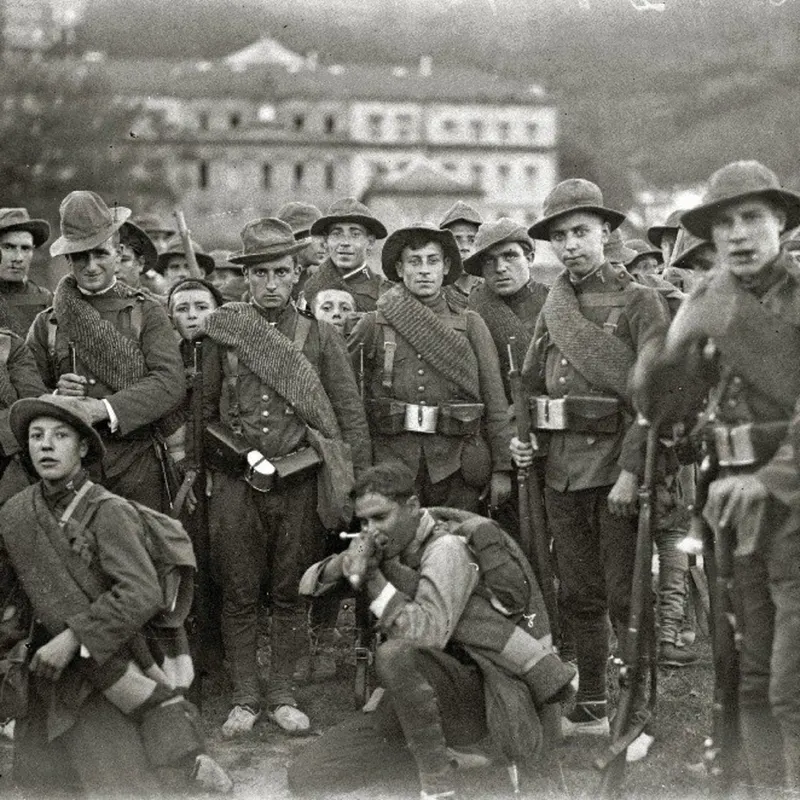
Yeah, so the magnet is the way I chose to render the title of Ramón Sender's 1930 novel, Imán, the Magnet. Literally, that's the nickname for the main character involved here. And so this story, it takes place during, it really takes place in the wake of the disaster of Annual, which was the greatest defeat dealt to a European army in the 20th century by an anti-colonial force.
The disaster of Annual
Just to set up some backdrop, the Spanish had long harbored imperial ambitions in Morocco, and although they only had a part of their ambitions fulfilled in the colonial carve-up of the country with the French that happened in 1912, the land of the north, which became the Spanish protectorate, was very rich in mineral resources. And so to exploit these resources, they needed to secure military control over the territory, which they proceeded to do in a manner that was both brutal and erratic. The armies were extremely poorly provisioned. The soldiers were treated as cannon fodder by the superiors, and their logistic system was incredibly poorly designed, which allowed a far numerically inferior force under the direction of Muhammad ibn Abd al-Karim, who was trying to found the Republic of the Rif, to cut them off and to meticulously kill off many Spaniards and their local allies. In the end, around 10,000 Spanish troops, as well as several thousand more native auxiliaries, lay dead in the mountains and the plains of the Rif.
So, in a way, basically, this is a chronicle of one of the, you could say, greatest anti-imperialist victories of the 20th century. But what's interesting is that it's told by the perspective of essentially one of the failed imperialists themselves, right? Because it's written by Ramón Sender, who I believe actually, was he part of this expedition himself? What was his involvement here?
He did serve in the Spanish army from 1922 to 1924. He was conscripted. Before then, he had already made somewhat of a name for himself as a left-wing journalist. And although he himself wasn't really present for the events of the disaster of Annual, he would have rubbed shoulders with many people who knew firsthand what all this about.
Finding Sender
Well, let me ask: how did you first come across Sender? How did you learn about this guy? And what drew you to him as an individual?
Well, I was doing a lot of reading for Moroccan history because after we did the Casablanca episode, I was really shocked to discover how pivotal Morocco was to Mediterranean history.
Yeah, and you've really dived deep these last couple months. It's very impressive how much research you've done.
I mean, I try. You've done your own share of the reading and the work as well. This is really a joint venture. This isn't all on me, really. The audience should know that this is the work of the Gladio team, not just me, myself.
Well, to continue about this story, so you explained how you first encountered... So you encountered Sender through your research in Morocco. And how did you discover, though, that this one of his books was currently out of print? What made you think and decide that you or us could help bring this novel, Imán the Magnet, back into the public view?
Well, I saw that this was one of the novels that's consistently cited as an example of the kinds of literature that were produced by the war. And it's really something because it's, although it's a work of fiction, it's very heavily rooted in historical fact. You find all kinds of gruesome details in there. For example, the fact that ultimately they were reduced to drinking their own urines sweetened by sugar to survive.
Oh man.
Yeah. Yeah. And just like these kinds of details, it's hard to come by this stuff in more academic history, you know, because it's just very graphic, it's very violent, and a lot of professional historians really try not to engage in something this gruesome.
About the readings
So we are about to read an extended set of passages from The Magnet, which a lot of these are involving Sam's own translation work, which is really impressive and exciting. Before we get into these passages, though, I think it would be cool to talk a little bit more about the context of this book. You mentioned that there was a whole bunch of literature produced in Spain after the war. I think most Americans probably have no idea that this Spanish incursion to Morocco ever happened. Could you just speak briefly on the kind of cultural and political impact this war or perhaps this defeat had on Spanish politics?
The Rif War and the Africanists
I would just like to say that without this war and without all the personalities involved, the Spanish Civil War could not have happened. The really gruesome part of the fact is that although many Spaniards were massacred the way they were, these were, for the most part, the lower ups. But nevertheless, this had a lot, this had a very strong impact on the Spanish military brass. And it really entrenched a very particular form of thinking in a faction that became known as the Africanists, who were, you know, people who harbored imperial ambitions in Africa writ large. And so you see a lot of figures who would be very prominent in the Spanish Civil War first make an appearance here. You had Franco, of course, there was Millán Astray, and many, many more. These were very hardened people. These were people who already had strong right-wing inclinations, but this war really primed them to think in a certain way.
The logic here was essentially that this war was, in a way, a continuation of the Reconquista of the Spanish peninsula. And so, just as the Spanish had driven the Moors out of the Iberian Peninsula, it was now Spain's duty to impose its will on North Africa to right this historical wrong. They saw what they were doing as really a crusade, frankly. And when it was all said and done, first of all, these were the people who had military experience writ large. The generals and the troops who were stationed on the Spanish peninsula didn't really see much action aside from putting down the occasional strike. But these people, they were really primed with the mindset that, like, if we can do a reconquista in Morocco, we can also do a reconquista within Spain itself against these nefarious left-wing elements who are trying to subvert the Spanish nation.
So, I want to talk about that part in a second: the way that this war would end up, in a sense, you know, prefiguring fascism in Spain. But before we go there, I think that what you said earlier about the Reconquista really touches upon a really common theme in our podcast, which is the ways that modern political movements will use and abuse the medieval and ancient past to support modern political programs. You know, that's obviously not that, that's not a new observation we're making here, but it really is remarkable how often you see this happening.
Oh, yeah, and absolutely. This is just a recurring theme in history. I mean, ultimately, one has to come to the understanding of history as not just a chronicle of events as they happened, but a telling of events from a particular vantage point at any given time.
Right, yeah, the construction of a kind of an official narrative of memory.
Yes, every generation must come to terms with its own history, and in doing so, they are bringing with it their own understandings of the present.
Pan's Labyrinth
You know, I might just be speaking for myself here, but whenever I think of Spanish involvement in Morocco, one single thing comes to mind, specifically one single movie character. You know who that would be, Sam?
No, go on.
The villain from Pan's Labyrinth.
Oh.
Because in that movie, this, yes, this like classic archetypal patriarchal fascist, the main character's stepfather, he himself is the son of a soldier who was killed in the Rif War. And so it's, I think it's kind of an interesting sort of legacy there. Because so this man, this is a guy in the 30s or 40s. His father, you know, decades before, had died in the Rif War, and he seems to see, he seems to think that the son seems to think that hunting down left-wingers in Francoist Spain is part of the same kind of nationalist project. Can you talk a little bit more about the ways that the Rif War and this kind of humiliation influenced Spain? It kind of reminds me of, you know, what we describe in America as Vietnam syndrome, the kind of wounded nationalism in the United States after the withdrawal from Vietnam.
Speak more about the kind of heredity of Spanish fascism and its origins in this defeat.
Fascism is colonialism brought home
So the French Martinican writer Aimé Césaire has a very famous line which paraphrased reads that fascism is colonialism brought home.
Right.
And I really cannot think of a more clear example of this being the case than the Rif War and the subsequent events in Spain. Because ultimately, as I said, these people were primed by a very particular form of thinking and the brutality that they inflicted on the people of Morocco to really shift their entire perspective to see that if such brutality can be inflicted upon Spanish subjects to make them submit, we can also do this on a larger scale to the Spaniards back home writ large to submit them to our will and to create our own political understanding of what Spain is and what being a Spaniard must entail.
Well, right. Anything else you can tell us before we get started about the book, the story, its character, Viance?
A proto-existentialist novel
Yeah, well, first of all, I would just like to mention that The Magnet has a very special distinction. And that being that it's really, in many ways, a proto-existentialist novel that preceded the works of the likes of Camus and Sartre by well over a decade. Even if Sender himself shunned the label, it's hard not to see the parallels there. The novel is really heavily influenced by this idea of the absurdity and cruelty of life. It's just regularly punctuated. And over all of this, the narrator, he's constantly making reference to this uncaring cosmic order that's present for all to see. And yet, despite all this, Sender isn't telling people that they must be resigned. He's ultimately saying that we must fight for justice for the common man and that there's an ultimate eternal unity of things. Although this was written before the Spanish Civil War, of course, you can tell that he had an inkling of the kinds of attitudes that the Spanish military brass would have had, and the way that they perceived both the Spanish soldiers and the Moroccans.
In fact, it's in fact the brutality that they inflict on their own soldiers is in many ways almost as bad as the brutality that they wish to inflict on the Moroccans, really.
Yeah, well, that's that is that I think it's so that's so classic in fascism, right? Like, even if you're claiming to, you know, protect your own nation, the methods you're going to employ in that defense are so violent that inevitably many members of your own nation are going to be persecuted as well.
Yeah, exactly. And so, Sender's point here really is that even if the universe is senseless, he's not saying that we must simply resign in the face of the absurdity, but we need to really manifest our will to struggle for the greater good. This is the meaning we must create for ourselves. And although the means by which we will do it is left vague within the novel itself, the implications are pretty clear. So, with that being said, let's begin to read the passages from the novel.
All right.
All right.
And last thing, Sam, one last question. So, the novel is not yet fully republished. It's coming very soon. When can our listeners expect to be able to get their hands on this new republished copy of Ramón Sender's The Magnet?
I'm not making any promises yet because this is really a very labor-intensive project, but I will try to make it available by the end of October.
All right, well, that's it. Okay, so yeah, end of October. Fingers crossed. All right, well, with that being said, let's dive in.
Reading: Viance's family
So, the first passage that we're going to be reading needs a little background information. I specifically chose this passage because it gives you an idea of the kinds of things that the average Spanish peasant would have been living through at this time. Viance, who is our hero in the novel, he's really the prototypical Spaniard per Sender's conception. He's from a family of literal dirt farmers who are constantly kept in debt, who are just unable to afford anything as basic as like a ham for Christmas. And writ large, these were the kinds of people who were fighting in Morocco because if a person had sufficient wealth, then their family would be able to buy them out of Morocco so that they could instead do their service on the Spanish mainland, which was also brutal in its own way because the men would be subjected to abuse by their officers.
These people were never particularly kind anywhere, but nevertheless, they mostly just sat around in their barracks and just messed around. Whereas the people who were in Morocco, these were the ones who were not given any regard at all and just sent to die for no reason, just to defend the fatherland, a line that frequently crops up within the novel. This is an amalgamation of a couple of passages that gives the background to Viance's life. There are a few breaks in the text because he's telling this story while the camp is also preparing its defenses. So there are interruptions, but we've stitched them together more or less seamlessly to give an idea of who Viance is, where his family comes from, and what they must endure. So that being said, let's get started. Viance returned to his memories, going even farther back than he had already. He spoke of a village in a dry part of the country where the people were farmers.
His father had plowed the Duke's land for 40 years without once seeing a decent harvest. It was only every five or six years he had enough to placate the wrath of the steward, who was an unreasonable man. I was twelve years old and followed the plow from dawn till dusk. I had to hold the handle above the level of my shoulder, and sometimes I stumbled and fell among the clods turned up in the furrow. They gave me half a loaf of garlic root to last the whole day, and my mother said she could not afford the expense of keeping me. At 30, my parents looked closer to fifty. They were so scrawny and haggard. My mother was always crying, and my father used to seize hold of us in a panic and say, Don't make her cry. She cries so much it'll make her blind. You'll think I'm lying, but I never once even saw my parents laugh.
And what about your siblings? How many are you in the family? There were three of us then. I had one little sister and one younger brother. Today, she would have been about 20. He would have been 16. But he got sick when he was little, and after that, he was always a bit stupid. Nothing but work, work. But there it is. The more you try to account for anything, the more muddled your ideas get. And then it was evident that he did not want to admit that his brother was an idiot, the word being repugnant to the tender sentiment of his memories. When I was 14, I said to my father, Why don't we go to Barbastro, where there's a railway and a bishop? You wouldn't have to work so much there, and I'm sure that in six months you'd be able to buy a new suit.
That was what had always worried me most about father, ever since I was quite small. As it had been 30 years since he had done as much as buy himself one pair of trousers, he was very poorly dressed. His clothes were mended through cordovan cloth with wagon canvas, even with sacking. But his reply to me was always the same. This year, the soil seems rich, and the wheat promises well. One day, I went off by myself to Barbastro. I felt that my mother believed in me, and though she never said anything about it, her faith flattered me and put me into excellent spirits. She gave me a new loaf, which she had borrowed from someone, wrapped up in a cloth, together with a clean shirt and six reales. God knows where she got them. I wanted a knife, too, but my mother didn't give me one.
So long as you are poor, never carry weapons, she told me. That doesn't do anybody good but the rich. On my way, about dusk, I met my father, who was coming home, his face livid with the cold, a damp faggot in his shoulder. The fog had caught him, and he was dripping at the elbows. This time of winter, he used to go to the mountains and return with a bundle of gorse and furze to make us a fire for the night, to keep us warm and to boil the soup. When there was a fire and some bread in the house, father would begin talking. He seemed like a new man. He almost always used to say that if we had a good year, we'd pay up our arrears and buy ourselves a few things, particularly a small ham. My little sister wanted chickens too, and my mother used to listen to us and never say anything.
Father would put his hands to the flames and then take ours and press them between his own. We used to go to sleep like that. When I met my father on the way to Barbastro, he said to me, Go with God, my son. Be an honorable man, and do not forget us. And I got lucky in Barbastro. Before a week was out, I got work as an apprentice in a forge. But I received no wages, just food. A year later, I was already getting three duros a month, which I sent to father. In the end, I earned 12 and sent 10 of them. With only two duros a month, I couldn't go to cafes or even have a girlfriend. As I was a senior assistant, I dressed appropriately to my rank, as you'll understand. A pair of trousers cost me eight pesetas, a pair of shoes, two.
There were two years when they couldn't even afford to buy seed, and I sent them all twelve that I earned. Every day I grew stronger. I could throw an iron bar 60 paces without breaking a sweat. My health was excellent. Unfortunately, the health of my family was not. One day I received a letter to say that mother was ill. I went by train to Vieran, and to there I tried to find a conveyance which would take me to the village, or someone who would lend me a mule. The snow was waist deep throughout the district. No vehicles were being driven. No one would lend me a mule, and I had to go on foot. It was six hours' walk to the village, but in that weather it took me over ten. I arrived about midnight. All the neighbors were in their houses. The family had been without a fire for five or six days.
My father was sitting in the kitchen with his eyes fixed on his rough shoes. I can see him now, and mother was dead. The doctor said her death had been hastened by drinking ice-cold water and getting up without putting her clothes on, and my father, from his knowledge of her, could well believe it. He said to me afterward, she knew she would never get better, and she did not wish to spend on medicine the few pesetas she had been collecting at the cost of depriving your sister a decent dress. The girl then was about fifteen or sixteen. The end of it was that my father. So there's a break in the text, but then Viance continues. After the mother's death, the three who remained stayed where they were: the father, the girl, and the idiot brother. The latter was capable of working at my father's side, and the sister kept house.
It was an easy task in a house where there was nothing to attend to. The father had watched his wife die with fatalistic indifference, but it was long before Viance could forget the silhouette of the corpse thrown against the wall of the undressed brick by the wavering fire of the lamp. After his return to Barbastro, three months had not passed before the sister fell ill. You see, don't you? She was my father's one consolation. Will you believe that she died too? My father was like a madman that day. He had always done his duty by the church, but that day, I can still see him walking across the square, very yellow in the face, and the priest comforting him. God has a thousand ways of testing our virtue. Have patience, he said. Father began to shout, God? Did God do this? Tell me where he is, your reverence.
Tell me, and I'll go smash his brains in. It was then that the father's loneliness and the calamity which had come upon him became most tragic and profound. Viance, watching the idiot resume his life of labor with the utmost unconcern and comparing him with his father, whose mind was still affected, asked himself whether the only possible happiness was not to be found in the complete absence of sensibility and the annihilation of intelligence. The expenses of the illness and the funeral swallowed up the savings of the mother, which had been intended for quite a different purpose. Father did not like to hear Viance talk of leaving the village. The cemetery was now his favorite resort, for the best of his life was buried there. What was left, his son's shadow, distorted by meningitis, and his own, were but vague hallucinations. The steward found him so crushed that he wanted to kick him off the estate, but Viance intervened.
He would cover the rent arrears from Barbastro. He returned to the forge. The blacksmith, sometimes moved to compassion and sometimes flying into a rage, would offer him wine or hurl forceps at his legs. He had two accidents. The axle of a cart fell on one of his feet, and two wedges flew out of the lathe and hit him on the head. Good God, man, you seem to be made of lodestone, he said. One day, thinking over these words, he saw that they were far deeper and more precise significance than their surface meaning. Viance attracted iron, in other words, misfortune, violence, to his vicinity. But it was not only he who did this, but many others. Laborers, workmen of his own class. He paid the Duke's steward, he sent the rest of his wages to his father, and yet the steward never showed him the very least bit of consideration, such as lending him seed or permitting him to delay payment of rent in the years when there was no harvest.
Nor did he succeed in getting his father and brother enough to eat, or even sufficient fuel to keep the fire burning. Nor did he ever receive a word of encouragement or satisfaction from his employer, in spite of the fact that he worked 12 to 14 hours a day. But none of his disappointments depressed him to the extent causing him to abandon hope altogether. A few good years would come and make his contribution unnecessary, and then he would keep the money and buy a set of tools and start his own shop. The sound of three distant shots came from the advanced post. They're having lots of fun in the blockhouse. Then came the rockets. Their light shone through the canvas and attenuated the glow of the little flame of the petroleum lamp until it was scarcely visible.
Reading: love and conscription
After that, Viance fell in love with the girl. She was fair-haired and sweet as a bunch of black grapes. He got as far as becoming her boyfriend and during the warm holiday evenings experienced the first stirrings of voluptuous pleasure. It was a very sordid affair. One day there was a rumor. Viance hesitated. A rumor that tore at his heart and put an end to the tranquility of his existence. His sweetheart had been seen with Lieutenant Diaz Orena. Viance's voice trembled as he uttered the name. She had been seen with him at twilight on the banks of the river at the other end of town. He thought at first he'd gone mad, and it cost him a good deal of trouble to understand that the swarm of anxieties, perplexities, hallucinations, and rancors he experienced were due to common jealousy. I asked him if he still loved her, and he replied, with agitation, that he believed so, though he remembered her only as he would remember a dead woman.
He had not attained his full virility until he fell in love. It had been of no avail to him that he'd been the champion bar thrower. This sport was a survival of javelin contests of the ancients, throughout the district. And the best working smith of the neighborhood was him. It was love alone which put a man into the category of a human being, and without it, everything seemed false and artificial. The radiant impressions of those first days, leading him to believe that he was entering upon a new and brighter existence, in which his perceptions would become profounder and more stable, had dazzled him. His original, cool, and energetic character was confirmed. His fellow workmen looked up to him and asked his advice in technical matters. It was he who had succeeded in obtaining a raise and in overcoming the obstinate resistance of his employer, who had sworn he'd murder the lot of them rather than grant any concession.
The appearance of his rival set his sentiments moving in a new direction. He had to fight, to defend his love as though it were a treasure. He made an appointment with the girl, but the very day they were to meet, he was called up, and when he found himself a soldier, his ideas for the moment underwent a change. He lost his frantically impatient desire to know whether she loved him and whether he had, accordingly, to seek out Lieutenant Diaz Orena and tear the soul from his body. From the time of his conscription to entry into the barracks and life as a recruit, he did not reflect. He had homicidal impulses of hatred for the lieutenant. He probably would have killed him if his own freedom had not been necessary for the support of his family. When he became a recruit, Lieutenant Diaz Orena was his instructor. Obedience weighed upon his spirit like a block of ice.
Then came the first sentence of confinement. He not only did not kill the Lieutenant, he even received a couple of blows from him one day and had to stomach them. He lost his position at the forge. Every day he felt himself more and more dissociated from what he vaguely supposed his life was going to be. And what about your father? Was there a harvest at here? The spring started very badly. They had a procession with the sacred image, but only a few drops of rain fell. A mere formality. That part of the country is just an arid waste, no use to anyone. The little that did come up, the locust got. Viance's hatred for the lieutenant had survived four forgotten years, and that hatred was all that now gave to his words and gestures the normal vivacity of a human being. What about your father? What became of him?
Without continuing his narrative, he fumbled in his breast pockets. At last, he fished out a filthy piece of paper, ragged at the folded edges. It was the last letter he had received in Africa three years before. It was in vain that I tried to read it. Below the first lines, there were three capital letters in the center of the paper: A D G, a Dios gracias. Lower down, the brother was referred to. He now slept in barns, because no one, remembering that his family had been honest folk, would refuse him the shelter of a roof. What of the father? Viance took the paper from me. You can't read it. It's got all greasy with sweat. When I came here, I stopped sending the steward the rent, so my father, to avoid being ejected, sold everything he had and paid the first year. The following year, after another miserable harvest, when the ears matured and came up blighted, he was at the end of his resources.
He worked day and night, running to see whether the frost had any effect on the land or whether the dews had softened it. He picked the stones and the noxious weeds out of it one by one with his own bare hands. He ate nothing and had no fuel. My young brother ran away when he found there was no bread left, and the police brought him back. One day, they found my father dead at the edge of the field. They wrote to me that it was heart failure, but it was hunger. They didn't tell me because it would reflect shame on a village that let one of its own die that way. That year, there was a magnificent harvest. He shook his head in despair. What a farce life is.
Reading: the attack on the camp
So in the next excerpt, we're talking about the events that unfolded as the camp was under attack. This was when the Spanish forces were dislodged from Annual, and because of the logistics system that they had set up, their military strategy was set and centered around these blockhouses, basically these forts, every couple of miles, which would secure the territory around them. But unfortunately, these forts were very poorly suited for... for delivering sustenance for its inhabitants, so the entire system depended upon convoys coming in every couple of days to bring in supplies, water, food, just everything. They couldn't do anything without the convoys. And so when the Moroccans were able to disrupt the movement of the convoys, this spelled a certain doom for the people in the blockhouses as they slowly died from exhaustion, from thirst, from the fighting, and ultimately from the fact that they simply ran out of ammunition.
So here we go as the camp that Viance is in is attacked. The flare gun was discharged in the center of the camp. Immediately, the Annual gunners began shelling the hotspots. They fired regularly by batteries with extreme precision. An advance party left the camp with two sections in extended order on the flanks. The men trotted forward persistently, mustering all the strength they had left. The creaking of their stirrups and saddles reminded one of the horses employed in the bull ring. Our own guns, near at hand, were firing too, and in their rare flashes could be seen the silhouettes of the retiring detachments our machine guns were trying to reach. The evacuation of the camp continued. As each party got past the wire, it went into battle formation while still on the march. The askari detachment went first. The falling shells really less helped us than the knowledge that this terrific uproar was being made by our own people.
The ground was wired up again behind the last of the departing troops. About 300 men had left the camp, and about the same number of us remained behind. The little column went forward at a rapid, impatient rate, without mishap. Viance could see the earth boiling up into great bubbles to the right, under the shellfire. Farther off across the plain, a group of horsemen appeared, tiny as toy soldiers. They were out of range of the machine guns, but they had been seen from Annual in the quick-firing artillery. That active and efficient force shelled them. The horses capered in the white clouds of smoke, rearing and whirling round on their hind legs. Clouds like cotton wool burst continually in groups of four above the horsemen. The successive shells tore the clouds made by their predecessors into shreds. The two guns from the camp now came into action, shelling the trenches where the enemy had been waiting for us that morning.
The reports sounded deep and soft, as though the guns were wrapped in cotton wool. They were followed, about a meter above the furrows, which indicated the position of the trenches, by the twin clear flashes of the explosions. As the afternoon light waned, the flames of the bursting shells became visible. They were whiter than the smoke, as though the projectiles had been packed with silver or fragments of looking glass. The column marched steadily into the plain. It appeared that they had gone a considerable distance already, but the unmistakable menace of the endless desert surrounded it, hemming in more and more closely every moment. The uproar was tremendous, but the landscape did not lose a bit of its enigmatic serenity. Viance kept his eyes on the column. The rear guard was reinforced now by a further section in extended order, and the flanking parties were fixing bayonets. Ah, the bastards. They're coming.
The machine guns aren't holding them. The column was formed into extended order as fast as it could, with long intervals between the men. One of them tripped, fell on his face, rose again, and fell a second time, sideways now, as though they were trying to force an entrance through the earth with his shoulder. He belonged to one of the flanking parties, which were at some distance from the road. A corporal approached him, unfastened his belt, and took off his equipment. Then he picked up the man's rifle and regained his party. The column continued to advance. The shells were falling closer to the road now. The wounded man scrambled to his feet and tried to catch up to his companions. If it had not been for the noise of the guns, he might perhaps have been heard shouting, Corporal, I can walk. That was nothing. The column, however, proceeded, and the wounded man lost ground steadily.
A tormenting anxiety spread among the watchers on the parapet. Viance remembered the retreat at the double, when he had fallen down and had the wind knocked out of him. The commandant had gone up to the lieutenant colonel. With your permission, sir, may I shoot a man belonging to the second battalion who can't keep up with us? If we leave him here, he'll only be cut to pieces by the Moors. The lieutenant had interrupted the other in an angry tone. Only if there's no alternative. You can put him on my horse, can't you? Have him brought here. It was true that the lieutenant colonel in question had the reputation among his brother officers of being a sentimentalist with very little of a military man about him. The wounded man was down again. Firing broke out to the right and to the rear of the column. The earth near the wounded man whirled up and scattered through the air.
Two shells had fallen there, one after the other. Viance could not see the man afterward, but further on, all around the column, the bullets were beginning to fly. A regular hail of them burst from a redoubt which the Annual batteries had failed to locate. Our own guns were shelling a short scope on the other side of the road. The rifle fire diminished, but the column had now left four more soldiers behind it on the road. Viance suddenly began lamenting. And us? What is to become of us? For the first time since coming to Morocco, he had lost faith in his officers. He had already witnessed two failures by General S. The Moors had no shortage of horses, good machine guns, and better bombs than ours, for they contained over a kilogram of nails and empty cartridge shells, which could be picked up on the plains. The situation was rapidly deteriorating.
Signs of faltering and malfunction were everywhere. Yesterday, an airplane had been shot down, and the troops marched by. They saw the dead pilot's body nailed to the top of a long pole. General S had been unsuccessful in his appeal for reinforcements. Some said his appeal was refused because he was too fond of making advances unauthorized by the civilian commissioner. Others that his request meant obtaining fresh battalions from Spain that the government would not even consider sending. It was also said that the staff was jealous of the general and wanted to get him disgraced. The result, in any case, was the same. The column had now descended into the plain, halfway down the road. The roaring of the shells was much louder. The camp guns seemed rabid. They fired incessantly, and there were none of the intervals between the reports that had given rise to the fear that they might become overheated and burst.
The parapet shook at its foundations. The men, to facilitate the elimination of the uproar from their ears, unconsciously opened their mouths. The first flock of carrion crows arrived at the sound of the guns from the neighborhood of the buildings at Annual and perched in groups on the ground. They had devoured so much soldier's flesh by now, no doubt, that they had achieved a certain understanding of the art of war. There was one on top of each of the telegraph poles. They all looked fat and glossy, and utterly satiated caws resembling belches emerged from them. The flanking files of the columns were now reduced to about four or five soldiers. The men who had already fallen would have companions in their long sleep. The daylight grew fainter, and the bursting of shells exuding almost red flashes could be seen better. The softness of the landscape was but a deceitful illusion.
To the left, the horizon was thick with bluish shadows. The shells explored the silence of the deserted and desolate immensity, testing its capacity for dramatic infinitudes. More and more sections spread to the flanks of the columns in extended order and were decimated. They could only be seen now as tiny black dots resembling ants. And they were much fewer, perhaps half the original number. The camp commandant, carrying his binoculars, passed through the parapet, remarking to the captain, The whole column ought to have halted and gotten to an open order. They would have been able to escape then, with the help of the cavalry at Annual. The general is too impulsive. He thinks everything he orders is bound to turn out well. The captain made a gesture indicating that he was in on the secret and didn't want to discuss it more than he could help. Shortly after, our own guns ceased firing.
For some time, they'd been in action only at long intervals. It was useless to keep it up. Too many shells were going astray, and all the ammunition we had may very well prove insufficient to defend the position. It was getting dark. The column was already invisible, and the shells from Annual were fewer and were now being fired haphazardly. There was still a certain amount of light in the camp, however. The last rays of the sun lingered on the canvas of the tents and on the chalky ground. As the gunfire diminished, the crackle of rifles could be heard more distinctly. It was less intense than might have been expected. Perhaps they were using their bayonets now. Signs of life were limited to the sounds made by the relief taking over inside the circle of wire and sandbags. The world ended at the parapet. Night was enveloping everything in black cotton wool, in chilly wrappings of crepe, in deep and desolate black.
The process of taking over, like so many others, was now complete. First came the disorder of the preparations for departure. Then, then the similar disorder of arrival. By the time the retreat had been sounded, everything had resumed its normal aspect, resembling the makeshift and shabby outfit of a traveling mendicant. Here and there, conversations were in progress. One soldier, stretching his blanket on the ground, observed: What are we to do, you ask? Defend Spain. That's what we've got to do.
Reading: the wounded soldier
And here we have another break. I forwarded to the end of a chapter when a soldier who had survived the onslaught comes stumbling back into the camp, hoping to get relief to be saved by his comrades. And so we continue. Out of the depths of the night, and yet very near to him, came subdued moans, in human voice, but deliberately muffled. Hey, who goes there? Viance asked. Don't shoot, comrades. Is this Annual? Who are you? Help! Is this Annual? Corporal! The corporal did not appear at once. The soldier believed that he had been left to his fate and cried out. Think of your mothers, boys. I'm in the first company, third battalion, Ceriñola Regiment. I've been shot twice. They broke my leg. Is that Annual? No, this is our. Now was the corporal's turn to answer him. The wounded man groaned, then cursed.
It was impossible to see anything. Dense shadows lay above the lighter ones, forming a network of shadows. An officer appeared. What's all this? The wounded man repeated. I've got two bullets in me. I belong to number one company of the battalion you relieved. And you say this isn't Annual? Christ Almighty, if you're not Annual, then God has forsaken us. Did the relieved column get to Annual? There's nothing left of it to get there. Didn't you see what happened? I'm one of the lucky ones. Listen to me, my boy, the officer warned him. You're talking to the aide-de-camp. Very good, sir. No, sir. The commandant was killed, sir. And then. All right, all right. I don't want to hear anymore. Do you still have your rifle? I've got three. You've done your duty well. Take out the bolts and throw them over here. Make sure they fall inside the parapet.
This order implied that it was certain that the Moors would soon reach the point of the wire and might get hold of the rifles. For the wounded man, it was a death sentence. Viance muttered idle threats on the officer's brutality below his breath. Does he think there's an ambush and they'll fire on us if we come out? On a dark night like this, they couldn't do us much damage. And even if they did, we could easily get back in now that the wire's been cut. The soldier hesitated for a moment, then begged in a tone accented by terror. Lieutenant, sir, I know it doesn't make any difference, but I'm due for discharge in just three months. What's that got to do with anything? If I get well, I could go home. There was no answer. The man added, dragging the words out of him in a hoarse whisper.
I don't deserve to die like a dog, Lieutenant. Sir. I forbid you to continue talking. Very good, sir. The wounded man changed his tone. The moon rose. A spectral metallic glitter illuminated the plain. The wounded man was lying on the ground, his broken foot trailing behind him like a piece of tattered cloth. He was grasping the stakes of the wire entanglement. The four or so meters of that barrier of twisted, sharp-pointed spikes were too far for him to jump. When he found himself exposed by the moonlight, he tried, in a voice of panic-stricken impatience between despair and humility, to make a last appeal. Lieutenant! Rifle shots close at hand drowned out his utterance. He did not attempt to continue speaking, but flattened himself against the ground. After an interval of silence, he resumed in a hushed tone. I'm going to throw them over now. I'll fasten my dog tags to one of them.
Can you please pass it on to the sergeant major, sir, so that he can at least write home? The sergeant major had been killed down in the plain, but the wounded man did not remember that. The lieutenant ducked behind the parapet to keep the bolt from blowing his head off. One fell inside the redoubt near the hospital. The next dropped among the men of a passing patrol. The third was thrown short of the parapet. The wounded man let his head fall on the ground, which was covered with debris and lumps of dried excrement. The aluminum dog tag, about the size of a five centimo piece, was fastened to the first bolt. The lieutenant read out the number, T-7.241. He noted the number in a small pocketbook he carried and threw the disc away. There was a small piece of string, blackened with sweat, attached to it.
Publishing plans
Well, alright, that is a pretty exciting passage. I think I can absolutely see, Sam, why you really fell in love with this book, and I am so excited to be able to read the full thing. Can you talk a little bit about-I know you can't say when it's going to be finished-the new translation and republishing, but how will our listeners be able to get their hands on this book?
Well, I'm planning to publish it through Amazon Publishing because, unfortunately, that's the best way to make a book available, unfortunately. But I will think of some ways to make it available by other means as well for people who don't want to give money to Bezos. So, stay tuned.
Well, thank you for all your great work with this project, Russian Sam. This is really exciting. I think this whole Morocco-Spain project is really fun. And I can't wait for the magnet to come out, and I can't wait for us to continue the story of Morocco and Spain in future podcast episodes.
Yep, stay tuned. It's all coming. We're only just now starting to get to the good stuff.
This is Gladio Free Europe signing off. Bye-bye.
The show is also on Apple Podcasts, Overcast, Pocket Casts, Podcast Addict, YouTube, RSS and Patreon.