52
E. Howard Hunt, Novelist
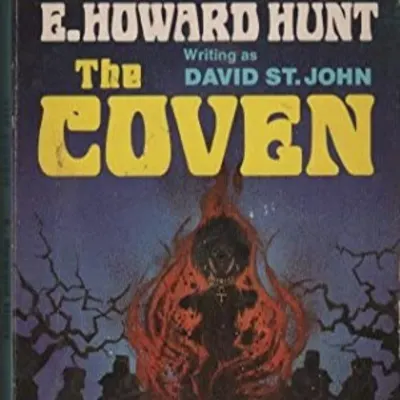
In progressCIA agent Everette Howard Hunt, Jr is notorious for involvement in the 1954 Guatemalan coup, the Bay of Pigs invasion, and the break-in at the Watergate hotel. But not many people know about most heinous crime: his decades-long side hustle as a hack writer. In this episode, we try to stomach his paranoid 1972 thriller "The Coven," in which a straight-laced attorney uncovers that Black Panthers are colluding with liberal elites in occult ceremonies in the shadows of Washington, DC. We explore what this book says about Hunt's personal anxieties, why his boss Richard Nixon thought the world could be divided into "Orthogonians" and "Franklins," and what the famed G-Man may or may not have been doing in Dallas on November 22, 1963
Hosted by Liam, Russian Sam, and Abram.
Transcript
A summer page-turner
And we're back with another episode of Gladio Free Europe. I am your host, Liam, joined here today by Abram and Russian Sam.
What's up?
Hello, hello.
And today we have a very special episode. We dug up something deep in the archives. I hope all you guys out there are, you know, enjoying your summers, maybe sitting by the beach with a nice little page turner. The three of us recently found a pretty fun book that we wanted to share with all of you guys.
A classic pulp novel.
Yeah, yeah, exactly. A classic right up there with like, you know, the works of Ian Fleming. A fun thriller, you know, along the lines of Graham Greene or Raymond Carver that we think a lot of you guys, the audience, would find interesting.
For the record, I do not recommend digging this book up. You absolutely do not want to read this. You will not have a good time.
Yeah, okay. Well, Sam here is a detractor. But this book is really something to behold. The book we read this week is The Coven, a forgotten political thriller with supernatural elements by a writer known as David St. John. Nobody has heard of David St. John really before or since. He wrote a handful of books with that name in the 70s. None of them made any kind of a splash at all. But pretty soon after these books came out, it was discovered that David St. John didn't exist. Instead, this was a pseudonym for a character so much more colorful than anything the author's limited imagination could come up with. Turns out, the real identity of David St. John was former CIA man E. Howard Hunt, one of the most notorious G-Men in American history. On the side, for more than 50 years, this guy, when not planning coups or illegally surveilling his own citizens, was writing the worst, the most contrived, and the horniest crime novels you could imagine.
Hunt as a novelist
So, to tell me, both you guys, what are your thoughts on this book and just the idea of E. Howard Hunt as a pulp novelist?
Okay, leaving aside his political activity, I think Hunt should have been sentenced to death for his prose alone. Like, he's this very trashy style, where at the same time, he has pretensions to like literary greatness. Like, he just has untranslated passages in French in there, acting as if like he's Mr. Worldwide.
Yeah, Tolstoy or something. And you have any thoughts, Abram?
This guy sort of reminds me, early on in Mad Men, I think in the first season, the character Ken Cosgrove writes a short story that's like actually good and gets published. And the jealous, vindictive character Pete Campbell sees this and wants to write his own novel. Now, Pete Campbell is not a creative writer. He is not a good writer. He just sees other people's success and thinks he has the ability to become successful in that field.
I mean, when he was first starting out, his first novel came out in 1942, I believe it was. It was basically the first novel written by an American who had served in the war about the war. And it was modestly well received. And I, and presumably, that just split something in him that he just had to keep writing. He just wanted to be the next great American writer. But instead, he just became a run-of-the-mill pulp fiction writer who just thought that he could do it better than Alexander Fleming, so he should get equivalent levels of fame.
Was that first book written under a pen name, or is that under his real name?
No, no, it was under his own name. He would write books under his own name until 1949 when he actually joined the CIA. And then again, at the end of his life, in the 90s and 2000s, before he died, he wrote a few more books with his real name. He wasn't doing much writing in his final days. Right before his death, they released a book, An American Spy, which was ostensibly written with the co-author, but the co-author was just the ghostwriter because by that point, like he was sick with everything. He had cancer, he had pneumonia. He just wasn't in a state to actually be writing. So they just handed it off to this guy who was just hired to do the job. And I mean, I read some of it. It's okay. It's readable, but you can tell that his heart wasn't really in it.
Who was E. Howard Hunt?
Well, yeah, so let's talk about Everett Howard Hunt, the man himself. Who exactly was this guy?
As you said at the top of the episode, he was one of the G-Men. He really made a name for himself in Guatemala in particular, where he played a very active role in propaganda operations against Colonel Arbenz, who was the leader of Guatemala at the time.
Yeah, yeah, yeah. And before that, if you want to even go a little bit farther back in his life, he has a kind of interesting, or maybe an interestingly disinteresting upbringing. Because like so many other people involved in American politics in the 40s, 50s, and 60s, he came from this northeast, upper, upstate New York kind of background. Quite privileged, you know, he went to private school, ultimately went into the Ivies. But what I think is interesting about him, which I think you see a lot among right-wingers in this area, is he was never as close to those elite social circles as he wanted to be. And this reminds me of the Pete Campbell comparison, Abram.
And comparison to somebody else that will be yes, yes, we'll mention him soon.
Another thing to mention here, I couldn't find confirmation of this, but some people might have suggested that the Hunt family was Catholic. It seems like it's not totally known for sure what his religious affiliation was, but if he was Catholic, he was very much a Catholic in the William F. Buckley style, but you know, like a Catholic wasp, basically.
And we should mention that Buckley ended up being a personal friend of E. Howard Hunt as he got older.
Yeah, yeah. Yeah, first Buckley went over to Mexico City to work for Hunt in some unspecified role. He claimed it was to translate something, but I mean, I don't know. But yeah, they would remain lifelong friends after this. They had similar crank complaints about liberal elitism. Well, elite liberalism, rather.
Well, we're kind of getting ahead of ourselves here. How, Sam, how did E. Howard Hunt, this kid from upstate New York, get involved in American politics to begin with?
Guggenheim and Bimini Run
Yeah, yeah. So World War II ends. He's done with China, goes back to America. He somehow manages to land a Guggenheim fellowship in 1946, which is a very prestigious literary prize. In fact, Gore Vidal was really mad that this guy got one before he did. And I mean, it's funny. I understand, like, having read some Gore Vidal and having read this guy, I understand. I'm baffled as well. So, he got his Guggenheim Fellowship and he decided to go down to Mexico to improve his Spanish while he's also writing his novels. And he just kept pumping them out year after year. They sold fairly well. He was getting like 150,000 sales per copy.
That's pretty good, damn.
Yeah, in fact, he was doing so well that his 1949 book, Bimini Run, was bought by Warner Brothers, who wanted to make a movie out of it. Although nothing really came of it, but he was paid $35,000 for the rights to it, which was a lot of money back then, especially for just like a basic proposal for a novel that wasn't even really well received.
It's funny that he got $35,000 from Warner Brothers, because the last thing I heard about Warner Brothers giving people money for like ideas is when they did that Annabelle creation movie where they had like a contest for you to pitch a movie and the prize was $50 just to like buy the idea and another $50 if we decide to make it. So $100 total if Warner Brothers makes her movie. $100 in 2018 money versus $35,000 like 1950s money.
That's great.
Yeah.
Yeah, it says a lot about America, doesn't it? We were once so great for failson WASP writers. Pretty soon after this, the writing career of E. Howard Hunt would essentially come to an end. However, the writing career of David St. John would only just get started. Because once E. Howard Hunt started his new job, he would no longer publish books under his own name. And that's because what was his new job?
Joining the CIA
It was working for the CIA. He had joined the agency in 1947 or 48 because, you know, the OSS had outlived its usefulness and it was time to get some new guys to get some new titles. And he was everywhere. He was a genuine globetrotter in the 40s and 50s.
Oh, yeah, absolutely. So in 1948, they sent him over to Paris ostensibly to administer Marshall Plan Aid. In reality, he was at the CIA Paris station. Kind of hard to tell what was going on over there. But clearly, he was up to some of his political shenanigans, which he would get a knack for later on in his career, as well as sleeping around, eating fine wine, and writing more novels.
Right, yeah. And I think what's also interesting here is that it was during his time in Europe, at the start of the lifetime of the CIA, that he really started to clash with other people in the growing nascent intelligence community. Because E. Howard Hunt was actually exceptionally right-wing for this milieu, which in the late 40s, early 50s had somewhat of a more international liberal bent than government institutions tend to do today. This would become a huge rallying cry for groups like the Birchers, who we talked about before, you know, that would emerge pretty soon after. And in E. Howard Hunt's life, it meant that he was convinced that he was a hard-working American and that these liberal elites, essentially, in the higher positions of the CIA, were really hardly better than communists. And so it was this time in Europe that seems to have really sharpened the blade of his grudge against his, you know, social betters who didn't go to Brown, the guys who went to Princeton and Yale.
And I think this is, you know, pretty interesting. And once again, another parallel to a figure who will feature prominently in this story.
Right, yeah, so yeah, yes.
Nixon, Franklins, and Orthogonians
And so, so, Abram, explain this. So, let's let's get to cut to the chase. What is this parallel we're talking about?
Yeah, so, you know, Hunt worked for Nixon eventually, and he has like very interesting similarities to Nixon. In the same way that, you know, Hunt went to these sort of prestigious schools, you know, he worked in these institutions, you know, with all these other guys, but he never quite fit in. And he was always like, you know, sort of socially outcast. And that's part of why, the reason why he never succeeded, you know, in becoming like a very big guy in the CIA. But it's very similar to Nixon because, you know, obviously the story is Nixon, he hated the Harvard guys, and he hated the Harvard guys because he got into Harvard, but he didn't have the money to travel to Harvard. So he went to college in California, just like stay close to home. Whittier College, yeah. And then, you know, later on, he would be elected to Congress, and then, you know, he would be a vice president.
But in that time in Congress, he never really made friends with the people in DC. He was actually good friends with JFK in the very beginning, but...
Oh, that's funny. I know that.
Then they ran against each other and, you know, that friendship kind of like sailed by. But yeah, he, again, he was the same deal. He was always a little too right-wing or just a little too much of a nerd, really. Like, if we're being honest, like a little too much of a buzzkill to like be in like the Georgetown parties. Yeah, yeah.
I don't know if you two guys have read Nixonland by Rick Perlstein, which is a favorite book of mine that I just reread a couple months ago. But a really big point in that book is this distinction that apparently existed in Nixon's mind going back to his days at Whittier between the well-heeled, erudite and possibly even soft on communism Franklins versus people like himself who were the hard-working, less privileged, more right-wing Orthogonians, which is an obscure Greek word meaning at right angles. And so according to Perlstein, Nixon basically divided the entire world between Franklins, who I think he would certainly include the Kennedys in that, and then people like him, the Orthogonians. And if he had ever taken the time to explain this to E. Howard Hunt, which maybe he did one day, you know, sitting in the White House Rose Garden, then he would have explained that E.
Howard Hunt also was an Orthogonian.
Alger Hiss
And I think that a really interesting example of this in Nixon's career as a congressman, which really illustrates this whole thing quite well, is the famous story of Alger Hiss. You guys know what happened there?
Oh, yeah, yeah, absolutely. State Department guy who had flirted with the Communist Party in his Harvard days, because that was the wave of the future. That's what elites did back in those days.
Right. And just to pause here, no, in his Harvard days, right? That's important, not his Brown days. He was a more elite guy than either Nixon or Hunt. You know, we say, oh, Brown is an Ivy League. It's like, Brown is an Ivy League in the minds of like people trying to make it big when they're still in high school. But in the act, once you actually get to the real social circles that like run the country, it is Harvard and Yale and Princeton. And not even Princeton so much. Like up until recently, basically every Supreme Court justice was Harvard and Yale.
Yeah, this is a very dated reference, but at one point there is a Family Guy gag where one of the guys is like, oh, yes, my retarded cousin went to Brown.
Yes, thank you, Seth MacFarlane, for explaining this much more simply than any of us could. Yeah. We just had to go back to Alger Hiss. Probably the most famous part of this story is that Alger Hiss eventually would be implicated in selling some kinds of secret documents to the Soviet Union. And the way he would be found out about this, thanks in some part to the efforts of Richard Nixon, who, as a congressman, was the biggest opponent of Alger Hiss and attacked him most strongly when a lot of other congressmen thought he might be innocent. The way they found these documents was because they had been stashed in a hollowed-out pumpkin on the Alger Hiss family estate.
Yeah, I gotta say, that's a very clever hiding place. I'm gonna have to keep that one in mind.
I would just say that, like, personally, if I was hiding documents, I don't think I would hide them in the one fruit that is most famous for being carved. Like, come on, of course, you're gonna check the pumpkins first.
So, like, when you get to a certain level of the upper classes, like, essentially, the problem for Nixon and Hunt and all these guys is that, like, they're not really commoners. So, the people who they would have had the disdain for, like, the real fancy boys, like, those people wouldn't really be interacting with, like, Joe Schmo. So, all of their misgivings and snobbishness would be like directed towards these people who are like well-off enough to be in the club somewhat, but not well-off enough to have the same pedigree.
The red scare in Latin America
Right, right, yeah. Yeah, and I think that we should mention that it was, yeah, and so, and it was during the mid-50s that in a lot of ways, E. Howard Hunt would essentially be vindicated because the red scare would happen across the late 40s, early mid-50s, wherein a lot of the guys that he saw as soft on communism would also be perceived as soft on communism by other elements of the State Department and the CIA, meaning that more explicitly right-wing figures like him would essentially have either more authority or be given free reign to do whatever they wanted to squash what they perceived of as communism or communist sympathy across the world. And nowhere in the world in the 1950s would be hit harder by this new wave of violent anti-communism than Latin America. And because E. Howard Hunt spoke Spanish, he would spend most of the 50s doing a whole litany of terrible, really crimes, really, all across that world region, starting in Mexico.
Yeah, so he was stationed down in Mexico, and again, he was involved in labor stuff, I believe, because again, because of the more leftward-leaning internationalist angle of the CIA at this time, they were trying to promote a non-communist labor movement across the world. So Hunt would have been responsible for things like that. And at one point, there was supposed to be a meeting between the president of the Philippines, who was, you know, not a communist by any stretch of the imagination, but he was for land reform and all those things, which to people like Hunt would have sounded really communist-y. So this guy was supposed to meet with some Mexican labor leader who was working with the U.S. Embassy. So I presume this also would not have been a communist by any stretch of the imagination. But Hunt had this guy arrested right before he was supposed to have a meeting with the president of the Philippines.
And he subsequently got chewed out for that because it could have caused a major international incident if the president of the Philippines had gotten swept up in this, it would have been really embarrassing. And it was at that point that Hunt really begins to get a reputation as like a fuck-up.
Yeah, right, right.
But despite that, you know, he found ways to, you know, keep hanging on and getting these important positions. We don't really know why it was, you know, I don't know if he had, you know, kompromat on somebody, if he was just really good at making friends and staying friendly with people who were in a position to hire or promote him. But despite this kind of bumbling, he stayed in the CIA for about 20 years and would go all across Latin America doing similar kinds of subversive covert activities, you know, to hunt down labor leaders and all that.
Most intra-race of these probably would be 1954 in Guatemala.
Guatemala, 1954
Yeah, that was the coup against Colonel Arbenz, who was a military leader who was democratically elected. And he essentially screwed over the United Fruit Company because what they'd been doing is they had a bunch of land in Guatemala that wasn't really being used at all. But at the same time, they never wanted to pay taxes on it. So they massively undervalued all of that land. So when Arbenz comes into office and he starts talking about land reform, you know, taking away the land that's not being used by these international companies and giving it to the peasants of Guatemala who at this point would have basically been stuck in serfdom. Like, that's how terrible conditions were. And because of what the United Fruit had been doing, cheating their taxes all this time, it looked like the value of their land was much lower than it was. So when they were compensated what they said it was worth, they started to make a fuss about it over in Washington.
That's a great bit on Arbenz's part. Yeah, like seeing these guys cheating on their taxes and then, you know, taking them at their word for it.
Yeah, so they concocted a cockamamie scheme where Arbenz was supposedly in league with the communists. They were supposedly shipping weapons over to Guatemala. You know how it goes. So they started supporting an army coup that only had something like 150 troops actually involved. It was minuscule, but they did have access to jets, which they used to great effect to actually bomb the capital city of Guatemala to demoralize the population and get people to surrender. And it worked. They got Arbenz out of there and they replaced the government of Guatemala with a junta, which would completely roll back labor protections and pretty terribly oppress the people of Guatemala for years. Oh, yeah, yeah. Yeah, this would all culminate in a civil war that was still going on into the 80s. The most famous episode of that was the genocide of the Mayan peoples of the coast. But that's getting way ahead of ourselves.
Right. Well, listen, what matters here is the fact that this was a cataclysmic event for the Guatemalan people. And it also involved, it didn't go super well for the CIA themselves, as far as I understand. But because they managed to pull it off, this would be the feather in E. Howard Hunt's cap for the rest of his career. He was seen as the one, you know, who saved Guatemala from becoming communist.
Yeah, and it wasn't the same kind of stuff where we get now where no one really wants to fess up for it. Like in those days, like even Dulles was bragging about what they had done in Guatemala a couple of years after. It was something that was a chip on their shoulder. But Hunt himself wasn't happy with the outcome because the guy he wanted to be installed as president didn't get it. So, you know, once again, the communists win, as they always do.
Right. And so after that frustration, he ended up going to Uruguay, which, you know, bizarrely in hindsight was seen as the most, you know, potentially communist-leaning nation in Latin America.
The Bay of Pigs
And then suddenly, 1959, the entire American foreign policy establishment is taken by surprise by what? The Cuban Revolution. It's just, you know, what, 50 miles off the coast of Florida, you have what would soon become a communist country professing sympathy with the Soviet Union. Complete transformation of U.S. foreign policy goals. They begin firing on all fronts, trying to figure out what we can do about this Castro guy.
Yeah, and that's where Hunt had his perhaps grandest fuck-up in terms of actual lives, if not in the American media. But Bay of Pigs, you may have heard of it. You may have listened to Blowback season two.
Right, yeah, yeah, yeah, great pod.
Yeah, mutuals with that, guys. You should listen.
So he would make all these friends in the Cuban-American exile community. You know, again, he spoke fluent Spanish. He was probably, you can imagine him, you know, hanging out, drinking rum, listening to salsa music. And he started realizing all these Cubans coming over, they hate Castro. It must be that everybody in Cuba hates Castro, right? And I'm sure he didn't ask why all the Cubans he knew happened to be wealthy and white. So he manages to start training this dissident army with the intention of invading Cuba. It starts in the Eisenhower years, continues into the Kennedy years, and then they tell President Kennedy, hey man, we have this plan, we're invading Cuba, and I guess somewhat reluctantly, Kennedy signs off on it. And so in 1961, they are about to launch this invasion of Cuba, landing at the Bay of Pigs. They learn they're not going to have air support.
as they thought they might have because I think Kennedy realized that that might actually cause World War III. So let's pull back there. But they decided, screw it. We've got all these guys. They almost hate Castro over there. We can do it. They go to Cuba and what happens?
And well, first of all, they weren't sitting synchronized. So they were supposed to all land at the same time, basically, but they didn't get there at the time they were supposed to be there, any of them. So it was very easy to just pick them off one by one as they landed on the coast. And yeah, it was a massive disaster. It was the thing that really made Kennedy a lot of enemies in the Cuban exile community, which might have come around to bite him in the back, allegedly.
Maybe so, yeah, that's true. And speaking of biting him in the back, he also would make an enemy of at least one guy in the CIA because E. Howard Hunt would blame Kennedy for the rest of his life for withdrawing air support and saying that it wasn't him who screwed up. It was Kennedy.
Before we move on, Abram, do you remember that thing like two years ago when all those Venezuelan guys and the Gringo too tried to invade Venezuela on fishing boats?
Yeah, yeah, I remember that very clearly. And so I think in that case, Trump and Bolton were fully on board.
No, Trump withdrew support because Guaidó's wife went to see him and she wasn't wearing her wedding ring, so he just decided that this isn't a cause worth investing in. Yeah, yeah.
Well, I'm bringing this up because, you know, you're talking about the Warner Brothers pride, you know, Warner Brothers purchasing prices going down from $35,000 to $100. Bay of Pigs, total failure, but at least they managed to get a couple thousand guys involved. That thing in Venezuela, they had 60 guys trying to take over a country that I'm pretty sure is geographically bigger than Cuba and absolutely a lot harder to control.
You know, you hear a lot about filibustering these days. Usually it's more of the Joe Manchin, Mitch McConnell kind, but I like how these guys brought back the classic 19th century William Walker style of filibustering. Return, baby.
Return.
The domestic desk and Dallas
And shortly after this would happen, E. Howard Hunt would find his star slowly falling within the CIA, and that he'd no longer be given these kinds of big international projects. Instead, he was moved to a new desk in the CIA, which was the domestic desk. And that alone is basically a pretty big deal because, as everyone probably knows, the CIA's charter is that it is meant to operate outside of the US. We already have the FBI and other groups, the NSA, to work inside the United States. So what he was doing here, moral judgments totally aside, was on paper illegal. But this would be what he'd be doing for basically the rest of his career would be internal meddling, the same kinds of stuff that he did in Cuba or in Mexico or in Guatemala. Now in the US, just maybe he couldn't be as explicit about, you know, this kind of suppression.
Yeah, but nevertheless, he became quite well known by face, if not by name, because there's a very good chance that he was in Dallas on a very eventful day. Supposedly, some of the people that the Dallas police had picked up on that day, tramps, so-called. One of the tramps in question looks stunningly like E. Howard Hunt, one of many suspicious figures that day, if certain sources are to be believed. Including Hunt himself, who basically didn't exactly fess up to having taken part in Kennedy's assassination, but basically sketched out the command structure to his son.
Yeah, it's a lot of ifs and maybes here, but they're certainly compelling, and there's a lot more ifs and maybes than you might expect.
Yeah, which just goes to show, Kennedy, he had a lot of enemies all over the place, both domestic and international. So there were just a bunch of different factions.
Right, right. But in any case, you know, pretty soon after the Kennedy assassination, E. Howard Hunt would be given a new job, no longer in the U.S., but certainly involving domestic politics, where he was actually sent out of the country after the Kennedy assassination and would spend the next several years in Spain, but for a pretty funny purpose.
America's answer to James Bond
He was on sabbatical trying to write America's answer to James Bond. Because now it's like, you know, the middle of the 60s. That was supposedly one of Kennedy's favorite movies, you know, which also is kind of some interesting psychological stuff going on here. Everyone loves James Bond, but America doesn't have an Ian Fleming. So maybe they just wanted to get him out of the country for a while, but for whatever reason, the CIA started paying E. Howard Hunt to write America's version of the James Bond novels. And what I think is pretty funny is that the name he chose for his total ripoff of James Bond was Peter Ward. I don't know.
I mean, Ward doesn't sound very American to me, honestly. It just sounds way too Anglo. You gotta spice it up a little bit.
Well, would like Peter Eagle Son be better for you?
Oh, oh, absolutely. I think he would have had a lot more success with Peter and Eagle Son than with Ward.
And yeah, and you're probably right because the books were a total flop, which I think this really, more than the Bay of Pigs, should be his, you know, biggest failure of his career, that he let the Brits have a complete monopoly over the cool spy character.
Yeah, and I mean, he was far from alone. A lot of these CIA guys, as I was surprised to learn, tried to write novels as well, like under pen names for whatever reason. It was just a much more literate society back in those days, so it was just something that you that people of a certain educational background were expected to dabble in.
And we should also mention, I think we said he was an English major, and these days you don't get like future world leaders or future world destroyers, you know, taking English as their major, but that was very common back then. And like you said, a lot of these guys styled themselves as some kind of, you know, warrior poet. That's certainly how Howard Hunt saw himself.
So that didn't work out. So what happened to him? Did he stay living in Spain? Did he get a nice Spanish wife? Did he become Latino? What happened?
No, instead, he made the wrong choice. He could have had all that, but instead, he moves back to America.
Back in America
And by now, it's no longer 1964. It's 1968. Things have changed quite a bit, you know? It's not the country he thought it was going to be. The hair has gotten longer, the bell bottoms have gotten wider, and women's liberation is sweeping the country.
Oh, he absolutely appreciated that last one. Very prolific womanizer.
Yes, yes, yeah, that's probably true. What he did not appreciate as much was the fact that many young people, including the ones, you know, indulging in free love and all that, were part of radical movements that he was now surveilling. Movements that were a lot more powerful and probably more radical than what had existed in the early 60s when he left. At least on the surface, it definitely wasn't the stuff that he would have been running into as an undergraduate in like the 30s. This was the new left, very different aesthetic, much more threatening. I should think that the only similarity he might recognize with the left of the 30s is that the same kind of Franklin-type Ivy League kids were often involved.
Yeah, and he clearly wasn't a fan of those guys, so he just got back into work. But unfortunately, he was never able to quite regain the profile that he got. Although he couldn't be outright fired.
So the thing about these guys is that, you know, once you get a hit, you can just write that for the rest of your career forever. You know, he did Guatemala, so he's like set. That doesn't mean that he's going to ride it to the top and become the head of the CIA, but it does mean that his position within the CIA is basically secure. And that's why he was like sent to Spain. Because, you know, it's like you can't fire this guy because he did good work for the agency and you want to reward that. But also, he's kind of a fuck-up. He fucked up the Bay of Pigs. So you don't want to give him any more. So you give him like a cushy job, you know, go to Spain, write your little novels, and, you know, be happy there. And, you know, for a while, I'm sure he was very happy.
But eventually, he came back to America. And I'm sure he was personally frustrated that, you know, he can't advance within the CIA. But, you know, as luck would have it, he would get a very important and pivotal position in the Nixon administration.
That's right. And again, so we should be really emphasizing this here: Nixon does seem like a similar character. And I have, we don't, I'm not sure how well they knew each other, but I do wonder if they saw at least some kind of, you know, kindred spirits in each other.
Into the Nixon White House
I think we should rewind a little bit. Just sort of explain how Hunt got to be in the Nixon White House. Because, you know, he was a CIA guy, and now he is like a spy in the White House staff, you know, for Nixon. So just give a little backstory on that.
So Nixon was a bitter rival with Kissinger within the White House. Obviously, like, Kissinger was a sort of a big deal, you know, in Washington, you know, and he had a lot of friends. A lot of people liked him. Nixon, not so much. Obviously, he was a big deal. He was the president of the United States, but he was not somebody who was allowed in the parties. I mean, at this point, obviously not, because he's the president. Like, president doesn't go to fucking parties in Georgetown. But, you know, before that, vice president, congressman, never allowed in those social circles. He was always excluded.
Yeah. And, you know, listen, they called the capital Washington, but they may as well have called it Franklin.
Yeah. Exactly. Exactly.
So Nixon wasn't ever allowed in those parties, but Kissinger was. And, you know, Nixon would do these things, you know, like these. Nixon had ideas. He was like a good politician. You know, he did become president, obviously. So he had things like, we're going to go to China. You know, Kissinger, you and I are going to go to China. And then Kissinger would like, you know, talk back, like, absolutely not. There's absolutely no way we're gonna go to China. And then, you know, eventually it happens. Kissinger and Nixon go to China. It's very successful. You know, open up negotiations with China. That's like a big deal. This is like one of the things people still remember Nixon for. Maybe the most important part of his presidency. Yeah. And then what does Kissinger do? He goes to Georgetown to the parties hosted by people like Katharine Graham.
Katharine Graham was the woman who, her family owned the Washington Post, and she was like the manager of the company at that time. So, you know, she was like a big deal in Washington. So Kissinger would go to those kinds of parties with those like liberal elites and he'd say things like, oh yeah, going to China was my idea. I had to like convince Nixon to do it. And shit like that would eventually get back to Nixon and Nixon fucking hated Kissinger because of shit like that. He would constantly do that. Whenever something good happens, Kissinger would go around and like take credit for it. So what Nixon does is he gets tape recorders installed in the Oval Office under the pretext that, you know, once we are going to write our memoirs, we're going to have like taped evidence of like who came up with what and you know whose ideas were whose ideas and yada yada.
But you know, there's like a little hitch up is a Nixon, you know, I say he's a nerd. He's like a book nerd. He's not like a tech nerd. So, like, which button do I press? What does this knob do? Like, how do I work this thing? Way above like Nixon's talents with technology. He couldn't figure out the gizmos.
Yeah. So, what they do is they make the tape recorders voice activated. So, you're whenever just whenever you're just in the Oval Office, whenever Kissinger comes by and we start talking, these tape recorders would just like start recording, and then we're going to have a complete record of literally everything that happens in the Oval Office, right?
Oh my god.
And then, you know, obviously, what those tapes end up revealing about Nixon is obviously.
Oh, my God, you're that's an interesting story. I never knew that part. That is wow, and that would be the best part of the Nixon story I've heard so far. He was literally hoist by his own petard.
So, he does that. Another thing he does is that Nixon has these guys, you know, like Kissinger and Haldeman, who was Nixon's chief of staff, and like Ehrlichman, who was like just like an advisor to Nixon. Those three were basically his Berlin wall. So, what happened is Nixon would drink. He wasn't like a big drunk. I think he just had like some kind of medication where it's like he just takes a shot of whiskey and then becomes like insanely drunk. So, he would like late at night, he'll like take he would take some whiskey and then he would just like say insane shit like, We're gonna bomb Damascus. And then Haldeman and you know, Kissinger and he were like, We're not gonna fucking bomb Damascus. We're just gonna let him sober up and then, you know, he'll completely forget about it in the morning, right?
The plumbers
But, you know, over time, new people start coming to the White House and new people like the plumbers. The plumbers being Howard Hunt and Gordon Liddy. And these were the guys that, you know, Nixon got because he needed people to take care of like domestic affairs for him, essentially. And when these guys were like pitched to Nixon, they would say shit about like Howard Hunt. Oh, he's James Bond. He's a pro. He's going to take care of whatever you need. Obviously, Howard Hunt is not James Bond. He can't even write James Bond. He's just like a, you know, he's a guy who, you know, did some good work, but also did a lot of bad work. So, you know, he's like a mixed bag. But, you know, because he's a mixed bag, he can never advance further within the CIA. But, you know, you can unload him on the White House.
Right, which, and yes, and what he does would be the probably the most famous aspect of the entire Nixon presidency, even more famous, at least in America, than the China visit.
Basically, at a certain point, Ehrlichman and Haldeman, you know, they have like, they delegate to like junior people, and those junior people would like delegate to the plumbers. So like one of those guys was like John Dean. So instead of the Berlin Wall, Ehrlichman, Haldeman, Kissinger, instead of, you know, his insane shit going to them and stopping, it would go to people like John Dean, who would then go to like the plumbers and say, you know, let's take care of this for the boss.
Watergate
Yeah, and the first job they were ordered to do, I believe, was to raid the psychiatrist's office of Daniel Ellsberg of the Pentagon Papers in 1971. Made a very big splash in front of the New York Times. But anyway, they were supposed to break into the office of Ellsberg's psychiatrist to like dig up dirt on him and paint him as a loon, basically. So they did that. They weren't caught for that one. But at a certain point, they just kept getting hired for bigger and bigger jobs. And at some point, someone, not Nixon himself, mind you, someone basically tells them to break into the Watergate Hotel and to bug it to. I'm not even sure what to do, what, frankly, because Nixon was insanely popular. His approvals were through the roof, and there was no doubt that he was going to win that election.
I wouldn't say no doubt. I wouldn't go that far. But yeah, he was definitely, he was leading.
No doubt for a reasonable person.
Plenty of doubt for a person like Nixon. And that's it right there. You've got it. Yeah. Especially with these, you know, commie-sympathizing Franklins running the Democratic Party now.
Yeah, but again, Nixon didn't order it. Someone further down the food chain suggested that they do this.
Well, what he did was he created these people who would be, he gave people these positions of authority and the encouragement to do these kinds of illegal things. He let them work out what the details would be. And the details, please tell us. Yeah, I mean, he would say things like, dig up dirt on Ellsberg. And then, you know, the fact that they did something illegal, I mean, it might have not been something like that Nixon was personally aware that that's what's going to happen. You know, he just says what he needs and then, you know, they figure it out. Another thing is that for a lot of early Nixon staffers, they knew him before he was President Nixon. So they knew like Vice President Nixon or like candidate Nixon or like Congressman Nixon. They knew him well and they knew like when to listen to him and when not to listen to him.
But these newer guys coming in, you know, like Howard Hunt or John Dean or Gordon Liddy, they knew him as the president of the United States of America. You know, they're not going to treat him as like just some crazy drunk. They're going to treat him with the respect like somebody in that position deserves, and they're going to do what he tells them to do, even though they really should, you know, push back on it or just like forget about it, honestly, you know?
Yeah, but Nixon's big mistake was after this had happened, it wasn't that he had ordered this, but rather that he refused to do anything about it because he was in general a very non-confrontational guy. He just didn't like doing any of that stuff. So the idea of coming out and saying that these guys, they, you know, they did this, it would have made him look bad, period. So instead, they just went into full denial mode, at which point the whole thing really spun out of control.
Yeah, again, remind you, JFK hung Howard Hunt out to dry. Nixon just went all in and just let him do what he needed to do. JFK survived the Bay of Pigs scandal. Nixon did not survive the Watergate scandal.
Right.
And Hunt himself would survive too, although he did get sent to jail. Ultimately, he just jumped ship because he saw which way the wind was blowing. But although he just got away with a slap on the wrist, just a few years in prison, his wife actually ended up dying in really mysterious circumstances at this time.
Dorothy Hunt's plane crash
Right. Very weird. Yeah, again, talking about all these ifs and maybes, this is one of the weirdest stories of the whole, I would say, you know, Watergate saga or even E. Howard Hunt's life. What exactly was she doing and how did she die when she died?
Yeah, so his wife, Dorothy, she was also seemingly affiliated with the CIA, although there isn't really hard evidence for that. But in any event, she was sent off to Chicago with $10,000 in cash and some kind of documentation. Presumably, this was Hunt trying to pay someone for some kind of favor to get him off the hook. But the plane that she was on, it crashes. It never reaches its destination. So Dorothy Hunt, as well as the other 40-something passengers on the plane, died that day. Officially, it was a pilot malfunction. Some guy wasn't doing what he was supposed to. But I mean, like, the entire point of all of these operations isn't to, without a shadow of a doubt, say that something didn't happen. It's to create enough reasonable doubt that...
It's to create a story that will run at the newspapers.
And I think that that might be more than anything else. Yeah, well, if you look at, like, you know, this podcast, Gladio Free Europe, if you look at the Gladio program in Italy most famously, the idea was really just to use violence to sow chaos rather than to promote any kind of particular political message. Because if your intention is more control by various American government agencies over governments foreign and domestic, then more chaos can allow groups like the CIA or NATO or local governments in Italy, for instance, to enforce their authority and crack down on potentially troublesome parts of domestic politics. But that is enough about E. Howard Hunt as a spook, as a G-Man, because this episode is not so much about his career in government.
The Coven
Instead, it is about his side career. We are going to focus on E. Howard Hunt as a novelist. And one novel in particular. They're over 80, you know. So if this tickles your fancy after you've listened to it, there's a whole universe for you to explore. Many of them available on archive.org. Right, yeah, yeah. So yeah, so this book, which we tried our best to get through, it's pretty tricky, given really how awful some of the prose is, and we are about to show you how awful. It is a spy thriller, essentially, about this high-powered, super cool, jazz-loving DC lawyer who gets involved in a murder mystery about a young singer who seems to have occult ties.
We have a lot of these passages of this book sampled here, so I think we can probably just dive into it.
Jonathan Gault
Let's set the mood, Abram. Would you like to lead us off with the very first wonderful paragraph of his 1972 book, The Coven?
Certainly. The sound of my door closing on the day's last client was no louder than a detonating grenade. When the echoes died away, I stretched and massaged my neck muscles stiff from staying over long in one position. The time was a little over six, and my secretary had been gone an hour, leaving me alone with Mr. Rolf Johansen, who droned on about alleged whiplash injuries suffered from a collision seven months ago. It was a lousy case on the face of it. Sorry, Mr. Johansson, but I don't handle contingency suits. His eyes unlidded like a startled toad. Huh? You're Jonathan P. Gault, ain't you? The fellow who was district attorney here? Not exactly. Here in Washington, the title is United States Attorney, and I was an assistant.
Wow, real riveting stuff.
Right, so yes, it's hilarious. He really imagines this kind of film noir character who's this, you know, former assistant U.S. attorney. The guy's name, we have to mention, if you didn't hear it, Jonathan Gault. Classic, awful, dork shit. It's yeah, the whole character's name is an allusion to the works of Ayn Rand. The character of Jonathan Gault, he's this, you know, well-heeled, high-falutin lawyer who everybody in town thinks is really cool. Pretty soon after this happens, he meets up with his girlfriend, who we find out is actually engaged to some wealthy man, but you know, John Galt is so hot, she can't stay away. He's a big jazz fan, which is very funny, that kind of character. And whenever he goes to jazz clubs, all of the older black musicians go up to him and say, Oh, hey, it's my friend, John Galt. You're so cool.
What year did he write this book?
72, yeah.
So this was this was when jazz was safe, but funk was coming up. Yeah. This is such a throwback. This feels like a 52 book. Yeah, because like I'm just reading it, like I can kind of picture in my mind what he's going for. And he's going for like a black and white 50s like noir. Camera above the spinning fan, you know, just light illuminated through the blinds, that sort of thing.
Exactly. Yes, exactly. It reminds you also, it kind of harkens back to the kind of art that was cool and transgressive in the 30s and 40s, but no longer in the 60s and 70s. And I think that I think the fact that the character is really into jazz is interesting because now in the 60s and 70s, this was right when jazz, which had previously been quite edgy and associated almost entirely with black artists, had lost that shine. And now, newer, edgier music like funk, you know, was coming up.
One thing, another thing is like the John Galt name. Is that supposed to be subtle? Only the true fans are going to get this reference.
Well, to be fair, he spelled Gault G-A-U-L-T, so who's to say? Yeah, he thought he was being clever, yeah. He was clearly at the leading edge of the culture. He was saying stuff that really riled up those libs, you know? And he felt that he was doing great service with his witty remarks about, you know, these darn kids and their urban settings.
Georgetown
So, yeah, here's one. Georgetown, I mused, once the fashionable quarter for the colonial residences of slaveholders and plantation owners. Then, for decades, a slum. Until the New Deal, it became a low-rent magnet for Roosevelt's bright young lawyers, who grew affluent and rebuilt and remodeled it into the highest-priced real estate south of Park Avenue. Now, in the phrase of a famous urban planner, Georgetown had become a zone of permissiveness, or in the words of a resident, the tagline of the dirty joke that was the district. The cycle was complete and the downgrade was in sight. The Aquarians had taken over.
Right. He doesn't even explain what Aquarians mean, because his audience, right-wingers in the 70s, knew that that was a byword for hippies, you know.
Yeah, it's also funny because, like, Georgetown, I mean, like I said, Georgetown is a place where Kissinger and like Katharine Graham hung out. Georgetown is a place where people like him weren't allowed to hang out. So, trying to paint it as like this Bay Area, like place of debauchery in Georgetown, like, come on.
The singer
Well, you know, speaking of the debauchery, the plot really gets going once he takes his girlfriend, who is engaged to another man but loves him because he's so cool, to a jazz club where there is this mysterious new singer adored by the counterculture crowd, a young black woman named Andre Lascaux. What I think is hilarious is that he mentions that she sings in French and African. And this whole first encounter with the singer, really her main appearance in the book, I think is just rich with unbelievable levels of racism and also unbelievable references of horniness. Could you please, Sam?
The spotlight lengthened along the slim body of the singer. The gold chain with its pendant marked her hip line and her hip legs seemed extraordinarily long, adding to the serpentine effect of her writhing body. Cords in her neck stood out. Her mouth opened wide as her voice soared in a birdlike cry and resonant crash of unseen drums ended her song. For a long moment, silence gripped the room, as though the listeners were stunned by the final burst of sound. Then people rose, applauding wildly, shouting her name, shouting encore, encore. And when I rose, I watched the woman in gold and saw the trace of contemptuous smile. Her presence, her bearing were proud, even haughty. No, regal was a better word. She reigned over the room, over the mortals who paid to see and hear her, and I sensed that she despised them all.
Right. I also thought it was kind of funny that E. Howard Hunt describes this character as having cafe au lait skin. And I think it's funny how like so many, you know, horny white writers, when describing black women characters, they can't avoid food metaphors. If it's not some kind of coffee, it's like, you know, some kind of chocolate.
I guess that's also another thing that's also a little anachronistic. Is you know, he describes her as she sort of sounds like a belly dancer, or like, you know, dressed that way, right? Even though she is a singer. And that's like a sort of thing that was, yeah, a 50s pulp icon. I'm not even sure if that's what he's describing, just comes off that way. Like, he could be describing like a contemporary kind of style, but still describing in a way that it sounds anachronistic.
Right, right, okay, yeah, because again, like jazz clubs were not any kind of countercultural center of the 70s. These kids would have been listening to, if they were black, they would have been listening to soul and funk, and white radical kids probably would have been listening to like, you know, psychedelia and early metal. This was not, like, they weren't listening to lounge singers. And he also, in addition to emphasizing, you know, her skin tone and the curves of her dress, he also describes how her performance was so magical that it actually was magical. If you could explain, Sam.
I gazed at the flame of our candle, saw it moving slowly to vertical, and then through the loudspeakers came a low, tense, primal beat. Above the center of the dark bandstand, I saw something, an awareness of light rather than light itself. Gradually, it materialized into a rough circle, about a yard in diameter, but with the depth and substance of a globe. Within its circumference, there seemed to be a slow-falling shower of golden particles. Much like the synthetic snowfalls inside hollow glass souvenirs when stirred or inverted, those had limitations, but gold rain seemed endless.
And again, this is kind of weird because mostly he's known for writing like very realistic thriller fiction, but this book seems to take place in a universe where magic is actually real. Right, right.
It was funny. The magic said it was only going to get really more crazy out of here.
But yeah, and so we'll read the next part, you know, which could this, which, which remember, like, this is a world where magic exists, essentially. The singer sang, and it seemed as though her ode was to darkness, telling of time before man was even shaped to tread the earth. I felt the heat and the slime. Fear drenched my face with sweat. It was far more than the mood evoked by the singer, for though I could see those things, seeing myself naked and befouled, struggling through a labyrinth of primeval vines that tore and clung at my bleeding flesh.
God, how did how was this published?
Just, yeah, I know, it's so unbelievably indulgent. And also, you know, all the references to music by a black performer being primeval and primitive, that keeps coming back. Primeval, primordial. I wonder why that is.
Murder and Shinbone
Yeah, well, in any case, shortly after the main character, who is totally not E. Howard Hunt, totally a different person, the main character, John Gault, remind you, he finds out that this singer, Andre Lascaux, has been murdered. They initially think that it's a robbery, maybe even fueled by acid, which was the big scary drug in 72, but eventually they blame the killing on an older African-American dancer named Shinbone Gates, who had performed in Hollywood musicals back in the 30s, but then had fallen on hard times. And as the coroners are taking the body away, the author, E. Howard Hunt, can't help but include this one little right-wing gripe. One flicked away a butt, then shoved the stretcher inside and closed the rear door. Both got up in front, and the siren began to growl. The ambulance lurched out of the alley, gaining speed and volume. For God's sake.
Sunday afternoon, the gal's dead, and they got to race back to the morgue. For what? Here replies: Union Rule.
I don't understand what the complaint is here that they're getting the body to a morgue in a timely manner after it had been lying outside all night, presumably.
No, no, yeah, you have to have a little like, you know, union diss in there.
Yeah, and I can't even tell. Yeah, I can't even tell what he's really upset about here. It's just that, what, like, are they too fast, too slow? I don't know.
Don't have time to just, like, sit around and bask at this murdered woman's body. They gotta get back onto work.
And wouldn't you believe it? There's plenty of basking at this dead black woman's body throughout the novel. Oh, yes, yeah, definitely a very odd, a very unusual use of the corpse as a storytelling object. But we're getting ahead of ourselves. Like we mentioned, that character Shinbone is blamed for the killing. And there's another little right-wing gripe slipping in when E. Howard Hunt makes sure to mention that simply because Shinbone is black, half of the audience wants to think that he has to be innocent. By Tuesday, the press was evenly divided on the case. Half of them took the sociological slant. Shinbone's tragedy was the result of race depression, while the other half slavered over the case's lustful implications. But they were united on Shinbone's guilt. I think it's kind of interesting because this idea that, oh, like the libs, they're so sympathetic to black offenders. That's such a common right-wing racist trope today, all over mainstream discourse, all over the internet.
We've talked about this before in the 70s. They didn't even want to give the accused any rights at all. Of course, in our episode on Dirty Harry, for instance.
Yeah, and obviously the complaint was like, oh, liberals are too obsessed with the sociological or socioeconomic causes of crime. They're not like hard on crime, like you know, Nixon is and shit like that.
Yeah, yeah, there's a bunch of great moments. At one point, Galt is talking to a cop, and the cop is just like, oh, I'm so glad that a lawyer's here because that way, when I'm accused of police brutality in court, I'll have someone to back me up. Yeah, yeah. And another kind of funny moment is that with the whole trial, is that at one point, there's this little exchange here where someone asks John Galt, Do you think Shinbone is safer in jail than on the streets of Washington? And then, you know, John Galt smirkingly replies, Isn't everyone? Yeah, the cities are out of control, that classic 70s thing. Yeah, but in the case of Shinbone, he actually lives in a dilapidated shack. From the point of view of John Galt, this is an act of mercy to keep him in jail. Right. That's true, yeah.
And then that also, that's interesting because as soon as he eventually gets acquitted and is released, what happens? He gets poisoned just as John Galt gets to his body and he's able to have one final dramatic message.
Madame Zilka's coven
Right, right, right. And I think that this is kind of the poisoning of this one person who's involved kind of reminds me of Oswald and that whole thing. But also, yeah, it leads us into this suddenly much more occult story. And so across the middle portion of the book, John Galt investigates Andre Lascaux the singer, as well as this sort of spiritual community that she was part of involving a woman named Madame Zilka, who's this like voodoo queen who has this growing national movement.
So this movie starts out like a 50s pulp novel, then devolves into John Galt, vampire hunter.
Yes, absolutely so. Yeah, absolutely. And a really important development here is that he finds out that some of these, you know, countercultural fans of Andre Lascaux, who might be involved in some occultism themselves, are also some people very high up in Washington. They are classic Franklins.
Yeah, so John Galt, he gets involved in the investigation because he was Shin Bone's lawyer, but now he has to, you know, get to the bottom of the actual case and find out who really did it to get his client off the hook.
Senator Vane
So he does a little snooping around and he finds out that the reason why Andre Lascaux was performing at the bar that night was because she had been recommended by the office of a prominent Pennsylvania senator, Newbold Vane.
Now that's a great name.
You just don't come across guys named Newbold anymore.
Oh, they say, yeah, Newbold is pictured as like a classic Lib Elite, you know, Lib Sicko, you could say. He's reminiscent of the Kennedys or of Alger Hiss. At one point, a character says, quote, I figured she was young and black, and so Vane was helping out, advancing her career, so to speak. He is a young man himself with a big appeal to the young and disadvantaged. Right, a little kind of smuggled in, anti-affirmative action line. As the events develop, we find out that this Senator Vane, who's really handsome and has these presidential aspirations, had a good reason for placing Lascaux there. But in the meantime, we're learning who Lascaux actually is. John Galt, he's out and about, he's talking to people, making these connections, and he's learning that Andre Lascaux is actually an American woman named Claire Morand, who came from a small town in Louisiana, who had gone to college, got a little radicalized because it's the 60s, man.
And lo and behold, she went off to Africa to study witchcraft, as one does. Right. And yeah, the exchange here with the journalist where it goes, guess what? Claire Andre was studying in Abidjan? Folklore? Swahili? Witchcraft? Black magic. And then John Galt says here, I thought, Africa, black magic, witchcraft, Louisiana gris-gris, the pre-Christian cross, Ankh, the life principle, Andre Claire and her crowd of devotees. I poured some brandy and got to bed. I dreamed of Catherine Vane, the senator's wife, in an Afro wig, opening a vein in my neck and sucking me bloodless while Juju drums pounded in another part of the jungle.
I really appreciate the Swahili reference because Abidjan is in Ivory Coast and Swahili is spoken in East Africa.
Right, yeah, yeah, thousands of miles away. No, of course, yeah, yeah.
You know, you think a guy who is so well traveled will learn at least a little bit about the world, but clearly not.
Kathy Vane
We mentioned Kathy Vane, that's the senator's wife here. She is one of the worst written characters in the book. Because as Galt investigates this high-powered Washington couple, he discovers, turns out, they're also notorious DC swingers.
Yeah, so they're both sleeping around. They're only in a marriage out of convenience for appearance's sake. But as Galt is investigating this mystery, he shags up with Kathy after she finds out that he's been snooping around the case. She's the archetypical liberated woman of the 60s sleeping around. And so they get to adult stuff. Yes, yeah, because it would happen.
Yeah, so first off, the description is awful, where E. Howard Hunt says that Catherine, stretching back her arms, resembled Athena in full light and just as braless. And then, perhaps unsurprisingly, John Galt, our sexy hero, seduces the senator's swinging wife. You've got the wrong idea, I told her. I made up my mind long ago. Trying to kiss girls is grade school stuff. I believe in the real thing. Are you going to resist?
It's turning into a Chuck Tingle book.
Right, and it would become just about as ludicrous because it turns out that not only were these swingers swinging with Andre Lascaux, they were part of her cult. And that it turns out that this cult was started by Andre Lascaux's own mother, who was that Madame Zilka. They were actually related by blood. This cult that the two mother and daughter run blends, you know, classical horror movie Satanism with African indigenous religion, which is, again, a classic racist trope going back at least as far as the Haitian Revolution. This idea that the religious beliefs of black people are devilish and demonic. And, you know, because this is all the same kind of thing to him, he even brings in elements of Greek and Roman paganism and even the Egyptian Ankh, just all incongruously lumped together. Yeah, like I don't really understand what the deal with the Ankh is exactly because for some reason it's like the symbol of this cult and they get a whole exposition about how it's the symbol of life and rebirth.
I think the reason is that he saw a hippie or some black kid with an ankh necklace in like 1970 and figured it had to be satanic. I think that's it.
And so tell Abram, what exactly is the kind of satanic rituals that these satanic sickos partake in?
They mostly do like Chuck Tingle shit, just like orgies, like BDSM, a little bit of Satanism, you know, just to make it a little more comical and absurd. Surprisingly, no communism so far.
That's true, actually, yeah. That is an interesting point.
So the man knows his limits, so you can't like throw too many elements into this story.
The ceremony
The book reaches its climax when John Gault actually sneaks into one of these ceremonies himself, and it's held at the Vane Family Mansion. And it turns out that at this occult secret orgy ceremony, the guest of honor is no other than the preserved corpse of the murdered singer, Andre Lascaux.
Yeah, and speaking of reaching a climax, let's get into it. At the far end, seated on a dais, was the heavy figure of a black woman. From shoulders to feet, she was covered with cloth of African design. On her head, she wore a tall African mask that was both grotesque and obscene, painted and streaked in yellow, red, and ochre. The teeth were those of a large carnivore. Twin canines curling down and below the end of the jaw-like tusks. Her left hand gripped a foot-high ankh, and the other a sort of jointed flail. As the music rose to a peak of sound, the flail lifted and slashed downward. On her knees, a woman turned and approached the throne. The flail cut across her breasts. Without a quiver, the woman went back to her place in the circle as a man approached the dais and received a harsh lash on his naked chest.
Then the next woman, followed by a man, alternated sexes until a dozen had paid obeisance to the flagellant in the mask, and the circle was again intact. The eyes of the celebrants fixed on the coffin and its corpse.
Right, yeah, so yeah, it's like, yeah, it's some weird BDSM shit while there's this like naked, dead body of this singer just poised, opposed, right in the middle of it. It's, yeah.
This idea of like this predominantly white crowd attending this African ceremony, I think it also shows this right-wing attitude that liberals are secretly some kind of black supremacist, that all they really care about is being whipped by a black person. That's that he's really showing his ass here. This is what E. Howard Hunt thinks about left-wingers. He thinks that anti-racism is some kind of masochistic show, and that that's the only reason any white Democrats exist.
I think Jordan Peele might have read this book at some point.
Well, after this, after this goes on, you know, in a classic voodoo ceremony fashion, they have the obligatory chicken sacrifice, and this time it's done by Kathy, the senator's swinging wife. And because it's written by E. Howard Hunt, she can't just kill a chicken. She has to kill a chicken while naked and letting its blood slither down her body. Please, Russian Sam.
Legs spread, Catherine Vane leaned backwards, drawing the poult above her breasts where the blood fell and flowed in a single rivulet bisecting her naked body. The bound wing strained the final time and went limp. Catherine's fingers dipped into the throat and drew a bloody line across her pelvis, then tossing the dead poult under the bier and stood with arms lifted and outstretched, displaying the inverted cross painted against her flesh. I'm just constantly amazed by how bad the prose is. Like, like, you know what? I should start reading shitty literature more often just because, like, I try not to indulge this kind of stuff, but you really need to read it from time to time to get some perspective on what good writing is, because, good lord.
The dead singer speaks
Uh-huh. Well, and after this scene, after this chicken sacrifice, this is where the book really takes a left turn. And so there's hints of this before, but this is where the book really becomes exceptionally magical. Because without any explanation, after this ceremony happens, the body of the murdered singer essentially comes back to life. Her body starts moving, and then her voice is magically, mysteriously heard by all. And then in this kind of sudden, quite literal Deus Ex Machina, the voice of Andre Lascaux tells the gathered cult members that one of their own cult had ordered her killed, that somebody among them had coveted her authority. And then the dead arm of Andre Lascaux points at the naked, blood-soaked Kathy, the senator's wife. Yeah, so as one does, she runs out when she's accused, but there is a Doberman outside that's ready to pounce and kill her.
Right, so yeah, so just yeah, just as how neatly this plot was resolved with, you know, the dead body explaining who kills her, then you have the villain of this book being quickly eaten by a dog. It's great writing, you know? Right, yeah, and the book basically just kind of ends there. It's then he gets the John Gault gets out without having really done anything to save the day. He leaves this cult house, and then there's this really obnoxious monologue at the end where he's back at the jazz club where all the cool jazz guys say how much they love him. And he has this little monologue. Abram, if you want to close us off with the last pages of this lovely novel by E. Howard Hunt.
Forget it, John. It's Georgetown. No, that's not how it ends. So it actually ends with: A spotlight went on. The band began Memphis Blues. Very solid and authentic jazz with roots reaching far away to Africa. I thought of Madame Zilka and her green baize table, the garish mask, and her two stuffed animals. Perhaps a bronze crematory urn had been placed there beside them. She would stay on there alone in the old house, alone except for her relics, until it was bulldozed down, leveled like the rest of the block, and then she would go somewhere on welfare. I didn't think Social Security would willingly send monthly checks to an elderly witch, even if she was not practicing and retired. But I would be glad to take her case.
Right, so yeah, so how does this book end with a little crack about a black woman on welfare?
What the book says about Hunt
And again, it's like, I think that this book just, it's interesting because it's, number one, it's just such a window into the reactionary world of the 70s, which we're in a lot of ways still living in today, in, you know, the world that those people created. But I think it's also interesting because this wasn't just like some guy. This was somebody with an incredible amount of power whose worldview, I think, clearly informs the actions that he would take, both in the CIA and then later in the Nixon admin. Yeah, he was a person in a position to impose this worldview onto others, you know, in a way that, like, basically no other writer could. Right, right. That's what I mean. Yeah, there's so much discussion about, like, you know, if art can be harmful. And I don't think this book was necessarily harmful on its own because it had very little impact.
But this is an interesting case because it's like this book is essentially a statement of intent for the kind of stuff that he and many other powerful right-wingers in the 70s were trying to do to hurt the kinds of people he was demonizing in this text.
Like, to be fair, like, like, we've been ragging on him all episode, but I will say I expected it to be much more racist. Cannibals running around and putting white people in cauldrons while like dancing around.
He goes pretty far.
Honestly, I think it's not too far off from that. It's just, he just has this kind of like occultist vein over it. Of course, there is some kind of strange cannibal reference here and there, but it's only metaphorical, really. Yeah, but the occult stuff, I found it really fascinating, really, because it seems like very much in the vein of proto-Q stuff. This was before the satanic panic, and yet, like. Yeah, yeah, it's yeah, it's these satanic elites, these liberal elites doing these satanic sacrifices.
Totally.
Yeah, I mean, it's not that extreme. It's not like Indiana Jones' Temple of Doom, right? Where they're like, you know, eating snakes and like cracking open like a monkey's skull and anything, you know, like that kind of over the top stuff. Yeah, that's more racist. Yeah. You know, I would have expected something a little closer to that, but you know, it is sort of grounded. It's not like going insane with the magic stuff.
Yeah, but not to give Hunt too much credit here, at one point he describes a character as, quote, large and black. He was naked except for a loincloth. And then, of course, the whole like cafe au lais skin for the protagonist. Or the singer who dies at the beginning. I think I'm pretty confident calling this a quite racist novel, even if it, by the standard of its time, could have been worse. I'm scared to look at his other work.
Right, well, I think beyond the prose, what I think is so bad about this one is just like how indulgent it is. How he's just imagining the protagonist as just like the coolest kind of like, you know, middle-aged white guy who he totally clearly thought he was. It's just so interesting to see like what this says about him, you know, how he saw himself, because clearly he thought he was John Galt.
Well, it's funny you should say that, Liam, because his children seem to recall him in a very similar light.
Hunt's son on his father
Yeah, one quote that I found from his son, St. John Hunt, that's his name, by the way, Saint John. St. John, in an interview for Rolling Stone, said, quote, he was unfaithful to my mom, but she stayed with him. He was a swinger. He thought of himself as a cool dude, suave, sophisticated, intellectual. He was Mr. Smooth, a man of danger. He was perfect for the CIA. He never felt guilty about anything.
Right. He would even be much more critical of his father, kind of almost surprisingly so. He also, in the same interview, said, quote, he was a complete self-centered wasp who saw himself as the blue blood from upstate New York. I'm better than anybody because I'm white, Protestant, and went to brown. And since I'm in the CIA, I can do whatever I want. Jew, N-word, Polak, wop, he used all these racial epithets. He was an elitist. He hated everybody. Very old school wasp attitude.
Like, not even Italians are safe.
Yeah, the Polaks, too.
Yeah, yeah.
Abram, can you read this quote we have by Ambassador Sam Hart, which I think is kind of funny, who was ambassador in Uruguay when E. Howard Hunt was the station chief there for the CIA.
Everett Howard Hunt Jr. was a unique character, said Ambassador Sam Hart, who met him when Hunt was chief of station in Uruguay in the late 1950s. He described him as totally self-absorbed, totally amoral, and endangered himself and anybody around him. As far as I could tell, Howard went from one disaster to another, rising higher and higher, everything floating just right behind him.
Really, E. Howard Hunt did not have a good reputation with anybody, but for whatever reason, he just stayed in these positions of power. Even in the CIA, he had a lot of people who were really critical of his activities. If you want to read some of these quotes, Sam.
One that I felt really gave a good sense of who he was at the CIA was: quote, what we wanted to do was have a terror campaign to terrify Arbenz particularly, to terrify his troops, much as the German Stuka fighters terrified the population of Holland, Belgium, and Poland at the outset of World War II. Directly comparing his own activities to what the Nazis were doing. And somehow he managed to maintain the illusion that he was the good guy, but it didn't work out for him well at all, really. By the end of his life, he was sick as a dog. He couldn't rewrite his memoir because, as I mentioned previously, he was sick. He had everything. He had pneumonia. He had cancer. One of his feet got amputated. He just kept having strokes. And yeah, it sounds like he got what he deserved ultimately.
Hunt's end
Right. I think it's interesting that eventually, I think eventually his luck with his former colleagues did run out because part of the testimony that would get him arrested in Watergate was actually from other CIA members, including the CIA director Richard Helms, as well as there's another CIA man named Jim McCord, who confirmed that he had been involved in Watergate stuff, as well as that phone bug we mentioned right at the top, that the Nixon's tape recorder, voice activated tape recorders.
One last thing about Nixon is, you know, I mentioned he's like afraid of confrontation. You know, once Kennedy learns of the Bay of Pigs, you know, he like he knows to stop it right away before this gets out of hand. And Nixon, not so much. So like he learns of the Watergate thing immediately. It isn't like something he learns like months later. No, he learns about immediately, like the next day. And he just doesn't have it to like get all these people in a room and like fire them or like do something about it. So he just sort of like procrastinates and just hopes it's all going to go away. And then of course things get worse and worse over the coming months. And then eventually when he does put them all in the room together, you know, it doesn't amount to anything. It's like Hunt was very lucky in that regard is that he just, for whatever reason, he just kept coasting by.
Right, yeah. And that's just, it's amazing how long he could coast by for. And, you know, and I kind of wonder, like, do you think that the fact that so many guys like this were able to hang on for so long, is that part of why the American system appears to now have dwindling prospects basically any way you look at it? Or am I confusing cause and effect here? And is is it that the American system was so strong that these guys could get away with these kinds of constant fuck-ups? What do you guys think?
I don't know anybody that's like been fired from a three-letter agency. You know what I mean? It was like once you're basically in it, you're like in it. And you think that's true even today. You think it's true. Yeah, like instead of being fired, you had like the shitty desk job, and like you can either work, you know, this mind numbing job for the rest of your life, or you can just like leave and try get a job in the private sector. Like, unless you do something actually illegal and it gets in, you go to court, like, you're staying on the payroll forever.
Well, well, clearly, the agency isn't a fan of these guys anymore now. They're much angling much more for the neurodivergent Hispanic woman with Havana syndrome and IBS, as well as a generalized anxiety disorder.
Well, I think that we'll take stuff back there. I think that what if he was looking at this situation, if E. Howard Hunt himself was looking at this, I think what he would say was that any supposed left-wing signaling among the CIA today is just because they're going after the Franklin crowd. It's that they're changing their cultural signaling to attract the, you know, to appeal to today's elite crowd of Ivy League grads who might have different cultural affectations.
I think you would just call them crypto commies.
Yeah, well, yeah, and I think on that note, this is an interesting one.
Closing thoughts
This is a fun one. Any closing thoughts you guys have on E. Howard Hunt or his novel, The Coven?
You know how people always get mad at like the garbage books that are being sold these days? The shitty YA literature, that's always like a topic of contention. This is the kind of stuff that men were reading back before they gave up reading and started watching TV exclusively. People like think of it as like, oh, people are reading like fucking Tolstoy back in the 60s. People are reading garbage like this. This guy sold like what 150,000 copies of his shitty books. There's never been a time where Americans appreciated high literature.
Right, yeah. So I guess, you know, so I guess it's, you know, it's easy to bemoan the death of American literacy, but if this was what the average guy was reading back then.
Yeah, maybe Prestige TV is actually a step up for them.
Maybe so. Well, thank you so much for joining me for this one, guys. This is a fun one. This is Gladio Free Europe signing off.
The show is also on Apple Podcasts, Overcast, Pocket Casts, Podcast Addict, YouTube, RSS and Patreon.