3
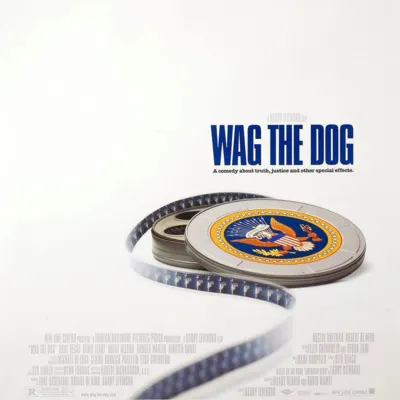
Wag the Dog
In progressWag the Dog is a movie
about a White House that fakes going to war in Albania to bury the news of a
President’s sex scandal. Exactly one month after the movie was released, the
Monica Lewinsky affair was first made public. We go into the movie and the
real world events it magically foretold.
Correction : at 19:40 Liam says Green Room, but he meant
Green Zone. At 1:08:00
Liam says Good Old Shoe, but he meant Courage Mom. Good Old Shoe is
the folk blues song in the movie. Courage Mom is the country song.
Would you like to know more? ☛
https://gladiofreeeurope.github.io/episodes/2021-05-26-wag-the-dog/ Hosted by Liam,
Halal Sam, and
Transcript
Welcome
And we're back with another episode of Gladio Free Europe. I'm Abram, and today I'm joined by Liam.
Hey!
Russian Sam.
Hey, yo, how's it going?
And Halal Sam.
Hello.
Wag the Dog
And today we're gonna discuss a very 90s political sitcom movie, I guess. Wag the Dog. And it's a very 90s movie, a very 90s cast, and a pretty funny movie, but, you know, not a very broad comedy movie. What do you guys think of it?
I think that it's very honest in its depiction of how many members of the American political elite are pedophiles.
Well, I would say that it's a relic of its time in many ways. In other ways, it holds up very well.
Yeah.
And it's just an all-around, fun movie to watch. Yeah, so yeah. I think that saying that it holds up is an understatement because this movie is fucking Nostradamus. You can go in every single frame in this movie comes true. And I think part of that is just how repetitive everything has been since probably the 1980s, since just the news became like this thing that's on TV constantly. So just look at themes that exist in this movie or existed prior and will be repeated in the following years. But let's get into just a little basic premise of the movie. So the movie is the president has an affair with an underage girl. We never see the president or the girl or anything like that. All we see is that the White House staff hires in a spin doctor to try fix this and get this away. And his plan is to fake a war, get a Hollywood producer to fake the war, and the movie goes on like there are little escapades for like the 11 days prior to the election of just like faking this war to try get the headlines about this affair out of the news cycle and just have everybody focus on like this war that the president is winning.
Yeah, and one thing I just want to add is that this is written by David Mamet, who's one of the most famous playwrights and screenwriters around. And he's probably best known for Glengarry Glen Ross. And it's kind of interesting to see him bring his like witty style to this like high-stakes political movie. And I gotta say, I don't think that everything about this movie works 100% of the time.
No, certainly not.
But it's a really interesting movie, and it's definitely really fun to watch and to think about.
The cast
Okay, casting. Because this is a great cast. A very 90s cast, what a great cast.
Absolutely. The main stars are Robert De Niro as the spin doctor, Conrad Brean, and Dustin Hoffman as this Hollywood producer, Stanley Motss. And Motss is spelled M-O-T-S-S, which doesn't come up in the movie, but if you just Google that, it's men of the same sex. So he's not married in the movie, and I guess maybe the implication is that he is one of those closeted gay men Hollywood producers, but right off the bat, let's just get that out of the way because it doesn't actually come up in the movie. He is directly inspired by Robert Evans, this real-life big-time 80s, 90s producer who is just known for being this total psycho and probably best known for being involved in both a murder case and also being on the side a coke smuggler.
Well, I mean, that was what the 80s were all about.
Absolutely. Other characters are Willie Nelson, for some reason, basically plays himself as this musician who gets in on the plot. And then William H. Macy is in here. He's, as we'll get into, a CIA agent.
Yeah, and Anne Heche is one of the White House staff.
Oh, yeah, just stunning as this.
Yeah, she's just a knockout.
Denis Leary in this movie is probably the most 90s thing about it. And it's incredibly grating.
The scandal
Let's get into the movie itself now. So it starts off, kind of interestingly, it starts off after the scandal has already happened. The president has already, allegedly, molested a teenage girl. They say she's basically a Girl Scout. And they bring in this guy, Conrad Brean, to fix it. He's not any kind of like criminal fixer. He's just a spin doctor. But they know that he's the kind of guy who can solve problems. But it's especially a big problem for them, the scandal, because the election is in 11 days.
Yeah, the movie's great because it just starts off with like Conrad Brean just like showing up at the White House and driving in. And as he walks into the White House, there's a photo of the president back of the head. You never see the president in this movie.
Yeah.
But it's a photo of him and he's like looking directly into like a Girl Scout's eyes. I'm not sure if that's the Girl Scout or somebody else. But that photo is almost identical of a still from a video of the 1996 re-election celebration where Bill Clinton hugs Monica Lewinsky. And it's very odd because Lewinsky at the time was wearing a beret, which is like an odd fashion choice. But of course the Girl Scout is also wearing a beret. So it's just like these parallels to real life that obviously are not intentional, but very striking.
Life imitates art
Was it not intentional?
No, no, it can't be because this came out before the Lewinsky scandal broke, which is just so wild.
No, no, no.
And Sam, I think that this movie actually shaped reality, I would argue.
So you would say this was meme magic at work.
Yeah, it absolutely was, yeah.
What is it, the Oscar Wilde thing? Life imitates art more than art imitates life, right? This is a perfect example of that.
Yeah, yeah. I think the answer is that the screenwriters and the director, Barry Levinson, they had their finger on the pulse so much that they could just perfectly predict what was going to happen in American politics.
The book
Yeah, I just should point this out. The movie was based on a book, and the book is like kind of like forgotten. It wasn't a very good book. It wasn't a comedy either. I think it was just like a political drama or whatever. But yeah, it was also called Wag the Dog and it's about H.W. Bush faking the Desert Storm campaign to like hide the fact that he had an affair. Yeah, I mean, it's irrelevant, but like, just get the point across that, you know, this stuff has been going on for a while. So, you know, this book was plausible. H.W. Bush, this movie is plausible in the Clinton era, and stuff that happens in the Clinton era is plausible to happen again during the Bush years.
A fake war with Albania
Turn to Melissa Gardner at KZAB in Santa Fe with this breaking news. Melissa? Thanks, Richard. Today, a local Firefly girl accused the president of sexual misconduct. The girl claims that the sexual misconduct occurred inside the Oval Office. Her attorney says there are no plans yet to hold a press conference. Right now, folks in Santa Fe and the rest of America are waiting for a response from the White House on these harsh allegations. With the election only days away, the big question is: how much will this scandal affect the outcome?
Yeah, yeah. And that basically gets into what is the central conceit of this movie here.
The Desert Storm point.
Because when Conrad Brean comes in, Robert De Niro, his plan to distract from this sex scandal, this unbelievably lurid sex scandal, is to start a war with Albania. Well, not to really start a war to create the impression of a war.
We cannot afford the appearance of a war. What'll it cost? But they would find out. Who's going to find out? Them. The American people. Exactly. Who's going to tell them? Yes.
To convince the public that a war is happening. And they do a pretty kind of clever job about it. The way they distract the media from the sex scandal is by doing everything they can to suggest that war is imminent with Albania. The Pentagon creates a special Albanian task force. They convince all the journalists that there's something happening in Albania.
The press room
Yeah, yeah. And basically, they get a guy in the, I forget what to call it, the White House press room, or they just get one of the journalists to just like, first guy they call on, this guy, everybody else in the room is like prepared to ask about this scandal that's like on the front of the Washington Post or whatever.
Yeah, because again, the president molested a little girl, and it's the media's got it.
I guess they just get some passing the media to just like ask questions that the White House wants. And this guy just asks.
Please, on the rumors, on the rumors that the president's flight, the president's delay is due to the situation to which you refer. Well, sir, we've just learned that the State Department has set up a special Albanian task force at Ops Center. Mr. Sklansky, I'm then all of a sudden, everybody else in the room is just like, wait, forget this little girl. What's going on in Albania? And yeah. So, perfect distraction, but you know, it only works for a day. You need to keep building on the story. You can't expect everybody to just be talking about this one thing for like 12 days.
But I really liked how the journalists just ran with it, hook, line, and sinker. After that initial guy, there's immediately a question asking if the situation in Albania is related to the Muslim fundamentalist anti-American uprising, quote-unquote.
Yeah, yeah, yeah.
Clinton's real distractions
And of course, and this is the first element that is just so true to life. Because, as I'm sure you guys all know, in the 90s, when very soon after this, when Bill Clinton had his own sex scandal, he responded quite similarly. I don't know if Russian Sam, if you want to go into that a little bit.
Let's go down to Kosovo.
Well, no, before Kosovo even.
Yeah, he did it a lot. Yeah. There was the bombing of the factory in Sudan called Al-Shifa.
Yeah.
It was going to Al-Qaeda. They were alleging that this factory was being used to manufacture explosives, but in reality, it was a medicine factory.
Yeah, and it was really, it was to distract from the fact that Bill Clinton got a blowjob.
Yeah, and as I said, you know, that story will just fade away after the first day, and people are going to go back to the scandal. So, you know, in Clinton's case, that's why he kept doing it, because obviously, like, people aren't going to talk about the bombing of a factory for like a year.
Yeah.
While the scandal's going on for a year.
Yeah. And actually, you know what? I would say this is where the movie fumbles. Because this movie thinks that it would take something as egregious as the president being a pedophile to make them want to make a fake war, when, in fact, it took something much softer, just a much less lurid affair, was enough to make America start a real war.
Yeah.
If anything, it was too timid in its predictions.
Yeah, yeah.
Well, I think in the movie's mind, or in the mind of the characters, that a fake war is much easier to sell because you can get the shots that you want.
Stanley Motss
Oh, yeah, and so speaking of the shots, is that Conrad Brean knows that there's just one man for the job. So they fly out to LA, take the Red Eye, and they get there right early in the morning to meet with Stanley Motss, who's this classic, high-powered Hollywood producer played by Dustin Hoffman.
Okay. And you want me to do what? We want you to produce. You want me to produce your war? Not a war, it's a pageant. We need a theme, a song, some visuals. We need, you know, it's a pageant.
Yeah, and we should just use the actors' names because the characters' names don't even actually come up in the movie a lot.
No, that's true.
Yeah, yeah, yeah, yeah, yeah, yeah.
They don't call him Motss, maybe like twice. Like, I just thought of him as Dustin.
Everyone's basically playing themselves. Like, Dustin Hoffman playing Dustin Hoffman, Robert De Niro's playing Robert De Niro. Denis Leary is certainly playing himself.
Oh, yeah. And so, yeah, so, but yeah, let's get into that now. So, yeah, so Dustin Hoffman thinks that if they want to sell a fake war, they have to really fake the war. They talk about how, like, you know, it's so, the media has a huge role in constructing these narratives. I think that Robert De Niro says something like, I read the Warren Report and the first draft, Kennedy Was Killed by a Drunk Driver.
What the title means
I think at this point, we should probably clarify what the name of the movie means. It's from like a, I guess, a proverb or something, where it's like, why does a dog wag its tail? Because a dog is smarter than his tail. If the tail were smarter, it would wag the dog. Which shows up in like the titles, but like, I don't know. It's like it's kind of like very stupid. I don't get it. But the implication is that the tail is the White House and the dog is the media in this case. So, you know, you know, the White House is playing the media and the media is just like too stupid to understand what's going on. Just, you know.
No, yeah, yeah, yeah. It's that the impression of politics is much more important than policy itself.
Are they too stupid or are they willingly playing along?
They're too stupid in the movie.
In real life, they're playing along.
Manufacturing Consent
But yeah, in the movie, they're just... Which is also why this is a movie that comes up with like media people. Like they reference this movie a lot because, you know, unlike something like the Noam Chomsky book, Manufacturing Consent.
Yeah, Manufacturing Consent.
Unlike that, which actually implicates the media's role, this movie does not implicate the media at all. So you can just lay the blame entirely on the White House and like ignore the fact that the media plays a role in all of those.
Oh, absolutely. Yeah, yeah, yeah.
But yeah, okay.
The Hollywood team
Dustin Hoffman. He assembles a team of Avengers.
Yes, yes. It's kind of like that famous line about the Spanish-American War. When William Randolph Hearst was really interested in promoting war in Cuba, I think the line was, he told an illustrator, you give me the pictures and I'll give you a war. And that's basically what happens. If they can fake atrocities, they can justify military action. In this case, the military action is fake, but it's the same idea. And so yeah, like you said, Abram, they get this crack team of Hollywood specialists here. You got Willie Nelson playing this like country singer. Denis Leary, playing himself, is a, I guess he was like a hot actor at this point. I don't know.
Well, he's a hot comedian, I guess. But yeah, he just plays himself. He's the fad king, who is just the guy who goes around and tells people, like, what things would make great for merchandising.
He also wants to shift the war to Italy because it's boot shaped.
Listen to this. Just follow me in this. What if it wasn't Albania, okay? Let's say it was Italy. I didn't get my hands on a lot of walking around cashing it's Italy because listen to this concept, the boot, give him the boot. What if a shoe is the fan? A shoe. Okay.
And yeah, I also like Willie Nelson, just like, oh, can we change Albania?
Nothing really rhymes with Albania. We're locked into Albania. Why? Albania is hard to rhyme. What are you looking at me for? It's the name of the country.
The suitcase bomb
What I thought was funny is that when they're planning out the justification for this fake war, what they choose essentially is that they should go to war with Albania because Albania is developing weapon of mass destruction.
No, not just developing, they already have a dirty bomb in a suitcase.
Oh, they already have it, yeah.
We just found out they have the bomb. So it's a suitcase bomb. You can put a bomb on a suitcase, right? It's a suitcase bomb. When it's cooking, it's cooking. Albanian terrorists have placed a suitcase bomb in Canada in an attempt to infiltrate the bomb into the USA.
Which again, which again, Sam, again, shows that real life is not as cra is even crazier. Because George W. Bush didn't need a real fake bomb to invade Iraq. He just needed the fake implication that they might be developing a fake bomb.
Yeah, we don't want the red flag to be a mushroom cloud, as Condi said.
The media and the Iraq War
Yeah.
We can talk about the Iraq War a lot later because the amount of media access or the way the media worked in the Iraq war is probably actually much worse than what we see in this film. I mean, like, they became embedded in the military, like, especially CNN, in a way that you that was just truly amazing.
And then this movie, the media, just like, they just trust the White House implicitly, which is, like, again, kind of true to life in that. In that, you know, if you're like in one, if you're like in the New York Times office or something, you can just like pick up the phone and call like a reporter in Albania and say, is there a war going over there? Right? But they don't do that. They just assume what the White House is like, oh, yeah, there's a war in Albania. Like, we're not even going to verify this. We're not going to fact-check anything. We're just going to print this whole cloth.
The fake footage
The way they fake it is they plan out this fake footage of a young Albanian refugee fleeing terrorists.
It's basically White Helmet stuff.
Okay, write this down. Young girl running from village towards camera, grainy, handheld, you know, news footage. Send it to everyone.
And what's funny is actually the girl who plays the refugee is actually a young Kirsten Dunst in one of her first roles. And so they can pretend this all-American girl is actually this Albanian peasant woman. And the whole thing is totally green screened.
Okay, let's try to shoot one. Okay, stay safe. Crazy, I want you to stand right over here. Okay? Here you go. Right there. These are chips. Just hold the bag when you run. We need it for the arm position on the screen. It'll be a kitten. Can I hold the kitten? No, we'll punch it in later. Right there. You're going to punch the kitten later? Yes.
Oh, and a great detail was that the president was on the line the entire time being consulted about the kind of cat, and he's very specific.
The thinking is, as of this moment, a small calico kitten, sir. There it is. We have a small calico kitten, sir. What? The president wants a white one. He wants a white one. Why aren't I here to win? Nice dark metal.
So they're in this studio. They make Kirsten Dunst sign an NDA, and there's the implication that if she ever tells anyone about this footage, that she'll be liquidated.
Yeah, with mildly and of course, even Dustin Hoffman himself has a little bit of trouble internalizing it because he keeps saying throughout the movie, like, oh, this is gonna be such a good story, and then Robert De Niro keeps reminding him, No, you can never tell this story.
How soon do you think we'll be able to get this cut? Oh, we're gonna be done about four or five hours. That's good, we can link that to the press, they can downlink it on Telstar 401 Transponder 21. And this just in a news breaks special report from the Albanian front. We've just received information that the young Albanian national fleeing in this video is attempting to escape terrorist reprisals in her village. America has seldom witnessed a more poignant picture of the human race than that which armed constantly. Fantastic.
The CIA steps in
Alright, so they film this atrocity happening, you know, they're about to show it to the world. They're really at the top of their game. And then on their way driving through LA, they notice a blinking siren behind them. And they think, oh, is it the cops? But no, it's not the cops. It's the CIA. And we meet this very mild-mannered CIA agent, Agent Young, played by very well-cast William H. Macy. And they go into a Mexican restaurant and he tells them that he knows there's not really a war in Albania. And he wants to know what's going on.
Two things I know to be true. There's no difference between good flan and bad flan, and there is no war. We show, and NSA confirms, there are no nuclear devices on the Canadian border. There are no nuclear devices in Albania. Albania has no nuclear capacity. There is no war.
Basically, what he's doing there is that he wants this to stop because this movie's politics goes is the CIA are just, you know, bureaucrats, basically, just agents of the state who are, you know, apolitical, aren't interested in, you know, re-election of the president. There's like, there's no war going on in Albania. You can't do this. You can't lie to the American public.
The apolitical CIA
This is a really common depiction of the CIA as like the apolitical professionals. I know that that movie Green Room on Netflix now, it's the same kind of thing. It's the idea that politics is sinful and tainted, but state service is immaculate. Which is very strange, especially in the 90s, given what the CIA is doing in the 90s.
Complete opposite politics of JFK by Oliver Stone.
Oh, that's true. Yeah, that's really funny. Yeah, yeah.
Yeah, but that's why the casting of H. Macy is perfect, because yeah, he just looks like a very mild-mannered nerd who's just doing his job, is like not interested in whatever's going on here.
In real life, he would probably be Mormon.
William H. Macy kind of reminds me of the fucking FBI guy that Trump fired. What was his name?
Comey?
Comey, yeah.
Comey, yeah, yeah, yeah.
Oh, yeah, yeah, yeah, yeah, yeah. He has that, like, nerdy demeanor, you know.
Yeah. He tries to convince William H. Macy that it's it might not be in the national interest to go along with the state war, but it's certainly in his career interest. And so eventually they part ways, and he's pretty convinced that he convinced the CIA guy that they're to go along with this plan.
This is what's great: H. Macy is the only non-cynical character in this movie. Because, like we said earlier, you know, president molests an underage girl, and then all these people are trying to fix it. And it's like, there is absolutely no pause at, like, oh my god, this is horrible. How could the president do this? Nope, they're just doing their job. They do not.
Yes, yeah. And again, to just say for the third time, the president molested a little girl.
Well, I mean, she could have been like 16. So not that little, but underage, underage. I mean, yeah, like none of the characters give a shit, except like William H. Macy.
Funny that the CIA guy is the only person who cares about America in this.
Well, but that just shows the kind of like the centrist liberal perception in the CIA. You know, it's like, it's a very kind of like blue-check Hollywood understanding of politics, which is completely wrong.
Yeah, well, it's the feeling that all these like three-letter agencies, because they continue to exist outside of like, you know, whoever's in Congress or whoever's in the White House, you know, like these are just like these people doing their jobs for like 20 years.
Yes, and the Comey comparison is actually so accurate because this movie really predicted the way that this depict the way the movie depicts the CIA really prefigured the way that the media in general would view the FBI and the CIA during Trump. This idea that the FBI was somehow going to save America from Trump. In this movie, the CIA is portrayed as the potential savior for American democracy from this fake war. And then in the very next scene, even the they fly back to DC and they think that they convinced the CIA, but then Robert De Niro turns on the radio and he hears that actually the fake war in Albania has ended and all of the fake troops are coming back home.
I have just gotten word that the situation in Albania is resolved. That it is resolved. The CIA confirms that our troops along the Canadian border and overseas are standing down. What does he mean the situation has been resolved? He just ended the war. He ended the war. The CIA. You know, I CIA. CIA. CIA. I thought they let us out of there too easily.
The war ends
H. Macy does them the good service of like not saying exactly what happened, but he has ended the war. So they realize it's now it's only, what, nine days to the election?
They gotta they gotta find a new distraction.
A soldier left behind
Yeah, they need a new angle.
Yeah, they gotta keep this, they gotta keep this rolling. They can't just like stop. I mean, there's gotta be something that we can do to like salvage this.
You know what it's like? What? The Japanese? What? In the caves? Go on. Okinawa? Go on. They didn't believe the war was over. That's right. So now we have a guy who doesn't believe. No, no, no. We have an American service man. A brave American serviceman is left behind a hero.
And then, lo and behold, they found their guy, Sergeant Schumann, part of the operations who was taken as a prisoner of war and abandoned.
This is another thing that's very dated: the idea of America having POWs. It's like, aside from Bowe Bergdahl.
Actually, I'll disagree with you there. Because, yeah, so like Sam said, they have this fake war hero that they have to rescue. Because even if all the troops are gone, maybe there's one man left behind. You know, they said it's kind of like the Japanese guys on the islands holding out. So they pretend that there's a man named Sergeant Schumann who's trapped behind enemy lines that they have to rescue. And what's funny is that this is another thing that really happened. The idea of a fake war hero and a fake rescue.
Jessica Lynch
So you guys know the story about Jessica Lynch in 2003?
In Iraq. They claimed that she was behind enemy lines in Iraq and rescued her, and she later said the whole thing was bullshit and was completely ostracized for it.
As I remember it, what had happened was that she was taken as a prisoner, but they just had her in a regular hospital where the doctors were just treating her injuries, and then these Marines just like came in.
Yeah, the Marines broke into the hospital.
That's what it was.
Yeah, yeah. She was basically, she was stranded, she was stranded and wounded, and she ended up being basically rescued by Iraqi civilians and taken care of in an Iraqi hospital. And then they wanted to frame it as this damsel in distress. This, this she was very young, too. She was probably only like 19 at the time. This young West Virginia farm girl trapped in Iraq, you know, presumably about to be, you know, yes, tortured and ravished or whatever by the terrible subhuman Iraqis. So they went in, guns blazing, and then she testified before Congress that the entire thing was fake.
Even worse, the story also said that she had like gone down fighting. She wasn't even captured in combat.
She was wounded, or she was in combat, but she wasn't.
I think that what happened was that she hadn't even fired. She was wounded, and then she ended up being basically left for dead by her own unit. And the Iraqis treated her in their hospital.
Yeah, yeah.
So yeah, so anyways, this goes to show that this is certainly the kind of thing that really would happen just a few years after. The idea of constructing a fake war hero to drum up support for an unpopular kind of campaign.
Old Shoe
Yeah, and the way they get Schumann is like kind of, you know, it's amusing where they kind of reverse engineer who's like, old Shoe, that's like a nice phrase. And then like they make up a song.
This old shoe.
Willie Nelson writes a song about old Shoe, and then Denis Leary picks up the phone and just like asks, is there like any soldier named like Shoe something? Schumacher, Shoe Man, and you know, and then they find somebody named Schumann and but yeah, they construct the story first and then find somebody to fill in the role after the fact. Which I guess is trying to be really clever because like the tale of the story is wagging the dog of the mission, I guess. That's what they're trying to do there.
How producing works
No, I think that's more like describing how a producer-led production works.
Oh, right, yeah.
Yeah, in Hollywood, you think of it like, yeah, the screenwriter who writes a great script that then a producer picks it up, finds a director, and goes like that. But there's also like a lot of movies, a lot of like shitty B movies from the 80s, where it's just like the producer has an idea and then finds a screenwriter to like fill in the details of like his various ideas and then grabs director and yada yada.
Or like, yeah, in a movie like in like a Star Wars movie where they add a character just because they know it'll make a good action figure.
Yeah, exactly.
Yeah, this is why we have like the character as a producer and not like a director or like a writer.
Right, right.
It's all, you know, thinking ahead, thinking ahead. That's what producing is. It's like being a plumber. Yes, like being a plumber. Do your job right, nobody should notice. When you fuck up, everything gets full of shit.
And the fact that he's a producer and not a director is actually pretty significant within the context of the movie because Dustin Hoffman is always complaining that as a producer, he never gets any credit. That, you know, like the directors get the Oscars, the producers don't.
Yeah, and because there is an Oscar for like best movie, and it's tradition that the producer accepts an award, but it's also like, you know, producers aren't household names the way that directors are, or even some writers. I think more writers are household names than producers.
Probably so, yeah. No, and Robert Evans, the guy he's based on, only became famous not because he was a producer, but because he was also a cocaine smuggler.
Hollywood's open secrets
Yeah, and like Harvey Weinstein only became famous of, you know, like The Me Too and, you know, him raping women. Like.
Even before that was totally exposed, like 30 Rock, they would make jokes about Harvey Weinstein entirely in the context of him being a moluster.
Everyone knew about this who was in the business. Everyone.
Oh, yeah, yeah.
Yeah, it was a funny joke. It was like, hey, he does this. Isn't it funny that he's a rapist?
Yeah, same with Kevin Spacey, but Bill Cosby.
I know that, like, apparently, every young male actor has a Kevin Spacey story.
Jim Belushi
Speaking of actors, they have this very strange little moment where they get Jim Belushi to come on speaking Albanian because I guess, you know, his family is of Albanian descent.
As you call back, in an earlier scene, they say, like, brainstorming, it's like, who's out there? Jim Belushi's out there. And like, you know.
John Belushi? Jim. Jim Belushi? Jim Belushi, what? Albanian? Jim Belushi's Albanian? Surest thing you know. Are you kidding? Jim, could I get a word with you, please? Would you like to comment on the situation in Albania? Well, yes, there is one thing I'd like to say. And this is to the Albanian that have this man in custody. And I mean this from the bottom of my heart as one of your race.
I didn't know Jim Belushi was Albanian.
Now we've got lots of Albanian pop stars, though. We've got Dua Lipa, for example. We've got that Albania's gotten on the map.
That's true these days, yeah.
Yeah, your Albanians are taking over.
Oh, they are, yeah.
Off the rails
I gotta say that this is kind of the part of the movie for me where it just kind of sort of goes off the rails. It just kind of gets a little too wacky and meandering.
I agree, honestly.
But to give credit words, dude, the music is great and really keeps your attention.
Oh, no, it is.
Hey, that song, that song, yeah, this old shoe.
Yeah.
The fake folk song
And they, speaking of the song, they end up faking the song as an actual old blues standard.
Yeah, they make like an old like 30s type recording with a hiss. And with the video, it's kind of clever. They plant the recording in the Library of Congress to make it seem like it's actually from like 1931 or something. And they have one of their women who's hooking up with the journalist just casually mention, like, oh, wasn't there some song about an old shoe?
Yeah, yeah.
This one works. They create this media spectacle of old shoe, you know, Schumann, the sergeant, stuck behind the enemy lines. And all these like high schoolers start tossing their shoes in like support of him or something.
Yeah, I mean, this is kind of a prefigures a lot of the social media campaigns we see today.
Manufactured campaigns
Oh, that's true, yeah, yeah.
All the shit about the Uyghurs, for example.
Pray for Paris kind of stuff.
Or does anyone remember the Guaido challenge?
Oh, yeah, that was an embarrassing one. That would have flopped, but that was a great example.
The Guaido challenge is like a perfect example of why these manufactured ones rarely work in real life.
Yeah.
They sometimes work, like the.
They sometimes do, but usually don't.
It's true. One detail we missed is they doctored the photo of Schumann to like he's ripped his shirt in like ways that spell out the Morse code. And the Morse code reads, Courage, Mom. Because, you know, that's like a very touching detail. Just like he's giving a message to his mom. You know, perfect details. This is why Washington people really need a Hollywood producer to fix these things.
Don't change horses in midstream
Yeah, the Hollywood people keep complaining about the ad campaign throughout the movie.
Everybody's always in a hurry these days. If they're not rushing somewhere, they'll be changing something that doesn't need changing. That's why I'm glad we're standing behind the president. Sure, we are. This just makes good sense. You don't want to change horses in midstream.
Yeah, yeah. This ad is like on constantly, and it very much irritates Dustin Hoffman because it is so stupid.
And well, you know, actually, that phrase was used by W. Bush in 2004, and it worked for him. He won.
Really?
Yeah, yeah.
I think that detail might have came from the book because, again, the book was based on H.W. Bush.
Oh, so you borrowed from his dad.
No, but yeah.
A prophetic movie
But basically, again, every aspect of this movie came true. It is an artifact of prophecy.
I think the way that people analyze movies like 2001 or I guess probably the better example, examples of Shining, they should do that with this. Because there is something genuinely arcane and magical about this picture. About how every act depicted ended up happening.
It's bending reality.
Yes, yeah.
It is the lathe of heaven.
Collaboration
This movie has a really great exposition of the creative process, by the way. Also, our good friend Liam here is our official Hollywood correspondent, so he can go to this a little better than we can. So throughout this movie, you constantly see these Hollywood people deliberating with each other and talking about different ideas and just like, oh, oh yeah, that's great. Oh no, that's stupid. And it just really shows that this is a collaborative process. It's not like you have these solo geniuses who are just pumping out hit after hit after hit. It's more like...
No, yeah, yeah. It's yeah, rule by committee.
The fighting 303
Yeah, I think the perfect detail is they're just sitting around late at night and Dustin Hoffman asked Robert De Niro, oh, what time is this? Like 3.03. 3.03, perfect. But then that number 303 becomes like the number of the military battalion that Truman is in. They write a song. The song goes off.
Oh yeah, yeah, yeah. The fighting 303s, yeah, yeah.
God bless the men of the free o free side by side we know no fear Well that's what I mean by when I say like the the tail wagging the dog it's that it all all throughout this plan like things that what they consider about the plan the plan you have this like phony war and the phony rescue mission it's not so much the the the content of the mission itself it's what can they how can they market it what about it will make people want to sing a song called this old shoe what can they do to really get the american public on board and distract them what little details can distract them from the fact the president has this lurid sex scandal yeah and this is why they couldn't really go to war they have to manufacture war because you don't get these like perfect details on like a real war you need to manufacture you kind of but you can at this point though you can do that in war you i mean it doesn't work very well but they do try like with the well you you fake him that's why you have the jessica lynch thing it's it's you fake them yes exactly like banna this there there was a real seven-year-old girl named Bana al-Abed but the whole campaign was really manipulative and and farcical and so so sam you're saying that the white helmets themselves were also the same kind of thing i would say a lot yeah a lot of the stuff is completely and obviously manufactured and meant for foreign consumption and sympathy to justify war it's a lot of it it's it is a media operation that does occasionally rescues people.
Juan Guaido himself, it's the same kind of thing.
Guaido and Nayirah
Like, he was this essentially a minor venezuelan politician who, based on this technicality of the Constitution, that was itself rooted in this like unconfirmed allegations of fraud meant that they could say he was the president now.
Yeah, it's it's completely it's just complete nonsense.
Nothing justifies war like a good atrocity. We all know probably this, not we'd all know the story of I believe her name was Nayirah, but there might be some people in the audience who don't, how in the lead up so we mentioned HW, in the lead up to the Gulf War under HW, this young woman named Nayirah alleged that Iraq, who's Kuwaiti, alleged that during the invasion of Kuwait by Iraq, that Iraqi soldiers were going into the hospitals and killing babies in their incubators, which was completely fictitious.
Yeah, and she was the daughter of the ambassador.
Yes, and she never even disclosed that.
She testified before Congress. It's worth noting.
She testified before Congress without anyone realizing that this was just completely a propaganda op.
Yeah, why would Iraqi soldiers do that to people who are going to be their subjects?
Reporters who never call
And again, the media just goes along with it. Like, again, if you were somebody in the New York Times office or something like that, you can just pick up the phone and call up like a Kuwaiti journalist and say, hey, is this true? They never do that. They're just like, okay, I mean, this little girl testified in front of Congress. We're just going to go along. Just like how in this movie, they never call up anybody in Albania and ask them if war is happening.
During the Battle of Aleppo, there were all these articles with things like Holocaust, Aleppo, and other insane shit in the New York Times. And the thing is, none of these reporters were on the ground. None of them. They were in Gaziantep, in Istanbul, or Beirut. In the 90s, and then in 2003, they wanted Saddam to be Hitler. And then in 2011, 2014, they wanted Assad to be Hitler.
Yeah.
And it thing is like, if you have landed a job at the New York Times, why would you do anything to verify these facts? There's no consequences for you getting this story wrong. You are ultimately serving the people who you need to serve.
You got journalists like Judith Miller just completely making up bullshit in the lead up to the Iraq war.
Yeah, she is the only one who had any kind of consequence, and that was only like some mild professional consequences, nothing like what they should have. But in general, there's never any consequence for getting these stories horrifically wrong. Because what matters is manipulating the public.
This always bugs me, just like seeing journalists pal around on like Twitter and just like, for whatever reason, whenever like an international story comes up, they're not paling around with like foreign journalists anymore. Perfect time. Like, okay, you know, there's something going on in your country. Let's ask somebody who like lives there.
Yeah, you could. Jake Tapper could talk to a Palestinian journalist if he wanted to. There's a lot of them. They're mostly getting shot in the back by the IDF, but they're around. But he's not going to do that because he wants to talk to people in his social circle.
Yeah, I mean, Iranian journalists, like anything. I mean, even like Uyghur journalists. We're just like citizens.
This is part of why there's so many fake accounts whenever there's a major international news story. Remember the fake accounts that were made of fake Bolivian accounts during the coup there?
Oh, yeah, yeah. The average citizen is going to go online and try to see what people in that country are saying because prior you could just get the journalists to like put out the word. Whereas these days when people are connected and they can just ask people in other countries what's going on, you have to like see these social networks with fake accounts to like drown out the real people.
Woody Harrelson's Schumann
Well, you know, speaking of fake people, the next thing that happens in the movie is that they have the finally the very hyped meeting and rescue of Schumann, where they're bringing this guy, Sergeant Schumann, back to the U.S. And so they meet this guy, he's played by Woody Harrelson at the airport. They bring him onto the plane, and that's when they realize it's not exactly what they had planned for.
Yeah, it turns out that Denis Leary, instead of calling for soldiers, he called for prison inmates somehow.
Yes.
So yeah, they bring him in a prison inmate.
Yeah, who it turns out is imprisoned for raping a nun.
That's unfortunate for them.
Yeah. And this is where the movie kind of goes off the rails for me because this is like...
Yeah.
It reminds me of like the Hangover movies, if you've ever seen those, or just a good comparison. Crazy wacky shit going on.
Yeah, yeah.
It goes from Alexander Payne to Todd Phillips.
Oh no, Schumann's going nuts on the plane, and there's a storm going on, and the plane crash lands and, you know. Oh, no, what's he doing in this cornfield? Yeah, I mean, it was so believable. I mean, it was down to earth until this point, and now it's just like, yeah, off the rails.
Yeah, so this is basically getting into the third act. The plane crashes. They all get out in this cornfield in the middle of nowhere, and they have to crawl out of the wreckage. They survived, and they have to get back to civilization with Schumann who they now realize is this complete psychopath.
Yeah, he's literally a nun-rapist. What do you expect?
Man, he's like low IQ. He like seems certainly not all the way there.
No.
Dustin Hoffman insists no problem that when you're a producer, you deal with stuff like this.
I mean, the Hollywood producers do deal with plenty of rapists.
That's true. And once again, Dustin Hoffman says, like, oh, it's going to be such a good story.
Listen, if you got a problem, solve it. That's producing. Oh, I'll tell you someday when they tell this story. Oh, you can't tell this story. Somebody have you killed. No, no. Oh, no. Of course, I know. Not now. Not now, but I mean, when they do tell this story, nobody can tell this story, Stanley, ever.
The tractor driver
And that's when they notice a guy on a tractor coming by, and they convince him to give them a lift to the next town over. But unfortunately for them, the guy in the tractor turns out to be an illegal immigrant.
Oh, yeah, which becomes, yeah, a legal headache for the president.
Well, it becomes a headache for Anne Heche because she's like afraid, well, what if somebody comes up and like interviews this guy who saved us? And then she actually also adds here that she thinks that television has destroyed the electoral process, which I think is fair.
Yeah, absolutely.
It was never a sound to begin with.
Television and politics
Well, I think that television and especially exposure to the internet has increasingly divorced partisanship from politics.
Oh, that's for sure.
And how politics, it's increasingly a team sport rather than a movement of individual decisions. It's obviously always been like that to an extent.
That's true, but this also coincides with the realignment of who these parties represent in terms of their socioeconomic basis.
I think it's pretty clear that the rise of 24-hour news and broadband internet have really poisoned political discussion among normies.
Yeah, well, of course, I mean, you have 24-hour news, you've got to fill in that 24-hours. So you're always looking for just inane bullshit to fill in the time, and that's just melting people's minds.
Absolutely. You know, not to get too Jon Stewart here, but especially on the right-wing side, that's how you genuinely get, that's how you prime a lot of right-wing people to genuinely believe that Democrats are satanic pedophiles and all that.
I mean, they're not wrong.
Yeah, yes, that's true. That's true. Yes.
This is where you get into people getting into an alternate reality, essentially.
The Daisy Girl
And speaking of pedophiles, the movie has another wrinkle in this plot because as they're waiting to get picked up from this small town, they're trying to keep an eye on Schumann, and someone looks away or something, and he notices this young girl picking flowers.
It's the Daisy Girl from the LBJ ad.
Yeah, yeah.
And then, you know, just like, yeah, just like Frankenstein in the, you know, Boris Karloff, he lumbers after her.
And the young girl's father watches him doing this.
Yeah, and just pulls out a shotgun and blasts him, which, you know, puts a wrinkle in the plans. They lose their beloved, their beloved hero.
And then here, really, all hope is lost. Because how can they win this election if, like, they've lost, if the hero is dead? How can they convince the public not to worry about the fact that the president's a molester?
Yeah, and at this point, like, the president has been going on at the news and saying, you know, Schumann's well and he's coming home and, you know, all that. So it's like, the president's really selling this. Like, come on.
Yeah, and again, the president is very insistent that Schumann comes back before the election begins.
Yeah, and of course, our fixers, Robert De Niro and Dustin Hoffman, are like, no, no, no, no, no. You've got to deliver him after the election.
Big mistake. Big mistake. You've got to bring him in by stages. Big mistake reveals Schumann before the election. How so? It's the contract, sweetheart. The contract with the election, whether they know it or not, is vote for me Tuesday, Wednesday. I will produce Schumann. See, that's what they're paying their seven bucks for. You know what I mean?
The president we never see
It's very interesting how much we see of the president's, what he, you know, his preferences and what he wants and how he's directing things, but so little of who he actually is as a person or politician.
Yeah, I mean, this is like a thing in 90s movies a lot where, like, you're trying not to actually politicize the movie because you know, like, if you've ever seen like a movie like Deep Impact or like Independence Day or whatever, you know, they never mention what party the president's in. It's just like he's the president in this movie, and you know, you're not actually supposed to like think about real politics or just try to think about the actual situation going on. And you know, it's kind of different in this because it's like a political comedy, but again, you're not really supposed to like think about real-world politics, you just try to like think about the plot of the movie.
A hero's funeral
And so, I guess they eventually they realize there's one way they can save this plan, which is that you know, the only thing almost as good as a hero's homecoming is a hero's funeral.
Yeah, and it's actually much better for them because obviously Schumann's like a nutcase.
Oh, psychopath, yeah, yeah, yeah, they don't have to deal with him.
Yeah, I mean, they were saying, like, okay, we put like a we just get Schumann to like walk in a straight line and then like put some like meat on his cuff so like the dog runs off and chases after him and stuff like that. And it's like, walking in a straight line, this guy's like a nutcase, you can't get him to do that.
Oh, yeah, yeah, but then yeah, they do kind of bring in that one part of the plan back because so that the funeral happens, it's at Andrews Air Force Base, they all everyone collects there for this beautiful funeral, and then you see the dog running after the coffin because you know they probably you know rubbed it with beef grease or whatever.
Yeah, it's perfect. And we also get the song of you know the 303 song again, which you know again goes off, yeah.
Credit and death
And it does, and Dustin Hoffman is just so happy and so pleased with how well this is going. He thinks it's his best work, essentially.
It's the best work I've ever done in my life because it's so honest.
And he wants to tell everyone about it.
Yeah, he wants the other thing, he wants to tell everyone about it. And what's worse is that then he sees that commercial again. Well, he sees people talking on TV and just like, oh, you know, the president's back in the polls, and here's the ad campaign that brought him there and the play, the fucking never change a horse, midstream.
Yeah, he wants credit for his work.
Yeah, he wants credit for like turning this around.
Yeah. De Niro warns him one more time that you can't tell anyone about the story, you're never gonna get credit. But Hoffman just keeps saying that he's so mad that these film school bozos that made that commercial are gonna get the credit for saving this campaign when really it was him. And he's so frustrated, he just walks out.
Yeah, and at that point, De Niro just gets on his earpiece and nods, just nods at one of the security guards.
Yeah, they jack Ruby him.
And as then the next day, we hear that this famed film producer has suddenly died of a heart attack in his home in Los Angeles. But he finally does get the credit he deserves because everyone's talking about him and all of his amazing work and all of these great films. So.
But not the fact that he produced war propaganda.
A real war
And one last bit of comedy to wrap up the movie is.
In this just in, a group calling itself Albania Unite has claimed responsibility for the bombing moments ago of the village of Close Albania. The president was unavailable for comment, but General William Scott of the Joint Chiefs of Staff says he has no doubt we'll be sending planes and troops back in to finish the job.
Oops, I guess they might have accidentally started a real war with this fake war.
Yeah, yeah, yeah. And so the president does get re-elected, but then they have to actually, it suggests they're going to do a real war with Albania.
Our verdict
So that was Wag the Dog, this very weird, very 90s movie. I gotta say, I don't love it. I think that as a movie, there's a lot of elements that were just kind of weak, that just seemed a little bit low energy, where the characterization wasn't totally fleshed out.
Especially towards the end.
Oh, yeah, especially in the back half. But it's definitely a really interesting movie, not only because it's so prescient, but also just in the way that it examines the relationship between the media and the White House. So I think it was pretty fun. What do you guys think?
It's just so honest. It is right in its depiction of how the state can direct these things and the media just follows along. Not because they're stupid, because they know it's their job, at least at the top level. Although the movie leans more into them being stupid.
But it's while being a dated movie in terms of like most of the dialogue and the fears of people like Denis Leary, it still definitely was... It predicted a lot of things, and it's pretty funny to see that most of the predictions ended up being worse or more funny even than what really happened here.
Yeah, maybe they were just taking notes and decided, yeah, this is a fun subplot. Why not? Let's drive the people who are paying attention crazy and just go with it.
Because none of this stuff actually makes a difference, really.
No, it doesn't matter.
There's no consequences for any of this.
At least not for the people who are doing it.
And they said the only consequence is the guy they have to shut up at the end.
Yeah, the consequence is real for, you know, the Iraqis or the people of the Balkans or, you know, all that shit, but not here.
Yeah, everybody who is a political operative in this movie has no consequences. And the only person who does suffer a consequence is the producer, Dustin Hoffman, who is just basically, he's a very powerful person, but he's still, at the end, just a civilian they bring on.
The trusted CIA
I will say the one, the other thing that really rubbed me the wrong way about the movie, though, was the depiction of the CIA as like an apolitical, competent, and with the best interests of the public at heart or democracy or whatever the fuck, which is simply not true.
Yeah, and so many people think of the CIA that way.
Probably most Americans, yeah, but I bet the CIA has probably a better image than any president.
Oh, absolutely.
I remember seeing some like polling of like Democratic voters. This was a couple years ago.
Yeah, I know the one you're talking about, yeah.
Yeah, like the CIA was near the top. You guys know what the most trusted institution was? Amazon.
Oh my god. That was awesome.
That makes me so mad. I'm just gonna become a third worldist.
You should. Honestly, it's amazing.
Fucking Amazon? That makes me really just feel just feel very grim. And I don't like that at all.
This was also at the time when Trump and Bezos were having their very public feud, I should add, but you know, it's still pretty insane.
Right, yeah.
That was the great moment. That was when you had like app Democrat app ratchet types going on Twitter saying that Bernie Sanders was helping Trump by saying that Amazon should have the unions for its workers.
Yeah, that was awesome. That was great.
But yeah, the CIA thing, it's, I mean, plenty of people know about CIA atrocities, but they all think, oh, that's in the past. Like, yes, they may have overthrown the government in Iran. Maybe they know about that now or Guatemala.
No, it's the same. It's the same bastards running the show.
Yeah, it's the same or their kids.
And it's just with more Mormons now, is the only difference.
The real timeline
Well, Abram, so you chose this movie. You know, this was one of yours. And I know that in the preparation of this episode, you really got into the weeds here by looking in to see what was being said about this movie at the time that it came out.
So, before we get into all the various articles and posts that I've assembled to discuss the similarities this movie has with the things that happen afterwards, I'm just going to give a very brief timeline of events of what happens immediately after this movie comes out. So, Wag the Dog is released in theaters in December 17th of 97. And the news of the Lewinsky scandal breaks January 17th, 98. So, exactly one month afterwards. And then, you know, Clinton admits that, you know, in grand jury in like August that he engaged in improper physical relationship with Lewinsky. So that was like several months later, like seven months later. And then, you know, August 20, three days after he admits that, he does Operation Infinite Reach, you know, which is, you know, launching the missiles against al-Qaeda in Afghanistan and the Al-Shifa Pharmaceutical factory in Sudan, which they said was a weapons factory.
And, you know, we discussed that earlier in the episode.
Yeah.
After this, like a couple months later, October 31st of 98, he signs the Iraqi Liberation Act or whatever, which starts Operation Desert Fox, the bombing campaign. And that was in December. And, you know, December is when the articles of impeachment stuff for the Lewinsky scandal was supposed to happen. But because of Desert Fox, he manages to delay that until January of the next year. But of course, just delay in the movie where he just does this thing and then, like, it completely erases the sex scandal out of the limelight. It just delays it. And this is just an amazing timeline because as soon as the movie comes out, pretty much, these events happen. I mean, this is all less than a year after the movie comes out.
Yeah, yeah. And it really seems like at the time, Americans were well aware of these similarities.
Oh, yeah, definitely. Just one final thing: you know, in February of 99, he's acquitted. You know, they have the trial in the Senate, and he's acquitted, and you know, he's a free man.
Yeah, getting a blowjob is not a crime.
Yeah, thank God.
But while the trial was going on, shit was going down in Yugoslavia against the Serbs and the Albanians and Kosovo. I have no idea how to say them.
Kosovar, I think.
Kosovars?
That sounds right.
But yeah. Then the airstrikes start in March, March 24, 99. You know, obviously, these NATO airstrikes would have happened no matter what. But it does feel like something that's very beneficial to Clinton because as soon as this impeachment trial is over, now there's like this war going on that he has to like get out in front of cameras and talk about. So perfect. You know, this war is kind of pushing that sex scandal out from the news cycle and you know, just taking up everybody's minds. Okay, so that's the basic timeline. Let's get into like the details as seen through these posts and these news articles.
Usenet and protests
This is titled Saddam and Bombing by John T. And this is from January of 98. The traitorous man sitting in the Oval Office is rumored to want to play wag the dog with our soldiers, sailors, airmen's lives to try to get the people's mind off his scandalously perverted sex compulsions. Of course, if he loathes our military, as he stated he does, a few thousand lives don't matter to him. He thinks he's more important. And then a while later, a man named John H. replies, Whether you agree with the president on Iraq or not, you'd have to agree that the problems in Iraq are anything but phony and stretch back for almost a decade now. Sheesh, are we gonna see Insipid Wag the Dog posts every time we have a military action from now on?
John H is probably a blue check these days.
I compiled a couple of posts from Usenet, and most of them are named John. So I guess John was like the most common Gen X name. I mean, these are all different people. It's just they were all named John, which is funny.
Yeah.
In February, after the bombing campaign already stopped, thankfully, but there was a protest in DC where people reference Wag the Dog. I dug this up, just photos from the protest in Dupont Circle. And just the caption says, A couple thousand people showed up at a DuPont Circle in Washington, D.C. and marched to the White House to express their disgust and outrage over President Clinton threatening to bomb Iraq instead of continuing negotiations. Above is a photo of Wag the Dog precision drill team in response to one chant of No Blood for Oil. The drill team later chanted, No Blood for Monica. People are making the connection that this war is just, you know, to distract people from the Lewinsky scandal and, you know, this is Wag the Dog all over again.
I think this is a good example of cultural degradation because in the late 90s people were comparing politics to David Mamet movies and today the best you'll get is that Trump is Voldemort.
Well, I mean, I guess that's just the kind of shitty movies that we get these days. But what are you gonna do?
Saddam's bootleg
Here's a headline from Entertainment Weekly from March of 98. It says, What's must-see in Saddam Hussein's Iraq? ABC News reports that a poor quality pirated video of Wag the Dog aired in the besieged nation on February 18th. I saw some references to this, and people always say Saddam Hussein airs a wag the dog on Iraqi TV. I'm just like, I don't think he was personally responsible for that. I think that's just, you know.
Saddam did have impeccable aesthetic tastes, though, so I wouldn't put it past him.
Oh, yeah, definitely.
You see those paintings in his bunkers, right?
Yeah, and all his furniture is very reminiscent of Trump Tower.
Yeah, yeah, no, definitely kindred spirits.
Let's continue.
Is life imitating art?
So this is all stuff from early 98. Around mid-98, when the Al-Shifa bombing, you know, taking out al-Qaeda in Afghanistan and, you know, killing innocent pharmacists in Sudan was going on, the New York Times publishes this article called, Is Life Imitating Art? Wag the Dog Springs to Many Minds. In the movie, the president's handlers invent a war to distract public attention from his sexual transgressions. In real life, was the Clinton administration doing something similar? These Americans may well represent a minority. A random sampling of opinions around the New York region yielded at least as many people who said the president's authorization of military force in Afghanistan and the Sudan seemed wholly justified, and that the United States could never be too aggressive in its efforts to stamp out and deter terrorists. Yeah, and this is something I saw a lot in the various Usenet posts, which is that people, even people who didn't like Clinton, were just, you know, very on board with this.
And even politicians who didn't like Clinton were on board with this.
Yeah.
I believe Newt Gingrich, who was the Speaker of the House at the time, said that, you know, we will go on with the impeachment stuff, but we need to support Clinton in this and later in the NATO bombings. Kenneth W. Starr, the independent counsel investigating the Lewinsky matter, fielded a question about Wag the Dog from reporters on the steps of the courthouse in Little Rock, Arkansas. Yes, I have seen it, Starr said with a chuckle. Other than that, I'm not going to comment. Representative Bob Ney, a Republican from Ohio, mentioned the movie in his defense of the president's actions on Thursday. I don't think the president would be foolish enough to do a Wag the Dog, he said, according to the Associated Press. Yeah, yeah, we see, like, even Republicans were completely on board with the bombing, even if they disliked Clinton themselves. Amanda Urban, a prominent Manhattan literary agent, said that she immediately drew a connection Thursday between Wag the Dog and the news reports that she was hearing, but that she shuddered at the serious thought that she gave to the parallels.
It's downright scary that we have to consider the possibility, Ms. Urban said. These are incredibly cynical times. I'm still like torn on this. I definitely feel like these things were stuff that, you know, the military brass wanted Clinton to do. And just, you know, the fact that the Lewinsky scandal was all over the news is what kind of pushed him over the edge into like going cover with him. I don't think he was like just going around to his staff. He's like, what can we do to like get this out of the news? I think it was, you know, the other way around. Bombing Iraq, bombing Afghanistan, bombing Sudan.
Kosovo
That's all over with now. Let's get into bombing Yugoslavia. So as I said, in March to like June, the NATO bombings of Yugoslavia was going on. So, you know, impeachment was over. He was acquitted. Nobody cares about Lewinsky anymore. Well, I mean, people do care about Lewinsky anymore, but like, nobody's going to hold his feet to the fire on Lewinsky anymore.
Three real Schumanns
In the movie, they manufacture a soldier being captured behind enemy lines. You know, Sergeant Schumann. And so here we go. CNN article, '99. Three U.S. soldiers were held captive by the Yugoslav army on Thursday after it said the three men were captured on Serb territory and resisted arrest. Serbian television showed pictures of three men dressed in camouflaged military fatigues. One of them had several cuts on his face, another had several cuts on his nose. So, as you can see, there was a real Sergeant Schumann. Not only that, there were three of them. Like I said, life does not only imitate art, life goes even farther. Yeah, obviously in the movie, we get the photo of Sergeant Schumann, and, you know, because it is a movie and they really want to make it palatable to the public, they have him rip up his shirt to say that message, courage, mom.
But of course, in real life, you know, that doesn't happen. I mean, they're all ripped up and tattered, but there is no message. But there is a photo of them, you know, taken as hostages, and that is shown all over the news. Meanwhile, Serb television broadcasts footage of what was said to be a destroyed bridge over the Danube at Novi Sad in Serbia's northern Voivodina province. Yugoslavia's representative to the UN, Vladislav Jovanovic, said the NATO was creating an artificial humanitarian situation and trying to broaden the organization's influence within the Balkans. Yeah, so this bridge kind of sticks out to me because in the blue screen footage where they have Kirsten Dunst running away in the village, Dustin Hoffman's character says, Can we get a bridge there? And I feel like the implication in that scene was that, oh, if there's a bridge there, it makes this whole scene seem much more fragile because if that bridge gets destroyed, then she can't escape for freedom.
When I'm reading this article and just like, oh, yeah, there was a bridge destroyed, and just like, oh, that's exactly what they're doing. They're destroying the bridge so these civilians can't run to freedom. Cinematic parallels. Speaking on CNN, in response to Solana's statements, Jovanovic said Belgrade was merely cracking down on terrorism and he blamed the refugee crisis on NATO and the Kosovo Liberation Army. Albanian terrorists, in close cooperation with NATO, have told the people to escape from Kosovo in order to manufacture an artificial humanitarian situation. NATO has accused the Yugoslav authorities of deliberate identity elimination of ethnic Albanians in Kosovo. Obviously, this is in Kosovo, but these are Albanians. Like, again, cinematic parallels, you know, these are Albanian citizens running for their freedom, and that's what we're fighting for. Don't think the movie's screenwriters could have predicted this so perfectly, but. And you won't fucking believe it. That's not enough.
Because not only were these three actual Sergeant Schumans captured, I don't know, do you say, is it Shoe Mans or Shoe Men?
No, let's say Schumann.
But in any case, not only were they captured, but the United States thought that there was only one way to show their support to bring these boys back home.
A real song
There's one more CNN article from April 15th, 1999. Inspired by a recent report on the Kosovo crisis, composer Steve Gooden gathered a guitar he purchased for a friend and 15 minutes later came up with a song dedicated to the three American soldiers held captive in Yugoslavia. On Wednesday, Gooden performed Let Them Be Free at Schur High School.
Kosovo and Wag the Dog
I only found out about that song because I was scrolling through Usenet looking for, you know, posts about all of this stuff and I saw this post just entitled Similarities Between Kosovo and Wag the Dog, where another man named John says, NATO says it's protecting Albanian refugees with pictures of Albanian refugees flooding Western media. In Wag the Dog, Kirsten Dunst's character plays an Albanian refugee fleeing persecution in a scene made specifically for the TV news. In Wag the Dog, a U.S. serviceman was accidentally left behind in the withdrawal. In the Kosovo operation, three U.S. servicemen who were not participating in the offensive were captured. A song was recorded in Nashville by a country singer honoring the war effort and the abandoned servicemen in Wag the Dog. Recently, a song was composed impromptu in Los Angeles by a country singer in tribute to the three captured U.S. servicemen.
In Wag the Dog, public opinion of both the war and the president gradually became favorable. So far, a majority of Americans polled support Clinton and Operation Allied Force. But of course, somebody has to jump in here and respond. A man named Cypher replies, Jesus Christ, your Americans are paranoid nutters. First, you all spout about the similarities between Wag the Dog and the last Gulf bombings. Now Kosovo?
There's always a contrariant.
Even as back as 1999, there's always a contrarian.
That's hilarious.
Yeah, yeah. That's great. Yeah, yeah, yeah.
You cannot deny the similarities at this point. Like, it's eerie.
Oh, yeah, no, no, absolutely. It's more than eerie.
This makes me believe that maybe magic is real.
Like, they got the country wrong, but they got the citizens right.
They barely did.
Yeah, yeah. It's Albania instead of ethnic Albanian areas of Yugoslavia. You know, it's basically the same thing.
Foreign policy as distraction
I guess part of it is that the nation of Albania was already pretty embedded in the American consciousness at this time, and there had already been some American bombing of Yugoslavia, but it's still really, really crazy. And I guess in general, what this shows is that, you know, this was not simply an artifact of this certain time, that doing foreign policy for domestic purposes, even if it ends up hurting people terribly, is just part of American politics. This has gone on under every administration since then. If I remember correctly, didn't Trump shoot some missiles at Syria basically to distract from some kind of domestic crisis?
He obviously did the Soleimani killings and ramped up shit with Iran where it looked like he was, you know, not going to do well in re-election. And at the same time, that's when impeachment was going on, right?
Yeah.
So, I mean, but that's, yeah, I mean, that's exactly like what Clinton was doing, and it's also very similar to what's going on in the movie.
Absolutely, no, yeah, absolutely.
Yeah, I mean, Clinton attacks Iraq when the impeachment is going on, and Trump attacks Iraq, but he kills Iranians in Iraq.
Yeah.
History doesn't repeat itself, but it often rhymes.
Absolutely, absolutely.
It just goes to show that empire is incredibly brutal. It's not necessarily brutal for important reasons. And I think that when there is such an unequal relationship between our government and the governments of places like Albania, or in real life, Sudan, the U.S. can do whatever the fuck it wants in ways that often hurt people in those countries really, really badly.
Obviously, these are things that were going to happen probably no matter what, but maybe ramped up to be much more palatable for TV audiences. And yeah, I mean, a lot of innocent people get killed in this shit, and it's just so to distract from, like, yeah, domestic affairs.
Every single thing that America has done in Afghanistan is just completely worthless. And, you know, everything would have been perfectly fine if like nothing happened, right?
Obviously, with the NATO bombings, I feel like this is one of those things that I'm conflicted about. Like, you know, Serbs were going nuts. But I don't think they should have been bombed like the way they were.
I think that Yugoslavia is one of those issues where if an American has very strong opinions on it, you should probably disregard them.
Oh, yeah, definitely. And I will say that the United States certainly had no business getting involved in a conflict like that. We didn't, I don't think it's possible for American bombings to make things better.
The Yugoslav prize
For this, I prepared like a New York Times article that sort of goes through this entire like year and a half of shit, and it ends with just like the sentence: jokes about the movie Wag the Dog became commonplace. Fittingly, the president in the movie seeking to distract attention from sex scandal stages a conflict in, of all places, Albania. And we're going a little long, so I'm just not going to read the entire thing, but you know, the photos from the protests and you know, links to all these articles and other things are just going to be like in the description for this episode. So, you know, you can go look there if you want to read a little bit more. Last thing I'm definitely going to read is this Yugoslav prize for Wag the Dog. So this comes in like April 18th, 99. So just three days after the real life, this old shoes on, the Yugoslav Academy of Film based in Belgrade decided to award the best picture prize, its special crystal prism, to the authors of the American movie Wag the Dog, whose contents became a tragic truth for our country and our people.
This is in April of 99. Belgrade was one of the cities that was bombed by NATO in March of 99. So a month before, you know, giving the prize to this movie, this city was being bombed by American forces. And this is the impetus for giving this prize to this movie. Yugoslav basketball player Vlade Divac, starting center for the Sacramento Kings, spoke during a press conference at the Regent Beverly Wilshire Hotel in Beverly Hills. The movie Wag the Dog, which tells the story of a fake war in Albania organized by a U.S. presidential advisor and a Hollywood producer to draw attention away from a sexual misdemeanor, has received the top award from the Belgrade Academy of Film, Arts, and Science. A letter sent to the film's director Barry Levinson, as well as actors Dustin Hoffman and Robert De Niro, was read by Divac. Belgrade TV stations aired Wag the Dog on March 26th, just two days after NATO began pounding the country in punitive air raids.
The bombings were in March. This award is giving away in April. In May, Belgrade was bombed again, and the United States destroys the Chinese embassy and kills, you know, three Chinese citizens in those embassies, which is a sore spot with China and the U.S. to this day.
Yeah.
Bloody history this country has.
Absolutely.
Politics as theater
No, and this shows that politics is theater, and I'm sure politics has probably been theater going all the way back to the Barbary War with Jefferson. And it's a consequence of empire that people are going to suffer and dramatic action is going to be taken for the absolute stupidest reasons.
We came really fucking close to invading Venezuela under Trump. And if he was a little bit less distractible, a lot of bad shit could have happened.
I mean, one good thing is the public no longer has an appetite for this stuff. You know, with the New York Times piece just asking random people about this shit, and just like in my own reading of like Usenet posts asking me about this shit, it seems like people were overwhelmingly in supportive of military intervention like across the board. You know, they did feel like the United States' role is to be world police, and you know, if the United States doesn't intervene, then, you know, who will? That kind of thing. But, you know, after getting clobbered in Iraq and Afghanistan, you know, during the Bush years, I feel like most Americans no longer have any appetite for like this kind of like foreign intervention.
I hope so. I guess we'll find out under Biden. I know some people think that Biden is minutes away from starting a war with Iran, but I'm a little bit more hopeful. I don't know. Maybe if he gets us back into the Iran deal, I'll feel a little better, but I don't think he's actually going to start an actual conflict.
Yeah, yeah. I think that, yeah. Like, you know, knock on wood, it gone to my head I don't think Biden starts a war, but I wouldn't put it past him. And I certainly don't think anything about our foreign policy is going to get substantially better under Biden.
It's going to be a weird four years.
Oh, yeah. Or maybe it has been a weird four years if we're listening to this four years from now.
That's true. Yeah, we shouldn't assume.
Yeah, for all we know, people listening to this podcast in the 23rd century.
Yeah, America, what was that?
Oh, that would be great if people were listening to this to like figure out what the hell America was.
Oh, that would be sick.
Yeah, yeah, yeah.
Future, yeah, future, like, undergrad, history undergrads, you know, podcasts become the new like Livy and Tacitus.
Final thoughts
But yeah, I mean, I didn't give my thoughts on this movie, but I'll give them now. It was pretty good. It was, I think it's ironic that the movie experiences turbulences at the exact same amount where the characters experience turbulence in the plane. But I mean, unlike the characters, I think the movie sticks the landing. It's just, you know, kind of dips. It's definitely not a bad movie. It's just it could. There's a couple moments where it could have been quite stronger.
Especially towards the end again.
Yeah, there's like 10. I mean, it's a 90-minute movie, and I would say like 15 minutes are bad.
Yeah.
It is a consistently funny movie. It's not like a uproarious, like, laughing movie, but like every single line just like it's delivered perfectly. It's like kind of has that, yeah, it's very amusing. And there's a lot of attention to detail. Like at one point, you see a guy wearing a fuck Albania shirt. They really put effort into this. It's it's a fun watch. I definitely would recommend it if you have like 90 minutes. It you know, breezes by very quickly. And yeah.
Yeah, yeah. It's at least an interesting time capsule, but also one that isn't completely irrelevant today.
Oh, yeah, yeah, yeah.
And you know what? You should definitely watch it because anything that has not yet come true in that movie certainly will.
Wrapping up
Well, all right, yeah. Well, hey, this was fun, fellas.
Yeah, another lovely episode of Gladio Free Europe.
Yeah, that was good.
Yeah, thanks for listening. I was Abram. I was joined by Liam, Sam, and the other Sam. And this is Gladio Free Europe signing off. Later.
The show is also on Apple Podcasts, Overcast, Pocket Casts, Podcast Addict, YouTube, RSS and Patreon.