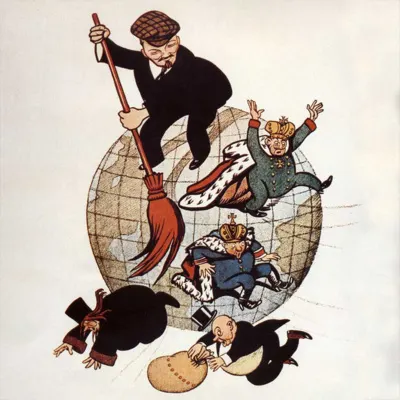
In early 1919 Lenin said, “We have never been so near to global revolution as we are right now” and he was absolutely right. What he didn’t realize was that the world, or at least the West, would probably not come so close again.
We’re joined by our friend Brendan to discuss some of the various small-time revolutions and revolutionaries in Europe and the Americas, their impact on world socialism, and the response the elicited from the liberal world order.
Transcript
Welcome, Brendan
And we are back with another episode of Gladio Free Europe. I am Liam, your host for this evening, here with Sam B.
Hello there.
And a really special guest we're so excited to have on, Brendan Yukon Cornelius at Needle's Eye with 3Es. Welcome to the pod.
Very, very glad to be here.
You know so much about left-wing politics, especially in the years between World War I and World War II. So as soon as we first embarked on this interwar series, we knew that you'd be a great guest to bring on. Before we really get started in this episode, which is going to be about the legacy of the socialist revolutions of the early 1920s, late 1910s, which mostly failed, can you tell a little bit about your background, your interests in this period and in left-wing politics and organizing?
Brendan's background
Yeah, sure, absolutely. So I've always been like really, really interested in history. I was like reading like academic history like regularly. I think by the time I was probably 14 or 15.
Oh, wow.
I was like, not, you know, journal articles, but, you know, like, you know, in terms of books and whatever. And, you know, I was also becoming interested in left-wing politics at that time, but they weren't, those interests were sort of loosely connected. Like, I can remember reading a couple of books when I was a teenager about, or that dealt with, to some, you know, significant extent, communists in the United States fighting against segregation. And that sort of twigged something in my mind that, you know, maybe these people weren't the bad guys. Like, you know, they had illusions, you know, in the Soviet Union and whatnot, but they were trying to do positive things that nobody else was interested in.
You've read Hammer and Hoe, right? By Robin Kelley?
Yeah, yeah. Or it wasn't Hammer and Hoe. It was actually this book called Defying Dixie by a historian named Glenda Elizabeth Gilmore. And it's not just about the CPUSA, which Hammer and Hoe is. It's sort of about the popular front left in the South in a broader sense. And then, yeah, like sort of in my, like, by the time I finished high school, I had like, you know, become basically convinced of revolutionary socialism. And I joined the youth organization of the Communist Party of Canada when I started university. That's like, you know, it's tied to the, you know, 100-year-old Communist Party of Canada. So there's definitely like a historical, you know, emphasis there. You know, people in those circles talk about, you know, the history of the party, the history of the movement a lot. And yeah, I just sort of became, and I guess, you know, I guess I am to this day a little bit, a little bit obsessed with like the history of the international left.
You know, like I, I love reading, you know, old newspapers and, you know, polemics and all of these things. And my, you know, and I was in sort of that place politically for several years. Now I'm sort of doing different, you know, different things in socialist politics. And I've sort of broadened out my sort of historical interest and tried to sort of get a better, you know, I think I'm interested in, and I think the only way to do this is to read the primary material, is to understand, you know, sort of every tendency on its own terms rather than sort of relying on what their enemies said about them.
Right, right, right. I think that you made a really good point on Twitter a while back that stuck with me, which was that a lot of differences in left-wing politics that might seem trivial at the time, or in our time, might seem trivial, are really people in a certain historical moment trying to understand their moment in very specific ways that to us now, yeah, are incomprehensible, but meant a lot to them.
Yeah, yeah. Yeah, and so that's something that I think is really valuable about like, well, you know, primary material is one thing, but also like sufficiently, you know, sufficiently fleshed out, you know, historical, historical work. I've been, for the past couple of months, I've been reading a lot about the Russian Revolution, and it's just like, there's so many, you know, it's so, it's so interesting and so fun to get into the, you know, the flesh and blood, right, of the revolutionary, you know, process at that at that level.
And I think that that whole period of revolution, which we're going to talk about today, is so important and I think so understudied in mainstream kind of Western circles. In high school, we learned so much about World War I and a little bit about the Bolshevik Revolution. We didn't get a peep about the revolutions in Russia or in Hungary at this time. But I think even in like the, from a primary education perspective, I think that's a mistake because I think those revolutions, which ultimately were not able to take off, had a huge impact on the way politics would go across the 20s and 30s.
Europe shaken
With the end of World War I in 1918 and 1919, the house of European society was pretty much shaken to its foundations. Thanks to the relentless destruction meted out by the imperialist powers between themselves and among themselves, many of the rulers of this old order were destroyed and the survivors were barely hanging on. Those who suffered the most in the previous century now had the most to gain. So you start to see communities that had previously been under the thumb of old dynasties like the Romanovs, the Habsburgs, or the Ottomans suddenly become part of these new nations carving themselves out in Europe and the Middle East. Ethnic minorities across the world, most prominently African Americans in the US and Jewish people in Central and Eastern Europe, were able to fight for new rights and a new dignity that had previously been denied. Universal suffrage for women is just over the horizon, and from both coasts of the Pacific, from Kamchatka on one side to California on the other, we see this genuinely global outbreak of working-class anger that is going to set the course for a new century.
At the start of 1919, Lenin said that we've never been so near to a global revolution as we are right now. And he was right. I think what Lenin didn't anticipate, though, was that this particular moment, at least in Europe, would never come again. There would never be a moment where Western and Central Europe would be so close to joining a communist world as in 1919 and 1920. And I think that because these revolutions in Europe and even the Americas did not succeed for a lot of reasons, you know, they were isolated, they were ill-equipped, they were ill-prepared. But even though they did not succeed, I think that they would have a lasting political and psychological impact on both the people who participated in these revolutions and maybe more importantly, in the people who played a role in destroying them. Especially because the forces that would destroy these revolutions, not only in Europe, but also in the Americas, would basically determine the course of politics in the 20s and 30s, and you could pretty convincingly argue, led directly to the outbreak of World War II.
Exactly.
Versailles
So amid the fires of these brief revolutions, two different groups would converge to lay out a future for humanity. Most famously, of the meeting of the Imperialist victors who convened Paris in 1919: the US, Britain, France.
The Versailles Conference.
Exactly, in Versailles. And the intention was to manage the destinies of the entire world. Thousands of delegates from across the planet met at the Palace of Versailles. Nationalists of every kind met to battle over maps and mythologies. Some of the famous attendees are the first Czech president, Edvard Beneš, the Irish revolutionaries, Sean O'Kelly, Prince Faisal, and Lawrence of Arabia.
Yeah, but we should mention that most peoples of the world were not guaranteed a seat at this table. New.
Sort of understandably, Germany, Austria, Hungary were not invited, but despite, but beyond that, only token representation was given to India, which was seen as part of the British delegation. Korea, all Arab people, and even China only had very limited representation, usually in the form of very pro-Western figures who could chart a future for those countries on British-French-American terms. The only black person invited was the president of Liberia at that time, and everybody else who attempted to join, if their skin was too dark, including W.E.B. Du Bois, would be stopped at the door.
Ho Chi Minh in Paris
I'm sure you know, Brendan, that Ho Chi Minh attended.
Yes, yeah. So the future Ho Chi Minh was living in France at that time. He had left Vietnam as a young man, and he'd worked as a sailor and as, you know, he'd worked in hotels and was just sort of part of the global transient workforce.
Yeah, and supposedly he even trained to be a chef under Escoffier who was like the father of modern French cooking.
Yeah, and then he found himself in France towards the end of the war and he became a member of the French Socialist Party as well as, I don't know if he had ties to any organized Vietnamese nationalist group, but he must have because he must have said that he was representing somebody at the conference. Woodrow Wilson famously claimed he was all for self-determination, but when Ho Chi Minh asked for Vietnam to be released from French colonial authority, he was basically just shown the door because it was clear that at this high table, not everybody was invited. And I would argue that as a direct response from the pretty much discriminatory nature of the Paris Peace Conference, another convention was convened just a couple weeks after.
There's actually a really good segue to this, like via the young Ho Chi Minh, because while this is going on, you have the debates in the French Socialist Party about whether they're going to join a new international. And the young Ho Chi Minh becomes one of the supporters of that position because of what the, you know, the revolutionary regime in Russia is saying about colonialism. And he wrote decades later that when he had discovered Leninism, he cried because he was so moved and impacted to finally discover the path for the liberation of Vietnam and the colonial people in general.
Yeah, and I think that's such an important point. And it kind of connects to your mention about southern communists, especially African-American communists in the 20s and 30s in the US. Because there's so many bad things we can say about the communist legacy, the Marxist-Leninist legacy in particular. But I think it's really important to point out that in the 20s and 30s, generally speaking, the main peoples making these arguments on behalf of colonized peoples in the US and in Asia were part of the broad, you know, were under the broad communist umbrella. These issues had not yet really been taken up by the liberal majority.
No, they've been rejected by them, outright rejected.
Yeah, yeah, yeah.
The other table
So, yeah. So, so basically, of the peoples who couldn't get a seat or were denied a seat at the high table in Versailles, there was another table in Moscow, which would be the third international, the third socialist international, sort of part of the same legacy of these international working men's organizations that Karl Marx had originally been part of back in the 19th century, and then the less successful Second International in the later 19th century that would be dissolved or that would basically be dissolved because of World War I. This international conference, which would come to be known as the Comintern, for Communist International, I would argue had a more important long-term impact than the Paris Peace Conference, if only because it actually produced basically a permanent institution, whereas the Versailles Conference would lead to the League of Nations, which was infamously ineffective. For decades, the Comintern would connect socialists and communists across the globe.
The architects of the League of Nations thought they could ensure global peace with a list of rulers and a lot of state dinner, but the builders of the Comintern were trying to build something entirely different. They believed they could usher in a new global era in which war would be unthinkable and impossible. They genuinely wanted to change the world. And so, looking back now, we can see that both these visions would eventually collapse. But I think that in this period of time that we're focusing this series on, the interwar years, this was a time for extreme optimism for both these camps, for the Versailles table and the Moscow table. And I think that that's why it's so interesting to look at these two different groups and maybe try to figure out why neither one of them were able to really succeed. Because both their optimistic visions of the future would eventually collapse.
The collapse of the Second International
I think that to really understand this moment in time, the best place to go is actually not the start of the Comintern, but really the collapse of the Second International, which I think can be dated to the outbreak of World War I in 1914.
Exactly.
So at the start of World War I, you have the German SPD, the German Social Democrats, who notoriously pledged their support for Germany's imperial adventure. And there was a spirit of widespread patriotism across Europe, probably strongest in Germany than anywhere else.
Right, the spirit of 1914, they called it.
Exactly. Now, part of this was ideological. A longtime social democratic leader, August Bebel.
So August Bebel believed that Russia was this uniquely reactionary and anti-worker. He died just before the war, but he said he would register himself to fight for if Germany would go to war with Russia, with the feudalist Russian Empire.
Yeah, so this is like the head of the Social Democrats claiming that, yeah, if a war happened, he would be the first to sign up to fight Russia.
I'll be the first, trust me.
And we should point out that he was 67 years old. So sure, sure thing.
Now, part of this was practical. Support for the war could stave off any state crackdown on left-wing political organizing, which was a huge, huge thing in Imperial Germany. There was a very tense relationship between the state and the Social Democratic Party.
Absolutely.
And this paid off. During World War I, the German government basically suspended this oppression of working class movements in exchange for the promise of loyalty. They called this peace within the castle, while they dealt with enemies beyond the walls. And so I guess this truce that the socialists, or the social democrats rather, made with the ruling class would be very controversial within the Social Democratic Party and would pretty famously lead to two different German communists coming to prominence. Rosa Luxemburg and Karl Liebknecht.
Luxemburg and Liebknecht
So how about this, Brendan? I'm sure you know a lot of these figures. Do you want to say a few words about Luxemburg and Liebknecht?
Yeah, so Rosa Luxemburg and Karl Liebknecht are absolutely two of the most fascinating figures of this period. Rosa Luxemburg was active in socialist politics in a number of different countries. She actually came from a Jewish family in Poland. And so she was a founding member of, yeah, specifically Congress Poland for our 19th century Europe heads. She was a founding member of social democracy in the Kingdom of Poland and Lithuania, which notoriously took a position that was opposed to Polish independence, which it regarded as a reactionary project, unlike Piłsudski's Socialist Party or Polish Socialist Party, which was independentist. And eventually she moved to Germany and she became one of the intellectual leaders of the left wing of the Socialist Party of Germany, or Social Democratic Party of Germany. And she was one of the polemicists against Bernstein's revisionism, as it was called in the 1890s. She was one of the first people after Marx to try to do a serious sort of theoretical fleshing out and update of the sort of analysis of the global economy in books like The Accumulation of Capital.
And I think she was also considered one of the party's great speakers and orators. Wilhelm, or sorry, Karl Liebknecht was the son of Wilhelm Liebknecht, who had been one of the founders of the party in the heroic pioneer era of Lassalle and corresponding with Marx and Engels. And so he, you know, he inherited a great legacy, you know, like Justin Trudeau, but much more admirable what he did with it. And Liebknecht specifically becomes famous because he was one of the only members of the SPD delegation in the Reichstag to vote against war credits.
For which he was drafted.
Yeah, and then he was drafted in response.
I've never found a great source on this. There's been some rumblings that he was basically tipped off to be drafted by the SPD leadership themselves because they wanted to get him out of there.
I think that's entirely plausible. It makes sense to me. Given the relationship that existed between the central leadership of the party and the left, which by that, which was already hostile for years before the war, but the war made it absolutely vicious.
The SPD
Yeah, yeah, tell us about what did the Social Democrats look like in this period and why were they hostile towards their own leftists?
So the Social Democratic Party of Germany.
Very big tent.
Yeah, between the 1870s and the 1910s, did something that is pretty extraordinary in the history of the global left, which is that they essentially built a nation within a nation. They were not just a political party that ran in elections or, you know, a typical party of the left and a party of labor that runs in elections and also has a presence in the unions. They had a subculture embracing newspapers across the country, local clubs, and a whole range of sort of civil society and recreation activity. They had, you know, there were socialist chess clubs and choirs and Sunday schools. And, you know, a huge, huge portion of the German industrial working class lived their entire lives within a world that was shaped by the Social Democrats in the same way that other sections of the population lived in a world that was centered around the Roman Catholic Church or the Lutheran Church or, you know, like the junker aristocracy does that with the military.
So they create this massive, you know, sort of subculture. Millions of people were either regular voters, union members, or you know, members of the party. And partly because, well, there's a few reasons that it develops ideologically the way that it does. So between 1878 and 1890, the party was actually illegal. And so there was not really a lot of ground for any significant rightward movement during that time. Frederick Engels is also still alive. Well, Karl Marx is actually still alive for part of this period. And then Frederick Engels is still alive until the mid-1890s. So you have the old revolutionaries who are able to give advice. And some of Marx and Engels' famous writing in the latter period of their careers is advice to or criticism of the German socialist leaders as they start to build up this organization.
Including figures like Bernstein, who you mentioned, right?
Yeah, yeah. And the young Karl Kautsky.
Yeah, yeah. Who both took a much more kind of reformist, from what I understand, a more reformist attitude than Karl Marx did.
Yeah, to some extent. Kautsky's sort of in the center, but I'll get into that in a second. So during the period of the anti-socialist laws under sort of the Bismarck regime, the social democrats very much are the outcasts of society. They're still able to do a lot of work in building up these institutions during that time. And then after 1890, the party is basically decriminalized and it begins to grow in terms of its electorate, its legislative presence, and its mass presence on all these levels that we've been talking about. And during that period, which is a period of huge economic growth for Germany, there are increasing rightward tendencies. In fact, a social scientist in Germany in this time, Robert Michels, theorizes what he calls the iron law of oligarchy, which is that basically any organization that becomes bureaucratic will progressively become more and more bureaucratic on the basis of observing the SPD.
Right, is it the same as the iron law of institutions?
Something like that, yeah. Maybe there's different translations of it. And so in that period, you get the crystallization of different factions. And because the SPD is so big, and because it's not, you know, a tight ideological party in the way that 20th century communist parties, which we'll talk about later, would end up being, there's room for different interpretations. And so you have the right wing of the party, which is basically made up of the trade union leaders who are increasingly, you know, they treat socialism as, you know, to quote what left-wing socialists often said in this period, something to declaim about on ceremonial occasions. And then in practice, they were concerned with securing, you know, material benefits for a relatively privileged section of the German working class.
Maybe a parallel here would be the British Labour Party, which like sort of claimed to be socialist on paper until the 90s.
Yeah, very, very similar to that. And then in the center, you have people like Bebel and Kautsky, who are theoretically very, very orthodox Marxists. And they're still adamant that the class struggle exists and that ultimately the workers in Germany and anywhere else will have to struggle for power. In practice, they're mainly concerned with building up the strength of the party. And the idea somewhat creeps into their conceptions that there's nowhere to go but up, and that they would be able to continue to build the strength of the party, the strength of the organized working class gradually until they got so strong that there'd be no nothing the capitalists would be able to do. That's not sort of explicitly avowed. And I'm, you know, I'm mainly, you know, partly this is what left-wing critics would bring up later on. And then on the left, you have people like Rosa Luxemburg, the young Karl Liebknecht, another young Polish immigrant named Karl Radek.
You have some Dutch socialists who are also active in the German movement, like Anton Pannekoek. And those people are, you know, they're revolutionary socialists and they are, you know, fighting against the increasing bureaucratization of the party. They want autonomy for their, you know, party schools and educational institutions. Many of them are intellectuals. They want autonomy for the newspapers that they control. And they want to make sure that the party's electoral representatives, the party's union representatives, are behaving in a revolutionary way. And there's a shifting alliances between these different groups. Sometimes you'd have a left-center alliance, and sometimes you'd have something of a right-center alliance. The great French historian Pierre Broué goes into a lot of this in his book, The German Revolution, which I think is sort of one of the great sources for this period.
The SPD and the war
And when the war breaks out, that makes this all very, very tense, because of course the right wing of the party are, you know, the alliance with the state during the war is essentially unproblematic to them.
The peace within the castle, they called it.
Yeah. For the left, they are dead set against it. For the center, it creates quite a problem because they're opposed to the war. People like Kautsky do not want to support the German war effort. They don't echo the German state's justifications for the war in the way that the right wing of the party does. But unlike the left, they are much more anxious to preserve the unity of the party. And so they'll only go so far in their criticisms.
Right. So you, so, so the MPs from the center wing of the SPD, they might oppose the war in principle, but they themselves would not vote against war credits. Only Liebknecht would vote against them.
Yeah, yeah. It was only a handful on the left who did that. And if you look at what the intellectuals are saying during the war, you know, they want to preserve the unity of the party, even though they're against, you know, against the war effort, which the majority has, you know, has decided to support, which the left considers this, you know, centrist position to be no better than the social chauvinists, right? And so those relationships between the different factions, which a few years later would literally be, you know, written in blood in the streets, become increasingly bitter during the war.
The Spartacus League
Yeah, and I guess you could say the first shot was fired with Liebknecht being drafted, because that was when Luxemburg established the Spartacus Society, basically within the SPD as a secret revolutionary organization of like-minded left faction members of the Social Democrats. Yeah, and they conduct anti-war agitation, you know, in the streets, in the factories during the war. A lot of members are imprisoned. But yeah, they managed to sort of sustain an underground organization to some extent through the whole war.
Right, yeah. We should mention named after Spartacus, the famous Roman slave rebel, which would, of course, later go on to be the movie scripted by Dalton Trumbo, a Communist Party member.
Yeah.
But speaking back to Liebknecht, eventually he would be allowed to return back from the front because he was middle-aged. He couldn't really fight.
He couldn't fight really.
And I think that they only had him digging ditches and he couldn't do that very well. So they let him go back. But pretty soon after he returned to parliament to the Reichstag, he would eventually be expelled and arrested again, this time expelled by the SPD.
Liebknecht and the Armenian genocide
Just curious, Brendan, do you know why he was expelled from the SPD? What was the final last straw?
I don't know what the specific rationale was in the end.
It's a pretty good story, actually. He gave a speech specifically in no uncertain terms denouncing the Armenian genocide.
Wow.
I did not know that. That's something. Was it the German participation in it?
Oh, no, I don't know, but I don't know if he mentioned direct German participation. I'm not familiar with that subject.
But he basically said that even if the Turks are Germany's allies, we must denounce these activities by the Ottoman state. This is unconscionable. And so that was what got him kicked. Just, yeah, a very kind of cool link there, which I kind of, which speaks to his internationalism. That, as far as I can tell, was not there at all with the right-wing members of the SPD. If all you care about is bread, and maybe not so much the peace part, then you might turn a blind eye to these atrocities abroad.
The Kiel mutiny
Eventually, though, as Germany itself strained under wartime pressures, you started seeing less and less wartime enthusiasm among more right-leaning SPD members. Pretty notoriously, right near the end of the war, as it seemed like the war was going to end, a pair of fanatic nationalists in the Navy convinced the last remnant of the Baltic fleet to make a suicide charge against the British. And the sailors said, no, screw this. And there was a mutiny that eventually took over the entire port city of Kiel. And this mutiny would basically sow the seeds of destruction for the entire German Empire because it would stretch into this broader movement of left-wing dock workers and sailors with calls for, like we said, bread this time as well as peace. And what's quite interesting is that this is happening just after, maybe a year and a half after, really, the Russian revolutions that brought the Bolsheviks to power.
And as a direct response to that, you start seeing individual members of the Social Democratic Party that are part of these sailors' councils that have started convening across Germany's cities. They are calling their councils workers-Soviets.
What is a soviet?
Brendan, can you tell us exactly what the word Soviet means? What is a Soviet and why is everyone making a Soviet in 1919?
Yeah, so the Soviet is a word that in Russian just means a council. And it acquires its modern political significance in the 1905 revolution. So, you know, leading up to 1905, you have sort of a cycle of escalating industrial struggle in Russia in the first few years of the 20th century. And with the, you know, approaching defeat in the war with Japan and merging with sort of the political grievances of a wide range of sections of Russian society, the workers engage in a mass strike wave, probably one of the largest strike waves in history anywhere, that is simultaneously economic and political in the year 1905. And much to the surprise and the initial incomprehension and even sometimes the hostility of the various factions of the Russian Social Democratic Labor Party and other left-wing groups that were trying to organize the Russian working class, during the year 1905, Russia's industrial working class display an extraordinary tactical and strategic and organizational ingenuity.
And they turn their strike committees in one factory into a strike committee in a whole city. And then they rework those strike committees into the Soviet, which is an elective body for which the constituencies are the workplace.
So you're saying that it was the 1905 revolution that really inspired the German workers more than the Bolshevik Revolution?
No. Not specifically. Okay. Yeah. So 1905, you know, so, and the Soviets become sort of coordinating organs for the various political and industrial struggles of the Russian working class in the year 1905. Famously, a 25-year-old or 26-year-old Lev Trotsky led the Petrograd Soviet. And when the 1905 revolution was defeated, most militants who'd been involved in the Soviets were imprisoned. Many people were executed. They were sent to Siberia. The revolutionary movement in Russia goes into a very, very deep recession. There's no talk of Soviets after that. Certainly, I mean, there isn't union activity isn't even illegal in Russia. But the collective experience of a generation of Russian working class militants who've been through that experience in 1905 stays with them. And so in 1917, when a similar situation starts to develop, it becomes the February Revolution. Once the, you know, as the Tsarist state, you know, disintegrates around them, the Russian workers form Soviets again.
And then, of course, you know, later in the year, the Bolshevik Party takes power and then walks in and hands it to the Congress of Soviets at the end of October.
Right. Although, of course, you could say tragically, that would not last.
Yeah, yeah. Soviet, actual Soviet power, like genuine, you know, council democracy of the working people in Russia does exist for a period of months, but you know, not much longer than that. But while it exists, it becomes an inspiration to working class militants around, you know, all over the world. So it's, you know, it's the combined experience of, you know, Russia's three revolutions, basically, that, you know, German workers are looking towards.
Councils in Germany
There's one more bit of context for why the German workers start forming councils, which is that during the war, after the first couple of years, as the economic costs of the war effort really start to bite for the German working class, industrial struggle in Germany becomes quite intense. And you have basically collectives of shop stewards in the major factories, especially in places like Berlin, but also in Hamburg, Leipzig, Halle, and other places, who start to organize the factory struggle in defiance of the large, in defiance of the top union leadership who are carrying out an industrial truce during the war. And many of them supported the center-left, and I mean center-left within the terms of the SPD that we defined, you know, the center-left split, the independent social democrats that appear in 1917 as an expression of that, you know, that shift against the war among the mainstream social democrats that you described.
So the German workers had started to form, you know, the same kind of factory-level body that the Russian workers had turned into the Soviets in 1905 in the course of their struggles earlier in the war. And then those experiences sort of come together as the German working class takes that revolutionary step.
The fall of the monarchies
The way that these working class organizations rejected both the union leadership and the SPD leadership, it kind of reminds you of those lines you see a lot in Lenin at this time that talks about when the masses overtake the party. This seems to be a perfect example of that. I think that probably the most important short-term ramification of these various worker Soviets, I think that existed basically in every single German state and every city, was that they pressured all of the 22 German monarchs to step down, including most importantly the Kaiser. So within, I think, just a matter of two weeks, you saw the complete downfall of the German Empire, leading to basically the creation of an ad hoc new government by the liberal aristocrat Max von Baden. And with all of the monarchists destroyed, with so much of the remains of the government formed in the dwindling war effort, the only new government left standing was basically that state within a state you mentioned of the SPD.
And so Friedrich Ebert was proclaimed the new chancellor of Germany, and for the first time ever, the Social Democrats were now in the driver's seat of German politics. Exactly. And like on paper, this looks like the situation that Marx and Engels had been describing for decades. Like you have a workers' party in control of a major economy, at least theoretically. And in Russia, Lenin had really been pinning a lot of his hopes on a German workers' revolution for years. And he believed, like Rosa Luxemburg, that cooperation between the Russian Soviet Republic and revolutionary Germany was needed to build this worldwide proletarian community.
Well, do you have anything to say, Brendan?
Dual power
We kind of ran through a lot just now.
The thing that comes to mind is sort of the situation of like dual power. Again, to sort of compare the Russian and the German revolutionary processes. You know, from the period of the February Revolution in Russia, you have what becomes known as the dual power, where you have the provisional government, which is trying to, you know, contain the gathering chaos of Russian capitalism and the Russian war effort. And then you have the Petrograd Soviet, which is initially dominated by moderate socialist parties who support the provisional government, support the war effort, but nonetheless exists as a distinct, you know, coordinating body of working-class political power. And, you know, Lenin sees this situation and he recognizes that the dual power cannot last and one of these institutions is going to crush the other. And so he has to win the argument first within the Bolshevik Party, and then the Bolshevik Party have to go out and win the argument within the politically active section of the Russian working class that it should be the Soviet that holds power.
And that is another way of sort of condensing the process of Russia's two revolutions. And so in Germany, in the fall of 1918, you also have something of a period of dual power. In some places, the councils are the only power. And in others, there's sort of a confused remnant of the bourgeois government. The civil service hasn't disappeared or anything. But the coercive power of the state is basically collapsing as soldiers just decide to go home or the soldiers are involved in these political struggles. And the difference, the central difference in Germany is that unfortunately, well, unfortunately, from like a revolutionary socialist perspective, I know this isn't like, you know, a political discussion we're having here, but the contrast with Russia is that the social democrats do not want to turn the organization of working class power that's come into being into the new state power.
When Ebert takes power, he tells someone, it might be Max von Baden, but I'm not sure. You know, he tells someone that he's taking power to prevent a social revolution. He says, you know, the social revolution, I hate it like sin, right? Like he's the right-wing social democrats at this point are horrified by the prospect of socialist revolution in Germany. And so over the next few months, they do everything they can to end the dual power, but in the opposite way from how the dual power ended in Russia. They do everything they can to, you know, convene a constituent assembly, have elections, create a new stabilized bourgeois state. And because, you know, even though the hegemony of the SPD had been shaken during the war, it had not been broken. So the great mass of German workers still followed the SPD. And, you know, many of them believed that, you know, the SPD would still lead them to socialism through a new democratic republican state.
Especially when a truly liberal state had never really existed in Germany.
Yeah, yeah, it had never existed. You know, you have a, you know, quite, quite authoritarian, you know, a society where there was class-based suffrage and, you know, a recognized aristocracy and all these sort of like archaisms of imperial Germany, despite its incredibly modern monarchs supported by the Junkers. And so many German workers believed that, you know, with these undemocratic obstacles removed, that the, you know, the project of the democratic and social republic and all of that would be able to, you know, to be implemented. And so when the social democrats, basically, you know, late in the year, essentially ask the councils to abandon any ambition of becoming the new political power. They actually do. They vote themselves out of existence. The same thing happens, or they vote themselves first into a subordinate economic role and then eventually out of existence.
Austria
And remarkably, the same thing happens in Austria, where, you know, everything that we've said about German social democracy, broadly, it happens in the German-speaking part of Austria as well. The whole Austrian Empire is a different story, and you have a million different national social democratic parties.
Oh, yeah. We're planning to bring Jim from BC on very soon to talk again about what was going on in the former Eastern Austrian territories at this time.
Yeah, yeah. But in German, in what is known in this period of history as German Austria.
Right, which is basically the modern country of Austria.
Yeah, yeah. The trajectory of the workers' movement is quite closely tied. In fact, there's lots of people that go back and forth between the same party, you know, the parties. And, you know, similar to right-wing politics in German Austria as well.
Yeah, obviously.
I guess there's one very famous Austrian in right-wing politics who would become prominent in Germany. Yeah.
Kautsky was Austrian, for example. But yeah, so that also happens in Austria.
I'm guessing that was the Austrian Socialist Party in a similar condition in terms of having these people at the top who were accustomed to the bourgeois lifestyle had made a truce of some kind with capital?
Yeah, yeah, to a large extent, to a large extent that is the case. There's like similar, you know, right, center, and left groups in the Austrian party. One remarkable thing is that in Austria during the war, a young social democratic member of parliament named Friedrich Adler assassinates a government minister.
Oh my god.
I didn't know that, really.
Yeah, yeah. It's a remarkable example of a social democratic parliamentarian engaging in individual terrorism. Probably for the, I think, the only time that's ever happened.
Oh, you know, actually, that's a great point to mention that we should get into really, really briefly, we should let the audience know that if anyone isn't aware, the phrase social democrat at this time was still very, very broad and basically included everything from trade unionism on one hand to full-on Marxist communism.
Yeah, I mean, the Russian Social Democratic Labor Party.
Became the Bolsheviks.
Yes.
It wasn't until this specific moment that we start seeing the term social democrat be limited to the more right-wing members of labor power.
Yeah, the people who did not want a full-on social revolution, a full-on overturning of everything.
Reformists.
Right. The people, the people like Bebel, who, as we've talked about, would convince these worker Soviets to disband themselves and eventually would reconstitute and reconstruct a capitalist economy and bourgeois society in Germany. Sorry if I cut you off. Anything else you would add? Please, please do.
No, yeah, that was my spiel about the German dual power.
That was great.
Yeah, I never knew that about it. I was just Friedrich Adler, you said.
Yeah.
That's insane. That's great.
There's a lot of very fun assassinations in this period.
I gotta say, you know, that's true.
Oh, this is the golden age of assassinations.
Oh man, there's so many. And there were so many people who were like acquitted for like assassination.
That's the most fascinating thing.
The Armenian genocide assassinate revenge assassinations. Oh my God.
Sholem Schwarzbart and yeah, the Nemesis people. Yeah, he, I was gonna say, Schwarzbart is so rare. I want to talk about that with Jim when you get him on. We're not, I don't think we're gonna get to Ukraine in this episode, but there's so much, yeah.
Oh, I was gonna say, one lasting consequence of this dual power era was that there were a lot of important concessions in both Austria and Germany that were made to all factions of the Social Democrats, which included basically releasing every political prisoner who was arrested by the government, including Karl Liebknecht. So, very shortly after, with the formation of this new government by Ebert and Baden, you see Liebknecht be released, and pretty much immediately Liebknecht and Luxemburg resume their revolutionary activities, connecting with other parties or at least other groups formed by these former Soviet Council members.
The German Communist Party
And on New Year's Eve 1918, they create the German Communist Party. A quick little note here is that the word communist was really not used very often in this era. It had sort of fallen out of fashion since Karl Marx's time. And it was really brought back the year before when Lenin formally changed the name of the Bolshevik faction of the Russian Social Democrats to the Russian Communist Party. Now you're seeing the pro-Bolshevik faction of the German Social Democrats become the German Communist Party. Across Germany, in the first week of 1919, you see small groups of armed communists attempt to take power. We should mention that Luxemburg actually didn't support this. She was convinced that all of these uprisings were premature, and that even though there was not really a remaining German army to fend them off, she believed that these uprisings were too small and too scattered to achieve anything.
But against her warnings, these small uprisings snowballed into what is now considered the German Revolution, or rather the Spartacus, the Spartacist uprising within the German Revolution. You started to see a genuine mass militant workers' movement in the city of Berlin, with some outgrowths in other cities taking to the streets, forming barricades, and eventually basically dominating the city, if only for a few days.
The Freikorps
Yeah, and then days later, you have the reprisals, which would come in the form of the Freikorps.
I guess I'm sure you know a fair amount about the Freikorps, Brendan. If you want to share any words here, yeah, so we've sort of been discussing, you know, all these different institutions in German society are collapsing and people are trying to put them back together again. Not all of those veterans are, you know, anti-war. Not all of them are joining, you know, any faction of the Social Democrats, let alone the communists. Many of those veterans are deeply, deeply embittered at their defeat. And they, you know, under the influence of a motley collection of nationalist ideologues, including the former, you know, the high command, right, Ludendorff and creator of the stab-in-the-back myth.
Yeah. Yeah. Yeah.
They become convinced that the democratic revolution, the socialist threat, and initially in a backhanded way, and then increasingly more explicitly, Germany's Jewish minority, have destroyed the country and allowed it to be defeated. And they begin forming paramilitary organizations. In some cases, you know, special forces and elite units, you know, during the war directly transition into this. Sometimes they're, you know, they're sort of formed, you know, in this context in late 1918. And they basically decide to fight their own war against Germany's enemies. And are encouraged to do so by these right-wing ideologues.
And I guess the really big moment here is the fact that even though these right-wing forces are natural enemies of the Social Democrats, in practice, they become erstwhile allies against the Spartacist communists.
The Freikorps were not party militias in the way that the SA was a dedicated party militia for the Nazi Party, but they were instrumental in the rise of the Nazi Party and the rise of the fascist movement more broadly.
Yeah, well, it's the big thing, like you said, they were from these veterans of World War I who didn't want to stop fighting for whatever reason.
Exactly. The war never ended for them, it just became internal. The enemies became internal enemies, and they were used by this new government. The term itself isn't really unique to this era, it had begun before that. But like when we say Freikorps, we're talking about this era. The early 20th century factions.
Trenchocracy
Yeah, I think this connects a lot with Mussolini's own writings about the fascist world he was imagining.
Yes, he had this vision of a trenchocracy that he talked about sometimes.
Trenchocracy is the aristocracy of the trenches. It is the aristocracy of tomorrow. It is the aristocracy in action. It comes from the depths. Its quarterings of nobility are splendid blood red. On its coat of arms, one may depict a cheval de frise, a trench pit, and a hand grenade.
A lot of horrifying implications there. Yeah.
Chilling stuff.
The splendid veterans today are the vanguards of the great army that will return tomorrow. The brutal and bloody apprenticeship of the trenches will mean something.
There was a determination for this, especially in Germany, which, unlike Italy, was on the losing side, for this fighting and dying, spending years in trenches filled with human shit and vomit and everything else and the stench of corpses. There was a determination that this would mean something. And what it would mean to them was pretty horrifying.
Babylon Berlin
Yeah, I just, if I can just like bring in, I think like a there's a pop culture like representation that I think conveys this really, really well. There's this one scene in Babylon Berlin, where you see like a group of veterans, and they've gathered on the anniversary of this one battle that their unit, you know, participated in. And, you know, they sing these anthems from the war, and they recite this long list of their comrades who died. And one of their sons recounts the details of the battle. He's been taught to memorize it. And I think it's an extraordinary piece of television because it makes it genuinely like, it's actually quite affecting. And I think conveys really strongly that idea of like, yes, many, many German reactionaries in this period were motivated by the desire for what we can look back and say is just nightmarish participation in one of history's worst disasters to have had this profound meaning and to have imbued them and the people who didn't survive with this nobility and this essential role in the destiny of the German nation.
Exactly. Like if you tell these people you are saving the German nation, a lot of them are going to believe it.
Yeah, and the son is like 10 years old, right? If I'm remembering this right?
Yeah, yeah, he looks like 10 or 12. Yeah, yeah, yeah. Like a proto, you know, Hitler Youth kind of type.
And I think that also connects to this thing I wanted to get into for this episode, which is that romanticism was an incredibly important, and I would say essential aspect of nationalism in this time. We've had episodes about the formation of national identities and how they use and abuse the past, but I think it's really important the way that romantic ideals of perfection and purity speak a lot to people, even if these ideals are false, are imaginary, and can be incredibly destructive. Or could even look a bit ridiculous to us today. These things were very real and very important to these people at this time.
The Bavarian Soviet Republic
So, you mentioned, Brendan, that there were some places in the German-speaking world where these Soviets never really gave up power. I think the most important example is Bavaria, which actually had a socialist government that would hang on for a bit longer than the socialists in Berlin.
Yeah, so that's a really interesting story, actually. Basically, as the German or so, Bavaria was one of the largest independent monarchies in Germany. And Bavaria, or independent is not the word that I mean, but the monarchies that existed in the German Empire.
Independent of the, like, of the Kaiser monarchy, as in like its own royal family.
Yeah, yeah, yeah. And Bavaria is a very distinctive place.
There's still a joke today that Bavaria is near Germany.
Which is really funny, and also a little ironic considering when most Americans at least imagine Germany.
Yeah, we think of Bavarian stereotypes: the pretzels and the beer, lederhosen.
Yeah, that's all Bavarian.
Isn't that just because that's where the American soldiers went, though?
Probably has a lot to do with it. And immigration patterns, of course.
Of course, of course, and it's just like more picturesque than like Franconia.
And it has such a distinct dialect.
Well, one important distinction with other parts of Germany that it shares with Austria is the fact that it's a very, very Catholic place. So as the Bavarian monarchy collapses, along with all the other ones in the fall of 1918.
Yeah, again, 22 monarchies collapsing simultaneously.
You have a government that's first formed by the independent social democrats. And then a young discontented aristocrat, sort of of the same mind, you know, as these Freikorps that we've been discussing, assassinates the independent social democratic president or prime minister.
Yeah, the victim in this case was Kurt Eisner, who was a theater critic turned social democratic leader. He happened to be Jewish, and due to incredibly widespread anti-Semitism at this time, a guy named Anton Arco-Valley shot him.
At which point, you have a ragtag band of anarchist artisan intellectuals who manage to take power in Munich, and they start trying to run the country. They ask Lenin for military assistance. And I think they promise something in return. They try to abolish money. They make some very serious efforts to create a rich public educational system and bring art to the people.
It's also important to note that I think the revolutionary government in Bavaria never really held power outside of Munich. And that's incredibly important because the government led by Hoffman, who was the defeated Social Democrat, was able to reconstitute itself in Bamberg as the counter-revolutionary capital in Bavaria. And the countryside, I don't think any of the peasants, or farmers at least, really knew what was going on at all.
Oh, here's just one little thing I want to jump in actually for that I think is kind of important. So, you know, so Eisner was killed by an anti-Semitic attacker. Just curious, the attacker, Anton Arco-Valley, had a very kind of complicated anti-Semitic motivation for killing him. Do any of you guys know what it was?
Yeah, there was basically he believed that there was this a Jewish plot to sell out.
Well, no, no, no, no. Yeah, but it's actually, it's much more personal than that. The anti-Semite who killed Kurt Eisner was himself Jewish, and that he had not been, he was not allowed into a certain far-right organization in Munich and hoped that by killing the most prominent Jewish person, probably in all of Germany, he could win their support as, you know, like the truest self-hating Jew.
And not immediately be thrown in prison.
Yeah, and the group that he was trying to join was the Thule Society, which some of you might be familiar with.
Yeah. Yeah.
So this is really clear early fascist formations going on here. I would argue in direct response to the emergence of these socialist movements. You have these romantic nationalists, the children singing the songs of the battles, creating, like you talked about, the parallel society of the social democrats before the war. Now you're seeing after the war, a parallel society of far-right, oftentimes incredibly racist right-wing forces trying to create an ethnically pure and completely militarized Germany.
Yeah, and the denouement of the revolution in Bavaria actually contributes a lot to that. Because basically, after this group of anarchists, you know, proved themselves to be not competent to run a revolutionary government, even in one city.
One quick little story here that I love is that Hoffman himself, the former president, took the bathroom key with him when he left to Bamberg. And apparently that came up in the telegrams to Lenin asking for help. One of their lists of grievances was that no one could use the bathroom in the capital.
Eugen Leviné
Right. And so at that point, a group of communists led by a revolutionary of Russian Jewish origin named Eugen Leviné take power. And they try to put things into a more serious order. And when they're attacked by the government, they engage in reprisals and they start executing bourgeois prisoners.
They also do something that a lot of revolutionary governments in this period did that I absolutely love, which is that they would repossess luxury apartments and gave them as housing to the poor. But eventually they were crushed by the same sort of social democrat Freikorps alliance that defeated the revolution in Berlin.
Leviné, or Levine, before he was executed, when he was given his death sentence, is supposed to have said that all communists are dead men on leave. So that tells you a little something about the stuff that he was made of.
Yeah, and yeah, if you, the whole quote here is great. It's that, yeah, we said we communists are all dead men on leave. I do not know if you will extend my leave or whether I shall join Luxemburg and Liebknecht. In any case, I await your verdict with composure because I know, whatever your verdict, that the events of history cannot be stopped.
Unwavering faith.
Bavaria turns right
So the upshot of this ends up being quite important for the history of Weimar Germany because after this very, very brief left-wing experiment, Bavaria now becomes by far the most reactionary part of the Weimar state. There is consistently a right-wing government from the suppression of the revolution in 1919 to the end of Weimar. There's a lot of monarchist activity that goes on. And basically, the treatment of right-wing political violence in Weimar Germany was most of the time quite a light touch. But whenever a right-wing organization was banned in Prussia, the largest state, or at the federal level or in other places, their members would go to Bavaria. Bavaria becomes like the Miami of internal German reaction. And that makes it one of the seedbeds for Nazism. And you see things like the Beer Hall Putsch just a few years after this.
Yeah, and of course, you know, homegrown, there's a lot of homegrown Nazis in Bavaria, too, because one of the commanders of the Freikorps that ousted and eventually killed Eugen Leviné was Rudolf Hess. And this was even some concern within Germany at this time that actually during this time, Albert Einstein, who I believe was living in Bavarian territory, petitioned the government for lighter treatment of captured socialists, but they obviously didn't listen.
Isolating the Soviets
So, with the failures of revolution in Germany, as we talked about both in Berlin and Bavaria, there's increasingly the sense that the Soviet Union is going to be isolated diplomatically. There are not going to be other socialist republics in the West that can be part of this joint revolutionary project. We talked about how Luxemburg and Lenin both believed that there had to be this kind of coordination, but now Luxemburg and Liebknecht have been murdered. The revolution has been nipped in the bud. The Western allies are elated about this, especially because this means that they know they can safely conduct their own conferences without fear of revolutionary agitation, but they're still very concerned about the threat that the Russian Revolution poses to global capitalism. One thing I want to mention is that when they were forming their Paris peace conference, initially they had wanted to form it in Geneva, but then a sudden outbreak of radical workers in Zurich convinced the Swiss government that they might not be long for this world.
And so the Swiss said, no, no, no, America, please stay away. At the very least, because a huge delegation of allies, of allied aristocrats, industrialists, could maybe spark a whole revolution in Switzerland. So instead, they had the conference in Paris. Little recognition was paid to the Soviet government. There was a token delegation of whites, you know, white émigrés who were part of the displaced aristocracy. But generally, there was not much interest in any kind of cooperation with the new Soviet government.
One little note I want to find kind of funny here, because there's a little symmetry here, is that when the Paris Peace Conference first converged, it wasn't supposed to be a conference to set out the future course of world politics. Instead, it was meant to plan that conference. But when so many delegates arrived in Paris, they realized, you know what, guys, we're all here. Let's just start getting down to business. So they started infamously redrawing borders, determining who would get what part of land, how these countries would benefit from the new order, how other countries would be punished.
Revolution in the air
But it was clear to everybody that revolution was in the air. And like we said, this was a major concern. As far away as the American West Coast, very soon after the German Revolution, you have a massive labor strike in Seattle, heavily involving socialist activists. In the Netherlands, a socialist leader claimed the revolution was imminent. He was wrong, but in any case, every city in the Netherlands was placed under martial law for a few weeks during this period. Even in Argentina, there was a bloody riot. I'm sorry, a strike led by communist workers turned into a bloody riot known as Semana Trágica, when a whole bunch of Argentine police machine gunned down these hundreds of workers, killing up to 700 of them.
What's kind of interesting is that, you know, we talked about like the Allies were very set on containing the Soviet threat, but not all of them thought they were going to win. There's kind of a funny quote here from a Canadian delegate.
If you want to read this, Sam.
Many, and not just those on the left, refused to panic. Over lunch at the Hotel Majestic one day, Canadian delegate Oliver Mowat Biggar chatted cheerfully that, quote, the feeling of all of us was that money had too much say in the world. Selfish money, that is. The logical conclusion is communism, and we shall no doubt all arrive there in a quarter of a century or so.
Yeah, which is pretty funny. Yeah, it was a, so yeah, it was, it was a very, I think it shows that there was a lot of fear around, but generally, this fear was much more hostile. Macmillan had an unusually optimistic view about the future, but everybody seemed to think that revolutions were spreading.
Lloyd George's fears
Just something that I'm reading recently, coincidentally, has a great quote about, like, from Lloyd George about the fear of the world revolution. So, one of the most prominent figures of the conference, British Prime Minister David Lloyd George, in 1919, as Britain is fighting insurgency in Ireland and there's a very, very radical strike that goes on in Glasgow. This is known as the period of the Red Clyde. Lloyd George says, quote, the whole of Europe is filled with the spirit of revolution. There is a deep sense not only of discontent, but of anger and revolt amongst the working men against the pre-war conditions. The whole existing order in its political, social, and economic aspects is questioned by the masses of the population from one end of Europe to the other. And this is probably the most astute, you know, leader of the old order in Europe at that time.
So you can see how deadly serious the fear was.
Intervening in Russia
Yeah, no, and one part of this fear was the fact that the Western allies at this time, although they did a lot to undermine the revolutionary efforts in Russia, they realized they really were unable to overturn the revolution. The white army that existed to fight the Soviets just simply wasn't up for the job. And whenever the British sent them uniforms and weapons, almost always what would happen would be that those weapons and uniforms would go into the hands of the Reds. There was a lot of discussion about sending troops, and some troops were sent, especially American troops and Japanese troops, to Russia. They weren't as involved in as much combat as activity as you might expect. A big part of the issue was that the French and the British basically refused to send their troops to die in Russia because they were worried that that would cause too much unrest at home.
We see how things like Gallipoli, how these deaths of soldiers galvanized political sentiments in the home country. And so there was a fear, especially in France, that sending veterans who had just barely survived the Somme to freeze to death in Russia on behalf of a Russian government that none of them had any loyalty to, and a Russian government that everybody seemed to know was hopelessly corrupt, was not going to win anybody any favors. Instead, the French had this plan that they called the sanitary cordon, which was a term from the Black Plague, which they used to describe their policy of supporting anti-Bolshevik governments in Central Europe to oppose the USSR and, in their understanding, contain the spread of communism.
Bullitt and Steffens
One little sidebar here, though, is that some on the American delegation actually were a little bit more optimistic about the USSR. They shared that Canadian delegate Biggar's optimism. And there were these two guys, if you've heard of them, Brendan, named William Bullitt, who was a diplomat with some left-wing sympathies, and Lincoln Steffens, who was his friend, who was a radical socialist journalist that was invited to the conference. They actually made this genuine attempt to visit Lenin, meet him personally, and hope to bring the USSR into the international community.
Yeah, so Lincoln Steffens, he was a journalist and he was an opponent, you know, an opponent of the First World War. And that sort of becomes the main thing that determined how people responded to the Russian Revolution was the way that they had felt about the war. But yeah, so Steffens, yeah, Steffens during this period famously, you know, he travels to, you know, revolutionary Russia, and he comes back and he famously says, I have seen the future and it works.
Yeah, yeah, he really believed that what was going on was a genuine revolution that was, yeah, effective and necessary. The Bolsheviks were the only faction within Russia that was capable of getting rid of the poverty and corruption that he believed had been previously endemic to Russian society under the Tsar and was still rampant among the whites. At the end of the week that they spent in Russia, where they actually met Lenin himself, Bullitt and Steffens had thought that they had actually made some kind of a deal that they would be able to bring back to the table at Versailles that would allow for some kind of permanent truce with the Bolshevik movement. You know, especially now that the revolutionary activity in Germany had ceased, there was a bit of a thaw happening very briefly in this moment in early 1919 between the Allies and the Soviets.
As soon as Bullitt and Steffens got back to Paris, though, a few events would happen that would totally torpedo any hope of Soviet Western détente.
The Hungarian revolution
The first of these was the revolution in Hungary. So just like in Germany, there was a social democratic government in Hungary that was hastily set up. This liberal aristocrat, sort of a Max von Baden character, named Mihály Károlyi, had established a government, but it was very weak. And that pretty quickly, especially when it came out that his government was unable to resist attempts by the Allies to give large chunks of Hungary, including Transylvania, to the government of Romania, ended up being ousted. And a labor leader named Béla Kun came into power. Béla Kun was kind of a funny character because he was a Hungarian soldier. He was taken by the Russians as a prisoner and brought all the way to the Urals in a prison camp. But that meant that he was in Russia during the Russian Revolution, and he ended up learning Russian while in jail and becoming part of the Soviet government.
After Hungary had their own revolution and the Hungarian, the Austro-Hungarian monarchy was replaced with this new liberal government, Béla Kun was able to go back home and very quickly began agitating for better conditions for workers, eventually leading to a more radical government taking power. And what's kind of funny is that although his, although Kun's faction was a very small part of the broader workers' movement, because of his perceived connections to Moscow, he was appointed foreign minister because the Social Democrats believed that Béla Kun would be able to call in Soviet aid to defend them from the reactionaries and also from the Romanian army that was coming in soon.
Hungary's utopians
Yeah, and the period of the Hungarian Soviet Republic is really, really fascinating. Because in addition to sort of revolutionary political organizers like Béla Kun, people like Tibor Szamuely, you have a faction of the Hungarian radical intelligentsia that grasps at state power. So the philosopher and literary critic, George Lukács, who would later go on to direct Star Wars, finds himself in a position of state power. And he said later that, you know, they were not interested in creating a land of milk and honey. They were interested in ascetic and immediate communism. And so they really had this intensely utopian view. And I mean that sort of in all senses of the word utopian, of what they were going to be able to do with state power in Hungary. And so they did things like they promoted, you know, publishing and literacy and cinema and theater. And they, you know, they made extremely radical, creative, you know, artistic work available to the masses.
And this is the kind of thing that they were concerned with while they were fighting a war with Romania, indirectly a war with the Western powers. And there was a very intense struggle with the internal counter-revolution. And you have the creation of this fantastically named revolutionary militia called the Lenin Boys. So even while the revolutionary regime is fighting for its life against enemies that would soon overwhelm it, you have these radical artists and intellectuals and writers who've attached themselves to the revolutionary state power who embark on this remarkable attempt to sort of bring the state power to the support of the furthest edge of modernist culture and to bring the furthest edge of modernist culture to the people. That was also a feature of the Munich Soviet Republic as well. There's just something, the breakdown of the social order sort of allows a fraction of the fantasiekla bohemians to very briefly grasp at power, to do whatever they wanted with society.
The meanest thing you could say about either the Hungarian or the Bavarian socialist governments were it was sort of as if like the DSA ran a country.
Exactly. Almost exactly like that.
Yeah, yeah. And you mentioned art, that there was a reason, there was so much cross-pollination with working class movements and artistic modernism at this time, which is really interesting. You know, like at the LA County Museum of Art of all places, I just saw this exhibit where they had two different artworks that were basically tributes to Karl Liebknecht made by social democrats, not even part of the Spartacus movement, basically to honor his legacy. And these were popular avant-garde artists who saw themselves as part of an intellectual vanguard, but also wanted to be part of the broader public art community of working class people and share their art with the masses.
The Limerick Soviet
There would be another much shorter-lived Soviet, even farther west in Europe, about as far west as you could get. Some of our listeners might even know what I'm talking about here. The pretty well-known, sadly, not especially influential Limerick Soviet in Ireland. I'm sure you know all about this, Brendan.
Yeah, it's a really fascinating sort of period because, you know, as people probably know, the revolutionary wave in Europe corresponds to, or, you know, coincides with the War of Independence in Ireland. You know, there's the formation of the First Dáil, the Proclamation of Independence, the guerrilla war, you know, against the British. But what many people don't know, partly because, you know, even like the mainstream nationalists or Republican historiography in Ireland does not, you know, celebrate it, is that there's also a wave of industrial unrest in Ireland at this time. And there are, you know, there are strikes in all kinds of sectors. Like labor in Ireland is, you know, it's not in the position of strength that labor in Germany or Russia was because the character of Irish industrialization was very different. There was only, you know, a concentration of heavy industry in the north and in the, you know, in shipbuilding and so on around Belfast.
And in the rest of the country, you have processing, you have things that are directly linked to food, you have mines in certain places, but you don't have, you know, there's no, you know, Ruhr or, you know, Youngstown or Turin in Ireland, and there still isn't. But you do have a remarkable flurry of strikes in these light industries. And because of the example of what's going on in the continent, basically, you know, I think as you sort of mentioned, you know, earlier in the episode, like workers all around the world sort of become trigger happy in terms of forming councils.
Yeah, yeah. Because the town of Limerick had some strategic importance, the British army occupied it. They didn't really have a full occupation of the entire country. They would just go into certain places, because they were spread so thin, they would go into certain places where they knew the IRA would likely strike. So they set up a shop in Limerick. But what they didn't realize about Limerick was that it had a very high union density and that the unions of Limerick were incredibly radical, both in their orientation towards the question of Irish nationalism and also in their attitude towards Marxism and revolution. So what happened underneath the noses of the Brits was that the workers of Limerick secretly made a pact to create a kind of workers' cooperative that they called the Limerick Soviet and orchestrated a general strike to starve out the British while supplying each other through mutual means.
They had a newspaper, they distributed food across the various people. And also what they did was that it was a major, it was a boycott also. So, they organized punishments of any merchants who were still working with the British.
Yeah, so you can sort of compare that to like the original function of the Soviet in Russia in, say, the period of 1905 or the period of February, where it's a very powerful coordinating body for working class struggle on a number of different levels.
It would eventually be dissolved after a couple of weeks. And I think that its dissolution, which was bloodless, actually is a great illustration of a process that we talked about many months ago in our episode on The Wind That Shakes the Barley. Because eventually, what killed the Irish Soviet wasn't the British directly, it was the fact that the mayor of Limerick, who was, as far as I can tell, a British sympathizer, convinced the local priests to say that anybody participating in the Soviet was going against the wishes of God and that they had to, you know, keep going to the stores of the pro-British merchants and all that and end the collective. And it worked.
The Soviet dissolved.
Clemenceau shot
Moving out of Ireland, one other important event galvanized Western opposition to communism and socialism in general in this period.
What was that, Sam?
Yeah, the assassination of Clemenceau. Sorry, the assassination attempt of Clemenceau by an anarchist is the important part.
Yeah, he was an anarchist who was pro-Soviet, but he was still himself not really part of any organized communist movement.
Yeah, he declared himself a Bolshevik, whatever, but that doesn't really mean.
Yeah, yeah, he wasn't part of any movement, really. Well, supposedly, when Clemenceau was shot, the assassin fired seven times and only hit once. And supposedly, Clemenceau shouted off from the ground where he lay that no Frenchman should be that poor of a shot, and that instead of going to prison, the guy should be taken to a shooting range to get gun lessons. In any case, though, this assassination attempt, probably even more than the abortive revolutions in Hungary and Ireland, was the catalyst for a widespread crackdown on socialist organizing across the allied powers.
Yeah, not just in France.
No, the world over.
The Red Scare
Just days after the assassination attempt on Clemenceau, supposedly there was a conspiracy of Spanish and Cuban workers in New York City that were trying to assassinate Wilson. I'm a little skeptical that this plot ever existed, but 14 Spanish speakers, anarchists saw them, were arrested and deported. This led directly to this broader American crackdown, and the infamous Palmer Raids led to a whole bunch of socialist organizations, mostly headed by immigrants, being destroyed, and any foreign-born socialist they could find being deported. Emma Goldman famously was deported in this era. There was a ship known as the Buford was dubbed the Soviet Ark because almost 250 Russian nationals were dumped on it and sent back to Russia. And one particularly nasty consequence of these deportations was the fact that a strong number of these Russian emigres happened to be Jewish, and this was used to justify a sudden resurgent wave of anti-Semitism, pretty much across the entire globe at this time, as the participations of a handful of individual Jewish people in these socialist movements was used to allege that all of the world's Jewish people were involved in some kind of malicious socialist conspiracy.
The Judeo-Bolshevik myth
Yeah, which, like, and it's important to point out that there were a lot of Jews in socialist and communist organizing, but there was a reason for that. It's not because of some sinister plot. It's.
Well, it's that, yeah, socialism was an emancipatory movement, and so people who had been the losers of the previous world were more interested in being part of this one. It wasn't just Jewish people who were involved in politics like this. Like, we talked about how in Ireland, it's that anti-British forces in Ireland often oriented towards socialism. In other parts of the world, you had groups like Latvians, for instance, who were heavily overrepresented in the USSR, Serbs in Yugoslavia. There's a long history of certain social ethnic groups being more likely to support certain types of politics, you know. But in this case, the participation of Jewish people in socialism and communism was grossly exaggerated with a deliberate malicious intent.
Yeah, like it's important to, you know, there's a really great book called A Spectre is Haunting Europe. It's called by a historian named Paul Hanebrink, and it's a history of the Judeo-Bolshevik myth. And he makes the point quite well early on that the Judeo-Bolshevik myth was not some kind of, you know, empirical response to the actual participation of Jews in revolutionary movements. It's, you know, it's an attempt to, an ideological attempt to explain, you know, the revolutionary subversion of the social order as a whole. And, you know, that's true to the extent that, like, in this period and subsequently, revolutionary figures who were not Jewish were very frequently assumed to be so.
Oh, yes, yeah, yeah.
Yeah, Kautsky, for instance.
Yeah, Karl Kautsky was the victim of anti-Semitic harassment, even though he was not Jewish at all.
Kerensky in Russia was called a Jew by his opponents.
The rise of Judeo-Bolshevik conspiracies are most strongly associated with the white Russian forces, as well as, of course, the far-right factions in Germany that were coalescing into the Nazi Party. But we should mention that English speakers' hands weren't clean in this period, and that Judeo-Bolshevik conspiracies were widely circulated in the U.S. and Britain. The Daily Mail was actively involved in publishing defamatory claims about pretty much all Jewish people, claiming that Jewish communities across the world were behind whatever atrocities were allegedly happening in Soviet Russia.
This is also when Winston Churchill, in this context.
That's who we were about to quote, yeah?
Yeah, yeah, yes, exactly. Yeah, so Winston Churchill notoriously read what Winston Churchill had to say about this imagined conspiracy. Communism among the Jews is nothing new. From the days of Weishaupt of the Illuminati to those of Karl Marx and down to Trotsky, Béla Kun, and Luxemburg, this worldwide conspiracy for the overthrow of civilization and for the overthrow of society on the basis of envious malevolence and impossible equality has been steadily growing.
And I think the crucial thing, or a crucial thing, to note about Winston Churchill's version of the Judeo-Bolshevik myth is that he in fact divided the Jewish population of the world into two groups. The bad international Jews who supported the revolutionary socialist project, and the good national Jews who were either or patriots of the countries they lived in, or Zionists. And Churchill supported, he supported Zionism as a means of channeling that disruptive Jewish energy and putting it in one place where it wouldn't bother Western civilization. And he was hardly the only person with that point of view.
Yeah, no, no, yeah. That's why, like, whenever anybody tries to lionize Churchill, it's just despicable. Like, he was such an anti-Semite. He was so horrible with India.
One thing I want to kind of touch on, this quote in particular, which I find kind of interesting, is that by mentioning the Illuminati, he's really kind of playing all the hits here, I feel like.
Yeah, but there were no Jewish members of the Bavarian Illuminati.
Yeah, but the thing is, like you said, yeah, the guy he mentions, Weishaupt, he was a Catholic. There weren't any Jewish members of the Illuminati. There's no evidence that he had any Jewish background.
He's doing the thing, like you mentioned, where it's anti-Semitism almost takes on this spiritual valence, where somebody who is seen as an opponent of the national order is basically assumed to be Jewish, regardless of the facts of the situation. It's part of the romanticism of nationalism. We should mention that even in Latin America, which had small populations of Jewish immigrants, you saw these widespread Judeo-Bolshevik conspiracies being circulated. So you mentioned the Semana Trágica in Argentina, where there were clashes between communist workers and police. As a response to those clashes, far-right mobs would ransack the Jewish neighborhood of Buenos Aires, beating individual random Jewish people in the street. And then across the river in Montevideo, the Uruguayan police claimed that they had exposed a plot by 40 Jews across the capital to take over the entirety of the southern cone and establish a Jewish communist state. Now, personally, I want to meet those 40 guys who'd be able to take over the whole continent.
They sound pretty tough. But in any case, not only did the U.S. basically take these claims at face value, and that the U.S. government at this time basically said, oh, yeah, we believe that Jewish people in Brazil and Argentina are spreading revolution. These theories in Brazil specifically would actually last pretty long into the 20th century. I think, Sam, you know about the Plano Cohen that circulated?
Plano Cohen
Yes, the Cohen plan it's this it's this claim, kind of like the protocols, claiming that there's this Jewish plan from Béla Kun actually the the name referred to Béla Kun, the the the Hungarian leader you mentioned earlier yeah so yes as far away as brazil you see these malicious conspiracies taking root and although anti-semitism probably was less widespread among brits and americans than germans or white russians we really should hammer home that english speakers hands weren't clean here and especially because american and british anti-semites probably played the biggest role in publishing translating and transmitting anti-semitic text you know everybody knows about Henry Ford but there were a lot of especially very wealthy americans who were very interested in promoting anti-semitic causes across europe and often cultivated ties with anti-semitic groups in europe at this time by the spring of 1919 the western allied powers had now pretty formally consolidated into a unified counter-revolutionary bloc they were opposed to both they were opposed to the existence of the soviet union but they knew that it was unlikely they could really overthrow the bolshevik government so they would concern themselves with containing its expansion around the same time wilson proposed his 14-point plan for a lasting democratic peace and Clemenceau famously claimed the almighty God only had 10 and Wilson bores us with 14.
the most important of these points was the creation of the league of nations this global tribunal to resolve disputes one little kind of funny sidebar here is that the League of Nations was basically designed by Jan Smuts, the South African prime minister it might not surprise you that he had no interest in allowing the league of nations to discuss the rights of colonized peoples.
Yeah, and he even actually sought to use the league of nations to expand the borders of south africa into former german colonial possessions. Like Namibia, which actually they would keep until they didn't leave until the 90s.
And not only were colonized Africans completely excluded from the League of Nations, but Bolshevik Russia was not part of the League either.
The Comintern
It was simply uninvited. I think that you could, I would argue that as a direct response to this exclusion, there was a desire within the socialist world, especially within Russia, to construct a parallel international body that could have a similar role of the League of Nations. And they would create a council similar to the Paris Peace Conference in Moscow to do this. This, as we said, was the other table that was created by those who weren't let in the door at Versailles. This table would be known as the Comintern. In March 1919, the Comintern would be founded. The first meeting opened with a tribute to Karl Liebknecht and Rosa Luxemburg. Something kind of funny here is that when they formed this first council in March in Moscow, just like the Council of Versailles, they didn't want this to be the Comintern meeting. They wanted to plan the meeting.
But again, when so many people showed up, they realized, okay, let's do it. And just like Versailles, they had members from all over the world. Members of many of the new countries that had broken away from the Russian Empire, Poland, Lithuania, Finland, were all present, many of them actively involved in attempted revolutions in their own countries. They were members from Japan. There were even members from Korea, which at this time, I believe, had just or quite recently been occupied by Japan. The Korean members actually were not communists. They had tried to go to the conference in Paris, but because it was a lot farther than Moscow, they said, oh, whatever, let's just go to Moscow instead. There were even members from China who would be instrumental in distributing communist literature, which would have a very important long-term impact.
The purpose of the Comintern
My main question for you here, Brendan, is that what was the purpose of the Comintern as it was established in 1919, and what exactly did it end up doing?
That's a really good question. So basically, the purpose of the Comintern was to be the organizing leadership of world revolution. That was, you know, that was the intended purpose. And it was so tightly bound up, the formation of the Comintern was so tightly bound up in that belief and hope for the success of the world revolution that Lenin and other Bolsheviks very frequently said, you know, when it was formed, that they expected the next conference not to be in Moscow, but instead to be in, you know, in Berlin or Paris.
Right, which had become revolutionary.
Yeah, yeah. Yeah. Despite the setbacks that were starting to come in, there was still the hope. And they were committed from the very beginning that the Communist International would not be like the Second International. And that manifests concretely in two main ways. One of it has to do with the organization and the discipline of the Communist International, and the other has to do with its scope. So basically, the opinion of the incipient communist movement was that the Second International had failed because it wasn't disciplined enough to ensure, for two reasons. One was that it wasn't disciplined enough to ensure that the national parties actually followed international discipline rather than capitulating to national chauvinism like they did in 1914. And the other reason, and this is especially an argument that Lenin makes, is that it was too based on the most privileged section of the world working class, that is, the better-off sections of workers in the imperialist countries.
Right, the labor aristocracy.
Yeah. And so they were determined to build an international organization that would be tightly organized. Lenin, you know, and the Bolsheviks at this point have also, you know, they're advocating a new conception of how Communist Party should operate, that they should be very, very different from the old, you know, big tense social democratic parties. You know, and we sort of fleshed that out with the example of the SPD. They wanted to have groups that were tight and disciplined, that operated with really, really rigorous unity of action.
Yeah, we could say Eugen Leviné from Bavaria, not Ernst Toller, who he replaced.
Yeah, yeah, exactly. That would be able to make quick turns tactically and would be able to, you know, in short order, carry out, you know, the insurrectionary seizure of power. And that also meant that the international itself would be disciplined, that decisions of the international would be, you know, materially binding on the national parties.
What does that mean? Could you explain that?
What that means is that if you did not follow the discipline of the communist international, then the leadership could be disciplined, or in fact, the party could actually be expelled from the Comintern. The second international had never done this.
So it's a continuation of what the policies on democratic centralism and all that stuff.
And so that might seem a little bit harsh on paper, but that also seems to suggest that if there is that disciplinary mechanism, that means that the Comintern is a much stronger international body than the League of Nations, which was basically unable to do anything.
Yeah. And then the other thing was that, you know, they wanted it to be genuinely international in the sense of extending beyond the centers of capitalism, Europe, North America, Japan, to embrace the entire world. And it is remarkable how much they succeeded in realizing that. And it's also, I think it's one of the most fascinating things that I've found in reading communist material from this time is how often they make this argument and how much they emphasize it.
A world revolution
So one example. So we've talked about the formation of the Communist Party in Germany, but in 1920, the Independent Social Democratic Party splits and they decide to join the Third International, or a section of it decides to join the Third International. And part of how that process plays out is that they have a conference to decide which international to join. And the Bolshevik leader, Grigory Zinoviev, comes to the conference and he speaks on behalf of the Third International. And the Menshevik leader, Yuli Martov, comes to the conference and he tells them not to join the Third International. So you have these two Russian revolutionaries confronting each other in the German city of Halle before an audience of thousands of German working class militants. And Zinoviev gets up and he says, we are not creating an international for workers with white skins. We are creating a genuine international.
He talks about the conference that the Soviet state and the Communist International had organized at Baku of anti-colonial nationalists from across Asia. And he says, at Baku, I felt for the first time the breeze of the world revolution. I stress not the European revolution, but the world revolution. And I mean, it's incredibly touching to me that an audience of German metal workers were moved by the idea of a world revolution sweeping Asia and join the people who were advocating that, that that sort of, you know, that internationalism was like, it was very real, you know, to working class militants at that time.
It's beautiful, especially thinking about that today, where that's just kind of unthinkable.
Yeah, it's difficult. And so the early Comintern, very soon, you know, there are parties, sometimes they're formed by small groups in these countries. Sometimes they're formed by groups of exiles in Moscow. But you have parties, you know, you have a Chinese party, a Korean party, a Japanese party, an Indonesian party that's partly formed by left-wing socialists from the Netherlands working with Indonesian nationalists. You have a party in South Africa that is initially mostly white and then becomes majority African later on.
Yeah, yeah. I think that was one where there's a lot of internal struggles where it took a long time for the actually genuinely committed socialists who were not, who were opposed to white supremacy, you know, taking over.
You have a party that's formed in Palestine, and that also becomes a very complicated situation with the relationship between Jewish and Arab communism.
As nationalism collides, yeah, with socialism.
You have parties formed in South America. And as you mentioned earlier, this is a period of a political awakening among African Americans. And you ultimately have a very significant cadre of African-American and Afro-Caribbean militants and intellectuals who are attracted to communism, not so much because of what the parties in their countries are doing, but because of the anti-colonial internationalist message emanating from Moscow. Claude McKay, Langston Hughes, Cyril R. James from Jamaica, one of the best, great writer. Harry Haywood, one of these early black communists, said that he did not so much join the American Communist Party as the Communist International.
Open debate
Yeah, so that's sort of the basic, you know, the basic idea. And I would, one thing that I would stress is that although it became much more bureaucratic later on, the early Communist International, the first few Congresses, the second Congress is held in 1920, the third is held in 1921, the fourth is held in 1922. After that, they become less frequent. Those first few congresses are extraordinary for the vigor and the openness of the debate that took place there. And you really do have radical intellectuals and working-class militants from all around the world gathering in Moscow to try to work out a strategy for world revolution. And everyone is able to speak their piece. Obviously, there's an enormous respect for the Russian leaders, but their arguments did not win out automatically in any way at that point in the early 20s. Many people criticize them for two examples.
Lenin has a long, long argument with two different groups of con or three different groups of communists, actually, one in the Netherlands, one in, or the Netherlands in Germany, one in Britain, and one in Italy, over whether the new Communist Party should run in elections and whether they should take part in the existing unions or they should form their own. With the Germans and Italian left communists saying no, they must reject any kind of parliamentarianism. Yeah. And Lenin also has a long argument with an Indian communist named M. N. Roy over how communists are going to relate to the anti-colonial movement and how they're going to relate to the different class forces that exist in the colonized countries. And that's something that is a subject of controversy for a very, very long time. Even still, there are writers in India today arguing about to what extent India has a class structure that can be analyzed with a Marxist lens.
And so you have, you know, at that early stage in the existence of the Comintern, you have a report on the colonial question that's delivered, you know, based on Lenin's notes, and then you have a counter-report delivered by Roy.
Oh, I didn't realize that.
Yeah. Yeah. So there's no sense, again, even though, like, psychologically, you know, there's an intense, intense respect for the Russian revolutionary leaders because they had done it, you know, for the first time in human history. But in an organizational and a political sense, there is not any kind of automatic deference and there's no sense in which they get their way. And I guess the last thing that I want to point out, last thing that I want to point out about the early Comintern is that, you know, a distinct communist political culture does not come into being full-formed, right?
Anarchists, syndicalists, nationalists
You have lots of different groups that come together to form the new communist parties. There's a general picture that, oh, you know, the communists were split from the left wings of the old socialist parties. And that's maybe 65% of the truth, because there were also anarchists and syndicalists who were attracted to the Russian Revolution, right? They saw the Russian workers form councils and then take over. There were, you know, a large section of the industrial workers of the world in the United States move into the Communist Party. At one point, the syndicalist CNT in Spain votes to join the Comintern. Groups as diverse. The Norwegian Labor Party joins the Comintern for a few years, actually, until like the mid-20s. The Bund spends a long period debating whether to join the Comintern. It's the Jewish Bund of a Jewish Social Democratic Party in Eastern Europe.
And you also have anti-colonial nationalists. So there are left-wing socialists, but there are also anarchists and syndicalists of various kinds. And Lenin, you know, Lenin was very, very adamant that, like, it was much worse to be a right-wing socialist than it was to be an anarchist or a left-wing communist. Like, his polemic with the left-wing communists was very harsh, but the goal was always to keep them on side because, you know, whatever flaws they might have, they were genuinely committed to revolution. What he was most afraid of was that you would have, you know, centrist socialists who only talked revolution. And when they came down to it, you know, they wouldn't take the leap. But he knew that the leftists and the anarchists even would, you know, be willing to do it.
Infantile disorders
At the start of this episode, we talked about the ways that people misinterpret these sectarian divisions that happened during this time because they don't really understand the context they existed in. I think a similar problem you see today, especially like, you know, on the left or whatever, is that people bring their sectarian baggage from modern political discussions into the past. And they assume that whatever a left communist might mean on Twitter today means exactly what Lenin meant when he called left communism an infantile disorder. They assume that anarchism today has something to do with what anarchists were doing in the 1910s and 20s.
The what, yeah, like infantile disorder in the context that Lenin meant it was a growing pain for the movement that would be relatively over, that would be relatively easy to overcome. Whereas reformism was like a deadly disease. Yeah, yeah.
Whereas these days on Twitter, you can make a comment about how China has a market economy and you'll get people calling you infantile in your replies.
As if it has something to do with like chill. Later on, there would be like official like doctrinary theorists in the Soviet Union who did use it to mean like, you know, left-wing critics aren't like children. So it starts, you know, it starts relatively early, but it's certainly not what Lenin meant.
Like I said, well, later on, a lot of things would change in the USSR. Yeah. To say the least.
Soviet caution
And you know, actually, that's a great time to start moving on here and getting to the least fun part of this episode, which is going to be the fact that although the Comintern was great at connecting socialists from across the world, as far as I can tell, it was incredibly ineffective at helping those local socialists actually achieve their material aims on the ground. Because after this revolutionary wave in Western Europe in 1919, 1920, the setbacks would only pile up and the Comintern would be unable to foster, or I would even argue, perhaps unwilling to foster further revolutionary activity in the West, probably out of fears of incurring some kind of reprisal on the USSR itself.
No, Soviet foreign policy was, and all in Comintern policy was very timid about this stuff after a certain point.
Yeah, which I think was, I would honestly argue that one of the only genuine through lines you see of comment of really Soviet foreign policy and the Comintern from like 1920 up until 1991 is the fact that the USSR was generally very afraid of scaring the West too much when it came to fomenting revolution abroad.
No, there was always this fear of being, well, this feeling they were encircled and this feeling of that they were going to be destroyed. Yeah, and even from very early on, basically from the time of like the Treaty of Brest-Litovsk, there was this tension that existed between like the interests of the Soviet state and the Russian Communist Party as the leading party of the world revolutionary movement. And this was a tension that the early, you know, the early Bolsheviks were quite honest about and they were aware of. And there were extensive, you know, sometimes in the early Comintern, you know, there were people who criticized, you know, like things like the 1922 Treaty of Rapallo with Germany. And they argued that, you know, it meant that the German communists would be hamstrung and they wouldn't be able to work for revolution. And, you know, I think you can generally say that in the early years, that tension was, you know, it was negotiated in a very complex way.
A world shadow government
And there's this, you know, I really like the sort of the frame that you've set up comparing Moscow and Versailles here, because through the 1920s and 30s, there is a perception on both sides of the barricades that the Comintern is a kind of world shadow government. And the Comintern sends, you know, operatives and emissaries around the world to deal with particular practical tasks for the different communist parties, or even just to convey, you know, political advice and instruction. And those people become figures of deep superstitious fear for all the police of the world, right? There's this sense that they have this, that they are the secret force with this great, great power to foment strikes and riots and to assassinate kings and presidents and all these things. And to some extent, you know, workers and militants, you know, they embrace that idea as well. There's an incredible passage in a paper about sort of the communist movement in Cape Breton, Nova Scotia, which is one of the only sit one of the only, a handful of situations in Canadian history where communism acquired a mass audience among workers was in Cape Breton, which is a coal field in the 1920s and 30s.
And there's a historian named John Manley who's written a fantastic, fantastic paper about this. And he talks about, you know, this, I don't know if it was maybe a film screening or something like this, where you know the you know the the family members of these you know left-wing you know coal miners in Cape Breton were being shown you know scenes of combat from the Russian Civil War. And what he argues is this was sort of used to create the sense that you know that they had a protector somewhere right that these workers were always getting the beaten out of them by the police and in fact the canadian army was mobilized you know to combat strikes in this region during this time that you know they might lose you know the fights here but in russia there was a workers army and there was a sense that that was you know the ultimate protector for you know the oppressed workers around the world and so there's this parallelism right where both sides of the barricades believe that you know moscow maybe at least has this power right yeah and in Robin Kelley's Hammer and Hoe he mentions that a lot of african-american communists in the 30s really believed that stalin was looking out for them and that as bad as the you know white supremacist terror campaign in the south might be they had the soviet union on their side i guess the the tragedy here is that it does seem like for workers on the ground this support was really just symbolic yeah to a large extent i think like yeah for that basic reason that you know the soviet union did have to engage in you know in in diplomacy and sort of through the 1920s there's kind of a dual track where the soviet state is trying to win some kind of diplomatic you know inclusion into the world and the communist international which happens to be led by a selection of the same you know human beings is genuinely you know trying to not foment revolution in the police sense, right?
Not, you know, setting day x for revolution, although they did that in germany in 1923, which was a huge mistake. But, you know, trying to build up the potential for a revolutionary working class movement. But from, you know, as you get later into the 1920s and into the 1930s, into the period, you know, of Stalinism, there's an increasing sort of primacy of Soviet foreign policy over, you know, the revolutionary mission of the Communist International. And yeah, and, you know, sort of this with the concept of socialism in one country in the sense that the Soviet Union not only does not need, you know, can't afford to wait for revolution anywhere.
I gotta say, this does kind of seem to rhyme with the earlier split we saw in the SPD and with the Austrian Social Democrats. This split between short-term economic development and a more long-term revolutionary mission.
Yeah, yeah, there's definitely a homology there.
The fall of Soviet Hungary
I think that talking about the ways that the Comintern was unable to materially support socialism, I think the best place to look, because it really was just such a horrible loss, would be the destruction of the Hungarian Soviet Republic in 1920, which I think was a lot more brutal than the destruction of the German Revolution. You saw a Romanian, a joint army of the Kingdom of Romania and some anti-socialist forces from within Hungary ended up taking power of Budapest and there were immediate reprisals due to the widespread belief in anti-Semitic conspiracies. Everyday Jewish people were blamed for the revolution and were gunned down in the streets. We made a little mistake in our last episode. We described Miklós Horthy as a general. Our Hungarian friend Kenneth pointed out that he's actually an admiral, which is kind of sadly ironic in a really awful way because Hungary was now a country without a navy.
So I guess if you're an admiral in a landlocked country, all that's left for you to do is to commit horrible ethnic atrocities. And basically, just the world, and especially the Comintern, watched helpless as Horthy would allow this to happen and take power. At this time, actually, Hemingway, of all people, wrote a short story about the experiences of an imaginary Hungarian communist escaping Horthy's forces who goes around spreading the word of revolution, but nobody believes him until he's eventually arrested by police in the West.
That is actually a pretty common historical experience because after the defeat of the Hungarian Revolution, any Hungarian communist cadre who managed to survive, you know, flee to the Soviet Union. And they would actually become, if not the largest necessarily in a statistical sense, I don't think I've ever seen a historian go through the statistics, but at least most notoriously, the Comintern functionaries were all Hungarians. And Béla Kun managed to survive, and he escaped to the Soviet Union.
The Turkestanis
And he became, you know, a leading official of the Communist International in a close personal political relationship with Zinoviev. And there was a German communist leader named Paul Levi, who was a close comrade of Rosa Luxemburg. It's not really clear what the reference here is. It could just be to sort of like the general easternness of Hungary, or it could have to do with the fact that Béla Kun also fought in Central Asia. But he referred very disdainfully to these Hungarian Comintern officials as the Turkestanis. And he believed that they didn't understand Western conditions and they were always going about things the wrong way. And there's a strong argument to be made. The two failed communist insurrections in Germany after the period that we've been talking about, so in the so-called March action in 1921, which very much was Béla Kun's political baby because it was based on an idea called the theory of the offensive that he had sort of theorized, which is that communist strategy consists of always being on the offensive.
And I don't think it's difficult to figure out what the flaws in that are because the conditions to be on the offensive do not automatically exist. And they didn't in Germany in the spring of 1921. And so they started an insurrection that failed brutally. And then again, in November 1923, there was also an attempt to foment a German revolution at that point, or a German insurrection specifically, the decisive moment. And that time they retreated from armed struggle at the last moment, but they had gone far enough that the party was banned and suppressed and lost, you know, hundreds of thousands of people left the party in disgrace. And some have argued that there was pressure within the structures of the Comintern to do this, not just because of the general project, but because there was this group of Hungarians in the Comintern structure who were, you know, basically their lesson was that you could never, you know, you could never lose again, right?
And so they were, you know, they became sort of the most like fanatical, you know, operatives of the Communist International. And I think that's at least partly true. You also have to look at Zinoviev and the relationship between different factions in the Russian party. But yeah, and then sort of one final legacy is that there was a Hungarian, one prominent Hungarian communist militant who survived and who did not flee, was a man named Mátyás Rákosi. And he would be in prison from the defeat of the revolution until a prisoner exchange in 1940. And he became, after the war, after, sorry, after the Second World War, he became one of the most, you know, brutal Stalinist leaders in Eastern Europe. And, you know, without wanting to either excuse or psychoanalyze, I think probably 20 years in Miklós Horthy's dungeons, you know, had played a role in, you know, hardening him a bit.
Turning east
Wow. Well, that's just really incredible context, Brendan. And I think that I really appreciate it. And I think just to close off here, you've talked a lot, you made a really good point here about the fact that there was this big push in the Comintern period to really globalize the communist movement and to make sure that the revolution would not be simply a revolution of white-skinned peoples, in the words of Zinoviev. And against the best wishes of that German asshole, Paul Levi, it does seem like there was a lot of support for Asian, for working class movements really across the entire continent of Asia. And I think what's really important here, which I think plays an important role in explaining this strategically, is the fact that by the early 1920s, with the defeats of revolutionary movements in Europe, as well as the success of nationalist movements in the Baltics, you see a situation where the Soviet Union is completely cut off diplomatically, economically, even geographically from the West.
If you look geographically, the only port that the Soviet Union has to connect with the West in 1925 or so is St. Petersburg on the Baltic. The rest of the Baltic, which primarily was majority control, was majority Russian, because Finland, the Baltic states, and you know, Poland, Congress Poland were part of the Russian Empire, all of those Baltic ports were gone. Just St. Petersburg. And the navies hostile to Russia, most probably the British and even the Germans, were able to basically patrol that water route and blockade the Soviets whenever they should so choose. On the other hand, in the East, in Central and Northern Asia, you see a much greater success of communist movements. And you also see the only permanent communist successes of the 1920s outside of the USSR.
Enver Pasha and the Basmachi
The first one I guess we should mention is that there is a failed anti-Russian revolt known as the Basmachi. Way too much to get into for right now. One thing I want to mention, because it's some cool symmetry here, is that one of the strange leaders of the Basmachi was a character named Enver Pasha, who I bet.
Enver Pasha, who is, if you know anything about the Armenian Genocide or the final days of the Ottoman Empire, you'll know as one of the three Pashas and one of the driving forces behind the genocide.
Yeah.
This guy, Enver Pasha, would jump onto this anti-Soviet revolution of Central Asian Muslims and try to turn it into this broader Turkic nationalist project. It would fail. He would be killed in a suicidal cavalry charge.
By the Red Army.
Sorry, there's rumors that he was killed by an Armenian soldier, but I don't know if there's actually any truth to that. If that were true, that would mean all three Pashas were killed by Armenians, but.
I do actually want to say something about that. So, as much as I was praising the speech that Zinoviev gave at the Halle conference, he does also talk about Enver Pasha, because before he became the leader of the Basmachi, he was sort of flirting with allying with the Soviets.
Yeah, the Soviets had a strange relationship with Ataturk and the Turkish revolutionaries.
Yeah, he was at the Baku Congress. And I don't remember if it was Martov or it was the faction of the Independent Social Democratic Party of Germany who didn't want to join the Comintern, but somebody brought this up and they say, how can you be palling around with this person who committed this horrible atrocity?
Which connects back to what you said about Liebknecht, because clearly this is something that German socialists were concerned with.
And Zinoviev kind of brushes it off. He basically says that you can't moralize about the terrible Enver Pasha. We know what this man has done and we don't make excuses for it. But this was a conference of people fighting imperialism and so on. I don't think he gives an especially effective answer to why they were allying with this genocider. But then, yeah, of course, Enver Pasha then decided that he had other plans as well.
Well, I guess that kind of points to the broader trend of early 1920s communist politics, where you see the seeds of both the successes of working class movements globally, as well as some of their worst mistakes and atrocities. I mentioned the Enver Pasha part here because it's just a kind of cool symmetry with the fact that, you know, you could argue that so much of this begins with Liebknecht being expelled from the party and working with Luxemburg to create his own, which happens because of the Armenian genocide. And here you have the most important architect of the genocide being killed by the communist movement.
Mongolia and Tuva
Moving away from Central Asia into more northern Asia, there are two successful communist revolutions that would become the only other communist states in this period. Mongolia, which was a total crazy situation, a lot of our listeners probably know this one character who was prominent here, the Baron Ungern von Sternberg. We don't have to get into all the details, but he was this genuinely nutty white Russian émigré of Baltic German descent.
Yeah, they're a wacky bunch.
And he had some dreams of creating a new Khanate. He put the first Khan on the throne since the 18th century. But in this case, together, joint forces of the Russian Red Army, as well as local Mongolian working class movements, overthrew the Mad Baron, as they called him, and established a new Soviet Mongolian Republic.
The leader of the Mongolian communists was a guy named Sukhbatar, whose name means axe hero.
Incredibly cool. He would die under sort of mysterious circumstances very soon after the revolution, and the capital city of Mongolia, Urga, would be renamed as Ulaanbatar, which I didn't realize was after this hero. And that's so, yes, so Sukhbatar means axe hero. Ulaanbatar means red hero, which, you know, another kind of more poetic nickname. But in addition to Mongolia, in nearby Tuva, remains of Sternberg's army tried to occupy this Turkic-speaking part of Siberia. This time, the same thing happened. Red Army advisors, including a lot of Trotsky's closest advisors, worked with local Tuvans people to oust the whites, and they created the Tuvan People's Republic, which would be this short-lived, very small, independent socialist state on the border between China and the Soviet Union. What's interesting is that this was a case where they were an independent state that tried a few times to join the USSR because they probably would have a much greater access to resources if they had direct connection to the Soviet economy.
But they actually were not allowed, they were not admitted into the USSR until the war itself, until World War II broke out, which is a funny little anecdote.
I believe the Mongolians also tried to join the USSR.
They might have. As far as I can tell, the concern was that the Soviets wanted to show that they had allies. So initially, there was this plan to incorporate all potential revolutionary states into a broader global Soviet Union. But by Stalin's period, with the policy of socialism in one country, that was no longer part of the plan. And I think out of fear of being seen as aggressors, they wanted independent socialist republics to remain independent, which I guess probably connects to a broader outlook of the community.
If I'm not mistaken, that independent Tuvan socialist state was the first modern state to have a woman head of state who is not a queen.
Yeah, that's right. In April, yeah, in 1940, a woman named Khertek Anchimaa became the head of Tannu Tuva, the Tuvan Republic. And I think that what this all points to is with the situation of the middle 1920s, where the USSR is cut off economically, diplomatically, and geographically from Europe, but has these long borders with both India and China due to the defeat of the Basmachi in Central Asia, as well as the success of communists in Mongolia and Tuva, sort of points to the more Asian-focusing tenor of global communist politics in the second half of the 20th century. And I think that the fact that these permanent borders would exist not with Germany, not with Italy, but with India and China and Mongolia, I think is quite important to the way that socialist ideas and the direction that ideas will be distributed in under the auspices of the Comintern.
Lenin looks east
Yeah, I think that's absolutely the case. And you can see actually something foreshadowing it in the notes that Lenin wrote during his illness. He actually talks somewhere about the central importance of the East in the future and how the day was only dawning or something like this that would see the decisive and final struggle of the peoples of the East for their liberation. So Lenin at the end of his life has this very strong intuition about the future direction of the world revolutionary process. And you can see that playing out basically down to like the victory in Vietnam in 1975.
Yeah, yeah, absolutely. And I guess that really is, it's such a basic lesson, but it's a lesson that so many socialists, especially in this period, didn't want to really learn, was the fact that socialism was necessarily a global project. That if capitalism is a global world system, then it can only be overturned through a genuinely global process, which means the majority of people involved are not going to be Europeans. But it really wasn't until the second half of the 20th century, it seems like, that this was universally acknowledged by socialist and communist movements.
The Comintern's legacy
I really do think that the Comintern is one of the central institutions for understanding the 20th century and not even just the period that it existed. For reference, you know, for listeners, the Communist International would be substantially mothballed by the time World War II broke out, but formally dissolved in 1943, basically because by that time the Red Army had become a much more important instrument of Soviet foreign policy than the Communist International could hope to be. And also, it's a gesture of goodwill from Stalin to the Western allies, right? We talked about that, like that specter of the Comintern, right? And Stalin during World War II had to finally exercise that in order to have a close alliance with the British and the Americans. But things that the Comintern does have effects, I would say, down to at least, not at least, but like down to the defeat of apartheid in South Africa, because the communists, you know, play a crucial role in that.
And the Communist Party of South Africa was formed in, you know, in the crucible of the Comintern. I mentioned way, way back at the beginning of the episode the role of the Communist International Communists in anti-racist struggles in the United States. And it was the Comintern that forced American communists to take that seriously. Or rather, it was an alliance between the small group of black communists and the international itself that forced the white majority of communists to take that issue seriously. And so that has, that happens in the late 1920s, and it has reverberations, I would say, through the rest of the, you know, the 20th century history of the United States.
The Black Belt thesis
Yeah, I guess it would eventually abandon this, but I know that the Comintern at one point argued that there should be independence for an African-American nation within the U.S. borders.
What they argued was that black people, by the Marxist-Leninist definition of a nation or a nationality, that black people in the United States met that criteria. And thus needed national self-determination. And they are a nation, like in that sense.
Absolutely.
Obviously.
Sure, yeah, yeah. If you're considering Russian Jewish people and the Roma to be nations, then I think that African Americans absolutely fit the bill.
Yeah, and that the South was the national homeland of the Afro-American people, and that they should have the right to political, an autonomous political power, that they should have the land, and that they should be able to choose to leave the United States if that was the choice of, you know the the black masses. And that would be the position of the CPUSA quite quite strongly during the early 1930s be downplayed somewhat in the later 30s it would be revived at the height of the cold war as the party sort of moves to the left and then it would finally be abandoned by the CPUSA in 1959 but it would be revived by left groups in the united states in the 1960s and 70s not that those groups any of those groups ever achieved a huge degree of influence but it is a concept that has a long legacy in the black liberation movement and in the the left in the united states i believe there are a handful of groups that still advocate in the us for self-determination for the black belt so yeah yeah yeah freedom road socialist organization still has the black belt notion and then like i think psl says black people are a nationality and there's like there's an element to it like it's it's complicated but like i think it yeah like there is a a profound distinctiveness within the spec you know the context of american society that like it's not nonsense i think that yeah as far as nations are a thing that exists i think that any definition would would include black americans as a nation so i think there are a number of you know paths that are taken in the period of the communist international that would have you know long-standing consequences for you know political and social struggle in you know in places all around the world and we talked about this process of sort of you know involution of the russian revolutionary project the soviet revolutionary project the communist international progressively becoming you know subject to the imperatives of soviet foreign policy and so by the 1930s you have people trying to form a fourth international unfortunately it was impossible to form a new international in a period of recession for the world revolution and so the Fourth International never, you know, never achieved more, you know, support of more than a handful of people outside of, oddly the the tin mines of bolivia and the tea plantations of Sri Lanka.
But that's, you know, the history of Trotskyism is a different story.
After the Comintern
And then I think it's interesting to look at the second half of the 20th century where you have this progressive disaggregation of the communist movement, right? You have the split between, as soon as communists have power in more than one country, it starts to fragment. Yugoslavia splits with the Soviets in 1948. China and the Soviet Union have their epic split. And then you have in the 1960s and 70s, I think that the period from 1968 to 1973 is the closest equivalent to that period of 1919 where world revolution becomes something that is not just a phrase, but that feels like a vivid possibility.
Sure, yeah. No, you've got the Black Panthers in the US, 1968 in Mexico and France. Many reactionaries certainly felt that it was around the corner and were terrified of it.
Yeah, yeah, and that's the thing, is that it's also real for Nixon. And you sort of have like a Cuban attempt to create what looks like kind of a third world revolutionary international in the form of OSPAAAL in the 1960s, but then it doesn't really turn into that and it becomes more of a propaganda element and Cuba becomes more aligned with the USSR. And there are still conferences and meetings of international communist parties later in the century, but basically, and where I would conclude, is that even though the international communist movement to some extent continues to exist, and even though there are attempts to create a new revolutionary international, there would never be anything like, you know, the early Comintern in terms of a function, you know, for all the political mistakes that it made and the weaknesses that it had, you know, that we've been discussing, but a real attempt to have a functional leadership for the world revolution.
And that's sort of what I think makes the Comintern, you know, historically unique compared to the period before its existence and the period after it dissolves.
Why the soviets lost power
While we have, thank you so much for that. And while we have it here, with one last quick question, we've talked about what the concept of a worker Soviet meant for these people in this period in the 1920s. However, just like in Germany and in Austria, the period where the Soviets would have power would not last. Could you concisely describe why the Soviet councils would eventually lose power in the Soviet Union that bore their name, and what kind of implications you think this would have?
Sure, okay. So the central reason that Soviet power and especially Soviet democracy in the direct functional sense does not last in revolutionary Russia is because the economic conditions, first the economic conditions and then the political conditions of the Civil War period effectively make it impossible. The Russian working class, you know, which, you know, in 1917 came as close to any group of, as any group of real people ever have to the ideal in Marxist theory of what the working class is supposed to do, begins to progressively disaggregate as you get into 1918 because the country's economy collapses. When Russia pulls out of the war, the defense spending, as we would now call it, that was propping up industrial production in Russia, bottoms out. And all the structural problems that helped create the conditions for the revolution in the first place become you know aggravated by the day.
And so factories are being shut down, or people are essentially being paid to do nothing. The price of food is going through the roof there's no fuel to run the factories there's no coal to heat people's homes and so millions of people return to their home villages in the countryside at the same time the political situation is heating up the civil war begins the most militant workers are moving into party positions, into state positions. And initially, that's not a bureaucratizing mechanism in a negative sense. Initially, that's dedicated working class militants volunteering to do difficult and dangerous things. But it means it's another element of this process of the capital R, capital P revolutionary proletariat in Russia begins to disintegrate into revolutionary militants and people trying to survive. And in that context, and especially in the context of the civil war itself, which imprints a, as all war does, a centralized character to every institution, right?
There's this progressive militarization of all aspects of life within the embattled revolutionary outpost in part of Russia, and then progressively they take over more of the country. And so you have the party taking over positions from the state, you have functions from the state, you have centralized state institutions taking over functions from the Soviet. And that's essentially complete by about 1920. But what I just want to emphasize that, contrary to what some interpretations from whether right or left that are very, very critical the Bolsheviks would say, there was not a Bolshevik plan to eviscerate the Soviets and take all power for themselves. The party state that exists by 1921 is not what the Bolsheviks intended to create when they came to power. It's the result of a series of ad hoc decisions that eventually have these harmful consequences. And some of them may have been unavoidable, and some of them were recognized as being mistakes, and some of them were recognized as being both mistakes and unavoidable at the same time.
And there are debates within the Bolshevik party, you know, about the details of all these decisions as they're made. But yeah, that's basically, yeah, so by about 1920, 21, the Soviets are no longer, you know, functional institutions, and it essentially, you know, it becomes a synonym for anything that's not directly, like Soviet institutions in the USSR means, you know, government institutions that are not directly part of the party.
Lessons
And because what's so interesting and also honestly so frustrating about this particular moment in time is that it seems so obvious that the subsumption of these Soviets into the bureaucratic apparatus was a huge mistake, which with very long-term implications, you could argue, on the course of the Soviet government. But nobody seemed to realize this at the time, that this was a moment where the specific actions made sense in their context. And I think that's kind of sobering, that, you know, sometimes what seems like the right call might have effects far beyond our own reckoning, you know, and or sometimes the fact that the Soviets pinned so much of their hopes on the success of revolutionary movements abroad when these revolutionary movements would not take root in the places they expected. And I think that this all goes to show that although maybe we can learn something from these, the history of these past mistakes, I think if anything, what it tells us is that you often can't tell that history is happening while you're living it, and that you can't even know what's going to happen or what even has happened until years later.
Wrapping up
But I think that's a great place to end. So, yeah, well, thank you so much, Brendan, Yukon, Cornelius, for coming on. Really nice of you to lend your time. This was a great one.
Yes, thank you so much. This was great.
Yeah, this was very fun.
And it's a great way to really begin in earnest this series on interwar politics. We're still lucky to have you, and we hope you have a great night. And yeah, thanks so much to everyone for listening.
Thank you so much.
Yeah, thank you. Shoo, shoo, shoo, shoo. Shoo, shoo, shoo, shoo.
The show is also on Apple Podcasts, Overcast, Pocket Casts, Podcast Addict, YouTube, RSS and Patreon.