97
B. Traven and the Treasure of the Sierra Madre
In progressLiam and Russian Sam tunnel beneath the hills of Mexico to uncover the remarkable history behind the 1948 film "Treasure of the Sierra Madre" and its creators.
Based on a 1927 novel about three American gold-hunters torn apart by greed, The Treasure of the Sierra Madre is one of the only modern novels whose author is effectively unknown. Attributed only to the mysterious "B. Traven," a German residing in Mexico, speculation over the writer's identity takes us through the German Revolution of 1919 and rumors of secret illegitimate sons of industrialists and Kaiser.
Celebrated in its time for its stark depiction of human brutality, the novel ascended to immortality when director John Huston adapted Traven's story in an usual western in 1948. Starring Humphrey Bogart and Huston's father Walter as prospectors, the film is regarded among the greatest riches of classic Hollywood cinema.
Listen to this episode of Gladio Free Europe to dig through the dirt of deception and intrigue surrounding both the novel and the film, and decide for yourself just who was B. Traven.
Transcript
Back to Mexico
And we are back with another episode of Gladio Free Europe. I am Russian Sam, joined as always by my excellent co-host, Liam.
Buenos dias.
Buenas tardes, rather.
But.
Oh, yes, you have to take into account the East Coast-West Coast time difference with us.
Yeah.
Yeah, so today, as you might have inferred from the title, we're going somewhere we haven't gone before. I think this is actually our first venture into Latin America in our entire oeuvre.
Oh, wait, no, that's not true. We talked about the Aztecs in one of our first episodes, actually.
So we are going back to Mexico. That's about 400 years after our previous encounter with that lovely country. This Mexico is very different from that Mexico. By this point in the story, Mexico is a modern state, more or less. It had undergone its own revolution in the 1910s and 1920s, which was actually, it's a bit forgotten these days, but it was one of the major revolutions of that period. It predated the Russian Revolution, which is generally considered the big one. And it was a haven for many leftists, including Americans who actually fled down south of the border because the first Red Scare was targeting many people who decided that Mexico would be their home. In addition to the revolutionaries, this was also the site of a massive industrial boom, in particular mining and oil. And as a result of that, there was need for a lot of laborers.
So in the reverse of what we see today, a lot of Americans were actually going south of the border to find work. And these were people who worked in really grueling conditions. Life was not great, as we're going to talk about in this episode. But with that very long prologue, let's get into the actual topic.
The Treasure of the Sierra Madre
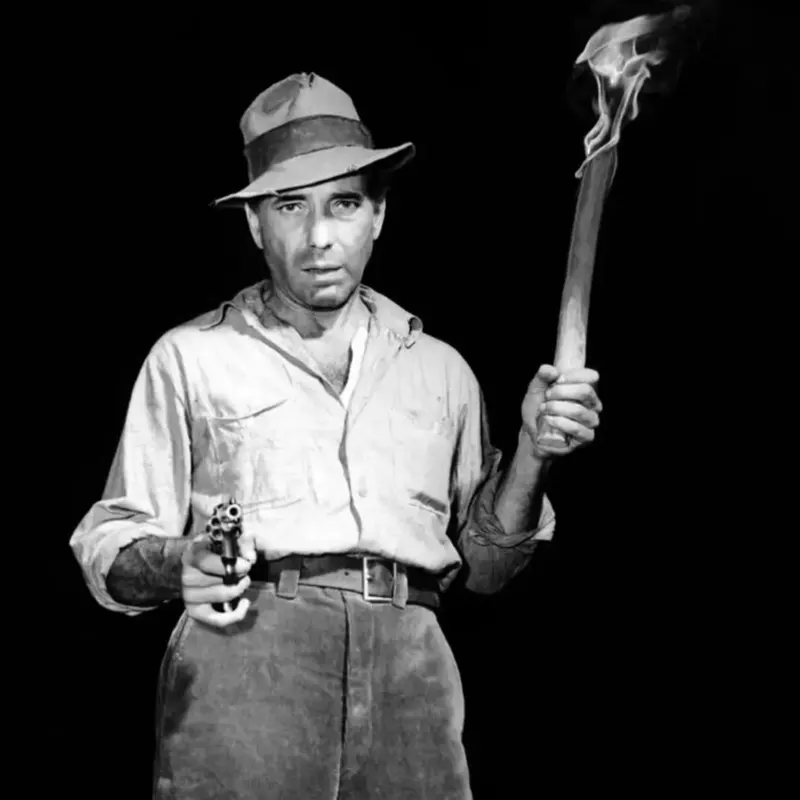
We're talking today about the 1948 Hollywood classic, The Treasure of Sierra Madre, directed by John Huston, famous for many different movies, like the Maltese Falcon, and starring in the leading role, the ever-wonderful and handsome Humphrey Bogart.
Yes, he actually might be most famous these days among more casual film fans for playing the villain in Chinatown.
Oh, I hadn't realized that. It's been a while since I've seen Chinatown.
Yeah, yeah, yeah. And yeah, and he also makes a little appearance in this one too. And I think that actually, you know, you mentioned we've done one episode on Mexico before. That was way back in episode seven. I think that that's not really a necessary listen to understand this topic, but I would recommend you guys check that episode out. Because really, what these two episodes are, are two very different colonial chapters in Mexican history. First, we saw the initial conquest by the Spanish, you know, the incredibly old-school initial colonial wave. And now in this episode, we're going to be talking about a very different kind of colonialism, much more modern, much more subtle, but one which still has very strong implications on the history of U.S.-Mexico relations and the development of the modern Mexican economy.
Right. And we're going to be doing this through the help of a great Hollywood classic, The Legend of the Sierra Madre, released in 1948, directed by John Huston and starring the ever-handsome Humphrey Bogart. Up into the forbidding majesty of the Great Madre Range go men. Their pasts buried in silent secrecy. Their futures hidden in the mystery of adventure. Men drawn together in their search for gold. Dobbs, soldier of fortune, Howard, the old timer, Curtin, the youngster, and Cody, the intruder.
Right, this is such a fun movie. I love this. It's really one of my favorite movies, especially movies from the 40s. It's just so incredibly modern, I feel like. It's Western, but not like any other kind of Western you've seen before. There's so many iconic moments. I've seen this movie probably four times now. And the first time I was maybe eight years old, I was seen with my parents on TV. And the part that stuck out with me most of all the scenes in the movie was one moment, maybe a third of the way through, when Humphrey Bogart's character thinks that another character is about to steal his treasure because he's, you know, sniffing around this rock where the treasure's been hidden. And he insists, actually, no, no, no, I'm looking because there's a Gila monster under there. And they pry open the rock to reveal this terrifying, giant, venomous lizard lurking underneath.
And that really stuck with me when I was a little kid.
Yeah, absolutely. It's just a really iconic movie full of really quotable lines. And in general, it's just a great meditation on how human nature is corrupted by the acquisition of wealth.
Yeah, and very misquotable lines, as we're gonna see.
Who was B. Traven?
But there's really also one other thing that's so unique about the treasure of the Sierra Madre, particularly its source material. And it's so unusual that this is really what made Sam and I want to do this episode. And that is the fact that the novelist, B. Traven, is pseudonymous. And to this date, we're still not entirely sure exactly who wrote this book.
So the original 1927 novel is credited only to a B. Traven, an unknown writer active in the 20s who wrote in both English and German. His first novel, The Cotton Pickers, actually first appeared in the official publication of the Weimar German Social Democratic Party, the SPD, in their newspaper Vorwärts. Shortly after, The Cotton Pickers was republished as a novel under the title Der Wobbly. And as you might be able to guess from that name, Traven, whoever he was, passionately advocated for labor causes and had a great interest in international workers' movements, such as in this case, the Industrial Workers of the World. The Treasure of the Sierra Madre is very much along these lines, as it follows a vagrant gringo who gets a job working on a Mexican oil field, but then hears word of even greater riches hidden beneath the sand. But just who was this enigmatic B. Traven?
This has been the subject of many investigations for nearly a century, since the author's own lifetime, and nobody has been able to come to an unambiguous conclusion. Many different theories have been proposed, some more credible than others, ranging the gamut from the unbelievable, such as Traven being the bastard son of the Kaiser himself, to the meekest of the meek, tracing his origins to a peasant family in a small village in present-day Poland. The mystery of B. Traven was intentionally seeded by the author within his own lifetime. He had a real knack for adopting different identities and creating false trails to throw off would-be snoopers. The Mexican cinematographer Gabriel Figueroa, who shot multiple films based on Traven's books, said that he must have had at least 20 passports. He had a vast collection of documents which would have allowed him to assume a different identity at a moment's notice.
His reasons for doing this cannot be stated with certainty, but there are a number of competing explanations out there. And in this episode, we are really going into the thick of it, you know, digging into the gold-rich dirt to find the nuggets of truth in Traven's life.
Right, but before we dig into that gold-filled dirt, just a reminder that we're hunting for our own gold-filled dirt out here in the form of our Patreon. So, if you feel like pitching in a couple of bucks for our hard-earned research mining for all the great content we deliver to you guys, we would highly recommend that you check that out and throw us a few bucks our way. And yeah, we'd be forever grateful.
Yes, and we promise to never let greed corrupt us, don't worry.
Yes, exactly.
Ret Marut, actor
Yeah, so what can be said for sure is that before B. Traven disembarked on the shores of Mexico in 1924, he had lived for over a decade under the name of Ret Marut. He was an actor and a short story author with a really small footprint in Germany, at least until 1919, as we'll get to shortly. But even in the days when Marut can first be traced in the historic record, he first appears in 1907 as an actor and director in an Essen municipal theater in northwestern Germany. He really worked to obfuscate his origins. When registering in the city of Düsseldorf in 1912, he claimed to be an English subject. With the outbreak of the war, he changed his story, saying that he was instead an American. And different people who had known Marut during his German period present contradictory accounts of his origins as well.
He was telling different people different things about his backstory throughout his life.
Yeah, and I think it really seems to have been a psychological compulsion for him. Maybe, you know, something, some kind of delusion of grandeur. I don't think that this kind of secrecy was really always the result of practical considerations about security. Although, as we'll see, that definitely was part of it. I think he had some great insecurity about his own identity, and he seemed to have only really felt safe as a public figure operating under these deep layers of disguise. It's really interesting, you know, he definitely had something interesting going on upstairs.
Yeah. Alternatively, some of the origins, as we mentioned, they give him really noble background and really famous people. So if he was like, I'm not saying he was the son of the Kaiser because he probably wasn't, but you know, if he was the son of a really notable person, then maybe he would have been told explicitly by whoever his father was, like, hey, listen, don't put yourself out there too much. I'm going to provide for you. You're never going to be short of money, but don't give people a reason to question who you are.
Right, like if he was the secret half-brother of a certain foreign minister of Weimar Germany.
Yeah, exactly. Yeah. Yeah. So despite all this obfuscation, we do have a paper trail documenting Marut's acting days in very cursory detail. He was in Thuringia in 1908, in Chemnitz in 1909, and he toured with the Berliner Neue Bühne acting troupe across Prussia from 1910 to 1912. He was no Edmund Kean, although he did play him once on stage. His biographer, Karl Guthke, called Marut a bit player, his performances being mostly limited to small towns. It must have been a really frustrating experience for Marut. He was unable to jump to the big stage. Or maybe that was the point all along. Maybe he was already leading this itinerant existence because he was on the run from something. 1911 through 1912 saw him working at the Danzig Municipal Theater. And he came closest to success in the profession from 1912 to 1915 when he was briefly involved with the Düsseldorf Schauspielhaus.
This was a theater of some renown. And this is where we get the form where he claims to be an English subject. Despite his wanderings, he seems to have been doing okay for himself. In his application to the Düsseldorf Theater, he wrote to the director that he viewed, quote, what is called a good wage as a matter of secondary importance. Did he perhaps come from money? So Marut quit his wanderings in 1912 as he was now involved with the moderately prestigious theater. But success continued to elude him. He was informed in June 1915 that his contract would not be extended for the following year, owing to the quote seriousness of the situation. That being the war, of course. Marut had his contract terminated in August, and shortly thereafter, he relocated to Munich, Bavaria, where he would stay for the next few years, and where he would finally make a name for himself, the consequences of which would take him into a lifelong American exile.
Born in San Francisco?
Right, but before we can get to that, let's speculate a little bit more on Marut's life before he became Ret Marut. Because, as best as we can tell, he was probably born around 1882 or maybe as late as 1890, as these were the years he himself gave throughout his life. Additionally, settling on the later 1890 date, possibly, you know, out of vanity. Throughout his life, he insisted that he was born in the US, specifically San Francisco. Whenever he had a run-in with the law and during his journey to flee Germany, he told consular officials that he was born in California. San Francisco was a great location to claim for a man in search of identity, because in 1906, the city was completely leveled in a massive earthquake, destroying any records that might have been useful to establish an identity. Clearly, you know, a smart guy, you know, he really, yeah, was very good at this.
Traven tried his story several times between 1918 and 1924 when he was desperate to claim American nationality. But all the officials with whom he made contact were familiar enough with this San Francisco trick to dismiss his claim in light of the absence of evidence. But we should add that this doesn't disprove Traven's claims of American origins outright. He claimed to have been born in America, and although he had good reasons for obfuscating his origins, an American birth is something he really sincerely believed, according to the recollections of his widow. During the early phases of his literary career, he claimed to have been raised in America as well, but this is a lot more dubious. Because although he did speak English, he clearly spoke it with a pronounced German accent. And honestly, this kind of comes clear in his English writing as well. It really seems like it's not by a native speaker.
However, the German prose of his novels is also punctuated with anglicisms. One of his books, The Deathship, had an original handwritten biography in English, not in German. So it does seem like some of his books were written in English first. So clearly, you know, he had, he was very fluent in English, he may have had some early English language exposure. Although we should mention that his earliest novels don't have as much English influence and were certainly written first in German. So again, this could just be another attempt at obfuscating his origins.
Yeah, as best as we could tell, Traven grew up without a father, and his mother was no longer present in his life from an early age. He never mentioned growing up around siblings or other relatives. Many of his early stories focus on relationship dynamics between emotionally abusive and controlling mothers and their hapless sons. Was this an autobiographical element, maybe? Traven had told his wife that his mother was an actress or singer who regularly went on tour, and a friend who had known him as Ret Marut recalled the claims that his mother was part of a traveling ballet troupe. At various points, he claimed that she was German, Scandinavian, British, or American. He told many people that following the death of his mother, he spent many years working as a sailor until he finally moved to Germany sometime before 1907, when he finally appears in the historical record as Ret Marut.
The Feige theory
And we've been around the bush for long enough. Let's go into some of the proposed solutions for the mystery of Traven's origins. The most simple explanation for who this guy was was uncovered by a British journalist, Will Wyatt, in the 1970s during the production of a BBC documentary on the life of Traven. After filing a FOIA request, he discovered correspondence from 1924 when Traven was still in London and once more attempting to establish his American nationality. As recounted by Karl Guthke and B. Traven, The Life Behind the Legends, the consular official wrote that Traven had presented himself as being born in San Francisco in 1882, but he had in fact confessed to British police that, quote, his true name was Hermann Otto Albert Maximilian Feige, and he was born in 1882 in Schwiebus, Germany. His mother was a quote mill hand and his father a quote potter.
He had come to England in the summer of 1923 en route to Canada and was then sent back from Canada to England because his papers were not in order. Investigations by the German police in Germany and Schwiebus had not turned up anything. Nevertheless, the prisoner, demonstrating good knowledge of the area, seemed well acquainted with the town, which makes it apparent that he had some connection there.
Right, and further research indicated that in February 1882, a boy named Hermann Albert Otto Maximilian was born out of wedlock to a factory worker. Some months after the birth, his father, Adolf Rudolf Feige, married his mother, Hormina Weineke. His father worked at a brick factory called Ziegelbrennerei in German, and Marut's magazine during his Bavarian period was in fact called Der Ziegelbrenner. So, you know, at the time of the BBC documentary, a younger brother and sister of Feige were still alive and interviewed about this. Quoting again from Guthke: He spent the first six years of his life in Schwiebus with his maternal grandparents. He was a good student, could not study theology as he wished, but rather learned the locksmith's trade in Schwiebus. He served as a soldier in Bückeburg from 1902 to 1904, the siblings continued, after which he lived with his parents in Wallensen, where he caused quite a stir as a political agitator and left the family around 1904 or 1905.
The only word from him came in the form of a letter after the First World War, over a decade later, in which he informed his family that the British authorities were about to expel him from England. Both brother and sister recognized photos of Marut taken in London in 1923, and then a photo of B. Traven, taken in Mexico in 1924, as their long-lost brother. They themselves were able to come up with a photo from around 1902 of their brother Otto.
Right, but just because there was an Otto Feige doesn't mean that the man named Ret Marut was Feige. Guthke believes that it's more likely that Feige was someone that Marut knew and whose identity he had pilfered for his own purposes. But the Feige story doesn't match up with much of what Traven had told others about his life. In this scenario, he grew up entirely in Germany with both parents, siblings, and grandparents. So it doesn't really match the psychological profile of the kind of man that he presented himself as in his stories and what he's told his wife. So it seems like there might be something there, but there are more interesting stories out there as well.
Yes, yes. Not necessarily more believable, but certainly much more dramatic.
The Rathenau theory
Now, the most interesting of these is that Traven was, in fact, the illegitimate half-brother of Walther Rathenau, who was briefly the foreign minister of Weimar Germany and who was previously a very well-known economist and industrialist. Gabriel Figueroa said that Traven had told his sister-in-law that he was the illegitimate son of Emil Rathenau, who was the founder of the German industrial conglomerate AEG and the father of Walther. Now, Walther, he was assassinated by the proto-fascist Freikorps in 1922 on account of his Jewish background. So according to the Rathenau theory, Traven was born as Moritz Rathenau, from which the name Ret Marut would be derived. And I mean, you can kind of see it if you squint. And we saw above that Traven was not really concerned about having a good salary in his German period, and he was able to publish his closed circulation and rather unprofitable magazine for several years, which would suggest that he might have had some money.
In his writings, he claimed to be of non-proletarian origins. Quoting from Guthke again, quote, as early as January 1919, Ret Marut noted in The Brick Burner that he felt better under the dictatorship of the proletariat, quote, than I have felt under any government in my entire life, for which the proletariat has governing power in its hands, capitalist heads, for certain destruction. And destruction of capitalism means that there can never be another war. My personal freedom is secured. But he distanced himself immediately from the proletariat as a class with the proviso, although I am not a worker and do not belong to the proletariat. But who threatened to take away the freedom vouchsafed by the proletarian government? His greatest opponents were the bourgeoisie, he said in the same Brickburner article.
Right. Yeah, I think that he might just be indicating that he's not a proletarian because he's an actor. And I think the relationship that artists have to capitalism is complicated, and not all artists see themselves as proletarians, even if they work for a wage. But it's definitely interesting that he, you know, was not a worker. I think that does show something about, you know, his certainly the way he conceived of his own relationship towards the socialist project that he was so interested in.
Yeah, and so working against the Rathenau theory, maybe Traven denied having Jewish ancestry, including when he was still Ret Marut, and he got into an argument with Dietrich Eckart, who was the founder of the Deutsche Arbeiterpartei, the German Workers' Party, which was the precursor of the Nazi Party.
It seems like everyone was hanging out in Bavaria in this period. It's a really interesting place.
Yeah. But given all the obfuscation he engaged in, who can say for certain if he really had no Jewish origins or if he was just laying more mines for would-be sleuths to try to figure this guy out. So yeah, the Rathenau theory, it's fun, but there's no hard evidence connecting Traven to the Rathenaus.
A Hohenzollern bastard?
Right. You know, but just because he might not be descended from one wealthy family doesn't mean he could not be descended from the wealthiest family in all of Germany. Or if not the wealthiest, then certainly the most illustrious. Now, in the 1960s, it was asserted that Traven was, in fact, a bastard Hohenzollern, maybe even the son of the Kaiser himself.
Right.
People are royalty. Truly royalty. Yeah.
People who had known Marut claimed that such rumors circulated around him in the 1910s and 20s, but as far as Guthke can tell, there was no contemporary evidence for this claim. Nevertheless, Traven clearly had fun with this version, and he didn't shy away from allowing such rumors to circulate. His widow recalled that when the two went to Germany in 1959 for the premiere of a movie based on his novel The Death Ship, he took her to a monument erected to Wilhelm I, the grandfather of the last German Kaiser Wilhelm II. Traven is reported to have told her that he is descended from him. Traven would also make tongue-in-cheek jokes about his noble origins, or maybe they weren't really jokes, we can't really tell. But according to this version, one Travenologist concluded that his mother was an Irish actor named Helene Marath, who shortly thereafter took him to America.
But others, including Guthke, say that they failed to find evidence for Helene Marit's existence, so that might be a dead glitter.
Right, right. And then also, you know, take a note there that her last name is, you know, remarkably similar to Ret Marut.
The Sternwaldt theory
Yeah, exactly. But the final theory we're going to present to you guys in this episode is the one favored by Guthke. It gives Traven noble origins, but not nearly as illustrious as the Hohenzollerns. Guthke's assertion is based on the fact that in 1935, Traven wrote a letter to the Library of Congress to deposit an opera playbill from 1840 into the collection. In the accompanying letter, Traven wrote that it was the only one of his kind that he knew of. This was not a particularly valuable document, and yet this was presumably something that Traven had brought with him all the way to Mexico and with him across all of his different voyages in Germany as he was evading the law. So you really have to ask, why was he bringing this thing along? The playbill listed a certain Frau von Sternwaldt, who lived from 1812 to 1883, whom Traven's widow confirmed as her late husband's relative.
Given the age of this woman, it might be that this was his grandmother. She was not a major actress, and her name is not a real aristocratic one.
In fact, she took it from added the von for pretension, or was it a fake last name altogether?
No, no, she took her husband's name.
Oh, okay.
Yeah. Now, Guthke uncovered that there was another actor named von Sternwaldt. This was Ludwig, and in fact, he wasn't really a Sternwaldt, but rather a von Warnstedt. This is, in fact, an actual aristocratic name. Sternwaldt, Guthke says, is an anagram for L. Warnstedt. So, like the initial and the real name of this guy. Now, this Ludwig figure, he was born in 1804 and was the illegitimate son of a Karl von Warnstedt, and he died in 1881.
Oh, so then this would be the husband of the potential grandmother.
Yeah, so potentially his grandfather.
Right.
Now, in 1855, a certain Fraulein von Sternwaldt made her debut, and she later traveled with the older Frau von Sternwaldt. According to Guthke's theory, this would have been Traven's mother. A Frau I. von Sternwaldt is listed as working in the Deutsches Theater in Newark, New Jersey, in 1886 to 87. And Guthke unfortunately found no further mention of an I. Sternwaldt until 1907, this time with the von dropped in theaters in Milwaukee and Chicago, so out in the Midwest now.
Right, but in our minds us, so it's another kind of hint to a potential American connection.
Yeah, and here's another interesting bit of circumstantial evidence: the von Warnstedt family has a Scandinavian branch, and if this theory is correct, this may explain why Traven sometimes claimed to have Scandinavian origins. Guthke also uncovers that the Warnstedts had relatives living near Lübeck in a town called Traventhal. Quote: Moreover, Marut is indigenous to this region. It is the name of an old noble family that died out in the 14th century. The name of the village of Marutendorf, seven miles west of Kiel, is thought to be derived from it. A strange configuration. Sternwaldt, Warnstedt, Traven Marut. Yeah, so that seems like a really compelling one, I'd say. And there are many different directions one could take with these inquiries. Travenology, it's a whole field. It's a real house of mirrors. Now, these are just the most prominent theories. I'd say that all of them have at least a little bit of merit to them, or I wouldn't have included them.
Make of them what you will. But I'd just like to say before we continue further, we're living in an age of DNA sequencing. Could someone please get a DNA sample from Traven's body and try to figure out who he was actually related to? Because I'm really dying to know.
Marut the writer
Yeah, no, yeah. It's quite a great mystery. No, I think it's very fun to speculate on who he might have been before he became Ret Marut and before World War I. But what I think is most interesting is the more concrete hints of his life after he established himself as an actor and a writer and even potentially a revolutionary, as we're gonna see. It seems that even before World War I, Ret Marut had been publishing short stories in various papers beginning around 1912. Nothing great, but there was enough published under this name that somebody reading the popular fiction of the era would have probably been vaguely familiar with the name Ret Marut. He published in many newspapers, including, as we mentioned, Vorwärts, the SPD paper. He also published a novella in 1916 to The Honorable Miss S and the Blue Speckled Sparrow in 1919, and sometimes published his stories in the magazine Der Ziegelbrenner, you know, the brick burner that we mentioned.
But he was receiving a lot of rejections. The historian Guthke uncovered that this one funny exchange published in the satirical magazine Simplicissimus in 1918. A certain Ret Marut publishes a rag in Munich, which in practically every issue smears Simplicissimus rudely and ineptly to boot. This charming gentleman has been trying year in and year out, and even during the war, to contribute to Simplicissimus by sending in dozens of sketches and novelettes, but his submissions were always declined by our editorial board as inadequate. Which I think you, Sam, have described as kind of the original Chapo Trap House reply guy origin story, you know, where you don't get the attention you want from Felix Biedermann, so you become a right-winger. You know, this is kind of the original thing like that.
Yeah, well, thankfully that didn't happen to Marut. He was a convinced leftist for the remainder of his life, as we're going to see. But yeah, the rag in question is his magazine Der Ziegelbrenner, the brickburner.
Yes. Which in this case, we should maybe understand as an unsuccessful, you know, Chapo orbiter podcast.
Yeah, we certainly don't know of any of those around here.
Yep, nothing at all.
The Brick Burner
Yeah, so this magazine would be published irregularly from 1917 to 1921, and it's had a pretty low circulation in Munich. Here we get a sense of Marut's political sensibilities. One author claims that the magazine was able to avoid censorship because it was misclassified as a bricklayer's trade magazine, which I find pretty funny.
That's hilarious.
Yeah, but more likely it just wasn't circulated widely enough for many people to take notice of this thing. And it was done from a personal press and financed by Marut himself. The first issue came out in September 1917, when the war was already looking very bleak from the German home front. Before this backdrop, the name of the new magazine reflected the publisher's desire to furnish with his publication building blocks for a better post-war Germany and for a better world in general. I never wanted to work for the fall of Germany, but rather for the building of a new Germany from the old one choking on its own falsehood, Marut wrote in January 1919. And the first essay of the first issue of this magazine adopted the building metaphor in reference to the post-war era. Don't rebuild the old, build the new. This introductory slogan was, however, more upbeat than the general tone of the 40 issues that came out in a decidedly irregular tempo.
To construct a more humane social order, Marut wrote, one first has to do away with the old. Criticism set the tone. Criticism of the way things are and of loathful contemporaries, as the cover sometimes read. The magazine included criticism, polemics, and zestful forays not only against the political and social order, but also against harmless parties, such as publishers who might intend to send review copies, theater and cinema owners who might think of offering complimentary tickets, and even potential advertisers. A warning on the cover of the first issue was meant to scare off all such potential suitors before they might find their way to the magazine's humble headquarters. The cover of the fourth issue, in July 1918, set new standards for editorial insolence. People should not attempt to pay a visit. There is never anyone here. We have no telephone, it read. Pretty funny. Marut's independence, safeguarded against any conceivable interloper by this alienation tactic, came before all else.
He was of the opinion that a pencil I have bought is in principle worth more to me than a typewriter received as a gift. And this comes to us again from Guthke.
And I think that, you know, all this, this strange secrecy and this, you know, fierce independence, really sets the tone for Traven's later famous reclusiveness. You know, he just had this violent aversion to being in the public eye while still doing whatever he could to get attention on his fiction. He wanted the attention for his writings, but not for him himself. And it doesn't seem like he was writing ever for any kind of monetary prize. He just wanted to get his words out there.
Stirnerite anarchism
So, as we mentioned, Marut had a leftist orientation, but he was politically closest to Stirnerite anarchism, according to Guthke's analysis.
Yeah, and I gotta say, he's the only, this is the only real-life Stirnerite I've ever encountered in any of my readings about, you know, interwar Germany or the 19th century or anything like that. I never knew that, you know, Stirnerites were a real thing. I thought they were just like a strange online group of weirdos.
Yeah, I really just thought it was a meme ideology, but I guess they had their shooters.
Yeah, yeah. If anyone's not familiar with Stirnerism, Google it, particularly Google Image It, because I think that'll really kind of tell you all you need to know.
Yeah, the only image of Stirner that we have is this good old sketch that Engels did back in the 1840s. It's like this smug guy in glasses.
Yeah, we don't have to get into Stirnerism now. Instead, though, let's talk about what Marut has to say about his own ideology. Because in January 1919, he wrote, I can belong to no party, since I see my personal freedom limited in belonging to any party, since being bound to a party line keeps me from developing into what I view as the highest and most noble goal on earth, to be a human being. I wish nothing other than to be a human being, nothing but a human being. And since the human being is the greatest thing to me, I am indifferent to everything else which does not lend to this goal and will remain so. But this indifference ceases for me from the moment when danger threatens my path. And only for my own sake do I raise my voice. It is my concern, not yours. Your concern is of no importance to me today, and it will always continue to be of no importance.
The most noble, pure, and true love of mankind is the love of oneself. I want to be free. I hope to be happy. I want to appreciate all the beauties of this world. I want to be joyful, but my freedom is secured only when all other people around me are free. I can only be happy when all other people around me are happy. I can only be joyful when all the people I see and meet look at the world with joy-filled eyes. And only then can I eat my fill with pure enjoyment when I have the secure knowledge that all other people too can eat their fill as I do. And for that reason, it is a question of my own contentment, only of my own self, when I rebel against every danger which threatens my freedoms and my happiness.
Yeah, he really sounds like a sweetheart, doesn't he?
Yeah, no, it's yeah, I think that, you know, it's, yeah, that comes from his article, The World Revolution is Underway, which, you know, is really kind of his interpretation of the revolutionary events happening at the end of World War I that we've talked about in previous episodes. I agree, it's he really, you know, clearly had this fierce independent streak. I think he was much more aligned towards anarchism than Marxist communism, but he was very much a fellow traveler with the revolutionary movements of the interwar era. I think that he saw Soviet communism as a stepping stone to this kind of individualist utopia, not an obstacle, which is very different from any kind of libertarian beliefs today, whether left or right libertarian.
Yeah, yeah. And like any anarchist, he really saw that, or any left anarchist, he saw domination from the state and domination by private capitalists as the same. And he believed World War I was the product of capitalists' conflicting imperialist designs over who could sell their commodities into which markets, to the detriment of the individual worker. Marut was drawn to a utopian conception of human liberation in which one global struggle would connect to a political program. And this really informs his writings up until the Mexican period. His socialist influence is incredibly clear and explicit in The Treasure of the Sierra Madre, which is something that, of course, the 1948 film almost entirely leaves out. Yeah, but despite his aversion to states and governments, Marut's attachment to one attempt at a state nearly cost him his life and forced him to leave Germany to the faraway shores of Mexico.
The Bavarian Soviet Republic
And that was, of course, the Bavarian Soviet. I believe at one point you described it as a theater kid republic?
100%. It was the government of Ret Marut's. It was such an interesting society. It was incredibly short-lived, you know, and despite being very short-lived, there's so much that you can write about it. It was just this incredible what if, but it, of course, terribly failed. But what it was, you know, was that in the immediate aftermath of World War I, communist revolutions broke out across Germany and were most successful in Bavaria, which is the large state, you know, in the southeast. Very rural in some areas, but also has a major industrial area. There's a lot of money going in and out of Bavaria in the interwar period. This is basically why so many people were in Munich, as you mentioned. But in 1919, it became a communist country. Initially led by this social democrat named Ernst Toller, who is this very strange playwright, probably mentally ill in some ways.
We talked about him way back in our episode with our friend Yukon Cornelius. Then it was succeeded by a more hardline Marxist state led by the famous Eugen Leviné, who would be executed for his participation in this failed republic. Really an interesting society. It's exactly the kind of society Ret Marut would have wanted to help build. But then in the end, it would be overthrown violently by those Freikorps that we mentioned, who were these proto-fascist militias of right-wing nationalist World War I vets who had no interest in building any kind of a more egalitarian Germany. Certainly not a revolutionary socialist Germany.
Yeah, but we're getting a little ahead of ourselves. Marut was, he had very high hopes for the revolution. He wrote that, quote, since the day the revolution broke out, I stand in this battle no longer so hopelessly alone as I did before November 7th. But he wouldn't just cheer from the sidelines. He played an active role in the events that followed. On February 24th, 1919, Marut was appointed to the press department of the Central Council and worked as a censor for a bourgeois Munich newspaper. He was then promoted to the Commission for the Socialization of the Press and briefly worked as a censor and sometimes writer for several Bavarian papers. But the Bavarian Republic of Councils was very short-lived, and it was snuffed out in early 1919 when the Weimar government decided to send in these Freikorps to impose their control.
Escaping the Freikorps
On May 1st, 1919, Marut nearly lost his life. He made an unlikely escape, and he published his recollections of that day in The Brick Burner under the title, quote, In the Freest State in the Whole World. He begins by excoriating the social democrats of Ebert in the strongest possible terms. Quote, But to what a state of degeneracy this Social Democratic Party has sunk, which hunts down like wild animals in the forest, revolutionaries and workers who ask nothing but the fulfillment of what was promised to them a thousand times by the rulers of today, promised in the days before they began to rule. Instead, indeed, it is worse, for the animals in the forest are granted periods of closed seasons, and skilled hunting is required at other times. How depraved this party has become, which offers bounty of 10,000 and 30,000 marks for the capture of fleeing revolutionaries, the purpose being not to protect the population from them, but rather to wreak vengeance on them and murder them.
What more can you expect from this party whose members perpetrate murders on revolutionaries, legal murders, which they call death sentences? And this is a country where since 1848, and despite the anti-socialist laws, no death sentence had been carried out against revolutionaries.
Right, and Marut then describes how he was arrested at a Munich cafe. Members of the White Guard, which is what he called the Freikorps, drove through the street firing machine guns at people. And after attempting to help some of the wounded, Marut left the cafe and was snatched up into one of these cars by these white guards. In the meantime, he writes in third person, a number of pedestrians have gathered around to watch the incident. The white guardists had become aware of them and began to denounce Marut loudly, saying that he was the one principally responsible for the human blood that had been shed and was still to be shed, but that he was now about to get what was coming to him. He then writes that he was driven to the war ministry and interrogated, upon which Marut was given 20 counts of high treason and told to confess before they fetched witnesses.
Marut was not allowed to call witnesses of his own. He was taken to be court-martialed. He continues: The hall in which Marut now found himself became increasingly full of captured workers, red guards, sailors, girls, and boys. Among the other denounced people there, Marut saw a 16-year-old who was charged with having attacked soldiers of the infamous army and with having spread Spartacist propaganda. At every moment, workers and sailors with deadly white faces were let out of the large hall in which the cigarette-smoking lieutenant decided on life or death for the prisoners. Their horror-stricken and tragic eyes revealed to the others who waited that they had also received death sentences.
Yeah, but Marut really lucked out because the man standing directly in front of him kicked up enough of a stink that several people had to go and restrain him and eyes were off Marut for long enough for him to slink away.
Yeah, it really is remarkable that he was able to get away from this. It's like it's crazy, you know?
Yeah, he says that some soldiers like saw him and he just saw pity in their eyes and they were just like, eh, get out of here.
Fugitive to Mexico
So from this moment, Marut became a fugitive from the law and he would live underground for many years. He wouldn't stay for too long in any particular place and he moved all around Germany and Austria. In 1923, he was finally able to catch a ship to Canada from whence he was deported to Britain and detained. This is where he presented the British police with the Otto Feige story. He originally wanted to go to America, hence his renewed attempt to become recognized as an American citizen, but this failed and Marut had to make his way to another place. In the summer of 1924, he was already in Mexico. This became his adopted country and the place where he'd spent the remainder of his life. He initially settled in Tampico, which was then undergoing an oil boom. In his diary, we find an entry dated July 26, 1924.
It read, quote, the Bavarian of Munich is dead. Marut was no more, but he would go through more than one identity in Mexico as well. Here's how Guthke explains his lifelong obfuscation of his identity. Quote, We can easily imagine why he adopted a new name in his chosen land and tried to pass himself off as hailing from America. He clearly did not want to be identified as Marut, the German anarchist and traitor wanted by the authorities. From the 1930s on, he may have feared the fiery tempers of the southern Mexican landholders whose exploitation of the Indios he lambasted in the mahogany novels. Furthermore, it is conceivable that a writer with Traven's sense of independence simply wanted to avoid the inconvenience of personal publicity or the anarchistic conviction that the individual is insignificant and may have lain at the bottom of his never-ending game of hide and seek.
Right, but in any case, it's yet that after he arrives in Mexico, like you said, Ret Marut is dead and B. Traven is born.
Traven the novelist
All right, so much like his contemporary, so Traven, I think, is really should be understood as part of this trio of pan-American writers with John Steinbeck and Ernest Hemingway. I feel like the three of them have so much in common because they all write these globe-trotting adventure stories injected with heavy proletarian themes. Most of Traven's writing is set in Latin America, in Mexico in particular, and deals heavily with the Mexican Revolution and its aftermath. And just like Hemingway and Steinbeck, Traven often wrote about Americans who crossed the border either to seek their fortunes or escape a shadowy past.
Although you should mention that, unlike Steinbeck and Hemingway, some of his novels deal entirely with local Latin American characters, in particular, indigenous Mexicans. They were a real fascination, almost a fetishization at times, for Traven. He continued to publish most of his books in Germany, despite, you know, being in exile. And that this was throughout the 20s and the Weimar period. And then in the 30s, the various publishers he relied on were all chased out of Germany by Hitler. He published mostly through one specific publisher, actually, and he was like their main product. He was able to secure a deal where most of the revenues would be going to expand them. It was like a union outfit for the printers union. So this was a way for him to directly help the workers' cause with his output. He really did well in that. His books were immensely popular.
Just in Germany alone, until 1935, his books sold half a million copies. So he was really, really widely read.
Right, right. And we should mention that there's kind of two traditions he's tapping into here. Because, you know, on one hand, he was thematically very similar to the kind of adventurous left-wing books of Steinbeck and Hemingway. But then on the other hand, I think that German readers might have understood him kind of in the same tradition as the famous Karl May, the German Western novelist. Because, you know, right? Because these were adventurous stories set in the Americas, very exotic, aimed initially at a German audience, but he was a good enough writer, particularly in the kind of themes that he would dabble in. He was not really a prose master, more of an idea guy. He had great success in the English-speaking world as well. Like we said, most of his books were written in two, possibly three languages, because many had Spanish translations. And they really were very widely acclaimed in his own time, especially in the 1930s.
So, in 1927, as we mentioned, he wrote The Treasure of the Sierra Madre, which would become his most famous book. But he also wrote these books known as the Mahogany Novels or the Jungle Novels about the impact of the Mexican Revolution in the southern, heavily indigenous parts of Mexico that I think are considered his kind of true magnum opus. He would write throughout the 40s, 50s, and 60s, usually eventually publishing with the help of a strange American known as Hal Croves, who would die in 1969, upon which any further Traven stories stop being published. But we're gonna get to Hal Croves later, because he has an important role to play in the film adaptation of The Treasure of the Sierra Madre. I think first we should look a little bit at the world that Traven was entering in the 1920s, in the Mexico of the revolutionary and post-revolutionary era.
Because while the film was shot in 1948, it takes place decades prior, around the time that the book was written. And this was a time in which Mexican society was a lot more turbulent than it was after World War II. And this was also an era in which U.S. involvement in Mexican affairs was a lot more heavy-handed.
Oil and Edward Doheny
And what I really didn't know until we began researching this episode is how much of the U.S.-Mexican relationship used to rely on oil. Just like neighboring California and Texas, the northern half of Mexico is really rich with petroleum. There's some places where oil tar bubbles up to the ground, like the La Brea Tar Pits in LA. And this tar was used heavily by pre-Columbian peoples. The Spanish had less use for oil, but beginning in the 19th century, there was a steadily rising demand for petroleum, lamp fuel, and machine grease.
As a little side note here, industrial petroleum production actually began in Russian Azerbaijan as early as the time of Catherine the Great, probably because they didn't have access to the whale oil market of the Atlantic.
Fascinating.
Yeah.
American and British investors began opening oil wells in Mexico across the second half of the 19th century with the enthusiastic cooperation of the Mexican president and de facto dictator Porfirio Diaz. The most prominent of these was the California-based but Wisconsin-born Edward L. Doheny. And if you've spent much time in LA, you've probably seen this guy's last name around. Today, Doheny is most well known for his involvement in the Teapot Dome scandal of 1921 and also for being the indirect inspiration for the character of Daniel Plainview in Paul Thomas Anderson's There Will Be Blood. But he was really a major, major player in the development of the international, particularly Latin American, oil business.
Yeah, and speaking of There Will Be Blood, now that I think about it, I think the opening scene of There Will Be Blood might be influenced by a scene in Sierra Madre where the mine caves in and Dobbs is, he gets hit on the head and he's just in this really precarious position until he's in the middle of the day.
Yeah, yes, very much so. And actually, you know, Paul Thomas Anderson is open about this. And he said that, you know, I think that like while he was making the movie, he was watching Sierra Madre like every night.
Oh, nice.
Yeah. All right. Well, so Doheny, you know, the original Daniel Plainview, he put his money in oil wells all across the Western Hemisphere, from New Mexico and California all the way down to Venezuela and Colombia. But the jewel of his crown of black gold had to be Tampico, Mexico, which is where the start of the action of this movie takes place, and which would actually be one of the global capitals of the oil industry, as well as a satrap of American, British, and Dutch oil interests. These oil barons, just like Doheny. Because so, these lucrative opportunities in Tampico brought over huge numbers of foreign investors and adventurers, mostly from the United States, but also smaller numbers of people from Europe, China, and even the Middle East. The book has offhand references to Arabs and Chinese cooks, hoteliers, and gold panners all around.
Díaz and the revolution
But just as Tampico was beginning to prosper, which was the first and second decade of the 20th century, rural areas of Mexico languished in drought and poverty. The Diaz regime's heavy-handed industrialization policies immiserated the huge population of peasants and benefited foreign investors like Doheny much more than everyday Mexicans. And while some Mexicans did benefit from this kind of economic modernization, nearly all of these riches went to the wealthier, whiter elite who'd been running the show in Mexico since the days of the conquistadors. So, when Diaz overextended his influence by jailing the young opposition leader Francisco Madero, small violent uprisings emerged across Mexico in defense of Madero and in opposition to the Diaz program more broadly. These uprisings consolidated into organized but still incredibly complicated revolutionary factions with famous leaders like Pancho Villa and Emiliano Zapata.
Yeah, unfortunately, we don't have time in this episode to really cover the Mexican Revolution, and to be honest, neither of us is well-read enough to really give the topic justice because it's a huge subject. But broadly speaking, Mexico in the 1910s and 20s was this incredibly unstable place. It was comparable to Russia or China in the same era. And the United States was heavily involved in the conflict, initially seeming to favor the revolutionary forces. Early into the revolution, the imprisoned presidential candidate Madero escaped from jail and was smuggled away to Texas, where he sought guidance from American political experts and oil executives, as well as the ghost of the legendary President Benito Juarez. You can listen to episode 41 on spiritualism to see how this kind of belief was not so uncommon in the early 20th century. They just really loved communing with the spirits back then.
Yeah. And as it became clear that the Mexican army was unable to contain the spread of the revolution, in 1911, a Porfirio Diaz stepped down after 35 years as president and fled to Spain. Madero was elected president with a broad popular mandate, including support from the rural poor, the urban elite, and the powerful American oil interests. So while he enacted certain major reforms, such as allowing freedom of the press, his reluctance to overturn the brutal economic and social hierarchies within Mexico caused the revolutionary armies to remain organized throughout his presidency. By the end of 1911, the rebel armies had turned against Madero. 1912 was marked by a constant rebellion both from the right and the left. And in 1913, ousted supporters of Porfirio Diaz took advantage of this chaos to overthrow Madero in a palace coup. The young president was shot in the street, an act witnessed by many American journalists, which caused a scandal in Washington.
Wilson, Tampico, and Veracruz
Right. And so, as a result, the new president Woodrow Wilson refused to recognize what he called this government of butchers that replaced Madero. American oil properties in Mexico, especially Tampico, were now thrown into jeopardy. And in the following year, 1914, the junta controlled the city of Tampico, but were under siege by revolutionary forces controlling the hinterlands. The U.S. was actually supporting both sides because they were funding the junta through the oil trade while also sending guns to the rebels. And as fighting reached the city center, some U.S. sailors got into an altercation with junta forces and were temporarily arrested on false pretenses. Although these guys were quickly released and the local general apologized, Wilson used this as a pretext to send an entire Navy fleet to the Gulf of Mexico to invade and occupy the neighboring city of Veracruz for over six months. During this time, the junta fell and was replaced by a new democratic government led by Venustiano Carranza. The U.S.
nearly occupied Tampico itself, only backing off when Carranza threatened to destroy all of the American oil wells if they did so.
Right, and this kind of American imperialism caused outcry across Latin America, with anti-American riots breaking out as far away as Montevideo. The Germans took advantage of the situation to move closer to Mexico, leading to the notorious Zimmermann telegram, which asked the Mexican government to join World War I on the side of the Central Powers in exchange for a return of large swaths of territory that the U.S. had annexed from Mexico over the course of the 19th century.
The 1917 constitution
And so in that same year, in 1917, the Mexican government drafted one of the most progressive constitutions ever written. It would actually influence the first Soviet constitution written in the following year. This constitution stipulated that the Mexican government reserved the right to nationalize foreign property and limited the ability of foreigners to own land, a regulation which is still on the books today.
In addition to this, there was a so-called Noxious Foreigners Act within the constitution, which basically said, yeah, which basically said that foreigners politically involved in Mexico could have their property confiscated and they could just be deported.
Traven, the CGT, and the CROM
And in fact, Traven, he became disillusioned with what was happening in Mexico in the late 20s and early 30s, as it became clear that he had a much too rosy picture of what the Mexican Revolution actually looked like, because he was in Tampico, which was controlled by primarily the CGT union, which was a more anarcho-syndicalist leftist type of union. But the government had actually set up a competitor called the CROM, which was, in fact, the predominant union in the rest of the country, which received government funding. And basically, in this way, the Mexican government of the mid-20s was able to squeeze out the CGT and sort of consolidate labor under the banner of the CROM, which became massively corrupt in this period. And so consequently, Tampico, it became sort of like a little island in a sea of CROM. And a lot of Traven's early writings, which were very optimistic about what the revolution was doing for ordinary people, it was very skewed by the fact that he was operating in this really atypical part of the country.
In the vanguard of the revolution.
Yeah, yeah, in this super industrialized place where the proletarian were playing the main role. Whereas in large swaths of the country in practice, nothing had really changed so much since Porfirio Diaz had been expelled and the same governors were still in place, you know. And there was a very long back and forth between all these regional interests and the central government, which again, we don't really have the competency to inform you guys about. But if there is interest, we will hopefully get back to this period very shortly.
And I also feel like, you know, just to kind of defend the Mexican government for one second, or just to put this in context, I think that he had every he and the workers of Mexico had every right to be furious at the ways that the more radical unions were sidelined by the official government-sanctioned unions. I just want to add that this is exactly the same policy being undertaken by the U.S. at the same time during the New Deal. It was this, you know, official above-board workers' organization that had the desired effect of sidelining more radical revolutionary forces. Like, you know, I think that, you know, the part of the downfall of the American Communist Party was just, you know, the success of above-board labor agreements of the New Deal. If the motto of the time is the president knows your boss is a son of a bitch, are you really going to want to take up arms against the president?
Yeah, yeah, but I mean, in Mexico, it was even more explicit because actually, like around 1928, the Mexican government saw that the CGT was effectively crushed and then proceeded to dissolve the CROM and stopped their funds. Yeah, it just led to many, many decades of the PRI having basically a one-party state in all but name.
No, yeah, yeah, that's it. Mexico's storied 20th century is just incredibly interesting.
The end of the oil boom
But, you know, just to kind of go a little bit farther into the 20th century, so the oil boom in Mexico actually peaked right around the time that Traven was arriving in the middle of the 1920s, upon which point Mexico was actually the second biggest oil producer in the world after the US. But right by like, let's say 27, 28, right when the book was coming out, the peak had passed and oil production was beginning to dry up, quite literally, because Tampico oil closest to the surface had mostly been sucked up and the techniques for drilling deeper oil hadn't been developed yet. Meanwhile, Venezuela was becoming a much more profitable alternative as a source of oil. So, Tampico's brief period as an international proletarian capital was beginning to come to an end. And oil jobs once worked by international workers were increasingly worked by local rural people, native Mexicans who were able to work for or willing to work for local for poor wages and who accordingly tend to be treated much more cruelly by their American, British, and Dutch employers.
Well, actually, here's the ironic bit. Actually, for a very long time, as it's commented on repeatedly throughout the novel, the Americans were the ones who were being exploited more heavily than the Mexicans because while the Mexicans had all these labor regulations, which say that they can only work this many hours per day, they have this minimum wage, and yada yada yada, none of these protections applied to the many foreigners who were working these fields. So, in practice, like it's very much a flipped situation to what you see today with the Central American and Mexican laborers who are usually undocumented working for cash in really precarious positions. But after a while, the Americans just went away because there were slim pickings to be had. There's actually a line in the novel where he says, Oh, we're all going to have to go back to Utah to plant beans or whatever because oil is over.
Oil is a done deal. And so, like, when the labor movement in Mexico was sufficiently crushed, then it was much easier to compel the local Mexican proletariat to work in these really harrowing conditions without the protections they had previously been offered.
Right. But as we'll see, you know, the Mexican government, they really were, I don't think they were as insincere about their version of the New Deal at this time as you might think, Sam. Because, you know, because they certainly did still have some juice left, as we're going to see.
Yeah, I mean, I'm just a hater, honestly. Like, I can't help it, so I'm always going to be criticizing. But yeah, like, well, I guess because there wasn't any good in all of this, I shouldn't let listeners think that it was all just a shit show because there were a lot of positive developments. Like, this government crushed the power of the church, what had previously been a major political force in Mexico. It got vast swaths of the country an education for the first time in their lives. It really did lead to many improvements, but just, you know, when you compare it to what could have been, it just, you know, leaves you wanting something more.
Right. No, absolutely. It's definitely just a what might have been. Because it was, I think, the Mexican government was this, it was kind of like the New Deal on steroids in a lot of ways. It was this, you know, incredibly interventionist, outwardly pro-worker regime, claiming to be upholding the ideals of the revolution, while in practice, never really reaching the finish line in any of these great reforms. But it did make these major economic interventions that were, I think, a lot more radical than what the Roosevelt administration was doing in the 30s.
Cárdenas nationalizes oil
And so, for instance, in 1935, the same year that John Huston, the young screenwriter who would eventually become the director of the Treasure of the Sierra Madre, the same year that he read the novel Treasure of the Sierra Madre, the official Mexican labor confederation began a major push to organize the Tampico oil workers, who by this point, a decade after Traven arrived, were now entirely Mexicans. All of the foreigners had left because there wasn't as much money left. And so, after two years of organization, the foreign-owned oil companies responded with an insultingly meager offer of better pay, which triggered a massive strike in the Tampico oil fields. Within weeks, the matter went to the Mexican Supreme Court. And to the shock and horror of the oil barons, who I'm going to guess were much more accustomed to the very anti-labor American Supreme Court, the Mexican justices ruled in favor of the union, ordering a 26 million peso settlement to be given collectively to the workers.
And here, the oil companies made their greatest mistake because they still refused to budge. This was seen as a sign of supreme disrespect because it meant that they were not only working against the interests of the Mexican workers, they were disrespecting the sovereignty of the Mexican government. And then in 1938, this situation was immediately and dramatically resolved because Mexican President Lazaro Cardenas, a former revolutionary general, declared the expropriation of all oil properties in Mexico, consolidating them into the state-owned Pemex Company. Foreign petroleum companies responded with a unanimous boycott of the Mexican oil industry. But just a couple years later, World War II breaks out. And there's suddenly a massive global demand for oil for use in planes, ships, you know, so many areas. So Allied governments in Washington and London pressured American and British oil companies to drop their boycott and thus allow the state-owned Mexican oil company to become one of the most profitable and largest Latin American companies of all time.
I believe it is now the second most valuable Latin American company, second only to the Brazilian state-owned petroleum company, which has a similar history.
Yeah.
The novel
And we've had enough time romping around in the oil. Let's get back to Sierra Madre itself. It's really easy to see why it's classic, but it's also easy to see why it's not as celebrated as the novels of Hemingway or Steinbeck. Because Traven's Magnum Opus is really an amazing summation of human vice and virtue. It's sort of a hidden camera view of a particularly interesting moment in Mexican history and the development of a modern capitalist economy. But it also has really stilted prose at parts. It's clearly written by a native German speaker, and it really hits you over the head with descriptions of Mexican settings. To give one example, quote, bags had the names of the hotel guests written in pencil. It often happened that the owner could not get his package, which he recognized by his appearance, because he had forgotten the name he had given when he had handed the bag to the manager, having in the meantime changed that name several times for the sake of convenience.
That's just a very grammatically German sentence. And it's like, it took me like several readings to finally understand what that actually meant.
Yeah, yeah. All right, well, so let's get into the story of the book. So you heard a little bit from the trailer at the top, but just to summarize in very brief, the story, which is somewhat straightforward, is that an American named Dobbs is flat broke in Tampico just as the oil boom is peaking. And after winning a tiny bit of money from a lottery ticket, he teams up with another gringo named Curtin and the old prospector Howard to find a hidden gold deposit in the Mexican hills. The three men make their way up to a remote mountain patrolled by bandits, where they find a great gold deposit, but every nugget makes them more and more wary of the bandits and each other. They have several deadly interactions with nature and with these bandits, briefly having a run-in with another American named Cody. But eventually, you know, this gold fever really begins to set in, particularly in the protagonist, Dobbs himself.
So he does in his partners, shooting Curtin and taking all the gold. He gets his own karmic punishment soon after when he learns that Curtin actually survived. But before Dobbs can get too far with the gold, he's captured by the fearsome bandits and killed. Soon after, the bandits themselves are executed by the Mexican Federales. The remaining fortune hunters, Curtin, and Howard realize this entire adventure was pointless. And then they see that the bags of gold that Dobbs had stolen have been emptied in a windstorm, and all the gold pieces have been scattered across the mountain once again.
Yeah, and although the prose is really stilted in part, I think some of it is really quite beautiful. There are a lot of explorations about what having money does to a man and how it warps their soul. So to quote one such passage, quote, Gold is a very devilish sort of thing, believe me, boys. In the first place, it changes your character entirely. When you have it, your soul is no longer the same as it was before. No getting away from that. You may have so much piled up that you can't carry it away, but bet your blessed paradise, the more you have, the more you want to add to make it just that much more. Like sitting at roulette, just one more turn. So it goes on and on and on and on. You cease to distinguish between right and wrong. You can no longer see clearly what is good and what is bad.
You lose your judgment.
Communism in the book
The book also has much more explicit references to communism. For instance, the dirty capitalist McCormick, who appears in the film, is a fake leftist, a fake woke leftist in the book, because he wins workers onto his side by pretending to be a Soviet sympathizer. And then meanwhile, there's another exasperated capitalist who has no love for socialism, but seems to think it's basically inevitable. He writes, The field manager also had the feeling that oil money was no longer easy money, that the new oil laws of the republic were to blame for the dying of the business. That hell of a government is confiscating all of the oil, declaring all oil land the property of the nation. Why, for the devil's sake, didn't they think of that 50 years ago when the land had no money in it? The whole world goes Bolshevik, and I don't care a worn-out step-in either.
I'll go Bolshevik too, first thing when I see it coming. And probably the most obvious Marxist theme in the movie version, which I gotta say, it's amazing that it actually slips in there, is when the Howard character, the old prospector, basically explains the Marxist labor theory of value, you know, verbatim. It's a really funny scene. It's really kind of, again, amazing that it came out there, especially in 48, just as the second Red Scare was beginning.
Yeah, yeah, yeah, yeah, yeah. He's talking about commodity fetishism and how, like, this gold is only worth something because of the labor that goes into finding it and transporting it and all that stuff. And it doesn't really have inherent value in and of itself, except for like teeth fillings and whatnot. So, yeah, yeah.
Traven and indigenous Mexicans
And that comes especially clear in the books, both out of the mouth of Howard, the old prospector, but also out of the indigenous Mexican characters, the Indians, as he calls them, who live in the countryside outside of Tampico. And I think this is kind of the most complicated aspect of Traven's legacy. He had a very weird, honestly very German relationship to Native Americans. And that's incredibly obvious in his writings. So he has a very weird relationship to Mexico more broadly because he's constantly excoriating the corruption of Mexican society, but really seemed to believe that the indigenous Mexicans were uniquely virtuous. And he had this kind of inverted white supremacy where he believed that by not being touched by capitalism and modernity, Native Americans, they were primitives, as he saw them, in a kind of racist sense, but this made them virtuous because they were not touched by the sins of modernity.
By contrast, the Mexicans of European and mixed European Native descent, who were the ones running the government, the ones in the cities, the ones owning all the businesses, they were far less virtuous and honest than the indigenous Mexicans. And there's a lot of kind of fun, you know, tongue-in-cheek quotes about all of the corruption that he must think he encountered in Mexico. For instance, the government, as such, was honest and trustworthy in every respect, but who could guarantee the honesty of the petty officials, of the chief of the police in the nearest town, of the little mayor of the nearest village, of the general in the nearest military post? Who was to vouch for the character of the clerk in the government office? So, in other words, you know, the government claims to be very honest, but then in practice, everybody from the highest rungs of power down to the lowliest clerk are all taking bribes.
Yeah, yeah. And my favorite part of this novel, which isn't really touched in the movie at all, it's full of these good old historical fables and vignettes talking about supposed excerpts from Mexican history. So we see all of these different ways that the natives were touched by these mines. Like we have stories of, for example, the natives destroying a gold mine and then killing everyone who knew where it was so that they wouldn't be enslaved and forced to work these mines for nothing. And basically, they came to see this stuff that the Europeans were so crazy for as their great misfortune because it's something that corrupts men's souls, as they put it. And in one of these vignettes, he has one of the Indians give this nice speech. The chief laughed, I do not need gold, nor do I want silver. I have plenty to eat always.
I have a young and beautiful wife whom I love dearly and who loves and honors me. I also have a very strong and healthy boy, who now, thanks to your skill, can see and is so perfect in every way. I have my acres and fields, and I have my fine cattle. I am chief and judge, and I may say that I am a true and honest friend of my tribe, which respects me and obeys my orders, which they know are for their own good. The soil bears rich fruit every year. The cattle bring forth year in, year out. I have a golden sun above me, at night a silver moon, and there is peace in the land. So, what so what could gold mean to me? Gold and silver do not carry any blessing. Does this bring you any blessing? You whites, you kill and rob and cheat and betray for gold.
You hate each other for gold. Well, you can never buy love with gold. Nothing but hatred and envy. You whites spoil the beauty of life for the possession of gold. Gold is pretty and stays pretty, and therefore we use it to adorn our gods and our women. It is a feast for the eyes to look at rings and necklaces and bracelets made out of it. But we always were the masters of our gold, never its slaves. We look at it and enjoy it. Since we cannot eat it, gold is of no value to us.
Yeah. And you know, by contrast, you know, while the indigenous Mexicans are wise and kind of, you know, natively anti-capitalist, his depictions of non-Indigenous Mexicans, mostly mestizos, is really bad. I gotta say, it's kind of shocking at times. Because he seems, because Traven seemed to view mestizo Mexicans, who are the overwhelming majority of the population, as not just morally inferior to the Indians, but also less trustworthy or industrious than the whites, people like Dobbs, the gringos coming down to the Tampico oil fields. He writes, These were mestizos, unwashed, uncombed, with ugly faces, types that are frequently met on the roads in the vicinity of cities, where they can sleep free of charge and wait for any opportunities the road may offer. Their look alone gave evidence that they had not worked for months and had reached the state where they no longer cared about finding a job, having tried in vain a thousand times.
They were the human sweepings of the cities, left on the dumps of civilization, possibly escaped convicts, outlaws, fugitives from justice. They were the garbage of civilization, with their headquarters near all other garbage and junk. A modern city spits out increasingly day and night.
Yeah, it's just really weird to think about because I don't think there's a single villain in this book who isn't either a mestizo or white. Like all the Indians, they're like fun little characters, you know, like they're kind of naïve and maybe very uneducated, but nevertheless, they have good intentions, which you can't say about the white characters in this novel or the mestizos at all. And the way Traven describes his beloved Indians, it's really, really sus, as Liam said. Like, he views them as these sort of innocent, almost childlike, and it brings to mind a really unfortunate history of Germans idealizing Native Americans and dressing up like them at every opportunity.
Yeah.
The weird thing about Traven is that he was very race science-y, but in an inverted way, where he explicitly wrote that, quote, that the Mexican politicians would, quote, push through what they think is beneficial to the people, whether it hurts the capitalists or not, because of their indigenous blood. He just genuinely thought like the Protestant work ethic is like a genetic thing, and because these people don't have it, they're like the future of humanity. And yeah, but on the other hand, despite this really flattering image of the nature of the Indians, there's also like, you know, this very strong condescension. For example, at the end of the novel, where the old prospector Howard decides to stay in an Indian village. Well, rather, he's forced to stay in an Indian village because after saving a little boy from drowning, these people, they feel they have to force him to be their guest and to show him hospitality.
And they basically treat him as a sort of magician and he becomes like a folk healer. Howard knew the country and had lived there long enough to know the people. As a great medicine man, he had to make use of his knowledge. He could have easily told the woman what to do about her lice, but he didn't want to lose his reputation as a great doctor. And as a great doctor, he knew that he must not tell his patients the truth about themselves and their ailments, or he might, as happened to many an honest doctor, have to work in a coal mine to earn his living. Howard said to the woman, You have lice because you have good, healthy blood, which lice prefer to suck. Your neighbor has bad blood, so she has no lice. Lice are a clever lot, and shun bad blood as your husband shuns bad tequila.
The woman was satisfied and decided to love and honor her lice as the best sign that she was a healthy woman. But five minutes later, the other woman came, asking the doctor for medicine to improve her blood, which must be bad, for she had no lice. Howard did as all doctors do. He prescribed a medicine, which, to make business still better, he himself manufactured by cooking up grass, leaves, herbs, roots, which he was certain would not harm even a baby. The woman was so grateful that she would have given him 100 silver pesos had she possessed them. Howard had to be content with 10 centavos, all she could afford. And it continues later that Howard could have lived here until the end of his days and been worshipped and fed and treated like a high priest. Everything was at his disposal, for he was intelligent enough to live by the approved doctrine.
That is, by doing what the people wanted him to do and expected him to do, never trying to reform anybody or change the conditions of life about him, never telling other people that they were all wrong and he alone right. And so everybody liked him and was happy to have him among them.
Yeah, that's a very cynical appraisal of what living in these places is actually like. But I mean, on the other hand, there's something to it. It's what Marx called the idiocy of the countryside. But yeah, despite the fact that he viewed Indians as naive, like we said, he clearly had a lot of sympathy for them and he saw them as the vanguard of the Mexican Revolution. And this wasn't without precedent. Both the condescension and the admiration were a stock part of Mexican discourse at this time. This was the period when José Vasconcelos published his La Raza Cósmica, a text which saw Latin America as the future of humanity because it would be the site of the fusion of all of the world races. And again, we don't have time to get into this and the other aspects of the Mexican Revolution, but suffice it to say, it was a really interesting time in history and people were really cooking in the discourse.
Now, Traven himself, he was very optimistic in these first years because he believed that the Mexican Revolution were again somehow immune to capitalism because of their blood. He was very touched by their struggle. At one point, he wrote, I know the courage, the dedication, the sacrifice, unknown and inconsiderable in Europe, with which the proletarian Indian in Mexico fights for his liberation to reach the light of day. It is a struggle for liberation, the likes of which has never been before seen in the history of mankind and even in the history of the struggling proletariat. To date, I have not succeeded in making a single chapter of this struggle for liberation accessible to the European working class in objective historical form or in a work of art. For all the writers and poets' tools, as I have possessed them to date, fail me when faced with the enormity and variety of the cultural, societal, and economic side effects and logical consequences of this Indian proletarian struggle for liberation.
And yeah, like he was basically just upset because he felt he didn't have the knowledge or the talent to really get across just how wonderful what he was witnessing was. So he relies on this like kind of weird, basically racial fetishism.
Yeah, so he was a problematic friend, basically.
The Cristero War
Yeah.
And there's another interesting difference from the film that speaks to contemporary happenings in Mexico. In the novel, the bandits that we see raiding the train are explicitly militiamen from the Cristero War, which was this sort of strange uprising of Catholic peasants against the secular revolutionary Mexican government.
Like basically, once again, the Mexican government was trying to force the church out of politics to disenfranchise them, to take away their lands. And in fact, they even went so far as to create an official schismatic church, the Mexican Apostolic Church, which would be separate from Rome and where priests were supposed to marry. Like, in fact, they explicitly forbade from preaching unless they were married. So this...
Yeah, I know. It's such a crazy chapter in history.
Yeah, it's a fascinating moment. So these cristeros, they actually received some of their money and guns from the American Knights of Columbus, which shocked lingering anti-Catholic elements in the United States, none more than the Ku Klux Klan, which actually raised money on behalf of the left-wing Mexican government as a middle finger to the Knights of Columbus. Very, very odd, very odd moment. Very fun example of the enemy of my enemy is my friend making for very strange bedfellows.
The train massacre
But you know, the Cristeros' most infamous action would be a train raid in Jalisco in April 1927, which despite actually occurring after the book takes place, is slipped in and described in explicit detail. Clearly, this was something that Traven was very aware of and horrified by and felt like he really had to describe. We should mention that in the book, the Cristeros, the bandits, are explicitly described as being mestizos, not indigenous people, which I think might be connected to his views of their horrible behavior. All right, this is crazy stuff here. It shifts from Steinbeck to Cormac McCarthy here, where Traven writes, Men were shouting and cursing, and some were attempting to resist the killers or to escape through the windows. Whoever reached a window and lifted his body to drag himself out was shot in the back or mercilessly clubbed to death. Many tried to protect with their bodies their women and children.
Others tried to crawl out under the seats or into corners or hide behind baggage. Women were hysterical, moving about as if they had been blinded. Some ran against the muzzles of the guns and held them against their breasts, begging to be shot. The killers served them all that they wished. Women were on their knees, some praying to the Holy Virgin. Others took out the amulets worn around their necks and kissed them. Others simply shrieked and tore their hair and mutilated their faces with their fingernails. Those with children held them up against the bandits, begging for mercy in the name of all the saints and offering, by the eternal grace of Our Lady of Guadalupe, their own lives in exchange for those of their babies. This is like really just harrowing stuff here. Like it's like, you know, he describes this train holdup as if it's, you know, a terrorist attack, really. It's a massacre.
And I gotta say, I had no idea that the Cristero War was so violent like this, but it's shocking. And according to Traven, these killers, you know, made no effort to hide their, you know, Christian motivations. With their war cry, Viva nuestro Rey Cristo, long live our King Jesus, the bandits had started the slaughter, and with the same cry, the signal was given to begin plundering. Fearing the bandits would cut off their fingers and ears to get to booty the quickest way, the passengers stripped their fingers and ears of whatever jewelry they wore and handed it over. Having cleared both the second-class cars, the bandits went to the first class car. Here, only a few men had been stationed to prevent the passengers from escaping or going to the assistance of the passengers in the other cars. As they entered to repeat here what they had accomplished in the second-class cars, the lieutenant returned from the dining car.
He had heard shots and was hurrying to see what was going on. As he stepped into the car, half a dozen bullets felled him. Triumphantly, the murderers shouted, Viva nuestro Rey Cristo on seeing the lieutenant dead at their feet.
Yeah, I mean, just this was a deeply shocking moment. Like, this was basically a Mexican 9-11. At that point, like, any support that the Cristeros had instantly dissipated because this was just so violent and so beyond the pale, and this isn't even the worst of it.
Right. As we're about to get to.
Oh, yes, right.
Things are about to get worse because, as Traven writes, in the express car, a few bandits had discovered half a hundred five-gallon cans filled with gas and kerosene consigned to various general stores in the little towns along the road. Seeing these cans, the bandits lit upon a fiendish idea. They opened the cans and soaked the two second-class cars and all their passengers with gas and kerosene and set all of them on fire. In an instant, the cars were ablaze as if by explosion. The fire, thrown backwards by the draft of the train, quickly spread to the other cars, which within just seconds were wrapped in flames. Yelling, howling, crying, laughing in madness, acting no longer by reason or instinct, the passengers tried to escape. A wide circle of darkness was lighted upon by the flames. And in that ghastly brightness, there ran and danced a yelling horde who only 15 minutes before had been normal human beings, peacefully traveling from one place to another.
Mothers without children, children without mothers, men without their wives, wives without their husbands, all of them mad, many of them fatally burned, many of them fatally wounded by bullets or knives, none of them any longer normal. The passengers from the first-class car and from the Pullman cars, who were but little affected, did their utmost to assist those getting out of the burning train, aiding the wounded, consoling the dying, and reasoning with the mad.
Yeah, this resulted in at least 50 deaths, God knows how many more casualties. And it was just, yeah, it really deeply shocked the nation. And this was a place that had been used to raids and various military maneuvers for well over a decade at this point. So, like, this was just a sort of savagery that hadn't been seen before.
Yeah, no, it's it's it's you know, it's horrifying. Like, you can compare it to like the Freikorps in Germany. You can compare it to the black hundreds in Russia. I think it was, it was this populist reactionary mob. They, and, you know, they saw supporters of the government as, you know, as the Antichrist, effectively, and they had this violent religious fervor that you almost rarely see in modern Catholicism. And that's why it's such a strange war. It seems so anachronistic. It's like something you'd see in the 17th century, in the 30 years' war.
Well, you'd see more of it just in the next decade in Spain during the Spanish Civil War. That was also a hotbed for Catholic zealots who were just killing people for el Rey Cristo.
Traven on the church
Yeah, that's true.
That's true. And, you know, and Traven makes, you know, he does not beat around the bush about the religious motivations of these fighters, you know. And obviously, this is colored by his own Catholic, I'm sorry, his own secular socialist outlook. But I don't think he's editorializing that much here. I think these bandits and these killers were open that they were doing this as they saw it for the glory of Christ. In Traven's words, the bandits in this case made it quite clear that they were fighting for their king, Jesus, fighting on behalf of the Roman Catholic Church for religious liberty. The fact is, they only had a very vague idea as to who Cristo was. It would have been quite easy to make them believe that Bonaparte, Columbus, Cortez, and Jesus were all identical. The Roman Catholic Church, during its 400 years of rule in Latin America, of which 350 were in absolute rule, has been more interested in purely material gains for the treasures and coffers in Rome than for educating its subjects in the true Christian spirit.
Governments of modern civilized countries have had quite a different opinion from the church on education, and these governments have also different opinions as to who is better suited to rule, the state or the church. No better proof of what the Roman Catholic Church in those countries has done to the people could be found than the fact that the same men who cried, Viva nuestro Rey Cristo, killed mercilessly and robbed for their own pockets men, women, and children whom they knew were members of that same church, believing at the time that they were doing so to help their church and to please the Holy Virgin and Pope.
Yeah, so this description in the novel comes from the mouth of a co- who's called Cody in the book. He gets killed in the movie, but in the book he just decides to stay in the area and try his hand at prospecting after our three main characters decide that they're going to collect their $50,000 worth of gold and call it quits because the bandit raid just alerts them to how precarious their situation really is. It just makes this clear, I don't know if we made this explicit enough. The bandits in the novel are in fact cristeros. In the movie, they're just, you know, generic bandits.
Yeah, yeah, yeah, yeah, exactly. All right, well, yeah, so that's, I think, a pretty good summary of the novel.
Pulp with ideas
Any before we move on to the film, any more thoughts, Sam? Because it's a great book. I really, I said, it's not always super fun to read through, but there's so many great little moments in it. I'd really recommend any listener read it. But you got any more thoughts, Sam?
Like back in the days before they had Netflix to binge watch, like this was the kind of thing you would just read to turn your mind off for a little bit, you know? And I think we should bring that back because honestly, like this is so much better than just binge-watching like Steven season 77 of Orange Is the New Black or whatever.
Yeah. No, and I think it's one thing that's also kind of interesting that in the book, in the film, the character Howard is always reading these pulpy adventure stories. And I kind of wonder if Traven's idea was to write his own pulpy adventure story with something more going on, you know, with his own ideas about anti-clericalism and anti-capitalism thrown in there. Sometimes, you know, a bit heavy-handed, but always very interesting. And with, you know, it's even if the book is didactic at times in its morality, it's a fun morality tale. The emotion and the themes are really laid bare. They really strike you. And I think that kind of makes it more of an entertaining book, not less. It's just, it's so stark in its drama. And the story is quite simple, you know. I really think it's not exactly a page-turner because the prose is tricky at times, but it's certainly fun.
Yeah, and he gets meta at it at times. Like one moment I really enjoyed, which with the hindsight of this having been made into a movie becomes really enjoyable. It's quote, when Dobbs is, he encounters the bandits when he's now alone. The novel goes, Dobbs caught one of the glances, he understood, and his breath stopped for a second. It flashed through his mind that he had seen many a movie in which the hero was trapped in a situation like this, but he realized at the same time that he could not remember one single picture in which the producer had not done his utmost to help the trapped hero out again to save the girl from the clutches of the bunch of villains. Before he could think of any tricks he had seen in the pictures by which the hero finally escaped, he felt with a strange bitterness in his mouth that this situation here was real.
And whatever is real is different. No smart film producer was on hand to open the trap with a good trick.
Yeah.
John Huston
All right. And I guess that is as good a place of any to transition from the novel to, in fact, this smart filmmaker. That being the truly exceptional John Huston. And if you know, Traven is noted for the mystery of his life, John Huston, if anything, is known for the opposite. How his life was constantly in the public eye from his early childhood. And that means that his dirty laundry, of which there was quite a lot, is very publicly available. He had a really stormy life, not too dissimilar from the figures he idolized, like Hemingway and, of course, Traven, which I think really makes him just the perfect filmmaker to adapt this movie. And that's why, you know, this movie, the fact that what was so amazing is the fact that this movie was able to happen at all, because it took a lot of pressure on the studios to make this movie, and it almost fell apart.
So, we're very lucky that, you know, we do get to live in the world where John Huston was able to direct this. It's clear that John Huston was a fast-living vagabond who obsessively chased the kind of macho outlaw lifestyle he always depicted in his films. This is why I think that he really was the natural fit to adapt this book by Traven. But we should mention that on several occasions, it almost didn't happen.
Walter Huston
All right, so let's go into his life right from the beginning, because like a lot of early Hollywood figures, John Huston came from a vaudeville background. His father, Walter, is best known now for his role in Treasure of the Sierra Madre as the old prospector Howard, but in his youth, he was a celebrated stage actor. And when he was very, very young, in his late teens, early 20s, he was mostly well known for his participation in traveling passion plays like The Sign of the Cross that would tour all around the country.
Yeah, like it's interesting. He was a farm boy who just started taking acting classes on the side. And it's well enough that he did, he just pursued his family.
He had one of those kind of classic, like early theater, early Hollywood working class backgrounds. He had this very kind of funny family who were always kind of shifting between both sides of the law. I believe his parents were Canadian immigrants, half Irish, half Scottish. And his dad was a farmer, but who had most of his money from gambling and had a lot of strange investments all over the place. So Walter Huston grew up in a lot of economic precarity with his father experiencing a lot of highs and a lot of sudden lows.
Yeah, so I can see why this book would have appealed to him so much, because that's fundamentally the theme of this book. Like, what happens to someone who like rises and falls like that several times in their life?
Totally. No, totally. And, and you know, when Walter Huston's giving the monologue about, you know, what money can do and ruin your life, I kind of wonder if he was thinking about his own father, John Huston's grandfather, when he wrote that.
John Huston's youth
All right, so when he was just 21, Walter Huston married the sports journalist Rhea Gore, and then a year later, they'd have their only child, of course, John Huston. He was born in the tiny town of Missouri, Nevada, which Walter Huston's father claimed to have won in a game of poker. Apparently, that is mostly apocryphal, but he was an influential figure in town, influential enough that he gave Walter Huston control of the electricity and water utilities, which would prove to be a huge mistake. Because when Walter Huston was maybe just 23 or 24 with an infant son, he somehow was unable to prevent, possibly may have caused due to negligence, a catastrophic fire that nearly destroyed the entire town of Missouri, Nevada. And apparently, the next morning, when they saw how bad the wreckage was, realizing that Walter Huston was going to be blamed, he and his wife Rhea immediately hopped on a train back out east.
He got back into the acting business, and especially in the other Missouri, the state of Missouri, in St. Louis, and he would travel occasionally to New York, where he would met, where he met the much more established and somewhat older actress, Bayonne Whipple, whose real name was Mina Rose, and who was probably about 15 years his senior. He would leave Rhea and marry his stage partner, Bayonne, Bayonne. And it seems like John Huston's earliest memories would have been traveling between his two families. His journalist mother, who actually was involved in some kind of a high-flying circles because she would always be covering these elegant horse races. So I'm sure he would have witnessed the Kentucky Derby when he was quite young. And then he would also travel to the home of his father and stepmother, who were the increasingly prominent actors. Walter Huston became friends with the famous playwright Eugene O'Neill, who helped him break into the film industry just before the rise of the talkie.
During all this, as his father slowly became famous throughout his 30s, John, his young son, was a very sickly child living in the shadow of his more famous relatives. And like a lot of sickly children in this era, he'd grow up convinced that he had to prove his own masculinity. So when he was as young as 15, he began working as an amateur paid boxer, apparently one of the best teenage boxers in the state of California, where his mother had settled. He also then got a job as a horseback circus stuntman. I think that when he was around 19, he got a very interesting job hired by the Mexican army to participate in these traveling horse shows. And then in 1927, he actually visited Acapulco and Puerto Vallarta in Mexico around the same time that Traven was there. And although they never crossed paths, it's interesting that John Huston had this early exposure to the oil boom era of Mexico that Traven was writing about.
After returning to California and marrying his high school sweetheart when he was not even 20, John Huston decided to put horseback riding aside and follow his father into acting.
Hollywood scandals
Right. So, so Liam, you characterized him as a classic Nepo baby, which it makes sense. Like, he was constantly using his father's connections to get a job at Universal. So, he was initially a script doctor, and he was basically tasked with making the dialogue punchier and doing uncredited rewrites.
But by the time he was 27, John Huston was already flying high. He became great friends with the famous director William Wyler, and he began stepping out on his wife Dorothy with the actress Zita Johann. He established himself as a true Hollywood playboy. He was notorious for his hard drinking and his reckless lifestyle. In 1933, he got into an accident while driving his mistress Zita home while drunk. This was a public scandal, which led to a DUI and Huston's first of four divorces. Six months after.
Right. Oh, and we should mention that Zita, who's a prominent actress, she was injured quite badly and her face was all scarred up. And I think that the tabloids had some horrific, like terribly in poor taste headline that was something like beauty defiled.
Oh my god.
Yes.
Yeah. It's like, so this was a big scandal, and this led to a DUI and a divorce. And then just six months after this initial accident, John Huston crashed his car again, this time killing a young pedestrian crossing Sunset Boulevard. Tosca Kerza was a 25-year-old Brazilian woman who had just married a famous actor named Raul Roulien, nicknamed the South American Rudolf Valentino. Huston pled not guilty, claiming he'd been sober, and that this poor woman had darted out in front of his car before he could stop. And somewhat surprisingly, he was cleared of all charges based on this testimony, but his reputation was shot, partially due to really interesting swirling rumors about the efforts of studio fixers to get John Huston acquitted.
Eddie Mannix and Clark Gable
If you guys remember way back in episode 66, we talked about the famous MGM fixer Eddie Mannix. According to the writer E.J. Fleming, he may have been involved in an attempted cover-up here. I'm not sure if this is probable, but it's certainly possible that, first off, Eddie Mannix may have pressured the local police, with whom he had very good connections, to not hit John Huston with as hard of charges as they could have. Additionally, there is a lot of speculation, which is totally circumstantial, that in addition to getting John Huston off of these charges, he might have also gotten him on the charges. Because according to the papers of Louis B. Mayer, a remarkable similar accident had occurred involving a much more famous Hollywood celebrity around the same time. There were reports that the actor Clark Gable was in an accident on Sunset Boulevard in which a young woman was killed. E.J.
Fleming argues that in reality, John Huston never hit anybody on Sunset Boulevard at all. Instead, Clark Gable killed a woman, and John Huston was pressured to take the fall and say that he had been the one driving this car instead. Again, I don't know if I believe this, but it's certainly a really interesting story, and it's not too hard to imagine that this, you know, high-powered fixer like Eddie Mannix might have been able to pull these strings to get this very famous star off of these charges and sort of offer up this much less famous person with an established reputation as a reckless driver and a playboy as a sacrificial lamb.
Paris and Traven
Yeah, but regardless of what actually happened on that day, the incident nearly ruined Huston's life, as Liam said. So he decided that he was going to go on a trip to find himself. He floated across Europe, crossing paths in Paris with both Bolsheviks and white Russian émigrés, with Spanish Republicans and fascists. And just like how Traven's character got into Tampico after the oil boom had already begun to pass, Huston came to Paris at the tail end of the jazz age. Hemingway and Gertrude Stein had already left for Key West and New York, and most of the Americans remaining in Paris were desperate artists who'd never make it big. He spent his time floating between Parisian bars and cafes, where he made no effort to learn French, but instead spent most of his time reading and writing and setting out to become a more serious screenwriter than he had been before.
His greatest inspiration came from the works of Traven, who by this point had half a dozen novels out already.
The Good Neighbor policy
After, yeah, so after three years abroad, John Huston returned to Hollywood determined to adapt Sierra Madre as a film, but ended up losing out on this bid to the more established writer and director, Vincent Sherman. However, to John Huston's great fortune, the Vincent Sherman version of the movie never came to pass, most likely due to a really funny reason that I wouldn't have anticipated, which was that during the Great Depression, the Roosevelt administration had a really strong policy of public friendship toward Latin American nations, which was meant as an attempt to repair America's image after decades of imperialistic adventures.
Just like the Good Neighbor policy, yeah, it was because this was coming right after stuff like the occupation of Veracruz and, you know, countless other heavy-handed imperialistic actions.
We should mention that, you know, the Roosevelt administration was continuing to behave quite imperialistically toward Latin America, but they realized that you had to do it with a smile. And they were very sensitive about not offending the sensibilities of Latin American viewers. And they apparently would even use the film board, which, you know, the people associated with the Hays Code to censor any kind of projects deemed to be offensive to Latin Americans. The Treasure of the Sierra Madre was one of these projects, as the depiction of Mexicans as bandits was seen as, you know, offensive and a potential obstacle to warming U.S. and Mexican relations. This project fell apart, and Hollywood Studios kept it on ice for John Huston to have another stab at it sometime in the future.
The Maltese Falcon and the war
Right. And during this time, Huston used his father's connection to get another lucrative writing job, this time at Warner Brothers, where he would collaborate with his old friend William Wyler on the films Jezebel and with his friend Howard Hawks on Sergeant York.
Yeah, he'd get his big break as a director with the Maltese Falcon of 1941. Really, really one of the most celebrated films of all time. It was the one that put Humphrey Bogart on the map, and it would mark the beginning of a long series of collaborations between Huston and Bogart. And later that year, in 1941, that is, Huston began production on another Bogart thriller called Across the Pacific. Bogart's character in that one is an American spy who was sent to Japan, who in 1941 were years into their brutal invasion of China and Manchuria, which was like, despite the fact that it was wildly unpopular across the world and made a lot of people really angry, just a similar thing happened as the Italian adventure in Ethiopia, where everyone was mad about it, but the League of Nations was powerless to do anything about it because first Italy and then Japan, they just got out of that organization.
So there was no way to discipline them, even on paper. So getting back to Across the Pacific, the climax of the film would involve Bogart's character discovering and foiling a planned attack on the naval base of Pearl Harbor, which I gotta say, this really like, I don't know, there's a lot of conspiracy theories floating around that Roosevelt had advanced knowledge of the attack on Pearl Harbor and just let it happen.
Yeah, I think that's probably an obvious target, right? If it's, you know, the most prominent, you know, naval base halfway to Japan. But I can see why people, you know, would have these rumors, especially with stuff like this happening. But yeah, but as you might expect, you know, a real-life attack on Pearl Harbor would suddenly make the idea of this movie a little bit less appetizing to American viewers.
Right, so John Huston had originally planned to go back to the Treasure of Sierra Madre after completing Across the Pacific, but after the Pearl Harbor attack, he abandoned the project to join the Army Signal Corps, which was the communications department, where he would make documentary films throughout the war. He left Across the Pacific by shooting a final cliffhanger scene in which Bogart is captured by the Japanese. Upon completing this scene, he told his replacement director to figure out how Bogart will get out of that situation. And humorously enough, this replacement director was Vincent Sherman, who had beaten out Huston on getting the contract for Sierra Madre years before. So this could have been, you know, John Huston's way of getting revenge for the previous snub, as he perceived it.
Yeah, yeah, yeah, setting this trap, like doing this, filming this really harrowing cliffhanger and then making his replacement figure out how Bogart is going to survive.
Yeah, he had a really mean streak to him. Like he would just constantly prank even the people who he liked. So I can imagine that he was probably unbearable if he didn't like you.
Right. Well, so after wrapping up across the Pacific, John Huston, as you mentioned, became a member of the Army Signal Corps, where he made some pretty celebrated documentaries, traveling all the way from Naples to Alaska, really just documenting many different theaters of the war, including the little-known Thousand Mile Campaign across the Aleutian Islands, which was the only World War II battle fought on U.S.
Back to Sierra Madre
soil. After the war, both John Huston and Humphrey Bogart found themselves more famous than they'd been in the pre-war era, and both of them were set on working together again. Bogart had also recently married the famous actress Lauren Bacall, his much younger co-star, which was, you know, really one of the first Hollywood great power couples.
Yeah, so by the time that Warner Brothers finally gave the green light to begin shooting Sierra Madre in 1946, Bogart and Bacall were desperately trying to have a baby. It seems that Bogart was shooting blanks at this time, so the doctor put him on hormonal injections, which made him go bald. And because of this, he had to wear wigs all through the movie, and they're just really awful in some of the scenes.
Yeah, yeah, once you know Bogart's bald in this movie, it's so obvious. It's hilarious.
Yeah, so together, Huston and Bogart began developing what had been his dream project for so many years. It was going to be a totally different direction for the treasure of Sierra Madre. Hollywood censorship was beginning to relax after the war, and so consequently, with his clout as a wartime journalist, Huston was able to convince Warner Brothers executive Henry Blanke to let him handle the project. Pre-production was really long and difficult, as the filming itself would be, but Huston was determined to get the story right and to give it a very authentic feel. To do this, he decided that the film would be shot in Mexico rather than just on a backlot in Burbank. Shooting on location at this point was a relatively new idea, but Fox's 1947 movie Captain from Castile had already proven that shooting on site in Mexico was possible.
Meeting Hal Croves
So Huston just knew that he had to meet the mysterious B Traven as well, which gave him further impetus to push for this movie to be filmed down south of the border. They had already been corresponding the two for some time, and Huston really wanted to meet his idol. So Huston made contact with Traven's publisher, who was an ostensible American going by the name Hal Croves. The man said that Huston would meet Traven himself in the Hotel Reforma in Mexico City at a specified date in January. So, trying his luck, Huston flew down to Mexico and waited all day at the hotel. He would wait and wait and wait. Eventually, a small man with graying hair and a German accent introduced himself as Hal Croves. He apologized, handing a written note from B. Traven explaining that he would not be able to meet the director, but that Hal could represent him in every way.
Traven requested that John Huston hire Hal Croves as a technical advisor because, quote, this man knows my work better than I do.
Right. And if you couldn't guess by now, Hal Croves is now understood to be yet another of B. Traven's many pseudonyms. It's hard to know if John Huston knew this, if he was just keeping up the kayfabe. It seems like across the production, he began to suspect that this so-called Traven expert actually was, in fact, B. Traven. But we should mention that whenever this was implied on set, Croves would apparently get very agitated.
Yeah, but also, Huston, he was very much going back and forth on this idea because Croves was so unlike what he imagined Traven could be like. He was just like, no, there's just no way that this is the same guy. But I mean, it was, I guess. Like, he was probably imagining a rugged man who had spent time in the oil fields or whatever. And here is just like this diminutive German guy who's really cranky all the time.
Yeah, this little European.
Yeah, yeah.
Casting Walter Huston
Right, but even if Croves wasn't Huston's cup of tea, he still gave him plenty of opportunities to help shape this project as authentically as possible. And it seems like he had input everywhere from production design to casting, because we know that he was consulted and was unhappy with the decision to cast Walter Huston, John Huston's father, as the old prospector Howard. But nobody was less happy about this casting decision than Walter himself. He was 62 at the time and thought that this role would be too old for him and didn't want to be known as an old timer, especially because in real life, Walter Huston, in fact, wore dentures and knew that if that was known, you know, he would instantly be seen as in this, you know, this geezer. John Huston really wanted his dad to show off his real missing teeth for this role.
And Walter Huston initially agreed, but then on the day of shooting, got cold feet and refused to take off his false teeth. So four crew members had to hold down Walter Huston on the first day on set while his own son pulled out his dentures. And I think eventually you can say that his greatest fear would come true because Walter Huston would absolutely be defined by this role as the old prospector because he would end up winning Best Supporting Actor as Howard.
Yeah, but he also died a year later. So this was like his final major performance before he passed away. But he really went out on a high note. And also, speaking of Walter Huston, fun fact. When John was originally writing this movie, he wanted to cast his father as Dobbs. But at that point, I guess he was already too old to play the role of Dobbs. So instead, he just became Howard and he killed it.
The laugh. Yeah, it's probably the most iconic part of Huston's performance. It's this unnerving cackling sound that he breaks into at several points in the movie. In fact, I think I'm going to insert it here just to give you guys a taste. Let's, let's have a haha! Let me tell you something, my two fine bedfellows. You're so dumb there's nothing to compare you with. You're dumb as the dumbest jackass. Look at each other, will you? Do you ever see anything like yourself from being dumb specimens? You're treading on with your own feet.
Yeah, so this sort of laugh was something that Huston had learned how to do by accident. One day he read a negative review of one of his plays, I believe, Othello, and he was so upset by it that he just had a mini nervous breakdown on the spot. He just started cackling like a madman and doing the same good old jig that he integrated into his performance as Howard.
Alfonso Bedoya and the cast
Yeah, yeah. You know, rounding up the cast here, we almost had Ronald Reagan cast as Cody, the fourth man interloper, which I think is kind of a great near-miss, which is kind of funny. And moving on to the Mexican characters, John Huston made a much more effort than was common at the time to cast actual Mexicans in Mexicans in a Western. Many of them were hired locally. Others were well-known Mexican actors who had relocated to the United States. One of these was Alfonso Bedoya, a Mexican man of Yaqui indigenous descent who had been in a couple Hollywood movies, but not in any major roles. He was already this well-known Mexican star under the nickname El Indio and was hoping to break into English language media, but wasn't too confident about his own English-speaking abilities, which is a problem that John Huston would have to contend with.
He's most famous for the oft-misquoted line that we're going to insert right now. If you noticed, he does not, in fact, say the phrase, we don't need no stinking badges. You know, that's kind of funny. It's like, you know, it's like, it's almost there, but that's the one that people remember. Bedoya, as we said, was really anxious about performing English dialogue as the unnamed but pivotal bandit, who I think is referred to generally as Gold Hat. And apparently, John Huston was only able to convince him to play this part, that he had what it takes, by hypnotizing him, by trying a hypnosis technique he claimed to have used on several of his actors to give them the confidence they needed to perform well on camera.
Yeah, and speaking of Walter Huston, he has quite a bit of Spanish dialogue in this movie, and he didn't speak Spanish at all. So he was very nervous about how he was going to deliver these lines. But John Huston arranged for his father to get the lines read by a native Spanish speaker so he could listen to it over and over again. And ultimately, he nailed it. When he speaks on set, he has an American accent, but it still feels like he's a fluent speaker of Spanish. Well, not fluent, fluent, but pretty good for a gringo.
We also mentioned, while we're mentioning Walter Huston, one other Huston appears in the film because if you look closely, you'll notice that the wealthy American in the white suit is actually a director cameo by John Huston himself.
Oh, yes.
Yeah. And like we said, most of the Mexican characters were played by Mexican actors. The only one I know who was not was actually the little boy at the beginning selling lottery tickets. Because in a very odd casting choice, that little boy is the actor Robert Blake, most famous for playing the incredibly unnerving villain, I think known as the mystery man, in David Lynch's Lost Highway. And second most famous because he potentially murdered a woman in 2001. This was Bonnie Lee Bakley, his stalker turned wife, very strange character with whom he had a terrible relationship and, like we said, may or may not have murdered. I know that he was acquitted of charges, but there's some question. Really weird. We're getting off track here. Let's return to the movie.
Pablo and Allegra
There's one other kid, in addition to Robert Blake, who didn't appear in the film, but had an interesting relationship to the production and to the director. This was 12-year-old Pablo Albarrán, an orphan who had worked as an assistant on the movie, who really took a liking to John Huston and whom John Huston would actually legally adopt as his son and take back to California with him.
Without telling his wife, we should mention.
Yeah, yes. He did this without telling his wife at the time.
Honey, I'm home. I brought a Mexican boy.
Yeah, pretty odd choice. And you know, just on the subject of his children, this is a total, total diversion, but we found one kind of shocking detail of his family life that we kind of have to mention here, which was that he actually would, in fact, have one other adopted child. This is his daughter, Allegra Huston. And we're really getting ahead of ourselves here. This is not involved in the film at all, but it's a very kind of strange story. 15 years after the production of The Treasure of the Sierra Madre, John Huston was in a terrible marriage with the Italian dancer Enrica Soma. Both of them were constantly unfaithful with each other, and both of them would each have a child with another person during this marriage. Because in 1964, Enrica Soma became pregnant but told Huston that he wasn't the father. Instead, the father was, of all people, the British medieval historian John Julius Norwich, who we cited extensively in all of our episodes on the Normans and Byzantium.
Just this very weird little, you know, gladio wraparound that we had to mention, because what are the odds, man? Like, that's crazy. I never expect one of our sources to appear in this kind of context.
But, all right, man, that's not. No, absolutely not.
But historians used to have a lot more fun back then.
Clearly so.
Shooting in Mexico
But man, man, we're basically about, that's about it, really, for The Treasure of the Sierra Madre. It's a great movie. It's just the fact that it exists is incredible, especially in an era when studios were so much more resistant to make these much more authentic kind of stories. Authentic not only in the setting and casting, but also just kind of in the bare emotion and cruelty of these characters towards each other. It's this very stark kind of realism. And even though it's a Western, I think you can certainly link it to the ethos of the noir films around the same time and the late 1940s, early 50s. It's very visually dark, too, at times. It kind of looks like a noir. And it's a very, I think, it's a very visually beautiful movie in many of its scenes.
Yes. Yeah, and that all comes down to the fact that Huston was really dead set on shooting this movie in a natural setting because, like, originally he was a studio guy, but when he was working for the Signal Corps, he was involved with a lot of documentary film production in, you know, in like Out in the Wild, basically. And it just gave him a taste for like capturing these authentic settings that aren't like tied to this lot in California, but actually getting out there and getting your hands dirty. And I mean, it like, like, it was a great move in a lot of ways, like, aside from the excellent performances and all the wonderful extras we get. This the production of this movie was really a boon for the regions where they were filming because these were like poor Mexican indigenous villages where people were just doing subsistence farming.
So when this production came around and they were paying these people like 10 pesos a day, that was just like an unfathomable amount of money for these really poor people. And they did a really fantastic job. And Huston, he wanted to thank these people for participating in the movie. So he organized screenings of The Legend of the Sierra Madre for these villagers, many of whom never would have seen a movie before this. And yet, here they were on the silver screen presented to them by this kindly American who's kind of weird, but you know, ultimately, like, definitely has a nice streak to him as well as the meanness. And although the film would be hailed as a great success by critics, it didn't do very well at all at the box office because it was just a really dark movie. It didn't have like any of the more lighthearted elements, like a love interest, for example.
Like, I learned that during the promotion for this movie, they were just running ads with like the faces of these characters and like a random woman in the background, like trying to imply that there would be...
Yeah, yeah, I know, because this is one of the most male movies ever made. You know, there aren't that many characters at all, but I believe they're, I think the only woman who has any spoken dialogue is the possible prostitute from the beginning, which is a little sus.
Oh, yeah.
Over budget
Yeah.
And I mean, like, even aside from that, this movie was a nightmare for the studio because it ended up costing something like two and a half or three million dollars at a time when a big budget movie would have been like $100,000, $200,000. So Warner, he had a habit of watching the dailies from pretty much all the movies that were being made by the studio. And he was getting exasperated by this production that was constantly costing more and more money. So one day while watching the daily shots, he just blurted out, yeah, you're looking for gold, all right? Mine. And in another scene where we see Dobbs, Humphrey Bogart's character, wandering through the desert looking for water, he just says, if that son of a bitch doesn't find water soon, I'll go broke.
Oscars and the hunt for Traven
Yeah, and you know, despite the fact that it didn't make as much money as they had hoped for, it did, like we said, get a lot of critical attention. It was a strong contender for best picture, I think, ultimately being beaten by the generally less well-remembered film, but still quite a good film, All the King's Men. But like we said, Walter Huston would, in fact, win Best Supporting Actor. And even though the film was not a huge box office hit, it got a lot of attention that there was a flurry of interest worldwide in the works of B. Traven, particularly in Mexico itself, where he was known to reside. Journalists from across the world attempted to track down the author in what became a veritable gold rush. And then in late 1948, a Mexican journalist named Luis Spota, writing for La Mañana, discovered a reclusive restaurateur going by the name of Traven Torsvan, who claimed to be a Norwegian-American expatriate, but whom Luis Spota believed was in fact B. Traven.
And so Traven, he would live for several more decades. Across the 50s, the name Hal Croves would reappear. When another Traven book was an option to be adapted as a movie, Croves insisted on writing the screenplay by explaining that nobody else would be able to do it justice. It was around this time that Croves married the translator Maria Luján, who then mysteriously acquired the rights to Traven's books and put out the first authorized Spanish translations of them. Before this, there were bootleg Spanish translations going around, which Traven was quite mad about, but he couldn't do anything about it because actually, like, you know, going out and making this a legal battle would require exposing himself. So he just sort of complained about it very loudly to everyone around him.
Oh.
Yeah, together, Luján and the publisher, Hal Croves, would publish many stories attributed to Traven.
Hal Croves revealed
And then in 1969, Hal Croves died. And it was then upon his death that his widow, Maria Elena Luján, confirmed that the publisher Hal Croves was in fact B. Traven, and that she had been married to B. Traven, who had also been known in his time as Ret Marut and Traven Torsvan. They were all the same man, but she had sworn never to reveal his true identity until after his death.
She didn't explain why, which I think leaves us with this kind of still really captivating and tantalizing unsolved mystery. Was he in fact this secret Hohenzollern bastard? Was he the secret brother of the murdered German foreign minister? Or was he just this reclusive actor of obscure origins who in his youth had gotten tied up in a very dangerous political game and always felt that he had to keep looking over his shoulder for anybody from the old country who might want to settle a score? I think that really Traven, even if he was not the kind of adventurer that John Huston hoped he would be, really was just like a character out of one of his novels. He lived this incredibly dangerous life, this life full of romance and mystery. He easily could have made an autobiography that surely would have been, you know, just as exciting as any one of his novels.
And I think that this unique biography and all of the many mysteries and different directions we can potentially imagine ourselves going in really makes the entire body of Traven's work all that much more interesting. And I think that this is especially true of a book with so many interesting ideas strolling around it as The Treasure of the Sierra Madre.
Other Traven adaptations
Yeah, but even if you're not the reading type, I just have to say, a lot of his books and short stories have been adapted. The Legend of the Sierra, The Treasure of the Sierra Madre, it really opened the floodgates for other Traven stories to be adapted. So, for example, one of the most famous Mexican films made in the year 1960 is called Macario. It's really wonderful. It's sort of a meditation again on similar themes of like what happens when this ordinary man suddenly gains wealth through an act of generosity and how that comes to haunt him. It's, yeah, it's just, it's got everything. It has anti-clericalism that you would come to expect from Traven.
Yeah, it's a really great meditation on what it means to be someone who's trying to be good in a very flawed world.
There's also The Death Ship. That's a German movie made in 1959. This one isn't as good as Macario, but it's a pretty faithful adaption from what I can tell. And it's definitely worth the watch. So that's just two of them. There's a lot more out there. But if this episode piqued your fancy, then please check out the other movies based on Traven's work and get the name out there. We're going to make 2024 the year of Traven.
Wrapping up
That's right. All right, well, hey, thank you so much, Russian Sam, for putting most of this one together. This was a great idea for a really great topic to go into. And I really hope you guys, the listeners, enjoy it as well. If you have not seen The Treasure of the Sierra Madre, but you somehow went through this discussion, please stop whatever you are doing and watch The Treasure of the Sierra Madre right now. It's one of the best films of the 40s, one of the best films of all time. It's a perfect way to understand what was so genius about both Bogart and John Huston. And you'll get to hear the best laugh you've ever heard. All right, any closing remarks?
I think that's it. You know, guys, take a look, watch out for Gila monsters, and don't let gold corrupt you.
Yep. Bye-bye.
The show is also on Apple Podcasts, Overcast, Pocket Casts, Podcast Addict, YouTube, RSS and Patreon.