41
Spiritualism in the 1800s
In progressWe take a look back at a time when the ghosts of men were possessing spirit mediums all over the country to tell tales of life on the other side. From Mark Twain writing a new novel, to Thomas Paine endorsing spiritualism, to Jesus writing an autobiography, it was a time when it felt like everyone was coming back from the dead and getting a book deal. We talk about it, as well as how Spiritualism came to be, what it meant, and some encounters famous figures from the era had with Spiritualists.
Transcript
A visit from the Great Beyond
And we're back with another episode of Gladio Free Europe. I'm Abram. Today I'm joined by Liam.
Hey!
And today there's a specter haunting the podcast's office, and that specter is a specter. We weren't planning on recording anything this afternoon, but this morning I woke up and immediately grabbed my laptop and just started typing out these notes. And only when I was done did I realize what just happened. You see, in my sleep, I was visited by a spirit from the Great Beyond. And through me, they wrote these notes for me to read to you all in this natural world that we all inhabit. So if you've already read the episode title, you know we're going to be talking about spiritualism in the mid-1800s.
Ghosts and the afterlife
Really, yeah, the spookiest time in American history. Everybody was just, you know, all ghosts all the time.
Yeah, a lot of people dying left and right, unfortunately.
Yeah, which definitely is part of this.
At this time, there was this idea spreading throughout the country that there was this real world, this natural world, which we all live in, and there was a spirit world where all our immortal souls would end up once we died. And that there were people called mediums who were either through training or just an innate ability they were born with could act as intermediaries between these two worlds and relay messages back and forth.
And I think we should add here that these concepts might seem very slightly, vaguely Christian, but none of this is really drawn from Christianity proper. This is an independent spiritual belief that many people would ascribe to without necessarily being Christians themselves.
Yeah, a lot of people who ascribed to it were, of course, Christians, because a lot of people at this time were Christians.
Yeah, 19th century America.
But there were also a lot of people who were nominally non-religious who still would buy into this. And I mean, there's like a very good reason for this. It's just, you know, in the middle of the 1800s, most people could barely read. You know, they could read like some signs, maybe a few sentences, but they couldn't really read a book. And access to literature was also so much lower than we can even imagine.
Yeah.
Of course, a lot of people weren't really religious. You know, they would believe in a god and a soul and probably some kind of afterlife, but anything beyond that, like things start to break down. Like, you know, they weren't like coherently religious. Even though Christianity was all around them, a lot of people didn't really attend sermons. A lot of people couldn't read the Bible.
Yeah, and I guess, of course, also floating around were just these very ancient concepts of ghosts, which, you know, go back before recorded history. This idea, which is sort of distinct from Christianity, isn't really part of the Christian tradition, but was widely believed by medieval and early modern Christians that when some people die, they will come back as a ghost for some reason.
Yeah, and of course, in all religions, I would say, or most religions, there's this general idea that once you die, your spirit continues to live on in some capacity, and that you could pray to the spirits of, you know, your ancestors or something.
Yeah, yeah, look at ancestor reverence in China, for instance, which continues today. Japan.
Yeah, like you could pray to like your deceased grandmother, hoping for some kind of guidance, and then maybe you would see a sign that makes you think that she has contacted you. You know, like stories like that have existed for like thousands of years all over the world. So the idea that we could speak to people in the Great Beyond has existed all over. The idea that they could speak back in this way, like so clearly. Not so much. You know, very few people have ever believed that. And most of those people turned out to be lunatics.
Yeah. And I think this is what's key with spiritualism that we're talking about in this episode. Distinct from the idea, like there's an older concept of believing in ghosts, but here in the middle 19th century, for the first time, we see these ancient beliefs being codified into something sort of resembling a coherent belief system.
Yeah.
Messages from the dead
Before we get into that, what spiritualism is and how it came about, let's read through some testimonials from some people who went on to the Great Beyond and delivered a message back. So first one is Thomas Paine. He, of course, wrote Common Sense, The American Crisis, a very important man in the American Revolution. Not a religious man like the people I was mentioning before. He was a deist. He believed in God and a human soul, but he was not a fan of Christianity and basically rejected everything about Christianity. And the classic metaphor people use for deism is that it's you believe in God as the clockmaker, so he puts all the pieces together, he gets the machine running, and then he steps away and is no longer active in our lives. Yeah.
I remember reading in high school that Thomas Paine said something like, there was only one God, which I don't know, I sort of read as like a knock against the Trinity, but I don't know.
But yeah, I mean, he passed away in 1809, but in 1852, he came to a clergyman named Charles Hammond and gave his account of his existence in the afterlife, which was published in the book Light from the Spirit World, The Pilgrimage of Thomas Paine and Others to the Seventh Circle of the Spirit World. So, you know, that's a pretty, pretty profound endorsement of this entire belief system. There was a Harvard professor named Louis Agassiz who participated in like an investigation of mediumship and basically said this is a fraud like these people aren't actually speaking to ghosts but a few years after he died he made a return and through the spiritualist Alan Putnam was able to publish a book apologizing for calling mediumship a fraud and related experiences from the spirit world so well there you have it you don't have to believe it in this world but you will believe it in the next that's great yeah I mean there was like a lot of other people like Edgar Allan Poe came back to write new poetry. Mark Twain, who like wrote about spiritualists and said this is nothing to write home about came back and like wrote a full book the book was called Jap Heron and it was reviewed in the New York Times and the critic thought it was okay just not his best the review says if this is the best that Mark Twain can do from beyond the grave then his army of admirers should hope that he will hereafter respect the boundary between living and dead yeah I never read it I think there's like a PDF around somewhere but there's like a lot of these like even Jesus came back to dictate his autobiography but unfortunately the spirit that possessed me didn't have time to read through that one so I don't have anything to say about that, but yeah, I mean, just like looking, I saw there's one called like the autobiography of Jesus of Nazareth from like 1870 or something, and there's like a couple more.
Apparently, they didn't have like a very profound effect on theology because these things just kind of came and went immediately.
Emanuel Swedenborg
I guess what's more interesting here is the impact that theology has on spiritualism.
Yeah, in the 1700s, there was a man named Emanuel Swedenborg, who was a Christian, Christian theologian, philosopher, and he wrote this book called Heaven and Hell. Yeah, he claimed it was divinely inspired, that you know, it came to him in a dream, just like this podcast we're recording today. And yeah, according to him, God is love itself and intends everyone to go to heaven. God's never angry, He does not cast anyone to hell. You know, he claims to have seen heaven, and he saw Jews, Muslims, and pagan people from like pre-Christian times. He saw angels from like the golden age who were still like happily married thousands of years later. He like wrote a detailed account of what life like was in the in heaven, basically. You know, it says like just a real experiences and world that in many basic ways is quite similar to our natural world.
You know, people go to sleep, they wake up, they love, they breathe, they eat, they talk, they read, they work, they play, they worship. You know, they live a genuine life in a real spiritual body and world. And he also said that every angel began life as a human. So all angels in heaven were human spirits originally. And, you know, children who die go directly to heaven. Well, they're raised by like angel mothers.
Just to pause on that point, I think that I wouldn't be surprised if the part about children dying and going directly to heaven was a huge part of why Swedenborg was able to amass a pretty big following, both you know, in Europe where he started out and then in the US. Because I've read that for people in pre-modern times, infant mortality was such a daily tragedy of life that any kind of consolation about dead infants going to heaven was incredibly important. And that this is a little bit far afield here, but during the German wars of religion in, let's say, like the late 16th century, so about 200 years before Swedenborg, a big part of the anti-Protestant impetus among German Catholics was this belief that the Protestants were going to outlaw infant baptism because this convinced hundreds of German peasants or thousands, many, many tens of thousands of German peasants, that if their children died in a Protestant world, they would not be baptized and they would go to hell.
So I think that kind of you know ties to this same emotional point that was so important to pre-modern religious people.
Yeah, I mean, Islam has this too. I'm very surprised that like Christianity doesn't. Like it seems like the most basic thing that like every baby that's born stillborn or every child that dies young like should go to heaven.
Well you know actually I've always thought this is a this kind of says a lot about Protestant versus Catholic pro-lifers in America. If you're Protestant and you're anti-abortion, you believe that every aborted fetus is an angel in heaven. But if you're Catholic and you're anti-abortion, you believe that every aborted fetus goes to hell.
Yeah, there's a lot of fucked up beliefs. I can completely understand why something this simple and streamlined would catch on, especially with people who like couldn't read.
Yeah, yeah. Don't worry, your baby's in heaven. And there's an angel mother, you know, singing these beautiful angelic lullabies to your angel baby.
Yeah. So, according to Swedenborg, you could only see angels if your spiritual eyes were open.
And yeah, I kind of got to wonder here if part of Swedenborg's pitch was, therefore, pay me money because my eyes are already opened and I can see for you.
I think him specifically, no, but every single person that comes after him, absolutely yes.
Yeah.
Just one last note. He also, I don't know if he came up with this idea, but like in the book Heaven and Hell, he has this idea of that the heavens are divided into like several parts, which is like a thing that basically shows up like there's a basis for the Mormon faith, right?
Oh, yeah, there's big, well, there's clearly big parallels with Swedenborg and Joseph Smith, both in their life stories and in their beliefs that they would establish.
Andrew Jackson Davis
Yeah. So, you know, original book Heaven and Hell, it was successful, right? People read it. It didn't really change the world. You know, not everybody born into like the multiple stages of celestial heaven. But in 1847, he made a return to the natural world and spoke through a medium by the name of Andrew Jackson Davis. And Davis was employed as a magnetic healer. This was like a thing in the 1840s. You know, most of the 1800s were basically, if you have like muscle pain, a magnetic healer would just apply magnets onto your body. And, you know, the magnets were supposed to like alleviate the pain or like improve or quicken like the healing process, which is, of course, complete bullshit. But thankfully, he found a much more honest line of work later. But yeah, so at some point, he like learns of his clairvoyant powers. And he was visited by the spirit of Swedenborg.
And he transcribed the book, The Principles of Nature, Her Divine Revelations, and a Voice to Mankind. And that became like successful. And that sort of really blew up the lid of this spiritualism thing as we know it. So, yeah, so Davis was really like the prophet of spiritualism.
Yeah.
The Fox sisters
I mean, there were around this time, there was also the Fox sisters, also in New York, like upstate New York. They were mediums, right? They held seances. A seance is basically, you know, a medium like sits around with other people in this room and they try to like conjure up the spirits of the dead who would like speak through them or just like show a sign, you know, like a table moving or like the lights coming out in and out. And, you know, they held these seances and yeah, those are the things that would happen, you know, like rapping sounds or just like shakes or whatever. And a few occasions, you know, one of them would just like speak and you know would be the voice of you know the person that being called upon. These stories like this were spread throughout the country at this time.
And slowly after this, a lot more people realized they had clairvoyant powers and could become mediums and could speak through the dead.
Defining spiritualism
So, but yeah, so spiritualism slowly but surely became much more rigorous. I mean, I know the stuff we're saying now sounds kind of like, it sounds very huckstery. It sounds like these people are all full of shit. And of course, quite a few people were just sort of, you know, trying to pull a fast one and just like make a buck and then like go to the next town and make a buck. But a lot of educated people very sincerely believed in this. So there was a concerted effort to like figure out like what does it mean to be a spiritualist. So there were like newspapers, there were conferences, you know, where like the more educated spiritualists would get together to like try to hash these things out. And at a certain point, the following was printed in a spiritualist newspaper, or several spiritualist newspapers at the time, just basically defining what spiritualism means and yeah, what it is.
So, first bullet point: meaning of the term: human spirits have a conscious individual existence after death, and their physical bodies can and do, under suitable conditions, manifest themselves and communicate with persons in the body. Those who believe this are called spiritualists. But the term is also applicable to a system, philosophy, or religion that recognizes this. So, yeah, number one, spiritualist is somebody who believes spirits can talk, right? I guess specifically that they can talk by going into another person's body.
Yeah.
And the bullet number two, the practical aim of this belief is that spiritualists should hasten the growth of the spiritual and divine nature in man. And that, like, you know, basically, this was a progressive educational belief system where, you know, okay, we understand that our souls are eternal, so we should do our best to like improve our eternal souls in this world. And that by doing so, we have a closer bond with the spirit world. You know, that if we improve our spirits in this world, that we can communicate with the spirits in the next. Spiritualists cannot fail to take a deep interest in the promotion of objects like the following, though they may differ in regard to methods of action: physiological reform, that the body should be a temple for the spirit, and any bad habits, poor diet, dress, or medication should be discouraged. Obviously, this one's very basic.
A lot of people were like anti-drug or anti-alcohol, you know, just very like cut out the vices, just try be a good person in that way.
It is very Protestant Christian in that way, but also it feels very progressive for the time as well. And the next one is education reform, which is the idea that, you know, both the spirit and the mind should be cultivated symmetrically. So just as you're improving, you know, your own spiritual well-being, you should also be getting smarter. And they even include physical education as part of this, that physical health and training the body was important spiritually. They also believed in parentage reform, which is the idea that every child should be secured in good health and good circumstances.
I think this part is really about having better resources as a child, you know, to like to have kind of promoting some kind of equality of opportunity.
Yeah, basically make a more egalitarian society where like children aren't doomed to like a miserable life just by being born to like poor parents, you know. You know, we'll get into that later, but you know, some people believe that we should eliminate poverty. Other people believe that we should eliminate poor parents, which is unfortunate. And the next part is very important, which is that spiritualists also usually advocated for the emancipation of women from all social oppressions. The idea that women should be able to choose an occupation if they wanted to, and they should be allowed to be mothers if they wanted to, but that these roles should not be forced upon them.
Yeah, and of course, be allowed to vote, you know, be allowed to like decide who they marry.
Yeah, there's a lot of cross-pollination between spiritualism and a lot of progressive social movements, especially suffragism. And this kind of continues, yeah.
They also wanted what they called the equal enlightenment and the liberty of all human beings, which they also continue to describe it as the abrogation of all oppression, civil inequality, domestic tyranny, and spiritual despotism.
Yeah.
I mean, a lot of people were abolitionists. It's not actually written explicitly in this that like we should support the abolition of slavery, but basically everybody read that bullet point to mean that.
Right, and this is also this was coming, this was in the 1850s in New York, which was a place in a time where abolitionism was incredibly widespread. So it makes sense that if you were a spiritualist, you'd also be an abolitionist.
Yeah. And if I'm just to speculate a little, I think the reason that it isn't written that explicitly is just because, you know, there were spiritualists in the South and you wanted this movement to spread where saying that explicitly wasn't welcome just yet. Let's just soften the blow a little bit for like political reasons.
Religious reform
Speaking of politics, they also had some kind of big ambitions to change American religion because they believed in theological and ecclesiastical reform. So many spiritualists were like radical individualists. You know, in the ways, like you said before, it makes sense why you would be a radical individualist if you're like a woman in America, right? Because you know, you want to be like emancipated from these kind of social obligations that you are put upon. Like you have to be a mother, you can't get a job, you can't like decide who to marry. So you want to say, no, I am an individual. I should be able to like choose my own life. And while there were a lot of religious people involved in spiritualism, a lot of them believed in like personal faith. That you know, you shouldn't be, you shouldn't be tied to the religion, you should be tied to the faith.
It's this weird thing where, like, you want to be emancipated from like the church, but still you are allowed to like believe in God and Jesus and you know, all these things.
And I think that kind of points to a broader trend of spiritualism. It's the idea that it's the belief in something that is in many ways quite religious. You know, like it's drawn from Swedenborg's ideas about souls and the afterlife, except now you're able to remove it from all the baggage of Christianity. So you can believe in ghosts, you can believe in spirits without also having to, you know, believe everything else that being a Christian requires.
Yeah, I do wonder if maybe this has something to do with like just the hypocrisy around this time. You know, like there were a lot of Christians who owned slaves. There were a lot of Christian preachers who like forgave slavery, that sort of thing. So maybe there was just like a cynicism about like this whole thing that people wanted to be free from. And the last point that all the spiritualists believed was: it's kind of repeating what they said earlier, but this general belief in social reform and ultimately reorganization. The idea that the current world is so antagonistic and harmful that the very foundations of society ought to be changed not only to promote better lives for people right now, but also to support a better spiritual well-being.
And although they don't say this explicitly, at least for a lot of spiritualists, this kind of social reform and social reorganization meant some form of socialism.
Yeah, I mean, if not like explicit socialism, like definitely progressivism. All this to say, like, you can already tell right now that this was a very northern phenomenon. Like, it sort of grew out of New York, so it was sort of limited geographically in a way, but also.
And New York was always the kind of spiritual center of the U.S., even going back before the Revolution.
Yeah, but you know, also like just the things we say, they did not fly well in the South at this time for several reasons.
Victoria Woodhull
But, you know, we mentioned socialists. Let's talk about some socialists.
Sure. So I think the most important person here who's a really good encapsulation of the whole spiritualist movement is Victoria Woodhull, this American socialist and suffragette and spiritualist who was born in, I want to say, like 1830 something in rural Ohio. One quick fact about her right now is that she became, after she rose to prominence, she started a newspaper called Woodhull and Claflin's Weekly, which was actually the first publisher of the Communist Manifesto in the United States. She would publish it about 25 years after it was published in Germany, but it's still this interesting link. And she would actually have later connections to Karl Marx that we'll talk about in a second. But the reason Victoria Woodhull came to prominence was more so than her left-wing political ambitions, her belief in the supernatural. Like we said, she was born in Ohio. Her dad was a small-time con artist, while her mother was obsessed with Franz Mesmer.
Do you know that name, Abram?
It rings a bell, but I can't pin it right now.
He was this kind of Austrian proto-spiritualist who is most famous for developing mesmerism, you know, this kind of old-fashioned type of hypnotism, which was very widely believed at this time. When Victoria Woodhull was just 15, she ran off with the family doctor, who was this 20-something charlatan, who didn't actually have a medical license, and he lied to her and said that he was the nephew of the mayor of New York City. Turns out he was just some, you know, sleazy asshole. And as soon as they got married, she discovered that he was an alcoholic and terribly unfaithful. And so, pretty quickly, you know, she was only a teenager still. She had a couple small kids. She wanted out. So she sought a divorce, but found out that it was incredibly hard for a woman to get divorced in the 1860s, which led to this lifelong distrust of marriage and especially the kinds of restrictions placed relating to marriage.
And to go deeper than that, the many ways that women were oppressed and constrained by traditional gender and sexual roles. And it turns out she was also a magnetic healer, just like Davis, the founder of modern spiritualism.
Yeah, yeah.
And I kind of wonder, so she basically, so she starts coming to prominence now, traveling the country with, you know, as a single mother with two small kids, as a magnetic healer. I kind of wonder if she's, you know, taking a page out of her dad and her ex-husband's book here. And during this process, as she goes from town to town, healing people by placing magnets on them, she also became active in the spiritualist movement. She claimed that she was in contact with ghosts, but particularly with the ghosts of ancient Greek philosophers, which is kind of funny. And so she would incorporate spiritualism into her magnetic healing and say that, oh, actually, this technique was taught to me by Aristotle or someone like that.
Yeah, I've heard things like that a lot. There was this idea floating around that because spirits can implant ideas into people's heads, that the spark of inspiration was a spirit looking out like an idea into your head. I don't have the quote in front of me, but there was one of Benjamin Franklin, or supposedly Benjamin Franklin told this to a medium in like the mid-1800s that after Benjamin Franklin died, he continued his experiments on electricity and he was planting the seeds of inspiration, you know, throughout the country. And that's how the advancement of electricity continued on after his death.
As she became more well known for her spiritualist activities, she also started making other declarations of things that ancient spirits were trying to say through her. And she would use these spiritualist arguments to promote her own personal politics. So for instance, she would say that ghosts were telling her that she has to advocate for votes for women, you know? And maybe this would have convinced people. You know, like if you're like a misogynistic 1870s dude, I'm sure there were some guys who would have been convinced that like, oh, well, if the ghosts are saying it, maybe I should give that a second thought.
Especially if, you know, if you do the whole song and dance at the seance, you know, like the rapping sounds, like the table moving, you know, the lights flickering on and off, and like then somebody saying this, then it's like...
Yeah. Yeah.
Free love
As a result of her, you know, women's rights advocacy, she was incredibly unpopular with conservatives and especially religious conservatives at this time. And what really sealed the deal with that was in 1871, she made this big public declaration that she supported free love and was completely fine with abolishing marriage if that's what it would take. And this just horrified so many conservatives in American society to the extent that she was nicknamed Mrs. Satan by the newspapers.
A very original nickname there.
Sex and magnetism
Yeah, so while we're on the topic of free love and sexual liberation. Let's go through this a little bit because there were like very mixed ideas of what this meant. So, one idea is at the time, sexual relations were believed to be a kind of electrical circuit joining the negative and positive magnetic energies of men and women. And, you know, each person has a storage battery of energy, which had to be full in order to result in a healthy child. And any sexual activity would be like a drain on the battery. So, a lot of sex or a lot of masturbation would invariably result in an unhealthy child. But, you know, curiously, like, sex without any kind of ejaculation, like, charged the battery. So, you know, you can edge as much as you like, but do not come. Do not come. Do not come.
I think it's there's a little bit of a Taoism in that, I believe. I don't know, maybe it's just a coincidence, but I'm curious if, you know, you start having a lot of Asian religious texts being translated in the late 18th, early 19th century. I kind of wonder if there's a link there.
Yeah, I'm not going to read it, but there's this long article in the Radical Spiritualist called Voice to Young Men, which goes into the dangers of masturbation and then just reads like a post on the semen retention subreddit. Yeah, it's just this long list of like why you should masturbate and what you should do instead. Like, you know, you should like try cultivate like a better spirit and you know, like read books and you know, go out dating, try to find a woman, you know, just do not masturbate, do not spill your seed.
Yeah, I think that a lot of this actually is just feels very familiar. Like the first point you mentioned about how like, you know, polarity between men and women, the magnetic energy of sex, that's the kind of thing that you'll see today being posted on Twitter by girls with Renaissance painting avatars.
Yeah. I mean, even people who are like really into astrology sort of buy into this sort of thing.
Yeah, yeah. And I think there is a connection here. I don't know if you've mentioned astrology yet, but it seems like a similar phenomenon to spiritualism. I think there's a direct link both in the fact that spiritualism contributed to modern astrology, but also the fact that it sort of seems like the kinds of people who are really into astrology today probably would have been really into spiritualism had they been born in the 1840s.
Yeah, I feel like these are the sort of things that have been talked about like throughout all time, but just for whatever reason, they never made it into like religious canon, right? Like any kind of devout religion would probably tell you like you should masturbate, but it's not in the religious canon. So it's like this thing that's constantly around that, you know, finds root in all these kind of like new religions or new like folk beliefs. I mean, I don't know.
So sex is only for making babies.
Breeding better humans
Got it.
What kind of babies should be made though? So in 1884, we're like skipping ahead a few decades, but phrenologist.
Fun guys, yeah, great group.
Yeah, the phrenologist by the name of Orson Squire Fowler, great name, wrote that the root of all reform was social reform. You know, we mentioned all those lists of reforms that should be done. Social reform, the only important one to this guy. And he said that if superior humans could be bred, the need for the other reforms would disappear because like these new humans would create a much more progressive expression of what it means to be human. If we just make better people, then we don't have to like worry about all these rules. Like they'll just instinctively do good things. Yeah, the motto for this view, it was man creates man as contrasted with the traditional view of God creates man. But yeah, I mean, like a lot of different people had ideas like this, and they kind of resulted in different conclusions. Some progressives came to the conclusion that those who were unfit for breeding or who were like inferior in some way had to be like either discouraged or prevented from reproducing.
Yeah, which is, it really does seem like you know, that kind of conclusion, somebody's inevitably going to come to that once they start asking all of these questions about, you know, like who will be the best parent? How do we have a better generation?
Yeah, and obviously, like, there's different ways to interpret that. Like, for some, it was like racial purity.
Yeah, because again, this is the 1870s we're talking about here.
For some, it was like, only good people should reproduce. For some, it's like disabled people shouldn't reproduce.
Right. Well, then this is why it's a very dangerous road to go down.
Not all, but like a good chunk of spiritualists believed in reincarnation. And of those that did, they believed that the noblest spirits inhabit the noblest child, right? Like the purest newborn is going to be like the body of which the greatest spirits will inhabit.
Hmm. And I kind of wonder if that's also a Buddhist or at least Asian kind of borrowing. I do wonder where some of this came from.
I think it's like a natural, like a parallel evolution sort of thing where, you know, if you believe in the immortal soul, you might believe that like eventually souls would choose to come back, right?
And I definitely, yeah, and I definitely think it's no coincidence that this was all taking place in the middle of the 19th century, which is a time when religious belief among the upper classes, the educated classes, seemed to be waning, while at the same time, there was so much more awareness of non-European belief systems. If you were born in the 17th century, you couldn't just get a book about Hinduism. If you were born in the 19th century, you could.
Warren Chase
Yeah, we should mention that, like we said, some of these spiritualists were pretty nasty, you know, racial eugenicists. What's kind of strange, though, is that some of them actually were abolitionists at the same time, which is weird. One seemingly contradictory case was Warren Chase, a spiritualist who came to prominence during the Civil War. And he was an abolitionist, but part of why he believed in the abolition of slavery was because he was horrified at the potential for miscegenation that would happen during slavery. You know, as I'm sure everybody listening to this podcast knows, sexual contact, which almost always is or is definitionally sexual abuse of enslaved people, was very common under slavery. This guy didn't care about the moral implications of that. He cared about the racial implications. He didn't want black people and white people having children, and he believed if slavery ended, that practice would end.
He also believed that if slavery was abolished, eventually all people of African descent would naturally migrate back to Africa. Yeah, and he connected this with this kind of spiritual belief about, you know, the equilibrium of the races and that African people were from the tropics, the tropical zone, whereas Europeans were from the temperate zone, which I think is kind of funny. So, you know, he's like, he's saying how black people who aren't native to America, they have to go back to Africa. But because of the climate, Europeans who also aren't native to America, they get to stay.
Yeah, I'm not actually sure, he was specifically talking about like going back to Africa. I think it was more that Africans will migrate south and then whites will migrate north.
Oh, so he thought, oh, so he thought that like African Americans from Louisiana were just going to walk to the Yucatan?
Or just say in Louisiana or like Florida.
Oh, okay, okay, huh, huh.
Or, you know, like Central America, go to like Brazil or something.
Yeah.
You know, I think he was one of those people like, you know, went to the south once, like, being a northern person, just like, it's too fucking hot here. We are not meant to live here. And just extrapolate from there and just like, yeah, black people live in Louisiana, white people live in Montana. And that's how it goes.
The Pantarchy
One kind of another interesting group, a less menacing group, was the Pantarchy. Great name. So they were founded by an abolitionist and spiritualist named Stephen Pearl Andrews, who were really big advocates of free love in the same way as Victoria Woodhull. And so they thought that breeding upon a scientific basis could regenerate the human race.
Do you have any idea what that scientific basis was? Like what kind of their calculation was about who could sleep with who?
I know. It was basically that like Stephen Pearl Andrews was the best male around and everybody should basically sleep with him. Yeah, I mean that was basically like the truth. But I mean a big thing was like I said before like a noble spirit like a good person a person with like good health and like intelligence those are the people that you want to breed.
That's a great throughline from Joseph Smith to Stephen Pearl Andrews to David Koresh you know like time and again and I know that also he was inspired by you mentioned earlier John Humphrey Noyes, who formed the Oneida community. I feel like you always learn about that in like 10th grade history that there were all these planned communities in the early 19th century that didn't take off. They all failed, but they had a strange lasting influence that was embodied through Stephen Andrews and the Pantarchy.
Yeah, I think an interesting thing about these is that they were free love communities, but they were also like very pro-eugenics communities. So, which sounds really weird, right?
Doesn't that you think that, like, yeah, yeah, like they were polyamorous, like, you would have sex with whoever you wanted. You didn't have to like marry.
Oh, uh-huh.
But you couldn't have children.
Yeah, but very specifically, only certain couples should have children.
And that kind of makes you think about that earlier point you mentioned about how they believed that sex was fine as long as you didn't, you know, seal the deal.
Yeah. I mean, I wonder if this is like a way to get nerds to have sex with like hot babes, basically. Like, okay, the babes are never going to choose you willingly. They're always going to have sex with the chads. But eventually, they are going to have sex with you because you are the only person fit for them to like have a child.
Maybe so, yeah.
I just stole this from Wikipedia. In 1870, the cultural critic, Dr. John B. Ellis, wrote a book against the free love communities that Noyes inspired, including individual sovereigns, Berlin Heights, free lovers, spiritualists, advocates of women's suffrage, and you know, friends of free divorce.
Woodhull's downfall
You know, we mentioned Victoria Woodhull. Yeah, that's basically like she slossed into all of those. And we should mention that she, like, she and this movement in general were just very unpopular with conservative normies in America. And Victoria Woodhull actually got into some trouble because I want to say in like 1871 or something, she was being hounded by this prominent Christian pastor who was saying that she was Mrs. Satan, she's evil, all that. But then Victoria Woodhull found some evidence that this pastor was also cheating on his wife. So she was really excited to expose this hypocrisy. But she didn't just want to simply expose him as an adulterer because in the 19th century, in a lot of American states, it was actually illegal to cheat on your spouse, even for men in this, you know, very patriarchal society. It was still a crime. So she actually accused him.
I believe she pressed charges of adultery against him, which was really uncommon. And I think that some of her intending to expose his hypocrisy, but some of her supporters were kind of uneasy with her using this, you know, anti-adultery legislation. And it was a huge media frenzy covering this trial. And even though it seems like he probably was guilty of adultery, the court was unwilling to convict and it ended with a hung trial. But then in a following civil suit, Victoria Woodhull and her followers were just wrecked financially and in their reputation. And what you start seeing after this is that a lot of people formerly associated with Victoria Woodhull, whether as feminists, as spiritualists, or even as socialists, are now wanting to distance themselves from this basically disgraced public figure.
Yeah, it's very unfortunate when it's like the lesson, the moral of the story is like keep your mouth shut about people's infidelity and hypocrisy.
Yeah, yeah, I think this is a case where you are not able to tear down the master's house with the master's tools.
Woodhull and Marx
Yeah.
Well, you know, speaking of tools, we should mention that she was part of the International Workingmen's Association, which I don't think you mentioned in this episode yet, but it was the first socialist international. We talked earlier when they in the episode with Brendan about the second and third internationals. This is the original, you know, international socialist group of which Karl Marx was on the central committee. And Karl Marx, as it turns out, was not a big fan of Victoria Woodhull. He would condemn her as a free lover, a banker's woman, and a general humbug. And then this would explain that she was a bourgeois spiritist and therefore had no business being in a socialist organization, regardless of her professed politics. So he would actually expel her from the group.
I want to hear Karl Marx say spiritist in his German accent.
Yeah.
That spiritist.
Spiritualism and the Civil War
So let me just rewind a little bit. We said this started out in the middle of the 1800s and now we've skipped to the 1870s. Let's go back to the Civil War. So, you know, as the Civil War approaches, you know, many spiritualists saw what they believed was like an assembling of the ranked spirits to bring about the end of slavery and establish a new society. It's very fortunate for them because, you know, the end of slavery and assumption from new society is like one of the main bullet points in like what spiritualism is and should be. So obviously most spiritualists having been in the north were supporters of abolition and the war. And there were spiritualists in the south, but a lot of them had Confederate politics. So, you know, during the lead-up and during the war, a lot of Southern spiritualists tended to quiet down about their association just because like it became very unpopular in the South to be a spiritualist.
But, you know, they kept doing their thing. You know, they kept holding seances and you know like doing what they needed to like get by and make money. But you know, they weren't having sermons and like exalting the greatness of being a spiritualist. And I don't think they really ever did, you know, because obviously like, you know, the war would happen, it would end, and spiritualism would still be fairly unpopular in the South for like several decades more.
Yeah, and we talked about in the KKK episode how they had the Southerners at this time had their own weird set of magical beliefs and all that.
Julia Ward Howe
So do you know who Julia Ward Howe is?
No, I don't.
Okay, so this is going to be a long story, but you know, it has an interesting ending. So around this time, there was a woman named Julia Ward Howe. She was born in New York City, 1819. She was not a spiritualist. She was like raised Episcopalian and converted to a Unitarian in her 20s. And she was married to a man named Samuel Gridley Howe. He's a more well-known figure, so our listeners might know who that is if they've studied the Civil War.
I feel like a Gridley Hoe seems like a great insult.
Yeah, but for those who don't, let me just explain. So he fought in the Greek War of Independence, and he wrote a lot about his time there. And he was the director for the Perkins Institute for the Blind in Boston. Their most famous student was Helen Keller, who we all know and love. And many of his associates were radical abolitionists who were involved in John Brown's raid. So there's evidence that Theodore Parker, who was the minister at the Howes' church, and Thomas Wentworth Higginson, who was like another close friend of Samuel Howe, were part of the Secret Six, the six men who were convinced by John Brown to bankroll his efforts that ended at Harper's Ferry. And another one of the Secret Six, supposedly, is Samuel Gridley Howe. And a lot of this is speculation because the Secret Six managed to cover the tracks really well, so we still don't exactly know who they were, but we'll just assume that if he wasn't one of them, he was close associates with one of them.
Samuel Gridley and Julia became involved in the U.S. Sanitary Commission because at the time most men died from disease like in the camps rather than like on the battlefield just because there was like a lot of disease and very poor like sanitary conditions in the infirmaries in the in the camps so a lot of people just like got stitched up and the stitches became infected and that's what would kill them rather than like getting shot and because of their work with the sanitary commission samuel and julia were invited to meet with President Lincoln in DC and while there they visited an army camp in virginia and they heard men sing the marching song John Brown's Body, of course yeah yeah that's anyone who's heard Solidarity Forever it's the same melody basically every marching song kind of had that melody yeah it was a simple melody that everybody knew so you could just like write lyrics to sing on that melody yeah so it was a popular marching song about the abolitionist john brown and also like a joke about the sergeant of the battalion who was also named john brown you know silly double meaning but it was also like mockingly sang by southern soldiers so you know a lot of people in the north were very unhappy about that so because of that because julia was like a published poet at the time a clergyman approached her at this this meeting in virginia and just asked her to like write a new set of lyrics for this tune for the soldiers to sing on their marches.
So, yeah, she accepted the request and this is her account of how she came up with the song, The Battle Hymn of the Republic. In spite of the excitement of the day, I went to bed and slept as usual, but awoke the next morning in the gray of the early dawn, and to my astonishment, found that the wished-for lines were arranging themselves in my brain. I lay quite still until the last verse had completed itself in my thoughts, then hastily arose, saying to myself, I shall lose this if I don't write it down immediately. I searched for an old sheet of paper and an old stub of pen and began to scrawl the lines almost without looking. Having completed this, I lay down again and fell asleep, but not before feeling that something of importance had happened to me.
Yeah.
So that poem was published in the Atlantic Monthly in 1862 and was sung, you know, same tune as John Brown's body. And in response to the publication of this poem and her account of how it came to her, John Bundy, editor of the Religio-Philosophical Journal, wrote, In such hours, the windows of heaven are open and the blessed immortals help and inspire us. We are spirits clad in earthly bodies. They are kindred spirits clad in celestial bodies. In our highest moods, they are nearest to us and sometimes possess our whole being and light our souls and touch our lips with fire from heavenly altars. So while she was not a spiritualist herself, you know, the fact that, you know, she was involved in these very high-profile union things and that she wrote this account of how this poem came to her in a dream and she just like wrote it down immediately was something that was talked about among spiritualists for like decades to come.
And I have to wonder if the fact that she was not personally a spiritualist, that probably gave more credence among spiritualists to her experience. They can say, look, she's not even part of us and she's believing what we believe.
Yeah, and the story is a good example of how spiritualism can tie into existing Christian beliefs. A Christian might read the story and think it was a divine gift, right? Or like a gift from an angel. And a spiritualist would then point to Swedenborg and say, well, all angels started out as humans. An angel is just a human soul, you know, a human spirit. and a spirit that has made the transition to the next world, the spirit world. And, you know, we here in the human world can make contact with the spirit world, but that can only happen if you're a good person with a healthy mind and healthy body and a kind soul. So if you want to one day be visited by a spirit who can maybe guide you in this life, then you should become a spiritualist.
The Lincolns and the mediums
Anyway, yeah, so I mentioned that she met with Lincoln. So let's talk a little bit about Mary Todd Lincoln. So the Lincolns had four sons, Robert, Eddie, Willie, and Tad. Three of them died young, very unfortunate. Eddie died at four from tuberculosis in 1850, and Willie died at age 12 from typhoid fever while Lincoln was president in 1861. So because of this, Mary Todd Lincoln had turned to spiritualists as a way to hopefully contact her dead sons and just get some closure. So she invited mediums to the White House to hold seances in hopes of contacting the recently dead Willie. And while there, one medium by the name of Nettie Colburn was introduced to the president. And almost immediately, she fell into a trance, and the spirits took over her body and began to speak to Lincoln about his duty to emancipate the slaves. Sir, you have been called to the position you now occupy for a great purpose.
The world is in universal bondage. It must be physically set free, that it may mentally rise to its proper status. There was a spiritual congress supervising the affairs of this nation as well as a congress at Washington. This republic is leading the band of republics throughout the world. And yeah, like during another visit to the White House, she recalls waking up from a trance and finding herself standing next to a table with Lincoln and two Union soldiers. And she says the officers were pointing at a map and Lincoln was telling the officers that she could pinpoint out of thin air the disposition of military forces on the ground.
Yeah, she's an empath. That's funny.
And Lincoln recognized her abilities and, you know, invited her to like high-profile meetings with the generals.
That's wild. You know, I know that like famously Nixon had an astrologist. It sounds like, again, it's kind of funny little through line here.
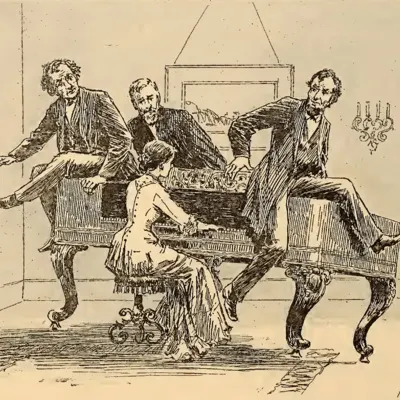
Yeah. I mean, I should say, this is her personal account. So it is very possible that she was never actually invited to these meetings. But let's just assume that she's telling the truth for humor's sake. That wasn't Lincoln's only run-in with spiritualists. Like, Lincoln and his wife, Mary, went to at least one seance in Georgetown at the home of a man named Cranston Laurie. And Laurie's daughter was a medium who had the ability to levitate a parlor piano, which she did when the Lincolns visited. Lincoln got to see someone just like lifting a piano up into midair.
Wow, that's wild. Do you know how we know that? Who's the source on that?
That was in a spiritualist newspaper, which I believe is an account from Cranston Laurie.
Because I'm curious, yeah, like, so that makes me think they probably just made it up. But you have to wonder, like, was there some house in 19th century DC that has some like elaborate pulley system that could raise the piano on wires whenever anyone famous came in?
Yeah, it is very possible. I mean, I'm inclined to believe that Lincoln did visit and did witness this, but you know, that it wasn't actually a supernatural phenomenon occurring.
Mediums on the battlefield
Yeah, yeah.
So let's talk about mediums on the battlefield because, you know, they weren't just like hounding Lincoln. They were hounding basically everybody.
Sure, yeah, yeah.
So like we talked about how that lady Nettie was involved in, you know, she supposedly could say how troops were feeling that day before a battle. There were other mediums who were involved in the Civil War. So apparently, like, yeah, some of them claimed they had the ability of clairvoyant travel, which means they could astrally project themselves to the South, you know, to see either what Jefferson Davis was thinking or what was happening, you know, in another battle. Others claimed that they could read minds from a distance. So they could stand at the Union side of the war, of the front, and then they could read the minds of a Confederate cavalry officer 30 miles away and know what time of day, you know, the South was going to charge.
And if you want to read this quote, Abram, from the Boston Daily Evening Transcript, 1862.
Yeah, so it just says, the spiritualists, or at least some of them, think that the rebels get their intelligence of the designs of the Union general through mediums who are able to get into their thoughts and swindle them out of their plans. The only resource of our military leaders on this theory is to not think at all.
Don't think, just charge into battle. That's great. And I guess this is probably the earliest time that, you know, like, that psychic warfare was being described. The kind of stuff that you're hearing about now with Havana syndrome.
I've already mentioned a lot of these sources are from like spiritualist newspapers, but you know, this one is from like a legit newspaper.
Julia Grant
Well, you know, speaking of the spiritualist newspapers, just like how they were previously speculating about Julia Ward Howe, if she was a spiritualist or not, this was also a time when a lot of public figures would be described. Like, are they a spiritualist? Blah, blah, blah. Like, you know, like various politicians and generals. It kind of reminds me of how, like, there's so much speculation about celebrities' lives today. In 1863, the spiritualist newspapers were arguing back and forth about whether or not Ulysses S. Grant and George McClellan were secret spiritualists.
Yeah, I mean, just like they also argued about that, about Lincoln, of course. Lincoln made much more sense because spiritualists were actually coming to his house and he was supposedly visiting them. But General McClellan, that one's a little more dubious. I'm not sure what sources they were employing other than just a general belief. Because, you know, there were spiritualists on the battlefield, like we said, so maybe some of them managed to get to McClellan closely. But we don't know. We do know is that at least one of them did manage to get to Ulysses S. Grant closely.
Yeah, because it turns out that Grant's wife, Julia Grant, was a really hardcore spiritualist herself. And she wasn't just, you know, following the spiritualist newspapers and all that. She claimed to be a medium with her own clairvoyant powers. Spiritualists were really excited that supposedly she would visit the camps and that they believed that she was going, just like that woman Nettie, to lend her spiritual services to the war effort. And I think her memoirs sort of corroborate this. They never say that she used her powers to fight the war, you know, the way that some people, some mediums did. But her memoirs did say that on the day before Lincoln was assassinated, she felt a premonition of some great event and that she managed to pass a note right before the assassination telling him to warn Lincoln about his impending doom and cancel their plans to attend the theater.
And although, you know, sadly, the message didn't get passed all the way to Lincoln, the Grants did stay home that night, which maybe could have saved their life, you know, if they would have been present when John Wilkes Booth came into Ford's Theatre.
John Wilkes Booth's ghost
Yeah. Speaking of John Wilkes Booth, that reminds me of something because there's another thing that, again, only corroborated by a spiritualist newspaper. But again, I will choose to believe this. At a spiritualist meeting in Brooklyn last week, the ghost of John Wilkes Booth was called up and made to divulge. Booth said he was sorry that he killed Abraham Lincoln and that they have since become reconciled. They are now good friends and walk out together. The assassination was based on an unfortunate misunderstanding. And finally, Mrs. Surratt was entirely innocent. And for those who probably don't know or just forgot, Mrs. Surratt, being Mary Surratt, who owned the boarding house in DC where John Wilkes Booth and her son, John Surratt, were conspiring on assassinating Lincoln, Vice President Andrew Johnson, and the Secretary of State, William Seward, and with a few other guys. And, you know, she maintained she was innocent.
She didn't realize there was a conspiracy going on in her boarding house. But yeah, she was found guilty of conspiring to assassinate the president, vice president, and secretary of state and was hanged in 1865.
Wow, yeah. I think that the point about them reconciling. Number one, it's hilarious. You know, it's just a very funny kind of thing to report. But I think that also kind of points to this broader trend that we talked about in the Klan episode, which was that after the Civil War, and especially after the end of Reconstruction, you start seeing this broader reconciliation across white America between Southern Americans and Northerners. And, you know, unfortunately, this kind of reconciliation, this burying of the hatchet, instead of causing the kind of abolitionist radicalism of the North to be common in the South, you started seeing Southern attitudes toward race and the Confederacy becoming more common in the North. And this eventually is what leads to tens of thousands of white dudes in Indiana and Ohio and in New York, you know, places that were staunchly anti-Confederate now becoming Klansmen and effectively becoming neo-Confederates themselves.
Comfort after the war
I mean, it's a real shame they didn't become spiritualists because like this anecdote about John Wilkes Booth and Abraham Lincoln becoming friends is that this idea of like the nobleness of the spirit that once we die, we leave this natural world, this earthly body, and become spirits in the spirit world. These kind of grudges, you know, like North versus South, you know, black versus white, like all these kind of earthly grudges just sort of fade away. And it is basically like a heaven. Like we are all just living there in unison, like in a pure way, much more nobler way than we would here. And, you know, I can see why, like, after the war, spiritualism was very, very comforting to people. Because one thing a spiritualist did after the war in the South and the North is hold seances for, you know, families who like lost a son or a husband or something.
You know, your brother, your husband, your son, whatever, is still alive in the next world and they are happy and they are going to be there waiting for you when you die.
Yeah, it's, yeah, it's the same as, you know, we talked about the Swedenborg's views about children going to heaven to be raised by angel mothers. It's the same kind of thing. And I think that this kind of comfort aspect is probably one of the biggest aspects of all spiritualism, both the kind of earlier ancient medieval beliefs in ghosts and the modern movement, that even if somebody has gone from your life, they haven't truly vanished. And that you can take some comfort in knowing that even if you can't necessarily communicate with them directly, they are still there somehow with you, and that you can maybe feel their presence. And I guess what really makes the 19th century spiritualist separate was that they said, actually, we can speak directly with ghosts. Pay me, and I can do it.
I mean, another thing is just, you know, we mentioned that we say that all the spirits are good. When we talk about what is spiritualism, like in those bullet points that we mentioned before, it basically just trying to guide us to be much better people ourselves in this world. Just this idea that like these earthly grievances, these earthly conflicts do not exist in the next world, and they have no reason to exist in this one either.
It's a fun topic, you know, and yeah, hopefully we might make some contact with the Great Beyond ourselves across this process.
Wrapping up
Anyway, so this was a short one. Hope you guys enjoyed it. I'm Abram, joined by Liam. This is Gladio Free Europe signing off.
The show is also on Apple Podcasts, Overcast, Pocket Casts, Podcast Addict, YouTube, RSS and Patreon.