129
Ghosts of the Ancient Mediterranean
In progress3000 years after the collapse of the Bronze Age Near East, the glories of Pharaonic Egypt survive only in ruins, the splendid cities of the Babylonians have crumbled to dust, and the very existence of the mighty Hittites is all-but forgotten. The religions and languages and attitudes of such great peoples have passed into oblivion. However, one aspect of the Bronze Age spiritual universe continues to haunt us today: a belief in ghosts.
For a Halloween bonus episode, Liam and Russian Sam explore commonalities in beliefs around ghosts, demons, and the risen dead from the Bronze Age Epic of Gilgamesh to the Golden Ass of Apuleius. Across the Mediterranean sea and 2000 years of ancient history, we can observe strikingly similar attitudes about the ability of the dead to remain among the living. Whether visible or invisible, ghosts were nearly-universally agreed to maintain an interest in the mortal world, often appearing to surviving enemies or relatives to demand particular treatment, often causing bodily or spiritual harm if their conditions are not met. Ghosts and related spirits, such as malevolent demons, were believed to possess physical spaces and even physical bodies, able to be exorcised only through highly specialized rituals conducted by special mediums. These ghostly attitudes, and even specific methods of paranormal communication, survived the end of the Bronze Age and became part of the spiritual universe of the Classical Mediterranean. In the Greek and Roman world, both epic poetry and drama are replete with ghostly encounters. Everyday people feared and respected the spirits of the dead, at times even using trickery to convince a rival that a ghost or spirit had cursed them.
Such entities are clearly present not only in the mythology and spiritual manuals of pagan societies, but also across the Hebrew Bible and the New Testament scriptures. For centuries, some Jewish and Christian scholars have been troubled by the possibility that ghosts could be real. The presence of the dead in the world of the living may contradict theological assumptions about the permanency of the afterlife. Moreover, rituals used in communing with the dead, including that used by the mysterious Witch of Endor, were highly reminiscent of polytheistic religious practice. However, a belief in ghosts has survived in monotheistic cultures, and related attitudes about spirits, both holy and unholy, are a key part of Christianity.
Through their preservation in Greek and Roman literature and the Biblical canon, ancient attitudes about ghosts, dating back as least as far as ancient Mesopotamia, would remain an enduring element of modern culture. With the spread of Abrahamic Religions, ghostly attitudes originating in the Ancient Near East would be exported across the entire world, defying the rise of rationalism. Even today, huge numbers of people believe that the spirits of the dead can be seen and spoken to, without realizing that this particular set of beliefs can be trace back to the anxieties of Ancient Egyptian priests and the recommendations of Babylonian exorcists.
Transcript
Legion among the tombs
Hello and welcome to Gladio Free Europe. I am here with Russian Sam.
Hello.
Today, we're going to open a bit differently than most episodes. Let's start by opening the good book to the Gospel of Mark, chapter 5. And they came over unto the other side of the sea, into the country of the Gadarenes. And when he was come out of the ship, immediately there met him out of the tombs a man with an unclean spirit, who had his dwelling among the tombs, and no man could bind him, no, not with chains. Because he had often been bound with fetters and chains, and the chains had been plucked asunder by him, and the fetters broke in pieces, neither could any man tame him. And always night and day he was in the mountains and in the tombs, crying and cutting himself with stones. But when he saw Jesus afar off, he ran and worshipped him, and cried with a loud voice, and he said, What have I to do with thee, Jesus, thou son of the most high God?
I adjure thee by God that thou torment me not. For he said unto him, Come out of the man, thou unclean spirit. And he asked them, What is thy name? And he answered, saying, My name is Legion, for we are many. And he besought him much that he would not send them away out of the country. Now there was nigh unto the mountains a great herd of swine feeding, and all the devils besought him, saying, Send us into the swine, that we may enter them. And forthwith, Jesus gave them leave. And the unclean spirits went out and entered into the swine. And the herd ran violently down a steep place into the sea. There were about two thousand, and were choked in the sea. This biblical passage of Christ casting out the demon legion, presented here in the King James Version, is one of the most evocative moments in the entire biblical canon.
Although it's not especially significant to Christian theology, this story would become firmly entrenched in Christian culture, particularly in Western Europe. The depiction here of demonic possession and exorcism, along with similar passages in Matthew and Luke, would determine the Western understanding of possession by spirits up until the Enlightenment. Moreover, other specific imagery here of the possessed man rattling his chains, living among the tombs of the dead, and cutting himself in agony. All of this would become part of the language of Gothic literature in the 19th century, strongly informing modern horror fiction. But just as this passage projects forward into modern Western culture, it also reaches back just as far into Near Eastern attitudes about life, death, and the afterlife. Attitudes that were almost universally held across the ancient Mediterranean and which would have been ancient even to Jesus himself. Bronze Age notions about ghosts, spirits, and demons survived for thousands of years in the Mediterranean and beyond.
And many of these convictions still haunt our culture today.
Four in ten Americans believe
According to a 2025 Gallup poll, a full 39% of Americans believe that ghosts are real, and less than half would confidently say that the spirits of the dead do not interact with the living. An earlier Pew poll from 2009 showed that 18% of Americans would go so far as to say that they have seen or met a ghost. If you drop the word ghost, this number rises even higher. 29% say that they have been in touch with the spirit of someone who died. And belief in the supernatural predates all written records, likely by tens, if not hundreds of thousands of years. Although the ancient Mediterranean and the Near East will be the focus of our discussion today, many of these beliefs are also found among people who would never have encountered the Greeks, the Romans, the Egyptians, or Babylonians. In the pre-Columbian Americas, many societies believed that the dead would retain a connection to the world of the living and that their descendants were obligated to bring them offerings.
Improper treatment of the dead could bring grave supernatural consequences, so their remains had to be treated with great care. Among the Inca, the preserved bodies of their rulers would continue to participate in the life of the empire. These dead kings, or Sapa Inca, would retain their authority long past their physical deaths, with their mummies continuing to receive lavishments of the living kings.
The caveman dreams of his father
Why did people separated by thousands of miles of ocean and thousands of years develop such similar ideas about the dead? Well, I mean, this is a field fraught with speculation, obviously, but one of the earliest explanations was proposed by the British anthropologist Edward Burnett Tylor in 1871. Tylor reasoned that the earliest humans needed an explanation for the appearance of their dead in their dreams. Imagine a caveman whose father had recently died. He knows that his father is no longer among the living. He had witnessed his death, after all, and participated in his funeral. And yet, night after night, he encounters his father when he drifts off to sleep, as alive as ever. When he wakes, our caveman must reckon with this contradiction. His father's body is dead beyond a shadow of a doubt, but somehow, in his dreams, the man continues to make his presence felt.
Tylor proposed that early humans resolved this by imagining that there was something beyond the life of the body. They deduced that each human had a spirit, which would leave the body during sleep and wander off into another world, where the dead continued in existence by other means. Modern anthropologists largely reject Tylor's theory, but the line of thought has popular cachet because why else would encounters with the dead have such cross-civilizational sway? In 1971, Dr. Dewi Rees published a study of nearly 300 widows and widowers in Wales. He found that 46% reported seeing their deceased spouse, a husband sitting at the kitchen table, a wife calling from another room, feeling their presence as if they were sitting right beside them. Many of the people in the study found these encounters comforting. They were particularly common among people who had enjoyed long and happy marriages.
The dead may kill you
But the dead usually aren't sources of comfort. In a paper titled, The Dead May Kill You: Do Ancestor Spirits Promote Cooperation in Traditional Small-Scale Societies? Researchers examined ethnographic records from 57 different societies. Of the 57 societies examined, 39, or two-thirds of them, believed that ancestral spirits could harm the living. Among such societies, it was widely believed that proper treatment of the dead was understood to mitigate such harm. To answer the question in the title, the researchers concluded that these beliefs do not make these societies more cooperative because the dead were primarily concerned with how they were treated. But the through line is interesting nonetheless. Most societies in the world seem to believe that their dead can continue to retain desires and interests.
The Mediterranean ghost package
But the ghosts that we imagine today in our contemporary Western culture have a through line to the spiritual world of ancient Mediterranean peoples most acutely. While the belief in the gods of Greece and Babylon may have fallen out of favor across the first millennium, other aspects of pagan cosmology survived. Through comparison of sources as disparate as the Epic of Gilgamesh, the Hittite texts at Hattusa, the poems of Homer, and the Hebrew Bible, we can construct a general Mediterranean package of ghostly beliefs. Specifically, that the dead can retain some connection with the world of the living, that their desires and motivations can exist beyond death, and that the living have a social, spiritual, or filial obligation to ensure that the bodies of the dead are properly handled. These ideas were universal, or very close to it, across the ancient Near East and the Greco-Roman world. Despite their origins in pagan practice, they were fully accepted by Abrahamic religions.
Everywhere these religions went, associated supernatural beliefs followed.
Paganism's rare survivor
Here on Gladio, we have often discussed the various aspects of ancient paganism, which may or may not have survived into the modern era. Most popular claims along these lines are spurious, such as an ancient Germanic origin for Christmas trees or any link between Santa's sleigh and Odin's flying steed Sleipnir. However, a popular belief in ghosts, demons, jinns, and exorcists can be understood as rare and indisputable examples of ancient polytheistic belief that has endured through to the transition to monotheism. Even though the rise of Judaism, Christianity, and Islam revolutionized so much of Mediterranean culture in antiquity and the early Middle Ages, pre-existing beliefs about ghosts and demons were considered mostly unproblematic. As discussed previously on this podcast, even some individual deities managed to be codified in monotheistic religion as antagonistic demons. Similarly, certain aspects of pagan ritual relating to the dead and undead would be preserved. This process is why the Phoenician deity Baal Zevuv entered Judaism and Christianity as the demon Beelzebub, and would be famously invoked in the Salem witch trials of 17th century Massachusetts.
This is also why ancient ceremonies to commune with the dead, such as those described in Homer and the Old Testament, or the summoning ritual of the former gods, a Hittite text we discussed a couple episodes prior, this would live again in the 19th century seance, an American and British parlor fad we also discussed on this podcast in episode 41 on spiritualism. This Halloween, Gladio is going to explore ancient Near Eastern and Greco-Roman ideas about ghosts and related spirits from around 1200 BC up until the rise of Christianity. We're going to be jumping across time and space a bit, but we hope to demonstrate that a belief in ghosts is one of several attitudes that united ancient peoples from Athens to Assyria, from Canaan to Constantinople, in spite of the many other social and religious differences across these cultures. Other apparently universal ancient Mediterranean beliefs, which were not entirely unrelated to the topic of ghosts, included a general belief in prophecy, the conviction that there was a world of spirits or gods parallel to that of mortals, and again, preoccupation with the proper disposal of corpses.
The horror of the unburied corpse
Improper or delayed burial could prevent ancient Mediterranean ghosts from leaving our world to that of the spirits and the gods, as Antigone feared may have happened to her brother Polynices. The defilement of a corpse was thus considered one of the most grievous spiritual punishments. This would be used as a tactic of terror by the infamous Assyrian emperor Ashurbanipal in the 7th century BC, when he defiled the tombs of his Elamite rivals and dragged the bones of their ancient kings out into the sun, dooming the ghosts of these eminent monarchs to be stranded in a mortal world now dominated by their conquerors. A very fun relief at the British Museum depicts Ashurbanipal enjoying wine with his friends, his retainers, and the severed head of the final Elamite king. In literature, the biblical book of Ezekiel is absolutely full of skeletons used and abused in various ways, from the famous vision of the Valley of the Dry Bones to the prophesied defilement of Gog, a foreign enemy of the Israelites who will be defeated, dismembered, and left for the birds.
The Israelites spent seven months gathering their bones to cleanse the land. Perhaps the workmen were guided by the sense that if the dead aren't handled properly, they would wreak havoc among the world of the living.
Ground rules: ghosts aren't real
But before we get too deep into this Valley of the Dead, we should establish a few basic analytic points about ghosts. First off, for the purposes of this episode, we will assume that ghosts and the supernatural are not real. I can't necessarily speak for Russian Sam here, but I personally do not acknowledge.
I mean, I've never seen one.
So, yeah, yeah. Well, personally, I do not acknowledge the existence of any magic, an afterlife, or any kind of animistic forces. Thus, any similarities between ghostly beliefs across cultures must be explained rationally through recurrent patterns in human psychology and cultural transmission. When considering the many apparent differences and inconsistencies across different types of spiritual encounters, we must remember that ghosts don't exist. Thus, they do not have the same kinds of distinct observable traits as trees or animals. It cannot be categorized taxonomically, despite the efforts of medieval demonologists and modern horror novelists.
Ghost, demon, goblin, elf
On the subject of taxonomy, you will notice that we've been using the terms ghost and demon and spirit kind of interchangeably, and will continue to do so throughout this episode. As discussed previously on this show, particularly in our episodes on dragons and vampires, folkloric concepts are often not as discrete as we would like. Elf, for instance, is a complex and contradictory category of supernatural being, which means that elves in medieval English tales had very little in common with those of contemporary Scandinavian folklore, not to mention Christmas media or fantasy tabletop games. Looking specifically at Halloween, older literature will often use the phrase ghosts and goblins somewhat interchangeably, even though goblins today are no longer seen as particularly ghostly. Thus, ghosts and demons, though apparently quite distinct in our modern parlance, are both non-living yet extant spirits which reside on another plane and have some ability to affect the living.
A ghost is a once-living individual who has died, whereas a demon is a malevolent being that has never been alive. In certain pagan societies, gods can also behave in ways very similar to ghosts and demons, communing with the living through summoning rituals or human intermediaries. Although we cannot objectively distinguish between types of spirits in any Aristotelian sense, we can distinguish between different types of spiritual encounters.
Apparitions and unseen presences
Sometimes, a ghost is encountered as an apparition, that is, a visibly present being. While ghost sightings are often described, there isn't any consistency in what a ghost looks like or how it behaves. Looking just at Greek literature, we can observe a wide variety of different types of ghosts. The risen dead of Homer's Odyssey appear to be fully present in their bodies and forms, but they can't think or speak as mortals do until they have drunk sacrificial blood. Yet in Homer's Iliad, the ghost of Patroclus seems to be an immaterial phantom, or eidolon. Greek apparitions could be sooty, possibly reflecting their cremation, or they could be transparent, a strong continuity with modern ghost stories. But in addition to these visible apparitions, ghosts could also affect the world through invisible means. Unseen spirits were often thought to be present, terrorizing the living and, of course, haunting houses. These spirits could also take possession of living humans, as in that passage from Mark, or, as in that passage from Mark, a herd of swine.
We should remember that from the point of view of a ghost believer in ancient societies, it could be difficult, if not impossible, to determine if such an invisible presence was the spirit of a loved one or something much darker and more malicious. Last, while we are focusing on the Near East here, a region which for our purposes includes the Greek world, we do not want to imply that these ideas are exclusive to this time and place. I think it is natural for people to speculate that an individual they knew in life could still be among us. This psychological commonality probably explains why stories of ghosts exist in many different parts of the world. But through the rise of monotheistic Abrahamic religion, this particular package of Near Eastern ghostly beliefs became dominant over others. With that out of the way, let us now pass through the veil from our plane into that of the spirits, where ghosts and demons dwell.
The first ghost ever drawn
The earliest references to spirits of the dead come from the late Bronze Age Mesopotamian tablets, which typically offer instructions about how to rid ghosts from one's home. In 2018, scholars determined one particular tablet showed a male figure with bound wrists led by a woman by a rope or chain. In fact, it's our earliest pictorial depiction of a ghost, and probably the first depiction of an exorcism. This ancient lady had good reasons for wanting to lead such a spirit away, as we know from slightly later Babylonian texts that the presence of a ghost was bad news. Ghosts were not simply frightening, they could actively harm the living through causing otherwise inexplicable injuries and maladies. People living in the Bronze Age, or really anyone prior to the advent of germ theory, had no means of understanding that most disease was caused by hostile biological entities. Instead, it was proposed that hostile supernatural entities must be the cause of disease.
Think about the beginning of the Iliad, where Apollo curses the Greeks to suffer a plague, or about the book of Exodus, when a similar divine punishment causes ten separate plagues to befall Egypt, most of them a literal illness or things that would cause an illness. Limited evidence suggests that ghosts as well as gods could be a cause of illness to ancient peoples. This seems like a ghostly trope that has fallen to the wayside, but we actually see interesting examples of this in modern lore. People who believe in ghosts often report feeling a physical chill in the presence of the entity or feeling ill and weak after the encounter. Thanks to William Friedkin's film The Exorcist, physical illness is now strongly associated with the idea of demonic possession in the minds of Americans.
Lamashtu and the fear for children
Ghosts and demons in ancient Mesopotamia were often strongly associated with the death of pregnant women and young children. Multiple talismans and cylinder seals from the later Iron Age depict scenes of childbirth in which male figures, presumably exorcists, protect women from attacking demons. The most feared of these demons was Lamashtu, who was sometimes worshipped as a goddess in her own right, as Mesopotamian mothers thought that this veneration could prevent her from killing one's children. Although no direct link has been proven, it has long been speculated that this figure could have a relationship to the Greek child-eating spirit Lamia or the comparable Israelite Lilith. Whether or not these figures all have a common origin, they reflect universal anxieties over child mortality in a world without modern medicine. They also might indicate a shared gender anxiety, as male priests, exorcists, and doctors who felt powerless over the outcome of women's reproduction would attribute any disaster to that of a malicious female spirit.
Khonsuemheb in the ruined tomb
Yeah, and Mesopotamia also may or may not be the source of our first ghostly literature, in addition to being the source of our first depiction of a ghost. It is difficult to determine whether the appearance of the risen dead in the Epic of Gilgamesh is older than the Egyptian story of Khonsuemheb. We will discuss the former at length, given that it survives basically in its entirety, but the latter tale from late Bronze Age Egypt survives only in fragments. Although we don't have the beginning or the end, we can tell that this story involves a man, Khonsuemheb, who spends the night in a ruined tomb and then summons the ghost of the interred with the aid of the gods of the afterlife. This ghost then explains that he was an official of the pharaoh Rahotep and apparently lived about four centuries before this tale was written.
He asks Khonsuemheb to rebuild his tomb, presumably so he can find some kind of eternal rest. While the Egyptians were very preoccupied with death in the afterlife, this short story is our most vivid account of an Egyptian spirit remaining in the world of the living. Although Egyptian religion had many differences with that of Mesopotamia or Greece, we see some striking similarities with Babylonian tablets and with later Greek stories.
Letters to the dead
Egyptians would leave letters to the dead in tombs, something they would share with later Greeks as well as modern celebrants of the Día de Muertos. One particularly fun example is the Qau Bowl, dated to around 2100 BCE. The bowl has two letters by a man named Shepsi, addressed to his mother and his father. The letter to the father is on the inside of the bowl and the mother on the outside. In it, Shepsi tells his deceased parents about the troubles that have befallen him, related to an inheritance dispute brought about by another malignant spirit and asks for their intervention. Writing to his father, he said, This is a reminder of your journey to the dungeon, to the place where Sen's son Hetupu was, when you brought the foreleg of an ox, and when this your son came with Nuwoeth, and when you said, Welcome, both of you, sit and eat meat.
Am I to be injured in your presence without this, your son, having done or said anything by your brother? And yet I was the one who buried him. I brought him from the dungeon. I placed him among the desert tomb dwellers, even though 30 measures of refined barley were due from him on a loan, and one bundle of garments, six measures of fine barley, one ball of flax in a cup. Even though I did for him what did not need to be done, he has done this against your son evilly, evilly. But you have said that this is your son. All my property is vested in my son, Shepsi, along with my fields. Now Sher's son, Hennu, has been taken. See, he is with you in the same city. You have to go to judgment with him now, since your scribes are with you in the same city.
Can a man be joyful when his spears are used against his own son? And then, writing to his mother, he said, This is a reminder of the time that you said, This, your son, bring me quails for me to eat, and when this your son brought to you, seven quails for you to eat. Am I to be injured in your presence so that the children are badly miscontent with your son? Who then will pour out water for you? If only you would judge between me and Sobekhotep. I brought him from another town and placed him in this town among his male and female dead and gave him burial cloth. Why then is he acting against this, your son, when I have said and done nothing evilly? Evil doing is painful for the gods, exclamation point.
I really love Karen writing to the manager here, this kind of like complaint form to the world of the ghosts.
Your dead father, your lawyer
Yeah, yeah, yeah. So here we see the social contract between the living and the dead on display in the Egyptian cosmology. The living expected that in exchange for the care that they provided to the dead, they would intervene in cases of illness, fertility, or other more worldly matters. It was a two-way street. If either party shirked their responsibilities, then the other could seek retribution. In one such letter, the letter to Meru, a son writes to his father about a spirit who had been haunting him and asks that he prevent looking upon him with malevolence. The article, The Social Contract of the Afterlife, Ancient Egyptian Letters to the Dead by Martin Hoagland, argues that these exchanges mirrored the logic of the ancient Egyptian legal system. The misfortune of the living was attributed to the dead, and the letters would stress the sender's innocence. Quoting from the article, to combat them, the living petitioned their akh, or spirit, to act as a lawyer or magistrate.
One common strategy was litigation, with the petitioner asking the akh to litigate with the offender. In the Qau Bowl, Shepsi demands that his father litigate with his deceased brother, noting that his father had, quote, scribes in the afterlife to document the case. In another example, the Louvre Bowl, addressed by a mother to her deceased son Merari, the sender asks him to report or bring charges against those who are harming her. Similarly, the text of the Hu Bowl asks the akh to make a judgment concerning an injustice done to the sender's daughter.
Yeah, yeah, and I gotta say, this kind of like quid pro quo, this is very resonant with modern ghost fiction. The idea that a specific act has to take place for a ghost to, you know, stop haunting someone.
Yeah, exactly.
Enkidu rises
Yeah, and so, despite the popularity of reanimated mummies in modern fiction, it doesn't seem like the Egyptians had any concept of bodies rising from the grave, in contrast with the Mesopotamians. We see this in the Epic of Gilgamesh, which may or may not predate the Egyptian story. The goddess Ishtar threatens to raise up the dead and to consume the living, but elsewhere in the text, the risen dead are much more benign. In the final 12th tablet, probably a later Babylonian addition to the originally Sumerian epic, the hero Gilgamesh sends his dearest friend Enkidu to sneak into the underworld to retrieve some of his lost possessions. But once he is down there, he has attracted too much attention and is condemned to remain forever among the dead. This whole section is quite confusing, as Enkidu had already died in the poem's seventh tablet. It's believed that this was another variant of the Gilgamesh story that did not make it into the main redaction.
After the death of his best friend, Gilgamesh pleads with the god Ea to let him see Enkidu once again. Ea commands the god of death, Nergal, to lead Gilgamesh halfway into the underworld, similar to Odysseus' journey to the edge of the world. Nergal then releases the ghost of Enkidu to allow him to just once to speak with his dearest friend. What ensues is a simple and moving encounter. He freed Enkidu to speak once to kin, and showed Gilgamesh how to descend halfway to hell through the bowels of the earth. Enkidu's shadow rose slowly toward the living, and the brothers, tearful and weak, tried to hug, tried to speak, tried and failed to do anything but sob. Speak to me, please, dear brother, whispered Gilgamesh. Tell me of death and where you are. Not willingly do I speak of death, said Enkidu in slow reply. But if you wish to sit for a brief time, I will describe where I do stay.
Yes, his brother said in early grief. All my skin and all my bones are dead now. All my skin and all my bones are now dead. Oh no, cried Gilgamesh without relief. Oh no, sobbed one enclosed by grief. Enkidu then goes on to describe, in poetic terms, the various peoples he sees in the underworld. Have you seen one who died in war? Oh yes, his aged father weeps and his young widow visits graves. Have you seen one buried poor with the other homeless nomads? Oh yes, that one knows rest that is not for sure, far from the proper place. Have you seen a brother crying among relatives who choose to ignore his prayers? Oh yes, he brings bread to the hungry from the dumps of those who feed their dogs with food they keep from people, and he eats trash that no other man would want.
Although the underworld of Gilgamesh is not a place of eternal torment like that of Christian hell, it's clearly dreary and monotonous, similar to what we hear of Homer's afterlife. While the great Gilgamesh is able to directly approach the gods and demand to see his dearly departed friend, most mortals are not so lucky.
Mediums and the Exorcist's Manual
In typical Near Eastern mythology, communion with the world of spirits is only possible with the help of some kind of intermediary, or, if you will, a medium. A late Iron Age Babylonian text known as the Exorcist's Manual prescribes treatment for physical ailments that Mesopotamian peoples attributed to ghostly disturbance. In particular, seizures were attributed to interference of a ghost or demon. The Mesopotamian exorcist seems to have been considered a type of doctor. Remember, this association of the physical practice of medicine with spiritual cures of the soul still persists in many religions, including Christianity. As the causes of these ailments were thought to be invisible and immaterial, ancient mediums developed arcane and esoteric practices to pull these ghosts, gods, and demons into the material world.
Circe's blood magic
In Greek mythology, Circe fills this role by teaching Odysseus a complex ritual of blood magic. As we discussed in our previous episodes, this specific ritual has very clear resonances with earlier Hittite texts for summoning a former pantheon of ancient gods. In both of these rituals, animal sacrifices are performed over a pit dug into the ground, after which these spirits are able to rise out of the earth and speak to the living. Circe's spell is so similar to that one Hittite tablet that it almost certainly reflects a common origin in Bronze Age Near Eastern spirituality. The ritual is also complex enough that a regular person, even a very canny person like Odysseus, would not be able to figure it out without the help of such an expert.
The witch of Endor
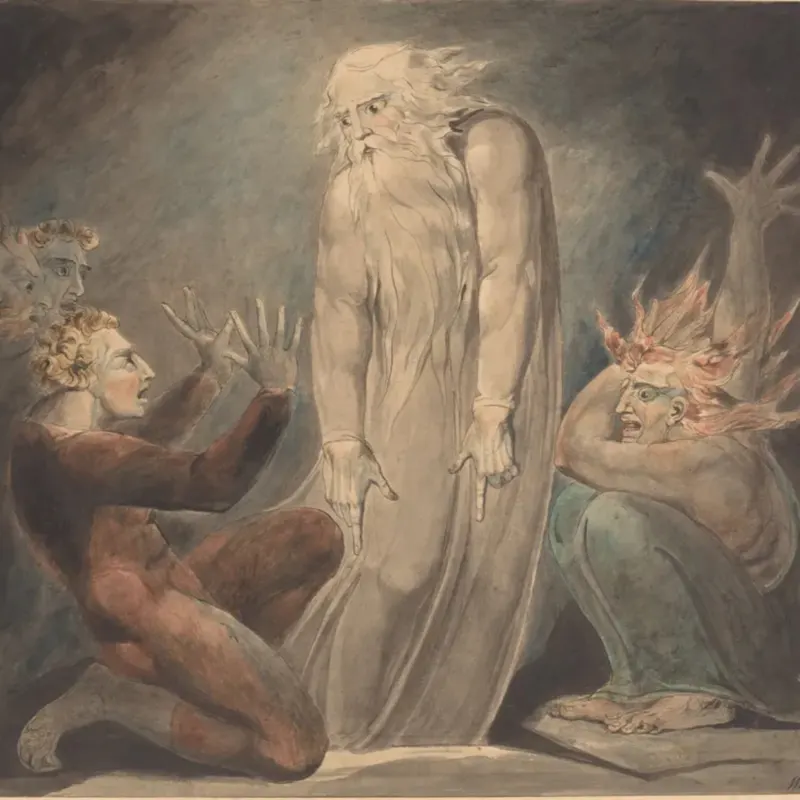
Yeah, in the biblical book of Samuel, probably composed about a century after the Odyssey, we can see a similar medium, the enigmatic witch of Endor. Saul, the first king of Israel, seeks the guidance of a deceased comrade to help to resist the Philistine invasion. Because he had previously persecuted what the King James Version calls those that had familiar spirits, he sends his servants to find a woman who can commune with ghosts. He quickly learns that Endor, a remote village that had only recently come under Israelite control, is a home of one such witch. Just like Gilgamesh or Odysseus, or the author of the Hittite tablets, this witch of Endor is able to conjure spirits, Elohim, out of the ground to speak. That word literally means gods in Hebrew, and the word gods is used in some English translations, possibly to associate her Canaanite witchcraft with paganism.
One of these spirits is not a god, but the ghost of the prophet Samuel himself, who gives words of advice to the doomed king Saul. This is another striking resonance with Homer, as the shade who provides the most assistance to Odysseus is that of the blind prophet Tiresias. Samuel's appearance, with his head covered by a robe or shroud, is clearly resonant to today's supernatural imagery, all the way down to the iconic sheet ghost of today. The English word witch would not be applied to this character until the Middle Ages, and carries with it associations of wickedness or even Satanism that the text does not fully imply. You can learn more about these ideas about the witch in our previous episodes about witches and their various doings. Certain modern Bibles, such as the New International Version, prefer the term medium. Earlier Greek and Latin translations describe her as an oracle or a prophet, but her title in the original Hebrew is Mistress of the Ob.
The Ob is probably a reference to a ritual pit, like the kind used by Odysseus to speak with the dead. The witch and her ob are described in such brief detail that the audience of Samuel is expected to know what this is. This could suggest that such mediums were a common sight in the biblical Levant, given that the Book of Samuel was probably completed during the period of the Babylonian captivity, it also might be some direct influence from the Mesopotamian ideas about the afterlife.
A problem for the theologians
This anecdote has been a theological problem for both Jewish and Christian audiences for the past 2,500 years. By consulting the witch of Endor, Saul violates both his own law against spirit conjurers as well as earlier biblical prohibition against witchcraft.
The later book of Exodus, right, where it says, Thou shalt not suffer a witch to live basically in a different way.
Yeah, no, I mean, and also, I mean, yeah, there's a lot of witchy stuff related. Kind of off topic here, but there is a passage in the Talmud where they talk about how people were able to prophesy, and apparently the method involves putting seven types of sperm directly into your eye. I just read that at one point, and my eyes kind of glazed over. Not because of the sperm, just the regular glazing over. But anyway, the later book of Chronicles lists the solicitation of this sorceress as one of the reasons why Saul lost God's favor and his life. Some ancient Jewish commentators were also disquieted with the very presence of Samuel's ghost, as the ability of the spirit to return to earth could be seen as contrary to the doctrine of the future resurrection of the dead. Some later Christians, including nearly all Protestants, thought that Saul was wrong about who he was speaking to.
It wasn't actually the prophet Samuel, but a wicked demon taking this shape. However, scholars in both religions have generally taken this story at face value. For centuries, this story has provided a theological basis for belief in both ghosts and witchcraft, even though such beliefs are even older than the Bible. 19th-century spiritualists, who we discussed all the way back in episode 41, directly cited the book of Samuel as precedent for their beliefs and practice, often alongside pagan mediums such as the Oracle of Delphi. While the ritual of the seance was basically invented by the modern esoteric hobbyists, its practitioners were basically correct that their ideas about the afterlife could be traced back many, many centuries.
The Holy Ghost
Right, and this is an example of how, unlike nearly everything else in the ancient world, the belief in ghosts was not significantly changed by the advent of Christianity. Even though these ideas were somewhat problematic to early Christians, even though they had also been for ancient Jews. In a single sense, ghosts, or a ghost, a disembodied spirit, is at the very core of the Christian religion. Per the Gospel of Luke, Mary was made pregnant with the Christ child by the Holy Spirit, and her kinsman John the Baptist is described as being filled with the Holy Spirit prior to his ministry. But the most vivid appearance of this spirit comes in the Acts of the Apostles, probably the most unusual book of the whole New Testament, which also contains an outright majority of references to the Holy Spirit in the entire Bible. Early on in Acts, the Holy Spirit enters the disciples of Jesus while they celebrate the Jewish holiday of Pentecost.
A frightening wind enters the house therein, perhaps causing the walls to shake violently. Then, the disciples witness an apparition, what the King James Version calls cloven tongues, like as of fire. These ghostly flames sit upon each of them and fill their bodies. After the Holy Spirit has entered these men, their bodies begin to speak every language of the Jewish world, not just the Aramaic of Galilee, but also the languages of distant Mesopotamia, Parthia, Libya, and Rome. This incident of spiritual possession became the basis for the modern Pentecostal religion, increasingly popular across North and South America today. It also has striking resemblances with the behavior of spirits in ancient Near Eastern texts going back to the Bronze Age. With apologies to any Christian listeners, this episode of Acts also has striking similarities with examples of demonic possession in the Christian Bible. Earlier Christians did not necessarily distinguish the behavior and function of the Holy Spirit from that of other ghostly entities.
The English term Holy Ghost was preferred over Holy Spirit up until the 20th century, as the word ghost formerly had a more equivocal meaning, just as its direct German equivalent Geist does today. Recent scholarship has emphasized the centrality of ghostly lore in the Greek-speaking world. This is an area that was somewhat overlooked by earlier classicists, as ghosts were seen as a kind of superstition that was surely beneath the brilliant rational Greeks. But this was not the case at all. Widespread beliefs about ghosts both helped and hampered the spread of Christianity in various ways. Non-Christian Greeks were not necessarily skeptical towards stories of Jesus' miraculous return from the dead, as ghosts were understood to be basically an everyday occurrence.
Jesus is not a ghost
However, contemporary scholar Candida Moss has argued that Christians were insistent that Jesus was not actually a ghost himself. Rather than being a being who was present and dead, he was a man who was beyond death and had thus lived again. In addition to the exorcism in Mark, this gospel also has a moment where Jesus' disciples fear that they see a ghost when Christ walks on water. In John, probably the last gospel to be composed, Jesus proves he is not a ghost by making his doubting disciple Thomas put his fingers inside his physical side wound. Biblical scholar Bart Ehrman believes this last passage was a way to argue against early Gnostic Christians, who believed that Jesus was indeed a ghost or something very similar. Perhaps an astral projection who appeared to be a living man but was really entirely spirit. This belief is called docetism and was the source of great controversy in the first couple hundred years of Christianity.
I think it's very interesting that this passage of John involves the disciple Thomas, as we know that certain Gnostic sects saw Thomas as their spiritual founder. If we drift away from early Greek Christians to the much broader world of Greek pagans, we can find even more rich anecdotes of ghostly beliefs and practices.
Pliny's haunted house
That Mark passage we quote at the top of the episode has some parallels, for instance, to a nearly contemporary Roman source that Russian Sam found.
Yeah, in the early second century, Pliny the Younger wrote a letter to his friend asking him a question that still bears down on the minds of the living. Are ghosts real, or are they merely creations of our own vivid imaginations? Little did Pliny know, he would give us the earliest surviving haunted house story. In Athens, there once stood a large and beautiful house, but it had been abandoned for years on account of a menacing ghost that had stalked the property. From Pliny the Younger's book 7, Letter 27, In the dead of the night, a noise resembling a clashing of iron was frequently heard, which, if you listen more attentively, sounded like the rattling of fetters. At first, it appeared at a distance, but approached nearer by degrees. Immediately afterward, a spirit appeared in the form of an old man, extremely meager and squalid, with a long beard and bristling hair, rattling the gyves on his feet and hands.
The poor inhabitants consequently passed sleepless nights under the most dismal terrors imaginable. The property became so notorious that it had been put on the market at a pittance. We remind our listeners that we're talking about second century Greece here. This isn't the Amityville mansion. One day, the philosopher Athenodorus arrived in Athens. He was unbothered by the haunting allegations and decided that he would love to hop on such a bargain and experience a real haunting for himself. That very same evening, he moved into the house and sat on his comfy couch, pen and tablet in hand. As he sat there deep in thought and writing, illuminated by the flickering candlelight, he began to hear the rattling of chains, getting closer and closer to him as time wore on. Unbothered, he continued to write. He was just an unusually chill guy, until finally, the jump scare. Quote, the noise increased and advanced nearer, until it seemed at the door, and at last in the chamber.
He looked round and saw the apparition exactly as it had been described to him. It stood before him, beckoning with the finger. Athenodorus made a sign with his hand as if it should wait a little, and bent down back to his writing. But the ghost rattling its chains over his head as he wrote, he looked round and saw it beckoning as before. Athenodorus did what any sane guy would do. He followed the ghost as it hobbled along outside, weighed down by its chains. When it walked into the courtyard, it stood at a certain spot and then vanished before his eyes. He marked the spot and went back into the house. The next morning, he went to the local administration and asked them to dig on the spot. Beneath the earth, they found the skeleton, wrapped in chains, even in death. The bones were gathered and given a proper burial.
The house would no longer be haunted. And, I mean, that settles it, guys. Always give your dead a proper burial, or else you're gonna wake up and find a crusty old man rattling his chains above your bed.
The phantom barber
And in that same letter, he follows that story with another much sillier ghost story. I don't really know what to make of this one, but it's baffling enough that I wanted to share it with you guys. I have a freedman named Marcus who has some tincture of letters. One night, his younger brother, who was sleeping in the same bed as him, saw, as he thought, somebody sitting on the couch who put a pair of shears on his head and actually cut off the hair from the very crown of it. When morning came, they found the boy's crown was shorn and the hair lay scattered about on the floor. After a short interval, a similar occurrence gave credit to the former. A slave boy of mine was sleeping amidst several others in their quarters when two persons clad in white came in, as he tells the story, through the windows, cutting off his hair as he lay and withdrew the same way as they entered.
Daylight revealed that this boy too had been shorn and that his hair was likewise spread around the room. Nothing remarkable followed, unless it were that I escaped prosecution, prosecuted, I should have been, if Domitian, in whose reign those things happened, had lived longer. For an information lodged by Carus against me was found in his scrutore, that is, desk. Hence, it may today be conjectured, since it is customary for an accused person to let their hair grow, that this cutting of the slave's hair was a sign that I should defeat the peril that hung over me. What do you make of this, Liam?
So, you know, so we previously showed a very, you know, a very modern seeming ancient story of, you know, haunted houses. This seems to be also quite modern, in that it's basically a Scooby-Doo tale, right? It's like somebody impersonating a ghost for some kind of material benefit in the real world.
Yeah, yeah, no. I mean, it's just, it's just so baffling to me, just waking up in the middle of the night, and there's a fucking dude dressed like a ghost going at your hair. Like, what do you even do in that situation?
Yeah. Well, you know, there are a couple of more weird Greek and Roman ghost stories we're going to share here.
Periander and Melissa
There's one in Herodotus. We have this fascinating and grotesque tale about another vengeful spirit. Here, the Corinthian tyrant Periander experienced some kind of misfortune thought to be brought on by the spirit of his late wife Melissa. Through consultation with an oracle, it was discovered that Periander had disgraced his wife through two violations of funerary practice. First, he committed necrophilia with her body, described with the metaphor of placing warm dough in a cold oven. Second, and apparently more disturbing to the Greeks, Periander had buried Melissa without her favorite robe. In true tyrannical fashion, Periander then attempted to make this right by bringing all the ladies of Corinth into the Temple of Hera in their finest gowns, where they were then forced to strip naked and burn their clothes as an offering of apology to the ghost of Melissa. This was apparently effective, as the ghost ceased to haunt the tyrant.
The municipal ghost worker
This ceremony in Corinth probably would have been administered by a mysterious goēs. This is an official described by historian Sarah Iles Johnston as basically a municipal employee whose job was to deal with the bodies and spirits of the dead in any polis. This was not a particularly prestigious position. It was a very blue-collar kind of shaman. It is also not a position that features prominently in ancient literature. Earlier historians often thought that belief in ghosts was marginal in belief in Greek society in contrast to belief in the gods, but this is no longer thought to be true. Johnston and other contemporary historians have demonstrated that beliefs about spirits, which are very similar to modern ghostly lore, were fundamental to Greek society. Ghosts appear frequently in Greek poetry and drama, not just in Homer. They often have brief appearances identical to that of the ghost of Hamlet's father in Shakespeare.
A benign projection of the dead, called an eidolon, was a useful literary truth-teller. But ghosts had their purposes in actual Greek society as well as fiction. To blame misfortune on the intervention of a dead ghost was less spiritually problematic than blaming such a misfortune on the gods, and less socially problematic than accusing a living neighbor of witchcraft.
Hungry ghosts
Just as we saw with Babylonian society, ghosts were particularly invoked in the deaths of children. A kind of ghost called a gello, which may be derived from the same Near Eastern being that gives us the word ghoul, was thought to be the spirit of a woman, often a young virgin, who died without having children. Just like the demon the Lamia, this gello hungered for the flesh of babies, apparently envious of other women who successfully became mothers. Thus we see that although the dead are no longer in this world, they aren't free of biological strictures. We saw in the Egyptian letters to the dead, as well as Gilgamesh and Enkidu story, that the dead relied upon the living to provide them with sustenance, for otherwise they would die again without it. The hungry ghost was a dangerous one. In its pangs of hunger, it would be reduced to a scavenger, menacing the living.
Beans for the Lemuria
The Romans had similar beliefs to the Greeks. In his Fasti, the Roman poet Ovid goes into great depth about Lemuria, an annual ceremony for the dead. It turns out these dead were hungry for beans.
Quoting from Ovid here, after washing his hands clean with spring water, he turns, and first he receives black beans and throws them away with face averted. But while he throws them, he says, these I cast, with these beans I redeem me and mine. This he says nine times without looking back. The shade is thought to gather the beans and to follow unseen behind. Again, he touches water and clashes Temesan bronze and asks the shade to go out of his house. When he has said nine times, ghosts of my fathers, go forth, he looks back and thinks that he has duly performed the sacred rites. And I mean, yeah, this one's interesting, the whole averting your gaze thing. Similarly, in the Greek temples, for example, they weren't supposed to, like, the temples were kept very dark, just so you wouldn't see the face of the god.
Because if you see the face of the god, you could go blind or otherwise have some kind of terrible reaction. Similarly, in the temple of Judaism, you were also not allowed to go in there unless you were especially anointed, and even the priests weren't able to look directly upon God for fear of the terrible consequences. So, yeah, this is just another example of a belief that seemed to be very popular across the Mediterranean. But yeah, this just about wraps it up. I think we've demonstrated the various kinds of ancient attitudes about ghosts and the dead, which survived from antiquity all the way to the present day. Beliefs about ghosts and demons, as well as beliefs about witches, were naturally transmitted through folklore, but also reinforced by the preservation and translation of ancient texts.
The witches of Thessaly
To wrap this one up, we wanted to share one last example of ghostly lore, a very Halloween-y story from our only surviving ancient Roman novel. This is, of course, The Golden Ass by Apuleius, a second-century text popularized in Britain some 1400 years later by the Elizabethan translation of William Adlington. Here, witches steal noses and ears from the dead, but if they can't find a dead body, a living one will do.
Right, so in this passage, just for some context, a group of Greek and Roman merchants are meeting in a tavern in Thessaly, a region which apparently was thought to be dangerously haunted by witches and ghosts. I can find no place in all the world which I like better than this, but I greatly fear the blind, inevitable trenches of witches, for they say that the dead bodies are digged out of their graves, and the bones of them that are burnt be stolen away, and the toes and fingers of such are slain or cut off, and afflict and torment such as those who live. And the old witches, as soon as they hear of the death of any person, do forthwith go and uncover the hearse and spoil the corpse to work their enchantments. Then another sitting at the table spake and said, In faith you say true, neither yet do they spare or favor the living, for I know one not far hence that was cruelly handled by them, who being not contented with cutting off his nose, did take the ears.
I then espied an old man sitting on a stone in the midst of the marketplace, crying with a loud voice and saying, That if any man would watch a dead corpse that night, he should be reasonably rewarded for this pains. When I heard this, I said to one who passed by, What is here to do? Do dead men usually run away in this country? Then he said, Hold your peace, for you are but a babe and a stranger here, and not one without cause, for you are ignorant of how you are in Thessaly, where the women witches bite off morsels of the flesh and faces of dead men, and thereby work their sorceries and enchantments.
The corpse speaks
The speaker then decides to attempt to protect one of these corpses from being defiled by these witches, in exchange for four to six gold coins. Then I pressed in amongst them nigh unto the bier, and got upon a stone to see this mystery. And behold, incontinently, the dead body began to receive spirit. His principal veins did move, his life came again, and he held his head and spake in this sort. Why do you call me back again to this transitory life that I have already lived? I've already been in the deadly den of Styx. Leave off, I pray, leave off, and let me lie in quiet rest. When these words were uttered by the dead corpse, the prophet drew nigh unto the bier and said, I charge thee to tell before the face of all people here the occasion of thy death. What dost thou think that I cannot, by my conjurations, call up the dead, and by my puissance torment thy body?
Then the corpse moved his head again, and made reverence to the people and said, Verily, I was poisoned by the means of my wicked wife, and so thereby yielded my bed to an adulterer. The speaker then explains he stayed watching this dead man's corpse, hoping to protect it from the machinations of those evil Thessalian witches. But because the dead man had come back to life, and because he shared the same name as the living man next to him, these witches were unable to tell the two of them apart, with disastrous results. When this the good guard of my body watched diligently in the night, and that the wicked witches and the enchantresses came into my chamber to spoil me of my limbs, and to bring such their purpose, did transform themselves into the shape of beasts, and when, as they could in no wise deceive or beguile his vigilant eyes, they cast him into so dead and sound a sleep that by their witchcraft he seemed without spirit or life.
After this they did call me by name, and never did cease till as the cold members of my body began by little and little and little to revive. Then he, being of more lively soul, howbeit buried in his sleep, in that he and I were named by one name, and because he knew not that they called me, he rose up first, and as one without sense or perseverance, passed by the door fast closed, unto a certain hole, wherein the witches cut off his nose and then his ears, so that was done to him, which was appointed to be done to me. After that, such their subtlety might not be perceived, they made him like a pair of ears and nose of wax.
The nose of wax
After hearing the story, the other people gathered in the tavern are amazed at this. And then they notice that the speaker does indeed have a nose of wax. He was the man who all of this had happened to. And then the speaker touches his nose, upon which the wax nose falls off and everybody laughs. A very modern punchline to this ancient work of literature.
Yeah, no, I hate when that happens to me.
A ghost-free Halloween
All right, well, I think that about wraps up this survey of ancient Mediterranean ghostly lore. I think we have successfully demonstrated that whether or not ghosts are real, the ghosts of the ancient world still haunt us today. I hope all of our listeners still have their noses and ears intact after this episode. We wish everybody listening a happy and ghost-free Halloween. All right, bye-bye.
The show is also on Apple Podcasts, Overcast, Pocket Casts, Podcast Addict, YouTube, RSS and Patreon.