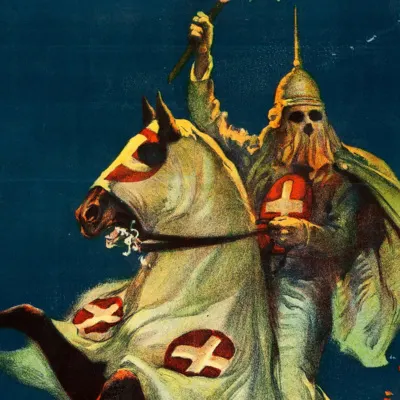
Our good friend Jern joins us from Ohio for a discussion about the interwar reanimation of America’s most notorious terrorist organization: the Ku Klux Klan. Jern tells the story of the working-class Ohio immigrants who formed their own secret society known as the Knights of the Flaming Circle to oppose white supremacy and kick the Klan out of the Buckeye state.
Hosted by Liam, Russian Sam, and Jern.
Transcript
Welcome, Jern
And we're back with Gladio Free Europe. I am Liam, your host for this evening, joined here by Russian Sam. And today we have a really special guest, one of our longest supporters and oldest fans, and also genuinely, easily one of the coolest guys on Twitter. Jern, how you doing?
Doing great. Thanks for having me on. What's up, guys?
Well, yeah, well, doing good. Thank you so much for coming on, Jern. I think this is going to be a really fun one. If anybody isn't familiar with Jern, he is probably the greatest chronicler and anthropologist of the history and culture of Ohio.
Yeah, like we didn't even know anything about Ohio until Jern started writing it down.
I feel like there's a lot of talk about, you know, the Buckeye state on Twitter in general. Any thoughts on why that might be?
Two Ohios
I think Ohio is definitely emblematic of two different Americas. You have the Ohio that I know and love, which is one of the most average states in the country that, you know, corporations use to product test. And then you have the idea of the middle of nowhere that no one knows anything about. And those together synthesize to, you know, bring the Ohio that I know.
Well, it's great.
Yeah.
You know, without like a spoiling too much of the episode, you've found a great story from Ohio history that we can dive into today. And I think let's just start right now.
Steubenville
This story that we're going to tell takes place in Steubenville, Ohio, primarily. And it's a place that I've been to one time. It was for a church volunteering thing. And we were just doing like outreach there because it is a completely hollowed-out, you know, industrial city with a lot of opiate trafficking now. They're not really known for much. It's a very sad, hollowed-out place. But this story takes place in a very different time when it was sort of an industrial hub on the Ohio River.
And it kind of seems like you mentioned the two visions of Ohio. I think in this story, we're sort of seeing the middle of nowhere side of Ohio coming to blows with the industrial Ohio, especially in Steubenville.
Yeah, definitely.
The flaming circle
Well, yeah, let me just dive into this story that you found, which is just really fun and harrowing and just says a lot about America, by reading this article that you dug up from the Steubenville Herald Star. On the night of September 26, 1923, residents of Steubenville, Ohio awoke abruptly from their sleep as a huge dynamite blast resonated off the hills on both sides of the Ohio River. Thousands of residents ventured outside to see what had happened. They may have feared the explosion had emanated from one of the coal mines in the vicinity. However, this fear was quickly replaced by an unsettling uncertainty of what they actually saw across the river. Flames erupted on the West Virginia hillside facing Steubenville. As residents gazed at the fiery night, some claimed to see white-robed figures darting about the flickering light of the towering flames. During the hot summer nights of 1923, it was not uncommon to be woken by a dynamite blast followed by burning symbols lighting up the night sky.
The Ku Klux Klan had been burning massive crosses across the country to announce their presence and warn residents that they were watching the citizens of the town where the cross burning occurred. Usually, the town had been targeted because the residents were not felt to be adhering to laws governing moral behavior, such as prohibition, and also because these towns typically contained large numbers of Catholic immigrants. However, something that night didn't fit the Klan's modus operandi. It would not have taken long for witnesses to the event to see that on this night, it was not members of the Ku Klux Klan who were sending a message to Steubenville. Instead, they saw that the burning symbol facing them was a colossal flaming circle that burned for a full half hour. The white-robed figures beneath the smoke that night weren't members of the KKK, but who were they? The next morning, they would find out, and over the next year and a half, so too would people across the United States.
Who were the Knights?
Yeah, so tell us, in brief, Jern, who were the Knights of the Flaming Circle, as they came to be called, and how do you learn about them?
The Knights of the Flaming Circle were an anti-Klan organization, or not necessarily organization, but they were dubbed that by newspapers such as, you know, the Steubenville Herald Star. And it was essentially just groups of organized, usually Catholic minority groups, you know, like Irish or Italians or whoever, organizing to disrupt Klan activities, you know, usually parades and sort of those gatherings. And it was at this point in, you know, 1923 in Steubenville that the first group of these guys got together in actual Klan-style robes and burned a big circle.
That's right. Yeah.
And I talk about like using the master's tools to take down the master's house, right? Like defeating the Klan with your own robes.
But yeah, a lot of these sort of ethnic groups disrupted a lot of Klan activities, and this resulted in a lot of fist fights, and in some cases, you know, people being shot and killed.
Yeah. And it seems like in the, at least in the case of Ohio, the efforts of these guys, the Knights of the Flaming Circle, you know, who might not have been, you know, all like angels themselves, but it seems like their efforts against the Klan were a huge part in the fall of the KKK in the North, especially in Ohio.
They, I mean, it wasn't just, you know, fist fights they were getting themselves in. They were going to parades and unmasking people.
Yeah, yeah. They really, yeah. They exposed huge amounts of, you know, local elites, especially kind of members of the, you know, like the upper middle class in Ohio, as, you know, Klan supporters at a time when the Klan was growing rapidly.
And they made lists.
The Klan's many lives
Well, yeah, well, I feel like before we can really understand the Knights of the Flaming Circle, we first got to talk about the Ku Klux Klan. But to get into that topic, I think we should sort of go over the history. You know, some of our listeners might know that the Ku Klux Klan has never really been a single connected movement across its history. And instead, it's more of a kind of a label that various types of the worst people in this country cling to. You can kind of compare it to how in other parts of the world, you've got people calling themselves ISIS, even though they have no connection to terrorist groups in Iraq and Syria. I think that the Klan is kind of like that. It's a banner you can wrap yourself around if you want to celebrate certain types of ideals of white supremacy and specifically a very Protestant white supremacy that considers Jewish and Catholic white people as only really one step on the ladder above from African Americans.
Reconstruction
So the first Klan came directly out of the Civil War. This was during the period of Reconstruction, which especially lately has gotten a lot of attention. You know, this was a really important time in American history. And I think it's pretty clear, you know, now that this is settled, that it was a total failure. Because in the years after the Civil War, the U.S. government attempted to bring the defeated South back into the national fold and especially elevate African Americans to political and social equality. But right out of the gate, there were a lot of people avoiding that possibility of social equality. Very many of them were members of the former Southern aristocracy. Although they were, you know, radical Republicans at the time who tried quite hard to promote this kind of social equality in the South, they eventually would be defeated. And a big part of their defeat, which you could maybe argue sort of a, was kind of an ultimate victory for the Confederates, at least in the South, was largely caused by the first Klan.
Russian Sam, you want to tell us a little bit about how the first Klan came to be?
The Knights of the Golden Circle
Well, the first Klan, first of all, it had some antecedents. It wasn't something that just popped into existence totally out of nowhere. There were organizations like the Knights of the Golden Circle, which was a secret society whose members consisted of slaveholders who wanted to annex the Caribbean into the United States before the Civil War.
Right. And I think what's important about these guys, just to jump in, they were a secret society modeling themselves off of groups like the Masons, but that they were a secret society that was explicitly Confederate and had these interests in maintaining planter power basically worldwide.
Well, I wouldn't really call them Confederate because this would have been before the Civil War, I guess. But people who would become the Confederates, absolutely.
Right, right, right, yeah, yeah.
The Sons of Malta
Another group I think is kind of interesting. I'm not sure if you're as familiar with these guys, but have you heard of the Sons of Malta, either of you guys?
No.
So they were this New Orleans-based group, very similar to the Masons. But what's unique about them that set them apart from the Masons was that, again, they were all Southern, which was a connection with the KKK, but they also wore traditional Mardi Gras costumes. You know, I don't know if you guys are that familiar with Mardi Gras costumes, because, you know, you might have a lot of specific ideas in your head right now, but the Sons of Malta wore their own regalia based on a very specific type of costume. Anybody listening to the podcast right now, and YouTube guys too, Google Cajun Mardi Gras or Cajun Mardi Gras costumes and look who comes up. You see the weird robes, the pointed hoods.
That's a nightmare fuel, honestly.
This is like some evil clown shit. It's like the Klan on a bad trip.
Yeah, so both the Knights of the Golden Circle, which we shouldn't confuse with the Knights of the Flaming Circle, totally different, century apart, but both the Knights of the Golden Circle and the Sons of Malta both had direct links in membership and traditions with the first Ku Klux Klan. The big difference was that, you know, while the Knights of the Golden Circle were incredibly racist in their ideology, and while the Sons of Malta tried to, you know, advance southern interests locally, the Ku Klux Klan was much more than just a secret society. They were a brutal, genocidal, terrorist organization.
I also find it interesting that specifically Mardi Gras is something that played into their costume design when later on the Klan would become virulently anti-Catholic.
Yeah, that's true. It's a funny little link there. And Mardi Gras gonna actually come back.
The first Klan
So, you know, the first Klan, which I know some historians have argued is actually should be considered the first fascist organization. It was a purely southern phenomenon of ex-Confederates. It was founded in Tennessee by a bunch of officers, I want to say in 1869. So a few years after the end of the war, Reconstruction's in full swing. Black people have the right to vote. Many Confederates are banned from political office. So these guys, hoping to basically, if not reenact slavery, maintain racial power in the South, use illegal means to enforce their goals. Because the pro-slavery interests before the Civil War were very closely tied up with the Democratic Party. Some historians have also argued that the Klan at this time was basically a paramilitary faction of the Southern Democrats, sort of comparable to how many political parties in the Middle East, for instance, have paramilitary wings today.
So it's, yeah, funny little thing there. You know, like the Lebanese Kataeb Party, you can maybe kind of compare that to what was going on in the South in 1869.
And it's funny that you should mention paramilitary because the Klan actually has its origins in a very renowned military figure, namely Nathan Bedford Forrest.
Of course, yeah, how can we forget?
Yeah, very famous general in the Confederacy. If you've seen that really goofy-looking Confederate statue, yeah, the one where he's on like the horse, messed up face, yeah.
Yeah, the one actually got taken down this summer, unfortunately. It's a shame because it's a great monument. Yeah, the idiocy of the South, right? Yeah. An expression like that.
Well, not the idiocy of the South, but the idiocy of these people.
Yeah, yeah, you're right. I'm sorry. Yeah, there's plenty of nice southerners out there.
Yeah, and anyway, Forrest himself was also a Freemason, which again goes into the origins of the Klan because, like, ultimately, Masonry has a lot of symbology and funny costumes and all these ceremonies that were very appealing to people in the beginning of the 19th century. Because, I mean, it's the 19th century. What else are you going to do? There's no television. There's no radio. Just going to hang out with the buds and do some ceremonies at the grove.
The end of the first Klan
Yeah, yeah. You know, we should mention that what's interesting with the first Klan is that although it would have this incredibly important psychological impact on many, on both the people it terrorized and on the groups that would, you know, later claim its legacy, it was actually pretty short-lived. The first Klan itself was only around for a few years. And pretty quickly, it seems that the organization, the Klan, was basically defeated by a combination of legislation and activities by local police and occupying union troops. But what happened with the first Klan is that even though this specific organization was basically extinct by around 1874, the Klan Act had been passed in Congress in 1871, a few years earlier. Despite the fact that the group no longer existed, its members largely escaped any legal consequences, which essentially allowed them to advance the ideals of the Klan through legal means.
So even though the Klan no longer existed, their long-term goals of keeping black Americans from voting, maintaining the power of former slave owners in the South, and eventually kicking Union troops out of the South eventually would all be met. It's just that they would no longer be doing this in the traditional white hoods of the Klan regalia. A few groups would pop up after the Klan was formally dissolved that basically did the same thing. Most notoriously, there was a group called the Red Shirts in South Carolina who used widespread intimidation to keep black people away from the polls in the 1876 South Carolina governor election and ensure that a former Confederate officer and a total neo-Confederate in ideology would be able to become governor there.
The 1876 election
That same year is the 1876 presidential election. You know anything about that one, Jern? I do not. No.
Yeah, you tell us, Russian Sam, what happened?
Yeah, so basically you had this very contentious election between Rutherford B. Hayes, the Republican, and I don't remember who the Democrat was off the top of my head, but basically there was a tie in the Electoral College and there was no other way to work around this. So basically the Republicans were able to strike a deal whereby Hayes becomes the president in exchange for Reconstruction as in the military occupation of the South by Northern soldiers would come to an end. And so Hayes gets into office. Pretty uneventful presidency, I'd say, one term president. And yeah, that definitely spelled the end for any appetite for Reconstruction as an idea. And so, yeah, so a lot of white Southerners cheered as, you know, Union troops left the South, but this would have absolutely horrendous consequences for African Americans in the South, basically giving carte blanche to white Southerners to enact the Jim Crow regime, which would pretty much exist for another 100 years.
It wasn't overnight, but this is it, but it's a causal relationship, I think. It's that, you know, Reconstruction essentially was abandoned. It's the first domino to fall.
Right, right. And even though the first Klan was no longer around for this, the individual people who made up the first Klan would become the political elite in the South for many decades going on.
The Bald Knobbers
Other groups that were kind of interesting that are sort of part of the same primordial soup that birthed the Klan, there's the Bald Knobbers, which are this strange group of Missouri Ozark vigilantes. They were kind of weird. They weren't that, it seems like they weren't that ideological and that they actually had conflicts with both pro-Confederate guerrillas and the U.S. government after the Civil War. But these guys would wear these kind of creepy, strange costumes, not totally unlike the Mardi Gras costumes we talked about earlier, and go around shooting and lynching people. Primarily, again, in this case, they'd be shooting and lynching white bandits. But still, it seems to be kind of a similar type of organization, just one that might lack the specific racial animus.
The Veiled Prophet Society
Another group we should mention that's probably the most famous of these kind of almost Klan groups was the Veiled Prophet Society, which still exists today.
That actress from The Office got in trouble like a year ago because people found out that she was nominated as a debutante at one of the balls.
Yeah, yeah, she was. Yeah, yeah. So it's, yeah, so this is in St. Louis. There is, again, an organization that still exists today that was started in 1877 during a general strike led by railway workers. All the rich-white elites of St. Louis got together and they needed some way to intimidate the strikers into calling off this general strike. And they had this bizarre solution. Some very bohemian rich guy who'd spent a lot of time in New Orleans and been part of Mardi Gras and was also this huge poetry fan formed a group called the Veiled Prophet Society, taking its name from this popular Orientalist poem from the time about the Veiled Prophet of Khorassan.
Oh, is that Edgar Allan Poe?
It's some Irish guy, Thomas Moore. I don't know. I'm not that familiar. But in any case, this guy named Slayback started wearing this white robe with a hooded cone that looked a bit like the costumes of the first Klan and looked a lot like the costumes of the Cajun Mardi Gras practitioners and also would sort of prefigure the second Klan, the traditional Klansman robe with the pointy hood. So what this guy, Slayback, would do is he would wear this robe and go at the head of a parade holding a gun as this creepy intimidation toward the strikers. Eventually the strike would end, and as a way to just kind of, you know, rub in the faces of the working class, the Veiled Prophet Society would form this annual Veiled Prophet Gala where they'd choose one young society girl each year to be crowned the Veiled Prophet Queen.
And in like 1999 or something, it was Ellie Kemper, you know, Kimmy Schmidt, the girl from The Office. The Veiled Prophet Society today denies any links to the KKK, but we should mention that black people were barred from taking part in the gala until 1979. Did any black people win after 1979? I would guess that there probably has never been a black winner of this ball because if there was, I think that a lot of the defenses that the group puts out probably would mention that.
Yeah, makes sense.
So, no, yeah, I'm going to bet there have not been any black girls winning this ball since then.
No, no, no diversity picks yet.
No, yeah, no, no.
Thomas Dixon
Right, you know, around this same time, so we're talking about the end of the 19th century. So, the Civil War is increasingly less and less relevant in Americans' minds. But the guys who lost the Civil War now have pretty much uncontested power in the South. Right around this time, there's one guy we should mention first in North Carolina named Thomas Dixon. He's been described, he was a writer, described as a professional racist. I think you, Russian Sam, called him the J.K. Rowling of racism.
Yeah, because he was a popular novelist whose books were absolutely instrumental in the ultimate KKK revival.
I think also, in addition to having this really important role in the rise of the Klan, this guy Thomas Dixon, his life is a really great illustration of where the Klan came from and also sort of the processes behind fascism in general. Because the Dixons were this elite North Carolina family of Scottish descent, and they were really part of the leisure class of the old South. His brother Amzi Dixon would go on to pretty much establish fundamentalist Christianity, which is another pretty funny link. And Dixon himself had these dreams of being just, you know, a man of letters.
Originally, he actually wanted to be an actor, but he was told that this profession wouldn't bode very well for him because, like, he was like six foot three and weighed 150 pounds, so he just looked very waifish.
Yeah.
Yeah, yeah.
Yeah, a bit of a lanklet, yeah. His physique might explain why he was especially incensed at the fact that he had to perform physical labor on his family's land because they still had all of their physical property, but because slavery was over, all of their human property had been emancipated. So, you know, without having slaves to work on the farm, they had to work the farm themselves. And the Dixon family saw this as an unbelievable slight against their honor. They believed they had a right to be, you know, slave owners. That was just part of their mindset. They despised the union for this perceived theft, and they saw Reconstruction as an enormous blow both to their dignity and to their personal fortunes. When Dixon was a very small child, the Ku Klux Klan would come to North Carolina. His father and especially his uncle Leroy McAfee were fervent early members.
When he was five years old, he watched Leroy McAfee participate in a lynching. This left a huge impression on him, but it wouldn't inspire any fear. Instead, he would see this lynching of a black man as a victory of the righteous South over people who didn't deserve it and was instrumental in forming his own violent white supremacist worldview. After, you know, his failed acting career, caused in no small part for the fact that he kind of looked like Slenderman, he sort of switched lanes and became a popular author. He never had the literary career he wanted. He was never this respected writer, but instead, he was a very successful kind of pop fiction writer. We should also mention that, you know, so he was a very prolific writer and he made no attempts to hide his own racial beliefs and instead thought that he could use fiction to advance his political platform.
And even by the standards of the 19th century, he really was unusually racist. It seems like he was a huge opponent of Thaddeus Stevens's plan to give freedmen families 40 acres and a mule because he thought that if black people were allowed to become independent farmers, they would eventually dominate the South and they would oppress white people or something. So he was a huge opponent of anything that would give any political rights to African Americans. Very quickly, he started writing books based on his own experiences witnessing the activities of the first Klan. And his books were huge in spreading stories of the Klan throughout the country, especially the South, but over time, into the North as well. His first novel was called The Leopard Spots, followed up by The Klansman, which itself would eventually be adapted in the 1915 film Birth of a Nation. Before we get into that, do you have any idea where the phrase The Leopard Spots comes from?
It's a biblical phrase, I believe.
Right, it's from the book of Jeremiah, and the original quote is, Can the Ethiopian change his skin or the leopard his spots? So in this case, you have Thomas Dixon taking a Bible quote and using it essentially to justify his racist platform, using this quote to argue that African Americans are incapable of self-governance and thus must be brutally suppressed by organizations like the Ku Klux Klan. These books were a huge success, and again, not only in the South. And during a trip to California in 1913, he would meet with another Southerner, D.W. Griffith, the famous director, and he would convince him to adapt The Klansman into his first feature film.
Yep, and that film was Birth of a Nation.
Birth of a Nation
It was a major blockbuster to quote the title of the version that I watched on YouTube. It says in the title that it's the quote masterpiece of racist cinema. And I'd be inclined to agree.
Jern, have you ever seen it in any of your film classes?
I have not, no.
Oh, yeah, yeah. We actually, I think these days, because it's so controversial, they sometimes let you choose whether or not to watch it. I think, yeah, so I saw it in the class a couple years ago. You found it pretty watchable, Russian Sam, right? Even though it's so long and so old?
Okay, well, caveat. I watched it at two times speed because it's unbearable at the regular pace. But that aside, it's very watchable for something from the era.
It's, yeah, I guess because to be honest, I'm not exactly sure which elements of this were so influential on the language of film. And over the past couple years, there's been a little bit of pushback against understanding it as being responsible for creating so many editing and cinematography techniques. But yeah, it's seen as a very important film. And its legacy is, to say the least, incredibly complicated, given that it is also a three-hour racist screed.
Yeah, I mean, movie theaters all across the South would play in the North as well, but they would play just reruns of this stuff. And the crowds would just be full of cheers. There were even accounts of people firing their guns into the air, like Yosemite Sam and excitement of, you know, the vigilante Klansmen on screen.
Well, Russian Sam, yeah, tell us about the plot of Birth of a Nation.
Yeah, so it basically follows the lives of these two families, the Stonemans and the Camerons. The Stonemans are pro-union. The head of the family is Austin Stoneman, who is a senator based on Thaddeus Stevens. And you can really feel a deep antipathy towards this guy.
Oh, absolutely. Yeah, he is the one. Yeah. It's a big part of the idea that I think is now rightfully discarded, but was pretty common in the 20th century that understood the Civil War the way we might understand World War I as this senseless conflict that led to a lot of innocent people being killed, which is correct, but then also did not lead to anything productive, which I think we all can agree is an incorrect reading of Civil War.
Yeah, there's a very odd framing in this film, honestly. I wasn't completely prepared for it. It's like basically very pro-union and pro-Lincoln in the sense that to the point where after Lincoln's assassination is shown in this film, which by the way, they got a really great guy to play John Wilkes Booth. You can really tell that he's sulking. And after Lincoln is assassinated in the film, we see the head of the Cameron family talking about how like, oh, we've lost our greatest friend. Basically, the frame that the movie is setting is that Lincoln would have been very magnanimous and he would have just basically pardoned everyone who was worthy of a pardon, which was pretty much everyone because this is a senseless brother war. But yeah, I just don't really understand how you can take a pro-Lincoln stand while also being anti-Reconstruction, which is what the film really relishes in.
Yeah, I know. And I have to think it's probably a... Dixon could only take that stance because Lincoln was assassinated, which on one hand makes it much harder to demonize Lincoln, but on the other hand, also means that Lincoln himself was not responsible for much of Reconstruction. So even though I'm sure he probably would have been directly involved in a lot of the processes that Dixon despised, because they happened after the assassination, you can pin it instead on the Radical Republicans.
Something I find very revealing about the extent of the racism is that there's a lot of black characters in the film, but most of them are played by white actors in blackface. But in addition to that, what's really revealing is that they're explicitly mentioned to being mixed race. Because I think that in Dixon's own twisted worldview, the villainous characters could only have complicated motivations if they weren't fully black. I don't think he was able, you know, I don't think he could ascribe human motivations to his villains if they had entirely African heritage. Yeah, Dixon, he really had it out for quote-unquote mulattoes because basically, like the standard racist thinking of the time was that like that black people, they know their place, they know that they're naturally slaves and they're contented to be in this role. Whereas mulattoes, you know, since they're mixed with white, they're more intelligent and so they realize that they're being oppressed and so they're very angry and scheming and yada yada yada.
I mean, that's probably, yeah, we should mention that it's probably no coincidence then that maybe the most important part of the KKK platform after stopping black people from voting was stopping any intermarriage between blacks and whites. They were just terrified of the color line being crossed, presumably because in their own racist twisted worldview would make African Americans more able to resist their own domination.
Yeah, Liam, would you care to guess what Dixon called the NAACP?
No, I will not guess, but I'm going to guess it still started with N.
Yes, but it was, quote, the Negro Intermarriage Society. And he basically said that they were against Birth of a Nation because, quote, for one reason only, because it opposes the marriages of blacks to whites.
Yeah, yeah, it was an obsession for these guys. And honestly, if you've ever encountered racist guys on Twitter today, it's still an obsession. So something's never changed. This film, although it was, again, this three-hour racist screed, was a huge success both in the North and the South. And most importantly, would be totally instrumental in the re-founding of a new Ku Klux Klan.
William Joseph Simmons
And as we'll talk about in this episode, a Ku Klux Klan that was no longer confined to the former Confederacy.
And for this, we have to thank one fellow by the name of William Joseph Simmons, who, after watching Birth of a Nation, was inspired to found this, well, re-found this organization that his father had been a part of back in the good old days.
Yeah, yeah. So just like Dixon, he was the son of a member of the first Klan and would try to, you know, would shroud himself in this legacy of a new organization. He talked a lot about how he was raised hearing the stories of, you know, the former glories of the Klan. And yeah, that was with him his entire life.
Yeah, and Simmons was kind of a junkie for secret societies. He was a member of 15 of them. Just love hanging out with the guys. Yeah, here the quote here says, Simmons was already a colonel in the Woodmen of the World when he decided to build an organization of his own. He was an effective speaker with an affinity for alliteration and preached on women, weddings, and wives, redhead, deadheads, and no heads, and the kinship of courtship and kissing, all spelled with K's. On Thanksgiving Eve, 1915, Simmons took 15 of his friends to the top of Stone Mountain, Georgia, near Atlanta, and built an altar upon which he placed an American flag, a Bible, and an unsheathed sword, where he set fire to a crude wooden cross, muttered a few incantations about practical fraternity among men, and declared himself Imperial Wizard of the Invisible Empire of the Knights of the Ku Klux Klan.
Quite a mouthful. Yeah. And that's, yeah. So, yeah, so that was the Klan. They were basically a kind of a LARPing social group. Initially, I would say they were initially less violent than the first Klan and more involved in their, you know, complicated secret rituals. But as they spread, would go back to all of the same terroristic tricks, you know, lynchings, shootings, cross burnings, to intimidate their enemies into abandoning any political desires and murdering essentially anybody who stepped out of line.
The first superhero movie?
Yeah, focusing on the LARP angle, I have a very controversial theory. Birth of a Nation is actually the first superhero movie.
Well, I mean, it basically is. Just like, you know, these aren't the kinds of superheroes that we'd look up to because we're not racist, but putting on a slightly different uniform. They kind of, if anyone's read Alan Moore's Watchmen, they do kind of hint at that a little bit, that there is a through line there, you know. I don't think Siegel and Shuster were in any sense inspired by the KKK when they were designing Superman, but yeah, there's these kind of weird links of heroism. And I guess what this goes to show is that heroism and romanticism can have very dangerous ends. Romanticism is a huge part of the rise of fascism in Europe and nationalism in general. And this is sort of an American example. There's this really good article written by Mark Twain, I want to say in like the teens. So probably before, probably right before the second Klan would emerge, where he talks about the ways that the southern cause saw itself as part of this chivalric tradition, dating back to the Cavaliers in the British Civil War and even all the way back to the Normans.
They also would, you know, the Klan would later claim some Scottish antecedents in their regalia and their ceremonies. So yeah, I think there are some interesting connections to heroism and romanticism, even in a group as so clearly non-heroic as the Klan.
The Klan goes north
As we know now, like the first Klan was just all in the south.
But in the second iteration, now, William J. Simmons didn't really intend it to be an organization that went northward. His thinking was more on the lines of, you know, I'm creating this fraternal organization that's going to, you know, bring like structure and tradition, whatever. You know, he wanted more excuses to get with the boys and do race science. But as recruiters started going up north, they found massive, massive success. And Simmons didn't really think too highly of that. You know, he was still very prejudiced against northerners, but they eventually found out to their surprise that there were a lot of people up there that were willing to take up their cause.
Right. And that is so important here in looking at the way that politics in America and racism in America changes across the second half of the 19th century. Even though that, like in the 1870s, there was still widespread northern animosity against the South because of, you know, the open wounds of the Civil War, by the early 20th century, politics has totally changed. Northern white people no longer really see the South as a threat. Instead, immigration, integration, and supposed rising Catholic and Jewish influence are the new obsessions of American right-wingers. I think what this means is that Birth of a Nation came out at the perfect time for Northern whites to be suddenly sympathetic to their white Protestant brethren in the South. Because it's, you know, a lot easier to, in this mindset, it's a lot easier to shake hands with a former Confederate who shares your cultural background than with an African-American moving into Harlem or an Italian or Jewish person moving into Brooklyn who doesn't even speak your language.
Exactly. The second Klan was not necessarily tying itself to solely the South. They were sort of professing this idea of a perfect Americanism. They used the phrase 100% American.
Right, right. And I think, if anything, they kind of reconciled American patriotism in the North with Confederate nostalgia in the South. I think it's no coincidence that after the rise of the First Klan, you start seeing movies like Gone with the Wind, Buster Keaton's The General, which are widely celebrated in the North, even though they are sympathetic to the Southern perspective. The most extreme example is the spread of the Klan to the North, and the softer example is the slow proliferation of the Lost Cause narrative, which, you know, a lot of people still subscribe to today.
An Aryan birthright
Yeah, let me read you guys one intertitle that appears towards the end of the movie. The former enemies of North and South are united again in common defense of their Aryan birthright.
Yeah, wow. And that says it all right there.
The Klan's enemies
I think that what's really interesting about the second Klan was that because it was a national organization, they had different kinds of enemies based on where they were. And this is really essential for this episode. Because in the South, the Second Klan was just as brutal towards black people as the first Klan had been because black people were their primary enemies. Those were the people trying to vote and transform politics and, you know, affirm their own destinies. In northern states, where there weren't as large African-American populations, the Klan actually didn't spend most of their time harassing and lynching black people. Instead, they primarily harassed white Catholics and Jews who they saw as foreigners and infiltrators into the whole American project.
They were also bipartisan for this reason, whereas in the South, they were obviously associated with the Democrats. In the North, they were very prominent among Republicans.
Right, and I think it's, yeah, which makes sense because the Democrats at this time were this crazy coalition of northern workers and southern racists. So if you were a northern racist and you were also anti-worker, you weren't going to be a Democrat. You'd be a Republican.
In fact, the Indiana Klan, which was one of the largest branches in the North.
Yeah, I think it was the most effective and also the most notorious.
Yeah, because of their omnipresence, 1924 was the election when black voters in Indiana started to shift towards the Democrats because these Klan guys were Republicans. And it will take a couple of more election cycles for most black people nationwide to be voting for the Democrats. But this was the beginning of the trend.
You know, one thing that I found really interesting, Russian Sam, in that book, Behind the Mask of Chivalry you dug up, was that support for the Klan in the North wasn't just a symptom of the kind of reconciliation of the North, of white people in the North and the South. It also basically helped speed that process along. I think that the book says here: the Klan of this era was both effect and cause of the reconciliation between North and South. Its very spread promoted a peculiar kind of national integration as Klan leaders worked to bury divisions among the nation's Anglo-Saxon men.
Yeah, well, this was coming in the context of the first civil rights movement, which was at that point starting to gain steam, which Woodrow Wilson, as president, had to forcefully clamp down on personally by banning black people from working for the federal government in a non-segregated capacity.
Yeah, this was also the period when most of the Confederate monuments around the country were going up.
Yeah.
And it's that the 1910s and 20s, this whole period we're talking about and these episodes on the years between World War I and World War II, they involved this extreme racial panic in America. And it was a racial panic that was so extreme that even many people who we would now consider white were seen as potential enemies and infiltrators.
Yeah, like we talked about this in the Italian American episode, for example, where these people were straight up getting lynched.
Yeah, there were notorious lynchings of Italian Americans in New Orleans specifically. Yeah.
Selling the Klan
But yeah, so let's talk a bit about the structure of the Klan itself. As Jern mentioned, the fact that it had spread up north is something that Simmons hadn't anticipated. But this was actually the result of some really brilliant marketing. In 1920, the Klan, it only had a few thousand members at that point because Simmons and his associates weren't that great at promoting themselves. So they hired a PR firm, how very modern, called the Southern Publicity Association, which gave them a bunch of pointers for how to, you know, make their organization seem appealing to ordinary people as well as to spread further. And funnily enough, one of the reasons why the Klan had such a prolific spread in this period is because its structure was essentially a Ponzi scheme, where like if you recruited someone into the organization, you would get a percentage of their dues, and it just went like that all the way up the chain.
So you can imagine that there's an incentive to, you know, go out and keep promoting people.
Yeah, and Mary Tyler and Ed Clark, the partners who ran the Southern Publicity Association, they personally were able to pocket like 80% of their personal commissions. Well, you know, like a normal, I believe it was the Kleagles are what the recruiters were called, only got like a couple bucks out of the $10 fee to join.
The Klan's ranks
Yeah, speaking of Kleagles, the Klan had some very original naming conventions. They loved their K-words.
It's like Dungeons and Dragons, but for doing evil. Yeah, so the head of the second Klan was the Invisible Empire. Basically, they had a bifurcated view of the world where you had the Invisible Empire, that is, the Klan, and then the Alien World. So, basically, like the same way that cops today will talk about everyone as civilians, the Klan had a very similar thing going on. So, the head of the Klan was the Imperial Wizard, who had a staff of 15 genies and which would hold an assembly known as a Klonvokation. Yeah, beneath that was the realm, and the convention of the realm was the Klorero, which is funnily enough from the Maori word korero, meaning convention.
Yeah, they're really digging, they're really scraping the barrel for K words here.
Yeah, so the head of the each realm was the grand dragon, and under each grand dragon were nine hydras. Beneath that, you had the provinces, which would host the Klonverses.
I don't like this iteration of the metaverse, just for the record, making my dissatisfaction known.
And the head of the province was a great titan with seven furies under him. And then finally, you had the most basic unit of the Klan. It's Klantons.
Yeah, so the Klantons were the most basic unit of organization for the Klan, each of which was headed by an exalted cyclops and subordinate officers known as the 12 terrors.
Right, and we should mention that all of these rules were held in a book that they called the Kloran.
Yeah, and they had a bunch of these. They had Klokards, Klectures, Kludds.
Why the costumes?
Well, I think we should kind of mention here: this is what's so weird about the Klan versus other, especially European fascist groups at this time, was the fact that they're just so clownish. They're just like, it's so easy to laugh at them. And so, my question for you, both you, Sam, and Jern: do you think that these guys were laughing at themselves? Do you think they found this funny? Do you think this was in some way like helped them rationalize the fact that they were murdering people? Or why did they do this?
I think it's just because it's fun to dress up in costumes and call and make up a bunch of ranks for you and your buds to have a nice, nice night out drinking. Now, of course, these nights out drinking also involved cross burnings, which I wouldn't condone, but the impulse is very familiar, I'd say.
Well, you know, and I think you can make the comparison that, like, the Freikorps in inter-war Germany seemed to be kind of a similar group. These were these men's clubs, and these case, which doesn't really seem to be the case with the Klan, but in that case, it was mostly World War I veterans where they would, you know, get together with their boys and then they'd go out and they'd murder suspected communists. And so, it does seem to be this kind of similar phenomenon.
It was part of the zeitgeist. This was something that was cropping up all over the world because similar material conditions tended to produce similar outcomes.
Who joined the Klan
Well, yeah, talking about material conditions, I know you did a little bit of research, Sam, into the kind of composition of the second Klan. It does seem a little bit different from groups like the Freikorps, but it looks a bit like the Nazis in Germany a decade later.
Yeah, well, I'd say that the difference with the Nazis is that the Klan was a much more religious organization. They're explicitly Protestant. I would say, yeah, they're explicitly Protestant both in their sectarian orientation and also in the fact that they were theologically very Christian. And they, yeah, they talked about Christ a lot more than the Nazis did. Like, basically, they spread their influence through churches. That's how they really made a name for themselves. In 1924, the Klan claimed that they had 30,000 ministers in their ranks. And yeah, that gives you an idea. It was a very Christian phenomenon. And some more about these guys. They were typically middle-aged, married, and very likely fathers. In Athens, Georgia, which is where this book Behind the Mask of Chivalry is focused on, 92% of Klan members were married men, and two-thirds of them were fathers, with an average of three to four children.
Yeah, I think the book says: in general, these were middling men, neither elite employers and bankers, nor, as today's popular imagination of the Klan would have it, poor white trash. While few had the resources to hire others, most exercised far more control over their own labor than their working-class contemporaries ever could. If not the best people, as one observer put it at the time, Klan members were at least the next best, the good, solid, middle-class citizens of our community.
Yeah, this is very interesting because it actually very neatly falls under the criteria of the petite bourgeois thesis of fascism, where it's basically the idea that fascism comes from these guys who aren't at the bottom of the rung, but who are just above the bottom and who feel that they could fall behind at any moment. Yeah, so in Athens, Georgia, 85% of the Klan members were white-collar workers, skilled tradesmen, or major proprietors. Only 15% of them were working class, which the wealthy were very heavily underrepresented, and the working class was also underrepresented. It was people in the middle.
You know, and I think it's kind of sobering because so much modern liberal discourse seems to understand the American middle class as the backbone of democracy and of liberal values. But clearly, that's an incomplete picture because people who have some property but might aspire to have a little bit more, in many cases, are the most willing to use extreme terroristic violence to see their personal profits increase. Like Thomas Dixon, the guy who wrote The Klansman that Birth of a Nation was based on, he was from a moderately wealthy family who had gotten less wealthy after the war. I think that's a really good study for how feelings of dispossession or potential dispossession inspire some of the most brutal violence that's ever been happened, that's ever been wrought upon the planet.
Producerism
Yeah, here's a quote from the book that I personally found very interesting because of the parallels it has with a lot of the stuff that Matt Christman has been talking about as American ideology being very based in producerism and free real estate and the idea that we never really had class conflict proper because you could always move out west to get some free real estate. But at this point in time when the estate was closed, suddenly there was a lot less mobility and a lot more fear. The order held the unbridled quest for wealth responsible for the decay of communal ethic. Klan propagandist Gleroy Curry thus accused quote materialism of quote-unquote poisoning the minds and shriveling the hearts of America's young men who looked out only for themselves now with no thought of quote the advancement of the commonwealth. Such criticisms suggest Klansmen's nostalgia for 19th-century petty producer ideal in which communal obligations and a sense of fair practice tempered the voracious self-seeking that private enterprise might otherwise promote.
Yeah, so very interesting impulse and something that you can definitely empathize with without deciding that suddenly it's okay to join the Klan. But it just goes to show that this precarity is something that breeds violent movements such as the Klan. And if you don't want to have any of those, you should, you know, probably not have this kind of precarity present in society.
Well, yeah, well, I think this resembles the kind of reactionary impulse you see today, which is, you know, capitalism isn't the problem. It's crony capitalism, you know, or the fact that, you know, like the Nazis believe that, oh, it's like it's Jewish participation in capitalism is why the working class is suffering. It's a way to use economic appeals without actually getting at the material basis for economic commiseration.
Yeah, speaking of, let me quote some more from another Klan spokesman. Are your sons and daughters for sale? The Citizens Protective League demanded of local parents. Do you realize you are gradually selling them into slavery? The League implored residents not to let, quote, Wall Street continue destroying the community life of America. It was vital, an Athens Klan lecturer had earlier warned, to quote, break up the monopoly that was ruining and crushing down the entire population of the world, who were, of course, Jews and Catholics.
Right, right. So, yeah, so yeah, so in addition to obviously hinting towards the more popular, you know, European anti-Semitism, I think it also kind of prefigures the woke capitalism you hear Tom Cotton and Marco Rubio talking about today. You know, these guys who don't lift a finger to actually pass any material legislation that betters the lives of working class people, but they can point to the you know political disagreements, or in this case, demographic disagreements with members of the broader ruling class as a way to say that actually they, in this case, the Ku Klux Klan, are standing up for the little guy.
Yeah, basically, their line of argument was that immigrants were a cudgel used by the big capitalists to drive down the wages of Anglo-Saxon men. And so, basically, like this is an attack on their livelihood, which is also an attack on their race, and yada yada yada, you know, the drill.
Right, right, right, yeah. And and I think that sets the stage excellently for the way that the peoples being targeted by the Klan themselves, especially the immigrant communities of Ohio, would be ultimately instrumental in not only fighting for their rights, but ultimately destroying the second Klan itself.
Akron
All right, so tell us, good friends, Jern, what is Ohio?
I'm sorry that that caught me off guard.
If you don't mind me asking, you're from Akron, right?
Yeah, I've been here my entire life, and I mean, this this city was you know a big reason why I got sort of interested in this subject. I was in a Ohio history class about a year ago, and I found out about the sort of Klan presence in the north and saw some sort of citation that was saying that the largest chapter was in Akron. I was really surprised because I'd never heard of this in you know, my hometown, but yeah, it was definitely a big spark that got me on a very, very deep rabbit hole. The Klan didn't just spring out of a fully formed and established Akron. I mean, a lot of, you know, reaction comes from periods of heavy, heavy change, and that was something that Akron experienced throughout the the 1910s and teens.
Here from a paper from 1974 about Akron and the KKK, it sort of outlays what the composition of Akron at the time and the situation it was in. It says here, Akron in 1910 was a city of 69,067 inhabitants, situated at the highest point in the Ohio-Erie Canal. The city's diverse industrial interests included rubber manufacturing, cereal, and agricultural machinery. During the next decade, Akron underwent industrial and population growth of almost incredible proportions. By 1920, the population had increased to 208,435, 5,580 of those being black. So, not really a large amount of black people, especially compared to other cities in Ohio. A lot of the first immigrants to Akron specifically were from, or in Ohio generally, but you know, the region. A lot of these people came from like West Virginia and stuff like that.
Migration into Ohio
Yeah, yeah. I feel like you had that you basically had three streams of migration into Ohio at this time, from what I understand, if this is right, where you had these immigrants who've been coming over forever. You know, like there's so many Germans in Cincinnati that there's still a neighborhood that they call Over the Rhine today, and you have Italians and Irish, and then you also have the Great Migration, so lots of African Americans coming out of the South into places like, you know, Cleveland and Cincinnati, these northern cities. And then you have the West Virginia guys you're talking about. You have these migrants, these migratory Appalachian Protestants, who I'm going to bet probably included a lot of future KKK members. They might have been poor, so maybe not so close to the social base of the KKK, but they probably would have been, they might have, you know, had some sympathies with the Klan because they were all white Protestants.
Well, I mean, for several years during the teens, I'm not sure exactly what range of years, but there were a good few where Akron was the fastest growing city in the country.
Really?
And yeah, and a lot of that was, you know, Eastern European migrants coming over to work in the rubber factories.
Yeah, if you don't mind me asking, your family's like from all over Europe, right? They probably, but did they come over in this time?
Yeah, so it was the my sort of Akron origin story comes from my great-grandfather who came as you know a young boy from Hungary with his family. And he worked in the Goodyear plants and helped in the construction of the USS Akron, you know, the first blimp.
Whoa, that's cool. And of course, yeah, you mentioned Steubenville earlier, and I guess that's Steubenville was probably dominated maybe most of anywhere by immigrants. A huge Italian community, which we'll talk about. One thing I think is funny is that this might surprise some people, but Steubenville, Ohio, also the birthplace of Dean Martin. Get some Ohio pride there.
But yeah, during this massive boom to Akron industry, especially during World War I, you know, the plants churning out, you know, tires and all that, a lot of the migrants that came to Akron were, you know, people in search of, you know, temporary work so they could send money back home to their families, whether that be in the old country or just, you know, elsewhere in the U.S. You know, this is the place you came if you were a single man, you needed a job at a factory and wanted to get some benefits. But after the war, a lot of those guys went home, and so all you had left were this massive city and a whole host of self-decided family men who weren't part of this migratory wave, but it sort of sat at the outskirts and looked very scornfully on the inner-city inhabitants.
Right, yeah, so it makes sense that this would be the kind of place where the northern Klan would seek to operate. You know, they see America slipping away from them, not unlike anti-immigrant activists today, except in this time the immigrants are all Hungarians and Irish and Italians and Jews.
Yeah, I mean, if you have a whole lot of single men going to any place, you know, the growth of industry will, you know, vices will fill gaps, you know, where the market demands it. And, you know, this sort of sparked the moral panic that we see these guys driving themselves crazy over.
Dudes are biologically compelled to rock.
Yeah, so I don't know too much.
Fighting back
I don't know if you do either about how the KKK was consolidated in Ohio initially, but what can you tell us about the ways that these minorities, particularly Catholics, came to basically fight back?
So as the Klan started establishing control on all of these northern states, you saw a lot of pushback from all these different ethnic groups which had established themselves in various neighborhoods. You had the Italians here, the Irish here, Poles, Slovaks, all of that. And a lot of times these guys would be organizing themselves into gangs and not as expressly criminal enterprises trying to turn a profit, but defending themselves against real or perceived threats from the other different neighborhoods that were next to them. And when the Klan started rolling into town and demonizing all Catholics and people who they thought as backwards whites, essentially. But you see all of these sort of ethnic gangs cropping up. But as the Klan comes in and starts demonizing them all as Catholics, they find common cause. And not for long. They're not organizing themselves together and thinking of each other as brothers in some unified body.
But as the Klan parades rolled into town, they would join forces and attack, unmask them. They would publish lists of people that they had uncovered as Klansmen. And it was this sort of temporary necessity they saw themselves as needing to come together to deal with this threat.
What's interesting is that the fact that they burned wooden icons in a way that looks a lot like a KKK ritual. So it is kind of interesting how, even though they existed explicitly to fight the Klan, they basically copied a lot of their kind of like tactics. They look kind of similar in organization.
Yeah, I mean, a lot of those came just from the sort of Steubenville, Youngstown area.
Oh, okay. So they weren't like wearing robes and burning circles everywhere.
Yeah, no, not everywhere. The news. When that first article cropped up, sort of announcing the existence of this new, you know, Knights of the Flaming Circle, the news were the people that named them. And soon after, any, yeah, any type of group that cropped up and did just random mob violence against the Klan, they were called, you know, Knights of the Flaming Circle. They, you know, they sort of lumped all these people into one organization, but really it was just people saying, hey, these guys are coming into town. Let's like, we should probably do something to stop them.
So these were like, yeah, like basically like kind of ad hoc, you could even say anti-fascist groups that were being set up. It wasn't really an overarching organization. It was just, yeah, these like individual people trying to fight the Klan wherever they were. And I think what's interesting is that it wasn't just a, it wasn't just in Ohio. That the these groups, these kind of like, you know, autonomous anti-Klan organizations, they, you know, popped up everywhere, all across the Great Lakes, even parts of West Virginia, which was seen as like Klan heartland.
The Red Knights
There's a New York Times article from 1923, which is, Red Knights formed to oppose Ku Klux. And the subheading is, The Flaming Circle admits Catholics, Jews, and Blacks, but bars Protestants. And it says here that the Knights of the Flaming Circle, declared by its organizers to be the foe of the Ku Klux Klan, is rapidly gaining recruits in western Pennsylvania, Ohio, and West Virginia. For the first time, it was made public today that the secret organization welcomes Catholics, Jews, and blacks as members, but excludes all members of Protestant churches. It is an avowed anti-Klan organization, but does not counsel parades or violence except as a matter of self-defense. These societies are all composed of foreigners who requested to join the Knights and entered en masse. During their initiation ceremonies, the Knights of the Flaming Circle wore only masks. Each knight has a flaming circle over his heart, symbolic, the organizers say, of truth.
As members of the new order wear robes, the name Red Knights has been adopted in making the distinction between the other society in which white robes are used.
So, is this no Protestant thing like tongue-in-cheek, or did they actually not accept Protestant members?
That's a good question, yeah. I don't know.
It's like kind of like being like ironically racist against white people, do you think? Or is it like more of an actual animus? I'm curious.
That's a good question. I'm not really sure. Nothing I've read really seemed to indicate one way or another, but I mean, I have to assume they were making fun of them. That was, you know. When it came to opposition media, all of the articles, you know, from newspapers that were highly against the Klan, besides, you know, just outraging and panic, were also, you know, just very much making fun of them. Everyone saw them as goofy. Everyone knew they were goofy. Yeah, yeah.
One thing I think is interesting is that that's interesting about the anti-Protestant part is that the vast majority of black people in Ohio would have been Protestant. And I looked really hard to see how many African-American members of the Knights there were, but because there's no demographic information, it's really hard to tell. I think that basically the very scant information we have seems to suggest that it was pretty overwhelmingly Catholic, but there were some non-Catholics and non-white people involved.
The Loyal Legion of Lincoln
One thing I find interesting, though, is that right around this time, sort of off the coattails of the Knights of the Flaming Circle, there was a group in Ohio of 300 African American men known as the Loyal Legion of Lincoln, or LLL, which was kind of an affiliated group. They unfortunately fell apart pretty immediately because, bizarrely, there were some members of their group who were so Protestant that they didn't want to work with Catholics at all. And one of them, a man named Reverend Russell, one of their leaders, came under a lot of scrutiny when he even argued that African Americans should work with the Klan to oppose Catholics, which is wild, you know, and quickly led to accusations that this guy was actually himself some kind of paid Klan stooge, which, you know, would make a lot of sense.
Yeah, this was also the time when Marcus Garvey was suggesting that they cooperate with the Klan. So, you know.
Yeah, so it's not impossible that like one weird, you know, right-wing African-American guy might have supported that. But in general, though, the broader tenor was fear among Protestant whites that the white Catholics and the black Protestants were linking hands. And so the pro-Klan newspaper Youngstown Citizen in Ohio actually published an article explaining that black people were naturally Protestant and that they should beware of Catholic organizations. And it even seems like there was a fear of African Americans in mass becoming Catholic, which I think really kind of speaks to this strange moment, which you wouldn't expect. And it's kind of funny because, of course, decades later, there would be a mass conversion of African Americans away from Protestantism, but it certainly wouldn't be towards Catholicism. It would be towards, you know, the nation of Islam, which is something very different.
The second most American religion after Mormonism.
That's true. Yeah, it is.
Yeah.
A Knight remembers
So, yeah, so again, it's really hard to find information about the Knights themselves, but we do have these really fun interviews from a handful of people who participated. In the 80s, an interview was made with an elderly member who had been part of the Knights 60 years before. One of the last survivors. And he, you dug this up, Jern, and this is a really great document that I think says a lot about who were the Knights of the Flaming Circle and what exactly they did to fight and eventually defeat the Klan in Ohio. This is an interview with Nick Cristiona by Dr. William Jenkins on May 8th, 1984 for the Youngstown State University Oral History Program on the Ku Klux Klan.
Okay, your name is? Nick Cristioni. How long have you been in Youngstown? 79 years, 78 years. I was born in Briar Hill on Alvin Street. Were your parents from this country? No, my parents were from Italy. When did you first hear about the Ku Klux Klan coming into this area? Around 1921, somewhere around there. What'd you hear about it? What kind of organization was it? Well, I heard they were against all Catholics and foreign people, and they wanted to make a city of their own. What did you do as a result of hearing that? Nothing. Nothing? You indicated before that some people formed another organization. What organization was that? Well, in the old days, every ethnic group had a group. So in Briar Hill, there was the Briar Hill outfit. Then from Berlin Street to Hamburg, there were the Germans. And from Jefferson Street to Worthington were the Irish.
And then from Westlake Crossing were the black people. Supposedly, some people formed an organization to fight against the Klan coming into Youngstown, dude. Do you remember? Well, yeah, but it wasn't really an organization. The paper dubbed them that. It was just a thrown-together outfit. The guys that got there first put in their licks. So they called them in the papers the Knights of the Flaming Circle, but you're saying that there really wasn't such an organization. Well, they called them that because what they had was a flaming circle. What we did was we got a bunch of tires and we put them in a circle and we burned them. Or we bailed the hay and we put them around a big circle and burned that. They burned the cross and we burned the circle. It was a hit and run outfit. There weren't any leaders or anything.
There were never any meetings, no dues. People just decide on the spur of the moment the kinds of things they would do. That's right. And whenever we heard there's going to be a Klan parade, then we put together a certain tough bunch and we'd try to disrupt it. Do you know why they happened to pick out a circle as the emblem? That was what the first guys did. So that's what we did. I know one time they had a parade there going to Canfield and they scattered tacks all over the road, roofing tacks. Everybody in the Klan got flat tires. Now that was just spur of the moment too. A few of the guys just got together and just decided to toss tacks on the road. Well, you see, in those days, they had what you called constables. And the constables was allowed to deputize as many men as he felt like.
These Klansmen, with all these deputies and constables, you would just sneak around. You can't let anybody know what you were doing. It was hit and run. There weren't any meetings. Okay, so many of the constables in the area were Klansmen. They could have arrested you or disrupted you? Yeah, they would arrest you. They didn't disrupt you. They just arrested you. Well, what'd you see or what'd you do that day? What we first saw was a lot of cars tipped over. First of all, there's a lot of Klansmen, and a few of them in their sheets and hoods over their heads, and a few of them had shotguns. Some of the Klansmen had shotguns? Some of the Klansmen had shotguns. Some of them, the ones on foot, had sidearms, pistols, but they didn't get the chance to use them. So there were some Klansmen who were walking to this parade or this attempted parade?
And they got hit so sudden, they didn't even get a chance to use their guns. What would happen to a car with a Klansman who is coming into Niles over Robbins Avenue? We'd go up to him and we'd tip his car over.
Very elegant solution.
Yeah, yeah, so I guess that kind of shows what these guys are up to. I don't think they really had any, you know, major ambitions other than just like stopping the Klan from having these rallies. But even if they were a pretty primitive group, they were really effective at disrupting Klan organization in Ohio.
Yeah, sounds like they had fun.
Yeah, no, they did. Yeah, yeah.
So we talked about, you know, you can either have fun with your friends in a racist way, or you can have fun with your friends in a non-racist way. Or even in an anti-racist way.
Yeah, exactly. Yeah, yeah.
Unmasking the Klan
And I think what's really important here that this guy doesn't really talk about that much was the fact that they would pull the hoods off of a lot of prominent Klansmen and expose them in these rallies.
So they scooby-dooed them.
They totally did. Yeah, exactly. And even, you know, in these areas where the Klan was prominent, the Klan was inherently a secret organization, and that many people didn't want to publicly be known as members. Because if they were exposed, then suddenly any Catholic or Jewish or African-American person who might work with them, for instance, if they ran a store, would suddenly boycott them. And so a lot of the Catholics in Steubenville and Niles, Ohio, they would lead boycotts of any known Klansmen and would basically use their muscle and their spending power to sideline Klansmen out of Ohio society.
Why the Klan fell
How much success did they have?
Well, the thing is, by the late 1920s, the second Klan had largely been beaten back back into the South, you know, which is really interesting considering that it was mostly a northern organization. Jern, how effective do you think these guys were?
I think a lot of the problems that led to the, you know, the fall of the Klan, it was a rapid, rapid decline starting in 1925. They already had a ton of internal issues going on, and there are, you know, a million different theories of why they collapsed. But I mean, I think the simplest way to put it, a lot of compounding factors. And I mean, in these areas, I'm sure these people had a definite effect.
You know, one thing we should touch on, neighboring Indiana, which had the most active Klan membership in the entire U.S., would also be pretty instrumental in the fall of the Klan because the grand dragon of the Indiana Klan would himself commit a really horrible rape and murder of a young woman named Madge Oberholtzer involved in voting rights and literacy campaigns. And I think that this was a case where if the Klan was committing these terrible acts of violence against black people, often the news would sort of turn a blind eye. But when they killed a white woman, it was a very different story. And I think that really was instrumental in turning public opinion away from the Klan among white Protestants. But I think that, you know, in other places, and especially in Ohio, I think that these public exposés of Klansmen by the Knights of the Flaming Circle were also really essential.
But, Jern, any other kind of things you've dug up that are interesting about the Knights of the Flaming Circle and anything else you know about that they did to fight the Klan?
Locker clubs
One thing I should actually we should touch on after the mention of the Indiana leader, it wasn't just in Indiana that people saw a lot of hypocrisy start to come out of a lot of the top Klan leadership. I mean, famously, when it was organized by Simmons, he intended it to be a fraternal club. You see, back then in Atlanta before nationwide prohibition, you know, Georgia had their own state prohibition with a sort of cutout allowing for this thing called a locker club. So if you had sort of a fraternal organization, you know, where you get like the elks and the owls and the beavers and all of that, you could keep alcohol in there. And his intent was to, you know, create, you know, his organization in that mold. So the, you know, the drinking aspect definitely would come to bite him a bit later on.
That's actually, I never knew until researching this episode that the KKK were fervent supporters of prohibition.
Not just supporters, but enforcers.
Yes.
Yeah, yes. And yeah, they saw, they connected alcohol usage with immigration. You know, they blamed Irish and Italians for this. And in that interview later on, they talk about how Italians were specifically targeted for apparently, you know, making wine. Although actually the guy that in the interview, then he later concedes that his father actually was himself a wine bootlegger.
Akron's Sunday drivers
Yeah, that's true, because in Akron, there is a very famous program they called the Sunday Drivers Program, where basically the local Klan, which was, you know, controlled the Sheriff's Department and a lot of the police, deputized hundreds of Klansmen with the power to arrest anybody for any offense, you know, gave them guns and whatever. And these people were, you know, they said at the time, you know, there was a Klansman watching every street corner. But just to focus on that, that's a really terrifying proposition. It's giving, it's enshrining these guys with state power, you know. And I think actually, that's another really interesting difference between the first Klan and the second Klan, which was that, you know, the first KKK was basically an anti-United States organization trying to keep fighting the civil war on behalf of the Confederacy underground. But the second Klan was totally incorporated into the U.S. state.
There was some resistance, you know, I think that at a couple points, the Knights of the Flaming Circle tried to, they claimed that they were able to call in the National Guard to fight the Klan. So the second Klan didn't have complex, might not have had complete support in the government, but on the local level, so many police forces would be Klan-affiliated and would, of course, remain Klan-affiliated basically until the present in many places. Yeah, there are some real shocking numbers.
Something like 11 Klan-affiliated governors were elected as well as 45-ish congressmen. So this was a big deal. At their peak, they had millions of members. And I think that this is.
What's interesting is that, so the Klan would suffer these huge defeats in the late 20s, but these defeats would really only happen in the north. In the south, the chapters of the Second Klan, they might become a little bit more discreet, but they would continue to hold power until the civil Rights Movement and beyond.
Yeah, I mean, it's kind of they came to the realization, really, that they didn't really need to do vigilante justice if they could simply be granted state power to do, you know, legal justice, or however they interpreted that.
Yeah, no, it's, it's, it's, the, it's that when your group controls the state, then maybe a paramilitary is no longer necessary. And that really, yeah, and you know, what's interesting is that really when you saw this kind of Klan vigilanteism re-emerge would be in the 50s and 60s with the beginning of, I guess, what he called the second civil rights movement after civil rights attempts in the early 20th century. Because now, as the white supremacist order is being shaken up again, you've got guys putting on the masks again to commit these brutal murders just like their fathers had done and just like their great-grandfathers had done after the Civil War.
Yeah, and this Sunday driver program in Akron got a lot of press and this mass deputizing of Klansmen to sort of patrol the streets eventually became an enforcement mechanism for prohibition. And they went on a lot of impromptu liquor raids. And after the governor ordered an investigation of what had happened here, they found that of all of the 175 gallons of moonshine that was confiscated by them, all but 45 were missing.
Yeah, they really pilfered.
Yeah, or those dang Catholics, they must have stolen it from our warehouse.
Oh no, oh no.
The coup
Yeah, speaking of kind of hypocrisy here, there's one other thing you mentioned about the fall of the Klan. Earlier in this episode, Russian Sam mentioned that there was a man and a woman who were really effective in recruitment in the early years of the second Klan. But then something changed and they wouldn't be involved in the Klan anymore. What was that?
Yeah, in late 1922, into 1923, there was a massive change-up in Klan leadership, a coup that essentially ousted Simmons from leadership and replaced him with Hiram Wesley Evans, who was a Klan leader who thought that Simmons really didn't care about the national project enough, and he really wanted to make the Klan a cross-country force that would do the kind of change that its members wanted. Simmons wanted a fraternal organization, and Ed Clark and Liz Tyler of the Southern Publicity Association, they were also ousted as part of this coup. And they had had a lot of scandal themselves even before they were with the Klan. There's a news story that both of them were rousted out of bed together by Atlanta police.
Oh, so that was before.
Oh, so I thought that was a scandal that helped that got them out of the Klan. So they were having an affair beforehand.
Yeah, the affair happened beforehand, but there is a big article. Yeah, there was a big expose that went national in 21 or 22 that got them a lot of bad press. So once it came out, it became a big stain on them. And also, I'm pretty, they also confiscated whiskey during that. But yeah, this affair lasted a long time and was not very private.
Superman versus the Klan
Yeah. You know, and I guess another kind of famous thing, it's kind of a funny story that some of our listeners might know because it's gotten a lot of attention, is that later after World War II, there was another big hit to the Klan, which had already heavily dwindled, especially in the North, was the fact that the Superman radio show decided to make the Klan their enemies for one season.
Yeah, I hadn't heard about this until you mentioned that.
Yeah, so once again, this can be explained by competition. One Superman superhero outfit outflanking on another one.
No, you're right. Yeah, it's kind of funny. It's a little, yeah, that's true.
Well, it's, yeah, it's kind of coming back to the kind of the heroism thing. I think that if like if a reaction organization does rest on this idea of heroism, then, you know, if, and then I guess it's possible that exposing non-heroic ideals might help some people come to realize that, oh, no, these guys are just these brutal thugs, you know?
Did the Klan win?
One other thing I wonder, which might be part of the decline, which is kind of a less pleasant reason for the decline of the Klan. Do you think it's possible that basically as white ethnics became more incorporated into the fold of whiteness, you started seeing less interest in Klan activity in places that didn't have large African-American populations?
Yeah, for sure. I mean, a big thing in the mid-20s, there is a new law that was passed further restricting immigration. And right here, after 24, that's where you see this big decline because, you know, these guys join this organization saying, okay, we're going to get the Catholics out of here. And a lot of them probably thought, oh, we did it.
That's, yeah, well, that's rough.
So it's kind of like the first Klan then. Like, they, it was a short-term failure in the fact that the first Klan was outlawed, but the first Klan succeeded eventually through Jim Crow in getting everything they wanted. So, I guess these guys, in a fucked up way, you know, they were run out of most of Ohio, but then Ohio would be a lot less, would become a lot less German and Jewish and Italian than they might have predicted it was going to be. Yeah, no, I think it's kind of interesting about all these reactionary groups, and we've looked at a lot of these, you know, the German Freikorps, we looked at the John Birch Society in the 60s earlier, and it is interesting how eventually they always do disappear, but it really seems like these defeats are never final. Even the Nazis after World War II, so many members of the SS and the Wehrmacht High Command would become incorporated into post-war military organizations, you know.
It really seems like it's hard to nip these guys in the bud.
Well, to quote Brecht from one of his plays, The Resistible Rise of Arturo Ui, we may have defeated the villain, but the bitch that bore him is in heat again.
Yeah, no, that's right, yeah. And, you know, you don't want to get too philosophical about this, but it does kind of seem like that if the same social conditions are producing groups like the first Klan, like the second Klan, like the Nazis, like the fascists in Italy and in Hungary during this period, then you kind of got to wonder if the underlying broader social conditions are really what has to change for the threat of fascism to genuinely be banished.
Someone should write a book about that.
Wrapping up
Well, thank you so much, Jern, for coming on. This has been really fun. I almost feel like a topic this serious shouldn't be fun at all, but the story of the Knights of the Flaming Circle is so interesting that I'm really glad you shared it with us.
Yeah, thank you. I mean, it's been incredible to see how so much horror next to all of this just incredible absurdity playing out in like my own backyard, you know, places that I've grown up around seeing. It's, yeah, just been very, very crazy to learn about. And, you know, a lot of people from around here that I talk to about are just absolutely shocked.
Well, yeah, well, thank you so much, Jern, for coming on. If you have any other, you know, last thoughts about Ohio or anything you wanna, you want to any words of Ohio wisdom to impart?
Something I think would be interesting to share, you know, concluding with the fall of the Klan. I'd like to give a little note to the big loser, Simmons, you know, getting kicked out of his own organization. After this, you know, coup happened in 23. Simmons was very critical of Hiram Evans, thinking that he was, you know, only involved at the Klan for money and whatever. And he went on this big tirade about sort of his downfall, saying, It is Klan in name only, for I am the only real Klansman. I alone am the possessor of the ineffable words and the magic key of Klancraft. And he would eat his words there because he was forced to, you know, sign over all the copyrights.
The name of the Klan, yeah, no, that got transferred over.
Yeah, no, it's really great.
And then once the Klan under Simmons took off, Thomas Dixon himself would condemn it and say that this is not.
Really? I didn't expect that.
Yeah, he just didn't like the vigilante justice aspect, which I don't understand.
Like, how can you idolize the Klan and not like vigilante justice? That's wild.
Yeah, no, like the book, The Klansman, was dedicated to his uncle who committed a lynching. He didn't like the second Klan because of the anti-Catholic and anti-Jewish stuff.
Really? Oh, so like he's... That's so funny.
Because, yeah, and that's the difference. That the first Klan didn't really have any, as far as I can tell, any specific anti-Semitic or anti-Catholic elements.
That's wild.
I know that, well, you know, Griffith, who directed to Birth of a Nation, he himself would, I don't know if he would come to regret it. He seemed to realize that he had taken a big PR hit after being responsible for the Klan, you know, and just the gross racism depicted in his film. So that's why he would follow it up with Intolerance, which is, I heard it's, it's, I think it's, I've heard its message a little bit mixed, but it's meant to be a, you know, a condemnation of social intolerance of any kind, whether racial or religious, and, you know, show the ways that across history social intolerance has harmed people. But I think it's, it's also a case where you can't put the toothpaste back into the tube. And, you know, Griffith's legacy is inextricably tied with the rebirth of the Klan, and that's necessary.
It's absolutely necessary when assessing his legacy.
Yeah, I mean, the second Klan was very, very explicit about their beliefs. I mean, for example, when they came into Akron, a lot of people, a lot of Protestant churches, found pamphlets all over that read the following: If you are 100% American and believe in the tenets of the Christian religion, white supremacy, our free public schools, just laws and liberty, protection of our womanhood, separation of church and state, limitations on foreign immigration, upholding the Constitution of the United States, freedom of speech and press, preventing the cause of mob violence and lynching, law and order. You are invited to attend the big mass meeting at the Akron Armory Wednesday night, May 24th to get the inside facts on the principles, practices, and purposes of the Ku Klux Klan.
I feel like public education is the odd one out here.
Yeah. You can definitely see how, as the organization of the Klan gets sort of pushed into the undercurrent, you still get a lot of these same buzzwords today. I mean, it's you could take a lot of these things off of a Republican stump speech, minus, you know, specifically saying white supremacy. But one of the anecdotes cited in the behind the mask of chivalry book that I was reading is that one of the Klan preachers was going around talking about how girls aren't womanly anymore and the boys are all sissies. And it's like, some things just don't change. It's the same type of person definitely has existed for a long time and still exists today.
My least favorite type of guy.
Yes, Gladio Free Europe. We are anti-small merchant fascists. So we'll say that proudly.
Gladio Free Europe is the only anti-Klan podcast.
That's correct. That's correct. But we are also a very pro-Jern podcast, and we want to thank you again so much for coming on to this episode. You really did a great job, and you've been a great supporter of us for almost about a year now. But yeah, and I'm very glad that we finally had you on, Jern.
Thank you all. This has been great. And it's, you know, been great to see the, you know, growth and development of the show. I like what you guys are doing.
Well, thank you so much. And yeah, this is Gladio Free Europe signing off.
The show is also on Apple Podcasts, Overcast, Pocket Casts, Podcast Addict, YouTube, RSS and Patreon.