The story of the Haitian Revolution is well-known. From the oath at Bois Caiman to the large-scale slave revolt which birthed the nation and subsequent war against the Napoleonic invasion force, the revolution is filled with cinematic moments of great poignancy. But what happened next?
Usually the story ends with Jean-Jacques Dessalines taking power, but with the help of our Haitian-born and raised friend Sebastian, we take the story further, and explore just what happened to this Caribbean nation for the remainder of the 19th century. We take aim at Haiti's troubled economics , political system, and internal racial politics.
The story is told through the lens of the many colorful personalities who took the reins of power while styling themselves monarchs. From Henri Christophe to Faustin Soulouque, Haitian history is filled with figures who sought to emulate French political forms despite the antagonistic relationship between these two countries.
The imperial moniker was partly a signifier intended for foreign consumption, but it had a ring of truth to it as well, as these rulers built palaces through corvee labor, minted aristocrats, and sought to impose their authority over their Spanish-speaking neighbors in what is today the Dominican Republic.
So what went on in Haiti? Listen to the episode to find out.
See Sebastian's Substack Kaskad for more contemporary Haiti analysis.
Transcript
Sebastian, born and raised in Haiti
Hello and welcome to Gladio Free Europe. I am here as always with Russian Sam.
Hello, hello.
As well as a very special guest, longtime mutual and friend of the show, Sebastian. How are you doing?
I'm doing good. I'm really happy to be on and talk about this.
Before we get into Haitian history and why it's so remarkable, and we're really going to focus on post-revolutionary Haiti in the 19th century, after the era of Toussaint Louverture and Dessalines. But before we get into all this, Sebastian, would you mind sharing a little bit about your connection to Haiti and why you are such a valuable guest for this episode?
I was born and raised in Haiti. My parents are both American and they taught at an international school. And then after I left Haiti and went to college in the U.S., I studied Haitian history and did my thesis on Haiti and I plan on, you know, continuing to study Haiti. And so it's, it's, you know, it's something that both I grew up around and I grew up in Haiti, but also something I've really worked on understanding more as I've gotten older.
You're living in the United States now. When was the last time you were living in Haiti?
I left Haiti in 2021. And then a week later, Jovenel Moïse was assassinated.
Wow.
And so you've an alibi.
Oh, yes. Yeah. Yeah. I'm pretty sure I did it too. And then my parents had to leave the country. And so I haven't been back in four years now. Hopefully, fingers crossed, at some point within the next decade, it's safe to return.
Haiti among the Atlantic revolutions
Yeah. Well, I think it's, you know, Haitian history is just, it's so incredible. You know, because in many ways, obviously, Haiti is unique as the only nation born from a successful slave revolt. But at the same time, I think that Haiti really fits in very well with the, in the broader revolutionary context of the 18th and 19th centuries. You know, and I think over the past year on this podcast, we've been looking a lot at liberal revolutions from that period. You know, we just had a whole thing about the kind of like utopian colonies inspired by 19th century liberal values. Haiti rarely comes up in these kinds of conversations, but I think that it was probably the most sincere of all of these liberal revolutions in that it was the most radical, it showed the most radical commitment to liberal Enlightenment values of obviously, you know, liberation and egalitarianism.
And obviously, the great tragedy of Haiti goes without saying, but must be said up top, is that we see a country in which people were completely stripped of their humanity, yet managed to win their humanity back. And their reward for this stunning and basically unparalleled victory was to be isolated, blockaded, and invaded by the same white reactionary forces who had enslaved these people for like 200 years. The greatest irony here is that one of the powers, probably the most brutal power attempting to force the Haitians back into servitude, was the revolutionary French Empire under Napoleon, which in theory claims to uphold these same values as the Haitians themselves.
Yeah, I would also like to add that recently there's also been, I assume people have seen, a lot of conversations on Twitter about the Haitian Revolution. And I'm not personally going to be somebody who makes very concrete claims or tries to categorize the Haitian Revolution because of how unique it is. But I will say, at a conference speaking to a Haitian historian who I think is quite good, he told me that he personally viewed Haiti as the first bourgeois revolution because the earlier two were not fully successful in implementing capitalism because they both included slavery.
Yeah, by the earlier two, you mean the American Revolution, the French Revolution?
Yes. The French Revolution, to the degree which it abolished slavery, it really only did so as a response to and as a part of the Haitian Revolution. The French abolition of slavery in 1794 really doesn't happen if the Haitian Revolution doesn't happen. And I don't know fully if calling the Haitian Revolution a completely bourgeois revolution is what I would do, but I think that that view has a lot of merit to it.
No, right, just to clarify here, you know, people, especially on Twitter today, anyone who's familiar with later 19th century or 20th century Marxist terminology is used to associating the bourgeoisie with the ruling class. In Haiti, it was completely the opposite. This was a slave society in which the slave masters were really not participating in capitalism, but instead this kind of like horrific bastard economic system that was very possibly the most brutal and murderous economic system maybe in human history. It really was not capitalism and these people were not the bourgeoisie. The system in Haiti that emerged in the 19th century in the period we're going to talk about after the revolution was bourgeois capitalism.
Toussaint and Dessalines in memory
Okay, so we should mention that basically all discussions of Haitian history in the United States only focus on the Haitian Revolution. We're not going to go into great, great detail about the revolution because many other better historians have done that elsewhere. One classic text that we drew on very heavily here is C. L. R. James's famous The Black Jacobins from the 1930s. If you haven't read it, you absolutely should. It's riveting. It's a great classic text.
Yeah, wonderful prose.
We are going to focus more on the post-revolutionary period after the time of Jean-Jacques Dessalines, who's going to be one of the main figures in this episode. Dessalines was the leader who succeeded the famous revolutionary Toussaint Louverture. I think that it's fair to say that Toussaint's reputation is pretty much universally beloved internationally and I think in Haiti as well. Is that right, Sebastian?
Yeah, yeah. It's interesting because in modern-day Haiti, I think Dessalines is very much seen as the father of the country, but Toussaint is almost almost like higher than that. He's someone who's kind of seen as separate from these like on-the-grounds pragmatic politics. And you see that, I think, in The Black Jacobins, where it often reads this kind of a hagiography of him. It talks about like these stories of like this man who could ride his horse for so many miles without any water or food. And that is kind of, I think, how we've seen in Haiti. Dessalines is the man who has a holiday for the day for his birth and a holiday for the day he was assassinated.
Dessalines the guy who says it all right there, yeah.
It's not to celebrate his assassination, but you know, he's the father of the country. It's Dessalines' name who you would invoke on Independence Day. But Toussaint, in his own right, is this like sort of like mythical, larger-than-life figure, without who the revolution is impossible.
And I think that the part of why I really wanted to get into post-revolutionary Haiti, the time of Dessalines and onward, is because you know, Haiti is not simply a, you know revolutionary symbol, it is a real country with a real history. And I think it's it's too often that Haiti is only thought of as this kind of like tragedy, this regrettable consequence of either global economic inequality or global prejudice. Because famously, Haiti was locked into debt slavery to the French, basically for the crime of freeing themselves. And shortly before this, the Jefferson administration of the United States had issued a trade embargo against the island, and there wouldn't be any formal relations with the U.S. and Haiti until the time of Lincoln. And then, even more insultingly than this, Haiti is often seen, especially by right-wingers, as this cautionary tale about revolutionary excess. There's this prevailing, deeply racist myth that the Haitians signed a literal or metaphorical deal with the devil to earn their freedom.
The implication being that Haitian people get what they deserve today in the form of terrible poverty and the 2010 earthquake as this, you know, recompense for their poor treatment of their former white slave owners, particularly relating to the 1804 massacre of the whites by Dessalines, that we'll get into. In other words, there's this idea that the entire nation of Haiti deserves to be punished for a moment of revolutionary violence against a small cast of overlords who had spent the previous century and a half treating the Haitians as truly less than animals. So, I think that, you know, with all of that out of the way, let's now get into the weeds of 19th century Haiti, quickly going over the revolution itself and then looking at the enduring survival of the first black republic and the most radical revolutionary project of its era.
The richest colony on earth
So, you know, just to start off, Sebastian, how is the Haitian Revolution taught in Haiti itself?
So, this is something that I personally don't have much hands-on experience with, having gone to an international school in Haiti. But what I will say is that Haitians are generally very well educated on their own history and they really know it very well. And the revolution for sure is something that like people are taught at a very young age and that children know all about, you know, the revolutionary heroes and everything. And something we're going to get into later, though, does have to do with different ways the revolution has been taught and understood in Haiti based on racial politics and color politics. But I will say, in general, Haitians, they really do know revolutionary history.
One thing that C. L. R. James's book, The Black Jacobins, really emphasizes is that, you know, people might see Haiti as marginal today, but in the period that gave us the Haitian Revolution, Haiti was really one of the most important parts of the world. It was this incredibly essential economic node of particularly the French imperial economy, but really the entire European colonial system. I think that Haiti may have been like mile per mile, the most economically productive region of the entire world. And this was due to the horrifically brutal efficiency of the Haitian slave system. We talked here in the last episode about how you can kind of see colonial slavery and the institution of racial hierarchies as this kind of new, almost modern system of social engineering for the extraction of profit. We see this in Virginia, we see it in the deep south, and I think that we probably see it more efficient in a horrific way in Haiti than we do anywhere else, right?
Yeah, in terms of Haiti's importance economically, it's kind of hard to believe, I think, compared to one Haiti size, as you mentioned, but also the fact that currently it's not like you see in supermarkets a lot of Haitian products, you know, unless you're maybe in Florida and they might have some fruits at some point that were grown in Haiti. But in like, you know, in the 1780s, if you were drinking coffee in Paris, if you were sweetening your coffee with sugar or cocoa, there's a huge chance that those products would have come from Haiti and invariably have been picked and harvested and processed by slaves enduring possibly the most brutal exploitation of any slaves in human history. We have in here a quote from Haiti: State Against Nation by Michel-Rolph Trouillot, who's a great Haitian historian, who wrote that by 1789 when the revolution started, 60% of the coffee sold in the Western world was grown in Saint-Domingue.
And it held world production records for both sugar and coffee, becoming, at least from the point of view of the French mercantilists, the most profitable colony in the world. And to speak to the kind of brutality in Haiti at the moment of the revolution in 1789 or even in 1804 when the revolution succeeded, a majority, about two-thirds of the slaves on the island had been born in Africa because they were simply working people to death because it was cheaper to continue the slave trade than to keep people alive and reproducing.
Yeah, and this regime was like comparatively new. It's lasted, they had begun doing this on this scale in basically the 1750s. Within the span of one lifetime, what was a pretty typical Caribbean slave plantation economy became the one that even most slavers would look at and with horror, like, what are these people doing?
Yeah, and so we should look into like what the structure of colonial Haiti was. Because I think there really is, I'm not sure if there's ever been a society as dedicated to slavery anywhere. Just looking at like the proportion of slaves to free people, significantly higher than anywhere in the United States during the slave period. And I'm not sure if anywhere else in the Caribbean had a ratio of this. Okay, so we should also mention that, you know, you mentioned the name Saint-Domingue. That is the French name for the modern nation of Haiti. It's the western side of the island of Hispaniola. The eastern side, which at this time was a Spanish colony and is, of course, still Spanish-speaking today, is the Dominican Republic. It's, you know, the name corresponds to Saint-Domingue. And so looking at the population of Saint-Domingue in like, yeah, 1789, there were about 500,000 African slaves on this island, the significant majority of whom were not born in Haiti, but had been born in Africa.
This was a big departure from slavery in mainland North America, and I believe also from Cuba and Brazil, where these large slave communities had become pretty quickly self-perpetuating. Even though slavery in South Carolina or Virginia was still exceptionally brutal and invariably murderous. I'm not trying to downplay that in any way at all, but a significantly higher proportion of slaves in other colonies did manage to survive long enough to marry and reproduce, leading to many people being born into slavery whose first language was English in the United States or Spanish or Portuguese elsewhere in Latin America. In Haiti, this wasn't the case. And the incredibly high turnover rate due to the deaths of slaves, I think is a very big reason for why Haitian language and Haitian religion really does have closer ties to African cultures than you see in the Black Diaspora and other parts of the Americas.
We discussed these connections with Africa back in episode 103 a few months ago in our episode on zombies. And a couple other figures from that episode are going to recur as well.
Haitian Creole and Vodou
The Haitian language spoken by the great majority of Haitian people is, you know, Haitian Creole. How familiar are you, Sebastian, with Creole? Do you speak Creole? And whether you do or not, how would you compare it to French?
Yeah, so I speak both French and Creole. And in terms of vocabulary, like percentage of vocabulary in Creole that is French origin, it's 90% plus. So most of the words have some kind of French origin. The grammar is almost entirely, it's just completely different from French grammar. And from what I've seen and read, it's very similar to languages like Fon spoken around the area of Benin, from the Gbe languages. And there are also a lot of words in it that maybe would have been more common in French during the time of colonization, since these would be people speaking more like dialects that aren't as common anymore, like especially from the north, Breton, or like Norman dialects, but currently aren't all that common in Parisian French, which is also why there are actually some words we use in Creole that they use in Quebec, in Quebecois France.
Oh, really?
But that they don't in Paris. For example, one of the words for mosquito in both Haiti and Quebec is maringouin, which isn't a word that's used in France at all.
Oh, yeah, that's interesting. And then, you know, moving on to religion, there are Afro-Syncretic religions across the Americas, but I think it's fair to say that the unique Haitian religion, you know, Vodun or Voodoo, maintains stronger connections to African religions and has, I think it's fair to say, a higher social prestige than most other Afro-Syncretic religions. And these connections to Africa, it's not just like parallels with African religion. They are absolutely acknowledged. For instance, among the Haitian religion and kind of Haitian culture at large, from my understanding Dahomey, the medieval kingdom of Benin, is kind of this poetic homeland for black Haitian people. And then the broader West African region of Guinea or Ginen is this kind of like is understood as this like this semi-mythical place where the Loa, the gods of voodoo, still live. And it's believed that when a voodoo practitioner dies, their soul does not go to heaven as Christians understand it, but instead goes to the heavenly realm of Guinea, Guinea.
Free people of color
Moving beyond the overwhelming majority of people in Haiti who were slaves before the revolution, because there were so few free people of any race, free people of color in Haiti had a relatively more elevated social status than free people of color in the United States. This was entirely out of necessity, and this was a very begrudgingly elevated social status. There were so few whites on the island to manage the slave economy and to staff the various artisan trades needed that free people of color, who were almost entirely the children of white slave owners and black wives or mistresses, were this really interesting kind of middleman community that existed in roughly equal numbers to white settlers. Unlike in the United States, many mixed-race Haitians were themselves slave owners.
Yeah, C.L.R. James, he gives this tripartite division of Haitian society and the revolution, where it's to be understood as like you had these three sectors of society, each with their own interests. You had, of course, the whites, you had the enslaved, and you had the free people of color. And ultimately, the revolution came about because the whites were so unwilling to grant the free people of color their full legal rights that these two groups, which previously had been in odds to a significant degree, because again, most of the free people of color were themselves slave owners, decided that they were going to throw in their lot with the enslaved masses. And we all know what happened next.
Yeah, yeah. And, you know, so people of mixed descent, who we're just going to call free people of color in this episode, they were classified by this incredibly Byzantine system of racial classification, very similar to what existed in Spanish America. And I think from what I understand, like, do these various classifications don't really still apply to post-colonial Haitian society, right, Sebastian? Like, nobody calls themselves a sang-mêlé or a griffe today.
No, no, these aren't, those more like specific terms aren't words that have continued at all. But I think one thing that we're really going to be emphasizing here is that the mulatto-black distinction is something that has been hugely consequential throughout post-colonial Haitian history and even into modern times.
Yeah, no, yeah. And that word mulatto, which is considered very offensive in the U.S. today, is used pretty freely to describe Haitian society. It's from the French mulâtre, which is based on the word for mule, you know, and it's direct cognate with the English and Spanish mulatto. And it's because that, you know, people of mixed descent who had, this ranged from people who were, for all intents and purposes, black and people who were for all intents and purposes white, but had this acknowledged mixed ancestry. They were this middle stratum of colonial Haitian society. And then as we're going to see after the revolution, become kind of the de facto economic elite of the free bourgeois Republic of Haiti.
Something I just wanted to quickly point out in terms of how like specific a lot of these racial terms were. There's a book that was published in 1789 by a French colonist in Saint-Domingue, Médéric Louis Élie Moreau de Saint-Méry, who fled the revolution and went to Philadelphia, where he finished publishing this like historical and this entire book on the history of French Saint-Domingue. And in his racial taxonomy, he classified people racially by how many parts white or black they were out of 128. So even if you were 127 parts white and one part black, which if we're, I mean, thinking logically, is that's really too much time, too many generations to realistically take place. But if you were in that situation, you would still be considered this other category separate than white. For these, really for our like purposes, any group between black and white can be considered mulatto.
And there were also black people who, like, fully black people who are members of this free person of color group. And they they would generally be known as the the affranchis or the like the the freed, the freedmen. Yeah, free people, freed men who had been born to slavery most of the time. They were they would become very important in the revolution, including, of course, Toussaint Louverture.
And then among the whites of Haiti, whom C. L. R. James basically characterizes, I'm sure correctly, as one of the most contemptible ruling classes in history. He mentions how even white barbers would, they would never deign to even cut someone's hair. They would call themselves barbers, but they'd come into the barbershop with three different slaves, each doing different jobs for free. You know, and they'd beat the so-called barber would beat them for not cutting hair fast enough. Even among the white society, you do see this division between the Grand Blancs, the major planters with close ties to France, and then the Petit Blancs, who were these kind of poor fortune seekers who usually didn't have enough money to own slaves, but very much wanted to join the slave-owning class and were deeply invested in white supremacy because that's what separated them from the free people of color, who often had much more money than they did.
It's the Jamestown demographic from the previous episode, basically.
Yes, yeah, the guy, yeah, the people who, like, yeah, Fountain to Virginia. The Grand Blancs did everything they could to stop the poor whites from making common cause with any free people of color. So there were increased restrictions on intermarriage, as well as any kind of restrictions on the civil society of free people of color. I believe that in the decades before the revolution, I think that any gathering except a wedding, I believe, of more than like a dozen free people of color was banned. And then after the Seven Years' War, increased restrictions were also put on the poor white Haitians as well, because just like the British colonies, the French colonies became important revenue sources for dealing with this war debt. One interesting aspect about Haitian society is that the free people of color were generally the most enthusiastic and optimistic about living in Haiti because they were the only Haitians who, broadly speaking, wanted to be there.
Obviously, the Haitian slaves who were mostly born in Africa were miserable beyond comprehension. But even the whites of Saint-Domingue were pretty unhappy because they were only there as short-term fortune seekers who, you know, always wanted to just make their money and get out of there. But for the free people of color, Haiti was their homeland. And many free people of color, both mixed-race Haitians and free black Haitians, eagerly served in the colonial military to prove their loyalty to France. They really wanted to be part of this Haitian society. Several hundred free black people served in Savannah during the American Revolution when the French Empire aided the United States. And one of these people who probably served in the American Revolution as a young drummer boy was future Haitian leader Henri Christophe, who we're going to discuss in great detail. So I'm kind of curious here. So there's two big divides we're seeing among the non-white population of Haiti.
You have, obviously, free and enslaved, and then you have black and mixed race. These also correspond to what I, from what I understand, with the distinction between French and Creole, with the distinction between Catholicism and Vaudun. To what extent do these pre, these colonial era antebellum distinctions lead to modern social distinctions in Haiti?
I would say that the biggest distinction there, as I mentioned before, would be the distinction between mulatto and black, as it's the racial distinction that can most easily be grafted onto current class distinctions.
Yeah, because even today there are like skin color, there's skin color overlap with like economic privilege.
And I would also say that for the most part, those who were Afghanistan and were more likely to be...
The free men.
Free African. Yeah, people who are not mixed race. They would be much more likely to be a part of the revolutionary elite and would then thus have closer access to political power immediately after the revolution.
Yeah.
And talking about the middle class in Haiti ultimately gets very complicated. Like today, I don't think we would be able to say that the black middle class descends from Christophe while mixed race elites descend from Pétion, for example. But we can definitely see that the military, even in recent times, has been a method of black Haitians rising up in society. I mean, a lot of these color distinctions have really been constant throughout Haitian history. So yeah, so if you are black rather than mixed race, you'll have a more difficult time breaking into the business world, but you can rise to the ranks of the military and gain social prestige that way. That's something that during the Duvalier era, he really used as a method of creating this black middle class.
And Duvalier, that's the leader of Haiti, the dictator from the 1960s and 70s.
Yeah, yeah. From him from 1957 to 1971, and then his son until 1986.
Baby Doc, yeah, Papa Doc and Baby Doc.
And so we just saw that, you know, that's the division of colonial Saint-Domingue, you know, the massive population of slaves, many of whom would die far before they could live long enough to marry and reproduce. So many of them had been born in Africa. And then the much smaller, roughly equal populations of free whites, some rich, some poor, and free black and mixed race people, some rich, some poor.
Maroons and Makandal
Orthogonal to all of this, outside of colonial Saint-Domingue, you also have these really interesting communities of escaped slaves known as maroons. You see this across colonial America, these populations of formerly enslaved people winning their freedom and surviving often intergenerationally out in the hinterlands. You see this even in what's now the United States, especially in northern Florida. You see this all across the Caribbean. You see this in mainland South America. But this was a particularly important phenomenon to colonial Haiti. One of the most important figures in the 1750s was the African-born Muslim rebel Macandal, who haunted the newly built slave plantations just as the, you know, as slave society was exploding in the 1750s and a full generation before the Haitian Revolution. Makandal was apparently a master of herbal concoctions and created this alleged conspiracy across the entire colony of Saint-Domingue, where he would provide poisons to various slaves in various plantations to poison their masters and even slaves who refused to comply.
After being captured, he was burned at the stake. And I think that you pointed out, Sebastian, was that according to contemporary sources, he recited the Islamic Shahada during his interrogation, both in Arabic and in French. And, you know, he was burned at the stake in the 18th century, which is crazy. We associate that with like the 16th century. And I believe he may have been the first, I'm sorry, he may have been the last person ever to be burned to death by any French government. Despite the fact that Macandal was killed, his story inspired other Maroons to fight French colonial authorities all the way up until and during the revolution. Also, so while all of these maroons were descended from escaped African slaves, some of them also claimed to be of native Taino descent. Those were the indigenous Arawakan people of Haiti, you know, well before the French slave society took root.
And these maroons who claimed indigenous descent were often called Incas by other Haitians, which was also a reference to the ongoing rebellion in Peru led by Túpac Amaru against the Spanish. I just think it's really cool that, you know, the people in Haiti were very much aware of other revolutions happening all over the world. Of course, not only the French Revolution, but even these indigenous uprisings in Spanish America. One other group of Maroons were known as the Swiss, as a kind of like a comparison to the famously fierce Swiss peasant rebels that we talked about a couple episodes ago.
Vincent Ogé
All right, so Sam, let's talk about the first real Haitian revolutionary within colonial society. This is not a figure outside of Saint-Domingue, like Macandal. This is a figure from within. That's Vincent Ogé.
Yeah, so like I said, there was a lot of ferment within Haiti itself between the free people of color and the whites. And really, the revolution can be traced back to the actions of Vincent Ogé, who was himself a jet-setting young planter of mixed race who very closely followed and even participated in the French Revolution of 1789. He had noted that the Declaration of the Rights of Man, the absolutely groundbreaking text outlined by the Marquis de Lafayette, essentially made redundant any racial discrimination against people of color.
Yeah. No, and we should underscore here that, you know, he was in, he was, Ogé was not in Haiti. He was a Haitian man who had moved to France, I think, to study, because it was really common that mixed-race children of white fathers would be given expensive educations back in the Metropole. And that's also, this is something that you would never see with mixed-race people in the United States. Even though Haitian slavery was just so brutal, there was this interesting kind of social carve-out for mixed-race people that you didn't see in America.
Yeah, but nevertheless, it was very much an uphill battle to gain recognition. C.L.R. James has a pretty funny quote in there about how Protestants, Jews, and comedians all got their fair hearing before the free people of color of Haiti got with regards to their rights.
Even the comedians.
Yeah. Yeah. Yeah.
So Ogé and people like him failed to convince the government that they are indeed bullying men and fully worthy of the same rights. And so, a small band of these people returned to the island and they decided that they would be seizing their rights by the sword. So, although this small band of well-heeled rebels won their first engagement against the Saint-Domingue militia, ultimately, a large detachment of regular French infantry chased them into the Spanish half of the island, which was the hilly, thick, forested land that would eventually become the Dominican Republic. Vincent Ogé was captured and brought to the capital of Cap-Français, where he was brutally and publicly executed. And just like Macandal, the white elites chose a brutal method of carrying this out. Ogé was broken on the wheel. He was one of the wealthiest men in Haiti. He was really a member of the upper crust, truly the creme de la creme of the colonial elite.
But because he was mixed race and he was willing to fight for his rights as a man, his defiance against the racist system in place caused him to be killed, just like the vicious maroon out in the hills. So, despite the fact that Ogé was a slave owner and was apparently very skeptical of his abolitionist friends back in Paris, his brutal murder outraged black people across Haiti, including the vast majority of his slaves.
Bois Caïman and the uprising
So, just six months after his death, Dutty Boukman and Cécile Fatiman's famous ritual at the Bois Caiman inspired the enslaved Haitians to revolt against the colonial society as well. We touched on the Bois Caiman ritual in our zombie episode, episode 103. But yeah, this was this famous voodoo or proto-voodoo ceremony where spiritual leaders basically proclaimed the revolution and inspired enslaved Haitians all across Saint-Domingue to revolt against French colonialism and the entire system of slavery. Yeah, so unlike Ogé's rebellion, this slave revolt that happened was much stronger, it was much more coordinated, and it would also be headed by maroons, who had been violently resisting the French for close to a century.
Yes.
Basically, immediately the Incas and the Swiss would join in with these slaves, former slaves. Yeah, so in less than two weeks, all of the major plantations in northern Haiti were overrun.
No, and I actually said this was like the greatest nightmare of the white Haitian elite just happening practically overnight. And I think it also is amazing, you know, with the population pyramid that you're seeing here with white slave owners who are just numbering at like some like 30,000 whites in the whole island. It's amazing that they didn't plan for this with when they're just so, so outnumbered by slaves. And also when they refused to grant full equality to the free people of color, like, you know, you think they would have, you know, Sebastian, like, you think they would have planned this out better?
Well, this is also, I think, a really interesting aspect: the fact that the French people back in France were also very different from the members of this colonial elite, like these colonists. I think that the colonists really had this penchant for brutality based on how deeply tied their economic livelihood was to slavery. And I think that they were even much more hesitant to allow any sort of encroachment on that than, say, French people were in France. I mean, an example that we see when we're reading The Black Jacobins is that after the Haitian Revolution starts, in France, there are people in the crowds of Paris who are decrying the quote-unquote aristocracy of the skin, who are saying that, like, you know, if we want to get rid of all of these distinctions between us, how can we possibly maintain these distinctions between white and black in our colonies?
And the colonists really didn't see things in the same way at all and did not have that sort of liberal republicanism at all.
Yeah, no, and then you know, this is a bit of a side note, it's not super relevant here, but there was a lot of discord within and among the whites of Haiti around this time. When the revolution breaks out in France, around the same time as Ogé is doing his rebellion against colonial society, around the same time that the slave rebellion is happening, there is a rebellion of poor whites against the rich whites. And I think from what I understand, a big part of it was they were pro-revolution, but also extremely racist. And they were worried that the rich whites would not take a fully hard-line stance against the free people of color and now the slave army as well.
Well, this is a really interesting axis on which the Haitian Revolution happens. The royalist Republican axis within Saint-Domingue is a huge factor. I mean, with talking about all the different factions in the revolution, Toussaint, Dessalines, and these leaders in the Haitian Revolution at times are fighting on behalf of the king against the revolution because they believe that the king has made these promises in favor of either decreasing slavery or, you know, having more rights for these free people of color. And then they, you know, switch over. They're fighting on behalf of the French state against royalist forces within Haiti. So that's an axis that is very, very important. And that's like, you know, there's kind of a dizzying amount of side switching in the Haitian Revolution, especially when it comes to also the international players, like the French, obviously the French, but also the Spanish and the British.
Like, I know for one thing that I thought was kind of interesting was that when some of the Haitian rebels were appealing to the Spanish, who still controlled Santo Domingo in the East, when they were appealing to the Spanish for support, they were saying, Oh, we're fighting on behalf, we're fighting to avenge the murder of the French king, who's actually the blood relative of the Spanish king. Help us restore the help us former slaves restore the dignity of the Bourbon dynasty. There's a lot of interesting politics playing being done.
Yeah, no, and I think just another great irony here, and part of why I think this uprising was totally inevitable was that because the white Haitians completely denied any humanity to their black slaves, they didn't anticipate that African people could be capable of brilliant strategizing, which they immediately were as soon as the revolution began.
And obviously, an aspect of the revolution we have to get into, because it's, I think, probably the way that Dessalines is best known in the U.S., is the massacre of the whites on the island. Which, first off, has to be said, it is simply untrue that all white inhabitants of the island or all white people on the island were massacred. There's obviously the famous Polish people and there some Germans as well who were brought by Napoleon to crush the slave uprising, who then, when they saw what was happening, sympathized with the Haitians and turned on Napoleon. They were spared. And also, there are cases of white colonists who were sympathetic to the revolution who were spared as well. I think that's something that really needs to be pointed out is that Haiti isn't really a case of a settler colony where there are people who are independently having a self-perpetuating society that is in any way disconnected from slavery.
As we said before, people who moved to Haiti from France only did so to make money off of the slave trade. And then once they got rich, they went back. So this isn't really a case in which you can separate the colonial society from slavery. And I mean, even, of course, there was quite a lot of brutality. There were famously children who were killed. When you read someone like C.L.R. James, it's very clear the kind of brutality that this was in response to, where he's talking about.
Exactly. Yes, no, because we're seeing basically one moment of violence, like, you know, basically what, like a 10-year period capped off by the 1804 massacre, which was the kind of the final push. But that's in response to 150 years of daily brutality. You know, this violence was a result, it was a consequence of a century of murder and torture and rape of black Haitian slaves by white slave owners. But also, even in the immediate context, black people were being massacred around the same time that revolutionary violence, revolutionary massacre, if you want to call it that, was happening against white people in Haiti. Many free blacks were and free mixed people, people of mixed race were lynched by white mobs, even if they were themselves slave owners, just because there was so much racial discord as a result of this slave revolt. And I think that because so many whites couldn't believe that slaves could plan and organize a revolt by themselves, they were convinced that the free people of color, the free Africans and the free mixed race people, had to have somehow instigated this uprising.
But at this stage in the revolution, free people of color had very little interest in supporting the slave uprising. Because remember, most free people of color, or at least many of them, were themselves slave owners. But so to kind of keep this chronologically, so just within two weeks of the Bois Caïman ceremony, basically all of northern Haiti, which is, from what I understand, the most agrarian and the blackest part of Haiti, where there was the highest concentration of enslaved people, the entire northern half of Haiti is overrun. Two weeks. It's crazy. In the South, it's a much tougher struggle. But one of the most interesting figures in the South is this mysterious leader named Romaine-la-Prophétesse. That's La Prophetess feminine, but whose gender identity is a matter of some interesting speculation. He's usually referred to by male pronouns, but took on this feminine identity for complicated and basically unknown reasons.
But regardless, he or she led the takeover of the city of Jacmel, and the city was immediately burned, presumably with most of the inhabitants still inside. We're seeing like immediately this violence, including violence against civilians, and it is absolutely not one-sided violence. The killings of black people by white people in Haiti did not make the papers, whether in Paris or London or Washington, D.C., and are today still discussed much less than the killings of white people, which, you know, are loom very large in discussions of Haitian history. From what I understand, there was kind of an immediate stalemate in the South, right? Like, it took like for like a year, the white and free people of color basically managed to hold on to their plantations.
As you pointed out before, the South didn't have as high of a concentration of black slaves. The north, Cap-Français, which is in modern, in the modern day Cap-Haïtien, was Haiti's main port. Even though Port-au-Prince became the capital later, or I think by this point, it was already the capital. Cap-Français was the most important city that most slaves came into. And the south, which is something that is going to come up later, was where a lot of the gens de couleur libres, the free people of color, had their plantations. That's where they were. And so there was just a lot less tension there leading up to the explosions that were happening in the north in comparison.
I think that's why there's this kind of a stab to the back myth that begins to develop because the Haitian slave owners were somewhat successfully holding off the slave revolt in the South. And then suddenly there's a new decree from on high. The revolutionary government in Paris finally accedes to the demands of the free people of color, people like Ogé, who would, you know, who would this martyr for racial equality. Suddenly, there is racial equality in the entire French empire. So all legal distinctions between white people and free people of color are immediately abolished. You even begin seeing free people of color elected to the government, not just the local government in Haiti, but the international, or rather the national government of revolutionary France. There are black, Haitian, and mixed-race Haitian representatives sent to this new Republican Assembly. This leads to some more shifting alliances as suddenly white Haitians become increasingly royalist as they suspect that the Republican government that just gave free black people equality is planning on extending this equality to black slaves as well.
And I think this kind of connects to your point about how that one historian mentioned that this probably would not have happened. This racial equality and eventually emancipation would not have happened in France if not for the revolutionary pressure of the slave armies.
Toussaint Louverture
All right, so Sam, as the war is progressing, we begin to see the entrance of the most famous revolutionary figure and really the primary subject of C. L. R. James' book. What can you share about Toussaint Louverture?
C. L. R. James is very much in awe of this man. He describes him as one of the most remarkable men in a period rich with remarkable men and the most gifted men from the years of 1789 to 1815 with the single exception of Bonaparte himself. Toussaint Louis Louverture, he was born in the Breda plantation in the north of Haiti in 1743. And according to his son, he was descended from a West African king. He apparently demonstrated some talent in training horses on the plantation in his youth, and he was able to escape much of the harsh, backbreaking work of working in the coffee or sugar fields. He continued to find favor with his white overseers, and he was manumitted sometime in his early 20s, taking on the surname Breda and renting a small coffee plantation as well as owning slaves himself, including, it seems, his successor and the future emperor of Haiti, Jean-Jacques Dessalines.
When the revolution began, Toussaint was at first involved in a smaller role, but he became a hugely important leader in his own right and proclaimed himself the governor general for life of the island in 1801. He was not declaring independence, we should point out, but rather administering the island as part of France, as the revolutionary government in Paris had abolished slavery in 1794. So in 1802, Toussaint was arrested by Napoleon Bonaparte, who was at this point not yet emperor, but the first consul of the French Republic. Despite being a revolutionary and a Jacobin at that, Napoleon was ruthlessly pragmatic and somewhat conservative on social values. He had a pretty famous quote saying, I am for the whites because I am white. And so this means that despite all of his various debatable virtues, he was extremely racist, as we can see. He really didn't view legal equality of black people or the abolition of slavery as essential for the moral upkeep of France.
And beyond his own prejudices, he saw emancipation of the slaves as sort of a revolutionary excess, something that was potentially well-intentioned, but unnecessary at best. Just like the new Republican calendar or the cult of the supreme being, because it was, you know, such a foundational part of the French economy of this period, it just didn't seem to make sense to put an end to that party. And we gotta mention, you know, that beyond just simply his skin color, Napoleon did have a personal investment in the maintenance of white supremacy in Saint-Domingue.
Oh, yeah, yeah. Of course, because his wife, Josephine, comes from a really powerful Caribbean family. She was born on either Martinique or Saint Lucia, and her parents were among the grandest of the Grand Blancs.
Leclerc's expedition
So Napoleon dispatched an invasion force in 1802, headed by another one of his in-laws. This was Charles Leclerc, the young husband of his good old sister Pauline. Leclerc's job was to secure control of the entirety of Hispaniola, not just Haiti and the West, now under the control of Toussaint Louverture, but the Spanish part as well, the future Dominican Republic. France had just defeated Spain and Europe and now had the legal right to the entire island, so said Napoleon. Toussaint, of course, had other plans.
Yeah, so Leclerc landed in Hispaniola with this massive army of whites, the Saint-Domingue Expeditionary Force. It included, as you alluded to earlier, Sebastian, a detachment of Polish soldiers who had sympathized with the French Revolution. But in addition to these Polish troops and the white French metropolitans, there were also a large detachment of free people of color with roots in Haiti who had been living in France. The most significant of these was a guy you mentioned earlier, Alexandre Pétion. He was this master artillery sergeant of predominantly French descent. I think he only had one African grandparent. He had initially fought against Toussaint on behalf of the free people of color, this kind of uprising that began as an extension of Ogé's uprising. But once it seemed like the slaves were making too much headway, he fled the island to metropolitan France, where he pretty quickly joined up in Leclerc's army to put down Toussaint's revolt.
Leclerc's expedition was actually initially quite successful. By the spring of 1802, this army had overwhelmed the mountain fort of Crête-à-Pierrot, and this was defended by Jean-Jacques Dessalines. So he was a former slave of Toussaint Louverture. He had risen to being one of Toussaint's closest allies. But thanks to Pétion's gunnery skills, the French were able to break through the fort and capture Dessalines. Shockingly, he here switched sides, defecting from and therefore betraying Toussaint Louverture and joining the effectively pro-slavery army of Leclerc.
I would also like to add in here that at this point, Napoleon does not make it clear that he is going to be reinstalling slavery. And so Dessalines and also Pétion, Christophe, these figures who, you know, end up being these really important figures in Haitian history are on Napoleon's side for this small bit because they are told that they will be able to keep their positions as generals in the French army. And they are told that what Toussaint is doing, taking over the island and increasingly taking more power for himself, is just too despotic. And they are told that he will be removed and their position will be secured, which, of course, they will soon learn is not the case.
Right, no, and I think what I should mention is that, you know, even though in hindsight it seems inevitable that the revolution would succeed, the revolutionary leaders didn't know that and didn't necessarily believe that they were going to win. And on multiple occasions, the revolutionary leaders attempted to make some kind of deal with the French government that would basically say, you know, let us be given clemency, the leaders of this revolt, and give us some new protections for our lives, and then you can restore slavery. There were a couple times in which a deal almost was reached. And I think it's, you know, it's very lucky for the Haitian people that this didn't happen, that they kept fighting.
Yeah, it speaks to a very interesting dynamic of Haitian history that we're going to be coming back to again and again, where all these figures who nominally want to break free of France's despotic grasp, nevertheless, end up emulating France in significant ways just because that's their reference point for what a state looks like.
Yeah. So after the Battle of Crête-à-Pierrot, Dessalines gives away the location of Toussaint Louverture. He is captured and shipped across the Atlantic to a miserable French prison where he dies sick and alone. Really a horrible end for a very remarkable figure. It appears now in late 1802 that the French victory is imminent, but there are a couple big issues here. Number one, yellow fever is just shredding the French army. I think that by this point, something like a third of the French troops had already died of yellow fever. But another issue is that Leclerc was showing his true colors to his new black allies and they wanted nothing to do with it. So Leclerc initially promised that formerly enslaved Haitians would remain free if they returned as subjects to the French Empire. But after the battle at Crête-à-Pierrot, he began this ruthless anti-guerrilla campaign in the mountains that basically became a war of extermination of any black people they came across.
This completely alienated the non-white troops in his army who saw him as just another Grand Blanc. So just a few months after Dessalines defected from Toussaint to Leclerc, he now convinced many of the black and mixed-race officers in the French forces to defect and join up with the remaining rebels in the hills. Dessalines defected alongside Pétion, the gunnery captain who had been essential in defeating him. And they also brought with them Henri Christophe, who was this highly cultivated free black officer. He was a waiter who apparently had picked up all of the customs of the Grand Blanc elite, working in various fancy hotels in Cap-Français, and had also, as we mentioned, seen apparently fought for France in the American Revolution. So defection and disease by early 1803 had completely destroyed, or not completely, but had come close to destroying the French army. And Leclerc himself would famously die of yellow fever.
This was also the moment when several hundred Polish troops deserted. And, you know, I believe that their descendants still live in Haiti today. And there are still very faint Polish cultural influences in Haiti.
Polish legacies
Yeah, we were talking a little bit before we started recording about how when Pope John Paul II visited Haiti during the Duvalier dictatorship, Duvalier brought some Haitians of Polish descent from this town where there are a lot of them called Cazale and had them do like a cultural dance for him. And there's also, I just something I just thought of as well is that a saint that is very revered in Haiti is the Black Madonna of Częstochowa.
Oh, yeah, the Polish, the famous Polish painting from Poland.
And it seems probably that this was because Haiti already being a Catholic country, the Haitians were able to make a connection between this Polish saint and black skin as relating that to themselves.
Yeah.
And interesting, we're saying in modern times, you can see a little potential trace of the Haitian legion, the Polish legion in the nation.
Yes, that was the other thing was there are a lot of Haitians, and of course, this is completely anecdotal. I don't know if this is related to Poland. There are lots of Haitians with ski on the end of their first names. There are some quite common names like Lovenski, for example. And they use it in very much the same way that they also use son at the end of something. So someone might name them child their name ski. And it seems, I don't know what other, where else that could come from, because I don't know of any other Slavic influences, but I think that that might be a relic of Polish influence.
No, yeah, that's very cool.
Rochambeau and victory
And so after these great desertions happened, the army was left in the hands of a man even more brutal than Leclerc. And that was the Vicomte de Rochambeau. This monstrous figure who managed to hold together the small surviving French expeditionary force and took revenge on the black defectors by escalating massacres of black people across the Haitian interior. He infamously imported hundreds of Cuban attack dogs to track down and kill civilians. And according to legend, he refused to feed them, leaving them hungry enough to instead devour human flesh. By this time, Dessalines had become the leader of the revolution, and his troops began enacting their own counter-massacres of white civilians. Although we have to mention, there weren't that many French people left on the island. By this point, 1803, 1804, there were more white people in Rochambeau's army, despite how that it had been, you know, so devastated.
There were more white people in the army than outside it, which I think is pretty important to consider when talking about massacres. Like, you know, most whites had already fled. Despite the brutal tactics used by Rochambeau, by this point, they were completely outnumbered by the armies of the former slaves. And so, in late 1803, Rochambeau cut a deal with the British, where the deal was his army and many white civilians would be boarded onto British ships and sent packing, many of them actually to New Orleans. And this meant that after they left, Dessalines and the army of the slaves had basically taken over the entire western half of the island. This means that the Haitian Revolution had been won by the black people of Haiti. Rule by the white slave owners would never be restored.
After the revolution
Yeah, so I guess that's the end of the episode, right, guys? That's a there's nothing else that ever happened in Haiti after that.
Well, and that's the thing, right? So, that's where so many Haitian history books end. They might also touch on the massacre of 1804 that we'll get into, but really, this is this should be understood as the beginning of the construction of Haitian society. It's a, you know, a revolutionary republic, not unlike the United States in some ways, but as we mentioned, much more committed to enlightenment liberal values. You know, so what are your thoughts kind of on the revolutionary and like post-revolutionary period in historical memory, Sebastian?
I think that there's a trend, specifically in the like Western left, that I think is very damaging, where Haiti is sort of only talked about as a country where the revolution happened. And then there are mentions whenever the United States or France does some sort of imperial violence. I think in doing that, even the way that people talk about the indemnity that Haiti paid to France, which we'll be getting into, I think that there is a lot of stripping away of agency of the Haitian people and of Haitian leaders. Of course, in an imperial situation, you know, the United States and France have always had more agency over certain things than Haitians have. But if you only look at things through an imperial lens, I think that you miss a lot of what's happening on the ground and a lot of the tensions that there are between different groups of Haitians.
And also, I think you miss a lot of how the goals of the Haitian elite, in fact, align with the goals of the imperial nations instead of it just being something where all Haitians are under the yoke of all imperial forces.
Yeah, right. That's what I wanted to say. It's very exculpatory of this Comprador class, which has basically ruled Haiti uninterrupted since then by like pinning the Europeans or the Americans as like the ultimate source of evil plaguing the island. And that is true to some extent, but they couldn't have done that without the collaboration of many, many people.
Yeah. No, and I think that you know, it's that the revolution would end slavery in Haiti and would formally end white supremacy, but economic and social distinctions resembling slavery and resembling white supremacy would survive in different ways. I think another interesting consequence of the revolution that you touched on earlier is how there were kind of two parallel elite structures in Haitian society. There was the military elite and then there was the business elite. And generally speaking, people, darker-skinned Haitians, who are the majority of Haitians, the vast majority of Haitians, could more easily rise through the military elite than the economic elite. And that's something that is very important in the immediate post-revolutionary period.
Emperor Dessalines
Yeah. So, and that's, and this is, now we're getting into the rise of Dessalines not as revolutionary leader, but as emperor. It seems kind of funny to think of Haiti as an empire, but Dessalines proclaims himself emperor of Haiti in 1804 on January 1st, 1804, Haitian Independence Day. And it's not an empire in the sense that he has any huge territorial acquisitions or anything, but as we talked about before, in order to legitimate his rule and make Haiti seem like an independent country that Europeans could respect, he modeled it after Napoleon's in terms of how he styled himself and what he named the country. They chose the name Haiti, which in both French and Creole is pronounced Aiti from the indigenous Arawakan name, which I believe means, yeah, land of mountains in Arawak. This, you know, obviously had implications of rejecting European influence, but the name Haiti had also been used poetically by residents of Saint-Domingue prior to the revolution as well, similar to how contemporary Swiss and Irish referred to their own revolutionary republics with the ancient Latin names Helvetia and Hibernia.
And we already touched on this. I talked a little bit about Dessalines massacring the white quote-unquote civilians in 1804 with the exceptions that we mentioned. Dessalines made a proclamation in 1804 defending the policy: quote, We have given these true cannibals war for war, crime for crime, outrage for outrage. Yes, I have saved my country. I have avenged America.
Yeah, the last part's crazy because it's like he saw Dessalines saw the project of the Haitian Revolution as blowback, not just for slavery, but for the entire process of European colonialism in the Americas, which I think is really remarkable. And I found that somewhat surprising. It shows that his worldview was very expansive and sophisticated.
There's also a very short quote here from CLR James that I think of a lot, not just in this context of Dessalines massacring the final whites on the island, but also, I mean, I think in many other post-colonial contexts where C. L. R. James writes in The Black Jacobins, when history is written as it ought to be written, it is the moderation and long patience of the masses at which men will wonder, not their ferocity. I think that considering everything that people like Dessalines had been through, it would almost be much more shocking if he hadn't done what he did.
No, yeah, yeah. We should mention, though, you know, that the massacre of white Haitians was shocking to many black Haitians, too. This was not something that was universally supported, but I think more significantly than like how people felt about it, I think is the fact that this was kind of an act of violence against black Haitians as well, paradoxically, because this was something that black and especially mixed-race Haitians were forced to do. Dessalines did not have the military capabilities of killing all the white people he could find. Instead, soldiers forced other civilians to care to carry out these killings basically as a way of ensuring their loyalty to the new imperial government. You know, like, so a particular interest was paid to mixed-race people because many of them were former slave owners and many of them had dragged their feet before joining the revolution. Now they had to decide on which side of the bayonet are you choosing to be on?
And beyond the massacre, there's the other controversy of Dessalines' rule, which is the cultivation system. Could you kind of briefly describe this, Sebastian?
Yeah, so this is something we're also, you know, we're going to be getting into generally because it comes up again and again throughout Haitian history. But immediately after the revolution, Haiti has no money. The only industry in Haiti was, you know, this incredibly exploitative agriculture. And so Dessalines did what many leaders would continue to do throughout the 19th century and even into the early 20th century, which was attempt to mimic the agricultural output of slavery without actually having, you know, slavery in name. And he redistributed farms, but then enforced essentially a sharecropping, you know, a sharecropping sort of labor code. And this wasn't very popular. Many poor black people were, of course, hesitant to return to the field in any capacity, given the history that they had with farming under slavery. And the urban mixed-race bourgeoisie were filling the same sort of economic vacuum that white merchants left.
So a similar class structure was crystallizing along different lines. And then even his own military officers abandoned him after a failed military expedition on the Spanish side of the island, which at the time was contested by parts of it by Haiti, parts of it by France, parts of it by Spain. The British also had their own history in parts of that island. And so it was, you know, he wasn't doing the best.
Christophe's kingdom, Pétion's republic
And after only two years in 1806, he was brought down by a mob, allegedly mastermind, by Alexander Pétion and Henri Christophe, who we both mentioned as former allies and who themselves will have their own tensions. And the country split in two with the south, the more urbanized and mixed-race elite class declared Pétion to be their president. And in the north, Henri Christophe declared himself at first Généralissime, which I just think it's a funny word. And then declared himself king of the northern state of Haiti.
Yeah, yeah. So, no, so this is something that I was vaguely aware of. I think it's just so interesting that, yeah, so Haiti spent a brief period as two separate countries, one of them a republic, one of them a kingdom. It seemed like this aristocratic monarchy, like, you know, titles were given out. There were princes, there were dukes. But I guess in practice, the two countries weren't that different, right?
So, in terms of our understanding of these two states, as I said before, the color differences later really affect the way that we talk about these states. And so, a lot of the mulatto historians of the South really, really are very anti-Christophe. Historically speaking, if you would read work published in English, the first sort of books on Haiti during the American occupation, those books would all unify.
Oh, and so you mean the American occupation of like 1919, 1920?
Yeah, yeah, yeah, because just because that's the part where we see American, like English language literature, really start popping off about Haiti. But it existed in the French literature.
Yeah, no, we mentioned the zombie episode. This is, yeah, when you sort of see a lot more American interest in Haiti in general, it was our colonial backyard, supposedly.
Yeah, but it this trend existed in the French literature much earlier and in the Haitian literature much earlier, which was they would talk about Christophe as if he was like the tyrant of the island. They, some would call him the black Nero.
Oh, that's great.
And Pétion and Boyer were known as sort of.
It's also, I have to add, that's kind of redundant in a modern Italian.
They were known as these sort of kind, mulatto, enlightened despots. I have a quote here where the British consul during this period, Charles Mackenzie, described Pétion's government as a, quote, perfect despotism. And this is sort of the picture that we have, but also the scholarship on this has evolved quite a bit. Author Marlene Daut has released a book called The First and Last King of Haiti. It's a biography of Henri Christophe. It's incredible. It's in like bookstores, which like most good works of Haitian history are not just like don't get these like wide releases like this. So if anyone has a chance to read it, please do. The First and Last King of Haiti, The Rise and Fall of Henri Christophe by Marlene Daut. That's D-A-U-T. She's really sort of challenging some of the ideas that we have because in reality, both the North and the South are kind of equally anti-democratic in terms of what life was like on the ground for the average person.
They were both split into these rigid hierarchies of oligarchy. Neither one was like what we would think of as a full liberal democracy today. Pétion proclaimed himself the president for life of the Republic.
Yeah, they're both dictators, both of them, both men.
Yeah, and it was a limited democracy in which senators and the like would be elected, but the head of state, the head of state would not change.
Were they taking cues from the United States on this model of government?
What's actually really interesting about this is it seems a lot more connected to what other Latin American governments were doing. So I see Pétion as being very, very similar to Bolívar, Simón Bolívar. In fact, and they knew each other. They were friends and allies.
Yeah.
When Simón Bolívar got his power over Gran Colombia, he took the term president for life from Pétion. He thought it was a great idea. During the war against Spain, Pétion actually sheltered Bolívar. A very interesting tidbit about that, actually, is that Jacmel in the south of Haiti is the first place that the flag of Gran Colombia was flown.
Oh, really?
The banners of blue and red on the Colombian and Venezuelan flags are things that Bolivar took from the Haitian flag, adding the yellow bar.
We mentioned at this beginning, but that's why it's essential that the Haitian Revolution, it's often seen as completely unique because it was primarily a slave revolt, but it was still very much part of this broader liberal revolutionary tradition from the United States to Venezuela to France.
I think something else that's interesting there is that Bolivar, like Pétion, had his own sort of anxieties about completely abolishing slavery. And I mean, there really are a lot of ways in which the two are very, very similar figures.
Yeah, yeah, like in the Latin American context, it was basically a really interesting coalition where basically a lot of these revolts against Spain happened in the first place because they wanted to abolish slavery, which the Creole elites were.
Yeah, them being the Spanish, not the colonists. The colonists opposed abolition.
Yeah, yeah. So, like, in a sense, a lot of these revolutions were anti-anti-slavery.
Yeah, no, no, no. I think the best comparison are the revolution of Vincent Ogé, who was this mixed-race slave owner. This is kind of what a lot of the revolutions against the Spanish look like, except many of these guys, including Bolivar, were not even of mixed race. They were just white Spaniards who were felt oppressed by the peninsulares, the European Spaniards. But so let's move on to Christophe a bit, because obviously he became a king and he had this aristocracy. So, does this kind of correspond to the whole idea of the like the black military elite versus the mixed-race business elite? Do you see something that this kind of corresponds to the two ruling classes of the Kingdom of Haiti in the North and the Republic of Haiti in the South?
So, I think that the North it does in the sense that the North was more explicitly a military autocracy. And in fact, scholars are like these propagandists pro-abolition, pro-Haiti writers from the North often sort of scoffed at the idea of the South being like a liberal democracy. And they thought it was kind of a silly idea. And they really did value this kind of clear autocratic structure. But what's interesting is when you look at people on the ground, the experiences of like the average in either place, in the North, there was a much more egalitarian spirit. And you, I mean, but at the time, at least before people became disgruntled with Christophe, if you spoke to people on the ground, you wouldn't get this sense that they were like very oppressed. This isn't the sense that we get from the Europeans who traveled to the north of Haiti.
And currently, the north is still quite different from the rest of the country. They still really have this pride in having once been independent and in holding holding this history of Christophe. The citadel in the north, Christophe's, just absolutely incredible fortress that he created to stop the French from coming and retaking the island. If you go up there and visit, you can just really see how proud the people in the north are of this history.
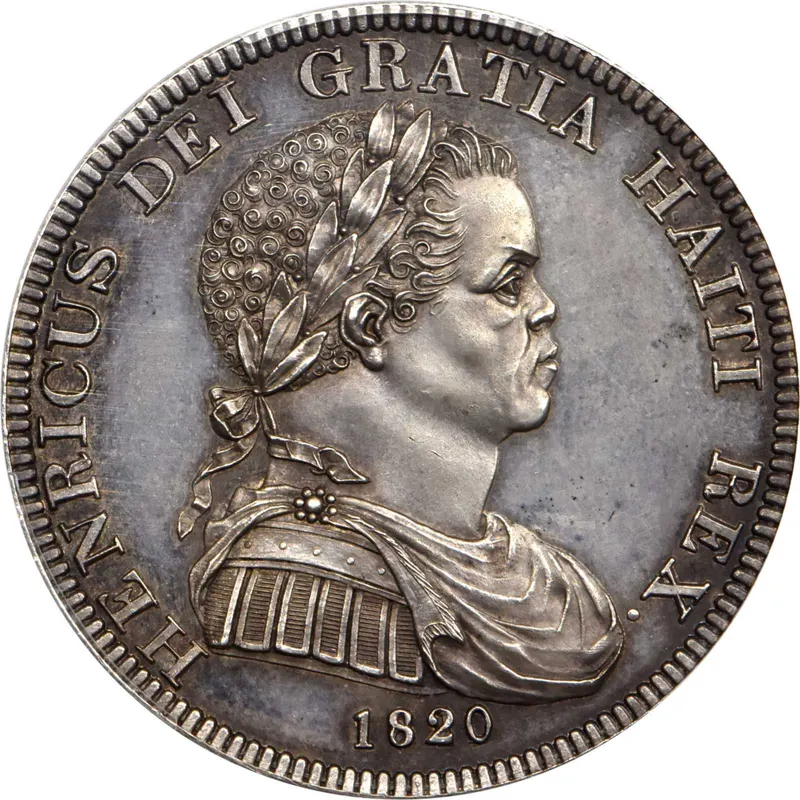
One thing also is very cool is that another kind of aspect of his, you know, his like cult of personality, they had surprisingly beautiful coinage, incredibly detailed coins of Christophe as a Roman emperor, wearing this detailed portraits of him in like Roman, in like a Roman pauldron and a toga with a laurel wreath crown.
They were extremely regime-pilled.
Yes, they really were.
I also, something that I want to add in: besides the racial divisions between the north and the south, there's another very interesting tidbit about Christophe, which is that he was born in Granada. This is something that, or I believe, Grenada, Grenada. My apologies to any Grenadians who are listening to it.
Love your syrup.
This is something that was theorized for a very long time. And in her new book, Marlene Daut has basically confirmed that that is where he was born. And there's a sense in which he was quite Anglophilic. He corresponded with a lot of British abolitionists and at times toyed with the idea of teaching English in the schools in the North in order. Yes, yes, in order to further distance the country from France. Whereas in the South, the mulatto elite were much more tied to France. As you mentioned before, a lot of these people would be people who, even if they didn't agree with France politically, they had studied in Paris and they really identified themselves culturally with their sort of like quote-unquote like Latin heritage.
Yeah. And that becomes another, yeah, that becomes another sort of difference between those as something we're going to get into is language conflict has remained a huge theme in Haiti, where the elite in the tradition of the rules of the south still speak French, while the vast majority of Haitians speak French.
So you can obviously make this like clumsy comparison of like, you know, class and region and semi-ethnic or just at least skin color distinctions in Haiti could be kind of like, you know, exemplified by Christophe versus Pétion. Regardless of whether or not that's an effective thing to do, do Haitian people see Pétion and Alexandra as like prefiguring modern splits in Haiti? Is that like a common is that does that like come up in like conversation?
I don't think really in conversation. It is definitely a it is that is definitely how it seems scholarly. I think maybe the only place in Haiti where you would see that is, as I mentioned, with the North being like so, so proud. It is possible that if you're that if you're in the north, people might say negative things about Pétion and Boyer. But I mean, it's not something that I personally saw all that much. But it definitely is something, as I mentioned before, that you would see in the historiography of the time.
The mulatto legend
There's one quote that I have here from a very good book on Haitian history where they're talking about this sort of tradition of uplifting mulatto leaders and denigrating black ones. This quote from a book called From Dessalines to Duvalier by David Nichols. Perhaps the absurd climax of the mulatto legend during this period is to be found in an article by Senator D. Trouillot entitled Résumé de la vie politique des cinq premiers chefs de la race africaine qui ont commandé en Haïti so the first five heads of the African race who ruled in Haiti. Toussaint was quote hypocrite and mean who aspired to power solely for personal ends who betrayed his people and had to expiate his crimes in the French Jura. He paid tribute to Dessalines for declaring independence but saw his assassination as the just reward for his tyranny Rigaud who is another very prominent and important mulatto figure that i just don't think we'll be able to get into today was praised for his early activity but criticized for his schismatic movement in the south if it had not been for the noble disinterestedness and patriotism of Borgella this action of Rigaud would have led to the victory of Christophe, the quote Nero of Haiti whose bloody appetite had led him to slaughter, quote, almost all the colored class in the north.
When Trouillot came to Pétion, he was almost lost for words. And this is an incredible quote: Le souvenir de ses vertus me ravit en extase, which essentially means the memory of his virtues ravished me in ecstasy. So there really is a sense in which, if you're reading writing at the time, you could get the idea that any black leader was just like a tyrant who wanted to kill him.
I went to Saint Louis, which is shocking to me. I thought he was, yeah, I thought he was like a saint.
Yes, yes. He definitely is now, but that is after quite a bit of even, who now is, which I think is also probably a product of the noirisme of Duvalier. Dessalines is universally regarded as the founder of the Haitian state. But there was a time when in the book it mentions that they were going to try and build a statue of Dessalines, and it got held up in the Senate because that was too controversial of a time. Because Yagos is black, anti-mixed race figure.
The deaths of Pétion and Christophe
Just kind of capping up the discussion of Pétion and Christophe here, Pétion would end up dying of yellow fever, just like Leclerc did. And he was succeeded by a man named Jean-Pierre Boyer, who's about to become very important. But focusing on the north, Christophe would not rule much longer than Pétion did because he would be overthrown by his own men. From what I understand, part of it was because he wrote this very sophisticated legal code, this all-encompassing Code Christophe, which was basically rejected by local elites for stepping on their toes with, like, you know, by trying to enforce the rule of law. He would be overthrown by his own men, and there would be one kind of unfortunate similarity with the original Nero, where Christophe would be one of the few world leaders to commit suicide.
And just as a note, when I went to the north, I saw the Palais Saint-Souci, his palace, which was then later destroyed by an earthquake. And when they're giving you the tour, these very proud northerners show you the room where he allegedly shot himself with a silver bullet. So it's a silver bullet. It's a very big part of his sort of mythology.
Yeah, yeah. So, yeah, so you mentioned so, okay, so by this point, so it's like 1818, 1820.
Boyer reunites the island
Christophe is dead, Pétion is dead, Boyer is now ruling the Republic of the South. He is the new president for life. He is a popular figure with a very similar backstory to Pétion. He is a mixed-race man, born in Haiti, grew up, spent part of his childhood and youth in France, came back with the Leclerc expedition, switches sides under Dessalines, is now part of this new ruling elite of the Republican state, the revolutionary state. He's a popular enough figure that he's basically given the keys to the north. The northern literal aristocrats in the north who had been appointed by Christophe and just overthrown Christophe, now that Christophe is dead, they allow this guy Boyer to basically reunite Haiti. And for Boyer, reunification does not just mean uniting the French half of the island, it means uniting the Spanish side of the island too. As in this post-Napoleonic period, because we have mentioned this, but Napoleon has also been overthrown by now.
He is now dying in St. Helena. The legal status of the modern-day Dominican Republic, Santo Domingo, is under question. It's this legal limbo that Boyer seeks to take advantage of. So, Boyer was ambitious and capable, just like Christophe, and he had this strong recognition of gaining Haitian recognition on the world stage. I think, you know, reunification and recognition are his two big aims. And he would succeed at both of them, but really at a terrible cost. But he would be the longest-serving leader in Haitian history. He served for 25 years and he would briefly reunite, as we'll get into, the French and the Spanish half of the island.
Yeah, so this is a very important aspect of Haitian history and Dominican history that helps form the relationship between the two countries now. But it's also very politically contentious, depending on whether you're talking to a Haitian, a Dominican. So an important part here is that the Haitian revolutionaries really saw themselves as these vanquishers of European colonialism. They kicked the French out of the island, in fact, chasing them into Spanish territory to remove them from the island. But still, there was a European power, a European slave trading power in the other half of the island. The Dominican Republic didn't exist yet, but the Spanish were there, and Haitian leaders wanted to expel them just as they did the French. In 1822, Boyer led the Haitian army across the border and began what would become the 20-year unification of the entire island. While he ended slavery for good and was welcomed by many of the island's black inhabitants, he also implemented many of the same policies around land that we've already seen Haitian leaders like Dessalines, Pétion, Christophe implement within Haiti: high taxation, development of an agricultural economy for export.
And of course, there were many in the DR who really, you know, didn't enjoy that. But at the same time, especially in the more urban Santo Domingo area, there were many who took pride in their connection to Spain as a motherland, the same way that the elites back in the south of Haiti took some pride in their relationship with France. So they spoke Spanish, they identified themselves as Creoles in the same way that elites in other Spanish colonies did. And they really, many of them specifically resented rule by a black nation. Boyer in 1843 would himself be overthrown by a Haitian figure by the name of Charles Rivière-Hérard. And right after that happens, and he wasn't around anymore to enforce this rule, a revolt in Santo Domingo, led by poets and playwrights called the Trinitarios, pushed out the Haitian occupation and established Dominican independence.
Yeah, shortly, not permanently.
And what's really interesting about this is the fact that the way that this is remembered in the DR, which I think really helps point to part of the reason why the relationship is so contentious. The modern relationship between the very tense relationship between Haiti and the Dominican Republic. Of course, these specific racism can be traced to much, much more recently.
Yes, because there is extreme racial prejudice against Haitians in the Dominican Republic. And, you know, this is way outside the scope of this episode. There's also a history of massacre of Haitian people in the Dominican Republic by Dominican governments.
Yes. And I think something we see where this idea starts is the fact that even though the DR was later recolonized by Spain, it's the only part of the Americas where colonial rule was re-imposed. And just like Haiti would later be, it was occupied by the United States. Dominican Independence Day is still celebrated as the day they got independence from Haiti. And which I also think is quite funny to count among your colonizers like the United States, France, Spain, Britain, and also Haiti. It doesn't really fit with the others. I don't want to seem too.
Okay. Were they oppressed in any sense by the Haitians, or was this just because they didn't want to be ruled by a predominantly black government?
It is complicated because I definitely wouldn't say that like Boyer did everything right or whatever. I think in any case where you have a military occupation of a country that has a different culture, speaks a different language, you know, that that isn't always, or most of the time even, isn't going to turn out well.
Yeah.
We already know that his land policies in Haiti were quite unpopular. And so we have no reason to think that putting those same policies on a different population would be, you know, any better. But we also can say at the same time that a lot of the anger at being ruled by Haiti was specifically directed at race, especially that anger that crystallized in this white Santo Domingo elite. And so, you know, while I don't think I would ever want to be as fully nationalist as saying like this was a good thing, I also fully understand why Boyer tried to, you know, eliminate all European powers from the island. And I understand why many Dominicans would rightfully be frustrated with this.
Yeah.
No, and I think also that they're just very different countries. In addition to the fact that the Dominican Republic was obviously Spanish-speaking, in addition to the fact that it was homogeneously Catholic without the same Afro-Syncretic influence to anywhere near the same extent, it had a very different history with slavery. It was still a colony dominated by slavery, but in the way that Virginia and South Carolina were dominated by slavery. It wasn't, as in, like, the economy was heavily revolved around slavery, but the ratio of slave to free was one to one. In the French side of the island, it was 11 to 1. A totally different kind of slave system. So they were just way more, you know, so many, I think you said many black Dominicans supported Haitian rule, but others did not for various linguistic and religious reasons. Religion was a big part. Like, you know, they were called the Trinitarios as a reference to the Christian Trinity.
And part of the way they agitated for revolution was by holding passion plays where, you know, Nero and Rome were like a metaphor for Haiti. But in addition to that, there were just way more white people and mixed race people in the Dominican Republic than there were in Haiti. And they were much less inclined to support the Haitian government over the Dominican Republic, over the modern Dominican Republic.
The indemnity
And now I think we're getting into maybe the second thing that Western Americans have heard about related to Haiti, which is the indemnity.
Yes, the debt.
As we mentioned before, there is this constant push to replicate the profits of the colonial period, but without slavery. And this became a very serious issue in 1825 when France sent a ship to the Haitian harbor demanding an indemnity in exchange for recognition of Haitian independence. At this time, the amount of money they demanded was more than the government's entire national budget. What's interesting about this, though, and I think comes into what we talked about about not wanting to let the Haitian comprador off the hook is the fact that the first to suggest paying an indemnity wasn't Charles X, France's king, but Haiti's own president, Alexander Pétion. Pétion had, and I think this is an aspect that most Americans don't know, even if they are quite educated in Haitian history. Pétion had first suggested it to France before he died as a way of achieving French recognition and at the same time cementing the position of his class in power.
And it also seems to be the case that neither Boyer or Charles X believed that France could reconquer Haiti if Haiti chose not to pay, but it was, in a sense, sort of mutually beneficial because within France, between France and this mulatto elite, there was this property question where they wanted to be able to rule over Haiti while not having France later come into call it debt. And so they preemptively offered to pay this money. Both these leaders, Pétion and Boyer, made such a bet because they thought that they would be able to make the money to pay it through this agricultural output, which ended up not being true.
No, right, and this is the, yeah, it's again one of many tragedies of Haitian history that, you know, Haiti, as we mentioned at the top of the episode, one of the most economically significant parts of the world prior to the revolution. After the revolution, it would never be fully incorporated into the global economy, basically ever again. They were never able to match the economic output of the slave system. You know, because like it's horrific to say this in such terms, but so many black Haitians were dying for a reason in the horrific logic of colonialism. They were being worked to death on a massive scale. If you are no longer working people to death on the same scale, you're not going to be able to get the same profits out of a plantation economy.
And there's a lot of legacies that we see in this, you know, throughout this history, throughout this history, where the elite continue to borrow a lot of this money from the United States, from France, from these banks, and they're never the ones who have to pay it off. It's always the poor farmers who have to pay for all of these debts. And they really create a dependency that the elite themselves benefit off of. There was a fascinating bit from the book Haiti: State Against Nation, which I referenced before, where he writes about how Haiti became this republic of merchants, as all of the money was being generated, all the wealth was being generated by peasants, but all the profits were being received by merchants. Trouillot writes that in 1842, customs duties amounted to 92% of government revenues. And by 1881, that had gone all the way up to 98%.
And so the only way that any money was ever made was through this export. And that is still true today, not in the sense that Haiti is a large export economy, but that Haiti is largely an agricultural nation where most of the food that people eat is imported. And whenever discussions are made about investing in agriculture in Haiti, it's always about investing it in an agriculture for export economy, despite the fact that Haitians aren't even capable of currently feeding themselves. And we see that cycle of dependency created by the comprador bourgeoisie at this time. And I think also there's this creepy kind of ethnic element here where the bourgeoisie are... Many of them come from, you know, like you said, like this mixed race background rather than being, you know, black African. But in addition, across the 19th century, you begin to see increased immigration to Haiti of French people, but also of Germans and especially Lebanese and Syrian people who become very prominent in this new market sector.
Yeah, that mostly happens quite a bit later around, like, for example, like the fall of the Ottoman Empire is when a lot of the Arabs start to come. But they really are really grafted onto that social structure. And currently, I mean, while it wouldn't be entirely true to say Haitian social structure hasn't changed in 200 years, there's a lot of ways in which you can see the skeleton of this 19th century social structure within the Haitian social structure today.
Boyer's fall
Right. And so, okay, so this was all under the time of Boyer. He would be the longest-serving Haitian leader, really kind of like, you could argue, like, one of the last founding fathers of Haiti who really set into stone so much about contemporary Haitian society. But like so many other leaders, he would end up being overthrown. He was overthrown in an elite coup led by the politician Charles Rivière-Hérard, who you mentioned, and his cousin, the poet, Hérard Dumesle. Do you know anything about why he ended up being overthrown after 25 years? Was it about the indemnity? Like, what made people suddenly decide, okay, that's enough of Boyer?
So, this is actually 18 years after the indemnity. So, it's not really that as soon as they announce it, this happens. But what definitely is the case is that just as those agricultural policies were not popular, they only get worse after the indemnity happens because now the country's in a massive amount of debt. And so it is the case that this becomes something that more and more people are very frustrated with. And there are multiple peasant rebellions that the government has to deal with throughout this period. And eventually, you know, he just, he isn't able to hold on to power anymore. And becomes, in quite a short period of time, the third Haitian ruler to be violently overthrown.
Yeah, yeah. Okay, so after, so the Hérard cousins, from what I understand, do not really successfully maintain control over Haiti. From what I understand, all of their support comes from the mixed race elite, the business elite, not from the military, not from the masses. There's this an uprising led by, I guess, these peasant rebels, what is it, the Piquets, is that right? Because they have pointed sticks called Piquets. And they would, this was in the 1840s, not too much earlier from the 1848 revolutions in Europe. And they would end up propping up several leaders. Eventually, the new military elite supported by the peasants would end up choosing an old revolutionary to lead them. And he is going to be, I think, the last of these interesting Haitian figures we are looking at, at least in great detail. And that would be the second emperor and third monarch of Haiti after Dessalines and Henri Christophe.
That would be Faustin Soulouque.
Emperor Faustin Soulouque
Yeah, and pay attention here, Brandon heads.
Sam, yeah, what can you tell us about Soulouque, Sam, about Emperor Faustin?
Yeah, well, I mean, we already touched on him briefly in episode 103. He sort of had a voodoo thing going on. He was, you know, bringing sort of a black populist vibe into the mix. That's precisely why he was chosen, because he was this revolutionary war hero who was already 65, I believe, when he was picked out by the Haitian oligarchy because they expected him to be a wet blanket who would, you know, cede to their will. But as it turned out, he was not willing to be that. When preparing for this episode, I compared him to Pétain to William, and there are definitely parallels.
Yeah, and that's just to clarify, that's not Petion, the Haitian leader. This is the French fascist collaborator, Philippe Pétain, in the 1930s.
Yeah, and just like Pétain, I would argue that Faustin was a Brandon. Those who know, know.
Yeah, so one of the topics that we see very clearly here, but is a huge part of Haitian history, is this idea of the politique de doublure, which is like the politics of the understudy. And it's an idea in which elites, especially in this context, in a modern context, like light-skinned elites, choosing a ruler who they don't think will cause too much of a problem with the populace. They don't think people are going to rise up and revolt, but also they think that they can control and manipulate. And Soulouque is very, I mean, he's quite old. He's the last Haitian ruler to have been born before the revolution. And he, there, he's born into slavery, even. This is like probably an apocryphal story, but it's a story that either Boyer or Pétion, there was some light-skinned leader who was speaking and said something like, maybe one day even this guy could be president.
And it's sort of like, and pointing at him as like this stupid black person in the room who no one would think could ever rule. It's even, this probably never actually happened. This isn't a real exchange, but it really does highlight the fact that this isn't someone who anyone thought would take much agency in ruling the government or who they thought would, you know, cause too much of a fuss.
Yeah. But no, but he very much did. He became, he really carved out his own sovereignty. He was this very culturally ambitious leader who embraced his own blackness and his African heritage in ways that some other Haitian leaders were reluctant to do. We mentioned how he embraced Vaudun and kind of made it this like semi-official state religion. He was basically the first person condescended to by the West as a tinpot dictator. Sam dug up something by the recent text by the historian Emmanuel Lechaux, who has this quote about Western observers of Emperor Faustin Soulouque, which was that, for the white Atlantic, the idea of a black emperor was as audacious as it was ridiculous. The Parisian newspaper La Réforme labeled Haiti's turn to empire as below ridicule, saying, If President Soulouque believes that in placing upon his forehead a crown of gilded pasteboard, he will make himself respectable in the ideas of foreign powers, he is singularly mistaken.
For the French-reading public, the use of the epithet of Soulouque became a Republican rallying cry, inciting popular anger against the second French empire of Napoleon III. Down with Soulouque became synonymous with Vive la République. International press followed, referring to Napoleon III during the coup of 1851 as the French Soulouque. Karl Marx used the analogy of Soulouque in 1852 to describe the empire's administration, comparing Napoleon III's court to a noisy, disreputable, rapacious bohème that crawls into gallooned coats with the same grotesque dignity as the high dignitaries of Soulouque. Closer to Haiti, the United States, already in a bitter conflict over slavery and territorial expansion, used Soulouque as a warning of the results of emancipation.
Yeah, and this is actually like a really interesting thread here where it's like this was happening at the same time as Louis-Napoleon was elected to power in France, and then they both had themselves coronated in the same year of 1852. So it's like, I really began wondering if, like, at one point, one of them was taking cues from the other or vice versa. But it does get back to that same dynamic I mentioned previously, where it's like, even these leaders who make such a grand effort to differentiate themselves from the Europeans and to, you know, just frame themselves as like super proud Haitians against the legacy of France and Europe, they still nevertheless were aping what was happening in France at this moment. So, this imperial obsession, thankfully, Soulouque was the last one to have it happen for real. But it, but this mode of politics would continue to dominate in Haiti for many, many years to come.
Is Faustin Soulouque remembered fondly today in Haiti?
No, I wouldn't say so. One really interesting thing, though, is that in him, in his fashioning himself as a Napoleon-like figure, he commissioned himself a crown and a throne identical to those being used in France, identical to the ones on Napoleon. And when I was in school in Haiti, we went on a field trip to a museum in Port-au-Prince that has the original crown that he had. And it's very interesting, I think, to think about this figure having these parallels with France. And I do think it says a lot about Haiti.
Yes, because they're both nostalgic figures harkening back to this earlier revolutionary era. You know, like Napoleon III obviously was trying to be his uncle, Napoleon I, and miserably failing, he ended up, you know, famously losing the province of Alsace-Lorraine. Meanwhile, Soulouque is attempting to, you know, share the glory of Dessalines and, I guess, to a lesser extent, Henri Christophe.
There's also, we were talking before about Christophe's creation of a nobility. And Soulouque does this really to an absolutely ridiculous degree. And in a book I've now quoted a few times, Haiti: State Against Nation, Trouillot really talks about Faustin as being this example of the parasitic growth of the state that becomes a huge part of Haitian history later. He writes: The counts and barons of Haiti's second empire had incomes that were ridiculously low compared to those of Christophe's nobility. But while Christophe's kingdom knighted only 77 men during its first four years, the empire created 400 in a single week. The spawning of an impoverished nobility cost the treasury far more than did the feudal elite of the north. In other words, as the number of parasites grew, their total cost of the state increased enormously, even though their individual incomes declined.
And I think that this-basically, a patron system, I guess.
Yeah. And I think that this really is something we have seen in Haitian politics ever since. We've seen in the Duvalier era, for example, him using the secret police and other state paramilitary as ways of, you know, providing upward mobility for some and cementing his power. And political theorists like Robert Fatton have written about Haiti's politique du ventre or the politics of the belly, where access to politics is often one of the best ways of enriching yourself and your family. And thus, Haiti is a case of a state that historically hasn't really done much for its people and is often quite separate from the Haitian people. Haitian state and the Haitian people are quite different ideas and concepts, but it's still often functioned to enrich itself at the other's expense.
And I guess this is this great tragedy, right? That so this, you know, coming up to the kind of closing in the end, we're getting at the end of stages of this whole discussion, but we've seen how the Haitian Revolution had this incredible promise to emancipate the Haitian people, but the government created by this revolution, including a government led by many of these revolutionaries, clearly had very little interest in expanding or fulfilling the promise of this revolution to everyday Haitians. And that's really quite depressing. But I think that we really need to keep in mind, though, that part of the context here is basically the entire world was setting up Haiti to fail. You know, it's like it's tragic that the Haitian leaders were not able to meet the promise of the revolution, but you almost wonder if it was impossible given the international circumstances.
And I mean, Haiti really is the first instance of a post-colonial country as we would understand it in the modern day. And I think that we see a lot of parallels between what happens in Haiti and what happens 150 years later when a lot of Africa becomes independent. A part of me thinks that, you know, for all that we can blame on the comprador bourgeoisie and everything, there is a certain sense to which that's, you know, it's not unique to the Haitian Comprador bourgeoisie at all. And in countries with much less pressers, we've still seen very similar, very similar events where the class that takes power, even if it's a class that maybe even wants to help or says they want to help the majority of the population, the forces of capitalism and the forces of imperial domination don't always allow for that.
Geffrard and the United States
Yeah. Well, in the end, you know, Faustin's empire would meet the same fate as the first Haitian empire and the short-lived Haitian kingdom in that it was overthrown by a military clique and a new president would be installed. This is Fabre Geffrard, and he is actually, he is the first free-born Haitian president born after the revolution. His father had a lot of revolutionary cred because he was a member of the Incas, the Maroon Rebel Band. He was the one who finally formalized relations with the United States during the Civil War. And part of this is because he allowed Union merchant and naval vessels to shelter in Haiti, while at the same time, the Dominican Republic, which is now once again part of Spain, they re-accepted Spanish colonialism, they were sheltering Confederate ships at the same time. What did this normalization lead to? Do you know, like, did this, was this, was this beneficial for Haiti at all now that after, you know, that Jefferson had finally been rebuilt 50 years later?
The Haitian Revolution, the Haitian relationship with the United States is, of course, very, very complicated. The relationship with black Americans, I think, at this period especially was very, very strong. And one place in which, like, while what we're talking about is largely very, very depressing, and a lot of stuff goes very wrong, Haiti as a symbol really gets its traction at this time around the time of the Civil War. And there's one story, this is quite a bit later than the Civil War, but at the Chicago World's Fair, where they set up a booth that is supposed to be celebrating African-American culture. And African Americans do not go to that booth. They do not enjoy seeing that booth because it's depicting these really harmful racial stereotypes. The booth that they do go to is the Haitian booth, because Haiti represents, you know, what it can look like for black people to have their own countries.
For all of Haiti's faults, it is independent and it is black. And that is hugely powerful as a symbol to black Americans. There's multiple attempts at African-American immigration to Haiti. There are a couple times that it was tried, it didn't really work. And the one case that actually was quite successful is while Haiti still owned the Dominican part, there were African Americans who were brought to the DR. And there's still a town, I don't remember where this is, where people claimed their lineage specifically to these African-American, these African-Americans who were sent during Boyer's leadership. And at the same time, pretty much immediately after the two countries have a relationship, the United States is looking at imperial domination. And Andrew Johnson suggests that the U.S. take control of the entire island of Hispaniola. And Frederick Douglass, when he becomes the ambassador to Haiti, his first task is to ask the Haitian government if they will give the United States Môle Saint-Nicolas, which is like a cove on the top of the island, as a military base.
And so it is very complicated. And obviously, as the case with just about any country, over the course of time, I think the United States has done much more harm than they have done good in Haiti. But for that moment, it did open up a market. And I think for Haitians, it really helped legitimate their role on the global stage, which is a goal that they had had.
Yeah, I think the role of Frederick Douglass there is really interesting. And I'm very curious if he was conflicted at all about that, about basically taking part in American colonialism against the first Black Republic.
Well, he gave a speech about this at the Chicago World Fair about I remember from it is: according to him at least, he claimed that there was no offense meant in America asking, and there was no offense taken by the Haitians or offense taken by the Haitians refusing. So it seems that I'm sure that he had some official qualms about what he was doing, but also there's a sense in which he's trying to portray that this is this independent black country and they are on equal footing making these diplomatic, you know, like discussions with an independent white majority country. So maybe, you know, even in doing the statecrafts, he was trying to, you know, legitimate Haiti as an as an independent power.
Yeah, that's interesting. And I guess some kind of context here is that right after this, the Dominican Republic, with American assistance, would once again declare independence, this time from Spain. And they only were recolonized for a couple of years. And not long after becoming independent, they actually petitioned to become part of the United States around the same time that the U.S. was trying to seize the port of Môle. This was during the Grant administration now. And I believe actually the U.S. kind of came close to annexing the Spanish half of Hispaniola. And part of the obligation was that Dominicans were too black. And many white American politicians did not want the enfranchisement of Spanish-speaking black people for the implications that would have on American black people.
Haiti's political instability
Well, that's kind of closing it up. Any, so this, we basically covered from the revolution up until the 1870s now. Any kind of closing thoughts on the late 19th century in Haiti and just kind of resonances of 19th century Haitian politics on the present?
Yeah, so I think one of the things I would really like to quickly touch on is the history of Haitian political instability that's resulted from this time. I did, I wrote something, it's been a few years now, so the exact, oh no, it's only been a couple years, but the exact numbers are a bit different. But I was basically counting the number of administrations there have been in Haitian history and the number, how many of these administrations have had either a normal transition of power or have ended up in the person like resigning, right, rather than being overthrown. And I think that's something that we really start seeing in what we're talking about, where Christophe kills himself, Pétion dies in office of yellow fever, Boyer is overthrown, Dessalines is overthrown, and everyone we've talked about so far, none of them left office of their own volition.
And I made a like a chart, it says on my Substack, but I made a chart on this as well of like how many of Haiti's presidents have finished their term out. And of the numbers I had at the time, 22 either fled the country or were couped, which is a majority. One killed himself. That's Christophe. Four were assassinated. Six died in office of other terms, and only 10 finished their term.
Wow.
And the first Haitian leader to just, you know, finish his term and end up living out the rest of his life without any issues was a 19th century figure who I like a lot, Jean-Nicola Nissage Saget, who was a provisional president and then later became a permanent full-time president from 1869 to 1874. At the end of his term, so this is 70 years after Haitian independence, he becomes the first president of Haiti to step down from a term without being overthrown or dying in office. He rides about 60 miles north from the National Palace in Port-au-Prince to his hometown of Saint-Marc on a donkey and lives out the rest of his life as a farmer. And Haiti would not see another leader fulfill out a term until the puppet leaders of the U.S. occupation 48 years later.
Wow, he was a real Haitian Cincinnatus. Yeah.
Yes, yes. And I think that you really see the seeds in the period we're talking about of a very turbulent political society. And you see the roots of something that definitely has continued on of a state that doesn't have the same interests as its population, which I think is also continued on. In a book that I recommended to you, Jean Casimir's Haiti: State Against Nation, he really makes the point that the revolution produces two completely different things. There's the nation that is people who are independent and don't have to be slaves anymore. And then there's the state, which is, as he sees it, just an outgrowth of the colonial institutions that existed before independence. And I think that if you look at Haiti within that framework, you're able to take all of the good of the revolution of independence and Haitian society, which outside of the political sphere has been thriving and has produced these, I mean, incredible cultural output, like you touched on voodoo in the episode you made on zombies, and a really, you know, a society that exists outside of politics.
Yeah.
Whereas what we see in this genesis of the state really has continued on with very, very few interruptions in terms of its destructive nature. Yeah. Yeah. Yeah.
No, I think it shows that, you know, in the same way that holding territory is often much more difficult than conquering territory, I think it's clear that defending the values of a revolution are often more difficult than the first revolutionary push. Like, you know, like overthrowing the old order can be easier than making sure it never comes back. And we've seen this to an extent with every revolution we've talked about in this podcast, especially these like these liberal bourgeois revolutions, like the American Revolution. But I think in Haiti, it just feels really more tragic just because there is so much potential and they came so close to creating this very egalitarian society.
Duvalier's flag
Any, I know, I don't want to get too deep into the Duvalier regimes, plural, but any kind of closing thoughts on how later Haitian governments connect to the legacies of any of these figures we've seen here, like Dessalines, like Christophe, like Faustin and Pétion?
Yeah, so as we talked about before, there was a tradition of really depicting all of Haiti's black leaders as being very negative and all of the mulatto leaders to be very virtuous. And this really changes during the Duvalier era. It's where we start to see Dessalines and Toussaint being fully revered and publicly as a matter of government policy. And Duvalier, with his sort of his ostensibly noiriste ideology, he makes a big point of emphasizing the impact and the rule of these like strong black leaders. So he adopts, he changed the flag of Haiti to a red and black banner instead of the red and blue, because this is a flag that was historically associated with Christophe's black kingdom. While the blue is more associated with Pétion and with this, you know, sort of Republican.
And it's also the blue of France.
Yes, yes. And which the story goes that they took a French flag and ripped the white out of the middle in order to make to make the Haitian flag.
The two flags, that's such a good metaphor, because are you taking out the white from the flag or are you putting in the black?
Well, it's also interesting too, because there's another piece of symbolism there, which is that Duvalier changes it from a horizontal bicolor to a vertical bicolor.
What was the, yeah, what was the, I think I've seen that. What was the motivation behind that? Why did he flip it like that?
When you flip it and you make one of the sides black, the only part of the fabric that is touching the flagpole is the black part.
Ah, the idea that it is the black portion of the country that is holding up the country.
Whereas red, which can symbolize either blood or it has often historically symbolized this sort of lighter skin tone of these mixed race Haitians. The red, in his view of Haitian history, is sort of just like an outgrowth. It's something that happens to be there, but it isn't the basis of Haiti's existence. And so that symbolism, I think, is very powerful. But I think partially it is also powerful because even though he has these grand rhetorical flourishes and these sort of statements, we once again see a mirroring of the post-revolutionary period, where for all of his claims of pro-black politics, Haitian social structure stays essentially the same. He is, of course, you know, a terrible dictator who kills just about as many black people as he kills anybody else.
I'm sure he probably only killed black people.
Yeah, well, there is a sense in which a lot of more like liberal, well-educated families were mixed race.
Okay. Yeah. Yeah. Okay. Okay. So, you know, once again, with Duvalier, I think much more obviously cynically and obviously to a negative degree, we have the manipulation of things that a lot of Haitians hold dear and believe their country to be then used against them or used to reinforce structures that are actually much more colonial and European in origin than they are authentically Haitian.
You could say that Papa Doc had this, you know, was hypocritical. He claimed to represent, you know, the black majority against the, you know, the lighter-skinned Comprador elite. From what I understand, his son, Baby Doc, who I think was just 18 when he took office, he didn't care about any of that, right? He, he, this is from getting from state against nation. He just abandoned that altogether.
It's the fact that I, this is something I actually mentioned on a podcast I was on last year, but if you Google Papadocyta.
This is with the friend of the pods.
Regime radio, yes, yes.
Yeah, okay.
If you look up a picture of Papa Doc and Baby Doc together, you see this like very old man with glasses. He's a doctor. And next to him, you have this just like unbelievably fat son of his. And that is kind of a very good visual metaphor where Papa Doc, for has obviously like evil as he is in this, you know, in Haiti, as like people are terrified of him and people don't like him at all. He has a sort of dignity about him. His son is much more openly like, like he promises that American companies don't have to pay taxes in Haiti. He lowers the minimum wage to like a ridiculous level and just lets, you know, Americans do whatever they want, fully opens up to neoliberalization, doesn't maintain that same like nationalization of the state as his father did, while still maintaining the same repressive structures.
And so, yeah, I think with him, you see it's easier to see the farce of Duvalierism for what it is because of how ridiculous and like patently corrupt the son is. Not that the father wasn't, but that the son is just has none of the dignity about him, which I think, once again, is a pretty good metaphor considering that the original leaders had the dignity of having led the revolution. Whereas after, you know, it's sort of a naked corruption that doesn't have any of that wisdom behind it in the eyes of the Haitian people.
It's tragedy and farce all the way down.
No, and that's the thing. It's that, like, looking at Haitian history, this is why it's so important to go beyond the revolution, because both on the right and the left, Haiti is only reduced to the period from like 1791 to 1804. The second Dessalines proclaims himself emperor. That's basically the last thing you hear about Haiti. But I think that looking into this later history going up all throughout the 19th century, that really makes... That kind of context is just so essential to understanding what the revolution led to and what the people leading the revolution actually succeeded at and failed at the decades afterward.
Favorite figures
Well, this has been great. This has been really, really in-depth. But, you know, it's such a period that I really do think that most people, especially Americans, and especially Americans interested in revolutionary history and the history of the Americas writ large, really need to study. I think that Haiti really is kind of this microcosm for Atlantic revolutionary history more broadly. And I think that the internal developments within Haitian politics after the revolution really can shed a lot of light on internal developments elsewhere in the United States, in Latin America, where you see this kind of similar revolutionary betrayal in many places, this re-entention entrenchment of a comprador elite. This has been a really great discussion, Sebastian. So first off, just thank you so much for coming on and sharing your time and expertise with us.
No, I'm very happy to. And also, I'm constantly tweeting, and it would be very nice to have a reason to tweet about something related to something I'm interested in rather than to just ruin my mind.
Yeah, so be sure to look in the episode description, check out Sebastian's Twitter, check out his Substack. And is there anything else you'd like to plug? Well, here's: I have a question for you to end us off. So, we've talked about so many different figures in Haitian politics. We usually try to avoid great man kind of stuff, but there are so many interesting figures here from, you know, Romaine-la-Prophétesse up through, you know, Emperor Faustin. Like, if you could think of like one person in Haitian history to be your favorite, that you think is like the most interesting or the most fun historical figure in the entire scope of Haitian history. Who do you think it is and why?
That's what's such an interesting question because it all just depends on what framework I'm using. Where, like, if I want to talk about someone who I think is very funny and odd, I think Faustin is just like a great example of this person who exemplifies all these aspects of Haitian history all in one in like a patently like, you know, like ridiculous and often quite tragic manner. But there are also, I mean, a lot of great 20th century Haitian communists and Haitian labor leaders who I'm a really big fan of, like Daniel Fignolé, who was a provisional president shortly before the Duvalier era, or Jacques Roumain, who's a poet and the founder of the Haitian Communist Party. And it's so hard to choose just like one guy because every figure in Haitian history almost like serves a different niche. And I think that the nature of Haitian politics really produces a lot of these like quote unquote great men because the executive is generally quite powerful in Haiti.
And I think that there are. I mean, there's so many directions that one could go from that. So I mean, those are just a couple of my offerings.
Well, thank you, Sebastian. This has really, really been great. And we really appreciate you coming on. Obviously, always welcome to come back on for anything. Haiti is so inspiring and it's so enlightening. And I really hope that all of our listeners dive deeper into Haitian history. And, you know, everybody, so many people on Twitter have read this book, but it really is such a great place to start with Marxist historiography and just with kind of, you know, 20th century history in general. If you haven't read C. L. R. James's The Black Jacobins, you absolutely need to. Any other books you'd recommend our listeners check out before we finish?
I would also recommend Silencing the Past by Trouillot. I also, I would recommend the, it's quite a dense and difficult book to read, I think, but the new book on Henri Christophe, I think anyone who's interested in that, please pick up a copy. It's great. And there's also, I mean, there's so much contemporary work on Haiti in whatever direction you look in. So if you want to read about stuff in the 90s, there's books on that. Want to read about why Haiti is the way it is right now? Read books on that or read my thesis, whichever you prefer. And there's so much scholarship around it. And I think that you can't really go wrong when looking for stuff to read about Haiti.
All right. Well, thank you, Sebastian. And thank you all for listening. This has been Gladio Free Europe signing off. Bye-bye.
The show is also on Apple Podcasts, Overcast, Pocket Casts, Podcast Addict, YouTube, RSS and Patreon.