105
William Tell and the Origins of Switzerland
In progressReady your crossbow as we venture up high into the Swiss Alps, a tyrannous bailiff might be nearby! This week we explore the William Tell, a national symbol of Switzerland, and the very real history which inspired his story. Join us as we venture back into a time before the Swiss were neutral, before they were known for their chocolate, and before they were even a state. How did this plucky assortment of cantons cohere in the first place, and how does the truth of Swiss history compare with the idyllic land imagined by Orson Welles when he quipped that in 500 years of democracy and peace they produced little more than the cuckoo clock.
Through all of this, the legend of William Tell was born and reborn regularly with a new message, a new intended audience, and a new platform, but always with the same goal: the pursuit of liberty and the battle against injustice. From the Swiss Rebellion of 1654, led by the Three Tells themselves risen from hibernation, to the Napoleonic Wars when William Tell became a symbol of the Helvetic Republic, to the pan-Germanic William Tell imagined by Friedrich Schiller in the eponymous play, William Tell has lived more lives than most.
Hop on our ski lift for one last look at William Tell’s winding journey, through medieval revolts, Napoleonic upheavals, and Schiller’s literary magic. Is he a flesh-and-blood freedom fighter or a cunning invention of Swiss lore? Grab your gear, the slopes are calling.
Transcript
Opening
Welcome back to Gladio Free Europe. I am Liam, joined as always by Russian Sam.
Hello, hello.
The Three Tells of 1653
Bringing us back to the 17th century, one of the most chaotic of all centuries covered on this podcast, to the year 1653. Fires of the Thirty Years' War have just ceased their writhing across the Holy Roman Empire. But beyond the foothills of the Swabian Jura, high up in the alpine dales of Switzerland, new embers are beginning to glow. The Swiss peasants, who have lived a life that has changed little since their forebears won their freedom from the vicious Habsburg a century prior, now fear that they will once again lose their liberty. This time, the culprits are not the Austrians in their far-off gilded towers, but instead their own flesh and blood, the Swiss merchants and landowners, who cement an oligarchy above them. Farmers across the cantons are drowning in debt. Inflation is rampant, and taxes weigh heavily on the poor. The price of grain plummeted with the restoration of normalcy in Central Europe after the peace at Westphalia, but rent is still due.
Among the common people, a rumor has begun to spread. The time of the tells is upon us. Back in the 17th century, Swiss peasants believed that under the Lake of Lucerne there was a secret cavern where the founders of the old Swiss Confederation lay in slumber. These three men were the representatives of the original Swiss cantons of Uri, Schwyz, and Unterwalden. In 1307, or alternatively, in 1291, they swore an oath to one another to join their fates together and throw off the imperial yoke, which was depriving them of their liberties. The war was won, and the Swiss Confederation secured its existence as a loose network of states, martial and republican in orientation. The founders' task was done, and as the legend went, they went off quietly into their cave. They were not dead, they were merely hibernating. And one day, when the Swiss peasantry needed them the most, they would rise once more to lead the downtrodden countrymen to freedom.
So now, 300 years later, time was ripe for the three tells to rise from their slumber and lead their kin to victory. The three tells thus walked among the people, spreading hope among the masses that their liberation was nigh. As the peasants became increasingly rowdy, the tells appeared in their midst. It really seemed that the time for victory had come. The peasants organized themselves and rose up against their oppressors, fighting with Knüttel, wooden clubs, which became the symbol of the rebellion, spurred on by their immortal, resurrected forefathers. This all sounds incredibly fantastical, but as we're going to see with Swiss history, sometimes legends are more real than reality. And in fact, the three tells really, truly, empirically did walk among the people to spread a message of deliverance. They may not have literally been the immortal founders of a medieval alliance, but they really believed themselves to be part of an immortal tradition.
They saw themselves as a trinity, one spirit divided into three, embodying the Swiss nation. And their name was taken from the most famous Switzer of all, the heroic crossbowman, William Tell, and the subject of this episode of Gladio Free Europe.
But before we proceed to today's story, I would just like to remind you guys that we do have a Patreon, and in fact, we just recently added a new tier where if you subscribe, you will be able to shoot an apple off of either one of our heads. So, if that sounds like your kind of thing, then please hop on over to patreon.com/gladiofreeeurope and give us your hard-earned money.
Yes, please. All right, let's get started.
Switzerland's image
Switzerland, the most quintessential of European countries, a land of chalets and ski slopes, hot chocolate, and hot brandy delivered by heroic St. Bernards. The average person might have some conception about the long influential history of Swiss banking. And if they've read a thing or two, they might know that Switzerland has a proud history of democracy. I think Orson Welles summarized the popular Anglo view of Switzerland pretty well in his 1949 masterpiece, The Third Man. Italy, for 30 years under the Borgias, they had warfare, terror, murder, and bloodshed, but they produced Michelangelo, Leonardo da Vinci, and the Renaissance. In Switzerland, they had brotherly love, and they had 500 years of democracy and peace. And what did that produce? The cuckoo clock. So long, Holly.
A great quote, but sadly, completely wrong.
Not in the slightest because cuckoo clocks are actually from Bavaria.
If there's one thing we love on Gladio Free Europe, it is smashing national mythology. So today we are taking on the proud, beautiful, completely fictitious tradition of Swiss history, including the Swiss national identity and their national hero, world-famous crossbowman, William Tell.
A nation without a natural basis
What is true is that Switzerland is quite different from many of its neighbors, especially in modern times. Most notably, it has four official languages: German, French, Italian, and the more obscure and smallest of these, Romansh. Swiss German is actually pretty incomprehensible to the Germans of the lowlands, and even speakers of Swiss German can't understand the dialect spoken the next valley over. The country is split into 26 provinces or cantons. You're going to get really tired of that word by the end of this episode. And these cantons were all once independent states of their own and still have strong civic identities. Unlike France or Italy or Germany, where the many rich variations in language and identity were steamrolled over by the March of the 20th century, the various Swiss languages and even the various regional Swiss identities are still incredibly strong. This kind of diversity might feel somewhat modern, but really, it's extremely archaic.
Because fundamentally, Switzerland is a medieval marriage of convenience between several very different places that against all odds has survived up until the modern era.
Yeah, they've pretty much reverse engineered the Roman concept of civitas almost.
Yeah, no, very much so. So today, only about 60% of Switzerland is German-speaking, due to the fact that the western provinces, which are pretty well populated, primarily speak French. And there are also pockets of other Romance languages, Italian and Romansh, down in the south. But the German-speaking Switzers formed the initial alliances that would become the old Swiss Confederacy, and they remained overwhelmingly dominant in Switzerland up until the late 18th century.
Accordingly, the historians Clive Church and Randolph Head argued that never has there been anything particularly natural about Switzerland. Thus, history, the human capacity to adopt shared stories and to imagine a community, is the primary foundation of Swiss identity. Well, you can say that about pretty much every other place, of course, but it holds doubly true for Switzerland, as we're about to get into.
Right, because the foundation of Switzerland is really fundamentally political. It's not about any kind of real common ancestor. And it's really in this lack of supposedly natural unifying identities they had to create a founding father and a founding mythology for themselves.
Myths of Swiss independence
Nationalist accounts of Swiss history heavily focus on the defiant, maybe even revolutionary character of the Swiss. The reason why this confederation of cantons emerged in the first place is because the Swiss liberated themselves from aristocratic feudal rule in the late Middle Ages. The Swiss revolt, which was really not a single war of independence, but instead a long series of small victories, slowly led to the recognition that the lords of the Holy Roman Empire, and in particular, the Habsburg dynasty, did not exercise any real control over the Swiss peaks and valleys. The various cantons were recognized first as independent states joined in an alliance, and then as a loose confederation that became the modern Swiss Republic. So, the Swiss national ethos, really heavily dependent on the fictional story of William Tell, is very reliant on this idea that they always just wanted to be left alone, to rule themselves by democratic processes as they saw fit.
The reality was much more complicated because neither of those things was true. Switzerland exists as a modern nation because of a centuries-long process of power politics, with Swiss leaders annexing foreign territory as eagerly as any feudal prince. Within 200 years of the supposed life of William Tell, the loose Swiss Confederation had become a real player in Western European politics. Swiss mercenaries served in conflicts across the continent, and the famous Swiss Guard still serves the Pope in Rome to this day. Although this is outside the scope of this episode, the Swiss incorporation into the broader world of European trade and finance led to the development of a powerful Swiss finance sector. So, Switzerland, it's never really been particularly isolated, and the wars fought by the Swiss were rarely entirely defensive. As for the democracy that they so highly praised, the medieval Swiss cantons were in fact dominated by a small number of rural families or urban elites, just like anywhere else.
Right, right. And Sam, I'm just curious: do you know what year Swiss women gained the right to vote?
I know this is a trick question because it was canton by canton, but the last one was in like 1980, I believe.
Yeah, 1971 was when the women's suffrage became across all the cantons, yeah. Yeah, yeah, it's just nutty to think about.
But really, the major distinction is that, unlike most other parts of Europe, sections of the Swiss countryside really organized themselves under local governments, which is why, you know, women were able to remain disenfranchised in a couple of them for so long.
Yeah, yeah, it's this disunity which could be really good or really bad, in that local communities of men were able to organize themselves more directly in ways than you see elsewhere in Europe, especially in the countryside. Whether or not this is democratic is up for some debate, because, like you said, these cantons were always organized by oligarchies, even in the countryside. But it did lead to, I guess, a more localized system of power than you would see elsewhere.
Yeah, exactly.
Mountains, trade, and cheese
So, Switzerland had a very unusual economy in the pre-industrial period because it was simultaneously cash-rich and resource-poor. Think Singapore. Because the country is entirely made up of mountains, foothills, and the intervening valleys, the soil and climate really aren't suitable for much serious farming. But due to its central position in Western Europe and especially its command over a small handful of navigable alpine passes, Switzerland has been a major crossroads of trade for over a thousand years. The great medieval trade networks that shipped wool between England and Italy relied heavily on the mountain passes of Switzerland. The famous Spanish road, which would gain prominence in this period, the 15th, 16th, 17th centuries, all that was dependent on Switzerland. So, because of this quirk of geography, along with the initiative of the medieval Swiss commoners who encouraged trade by building bridges and hostels in the mountains, this brought in a level of prosperity to the Swiss valleys which could not be expected by their poor natural resources.
So, the skull shift from farming to dairy pastoralism led to the rise of transhumance, a practice where cattle herders lead their animals from mountain to valley depending on the season. This semi-nomadic lifestyle meant that poor agrarian Switzers were unusually mobile, very good at mountain climbing, and even had a somewhat cosmopolitan ethos. And of course, because they were out in the mountains, they were constantly hunting. So, you know, that also gave them a lot of very useful skills that would translate into war. And so, many Swiss herdsmen supplemented their income by serving as mountain guides for foreign merchants. And in this sense, the rough geography of Switzerland was really quite the blessing in disguise. The mountain passes would become the region's greatest economic asset and eventually the Swiss people's most lethal weapon.
Right. And so because the soil was so poor, the Swiss had to rely on secondary products, mostly from cattle or whatever crops could be grown. This meant there was a ton of wine production, a little bit of beer production, eventually some chocolate production, but more than anything, cheese production.
Yes, so Swiss cheese really dominates the agricultural history of Switzerland the same way that wool does for England and the Low Countries. And that by the late Middle Ages, Swiss cheese was already on the culinary map of Europe. The unusually mobile Swiss peasantry would walk down the mountain passes into Italy and France carrying huge wheels of cheese on their back. The cheese trade flooded the cantons with silver coinage from Italy or Swabia or Burgundy, giving the Swiss a strong interest in the politics and finances of the lowlands. This economic significance meant that many local lords and distant emperors took an interest in Swiss affairs beginning in the High Middle Ages.
Towns and cantons
And the High Middle Ages really were this unusually prosperous time for Europe when trade networks, especially the wool network from London to Florence, was booming. Switzerland became unusually urbanized because rural barons established new towns all across the various cantons in hopes of creating their own little trade center. Most of these towns didn't take off, but still became useful places for local trade and places where travelers could rest their head and pay tax money. In time, these towns often became much more powerful than the barons who had established them, leading to town councils one by one taking over whatever canton they happened to occupy. Just like neighboring regions of this wool highway, the cantons became organized into those kinds of governments we described. Unusually, even rural cantons had well-organized governments. And if there's really any one factor that sets apart Switzerland from the rest of Europe, much more so than the mountains, I think it's the fact that there were these local civic identities that were able to very rapidly form themselves into militias and resist foreign authority whenever it came to be imposed.
Yeah, it's really the Republican ideal. This is, you know, the kind of stuff that all that the Dutch also relished in. And I'm just bringing up the Dutch because the Swiss will have to tell you how unique they are in this regard. But I mean, even just looking at Europe in the late medieval and early modern period, you see similar constructions. So I'm just preemptively knocking the Swiss down a couple of pegs just because.
Anyway, I think if there is anything unique about Swiss democracy, it's that these medieval rights that weren't spread evenly across Europe were preserved in Switzerland, whereas they fell apart elsewhere. Switzerland managed to have a modern economy without a modern absolutist political order. And that leads to this strange situation that persists to this day.
Right. So eventually, because of their economic importance, some of the cantons were granted the status of imperial immediacy by the Holy Roman Emperor, which meant that they were protected from any lord ruling over them except for the emperor himself. And because the emperor was typically far from Switzerland, down in the foothills of Swabia or in the distant Franconian forest, lordship was really not much of a going concern for day-to-day life. In the 13th century, the various gorgos cantons began making peace alliances between themselves to protect from local threats, such as the avaricious lords next door. This relationship between town and country was somewhat unusual, as the rural cantons organized their own collective governments in imitation of city councils. So, in the 14th and 15th centuries, it would be these rural cantons that gave us the story of William Tell and the Swiss nation writ large.
And so, again, Switzerland was not a natural formation in any sense, but like you said, really no country is natural. However, Switzerland feels especially invented because there's no real linguistic or even geographic element holding this together. Like, you know, Britain is an island that largely speaks one dominant language. Spain is a peninsula that previously had been a Roman territory. Same thing goes for Italy. France is derived from this specific medieval kingdom. This is not the case for Switzerland. Switzerland is instead based on a small medieval alliance, which eventually blossomed into a broader confederacy.
The Helvetii and founding myths
Romantic Swiss nationalists and revolutionaries would eventually point to the Celtic Helvetii tribes as the ancestors of all Swiss people. But this history wasn't rediscovered until long after the Swiss entity was first founded. The Helvetii tribe offered the Swiss a mythical heritage that predated ongoing divisions of class and religion. I'd argue the William Tell story serves the same exact purpose.
Right, absolutely. So let's actually dig into the William Tell story.
Shoot some apples.
Yeah.
The William Tell legend
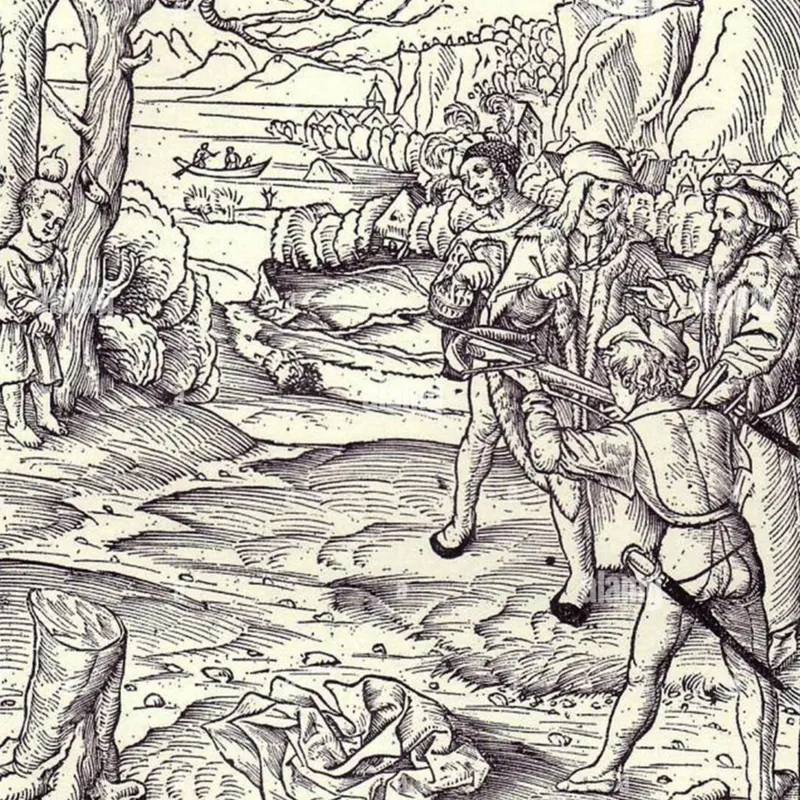
Now, this story was first recorded in a manuscript known as the White Book of Sarnen from 1474. And the story, as recounted there, says that around 180 years prior to the writing of this book, a crossbow hunter with a stainless honor and peerless skill named William Tal, rendered in English as William Tell, was walking with his young son when they came across a hat on a pole. This hat belonged to Herr Gessler, a local Vogt or bailiff for the Habsburg dynasty, who had gone claimed overlordship over Switzerland but recently reasserted control from their base across the Alps in Austria. William Tell is instructed to bow before Gessler's hat as an act of submission to Austria. When Tell refuses, Gessler devises a cruel scheme to punish Tell and to test his skills. He was to shoot an apple off of his son's head. William Tell stoically draws two arrows from his quiver and shoots off the apple, without harming a single hair on his son's head.
Gessler is so amazed at the display that he is about to set Tell free. Before that is, he asks Tell why he drew the second arrow. And so, just like another mythologized founding father, our friend William cannot tell a lie. He explains that he drew two arrows because if he had missed his first shot and killed his son, he would have used the second one to kill Gessler, and that time he would not have missed. Furious at this admission, Gessler ordered his men to arrest Tell and to lock him up for life. He's goaded onto a raft and sent downriver to a local Habsburg jail. But as the boat falls into some rapids and is about to crash, William Tell heroically steers his own captors to safety, then takes advantage of the chaos to make a mighty leap off the raft and onto the shore. He reunites with his son and is on his way home when he learns that Gessler still intends to capture and kill him.
So William Tell lies in wait, just as he does when he's hunting Chamois or Ibex, and then shoots Gessler as he walks into the valley. This ignites the first Swiss revolt, leading to the liberation of Switzerland. The White Book of Sarnen also mentions other heroes, like the woodsman Conrad Baumgarten, who chopped up a Habsburg official who attempted to rape his wife. Afterwards, another man, Werner Stauffacher, from the canton of Schwyz, was convinced to form an alliance with two other cantons by his wife, a woman later sources name as Gertrude. Centuries later, this real-life alliance between Schwyz, Uri, and Unterwalden would be considered the basis of the Swiss state. The oath supposedly made by Stauffacher and his comrades at a field called Rütli would be memorialized as the founding moment of Swiss identity, right up there, equal in status with William Tell and the Apple. Some of these figures might have been based on real people.
Werner Stauffacher was probably a real ancestor of the later Staufachers who were prominent in Switzerland at the time that the book was written. But it's suspicious that a lot of the other names of the people involved are geographic and occupational. Tell's original surname Tal is German for valley. Baumgarten means orchard, and other names in the story refer to specific locales in the cantons. This naming scheme brings to mind much older myths, the kind we discussed back in episode 60, where fictitious ancestors were invented as mythic stereotypes of modern-day communities. The Scots claimed to be descended from a princess named Scota, and the Danes believed they were all descended from one guy named Dan.
Did Tell exist?
Unfortunately, modern historians can't really discern whether a man named William Tell ever existed. There is certainly no reliable evidence from anywhere close to his alleged lifetime, although the folktales that were picked up by the White Book would. These kinds of stories often circulate for generations before actually being written down. We've discussed this problem previously when tracing figures like Krampus and Santa Claus in that same part of the world. So, scholars have really doubted the existence of William Tell as early as the 17th century, when Habsburg diplomats were eager to point out that the story was probably just folklore. Voltaire was probably the first to recognize the story served a political purpose, saying that, quote, we must allow that this story of the apple is very suspicious. It seems as if the Swiss thought it is their duty to deck the cradle of the Helvetic Republic with fabulous embellishments.
Right, and we have to add there that when you hear that sentence, remember that he's writing in the 18th century, so every one of those S's looks like an F.
Right. Yeah.
And so in the 19th century, moving on after Voltaire's lifetime, the William Tell story takes on a new political valence due to the great upheavals of the Napoleonic era and then the liberal revolutions of 1848. In this moment, the question of whether or not William Tell actually existed was considered to be of great importance to Swiss historians and other German-speaking historians abroad. If William Tell was not real, then the entire legitimacy of Swiss republicanism was thrown into question. The Tell myth became foundational to Swiss civic religion. Doubt thus became heretical.
Tell and Robin Hood
Yeah, and so if we accept that William Tell is a pure figure of folklore, there's another great parallel we could be looking at, who is also first attested in the same period. That would be Robin Hood, the yeoman English archer who protects the people of Sherwood Forest from the wicked sheriff. The first Robin Hood ballads, featuring his enemy, the Sheriff of Nottingham, and his sidekick, Little John, go back to the late 15th century, the exact same period as William Tell first appears in print. Both of these men are icons of the free farmers against the feudal system. After a century or two of retellings, an ethnic element was also added: native Saxons and native Swiss fighting off the Normans and the Austrians. This aspect of the tell story allowed for the Swiss people of various linguistic and religious backgrounds to rally against the foreign Austrians.
And the story has so many different parallels, like the shooting the apple off of someone's head, for example. That's a very common mythological trope. It first shows up in the works of Saxo Grammaticus, I believe, the Danish historian.
Yes, yeah, yeah, yeah. And that was something also of great note to kind of, you know, German Romantic historians, that certain elements appear to possibly derive from ancient Germanic mythology. At the very least, you know, these common ideas were percolating across Western Europe for many centuries, which again kind of implies that they might be fictitious.
The Rütli pact
Yeah, right. But what historians do know for certain is that beginning in the late 13th or early 14th century, the allied cantons of Switzerland, which at this point was a region without a name or a common identity, came into conflict with the Habsburg emperors over questions of feudal rights and taxation. In one document called the Bundesbrief, the cantons of Uri, Unterwalden, and Schwyz, the last one gives us the name Switzerland, agree to protect each other and to resolve internal and external conflicts without foreign bailiffs. Sort of like the fictitious Herr Gessler.
Right, and connecting real documentation to myth here, this pact, which was either signed in 1291 or 1307, sources differ, was probably the real-life basis for the fictional Rütli Oath, which is central to the William tell story. And so this pact between the cantons, who may or may not have led by men including Werner Stauffacher, would lead the various three cantons into defeating the professional Habsburg cavalry again and again. Although the peasants of the cantons lacked any real military experience, they were masters of the hostile Swiss terrain, and they knew how to lure any enemy into a trap, whether a wild ibex or a mounted knight.
And they knew better than to force cavalry into the mountains, so.
Yes, exactly.
The Battle of Morgarten
Europe would be shocked by these victories again and again, as well as by the brutality of the Switzers. The American historian Barbara Tuchman noted that, as peasants, the Swiss militias did not expect the rules of chivalry to be applied to them. Therefore, they do not apply these rules to their Habsburg enemies. At the Battle of Morgarten in 1315, thousands of Swiss peasants, armed with halberds, hid high in the hills above a narrow lakeside pass. When the Austrian cavalry approached, the rebels rolled down tree trunks and boulders, frightening the horses and driving them into the lake. The peasants then rushed out with their long axes, hacking at the stuck horsemen. The Habsburg knights found themselves at the mercy of a people with no mercy to give. This battle is a really huge part of a Swiss national memory, and it's often seen as marking the beginning of Swiss independence.
But although this battle actually did happen, unlike the William Tell story, its assumed political implications are just as fanciful. This battle was not in any way a war of independence, but instead a really small-scale petty conflict between the three Swiss cantons and the Swiss abbey, whose abbot appealed to the Habsburg Duke for protection when the cantons began settling on lands outside of the monastery, at one point even breaking in to loot and rob and take monks hostage. The Swiss were not declaring any independence from either the Habsburg Duchy or the broader Holy Roman Empire. They really had no conception of themselves as Swiss. The battle was won by an alliance of just three cantons out of today's 26, although the central role of the canton Schwyz led outsiders to describe all members of the alliance as the Switzers or the Swiss.
Right. And so we should also be careful of attributing too much cause and effect to this victory or any individual battle to the ultimate liberation, if you can call it that, of Switzerland from feudalism. Because aristocratic rule was never very widespread in Switzerland to begin with. The White Book of Sarnen actually suggests that the Swiss themselves believed that their imperial immediacy, that being rule by the emperor and not by any intermediate lord, went all the way back to Roman times, you know, the time of Augustus and Caligula. Other documentation supports this, that you see a lot of independent abbeys and towns even before these battles are fought. So clearly, the Habsburgs or any dynasty had never been that entrenched in most of Switzerland. They might have had small territories, but could not command surrounding lands.
We should also mention that the Habsburg defeat at Morgarten happened at a really bad time for the dynasty, when the Habsburgs were on the back foot in a lot of places. So the fact that the Habsburgs very much so the fact is, the Habsburgs very much did ultimately withdraw from Switzerland, but it was a long process and other factors were involved here. One thing we should also mention is that even though the Battle of Morgarten was anti-Habsburg, it wasn't anti-imperial, because in the time between the start of this conflict and the Battle of Morgarten itself, the Habsburgs actually lost the imperial title and wouldn't have it again for 100 years. The emperor at the time of the battle, Louis the Bavarian, was himself a sworn enemy of that dynasty. This means he actually rewarded the Swiss cantons with new trade rights. So even if it was anti-Habsburg, so you know, the idea that this battle led to their liberation from the empire, which some people believe today, completely not true.
However, the alliance between the three cantons of Uri, Unterwalden, and Schwyz would survive for a very long time, arguably up until the present, because it's this alliance between three cantons which would slowly grow across Switzerland, inviting more and more members on different terms. You also would begin to see different overlapping alliances between other cantons. So this is all to say that these cantons are still completely politically independent, but increasingly interdependent when it comes to their own economies and defense. Despite some big internal turmoil, this alliance survived the Black Death as well as new foreign threats, both from Austria and from France.
The Gugler War
Switzerland briefly became an arena in the bloody dynastic contest between the English Plantagenets and the French House of Valois, the Hundred Years' War. This was almost entirely because of a boneheaded decision by the brash young knight Enguerrand de Coucy, who fought at different times for both England and France, and is the main subject of Barbara Tuchman's book, A Distant Mirror. Coucy was half Habsburg himself, and he claimed territories that had been vacated by the Habsburgs after the Battle of Morgarten. Switzerland had no stake at all in the dynastic conflict between England and France, but the French eagerly equipped Coucy on this sideshow because they had a major problem of knights like him pillaging through the French countryside. Sending these knights up into the Alps meant they were no longer France's problem. They could go pillage somebody else. And this is exactly what Coucy and his knights would do.
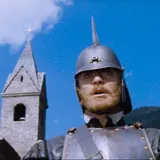
He equipped them in pointy woolen hoods worn over their helmets, called Guglers in German, and marched into the independent territories first of Alsace, then the Swiss cantons. The campaign of terror that followed came to be known as the Gugler War. When towns refused to acknowledge Coucy as their rightful lord, or even offer his men any food or shelter, he took to pillaging the countryside to support himself. The Guglers spread into small gangs to cover more territory, looting and killing and raping wherever they could, until more peasants fled to the safety of walled towns like Zurich and Bern. A few days before Christmas 1375, a large number of Coucy's Guglers sheltered in an abandoned church, only to realize they were surrounded by an angry mob of peasants, armed with torches and, one can only assume, pitchforks. The Swiss peasants set fire to the church, burning many of the Guglers alive, killing many others as they fled.
Not long after, Tuchman writes that another knight saw a victorious peasant wearing armor that had been looted from one of his comrades. This Gugler explained that only people of noble blood should be allowed to wear armor. The peasant replied, Sir, today we have so mixed the blood of nobles and horses that one cannot be told from the other. After this defeat, just like the Austrians before him, Coucy decided to cut his losses and flee from the treacherous Alps while he still could. The Gugler War became yet another notch in the Swiss victory belt.
And the Gugler War is also how I characterize a lot of arguments I see on the internet. But just like these arguments never seemed to end, the Swiss would have another long slog ahead of them.
Sempach and Winkelried
So a decade later, in 1386, the Swiss once more clashed with the Austrians at the famous Battle of Sempach, which was instigated by the overreach of one of the last remaining Habsburg bailiffs, who might have inspired William Tell's enemy, Gessler. This battle involves a figure named Arnold Winkelried, who figures as kind of a morbid counterpoint to William Tell. He became a martyr to the Swiss cause by supposedly throwing his own body onto many different Austrian pikes at once. After their blades became stuck in his flesh, the Habsburg troops were unable to defend themselves from the rest of the Swiss. This story is again most likely fictitious, but there is no question about the battle's outcome. The Swiss won, and the Habsburg Duke, Leopold III, was killed, according to a resentful Austrian chronicler, quote, by his own people on his own land over the question of his own authority.
At some point after the famous Battle of Sempach, the overlapping alliances between the cantons had become permanent. Switzerland, as an entity, was silently formed once the cantons began to understand themselves as an Eidgenossenschaft, or a commonwealth. Part of this identity was externally imposed. The writers of the lowlands were shocked and often appalled by the victory of the peasants against their supposed bettors.
Like, again, these people genuinely thought that like class distinctions were given from God on high. So when they saw like these peasants not following the made-up rules that they made to dominate everyone else, they just had a total conniption and they were basically begging for the mods to come in and step in on their, you know, little beef. But unfortunately, God doesn't play favorites.
That's why I love the story about the one knight getting so mad that a peasant wore armor. Like, no, you can't do that. You're a peasant. That's against the rules.
Rudolf Brun's Zurich
But, you know, but before we get too epic about celebrating the Swiss, we have to mention that these guys were incredibly violent, not only against their aristocratic oppressors, but against other Swiss people. Like you said, Orson Welles, totally dead wrong. Swiss history is remarkably blood-soaked, possibly more than the rest of Europe at this time, given this high degree of political disunity. You know, we should mention that even the famous Battle of Morgarten was really part of a war between various cantons over petty economic rights. One of the nastiest episodes of Swiss history begins in the 1330s, when Zurich, probably the most important city of Swiss history, briefly came under the sell of a care, briefly came under the spell of a charismatic renegade named Rudolf Brun, who came from one of the few wealthy families that dominated politics in the city. However, Brun himself was not very important.
He wanted an inn, and he realized it could be that many others in the city were dissatisfied with this aristocratic state of affairs. Because although all of the Swiss cities were technically democracies, people outside ruling cliques couldn't vote and could usually enforce their will only through mass popular action. Brun thus realized he could use this to his advantage by rallying the artisans of Zurich against the wealthier merchants. Brun's gang overthrew the old city council who ran to the shelter of the nearest aristocrats, and Brun drew new counselors from the various trade guilds that were previously kept out of power. Brun claimed to be acting in the interests of the common man and definitely did give a few individual artisans more influence in the city government, but he quickly reasserted the old order and really turned Zurich into his own principality. We're going to see that actually this is going to be a pattern in the city's history, a strong man rising up and really shaking things up, usually for the worse.
When the bubonic plague came to Switzerland in 1349, Brun's standing was immediately threatened by the suffering that occurred therein. But Brun was able to stabilize his position with a strategy followed by many other rulers during this great period of hardship. He blamed the Jews. A brutal massacre was carried out in Zurich using the typical pretext of blood libel. Hundreds of Jewish people were burned alive. Following this, Brun seized a lot of Jewish property for himself and expelled the survivors. But because he had no convictions at all and lacked even the even the convictions of a committed bigot, he later reneged on this and allowed surviving members of the community to return to their destroyed homes.
The Old Zurich War
Yeah, and so it was as the calamitous 14th century passed into the confident 15th century. Zurich and its great rival Bern continued to annex surrounding territories. Even the rural cantons of Schwyz and Uri began claiming foreign territory, leading to the first incorporation of Italian-speaking lands into the confederation. At some point during the process, the Swiss Diet or Tagsatzung was formed to resolve disputes over newly annexed valleys. Swiss people sometimes claimed that this diet allowed the Swiss to be uniquely peaceful among the European nations. But you should see now that this absolutely was not the case. In the 1440s, Zurich made a major power play when it claimed the lands of the Count of Toggenburg, one of the last major aristocrats in the region, who died without an heir. When the other cantons in the alliance forced Zurich to abandon these lands, the city Burgomeister pleaded to the Habsburg Emperor, Friedrich III, for assistance.
Right, no, it's you know, how the tables have turned, right? Now it's Zurich who are calling the mods for help.
Yeah, so imperial troops from Austria began pouring into the borders, they were sent into Switzerland and once again were deftly defeated by an alliance of the other cantons. The Habsburg troops were forced to shelter in Zurich, and the frightened Emperor Friedrich called for help from his cousin, King Charles VII of France. France at this point was in the closing stages of the Hundred Years' War, and just like with the Gugler Knights of Enguerrand de Coucy, the French thought that this adventure in Switzerland would be a great way to keep their own soldiers occupied and to stop them from pillaging towns in France. So, a major detachment of French mercenaries thus climbed their way up into the Swiss Alps, leading to a major escalation in bloodshed on both sides. In 1444, just four years after Zurich sparked the conflict, many thousands of French soldiers surrounded the Swiss defenders in the hospital of Saint-Jacob, which was probably more of a hotel for travelers than a home for the sick.
Despite being bombarded by early cannons, the Swiss refused to surrender. 19th-century Swiss nationalists would describe the Battle of St. Jacob as a, quote, Swiss Thermopylae, as the defenders of the canton fought to their deaths. And even though the French had numerical advantage and far superior equipment, they bled so much from this Pyrrhic victory that most of the mercenaries then returned home. This allowed for an unhappy peace that led Zurich's return to the Swiss Confederacy on the condition that they cease any alliance with the Austrians or the French. And so this conflict, later described as the Old Zurich War, was perhaps the greatest internal threat to the survival of the Confederacy. But still, it survived.
You know, we should mention there was a lot of bad feeling despite this. Many people in Zurich in particular seemed to see other cantons, especially the rural cantons, as hardly the same species as the folks in the town. One Zurich priest would later write that of the other cantons, these bumpkins were coarse, wrinkled, rough, and with strangely shaped bodies.
Bern and the bear pit
Right. So in the following decades, the blood of the Swiss continued to flow down their alpine valleys, often in pursuit of new French-speaking territories to the west or over trade rights with their lowland competitors. The merchants of Germany often turned their nose at the crude hicks in Switzerland, leading to one Swabian trade fair to prohibit the use of Bernese coins marked with the town's emblem of a bear. Furious at this sight, young men from Bern began rioting across the border towns, particularly in areas loyal to the Habsburgs. Some of these men actually describe themselves as Turks, presumably as a way to trigger the Austrians.
Yeah, no, I think it's pretty funny because this is, yeah, this is just like five years after the conquest of Constantinople. So that's pretty edgy.
Yeah, and I mean, again, just with another Dutch parallel, Liever Turks dan Paaps was also.
Yes, yeah, dude, yeah.
Something about fighting the Habsburgs makes people just say, dude, I'm Muslim now.
Yeah, exactly.
Yeah, and one thing also we should mention about Bern, just because just before I forget, their symbol is the bear, because the name Bern sounds kind of like the German word Bären, for plural for bears. And so for that reason, one cute thing about Bern that's been the case since this time, the 15th century, is there's sort of a zoo in the middle of the city that's simply called the bear pit, where for like 600 years, wild bears have been kept in the city.
Swiss mercenaries
That's fun.
So around this period, Swissmen increasingly began offering their services as mercenaries in the surrounding regions, in particular in Milan to the south and the Duchy of Burgundy to the north.
You know, actually, I should amend this. Not just men, because these guys, the Landsknechts, the mercenaries of the 16th and 17th centuries, a lot of them actually were supported by their female family members, which is kind of interesting. Entire families would go on crusade to pillage together.
Yeah.
It's a bonding exercise.
Yeah, road trip. Yeah.
Yes, in this case, the road being the, you know, the same roads that brought wool.
The Spanish roads.
The same mountain passes that brought wool from England down into Florence, that brought cheese from, you know, the Swiss valleys down into Milan or wherever, were now a great way for soldiers, many of them mostly farmers fighting on the side, to find work.
War booty.
Yes, lots of plunder, too.
The Burgundian Wars
So in the late 15th century, Swiss troops fought on both sides of the Burgundian Wars, as France and Austria both fought against the young, ambitious Charles the Bold, who came very close to establishing his own permanent kingdom in between modern-day France and Germany, centered around the Low Countries with some territories in the Alps as well. So the Swiss fought on both sides here, but eventually were convinced to only fight for their old enemies, the Habsburgs, in exchange for the pretty amazing concession that the Habsburgs abandoned all their remaining territories and even territorial claims in Switzerland. Really, really at this point then, really finally emancipating the Swiss from any kind of feudal obligations. Thus, in 1477, at the French town of Nancy, a Swiss attack on behalf of Austria wiped out the Burgundian army and killed Charles the Bold himself. This in a victory not unlike the victory at Sempach 90 years prior.
Yeah, and this was probably the greatest investment the Habsburg could have made because all those territories ended up falling into Habsburg hands.
Yes, it's really, yeah. No, that's why, in a sense, you know, if these guys were really anti-Habsburg, it was a huge kind of self-owned for the Swiss. But there would be some great short-term gains.
Yeah, so let's look a bit into the future. The Battle of Nancy made the Swiss Halberdiers the hottest commodity of the military labor market, and every king and duke wanted his own detachment of Switzers. This was especially true in northern Italy, where the Swiss farmers switched from selling cheese to selling their own lives. Men fighting for Florence, France, Milan, and especially the city of Rome brought new riches up into the mountains. The mercenary captains quickly became some of the wealthiest men in the country, a nouveau riche elite, often of rough peasant stock.
Hans Waldmann
One mercenary named Hans Waldmann, who fought in the Burgundian Wars, used his new wealth to dominate the politics of Zurich. He was able to muscle his way into being the town's uncontested ruler, just like Rudolf Brun had been, and was nearly as brutal. Seeking to leave his humble origins behind, Waldman restricted the economic rights of peasants living in the land outside of Zurich. He prevented them from selling cloth to traveling merchants, insisting that this privilege belonged to the city folk. And more intolerably, he demanded that the peasants kill their own dogs so that wealthy townspeople would have more rabbits to hunt on the weekends. This demand triggered a violent uprising, in which the peasants broke through the walls of the city, dragged Hans Waldmann into the streets, brutally tortured him, and chopped off his head before a crowd of horrified townsfolk.
So even in 15th century Zurich, you really do not want to mess with people's heads.
And do not mess with the chuds outside of the city gates.
No, no, yeah.
The height of Swiss power
So the generation after Waldman would be the peak of Swiss mercenary involvement across the many wars of early modern Europe, and would probably be the apogee of Swiss international power. Because from around 1490 to 1520, the Swiss were genuinely dominant on the battlefield, whether this battlefield was up in their alpine valleys or on the plains of northern Italy. Basically, nobody could defeat the Swiss except for other detachments of the Swiss. So many mercenaries from the cantons were active in northern Italy that there was a real fear that these thugs from the north could become the new ruling elite in the Italian city-states, just as barbarians had done a thousand years prior during the collapse of Rome. Niccolo Machiavelli noted that Niccolò Machiavelli noted this Swiss dominance and was one of the first outsiders to comment on the democratic culture of Switzerland. He said that just like the ancient Spartans, the Swiss are the most armed and thus the most free.
You know, this might be why the fact, you know, even to this day, there's this strong tradition of gun ownership in Switzerland, which is very unlike that of their neighbors. The development of mass professional armies and especially of the cannon would cut the period of Swiss dominance short. In the Battle of Marignano, the French artillery blew entire divisions of Swiss halberdiers to pieces, but intellectual changes also convinced many Swiss mercenaries to return home. One factor was that many Swiss were queasy about fighting their countrymen. Another factor was far more spiritual.
Zwingli's Reformation
Because just as Switzerland was winning its greatest glory in the fields of Italy, the country was becoming a hotbed for the radical reformation. Barely a decade after Martin Luther had nailed his 95 Theses to the walls of the Wittenberg Church, the country priest and mercenary army chaplain, Huldrych Zwingli, rose to leadership in the city of Zurich, marking his break with Christian tradition by taking part in a literal sausage party that violated the rules of Lent.
Right. So while Luther was content publishing treatises from his comfy university armchair, Zwingli transformed Zurich once again into the personal fiefdom of one man. He rallied the populace with ideas about Christianity much more radical than Luther could have dreamed of. Like many fervent Christians, Zwingli saw his church as the new Israel on earth and believed that baptism was a way to seal the oath between man and God, just as circumcision was in Judaism. The historian Diarmaid MacCulloch believes that this covenant was a really big deal for the Swiss because oaths and treaties were such an important basis for their entire nationhood. Zwingli then took the people of Zurich on a crusade against idolatry, destroying medieval art and banning all church music as a frivolous distraction. Although in the typical Swiss habit of playing both sides, he did allow Zurich's printers to sell sheet music to other cantons.
His most fervent supporters, who he would actually later disavow, destroyed crosses erected in village squares and decried the practice of infant baptism. They believed that the oath of baptism was so important it could never be made by a child. Every adult had to undergo a second baptism. These people came to be known as Anabaptists, those who baptize again. They would shake Germany really to its foundations across the next couple decades and are today known as the Amish. So, drawing on his own personal experiences as an army medic, Zwingli preached against the horrors of war and convinced many Swiss within and without Zurich to stop killing their fellow man in exchange for the Milanese or the Florentine silver. Yet, just as he condemned violence for money, he led the city into an abortive holy war against the parts of Switzerland which remained Catholic. A coalition of Catholic militias joined forces against Zurich and, according to legend, convinced the city's allies to abandon the fight by offering the bribe of warm milk on the battlefield.
Which, I mean, it was really easy to win people over back. You're going to have to do a little better for me.
Whatever you think about Zwingli and his ideas, he was a true leader and he met the Catholic coalition on the battlefield in full armor. As a preview of the kind of religious violence that would cause Europe to bleed terribly across the next century and a half, the Swiss Catholics showed no quarter to their Protestant countrymen. Zwingli was hacked to death alongside his men, the same fate as Hans Waldmann, and his mangled corpse was dragged onto a woodpile and burned. One final insult meant to deny a heretic a Christian burial. The people of Zurich and the Protestants of Switzerland more broadly were chastened after his slaughter. Although now Switzerland was part of the Holy Roman Empire only in name, they adopted the imperial principle of cuius regio, eius religio, which means whoever rules a province gets to choose its religion. In a Swiss context, cantons ruled by bishops mostly stayed Catholic, whereas cantons ruled by city or peasant assemblies voted to pick a religion.
This was a pretty stable solution, as cantons held together in a confederacy despite their religious splits.
Catholic and Protestant cantons
Moving on later into the 16th century, as France has its own much more violent wars of religion, Swiss mercenaries will support both sides and make off handsomely.
I would have loved to be an elections analyst for the Swiss religious elections.
Absolutely. And you know, what's funny is that they had their own kind of electoral college bias because the Swiss population was very Protestant, overwhelmingly so. However, a lot of the smaller peasant cantons were Catholic. So this meant that the rural areas with lower populations had disproportionate sway over the broader confederal government. And this meant that whenever they came together for a vote, the Catholics would always outnumber the Protestants. It's kind of funny. Actually, again, another rhyme with American history, the fact that this minority group had a majority of seats meant that they were very concerned about expansion because adding new territories would tip the balance of power. So the city of Geneva, which was pretty independent for most of this and doesn't really factor into broader Swiss history until a later period, had become a major center for Protestant theology under the famous French theologian John Calvin.
Geneva repeatedly tried to join Switzerland, but was initially blocked because there is a fear that adding it to the Confederacy would lead to a lasting Protestant majority. Eventually, Geneva will wiggle itself into the Confederacy, but only after a lot of finagling. One province that did not successfully join Switzerland was the great city of Strasbourg in modern-day France. This is a major city, which at the time was even more important. This could have had real huge impacts on the development of Swiss history and the Swiss economy. But because Strasbourg was so big and so Protestant, the Catholic cantons refused to let it into the Confederacy, and it is now part of the Kingdom of France, now you know, the French Republic.
Yeah, so during this period of religious division, the Catholics maintained a really loose political control while the Protestants dominated intellectual and cultural life.
Tell as a civic saint
So Swiss people reminiscing over a more unified past found themselves turning to the story of William Tell, a hero who was said to have lived safely before the Reformation and who could be claimed by both sides. Swiss politicians became increasingly preoccupied with the Swiss identity in an attempt to maintain stability. In the early 17th century, the Holy Roman Empire descended into a brutal 30 years war, but Switzerland, for a time, was a bastion of peace. Plenty of Swiss people fought and died on the battlefield, but for gold and glory rather than to protect their homeland. During this period, the supposedly unique case of Switzerland, where the Swiss called the Sonderfall, was discussed by Swiss writers and backed up by nationalistic accounts of the Swiss Revolt. Switzerland was a nation unlike all the others, a nation formed by hardworking common-born shepherds and mountaineers who wanted nothing more than to be left alone, but whose rightful independence was constantly threatened by trespassing Austrian aristocrats and grasping French adventurers.
This early civic religion had its own holy texts, the medieval pacts between the cantons and its own saint, William Tell. Everyday Swiss people in the 16th and 17th century began to claim that various locations were secular shrines to the Tell cult.
Right, again, this brings us, yeah, to the cavern of the three tells.
Yeah, so by this point, the interest in the tell story came to be increasingly associated with the Catholic cantons. Yeah, part of this was because out of the medieval Swiss rebels, people like Tell and Stauffacher were really the only famous Swiss Catholics in a period that was culturally dominated by the Protestants. But we think that a part of this is that the popular veneration of William Tell had really had saintly overtones. This is conjecture on our part, but it would not be surprised if the same fervent Protestants who chopped down crosses and burned icons of the saints may have knocked down any monument to William Tell that they came across.
Right, and so you know, so William Tell is still the central figure in you know Swiss popular history, but he's really a big deal in the Catholic parts of Switzerland from what I understand. It's like how you know every American knows something about the Wizard of Oz, but in Kansas, they go crazy for the Wizard of Oz.
The Thirty Years' War and Westphalia
So Europe in the first half of the 17th century was dominated by the biblical carnage of the Thirty Years' War. This began as a dispute between the emperor and his princes, but morphed into a brutal struggle between the House of Habsburg and the French House of Valois, played across the German soil. Switzerland, however, was remarkably free from violence during this period, the early 17th century, even though both French and Spanish, and at one point even Swedish troops all crossed through the region. And Austrians also briefly pillaged the canton of the Grissons. Switzerland was represented at the Peace of Westphalia by Mayor Johann Rudolf Wettstein of Basel, a stubborn former mercenary who was denied an invitation by either the French or the Habsburgs at the war's end, but showed up anyway and refused to leave. Amazingly, he managed to convince the conference to hear him out, and they declared that Switzerland was finally no longer a member of the Holy Roman Empire at all.
So, really, if there's any singular father of Switzerland as a sovereign independent state, it's this guy who is a lot less famous than William Tell and much more, much more, you know, historically well attested. But we should mention that this formal nationhood didn't really do much for Switzerland, at least at first. Because when Wettstein returned to the cantons, he saw that both town and country were now impoverished. Because during the Thirty Years' War, peasants in Switzerland realized that the lowlands of Germany were so devastated that crops and cheese from their safe valleys could be sold down below at much higher prices. Merchants were eager to ferry Swiss products down into the beleaguered empire. Or, you know, to be less charitable, both the peasantry and the townsfolk were implicated in widespread war profiteering, and now that well was dry.
The Peasants' War of 1653
So let's return to where we began this episode. It's February 1653, when the Three Tells are in the town square of Schüpfheim, speaking with great zeal. These men were supposedly the founders of the Swiss Confederation walking among the people again: Walther Fust, Arnold von Melchtal, and Werner Stauffacher. These figures embody the Swiss people's eternal resistance against tyranny. But in reality, these men were, of course, not any heroes of myth. They were instead Hans Zemp, Kaspar Unternährer, and Ueli Dahinden, farmers from Entlebuch Valley, a region seething with discontent. Things came to a head when the so-called three tells, thronged by a crowd, confronted a delegate from the Lucerne government. He left unscathed, but the authorities were spooked and dispatched professional soldiers to apprehend the tells. The leader scattered, two of them back into Entlebuch, while Zemp fled to Alsace, a territory recently conquered from the Empire by France, in the culmination of their centuries-long plan to destroy the Spanish road.
Although the Three Tells had catalyzed the Swiss masses, their clubs were no match against the professional Swiss soldiers, and the rebellion petered out. The residents of Schüpfheim were made to swear an oath of loyalty, an inversion of the 1307 oath against power. They were disgruntled, but seeing nothing else to do, they retreated. The authorities took a hard-line stance and refused to pardon the Tells, giving them no means to defuse the situation. Because they had no way of stepping out of this gracefully, the Tells decided they weren't done yet. Unternährer and Dahinden regrouped and recruited a certain Hans Stadelmann to replace the now absent Zemp. The Tells were done preaching. Now was the time for action. They took a course of action that we would today call the propaganda of the deed, deciding that they would ambush the bailiff of Lucerne, one Ulrich Dulliker, and his companion Kaspar Studer.
The latter was shot dead, and the former was injured. It was said that after the attack, the three Tells, still costumed, attended Sunday Mass openly. They would never don their costumes again. The attack won sympathy from the masses, but failed to rekindle the rebellion. They were not long for this world. In October 1653, Dahinden and Unternährer were shot dead by authorities. Stadelmann was captured and executed the following year after being betrayed by Zemp, who told the authorities where they could find him in exchange for a pardon. Very goodfellows-type ending there.
Yeah, and these events, you know, the story of these three tells was immortalized in the Tell Song, which really helped cement especially the role of the legendary William Tell in the Swiss Civic Pantheon, as well as the actions of these three now executed men.
The Tell Song
Yeah, just to be clear, this is the tell song of 1653. There were a number of tell songs before then as well, but this is one of the, you know, one of the big ones. In 1653, great wonders shook the land, you'll see. This tale I sing not out of spite, but so the truth may come to light. For silver's coin, this war was born, a farmer struggle, weary and worn. Oh, tell, if only you could rise, and wake from sleep to hear our cries. The bailiffs take with ruthless hand, our horses, cows, and all our land. Each noble lives as princes do and takes whatever pleases to. The poor man breaks beneath the yoke, his strength consumed by every stroke. Drive them out with sword and spear, restore the peace that we hold dear. To free your land, make haste and fight. Remember its honor day and night.
Remember Klaus, the brother true, and speak his vow in all you do. With clubs, we'll clean this house of grime, and let your strength ring through all time.
After 1653
So, although the rebellion failed to substantially change anything about Swiss society, it was arguably the first time that the Swiss began organizing themselves across the cantons on the basis of class. The peasants truly believed that they lived in a revolutionary republic and that their actions were thus redeeming the legendary oath made at the field of Rütli. The suppression of the revolt by a coalition of the cantonal governments also shows that the Swiss ruling classes were beginning to work together for the first time as a single body. Switzerland was really becoming a nation for all the good and ill that might imply. After this point, Swiss historians began to describe Switzerland less as a coalition of cantons and more of an ancient regime, with a consistent economic relationship between them and increasing cooperation, interdependence, and intermarriage between members of the ruling classes, crossing the lines of canton and language, sometimes religion as well.
The Catholic/slash Protestant conflict still existed in Switzerland, although it was very heavily dampened by the Swiss habit of exiling or even executing radical Protestants who threatened the uneasy peace.
Right, and just to interrupt here, you know, we should mention that, you know, that there was really severe internal divisions among the Protestant camp, especially in the German-speaking world. And the basic scheme here is that the Lutherans hate the Calvinists and the Calvinists hate the Anabaptists. So the Swiss who.
And everybody hates the Jews.
Yes, absolutely. And so, you know, so because the Swiss Calvinists, they were always worried about being seen as too radical themselves, they were eager to kind of deflect this by persecuting the Anabaptists. And of course, also, there was plenty of brutal anti-Semitism to go along.
Yeah, so there was a lot of grumbling over political representation as the big Protestant cantons increased their demographic edge over the smaller but more numerous Catholic ones. And part of this was really due to increasing numbers of French Huguenots seeking refuge in western Switzerland. Eventually, there was a brief civil war, which restructured the diet to allow for a more proportionate representation. Catholics initially started their own diet in protest, but this didn't take off. So they unhappily participated in the new diet in which they no longer had veto power over the Protestants. Still, the Catholics often refused to show up and did what they could to obstruct any Protestant proposals. So the diet slowly lost its legitimacy among the people. A popular expression was that, quote, the diet could not agree that snow fell in winter. And this would really continue to be a trend within Swiss governance until really the middle of the 19th century.
Yeah, so at the end of the 17th century, Swiss banks began to develop largely thanks to the expertise and international connections that the Huguenots brought with them. These people, they were often in communication with relatives and business partners in France, in the Low Countries, and in England.
Yeah, and I think that the fact that, you know, Switzerland has this major French-speaking minority is really going to become increasingly important in the 18th century. You know, because the Austrian statesman Clemens von Metternich is famous for observing: when France sneezes, Europe catches a cold.
Revolution comes from France
And whether or not he actually said this is one thing, but it's clear that by the 18th century, France had enormous influence over the politics of really the entire European continent, and especially over French-speaking communities, including the urbane French-speaking intellectual circles of Western Switzerland. So, the French Revolution in the late 18th century shook Europe all the way to its extremities, and Switzerland was directly in the sneeze zone. Swiss intellectuals and activists, unhappy with the settlement or failure of the 1653 revolution, spent the succeeding century seeking their fortunes abroad. And this meant that even before the revolution began in France, Paris actually had a healthy community of Swiss exiles, the most famous of these being the philosopher Jean-Jacques Rousseau. You should mention that up until this point, most of the changes in Swiss history we've been describing were driven by the German-speaking majority. But now, the French-speaking cantons, including the large city of Geneva, which you know had previously been latecomers to Swiss politics and were somewhat marginal before, are really going to have a much greater proximity to the real center of power in Switzerland.
And this is largely because the fact that they speak the same language as in Paris, where you know everything is happening. This really meant that as social tensions began to boil over in France, the Swiss exiles started to apply the new concepts of liberté égalité fraternité to their own situation. Back in the cantons. They formed a Helvetic Club in 1790 to advocate for a Swiss revolution modeled after the transformations that were now unfolding around them in Paris. Talk was rife of quote-unquote modern Gesslers despotizing the descendants of William Tell. Many saw parallels between the Enlightenment ideals of revolution and the freedoms won by the Swiss Confederates in the Middle Ages. Across the 1790s, the Swiss people revolted against their bishops and landowners, creating tiny republics across the cantons. The French revolutionary leader Robespierre commended the so-called Children of Tell for their victories. But now, storm clouds were gathering around them.
Outside the new revolutionary republics, an international coalition of reactionaries sought to invade France and to restore monarchical rule. Swiss revolutionaries noticed the Austrian Habsburg forces just across the valley and began to fear that their republics and even their independence could be at stake. The time of Bail of Gessler would be coming again. The Swiss exile Frédéric César de la Harpe petitioned the French government to send a military detachment to protect the Swiss cantons from counter-revolutionary threats outside of Switzerland as well as within. While La Harpe was in Paris at the time of the revolution, he had recently been living in Tsarist, Russia, as a tutor to the crowned Prince Alexander. His time at St. Petersburg taught him how brutal the old monarchies could be. When he was granted an audience with the French Directory, the revolutionary leaders eagerly obliged La Harpe's appeal for aid. The French, who included the ambitious young general Napoleon Bonaparte, obliged not out of democratic solidarity, but because they knew that the mountain passes of Switzerland held enormous economic and strategic value for Paris.
The Helvetic Republic
Right, so in 1798, French troops entered the Swiss town of Bern, where local liberals had already overthrown the old city council and established their own republic. And following a plan laid out by La Harpe, the various cantons, as well as their treasured treaties, were instantly dissolved with a stroke of the pen. This means that the various linguistic, geographic, and religious communities of Switzerland were now for the first time finally truly united into one government. That was named the Helvetic Republic. This hearkened back to a Celtic-speaking tribe who lived in the Central Alps at the time of Julius Caesar. It's probably not a coincidence that the ancient Celtic heritage of Switzerland was cherished by its French speakers, because this linked them with the Gauls of modern-day France and also was an example of an ancestral nation that they and the German-speaking Switzers claim as their own, without relying on the, you know, German-speaking history of Switzerland.
Yeah, so this proclamation would have enormous support among certain sectors of the population, particularly the urban artisans, the merchants, and the intellectuals, the kinds of Mercurians that we discussed in the previous episode. But outside of the towns, many rural people resented these new changes, not to mention the grumbling bishops and city councilmen who had recently been deposed. So these internal struggles escalated into a low-level civil war, pitting pro-French and anti-French Swiss against one another. Many who had gained military experience as mercenaries fighting for Austria, Britain, or Spain. These internal struggles escalated into low-level civil war, which pitted the pro- and anti-French factions against one another. Many had gained military experience as mercenaries fighting for Austria, Britain, or Spain, and they were now eager to bring their métier home. La Harpe attempted to stabilize this situation by consolidating his own power and sidelining his fellow Helvetic revolutionaries. But this did nothing except to impugn his reputation and sour everyday Switzers against the revolution.
Across the cantons, people began to see the French-backed Helvetic Republic as yet another episode of foreign tyranny imposing itself upon the Swiss liberty. After his attempted overreach, La Harpe was removed from power himself and fled to the enemy capital of St. Petersburg, where his former pupil, Alexander, was now the Tsar of Russia.
Yeah, and then things really, you know, went to shit once it was discovered that the French army was siphoning tax money out of the Swiss treasury. So, after this discovery, this, you know, major scandal, French-speaking rebels called the Bourla-papey, or paper burners, broke into city halls and archives to destroy tax and census records, overpowering the less well-armed pro-revolutionary militias. This was a kind of strangely ordinary and perhaps particularly Swiss example of mob violence, because the counter-revolutionary vandals took pains to protect church records and their beloved medieval alliance charters before actually setting fire to any paper. Meanwhile, in the German-speaking cantons, the counter-revolution was decidedly less pleasant. Farmers grabbed wooden clubs to join the armies led by the Austrian-trained officers in what was to become the War of the Sticks. In addition to clashing with pro-French soldiers, the farmers ransacked the homes of urban revolutionaries and beat them on the street.
The tiny Swiss Jewish community suffered worst of all. Because the French and the Swiss Revolution had ended the ancient social restrictions on Jewish public life, the Jews were the ideal scapegoat for any problems associated with the new government. And so, in 1803, General Bonaparte, who was now the first consul of France, organized a truce between the Helvetic Republic and the various rebel factions. The French troops could withdraw and the unitary Helvetic government would dissolve in return for the newly independent cantons promising to preserve social and religious equality. The new government, the so-called Swiss Confederation, operated on Napoleonic principles of authoritarian republicanism rather than revolutionary principles of radical liberalism. Everyday Swiss citizens were more satisfied than they had been under the Helvetic Republic, but the idealistic progressives felt that their French allies had stabbed them in the back. La Harpe refused to participate in the peace talks and would not return to Switzerland until after the Battle of Waterloo.
Debates over the fate of this small mountain nation intrigued the intelligentsia within and outside Switzerland, causing some late Enlightenment thinkers to appreciate Swiss history in a new light.
Tell and the revolutionaries
Right. So, you know, returning to William Tell, the French revolutionaries actually had put them in the pantheon of their own, you know, revolutionary heroes. Tell had been well known in France since at least the 16th century, and in the Jacobins' hands, he became an esteemed tyrannicide and an eternal enemy of Austria. Meanwhile, in Switzerland, as the 18th century progressed and Enlightenment ideals began to percolate among the population, there was a renewed interest in their own freedom fighter as well. Tell remained at once traditional and revolutionary, a symbol of the original Swiss victory over the Habsburgs, but also a unifying figure for a more cohesive Switzerland, united by something more than a weak diet. Especially in the second half of the 18th century, Swiss literature saw many poems, songs, and plays dedicated to William Tell. So, when the French set about backing the Helvetic Republic, Tell was once again reappropriated for a new audience.
This time, he would be a freedom fighter for Republican virtues against the old forces of reaction. The French envoy to Switzerland, Joseph Mengaud, went so far as to write a so-called paternoster of William Tell, which was distributed to Helvetic Republicans in the Vaud. William Tell, you are the founder of our freedom. Your name is revered as holy in Switzerland. Your will be done today with us, just as when once you triumphed over your tyrants. Give us this day your courage and your bravery and forgive us our past fearfulness, that we with so little courage watched how again and again we had our freedom stolen from us, just as we forgive our governors and leaders, who alone are to blame for our lost freedom, and allow us in future to no longer be oppressed, but rather free us forever from all forms of slavery, and then yours will remain the honor and the glory for all Swiss freedom and equality. Amen.
And I gotta say, this is like peak French Revolution stuff.
I like the rest of the world.
Yeah, yes, yeah. No, no, it seems like they were hoping that they could turn Tell into the Jesus of the cult of the Supreme Being, right? This kind of revolutionary divinity on earth.
Yeah, and as Liam said, Tell, he was really, really popular among the revolutionaries. Like, there are very clear reasons why this would be the case. Aside from being a traditional national symbol of the people of Switzerland, the Austrian Habsburgs, who were Tell's enemy, were also the enemy of the revolutionaries in the 1790s, just as much as they had been in the 1290s, according to the mythology. The official emblem of the Helvetic Rat, the parliament, that is, even featured William Tell embracing his young son after shooting the apple off his head. Tell was not as strictly a revolutionary figure either, as many opponents of the Helvetic Republic buttressed their position by appealing to him, often employing the same talking points as their revolutionary compatriots for why the French need to be opposed. But nevertheless, there was an anti-Tell faction as well, with some people arguing that Tell was nothing but a killer, and really the true liberators of Switzerland were the swearers of the Rütli Oath, whereas Tell, he was just basically a bandit who killed this man for no good reason.
Right. And I think we should mention that, like, you know, the two incidents of the apple shot and the Rütli Oath, both of them legendary, would be kind of equally important in the Swiss national memory and would be even commemorated in works of art produced outside of Switzerland due to their great political implications and romantic value.
German Romantic nationalism
Right, so let's turn our attention to the North for a little bit. In the midst of all these earth-shattering events, there was something really big happening in Germany. The Napoleonic era had presented an existential threat to the German-speaking polities of Central Europe, which were then still largely existing within the framework of the Holy Roman Empire. The Holy Roman Empire was a historically weak and muddled entity with an indeterminable web of sovereignty linking together literally thousands of states. For more information on the Holy Roman Empire, listen to episode 63, where we discussed the Thirty Years' War and the film The Last Valley with Matt Christman.
Yes, one of the best.
Yes, absolutely. So, this vague notion of a pan-Germanic consciousness had begun its evolution centuries before the Napoleonic era, but it was largely the domain of these bookish nerds who had nothing better to do. But the Napoleonic era changed everything because increasing masses of Bodners, Prussians, Saxons, Hessians, and many other types of German emerged from the Black Forest and decided that their destinies were bound together under the banner of a united Germany. To these intellectuals, they were, after all, one people, tied together by bonds of language, culture, and ways of being. Bound together by their hatred of the French, who were now occupying large swaths of this territory, German Romantic nationalism came into vogue. Where today most nationalism is about sitting on Twitter and complaining about how your country is going through the Great Replacement, back in those days, the nationalists had much more going for them.
They were young, they were energized, and they were ready to share their vision with the world. To that end, literature proved to be a really great medium. The proto-Romantic nationalism had already been brewing in the German cauldron for some decades, especially within the Sturm und Drang movement of the mid-18th century. The proponents of Sturm und Drang believed that above all else, they must incite a strong emotional reaction from their audience. And they believed that they were doing this in reaction to the sort of detached rationalism of the Enlightenment. And of course, that's like a very simplistic caricature of both of these trends, but I'm just highlighting the extremes here. Yeah, don't at me.
Yeah, so this tendency gave the German language some of its finest literature and theater, including figures as esteemed as Goethe, Herder, and Schiller. Herder is the guy whose quote we read in the Pirenne episode about how the barbarians snuffed out the sick old man that was the Roman Empire.
Yeah. So just expanding on this point a little bit, you know, it's so hard for a lot of modern people to understand the way that nationalism could have once been an intellectually progressive force, but in this context, it absolutely was, because nationalism in the late 18th, early 19th century wasn't yet a tool for imperialism or racial division, really, in the way that it would become in the later 19th and 20th century. And at this point, nationalism was really considered this democratic ethos because it was about supporting the will of a nation, not necessarily against another nation, but the will of a nation against the feudal reactionary elite who had a completely different set of priorities and values. And I think that it's so hard to imagine what the world before nationalism was that it's hard for us to understand how revolutionary these principles were. But they very much were.
And, you know, in the early 19th century, nationalism was really this kind of romantic gloss over a lot of generally progressive and egalitarian popular movements.
Yeah, if I wanted to be tongue-in-cheek, I would say that German nationalism was the original wokeness.
No, in a sense, it kind of was. And that's why it's like it's this, the great irony and tragedy of really all of the 19th century is how nationalism began versus what nationalism became. And obviously, you know, as early as the mid-19th century, many left-wing thinkers and Marxists were already identifying basically what nationalism was going to become. They knew these romantic slogans were hollow, that real liberation had to come on the basis of, you know, class rather than nation and race. But in like 1803, 1804, people weren't thinking that far ahead. And it was a very different kind of moment. You know, German nationalism meant something incredibly different than what it would become.
Friedrich Schiller
Yeah, absolutely. So let's speak about one of the main proponents of German nationalism in this era. That is, of course, Friedrich Schiller, the great playwright and author, and really a bit of a polymath. So he was born in the southern German duchy of Württemberg in 1759.
Yeah, you know, we've mentioned Swabia a few times in this podcast so far. That's that's kind of roughly equivalent geographically.
Yeah, exactly. So his father was a military surgeon and his mother came from quite humble origins. These people were hardly the most literary types to be found in their day. They had fairly low-status artisan origins and they slowly inched their way up through the generations. It was expected that Friedrich and his siblings would continue the same gentle upward trajectory, but young Fritz overshot what was expected of him and landed right in the German literary pantheon. Schiller's parents originally intended for him to become a priest, and he became very closely familiar with the Bible and began devouring literature and poetry from a young age. When Friedrich was seven, his father moved the family to Ludwigsburg, the chief residence of Duke Carl Eugen of Württemberg. His precocious intellect and voracious literary appetite won him the Duke's notice. This was the age of enlightened despotism after all, and the Duke, like many of his peers in Europe, was enamored with the idea of creating a courtly elite steeped in enlightenment values.
Württemberg was a bit of a backwater at this time, and the Duke hoped to enhance its status by fostering a state-of-the-art administration and a prestigious culture. To that end, he founded the Karlsschule in 1773. This was a military academy aimed at giving boys the finest Enlightenment education that was available in those days so that they could serve as an elite class of military officers, administrators, and civil servants loyal to the Duke himself. Tuition was free, but pupils were expected to serve the dukedom upon graduation.
Yeah, I know it was a very early kind of civil service program. You know, it's the beginning of the modern state that we start to see, you know, in the absolutist era. So, you know, Schiller was only 14 when he had been handpicked to enroll in the founding class of this academy. And in a way, this was a godsend because his family's finances were in disarray. His father struggled to pay rent all through his childhood. But Schiller felt oppressed by the regimented lifestyle of the military academy, and he was uncomfortable with the deep attention given to him by the Duke. He initially studied law at the Duke's insistence, but then switched to medicine when the Duke changed his mind. And then, although schooling was an opportunity he otherwise wouldn't have been able to access, this time took a great psychological toll on the young Friedrich Schiller.
The pupils of the Karlsschule were under constant supervision, and their education emphasized strict discipline. You know, across the borders in Britain and the United States, this would be known as the Prussian model, and for good reason. This system did certainly teach Schiller something, but not the lessons the Duke had hoped to instill. Instead, Friedrich was taught to have a lifelong disdain for authoritarianism, as we certainly see in his literary works. And so, this literary career began when he was still a student in 1775, when he wrote his first play, which is now lost. The following year, he published his first poem, and then he began working on his first theatrical masterpiece, The Robbers. Again, you know, this interest in the illegal and the rebellious. But he would not see the limelight for many years, partially because he was so preoccupied with his medical studies. He defended a medical dissertation successfully in his second attempt in 1780, and then, following in the footsteps of his father, was sent to be a regimental doctor for a ragtag regiment, which Schiller described as 240 almost to a man, invalids and cripples.
So they certainly needed his medical care. Schiller's salary was meager, and his prospects for promotion were bleak. The Duke continued to micromanage and forbade Schiller from treating civilians on the side to supplement his income, even though other doctors often did that, and his father had already bought him an expensive civilian doctor suit that he never, sadly, got to wear.
The Robbers
Yeah, so Schiller, he was deeply oppressed by the situation, and he began to voice his discontent in his writing. He finally completed and anonymously published The Robbers in 1781. At the age of 22, Schiller had delivered an instant hit. The robbers channels a raw emotional energy of the Sturm und Drang movement into a searing critique of corruption, of betrayal, and of societal decay. The story tells the story of two aristocratic brothers: there's the noble but impulsive Karl Moor and his scheming, ugly little brother Franz. When Franz manipulates his father into disinheriting Karl, he, that is Karl, is now embittered and takes his revenge by becoming the leader of a gang of honorable outlaws fighting for the common man. As the brothers pursue their opposing path, Schiller explores the consequences of ambition and of vengeance. The play really deeply resonated with the youth of this time. It was taken as a manifesto against tyranny and the moral bankruptcy of the present-day order.
And it was also really a strong propaganda piece for republicanism. That was the interpretation, at least. Tod oder Freiheit, Death or Freedom, captures the ethos of the play, and it really became a slogan for Germans for many generations to come across all the political tendencies. So, the first production was set in January of 1782, and it inspired many young German men to set up their own so-called robber gangs. Young men in those days were very impressionable. Let's recall that when Goethe published The Sorrows of Young Werther, there was a wave of suicides.
Yeah, yeah. I think it's the sorrows of young Werther.
Yes, yes, the Young Werther.
Yes, exactly.
And so Schiller was really cementing his reputation as a subversive because of this, and the Duke ultimately had him arrested for traveling to the premiere without a permit. To add to his trouble, Schiller had another scrape with the law that same year because somebody had complained that the robbers denigrated Switzerland by referring to Graubünden as the Athens of Crooks. Schiller was threatened with further imprisonment and was banned from non-medical writing. Friedrich at this point felt that he could no longer remain in Stuttgart. He had remained there up until this point because his father was directly dependent on the Duke, but the writing ban pushed him over the edge. So in September of 1782, when the Duke was occupied holding a party for the future Tsar Paul, who was marrying his niece, Schiller fled the city. This was a really dangerous endeavor, as the military doctor was now a deserter.
He remained on the run for many years to come.
Right, so this means that after fleeing Stuttgart, Schiller was just like a character in one of his plays. He was a fugitive, relying on the hospitality of his friends and admirers who recognized his talent. And this is a theme that we're going to see in the plot of William Tell, his play, you know, the precarity there, the danger of being on the run, you know, for following your beliefs. And so this period of itinerancy marked the beginning of Schiller's real ascent into the German literary world as this true underground, you know, man of letters. Over the next decade, Schiller expanded his work beyond theater, going more into poetry and philosophy, as well as a little bit of historical writing, where he'd explore themes of liberty, morality, and any struggles against oppressive systems. In 1787, just a couple years before the French Revolution would erupt, Schiller relocated to Weimar, where he entered into a pivotal relationship with the famous Johann Wolfgang von Goethe.
And so, you know, Schiller and Goethe are very strongly associated today in Germany, although Schiller is a lot less well-known in the US, in the Anglo world. I believe they actually share a tomb, which is kind of funny. Their collaboration and mutual admiration transformed the cultural landscape of German literature, giving rise to the Weimar classicism movement. Schiller's major works during this period, including Don Carlos and the Wallenstein trilogy about the famous general of the Thirty Years' War, really cemented his position in the German literary pantheon. Through all of this, Schiller continued to follow political developments keenly. He was a great supporter first of the American Revolution, seeing it as the embodiment of the liberal form of Republican idealism he really identified with. He began as a sympathizer for the French Revolution as well, and, you know, because of his play The Robbers, many of the Jacobins took him to be one of their own.
Schiller was declared as an honorary citoyen of the Republic in 1792, but he became increasingly uneasy with the violent and authoritarian developments in France, especially under the Jacobins, and was really somewhat offended by the imprisonment and later execution of Louis XVI. The king's death prompted him to write a tract dedicated to his memory, and this was lost to history, but I think the fact that he was so shocked by the killing of a king that he had to write this gives you an idea of his political temperament. By 1795, Schiller openly declared his belief that the French Revolution had already failed because it had, quote, failed to place the law on the throne.
Schiller's William Tell
But for our purposes, Schiller's most important contribution is his play, William Tell, produced in 1804, not long after the overthrow of the Helvetic Republic, orchestrated by, or at least allowed by, Napoleon Bonaparte. Schiller's quill transformed William Tell, already a common personality in popular theater, into something more than a Swiss folk hero, and inverting the polarity of the Helvetic Republic's William Tell imagery. Tell was once more the ultimate symbol of defiance against foreign domination. Only this time, the empire in question was understood to be not Habsburg, but French. Those who opposed Napoleon saw the play as a condemnation of his encroachment into German-speaking lands. Napoleon had not yet declared himself emperor when the play was staged, but this later development would have made William Tell even more poignant. Produced with the help of his old friend and benefactor Goethe, from the time William Tell was first staged in Weimar, it had a warm reception.
The audiences rightfully saw it as a direct commentary on the events of the day. Stauffacher's speech at Rütli sparked thunderous applause, and the French banned its performance as a subversive work. But the influence of the play continued to spread despite being outlawed, to the point where the Prussian army soldiers recited the Rütli Oath as interpreted from the play from the Battle of Leipzig.
And so, you know, here it's a it's a really long scene. It's all, you know, it's so long, it almost reminds you of the like the Council of Elrond or whatever in Lord of the Rings. It just goes on forever. But the writing is beautiful. There's all these romantic allusions to ancient chapters in German history, and it's really the prose is great. So I'll just jump in for a little bit here. By this fair light which greeteth us, before those other nations that beneath us far in noisome cities pent, draw painful breath. Swear we the oath of our Confederacy. A band of brothers true we swear to be, never to part in danger or in death. We swear we will be free, as were our sires, and sooner die than live in slavery. We swear to put our trust in God most high, and not to quail before the might of men.
So William Tell would be performed in its entirety on the battlefield of the Battle of Leipzig at the one-year anniversary. But Schiller would not live to see any of this. He had always been sickly, and the difficulties of the French occupation really took a toll on his health.
Right. So, like all great early 19th century artists, he died of tuberculosis at the young age of 45, just a year after the play was produced. William Tell was his last great success. It would have been, and it would in fact have the longest shadow of any of his dramatic work, as many of its sublime phrases can be found throughout history, especially in the popular culture of German-speaking countries. There's a lot of kind of very famous quotes here: like, What hands have built, my friends, hands can destroy that home freedom God hath built for us. And this is, you know, just when they, this is the context here is that some Swiss rebels see a Habsburg castle that they intend to demolish. Another great quote is: What extremity remains for us to dread? What, when our eyes no longer in their sockets are secure?
Yeah, I just really enjoyed reading this. And I haven't read a lot of drama for a very long time, but like reading this, I finally really understood where Brecht is coming from, because he's really emerging from this same kind of tradition where, you know, these characters, they embody concepts more than they do exactly people. You know, kind of drawing on the original legendary imagery where it seems like some of the characters in the 15th century accounts of the Rütli Oath are references to various occupations. A lot of the characters here really seem like symbols representing different aspects of Swiss history. Like, you know, for instance, there are these, there's this kind of side plot about this elderly aristocrat who's very fond of the Swiss cause and his arrogant young, well-dressed nephew who sides with the Habsburgs. But eventually, the nephew is so impressed by the deeds of William Tell that he not only switches sides to support Swiss independence, but he frees all of his peasants, therefore, you know, ending feudalism in Switzerland.
Well, that's actually not why he switched over to the Swiss side, though. Like, he has this really evocative scene with his uncle, I believe it is, in like the first act where his uncle is excoriating him for the fact that he's hanging around the court over there in the Habsburg lands. And he's going to be a little bit more. Oh, you know, well, I'm against this oppression as much as you are, but I see no better way to further our cause than to have the emperor's ear. And so I'm doing this for your own good. And in fact, no normal person would want to be here because, like, this is the backwater. I'm a worldly person, you know? But then he switches sides because ultimately he has a lover in the Austrian court, a woman named Bertha, who, as it turns out, is kind of woke.
So she sympathizes with the Swiss. And, you know, he's already very uncomfortable with what he's seeing, with Gessler's antics through all this. And finally, she's just like, oh, well, you know, you got to be a man and you have to support your countrymen. And he just switches on a dime. Like, okay, if you say so.
Yeah. Yeah, but it's a very cool play. And like I said, the language is beautiful. It's very Shakespearean in its structure. You know, it's like very long with these soliloquies. Much closer, I would say, to like, you know, Renaissance theater than to most later 19th-century theater. But it's pretty cool. And it's this, you know, this deliberate myth-making. It's this very self-conscious, romantic, nationalist project. And obviously, you know, Schiller himself was not Swiss, he was from Swabia, which is down below in the foothills, but he had this, you know, strong romantic fascination with the Swiss cause. And just like many Swiss people, he saw how the medieval struggles against feudalism could be this, you know, modern-day inspiration for 18th and 19th century struggles against the monarchies that still survived. And I don't think that the Swiss revolts actually had much to do with the French or the Helvetic Revolution at all.
I think there was this, you know, there were some ways in which it was about poor versus rich. But if you, I think that what this episode has shown is that the actual history of medieval and early modern Switzerland was really not particularly egalitarian. And that although these people did successfully evict aristocratic rule, and for that they should be commended, they didn't necessarily have the same kinds of values that, you know, Schiller and the fans of his work would project onto them.
Yeah, absolutely. But I mean, fundamentally, these are kind of progressive values that they espouse, you know? So.
Right, right. And I think this is that that's why William Tell is such an easy figure to twist into any cause because he's simply a guy who stood up for his principles. And those can be any principles you project onto him. But yeah, before we depart from the play itself, I just want to read one more passage just because I think it's really beautiful and it also speaks to just how young this movement was. This was German nationalism, that is, was fundamentally a movement of the youth. So there is this one soliloquy that goes, The new is pressing on with might, the old, the good, the simple, all fleet fast away. New times coming on, a race is springing up that think not as their fathers thought before. What do I hear? All are in the grave, with whom erstwhile I moved and held converse. My age has long been laid beneath the sod.
Happy the man who may not live to see what shall be done by those that follow me. So, again, on the one hand, this is talking about the unification of the Swiss to fight against the Habsburgs, but at the same time, it's talking about the unification of the German people to fight back. That's the line. What shall be done by those that follow me? Is on one hand, very poignant, given that, you know, he would die, Schiller would die so soon after he wrote this that you know, any German nationalist project would inevitably have to be done by those who followed him. But I think it's also, you know, there's also kind of a little bit of a darkness there, given what we know about what was done actually was done. You know, like now that we know where the road of German nationalism ended, this kind of like early idealism, I think, should be seen a little bit more with a little more scrutiny.
Yeah, absolutely.
The Swiss reaction
So the play opened in Weimar to a lot of praise from the German audiences, but there was a lot of grumbling in Swiss quarters about this play. Like now, of course, it's like part of their, you know, national literary traditions. And I've been told that Swiss people can just like quote some of the more famous lines from memory all the time. But back in the day, they were kind of annoyed with it because, in a way, it's sort of Orientalism almost the way that he's projecting all these things upon the Swiss. So, for example, like in the above monologue that I just read, there's like this sort of implied racial and linguistic unity through the Swiss lands. But this is very much at odds with the real constellation of affairs in Switzerland, which again was multi-ethnic and multilingual, multi-confessional. He really had to flatten out a lot of differences, which of course makes sense because he was writing about his contemporary German context in a veiled way so he could evade the censors.
But yeah, the Swiss didn't necessarily like that. They didn't like the fact that Tell was made a hero because in the Helvetic Republic, he was, you know, sort of the icon of those revolutionaries. And people who went out in Switzerland, of course, were not revolutionaries. So they looked sort of askance at Tell. And in fact, to this day, many Swiss productions of William Tell will not show the scene where he kills Gessler because they were sort of really unhappy with the whole tyrannicide narrative. Because the way they tell it, like Tell is almost a secondary figure. The people who swore the oath at Rütli, those are the actual, you know, founders of the country where Tell was just a killer.
Yeah, but before we continue, I'd just like to make a note that there was grumbling from the Swiss, even at the premiere itself. Hegel attended this and he noted that somebody in the audience was commenting that these weren't real Swiss being portrayed up on stage, which, I mean, the race science was much more advanced in those days. So they could.
I kind of wondered if it was especially, there's a lot of bitterness about the fact that he was Swabian in particular, because, you know, the Swabians were at war with the Swiss almost as much as the Austrians were.
Yeah.
After Waterloo
All right, so just kind of moving forward through the remainder of, you know, 19th-century Swiss history here, about a decade after William Tell premieres, European history will completely change with Napoleon's defeat at the Battle of Waterloo. The British now inaugurate a new order over Europe, really redefining politics on generally more reactionary terms. You know, we mentioned before the status of the Jewish community in Switzerland. Jewish people across continental Europe will be stripped of their rights in the wake of Napoleon's defeat. And generally, you'll see this kind of reentrenchment of aristocratic privilege over commoners of all religions. Within Switzerland, you don't see as many changes because a lot of these changes had already happened with the collapse of the Helvetic Republic and the restoration of the old confederacy. But there is one big change at the Congress of Vienna that set all this out. And this was the long-standing tradition of Swiss neutrality, which of course has persisted up until the present.
Switzerland famously does not take sides in any foreign wars, which is of great interest to Swiss financiers who are thus very eager and able to often support both sides of any given conflict. Some individual Swiss would continue to serve as mercenaries in various conflicts. That's why, you know, the Swiss guard in Rome still exists to this day. But many of the social and class struggles that we first saw in 1653, then again in 1798, would continue to simmer across Swiss history and really across European history in general in the first half of the 19th century. And then in 1848, this would really bubble over in a continental period of turmoil. And in Switzerland, this would see the return of William Tell.
Tell in 1848
Right, yeah, because when the '48 revolutions broke out across Europe, the German-speaking Republicans were really eager to bring up this image of William Tell as a romantic hero against feudal oppression. So Schiller's play was quoted explicitly in revolutionary pamphlets as a call to arms in the era. Meanwhile, over in Hungary, William Tell was a popular icon for a really unexpected reason: gambling. The Austrian printing houses produced packs of cards featuring William Tell and other Swiss heroes. And these cards were widely distributed across Central and Eastern Europe. Because Hungary at the time was controlled by the Habsburgs, the same family that had dominated parts of Switzerland 600 years earlier, William Tell became a natural symbol for Hungarian defiance. When the Hungarians took up arms in 1848, which led to the most violent of the revolutions of the era, possession of a tell card was used to signal revolutionary sympathy.
The government banned the play and made possession of the cards illegal. While there was surprisingly little controversy about the play upon this publication in 1804, now, four decades after the initial publication of the play, the crowned heads of Europe feared that this work might inspire radicals to take shots at their own rulers. Reactionaries turned against the play and against Schiller writ large.
And so, you know, the German historian Gutzali noted that although there's, I believe, no reference to Jewish people in Schiller's play at all, and Schiller himself was a Protestant, the play was actually targeted by anti-Semitic vitriol at this time. It was associated with liberalism, and liberalism was associated with Jewishness. And this, you know, crazy conspiracy went all the way to the top. Because, you know, as we saw with the War of Sticks against the Helvetic Republic, anti-liberal beliefs were often closely linked to a fear and hatred of Jewish people. In one sense, this prejudice was kind of obvious, as Jewish people certainly benefited from the Napoleonic policies that ended their discrimination. But in another sense, almost a more spiritual sense, paranoid 19th-century reactionaries believed that individualist emancipatory movements like the French and the Helvetic Revolution, or now the revolutions of 1848, would alienate the people from their ancestral soil, replace the adoration of Jesus Christ with the worship of reason, and allow nameless commoners who handle money to stand on equal footing with dukes and aristocrats whose forebears had ruled Europe since the time of Charlemagne.
This, you know, as we discussed in our previous episode, this is kind of this Apollonian fear of Mercurians becoming the new leaders. For this reason, one of the most Apollonian figures of the time, the king of Prussia, Frederick William IV, condemned Schiller's play as something only for Jews and revolutionaries. Returning to Switzerland for a moment, a major effect of 1848 was that Switzerland was permanently reorganized into a single unified republic. The dream of La Harpe and the Helvetic Republic was now realized 50 years later. Swiss neutrality was used as the basis for the Swiss financial sector, which would completely reorient the Swiss economy. Swiss bankers followed the same logic as the Swiss mercenaries centuries earlier. Work for whoever pays you and don't ask any questions. And don't be afraid to support both sides because that's how you make money.
Tell in the 20th century
Right. Seems just kind of, you know, moving into the late 19th, early 20th century here. William Tell of after 1848 restructures the Swiss government, William Tell becomes kind of a safer revolutionary symbol. He starts to become kind of the unquestioned national symbol of Switzerland without as many political overtones there. Beginning with the early 20th century, several Swiss towns began hosting elaborate annual performances of Schiller's play in imitation of the annual Wagner festivals they have in Germany. And so, you know, as liberalism lost its teeth and as nationalism began to morph into a tool of reaction, as we described, this meant that Schiller's play William Tell lost its radical character. And if anything, the play in Germany began to be associated somewhat with right-wing nationalists because German nationalists used William Tell's uprising against foreign overlords as a metaphor for the imagined constraints placed on German expansion by the other European powers.
This was especially true after World War I and the Treaty of Versailles. And so this meant that William Tell, both the play and the legendary hero, became obvious symbols for German revanchism, not just in Switzerland, but really in the former German Empire.
Yeah, and I mean, just returning to the reactionary parts of the play, I mean, honestly, it's not surprising to me at all because fundamentally, it's sort of an apolitical play when you get down to it. It's like the main message is basically like it's good to have virtue and it's good to rebel against the unvirtuous. And the edition that I read had a preface by Thomas Carlyle, who is sort of like the arch reactionary of Victorian England.
And he's absolutely, yeah, yeah.
And he's like really praising William Tell as portrayed in here as like, you know, this sort of laconic figure. He doesn't really say much. He doesn't really have values as such. He just knows when things are going wrong and he rises up against, you know, this personal attack against him when he's forced to almost kill his son. You know, so like so many things, it can really be appropriated for any political cause you want because it's just a floating signifier at this point.
Jessner's 1919 production
Yeah. And you know, and I guess for that reason, you know, that meant that during the great cultural transformations of the Weimar era, some very clever revolutionary artists realized they could use William Tell as well. You know, they didn't have to let the reactionaries, the German nationalists, monopolize his legacy. So in 1919, shortly after the failed German Spartacist uprising, the writer and director Leopold Jessner put on an extremely controversial production of Schiller's play with innovative set design inspired by German expressionism and an iconoclastic new interpretation of the story. Here, the villainous bailiff Gessler was presented as the recently deposed Kaiser Wilhelm with an upturned mustache and a barrel chest weighed down with metals. To remove any room for doubt about who this character was meant to represent, a trumpeter in the orchestra announced the first appearance of Gessler with a short melody from Wagner's Siegfried that was famously used as the horn on the Kaiser's limo.
Before the play was even over, right-wingers in the audience realized that if Gessler represents the Kaiser, then William Tell might represent the hated left-wing revolutionaries who had overthrown him. Fighting broke out among the seats, but the ultranationalists were evicted by the rest of the audience, and the play was able to continue.
Tell and the Nazis
20 years later, the German counter-revolution would reach unimaginable heights and unimaginable horrors under the Nazis. William Tell was again revived for reactionary purposes. Romantic German ultranationalists approved of the play's allusions to the mythical origins of the Germanic peoples in the extreme north. They believed Tell and his comrades exhibited heroic traits unique to the Aryan Germans. Then, during one of Adolf Hitler's annual trips to Munich to commemorate the Beerhall Putsch, the Gestapo noticed a shifty young man in the crowd. Upon arrest and interrogation, the French-speaking detainee, Maurice Bavaud, confessed to having come to Germany to shoot Adolf Hitler. Bavaud was himself a member of the extreme right. He was a Catholic fanatic who feared that Hitler would suppress the church and conquer his homeland, Switzerland. After Bavaud's execution by guillotine, anti-Nazi dissidents began to hail him as a new William Tell. And accordingly, just two weeks later, Schiller's play was banned in Germany, now considered too dangerous for yet another tyrant.
Around this time, you also begin to see another nationalistic revival of William Tell, this time in Switzerland. There's a brief moment when the Swiss begin to fear that there might be an invasion of Switzerland by the Nazis, especially as the war gets worse for the Germans and American troops land in France. There begin to be renewed fears that, just like in the Thirty Years' War, you might see German troops marching through Switzerland on their way to fight another enemy. And I think that the fact, again, that we mentioned before that Schiller being Swabian might have annoyed the Swiss. I think Hitler being Austrian would have really annoyed the Swiss.
Switzerland today
You know, so after World War II, Switzerland becomes basically much like any other nation in Europe. And, you know, looking at Switzerland now, really, it's hard to see how Switzerland could have ever been a kind of revolutionary idea at all. Switzerland now is simply a country for banks and ski chalets. It's associated with extreme wealth and occasionally with shady politics and finance. But as we mentioned, with the unique linguistic situation, there are some interesting surviving elements of the very unusual medieval Swiss Confederation. That's really nothing of that state exists any longer. The cantons are, it's no longer an association of cantons. It is a single unitary government. But I think there really are these kinds of interesting hints of the old Switzerland and the enduring survival of William Tell and the Tell myth is obviously the greatest example.
Tell in pop culture
Yeah, so William Tell is still immensely popular, as we said. They reenact him.
Yeah, no, no, we played the William Tell Overture at the start of this episode, which of course was immortalized by a lot of cartoons in the 20th century. And, you know, it's just the image of, you know, shooting the apple is, of course, now just this very common motif, especially in comedy and, you know, in prank shows, devoid of any political significance. It, of course, gives us the horrific death of William S. Burroughs' wife in the 1950s. It's just, you know, it really is this enduring symbol. There have been several other William Tell adaptations over the years. I know there was a corny 90s TV show in New Zealand that I think is beloved by a lot of, you know, Kiwis these days. And recently, actually, there was a British somewhat high-budget William Tell movie that was produced this year that should be releasing in 2025.
And it's actually a direct adaptation of the Schiller play, but trying to make it more of an action movie. It's got one of the guys from The Northman, Claes Bang, and also features Ben Kingsley with a golden eye patch. So I have no idea if it's going to be any good or not, but I think I might have to watch it now after the work I put into this episode.
Yeah, absolutely. And I'm really looking forward to this film once again precipitating a political rebranding of William Tell. Will William Tell suddenly become a bass clibb because people start drawing comparisons between him and the Trump assassins, for example?
Oh, we'll see. Maybe so, you know?
The hollowest of icons
Yeah, no, I think that again, that's the thing is that it's William Tell might be the hollowest of all revolutionary icons, you know, like other revolutionary figures like throughout history, like you know, Boudica or Spartacus from classical history, they're a little bit too political. I think there's implications there about colonialism and about class that are a little bit uncomfortable to certain people who want to use them. But William Tell, he really was not a class-based revolutionary at all. He was rebelling against some kind of oppression, but as we've shown, the disputes that the Swiss themselves had with the Habsburgs were very minor. It really was not about the institution of feudalism at all. It was about these petty land rights that really began between arguments between the cantons. You know, part of it was because the canton of Schwyz, that gave Switzerland its name, wanted to bully and eventually conquer another canton, and the Habsburgs wouldn't let them.
And this eventually gives us this great national myth we have today, where, you know, William Tell kills the wicked Austrian bailiff and then inaugurates, as Orson Welles would say, 500 years of democracy and brotherhood. In reality, it's a lot more complicated and a lot less pleasant. The, you know, Swiss are much less heroic in their history as they might want to sometimes portray themselves. But I do think that the survival of the William Tell story is really interesting. And I think that Swiss history is quite unique in Europe and really does deserve some specific attention. And yeah, really, that's kind of about it. Any closing thoughts about William Tell, Sam, or about Swiss history more broadly?
Yeah, I mean, I guess, as Liam said, I'm sad. This was really such a small thing, ultimately. But here, because of it, we have an entire nation in the heart of Europe that's famous for fondue and chocolate and banking and all these other wonderful, wonderful things. Which I guess if I had to say you should draw a lesson from this, it would be that you can just do things. And if your heart is in it, you can accomplish greatness. So let 2025 be the year of the Gladio William Tell. I hope all you guys start your own little rebellions out there.
Yes. And then that's the great thing about William Tell is that because it's such a hollow signifier, it can be rebellion for anything. You know, you can rebel against your fruit ripening too fast. You know, anything you feel like.
Yeah, and yeah, just rebel against bedtime. And maybe 100 years from now, you'll be hailed as a great revolutionary.
Yes, yes. All right. Well, thank you, as always, Russian Sam. And you guys listening out there, watch your aim. Be careful with those arrows. Yep. Bye-bye.
The show is also on Apple Podcasts, Overcast, Pocket Casts, Podcast Addict, YouTube, RSS and Patreon.