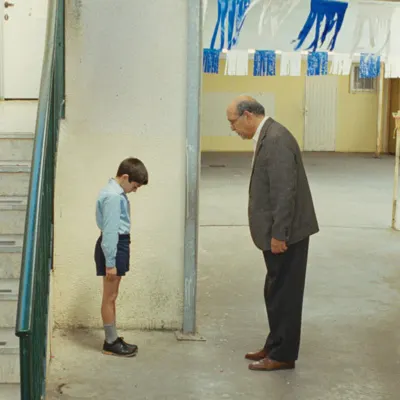
Our friend Fathi joins us to discuss The Time That Remains, a 2009 film that examines the creation of the state of Israel in 1948 through to the present day. A semi-biographic film, in four chapters, about a family spanning from 1948 until recent times attempts to portray the daily life of those Palestinians who remained in their land and were labelled “Israeli-Arabs,” living as a minority in their own homeland.
Check out Fathi’s website, Decolonize Palestine.
Hosted by Russian Sam, Halal Sam, and Fathi.
Transcript
Welcome, Fathi
And we are back with another episode of Gladio Free Europe. I'm Russian Sam and I'm joined by my co-host Sam B.
Hello.
As well as a guest live from Palestine, we have our buddy Fathi, who goes by A Man and the Sun on Twitter. He's here with us today to talk about how there's one Jewish state and 22 Arab states and it's just not fair that everyone is trying to push the Jews into the sea.
Yes, exactly. Thank you.
Yeah, but for real. Welcome, Fathi. It's been a long time coming. We've been trying to get you for a while and now you're finally here.
Well, thank you. I'm really happy to be here and it's always nice to talk to both of you. So I'm sure this is going to be a great discussion.
Elia Suleiman
And what we'll be discussing today is a 2009 movie called The Time That Remains, Chronicle of a Present Absentee, which was directed by a guy named Elia Suleiman, who's probably the most well-known of the Palestinian film directors, although nowadays there are a couple of others. He was born in Nazareth in 1960. He's from a Christian family. And like many of his other films, well, all of his other films, this one is very autobiographical and very focused on his family as well as the city of Nazareth. But this one, it's much more historically grounded than the rest of his work. He's done a couple of great interviews that we shall be reading an excerpt out of right now. When I was growing up in the 1960s, there were lots of taboos about Palestine from our parents and the whole community. In fact, I don't ever remember hearing the word Palestine.
Shin Bet was very powerful in those days, and anybody who so much as mentioned Palestine or Arab nationalism or anything like that would be harassed and could even lose their job. People knew that if they wanted to be able to support their families or send their kids to school, they'd better keep their mouths shut. There were also lots of collaborators or informers around, so people lived in fear. Things eased up when Likud came to power. Likud didn't care whether or not the Shin Bet kept track of everyone and tapped their phones and all that, because they had another agenda. Their aim was not to pacify the population, but to get rid of us entirely in a kind of total solution. Not necessarily by loading us into trucks, but through economic and other pressures. There are lots of ways to make people leave. But even if things weren't openly discussed, I would think that children would pick up political messages.
Yes, of course. And we always had the sense of an inferior otherness, vis-a-vis the ones who dominated us. And the segregation spoke a lot about that, because we always felt intimidated when we left Nazareth or crossed into any Jewish city. We always felt that we were unwanted visitors in our own land.
Nazareth
We're gonna have to talk about Nazareth specifically a lot in this episode.
Yeah, so Nazareth, the birthplace of a little guy known as Jesus Christ. So Nazareth, it was a center for Christian pilgrimage for a while, but it was otherwise relatively unimportant until recently, when in the aftermath of the Nakba, Nazareth ended up being the only significant Arab city which was able to retain its Palestinian majority. As you can see, Suleiman, he's a Nazarene born and raised. He has a very love-hate relationship with his city.
Palestinians inside the Green Line
There's a very interesting dynamic at play here when it comes to the Palestinians who remained within the territory of what became Israel. Not all of them were expelled for a variety of reasons, and today they make up about 20% of the population of the state. And in some important ways, their lived experiences do differ from those of the Palestinians in the diaspora as well as in the West Bank and Gaza. But there is significant overlap.
Obviously, every region in Palestine has its own challenges, its own material context, and each one of them has their own, you know, matrix of control specifically designed for that specific population. Obviously, those in the West Bank and the Gaza Strip have completely different circumstances than, for example, Palestinians in the diaspora or Palestinians within the Green Line. And the thing is that Palestinians within the Green Line, although they have some things better than, say, Palestinians in Gaza when it comes to standard of living, they are still under a strict matrix of control by the Israeli government. These are in the form of de jure, such as over 50 discriminatory laws, which you can explore on the Adalah database online. And basically, open segregation. There's very little mixing in Israeli cities, actually, when you look at the populations and where they live and their neighborhoods. And they are always under constant pressure to, you know, give up their identity.
There's this whole incredible pressure ever since Israel was founded to make them identify as Arabs and not as Palestinians. And they've even tried to do this with Palestinians in the West Bank and the Gaza Strip as well, or in Jerusalem. And this is all in an effort to just deny Palestinian identity. So I'm sure we'll go in through much more nitty-gritty ways in which they're discriminated against within the Green Line. But just suffice to say that the idea that every Israeli citizen is equal is complete nonsense. And I would love to go through that a bit later.
Yeah, and there is a distinction between citizenship and nationality.
Yeah, I mean, that's a trick. When you talk online, like, oh, they're all citizens, like, you say, okay, well, if they're all citizens, that's fine. But then, when you realize that a lot of your rights come from your nationality, which a lot of people don't even realize is different than citizenship, it turns into a whole different story.
Suleiman's life
Yeah, so let's get back to Suleiman. He was accused of being a gang leader when he was 17 years old. He had dropped out of high school and he was involved with some seedy elements. And so, basically, he fled Palestine to go to London to get the pressure off him for a little while. And he returned to Nazareth in 1981 when he first began to toy with his brother's VHS camera. That's really when his interest in filmmaking began. And he moved to New York in the following year, 1982, where he would remain all the way until 1994. So, Suleiman, he was undocumented. He worked various odd jobs in bars and restaurants. He just fell in love with cinema and made friends with film students who would sneak him into their classes and various screenings. So, he was largely an autodidact. He only made his first film when he was 30 years old.
So, remember, kids, it's never too late.
Yeah, so he returned to Palestine on a full-time basis in 1994 when he was selected to found a media department at Birzeit University, which our friend Fathi here is intimately familiar with. And again, he did all of this before he had even made his first feature film. He made a couple of short films, but the fact that he was the one who was selected to do this really speaks to the dearth of Palestinian filmmakers at this point.
Here we have another quote from an interview that he gave where he explains how he was selected to run the media department. I was the only one around. It was to be a film department, but then the Oslo Accords came along. The post-colonials arrived, and they wanted technicians. They don't want people to think in the Middle East, they want them to have jobs. So they trained them to be cameramen to film wars and intifadas and earn $400 a day from ABC or BBC. It's easier to send the natives into the jungle.
He ultimately did try to create a more film/slash media studies environment, so he would expose his students to the great works of cinema, and ultimately, he himself would continue his own endeavors.
Chronicle of a Disappearance
In 1996, he made his first feature film, which was called Chronicle of a Disappearance, which was lauded internationally. And it really sets Suleiman's style. It's kind of autobiographical, usually very absurdist, and usually in the style of these unconnected vignettes. He tries not to depict violence very often in his films for political reasons. Although it does make an appearance. In Chronicle of a Disappearance, there's a scene where a van full of Israeli special forces appears and the policemen all jump out in a rush to urinate against a wall. They have just done something evil and are on their way to do more evil. But I was not going to give them legitimacy by showing the acts they had committed. Instead, I showed them in their most ridiculous moment, before and after their evil act. Personally, I think it is much more powerful than fetishizing blood. When I had my legal battles with Chronicle of a Disappearance, one of the things that the Israel Film Fund, which provided some of the funding, told me is that they hated my film because by making the Israelis into cartoon figures, I did not recognize their existence in this place.
One of these people told me that he would have appreciated the film a lot more if I had depicted an Israeli soldier breaking the bones of a Palestinian rather than ridiculing them. I can't imagine a better compliment. This is exactly what cinema can do.
He's a very funny guy who often lands himself in trouble, both with Israeli authorities as well as with Palestinian authorities. This film actually is what got him into a lot of trouble with both Palestinians and the Arab world at large because the Israeli national anthem Hatikva is actually the closing shot of the film and so a lot of people took this along with the fact that he had accepted money from the Israeli film fund to make this film. They took this for the fact that he was collaborating, that he was ridiculing Palestinians.
Divine Intervention
In 2002, he had his most internationally successful film called Divine Intervention, which saw further success and it ended up being shown at Cannes and it was awarded a Palme d'Or. And in fact, it was even submitted to the Academy Awards for consideration for best foreign films, but it would not be accepted as Palestine was not a recognized state, which really highlights the difficulties of being a Palestinian filmmaker.
The Time That Remains
Let's get to his third film.
Yes, and this is the film that we will be discussing, and that's the movie The Time That Remains. It largely tells the story of Elia's father's life, Fuad, which was based on the memoirs which Elia had encouraged his father to write when he became sick. He would later corroborate the anecdotes that his father wrote down with others. The film takes place in multiple time periods, and we just see first Fuad's own near brush with death in 1948, as well as around 1970, when Elia is still a young boy, and then further scenes later in the future.
Yeah, so as I said, Elia has a distinctive style, and one of the things that really stands out is that, first of all, he is a character in his own movies. He plays himself. Well, not exactly himself, but he plays ES. He doesn't talk much.
Yeah, yeah, that's his thing. He's really a silent observer. He's mute. He's largely passive. And the way he structures his films, he doesn't want to impose his own interpretation on the audience, so he leaves things very open-ended.
Non-professional actors
And another hallmark feature of the film that he makes is that most of the characters aren't played by professional actors. They're just played by regular people that he knows. His family members, just...
And it shows.
It shows sometimes some of those line deliveries are absolutely terrible.
Yeah, no, but that's part of the charm. It is completely.
But his father in this film, he's played by a somewhat well-known Palestinian actor named Saleh Bakri. He does a pretty good job with it, I'd say. And as I mentioned, although this film is more historical than his other films, Suleiman does not want this to be viewed as a work of history per se. While what I was describing in personal ways was true to history, in the sense that the facts were historical, I moved away from those facts and talked about the people living through them at the time. I wanted it to be a personal narrative, not a political one. This film is not just about the Nakba. It is a very personal film, about what happened to these people, the Palestinian citizens of Israel, who have so much grace and who for years resisted giving in to an utterly oppressive regime that began with overt military repression and continued with the use of all sorts of economic and psychological forms of oppression.
I think that it mostly comes through in the film. Like, when you're making a movie about the history of Palestine or the Nakba, there's this temptation to go and make it into this grand, you know, historical epic. But I think the movie really succeeds in showing how, you know, at the end of the day, life goes on. We're looking at the lives of, you know, quote-unquote small people, just very simple things that you wouldn't even think are affected by, you know, the context that they're in and just how it really touches everything, even very small, simple things you wouldn't even think twice about normally. And I think that's what really is an allure of the movie: that's just, you know, some guy's life. And this is how it was. This is how it changed. He's not claiming to be, you know, some kind of liberator or some kind of, you know, great poet or whatever.
This is just how he lived. This is his experiences, for good or for bad.
Yes, and it's not even supposed to be all Palestinians. It's specifically, he is focusing on the Palestinians within the Green Line.
Present absentees
The subtitle of this movie is Chronicle of a Present Absentee. It's a very interesting phrase, a present absentee.
A present absentee is unfortunately more than just an interesting, you know, subtitle. A present absentee was a legal designation after the 1948 Nakba. As you know, the majority of the Palestinian people were ethnically cleansed from their villages, had hundreds of villages destroyed. Most of them ended up outside of what came to be known as the Green Line, which was the borders of Israel 1948. Well, I hesitate to call them borders, but at least let's call them armistice lines. What happened to the internally displaced people or the people who were like in the next village over when the Nakba happened, they were called present absentees. Everybody else was designated as an absentee because they could not come and claim their property. Because if you could not come and claim your property, it would be given to the state, and the state would then probably give it over to a Jewish family that's coming home from Europe or whatever.
But if you were there in a village next over, but not the exact same village or place where the property was, you would be classified as a present absentee, which is absolutely a nonsensical term that makes no sense.
This is a justification to take over their property anyway.
Like, okay, you're here, but you're still an absentee because you can't go back to your village. Why can't you go back to your village? Because we won't let you. So it's just a very thin, you know, legalistic way to actually rob the refugees of their stuff, even if they were actually there. I think a whole third of Palestinians within the green line, I'm not sure if that number is accurate, but I think around like 30 to 40 percent is, you know, internally displaced Palestinians who till this day can't go back to their villages because most of them don't exist. So that was their way basically to take over the property. And I think it was Simha Flapan that did the math, and he found that taking over the properties of the Palestinians reduced the cost of settling a Jewish family of four from $5,000 to like $1,500.
And in 48, that was like a lot of money. So it's basically subsidized the creation of the Israeli economy in all sectors, basically. So you know, the whole miracle thing is not really a miracle, but whatever.
Yeah, no, it's just the result of massive, massive theft and ethnic cleansing.
I think it was, was it Alan George that found that approximately all 80% or 85% of the land in Israel, agricultural land in Israel, was just up until the 90s was just, you know, refugee lands that they took over. They had barely added any new actual agricultural lands. So, I mean, that's a whole different topic.
The whole making the desert bloom thing is complete horseshit and propaganda.
Making the desert bloom?
Not even a grain of truth.
No, the thing is, like, if you actually look at the statistics before the Nakba, you'd see that the only area where the Zionist quote-unquote pioneers or settlers actually excelled in was growing fodder. Otherwise, they had like fodder for animals. Otherwise, they could not hold a candle to anything the Palestinians were producing. Despite their expensive machinery, they were much less efficient than, you know, a fallah, actually.
Yeah, it wasn't because it wasn't their fucking land. They didn't actually know what to do.
Yeah, actually, if you read some of the diaries of the pioneers, like I think his name is Chaim Chissin. I'm sorry, I'm probably like horribly like mangling the name. He arrived in the 1860s. They're called the Bilu pioneers, and he kept a detailed diary about how they came and they looked down on the fellahin, the Arab peasants, and they tried to grow barley. And the peasants warned them that you can't grow barley here, you can't grow in this season. They said, well, we have machines, we can dig deep, you don't understand. And they basically almost died of starvation and it basically failed.
The first Zionist settlers
Yeah, this was the first Zionist migration into Palestine. Jews had been coming to Palestine for centuries at that point, largely for religious reasons, but this was the first really Zionist political project where these guys from Russia were fleeing this place because this was the time of major upheavals and pogroms within the Russian Empire against the Jewish community. So a couple of these pioneers decided that they would make a new life for themselves in Palestine. And that's ultimately how these projects came to be in the first place. And over time, they tried a bunch of different things. At one point, they had the help of a Baron de Rothschild to try to create an agricultural plantation economy based on cultivating wine, where Jews were to be the overseers over Palestinian peasants who were to be wage scrapers. But that plan also didn't work out. They were experimenting with all forms, all different forms of colonialism.
But yeah, getting back to Suleiman and the film.
Back to the film
So yeah, As Fathi explained, present absentee is this very Israeli legalese term, which is the sort of thing that they really love to cling to. But this is more of a double entendre because, as I mentioned previously, Suleiman is this passive observer. And this is something that's somewhat extended to the Palestinian people within Israel writ large, because although they are physically present on the land, it's no longer the same place that it was before 1948 because now they are living under a Jewish state which does not really recognize them as full citizens and they are just treated as perpetual outsiders.
Yeah, no, even the word Palestinian is not something that you are supposed to say. A fun thing to do is if you look through like the archives of a major newspaper like The Times or something, just search the word Palestinian and you will see very few entries in the 50s or 60s. Yeah, just the Palestinian is almost never named to the extent that they are mentioned. They're just generic Arabs or not even mentioned at all. Often news stories were presented from the perspective of Egyptians or Jordanians and Syrians, but not the Palestinians themselves.
Our impressions
But yeah, so what do we think about the film, guys?
I liked it. I thought it was very interesting. I thought it was... I like his vignette style.
The fact that he depicts just the absurdity of living in this insanely fascist country as a hated minority whose land was stolen. He doesn't go overboard with violence, as we said earlier. And honestly, it really does strike through the film. When you just see, like, for example, the moment where the guy is having a phone conversation outside, and the tank is just... Yeah, the gun of the tank is just following his head as he's just on the phone talking about, yeah, this party will have a great DJ. Based on a true story, by the way.
It is absurd in that sense. It also, it shows a little bit about, you know, the stratification of some areas also in the West Bank, like Ramallah, particularly. Like, some people were out there dying every day and some people were partying. Like, obviously, it was all exaggerated for effect. But I enjoyed the movie.
You know, I particularly liked the camera style. I think it was like still cameras most of the time. There wasn't very many moving cameras, I don't think. I liked the contrasts in the backgrounds on the foregrounds, especially in the beginning of the movie when they were blindfolded and tied next to the olive trees. I just feel like it was very striking cinematography. I mean, I'm not exactly a movie guy, but it just seemed like very, very nice composition to me.
No, the moment there where there were like the olive trees and the blindfold, it's more striking than if he had just shown the Israelis just beating people to hell. Incredibly hard to get out of your head. Yeah, and I think it, like, it works, it works in capturing, like you said, the absurdity of the situation, especially when he comes back after being abroad. And he comes back and like everything is different. He can't even recognize what's going on anymore. Like, I mean, I feel that. I mean, on a much, much lesser scale. I spent like eight years abroad and I came back and I felt like the whole country changed. I'm just talking about Ramallah. So, let alone somebody who actually, you know, saw the Nakba or, well, his father saw the Nakba and saw the changes in society because those were much, much more dramatic upheavals than something like second Intifada to today.
Can you talk a bit about your experiences in this regard?
Coming home to Ramallah
So, basically, my teenage years were during the second Intifada. That was when we were when I was in school. That was when I witnessed most stuff, seeing our neighbors getting shot, some messed up stuff that teenagers shouldn't have to go through. It's really a formative part of your life, and it just really builds you for the rest of your existence, basically, these things that you went through. I don't want to go on too long about this stuff, but when I came back, I left around 2004-2005, so it was basically the tail end of the Intifada. And I left to do my BA in Austria, and then I did my MA in Germany on a scholarship. And I come back, and I feel like the country was different.
The Palestinian Authority
In that period, we saw that the PA underwent its transformation a bit more from Yasser Arafat style of patronage networks to the new Abu Mazen patronage networks. We saw more institutionalization, more IMF, you know, mandates and stuff. And people keep saying that it was, you know, the neoliberal turn of the Palestinian Authority, even though I would disagree with that, because from the very beginning, the Palestinian Authority was built as a neoliberal device. There's absolutely nothing that's not neoliberal about the Palestinian Authority. I think the IMF itself said that this is an opportunity for us to create something from scratch. We don't have to go through these reformations and changing of policies. We can just start it from scratch in this way.
Oh, absolutely.
It is the dream colonial regime for these people. So, what Salam Fayyad did in 2007, he was the prime minister at the time, he just institutionalized a lot of the things that were already there. And they institutionalized the security forces, General Dayton from the U.S. He came and trained all the security forces. They retired any of the security forces that had anything to do with the Intifada, anything to do with resistance. The Palestinian Authority was terrified after what happened in Gaza, so they became much more repressive in all ways of life. Like, it would never have occurred to me that you could get thrown in jail over a Facebook post back in 2004, 2005. You know, well, not Facebook specifically, but I mean, like, online. But nowadays, it's just the norm. It's turning into a Mukhabarat state akin to Jordan, at least in the West Bank.
And this might be something that's a little like not that, you know, huge of an indicator. But when I left, every street had graffiti about resistance. When I come back, there's absolutely zero graffiti. I'm talking about Ramallah at least, because this is where I live. There's absolutely zero graffiti on the walls, and it's been mostly subsumed by advertisements, especially for like telecommunications and stuff.
Yeah, it's absolutely like even the biggest murals in Ramallah are now just like the old buildings have been destroyed. You have these big, you know, glass towers built.
And I mean, what kind of country under occupation builds glass towers? Like, it's just so ridiculous. This, this, this attempt to convey normalcy, like, to try to be like, look, if we maybe if we're good enough, they'll give us statehood. And this was basically the Palestinian Authority's politics since 2007. If we do our institutions good enough, if we build the country nice enough, the world will look at us and say, hey, these guys are ready for statehood. Obviously, that was, you know, never the issue to begin with. So, I mean, yeah, it's not working. It's still not working. It's trying to convince everyone that the Bantustan is actually a normal way of living.
Who's funding those big glass buildings?
The Palestinian bourgeoisie. We have a lot of millionaires now.
Ah, okay. So it's not, okay, it's not foreign money.
No, no, the foreign money goes towards, you know, oh, supporting entrepreneurs and all that nonsense.
I remember the Qataris trying to fund some luxury development or something a while ago.
Yeah, yeah, but it's all in the form of investments. It's not like it's not kind of, it's not like aid. Actually, for a while, the Palestinian Authority has been decent with its incoming, you know, tax from the taxes and the VAT and what have you, but obviously that's under the control of Israel, so they can cut from it and take from it whatever they want. So they do. They do. We basically pay for our own occupation.
And then they're like, why does Israel want peace? Why doesn't Israel want peace? Sorry.
Because, I mean, they have a five-star occupation. They have all the control and none of the responsibilities. They don't have to do any of the dirty laundry. They don't have to take care of the health, take care of, you know, sanitation. They have the Palestinian Authority to do that. But when it comes to actual power, they have all the power. So it's like the perfect situation for them. Why would they want to change that?
And they also get to attack the Palestinian Authority as being cruel to its own people, which proves that the Palestinians are unworthy of statehood. But who exactly is propping up that authority in the first place?
No, no, it's actually ridiculous. Like, the Palestinian Authority has been one of the biggest boons to Israel. And the Israelis look at it as if it's some kind of radical, you know, PLO in the 70s. You know, like, this is not who is here. This is not what's happening. Like, these people are actually, the coordination has probably, you know, done more for your security than you even imagined. Like, they've created the perfect subcontractor for the occupation. It is a subcontractor. It is part of the occupation. Like, they cannot even arrest somebody in areas B or C without going through Israel first. Israel, when it goes into the cities, they notify them to remove their police forces. Like, it's basically, again, like the Bantustan authorities. These is completely dependent upon Israel. They cannot exist without Israel. And that's why they're very nervous whenever any kind of movement happens, because they understand that their legitimacy, like whatever legitimacy they had after the Oslo Accords in 94 or whatever, or whatever their history is, it's all gone.
Like, people do not trust the authority anymore. And it's been like this for a while.
Areas A, B, and C
Yeah, for anyone unfamiliar, the West Bank is divided into areas A, B, and C. Actually, Fathi, could you explain that real briefly?
Yeah, sure. The Oslo Accords, well, Oslo 2 really, designated three different areas in the West Bank, which is areas A, which are under full civil and security control of the Palestinian Authority. These are very small, and they mostly take up the urban areas of Palestine, of the West Bank, sorry.
Ramallah, Nablus, places like that, yeah.
Yeah, the big cities, some of the bigger villages, but it's like they're little islands, basically, if you look at it on the map. Areas B is where a lot of villages are. These are under the civil control of the Palestinian Authority, but security control remains under the hands of Israelis, which means that you get all your permits and stuff from the Palestinians, but other stuff like crime and what have you, it should technically be in the hand of Israelis, though they don't care. Area C is under full Israeli control, and this is the area where most of the West Bank is. This is around like 60% or so of the West Bank. This is where all settlement, well, the vast majority of settlement construction takes place. Palestinian communities in Area C are not allowed to do anything basically without Israeli permits. And guess what? They don't give permits for anything.
Yeah, there's been a lot of proposals to fully annex Area C in the past five or so years, I'd say. Especially on the Israeli right. The Israeli right is a term almost implies that there's a left, which not really.
But there's there's some, yeah, it's where most of the settlers are in Area C. Yeah, it's attractive to them because it has a sparse population because they don't allow new people to move there. And it has a lot of resources, a lot of land, especially agricultural land. So they're like water, a lot of water, yes. Obviously, by the way, like the Oslo and Paris set up the Joint Water Commission or committee. I'm not sure which one of them, the JWC. And it was basically just a legal way to make the occupation of our water just formal. It functions the same exact way as before Oslo, but it has an extra committee now. Like the Israeli army gets to veto everything, but the Palestinians get no say. Like if the Israelis want to dig a new well for settlers, Palestinians can't say a thing. If Palestinians want to dig a well, the Israelis get a veto if they want to or not.
And like the vast, vast majority of everything gets vetoed.
The opening scene
Yeah, so speaking of changes, let's get back to the movie a bit. The opening scene, so Suleiman, he's returned to Palestine because his mother is sick and he needs to go take care of her. And he's picked up at the airport by an Israeli driver who he's loading Suleiman's bags into the car, and we catch a glimpse of this poster right behind him, which is done in this mandate-era like Palestinian tourism poster.
Have you ever seen the Visit Palestine poster? That's it's that stuff, like the one with the oranges and it. Except the text on this one reads, Eretz Acheret, so another country, quite literally.
I mean, so he's driving Suleiman from the airport to Nazareth, and they're driving through a thunderstorm. While the driver, he seems totally lost. Do you know where we are? I don't know anymore. Where are the kibbutzim, the moshavim? They were everywhere. Did the earth swallow them up?
Nazareth's history
Yeah, so just like he's literally lost, but also he doesn't recognize the country that he that he grew up in anymore because Israel also underwent this neoliberalization process from the 70s and 80s onwards where the old foundations of the state which were well more collectivist oriented it was this kind of second international kind of like collectivist basically an attempt at like settler social democracy it's very strange if anyone if you ever hear anyone talk about patriotic socialism it basically looked like that at that point the film turns to black and we're taken back to 1948 to the city of nazareth he very clearly has a deep love for his city with while also being deeply frustrated with what it is and its residents but it's a sort of tough love but yeah the city of nazareth there's a kibbutz nearby called Kfar HaHoresh these days and over there they found an archaeological site, which is a 10 000-year-old cultic and funerary site, which goes to show that that this is a place that was settled for a very, very long time in fact palestine has one of the oldest known continually settled cities ever.
Jericho is about 9,000 years old or something like that. But yeah, within Nazareth itself, there are signs of habitation from the Bronze Age onwards, so approximately 4,000 years ago. But the city wasn't really mentioned in any extant texts until the life of Jesus, during which point it would have been a town of around 500 residents. A very minor town, sleepy, not anything to write home about. But it became an important religious center and site of pilgrimage for Christians as the religion spread. And in the modern period, most of the Palestinian inhabitants of the city to today make up 60% of the population, of whom 70% are Muslim and the remainder are Christians. But back in Mandate days, the ratio was reversed. It was around two-thirds Christian and one-third Muslim. It continued to be a site of pilgrimage for Christians across the world for centuries, really. But during the reign of Zahir al-Umar, it became a market center of some importance in the 18th century.
And it just developed for a while until during the Mandate period, it became the center of Christian Palestinian politics.
The Nakba
But then in 1948, you had the Nakba. You know, it was the ethnic cleansing of Palestine. It was the expulsion of 750,000 residents of Palestine into countries both neighboring and across the world, most of whom would be unable to return to their homeland.
And yeah, you often hear Zionist apologetics if they don't deny that the Nakba happened in the first place. They'll say that this was an impromptu thing that wasn't really planned that far ahead.
It was 100% planned.
Although the specifics of how it happened came about somewhat spontaneously during the war, the idea of kicking the Palestinian Arab residents out of the land was long-standing in Zionist thought. Goes back all the way to Herzl, where he muses in his how ultimately this project would require that the Arabs vacate their lands to make way for the Jews. And this understanding was shared all the way up to the highest levels of Zionist leadership. And as 48 drew closer and closer, there was increasingly this understanding that this is not an option. Previously, a lot of Zionist leaders entertained the notion that because they would bring development to Palestine, that the Arabs would be grateful and would welcome them. What really happened was that the Zionists, although they did bring a lot of capital into Palestine, in fact, during the Mandate period, they effectively set up this dual economic system where Jewish settlers were indeed plugged into this rapidly developing economy, which was growing by the year.
Meanwhile, the Palestinians were largely locked out of that economy. And as the peasantry was kicked off the land because their landlords sold it from literally right under their feet to these Zionist enterprises, they increasingly suffered.
Land sales and the Tanzimat
Yeah, that's a really important point, is that even before the Nakba, you had Zionists and their funders buying the land out from under their feet from absentee landlords.
The Ottoman state from the 1830s onwards was undertaking something called the Tanzimat reforms, which was supposed to originally was framed as a way to bring the Ottoman state back to its pure foundations, but from the 1860s or so onwards, it became more about creating a state of affairs more in line with contemporary European institutions. But basically, what has happened was the peasants of the Levant writ large and Palestine, they were given the opportunity to register the land that they were cultivating under their own names, but for various reasons, namely that they were afraid of being taxed or drafted into the Ottoman military. In practice, a lot of land came into the possession of landlords who didn't actually live on the land or cultivate it, but who came to an agreement with the peasants, like, oh, yeah, I'll buy you tools if you let me register the land under your name and you won't have to worry about taxes or anything like that.
So once the Zionist enterprises got started, these landlords who felt no obligation to the peasants who were living on their land, many of them just sold this land onwards to the JNF and other similar institutions.
Plans for transfer
But yeah, speaking of the JNF, the Jewish National Fund, here's a quote from Joseph Weitz, who was the director of the land departments of the JNF. It's a diary entry from 1940. There is no way but to transfer the Arabs from here to the neighboring countries, to transfer all of them, save perhaps Bethlehem, Nazareth, and Old Jerusalem. Not one village must be left, not one Bedouin tribe. The transfer must be directed at Iraq, Syria, and even Transjordan. For this goal, funds will be found. And only after this transfer will the country be able to absorb millions of our brothers and the Jewish population in Europe will cease to exist. There is no other solution.
That was basically the consensus by the late 40s. And even like in the 30s and 20s, these ideas were floated, like started to be floated seriously. Like Ben-Gurion said multiple times that, you know, any kind of partition or what have you is just a temporary thing until they can form a strong enough army to, you know, complete the job and kick the Arabs out. It's all connected. None of it was some kind of random happenstance or, you know, an accident of warfare or what have you. Like the Zionism, actually, there's a whole book about the concept of transfer in Zionist thought. And it's actually quite excellent.
Could you give us the name of that book?
Nur Masalha's. The concept of transfer in Zionist thought. I think that's the title. Or maybe that's the subtitle.
I'm not exactly sure.
Nazareth in 1948
So Nazareth, at this point in time, it had around 17,000 residents to whom another 20,000 would later be added, which would create this really untenable situation because basically, like Nazareth was to be part of the Palestinian state according to the UN partition agreement. So many people fled or were forced to evacuate from their towns and villages. And some of this was quote-unquote voluntary, such as after the Deir Yassin massacre when the Etzel and Lehi massacred hundreds of villagers in this village, which actually had very friendly relations with their Jewish neighbors. And this spread panic through the population. Many people from Haifa, which is another one of the major Palestinian cities, which at that point was like 50-50 Jewish and Palestinian, many of them fled because basically, like the city was getting shelled. And this was before the war even formally started, before the state of Israel was founded.
Like, all of this was still happening before the British had left. They still had their troops on the ground at that point.
Ghassan Kanafani wrote a short story about Haifa in the Nakba and the aftermath called Returning to Haifa, which is. I highly recommend it. Check it out if you're interested in that city.
Yeah, I think a big misconception about the Nakba is that it did not coincide with the war. Like it began before the war. Approximately 300,000 people were already ethnically cleansed before the war even began. So the whole idea of all the Arab armies came in and told people to leave the country, which is also another myth that still everybody believes, but you know, it's nonsense when you actually look at the record. And also the idea that these villages were emptied as a result of warfare is also belied by massacres like Deir Yassin, as Sam said, which had, you know, they actually had a non-aggression pact with their Jewish neighbors, like in the settlements around them. So like this village did everything perfectly that, you know, the Zionists demand they do. And it still got ethnically cleansed. And not only ethnically cleansed, it had one of the most atrocious massacres committed to it.
We're talking about literal, you know, horrible, horrible things, mutilations, beheadings, like absolutely ridiculous. And it was on purpose. This was on purpose so that would incite panic upon the population. And it worked. It worked. They had these things called whispering campaigns where they would go around Arab villages with the loudspeakers and say that if you don't leave, you're going to face the same fate as Deir Yassin and all these other things. And we're going to murder you, we're going to kill you. And multiple villages were actually like the villagers actually fled from them without seeing a single soldier from that kind of thing. So, you know, there were multiple means to empty villages. Not all of them were dynamited straight away or were taken over by armies. A lot of them were abandoned due to, you know, these whispering campaigns and the threat of being overrun by the army and having, you know, massacres committed against them.
Tantura
Exactly. Yeah, and speaking of massacres, a town called Tantura is in the news again because in the late 90s, there was this master student at Haifa University named Teddy Katz, who was a Zionist, but he was, you know, he was working on his history master's thesis and he ended up interviewing the former residents of a town called Tantura, as well as the veterans of the Alexandroni Brigade, which had fought to take this village. And although Palestinian sources had been talking about the fact that the inhabitants of this village had been massacred all the way back in the 50s, you start to get the first published mentions of it, I believe. But this was largely news to the Israelis. So Katz, he writes this very meticulously researched thesis about this event, and he basically gets these veterans to comment on the record to say that, yes, we had massacred a large number of villagers after the town had surrendered.
And so he defended his thesis. He got a 97 on it. So nearly a perfect score because he had done a very thorough job of uncovering this. And a couple of years later, some journalist working for Maariv, I believe, he discovered this thesis in the archives and he writes a short story about it for the paper, which sets off a massive controversy within Israeli society itself because, you know, this is not a very flattering image of Israeli soldiers. And the Israelis had this idea that, you know, this is not something that Israelis would do. So suddenly, these veterans who had spoken very candidly to Katz, they start to dispute what he had written and they start to deny that they had ever told him this in the first place. They, in fact, take him to court over this for slander. And Katz was, he was not a young man.
He was in his 50s through all of this. He had already had one stroke. So under pressure from his family, because they were worried about his long-term health if he would fight this battle, he signs a declaration saying that he had lied, that he made mistakes, even though the mistakes in question, like there were a couple of mistakes, but it came down to like these very trivial transcription errors, I believe. And so under all this pressure, he was forced to renounce his work, which he very quickly regretted and which he tried to take back, but which wasn't able to do. And he ended up having several more strokes because of the stress of this whole experience. He is wheelchair bound because of this. But yeah, to cut to the present day, a new documentary film was just released where an Israeli filmmaker had gotten interviews with these people who finally admit that yes, we did this and the bodies are buried under a parking lot near the beach.
Yeah, and the Palestinians had been saying this for decades and no one listened to them.
Who gets to narrate
It's, I mean, I talk about this all the time on my Twitter. This idea of who gets to narrate, who gets to determine history, who gets to be listened to. This is a huge thing that we struggle with. We've always been framed as irrational conspiracy theorists. All we're doing is animated by hatred. Like we can't be objective, you know, scholars or what have you. So a lot of our production and historiography is just thrown aside as the ravings of anti-Semites and what have you. And meanwhile, what the Israelis produce, especially the new historians, really shed some light on this. It's given a much more flattering light. Like, oh, if they're Israeli and saying this, then it must be believable.
Yeah.
And this is really the whole history of what's going on. There are so many things that would have been dispelled decades ago if people just literally listened to Palestinians saying. And I'm not saying this in the sense of, don't talk over blah blah blah. No, I mean like literal scholarship with all these testimonies and all this hard work that goes through. Like there is meticulous documentation of all the villages that were destroyed. We're talking Salman Abu Sitta is still updating his list of villages destroyed to this day. Over 600 of them, I believe.
Yes, exactly.
And he found out that most statistics don't take into account the Bedouins in the Naqab desert because they were considered Bedouins and they move on and come and go. And they had neglected to understand that these were sedentary Bedouins and they moved very little inside Palestine itself, not from outside of Palestine. So if we actually take all of this into account, the villages go up to around 600 and the number of people ethnically cleansed also goes up. But there is very, very little documentation of these people because also the British numbers did not include them because they were considered as transient. But they were not transient. They were sedentary mostly. So like to this day, there's more and more stuff being discovered. Like there's an enormous amount of scholarship. And it's absolutely infuriating when some, you know, Hasbara pundit or whatever is still talking about, still, you know, reading from Hasbara manuals about stuff that's been, you know, disproven decades ago and just they have absolutely no will or want to listen to new information that could jeopardize their worldview. Like, even today.
Yeah, you were telling me before we started recording that you've encountered people who continue to deny that the massacre happened in Tantura, even though, like, again, these are the veterans of the campaign who are saying, yes, this is what happened. They said, we did it. Here's where we buried the bodies.
Yes, exactly. And it doesn't matter. Like, it doesn't matter. A lot of these viewpoints that they have, if they were susceptible to evidence, they wouldn't have them to begin with. This is just absolutely a bunker mentality. If there's any kind of evidence, it must be some kind of Pallywood or, you know, anti-Semitic conspiracy to because everybody hates Israel. And, you know, the Israeli media does a really great job of that. Just cultivating this kind of bunker mentality that the whole world hates them and it's only because of you know their identity. And because Israel is the only nation on earth that produces any Hebrew media basically on a scale large enough for anything, they get to cultivate the story. They get to frame everything. Even if you like read some of the stories in Hebrew about what happens, like even the story about the 80-year-old Palestinian man that was tied up and beat to death, like you'd find out that apparently the soldiers were the poor victims because they didn't realize what they had done to him.
He wasn't able to object when he was tied and gagged and blindfolded, apparently. He didn't tell them he was in distress. So really it was the soldiers who were the poor people.
Yeah, the poor soldiers, they got traumatized by beating this old man to death.
So it's absolutely ridiculous how shielded the Israeli public is from their actual history. Till this day, they are under the impression that Israel was this little outnumbered, you know, underdog that barely survived the odds when, in fact, it had a bigger army, it had better weapons, it had everything since 48.
The backing of a fucking superpower to this day, small beings who have nuclear weapons.
Yeah, exactly.
It's funny when you put it against these, you know, these modern, you know, quote-unquote progressive Zionists in the West.
This is a completely Western phenomena, by the way. Like, there's no kind of nonsense.
Yeah, there's some of them in Israel. They work in the progressive NGO world, talking about bringing equality between.
Yeah, but that's like five people in Tel Aviv.
Yeah, they vote Meretz.
There's like three of them. That's just a very insignificant force in Israel itself. And it's just the whole idea that, oh, we're just a progressive force. And they're like, oh, America's terrible, and but they can't reconcile. Like, why did America support you? Like, it's terrible everywhere else, but it just decided to love indigenous rights when it came to you. Like, come on. The British Empire, the French in the 50s, really, come on, bro. They were committing genocide against the Algerians, but they just love indigenous people. The French who helped the Israeli nuclear program also. Yeah, like the 56 Suez crisis, like, had all the colonial powers like ganging up on Egypt. Like, come on, like, you think they were supporting you out of love for indigenous rights? Like, you have to be kidding yourself at some point.
Yeah, so speaking of Pallywood, let's go back to the film, huh?
Operation Dekel
In July 1948, Operation Dekel, Palm Tree began with the goal of capturing the Lower Galilee, which included Nazareth. And this is where the historical scenes of the movie start. At the time, the region was under the control of the Arab Liberation Army, which was a volunteer force assembled from across the Arab world, which was established under Syrian auspices and which got involved in the war all the way back in January because Israel was still not an independent state. And these states couldn't, you know, invade Palestine because the British were still there and it wouldn't, in effect, be a war against the British Empire. But so yeah, the Arab Liberation Army, it's mostly stationed in the north of the country. And it was just one of many factions that were fighting on behalf of the Palestinian people at that point. And it really speaks to the disorganization of Arab forces because at the same time as they were fighting their own quarters, they were also basically in this very tense feud with other factions, such as the faction of the Mufti, Hajj Amin al-Husseini, who had his own formation, which was the army of the Holy War, which was, you know, another thing.
David and Goliath
But basically, one of the commonly cited conceptions about this war is that it was basically David versus Goliath, that Israel was fighting against these six different armies, and miraculously, despite being outnumbered on every front and outgunned, they emerged victorious.
They frame it as this war for survival, while they even had deals with the Jordanians under the table. The Jordanian army was the most equipped, the most advanced one, and a lot of the map of the West Bank today as we see it is dictated by all of the, you know, what they had agreed to with the Zionist forces. The Jordanians had agreed to, the Zionist, Abdullah agreed to with the Zionist forces at the eve of the war. Glubb Pasha, who was a British officer responsible for the Arab army, you know, the same British that were sponsoring the Zionist movement up until that point, he had a book. He very frankly called it a phony war. He was told to do a phony war, to do as if it was a theater play, to convince the people that, okay, we're going to go wipe out the Zionists.
It doesn't matter for Jordan. He didn't care about Palestine. What cared, Abdullah cared about Greater Syria. That was his aim. He wanted the West Bank and its economy as a stepping stone towards Greater Syria. And obviously that didn't happen because, you know, nobody was interested in that, the colonial powers who sponsored them. So, even if we take this whole idea of it was a real war, this was all the armies were outnumbered by Israelis. Actually, it's funny. By the end of the war, it was like two to one or three to one, something like that. I don't remember the exact number. I think Avi Shlaim has some detailed numbers. But so, it's it's it's absolutely ridiculous. Not a single source says that the Arab armies were superior to the Israeli armies in numbers. So, this how this idea came that it was you know a small outnumbered little underdog is you know completely opposite of what actually happened in reality.
And I and I get it. You can't really get sympathy if you're like, oh, we were the superior force and we just crushed everybody around us. Especially, you know, coming off the whole, you know, narrative of Israel being oh, a refuge for poor people who just want to escape, you know, pogroms. And to be like, oh, we were a superior force and we just took everything over. Like, it's not as sympathetic.
And again, the Arab forces were very disorganized. Like, you had the Arab Liberation Army, you had the Army of Holy War, but you also had all these separate armies of Jordan and Syria and Egypt. But there was really no coordination between these entities. Basically, all of these armies were fighting to secure their own interests. Abdullah was fighting for his own Greater Syria project. The Syrians were trying to create their own Greater Syria project. The Egyptians were, I don't even know what the Egyptians were doing, but they had a horrific record during this war. They were just not very good.
Yeah, it really radicalized Nasser, though. Like, I think Nasser, one of the things that really radicalized him is that they were surrounded by Israeli forces, and they could see the Jordanian army on the other side, and the Jordanian army refused to come and save them. Like, they would send dispatches to the Jordanians. They're like, oh, yeah, we're coming, we're coming, don't worry about it. And they could see them, like, not moving. Like, it was very, very open, the kind of cooperation between the Jordanians and Israelis during the war. And this is part of why Nasser had a real grudge against Hussein afterwards. Like, this would become like a very famous grudge between Jordan and Egypt.
So it's, it's July 16, 1948, in the midst of Operation Dekel.
The fall of Nazareth
And we see this really evocative scene where Fuad and his friends, they're drinking coffee at a cafe, and walking past them is this soldier from Iraq, who's a part of the Arab Liberation Army, and he's just wondering where to go, where he should fight. And they're just telling him, Oh, oh, Tabariya, it's been liberated, quote unquote. Then goes, tries to go to another place, and so on. And ultimately, they just invite him to drink some coffee with them when the Israeli planes are flying overhead and shouting these messages about how we have defeated the bandits, now Nazareth is safe, etc., etc.
Yeah, so Nazareth surrenders on this day, July 16, 1948, with assurances that the city would not be ethnically cleansed. And we see a scene where the mayor of Nazareth goes to a meeting with these Israeli military commanders and they read him the statement to the effect of that the residents of Nazareth will not be touched. Your civil and religious rights will be respected. Yada, yada, yada. Come sign this, come take a photo with us. And yeah, so that's the end of it, right?
No, definitely not.
All these other cities that we talked about were thoroughly cleansed, like Haifa, for example, thoroughly ethnically cleansed.
But Nazareth was a little bit different. So the IDF was really on its best behavior when it came to Nazareth, and that's not really, and that's not to say that, you know, there wasn't looting and robbing and killing going on, but rather that compared to that, compared to some of the other campaigns happening nearby at the same time, this was relatively clean. So they had promised that they wouldn't ethnically cleanse the city because Nazareth, as we mentioned previously, it's a very important site for Christians around the world. And Ben-Gurion instinctively understood that if this city were cleansed, suddenly you'd have a lot of pissed off Christians in the United States and Europe saying that, like, this is uncalled for, that it's ridiculous. So from the beginning, the plan is to let Nazareth stay as it is, but not everyone was on board with this. There was a guy named Moshe Karmel who was in charge of that front.
Ben Dunkelman
And on the following day, on the 17th of July, he gave an order to expel the inhabitants of the city. But the inhabitants of the city, they got really lucky in that there was a man named Ben Dunkelman, who was a Canadian Jewish World War II war hero who went to Palestine as the war was beginning. And he became the commander of the 7th Armored Division because of his experience with mortars, which he had learned during the war in Europe. And he was appointed the military governor of the city. So naturally, his instructions were to, you know, leave the residents alone, that this was the agreement that they had come to. So imagine his shock when he's suddenly told that he is supposed to expel the residents as they had been expelled from many other cities and towns across Palestine. And this actually, it only really came out in the late 70s because in 1974 he had his memoirs ghostwritten by a man named Peretz Kidron.
And Kidron he recorded this passage which Dunkelman later requested be cut from the book. Avraham Yafe, who had commanded the 13th Battalion in the assault on the city, now reported to me with orders from Moshe Carmel to take over for me as this military governor. I complied with the order, but only after Avraham had given me his word of honor that he would do nothing to harm or displace the Arab population. Only a few hours previously, Haim Laskov had come to me with astounding orders. Nazareth's civilian population was to be evacuated. I was shocked and horrified. I told him I would do nothing of the sort. In a view of our promises to safeguard the city's people, such a move would be both superfluous and harmful. I reminded him that scarcely a day earlier, he and I, as representatives of the Israeli army, had signed the surrender document, in which we solemnly pledged to do nothing to harm the city or its population.
When Hayim saw that I refused to obey the order, he left. A scarce 12 hours later, Yafe came to tell me that his battalion was relieving my brigade. I felt sure that this order had been given because of my defiance of the evacuation order. But although I was withdrawn from Nazareth, it seems that my disobedience did have some effect. It seems to have given the High Command time for second thoughts, which led him to the conclusion that it would, indeed, be wrong to expel the inhabitants of Nazareth.
I don't think it was morality so much as fear of their benefactors getting really, really angry at them and not giving them the aid they needed.
Oh, yeah, yeah.
Kidron's leaks
Of course. Kidron had, actually, he was also the translator of Rabin's war memoirs into English. And among the passages that were part of the original Hebrew manuscript, which were later supposed to be cut, was one that described his Rabin's time as a deputy commander during Operation Danny. And Rabin basically writes about how Ben-Gurion gave expulsion orders for Ramle and Lydda to the effect of expel them, expel them, expel them. And this also happened in that same month of July. So Kidron, he leaked both of these stories, then largely unknown in the West, to the New York Times in 1979, which just goes to show that the only reason why Nazareth was spared this fate was because its status to the global Christian community made it a holy site and one that was not supposed to be destroyed in the same way that other Arab towns were.
I just want to emphasize it's not like as you mentioned, it's not out of love or respect for Christian Palestinians or Christian Arabs. It was definitely the symbolic value of Nazareth to the world because when they came to destroying villages, the Israelis really did not discriminate between Muslim and Christian Palestinians.
I mean, it was almost impossible to tell most of the time.
Except with Druze sometimes, but that's another story. That's a different story because they tried to co-opt them into the army and the state. But Palestinian Christians have also shared their fate. Like there are multiple stories of religious such as Jurasha, where the they tried to do a PR move by telling the Christian Palestinians you can stay, but your Muslim neighbors have to leave, and they refused. So they were all ethnically cleansed. Stuff like that. It's like it has nothing to do with, you know, Christians as Christians per se or Christian Palestinians. It has everything to do with, you know, how this would be seen as a propaganda tool or not, how it would be seen by their benefactors, like we said. Because as a young state, Israel still needed a lot of aid from the West.
I'd argue it still does.
It still does. Absolutely.
It still does, yes. It's very, it's very exaggerated how powerful they are. I mean, even if you look back to the 2006 Lebanon war, they couldn't last a few days. They couldn't last a few days without rearmament from the U.S. They had like an airbridge through Cyprus to get them new weapons, and that was Hezbollah in 2006. Hezbollah today is like 10 times as powerful as that was.
Yeah, they've gotten a lot of good training in Syria.
But yes, back to Nazareth.
After the war
So after the war, 160,000 Palestinians remained in what became Israel, with maybe an additional 20,000 successfully returning from exile. But Nazareth would remain the only major Arab city within the borders, and it ended up becoming the center of Palestinian cultural and political life within the Green Line. But it was also, as a result of this, the focal point of Israel's attempts to form this Arab-Israeli identity, which is something they're still trying to do and trying to impose. So, this is a quote from Hillel Cohen's Good Arabs.
Good Arabs
So, Cohen writes: The aspiration was to reshape Arab consciousness and identity in accordance with the hegemonic Israeli worldview by controlling society's political discourse. Israel's leadership understood that consciousness guides the behavior of individuals. The state's goal was to detach the Palestinian Arabs in Israel from the Palestinian Arab identity that was central for many of them and to create something new, the Israeli Arab. The regime wanted to sever their ties to the Arab national movement. Through its loyalists, the state sought to indoctrinate Arab school children with the Zionist narrative to widen the fissures between and within religious communities, Muslim Christians and Druze, to promote obedience to the authorities and to challenge non-Israeli national identities, be they Palestinian or pan-Arab. No less important, by reporting on the day-to-day speech of the Arabs and summoning and interrogating those Arabs who speak against the state, the security authorities, quote-unquote, taught the minority what was fit to be said and what was unacceptable, thus shaping the contours of Arab political discourse in Israel.
Another point of interest, I believe, is that you mentioned, you know, pan-Arabism. Christian Palestinians and Christian Levantines in general, or non-Muslim Levantines, let's say, they were some of the vanguards of pan-Arabism. Like they were some of the people who were most, they were the most interested in a new secular identity that was not based on religion because they had been discriminated against based on the religion for a long time. Okay, like it's not exactly pogroms in Europe, but it was not, you know, it was different. There were tiers of citizenship, like according to the millet system. Everybody has their own religious government or what have you, or somewhat of an autonomy.
Yeah, absolutely.
Like Michel Aflaq or Antoun Saadeh, all Christians.
Constantin Zureiq, yeah, like they were very interested in the whole idea of a new secular citizenship, you know, egalitarian civic life, not based on religion like it had been for hundreds of years. So I think also part of the ideological battle that Israel tried to do is that they tried to crush that spirit because, as I said, it was most popular among non-Muslim Arabs. So Nazareth had to be pacified in that way, especially since it became a center of thought after Zahir al-Umar, like you said, it became more important, and a lot of printing presses and what have you were situated there.
As Cohen said, Israel set about empowering so-called moderates, which of course means collaborators, to take the helm of Palestinian society. And they would use both carrot and stick in an attempt to bring the Palestinians remaining in Israel into line, creating this atmosphere where those who did not acquiesce were threatened.
Collaborators
And the film captures this element very well through the eyes of the young Elia Suleiman, where he's still a schoolchild. And we have this very evocative scene where these Palestinian children, they're singing an Israeli song to this education minister who then goes on to award them a first prize in a singing competition because awarding this prize to a school of the Arab minority is another proof of our willingness to pass on the values of democracy and equality of all our pupils. It was just very interesting because there were always people within the Israeli establishment who didn't necessarily hate the Palestinians, who genuinely did want to better their condition, but within an Israeli framework. I remember there was a couple of years ago, there was this very interesting story in Haaretz about how some members of Mapam, which was the main opposition party to Ben-Gurion's Mappai, how some of these people they wanted to basically create, they wanted to integrate Palestinians into kibbutz as, you know, because they still held on to the socialist ideas that, you know, this was to be a state based on brotherhood and socialist principles.
And as such, Palestinians are a part of this and they should be welcomed. But transformed into what these people, they want these Israelis want them to be. I mean, transformed in some sense, yes, but also to some degree integrated into Israeli society rituards to be recognized as equal partners in this endeavor, only to be told by higher ups that there's no way this project could be undertaken because you're basically blurring the lines between Jews and non-Jews, and that's just not kosher. That's not how nationalism works, especially Zionism.
Yeah, that's the thing. Like when it came to Zionism, every time the struggle between socialism and Zionism came up, they chose Zionism every single time. Even from the very beginning, the pre-state period, even their labor union was segregated. Like they would not take Arabs. That's, you know, these are completely incompatible ideas with socialism, but you still have people today looking at a kibbutz, you know, segregated kibbutzim, and they're like, oh, this is socialism. Zionism was socialism. Let's do that. Building socialism on the foundation of settler colonialism.
I do think that there were people who were sincere in wanting to create a Zionist project which was inclusive of Palestinian aspirations. But again, first of all, these people were in the minority. And second of all, when they did try to accomplish something, they would just be stopped before they were able to get anywhere. And this was a very disillusioning experience for many of them. Some of the more principled ones ultimately ended up becoming communists, which was a very important element in Israeli society when it came to the Palestinians.
Military rule
Yeah, so Palestinians within Israel would continue to live under military rule until 1966, which meant that they needed permission to move between towns, that they could be resettled at the state's whim, they could be deprived of their jobs. And so, because of this, as Hillel Cohen stated, you had collaborators of many different shades. You had some who were just afraid for their family's safety, which is why they collaborated with the authorities, to career criminals who were looking to gain immunity for their illegal activities by making themselves useful to the state. And then you just had some who were out for self-aggrandizement to have the ability to stick the authorities on their personal enemies and to, you know, get wealthy. The authorities brought about the creation of a small class of wealthy collaborators at the beginning of the 1950s. The state gave them leases for relatively large tracts of land on which they employed refugees and landless Arabs.
In this way, they proved that cooperating with the authorities was worthwhile, at least economically. The class included mukhtars and mayors who supported the government, regional and national leaders, and veteran collaborators who continued to work with the Israeli authorities.
It's worth noting that a lot of these tactics are still the same to this day. And I'm not saying this as some kind of crazy conspiracy theory. There was actually a few articles covering this a few months back that most of the kingpins in these societies actually have ties to the Shin Bet, and that's why they can't be arrested. And they have a function of policing the inner Palestinian society inside there and keep them busy with all these things.
And what you described about basically having them all live under military rule until 1966 is why it's so funny when liberal Zionists think that, oh, the occupation of 1967 is what ruined Israel's soul or corrupted it. And before then, they had this pure democracy that made everything bad once the occupation, it rotted the Israeli soul. It's like there was never a period of time when this mythical version of Israel existed. This is just propaganda that you tell yourself to feel better about supporting an open apartheid state today.
No, it's just saying, well, one ethnic cleansing operation is okay, but do that again? I don't know. I'm not comfortable with more.
Also, another method of collaboration is to use blackmail, which is still a very big tactic today. Say you have information that someone is, I don't know, gay or is having an affair or what have you. The same in any society.
Yeah, and it's very candid. Like, there are very candid admissions of this stuff. If you Google, like, unit 8200, gay Palestinians, you'll have so many confessions of these soldiers saying, like, oh, if you're gay, if you're sick, if you needed anything, we'll blackmail you until you give us the information we want. Like, even if you have nothing to do with anything, or just the thing about, you know, myths and war crimes that happen in Palestine is that we have very candid confessions on almost everything. It's kind of mind-boggling to imagine the propaganda that has gone on for 70, 75 years that has hit these so well and brainwashed people so thoroughly that they will look at these admissions and be like, no, no, this is this is all fake. It has to be some kind of, you know, conspiracy theory against us.
Yep, it is.
Israel is very good at its victim complex.
The stand-tall generation
Just because all of these structures and threats and enticements were leveled against Palestinians, it doesn't mean that they simply took it. In fact, this first generation of Palestinian citizens of Israel are often called the stand-tall generation because they had a very oppositional attitude to the state. And such opposition was usually carried out under the auspices of the Communist Party and nationalist organizations. In fact, the Communist Party became the majority Arab party within the Green Line. And in the 1949 election, it won something like 20% of the Arab vote. The rest mostly went to orbit parties. Basically, then the other Jewish parties would set up orbit lists of Arab candidates. So you had around Mappai, you had the agriculture and development list, I believe, which is where most of the votes went, something like 60%, because a lot of people, they were so afraid of the authorities that they wouldn't even vote the way that they necessarily wanted to.
Rather, they would vote for the party that had the closest links to power in an attempt to demonstrate that, you know, oh, we're happy dancing Arabs who will sing these Israeli songs to the education ministers to show how satisfied we are to be living here.
Yeah, just because this was the public-facing version, this does not mean that there was not a lot of discontent and whispers going on behind the scenes.
School days
As Suleiman said, although no one really talked about it, as a child, he understood a lot of things that he shouldn't have understood per Israeli conceptions of what the new Arab-Israeli so-called would look like. And so, we have several scenes in the movie where a young Elia is being reprimanded by his teacher, who's just telling him, Who told you that America is colonialist? You don't say such things in class. And it's kind of humorous, but at the same time, this is just what it was like, you know? Like, teachers especially were very vulnerable to the Israeli authorities because they were getting their salary from the state. And many teachers, in fact, they had more radical sympathies. And if they were not careful, they would lose their jobs. Within the classrooms, there were often informers to report what these teachers were saying. And you just weren't supposed to say these sorts of things.
There's actually a rather famous Israeli Palestinian show written by Sayed Kashua, who is basically the first Palestinian writer to make it big, writing in Hebrew. It's a comedy show, basically. It shows the life of this Palestinian journalist who's trying to integrate within Israeli society. And at one point, we learned that his father was actually a school principal, and there's an entire episode surrounding the fact that his father had raised him in such a way to be very amenable to Israeli authorities. And it's just a big point of frustration. It's just something that still occupies the minds of the Palestinians behind Green Line.
For sure. And this, like, mostly exists today as well. There are committees that oversee quote-unquote Arab education in Israeli schools to this day because schools are segregated mostly in Israel. There are barely a few schools that are mixed between Jewish and non-Jewish children in Israel.
Yeah, that's what the liberal Zionists are up to. They're trying to create these kinds of institutions.
Yeah, yeah, as if the problem is just, you know, that we're not dialoguing enough or what have you, this whole kumbaya attitude that ignores structural issues and institutions. Conversation between the sword and the neck, that's kind of funny once said.
Yeah, yeah. The thing is that they were very specific about who gets to be a teacher, who's allowed to stay a teacher, what do they teach. It's one of the most regulated and overseen parts of, you know, Palestinian societies inside the Green Line. So it's no wonder, really. And it's what's ironic is that Palestinian teachers are known throughout the Arab world as being like radical, very strong, excellent teachers, especially in Kuwait. Like, if you talk to any old generation Kuwaiti until this day, they'll tell you that Palestinian teachers are the best teachers you could have. And that was back in the day when that was basically all we had when we were after the refugee camps. The Syrians are known to be the best mechanics because they can't get any new parts, so they became masters of mechanics and you know, fixing tanks and all that.
You know, it's kind of interesting how your condition really creates your specialty because they'd say the best teachers of Palestinian, the best mechanics are Syrian and such.
Palestinians as a diaspora
Yeah, just this really gets to the heart of something kind of darkly funny about the Palestinian experience. And I'm not the first one to think of this. This has been commented on both by Elia Suleiman and people like Mahmoud Darwish. But essentially, by creating the state of Israel and by creating this so-called Jewish state, like the Zionists basically made the Palestinians into a people very similar to diasporic Jewry, where, you know, they're sort of dispersed and associated with higher learning. And yeah, this is just something that continues all the way to this day. So.
Oh, absolutely. I mean, and now the star of David graffitied on a wall is a symbol of we dominate you, fuck you, in Palestine. I mean, by negating this idea of the diaspora Jew who is sort of bookish and like not really tied to the land, intellectual, there's been for over 70 years now a lot of Palestinians who fit the exact same mold.
Yeah, a professor I once had described the ideal new Jew of the Zionist movement as of that of the early early Zionism, as a Hebrew-speaking farmer with a gun. I think that's a very accurate description.
Yeah, yeah. Ella Shohat, I think, had a great interview on the topic about the creation of the new Jew, quote-unquote, you know, the big muscly, chiseled-jaw, you know, burly, hyper-masculine. Actually, if you look at some of the earliest propaganda posters and even some of the earlier movie posters, you would have a very, very hard time distinguishing, you know, blood and soil posters from, you know, the Zionist ones. They'd have the ideal, you know, broad-chested, chiseled, chinned male, and they'd always be blonde. Or even Israeli, old Israeli money.
Like, it'll often have, you know, field work or, like, factory work on it.
Yeah. Yeah, just this whole imagery of the pioneer, what the new Jew is, according to Zionism. It's very, you know, very European ethno-nationalism. I mean, that's the context it sprung out of. So, I mean, that's, of course, it's going to emulate that.
The drunk neighbor
Elia Suleiman, he's a big fan of these really goofy characters. And.
And one of the most memorable characters in this movie is he's the drunk neighbor. The one who douses himself in kerosene.
Okay, to be completely honest, I find that character a bit offensive because all the conspiracy theorists I know don't need to be drunk to make that kind of comment. We are completely capable of being crackpots without alcohol, so this is slander. But yeah, he's great. He's just constantly telling Fuad about his theories about how they're going to liberate Palestine by provoking Israel into attacking Lebanon and then France is going to get involved and fuck fucking fuck Israel's mother's pussy.
It's very uncle. It's very like strange uncle.
Strange uncle energy, conspiracy theories, harebrained schemes.
We all have that uncle. We all have that uncle. Like, could you imagine trying to get into an argument with that? Like, oh, come on. Just nod and smile.
He's a very funny character, but at the same time, there's a very tragic streak to him. As always, with Suleiman, there's always another side to him. So whenever he isn't drunk, he's just trying to set himself on fire, basically, because he just can't handle life without his glass of Arak.
Bulgur and musakhan
I like the bit where the Israelis come into the house and they think he's got explosives and it's food. They think it's gunpowder.
Yeah, well, you know what's funny is that this burgul that they thought was gunpowder, they didn't know what burgul was. They never heard of it before. Today they're claiming it as traditional indigenous Israeli food. Burgul is basically, I mean, a more coarse version of couscous. If it could be made in the same way, it's like that in a lot of ways, really. Just this whole idea of co-opting, taking over things that were absolutely foreign to them. Like, for example, musakhan, which is the Palestinian national dish, basically. It's a big piece of bread with onions toasted with sumac, which is a purple herb, spice, sorry. Yeah, well, it turns the onions purple. So when the Israelis first wanted to make their own musakhan, they didn't know what sumac was. So what they did is that they just used red onions instead. And like, and now they say Israeli pizza.
So it's just like, yeah, it's, it's, like, it's, it's so stereotypical. Like, it hurts how stereotypical is this self-indigenization thing that's going on right now. Like, you know, in the beginning, it was cool to be like, oh, we're colonizers because you're backwards. Like, this is the way of the world. Like, this is the right thing to do. And then after World War II, when that started, you know, going out of style. Now suddenly they're like, oh, look at us. We're indigenous. We're Middle Easterners. Ha ha.
Well, maybe to play devil's advocate just a little bit, something like 70% of the Jewish population of Israel is descended from Mizrahi Jews, most of whom were from the Middle East.
Yeah, but most of them are North African, and most of them are not from the Levant. Most of them are like North African, Yemeni, Iraqi. Okay, let me ask you this question, Sam. Have you ever heard of pierogis being called traditional Israeli food? Why is it only done with Middle Eastern food that's traditional? Because there's a million Polish Jews living in Israel around that. But I've never heard of pierogi being called traditionally Israeli. Why is it only Middle Eastern food? Exactly.
It's an attempt to claim what isn't theirs.
Like, you've never heard of croissant being called traditional Israeli food. There's a lot of French Jews. Like, it's very selective what they try to claim. It's self-indigenization. And also, I think Sam touched on this a little bit: a Moroccan and an Iraqi Jew would not know the hummus that we eat. They're completely different. Completely different ingredients, completely different styles of preparation. There are relatively little Levantine Jews in Israel. I mean, the first, I mean, look at the story of za'atar, for example. They're calling it because it was called Ezov in the Bible, so it's a traditional Israeli food or whatever. The first Israeli brand of za'atar came out in the 70s, and they had to copy a Palestinian recipe. Like, the founder of the company even said that, that. That the first few mixes of za'atar that they made were absolutely horrible. They came out black somehow.
It's supposed to be green. So, like, you know, like, how is this a traditional ancient, you know, Israelite food? And you first made it in the 70s. You know, like, this is just some of it is so obvious. Self-indigenization, like, tactics. And they're not, like, at the beginning, they wanted to separate themselves because that would set them apart, because that was the good thing at the time for them. And now they want to be like, oh, we're part of the region, we're indigenous, especially this whole, you know, faux progressive movement going on in Zionism, especially in the West, where they're like, oh, we're indigenous people, what have you. Like, it's just, it becomes really transparent and obnoxious to deal with, really. I almost prefer, you know, the racist right-wing Zionists, because at least they're straightforward with how much they hate us. Oh, no, I absolutely. There's an honesty to that.
That is just. But it's one thing to say that something is traditional Yemeni or Moroccan dish, and another to say this is Israeli, which is a country that's only existed for a few decades.
Yeah, traditional Israeli food found all the way back in the Bible.
Yeah, I think it was Ali Abunimah that made the argument that if we're going to go by everything that's mentioned in the Bible being traditional Israelite food, then we might as well make, you know, ice cream, traditional Israeli, because there's milk in the Bible, you know, or Pop-Tarts even because there's water, you know. It's just a ridiculous line of argumentation to go down.
I wonder what they'll take next.
There's definitely, there's more stuff for them to steal, I'm sure.
Kul al-Arab
Yeah, there's another scene where a newspaper boy and there's one paper called Kul al-Arab, all the Arabs. And that one is the free paper, so he's just screaming, Kul al-Arab bil-balash, so like all the Arabs for free, all the Arabs for free.
Yeah, so like basically like Arab voices are being given out for free, and after the Abraham Accords, that takes on a new resonance.
Oh, you don't want peace? You're anti-peace. Is that it? Yes, yes.
The Abraham Accords
The UAE has had so much conflict with Israel over the years. Who could forget when the armies of Dubai invaded?
No, but what's funny is that like Zionist hasbarists were using these countries as an example of the Arab tyrannies that a Palestinian state would be, like something to be avoided. And now it just like dropped. Like when we're talking about BDS, like, oh, why don't you go BDS the Gulf countries? That talking point has virtually disappeared overnight. Which really shows, yeah, it really shows how all of this, you know, concern for quote-unquote human rights they have in the arguments are just like really a cudgel to silence Palestinians. They're not actual genuine. You know, when they say, oh, what about, what about? It's like they don't care about that place. They just want to, you know, divert attention away from them.
Yeah, the president of Israel is actually in the Emirates right now, and I just saw a video on Twitter yesterday of the Emiratis playing the Israeli national anthem to welcome him. It's very jarring.
Yeah, they also got Yemeni rockets.
I can't wait till they import the Kafala system or something.
I mean, they kind of do have it. And it's actually depicted in the movie a bit where the woman taking care of Suleiman's mother is a Filipino woman.
What would you say? How would you summarize the current anti-BDS talking points? Now that they can no longer say, why don't you focus on the evil Saudis and Emiratis?
Oh, they just switched to different countries. Like, don't worry about it. They are like free Palestinians from Hamas. You should boycott Hamas first. If that doesn't work, or if that's not effective, or you can just do them all at the same time, you can say, why are you singling out Israel? Double standards. Other countries aren't expected to be like this. It's really the same things. It's just very versatile. Either Israel is a shining light of democracy or whatever the fuck. You can't claim that it is that and also say, well, it's not so bad next to country X. You can't use both of these, but they do.
Well, they do.
There's a lot of actually talking points if you just put them out, like, put them in a spreadsheet or something. A lot of them are contradictory. It's like, oh, there are no people here, but we're under existential threat from them. It's like, okay.
We're surrounded by enemies, and yet also we're friends with all our neighbors now.
Yeah, but the thing is, like, these governments are completely unrepresentative of their people. Like, even the Jordanians and the Egyptians, like, there's incredible hostility towards Israel, like, in the region. It's not, like, the regimes are not representative, and they know that.
I'm sure the same is true of the UAE, honestly.
I think most people are terrified to talk in the UAE. Apparently, people who barely just posted videos of the rockets being intercepted were taken in for investigation. Like, it's incredibly oppressive when it comes to any kind of, you know, political discussions in the UAE and all of the Gulf, obviously.
Pole vaulting the wall
Back to the movie. Again, there's a bunch of very humorous vignettes that get to the heart of Palestinian guay. Pole vaulting the apartheid wall. There's the scene where you have soldiers and doctors fighting over a patient.
I mean, that scene, that scene with the doctors is, I felt it too hard. Like, the night I was born, actually, the Israeli soldiers went into the hospital to arrest somebody. And I almost choked that night, actually, on tear gas.
Yeah, see?
So, from the very, like, look, look at this, like, poetic existence. Oh, from the moment I existed, some kind of, you know, I could make it into a Tumblr post or something, but it's, you know, it's 2022.
Are the hospitals openly segregated in most of the Greenline? Like, in areas with.
I don't think so. No, not the hospitals. I mean, there are some hospitals that Arabs are more likely to go to, and some that Jews are more likely to go to. I think actually the medical, you know, sector is one of the areas where they tout the most. Oh, look at us, we're integrating. We have so many Arab doctors. You know, like Arab doctors and Arab nurses are like the number one thing that they point to when they're like, see, Israel is an apartheid. That's another stereotype of Jews that has just gone all, that is flipped.
Yeah, the big stereotype is that Palestinians are all pharmacists.
Yeah, we know our drugs, man.
Ramallah then and now
Yeah, but what I found to be the most evocative scene, it's the one that takes place in the present day, or I mean, during the second intifada, basically, where Suleiman is looking out his window and there's this fight going on between soldiers and Palestinians who are throwing rocks.
Yeah, I just want to comment about that scene. All the places that these scenes take place in Ramallah, it's actually quite jarring to see how they looked like back then and how they look now. Like, these areas now are completely gentrified. You would not be able to tell. Like, they're all like fancy cafes that have, you know, 20-shekel coffees and all that and stuff, you know, the street 20-shekel coffees. It's seeing how Ramallah looked during the intifada and how it looks now was a little bit jarring. And even Ramallah was worse hit in this aspect than many other areas. I felt like, like I said earlier, there were a few scenes I felt were a little bit exaggerated in Ramallah, but I'm sure this was for like effect. Yeah, I mean, the whole, you know, rave scene inside the place during occupation.
But it also does show that as Palestinians, we're also not like a monolith of all, oh, we're all resisting, we're all doing, you know, nationalist work or what have you. There's also, you know, the national bourgeoisie that's enjoying its life basically as much as it can during the occupation, and some of them directly benefiting from the occupation. Those were some of my ideas on the Ramallah scenes. I don't know. I feel like the Ramallah scenes were most because he's viewing Ramallah as a guest, you know, he's viewing them from some kind of, you know, as a slice almost, because he's from Nazareth. And it was just very interesting to me that that was the impression he got. Because not all of Ramallah was like that. Even Ramallah itself. Like the areas closer to the refugee camps or the areas in the poorer neighborhoods, they definitely had much, much more of a price to pay than that area where they were, you know, raving.
That area right now is also basically in front of the municipality. It's one of the most expensive places if you want to go eat. It's like the tourist zone basically now. So, yeah, yeah, it's the lower Ramallah. It's historical Ramallah, basically. They don't have a big old town, but what's there is basically around that area. And they renovated the city hall. It's really looks very impressive, actually.
Statues and all that.
The grass is greener
Yeah, you can tell that Suleiman is enamored by the West Bank in some sense because, I mean, it's very much the case of the grass being greener on the other side. And at the same time, you have a lot of people in the West Bank and Gaza, who fantasize about one day having the opportunity to go to go behind the green line and to experience staff life. And it's just these people with their own experiences of oppression, thinking that the other guys have it much better.
Yeah, it's definitely terrible, terrible for everybody. But I do think that there is a bit of a hierarchy when it comes to it's not like you can put a suffering on a meter to measure it, but I would definitely say like Gaza has it much worse than within the Green Line. They all have their unique set of challenges. They all have their different ways they're being erased or trying to be, you know, excised from community. I mean, even in the diaspora, a refugee in the Lebanese camp is not going to be the same as, you know, some kid in Brooklyn. You know, like it's different. Like, okay, they're both refugees, but they're not all on the same level. And that's really one of the biggest effects of 48. It really shattered us into so many different communities, so many different groups, and each has their own challenges.
And, you know, it's one of the biggest challenges for Palestinians. And what we saw in the last year, during the events of Sheikh Jarrah, we saw some amazing, you know, displays of unity. I mean, this was the first time in 70 years that Lydd, the city of Lydda, was under, you know, martial law because Palestinians were, you know, Palestinian citizens of Lydd were going out and putting the Palestinian flags on everything. And it was just like the Palestinian flag was on top of Lydd. And that was something that hasn't happened since 48. It was just a lot of feeling of unity between Palestinians inside the green line, outside the green line, in the diaspora. And that was something, I think, something, you know, I don't want to say changed or it snapped, but I feel like the compass was once again reoriented in a way, in a manner of speaking.
Fathi's scenes
Let's pretend for a moment that you're Elia Suleiman and you want to create a couple of scenes for this movie that take place in the present day. What are your scenes? What are your scenarios?
He, you know, does scenes from his own experiences. And I would definitely, definitely want to, would love to do a little comparison between the Ramallah I knew in the late 1990s and the Ramallah I came home to afterwards. Like, obviously, it's not as dramatic as what happened to him. But there is a marked difference. And there is just a cultural shift almost towards a more individualistic worldview. It's just, it's just really jarring to walk down a street that used to have like hundreds of meters of graffiti everywhere. And I know I keep focusing on the graffiti. A lot of people might think that this is like a minor detail, but if you understand like Palestinian resistance where they had to tag the walls and run away before the army came in, like being able to draw, you know, patriotic Palestinian stuff on the wall was actually a big threat to your health, especially in the days of direct occupation before the Oslo Accords.
So all of our streets had so much graffiti, so many flags, so many posters of martyrs everywhere. Nowadays, it's just everything is so institutionalized. Oh, you can't put up that. It's sanitized and also institutionalized in the sense that, oh, this is not a place designated for posters. Now, you know, it's been put through the legal system now, this whole idea of civic control of the municipalities and all that, which, you know, some would argue is a good thing, but it's really clamped down on the public space. There is basically no public space where you can just go and do your thing anymore. Everything is regulated in a way that benefits the private sector in one way or another. There's not even parking spaces anymore that you don't have to put a coin in to park. Like, it's that bad. You know, it's just everything is getting atomized, individualized, made for profit, and obviously that excludes 99% of the people.
Visiting Ramallah
You know, it's funny because this is one of those areas where it really is a matter of perspective and where you're coming from. And when I had the opportunity to visit you in Ramallah in the summer of 2018, I was coming from Amman. And when I finally got into Ramallah, I was struck by how much more lively the city is and how it feels much more organic than Amman itself, which really just feels like basically like a giant, shitty strip mall. Whereas Ramallah, it felt like, you know, these people are out there living and they're not really, they're not as meek as the people of Jordan. Yeah, just for me as an outsider, comparing these two Arab cities, it was a night and day difference.
Sure, I mean, Jordanians also have their own set of challenges, and a lot of them stem from the same source, to be honest. But you have to remember and keep in mind that Ramallah is a bit of a bubble. Like, it's basically just the center of all this attempt to prop up the Palestinian Authority and make everything as attractive as possible. If you go to Area C, for example, Salfit, most of its land is being confiscated. The settlers are roaming all over the place. They're dumping sewage on the villagers. Like, it's night and day, and it's it really is a bubble. You can't compare life in Palestine just looking at Ramallah. But what you mentioned, like, the whole idea of strip malls and such, like, that's being slowly incorporated. Like, we have, in the last few years, like, multiple buildings have been, like, taken down, like old buildings.
And they're going to build like big shopping centers in their places. But the thing is, we don't even have the economy to support that. Like, even some of the malls that are open, they have places to rent, and they can't get people to rent them because, like, bro, like, all the GDP growth that you boasted about was basically five companies building empty apartments that nobody could afford to live in.
That sounds like a bubble that could burst.
Yeah, yeah. So, it's like Ramallah is really heading in a terrible direction, in my opinion. It's losing a lot of its identity. And a lot of the other cities just see it as, you know, sell out central. Like, they don't do anything in there. Like, Jenin, for example, is known as one of the capitals of resistance in the West Bank. And what are we known for, Yani? Abu Mazen? I mean, I'm from Jenin too, so I'm biased.
So were you born in Jenin then?
I was actually born in Nablus. My mother's side of the family is from Nablus. My father's side of the family is from Jenin. So we lived in both of them for a while. Like, we lived first in Jenin, then moved to Nablus, and then into Ramallah. So I feel like I have like I've lived in multiple places in the West Bank. I know a lot of people all over the place. I feel like I'm at least the central region. Like, I haven't been up too up north or too down south to al-Khalil, for example. It's a weakness I have to remedy.
Oh, God. The settlers of that area are just the most sadistic people in the world.
Yeah, yeah. Like, imagine the mentality of needing to live there, like, just to make life miserable for everybody.
Wrapping up
Fathi, we've we've taken a lot of your time. Thank you so much for being so generous with it. Do you have any parting thoughts to share with us?
Not really. Thank you so much for having me. This was a really lovely discussion, and I, you know, can have me over again if you want.
I would love that. There's definitely a lot more Palestine topics to talk about here.
Yeah, and speaking of Palestine topics, you have a website now, don't you?
Ah, yes, decolonizepalestine.com. Plug.
It's a great website. It's basically like just fact-checking the Zionist fact checks.
Checkmate, Falafel is actually 1500 years old, invented by Jews.
But yeah, check out decolonizepalestine.com. Support their Patreon if you have the opportunity. And check out Fathi on Twitter at A Man in the Sun. One word, no spaces. This has been Gladio Free Europe. And we are signing off. But before we go, if you enjoy this episode and you want to hear more content like it, then please, we would really appreciate it if you would take a few minutes to go to Apple Podcasts or whichever platform you're using to listen to this episode and leave us a rating and or a review to let others know that we are bringing you informative discussion about topics ranging the world and periods in time.
The show is also on Apple Podcasts, Overcast, Pocket Casts, Podcast Addict, YouTube, RSS and Patreon.