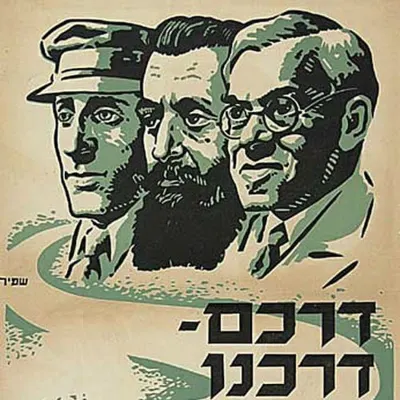
Our good friend Kevin is back to help use trace the roots of Zionism as an ideology and the various religious, cultural, and "socialist" strands that existed before 1948.
Hosted by Russian Sam, Halal Sam, and Kevin.
Transcript
Welcome back, Kevin
All right, and we're back with another episode of Gladio Free Europe. I'm Halal Sam, and I'm joined by Russian Sam.
Hey, hey.
And Kevin.
Hello.
Returning guest, Kevin.
Great to be returning.
We are talking about Zionism, and specifically the roots of Zionism and its history as an ideology, the history of Zionist thought and the Zionist movement. And we're going to trace the history of Zionism from the beginning, before Herzl, actually. The beginning of the idea of Jewish nationalism. And we're going to go from there. And that's why we have Kevin with us because he knows quite a bit about this topic.
Nationalism and the Jews
In order to start with Zionism, you have to start with the birth of nationalism. Nationalism, as we know it today, is not an ancient phenomenon, as most of you probably know. It's very new. It has its roots in the 19th century, especially in Europe. This was the beginning of people from, I don't know, Bavaria and Saxony thinking of themselves as the same people. You know, in terms of its impact on the Jews, there were Jewish communities all over Europe at the time, millions of Jews, but the biggest Jewish communities were in Eastern Europe, which wasn't as affected by these kinds of Western European political currents, or they weren't affected in the same way.
Not yet, anyway.
Not yet. It arrives slower and later, but for many Jews, this meant the beginning of political emancipation. Until the time, in times of the ancient regime, Jews were people living in the margins of society. And I know we're going to discuss the way the Jews in Europe lived, but it's interesting how nationalism created a bit of a paradox. On one hand, it became the vehicle through which Jews were able to integrate into political life, and they were no longer quotas. They became citizens just by virtue of living there, which was something that was deprived for them previously. But at the same time, this idea of a common origin as the basis for political life also made many of them feel apart. If, you know, Italians, which was a new thing, all descended from ancient Romans, so what's the place for these Jews who arrived maybe two, three, ten generations ago, but have no connection with ancient Romans?
Many Jews also lived in sort of the crossroads of ancient cultures. So in places like Warsaw or, you know, the border between Poland and Russia or Russia and other countries around, Jews had to sort of align themselves with some kind of national narrative. And this became a bit of a paradox for Jews. And also this beginning of modern anti-Semitism, a lot of political and cultural movements saying, you know, we are a nation and these Jews do not belong to our nation. And the fact that we've given them political rights is a bit of a threat to our nation because they will align to with our enemies whenever there's a war or some kind of problem with our neighbors.
Yeah, there's this idea of, among some people, of anti-Semitism, as we think of it today, as being this eternal, unchanging constant of Jews always being the other and always outcast. But that's not really the case. What we think of modern anti-Semitism really does have its roots right around here at this point in time and in Europe. This was very much a land-based nationalism. The people who live on the land, so for example, the Germans or the Slavs, are the rightful owners of the land, and therefore all Germans should live under a German government. All Slavs should live under a Russian government. All Italians under an Italian government based in Rome, etc. So, in this context, you can really understand how Jews came to Zionism as an ideology.
Jews in Europe
Yeah, so what was the state of the Jews in Europe at this time?
Not great. It varied a lot. It varied extensively. Europe is a big place with a lot of different, especially in this time, a lot of different governments with a lot of different social structures and systems and economic structures and systems. But in general, there were a lot of places where it was just not very good to be a Jew. And it was in some places only getting worse, especially in the East.
The Haskalah
In order for Zionism to become a feasible ideology for people, you first need to have a certain background understanding. And in this case, this meant that the Jews needed to acquire an understanding of the way that politics worked in the Gentile context. And this was to a large extent fulfilled during the Haskalah, the so-called Jewish Enlightenment movement, which saw a revival of literary Hebrew across Europe by these figures called Maskilim. Of course, this also involved a lot of translation from European languages into Hebrew. So suddenly you had a larger audience for these texts and for these ideas, which were percolating through European societies. And so naturally, they also made their way into the Jewish community.
Yeah, so Jews weren't really a people who worked the land for various historic reasons. Jews were often employed as merchants who would go from place to place, beer brewers, moneylenders to the court doing the kind of work that Catholics were unable to do, things of that nature, just not working the land, which really set Jews apart at this time. And would later become a very important topic in Zionism. And over time, as Kevin mentioned, you had the emancipation of the Jews of Europe, the creation of a secular citizenship. And this idea started in revolutionary France. And by the 1860s, 1870s, most of Western and Central Europe gave Jews equal rights to their Gentile counterparts. But this was not at all the case in the East, in the territory of the Russian Empire.
Yeah, I would add that the Haskalah, the Enlightenment, was obviously a Jewish reflection on the ideas that were circulating around Europe: the idea of a secular state, you know, civil rights and stuff. But the cultural and political environment in which these different Jewish communities lived really set the tone for the type of enlightenment that Jews were going after. So in Western Europe, places like Germany, where Jews received political rights, the challenge was how do we adapt Jewish tradition into something that can be easily integrated into Europe? How do we redefine our practices and the way that we see our Jewishness? So for example, Jews started dressing the same way as the society around them, started eating the same way. They started adapting their prayers and introducing, you know, the languages German, French, and less Hebrew. But in Eastern Europe, where there was no possibility of political integration, then the Haskalah took a very different tone.
There it had to do with how do we define Jewish peoplehood or nationhood? They started reviving the Hebrew language and writing more secular literature in Hebrew because there was no possibility of integration. So there it took a much more national tone that really set the stage for the type of acceptance that Zionism was going to have in Eastern Europe. It became a sort of a platform for the challenges that many Jews started formulating around the 19th century.
The old Yishuv
So a shocker, there were already Jews in Palestine before the beginning of Zionism as we know it today, as we think of it, and before the major migrations of mostly European Jews to Palestine. They were later called the old Yishuv as opposed to the new Yishuv, the new migrants. They were mostly concentrated in a few cities, Jerusalem, Tiberias, Hebron, places like that. They're mostly Sephardic, but you also had some Ashkenazi migrants. For example, former president of Israel, Reuven Rivlin, I'm probably butchering that. His family were from the old Yishuv. They were Ashkenazi who had been there since the 18th century, probably. But they weren't active in agriculture. They mostly subsisted on donations and community funds. They certainly weren't Zionists because Zionism didn't exist yet. They were not there as part of an ideological project. That would begin with Zionism and with the migrations to Palestine.
A letter from the Cairo Geniza
Yeah, but of course Jews settled in Palestine largely due to religious beliefs about the fact that to die in Palestine would mean that they would be the first to be resurrected when the Messiah returns. Generally, they would move there when they were older, just basically moving there to die. One colorful example of this comes to us from the Cairo Geniza, which is a collection of documents that were unable to be destroyed because they contained the name of God.
Yeah, in case anyone doesn't know, you can't destroy a piece of paper if it has the name of God on it, if you're a believing Jew.
And in this Cairo Geniza, we find the oldest letter written in Yiddish that we know of from the mid-1560s.
Yeah, Kevin, do you want to read this letter?
My dear son, may you live and be well. I am very sick. God Almighty knows what will be my end due to our sins. My dear son, do not be distressed. I also ask the faithful doctor, in other words, God, for you not to be sick, for me to suffer instead of you. And I also ask that he not let me die until I see you once again and you place your hand over my eyes and recite Kaddish after me. And so, my dear son, do not be distressed. Live and be well. I do not know where to obtain money from. Poor people have no money. My dear son, bring me a linen garment with you. I do not have, due to our many sins, a sheet on my bed or a cover for my pillow. If I was, God forbid, to die, I would not have a sheet to be covered in when they remove me from my bed.
I am ashamed before other people. I do not have a turban for my shrouds to put on my head. If you are able to buy me one there cheaply, do so. And bring barley with you. I cannot find any here at all. Bring two.
Jewish mothers are the same as they've ever been.
That's a very depressing letter.
Joseph Nasi and Napoleon
Yeah, so before you had Zionism as a formal political movement, you had actually several attempts to bring large numbers of Jews to live in the territory of Palestine. One particularly famous example is the case of Joseph Nasi. He was born into a prominent Portuguese crypto-Jewish family, Marranos, and he left Portugal in 1546 to escape the Inquisition. And he was able to make his way into the Ottoman Empire and to integrate himself into the court and to become a valued diplomat and advisor. And he hoped to create a Jewish province within the Ottoman Empire. Based on his experiences as an exile, he wanted to create a haven for Jews. But the plan fell through because of a number of wars, lack of economic feasibility. And then a bit later in 1799, you had a much more colonial venture with the case of Napoleon, who at the time he had landed in Egypt a couple of years before that and he was attempting to capture the Levant.
He wasn't able to take Palestine, but he did make an interesting proclamation in 1799 as he was trying to take the city of Acre. Bonaparte has published a proclamation in which he invites all the Jews of Asia and Africa to gather under his flag in order to reestablish ancient Jerusalem. He was already given arms to a great number, and their battalions threaten Aleppo. This is from the Gazette Nationale in 1799.
And really, the question is: can these examples from Nasi and Bonaparte's attempt to reestablish Jerusalem, however credible that attempt is, be called, can they be called Zionist? I would argue no, for the simple reason that there wasn't a political identity dimension to this very much. There wasn't a project of building a state, especially with Nasi, at least, to the same degree there was with Zionism as we think of it today. Napoleon's is certainly closer, for sure.
Yeah, but even there, Napoleon wasn't exactly envisioning a sort of independent Jewish state. He wanted to do what he was doing everywhere, where he just set up a state led by a bunch of guys who were loyal to him and who he could count on.
Yeah, it was basically, a Jewish cisalpine Republic.
I would say Nasi's example is clearly not a Zionist example. I mean, throughout the times, there were different movements within the Jewish communities to settle Jews in the land of Israel. Most of them were Messianic. Most of them thought, you know, the Messiah is about to come. Let's greet him and be there in person so that we can be the first Jews to actually receive the end of days or whatever. Some had to do more with freedom from persecution, which is clearly Nasi's example. But it's obvious that Zionism as a concept had not been coined. That happened in the late 19th century. But also, it's an imperial plan. And there were several throughout later in the 19th century where people were thinking, you know, we have this Jewish question, we have the Eastern question, which is the Ottoman Empire is crumbling before our eyes. How can we take the two and do something that is beneficial to our position as an imperial power, which is what Napoleon is doing.
Exactly. An example of this would be like what happened with the Maronites on Mount Lebanon. They got a kind of a little bit of their own semi-autonomous province with some European protection. And the idea was essentially to do more stuff like that. The Ottoman Empire is weakening. We could use these Jews. We could use this.
Absolutely. How can we take this confrontation between different minorities in the region to our favor?
Exactly, which is something that empires still do to this day, obviously.
The Eastern question
So we're in the 19th century, and the 19th century is a period of very important political change in Europe, in the Middle East, in North Africa. One of these changes has to do with the status of the Ottoman Empire, which used to be a huge extension of land. But throughout the 19th century, imperial European powers started sort of chewing away the Ottoman Empire and taking away different strategic pieces of land, places like Algeria, Libya, Egypt, and more. Europe is starting to prophesize that the Ottoman Empire is approaching its end. They see the Ottoman Empire as the sick man of Europe. Remember that the Ottoman Empire also included a piece of Europe in the time of its greater extension. It included Greece, it included the Balkans, not just the piece that Turkey now has in Europe.
Bulgaria, Serbia, etc.
Bulgaria, exactly. And these European, mostly Christian lands of the Ottoman Empire, started having a lot of these nationalist movements claiming for independence and actually achieving it mostly through the support of Eastern powers who saw that it was beneficial to use this nationalism to debilitate the Ottoman Empire. Europe is starting to talk about the sickness and the possible demise of the Ottoman Empire, and everybody's starting to, you know, sort of grind their teeth talking about the bounty that is about to come if the Ottoman Empire falls.
And the potential chaos if someone, if the wrong person gets the wrong thing, like, say, if Russia gets, you know, the if Russia gets Istanbul.
Exactly. If Russia finally gets access to the Mediterranean Sea. It's so interesting for Europe that by the late 19th century, if we're talking about Palestine, all the major European powers and the United States established their own consulates in Jerusalem. And it wasn't just the consulates. They also started establishing religious orders, which were extensions of imperial presence. Everybody's talking about the future of these lands. And in the Protestant Anglo world, there's a lot of interest in what's going to happen to the Jews of Palestine. They started envisioning the possibility of a Jewish state, which would serve as a sort of a buffer between the Turks and the Egyptians, and would enhance British influence in the Levant. And there's also religious interest in this. A lot of Protestant religious movements thought that the return of the Jews to Palestine would also serve to bring about the second coming of Jesus.
There's a great novel named Daniel Deronda by George Eliot in 1976, sorry, 1876, which is a novel with a specific Zionist program long before there was a word such as Zionism, long before there was a man named Theodor Herzl writing about these things. And this is part of the cultural milieu in which Zionism comes about in the Jewish communities. There's a discussion outside of the Jewish communities about, you know, can we use the Jews by the time the Ottoman Empire crumbles?
Exactly. Exactly.
Oh, and also, obviously, there are still quite a few Christians who believe that the Jewish presence in the Holy Land will hasten the coming of the Messiah.
Yeah, and there was very much an angle of inter-imperial rivalry to this in that a lot of these territories were acquired or put under the protection of the British or the French because they thought if they don't do it, then the other side is going to do it. And then that would be harmful to their own geopolitical interests.
Exactly. Exactly.
Proto-Zionism
It was around this time that you saw proto-Zionism begin to emerge as really a coherent mode of thought. And it's likely that the first thinker to attempt to do this was a man named Yehuda Bibas. He was born in Gibraltar, but he was from a prominent Moroccan rabbinical family. In 1832, he took up the position of rabbi on the island of Corfu. Inspired by the Italian Risorgimento and the Greek uprising against the Turks, Bibas broke with the traditional quietist stance of waiting for the redemption and advocated the return of Jews to resettle their ancestral lands to wrestle it by force if necessary. The most original element in his theology was his reinterpretation of the spiritual notion of teshuva, repentance, to its literal meaning, return. That is, that Israel's redemption is not dependent exclusively on its return to God, but upon its physical return to the Holy Land.
And also, Bibas wasn't really much of a writer per se. He would get his message out mostly in sermons and lectures. So the person who would really come to popularize these ideas was a man named Yehuda ben Alkalai, who was a rabbi in Belgrade and a student of Bibas. But he actually wrote unlike Bibas. He was a relatively prolific writer and he promoted his ideas far and wide.
Fun fact, Herzl's grandfather was a follower of Alkalai and attended his synagogue.
Yeah, in Zemun, also called Semlin, a town in Serbia. But Alkalai was a bit different from Bibas in that he was much more theologically grounded, whereas Bibas got inspiration from unrest in Greece and the Risorgimento in Italy. Alkalai based his understanding on theological grounds. Here's an excerpt from one of his lectures. Israel's redemption will be brought about by kings on earth, for salvation is the Lord's alone, and he will cause it to be realized by human beings, just as he caused salvation from the exile in Babylonia to be brought about by Cyrus. And the future will cause Israel's redemption to be brought about by the kings of the Gentiles, for the Lord will awaken their spirit to let them go. For the leaders of Israel will establish an opening like the eye of a needle, and the Holy One, blessed be he, will make that opening as broad as the entrance to a hall, and will incline their hearts to do their behests.
So, I think there's something interesting about Alkalai and the people in the 19th century. So, there's this old Talmudic excerpt that says that Jews will not resettle the land of Israel en masse until God requires it so. It's called the three vows. The idea is that the exile had been imposed on the Jews due to divine punishment, and it was only through a divine decision that the exile of the Jews and their dispersion among different nations would end. Alkalai is sort of the beginning of a breakaway from that notion. He still talks about redemption as something stemming from divine decision. So, the Jews would only reunite in the land of Israel when God wanted it so. But he's also saying, you know, there will be human decisions behind that return, which will come about as a result of God's decision to end the exile. It wouldn't be long until more secular-minded Jewish leaders and intellectuals would say, No, this return to the land of Israel will be purely done by human hands, and we no longer have to wait for God to decide when the Jews return, which is obviously a result of secularization in Jewish life and in European life.
Kalischer and Hess
And meanwhile, in Prussia, modern-day Poland, there was a rabbi named Zvi Kalischer who in the 1830s and 1840s came to these sort of proto-Zionist ideas on his own. So, really, this goes to show that this was part of the zeitgeist. There was something in the air that was allowing these people to think these thoughts, which in prior eras wouldn't have been practical. But in terms of more secular promoters of proto-Zionism, you had a man named Moses Hess, and he was an early socialist thinker. He was good friends with Marx and Engels for a little while.
Well, up to a point.
Yeah, Hess was a correspondent for the Neue Rheinische Zeitung, which is, of course, the newspaper where Marx worked as an editor. But he would ultimately come to break with Marx and Engels on theoretical grounds. He thought that they were overemphasizing the role of class conflict in history. He thought that racial conflict was, in fact, the primary engine of history. And in 1862, he wrote a book called Rome and Jerusalem, which was really the first book-length defense of an idea that would become Zionism.
And how do you guys think that book did?
I'm going to guess it sold under a thousand copies.
Worse. It sold 160 copies, and Hess actually had to buy the unsold copies back from the publisher at a reduced price to recuperate the loss of having printed this book that nobody wanted to touch.
Great job. Great job, dude.
Just a long line of angry Jews shouting into the void.
That's our history, baby.
Pogroms and Hovevei Zion
But now we get into the actual formation of Zionism that is calling itself Zionism as a self-conscious political movement. So, Zionism as a mass movement really began to gain steam in the Russian Empire starting from 1881, when you had a massive rupture in terms of anti-Semitic pogroms all across the Russian Empire because Tsar Alexander II had been killed by the Narodniks, and one of the people implicated in the plot was of Jewish descent. So, this really gave people an excuse to go ham. And they did. And it was incredibly violent. Like, really, the Jewish American community, to a large extent, can trace its roots to this event. This is really the thing that brought Jews en masse to emigrate, be it to the United States or to South America or to Western Europe. And also at this time, you had people thinking about the Jewish question, and you had a man named Leon Pinsker who would write this pamphlet called Auto-Emancipation, where he basically argued for Jews to settle in Palestine.
And he would go on to form this organization called Hovevei Zion, the Lovers of Zion, which, with the backing of the Rothschilds, would set up a couple of settlements in Palestine.
Yeah, you know, the title is not a coincidence. You know, emancipation was the name given to the process in which Jews in Central and Western Europe had received political rights and had become citizens. That had not happened in Eastern Europe. But what Pinsker was saying is our struggle is not for emancipation. It's not for somebody from the outside to say, okay, you are Russian citizens, because then we will always be second-class citizens. Real liberation will not come from the outside in. What we have to fight for is auto-emancipation to become our own independent nation and become full citizens in a place that is governed by ourselves, by Jews. So it's really a modern formulation of Jewish nationalism. And it was a message that started igniting the consciousness of Russian Jews who are desperately trying to escape persecution and find some narrative that would bring them hope in the middle of all this chaos and destruction.
Exactly. Yeah. And the Hovevei Zion weren't very successful. They did set up a number of ventures in Palestine. They were all agricultural. They were trying to do plantation-style labor where you had these Jewish overseers with Arab laborers, but they weren't able to make it profitable.
Yeah, their settlements were heavily, heavily dependent on the donations given by Jewish philanthropists who were really the ones responsible for making them sustainable because they weren't profitable, the settlements. These philanthropists would finance the settlers' way of life and would also buy the produce that was coming out of these settlements.
Yeah, and agriculture and the idea of Jews in agriculture would become very important in Zionism as time went on.
Although still dependent on Arab labor for many things.
The Hebrew revival
But let's talk about another aspect of Zionism at this time, the Hebrew revival. So it's important to note that at this point, Jews mostly spoke, depending on how assimilated you were, either the language of your surrounding country or some local dialect of it or Jewish language. For example, Yiddish in Central Europe, Ladino among some of the Sephardim, Judeo-Arabic, if such a thing exists, I know. Essentially, you have this problem of if you settle all these Jews in Palestine from places as different as Lithuania, Germany, France, Yemen, Egypt, etc., if you settle them all in one place, how do they communicate with each other? Well, the revival of Hebrew as a spoken day-to-day language is probably the biggest achievement of the Zionist movement because there is no other movement that has revived a completely dead language. Like, you can talk about Irish or Welsh or other language revivals that have brought languages back that were not dead but were in decline.
But Hebrew was not a spoken language. This would be like reviving Latin or Sanskrit as spoken languages. And the guy who did it was an eccentric man named Eliezer Ben-Yehuda, who was from, I believe, Vilna in the Russian Empire. And his parents wanted him to be a rabbi, but he was pretty secular. He ended up moving to Jerusalem in 1881 and made his son, in a rather cruel experiment, actually, the first native Hebrew speaker, the first monolingual native Hebrew speaker. His son was actually not allowed to play with any children or anyone who was not speaking Hebrew to him because he wanted his son to be a pure Hebrew speaker. So the son's only friend for a while was just a dog, which definitely says something about both his dedication to the project and also about his skills as a parent and tolerance for child abuse.
Also, nobody mentions this, but thanks to Ben-Yehuda that we have not just the first Hebrew native speaker child, but also the first Hebrew native speaker dog, because everybody talked to this dog in Hebrew. It's interesting because Ben-Yehuda, he realized that Hebrew had to be modernized, which meant that grammar had to be simplified in order to become a language that would be taught to millions. But also, he needed thousands of new words because they had never used words for radio, television, cinema, the train, or whatever.
Agricultural and military terms, especially.
Absolutely. And the way to realize, you know, what words are necessary is let's just use it in everyday conversation. And whenever we need a word that we don't know how to use, we'll just invent one. So they would use old Hebrew sources to invent new words. Other languages in the region, especially old languages like Aramaic, like Sumerian. He had this great command of Jewish religious sources and also ancient languages, which is where he took many of the ideas for new words that he created. And he created new newspapers and a dictionary in order to popularize many of these words. Even though he invented thousands of words that never became popular, and then Israelis just used foreign words like radio and televisia for television, but he created actual Hebrew words for all of these concepts.
Can you talk about his attitude towards swearing also?
Yeah, he was very conservative. So he included no swear words in modern Hebrew. And today, Israelis have to use Arabic in order to, you know, transmit when they're pissed off.
Yeah, that's why Israelis love to use like Kusemek or bin Sharmuta or stuff like that.
Yeah, what did you say about my mother?
Nothing.
Yeah, and there's also a reason why Hebrew didn't have any swear words. Namely, it wasn't a spoken language. It was categorically not supposed to be a spoken language at that point. It's a holy language. It would be like using ecclesiastical Latin to talk about your trip to the movies.
Yeah, in fact, the old religious establishment in the Jewish community of Palestine was very much opposed to Zionism because of the whole Talmudic idea.
And to him in particular.
And to him in particular, because he was desecrating, you know, the lashon hakodesh, the Hebrew tongue, and they thought it was sacrilegious, the idea that a Jew would go to the supermarket and just order, you know, toilet paper in Hebrew. That's the language that they use to communicate with God. That's the language that you use to read ancient religious sources. That's not the language in which you pick up women.
And also, because another thing to note is because a lot of these speakers were native speakers of Yiddish or Russian or other languages like that, the pronunciation was not quite what Ben Yehuda intended. I believe he intended to base it off of the Sephardi dialects, but the pronunciation ended up being a lot more Ashkenazi.
Not entirely. Like Israelis will say Shabbat instead of Shabbos. But they still merged ha with yeah, yeah, the Hebrew alphabet is full of letters that sound the same because they just decided to discard a bunch of them.
Yeah, Kuf and Kaf.
But yeah, this revival of Hebrew is really probably the biggest achievement of the Zionist project. You have entire generations of people who are native Hebrew speakers, native speakers of this language that was not supposed to be a spoken language. And that really does is a testament to the power of this ideology and the power of nationalism in general. Because Zionism is a very good study of nationalism, a very extreme and destructive and frankly awful example of it. But it is a good example to look at.
Yeah, thanks to the modern political movement of Zionism, which was organized and eventually rallied behind Ben-Yehuda's concept of reviving the Hebrew tongue. Only about 40 years after Ben-Yehuda settled in Palestine and started his work with the Hebrew language, the British actually recognized Hebrew as one of the official languages of the British Mandate for Palestine, which is a very short period for such an incredible achievement.
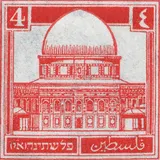
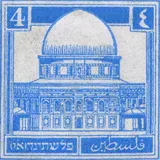
Yeah, if you look at coins and banknotes from the Mandate, they have Arabic and Hebrew on them, which is pretty ridiculous considering the vast majority of people in the British Mandate of Palestine were not Hebrew speakers. They were mostly Arabs. Hebrew was a minority language and a very new one at that. And not even the first language of most of these Jews.
Yeah, but nevertheless, there was very strong pressure if you were a Jew to actually speak Hebrew. Like you actually had young adults going around on the streets and giving people trouble if they spoke Yiddish or another non-Hebrew language.
Exactly. They were very committed to this ideological and political project. Hebrew became one of the central elements of Zionist thought, which is very strange considering that it was absolutely foreign to Theodore Herzl's thought, for example, who thought that it was ridiculous to talk about reviving the Hebrew language. He said famously, Can anybody imagine buying a train ticket in Hebrew? The whole idea was ridiculous for him because there was no Hebrew word for train or for ticket.
Yeah, he wanted Israel to be German-speaking.
Disgusting.
Because that was the language of the culture Jews like Herzl himself.
Yeah, but still disgusting.
I mean, it does fit the profile of a country that does ethnic cleansing.
Theodor Herzl
So, okay, we've gotten to the big man himself, the arguably in public concept, started all this mess, Herzl.
Say what you will about the man, but he had a great beard.
He did, he did.
Kevin, could you tell us a bit about Herzl and his career?
Sure. Theodor Herzl was a Hungarian-born upper-middle-class or upper-class Jew. He was a lawyer by training, but he really worked as a journalist and playwright. He was a sort of a bon vivant for his time and was considered generally to be an assimilated Jew in the sense that he was integrated in, you know, a cultural, intellectual, economic elite in Europe. And Jewishness was not always a major factor in his life. Now, at one point, the traditional narrative goes towards the end of the 19th century, Herzl is awakened. It was always part of his thought, and being Jewish had influenced different aspects of his life, but is awakened by the actual threat of anti-Semitism, both by what is happening in Eastern Europe, the pogroms, and what is happening in Western Europe, which is the political emancipation that met cultural resistance in the form of modern anti-Semitism. And Herzl comes to the conclusion, which he writes in his 1896 book, The Jewish State, which is sort of a political manifesto, that integration would not be entirely possible in Europe, and the Jews needed a state of their own to serve as a refuge.
So Herzl is not really inventing the wheel here. There's already a political movement in Zionism. There's already the first settlements by the Hovevei Zion in Palestine. What Herzl did, and which is very innovative and that is seen as a key element in Zionist history, which is why Israelis consider him Hozeh HaMedinah, the visionary of the state, is on one hand, give the Zionist movement a diplomatic leg. Until that point, Zionism had devoted itself to settling the land, to trying to gain support from philanthropists, to reviving the Hebrew language. Herzl says, you know, that's all very good, but unless we have political support from the major world powers, this is all going to be for nothing. So he sets out to meet with the major political leaders of his time: the Ottoman Sultan, the Pope, the German Kaiser. He's meeting all these people and saying, you know, the vast majority of Jews in the world are behind me, which is completely false.
Zionism during Herzl's lifetime and for a long time after Herzl was a marginal movement within the Jewish people.
Except in Eastern Europe.
Well, yeah, in Eastern Europe, it's bigger, but it's still a minority if you compare it with the Bund, for example, a movement that came to be in the same time as Zionism. This was the Jewish Socialist League of Russia, Poland, and Lithuania, which was much bigger in Herzl's lifetime. And they were going for a cultural self-determination within the Russian Empire to be recognized as a nationality within the Russian Empire. Herzl was saying, I have all the support behind me, and the most rich people, the richest Jews in Europe, are behind me. So they can give you financial support if you support my movement.
The Zionist Congress
This was a big bluff. Now, the second innovation that Herzl brings is: let's bring everyone together, which is why he launches a Congress in Switzerland, in Basel, called the Zionist Congress. And they do periodic meetings and they found the Zionist organization, which would serve as an umbrella organization for different local institutions with different ideologies, different platforms, and they would all come together under the shared goal of establishing a Jewish state. Now, there were many things in this umbrella organization that would be very contentious. One of them was: where are we going to build this state? What are going to be the characteristics of the state? Is there going to be a place for a religious Jewish life in the state? Or is it going to be a secular Jewish state? Herzl, in this regard, was a classic European liberal. He thought the Jewish state would be Jewish because there would be a Jewish demographic majority, but he didn't really feel that religion had to serve a public role, which is very different from the Israel that we see today.
Yeah, kind of like what we saw with Pakistan, honestly.
Absolutely, absolutely. The idea of secular nationalism eventually being taken over, at least partly, because in many regards, I mean, Israel is not a theocracy, but it is, you know, a country where religious laws have their influence.
Yeah, I mean, marriage takes place in a religious institution there. That's why there is no gay marriage in Israel. You have to go to Cyprus or something.
If you want to get married, you go to your synagogue or to a church or to a mosque. Much like in neighboring Lebanon or Syria. Really, Israel is less secular than some of its neighbors.
Most obviously, Turkey.
I would argue is a more secular country.
I would say, at least, you know, Turkey 20 years ago, that would be...
At least on paper.
Yeah, on paper for sure.
Israel, as I say, is far less secular than the United States, for example.
I would agree. It is not exactly what he envisioned.
And also, it's not German-speaking, like he envisioned.
Herzl was very much of his time and class and place. That is, a German-speaking, fairly assimilated Central European Jew.
Absolutely. And Herzl, even though he didn't really have a lot of diplomatic success, his main innovation was to establish an infrastructure for a movement that would go on without him. He actually dies very young. He had a heart problem and he died in relative poverty because he had used so much of his money to keep the Zionist organization alive. So in 1904, at the age of 44, Herzl dies. But there's already a Zionist movement with the Zionist organizations and a growing settlement movement. And all these political streams of Zionism, even though many of them are diametrically opposed in terms of political goals, they set their differences aside because they place their common goal of establishing a Jewish state and obtaining political support for a Jewish state above all these differences. That is Herzl's main contribution to Zionism, even though he really saw no success during his lifetime in terms of coming closer to that goal.
Argentina and Uganda
I think we should also mention he wasn't, he was not dead set on Palestine as a destination for Jewish colonization. He also considered Argentina. The British gave him an offer to set up a Jewish state in Uganda that was very contentious, with a lot of people saying, Yes, let's take Uganda, let's create our state there. It's not perfect, but at least it'll give Eastern European Jews fleeing pogroms a place to go to versus the people who were dead set on Palestine as the historic home of the Jewish people, especially the religious Zionists.
You know, because I think that region in general at the time was considered Uganda, the Uganda plan was actually in Kenya. So the idea of not exactly having to be Palestine as the destination, the place for the Jewish state, actually comes from Herzl himself in the Jewish state, which he wrote before the Zionist Congress. In 1896, he says, you know, there's really no difference. If it's Palestine, all the better, because that's the land of our forefathers, and that's going to be very inspiring for many Jews, and it's going to be great for the movement. But if it's not possible because the Ottoman Sultan doesn't agree with their goal and we can't achieve it, then we can also settle for Argentina, which is my country. Why Argentina? Because there was already a Jewish community, because it was a poor country, because it had very low population density, particularly in the south, in Patagonia.
Especially after the genocides there.
Exactly, exactly. The Native Americans in the south of Argentina had already been mostly ethnically cleansed by the Argentinian government. And he felt, you know, we can do a negotiation. There's already Jews there, so it'll be easy to resettle those Jews if they want to to the south of Argentina. Now, Herzl discards the Argentina plan right away, but the Uganda plan, which was actually Kenya, is proposed in a Zionist Congress. And this is where we see the different ideological traditions of Zionism clash in one of the very initial fights. The Russian delegates storm out of the Zionist Congress and they say, you know, it's Palestine or nothing. And in the end, they settle for that idea. It would be Palestine or nothing. And that's where you see that this sort of secular civil nationalism of Herzl eventually gives way to a nationalism that is more traditional, that is more based on language and land and blood that was developing in Eastern Europe.
An openly colonial project
Exactly.
And I want to go back to: you might notice that all of these places, these potential zones for Jewish settlement, have one thing in common: there's already people living there. And that is something that Herzl was quite aware of and quite unashamed of. And the Zionist movement in general, this was not something that people didn't know. There were already people in Palestine. There were already people in Argentina. There were already people in Uganda and Kenya. And Herzl was very much unabashed in calling it a colonial project and thinking of it as such. He wrote letters to Cecil Rhodes, where he would talk about Zionism as something colonial, his words and his admiration for what the British had done.
Imagine Herzl coming back to life and talking to one of those decolonial Zionist weebs.
Herzl's writings were very much proud of this kind of colonial thought. He thought, you know, Europe would naturally identify with the Jews' quest to settle Palestine because that would expand the borders of European civilization in a part of the world that had not been blessed by it. He actually gives the name colonial, talks about a Jewish colonial trust and talks about a sort of natural affinity between the British imperial project and Zionist colonial project. And in his second book, Altneuland, the Old New Land, which he wrote in 1902, two years before his death, he actually includes an Arab character who talks about being blessed by the idea of a Jewish state, the fact that he had been able to progress economically and culturally thanks to the Jewish presence in Palestine. It is a very interesting idea that, oh, these people will actually be grateful for our colonization, for us, displacing them and becoming the majority and turning them into a subjugated minority, which is exactly what these people were aiming to escape in Europe.
This thought is hugely influential for Zionism for several decades.
Yeah, it is. Although there are, there was, it was and still is, of course, a school of Zionists who were against that. But let's keep going. Let's talk about the different kinds of Zionism.
Liberal and religious Zionism
Let's just go over liberal Zionism again briefly.
Yeah, so liberal Zionism is basically the Herzlian section of the Zionist organization. It was essentially creating a capitalist state on the European model with the support of the imperial powers. It was not really breaking any major traditions or building something new. It was just taking the pinnacle of civilization like Germany at the end of the 19th century and transplanting it to Palestine.
Yeah, just move this over here.
And don't worry about the people who already live there. They'll love us or we'll just get rid of them and not talk about it very much.
But there's other kinds too. We've talked a bit about religious Zionism and there were of course a lot of Zionists who were not into this idea of a secular European modern state along these lines. There were Zionists who were very much into the idea of, if not a theocracy, then a state where Jewish law is still in force. And I'm going to read a quote from Meir Bar-Ilan's What Kind of Life Should We Build in Eretz Israel. He says, quote, Our people as a whole and our religion in specific are totally different from all others. Among the nations of the world, statecraft is kept separate from religion. Our case is different. Our Torah and traditions are not a man-made constitution, but God's own law. If we say this law is good, this one is not, we negate everything. We cannot have partial acceptance, for this destroys the sanctity of the Torah.
In other words, no, we're different because our religion's right and they're wrong. And this was something that a lot of people, a lot of Zionists, really believed and wanted to emphasize, and part of the reason that they were so opposed to things like settling in Kenya or having a secular modern state.
Yeah, religious Zionism was a minority within the Zionist movement and a minority within the Orthodox world because the majority of the Orthodox world in the time of Herzl had taken a confrontational approach to Zionism. They saw this movement as a movement led by secular Jews to make Jewish people get away from religion and develop a sort of very assimilated concept of what it meant to be Jewish. But this became a growing movement and, well, this is getting, this is skipping a lot of times, but after 1967, religious Zionism becomes really empowered and a very strong discourse in Israeli political life.
Absolutely. Absolutely. And as does revisionist Zionism.
Cultural Zionism
Could you briefly tell us about cultural Zionism and Ahad Ha'am?
Yeah, so very briefly, not all Zionists thought the same way, right? So, we talked about religious Zionists, but most Zionists thought that the idea, the goal, was to establish a Jewish state and get the largest amount of Jews migrating into the Jewish state and establish a new country. Now, Ahad Ha'am, for example, he was a Russian thinker who became a part of the Zionist movement very early on. He wrote around the same time that Herzl was writing his own stuff, but very early he said, you know, this approach that the majority of the Zionists move, this euphoria with which the idea of creating a Jewish state is being discussed is not going to be fruitful. He literally wrote an essay saying this is not the way. And he was saying, you know, this is a very small piece of land. It's already inhabited. He's one of the very early thinkers who says, you know, we have a problem with the majority of the people who are living in the land, with the original inhabitants of the land.
And he's saying, there's no way that we're going to establish the native people. He's saying there's no way that we're going to establish a demographic majority. And even if we do, it's never going to be a substantial amount of Jews, say the majority of Jews around the world. So instead of establishing a Jewish state, what we should do is establish in Palestine a Jewish cultural center, a spiritual center, a place that will revive Jewish life. This is very much inspired by the concept of Haskalah, the idea that Jewish life was stale and needed to be revived, re-envisioned, that the revival of the Hebrew language, for example, had the potential of being a vehicle for a new, prouder, more complete, more fulfilling Jewish life. Essentially, what Ahad Ha'am was saying is: let's not deal with the problem of the Jews, which is their physical safety. Let's deal with the problem of Judaism, an ancient tradition that is withering away because it hasn't adapted to modern life.
So he's talking about the revival of Jewish life, and that revival for him meant that a new spiritual center needed to come about. Some steps had been taken that for him were very positive, such as the revival of the Hebrew language. Later on, there's this university, the first Hebrew university, which is the Hebrew University of Jerusalem, that settles these are ideas that are very inspiring for spiritual or cultural Zionists. But for them, it's very much, it really has to do with culture and less about establishing, you know, Jewish demographic supremacy over the land of Israel.
But yeah, let's move on to Sam.
Labor Zionism
Could you tell us a bit about labor Zionism and socialist Zionism, if such a thing can exist?
Yeah, so labor Zionism was really an attempt to synthesize socialism with Zionism, socialism being a very popular ideology at this period in the Russian Empire. Not just for Jews, but really all across the board. And you really had a lot of different permutations of socialism. So this idea of socialist Zionism would not necessarily be anathema to everybody. And really, in 1901, you had this organization formed called the Poale Zion, the workers of Zion, who had split away from the Jewish Bund, which Kevin had mentioned earlier. Whereas the Bund wanted recognition and cultural autonomy within the Russian Empire, Poale Zion were really much more Zionist-oriented. And of course, one of the founders of Poale Zion, and probably its most interesting thinker, was a man named Ber Borochov. Borochov was a member of the Russian Social Democratic Labor Party, RSDLP, until 1901, when he got expelled on account of his Zionist beliefs.
Because, again, the Orthodox interpretation said that Zionism was a bourgeois ideology which didn't serve any purpose. But Borochov disagreed, and he created his own synthesis between Marxism and Zionism. And you can tell that he was taking some inspiration from Hess here. He said that nation is as much of an engine of history as class, and that the Jews, as a diasporic people, have a very abnormal class structure, a sort of inverted pyramid, quote-unquote, in his words, with a massive overrepresentation in petty bourgeois professions.
And he wasn't wrong, to be honest.
Yeah, in 1897, 74% of Jews in the Russian Empire were working in trade or manufacturing, as compared to 14% of the total population, and only 3% worked in agriculture compared to 74% of the population. So Jews were very much an abnormal case when it came to the nationalities of the Russian Empire. And so Borochov went on to argue that because Jews are not rooted in the land, because they have such different class and professional distribution, capitalist development would take a toll on the Jews because as the majority non-Jewish population develops its own middle class and bourgeoisie, they will be anti-Semites, of course, and they'll refuse to hire Jews. And eventually, the Jewish bourgeoisie will be out-competed as well because there's just so many more of these non-Jewish bourgeoisie running around. And so he believed that having lost the means to make a living, the Jews will undertake a spontaneous migration to Palestine, not out of ideological conviction, but out of necessity.
And they'll build up the productive forces of Palestine. And only once capitalist development is complete can there really be hope for a revolution.
And it's a pretty shitty Marxist analysis. So when Borochov presented his ideas to Lenin in 1914, Lenin had a pretty funny response, which was, you were trying to sit on two chairs at once. The problem is you are not even on the two chairs. You were in this empty space between them.
The Lenin quote is very interesting because one of the Zionist youth movements, there were many youth movements within the Zionist movement that were affiliated with these different ideologies and eventually with the Zionist political parties that came out of these ideologies. One of these was Hashomer Hatzair, which was a Marxist Zionist youth movement very much inspired by the ideas of Borochov and another labor Zionist thinker named Nachman Syrkin. And one of the founders of this movement named Yaakov Hazan, who was also a member of the Israeli parliament eventually, he said, you know, our movement has this tragic contradiction. We cannot be 100% socialist and 100% Zionist because socialism has an internationalist message, whereas Zionism is a national movement.
And a colonialist movement.
Borochov took some time to think it over, and in 1917, he admitted that his synthesis had shortcomings, but he died of tuberculosis before he had a chance to formulate his theory. But nevertheless, Poale Zion would become a major force in Palestine. They would really become the kernel around which the Israeli state would form.
Conquest of labor
They would create the kibbutz movement, which is basically agricultural communes based on a principle of egalitarianism.
But but but there's a caveat here: egalitarianism for the Jews. They believe strongly in something called the conquest of land and the conquest of labor. The conquest of land being, you know, physically settling in a place, and the conquest of labor being the use of Jewish labor to build up the Jewish state, rather than relying on the labor of Palestinians as many previous attempts had unsuccessfully tried to do.
The labor Zionists were trying to create a sort of a working Jew, not the bookish, petty bourgeois Jew of the diaspora, but a man's man who has calluses on his hands and who's sunburnt. I had a professor who referred to the ideal Jew among labor Zionists as a Hebrew-speaking farmer with a gun.
It sounds all well and good when you hear it at first. Sure, what's the problem? Building up your own community through your own labor rather than exploiting the labor of another people. What's the problem with that?
It's built on colonization.
Well, that's part of the problem. The other problem is that this, in practice, meant the intentional exclusion of Palestinians from working in Jewish workplaces. As a result of this, they ultimately got around to creating their own labor union called the Histadrut, which would essentially go to employers and tell them they always have to give priority to Jewish people who are seeking work. If there's a Palestinian worker and there's a Jewish worker, you have to pick the Jewish one. And in practice, this really meant that from the moment that this ideology really took hold, the Zionists became intent on building a society that was parallel to the existing Arab one.
It's very interesting how, under this socialist, very well-intentioned discourse, what essentially came to be was two separate economies. One that began to modernize very quickly, which was the Jewish one, and the other one that became very stale and eventually excluded from the main market, which was the Arab economy of the previous natives of Palestine. And their land was being taken, their resources were being siphoned. The prosperity of one came at the expense of the other.
It's exploitation.
And one of these economies had a major capital coming from abroad, which is what enabled the Zionist movement to purchase more and more territory.
Often from absentee landlords.
Yes, by purchasing land from absentee landlords living mostly in what is today Lebanon and Syria. Eventually, after 1948, this land is just taken away. But during the early part of the 20th century, the land is bought and workers who rented the land to work, Palestinian farmers, are excluded because of this politics of Hebrew labor.
Yeah, and the fellahin just get completely fucked over because they don't own the land. It is owned by the absentee landlords. You just sell it under their feet.
Yeah, in fact, the first episodes of violence between Jews and Arabs in Palestine have to do with this. Workers who refused to be expelled from the land that they worked and lived on.
It turns out that the bunch of foreigners who were colonizing the land did not have the best interests of the people, the native inhabitants, at heart.
I mean, this is really the heartbreaking thing because there were labor Zionists who believed in building an egalitarian socialist society that would encompass both Jews and Palestinian Arabs. But the problem was that the leadership, you know, they understood that they couldn't be 100% socialist and 100% Zionist. And ultimately, the Zionism won out. And these people were left disillusioned. These labor activists who had been sent to organize Palestinian workers working on Palestinian railways, for example, which was one of the few places in mandatory Palestine where Jews and Arabs were working alongside one another, were basically told to cut it out because if you're empowering the Arabs, you are definitionally disempowering the Jews.
There's an interesting discussion inside labor Zionism about, you know, what's going to be the role of socialism. Eventually, the most dominant strand of labor Zionism, the one that Ben-Gurion, and most of the Israeli political leaders in the early days belong to, they put themselves behind this idea of constructivism, which is our main goal is to establish a Jewish state, then we can talk about class struggle, then we can talk about socialism. But they really used socialism as a vehicle through which to create a Jewish state. So it was obvious that in order to organize the settlement of Jewish workers, Jewish communal settlements, which also had a very productive role in establishing a Jewish economy, socialism was a great tool for that. But it was mostly that. It was always in a second place after the main goal of labor Zionism, which is Jewish nationalism. Let's establish a Jewish state, no matter what the cost.
Exactly. I think it's a pretty good summation.
Revisionist Zionism
So let's get into revisionist Zionism. Kevin, can you tell us a bit about Ze'ev Jabotinsky?
Yeah, sure. So Jabotinsky is the intellectual founder of this stream of Zionism called revisionist Zionism. It was called revisionism because at the time it was quite oppositional to the mainstream Zionism, first of Herzl and then labor Zionism. And the opposition took many forms. One of them had to do with the way that mainstream Zionism approached Palestinians. So as you guys said, Zionism had this kind of very condescending way of talking about Palestinians in the sense that it would eventually embrace Zionism and they would eventually benefit, materially benefit from the economic progress and the civilizational work that Zionism was going to do in Palestine. Jabotinsky sees this as very innocent, as very naive. He says they will never embrace us. He says Arabs at the time, he never talked about Palestinians. They have a national dignity that makes them naturally oppose any movement that wants to settle and eventually take away their land.
He says, let's be honest, this is what we're doing. So the whole strategy that Jabotinsky lays out is the idea that Zionism had to be a very forceful movement. It had to have a powerful army. Zionist settlers had to be very good at handling weapons and be very skilled soldiers. And that the Zionist, the Jewish state had to be built, that eventually Palestinians would have to accept it with reticence, begrudgingly, by accepting the idea that it was undefeatable. This idea of Jabotinsky, he called it the Iron Wall.
That's how he titled the article.
Exactly. The Iron Wall.
It's the name of an essay that he wrote, originally in Russian, in 1923. And I would like to read a bit from it because it's very blunt.
The Iron Wall
It lays out what he believes: The Iron Wall. I am reputed to be an enemy of the Arabs, who wants to have them ejected from Palestine, and so forth. It is not true. Emotionally, my attitude to the Arabs is the same as all other nations. Polite indifference. Politically, my attitude is determined by two principles. First of all, I consider it utterly impossible to eject the Arabs from Palestine. There will always be two nations in Palestine, which is good enough for me provided the Jews become the majority. There can be no voluntary agreement between ourselves and the Palestinian Arabs. Not now, nor in the prospective future. I say this with such conviction, not because I want to hurt the moderate Zionists. I do not believe they will be hurt, except for those who are born blind. They realized long ago that it is utterly impossible to obtain the voluntary consent of the Palestinian Arabs for converting Palestine from an Arab country into a country with a Jewish majority.
I find it interesting that Jabotinsky has the reputation that he has as being the founder of the most hard-line wing of Zionism and the most violent one. And then he just opens this essay with, yeah, the Arabs are here. There's nothing we can do about that. Like, like, Labor would actually go on to do the impossible in his conception.
So basically, Labor were the better Zionists.
Yeah, no, they did the ethnic cleansing. They expelled 700,000, at least, Palestinians in 1948.
Let's also be honest, Jabotinsky was more than willing to perform violent acts on Palestinians. It's just that I think he's actually referring to them with dignity. The whole idea of, you know, Palestinians will eventually accept us because they'll be better off with us than they were before is very condescending and he's actually showing the true face of what Zionism would eventually do. At the time, he received condemnation. That's the reputation that he's talking about in the beginning of the essay. Ben-Gurion, who very quickly became the leader of the Yishuv and eventually the Prime Minister of Israel, referred to Jabotinsky as Vladimir Hitler because his original Russian name was Vladimir. He eventually changes it to Zev. But we're talking about a leader who's saying, you know, our goal will have a very clear human cost, and Palestinians are not blind to it. So the sooner we accept it and the sooner we prepare ourselves for what is obviously going to be a war between Jews and Arabs, then the better off we're going to come out of it.
So it's more prophetical than anything that we found written by Herzl or any of the early Zionists, but of course, it's not very nice to hear.
The thing he was wrong about, of course, was that it would be impossible to ethnically cleanse the Palestinians. They, of course, didn't ethically cleanse all of them, but they ethnically cleansed the majority of them, enough so that Israel became a Jewish state after 1948.
I mean, here's a startling statistic. Like, so everyone knows that in 1948, the UN partitioned Palestine into a Jewish-majority state and an Arab-majority state. Does anyone want to guess what percentage of the population's Arabs were in the so-called Jewish state?
I'm going to guess 60%.
45.
They were a minority, but like very slightly a minority. Like, given the status quo, within a couple of years, it still would have become an Arab-majority state. A Jewish state that's actually majority, Arab, Muslim, and Christian.
And of course, famously, the Labor Zionists didn't intend to respect the partition forever anyway. It was, as Ben-Gurion said, it was a starting point to go further.
Here's an interesting snippet of Jabotinsky's biography, which I think is enlightening and also helps us understand why he was perceived that way. Jabotinsky had fought in World War I. He had established a Jewish force within the British Army to fight against the Ottomans. He had also spent some time in Italy and had developed a very honest admiration for Mussolini. And between that and his sort of infatuation with military life, it was very clear to see in Jabotinsky's thought the signs of a fascist movement, or at least a movement that admired and took many things from fascism. This whole infatuation with military life, this love with discipline. He founds a youth movement called Beitar, which is modeled after a Zionist militant who had died fighting Palestinians in the Battle of Tel Hai. And they adore discipline. They wear military uniforms and they're much more militaristic than any other Zionist youth movement at the time.
This would also not be the last time that Zionist movements aligned with fascism. The obvious example being the Lehi.
Lechi.
Oy gevalt.
More of the Iron Wall
Back to the Iron Wall, because this quote: We cannot offer any adequate compensation to the Palestinian Arabs in return for Palestine, and therefore there is no likelihood of any voluntary agreement being reached. So that all those who regard such an agreement as a condition sine qua non for Zionism may as well say no and withdraw from Zionism. Zionist colonization must either stop or else proceed regardless of the native population, which means that it can proceed and develop only under the protection of a power that is independent of the native population, behind an iron wall with which the native population cannot breach. My readers have a general idea of the history of colonization in other countries. I suggest that they consider all the precedents with which they are acquainted and see whether there is one solitary instance of any colonization being carried on with the consent of the native population.
There is no such precedent. The native populations, civilized or uncivilized, have always stubbornly resisted the colonists, irrespective of whether they were civilized or savage. It made no difference whether the colonists behaved decently or not. The native population fought with the same ferocity against the good colonists as against the bad. Every native population, civilized or not, regards its land as its national home, of which it is the sole master, and it wants to retain that mastery always. It will refuse to admit not only new masters, but even new partners or collaborators.
Well, at least he admits that this land belongs to Palestinians.
Yeah, there is only one thing that the Zionists want, and it is the only one thing that the Arabs do not want. And for that is the way by which the Jews will gradually become the majority, and then a Jewish government would follow automatically, and the future of the Arab minority would depend on this goodwill of the Jews. And a minority status is not a good thing, as the Jews themselves are never tired of pointing out. So there is no misunderstanding. The Zionists want only one thing: Jewish immigration. And this Jewish immigration is what the Arabs do not want.
Zionists only want one thing, and it's disgusting.
But it actually is disgusting. But yeah.
Exactly. What is impossible is a voluntary agreement. As long as the Arabs feel that there is at least hope of getting rid of us, they will refuse to give up this hope in return for either kind words or for bread or butter, because they are not a rabble, but a living people. The only way to obtain such agreement is the Iron Wall, which is to say a strong power in Palestine that is not amenable to any Arab pressure. In other words, the only way to reach an agreement in the future is to abandon all ideas of seeking an agreement at the present.
So yeah, he's very clear about this. As he says, there is not a single example of colonization happening with the consent of the native population. Like, what are you talking about to all the labor Zionists who talk about the benefits supposedly that Palestinians will guess, whether they admit that they are Palestinians or not and have a distinct identity? They claim that supposedly, oh, these people will be grateful to us for modernizing their country and bringing benefits, economic revitalization, etc. And to him, he says, What are you talking about? That has never happened before. Let's be clear about what we're doing. This is colonialism, and we're going to, and we want to win.
Jabotinsky's legacy
Yeah, we should add that Jabotinsky's ideas, even though they were a minority with the Zionist movement, they were very influential. They led to the foundation of two armed movements. One was called the Irgun and one the Lechi. A Zionist youth movement, one of the main ones in the Jewish diaspora called Beitar, which also led to the foundation of one of the biggest soccer clubs in Israel, which is Beitar Jerusalem.
The most racist football team in Israel.
Which is now owned by the Emiratis.
And one of his main disciples in Poland, Menachem Begin, he founded the Herut Party, which is currently the Likud Party. And ever since the late 70s, essentially, Labor and Likud have been taking turns to lead the Israeli government.
But mostly Likud.
And Labor is pretty much dead now. They have what four seats now.
The funny thing is also that Likud support is actually more diverse within, as in diverse among its Jewish constituents.
Another major point where Jabotinsky took distance from the mainstream Zionist movement was the opposition to any idea of partitioning the land. Jabotinsky talked about the greater land of Israel, a return of Jewish sovereignty over the entire territory where Jews had been independent during the times of King David and King Solomon.
Yeah, he had a poem about called the East Bank of the Jordan.
Exactly. And the Beitar Youth Movement would chant, Shtegadot La Yarden, Rakkach, the two shores of the Jordan River, only that way, meaning only that way will there be a real independent Jewish state.
So Jabotinsky was a very prolific writer.
Shatnez
Collections of his works now span multiple volumes. He put out a lot of stuff, including novels, by the way. In 1938, I believe Jabotinsky put out a very interesting article, which translated from the Hebrew is titled You Shall Not Wear Shatnez. And basically, Shatnez is a biblical concept. It's a mix of linen and wool, and it's profane. You're not supposed to wear this except for in the context of the temple. I believe some of the high priests wear garments made of Shatnez, but this is not something that's categorically forbidden according to Jewish law. And in this article, Jabotinsky explains why he is opposed to labor Zionism. He makes the argument that you simply can't mix Zionism with another ideology because any attempt to do so is foreign to the Jewish people and will come to the detriment of Zionism. To quote him, he wrote: Zionism is an independent ideal.
It is beautiful, pure, clean, and moral. And therefore, everything that delays it is immoral. In other words, we have to push ahead along the Zionist path without any of these distractions about socialism or whatever else. To create a Jewish state is the most important thing, by any means necessary.
And this faction of Zionists were very much marginalized in Israel for decades, really. In fact, there was almost a civil war between the Yishuv just as the Nakba was beginning. So basically, the labor Zionists ordered that a ship carrying revisionists be shelled, and this almost brought the two factions into a conflict. And when the armistice was signed, when Israel was a state, they were marginalized within politics for a very, very long time. It wasn't until 1977 that Herut would finally take the premiership.
You know, it's interesting how, despite Jabotinsky's reputation as an extreme right-winger, his social vision, even though he was opposed to socialism, he also talked about the state having to be responsible for covering basic necessities, what he called the five mems, because they all started with the Hebrew letter mem, food, lodging, clothing, education, and well-being. So he actually envisioned a pretty present state, which is quite contradictory to the fact that most of his followers today, the people who claim to be ideological descendants of Jabotinsky, they're pretty free market economy kind of guys like Netanyahu.
So Jabotinsky was a Yang Gang member.
Or you could say he took influence from his stay in Italy.
In more ways than one.
Wrapping up
So this has been a history of Zionism mostly until 1948. Zionism as an ideology and the history of it. That's pretty much all we have for now. And at some point in the future, we'll definitely come back to this topic because there's a lot more to say about Zionism, especially in its implementation and the ethnic cleansing of Palestine.
I hate Zionism, have for a long time, still do, but it's a fascinating nationalist movement to look at.
I think Herzl gave Zionism a very resilient kind of infrastructure. When it was necessary, socialist Zionism gave the movement a very structured path forward with a centralized command, with a quasi-state that would handle human resources, organize paramilitary troops, and do what was necessary at the time. And by the time that this was no longer necessary, it was replaced by different kinds of Zionism. What we see today is the domination of revisionist Zionism, religious Zionism, these movements that used to be marginal. They came to the forefront, particularly in a new time for Israel after 1967, which is what I said is going to be the topic of a future episode. So I think Zionism needs to be analyzed as a very complex movement that was able to show different faces according to different needs in different historical contexts.
Weizmann at the UN
Actually, Kevin, as a final anecdote, could you talk about Chaim Weizmann's interesting stances on colonialism at the UN?
Yeah, that's a case in point of what we were discussing just now. So in 1947, the Zionist movement had to present its argument before the United Nations Special Committee on Palestine, which was a special entity that was set up to discuss what would happen to Palestine after the British withdrawal from Palestine that was said to be in 1948. As we know, that led to the creation of the State of Israel, the war of 1948, the Nakba, and everything. But at the time, when they were doing presentations, different representatives spoke before this very small committee that would decide what was going to happen in Palestine. One of the people giving presentations was Chaim Weizmann, a political Zionist that many people saw as the ideological heir of Theodore Herzl. And in his presentation, Weizmann said that the Jewish agency, the Zionist entity, would have a positive role in the development of Palestine for all of its inhabitants, the same way that the East Indian Charter Company had done in Asia.
So he was really comparing Zionism with colonialism. At the same time, Ben-Gurion, who later became the prime minister of Israel, somebody who was coming from the world of labor Zionism, socialist Zionism, he presented Zionism as the plea of a stateless, homeless, defenseless, small people facing a powerful world empire, which were the British. Was Zionism an anti-colonial or a colonial movement? Well, the brilliance of Zionism at the time was that it could present itself as both things at the same time, depending on its target audience. And that led to huge diplomatic achievements and the establishment of the state of Israel.
Yeah, it's the reason that you could get both the USSR and the USA supporting its admission to Israel's admission to the UN.
Absolutely.
It's also the reason why you could have decolonial Zionist takes now.
All right. I think that's a good note to end on.
Anyway, it's been good talking to you guys. And we'll come back to this topic at a later date. Thanks for the invites.
Bye-bye.
The show is also on Apple Podcasts, Overcast, Pocket Casts, Podcast Addict, YouTube, RSS and Patreon.