Humans have been consuming alcohol for as long as we've been human, yet the identification of alcoholism as a chronic addiction is startlingly modern. The history of alcoholism, and the various ways to solve it, provide a great look at the shifting social attitudes around addiction. Many of these disparate ideas come together in the controversial 12-Step Program made ubiquitous by Alcoholics Anonymous.
Liam and Russian Sam are joined once more by their good friend Jon to discuss the past 10 million years of alcoholism, beginning with the earliest known consumption of fermented fruit by our simian ancestors and moving through the 18th century gin crisis and the Victorian temperance movement. Across the 19th century, physicians and preachers clashed over the concept of addiction as a medical condition or a personal moral failing. While the former understanding is now taken for granted, moralistic interpretations steeped in Protestant theology survive in many addiction treatments, including the 12-Step Program.
Jon walks us through the origins and practice of this program, laid out in the 1930s by the enigmatic "Bill W," an alcoholic who turned to both Carl Jung and Lutheranism to help with his addiction. As his program mushroomed into a global movement, his eccentric ideology became scripture for millions of people seeking treatment. Jon describes his own experiences with this philosophy and recounts some of the more controversial aspects of Bill W's life 12-Step Programs writ large.
Jon's Substack: https://dfg.substack.com
Transcript
Jon returns
Hello and welcome to Gladio Free Europe. I am Liam, joined as always by Russian Sam.
Hello, hello.
And a returning, very special guest, previously from the frigid bush wilds of Alaska. Now coming at us from sunny California, this is our good friend, Jon. How you doing?
Hello, hello, everybody. I'm doing great today. How are you?
Good, thank you. We have a really cool topic, something we've really never touched at all before, but it's a topic that really brushes against so many interesting Gladio kind of subjects. Tell us, Jon, what is the topic that you're bringing to us today?
Why 12-step programs
And what brought you to that?
Yeah, so we're going to be talking about the history of the 12-step movement. And the reason why I became interested in it essentially is just because, you know, I mean, I have a good amount of experience, let's say, with addiction and also just with 12-step groups as well. Just because I ended up going to a rehab center, it was about two years ago. And as we'll talk about in this episode, it's pretty much every rehab will tell you to go to these 12-step groups and also a lot of courts as well. And so I just became interested in like, they don't talk too much about the history of the movement, or at least not like the kind of preceding history of the movement. They talk about like the actual AA as well. But we'll get into there's some more background to the movement of 12-step groups.
And I just, I found that really interesting.
Yeah, and it's such a specific history that I think is really much more complicated and kind of more esoteric than a lot of people would expect. Especially, you know, so many people are part of these programs and often have very good results without really knowing anything about kind of the history and the underlying philosophy behind them.
Right. Yeah. And I mean, because I mean, even like, I guess to kind of preface this, like, I think a lot of the discussion, it might end up kind of sounding like I'm talking shit essentially about it. And I don't want it to be that really. Like, I don't go to 12-step groups anymore just because of some of my own issues that I've had with them. But like, I don't, like, I do recognize that they work for people. Like, it does, like, there's a lot of people that have gone to them and they stop drinking and then they don't ever drink again. And it everything turns out hunky-dory for them. But I do also think that, like, we'll get into this more, but like, the cult aspect of it, because that's like a criticism that people of it have made is that it is kind of a bit of a cult.
And I don't agree with that, at least not fully, but like, it does have some of the aspects. And one of those is that they kind of, like, they literally will tell you in these groups to like not think too hard about the ins and outs of it. And they will just be talking about like how you just need to just let go and let God. I mean, that's a very common refrain in those groups is let go and let God.
Right. And I think even the fact that it is an explicitly theistic program, I think that's something that a lot of people not involved in 12-step programs would never have realized, especially like you said, that you know, courts often order participation in them.
Yeah, I actually met somebody not too long ago who was telling me about how they got like arrested for like a weed charge back when they were like 16 or 17. And the courts mandated that they go to either NA or AA, which was kind of strange to me because it's like there is a marijuana's anonymous even, but like yeah, like, yeah, there we'll get into this more, but there's so many 12-step groups nowadays. But yeah, so it's like they, but the, it's very just mandated that people go to AA or NA, and like they're very like ingrained in the court system nowadays.
Jon's writing
But, you know, before we get started, Jon, I know that you're a very active writer now. Would you mind sharing a little bit about what you're writing and where we can find it?
Yeah, so I have a Substack. It's at dfg.substack.com. So I've actually, I've been writing a lot. I haven't published anything in a while because I'm currently working on a novel.
All right.
Just to give you a little bit of a background to it, it's essentially an inversion of The Idiot by Dostoevsky, where instead of it being a perfect man who's hated and loathed by every, well, not hated, but kind of despised by people and regarded as an idiot, it's a piece of shit guy who everybody just inexplicably loves, and he kind of just quickly rises to the top of society.
Many such cases.
Yeah, yeah, but I do also have my novella published, which I believe I mentioned last time I was on, where that one is actually finally finished now. And it's actually pretty relevant to our conversation. It basically follows a guy going through an experimental drug rehabilitation program where they recreate the effects of opiates with music. And it's kind of just his journey of trying to get clean using that.
Oh, all right. Well, we'd love to check that out.
Yeah, so again, that's dfg.substack.com.
Ray.
Drunk monkeys
Well, all right. So I guess let's just say this. So we're going to say a lot of kind of critical things about the history of temperance more broadly. So we should preface this by saying that Gladio Free Europe is very much an anti-alcoholism podcast. Before we just put that on the floor, just so you know, there's no people might even say that we're the only anti-alcoholism podcast in the world and all the other ones will make you an alcoholic.
That might be true.
But if we want to understand the history of alcoholism, I think we're going to have to start really, really, really early with the history of alcohol more broadly. So to just dive in here, drinking is possibly mankind's earliest vice because the consumption of alcohol predates writing, predates agriculture, and may even predate mankind ourselves. Because apes, bears, bats, and elephants have all been observed eating rotting, fermented fruit to the point of total intoxication. And in some cases, animals even prefer this fermented fruit over fresh fruit.
Yeah, and in fact, Charles Darwin, when he was writing The Origin of Species, thought that this kind of behavior was so human that it must have proved that humans and other mammals evolved from a common origin. I mean, granted, he had a whole lot of other evidence there, but this was just one of his more whimsical points. To quote from the book, the natives of northeastern Africa catch the wild baboons by exposing vessels with strong beer, by which they are made drunk. A German zoologist has seen some of these animals in this state, and he gives a laughable account of their behavior and strange grimaces. On the following morning, they were very cross and dismal. They held their aching heads with both hands and wore a most pitiable expression. When beer or wine was offered them, they turned away with disgust but relished the juice of lemons.
An American monkey, an Ateles, after getting drunk on brandy, would never touch it again, and thus was wiser than many men. These trifling facts prove how similar the nerves of taste must be in monkeys and man. Yeah, and evolution has actually, in fact, left humans especially suited for metabolizing ethanol alcohol even more than other apes. Because about 10 million years ago, around the time that we were diverging from our chimpanzee cousins, our ancestors acquired a mutation that left us with ADH4 receptors. It's theorized that around this time, our ancestors were coming down from the trees more and more. Therefore, being able to metabolize fallen, rotten, fermenting fruit gave them more calories and allowed our early ancestors to spend more time on the ground. And of course, also, alcohol in moderate amounts is genuinely pro-social, which means even an ape walking around the forest who might come upon some alcoholic berries might have, well, you know, brought over his buddies to indulge with him, facilitating bonding and leading to the craziest weekend of their monkey lives.
Mm-hmm.
Yeah, and so we evolved and we shed our fur, but our love of alcohol was here to stay. The problem for the alcohol-loving human in those days was that it was very scarce. Sure, this stuff was delicious and it makes you feel good, but you were left entirely to nature's whims when it comes to actually getting wasted.
Beer and the Neolithic
But what if there was another way? And as some humans started asking this question, a solution presented itself. In the distant hills of Anatolia, near the Turkish-Syrian borders, you'll find a now famous Neolithic site called Gobekli Tepe. This temple complex was built some 11,000 years ago and it began to be studied in earnest in the 1990s. This site was single-handedly responsible for forcing academics to re-examine what early Neolithic peoples were actually capable of. And so, the nature of the site is still hotly debated in many aspects, and we'll probably never receive closure about the significance of the megaliths and the beautiful carvings there. But we do know a fair bit about the material culture. It's very likely that the site was seasonally inhabited. Archaeologists theorized that there was a religious center there which would attract people for festivals. And they used this occasion to worship, to trade, to socialize, to feast, and more than likely, to drink.
The site is strewn with millstones, which would allow people to grind wild grain. This ground grain was stored in large vats and pots and was used to make porridge, bread, and sometimes even beer. It's a very simple process. You pour some water into grain and you get beer. Later, people would get these techniques down to a science, but back in those days, they were only in the beginning stages, so they had to make do with leaving this congealed grain liquid out in the open for days for it to get lightly alcoholic. The alcohol was weak, and it would have been probably rancid to our taste, but these Neolithic hunter-gatherers loved it. And they weren't alone. Some archaeologists have argued that the demand for ancient beer might have been what first convinced hunter-gatherers to begin planting and harvesting grain in a controlled manner. And so, the story goes: humans sort of drunkenly stumbled their way into civilization in the quest to get blasted with increasing frequency.
Right, and they did this again and again all over the world, because across the Near East, China, and Mesoamerica, early Neolithic farmers were producing alcohol in larger and larger quantities. It was the source of a good time, even good for one's health, because the transition from hunting and gathering to agriculture came with many trade-offs. And although for a long time, the sedentary agriculturalists were actually less healthy than their mobile hunter-gatherer cousins, beer allowed these people to persist. Because beer is a very important source of B vitamins in people who are not eating very much meat and have a grain-heavy diet. Without this, they might potentially wither away. We can see this in the way that ancient Egyptian literature emphasizes the importance of beer for the poor farmer's diet. You often encounter a formulaic reference to beer, bread, and clothing as the staples of Egyptian life.
Beer in Mesopotamia and Egypt
But before there was literature, writing had to be invented, of course, and writing became an inseparable part of the civilizations which survive to our day. Fully articulated writing systems were first developed in Mesopotamia and Egypt, but their emergence was part of an evolutionary trend which had been ongoing for some thousand years. Initially, some creative types figured out that proto-writing was a means of taking account of inventories. Since beer was a staple, some of the earliest examples of cuneiform writing are either receipts for beer or laborers' ration cards to receive their daily payment of barley, bread, and beer. This was also standard practice in Egypt. These early proto-writings were necessary as society became more complex. They took stock of resource allocation, taxation, and all that good stuff. But most importantly, for our purposes, the brewing and distribution of alcohol had to be coordinated somehow. And with writing, you could do that much more easily.
This was before the advent of money proper, and of course, payments for labor and such were made in kind. And the average Mesopotamian because of the state of their civilization would have spent their day lightly sloshed. It's going to be a common trend in this episode, just being drunk all day.
It's a common trend in my life, too.
Yeah, so we're aware of some 80 different types of Mesopotamian beer, and it seems that something like half of all grain in these societies went towards making beer. It really was a completely inseparable part of their culture. According to Sumerian and greater Akkadian mythology, this was the drink of the gods, and its consumption took on an almost mystical element. But when we think specifically of Mesopotamian beer, you shouldn't imagine that $15 IPA you might order at a bar. The situation for these guys was much more dire.
The Hymn to Ninkasi
Let's look at how exactly Sumerian beer was made. Through the prism of a devotional song to Ninkasi, the goddess of beer, which is also an instruction manual for brewing beer, helpfully enough. Ninkasi, you are the one who handles the dough with a big shovel, mixing in the pit the bapir with date and honey. Ninkasi, you are the one who bakes the bapir in the big oven, puts in order the piles of whole grains. Ninkasi, you are the one who waters the malt set on the ground. The noble dogs keep away even the potentates. Ninkasi, you are the one who soaks the malt in a jar. The waves rise, the waves fall. Ninkasi, you are the one who spreads the cooked mash on large reed mats. Coolness overcomes. You are the one who holds with both hands the great sweet wort, brewing it with honey and wine.
Ninkasi, the filtering vat, which makes a pleasant sound. You place appropriately on a large collector vat. Ninkasi, you are the one who pours out the filtered beer of the collector vat. It is like the onrush of the Tigris and the Euphrates.
Yeah, so this poem really makes it clear that this wasn't really a liquid. It was more of a slurry. Because, you know, they were making this stuff out of bread. They were just like taking bread that was baked and they were, you know, throwing it in there in the water with all this other stuff. And it doesn't sound great, I gotta say. And so even after it was strained, there would have been many particulates. So to that end, you needed a big filtering straw to enjoy that big jar of lukewarm beer.
Yum yum yum. If you've ever drunk mate, the South American drink, you're probably have some idea of how these kinds of straws work. It's like there's a filtering mechanism to make sure that, like, you know, all the gross bits don't go up the straw. And yeah, so you would just do that every day, several times a day, likely, and have fun with the buds.
Yeah, you know, but however primitive this might seem to us, this manner of drinking, it was the very hallmark of civilization to people in ancient Mesopotamia.
Enkidu's first ale
Here's this passage from Gilgamesh about Enkidu, who's a wild man created by the gods to punish Gilgamesh for his pride. When he's first created, he's basically a beast, living in the wilderness among the animals, covered in hair, eating raw meat, completely mute. But one day, Gilgamesh hears that his subjects are being terrorized by this naked feral man and sends a prostitute to civilize him. By the end of the process, he has become a man, he's learned to speak, and he's no longer welcome among the animals. After a week of, let's say, acculturation by this prostitute, Enkidu is now dressed and introduced to the finer things in life. The poem proceeds: How to eat bread Enkidu knew not. How to drink ale he had never been shown. The harlot opened her mouth, saying to Enkidu, Eat the bread, Enkidu, essential to life. Drink the ale, the lot of the land.
Enkidu ate the bread until he was sated. He drank the ale a full seven jugfuls. His mood became free. He started to sing. His heart grew merry. His face lit up. And so, you know, as we might view alcohol as something that reverts man to his basest instincts, to the ancient Sumerians, eating bread and drinking beer were a non-negotiable part of being civilized. This isn't to say, however, that they didn't recognize the dangers of overindulgence of alcohol, because in the legend Inanna and the God of Wisdom, we see a warning about the dangers of drinking more than your share. As this story goes, the goddess Inanna, daughter of Enki, is desperate to make her way in the world with her own powerful domains, but her holy father is reticent. Inanna is crafty, so she plies her father with drink to lower his resolve, tricking him into giving her more and more power with every drink.
The next morning, Enki wakes up hungover and is informed by an advisor that he'd given a long list of powers and domains to his daughter Inanna. He tries to retake them by force, but Inanna is now too strong to be forced and he gets to give it up. The moral is clear: don't make important decisions when you're shit-faced.
Wine and the Mediterranean
But yeah, that's enough about beer cultures for now. Let's talk about the other big alcoholic staple, wine. Where the river valleys of Mesopotamia and Egypt beer was the drink of choice, the people surrounding the Mediterranean had acquired much more of a taste for wine specifically. The etymology of the word wine itself speaks to its far-flung roots. There are similar words to be found in Indo-European languages, so it's oinos in Greek and vinum in Latin. There's Semitic, of course. In Hebrew, it's yayin. And even in the Kartvelian Georgian languages, you find the word ghvino. There's a lot of debate about where exactly this word comes from, and there are plausible cases for all these language groups being the origin. But what we know for sure is that the earliest winery, which dates to around 4000 BC, was discovered in what is today Armenia. And so wine, it continued to, you know, develop in this region until finally it gets into the hands of the Greeks, who really make it what it ultimately became.
The Greeks had a huge market of strong red wines, which were typically mixed with water before being drunk because the undiluted stuff was way too strong, and that was thought to be the drink of barbarians. You were, you know, supposed to exercise temperance in your drinking, so while drinking was something that you did and it was, you know, encouraged, even, you were nevertheless never supposed to really lose your wits. That's a barbarian trait.
Alcohol and the gods
Right, and just like the ancient Mesopotamians, the peoples of the Mediterranean associated wine with divinity. We see alcohol gods all over the place throughout world religions. The Maya and the Aztecs, for instance, both saw alcohol as a means to bring mortals into the godly realm. But the Aztecs feared that too much drinking, especially by peasants, might actually offend these deities. Nobody likes to deal with a drunk guest in their home, least of all a god. Meanwhile, in migration-era Scandinavia, some of the earliest runic inscriptions we have are of the letters A-L-U, which literally translate to ale. But it's believed that in these inscriptions, the word for ale was used as a metaphor for magic or divinity. The 20th century Indo-European scholar Edgar Polomé believed this indicated that early Germanic peoples used beer to achieve an ecstatic mental state. Centuries later, their Viking descendants famously forced victims of human sacrifice to drink alcohol so they could see their ancestors before slaughter.
Yeah, and so many ancient peoples would associate drunkenness with immorality and foolishness. As we said in the Bible, for example, Lot becomes drunk and commits incest. And there's a strange moment in there where Noah becomes drunk after the flood and is found sleeping naked. So, you know, his son Ham walks in on him and sees his nakedness, for which he is supposed to be cursed in perpetuity. And then, you know, this doctrine of Ham was basically used to rationalize the enslavement of Africans.
Yeah, yeah, one of many weird connections between alcohol and racism we're going to see in this episode.
Drunkenness in antiquity
Right, but really, the first documented teetotalers are probably the Nazarites, who were an ascetic Jewish sect which refused to cut their hair and also never touched alcohol. And the Greeks and the Romans, they, as I mentioned previously, also looked down on drunkenness outside of certain ritual occasions, like the orgies of Bacchus. You weren't supposed to be doing it. Drinking unmixed wine was considered foolish or barbaric, and the Greeks tended to see drunkenness as a sign of weakness. And so the father of the Spartan king Leonidas was said to have gone insane from drinking his wine too strong. And Alexander the Great died at 32 shortly after drinking an entire vase of unmixed wine. So while his contemporaries might have speculated poison, historians think that liver failure or alcohol-induced appendicitis might have been what actually took down the great conqueror. But even though all these different harms of alcohol were well known to ancient peoples, one risk was not understood until much, much later.
Spirits and the gin craze
Addiction. Drunkenness was understood as more of an immediate condition and not something that, you know, was habitual. Fears of overindulgence of wine were usually associated with an overly sumptuous diet of food as well. And so medieval doctors were equally worried about overconsumption of alcohol as they were about the overconsumption of meat. In fact, we don't really see any references to habitual alcohol consumption or alcohol reliance until the early modern period when distilled spirits hit the market. Distillation was pioneered by medieval Arabs originally, intended as a medicine originally, supposedly, although, I mean, eh, I don't know. But by the end of the Middle Ages, it was widely consumed recreationally in Christian Europe, especially in Germany and the Low Countries. And so in Elizabethan England, people noted how these new foreign spirits like gin were immediately more intoxicating than beer and wine. Hence, they got the term Dutch courage.
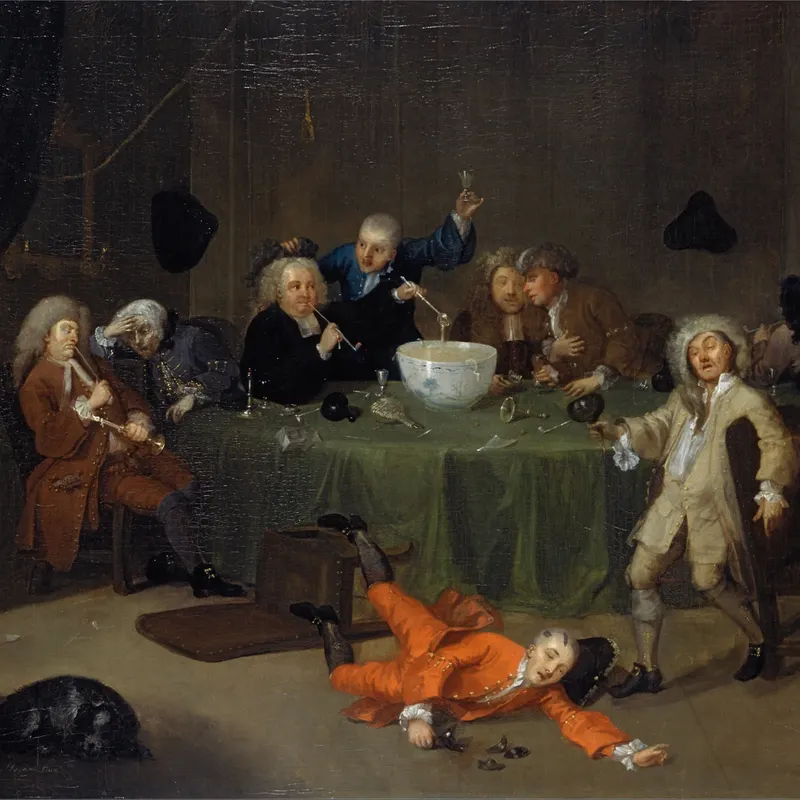
Yeah, and gin in particular was consumed to enormous excess beginning in the late 16th century up throughout the 18th and 19th centuries. And this really was coinciding with the first concerns about the social and medical effects of alcohol. English moralists like William Hogarth contrasted dangerous foreign gin, the source of that Dutch courage, with wholesome British beer. By the dawn of the 19th century, sipping cheap blue-tinted gin was seen as the first step down an irreversible path of vice, corruption, and demise. This was the infamous Blue Ruin.
You know, that's really fun because when I was drinking really heavily and I was trying to like keep it all under control, I would try to control it by buying exclusively gin because I just found it so disgusting that I was like, well, I'll drink less of it. But then I ended up just doing the same exact thing.
Right. Well, that's happened, yeah, nasty gin. And that thing is what happened with so many alcoholics: is that, you know, especially in this period, they might have not really liked the taste of gin, but they really could not put it down, they were chemically addicted, right?
Yeah, yeah, and I mean, these kinds of distilled alcohols were actually found in England earlier. So, I mean, we have some records from like the 15th century of people ingesting whiskey, but it was primarily a medicinal thing. I've found like some references to whiskey in like in 1495, I believe, there was exactly one bar in London that served aqua vitae at all, which I believe is a precursor to whiskey, which gives you a sense of like, you know, this wasn't something that you were necessarily exposed to.
Right, it was really, it was the yeah, it was the 17th and the 18th centuries when hard liquor really became widely available and increasingly so across the early 19th century.
The discovery of alcoholism
And so, if you look at the end of the 18th century, one of the first people to recognize the medical aspects of alcoholism, the idea that it could be something that people were medically compelled to do, not by choice, was actually the American revolutionary Benjamin Rush, who was a physician, unfortunately, a pretty bad physician, but he did do some interesting research, even if he wasn't great at treating patients. And he was one of the first people to recognize there could be a medical component here, something that would be later developed at length in the 19th and 20th centuries. To go back to Blue Ruin, this whole idea of early alcoholism as a chronic debilitating condition really began to receive a lot of attention during and after the Napoleonic Wars, especially in Britain, when veterans of the army and especially the Navy returned home completely ravaged by addiction to drink.
The German doctor, Christoph Wilhelm Hufeland, eventually coined a word to describe this, not in moral terms, but in medical terms. He described this condition as dipsomania, Greek for obsessive thirst. Now we call that alcoholism.
What the Big Book admits
Before we move on to the history of temperance, Jon, any thoughts about, you know, early alcohol and alcoholism more broadly and like, you know, the beginning of addiction as we understand it?
I, I mean, there's two things that kind of stand out to me. I mean, one of them is the, like, the way that people thought, like, they thought of it as like, oh, it gets you closer to the gods, or like also just that it's really good for socialization. Yeah. And I think one of the kind of more interesting aspects of 12 step groups is that they do admit this. Like in the big book, which is like essentially like the Bible of like the actual title of the book is just Alcoholics Anonymous, but the everybody just calls it the big book. It's, they, they say in it, they say like, oh, drinking for most people means conviviality and colorful imagination and things like that. But then they're like, but for the alcoholic, it means certain death is essentially what they say. Like it's a lot different than like the temperance movements that we're about to talk about, where they actually like, they do admit that like, oh, yeah, there are these kind of pretty awesome effects of alcohol.
And I mean, that's like kind of the thing that, I don't know, just it's part of what makes addiction so tricky is that, you know, it does have a pretty good benefit, at least if you're not doing, like, if you, if you can keep it under control, it has benefits to it. But it's just that when you lose control over it, it kind of just, you know, it'll take over everybody else. It's life.
Like, absolutely. No, and that's the thing that, you know, with what's interesting that we're going to get into with 12-step programs is that it really is about personal choice and personal development, not about this imposition of morality through legislation or coercion. And I think it's probably not a coincidence that 12-step programs didn't emerge until after the failure of national prohibition.
Right. Yeah. I mean, I think, like, they, they really, I also think that the aspect of like they focus on personal choice and like personal self-development. I think it's not a coincidence that it arose in America and that it's still the most popular in America, given like how much is focused on just like the individual's choice and like developing the individual.
Drinking in early America
Right. Well, so let's just kind of quickly, very quickly go over the history of temperance, especially the early centuries, the first century before prohibition, the 19th century, not the 20th century, just to kind of understand the moral background of 12-step programs and see kind of what they were sort of reacting against. Because, like you said, like 12-step programs are really separate from the temperance movement, and they really didn't get started until after temperance, as we understand it, failed. So, really, just in the broadest strokes, we should start by mentioning that alcohol and alcoholism were absolutely rampant in early America. Major consumption of hard liquor was ubiquitous, whether you lived on a farm or whether you were on the streets of Manhattan. It was expected, it was even an expected part of the workplace. For instance, in New York in the early 19th century, whenever a workshop hired a new member, it was typical for every employed artisan to spend the entire day getting drunk on however much whiskey was available.
Or actually, I think rum was more common in the East Coast in this period. Violent fights between drunken artisans were a huge social concern, not to mention the violence that these men often inflicted onto women and children. As America began to industrialize, alcohol remained part of the workplace. And the famous early factory at Lowell, Massachusetts actually contained an on-site brewery. According to Bruce Bustard of the U.S. National Archives, the average American in 1790 drank close to six gallons of alcohol a year. And by the 1830s, it increased to seven gallons. We should emphasize: when we're saying gallons of alcohol, we're not saying gallons of beer. We're saying gallons of pure liquid alcohol consumed in various forms. If we do some quick back of the napkin math, this comes out to roughly 100 gallons of beer and cider per American per year. It's just staggering. And then as the 19th century progressed, the increased development of trade networks made alcohol increasingly available, whereas new economic hardships, such as the proletarianization of those urban artisans and the famous panic of 1837, caused many downtrodden Americans to drink even harder.
Right. And I mean, I think we should like talk a little bit about the political economy of whiskey in this period, just because it was literally currency for a while there. It was just like, you know, something that you did with your excess grain after the season was over. And, you know, you want to, you don't want what you haven't been able to consume to go to waste. So you just distill it in your backyard or whatever, and then you have this stuff that you're drinking all year round and you sell off the excess, you're using it as currency. So because of that, like as agriculture became more and more productive, you had a lot more of the surplus going into these hard drinks. And consequently, people were getting much more sloshed with the development of society.
The first temperance societies
And so it should be unsurprising that beginning in the 1820s and 30s, coinciding with the Second Great Awakening, you began to see the first temperance societies in the US and Britain, which were basically exclusively at first connected with Protestant denominations. We mentioned the word teetotaler earlier, meaning somebody who drinks no alcohol at all. This term actually comes from these groups on both sides of the pond that encouraged people to sign petitions with a capital T marking their total abstention from alcohol, which in 1830 was a very radical thing. You know, not drinking and not drinking heavily was not something people usually did. Enormous consumption of alcohol was incredibly expected of both men and women of all levels of society. And because this was so expected, and because, you know, those who recognized the damages of alcohol and chose to abstain from that tended to be pretty evangelical about trying to convince their many other alcoholic friends and neighbors to abandon drinking as well.
What followed was that many, but not all temperance activists began desiring the outright prohibition of alcohol.
Women, abolition, and nativism
Right. And women in particular were really at the forefront of the temperance movement in America for very, very practical reasons because there was so much hard drinking, and because men were the ones who were drinking the most, the social costs of alcohol fell on women. And so, you had this proliferation of lurid stories of husbands spending their entire pay on booze and neglecting their wives and children, and even going into violent fits against their wives who dared to tell them to knock it off. And like it should be understood that temperance didn't really have an inherent political valence at this time, and there were many people of different stripes calling for the same end.
Yeah. And so, most of the big pro-temperance organizations of the era were part of the mono-cause, as you know, you might call it in contemporary terms, which included the abolition of slavery. So, Abraham Lincoln himself, while he was running for a congressman, he courted the support of these temperance activists quite early on. This is way back in the 1840s, we're talking about here. And so, you know, we should mention though that this mono-cause, although it seems very progressive today because it includes abolition, it also actually overlapped pretty heavily with nativism because alcoholism, despite being truly as American as apple pie, just for some example here, the real-life Johnny Appleseed, he was not planting apple seeds to grow apples for eating. Those were cider apples for being made into alcohol. But so, despite the deeply American history of alcohol and alcoholism, some temperance people saw it as a foreign contagion which they associated with Irish and German immigrants who were coming to the U.S.
in large numbers in the 1840s and 50s. There was a lot of overlap with teetotalers and the American Party, better known as the Know-Nothings. They had their most success actually in those northeastern cities where there was previously these long-standing traditions of just being drunk in the workplace. So these guys were basically, you know, total hypocrites. American culture had a deep tradition of heavy, heavy drinking, and they just wanted to blame it on the new people coming off the boat. Yeah, and we just have to mention that there's absolutely a sectarian bent to all of this because there was a very religious valence to the language and the advocacy of the temperance movement. And of course, America being a predominantly Protestant nation meant that it was very easy for people who were already xenophobically inclined to look at these Irish and German immigrants, many of whom were Catholic, according to these people, just stood completely contrary to the American project and to right.
Yeah, yeah. We have to mention that, you know, that the temperance movement was very divided because there actually were many Catholics who were temperance advocates. There was even, I believe, in Massachusetts, the most prominent temperance figure not associated with the Know-Nothings was actually an Irish priest who preached temperance to his own congregants.
Sin or disease?
But another issue was also a big point of division, which was that should alcoholism be understood as a medical condition, as the Dr. Benjamin Rush had argued, and as many other people in the 19th century were beginning to believe? Or should alcoholism only be understood as a personal moral failing, a sin? In the 19th century, the more religious tint of temperance would win out. This came to prominence due to the success of the Second Great Awakening, and because this pack of religious reformers saw alcohol as a vice that led to social decay and was actually contrary to the very will of God. We often call these impulses Puritan, but the Puritans, funny enough, really enjoyed getting drunk on special occasions. This was a new, distinctly 19th century beast. But unfortunately for the temperance movement, there were larger beasts still to tackle in the country. Because as the 1850s progressed, sectional conflicts continued to rage on, leading eventually to the election of the abolitionist Abraham Lincoln to the presidency and the subsequent Civil War.
This kept many people sufficiently busy, and so temperance began to lose some of its luster among the American public. However, it wouldn't exactly die because about a decade after the Civil War, as America grew less interested in Reconstruction, as we discussed in our last episode, social reform agendas streamed back into consciousness as part of the new progressive platform.
The Women's Christian Temperance Union
Right, and so in 1874, you saw the formation of the Women's Christian Temperance Union in Cleveland, Ohio. Ohio mentioned, shout out to Jern. And this was the result of a successful campaign that had been organized against the saloons of the city. The WCTU would stand at the forefront of the temperance movement of this period. This organization was the one that truly put women at the forefront. So not only was the WCTU framed by the suffering of women, which they faced as a result of rampant alcoholism within their own families, it also argued that this was a sufficient cause to give women the vote. Women needed to exercise political power if they hoped to have the weapon to defend themselves against violent men. As such, the temperance movement and women's suffrage were melded together seamlessly. This movement viewed women as the moral guardians of society, and as such, it held that it was their duty to stamp out vice.
The WCTU continued its anti-saloon advocacy with public protests and so-called pray-ins. These were sort of like sit-down protests outside of bars. Women would pray and sing hymns very loudly to shame the men inside and to keep people from going in to drink. And so, with these kinds of campaigns, the WCTU was able to pressure many localities into restricting alcohol, be it through restrictions on licensing drinking establishments or through the outright prohibition of the sale of alcohol or perhaps restrictions.
And what I didn't realize until I started researching this was that there was very successful prohibition on the county and state level throughout the later 19th century. Although, when I say successful, I mean they got these laws passed. I don't mean that they were actually able to ban the production of liquor, especially because if you're doing it on a county level, there's really no way to enforce people from not going one county over to buy alcohol, which happened constantly. There was this big concern among the temperance movement that any kind of alcohol ban would need to be national, leading to increased support by the WCTU and many different organizations for this outright ban on alcohol. We should also mention, just because it's a colorful anecdote, probably the most prominent public face of the temperance movement in the late 19th century was the infamous Carrie Nation, a woman who went around hacking up, physically hacking up bars with a tiny axe, smashing barrels of beer and bottles of whiskey and all that.
She was actually seen as kind of an embarrassment by the WCTU, and so she wasn't formally part of the movement, but she was really this kind of, you know, she was heavily vilified. And there were famous signs hung in bars across the country, which said, all nations welcome except Carrie. And this was also a subtle little nod to the fact that just as we saw in the 1850s, by the 1890s or so, there was this continuing nativist element of temperance as alcohol continued to be associated with hard-drinking Irish Catholic immigrants, as well as newcomers from Russia and Scandinavia and the later 19th century?
So, as the 19th century progressed, turning into the 20th century, and feelings about immigration began to sour, temperance really picked up more steam. Not to mention the fact that women's rights were also rapidly accelerating. And just as many states passed state-level laws banning alcohol, there were also many states now allowing women to vote on the local level. And so, this kind of progressive mono-cause began to snowball. But what we have to emphasize is that progressivism in a late 19th, early 20th century context isn't that similar to progressivism today and often has some room for what we would consider very, very regressive ideas like nativism and white supremacy and racial hygiene. By the start of the 20th century, even the Ku Klux Klan had some support for prohibition.
World War I and Prohibition
And then the outbreak of World War I would really upend the calculus.
Yeah, like this is fascinating. I hadn't realized this before, but I mean, we mentioned previously that Irish and German immigrants were scapegoated as like bringing this contagion of alcoholism into America, even though that was pathogenically not true. But with the outbreak of the First World War, there was suddenly a lot more anti-German sentiment, and the WCTU and other temperance organizations were able to really use that to their advantage to argue that because so much of the alcohol industry was owned by Germans, now that America was finally at war with the perfidious Hun, there was an opportunity to strike back against the Germans by banning alcohol outright. This was part of the larger push of the era to de-Germanize the Germans who previously constituted an enormous part of the country, especially in the Midwest, where you know they continued to speak German, they had their own German newspapers, they weren't really like assimilated into American waspdom quite yet.
And so, as a result of the advocacy of temperance organizations and the confluence of all these other interests, Congress was finally able to pass the 18th Amendment in December of 1917. And in the following two years, more and more states would sign on to it until finally the 18th Amendment, which brought the era of prohibition, was signed into law.
Right. And so, you know, we really don't need to get into the details about prohibition at all once it became national law. I think really the only thing that needs to be emphasized, especially for the purposes of this episode, is that it didn't work. Rather than solving the problems of state-level prohibition, Americans continued to sneak in alcohol from abroad, especially from Canada and Cuba, leading to the now thriving Canadian whiskey and Cuban rum industries, and also, of course, produced whiskey in their own bathtubs, in their outhouses, wherever, leading to this widespread black market, both domestic and international, of alcohol, leading to more crime and really just large levels of small-time criminality among regular Americans. There is a kind of somewhat contrarian take to be made that prohibition was somewhat successful and that it did certainly permanently reduce the American consumption of alcohol, at least to some extent.
But in terms of stopping the consumption of alcohol altogether, it was clearly a failure. It might have reduced drinking, but it didn't stop it.
After Prohibition
Eventually, of course, it was repealed, and the temperance movement was basically left discredited.
Leader mentioned there actually was a third temperance party which existed in the late 19th century and actually survived through and past prohibition. I think it got like 100,000 votes nationally as late as the 1930s, a decade after Prohibition ended.
Yeah, I believe that their symbol was a camel.
Yes, yes, because they were dry. Yeah, yeah. But, you know, after the end of Prohibition, the idea of using the law to stop drinking was basically discredited. And so, people who believed that drinking was this great social evil that needed to be stopped, whether on the collective level or on the social level, they were became less interested in using the law as an avenue to change that and began to think a lot more about personal responsibility and personal growth.
Frank Buchman and the Oxford Group
And so, we've been talking mostly about the United States so far, but I think we're now going to have to look towards England. So, the history of 12-step programs begins with the Oxford group. The group was started by Frank Buchman. He was a Lutheran minister who dreamed of being the leader of a big city church. Instead, he was called to a small suburb of Philadelphia that didn't even have a Lutheran church and with no salary. He worked tirelessly to build a church, overworking himself to the degree where he was prescribed a long European holiday by his doctor.
I'm pretty jealous of that doctor.
No, I know.
I am a doctor. I stopped that, right? Like, man.
Yeah, there should be covered by insurance.
Absolutely. Yeah, absolutely.
Yeah, now they just give you OxyContin, and it's like, come on. He later moved on to evangelizing in China, pioneering a method of conversion of young Chinese leaders and eschewing the concept of white superiority, which was, I guess, a major invention for the time that you should actually get Chinese people involved in converting Chinese people.
Yeah, you actually respect the people whose souls you're trying to control.
Right. And during his time in China, he actually became friends with a close confidant of Sun Yat-sen, Ju Chiang. He was eventually asked to leave China in 1918 because he was criticizing other missionaries too much for moral depravity, especially accusing people of homosexuality. Buchman then founded the First Century Christian Fellowship, an organization which sought to restore the church of early Christianity. We talked about this a lot on the podcast: how there's so many groups throughout history, especially Protestants, are so convinced that they're going to restore Christianity as it was in the time of Jesus and the apostles.
Yeah, well, I mean, Christians aren't the only ones doing this. Like every two weeks, there's a new party that supposes that it's going to take Marxism back to its original roots.
So, you know, so the group had no formal leaders and was focused on the principles of surrender of oneself to God's will. And this is going to be a big thing that comes up later in the discussion in 12-step groups: is that surrendering oneself to God's will. The group began to fall out of prominence after World War II, though it still boasts of its accomplishments in forging peace between France and Germany in the aftermath of the war. The most lasting legacy of the group, however, is that of 12-step programs. And actually, before we get into the 12-step programs, just one other interesting tidbit is that this guy was not only like close friends with somebody, like he was only one degree of separation from Sun Yat-sen. During his time in Europe as well, he actually became good friends with the Romanian royal family as well. So he was really good at like getting himself in with people that were kind of high up, which is going to come into this in just a second.
Ebby Thatcher, Bill Wilson, and Carl Jung
So, the Oxford group founded an evangelist in the form of Ebby Thatcher. He was a well-to-do scion of a New York industrialist family who made their fortune supplying the wheels for railroad cars. Ebby flunked out of college and was quickly shuffled along to a seminary in Vermont where he met Bill Wilson, who was going to become the founding father, essentially, of Alcoholics Anonymous. Ebby and Bill ended up going on prodigious benders with each other, both falling deeper and deeper into alcoholism, with Bill becoming more of a lout and Ebby becoming more of the criminal type. Ebby's family paid handsomely to try and have him cured of his alcoholism, eventually sending him to a month of psychiatry sessions with Carl Jung.
Also, I just want to add that, you know, back then, you could get prescribed. You know, if you were depressed, they just sent you notification to Europe. And if you had any other mental issues, they would just have you meet Carl Jung personally. That's what has used to work. Return. Yeah.
And yeah, we haven't even gotten to the best part of his treatment yet. So Jung told Ebby that advanced alcoholics had little hope of recovery and that the only successful treatment that he had seen was not a medical one at all, but rather a spiritual experience that reconfigures every aspect of the psyche, which is this is going to become the key aspect of Alcoholics Anonymous. So Ebby returned to America after a three-month stay on a Caribbean island where no one but his servants were allowed and no alcohol was allowed on the island. After a week back home, Ebby began drinking again, quickly landing himself in court. At his court hearing, a group of three members from the Oxford group came saying that they had developed a method to make upstanding citizens out of alcoholics. The judge decided to release Ebby to the care of these people, which that's another crazy aspect of the past is that you could just be in jail and then like a bunch of religious nuts show up to your trial and they're just like, we'll take them off your hands.
And the judge is just like, okay, all right, you're free to go. Go with these people.
Oh my god.
We should mention this is the era. This was like an era when lynching was still somewhat common. You know, I kind of wonder if it's like, you know, it's like a similar process. It's this kind of, it's, it's a much more positive case, but it's this deputization of justice.
Yeah, yeah, absolutely. It's definitely like, it's just, it was just so much easier to like convince judges, not judge, like figures of authority of like trusting you. Like, especially like.
Oh, yeah, yeah, yeah, yeah.
Like state capacity was still kind of an insinuation.
Yeah, yeah, definitely. And so, anyway, so after, so it turned out that the method was successful, at least for a time with Ebby. So shortly after, Bill Wilson got a call from Ebby when Wilson had been in and out of sanitariums trying to rid himself of alcoholism without any success. He was expecting a fun night of drinking, but Bill was surprised when Ebby turned down a drink. And Ebby replied, I got religion now. And this is kind of like the founding moment of AA in the 12-step groups. And it's, there's really like, like in 12 step groups, there's a lot of, I don't want to say mythology because that sounds too dismissive, but I mean, it's essentially like mythology around this night. Like this is in, like, this is all in like the first chapter of AA. Although it does, like, it doesn't really, it's a lot more disconnected in the big book.
Like, they don't, they just mention, like, oh, there's somebody who saw Carl Jung, and then also my friend came and said, I have religion. Like, it doesn't really mention the background too much, it just kind of mentions the kind of the vague outlines of everything. And then it's like, he says, I got religion now.
Yeah, no, and it's also exciting. It's very interesting how it's this kind of like the two influences here for these guys, Ebby and Bill Wilson. It's how, you know, they cut from one end that they are being influenced by this, like, you know, the Lutheran temperance tradition of that guy Buchman, but then also they're like speaking to Carl Jung, getting these very, you know, strange early 20th century secular ideas that would have been totally alien to the earlier temperance movement. I think it's, you know, it's this very like kind of fundamentally modernist interpretation of alcoholism.
Yeah, and yeah, I actually, I really agree with that. And like, I think like throughout the big book, like it really does try to like right after this part here, it mentions like kind of Bill struggling with the idea of accepting religion and accepting God. And it really does try to square the circle of like science and religion. And it does really try to combine those two aspects of humanity, I guess, of both respecting science and reason while also like fully surrendering yourself to over to God is a really big theme of the book.
And so, so did Ebby and Bill, did they create Alcoholics Anonymous themselves or did they just kind of like somehow, you know, inspire its creation?
Bill W. and anonymity
Did they actually organize the group?
It's kind of complicated because Bill W. They call him Bill W in the in like the mythology or the you know the yes, yeah. They call it because like it's alcoholics anonymous. So you don't use these last names. I'm sure a lot of people have seen like, you know, in TV depictions of Alcoholics Anonymous. I didn't realize they kind of apply this to their own like founders.
Right. Yeah. And actually, like Bill took the concept of anonymity really seriously. Like he didn't, like, Time magazine offered to put him on the cover and he refused to like have his picture taken even. Like it is basically like it gets into like almost like Islamic levels of like trying to not have images. Although they do still like like they mention Bill W and there's another figure called Dr. Bob. Like they're generally considered like the founders of AA. Although in a lot of ways, I really do think it's Ebby that was kind of the founding member because Bill refers to Ebby as his sponsor even after, as we'll get into, because Ebby will relapse back into alcoholism. But even after that, Bill still refers him as his sponsor. So in a lot of ways, Ebby is kind of like the founding member of Alcoholics Anonymous.
Yeah, so here's a question. Like, why was there so much emphasis on anonymity specifically? Because I mean, like, maybe in a big city, sure, you could be anonymous and no one would necessarily know you. But if you're like operating out of some podunk town in like the Midwest, that's like, you know, a thousand people, then obviously like people are going to recognize everyone else. So like, so like I guess I'm just not really quite understanding where the anon where the anonymity comes in exactly.
Yeah, I mean, it's a lot different in small towns. And like, and like I haven't done Alcoholics Anonymous in small towns, so I don't really know how like the anonymity aspect of it's kind of strange. But I mean, I could say, at least in terms of like the early AA groups, like it was found like it was mostly in Akron, Ohio, and New York at the beginning. So it was in like these kind of I mean, Akron's not like a cosmopolitan city, but it's still a somewhat large city. So, yeah, as for modern AA, I mean, like, it really they really emphasize like hanging out with people and Alcoholics Anonymous a lot, and the like actual anonymity isn't really emphasized as much. But there is a big emphasis still on like not taking outside issues or interacting with the press really, even though as we'll get into the press and outside issues kind of helped prop up AA in the early days.
Dropping old friends
And that's what I think it's something that they've been using, like at the beginning, like there's this argument that it's kind of culty. And I know that kind of you know, that's something that they've been that AA has so often been criticized for are the ways that they sometimes encourage people to basically drop their friends. I think that you know, I guess in the defense in their defense there, I think that it's true that you know, if you mostly hang out with alcoholics, it's going to be much harder for you to stop drinking if all of your friends are drinking all the time. And I think that AA seeks to combat that, but kind of, what are your thoughts there?
Yeah, no, no, I mean, I totally agree. I mean, because when I when I sobered up, I mean, I basically like I'll still talk to them sometimes, but I mean, like, my old drinking, but and I mean, because I didn't just drink, I used a lot of drugs as well. And it was like drinking and using buddies mostly. And so I mean, like, I don't hang out with them that much, and like, you know, like I don't, I don't go to bars, like, I'll go to concerts where there's lots of drinking going on, or like, like, I went to a hockey game last week, there was lots of drinking there. Like, I'm not like afraid to be around drinking, but I don't exactly want to be around a place where drinking's the main activity. And so, I do think that there's a lot of validity to the idea, because especially, like, the type of person that goes to an AA or like an NA meeting is probably somebody that has gone pretty deep down the rabbit hole because, like, somebody that hasn't really like messed up their life due to addiction isn't going to be wanting to go to like a 12-step group, right?
And so, they probably are in a position where, like, yeah, they should replace their friends with people who don't drink or use drugs.
And the kind of the use of like scare stories is also something that AA has been kind of criticized for.
Yeah, yeah. I mean, yeah, that's a big thing also. And it, because this was while I was in Alaska, that I had like a relapse. So it's it's a little bit complicated because it, like, it didn't get full-blown, but that was because I was in Alaska where it was really difficult to get alcohol. Yeah, so, like, I mean, I would drink a lot for like a week or two, and then I would just run out of alcohol.
Yeah, even with access, yeah.
I would just be like, okay, I'm sober now. But, like, it, like, they really emphasize in 12-step groups that, like, oh, if you start drinking again, you are going to die. Like, and I'm not exaggerating, like, the verbiage that they'll use there. Which, like, again, to be fair to them, there are, there's a lot of people in AA where if they drink again, and if like, assuming they don't stop, they're they're going to die. Yeah, you know, that is where alcoholism and addiction can end a lot of the time.
Bill's conversion
Well, you know, so I just realized we haven't actually discussed the formation of AA itself. So, you want to kind of get into that part?
Yeah, yeah. So, after, so anyway, so Ebby told Bill, he said, I got religion now. And at first, he yeah, Bill kind of and I guess so.
So you're saying that's like the that's like a famous line in alcoholism. I'm sorry, in alcoholics anonymous, right?
Yeah, like this is like a really famous line. Like, it's in the first chapter, and it really of the big book, yeah, of the big book. And then, and so at first, Bill kind of writes off the idea of turning to God for help. But and then this is also a big line in AA. He says he has his mindset changed when Ebby says, Well, why don't you create your own conception of God? And that becomes a really big part of AA as well. Because after that, Bill never drank again for the rest of his life, and then that's essentially how Alcoholics Anonymous began: is that Bill created his own conception of God, and then, as we'll get into, he starts building up a fellowship, and that's where AA comes from. So, after a quite literal white light experience, like Bill genuinely was suffering from delirium tremens, which is a stage of alcohol withdrawals where you have some pretty, you can have some pretty horrific hallucinations.
Right. No, and so the other reason that the medic, the specific, the medical effects of alcohol withdrawal are much more dangerous than of a heroin withdrawal, which I was shocked by.
Yeah, yeah. Like I've done, so it's basically like heroin withdrawal can technically kill you because of like dehydration and stuff like that. Like you get really dehydrated and like you won't be able to keep food down. So like the secondary effects of it can kill you, but like alcohol withdrawal and benzo withdrawal as well are the only two withdrawals that can just straight up kill you because you can just have a seizure and die from alcohol or benzo withdrawal. And so this is what happened to Bill W.
Yeah.
So this was his fourth time going to a sanitarium where he went through delirium tremens and he had a vision while he was in the sanitarium and he found himself suddenly free of his alcoholism. But still, even after this, he did feel tinges of temptation creep back in. But to fight these temptations, he would call up pastors from the Oxford group who would put him in touch with fellow alcoholics to help them relieve their own alcoholism. So this is really becomes the ethos of Alcoholics Anonymous: you have to go out and help other alcoholics to be able to be free of your own alcoholism. Like it's kind of emphasized a lot in 12-step groups. Like people will say, Oh, I'm not doing, I'm not actually doing this for you. I'm doing it for myself. Like that's why I go out and sponsor people, or that's why I do things to help keep AA running is because it helps keep me sober.
So, again, it kind of goes back to that squaring the circle between like the individual and like the community as well.
Dr. Bob and the first groups
And then, so through this process, Bill became good friends with the famous and the A's, the eyes of AA members, at least, Dr. Bob. And Dr. Bob was a doctor who used his practice to prescribe himself a litany of sedatives. Bill talked with Dr. Bob, who was an easy sell as he was an already an Oxford group member, and convinced him of the necessity of what would become the program of Alcoholics Anonymous. And just to talk about Dr. Bob a little bit briefly, he was really like a crazy, like his story in the big book about his way he used drugs was like just so jarring and insane that like the way he would do it is he would inject sedatives in the car in the garage and then he would like rip off the the tubing and all of that and then he would just try to rush into the bedroom before he would pass out and so like all the time he would just pass out like in the hallway or like he would pass out in the car and so so it was just like really really really gruesome stuff for his story just to kind of touch on that a little bit oh man but anyway so so the group began to grow though with many members quickly sliding back into alcoholism about a hundred people mostly in akron ohio and again shout out Jern, yep they had built a fellowship of men and women though it was mostly men and it still is to this day there's because that's another thing about a and addiction in general that i've noticed because it was true when i was in rehab as well.
Is that so so? So it's even comes to today where in AA, like it is mostly men, and it's also mostly men in rehabs and i i mean, there's I don't know exactly why that is, but it does seem to be an issue that does affect men more. I guess it's just a male mental health type of thing.
Yeah, well, I think that that was totally the case 150 years ago when the temperance movement was beginning. You know, I think it, I think, for whatever reason, I think it's true that I don't know if men are more susceptible to alcoholism, but I think that the negative effects of alcoholism often are expressed more visibly in men. And oftentimes, men are not the ones who suffer the consequences of these negative effects.
Yeah, I do think, yeah, I think that's a big part of it. Like, I mean, mostly, I would say like the violence aspect of it is probably the biggest thing is that men get drunk and just start breaking shit or fighting people. And that becomes like, that's a lot more immediately obvious that something's going wrong that you have to fix than, yeah, than yeah.
The Twelve Steps
But so so after about 100 people became members of Alcoholics Anonymous, the group formally laid out the 12 steps and 12 traditions. And the 12 steps are basically the guiding principles of AA to this day.
Do you mind if I read them off?
I feel like, you know, we should probably, I think it makes sense if you're just to kind of list what the 12 steps are.
I can read them right now.
Yeah, absolutely. Go for it.
So this is from the 2001 revision of the Alcoholics Anonymous Big Book. One, we admitted we were powerless over alcohol, that our lives had become unmanageable. Two, came to believe that a power greater than ourselves could restore us to sanity. 3. Made a decision to turn our will and our lives over to the care of God. 4. Made a searching and fearless moral inventory of ourselves. 5. Admitted to God, to ourselves, and to another human being the exact nature of our wrongs. 6. We were entirely ready to have God remove all these defects of character. 7. Humbly asked him to remove our shortcomings. 8. Made a list of all persons we had harmed and became willing to make amends to them all. 9. Made direct amends to such people wherever possible, except when to do so would injure them or others. 10. Continued to take personal inventory, and when we were wrong, promptly admitted it. 11.
Sought through prayer and meditation to improve our conscious contact with God, praying only for knowledge of His will for us and the power to carry that out. 12. Having had a spiritual awakening as a result of these steps, we tried to carry this message to alcoholics and to practice these principles in all our affairs.
Yeah, you can really feel the Protestant, like, yeah, you can really feel the Protestant ethos in there because, like, I mean, like, it's interesting because, I mean, on the one hand, like, there's so, you know, this sort of like strong emphasis on confessional, which is something that you focus more on in Catholicism. But on the other hand, it's like, you know, because there is no church, you have to make do with this alternative structure that they've built up.
Yeah, and as for the alternative structure, I mean, like, it's very varied in terms of how somebody might actually do the steps because you work it out with a sponsor. And so it's however your sponsor does the steps essentially is how you're going to do them. So nobody really does them exactly the same. Like, I mean, because I had two sponsors during my time in AA. Like, because the third step, there's a prayer in the big book that you're supposed to say. And then... Like, my first one, he didn't even make me say the prayer. And then, like, the second sponsor I had, like, I literally got on my hands and knees to say the third step prayer, which I, which I don't even remember what it is. I know it's thy will be done and not mine as part of it. Because that's kind of like the main thing in AA is that you're supposed to surrender your will totally.
Yeah. But it's not your control that, you know, God has just basically decided to free you from alcoholism.
Yeah, but here's another question I have.
God as you understand him
Like, how does AA deal with the fact that maybe not all the people going to these meetings are Protestant or even Christian? Like, I'm sure like Jews and Muslims and other religious faiths also end up in these kinds of meetings. Is there like a way to make this program more synchronistic with these other religions, or is it all just like very heavily Christian-focused?
So, I mean, there's definitely like it's all Christian overtones and like definitely Protestant overtones as well. But I mean, one of the 12 traditions is that AA is not allied with any sect, denomination, and organization or creed. So at least in theory, you like, that's why you're supposed to choose your own conception of God, is that it can be whatever God you believe in. It's just you have to believe in God. And they kind of whittled that down later on. Definitely not with the early AA groups, but like nowadays, they just say higher power.
Yeah, that's the famous phrase. And it kind of reminds me how the Boy Scouts, which has some very, very loose similarities with just, you know, having this kind of creed, you know, if you're a Boy Scout, you do have to believe in God as one of the, like, the part of the Boy Scout oath, but God to you is allowed to be visionary if that's your preference.
Yeah, and like people joke in AA, like with the higher power thing, like they say, like, oh, your higher power can be a doorknob. Or like a lot of times, like they tell people, if you don't believe in God, then your higher power should be like AA itself. Like the main thing that they emphasize is just the higher power can't be yourself.
That's interesting. That's really interesting.
Yeah.
And I kind of wonder if, and for some people, it's kind of acknowledgement that it's a social exercise. It's the power of being part of people who are helping you achieve something that is very, very difficult. Good addiction is one of the hardest things anyone could ever do. So like, you know, like, I think it makes sense that some kind of regimen really makes it more difficult.
Yeah, yeah. And I, I mean, like, because again, like, I don't, I don't go to these groups anymore, but like, I do think there's absolutely something to it. Like the idea of saying, like, I'm not in control. And like also trying to like, like, I think the main utility of 12-step groups is the fact that they kind of like reintegrate you into society just because it like it gives you a new friend group and it tells you to like stop being a shithead and to like go make up with the people who you hurt and to not hurt people anymore.
Making amends
Right, right. No, and that's what i was kind of gonna ask about that. I think the eighth step i think is one of the most interesting. The part about making amends to the people you've harmed, right? Eight and nine, making the list of who you've harmed and then making amends with them. I'm curious if you have any kind of thoughts on that program, because that's well, that's kind of the one that's you know, maybe it's the one that's the most disconnected from this idea about personal submission and personal growth. It's about affecting the world.
Yeah, yeah. And I mean, I think that comes back to kind of what I was talking about with like AA, like, I think it's really trying to like square the circle between like the individual and the community because it again, like they kind of frame it as this selfish thing. Like, you're doing this because it will keep you sober and it will like help you kind of keep a clear mind and just live a good life. But it still does emphasize, like, yes, you have to go out and like admit to people what you've done and like make up for the wrongdoings that you've done in whatever way that they want you to. Although, actually, an interesting thing too about that is, and this gets kind of into Bill W's life as well. There's a there's a section in the big book where the section where it talks about making the amends, where it basically says that, like, if you cheated on your wife, like they kind of say, like, oh, well, it that that would be harming that could be harming your wife by admitting that to her.
So maybe just keep that to yourself. And that kind of that kind of gets into something with Bill W with because we'll talk about his later life in a moment here, but he most likely was sleeping with members of Alcoholics Anonymous. Like he was kind of using his prestige to sleep with women.
Rockefeller money
Well, yeah, so let's talk about kind of the continuing history once these 12-step programs really became established in the Midwest and the Northeast.
Yeah, so as they were growing, they wrote the book Alcoholics Anonymous, which became kind of the Bible of Alcoholics Anonymous. But they were facing financial troubles. But Bill W used his personal connections through Dr. Bob, who had it in with the Rockefeller Foundation, and he was able to get a large sum of money from the Rockefeller Foundation, which is really interesting because, or at least it's interesting to me, just because one of the 12 traditions is that AA should be fully self-supporting, declining outside contributions. But they were basically, I think the way they got around it was that they said that this money was for the rehab clinics that they were going to send up or set up.
Yeah. And so I think it's, you know, this is where I don't know how clear of a line you can draw here, but I think the fact that it was the Rockefeller Foundation is interesting because I know that Mr. Rockefeller himself back in the late 19th century had initially been an advocate of, he was a temperance advocate, but he was skeptical of legalistic prohibition because he kind of correctly predicted the ways that it would just, you know, basically, increase criminality and people would get around it. And so, it's kind of funny that then, you know, his foundation after his death is being used to further the kind of personal-driven temperance solution he would have preferred.
Right. Yeah. So, it and it really was the money from the Rockefeller Foundation. Like, that's how they published the book Alcoholics Anonymous. And it's also how they funded their rehab clinics that they would begin to set up across the country. The most famous one was the Lighthouse Clinic, which was directed by Ebby Thatcher. And he would direct it up until he ended up resigning after he became relapsed into alcoholism and he wouldn't ever recover back from alcoholism. So, he would drink for the rest of his life and eventually he would die of emphysema. But he would remain friends with Bill W for the rest of his life.
Bill W. and LSD
And here's where things start to get a little bit weird. So, in the 1950s, Bill W began experimenting with LSD, actually. He ended up taking it with one of the Sanford experiments with Aldous Huxley.
And he actually curiously, how does NA and AA feel about? I doubt they're fond of LSD these days, right? They probably be there, but I'm sure they're, I would expect they're opposed to psychedelics, right?
Right, yeah. Like, it's very not like they're very anti, like, like it's, it comes up a lot in AA, like using any sort of drug, like, especially like marijuana or like, or also psychedelics. Like, they don't say that you should use any mind-altering substance. So it's and like I've never heard anybody in the AA groups mention this. It's just it is something that Bill W wrote about, and like we only know about it because Aldous Huxley wrote, Aldous Huxley was a big fan of Bill W and talked about taking LSD with Bill W.
Well, I mean, it is interesting because using psychedelics to overcome addiction has come into the vogue over the last decade. And I mean, I haven't really looked into it that much, but just based on the cursory knowledge, it does seem to help some people to actually, you know, kick these habits that they haven't been able to kick otherwise.
Narcotics Anonymous
Right.
No, no, absolutely. Well, when we mentioned, you know, so I mentioned Narcotics Anonymous. We kind of didn't discuss that yet. So that was basically a split off of AA, right? I didn't realize that.
Yeah, so actually, because there was a big divide in Alcoholics Anonymous, whether they should include drug addicts at all. And like the main thing that people mentioned is that one of the founding fathers of Alcoholics Anonymous was a drug addict. But the kind of divide was that it was if people's drug of choice was alcohol or not.
So what was the argument against like allowing people who were heroin addicts, for instance, in? What was the objection?
The objection was made, like it basically came down to like snobbishness almost. Like it was just that they thought they were worried of having like people who were too down on their luck or people who were too criminal in their midst. So they didn't want drug addicts in there, which is still a thing in some AA groups. Like I like this wasn't a thing in Washington at all. I think partially just because like opiate addiction and like meth addiction is so widespread in Washington that, like, because again, like I said, like, I use a lot of drugs as well, and especially opiates. And when I was in Washington, there was no problem with me showing up to an AA meeting, but I did encounter that a couple times in AA here in California when I first moved here. That people didn't want, like, if you mentioned drug use or something like that, they would basically tell you that you should be going to NA instead.
Yeah.
But yeah, so they so they ended up splitting off. I believe it was 1954 when Narcotics Anonymous wrote their book, which they call the basic text.
And from what I understand, the 50s is when heroin usage really became widespread in the U.S. It was after World War II. It was these returning World War II vets who had been addicted to morphine who now had access to a much more dangerous substance.
Right. Yeah. And also, I mean, like, it caught on with like a lot of other people. Like, it caught on with the beatniks a lot. Like, like, yeah.
Oh, of course. Yeah, jazz musicians.
Courts and the spread of AA
And so, so that's how Narcotics Anonymous became a thing. And after some positive press, AA spread across the country and even began to use by court systems in an attempt to reform recidivist alcoholics. And when it became integrated into the courts, is really when you see the movement take off, which does kind of bug some people in AA to this day that courts kind of force people into it, just because it leads to a lot of people that aren't doing it because they have any really genuine desire to get sober. They're just doing it to kind of try to beat a court case. However, even then, you do hear stories a lot in AA about people who came here just to beat a court case and then they end up staying and fully binding to everything and then they don't ever drink again. So it's really a give and take for that.
Sixty kinds of anonymous
And after AA blew up, it ended up splitting into a lot of different factions with over 60 different 12-step groups existing today. And these range from overeating and shopping from marijuana to cocaine to even there's an artist anonymous today as well.
What's that? Sorry, Krishna. What's that?
I don't know. It's not even an addiction. Like, I think it's just like it's they're like, oh, my life is hard being an artist, so I need the 12 steps to set my life right. Like they all just use the 12-step process. And it's worth mentioning in all of these, like in NA, for example, the 12 steps are exactly the same. It's just different what they're admitting they're powerless over.
I know there's also a sex and love addicts anonymous group. And it's kind of funny to imagine like the one person there who's there because they're a love addict specifically.
Yeah. Yeah.
What's also even funnier is that there's two sex addicts because there's sex and love addicts and then there's just regular sex addicts anonymous.
Oh, yeah, for the ones who aren't sentimental about it.
Okay.
What works and what doesn't
And there's also another funny thing is because there's 12-step groups for like the the loved ones of alcoholics as well. And there's kind of like a split faction in that where like there is so there's Al-Anon which is kind of like the traditional 12-step for people that are out of it and then there's adult children of alcoholics and they really really don't like each other they're like they just really they just like because they would meet in the same places like where we had our aa meetings but they would like they would be talking shit about each other all the time to me like because i would be there before to make coffee or something and they would just be like bad mouthing the other group the entire time wow there's so much controversy and the anonymous fandom i had no idea yeah yeah there's a there's a lot of factionalism it's really a lot like leftism when it comes down to it yeah no it's it's yeah it's i think it is so interesting that's like kind of looking at the origins here i just you know like really kind of funny to see kind of what it's all become i'm just kind of curious like if you don't mind sharing this what do you think are the biggest problems you have with 12-step programs and what do you think are the best aspects yeah so i mean my problem with it like and it's not even necessarily a problem i have like like it's not a problem that i have with it as a whole like where i think it's not worth something it's mostly just that like i think the use for it is and i said this earlier, but like, I think the use for it mainly is like if your life is really like if you've destroyed your whole life and you don't really have anywhere else to go, like, I think there's a lot of value to it because it gives you like a community and it kind of like helps you slowly rebuild your life and like just kind of tells you because the progress of rebuilding your life is going to be really slow.
So just kind of surrendering yourself over to God's will or whatever you want to call it. And being willing to see that progress be really slow is kind of going to help keep you sane for that process. But like for me, I mean, it's basically just like my life stopped being shitty. And so I just don't exactly feel the need to do it anymore. Like I, it just doesn't resonate with me the same way as like when I like was just coming out of withdrawals and like I didn't really like have anybody that I didn't just like I didn't have anybody to hang out with who I didn't just like drink and use drugs with. Like I'm in a much different situation now than then. And but another problem that I have with it is like it this is more a California specific thing than like AA because there's a lot of variance between AA groups.
And like, but it's just when I moved here to California, like it was a lot different than in Washington where like they focus more a lot more on like having a balance. And this kind of goes back into like the having a good life thing. Like in California here, they really push like you have to go to a meeting every single day for like the rest of your life. And like you have to be doing all of this stuff.
Like you basically have to like completely center your life around AA which one is just like like I always felt it was kind like again like I don't like using this word but it's the best word I can think of that like it's kind of culty and it's just like it just sort of rubs me the wrong way so so the good so the good things about a are mainly the community aspect of it because like I said a lot of people will completely just push everybody away because it's I mean it's not an easy thing to like love somebody that's destroying their life with addiction and so it pushes a lot of people away and so what AA does is it kind of gives you a new friend group and you know that gets into like you know why people are willing to go to a meeting every day and you know you hear it a lot in the groups that this is like one of the only places where they feel like a normal person where like people understand their mindset because you know like it doesn't like it doesn't make sense to most people why you would keep doing something that's like ruining your life and so like it is definitely like it's a really important thing for people to be able to talk to somebody who understands like having done that and like being able to rebuild their life and live a better life from there uh-huh yeah and and i think it's in this context that it really makes sense that for a lot of people, this is supposed to be like an ongoing process.
Because I mean, like, if you just like, let's say you manage to kick the addiction, but then like you fall back into your previous life patterns and you start to get depressed again, for example, it's super easy to, you know, fall back into it.
Yeah, yeah. Although that actually I would say is kind of that I would say is like, because they do in theory, like they're very accept, like they're very nice to you if you like relapse and you come back or whatever. But like for me, like an issue I had with it was that like at least at first when I relapsed before like I kind of had a more sustained one. Like I even had people say to me like, oh, well, maybe you're not a real alcoholic because you came back so fast or something like that. And yeah. And so like you get a lot of weird reactions from people just because they because they really drill it into your head of like, if you drink again, like you're going to have a full-blown relapse and like all these bad things are going to happen to you.
So I think that kind of does, it can set up the mindset that kind of does lead to a full-blown relapse because you have, you have a night of drinking or you have one drink and you're just like, oh, well, I'm fucked. I'm just going to keep going. So that I think actually is kind of a damaging aspect. But if you do come back, people will be very accepting of you and like they'll just be happy you're back essentially. So I mean, it's kind of a give and take. Like it's a complex issue, I would say.
Yeah. Well, thank you so much for sharing all of this and, you know, bringing like all of this really interesting history here.
Bill W.'s later years
And do you want to touch the last little thing here? If this isn't too dour of a note, you want to touch on what you kind of mentioned about the, you know, the alleged corruption of Bill W in his later years?
Yeah, so I mean, it was basically like there was man, I've I can't recall her name, but there was one specific woman that he was basically thought to he is widely thought that he had an affair with her because he did leave a substantial amount of his inheritance to her that he changed his will at the last moment. And then also she told people later on that they had an affair with so he's he admitted it. It's totally he he never like formally said it. It's she admitted it and he gave her all of his money.
Oh, I see.
That's essentially what happened. And she was a member of AA that he basically was taking advantage of. Yeah, and that also, I mean, I guess just to touch on like problem is like people taking advantage of like vulnerable new people in AA isn't like unheard of, like especially with women. Like it's called 13th-stepping where you basically like somebody who's been in AA for a while like kind of like finds like a woman who's new and then you know just kind of gloms onto them and that kind of accounts for why there are relatively fewer women involved because of that?
Yeah, I definitely think that's a big part of it because also like there's like woman only AA groups and from what I from what I understand a lot of women basically only go to them just because it's like so common for them to be hit on by people, like by men in AA meetings. So, so yeah, I mean, that's definitely a big, a big issue with AA. I mean, luckily, it's not something I had to deal with, but it's still something that, you know, is a pervasive framework.
Yeah, well, well, thank you so much for coming in. Any kind of, it's kind of kind of, I think we're probably wrapping up here.
Does it work?
Any kind of closing thoughts you have about 12-step programs in general and you know, kind of like where they where they've come from and kind of what your general thoughts are on their like their efficacy and their history there?
Yeah, I mean, I think, I mean, I think unfortunately, I mean, the thing with addiction treatment in general, I would say, is just that like most treatments for most people kind of like don't work is the kind of the fucked up thing. Like the success phrase for rehabs for basically any rehabilitation program is in like the single digits to like low double digits. So in terms of like how efficient or not efficient, but efficacious AA is, it really kind of just comes down to how it is for because most people, like you see it when you're in AA, like most people come for a little bit and then they leave. And, you know, I'm sure some of those people stay sober, maybe even like a substantial amount, but most of them I would guess probably go back to drinking or using. And that I would say is probably like at least half of the people that come into AA.
And so, like, it's not exactly like a great success rate. But, I mean, the thing is, is that, you know, most rehabilitation programs don't really have a good success rate either. So, in terms of how valuable it is, I mean, I really think it just comes down to if somebody's getting value out of it. And I mean, I know a lot of people do get value out of it. So, I don't want to like knock that.
No, and that's the thing. It's, you know, it's like, it's, it's, it's a continuation of the kind of earlier temperance movement we saw, in which there were these really serious problems with it, like, you know, the nativism, I think, most especially. But these people involved in these movements, I think, genuinely were well-intentioned, even if they might not have had the ideal tool set to do it. But I think that, you know, like with AA, it is still a much more effective tool set than a lot of others that are available. And it did work for a lot of people, whether we're talking about temperance back in the 19th century or yeah, I mean, like, it's it like, especially with the temperance movement, like, it's just people kind of have it, like, it gets weird when it's people that don't know that much about addiction, like don't have experience with it, kind of try to solve it.
Like, trying to think that you could just ban alcohol and that's going to stop people from drinking. Like, any alcohol, like, like, I was in Alaska where alcohol was illegal and I still found ways to drink. Like, we just put whiskey in apple juice containers and then brought it on the plane. Like, that's it was really as simple as that. And we, you know, but like, and I think that's kind of the biggest value of AA is that it is people that have experienced addiction, like, kind of trying to guide you through how to get you out of it.
Well, yeah, well, thank you so much for coming on, Jon. This is really an interesting talk. And it's really interesting to kind of just kind of see these trends here. Even though, you know, AA was formed basically in light of the failure of the 19th century temperance movement and then 20th century prohibition, I think that you do see a lot of these kind of same through lines there, you know, because, you know, addiction is probably as old as humanity. And the understanding of, you know, chronic alcohol dependency has been very well known for 500 years at least. So that's the thing kind of getting into the history here is just such an interesting topic. And it's not a topic that either Sam or I had ever explored before. So, you know, thank you for bringing this up.
No problem. I had a lot of fun with it.
That's great. Well, yeah. Well, thank you, Jon. Any closing thoughts, Sam?
No, not really. I mean, I would just say if any of our listeners have issues with substance abuse, then please get help. It doesn't have to be AA, but I mean, like, I just hope you are able to get to a better place where you don't have to use it.
Right, no, because these things. Yeah, no, absolutely. You don't want to be like the Mesopotamian god Enki and find out that you've given up all your power to your daughter.
I hate when that happens. All right. Well, thank you so much, Jon. And thank you guys all for listening. This is Gladio Free Europe signing off. Bye-bye.
The show is also on Apple Podcasts, Overcast, Pocket Casts, Podcast Addict, YouTube, RSS and Patreon.