Gladio Free Europe received a frosty transmission this week from the icy waters of the Bering Sea. Writer, prophet, and friend of the pod Jon called in to talk about life in Alaska. We run through the past 300 years of the 49th state, beginning with initial bloody encounters between indigenous Yupik and Inuit peoples and the Russian Empire and the ensuing colonial contest with Britain, the United States, and even Spain. By the end of this episode, you'll know exactly what makes Alaska so different from the Lower 48, the reason American merchants were so set on acquiring the territory, and why famous sled-dog Balto is a damned fraud.
Transcript
Meet Jon in Alaska
Hello and welcome to Gladio Free Europe. I am Liam, joined as always by Russian Sam.
Hello, hello.
And today we have a very special guest, a pretty cool friend of mine, somebody who has a pretty cool story and a lot of cool stories to tell, particularly involving the mysterious, exotic, and beautiful U.S. state stolen territory, whatever you want to call it, of Alaska. And this is my friend Jon in Alaska. How are you doing?
Hey, I'm doing pretty good today. I managed to kind of fake a sick day, so I've been enjoying that.
Nice, nice. And, you know, without like doxing yourself too much, can you tell us what you're faking a sick day from? Because I think that's pretty cool.
Yeah, so I've got a job at a school in a remote village in Alaska. About as specific as I'll get is it's like on the peninsula. And because I went to school to be a teacher and I just finished my student teaching and I got an email from my school about an opportunity to be a tutor at a school in Alaska. So I thought it sounded cool to spend three months out here. And so I got a job as a tutor. I'm in a town, or I don't even want to call it a town. They all call it a village out here. So I'm going to call it a village. It's basically two villages put together, and it's like 300 people in the two villages, which is apparently a big village out here. Some of the other villages, like a village where they just, they're trying to get me to work next year, it has like a hundred people there, and then some of the villages have like 50 people there.
So, there's some villages that are like three families or whatever because all the families are pretty big too. Like, all the families are like eight, eight or nine people.
Oh, wow, that's old school. I don't think I've ever been anywhere that small. The smallest town I've ever been in prior to this was like my college town. I went to WSU, and that that town was like basically like most of the population was just like people that went to the college, and the rest of it was just like wheat farms. But even that was like a big town compared to this, like, this is like super isolated, like, the town's only accessible by plane.
That's in Southern California, so you've really you went from like one side of the west coast to the other, it's a pretty pretty big change, yeah. Yeah, so I guess the main thing is that we've kind of we know that you have some kind of cool stories about life in Alaska, about your work, you know, about like how you're liking it, and especially because this is a history podcast about Alaska's history, which is a lot of interesting stuff to get into. I've never been to Alaska, I've never dived too deep into Alaska and history myself. I know like the broadest strokes, but you obviously know a lot more than me. Sam, have you ever been to Alaska? I know you've been to Russia a couple times. You ever like crossed the Bering Strait?
Nope, nope, never been to Alaska. My knowledge of the place is limited to trivia, unfortunately. But thankfully, we have Jon here to help us make sense of this whole thing. What goes on in Alaska? We're about to find out.
Life in a remote village
Yeah, so I mean, I guess just a funny story about coming out here was that, like, because they told me how I would have to like ship food in because like the town's only accessible by plane, and it's basically like buying stuff from the grocery store, like it's cheaper to ship stuff in because the grocery store has to ship it in anyways so like you're just paying to ship it in plus like a markup yeah it's crazy Oh, yeah, but I guess I just did it in like a really stupid way because like I genuinely thought like, oh, I'm going to buy a bunch of stuff in Washington where I live and then like ship it out. But funny, funnily enough, Amazon still has free shipping out here. So it would have been way smarter to just order stuff on Amazon and ship it out.
Yeah.
So I basically wasted like a ton of money doing that. But I still, I don't know, it adds to the fun because I'm like rationing food out.
The adventure.
Yeah. Yeah.
You know, I've heard that because like, you know, it's so far out from everything that buying a hamburger in Alaska, like at a restaurant is like 20 bucks or more. Is that true?
Yeah, it's gen. Like, I mean, I think it genuinely was. Like, even in Anchorage, it was like, I got like a burrito. And I mean, it was a fairly big burrito, but the burrito was like $16 or something like that. And Anchorage is going to be like the cheapest place you can go in Alaska, basically.
Yeah, that would be high, even by New York standards, for the record.
Yeah, yeah, yeah, yeah.
It even puts LA to shame. Yeah, yeah, yeah.
And so kind of just like, oh, Anchorage is like a relatively big city, right? Like probably bigger than some Americans might think.
Yeah, it's bigger than the metro area is like 400,000 people, I think. And it's something like 60% of the population lives in Anchorage, basically. Yeah, yeah, yeah. Yeah.
That's crazy. Yeah. That's a crazy concentration.
Yeah, yeah, because, like I said, like, this is like one of the bigger villages around here, apparently. And there's just like so many towns that are just like 50 people or whatever, like scattered around the state that are like only accessible by plane. And it just makes me think of like, how the hell do people like, because it feels weird enough, like, like the difficulties of living out here, but this is like one of the cushier places everybody's been telling me. So.
Yeah.
How Alaska became American
So obviously, you know, Alaska, very far from the mainland contiguous U.S., but it is still part of the, you know, the U.S. I think it was the 49th state to be admitted. I think it was before Hawaii. It was admitted at the same time as Hawaii, I believe.
Yeah, I think it's still technically Hawaii is considered the 50th state. I don't really know why. Maybe it's just like they did it one, they did Alaska one day and then Hawaii the next, but from everything I know, Alaska was the 49th state. But they were basically admitted at the same time.
I know it was definitely, you know, like colonized, acquired, whatever you want to say, by the U.S. before Hawaii was. And I know that, like, you know, obviously, you know, Alaska becoming part of the U.S. is like, you know, not historically inevitable. It was contingent on a lot of interesting conflicts that I feel like people outside of Alaska don't really know about. How like the Spanish and the Russians and the British and the Americans were all vying for this same huge chunk of land.
Yeah, it was really a free-for-all.
Yeah. And the various indigenous peoples, the Yupik, the Inuit, were all caught in the middle.
Yeah, like it basically comes down to like when they took when the U.S. took control of Alaska, it was basically just because Russia and the UK were in like such a strong rivalry at the time. Like it has to do with like the Great Game and stuff like that, like them vying over Central Asia.
Yeah.
And basically, Russia just thought it was a good way to screw over the UK because they weren't sure how well they would be able to hold on to Alaska because they didn't have the same access to it that like America had. So they've basically just thought it was a good way to screw over the Brits to give Alaska to America or sell it, I guess.
How Russia reached Alaska
And if you don't mind, Jon, would you mind if we rewind a little bit and talk about how Russia gained a foothold in Alaska in the first place?
Yeah, sure. I mean, it basically just comes down to like they kept marching east to get through Siberia. And then by the time they got to the coast, like, because it's like remarkably close. I mean, even today, like the end of, like, Russia still controls like one of the islands in the Aleutian chain. And like, it's really, they're really not that far apart. And it, I believe it was the fur trade is what made them come out initially.
Contact across the Bering Strait
Yeah, yeah, there was pretty regular contact, even in pre-European times, from what I understand.
Well, yeah, like, like, the Yupik languages are spoken on both sides of the Bering Straits. They're spoken in eastern Russia and in western Alaska. Yeah. Yeah.
The native people, like, there wasn't much of a divide, like, even after the, what do you call it? The Bering Strait opened up. Yeah. Basically, there's still a lot of contact in between like Alaskan people and like Siberian people. And even like, there's still not that big of a difference ethnicity-wise, between them.
Yeah, no, the languages are super close. And I remember, like, I read a while back that, like, there was, like, sporadic contact from like deeper in Siberia into Alaska. And I know, like, some native Alaskan cultures wear this pretty cool armor that they use for fighting polar bears, which had come over from Siberia. And then, maybe even more kind of exciting is that, do you guys remember when they found that Venetian bead? You know what this?
Oh, yes, yes, I've heard about this.
I haven't heard about this. I want to hear about it.
Sometime, sometime a while back, yeah, an Alaskan grave site was unearthed. I believe it was a grave site, where they found this glass bead that seemed to be of European origin. And when they dated it, it turned out that it was a medieval glass bead that had come to Alaska certainly before Europeans got to Alaska and probably before Columbus got to the Americas at all, which suggests it was a bead from Venice that traveled all the way across the Silk Road from Italy into China and then presumably through China, up through northern Asia, all across Siberia before eventually landing in the pocket of some Inuit guy who probably didn't know how far away it came from, but knew it was this like cool exotic foreign object.
That's cool.
We talked about that book, 1491, which is a pretty cool overview of indigenous pre-Columbian culture. And one thing that the author took pains to underline, which I never really considered before, is that a lot of discussion about Native American trade sort of is a little bit too patronizing and condescending to Indigenous peoples. It really emphasizes the ways that they might have been tricked or fooled by buying these worthless trinkets. But what that perspective forgets is that a trinket that might have been worthless to European settlers could have had a lot of cultural and political value to Indigenous peoples because it shows: look, I have connections to foreigners. You've got to respect me. I can access goods from across the ocean. Having that glass bead might have been a pretty cool display of power in that place and time.
Yeah, and of course, even though the distance itself is striking, there's nothing really unusual about this. From what I understand, there were trade networks from coast to coast of North America for thousands of years, basically. People have been moving and trading across these routes for much, much, much, much, much longer than Europeans ever heard of America.
Yeah, absolutely. So, let's lead us through, like we were talking about, like if you could lead us through how exactly the Russians got to Alaska and eventually, how did that lead to the U.S. making Alaska the 48th or the 49th state?
The Russian Empire moves east
Right. Okay, so in the 16th century, Russia was in the process of transitioning from a regional state into an empire proper. And as part of that, this meant, first of all, that they were going to militarily defeat the neighboring states that were on their borders and who had been causing a lot of trouble for the people who lived there for centuries. Rest in peace, Siberian Khanate. Yeah, yeah. Those guys sure love to slave raid. But anyway, the Russians, from the 16th century onwards, suddenly there was this frontier opening up in a process that's kind of analogous to the United States, where at first it was basically serfs who were running away from their masters as the chains of feudalism were getting tighter. They started heading out where the authorities weren't. And of course, that's happened to be out east. And initially, this was an annoyance, but pretty quickly, the Russian state realized that this could be a great asset to actually expand the footprint of Russia.
So there's a lot of history to go in here, but suffice it to say that by the 18th century, Russia was right by the tip of the Eurasian landmass. They were stopped at an area called Chukotka for nearly a century. And the inhabitants of Chukotka, they're called the Chukchi. Today in Russia, they're primarily known for being the butt of jokes about how dumb they are, unfortunately, but like not dumb in stupid way. It's like there's a cleverness to them that's simple but profound in a way. But anyway, these people, they were able to hold off the Russian troops for over a century. They were very, very fierce warriors, not nice guys. And ultimately, the only reason why they ultimately came to an agreement with Russia where they would recognize the Tsar as their sovereign, but they were still exempt from paying taxes because they just, you know, weren't the kinds of people that you do that to.
They had held their own for a century against European power, so they were kind of respected. And so with Chukotka integrated, this was right at the end of the 18th century. Suddenly, you're at the Bering Strait, and right across the water is Alaska.
And I just want to add here: this is not that. It's like only a few years before, from the American perspective, you have Lewis and Clark reaching the Pacific from the other side. So it's around the same time you have these kind of parallel colonial processes, both very bad for the people living there, in which these powers sort of originating in Europe in a sense, both come, basically converge on the Pacific.
Yeah.
Russian Alaska
Right, and you know, the one other thing I know about Russian settlement of the Russian Far East is that in 1825, there was the Decembrist revolt, where a bunch of liberals, a lot of them actually coming from the aristocratic sector of society, who were dissatisfied with the Tsar, tried to change society, didn't quite work out, so they all got sent off to the Far East. And these guys, the Decembrists, not the band, they would sort of have this little kind of cultural flourishing in the Russian Far East. And eventually, some of them would land in Alaska. And the first major Russian settlement in Alaska was this pre-existing indigenous community, I think of Tlingit people, not in actually not even in the part that's closest to Russia, but in the part that's closer to mainland Canada, which is Sitka, Alaska, which they named New Archangel, named after another city in western Russia that's probably just, as from I understand, just as icy.
Oh, yeah, that place is freezing. My grandmother, she did her post-university experience up there. It was not a great place after the war, let's say that much. Yeah.
Oh, so, so, Jon, so you mentioned the great game earlier. So, you know, like, one thing that's kind of interesting is that by founding this city right up against the border with Canada, the Russians were sort of, you know, making a statement to the British, who, of course, owned Canada at this time. You know, British Columbia, Western Canada, was incredibly sparsely populated, as our friend Jim could tell us at this point. So I don't think they were actually much of a threat to British settlements, but it certainly was this interesting challenge to British colonial ambitions, right?
Yeah, and I mean, they even made trading posts as far down as California, from what I understand. Like, there are, and interestingly enough, there's like Inuit martyrs because of people that traveled with the Russian settlers, and they basically ended up fighting some Spanish or like British colonists and then ended up becoming martyrs in the Orthodox Church.
Yep, no, absolutely. And one thing you see in California in some places is that there are like, I think, like, for instance, Santa Barbara, no, yeah, Santa Barbara. They have all these flags for every nation that's ever claimed the city. So a lot of times it's like it'll always be the Mexican flag, the California Republic flag, the Spanish flag. But in some places, they have the Russian flag there too, because there was a brief period where the Russian Empire claimed control over that part of Alaska. And I know that with the native connection, with the native martyrs, I think in one case, it was that a whole bunch of, I believe, Aleutian people who were otter hunters would travel with Russian sailors all the way up and down the coast of Pacific America looking for otters. And on one occasion, they had a run-in with some Spanish settlers as well as some local Californian indigenous people.
And the Aleutians were killed. And because the Aleutians had become Orthodox Christians, they are now remembered as Orthodox Christian saints.
Orthodoxy in Alaska today
Is Alaska still very like, is there still much of like a Russian like, you know, cultural presence? Like, are there still, you know, Russian Orthodox people in Indigenous communities?
Yeah, there's not much of a Russian cultural presence, I would say, but there is definitely like the Orthodox Church is still pretty big because like where I'm living, it's mostly native Alaskans. And like the only church here is like a big, like it looks like any other Orthodox church. And people are still pretty religious out here. Like you hear kids talking about going to Bible camp and stuff like that like a lot. But yeah, like the church is basically like a standard Orthodox church. They have like some Greek guy that's like the priest for the town that kind of like flies around between the different villages to like bless it at different points.
That's crazy. So is it like formally part of the Russian Orthodox Church or is it its own offshoot?
I think because if I remember correctly, I think basically what happened is that like after the Soviet Union took over, the Orthodox Church, like it used to be a lot more closely connected with the Russian Orthodox Church, but after the Soviet Union, they kind of gave a lot more independence towards like the American version of the Orthodox Church just because there was like more religious freedom or whatever. And so nowadays it's not very connected. Like they don't speak Russian in the church or whatever. Like they speak English. It's mainly just in looks in terms of like how Russian it actually is. Like it looks like a Russian church and like oh, the icons, the onion domes. Yeah, yeah, they have the icons and the onion domes.
Yeah, and for the record, I don't think that this would have been a move that the Soviets would have made unilaterally from their part. More likely, there was pressure on the ground for these people to dissociate from the Russian Orthodox Church, which was now in Soviet hands.
Yeah, was this? Do you think this was by like random Russian immigrants, emigrades in America, or was the CIA or the State Department straight up telling native Alaskans that they have to break ties with the Soviets? What do you think?
I'm pretty sure that would have just been white Russians, honestly. I don't think that any security agencies would have cared that deeply if some native Alaskans are going to an Orthodox church that formerly is within the church hierarchy that's controlled by the Soviet Union.
Russian massacres
Do you know anything about how bad were the Russians in Alaska, Jon? Like, I assume it's probably, I'm going to assume it's not a great, even though if the people are still Orthodox today, despite that, I'm still, I'm going to bet it's probably not a very warm cultural memory.
Yeah, I mean, it's basically like, I mean, it's the same as any other European settlers, really. Like, I know because I've kind of been in classes where they're learning about like, like, they call it like cultural standards or whatever. It has to do with like how the classes are set up. And like, they talk a lot about like different massacres that happened. Like, there was one at, I think it was Kodiak Island. Like, it wasn't called Kodiak Island back then, obviously, but it was, there was some revolt, and basically they led, they like got one of the tribes to like massacre the other, and it killed like 10,000 people or something like that. So there's still a lot of like really bad, yeah. So there's still like a lot of really bad cultural memories of that, but they which probably makes sense as to why like you don't see much like a Russian culture that stuck around, but you do see the religious aspect kind of sticking around.
Yeah, yeah, no, yeah, right. Actually, I realized now I've heard this before, and it's a good way to frame this is that I think it, from what I understand, among modern indigenous communities, it's called the wounded knee of Alaska. Like, that's how this event is commemorated. But it was not, it was not a massacre committed by American white settlers, but by Russians.
Yeah, yeah. And it was pretty messed up because it took place over like 10 years or something like that. Like, they basically just blockaded the island and like slowly wiped them out.
Wow. It makes you kind of realize that colonialism. There's no way to do colonialism that isn't brutal and genocidal. You know, like some colonial situations might be worse than others, but if you're trying to economically and socially dominate these communities, it basically inevitably is going to lead to massacre because there's going to be resistance, and the best way to put down resistance is by starving people out and killing people who resist. This happens like, you know, time and time again all over the Americas and many other parts of the world.
Yeah, I mean, I guess it, yeah, like you said, it just turns out if you're going to try to make it so that you're forcing the people of one area to enrich people of another area, like it's probably not going to turn out well. So, yeah. Like, economic exploitation always ends up pretty fucked up.
Why Russia sold Alaska
And from what I understand, ultimately, all of this, you know, brutality committed by the Russians would basically be for nothing, right? Because they would, there would not be a permanent Russian presence in Alaska. Pretty quickly, they would sell this territory to the U.S. I know famously it happened. I want to say in Lincoln's administration, it might have been Grant's, right? But it was like around the time of the Civil War, right after.
I think it was right at the end of the Civil War.
That was the Johnson administration.
But yeah, all right, so clearly I am out of my depth here. You two guys, why don't you share what you can about how exactly this territory, which Russia clearly was willing to kill thousands of people to keep a hold of, ends up moving into American hands?
Yeah, well, basically, I think essentially what happened is that like a lot of the fur trade, it kind of went by the wayside because the fur trade was mainly had to just do with fashions back in Europe. And those fashions kind of died out eventually. Like if any of you have ever seen the movie First Cow, which is a movie that I really love, like they talk about, it's set in the Oregon territory.
Yeah, with Alia Shawkat.
Yeah. And they, like, they're talking, like, there's a scene where these two British aristocrats are talking about the fashion back in Europe. And they're just like, oh, yeah, the fashion's kind of dying out now. But of course, it's, oh, this fur trade is going to last forever. And also, we're never going to run out of beavers and stuff like that. But basically, what happened is that the fashion died out and fur wasn't as popular anymore. So the fur trade kind of died out. And that was basically the total of what Russia was doing to kind of make money off of Alaska. And on top of that, like they didn't, their eastern seaboard wasn't like nearly as well maintained as like the western seaboard in America. So their access to Alaska wasn't really like as strong as it was, as strong or as useful as it was for America.
And like I was saying there.
Yeah, no, and that I think that's still kind of, yeah, that's still part of like armchair Russia analysis today. The whole thing about how like they don't have a warm water port because all the ports in the Russian Far East are frozen half the year. Yeah. Yeah.
And I mean the ports in Alaska are frozen too. Like I mean it sounds stupid, but I was like blown away by just like how frozen everything was when I got here just because like I knew it was cold, but I just didn't realize like that like literally everything was frozen. Yeah.
No, yeah, yeah, you're there you're in the Arctic Circle. You know, like, Jon, I know you from a chat with some people in Northern Europe, and it's kind of funny that you're probably like significantly closer to them in like Finland and Scotland than you are to me in LA.
Yeah. Even though you're in the U.S. Well, yeah, because it also blew my mind just how far away Alaska is from the rest of America. Because I like, it was like a four-hour flight from Seattle over to here or over to Anchorage. And that's like a longer flight than it is from Seattle to San Diego, which is a flight I make a lot because I grew up in San Diego and I live in Seattle now. So they're farther apart, like Alaska is farther apart from like the northern U.S. than like the northern U.S. is from the southern U.S. So it's like very, very far away.
Wow.
But yeah, but yeah, back on the topic of just like kind of how America ended up acquiring it. It really just has to do with like it was hard to maintain Alaska and with Russia losing out on like naval dominancy compared to the UK, they were really worried about the UK taking Alaska and then having like a really strong like basically because if they take Alaska, then they would have this territory that's right next to Russia. And they were kind of afraid, which I'm not sure how valid of a fear it is, but they were kind of afraid in the same way that like the Brits were afraid of Russia taking Central Asia to invade India, which was always a stupid fear. Like they, Russia was kind of afraid of like the Brits using Alaska as a jumping off point to like invade Russia, which also seems like a stupid fear because it's like then they would have to march all the way through Siberia.
That would have been hilarious to see, you know, especially given how like, you know, going from like France to Moscow is probably like a third of the distance as Alaska to Moscow. You know how that worked out. So it's very funny to imagine the British army, all these guys from like, you know, Cardiff and Norfolk having to march on foot from Alaska all the way across the entirety of Siberia.
Yeah. Yeah, who knows?
Maybe a guy or two will make it. Yeah.
Yeah. But yeah, you know, it's, yeah, I feel like people love, you know, having like those kinds of imperial anxieties in any kind of like, you know, big state conflict. Like how like, you know, like, should I think of an example? Like, I believe at the start of World War I, and like, you know, crazy ambitions, at the start of World War I, I think the German Empire was convinced that winning World War I would allow them to take over, somehow take over all of Italy, that that would be next.
There's one guy in the German high command who seemed to think that.
But all right, let's say, yeah, so yeah, so let's talk about it.
Seward's Icebox
So eventually it becomes American. We said it happens in the Johnson administration. Why did the U.S.? I get why Russia didn't want Britain at their doorstep, but why did the U.S. want this territory?
Okay, yeah, I mean, basically, the biggest reason, like the most immediate reason is like a pretty funny reason, in my, at least to me, because it sounds really stupid to us, but like the biggest reason why was because they wanted the ice in Alaska. Because basically, they wanted like California.
Literally, so physically the ice, like the ice itself.
Yeah, they literally wanted the ice because like the ice trade was really huge back then because they didn't have refrigeration. So they needed ice for ice boxes. So they, and Alaska had so much ice, but like the problem with like the way they were shipping ice to the West Coast before, because like California was like starting to have like major population rises and the Northwest to like a much lesser extent, but like mainly California.
Right, right. Yeah. Because this is 1867. And just for a little bit of context here, 1848, obviously is the California gold rush. And that is when a huge amount of Americans started moving into California territory. When California was part of Mexico, it actually had a very sparse European or colonial population. It was overwhelmingly indigenous. Suddenly, when they find gold, all these gringos and all these Mexicans too start moving into California with pretty bad results for the people, the indigenous people already living there. And so then you got a lot of people, they need a lot of food, and to preserve food in a hot climate, you gotta have ice.
Yeah, yeah. And basically, what they had to do before, because this was before the Panama Canal as well. So what they would have to do is they would ship ice because there also still wasn't reliable railroads that ran like all the way across to the west. So they would ship ice on sea and go all the way around the southern cone and then come back up and then deliver it to California. And that kind of has to do with goods in general, which is another thing that's kind of funny is because basically California in the West was like kind of similar to what Alaska is like now, where it's just so far out of the way that it leads to things being like insanely more expensive and just like harder to live out here because it's like out of the way from all the normal shipping routes.
So, but basically, so Alaska was a really good way to get ice to California without having to like go so far out of the way to get. So it basically made it so ice could be a lot cheaper in California.
It's hilarious is that, you know, yeah, this has been a pretty good year for rain in California, but usually California is pretty dry. So even 150 years later, the state government of California is still purchasing water from Canada and Alaska because you guys have a lot. We don't have too much. Let's make a deal.
Yeah.
And yeah, and so that's also the funny thing here is that I remember in like, yeah, the one thing you learn about Alaska in the US is that when they bought Alaska, it was called, it was nicknamed Seward's Icebox. And I didn't realize until today that it literally was because of the ice. That's very funny to me. It wasn't just a joke.
Yeah, like it genuinely what, like, people made fun. That was kind of how people made fun of it back then, but it was genuinely one of the best reasons to do it because, like I said, like, ice was such a big trade back then. And, like, so much of Alaska is basically all ice that it makes it like this massively profitable trade. But on top of that, even like, they did know about like a lot of resources in Alaska besides just ice. Like, they knew about it prior to America purchasing Alaska. Like, they knew about like the gold reserves. It's basically just like the Russians didn't have like the capability to be able to exploit those resources. So, that's kind of why you see the gold rush happen, like, pretty soon after Alaska gets acquired, is because they did know that there was like gold and I think maybe oil, but that one I'm not too sure about.
But they definitely knew about the gold that was out here.
Designs on British Columbia
Yeah, and there's also another really interesting geopolitical angle over here, namely that this purchase was really concocted as part of a plan that was supposed to end with the United States getting British Columbia. That was ultimately the dream.
In fact, right, that's why, yeah, that's why it's like awkwardly not connected to the rest of the country.
Yeah, yeah, because yeah, the border over there between the U.S. and Canada was only demarcated in 1848, I believe, or something like that.
Yeah, that was the whole, yeah, you know, there was all like 54-40 or fight. Like, I think it was Polk who made a really big stink about getting like a much bigger chunk of Oregon, and then he gave up. So, it's like, you never mind, all right.
You know, one thing I also want to add on to is that you talked about how Russia.
And it's like the one American nationalist.
No, go ahead.
I was just going to say, it's like the one American nationalist view that I like to give myself is that I still do think we honestly should have British Columbia just because I like British Columbia. And I don't like having to use my passport to go to Vancouver or whatever.
Jim, do not listen to this episode.
Now would be a good time to remind our listeners that the views of our guests are not necessarily the views of the Gladys.
That's right.
California and Alaska
Yeah. Well, you know, back to that point about how Russia, the Russian government wasn't really capable of properly exploiting the natural resources of Alaska, you know, despite how much blood they spilled trying to do so. That reminds me a lot of California at this time because in a very similar situation, the Mexican government was pretty brutal in California towards indigenous peoples in hopes of controlling the territory. But despite that, there was never enough of a population base to really get at the resources of California. First, the gold, and then once the irrigation got there, the great, you know, agricultural potential. So it wasn't really until the U.S., which had a closer population base to California and also closer population base to Alaska, was that until you really got to see that kind of exploitation happening. And again, it was once these, it was once huge amounts of settlers came over, not just parties of explorers and soldiers, that things really got bad for indigenous peoples.
First in California, and then not too long after in Alaska. First with the ice craze and then the Alaska Gold Rush. What do you know about the Alaska Gold Rush? That's like a thing you learn about in high school. I know that they called some city the Paris of the North, but I don't really know anything else?
Yeah, I mean, I honestly, I don't know too much about the gold rush to be, yeah. To be honest, I just don't know that much about it. Basically, I just know that there was a gold rush and it was in the Yukon. Yeah. That's kind of about the extent of it that I know.
No worries.
The serum run
Well, then let's skip over that then. And because I know there's one thing that one story you want to talk about, which is a story that some of our listeners might know about, but I think it's kind of cool because it shows a lot about Alaskan history and kind of modern Alaskan society. The way that it's a it's for geographic and historical reasons, it's very different from the rest of the country. Infrastructure, travel, and access to goods, like you said, are really limited in a way that's not really comprehensible to anybody in the contiguous U.S. And I know that a really interesting part of this is the story of the first Iditarod race, the you know, famous bobsled race. Because it seems like that kind of that reveals a lot about what makes Alaska unique. If you could, you know, if you want to, you know, lead us off with that story.
Yeah, yeah. So, basically, the Iditarod Trail, for those that don't know, it's like this big dog sledding race that they have every year. It starts in Anchorage and it ends in Nome, which are, let me find the exact distance right now, but it's a huge distance because Alaska is like mind-boggling big. But, like, it goes from Iditarod to yeah, so it's a thousand miles. So, it's this dog sledding race that's a thousand miles long that goes from Anchorage to Nome. And basically, the way that it got started was that there was a diphtheria pandemic in Nome back then, which like back then it was like a couple hundred people. And diphtheria was curable by that.
Still, Nome only has like I think 4,000 today.
Yeah, it's a little, I think it's like 3,500.
And so would the people of Nome at this time, would it was this an indigenous settlement or were these settlers? Like, who were the people dying of diphtheria who needed medical attention in the 20s?
These would be mostly settlers, if I understand right. Like, because I don't think there were very many, yeah, because I think Nome was one of the places where they either had a gold rush or it was just a big fishing town. Because I know, like, kind of the whole west coast of Alaska has like really big fishing things going on, like, to this day. So, if I had to guess, it was mainly settlers. And at the very least, the movie that I watched about it, because I was watching a movie about it in one of the classes that I'm helping out with.
Togo, right?
Yeah, Togo. Like, it mainly just showed settlers.
Yeah, yeah, because everyone knows about Balto, the famous sled dog. But from what I understand, Balto, kind of a clout fiend. And really, Togo was the dog sled that should have, the sled dog that should have got all the credit. So Sophie has to do with the money.
Yeah, Togo was the lunch pail dog. Yeah, yeah, yeah.
So let's correct the record here. Tell us the story of Togo and not that goddamn fraud Balto. Get out of here. This is Togo, Togo Town here.
Yeah, so Togo was the original lead sled dog that helped it. Like, so this was back in 1925. And basically, there wasn't any Grand Alaskan Highway. The Grand Alaskan Highway was built in, I think, the 50s or the 60s. And there wasn't any railroad connecting Anchorage to Nome. So they had to do a dog sled. And it was in the middle of winter. Like, because it's a lot easier to get through Alaska during the summer, obviously, because everything melts, and yeah, it becomes, yeah. But so it was all ice, and they had to basically get this serum all the way from Anchorage to Nome. And, like, it's really a similar story to kind of how, like, the first marathon got started. Like, it's just like this big trek.
In ancient Greece, yeah, yeah, it was, yeah, yeah, that's a great point. It was a rush out of necessity, yeah, yeah. Basically, and so, obviously, there's a really long indigenous history of sled dogs being used to transport goods, not just in Alaska, but all over the North America, basically. Because, as because dogs were the only domesticated animals in the modern, in like you know, the modern United States before Columbus.
Yeah, yeah, it's really big out here. And on a slightly depressing note, like, it's been a lot harder for them to do it in recent years because like because of climate change, like there's just not as much snow. So, like, the area I'm in, like, dog sledding was huge, but they haven't been able to dog sled for the past like six years.
Sled dogs and the Inuit
Yeah, something I find especially interesting, which kind of gets to the story of the Iditarod itself, is that the Inuit cultures are incredibly far-reaching. We eventually, we should do a whole episode on Inuit history, which is so cool. And I know a few Inuit people on Twitter who, you know, I've learned a lot from them. But one thing I think is super interesting is that Inuit cultures go as far east as Greenland, right? Like, all the way from like the Yupik people you were talking about in eastern Siberia, all the way to Greenland, which is insane, all of North America. And so, because of that, due to the fact that Greenland on two different occasions, it would come under the possession of Scandinavian people, you know, first Icelandic settlers and then eventually the kingdom of Denmark, Scandinavians had some exposure to the practice of sled dogs, which were introduced in Greenland from all the way over in like, you know, Siberia and Alaska when the Inuit crossed over.
And so this means that when Europeans came to Alaska, some of them were people of Scandinavian origin who had some previous exposure to this cultural practice of sled dog racing because decades, centuries before, other Scandinavians in Greenland had learned about this practice, which means that the guy who was, I guess, the musher, you'd say, of Togo, he himself was this Finnish and Norwegian guy, which I think is kind of interesting.
Leonhard Seppala.
And so he was the guy who was with Togo on the original Iditarod.
I mean, it's just crazy, like, the level of spread that there is with the culture, like, with how far spread out it is.
Yeah, yeah.
And so basically, you know, like you said, like, dog sledding was really big, like, with indigenous cultures. And it's kind of just something that the settlers learned out of necessity just because it was genuinely like, it's like snowmobiles before there were snowmobiles. Although, I guess they call them snow machines out here, which is kind of weird. But so snow machine before it was a snow machine. But so he gets it. And I mean, basically, from there, it's just kind of like this long, like treacherous journey. Because from what I remember, it was like towards the end of winter, too, which makes it a lot more dangerous because like a lot of the ice is starting to break up. And he basically had to go over like a lot of frozen lakes. And I think he went over like the frozen sea at one point.
Yeah.
And yeah, just so like. Yeah, so a lot of the ice was breaking up and that just makes it a lot more treacherous to get through. But he basically was able to do it. And I think the original person that got sick from it still ended up dying. But basically, they still were able to get the serum there to get enough people to be cured in time enough for it to not kill basically like the entire town. Because it probably would have just wiped out the whole settlement if they didn't get it there. Yeah.
No, yeah, that's that's incredible. Yeah. And that's how precarious life was, you know, in Alaska. And, you know, as you said, even today, it seems like there's so much dependence on air travel, it sounds like it's still really precarious.
Yeah, like I definitely wouldn't want to get seriously injured out here. Like, because, I mean, I know, for example, at the school, like, they teach kids how to like do a tourniquet and stuff like that because it's just like, like, there is a clinic here.
Wow.
But, but yeah, like, I don't know how, like, I don't know how much the clinic could actually do. Like, I'm sure they can, like, prescribe stuff, but even getting stuff prescribed, it's like they have to fly it in. And it's just, yeah, like, it's a, it's, yeah, it would be a big deal to get seriously injured out here is basically what I'm thinking.
Yeah, yeah.
Togo's name
You know, one last thing I know about Togo, which I think is kind of interesting, is that the name is a Sami word. The guy, the guy who was ethnically Finnish, he was not Sami, but he just named the dog after, like, I think it's, I think it's just Sami for dog, after the Sami people of Scandinavia. But kind of funnily enough, for some reason, he decided actually, after he already named the dog this name, he was reading a book about, like, he was reading the recent stories of recent Japanese history, and he was really impressed with how well the Japanese did just like a decade, maybe 20 years before in the Russo-Japanese War. So he decided, actually, I'm changing the origin of Togo's name. It's not a Sami name anymore. He's named after Admiral Togo, who defeated the Russians at the battle of Tsushima.
Oh my gosh.
I think it's kind of funny. And interestingly, yeah, Balto also was driven by a Norwegian guy. So it's kind of, I feel like you don't really think of like Scandinavian influence in Alaska, but I guess during the gold rush at the end of the 20th, end of the 19th century, I guess there would have been a lot of Scandinavian guys, you know, familiar with the climate who wanted to go over.
Balto and Togo today
Well, I do have some very fun Balto and Togo facts for you guys. Are you ready?
Oh, please. Yeah, yeah. Let's, yeah, let's, you know, let's, yeah, let's finish up with that. Yeah, yeah, yeah, please.
Well, from what I understand, both dogs are currently taxidermied and on display in various regional museums. So you can actually, you know, see what these guys look like. See Balto and Togo today. Yeah.
Maybe you can compare them. Yeah, see who's prettier. Who should really get the claim for stopping the diphtheria outbreak?
I'm going to have to say that Balto was the prettier dog. Yeah.
Yeah, and just speaking of taxidermy, like one of the funny things, when you get into Alaska, like in the Anchorage Airport, they just have like all these giant taxidermy bears and like wolves and stuff like that, like on display in the airport. Yeah, what other honey are you going to pick up over?
Which I guess also, I don't know how much this is related to taxidermy, but when I first showed up, this guy was showing me around and he was like showing me like this freezer. Like, he's showing me this freezer, and he's like, Oh, yeah, I'm like, there's a bunch of old salmon in here, you can have as much of that as you want. And then he just points to one of the bags, and he's like, Don't touch that bag, that's a bear's head. And I'm just like, I don't really get why there's a bear's head in the freezer, but yeah, that's awesome.
Polar bears
Well, I, you know, I've heard as a kid who read like wilderness survival guides and Boy Scouts that you never want to eat a polar bear's liver because it's so high in protein that instead of you know building those great gains, it's it's gonna kill you.
I think it's vitamin A. Oh, okay, main spider, yeah, but something about polar bear liver is deadly.
Also, you were talking this before the episode, Sam. Apparently, polar bears have black skin. Who knew?
Yeah, that's one of like three polar bear facts I know, so I cherish it with all my heart. The other polar bear fact I know is that they are insanely aggressive because they didn't evolve alongside humans for nearly as long as most other types of bears, so they just don't have the instinct to avoid humans because bears they're generally pretty smart, they don't really want a confrontation, they're mostly chill unless they're like in a very desperate state. But polar bears, they will fuck you up. I know in in some towns in Norway, they have laws on the book saying that if you go outside, you have to bring a gun with you in case you run into a polar bear and it attacks you because otherwise you're mint smooth. Yeah, whatever.
I know a guy, he's Inuit. He lives in northern Alaska, very far north, and they have a polar bear siren because every so often a nanuq comes through the village and they have to put the siren on to stop people from getting chomped.
Yeah, I'm glad I'm not far north enough to deal with polar bears. So I'm glad about that.
Why do you get mooses at least?
Yeah, like I've seen, like, I've seen a couple foxes. I haven't seen a moose. Like, I know there are moose out here because people have offered me moose. So they definitely hunt moose, but I haven't seen any moose just walking around. And I definitely haven't seen any bears. But from what I understand, they're still hibernating. Like, I think they said they come out of hibernation here soon, which makes me nervous about walking around because I like to go on walks like every day. But now I'm like, wait, is there going to be a bear that's going to eat me if I go out on a walk? Like, I don't know. That's cool.
The Thousand-Mile War
I've got, you know, I can close this off with one very tiny, very recent Alaska bear story. But before we do, first off, thank you so much, Jon, for coming on to chat about Alaska. This is all very new to me. I just knew a little bit about Togo, but that's it. Anything else you want to share? Any other stories or little anecdotes about Alaska? Things you've observed in your time there so far?
I guess just like one other little tidbit about Alaska is because I hadn't really known about it, but I guess there was like a big aerial war between Japan and the US during World War II. Because I knew that like the Japanese occupied a couple islands. And basically, like one of the guys I've met here, like he keeps telling me, like, he's like an older guy. And he has just told me a lot of stories about people that like survived like air raids from when the Japanese were bombing. So that was kind of a crazy thing to learn about.
Whoa. So there was, oh, right, because the Aleutian Islands had the only, I believe, the only conflict on U.S. soil in World War II. Yeah. Besides Pearl Harbor. That's crazy.
Yes. So I haven't read the book yet, but if you guys want to read a book about it, there's a book called The Thousand Mile War that's like now on my reading list because the guy was telling me about it. And I was like, I definitely want to read about that.
Jon's Substack
All right. Well, Jon, is there anything you'd like to plug?
Yeah, actually, there is one thing. I haven't been putting much on it in the past couple months, but like I do have a substack as annoying as that is.
No.
And I plan on putting stuff on it again. So it's dfg.substack.com. So if anybody wants to check that out, I've been writing like a novella for probably too long. Like it's been like a year now that I've been writing it, but it's almost finished now for real. Like I'm writing the last part. So if anybody wants to read it, and then also just random ramblings that I kind of do whenever I feel like it. So if people want to read that, then check it out.
Well, that'll be in the show description. Yeah, you know, Jon, I have one story to close this off, one Alaska story. But before I get there, I understand you're also working on something called The Bible 2. Would you be comfortable talking about that?
Yeah, I mean, I don't know. It's mainly a joke. I mean, I guess like it started off, like, this is kind of embarrassing, but I mean, basically, it started off when I was like genuinely going like a little bit cuckoo. But now, but now it's like mainly just a shot.
Tell me about it. Yeah.
COVID. Yeah. Yeah.
So, I mean, it's, I mean, it's like half a joke and then half something that might actually work out. But it's basically like, I'm going to write a book and then I need other people to write books for it.
So I guess if people want to contribute to the Bible too, then like, you're the Apostle John.
The Apostle John too.
Pitbull in Kodiak
All right. Well, thank you so much, Jon. And here's the last little story that you might know, and I think you might know Sam too. I just think it's very funny. You mentioned Kodiak, Alaska earlier for a terrible reason for the massacre led by the Russians, you know, Russian settlers in Alaska. There was one other time that an outsider came to Kodiak, Alaska. It's a much more positive encounter. And that is the time that a certain Miami-based rapper who is best known as Pitbull did an online poll to see what next city would have his concert. And so, you know, people were voting Atlanta, Seattle, Miami. But a well-intentioned campaign starting by people in the city of Kodiak, Alaska, said, no, Pitbull, come to Kodiak. And then a bunch of, you know, classic early 2010s online pranksters thought it would be really funny to share the poll and all vote in it.
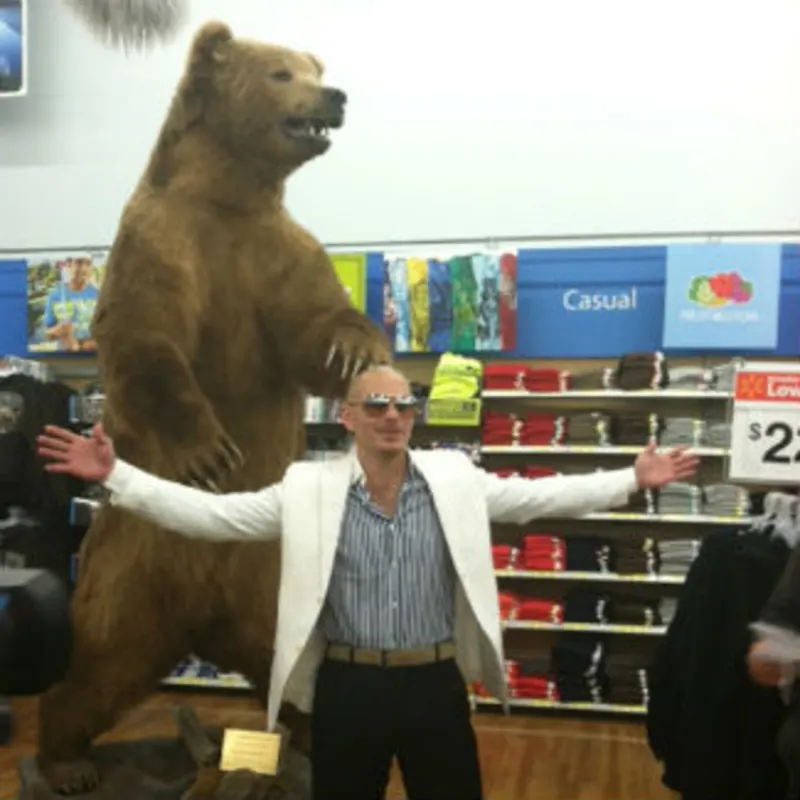
And eventually, Pitbull saw that he had to come to Kodiak, Alaska. So to his credit, he did. And he actually, it was a really big deal for the town. He was probably the first major musician to ever perform there because it's a very small town, just a few thousand people. And the only venue that was suitable for holding everyone in town was the Walmart. So Pitbull played a concert for basically the entire town of Kodiak, Alaska. Like a thousand people or more showed up in the Walmart to hear him perform. And he performed right underneath a giant stuffed grizzly bear.
Yeah, I remember when this happened, it was really funny. It was a great prank, and he really took it to heart. He seems like a very genuine guy.
Yeah. But it really just boggles the mind to think that there are probably people listening to this podcast who probably didn't even hit puberty when that happened.
Yeah, maybe so, yeah.
Yeah, all right. Well, with that, that concludes our Alaska talk. Jon, if you ever want to come on again to chat about Alaska or anything, please do. This has been great.
Yeah, yeah, I definitely had fun doing it. This is my podcast debut. So, I mean, I had fun doing it. So.
All right. Well, yeah, let's bring you back on sometime. And Russian Sam, as always, thank you for joining me. This has been Gladio Free Europe. We will be back very soon with a discussion about another place very far from Alaska, but still in the Americas. We are going, I think for the first time next week, to the southern hemisphere. We'll see then. Stay tuned. Bye-bye.
Once again, Kodiak, I want to say thank you so much for having us out of here.
The show is also on Apple Podcasts, Overcast, Pocket Casts, Podcast Addict, YouTube, RSS and Patreon.