Renowned Caucasus correspondent Alexander Thatcher joins Gladio Free Europe from the land Anatolia for the first of several episodes examining the historic bronze-age context of Homer’s Iliad and Odyssey.
Written in the 8th or 7th century BC but set a half-millennium before, the Greek epic cycle recounts events that were ancient even to an Iron Age audience. While the historicity of the mythic Trojan War cannot be proven, scholars from the days of Schliemann onward have proven that the city of Troy really existed. In its heyday, this archaeological site in Anatolia was closely involved with the affairs of the early Mycenaean Greeks as well as the great empire of the Hittites.
Identified shortly after the discovery of Troy, the Hittites were a civilization previously only known to western culture due to a few references in the Hebrew Bible. Not attested in any of the chronicles of the Greeks or Romans, the Hittites would be the first great civilization known primarily through archaeology. The decipherment of Hittite texts at the turn of the 20th century led to two shocking revelations: that these Hittites led an empire stretching from the Aegean down to Canaan, the greatest power in the Bronze Age Mediterranean after the New Kingdom of Egypt. Second, it was proven that their language was Indo-European. These discoveries would reorient the western understanding of the ancient past, and cause some Europeans to project their own image onto the Ancient Near East.
Alexander Thatcher helps Liam and Russian Sam contrast the various nationalist and mythological narratives of the Bronze Age with what we actually know about the Hittites and their fascinating society. Recent breakthroughs in archaeogenetics and completing linguistic models provide fascinating insight into how the Hittites emerged in the deep past, and to what extent they were related to the Greeks of the west and the Semitic peoples of the east. Also discussed are the mysterious disappearance of one Hittite prince, the existence of an obscure Levantine kingdom of apparently Indian origin, and of course, the infamous Hittite legal code with its very specific attitudes toward certain interactions with horses.
While the Hittites are not mentioned once in Homer, their fall around 1177 BC may be the most dramatic episode of the famous Bronze Age collapse. This episode and its follow-up look at what the Iliad and the Odyssey can tell us about the folk memory of this catastrophic event, and to what extent the Greeks themselves were implicated.
Transcript
Alexander Thatcher, live from Istanbul
Welcome back to Gladio Free Europe. We are here outside the lofty walls of Troy after this 10-year siege, ready finally to bring glory to the great Achaeans, possibly known as the Ahhiyawa in Hittite sources. This episode is going to go deep into the archaeological and epigraphic basis to the texts of Homer that we know from late Bronze Age sources, particularly those from the Hittite Empire. Here today, joining myself and Russian Sam is none other than our man in Anatolia, Alexander Thatcher. This is somebody that a lot of you will know. He is a renowned expert on Anatolia and the Caucasus, including its modern history and politics. But you also have a very strong interest in its ancient origins. Isn't that right, Alex?
Yeah, since I was a kid, basically. Like a lot of people my age, I was one-shotted by Age of Empires and Age of Empires II and like annoyed my parents into taking me to the Oriental Institute at the University of Chicago. And since then, I've had a pretty active interest in ancient Anatolia and kind of the classical and Hellenistic world more broadly, but Anatolia and the Caucasus has always been a...
Without doing any kind of docs to you, you're actually right now, as you speak, you're just a stone's throw away from the historic site at Troy, right?
I am physically looking at the Galata Tower in Istanbul right now. In order to see the Odyssey, I tracked, I went, I took the Istanbul ferry from Europe to Asia and got a really bad sunburn in the Russia. But I, yeah, I'm in I'm in Istanbul right now.
Very cool, yeah. And so, if anyone is not aware, the locale of Troy, as described in Homer's Iliad and the Odyssey, is in northwestern Anatolia, the region of the Dardanelles. That's what, like, just like a day trip or a ferry ride away from Istanbul.
Yeah, probably probably an eight-hour, a little bit more than that, bus ride. This is Turkey, and everything runs on bus rides, so you know, it's a pretty comfortable place. Like, a friend of mine is in that area for a wedding right now, and you know, it's just like a weekend trip.
Yeah, well, yeah, so before we really get into all this stuff, and this is this is going to be a very fun discussion, Alexander, this was your idea to record this. You came to us with this great episode suggestion. Obviously, there's a lot of attention being paid right now to the works of Homer, and as well as the the real historic basis to the Bronze Age events apparently being described. What specifically drew you to the idea of this late Bronze Age basis?
Caucasian epics and the Nart sagas
Well, a few things. I was always interested in kind of the emergence of agriculture, kind of our first understandings of our own civilization, of kind of the origins of life in the Near East. Anatolia had a specific appeal to me because it's the origin of the Indo-Europeans and because it kind of ties back into both classical Greece and the Caucasus at this really weird, kind of very deep primitive level. Like if you read Hittite mythology, if you read Hurrian mythology, you just kind of see these weird echoes of the Caucasian Nart sagas, which is something I know quite a bit about, or more obviously classical Greek mythology, the succession of Greek.
Yeah, and we're going to get into a couple specific Greek correspondences with Hittite and Hurrian myths later on in this episode. You know, the Nart sagas, for anyone who is not aware, these are modern, I believe, mostly 19th century sagas from the North Caucasus, like places like, you know, Dagestan today, correct?
Well, not, I think there are a couple of Nart sagas in Dagestan, but they are, so our records of them are from the mostly from the 19th century, but the extant corpus is mostly in Circassian. And a lot of that is gathered.
Oh, okay.
Yeah, so most of it is Circassian or Ossetian. The most complete corpus is Circassian, I believe.
Yeah, no, you have discussed on your Twitter account quite a lot about the, you know, the wealth of these epic Caucasian stories.
Yeah.
And I know that some historians recently have begun using these stories as interesting analogues for the works of Homer. There's been similar work back in the earlier 20th century about stories, epic stories from the Balkans, I know. But I know that the Nart sagas are of a special of our particular interest simply because of the geographic proximity. They're not only quite geographically close, or not exactly close, but they are proximate to the lands of the Hittites, the empire in which at the other edge, the events of the Iliad and parts of the Odyssey would have taken place. In addition, the Caucasus are closer to Mesopotamia than Greece is, also leading to suggestions of potential influence from early Mesopotamian epics, like the story of Gilgamesh. And this is something that we're going to get into a little bit deeper in regards to its potential Greek affiliation as well.
And so you also know a bit about Anatolian archaeology as well as Anatolian archaeogenetics. I know, obviously, these subjects have political resonances, especially in Anatolia and the Caucasus. Is that when you first got into this subject?
Yes, so I was kind of, this is somewhat embarrassing, but I was one of the first like autistic Paradox Interactive games people.
Hell yeah.
Yeah, yeah. So if anyone here has ever heard the term Byzantine to describe someone who's a teenager and it says they're playing as Byzantium in any of the Paradox games, I think that term was originally coined for me sometime in the 2000 war era.
Original Byzantine.
Anatolian archaeogenetics
Yeah. And like, so my interest in like Anatolian archaeogenetics was spawned partially because I took some pretty good Byzantine history and Ottoman history courses in college, both in Istanbul and back in America. But a lot of my professors were kind of either older Gen X or boomer and were very uncomfortable with any kind of genetic research and were kind of stuck on the pots-not-people narratives of history. And that's completely understandable. They're coming from a very nationalist framework. You know, a lot of them had very intense memories of the Balkan wars. But just traveling around Anatolia, I never really believed that because you run into people who, if you drop them in the middle of Los Angeles, would read as like half Korean. Like you have this like 70 year old.
So you're saying that it's very clear that in Anatolia, there certainly were like, you know, migration events where peoples from various different origins settled in Anatolia. And I gotta say, you know, just looking at Twitter for five minutes, you can see why there was such a traditional hesitation around the use of genetic evidence to look at the past. And many people with many different nationalistic or racialist grudges use and abuse genetics to advance political arguments today. That is not to say that genetic evidence cannot be useful. And honestly, I think at least from you know, I think most, probably all nationalist fantasies are actually smashed by the confrontation of genetic evidence. Lately, there has been an argument by Western racists that modern-day Greek people have nothing to do with the ancient Greeks, that the ancient Greeks would have been genetically the same as the English, and modern-day Greek people are these interlopers.
This is completely nonsense, as we know clearly through archaeogenetics. It also echoes other arguments used against Mediterranean and Near Eastern peoples that, again, we now know are false. There is clear genetic continuity really all across most of the world with the ancient past. But I think, you know, in particular, the Near East shows that there has been both migration and as well as continuity, that multiple groups will move across the Near East, complicating the genetic legacy of various places. But the core of really every Near Eastern population, regardless of language, goes back to the Bronze Age and the Neolithic.
Yeah, that's a good way of putting it. I mean, it's also funny because people expect there to be rules about the relationship between language, physical culture, and historical record. And there's just kind of not, right? Like, weird stuff happens in the in genetic, weird results come out of genetic research all the time. And it's, it's, you know, sometimes something shows up, sometimes something doesn't, sometimes something that no one could have predicted is right there and it looks obvious in registers. I like a lot of this is very chud-coded. Just, let's just be upfront about this, right? Like, a lot of this.
Yes. Yes. No, no, and again, yeah, like, yeah. And anybody discussing haplotypes on Twitter most likely is some kind of a political reactionary doing so to, you know, to forward some kind of reactionary agenda.
And like I, if I tweet or if I get into a serious conversation on like Caucasian population genetics, I will notice like like chud engagement on those things, just like realistically, right? But like, I this is an actual science. Like if you get in if you read the actual papers, it's clear that there's very smart people working on this and trying to draw like 19th century romantic blood conclusions from like Y DNA haplogroups. It's just like it's bullshit.
It just is.
Schliemann's Troy
Yeah. Yeah. You know, and all this is to say is that, you know, archaeology and archaeogenetics and archaeolinguistics can be used in concert to understand an ancient past that is not necessarily well attested textually. And all of these pieces of evidence allow us to understand the ancient world and particularly ancient Anatolia much better than we did in the past. So we're going to get into the history now of ancient Anatolia and why it's so important and in particular what ancient Anatolia tells us about the world of Homer. But I think that if we want to understand the history of Anatolia, we first should understand the history of the history of Anatolia. So let's start with possibly the most famous, most controversial Anatolian archaeologist, that being Heinrich Schliemann, who in 1873 declared that he had discovered the site of Troy of the Iliad and the Odyssey. Schliemann was fanatically devoted to the cause of finding this ancient site.
He apparently declared as a child that one day he would indeed find Troy. He spent years across the young Greek Republic and the Ottoman Empire looking for whatever locale may be the location of this ancient city. And he did indeed find a site that is now quite conclusively understood to indeed be the basis for the Troy of Homer. He has a very mixed reputation today as he was grandstanding, destructive, and deceptive in his research. In his attempt to find the Homeric Troy, he destroyed many archaeological layers above and beneath the layer he was most interested in. Schliemann was also accused of moving around or salting objects from one layer to another or even from one location to another to construct a more romantic narrative account of his finds. Perhaps most controversially, he discovered a fascinating golden funerary mask, which he dubbed the Mask of Agamemnon. But over the years, various doubts have been cast as to whether or not this mask was actually associated with the burial in which he claimed it was found.
Some have accused him of creating or commissioning this artifact and that it was not, in fact, ancient at all. This is not a popular theory today, but it does seem likely that the famous mask of Agamemnon was moved from one grave to another to fit this narrative that this find, which was at Mycenae, not at Troy, was connected to the figure of Agamemnon from the Iliad.
Yeah, Schliemann is sort of a founding father of archaeology, except in the negative. Just people were looking at everything he was doing and were like, okay, we're not doing that.
Yeah, we're, again, he's going to be a recurring character in this episode, and we might bring him up in the podcast again. He's a really fascinating guy. I think you do need to understand him in the standards of his day. We also need to say that this was a period in which archaeology and research in general was expected to have some romantic flair. Most archaeological accounts were published in long monographs written by the archaeologists that needed some kind of a narrative to keep people interested. So you have many archaeologists, even linguists and historians, describing these dramatic events where they discovered or realized something, because that was expected in the 19th and early 20th century. Also, in this time, Anatolian history and geography was quite poorly known, especially this early. Most inquiry into the history of Anatolia had to do with its involvement in the classical Greek and Roman world, as well as in the rise of Christianity.
Rediscovering the Hittites
Bronze Age Anatolia was really not of significant interest to Western historians, and there was really no understanding of which kingdoms or civilizations ruled in the Bronze Age. That is, until Schliemann. The very next year, in 1874, the British Anglican priest Archibald Sayce uncovered ruins in Ottoman Syria with a unique hieroglyphic script. He realized this was clearly not Egyptian, but instead an otherwise unknown writing system. Shortly thereafter, another British clergyman, the eccentric evangelical missionary William Wright, identified an identical hieroglyphic script in central Anatolia. Here, this hieroglyphic script was paired with other inscriptions in cuneiform, the writing system used in nearby Mesopotamia. William Wright convinced the Ottoman governor of Syria to drag additional massive stone inscriptions all the way from the Syrian city of Hama to the Ottoman capital at Istanbul for easier study by himself and other foreign archaeologists like Archibald Sayce. While neither Wright nor Sayce could read the language described here, they were able to pronounce some of the cuneiform inscriptions.
They realized one of the sites they looked at in Anatolia was called Hattusa. William Wright quickly asserted this meant the people who had left these ruins at Hattusa had to be one in the same with the Hittite tribe of the Bible. For anybody who is, you know, not up on your Old Testament, these were an obscure people known in Hebrew as the Bnei Heth, whose activities in homeland are never really described in detail, except that they were known to have occupied the city of Hama in Syria, where some of these inscriptions were found. Prior to the work of Sayce and Wright in the 1870s and 1880s, these biblical Hittites had never gotten much scholarly attention, especially because, unlike the Egyptians or the Babylonians or Assyrians, they left no archaeological trace, and there was no mention of them in Greek or Roman sources. The identification with the site of Hattusa with the biblical Hittites would be extremely controversial in the 150 years since.
Some historians and archaeologists are still skeptical that these two peoples were one in the same. Yet, this was of great interest to Christians and Jews worldwide. It was thought that if these inscriptions at Hattusa and Hama had been carved by the Hittites, then the events of the Old Testament were grounded in real archaeology. This is very similar to what Schliemann argued about Greek mythology and the Iliad after his excavations at Troy and at Mycenae. Initially, people were a bit confused by the claims of Sayce and Wright that an Anatolian people could be the Hittites of the Bible. This is because the biblical Hittites are Canaanites from the southern Levant with close dealings with the Israelites. Why should their capital be all the way up in Anatolia, modern-day Turkey? Wright insisted on the basis of their name alone that the people of Hattusa had to have formed an empire stretching all the way down into the Levant, thus influencing the affairs of the kingdom of Israel.
Wright could not prove this, however. To support his argument, he invented the now famous phrase: absence of evidence is not evidence of absence. In the 150 years since Wright said this, he has basically been vindicated. It is now understood that the Hittites did indeed command a massive, though very loose, empire. They certainly had dealings as far south in the Levant. However, it is increasingly clear that the Hittites of the Bible do not refer to the glory days of the Bronze Age Hittite Empire, but instead the small Neo-Hittite successor states which survived in Syria after the famous Bronze Age collapse wiped out the Hittites of Anatolia. We should also note a little name issue here. The Hittites never referred to themselves as such. They instead were the people of Nesha, as their own homeland was the city of Nesha, or Kanesh, a little bit to the south of Hattusa.
But as a matter of convenience, everybody refers to these guys as the Hittites today, even those who still doubt that they are the same as the Hittites of the Bible. Following the work of Sayce and Wright, the extent of Hittite dominion in the Near East would be further proven by German archaeologist Hugo Winkler, who determined that rather than being an obscure biblical tribe, these Hittites were indeed an empire, an empire on par with Egypt or Middle Assyria. However, this was mostly made on the basis of archaeological similarity between Hattusa in Anatolia and sites in Syria like Hama and Carchemish. Practically nothing about the political history of the Hittites was yet known, as their language was still undeciphered. However, ongoing translation of Egyptian, Babylonian, and Assyrian texts helped turn-of-the-century archaeologists understand the Hittites' role as a major player in Bronze Age politics. Then, in 1917, we get Bedřich Hrozný, an Austro-Hungarian Czech linguist who finally translated the Hittite cuneiform script.
Hrozný deciphers Hittite
As he began deciphering the first Hittite sentence, he recognized the Sumerian word for bread, Ninda, right next to an unknown Hittite word, watar. Given the context, he figured that this text had something to do with eating and drinking. He rolled that strange Hittite word around in his mouth a few times: Watar, Watar, Water. These ancient Hittites described water just as English speakers do today. Hrozný then dropped his pen in shock. He was stunned at the prospect that these Hittites, a people of the Bronze Age Near East, spoke a language related to that of his own European society. Upon this startling revelation, an ancient and obscure civilization was now understood to be part of a specifically European narrative of history. Through no fault of his own, Hrozný published his findings at the worst possible time. Following World War I, ultranationalists of various kinds, already enamored with the Aryan mythology of French racialist Arthur de Gobineau, now saw with the Hittites a way in for white Europeans in a world of ancient religion and civilization.
This was a world until this point, Europeans were considered absent from. The identification of the Hittites with the Indo-Europeans was thought to affirm existing racialist theories, which suggested that various Near Eastern peoples, such as the Amorites of Mesopotamia or the Hyksos of Egypt, were in fact white Aryan conquerors whose activities prefigured and justified 19th century European colonization. It was even conjectured by these racialists that the ancient Sumerian language, an isolate with no known relatives, could be European, especially because it shared a cuneiform writing system with the Hittites. Thus, the very origins of agriculture and urbanism and written language could be laid at the feet not of Middle Eastern people, but Europeans. Rather than latecomers to the ancient world, Europeans invented it. Actual Middle Eastern people were just laggard imitators. Again, all of these theories are completely nonsense. The past century of archaeological, linguistic, and indeed archaeogenetic evidence has revealed much about the history and prehistory of the Bronze Age world.
While Europeans were indeed part of this world, as we're going to see, they certainly did not invent it. Additionally, the narrative of the Hittites as European at all has been thrown into question. Nobody doubts that the Hittite language is Indo-European, but that doesn't mean this language came to Anatolia from Europe. Various models have instead suggested that the Hittite language could have developed in or around Anatolia itself. We also need to emphasize that in no sense were the Hittites foreign to the Near East. They were not some kind of, you know, migratory group who did not have deep roots within Near Eastern society and politics. Instead, their culture was extremely close to that of peoples like the Assyrians and the Hurrians. I would say that the Hittites are clearly much closer to non-Indo-European speaking Near Eastern peoples than they are to other Indo-European groups. There are some interesting parallels with religion, but these could be a result of contact and influence just as much as a common Indo-European hereditary legacy.
The Hittites and the West
But the Hittites did indeed have important connections to the West. It is now understood that the site of Troy excavated by Schliemann, also known as Ilios in Greek, is the same as Wilusa, mentioned in Hittite texts. It was undoubtedly part of the Hittite world. Wilusa, or Troy, had strong cultural and linguistic ties to the Hittites, and in particular, the capital of Hattusa. Though it was not always a happy constituent, it was indeed an important piece of the Hittite Empire. Wilusa was the western terminus, its gateway to the mysterious and dangerous world of the Aegean, where Minoans and Mycenaean Greeks battled for the future of what would become Greece. So, since the days of Winkler and Hrozný, thousands upon thousands of Hittite tablets have been uncovered and deciphered. These texts are not always in the Hittite language, thus reflecting the linguistic diversity and wide reach of the empire.
Some of these texts indeed mention foreign cultures, such as the kingdom of the Ahhiyawa. These people, mentioned in about 30 tablets, were an Aegean culture who may have had a toehold in western Anatolia. They were involved in Anatolian affairs, especially regarding the city of Wilusa, and they may have aided the Wilusans in a rebellion, at least one, against Hittite control. These Ahhiyawans are understood to share the name with the Achaeans described by Homer. The tablets in which they are mentioned have been studied intensely by historians and archaeologists, searching for any clue to the historic background of the earliest Greek myths and the story of the Trojan War. So, this is all to say, the Hittites are not only relevant to the events of the Bible, they are in fact much more relevant to the deeds recounted by Homer in the events of the Iliad and the Odyssey.
The fall of Troy, as recorded 500 years later in Greek poetry, may or may not have really happened, but this does indicate a cultural awareness of the Hittite Empire and possibly a distant cultural memory of the Bronze Age collapse. This was an event that not only wiped out the city of Wilusa, but apparently destroyed the entire Hittite Empire, leaving only those rump states in Syria. The Bronze Age collapse has been discussed at length recently, largely due to the release of Christopher Nolan's film The Odyssey. We don't have to go in detail about the movie, but I'd love to hear, Alexander, what are some of your thoughts on why you think the Bronze Age collapse and especially the potential of involvement of the sea peoples is of such, you know, is such a hotly debated topic today?
Well, I think it reflects kind of underlying anxieties around social collapse. It's this really interesting moment where, I think, is it Cline's book is titled 1139, 1189 BC or something?
1177.
1177, right?
1177.
And it is this really cool, kind of terrifying moment where entire writing systems collapse, population density collapses, economic complexity collapses, people are replaced, like we know that genetically. Languages that are just never heard from ever again. And that's a real underlying anxiety, right? Something I find quite funny is that Karl Polanyi, the Hungarian Marxist economist, he actually wrote extensively on Bronze Age economies. Yeah, he wrote extensively on the Bronze Age economies as examples of non-market or like at least non-kind of like non-currency economies. And the funny thing I always find about the comparison is that he's using it to justify or to kind of like prove some kind of historical precedent for the Comecon economies for the Warsaw Pact. But something we know about the Warsaw Pact is that it collapsed. And something we know about the Bronze Age, like pre-currency, non-market economies, is that they all like mysteriously collapsed. Everyone went anywhere.
There were hoodlums in the middle of the street working for anyone who would do anything, right?
Real palace economies have never been tried, Alex.
Yeah, basically, right? I mean, it is pretty interesting. Like, there's this, I've always kind of loved the Bronze Age. And the first place I ever went to where I felt like I had kind of like retreated into the Bronze Age somehow, that I had this access to the knowledge of like what it felt like as a time. It wasn't in like Ankara, it wasn't in Istanbul, it wasn't even in Greece. It was in Tirana. It was in Albania when I went to like Enver Hoxha museums. Because if you go to central Tirana, there's this really weird feeling of like theocracy, of like how horrible and like nauseating and small Enver Hoxha's Albania was. And like, that's kind of always how I think of a lot of these like bizarre theocratic Bronze Age societies. Or at least that's kind of how they were presented in the literature.
That's how they were presented in the literature like 20 years ago. I think things have moved on since then. Because these are all very different societies, right? Like the Hittites, I think they had something like a legislative council. It's debated on what they had something like a Senate functionally. And there's also all these arguments about to what extent the Hittite great king was bound by religion.
Yeah.
Right? Because for the most part, the Egyptian pharaoh could kind of do what he wanted a little bit, right?
Yeah, we will see. The Hittite king had very severe, a very strict taboo system he had. He was supposedly had to follow.
Which is cool and interesting. Yeah. Right. I mean, it's a very different model of kingship than what I think people assumed or been the assumption of the Near East.
Göbekli Tepe
Yeah, no, I think that's fair. You know, so most of this episode is going to be about the late Bronze Age, the events leading up to the Bronze Age collapse and what this might have to do with the works of Homer, with the Odyssey and the Iliad. I think that, you know, but again, to understand the Bronze Age, we have to start with the early Bronze Age and how these societies first came into being. I know this is something that you know a bit about Alexander. I wanted to know if you could, what you could share about the earliest formation of societies in Bronze Age Anatolia, both Indo-European and non-Indo-European societies. Like what can you tell us about how the late Neolithic turned into the early Bronze Age?
Well, I'm afraid I'm going to have to go back even further than that.
All right.
You guys know the site of Göbekli Tepe?
Of course.
Yes. Famous.
Yeah. I was there 16 years ago when it was still like an actual big site before it was a tourist attraction.
Wow.
And it was one of the most impressive things I've ever seen in my life. I kept thinking of the monoliths in 2001. Like you really do have this feeling that you're somehow connecting to something that you don't totally understand. But this is something I'll bring up later on and something I found really interesting is that these, I don't know, I guess the megaliths or something like that, they depict animals for the most part. They depict animals that don't really exist in the local environment anymore. So they kind of like depict a more heavily forested, kind of more, maybe a less arid environment that is kind of like that you have to reconstruct to understand aspects of, I think, Bronze Age Anatolia.
Yeah, and so for anyone who's not aware yet, that this is a late Mesolithic, early Neolithic site from about 10,000 years ago. And, you know, 12,000. Probably not created by early farmers. Instead, probably created by late hunter-gatherers. This is, you know, highly debated. But yeah, but clearly, you know, Göbekli Tepe is extremely important for, you know, really the history of civilization as we understand it in the Near East, but in particular with the development of Neolithic and Bronze Age Anatolian cultures.
Yeah. So it looks like it was a ritual site. And in order to maintain the ritual site, there were concerns about like how do we feed people who are involved of like maintaining the rituals, the sites and stuff like that. And maybe, like, you're already experimenting with grains a little bit, and you know, stuff happened. And here we, here I am 12,000 years later, looking at a city of just two million people.
Yes, no, I know. So, yes, so yes, these guys at Göbekli Tepe, without realizing it, were creating the conditions to lead to Paradox gamers 10,000 years ago.
Exactly, yeah.
We mentioned, you know, in many ways, this is an ancestral site, both in kind of a civilizational sense, but also, am I right that this site was likely built by the early, the late, I guess, Anatolian hunter-gatherers who would become ancestral to the peoples who would introduce farming to Europe and would, of course, also remain in Anatolia.
The first farmers
Yeah, and to chunks of Asia as well. So, this invention of agriculture is like, if you're listening to this, there's a pretty good chance, unless you're like, there's a pretty good chance you have some kind of ancestor that was like a farmer in Anatolia like 9,000 years ago. Maybe it's not, maybe it's not most.
Yeah, no, no, it's crazy. There are people in the highlands of Peru whose distant ancestors, who's part of their distant ancestry goes all the way back to Mesolithic Anatolia.
I mean, this is ancient like that. It's cool. But anyway, so this is all before writing. So we have a pretty limited idea of language. But basically, this invention of agriculture that happens kind of in the border between Syria and what is now Turkey, it kind of like they go, it kind of goes nuclear almost, like it spreads everywhere. Like within a few thousand years, you have their direct descendants who are bringing agriculture to Ireland, to southern Scandinavia.
And we should mention that, you know, that many, many regions without agriculture were extremely sparsely populated. So it was very easy for these Anatolian hunter-gatherers, now Anatolian farmers, to settle in Europe and basically overwhelm existing hunter-gatherer populations. So, you know, European people today largely derive much more of their ancestry from these Anatolian farmers than from the Western hunter-gatherers.
Yeah, I mean, this gets there are always like weird different patterns of like relationship between hunter-gatherers, between one population and an incoming population, right? I mean, there are certain areas of Europe where there's a stronger signal, a stronger genetic signal of Western hunter-gatherers, and there's some places where it doesn't exist at all.
Zagros, the Caucasus, and the steppe
Yeah, and so we should get into two other ancient populations, I think, just to understand what was going on in later in the Bronze Age. So, first, so there are the Caucasus hunter-gatherers who had their own kind of Neolithic in the Caucasus region, and there are, of course, also the Eastern hunter-gatherers who would eventually develop an entirely new lifestyle, that being pastoral nomadism centered around command of the horse. What can you tell us about the Caucasus hunter-gatherers, who were not the same group and were somewhat genetically distant from the Anatolian hunter-gatherers?
Right. So, genetically speaking, the Caucasus hunter-gatherers are closely more closely related to the Zagrosian hunter-gatherers, the hunter-gatherers of what's now Western Iran.
Yes, yes.
No, so the Zagrosian hunter-gatherers develop agriculture and they end up expanding east. They're a huge part of today's South Asian population, gets their descent directly from that. They're probably involved in the formation of the Indus Valley civilization, stuff like that.
Yes.
The Caucasus are interesting because genetically, there is some distance between them and the Anatolians, but with the invention of farming within a few generations, most of the population of the South Caucasus is mixed Caucasian hunter-gatherer and Anatolian farmer. So, like, a lot of our major, a lot of what we understand to be like the first recorded instances of civilization in Anatolia or even the Aegean, possibly even going into Italy, which is something I'll bring up, are a combination or a fusion of Anatolian Neolithic farmer and Caucasus hunter-gatherer. So, we have the Kura-Araxes civilization, which is spread all over the Caucasus. It gets down into Israel. It's probably one-third of eastern Turkey. A very interesting, metallurgically complex civilization with quite a bit of Caucasian DNA, but also a lot of Anatolian presence. They're very important. And what's interesting is that this kind of like early Bronze Age, Chalcolithic, Copper Age, pre-Bronze Age population, it looks like it has quite strong links across a pretty broad area.
Do you guys know what the Lemnian language is?
Yes, I believe this is the language that is thought to be related to Etruscan, but was spoken in the Aegean, isn't that right?
That is correct. So there's all these stories in the classical period about the Etruscans having origins in Anatolia. Even the Aeneid is maybe some kind of weird reference to like a relationship between Italy and Anatolia. But we have this like language that looks like Etruscan, and we have Raetic, which is spoken in like the Tyrol in northern Italy, and we have Etruscan. So it's possible there was some kind of like Chalcolithic spread of languages that might have included just, you know, this is speculation. This is like giving an account of the city from an airplane kind of stuff.
Yeah.
So it looks like there was some kind of late Neolithic, Chalcolithic expansion to Crete that gave us the Minoans.
Yes.
To the Balkans and from and then to ultimately the Etruscans and to the Raetians as well. And like we can trace that genetically a little bit.
Just to make sure the audience doesn't lose this here, what we're discussing is that there is an obscure but detectable migration of Caucasian people, you know, from the mountains of the Caucasus, speaking an unknown language who migrated westward. And this is a relatively recent discovery. And we aren't sure what language these people would have spoken, but this does seem to have something to do with the formation of early Bronze Age societies, not only in Anatolia, but possibly as far as the Minoans and the Etruscans.
Right. So this is kind of two cultures. It's a little bit distinct. So there's this combination of Caucasian hunter-gatherer and Anatolian, but it's not like it's not replacement, right? It's not like they're going in and killing everything. It's this kind of interesting fusion of these two things, and people expand from that. Now, what is distinct here is the spread, what the formation of Indo-European languages. And there's been a lot of recent research on this, which I think you want me to get into. And this is probably the best time.
Where the Anatolian languages came from
Yeah, let me just, yeah, let me just kind of pause here just to give a lay of the land. I think many of our listeners are going to be familiar with the broadest of strokes of the proto-Indo-European history. But this brings us back to that third ancestral population we described, the Eastern hunter-gatherers, who lived in the Pontic steppe in what is today southern Russia and Ukraine. They are often closely associated with an archaeological culture known as the Yamnaya. However, Indo-European languages probably existed prior to the emergence of that specific Yamnayan culture. A major mystery, which is still not fully understood, is when and how early Indo-European languages, including the ancestor of Hittite and the related Luwian language, came into Anatolia. Did they develop locally in Anatolia or were they introduced from Europe, where most other Indo-European languages are spoken? Some archaeologists in the 20th century argued for a fully indigenous Anatolian model.
And this specific model is largely debunked. But this suggested that the Anatolian hunter-gatherers who introduced agriculture to Europe and became the primary genetic basis for southern Europe in particular, they were speakers of an Indo-European language. This was quick, this idea that Indo-European languages came out of Anatolia. The Hittites were the ones who stayed in Anatolia. Other Indo-European speakers, you know, people speaking the languages ancestral to Greek, to Celtic, to Slavic, they had come out of Anatolia. That model is now basically debunked. For a long time, the prevailing model, which is still in a sense dominant, is the steppe model, very closely associated with interest in that Yamnaya culture of the Pontic steppe. This suggested that rather than all Indo-European languages originating in Anatolia, all Indo-European languages originated in Russia and Ukraine, and that the Hittites were indeed descended partially from migrants from Europe who brought their Indo-European language over land through the Balkans and Thrace or by sea across the Black Sea into Anatolia.
This is corroborated by lots and lots of genetic evidence in Europe. It is very clear that Indo-European speaking peoples led to massive genetic transformations in Europe, where they mixed with the existing Neolithic farmers of Anatolian descent. In Northern Europe, these steppe migrants would become the greatest component of the population. Southern Europe, not as much. This was it really seemed like maybe 10 years ago that was it. That was the end of the book. We know that Indo-European languages were introduced from the steppe. All languages of the Indo-European family had a steppe origin, including the earliest branch to break off, that being the Anatolian branch associated with the Hittite language. But very recently, new models have come forward arguing a much more nuanced view. I'm going to let Alex, I'll let you describe this new model here. But the model put forward by Lazaridis suggests that actually, while European Indo-European languages did indeed develop in the Pontic steppe, their real origin was in fact in the Caucasus.
And that the Anatolian languages would have moved from the Caucasus westward a quite short distance into the Anatolian highlands, whereas their sister Indo-European languages would have moved north into Central and Western Europe. What can you share about this new kind of synthesis Caucasus model?
So, this gets complicated in part because a lot of the literature about it isn't very good. Like, the core papers are very good, but you end up reading like a dozen WordPress or substack posts about it, and then you kind of realize they're all making contradictory claims, and they all like there's this kind of a whiff of chud about everything that makes you kind of like oh, yeah, well, no, and that's that's the real problem with archaeogenetics and so much of ancient history is people get into it for the wrong reasons that they don't have a sincere interest in the past, they look at the past to justify current-day political agendas, yeah. And like, I, you know, I study Turkey and Eastern Europe, and I like I enjoy learning about pseudo-history like this, but like I really try and be very careful about like making the absolute minimum claim about all of this and just like what I'm saying, like a hypothetical theory.
This is, I'm just going to list this as a possibility. So, yeah, like I was saying earlier, we have this moment in where the Caucasus and the South Caucasus and Anatolia have mixed. Like, migration is almost always a two-way stream, right? Think about like Garibaldi, like going from Italy to like a sandwich shop in New York and then back to Italy, right? Like, that's that's how that's how migration works a lot. So once you have that link, people go back and forth. But what's interesting is that the Anatolian languages, like Hittite, Luwian, the Palaic, the Carians, like the other strange ones, they don't look like some of the other Indo-European languages, and this has always kind of been a problem. Like, the most clearly it broke off very early from the other branches. Very early. So there's some sounds it has that are that are archaic. And the problem.
The Hittite laryngeal.
The Hittites without horses?
Yeah, the weirdest and most interesting problem is that the thing we know about the Yamnaya is that they had wheeled vehicles. Right? Like the core Yamnaya culture did not have chariots. That develops later. The actual Yamnaya went everywhere in these wagons. Like at the museum. Clunky solid-wheel carts. Spoked wheel did not exist. So the wheel was constantly being worn down. It would have been a very bumpy ride. They look like something from like a fantasy movie. It's quite strange that you see them. The most famous example of this is in the State Museum in Yerevan. I think it's called the Lchashen wagon. And it looks like, you know, my family's Mormon, so like I know what a wagon looks like, but it has these weird, like children's play toy, huge wheels. Like it looks like a caricature. Very strange. And the Hittites do not have Proto-Indo-European wheeled technology vocabulary.
They don't have it. People always thought that was strange. And this gets worse for the like this. So my friend Sorel grew up with Maria Gimbutas, who is probably the biggest figure in Indo-European linguistics. So I think I should just mention that.
Yes.
Like, her mother, like, works, her mother was like, like, worked on her estate and, like, as like in multiple organizations she was in. And Gimbutas was like a real genius, like an eccentric, but a real genius. And everyone thought her theory had worked. But the problem we have is that the Hittites don't have this, like, the core Yamnaya DNA is conceived of as being half-Caucasian hunter-gatherer, like pure Caucasian hunter-gatherer, not as much Anatolian ancestry, like some mountain pass in the North Caucasus that like went up the Volga and met these strange-looking people who are coming in from Siberia, 50-50, and you know, boom.
And just to clarify here, the people you're coming from Siberia, you're mentioning, are the Eastern hunter-gatherers who are thought to have had a North Asian affiliation.
Yeah. Yeah. So they're a branch in archaeogenetics, they're a branch of what's called ancestral North Eurasian, which was also a foundational element for Native Americans.
Yes.
Yeah. So, which is fun because, like, you know, everyone loves speculating about like Eurasian connections with Native American stuff. And, like, that shows up sometimes. And, but anyway, you have this kind of like chud-coded idea of like this Middle Eastern-looking kind of like Caucasian wife meets this like early, like, steppe warrior with like mad snipples and cheekbones or something like that.
No, no, yes. And again, like, this is this is a, I think there's a lot of modern-day chuddery around the Proto-Indo-Europeans. Because, yeah, they can imagine this kind of, you know, Conan the Barbarian thing, which like, you know, glorifies white guys they associate with themselves. Like, look, we've conquered the whole world. We deserve more rights than other people.
But something I love about Conan is that it kind of gets weird elements of the vibe correctly. Like, we can talk about it later, but like, like, there is some, it's pretty creative stuff at a certain level. But, like, like I was saying, the problem is that this, these like Siberian guys aren't showing up in the Anatolian samples, right? And if all Indo, if the formation of the Indo-European languages happens at that meeting point in the, like somewhere along the Volga between a Caucasian group and a Siberian group, then why isn't that showing up in Anatolia?
The Hattians before the Hittites
Right, right. No, so here there's two conspicuous absences in early Anatolian culture: that the ancestors of the Hittites, they lacked words for the wheel that we would expect if they were descended from groups like the Yamnaya, and they lacked apparent genetic ancestry from the Yamnaya and other European Indo-European speakers.
And this is this is very interesting because the Hittites, they like, it looks like there's like a 10% kind of genetic replacement of central and I think Western Anatolia sometime within a timeframe that makes sense for the spread of the Anatolian languages in Anatolia.
And this is probably what, like the fourth and third millennium BC, right?
Yeah, maybe even a little bit earlier than that. Because what's interesting about Anatolia is that we have pre-Hittite languages in Anatolia. We have Hattic.
Yes.
Right, which is the language of Nesha, of Hattusa, of the actual core Hittite region. Like, we know that these people were there, they spoke this language, and it doesn't look like an Indo-European language.
Yes, no, and I think that this is going to be an interesting theme here. Is it seems like the Hittites as a culture were never very large? They had a huge political dominion, but it seems like the group of people who were native speakers of Hittite were just a few, basically. And this meant that the Hittites had to rely extensively on other languages, including pre-existing Anatolian languages such as Hattic and Hurrian to run their empire because not enough people spoke Hittite.
Like, I think the chancellery language by the end is like Luwian a lot of the time, isn't it? Like, it's not even. Am I right about that?
I think so, yes, because you know, so Luwian, again, which is the language associated with Troy, that was spoken all across western and southern Anatolia over a wider geographic region than Hittite would have been.
Yeah, and like Hittite, all of these Anatolian languages are cool too, because like when you say Anatolian, you mean non-Indo-European Anatolian languages?
I mean, I'm actually talking about India, I mean Indo-European Anatolian languages.
Okay, so you mean like Hittite and Luwian? Okay.
Hittite, Luwian, Palaic. They seem to pick up stuff, right? Like, it's not quite like popular, it's not like Spanish arriving in Mexico or something like that, right? Where like you can kind of check like the Spanish, like modern-day Mexican Spanish has some aspects that reflect native influence, but it's pretty close to total replacement. Like, it looks like the actual Hittite settlement, the old Indo-European settlement of western and central Anatolia was maybe not peaceful, but there was a lot of like cultural contact from a pretty early. And that the Hittite Empire, I mean, I don't want to make it sound like Tito's Yugoslavia or Austria-Hungary or something like that, but there's kind of like understanding of difference. There's integration of Hattic religion at every single level. There's a huge Hurrian influence, but from a fairly early day. So it's an interesting kind of, you know, diverse thing from a very early time.
Yeah, well, could you share anything that you might know about the Hatti, the Hattic people and the Hurrians?
All I really know about the Hatti is that they probably created the famous sun disk, which is this, you know, this famous Anatolian artifact. It's a very beautiful piece, I guess, of bronze, I'm pretty sure. This metal lattice that was initially associated with the Hittites, but is now understood to predate them.
Yeah, it's actually used on Turkish candy. I think it's called the like the and it's also like one of the official symbols of Ankara because the early Kemalists really loved their Bronze Age Anatolian iconography and archaeology. Like there was a lot of like weird pseudo pseudo-archaeological stuff, but there was also a genuine passion.
Yeah, no, son, shout out to the sun language. Yes, you know, one of our very early episodes got into the you know Turkish nationalist sun language stuff. But yeah, but the sun disk, I guess there's a couple of them. There's multiple that are these like disc-shaped metal objects. They're very beautiful.
Yeah, no, I'm in Ankara quite a bit, and there's not a lot of good museums in Ankara, but there's the Museum of Anatolian Civilizations, which I think I went to twice in one month once. It's in this wonderful Ottoman caravanserai. Like it's this beautiful brick building. It won like an award for Best Museum in Europe in like 1999, I think. But they have a collection of the Hattic sundisks there. They have a lot of cool stuff from digs from Neolithic Anatolia, stuff like that. But so the Hatians, the Hattians are interesting in part because it complicates the idea of Indo-European emerging from Anatolia because we have this Hattic language that doesn't look Indo-European. But it is also interesting because it gets into long-distance language contact between the Caucasus and Anatolia and Southeast Anatolia, like the what used to be called the Armenian Highlands, which is now like eastern Turkey.
And because we have there's there's a something called the Elerodian language theory, which is that the Hattic speak, the Hattic language is genetically related to the languages of the Northwest Caucasus. So, Circassian and Abkhazian.
Now, this would suggest, and just to clarify here, if that is the case, this could suggest that the Hattic peoples before the Hittites might have been connected to that kind of Caucasian migration that you mentioned that possibly went as far as Crete and Italy. This could have led to the emergence of a pre-Hittite culture.
Yeah, so maybe this late kind of like mixed Caucasus-Anatolia thing was true or was there in both Anatolia and the Caucasus, and this was like a shared culture. And this shows up in the DNA a little bit. My favorite example of this is one of my best friends from Tyrol in Soviet Austria, and one of my best friends is Circassian. And the like YDNA haplogroup, like the ancestry of what your direct ancestor, your direct male patrilineal line is. G2A is the most common for Circassians. You also find that in the Tyrol, because mountains, wherever you go, mountains will like soak stuff up, and it's hard to replace the people there. So, like, maybe this was some kind of like ancient connection that we only see the traces that have evidence from. An issue there is that we don't have a very good record of Hattic.
Like, we have prayer. I think our entire corpus of Hattic is prayers recorded by Hittite priests.
Hurrian and Urartian
Yes, the language that is far better attested in the Hittite world is another Caucasian language, and that is Hurrian. And I know that its potential connection to Hattic has never really been proven. Just curious. Do you know much about the Hurrian language and the people who would have spoken it?
So Hurrian is provably related to an Iron Age language called Urartian. So after the Bronze Age collapse, after this period, we know that there are these two languages called Hurrian and Urartian that were spoken in modern-day Eastern Turkey, and we can assume parts of the Caucasus.
Yes, no, and Urartu, which is, and this is a lot later after the period we're describing here, but Urartu is a big deal to Armenian identity today.
Yes. And so we, it's usually theorized that the Kura-Araxes culture, this kind of trans-Caucasian Eastern Turkey, Bronze Age culture, a predominant language or popular language was something that looked like Urartian. And it looks possible, like my understanding of the current state of the evidence is that there's a more likely relationship between the languages of the Northeast Caucasus, which is Chechen, Ingush, a bunch of languages in Dagestan, Lezgian in Azerbaijan, the historic Caucasian-Albanian language, Udi, and Hurro-Urartian. So maybe this was some kind of like broad, like copper age pre-Indo-European language that was spread all the way from Azerbaijan and Dagestan into like what's probably today northeastern Syria.
That's possible. And then at some point in the third, by the third millennium BC, which is 2000 BCE, at some, for reasons that are still extremely obscure, the Hittite language, which is indeed Indo-European, had become dominant in the central Anatolian highlands. Initially, it was around the city of Nesha or Kanesh, as you mentioned, and then eventually also around the city of Hattusa. It seems, like you said, in all of these places, the Hattic language had earlier been spoken there. Hittite speakers became dominant, but due to either out of respect or out of necessity, they were somewhat bilingual and they maintained the Hattic language, especially in religious rituals. This period here is the Middle Bronze Age. This is 500 years after the construction of the Great Pyramid of Egypt. The old kingdom of Egypt, by this point, 2000 BCE, had already given way to the Middle Kingdom.
Mesopotamian influence and Kanesh
Meanwhile, in the marshes of Mesopotamia, the people of Sumer, who invented the written word, witnessed their culture and identity slowly be subsumed by the Akkadians, who spoke a Semitic language from the west. The Akkadians themselves would eagerly adopt basically every aspect of Sumerian society, including veneration of the Sumerian god-king Gilgamesh. The Akkadians had their own hero as well, Sargon of Akkad. This man, who created a kingdom that reached as far as the mountains of modern-day Iraqi Kurdistan, would be remembered with awe all across the Mesopotamian region and a little bit beyond. When the kingdom of Sargon collapsed in the late 4th millennium, the influence of the Akkadian state would be strongly felt in the upper Mesopotamian society of Assur, that's Assyria, as well as the emergent lower Mesopotamian city of Babylon. Like the Akkadians before them, the Babylonians were ruled by a Semitic-speaking migratory tribe, the Amorites, who came from what is today Syria and Lebanon.
These Mesopotamian peoples would exert a huge influence on Hittite culture even before the formation of the Hittite state. It appears that the original Hittite city of Kanesh, prior to the settlement of Hattusa, was a major Mesopotamian trading center where merchants from Assyria had a permanent presence in Anatolia. This suggests that from an extremely early era, Hittite speakers were exposed to Mesopotamian language, the cuneiform writing system, and Mesopotamian religion. The Hittites eagerly syncretized their deities with those of the Mesopotamians and with those of the Hurrians. This was simply what was done in the ancient world. So, you know, the Hurrian god Teshub became the Hittite god Tarhunna, and this was the great storm god who the Hittite king insisted was his spiritual father. We could go in even more detail on, you know, the site of Kanesh, which is today known as Kültepe in Turkish. I think we should kind of keep moving along to get to the actual Hittites here and bring this back to Homer.
But the one thing I want to say is that even though Kanesh was a major trading center for the Assyrians, it's about 500 miles away from Assur. And that's a very rough road to travel. It's a very mountainous region. Again, that's kind of, it's like eastern Anatolia into Iraqi Kurdistan. This would take about a month of travel on either horse or donkey. Way back, we discussed the Hungarian traveler Ármin Vámbéry, who made this road in the 19th century. It was really hard and dangerous then. I'm sure things were even worse in the second millennium BC. But then, you know, regardless, by the time of the late Bronze Age, we begin to see a Hittite state emerge in central Anatolia with very close connections to Mesopotamia, as well as to the Hurrian people. For kind of this lay of the land of the late Bronze Age, which is really the period of our interest here, Egypt at this time was experiencing its greatest international influence under the New Kingdom.
The Egyptians had a significant presence in the land of Canaan, and they had some military activities as far north as Syria, really the border of Syria and Anatolia. This would put the ancient Egyptians on a collision course with a much newer power north of Syria, that being the Hittites. Syria itself was divided amongst various Semitic-speaking peoples, such as the Amorites of the Mediterranean coast, and of course the Assyrians in eastern Syria and Iraq. In between them lived Hurrian-speaking groups, very closely related to those who lived in western Anatolia. One of these Hurrian-speaking groups we will discuss in great detail later. This was the kingdom of Mitanni. But, you know, for our purposes, we begin seeing this consolidation of Hittite-speaking groups first in the Anatolian highlands, then with slow influence moving down into what is now modern-day northern Syria, into these Hurrian and Semitic-speaking areas. By the like middle of the second millennium BC, like let's say like, you know, 16, 1500 BC, we clearly see a Hittite empire dominating not only Anatolia, but having great influence in Upper Mesopotamia and in Syria.
The rise of Hattusa
Very quickly, these Hittites would become the dominant player in the northern Near East, significantly more powerful than any society in Syria or in Iraq, including the earlier Assyrian culture. So let's actually get into these Hittites. Sam, please tell us about what makes the Hittite Empire so fascinating.
Yeah, well, I mean, as we got to at the head of the episode, they're very different from other classical peoples like the Gauls or the Achaemenid Persians because there are just so few external sources which talk about their existence. So in our episode on Druidry, for example, we quoted some of the vivid descriptions of the deeds of the Celtic kings and queens as well as their clerics from the Roman sources. And some of these accounts purport to quote these people themselves, but this is really problematic because we have no first-hand corroboration of these cultures. But nevertheless, it's still better than the situation with the Hittites, who where we have the exact opposite problem. We have a huge wealth of texts, mostly on clay tablets, which were preserved completely accidentally. But what we lacked is much of a tradition of organized histories or the extended works of literature.
So we have some surviving accounts like the Annals of Hattushili and the Murshili, which are just a few tantalizing pages, unfortunately. So this means that historians and archaeologists have to reconstruct the history of the Hittites by analyzing the Bronze Age equivalent of emails, press releases, Excel sheets, and receipts. So sometimes we get literary or mythological texts, but these tend to be very fragmentary. So we just have a few pages of any particular text, possibly out of hundreds. One of the best preserved of these bodies of work is the Hittite Legal Code.
Hittite law
Right, and so the Hittite laws were put in place pretty early in the, you know, the early days of the empire around 1650 BCE, but they would be copied and recopied up until the collapse of the Hittite state around 1177 BCE. So we have a huge number of extant tablets copied around this time, showing very little difference over the centuries. We've been able to basically reconstruct the entire Hittite legal code through these many tablets. And so, you know, they echo the Babylonian laws of Hammurabi, and they also prefigure the laws of the Hebrew Bible. But the Hittite laws are a bit different because they don't seem to be religious at all. They seem to be based rather on ethics and morality, not the will of the gods. And they're also relatively lax in terms of their punishments and their regulations. For instance, in the Hittite legal code, divorce was permitted, and even the custody of children would be laid out in detail.
There were also specific provisions on how custody would work, whether the ex-spouses were free or enslaved. If a free man married his own slave woman and then divorced her, she would keep custody of one single child and her ex-husband got the rest of the kids. If two slaves were married but then divorced, here the mother would, in fact, get custody of most of the kids, with the father only getting one to raise as his own. We should emphasize that this level of marital and reproductive freedom for slaves isn't very typical in the ancient world, and it's very different from what we'd see in Greece and Rome.
Liam, you can use the word woke. I mean, as long as we're getting into this. I mean, this is like.
Yes, yeah. No, no, it's true. The Hittites, yeah, the Hittites were relatively woke when it came to their, you know, sexual morality. It's very interesting. And their, you know, their recognition of the human rights of slaves. And so, because they didn't only permit marriage between a slave and a free person, they also insisted that if a free woman marries a man who's a slave, his master cannot then enslave her on that basis. From what I understand, a free woman marrying an enslaved man would have been completely impossible in the Roman world. This is a very different idea of both women's autonomy and the rights of enslaved people. Also, very fascinating, the Hittite laws repeatedly state again and again that consensual sex between a man and a woman is not a crime, even if this man happens to have a wife in another town, or even if this woman previously slept with that guy's brother.
A man can even sleep with his own stepmother. However, if she's still married to his father, then this becomes incest, it's a crime, he has to be put to death. And yes, unfortunately, the Hittite legal code does specify that sex with animals always results in death, unless the animal happens to be a horse or a donkey. But before anybody listening gets any ideas, a man caught in the act of sex with a horse can never become a priest or ever have any dealings with the Hittite king. So it was a somewhat social, you know, somewhat socially disabling. This all comes from the cache of Hittite tablets found at Hattusa, which is, you know, our greatest source for Hittite life. Hattusa was the capital. We'll describe it in a bit more detail. But, you know, the library of Hattusa is excellent because there's just so much there.
Hittite literature
Most of these were preserved accidentally. These were written on clay tablets, which dried out over time, basically becoming invulnerable. Some of them were burned in fires, making them even more durable. One of my favorite correspondences we see here is from the Hittite queen Puduhepa to the famous Egyptian pharaoh Ramses II, as well as his wife, Queen Nefertari. The Hittite queen is on very familiar terms with these Egyptian rulers, recognizing them as her equals. She gives us casual insights into the role of the queen of the Hittite court. In particular, she was in charge of raising the children of the Hittite king, her son, and his many different wives. There's also another great document, the furious last will and testament of the Hittite king Hattushili I, where he excoriates his worthless son and his treacherous sister. We also get from the Library of Hattusa tantalizing fragments of lost literary works, including local Hittite and Hurrian variants of the Gilgamesh story and even local Anatolian epics.
These late Bronze Age works, all in poetic verse, have recently been argued to have been a proximate influence on the Aegean traditions that would eventually become the Iliad and the Odyssey of Homer. It is clear, as we will see, that the world of the Mycenaean Greeks was part of the Hittite orbit, even though they were not on very good terms with the Hittites most of the time. Moving us back into the Hittite capital of Hattusa, the Hittite realm was extremely personal. Basically, all power and legitimacy radiated from the lofty walled household of the Labarna, which is the Hittite word for king. Like the word Caesar, this was the personal name of an early Hittite ruler, which was eventually applied as an honorific to the original Labarna's successor. Like all other monarchs of the ancient Mediterranean, the Hittite king had a highly ritualized role and was understood as a divine representative on earth.
The Hittite king
He was called the son of the gods, that's son S-U-N, as he was appointed directly by the storm god Tarhunna with the assent of all other gods. I think this is a kind of funny divine parallel to how, as you mentioned, Alexander, there was indeed a Hittite council, which apparently had to approve of a lot of the king's decisions.
Which is very distinct. And we have this idea of like Bronze Age autocracy, but then we have this like kind of vaguely understood Hittite like constitutional monarchy sometimes.
Yeah, yeah, and we really don't know very much about how the king actually ruled, how power was shared with his council. It seems that most of his activities would actually be involved in performing religious rites and then leading campaigns abroad. We really don't know what his domestic policies would have been or how much control he had over that. And like you said, there are weird restrictions placed on the king, including extremely onerous religious taboos, reminiscent of the commandments of the Hebrew Bible, as well as the restrictions placed upon Roman priests centuries later. So for instance, it was forbidden for the Labarna to ever eat meat that did not come from a ritually sacrificed animal. He couldn't even touch leather that didn't come from a sacrificed ox. The king and his extended family were physically segregated from their subjects because they lived in a walled palace within a walled city.
The citadel of Hattusa loomed high above the rest of the people. It would have been a very large palace, probably containing not only the king and his wives and children, but also many of the nuclear families of his own sons and daughters, who often included foreign princes and princesses that married into the Hittite family. Sometimes the son-in-law of a king would become formally adopted into the family, but we'll get into this in a minute. Many Hittite texts go into detail about the various festivals that would have been carried out by the king, and it seems like the only time he would have interacted with his subjects directly would have been on these religious occasions where he wore special regalia and made these, you know, religious pronouncements. This is similar to what we see with Egyptian kings. This is even similar to what we see with Chinese emperors up until the 20th century, this public festive religious participation.
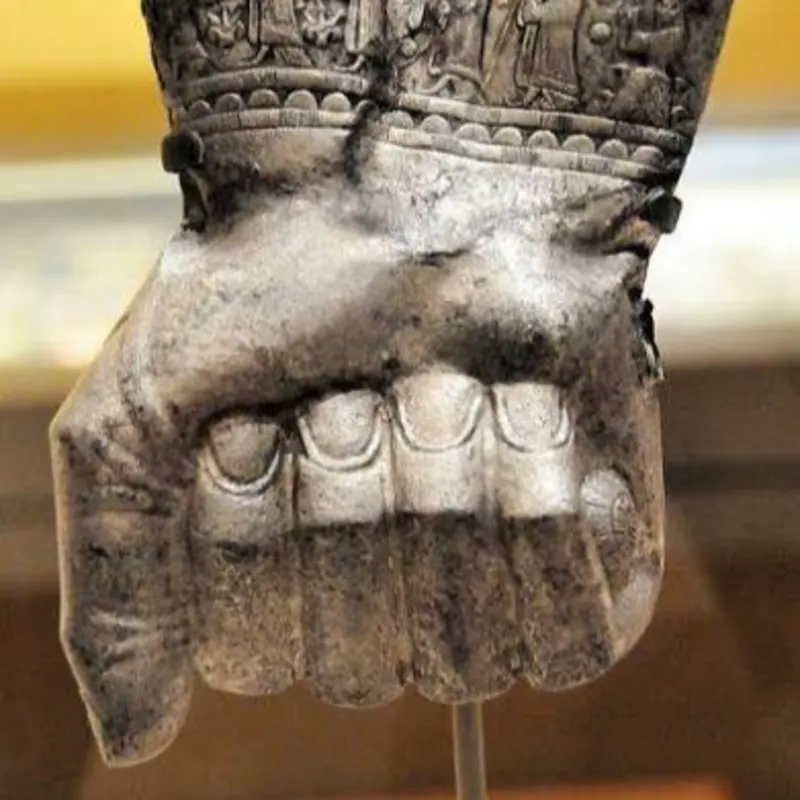
We have one incredible ritual object associated with the Hittite king, and this is the Hittite fist goblet, one of the coolest artifacts of the Bronze Age. A silver vessel in the shape of a fist with a religious relief on the wrist of the fist, and then the word for strength stamped onto it. This was probably used by the king Tudhaliya III around 1400 BC, likely would have been used for the consumption of wine or perhaps the anointing of oil in a religious ritual context. Again, the king would have had so many festivals to oversee, this might have actually been his primary duty day to day. This was his main, could have been his main act of policy, was presenting publicly for these prayers for a good harvest, for victory at battle. And then, whenever he wasn't doing this, he was probably leading his campaigns to keep the many vassals of the Hittite state in line or expand the Hittite state while going to war with foreign peoples.
Well, I'm just going to say, what this reminds me, what this has always reminded me of is some kind of middle, it sounds a little bit like the kind of old Central Asian model of the Khan as like constantly going between city to city, administering, conquering. But it always reminds me specifically of the Holy Roman Empire, because the Holy Roman Empire would have these like circuits where the emperor was supposed to be at one point, or like be at this festival, be at this legal kind of proceeding. It's this weird kind of uncentered politically, or it's this, I don't know, it's quite odd. It's cool, the idea of like the king mostly being this like wandering priest who also has like complex authority and has a council as well. It's legally, really cool and complex.
Totally. And again, so there are many correspondences with other monarchies, like you said, a Central Asian Khan or, you know, the early modern Holy Roman Empire. I think there's also a lot of similarities with early medieval Europe, when you had these very weak, poorly administered states run by Carolingian or Merovingian monarchs who were constantly on the move, but didn't really have much ability for a unitary policy and were really managing collections of functionally independent territories. The Hittite Empire really seems more like a franchise system, where there would have been various effectively independent states, usually run by a son or brother or son-in-law of the Hittite king, that were under only nominal control of the Labarna himself. Additionally, subject territories that had been conquered would be ruled by local kings, and we really don't know to what extent they actually were under the real control of the Hittites.
A perfect example is Troy. Troy seems to have revolted against Hittite rule on multiple occasions. We really have no idea what level of Hittite control would have existed over the city when they were not in revolt. But so, to get into the parallels with the kings of medieval Europe, they're really quite striking, not only in the function of the king, but in the aesthetics. So, the Labarna carried a staff of office, which was similar to the rods held by Egyptian monarchs, possibly also derived from a shepherd's crook, but seemed very similar to a king's scepter from medieval Europe. He would have had an organized coronation in which he was dressed in ceremonial regalia and even anointed with oil. My favorite thing about the Hittite king is that he would have been surrounded at all times by a special standing bodyguard of 12 men. This was apparently a highly coveted appointment, usually given to men of noble birth, strikingly similar to the Kingsguard of the works of George R. R. Martin.
These Hittite royal guards.
No, just sorry to interrupt, but it sounds quite biblical at times as well, doesn't it? I mean, the.
Yes, especially the anointing. No, totally. And I think we should mention here that the Hittites, although they predate the kingdom of Israel as described in the Bible, this is the same Near Eastern context. They would have been inspired by the same ideas of kingship from the Assyrians and even the very early Sumerians. And we also should not discount that specific Hittite traditions could have been adopted in the land of Israel. Because as we're going to see at the end, the Neo-Hittite states in Syria were the ones in direct contact with the ancient Hebrews. Back to this King's Guard, when not defending the body of the king, they were also generals leading his armies in the constant wars the Hittite king would fight either against his own restive subjects or against foreign peoples like the Mitanni, the Mitannians, and the Assyrians. It seems like there was a constant threat of these guards becoming too ambitious and too powerful.
The Panku and royal succession
Possibly to prevent constant palace coups, the Hittite Labarna organized a second set of guards known as the Golden Spears to watch the primary royal guard at all times, a very fascinating counterweight. This reminds me of how Julius Caesar and Nero, for instance, both had a personal guard of Germanic or Gaulish warriors to protect them from their own Praetorian guard, who they didn't trust as much. As we mentioned, the Hittite king had extremely infrequent contact with anybody outside his family, excepting his slaves and close advisors. In another reflection of later European monarchies, many important advisor positions had names suggesting they actually began as servants. For instance, the Lord of Wine would be in charge of most of the domestic affairs of the palace and possibly had some effect on policy, but probably originated as a humble cupbearer. The Hittite word for governor is Lord of the Watchtower. That's bel madgalti.
That's actually, some of you might recognize, the same Semitic root as Mary Magdalene, who means tower. Anyways, the Lord of the Watchtower would be the governor of entire foreign territories. However, the name suggests this may have simply begun as a single guard of a, you know, a tower at the Hittite border when the Hittite state was much smaller than the empire it would become by the late Bronze Age. Hittite laws specify that many positions, including governorships, could only be held by the son of a king, either the current king or the descendant of a previous king. This meant that there was a constant need to expand the royal family. If there were not enough sons or grandsons available, adoption was possible and not infrequent. Usually an adopted son, however, was already a son-in-law who married a Hittite princess and was then formally adopted into the family.
Thus, he would be allowed to hold a governorship or another important advisory position. Generally, though, Hittite kings solved the problem of not having enough sons by eagerly embracing polygamy. The Labarna could marry multiple women to strengthen alliances with his many vassals or to form alliances with distant rulers. At least two Hittite kings had Babylonian women among their wives, and one Hittite prince almost married an Egyptian woman. It seems that only the king's first wife was actually recognized as a queen and thus had specific ceremonial duties. Beyond ceremony, we know from the letters of Queen Puduhepa that the first wife or the mother of a queen also had the unique authority of running the affairs of the palace, specifically regarding women and children. It seems that the first wife of the Hittite king typically served as regent when her husband was away at war. Additionally, her sons, not the sons of other wives, took precedence in the chain of succession, although the king himself did have final say and could override this at times.
Also, as is permitted in the Hittite legal code, Hittite kings typically married enslaved women as well. These slave wives presumably had no means of saying no. They also had no legal status or protection. Children of a king and an enslaved wife were specifically removed from the line of succession. However, they could still serve important government positions and were recognized as legitimate members of the royal line. It is entirely possible that some Hittite kings were indeed born to enslaved mothers. They just, you know, concealed this with hindsight. We do know that certain Hittite kings seem to have fudged their own genealogies to indicate a closer relationship to the king before them or, you know, hide any other potentially embarrassing details in their ancestry. Many princes of the Hittite king lived outside of Hattusa, as they were in charge of ruling provinces basically as fully independent states that only gave token loyalty to the Hittite king.
A great example is the city of Carchemish in Syria, traditionally ruled by one of the sons of the king. After the collapse of the Hittites and the entire Bronze Age world, Carchemish would remain an important rump state, still ruled by a scion of the lost empire. It is very possible that when Hattusa fell, the entire royal family moved to Carchemish and made that essentially their new capital. Thus, seeing how much of a loose patchwork of states this was, the Hittite Empire should not be understood as an administrative empire like ancient Rome or even Iron Age Assyria. It didn't have permanent institutions of long-form geographic governance. It was a loose empire, much more similar to that of Sargon of Akkad in the early Bronze Age. This is a system of tenuous allegiances requiring constant violence to keep subjects' territories in line. The various kingdoms and tribes under Hittite dominion rebelled constantly, sometimes in concert with each other.
Crisis and recovery
Around 1400 BC, mountain clans from the Caucasus began sacking core Hittite territories, likely including the capital of Hattusa itself. Meanwhile, to the west, the Arzawa kingdom of the Aegean coast also rebelled, leading an alliance that included the city of Wilusa, which again is Troy. Historians such as Eric Cline have recently been very excited at the possibility that this event could have some distant connection to the events described in Homer. There isn't any textual evidence to suggest that any Greeks were involved in this Arzawa revolt, but one of the prizes seized by the Hittite king after winning this war was a sword from an Arzawan soldier, which was then re-dedicated to the Hittite storm god Tarhunna. This sword is now understood not to have been of Arzawan origin, but instead Mycenaean Greek. Moreover, the name Arzawa and the related term Assuwa are thought to be ancestral to the modern word Asia, which to the Greeks specifically meant Anatolia.
Mitanni
We're going to return to Troy, of course, but first let's look at the Syrian city of Carchemish, traditionally run by the son of the Hittite Labarna. Before the Hittites came to Syria, Carchemish was actually the northernmost outpost of the Egyptian New Kingdom. At some point in the late Bronze Age, it was then taken over by the Mitannians, who are really one of the most fascinating peoples in the Bronze Age. Alex, you probably know a bit about the Mitannians, right?
Yeah, so they are a Hurrian word. The majority of the population spoke Hurrian, but the reason they're famous is that they worship Hindu gods.
Yes.
Like, that is like, not exaggerating whatsoever. The gods.
Yes, that's exactly correct.
Yeah, they are Hindu. Like, at least there is some kind of like caste of the Mitanni state at one point is like semi-Hindu. It's one of the great facts of Bronze Age history.
Yes, yes. It's that it seems that even though this was a Hurrian-speaking kingdom, the ruling family were Indo-European speakers from India. And that how this happened is extremely obscure. Or perhaps, perhaps Iran. They would have once spoken a language closer to Hindi than to Persian. A peace treaty signed by the king of the Hittites and the king of the Mitannians includes an invocation to the many collective gods of both peoples. This list includes three presumably Mitannian gods named Mitrashil, Uruwanashil, and Indar, thought to correspond directly to the Hindu gods Mithra, Varuna, and Indra. It appears that the Mitannian elite entered the Near East from South Asia, or perhaps Iran, Afghanistan, as bands of charioteers called maryannu, and they very quickly dominated all of modern-day Syria as well as parts of Iraq and southeastern Anatolia. The Mitannians steamrolled pre-existing societies such as the Amorites and the old Assyrians.
After winning some border skirmishes against the new kingdom of Egypt, the Mitannian king secured an alliance with the Egyptian pharaoh Amenhotep III against the ascending Hittites. But then came the ambitious Hittite king Suppiluliuma. And if there's one Hittite you want to remember from this episode, it's him. Suppiluliuma I was a popular general of princely origin who had battled the Arzawans and then usurped his way to the throne. He claims to have been a son of the previous king, but may have in fact been adopted and was really a son-in-law. Regardless, as king, Suppiluliuma crushed the Mitannians, seizing their major cities before their Egyptian allies had time to respond. Suppiluliuma then allowed the Assyrians, who we now call the Middle Assyrians, to take what territory remained of the Mitannian state. Very little would be left of Mitannian society after the conquest by the Hittites. However, the word maryannu, once used to describe the ruling clan of Mitanni, would then be used by other civilizations to describe their own charioteer units who fought with similar tactics.
This is a perfect parallel to how later European militaries would call their units Hussars or Mamluks after foreign groups using such tactics. Additionally, it is very possible that the term maryannu is the etymology of the otherwise inexplicable name of the Homeric hero Meriones. So, after dealing with the Mitanni in classic Hittite fashion, Suppiluliuma appointed his sons as kings of their various former territories in Syria, including Carchemish. He probably established the tradition of making princes the rulers of subject territories. And remember, these territories in Syria would remain in Hittite control for much longer than the core Hittite territories of Anatolia. It is now understood that Hittite states in Syria, later termed Neo-Hittite states, would slowly adopt Semitic culture and begin to influence the affairs of Canaan to the south. Thus, these Neo-Hittites probably seem to be the basis for the Hittites of the Bible. But at least one of Suppiluliuma's sons did not conquer a subject territory.
Suppiluliuma and the Zannanza affair
This would in fact be his most famous son, maybe the most famous Hittite person after Suppiluliuma. That would be Prince Zannanza, a young Hittite man who was once considered as a possible husband for an Egyptian queen. We don't know who this queen was exactly, but she was very possibly the widow of the one and only King Tut. At some point after Tutankhamun died, a letter was received by Suppiluliuma, purporting to be from the young widowed Hittite queen. She explains that she has no sons and no husbands. He, Suppiluliuma, has many sons, so he should give her one of them to be her husband. He would then become a king and rule the land of Egypt. This probably would have been a very shocking letter for the Hittites to receive. Egypt was their greatest rival. The conquest of the Mitannian state would have shocked the Egyptians, as previously they were the ones dominant in Syria.
Now, suddenly, these ascending Hittites are coming all the way down the Levantine coast. Maybe this Egyptian queen, if the letter was authentic, decided that Egypt was not in a position to fight the Hittites at this time. So instead, they should try to make up and form an alliance. Perhaps, you know, if this marriage alliance worked out, perhaps it could be a permanent friendship between the two greatest powers of the Bronze Age. But the Hittites were very skeptical of this letter. No Egyptian royal woman had ever previously married a Hittite man. It appears that until this point, the Egyptians had a policy of only allowing their sons, not their daughters, to marry foreigners. So the Hittites did not respond. The initial letter was then followed up by an angry second one asking why the Hittites did not respond to this incredible offer. The second letter repeats: I don't have a husband, I don't have a son.
Give me one of your sons. What's the problem? What's the hold-up here? It appears that after getting this second letter, Suppiluliuma decided: all right, this is probably legitimate. I will send one of my sons to Egypt to marry the Egyptian queen and apparently become the new pharaoh. Suppiluliuma sent his son Zannanza out of the Hittite capital of Hattusa, very possibly for the first time in his life. His son crossed out of the Hittite borders in Syria, moving into Egyptian territory, and he was never heard from again. Nobody knows exactly what happened to Zannanza, but it appears that his royal caravan was ambushed, and Zannanza himself was probably killed. We don't know who would have done this, but it's very possible that the entire Zannanza affair was a ploy. Some evildoer, either the real Egyptian queen or some imposter, sent this letter specifically to lure out a royal caravan to ambush, either because they wanted to plunder the riches of the Hittite Empire or because they thought that killing a prince would weaken the Hittite state.
We will never know exactly what happened with this so-called Zannanza affair, but it's one of the most interesting anecdotes of the entire Hittite period. A couple generations later, the Hittite Empire would be beset by a terrible plague of influenza. Some commentaries thought that this was actually punishment by the gods for the various misdeeds of Suppiluliuma, including his usurpation of the throne and then his neglectful allowance of his son Zannanza to be killed. All right, this is a great place to stop for now, I think, because we should move on shortly from the Hittite heartland in central Anatolia to the restive western coast, that being the vicinity of Troy. Before we move on, Alexander, any more thoughts on the Hittite state themselves and its potential relevance in modern Turkish identity?
Hittites in Turkish nationalism
Yeah, so there's an entire part of southern Turkey called Hatay, which was part of the French colonial administration for a couple of decades. And Turkey was kind of going through this period where they were kind of trying to determine what being a Turk meant in the aftermath of the Ottoman Empire.
Yeah.
You know, it's a common, it was a common national phenomenon, right? The World War I era end of like dynastic empires. Being a Turk suddenly means something kind of strange if like a bunch of the population are like Albanian or Circassian refugees. So it was kind of convenient to say that, oh, well, the Turkish people are the direct unbroken continuation of the ancient glory of the Hittites. And it's interesting because it's like within Turkish history, there's a strain called post-Kemalism, which is like very anti-Republican, very like critical of the early development of Turkish nationalism. And they would look at something like that and see only like ideisty kind of pseudo-intellectualism, stuff like that. But it's kind of this interesting moment because it's kind of Turks trying to fit themselves into the region in some function.
Right, you know, and most listeners probably understand this, but the Turkish language was introduced to Anatolia in the Middle Ages, very, very long after the period we're describing here. Turkish people are obviously descended genetically from the Hittites, but they don't speak a language related in any sense to the language of the Hittites. Not at all. And this is somewhat politically problematic. And, you know, Turkish nationalists have various confusing and sometimes extremely unconvincing ways of drawing a connection of identity.
Yeah. Yeah.
Yeah, no, it's very fun. One of the theories is that the Hittites were Turks, obviously, but then they all got raided during the Bronze Age collapse, so they went off to Siberia for a little time and then they sort of came back to Anatolia. How much per like how seriously is this kind of theory taken in contemporary Turkish discourse?
Well, it's kind of hard to ask me because I live and breathe this stuff. Like, I wake up in the morning thinking, like, what are the pseudo-scientists and pseudo-scholars saying? And, like, if you look at my Twitter feed, a substantial amount of it is, like, Turkish uncles arguing about how the Troy was Turkish, ancient, the Native Americans are Turkish, obviously. That that's unacceptable. Ancient China was maybe founded by Turks, stuff like that. But today, most people consider it this kind of like eccentric early Kemalist moment.
Yeah.
I think it was basically, it was mostly abandoned.
Yeah.
And I think in the 1940s.
Right. And although I don't think that we should have any, we should not be sympathetic to these arguments in any sense, I do think that important context here is that this is basically in response to centuries of Europeans trying to alienate Middle Eastern people from their ancient ancestors. And this happened with basically every Near Eastern civilization. Even today, you'll see assholes on Twitter from various political perspectives arguing that modern-day Iraqis and especially modern-day Egyptians have nothing to do with their ancestral empires. This is completely nonsense.
Or like Alex Jones talking about how the Greeks were all like blonde girls in Texas before the Ottomans came in.
Greek continuity and its myths
Yeah, that in particular, the idea that modern-day Greek people, and especially modern-day Turks, are like physically so much browner than ancient Turks. This is this modern day kind of Aryanism that was discussed a lot around the Christopher Nolan movie, The Odyssey. It's completely nonsense. It is totally unsupported by archaeogenetic evidence. There is very strong continuity of genetics and culture in both Greece and Anatolia. And there was foreign ancestry coming into both of these places, but it does not seem like ancestry coming in would have been from like darker-skinned Middle Eastern people. Anatolia in the Bronze and Iron Age probably had closer ties with Mesopotamia than it does today, I think I would say. And then even moving beyond the specific issue of genetics, modern-day Turkish people clearly are part of a continuous civilization with ancient Anatolian peoples who include the Hittites as well as, you know, Byzantines and the Hatti and the Hurrians.
There were periods of linguistic turnover and periods of civilizational collapse, but broadly speaking, there is a continuous trend of urbanized agricultural civilization that is much of a longer, deeper trend in Anatolia than in most other parts of the world. I don't think Turkish people should feel the need to construct pseudo-history to explain their connection to the ancient past.
Yeah, I mean, I think a part of it is that Greek nationalism kind of was the first nationalism of the region. And Greek nationalism, you can just point to, oh, well, we speak the same language as languages the Greeks do, right? Like, you know, people can point to the fact that to go to the Morea or something, that a bunch of people spoke Albanian or like a bunch of people had to learn how to speak some kind of like more modern Greek or something like that. But the Greeks were able to do that. And the Turks kind of weren't, especially, especially as a secular national nation-building project that's a problem. Because, like, you can't really say that we were given this land through like religious conquest anymore because you're trying to build a like Jacobin style, like, national liberal national state.
Yeah, a secular Turkish republic.
Exactly, right? So, it kind of made sense to like talk about these like relatively new discoveries in Anatolia as like evidence of a continuous secular civilization or secular, not secular, but a continuous, not solely Islamic civilization.
Yes. No, and even outside of an Islamic context, secular societies, unfortunately, are more likely to get into race science type of stuff because they need other means of justifying their legitimacy beyond the Bible or the Quran.
Yeah, I mean, there's a pretty good Ross Douthat line. I hesitate to quote him, but it's if you hate the Christian right, you'll hate the post-Christian right even more. And yeah.
Sam, that's something that Sam believes is quite strongly as well.
Yeah, I know.
Wrapping up and next time
Yeah, well, just to kind of wrap this up here, I think that another issue is that Turkish people clearly recognize that, you know, not only do Europeans try to alienate them from their ancient heritage, most European interest in Anatolia was basically secondary to interest in Greece. They were interested in connections between the Greeks and Anatolia. By the Iron Age, most of Anatolia would eventually, by the late Iron Age, most of Anatolia would actually become Greek-speaking. You know, by the Byzantine period, all Anatolian languages would go extinct. It would become very heavily Greek-speaking. Then, under later Turkic-speaking peoples, we would see a new linguistic shift to Turkish. But, anyways, European archaeologists, including Schliemann, were really only interested in Anatolia because of its Greek connections. The very few archaeologists who examined Bronze Age sites in Turkey before Schliemann just saw them as curiosities, not evidence of ancient dignified empires.
Next episode, we're going to actually look at the historic basis for early interactions between Anatolians, including the Hittite Empire, and the Mycenaean Greeks, whom they called the Ahhiyawa or Achaeans. There clearly was very significant interaction between the peoples of the Aegean and the Hittite Empire. It is also extremely possible that these interactions were later recorded in distant historic memory by the Iliad and the Odyssey of Homer. All right, Alexander, thank you so much for joining us today. This is a great one, and we're very excited to keep this conversation going very soon with our next one.
Nice to be here. Had a really fun time.
Thank you. All right.
The show is also on Apple Podcasts, Overcast, Pocket Casts, Podcast Addict, YouTube, RSS and Patreon.