Everyone’s favorite Ukrainian-Canadian diaspora chronicler Jim takes us to the
Carpathians for an episode on peasants, poultices, and Parajanov. We discuss
the director’s 1964 film
Hosted by Liam,
Abram and
Jim.
Transcript
Welcome, Jim
Welcome back to Gladio Free Europe. I am your host Liam for this episode and I am joined here with Abram.
Hello.
And we also have a very special guest coming to us from the beautiful British Columbia, BC Jim.
Hey, how's it going?
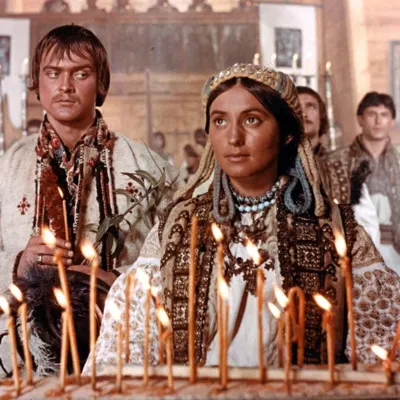
Jim here runs one of the best podcasts around. It's called The Jimcast, which is why I thought he would be an incredible guest for this week's episode, which is on the 1964 Soviet movie, Shadows of Forgotten Ancestors by Sergei Parajanov. You know, a couple episodes ago, we did a whole little crash course over the Kievan Rus, and now we're going back to that part of the world for an episode on a movie set in a part of that world where things maybe haven't changed so much over the centuries.
Jim's background
But before we get into the movie, Jim, could you tell us a little bit about your background and about the Jimcast?
Yeah, you bet. So I kind of started poking my nose into some Ukrainian family history a little while ago, and it turns out the forest that my family tree is in is full of Nazis, and I thought that was kind of weird.
Oh, no.
And I started looking into some of that kind of stuff, and it turned into this kind of podcast project about the history, the political history of the Canadian-Ukrainian diaspora, essentially, and the process of identity formation and the way that's manifested in politics kind of over the 20th century and in the present day. And it's been a lot of fun so far.
And because this movie, Shadows of Forgotten Ancestors, is really this really cool depiction of this Western Ukrainian community in a specific place in time.
First impressions
I thought that, Jim, you'd be a really good person to bring on for this episode.
Yeah, no, it's a movie I saw for the first time pretty recently. Got turned on to it by Clowns Van Zent, CBZ, shout out, because they knew I was doing some Western Ukraine stuff and another Soviet film. So, yeah, it was an experience, for sure. Had everything I hoped for. Some great location shots, some great costumes, some probably would not be allowed today use of animals in filming. Yeah, pretty sweet.
And Abram, had you ever seen it before?
No, I had never even heard of it before, but yeah, I watched it a couple times in preparation for this episode. Yeah, it's a very interesting movie. It's very good in a lot of ways. It's very okay in some more important ways. But overall, I would say it's definitely something worth watching if you're into history of movies and I guess history of Western Ukraine.
Definitely, yeah, yeah. I came to this movie from a pretty funny angle. There's this indie band that I liked a lot when I was in high school that is formed by a former member of Neutral Milk Hotel that performs Eastern European folk music. And in like 2013 or something, they recorded an alternate soundtrack for this movie. And at first I thought that was really cool. But then after I saw that movie, I just thought, like, how arrogant do you have to be to think you can record a better soundtrack than the one this already has?
Oh, yeah.
This movie has a very interesting and very, very phenomenal soundtrack, honestly.
There's some great, something I've been using on my mellow podcast there is there's these great Smithsonian folkways recordings made in like the really the earliest 90s, I want to say, of kind of various, basically community groups. Like some of them are pretty bad recordings of various, yeah, Western Ukrainian folkways, and there's a bunch of Galicia and kind of Ivano-Frankivsk music in there. If anybody's has seen this movie, is interested in hearing more of that, that. That's sure the place to go.
Carpathian Ruthenia
Well, it's great that you mentioned Galicia and all those regions because this movie, Shadows of Forgotten Ancestors, which I should mention was directed by Sergei Parajanov in 64, is set in a really specific part of modern-day Ukraine. It's in western Ukraine, like I said, in a place that's called Carpathian Ruthenia, or sometimes the sub-Carpathians. It's sort of on the border of Hungary and Romania, but it also, from what I understand, overlaps with a lot of different provinces and historical regions of Ukraine. I was wondering, Jim, could you tell us a little bit about where is Carpathian Ruthenia in the neighborhood of Eastern Europe, and how does it overlap with other regions like Galicia or Bukovina that some of our listeners might have heard of?
Yeah, great question. So Ukraine, the word itself, is I'm sure you would have gone over in that Rus episode, IIRC. Ukraine means borderland, and so the Carpathian Rus is a borderland of a borderland, essentially. Yeah. The Carpathians kind of do this weird crescent shape from kind of the top left armpit of the Black Sea into kind of into Slovakia, basically, where the big kind of terminus for them is. But most of its length is not kind of, it's not the Alps. It's not a snow-capped range of, it doesn't constitute a hard boundary, really. You can move armies back and forth through it if you put your mind to it. There are impassable parts of the Carpathians, but that's more like the Tatras. You guys know the flag of Slovakia. The mountains on their shield represent kind of one tip of the Tatras.
Ah, cool. No, I didn't realize that. That's awesome.
Yeah, the Slovaks call that the, they call the Tatras the biggest Czech cemetery in the world, because I guess that's like a Prague weekend warrior sort of thing. But that's not so much the case in Ukraine-Romania area. I wouldn't quite say rolling, but think more Appalachia than Rockies in strictly geophysical terms. Culture we'll get to later. But yeah, so it's only been has been called Ukraine, I think, since modern national boundaries. There would have been very little affinity culturally, geographically, somewhat linguistically, but very contentious and probably religiously with the inhabitants of the lowlands and stuff. So this is an area that's pretty poor. The soil's pretty bad, unlike other.
Yeah, none of that great Ukrainian volcano soil in the east.
No, no, this is not the black earth region. This is crummy, scrappy, rocky, Irish-type, Irish-type soil. But that also means the fact that it's not particularly minerally rich and that its main resource is timber and not timber to write home about, just a lot of it, does mean that it's not really particularly valuable to anyone that I've been aware of. The Carpathians are strategic in the fact that they're there, but holding them isn't worth much. And so this is like a lot of mountain areas in the world, without silver mines or anything. This is a place where I think people have been by and large left to their own devices by the various different political groups that have spanned this area, but probably couldn't be bothered to go into the mountains too much.
You know, Dracula country, right?
It's best left alone.
Absolutely. And I think that's probably why the Carpathian region or Carpathian Ruthenia is seen as this time capsule to an earlier period of Slavic or Ukrainian culture, depending on your particular ideological bent.
Absolutely. If we're going to run with that Carpathian Appalachian, then sub-Carpathian Ruthenia is like the Ozarks, I think. Really, really out there.
It's cool.
Greek Catholics and the Habsburgs
Yeah, yeah. You mentioned the religious divide, and you also mentioned the external powers. So I think it's a good time to mention two little things here that set Carpathian Ruthenia apart, or really, that set Western Ukraine apart from Eastern Ukraine, which is the, number one, the prominence of the Greek Rite Catholic Church as opposed to the Eastern Orthodox Church. And also, the related fact is that for a very long time, it was ruled not by Kiev or not by Moscow, but by Vienna. It was part of the Habsburg Empire for hundreds of years.
It's, as, I mean, it's been one of those areas that's been ruled by pretty much every big name that you can think of in that part of the world. Alternately, Poles, Turks, Romanians, Vlachs, oh, Bohemians at some point or other, probably Premyslids or something. And it only gets thrown into this issue kind of arises, I guess, in the wake of World War I when all these borders are being drawn by people who've never been to these places, even that might live nearby. And so it's Austria-Hungary for most of kind of what we might call modern history, but again, a word that probably doesn't mean very much to most of the people living in sub-Carpathian Ruthenia until much later. But yeah, so the Greek Rite Catholic Church, and there's a bit of it in this movie, fortunately, because it is a pretty neat little cultural facet, but it's basically major Catholic sovereigns in Poland, particularly and Austria also to a large extent, just not really being comfortable with having Greek Orthodox peasants following their own rites within the boundaries of their empire, but also not really caring enough to really uproot everything and change it all around.
They pretty much just switch official kind of, they move the org chart around, but you can't tell a Russian from a Russian Orthodox from a Greek Catholic Church if you're standing in one.
Yeah, no, actually, I gotta say, when I saw this movie, and I saw it twice, and I didn't pick up on the fact that they weren't Eastern Orthodox, because the robes look so, you know, like the way you would imagine a Russian or Greek priest's robes to look, the icons, all that.
Yeah, yeah, absolutely. And I mean, it's so remote that, like, would, would, would, you know, if this is the mid-19th century, like, does, does that priest, like, know who the Pope is at that time? Does that matter to any of these people, you know? So it's, that's all pretty, probably pretty superfluous to the kind of everyday of worship. And again, that becomes more important with, like, diasporic identity formation and shit.
Yeah, yeah. And that's, and I think that really is the kind of the broader trend here you see, where local expressions of culture don't always have that much to do with these broader external cultural identities placed upon the people living in this place.
They don't fit geographically. They don't fit culturally. These are people for whom no kind of national project has ever felt totally appropriate. Like the Soviet one, only because it would have been, it was so inclusive in social terms that it was just the biggest tent that had ever been there, essentially. But this is, it's a real borderline.
Sergei Parajanov
And funny, you should mention the Soviets and also people who awkwardly can't fit within cultural labels, because I think this would be a great time to bring up the director who's sort of our main character in this episode, and that's Sergei Parajanov. He's a filmmaker who's got a really high reputation in the West. As soon as this movie came out, he was understood as one of the foremost Soviet directors, but he actually, unfortunately, had a pretty limited career, a much narrower output than someone like Tarkovsky, at least of films that are considered to be these excellent masterworks. Because as we'll get into, his career was cut quite short not too long after this film came out. What's interesting about Parajanov was that most of his films dealt with these kinds of borderland cultures, groups within the USSR that didn't fit neatly within a particular national identity, really.
In his own case, his family were ethnic Armenians, but he was born in Georgia, in the Armenian quarter of Tbilisi. And in general, his films go into, like I said, kind of borderland cultures and often are set in the kind of vague past. You can tell it's not the present, but you can't really tell if it's the 18th century or if it's the 13th century. Like in this one, if there weren't any guns in it, it would be really hard to tell that it was set in like the late, middle 19th century.
Yeah, that was a question I had just watching this movie, because the guns don't appear until fairly late in the movie. But yeah, I was just like watching this. I was like, when is this? Is this like supposed to be the 1500s? It's supposed to be like the 1900s? Not really sure. Fairly late in the movie that you see somebody with a handgun that's like, oh, okay. So I guess like gunpowder was invented at this point.
Yeah, and I kind of get the sense, like, you know, I didn't know much about this director until we kind of started searching some stuff up for this episode. But, you know, it's definitely seems like the kind of guy, like, would he have even chosen a time period or did he just decide he wanted somebody to have a gun? You know what I mean?
Yeah, yeah.
I'm sure there's purposeful timelessness. And then, you know, I'm not sure it occurred to anybody. As long as it's outside, it's hard to place because it's outside of time, which is probably why he chose these people to film in the first place.
My question would be to the filmmakers: would be, do they just sort of perceive this subject matter, these people, this area, as having been this way for hundreds of years? You know, if this movie was set in, say, the 1700s, would it have looked any different if it was set like 100 years prior, 100 years in the future?
Yeah, I don't know. Like we said, it's definitely a place that's remote, but not inaccessible. So I'm sure that, I'm sure now, sub-carpathia looks absolutely nothing like it looks in this movie. But if you look close enough, you might find some villages where if you kind of squint, it might seem a little bit like the town of Ivan and Marichka.
Western Ukraine joins the USSR
Yeah, we should note also that not only is this an economically underdeveloped and remote part of the world, but it also would have been uniquely underdeveloped and remote in social, economic, cultural terms. Take your pick within the Soviet Union itself, because unlike the rest of Ukraine, this doesn't become part of the Soviet Union until after the Second World War. During the First World War, this is the site of a bunch of just insane, just you know, fractals upon fractals of Ukrainian insurgent republics and stuff. But it's when the when everything's shaken out and they're drawing lines on the map at Versailles, it ends up as mostly as a part of interwar Polish and Romanian republics and isn't part of Ukraine at all. And so Hutsul pol or I shouldn't say Hutsul, Galician politics generally and ethnic Ukrainian, does that apply? Hard to say, politics in the interwar period are like kind of subdivided between liberal reformist anti-Polish nationalism and like fascist terrorist anti-Polish nationalism.
And so this, it's when it when it does join the Soviet Union officially in 1944, I guess, and then actually after a few years of really brutal insurgent warfare, where I think it's kind of Khrushchev's big break as a commissar.
Oh, I didn't realize that.
Yeah, no, the insurgency after the war of the UPA after they go from ethnically cleansing Poles to actually having to fight a Soviet occupying army, which even though it's firing on all cylinders at that point, I mean, insurgency is a different game, right? It's a different being the best, one of the beings, one of the best armies in the world history doesn't imply you're good at fighting insurgencies because that's just killing civilians and burning things on both sides. And so it's kind of, I've been, I understand there's a little bit of support to the West kind of half-asses. There's a few British gliders or something that are immediately captured, but it's a hardship posting for like NKVD members. It's a really crummy, underdeveloped part of the world where even people that aren't necessarily Ukrainian nationalists or don't know what that means are still willing to shelter somebody in the, you know, especially watching this movie, right?
There's just everybody's got a weird little pantry cellar cabin, oh, yeah, yeah, right. It's easy to hide in. And so it does take time, even with not very much external supports. And so, by the 50s, when it's actually starts to be incorporated, like they're starting from scratch. And so I'm sure that would have appealed to to to the director, oh, absolutely, who also it looks like it looks like he was just coming off a divorce from a Ukrainian woman when he made this movie.
He was, he was, yeah, well, he extremely, extremely divorced movie here.
Oh, it was.
Parajanov's first marriage
Well, we'll get into that. His own life is insane, and we can talk about that now, and really kind of parallels the movie in some funny ways. One thing that I think is kind of cool is that you mentioned the idea that his films often show a place and a people that sort of exists beyond time, and I think that to some tiny extent that that might have been true for his upbringing because, like we mentioned, he was part of this ancient minority community of Armenians in Georgia. He even grew up practicing traditional Persian miniature painting because that was this like traditional economic activity of the Armenians in Georgia, which I think is kind of cool. And he also had a very early run in with the law because in 1948, for the first time, for the first of three times, he was arrested on charges of homosexuality, which was still illegal in the USSR.
But he was he wasn't he wasn't exclusively attracted to men because he had a lot of very turbulent romantic relationships with women, too. And the first was in 1950 when he married a woman from a Muslim background who was a Tatar from a Caucasian Tatar community named Nigyar Saraeva. And her family, much like the families we see in this movie, were incredibly traditional and really opposed to her mixed marriage with this Armenian Georgian guy. And, like, that seems to me, I mean, I don't know anything about Soviet Georgia, but that really surprised me that that was so kind of socially transgressive to someone or other.
Because, like, I my understanding is that, you know, having Tartar descent or Tartar heritage in Russia is like analogous to like, you know, Liz Warren Cherokee kind of stuff, you know, like, yeah, scratch a Russian and a Tatar bleeds kind of thing or something like that. So, not, I mean, just stereotyping wildly here, but that seems like a really kind of conservative Muslim Caucasian Tartar thing rather than a kind of ethnic, because I mean, yeah, there would have been Tartars and Armenians getting married all over the Soviet Union.
Yeah, yeah, I think this says much more about the region of the Caucasus than it says about Tatar culture.
Exactly, yeah.
And because what happens is, so they get married secretly, they run off together totally against the wishes of Nigyar's family, and then pretty shortly after the marriage, some of her relatives confront them and they tell Parajanov that he has to pay this traditional Caucasian bride price, which I guess in the 50s was still being practiced in this part of the world. And he says no, he tells him to buzz off. And that was not a good decision because very shortly after the wedding, Parajanov's wife goes missing. And then several days later, her body turns up. She's found dead on the railroad tracks outside of Tbilisi. And just like something out of a silent movie, or really something out of a cartoon making fun of a silent movie, she had been tied up and left on the railroad tracks in front of an oncoming train.
Jesus.
Yeah. And this was in 1951.
I mean, especially fucked up, because it would make more sense to kill him since he's the one who isn't paying than her.
Yeah, it's crazy. Yeah, yeah.
No, they killed her own rel they killed these men, killed their own relative. Yeah, honor killing is about the transgressive threat that sort of murdered theoretically aimed at dispelling is the threat from like the group seeking other options. Some Armenian is no threat to the group, but a defiant daughter most certainly could be. But 1951, that is not easy.
Yeah, and that is wild. Many parts of the world.
That would be, you know, this is this is like, well, 1951, that's like the most arguably socially liberal period of Islam generally and in the world, maybe ever.
Mountain peoples
Yeah, and speaking of like scary Caucasian Muslims, funny thing about the Hutsuls, Lemkos, Boykos, Galicians generally, not very good at war. The whole mountain borderland thing is usually, you know, that usually gives you like, you know, Swiss, Highland Scots, Dagestanis, Uyghurs, Pashtuns. Yeah, the Hmong, fucking, you know, whoever. There's usually mountains involved, but maybe the Carpathians, since the Carpathians aren't near other mountains, it was something you could just go around. I don't know. But that's, to me, is something that really stands out. And, you know, especially since like we do see all this blood feuding in this movie, which is so typical of mountain cultures. Not to get all like fucking, you know, John Dolan anthropology here, but yeah, like Albanians and all the northern Italians and all these, they love their blood feuds and it's practice, right? But, you know, there's no the crack kind of insane mountain infantry of the Austrian Empire are always Croats from the borderlands with the Turks, never Ukrainian speakers as far as I know.
So I don't, I and I don't know why that is, but I but I wanted to mention it because I think it is also kind of culturally particular, and hey, you know, that's until you know they're Ukrainians, right? They never fucking win in anything. It only, I guess, I'm sure that only amplifies the grudge, right?
Oh, yeah, yeah, yeah.
Parajanov moves to Kiev
You know, as you could probably expect, after this genuinely unspeakable tragedy, Parajanov was just totally wrecked, and he ended up leaving the Caucasus because of it. And he moved a thousand miles to Kiev, where he would live for most of his life. And even though we should mention here, even though his family is Armenian and he's Georgian by nationality, he really is understood as a Ukrainian filmmaker because he was operating not within the Georgian film community, not within the Russian film community, but specifically within the film community of Ukraine.
Nationalities in the Soviet Union
I don't know if this is maybe a little bit outside your wheelhouse, but how much do you know about the way that political authority worked in the Soviet Union? How much power and what powers did each republic have? Do you know?
So that depends mostly by era. So the guy, the number one guy, shouts out to Greg Afinogenov, probably everybody listening knows fucking who that is. But his, and this is a bit in the first episode of the Jimcast there, but the go-to scholar for kind of Soviet ethnic history and not just history of Soviet ethnicities, but kind of like history of Soviet anthropology and ethnography and that sort of thing is a guy named Yuri Slezkine. And his analogy for the early days is that the USSR's communal apartment. And what he kind of means by that is that it's one dwelling, it's one domicile, but it's boarded up as a communal as a vastly overcrowded, you know, early 50s Soviet communal apartment would have been. It's divided up and boarded off different parts from each other. And so at the beginning of the kind of, yeah, at the kind of very beginning of the revolutionary period and the civil war, both sides of every conflict, reds and whites and with the odd Petliurists and stuff, are all nationalists as we conventionally understand them.
And especially in, you know, and that's reflected in like the Canadian diaspora where both it's a the conflict isn't between nationalists and communists at all. It's between nationalists who see Bolshevism as the path to liberation from the imperial boot heel and people who want to, the nut bars who want to like restore the hetmanate or whatever, just conservative nationalists. And so the Cossack guys. Exactly, yeah. You do have kind of this really genuine and from the bottom and encouraged from the top, but largely implemented from middle management and lower, this, I think Slezkine calls it like the greatest ethnographic project in human history. There is this incredible outpouring of support and enthusiasm for what Lenin called the indigenization of communism with the idea that there was this prison house of nations that was the Russian Empire. And now that it was. And, you know, the Soviet Union gets talked about as an empire, I think, pretty usefully.
I don't really see any way that it isn't an empire as long as we take that to mean not, you know, the broader social sense, not just having an empire, but not just having an emperor, rather. But this is a very kind of genuine outpouring of kind of national enthusiasms all across the new USSR. It switched all the way to Central Asia and Tuva and Siberia.
Oh, yeah, yeah, yeah.
And the Koreans in the Far East and the, you know, weirdo quasi-Zionist Yiddish Birobijan project. It's a kaleidoscope of. And so that also results in like, you know, a lot of census takers leaving villages and horse-drawn hay carts and crummy old cars down mountain roads and asking people, who are you? And them not knowing what to say. And then, all right, I'm going to write down Ukrainian. And that's how these things happen, right?
Yeah, yeah. I believe in Central Asia in particular, some of these national identities that exist now, and you'll see on the map, were basically created in whole cloth in this period.
Absolutely, yeah, yeah. Not my wheelhouse, but I've no doubt. Probably even harder there. At least there's some, at least you can categorize people by their church with a few kind of key indicators if you so choose. And in the West. Anyway, so that's kind of this, the 20s and the new economic policy period is this outpouring. And probably I would say also a peak of like national influence and the influence of national Communist Party, you know, like Ukrainian Communist Party, Armenian Communist Party, politicians in the day-to-day running of those areas. And then the next kind of 10, 20 years, Slezkine, I think, calls like a great retreat. And this is a huge, yes, a huge pendulum swing back, not just in, well, hey, I'm guessing it was probably way harder to be arrested for homosexuality in Tbilisi in like 1924. You know what I mean? So not only socially and the transition from NEP, kind of decentralized NEP stuff to the classic, yeah, what Kotkin calls Stalinism as a civilization, which I think of a lot.
But yeah, the turned just into top-down heavy industry priority. It's a time of social dislocation, not just with the forced migrations and the deportations to Siberia and the purges, but there's also this huge, and of course, the social conservatism we mentioned about homosexuality gets banned, abortion gets banned, all this sort of nonsense. But also, you get this kind of return to what I'm sure Lenin would have called great Russian chauvinism, which is Ukrainian identity is emphasized as like the history of being like a happy little brother, I think is the exact words that are frequently used. There's this resurgent, and partially it's to do with the demands of war, you know, those insane speeches he's giving where he's shouting out like Nechayev and Nevsky in the same speech and shit.
I'm sorry, who is he?
Oh, it's Stalin, Stalin.
Oh, yeah, you're saying so, yeah, how would Stalin would embrace like past military victories of the Russian Empire?
Yeah, yeah, and so, and, yeah, and so in the war, you get the sense he's just throwing everything at the wall and seeing what sticks, just like every possible, you know, from Bagration to naming their anti-Nazi counteroffensive after this imperial general. Oh, yeah, and he, he would give, and I mean, then he gets, you know, Eisenstein's filming Alexander Nevsky and giving, I think he had like an award that was named after Suvorov or something, but his name comes up a lot as a defender of the realm from nasty Latin Westerners. And so, this also results in like extremely destructive purges of all those national parties I mentioned that were pretty prominent during that period. This is where, you know, this is pictures of mugshots with axes on them, right? There are very few of these people left by the time this stuff's over, be it Armenia, I'm sure the Central Asian Republics also, and Ukraine especially.
The famine debate
And so this is kind of, this comes up a lot in kind of Ukrainian studies stuff because usually, because this gets into famine stuff, which is this kind of fulcrum around which all the kind of Ukrainian historical discourse in the Stalin period revolves and for good reason.
Yeah, and also a lot of very annoying discourse on Twitter.
Oh, yeah, no, that shit's great. I love it. I think it's good. Very generally, the divide is between people who study Ukraine, just Ukraine, so largely Ukrainian scholars or their sycophants in North America, who looking at Ukraine, you know, there's this great ethnographic retreat, I guess you'd say, this turn away from the indigenization of communism, is happening at the same time as this retreat from the NEP decentralized agriculture first stuff and the transition to heavy industry above everything. And so what that looks like on the ground is that you have all these grain confiscations and requisitions and the Kulak resistance and all this stuff. It's happening at the same time that all these Ukrainian artists and intellectuals are being purged and the Ukrainian Communist Party is being turned upside down and shaken. And so it looks, and not unreasonably, like this is part of a concerted effort to destroy everything that makes Ukraine Ukrainian, to stamp out culture, to kill three or four million people.
And so Ukrainian scholars, both in the sense of Ukrainian nationals and people that study just Ukraine, and, you know, I'm talking like the Snyders and the Applebaums.
Yeah, the ones who had New York Times op-eds.
Yeah, yeah, yeah.
The Atlantic set.
This means that the Holodomor must be a genocide because, well, here's your evidence that they were actually looking to wipe these people out is that they locked up all their artists and musicians and stuff. Again, not unreasonable if looking at that evidence on its own, but then that tends to be, I would say, very generally, again, disagreed with by people who study the entire Soviet Union. So the Kotkins and the Ronald Grigor Sunys, who look, it's like, well, if this was a conspiracy to wipe out Ukraine, whence cometh, you know, the death of 25% of Kazakhstan, right? Whence cometh the Volga famines or any of these things. And so there are very few people who are also extremely popular on Twitter for obvious reasons that, you know, ascribe 90% of this to bad weather or whatever, which is scholastically defensible, if not a kind of consensus position.
But so at the same time, what we can say about that famine not being specific to Ukraine in any way, Ukraine was hit the worst besides Kazakhstan. But there was, just as that doesn't necessarily indicate an attempt at genocide because it's also happening everywhere. So we can say the thing about this great ethnographic retreat about these purges of the national parties. That's also happening everywhere. So Ukraine gets has a very, yeah, horrific time dealing with both of these. But yeah, that is kind of those are concurrent events. And that kind of defines for a lot of the diaspora their relationship with the Soviet Union until 1991.
The Thaw
So yeah, that's kind of, and then I just as there's this great retreat during the Stalin period, I think during the Thaw and during the Khrushchev kind of rehabilitations of all these national communists and stuff.
Right. And you know, we actually, we had a whole thing about the thaw on a previous episode about Soy Cuba, which was also by another film by a Georgian filmmaker at this time.
Oh, yeah. Yeah. So, and again, that's, I am not as familiar with cultural stuff during the Khrushchev period, but I understand that it represented somewhat of a pendulum swing back the other way where these various kind of national communisms do start to being celebrated. And, you know, they love this stuff, right? Your geriatric functionary, you know, waking up in the Politburo meeting long enough to applaud for something. They love all this, you know, people dancing in weird national costumes. That tickles their tickles their pickle for sure. They're all about that sort of thing, just on a very kind of, I don't want to say, yeah, on a pretty kind of surface superficial level. There's never a return to the kind of political horizons of the 20s, even if there is kind of a...
Yeah, the political autonomy.
Yeah, yeah. Those seat at the tables aren't refilled. They are done away with. But culturally, there is a bit of a thaw.
But you get media representation, and that's worth something, right?
That's right. Yeah, yeah. I really shouldn't have used seat at the table.
No worries.
Ukrainian film in the 1960s
Well, yeah, I think that that's a really good way to put it, both of you. Because from what I can tell is that in the early 60s in Ukraine in particular, there was suddenly this major artistic interest in, like you said, ethnographic depictions of even the most outrageous, or actually not outrageous, but the most exotic fringes of Ukrainian society being depicted on film. But at the same time, there wasn't really much, let's say, cultural permissiveness as many of these artists had wanted. So, they were still always worried about the censors. So, they could film anything they wanted, but they weren't always sure if it was going to be allowed to be shown in Kiev, let alone Moscow. But in Ukraine, in particular, there was this guy named Petro Shelest who was really interested in the remote cultural depictions. And he had a very close relationship with Parajanov.
And so, when he met Parajanov, he had been really into the kind of Italian neorealism, French New Wave stuff that was coming out at that time. And he also knew a lot about the early Soviet filmmaking from what you call it, the early ethnographic period, where there was this really interesting outpouring of both cultural depictions and experimental filmmaking. If you want to read this quote here, Abram, it's kind of interesting by Parajanov.
Yeah, he says, I may have received this love for authentic texture in films thanks to Pasolini or Fellini, but the truth is, when you film an old subject, the film acquires an archaic character and demands another style. You can't put an old costume and walk around in a contemporary manner, unless you know you wish to produce an effect that way. My love for old things is not a hobby, it's an aesthetic conviction.
The film historian James Steffen even goes so far as to argue that Parajanov's filmmaking was not only this artistic statement, it was a deliberate political statement by the Soviet government, and that they used his art to show to the world the way that Soviet cinema could be groundbreaking at a time when there might have been this impression of Soviet stuffiness. And also, what Steffen says here is that his greatest accomplishment was to bring the cultures of non-Russian republics like Ukraine, Armenia, and Georgia onto the global stage through a lively synthesis of regional folk culture and literary tradition with new avant-garde film techniques and his own personal touch.
Yeah, I mean, obviously, this is also like a very good propaganda tool domestically and abroad. Just like, you know, look at all these different cultures and histories that are presented in the Soviet Union and look at how we're celebrating them in film.
Yeah, yeah.
Parajanov in Ukraine
So even though Parajanov was originally from Georgia, he really becomes associated with Ukrainian culture. So he starts off making Ukrainian fantasy films, illustrating Ukrainian folktales. He even goes up into the Carpathians, where he makes these short documentaries about Ukrainian folk craft, which ends up being really an important part of the story that we're of the story of Shadows of Forgotten Ancestors.
The Hutsuls
You mentioned before, Jim, the Hutsuls, who are the specific culture being depicted in this movie.
The Hutsuls, yeah. One of a few kind of, you know, all this ethnographic stuff is on a spectrum rather than, you know, easily circumscribed groups. We do that later on purpose because we can't deal with spectrums and continuums of things. But another reason this movie is great is because it shows you it's a, you know, not story aside and fantastic visuals and stuff, it's also like a top-to-bottom national geographic documentary about these people because that's obviously something that's fascinating to the director as well as life ways as well as just kind of artistic culture. And so, yeah, the Hutsuls as mountain people, pretty poor generally, as we mentioned, bad soil, semi-nomadic herders, I believe. These towns referred to as Hutsul winter and summer capitals and that sort of thing.
Yeah, the transhumance you always read about if you ever read about Switzerland or the Carpathians.
Yeah, and my understanding, I'm not a folkways guy, but my understanding is, you know, in the summer, you bring your sheep up to the alpine where there's grass. And I think that that happens in this movie at one point. It kind of takes the sheep up into the mountains. But yeah, so there would have been a lot going that going on. And also forestry in this part of the world was the big interaction with the rest of the world. And by way of comparison, in the personal anecdote, the first of several here, this town, where is it? Krivorivnya, where is the, and we'll talk about Franko and Hrushevsky in a second a bit, but that's about it's about 75 kilometers as the crow flies south and east of the valley where my mother's whole family.
Oh, cool. That's awesome.
And yeah, and but just, you know, and decidedly not Hutsul. Definitely very much, very much closer to that kind of Ukrainian-Galician identity, but that shows to go you not just kind of that these people are all living cheek by jowl and moving across and past and around each other all the time, but forestry was also kind of the major wage labor for men not involving farming because most nobody nobody had one job at that at that in that period and in that area.
Yeah, and this movie shows us that both forestry and herding goats and sheep can be a lot more dangerous than you might expect.
Yeah, no kidding. Well, I mean, yeah, forestry is always dangerous, but yeah.
Lemkos, Boikos, and Rusyns
For a quick little clarification here, so you mentioned, yeah, Lemkos and Boikos and Hutsuls. Those are all basically cultural identities within the Carpathian region, the sub-Carpathian area. And they're also sort of considered part of this broader Rusyn group. Is that right?
Yes, I would, that, I think that's correct. Yeah.
But it's also one of those things where it, that's kind of, that's like, that's an exonym, right? Like, they don't call themselves Rusin. That was, like, applied mostly by outsiders.
Well, Rusyn would have been, that was a name, that was a name eagerly adopted by some, by the Galician Russophiles were very interested in identifying as Rus, Rusin.
Yeah, the people who look toward Moscow rather than toward Vienna.
Yeah, yeah, and so, which is easy, which is pretty easy to get away with when you're up in the mountains, right? Nobody cares. But but you have these weird situations where you have these Ukrainians showing up in North America who have no idea what to write on the Ellis Island entry form any more than they would have known what to tell that nosy Soviet census taker you mentioned. But you have some of them writing Galician, you have some of them end up writing Greeks because they're Greek Catholics.
That's great, yeah.
So I really want to know if there's like a flat-faced, blonde-haired, blue-eyed Greek family somewhere in the U.S. that doesn't really understand why. Anyway, yeah, but so you, and you get this, since there's no Ukrainian proper Greek Catholic priests for the first few years, as there usually isn't, they usually come once you've built a church out of birch logs, but you have these kind of they're like union raids of the American Russian Orthodox Church at first based in Sitka, Alaska, on account of the Russian trading company and later moves down to San Francisco to accommodate the white emigres coming from Vladivostok and shit. But they kind of go after the Ukrainian community as a source of not converts, really, because the idea is, hey, you're already this church, so you should just.
Oh, because they don't recognize them as they don't recognize them as Greek Catholics.
Well, no, they probably, they're, yeah, that's, they're probably, and there's, yeah, there's, there's stories of like resistance heroes that stay loyal to the Russian Orthodox. I think there's Russian Orthodox saints that are like persecuted by Austrian Catholic authorities for being, for trying to rile up the Rusyns in the kind of late 19th century where this, where this is set, and, or I shouldn't say late 19th, latest 19th and earliest 20th. But yeah, so Rusyn, to some degree, it's an exonym, certainly an exonym of convenience. It's certainly what the, I believe, Czechoslovak Republic would have used to describe these people because they end up with this little finger of mountainous territory at the edge of Slovakia purely through luck. They have nothing in common with them. They're not really interested. It never gets developed, and then they lose it after the war anyway. But yeah, so it's that's it's a convenient catch-all, and there is some self-identification of that that goes all the way back to Kievan Rus and kind of those various religious identities.
But for the most part, yeah. No, but like Lemko, Boiko, and Hutsul, those are also to some degree and used by people outside those groups to describe them. Like I think just on the wiki there, it's you know, the amount of people that can kind of relate to these cultures is pretty broad, but the amount of people that will identify as that and not Ukrainian is pretty small, even compared to like, I think people are way more willing to describe themselves as like Vlach as well as Romanian or the Hungarian ethnic group in Romania is called.
I don't remember.
The Szekelys.
Yeah, that's right.
Yeah, yeah, yeah. Yeah. I feel like those are people are more willing to step in and out of those identities than the kind of sub-Carpathian Rusyns are, but it's hard to get it. It's hard to, it's hard to get a sense of these things. And it's also one of those fields of knowledge where you're not always convinced that there's something you're not understanding. There are no hard answers to any of this shit, frankly.
Diaspora identities
Oh, and I did want to mention, because we might, because Lemko's might not come back up, but just in terms of diasporic identity construction and stuff, just as a little aside, one of the first places I heard the word Lemko was doing some research about our Canadian forces arming and training neo-Nazis in Donbass today. And the one Canadian, the one Ukrainian-Canadian diaspora volunteer to go fight for neo-Nazis in Donbass used the nom de guerre Lemko.
Wow, that's really interesting.
Yeah, so there is kind of this leftover Ivan Franko-ish, Mykhailo Hrushevsky-ish identification with that because you know the, you know, there's always that pure peasant form of whatever it is we're trying to build a country around, right? People always fetishize the poorest member of their imagined ethnic community to put on flags and shit, right?
In the case of that guy Lemko, the genuine neo-Nazis in eastern Ukraine must have been kind of confused when they meet this guy who is an American, but he's calling himself this sort of obscure tribe from the West.
Yeah, yeah. No, I'm sure it's completely bizarre. Also, well, and that's a little bit of the. And even the SS division, right? They're not Ukrainians, they're Galicians. They're not Slavs.
Oh, because of the Nazi racial supremacy theories.
Yeah, they saw it, right? Yeah.
Maybe Lemko struck him as the least Untermensch of any of these different ethnic groups. I don't know. Who knows?
But yeah, I did just... So there is clearly a bit of that identification still in even well-established large North American communities.
And to jump on that point also about how valorizing the poorest among them, I think that's a really important note to make about the Hutsuls, too. How the Hutsuls are kind of seen as the they're seen as in a sense the least of the Carpathian peoples, which therefore makes them the most of the Carpathian peoples, because they're the hardiest, they're the poorest, they're the most sober, they're the most pious, maybe.
Yeah, yeah, I'm nodding. I mean, this is like if the Carpathians were in the British Isles, they would have, you know, killed all the Hutsuls and then worn their and then worn Hutsul clothes for hundreds of years after. You know what I mean? Yeah, like this is really that kind of yeah, it's well, that's 19th-century bourgeois nationalism Ivan Franko gets to it later because everything gets to this part of the world later, but they love that, you know, like just getting on a haycart and riding to God knows where, and the first, you know, guy you see driving sheep down the street, it's like, wow, you know, here you are, a real Ukrainian. What the fuck are you talking about? Yeah, yeah.
What's that story about how, was it Michael Collins, how he's in Ireland and he just sees a man in a donkey cart and starts crying because he's the most Irish man he's seen.
The Hutsul myth
I think we should mention that this is where Shadows of Forgotten Ancestors, the story, really comes into in a very important way because this book was foundational in establishing what I guess we can call the Hutsul myth. Like the idea that the Hutsuls are both uniquely oppressed or at least uniquely deprived and therefore uniquely Ukrainian.
Which is kind of interesting because they never really saw themselves as part of a Ukrainian polity at all until these guys from Venitsy and Kiev saw them and decided that they were Ukrainians. And later informed them of that fact that they were now included.
Yeah, yeah. And I don't know too much about Russian art at this time. This is 1911, so this is right before the revolution. But that, but the book, which was written by Mikhail, I'm sure I'm going to say this wrong, Kotsiubynsky, try my best here. He was a symbolist, which was kind of this like artistic sort of surrealist movement that was really informed by folklore and also to some extent by nationalism. And so this was something that Parajanov would really tap into, but it was also a very popular book in the Soviet Union at this time. And I would think maybe also in the diaspora.
Just curious, had you heard the name of this book ever? Just like growing up in a Ukrainian family?
I had not. No, I was not previously familiar with this guy. Franko, for sure. This guy, this guy, not so much. In fact, every one of the Ukrainian communist halls has like a bust of Franko in it.
Oh, that's funny.
He's huge among like the left still.
He's the big leftist guy, yeah. Although, yeah, I guess this guy's particular politics were just vaguely kind of bourgeois nationalist enough that the Soviets were able to kind of take him and run with him.
I think so, yeah. The whole of Soviet history, they are so desperate for communists in Western Ukraine, right? But there's none to be found. There's no manufacturing. Hardly anybody knows how to read. And so they end up naming, you know, a huge administrative district after Ivan Franko, who was like explicitly not a Marxist because he thought the Marxists were, you know, too dismissive of the peasantry, which probably would have sounded about right to a lot of Ukrainians living under the Soviet Union in the 30s. But anyway, it's kind of funny.
The story
Just how they need guys.
And that's a great point because, like you said, this is not a Marxist book at all. It's a very simple romantic novel that's sort of tapped into this pre-war kind of fin de siecle irrationalism, this interest in magic and spirituality and ancestors and all that. Hence the name. The plot is super simple. There's a boy named Ivan, girl named Marichka. They love each other, but their love can't be. It's a classic star-crossed lover story. When Marichka's lamb slips into a river, she tries to save the lamb. Instead, she drowns. Ivan's totally heartbroken. He's so overcome with grief that he jumps into a marriage with another woman, but then it doesn't work out. Pretty soon, she shacks up with this kind of strange, mustachioed magician guy. He confronts him. He gets mortally wounded. And as he wanders through the forest dying, he sees one last vision of his beloved Marichka.
And that's the whole book, basically. It's a fairy tale. It's not really a great work of literature. And it's not something that you'd imagine the Soviet authorities would be especially keen to adapt. But I guess, like you said, because they were looking for local heroes, they thought it would be a really good source of soft power, basically.
And that also would have appealed to the sort of people that were making Soviet cultural decisions, right? They probably loved this kind of Dickensian. Again, I'm going to judge his book entirely by its cover here. I don't even speak Ukrainian, but I'm sure he really goes on and on describing scenery, right? And I'm sure it reads a lot like the movie watches in the sense of the detail would have been so important to him. But they like that sort of thing in that they don't like this, you know, they like that stuff in a book because they recognize it. And this, it's hard to call this film, you know, subversive in any real political sense, but I feel like they probably just hated it because they didn't understand it. And they're a bunch of old guys who are scared of what they don't understand. And that's what happens to all the Czech new wave directors because man, oh man, does this look again?
Not a film guy, I know very little about film, but this is like the spitting image of some of the Forman stuff that's coming out of Prague during this era. The whole shaky cam, bright colors, loud noises, kind of cacophony of vaguely surrealist imagery is very, very mid-60s.
The Soviets and Ukrainian culture
Yeah. And what we'll find out in his case, or what he would find out, is that although it was very popular with the local Ukrainian authorities, once it got to Moscow, that's where he ran into some trouble. But at the time, the government of Ukraine was really interested in promoting Ukrainian culture abroad. And I think that the reason why they chose this book in particular was because its author had just been recognized by UNESCO as this like great, as like a list of like great authors from Ukraine. And now that I think about it, I wouldn't be surprised if this was part of some, you know, American kind of let's separate Ukraine culturally from the USSR kind of thing.
100%. The former head Yaroslav Stetsko, a Nazi collaborator who ends up as head of the major figure in the OUN, the Banderite branch of the Organization of Ukrainian Nationalists in the United States. And he's, he's, you know, these guys are all spooked up and stuff. And he is a good friend of George H.W. Bush and later becomes the founding member of something called the Anti-Bolshevik Bloc of Nations.
Oh, they have, yeah, and they have this thing called Captive Nations Day.
This is a big Reagan thing. And this is the kind of cultural production of the stereotype we have of the Soviet Union that it's gray and bland and there's no culture that is particular at all, basically, right? Not just that it's boring and it's kind of shitty, which probably had some truth to it because my understanding is it was pretty fucking boring. And that's well, that's how, hey, if it wasn't boring, these directors wouldn't be making all these movies that grew up in the post-war generation and were incredibly bored and were just looking for the coolest thing around, just like, you know, the British kids were looking to India and stuff, I'm sure. And to the American South.
Yeah.
Oh, yeah, yeah, yeah. Totally. And this kind of stylistic film stuff is definitely super typical of the era.
The male witch
But also, oh, yeah, I just wanted this, that the kind of male shaman witch doctor figure at the end.
Oh, yeah, that best character.
Yeah, it's so just a fantastic. Yeah, there's, I mean, this is such a melodrama. He looks like just such a pantomime villain.
Absolutely. He's fantastic.
But the thought I got the mustache.
Yeah, yeah. And, but the thing I thought was kind of weird is that the shaman kind of figure is male. That surprised me because, of course, you know, we know the history of Eastern Europe doesn't really get an early modern period, depending on how you look at it, but it also doesn't have the orgy of like anti-witch violence that the West has. These remain respected community members a long time.
A family poultice
And another personal anecdote time, I went to Ukraine in 2017 to see what there was to see. And with my mother talking about, and she was talking about how her grandmother would send her to do stuff like, oh, local girl gets her leg trapped in farming machinery and is probably going to get gangrene. So Nana sent my mom out to scrape pitch off of pine trees and she would mix that with honey. Of course, a natural antiseptic. And this green stuff that she would scrape off strips of bacon that she hung in the basement in the place in Armstrong BC. And she fashioned all this stuff into a poultice and put it on this girl's leg, who apparently screamed all night. But my Nana says that when you took the poultice off, it was like somebody had sneezed in it and she kept the leg because that would be some kind of weird natural penicillin in the bacon, whatever.
And the pine sap would have been like a binding agent, like a gum base or whatever. And honey's antibacterial, right?
Yeah, yeah. But so not only that, but she would also talk about stuff like, oh, you know, my, my, my, my nana would call her and tell her somebody would died. And she'd be like, I know, you know, because I had a dream about them walking three times around a haystack last night. This sort of shit, right? And so, and then, and then our, we're just talking about this, and then our guide in Ukraine overheard us and said, Yeah, it's it's common for Ukraine women to see these kinds of things, sort of thing. And so, you know, if you're making poultices and seeing things before they happen, that's a witch, right? Call it what you want, but that is a witch, but also not a very big deal. I don't think very rare or remarked upon, and so, yeah, that was kind of something that surprised me about this movie from my relatively little exposure to authentic subcarpathian culture.
But I always thought that was that was women's work, but I guess not.
Well, even in this movie, Ivan's second wife is also practicing in witchcraft, so you know, both genders are represented in this quackery, yeah, yeah.
Making the film
Oh, and I did want to mention in terms of our periodization, I think there is a an intertitle somewhere where it says 1964 and 1864, which both confirms our technical estimate of the late 19th century and the fact that he obviously wanted it to be timeless but needed to situate it somewhere.
Yeah, complete mentioned that so it probably that probably does indicate that it is set in 1864, but it also might be because that was the year that the author of the book was born, and that was part of why they wanted to release this movie in 1964. So, the Soviet government was they were really interested in doing it, and initially, I think they wanted somebody else, but she dropped out, a woman director, and but she recommended it be done by Parajanov. And when he read the script, he immediately fell in love with it. I gotta wonder if part of that was because he's a guy whose own wife is horribly murdered in a blood feud. He might kind of, you know, project himself into this story a little bit.
And then has an unhappy second marriage with a Ukrainian woman.
Yes. Oh, yes, you're right. We forgot to get to that. Yeah, so he also then was, when he moved to Ukraine, briefly married to a Ukrainian woman. They quickly got divorced, probably because of his own infidelity. And yeah, and then he, like you said, he was a very divorced man, and then he spent years of his life just going across these remote parts of Ukraine filming these short documentary films about Ukrainian like folk traditions and folk art.
A Marxist reading?
The like we talked about that the Soviet government had these had this particular interest in the movie. Like we said it was the 100-year anniversary, but they also thought that it could be politically useful both in an external context of showing the you know the artistic freedoms that existed within the USSR, but also because they did try to kind of project a Marxist reading onto it. Yeah, because beyond the novella's ethnographic authenticity as a representation of Hutsul folk beliefs and legends, the Soviets tended to emphasize this depiction of the poverty and backwardness of Hutsul society. But they also emphasized the democratic proto-socialist aspect. Its ideal philosophical contents consisting of showing a man's struggle for real happiness at great human love and the affirmation of the inexhaustible creative forces of the people. The characters of Ivan and Marichka are the embodiment of true human beauty and poetry, the world of private property is set against the world of true happiness.
And that last part is just like a huge stretch for me.
Yeah, I agree. Maybe that's in the novel, but it absolutely, like you wouldn't you wouldn't pick that up in the movie.
No, yeah, it reminds me of people on Twitter today trying to explain that a movie, that because they like a movie, therefore it has to be a leftist movie.
Yeah, this movie, I wouldn't even pick up anything like socialist about it or even like no political in general. It really just feels or even just like a message because you know, we say it's like a fairy tale almost, but obviously, most fairy tales have like some kind of like basic moral. You're trying to like teach children, and this movie doesn't even really have that. It's just like these two characters fall in love, and then one of them dies, and then you know, a few years later, the other one dies, and it's just like you know, very sad, but you know, they reunite together in the afterlife.
This is what the 30s Pravda would have called art for art's sake.
Yeah, no, you're right, yeah.
Well, this, and there is a, I feel like, I feel like there's kind of a vaguely negative portrayal of religion at the very beginning. I don't know if somebody has a line complaining about the priest or whatever, but that's yeah, that's like the only political content in the in the movie, as far as I can tell.
You know, so in the beginning, there's like Ivan's father engages in an axe fight with a much richer man, and then Ivan's father is the one who dies, and the richer man ends up being alive.
And the richer man, we should add, is Marichka's father.
Yeah, and so there was a little bit of social commentary in the beginning, I guess, of just like about look how unequal the society is. You know, he's like wealthy and he donates to God, but he doesn't donate to the poor beggars on the street.
Yeah, yeah, there is no Satan sort of thing, very very materialist, but that's about it.
And would there even have been, do you think, very wealthy people living among the woods at this time?
Well, yeah, that would be the guy with like 20 sheep, right?
Yeah, I mean, these guys weren't having harvests, because usually it would be the guy with the best harvest that year. But I guess he had just the guy who's most of his sheep didn't fall off the side of a cliff.
Yeah, yeah, and I'm sure, I'm sure there's, yeah, well, the wealthiest in the conventional sense, if you say you wanted to borrow money, you couldn't have done it in your town. You would have had to go find somebody who knew how to read tropical parentheses. But yeah, I mean, it would have been, you know, like probably the guy who had a fancy new wood stove made of iron that he got carried in from Vienna or something. No real money and no real power and no real influence either. I don't know if these guys even sent, like, I don't know if they even sent, you know, MPs to Vienna when they were doing that kind of thing. Yeah. No, no, no, no intellectual class, no, no anything. They even had to rely on the anemic Western Ukrainian intellectual class to tell their story.
Yeah. And it seems like in terms of development, things were still, like you said, by the early 60s, still much lower in the Carpathian region than almost anywhere else in the Soviet Union.
Yeah, same in Czechoslovakia, the far. You do, you, you get a bit, actually, you get an analogous process of these filmmakers looking for just something anything different. They'd go into deepest, darkest eastern Slovakia and film the extremely poor rural people who live there. Analogous process and probably analogous people. But yeah, no, not much going on.
Filming in the mountains
Yeah, and of course, there's an obvious problem in trying to make a film in a region like this, which is that basically you have to bring all your own stuff. You have to, there's probably no reliable electricity. There are no hotels. So you have to deal with all of that in your own.
Yeah, there's no local crew. You can't hire a lighting guy there.
Yeah.
No good roads to carry any of this stuff along.
Oh, yeah, everything has to be helicoptered in. And I don't even know that I doubt they even had helicopters available on a film like this in 64. And so because of this, maybe unsurprisingly, this was one of the longest productions of any Soviet film. Because they were basically constantly whipped by wind and snow was blowing in their face half the time. They took 11 months to film this, which is just unbelievable. Almost no film ever takes that long.
Oh, and I'm also sure this director, you know, he's probably definitely the kind of guy who's like just leaves the tent in the morning, is like the light's wrong. We can't film it today. I'm sure sort of crap, you know?
Yeah.
I don't think there's any like artificial lighting in this movie, so the entire thing is natural light. So yeah, even if it's cloudy that day, then you really can't shoot. You really have to like do another one. And then, of course, adds to the cost, because you know, you flew all those people out there. You gotta pay them for that day, even if they didn't work.
So it's just like no, absolutely.
Yeah, and because so much of the film was exteriors, 34 of the like hundreds of days that they had to shoot for had to be canceled because of weather conditions. Just because if it was snowing that day or whatever.
Right.
Well, I'm glad they took the time. Yeah. Yeah, because it is.
Memorable shots
It's a really cool, it's a very cool movie, and there's some really interesting moments. Like we mentioned, like how logging is dangerous. One of the most famous shots in the movie is there's a POV shot where Ivan's brother is killed by a falling tree, and we see it from the point of view of the tree.
Tree falling is whenever they, you know, somebody says being a police officer is dangerous and 300 people get mad at them and post statistics. Tree falling is like twice the next highest one, which is like king crab fishermen. It is an insane profession, and everybody who does it, even in the modern day and age, has screws loose. They're crazy people.
I can't relate.
Yeah. Yeah, and I feel like another cool shot that I liked a lot is the scene is the shot with the moving camera where it's the funeral. And you mentioned the church scene before. It immediately precedes that, where it's this kind of strange funeral with these apparently pagan elements. And then the spooked mother pulls Ivan into the church to get him away from all that.
Well, and I mean, that's not specific to Ukraine. What is that? Somebody was saying they were sending like missionaries to Sicily in the 1870s because nobody was like recognizably Catholic, but I'm sure it would have been the exact same bizarro, syncretic, weird, just massive thing.
Absolutely.
They just wouldn't have ever gotten it sorted out by anyone. They would have gone straight to communism, and then that was that.
A Ukrainian-language film
Yeah, I feel like probably the coolest thing about the production of the movie is the fact that it's in the Ukrainian language, which until this year, 1964, there had never been an entire feature film produced in Ukrainian.
Yeah, even the Russian people who were like getting this movie funded were like insisting that it should be dubbed over and released in Russian. Yeah, I mean, he managed to resist that.
Actually, Liam and I previously watched a Soviet movie called Mimino, and in that movie, it's like set in Georgia, and like some Georgian man moves to Moscow, but so in the first like 20 minutes, it's set in Georgia. And how they dub that is the actor is speaking in Georgian, and then immediately after the stuff he's saying in Georgian is finished, a dubbed-over voice just repeats back what he said in Russian immediately. So it's like very, very distracting and just like not a good way to make movies. So very glad they just like put the entire thing in Ukrainian and just like had the Russian speakers read subtitles.
Yeah, no kidding. And that had the fact that there would have been, I'm sure, like, you know, films made in the country of Ukraine without being in Ukrainian, it would be one of those things where all the sorts of people that would be making a movie wouldn't be ethnic Ukrainians in the sense that, you know, Kiev would have been, had a lot of Ukrainians in it, but none of them were either, you know, plugged into technology at all or like larger kind of modernist artistic movements. Same way, you know, every movie made in Prague would have been a German movie still, sort of thing. Just ships, ships passing in the night there.
Ukrainian and Russian
Right, right. And so, could you talk a little bit about what the Ukrainian versus Russian language situation was like in Ukraine, especially western Ukraine, in the 60s?
In the 60s. Yeah, so like I mentioned, there was that they would have been coming off that swing back from the indigenization of communism movement. So Ukraine was very strongly encouraged everywhere in the 20s, then kind of drastically clawed back in the 30s and 40s. And then in the thaw, things would have probably shaken out a little bit. I think Russian still kind of remains the dominant. Certainly eastern Ukraine is more influential than the East is much more influential in the communist era. It's one of these classic, like weird kind of regional mafia type political establishments. I think like everybody who's anybody in communist Ukraine are all from Dnipropetrovsk.
Oh, it's funny. It's like Tikrit in Iraq with the Baathists.
Exactly. Exactly. Yeah, yeah, yeah. And so, because it's all networks and who knows people and who you can trust and stuff.
Going to Yale if you're someone in the CIA in the 50s.
Yeah, yeah, yeah. Or what's, you know, Gorbachev becomes Gorbachev because he's like, starts, he's from the Caucasus, but he starts his career as the local party secretary of the spa town where the whole Politburo goes on vacation and stuff.
Oh, yeah, in Crimea, right?
Yeah, it's all this weird regional stuff that determines all the weird Soviet power networks. Yeah, so Ukrainian would have remained. I don't think Ukrainian, the language would have never reached the kind of heights that it reached in the 20s. And the East is both more populous, but also much more heavily industrialized. So Donetsk coal miners and ironmongers and that sort of thing would have been the biggest kind of groups of workers when this is all being would they have been Russian-Ukrainian speaking at this time? Well, so yeah, so they would have spoken Russian. Again, ethnic labeling is more difficult. Like Khrushchev is born technically. I believe Khrushchev and Brezhnev are both born within the boundaries of Ukraine. Brezhnev, I think, I want to say he grew up speaking Ukrainian. I'm not too sure. But there would have been, yeah, it's about roughly half and half in terms of what people speak at home, same as it is today.
But I think Russian would have still been the dominant language. I expect that's what they would have conducted party meetings in for the most part. But there still would have been education in Ukrainian. All the street signs in Western Ukraine would have been Ukrainian, that sort of thing. Because they were still concerned with that, I think, yeah, that Ivano-Frankivsk district is created after the war, right? Because it wasn't part of the Soviet Union formally. So there is that move towards legitimizing the communist project and translated into Ukrainian. So yeah, it would have been, I think Russian would have been dominant to some extent throughout the Ukrainian SSR, but dominant in such a dominant in a political environment that wouldn't have necessarily led to conflict because it's not like the Ukrainian language was endangered. Of course, it still isn't, but we have to pretend that it is now for a bunch of different reasons.
Yeah, like I said, we should mention that there probably were a lot of like genuine, terrible chauvinists, especially under Stalin, right? Who probably like did not respect Ukrainian as a language at all.
Oh, no, there's plenty of that whole like kind of little brother attitude is pretty well. And I mean, Stalin would have that Stalinism would have been the latest manifestation of that that would go all the way back to, I'm pretty sure, like the Narodniks and the like Pan-Slavism was huge in this part of the world until the First World War, certainly. And that oh, well, and I mentioned those Russophile kind of priests and immigrant communities that would have very strongly identified with Moscow on purpose, even from this part of the world. So yeah, no, the chauvinism is very real. And to this day, too, that's it's it's not necessary, you know, those sorts of perceptions among Russians aren't necessarily harmful in a different political context, but that's that's that's that's very yeah, yeah, pretty soon we can start wrapping this up with a talk about the way that Moscow received this movie and the kind of broader implications that it had about Ukrainian culture.
But before we do that, Abram, do you want to say any more, anything more about, or anything else about the production of this movie from like an artistic standpoint?
Abram's mini review
Because that's more of your wheelhouse.
Yeah, okay, so a quick Abram mini review. This movie is not beautiful in the traditional Hollywood sense. There are no wide shots of the landscape. There aren't very bright saturated colors. There aren't any good compositions. And the reason is to have those things, you usually have a very fixed camera. And this movie does not have a fixed camera. This movie has an active camera that follows the actors around in the action. A good example to compare this movie to would be The Revenant, that Leonardo DiCaprio movie, because it's also set in the wilderness and has a lot of long takes that follow the characters around. But that movie was made in the 2010s, and this movie was made in the 1960s. Just to give you an example of this, there's an early scene that we mentioned where, you know, they were in the church for a funeral procession.
And traditionally, how you would shoot the church is you would have a fixed camera, wide shot, just showing the entire church procession in one frame. Or maybe have a dolly shot slowly moving down the aisle. In this movie, we have a handheld camera that sort of follows around the main character Ivan as he walks, you know, sort of doing its own thing, just kind of going through the crowd, turning side to side, just to show you what's happening in this room here. And virtually every major scene in this movie is like that, where the camera follows around Ivan, the main character, and tries to give you a sense of what things look like from his perspective. And, you know, an interesting thing this movie does is the camera whips. So you've probably seen this a lot in shitty found footage horror movies. Usually what happens is to make a scene feel like just one long take, what you'll do is you will whip the camera to the side very quickly to mask the edit where you know two shots are being spliced together just in that like camera whip.
And this movie does that too, but an interesting thing this movie does is a lot of times when the camera will whip to the side, the shots won't match. So you will be at the bottom of a hill, and then the camera will whip to the side, and all of a sudden, you're at the top of the hill. Which gives the movie this sort of dreamlike quality. And I would say dreamlike is the perfect way to describe this movie. In terms of story, it's very simple. It follows around a boy, later a man named Ivan. You know, at the start, his older brother dies from a tree falling on him. His father dies in an axe fight. He meets this young girl, they fall in love, they grow up together, and then when they're older, she dies as well. And then he remarries, it doesn't go well, and then at the very end, he dies.
And we basically just observe these things happening. It's very atmospheric. There's very little dialogue. There's no conversations at all. Basically, every scene only has one person talking, and they don't talk very much. And I'm pretty sure the reason for that is that the acting isn't very good. It reminds me of early John Waters movie and the fact that you have these non-professional actors, but they just very much look the part. I'm thinking like all the old Ukrainian ladies and the very stern-looking old Ukrainian guys in this movie, where they have that perfect look that you're going for, but they're not professional actors, so they can't deliver very good dialogue. And also, a lot of the time you can tell that they had somebody else dub over their lines because the voice doesn't match the mouth movements. But in terms of how it all comes together, you know, the handheld camera work, the weird acting, the lack of dialogue, it creates a movie that feels more like a dream than a traditional narrative.
I wouldn't say it's a good story told well, but I would say it's a very well-crafted and unique piece of art. And if you're a fan of cinema, history, or cinema history, you will definitely get something out of this.
Yeah, yeah, and I think this is the reason why this film, just like Soy Cuba, which we talked about before, has had a much more positive, or at least longer-lived, reception in the West than where it was made. I think it reminds me most of a lot of Japanese movies, especially by Kurosawa, both in that the way that they're so atmospheric and the storytelling is so visual, but also in the sense that the characters often don't have much of a monologue that's external. The acting is all in the face.
Exaggerated acting
Actually, there's one very funny thing to me. You know, there's just one scene where Marichka is getting teased by this old lady. Marichka's the female main character.
The lost love.
Yeah, she gets teased by this old lady and she just runs towards the camera and just like puts her hand in her face to like show that you know she's very distressed. That's like a sort of thing you see in plays. Because like, okay, people in the 10th row can't see the expression on your face. So you have to like really oversell the emotions. So, but this is a movie where you can just like see the character's face. But because these are very like amateur actors, they just have to like oversell everything because this is the best acting you can get out of them.
And I also think that goes back to the Parajanov quote about how when you're doing an old movie, it has to be what he called an old style, where I think that he believed that that kind of exaggerated performance made it in a way more authentic to the spirit of the work than if it had been totally realistic. Because it's again, it's a fairy tale. He's trying to make a pantomime here. It's not supposed to be a story involving characters you could see in your daily life.
Yeah, it's like everything's very exaggerated, just like, yeah, like a fairy tale. And if you want to make this feel a little older, you harken back to a much simpler art form like stage plays.
And it's and also silent film melodramas that it seems like a lot of these guys had seen, you know, everybody's screaming and crying and throwing their heads back and exaggerating every movement. And yeah, no, the thematically, the story is a mess. It doesn't really matter.
Right, yeah, yeah.
Dovzhenko
You know, one thing I think I should probably mention here: there's this really famous 30s Soviet director named Dovzhenko. And our director was actually got started in the Dovzhenko Film Studio. And he made this movie called Earth or Zemlya in 1930. And it's all like that. Like you said, like people throwing their hands back. It's about Ukrainian farmers. And it's just like, it is basically a play because it's very early in the history of silent film when there hadn't really been this tradition of realistic filmmaking yet.
The music
The music's also very, very good. Very traditional folk music.
Oh, the music's incredible. Yeah, yeah, yeah. It was by some young guy, and he just totally killed it.
Yeah, and also the characters are playing, you know, like instruments throughout the movie, just like in the background. So like that's constantly in the score.
What are those giant horns called? I always forget.
Well, Alpenhorns in the West, but I don't know, I'm not sure what they call them in Ukraine. Yeah, that's kind of your basic mountain loadout, you know, the big horns, the shorts.
Yeah, yeah, all the sheep.
Is it authentic?
Well, you know, let me ask you. So you mentioned that you visited Ukraine, your family is from Western Ukraine, you've read a hell of a lot about Ukraine, you know a lot of Ukrainian people. Do you think that the depiction, not necessarily of the Hutsuls in particular, but of the sub-Carpathian region, all the weird stuff, like the wedding with the ox yoke, the black magic, the strange costumes. Do you think that is an authentic depiction of Ukrainian society at all? Or do you think that's just this guy who may live in Ukraine but isn't from Ukraine, basically just totally exoticizing for fun? What do you think?
That's a good question. I don't necessarily see that as a as any kind of as any kind of binary. Not that you put it that way, but I mean, you know, many of the greatest things that people are the most proud of are made by, you know, pretty people with a pretty kind of fetishizing gaze, I guess. This is not, I think this is your classic, you know, making the New Guinea, you know, New Guinean Highlanders put on all their ceremonial stuff because we're taking pictures today, sort of thing. You know, they're not, the drip is not actually this strong at any period in history. I don't think this is kind of the whole shebang all the time, right? Everybody looks like they're getting married at every part of this movie. Even if, yeah, the only thing produced in this part of the world is embroidery.
But authenticity, I mean, I definitely think that, like, you know, only been there once, not, I've had to kind of seek some stuff out myself because I don't live in the super Ukrainian part of Canada, which may be just as well. But it is, it definitely reflects my encounter with it in the sense that it's, yeah, you go there and it is, I don't want to say outside of time. It's a long way from things. It's a different kind of place. And so definitely it reflects the kind of kind of chill up your spine that you get when you wander into these kind of dark but heavily logged and very old feeling kind of woodlands in this part that the you know weekly markets and stuff don't really look like they've been at the center of the so many events that have made modernity modernity. So is it authentic?
Not really, but could we recognize anything in an authentic depiction? Would there be any real artistic value in an authentic depiction? I mean, he's sure he's making all these all these documentaries, but even those, even documentaries, even the idea of pointing a camera at something banal is a pretty inauthentic instinct in and of itself, right? The idea of this gaze being brought to bear on things is definitely kind of intrusive and stems from outside influences and outsiders themselves. So I can't, I don't think I'm in any position to be able to, you know, identify what's authentic, what gets invited to the Borscht cookout. But I do think that this is definitely something that Western Ukrainians would have been really happy to see. Even people that weren't Hutsul, right? This would have been, this would have meant a great deal. And so I think this would maybe go in some kind of category.
I'm trying to think of a good analogy here of, but that kind of thing, or Speedy Gonzalez, or any of those extremely inauthentic Western gaze works of art that are nonetheless kind of beloved by the people they're depicting totally wrong.
Yeah. Oh, well, you know, I grew up in Miami and I have a lot of Cuban friends who are very big fans of Scarface.
Oh, yeah, yeah, yeah, yeah. Yeah. Well, oh, God. I mean, yeah, North American. And well, and that's that's like the whole diaspora experience of, you know, why do people from this part of the world kind of dress like Cossacks when they're in North America, right? These mustaches in this movie look Romanian to me. Because the Ukrainian must Ukrainian mustache is one of those big bushy Shevchenko ones that, you know, covers half your face and droops down to your down past your chin sort of thing. So not to get too far off topic, but yeah, I would say it's not especially authentic, and I don't know if it could be, and I don't know if that would be a particularly worthwhile enterprise.
My only question would be if the Ukrainians watching this were ever kind of insulted that the movie starts with an axe killing and ends with an axe killing, basically over just like petty bullshit at both times. I mean, if this is like the first movie in the Ukrainian language about Ukrainians and this is how it starts and ends, I don't know. I kind of would have been a little disappointed.
Yeah, I mean, I can't speak to that. I do know sometimes the novelty of seeing oneself buys you a lot of forgiveness in terms of specifics.
I've heard a lot of people say that about like the recent Disney movie Moana, you know, the movie about like Polynesians.
Oh, yeah, yeah.
There's like, yeah, plenty of people from those countries have expressed that like, oh yeah, just the fact that there's like a Disney movie about us is like, who cares about the inaccuracies? Just like that alone is enough to make us love it.
Well, and also Disney, I feel like with Moana, we're definitely anticipating discourse, and I felt made sure to kind of cross some T's and dot some I's that like, I dare you to, I dare you to cancel this movie, you know, sort of thing, because we did X, Y, and Z.
Right.
That's like how Frozen, like how Frozen 2 is a kid's' fantasy movie about the historical abuses against the Sami people. Not a joke.
Oh, yeah.
Who is Ukrainian?
You know, here's the kind of, that made me realize, so this film was very popular among general Ukrainian audiences. And because Parajanov was so associated with the head of the Ukrainian film board, Petro Shelest, he also was sort of protected by Ukrainian film critics or from Ukrainian film critics. But we're talking about Ukrainians and Ukraine. I do think, again, we should bring back this kind of broader question, which is know that it's a question that you, Jim, have talked about a lot in your work, which basically is: I'm sure you could go all day about this, but who is a Ukrainian? And to what extent do you think these people, the Hutsuls, especially them, because they are supposedly especially isolated, to what extent can they be considered Ukrainian?
Yeah, that's. I guess my instinct is to definitely put them closer to that label than any of the other ones, because it is and always has been such a barely coherent national project that it has more room for exception and gray area and continuum and spectrum than does certainly Polish or Romanian or definitely Hungarian. So I think these people they're certainly not a cultural isolate. Like none of this is unrecognizable to the people living 50, 100 kilometers away. I would say they're probably less culturally distinct from rural flatlands Western Ukrainians than were the Jews in those cities from those same Western Ukrainians. So it doesn't. It would be cheating to put them completely on their own as, you know, I'm sure. Well, well, it's always, you know, the more the more of a specialist you are in something, the more willing you are to isolate it from things and emphasize rupture and discontinuity and exception.
So, I think we have to, and like, you know, putting aside the fact that the very of limited usefulness, but the only really data that there are for any of this is census stuff where most of these people are Ukrainians do see themselves that way. And I'm sure the diaspora are the, you know, in every instance, are the most insistent that they're something different and something special. But I think you have to call them to some degree Ukrainian because they're so definitely not everything else, and that's it. You know, it's it's hard to declare there being a better indication of Ukrainianness than political land boundaries anyway, because that's where the that's where the the whole concept starts, not just for these people on this borderland, but but you know, even more so. Mentioned this this comes up in the podcast, but Kate Brown wrote this fantastic book about the borderlands and kind of the along the northern border with Poland and how they face the same sorts of issues of like just this bizarre kaleidoscopic mix of weird little Mennonite churches and people say they're Polish but they don't speak Polish and can you build us a Polish school so we can learn our own language back again because we haven't spoken it for 300 years, but we're definitely Polish and all this sort of shit, right?
So, the Ukrainian means borderland, right? So it's gotta include these people. I don't know.
I think that's a very nice sentiment. And yeah, I think it's a great way to put it. One thing I found kind of interesting when looking up the researching the Hutsuls in particular was that because it does seem to be that like the myth of them being particularly isolated does seem to be sort of true, only because the name Hutsul was never actually used in the 19th century until the 19th century. And then apparently until the early 19th century, people in this part of sub-Carpathian Ruthenia just called themselves Highlanders. And that was the only identity they needed, which I think is kind of interesting.
They might have called themselves Rusnaks.
Yeah, and I think some people consider that those kind of exonyms, right?
Yeah, people. Yeah, to be, you know, derogatory or offensive. And, right, everybody's word for themselves is just the people or the people of the X place.
Bandits and intellectuals
Yeah, there's some thought that actually it might even mean bandit initially, the word Hutsul.
Oh, yeah. Yeah, interesting. That would be, that's the other, right, bandits. The other half of that equation of finding the purest expression of somebody is this is a big social bandit part of the world. And there are a few good bandit stories of along the lines of Janosik in Slovakia or whatever the Albanian guy's name is. But there are a few of those stories in this part of the world for sure. But I wanted to, you mentioned like the real importance of that, this Krivorivnya, this town, apparently was not only Ivan Franko's kind of summer retreat for him to go around emphasizing. Well, and you know, these guys, like his, one of his most famous poems about the kind of national struggle, it's about people breaking rocks in a quarry as kind of a metaphor for the brutal labor of nation building or whatever. But they like things that suck, like being a dirt poor peasant or breaking rocks in a quarry.
Those are extremely authentic to him. So it really appealed to him for sure. But also, apparently, a guy who lived or visited or vacationed there for a time was another really important guy towards a formation of the Ukrainian national identity, Mykhailo Hrushevsky, who is kind of that, the ultimate example, I would say, of what I was mentioning in terms of that kind of nationalist who see the Bolsheviks as the best way forward. So Hrushevsky is kind of the first, I guess, like Ukrainophile historian of pre-modern Ukrainian history. So he emphasizes, you know, like the specificity of Kievan Rus as compared to the Novgorod Moscow end of things, for instance, or this sort of history. And so for him to also have, he later ends up in like the Rada and becomes important in those kind of early 20s, that kind of ethnographic explosion that I mentioned.
The crazy years you mentioned, yeah.
Yeah, yeah, where the political horizons were still wide open. And he eventually, of course, gets gulaged and shot in the head, along with all the other ones. But I wanted to throw that name out there too, because he's another, really one of these fantastic figures of Ukrainian history that's an intellectual titan that has to be totally written out of everything because he became a communist later in life. Born out of patriotism, which means we have to bring him up as often as possible. And then there was one other.
Prisoner of the Mountains
Oh, yeah, and I guess I wanted to make a little comparison here in terms of adaptations of much older novels taking place in remote mountain regions beyond the grasp of time or the Soviet government, seemingly. And, you know, this podcast was listened to nerds like us, so I wanted to recommend them another Soviet movie about the same sort of things. It's called Prisoner of the Mountains.
You guys have ever heard of it?
Check it out, though. It's an adaptation of.
Oh, it's a Tolstoy story.
Yes, it's Hadji Murat, is the Tolstoy story about a Chechen kind of, or I think Dagestani, don't remember, rebel leader fighting against Tsar Alexander's, Alexander I. No, no, Nicholas I, I want to say, his conquest of the Caucasus, and he changes sides a couple times, and he's kind of this vaguely El Cid kind of figure. And so that, anyway, that novel was adapted, adapted to some extent. There's a lot of liberties and differences, but it's adapted into the Russian invasion of Chechnya in the early 90s. And so these prisoners, these Russians are taken prisoners and kept in one of these tiny, basically a sitch. I don't know what they're actually called, but whatever it is, wherever it is, the Dagestanis live. And it's a neat movie, too. And if you like these kind of mountain peasant outside of time scenes of people looking into the distance dramatically while sheep walk past them, that's your movie.
Here we go. 1996 by Sergei Bodrov.
Parajanov's later career
Yeah.
Well, man, thank you so much for coming on. Before we wrap up, I think it's just we can just kind of close out here. I just feel like we probably should mention the unfortunate, less happy rest of Parajanov's career. You've probably seen his next movie, right? Or at least you've heard of it, I'm sure. The Color of Pomegranates.
No, I heard about it when I first watched this movie, but I've never seen it.
Yeah, yeah, it's much more surreal than this one. And to be honest, I'm not as much of a fan. But that was the one where he started getting in trouble with the censors because due to his close relationship with the Ukrainian film board, he was able to basically convince them that anything experimental in Shadows of Forgotten Ancestors was totally in line with the expectations of Soviet ideology, as well as the cultural demands of that moment, you know, trying to show this new face of Ukraine to the West. But then once his movie started going to Moscow, he ran into more trouble, especially because his next one, which maybe we should do an episode on sometime because it's pretty weird and pretty fun, even if it's not as fun as this one, it was just too beyond the pale. It's about this 18th-century Armenian poet, but it's really this totally surreal, spiritualistic, almost kind of Jodorowsky-style movie.
And that's really what got him in trouble. And what really was his moment was in 1973, just a few years after the release of that movie, his longtime patron, Petro Shelest, head of the Ukrainian film board, steps down from his post. He retires. And the day he retires, Parajanov is arrested. He was specifically arrested for kind of like quid pro quo sexual harassment charges, really, where supposedly he was telling young male actors that they would star in his movies if they would perform sexual favors for him. And I don't know if it's true or not. I'm sure this kind of thing was probably very common in the Soviet film industry in the 50s and 60s and 70s, just like it was in the US. But traditionally, film historians have assumed that this was just a thinly veiled homophobia because they knew he was bisexual and they knew that he was creating art that was considered problematic by the authorities.
And this basically cut his career short. And he spent the next 15, 20 years on and off in prison and then eventually in exile. But despite that, this movie, as well as both these movies, Shadows of Forgotten Ancestors and The Color of Pomegranates, did have this really strong reputation both in the West and to some extent in the former Soviet Union. He eventually comes back to the country during the early 80s under the Gorbachev era and does a couple other Caucasian fairy tales, sort of like The Color of Pomegranates. But then he dies in 1990, right as the Soviet Union is falling apart. And it just seems like it's definitely not the trajectory that this guy deserved. I feel like he was an incredibly talented filmmaker. I feel like this is a really great movie. And it really is a shame that he wasn't able to have this creative freedom for more projects.
I mean, yeah, these censors are just, they're Philistines. They're old men. They don't like what they don't understand, and they don't give anybody the benefit of the doubt. And we're so lucky that Milos Forman was in Paris during the Prague Spring and made it to Hollywood, because who knows what this guy could have gotten up to.
No, absolutely. I think that, yeah, it just... This is definitely a movie that should absolutely be allowed to exist outside of politics and outside of ideology.
Art for art's sake.
Wrapping up
Big fan. Well, I'm really excited to hear the next Jimcast episode.
Yeah, Jimcast, I'm hoping to get one of those cranked out hopefully before Christmas. I finished at work seasonally, and so I'm done for the year. And so hopefully I have a little bit of time on my hands, and we got to start finally getting into politics and the Canadian socialism and the pre-war years and the war itself and all that sort of stuff. So yeah, hopefully you'll have one of those coming your way soon enough.
I hope to see some Soak Reds in there.
Oh yeah, no, the Soak Reds will appear, as will the CCF. And anyway.
Yeah, well, that's awesome. And yeah, like I said, Jimcast, really, really great podcast. I've learned so much from those three episodes, and I can't wait to hear more. Thank you again, Jim, so much for coming on. This was really, really fun. I had a blast with this, and it's a fun movie, and I feel like I learned a lot more about it now that I've talked to you about it.
Sweet. Well, I'm glad. I had a ton of fun, and sorry it's over. It's pretty sweet. Good time. Thanks for having me. I really appreciate it.
That about does it for this week's episode of Gladio Free Europe. I'm Abram. I was joined by Liam and BC Jim. And if you have any thoughts or comments about this episode, feel free to tweet some of them at Liam or at BC Jim. His handle is in the podcast description too. So follow him on Twitter, listen to his podcast. And thanks for listening. Talk to you guys in the next one.
The show is also on Apple Podcasts, Overcast, Pocket Casts, Podcast Addict, YouTube, RSS and Patreon.