74
Christianity in Japan - The Priest and the Pirate
In progressIn 1549, a Portuguese priest and a Japanese pirate disembarked on the port of Kagoshima with one purpose: to bring Christianity to the islands of Japan. They would be remarkably successful. Within 50 years, hundreds of thousands of Japanese people had been baptized, from lowly fishermen and merchants to powerful noblemen at the center of the shogun's circle. Yet after 100 years, almost all trace of this foreign religion had vanished.
This episode is this first of a series covering the history of Christianity in Japan, which is going to explore how this faith, once praised by no less than the great warlord Oda Nobunaga, came to be persecuted with a fervor rivaling the Spanish Inquisition being carried thousands of miles away in Europe. Liam and Russian Sam explore how the 16th century brought political and religious upheavals to both Japan and Europe. In the east, this came in the form of the Warring States Period, or Sengoku Jidai, when samurai, shoguns, and Buddhist warrior-monks fought for control of Japan. In the west, the Protestant Reformation split Europe apart and led to the formation of the Jesuits, a well-connected order of priests commanded to spread the power of the Catholic Church by any means necessary.
What caused the civil war that tore Japan into pieces? Why were many Japanese people so accepting of a foreign religion? And where do the pirates come in? All this and more in this week's episode of Gladio Free Europe.
Transcript
Two years of Gladio
Welcome to Gladio Free Europe. I am Liam, joined as always by Russian Sam.
Hello, hello.
Today we have a really fun episode that we've spent quite a while on. This is going to be the first part of a series focusing on a really interesting intersection of cultures, civilizations, entire intellectual worlds that I had previously known nothing about. And that is the incredibly turbulent clash at the turn of the 17th century between Christianity and Japan. And movie buffs among our fans would probably recognize this period from Scorsese's Silence.
Yes. 2016, which is a movie I've been absolutely obsessed with since I saw it for the first time in like 2018. And I just keep coming back to it. So I'm really glad that we're finally talking about it on the podcast.
Right. And there's just so much to chew on with this topic. It's really crazy. But before we do, we just want to say if you guys are liking this show, we'd really appreciate it if you can give us a rating and a review. And if you have any thoughts or questions or concerns, please hit me up, hit Sam up, let us know. We're really having a great time with this podcast. And it's officially been two years as of yesterday.
Yeah, Gladio Free Europe is a toddler now. Isn't that crazy?
Yes, we are. We are in our terrible twos. And so all we can say is, you know, and all I can say is if you want us to make it out of these, our toddler years alive, check out the Patreon. You know, we've got a little donation box. And if you're liking this, we would love the support. But all right, all right, let's get into this.
The priest and the pirate
We are going to jump right into Japan in the year 1549, when two men got off a Chinese junk bound from India to Kagoshima, Japan. One of these guys was a bookish Basque cleric named Francis Xavier. The other was a pirate named Anjiro. These two guys would completely upend the ensuing history of Japan. So much of the next 200, 300 years is directly at the feet of what happened when these two men landed in that port. Francis Xavier was a priest, Anjiro was a rogue samurai who turned to crime to make ends meet. But now they were allies with one mission: they were going to spread the word of Jesus Christ to the islands of Japan. And this missionary effort, although it ultimately would fail, and that's really important, Christianity would never successfully spread to Japan. But despite that failure, it would have enormous consequences on the ensuing history not only of Japan, but also of European colonialism and the broader history of Asia.
In 1951, a historian named C.R. Boxer published a book that declared 1549 to 1650 to be the Christian century of Japan. This is definitely hyperbole, and Boxer himself eventually stepped away from that. The publisher really pushed that terminology to sell the book more than anything. But it is an interesting framework to view this period. This was an incredibly turbulent time in Japan for so many reasons. Christianity was only one of those reasons. But a lot of these changes, for instance, the failed Japanese invasion of Korea, would actually be instigated in no small part by the Japanese Christians themselves. The greatest consequence of this Catholic presence in Japan would be when a guy named Tokugawa Ieyasu finally ended decades of strife across the islands, unifying Japan and closing off almost all contact with foreigners. Some trade would trickle in through the Dutch and the Chinese, but Japan would enter its famous period of isolation.
And I do not think that would have happened if Francis Xavier and Anjiro had never come to Japan in 1549. So this episode is going to focus on the first encounter between these two civilizations: the people of Japan and Christendom, specifically the Catholic Jesuit Order. But before we can see how these guys cross paths, gotta see how they got there.
Buddhism comes to Japan
To start with Japan, we are eventually gonna have to go back and do a full episode on ancient and early medieval Japan because there's so much interesting stuff to grab onto. But what you really gotta know is that around the year 500 AD, Japanese people had some kind of polytheistic, unorganized belief system that you could sort of compare to the traditional religions of ancient China and Europe. This religion is today called Shinto, but it wasn't called that back then, and it didn't have scriptures or any kind of organized theology. It was really just a collection of myths and rituals that differed incredibly from place to place. But then in the year 552, travelers from the Korean kingdom of Baekje brought over a new religion from India. It was Buddhism, which came with its own gods and cosmology and a much more organized belief system. According to legendary history, the ancient emperors and chieftains of Japan were divided about whether or not to accept this new religion.
The big question was whether or not Buddhism was compatible with the worship of the old gods. Some traditionalists completely opposed any form of Buddhism in Japan. In one famous case, a group of dissenters grabbed the statue of the Buddha and tossed it into the Osaka River. This led to a legendary civil war, where a prince named Shotoku reunited the province of Japan and assert Buddhism as the state religion. But he also pushed for the continued maintenance of the older traditions. So for the next several thousand years, Buddhism existed as a layer on top of the older Shinto beliefs, but would be pretty much totally compatible. The Japanese worshipped their Shinto gods, the Kami, but also revered the Buddha and paid tribute to the Ten, another group of gods and demons from India, which eventually would become essentially another set of gods that are still worshipped in Japan today.
Shoguns and samurai
The centuries pass, you get a lot more influence from China, mainland Asia in general. A lot of what we associate with modern Japanese culture starts to take form. You've got a system of writing based on Chinese characters, you've got streets built in imitation of Chinese streets, all that kind of thing. The beginning of popular Japanese literature, like the tale of Genji. You even see the development of one-sided swords, you know, we all have those. But there's a lot of interesting developments in the political system too. Some things we really have to establish here that are important before we get into this whole story, organized Buddhist temples begin to exist. They are never as organized as the institutions of the Catholic Church. You can maybe compare them to competing Protestant churches. There'd be like the Church of England with bishops underneath him, yada yada. That kind of thing exists in Japan in Japanese Buddhism.
Also, the emperor slowly starts to lose power, and the guy called the shogun starts to gain power. Eventually, the shogun becomes the real ruling authority. So in the coming centuries power would devolve even further as various samurai lords known as daimyo were vying to control their own good old regions across Japan without much input from the shogun. On a more local level, power was held by thousands of aristocratic warriors on horseback who were vassals to the daimyo and who claimed to uphold a strict code of morality and behavior. You probably know these guys as the samurai.
Right, and their moment really came in the 1200s when the Mongols attempted to invade Japan. Both times this was basically a fumble. You know, famously the wind blew most of their ships back. But some Mongols actually did land in Japan and were handsily defeated by the samurai. This really ups the prestige of these guys and due to this victory they're known as not just you know hired warriors but are really incorporated into the aristocratic structure. That's why they are very often compared to European knights.
Mongols and guns
Another big consequence of the Mongols are that you might not realize this, but the Mongols had guns. And gunpowder spread from their massive empire into every surrounding province. And because the empire was so big, these surrounding provinces included both Japan and Western Europe. So in like medieval France and medieval Japan, around the same time, Chinese-style primitive guns slowly start to become part of warfare. Around this time, the local daimyos start to grow in prominence. They grab authority held by the shogun, which was previously held by the emperor. So it seems kind of like the shogun might be going the way of the emperor. You know, one figurehead replaced by another, as the daimyos start to hold the real power. At one point, a group of samurai attempt to restore the power of the emperor, which leads to a really prolonged Avignon papacy situation, where there are actually two guys both calling themselves the emperor in Japan.
The Sengoku period
Kind of funny. By the 1400s, the daimyo are effectively independent of either the shogun or the emperor. In 1467, a succession dispute breaks out, leading to riots across the capital of Kyoto. Rival mobs burn down pretty much the entire city in what's known as the Onin War. That marks the complete breakdown of central authority in Japan and the start of what's known as the Sengoku Jidai, or the Warring States period. You might have heard of this. This is a huge period in Japanese historiography. Probably not the last time we're going to talk about this. And this is the setting for the introduction of Christianity. What really matters about the Sengoku period is that because Japan is split into so many essentially different countries, all of these small little states start to reach out to areas outside of Japan in hopes of getting some kind of leverage over the other.
Whether it's foreign goods to show their legitimacy, foreign trade, any kind of new weapons. One important element here is that a lot of daimyo, as well as individual samurai, turn to crime, especially piracy to make ends meet. Pirates are, at the end of the day, sailors, and a lot of times they're traders. So this means that Japan is increasingly becoming incorporated into global Pacific trading systems in the 1500s. Another country is starting to slowly get incorporated into the Pacific Ocean, and that's Portugal. But more on them in a second.
Yeah, so as Liam mentioned, in 1467, we see the outbreak of the Onin War, which was the result of this guy named Ashikaga Yoshimasa, who was the shogun at that point. He was much more interested in the arts than he was in ruling, and he didn't have a child. So at a certain point, he just decided that he would retire and he made his brother Yoshimi the shogun. But unexpectedly, he had a son, and the long and short of it is that this sparks a succession crisis, which leads to a decade of warfare, which tears apart what remained of central authority in Japan.
Yeah, so there's depopulation, disorder, even climate change at this time, which is kind of interesting. You know, would this be a little ice age or?
No, no, this would have been before the little ice age, but it was a different climate fluctuation. So ultimately, to cut to the chase of the Onin War, the faction that was backing Yoshimasa's son won, but the shogun lost control, and the power vacuums that sprung up were increasingly filled by daimyo, the local lords, and the ikki, who were associations of peasants and monks, etc., who were able to maintain their independence from these lords and basically function as autonomous communities.
The ikki are great, and so we're not going to get really get into them in this episode, but the ikki are definitely going to play a role in the story. So, listeners, put a pin on that.
Japan looks outward
Independent peasant formations, very, very Buddhist, often connected to temples. Okay, but there's so many amazing stories from the Sengoku period that, like we said, we're going to do more episodes in Japan in the future, but this is really what you got to know for now: is that a lot of disunity, but also a lot of international involvement, including piracy. On a more peaceful note, this is when you start seeing a lot more Japanese merchants established in foreign ports than you previously would have seen before. A lot of Japanese people and a lot of Americans have this idea that Japan has long been incredibly isolated. That isn't true. There have been just some periods of more isolation and some periods of more international contact. This is an extreme period of international contact. A really fun example of this is that the word for backpack in Japanese is kaban.
If you've ever done, like, you know, a week of Japanese Duolingo, that's one of the first words you're going to learn. But what's cool about the word kaban is that it actually looks really similar to the word for bag or trunk or satchel in a lot of Filipino languages. It's been proposed that this word is a result of the really cosmopolitan nature of the Sengoku period. Japanese merchants were active in the Philippines, and slowly either a Filipino word entered Japanese or a Japanese word entered all these Filipino languages. This meant that Japan had become more outward-looking than anybody could have expected, and it would end with Japan becoming more insular than it had ever been up to this point.
Pure Land Buddhism
We're going to talk a lot about Buddhism in future episodes because Japan was and is to an extent a really Buddhist country. But there's one specific tradition we should get into, which is called Pure Land Buddhism. This was a Buddhist school heavily promoted by a monk called Genshin. You've heard of him if you ever heard of the video game Genshin Impact. That just kind of shows the impact of this figure in Japanese culture today. The really important thing about Pure Land Buddhism is that it emphasizes two things, really. First off, the teachings of a Buddha named Amida, not just Gautama Buddha, but another one. And especially the idea that Amida is the reincarnation, in a sense, of a previous Buddha named Dainichi, the cosmic Buddha, the first and eternal Buddha. Also, it's called Pure Land Buddhism because there's an idea that if you're a very lucky Buddhist and a very good Buddhist, you can be reincarnated not as a human or an animal on earth, but instead as a being on a higher plane of existence, a plane known as a pure land or a Buddha field, which is a heavenly world where people can be reborn, where they can more easily achieve enlightenment and eventually join the ranks of the Buddha Amida and the Gautama Buddha himself.
So that's where we are in Japan.
Yeah, and this is the sect that was most popular with commoners and the like because within Japan itself, you had different sects had different class bases as a general rule. So the nobility, they got the ones that were more heavily focused on esoteric studies and like actually reading the scriptures and things of that nature. But the great thing about Pure Land Buddhism is that you literally just have to say once that you accept Amida and then you get reincarnated into the Pure Land in the next life.
Yes, yes. And that's a really funny little link here is that for that reason, Pure Land Buddhism, although it's much older, is often compared to Protestantism in Europe, in Christendom. Because, you know, many Protestants believe that faith alone in Jesus Christ can send you to heaven. You don't have to be a particularly good person. It's all preordained. All you have to do is believe. Pure Land Buddhism is a little bit similar because they say that as long as you profess that this is true, you don't have to worry as much about leading the holiest life to be reincarnated. Because if you really want to reach enlightenment, just do it in the Pure Land. Do it when you're reborn.
Yeah, exactly.
The Reformation
Yeah, yeah. And so on the subject of Protestantism, let's now go thousands of miles away to Europe in the 16th century. Just like Japan, Europe was obviously incredibly fractured at this time, not just politically, but also, of course, in religion. Because the Protestant Reformation had just broken out. And the Catholic Church would form a new order with the expressed purpose of containing that heresy and using any means possible to reassert the dogmatic authority of the Catholic faith. These guys were called the Jesuits. Just curious, Sam, did you know much about the origin of these guys before? Because this is all new to me.
Well, I mean, I just knew that there was a guy named Francis of Loyola who founded the order, but I didn't really know the details. We, of course, looked into these guys a bit during our 30-year war episode because you can't really understand a period without understanding them. But yeah, no, this is mostly new to me.
Yeah, well, you actually, you said Francis, his name was Ignatius of Loyola. He's the first guy. But it's funny you should say that, though, because he had a buddy that we mentioned at the top of this episode, Francis Xavier. And these two guys are just super essential to understanding how the Jesuits worked. Because, you know, the Jesuits, they essentially were secret agents whose whole job was to embed themselves in various countries and governments to essentially work behind the scenes to spread Christianity as well as the power of the Catholic Church. For this reason, there are many, many conspiracy theories, many of them quite nasty, that implicate the Jesuits.
Ignatius of Loyola
But to start off, the Jesuits, like you said, were formed by a guy named Ignatius of Loyola. He was a guy from the 16th century, but was a, and he's a saint, but who really feels like a saint from much earlier, like from the early Middle Ages, because he had a very crazy life. He was a Basque knight. who was hit with a cannonball during the war between France and Spain. His leg was blown to pieces, and he had to undergo this insane 16th century surgery where his whole leg was sliced open so pieces of bone could be taken out and put back in the right place. And again, because this is 1521, no anesthesia. Must have been excruciating. Miraculously, he was able to keep his leg, but he'd be in pain for basically the rest of his life. And the specific experience of the pain of that surgery had a profound effect on him.
He'd be in recovery for months, and all Ignatius could do was read. He wanted to get his hands on chivalric romances, but the hospital he was staying at only allowed him to read Lives of the Saints. And if you guys remember from a couple episodes ago, reading medieval hagiographies was the main way medieval Christians interfaced with Christianity. Especially, you know, if you couldn't read Latin, you weren't reading the Bible. You were reading the lives of the saints. So Ignatius was enmeshed in Christian literature and started to rethink his choices in life. He turned away from his former military career and resolved that instead of raising his sword in the venal temporal wars of the kings of Europe, he should instead pledge his sword in the spiritual war against Satan. Having been marinating in these Christian ideas for a while, once his leg was healed, he went on pilgrimage.
After spending a night in vigil in front of the Black Madonna of Montserrat, Ignatius wrote that he, quote, had resolved to leave his clothing and dress himself in the armor of Christ. He then had his sword and dagger left at the altar of the statue and continued his journey journey. He would then go on to spend ten months as an ascetic in a cave near Manresa in Catalonia, where he let his appearance go and subsisted only on the simplest food given to him, rejecting wine and meat. This is classic, like saint stuff. Like he's really molding his life in the style of earlier saints.
Yeah, right. And then in Manresa, while he was going in this cave, he experienced a strange vision. He saw, quote, a form in the air near him, and this form gave him much consolation because it was exceedingly beautiful. It somehow seemed to have the shape of a serpent and had many things that shone like eyes, but were not eyes. He received much delight and consolation from gazing upon this object, but when the object vanished, he became disconsolate. The more he thought about what he saw, the more he came to the realization that this was a demon trying to tempt him away from a righteous life, an agent of Satan who was trying to get him to let his guard down and in his moment of weakness to tear him away from the faith.
Right, so if he wanted to resist this demon, he had to live the holiest life he possibly could.
Yeah, he also talked about how he was having all these thoughts about how, oh, how are you going to do this for 70 more years? And he just ignored that and continued his devotion. But from Manresa, he proceeded to the Holy Land where he brushed shoulders with some Franciscan monks who were also devotees of Saint Francis of Assisi. But it seems like this pious ex-soldier and the holy men wouldn't get along because after a couple weeks in Ottoman Jerusalem, the monks told him to back off their turf and to go back home. He wouldn't leave until he was threatened with excommunication. So clearly, whatever he did really pissed him off. But nevertheless, he returned to Europe and that's when he started to make a name for himself.
Right, right. And it seems like this experience made Ignatius decide that he could only fulfill his holy calling under the sanction of the Catholic Church, but also that existing Catholic institutions like the Franciscans weren't holy enough. Unusual for a man in his 30s, Ignatius began to study to become a priest. And the funny thing is about this is that to become a priest, of course, you have to learn Latin.
And he writes about how he was in a classroom with like these boys who were half his age and he was just trying to learn Latin alongside them.
God, yeah, no, it's like the opening scene in Elf, you know, with like Will Ferrell next to the elf kids. That's basically Ignatius Loyola at this point.
Yeah, yeah.
And give it, he's got like his leg is all scarred up. He's probably got scars all over his face. And then these like, you know, little, you know, fancy lad priestlings next to him. Very funny, very funny to think about.
Yeah, but nevertheless, he was made out of really hard stuff, if his previous life attests to anything.
Paris and the Society of Jesus
And he ultimately got a hang of it and he decided that he wasn't going to remain in Spain for his education. He was going to go to the top universities of his day, which were in France, in Paris.
Right. Because really, like, in this period, you know, the high, late Middle Ages, early modern period, if anybody who is anybody is going to be in Paris.
Ignatius began his Parisian studies right around the time when the French theology professor named John Calvin began preaching about the need to reform the church, which caused the schism within French Christianity.
Right. Just to jump in here, that is the same Calvin as in Calvinism that we discussed in our episode of the Thirty Years' War. And this was really a key moment in Ignatius of Loyola's life. Just like Calvin, he agreed that the church wasn't sufficiently holy at this point, and he'd had his own share of conflicts with the Catholic institutions. But rather than joining Calvin in his crusading Catholicism, Ignatius doubled down on his Catholic faith, took his orders as a priest, and formed a small group of fellow Iberian students to dedicate themselves fully to the faith from within. These seven students called themselves the Society of Jesus, and they quickly gained the support of the University of Paris, then the Pope, and then the Habsburg Emperor Charles V. Following the example of the original disciples 1500 years prior to them, they pledged themselves to travel the corners of the earth, strengthening faith in Christ in countries where it was failing and spreading the word of Christ to those who had never heard it.
This small group would explode into one of the most important and controversial Catholic orders of all times. You know them, of course, as the Jesuits.
Right. And so of Loyola's six companions in 1540, there's one we already talked about, and he's the guy named in Basque, Francisco Shabiercoa, known in English and Latin as Saint Francis Xavier.
The Habsburg world
Before we explain how he got to Japan with the help of Anjiro, that samurai turned pirate, let's talk a little bit about the, you know, geopolitical context here, especially with our friend Charles V, Habsburg Emperor. So in 1540, to any European, the world looked like it was the Habsburgs to lose. In just 60 years, this dynasty had jumped from dukes of Austria to Holy Roman Emperor and King of Spain. They had direct control over the Netherlands and Hungary, as well as huge swaths of Italy. Very wealthy swaths, really like some of the most central regions of the Italian Renaissance. But more important than any of that was their authority over the new American continent, at this time still called the Indies. Indigenous kingdoms were being subjugated beneath the eagle and the cross and torn apart brick by brick. Gold and silver stripped from the mines of Peru turned bloodthirsty Spanish adventurers into kings in all but name.
Generations of indigenous laborers and eventually African slaves would live and die digging out precious metals to ship to the Habsburg throne in Spain. This ill-gotten wealth would fund the election of emperors, pay for their incessant wars in Europe, fill cathedrals with newfound luxuries, and allow for even more exploration and overseas colonies. First in the West Indies and then the East. You guys might know that the Austrian motto for many centuries was A-E-I-O-U. Its original meaning is a secret, but it's often been assumed to be the Latin phrase, Austria erit in orbe ultima, which means Austria will rule the entire world. And in the 1500s, to the terror of the kings of France and England, it seemed like that actually might come true. I think it's really funny, because we're going to end this episode by mentioning another guy who thought he could rule the world. So it's really cool to see how these two bases of power start to spread.
Near the end of his life, Charles V was forced at spear point to abandon his properties in Germany and Central Europe, but just keep Spain. His brother Ferdinand would look after the Holy Roman Emperor. His son Philip II would abandon any Holy Roman aspirations, but keep everything westward. So he'd keep control of the Netherlands, he'd keep control of Italy, and he'd look even further to the west, to lands across the sea. Not just America, but also England. Philip famously married the Catholic queen Mary Tudor, and he was actually declared the legal king of England in Ireland. Parliament was forced to do all their business in both English and Spanish, even if he wasn't present, to the extreme annoyance of a lot of politicians. But what really matters here is Philip's activities in Asia, even further west than their colonies in America.
Spain in the Philippines
You all know about Ferdinand Magellan. He first visited Southeast Asia in the 1520s as part of a plan to spread the word of God and circumnavigate the world. He did spread the word of God, but he was not able to circumnavigate because his missionary activities would eventually kill him. On the island of Cebu, which he did successfully convert, one guy named Rajah Humabon asked Magellan and his men to subjugate another ruler named Lapulapu. Lapulapu decided he wasn't buying what Magellan was selling. A battle ensued and he kills Magellan. The guys hop back on their ship, finish circumnavigating the world without Magellan. But then 20 years later, a guy named Ruy López de Villalobos returns to this region. This is the island of Cebu, part of the Philippines, a region called Visayas. He wouldn't have any more luck seizing these islands, but he'd give them a new name called the Philippines after the king and declare them as Spanish territory.
I'm mentioning all of this because this was part of a formal Spanish effort to spread Catholicism. They really wanted money, they really wanted land, but they did have a genuine interest in spreading the word of God, too. And the best way to do this was in partnership with those guys, the Jesuits, created by Ignatius Loyola. Jesuits would very quickly become active all throughout Asia, and within just a few decades, they would even go to a place that previously Europeans had barely heard of.
Marco Polo's Cipangu
Now, Europeans, they did have an inkling of the idea that Japan existed for centuries before the first reported landing of a European would happen, because in his travels, Marco Polo describes a land which Kublai, in whose court he was ostensibly serving, had failed to conquer. This was the island of Cipangu.
Right, so everybody said about how the Mongols tried and failed twice to take Japan? Even in Italy, they got news of that.
Cipangu is an island toward the east, 1500 miles from the continent. It is a very large island. The people are white, courteous, and handsome. They are idolaters. They are independent and know no lordship but their own. You must know that they have immense quantities of gold, because it is found on the spot in great abundance. You must know that the lord of this island has a very large palace, all covered in fine gold. Just as we roof our houses and churches with lead, so this palace is roofed all over with fine gold. So the value of it is such that one can barely calculate it. Further, the floors of the chambers, of which there is a great number, are also of fine gold, of two fingers in thickness, and all other parts of the palace, namely the halls and the windows, are similarly adorned with gold.
I assure you that this place is of such immeasurable wealth that if anyone told the value of it, it would be past all belief. Marco Polo then proceeded to tell the story of the failed invasions and the typhoons, or acts of providence, as some people would have it, which foiled the invasion twice. The Japanese, as we mentioned at the top of the episode, call this the kamikaze, the divine winds.
Right. You know, I just want to jump in here. Marco Polo made up a lot of shit. Like, you know, he talked about men with dogs' heads and stuff like that, men with faces on their chest. But the golden temple is totally real. If you go to Kyoto, you can see it. It's called Kinkaku-ji. It's not, it's, it was traditionally the residence of the emperor, but it was owned by a Buddhist temple, which is kind of interesting. And that kind of shows this very complicated relationship between Buddhist clergy and the imperial court that looks a little bit like the relationship between the church and monarchies in Europe.
Yeah. So it was the wealth of Cipangu which made Kublai lust for it. So the Europeans would have a similar reaction. And once the age of exploration was underway, many would set their minds to visiting the places which Marco Polo described in his book, including this land of gold.
Wokou pirates
A Portuguese explorer named Jorge Álvares reached China in 1513, but it would take another three decades before Japan would be reached. And there's a couple of reasons for this. In the aftermath of the Yuan failed invasion, piracy became endemic in the East China Sea. These were the wokou, or the so-called dwarf pirates who operated out of Japan. Many of them were not Japanese, in fact, but were Chinese or Korean in origin, but they were based in Japan. These pirates would menace the coast of China for many centuries to come, and their raids, which often involved local collaborators, were deadly and frankly really graphic. Like Boxer, he wrote his book. The book was published in 1951, so memories of the war were still very fresh. And he's constantly drawing parallels between what these pirates were doing, like cutting out fetuses out of children's stomach and Japanese atrocities in China during the war itself.
So yeah, and just, you know, on kind of a broader note, this period in the 1500s basically would be the greatest extent of Japanese international involvement before World War II. So it's a really obvious parallel to make, especially as we're going to talk about next episode, once the Japanese attempt to invade Korea.
Yeah, and of course, historically the gap between piracy and trade as vocations is often really murky. Just look at all of our episodes on the Vikings.
Yeah, exactly.
So these ships would often go on trading voyages after a successful raid, and the Portuguese were meeting Japanese people in places like Malacca decades before they would make it to Japan itself. Europeans were also known to serve on wokou's ships, so there is a good chance that individual Europeans would have made it to Japan before the first recorded contact.
The first Portuguese landing
But let's talk about that first recorded contact because it's quite interesting. This would happen in 1543 on the island of Tanegashima off the coast of the Japanese mainland. A Portuguese ship was blown off course and made an emergency landing on the island. Here's how the event is recorded in the Teppōki, the so-called Gun Chronicle, an account of the introduction of firearms to Japan. Quote: On September 23rd, 1543, a big ship had arrived before dawn at the Nishinomura Bay. Nobody knew what country it came from. There were some 100 people on board whose physical features differed from ours and whose language was not understood. Those who saw them found them strange. Among them was a scholar from China. The chieftain of Nishinomura at the time knew written Chinese well. By chance meeting with Goho, that is the Chinese man aboard, he conversed with him by writing in the sand with a stick.
He wrote, We do not know what country these people on board come from. They look strange, do they not? Goho wrote in reply, They are traders from among the southwest barbarians. They have some knowledge of the relationship between superior and inferior, but otherwise they do not know about propriety. Therefore, when they drink, they do not use cups, and when they eat, they use their fingers and not chopsticks as we do. They show their feelings without any self-control, and they do not know the written script or the use of it. Such traders are in the habit of roving from place to place, bartering things which they have for those they do not have. They are not very strange and are withal quite harmless.
I think that's exactly how Japanese people describe me and my family when we were over there last month.
Yeah, so the Teppōki, it's actually quite short. It's like three pages in the edition I have it in, but it's really quite fun. It then proceeds to tell the story of how a local lord was taught to shoot by the southern barbarians, or nanban in Japanese. The arquebus would soon play a decisive role in Japanese history, becoming known in Japan as the Tanegashima, after the island where the barbarians made their stop.
Yeah, yeah. What's kind of interesting here is that even though the Europeans and the Japanese had gotten gunpowder from the same source, the Mongols, they totally developed in different directions. Japanese guns would really not develop much in the Mongol model at all. They were just, you know, metal tubes on long wooden sticks. But whereas by this time, the Europeans had already developed something that looks a lot like a musket or a rifle, like you said, the arquebus.
The nanban trade
And this would totally transform Japanese warfare and basically, have a reason to allow these strange, dirty foreigners to keep coming to Japan.
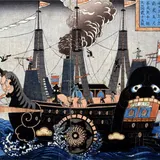
And as it turns out, the Portuguese were full of useful knowledge and know-how. The Japanese vessels were banned from Chinese ports for centuries at this point because of the whole piracy thing. So, even though they were spatially nearby, Chinese goods were difficult to get a hold of. The Portuguese had a much easier time and became a vital intermediary between the two countries. Thus, the nanban trade was born, and Japanese silver was transferred aboard the Kurofune, black ships, as the Japanese called Portuguese carracks, into China to buy coveted silks.
Right, and at this time, silver was actually more valuable in the East Asia than gold, just like it had been in Europe centuries before. So, for a while, the Spanish and Portuguese were able to get insane arbitrage because they were sailing over with silver and trading it for gold.
Francis Xavier
Yeah, but silk and guns weren't the only thing that the Portuguese were transporting to Japan. Let's look back at our friends, the Jesuits, right? Specifically, that guy, Francis Xavier.
So, he was a roommate and friend of Ignatius Loyola, one of his initial six companions. And they were a really mismatched pair. Ignatius Loyola was this, you know, proud warrior who got his leg halfway blown off by a cannon. Francis Xavier was an indoor kid. His dad was a lawyer, something like the general counsel of the kingdom of Navarra. And his cousins were finance ministers and professors and theologians. He was like, you know, the, you know, what did they say, but the PMC? He was that version of the 16th century. Lower nobility, very well-educated. Total opposite of Francis Xavier. These were kind of the two paths you could take as a vaguely rich kid in early modern Europe. Some of his brothers did fight, but in that war they fought in, which I believe actually was the same war where Ignatius Loyola got his leg hit, this led to the kingdom of Navarra being really badly overrun by both the French and the Spanish.
Eventually, a Spanish army confiscated their territories in Navarra and evicted Xavier's family. They were totally thrown into disgrace. They no longer had any kind of future within the government of Navarra. So Francis Xavier realized if he wanted a professional career, he needed to move up through another institution, maybe something like the Catholic Church. So he'd go to the University of Paris, just like Ignatius, and be roomies with this much older, scarred-up, hard-drinking, gambling soldier. I really hate to make this comparison, but it's the best one that comes to mind. These guys are basically Rick and Morty. That is the relationship between Ignatius Loyola and Francis Xavier. Francis the nerd was not totally convinced yet to become a priest, but supposedly, when Ignatius became a priest, he pushed him to take the vows by asking him famously, what will it profit a man to gain the whole world but lose his own soul?
As in, you know, spreading the word of God, spiritual wealth, is more important than material wealth. They form the Jesuits, and the two of them meet the Portuguese ambassador to the Pope, who had come to plead for missionary assistance to spread Christianity to the new vast colonial holdings of Portugal. Ignatius takes this opportunity to found the first Jesuit mission and commanded Francis to spread Catholicism anywhere the Portuguese wanted to send him to. This leads us to another pocket hole phrase of Ignatius Loyola. He supposedly told Francis, go and set the world on fire. And that's basically what Francis would do. He first travels to Portugal, where he gets direct instructions from the king, and then goes to East Africa, where he preaches Christianity there, apparently pretty successfully. From East Africa, probably Mozambique, he goes to the Indian city of Goa, where he starts founding hospitals, doing charitable work, kind of like Ignatius had done.
However, we should say that other aspects of Francis' mission were much less commendable. And this is the huge caveat of any kind of missionary activity in this time. It is a colonial practice, and there is no colonialism without really terrible inequality and violence. Specifically in this case, Francis interrogated recent African and Indian converts about suspected crypto-paganism. This is happening at the same time as the Spanish Inquisition. It's basically an extension of that. Even Portuguese merchants and settlers who were too friendly to locals, especially if they were married to local women, could potentially be questioned, even tortured on the suspicion of harboring non-Christian or radical beliefs. To really enforce the orthodoxy, Francis Xavier started founding schools in Goa to teach Christianity and eventually create entire generations of Portuguese-speaking Indian Catholics.
Xavier in Asia
So, after spending some time in Goa, Xavier sailed first to Sri Lanka and then later to modern-day Indonesia, baptizing as many common people as he could before running afoul of local religious authorities, which he was one to do. Of course, because he was encountering people who spoke dozens of different languages, he relied constantly on interpreters.
A Jesuit at a Buddhist rite
Right. Let me just jump in here with one really quick bit that I think is very funny. A really common theme in this whole series is going to be: whenever people who are familiar with Christianity encounter Buddhism, or vice versa, they're going to notice some similarities. And we're going to talk about these similarities a lot because they're pretty interesting. But the best example of this is that Francis Xavier was sent by Ignatius to spread the word of Catholicism, to fight heresy, to fight paganism, yada yada. But as soon as he gets off the boat in Sri Lanka, he sees religious practices that to him look very, very Christian. And when a local Sri Lankan Buddhist monk comes out and is making some kind of Buddhist prayer, Francis Xavier tries to join him because he thinks this guy has to be a long-lost Christian. So hilariously, even though he's sent on this mission to enforce Catholic Orthodoxy, the first thing he does when he gets to Sri Lanka is basically, you know, become an apostate and embrace Buddhism accidentally.
Yeah, he becomes the first white boy Buddhist.
He does, yes. And speaking of, you know, the supposed similarities between Buddhism and Christianity, a big part of that idea that these religions are similar, perhaps even compatible, is the result of the guy I mentioned at the top: Xavier's buddy, the samurai-turned pirate, turned Christian missionary named Anjiro.
Anjiro
Anjiro, he was this really rough and tumble sort of guy. As we mentioned, he was a samurai who had probably fought in the Sengoku wars and then turned to crime to make ends meet after that was no longer paying the bills. He was on friendly terms with pirates. He eventually fled into exile after he was charged with murder.
Yeah.
So he quickly got work on a passing trade ship, which was crewed by some foreigners from Portugal. On the ship, Anjiro learned some Portuguese and became interested in the crewmen's religion, which reminded him of the Buddhist message of salvation. The sailors told Anjiro that there was a man traveling across the Portuguese trade northern networks, who knew more about Christianity than any of them. So Anjiro decided that he would try to meet this guy. This was Francis Xavier. For several years, he attempted to track down Xavier across the ports of Southeast Asia, eventually following rumors that brought him to Malacca, today part of Malaysia. He met the priest and told him that he had come from thousands of miles away just to profess his sins and to learn more about the foreign word of Christ. And Francis, he was probably very flattered by this, and he also sensed the great opportunity because he told Anjiro that if he was serious about Christianity, he could return to him to Goa and study at one of the schools he'd built.
Anjiro agreed and he became baptized in May 1548. He took on the Portuguese name Paul and he began studying Portuguese and theology in hopes of becoming a missionary himself. Anjiro was a very bright guy. It was claimed that he learned the gospel of Matthew by heart after hearing it only two times. And people, bro, people loved doing that back then, like memorizing the Bible. That was like the biggest pastime in the early modern world.
So while he was going through his schooling, Anjiro was sharing stories about his homeland, and he convinced Francis Xavier that this huge but disunified island could be fertile ground for mass conversion. This would be difficult because unlike Sri Lanka or Malacca, Japan was incredibly far from the Portuguese base in Goa. So any direct contact with Europe would take months or in practice years, really. But Anjiro believed that proselytism in Japan was possible and Xavier seemed to think that it was necessary.
Landing in Kagoshima
So in 1549, the pair grabbed their bags, they gathered some attendants, and they boarded the only ship they could find that was heading to Japan. It was a Chinese merchant ship which was supplementing their earnings with piracy. The crew, who probably thought that the guys were crazy, took them aboard and sailed them to the sign and sailed them to the sunny Japanese port of Kagoshima. Francis Xavier and Anjiro, as well as a small handful of Portuguese and Chinese assistants, were now on their own in a country rent apart by over a century of civil war at this point. Just keep in mind while we're telling you all of this that the Jesuits were active for less than a decade at this point, and they were active in Japan before they were across large swaths of Europe.
Yeah, it's crazy.
Yeah, so these guys were really globetrotting in a way that would have been extraordinary.
Yeah, because this was the first Jesuit mission, you know, like there would be a lot of Jesuit activity in the future. We're planning an episode to talk about the Jesuits in Paraguay, because that's a huge topic in South America. But this would be even before that. And like you said, now that they are in Kagoshima, this brings us to the top of this episode, where Anjiro and Francis Xavier get off the boat in this strange country, which we should mention is the exact same port that Anjiro fled a murder charge from years before. They get off the boat carrying only a little bit of money, a few foreign treasures that they can sell if times really get tough, and interestingly enough, a barrel of pepper that was given to them as a gift from the family of the explorer Vasco da Gama.
So initially Francis Xavier was welcomed by the daimyo of Kagoshima probably because he wanted more trade with the outside world and he saw Francis as a key to that. And in fact the Jesuits were very aware that they were associated in the minds of the daimyo with trade and they would often seek to magnify their connections, making it seem like they had a lot more control over the Portuguese trade than they did in practice. And this would come around to bite them in the butt ultimately. But for now, this was a helpful tactic. So, Francis and Anjiro, they successfully converted a few local townspeople to Catholicism, and they used the painting that Xavier had brought of Jesus and the Virgin Mary to illustrate the stories of the life of Christ. Xavier wrote his first letter from Japan only weeks after his arrival. He had very nice things to say, and it seemed to him that his reception with the Japanese was going swimmingly.
To quote from the letter: All, both laity and bonzes, like us very much and are greatly astonished to see how we have come from such distant lands as Portugal to Japan, which is more than 6,000 leagues, only to speak of the things of God, and how these people can save their souls by belief in Jesus Christ, saying that our coming to these lands is the work of God. One thing I tell you, for which you may give many thanks to God, our Lord, that this land of Japan is very fit for our holy faith, greatly to increase therein. And if we knew how to speak the language, I have no doubt whatsoever that we would make many Christians. May it please our Lord that we may learn it soon, for already we began to appreciate it, and we learned to repeat the Ten Commandments in the space of 40 days, which we applied ourselves thereto.
So you can see they're already trying to, you know, mesh with the local customs, and it helps a lot that Anjiro had memorized the gospel, because apparently he was able to entertain local people, including initially his own family members, by telling them the story of Jesus.
Lost in translation
And it seems like Anjiro's immediate family probably would have been the first Christians in Japan. The story is complicated by the fact that the locals probably didn't realize that Catholicism was a foreign religion at all.
Right. I mean, they realized that it was foreign and that it was coming from India. In fact, it would be associated with India for a while, which is not technically wrong because the Jesuits, again, were stationed out of Goa for a very long time.
And we should mention here that the phrase southwestern barbarians was used by both the Chinese and the Japanese to describe Europeans. That same phrase had initially been used to describe India. So I think a lot of people actually thought that the Portuguese were Indians, you know. And I'm sure they are, like, if you're if you've lived in Japan your whole life, a Portuguese person and an Indian person probably look a lot closer to each other than it looked to you, you know? So I can kind of see the confusion. And the main thing, though, is that there was this misunderstanding that when they were talking about Jesus Christ, they were basically just talking about another Buddha.
Yeah. And part of the problem here was Anjiro himself. His translations weren't really top-notch because he wasn't educated in the literary register of Japanese, and his knowledge of Japanese religion was also very imprecise. To quote from George Elison's Deus Destroyed, according to Anjiro, the Japanese believed in one personal God who punished the evil and rewarded the good, the creator of all things, adorned in the Trinity, surrounded by saints. One can easily recognize in this latter fancy a trace of the typical mandala representation. This Lord of all and God-Creator was in Japan called Dainichi. Upon this point rests the most curious result: the dynamic force of perfect wisdom illuminating the universe, Dainichi of the Diamond Realm, was by the untutored layman identified with the personal omnipotence and wisdom of the Christian god, Deus.
Right. This is from the book Deus Destroyed, which is an amazing account of the rise and fall of Christianity in Japan, and basically the biggest source for this episode. Just to kind of explain that quote, it gets a little bit complicated. Really, the main thing is that there was understanding in Buddhism that Dainichi was very loosely equivalent to the Christian principle of the Holy Spirit, of this, you know, eternal godly force that exists within various Buddhas. So you can kind of see, especially with the translation gap, why this might be confused. So it really took a long time for Japanese people to realize Christianity was wholly separate from Buddhism. It also seems like a lot of Japanese people, because of this perceived similarity in doctrine, really wanted to layer Christianity on top of Buddhism because there's this really long history of religious syncretism in Japan. We talked about how a thousand years before this, Buddhism had layered upon the earlier beliefs that would become Shintoism.
A lot of Japanese people were very excited to incorporate Buddhism into the Japanese pantheon. But as the course of the 17th century would tell us, both Christians and Japanese authorities wouldn't let that happen.
Xavier turns on Buddhism
Yeah, right. So as we saw, Xavier, he had a really fantastic experience when he was first started. He was really optimistic, but by this point, he was starting to have some less than pleasant run-ins with Buddhist monks. And he had been in Japan for some time now, so he was starting to be able to articulate the differences between Buddhism and Christianity. And he finally got around to the idea that the Buddhas were actually demons, which, of course, Buddhist monks wouldn't have appreciated it very much. So, Anjiro was probably put in this really uncomfortable position of having to translate these less than nice things being said by Xavier, and they wore out their welcome shortly after that because they had to sent packing to another daimyo ship shortly thereafter. The scuffle might be what caused the daimyo to send Francis and Anjiro packing and forced the small community of Japanese Christians to renounce their faith as soon as they left.
While staying in Anjiro's wealthy family outside Kagoshima, Francis decided that the best option was not to preach to the masses, to the poor, as Jesus had done, but instead to start from the top down. So he was ultimately convinced that because of the way that hierarchy worked in Japan, it was much better to have this religion be associated with the higher classes so it would be high status. And because of this, the Jesuits, they got into a lot of tension with other Christian orders that started to show up a couple of decades later because of this different emphasis. And so convinced in the greater efficacy of top-down conversion efforts, Xavier convinced Anjiro to take him to Kyoto, where he would present the word of God to the emperor himself.
Seeking the emperor
Right. Because if you hear that Japan has an emperor, you're going to want to talk to him, right? He must be the most powerful guy in the country.
Yeah, decidedly not the case in Japan. So probably through the connections of Anjiro's relatives, Francis Xavier was eventually able to demand an audience with the Emperor of Japan, who was at this point a man named Tomohito. He was convinced that if he preached to the Emperor, he could convert the entirety of Japan to Catholicism overnight. Anjiro didn't have the heart to tell him that Tomohito had no real power. By this point in Japan's history, the Imperial household was basically forced to subsist on selling autographed poems to raise the funds for the Imperial household.
So they were doing cameos, basically.
And this guy, he was under the very mistaken assumption that the Emperor was actually running the show.
Right. No, because the Emperor had been a figurehead for many, many years. And this is a time in the Sengoku period where there really was no central authority in Japan at all. Even the daimyo, the Ashikaga daimyo, the shogun I mean, was himself basically a figurehead. So if you're trying to do a top-down conversion, you're going to be out of luck.
Yeah, so to make matters even worse, the personal affairs of the imperial household were handled by the Buddhist abbot of Mount Hiei. So we're already off to a pretty bad start because when Francis and Anjiro tried to visit this monastery to obtain permission to go further, they weren't even let in through the gates. Apparently, according to the book The History of Christianity in Asia, which we're also sourcing a lot of this from, by Samuel Moffett, they just saw how ragged his priest's robes were and they're like, who the hell is this guy? We're not letting him in here.
He's going to stink up the place.
Yeah, the Jesuits in Japan, they would eventually take their strategy of top-down conversion too hard and they started to start wearing silk robes, the same kinds that would have been worn by the fancier classes.
Courting the daimyo
Yeah, yeah. And that's an important part here. The Jesuits really go native. And I think that's part of why they eventually do have some success. They weren't able to talk to the Imperial court, but they were, or they didn't have any success at least. But then Anjiro and Francis Xavier started going to various lesser lords, different daimyo, especially back in the south, where Anjiro's family was from, areas around the cities of Kagoshima, Nagasaki, on the island of Kyushu. So they went on tour on the various castles of the area, dodging bandits along the way to bring gifts and foreign knowledge to the country's dozens of rival lords and ladies. And although things weren't going quite as well as Xavier imagined they would in the beginning, impressive progress was still being made considering just how few missionaries there were in Japan. And of course, the difficulties were compounded by the fact that Anjiro himself, as a layman, did not have a good grasp of Japanese religion.
But thanks to his wits, he was able to convert several Japanese Buddhist monks into the Christian faith, which would be a great expedient to the development of crafting a Christian message that was both delivered in good Japanese as well as a way to combat the theology of the Buddhist monks who would stand in their way.
So according to Moffett, a few of the daimyo were actually interested in Xavier's teachings because he seemed like a really fun and eccentric character to them, most likely. He was unusual or amusing enough that he was hosted by various courts for extended periods of time where he shared his knowledge of astronomy and wowed the courtiers with a treasure that was rare even in the Europe of this time, a mechanical clock.
Right. But he probably also started giving out some of that Vasco da Gama pepper that I'm sure they would have certainly appreciated.
Oh, yeah, absolutely. So, yeah, this man was just traveling. He had his goodies in tow and he was making some progress. Regardless of whether or not the Japanese nobleman actually respected Xavier or just saw him as an oddity, he quickly started to admire a lot of the Japanese culture. But although he had plenty of really nice things to say about Japan and Japanese, he spoke about how courteous they were, about how clean they were, about how intelligent they were, etc. But he also had a lot of less nice things to say. He was really unhappy with the openness towards pederasty in Japan at the time, about the fact that polygamy was quite common about Japanese religion, about infanticide, which was also very common in this period, etc. There was a lot to be unhappy with. But because Xavier, he didn't really have a grasp of the Japanese language that would have been needed to really make these distinctions very clear.
Many of the new converts understood Christianity in Buddhist terms. Even though Francis ordered converts to shout in the streets that, quote, Deus is not Dai-Nichi. But unfortunately for Francis, this was even worse in one sense. Buddhist monks soon began using this in wordplay because in Japanese, Dai Uso means the great lie. So this guy shows up talking about Deus. Well, that's the Daiuso. Watch out.
Christianity and Buddhism
All right. So we're going to finish this up pretty soon. We're starting to wrap this up. But I think that before we talk about the height of Jesuit power in Japan, which would come very soon, let's take a look at the idea that Christianity and Buddhism resemble each other. Because a lot of people these days in the West have some interest in mixing elements of Christianity with elements of Buddhism, whether they know it or not. According to a Pew survey from 2007, 20% of American Christians believe in reincarnation, which is not part of Christianity. That is a Buddhist belief that has been incorporated into the lay Christianity of a lot of Americans. But this kind of, you know, syncretic incorporation isn't new at all. The observation that Christianity and Buddhism are similar in their teachings and in their structure has been made, like we said, for many hundreds of years.
It ended up being both an asset and a problem for missionaries. Locals were able to understand the new religion in the terms of the old religion. So like the idea of faith in the Pure Land Buddhism is a little bit similar to faith in Christ. And the idea of nirvana has some similarities to the Christian idea of salvation. But there was a bit of a cafeteria of religions in Japan at this time. Everybody practiced some kind of mix of Shinto and Buddhism at the same time, but many people in Japan had beliefs that differed somewhat from the other person, from their neighbor, just based on personal interpretation. Different Buddhist temples would have their own interpretations and people could choose which to adhere to. That wasn't really on the table for Christians at this time. Both Catholicism and Protestantism were very dogmatic, vying for control not only over Christendom, but really over the whole world.
That was essentially the point of the Jesuits. They were not as flexible as Japanese Buddhism. They weren't comfortable with the ways that Japanese people, worshipers, wanted to accept bits of doctrine they liked and reject bits that they didn't. And an even bigger issue was that they thought it was, the Japanese often believed it was totally fine to layer Catholicism over their pre-existing spirituality. To Catholics at this time, that was the most insidious kind of heresy at all. Because there was this belief that true doctrine mixed with heresy was much more dangerous than heresy on its own, because it could more easily trick the real faithful into straying away. In a sense, it was the devil's work. And these people we're talking about, they really sincerely believed in Satan in ways that are pretty hard for modern people to comprehend, unless you are extremely religious. You know, we talked about how Ignatius Loyola thought that the devil was personally trying to tempt him.
When Francis Xavier saw the ways that local Japanese people attempted to mix Buddhism with Christianity, he was convinced that the Amida Buddha and the Gautama Buddha were in fact two demons who were specifically trying to stop the Jesuits from spreading the true religion of Catholicism.
The devil's imitation
And there's one other issue. We talked about how there's a structural similarity between Catholicism and Buddhism. You know how when Francis Xavier went to Sri Lanka, he accidentally took part in the Buddhist ceremony? A lot of Jesuits noted these similarities. One of these was an Italian guy named Cristoforo Borri. When he went to Vietnam, which was also heavily Buddhist, he similarly had this idea that Buddhism was specifically satanic because it could somehow insinuate itself into Christianity due to these very interesting ritual similarities. He wrote, It looks as if the devil had endeavored to represent among the natives the beauty and variety of religious orders in the Catholic Church. The priests have chaplets and strings of beads about their necks. There are among them persons resembling bishops, abbots, and archbishops, and they use their gilt staves not unlike our croziers. If any man came newly into that country, he might easily be persuaded that there had been Christians there in former times, so nearly had the devil attempted to imitate us.
And this is a really common thing in Christianity, actually. This idea that satanic religion, it's like the idea that it's supposed to be like a parody of Christianity is where the idea of the Black Sabbath comes from. This idea that this is an inversion of Christian ritual by appropriating these structures in a way that serves the devil rather than God. You know, it's kind of metal, if you think about it that way.
Guests, not conquerors
So, you know, what happened here, we should also mention is that because they were unable to make contact with the emperor, there wasn't any kind of, and because also, because the Spanish or Portuguese did not directly control Japan at all, they only had economic influence, they couldn't mold Japanese society in a Catholic image the way that they were doing in the Americas. You know, I talked about dismantling indigenous cities brick by brick. There was never going to be that kind of possibility for Japan, you know, to the great benefit of Japanese people. Instead, the Jesuits had to basically become part of Japanese society, respecting many Japanese traditions while also vociferously opposing Buddhism and Shinto in any form. So, the most cynical explanation here is that the Jesuits were simply not powerful enough to enforce European culture, so they had to adopt Japanese culture. They were guests, not conquerors.
The more charitable explanation is that the Jesuits were trained to use a variety of tools to spread the faith, including, you know, honey, not rice vinegar.
Xavier's last voyage
Despite the difficulties with enforcing orthodoxy, Francis Xavier did eventually get one daimyo from the Otomo clan of Kyushu to convert, planting the seeds of a lasting Christian community in the island. And this, again, was the same island that they first landed on, the island that held Kagoshima and Nagasaki. But then the Jesuits ordered him back to Goa to receive new orders. He'd had his fun in Japan. Now he had to preach in the real prize, China. But tragically, Francis Xavier would never actually get there. He sailed to the Pearl River Delta, but then as soon as he got off the river, the Ming Chinese authorities wouldn't let him in. They kept him at a small island off the coast that would actually later become Hong Kong, interestingly. And on this island, he waited for six months on a swampy malarial delta, where unsurprisingly, he got sick and died without ever reaching the mainland.
As for Anjiro, apparently he also left Japan to go back to his old rough and rowdy ways. He returned to piracy. And intriguingly, just like Francis Xavier, he also died in China. Not as a missionary, but instead as a wako pirate on a failed raid of a Chinese port.
Macau
This meant that the initial Jesuit mission in Japan was a failure, but something would happen that would completely change the balance of power in the Pacific. In 1557, the Portuguese would have a successful naval battle against some of those Wako pirates. For all we know, Anjiro might have been one of them. In return, Ming China completely reversed course and gave much more favorable trade terms to the Portuguese, including a lease on the island of Macau, which would become the primary Portuguese port in the Pacific Ocean and have huge consequences on the ensuing history of European colonization and trade in Asia. Suddenly, the Portuguese had a new power base far closer to Japan, as well as the Philippines, which had already been claimed by the King of Spain. This meant that Catholicism could much more easily radiate throughout the various islands. There would soon be Catholic communities in Indonesia, in various ports, and especially in Japan.
Fróis and Nobunaga
But there's one really, really important figure about to take the stage here. He is a figure who is only marginally important to Portuguese or Jesuit history, but incredibly important to Japanese history. And that is the famous shogun, Oda Nobunaga. The best way we can understand Oda Nobunaga in this episode, though, is through the eyes of another young Jesuit who came to Japan after the death of Francis Xavier and Anjiro's return to piracy. This was a young man named Luís Fróis. He received orders in Macau to resume the Jesuit activities in Japan, but he didn't go to Kyushu, which already had a solid Christian presence, but instead back to Kyoto, where the shogun and the emperor lived. Again, the shogun was not interested in what the Jesuits were selling, but they let Fróis stay outside the city, where he began learning about Japanese culture, just like Francis Xavier had done.
He also wrote some of the earliest European books on Japanese customs and language, which is kind of interesting. But there's one more really important thing about Fróis, much more important than how much of a weeb he was. And that was the fact that he was in the Japanese capital when Oda Nobunaga stormed Kyoto, installed a puppet shogun, and became the de facto hegemon over Japan. Nobunaga was very surprised to find a Portuguese priest living in the area. But for whatever reason, the two of them hit it off. And he let Fróis live in one of the spare rooms of his new palace and make use of his massive library. And over the next 12 years, Fróis and Nobunaga became really good friends. He shared with the Daimyo important information about the outside world, probably giving Oda Nobunaga his first impression of the extent of Spanish and Portuguese colonial power, as well as the threat that this could potentially pose to Japan.
Because Fróis was close to the effective leader of the country, he had official sanction to evangelize all over Japan, especially to various samurai of the Oda clan.
Guns and converts
There were many big reasons for the daimyo, and especially Nobunaga, to tolerate the missionaries. The big one was, of course, guns and trade. European guns were far more sophisticated than guns in Japan had been at this time.
So in the 1500s, as we mentioned, the Portuguese had matchlock muskets while the Japanese were still using the Chinese hand cannons, which were similar to the guns which were being used in Europe during the Hundred Years' War. So this was very dated technology. The matchlock muskets had an effective range of three times. They were much easier to use. And in general, they were just superior weapons.
Omura Sumitada
Right. We mentioned, yeah, so we mentioned the Otomo clan before. The most important of these converts was Otomo Sorin, who controlled about half the island. Another one was a guy who I think I like a lot more, named Omura Sumitada, who the Jesuits would know as Don Bartolomeo. And he was a real rough and tumble guy. He kind of reminds me of those early medieval Christian chieftains who, you know, like really embraced Jesus in a very kind of muscular way. According to Fróis, as Omura Sumitada had gone off to the wars, so it happened that he passed on the way an idol, Marishiten by name, which is their god of battles. When they passed it, they bowed and paid reverence to it, and the pagans who were on horseback dismount as a sign of respect. Now, the idol had above it a cockerel. As the daimyo came there with his squadron, he had his men stop and ordered them to take the idol and burn it along with the whole temple.
And he took the cockerel and gave it a blow with the sword, saying to the animal, Oh, how many times have you betrayed me? And after everything had been burned down, he had a very beautiful cross erected on the same spot. And after, he and his men paid very deep reverence to it as they continued on their way to the war.
Yeah, this was something that would become common to Christian converts, even though the Jesuits themselves were actively against this because they saw this as the kind of behavior which was harmful to the long-term prospects of the mission in Japan since it was so hostile to Japanese culture in a way they were trying not to be. But nevertheless, they couldn't really keep a handle on it, so this kind of stuff kept happening and kept adding to the long list of propaganda that Buddhists had against Christianity.
We're gonna get to that propaganda, the anti-Christian propaganda, in a future episode. And a lot of it's pretty fun. But despite these ramping tensions, the Jesuits were still in a really good position, simply because Luís Fróis was basically the confidant of Oda Nobunaga. It's this incredibly fortuitous relationship, which would have huge ramifications toward Jesuit success. But of course, that means that that success is totally predicated on Oda Nobunaga staying in power forever. That would not come to pass. But we're not going to have time to get into the fall of Oda Nobunaga in this episode, of which Fróis was actually a direct witness.
Jesuit Nagasaki
But what we are going to get to is the ultimate apex of Jesuit power that would happen under Oda Nobunaga. And that was when, amazingly, Omura Sumitada, that same guy who destroyed the idol and burned down the temple, would eventually give the port of Nagasaki to the Jesuit order on an indefinite lease. He only had control over half of the island of Kyushu and realized he couldn't very effectively control or at least defend all of it from his rivals. Instead, he decided he could relinquish the port of Nagasaki, give it to the Jesuits who had their own men and their own guns, and work together against the rival Mori clan, I think it was. We shouldn't overstate how much influence the Jesuits had because, you know, in practice, the former officials of the daimyo were still basically in power, but on paper, the Catholic Church directly controlled part of Japan, which was crazy.
And this allowed the Jesuits here to have complete free reign over spreading Christianity across the island of Kyushu. And if we're going to call this period the Christian century of Japan, nowhere was more Christian than Kyushu at this time. And this would have very important lasting ramifications on Japanese society. Many people across all classes on this island would become very strong Catholics. Just 30 years after Anjiro and Francis Xavier landed in Kagoshima, Nagasaki was now directly controlled by their successors. It's an incredible rise. And so much of it is because of the quick thinking of Francis Xavier and Anjiro, as well as the incredibly lucky friendship between Luís Fróis and Nobunaga.
Yeah, and around this time, Christianity had something like 100,000 converts in Japan, which again, considering how few actual missionaries there were in the country, this was nothing short of a meteoric rise. But in practice, of course, a lot of this was more the daimyo compelling their peasants to get baptized without really making sure that they knew the doctrine rather than actual willing converts to the faith. But nevertheless, Christianity, especially in Nagasaki and the outlying areas, took very deep roots, which would take decades to eradicate once the mood changed.
The turning wheel
Yeah, exactly. And the mood would certainly change. Overlooking Nagasaki is a hill. And if you were standing on this hill in 1582, you could look over and see the entire island of Kyushu. And on a very clear day, you can even see the main island of Honshu, which to the missionaries at this time, or any very zealous Japanese converts, seemed like ripe for the taking. Hundreds of thousands, millions probably more souls who you could hopefully send to heaven by, you know, telling them the word of Christ. It seemed like a very bright time for the Jesuits. And it also seemed like a very bright time for Oda Nobunaga. But the wheel of fortune would always continue to turn. And that same hill in Nagasaki would eventually be the site of a mass execution of Christians in a mock crucifixion, you know, to humiliate the Christians on their own terms.
And that would happen due to the rise of a new shogun who would succeed Oda Nobunaga. Really, one of the most interesting figures in Japanese history. A figure who I think is much less sympathetic than Oda Nobunaga, but far more ambitious. He was a guy named Toyotomi Hideyoshi. And next episode, we're going to get into the ways that Hideyoshi would attempt to destroy Christianity and even control the entire world. This has been Gladio Free Europe, and sayonara. Bye-bye.
The show is also on Apple Podcasts, Overcast, Pocket Casts, Podcast Addict, YouTube, RSS and Patreon.