72
GFE World Travel Update
In progressAfter a couple weeks of adventuring across Japan and the Caucasus, the hosts of Gladio Free Europe are back in the States. Liam shares his experiences seeing the traces of the violent Sengoku period all across Japan's main island Honshu, and explains how this trip finally brought him to his "white guy into Buddhism" phase. Thousands of miles away, Russian Sam visited the ancient nations of Armenia and Georgia and got a front-seat view of how influences from east and west continue to vie over these countries today.
We'll be back very soon with full episodes on the history of Japan, Armenia, and Georgia, beginning this month we dive into the chaotic finale of Japan's Warring States Period, when a period of intense international ambition gave way to the famous centuries of isolation.
Transcript
Back from Asia
And we are back with another episode of Gladio Free Europe. I am Russian Sam reunited once again with Liam.
Yes! Finally back on American soil.
Yeah, as am I. Both of us ended up having taken your vacation at the same time, just unplanned.
No, but it worked out.
Yeah.
Yeah, it was great.
Liam went to Japan. I went to Georgia.
Yeah, the country, not the state.
Yeah, yeah.
We unfortunately had to miss a week of programming last week, but since coming back from Georgia and Japan, we've got a lot of really cool ideas for future episodes. And we've been working pretty hard on a, particularly on this two-part Japan series that we're about to drop. So we're really excited about that. And I know, Sam, you have a lot of stuff to talk about about the Caucasus that you visited, about Georgia and Armenia, which, you know, that's a really interesting part of the world with such an interesting history. So I know there's a lot that we can draw from there in the near future.
Oh, absolutely. Yeah, it's absolutely fascinating. It has a really, really long written history in a way that many places don't. And there's just a lot to talk about. So this episode is going to be more of a debrief episode where we just talk about our observations from the two corners of Asia.
Yes, exactly. Two ends of Asia, you know? Yeah, yeah, no, yeah, exactly. Because, you know, like Japan, you know, the easternmost end of that whole cultural sphere. And then, you know, arguably, in like an archaic European view, Georgia and Armenia and the Caucasus is the westernmost end of Asia, you know, beside that, that and Turkey, yeah. Yes, this episode is going to be kind of a, this is going to be kind of like an under the hood episode where Sam and I are just going to casually talk about our observations about these three countries that we visited. So, because I was in Japan, primarily in southern and western Japan, and Sam was in the Caucasus in Armenia and Georgia. These were both just trips for fun, but they ended up being, you know, very fruitful trips for podcasting reasons because there's just a lot that we learned about all of these places.
Yeah, absolutely.
Is Georgia in Europe?
But before we continue, just on the note of Asia, I just wanted to tell this because I actually have a funny story pertaining to my dad and the classification of Georgia.
Yes, I know this one.
Many years ago, my dad finally got on the computer and he started visiting some really unpleasant sites, yeah, like the Russian equivalent to Infowars, essentially.
Yeah, yeah.
So, like, I was always hearing in the earful about European civilization and how it's under assault and yada yada yada. So, like, I started to just tease him to really tease out where exactly the border of Europe and Asia is. So, one time I just started naming countries and it's like Russia, Europe, Turkey, Asia, Armenia, Europe, Azerbaijan, Asia, Georgia, question mark, Asia. And I found this interesting because I thought his crazy.
And just to pause here, to pause here, for the viewers at home, Georgia is northwest of Armenia. So, if Armenia is Europe, you'd think that naturally Georgia must also be Europe.
Yeah, like when I started this, I thought he would define Europe in terms of Christendom and whatever. And I mean, by that metric, then Georgia would absolutely be Europe. Then I asked him why Georgia doesn't count as Europe, and he just started telling me about how they treat their women badly, so they're not Europeans.
God, yes. And I just, yeah, I think also it's like, you know, if you don't want to be, if this is in the docs, you know, I think it's very funny that your dad, who's a Russian Jewish guy, is like so into the idea of like defending Christian civilization. That's just what nationalism does to your brain.
Well, not Christian civilization, but European civilization. And I mean, yeah, he's got brainworms. He's reading some multi-polarity stuff these days. I try not to talk about it because it would just drive me crazy.
But I think that Russian boomer nationalism stuff really is a great compliment to American boomer nationalism. It's just as incoherent. It's just as annoying. I know we might have some Z-pilled listeners, but I can't fuck with that. Like, no, that's awful.
Yeah, no, no. Not a fan at all.
Buddhism at both ends of Asia
But anyway, as Georgia and Japan are the two corners of Asia, they actually have another connection, namely Buddhism.
Yes.
Yeah, there's a famous saying that the Japanese are born Shinto, marry Christian, and die Buddhist.
Yes, and we're actually going to talk about that in our next episode. We're going to explain why that phrase actually sort of makes sense. But yeah, so Japan is obviously a country with a very rich Buddhist history where many people today are Buddhist to some extent. But what we found out was that on the other end of this supposed Asian continent, Georgia also has a really interesting Buddhist link.
I think we've mentioned the hagiography of Barlaam and Josaphat, which is like a Christianized version of the Buddha story. And as it turns out, that text was transmitted into the Western European languages through Georgian specifically in the 10th century. That was when it was originally written, and then it got transcribed into Greek. And that's how Europe came to know the Buddha, Barlaam.
Yeah, I know, which is really interesting. And of course, from what I understand, when Europeans would later re-encounter Buddhism, primarily through the activities of Portuguese and Dutch merchants, they had no idea that it was the same guy, which is kind of funny.
Yeah.
Yeah. And yeah, very, very funny. We'll talk about, I think that's going to be a big focus of our upcoming episode. But yeah, I know, really interesting stuff.
What is Asia, anyway?
And I just want to pause for one second on that point. Just the point about Japan and Georgia being the same continent. Because I just think that that just kind of shows how specious the idea of continents having any cultural value is. Whenever anyone talks about Asian culture or African culture for that matter, or Native American culture, it's just that's such a absolute nonsense. Because these parts of the world are so big. There's so much shocking cultural and environmental diversity between them that there's so little that you can say that is unifying about Asian culture. You know, I think as we're going to find out in this episode, as we talk about Georgia and Armenia and Japan, I think that except for this faint memory of the Buddha, there is incredibly little that unites these places. And I think that's kind of funny. But then, but from the European perspective, you know, if you're standing in London or Berlin looking outward, everything east of you, that's all Asia.
It's the Orient, you know? Even like the Balkans were at one point described as Oriental in the 19th century.
Iran in the Caucasus
Yeah, although Georgia actually does occupy this sort of borderland area between Europe and Asia, in as much as we want to ascribe these terms of having as having any kind of reality, just because, like, I mean, on the religious angle, for example, very rich history of Zoroastrianism in Georgia and Armenia prior to the introduction of Christianity. And in fact, in Tbilisi today, there are even the ruins of a Zoroastrian fire temple that you can find. And that's very interesting because even though, you know, the Buddhist history in the Caucasus is incredibly faint, it's like it's the Barlaam story, basically, basically just that. Zoroastrianism did once have Buddhists, but they tend to end up later.
The Kalmyks, if anyone isn't familiar, they are a Mongolian-speaking culture in southwest Russia, pretty far from Mongolia, who came probably as refugees sometime in the 17th century, fleeing some kind of violence in the Chinese Empire. We could actually, maybe eventually, we should do a whole episode on the Kalmyks because it's really a very interesting group of people. Some people think Vladimir Lenin might have been part Kalmyk. But yeah, but I was going to say that although there isn't that much of a rich Buddhist history in the Caucasus, besides the Kalmyks and besides the Barlaam story, Zoroastrianism, the traditional religion of Iran, does have a very rich history because the Caucasus for many, many years was under Iranian control, especially the Sassanids or Sasanians in the early Middle Ages. They were the last Iranian dynasty before the Islamic expansion. And what's kind of interesting about these guys, one thing I love, a whole fact I love, is that the semi-legendary ruling family of the Sasanians, the kind of, I guess you'd call them, the literal satraps of that part of the empire, their last name, their clan name, was Bagratoni, which is probably a name that you know, Sam.
Oh, yeah, yeah. You meant Bagrationi.
Well, it's Bagratoni, but it's like it's Bagratoni, I think, in Georgian, and then Bagrationi in Russian. And it eventually, that surname has survived basically to the present in the Russian Empire. Because eventually, as Georgia was annexed into the Russian Empire in like the 17th century, I guess, families claiming descent from this ancient Persian family were then incorporated into another empire. And there was the famous general Bagration of the Napoleonic Wars.
Oh, yeah, yeah. And of course, later on, it became Operation Bagration. The name, his namesake was used in World War II in the great counteroffensive against fascism.
Right. And speaking of Iranian dynasties, the dynastic history of the Caucasus having Iranian connections actually go even before the Sasanians, namely because the kings of Armenia for a very long time, and by proxy also Georgia, because these were often part of one kingdom, were the Arsacids, who were the ruling family who preceded the Sasanians, I believe. I don't remember what dynasty it was, but it's very interesting stuff.
No, yeah, and there's so much great stuff in the Caucasus. Like one story I love, which is almost, it feels very modern, like a very kind of 19th-century arrangement. You know, Rome and the Sasanian Empire, actually, this might have been the Parthian Empire before the Sasanians. In any case, Rome and the Persians were always constantly at war. There's like an incredibly almost tedious history of warfare between Rome and Persia for about a thousand years. And in one of the around, I think around the time of Nero, I think it was, there was this very funny power sharing agreement over Armenia, which at the time, you know, Armenia was a very ancient kingdom. Armenia had been a unified kingdom for a long time, and but it was constantly this battle site between Rome and Persia. And so in the middle of these constant conflicts, eventually the Emperor of Persia and the Roman Emperor Nero came to this pretty funny agreement where the Persians would have actual control, actual hegemony over Armenia.
And specifically, it was that the Persian king would have to approve every Armenian king. But the deal is that the Romans would have spiritual influence over Armenia. And that even though each king was selected by Persia, they had to be somehow anointed by the Roman emperor. So the king who was chosen by Persia wouldn't be considered legitimate until Nero went all the way over to Armenia to give him his blessing.
Yeah, absolutely.
The first Christian nations
And speaking of blessing and Christianity, these two countries really pride themselves on being the first Christian nations.
Yeah. Are they older than Ethiopia in that sense?
I believe that Armenia became Christian in like the 320s or something like that. Don't quote me off that. I've been absorbing a lot of information. But yeah, there's actually a lot of beef between Armenia and Georgia. It's mostly like friendly stuff, but there's also like, for example, Armenians go off to claim that the Georgian alphabet was invented by Mashtots, who was the same guy who invented the Armenian alphabet. But they're very proud. In fact, one time I was doing laundry in Tbilisi and I just started talking to this guy who's like the perfect Soviet boomer. God bless him. And he just started telling me about how if Armenians invented our alphabet, then how come we have three alphabets and they only have one?
Yeah, yeah. I love the, you know, I live in a very Armenian part of California and I love seeing the, I love the Armenian alphabet. It's so beautiful. My girlfriend said a while back that it looks like every letter is a different kind of U. It's like all made out of U's. And that's kind of true.
Sam in Georgia
It does look like that. All right, but so we've been kind of scattershot so far. Let's, you know, maybe put this whole thing in focus. Why don't, Sam, why don't you just tell us about the broad strokes of your trip to Georgia and Armenia? Where do you go? What really caught your eye? What shocked you? What amazed you? If you go again, yada, yada, yada. Just take it from the top.
Well, from the top, I absolutely would go again. I want to go again. It's one of the most incredible places that I've been, and I love it very, very much. And hopefully, I have the opportunity to see it sometime soon because my plans actually ended up being a bit derailed. I had a whole itinerary planned out that would have had me going all the way across the country, particularly the western half. But in practice, I was based in Tbilisi and just exploring the city as well as going on day trips mostly to the eastern part of the country. Where do I even start? Well, let me just mention some of the places that I went to. My favorite place that I went to was Kazbegi, which is like all the way up in the north. It's some of the most stunning mountains you'll probably ever see.
It's somehow even more beautiful than the Alps, if that makes sense. That's one of the things that the Caucasus is really renowned for, you know, mountains, because boy, do they have a lot of them. And they're all very beautiful. So Kazbegi is a must-go. There's this one particularly beautiful church, the Holy Trinity Church, I believe it is. That's, well, I mean, there's a ton of Holy Trinity churches, but the one in Kazbegi, it's like if I were a religious person, then just being there would like reinforce my faith in God. Let's put it that way.
Explained.
Yeah, I mean, it's like just this church that's high up in the mountains. It's surrounded by all these incredible peaks. And of course, like, this was kind of a necessity because Georgia was a battleground for many years. The Persians, they never quite went away. They would always be invading. And in addition to the Persians, you also had the Ottomans, you had the Russians, you had various regional groups.
And you know, I just paused for a second. I think, you know, and one other important group you missed, kind of intermediate between the Persians and the Ottomans, is, you know, the Seljuk Turkic Empire, which really tore through the Caucasus in like the 11th century and 12th century, and eventually sort of in a roundabout way led to the establishment of the Ottoman state.
Yeah, absolutely. So, Georgia really bears the scars of all of these invasions. Tbilisi was burned to the ground something like a hundred times, I was told. So, because of that, like they had to get very creative about where they kept their treasures and their holy stuff. I mean, Christianity already had a very long tradition of like going out into the wilderness, broadly defined, as we talked about in the Christian Saints episode.
In the Saints episode, absolutely, yeah, the Desert Fathers.
And so, because of that, they also would go to all these remote places in Georgia, like Alzheimer. And because this was also a place that was constantly getting invaded, it made a lot of sense to build these wonderful churches high up in the mountains that would be much more easily defendable. These would be the kinds of places where you could stash your holy stuff and wait out the invasion.
Yeah. And that's so cool. Like, the underground, like, basically ancient bunkers, pretty much. Ancient fallout shelters.
Well, above ground, but way above ground, like 2,000 meters above ground. But.
Oh, yeah, yeah. I think I'm confusing it with the underground bunkers in like Anatolia proper. A lot of like old Byzantine.
Oh, you mean like Cappadocia?
Yes. A lot of old Byzantine and Ottoman and even earlier towns have these underground hiding chambers where you can, you know, store your treasure. But I think this is the same thing. It's just it's up in the mountains instead of underneath the mountain.
Defaced churches
Yes, absolutely. And when you go into Georgian churches, for example, the Svetitskhoveli monastery in Mtskheta, one of the things that jumps out at you almost immediately is that the walls are covered with these beautiful paintings that are many centuries old, which are also defaced. They have, many of them have like their eyes or their entire faces scratched out. And as it turns out, this was something that the Persians did fairly often whenever they invaded because like in Islam, you're not supposed to depict the human form. And so they would just go into these churches and scratch out as many faces as they could. So even the churches in Georgia, they bear the marks of this really crazy landscape and warlike terrain.
Georgians and Jews
But anyway, religion, it's a huge deal in Georgia. I was actually surprised by just how religious they are as, you know, as a deracinated American who doesn't really have a particular kind of faith. Like over there, it's pretty normal for like taxi drivers to cross themselves whenever you drive by a church just because like it's yeah yeah it's that normalized but i mean like despite the fact that they're very very religious christians they actually love jews over there as they will not stop telling you about oh nice so you told them you were jewish and they were like hey yeah yeah i mean like basically their rationale is that jesus was a jew and we had jews for 2500 years and jews brought back a bunch of relics from jesus's life into georgia itself so so there are bros you know right and you know, I actually i wonder if, you know, because because georgia was christianized so early i wonder if any of the first christians in georgia were, you know, ethnically jewish.
At the very least, I'm sure there's some kind of folklore tradition about jewish christian disciples bringing christianity into Georgia.
Yeah, I just recently started reading the Georgian Royal Chronicles. And yeah, there's a lot of stuff to that effect in there. But I mean, I also wouldn't chalk this up to, you know, like the ancient Jewish roots of Christianity for fostering this attitude, just because if you go over to neighboring Armenia, for example, there's a much more complicated relationship with Jews over there, for lack of a better word.
Armenians as a middleman minority
Really?
Yeah, I mean, like, within the Soviet Union itself, like, Jews and Armenians never really liked each other that much. I'm, of course, like speaking in very, very broad terms, but I mean, like, yeah, I mean, it kind of makes sense, like, when you get over there, because I mean, like, one of the things that I learned in a way that like I hadn't expected was that in Georgia, the Armenians were often playing a very analogous role to that which the Jews were playing in like Eastern Europe.
So, right. No, it's, yeah, it's, you know, like, you hear about, like, it's the classic anthropological term is like a middleman minority, a group of people who are not necessarily culturally powerful, but have an intermediate position in a certain country where the peasants are from one cultural background, the nobility are from another, but the merchants and craftsmen are from a third group. And that's like, that's, yeah, Jewish people in parts of Eastern Europe, Chinese people in parts of Southeast Asia, and Armenians in the Caucasus, as well as at one point, Eastern Europe, too. There used to be Armenian merchant communities in Hungary and Poland, which is kind of crazy.
I mean, there's that one anti-Semitic joke that's like an Armenian is a Jew who followed a rolling penny into a church.
Oh, yeah, yeah. They love those old Eastern European Middle Eastern jokes like that. Yeah.
Yeah, no, I mean, like, it's like, it's kind of funny, honestly. But anyway, just because they occupied the same kinds of social niches, I feel like that led to friction between Jewish and Armenian communities when they actually did interact.
Yeah, I think it also kind of an elephant in the room here is the fact that Armenians are probably victims of the second most brutal 20th century genocide in Europe, if you can call it that.
Yeah, yeah, yeah. And on that note, actually, the anti-Semitism is actually kind of relevant here just because one of the countries selling the most weapons to Azerbaijan at the moment is, of course, Israel.
Oh, is Israel right since that? That's unfortunate.
Yeah. Yeah, so because of that, they just associate Israel with Jews in general. And I mean, given the difficult situation, it's not good, but I'm not going to judge them too hard for given what they're going through, you know?
No, it's analogous. It's analogous to, yeah, it's analogous to Islamophobia, sorry, to anti-Semitism in the Islamic world. The irony, of course, being that the group collaborating with Israel are Muslim Azeris. So yeah, that's like it's a weird inversion of the kind of the classic expression of anti-Semitism in Muslim countries.
Armenia under threat
Yeah, absolutely. And I mean, just like the day after I flew out of Armenia, they opened up this monument to the people behind Operation Nemesis. And now both the Turks and the Azeris are really flaming mad to the point where Turkey, I believe.
To pause here, Operation Nemesis was this really interesting covert operation led by Armenians after the Armenian genocide to track down and assassinate large numbers of Ottoman officials involved in prosecuting an Armenian genocide.
Yeah, so this was not received well in Turkey. Turkey, in fact, closed its airspace to Armenian planes as a response to this. But I mean, like, even beyond that, you can tell that it's a very tense atmosphere. When you're walking through Yerevan, you see a lot of people in military uniforms. And in fact, like on April 23rd or 24th, the Azeris they took over a border control point into Artsakh. So now there is a lot of fears that what remains of the Armenian population there is going to get starved out very soon.
Right. And we should say this is less than two years after an open war between basically Armenia and Azerbaijan over the Artsakh territory, which Armenia lost.
Yeah, it's very grim stuff. Yeah.
Just something that I kind of just thought is interesting is that so I live in a very Armenian part of LA. So that war was a really big deal right when I moved here. You saw a whole bunch of Armenian flags. You saw a whole bunch of Artsakh flags, which is a kind of a variant of the flag of Armenia. There's even a shopping center near me called Artsakh Plaza. Interestingly, and it is also an Artsakh Boulevard. But about two years later, you don't really see many Armenian flags anymore. I don't know if it's because the diaspora has kind of lost interest, or maybe it's because they're mad at the government for losing the war. I don't know. But you see a lot less Armenian flags today than you did a year, two years ago, or even one year ago.
This is just pure speculation on my part, but Armenia gets slandered a lot as like a Russian puppet or an Iranian puppet. And given the state of things right now and the ongoing war in Ukraine, there's probably some pressure for Armenians to distance themselves a bit.
Yeah. And the irony, of course, is that, you know, from what I understand, Azerbaijan, who is 100% the aggressor in this conflict, they benefit from trade from the US, from Russia, from Israel. They are much better funded than Armenia is. Armenia kind of gets accused unfairly of, you know, of being under undue Russian influence, but there's plenty of Russian influence in Azerbaijan, especially economically.
Yeah, yeah, absolutely. Right now, Russia is routing a lot of its gas through Azerbaijan, which is, of course, they're profiting very handsomely from given the energy crisis and which they're currently using to build up their military forces to take Yerevan as they're constantly screaming about at these points.
Right. And yeah, and we should mention that like the Azerbaijan or Armenia war got a lot less attention than the current Russia-Ukraine war did, even though if you're looking at it from like a liberal democratic perspective, it's the same kind of thing. Azerbaijan is a country completely controlled by a very tiny plutocratic class. Basically, one family controls the entire country, or a couple families that are all intermarried together, control the entire country, the economy, media, and government. Whereas Armenia and Georgia, too, are both like genuine democratic republics. But Armenia did not get anywhere near the amount of sympathy as Ukraine is getting right now. Maybe it's because Ukraine is too close to Russia. Maybe it's because Ukraine is a much smaller country. I don't know. But it's definitely unfair. But a lot of people have talked about how Ukraine gets more sympathy than other parts of the world.
So we don't have to belabor that point.
David Gareja
Yeah, well, I mean, shifting back to my trip a bit, let me just talk about how I was personally.
Please, yeah, let's get back here.
Yeah, yeah, yeah.
By the Azeri menace.
Oh, please. Yeah, one of the trips that I took out was to a monastery complex called David Gareja. It's in the desert, basically. Well, they call it the desert, but it's not exactly a desert. It's more of like a clay, basically, which I had the bad luck of going there on a day when it was raining buckets. So you can imagine that I was slip and sliding all over that clay and it was getting stuck to my shoes. And it was one of the nastier experiences. But anyway, like later on in the day, we went to the monastery itself. And as it turns out, a huge part of the complex is currently inaccessible to anyone because it happens to formerly be on the Azeri side of the border. And it's been closed for years because the president of Georgia, who is mostly a symbolic figure, mind you, she doesn't have any actual power.
She said something off color a couple of years ago. And so Azerbaijan decided to punish Georgia by taking this complex that's very important to their religion and just making it off limits, period. Like the part that is in Azerbaijan proper, it's actually the more impressive part of the complex. It has like all these wall paintings from like the 9th, 10th century that I unfortunately wasn't able to see. But hopefully it'll be resolved by the time I'm there next time.
Georgian food and cha-cha
Yeah, hopefully. Okay, so you think you definitely go back to the Caucasus?
Oh, absolutely. Like there's no, like, like it's such an incredible place in many respects. Well, I mean, just to talk about the positives, of course, like, Georgian food is amazing. Like, I've loved Georgian food for a very long time. It was...
Can you, can you get, can you get a lot of it in New York?
Yeah, yeah. I haven't, like, like, thankfully, we have a large Georgian diaspora over here, so restaurants aren't an issue. So I'm like, whenever there's something to celebrate, I'm just like, let's go to a Georgian restaurant.
That's awesome.
Yeah, they're also renowned for their wine, of course. Braver people can also try something called cha-cha, which is a result of the way that the Georgian wine industry works. Like, their viticulture, it's older than the one that ended up in Europe, and it's also distinctive in that it uses the entire grape. And so, like, this wine is fermented in these clay jars called qvevri, pithoi, basically, to use the Greek term, and it's just kept there for a while. But when they actually retrieve the qvevri after it's done fermenting and they like pour it out, they don't throw out the remains of the grapes. What they do is they give those another squeeze, they leave them to ferment a bit more, and that becomes cha-cha, which is like from 60 to 80% alcohol. Basically, yeah, it's it's very like the ancient Near East that they had in like Phoenicia that was called straw wine made out of raisins.
I think it might be a little bit similar. Like, I don't know what they do with that stuff, but it like goes to your head immediately. Like, you have one shot and you're already starting to feel it, which I'm like, I can handle my drink normally, you know. This is not something that regular normally happens to me, and yet, cha-cha, man, absolutely go, do try it and enjoy, but be very careful. That's that, that's all I'll say.
Poverty in Georgia
Speaking on less positive notes, one thing that really shocked me was just how poor people are.
This is in Georgia or Georgia and Armenia?
Both Georgia and Armenia, but Armenia is significantly poorer than Georgia because it's basically besieged on the Turkish and the Azerbaijan borders, of course.
Even though, correct me if I'm wrong, but even though Armenia was a lot more industrialized than Georgia in the Soviet period, right?
I'm not sure about the specifics, honestly, but Armenia, it's like Georgia was historically the richer of the two places just because it's bigger. It's bigger, the land is better. What remains of Armenia today is like basically the rump state that like it was sort of the backwater of Armenia by the time that it was actually established, unfortunately.
Right, right, yeah, because the ancient and medieval territory of Armenia was so much larger. Like at one point, Armenia had a coast on the Mediterranean. I think culturally, you might call it Armenia people, I'm sure, will describe Armenia as Mediterranean today, but it's pretty far from the Mediterranean Sea. But in the Byzantine era, that was not the case. Oh, but yeah, but please tell me more about solar. So what shocked you so much about the poverty there?
I understood going into this that this was a post-Soviet country and that economic metrics aren't necessarily to be taken at face value just because you know how that goes. Like even over here, but especially over there. But I mean, if you look at like Georgian GDP per capita, for example, then you get a pretty respectable number. It's like $8,000 per year, I believe, something like that, which is, I mean, it's not great. It's not terrible. But I mean, it's fine. But my first day over there, I got into the habit of talking to cabbies because I speak Russian and most of them, if they're of the older generation, they also know Russian. And my first day, I had this 75-year-old gentleman, very nice guy, who was telling me about how he has to drive this taxi because his pension is like $120 a month. In addition to that, he also has to support his grandchildren who work in pharmacies like 60, 70 hours a week, who earned like $150,000, $200 a month, basically.
And if you look at what prices are actually like in Tbilisi, especially, I found it personally to be quite cheap, but I also live in New York, you know? Like in the last year, they've seen like a doubling of prices basically because of like the global inflation, but also because there's suddenly a lot more Russians who have more money to throw around who are pushing the prices of everything.
When I was in Japan, I was amazed at how cheap everything was compared to America, but I'm sure like any, like, you know, 90% of the world would be far cheaper in terms of like cost of living.
Yeah, so I mean, like, again, on paper, like, like, Georgian GDP per capita, it's supposed to be like $8,000 a month. And for very large swaths of the country, it's clearly not that. And people are really struggling. And despite the fact that things are quite bad, I like I spoke to someone about this. In fact, why do people put up with all this bullshit? She was telling me about how there are like neighborhoods in Tbilisi that haven't had hot water for years just because like the pipes are corroded and the government won't really do anything about it. And I was just like, how do people tolerate this? Because I mean, like, the stereotype of Georgians is that like they're very feisty people. They are like if you disrespect their honor in some way, like they're gonna come at you hard. And yet they're just very resigned in the face of all of this awful treatment by the government.
And she was basically telling me about how like it's true if you're speaking in terms of interpersonal contact, but if like if you're talking about an abstract force, like a bureaucracy not doing its job, for example, there's no one to put the blame on. And so people just sort of think that like it is what it is and they just go on living. Yeah, speaking of Tbilisi, beyond that, Georgia is not a very large country, but it's still very underpopulated. It has a population of something like three and a half million according to the last census, which was done a decade ago, granted. So it might have grown since then. But something like one and a half million of those people live in Tbilisi.
Oh, wow.
Specifically, that's a crazy density.
Yeah.
A crazy concentration. A lot of the country is mountains, though, right? So probably pretty hard to live in, or is that not true? Am I just stereotyping?
I mean, there are a lot of mountainous areas, but nevertheless, like a lot of this is sort of a post-Soviet phenomenon where, I mean, granted, it was happening before, like, the capital city of a developing country, like, it tends to grow. But nevertheless, there used to be much more in the way of regional development in Georgia, which now doesn't seem to be the case as much anymore. And people, like, young people in particular, like, they are just leaving these regional towns and cities in droves to come to Tbilisi because that's where the money is, that's where the jobs are.
And yeah, and I know there's a lot of immigration to Western Europe too. Like, a friend of mine grew up in Austria, and she said that a huge percent of the schools she went to was actually Georgian immigrants. And half of them were specifically Georgian Jewish, which is kind of interesting. And she said that, like, whole towns basically would pack up and leave Georgia for Austria and Germany.
Yeah, absolutely. That's like that's a huge deal. Something like 20% of Georgian GDP, I believe it is, is based on remittances. Like the taxi driver I mentioned, like he probably has some kind of foreign connection in his family to like help keep them afloat because I don't understand how he would be able to live. Like, even granting his taxi driver gig, it's just not sustainable to, it's just not possible to live on those means in that country, period.
Yeah.
It's a wonderful place, but it has a lot of problems under the surface. And I'm very deeply concerned for the people of the country, frankly, and the way that they've been misgoverned. Because, I mean, like, it's kind of a libertarian paradise in many respects. Well, like, they have a constitutional clause saying that they can't have a minimum wage, for example.
A lot of like Georgia.
Yeah, yeah, I mean, like, a lot of Georgian legislation was straight up written by like American libertarian hacks who were invited over to the country to yes, yes.
And this is classic post-Soviet shock doctrine stuff. It's, you know, like on the more cultural level, it kind of reminds you of how Poland and Ukraine have like a blanket ban on identifying yourself as a socialist, which is, you know, it's crazy.
Georgian politics
So, you know, so actually, on that note, kind of, let's kind of talk, you want to talk about, I don't know how much we're going to get into this. We don't really talk, we kind of try to avoid modern politics too much in this podcast, but we, I think it's kind of, you know, we would be remiss not to mention the fact that Georgia has this interesting ongoing political crisis, sort of involving the degree of, you know, Western and Russian influence in the country. You know, and I don't think anybody would ever say today that any kind of so-called Asian culture is a big part of Georgian identity, but there is this interesting East-West divide today, except that East now is Moscow, not like, you know, not Zoroastrianism.
I mean, it's very, very complicated to put it mildly.
Yeah. Just let's not summarize the issue. Tell us, let's let the tell us what you saw in Georgia. That's what I want to hear. Politically.
I didn't see much in the way of politics, honestly, but I was like April 9th. It's the day after I came over there, and it's a National Day of Remembrance because in 1989, the Soviet army opened fire on a demonstration and killed something like 20 people. And that's still, it's still one of the most important events in modern Georgian history. In fact, I was walking past the parliament on that day and I saw people waving like the old Menshevik flag of like the briefly independent Georgian Republic and I was like, oh yeah, yeah, again, because Georgia was, even though Georgia is of course the birthplace of Joseph Stalin, it was also the homeland or the stronghold of the Mensheviks during the Russian Civil War. Yeah, so I'm walking past these guys who are waving these flags and I know this flag as being the flag of the Mensheviks.
So I'm just like, what's the deal here? Does Menshevism still have supporters in Georgia?
What does it look like?
It looks kind of like the German imperial flag. Well, part of it, at least, because frankly, that's kind of what it was. It was kind of a German protectorate from what I understand. But anyway, it's like on the top left-hand corner, there's a black bar and a white bar. And then under, and the rest of the flag is like red.
Oh, I think I've seen that before. Okay.
Okay, yeah. Yeah, but no, not Mensheviks, as it turned out. Just like the current Georgian flag with the crosses. That wasn't.
Yeah, well, I think that's a little bit like in Ukraine, how a lot of different Ukrainian figures with incredibly different ideology are now being recapitulated in this, you know, big tent Ukrainian nationalism, including groups that worked with groups like Nestor Makhno and his black army, who worked with the Bolsheviks, and groups that collaborated with the Nazis. They're all lumped together as Ukrainian patriots.
Like getting back to the demonstration, I saw that in the morning, basically, and then in the evening, I was walking home because my hotel was right by Freedom Square. And there was another demonstration going on with a bunch of people, a ton of American flags, a ton of NATO flags, a ton of Europe flags. There is a bunch of EU flags everywhere you go in Georgia, that's just the way things are, even though Georgia is not a member of the EU, and it doesn't seem like it's going to be one anytime soon. But anyway, also a bunch of posters of Saakashvili, who was the previous president of Georgia, who is currently in jail after he was lured back into the country and arrested for corruption charges. I don't really know the exact details of that, honestly, but I just don't trust Saakashvili. I'm sure he got what he deserved.
But anyway, it was like all these posters of Saakashvili and Zelensky on the same poster, and I was just like, What is going on here?
Yeah, so sorry, so isn't there all was he the one who became a Ukraine, a Georgian politician who then became a Ukrainian politician? He like switched countries but stayed in politics.
Yes, he was the president of Georgia, then he got kicked out of office, and then he went over to Ukraine shortly after Maidan, and he became the mayor of Odessa. Which I just find that hysterical. Like, he's a very like pro-American, pro-market guy, and here he is, like, following the career path of a Soviet bureaucrat. Basically, that's that's very funny.
And you know, before I forget, another interesting Ukraine-Georgia link is that we talked about the movies of Sergei Parajanov before, like, especially that, what's it called? Oh my god, Shadows of Forgotten Ancestors. So, he was a guy, he was ethnically Armenian from Georgia, but spent his entire career in Ukraine. So, it's kind of funny, these very interesting Soviet cultural links that still survive today.
Armenia versus Georgia
So, you know, you talked a lot about Armenia and Georgia. I think that I know that there's a lot of parallels in the history. They're both very old countries. They both, you know, in their same geographic area, they both really are this kind of crossroads of the world kind of place. That's why you've got like old Buddhist stories coming through. That's why you have the Roman Emperor, Emperor, and the Persian Emperor both projecting power over Armenia and Georgia. What are some of the differences that you've observed? You know, like, did they, besides Armenia being poorer, did Armenia and Georgia seem noticeably different as soon as you crossed the border?
Well, I mean, this is kind of a have you ever noticed how white people drive their cars like this, with black people drive their cars like that? I mean, like, I just get the sense that Armenians are a lot more eccentric than Georgians are as a whole.
Oh, really?
Yeah, just like, like, I was taking a taxi in Yerevan, and like, the window is wide open, mind you, but the guy, he just like he's he still turned the fan on, and I was just like, wait, what the hell? I don't know, like, they're going through a lot of shit right now. Can't really blame them for being a little weird, you know?
That's funny.
But I mean, Georgia is also going through a lot of shit. Like, something like 20% of its territory is currently inaccessible to Georgians themselves.
Abkhazia and South Ossetia
This is Abkhazia and South Ossetia.
Oh, of course, yeah, because this is, you know, this is, yeah, and this, this is, you know, of course, this is an interesting foreshadowing of what would happen with Russia and Ukraine, because these are territories that declared independence with Russian support from Georgia and now have a very strong Russian influence. Sometimes they are considered Russian puppets. I don't really know if that's true, but it's a really, I know it's a really big political issue in Georgia today.
Yeah, I haven't really looked into it that closely, to be honest. It's a terrible situation for everyone involved. Like, Tbilisi is still full of refugees from Abkhazia, even though it's been something like 30 years. These people are still living in slums because the government won't get around to building enough housing for them. It's, yeah, it's terrible. But despite the fact that all these territories are inaccessible, when you're driving on Georgian roads, you're constantly seeing signs that point to Sukhumi and Tskhinvali and all these places that are inaccessible, just the hope that someday they'll be reunited, of course.
I know, yeah, yeah, yeah. But that's kind of an interesting, you know, kind of irredentist kind of policymaking. It's like, it's like, even though these territories are no longer de facto part of Georgia, legally treating them like they still are. This is, you know, it's kind of like, this is how a lot of countries deal with these issues. That's like the whole issue of strategic ambiguity over Taiwan is because China legally considers Taiwan part of its territory. And to avoid any kind of conflict, Taiwan basically agrees too. Like they both, you know, have this pretense of being the government of China. It's, yeah, that's an extreme example, but you see this ambiguity in a lot of places. I know. Famously, the government of India banned Windows software for a long time because they considered Kashmir part of Pakistan rather than respecting a similar kind of ambiguity that existed at that point.
Pretty much nobody except for Russia and Syria recognizes these places as an independent country. It's quite, just to be clear, the overwhelming majority of the world thinks that Abkhazia and Ossetia are rightfully Georgian territory, but I'm not going to comment on that because I don't know enough at this point, frankly.
The Ossetian language
No, yeah, it's not a place, exactly. And one thing I know about, one little thing I just want to point out about Ossetia, the only thing I know about Ossetia, which it's one of those facts that once you learn it, you like can't stop sharing it. It's literally the only thing I know about Ossetia is that they speak the Ossetian language is a descendant of ancient Scythian. And it's the only survived, it's one of only three surviving Eastern Iranian languages. So these are the basic languages of the Scythians from ancient Greece, the ancient Greek times, that are still spoken today. The other two, quite far away, are Afghan, the Pashto, and the closely related language Pamir. And so Afghan, Pamir, and Ossetia, all the way in the Black Sea, those three are all descendants of the Scythian and Sarmatian languages that were once spoken from like Poland in the west to almost Manchuria in the east.
It's this remnant of this ancient Iron Age world of Eastern Iranian-speaking nomads.
Yeah, absolutely. And the world better watch out because they're coming back in a big way, folks. I don't know when. I don't know where exactly, but it's destiny. It is happening.
Yeah, yeah. Yeah, that's yeah. And one thing I think is kind of interesting is that the idea of Asia as like a place, I think is pretty ridiculous. I don't think there is much that unites Georgia and Japan in any meaningful sense. But one, there's a few tiny little things. Like one of the tiny little things is, you know, how like we talked about Buddhism found its way in both countries. Another tiny little thing is that there has been a pretty interesting influence from on both of these countries from the cultures of the inner Asian steppe. Whether it's the Scythians in the Iron Age in the early Atlant antiquity, or if it's Turkic and Mongolic-speaking peoples in the Middle Ages, both Japan and Georgia have had, and Armenia have had very interesting steppe influences. Before we, you know, I would love to share a little bit about my top my time in Japan, but I don't want to, if there's anything else you want to share about Georgia and Armenia, by all means, you know, we can go as long as you want.
Well, I mean, like, I've taken up enough time, honestly. Let's hear what you saw in the other end of Asia at this point, because we are going to be coming back to both of these places very, very soon.
Liam in Japan
Yes, yeah, we have some. We are really, I'm really excited for our Japan episode next week. Or for the first of several. So, yeah, Japan, dude, Japan was fucking awesome. Like, I really liked it. I'd never visited Asia before. Have you visited, like, you know, Eastern or Central Asia ever?
I haven't. No, like, I'm to up until this point, the only Asian country I'd been in was Jordan.
Uh-huh. Uh-huh. Well, Japan, it was great. It's in a lot of ways, Japan is visiting Japan. If you've ever like seen any anime or Japanese movies, it really is a lot like you'd think it's gonna be, to be honest. Almost in some kind of like ridiculous ways. Almost like I laughed a couple times just because, like, if a 10-year-old was describing Japan, they would probably say that like anime characters in Godzilla and samurai are everywhere. And then you go to Japan, and that's actually true. Like, the most popular item on the Japanese McDonald's menu is the Samurai Mac, which is incredible for the record. And yeah, and like, there's all there's so much anime marketing in the strangest of places. Like, we stayed in this really lovely town called Hakone, a small town mostly known for its hot springs. We skipped the hot springs because nobody was with my parents and my girlfriend.
Oh, is that where the monkeys go?
No, those are up north. This is in the south, or in central Japan, kind of outside Tokyo. No monkeys, sadly. But, we, we, our, our bus took us by this like traditional resort of a hot spring place. The windows had human-sized anime decal decals, which I thought was very funny. Like, you would never go to like a resort in America and see, like, you know, anime characters on the walls or cart, or even like American cartoon characters. But that's just, it's a very different approach to mass media in Japan. One thing that you kind of expect, you might kind of expect if you know, if you've heard about a little bit about Japanese culture, or you know, is that vending machines are also everywhere. They're a lot nicer than American vending machines. They always have a built-in trash can, which is kind of cool.
But one specific type of vending machine that you see are gacha machines. Gachas are these like little plastic toys where you you put in a coin, you turn the dial, and something comes out. And there's there are thousands of different gacha toys for sale all across Japan in the weirdest of places, in the train stations, next stores, in alleys. And they're so funny because a lot of them are like typical plastic toys. A lot of them are anime tie-ins. So, like, you know, Spy Family is a really popular anime in Japan right now. Demon Slayer is really popular. So you can get like a Demon Slayer action figure in this tiny plastic little case. But a lot of them are much, are a lot more obscure. Like one of the ones that I saw was a whole series of tiny little businessmen figures that, like, so it's like a businessman smoking cigarettes at a train station or a businessman in a payphone, like stuff like that.
Like guys with briefcases.
Oh, that's cute.
Then there's also ones that I thought was really interesting that I this is one that I had to actually buy that I couldn't go without. That's this little plastic figurine of Neolithic Jomon period art from Japan, of like little like statuette statuettes from the earliest period of Japanese history, which I thought was awesome.
Yeah, like the ancient aliens guys, right?
Yes, yeah, yeah, because they're in Neolithic Japan, there were these really weird little figurines that really do look like aliens. I love them. They're awesome.
Buddhism in Japan
And then another favorite of mine is there are gachas you can get of traditional, like of medieval Buddhist sculpture, of Buddhist demons that are that guard the temples. And that kind of brings me to this point, which is that one thing I didn't expect in Japan, which I probably should have known if I would have done my homework a little better, is the degree to which Buddhism is still very present in Japanese culture, both in terms of the fact that many Japanese people do believe in the religious aspects of Buddhism. Many Japanese people do pray at Buddhist temples a lot, and as well as Shinto shrines. And the relationship between Shinto and Buddhism is so interesting. It's just so different from any kind of relationship between religions in the West. It's as if Greek and Roman paganism had stayed around, but was totally interlinked with Christianity.
That's kind of what the situation is in Japan. But you see like, but at the same time, so that there's this, there is a lingering religious aspect of Buddhism, but Buddhism is also very secularized in the sense that Buddhist temples and these Buddhist demons, the temple guardians, they are seen as these kind of like secularized patriotic figures in Japan. And while we were there, there was a TSA poster that had like the Buddhist temple guardians on it, just like as like, you know, like as like a warning sign. Like, you know, it doesn't look like a little joke. Like, you know, like these guys, if you don't like put your shoes in the bin, the Buddhist temple guardians will get you or something like that.
Yeah, that's funny. But yeah, like, I'm really looking forward to getting into this because I know they like basically, like, when Buddhism first came into Japan, they tried to repress it, but then ultimately some of the nobility started to practice it. So they said, eh, whatever. I guess there's Buddhism now. And with time, they sort of, like, Buddhism and Shinto sort of like integrated into each other's framework, where now within the Shinto framework, all these Buddhas are like common as well, and vice versa.
Yeah, and this is, this, yes, and this is a very controversial issue that scholars in Japan and outside Japan have been studying for like a century or more. But I think that the current belief now is that Shintoism was basically created as a result of interactions with Buddhism.
Shinto and Buddhism
That before the encounter with Buddhism, there probably was not organized worship of anthropomorphic gods. But after Japanese people encountered Buddhism, which has anthropomorphic gods, also I should add, anyone who tells you that Buddhism is not a religion, they are fucking liars. Dude, they got gods, they got demons, and I didn't really understand.
They have hells, yeah.
I wasn't able to visit, but there's even this one little temple in Osaka that simulates what it's like to go to Buddhist hell if you're a bad, if you're a really bad Buddhist. But yeah, and so apparently that the because Buddhism has these very anthropomorphic deities in a lot of ways. It has the temple demons, for instance. It has the Buddhas. The Buddhas themselves are revered basically as gods in a sense. And it even has, which I didn't even realize until visiting Japan, a lot of traditional Hindu gods like Shiva and Indra are.
And Manjushri is very important there as well, I believe.
Yes, yeah. They are incorporated into Buddhism as Buddhist deities, which I had no idea about. So a lot of temples in Japan have these statues to traditional Indian gods, which like totally blew me away. So yeah, and so anyways, because of that tradition of statue building, of anthropomorphic worship, it seems like Shinto kind of responded to that by turning these very ancient traditional figures, which might not have had an anthroporphic form, into these kind of human-like gods, sort of like the Greek gods or the Norse gods. So, but it seems like it only happened due to the encounter with Buddhism.
I actually find it interesting that you brought up Greek and Roman paganism earlier, just because that's basically what happened to Roman religion as well. Like, as far as I understand, the Brahmins didn't really have anthropomorphic gods until Greek influence came around and suddenly Mars became analogous to Aries and the Greek pantheon and so on.
Yeah, yeah, and I think that there's definitely an analogous relationship with Chinese and Japanese culture as there is for Greek and Roman culture, right? Actually, in a very strong sense. The difference is that China is a way bigger country than Greece. So it's a very different kind of relationship. You know, of course, like, you know, for many centuries, Rome ruled Greece as a place, and then eventually the modern Greek identity is totally shaped by Roman influence because the Byzantine Empire was Roman. Nothing like that in China and Japan. We're going to talk about there was there were two attempts in Japanese history to conquer China. Both went very badly. First went very badly for Japan. Second went very badly for Japan, but also terribly, terribly badly for China in World War II and led to just unimaginable atrocities in Asia.
Hideyoshi
But the first attempt to conquer China, that's a lot more obscure. And that involves a guy that I didn't really know much about until I visited Japan. But he is such an essential figure to Japanese history. The incredible warlord of warlords, Toyotomi Hideyoshi.
Do you know much about Hideyoshi, Sam?
I'm vaguely familiar with him based on Radio War Nerd episodes, but I haven't looked into him that much independently yet.
We, okay, I think in our second episode that we're going to do, like in two weeks about Renaissance Japan, he's going to be like the protagonist. But he is a really interesting figure. Something I don't understand is that if any American knows any Japanese figure from the Sengoku period, which was also called the Warring States period, it's kind of like the Japanese version of The War of the Roses, this long, extended period of civil war that led to the establishment of stable monarchism in Japan. The main figure you're going to know from that period is Oda Nobunaga. He's like the famous guy, the unifier. But what I learned in Japan was that he really only started the job and he was only hegemonic over Japan for like four or five years. And the area under his direct control was just like maybe a third of the main island.
Whereas Hideyoshi, the guy that succeeded him, way more interesting figure. Oda Nobunaga was a rich kid. Hideyoshi was a peasant. He was, in his early years, he didn't even have a family name. He created one for himself, which is kind of cool. He's almost like a Thomas Cromwell figure because he never attempted to fabricate a noble lineage for himself, just as Thomas Cromwell was somewhat proud of being from a humble background. But instead, he was like, you know what? I'm going to make my own family and they're going to be important because they're descended from me. And I got to respect that hustle.
I believe that in Japan they have a saying that goes that Oda harvested the wheat, Hideyoshi needed, made the dough, and Tokugawa baked the bread, something like that.
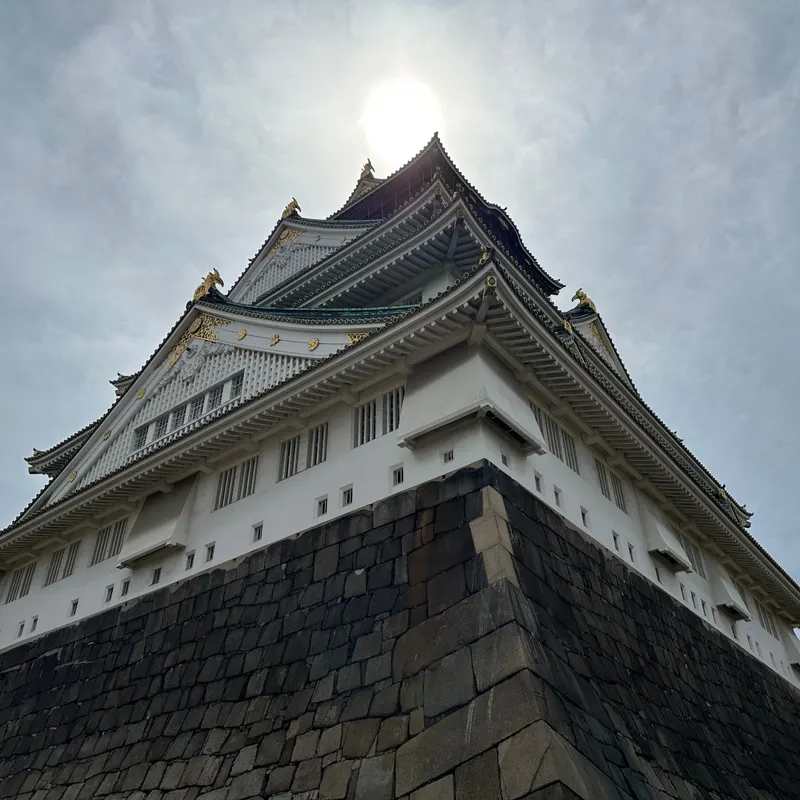
Right. Yes, yes. Because after Toyotomi Hideyoshi, there was the third warlord who finished the job. Yeah, Tokugawa, we'll talk about a lot about him in our Japan episodes. He really established Japan as both a unified and an isolated state, which basically would set the course of Japanese history for the next couple centuries. But I'm bringing up Hideyoshi because stuff attributed to him is everywhere in Japan. And I don't think it's like a folk attribution. I think it's that he was such a prominent figure that so many Buddhist temples and Shinto shrines and castles all over Japan were either built directly by Hideyoshi or in response to his conquests by his enemies. So all these castles are built in the same style because they were either constructed or refurbished during these wars led by primarily by Hideyoshi and his immediate and his son, his immediate successor.
So there's this amazing castle in Osaka and an even better castle in the town of Himeji, which from what I understand is mostly known as like a castle town. It was this fortified city where all these samurai lived basically to project power elsewhere across Japan. And most interestingly is that eventually he had amassed so much power within Japan, he felt confident enough to take on Korea and China. He would fail abjectly to take over either Korea or China. And that would really push his successor, Tokugawa, into abandoning any kind of international ambitions and even a lot of international contact.
Castles in Georgia and Japan
I was interested that you bring up castles actually because that's one of the things that Georgia is really known for. There are basically all of these fortresses all over the country in front of like over every valley basically. I mean it makes sense. Like this was a place that, you know, constantly being invaded and it was very mountainous. So like they used that to their full advantage. So I mean one of the places I visited over there was it's called Akhaltsikhe, which is Georgian for new fortress basically. It was built in like the 9th century. Akhaltsikhe is the name of the town. The fortress itself is usually called Rabati. Like the same as the city in like with the same origins as the city in Morocco. Rabat basically. But anyway. Yeah and this place it was like renovated quote unquote like a decade ago and I say renovated in quotes because it seems like a lot of it is just sort of the Disneyfication of these places which is a very common thing in Georgia unfortunately.
Like the Georgian economy is at this point very heavily built on the tourism industry. They had a choice between like building up a productive economy based on like agriculture or tourism. And Saakashvili, he made the decision that Georgia would become the tourism country. So now everything is built towards that orientation. But nevertheless, a lot of sites are in like this terrible state of preservation. And what they do have is just shiny stuff for like Khaleeji Arabs to come and take selfies.
That's funny. Oh, actually, and then you mentioned there's like a lot of like was that Rabat or Georgia where there's a lot of Arab tourism?
Oh, I mean Georgia, like the fortress is called Rabati.
Oh, yeah, it's the same origin as Rabat in Morocco.
Yeah, yeah.
Tourists in Japan
You have to mention that one other thing about Japan was that that was very cool, and I'm sure this probably annoys a lot of Japanese people, but there was so much tourism from all over the world while we were there. A lot of Americans, some Brits, a lot of very obviously British women with like really crazy makeup, you know, they love doing that. A lot of Spanish speakers, too, a ton of presumably Latin American tourists were there. I kind of try, I speak a very, I speak a tiny bit of very poor Spanish, and in one of the one of the the castles, there was a tour group from somewhere in South America, and I tried to like sort of follow along what the tour guide was saying to the best of my ability, but that was kind of cool.
There was a lot of Korean and Korean, Chinese, and Vietnamese tourism too. When we were in Osaka, we actually stayed in the Korea town of Osaka, and that was amazing.
Osaka
Osaka is just so fun, it's so different from Tokyo because most of Tokyo feels like you're in Lower Manhattan. It's incredibly slick, very formal, very professional. You know, Osaka, that's like that's where people go to have a good time. Osaka is much more casual, it's not as polished, which I think kind of makes it more fun. It feels much more down-to-earth, a little bit gritty, but so beautiful. There's this amazing castle there. Really fun, kind of culturally. There's this really famous area of Osaka called Dotonbori in the Namba neighborhood, and that's this it's kind of like this is an unfavorable comparison, but it's a little bit like Duval Street in Duval Street in Key West or Bourbon Street in New Orleans, because it's like kind of this like bars and restaurants district. But what makes it so fun is that every restaurant and arcade and hostess bar in Dotonbori has this some kind of giant sign, either like a huge neon sign or even some kind of like stat sculpture.
So the famous one is in Dotonbori. There's a basically a giant animatronic crab that snaps its claws on the side of the building. So much great stuff like that, dude. And again, this is what I'm saying. It's like a lot of Japan is exactly what you think it's going to be.
Yeah.
A lot of stuff like that. A lot of really fun self-conscious goofiness. But yeah, man, I loved it. I can't wait to go back. I'd especially love to go back to Osaka. We only were in, we visited Tokyo. We visited all over the Kansai region, which is southwest of Tokyo. And Kansai is also really, that was the main battleground for the Sengoku wars. So so much about that. When you visit Osaka, if you go to the museums, then you go to Himeji, you go to the museums and the castles, you're going to learn a lot about the Sengoku period, even if you're not trying to. And then we went to Hiroshima, which is very beautiful in different ways. But I wasn't able to get to the north of Japan or the far south. We're going to spend a lot of time talking about Nagasaki in our upcoming episode.
And so I wasn't able to get down that far, unfortunately. That's right at the southern tip of the main island chain. But I would love to go. I'd love to go to Okinawa, you know, which has a very unique history in Japan. It was its own kingdom for a really long time. And then, of course, Hokkaido in the far north, the Ainu, traditionally Ainu region. Man, I would love to go. So I really can't wait to find an excuse to go back.
Do you have plans to actually go back, or is this just dreaming at this point?
No, but I'm just dreaming. I'm going to have to start saving. My family spent about a year planning for this one. So I'll have to start planning soon for my next one whenever I go. The main reason I went is because my brother has been living there teaching English for a little bit. And so I haven't seen him in person in a while. So that was kind of cool. And I got to meet his friends out there.
Yeah.
English in Japan
Speaking of English, I'm actually kind of curious about this because I know that to get into university, you have to have pretty decent English in Japan, but they also don't really speak English or they're like, what's your experience with that?
I actually didn't realize that. That surprises me because yeah, the English level is very, very low in terms of how much does the average person speak. That's a little bit tricky. But at the same time, Japan is incredibly accommodating to English-speaking tourists in other ways. The amount of English language signage is crazy. Almost every sign is bilingual in English and Japanese. A lot of signs are...
Yeah, same in Georgia.
Uh-huh. And a lot of signs are even trilingual with Chinese or even quadrilingual with Chinese and Korean, which is, you know, it really kind of puts America to shame because I think that America has way more linguistic diversity than Japan does. But you see so much more English language signage in Japan than you see Spanish language signage in America. You might even see more Chinese language signage, like Chinese language PSAs in Japan than you see either Chinese or even Spanish language stuff in America, which is kind of interesting. So even though Japan is much more homogenous and in a lot of ways, in most ways, much more xenophobic, tragically. When it comes to language, they're way more accommodating. I guess because they know that nobody speaks Japanese unless they live there.
Xenophobia
Yeah, I've like heard, and granted, this was a very long time ago, but I've heard that some restaurants even have signs that say no foreigners.
Oh, yeah, yeah, that's unfortunately. Yeah, I mentioned the town of Hakone right after we visited Hakone, some noodle shop, I think, in Hakone went viral for having a sign outside that says, like, please, no Korean, no Chinese. And that kind of gets to the point where I think that unfortunately, Japanese xenophobia is not distributed equally. And I think that it's a very tricky issue. And I don't want to step out of bounds here, but basically, Westerners are not demonized in Japan the way that other people, people from other parts of Asia might be. There's, you know, there's a lot, there's a lot, much higher tensions with Korean and Chinese people than there are with random American tourists. I think it's much easier to visit Japan as a white person than it is as a Korean person, which is awful. And that really, that's the dark side of Japan, that there is this nationalist undercurrent.
And I don't want to exaggerate it because most people in Japan are really not political at all. And the far right has very little support. Much, I would argue, a lot less support than it does in Europe, for instance.
Japanese politics
Did you see any of the vans?
I saw so many vans, dude. That was so fun. And that's what kind of, you know, I don't know, you mentioned you saw some protests in Georgia. I didn't see any protests in Japan, but I saw so many political stump speeches. And one thing that's very funny about Japan, which almost seems like something from a video, it feels like a scripted event from a video game. Minor political candidates, like people running for city council or whatever, will go around Japan giving, like go around the city standing on the top of a car, giving a speech with a loudspeaker for everyone to hear about why you should vote for them.
Yeah, that's so charming.
Yeah, I know, I know. And there was one guy that nobody seemed to be paying attention to who wasn't very popular. And so out of curiosity, I took some pictures and went on Google Translate. And it turns out he was from some like ultra-far-right party explaining why Japan needed nuclear armament, why, you know, Japan had to be an empire again with nuclear weapons. And so I was very pleased to see.
Wait, is that the one that has an emoji as its logo? Because I just saw that on Twitter.
No, that's a different one. But there's a lot of like cutsy ultra-nationalist groups will have like their logo will be like a cute little anime girl or something like that, a cute little cartoon. And then their platform will be like, we must recreate the Japanese empire. Yada yada yada. But again, though, is that there's many different ultra-nationalist groups in Japan, but they are all pretty marginal because the main ruling party for much of the last century in Japan has been this kind of like very respectable, moderate, you know, center-right nationalists.
Yeah, the liberal Democratic party.
The liberal democrats and who are neither liberal or very democratic, but they're not psychopaths. That's the thing. Like there are extreme elements within the LDP. I think Shinzo Abe was connected to some of the far-right elements. But the really crazy people, they stick to these third parties, which have no electoral support and much less electoral support than European far-right parties. And that was interesting.
Yeah, but despite the fact that they don't really have a lot of electoral support, they do have a lot of sway in the public sphere, from what I understand. Like, because of that Japanese school textbooks, that's the big one. When you get this World War II section, it's like two pages, and that's yes.
No, no, no, you're right. You're right. And actually, an ongoing issue is supposed to call it textbook reform because there's this supposed concern among the Japanese far-right that school textbooks are too mean to Japan and that they need to be like more, you know, they need to be basically more sympathetic towards the Japanese Empire. But again, like most people in Japan, it does not seem like a very politicized country. There were some, there were a lot of political speeches being made, mostly to audiences of zero, which I feel like is kind of humiliating. Like you're on a van giving a speech and no one's, no one's listening. There were some figures from bigger parties that seemed to get more attention that people might have heard of that were gathered around listening to. But yeah, for the most part, it didn't seem like there was as much popular engagement with politics than there was in America.
It seems like, yeah, it doesn't seem like Japan has as much of an active culture war as you see in America, or even in a lot of other countries like Georgia or South Korea.
There's a gay marriage thing going on in Japan at the moment.
Oh, oh, good for them. Yeah, yeah. I know that they have like Pride Month in Japan, although apparently, unfortunately, it's like it's more popular with foreigners in Japan than locals. Oh, yeah.
I saw pictures that showed like three Japanese guys in the photo surrounded by like a sea of foreigners at a pride parade.
Yeah, yeah, yeah. No, and that's something that like Japanese people, Japanese right-wingers will say is like, oh, the Westerners are importing their values. But hey, suck it up. Sorry. No, I am completely unsympathetic to that kind of argument. I think that the expansion of Western liberal values into other countries is often a pretext for very bad policies, you know? But that into itself is a good thing. I think it's a very good thing if Japan or Saudi Arabia becomes more accommodating of gay people. I have absolutely, I have no sympathy for the so-called left-wingers who think that it's like based for Russia to be homophobic because that's for the student West.
Oh, absolutely. No, no respect for that attitude.
What Japan cares about
Yeah, so what would you say the Japanese do care about?
So much interest in like art and food. It seems like there's a bigger awareness of European art than there is in America. Or actually, obviously, Westaurus more broadly. The thing that was kind of funny is that in the Osaka Metro, one of the terminals in the station, there's a whole, it's really funny, there's a miniature gallery of replica prints from the Chicago Art Institute. So there's all these like the paintings whose real you know version is held in Chicago, they have like prints of them in Japan. I thought it was really funny. You would never see that in America. You wouldn't see, I doubt, I don't think there's a single subway in America that's like the Louvre themed, you know? But in Japan, there is. Also, of course, you know, Japan is incredibly commercialized, as much or more than America. Everywhere you go, it's, I'm biased.
I'm a tourist, I was a tourist, so I was spending money everywhere. But everywhere you go, there's ways to spend your money. There's such a strong interest in conspicuous consumption. You know, this is true for America too, but like, you know, so much food you can buy is so cute. I think specifically, so you can like Instagram it. There's a really big interest in a really big interest in Japan in like cute small desserts. All these Japanese people, especially young women, go to these bakeries just to get like a really cute little like slice of matcha cheesecake so they can like, you know, take a photo of it. Pastries are huge. Every train station has, in the big cities, has a whole row of different stores that all sell different variations on the same pastries. Some of them are traditional Japanese pastries. Some of them are European pastries.
One really popular one, which I think is awesome, is called, I think it's called castera. Actually, you might have heard of this. This is a cake. The name literally means Castilian because it was brought to Japan by Spanish and Portuguese missionaries in the 16th century. A little hint towards our next episode. And it's still very popular in Japan today, a half millennium later. And that's really cool.
Trains and the countryside
As you can expect, the trains are amazing. They're not as cheap as you might expect. They're a little bit expensive, but compared to the cost of having a car, it's just nothing. And another thing that is really common to foreigners is that there's an amazing discount you can get on the bullet train if you're visiting Japan for like, I think it's like if you're visiting for less than three months, you get this amazing train pass that lets you go all over the country. And it really.
Oh, I think they're raising their price on that, actually.
Maybe, maybe so. Yeah, I was lucky. And it's so pretty just to see the countryside roll by, you know, and it's just like you think it's going to be. You know, if you've ever been on it, it's like being on a train in Europe is probably the same, but it's so nice. You also realize that even though Japan is so modern in every basically almost every way, you know, it's like that they really pride themselves on that. So much of the country is still very rural. And there's a lot of very scenic farms. You'll see a lot of houses that seem to be hundreds of years old, very traditionally built in the countryside, which is cool. And so yeah, man, it was just a great time.
Which actually aren't old because like the Japanese, they like tear down their houses every 30 years and rebuild them or something, which is related to some kind of Shinto, some kind of Shinto religious belief, I believe, about like renewal.
Huh-huh. I didn't realize that.
Yeah, like Japan is one of the only places in the world where houses lose value with the passing of time because of that.
Oh, interesting.
Cheap houses
And that's actually one of the most interesting things about Japan is that possibly for that reason, real estate, especially outside of the big cities, is shockingly cheap. There's a lot of actually interested in this now because of that. You can buy a house in Japan, especially like outside of Osaka or Tokyo, for something like, I don't know, man, like 40,000 US dollars. Something insane.
Well, I mean, kind of similar in Georgia as well, because like vast slots of the country are being depopulated by the centripetal force that is Tbilisi. And because of that, like prices in Tbilisi for housing, they're going up. But everywhere else, it's like falling pretty precipitously. And although foreigners, I believe, can't, like, it's very difficult for foreigners to buy land, actual land in Georgia. Now, it's pretty easy to get real estate over there.
I know. I noticed in Japan is that it's pretty easy for Americans to buy property in Japan, but you can't get that. That's not a guarantee of permanent residency. So you can buy a house in Japan, but you can only visit it on a tourist visa, which is really pain in the ass.
Well, I mean, that sounds fine if like you're just visiting for a couple of months a year and you just want to like hang out in the countryside away from the big city buses.
Yeah, yeah, yeah. Yeah, yeah, that makes sense.
Yeah.
Who welcomes foreigners?
But yeah, like very weirdly xenophobic place, all things considered.
Hey, Georgia or Japan.
Oh, Japan. Georgia, it's actually very, very accommodating to foreigners. Like, they love foreigners over there. Like, they are just a very friendly, outgoing people. And I mean, like, I know I'm generalizing, but like, in my experience, that's just how they are.
And I gotta say, I don't want to be too harsh in Japan for the racism because I live in fucking America. You know, I don't, like, I think that outward expressions of xenophobia are probably maybe just as common, maybe more in the US. But in Japan, the difference is that, you know, their policies toward immigration and the social attitudes toward integration are, I would say, much more strict in ways that don't rub me the right way.
Yeah, I mean, like, there's a lot of really intense hatred of Brazilian Japanese over there, from what I understand, because in like the 80s or 90s, they made it very easy for those, for the descendants of Japanese in South America to come over and live in Japan. And they just found these people to be too acclimated to South American culture. And because of that, they were just treated horribly, from what I understand. Even though, like, ethnically, it's the same people, but nevertheless, that just goes to show that a lot of nationalism is just cope. It's just imagined. And yeah, like if the Japanese couldn't get along with like Brazilian Japanese who just happened to spend a few generations away from Japan, what does that really tell you about like racial solidarity or whatever?
Exactly. Yeah, yeah, no, yeah, yeah, yeah, yeah. But no, but yeah, man, like, despite the lingering undercurrent of racism, which again, as an American, I don't really have a place to stand on here, Japan's awesome. It's great. And honestly, that like they are, Japan is very accommodating of tourists, especially if you got a US or European passport. And that makes it really an easy country to visit. The language barrier, unless you're, as long as you're in a city, basically nothing. And if you've run into any issues, bro, take a Google Translate. There was on the first night that my girlfriend and I got in, there was this very confused old British man who didn't realize that Google Translate existed. And so I showed him how to download it. And I think that might have quite literally saved his life. He was having a hard time. But you know, if you know, if you know how to use your phone, then you're you'll be fine.
Japan's hard side
Japan, it's yeah, of course, obviously, in many ways, Japan is not perfect. There was a lot more visible poverty than I would have thought. There are absolutely homeless people in Japan. In one of the train stations, we walked through, like, there were dozens of people sleeping on the floor, like you might see in New York, which you might not expect in Tokyo. The working hours are incredibly long, and a lot of blue-collar neighborhoods in Japan feel kind of depressing, honestly. It feels like all people do are get up and work very long hours at low-paying jobs and then go to sleep. There doesn't seem to be not everyone gets to enjoy Japanese nightlife and pop culture if you're under a certain income threshold. And that sucks, you know?
Yeah, that kind of stuff goes a very long way to explain their birth rates, honestly. Although, at this point, like, weirdly enough, with the last couple of years of COVID craziness, Japan now has the highest birth rates in East Asia. So, yeah, it's because, yeah, other countries have sunk so much.
And you know, I gotta say, like, you know, I'm sure the birth rate stuff is true, but you see kids everywhere in Japan. I think the birth, like, it's like it doesn't seem like it's like a dying country in any sense. It doesn't seem like it's an old country. If anything, honestly, I think a lot of this is because of better like health, but people in Japan look so young. It really feels like people in their 20s. It feels like everyone's 25 in Japan, which is really funny. I think it's you know, people might age a little better. So, someone who's in their late 30s might look like they're in their 20s, but people seem way more younger than Americans. And it also helps that everybody is dressed super well.
Well, I correct you, Liam. Everyone is either 25 or 80.
Yeah, that's right, that's right. And yeah, you see a lot of old ladies in kimonos, which is really cool. I don't know if like you turn 80 and start wearing a kimono or if they've just been wearing kimonos every day for 80 years, but that was kind of interesting. You know, like I don't think if you go to Vienna, you're not gonna see old ladies in dirndls, I'm pretty sure.
Yeah, although I will say, I had a layover in Warsaw before actually getting to Georgia, and like I happened to get into like this Catholic procession because I was there on Easter night. But I saw several guys in Sarmatian garb marching in this procession, and I thought I was tripping.
Oh, that's hilarious, yeah. Dude, I think, say, if there's any hope for Poland, it's either communism or sarmationism. They gotta, if they gotta get rid of the whole like pretending to be Westerners shit. Embrace the East.
Yeah, I mean, like, I asked around for the record, and this isn't like some kind of weird nationalism stuff. These are probably just like street entertainers in touristy districts who happen to like go there in their work clothes.
Oh, okay, okay. I see, I see. Like, unexpectedly large number of kids in Japan. Everyone is 25 or 80, and people are healthy. Well, I mean, it sounds like something's going right for Japan, at least. That's great.
Yeah, Georgia, I like, I don't know what's up. Honestly, maybe I just like had a very skewed view of the country, but I didn't see that many kids, which kind of surprised me because I expected them to have like larger than median families by Western standards, at least.
I think the issue is that Georgia has a high emigration rate, and Japan has basically zero emigration. People don't leave Japan very often, but a lot of people leave Georgia and take their kids.
Oh, yeah, yeah, absolutely.
Crazy driving
Do you have any questions related to Georgia? Oh, yeah. Hellis. Anything that like took you out? Anything that surprised you? Things that were maybe shocking or like anything about the country that you really didn't expect, just let me know for either country, for Georgia or Armenia. I'd love to hear.
Well, I'd say that I got what I had expected, except the driving was crazier than I thought.
Yeah.
And like, I thought that Georgian driving was kind of nuts, right? Because these people, they just, like, a lot of Tbilisi doesn't have traffic lights at all, period. So you're just kind of winging it a lot of the time. But I mean, like, even beyond that, I was like, okay, this is nuts. It can't get any worse, right? And then, like, I take the Marshrutka from Tbilisi to Yerevan, and we crossed the Armenian border, and this dude is flying. He's going, like, 120 kilometers in the 60-kilometer per hour zone. And I'm like honestly a little scared for my life at that point because it's like yeah. Like this was a road at the side of a cliff, mind you. This wasn't like a well-built highway. It was just like what the fuck is going on?
Well as somebody who lives in Los Angeles, very funny that that's something that apparently driving habit that goes back to the old country. I don't know if I would have expected that. Oh my god.
Militarized Armenia
I mean even beyond that, like I said, like I was kind of surprised by the degree of militarization you see in the streets of Armenia, but they are very bursie.
And that's the thing. It's like that's horrible and terrifying. And like, you know, a lot of Armenian Americans, especially not so much these days, especially a couple years ago, were incredibly patriotic, often in kind of aggressive ways. And you know, I'm, again, we are very anti-nationalism of any kind in this podcast, but Armenia is historically has been victimized in absolutely disgusting ways by Turkey. And in many ways, the behavior of Azerbaijan, which is culturally and politically very close to Turkey, really rhymes with what happened a century ago. It's just continuity there. And so, you know, like I absolutely do not blame people in Armenia for being very assertive of their nationhood, you know? Whether, you know, I know like whether or not you think the nation is a thing that exists, you can't fault somebody for defending it when they are under threat in this sense.
And it is unfair that the situation in Armenia has received very little press coverage outside of California, where there is a big Armenian diaspora. Yeah, and so it's interesting that, like, that even for an outsider like you, it's the degree of militarization is so evident.
Like, it is what it is, right? I'm ultimately like powerless to do anything, but I just felt so deeply for these people. Like, they've been through so much shit just in the last century, and it like it doesn't seem like it's going to get any better. And, like, all of the cards are literally stacked against them. It just, yeah, just hoping for the best, I guess.
Travel recommendations
Okay, all right. Well, let's yeah, at the risk of ending on an unhappy note, let me just say, I've really had a really fun couple weeks in Japan. It sounds like you had a great time too. It's funny how our vacations, you know, kind of coincided. And man, I'm probably not going to go to Japan in person in a long time, but we are going to be back in just one week in spirit to Japan with a long episode on the end of the Sengoku era, which really established so much of modern Japan. I also wanted to say, if anyone listening is planning on going to Japan in the near future, run, don't walk. It's awesome. Spend as much time as you can in Osaka. Really spend lots of time in the Kansai and Hanshin region. It's so beautiful. So much about it is great.
Go to Kyoto, visit the Inari Shrine, walk up the steps, see the Fox shrine, you know, go to the Golden Temple in Kyoto. It's amazing. The Buddhist temple. Really, really great town. Visit Hiroshima if you have time. We stayed in kind of like the hipster part of town. It was awesome. Loved it. I gotta say, man, I am now a Hanshin Tigers fan for life. We went to a baseball game. They kicked the shit out of the Tokyo Swallows. And I came home with a beautiful Hanshin Tigers hat that, even though it's too small for me, I'm good in Georgia.
Well, I'm also going to put a huge recommendation for Georgia and Armenia for any of our listeners. It's great. It's really an incredible place. You're going to see, like, there's really something for everyone. Like, there's nature, there's historical stuff. There's a lot of really beautiful churches. The cuisine, of course, is incredible, both food and drink. And also, I mean, it's also like surprisingly cheap. Like, I mentioned that it's getting a lot more expensive for Georgians themselves because of the large numbers of Russians who are coming over there to escape the draft. But just to give you guys a reference point, like, including my flight over there, I spent like something like between two and a half and three thousand dollars for the entire trip that lasted almost three weeks. So, I mean, if you're looking to travel on a budget, then by all means, Georgia is an incredible place to go for not that much money.
Yeah. In a similar note, Japan is much more expensive than Georgia, but it's not as expensive as the United States. Traveling and lodging and food is a lot cheaper. The only expensive thing, which is incredibly expensive, which you're going to have to save for, unfortunately, is the plane tickets. But if you go at a we went at a bad season because this is tourism had just opened up to Japan after basically three years of being closed. Kind of a mini Tokugawa isolation just then. And also, we went during the cherry blossom season because that was the only time that my brother was off work. If you go at a different time of the year, tickets are going to be way more affordable. I would definitely recommend that. And also, Airbnbs are really cheap. Just make sure you're in a good one. Some of them are really small.
I was totally fine staying in like very cramped conditions. But you know, if you've got, if you're more, I don't know, if you've got any princesses of the princess in the peas among us, might have an issue.
Yeah, well, Japan is also one of the places you can go to actually live in the pods.
Yes, yeah, yeah. So, yes, if anyone's looking forward to experiencing the future, you can head on over there and stay in a pod hotel.
Wrapping up
Exactly.
All right, well, on that note, it's been great. I think it's very fun that the two of us now have seen the two extreme ends of Asia. So, I think that now we gotta work our way to the middle. Maybe you and I can meet in Mongolia one of these days.
Oh, absolutely. I'm looking forward to it.
All right, well, on that note, this is great, man. I know this wasn't really a real episode. I hope you guys aren't too disappointed, but we've got some great stuff coming out really soon. Lots of Japan, lots of the Caucasus, as well as some other, you know, our classic bread and butter. We've got some episodes about early modern Europe coming out soon too. So, stay tuned for the next couple months. We've got some really fun stuff coming soon. This has been Gladio Free Europe signing off. Bye-bye.
The show is also on Apple Podcasts, Overcast, Pocket Casts, Podcast Addict, YouTube, RSS and Patreon.