19
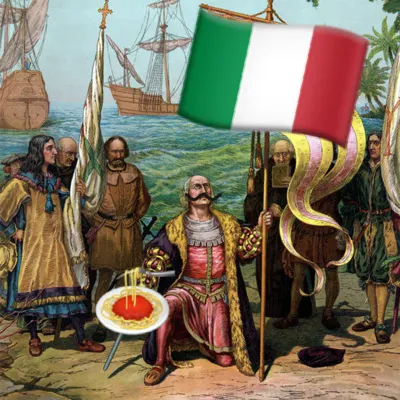
Columbus Day
In progressWhy is Christopher Columbus considered a hero to Italian-Americans, and why did they fight so hard to give us a national holiday to celebrate him? We take a long look at the history of the Italian immigrant experience, and how that got us to Columbus Day (now co-named Indigenous Peoples' Day).
Hosted by Liam, Russian Sam, and Halal Sam.
Transcript
Welcome
Welcome back to another episode of Gladio Free Europe. I'm Russian Sam and I'm joined today by my lovely co-host Liam.
Hey!
And Halal Sam.
Hello.
And we are recording this on the eve of what is now Italian Heritage slash Indigenous Peoples Day, formerly known as Columbus Day. So we thought that it would be fun to talk about the history of this holiday as well as the history of Italians in this country because there's a large proliferation of jokes about Italians on the internet. You've probably seen it for a very long time. A lot of that material is very stale. But what is the actual Italian-American story?
The 1891 New Orleans lynching
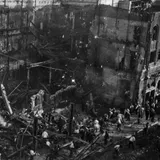
I think the best place to start this story is not in 1492. I think it's in 1891. Specifically, March 14th, 1891. In New Orleans, Louisiana. A group of 8,000 assembled on New Orleans Canal Street, almost filling up the large space from curb to curb on either side of the boulevard. The crowd, possessed by an ungovernable fury at the murder of Police Chief Hennessy, had guns and arrived at the parish prison at 10.30 that night. Prison guards let the mob inside, where they eventually found the Italian prisoners accused of the murder of the police chief. They brought the prisoners out into the street, and the shotguns belched forth. The slayers of Hennessy fell dead in their tracks. This was the scene of the 1891 New Orleans lynching, where 11 Italian immigrants would be shot or hanged for their alleged participation in the assassination of the cop. This event is generally considered the largest mass lynching in the U.S. history.
And interestingly, it was a mass lynching of Italian immigrants. This caused an immediate crisis internationally, where the U.S. and the Italian governments came to pretty high tensions over the murder. And it led to an immediate crisis in American race relations. Not race relations between white people and black people, but race relations between Anglo-Americans and these large numbers of newcoming Italians who were seen as completely alien to the society they were trying to make their home. And this event also led to the creation and the celebration of what's probably the most controversial holiday in the United States. Columbus Day. Tonight we'll be looking at the history of Columbus Day and its connection to Italian American politics in the 20th century.
Our sources
Yeah, and before we get too deep, I think we should mention that we have a few sources for this. Halal Sam read a book called Wop!
I read the book Wop! by Salvatore LaGumina, which is this collection of newspaper clippings and magazine clippings, essentially, and speeches talking about Italians and the Italian problem and the Italian-American experience of Italian American history.
And I know that Russian Sam, you found these two pretty cool movies that do a pretty good job of illustrating the history of Italian immigration from the late 19th century to the middle of the 20th century. Namely, the 2006 film Nuovomondo, also known by the English name The Golden Door, as well as the 1996 film Big Night.
And this is a great contrast because we'll get into the movies later, but they show really the two very different types of Italian Americans from the beginning of the diaspora and then to after World War II, how you really just see this complete transformation in this population as they basically become American.
And become white.
Yes.
Yeah, so tonight we're centering Italian voices, although none of us are Italian.
No, but two of us are from New York, which I think means New York and Jersey, so we kind of count.
Christopher Columbus
I think we should mention, though, that because this is Columbus Day, we should begin this story with the figure of Columbus himself. So in 1492, Christopher Columbus sailed the ocean blue.
It wasn't that clean. It wasn't very nice.
You guys probably know the general outline of this already. Christopher Columbus was a Genoese sailor and merchant who eventually made his way to the Portuguese and later the Spanish court, where he was able to secure the backing of the Spanish crown to fund his expedition to Asia. And so he thought Asia was a lot closer than it really was. He thought that it would be much easier to sail across the Atlantic and get to China or India.
A very common myth that you'll hear about this is that everyone thought the world was flat except for Columbus and that's why they didn't support him. But in reality, it was because they actually knew what they were talking about and they told him that he was going to die of hunger because he'd run out of provisions before he actually got to Asia.
Yeah, especially the Portuguese who had built, who were building this maritime empire and had very, very good maps of sea routes. Yeah, and you know, I think we should mention that it probably would have been better for a lot of people if Columbus actually did die of a lack of provisions on his way there.
Oh, absolutely.
It would have stopped the largest genocide in human history.
What does Columbus say in his own words?
They brought us parrots and balls of cotton and spears and many other things, which they exchanged for the glass beads and hawks' bells. They willingly traded everything they owned. They were well-built, with good bodies and handsome features. They do not bear arms and do not know them, for I showed them a sword and they took it by the edge and cut themselves out of ignorance. They have no iron. Their spears are made of cane. They would make fine servants. With fifty men, we could subjugate them all and make them do whatever we want.
Yeah, so in 1492, Columbus set sail and he arrived on the island which you would call Hispaniola, which is today where Haiti and the Dominican Republic are. So here he's talking about the Taino population that was at that time living on the island.
Yeah, who are no longer living on the island because they were mercilessly exterminated and enslaved.
I think we should add that, although there is a little bit of debate about whether or not Columbus was deliberately trying to destroy this entire nation, it's inarguable that his actions are the biggest contributing factor in the eventual genocide of the Taino people and so many other indigenous peoples across the entire Americas, as well as the beginnings of the American slave trade.
Yeah, and you'll often hear the refrain that, oh, it was a different time. They had different standards. But it should be underlined that even by the standards of the day, Columbus was seen as a pretty vicious guy.
Yeah, there were Catholic priests and others and a lot of people who said that.
Oh, yeah, yeah, yeah, yeah, yeah.
And you feel that great example, Russian Sam, of how he was brutal, not even just to indigenous people.
And as I said, Columbus was from Genoa, and he was actually from a commoner background, basically working class, and he was very embarrassed by that. This resulted in this sort of inferiority complex to the point where when some woman in Hispaniola was talking about his ancestry, his brother basically ordered that her tongue be cut out for badmouthing the family. And I have to assume that if he was this openly brutal with a European woman, presumably non-Christian indigenous people would have been treated with even more wanton casual violence. To quote from the letter that he wrote to his brother upon hearing this, what you have done is good, for whoever speaks ill of us deserves death, and this is the law.
It should also be noted that, obviously, he wasn't Spanish himself, but the Spaniards had just engaged in the Reconquista, supposedly, I don't like that term, but whatever, just done a lot of pillaging and conquering in Iberia itself.
Yeah, the same year, yes, we shouldn't get the same year that Columbus arrived in Hispaniola was when so many Jewish and Muslim people from southern Spain were forced to convert or leave the country. I think it's just really important to say all that here because this whole episode we're going to be talking about Columbus and his legacy as this great cultural figure. I think we do need to mention early on that no matter if you think he was this great hero of the Italian nation or what, he was a really brutal guy, and there's no way around that. And that even people who defend or uphold the legacy of Columbus should recognize that he was responsible for a lot of brutality both personally and in his lasting legacy.
Italian explorers
The other fascinating thing about him as a representative of the Italian nation is that no such thing existed at that point. He didn't go to the Italian court in Rome because it didn't exist. No, he went to Spain.
Although, interestingly, he wasn't alone in that, is that a lot of people from modern-day Italy did participate as early explorers.
Yes.
You had Giovanni da Verazzano, you had John Cabot. Like the list goes on and on. Like Italians were very active in this effort.
Although these early explorers sailed under the flags of Atlantic monarchies, they were the standard-bearers of a general movement of ideas and finances that really stemmed from Italy. The Italian networks and financial backing that were crucial for these Italian navigators provided the additional element that made these first voyages possible. In the early expeditions, the Italian sea captains and their investors cared about profits, not sovereignty, which was an approach the Genoese investors had pioneered in the Mediterranean. The Atlantic monarchs, on the other hand, found it gratifying to extend their sovereignty, both for its own sake and because it would become the basis on which they shared in any profit. One way of looking at what happened in the years before and after 1492 is to see it as an attempted commercial conquest of the Atlantic by several groups of Italian venture capitalists. In the end, the Atlantic world proved too large and too risky and too distant for the Italian commercial networks to really dominate it.
So, in this way, people from what would eventually become Italy were able to make their contribution in the settlement of the New World and the razing of the indigenous societies that already existed there.
The first Italian American
And one of the first Italian Americans to settle in what would later become the United States of America and to take part in this project was a guy named Pietro Cesare Alberti, who lived from 1608 to 1655. He's often been called quote-unquote the first Italian American. And he was a Venetian sailor who had immigrated to what was then New Amsterdam, what's today New York, in 1635. He had an estate in what's today Brooklyn.
Somehow, Brooklyn was already calling. He was killed by Native Americans.
Oh, yeah.
We should note, though, that even though there was a little bit of limited Italian settlement in the New World in the colonial era, you didn't really see much interest in the figure of Columbus at this time.
Columbia
However, after independence and during the Revolutionary War, there was this sudden crisis of identity where the U.S. needed new national symbols to look for for this new nation. A really obvious symbol was Columbus. And quite interestingly, the figure of Columbus as this sort of beacon of civilization in a new land first found its major form in the idea of Columbia, this feminine goddess figure. What I find especially interesting about Columbia, this, you know, this female goddess figure that represents America comparable to Britannia and the UK or Marianne in France, was actually created by an African-American woman, Phyllis Wheatley, who some of you guys might know from AP US history. She was the first African-American person to publish a book in the U.S. And in 1776, she actually wrote this sort of vaguely pro-independence poem that featured Columbia as this feminine figure. And then shortly after independence, there's this sudden push of Columbia and Columbus being adopted as names.
So for instance, Columbia University, 1784, used to be just called King's College, but after the Revolution and Independence, you didn't really want to go to someplace called King's College anymore. So now you go to Columbia. In 1786, Columbia, South Carolina, was established as the new capital. And then, of course, in 1791, a little bit after this, you have the District of Columbia is established.
My favorite fact about DC is that it's shaped the way it is because that part of Virginia that should be part of DC wanted to keep their slaves.
Aw, of course. I didn't realize that, but of course.
Yeah, no, that's why DC isn't the perfect square, anyways.
And interestingly, in 1792, you also have one event, which was the very first celebration of Columbus's landing. And I'm not really sure if we can call this Columbus Day, because it wasn't a holiday and it wasn't celebrated as such, but you have the Tammany Society of New York recognizing that the landing itself by Columbus on October 12th was an important event that should be celebrated. And this was in 1792, which was the tricentennial of his landing. So, yeah, that's you see that in the late 18th century, going on to early 19th century, you have all of these places being called Columbus or Columbia formed in a very short time. There's this brief period where there's a lot of national interest in the figure of Columbus. We should note, though, that this interest isn't coming from Italian Americans, of which there were very few. This was coming from Anglo-Americans who were simply looking for a new symbol to augment their new civil religion.
Yeah, you also get Columbus, Ohio, the Columbia River in the Pacific Northwest, British Columbia.
And I guess from the Columbia River, yeah, yeah, you get British Columbia from that. Yeah.
Yeah, but despite the fact that there were so few Italians present in the United States at this moment, this does not mean that some of them did not play an important role.
This is true.
Italians in the Revolution
So the most prominent example of an Italian who participated in the Revolutionary War was a man named Filippo Mazzei. He came to Virginia in 1773 and became good friends with Jefferson. He became a massive proponent of republicanism and a financier and propagandist for the American Revolution in Europe, especially in Italy. He was actually elected to a local council in Virginia, which he served for a little while. But after the conclusion of the Revolutionary War, he went to serve in the Royal Court of Poland until the partition happened.
Wow, that's interesting. You know, you also had a guy named William Paca, who was an English merchant of distant Italian ancestry, who was actually one of the signers of the Declaration.
How many Italians?
But how many Italian Americans were there at this point exactly?
One cannot estimate with certainty the number of Italians residing in the United States either in 1800 when the country extended to the Mississippi River with an entire population of 5.3 million or in 1850 when it reached the Pacific Ocean with a population of 23 million. Figures ranging from 3,000 to 12,000 Italians have been suggested. The United States did not track immigration until 1820 and only 30 Italians were recorded as arriving in that year. In the decade 1841 to 1850, an average of 187 Italians entered annually, which was just 11% of the total number, a far cry from its 23.26% during the heyday of Italian immigration 50 years later. In 1850, there were 3,679 Italian-born immigrants, not including offspring born in America, second generation Italian Americans, or Italians who arrived before 1820 and were living in 1850.
So in other words, there were not a ton of Italian Americans at this time.
No, this was a small population.
There were about as many Italians back then as there were like Albanians, probably.
Exactly, yeah.
Although there probably would have been some Italian Albanians, actually.
That's true, Arbereshe, yeah, yeah. They are a thing.
So in other words, if you're asking how many Italian Americans there were in the early 19th century, the answer is not that many.
The Risorgimento
You really wouldn't see that many Italian Americans coming to the U.S. until during and after the Civil War.
But this wasn't because of a civil war in America, but because of what was happening in Italy, which was the long-lasting civil conflicts known as the Risorgimento, in other words, the northern-led movement for unification.
Yes, the birth of the Italian state as we know it today. The idea of a state that goes, you know, from the Alps to the tip of the boat.
Yeah, yeah, yeah. Probably the most important figure in this was Garibaldi. Very, very accomplished, fascinating figure. And this led to a whole lot of economic and social crises that pushed a lot of people, especially on the more elite end of the spectrum, but also a lot of poorer people, to leave the country.
What I find kind of interesting is that a lot of these early Italian immigrants during the war actually came to the U.S. as soldiers to fight. And you even had Italian immigrants fighting on both sides of the American Civil War.
Yeah, and Garibaldi himself was offered a generalship in the Union Army, but refused it because he was angry that the Union was not fighting to abolish slavery at that point. Although he did have some service in the New World, he did have some military history there.
Yeah, yeah. Oh, Garibaldi, really, definitely a really cool guy. Well, I'm thinking if we want a holiday for a famous Italian person in the New World, personally, I think Garibaldi is a much, much better pick than Columbus.
Absolutely. Incredibly cool guy.
Yeah, why don't you tell us a little bit about the way that the Garibaldi's conflict sort of bled into the American Civil War?
So due to some international liberal support for the Union and Garibaldi's own anti-slavery stance, because he was a good person, many Italian veterans of the unification wars emigrated to the U.S. and joined the Union Army. And maybe out of revenge against their Garibaldian enemies, several dozen Neapolitan veterans of the Italian War who had opposed unification sailed to New Orleans or New Orleans to fight for the Confederacy.
And I think that's really funny because this means you have the northern Italians fighting for the North in the Civil War, and you have the Southern Italians fighting for the South. It's incredibly funny.
Yeah, and New Orleans, as we will get into later, is a historically important city for the Italian-American community. Yes, New Orleans was always a major Italian settlement center. The French quarter specifically, I believe. Yeah, yeah.
And this is when Italian settlement really took off. It was after the Civil War, you start seeing large numbers of Italians, now poorer Italians, especially, coming to places like New York and Boston and Philadelphia, but in smaller numbers to places like the West and including New Orleans, which was sort of considered a Western city just because it was so far from the Northeast. And you mentioned that a lot of Italians moved to the French quarter. That's really interesting to me because in the West, especially in San Francisco and Los Angeles, where they had these existing older Mexican communities, you had Italian immigrants who didn't assimilate into Anglo-American society, but instead they actually basically got folded into the Mexican community in those places. Kauda Black and Solidarity. Yeah.
Why they left
What were some of the reasons besides political instability and wartime violence that caused people to flee?
Okay, so the price of agricultural goods collapsed after the end of the Civil War, and the population of the South had exploded. The North-South divide got even worse. This is in Italy, by the way, with the North industrializing and the South remaining agrarian and really almost quasi-feudal.
Yeah, so again, maybe it's not entirely a coincidence that the Southerners from Italy joined the American South, because these are places that were both had a very brutal system of agriculture in kind of a similar way. Although, of course, as brutal as agriculture was in Italy, in southern Italy, it was nowhere near as bad as slavery, but it was still this kind of tradition of bonded labor, often enforced by violence.
Yeah, I mean, Bella Ciao was originally a song sung by farmers in the South, I believe.
Yeah, that's a great example. Yeah, the famous anti-fascist song, yeah.
Before it was a partisan song, yes.
I know one thing that you discovered, Russian Sam, was that a big push factor for migration was that even though the south of Italy was incredibly poor, the population was expanding really rapidly. So you had all these very poor rural people, especially in places like Sicily.
Oh, yeah, for sure. And at the same time, you were also seeing a massive expansion of the North-South divide in terms of economics. Like the price of agricultural goods basically collapsed after the American Civil War because you once again had a massive influx of these grains into the market, as well as the expansion of railroads, which allowed goods to reach markets in a more timely manner. And as a consequence, you saw a situation go from in 1860, the GDP per capita of the southern regions of Italy was 99% that of the more industrial north. So basically, you're saying it was on par at this time with the north. The south was just as wealthy as the north. And then by 1895, it's down to 91%, and it just keeps declining until 1945 it bottoms out at 49%. At the end of World War II, they've sunk to basically half the wealth of the north of Italy.
And from the very beginning, you had these very unpleasant feelings, which were often mutual in both the north and the south, which, ironically enough, from the fact that during the period of Risorgimento, many southern intellectuals were writing about how the monarchy had actually degraded the southern Italian population and made them uncivilized and superstitious and violent. And ultimately, once the monarchy was out of the picture, this image of the southern Italian still remained.
My mom grew up in a pretty Italian neighborhood in Yonkers, and most of her neighbors were-I mean, you still had monolingual Italian speakers among like the great grandparents and stuff because you had multi-generational housing. But some of the more northern, but not really northern Italian kids would say of Sicilians, this is how they would explain Sicilians: a piece of Africa broke off, which is both racist against black people and against Sicilians. And that's racism within Italy.
That's wild, yeah.
North and south
Yeah, no, and this was in this was in the 60s.
Yeah, well, here's that great quote about what it was like in the kingdom of Naples prior to unification. The traveler who happens in that kingdom finds no signs of a civilized people, no institution that is useful and productive, no public or private instruction, no roads, not even any links among provinces or between the capital and the provinces. There is no traffic, no commerce, no arts, no industry, no manufacturing. And if it were not for the thousands of monks and priests, crooks and vagabonds, beggars and do-nothings, if it were for the serenity and clarity of the sky, the fertility of the soil, this traveler would think that he was in one of the countries of Africa, made bestial by the most degrading despotism.
It's really, yeah, it's intense stuff.
Really nasty stuff, yeah.
And it's funny, yet. So here is in the 1860s and in the 1960s, you've got this racist association of southern Italy with Africa. Yeah, it's pretty wild.
And, you know, Gramsci, who I'm sure a lot of our listeners are quite familiar with, he actually had this quite interesting comment about the perception of southern Italy. It is well known what kind of ideology has been disseminated in myriad ways among the masses in the north by the propagandists of the bourgeoisie. The south is the ball and chain which prevents the social development of Italy from progressing more rapidly. The southerners are biologically inferior beings, semi-barbarians or total barbarians, by natural destiny. If the south is backward, the fault does not lie with the capitalist system or with any other historical cause, but with nature, which has made the southerners lazy, incapable, criminal, and barbaric.
This is his description of what the propagandist of the bourgeoisie, as he would say, correctly, what he says that they believe is basically identical to what Lega Nord and other people in the north of Italy who are violently racist against the south would say today.
So you're saying, yeah, like modern-day, yeah, modern-day Italian racists.
Yeah, like this is, although Lega Nord has expanded throughout Italy, beyond the north, etc., etc., it began as a northern separatist party because of this attitude of they are keeping us back. They are the ball and chain which prevents the development of Italy. Right.
Nuovomondo
And of course, these kinds of beliefs held by northern Italians against the south would basically be adopted by Americans upon Italian immigration. And I think that this is a perfect place to introduce one of the movies that we saw for this episode, which is Nuovomondo or Golden Door, which is this really funny, almost magical exploration of what it was like for incredibly parochial rural Sicilians moving to America. And it just shows that these people just lived in a completely different world than the one they were about to enter.
So the movie takes place in 1904 in Sicily, and the central characters are the Mancuso family, who are these poor Sicilian peasants who decide that it's time for them to pack up and move to America.
Right, and these people have no idea about the outside world at all. Probably the most interesting scenes of the movie are where the main character imagines what life in America is going to be, and he thinks it's people with giant vegetables wading through seas of milk because that's how that's how luxurious life is in America. There's even one funny early scene right at the beginning where these two young women have a photo of what they believe life in America is like, and it's these edited photos of onions so big that a wheelbarrow is needed to carry just one. And these people are so parochial that they really believe that's what's waiting for them.
And also their situation at home is so shitty. Yeah, yeah. It's overall an excellent movie. It does a great job of capturing the atmosphere of the time and it just looks great. Like there are a number of very visually striking scenes. There's one scene where the boat full of immigrants is leaving the harbor to depart to America and you just see this chasm form between the boat and the people who are waving goodbye to them. It's really ominous, honestly.
Yeah, it's very like this because these people are, many of them are never going to return home again. Although I guess as you've noted Russian Sam in your research, a lot of Italian Americans did at least intend to go back after working for a few years.
Yeah, something like half of Italian emigrants would return to Italy after working for a couple of years in America or in another more developed European country. Their calculus was basically: I'm going to go to America or France or whatever, work for a couple of years, then I'm going to come back home to my village. I'm going to buy a nice plot of land, build myself a nice mansion, and then retire and live happily ever after.
Becoming Italian
And also, talk about how this strength, what this did to the Italian identity.
So, to a large extent, Italian identity was actually formed outside of Italy because when these people would go abroad, they suddenly found out that they're, you know, Italians. There's actually this great scene, on the ship, where they're getting settled down, and one guy notes that he had never slept with so many foreigners before. And Salvatore tells him, foreigners, but we're not foreigners, we're all Italian. Italian? Italian, but we don't speak the same way. Don't you know you're Italian? If you say so, exactly. Like, once they're in America, they're no longer all, you know, you're no longer Sicilians or Tuscans or whatever, you're Italians. Often it was just village identity. Like, keep in mind that unification only happened in 1871. This was a very new country, as well as the fact that the state of education was very poor, especially in the south. The best most people could hope for was going to church school for a couple of months in the winter while they weren't working the land.
Right, yeah, because people would often settle among other people from the same province or even the same village. Like, where your ancestors came from in Italy remained an important aspect of Italian-American life in the early 20th century.
Absolutely.
But we have these mixing together in these little, in like the little Italies of all these American cities, kind of like we see with Chinatowns. I actually read an interview with Martin Scorsese. His parents were born here, but basically, like, he talks about how his parents had basically grown up on adjacent blocks. Like, his father's family lived in one building where people from village X settled, and then his mother settled in a building literally down the block where people from her village settled. And, like, these were very insular people to the point where, like, people from building X, marrying people from building Y would be seen as a big deal, basically.
And of course, these immigrants, when they came, because they had very low education and they didn't often have employable skills, they tended to have blue-collar work and often worked very poor wages, probably lower wages than most native-born Americans were comfortable working.
Radicals and racism
Absolutely.
Probably as a result of the extreme poverty of Italians, both in Italy and in America, there was this flowering of radical intellectual thought on both sides of the Atlantic, where you have a whole bunch of Italian Americans adopting anarchists and socialist beliefs, and then you also have many people in Italy and Sicily learning these beliefs and coming to America as professed socialists. This was part of this broader backlash against Italian American immigration out of the specific fear that Italians were not only racially inferior or whatever, they were also bringing these far-left ideologies, which could threaten to turn America into a socialist country.
All right. And here we have a political cartoon from the late 19th century. Imagine if Ben Garrison was about 20% more racist or 10% more racist, but it was about Italians. You have rats with human faces, and they're dark-skinned and mustachioed and swarthy, and they're all swimming toward American shores. They're coming out of a box labeled direct from the slums of Europe daily. And you have all of these Italian rats, some of them with knives in their mouth, swimming to America, and they were all wearing hats that say mafia, radicalism, socialism.
Anarchism.
Yeah, the only comparison I can think of, even better than Ben Garrison, is if anybody has played Bioshock Infinite, the kind of like over-the-top racist art in that game is really not remotely off the mark of what was actually being produced in the early 20th century. It's really clear that Italians at this time were genuinely the victims of extreme racial prejudice. There's a lot of talk about whether or not Italians were considered white at this time. I think that honestly, that's almost beside the point. Because whether or not they were explicitly considered white or non-white, there was incredible racial prejudice against Italians, and they were absolutely seen as less than white people, both racially and socially. And there were clear material causes of this, like the fact that they would work for really, really low wages.
Yeah. And also, they were almost uniformly Catholic, which led to a lot of anxieties among the still very Protestant American public. Yeah, at this time, it was teeming with conspiracy theories about papist conspiracy for Catholics to swamp the United States and bring it under the domain of the Pope.
Unfavorable comparisons
Absolutely.
And I think this was a big factor in why Italians experienced a lot more prejudice than Protestant immigrants from Germany and Scandinavia. But interestingly, it also seems like that by the late 19th century, when Italian immigration really picked up, they were also being unfavorably compared to other immigrants from Catholic countries. Let's hear this one quote from the New Orleans Times Democrat, because this is a pretty interesting examination of popular prejudices against Italians.
Yeah. The Germans, the Irish, and others migrate to this country, adopt its customs, acquire its language, master its institutions, and identify themselves with this destiny. The Italians, never. They remain isolated from the rest of any community in which they happen to dwell. They seldom learn to speak our tongue, and they have no respect for our laws or our form of government. They are always foreigners.
This is from the New Orleans Times Democrat in October 1890.
Yeah. This is very, very recently after a lot of people were very afraid of Irish immigrants and Italian immigrants. But there's another quote. They are with scarcely an exception Roman Catholics, but they do not feel at home in our Roman Catholic churches for the reason that the priests are either Irishmen or Germans. The Protestant denominations make very little, if any, effort to proselytize to these people, since the language barrier, the barrier of language is almost insurmountable.
Wow, yeah. I think it's pretty true that Italians really seem to have received more prejudice than other European Christians at this time.
Yeah, it's very interesting to me that they mention our Roman Catholic churches, which would be an unthinkable thing to say, even a few decades earlier.
No, because just because this was in the 1880s, 1890s.
Yeah, this is 1884 in the New York Times. Yeah, yeah. And so 50 years before that, Irish and German Catholics were seen as, you know, like the scourge of America.
And speaking of the New York Times, there's an especially nice quote right here that you found.
It should be said, however, to the credit of the Italian race, that these peasants, low as they are, are not often found in our prisons for crimes of theft and robbery. They seem on the whole an honest class, but are continually brought before the courts for fighting, for violence, and for attempts at murder. Crimes which arise from the crowded way in which they live and the jealousies and the quarrels that naturally arise from their promiscuous mode of life. Their children, as they grow up, will naturally and inevitably form the criminal class of New York City, unless they are reached by only the best American influences.
Yeah, this is in 1882.
Yeah, it's the Gray Lady, you know, always that lovely newspaper is, you know, just describing how the Italian is naturally inferior unless he's, you know, taught by the superior American way of life.
And it just has the crime gene. Yeah, yeah.
Oh, and actually, we have one more that's even possibly the worst of all.
Oh, yeah, let's go.
Steerage passengers from a Naples boat show a distressing frequency of low foreheads, open mouths, weak chins, poor features, skew faces, or small or knobby crania. Such people lack the power to take rational care of themselves. Hence, their death rate in New York is twice the general death rate and thrice that of the Germans. No other immigrants from Europe, unless it be the Portuguese or the half-African bravas of the Azores, show so low an earning power as the southern Italians.
Scientific racism and Ellis Island
They specify southern Italians, which is interesting.
Yeah, and you're also seeing at this time the collision of Italian immigration with the new turn towards scientific racism. So, in a way, Italians were coming at the worst time because this was a time when white Americans were increasingly interested in stuff like skull shapes, you know, and even like whatever physical differences they could find between themselves and immigrants.
And they didn't even have to do this work. The race scientists of Northern Italy had already done their job for them.
Yeah, yeah, exactly. Absolutely, yeah.
And I think that a cool example of this, which isn't entirely racial, but it's very eugenic, is how at the end of the movie Nuovomondo, after this Italian family has worked so hard to get to the U.S., they're told that the elderly mother and the mute son are not allowed to come in because they're seen as potential, you know, pollutants in the American population. Oh, yeah.
There's this great quote where one of the administrators on Ellis Island is explaining to a woman asking questions about what the purpose of the test is. And he says, It has been scientifically proven that a lack of intelligence is genetically inherited, hence contagious in a way. We are trying to prevent below-average people from mixing with our citizens. And yeah, that's all there is to it.
It was a very cruel enforcement regime which just treated these people like animals. Like we see a scene where they're being examined, like they're naked, and there are people walking around them to check for deformities or illnesses. Yeah, just really awful, dehumanizing stuff.
You know, and of course, I know we're not really a political podcast, but we probably should mention that this is somewhat reminiscent of what still goes on in immigration facilities. It's just an incredibly brutal tradition.
Absolutely.
Claiming Columbus
And I think the bottom line here is that it's clear that Italian Americans felt incredibly unwanted by their new country. They were experiencing really high levels of opposition and even violence in a lot of places we're going to get into. And starting from pretty soon after the end of the Civil War, there was this push among Italian communities across the U.S. to prove themselves as Americans.
And one way a lot of Italian Americans thought to do this was by connecting themselves as these 19th-century Italian residents to earlier Italian residents in the Americas. And the obvious example was Christopher Columbus.
In 1866, Italians in New York lobbied for the recognition of Columbus Day as a holiday.
Yeah, this was when New York probably had one of the only Italian communities in the country.
Greatest city in the fucking world, baby.
Yeah, and these were for the most part educated political exile types and not the quote-unquote ignorant country peasant. So it was a very different demographic, but nevertheless, they felt the need to create a space for themselves as part of the American nation. And they were followed by the Italians of San Francisco who held in Columbus Day parade in 1868.
Yeah, yeah. One kind of funny quote I like is that there was one Italian activist named Angelo Noce who led the campaign for Columbus Day in Denver. And he said that he first recognized that Columbus was a good figure because he was creating a tavern and he wanted to name the tavern after an important Italian. And he said he finally decided to call it Christopher Columbus Hall, realizing that Columbus was the only Italian that Americans wouldn't throw rocks at.
Jesus Christ.
But yeah, there is a genuine environment of discrimination here. Yeah, yeah. And I think this is why Columbus Day is a really touchy subject because even though Italian Americans today, thankfully, don't experience really any discrimination.
No. They're white now.
Modern Italian Americans are totally assimilated into the fold of whiteness. And, you know, that has a lot of, that carries a lot of very unfortunate baggage.
The Ashkenazi Jews are another example.
Yeah, no, absolutely. Yeah, yeah. So many groups had this process. Yeah, yeah, Jews are another great example. But before Italians were really incorporated into the fold, I don't think you could really fault them for latching onto Columbus, even though Columbus was a pretty awful person.
It would have been nice if they pushed for Garibaldi Day or something.
Oh, absolutely. Yeah, that would have certainly been a better outcome.
Generally, cool guy.
Also, another one of the national heroes not born in his own country, technically. Born in what's now France.
Really?
Yeah, Nice.
Nizza.
Interesting, yeah.
Yeah, and Nizza became Nice, and now it's French.
Yeah, well, it's clear that I guess maybe because Anglo-Americans had no love for Garibaldi, Columbus was the one that they went with. Yeah, because there was already this existing phenomenon of naming things after him.
Yeah, Columbus could be a very apolitical figure in the way that Garibaldi can't be. Yes.
And I think another thing is that even though Garibaldi had a long and close association with the New World, Columbus was already more familiar to Anglo-Americans. He was an Italian that they knew. Although, of course, as we said, you know, there's some question about whether he really was Italian at all.
The fact was, Italians identified with him.
New Orleans, 1891
So increasingly across the late 19th century, different Italian communities start celebrating Columbus Day and having their own Columbus Day parades.
But Columbus Day wouldn't really take off nationwide until 1891.
Yes, and there's a reason for that. The events of New Orleans that we talked about earlier.
Yeah, so to recap, 11 Italians were taken from their prison cells and murdered by a mob in retaliation for the murder of a police chief who was believed to have been killed by Italians. And this was the largest mass lynching in United States history.
Although it should be noted, this wasn't the biggest ethnic massacre. Yeah, the Los Angeles Chinatown was massacred, the San Francisco Chinatown was massacred. Of course, in the 20th century, there was the race riot massacre in Tulsa. Or San Francisco Chinatown. There's a bunch of others.
And the difference between a massacre and a lynching is that a lynching has a specific target. It's mob violence against a specific person, whereas these other massacres...
Supposedly vigilante justice, yeah.
Yeah, what happened in Tulsa is more of a pogrom, really.
That's a much better way to put it, I agree.
Yeah, that's a pogrom against black people, whereas this is a specific lynching against suspected but most likely innocent accused killers of a cop.
Is killing a cop even really a crime? Come on.
Here's an article from March 16th, just a couple days after the lynching from the New York Times. And I think this article does a great job of both summarizing the brutality of what happened and also gives a nice little look at the way the riot was seen by many Americans.
Yeah, by non-Italian people of New Orleans, but yeah.
New Orleans mob shot to death 11 victims, two or three others upon whom it sought to carry out if notions of justice could not be found. As was said by the New Hampshire clergyman who witnessed the sacking of the office of a Copperhead quote-unquote newspaper at Concord during the War of the Rebellion, it was a very respectable mob, quote-unquote. Nor did its leaders make any concealment of their part in the understanding. Mr. Parker, Mr. Denegre, and Mr. Wycliffe made short excoriatory speeches. It was announced that Mr. Houston-unquote first lieutenant. These were all well-known citizens of New Orleans. A quote-unquote committee had procured rifles, pistols, and shotguns. In broad daylight, the angry throng followed its leaders to the parish prison. Once inside the walls of the prison, they shot down the crouching and shrieking Italians as they would have shot down streetcars. The New Orleans Cotton Exchange at once adopted resolutions declaring the actions of the mob as proper and justifiable.
How many citizens of the United States would believe that? There can be no doubt, however, that the people of New Orleans believe it. The Stock Exchange and the Board of Trade adopted similar resolutions. The newspapers did not condemn the lynching, and some New Orleans newspapers approve of it. Nor can there be any doubt that the mob's victims were desperate ruffians and murderers. These sneaking and cowardly Sicilians, the descendants of bandits and assassins, who have transported to this country the lawless passions, the cutthroat practices, and the oath-bound societies of their native country, are to us pests without mitigations. Our own rattlesnakes are as good citizens as they. Our own murderers are men of feeling and nobility compared to them. Yet, while every good citizen will readily assent to the proposition that this affair is to be deplored, it would be difficult to find any one individual who would confess that privately he deplores it very much.
That is because human nature, in some respects, has been but slightly modified since the days of savagery by civilization and criminal jurisprudence and quote-unquote respect for the constable's staff.
Reactions to the lynching
And so, this New York Times piece, even though the language is very strong, is really actually quite critical of the lynching. But it's showing how many people in New Orleans were just completely open supporters of this wanton display of cruelty, and many people outside of New Orleans weren't that inclined to condemn it. I think that one interesting example of somebody who evaded justice was John Parker, who helped organize the lynch mob. 20 years later, he was elected governor of Louisiana. And you know what?
Could somebody read this quote by him about what he has to say, Governor Parker, about Italians?
He described Italians as quote-unquote just a little worse than the Negro, being, if anything, filthier in their habits, lawlessness, and treachery.
Yeah, so there's just this, you could call it, I think, an outpouring of white supremacy against Italians. You have these people who, despite being from Europe, have extreme anti-black racism, you know, grafted onto them. And I think it's that even though it was definitely a lot worse, much, much worse to be a black person than an Italian person at this time.
Oh, God, yeah. Like, in case that is not clear, that it is much, much worse to be a black person, especially in the American South, my God. Yeah, yeah, yeah.
Even though the biggest lynching happened to be of Italians, the vast majority of lynchings were not of Italians. And African Americans were way more likely, and I'm almost positive, were the majority of all people lynched.
Absolutely. By leaps and bounds, yeah.
And I think that the connection between anti-black racism and anti-Italian racism is really interesting here because there was another lynching in the city of Tallulah, Louisiana, or a town, really, this small rural town in the north on the other side of the state, where a group of Italian immigrants, five of them, were hanged en masse by a white mob because it was rumored that these Italians treated blacks and whites equally in their stores.
Wow, what a heinous crime.
Yeah, it's pretty wild. So, yeah, so there's, there's these, you can see these racial anxieties playing out over Italian immigration. On one hand, Italians are believed to be, you know, less white than other Europeans, therefore they're like a stain on the gene pool or whatever. On the other hand, because they're not American, because they haven't, you know, drunk the Kool-Aid of American white supremacy, there's a fear that the presence of these foreigners could weaken these existing systems of racial control, especially in the South.
Which are, yeah, exactly. Incredibly important in the South for the maintenance of the political and economic domination of the white upper class.
And the racial hierarchy in general.
Yeah, there wasn't, because of this, there really wasn't much popular white opposition to the lynching.
Even from other Catholics, from what I understand.
Yeah, yeah, yeah.
This is from Leslie's Weekly in March of 1891. Headlines, No Regret for the Death of 11 Sicilians. Probably no reasonable, intelligent, and honest person in the United States could regret the deaths of the 11 Sicilian prisoners in the New Orleans jail Saturday, March 14th. Whether they were members of the law-defying mafia or not, they belonged apparently to the lowest criminal classes, and on general principles, deserved, and no doubt expected, to meet a violent death. And then just a couple months later, we have Senator Henry Cabot Lodge, who is from a pretty very famous political family, who went so far as to say, such acts as the killing of these 11 Italians do not spring from nothing, without reason or provocation. The mob would have been impossible if there had not been a large body of public opinion behind it, and it had it not been recognized that it was not mere riot, but rather revenge, which Lord Bacon says is really just a kind of wild justice.
Yeah, and this is an article where he's kind of trying to toe the line between saying the problem with it was that it was mob violence, but the targets, the targets are very good.
And keep in mind that this was a so-called northern progressive.
Yeah, this is from a northern Republican.
Although he was a big proponent of immigration restrictions generally. This is just one example of that.
Yeah, many so-called progressives were open white supremacists, and they saw the betterment of the country as involving violent eugenics to purge the gene pool of undesirable elements.
Yeah, yeah, many of them were eugenicists. Absolutely, yeah. So, if you're an Italian immigrant in like the year 1891, if you live in the north, you're going to have progressive politicians who might accept your votes, but at the same time, they're probably, they're going to support a eugenicist program that excludes you. If you go to the south, you get fucking lynched because you're seen as, you know, you're seen as not white enough, or you're not like a reliable ally in white supremacy. You can maybe go out west where things might be a little bit easier for you, but even there, there is this big trend of Catholics of all types being slowly stripped of their power by incoming Anglo-migrants. So, really, it was just a very precarious time for these immigrants.
Italy protests
So, what I think is interesting is that even though there was not much public outcry in the United States against this mass lynching, there was a very rapid outcry from another country.
Yeah, from Italy and the Italian government.
This also, we should add, is something that black people who were victims of lynchings, again, on a much larger scale, did not get. Which is a really interesting difference here. Even though these Italian immigrants were very poor and incredibly oppressed, they did have at least the spiritual support of the Italian government protecting them. And we should add that the Italian government was just 20 years old at this point.
Yeah, yeah, black people had no such backers on the international stage.
This became obviously a very big national event, this massive lynching of Italians, to the point where it goes all the way up to the presidency. When President Harrison, trying to ease the rupture of relations between Italy and the United States created by the lynchings, allocated a cash indemnity of $2,500 for the families of three victims who were Italian nationals, Congress protested. Harrison was accused of quote-unquote unconstitutional usurpation of congressional powers of spending from an emergency fund where there was no emergency. No indemnity was paid to the families of the victims who were American citizens. When the president denounced the lynchings as a quote-unquote offense against law and humanity, there was talk of impeaching him.
I think this really just goes to show just both the level of anti-Italian sentiment at this time, but also just the fervor of American racism. So these are immigrants straight from Europe, yet they're just treated with this extreme vitriol to the extent that if the president makes any kind of apology for an act of horrific violence against them, he suddenly has a target on his back.
And the lynching and the coverage of it had another very interesting legacy in that this was the first time that the American public was introduced to the idea of the mafia.
Yes, because the mob were accused of assassinating the police officer.
And the people who got lynched were supposedly members of the mafia. And so from this point onwards, Italians were associated with the mob, which was an image that they worked very hard to change.
And I think it's a, there's definitely some irony there, some projection in the fact that, you know, Anglo-whites who are part of this lynch mob are the ones going around and saying, actually, Italians, you guys are the violent ones. So after the lynchings, there was this enormous crisis within the Italian community. Because even though there had been violence against them before, this was really much more brutal than previous acts of, you know, anti-Italian hatred. And so there was an immediate campaign toward the US government asking for support. But because Harrison had been rebuked earlier by his opponents, he needed a less material and more symbolic way to really, if not protect Italian Americans, prevent further outbreaks of violence. Because even I think a lot of racists who didn't condemn the mob, they probably recognized that you didn't want too much unrest in this country. Especially if Italians are being racialized as violent, you probably don't want to get them, you know, too angry.
The first Columbus Day
And so what happened was just by a stroke of luck, this horrific lynching happened only a few months before the 400th anniversary of Columbus's landing in Hispaniola. So this meant that President Benjamin Harrison announced that October 12th, 1892, would be the first National Columbus Day. So really, this is where the idea of Columbus Day leaves the confines of the Italian communities in America's cities and for the first time enters the national consciousness. You have this idea that Columbus, who previously had some association as this national American figure, now should be celebrated in this specific day. Although what's funny is that initially it was meant to be a one-time thing, really just to diffuse Anglo and Italian tensions. It ultimately became, like we said, this very controversial lasting holiday.
Assimilation
So assimilation was a big concern both for outsiders as well as members of the community in various ways. There was a lot of fear from the American perspective about the supposedly inassimable nature of Italians, but there were also other aspects as well. So for example, you had a bunch of cultural reasons.
Well, you know, the stereotype about Italians being lazy and not really working or whatever. So like. But I guess you found out that despite that stereotype.
Yeah, despite the stereotype, in 1890, 90% of public works employees in New York City and 99% in Chicago were Italians. And it's like they literally built the public infrastructure of those cities, like the subways, like the water systems, and a lot of them died doing that.
That's it's crazy. It's like there's so many stereotypes like that, but it's like today how, you know, with like Latinos, there's a contradictory coexisting stereotype of them as lazy and also as low-income workers.
Yeah, like they're stealing all the jobs, but also they're mooching off of us. That's ridiculous.
And I guess, tell me about this. I know that you also thought that there was a fear that Italian individualism was somehow a contrast with like the American character.
So Italians were a very collective-minded people, which a lot of rural Americans at this point were as well. Capitalism had not dissolved those bonds yet, but Italians tended to be like very family/slash community-oriented. And this extended to not trusting authorities, originally stemming from the fact that back home in Italy, first of all, when the unification of Italy happened, suddenly these peasants were faced with a bunch of new taxes, which in aggregate didn't really get them anything. So they just sort of learned to keep their mouths shut and just watch out for their family.
And it's funny you should have mentioned families because one way that many Italian immigrants did differ substantially from Anglo-Americans was the fact that they did have really big families. Like that stereotype was statistically true. And just like racists today, especially in Europe, there was a lot of anxiety in early 20th century America about Italian birth rates. Because in New York City, for instance, which had and probably still has the largest Italian-American population of any community, the birth rate in 1910 of Italian women was over twice that of non-Italians. So there was this big anxiety that, you know, the Italians are coming over in too many numbers and they're reproducing too fast. And you actually, you know, one thing you can maybe argue is that part of why this difference in birth rates existed might have been the fact that traditionally Italians were incredibly Catholic, and Catholics, of course, had pretty strong traditions against contraceptive.
Italian Catholicism
Oh, yeah, but speaking of Catholicism, they were very Catholic, yes, but they were very Catholic in a very different way from what the Catholics who were already in America, mostly Germans and Irish, were. So first of all, you had a streak of anti-clericalism because, again, the priests were kind of an arm of the state at that point. And so, like, they just didn't trust them, but they still believed in God. They were very pious and church-going.
In contrast to the formal Irish Catholic services, the Italian Mass was one of intimate and joyous celebration. An Irish friend of Richard Gambino, the historian, told me that his parents were, quote, shocked and aghast, unquote, at the Italian woman in their church who kissed and caressed statues of religious figures. Father Thomas Hilferty, an Irish priest assigned to an Italian parish in Philadelphia, found the Italian attitude towards religious statues, quote, a startling contrast to that of his fellow Irish, who regarded the statues as symbols. To the Italian worshipers, they were far more than that. They would actually get up and talk to the statues, marveled Hilferty. They would say, Anthony, my son's been involved with bad people. Either straighten the situation or I'm not going to pray to you. The Irish never did that. There was also a difference in how the Italian and Irish worshipers viewed sin.
For the Irish, a mortal sin that went unconfessed, placed one's soul in jeopardy. The Italians, in contrast, viewed God, God is an all-understanding, all-compassionate, forgiving being. That's from La Storia.
And it was really wacky because for all of the church's rhetoric about inclusivity and love for one's brother, Italians were really disdained. Like a lot of communities just didn't have an Italian-speaking priest, first of all. And second of all, Italians who went to Mass would be relegated to like the basements under the actual church. So it was incredibly degrading.
That's crazy. I guess because presumably the priests would be Irish.
Yeah, yeah. And in other instances, they were actually put in the same section as black worshipers.
That's really interesting. Yeah. So there's this, yeah, so there's this racialism. There isn't, in some ways, a shared racialism in some kind of minor ways between black people and Italians that wasn't as true, I would say, for the Irish.
Italian immigrants experienced more racist hardship than other white Christians did. And I think that like often the Irish and the Italians are discussed in the same breath in terms of like the assimilation process. But I think it's true that the Italians had a hard time with it.
Yeah, like at least the Irish spoke English as a first language for the most part.
That's true, yeah, yeah.
Hey, there's been two Irish presidents, there's been no Italian presidents.
There wasn't even an Italian-American cardinal until 1982. Yeah, it took them a very long time to break into the higher echelon of American society across the board.
Food
And another huge difference between Italians and the American mainstream was their cuisine, of course. This is probably something that the Italians are most well known for in the U.S. today.
The Anglos in this period were real sickos. They were on that Victorian wave, and they had a problem with that. Pepper is not, like salt, a mineral substance. It is a vegetable poison. It is in no sense a food, but in every sense a stimulant, which is but another name for a substance non-usable by the vital organs, and therefore to be thrown out of the vital domain. It is needless to say that ginger, spices, nutmeg, cinnamon, and all that class of condiments must be put in the list of things forbidden in a hygienic diet. The habit, every year increasing, of using spices and condiments in almost every article of food and in such large quantities cannot be too severely condemned. In doing away with spices and condiments, we must also dispense with pickles. There is nothing in a pickle to redeem it from hopeless condemnation. It's from health in the household or hygienic cookery from 1883.
If you eat black pepper or cinnamon, you're literally poisoning yourself.
I think actually, what's kind of especially funny about that quote is that maybe 50, 60 years after this, you actually had large numbers of Anglo-Americans becoming obsessed with Italian food, especially after World War II. Although, as we're going to talk about in a minute, a lot of times the American interest in Italian food didn't actually have much in common with genuine food traditions from Italy.
Yeah, it was spaghetti and meatballs.
Mamma, yeah.
Yes, not as much interest in like, you know, osso buco or actual, you know, like actual dishes. You don't see a lot of Midwesterners eating squid ink pasta, for instance. Although they should. That shit is delicious. That's true.
So food was actually a huge concern for social workers who were constantly in immigrant homes who were basically trying to like assimilate these families into an American way of life.
Yeah, no, it was a broad racist project basically meant to eradicate aspects of these traditional cultures that were seen as foreign.
I watched this PBS documentary, The Italian Americans, and one thing that they bring up is the fact that these social workers were pushing for food like oatmeal, for example, which back in Italy was like pig food, basically. So these Italians were incensed that like they're trying to feed them pig food in America.
Oh, that's awful. And you know what's really, I think, is the most tragic thing about this? Italians did assimilate pretty rapidly. And even though, even if the immigrant generation themselves did not assimilate, by the second generation, you generally had children speaking English and in probably many cases, you know, doing more traditional American practices.
Like the thing with assimilation is that like it doesn't really happen except from like maybe well-educated people. For example, I'm Russian-American and like I would say that like most people of my parents' generation, they're not assimilated. Like Russian was the language spoken at home and there's a preservation of like a Russian slash Soviet identity to some extent. But the kids, man, like the kids often just barely speak Russian at all and they're just very eager to meld into mainstream white American society.
Oh no, for sure, yeah. You see this everywhere.
Crime and the second generation
A really funny flip side to this is the fact that there was a lot of fear about Italian criminality in this period.
Yes.
Oh yeah, I know definitely.
And this really is one of the longest lasting stereotypes of Italians, this association with crime. You know, it's been going on since the 1890s. And it's one thing that you found out is that actually, despite these fears, Italian immigrants had a lower crime rate than general Americans.
Yeah, immigrants in general tend to have a lower crime rate than society at large. And this was the case back then.
Oh, yeah, this is still true today.
But the interesting thing is that the children of these people were far likelier to get involved in crime, especially the mob, because they saw it as an avenue to become wealthy and to actually live the American dream. Whereas previously, they were living in these tenements with like nine siblings and parents who were working like 12-hour days.
Yeah, yeah. Yeah, so for example, the superstars of the Italian mafia, like Al Capone and Lucky Luciano, those guys were all either born in the United States or came here as very young children.
Public schools
Yeah, and one really obvious engine of assimilation, which is still true today, of course, was public education.
Yeah, this is really the purpose of public education. Like ultimately, despite all the stuff that you hear about the importance of education, yada, yada, yada. And I mean, yeah, it is important for advancement within society. Like you're going to have a hard time doing it with just the high school diploma. But the primary goal here really is to create the nation, to create a citizenry which considers itself a part of a cohesive whole. And here's a quote from La Storia, which talks about the ways immigrant children of this generation were integrated. The teacher felt the duty, often carried out with affection, to Americanize the immigrant child as quickly as possible. This was school policy. There was daily patriotic flag drills, something that was absent in European schools, and English was learned along with the myths and legends of America. Assemblies on Fridays and special holidays were usually dedicated to patriotic themes.
On Washington's birthday, speeches by principals reminded children of the legendary father of America, reinforced in some schools by cherry-flavored lollipops in the shape of an axe.
And you know, this really brings to mind the whole theme of this episode: how Columbus Day is a broad American myth about the supposed founding of this country, but that also happens to overlap with Italian identity politics. So it really is just a very natural point for Italian immigrants to gravitate to.
Oh, absolutely.
Although, as we're about to find out, there actually would be a lot less Italian immigrants very shortly.
Immigration restrictions
Because starting with 1917, the U.S. government began to pass a series of quite racist legislation that heavily limited immigration to the United States, even from Europe. At this point, it was mostly screening by mental capacity or illness, or in the case of women, for example, they wouldn't accept unmarried women, which is highlighted in Nuovomondo. But with this series of acts, suddenly you find an expansion of that framework to encompass a much larger area. And one really big impetus behind these immigration restrictions, in addition to just base racism, was the first red scare. Because of that existing stereotype of Italians as radicals, when the Russian Revolution happens and there's this global panic about communism, you suddenly see this crackdown on immigrant groups believed to be bringing socialism into this country. And the two groups that were most heavily targeted were Jewish Americans and Italian Americans. Yeah, so then in 1921, you saw the passage of the Emergency Quota Act, which restricted yearly immigration to just 3% of the number of residents from each country according to the 1910 census.
So for example, if there were a thousand Italians living in the United States in 1910, basically they would allow in 30 people. But really, the U.S. brought out the big guns in 1924 with the Immigration Act, which made the 1921 provisions permanent, which brought the quota down to 2% and also introduced visas for the first time. This policy, which was really basically formulated to keep out Jews and Italians, severely restricted immigration to the United States throughout many decades. And what's crazy is that this law wasn't actually repealed until 1965, when a new Immigration Act was passed that allowed much less brutal restrictions on place of origin for immigrants, which allowed for further immigration not only from southern and eastern Europe, but also from Asia and Latin America. The Immigration Act of 1924 revised the figure down to 2%, but that wasn't the same census, whereas the first one was the 1910 census.
This was the 1890 census. So this was even fewer. Oh, so it was based on an even smaller population. That's crazy.
Italian American stars
What I do find kind of interesting, though, is that despite this increased turn against, you know, Italian presence in America, in the early 20th century, a lot of Italians did rise to prominence. One of the first famous Italian Americans was Rudolph Valentino. Although we should probably note that even though he was a popular actor in the Silent era, the newspapers would just casually call him a wop. It wasn't seen as offensive to do so. Because of his Italian heritage, he was totally pegged down as this so-called Latin lover who played these very exotic roles. And this was actually quite sad because he wanted to be a more serious actor and get roles where he wasn't typecast into this kind of role, but he just wasn't able to do it. Another prominent Hollywood Italian person who had a much nicer life was Frank Capra, who's born in Italy, and he directed all these movies from the 30s and 40s that you've probably seen.
It happened one night, Mr. Smith Goes to Washington, and probably most famously these days, the Christmas movie It's a Wonderful Life. Yeah, all-around excellent director. One more Italian celebrity this time was Joe DiMaggio, who a lot of people say is you know the best baseball player of all time. He was from an Italian family, although, as we're going to get to in a second, his parents had a much harder time than he did.
Italians in politics
And in addition to these cultural figures, Italians were increasingly becoming prominent in politics, especially on the East Coast, primarily as Democrats. So the most famous example would probably be Al Smith, who was basically like a quarter Italian and his father had like changed his name to be more Anglo-sounding. He was elected as the governor of New York in 1923 and tried to run for president in 28, but he lost. And there was this huge backlash against his campaign. So in the same way that you had stuff talking about how creeping Sharia is coming, back in the good old days, you saw a lot of the same theories drawn around about Catholics. So you had a contingent of people who believed that Al Smith, who was openly Catholic, they believed that he was planning to move the papacy to Washington, D.C. So America could become a pope-run theocratic state.
And these kinds of ideas didn't go away.
Like it continued all the way until the election of John F. Kennedy.
Absolutely.
And actually, not many people know that, but this really is Joe Biden's secret plan.
And, but, you know, it is true that the Italians and Catholics in general at this time were very Democratic. And in one big departure from today, as we'll talk about, in 1936, you had 88% of Italians voting for FDR, which is crazy. 88%.
Wartime internment
Speaking of FDR, in 1942, FDR has signed the legal framework, which was used to intern Japanese Americans. But there were also attempts to intern Italians, interestingly enough. Yeah. So it wasn't feasible in the East Coast, because in the East Coast at this time, a lot of cities were at least 20% Italian. However, about 700,000 Italians almost who didn't have U.S. citizenship were forced to register themselves as enemy aliens during the war.
Yeah, and just to be clear about who these people were, most of these were women and these grandmothers who had never gotten American citizenship because they didn't speak the language, they weren't literate, and they just were fine without it up until that point. So they just didn't bother to.
Yeah.
But however, on the West Coast, it's a really different story. And you actually had a lot of Italians being caught up in the internment push of Japanese. So I think the best example is that General John DeWitt, who oversaw this internment of Japanese, actually also pushed to have it extended to Italians and Germans. And in California, 10,000 Italians were forced to leave their homes. And hundreds of them were actually sent to the same internment camps as the Japanese, which is pretty interesting.
And going back to Joe DiMaggio, he might have been a famous baseball star, but his parents were just ordinary working-class Italian folks. His father was a fisherman, and his father was banned from working in Los Angeles' fisherman's wharf. Like, they just were not allowed to go out to sea at all because they were afraid that this would be used as a way to infiltrate people and to pass information along to the Axis powers. And the situation got so toxic that the mayor of San Francisco, Angelo Rossi, who obviously wasn't Irish, got dragged before the California House of Un-American Activities, largely on account of his ethnicity. And there was even a push in Los Angeles and Orange County, which had some of the biggest Italian populations in the state, to be completely cleared of Italian residents. And it actually took intervention by Roosevelt himself to stop Italians here from being deported.
Yeah, and funnily enough, this is actually something that Mussolini himself had wanted. He basically wanted to infiltrate Italian agents into the United States for sabotage missions to cause reprisals against Italian Americans. And this would have the double effect of, first of all, weakening the loyalty of Italian Americans who would have been persecuted by the government for something that they hadn't done. And secondly, it would have also precluded those people from contributing to the war effort to the fullest extent. And Italians were a very large segment of the American population at that point. So their non-participation would not have been trivial.
Yeah, yeah. Although, you know, long story short, it didn't work because Italian Americans at large were very eager participants in World War II, you know, on America's behalf. And they were actually a disproportionate portion of servicemen. Up to a million and a half Italian Americans served, which was about 10% of the entire service body. I haven't been able to find statistics about how many Italians there were exactly in the United States in 1942, but I have an inkling that they were overrepresented. So even though World War II led to more tensions between Italians and the government, it also had the effect of creating this civic nationalism that smoothed out previous ethnic differences, especially among white Americans.
The GI Bill
And you also saw after the war, you had a major push to assimilation with the GI Bill, because suddenly all these Italian Americans had this new avenue to middle-class life that they never would have had before. So naturally, as a result of the GI Bill, which gave them access to subsidized education and housing, they were able to move up the economic ranks and become much more middle class than they had been before the war.
Big Night
I mean, this is where we bring in the second piece of media for tonight's episode, a 1996 movie called The Big Night. Basically, the premise of the movie is that you have these two Italian brothers, like Italian-Italian, who had immigrated and they're running this authentic Italian-American restaurant that serves actual Italian food. But I guess that eventually, the fact that it's authentic is kind of the problem. So they don't have a lot of business because Americans aren't into Italian-Italian food. Like the restaurant is being foreclosed on because they aren't able to keep up with payments, and so they're trying to save the restaurant as a last-ditch effort.
This movie is like I went into it expecting it to be this typical like 90s comedy where it's like it seems serious, but it's very lighthearted, and in the end, everything works out, but it doesn't exactly work like that.
No, yeah, yeah, no. It's quite dark at times because it shows, you know, the way that like assimilation often comes with basically abandoning a lot of your previous cultural values because they aren't compatible with, you know, America of the 50s.
Lingering prejudice
You know, but of course, despite the broad trend of assimilation, there still were these kind of lingering hints of Italian otherization. I know that you found this really crazy article from the New York Times in 1966, and the headline was, Brunette Couple Forbidden to Adopt Blonde Girl. Mr. and Mrs. Leoni of Ulster County, New York were unable to adopt their four-year-old foster child, Beth, whom they had known since she was an infant, because the county welfare Commissioner ruled that Leoni's coloring and ethnic background made them inappropriate parents for a blonde-haired, blue-eyed girl. When the Leonis appealed the ruling, a family court judge supported the welfare Commissioner and further ordered the Leonis to give up the child. And thankfully, once the story blew up, the Leonis got to keep this girl and to actually raise her.
Oh, but isn't it crazy that this was possible like in 1966?
In the 60s, yeah.
So this was like amid the civil rights movement, there was still this much bigotry against Italians of all groups.
And I guess another important thing in the 1960s was there probably was at least as much of an association with crime as there had been in the 30s or the 1890s. In addition to, you know, big movies like The Godfather and Mean Streets, often made by Italian filmmakers about the, you know, Italian mafia, you also have these high-profile criminal trials, especially those spearheaded by the Kennedy administration, against the mob.
Even though the mob probably got Kennedy elected in the first place.
Yeah, yeah, that's absolutely true. And it's probably no coincidence is that in the 1960s, there actually was a fair amount of, you know, mafia embeddedness within these East Coast Democratic machines.
A lot of cities like Philadelphia, Chicago, New York did have some entrenched Italian mafia power, but it wasn't like every Italian person was a gangster. That's ridiculous. And it also wasn't just Italian. Like, you also had the Jewish mafia, for example.
Oh, yeah, yeah.
Bugsy Siegel built Las Vegas.
Like, yes, there was a problem with the mob, but this wasn't like specifically an Italian problem.
But even today, I reckon that if you say the word mafia to someone, they're immediately gonna jump to Italians.
The Italian Anti-Defamation League
Yeah, it's a lingering stereotype. And I guess, you know, as a response to this stereotype, you did have a lot of Italian Americans who started to demand better media representation. And some of them even formed organizations trying to fight this.
Yeah, so in 1967, a group of Italian Americans in New York formed Italian Anti-Defamation League, which is based off the much more well-known the American Anti-Defamation League, which is more of a Jewish/slash Zionist group. And this led to some very funny consequences. In 1967, Frank Sinatra, who was active in the African-American civil rights movement, accepted the role of national chairman of a new American Italian anti-defamation league with the major aim of combating stereotypes of Italian Americans as connected to the mob. Alas, Sinatra was swiftly criticized in the New York Times editorial page for having his own mob connections, which it turned out were real. And after this, the Anti-Defamation League of B'nai Brith, which had honored Sinatra in the past, filed a lawsuit against the organization for its use of the phrase anti-defamation, which the Jewish League claimed as its own. The comic nature of the situation did not go unnoticed.
The normally staid Times printed the semi-serious headline, Italians and Jews go to court.
One thing we should mention is that although many people involved in the Italian Americans' anti-stereotype movement were well-intentioned, it did pretty quickly get bogged down by the fact that a lot of the people fighting this stereotype of Italians as criminals actually were themselves involved in organized crime.
Yeah, so most comically, in 1970, Joe Colombo of the Colombo crime family, aka probably the most famous mafia syndicate in the United States ever, founded the so-called Italian American Civil Rights League. Colombo was insistent that he was an honest real estate broker and he had made all his money honestly, and that he was being targeted by the FBI because of anti-Italian sentiments.
Yeah, and I guess as shown in the movie The Irishman, well, he was shot at least at a rally for the Italian American Civil Rights League.
Yeah, I've also seen some question about to what extent he was actually disabled because, like, it's often said that he was put in a coma, but I've also heard speculation that he was faking it. He was playing it up to escape prosecution.
Colombo and the JDL
That's funny.
And speaking of Joe Colombo, there's a very interesting link that some of you may very much enjoy. So, there's this organization called the Jewish Defense League. Like, they're basically just Jewish skinheads. They're right-wing, and they have, you could argue, racist views. Oh, extremely racist, extremely right-wing. And they were founded by this rabbi named Meir Kahane. The JDL and Kahane himself had actually had links to Colombo and the Italian American Civil Rights League. Yeah, so Colombo found out about Kahane from his lawyer who was also representing Kahane, who at the time was in jail for a bomb-making charge. And his bail was set at $25,000, which was a huge sum of money that he couldn't afford. And once Colombo heard about this, he just went the next day and bailed him out. The Jewish Defense League got weapons and money, tons of money from Colombo, said Irving Calderon.
Colombo thought he got respect from being seen as a famous rabbi, even though at the time most Jewish Americans didn't respect Kahane. Colombo got something more than just respect. Some of the JDL's toughest members worked as strong-armed men and loan sharks for the Colombo family, said Zwiebin. They wanted us to do their muscle work for them, you know, collecting loan shark debts. Calderón also said that Colombo helped the JDL carry out several of its terroristic missions, though he'll not say which ones. Our relationship with Colombo gave us more clout, says Calderon. People are afraid of the mafia. It gives our enemies, like the Black Panthers, some of the things that are going to consider. Kahane would later say that if Jabotinsky, who was a famous radical, militant right-wing Zionist of the 30s, could deal with Mussolini, then we can deal with Colombo. Yeah, and they had a very close friendship and were constantly speaking out for each other's causes.
At one point, Colombo went on ABC and said that Italian Americans demand the American government cut relations with the Russians unless they let the Jews go.
So I guess in a way, Russian Sam, Joe Colombo is the reason why you're on this podcast.
Oh, yeah, for sure.
Columbus as immigrant
Yeah, you know, and as you mentioned, so this is now, we're moving on into the 50s, 60s, 70s. Even though so much about Italian society is changing, one common factor is that Columbus Day is still a really important part of Italian American society. Even as Italian Americans begin to assimilate and are no longer the victims of such brutal racism, they're just as connected to the figure of Columbus and really all that that implies.
Yeah, so Columbus was used rhetorically for a number of purposes. Among them, immigration reform was a very important fight. Like they were personally affected by these immigration restrictions. It meant in practice that it was very difficult for families to reunite. And so as a result of this, Columbus got a facelift. Annual Columbus Day celebrations provided Italian Americans with opportunities and public platforms to highlight or even reinterpret aspects of the Italian immigrant experience in the U.S. Italian Americans linked the figure of Columbus with that of the immigrant and thus used the holiday to lay claim to immigration and citizenship rights. Immigrant gift discourse was a standard part of the Italian-American celebrations of Columbus Day in the post-war period. The day was used to commemorate how naturalized citizens and the children of immigrants steadfastly fought for the preservation of democracy against fascism, against communism. These and other deeds led one advocate to assert: The land discovered by Columbus is an immigrant country.
Its greatness, its strength were made and are being made through the combined efforts of all us immigrants and sons of immigrants. Many Columbus Day celebrants often reinterpreted popular narratives in American history in an attempt to convince a broader audience of full Italian-American membership in the nation. Italian Americans frequently reimagine Columbus as America's first immigrant. Italians were recast, not as recent arrivals, but as some of the very first Europeans who migrated to the areas that would become the U.S. In such an account, all other immigrants followed in Italian footsteps. Ultimately, all of these fights amounted to something, and in 1968, Lyndon B. Johnson signed a bill which made Columbus Day a federal holiday as of 1971.
Yeah, so this is so it's almost 80 years after the initial signing as a one-time celebration. It's finally become a federal holiday celebrated every year by the entire government.
The shift to the right
And corresponding with the assimilation of Italian Americans in these post-war decades is also the suburbanization of Italian communities, as many Italian Americans move out of these major cities into surrounding suburbs. And one shift that happened at the exact same time that probably is closely connected to suburbanization is the fact that many Italian Americans began drifting away from the Democratic Party and toward right-wing politics.
Yeah, and this is very typical of most white ethnic groups in this country. Assimilation basically means taking on all of the aspects of whiteness, including the particularly atrocious ones, which Italians themselves had literally been killed by.
Yeah, yeah, there's absolutely an irony here, and it's the irony you see again and again in American history.
Yeah, so when the civil rights movement finally hits its full swing in the 1960s, many white ethnics in urban areas and inner suburbs were very fierce in their opposition to integration, which led to violent clashes in deep blue cities like Chicago and Boston between longtime white residents and African Americans.
And Chicago was actually like the only place where Martin Luther King Jr. got physically assaulted.
Really? That's crazy.
And then once Richard Nixon is running for president once again, he starts to make some anti-civil rights dog whistles. Nixon was able to see significant gains among white ethnics who started to vote for the Republicans in larger numbers from this point. Yeah.
And also, you know, the Law and Order campaign, initially in response to the Watts riots in 65, and then against other riots across the U.S. in 1968, you started seeing a whole bunch of Italian Americans, as well as Irish Americans and Polish Americans, become Republicans. They move to the suburbs, they are very racist, and they see Nixon on TV, and then they vote for him in 1968.
I guess the next big shift that we saw in the same direction was in the 80s, where the whole Reagan Revolution convinced all these Italian Americans and many other blue-collar ethnic whites that the unions that they'd been part of and the regulations which protect them at the workplace are actually oppressing them. And that it's not capitalists that's the problem. It's all the red tape. It's all the bureaucracy. And that if you can vote for Reagan, you can, you know, strip American capitalism down to its bare essentials, and then you can get rich.
Italian Americans these days, under especially since 2016, are way more right-wing than they were than their grandparents were.
And according to this 2016 BuzzFeed survey, Italians were actually some of the most right-wing Americans in the country. And that Italian Americans supported Trump over Hillary by a margin of 61 to 39, which was one point ahead of WASPs, who had always been the traditional bulwark of reaction, and even 10 points ahead of the Irish, and maybe less surprisingly, a full 37 points ahead of Jewish Americans, who remain one of the only white ethnic groups to be consistently liberal.
Buddy Cianci
One pretty interesting case study of the right-wing shifts in Italian politics is Buddy Cianci. Anybody who's listened to that podcast, Crimetown, from a couple years ago, knows who this guy is. He was a Democratic lawyer who rose to prominence fighting the Patriarca crime family of Rhode Island, but then in 74 switched parties, became a Republican, and was elected as mayor on this anti-corruption and also pro-austerity platform.
Yeah, and this is kind of irrelevant, but the moment I laid my eyes on this man's face, I just instantly associated him with Jabba the Hutt.
Yeah, no, and I'm definitely not too far off in morality. Because in 1984, Buddy Cianci was arrested on torture, kidnapping, and assault charges because he horribly maimed a man that he claimed was banging his wife. And something I think is kind of funny about Buddy Cianci, our last little note about him, is that he was, because he was convicted of this crime, you know, he was forced to resign as mayor. But what I think is pretty funny is that the rule which prevented convicted felons from holding city office was actually written by him years earlier during his time as an anti-mob lawyer.
Def rules.
And, you know, Cianci's enemies, the Patriarca crime family, are actually themselves a really interesting illustration in the increasingly right-wing tenor of Italian American politics, especially on the radical edge, because you have Raymond Patriarcha, the leader of this family, actually buddying up with George Lincoln Rockwell, who was the founder of the American Nazi Party. So despite the fact that he was a member of an ethnic group, which, you know, in his grandparents' lifetime, would have been lynched, this Patriarca crime family helped to pay for the construction of the so-called white American church in Maine and plotted the assassination of the senator from Massachusetts, Ed Brooke, who was the first black person to be elected to the Senate since Reconstruction.
And I think one thing that's kind of interesting is also that actually one of the members of the Nazi Party, the American Nazi Party, was Italian. There was a guy named Joseph Tomasi, who was apparently one of the most brutal members of the Nazis. But what's kind of funny is that because he was Italian, the other Nazis hated him. And they actually called him Tomato Joe because of his heritage.
That's a great Trump nickname.
So in 1972, to bring in another thread, Tomasi was involved in a shootout with the JDL. So basically, in this conflict between the JDL and the Nazis, you have Italians on both sides.
Italian civil rights activists
Yeah, although that's pretty funny, although we, of course, we probably should mention that not all Italian-Americans in the 60s and 70s were right-wing or racist. I think that one interesting example of this is that in 1956, the only Florida Democrat to oppose racial segregation was the Italian-American Dante Fascell. And another important Italian-American civil rights activist was Father Geno Baroni, who was this Philadelphia priest who actually marched with Martin Luther King and was involved in civil rights protests in 25 different cities in the South.
Yeah, and to perhaps bring up the most tragic of these examples, there was a notorious case where Viola Liuzzo, who was a 39-year-old housewife who was also involved as a civil rights activist driving people home after the march in Selma in March 1965, her car was ambushed by a car filled with KKK members who pulled up on her and fired upon her, killing her. And it should be noted that one of the men in that Klan car was an FBI infiltrator. During the trial of her killers, the FBI took part in a smear campaign against Liuzzo's family to divert attention away from FBI culpability.
Oh, it's awful. And I don't want to add that this smear campaign was horrific against this woman. So she had been killed, you know, fighting for civil rights. And then afterwards, during the trial, her daughter had the N-word shouted. Her white daughter had the N-word shouted at her by racists and was even pelted with rocks on the way to school.
Yeah, and Martin Luther King Jr. would attend Liuzzo's funeral because it was genuinely huge news across the country. It was shocking. And of course, just three years after this, King himself would be assassinated. But one last little detail here is that the legislation to make his birthday a federal holiday in 1983 was actually written by Italian-American Congressman Peter Rodino of New Jersey.
Yusuf Hawkins
Yeah, so despite this, the general trend of increased Italian participation and in the broader project of American Reaction is undeniable.
There's a particularly nasty example of this that happened right here in New York City in 1989, and that was the murder of Yusuf Hawkins. Before the outrage over Tamir Rice's shooting in Cleveland, before the protest for Michael Brown and Ferguson, before the acquittal of Trayvon Martin's killer launched the Black Lives Matter movement, before the nationwide Marches for Racial Justice in summer 2020, there was the story of Yusuf Hawkins in New York. Hawkins was 16 years old when, in August 1989, he traveled with three friends to the insular white neighborhood of Bensonhurst, Brooklyn, from his predominantly black neighborhood of East New York, to inspect a used car. Shortly after 9 p.m., a mob of white teenagers, some brandishing baseball bats, amped by a rumor that a local girl had invited black friends to town to taunt them, cornered the group. Someone fired a gun. Two bullets struck Hawkins in the chest, killing him.
In 1989, the neighborhood of Bensonhurst was predominantly working-class Italian-American. Yusuf's group, according to his younger brother Freddie, and his friends Christopher Graham and Luther Sylvester, never went there. Bensonhurst was seven miles from East New York, but a different world. Joseph Fama, then 19, was convicted of second-degree murder in 1990 and sentenced to 32 years in prison. He's up for parole in 2022. The alleged ringleader of the mob, Keith Mondello, was acquitted of murder and manslaughter, but convicted of lesser charges. He was released from prison in 1998. Of the 30 or so people believed to have cornered Hawkins and his friends, only eight were charged.
Yeah, I think honestly, this kind of brings us full circle in a really horrific way. How in the 1890s, Italians are targeted in the largest mass lynching in U.S. history, and then in the 1980s, Italians are instigating one of the most recent lynchings against African Americans.
Indigenous Peoples' Day
Yeah, and this really very neatly brings us to a question, namely, if Italians are no longer victims of racism in America, what is the purpose of Columbus Day in this day and age?
I think that, you know, also in the 60s, I think it's important to mention here was the birth of the American Indian Movement, which was this big outpouring of rage and activism in favor of indigenous rights, oftentimes with a very militant character. And these Native American protesters, since the 60s, have really wanted to educate the public about Christopher Columbus's involvement in oppression and genocide. As a result of their efforts in the last couple of years, there's been an increasingly serious push to get rid of Columbus Day as a concept.
And this is perhaps most famously portrayed in a particular episode of The Sopranos called Christopher.
Yes, yeah, yeah.
In that episode, there's a struggle where a local Native American group wants to get rid of a popular statue of Christopher Columbus that had been paid for by an Italian society. And the mob guys in the show are really upset about it.
Although, one of the most famous parts of this episode, which to be honest, half of the people listening here probably know what I'm about to say. It's the part where the only member of the gang who's actually from Italy explains how he actually doesn't like Christopher Columbus because Columbus was Genoese and he's from Naples. They don't get along.
Yeah, that was a great episode all around.
It often has the reputation of being the worst episode of The Sopranos. Like, it's hilarious. It's excellent satire.
And it's very relevant because, you know, just last year, tensions flared up pretty heavily as all of these statues were torn down by, you know, anti-racist protesters, especially statues of Columbus. And I think it's kind of interesting to note that even though it's possible that some of these statues of Columbus were basically put up to defend a certain group from racism, 80, 90, 120 years later, Italian Americans really aren't the victims of any noticeable racial animus. It's a very different country now where racism is still an enormous problem. But I think it's fair to say that Italians are more likely to be on the offending end these days than the receiving end.
That's the American dream. One day your grandparents are getting lynched and then suddenly you're the one doing the lynching.
Yeah, you move to the better side of town and you're on the other side of the protest.
And so finally, last week on October 8th, 50 years after the federal recognition of Columbus Day, Joe Biden announced that Indigenous Peoples Day is going to be celebrated alongside Columbus Day this year. Which is a pretty funny, which I think is a pretty funny compromise, you know. You have like the victims of the genocide and the guy who sort of got the whole thing started on the same holiday.
Yeah, like if you're going to do it, you might as well go the New York crowd and just call it Italian Heritage/slash Indigenous Peoples Day.
Wrapping up
Well, thank you so much, Russian Sam, for putting together this really great episode. You know, even if you might not be Italian, you're a New Yorker, you're a lifelong New Yorker, so I think that means you're at least a little bit qualified to talk about this subject.
I'm a little bit Italian by relations.
I think that we should also say, you know, most important of all, that the official stance of Gladio Free Europe is that we're anti-Columbus Day, but like we said, we do think there should be an Italian holiday. And I think that I think it's fair to say that the best Italian holiday there should be is Garibaldi Day. So, everybody listening, you know, call your senator, picket outside your local pizza joint, and tell them America needs Garibaldi Day.
So, we're gonna end this episode with this pretty cool 1925 song that's it's a son who emigrated from Italy to America, writing a letter back to his mother. And it's a pretty nice song, just you know, saying how I'm gone, but I still think about you, and that even though I'm here in America now, I think about Italy every night, and that I'm earning this bread, but it tastes so bitter. And that so many of us were in America, but we long for the sky of our homeland. And so, I'm thinking, you know, if we could just close off this episode, that's also happens to be our first celebration of Garibaldi Day. Let's all say, oh, baby, thank you.
The show is also on Apple Podcasts, Overcast, Pocket Casts, Podcast Addict, YouTube, RSS and Patreon.