31
Failed Colonial Ventures of the Americas
In progressThe New World gave birth to many colonies we know and love today, but it also birthed some colonies that didn’t quite make it to maturity. We go back to the late 1600s and take a look around the colonies of Sweden (New Sweden), Courland (Tobago), and Scotland (New Caledonia (the other one)).
Hosted by Russian Sam, and Halal Sam.
Transcript
Welcome
And we're back with another episode of Gladio Free Europe. I am Sam B and I'm joined by my co-host Russian Sam.
Hi there.
And today we're going to talk about failed colonial ventures in the Americas. Believe it or not, the Scots and the Swedes and yes, even the Poles once made an attempt at colonizing America. The Americas, I should say. And these obviously did not go well, but have provided us with some pretty incredible stories.
Colonization was contingent
Before we begin, I'd just like to state that a lot of this is very historically contingent, and it's ultimately coincidental which states were able to successfully create colonies and which ones weren't. A lot of it ultimately came down to chance.
Yeah, I know, there's where you choose to build your settlement and that your ability to form alliances with local indigenous groups and or to murder them and things like that are very honestly, these people did not know where they were going, really. They knew where they were going, but they did not know that much about the local conditions. And sometimes they picked wrong.
Yeah, might as well have been Mars to them. These people were going with very little actual information about what life would be like there.
The Basques in North America
So before we get to the formal colonial ventures, I'd just like to start with an honorable mention, something that very few people know about. The Basque involvement in North America. You guys probably know where the Basques are, right? They're the mountainous people on the border between France and Spain.
With that weird language that no one can really classify.
At one point, they were really involved in fishing and whaling. And there's a lot of speculation that, in fact, they might have been fishing off the coast of North America long before any of the other colonial powers showed up. Now, they didn't really try to settle the area as far as I know, but they did leave a mark. In fact, there was even a pidgin language, a mix of Basque and an Algonquin language. Wasn't a very sophisticated language, just like to trade, I guess, but it was attested to into the 18th century. So that stayed around for quite a while.
That's a very profound impact.
Yeah, well, that's just one of the many crazy stories that didn't really go anywhere.
The Swedes
Let's talk about some people who did actually make it to land and started settling. The Swedes. It's very strange to think of Sweden as a major power, but at this point when they were doing this, they actually were. They actually caused quite a bit of trouble for their neighboring powers around the Thirty Years War, didn't they?
In the 30 Years' War, they were really the scourge of continental Europe. And they were just sending so many soldiers to the mainland that ultimately their male population took a very, very big hit. But they were also involved in the Baltics, in Russia. For a couple of centuries there, Sweden was the boogeyman to the Russians.
Yeah, wasn't St. Petersburg once Swedish land?
Yeah, that entire area was once Swedish, all the way until they held Livonia, which is basically like Estonia and large parts of Latvia for a good while.
New Sweden
Meanwhile, across the Atlantic Ocean, they were also getting involved. In 1626, they formed the Swedish Southern Company, which was intended to trade in North America.
Where in modern America was this colony?
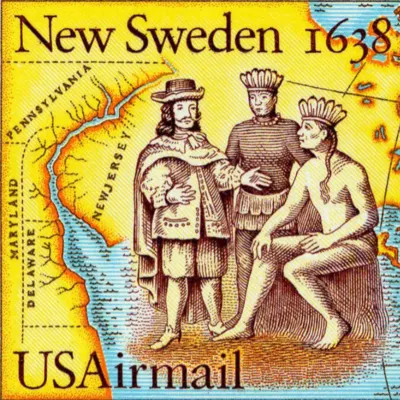
Well, it's on the territory of what is today Delaware. In 1638, they founded Fort Christina near what's today Wilmington. The land had already been claimed by the Dutch to be part of New Netherland, but they just didn't have the means to hold that land. So consequently, Sweden was just able to swoop in there and say yoink. It wasn't a very numerous colony. They only had about 600 settlers, mostly along the river, and they were interested in the fur trade, like many of the other powers, like the French, for example, also very interested in the fur trade.
British also.
So they're kind of chilling over there in New Sweden, and that didn't really go anywhere. So in 1655, they started the Second Northern War with a bunch of their neighbors, and they led a very successful campaign in Europe. In New Sweden, it was a very, very different story. Well, the Dutch were part of the anti-Swedish coalition, and they used this war as an opportunity to capture New Sweden. And when the war came to an end, the Swedes had largely succeeded in their goals in Europe. But as part of the treaty, they agreed to cede New Sweden to the Dutch, who again had already laid claim to the land, but didn't have the means to actually secure it. This way, New Sweden became a part of New Netherland. But the Dutch didn't really get to stick around for that long either. They just lost it a couple of years later to the English.
And you all know how the story goes. New Amsterdam became New York. The rest is history.
Courland
A much funner story deals with the Couronian attempts to create an American empire. And once again, we are back to the Baltics. Sam, could you tell us who the Couronians are and where Courland was?
It's an area in, like, the northwest of modern-day Latvia. And that area had been the site of the Northern Crusades. It had been taken over by the Teutonic Knights and other affiliates. And they exerted control over that territory until ultimately, in the 1550s-ish, politically, that territory was very weak and very disorganized. They didn't really have the means to defend themselves. So at one point, Ivan the Terrible just decided it's free real estate and tried to stage an invasion. He would not be the last. And it was at this point that the so-called Duchy of Courland came to existence as part of the Treaty of Vilnius of 1561. Gotthard Kettler, who was the final head of the Teutonic Order of Livonia, he signed this treaty where he agreed to become a vassal of Lithuania. And of course, again, this was in the backdrop of the Livonian Wars.
Lots of actors involved. You had Russia, you had Sweden, you had Poland, Lithuania, of course. They were all fighting over this area because even though it's not really a super valuable land in terms of resources, it's a very strategic point. There are lots of ports. And yeah, so if you were able to control this land, you had access to a very good position to dominate the trade across the Baltic Sea and the North Sea. Very useful for powers like Russia or Sweden or anyone like that.
Yeah, so because of this, Courland was really able to punch above its weight. And at various points, they were basically behaving as an independent state in all but name, even though at first they were a vassal of Lithuania and then later of Poland-Lithuania, once those states combined. And it's shortly after this point that we begin to see the colonial ambitions of the Kettler family come into shape.
Duke Jacob Kettler
And this would happen mainly under the tutelage of Duke Jacob Kettler, who was the grandson of Gotthard. Tell us more about him.
Jacob was born in 1610. His father was Wilhelm, who was another one of Gotthard's sons. Basically, Gotthard had split the duchy between his two sons. That often doesn't go very well, and this was one of those cases. So when Jacob was still a young boy, his father had been exiled by his uncle Friedrich, who wanted control of the entire territory. And so he grew up hopping across Europe. James I of England was his godfather, which should tell you something about the standing of this family. We're gonna get into James I a little bit later. His mother was a Prussian princess. He was really in place at a time when some big ideas were floating around. He was exposed to a very modern education by those standards. Spent a lot of time in the Netherlands, where he was influenced by the mercantilist ideas of the Dutch and their various colonial ventures.
That was another power that really punched above its weight.
Oh, absolutely. And for a long time.
I mean, hell, they still have holdings in the Caribbean. They still have their colonies.
Some of them. Yeah, so Jacob, he ultimately became the Duke of Courland in 1642, and he wanted to do for Courland what the Dutch had done. So he undertook an economic reform program, established very close links with Western European powers, and he commissioned a fleet of over 200 ships, which is very large. It's getting up there with the major maritime powers, really.
Yeah, this is very significant, especially for a country that is technically not independent.
Tobago
Yeah. So Jacob, he's very ambitious and he sees that the Dutch are having a lot of success as a colonial empire. And so he starts to look abroad and his eye was drawn to the island of Tobago.
Why would that island, of all places, attract his attention?
It's a small island off the coast of South America. It's next to the much larger Trinidad. It was a very difficult place to get a footing on. Yeah, it was technically in the Spanish orbit, and they would raid it periodically to capture slaves from among the indigenous Carib population. But they weren't really able to settle it because it was a very difficult environment. But that didn't stop them from trying. The Spanish gave it a shot, the Dutch, the English, and these colonies mostly didn't really go anywhere. But the island itself, fun fact, it changed hands something like 31 times over the course of these couple of centuries. So it was very hotly contested territory, even though it wasn't a very attractive destination in and of itself. The Couronians, they tried to establish a colony on Tobago as early as 1634, but that one didn't go anywhere.
They had about 212 settlers. But it was, as I said, a very difficult difficult environment in a bad neighborhood. There were a bunch of pirates swarming around, and the Spanish were themselves very heavily embedded on Trinidad, so they constantly tried to make sure that no one invaded their turf. This first attempt, it was a complete disaster. Most of these settlers just ended up dying of famine and disease. This isn't the kind of land that they were really used to. These are northern Europeans trying to live in the tropics.
And I'm guessing that the population was pretty hostile to them, as they should have been.
Well, that's a bit mixed, actually. From what I found, the Caribs who were living on Tobago themselves, they were sometimes at war with the Couronians, but they were also somewhat successful in cultivating friendly relations. Some maps produced during the period just show that the Couronians and the Caribs lived side by side, and there were some conflicts, but for the most part, it was peaceful. The problem really came from the Caribs who were living on nearby islands who would periodically raid Tobago itself. Those guys didn't have good relations with the Caribs of Tobago either, so it was difficult at times. But the first attempt failed. But then in 1642, Jacob, who was now the Duke, he made another attempt. This time he involved Dutch sailors who would have been more familiar with the environment. But this venture proved to be unsuccessful. The guy they picked, he wasn't the best organizer, as it turned out.
So after 1650, he also just called it quits and left.
Jacobstadt
But they were finally able to create a more durable colony in May of 1654 when they sent a ship carrying both settlers and soldiers. And they were able to establish Jacobstadt on the northwestern coast of the island.
How long did that last?
Also, not very long.
Of course.
But they made more headway. Also, it should be noted that they had a very mixed crowd there. These weren't just Couronians. Of course, you had some Latvians, some Baltic Germans, but you also had French, Walloons, Dutch. And this was really a common practice at the time. I mean, these were very, very difficult lands to settle. So they were really trying to cultivate as many contacts as possible. And, you know, they were sort of acting like beggars can't be choosers. And so ethnically, the settler population was often mixed. But despite this, the Couronians were never able to get more than a few hundred people on board. But they did set up a miniature plantation economy. They practiced slavery.
Of course, they did.
The Gambia and indigo
Jacob was also able to establish a colony off the coast of Gambia named after himself James Island.
Yeah, he had acquired this territory in 1651. Yeah, they would route slaves through there, some of whom ended up on Tobago. They set up indigo colonies on the island, which is one of the most brutal types of agricultural plantations. I would say even worse than sugar, because in addition to the hectic conditions in the field and the dangerous environment, indigo in high concentrations is also very poisonous.
Even harvesting it alone can just carry the risk.
Yes, exactly. And consequently, indigo slaves had probably some of the shortest lifespans on average.
The Dutch take over
But yeah, back to Tobago itself. Funnily enough, the Dutch had set up a shop on Tobago shortly after the Couronians showed up in May. And the Dutch were able to set up a privately funded colony in September of that year on the southwestern corner of the island. And so because of that, you had some competition going on and some light combat. Neither side really wanted to cede, but ultimately, in 1659, as I mentioned, there was the Second Northern War going on. And the Swedes were at war with the Dutch at this point. So the Dutch settlers on Tobago were able to negotiate a settlement with the Couronian settlers to get them off the island so that they can, you know, go back home or go to another colony. But the Dutch were able to secure control over Jacobstadt, at least for a little bit.
Once again, the Dutch take a colony and just take it over. Same thing with New Sweden. They really punched above their weight.
A Dutch account
Yeah, but even before the Dutch were able to take over the Couronian colony, it was a very inhospitable environment for these settlers. In fact, we have a Dutch account from 1658 which describes what life was like in the Couronian colony. In the Couronian quarter, I have, with great sadness, witnessed the indescribable misery of the people there. They have nothing but a fair amount of flour, a watery mush, and some salt. They are not allowed to hunt because of the savages. The seasoned soldiers number approximately 40, and among them are less than 12 healthy men. The others just wait for their end to come. Of the 90 farmers that settled here, more than 40 are dead, and they die like animals in the ground without anybody caring for them. They do not plant anything because they are not allowed to leave their fort, lest they succumb to the plague, which is out of control, or get caught by the savages.
The lieutenant who commands them is truly a godless man, and does nothing but get drunk all the time and swears so horribly and insolently that one is afraid to be in the company of such a godless man.
Sounds like a pretty miserable place. So, when they got the opportunity to abandon ship, they would have been happy to take it because that's not the kind of life you'd want to live necessarily.
Absolutely not. No, it's miserable.
Later attempts
But nevertheless, Jacob was an ambitious man and he periodically made attempts to retake the colony. In 1667, an expedition was briefly able to reconquer Jacobstadt, but they weren't able to cement their control, so the following year they left. And then in 1680, after the French had tried to do something with the island, the Couronians just sent another ship to re-establish another colony. But this time didn't work out so well either because they had very poor provisioning. They couldn't do very much agriculture. They had to deal with very unhappy indigenous populations and also pirates who were quite active in the Caribbean, as we were taught by the pirates of the Caribbean franchise. Jack Sparrow, he was giving them a lot of trouble. And yeah, despite the fact that the Couronians were able to build up a very substantial naval fleet, they weren't able to keep the colony afloat.
So the Couronian colony again failed to take root and they abandoned it for the most part in 1680. They tried to send a couple more expeditions in 1686 and 1689, but those were not successful either. What happened to them? Well, by 1693, there are some accounts which say that Couronians who remained had gone native, according to one Danish eyewitness. Yeah, for the most part, no one was able to get a successful foothold over Tobago until the British finally did it in 1763, at which point they were able to turn it into a more successful plantation colony. Although the Couronians, they continued to insist that this was their land, that they had a right to it, they would continue to appoint governors to govern the island, which they did not have control of, all the way until 1795, when they finally got annexed by the Russian Empire.
Doing a land acknowledgement for Courland. That is absolutely insane.
Tobago in Latvian memory
Is this something that Latvians like to talk about or care about? Because these things can go one of two ways. One, it's a this is our glorious past. We must talk about how glorious we are. Or two, it's don't talk about this, we fucked up. How did this one go?
Oh, absolutely. They very much went with the former route when Latvia was able to gain its independence in 1918. In fact, this was one of the things that nationalist ideologues focused on. They basically turned this comical and very much unsuccessful colonial venture into a point of pride to show that, like, look, we have this great past. We were one of the few European powers that had overseas colonies. We're not just a bunch of backland peasants who had nothing going for them, you know? We we were a great power, we're going to become one once again. Look, we got we got we got our shit kicked in by the British too. So, in the end, interwar years, this was a big point of pride. There was a lot of culture around remembering, glorifying, really, this venture. So, in 1935, Aleksandrs Grins adapted his novel Tobago into a play.
And when it premiered in 1935, several government ministers of Latvia were present because this was glorious history.
Yeah, yeah, exactly.
Before the premiere, the author revealed his patriotic intentions. Latvian history so far has been depicted in too dark colors. Looking to the past in true light, many will be dazzled by the history of their fatherland. Grins claimed the reign of Duke Jacob is one of these glorious periods. He talks about the brave Latvian sailors and the folk songs sung by their wives. However, he prefers to ignore the involvement of Baltic Germans, thus stressing the allegedly national Latvian character of Jacob's enterprises. In his review of the play, an anonymous journalist even stated that when Courland was ruled by Jacob, a Latvian felt like in his own country he had to support his ruler's intentions and had to take care of the prosperity of his fatherland. Jacob is glorified as a good ruler, a personal friend of Louis XIV, but his ethnic background is not mentioned. The author stresses that Jacob stood up against the Baltic German barons and that he received support from the Latvian serfs.
The fact that Jacob himself was German is omitted. Such a narrative is typical for the 1930s when the authoritarian regime tried to popularize the myth of 800 years of Latvian slavery under German rule. The German role in the colonization of Tobago, therefore, had to be downplayed. Yeah, so they continued to promote this glorious history. They had an opera, once again called Tobago, in 1939. Duke Jacob and Tobago were invoked as heroic examples of Latvian accomplishments in the past, including by the president of Latvia himself, Ulmanis. And this was in the context of very tense relations between the Latvians and the Baltic Germans, who had, again, traditionally made up the upper crust of this territory. They were the landholders, while the Latvians were mostly serfs. And I mean, there is a grain of truth here in terms of Jacob being good for the serfs. His economic reforms had made it, had made life easier for them.
But yeah, this really speaks to the funny nature of historical memory. This constant need to exaggerate, to misrepresent history, to put forward the best face of the nation, to try to claim that Latvia were consistently these major powers. That these figures like Jacob were actually, you know, were not German at all. Or if they were, it doesn't matter because it really shouldn't matter that much, but it does matter a great deal if you're an ethnic nationalist.
But what did the Baltic German how did the Baltic German feel about this?
With the influence of Nazism from the late 30s onwards, a lot of their stuff took a very racial bent. You know how those Nazis are. Yeah, so in the Baltic German telling of things, you know, the Latvians, they were just the Untermenschen, and everything great that ever happened was the result of German ingenuity. And, you know, at best, the Latvians were just standing in the way of progress because of their inferior genes. But yeah, Latvia would be taken by the Soviet Union first shortly before the war, and then it was retaken as the Nazis were pushed back, of course.
After the Nazis tried to take it first. The German occupation of the Baltics was probably one of the most deadly, especially for Jews, but also other minorities as well. It was not a good time.
Soviet Tobago
Once the Soviet period began in earnest, the memory of Tobago wasn't really heralded nearly as much. But there was one exception. There was a Latvian Soviet film where the name of the island is invoked. The 1965 film Tobago, which doesn't speak about the island of Tobago itself, but rather a ship of the same name. The 1965 film Tobago Changes Its Course was directed by popular filmmaker Alexander Leimanis. In this particular film, Tobago is the name of a Latvian merchant ship out at sea during the summer of 1940. The ship's owner had left port in fear of the imminent collapse of the Ulmanis regime. Also on board, however, is a crewman named Drezhinis, who was a member of an underground communist organization. Upon learning that Soviet power had been established in Latvia, Drežinisch rallies the crew, who then unanimously decide to change course for home. From the film, Latvians are meant to concede that the distant paradise of Tobago has been superseded in importance now that the workers' paradise had been established at home.
After independence
Is this something that what happened after the fall of the Soviet Union and Baltic nationalism started to rear their head again?
Well, Tobago once again came into the limelight for the same reasons as in the interwar period, although this time it didn't have nearly the same fervor as had been the case in the interwar years. But there are still tons of businesses named after Tobago. It's sort of like, you know, a magical land that has a great environment and that our ancestors had worked hard to settle. Granted, don't ask us what actually happened. The glories of colonialism and murder, plantation agriculture, and slave plantations. And so in 2001, there was another play by the name of Tobago. Although this play itself wasn't nearly as histrionic as the previous attempts, from what I could tell, from the summary that I had read, it actually seems like a very harrowing existence being depicted here. So it's not really the same kind of rah-rah return to tradition, Latvia über alles. But yeah, there's Couronian Tobago.
The Latvian slash Couronian slash Polish colony in the Caribbean.
I'm sure they had some wonderful screen door submarines.
The Scottish colony in Panama
Alright, I want to turn to a different colony. In July 1698, five ships set sail from the port of Leith, which is just north of Edinburgh, on the east coast of Scotland. They carried 1,200 settlers and were bound for the Isthmus of Panama. So this was an attempt at a Scottish colony in the Americas. Now, at this time, Scotland and England were different kingdoms that shared one monarch, King William, or King Billy, if you're in Northern Ireland, I guess. By this time, England had already established a substantial overseas colonial empire, including Jamaica, Antigua, and obviously the east coast of North America. The English had also already established the East India Company for trade in the East Indies and India, and the Hudson's Bay Company, which controlled a big part of the Hudson's Bay and the fur and fur business around those areas. The Hudson's Bay Company still exists today, by the way, which is pretty wild. But anyways.
Scotland, on the other hand, had nothing in the way of overseas colonial possessions. Scotland and England have shared a monarch since 1603, when Queen Elizabeth I died childless. And then King James VI of Scotland, who was her first cousin, inherited the throne and became King James I of England. These two countries may have shared a monarch, but they still remained independent separate kingdoms with separate government institutions, separate currencies, and, as you're going to see here, separate and even competing foreign policies. So the fact that Scotland didn't have any colonies meant that they didn't have all the best choices available to them. While Scotland maintained its independence, the 17th century was not kind to them. They had civil wars, revolutions, the Jacobite uprising, and of course the relentless march of English capital.
The Company of Scotland
And this is when we start seeing the formation of a company called the Company of Scotland, or the Company of Scotland Trading to Africa and the Indies. So the Scots are going to have their own trading company, just like the East India Company, just like the Dutch West Indies Company. Everyone has a company, the Scots need to have one too. This is a quote from an FT article, actually about a play that's about this. So I guess we're talking about plays again. It was right at the beginning of capitalism and the blossoming of the banks. The Bank of England was founded in 1694, the Bank of Scotland in 1695. And suddenly the Joint Stock Company had arrived. It really was the beginning of the modern system. So in 1695, the Company of Scotland Trading to Africa and the Indies was formed and started fundraising. The funny thing is, their fundraising begins in London.
I'm going to read a little bit from a paper called The Management of Capital by the Company of Scotland from 1696 to 1707. The Act itself had specified that the company was to be a joint venture between London and Scottish capital. And given the greater liquidity in the London market, it was natural that the directors would first seek to raise capital there. However, the London capital raisings failed to bring in any cash, despite a network of London Scots. The East India Company and other vested interests appealed to the English Parliament and worried in particular about the tax concessions given to the Company of Scotland, and articles of impeachment were drawn up against the promoters in London, scaring off potential investors. So then the Company of Scotland went to Scotland to open their books. And they opened the subscription books in Edinburgh in February and in March in Glasgow.
Quote, rather than offer shares to merchant elites, the capital raising was extended as far as possible socially and geographically. The directors stated that, quote, no reasonable means for opportunity should be omitted to make this the most diffuse and national joint stock in the world. There were 1,320 shareholders in the Company of Scotland, 1,267 individuals and 53 institutions, who signed the subscription books. And that should be compared with 1,267 for the Bank of England and 1,188 for the English East India Company. Now keep in mind, Scotland has about a fifth of the population of England, 1/36th of the tax yield, and 1/40th of the money supply. So this is a huge portion of Scottish national wealth poured into one single company for colonial ventures. I've seen different estimates on how much of Scotland's actual money was poured into this. Some people say as little as 20%, some people say as much as half.
But according to this, the subscribed capital of the company was between 44 and 133% of the coinage based on contemporary estimates, and the actual cash paid by subscribers between 17 and 51 percent. This represented a very significant investment of the nation's liquid financial resources.
That's really an insane investment. It sounds like they were really, really like all in on this.
Yeah, the paper calls it a financial mania. Everyone from even clergymen were investing in this, even more prosperous farmers. Anyone with any savings who was patriotic would have invested in this. It was what they talked about. They talked about this everywhere. It was the talk of the town, the talk of the country, the talk of the nation. It's really insane to think about because they are seeing English capital marching forward steadily, eating everything to the point where this company starts its fundraising in London, for God's sake. And they view this as their chance to basically stand on their own, to form their own empire, to form their own trading network for Scotland.
Why Panama
Well, it really sounds like with the kind of enthusiasm that they had, they must have seen a lot of success, right?
No, absolutely not. The plan basically for this would-be Scottish Empire was simple: take the Isthmus of Panama, control it, and then you control trade between East and West. The Scots were not the last to try this. A couple hundred years later, in the late 19th century, the French would try to build a canal on the Isthmus of Panama, but much like the Scottish attempt, tropical diseases like malaria and yellow fever just decimated the workers building the canal, and the French eventually bailed. And then the U.S. took over the job in 1903 and carved off Panama from Gran Colombia and actually retained control of the Panama Canal zone from until 1997. In 1979, it became joint control between Panama and the U.S. And until 1999, it was joint control. But before 79, it was just the U.S. So we had that America controlled the Panama Canal until 1999.
And as I mentioned before, all those French workers dying of disease. Same thing happened to the Scots. And even the same thing happened when the Americans built a canal. It's just a really inhospitable place if you're not used to the local environment. And these Scots were very much not used to the native environment.
And the way that the U.S. actually got control of Panama is quite funny. Basically, what they had done is American representatives had gone to the people of Panama, which again had been part of Colombia for nearly 100 years at this point. And they basically told them that if they were to rebel and create their own independent state, then the United States would invest heavily in Panama and they would see prosperity. So their Panamanian representatives did what was asked of them and they successfully waged a war that ended with Panamanian independence. But American promises didn't really pan out the way they said they would.
That tends to happen. And then the U.S. retained control of that canal until 1999, which is just insane to think about. Well, the fact that this is something the Americans kept until 1999 should tell you, also we had military bases around there, should tell you how that this is a really valuable area.
Fort St. Andrew and New Edinburgh
Like, okay, the Scots didn't actually get the what's now the Panama Canal area. They were a little bit south, what actually became called Scots Bay. They brought about 1,200 settlers on that first voyage, only lost about 70 people on the boat. But as the months went on, more and more people started to die. They constructed their first fort, Fort St. Andrew, important saint to the Scots. You know, St. Andrew's Cross is their flag, etc., etc. And then they built this capital, New Edinburgh, which really was just a collection of huts. They did not have very much success in terms of trade or food or anything else, really. They did establish some good relations with some native peoples of the area, some of the Guna or Kuna people, but in the end, it just was incredibly, incredibly difficult to them. The most important thing here is that this land was not unclaimed.
In addition to the native people who already lived there, but aren't counted as human, if you're a Western European, the Spanish already claimed control of this area and had for a very long time that it was an important part of their route that they took to bring their silver back to the Metropole and gold and other resources they extracted. And they were not going to just let the Scots take this. But the Scots viewed this, the Spanish Empire, as just crumbling, and you just need to push it a little bit and they'll give up. Whatever. It doesn't matter. They didn't really settle many Europeans in the area because, again, you die, but they still retained control of the area. So according to some of the local colonists, they soon found that the land was unsuited to agriculture, or at least the agriculture they were familiar with, and quote, the Indians were uninterested in the trinkets they had brought them.
Disease and starvation
Spring 1699 brought torrential rain and with it disease. By March 1699, more than 200 colonists had died and the death rate had risen to over 10 a day. People came on this voyage hoping to build something beautiful, something new, something glamorous, like the English did with Jamestown or something like that.
But Jamestown also wasn't glamorous, just so we're going to be.
Yes, exactly. Exactly. In the beginning, Jamestown was a fucking swamp. It was, really, you can still tell that most of that area is swamp, but it's just, it was miserable. I'm going to read a little bit, a little bit of an account from Roger Oswald, who joined the venture. They lived on less than a pound of moldy flour a week. When boiled with a little water, without anything else, big maggots and worms must be skimmed off the top. In short, a man might easily have destroyed his whole week's ration in one day and have but one ordinary stomach neither. Yet for all this short allowance, every man, let him never be so weak, daily turned out to be to work by daylight, whether with the hatchet or the wheelbarrow, pickaxe, shovel, forehammer, or any other instrument the case required. And so continued until 12 o'clock and at 2 again and stayed till night.
My shoulders have been so wore with carrying burdens that the skin has come off them and grew full of boils. If a man were sick and obliged to stay within, no victuals for him that day. Our counselors, all the while lying at their ease, sometimes divided into factions and, being swayed by particular interests, ruined the public. Our bodies pined away and grew so macerated with such allowance that we were like so many skeletons. So yeah, there's nothing glamorous here. This is just a death trap for these people.
Yeah, sounds very similar to what the Couronians were going through.
Absolutely. Eventually, the rumors of a persistent Spanish attack and just the misery of this entire enterprise drove people to just abandon the colony. And out of the 1,200 left, less than 300 returned to Scotland on the first voyage. Less than 300 out of 1,200.
That's a pretty appalling rate.
No help from the English
And what were the English doing at this time, by the way?
The English made sure that these people would get no help. The king, King William, instructed the Jamaican colonial government and the colonial governments of North America: do not give these people anything. Don't give them so much as like clean water or food or anything. Do not help these people. And the Spanish, especially, said, No, you're invaders. You are trespassing on our territory. We're not going to help you. In fact, we're going to besiege you as soon as we get the chance.
The second expedition
But then a second round of ships came, and when they found that the colony had been abandoned, to their surprise, they decided to rebuild it. They also didn't last long. Quote, On February 13th, after hearing from the Kuna that a party of Spaniards was approaching, the councillors of New Caledonia sent a detachment of about 200 men. Borland told us that the Scottish warriors were, quote, joined by about 40 of our Indian friends under the conduct of Lieutenant Turnbull, who understood something of the Indian language. But this encounter was basically a skirmish that took the party of militiamen by surprise. The Scots even took three prisoners. Soon, however, they realized that the colony was surrounded and that there was no possible way out. And they were besieged on all sides at this point by the Spanish. Nothing came in or out. They got no help. The Spanish, I believe, even captured one of the boats, one of the Scottish boats that came to help them.
31st of March, 1700, the defenders signed the Articles of Capitulation, which were drawn up in Latin, by the way, and allowed them two weeks to leave Darien with military honors.
The cost
At the end of the venture, around 2,000 settlers lost their lives, and three-quarters of the pledged money invested in the company was consumed without yielding any tangible results.
So, again, this was what, like 150% of the money that Scotland had?
It was anywhere between 20 and 50% of the total money of Scotland, but in terms of the available, like circulating currency, yeah, something like that. It's truly insane.
It kind of reminds me of what Napoleon tried to do in Egypt. Basically, they both thought that they would take these hinge points of trade, and by doing that, they would be able to reap the benefits. And both were at least on paper controlled by other empires, the Ottomans, the case of Egypt, and Spanish in case of Panama. But both empires were perceived to be in like terminal decline. And, well, what does it matter if we take this from them? And in the end, the English and the existing empires took the territory back and kicked them out, the French and the Scots.
The remains were found in 79, I believe, of Fort St. Andrew, but to this date, no one has found the cemetery where all the Scots were buried. It's just somewhere in the jungle, and one day someone will find it and sentimentalize it. But this is not something to be sentimentalized. This was an attempt at forming a colonial empire that just led to misery for everyone. And colonization isn't something glamorous anyway.
The end of Scottish independence
It's deplorable. In the end, this-I think it's fair to say that this was one of the fatal blows to Scottish independence. And the Acts of Union followed very shortly thereafter in 1707. And Scotland has eventually no longer had its own currency, no longer had its own parliament, until eventually it did again in the late 20th century.
But I don't think this was doomed because of the climate alone. The climate of the Caribbean, for example, is horrifically harsh and unfriendly to Europeans, especially. But even still, there were still some communities of white Europeans in some of the places, like some in Haiti, for example. So it is theoretically possible that you could have made it work in Panama with just a lot more people and way more resources, but Scotland just didn't have those resources.
And more importantly, the land was already claimed by Spain, and the British, sure as hell, weren't going to let this survive. The East India Company was not going to let a competitor arise. And it was just too late. The failure of Scotland's colony in Panama really, really put a damper on basically everything in Scotland after that. Financially, at least. So much money had been sunk into this. And the English had kind of, in their view, been proven right. And they made propaganda to this effect, saying, look, the Scots can't do this. They can't do colonialism as well as we can. They failed. And eventually, the Scottish elite was kind of forced, but also chose to join up with England to form the Kingdom of Great Britain. And that is the end of Scotland as an independent nation. But the funny thing is that Scots themselves still proved to be prominent in the empire afterwards.
I mean, there is a reason you find traces of Scottish accents in a lot of British colonial accents. The Scots had a disproportionate presence all over the empire, but their colony utterly failed. It was just too late for them to make it go at this with British naval power and the Spanish presence there and Scottish commercial power just was not powerful enough to sustain this.
Colonies that might have been
And it's just fun to look at these little colonial ventures that were just complete failures and remember that these things could have gone a different way, at least some of them. And the map of the New World could look very different. But because these failed, we have the map we have today. And there is no Scottish America, except for Nova Scotia in Canada, I guess, but that doesn't count. There is no New Couronia. There is no New Sweden. It's all gone. But these are still an important part of the history of these areas. And some of them are still remembered sentimentally or otherwise today.
The lesson is that colonialism is bad and that Poles can't do anything right.
How many Poles does it take to establish a colony?
Two, one to fail and another one to blame the Russians.
But, and I find it interesting looking at these kind of failed national enterprises because things could have been very different.
Wrapping up
But I think that's all the time we have for this week. This has been a pretty short episode. It's kind of busy for us right now, but we did want to bring you something this week, and we thought this was an interesting story that we and I, in particular, have been meaning to talk about for a while. So, I hope you enjoyed learning about it. We're signing off for tonight, but just because we're sleeping doesn't mean that Courland and Tobago will not rise again. Be on the lookout, big things are coming.
It's 2022.
I'm gonna bring it back. I'm going to bring back the Scottish colonization.
No, no. We're going to bring this stuff back. We are going to bring back Courland, not just in the colonies, but also in Europe.
This has been Gladio Free Europe. I'm Sam. My co-host, Russian Sam, and we will see you next week.
The show is also on Apple Podcasts, Overcast, Pocket Casts, Podcast Addict, YouTube, RSS and Patreon.