59
Indigenous New England and the First Thanksgiving
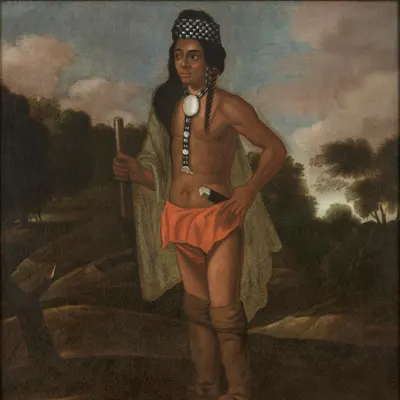
In progressEvery kid in America grows up hearing about "The First Thanksgiving" featuring Squanto, the Mayflower, and the surprising nutritional value of dead-fish fertilizer. But this patriotic narrative offers only a tiny glimpse at the astonishing and agonizing history of contact between Europeans and indigenous peoples of New England, who called themselves the Ninnimissinuok. Our multi-part series on 17th century New England begins by examining the beliefs, culture, rapidly-changing politics of nations like the Wampanoag and Narragansett hundreds of years before religious disputes on the other side of the ocean would send English interlopers into their land. We'll also look at colorful figures like George Waymouth and Ferdinando Gorges who were involved in exploration and even failed colonization in New England long before the Pilgrims, as well as the unbelievable stories of indigenous people like Sassacomit and the Tisquantum who were stolen from their homes and brought to Europe, yet managed to make it back in one piece. Last, look into how and why an obscure but probably real celebration between some Pilgrims and Wampanoags became an essential part of our nationalist mythos.
NOTE: The first 5 minutes of audio are lower quality due to an issue with Liam's mic. This Thanksgiving, Gladio Free Europe is thankful for your patience in dealing with this technical issue!
Outro music: Honor Song, a song of the eastern Algonquian peoples including the Wampanoag and the Mi'kmaq
Transcript
Happy Thanksgiving
And we are back with another episode of Gladio Free Europe. I am Russian Sam, joined as always by my co-host Liam.
Salutations.
And if you're listening to this, when the episode actually comes out, the day after will be Thanksgiving, that most American of holidays.
Yes, everyone loves the real cranberry sauce, the canned cranberry sauce.
Oh yeah, yeah, for sure. I'm going to be making a nice turkey myself. I've mastered the art, even though I am but the child of an immigrant who makes notoriously dry turkey. But I have assimilated into the great fruits of this country. I have learned the ways of your proud people.
Right, and as we're going to talk about this episode, Thanksgiving has always been in a very large part about that idea, that kind of idea of, you know, cultural assimilation of everybody, no matter where you come from, assimilating to the traditions of a small handful of guys, really just a handful, who settled in New England in the 1620s. But for this episode, we really want to look hard about not only who were that small handful of guys, and it really was hardly more than a handful, we're going to look at what actually happened in the early 17th century and how this very interesting, very chaotic, really exciting moment got distilled into this surprisingly innocent, patriotic, and at times kind of chauvinistic American holiday.
Yeah, for sure.
Thanksgiving as we learned it
I remember when I was growing up, I had a very particular vision of Thanksgiving taught to me in school. It was, I imagine it was the same for you guys. Like November was just Thanksgiving month. Like we'd make those funny little buckle hats and we'd do reenactments. We'd make like various arts and crafts featuring turkeys. And we talk about how the Puritans and their Native American friends just sat down one day and lived happily ever after.
Right, yeah. I think the craziest part about Thanksgiving is that it does seem like that joint celebration really did happen. But the circumstances of how that got there are so much crazier than you could imagine. And the aftermath of that single event is really a lot less pleasant. And so we don't have time in this episode to go into the continuing history of Puritan settlement New England and interactions with Indigenous peoples.
Yeah, we actually had to split this up into a two-part directly just because there was so much content. There's so much to go into here.
But this episode, we really want to set the groundwork for what 17th century New England looks like. And in particular, we really want to dive deep into the social, political, and spiritual worlds of the indigenous Algonquian peoples of New England. In particular, the Wampanoag and the Narragansett.
Yeah, so and while we are going to be looking at the politics of these particular peoples as well as their history writ large, because again, we don't really hear their side of the story that much. The best that I got was this idea that they were just done wrong. And of course they were, but we don't really understand how that came to be. It was very much this idea of like this race of noble savages, so-called, who like basically were too trusting of the white man and consequently got wiped off the face of the earth.
Yeah, yeah. And so we hope with this episode, and in particular with the next episode, to show that the leaders of these tribal confederations were very savvy political actors who often made decisions that made the most sense at the time, but ultimately, due to circumstances completely outside of their control, such as the overwhelming numbers of Europeans that would come in, the new diseases that would come in, and even a degree of violence that they didn't anticipate. They ultimately found out that the set of tactics that had worked for them in the past for centuries at resolving disputes would be unable to resolve disputes with these strange foreigners.
Yeah, absolutely. So again, we're not going to be reading the history backwards. We're trying to do our best to present the events and how they actually came to be rather than looking at the results and saying that this was preordained because it very much wasn't.
Yeah, yeah. And so this episode is going to go really heavily into the history of how Thanksgiving came to be, both what the real Thanksgiving looked like and how the later holiday developed. But we made the decision to step away from any kind of political debates over the legitimacy or the value of Thanksgiving a holiday today. This is a history pod. We're not a politics pod. There's a lot of people much more qualified to talk about that issue than us. So we are going to lay out what happened and you all can draw your own conclusions about the holiday that a lot of us are going to be celebrating this week.
Yeah, but before we begin, we'd just like to ask you to leave us a rating or review on Spotify or iTunes if you're a fan of the show and you like the work that we do. It'll really help us out and we'll be very thankful to you.
The English Reformation
All right, so before we get into New England, we have to talk about the original England, Old England. And specifically, we're going to be talking about the English Reformation. Unfortunately, we don't really have the time to dive deep into this one. In fact, we're actually thinking about doing a whole episode about this in its own. But in the interest of getting to the Wampanoag stuff sooner, we have a quick and dirty little intro right here about what the English Reformation was and why it happened.
Yeah, so the Reformation, as we know today, officially began in the early 16th century when Martin Luther, who was originally interested in reforming the church from within, came to believe that the entire foundation of the Catholic Church was rotten and that true Christianity required that it be discarded. For a little more on this, check out episode 32 with James, Catholicism 101.
But like basically everything we discuss on this podcast, the real seeds of the issue go back much earlier, as early in fact as the 11th century investiture crisis, which was sort of like an early clash between church and state based on who was allowed to appoint a bishop to a particular see.
Yeah, so basically Rome began to throw its political weight around at this time and a lot of monarchs in Europe itself were very unhappy with that, hence this investiture crisis. Although the matter would be settled formally in 1122 with the Concordat of Worms, which came to a conclusion that said bishops would continue to be appointed by Rome, but they were required to swear loyalty to their king as secular ruler, the question of Rome's power would continue to generate a lot of tension in the background. And England itself was no exception.
In episode 30 about the Lion in Winter, we discussed the murder of Archbishop Thomas Becket, seemingly at the behest of Henry II. Henry wanted to impose stricter control over the church and Becket, who had at one point been his close friend and confidant as well as chancellor, stood in the way. If you want to learn more about that, just listen to episode 30. Fast forward a few centuries and we find that another Henry is very unhappy with the church, and he'll probably be only Henry that any American would know.
Yeah, and he was a big boy.
That was Henry VIII, the most famous English king. Very round guy. And truly a, yeah, truly a larger-than-life figure in more ways than one.
Basically, the long short of it is that in 1534, Henry, hoping to marry the younger Anne Boleyn to produce an heir, divorced his older wife Catherine, even though this was a major violation of church doctrine and founded his own English Anglican church. This first act of supremacy made the King of England the head of the church in England, which totally resolved the investiture crisis by giving him, not the Pope, the ability to appoint bishops because he effectively had become the Pope of this new church. This was followed by legislation which gave the crown taxes collected by the church as well as the treasons act, which made it a crime to question the principle of royal supremacy. And the English Reformation name is a little bit misleading because although it shares the name with the Reformation of the mainland, it was in many ways an entirely separate affair.
Yeah, most importantly, because so many of the traditions that were eradicated in the continent by the Lutherans and by the Dutch Reformed guys and the Swiss Reformed guys stayed around in England. They just weren't exactly technically Catholic because they were part of a separate Anglican communion. Although we should keep in mind that the fear of crypto-Catholicism was a really big deal. There were a lot of secretly Catholic families in England, and when the witch trials would roll around around the same time as the pilgrims were coming over, a lot of the impetus behind the English witch trials was rooting out supposed crypto-Catholics in English society.
Yeah, and although the English Reformation formally severed the tie to Rome, the Anglican Church would continue to hold on to many of the traditions which reformers had found to be so disagreeable. Right.
I think it's just a good example of this: that the word episcopal, which means Anglican in the U.S., just means of the bishops, because Anglicans were one of the only Protestant denominations which kept the concept of a bishop.
Yeah, so again, there's a very rigid church hierarchy centered around bishops. Anglicans will pray the rosary just off the top of my head, some of the big things that distinguish Anglicanism from Protestantism as it would be recognized on the European mainland. But all these details would be very bitterly contested through the years. Many radicals were really unhappy with the Church of England because they thought that it had not sufficiently cleansed itself of the aspects which made Rome so detestable in their eyes. Rome was rotten to the core, it had adopted all of these fake Christian values. So these guys said that we have to discard all of that and start anew. In other words, we have to make the church more pure.
Yeah, exactly.
The Puritans
And that gets us to one of the main characters of this episode, the so-called Puritans. And fun fact, this word was originally levied as an insult against them. It meant something sort of like a stickler. Right, yeah, yeah, because I think a lot of people just found these guys annoying. We'll get to what they actually believed, but in practice, if you weren't a particularly pious person, to you, the Puritans were the guys who tried to ban gambling, who tried to ban the theater, who might have had very strong opinions about very intricate doctrinal issues which you yourself couldn't really understand.
Yeah, but again, the term Puritan really hides a lot of diversity within it because it was levied against all kinds of people who were unhappy with the Anglican church for a whole variety of different reasons. Some would come to embrace the term as a positive, while others prefer to be called saints or the godly, which again sounds very pretentious.
A pretty funny phrase from the time used by non-Puritans was that a Puritan is one who loves God as with his whole soul, but hates his neighbor with his whole heart.
Yeah, great, great and great kind. So, again, it's very hard to generalize these guys because there were so many different groups that fell under the Puritan umbrella. But to paint with a very broad brush, these were broadly speaking Calvinists who, you know, believed in predestination and all that jazz, and Congregationalists who held that every church had a right to elect its leader rather than priests being appointed from on high. And they called for everything to be done by the book. And the book, of course, being the Bible. If it's not in the Bible, then out it goes. But this was always very much a matter of degree. Most so-called Puritans had, in fact, never broken with the Church of England, even though they were unhappy with its state and would continually push for reforms from within. The people who actively rejected the church in full were only a small minority, and they would come to be known as the dissenters or the separatists.
Right, and they'll be very important in this episode.
Yeah, and one final caveat: we often tend to think of these guys as like basically Taliban-style reactionaries because of the way they've been depicted. Puritan is basically just a catch-all phrase for people who don't like fun. When we think of Puritans, we're much more likely to think of Nathaniel Hawthorne's scarlet letter rather than the actual guys and what they preached. But I would just like to say that although they framed a lot of what they said in terms of returning to original Christianity as they saw it, as it would have been practiced by the apostles, in practice, this meant a very large degree of reform. These guys were very innovative in how they came to practice their faith. And we'll come back to these guys later and talk about how they ended up in America.
Norumbega and the Ninnimissinuok
Right, because now we are going to turn our gaze from England to New England, or as it was initially known to explorers, Norumbega. Before colonization, the region that is today called New England had a very interesting patchwork of tribes and political federations. They were collectively known as the Ninnimissinuok, which literally means the people in the local Algonquin languages.
And all of these indigenous peoples of New England had quite a few things in common. Unlike other parts of the Americas with more linguistic diversity, pretty much everybody in this part of the world at this time spoke an Algonquian language like Abenaki or Massachusetts.
Right, and Algonquian languages had a really crazy distribution because before colonial contact, they were found as far south as the Carolinas, like the famous Croatans from Roanoke, as well as all the way up the coast of New England, and then far west across the Canadian prairies, like the Blackfoot, who still live today in Alberta and Montana.
Yeah, and these languages probably emerged in the Canadian prairies or the American Midwest sometime around 500 before the Common Era, developing trade networks across the continent. The proto-Algonquian people started moving east, although two related people groups would actually go far west into California, where they settled into coastal valleys to live as hunter-gatherers in more mild climates. These would be the Salish people who are still around there today. They also speak a language that's related to the Algonquian languages all the way on the other side of the continent.
Yeah, it's crazy. And unlike those guys in the West Coast, though, the guys on the East Coast were mostly semi-sedentary farmers, not hunter-gatherers, especially the groups we're talking about today. There were some tribes who lived in towns entirely year-round, although the Wampanoag, who were the main focus of this episode, they spent half of the year in these permanent settlements, and then the other half of the year would go on extended fishing and hunting trips, often staying in other permanent camps closer to the ocean during the winter months. In his book 1491, the author Charles Mann argues that this kind of lifestyle wasn't really nomadic but closer to a modern New Yorker having like a winter home in Miami. And speaking of Miami, the coastal New England tribes had very strongly valued beads and seashells from as far away as Florida. And the possession and exhibition of foreign objects was really important to chiefs called sachems because it showed that they controlled access to foreign resources.
Sachems ruled villages that were pretty permanent and often had fences, usually where crops would be grown within. To the south, in Virginia, the Carolinas, English explorers mentioned seeing really serious towns with planned streets and high wooden palisades and even some multi-story buildings. We don't think the towns in New England were that complicated, but they were definitely very deliberate, very permanent settlements, which doesn't always come across in popular depictions of Native American architecture.
Yeah, so the Algonquian peoples called they had these homes which resembled a large dome basically called wetu, which was made out of young sapling branches which were sort of woven together and on top of those branches they would place various mats to insulate the home.
The Three Sisters
For sustenance, coastal New England peoples cultivated the famous Three Sisters crops, which ultimately originated all the way down in Mesoamerica. This would be beans, corn, and squash, which I'm gonna bet a lot of you guys are gonna be eating this week.
Yeah, and on the three sisters, again, when you go through the American education system, you're left with the idea that the Native Americans were sort of timeless and had been living the exact same way, like for thousands of years. And this is one case where that's not true at all. In fact, the Three Sisters weren't widely cultivated in the New England area until the 14th century. So, literally, like 200 years before the English showed up. Which speaks to the ways in which these cultures were not simply static and preserving the same way of life from for tens of thousands of years as some of the more noble savage type tropes would seem to imply. Yeah, absolutely.
And the fact that these crops were from Mexico shows that these guys were part of a very interconnected pre-Columbian world of trade and contact.
So, on farming, the Algonquian peoples of this region had a gender division of labor. And speaking very broadly, farming and gathering were primarily women's work, except for tobacco. Tobacco was for the fellas. In addition to that, women would be responsible for food processing, the creation of clothing, and other such household tasks. Beyond that, it's very difficult to generalize because, as we shall see, when the English arrived, these peoples were in the midst of massive societal changes. Different tribes had different levels of emphasis on both matri and patrilinearity, and sometimes both. Although, land ownership in particular among the Algonquians seemed to have mostly passed through the female line.
You know, speaking of the English, one thing I find very interesting is that the Jerusalem artichoke, I just learned, has nothing to do with Jerusalem at all. Instead, it was cultivated by the Wampanoag people in New England. But when the English settlers got here, they proclaimed this land to be the New Jerusalem. And when they saw this native crop being grown, they said, Oh, cool, let's call this the Jerusalem artichoke, because this is Jerusalem now.
Oh, that's neat. Another interesting pre-existing similarity, which would become more evident when the English arrived, was that crops seemed to have been grown by families and not by entire clans or villages. Every family would be responsible for cultivating their own cornfield, but they would also participate in communal hunting and fishing during the difficult winter months.
One thing that Charles Mann makes really clear is that many indigenous tribes had a very strong understanding of land rights and land ownership, which I think is often flattened by often sympathetic portrayals of Native Americans as having no conception of property.
Yeah, unfortunately, these guys very much did have private property, but let's talk about their belief system, their cosmology, because again, this is another thing that's woefully underrepresented in the American education system.
Kiehtan
So, on that note, as we mentioned, corn had only become cultivated on a mass scale in New England from around the 14th century. And with the introduction of corn also came a brand new god who would come to be known in the Algonquian languages as Kiehtan, or he was also worshipped by other peoples like the Lenape, who called him Ketanotoit. This literally means the great spirit. And Algonquian belief systems, they were generally focused around so-called Manitou. This is sometimes rendered as gods, but it's not quite the same thing. Manitou is more of a vital force which is present in all things and which may be good or evil or anywhere in between, but they're not really gods in the same way that Kiehtan would be. So it's a very animistic worldview. In fact, you can compare this to the Kami in Shintoism, who again are more like spirits rather than gods proper.
Roger Williams, most famous as the founder of Rhode Island, wrote the first comprehensive treatment of a New England indigenous language, Narragansett, in 1643, which includes a lot of really interesting cultural notes. The word god is Williams' own translation, but this passage here is pretty interesting. There is a general custom among them, when recognizing something extraordinary in men, women, birds, fish, etc., to cry out, Manitu, which is, it is a god. Or, when they see one man excel in wisdom or valor or strength, they also cry out, Manitu, a god. Yeah, so by the time that the settlers arrived in New England, Kiehtan was really the top dog. This was the god of corn, good weather, and fertility writ large. He was said to live out in the southwest, which is precisely where corn comes from on that note.
Oh, that's funny. I had no idea.
Yeah, yeah, it's very neat. So, Kiehtan, he was conceived as this life giver, and the Wampanoag believed that when they die, their souls will return to spend eternity with him. Hence, they and other peoples in the region would bury their dead in a fetal position and covered in red ochre, facing towards the west to help the soul find its way to Kiehtan. Ancient peoples love red ochre, don't they? I feel like that's always coming up in archaeology. Yeah, I saw one archaeologist suggest that it probably had some antimicrobial properties, which is why it was so popular. But anyway, corn was very important to the Wampanoag by this time. So, it's no surprise that a corn god would be so central to their faith. The introduction of.
I guess the American version would- you know, it's funny actually, because I feel like the modern American version of that would also be a corn god, but just maybe a corn syrup god.
Oh, God.
No, that's Satan.
But anyway, the introduction of regular agriculture really helped to mitigate the threat of hunger in a massive way. And for this reason, Kiehtan, he was really highly revered. So, per the story, Kiehtan, who also created the world and humans and all the Manitu, he saw that his people were going hungry, so he attached some corn kernels to a crow to deliver to the peoples of New England. And for this reason, the people of New England had a taboo against killing crows because they were seen as like Kiehtan's messenger. And by the time that the English came into contact with the peoples of New England, there was a general understanding that Kiehtan had created the world, the Manitou, and people writ large. Per the story that they told, Kiehtan had several attempts to create people. At first, he made people out of stone, but they were too cold, so he shattered them, opting instead to make people either out of mud or out of trees.
You know, that sounds pretty golem-like to me.
Oh, you know what? There's a reason why Native American Israelite legends were so popular by the 19th century.
I'm sure, yeah, yeah, yeah. A guy called Edward Winslow, who's pretty important to this episode, would become Plymouth Colony's primary liaison with the Pokanoket, who were a subdivision within the Wampanoag. And he said this in 1624 in his book, Good News from New England.
Yeah, so he begins the passage by correcting himself for previously having written that the natives had no religion. So he proceeded to sketch out the contours of their faith. And I personally found this passage kind of surprisingly sympathetic because we have this very rigid idea of what Puritans were and how intolerant they were. So without further ado, Winslow wrote, quote, They say Kiehtan created the heavens, earth, sea, and all creatures contained therein. At first, they say there was no sachem or king, but Kiehtan, who dwelleth above in heaven, whether all good men go when they die, to see their friends and have their fill of all things. This, his habitation, lieth far westward in the heavens, they say. Thither the bad men go also, and knock at his door. But he bids them Quatchet, that is today, walk abroad, for there is no place for such, so that they wander restlessly in want and penury.
Never man saw this Kiehtan, only old men tell of him, and bid them tell their children, yea, to charge him to teach their posterities the same, and lay the like charge upon them. This power they acknowledged to be good, and when they would obtain any great matter, meet together and cry unto him, and so likewise for plenty, victory, etc., sing, dance, feast, give thanks, and hang up garlands and other things in memory of the same.
Hobbamock
And Kiehtan, he had a darker counterpart. This was a figure called Hobbamock, who would also alternatively be known as Cheepi or Squantum. If that name sounds familiar to you, there's a good reason why. And the Puritans, when they saw Hobbamock, they saw Kiehtan's polar opposite. And in some ways, he was, because Hobbamock, he was associated with the northeast, cold, darkness, night, and death. And sometimes the underworld, where the unrighteous would go and be punished, according to some tribes. But again, other tribes didn't really have this idea of an underworld. So when the early English came to contact with the Ninnimissinuok, they often interpreted Hobbamock as the devil or Satan. And although Hobbamock is associated with many evil and dark things, he can't really be collapsed into a singularly evil being. Again, quoting from Winslow, This, as far as we can conceive, is the devil. Him they call upon to cure their wounds and diseases.
When they are curable, he persuades them. He sends them the same, for some conceived anger against them, but upon their calling upon him, can and doth help them. But when they are mortal and not curable in nature, then he persuades them. Kiehtan is angry and sends them diseases whom none can cure. Insomuch as in that respect only they somewhat doubt whether he can be simply good and therefore in sickness never call upon him. Yeah, so again, no, Kiehtan in this passage is a source of some maladies, and Hobbamock sometimes acts at the behest of Kiehtan. In fact, if we want to do the Satan comparison, we can maybe compare him to Satan in the book of Job, who is basically visiting all these awful things upon Job, but it's at God's behest. This is not Satan acting of his own free will, really. So.
And the dual aspect of these gods here, of Hobbamock, would be very important in times of war when peoples would often take refuge in swamps, which were seen as his domain. And you're going to see a lot of this in our next episode when we talk about the kinds of warfare that would happen between the peoples of New England and the invading colonists.
Yeah, so Hobbamock was thus called upon for relief from the mundane realities of life for healing, as well as by those who occupied very special roles within these Algonquian societies.
Powwows and pniesesok
These were classes known as the Powwow and the pniesesok.
Right. You guys probably already know the word powwow, but its original meaning was that it was not any kind of party, but instead a dreamer or a diviner. This was a shaman class, which would serve the religious and medical needs of a community. And in addition to healing, they would also organize rituals to uncover the will of the spirits. They got their powers from Hobbamock, as well as various other Manitu. Wampanoag seek Cheepi's power because of, not despite their fear of it, a vision of Cheepi gave the seer access to secondary tutelary spirits, which thereafter inhabited the seer's body, and their stunning array of powers, such as healing, prognostication, and cursing. A young man's or woman's transformation into a powwow, there is one recorded mention of a female powwow, was a momentous event. And, quote, for two days after the rest of the Indians dance and rejoice for what they tell them about the serpent, the serpent being Hobbamock.
To identify the origin of the sickness and how to combat it, the powwows would have fasted, danced, and thrashed themselves into ecstatic trances, while sometimes roaring like a bear, and other times groaning like a dying horse, foaming at the mouth like a chased boar, smiting on his naked breast and thighs with such violence as if he were mad. These grunts and growls were the sounds of one of the powwow's two spirits communicating with other spirits across space and time in search of answers. Meanwhile, friends and relatives of the patient gathered around, giving quote attentive audience to the powwow's imprecations and invocations. Occasionally, the powwow would come to a stop, lead the bystanders in the chant, and then proceed as before with his quote bellowing and groaning, which, Wood marveled, would quote, thus will he continue sometimes half a day.
So it's almost kind of like an exorcism, but for any kind of illness.
Yeah, yeah, exactly. That's a really great comparison.
And the other important class of people who were thought to be in direct contact with Hobbamock was a class known as the pniesesok, or pniese in the singular. And these guys, they were basically a military elite. These people were thought to have been selected by Hobbamock by appearing to them in a dream or in visions. And this was a class of people that led others into battle and collected tribute by virtue of their divine connections. They also seemed to have had an advisory role to the sachem. Winslow writes: Once a year, the pnieses used to provoke the people to bestow much corn onto the sachem. To that end, they appoint a certain time and place near the sachem's dwelling where the people bring many baskets of corn and make a great stack thereof. And it seems like these kinds of tribute payments, just like in Europe, weren't always food, but also could be taken in kind, like labor.
And according to Winslow, there was also another third class of people thought to be connected to Hobbamock, but he didn't know what they were called, only that they were very rare, much more rare than the other two categories.
Yeah, it's a C or yeah. Exactly. Well, so we've been talking about sachems a lot.
Sachems
The word sachem is often translated to chief in American writings, although earlier the settlers often called the sachems kings. Is that exactly accurate?
Not exactly. Basically, sachems were the head of a sontimoonk or a sachemship. And the early English settlers, although they would often call them kings, that term comes with a lot of historical baggage just by virtue of the fact that it's so connected to European conceptions of kingship. And although there were parallels, it wasn't exactly the same thing as the European case. The sachem would be chosen by the tribe, but there's a big caveat there in that it was certain members of the tribe. It wasn't always like the entire tribe. And he or she could also be removed if they failed in their duties. By the time the English arrived, it seems that the system was hereditary more often than not, especially in the coastal communities. Although it was not based on primogeniture, and women could also become sachems. And sometimes, in fact, there were two sachems for whatever reason.
Another term you see a lot in writings about New England is sagamore, which is often used synonymously with sachem, but in some contexts seems to refer to kind of an underking or a minor chief underneath the major sachem.
Yeah, so by the time that the English arrived, the peoples of New England were already forming confederations of sachemships. So these confederations would be led by a so-called paramount sachem, or in the local language, the Quetasontumag, chosen from among their ranks.
Real Gladio old heads might remember episode 7 about Aztecs and that show Hernan. Shout out to Paul Abu Nanon. So when the Spaniards arrived in Mexico, they came across kind of a similar thing, right? The head of a city-state would be called a tlatoani, the speaker, while the head of a confederation of city-states, like the Mexica, would be the huey. Yeah. Would be the huey tlatoani, the great speaker. So it was like king of kings. And if you look at all the evidence in New England, it really seems like the Algonquian peoples were on kind of a similar track. It seems like to the west, Iroquoian speakers had something pretty similar with the famous Haudenosaunee Confederation, and Huron Confederacies in the Great Lakes were also kind of a similar process. Like we were saying, it really kind of seems like once you start doing agriculture, oftentimes some kinds of political hierarchies and early state structures begin to pop up.
Whether you're talking about 13th century New England or 8th century Carolingian France. Yeah, and again, the Iroquois peoples had in fact begun to practice agriculture a couple of centuries before the Algonquians of New England. So they were a couple of centuries ahead in that regard. Yeah.
So, as you hopefully realize by now, the Ninnimissinuok had a very complex system of power and social hierarchies. None of that woo-woo peaceful people living in harmony with nature and and one another nonsense. We're not about that at Gladio Free Europe. These were peoples who were already undergoing complex social transition before the English got there in an area which had basically half a dozen major proto-state formations, each of which had several tribes or clans under their control, although as we're about to see, tribe might not be the best word. And sometimes these underlings would change their allegiance to another group for various reasons.
Yeah, tribe is not a great word because it often implies kinship, especially common ancestry, which we don't know is necessarily an important, or at least the most important factor here. Because sachemships seem to be hereditary, biological kinship does seem to be important, but other kinds of relationships were very important in these societies too. Silverman, who we've quoted before, explains. Anthropologists prefer paramount sachemship to tribe to describe the southern New England political structure in which a prestigious or powerful or paramount sachem collected tribute from a network of other local sachems to enable him to lead his foreign diplomacy, warfare, and trade, and in some cases to spare them from his own attacks. Wampanoag oral tradition also had the paramount sachem serving as first among equals in periodic grand councils of the local sachems. These paramount sachemships of tribes were reflective of shared kinship and culture among the constituent peoples and of the decision of otherwise autonomous communities to form temporary confederations under prominent region-wide leaders.
To say that tribal divisions corresponded roughly to dialectical differences might be confusing cause and effect. All Indians in South New England spoke one or another dialect of a broader Algonquian language family. So, when people who had previously spoken different dialects allied with one another, it tended to standardize their speech.
Oh, that's cool. Yeah, so Silverman goes on to give a list of the paramount sachemships which existed at the time when the English arrived in the area. They were as follows: there were the Wampanoag, the Narragansett, the Nipmucks, the Massachusetts, the Pequot, and the Mohegan. Some of these were weaker and less influential than others, but power dynamics would be very fluid, as well as borders between all of those people.
Just like Old England, there could have been something like a heptarchy popping up in New England. And I think that this kind of political complexity, honestly, I'm kind of stepping aside here, but I think that really makes the destruction of these societies so much more tragic because so many interesting dynamics were happening in Indigenous New England. But due to the ultimate hostility of the Europeans, these kinds of political structures were not going to be able to survive to the end of the 17th century.
Yeah, that was really the major tragedy of colonialism. It was the fact that it destroyed the ability of all of these very complex and very interesting societies to continue evolving. Who even knows what these societies would have looked like if they had another 500 years to develop?
Do you realize how good indigenous anime could have been?
Oh my god.
Society under the sachems
Under the sachems were a class of people called the Atoksoag, principal men who were often called nobles by the English. They were in an advisory role and they often had to give their consent before Sachem's decision became binding. It also seems like they confirmed the succession from one sachem to another. A lot of them were probably relatives of the sachem too, so they had a very close familial interest in, you know, keeping this going.
Yeah, but the majority of the people were the Missinoak, the common people. Below them, there seems to have been a class of servants and slaves, which, which, as far as I could tell, was usually not hereditary, although there were exceptions. We really have to ask ourselves, how did this structure come to be, and what did the Sachems do precisely?
And again, it really seems like it's all about agriculture. Winslow says here: Every Sachem knoweth how far the bounds and limits of his own territory extendeth, and that it is his own proper inheritance. Out of that, if any of his men desire land to set their own corn, he giveth them as much as they can use and sets them their own bounds. In this circuit, whosoever hunteth, if they kill any venison, bring him his fee, which is the four parts of the same. If it be killed on land, but in the water, then only the skin is given. The great sachems or kings know their own bounds or limits of land, as well as all the other land in the nation. So, in addition to land allocation, the duties of the sachem included diplomacy, mediation of disputes, the dispensation of justice, and receiving visitors. As we saw above, the sachems would receive tax-payments in the form of produce and labor, and much of that surplus which the sachem had accumulated would be spent on feasts, which were one of the sachems' duties.
Although sachems did live more rich material lives than their underlings. And just like monarchs in Europe, the sachems saw each other as kin, using language like my brother to describe each other. Some of them were actually related by blood, but usually this was a symbolic kinship.
Yeah, and also, in another parallel to Europe, the people under the sachem would often treat them as like a parental figure, almost. So, in a way, the sachems were bound by a sort of noblesse oblige, and this had to do with the fact that there was the threat of underlings choosing to go over to the camp of one of their rivals. Many wars were in fact fought over this, about one tribe trying to get into another sachemship. And it seems like an increase in warring signaled the importance of the sachemship. And although their decisions usually weren't unilateral, as we saw, the nobles had to be consulted before a final decision was given, the sachem would make decisions of war and peace, and part of the duty of the sachem included defending his underlings or defending, in quotes, the right to keep unwilling sub-units subservient to a particular sachem, because, hey, the spice must flow.
War and tribute
Scholar Kathleen Bragdon, in her Native Peoples of Southern New England, wrote that the primary reasons for war in the pre-contact period were, quote, valor, revenge, and taking captives. And while questions of honor certainly could be important, as well as retribution, we here at Gladio Free Europe are good Marxists, so we really wanted to consider the economic factors here. On captives, quoting from Bragdon, raids were a common strategy of recruitment for groups who had a need of personnel, usually women and children. Individual needs for wives and children became, because of native notions of obligation, group needs. So, in other words, the sachemships needed more people. So, at this point, you're asking yourself, what's going on? Why were they doing this? Well, we know that wars seem to have been in the process of becoming more frequent as sachems grew in power. And this is evidenced by the proliferation of palisaded towns, which are more associated with the Algonquian peoples in the south and the Carolinas.
But around the 16th century, these started to make an appearance in the New England region as well. Once again, quoting from Bragdon: Palisaded settlements dating to the early decades of the 17th century have been identified on the Connecticut River, the Mystic River, at Fort Shantok, the Taunton River, the Thames, and six locations on Long Island.
The Wampanoag and the Narragansett
And of all the paramount sachemships at the time of European contact, the most important was the one you mentioned before, the Wampanoag, who are really the stars of this episode. And we should mention that the Wampanoag people are still around today. They live today in New England, and there's recently been a language revival project to bring back the Massachusetts language.
Pretty cool. Yeah, it's really neat. Like, basically, because of the way that the Puritans operated, they translated a lot of material and a lot of Christian material specifically into these languages so that they can convert these people.
Right, so now their language is much more possible than other languages that have tragically gone dormant.
Yeah, so the Wampanoag, at this point in our story, were allied with the Massachusett and the Nauset Confederations that covered eastern Massachusetts. And their primary enemies were the Narragansett, whose tribal borders looked pretty much identical to the modern boundaries of Rhode Island, which wasn't a coincidence, by the way. And in the next episode, we'll explain how the colony of Rhode Island was possible through Narragansett displacement. Yeah.
The Wampanoag and their allies were in a pretty tense standoff with the Narragansett at this time, though, right when our story begins. Probably due to some kinds of population pressures. It seems like about 100,000 people lived along the New England coast at this time, and Charles Mann believes that this kind of competition gave sachems in New England in particular more power than was typical in neighboring areas. And this also meant that more men had military training.
Yeah, so at least among the Wampanoag, it seems like the military and economic power of the Sachem was really closely linked. Tribal officials had to be warriors, and to qualify for an official position on the Sachem's Council, you had to undergo a grueling initiation rituals comparable to what many other tribes would do thousands of miles away on the Great Plains. Warriors like Tisquantum would have to drink poisonous berry juice as a test of strength, crawl through thorny bramble bushes, and survive an entire winter alone in the wilderness. And warfare among the Confederations was very common by this point, but not yet particularly bloody. One group would lead an attack to kill some members of another tribe and then maybe carry off some women and children as hostages and then force the losing side to come to the table to make a favorable peace deal, like gaining access to hunting rights or another stretch of the forest or tribute payments, things of that nature.
Silverman argues that it was the proliferation of Three Sisters agriculture, which again was beans, squash, and corn, which is the key to understanding this conflict.
Agriculture is a really great boon in increasing the number of available calories, which then in turn allows for population growth. But at a certain point, there's a new equilibrium that has to be maintained with more lives on the line. Corn agriculture will also tend to deplete the soil pretty quickly, even in conjunction with native methods of nitrogen fixation when you, you know, grow beans to replenish the soil. This will go a pretty long way to explain the conflict between the Narragansett and the Wampanoag, who both lived along the river estuaries where corn agriculture first took hold, and also were very well supplied with nutrient-rich river water that allowed for a pretty famine-proof life.
Wampum
Yeah, so Silverman further considers two other economic factors: one of them being internal and the other external. The internal one had to do with the Iroquois, the Mohawk in particular, up there in northern New York today. And the Iroquois people, they had really acquired a taste for wampum. You've probably heard that word before, but you might not really know what exactly it is. So, wampum, they are clam and sea snail shells that were turned into beads, which were worn as jewelry or strung together into really intricate belts. Initially, they had value as symbols of authority, as spiritual objects, and instruments of record-keeping. And because the Mohawk had gotten a head start on centralization and had rather expensive tastes, the Wampanoag and the Narragansett were thrown into competition both for the purposes of sending tribute to prevent raids from the Mohawk, as well as to get in on that sweet trade.
So, they would fight for the coastal regions which were rich in shells. So, and then a couple of centuries after that, with the introduction of widespread European trade networks, Wampum would also evolve into a currency, which it previously hadn't been. Yeah, and going back to Silverman for a bit, I'm on that note, the coastal areas in general were very desirable precisely because that was where Europeans would come to trade. So, Europeans had been in these waters long before the settlers had arrived, and they came bearing goods which were both desirable and valuable, which would give sachems both trade revenue and a steady stream of products to keep their underlings happy.
Verrazzano
It's hard to say when exactly when the first Europeans came to New England, but we talked a little bit about this in episode 31, which was Failed Colonial Ventures of the Americas. I think that some pretty fun circumstantial evidence for a pre-Columbus venture is that in parts of Canada up until the 18th century, there was a surviving pidgin language that mixed Algonquian words. But the earliest confirmed visitor to the area that we're discussing today was the voyage of Giovanni de Verrazzano, after whom we have a very nice bridge in New York.
But anyway, Verrazzano at this time was in the service of the French king Francis, and during his 1524 voyage, Verrazzano and his crew anchored in what is today likely Newport, in a Narragansett Bay, where they stayed for two weeks in the company of the natives who Verrazzano described as beautiful and very affable, in contrast to the tribes further north in Maine, thereabouts, who were very rude to him and just showed their asses to them from the shore while laughing.
Yeah, yeah, literally, yeah, they mooned the Europeans.
Yeah, so it's impossible to tell who exactly these people were given the constantly changing boundaries of the different sachemships at the time, but this very well may have been the Pokanoket, the band of Wampanoag who would play a very interesting story. They are very generous and gave away all that they have. We made great friends with them, and one day before we entered the harbor with the ship, when we were lying at anchor one league out to sea because of unfavorable weather, they came out to the ship with a great number of their boats. They had painted and decorated their faces with various colors, showing us that it was a sign of happiness. They brought us some of their food and showed us by signs where we should anchor in the port for the ship's safety, and then accompanied us all the way until we dropped anchor.
We stayed there for 15 days, taking advantage of the place to refresh ourselves. Every day, the people came to see us on the ship. We frequently went five to six leagues into the interior and found it as pleasant as I can possibly describe and suitable for every kind of cultivation. Grain, wine, or oil. For there, the fields extend for 25 to 30 leagues. They are open and free of any obstacles or trees, and so fertile that any kind of seed would produce excellent crops.
Yeah, and Verrazzano also gives us a lot of preliminary anthropological details, such as their attire, their seasonal migrations, the kinds of housing they lived in, their mourning customs, things of that nature.
Yeah, and in fact, later on in the letter, Verrazzano mentions that he had reached a place which had previously been contacted by Breton sailors. So in many places, it's very likely that first contact predated this visit and would continue even if the literary record is sparse in this regard. And in fact, just the way that he was greeted by these people would seem to suggest that they already knew the ropes, that they knew that sometimes these weird guys who are dressed funny in big ships would show up and you can get nice things from them. So the excellence and the fertility of the land was clear even to this guy who'd only been there for two weeks. And this was by no means natural, unlike some of what you'll hear with the noble savage myths that we hate so much over here. This idea of the natives living one with nature, but really it's the result of very deliberate cultivation.
So when the Puritans would show up in New England where the population had been ravaged by waves of disease by that point, the combination of well-tended land and the lack of inhabitants made them believe that this was an act of providence. They just happened to show up there before the land reverted to its natural state. But I suppose you could also read that as an act of providence.
Well, I think for me this is like a sitcom moment, you know? It's like it's like some guy drops his wallet and then you pick up the wallet. Instead of thanking the guy, you thank God, you know?
Norumbega and the French
So Verrazzano made another important contribution to later explorers and colonizers. He produced a map which was published in 1529 of what is now the American Northeast and the and the Canadian Maritimes. He marked a town called Oranbega, which over time was twisted into a legendary city like El Dorado, where towers were made of gold and people walked with bowls of pearls balanced on their heads. So across the 17th century, the name of this place morphed into Norumbega, which would become synonymous with the entire region. And in 1604, the French aristocrat Pierre Dugua de Mons and explorer Samuel Champlain, you might have heard of, tried to establish a settlement in Norumbega on the island of Saint-Croix on the east of Maine. So 79 settlers were sent to create a town, but when months, half of them died probably of scurvy, and this colony was abandoned. Survivors went on to the more successful French colony in North America, which was Port Royal.
I think this moment is pretty interesting because when the French arrived to St. Croix, they had to engineer an alliance with the local Mi'kmaq sagamore named Messamouet, and he had already been familiar with Europeans because it seems like sometime in the 1570s, he in fact went to Europe with some Basque sailors to spend a few time in Gascony. Which is not only that amazing, that same story is going to be repeated multiple times in this episode. Not only was there extensive contact before the pilgrims got to America, but several Native Americans had already traveled to Europe themselves.
Yeah, and there was also another guy named Samkouda, who Champlain writes had the nickname of Paris because he had lived in the city for some time. Yeah, so again, as we can see, despite the sparseness of the written record, we know for a fact that natives would have been familiar with Europeans to a degree that's often omitted when the story is told. But neither were relations always as amicable as those described above. Let's turn our sights further south to a place where the bulk of the events of the episode take place, and one where some less nice interactions happen right between the Europeans and the natives.
Waymouth's kidnappings
At the start of the 17th century, the English themselves were trying to get on the colonial game a little bit after the Spanish had already hopped on. In 1605, an Englishman named George Waymouth sailed across the Atlantic, hoping to find the fabled Northwest Passage to Asia. He didn't find it, of course, but he did manage to be the first Englishman to set foot in New England when he landed on another Maine island in search of supplies.
Yeah, so pretty quickly after landing, Waymouth and his men encountered a group of Abenaki hunters, and initially the encounter was peaceful. The two men had spent a few days exchanging goods, like the Abenaki bread in exchange for squash. And at one point, Waymouth took out a magnet and stuck it to a sword. The Abenaki were probably very surprised to see that. They probably didn't see something like that before. But unfortunately, it wasn't all fun circus tricks.
He initially thought this could be the start of a fruitful trade partnership, but things eventually soured. Because one day, two native hunters encouraged his men to visit their own village, the Abenaki village, somewhere in the mainland. But the English realized that it might be risky to venture into a completely unknown country. These two guys that were talking to them seemed friendly, but what if it was a trap? So one of Waymouth's men, James Rosier, wrote, These things considered, we began to join them in the rank of other savages who had been by travelers in most discoveries found very treacherous, never attempting mischief until by some remissness fit opportunity afforded them certain ability to execute the same. So if you have no idea what that early modern English is saying, it's that I've heard that these guys might not be trusted, so maybe we should get the drop on them before they can betray us.
So the English huddled together and they decided that they, instead of being ambushed by the natives, they would ambush the natives themselves. So Waymouth and his men abducted these two Abenaki and put them onto the ship. They planned to head back to Europe with these prisoners in tow as examples of the kinds of people living in the new land and maybe, you know, as valuable hostages if they ever wanted to come back, and also as translators. So Rosier, the one who wrote the above passage, wrote that the plan had been to make friendly contacts with the locals, which would come in handy later for the purposes of building a colony in the area.
And I personally, I couldn't imagine a worse way of going about it. He added, like, yeah, kidnapping people than coming back and trying to be their neighbors. Yeah, like the Basque were getting guys to come to Europe consensually, and they seem to have enjoyed their time. Like, why are you going straight to the kidnapping guy?
I think clearly the message here is that Basques can hang and the English simply cannot.
It's true, so true.
Yeah, so with these two guys in tow, Waymouth decided that two prisoners wasn't enough. So he returned to the island and organized another trading meeting as if nothing had happened. So they met with some more Abenaki people who started wondering why their two friends had not yet returned from the hunt. And then they remembered that the last thing those two had done was meet with the English. So once again, quoting Rosier, one took flight, and the ship's crew used little delay, but suddenly laid hands upon him. The two natives struggled mightily. It was as much as five or six of us could do to thrust them into the light horseman, where they were borne to the ship and all five were shunted off the lower deck. So Waymouth hopped onto the ship and ordered his men to sail back to England with these five valuable hostages in his storage compartment.
They weren't really treated as slaves per se, but they were hostages for the aforementioned reasons. Although in practice, this wasn't much better.
The hostages included men named Sassacomit, Skidwares, and a sagamore named Maneddo, who were exhibited at the English court and shown to a knight named Ferdinando Gorges.
Great name.
Ferdinando was interested in their foreign appearance and all the stories about their culture. So the next year, he organized a ship back to America with Sassacomit on Maneddo with the intent of founding a colony. This is, you know, just like Waymouth said: even though we just bullied these guys and kidnapped a bunch of their dudes, we're gonna try to live right next to them. George Waymouth agreed, so he jumped on the expedition. But interestingly, they thought the best way to get to Maine was actually to go the southern route through the Caribbean, where you can restock and then go all the way up to New England. But the problem here is that at this time, England and Spain had a very tense relationship. So before they could even get to America, this ship carrying Maneddo and Sassacomit and George Waymouth was captured by the Spanish.
Yeah, so Maneddo and Sassacomit they would be held captive in a Spanish prison, and after this, Maneddo was never heard of again. He just disappears from the historical record. But Sassacomit's story doesn't end there. He managed to break out of jail somehow and even to make his way back to England, where he was reunited with his fellow captive, with his fellow captive Abenaki, who had stayed in Europe. And Ferdinando Gorges, he learned about Sassacomit's miraculous survival and set about organizing a new mission to New England.
The Popham colony
Which brings us to the first semi-successful English attempt to colonize New England. And side note, just a note of clarification: we often tend to think of colonialism as state-sponsored ventures. And although this was true in some cases, in many others, it was the result of private actors who received rights from the state to carry out such ventures for the sake of generating revenue for the state. These were basically joint stock companies, the first stock companies were basically devoted to this kind of thing. Yeah, and this is really important for understanding the dynamics between the English and New England. Different colonies with different charters granted to different people would often have very tense relations as they were in competition for manpower, resources, and trade revenues. So, which is why you can't really speak of the English singularly for a very long time until well into the 17th century.
In 1606, King James would issue charters to two different companies hoping to colonize New England. This was the Virginia Company, which you've all heard of, and also the Plymouth Company. Now, quick note here: Plymouth is synonymous with Pilgrims in everyone's mind, but the name Plymouth, as we're going to talk about, actually predates the Pilgrims. Pretty interesting.
Yeah, so the Virginia Company would successfully, and they put successfully in big air quotes, land settlers in what became Jamestown in 1607. And the fact that this was a for-profit venture primarily really goes a long way to explaining why people who showed up to Virginia basically came as gold hunters without the necessary supplies for farming. And it really didn't help that they had arrived during the drought. So the first few years were literally called the starving time in Jamestown. Only 60 of the original 500 colonists survived that period.
Yeah, and honestly, it feels like a lord of the fly situation, but instead of British school children, it's crypto guys.
Oh, God.
But so that's the Virginia Company. But the Plymouth Company, chartered the same year, had an even worse track record because around the same time that the first settlers disembarked in Jamestown, they also landed in Maine at a colony known as Sagadahoc, or otherwise, Popham Colony. Today it's Phippsburg in Maine. So, with the financial assistance of John Popham, who was England's Lord Chief Justice for whom the colony would be named, Ferdinando Gorges put Sassacomit and Skidwares on yet another ship back to New England. This time accompanied by another Abenaki named Skidwares, as well as a hundred men from the English town of Plymouth. That's why Plymouth Colony. The colonists landed in Maine, pretty far from Plymouth, Massachusetts, and instructed their two Abenaki captives to lead them back to their village. So, you know, with a hundred men who had arms, the English figured they had no fear of being outnumbered.
Skidwares led the colonists to an Abenaki settlement, but didn't organize any kind of trade deal like they'd hoped. Instead, he warned the locals to stay away from English strangers. The English thought that Sassacomit and Skidwares would be their intermediaries, but instead, these two guys basically just returned to their homes and told the English, You're on your own. Sucks to be you.
Yeah, French sources from the time report that the Abenaki had come to them to inform them that some of their men had been killed by the English. They thought that these people were dead, and just one day out of the blue, these English guys show up with your friends and family in tow and tell you, hey, let's be friends. I don't think that's gonna work out in most cases.
When the English realized that the Abenaki wouldn't trade with them, half the colonists returned to Europe, leaving the rest behind without a ship. And those who stayed behind were unable to find crops that they could farm in time and were totally unprepared for the freezing winter. The survivors realized that they had no future in America and used the rest of their supplies to build a ship called the Virginia. Just 14 months after they landed, the half-starved and half-crazed survivors of the Popham colony returned to the city of Plymouth in England, that is, and warned that the northern reaches of America were not suitable for English life. And it actually did kind of put a pause on New England colonization for a few years. Kind of interesting. Basically, what it meant, though, is because of the failure of the Plymouth Popham colony, nobody with any sense wanted to move from Europe to Massachusetts.
That meant that all the people who did go to Massachusetts were people who had very little sense at all.
Yeah, which would include, of course, religious radicals and foolhardy explorers like John Smith.
John Smith and Thomas Hunt
John Smith, another very well-known name.
And not just because it's the most generic name you could think of. But, yeah, so around 1614, John Smith, the famous one, not the generic one, sent a small fleet to explore the region. He gave it the name New England for the first time and ordered that the sailor Thomas Hunt capture local people. Smith seems to have wanted hostages like Sassacomit and Skidwares, but in other words, people who could be used for political leverage. But Thomas Hunt, he was less scrupulous than that, and he wanted slaves to sell in the Spanish colonies.
I gotta say in itself. Yeah, this seems pretty uneconomical, right? Like, you're sailing all this way just to capture people to sell as slaves when you could have captured people way closer to home, way closer to the Spanish colonies. I kind of don't get that. Maybe it was partly the exotic factor, like, oh, check out these Native American slaves. That might be it, yeah.
And that might be why he did end up capturing a very large number of people from the Wampanoag nation, most of whom probably died soon after their capture due to most likely European diseases.
Tisquantum
But one interesting survivor was a guy in his late 20s known as Tisquantum. We mentioned the name Squantum before, which meant connected to the Algonquian religious figure of Hobbamock. But everybody in America knows who Tisquantum is. They just might know him instead as Squanto.
Yeah, so his name would hint at the fact that he might have been a pniese, one of the so-called knights that we described above.
Right, so he would have had to do that grueling initiation ritual. He would have had to drink poison and spit it back up. He would have had to spend a year alone in the wilderness, which I think explains a lot of Tisquantum or Squantum's later behavior and achievements.
Yeah, so Tisquantum and around two dozen other captives were taken to Spain along with cargo with the full intention of being sold into slavery once he was supposed to be transported to Cuba or Hispaniola or one of the other death traps that the Spanish were setting up at the time, or be forced to spend the rest of his life rowing galleys across the Mediterranean. But amazingly enough, Squanto seems to have avoided enslavement thanks to the help of a Catholic friar in Gibraltar. This would surprise many people, but the Spanish government actually had very strict restrictions on the enslavement of Native Americans at the time, thanks to the efforts of people like Bartolomé de las Casas, whose supporters had enough sway within the Spanish government to pass the New Laws of 1542, which really heavily clamped down on the slave trade of natives. To which many slavers promptly rolled their eyes and said, Yeah, right.
For whatever reason, this law had a carve-out for enslaving so-called cannibals, and wouldn't you know it, suddenly there was a whole lot of cannibals to be found in South America. But even though these laws weren't always effective, clearly they worked some of the time in the case of Tisquantum.
Right, yeah, because Tisquantum or Squanto is someone who either was incredibly lucky or maybe he really did have some kind of divine blessing because he manages to actually escape from this Spanish prison thanks to this intervention by a friar, a total random chance event. And what's even crazier is after he gets out of this Spanish prison, he somehow manages to go all the way across Spain, all the way across Western Europe, into England.
Yeah, he very quickly learned English and eventually came to the doorstep of a man named John Slany, who was a treasurer for the Newfoundland Company, a fishing company. Slany was also interested in setting up a colonial venture, and the two men saw a lot of potential use in each other. Slany was Tisquantum's ticket home, and Tisquantum was a potential ambassador for Slany's interest. So Slany sent Tisquantum to Newfoundland in 1616 on a fishing trip, but Tisquantum was unable to find anyone who would take him home to New England to Patuxet, and so he returned to London. And here's another fact that's really unexpected. Slany lived on the same street as John Smith of John Smith fame, who at the time was hosting another guest from the New World, Pocahontas. So it's very possible that Tisquantum would have met Pocahontas at some point.
That's wild, yeah.
And then in 1618, he went back again to Newfoundland on another fishing expedition, and this time he meets a guy who would be his ticket home, a guy named Thomas Dermer. Thomas Dermer was an agent of our friend Ferdinando Gorges. Once more, he took Tisquantum back to England, where Tisquantum did meet Ferdinando Gorges for the first time. And by now, Tisquantum was very savvy in English ways. He knew that if he wanted a safe passage back to New England, he had to convince Ferdinando it was worth his while, especially after his disastrous attempt to settle Maine a decade before. Tisquantum knew everybody back home in his village of Patuxet and could convince the leaders of the Wampanoag to trade with the English, as well as maybe mend the rifts that had been created with the English slavers for some time.
Yeah, so the next year, Dermer returned with Tisquantum to his home, the same place where he had been captured. But to their shock, the village of Patuxet had been abandoned.
The Great Dying
They went around looking, and finally, Tisquantum found some survivors living in the neighboring town of Namasket who were likely shocked to see him alive because the years from 1616 to 1619 were utterly devastating to the region. This was a time when the European diseases really ripped through the regional communities, and at least half of the population and perhaps as many as 90% of people would die as a result of this. This is today remembered as the Great Dying. A lot of scholarship is very conflicted today on to what extent European diseases wiped out indigenous peoples prior to direct European settlement. But coastal New England seems like a pretty cut and dry case because even without large numbers of Europeans living in the region, the very presence of temporary colonists like the Popham guys or slavers and fishermen was enough to spread these absolutely devastating diseases through the populations there.
Thomas Dermer
So a messenger was sent to the territory of the band from which the paramount sachem of the time came. These were the Pokanoket and the town was Sowams in present-day Rhode Island. Dermer and Tisquantum made contact with the Sachem Massasoit. Massasoit is in fact the title. His actual name is Ousamequin, which is kind of difficult to pronounce, but I'm trying my best here, guys. Please don't flame me. So the Massasoit came to Namasket with his retinue and established relations with Dermer. He handed over some French captives who had survived a shipwreck some years earlier and were taken in by the tribe who didn't treat them very well, from what I understand. And I wouldn't be surprised if the English didn't treat them very well either.
Oh, yeah, absolutely.
So, although Dermer left, although Dermer left Namasket on good terms, he ventured into the Cape Cod Peninsula into the town of Monomoyick, hoping to make more great deals. This is today the town of Chatham, and the town had in fact been the site of a French raid some 13 years earlier, and the locals were very hostile to Europeans. After the exchange turned sour, Dermer was taken hostage, although he was somehow able to turn the tables and return to his ship. But Dermer, he was very dead set. He was dead set on making the best of New England. So he returned to Massachusetts the following year, 1620, and he found that his reception this time was nowhere near as warm as it had been last time. To quote from a June 1620 letter that Dermer wrote to his friend, as it was cited in Bradford's Of Plymouth Plantation: The Pokanokets who live in the west of Plymouth bear an inveterate hatred of the English and are of greater strength than all the savages from here to Penobscot.
Their desire of revenge was occasioned by an Englishman, who having invited many of them on board, slaughtered them with small shot, when, as the Indians say, they offered no injury on their part. Whether they were English or not, it might be doubted, but they believe they were, for the French have so assured them. For this reason, Squanto cannot but deny they would have killed me when I was at Namasket, had he not interceded hard for me.
So, Tisquantum basically saved this guy's life here, but then on their way out of the village, another group of indigenous people ambushes Dermer anyway. He's badly wounded, goes back to Virginia, where he basically immediately dies after getting off the boat.
Yeah, and Tisquantum, he would stay on in southern Massachusetts in the ruins of his hometown. He was considered the traitor by the Wampanoag, and his decision to stay would lead to one of the most unlikely and momentous encounters in American history.
Right, and we're gonna take a quick break right now and then see what's gonna happen once Tisquantum encounters a much more famous group of European settlers.
The Separatists
James VI of Scotland had just become James I of England and many hard-line Protestants who resented the compromises that Queen Elizabeth had made with large numbers of Catholics within the country thought James would help them to remove Catholic traditions from the Church of England and build a more holy society. But James said no dice. In fact, he literally said no bishop, no king to the Puritan ministers who met with him in the hope of reforming the church. He considered any attempt to diminish his authority to be seditious, so the answer was.
You're right. Again, and the precedent here is that if you deny the primacy of the king in the English church, you are a criminal and a heretic.
Yeah, so afterwards, a group of particularly enthusiastic Puritans led by a man called Robert Browne believed that the Church of England could not be purified any further, that they'd done all that could be done, and that they would have to form their own congregations, which would form independently under the authority of individual preachers, not bishops with a close relationship to the crown. But because England at the time had no real conception of religious pluralism, to do this was to violate the law of England and the will of the king. Like, again, it was literally sedition.
Yeah, and so we can't get into the theology too deeply in this episode. Maybe in the future, we can do a whole thing on English Protestantism. But these guys, again, were Calvinists who wanted to have a right to form their own congregations, which could choose their own ministers, and had the right to exclude members who were insufficiently godly, a tradition that's going to famously come back in the later New England colonies. They also, very importantly, wanted the right to live biblically.
Yeah, so the Brownist preachers met in a town in Scrooby to figure out how they should practice their independent religion. Were they going to do it in secret, like the crypto-Catholic churches that they feared operated in the shadows across England were doing, or would they operate in the open, even if they risked their lives doing so? And so the guy who was hosting these preachers at his house spoke up. He was a minor diplomat named William Brewster, who arguably changed the course of history when he said, You know, if our problem is that we don't want to deal with the Church of England, rather than trying to destroy the Church of England if we're just a small group of guys, can't we just leave England?
Leiden
And he just blew everyone's mind because in 1607 and 1608, Brewster and another Brownist named William Bradford led the congregation from Scrooby abroad. Because this was essentially a religious migration, people started calling them pilgrims, and clearly the name stuck to them.
If you paid attention in school, you might remember that these guys didn't go straight to America, but instead stayed in the Netherlands for around a decade. They settled in Amsterdam primarily, where William Brewster had some connections, but they immediately started feuding with each other over minute theological distinctions, which led to the creation of the Baptists. The pilgrims who did not become Baptists moved to the smaller city of Leiden. And because this was a Protestant city, which was very interested in what was happening in neighboring England, the leading preachers from Scrooby became celebrities of a sort, and a few of them even earned speaking fees as guest lecturers at the University of Leiden, which is still a very prestigious university. So, William Brewster even opened a print shop and got rich selling Protestant manuscripts in Dutch and in English. But unfortunately, most of the pilgrims didn't have those kinds of skills.
They were mostly rural and very poorly educated. They spoke little Dutch and they didn't have the life skills that were suitable to live well in a crowded merchant city. So most of them started living grueling lives as wage laborers, working with wool and whatnot. The adults all felt really out of place, but their children started to integrate. And so the pilgrims started to worry that their children might begin practicing a different kind of Protestantism than they themselves had practiced. Or even more horrifying, they worried their children might start speaking Dutch.
Yeah, no joke. If my kids start speaking Dutch, I'm disowning him. So, in addition to those kinds of problems, there was also a very serious threat looming on the horizon. Theological disputes meant that the Dutch Republic was becoming less tolerant towards religious dissenters. In fact, King James was personally pressuring the Dutch church, and the atmosphere was greatly uncertain as the Habsburgs were still hoping to retake the Netherlands in its entirety. The Republic of the Netherlands had only cropped up a couple of decades before that, and it was felt that the Spanish, the Habsburgs, just would not let up. And the situation did indeed spill into war in 1621 as this 30 years' war raged on in Germany itself. The Habsburgs made one last attempt to subjugate the Netherlands.
The Mayflower
And so, in the midst of all of this, the separatists decided that it was time to get out.
By 1619, many of the pilgrims decided they were going to leave Holland, and their first thought was, why don't we set up a shop in South America in the Dutch colony that would later become the nation of Guyana? They also thought about settling next to Jamestown in Virginia, but ultimately they chose the Hudson River in modern-day New York. And at this time, this area was considered a part of New England, although the Dutch also claimed it as New Netherlands. Because of their Dutch contacts, the Separatists thought that they would be able to play these two European powers off of each other so that they could retain their religious liberty. And so, in 1620, after they secured legal sanction to settle in the contested territory, 102 settlers left aboard the famous Mayflower.
There were in fact originally supposed to be two ships sailing to New England: the Mayflower.
Yes, the Speedwell, right?
Yeah, there was the Mayflower, which was commissioned by the non-Separatist shareholders of the colonial venture, and the Speedwell, which was supposed to transport the Leiden Separatists in particular. But seeing as we only hear about the Mayflower, clearly something went wrong along the way. The two times that the Speedwell attempted to go off to sea, it sprung a leak a few hundred miles out at sea, and eventually they gave up on trying to repair it, instead opting to pack as many people aboard the Mayflower as they could. So some of the Speedwell settlers were forced to remain behind. And this had the effect of binding together the Puritan and the non-Puritan settlers who had very different conceptions of the kinds of colonies that they wished to build. The non-Puritans would be called by the Puritans strangers. And because the Mayflower was only supposed to carry 65 people originally, conditions were naturally very cramped.
There were also another 30 seamen, in addition to the settlers, and the voyage was quite harrowing, took an entire nine weeks, and was beset by storms, one of which nearly broke the ship's mast. And this would only be the beginning of their problems, mind you. In addition to the cramped, filthy conditions that they were exposed to, all that time they had spent at port had depleted their supplies massively as well as delayed their arrival by several months. So they arrived in Massachusetts in much worse shape than they had expected.
And that arrival would come on November 11, 1620, when the Mayflower anchored at the tip of the Cape Cod Peninsula at the site that's today known as Provincetown Harbor. Winter had, for all intents and purposes, begun, and the world of the 17th century was in the midst of what is today called the Little Ice Age, which in fact sparked crises all over the world during the 17th century. You had problems in Russia, in the Ottoman Empire, in China, just all over the place. This climate change was really disastrous for many places, and New England was also one of these places.
In fact, thinking about it right now, I'm starting to wonder if maybe more difficult climatic conditions also helped to spark wars among the New England sachemships.
I would absolutely not be surprised, and that probably also exacerbated deaths by disease, you know, because like half-starved people are going to desire diseases a lot faster, and the English themselves would learn that pretty soon after landing in New England.
So, when the settlers arrived in New England, they didn't have the time to really set up the town. They were quite fortunate in that only one death had happened during the crossing, a sign which the pilgrims interpreted as divine favor. But supplies were nevertheless running very low, and as the ship approached harbor, there was tension between the Puritans and the strangers who wanted to chart their own course. But before the ship docked, reason won out, and the two communities were able to come to an agreement which has gone down in history as the Mayflower Compact.
The Mayflower Compact
Having affirmed their loyalty to King James, the colonists wrote, Having undertaken for the glory of God and advancement of the Christian faith and honor of our king and country, a voyage to plant the first colony in the northern parts of Virginia, do by these presents solemnly and mutually in the presence of God and one another, covenant and combine ourselves together in a civic body politic, for our better ordering and preservation and furtherance of the ends aforesaid, and by virtue hereof to enact, constitute, and frame such just and equal laws, ordinances, acts, constitutions, and offices from time to time as shall be thought most meet and convenient for the general good of the colony, unto which we promise all due submission and obedience. In witness whereof, we have hereunder subscribed our names at Cape Cod, the 11th of November, in the year of the reign of our sovereign lord King James of England, France, and Ireland, the 18th, and of Scotland, the 54th. Anno Domini, 1620.
I just want to add here, so funny that they were still saying that James is the king of France. Hilarious. Yeah, like, like the English monarchs, as I was shocked to find out while researching this episode, didn't cede their claim over France until like 1801.
Yeah, so this Mayflower Compact was signed by 41 out of the 50 adult men male settlers on board, which included three of the five hired men and two of the nine servants. This document was retroactively dubbed the founding of American democracy by figures like John Quincy Adams and Daniel Webster, and frankly, that's just pure nonsense. This document, yeah, no, this document does not lay out what form of government this is going to take, the details of how all this is going to be arranged, etc. And, but, but in reaction to this school of thought, another more cynical interpretation emerged, which argued that it was a paragraph set to favor the Puritans. But that's not how it panned out either. In truth, it was a very progressive document for its time, which gave almost every adult man an ongoing stake in the body politic. Because, well, first of all, there were strangers in their midst with whom they would have to find a way to live together if they hoped to survive.
Because if the settlers had splintered in the first place, this would have made it all the more difficult to survive. But there was also an analogy here to the religious belief of the Puritans. Just as the Puritans sought to give believers a right to worship in a congregation that aligned with their beliefs, this first wave also heavily believed in the consent of the governed in the ways that they're governed. So, John Turner, in the book They Knew They Were Pilgrims, shows how progressive this was for the standards of the time. He even compared it to other English colonies in the area. He notes that Plymouth never made church attendance a requirement for participation in governments, unlike the Massachusetts colony, for example.
First contact at Cape Cod
Because they arrived so late, the passengers were mostly confined to the ship for the rest of the winter. They didn't see any people on shore, but they were pretty anxious because they knew about the history of tension between natives and Europeans, you know. And so, nevertheless, some of them would go on shore to gather supplies. So, a dude named Miles Standish, you might have heard before, who was one of those strangers, not a Puritan, he led a group of soldiers in November 15th to survey the landscape. They spotted some natives for the first time, but as soon as they saw them, these guys with guns, they retreated into the forest. The pilgrims, hoping to make contact, they gave chase. And then the natives, knowing that these guys might be slave hunters, pretty wisely ran pretty far. And so, during this chase, which is like a very kind, to me, is a very kind of like cartoonish moment, you know, like, hey, we just want to talk.
We're not trying to enslave you, they didn't manage to find these guys they were chasing, but they did find some well-needed supplies. They found a village which had clearly recently been inhabited, but was now empty. They also went into the woods and they found some buried corn, which is unusual.
Well, here's how Charles Mann describes that, especially the buried corn. Eventually, they found a deserted Indian habitation. The newcomers, hungry, cold, and sick, dug open burial sites and ransacked homes, looking for underground stashes of food. After two days of nervous work, the company hauled 10 bushels of maize back to the Mayflower, carrying much of the booty in a big metal kettle that they had also stolen. And so it was God's good providence that we found this corn, Winslow wrote, for else we should not know what we'd have done. So as soon as the pilgrims got to the Americas, they were grave robbers and burglars. Not exactly an auspicious start, but although they would sort of repay the natives later for having pilfered these grave goods in a very desperate moment, they probably didn't come off too well to onlookers.
Another expedition came over pretty soon, which actually yielded real contact with the natives, but it wasn't what the pilgrims had hoped for. Instead, it was a brief, violent skirmish. However, it was pretty clear to the Wampanoag people, who we should mention were the people that the pilgrims were encountering, that these guys weren't the same people who'd been enslaving them for so long. So on November 23rd, that was the day of the first wash when the pilgrim women and children came on to wash their clothes, the natives realized that if these strange people came with their whole families, they might have had different intentions than people like Thomas Hunt. So then, finally, on December 15th, the Mayflower moved to another location where the scouts could find cornfields and a good supply of water. And this was where they would build their town.
Settling Patuxet
This location was the exact same spot as Patuxet, where Tisquantum had lived. Thanks to a terrible plague several years before, it was now left abandoned, and these guys could, incredibly luckily, move in. Little did they know, not only was this perfectly clear ground, there would also be English speakers living in very close proximity. So some of them settled down on the mainland, with most of the inhabitants remaining aboard the Mayflower given the absence of housing, and they waited for better weather.
Yeah, and this first winter, they did not have a good time. They were still living aboard a really cramped and dirty ship, and they were starting to get scurvy and other ailments that aren't very nice to go through. So, by just like the French settlers, just like the settlers of Popham. Yeah, by New Year, 30 of the original 102 settlers had died, including the man named John Carver, who had been the leader of the expedition. So, William Bradford stepped up and appointed himself the de facto leader. They tried to plant crops, but they were dying very quickly, and pilgrims were totally unfamiliar with the terrain. They just couldn't make any progress. By the end of winter, only 47 of the settlers remained alive, out of 102 people. That is.
In a very famous passage, William Bradford wrote, But it pleased God to visit us then with death daily, and so general a disease that the living were scarce able to bury the dead, and the well not in any measure sufficient to tend the sick. In other words, the pilgrims were in a strange land, surrounded by people who were watching them and who they feared might take advantage of this clear weakness. Phineas Pratt, a later settler, wrote that in that first winter, the pilgrims would prop up sick men against trees with muskets to make it seem like they were stronger than they really were. It was a really bleak existence these first few months. But unlike Jamestown, where the hunger was so bad they started eating each other, here the pilgrims managed to survive.
Massasoit's dilemma
Their movements were watched from a distance though this entire time. We can imagine there were great deliberations happening at this time among the Wampanoag leadership to figure out what should be done about these strange white men who'd ventured to their shores with their entire families. The great dying a few years earlier had been a really cataclysmic event which would completely reshape the realities on the ground. So this meant that figures like Massasoit, the leader of the Wampanoag, had very different needs and attitudes toward these settlers than previous generations, pre-plague generations of leaders might have had.
Once again, quoting from Charles Mann's 1491, Massasoit was an adroit politician, but the dilemma he faced would have tested Machiavelli. About five years before, most of his subjects had fallen before a terrible calamity. Whole villages had been depopulated. Indeed, the foreigners had now occupied one of the empty sites. It was all he could do to hold together the remnants of his people. Adding to his problems, the disaster had not touched the Wampanoag's longtime enemies, the Narragansett, to the west. Soon, Massasoit feared, they would take advantage of the Wampanoag weakness and overrun them. And Massasoit had already met Squantum, who was the perfect go-between between the natives and these English newcomers. He spoke fluent English and he even came from the exact same part of New England where the Separatists had just landed. It seems like a perfect guide to have conduct your affairs, but the Massasoit didn't trust Squantum.
He was a guy who had a close but unpredictable relationship with the English, and now that his entire family had died, he also had nothing to lose. But amazingly, there was another man in the region who also spoke English, whom the Massasoit trusted much more, and who could perhaps keep an eye on Squanto to keep him from doing any funny business.
Samoset
This man was named Samoset.
Right, and so Samoset told the pilgrims that he was an Abenaki sagamore who was maybe visiting the Massasoit or maybe a captive. He learned English from fishermen, although some people think that actually he might be the same guy as Sassacomit, who we talked about earlier. He was one of the Abenakis who was captured by George Waymouth way back in 1606.
Regardless of the origin. Yeah, and the English were notoriously terrible at transcribing native names consistently, so who knows? The names.
Oh, yeah, yeah, so yeah. So it is possible, yeah, that Sassacomit, Samoset, it's possible, yeah. But regardless of Samoset's origin, he was the one, not Squantum, who was chosen by the Massasoit to be an emissary to these strangers. So on March 17th, 1621, Samoset walked alone into the camp of the sickly, starving English settlers and said, Welcome, Englishman. And his very next action, asking for a beer.
Yeah, here's how Edward Winslow describes this first encounter. He was a tall, straight man, the head of his hair black, long behind, only short before, none on his face at all. He asked some beer, but we gave him strong water and biscuit, and butter and cheese, and pudding, and a piece of mallard, all of which he liked well, and had been acquainted with such amongst the English. He told us that the place where we now live is called Patuxet, and that about four years ago, all the inhabitants died of an extraordinary plague, and there is neither man, woman, nor child remaining, as indeed we have found none, so as there is none to hinder our possession or to lay claim onto it. And Winslow's account reveals the extent of English contact with the Wampanoag up until this point, and much of this contact had already been violent.
Once again, quoting from Winslow, they are much incensed and provoked against the English, and about eight months ago slew three Englishmen. Two more hardly escaped by flight. These people are ill-affected toward the English by reason of one Hunt, a master of ship, who deceived the people, carried them away, and sold them for slaves like wretched men. That cares not what mischief he doth for his profit.
The alliance
So a few days later, Samoset returns to what is now Plymouth with Tisquantum, who told them that the Massasoit was nearby, and the pilgrims sent word that they would like to meet him. So the Massasoit, followed by a large entourage of warriors, approached Plymouth. Edward Winslow was chosen to represent the pilgrims and told Tisquantum he wanted to sit down and talk with the sachem. They would ultimately become not just allies, but very good friends. Right, he actually basically gave himself up as a hostage, which really endeared him to the other pilgrims there. It was this kind of interesting, you know, show of bravery. And so, after several days of negotiations, the pilgrims and the Wampanoag agreed to a special arrangement where the newcomers could occupy the territories that were abandoned due to plague in exchange for giving the Wampanoag access to some of their European goods, like copper kettles. Yeah.
You should mention that a lot of modern discourse about this kind of trade between settlers and natives implies that this trade was very unfair. And I think that in some ways that's true, but I think that a lot of times this discourse becomes unintentionally very condescending to the natives because it implies that they were foolish, that they were being tricked, which I'm not exactly sure if that was true. It was certainly an unequal exchange the way that you see between the first world and the third world today, but I think that what that kind of discourse loses is the fact that the goods that were being acquired from the Europeans were so foreign to the Wampanoag that they could offer a lot of really interesting legitimacy to their rivals, which really meant a lot in this, you know, kind of society. In the context of Native American politics, access to foreign goods and curiosities was a really important source of legitimacy.
So obtaining foreign objects shows your rivals that you're in contact with the newcomers, these travelers, these traders, so that you have basically control to this entire access of resources. In that context, giving these newcomers a small stretch of forest that nobody was living on doesn't seem like that bad of a deal. It honestly seems like if anybody's getting cheated, it's the English. And that might be how the Massasoit saw it.
Yeah, and in fact, there was another very important factor for driving the Massasoit to make this alliance, and that was, again, the Narragansett. The Massasoit decided that these newcomers could be more effective as allies than as enemies, and because they were so few in number, he assumed that the English were unlikely to ever be an existential threat to the Wampanoag. He was thinking of this in terms of a paramount sachem, a political leader who bound together many different communities under one polity. So these New English settlers were people with whom he could come to a mutually beneficial agreement, unlike his old enemies, the Narragansett.
Right. And so Squanto also has his own motivations, which we're going to talk about in our next episode, because he was already suspected as an agent of the English and never really could reintegrate into Wampanoag society. And so for that reason, he personally really wanted to work with these guys. He realized that they could give him what he wanted and he could give them, quite famously, what they wanted, which basically meant survival skills to survive a second winter in America.
Squanto and the dead fish
So for the rest of his life, Squanto would live near the settlement of Plymouth and assist the settlers in survival. He'd tell them where they could hunt deer, where they could catch fish, the best way to catch an eel, and most famously, the fact that you can fertilize corn and replenish the soil by planting a dead fish in it. Really interesting side note here, though. So everybody knows the dead fish story, right? Like Sam, you probably learned that in school, didn't you? Yeah, yeah. The crazy thing about the dead fish story is that it's probably true. Squanto probably did teach the pilgrims to farm that way, but there is no archaeological evidence that anybody before Squanto ever did that. So it's possible that Squanto was just a very smart guy who invented that, you know, from whole cloth. But another theory is that one place where fish fertilization was common was the Basque country, Galicia, coastal Spain.
Charles Mann suggests that when Squanto was in Spain, he might have observed local farmers planting fish in the ground, and he actually brought this technology back to America, which really just shows how shockingly interconnected the world was, even before colonization began in earnest.
Yeah, and you know what? This also gives me another thought. So, in Wampanoag society, traditionally farming was the domain of women, and yet Squanto knew how to farm. So, perhaps he was farming himself over in Europe at some point?
Yeah, yeah, it's absolutely possible.
The first Thanksgiving
Yeah. All right, okay, so we've been talking about the Wampanoag, the Pilgrims, we even mentioned Henry VIII. You guys are wondering, though, this is a Thanksgiving episode. When are you gonna get to the Thanksgiving? Well, we'll explain here. So, it is true that a real feast in which thanks were probably made was celebrated by both pilgrims and Native Americans in 1621. But there isn't really direct continuity between that feast and the modern holiday of Thanksgiving. Instead, it's much more of an exercise in cultural memory, particularly the way that the cultural memory of New England eventually became to be shared by basically the entire United States.
Yeah, and so although Thanksgiving had long been a regional holiday in New England and had played somewhat of a role in the discursive landscape of the early American Republic, the notions behind it were very vague until 1841 when suddenly a pamphlet known as Mourt's Relation was republished. This was a collection of letters written by Edward Winslow and William Bradford to financial backers in England to inform them about conditions in the New England colony. These letters would be compiled and published as a pamphlet in 1622. And basically this pamphlet, again, it was probably known to have existed, but there weren't any extant copies of it until one finally showed up in like 1821. And this is where we get some very interesting interpolation. When it was published in 1842, this was how the final letter was rendered. This final letter is dated to December 11, 1621, and it opens with this passage.
You shall understand that in this little time that a few of us have been here, we have built seven dwelling houses, and four for the use of plantation, and have made the preparation for diverse others. We set the last spring some twenty acres of Indian corn, and sowed some six acres of barley and peas. And according to the manner of the Indians, we manured the ground with herring. Our corn did prove well, and God be praised, we had a good increase of Indian corn, and our barley indifferent good, but our peas not worth the gathering. Our harvest being gotten in, our governor sent four men on fowling, so that we might, after a special manner, rejoice together after we had gathered the fruits of our labors. They four in one day killed as much fowl as, with a little help aside, served the company almost a week.
At which time, amongst other recreations, we exercised our arms, many of the Indians coming amongst us, and among the rest, their great king Massasoit, with some ninety men, for whom three days we entertained and feasted. And they went out and killed five deer, where they brought to the plantation and bestowed upon our governor, and upon the captain and the others. And although it be not always so plentiful it was this time with us, yet by the goodness of God, we are so far from want that we often wish you partakers of our plenty. Yeah, so when this was republished in 1841, a footnote was inserted by the editor, which reads as follows. The following is the earliest description of the first Thanksgiving. The dates are not specified, nor is there any specific mention of turkeys as comprising part of the feast, although they doubtless did.
They said fowl.
Yeah, like I think there might have been some turkeys there. No, but I mean, I just love that interpolation. Like, surely they must have eaten turkey, because that's what we do for Thanksgiving.
Oh. Yeah, that's true. Yeah, yeah.
Puritan holidays
Yeah, so we have to wonder, like, what's the deal here exactly? So, as we mentioned earlier, the Puritans were really great religious innovators, even if that wasn't how they framed their religious project. The project itself was cast in terms of returning to the traditions as described in the Bible. None of that papist pagan stuff for me and the boys, you know? Yeah, and basically, what this meant was that anything not biblically sanctioned was essentially discarded, which included many major holidays.
So, when the pilgrims got to New England, William Bradford banned Easter and even, much more famously, Christmas.
Yeah, and the Puritans actually had good reason to disdain holidays. It's often framed in terms of this idea that they just hate fun, but considering the historical context, it's very understandable. So, if you count Sundays as religious holidays, until religious reformations began, there was a grand total of 147 religious holidays celebrated in England every year. And you'll often hear this praised in terms of like, oh, look how little work peasants had to do. Mayhaps this is based anti-capitalist praxis. But unfortunately, not. In reality, this was very difficult on the common people. These were days with mandatory church attendance when no work was allowed and people still had to pay for their food and drinks. So, imagine if your harvest was ripe and rotting in the fields, but you weren't allowed to collect it because you had to go celebrate some minor saint day. And the Puritans, seeing the hardships that this would impose on the population, deduced that this was not the wish of a benevolent God, but rather another one of those papish aberrations which aim to keep people poor.
So, at first, reformers were content to just reduce the number of holidays. Henry VIII's 1536 reforms reduced them to just the Sabbaths and 27 religious festival days per year. But at a certain point, the Puritans came to question them altogether. The only holidays which the Puritans acknowledged as legitimate, although we have to put a big asterisk next to Guy Fawkes Day, which inexplicably became an annual Thanksgiving day in many communities, as critics of the Puritans love to point out even at the time. But aside from Guy Fawkes Day, these were the Sabbath and the so-called providential holidays, which came in two categories. The first were the fast days, and the second were Thanksgiving Days. These were providential in the sense that they were a reaction to the acts of God. The former were days of penitence when they would fast, as the name implies, and the latter were days of celebration of God's mercy.
They would be announced either by a singular church or by a government writ large, but there had to be something particular to celebrate. To quote from James Baker's Thanksgiving, The Biography of an American Holiday: Having an annual Thanksgiving flew in the face of Puritan theory by presuming to predict or take for granted God's unrevealed will. So, these guys weren't deists in the mold of Thomas Jefferson and other founding fathers who believed in God as a sort of watchmaker, a first mover who created the world and its natural laws and then stepped away. For the Puritans, God was an active agent in history.
And although providential holidays, that sounds fun, right? It's a holiday after all. Both the fasts and Thanksgivings were actually very somber occasions which involved a lot of church going and praying. These Puritans really were a stern bunch in their way.
To quote Baker again, Fast and Thanksgiving days were two sides of the same providential coin. Both involved preparation on the previous evening and attendance at church for much of the day itself. Only those tasks which could not be postponed, such as feeding the family, watering the livestock, or rescuing people in danger, were allowed. Fast days naturally involved refraining from food and drink, although not complete abstinence, from the beginning of the eve to the mid-afternoon on the day of the fast itself. At the official end of the fast, at 3 or 4 p.m., devotions might continue later, there was normally a modest meal. On Thanksgivings, the religious preparations and attendance and morning services were the same, but there might be more culinary preparations on the day before, and the afternoon meeting was shortened or perhaps eliminated so that people might celebrate with feasts and fellowships, but not with frivolity, sports, or such secular activities as were seen at the Plymouth event.
A harvest festival
Now, at this point, you're probably wondering, what's the deal with this? Why is this nothing like the day that's described by the Winslow letter? And the fact of the matter is that this was not something that the Puritans considered to be a Thanksgiving. In fact, this was more something along the lines of a traditional English harvest festival, so to speak, where although like the Puritans, they tried to purify like their religious beliefs, something like a harvest festival wouldn't necessarily be religious. It was just like celebrating the fact that you had completed the harvest and now you get to relax and enjoy your surplus for a little bit before you have to worry about going hungry again. So again, this was not a Thanksgiving in the Puritan sense of the word. And in fact, let's go into the history of these providential holidays in New England. The first documented one in Plymouth happened in the summer of 1623 when they held a fast because it had failed to rain for six weeks after the final sowing.
So after eight days of religious service, it suddenly began to rain and the colony was saved. So to celebrate, the Pilgrims also threw their first New England Thanksgiving on July 30th, 1623.
So the real first Thanksgiving.
Yeah, exactly. That's the actual first Thanksgiving, not the meeting of the Wampanoags and the Pilgrims that we learn about in schools.
And although records of these early providential holidays were sparse, to give you guys an idea of the Puritan vibe, John Winthrop's notes record that his congregation held 34 fast days and 9 Thanksgivings days between 1634 and 1653. And you might be wondering how exactly were these Thanksgivings celebrated? Here's a direct quote from Winthrop's notes. In the meeting house, beginning some half an hour before nine, continued until after 12 o'clock, the day being very cold, beginning with a short prayer, then a psalm sang, then more large in prayer, after that another psalm, and then the word taught, after that prayer, and then a psalm, and merrymaking to the creatures, the poor sort of being invited the richer. So a lot of psalms, a lot of praying.
Yeah, this is not exactly my idea of a good time, but I mean, I'm the product of a very particular culture. I'm sure the Puritans just really enjoyed.
Yeah, yeah, they might like that more than we do, yeah. But that begs the question, though, basically, which you have to wonder: when did Thanksgiving stop being so religious as it was at this time?
Thanksgiving in New England
So, after a while, the Puritan culture of New England softened, although it still left its mark.
Thanksgiving would become a much more festive occasion. Because Christmas had not been revived in that part of the country until well into the 19th century, Thanksgiving came to fill that niche. And we should mention that, you know, like a white Thanksgiving, like a Thanksgiving where it snows, was seen as the ideal for much of the 19th century. So in New England, sledding was seen as a quintessential Thanksgiving tradition. And this is probably also why Jingle Bells was first composed as a Thanksgiving song.
Really?
It's true.
Wow. I didn't know that.
Mm-hmm. Isn't that crazy?
Ah, wow. Yeah, that's really nuts.
And sledding was a quintessentially Thanksgiving activity that you could do. We just basically took those aspects and transposed that onto Christmas at a later date.
And also, at this time, in the first half of the 19th century, the holiday had a very New England flair to it. They had preserved some of the older Puritan customs, such as the lack of a set date and church attendance being the norm, for instance. But in other ways, it departed pretty radically from Puritanism. Although it was still customary to attend a church service in the morning for a few hours, the rest of the day would be spent feasting, spending time with family, and even going to dance parties. And in fact, some of these Thanksgivings even lasted for several days, like they would happen on like Thursdays and they would go on until Saturdays or something like that.
So instead of 12 days of Christmas, they got 12 days of Thanksgiving.
Well, not 12, but one can hope. But yeah, because of the ways that Thanksgiving would be celebrated, in the parlance of the times, it was a feminine holiday.
Interesting.
And as it was a feminine holiday, it didn't really have any historical significance. It was basically a time to get the good homey vibes. In fact, the Pilgrims didn't feature at all in the Thanksgiving proper of New England until much later. There was a more so-called masculine counterpart to Thanksgiving, which explicitly celebrated the arrival of the Puritans. This was Forefathers' Day, and it was celebrated on December 22nd.
Never heard of that. And the gender part is very interesting. I never would have thought that. And I guess the, you know, we'll talk about this in a minute, but the gender part is especially interesting because the most important person to the spread of Thanksgiving nationally was a woman. So that is interesting.
Yeah, it actually began to be celebrated in Plymouth in 1769 as a protest against what the Patriots saw as British tyranny, as a way to like underline that, like, you know, we're our own thing, our ancestors left England to escape tyranny and now we're being subjected to tyranny once again.
I know that a big part of why Thanksgiving began to spread in the 18th century was sort of in kind of a basically an early right-wing traditionalism by conservative Federalists, a former New England-based political party, who thought that the Puritans were more, well, pure than people living today. And so that the modern-day peoples of New England, who often included immigrants from places like Germany and Ireland, who might not be as, you know, close to the Puritan backdrop, should embrace that cultural and religious attitude of the earlier Puritans. Interestingly, you had these New England societies founded outside of New England in places like Ohio by people with New England roots. I'm just starting to read Albion's Seed now, and a big part of that book is the way that the idea of being from New England was a really big part of the early Midwestern identity, which you might not realize today.
And this is why, pretty quickly, Thanksgiving began to spread into places where New Englanders were settling, although not really taking root yet outside of New England and the, you could say, New England diaspora.
National Thanksgivings
And although Thanksgiving, as we know it today, wouldn't really happen until well into the 19th century, there were actually a couple of general nationwide Thanksgiving celebrations from the second half of the 18th century to the first half of the 19th century. The first nationwide observance of a providential holiday happened in June 1775 when John Hancock, who at the time was the president of the Continental Congress, which at the moment was debating whether the colonies should secede from England, declared a fast day for July 20th of that same year. In the next year, the first national Thanksgiving would be proclaimed in May 1776 by Henry Laurens, who was Hancock's successor to the post of the presidency, who called it to be celebrated on December 18th, 1777. And so George Washington would actually issue kind of a one-off national Thanksgiving in November 1789, and then a second one in February 1795.
So again, these weren't national holidays yet. These were just one-off affairs and weren't always in the same date that we expect Thanksgiving to be. A few other presidents would make other kind of ad hoc proclamations, but the last one before Lincoln, who we'll talk about in a minute, was James Madison in April 1815 to mark the end of the War of 1812. After the War of 1812, the tradition basically lapsed. It wasn't until a new war that this came again.
And I kind of wonder if part of this is because after the War of 1812, as sectional differences started to rise across the U.S., anything being associated with New England suddenly had kind of a political label that people in the South and the West might not have wanted to embrace.
Yeah, and I mean, keep in mind, after the War of 1812, the New Englanders were the secessionists. There were actually some Whigs who actively wanted to leave the Union.
Yeah, and that was what like totally destroyed the Whig party as an institution.
Yeah, yeah, rest in peace.
Sarah Hale and Lincoln
Well, so as we mentioned, one person would really become responsible for Thanksgiving going national. And she was this writer, publisher, and school teacher named Sarah Hale. Really interesting figure. Most interesting possibly because she claimed to have invented Mary Had a Little Lamb. Like she claimed that was her composition. She also, more prominently, edited several women's magazines for basically her entire life, and she lived until she was 90. The most important of these was Godey's Lady's Book, which was a women's magazine that explicitly promoted New England values to non-New Englanders. It saw itself, New England, as a moral and democratic model from the rest of the country because it was a region that led the country in issues like abolition, women's rights, and education. So, like we said, Thanksgiving had already been celebrated before it was a known entity, but she really made it national. She petitioned every president from Taylor, Fillmore, Pierce, and Buchanan to make it national, but none of them actually listened to her until Abraham Lincoln.
And then I think there's kind of an obvious reason for that, because suddenly, when the Civil War is happening, you don't have to worry about pissing off the South. Embracing the cultural attitudes of New England make a lot more sense. And more broadly, embracing the image of hardy New England family planters as opposed to aristocratic Virginia slaveholders also makes sense.
Which makes it even more ironic that the first national Thanksgiving proclamation since Madison would be given by Jefferson Davis, and that nation was the secessionist South.
Yeah.
Davis had proclaimed a Thanksgiving on July 28th, 1861, to celebrate the Confederate victory at the Battle of Bull Run. Lincoln responded in kind with the proclamation of Thanksgiving on April 13th, 1862, to celebrate the victories at Shiloh and Fort Henry. But not wanting to create a Thanksgiving gap, Jefferson Davis issued one final Thanksgiving for September 28th, 1862 to celebrate the victory of another Battle of Bull Run. But from that point onward, the Confederacy had very few things to be thankful for. So Lincoln would hit back with a whole two Thanksgivings in 1863. The first Thanksgiving of 1863 was to celebrate the successful Union victory at the Battle of Gettysburg, and the second one was on the last Thursday of November of that same year, which began the tradition which continues to this day. So in 1863, Lincoln declared: In the midst of a civil war of unequaled magnitude and severity, peace has been preserved with all nations.
The order has been maintained. The laws have been respected and obeyed, and harmonious prevailed everywhere except in the theater of military conflict. The axe has enlarged the borders of our settlements, and the mines, as of iron and coal, and the precious metals, have yielded even more abundantly than heretofore. Our population has steadily increased, notwithstanding the waste that has been made in the camp, the siege, and the battlefield. And the country is permitted to expect continuance of years with large increases of freedom. No human council hath devised, nor hath any mortal hand worked out these great things. They are the gracious gifts of the highest God, who, while dealing with us in anger for our sins, hath nevertheless remembered mercy. It has seemed to me fit and proper that they should be solemnly, reverently, and gratefully acknowledged as with one heart and voice by the whole American people.
I do therefore invite my fellow citizens in every part of the United States, and also those who are at sea and those who sojourn in foreign lands to set apart and observe the last Thursday of November next as a day of thanksgiving and praise to our beneficent Father who dwelleth in the heavens.
That's just really great writing.
Oh, yeah, yeah, for sure.
Yeah, it was actually, I believe, was written by Seward, actually. You know, the last, yeah.
And a couple things interesting here. Obviously, very religious, which isn't really part of Thanksgiving today, unless you come from a very religious household. But also, no mention of New England, no mention of the Puritans. That would all be added by continuing work of Sarah Hale, who tirelessly released Thanksgiving articles in her various newspapers basically every year until her retirement at the age of 89 at the end of the 19th century. This meant that the cultural and culinary associations of Thanksgiving with the pilgrims stayed rooted in New England.
Thanksgiving and Native Americans
And there's also another very interesting cultural artifact from this time, which doesn't really appear today. So at this time, there started to be an awareness of the pilgrims and of the Indians because at this point the United States was really ramping up its Western expansion, and Native Americans were seen as a very hostile force. In fact, these early depictions of Thanksgiving often showed the pilgrims as being attacked by the Native Americans rather than feasting with them.
Really? Oh man.
Yeah.
Like, it's just crazy how much these meanings shift over time, and we're just not even really aware of it because it's just taken for granted that this is how it's always been. And that's why this kind of like a, that kind of adds a little bitter flavor to the current day kind of reconciliatory theme of Thanksgiving. Because what you're saying makes me think that Thanksgiving wasn't celebrated as a day of, you know, harmonious coexistence between whites and natives until Native Americans no longer posed any kind of serious threat to white civilization. Like, it's, you know, like once a group has been terribly subjugated, has been the victim of an absolutely horrific genocide, and many of the survivors just totally torn apart by European diseases, that's when it's safe for them to be noble savages, you know, who you could say, oh, we can learn so much from them because they're so simple and primitive.
Yeah, this is really the root of a lot of American literature which admires Native Americans. Yeah, yes, exactly. Like, the Mohicans at this point were basically a moribund tribe. It was thought that they would just stop existing in the very near future. There are like 1,500 of them today, and there were even fewer of them then. So, James Fenimore Cooper, he made up this, like, basically entirely fictionalized story to try to create these noble Mohican savages who are being erased from history and who will cease to exist any moment now. So, it's okay to finally give them their due.
Charles Mann mentions in 1491, which really anybody listening should read, that a lot of the first critics of the patriotic Thanksgiving narrative way back in the 60s and 70s unintentionally repeated and replicated the basically racist conclusion that a European victory was preordained. It was inevitable. That the sudden arrival of small numbers of white people meant that the history of the Wampanoags was going to come to an end. That's obviously not true. And while I'm not going to pass any judgment on like the validity or the value of Thanksgiving as a holiday, I do think that the Thanksgiving narrative is based on a genuine moment of real coexistence, even though it wasn't part of the holiday celebration initially, which reminds us that the history of European and Native American interactions could have gone a different way. There was a brief moment where the pilgrims who landed at Plymouth could have become permanent, peaceful neighbors with the Wampanoag, possibly even eventually incorporated themselves into the Wampanoag Confederation. The conquest...
Well, I doubt that. I think it's what. I mean, I doubt that they would have gone so far as to incorporate themselves into a Wampanoag Confederation, but nevertheless, like these were this first wave of pilgrims, they were very friendly and sympathetic towards the Wampanoag, especially, and some of them to Native Americans writ large.
Yeah, they're obviously less sympathetic to the Narragansett, who we'll talk about in our next episode. But for about, what, about two generations, there was a genuine peace between the pilgrims and the Wampanoag.
Yes, yeah.
And again, there was a very active effort to convert them to Christianity because this is what they thought was the true religion. It wasn't really a sense of superiority. They didn't think that they're, by virtue of being English, better than the Wampanoag. They just happened to think that they had the right religion, and if the Wampanoag would adopt that religion while still retaining their own language and customs, that would still be totally a-okay.
Right. And the later Puritans, the ones who had not been associated with the separatists of Leiden, they had a much more aggressive and enthusiastic attitude toward converting the natives as well as taking indigenous land. And so, I think that probably the real major factor in broader New England history was not anything that the Pilgrims did because they were so few in number, but instead, about 10, 20 years later, when many thousands of other Englishmen suddenly began arriving on New England shores.
Yeah, absolutely. Again, our goal here is to recover the lost potentialities, which aren't really thought about today, but to try to see how another world might have been built and how that hope ultimately came undone.
Franksgiving
But not to end this episode on too dark a note. While doing research about the holiday of Thanksgiving, Liam came across a very funny tidbit of Thanksgiving trivia.
Right, which is that even though the November, the general late November date of Thanksgiving was set by Abraham Lincoln, it actually used to be the last week in November, not the second to last. And this was changed by another famous president, Franklin Delano Roosevelt, who decided to move Thanksgiving one week ahead to extend the Christmas shopping season and hopefully you know relieve the Great Depression with this little added economic stimulus. Although this was like a very kind of pro-free market kind of move, because it was associated with Roosevelt, it was soundly rejected by Republicans all across the country. And so for at least 10 years, Republicans across the U.S. refused to celebrate Thanksgiving on the day that Roosevelt wanted. And instead, they called that day Franksgiving, having theirs, you know, a week later. And it wasn't even until the 50s that Texas finally adopted the Franksgiving date as their official date of Thanksgiving.
And I think on that note, I hope that all of the Gladio Free Europe listeners have a nice Franksgiving, or at least, you know, a nice day off. And that anybody who has any kind of moral qualms about celebrating a, you know, colonial holiday, just celebrate Franksgiving instead. Same day, same food, no one's gonna know.
Yep, Gladio Free Europe is the only pro Franksgiving podcast.
All right, and on that note, we will see you again very soon with the continuing history of English and Wampanoag relations in 17th century New England. See you guys soon. Bye-bye.
The show is also on Apple Podcasts, Overcast, Pocket Casts, Podcast Addict, YouTube, RSS and Patreon.