73
The Coronation
In progressEngland has a new king, and the realm has come down with a terrible case of coronation fever. You may have seen the ridiculous merchandise, the extravagant robes, or the swords and other odd utensils used in the ceremony, but you asking yourself — what does this all mean?
Well, Liam and Russian Sam sat through the coronation of Charles III so you don't have to. This week's episode of Gladio Free Europe is a run-down of the various aspects of this solemn ritual, which as it turns out is much less ancient than you might expect. Listen to find out what Penny Mordaunt's Sword of Mercy has to do with the Halo games, why Charles chose to be crowned in his mother's clothes, and how a rickety graffiti-covered chair became Britain's most sacred throne. We end the episode with a brief history of the Stone of Scone, sometimes known as the Stone of Destiny. Stolen from Scotland in the 13th century by Edward I, this rock seemed doomed to remain in England forever before a plucky group of young Scottish patriots busted it out of Westminster Abbey on Christmas Day, 1950.
Apologies for the audio trouble on this one. We can only assume this is our punishment for besmirching the divine right of kings.
Transcript
Coronation fever
Hello and welcome to Gladio Free Europe. I am Liam joined as always by Russian Sam.
Hello, hello.
Buddy, have you heard? There is a new king.
Have I heard? I even went and watched the coronation just to prepare for this episode. It was harrowing. The things I do for this podcast, man.
I know, yeah, sitting through two hours of that. I can do you one better. After I saw the coronation, I then went back and I saw Elizabeth's coronation, which was...
Oh, really?
I think. Yeah, maybe, I don't know. Not as goofy, maybe, but I think it was worse. The official BBC broadcast has these really long periods where they just zoom in on tapestries. I guess because, like, I don't know.
Well, television was still a new medium. They were still figuring it out.
Exactly. Yeah, yeah. But yeah, yeah, coronation. Coronation fever. I saw, you know, we are thankfully in the States right now. So we didn't have to worry about the, you know, royalist mobs coming down the street. I did see a video in...
Yeah, the only time I'm proud to be in America.
I did see a video in Boston of some pro-Charles forces going around like blasting trumpets, which I don't like to see. You know, like you said, we fought a war about that. But yeah, for our poor captive cousins on the other side of the pond, it really seems like the whole country has been taken over by coronation fever. And what I find especially interesting, I don't know if you see much of this, Sam, but the coronation merchandise that's everywhere.
Coronation merch
Oh, yeah, absolutely. I'm aware. In fact, in preparation for this episode, I read a very famous chapter from a very famous book that we'll mention shortly that goes into all of the different kinds of trinkets that are hawked at this time of year.
Yes, trinkets aplenty. There are coronation mugs, coronation plates, coronation towels, coronation tea. The store Tesco is selling coronation ketchup and mayonnaise, while their competitor Aldi is selling coronation carrots. Not real carrots, but like stuffed plush carrots that have big purple crowns and fluffy white eyebrows as a tribute to Charles.
Man, honestly, if I were a monarchist, I would find this offensive. It's just so goofy. It feels like parody.
Oh, no, I know. Yeah, no, dude, there's more. Like Asda, they've got coronation gnomes. They have their character Gnorman Gnome. That's G-N-O-R-M-A-N. And like, he's kind of like the Union Jack version of Uncle Sam. He's got like the Union Jack top hat, Union Jack sunglasses, and he's holding a little flag with the coronation logo on it. Another great one that I saw on Twitter, Iceland Foods, some other store, they made the limited edition hash crown, which was, you know, fried potatoes sculpted into life-size royal headgear. Tragically, that was just like that was just a test example for April Fools. I don't think they're mass-producing the hash crown, but I would like to try it. I'm kind of curious.
I mean, honestly, this is the perfect stuff to go with this coronation, honestly, because I mean, I haven't watched one of these before, granted, but it's really like it felt very like, it just felt really pathetic to me just looking at how old Charles and Camilla are. It just doesn't really inspire you with confidence. You know, this like 75-year-old man is finally taking the crown because his mother just wouldn't leave forever.
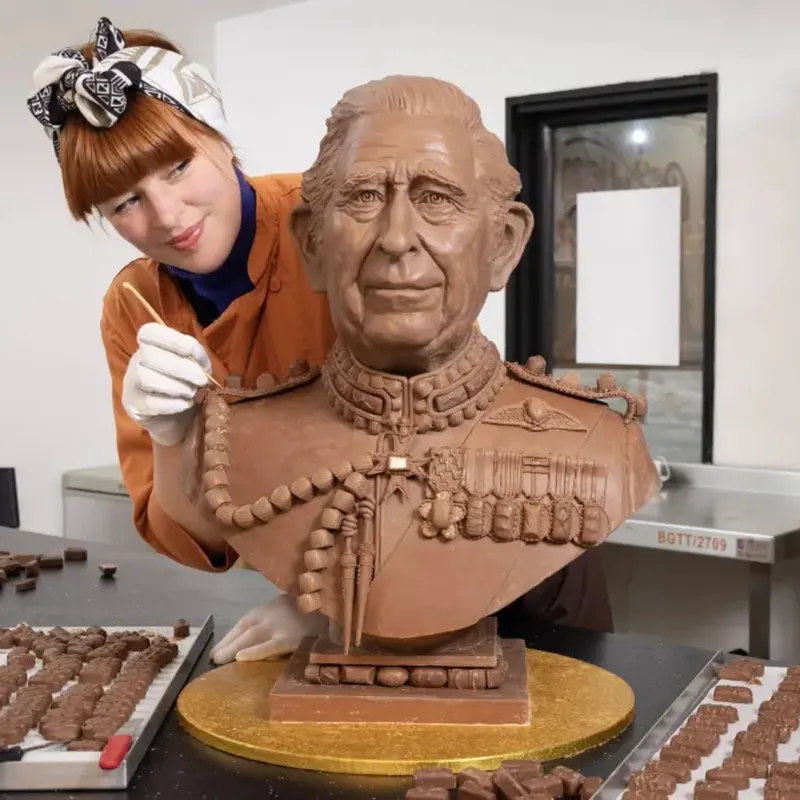
Yeah, yeah, yeah. There's one thing that they made, some chocolate company, the candy company celebration, I think it's called, they made a 50-pound bust of Charles out of milk chocolate. That I gotta say is actually quite well sculpted. But my question is, what are the odds that that bust lasts longer than Charles? And I mean, both of his parents lived to be almost 100, so Charles is probably gonna be on there for at least a decade. Any British listeners we have might be stuck with this guy for a while.
What is a coronation for?
So let's get into, I guess, the coronation. Let's talk about what exactly happened. Because like you said, that some people might have found all the merchandise pretty offensive. Because it is. It's almost like, you know, at best, it's like a light-hearted way to celebrate this monarch. At worst, it's, you know, making fun of this institution that British conservatives still do think is very important. So as you might expect, writers for The Guardian and other outlets penned pieces complaining about the fact that there is all this like frivolous coronation stuff. Because the coronation is a solemn ceremony. It's, you know, the most important celebration of British royal kingship. The BBC official broadcast says something like, this is for the Elizabeth's coronation. They said something like, this coronation ceremony has gone largely unchanged since the days of William the Conqueror.
Yeah, right.
Yeah. Because here's the question, which is going to kind of be the fundamental question of this episode. Basically, how old is this coronation really? And what purpose does the coronation really serve? And those two questions, we have spent the week of the coronation researching.
The invention of tradition
Like you said, Russian Sam, there was one really good book that dived quite deeply into this topic, and that was the 1983 collection of essays by Eric Hobsbawm, The Invention of Tradition. This book came out around the same time as Benedict Anderson's Imagined Communities, which we've talked about before, and both of them looked at the ways that traditions and identities that are perceived to be very old or even essential and inalienable in the case of nationality are often not that old at all. Instead, are deliberately constructed by many different people over decades or centuries to serve a political purpose. And conveniently enough for us, when we were researching this topic, one of the main essays in Hobsbawm's collection is specifically about coronations.
Just before we get into this, I just want to say that while I was perusing the web in preparation for this episode, I saw people reacting to this essay and the book writ large by like just acting like the idea of like the invention of tradition meaning that these traditions are somehow not legitimate or don't have purpose, period. But that's not really what it means. I mean, it's a social construct, which is one of those terms that doesn't necessarily signify good or bad, but which a certain kind of person has an aversion to just because it's like, you know, it's not real, therefore it's a social construct, therefore it's just not something that should be followed. But I mean, there are plenty of social constructs that are good. It's just that this one isn't particularly, you know, worth it.
Yeah, yeah, no, yes, yes, yeah. Because, yeah, because it's, it's, I guess, you know, like, there are benevolent aspects to coronation and the fact that people enjoy watching it, you know, but it represents a fundamentally, you know, incredibly unequal and oppressive institution. And that's why I think it's interesting to see the ways that this specific coronation tried to sort of give a more equitable or progressive bent to the British monarchy, you know, which is, of course, an extension of the British Empire, this incredibly brutal political institution. And even the fact that kingship writ large is always going to be hierarchical, unfair, and generally speaking, oppressive. So I think it's kind of funny to see the way that they try to square that circle.
Yeah, Vulganfist.
Cannadine on coronations
So tell us, Russian Sam, tell us more about what Hobsbawm specifically argued about coronations.
Well, the chapter in the Hobsbawm book was authored by David Cannadine. So Cannadine, he goes into the many ways that the meaning and the form of these ceremonies changed over time, starting from the 1820s when these were actually seen as basically a public nuisance and were very poorly organized. And there are some really great anecdotes in here, like during one of the coronations, a Disraeli, he had to sit on the lap of his wife during one of these just because it was that badly planned out. Yeah, that people were showing up to these drunk and causing a ruckus, things of that nature, just really great farces, which got me thinking about how much I would love for Eric Andre to stage.
We're going to talk about what the coronation is really for, but I think one of the purposes, obviously, is to renew faith in the monarchy. If you really want to do that, yeah, make it fun.
Yeah. Get Eric Andre.
Yeah, yeah, yeah. Yeah, no, I agree. Like, the coronation of Queen Victoria, as Cannadine actually argues, was not that important. And people were, again, rolling their eyes at the fact that, you know, it was another one of these annoying coronations by this queen whose competence was highly doubted.
Yeah, so during her jubilee, that was the point when these started to actually be competent. And also, this was a time when there were actually a lot of monarchies on the continent who were having their own ceremonies, like the Italians and the Germans and the Austro-Hungarians. And so the theatrics of the coronation really became a field of contention for propaganda as showing off how majestic you are.
Right. And also we should add, I think that the later nineteenth century is a time when monarchies become wedded to national identities in ways that they might not have really been before. And that something like a British coronation or any kind of ceremony really could express the might not only of the monarch, but also of British society writ large on the global stage.
Right. And then during the interwar period, the British monarchy was...
Something strange happens in that period.
Yeah, it's a lot of monarchies are deposed. And so, consequently, there's a lot less competition going on. And then finally, by the time you actually get to Elizabeth II, who only recently passed away and who was crowned a queen in 1953, at that point, the British were the last ones standing. In fact, they are currently the only European country which still has a coronation ceremony, which is why it's such a big deal. Because again, this is the only one that's happened in our lifetime.
Right, yeah, because basically after there was that like, you know, Leila montage where the Hohenzollerns and the Wittelsbachs and the Habsburgs and the Romanovs all got torn off their thrones, Britain was the only one standing. They realized that, you know, like being a monarchy could kind of become their thing. That this projection of stability and tradition could become part of this imagined, uniquely British character, which would have very interesting implications and potentially beneficial implications for global trade, for diplomacy, even for warfare. The idea that Britain is this eternal and unchanging institution.
Yeah, and of course another thing that changes during this time period is that the political power of the monarchy is actually waning as this period goes on and on. And consequently, this means that previously, like in the 1820s, which is where Cannadine begins his exposition, the monarchs were really very personally unpopular more often than not just because this was seen as just wasteful expenditure, and they were constantly getting involved in political affairs, which to the liberals of the time was just really repulsive. But now just because they're not supposed to exercise any power, although that's still kind of murky in practice. They are just mascots now, for lack of a better term.
Yeah, exactly, exactly.
Figurehead monarchs
The common phrase is, the common metaphor is a figurehead monarch. But what's a figurehead actually for? It's like, you know, it's a display of the wealth of the person who made the ship. If you're, you know, trying to charter a ship and you see one with a fancy figurehead, you might think that whoever's building that ship, they got some money. You know, maybe they know more about shipbuilding than the guy without a figurehead. So I think that that is kind of what both the monarchy is for and the coronation is a way of reinforcing that. That kind of spiritual power that can reinforce the spiritual authority of the monarchy within Britain and also project a positive image of stability abroad. And I think it's kind of interesting to mention that this is a time that's of some pretty significant uncertainty in Britain, I gotta say. After Brexit, with this big political turnover with three prime ministers in one year, with the economy not doing very great.
I saw that one recent projection says that England may soon be poorer than Poland. So you can see why there might be a need for more stability right now. I think that puts this in an interesting context.
Why wait to crown a king?
Another thing that I thought was interesting that I didn't realize until just now is that this coronation happened many months after Charles was proclaimed king. I think that he first appeared before not Parliament, but some kind of, I guess the House of Lords maybe, some group. He appeared before them back in September and they, you know, acclaimed, you are Charles the King, yada yada. So can you guess why they have to wait all this time, though, for the actual coronation?
Probably a period of mourning.
That's exactly it. Yeah, because back in the day, the king dying was supposed to be seen as this great national tragedy. And so that it would have been seen as inappropriate to have this grand celebration with the chocolate King Charles and the King Charles gnomes until now. You're supposed to be crying about Elizabeth this whole time. But also, that brings me another question. Something that I always found kind of interesting is: if the new king always becomes king upon the death of the previous monarch, if it's this instantaneous transition, then why exactly is a coronation necessary?
Well, as I learned while researching for this episode, we're actually taking something for granted. British successions specifically were often very chaotic in medieval times because, unlike the case of the Capetians in France, for example, it was not the norm for the successor to the throne to be crowned during his father's lifetime. A king would, of course, have his preferences. He might make his wishes known while he was still living or perhaps when he was on his deathbed. But these were often not respected because there is no enforcement mechanism for a guy on his deathbed muttering who he wants to be king.
Yeah, shout out to Viserys. That's why, as late as Henry II, there's a lot of question about who would succeed him after he died, which of his sons. And then a few centuries after that, famously Richard III seized the throne from his nephews, who he probably killed and you know made himself the infamously made himself king instead. So yeah, so like part of the coronation is it's this like it's this display of stability once you've already taken the throne and shown that you're gonna be the king. You do this whole ceremony to show the lords of the realm that like I'm here to stay. You gotta respect me. These days, the will of the lords of the realm is even more irrelevant to British society than the will of the monarch. But like we said, it still has this very important cultural and arguably economic function, especially given how much money they spent on this.
And we'll talk about it in the end.
Origins of the coronation
But now, Sam, let's go into the origins of the coronation, specifically the idea of coronation, and then also we can talk about all the goofy different parts of that ceremony. The swords, the orb, the jewels. But let's start with how this whole thing began.
Well, I actually want to draw a distinction between coronation and ascension of a king, which is going to be relevant a little bit later. But yeah, the ascension of the king, it was a pretty normal thing going all the way back into antiquity, like across many different civilizational spaces. Like these kinds of things often tend to evolve in many different places. And even if the specifics differ, there's nevertheless certain configurations that tend towards more stability and those that don't. But basically to get to Europe specifically, modern European coronations had their roots after the fall of Rome when the various barbarian kingdoms started to develop their own traditions of legitimacy. It seems like these early kings, in particular the Franks, were kind of making up these ceremonies on the fly as they went along, while also being influenced by Eastern Rome as well as the previous traditions of Rome.
But nevertheless, there were two really interesting sources of inspiration. There's, of course, the ancient tradition, description of kingship in the Bible, in particular, the Old Testament. In fact, the coronation ceremony of Charles included a very biblically grounded tradition.
Oh, yes.
Yeah. Yeah, and there's also the ordination ceremonies of the bishops. In other words, the church legitimizing the king.
Yeah, yeah, which I think that's also part of why the ceremony is so religious, because they were modeling it in some extent off of an explicitly Catholic ceremony of the Middle Ages.
Right, right. Because this was, like, ultimately, the ideology revolved around the idea that this was God's representative on earth, and so you have to listen to this guy. And naturally, if he's God's representative on earth, then he needs to be sanctioned by the church as well, which was often a point of tension. This ideology of post-Roman kingship in Britain and Western Europe was by the early medieval period, largely speaking, based on bloodlines, unlike in the East, as we've talked previously, which had more of an elective monarchy system going well into early modern times.
Yeah, and so because of that, there was a very heavy emphasis on genealogy as we went into episode 60 on legendary ancestry. Go back and listen to that one if you haven't. And these can be understood as basically title deeds to the kingship. So basically, the idea that the further back you can trace your line of succession, the more legitimate your claim to the throne is.
Athelstan
Yeah, so like the first monarch to call himself King of the English, who is really the king of all the English-speaking peoples of Britain, as opposed to the seven previous petty kings, he was a guy named Athelstan, who reigned from 925 to 939. And he completed the process started by his grandfather, Alfred the Great, of combining the thrones of Wessex and Mercia, the two biggest kingdoms of the heptarchy, into one. Eventually, that becomes England. According to the writer David Crouch, Athelstan's inauguration followed a rite devised to align the somewhat antiquated English rite with the one then current in West Francia. It used the full symbolic range of regalia: the ring, sword, rod, and crown. This ceremony proclaimed the king as defender of justice in the church, the one who brought peace and unity. He was anointed, and so was Christ. He was the mediator between God and mankind.
The rite used in 925 was the template for that used in the consecration of every subsequent medieval king of England, whether Saxon, Danish, Norman, or Plantagenet.
Yeah, and of course, a lot of this goes back directly to Charlemagne, who was the one who cemented this idea of post-Roman kingship in earnest, and who everyone would spend the following centuries attempting to copy as much as possible.
Yeah, yeah, yeah. And he was a great conqueror, you know, also a great party planner. You know, kind of set the tone for all that stuff.
Yeah.
Another kind of funny thing about Athelstan is that he was the first English king to use a crown. Before that, they were a helmet, which is kind of funny. One thing I just wanted to bring up here is that there's this pretty fun book called The Wake, this historical fiction novel about the Norman conquest. In that book, they don't say the word crown, they only call it the Latin corona, because the concept of a crown is so foreign to England that an English word hasn't developed yet.
Wow, the Normans introduced Corona to Britain. Where will their barbarity end?
Crowns and scepters
But returning to coronations, given the root of the word, you'd be right to suspect that the physical crown was an important part of the legitimizing ideology. But until the ascension of Edward I in 1274, the power of the monarch was actually primarily represented by the scepter.
Yeah.
Crowns were more secondary, and so crowns were not by custom passed down from the king to a successor. And in fact, they would often be entrusted to various churches. So if a future king wanted the crown of a predecessor back, he'd have to give the church a replacement in its stead. So that's a very funny image, right? This guy just commissioning another crown so he could have his predecessor's crown, and he has to, you know, give it back to the church so they don't, God forbid, lose a valuable investment in precious gold and gems. But anyway, from King Edward's reign, the crown took on a new significance. It came to represent kingship in the abstract and all the rights and duties that it entailed, as they would be renegotiated across time, which again, that's the central point. We shouldn't take for granted that the meaning and the form of these ceremonies was ever continuous.
Right. And like you said, there's this idea that there should be this continuous passage from one king to the next. To quote Crouch, the king of England could no longer die because his kingship was perpetual. And this ties into a pretty interesting point of modern historiography about medieval kingship, which is the idea of the king having two bodies, that being one body of his physical body, but in the other sense is that he also is the body politic, how the monarchy is centered around the person of the king. That so many government institutions do not exist in a vacuum, but instead totally take all of their legitimacy based on their association with the king.
Right, and in this way, the process leading up to the ascension of the king came to take on a great symbolic importance as well. Especially when the king taking the throne happened to be a usurper.
Yeah.
When you don't have the blood and the necessary bloodlines, or the fact, or you have the uncomfortable truth of your treason, for lack of a better words, hanging over your head. Legitimacy as embodied in the physical crown and the acceptance of the nobility of your proper place on the throne becomes a lot more important.
The coronation oath
Right, yeah. And the coronation isn't just the king gets a crown. It's kind of a two-way street. Like, you know, usually a bishop will put the crown on his head, and then the king will give his little tight ten. He'll do a monologue, essentially, where he explains his intentions to rule in a just way. And this monologue, these rites, this oath, this changes somewhat from king to king. And we'll talk about how, but the broad strokes have largely been the same, at least since the High Middle Ages, since the Norman era.
Right, so in the British context, especially from the 11th century onwards, we can examine these oaths through the idea of contracts, basically. As part of the ceremony, the king must read an oath, and the implication here is that these are the conditions of the kingship. And if the king wants to remain on the throne, they must be preserved to maintain his legitimacy. And this idea is actually quite upsetting to many individual kings just because the implication is that an unjust king can be removed theoretically if he is in breach of his oath.
Yeah, yeah, and of course, several were across the course of English history. Interestingly, English oaths were basically ripped off from the oaths of the Holy Roman Emperors, and I think it might not be a coincidence that Henry I's sister and Henry II's mom was the Empress Matilda, who was the widow of the German Kaiser and was very proud of that imperial connection. We mentioned Edward II earlier. He was one king whose oath ended up kind of coming back to bite him. He had sworn to uphold the laws which his subjects rightfully and reasonably choose, which eventually gave the magnates cause to defy him. Thus, they were saying that they were loyal to the idea of kingship, not the specific actual king. So, you know, they were always trying to toss him out and bring in a better king. Eventually, 1327, Parliament permanently revokes Edward II's kingship and proclaims his son Edward III as the new king.
And as for the ceremony itself, for centuries it was organized by a guy whose title is the Earl Marshal, and it was carried out by the Archbishop of Canterbury at a church and former monastery called the Abbey of Westminster.
A medieval ceremony
So what might one of these ceremonies have looked like in medieval times exactly? Here's Crouch describing the recoronation of Richard I after his return from captivity. We know that a Norman king processed from his palace to the crown wearing at mid-morning in his royal vestments, already wearing his great crown and carrying rod and scepter, led by the bishops. Behind them came the abbots and the attendant monks and clerks. The king came behind the chanting clergy, flanked left and right by more bishops. Four barons carried lit candles in front of him, and four more shaded his head with a silk pavilion carried on four poles. Three ceremonial swords were borne upright in their gilded sheaths by senior earls. The Earl of Chester was said by one source to claim the right to be premier earl and therefore carry the king's scepter. But that would apply only to his first coronation, not the later crown wearings.
At the church, the king knelt before the altar for the opening invocation of the Mass and then took his throne, set up the choir, led there by the Archbishop of Canterbury and the Bishop of London. After the initial prayer, the king heard the laudes regiae, which is kind of like the anthem of praise sung by his clerks. Yes, you can see it's like a pretty ostentatious ceremony, and you might not be surprised to hear that this much pageantry often leads to some mishaps. Because a little bit earlier in the time of King Stephen of Blois, apparently we are told at King Stephen's inauguration, the singing of the Laudes was a shambles, as the monks of Canterbury and the royal clerks had not settled on who was supposed to do it. So the two sets of clergy competed for the honor as well as the fees that went with it.
So it's like, you know, this guy's trying to get crowned king, and suddenly, yeah, the choir is fighting each other over who gets to get paid, which I think is very funny. Also, I gotta wonder, you know.
Yeah, it took them a surprisingly long time to actually figure out how to run these things smoothly.
Yeah, yeah, yeah. And also, I want to add, King Stephen of England, you don't hear about him that much. He was a one-off dynastic guy. He was the house of Blois, just one guy, and then it was back to Plantagenets. So I kind of wonder if, you know, like, might have been a bad portent, you know? If the coronation goes badly, then maybe you're not going to be a very good king, you know?
God save the king
And so, you know, as you could expect from the presence of bishops and archbishops and monks, this is a very religious ceremony. You can even compare it to the role of state Shinto in Japanese imperial processions, you know? The Archbishop of Canterbury basically interrogates the new king about his godliness, asking if he's going to uphold God's will to the best of his ability. You know, one thing I'm kind of curious about, Sam, is what do you think would have happened if Charles said, no, I'm not going to. I'm going to defy God.
The greatest bit of performance art of all time.
Obviously, that would never happen. But there was some question about Charles' personal religious beliefs when they were arranging this. I think that everyone kind of sees Charles as some kind of vaguely new age-y Christian. But Charles is, he's very ecumenical in ways that I usually think would be kind of commendable. But because he is this, you know, an entitled aristocrat, he, of course, finds a way to bungle it. There was one incident in the 90s that's kind of funny where he was saying that when he would become king, which he probably did not expect to be 30 years away, he said that he would not simply call himself defender of the faith, meaning Anglican Christianity, but in fact, defender of all faith. And so this was, I think this was meant to be. Yeah, and so I think that this was intended to be.
Yes, we did it. We're bringing the Caliphate to England. Let's go.
Yes, exactly. I think he really had good intentions here. He was trying to say that he would be very inclusive of other religions. But when he's telling, you know, Catholics and Muslims and Jews that he's going to be a religious authority in their religions, that's when those groups all said, hey, hold on, buddy, take a step back, you know. We don't need you messing with our faith. Which is kind of funny. This meant that when he finally was crowned on Saturday, there was some fear in the British press that he might somehow stick his foot in his mouth again by, you know, accidentally claiming some authority over Islam, which would have been pretty funny. But no, no, he had a pretty conservative, very, very normal kind of statement.
Charles's oath
If you want to read it, Sam.
I am willing. I, Charles, do solemnly and sincerely, in the presence of God, confess, testify, and declare that I am a faithful Protestant, and I will, according to the true intent of the enactments, which secure the Protestant succession to the throne, uphold and maintain said enactments to the best of my powers according to law. God of compassion and mercy, whose son was not sent to be served, but to serve, give grace that I may find in thy service perfect freedom and in the freedom knowledge of thy truth. Grant that I may be a blessing to thy children of every faith and belief, that together we may discover the ways of gentleness and be led into the paths of peace through Jesus Christ our Lord. Amen.
Yeah, and if you guys caught that part about the Protestant succession, it is still unlawful for a Catholic to become King of England, which I find very funny.
This is a really great oath, just like comparing to the previous one, just because it's like so religiously focused.
Meddling monarchs
Well, because at this point, the British monarchy isn't supposed to really get involved in anything else. Although, again, behind the scenes, they kind of do that.
Oh, yeah, yeah, they definitely, yeah. They certainly meddle whenever they can. But it is interesting. I wonder what the actual constitutional status of, like, what happens if he actually does try to meddle formally?
A lot of it is just tradition. The king is not supposed to comment on politics. I think that they always tried to get Elizabeth to do so, and everyone kind of knew that she was, you know, quietly a conservative supporter because there were, you know, Republican tendencies in Labour. But she was always pretty good about that. Other people in the royal family were not. There were some whispers that at one point, Lord Mountbatten, her uncle-in-law, I guess, may have been involved in a potentially unlawful plot to oust Prime Minister Harold Wilson, essentially a right-wing coup. So there is some pretty scary precedent for monarchial involvement. And that's why there's a lot of opposition on the British left to monarchism today in England and England, Scotland, and Wales. And not just because the entire institution of monarchy is fundamentally unjust, but because of this association with the right wing.
There was this very weird moment relatively recently when Charles first was acclaimed king, when he tried to interfere with the Scottish Parliament when they were trying to do a rent freeze during COVID, which is very weird, you know. And a lot of people think that was just kind of a trial balloon to see how the public would react to the king expressing his views on politics. Of course, you know, the king of the United Kingdom has very little, if any, formal political power. It's all just soft power. But I do think Charles wants to use his soft power a lot more than his mom did, especially because he's been waiting 70 years to do it.
Yeah, and he does do it. One particularly egregious example I can think of is: I know that NHS now covers homeopathy, specifically because of the lobbying of Charles, because he believes in that new agey stuff.
Other faiths
Yeah, as for the religious aspect, I think it is, what's interesting is that it is an explicitly Anglican Church of England ceremony, but there were, like we said, all these nods to other religions. Members of religious minority communities were invited just as an expression of goodwill to show that even though he is an Anglican monarch, you know, Britain is not a country only for Anglicans. You know, there's been a lot of centuries of public civil violence to make sure that's the case, you know, the emancipation of Catholics and Jews and other groups like that. So because of that, there were Catholic and Jewish and Hindu and Sikh and Muslim clerics invited. One funny thing though is that this happened on a Saturday, which is the Jewish Sabbath. So the rabbi who was invited, he actually wasn't able to drive, so they let him stay the night in the palace.
And that was kind of funny.
Darker sides
We should maybe mention, though, that there are many darker aspects to the religious tenor of the coronation. For example, we're talking about the Protestant succession. There was a lot of fighting in the Tudor era about if the language would be too Catholic or too Protestant. When Elizabeth I took the throne, there was a lot of fear that the language used in her oaths, as well as the bishops attending, they were a little bit, it was too Catholic for the Protestants and too Protestant for the Catholics. So there's a lot of fear about that initially, but I think instead that just kind of foreshadowed the fact that Elizabeth would create this great settlement, you know, of not exact, of not toleration, but of a new state religion that blended, you know, elements of both.
And on a much darker note, you talked about the coronation of Richard of the Lionheart, and that was in 1189, Richard I. That coronation corresponded with a pogrom of English Jews. He was a crusader, and the crusades were marked not only by violence abroad, but also violence at home, religious violence against non-Christians, and the only non-Christians around were Jewish people. So dozens of Jewish people were murdered in 1189 just due to the Christian fervor that spilled out of the coronation. And again, that kind of just brings us to the fact that personally, I don't think that you can ever have a progressive coronation. I think that due to its heredity and due to the current state of monarchy, monarchism will always be unjust. So any coronation is celebrating basically a tyrannical institution. And I don't want to get too soapoxy, but I just think that that's why, like, at the end of the day, this is only going to be a nationalist exercise and a monarchical exercise.
And as somebody who doesn't like monarchism or nationalism, I can never take more than a voyeuristic pleasure in watching a coronation.
Well, I'm going to take a more central stand here, and I'm going to say that as soon as the British royal family gives up all $25 billion of their assets, on paper, at least, they probably have more. And they become sort of mendicant monarchs, then I will support them. Up until that point, no one else.
All right, yeah, yeah.
What it cost
On the subject of money, let's talk about now how much this ceremony cost. Because interestingly, there were some efforts taken to reduce the cost of this coronation. Because we said this is not the best economic time for Britain, and because a new monarch might not necessarily want to start spending lots of his subjects' money immediately out of the gate. So, some reports said that, I think the official reports from the British monarchy were that the final cost of the ceremony was 50 million pounds. But according to an investigation by the newspaper Express, it was actually 250 million pounds. So, yeah, a quarter of a billion pounds basically just for a very fancy parade with a choir performance and a long monologue, you know? And in dollars, that's 350 million.
I don't quite understand what they were spending that money on, frankly, because I watched it and just there's no way that was 250 million dollar pounds worth of ceremony.
Yeah, well, well, think about it, man. It's it's the security, it's the choir, it's maintaining and you know, presenting all of the crown jewels that we'll talk about, it's refurbishing the cathedral, you know, Westminster Abbey. I think that this, like all of the horses, you know, the carriages. I think that if you're not careful with how you spend money, which clearly Charles was not, I think that something like that could easily rack up that much money the way you're the same way that like, you know, a big budget Halloween movie could easily rack up a $100 million budget just by having a lot of effects and not being careful.
Buy a few more candles.
Yeah.
Zadok the Priest
Yeah, all right. All right, so the notes go into the specific elements of the coronation. Let's kind of, you know, itemize the list and go through everything that happened and talk about what exactly it was. So you might have noticed that every that this coronation, like every previous coronation since the Georgian era, opens with the song, includes the performance of the piece Zadok the Priest, which is really the theme song of British coronations. It was composed for George II by George Friedrich Handel, who, interestingly, like George II, was a German, you know, born, I think, just like maybe a few hundred miles away.
Not unlike the issue with the coronation of Stephen of Blois, the coronation of George II was a bit of a mess because the choir wasn't sure which anthem they were supposed to sing. So at one point, half of them began singing Zadok the Priest, but the other half started singing a different song. And apparently it was just total chaos until eventually the choir master brought them in line.
And we mentioned omens' importance earlier. I think I do have to mention that George II is often considered one of the worst British monarchs. He presided over a huge Jacobite rebellion and he was always wasting money on gambling and his mistresses. So yeah, it was kind of a sign.
Wow.
The text Zadok the Priest is a brief excerpt from the Old Testament. And the use of this brief excerpt is probably the single oldest aspect of the coronation. So, you know, the coronation presents itself as very solemn and ancient. Most of it, as we're talking about, is not. But this one excerpt actually is. The only real change is that they've shifted the language from Latin to English. I'm sure it's the only element of the coronation that even predates the Norman conquest, because, like we said, this specific phrase goes back to the time of Athelstan.
Robes and scepters
The robes that were used were actually older than you might think because a big kind of gesture of modesty was that Charles III, the new king, didn't commission any new robes for himself. Instead, he used older robes previously worn by other kings in the 20th and even 19th century. And he used specifically the robes of George IV as sort of a cost-saving measure, but that's actually kind of funny in a way because George IV's coronation was actually, per Cannadine, the subject of a lot of ire from the liberals of the time just because it was so expensive. Because of how expensive that one was, the subsequent ones had to actually cut back significantly.
Traditionally, the biggest symbol of monarchical might was not the crown, it was the scepter. And so there were certain, there was, I think, two different scepters that we saw, and even a staff at the coronation. The main scepter, called the Dove Scepter, it has a huge diamond in the middle of it. And this is one of the most kind of blatantly modern elements of the coronation ceremony, because this scepter only goes back to 1910. The diamond inlaid within is known as the Great Star of Africa, and it's the largest white diamond in the world. And you can probably guess the history.
Yeah, absolutely.
It was, you know, uncovered by South African workers, paid peanuts in the 1910s, in a mine owned by some white guy, you know. So there was actually a little bit of outcry in South Africa about the use of this stone in the coronation and calls for repatriation, but not really any movement. The crown doesn't seem likely to give up any of their jewels anytime soon.
Stolen diamonds
There's one more jewel that didn't make an appearance in this coronation, but I think that you know something about this, Sam.
Oh, yeah, yeah. This is the Koh-i-Noor diamond, which was previously in the crown, which had been used to crown Elizabeth's mother. It's an enormous diamond that goes back all the way to the reign of Shah Abbas of the Mughals, I believe. It has a very troubled provenance just because, well, first it was taken by Nader Shah and taken back to Iran with him when he invaded India, and then, no, not Iran, I'm sorry. It was his court was centered more in Afghanistan, and then it just kept falling into different hands until finally it was came into the possession of the Emperor of the Sikh Empire, from which point the British basically spirited it away back to England, and it had been there since. And it's long been the target of polemics from Indians, from Iranians, from Afghans saying that this is their diamond and that it should be returned to them.
Yeah, yeah. And yeah, and so this one, like you said, wasn't part of the ceremony at all. Partially, some people think it might have been because it's traditionally associated with queens. And, you know, Charles, I guess he's nothing if not a man's man. So he doesn't want a feminine diamond in his ceremony.
Well, it was supposed to be in Camilla's crown. Like, for the record, like, it wasn't the crown that Camilla used to be coronated, but they took it out for the event.
So I think it's two-point controversy. I think that the movement to repatriate the Koh-i-Noor has gotten a lot more traction than the movement to repatriate the Great Star of Africa. So they figured we can get away with one stolen diamond, but not two.
Yeah, well, I mean, there's actually another one, the necklace that Camilla wore. That was actually another stolen diamond, the gem of Lahore, something like that.
The orb
Any thoughts on the orb, Sam? King Charles' orb?
Oh, well, we love the orb, of course. We've been obsessed with the orbs ever since a certain president went to a certain country and touched one and captured our hearts.
The great orb of Riyadh, you know, I know. This orb, I think, Charles' orb, is a lot less impressive than that Saudi Arabian orb, personally. It's just a little gold ball with a cross on top. You know, as you might expect, it represents the power of Jesus Christ over Earth. Although I gotta think that if the king is holding that orb, that seems like kind of an arrogant statement. But this is also a very old part of the ceremony. This one actually dates back to Byzantine. The orb was a symbol of Byzantine kingship back in the early Middle Ages. It's not that ancient of a piece of the British ceremony, though. I think the first king to use the orb was Henry VIII, who interestingly was one of the first, I don't know if this is a coincidence, but he was one of the first kings to reign England after the Byzantine Empire fell.
And after the Byzantine Empire fell, there was this outpouring of Byzantine intellectual refugees. I don't think any of them made it to England that I know of, but maybe there's some connection there. Regardless, Henry VIII, he had his orb. Some little English civil war happens, and Oliver Cromwell gets control of the orb and sells it, which, you know, I think it's a mistake. I think that an object that magical, you probably want to hold on to, but he sold it, and that orb is lost forever. But so then Charles II comes in and creates a new orb. And that's actually kind of a recurring theme with coronation stuff and crown jewels. A lot of the crown jewels were lost during the English Civil War. So Charles II, in all his famous restoration ostentation, had all of these new crown jewels remade. Probably the most famous of these, or at least the most famous right now, are the Four Swords.
Sam, you got thoughts on the Four Swords?
Before we proceed to the Swords, I actually want to comment on the orb specifically.
Sure.
As we mentioned at the top of the episode, there's been a lot of emphasis this time around on being inclusive for the ceremony. And what really struck me is that the women who were shown carrying the orb and scepter at the beginning of the episode, they were both black, which feels like a very strong attempt at a symbolic statement by the monarchy, which I mean, I'm sorry, I just can't be bothered to care about that.
Well, yeah, yeah, you can't, you can, I don't think you can have an inclusive monarchy. I don't think that's a possible gesture to make. Like, an effort was made.
The four swords
All right, but swords, swords, come on, man. Sword time. Tell us your thoughts.
Yeah, this part was great, frankly. In another gesture towards inclusion, this was the first time that a woman was included as a sword.
Oh, yes, Penny Mordaunt. She's some big politician. I'm not familiar, but I know people in England are very joking a lot about her bearing the sword. Right, and so there were four swords involved in the ceremony. Put on your Magic the Gathering hats because these are the swords of state, the sword of mercy, the sword of spiritual justice, and the sword of temporal virtue.
Yeah.
So they're all meant to be, you know, abstract representations of different kingly virtues, and all of them date back to the time of Charles II. But one of them does claim a particularly illustrious history, and that one is the sword of mercy. Had you heard of this one before, Sam?
I knew a little bit about it. No, no, I haven't.
Well, so the sword of mercy, it is from the 17th century. That's fact. But it claims to be a replica of a much older sword. I'm skeptical that the older sword ever really existed. But if it did, especially given the story behind it, but the older sword that it's supposedly based on goes by the Latin name Curtana. It's a very famous sword that appears a lot in medieval literature, supposedly held by a lot of different legendary kings. And if you're wondering, this name of this sword, Cortana, it actually is the origin of the Halo character, Cortana. It's a weird medieval literature reference. But this sword of mercy, depending on who you ask, it might have belonged to Edward the Confessor, who was one of the last Anglo-Saxon kings. It might have belonged to Tristan, as in, you know, Tristan and Isolt, the Arthurian romance. And it might have even belonged to this character named Ogier the Dane, a legendary Viking who supposedly fought for Charlemagne.
But probably all not true. There might have initially been one sword before the English Civil War that was used, and then during Charles II's time, when they reforged this sword, they gave it a much more illustrious history. But because of that illustrious history, the oh, I'm sorry, actually, this was Charles I, not Charles II. I'm sorry, yeah, this was, so this is, this is, this sword is slightly older than the rest, as in, like, you know, 20 years older. This one was made for Charles I, but then when the English Civil War happened, like many other British crown jewels, it was basically sold for scrap. But this one came into the hands of some royalist farmer who apparently bought it from the parliamentarians for five pounds. And he dutifully held on to it for 30 years. But interestingly, he didn't give it to Charles II. I don't know if this guy didn't like Charles or what.
Instead, he gave it to James, who was crowned in 1685. And since then, this sword of mercy, supposedly the sword of Charlemagne's friend, supposedly the sword of Edward the Confessor, supposedly the sword of Tristan, has been in the possession of the monarchy ever since.
King Edward's chair
Well, on to less impressive artifact, we have King Edward's chair.
Yes.
And this is a very uncomfortable-looking wooden throne that's bejeweled. It was built in 1300.
Yeah.
Very splintery.
Yeah, it was built in 1300 for King Edward I, also better known as Edward Longshanks, and better still as the Hammer of the Scots for a very particular reason. He's one of the more famous kings of England due to his brutal wars in Scotland, kept famous by Scottish folk memory and the movie Braveheart, of course.
And also because in 1290 he forced all the Jewish people that lived in England up until that point to leave because of a blood libel controversy.
Yes, he's got an incredibly mixed reputation, to say the least. I'm actually kind of surprised there wasn't any outcry about using the throne for that reason. I didn't hear anything. But it kind of shows it's like there is this brutal heredity with monarchy. But the throne is important because for a couple reasons. But the thing, mostly because it was commissioned as a display of royal power and also of English power over Scotland. Because during his wars with Scotland, he seized from Scotland a very important stone known as the Stone of Scone in English or the Stone of Scone in Scots. The chair was meant to be just a receptacle for that stone. So a guy named Walter of Durham, who was apparently the most brilliant English artist and craftsman of the time, built and painted this chair specifically to hold the stone. It was made for King Edward, but dedicated to Saint Edward, Edward the Confessor, the guy we mentioned before who supposedly held the sword of mercy.
It really is very old, and it's been terribly maintained. It's not a museum piece. It's an actual, like, it's a used piece of furniture. It's nowadays almost only used for coronations, but for many, many centuries, it was used as a regular chair. The bishop would sit in it, visitors would sit on it, choir boys would sit on it and even carve their names into it. There's one little inscription that you might have seen behind Charles' head that says, P. Abbott slept in this chair 5 July 1800. Which is pretty funny.
That's incredible. Just like the total lack of regard for history. I love it, honestly, in this context.
Yeah, and this kind of shows that the solemnity of the coronation is a pretty modern invention. It goes back to the 19th century. It was really buffed up in the 20th century. People were a lot less respectful. And it wasn't just kids. Tourists could pay money to sit on the chair, on the throne all throughout the 18th century. And I think that's really what really caused the wear was, you know, the butts of thousands, tens of thousands of tourists for years and years. Also, the jewels are not original because the earliest jewels on the chair mysteriously disappeared sometime in the Middle Ages. And the best guess is that some greedy bishop just, you know, chipped them off and sold them and hoped the king wouldn't notice. Because the chair is pretty ugly, for a long time it was covered in gold leaf or cloth. But the cloth would just be roughly nailed onto the wood, which led to even more damage, even more splintering.
And also, you might have noticed the base of the chair, the part that holds the Stone of Scone, it has these really ugly gold lions on it. Very Rococo, totally, total different style from the rest of the chair. These were added, I think, in the 18th century, and adding them, as you might expect, caused more damage.
The suffragette bomb
But there is one event that I think is the most interesting cause of damage in 1914. You know what happened, Sam?
No, please enlighten me.
As an act of protest, a group of suffragettes tossed a shrapnel bomb at the throne. And.
Oh, hell yes.
Yeah, yeah. I know.
I respect that.
They didn't do too much damage, but they did shove some pieces of shrapnel into the wood and into the Stone of Scone itself. Although, that would not be the last time the stone would undergo damage. Like we said, the stone is really the whole point of this chair. And there's a great story behind the stone about why that stone is so important.
A verdict on the coronation
But before we get into that, Sam, you have any last thoughts about the coronation? Impressions? You know, any suggestions for the next one? If there is a next one?
Well, I have to say, I wasn't a fan of it in general, but the music was great. I can't really fault them for that in particular.
Oh, yeah. No. You know what? Zadok the Priest, kind of a banger.
Yeah, and I mean, they also had a great rendition of Kyrie eleison performed in all of the traditional languages of the British Isles. So they had it in English, in Scots, and in Gaelic.
In Irish Gaelic as well.
Yeah, that was cool. Just a great symbol. I hope all that money wants to pay those singers because they deserved it, at least. But yeah, as for suggestions, once again, I think Eric Andre should direct the next one. I think he'd be great at it. I think this is his moment to shine, literally. And I don't see what's the worst that could happen.
Alright, I said, I completely agree.
The Stone of Scone
Alright, but so now I think this is the time to close this off. I'm going to tell you guys the story of the Stone of Scone. I wish that was the real pronunciation. It's really Stone of Scone, which is kind of less fun. But so this is, of course, a Scottish stone. It was stolen by King Edward I during his war with Scotland. Before it became part of the coronation ceremonies of English kings, it was used in the coronation ceremonies of Scottish kings. And it was probably used as their chair, like a kind of a primitive stool that the king would sit on.
It actually wasn't.
Oh, what did you see?
I read something to the effect of this was probably the base of a mobile altar that was used during the Scottish coronation ceremonies. But that's one theory. There are some other ones. I also saw that there's one that it was like a Bronze Age weight that somehow ended up getting incorporated into the ceremonies. But I'm not an archaeologist, so.
Well, there's certainly lots of theories about its origin, and we'll talk about it in a second.
Scone Abbey and the Culdees
It's called the Stone of Scone Scone because it's from a place called Scone Abbey, which no longer exists. But this was a very important medieval abbey that was believed to be essential for the initial proliferation of Christianity in Scotland. Christianity was probably introduced from Ireland by a guy called St. Columba at a time when Scotland and Ireland had incredibly close relations. So close that there was a complete continuity of language across the two countries. The name Scotland basically means Ireland, because Scoti was an ancient and early medieval name for the Irish. And during this period, Scone Abbey, Scone Abbey, was probably managed by a very weird group of people who might not really have been monks at all. They were called the Culdees.
Culdees apparently figured pretty prominently in the Scottish national identity and folk history, which I didn't realize. I have to admit, I hadn't heard of them until I was looking up the history of the stone.
They're interesting. They are often given as an example of the kind of Christian eccentricities that were allowed underneath the Catholic umbrella prior to the Counter-Reformation and also prior to the centralizing reforms of the High Middle Ages, when Catholicism had a lot more differences from place to place. One of these eccentricities was the fact that their name probably means spouses of God, but these were men. So that itself is kind of strange. That, that you know, it's, and that may or may not harken back to pagan Irish ceremonies in which kings would proclaim themselves to be married spiritually to various goddesses who would give them legitimacy. So that's kind of odd, that alone. These guys calling themselves the husbands of God, basically. But they also lived very ascetic lives despite not being true monks. They were regular people who chose an ascetic lifestyle as hermits for themselves, where they would grow their own crops totally self-sufficiently and spend all of their free time just praying and contemplating the Christian mysteries.
Because the Culdees didn't really speak to the authority of any given bishop or even really the Pope, they were seen by Scottish Protestants as the proof that Scottish Christianity has always been its own thing and therefore needed to be independent both of the Church in Rome and the Church of England. I think that this is just kind of a nationalist misappropriation, especially because a group of very zealous Scottish Protestants would end up being the ones who destroyed Scone Abbey. That's why it doesn't exist anymore, you know, even though they, you know, they wore the banner of the Culdees and then they destroyed the most famous landmark of the Culdees. But this happened long after the Stone of Scone was taken out of Scone Abbey. And even if the Scottish Protestants didn't give much respect to the Abbey itself, they did care a lot about the stone due to the pretty brutal circumstances in which the stone was captured.
Longshanks takes the stone
Right, so the deal with the stone of Scone is that it was once again taken by Edward Longshanks. It was stolen from Scone Abbey and when he rode into the country in 1292 during a dispute over which he would be king. But he basically used this crisis as a pretense to claim the Scottish throne for himself, which is a long-standing thing in British history, newsflash, if you've been living under a rock. But that could be an episode unto itself.
But Wales, yeah, yeah, yeah.
Yeah, the English would eventually be repulsed, thanks in no small part due to the efforts of a couple of guys named William Wallace and Robert the Bruce. But the stone was nevertheless spirited away to England, where it would remain installed in the base of that ugly wooden chair built by Edward. But on the plus side, Charles didn't look very comfortable sitting on it, this coronation. So I'd say that it's still the Scots are still getting their revenge over that one.
Yeah, yeah.
Jacob's pillow
Let's take a step back. What exactly is the Stone of Scone?
Right. So in the Middle Ages, before it was taken by King Edward, and possibly the reason why it was taken by King Edward, is because it was thought to be Jacob's pillow. This is this weird, apocryphal bit of, you know, Christian mythology that claims that when Jacob in the Old Testament had a dream of angels climbing to heaven, he was sleeping on a stone pillow. And that after the destruction of the Temple of Jerusalem, this pillow was then brought to Egypt, where it came into the possession of a certain princess Scota. So, you know, we said that the name Scotland basically means Ireland, because the Scoti were an Irish tribe who meant Irish. The Irish and the Scots claimed, as we talked about in episode 60, that they were descended from this Egyptian princess Scota. You know, the English said they were descended from the ancient Israelites, the Scots and the Irish said they were descended from Egyptians.
Therefore, this pillow was taken from the Temple of Jerusalem to Egypt to Ireland, where it then became the Stone of Destiny. And that is a very common name for the Stone of Scone today.
Little thing here. It was called the Stone of Destiny because the Stone of Scone was believed to be the same thing as the Irish Stone of Tara. That was this stone that was very important to medieval Irish kingship. The kings of Scotland said that the Stone of Scone was the exact same as the one in Ireland. Their ancestors had brought it from Ireland to Scotland, and now it was theirs. Little issue here is that the Stone of Tara still exists. You can just go to Tara and see it. So unless it magically duplicated itself, it's the wrong stone. And according to geological analysis, the Stone of Scone was mined locally. It was just taken out of a quarry somewhere in the vicinity of Scone. But even if the mythical story is obviously not true, people certainly believed it was. And across the 18th and 19th century, once it came to England, this mythical and mystical association only increased.
For a while, English writers tried to find some way to connect it to the story of Macbeth, because he was one of the only Scottish kings they really knew about, thanks to Shakespeare. But no, it seems like there's no specific connection there. But the fact that the idea that it had this some kind of mystical, Christian or even pre-Christian significance really did loom large in the minds of English and Scottish Romantics up until the present.
The Christmas heist
But the most important thing about the stone, aside from how fun Stone of Scone is to say, isn't where it comes from or what it's supposed to represent, but rather what four Scottish kids did on Christmas Day 73 years ago.
That's right. Yeah, this is a great story. Some of you might be familiar with this story, but if you're not.
For some background, Scotland was in a pretty bad place in the early 1950s. The UK never had the exact same kind of post-war prosperity that America did, and Scotland absolutely didn't. Glasgow, in particular, was one of the bleakest places of the United Kingdom in 1950. It was very working class, a lot of immigrants, not a lot of work, which meant that it was a pretty depressing place to live, and the Scottish national movement didn't seem to be in a good place. A group of University of Glasgow students who were active in that nationalist movement devised a plan that they thought could maybe lift the spirits of the Scottish people and right what they saw as a terrible historical wrong. It was a simple plan. They'd go down to London, you know, the belly of the beast of the British monarchy, and then take back the holy stone that had been stolen 700 years before, bring it back to the ruins of Scone Abbey.
The kid leading the charge was a 25-year-old World War II veteran named Ian Hamilton, who had already become quite active in this movement. And he knew a woman named Kay Matheson, who was a Gaelic speaker and I think a linguist who came from a much poorer background. Another guy named Alan Stewart had the car, and a fourth guy, Gavin Vernon, revealed all of this in 2004, basically on his deathbed, to the newspaper, The Scottish Herald. And he's the reason we know exactly what happened, thanks to his basically confession. So what he says is that these four kids got together in the 50s and they met with a sympathetic government official who actually gave them some money to pull this off. Money for gas, for lodgings, because he supported this theft. So they had a little bit of help from a pie.
Well, it was a pretty simple plan, from what we can tell. They would just drive for 18 hours from Glasgow to London on the cold December day just before Christmas, and they would just go and take the stone. Basically, the leader, Ian Hamilton, would walk right into Westminster Abbey as a tourist, then lock himself in the bathroom and wait until the guards left. And he tried this. So he was able to get in, but then as soon as he tried waiting in the bathroom, the night watchman realized, wait, why is that guy still in there? And so the guards basically grabbed him and threw him out. He convinced them that he was only there by accident, that he wasn't trying to stay in overnight. And the guard actually believed him, but this meant that plan A was a no-go. They had to figure out another way to get in.
But now, after being inside, he knew a little bit more about the setup. So Ian convinced the other kids that they could go again on Christmas morning. Because that day, the Abbey would be closed. I don't think there was any kind of Christmas service planned, and the guards would have the day off. So just after dawn that morning, the three boys picked the lock while Kay Matheson waited outside in the getaway car. They actually got in and they made their way to the coronation room and started pulling the stone out of the chair, which ended up being harder than they thought.
Yeah, it's like 300 pounds for the record.
Oh, I didn't realize it was that heavy. That explains it, yeah. And so they had a lot of trouble getting the stone out and they really tried not to damage the chair because they didn't want any like additional charges, you know, if they got caught. They managed to avoid breaking the chair, but when they finally yanked out the stone, they pulled it out too hard. Stone flies out of their hands, lands on the floor, broken into two pieces. This made it a little bit easier because now there's, you know, two 150-pound pieces instead of one 300-pound piece. But the guys had to grab the two stones and bring them out to the car. Along the way, they dropped their car keys on the floor. They have to run back in and get them. By the time they finally get the stones in the car and get the car started, a cop seized them, basically red-handed.
And amazingly, they had a pretty funny ploy to distract the cop. That as soon as they got the stones loaded in there, Ian Hamilton jumped into the driver's seat on top of Kay Matheson, the woman, to convince the cop that this was some intimate moment he shouldn't interrupt. And again, he got lucky. That worked. The cop, you know, looked the other way and they drove off, you know, secretly holding this priceless ancient stone in their truck. To throw the cops off their trail, they didn't go straight to Scotland. Instead, they went southeast to Kent, looking for somebody who could repair this stone for them. They found someone, they got the stone repaired, and eventually they brought it back to Scotland in one piece and interred it in a medieval Scottish abbey, just like it once had lain.
Aftermath
This was a huge coup for Scottish nationalism. It's a really big deal for advocates for Scottish independence today. But after about a year of searching, the police did manage to identify the stone and they brought it back to Westminster Abbey. Many people were interrogated for this. There were a lot of questioning was made of young people in the Scottish independence movement, including Gavin Vernon, the guy that we all know this from, but no charges were ever actually placed. He wouldn't formally confess to being the guy who did it until he was basically on his deathbed, but he did tell the press that in Glasgow people knew. And then after he stole the Stone of Scone, he never had to pay for a beer again.
Brilliant.
These days, of course, the Stone of Scone is used in the coronation, so the victory was short-lived. The British monarchy still exists. England is still basically in charge of Scotland. It is still part of the British Empire, of the British crown. But interestingly, when the Scottish government formally devolved in the 90s and formed its own parliament, one little concession they needed to get out of England, they did manage to get an arrangement where Scotland would get to keep the Stone of Scone every time except when there's a coronation happening. So although it's still used, you could say, you know, unjustly in crowning the British kings, it is kept in Scotland most of the time. So maybe they weren't totally unsuccessful.
Wrapping up
Well, Liam, I think we have a new script idea for you.
You know how you'd say that, but that movie already exists. I saw it as a kid and I thought it was delightful. Yeah, it's just called Stone of Destiny 2008.
Yeah, yeah. I'd certainly recommend watching it, especially if any of you guys were as disgusted with the ostentation of the monarchy as we were.
Yeah, absolutely. So, here we are. We've walked you guys through a brief history of the coronation, and yeah, I mean, what else is there to say?
Yeah, just let's get Eric Andre ready to do the next one.
The show is also on Apple Podcasts, Overcast, Pocket Casts, Podcast Addict, YouTube, RSS and Patreon.