13
Migration and Memory
In progressWas King Arthur an Englishman? Did ancient Turks build every civilization in history? What do ice cream men in Istanbul have in common with reindeer herders in northeast Siberia?
Liam and the two Sams answer these questions and more as they dive into the mythology of nationalism and political abuses of the ancient past.
Hosted by Liam, Russian Sam, and Halal Sam.
Transcript
Welcome, Friday the 13th
All right, we are back with a new episode of Gladio Free Europe. I'm going to be your host for this one. It's Liam. And I am joined here by Halal Sam.
Hello.
And Russian Sam.
Hey, hey.
So, you know, this is our 13th episode. It's also Friday the 13th that we happen to be recording. So I was thinking a little bit about like, you know, what it means to really be cursed. You know, like, what's the most evil entities we can think of?
The English.
Yes. So I was thinking that this episode, we are going to do a little dive into the history of what it means to be English. It's not exactly going to be a history of England. It's really going to be a history of the modern English cultural identity. This is not going to be a movie episode like we usually do. This is just going to be full-on, mainlining, straight into the veins, history nerd stuff. And we were also hoping to compare the formation of this one national identity with the national identity of another country, which is maybe also a little bit cursed. And that is Turkey, a country with sort of a similar imperial history to the United Kingdom, but with a really different relationship toward its own past.
Nationalism and the ancient past
So really what this episode is going to be about is it's going to be about the mythology of nationalism. So my question for both of you is why do you think that nationalism, which is fundamentally a modern political philosophy, why do you think nationalism is so concerned with the ancient past?
Well, it's all about garnering legitimacy. And the older something is, the more real it is, and therefore it's more legitimate. So, if you're talking about nationalism in particular, it's much more legitimate to try to claim that you're following a tradition that has existed since the 6th century.
Well, you know, no, as we're about to say with Britain, a lot of British people would claim that their history goes back far beyond the sixth century.
I would say that there's a lot at stake here, because if your country's legitimacy rests on the idea of this continual, continuous past, stretching back to however long ago, then if that isn't true, do you have rights to this land anymore? Do you have rights to these cultural things anymore? Do you have rights to celebrate these battles, etc.?
Yeah, no, definitely, definitely.
What is a nation?
You know, and before we really get into the weeds here, I think we should really briefly lay out what exactly are we talking about when we say nationalism and what does it mean when we say a nation? Because a lot of people, especially people who are nationalists, might think that nationhood is eternal and that their national identities are objective. But that really isn't the case. Because up until pretty much the modern era, most people didn't conceive of themselves as part of a nation. And it's actually kind of hard to define what a nation is. This is, you know, in the words of the famous British historian Hugh Seton-Watson: I am driven to the conclusion that no scientific definition of the nation can be devised. Yet the phenomenon has existed and exists.
That's kind of circular reasoning. But I mean, it is kind of an I know it when I see it thing.
Yeah, and I think that's correct. What does Benedict Anderson have to say, Sam?
God, I'm going back to my grad school seminars right now. The nation is an imagined political community, imagined as inherently limited and sovereign. It is imagined because even members of the smallest nation will never meet, know, or hear of most of their fellow members. Yet, in the mind of each lives the image of their communion. And I would just like to say a common misconception about this quote is that when Anderson says imagined, he's saying that it's not real, but I mean, it is real. It's just that just because it's based on this mental image per se doesn't make it not real. Like, people have died for this stuff.
I would compare it to national borders in that national borders are not fixed, they're not eternal, and they are made by people. They are man-made, but they are still real. They still have a real effect. When you cross one, something happens, and if we cross it without permission, something happens. Like, it still has real effects, it affects people. Imagined doesn't mean not significant.
Yeah, I'm just kind of reminded of the way that people talk about how everything is a social construct.
Yeah, like money is a social construct, but obviously, money is the foundation of so much in our society.
Yeah, like everything is a social construct. The language is a social construct.
Right, sure, sure.
Ancestors and migrations
Okay, so what I'm wondering here is really what this episode is about. It's gonna be about the ways that this type of imagined community is constructed. Why do people imagine their nations in one way versus the other? And specifically, what I want to talk about is what are the ways that ancient migrations of people affect the ways that we think of a nation? Because every nation has lots of different ancestors. Why is it that some national identities privilege certain groups of their ancestors over others?
Well, it really depends on what kind of narrative you're trying to build. Like, we're going to get to the English in a bit, but for example, there's a marked difference between the ways that proponents of Germanism and Anglo-Saxonism and Celtism would present their nation and the national mission of Britain.
Well, yeah. You know, historically, these migrations, these groups of certain ancestors, which in many cases led to the demise of other groups of ancestors in a single nation, in a single modern nation, have really for a long time been of great interest to historians and to nationalists. And so, what we're going to do here is kind of get into the archaeology of these migrations, see what kinds of migrations actually happened in prehistory up until the Middle Ages, and then see the ways that modern-day nationalists have used or abused the histories of these migrations.
Billiard balls and people
So, you know what, Russian Sam, why don't you tell us about billiard balls and people?
So, from the beginning of archaeology as a discipline, pretty much until like the Second World War, there was a lot of interest in migration and people groups, which happened to occur at the same time as the imperialists were spreading languages across their colonies across all of these different continents.
Yeah, so as migrations were spreading languages in the 18th century, people started wondering how did migration spread languages in the 8th century?
Right, exactly. And the traditional model basically stated that basically when you find new kinds of goods in a certain place, like for example, new kinds of pots or new kinds of arrowheads or whatever, that means that a new people has arrived, which has been called folk migrations. So, basically, like you have a group A living in place X, and one day, group Y from place B shows up, kills all the people of group A, and starts living on that land.
Right, and the famous metaphor is that human groups would migrate across the landscape like billiard balls. These discrete and permanent entities that are easily definable and distinct from their neighbors moving across from place to place. Part of the really unfortunate implication of this narrative is that it really suits the aims of a lot of nationalists. Most infamously, the Nazis in World War II used these supposed claims of ancient Germanic migrations to justify moving their armies across all of Europe and committing possibly the worst genocides in history. So, there is kind of, like you said, there are some very high stakes about these discussions of migration. And partially as a result of the abuse of this rhetoric of migration by the 70s, the billiard ball theory had been totally discredited. So, you know what, Halal Sam, can you tell us what the archaeologist Dave Anthony has to say?
Migration returns
Just for anyone who's not aware, Dave Anthony, who wrote The Horse, the Wheel, and Language, is one of the foremost scholars on Indo-European studies, who is a really good source for what we actually know about these big folk migrations in ancient times. This is from 2007, so it was actually before big DNA studies on Europeans have been done. During the 1970s and 1980s, the very idea of folk migrations was avoided by Western archaeologists. Internal causes of social change, shifts in production and the means of production, in climate, in economy, and access to wealth and prestige, in political structure, and in spiritual beliefs, all got a good long look by archaeologists during these decades.
So, basically, what this means is that migration was no longer seen as the main reason why cultures and peoples changed. It wasn't so much that the Celts moved into Britain and subjugated the previous people and made it a Celtic nation. It was that new cultural influences and new economic influences led to changes in culture and maybe changes in identity.
But then, the problem with this is that we know through history that peoples do migrate and that these so-called folk migrations actually do kind of happen. And they're very important.
And it's not always kumbaya multiculturalism, sometimes it is very violent.
Oh, yeah.
So, while archaeologists were ignoring migration, modern demographers became very good at picking apart the various causes: recruiting patterns, flow dynamics, and targets of modern migration streams. Migration models moved far beyond the billiard ball analogy.
So, slowly, what happened was that across the really the 90s and 2000s, you saw people realizing that, okay, actually, sometimes you do see these major migrations. Like, it was conclusively proven, for instance, that the ancestors of the Navajo were relatively more recent migrants into the North America, for instance. And that there was a lot of analysis at the ways that more recent groups of people, such as, for instance, the Afghans versus the Baloch, the Baloch of Afghanistan, how they move across the landscape and how they change their identities. You know, probably the most famous theorist who, at the time, back in the 70s, was not really taken that seriously, was Maria Gimbutas, a Lithuanian archaeologist who was a really strong advocate for mass migration theories. Although, at the time, she was basically shown as what not to do when ascribing cultural changes to migration. More recent archaeology has actually suggested that she might have been kind of on the mark.
And like you said, Russian Sam, it wasn't, you know, all kumbaya. In the past 20 years, archaeologists like Dave Anthony, as well as genetic breakthroughs by people like David Reich, have shown that there in fact were very large mass migrations all across the planet throughout history. Mass migrations in Europe appear to have been what spread modern European languages across the continent.
So I guess the truth is kind of in the middle. You know, people are not ping-pong balls, they're not billiard balls, they are not these discrete, unchanging groups that exist throughout the centuries moving across space and time, but peoples do move across space and time. It's just that it's a lot more messy. There are no hard cultural boundaries. And as often as not, or probably more often, migration does not involve a replacement of the previous society, but kind of a synthesis into or an assimilation into a newer society.
Two migrations
So we want to look at two separate migrations that happened 500 years apart. Migrations that you could kind of say mark the start and the end of the early Middle Ages. The first one is the Anglo-Saxon migration into Britain around the fall of the Western Roman Empire. And then the second migration is the Turkish migration into Anatolia that pretty much heralded the decline of the Eastern Roman Empire around the year 1100. Although both of these migrations involved some of the largest and most permanent cultural changes of the Middle Ages, modern-day nationalists in Britain and Turkey have a very different relationship with their country's histories of migration. And that is going to be the main thrust of this episode. Why do different countries construct their nationalities differently? What makes one imagined national community so different from another? And the best way to start is, like I said, the most cursed country in the world, Friday the 13th, starting with England.
The Cheddar Man
All right, so just a quick overview of Britain. The lovely island of Britain has been invaded a whole bunch of times in its history, just like the rest of Europe. In the Mesolithic, which was about 9,000 years ago, you had these small populations of hunters and gatherers living across the island. There's one really, really famous skeleton that was discovered of a Mesolithic man who was called the Cheddar Man from 9,000 years ago. He was 7,000 BC, 9,000 years ago.
So the Cheddar Man was a really important find for British archaeologists because they could say, oh, he's the first Englishman. Although it's kind of a little goofy to call him the first Englishman. He would have had no idea what that meant. In both a cultural, a political, linguistic sense, there was very, very little uniting the Cheddar Man with modern-day English people. Even calling him British is kind of a stretch because the island of Britain didn't yet exist. He was on what became Britain, but at the time it was still conjoined with the rest of Europe.
So the first modern Britons who lived about 10,000 years ago had dark to black skin. A groundbreaking DNA analysis of Britain's oldest complete skeleton has revealed. The fossil, known as Cheddar Man, was unearthed more than a century ago in Gough's Cave in Somerset. Intense speculation has built up around Cheddar Man's origins and appearance because he lived shortly after the first settlers crossed from continental Europe to Britain at the end of the last ice age. People of white British ancestry alive today are descendants of this population.
The whole skin color thing, that's totally irrelevant. That doesn't matter at all. But what's relevant here is the fact that they refer to him as the first modern Briton, which is kind of a lot like how the Edwardian archaeologists a century ago called him the first Englishman.
The Cheddar Man was the first football hooligan.
Yeah, that's what they want you to think.
My question is, is it really reasonable to consider this ancient, ancient person 9,000 years ago as part of the same cultural identity or as the same ancestral population as people today?
I mean, language is kind of imprecise and it's very difficult to actually say this stuff properly. But basically, like, I wouldn't have a problem with calling him British per se as a geographical term. But he absolutely was not English.
But British isn't a geographical term purely. It's also a political term.
It's it has, yes.
It's a term loaded with nationalism.
Yeah, I mean, just as the people of Northern Ireland.
Absolutely, yeah, absolutely.
Or Scots even. Tell a Scottish nationalist that he's British and in the geographic sense that he's going to get pretty angry.
Neolithic farmers
Yes, and also the quote you read, maybe the most interesting line is that people of British ancestry today are descendants of this population. But that doesn't actually seem to be true. Because about 6,000 years ago, Neolithic farmers who actually were from modern-day Turkey, a country we're going to get into, started settling in Britain. And archaeology makes it clear that they basically totally overwhelmed the British hunter-gatherers, the indigenous people like the Cheddar Man. And genetics might even paint an even grimmer picture. So in 2019, there was a study that showed that about a millennium and a half after the Neolithic farmers came to Britain, there was no remaining trace of the population of the Cheddar Man. There was nothing left.
This is pretty shocking. Like, this is on the scale of, like, the settler colonial genocides of the Americas. This is nothing that happens very often. Outside of, like, what happened in North America, for example, or Australia, other genocides like that, this is not a common thing of complete population replacement.
Well, maybe in later times, but this would have been pretty par for the course in the Neolithic, no?
I guess. I guess.
Well, that's the things that we're going to talk about. There's a lot of different types of migrations. And you're right, that in the Neolithic, it seems like these kinds of major, very rupturous migrations are more common. Part of that may have been population size, like it's a lot easier to wipe out a small population than...
Right, yeah.
We can talk all day about why that might be. But I think that what's important here is that even though there was this significant genetic and cultural discontinuity between the British peoples of the Mesolithic and the peoples of Britain in the Neolithic, the Cheddar Man basically remains this cultural symbol of Britain and even specifically England. Which is, yeah, despite the fact that there's no actual continuity there. Yeah, and these Neolithic farmers, they wouldn't mark the last major transformation to happen in Britain. There would be a lot more of those to come.
The Bell Beakers
And so the next transformation is one of the most mysterious. It's not so much necessarily a movement of people, or at least it wasn't understood at the time, but really of things. Because around 2500 BC, you suddenly see this arrival all across Western Europe of bell beakers, which are these kind of strange jars that were sometimes used to store wine and beer, but for some reason they were included in burials all across Western Europe, including in Britain. And so the big question is, what does it mean to suddenly see a new burial practice move so far? Does it mean a change in religion, or does it mean a change in people? And so, you know, 80 years ago, pre-World War II, the thinking was you probably had another complete replacement of the population. So, what people thought at the time was just like how these Neolithic farmers replaced people like the Cheddar Man, whoever brought these bell beakers had replaced people like the Neolithic farmers.
Let's read what archaeologists had to say at the time.
From R.A.S. Macalister in 1949: The Beaker folks exterminated the men, or at least reduced them to slavery. As for the women, they met the usual fate of women in warfare to every man a damsel. As the savage Hebrew poem expresses, it was the only catastrophe of ancient times subversive enough to have affected such a complete change of language.
Basically, by the 70s, people didn't really want to think this way anymore because there was such a push away from the billiard ball model. The new line of thinking was that pots move, people don't. And that just because suddenly these bell beakers appear in Britain doesn't mean that a new group of people had brought them. The comparison they made back in the 70s was that you're starting to see Japanese cars all over Europe, but that doesn't mean that Japanese people are living all over Europe. So, then, so yeah, from the 70s onward, there was kind of a push away from the billiard ball model, like we're saying, you know, people really kind of didn't want to talk about migration at all. They just wanted, they wanted to suggest that actually the populations were stable, peoples were living in the same place across a long period of time, but their cultures were changing due to contact.
But, like we said, since 2014, new advancements in genetics have started to paint a really different story. Instead, it actually looks like the people who brought the bell Beakers really did settle in Britain in very large numbers and appear to have basically overwhelmed the Neolithic farmers, just like the Neolithic farmers overwhelmed the Cheddar Man. There was this sudden increase in ancestry from the European steppe, like places like Russia and Ukraine, which suggests that the jars were brought by people who spoke a European language. And what this means is that the Bell Beaker people, they do appear to have been a distinct foreign culture, and they do seem to have actually replaced the previous Neolithic inhabitants. This was a really dramatic genetic turnover. And in the words of the scholar J.P. Mallory, who's one of the biggest modern scholars of the Bell Beakers, what he says is that everybody owes R.A.S. Macalister an apology.
Because even though his older, you could say Edwardian-style line of thinking about these grand migrations had mostly been discredited, recently it's turned out that actually in the Neolithic, like Russian Sam said, there were these very large migrations. But this doesn't mean that the whole billiard ball thing is correct, obviously.
Peoples are not nations
No, absolutely not.
No, no, not at all.
It's correct sometimes. It would be a mistake to try to.
I agree.
It's not correct because peoples have migrated, but what's really important is that peoples, ethnic groups, are not these permanent discrete units because every group is always constantly mixing with another and identities are constantly shifting. Like one thing that I think you're getting at, Russian Sam, is that even though the people related to the Cheddar Man, these British Mesolithic hunter-gatherers, basically disappeared from the gene pool of Britain, the people, the Neolithic farmers who replaced them themselves had some ancestry from other groups of hunter-gatherers. So, so which means that because of that, there is still some ancestry of hunter-gatherers in Britain today. It's just not, they're not direct descendants of the Cheddar Man.
I think what's really important to recognize is that when migrations happen, these aren't movements of nations, whatever a nation is. These are movements of individuals, individuals moving in groups.
Exactly.
You don't have entire nations, as we would understand, picking up and leaving. You have people from those groups.
Well, the Angles did do just that, actually.
Well, but what is a nation? What does that mean? We have these tribal migrations, but identities are very, very flexible, you know, and they can change pretty heavily across migrations, during migrations, and then afterwards as they contact new groups.
Well, at this point, this is very much more of a semantic argument. Like with the case of the Angles, for example, like they straight up abandoned their homeland in what is today Denmark, and they just all packed up and moved to the British Isles. Now, I can't tell you how these people identified, and British nationalists definitely can't tell you how they would have identified themselves. But it doesn't seem unreasonable for me to say that the Angles, whether they were a discrete group or not, were migrating like as a group.
But that's the thing, is that that's exactly the thing: is that our we apply that name to these people, but like, did everyone who spoke the same language as them and from the same communities as them get on those boats? Every member of that community? That seems rather unlikely.
Well, I mean, it seems unlikely, but that's essentially what the sources tell us: that basically these areas were abandoned. Like, we don't know why that happened. We don't know how this process occurred that, like, literally an entire quote-unquote nation just packed up and left.
What this really shows us, I think, is that we can never take any kind of cultural change for granted. Sometimes pots move, sometimes people move, and only through really serious and careful study of archaeology, of linguistics, sometimes of genetics, and of course of the written record, can we find out exactly how this happened.
The arrival of Celtic
Like, so one really big debate that's happening right now is whether or not the Bell Beaker people we mentioned before, whether or not they brought the Celtic languages. At what point do we get Celtic languages in Britain? So although the Bell Beakers almost certainly spoke an Indo-European language, I don't think that they spoke something that we would call Celtic today. So the way JP Mallory, the historian I mentioned before, he seems pretty convinced that actually you see the introduction of specifically Celtic languages to Britain basically a thousand years after the Bell Beakers, at least. It really seems to him that it wasn't until the Iron Age that languages that can specifically be called Celtic came to Britain. And what's interesting is that this arrival, which it's actually associated with a certain type of art known as La Tène or La Tene, I'm not sure how to pronounce it.
This was around in the Iron Age, let's say like 700 BC. So many, many centuries after the Bell Beakers came. This migration associated with Celtic speakers didn't involve any kind of genetic replacement. It seems to have been essentially bloodless, or if not bloodless, it seems to have been have not had a significant impact on the gene pool. So this kind of shows that we have all these different types of migrations in history. We have people like the Neolithic farmers and then the Bell Beakers who totally leveled the playing field and basically completely transformed the cultures and populations of these islands of the island of Britain. And then we have the potential for the Celts to have come in a much more metered fashion.
How England became English
And that's what I'm wanting to talk about here: the most culturally significant recent migration to Britain, I would say, was the Angles and Saxons who brought their Germanic language, the ancestor of English, around the end of the Roman Empire. What kind of migration was that? Was that a migration closer in scale to the Bell Beakers, which was this huge rupturous change, or was it closer to the Celtic migration? Or at least, let's just say the introduction of Celtic languages, which seems to have happened without a major migration. So here's the main question: How exactly did England become English? Was it a really significant, like you say, a folk migration like the kind that appears to have brought the bell beakers to Britain? Or was it something smaller in scale, but still very meaningful? Something like the Celtic introduction or the Roman conquest?
Obviously, England speaks a completely different language than what was spoken there 2,000 years ago. English is a Germanic language, albeit one with a lot of Romance vocabulary from Latin and French, because of the Normans. But it is most closely related to like German and Swedish. But obviously, ancient Britain spoke a Celtic language, which would be related to Irish or Scottish Gaelic or.
And of course, Gaulish, which is extinct, you know, which you know about from Roman records.
Yes, yes, yes. But the Britons seem to have kept a lot of Roman cultural practices, like public baths or Christianity. But those were lost by the peoples who call themselves Angles and Saxons.
Yeah, yeah, and really because, so even so, the Romans are a good example, because just like the Celts, they didn't have any like major impact on the population of Britain. People in Britain today do not seem to have significant amounts of ancestry associated with the Roman conquest, but it was this huge transformation of the culture, even though it was not like a major migration of people. This is a classic example of pots, not people, where you saw this enormous material transformation. And one thing that I know that you're interested in, Halal Sam, is that even in places that were not directly under Roman control, you suddenly start to see all of these Roman artifacts showing up.
Yeah, because it's a prestige culture. And it's pretty amazing that it starts making this the other way into places like Scotland or the Germanic areas that had no Roman rule at all.
Even like in the continent, there was an incredibly close relationship between Germanic-speaking peoples like the Goths and the Roman Empire, even before they were part of the Roman Empire, because they were constantly in contact. A lot of Goths served in the military, and you even started to see in Eastern Europe outside the borders of Rome, Gothic chieftains would copy or imitate Roman building styles in their own palaces.
Exactly. You can kind of compare it to like the influence of Persian culture beyond the frontiers of the Persian Empire itself.
Or the fact that everybody in the world drinks Coca-Cola. The power of American culture.
Gildas
So, for a really long time, there's been a lot of debate about the nature of the Anglo-Saxon migration. Like I've said a hundred times now, did it look more like the bell beakers, or did it look more like the Celts and the Romans? What kind of migration was it? Was it a limited invasion by military elites, or was it a mass migration of entire nations? Russian Sam, you've done some research on this. Were you able to glean from the historical record of what it was like to be a British person at the time when the Angles and Saxons started arriving?
It sucked. The earliest extant source that we have that talks about this invasion is a guy called Gildas, who lived from 500 to 570. But before we talk about Gildas, there needs to be a caveat that this is not really a history per se. This is more of a polemic in the style of Old Testament prophet books where Gildas is castigating his own people for their impiety for bringing God's wrath upon themselves. God's wrath being the Anglo-Saxon invasion, basically, because the Britons have been so sinful and so nasty and brutish. God has sent an invasion, sort of like a plague.
It's like halfway between like the book of Revelations and like a letter to the haters.
Great, to give you guys an idea of how unhistorical this is, he doesn't give us a single date. No, that's not true. He gives us one date, which is where he's talking about how he's in his 46th year when he's writing this in the year something, something. But otherwise, it's all vibes-based. He's clearly just like doing this off the cuff.
So let's give us these vibes. Come on, come on.
The barbarians push us back to the sea. The sea pushes us back to the barbarians. Between these two kinds of death, we are either drowned or slaughtered, but they got no help in return.
Okay, yeah. And that's really, so Gildas is all like stuff like that. You know, you could like, you could put a Godspeed You Black Emperor track behind him and it would fit perfectly. One kind of useful thing about Gildas and other sources at this time, though, are that even though they're not exactly works of history, they do sort of help us understand what exactly was happening in Britain in the 500s that allowed these Germanic-speaking peoples to settle there.
Vortigern and the Chronicle
And the traditional narrative, which both Gildas and later English sources show, is that, or that they attest to, is that there was this foolish British king named Vortigern, who actually invited the Saxons to Britain because he was busy dealing with these invasions from the north and the west by Irish and Pictish raiders, and he wanted help. So, Russian Sam, what does the Anglo-Saxon Chronicle say about Vortigern?
In the Anglo-Saxon Chronicle, the entry for the year 449 reads: And in these days, Vortigern invited the English. And note that the word English is used here, hither. And then they came in three ships to Britain at the place Ebsfleet. King Vortigern gave them land in the southeast of this land on the condition that they should fight against the Picts. They then fought against the Picts and had victory whenever they came. They then sent to Angeln, bidding them to send more help and had informed of the cowardice of the Britons and the excellence of the land.
Oh, yeah, sure. So, and so, Angeln, that is, that's basically the homeland of the Angles, which you mentioned before, that you say is believed to basically have been depopulated.
Yeah, modern-day Denmark.
Yeah, what I like about that, which I think is kind of cool, it's no one really knows what the name Angle comes from, but there's one theory that actually it's the angle where the Danish peninsula meets Germany, which is kind of cool. And that if that's the case, the word angle in English is probably the same root. But continue.
They then sent hither a greater force to the help of the others. Those men came from three tribes of Germany: from the Old Saxons, from the Angles, and from the Jutes. Their leaders were two brothers, Hengist and Horsa.
Hengist and Horsa
And I think, but don't they believe that Hengist and Horsa were the sons of someone who were the sons of someone, who were the sons of someone, who were themselves the sons of Odin, which I think is pretty funny. So that, according to this narrative, the Anglo-Saxon narrative, it goes all the way back to Odin.
Yeah, and note that this is a Christian source, mind you.
Oh, that's true. I didn't think of that. Yeah, that's very funny. So they were still into that. So, you know, so that here's the question. So, in the early Middle Ages, these would have been a couple centuries, probably, maybe 400, 500 years after the initial migration, there was a lot of understanding of this continental origin of the Anglo-Saxon people. And like you said, of these figures, Hengist and Horsa. And even though it was Christianized, the English were still seeing them as kind of semi-godly, which is why I think it's kind of interesting that these two characters, Hengist and Horsa, don't really factor into the modern British national mythology at all. I think that, like, the Celtic rebel queen Boudica is probably a much more famous cultural touchstone than these two guys, even though nobody in Britain, except for some people in Wales, speaks the language that she spoke.
Well, there's a very specific reason why Hengist and Horsa aren't really national folk heroes, and that might have something to do with King Arthur.
King Arthur
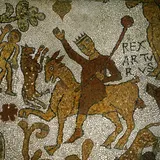
So, you know what? I think a good way to talk about King Arthur is that one of the books that I read in preparation for this episode was this really great book by the historian Guy Halsall called Worlds of Arthur, which basically is an overview of these sources we're talking about, like Gildas, that looks both at the Anglo-Saxon migration, but also looks for any trace elements that could have inspired the myth of King Arthur. I think that King Arthur is a really funny figure, and honestly, I would love to do a whole episode on him. He's funny because even though King Arthur is maybe the most single famous cultural figure associated with England, he wasn't English in any recognizable sense at all. And I would say that, moreover, most of the early Arthurian legends suggest that he battled the Saxons, which you could mean, you could argue, means that he was trying to stop England from existing.
You know, his life's mission was to stop an England from existing on Britain. Yet today, he has been totally recuperated as a symbol of England.
Yeah, this would be kind of the equivalent of the United States claiming Tecumseh as a founding father.
Great comparison.
The archaeology of conquest
That's a really good comparison. And so what Guy Halsall does is that he's a very critical historian. He's always very critical of traditional narratives. So he kind of contrasted the different modes of looking at the Anglo-Saxon migration. What he found, what he argues, is that from an archaeological sense, there does appear to have been a very dramatic transformation on Britain. Halal Sam, read what he has to say about the archaeology of the Anglo-Saxon migration.
Developing these conclusions, a political history was produced, which seemed strikingly to confirm that, given an outline by the written sources, a mass Anglo-Saxon migration drove the Romano-Britons into the Highland zone, Cornwall, and in the rest of the southwestern peninsula, Wales and Cumbria.
In the archaeology, it really does appear like there is a very large migration of people, not just pots, into Britain.
And also, these areas that are mentioned are the places where you, especially Cornwall and Wales, are places where you get remnants of the Celtic languages lasting the longest. Although it eventually fades in Cornwall, obviously. But.
Do we perhaps want to go back to our buddy Gildas?
Oh, sure, yeah. Yeah, read us in the next one about Gildas.
They devised, they being Vortigern, that the ferocious Saxons, hated by man and God, should be let into the island like wolves into the fold and beat back the people of the north. Nothing more destructive, nothing more bitter has ever befallen the land.
Yeah. And what Guy Halsall says is that the archaeology essentially matches what he calls Gildas' doom and gloom narrative. Because what you see in the archaeological record is that these Roman-era sites, which were still inhabited by people after the Roman Empire left Britain, suddenly collapse. People stop living in them. And what's especially grim is that around the years 400 to 500, it looks like many of these sites were burned. You know, so it's a really grisly picture. Like just according to this archaeological model, if we're just looking at the archaeology, then just like the people who wiped out the Cheddar Man, you seem to see this very major migration and a very major turnover or replacement. It really seems like the Anglo-Saxons were like these, you know, orc people who just stomped on these natives who were desperately trying to cling to this kind of civilization.
Okay, now I do get why modern English people use this as their historical model.
Yeah, yeah. So you can kind of see if the Anglo-Saxons really were so brutal and so destructive, why the modern-day British identity might not want to focus on the Anglo-Saxons that much.
What the DNA says
But before we get into the modern identity, my question is: were the Anglo-Saxons really as brutal and as destructive as the archaeology suggests?
Ah, well, I wouldn't have wanted to live in this period. Could I just say that?
Well, basically, what happened was that around the 70s, you know, the same time that everywhere people started disputing these migration narratives, people started looking more critically at the migration narratives in Britain. And they were wondering: is it possible that just like how the Celtic languages appear to have arrived without a major migration, is it possible that Germanic languages could have arrived without a major migration? The question isn't really settled, but it kind of seems like the answer is somewhere in the middle. That if we look at the DNA, it appears that unlike the Romans and unlike the Celts, there really was a pretty big migration of people, but unlike the Bell Beakers or unlike the Neolithic farmers, they didn't come anywhere close to replacing the existing population. So you know what? Halal Sam, read off this next quote that we found, this study.
So in 2016, there was a DNA study that found that roughly a third of the ancestry of modern English people is from the Anglo-Saxons, especially with people in Eastern England having up to about 40% and Western England, close to Wales and Cornwall, obviously, having as little as 25%. By comparison, this is a third Anglo-Saxon ancestry is similar to the European genetic influence on Honduras or Peru.
So yeah, so there was significant migration, just like a lot of Spanish people moved to South America, but it didn't completely destroy the existing society or population.
This is a Peru, not Argentina.
That's a great parallel. Like, look at Peru today. Indigenous Andean cultures, they're certainly not with, they're not free from oppressive influences, but these cultures are thriving. There are a lot of people in these places speaking indigenous languages who are able to keep up many aspects of their culture. And even Peruvians who speak Spanish, who might not identify as indigenous, have a lot of Indigenous heritage. And this is kind of the case for Britain. We saw this significant cultural transformation, but there were some aspects of the earlier British society that remained.
Here's a question for you, Liam. Do we have some idea of the breakdown of ancestry by paternal and maternal DNA?
Yeah, we do, and it's kind of what you'd expect. A lot more Anglo-Saxon ancestry on the paternal side, probably because many of these people who settled, just like the Spanish conquistadors, were unattached, you know, single-male soldiers who would have married local women. I think also in Eastern Britain, especially, one thing that's a little bit disturbing is that you suddenly see many fewer British men reproducing. I'm just talking about Eastern Britain. You might have seen something, some kinds of massacres, or at least some kinds of mass enslavement, you know, the way that something that would have looked a tiny bit like what R.A.S. Macalister described with the Bell Beakers. But it seems like that was really just a sort of a one-generation kind of thing. You appear to have had one or just a couple generations where these migrants set up these new societies where they essentially either subjugated the Britons or kicked them out.
But that isn't the full story.
Isotope analysis
Why don't you talk about this recent isotope analysis? Halal Sam. What do we find out about this recent skeletal analysis?
So, this is from just about a month ago.
Yeah, very new.
Yeah, very, very recent.
These are analyses of Anglo-Saxon burials.
Yeah, so these are basically to explain this. These are skeletons that are buried in ways that appear to be in an Anglo-Saxon style. They're not buried in the same way that Celtic burials would have been at that time.
Yeah, and just to make clear, isotopes are basically using isotope analysis. Archaeologists today are able to determine the area where someone grew up, for example, based on the kind of calcium they have in their teeth. Which is pretty wild.
Okay, so between 66 and 75% of the early Anglo-Saxons were of mainland European ancestry, and 25 to 30% were of local ancestry. This is in contrast to like in the Middle Anglo-Saxon period where there was 50 to 70% had local ancestry and 30 to 50 percent had mainland European ancestry.
What this means is that when you first start to see Anglo-Saxon style burials in Britain, it does seem like that at the beginning, in the first couple generations, most of these people are direct migrants from the European continent. People who came, you know, like you said, Russian Sam, from Angeln. And they came with their whole families and there was no one left to live in Angeln. But then as time goes on, you start seeing these burial practices spread to people who don't have Anglo-Saxon ancestry, which means that just like in Peru, you saw this slow, broad expansion of this culture that did not involve a change in the population.
Our estimates of the percentages of Anglo-Saxons who had mainland European ancestry fall within the range of estimates derived from genetic data. They contradict the picture of replacement that you get painted by these historical documents. And it seems more likely that the mismatch between our results and the historical document relates to the fact that the documents were written long after, and in many cases, centuries after, the migrations, and so the accuracy can be pretty questionable.
Right, right. So basically, so here's kind of the bottom line here. Modern British people are descended mostly from these earlier British inhabitants, you know, starting mostly starting with the bell beakers with some distant traces of previous peoples, then smaller bits of ancestry from later groups. But then the Anglo-Saxons were a very large migration, but they weren't large enough or they weren't destructive enough to really replace the previous people. So, like, the, and I think that really the most important effect of the Anglo-Saxon migration, it wasn't anything with the gene pool. It was just that it really transformed the culture. It changed the political identity of the British people to being English rather than being Brythonic, and it, of course, changed the language. There's a reason why we are recording this podcast in English, not in Welsh.
The term Anglo-Saxon
It should just be highlighted that the term Anglo-Saxon was never really a vernacular term. It shows up a total number of three times in texts in Old English. Like, this was pretty much just an official term that was used in some Latin documents, some charters by Alfred the Great and a couple of his descendants, who in the first place decided to adopt this title specifically to bind together as many of these people as possible. Just like, yeah, I'm the king of the Angles and the Saxons. I'm the king of the Anglo-Saxons.
Now that we've talked about how these people, who did to some extent, consider themselves Anglo-Saxons, came to the island of Britain. Now, we're getting into the juicy stuff. How did the descendants of these Anglo-Saxons, who were also descended from a whole bunch of other groups across European history, like the Neolithic farmers, like the Bell Beakers, maybe a tiny bit from people like the Cheddar Man, how did they turn their ancient tribal identities into a modern national nationalist identity? And how is this modern national identity shaped by its past?
So it seems like the initial use of the phrase Anglo-Saxon didn't mean a specific group of people necessarily who were a mix of Angles and Saxons. It only meant Saxons living in England, which had already been named after the Angles. So the first usage of the phrase Anglo-Saxon was actually differentiating Saxons in England from Saxons in Europe. Kind of like how you might say Asian American. That doesn't imply that Asian Americans are descended or ethnically mixed with other Americans. But of course, most self-designated terms are not coming from both Angles and Saxons, it's one or the other. English comes from Angles.
And there was one other that you found that I thought was kind of funny.
Yeah, the word Sassenach.
Yeah, so you know, Sassenach, which is a great word. It's what the Gaelic speakers in Scotland and Ireland call English people. It comes from Saxon. I think it's pretty funny. There's also a Tolkien pointed out that a pretty common Welsh surname, I believe it's Sayce, which is like very, which is seen as emblematic of Welshness, originally means Saxon. And I only wanted to bring that one up just to show the fact that culture and identity are incredibly tricky issues. Again, peoples are not billiard balls, which means that a lot of people who are proudly Welsh have a last name that suggests distant English heritage, even though they're still part of a Welsh community.
The Reformation's Anglo-Saxons
So when did this phrase, or at least the concept of the Anglo-Saxons, come into popular usage?
Well, first it died out when the Normans took over and it was just sort of forgotten about for a while, but then it began to have its moment in the sun in the 16th century.
So was this in the Tudor era during the Reformation?
That was exactly it. Basically, for those who don't know, the Reformation happened in the beginning of the 1530s because Henry VIII was married to Catherine of Aragon, who kept giving birth to daughters, and he just got really frustrated with her, so he wanted the Pope to grant him a divorce. But the problem was that Catherine was the niece of the Holy Roman Emperor, who was sort of breathing down the Pope's neck, so he wasn't willing to do that. And basically, this ended with the Church of England becoming decoupled from the Roman church and becoming its own thing.
So I know that the Reformation involved a lot of different competing Protestant sects. There was, of course, the Church of England, and there were all these other kinds of stranger ones that have kind of fallen down the wayside historically. Who exactly were the Protestant groups who were bringing back this kind of Anglo-Saxon identity?
Well, the Anglo-Saxon Project was really affiliated with the Church of England as a bunch of people were trying to mine these old English texts to show that there had in fact been an English church that was independent of Rome.
In the early Anglo-Saxon era, before Augustine of Canterbury came over.
Yeah, so one of the promoters of this kind of thinking was a guy called Matthew Fox, who was a priest basically. And here's an excerpt from an interesting book called Desire for Origins. There was another church, Fox maintained, and that was the true church, always there, keeping sparks of doctrine alive. The true religion, brought to England in the earliest age of the church, had survived until the arrival of Augustine, who brought with him Romish influence and destroyed the authentic Latin sources they described, studying by all measures how to preserve and further their newcome doctrine. Fox wrote that these conspirators did abolish and raise out of libraries and churches all such books which made to the contrary of their views. According to Fox, all heresies, including celibacy of the clergy, transubstantiation, worship of the Blessed Sacrament, among others, were new nothings lately coined in the mint of Rome without any stamp of antiquity.
Yeah, that's just so cool. Totally making stuff up on the spot to defend the idea of there having been this independent Anglo-Saxon church and they're just basically returning to tradition.
Yeah, so this was really happening mostly in the reign of Edward VI and Elizabeth. It was primarily a theological push, which was sort of the catalyst for renewing interest in the pre-Norman past, but it didn't stay put. It got out into the wider world and the consequences of that were quite interesting.
Arthur and the Tudors
We mentioned earlier in the episode that King Arthur as an English symbol is kind of an ironic appropriation, but one of the earliest uses of King Arthur as a specifically English symbol was by the Tudors, because although they, of course, were kings of England, they had distant roots in Wales. And I know Tolkien has argued, and I believe some more academic sources have corroborated this, that the Tudors specifically leaned into Arthurian mythology. You know, famously, King Henry VIII's older brother, who nearly became king, was named Arthur, as a way to kind of show this indigeneity of them as the English as distinct from the Normans. So even though the use of the phrase Anglo-Saxon basically dropped away in the Norman era, you saw among some non-Norman families a renewed interest in older British histories and the beginnings of a synthesis between Englishness and Celtic Britishness, even though if King Arthur ever existed, in his time, those would have been completely antagonistic identities.
Well, that's what dialectics is all about.
That's right.
Tacitus and Germanic democracy
So, yeah, England in this period was very unstable. It just kept going back and forth between monarchs who were Protestant and those who were Catholic. And this compounded a lot of other difficulties, which ultimately led to the English Civil War, which was fought from 1642 to 1651. And essentially, this was the point where this Anglo-Saxon stuff started to seep into political discourse, really. At this point, you had a lot more feelings of affinity with the Germans as a result of the Reformation, because that's where the Reformation started. And of course, a couple of decades before the Reformation started, Tacitus had been rediscovered.
Who, of course, and just for anyone who's not aware, Tacitus is the main source we have for ancient Germanic peoples. If you want to learn more about Tacitus and the ancient Germanic peoples, make sure to listen to our episode on the Netflix series Barbarians.
And yeah, so the manuscript for Germania was first printed in 1476, and it seeded a lot of interesting ideas about Germans, in particular their political system. For a little bit of context, just like Tacitus had done before, the image of these German barbarians was always politicized. Tacitus saw political values in the Germans that he believed the Romans were lacking. And it seems to be a similar thing going on here.
Which political values are we sure?
Yeah, well, basically, it's, you could argue, kind of proto-democratic values. Because what Tacitus says here is: on minor matters, only the chiefs decide. On major questions, the whole community. All their decisions, all their agreements are made this way. Night is seen as ushering in the day. Silence is commanded by the priests, who have on these occasions the right to enforce obedience. Then the king or the chiefs are heard in accordance with each one's age, nobility, military distinction, or eloquence. The power of persuasion counts more for them than the right to give orders. If a proposal displeases these people, they shout out their dissent.
Yeah, so exactly. Here we go. We have Germanic democracy. We have Anglo-Saxon democracy.
And the people who supported an English republic were saying that Anglo-Saxon life before the onslaught of the Normans in 1066 was one that was predicated on this idea of natural rights, which of course are eternal and unchanging and just sort of exist in the ether until some English guy was smart enough to pluck them out.
What the English are doing here is they are looking at this tradition of Germanic democracy, which I guess they see as ancestral because of the Anglo-Saxon-Germanic connection. But one thing I want to point out is that we don't really know if this is an authentic representation of how these ancient ancient peoples lived. Because Tacitus himself, as I was saying, was trying to make these political arguments about how the Germans of the present are more virtuous than the Romans of the present. And I just wanted to let you guys know that Tacitus was writing only about a generation and a half after the Roman Empire had been established out of the ruins of the Roman Republic. And I'm kind of wondering if this reference to barbarian democracy might really just be a thinly coated desire for return to Roman republicanism rather than any actual documentary account of how these Germanic peoples lived.
It certainly wasn't meant to be used the way it's used today or was used by these English people.
Yeah, no, I doubt Tacitus ever expected any Germanic-speaking peoples to be able to read. It's very possible that this was his own projection, that this was his own veiled way of criticizing the Roman Empire.
But it might also be true, maybe.
Maybe whether these things are true or not, nationalist myths must still have power.
Yeah, exactly.
The Norman yoke
And all of this goes back to the idea of a quote-unquote Norman yoke, which was a phrase that was used by a chronicler in the early 12th century, I believe, who was actually half British and half Norman. And he had these mixed feelings. Orderic, I think his name was. But he wrote this throwaway line in one of his manuscripts about the Norman yoke descending upon England. In a certain sense, the Norman onslaught of England was very oppressive, but that's mostly if you were Anglo-Saxon nobility because they just totally replaced the Anglo-Saxon nobility. Something like 190 people owned half of the land in the country as a result of the onslaught. And like 10 to 20,000 Normans came to move to England. But over time, they mixed heavily with the English population until by the 13th century, it was difficult to tell who was properly a Norman and who wasn't.
Yes, yes.
And I wanted to add on to that and sort of bring back something I said earlier, which is that the Norman-English distinction, although it sort of, people tried to project this onto it later, it wasn't a distinction between two nations. The Normans were, if anything, really more of a tribal or dynastic group who happened to be French-speaking, and over time, they lost this French-speaking character, and they were no longer readily distinguishable from people of non-Norman English descent.
And I mean, they were Vikings originally.
Oh, yeah, of course. Yeah, yeah, no, definitely. They absolutely were. And, you know, so we, but going back to this period, we mentioned how the Tudors embraced Britishness, which included this synthesis of Anglo-Saxon and Celtic traditions in the form of Arthur. But one thing I want to mention, back to add a little bit more context, which I'm always doing here, is that the Tudors were doing this not too long after a hundred-year-long war with mainland France. And I have to think that part of their embrace of Englishness and even more ancient Britishness as opposed to Norman-ness was because there might have been a renewed animosity toward people of French descent because of this war. It seems like a pretty perfect opportunity to want to lean into the fact that you aren't French. In fact, you're not even just Anglo-Saxon. You're actually a fucking Celt like King Arthur.
And this is something that parallels with the later kind of distancing from German ancestry that we saw after World War I.
Yes, and we are going to get into that really soon. Russian Sam, what do you learn about next for the use of Anglo-Saxon identity in politics?
The Diggers
Well, the English Civil War was going on. There was a lot of discourse, lots of posting the old-fashioned way with pamphlets. Yeah, and one particularly interesting pamphlet where this discourse about the Normans crops up is a 1649 pamphlet by one Winstanley, who was the head of the Diggers, who were basically a more radical version of the Levellers, basically proto-agrarian socialists. But he wrote this pamphlet called The True Levellers Standard Advanced, or The State of Community Opened and Presented to the Sons of Man, which has some spicy discourse about the Normans. For what are all those binding and restraining laws made since that conquest, but the cords, bands, manacles, and yokes that the enslaved English, like Newgate prisoners, wear upon their heads and legs as they walk the streets, by which those Norman oppressors and their successors from age to age have enslaved the poor people, killed their younger brother and would not suffer Jacob to arise.
That while you pretend to throw down that Norman yoke and Babylonish power and have promised to make the groaning people of England a free people, yet you still lift up that Norman yoke and slavish tyranny. England is not a free people till the poor that have no land have a free allowance to dig and labor the commons and so live as comfortably as the landlords live in their enclosures. Riveting stuff, no?
Absolutely. And what's interesting here, which I think is very significant, is that it totally combines, in an, I would assume, an organic, almost unintentional way, this proto-nationalistic claim about, you know, the English as indigenous versus the Normans in this class remark. I don't think there's anything oppressive about being mean to Normans, but it does, I have to say, sort of bring to mind German populist anti-Semitism, which would blend very real, completely understandable economic critiques of the vagaries of German capitalist society with this really vicious anti-Semitism. And I think this is kind of a similar sort of thing. It's this inability to separate the economic relationship that English peasants had with their overlords with this perceived national tribal conflict that might be slightly easier to comprehend.
Yeah, it's just these people are using Norman as a shorthand for the oppressors. And I mean, yeah, of course, the Normans were oppressors. In fact, England never really had any land reform. So the descendants of the people they're talking about are still the ones who own all of that land. But it's not because they're Norman that it's an issue. It's because they're monopolizing all of these resources for their own personal gain.
Racial Anglo-Saxonism
Right. So, so we've seen here how English identity as distinct from Norman identity, which basically is implicitly Anglo-Saxon identity, came about again in the era of the Reformation and the English Civil War. But how did the phrase Anglo-Saxon, which has somewhat recently come into question in academic circles, if it even should be used, when did it gain such a notorious political valence and association with reactionary racism?
It sort of fell off after the end of the English Civil War, but it was revived to a much greater extent in the second half of the 18th century. And at that point, it began to combine with the nascent racist discourses that were hanging around in the air for a while. And of course, this had some very interesting implications because you suddenly had this showdown between Anglo-Saxonism, the idea that the inhabitants of England are descended from Anglo-Saxons, and Celtism, which was the idea that they're descended from Celts. There's an article called The Origins of Racial Anglo-Saxonism in Great Britain before 1850 by Horsman, and he talks about this tension between a nascent Anglo-Saxonist movement and a nascent Celtist movement.
I know that, yeah, and one of the writers you found, I know, was John Pinkerton, who you think is basically the guy that really started the racial Anglo-Saxon movement, which was a huge forerunner in basically modern white supremacy.
Yeah, that's the argument that Horsman makes in this article, that Pinkerton was the first one to really make this argument explicitly. Pinkerton, who possessed a striking polemical style, argued that the Celts were an inferior people who had been driven out of much of Europe by the Goths, a term that included Greeks and Romans, as well as Germans and Scandinavians.
This just shows how ludicrous nationalism so often is. There is absolutely nothing culturally linking Greeks and Goths that they do not also share with the Irish. But he's using this very kind of a sneaky historical abuse in a way to connect people he respects with a more grand ancient past, even if this connection isn't legitimate.
Pinkerton had firm views on race, which differed from most of his contemporaries and accurately foreshadowed 19th-century developments in scientific racism. Writing, a Tartar, a Negro, an American, etc., etc., differ as much as a German as a bulldog or a lapdog or a German cur from a pointer, wrote Pinkerton. Pinkerton was unusual in that rather than merely praising Germanic characteristics, he was prepared to make comparative racial judgments. He wrote of Celts who, quote, have been savages since the world began and who will be forever savages while a separate people, that is, while themselves and of unmixed blood.
I think it's interesting that the group in this paragraph that he's really singling out are, you know, he says Celtic people, because this kind of ties into the imperialist implications of this Anglo-Saxonist ideology. Because, of course, this was in the 18th century when Britain had recently embarked on its, you know, massive colonial ventures. But the colony closest to home, which was one of the most troublesome, was Ireland. And I have to think that when he's writing the Celts here, he's not thinking of the ancient Gauls. He's thinking of the Irish people just across the sea.
Yeah, like you can tell that he's just dripping with contempt. And this certainly isn't because of some guys who lived in Britain 2,000 years ago. No, he's talking about the enemies of today, or his enemies of the day. That is the people of Ireland who are not being good little subjects.
Yeah, so Pinkerton was ahead of the curve in this regard.
With race science, yeah, he was a very progressive race scientist. He won the Nobel Prize in it, actually, for his overwhelming contributions.
But it got a lot more serious as a discipline over the course of the 19th century, as the Imperial Project expanded further and further, and suddenly there was this need to... There was basically this argument being made that the Anglo-Saxons are a great freedom-loving people, and that's just an inborn trait that they have. And so, therefore, they have the right to conquer everyone else to show everyone how great they are. Just as the Anglo-Saxons had the right to conquer the people of the British Isles.
Robert Knox
And here's another great British race scientist speaking about the Celts that I quite enjoyed. This is a guy named Robert Knox in a book called The Races of Men.
Oh, yeah, this guy's nasty.
And just before anyone asks, my family's Irish, so I'm allowed to say this. The Celtic character was an amalgam of furious fanaticism, a love of war and disorder, a hatred for order and patient industry, no accumulative habit, restless, treacherous, uncertain. Look at Ireland. Although Ireland had suffered from Norman rule, the source of all evils lies in the race, that Celtic race of Ireland. Wales and Scotland gave similar examples. And the Celtic race should be forced from the soil. By fair means, if possible, still they must leave. England's safety requires it. I speak not of the justice of the cause. Nations must ever act as Machiavelli advised. Look to yourself.
God, this is so cool.
God, he really is. The guy's fucking scared of Irish people. Come on, man.
You think he got like made fun of a lot on St. Patrick's Day? You know, some like Irish kids or something bullied him too much?
Yeah, people were just so much more unhinged back in those days. We're a lot more progressive now that white people have just melded into a single group. So now it's just like, you know.
I'm just glad there's no one in Ireland today who believes any of these things.
Oh.
Yeah.
The Celtist response
So what I really think is so important to this discussion of England is that England had a very, a very fraught relationship with its own national identity. Because although we've seen these writers already who had very vehemently anti-Celtic sentiment, other writers saw the British people as a Celtic people. And that just in the way that the English-speaking Tudors recuperated the legacy of King Arthur, which took its source in an anti-Saxon polemic, essentially, some English writers actually embraced this Celtic heritage. So one prominent British Celtist in this period was a man by the name of Matthew Arnold, who is perhaps most famous for his study of Celtic literature, which was basically an attempt to show the ways that the English national character has been shaped by the Celtic people.
Arnold's work was written to stress the polyglot nature of the British nation and the diversity of cultures that were available to rejuvenate what he saw as the chief obstacle to the fostering of a healthy national cultural tradition. The Philistinism of the English middle classes. The Celtic element in the English nation, Arnold saw as essentially sentimental, with characteristics of wishful regret and passionate melancholy. This Celtic element checked the steadying Saxon temperament so that the national makeup of the English led them to have a middle place between the Germans on the one hand and the Welsh on the other.
So here it's kind of interesting. This is kind of a common element of nationalism. I've read a fair amount about German anti-Semitism, and there was one small group of German nationalists in the 19th century who themselves were not anti-Semitic. And instead, just like this guy, Arnold, they thought that the blending of German Gentiles and German Jews could lead to kind of a stronger cultural median, which seems to be what Arnold is advocating for here.
Yeah, this is far less psychotic than the other stuff we've read.
Yes, but of course, so this, we're moving now into the middle and late 19th century, and of course, there was no small amount of racial psychos in this time period.
Oh, this is a golden age for that.
In comparison with this vision of a more plurally based conception of Englishness, the apostles of the Teutonic conception of the English national origin, such as Charles Kingsley and Anthony Froude, tended to assert a single racial base for Britain. This was more easily to apply on the imperial plane than it was for the more complex and ambiguous pluralist dosha.
World War I and the House of Windsor
So yeah, so basically kind of there's been this really fraught sort of history about is in the later 19th century is Britain a Celtic nation or a Germanic nation? But this question was pretty soundly settled by something that happened in the early 20th century. Anybody who knows anything about the House of Windsor and what they used to be called knows what event I'm talking about.
World War I, baby. The House of Saxe-Coburg and Gotha became the House of Windsor.
Just like how the Tudors, after a full century essentially, of war with France, really wanted to step away from any potential French influence, not only in their family, but within the broader national culture. In the early 20th century, you saw a sudden turnabout, a movement away from Anglo-Saxon traditions, because the British public could not stomach being seen as German, which I find really interesting. And even though I don't think there is any real anti-German animus today after the world wars, I would argue that the modern British national identity sort of has its roots in this rejection of Anglo-Saxonism.
After you send your sons, you know, to fight for years and years in the Somme against the Germans, it's pretty hard to stomach the notion that they are your kinfolk.
And then do it again two decades later.
It's certainly that the current British national identity, which I would argue is more Celtic-looking, is not any more or any less logical than the older sort of Teutonic identity, especially because the Teutonic identity was so racialized.
Civic and ethnic nationalism
I think that what I just find really interesting about this struggle within the British national identity is that it's the perfect example of how nationalism is the construction of an imagined community. Because I would argue that this less racialized, more Celtic-looking national community is a community that's more based on who lives in Britain rather than what is the ethnic origin of a certain group of people. I would argue that part of why this more Celtic-looking nationalism is in use today is because it's a bit more palatable to an international society like modern Britain. If both the Cheddar Man and Hengist and Horsa and King Henry VIII can all be considered equally British, then it's a type of civic nationalism essentially that can apply to people of any ethnic background. I would argue that the nastier, more Teutonic nationalism is less compatible with the modern globalized world.
Oh, yeah, of course. But it should also be noted that there's no reason why the Teutonic nationalism had to be the psychotic one and the Celtic nationalism had to be the more chill one. It's all just a coincidence, really.
Yeah, yeah, and I think that broadly speaking, I think that national identities, they're shaped by their context. You know, that's like the only reason why Britain moved away from German influence is because they happened to be enemies with Germany. Had World War I gone a different way, if Britain had been allies with Germany, but was also accepting immigrants from places like India and Jamaica, it's totally possible there might have been a sort of a Teutonic nationalism that wasn't racialized. I know, because you know, quite famously, French colonial textbooks across the 20th century, even in places like Guinea-Bissau or Montserrat, where people probably had no European or French ancestry, the textbooks would begin with a famous line. Our ancestors, the Gauls, yada, yada, yada.
Guinea-Bissau was Portuguese though, so you might want to change.
Fuck! Damn it! I'm so sorry, guys. I'm a fraud. I just gotta leave this podcast if I can't remember which small African countries were colonized by which imperial bastards. I apologize.
Fucking Irish. I'm kidding. I'm kidding. It's because the small Irish brain is so provincial and so unused to conquest that they can't keep all these names straight.
I think this is a great time for a quick little break. And as soon as we come back, we're going to talk about, as we said, one other country with a very cursed past, which has a type of nationalism that might look a little bit more like the kind of Teutonic identity which is defeated.
Turkey and Anatolia
So just like in Britain, Turkey's been home to hundreds of different ethnic groups across time. The oldest known temple is called Gobekli Tepe, which might even predate agriculture, and the oldest known town, Catalhoyuk, they're both located in Anatolia, which is part of modern-day Turkey.
Anatolia is the peninsula that makes up like 80% of Turkey.
That's actually a tricky subject because the term Anatolia, which by the way, is actually a Greek word. It's literally the Greek word for East. But since the founding of the Republic of Turkey, the definition of Anatolia officially in Turkey has changed. It used to kind of stop at the mountains, because if you actually look at the map, only part of it's a peninsula. But what used to be called Western Armenia or the Armenian highlands is now Eastern Anatolia.
And you know what? That's a perfect metaphor for what we're about to talk about.
Yes, even geography has been shaped by nationalism.
We'll talk about this in a minute, but if Britain takes the geography and projects that forward toward ethnic groups who only share geography with disparate ethnic groups who have lived in Britain in different times, if anything, Turkey is the opposite, where they take an ethnic group that's currently dominant within Turkey and then use that ethnic group to change the definition of the geography to suit their needs.
Exactly. So the Hittite Empire was one of the major players of the Bronze Age and Iron Age, and Turkey was home to at least a dozen other kingdoms and peoples. But the most important for our discussion are the Greeks, who would control Anatolia for centuries until Rome conquered it. But they'd remain the dominant group, dominant cultural and linguistic, throughout the Roman period and would survive until the end of the Eastern Roman Empire or Byzantine Empire.
The last Byzantine emperor to be a native speaker of Latin, I think was Justinian in the 500s.
The Byzantine Empire was effectively the Empire of Greeks.
Yes, it was the Roman Empire because it still had Roman institutions and Roman law, but it was everyone who spoke Greek. It was Roman and Greek.
A different national identity
I think that these multiple kinds of Greek and Roman and Hittite layers are interesting because, unlike in Britain, where all of these previous cultural layers, even those that have very little modern impact, like I keep mentioning the Cheddar Man, it's the opposite in Turkey. In Britain, those cultural layers are a big part of the national identity. In Turkey, they really aren't. Because in Turkey, the national identity doesn't embrace the achievements and successes of the Eastern Roman Empire, who ruled over modern-day Turkey for such a long period of time. Instead, the Turkish identity rests entirely on the migration of Central Asian Turkic speakers who ultimately defeated and subjugated the Eastern Roman Empire and have brought the Turkish language to Anatolia and which has been Turkish speaking for about a thousand years.
Exactly. If you look at a Turkish elementary school textbook, it'll tell you something like this. This is one from 1991. Archaeological excavations and research into Central Asia have shown that the oldest civilizations in our world was the creation of the Turks. Turks from Central Asia migrated to various parts of the world and helped the natives who still lived in the Paleolithic age to move into the Neolithic age. They learned from the Turks how to cultivate and how to work metals. In these new countries, the Turks made further advances, building big cities and founding strong states, important centuries of civilization, were thus created in Mesopotamia, Anatolia, Syria, around the Aegean Sea.
God, that's so cool. Just Turkic missionaries on a civilizing mission across the world.
Anybody who has taken even the smallest sliver of a class in ancient history knows this is absolutely bullshit. If anything, what marks the Turkic peoples in the Middle East and Anatolia, is that they are the most recent newcomers. And there's nothing wrong with that. Turkish identity is no less valid than an older identity. It's just that it doesn't actually have this deep ancient past.
The Seljuks and Manzikert
Because you see, is that the only reason why Turkic speakers live in Anatolia was because maybe 400 years after the death of Muhammad, there was the Seljuk dynasty, which was this very powerful kind of mercenary clan that eventually took over Iran and from there spread into Anatolia. You know, of course, Turkic languages initially come from the Altai mountains of the eastern steppe, pretty close to Mongolia. The first Turkic speakers would have been very culturally similar to Mongolians, but over time, they adopted a lot of Persian influences. They kept their language and they adopted Islam. And they brought this sort of Islamic, Persianized Turkish identity into Anatolia, where it slowly, in a sense, formed the basis of the modern Turkish identity. Would you mind Russian Sam explaining this quote by the historian, I believe her name is Joan Hillenbrand?
Nobody knows exactly when nomadic Turks, the Turkomans from Central Asia, first came to Anatolia, the land now known as Turkey, or how many nomads were involved. What does seem clear, however, is that it was the policy of the first three great Seljuk rulers, Tughril, Alp Arslan, and Malik Shah, to direct the Turkomans to the frontiers of their empire and thereby to soften up their enemies, as well as sidestepping the problem of how to control these often undisciplined forces.
Just to pause here, so we do know that there was certainly this migration, just like the Anglo-Saxons. We aren't really sure what kind of migration it was. Was it just the military elite, or is it people? The historical sources suggest that whole families were probably being moved over as part of this political program.
This process brought about the Turkish penetration of Azerbaijan, the Caucasus, and Anatolia. The Battle of Manzikert in 1071 was viewed retrospectively as a hinge of Turkish history.
It should also be noted that, like, in a lot of these battles, the Turks weren't the only ones who were fighting these battles. In fact, there were a bunch of Armenians involved in these early Turkic expansions, funnily enough.
Right, right. And because remember, this is a pre-nationalist period. Modern-day nationalism simply cannot be projected back into the Middle Ages. The most important cultural identity in this period was absolutely religion. So you had Armenian-speaking Muslims and Turkish-speaking Muslims, and I'm sure plenty of Arabic-speaking Muslims all fighting in this same battle. And later on, as we're going to talk about, over time, the legacy of this battle and of the Turkish migration, the migration of Muslims, the slow conversion of Christians to Islam in Anatolia was flattened into a simpler Turkish nationalism. If you wouldn't mind Halal Sam telling us what happened next after the Battle of Manzikert.
So the Seljuks established the Sultanate of Rum, meaning Rome, Rum, and their descendants would rule Anatolia for almost a thousand years. And the Ottoman Empire, which spanned multiple continents, would begin as a successor state in northwest Turkey. And over time, the Turkish language and Islam would spread across the mostly Christian, mostly Greek-speaking population, leading to a new cultural identity that began not with the ancient peoples of Anatolia, but with this 11th-century migration of Turkic Muslim migrants.
And one thing we should add: whenever Turkish nationalism looks past Manzikert, looks beyond Manzikert, it doesn't look at the earlier Anatolian civilizations, that much. Instead, it looks back towards the steppe. So, you know, we don't have to get into the genetics here, but the Turkic speakers who came over, just like the Anglo-Saxons, they weren't a majority of the population. Most people living in Anatolia, who were the majority of the ancestors of modern-day Turkish people, would have been Greek speakers. Some of them might have been Arabic speakers, some of them might have been Armenian speakers, but they were acculturated into this Turkish culture. So it reminds me of what you said, Russian Sam, how in the French colonial empire, people in Africa were taught that their ancestors were the Gauls. In modern-day Turkey, there's something similar. No matter what someone's ancestry happens to be, they are taught that their cultural history, their lineage, begins in the eastern steppe, the Altai Mountains.
Exactly. That is the center of civilization and culture for Turkish nationalism. That is where it all begins.
An Islamic identity
But I guess, but of course, though, nationalism didn't exist in the Middle Ages. In the Middle Ages, the medieval Turkish identity, or what would become the medieval Turkish identity, was totally Islamic. It wasn't about being Turkish. I honestly doubt that in the Ottoman era, people really gave much thought to the deep past at all. They probably didn't even know how far deep into Northeast Asia the initial Turks had come out of.
No, why would they?
Exactly. Like, you know, even there's some evidence that even in the early Middle Ages, many Anglo-Saxons didn't realize that they had an ancestry in the continent. But, anyways, the really important thing, that the thing that preceded the modern Turkish identity, modern Turkish nationalism, was the Ottoman era Islamic identity, which really was not a national identity. Because Turkish-speaking people in the medieval and Ottoman era, they didn't identify with their ancestors, who might have been, you know, Hittite, Greek, even Latin-speaking. Instead, they identified with all Muslims, even Muslims who had no real connection to Turkey. Could you read this other Hillenbrand quote?
The heroes whose exploits are sung are Muslim warriors for the faith, regardless of their ethnic origins, Arab or Turkish. So the exploits of the shadowy Sayyid Battal Ghazi, who was an Umayyad Muslim leader, are effortlessly associated and conflated with those of the Turks after Manzikert. The Turkish newcomers in the 11th and 12th centuries established continuity with the Arab Muslim past in the same geographical area, and they inherit the glorious Muslim pedigree personified in the caliphate.
Right. So this was the identity that existed for many, many centuries in Anatolia. It was this very Muslim identity that I would argue didn't look toward Constantinople, you know, the shining capital of the Byzantines. It looked toward Mecca and Medina, you know, these holy sites in Islam. It suggested that being a Muslim was really what mattered most. It didn't really matter that you spoke a language from Northeast Asia, and it didn't really matter that your ancestors might have been Greek speakers. What mattered is that you were part of this universal Muslim world?
I'd actually maybe push back on that a little bit. Maybe this was the elite discourse, but I'm pretty sure that if you had gone into like a village in the Anatolian heartland and asked the people how they identified, they would be identifying with their village or their family or their clan, etc., and wouldn't really think to talk about their Muslimness that much until a certain point. But they certainly wouldn't have talked about a nationality.
No.
Because I don't think Turkish nationalism existed in any sense in the Ottoman era. In fact, Turk was a derogatory term for a very long time.
I'm just about to get into that.
The birth of Turkish nationalism
So, Turkish nationalism comes out of the same circumstances as nationalism, like Balkan, Greek, and other forms of nationalism. That is, the disintegration of the Ottoman Empire. Especially the aftermath of the Balkan Wars and the loss of Greece in the 19th century. We shouldn't say that Turkish nationalism destroyed the Ottoman Empire, as some people put it, but I think it's better to say that the fall of the Ottoman Empire necessitated the construction of a Turkish nationalism.
Exactly. Something new had to be made because the empire itself was a sinking ship. Not that the defeat of the empire was inevitable, etc., etc., but time was not on its side. Let's just, I'll put it that way.
Right. And so, so, from what I understand, the Turkish identity basically begins before the Republican period. It was when you know the original young Turks were around, the Committee of Union and Progress. But they really, these guys, the young Turks, they knew, as you said, the empire was a sinking ship. They knew it wasn't going to last. So many territories had already been lost. What was left was really the Turkish-speaking heartland, essentially. And that's what they doubled down on.
It was no surprise that the huge losses of the Balkan Wars, the ensuing establishment of nation-states by formerly Ottoman subjects, and the persecution of Ottoman Muslims in these regions, that's really important, confirmed suspicions in the CUP, the Committee of Union and Progress, that non-Turkish Ottomans could not be trusted. The conclusions the CUP drew from its analysis of the political predicament of the Ottoman minorities quickly turned very hostile. That's from Ugur Umit Ungor's paper on Diyarbekir, which is a specific thing. And I'm going to read a quote from Mustafa Kemal now, you know, Ataturk, who's really the founder of modern Turkey, who said that the new Turkey has absolutely no relation with the old Turkey. The Ottoman state has gone down in history. Now a new Turkey is born.
Exactly. Which really shows the perspective of these Turkish nationalists. They were not the Ottoman Empire. They were no longer part of this tradition that, at least among the elites, as you pointed out, Russian Sam, looked toward Mecca and Medina, nor were they part of this older, you know, Byzantine, Hittite, Anatolian tradition. Instead, they drew this new identity that only embraced the Turkish language and deep heritage from the steppe. They looked toward the Altai Mountains.
Exactly.
Turkifying the language
Yeah, so as part of this process of building an entirely new Turkey, they had to get very creative about a lot of stuff. They tried to completely Turkify the language to get rid of loanwords from Arabic and Farsi, which wasn't very successful.
And one thing I should add is that the Persian influence was really a big part of Islamic Turkish culture because the Seljuks had come not straight from the steppe, they were from Iran. They conquered Iran and then they conquered Anatolia.
Yeah, basically the Turkish language that would have been written, like the written language, not the language in the villages, was very heavily Persian inflected both in terms of its vocabulary and its grammar. And of course, at this time, before Ataturk, the alphabet they used was the Perso-Arabic alphabet. It was not the Latin alphabet of today.
Yeah, which is terrible for writing Turkish, by the way.
Yeah, it's a vowel-heavy language.
That's too bad.
Yeah, so an alphabet without vowels, not what you want to use, I guess.
Sun language theory
But yeah, speaking of language, they pushed some rather interesting theories about language, not only Turkish, but the origins of language itself. They had something called sun language theory, which was basically the idea that all language was derived from a sun cult, which was practiced by the proto-Turkic people. And so they developed a vocabulary and grammar so they can do rituals to worship the sun, essentially. And over time, this language became Turkish. And then these Turks, like, they spread all over the world and taught everyone else how to speak.
You know, and that sounds just like the bullshit that white supremacists in the earlier 20th century were saying. Like, you know, the Nazis, for instance, part of why they embraced the swastika symbol is it's a really fucking common symbol. It's really easy to draw like a twisted little X like that. So, what the Nazis would do, they would find instances of swastika symbology anywhere, even I think in the Americas. And they would use this as proof that the ancient Aryans, because of their, you know, innate superiority, were able to migrate to all of these places where in history they never actually had been.
Yeah, I have a great quote from the New York Times in 1936 where they summarize this sun language stuff. The Sumerians being Turks originating in Central Asia, all languages also consequently originated there and first used by the Turks. The first language, in fact, came into being this way. Prehistoric man, in other words, the Turks, in the most primitive stage, was so struck by the effects of the sun on life that he made of it a deity, once sprang all good and evil, events came to him light, darkness, warmth, and fire. With it were associated all ideas of time, height, distance, movement, size, and give expression to his feelings. The sun was thus the first thing to which a name was given. This was OG. And from this syllable, all words in use today are derived.
I believe it.
Wounded nationalism
We're all familiar with the podcast, The War Nerd, which is really one of the best current event podcasts and 20th century history podcasts. One thing that he said quite a bit, which I think is completely correct, is that all nationalism is wounded nationalism, and that nationalists by nature have a chip on their shoulder. If I had to hazard a guess, I think that some Turkish nationalists are insecure about the fact that the Turkish national identity basically begins in 1071, which is somewhat recent for a national identity to begin. So I think that because of this wound, this wound of recency, many Turkish nationalists wanted to fabricate this ancient Turkish past.
Exactly. They projected backwards, they grabbed a cultural identity that didn't exist. You could say it didn't exist in the 20s. If you want to be very generous, you could say it didn't exist until the 11th century, and they pushed it back entire millenniums.
Yeah, they just acted as if they invented civilization, period.
It's kind of funny to talk about how these absurd nationalist claims are so crazy. Just like how, you know, it's so crazy that the Nazis thought that ancient Aryans were like in Tibet. But this has real-world implications. Nationalism is almost always a violent process, which leads to people outside of this imagined community being visited upon by really terrible violence.
Yeah, and Turkey is a good example of that.
Absolutely. Because I think that this kind of funny sun language stuff also ties in pretty awfully, not initially modern, but recent Turkish politics.
The population exchange
Yes, I mean, for example, a good example of this is the Greek-Turkish population exchange, which is a nice way of saying ethnic cleansing. There was a massive population exchange of Greeks in Anatolia for Turks in what's now Greece. And it wasn't quite as simple as just you're a Turk, you're a Greek. There were, for example, Greek Orthodox Turkish-speaking people in Cappadocia, in like central Anatolia. They were Christians, Orthodox Christians, and they wrote Turkish in the Greek alphabet.
Which country did they end up going to?
Well, to Greece, which was a foreign country to them.
If you're looking at Turkishness as a national identity, they looked toward the steppe just as much as any Turks did. But because of this older Islamic tradition, they were seen as not Turkish enough.
Yeah, and it's also a very interesting contradiction where the Kemalist regime is trying to build the secular Turkish identity. But when push comes to shove, they're determining Turkishness by religion rather than by language.
Mountain Turks
And so here's something we wanted to get to: on the flip side of this, Kurdish people cannot meaningfully be considered Turkish.
Oh, what are you talking about? They're mountain Turks.
Yes, Kurdish people have a deeper history in the Caucasus and in the Iranian plateau. But like he said, Russian Sam, the official line until I believe the 90s was that Kurds were to be considered mountain Turks. They were simply another aspect of the Turkish nation. Therefore, their territory must always remain part of Turkey. And therefore, as wayward Turks, they must be properly educated, which was code for oppression.
Like they literally said that the Kurdish language, which is an Indo-European language, mind you, is a dialect of Turkish.
Yes, incredibly distinct from Turkish, as distinct from Turkish as Yoruba is. So you know what, Halal Sam? Tell us what this is a relatively modern historian in Turkey has to say about the Kurds.
This is Orhan Turkdogan, who is an accredited academic. There is no such thing as the Kurdish people or nation. They are merely carriers of Turkish culture and habits. The imagined region proposed as the new Kurdistan is a region that was settled by proto-Turks. Sumerians and Scythians come immediately to mind.
Which is ludicrous. You know, the Scythians were doing their, the Scythians, they were doing their like horsey Milky Boy thing on the steppe for a very long time, and then the Turks, if anything, kind of took them over. If anything, it's the opposite. You know, the Scythians cannot be considered Turks.
No.
It's goofy that this abusive history, but this abusive history has very violent applications, which so does so do so many national identities. And that's what I find is so, is just like kind of tragically funny. National identities are oftentimes arbitrary, they're oftentimes ludicrous and laughable from a historical standpoint, but because they have these real-world implications, if the coin happens to fall in a way that excludes a certain group, then that certain group is going to be terribly victimized by this arbitrary nationalism.
Exactly. Yeah, like it's funny, but also like this stuff actually unironically kills people.
Absolutely. It's continuing to kill people today.
Hatay
Do you guys want to talk about Hatay Province, which I know you've done a little bit of research on, Halal Sam?
Hatay Province is the most recent addition to Turkey. It was added in the early 30s, and it was taken from Syria, from French Syria. And after that happened, as a result of a totally referendum, all the place names were changed from Arabic to Turkish. The people were Turkified. And the most interesting thing about that is the name of the province itself, Hatay, which comes from Hittites.
Yeah, which is crazy. So this is a great example. So the name Hatay completely attests to the pre-Turkish history of the modern Turkish region. But it's instead the policy of Turkish nationalism is to paint everything with this brush of the steppe.
Exactly. Instead of calling it Iskenderun or Alexandretta, it's now Hatay, it's now Hittite.
That's just kind of goofy, but the really horrible implication of this is that the people who were not Turkish, who lived in these provinces, were forced to become Turkish.
The Armenian genocide
One thing we haven't even mentioned is that one important figure in the late Ottoman Empire, who wasn't really a Turkish nationalist but embraced some aspects of it, Enver Pasha, he was instrumental in carrying out the Armenian genocide. Armenians could not be squared with the early formations of this new Turkish nationalism amid the death throes of the Ottoman Empire. They were seen as a potential fifth column because they were Christian and many of them lived within Russia. So when the Ottoman Empire went to war with Russia in World War I, the Armenians were slaughtered. They were marched into the desert. Those who resisted were shot terribly. They were forcibly starved. They were murdered en masse. It was one of the worst genocides of the 20th century. And to some extent, it was because of this nationalist formation in Turkey.
Yeah, exactly. And after that, the names of their places were changed. Western Armenia became Eastern Anatolia. All the city names changed. Like in some places, like 50% or 75% of some places of these names are totally different from the original Armenian names. Some are just completely invented.
Afrin today
I don't like discussing modern-day politics on this podcast, but I think that we do need to mention here that this is arguably a continuing process. Because when Syria's Afrin Canton was occupied by Turkey a couple of years ago, they started doing something a little bit similar to what happened in Hatay 80 years ago. They didn't, I don't believe they changed any names, but they started teaching Turkish in schools.
Yes, and they started issuing signs in Turkish and Arabic. Yes, people in classrooms in this province of Syria, which is under Turkish occupation currently, their schools now have Erdogan's portrait hanging on the walls. It's truly interesting. And there's a Turkish post office in some of these places, in this place. It's connected to the Turkish electrical grid.
And also, like, the population of this place was majority Kurdish before Turkey decided to go in because they wanted to use this territory as a place to house Syrian refugees, and many of those people were literally kicked out of their homes. It's it's ethnic cleansing. There's no other word for it.
Yeah, it's it's it's it's it's it's horrible. It's horrible.
Yeah.
Online nationalists
As another, you know, accident of history, Turkish nationalism is currently a lot more active, I would argue, than British nationalism. There are still many people who are terribly chauvinistic British nationalists, but it seems to really be on another level in Turkey. The one classic thing that a lot of people encounter on the internet are you know online Turkish nationalists who sometimes get a little goofy. This is just a little mechanism right here: sort of notorious Turkish YouTube comment that I think does probably speak to the way at least some Turkish nationalists view their identity.
Yeah, so a guy with the name Batman and his anna, his profile picture is some anime girl, you should add, which gives a little nice little flair. So, Bruce Wayne wrote, I am from Izmir. I did an ancestry DNA test and learned I'm 80% Greek. My whole world has changed. I tried to commit suicide, but couldn't do it. Now I have to live like this. But after that, I decide it is Zionist game. I suggest people don't do DNA. It's why, because I'm 100% Turkish. Thanks.
We're not going to get into the genetic stuff here, but 100% Turkish doesn't. Nobody is 100% Turkish. Even people living in Northeast Asia today who speak a Turkic language, whose ancestors did not migrate to Anatolia like these guys, they're not even 100% Turkish. Because no population, unless you're like a completely uncontacted tribe, no population is totally unmixed. Cultural identities are not based on ancestry.
Yeah, and the Turks of Turkey are probably the least Turkic of the Turkic peoples that exist in terms of ancestry, but it doesn't matter. They're still hardcore nationalists.
Nationalism constructs these identities that become incredibly important, even if they don't conform to the facts of history. And typically, when this happens, when there is this disconnect, which is inevitable with any national identity, typically what happens is the nationalists suppress discussion of history because they want to present their mythology as objective, even though it never can be.
"We are Muslims"
Turkish identity was something that until the Ataturk's time was not felt by a lot of people.
Right.
It was, yeah, it was either you had a regional identity or you had an Islamic identity.
Yes.
Yeah, the same way that Arab was used for a very long time, it was just a Bedouin.
I'd like to read a quote. There was nobody, this is about the eastern provinces. There was nobody who praised himself as being Turkish. The term Turk seemed to be a shameful one. Nobody wanted to take upon oneself. In Eastern Anatolia, Turk meant Kizilbash, and in Istanbul, it meant a horse person or villager. In a partly autobiographical historical novel, yet another young Turk intellectual was confronted with Ottoman Muslims denouncing Turkish nationalism and Mustafa Kemal, giving rise to the following exchange. How could one be Turkish and not line up with Kemal Pasha? But we are not Turkish, sir. What are you then? We are Muslims, praise be to Allah.
This was said in Turkish, by the way.
Yeah.
This man did not consider himself Turkish because what connection does he have? He said and said, the Turks are the ones over there who live in Haimana. No, the Turks are those people over the hills. Not me. I'm just a Muslim.
Wait, so the Turks were the ones in the next village over?
Yeah, exactly.
That's hilarious. God, I love that. And that's just such a perfect encapsulation of the way that nationalism is incoherent. This guy, as a Anatolian villager who is a Turkish speaker, would have been like the ideal national subject, but he didn't get it.
No, he didn't. He just wanted to see himself as a Muslim.
Yeah, yeah. No, no, famously, as a little comparison, I believe Hobsbawm wrote that in the first, I believe, Polish census of the independent Polish country, when they asked people, what is your ethnic group? What is your national origin? Hoping to find out who was a Pole, who was, you know, a Hutsul, who was German. Instead, they saw people saying, in some very remote villages, we're from here. You know, we're locals. What do you mean?
Or that their language was the Catholic language.
Yes, yes, yeah, yeah, yeah.
I believe a great account, if you want to follow, is Jim from BC, who has his own podcast, Reese mentioned that. It's just hilarious. Great example of how nationalities are incoherent.
Wrapping up
Well, before we really go, I just want to say one really quick thing. I think it's good that we have this discussion. I think it's important to talk about what nationalism is. When we're getting into ancient history, it's really, really easy to run up against people who are nationalists. And I think that if you, I would go far as to say, if you are an honest student of history, then you cannot, you must reject nationalism because all nationalism inherently distorts the past and abuses the past. And typically, these abuses take really horrible forms that hurt people.
I think that it's important to note, as you said, Russian Sam, that nationalism is an accident of history. Teutonic nationalism didn't need to be so violently white supremacist. And Turkish nationalism does not need to look toward the steppes instead of toward Mecca or to Constantinople.
Or Anatolia, even.
I know that one thing that we didn't really get into, but I've heard that you said, Russian Sam, there was even briefly a moment where some Turkish nationalists tried and failed to build a national identity that did embrace the pre-Turkish Anatolian past. I think it's that it's really important that even though nationalism is about these imagined communities, constructs these groups of people that some are important and some must be rejected, even though it's so clearly arbitrary and artificial, nationalists themselves do not believe this. They purport their identities to be objective representations of eternal cultures, even though no culture is eternal, nothing is unchanging. Really, nationalism is always, in every single case, a reflection of immediate political conditions that show the biases of the time. And I think that whenever we are studying ancient history, it is really important to make sure that we are not falling into these national tropes.
We are not projecting nationalist assumptions onto the ancient past, and that even we're not doing research that might inadvertently support a harmful nationalist agenda.
Yes, I agree, but also at the same time, it should be noted that Gladio Free Europe is a 100% pro-territorialist Soviet nationalist podcast.
That's right. Thank you guys all for listening to this. I hope we, you know, maybe taught somebody something they didn't know. This is a really fun.
I learned a lot doing the research for this. And yeah, have a great one, guys. Happy Friday 13th.
Yep. See you guys next week.
Bye.
See ya.
The show is also on Apple Podcasts, Overcast, Pocket Casts, Podcast Addict, YouTube, RSS and Patreon.