124
Arthurian Romance
In progressAt the court of a French princess in the middle of the 12th century, an obscure poet named Chrétien de Troyes would begin to write and distribute fanciful stories of the Knights of the Round Table. In doing so, he would propel the figure of King Arthur to an unforeseen level of fame and create the medium of fiction as we know it.
Following the previous discussion of earlier lore surrounding Arthur, and his potential historic basis, this episode of Gladio Free Europe explores the literary development and legacy of the Arthurian Romance. Liam and Russian Sam pick up with the release of Britain's first bestseller, Geoffrey of Monmouth’s fanciful Homeric pseudo-history, Historia Regnum Britanniae. As this book and its account of King Arthur spread across Europe, many derivative texts would be composed in prose and verse, sometimes elaborating further on King Arthur and his court.
During the reign of King Henry II of England and Eleanor of Aquitaine, whose vast territories included England and half of France, the brilliant court poet Chrétien de Troyes would synthesize the matter previously chronicled by Geoffrey and his predecessors with the poetic and heroic traditions of France. In Chrétien’s five Arthurian stories, the tone and themes of the older Song of Roland would be applied to the deeds of Arthur and his knights to create a genre of literature entirely its own. The works of Chrétien and his followers would illustrate the chivalric values idealized by the aristocrats of the high and late Middle Ages. King Arthur’s knights are valiant fighters, but also passionate lovers, merciful Christians, and fully-realized humans, exhibiting an interiority not seen in any European literature since classical antiquity.
The chivalric romance would spread out of the French-speaking courts of England and France into popular circles across Europe, leaving a mark on the literature of Norway, Italy, Islamic Andalusia, and the Jewish diaspora. Chivalric romance, and Arthurian stories in particular, would become Europe’s first tradition of popular fiction and remain eminently popular until the end of the chivalric age itself. These stories were read not only for entertainment, but also for moral instruction. For good or ill, chivalric ideals such as courtly love and the knightly quest would impact the real behavior of the medieval warrior elite.
By the later Middle Ages, Arthurian stories would become more solemn and meditative, particular in Arthur’s own land of Britain. After the carnage of the Wars of the Roses, a knight and prisoner named Thomas Malory would compose Le Morte Darthur, a sprawling biography that would become the most famous Arthurian work of all time. Written without any of the whit and whimsy as earlier French stories, this text would effectively conclude the chivalric romance tradition and define the legacy of King Arthur for centuries.
Following a long period of neglect, the artists and aesthetes of the Victorian age began to reappraise the works and values of the Middle Ages, with particular attention to the mournful chronicle of Thomas Malory. Writers such as Walter Scott and Alfred Tennyson would create new works in the chivalric tradition. Arthurian and medieval scenes would be of sudden interest to the painters of the 19th century, in particular the Pre-Raphaelite brotherhood that included John William Waterhouse. This Victorian medievalism took many forms, and was at times associates with earnest progressive politics as well as deeply reactionary yearning for an imagined period of innocent morality and unquestioned hierarchy. Although Chrétien may not be a household name (unless your household is the French royal court) his contributions are everywhere. In all popular division, but in particular the modern genre of medieval fantasy, the images and themes first popularized by Chrétien de Troyes would rise again, as was prophesied of King Arthur himself.
Transcript
Geoffrey of Monmouth's history
Welcome back to Gladio Free Europe. I am Liam, joined by my valiant knight, Russian Sam, as we continue our discussion into medieval Europe's most popular, most storied, and I would say most fun vernacular tradition, that being the body of work around the stories of King Arthur. If you have not yet listened to our previous episode on the early development of Arthurian lore, I would strongly recommend it. Just in case you haven't, here is a quick overview. So, in the middle of the 12th century, the literate classes of England began to take a sudden interest in their kingdom's past. This was not too unusual. French troubadours had a proud tradition of singing songs about the Emperor Charlemagne and his loyal paladin Roland. All across the Christian world, churchmen had been recording annals and chronicles of their own past, really since the time of the fall of Rome.
The Romans themselves were deeply concerned with their own antiquity. The most celebrated work of ancient Latin poetry was the Aeneid of Virgil. This text, to which basically all later medieval compositions would be compared, imagined a new history for Rome, a legendary ancestry reaching back beyond the time of Romulus and Remus to the days of the Trojan War. Moving us back to the 12th century, readers and writers in England would have been greatly inspired by Virgil's Aeneid in their search for their own past. But there's one key difference here. The abbots and aristocrats of this time were almost entirely French. With the exception of a small number of local Anglo-Saxon elites and some Norman knights of Breton descent, the British ruling class did not trace their own ancestry to the island of Britain. But in this period, just as the gore and the glory of the Norman conquest began to slip out of living memory, these conquerors sought to learn more about the history of their land and their subjects.
In time, they would make this history their own.
Yes. This newfound interest in the British past would have massive implications on the island's culture as well as its identity. And it's almost all because of the work of one man, Geoffrey of Monmouth, whose Historia Regnum Britanniae, or the History of the Kings of Britain, became the most influential text in the island's history before Shakespeare. Drawing on the legends of the Welsh, Geoffrey of Monmouth recounted how Britain was originally settled by Brutus of Troy, a kind of classical fanfiction OC who was related to the heroes of the Iliad and Virgil's Aeneid. After this initial settlement by the Trojans, Britain became the home of subsequent waves of refugees and renegades, including the Huns and the Scythians, as well as, of course, the Romans under Julius Caesar. After the arrival of the pagan Saxons, who had been invited to the island by the treacherous King Vortigern, a man named Uther defended God and country under the banner of a fiery comet.
His own son, conceived through magical adultery with the woman named Igraine, would be an even greater ruler, a man of homeric prowess and Christ-like virtue, the once and future King Arthur. Arthur beat the pagans out of Britain with the help of his loyal knights and the wizard Merlin. He slayed giants and even subjugated the decadent Roman Empire, forming his own imperium that stretched as far as Norway. After being betrayed by his own son Mordred and his wife Guinevere, Arthur was defeated at the Battle of Camlann. He came to the mysterious Isle of Avalon to be cured of his wounds, and Britain fell into ruin, eventually falling into near total Saxon domination. Though presented as a straightforward history and not always exactly a page turner, this stuff is extremely dry.
Yeah, it kind of gets good near the end. You know, King Arthur shows up like, you know, 70% of the way in, and then it kind of becomes more novel-esque. But yeah, the first two-thirds, a little tough to get through.
Yeah, no, it's like it's just the same pattern as everywhere else. These ancient chronicles tend to start with like biblical times and Adam and Eve, and it's sort of like a history of the world as told by someone who did a lot of acid.
Yes.
Well, you know, and then this was not the first history of its kind, but it was extremely widely read. And it would be very popular not only in England, mostly among French speakers, but also among the Old English themselves, but even outside of England. The style here would, and even the title, Historia Regnum Britanniae, you'd see that title recycled for other kings. There would be the Historia Regnum Francorum. There would be the Historia Regnum Danorum. The last of these would inspire another great medieval text, that being the Gesta Danorum by Saxo Grammaticus. That's this huge collection of Danish history from, I believe, the late 12th century that includes the story of Amleth giving us Hamlet. I would argue that this trend in history writing, these longer form, semi-narrative texts, are somewhat derived from Geoffrey. He wasn't the first person to be doing this, but he was the most popular.
Welsh threads in Arthuriana
By the end of the 12th century, as we discussed in our previous episode, the very grey and very eminent King Henry II of England was apparently inspired by Geoffrey's writing to direct his subjects to search for the bones of King Arthur, who was by then understood to be both very real and Britain's greatest king. The contemporary writer Gerald of Wales recorded that the monks of Glastonbury Abbey in southwest England soon uncovered ancient skeletons of a man and a woman with a lock of golden hair between them buried under an engraved lead cross that declared extremely conveniently exactly to whom these bones belonged. Here in the Isle of Avalon lies buried the renowned King Arthur with Guinevere, his second wife. So we can see how Geoffrey's Chronicle introduced the literate Latin-speaking classes of Europe to a body of originally Welsh and Breton stories that would become the basis for the Arthurian world, or again, the matter of Britain.
And these Welsh or Celtic influences here don't always show up in obvious ways, but they are very fascinating. You know, so for instance, many King Arthur stories are unsure what exactly to call Arthur's kingdom. Thomas Malory calls it England, but most other writers recognize that name doesn't really apply because his enemies were the Saxons, the ancestors of the English.
He's defending the land, you know, he's trying to prevent his land from becoming England.
Yeah. And also, you know, the term Britain would be widely used, but that term was also somewhat problematic because many Arthurian stories mention Scotland, Pictland, or even Wales as foreign realms. It's clear that in most of these stories, including the works of Geoffrey of Monmouth, the kingdom of King Arthur is meant to correspond pretty much exactly to the modern nation of England, even though England did not yet exist. So, Geoffrey explains that before England was England, that part of the island was known as Logres, a term he probably derived from the Welsh term for the British lowlands, Lloegr. He goes on to say that actually the name Logres comes from an ancient king named Locrinus, son of his OC, Brutus of Troy. About 40 years after Geoffrey of Monmouth, another writer, the primary subject of this episode, Chrétien de Troyes, would use the name Logres, but with an apostrophe after the L, meaning, as he explains, land of the ogres, showing us how, you know, King Arthur's realm was often beset by fearsome monsters that his knights would have to defeat.
A medieval bestseller and its critics
So, 200 copies of Geoffrey's texts survive today from the Middle Ages. It was one of the most copied texts of its time. And interestingly, many of these texts were not from England. People were reading Geoffrey's Chronicle as far off as Hungary, which shows the influence it, you know, clearly had on other traditions of history writing.
Yeah, no, there are like 200 copies of it around Europe, which is crazy for medieval standards. 200 is a huge number. Yeah, last episode was on Beowulf. Beowulf survives from one single manuscript copy. Many other later King Arthur stories, narrative romances like Gawain and the Green Knight, also known from only a single copy.
And I think, you know, the fact that Geoffrey's text was so popular internationally, I think, explains why there are some unexpected, very early depictions of King Arthur outside of England. For example, there are these cathedral reliefs from Italy and Spain. We used one of them as our episode art for our previous episode. And this goes to show that within a single human lifetime, probably within Geoffrey's own lifetime, people all across Europe were reading his account and taking it extremely seriously. There were some doubts about the veracity of all of his claims, because, you know, it's basically a work of fiction. He creates various kings and various wars, apparently out of his own memory, to explain why England has a history as rich as that of Italy or Greece. So there were some initial doubts, but generally speaking, people took it seriously. One of these doubters was the more sophisticated by our standards historian, William of Newburgh, who complained that only a person ignorant of ancient history would have any doubt about how shamelessly and impudently Geoffrey lies in almost everything.
He goes on to say that it is quite clear that everything this man wrote about Arthur, or indeed his predecessors from Vortigern onward, was made up, either from an inordinate love of lying or for the sake of pleasing the Britons.
Yeah, medieval academic conferences must have gone crazy.
Sam, this is a medieval guy saying this.
Yes, I know. I'm saying medieval academic conferences.
Okay, yes, yes, yes, yes.
Can you imagine, man?
No, and this was the era when Oxford students were like always stabbing each other in the street. So yeah, yeah, no. Medieval history conferences would have been no joke.
Getting squashed during their exams as well.
Oh, yeah, no, absolutely. Yeah, no, yeah. Medieval scholarship was very much a party atmosphere. Some things haven't changed. Okay, but to bring this back to King Arthur, not only did Geoffrey of Monmouth popularize King Arthur as a fictitious character, he also popularized King Arthur as the paragon of Christian kingship, a figure to whom all kings and all Christians, and even many non-Christians, thought they ought to emulate. By the 14th century, King Arthur had been unanimously accepted into the chivalric pantheon known as the Nine Worthies. These were men thought to have expressed the greatest martial and personal virtue all across known history. They were comprised of three pagans, three Jews, and three Christians. And the accepted list was Hector, Julius Caesar, Alexander the Great, the biblical Joshua, King David, Judas Maccabeus, King Arthur, Charlemagne, and the more recent crusader, Godfrey of Bouillon. Immediately after Geoffrey, other writers, including poets, began to adapt his work into some unexpected ways.
Brut, Wace, and Layamon
During the reign of Henry II, probably the king most associated with Arthurian lore and its interest in it, the Norman poet Was or Wace reworked much of Geoffrey's chronicle into poetic verse, with a particular emphasis on Brutus or Brute, who is the name of the poem. I think that Wace here is the missing link from the ancient Welsh King Arthur to the medieval chivalric King Arthur, because he takes this Welsh figure described at length by Chrétien and moves him out of a dry historical account into a narrative adventure. Wace's poem clearly shows early elements of courtly love that aren't really present in Geoffrey's text, and also it is the first to describe a round table around which Arthur's knights sit. Until Wace, none of the references to King Arthur that we've seen, we mentioned some of them in our previous episode as well, are actually from narrative fiction or romances.
They're all purported histories, which typically place King Arthur among a pantheon of other great and terrible British monarchs, figures like Old King Cole and Vortigern, who are not super well known today. But stories of King Arthur, meant as a form of popular aristocratic entertainment, were being told in Geoffrey's lifetime. This is how he had heard of King Arthur in the first place. It's just that until Geoffrey and Wace, these stories were not being written down.
Yeah, and the genealogy of all these stories is kind of nutty to think about because basically just oral storytellers from Wales and Cornwall, and then later Brittany, were the ones who were coming up with this mythological tradition and transmitting stories back and forth across the English Channel. And then ultimately, these stories from a fairly marginal part of Christendom at that point made their way into the pages of Geoffrey of Monmouth, who later inspired other authors of Arthurian romances.
Yeah, I think I should add here that many later Arthurian authors would have had no idea about the Welsh origins of these stories, which I think is kind of fascinating. It's unexpected influence from, yeah, what you said is a generally marginalized area and an area that was actually under constant assault by the English monarchy, the same monarchy that was becoming so interested in Arthur. Geoffrey would have learned about these stories because he would have grown up with some exposure to Welsh bards who told stories in Welsh and possibly also in French about King Arthur, bringing in other elements of traditional Welsh and Breton folklore. These stories were transmitted back and forth across the English Channel and eventually they made their way out of a relatively marginal region of Christendom into the courtly accounts of Geoffrey of Monmouth and later writers of Arthurian romance. As we see with Geoffrey's Chronicle, Arthur in the Welsh tradition that he derives from was one of several legendary kings and part of a whole constellation of great heroes.
Merlin and the loathly lady
The most famous of these figures after Arthur was Myrddin the Bard, probably a real poet who became the Merlin of Geoffrey's account. Although our only examples of full-length Welsh Arthurian stories were written after the circulation of Geoffrey's account and later romances, the Welsh Arthurian tradition is a really cool parallel look at this whole matter of Britain. Several tales in the books of the Mabinogi are direct parallels to stories in French. It seems like they might be translations or adaptations of the works of French writers such as Chrétien de Troyes, but they bring in many other older Welsh elements. Some of these Welsh story elements are found independently in Welsh and French stories, showing that this kind of influence was going back in both directions. Some of these themes include a hero's horse being chopped in half by a falling portcullis, or a particular vessel like the Holy Grail having magical properties to restore life.
My favorite of these ancient Welsh elements in Arthuriana is the loathly lady, in which a male hero, usually handsome and sometimes virginal, has to kiss or marry a hideous, monstrous woman. It's thought that this narrative comes straight from pre-Christian stories attested in the Welsh and the Irish tradition, in which a king must wed a nymph or a nature goddess to gain sovereignty over a place. The Lady of the Lake, who in some stories marries a human king to birth Lancelot, is a more pleasant variation on this loathly lady theme. Historians today are hesitant to ever use the word pagan when describing any element of medieval European vernacular culture. We discuss the reasons for this caution in our episodes on witchcraft and Yule and on Krampus. The first issue here is that the people engaging with these traditions were Christians. Essentially, the only exception in the case of King Arthur is that some of the enthusiasts of these chivalric tales were in fact Jewish or even Muslim.
Pagan survivals?
But pagans did not really exist in Western Europe in the high and late Middle Ages. Certainly not in the Western courtly circles in which these romances would have been produced. But it does seem that some themes and elements of King Arthur's stories have their roots in a body of Welsh language folklore that goes back into the pre-literate era, reaching toward a common Celtic mythology held in common with peoples such as the Irish that predate Christianity. Some 19th century writers believe that certain Arthurian story elements, in particular the Holy Grail, were deliberately inserted into the Arthurian legend by Welsh bards who practiced a kind of druidic paganism in secret. This is a popular myth which contributed in a sense to the eventual development of modern neo-paganism, but it's also completely baseless. We have no evidence of any kind of hidden paganism across the Middle Ages and early modern period.
Regardless, in 1836, the early Arthurian scholar Algernon Herbert insisted that the story of the Holy Grail was the Quran of Arthurian romance, meaning it was a blasphemous imposture meant to infiltrate holy Christian culture with vile Celtic paganism. Meanwhile, other scholars, most of them Welsh themselves, took pride in the apparent survival of pagan Celtic imagery into these stories. And we should mention that the image of the Holy Grail does, in fact, have some intriguing parallels to the sacred cauldrons of Welsh folklore. These cauldrons often have some ability to confer wisdom or eternal life. This could just be a coincidence, but it's one of many elements of the Arthurian legend, which are strangely reminiscent of stories that we believe to be pre-Christian.
Yeah, so another interesting point is that the role of the beheadings in Arthurian lore is kind of nuts. Heads feature really prominently in various mythical contexts, such as the Welsh story of Peredur, based on Chrétien's Percival, in which the sacred wafer contained in the Holy Grail becomes a human head. Perhaps more famously, we can look at the English poem Gawain and the Green Knight, in which the young hero cuts off the head of an otherworldly foe, who then walks away holding his own head and vowing to return. Centuries before these stories were composed, many Celtic speakers did indeed have a fascination with human heads, which were often preserved as military trophies or as a means of obtaining the skill or wisdom of a person to which the head once belonged. We mentioned in our episode on Druidry that multiple Celtic ritual sites in Gaul contained grotesque displays of skulls and heads, and in one case, rows upon rows of decapitated bodies.
There definitely could have been some link here. However, we can't assume that all magical or ritualized beheadings must be pagan, because just looking at the Bible, there's the story of Judith and Holofernes in the book of Judith, I believe it was, and Salome and John the Baptist are, you know, also in the Christian New Testament with a very similar theme. Both of these tales featured a severed head, but nobody would ever suggest that they had to be inspired by Celtic beheading obsessions.
Yeah, and so some Arthurian scholars in the 19th and early 20th century were very eager to say that, like, everything in King Arthur has to come from pagan tradition. These days, scholars tend to be a bit agnostic. There are a lot of apparent similarities that very much could be derived in some way from pagan storytelling traditions, but because pagan stories were pretty much never written down until the Christian era, there's a lot of uncertainty here. And in many cases, themes that we see in both Arthurian stories and potentially pre-Christian Welsh stories could have emerged independently. There are other Welsh influences too, beyond this potential, you know, pagan magic stuff. Because high medieval stories of Merlin and Arthur have some interesting similarities to tales about the person of Cadwallader, a very real Welsh king who lived in the 7th century, about a century after the supposed life of King Arthur.
Cadwallader and Celtic Britain
Little about Cadwallader is known for certain, but he was thought to have defended the native Britons from the encroachment of the Saxons and might have also claimed control over all or most of Britain. After his death, this great king was prophesied to one day return and drive out all foreigners from the land, whether they be Saxon or Dane or Scot. It seems pretty clear that Welsh narratives about Cadwallader would shape the high medieval character of Arthur, as well as Welsh stories that Arthur would one day return. However, recent scholarship has actually pondered the opposite. If instead, the same fanciful medieval texts that give us King Arthur and his, you know, magical court also shaped the Welsh cultural memory of Cadwallader. Again, most of the Welsh stories that we have are from the 12th and 13th centuries, after the proliferation of Arthurian romance in the French and English traditions.
Yes.
What we can see here is that the Celtic world, though in many ways quite marginal, was still part of a broader European tradition of storytelling, and there were very fascinating influences in many different directions, from Welsh into English, Welsh into French, French into English, French into Welsh, all of that. But, okay, so on the subject of real kings like Cadwallader, let's get back to the magnificent and monstrous King Henry II. This is our second episode in which we described Henry and his immediate relations at length, because they're some of the most fascinating characters in all of medieval history. The affairs and exploits of his family, who would become known to posterity as the Angevins, provide the backdrop for the rise of Arthurian romance. So, as all great medieval writers do, we need to make a quick diversion here into an entirely different story. Sam, take us away.
Henry II and Eleanor of Aquitaine
Yeah, so Henry II emerged as an unlikely king in Britain and England after a really glenty civil war that was waged by his mother Matilda, herself the granddaughter of William the Conqueror and the widow of the German Emperor. Matilda, we should note, is the direct basis for the character of Rhaenyra Targaryen in the works of George R. R. Martin. Yeah, so therefore, the Angevins continued to influence the fantasy literature of the world to this day. And Henry inherited his mother's claim to the English throne, as well as his father, Geoffrey Plantagenet's lands in Anjou, the province from which the Angevin family gets its name. He was a master of both the martial and the marital arts. Henry's empire expanded the English realm westward into Wales and Ireland, north into Scotland, and south to encompass basically the entire western half of France. He accomplished this last acquisition through a marriage to Europe's most eligible woman, the famous Eleanor of Aquitaine.
I'd call her a bachelorette, but she was, in fact, already married when they had met. Eleanor's husband at this time was none other than her overlord, King Louis VII of France. Eleanor used the status of her first marriage to greatly expand the realm of Aquitaine in western France and established a personal fiefdom larger than the domain of her husband, the French king. Their marriage was very rocky and apparently not improved by their joint invasion of the Holy Lands during the Second Crusade. Like many couples today, they returned from a stressful trip abroad less happy than before. Unpopular at court due to her independent ways and bold manners, as well as fashion choices, Eleanor began to discreetly shop around for a new beau. It appears that she quickly set her sights on the teenage Henry II of England, at this time only a prince, but still a very major landowner in northern France.
So in 1152, when she was 28, Eleanor of Aquitaine had her marriage amicably annulled from King Louis of France on the grounds of consanguinity. She then left her two daughters behind and journeyed to Henry's holdings. Along the way, she was nearly kidnapped and forced into marriage by the aggressive Count Theobald of Blois. This is exactly the kind of peril that befalls Arthurian heroines in the chivalric romances, mind you. After a secret marriage to Henry, who was about a decade younger than she was and an even closer cousin than her first husband, Eleanor found herself at war with her ex-husband, who was still her rightful liegelord. He had not approved of this new second marriage, fearing rightly that it would join the lands of France's greatest vassal to the realm of France's greatest rival. So Eleanor and Henry won back-to-back wars against her ex-husband, the King of France, and against the current King of England, defending his right to inherit the throne.
The old king died in 1154, making Henry King and Eleanor queen for the second time. They had several children, including the beloved King Richard the Lionheart and the despised King John. Although they feuded often, they going to war with each other on multiple occasions, mind you, very rocky marriage. Henry and Eleanor would jointly rule over one of the largest realms in Europe, bringing Britain even deeper into the cultural and political orbit of the continent while simultaneously elevating native British culture, such as the story of King Arthur, into the broader European consciousness.
Right, and so we don't want to suggest that the kingdom of Henry and Eleanor was a nation or even a united polity. It was a collection of various realms held by one Angevin family. Most of these realms were lordships that, at least on paper, ultimately answered to the King of France. But Henry claimed ownership of all of his wife's vast personal territories, and Eleanor, for her part, ruled England whenever Henry was in France. It was under the vast rule of these Angevins that the English realm became a real power in European politics for the first time. The broader cultural flourishing of the 12th century, often considered its own renaissance, had a vibrant expression in England, including through the production of literary works. Henry and Eleanor are the dedicatees of several notable medieval English texts. The prominence of England in this period likely spurred the broader European interest in British history and culture, usually consumed in the form of chivalric romance and fantastic chronicles like that of Geoffrey of Monmouth.
It's interesting that Geoffrey emphasizes that his heroes Brutus and Corineus, ancestors of the British and the Cornish, spent some time in Aquitaine before settling the island of Britain. Other Arthurian stories could be used to legitimize the French-speaking Angevins, whose Norman ancestors had conquered England with almost within living memory. Geoffrey's chronicle and later literature were a way to remind the English that they too were once foreign invaders in Britain, and that after 600 years of Saxon rule, none of their monarchs, these Saxon monarchs, had challenged the splendor of the greatest British king, a man who was no more English than the Normans were. I think therefore the Norman use of King Arthur mythology is very sneaky and also has some interesting resonances with much later colonial rhetoric from the 19th and 20th century. You know, like you guys were conquerors too, you know, we're just the latest ones.
So it has been conjectured that Eleanor and Henry directly patronized the writers who would aggrandize their realm. However, even more than these two, it was Eleanor's daughter from her first marriage, the Princess Marie de Champagne, whose personal fancies would have the greatest influence on Arthurian romance as we know it.
Yes, and before we move on, I would just like to note that we did episode 30, The Lion in Winter and Medieval Christmas, if any of you guys want to learn more about Eleanor and Henry's rocky marriage, as well as to see a really fantastic movie.
Chrétien de Troyes
Yeah, you know, really great stuff. And again, and so we're just discussing this at such length here because this is the backdrop for the Arthurian world as it's going to really come into being. Because after Geoffrey, after Wace, we see a new charismatic young writer, a man of completely unknown origins. And he is going to elevate stories of King Arthur to their highest literary potential. And I'm going to argue, essentially create the medium of popular fiction as we know it. This is a bold claim, but I really believe that all popular fiction available on shelves today, from James Joyce to Jodi Picoult, is part of a storytelling lineage that begins in the court of Marie de Champagne and her court poet, Chrétien de Troyes. While his poems were not the first Arthurian tales to be written down, and not even necessarily the first romances written in verse, they certainly kick-started the continental craze for adventure stories.
Chrétien's primary stylistic influence would be the 11th century poem The Song of Roland. This is the earliest known chanson de geste or song of deeds. This phrase today is used to describe French language verse romances, which are not set around the round table of King Arthur, but instead at the court of Charlemagne. Chrétien was one of several writers in the 12th century who mimicked the form and the themes of the Song of Roland, but his works are set apart not only because of their Arthurian subject matter rather than Carolingian, but also because of the added emphasis on humor and romantic love. Chrétien was probably exposed to Welsh and Breton oral stories, just as Geoffrey of Monmouth had been, but he had another major influence as well. The troubadours or jongleurs of southern France. That second word comes from the Latin joculator and gives us the English juggler, showing how it was kind of a catch-all for any medieval entertainer.
Troubadours and courtly love
And these entertainers from the southern regions of France had a similar role to the bards of northern Europe, but it seems that they emphasized sound over story. Due to the widespread influence of these Occitanian jongleurs and troubadours across Europe, some earlier scholars, most of them from the south of France themselves, insisted that Chrétien's stories must have first come out of the region of Aquitaine. These same scholars saw the Troubadour tradition as part of an unbroken chain of Mediterranean poetry going all the way back to Ovid and Sappho and Homer. Their works were implied to be superior to that of the Bards, whose poems were, by comparison, just coarse war stories spoken by semi-literate barbarians. This idea that Arthur's stories had to have come from southern France is no longer believed at all, but Chrétien was surely inspired by the Troubadours in his rich descriptions of love and virtue.
These were major preoccupations of Troubadour poetry, and this is why chivalric romance is chivalric. So let's get into the actual body of his work. So, Chrétien leaves us with five excellent stories that are long enough that they're almost short novels. They just happen to be written in verse. Nearly every element we associate with King Arthur is present in some form in his text. This makes him very different from writers such as Geoffrey of Monmouth, who present a more archaic King Arthur, more less familiar than the one we see here. Perhaps the most prominent element invented by Chrétien is the entire character of Lancelot. You know, he famously has an affair with Queen Guinevere, and although she is described as unfaithful and treacherous in other ways in earlier accounts, Chrétien really describes this romance in great detail. He also gives us the Grail, the concept of the knightly quest, and the rash boon.
This is when a knight is so honorable that he tells somebody, usually a fair maiden, that he will do her a favor without even knowing what this favor is going to be. Also, while Chrétien did not invent the character of Sir Kay, he's the first to provide us with his defining characteristic. Kay, unlike all of the other knights of the round table, is a huge dick. Another interesting element, followed by later writers, is that these stories are not really about King Arthur at all. Instead, we follow Arthur's knights, who are less powerful and thus more prone to mistake and temptation. Another major change here is that these stories don't actually follow King Arthur himself. Instead, they're centered around his knights, who are less powerful, more prone to mistake and temptation, and thus more compelling protagonists.
Yes. Arthur looms in the background of Chrétien's work, paternal and solomonic, directing his knights on quests to restore their honor, providing them with sage advice during times of conflict, and holding lavish banquets and weddings to celebrate their accomplishments. Also, for Chrétien, King Arthur's primary court is not actually Camelot, but instead Cardigan, a coastal Welsh castle town that did not have any illustrious ancient history, but was recently built by the Normans before being taken over by the native Welsh. I'm curious if Chrétien was aware that during his time, Cardigan was a major Welsh cultural center. A beacon of native British defiance against Norman encroachment, it was the site of the first Eisteddfod. This was a major poetry contest of Welsh bards held in 1166, just as Chrétien was writing his stories. You may be able to make the argument that this competition was the Welsh manifestation of the broader 12th century Renaissance, the same literary mood that gives us Chrétien.
It's also just as likely, however, that Chrétien did not even know that Cardigan was in Wales at all, because he describes Sir Percival repeatedly as a Welshman, which indicates that the other knights are themselves not Welsh. He also describes Arthur's kingdom as Logres. Again, it's, you know, that's corresponding to the realm described by Geoffrey of Monmouth. Chrétien does mention Camelot at least once in his poem Lancelot, the Knight of the Cart, but it seems to be a temporary court that Arthur holds while traveling. In his poem, Yvain, The Knight with the Lion, the town of Carlisle plays the role of Camelot here. There are also some other differences from later Arthurian works. The figures of Merlin and Morgan le Fay are mentioned only in passing. But perhaps the most surprising? The Holy Grail, which makes its first appearance in Percival by Chrétien, does not have any biblical overtones in the original text.
The Grail appears
This Grail, not yet described as holy, is simply a magical plate or bowl with mysterious healing properties. In general, though, Chrétien's stories are remarkably similar to the next several centuries of Arthurian literature, and as far as I can tell, they're the best. Personally, I love Chrétien's work, and I think that this also speaks to the strength of his modern translator, William Kibler. Chrétien's stories are extremely fun, and they might be more engaging and more readable than anything else from the entire medieval period. This is because Chrétien is totally self-aware in his narration. He's even mischievous at times. He jokes with the reader that he might not know this detail or that detail of the story that he's telling, like what kind of housework his heroine in need was doing when her lover Erec first met her. But then he says, that doesn't matter, and you're missing the point if you wonder what she was doing.
It also seems like he's satirizing his own story as he's telling it at times. But I think a better way to see it is that Chrétien uses humor to playfully mock the aristocratic ways and concerns of his patrons. This could have been somewhat dangerous as he was himself most likely not a nobleman. Some historians have even conjectured that Chrétien could have been a recent Catholic convert from Judaism, based on the fact that the town of Troyes had a significant Jewish community and was the home of the biblical scholar Rashi. There's also some speculation that the story of the Grail indicates some exposure to Jewish Passover seders. Even his name has been brought up as a little clue here. Extremely few French Christians were named Chrétien. So, this could have been the conspicuous choice of a convert or perhaps an ironic pen name from somebody from a famously very Jewish area.
Regardless of his religious origins, Chrétien's close attention to textiles and his knowledge of silk making has led to the additional suggestion that he might have come from a family of cloth merchants. However, we should also consider this might have just been an artifact of the era. The High Middle Ages were a time of huge economic growth, mostly centered around the development of the textile trade. We should also keep in mind that while he does give us some interesting insight into the lives of common people, he constantly describes the peasantry in very negative terms. Chrétien takes for granted that base-born farmers are ugly, bestial, and of low moral character. Although, again, this may only be what his aristocratic patrons wanted to hear. But regardless of his origins, Chrétien emphasizes the humanness of his stories to a really great extent, which again is what I think separates him from most other medieval literature.
There's just so many little details as well as allusions to the habits and the lives of the characters, like when he describes Queen Guinevere as being so happy in that minute that she could go birding. Some of the details, like the lavish description of food and, as mentioned, fabrics, can be a little repetitive going on for entire pages. But this makes his Arthurian world feel much more lived in than that of many other writers. He's most celebrated, however, for doing something that was quite rare in prior examples of medieval narrative fiction. Namely, he shows us that his characters think. So, for instance, in his poem Yvain, Lady Laudine debates whether or not it is right to love a man who had just recently killed her late husband. In an extremely modern choice, Chrétien puts this inside Laudine's head as she imagines a hypothetical dialogue between herself and this knight, where they let their feelings truly be known to one another.
Yeah, no, it's crazy. Like, you know, we see, like, we see how she imagines Lancelot talking to her if she would let her love be known. It's very, very meta.
You know, so we can see, therefore, that Chrétien illustrates the motivations.
Yeah, no, you just go up into her DMs, like, do you like me?
Erec and Enide
Yeah, and so, you know, he illustrates the motivations of his courtly protagonists with real sophistication and grace. This is why I think he's such an interesting writer. His heroes and heroines, though in pursuit of fantastical quests and embattled by over-the-top crises, experience emotional turmoil just as resonant to 21st-century readers as 12th century. But certain of his stories are especially timely to their high medieval context. His first poem, Erec and Enide, explores one of the contradictions right at the heart of the principle of courtly love. If a knight succeeds in winning the heart of his lady, thus achieving his great chivalric quest, what happens next? How can a knight keep performing chivalrous acts if he's already gotten what he wants? Can a satisfied knight truly be a knight at all? Young Sir Erec has exactly this problem after marrying a beautiful yet impoverished woman named Enide. She is the daughter of a kind and virtuous vavasour, which means a kind of middle-class tenant who has no property but some social standing and is often a retired knight.
On a quest that begins with him being slapped by an evil dwarf, Erec stays with this vavasour and is smitten with his daughter Enide. After winning her heart through displays of virtue and valor, Erec brings Enide back to Cardigan for a grand wedding at King Arthur's court. He's extremely happy with his new wife, wanting to spend all day with her instead of with the other knights of the round table. He is thus perhaps the first recorded wife guy in medieval history.
Yes.
But although Erec has never been happier, rumors begin to creep in that he, once a brave and valiant fighter, has lost his touch. He then becomes disgusted with his own complacency and begins to lash out against his beloved wife. Erec decides the only way to restore his glory is to go on a quest even more dangerous than the one by which he met Enide. With his wife unhappily in tow, Erec gets into all kinds of trouble, fighting bandits and giants and wicked aristocrats who have lecherous designs on his wife. At every turn, Chrétien ups the stakes, adding new twists and constant cliffhangers that make matters ever worse for the young couple and keep the reader interested. But Erec's glory is ultimately restored through his constant acts of martial valor, and in the end, his loving marriage survives. There is then an extremely long description of what kind of party King Arthur throws when Erec's father dies and he becomes king in his own right.
Again, lots and lots of descriptions of what food they're eating and what kind of fabrics everyone is wearing.
Yeah, absolutely. I was just reading this and I was thinking this would make a great road trip movie.
Oh, yeah, yeah, absolutely. No, like, all of the five surviving stories by Chrétien are extremely cinematic. And, you know, King Arthur is a very well-known figure today, but I really think that these individual romances, especially Chrétien's romances, deserve to be read much more.
Yeah, absolutely.
Lancelot, the Knight of the Cart
His other great romance is Lancelot or The Knight of the Cart. The story is the first of the appearances of King Arthur's most famous knight, as well as the first hint for his love for Queen Guinevere. The queen was previously described as unfaithful by Geoffrey of Monmouth, but his chronicle describes her like a gold-digging traitor who leaves her husband for a rival king, not a woman truly and passionately in love with the man she can't have. The story follows the same basic outline as Erec and Enide, in which a knight must go on a dangerous quest to prove himself or to win over the love of a lady. Remember that these stories are so early that Chrétien probably invented some of these tropes. In this case, our hero must rescue Queen Guinevere from the wicked Meleagant, who is sort of a very Bowser-type figure in Arthuriana.
He's just always kidnapping the princess or the queen. Fun guy. But anyway, after yet another wicked dwarf forces Lancelot to ride in on a cart, which in medieval times was a sort of transportation associated with the elderly and children, and after a perilous journey across a bridge that was actually a giant sword, Lancelot comes to Guinevere. However, she rebuffs his romantic advances, not because she's married, but because she thought he didn't suffer enough in his journey, specifically because she heard that he had hesitated before climbing into the humiliating cart. In the end, Lancelot violates every medieval tradition of sexual propriety by having sex with Queen Guinevere. But when she is accused of adultery, he protects her virtue by shielding her from allegations that she had an affair with another knight, the unpleasant and unsexy Sir Kay. Lancelot, who is careful to defend his honor, does not go so far as to lie and say that Queen did not have an affair with another knight, who was, in this case, him.
Yes.
So, like Chrétien's other story, Percival, Lancelot is actually unfinished. It's been speculated that this is because Chrétien was uncomfortable with the adulterous subject matter, which he only included to excite his patron, the Countess. There is some interesting psychology here, not only with the characters of Chrétien's work, but that of his dedicatee as well. Marie of Champagne was the daughter of Eleanor of Aquitaine, and she was in something of a love triangle between the King of France and the King of England. So, despite Chrétien having close to no known biography, except for the scant details that he tells us in his prologues, his stories would create not only the genre of chivalric romance, but establish the writing of fiction as a viable profession.
Yeah, right, and this is something I really want to emphasize here: that you know, that in his creation of the Arthurian romance, he lays the groundwork for basically all modern Western fiction, because the idea of writing as a commercial and popular tradition of fiction did not seem to exist before Chrétien. Previous attempts at fiction writing, like the Song of Roland, did not have the same immediate impact as Chrétien's work. Chrétien is the beginning terminus for a tradition of fiction writing that exists to the present. He also was self-consciously writing historical fictions. There are a few references to supposed customs of the past, like how riding in a cart was a grave punishment in King Arthur's day. And like so much of this romance literature, Chrétien's imagining of history has a didactic character. He tries to demonstrate chivalric values that were supposedly more common in the past than in his own 12th century.
Yvain
His story Yvain begins with the complaint that today very few serve love. Nearly everyone has abandoned it. Love is greatly abased because those who loved in bygone days were known to be courtly and valiant and generous and honorable. Now love is reduced to empty pleasantries, and those who boast of loving and have no right to do so make a lie and a mockery of it. So if we had unlimited time trapped in an unchanging realm like the Fisher King, we would go into even more detail about Chrétien and the writers that followed him. But because so much of the world and the tropes of Arthuriana were established by Chrétien, there isn't too much more that we are going to say in this episode. After Chrétien's death around the year 1200, Arthurian literature explodes across Europe and remains popular until the 16th century. The story of the Grail, initially developed with Chrétien's Percival and later expanded by the French writer Robert de Boron, would really gain its greatest religious and philosophical significance in the German lands.
Wolfram's Parzival
One writer in particular, the knight Wolfram von Eschenbach, would elevate the character of Percival, who he calls Parzival, into a cornerstone of German literary culture. And these German writers were hardly alone. Hundreds, if not thousands, of stories would be written in corporating Chrétien's literary innovations, as far as Islamic Spain in the south and Scandinavia and Iceland in the north. One 13th century Norwegian king, Hakon IV, was obsessed with Arthuriana and had popular romances written in accordance with the less chivalric culture of his own court. I'd go a step further and say that much of the contemporary Scandinavian saga tradition might have been inspired by Arthurian romance. While the stories depicted in Norse sagas greatly predate high medieval romance by centuries, reaching back into the Viking Age, these stories were not written down until the 12th century. This means it is thus entirely possible that the decision to commit these stories to writing was inspired by the proliferation of written adventure stories coming out of France, especially the adventure stories of Chrétien.
So clearly by the high and late Middle Ages, Arthuriana had become something of a pan-European literary tradition. Stories of this great heroic figure, the first of the Christian worthies, were even being told outside of Christendom in Muslim and Jewish circles. Interestingly, although King Arthur was such an international figure at this time, he was relatively neglected in England and Wales compared to on the continent. That is, until the middle of the 13th century and especially into the 14th century. So, it was around this time that several Arthurian stories were recorded in the Welsh language, and these stories may preserve some of the elements of the earliest King Arthur lore. The Welsh Arthur, as he is preserved in the Mabinogion, is typically a bit less courtly and much more rough and tumble, just as we'd expect with the 6th century dux bellorum. But scholars are increasingly convinced that the plots of the Welsh Arthur stories, essentially all written after the 13th century, were local adaptions of the French tales of Chrétien and widely read not only in areas of Norman control, but even in independent areas such as Cardigan, where many Welsh princes studied French as a second language.
The English Arthur
So, around the same time the Welsh rediscovered Arthur, the English also began to take an interest in their island's ancient paragon. And when we say the English, we specifically mean the descendants of the Anglo-Saxons rather than the French-speaking elites. And an English writer named Layamon composed his own translation of Wace's Brut around the turn of the 13th century. We quoted this text in our legendary ancestries episode. Layamon was born over a century after the Norman conquest, by which point it appears that ethnic and cultural distinctions between the English and the Normans were increasingly vestigial. He celebrates Arthur as his own forebearer, and he feels no need to apologize for the actions of the pagan Saxons. In the following centuries, English writers would give us the beloved Middle English poem Gawain and the Green Knight, as well as the alliterative Morte Arthure. Both of these pieces were part of a revived alliterative poetic tradition, which was probably inspired both by the Latin works of Virgil as well as by the Old English poems, which by the late Middle Ages were many centuries old.
We mentioned last episode that Beowulf was lost and forgotten at some point after the Norman conquest. Other works of Anglo-Saxon poetry, however, particularly some hagiographies, remained in circulation. So the late medieval English poets probably had access to some of these texts, and because King Arthur was understood as a figure from the ancient past, writers like the Gawain poet might have been trying to write in an antiquated style that they associated with King Arthur's day.
Yeah, and that second text, the alliterative Morte Arthure from the 14th century, would then inspire Thomas Malory's prose account of the 15th century. Both of these pieces take a serious and contemplative view of Arthur and his legacy, cutting away much of the playfulness of Chrétien and the French poets, and instead emphasizing the moral failings of the people of Camelot, including Arthur's own moral failings. One additional 14th century piece, the Stanzaic Morte Arthur, is probably most famous for giving us Arthur's dream of the wheel of fortune. This is a medieval image that, yes, is the inspiration for one of America's dumbest game shows. Here, the poet writes: Him thought he sat in gold all clad, as he was comely king with crown, upon a wheel that full wide spread, and all his knights to him bound. The wheel was fairly rich and round, in world was never none so high.
Thereon he sat richly crowned, with many a besant, brooch, and bee. He looked down upon the ground, a black water there under him sea, with dragons feel there lay unbound, that no man durst them nigh, nigh.
So this image is clearly meant to represent the ephemerality of all of King Arthur's glory. He's literally on a giant wheel going round and round with dark water and dragons beneath, showing the way that even the greatest man may fall. The implied collapse of Camelot here connects with some of the themes we discussed in Beowulf: that even the greatest heights of glory are all ephemeral. King Arthur himself experiences a moral collapse in multiple Arthurian tales, particularly in these later English stories. Arthur's nephew Mordred morphs from an apparent ally into the vilest of villains, eventually fighting with, not against, the pagan Saxons at the Battle of Camlann. But this defeat lies squarely at Arthur's feet, as in these English tellings, Mordred is not only Arthur's nephew, but also his illegitimate son, born through an incestuous liaison with his sister Morgause. This seems to connect Arthur's downfall to that of the wicked Vortigern.
Another element in these later stories is even more shocking. This is the May Day Massacre, an event mentioned in a handful of French and English stories, but related in most detail by Thomas Malory. Here, King Arthur learns of a prophecy that a young boy shall overthrow him. So as Shakespeare would put it, Arthur then out-Herods Herod, committing his own massacre of the innocents, slaughtering all the infant boys in his vast kingdom. This is totally contrary to our perceptions of King Arthur today, and you can see why basically every adaptation leaves it out.
Malory's Le Morte Darthur
Yeah, we touched on Malory's book in our last episode, Le Morte Darthur, which is typically written without an apostrophe and with the incorrect male article. This is the most famous and most discussed work in the Arthurian canon. This is largely due to its role in English literature, being one of the first books to be printed, as well as its length. It's as long as a novel, and it comes very close to being a novel in its structure and purpose. Malory weaves together various pre-existing stories, including the 14th century English text and some earlier French romances like those of Chrétien and Robert de Boron. The only reason that this is not considered a novel is that Malory is only partially successful in arranging his versions of these tales into a cohesive account. While it begins with Arthur's magical conception and ends with his apparent death, the middle 80% jump around constantly across time and space, and it's full of various inconsistencies that you wouldn't expect to see in a true novel.
Right, but we should cut Malory some slack here because unlike any of these previous authors, he was not a court poet or a highly literate churchman. He was a knight and he was a prisoner. And as we mentioned in our last episode, he was locked up in prison for very good reasons. Historians mostly agree that he was the same Thomas Malory imprisoned for serial rape and attempted murder, and even for raiding an abbey like a pagan Viking. After living a life in constant defiance of chivalry, Christian virtue, and of all human decency, he was locked up for the last time in his 70s or 80s. Out of a need for penitence, a sense of nostalgia for his more chivalric youth, or just out of boredom, Malory spent his final years composing a long, mostly coherent account of the life and the mort of the greatest British king.
Caxton and the printed Arthur
William Caxton, the first English printer, began distributing English language translations of French chivalric tales in the 1470s. Most of these dealt with the heroes of Greece and Rome. After about a decade, some of Caxton's more pious readers asked him to please put out a book about a Christian for once. Caxton had recently been given a handwritten copy of Malory's Le Morte Darthur. Not only was its subject the most virtuous of all Christian kings, but the sprawling text contained therein everything his readers would have wanted. In Caxton's introduction to Malory's book, he promises that his readers shall find many joyous and pleasant histories and noble and renowned acts of humanity, gentleness, and chivalry. For herein may be seen noble chivalry, courtesy, humanity, friendliness, hardiness, love, friendship, cowardice, murder, hate, virtue, and sin. He then goes on to say that his book will not only excite the mind, but also enrich the immortal spirit.
All is written for our doctrine, and for to beware that we fall not to vice nor sin, but to exercise and follow virtue, by which we may come and detain to good fame and renown in this life, and after this short and transitory life, to come unto everlasting bliss in heaven. After this printing by Caxton in the late 15th century, Malory's Le Morte Darthur would have a very popular reception in England among all social classes, totally edging out earlier Arthurian works. It's fascinating to note that Henry Tudor's son and heir presumptive would be named Arthur in 1486, a year after Le Morte Darthur's print publication. This Henry, Henry VII, also tried to emphasize the legitimacy of his new dynasty by painting his family insignia on an old round table once believed to be the round table of Camelot. But despite these gestures, fewer and fewer Arthurian romances would be produced after the time of Thomas Malory.
Tom Thumb and the Arthurian decline
Only a handful survive from the 16th and 17th century in English. By this point onward, most Arthurian works would be stage plays directly drawn from Malory and Geoffrey of Monmouth, as well as two fantastical stories that have been passed down. One of them is about a figure named Tom a Lincoln, and another named Tom Thumb. This miniature hero, now immortalized in several cartoons and a grocery store, is first described at length as an explicitly Arthurian character in the 17th century, again, just as interest in King Arthur was really petering out. The original Tom Thumb story, written in 1621 by Richard Johnson, presents the conceit that if Arthur was Britain's most kingly king, he would naturally be acquainted with the most dwarfish dwarf. Tom Thumb is described much like the heroes of older Arthurian stories, departing from Camelot to slay giants and to rescue fair maidens like any other knight, difference being he's only a couple inches tall.
The Tom Thumb character would become incredibly popular across the 17th and 18th centuries, although with every adaptation, his association with King Arthur grew dimmer. I think you can make a case that Richard Johnson's 1621 pamphlet was the last Arthurian romance produced in England. The true tiny terminus of a tradition that began with Chrétien de Troyes and harkens back all the way to the Welsh bards of the early Middle Ages. By Johnson's time, Chrétien and the other French authors had faded into obscurity. Their contributions to British culture and to world literature would have to be rediscovered by later antiquarians, beginning in the 18th century. In 1765, the Anglican bishop Richard Hurd wrote a piece extolling the virtues of the Middle Ages, then typically known as the Gothic Age. This was something most Protestant clergy up until this point shied away from, as the medieval age was a Catholic age.
Hurd and the medieval revival
But Hurd celebrated this era and its concept of chivalry, as he was concerned with a new enemy, modernity, which he saw as a threat to monarchy and to stability. In a sense, he would be proven right by the French Revolution 25 years later, which brought tumult to Europe and beyond in the form of the ensuing Napoleonic Wars. British conservative Edmund Burke expanded on Hurd's argument, arguing that it was precisely the decline in French chivalry that allowed the Jacobins to replace the Ancien regime of France with a republic he saw as barbarous. And just as all of this was happening, England and Wales experienced rapid social changes as a result of another kind of revolution, one which transformed agrarian peasants into early industrial proletarians. All of this spurred new inquiry into a past that was considered both more primitive and more innocent. While most scholars of the Enlightenment sought to reject anything associated with their feudal heritage, others devoted great new interest into the supposedly Gothic period between the fall of Rome and the Renaissance.
It is in fact not until 1817 that the term medieval would come into usage. And beginning in the 1830s, coinciding with the accession of Queen Victoria, that word would fully replace the earlier Gothic and soon be on the tongues of basically every educated English speaker. The Victorian age saw a sudden embrace of the aesthetics and perceived values of the medieval age. This was a direct response to the rationalism of the preceding 18th century, and this interest sometimes had a politically reactionary character. Victorian sentimentalists saw the Middle Ages as simultaneously innocent and barbaric, a time when man was ruled not by ideas or by the market, but instead by strength of arm and faith in God. 19th century artists and architects sought to emulate the imagery of this lost age. Phony Catholic cathedrals sprung up across Old England and New England in the form of university halls and train stations and early public housing.
Gothic literature, taking its name from the older term for the Middle Ages, was deeply concerned with the weight of history and the imagery of medieval beauty as well as medieval barbarism. It is in this period that many genuine castles were defaced and reconstructed as fairy tale simulacra, and dubious museums began to assemble fictitious torture devices to terrify ticket holders. This cultural mood also saw a set of conditions that would lead to the creation of historical fiction as we understand it, greatly influencing the development of modern fantasy literature. Writers engaging with the medieval past did so by uncovering ancient stories that had been lost to time, dragging them out of dusty monasteries just like the supposed skeletons of Arthur and Guinevere at Glastonbury. Technically a pre-Victorian, Walter Scott's Ivanhoe had a huge effect on medieval nostalgia in both Britain and the United States. This 1819 novel constructs an ethnic antagonism between Saxons and Normans that may or may not have existed, and takes at face value the virtues of chivalry described in medieval stories.
Walter Scott and Ivanhoe
In an essay penned for Encyclopædia Britannica several years after Ivanhoe, Walter Scott insists that the development of chivalry produced the greatest change in human behavior and thought after the introduction of Christianity. Nobody today would ever make this claim. Historians have problematized the very concept of chivalry, pointing out that the heroes of chivalric romances often behave in ways that we would not consider chivalrous today. Think of Arthur's slaughter of innocent children in the world of Malory or the deceptive rape of his mother Igraine by his father Uther. More significantly, while chivalric stories were widely read by medieval people, this does not mean that the values in such stories were ever actually followed. I don't think that a comprehensive study of medieval behavior, in particular those concerning violence, suggests that medieval people were more honorable and more merciful than moderns. But this conception became very deeply rooted in reactionary Victorian thought, even beyond the United Kingdom.
Mark Twain against chivalry
Mark Twain scoffed at the sentimental romantics of his generation, who used an imagined harmonious medieval past to argue for social hierarchy and aristocratic privilege. In Europe, this image of medieval innocence was employed by men like Edmund Burke, who rejected the egalitarian values of the French Revolution. In the American South, such language was used by slaveocrats like John C. Calhoun, who thought that their neo-feudal system of white supremacy reflected honorable values of medieval Europe.
Yeah, and so this concept of southern chivalry, which still exists today in a sense and may need to be explored in a future episode, imagined the American South as the continuation of a kind of medieval society brought to America by the cavaliers who had fought against the parliamentarian commoners in the English Civil War. This kind of cavalier mythology suggested that there was something fundamentally medieval about the southern slave-based way of life, and this had fanciful expressions like an 1845 jousting tournament held outside Richmond, Virginia. On a darker level, the concept of chivalry was used to justify the enslavement of black Americans, which slaveholders themselves insisted was more humane than the industrial labor of the North. Violence against black people, committed to avenge supposed slights against the honor of white women, was noted by contemporaries as an expression of this innocent chivalric ideal. Mark Twain, himself a Southerner, was disgusted by all of this.
In one great essay, he went so far as to directly blame the works of Walter Scott for the American Civil War. Mark Twain believed that if the Southerners of the 19th century had not been so obsessed with Ivanhoe and other romantic stories, the agrarian South would have never gotten the notion that their supposedly chivalrous way of life was more honorable than that of the mercantile North. All of these threads would come together in Mark Twain's late novel, A Connecticut Yankee at King Arthur's Court. In this earliest of isekai, a 19th-century New England liberal finds himself living in the distant British past. By bringing northern industry and education to the court of King Arthur, the protagonist quickly becomes the most celebrated figure at Camelot and turns Arthur's realm into the glorious kingdom that will be described by Geoffrey and Chrétien and Thomas Malory. Mark Twain's book satirizes the reactionary adulation of the Middle Ages by his contemporaries, but also acknowledges the kinds of alienation and inequality present in 19th century life.
Tennyson and the Pre-Raphaelites
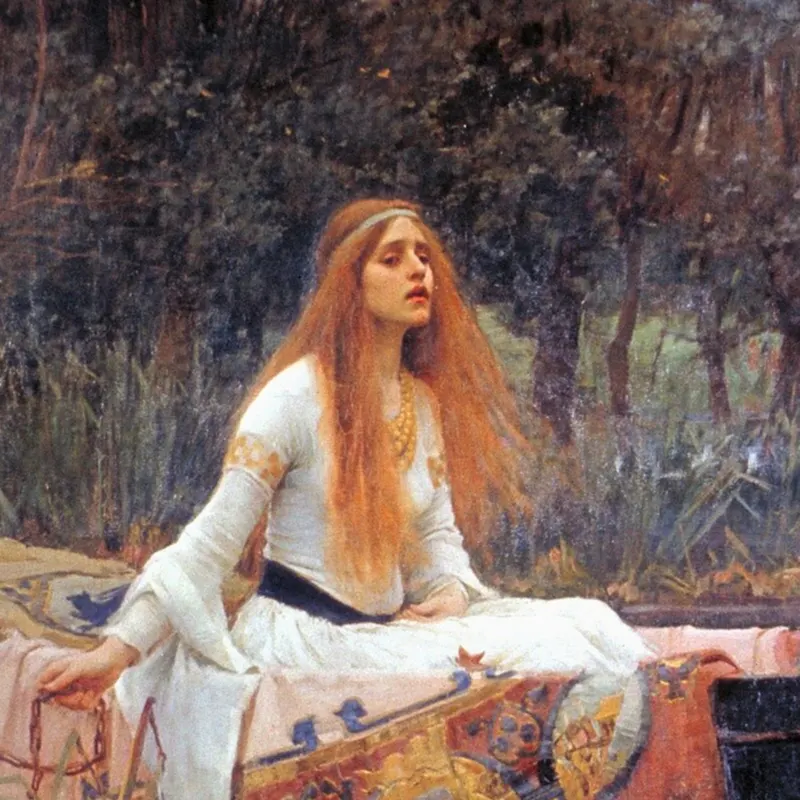
While Mark Twain was strongly opposed to the values of the Middle Ages, he thought that his own era of imperialism and industrialism showed only modest improvements in the dignity allowed to its subjects. Meanwhile, back in Britain, Alfred Tennyson, who was the poet laureate of the United Kingdom, contributed to this with his book The Idylls of the King, a cycle of stories in verse inspired by Thomas Malory and the Welsh Mabinogion. These texts bring in the same solemnity and even mournfulness that we see in Malory's texts. It's no coincidence that they were written as a requiem for Prince Albert, the late husband of Queen Victoria. Probably the second most influential 19th century medieval work after Ivanhoe, these poems are not particularly well known today, but they were highly celebrated at the time for their earnestness and high romantic emotion. The most famous of Tennyson's cycle was probably his poem of The Lady of Shalott, about a beautiful Elaine who was trapped in a tower and cursed to never leave or even look outside on penalty of death.
Her only view to the world beyond the tower is a small mirror opposite her window. One day, as Sir Lancelot rides past, she is so overcome with love, that she turns around, knowing that this means her doom. She leaves the tower and floats down in a boat to Camelot, but dies of her curse before she reaches her beloved knight. Originally recorded in an Italian King Arthur story, this poem was adored by the Victorian sentimentalists for its fairy tale setting and innocent intense emotion. There are obvious resonances with the story of Rapunzel, as well as classical motifs like Orpheus looking to Eurydice and even Plato's Allegory of the Cave. But this poem is especially relevant because the image of the lady floating on her boat, either awaiting her fate or lying at her eternal rest, became a favorite of Victorian painters. The artist movement was known as the Pre-Raphaelites, and they thought that this was a uniquely romantic symbol.
Medieval imagery, more broadly, was thought to be earnest in a way that revealed the bare fundamentals of human emotion. Thus, illustrations of Tennyson's poems from the 1850s onwards encouraged the production of many serious and mature medieval paintings that would contribute greatly to the tone and imagery of modern fantasy media, such as John Boorman's 1980s film Excalibur or the many Lord of the Rings illustrations that would inform Peter Jackson's films of the 2000s. This imagery was everywhere from the middle of the 19th century up to the start of the 20th. In Art Nouveau illustration, the architecture of many public buildings and private estates revived stained glass industry and even the wallpapers of William Morris. Slowly, across this period, the French tradition of Arthurian romance was also recovered. Interestingly, the stories of Chrétien were republished in the English-speaking world decades before they reappeared in France. This was done by a young woman named Charlotte Guest, who will come up again shortly.
Also, while this aesthetic medievalism was derived from the same impulses as more odious political medievalism, it rarely had any explicit reactionary character. William Morris was himself a prominent socialist, and even some left-wing figures of the Second International saw certain aspects of the Middle Ages as a sort of pastoral Eden. In a roundabout way, we can connect this interest in medieval culture to the rediscovery of oral folk traditions. This movement, which incidentally was spearheaded by many left-wing figures in Britain and America, understood the medieval past as pre-capitalist but not utopian. Certain literary artifacts from the medieval and early modern past were celebrated as the earnest expression of culture outside capital. It may not be a coincidence that within European academia after World War II, the social transformations of the Middle Ages and early modern period were an especially popular subject of Marxist historians. And King Arthur has had many other resonances persisting until modern times.
Camelot and British identity
On a cultural and political level, the idea of Camelot as a lost place of virtue was as appealing to people in the mid-19th century just as much as it was to Americans in the 20th. We mentioned how Tennyson's work was an elegy for Prince Albert, and we can compare this to how Americans in the 60s would remember the brief presidency of John F. Kennedy as their own Camelot. Other Victorian takes on the Arthurian canon, however, were less graceful. During the period of the Franklin Expedition, when British explorers attempted to chart the Arctic, English writers imagined fanciful stories of King Arthur leading his own expedition to the North Pole. This was part of a broader trend across the 19th and 20th century, in which medieval stories and events were used to justify the political concerns of the present.
This is classic Gladio wheelhouse stuff here, you know, this kind of use and abuse of history.
Yes. To many British people, and particularly English people, medieval stories of Arthur were thought to reveal a permanent truth about their nation. Arthur's martial greatness and his victories abroad prefigured and justified the conquests of the British Empire. Not only their exploits in the Arctic, but also the subjugation of India and much of Africa. Outside of England, imagery of King Arthur was sometimes employed against the British Empire, in defense of Welsh or Cornish autonomy, or a broader sense of Celtic cultural and linguistic defiance. The very flag of Wales is the Red Dragon, an image mostly derived from the Welsh Historia Brittonum, and associated with Arthur and Merlin by Geoffrey of Monmouth in his own Historia. The loss of Camelot has understandable resonance for Celtic speakers today, who have not forgotten that Arthur's great enemy was, in fact, the Saxons. Even before the medieval revival of the 19th century, Welsh scholars in the 18th, some of the men and women we discussed in our Druidry episode, regained interest in the works of Arthur.
Until deep into the 20th century, Welsh literary stories of Arthur from the High Middle Ages were assumed to have been the oldest stories, entirely influencing the French tradition and having no influences from the outside world. This is no longer believed to be the case, but would be very important to the development of Welsh national consciousness in the early and middle 19th century. The missing link between the Welsh Arthurian legend and the broader medieval revival of the Victorian period is Charlotte Guest, a young English woman who married into a Welsh family and became devoted to Welsh causes despite not being Welsh herself. It was she who popularized the stories of the Mabinogion in English and even gave us the term Mabinogion. She was one of the first people to really analyze the writings of Chrétien de Troyes and his potential relationship with Welsh literature. And as mentioned, she was the first person to translate Chrétien's stories and bring him into the broader consciousness after the Middle Ages.
Arthur today
In modern art and literature, the legacy of King Arthur is really too much to describe. The most famous direct adaptation of these stories is probably The Once and Future King by T. H. White. On screen, Arthurian stories have given us everything from Disney's The Sword and the Stone and John Boorman's Excalibur to David Lowery's The Green Knight and Robert Bresson's Lancelot du Lac. The 2004 film with Clive Owen attempted to restore King Arthur to his original late antique origins, tragically without much historic success. Arthuriana has also inspired two operas by Richard Wagner and a 1960s musical, plus more obscure works by Henry Purcell and a very underrated 20th century opera by Isaac Albéniz. It's called Merlin and you should listen to it. The character and stories of King Arthur, however, would retain their strongest cultural influence in Cornwall and in Wales, as a reminder that the history and culture of Britain goes back long before the first Saxons landed on that Saxon shore.
Arthur's grave at Glastonbury
But now let's bring our wheel of fortune back from the end of Arthurian romance to the beginning of the quest for the historic king Arthur. 1191, with the discovery of Arthur's supposed tomb at the Abbey of Glastonbury. As we mentioned at the top of the episode, Gerald of Wales tells us that the search for Arthur's remains was launched at the behest of none other than King Henry II. It goes without saying that he had a political motivation for seeking the grave of his great predecessor, as Arthur was the only British king said to have ever held more land than him. But Henry II didn't only want to describe himself as the new Arthur, he also wanted to emphasize that Arthur was in fact dead. Gerald of Wales, who was one of the all-time haters of the Middle Ages, gives us one of the earliest references to the messianic cult of Arthur.
He wrote, quote, Many tales are told and many legends have been invented about King Arthur and his mysterious ending. In their stupidity, the British, that is, the Welsh, Cornish, and Breton peoples, maintain that he is still alive. Now that the truth is known, I have taken the trouble to add a few more details in this present chapter. The fairy tales have been snuffed out and the true and indubitable facts are made known, so that what really happened must be made crystal clear to all and separated from the myths which have accumulated on the subject. So, neither the bones nor the slab or the engraved cross that Gerald described are known to still exist. During the dissolution of the monasteries under another King Henry, the relics at Glastonbury seem to have disappeared. One of the Arthurian relics was lost much sooner. Just moments after its discovery, as Gerald of Wales tells us, the golden hair of the dead Queen Guinevere was destroyed when one monk, with fleshy fingers, handled the lock of hair too roughly and made it crumble to dust.
So, in the eight centuries since Gerald reported this discovery, historians have debated whether or not the dig actually happened and if the items found within it could really be associated with a real King Arthur.
Right, because it seems very convenient that the skeleton of Arthur would be found so soon after King Henry II directed his clergy to find it. Some have suggested that the Anglo-Norman elite might have engineered the entire affair to suppress the Arthur cult that Geoffrey sneered at from above. Henry had battled the independent lords of Wales across those past few centuries, like those at Cardigan, who turned Norman Castle into a center of Welsh defiance against Anglo-Norman aggression. Although Gerald was himself of Welsh descent, he devoted his life to championing the expansion of English power at the expense of Celtic-speaking peoples. We discussed his infamous description of Ireland in our episode on the Druids.
Personally, I think this finding at Glastonbury was indeed a forgery. But I don't think Gerald was aware of this, let alone Henry II. Instead, I think there's another culprit. Just as King Arthur's court of virtue was destroyed by vice through the treachery of Guinevere and the avarice of Mordred, and even the king's own incestuous union with his sister, I think we need to look here at the base impulses of otherwise holy men, specifically the abbot who led the supposed discovery of King Arthur's bones, the future bishop Henry de Sully. The monks at Glastonbury had fallen on hard times in the late 12th century. It was initially one of the abbeys most cherished by the Normans, and in the lifetime of William the Conqueror, was actually the wealthiest monastery in England. But pilgrimages to Glastonbury had slowly declined across the 1100s, and several years before Henry II put them on this quest, a fire destroyed much of the complex, requiring costly repairs.
While there is no smoking gun, we do have a kind of smoldering crucifix. Archaeologists have never found that leaden cross with Arthur and Guinevere's names, but they have found other crosses across England, quite similar to what Gerald described. The problem is that these are all items from the 12th century. It is thus very suspicious that a 6th century cross discovered in the 12th century looks just like every other 12th century cross. Additionally, we know that the Glastonbury monks had previously shown a willingness to forge centuries-old charters granting them privileges over neighboring villages. Making a phony artifact attributed to Britain's greatest king would thus not be beyond the pale. And one last detail about this discovery. If you remember from the top of the episode, Guinevere was described, surprisingly, as Arthur's second wife. None of the sources we've mentioned so far indicate that Arthur was married more than once.
If he had any other sexual partner at all, it was his own sister Morgause. But because Arthuriana always gets weirder the closer you look at it, in some very obscure sources, Arthur has indeed two queens, and they're both named Guinevere. One French story suggests that Arthur actually had two queens at once, totally unbeknownst to him: the virtuous Guinevere and her evil twin, also named Guinevere. Then a short Welsh poem tells us there were actually three Guinevere's, only one of which was said to have been unfaithful. I think this very bizarre tradition was a way for King Arthur and his fans to save face. The greatest king of Britain might have had an unfaithful and sometimes treacherous wife, yes, but he also had another wife who was a paragon of morality and chastity. Therefore, any positive references to Guinevere surely refers to the one who didn't cheat on him.
Arthur's second wife
To me, the inclusion of that phrase, Arthur's second wife, is actually the greatest tell that this grave marker was a hoax, because it shows the monks at Glastonbury couldn't help themselves. Knowing that their forgery would greatly increase popular interest in Arthur and leading to moral imitation of his court, they had to slip in one final moral lesson, guiding their parishioners away from potential veneration of an adulterous woman. Regardless of their motivation, this apparent forgery worked. Interest in King Arthur spurred a broader national interest in Glastonbury Abbey, leading to later stories that the biblical figure, Joseph of Arimathea, had come there when he brought the Holy Grail to Britain, and that he stuck his staff in the ground, which later sprouted into a thorn tree, a tree whose descendants are still at Glastonbury to this day. This association, tying the Bible to King Arthur through the item of the Holy Grail, would revive Glastonbury as a premier pilgrimage and eventual tourism site.
Around 100,000 people visit the Abbey every year today. Due to these legends, the broader town of Glastonbury would come to be associated in the 20th century with a new age spirituality and alternative history, like the various neo-pagan ideas about druids we discussed in episode 106. This meant that by the 1960s, the town that grew up around the Holy Abbey of St. Dunstan would become an unexpected site of hippie counterculture. And this is where we get the most unexpected of all the far-reaching consequences of King Arthur and the Arthurian romance. The Glastonbury Music Festival, today the most famous association with this site, began as a folk and rock music festival in 1971, featuring performances by David Bowie, Traffic, and my personal favorite, Fairport Convention, a folk revival group whose music kept alive the same kinds of oral balladry that led to the initial dispersal of Arthurian lore.
The once and future king
This means, in a certain sense, King Arthur, Britain's once and future king, still rules the pop culture of his island today. All right, and this is all to say, King Arthur's stories are a lot of fun. If you listening have not engaged with medieval literature before, you totally should. Chrétien de Troyes is a great place to start. Many people prefer Thomas Malory due to the gravity of his account, but there is just so much to get into. I think we're probably going to have to do an additional episode on other aspects of the romance tradition because there's just so much wealth there. Sam, any last thoughts on King Arthur and the romances before we sign off?
Yeah, I mean, I don't know. So, sign up to King Arthur's Patreon, I guess. He's a pretty cool guy.
All right, yes. Yes, well, thank you all for listening. As you can see, we're both big nerds for this stuff. We hope you enjoyed, and we all await the return of Arthur. Let us all retire to Avalon.
The show is also on Apple Podcasts, Overcast, Pocket Casts, Podcast Addict, YouTube, RSS and Patreon.