30
The Lion in Winter and Medieval Christmas
In progressMom’s in prison, dad’s newest mistress is your fiancée, and your two little brothers are plotting to kill you! If you thought your Christmas was stressful, try being Richard the Lionheart in 1183. For this week’s episode on the 1968 film The Lion in Winter, we run through the deadly intrigue of the Plantagenet court and chart the history English Christmas along the way. Come troll the ancient Yuletide carols with us to find out whether Santa Claus has anything to do with Odin, why the 12 Days of Christmas really end on January 5th, and if King Richard the Lionheart ever saw a Christmas tree.
Hosted by Liam, Russian Sam, and Halal Sam.
Transcript
Welcome
Welcome back to another episode of Gladio Free Europe. How are you boys enjoying your holiday season?
Well, I probably have COVID, but I mean, I'm feeling pretty asymptomatic. It's fine. I'm just gonna, you know, accumulate all the COVID in my body and use that for greater things.
Russian Sam will soon be the super soldier of Sheepshead Bay. And you, Sam B, how you doing?
I am the only person, along with Maggie, in New York to not have the Omicron variant right now, and I'm pretty proud of that.
You're gonna catch it.
Yeah, but until then, I win, I think.
Yeah, were the holidays good for you all? Good New Year's.
New Year's was great. Very calm and nice. We spent it with a friend, watched a movie. Pretty nice, pretty mellow.
We still got our Christmas, I'm sorry, New Year's tree up.
Yeah, yeah. My family has our Christmas tree up too, still.
The twelve days of Christmas
But you guys might not know that actually, in accordance to the medieval Christmas traditions, which we'll be getting into pretty heavily today, it's actually still the Christmas season up until January 6th.
Yes, the storming of the Capitol wasn't the only good thing to ever happen, January 6th, folks.
Yes, yeah. As any devout Catholics might know, January 6th is not only the anniversary of the day a whole bunch of dental hygienists stormed the Capitol, but also the holiday of the Epiphany, which represents the day that the three wise men, you know, came to Jesus, recognizing him, according to the New Testament, as the Son of God. And so Epiphany isn't really a big deal in the United States today. I don't think it's much of a big deal in other parts of the Christian world. It's not really central to the Christian calendar the way that Christmas is today.
Well, I'd say it's more important in the Orthodox world, probably.
Yes, absolutely. Absolutely. But in the Catholic world, especially outside of Latin America, among Catholics in the US and Catholics in Western Europe, Epiphany is really kind of just an add-on after Christmas. But as we're going to talk about, this wasn't always the case because Christmas in the Middle Ages wasn't simply a holiday. It was the broader season of Christmastide, which was an almost two-week festival that started with Christmas and ended on January 6th. So, just one little quick fun fact before we get too deep in the history stuff: 12 Days of Christmas actually starts on the 25th. So, we are still in the middle of the 12 days of Christmas. And I hope you all have your partridges and pear trees ready.
Yeah, we're going to be returning to tradition. We're going to reimpose the 12th day of Christmas and just get debauched and drunk.
The Lion in Winter
Yes. And with all that in mind, for this week's episode, we are finishing off our three-week holiday marathon at Gladio Free Europe with an episode on medieval Christmas and the 1968 film The Lion in Winter, which is as far as I know the only American movie set during a medieval Christmas celebration. This is going to be a really crazy episode. It's going to be a huge mix of cultural history about the story of Christmas, as well as a lot of information about the Normans. We did so much research for this episode, The Sams and I, that I'm probably going to use this as a springboard for a future series of episodes on medieval France and England, because it's such a cool topic, and Christmas is an amazing vantage point to look at all of the changes happening in medieval Britain in the 1100s and 1200s as these French nobles exerted control.
So, as we get into the movie The Lion in Winter, let me ask you guys first off: did you like it? Was it too dry? Did the jokes land? How do you feel?
I'd say that it's basically like if you took two hours back to back of the wittiest Game of Thrones dialogue sequences and just stitched it together, which is to say that I'm personally a fan, although I imagine for some people this might not be their cup of tea.
I definitely agree with the Game of Thrones dialogue string together description. I didn't love it. There was some stuff I did like. Katharine Hepburn and Peter O'Toole were both very good, especially Katharine Hepburn. She was very, very good and very entertaining. But after a certain point, I kind of just stopped caring that much, to be perfectly honest. And also, I know how it ends. It's not a surprise, but it was, well, it was certainly very well done.
The story
So for anyone who isn't familiar, The Lion in Winter, in addition to being one of the only movies about medieval Christmas, it's really one of the only big-budget Hollywood films about medieval English history. It recounts a really interesting moment during the life of King Henry II, who's widely understood to be one of the most powerful, maybe one of the greatest kings in English history, who had the classic conundrum of not knowing which of his children should succeed him. The movie is written by James Goldman, who is the brother of William Goldman, you guys might know from The Princess Bride, and it has definitely some of the kind of like, like you said, the witty lines, the kind of quips that you associate with his brother's work, but it's also really well researched. Although James Goldman takes a lot of liberties in telling this story, the facts of what happened in the winter of 1183 are basically correct.
So, really, to get into the brass tacks, King Henry II, who's turned England into really one of the most powerful states in Europe at this time, who's basically conquered half of France, needs to decide which of his sons is going to take the throne. His wife is the incredibly powerful woman Eleanor of Aquitaine, who's actually been locked up in prison for a decade ever since she waged a civil war against him. But she almost won, as she notes. Yeah, she came very close. But Henry won, he secured control. Now he has to choose an heir. He invites the young king of France to come to join them for Christmas as they decide which of the three sons, Richard, Geoffrey, and John, is going to be the next king of England. In addition, the king of France's sister, Alice, is going to marry whichever one of these brothers becomes king to secure an alliance with France.
However, Alice has also been the mistress of the much older King Henry for years, leading to some tension between all of his various sons, who are basically going to be, in a really strange way, married to the woman that their father loves.
He's 50 years old during this sequence, and that's a big point of contention and something that's really brought up time after time.
Yeah, yes, yes. He is an old man in a hurry by medieval standards. He is full of energy, but definitely past his prime, and he knows that if he doesn't pick a successor soon, there's going to be immediate chaos upon his death. We'll get into the history about his life later in this episode, but he was born at a really chaotic time in the history of England, and it's clear that he didn't want to repeat it.
An anti-Camelot
I think that the movie, part of why I like it, is that it's so cynical and unromantic in how it depicts life in the Middle Ages, which I think was probably especially interesting or especially shocking to viewers in the 60s. You guys might know that the early 60s were sort of understood as a very optimistic time in the US, especially with the ascent of the Kennedy administration. And you guys probably also know that there is a particular nickname used in the Kennedy years for the White House: Camelot.
Exactly.
And so I think that that is a really interesting piece of context to set this movie. Because here you have, in the late 60s, when this comes out, after the assassination of JFK and the impending assassinations of figures like Bobby Kennedy and Martin Luther King, you've got this increasingly hard turn in American politics as Johnson and Nixon take over. The court of Henry II in this movie sort of exists as the anti-Camelot because it's depicted without any romance and without any honor. The love we see is adulterous and almost incestuous. All the players are conniving and grasping. This is why Game of Thrones is a really good comparison, although no offense to George R. Martin, but I think this is a much more interesting piece of work in the way that it derives from real history.
There's so much you can compare it to. I think the closest analog for me is Succession. If anybody's seen that, there's a really similar dynamic with the two parents in this movie and the parents in Succession.
Yeah, and I'd say both shows are equally cynical but unrealistic in their depiction of these power dynamics.
Absolutely. And you know, given the way that these parents clearly resent their own children, especially Eleanor of Aquitaine, she literally says it. She says, I don't care for my children.
Yes, which is why I think that one more comparison, which might not be as obvious, is one of my favorite shows, Arrested Development.
I don't care for Gob.
Yeah, it's the classic.
I don't care for Richard Lionheart.
A modern-feeling film
One more thing about the movie that I find really interesting. This works for some people, it doesn't work for others, is the fact that it tries really hard to make the characters feel modern. A lot of things we know about these people would seem strikingly modern to us. One aspect of this story that is embellished upon, but very, very probable, is the fact that Richard Lionheart was probably gay, or at least bisexual. This movie was pretty groundbreaking in the way it depicts that. And I have to think that this open depiction of his sexuality probably wouldn't have happened in an earlier film, something made before the 60s.
That's the one thing about this movie that actually surprised me. I did not expect them to depict that. That was the one thing, because I went in thinking, oh, I know this story, I know how this turns out. But I did not expect this to be depicted at all.
Yeah, you know, it was really interesting. And it's very effective. Even today, I guess maybe because you know it's a film from the 60s, it really catches you off guard. It's pretty shocking.
Well, I mean, it was also originally a Broadway play, which I'm not sure if it was already mentioned at the top, but that might go some way towards explaining it. Maybe if only because theater had a little bit more leeway for content in the 50s and 60s than film did. You could get away with a lot more on stage than you could on screen.
For sure. There's so much, though, that just seems very modern to me, especially in the play. I feel like without the accents of the characters, they almost seem more lifelike when you read the dialogue in your head.
Part of it, though, is that the way that these characters feel so modern, they say plenty of things that they would never say in real life. They break the fourth wall a couple times. There's that great part where Eleanor of Aquitaine tells her husband when he's trying to negotiate with her, oh, you were so much better in the last scene. One more element of, I guess, modernism or anachronism that brings us to really the big thrust of the episode today is that it's set during Christmas, which, like we said, would have been this major long-term 12-day celebration for the medieval Normans, but they use a lot of aesthetics that we associate with modern Christmas.
The Christmas tree problem
Probably most controversially or infamously is the fact that near the end of the movie and written in the stage directions of the play, they have a Christmas tree.
Wow, would they have had a Christmas tree?
Absolutely not.
But it makes it more relatable.
Yes, because moving on to this whole part of the episode, Christmas in the 20th century is very, very different from the Christmastide celebrations that would have existed in the 12th and 11th century. There are a lot of modern traditions that go back very far, but a Christmas tree is one of the most modern, one of the most recent, especially in Britain. I think that this was part of a deliberate choice to make these characters more relatable. James Goldman researched so much, I think he must have known that Christmas trees didn't exist at this time, but for whatever reason, he thought that including these traditions, as well as wrapping gifts, would have made these characters more relatable for a modern audience.
Yeah, because the fact that Christmas looks so different elsewhere gives us this disconnect.
Yeah.
The Normans and Christmas
I mentioned the Normans. As everyone listening probably knows, they were the French-speaking rulers of England who came over in 1066 with William the Conqueror. This event had an enormous impact on the long-term culture and history of Britain. There's so much that it changed that I think we can do an entire episode in the future on what exactly the Norman transition meant. But one pretty funny aspect of this is that the traditions we mentioned before, the 12-day Christmastide celebration, this was actually introduced to England by the Normans. It didn't really exist in prior English societies. Christmas at all seems to have really taken a much stronger prominence during the Norman era. But even then, it was still sort of part of the lead-up to Epiphany.
Yeah, because prior to this coronation, Epiphany was actually the primary English winter holiday. Christmas obviously celebrates the birth of Jesus, but Epiphany is Three Kings Day.
Yeah, yeah. And then slowly during the Norman period, you start to see Christmas eclipse Epiphany, leading to the current situation we have today.
Yule
But if we want to go back a little bit farther in the history of Britain, there is, of course, an even older winter holiday that once really took center stage.
Yeah, we're talking about Yule, of course, which was the Germanic pagan holiday that was celebrated around this time because it was the winter solstice and most societies had something to celebrate the winter solstice because it's a very astrologically significant event. Yule is now often used as a synonym for Christmas, but originally these were very much distinct holidays and Yule itself was quite long. It was supposed to last from November all the way to January.
Yeah, it was a season. You know, like if Christmastide was 12 days, Yuletide was two months, which is kind of interesting.
That's too much. That's too much holiday.
Yeah. I take the opinion that there probably are some Yule traditions that exist in modern Christmas because there had to be a reason why medieval Christians saw them as equatable. There's a reason why Yule came to mean Christmas, but it was a very different holiday with, of course, a very different origin. The records we have that talk about Yule suggests that it probably has a very distant origin in the deep Germanic past, which is pretty cool. The Goths, who were living all the way in Eastern Europe in Roman times, they also had Yule, suggesting that this probably goes back many centuries before the birth of Jesus.
Odin and Santa Claus
Speaking of gods, doesn't this also have connections to Odin?
Yes, it does. Yeah, one of Odin's names was the Yule Father, which is pretty cool. And we don't really know what the worship of Odin outside of Scandinavia looks like. And even in Scandinavia, our understanding is very shaky. But it's pretty clear that Germanic-speaking peoples from as far west as Britain to as far east as Crimea in ancient times had some reverence for Odin or Woden or Wodanaz, whatever they called him, during the season of Yule.
And actually, you know, it's funny you should mention Odin because some people even go so far as to suggest that there's some tiny hints of Odin worship in modern-day Christmas. And this also connects to a certain figure we discussed in our last episode. If you want to expand on this, Russian Sam.
Some people have postulated, pretty spuriously, I would say, that there is a connection between Santa Claus and Odin. And this really comes down to the fact that Odin is like this old guy with the long white beard. He rides around on a magic sleigh, etc., etc. And as Christianity as a religion began to play a less prominent role in the lives of everyday people, there's suddenly been more interest in pre-Christian traditions. So it would make sense why this attempt to make a connection would happen, but there's really no evidence of a Father Christmas figure existing in England until around the 15th century.
Yeah, I call major bullshit. Plenty of gods had chariots. Icarus had a fucking chariot.
Yeah, so Father Christmas is first attested sometime in the 15th century, which would have been almost a thousand years after the Anglo-Saxons had become Christian, and many centuries after the last pagan Vikings had lived in England. Maybe it is possible that some Yule traditions involving Odin could have existed outside of the written record for a very long time before any reference to Father Christmas was written down. But again, this is just pure speculation.
Yes, yes.
And that's so much of this discussion about these old holiday traditions. We don't really have evidence for modern Christmas going back very far into the deep past. They might have earlier antecedents, but we can't say. So it's sort of irresponsible for holiday blogs and pop history sites to be saying the, oh, you know, actually, like, this holiday is pagan. Because we can't really say for sure.
It's like on the Quo Vadis episode with Maggie, they explain that there is a link with Christmas and Saturnalia, but that's not the only reason why Christmas is celebrated on the 25th.
King Hakon's Yule
But what we do know for certain is that, for whatever reason, early Christians saw Christmas as somehow linked with their Yule celebration. And there was even a deliberate attempt by Germanic-speaking rulers to turn Yule, or at least turn Yule celebrations, into Christmas celebrations. Probably the most important character in this context is King Hakon of Norway, the first Christian king of Norway who really tried to make all of Norway into a Christian country. He actually changed the date of Yule to make it fall on December 25th, because previously it was in November, December. Actually, it ended a little bit before modern-day Christmas because the calendar was different. He also tried to emphasize the more secular, irreligious aspects of Yule, which I think is kind of funny because it's sort of how many people who aren't explicitly Christian now celebrate Christmas. He tried to tone down the pagan aspects of Yule and also tone down the Christian aspects of Christmas, hoping to create sort of a more general holiday that lots of people could celebrate.
Hmm, I wonder if anyone else would try that in the future.
Hakon's saga also is the best description of what Yule actually looked like. To give a little spoiler, it looks pretty different from Christmas today. It was ancient custom that when sacrifice was to be made, all farmers were to come to the heathen temple and bring along with them the food they needed while the feast lasted. At the feast, all were to take part of the drinking of ale. Also, all kinds of livestock were killed in connection with it. Horses also. Sacred twigs were dipped in the horse blood and used to sprinkle blood all over the pagan idols and the walls of the temple within and without. And likewise, the men present were to be sprinkled with blood. But the meat of the animals was to be boiled and served as food at the banquet. Fires were to be lighted in the middle of the temple floor, and kettles hung over the fires.
Sacrificial beaker was to be borne around the fire, and he who made the feast and was chieftain was to bless the beaker as well as all the sacrificial meat.
Yeah.
So you can see the most broad similarities to a modern Christmas tradition, just in the sense that, you know, you make a toast, you have like a special meal, but unless your Christmas celebration involves bloody twigs sprinkling blood on everyone attending, I don't think it's that close to Yule.
Yeah, it seems pretty far removed to me.
One other thing mentioned in Hakon's saga, that same text, is that at least many centuries before it was written among the Goths, they had a tradition very far away from Scandinavia of killing a boar and eating it for Yule. So some historians and anthropologists have thought that maybe the modern tradition of a Christmas ham somehow was connected to this boar sacrifice, but I don't think medieval Europeans really needed an excuse to eat ham. I think that probably was just, you know, the most common meal. So I will say, as much as I would want this to be true, I am kind of a Yule skeptic.
Were Christmas trees pagan?
I don't think that much of Yuletide is preserved in modern Christmas, but there's probably like maybe one or two things that could be there that escape the written record. In the 19th century, it was pretty widely assumed that Christmas trees were the most prominent symbol of Yule, or at least the most prominent Yuletide tradition that's celebrated still in Christmas. But that's also not true. Christmas trees really don't enter the written record until the 15th century. They were really popular in one part of Germany, and then after the Reformation, when England wanted some more non-Catholic Christmas traditions, this tradition was imported to other parts of England. And it didn't really take off until the 19th century when Queen Victoria married the German Prince Albert, who brought his own Christmas trees to London. And that's really when Christmas trees took off. So there's definitely not any kind of continuous history of a Christmas tree existing in England, which is why it's very weird for Eleanor of Aquitaine to be wrapping gifts underneath the tree in this movie.
It's possible that there was, however, some kind of wood worship going on in these pagan Yule celebrations, or, you know, in Germanic religion in general. There's some references in Tacitus and in the sagas to sacred groves. And in addition, there might be some religious significance behind using twigs to spread blood in the, as the references in Hakon's saga. They could have used anything to spread the blood around. A twig, though, signifies some connection to nature. There are some other references, though, that aren't really connected to Yule that suggest some kind of tree worship, which are basically the reason why 19th-century historians assumed that Christmas trees had to be pagan. So, the ancient Germanic peoples, they respected wood.
Larry David would approve.
The Irminsul and Uppsala
Yeah, so the Saxons, the continental Saxons, not the Anglo-Saxons, they were some of the last pagans in modern-day Germany and Central Europe.
But not the last in Europe.
And they were known to worship a wooden pillar known as the Irminsul, which has been linked with both Christmas trees and the maypole. Charlemagne the Great ordered this pole destroyed during his brutal conquest and massacre of the pagan Saxons. But we do have that kernel there.
And also, we have a religious site up in Uppsala in Sweden, now the site of a.
Which was the kind of the holy capital of the Vikings, basically. And now the site of Sweden's most prestigious university.
It was believed that the Vikings worshipped a sacred ash or yew tree somewhere in Uppsala. And Hervarar saga mentions the importance of this tree to the ancient religion. It was associated not with gift-giving, but with sacrifice giving.
Yeah.
Kind of grim, you know, but what else do we expect from the medieval Scandinavians? So after King Inge attempted to bring Christianity to Sweden in the early 11th century, he outlawed the practice of human and animal sacrifices. And then once he is succeeded to the throne by his brother Sven, also known as Blot-Sven, to give you an idea of what kind of guy he was, Sven was so upset by this banning of sacrifices that once he came to the throne, he organized a major sacrifice of horses at this sacred tree. And according to the saga, this was such a powerful display that many Christian Swedes reverted to paganism and all of Inge's work was undone, which really goes to show that Christianization was not a one-off thing. It's not as simple as just like baptizing everyone, and there you go, you have a Christian country.
Traditions take a very long time to actually spread in the population now.
Absolutely.
William the Conqueror's coronation
And this was the 11th century, so this is only a few decades before another person descended from Vikings really takes the center stage, and that's William the Conqueror, who, as we mentioned before, in 1066 would become King of England. He was very important in bringing Christmas traditions to England, not only because the French, and including the Normans, had a whole set of different Christmas traditions, like we said, the 12-day Christmastide, but also because, on a more personal level, he chose December 25th to be his coronation date, which is pretty interesting.
It's very interesting symbolically, just linking yourself to Jesus in such a direct way. It's very bold.
And so, like we said, this begins this process where Christmas slowly takes a more present, prominent role across English society. You know, there used to be a whole lot of different masses. There was Michaelmas, all these holidays like that. But slowly across the Norman era, Christmas really becomes the big deal, leading towards the modern situation where Christmas is the major winter holiday for so much of the world.
Empress Matilda
But after King William took over, it really wasn't all peaches and roses for the Norman dynasty. We're going to skip ahead a few decades to get closer to where this movie begins. We're not going to talk about William on this episode, but someone who is very important is his grandson, King Henry I. And perhaps more important than him is his great-granddaughter, the Empress Matilda, who I think is really one of the most fascinating characters in medieval European history. Matilda was the daughter of Henry I, who we said, you know, was the grandson of William the Conqueror. She was born in the beginnings of the 12th century, once Norman rule was really well established in England. By this point, all of the nobility would have been French-speaking. English literature was at an all-time low as the Norman power was so high. And the Normans really seems to be kind of an ascendant power in England.
When she was just 12 years old, her father, Henry I, marries her off to the much older Heinrich, the Holy Roman Emperor as a way to build prestige for this new ascending Norman dynasty. Even though Matilda was very young when she became empress, she was actually really active in the imperial government. When her husband was fighting wars in Germany, she would be the regent of Italy, and when he was fighting in Italy, she would be the regent of Germany. Because the HRE at this time was really always such a loose and chaotic entity, it was basically always in a constant state of civil war that her husband Heinrich was having to put down. So this gave her a lot of experience and dealing with rebels and dynastic wars of succession, as well as learning how to rule.
The White Ship
A really important event happened in 1120, one of the maybe most important events in high medieval history, which involved a certain vessel known as the White Ship. If you want to talk about this, Sam B.
So in 1120, there were 300 major Anglo-Norman nobles who were sent to travel back from Normandy to England. Should be noted they were ruling from Normandy, not from England, because given the choice, wouldn't you rather live in France than England? So this was a very short trip. It was a pretty routine journey. They would do this all the time back and forth. It wasn't a big deal. And Henry would usually organize the trip, but he was suffering some kind of stomach problems and he decided to wait until the next morning to sail over.
Which is kind of like the 12th century version of Seth MacFarlane not getting on that plane.
Or Waylon Jennings not getting on the plane with the Big Bopper, taking the bus instead. But the rest of the Anglo-Norman high nobility, which included his son, William, got on board the ship, the white ship.
So, and according to the chronicler Orderic Vitalis, William, who again is the brother of Empress Matilda, he was really excited to be the one organizing this trip. Because, you know, as this young, ambitious prince, it's the way to show that he's the man in charge. So he gets in the ship. It's a really easy trip. They're heading. It's going to just be like an hour or two going from Normandy to England. And he's like, you know what? Let's have some fun. So he opens up a case of wine that was in the ship and starts passing out wine to everybody. All these Norman nobles are getting tipsy. Everyone's having a good time. Everybody loves Prince William. And then he notices that the crewmen, they seem kind of sad. Because they're the only people on the ship not drinking. So Prince William, being a great guy, a real party boy, he opens up another case of wine and starts passing out the bottles to the crewmen. Guess what happens?
They get to England just fine without any problems.
No, it goes down like the Exxon Valdez. It turns out a drunk crew is not exactly what you want in navigating these waters, and all 300 passengers are thrown or just thrown into the sea.
That's right. So, yeah, so before they can even get too far out of the waters of Normandy, they hit a massive rock and the ship sinks. And because it's 1120, nobody knows how to swim. Only one person, a butcher, a commoner, makes it back to France alive. And in one night, 300 of England's best and brightest drown in the channel. But most importantly, the heir to the English throne.
Yes, including Prince William. So, this just is a huge shock to not only the English crown, but really all the various nobles of Western Europe, because this means that there's nobody to inherit the throne, because the king has no living legitimate sons. The only legitimate child he has left is Matilda, the Holy Roman Empress. There has never before been an independent queen of England, but Henry thinks that this might be the best option to secure the long-term interests of the House of Normandy.
Matilda and Geoffrey
Not too long after this crazy tragedy, Matilda's husband, the Emperor, dies. She returns to England, although she actually keeps insisting on being called empress for the rest of her life. And really soon after the marriage, she remarries a much younger nobleman who's the 15-year-old Geoffrey of Anjou. He was 19 when the wedding actually took place, I believe, but she's early 30s.
Yeah, it's a 12th century Licorice Pizza situation.
Yeah, man, got a mommy wife.
Yeah, they probably had a pretty good marriage, it seems like. And she actually had no children with the Holy Roman Emperor, but now she has several with this guy pretty quickly. Geoffrey of Anjou, he was a really kind of just like his grandson Richard Lionheart, he was a sort of model chivalric knight. He was seen as this great, like tournament hero, very dashing. He was also because Count Geoffrey was the son of the king of Jerusalem, this marriage also brought the English nobility into the really complicated politics of the Holy Land at a time when crusaders ruled these sort of precarious Catholic states across the Mediterranean coast. Interestingly, he was the Count of Anjou, so for that reason, a lot of their descendants were known as the Angevins or the Angevins. But in addition, as part of his tournament get-up, he would always wear a branch of the bush known as a planta genista in his hat.
And so, for this reason, he was called Geoffrey Plantagenet. And the most common name for his ancestors, which are really kind of a later branch of the Norman family, are known as the Plantagenet dynasty.
Stephen of Blois
Okay, so Henry I is getting older. Clear he's not having any more sons. So his daughter Matilda is certainly going to succeed him. However, not everybody in England is jazzed about that. And there's one French nobleman who particularly objects to this. His name is Stephen de Blois. And I think he is the asshole of the week for this episode. So Matilda and Geoffrey of Anjou thought they could make this transition easier if Henry started handing over some land and power while he was still alive. But Henry really didn't like this idea and resisted really fiercely, which led to a civil war.
I'll just say, I'll say it right now: the first of many in this episode.
Oh, yeah. No, there's a lot of civil wars here.
The English on English crime is a real problem here.
Or in this case, really, it's Norman on Norman for most of it.
But yeah, so King Henry, Henry's on one side, old dude, and Matilda and Geoffrey are on the other side.
Right, so it's kind of crazy because she's already going, she's already his heir, but I guess she wants a little bit of a stronger position. So before he dies, declares war on him.
But then in 1135, Henry suddenly dies in the civil war, and this leaves Matilda even more unpopular than ever among the nobility.
Right, it's pretty clear she made a really big miscalculation.
It's insane that this all happens because they get too drunk on the boat.
Yes, yes, so much happens because Prince William of England wanted to be a cool guy and give out some wine.
It's like, it's like how everyone in the Polish government was on one plane that crashed in Russia.
Yeah, no, it is. It's a crazy story, yeah. And so now, Matilda finds herself in a really tricky position because she declared war hoping to, you know, get more land for herself so that she'd be more respected once her father dies, but her father dies way too soon. So now she's seen as this upstart, and to make matters worse for all the noblemen, she's a woman, so nobody wants her to take the throne. But she does have the strongest claim to it. And this chaos leads to a 15-year period of civil war known as the anarchy.
The Anarchy
And it's in this period of chaos that Matilda's son, Henry II, maybe the protagonist of this whole episode, is born. And it's in this chaos that he is going to be raised and learn how to be a king.
Before Henry I is even buried, Stephen de Blois jumps into action, totally insistent on making himself king.
Doesn't he basically just ride into London and say, I'll lower your taxes?
Exactly, yeah. He goes into the city, which was this weird, independent entity with all its own laws at that time. And I guess still kind of is, actually.
Yeah, yeah, yeah.
And so he tells all the magnates of the city of London he'll give them more favorable privileges if they make him king.
Just to reiterate, this guy is basically a nobody. He's Matilda's cousin. He's the count of a distant region of France, but he doesn't have any direct ancestral claim to the throne. Part of it is that he even claims that there's this ancient Anglo-Saxon tradition of the people of London electing a king. This might be true, but it had never been part of the royal succession process before or since. At least not in the Norman era. It kind of works, and this clout from this triumphal entrance into London allows him to start consolidating power across England. But a handful of other notables insist that Matilda is the rightful heir, even though she's a woman, including her illegitimate half-brother, I believe he's the Count of Bristol in Western England. He sort of starts off kind of like the Northern Alliance of 12th century England, where some of these nobles in southwest England refuse to respect Stephen as king.
The fact that these guys are holdouts means that Matilda has a chance, so she wages a 15-year civil war against King Stephen. During this time, like we said, she gives birth to Henry. She organizes an invasion of England while Henry is only a small child. 1135 is when Stephen takes the throne, so he's only two when this whole thing starts. And when he's a little kid, he actually goes to England to follow his mother on the initial campaign to take over much of England. They expand out of the southwest and take about half of the island of Britain, including a lot of Wales. But the problem is that even though they take all this land and raise this big army, it isn't enough to defeat Stephen. And maybe even worse, Stephen isn't strong enough to kick out Matilda. So there's this kind of sort of a sort of a civil war, sort of a cold war that exists for about a decade where there's two different kings or two different monarchs in England constantly engaged in a small-scale war against each other, which is terrible for the people caught in the middle.
So many farms and towns are just ruined in the warfare. Traditional laws can't really be enforced at all. The economy completely breaks down, and nobody has the authority to mint coins anymore. So you have local elites trying to make their own coins. Even bishops are trying to create systems of currency because nobody else can do it. But what happens in this chaotic time is that Henry II, her young son, gets a very brusque education in basically what it means to take power and hold it.
So basically, this is England's warlord era.
Yeah, it really is. It really is.
Matilda, although she never actually made herself queen, she was very competent at fighting wars, strategy, all that big picture stuff. And it seems clear that he inherited a lot of that from her. At the same time, his father, Geoffrey of Anjou, he was involved in wars taking over Normandy. And a lot of the land that his father takes in France becomes Henry's land. Henry becomes increasingly ambitious in this turbulent time. He's cared by famous, a lot of well-known tutors, including some philosophers and churchmen that are pretty well known across England and France. And by the time he's a teenager, he was already taking a leading role in his mother's military campaign.
Yeah, before we go further, something that I think is important to note: these kinds of civil wars were very common on the continent in mainland France, where basically you had this situation where you had a bunch of nobles with their duchies, which were formerly vassals of the king of France, who was a Capetian in Paris. And this was really like the norm for them. But in England itself, they had a much more centralized kingdom.
Right, going back before the Norman era.
Yeah, I mean, this is really the state of Europe as a whole, like these kind of wars within countries. This is basically, we've touched on this earlier, but that's what the Holy Roman Empire is on a larger scale.
Yeah, yeah, absolutely. Well, what I would say here, honestly, if you want to really be macro level about this, you could say that this period of the anarchy sort of represents the worst of what the Normans brought to Britain. Because a lot of the Normans brought a lot of fun stuff to England, including, like I said, come on, 12 days of Christmas. Who doesn't like that?
Most of the words we use.
Yes, they brought England into a French-style system of governance, which involves much bloodier transitions of power and much more violent civil wars.
A French system of governance should have come to England a few centuries later in the late 18th century. But that's another story.
Yeah, yeah, yeah.
Yeah, if it would have been Napoleon and not William, oh man, that would have been great.
Henry's teenage invasion
But yeah, like we said, though, Henry II, he really cut his teeth in this era, and he was so ambitious studying under his mother that he actually started to get a little bit bored, or maybe a little bit impatient, and he was skeptical that his mother was strong enough to take over England on her own. So, Russian Sam, what does Henry II do when he's just 14?
Well, he decided that he was going to retake the English throne all by himself. As the days passed by, it became clear that all of the rumors were lies, smoke and mirrors that had cloaked the truth of Henry's invasion. He had a few knights with him and a handful of mercenaries he had promised to pay in plunder. The teenager had launched his own enthusiastic campaign, apparently without the consent or approval of either of his parents. Geoffrey provided nothing for the attack. It would soon become clear, too, that his mother and his uncle Robert disapproved of the boy's actions. Hungry, unpaid, and disheartened, Henry's mercenaries began to drift away. Honor demanded that Henry pay his men and cover the cost of the expedition. He appealed to his mother for money, but she flatly refused to help him, suggesting she did not approve of his effort. Turning next to his uncle Robert, Henry found him immovable, quote, brooding like a miser over his money bags.
Running out of time and options, Henry made an astonishingly bold plea to King Stephen for help. Having arrived to try and prize the crown from the head of his first cousin once removed, the teenager now asked Stephen for money to pay his failed bid. Astonishingly, it worked. Stephen sent all the cash Henry asked for. Perhaps it should not have been a surprise. Stephen paid off knights and mercenaries to ensure that they left England. He could also point to the swift failure of the challenge to his throne and may even have banked some warmth with his opponent that could be valuable later. Stephen was the only real winner in this debacle.
Does anybody know how to say bay of pigs in Norman French?
Say what you will about Henry. He was a very bold youngster. Maybe a little too bold, but he had what it takes to become a king, clearly.
He was a gifted kid.
Like we said, his parents didn't support this. It was a huge disaster, an enormous embarrassment for Matilda's cause, I would say. But it did, in a weird way, maybe start to show the world that Henry II meant business. And not long after this total debacle, his father Geoffrey gives some land in France to his son Henry. And then just before his death, Geoffrey actually declares that Henry is the new Duke of Normandy, because the previous Duke he's kicked out. So now Henry is a duke in his own right. It's increasingly clear that it'll be him, not his mother Matilda, who will be ruling England. And here he makes probably the most important decision of his life. Really a decision that propels him to the world stage, allowing him to become once-in-a-generation kind of conqueror he would become. And it wasn't any kind of military victory that would be so important.
Instead, it was the amazing act of diplomacy for the young Prince Henry to marry Eleanor of Aquitaine, the most powerful woman in Europe and one of the most powerful landowners in the entire world.
Eleanor of Aquitaine
Alright, so Eleanor of Aquitaine, really an extraordinary woman in many regards. She would have been one of the most powerful women, not just of her era, but of European history, writ large. She was the Duchess of Aquitaine, which basically covered something like half of continental France. She gained that position at the age of 15 when her father passed away. Since she was the heir to such a large land holding, she was basically the most eligible bachelorette in all of Europe. And everyone was trying to marry her essentially. But ultimately, she ended up marrying Louis VII, who originally wasn't supposed to become the king of France, but became the king when his older brother died.
And, you know, that's the case with so many of these characters here. This is a really funny time where so many people who are often very competent that weren't intended to take the throne with their own initiative were able to.
Yeah, Louis had been raised from his early childhood to go into the church because that's what the younger sons of nobility did. Eleanor had that famous phrase that she was looking to marry a king, but she married a monk because he did not fulfill his marital duties very well. And that might be why they had no sons.
Yeah, and yeah, they only had two daughters, and this wasn't Eleanor's fault by any means of the imagination. She had like seven children with Henry, so clearly just Louis was a little too pious to do what was expected of him.
So she marries Louis. They didn't have any sons, which was compounded by the fact that Louis had gone on Crusade, on the Second Crusade from 1145, and so they had gone to the Holy Land. And there's that bit in the movie where she mentions, you know, being paraded bare-breasted to Damascus with her attendants dressed as Amazons. The Amazons reference, it does come up in one of the chronicles of the period, I believe, but it sounds a little too gaudy to have been possible.
Yeah, yeah. Yeah, well, like so many powerful medieval women, you know, this is kind of cliché to say this point, but it's true. Clearly, there's a lot of sensationalist embellishment on the part of these medieval writers.
Theodora comes to mind.
Absolutely.
While on Crusade, Eleanor had a pretty bad falling out with her husband because she was spending a little too much time with her uncle.
Yeah.
You would think that, like, you know, an uncle and a niece, they'd be allowed to spend time together. Well, apparently not. There were all kinds of rumors swirling that she was having an affair with him.
And it seems slanderous, honestly. It might have just been that she was fed up with her husband not fulfilling his duties and not being a very competent military commander.
So they finally go home around 1149. And this entire expedition had been a debacle. So Eleanor comes back to France with Louis. They don't have any sons. She's still in her prime. He's just a loser in her eyes, frankly. So she ultimately moves to have the marriage annulled. And do you guys know the mechanism that was used to make this happen?
Consanguinity
Yeah, anyone who's played Crusader Kings 3 would can guess it. Consanguinity.
When the Pope declared that because they were fourth cousins or something, that was too close and they weren't allowed to be married. They were very selective about applying this, of course.
I mean, because he would have annulled every Habsburg marriage.
Yeah, so divorce was a big no-no in general, but of course, there were always loopholes for the wealthy and the powerful. So according to church law, any marriage done with a cousin up to the seventh generation, so like a seventh cousin, would be considered incestuous, basically. So if someone had married someone without the knowledge of this person being their cousin, they could technically get an annulment. Yeah, and just for perspective, seventh cousins are really distant. I'm sure there are so many people in modern America who were married to their seventh cousins and have no idea.
As an Ashkenazi Jew, I feel like every other Ashkenazi Jew is my seventh cousin. I'm probably seventh cousin with Russian Sam somehow.
Yeah, I know, I'm sure, I'm sure.
So there was this one weird trick that was very convenient. And Eleanor, she's still in her prime. She's 28 years old at this point. I mean, suddenly, she's once again the target of a bunch of plots to have her kidnapped and married, including by Henry's brother, Geoffrey.
Oh, wow, I didn't realize that. That's fucked up.
Fellas, don't kidnap.
It seems likely that Henry would have met Eleanor in Paris in the court when he was visiting. And fairly soon, Eleanor decided that Henry was her best bet for keeping onto her own lands as well as expanding the territory greatly.
Yeah, yeah, you know, I don't want to get too Freudian here, but both Empress Matilda and Eleanor of Aquitaine, both incredibly powerful women and both about 10 years older than their husbands, kind of makes you think, you know, if Henry II might have had some mommy issues. I mean, he saw that it worked well for...
Yeah, yeah, it worked for his dad, so yeah, I'll do the same thing.
I mean, France has returned to this tradition. Look at Macron.
Oh, yeah, that's true.
Yeah, yeah, the king, yeah, our own king of France today. That's true.
He's a. He technically is royalty. He's because of Andorra. He's co-prince of Andorra.
Oh, that's true. Yeah, yeah, that's true.
Yeah, the president of France is the Prince of Andorra.
Yeah, but please continue your question, Sam.
Henry becomes king
Yeah, so going back to Henry, the war between Matilda and Stephen had been going on for 15 years, and Henry periodically tried to go on an expedition to England and take the throne, but very often he was forced by events on the mainland to stay put. And meanwhile, in England, we should add, Stephen de Blois was a pretty ineffective king. The fact that he wasn't able to, you know, kick out these rebellious noblemen, including Matilda, for 15 years, I think, speaks to his weakness.
Yeah, but finally, Henry is able to go over there in 1152 with an army that was actually able to put up a challenge. And after a while, he comes to an agreement with Stephen, whose son, Eustace, who was supposed to be his heir, had died recently. They had an agreement that Stephen would continue to be the king until the end of his life, at which point Henry would take the throne. And two short years later, in 1154, Stephen finally croaks. And finally, Henry comes to the throne as the king of England.
So let's reiterate here. Right now, Henry is the king of England. He's got Normandy. He's got Brittany. He's got Aquitaine.
He's enormous.
A third of France.
Yeah, yeah. Yeah.
And so Henry, he was not content to stay within the parameters of this rather large kingdom. So he would also invade Scotland and Ireland.
Yeah, yeah. Very important part of the Irish story. An earlier Norman nobleman had already sort of started seizing lands in Ireland, but it was really the initiative of Henry II that established the modern, the Pale of Ireland, which was this part of Eastern Ireland that was under permanent English control after this point.
So yeah, so Henry II is remembered as one of the most important and effectual English kings. He really expanded the power and authority of England into Scotland, Wales, and Ireland, like we said. He waged constant wars in France. He was clearly more powerful at this time than the King of France was, which is a very interesting situation and arguably led to the many centuries of rivalry between England and France. Because before Henry II, England wasn't really strong enough to put up a fight against France alone.
He was such a great war leader that the writer Gerald of Wales, this famous monk, described him actually as our Western Alexander, because that was how famous and renowned Henry II was at this time. He was respected for his victories as a conqueror, but he was also kind of feared as a tyrant, was very unpopular with much of the nobility, and many people outside of England just saw him as a brute. This, you know, lusty, violent conqueror who was constantly popping out illegitimate children, constantly having these often sordid scandals with his mistresses, and even most notoriously, killing a beloved member of the clergy.
Thomas Becket
Yeah, so Thomas Becket, he was the son of Norman merchants who had settled in London when he was still a young boy. By the standards of the time, this was a very humble background. He grew up in London. He spent some time in France. This was before there was a university in Paris, I believe, but Paris was still a major center of learning in Western Europe. And while he was over there, he made some connections which he was later able to use to ascend to the position to a position of power within this church. And something interesting to keep in mind is that until he became the Archbishop of Canterbury, he was basically secular clergy, which meant that unlike the formal clergy who weren't allowed to own property, who weren't supposed to exercise power, even though of course many of them did, but they weren't supposed to do it.
While Becket, he did have a formal right to these things and he was able to accumulate a lot of power and ultimately to strike up a very good friendship with Henry II.
Yeah, yes, and they were friends. And in addition to that, he was a pretty well-known popular figure for whatever reason. Especially after his death, you start seeing a lot of quite literal hagiographies written very far from England. And something I find funny is that to go back to the Scandinavian sagas for a second, one of the best sources we have for Thomas Becket's life is actually an Icelandic saga because that's how far this reverence of Thomas Becket went. But yeah, so he was very good friends with King Henry, but unfortunately for Thomas Becket, that friendship wasn't going to last.
Yeah, so what happened with Becket is that he became the Archbishop of Canterbury after his mentor had died. And as the head of the Church of England, well, well, not the Church of England, the Church in England, I should say.
Yeah, we're not quite there yet.
Yeah, so as the head of the church in England, he was stepping into very uncertain ground because this was a period of time when there was a lot of contestation between the powers of the church and the powers of the nobility. This was pretty much always a major back and forth. Like, basically, it came down to the fact that at this time, Rome was really trying to strengthen its grip over politics across Europe. And part of that meant that they wanted the right to name the bishops and the archbishops rather than leaving that to the local kings. I mean, naturally, this posed many problems because rather than the king choosing someone whom he could trust to run the church and to operate in a way that's to the benefit of the country, now you have a papist conspiracy to control the kingdom from without.
Yeah, yeah. I think it's this kind of all, it's a very interesting time because the middle of the 12th century was when all these very sort of primitive monarchies of Europe, and I'm including the papacy as one of these monarchies, these very old institutions start trying to solidify their power and start to compete with each other. You have the kings of France and England both become more powerful vis-à-vis their nobles. You start having the papacy try to rein in a lot of their priests in far-flung areas who they might not often have much direct control over. Yeah, yeah.
So to finish up the Thomas Becket story, by 1170, he was gone past his friendship with Henry II. There was very much a mutual antagonism happening because Henry didn't want this guy to take his power. So in 1170, he gets murdered by a couple of knights, presumably on the order of Henry.
The famous line that I'm sure a lot of our listeners know, probably not true, but supposedly Henry II asked his nobles, won't somebody rid me of this troublesome priest? Shortly thereafter, Thomas Becket was stabbed to death, Julius Caesar style, really shocking people across Europe and really pissing off the Pope. Funnily enough, I think Thomas Becket only comes up once in the movie when Eleanor of Aquitaine makes a joke about how she slept with him when she didn't. But he is really important to this story because his death, as we'll talk about in just a second, is really going to is the first domino in this series of events that leads to this movie and leads to the complete breakdown in relationships with King Henry and his sons.
Henry's sons
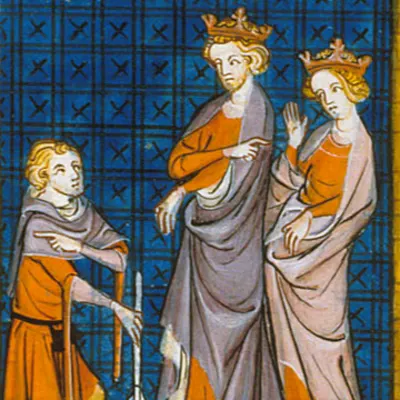
Now, to get into his sons, we already know there's three ones they talk about in the movie: Richard, Lionheart, Geoffrey, and John. But actually, very importantly, Henry II also had another son, an older son, who had already died before the Lion in Winter takes place. The so-called Henry the Younger. Henry the Younger, who is really interesting because he was the only, I believe, French prince to ever be crowned king even before his father died. This was also kind of a middle finger to the Pope because I believe before the death of Thomas Becket, during the dispute, because the Archbishop of Canterbury, because Thomas Becket, wouldn't crown the younger Henry as the heir apparent, he actually got the Archbishop of York to do it instead. And really, it seems that the would-be Henry III, you know, the younger Henry, they usually call him Henry the Young King.
He was Henry II's golden boy. He really cared for this kid. He really thought that he would be a great leader to succeed him. But of course, it wasn't to be. We've mentioned Henry. We should probably mention the other sons because they're so important to the story, the story of the movie.
So, obviously, there's Richard the Lionheart, who's this, you know, glorious warrior, who spent his 20s going to war with rival French nobles on his dad's behalf. This kind of classic chivalric knight image. He performed in tournaments, he composed poetry in French in Occitan. Did not speak English.
Honestly, I don't get it.
Yeah, which is, yeah, kind of funny, you know, because he's such like a figure in English, like an English patriotic figure almost. Not an English guy at all.
Nope, did not even speak English.
This is totally conjectured here, but I'm gonna bet he probably looked very fondly upon his grandfather, Geoffrey of Anjou, because they both were these real like tournament knights who were also rulers in their own right.
Absolutely, that makes perfect sense to me.
Then you also have Geoffrey, who's kind of more competent and but also overlooked.
Yeah, yeah, he was the the Duke of Brittany, he had a lot of land, yeah, he was doing very fine, but because he was the third, yeah, he was the third son, so he wasn't really seen as that much of a successor.
One really important thing we should mention here is that the Normans never had a formal tradition of primogeniture, so it wasn't totally certain before the coronation that Henry the Younger would succeed the powerful Henry II. But after the coronation, it became very clear that in this case, the oldest son would become king. Of course, there was one more son who was the notorious King John.
The youngest.
Yes, the arrogant baby.
Yeah, do you guys know what his nickname was?
I believe it was John Lackland.
Yeah, because he didn't get any land. Yeah, yeah. And funnily enough, two of these guys would become king, but of course, Henry the Younger wouldn't be one of them. And I gotta think there's kind of like some karmic justice here. Like, if you're such a, if you're so proud of your son that you're so sure he's gonna succeed you, that you even have him crowned king while you're still alive, I don't think the gods are gonna let that happen. I think they're gonna punish you for that one.
The whole king in waiting business, no. I mean, it's important to contextualize this. I think this was more of a French tradition. This was something that they would do so that there would be no question about who would be the rightful successor once the current king dies. So it does make sense in a way, but it wasn't something that English kings had done up until that point.
I think the Ottomans had it right. Just let your sons kill each other. Yeah, yeah, yeah.
Well, that's kind of what's going to happen as well, as we'll get into.
The Great Revolt
Because in 1173, so this is after the coronation of Henry the Younger and after the murder of Thomas Becket, a really important thing happens. Not in England, but in Rome. When Pope Alexander III canonizes the murdered Thomas Becket as a saint, this is a crazy indictment of King Henry II. Because if Thomas Becket is a saint and a martyr, that means somebody martyred him. And that person is Henry. And just as an example of, you know, how powerful the spiritual authority of the church was at this time, almost immediately after the declaration that Thomas Becket is now a saint, and therefore that Henry is this, you know, blasphemous murderer, there is a massive revolution, simply called the Great Revolt, across England. One of many different major revolts that would happen in the Plantagenet era, which really shakes the power of Henry II. The most powerful king in Europe suddenly has the most powerful rebellion to contend with.
And here's the real kicker here: Eleanor of Aquitaine joins the rebels. So, this, Henry's incredibly powerful wife, from whom he's drawn so much legitimacy and also so much manpower, is now on the other side. And perhaps most shockingly, because it's so clear that the rebels are the winning team, because they seem so strong, and because Eleanor is so persuasive, she convinces all of her adult sons to join the rebel, the rebellion. So, Henry the Younger, the heir presumptive, who's already been crowned king, Richard the Lionheart, and Geoffrey of Brittany all band together to fight their father. And this is the really important background to this movie, because just a few years before the Lion in Winter begins, all of Henry II's adult sons went to war to overthrow him. Only John, who was a kid at the time, just like seven years old or something, only John stays loyal, which is why when the movie starts, John is the one who Henry wants to succeed him.
If you can lead a failed invasion of France at 14, you can try to overthrow your father at seven. I'm sorry.
No, yeah, yeah, yeah, yeah. The problem is that, yes, Henry II was a very competent guy, which means even though the rebels seemed so imposing, Henry was able to defeat them. Even worse, Henry the Younger dies during the revolt, meaning that the heir who's already been crowned king is now no longer going to replace him. And it's kind of like the white ship situation all over again, except this time, instead of all of the potential heirs dying, you have one heir dying and the other adult potential heirs as effectively traitors. One really important thing happens in the Great Rebellion, which is that initially Richard the Lionheart and Geoffrey had both joined the side of Henry the Younger, who instigated the revolt along with Eleanor of Aquitaine. But as the war continues, Henry II is proving increasingly competent at dealing with the rebels. And here, Richard the Lionheart makes a really interesting calculation. He switches sides.
Instead of fighting with his brothers to overthrow their father, he joins with Henry, basically apologizing for his betrayal and is instrumental in defeating the forces of Henry the Younger. Henry the Younger dies, and now Henry II eventually manages to bring back control over his empire totally under his own rule. But now he's in a really tough position. His own wife is a traitor and he locks her up where she's going to remain for the rest of his lifetime. His sons, meanwhile, are all either dead, they're traitors, or in the case of John, they're a child, leading to this really unstable situation. Because Henry wants the young Prince John to succeed him, very soon after the rebellion ends, he launches a campaign into Ireland to expand the English presence there, and he makes John the Lord of Ireland. But it's a pretty miserable failure. It's like an early imperial debacle where the English army is really swiftly defeated by Irish rebels.
It's a very uncertain time for the English throne.
The setting of the movie
And this brings us now to the Lion in Winter. Finally, after an hour of talking to this, we get to the place in history where the movie begins. The English throne is effectively up for grabs. The three boys who can potentially inherit it are Richard, who's very ambitious, but also has that history of rebellion, Geoffrey, who's very sneaky and has that same history, and then John, who's this snotty teenager who doesn't really seem to be that competent at all.
Yeah, so the setting of the movie is a place called Chinon. It's Christmas in 1183 as they're holding the Winter Court, which was basically just the king and his nobles getting together and getting drunk and having a good time. And so on this occasion, Henry releases Eleanor of Aquitaine, who is locked up in a castle for 10 years at this point, and she gets to join in the festivities and I guess pretend that nothing is up, just like show herself to the nobles to like create the illusion of normalcy, even though all these people know that like she's locked up. So this feast becomes the site of a power struggle. Henry wants his youngest son John, who's around 16 at this point, to inherit the throne, whereas his wife Eleanor wants Richard.
And we should add that the throne here actually includes quite a lot of territories. There's the Kingdom of England, which is the biggest prize, but there are also the duchies of Aquitaine, Brittany, and Normandy, which are also very powerful possessions. Henry seems to be unwilling to let any one of his sons have all that power. I think he wanted to do kind of the Charlemagne move, where you split your territory between your different kids, but that also seemed like a very unstable situation, and he wasn't sure what exactly should happen. So, so much of the power playing here in this movie was trying to figure out who gets what. Does one person get England and another person get the Aquitaine? And to make things even more confusing, there are the two other characters we mentioned at the start of this episode: there are the young, the teenage King Philip of France and his sister, Alice.
Alice is the intended bride of whoever will become the king of England, because marrying her will secure an alliance with France. But really, to make things really much more tricky and really kind of exposing the pretty awful character of Henry II here, she's been sleeping with Henry for several years. She's been his mistress since she was a teenager. This means that whoever becomes king of England is also going to be in this semi-incestuous marriage with their father's mistress. And it's clear that nobody is really jazzed about that.
Yeah, so that's really where the scheming begins.
Yes, and there is, and boy, is there a lot of scheming in this movie? The whole movie is scheming. Yeah, you know, the characters, they kind of feel like Greek gods or something. The way that they like, they cheat and scheme on each other. Really kind of like both superhuman and less than human in their morality.
And so you have the older sons, Geoffrey and Richard, whose loyalty Henry really questions because of their previous rebellion against him. And then you have John, who's Henry's little boy. He's like this sniveling teenager who's not very bright. Although it seems like he was not done justice here because the real John, he was actually very well educated.
Yeah, yeah. Yeah, John is someone who definitely gets a bad rep for history. This is getting a little ahead of ourselves. All of the lands of France, all of the English territory in France, pretty much would be lost under John, so no historians wanted to go to bat for him, but he probably wasn't as incompetent as the movie suggests.
Henry expects that his older boys are going to scheme against him, but John, now at the tender age of 16, is you know, he's going through puberty, he's scheming against his father, as boys will do. And this really shocks Henry, who basically considered John to be his son, as in someone whom he had raised by himself and not with Eleanor, who was imprisoned when John still would have been a very young boy.
And this also is probably a leap, but because there was a lot of back and forth infidelity with Eleanor and King Henry, there is some fears on Henry's part that the older sons might not actually be his biological children. Illegitimate children is not exactly. I mean, William the Conqueror himself.
Henry II and also Henry's Henry's grandfather, Henry I, both had like a dozen bastard children each. No, yeah, if you think about it, the fact that, hey, William the Conqueror was William the Bastard, you think maybe they would like consider giving their illegitimate sons a chance, but no, they never really seem to.
Watch the movie for yourself.
Yeah, there's some really great stuff here. We've been going on for over an hour already. It would take us so long to go into all the detail of the schemes and plotting of this movie.
Schemes and reveals
There's so much of it, but there's some pretty kind of crazy reveals here. The most interesting, considering the year this came out is the fact that it's revealed that the young king of France had previously had some kind of affair with Richard the Lionheart. Now, this is almost totally speculative on the part of James Goldman, but some historians think that there might be something there. It's very likely, based on what was written about him at the time, that Richard Lionheart was into men. And there's some evidence that his relationship with the King of France, which was very close, might have been more than a friendship. But in any case, in this movie, the King of France reveals this secret really just as a way to hurt Richard, which is quite interesting. As the movie goes on, eventually, the King Henry, the King of England, decides that he's done with all of his children.
They're all plotting against him. He decides that once again, he's going to have Eleanor's marriage annulled, this time with him, so he can marry Alice, his mistress, and have a new child. But by the end of the movie, Eleanor of Aquitaine basically convinces him that this is an untenable position. Because if he has three sons who are so rebellious towards him, he can never have another child and expect that child to be safe, which means that his only options are to kill or imprison all of his living children, or just wait and see what happens. Maybe wait and see which of these three little sniveling slimeball princes comes to power. And that's eventually what happens. So the movie, after all the scheming and planning, ends with status quo, which I think is kind of interesting. Eleanor goes back to prison.
But of course, this would not be the end of the Plantagenet story.
Eleanor and Henry
And something that we didn't get into earlier is the actual relationship between Eleanor and Henry as depicted in the film, because, like, it's the pinnacle of the love-hate relationship. Like, they clearly are still enamored by one another and love each other deeply, but at the same time, they're still very bitter about the wrongs that had been committed against each other.
The whole civil war and jail thing.
Yeah, and Henry's infidelity with Rosamund of Clifford, which comes up sporadically. But basically, the legend was that Henry had an affair with this minor noblewoman. Ultimately, Eleanor comes to learn of their affair and has Rosamund killed, which is not backed up by the historical record as far as I know, but which was a very popular myth.
Again, this demonization of Eleanor as this scheming, conniving, ruthless political actor who will stop at nothing to get what she wants.
And who has the gall to be a woman?
So Henry was sleeping with Rosamund. Eleanor was sleeping with Henry's father, yada, yada, yada. You know, usual squabbles that come up during Christmas dinner with your family.
Yeah, very lively and combustible situation.
Yeah, yeah.
Our verdict
I like this one a lot. I think all the scheming is really fun.
It's not a bad movie. It's actually very enjoyable. It's way better than anything that would be made today about this, for sure.
Oh, absolutely. Yeah. Yeah. No, there have been a couple of Netflix movies about medieval dynastic warfare. They're both all right, but this, I think, just stands head and shoulders above them.
And the performances, like we said, you know, Peter O'Toole as King Henry.
Very good.
Katharine Hepburn is fantastic.
Katharine Hepburn, which is crazy casting as Eleanor of Aquitaine, which I think is quite good. Some people think her voice is a little annoying, but personally, I think that's a big part of the charm.
No, it's perfect. It's absolutely perfect.
How Richard became king
But yeah, one thing I think that we should do to wrap this up is that the movie, although it's really good, it ends in what I think is a really unsatisfactory note, because it doesn't tell you who gets the English throne. Most viewers probably know that there was a famous king named Richard the Lionheart, but I thought it might be good just to really briefly explain how he became king. Because even though he was the oldest son, like we said a few times now, there wasn't any guaranteed system of primogeniture. So it's pretty interesting to see how that happened. Not long after the events of this movie, yet another civil war would break out in Angevin England. Richard the Lionheart takes a cue from his grandmother, the Empress Matilda, and declares war against his father, Henry II. During this time, Henry is so bothered by the stress of his arrogant son rebelling against him for the second time that he actually develops a stomach ulcer, which is eventually going to kill him.
But Richard manages to raise an army in France and seize much of the French territory, of the English territories on the continent. He isn't able to get his brothers to join him, but he is able to really put up a fight.
The fall of Jerusalem
But amidst the fighting, another very important transition happens across the Christian world. Except it isn't anywhere near England, and it's not even in Europe. It's on the other side of the Mediterranean, in Jerusalem, where the holy city once again changes hands. So over in the Levant, in Egypt, you have this guy named Salah ad-Din, more commonly known in English as Saladin, become the head of his own dynasty, and he is able to basically retake Jerusalem from the Crusaders who by this point had been holding it for around 150 years.
Yeah, yeah.
And we should mention that this sends shockwaves throughout Christendom, you know, raising fears of an ascendant Muslim power in the Holy Land. But it also has particular relevance to the Angevin family, because as we mentioned, Geoffrey of Anjou was the son of the former king of Jerusalem. So this is an ancestral realm being conquered by infidels.
Yeah, and so suddenly with this massive change of hands of this immensely holy city, which had been the entire justification for conquering these territories in the first place, there's a lot of fear that the Crusaders are going to get totally wiped out and kicked out of this land that they had fought so intensely for. There's even a story that Pope Urban III died of sorrow after hearing the news that Jerusalem had fallen. And just three weeks after Saladin entered Jerusalem, the famous Holy Roman Emperor Frederick Barbarossa called for a new crusade. And lords across Europe were pledging to join. Among them was Richard the Lionheart, who was still engaged in a revolt against his father. Yeah, and this is really interesting because the potential for a new Third Crusade actually became a bargaining chip for Richard because he told his father, Look, you're old, you're sick, look how powerful I am.
Just step down and make me king so I can fight this crusade I want to fight. But it didn't work. Henry II, this powerful conqueror, was incredibly stubborn. And he absolutely was not going to hand over power to his son in the middle of a rebellion like this.
Yeah, Henry just did, just refuse to consider peace, and that obviously infuriated Richard and caused him to launch this full-scale offensive against his father.
Yeah, I think it's interesting that even though Richard has such a good reputation even today among like what little lay people know about English medieval history, he really comes off as kind of a very grasping and entitled guy.
Due to fears that the unrest in England was actually delaying the crusade because England was such a prominent military power, the Pope just wanted to get things over with and let the crusade kick into gear.
Henry's death
So, Pope Clement, the new Pope, who just taken power, he organizes a peace conference between Henry, Richard Lionheart, and King Philip of France.
At this conference, Henry, who is very sick at this point, makes one final play to make John his heir and to disinherit Richard for his treachery. It doesn't work. And here, as soon as he walks away, we see Richard Lionheart and King Philip of France, who very well might be his former lover. They do one last little negotiation against Henry II. So, unbeknownst to Henry, after these failed peace talks, Richard and the King of France negotiate a secret alliance. And so, once Henry and his entourage leave the meeting, Richard and King Philip send riders to overtake this convoy.
John sides with Richard, which really deeply shocks Henry II, who, sick with his ulcer, he had enough on his plate as it was, and he just decides that he's gonna tap out, he won't continue the war against his sons.
Yeah, actually, in some versions of the story, which I think are probably exaggerated for narrative effect, Henry was realizing that the war could not be won. You know, he was no longer strong enough to resist the combined force of Richard Lionheart and the King of France. And that when he heard the news about John betraying him, you know, his second favorite boy after the dead King Henry, the one that he really pinned all his hopes on. Just like the Pope hearing the news about the loss of Jerusalem, King Henry collapses. And with his last moments, he lets out a prayer of confession, and then he dies.
And yeah, in this case, you know, there is no anarchy because Richard I, Richard of the Lionheart, is so renowned and so powerful that he's able to clearly make himself the king. And almost immediately after seizing the throne, he leaves England to go on the Third Crusade.
What I find kind of interesting is that he never actually marries Alice. So all the potential anxiety about marrying his father's mistress was all for nothing because he would never go through with the marriage. There never would be the alliance with the true alliance with France.
Yeah, so Alice doesn't marry Richard, the Vexin goes back to the King of France, which was this disputed region which comes up a couple of times in the play, but which was quite important from a geopolitical standpoint.
So it's interesting, so this means that, so Henry II, who again is really one of the most competent and influential kings in British history, he dies broken and alone. An unhappy old man whose children have all abandoned him. And I think that's kind of a, it's a funny kind of, it's like a morality play. It's a very funny cautionary tale, you know, it's like he's the man who had it all, but then in the end, nobody was there for him.
The eagle and its young
So there was this chronicler historian named Gerald of Wales, who we've mentioned in this episode and he was one of the primary sources for this period. And while doing research for this episode, I came across this wonderful quote from him, which is probably apocryphal, but which nevertheless really captures the grief of Henry's situation. There was an eagle painted, and four young ones of the eagle perched upon it, one on each wing, and a third upon its back, tearing at the parent with talons and beaks. The fourth, no smaller than the others, sitting upon his neck and awaiting the moment to peck out its parents' eyes. When some of the king's close friends asked him the meaning of the picture, he said, The four young ones of the eagle are my four sons, who will not cease persecuting me even unto death. And the youngest, whom I now embrace with such tender affection, will someday afflict me more grievously and more perilously than all the others.
So there you have it, man. The Alexander of the West who just spends his last years in total misery, not knowing what's gonna happen. Just raises these kids who just scheme. And he was trying so hard to build something stable, a stable regime that would be passed on to his children, and all he created was instability.
Yeah, no, I do think it's somewhat profound because it just shows the way that, you know, monarchical systems are just inherently unstable because you never know who's going to take over next. It's so rare that the person who is just born into power is able to be as competent as you want them to be. And when there's not a direct system of, you know, primogeniture, then there almost always is going to be some kind of instability and violence in succession.
Yeah, and that's why I think it's a very interesting movie. And I think that even though it's set almost 900 years ago, it's very relevant in a lot of ways to any kind of, you know, transitions of power. Like, even if you're not a king, everyone's got these kinds of relationships with their parents or with their children quite often. And I think this is just a really great illustration of one of the most interesting family dynamics to ever exist in world history.
A brilliant process of Darwinian selection for the biggest bastards of their time.
Wrapping up
That is right, yeah. Well, on that lovely note, I wish all of you guys a happy Yuletide and a happy Christmastide this year. I think this episode is going to come out right before the, right on, I believe, the 11th day of Christmas before Epiphany. So, hopefully, you know, you guys can get in the Epiphany spirit with this one.
I better see three wise men outside the doors of all of our listeners.
We are the three wisest men.
Yes, I hope we could be your three wise men for this episode.
Yeah, Gladio Free Europe is the only wise podcast.
The show is also on Apple Podcasts, Overcast, Pocket Casts, Podcast Addict, YouTube, RSS and Patreon.