88
Krampus and the Demons of the Alps
In progressEach Christmas season, the mountain peoples of Europe are beset by monsters. Fearsome figures like Krampus, Perchta, and the Kuker descend into quaint hilltop villages, sometimes to spread holiday cheer, sometimes to hasten the coming of spring, and sometimes just to sew chaos and discord. These figures are all part of similar winter celebrations found across the Alps, stretching from their western foothills in France all the way to the Dinaric Alps of the Balkans. Due to the primal nature of these traditions, in which men and women wear the skins of beasts and the faces of demons, scholars and churchmen have wondered for decades if these Christmas festivals could really be a remnant of much older traditions.
On this week's episode of Gladio Free Europe, Liam and Russian Sam explore the history of these Christmastime monsters, and the widespread traditions of people wearing their costumes to parade through the streets. While drawing a straight from Krampus to ancient Alpine paganism is not particularly easy, some of these figures offer interesting parallels to what we know of the traditional pantheons that Christianity supplanted.
Historians today are much hesitant to attribute modern beliefs to paganism than they might have been in the time of the Brothers Grimm. But it's clear that these traditions are among the oldest in Europe, with interesting to the development of witchcraft lore and even the spread of deadly witch hunts across medieval and Early Modern Europe.
Join us on a trip to the snowy highlands of Austria, Germany, Slovenia, and Bulgaria and decide for yourself if these winter monsters may be our last remnant of the pagan world.
Transcript
Christmas with monsters
Welcome back to Gladio Free Europe. I am Liam, joined here by Russian Sam with a very fun episode for you today. How you doing, Sam?
I'm good, I'm good. Just making some plov, as one does for the holiday season.
Right, because this is where we are already, the holiday season. It's already just a couple days until Christmas. Some of you might remember that this is going to be our third Christmas episode in Gladio Free Europe. A couple years ago, we did a really fun episode on medieval English Christmas traditions. We talked about the ways that Norman families, you know, Norman aristocrats celebrated Christmas in the film The Lion in Winter, and we talked about the potential ways that Christmas may or may not be influenced by pagan traditions. Are Christmas trees related to the holy oaks of the ancient Norse? Is kissing under the mistletoe a remnant of a Celtic marriage rite? Is Santa Claus just Odin in a red hat? And what we came to was that the answer to all these questions is probably not.
No.
Most modern Anglo-American Christmas traditions appear to have developed in the early modern period, or even more recently. We're talking the 17th century, not the 7th century. Much of the way we celebrate Christmas in the United States is a mixture of Victorian sentimentalism and slightly older immigrant traditions brought over by the Dutch and the Germans. These traditions are generally not medieval, but instead seem to be related to the construction of new traditions and identities, especially in Germany and the Netherlands after the Reformation. Except for a handful of very obscure Christmas traditions, such as the Scandinavian Yule goat and the even more obscure English tradition of parading a boar's head into the Christmas table, it's very hard to connect any kind of Christmas tradition to the pre-Christian festival of Yule that gave Christmas one of its names.
The Alpine exception
However, if there's any exception to this rule, it would be the Alps, where we're going to take this episode today. Because maybe due to their geographic isolation or their lack of ever having a complete religious monopoly, or perhaps just sheer chance, there were a large handful of folkloric traditions and characters in the Alps and surrounding lowlands that appear to have some antecedent in the pre-Christian past. Even though the Alps are very diverse in language and culture today, these traditions are quite widespread, crossing linguistic and religious borders, suggesting possibly a common origin predating modern religions and modern languages. In this episode of Gladio Free Europe, we are going to talk about these traditions, look at their origins, and see where they've come over the past thousand years. The most famous of these, of course, is Krampus, who I'm sure most, maybe all of our listeners, are very familiar with.
But some of these figures are a little more obscure. All right, before we get started, Russian Sam, any thoughts about Alpine Christmas traditions and the possibility of paganism?
Krampus, Perchta, and Belsnickel
So, as we mentioned, the most famous of these guys is Krampus, but his slightly more obscure but possibly more interesting female counterpart is known as Frau Perchta, sometimes called Bertha. Just like Krampus, she's usually depicted as a horned, hairy demon. And, like, you know, Sam suggested, this might potentially be connected to global horned, hairy demon traditions. It's hard to know. But the interesting thing here is that Krampus follows Saint Nicholas to punish bad children before Christmas time, while Perchta appears after Christmas time as part of the Feast of the Epiphany Festival. In Bavaria and Austria, there's a very interesting celebration called Perchtenlauf, where people dress up as this monster character, Perchta, basically to run around town causing havoc. It's a really interesting festival.
I've also come across the fact that in some places you have this idea of the duality of Perchta, where there's a good side of Perchta, a good, beautiful side of Perchta, and that's what they do during the day, and then during the night, they dress up as the evil, scary Perchta and terrorize.
Right. Yeah, yeah, yeah. That's a really interesting part of it: in some depictions, Perchta is only a little bit monstrous, and we'll make sure to mention that. Perchta is often associated with weaving and spinning, which is something she shares with a related figure and possible one-time goddess known as Holda, or sometimes Mother Hola. Northern Germans also have another Christmas figure not shared by anyone else, the somewhat morally ambiguous Belsnickel. He's kind of the halfway point between Krampus and Santa, because he's depicted as a human, not a devil, but he has a long, creepy tongue. Just like Santa Claus, Belsnickel gives gifts to good children, but like Krampus, he carries a stick to whack the bad ones. And yes, this is the guy Dwight Schrute dresses up as in that one episode of The Office. And if we want to stray further away from the Alps and look at the creatures that are a bit less monstrous, Germany and the Netherlands, as well as other places, are just full of these kinds of local traditions about the different companions of Saint Nicholas, who are usually described as Santa's man servants.
This seems a little less cute and festive than a workshop of elves, but really who are we to judge at the end of the day?
Zwarte Piet
The most famous of these servants of late is, of course, Zwarte Piet, Black Peter, the Dutch gift giver who was originally depicted as an African slave and is now the center of one of the fiercest culture wars in the Netherlands. It's a really big deal over there. In fact, a couple of years ago, there's been a lot of argument back and forth in the Netherlands because many people are very unhappy with the fact that all of these white people are doing blackface. So now there's an attempt to make it more like soot spots on the face.
So it's like, you know, he's going down ship.
Oh, it's because he was sliding down the chimney.
Yeah, he's not actually a slave.
Yeah.
I've also seen people try to do like purple or red makeup instead of blackface, you know, which also seems like a good way to kind of fix it.
Right, but anyway, a couple of years ago, there was a hilarious compromise at one of these festivals. They have festivals where people march dressed as Zwarte Piet where like half the participants would be doing the old-fashioned blackface version and then half would be doing the soot-faced version as quite a way to compromise these disparate traditions, let's say. It's quite funny to look from a distance.
I think the interesting thing is that, you know, one of the biggest defenders of the blackface version of Zwarte Piet is the infamous far-right politician Geert Wilders. His party just won a shocking victory in the Dutch elections, so we might be hearing a lot more about Zwarte Piet in the news pretty soon.
Monsters across Europe
And so while these traditions mostly receive attention in the German-speaking world and of course the Netherlands, like you said, Russian Sam, there are versions of this all over Europe, including as far east as the Balkans and Poland. Czech and Hungarian people have their own version of Krampus, although the Hungarian version, known as Busó, is actually associated with the carnival season rather than Christmas. Then in Bulgaria, there are very well-documented traditions known as Kukeri or Babugeri, who are these really cool-looking monsters with tall heads and long straight hair like an Afghan hound. If you're not familiar, look up the Kuker right now. It's a really cool-looking creature. Again, it definitely has a pagan vibe, but it doesn't seem like there's documentation predating the origins of Christianity or the introduction of Christianity. Then in neighboring Slovenia, young men have a similar but a little bit friendlier creature called the Kurent that I think looks exactly like the creatures from Maurice Sendak's where the wild things are.
Yeah, and then over in the Balkans and like Serbia and Greece and Bulgaria also, there's another epiphany related creature called the kallikantzaros, which is sort of like this furry half-man, half-animal type thing that sometimes has horns and he has hooves and all those things you would come to expect. So that's maybe another Krampus analogue.
Yeah, and I know that the Greek version has led to a lot of speculation whether or not it could be derived from the nature god Pan, or if it's, you know, just a coincidence. And again, it's really hard to know. We're going to focus on the German-speaking world here and looking at those examples, but there are examples of these creatures all over the place that I think are really deserving of a lot more anthropological study.
Krampus goes global
In 2013, though, these creatures really became globally well known because of the French photographer Charles Fréger, who published a photo series for National Geographic called Europe's Wild Men. Again, a lot of our listeners have probably seen some of these pictures before. I feel like every Christmas they blow up on the internet. They're pretty cool. He just went around Europe from France all the way to Bulgaria and Greece, looking to photograph these kinds of monstrous celebrations. Later, actually, he did another series in Japan, probably photographing those creatures you talked about, Sam. I think it's interesting though that this photo series was released in 2013 because the early 2010s is exactly when Krampus exploded in English language pop culture. And I kind of feel like 2013 in particular was the real inflection point where, you know, after that year, Americans generally became aware of the figure of Krampus in ways that they had totally not been before.
I think there's a few reasons for this. Honestly, the main reason is just that in the early 2010s, as sure a lot of us can remember, there was this kind of like, you know, lol so random kind of internet sensibility that usually had something to do with monsters for some reason. You know, this was the era of pride and prejudice with zombies, Abraham Lincoln Vampire Slayer, all of those Cthulhu jokes. I think that that's, you know, that was fertile ground for a character like Krampus. We should mention that the same year National Geographic published those photos, 2013, there was a Krampus-themed episode of American Dad, as well as that Belsnickel episode of The Office. Although I do feel obliged to point out that actually the Venture Bros had their own Krampus Christmas special a full decade earlier in 2003. It just took a long time for, you know, other shows to really kind of catch up there.
I think that the Krampus mania in the years that followed really culminated in 2015 with the release of the Hollywood movie Krampus with Toni Collette and Adam Scott. It's really goofy, it's fun, I like it a lot. It's kind of like an Evil Dead riff with a Christmas theme. You should watch it if you haven't. It doesn't really have much to do with the folkloric character of Krampus, but it's definitely a lot of fun. All of these versions of Krampus are generally more monstrous than traditional interpretations, especially if we go back like before the 1950s. Intriguingly, this kind of scarier Americanized Krampus has really begun to influence Krampus celebrations back home in Germany and Austria, which has led to a mixed reception from the locals.
Primal Christmas
I think, just to hazard a guess here, that part of the popularity of Krampus, beyond the, you know, lol-so-random humor of the 2010s, is that this creature and similar related creatures like Perchta imply an origin in the bleak and harsh reaches of history when people's lives were shorter and less pleasant than our own suburban American existences today. Krampus is perceived by Americans as the Teutonic Christmas, coming to our homes not from the warmth of the chimney, but instead from the darkness of the cold forests outside. There's something so primal about Krampus, about Perchta, about Hulda, all of these figures. So it's really easy to wonder if belief in these figures might have persisted for a very long time. And for centuries, even before the time of the Brothers Grimm, who we're going to mention in this episode, people living in the mountains and surrounding lowlands wondered if Krampus and Perchta could not just be older than Santa Claus, but even older than Jesus Christ himself.
The evidence for paganism
Whether or not any of these figures have origins in pre-Christian deities has not yet been conclusively proven or disproven. We're just gonna say right here: there are not going to be any hard answers to this question in this episode. But what I'll say is that the circumstantial evidence for a pagan background for these beings is much stronger than for any Anglo-American Christmas traditions like Santa Claus or the Yule Log.
So the hard references to Krampus and Perchta are really only slightly older than the Anglo-American Christmas trees, but they are known from church condemnations in the early modern period that seem to imply that these creatures were much older. Holda is the exception, however, because there's a continuity of references going back all the way to the 9th century in Germany, a time when Christianity was well established in southern Germany, but was only a recent import to the Rhineland. In northern Germany, in particular the North Sea reaches where the Saxons dwelled, Christianity had only recently been introduced and it was coming at a point of a sword and met with very fierce resistance. So besides these early church documents which mention the lingering belief in pagan gods, we have almost no record of what pagan beliefs actually looked like during this period, unfortunately.
Which I think is actually something a lot of people don't realize. I think it's assumed often that our understanding of paganism is much, much stronger than it really is.
Yeah, it's all very speculative and based on sources like the sagas and yeah, yeah.
So we have the sagas, which are like, you know, stories written down by Christians centuries later of the pagan beliefs of their ancestors. And then we have Roman records, which are a little bit too old and often don't really give us the kind of information we're looking for. Roman writers didn't have the same kind of anthropological priorities that we might today.
Right, but they did get some rough sketches, correct? Anyway, this means that rather than giving us a smoking gun to connect Krampus to some kind of pre-Christian demon or deity, the historical record only offers us hints.
The mountains apart
Right. And I think that if there are kind of lingering pagan vestiges in the Alps that don't survive in northern Germany or in England, I gotta think it's connected to the geography. Just because the Alps have a very different history from the lowlands of Europe and particularly in England. As a mountain people, the pre-modern peasants of Austria and Bavaria basically lived in these kind of islands of isolation, where they were always adjacent to the intellectual world of Rome and Paris and Vienna, but never completely integrated into them. This is not the case of England, where there was much more contact between rural places and the cities. I think the best account of this kind of existence comes from one of my favorite historians, the great Ferdinand Braudel, who wrote this just absolutely sweeping survey of the early modern Mediterranean while in Nazi captivity. It was one of the greatest accomplishments, I think, of 20th century historiography.
What he says here in his book, The World of the Mediterranean in the Time of Philip II, quote: The mountains are, as a rule, apart from civilizations, which are an urban and lowland achievement. Their history is to have none, to remain always almost on the fringe of the great waves of civilization, even the longest and most persistent, which may spread over the great distances in the horizontal plain, but are powerless to move vertically when faced with an obstacle of a few hundred meters. To these hilltop worlds, out of touch with the towns, even Rome itself, in all its years of power, can have meant very little. And I want to add here that when he says Rome, I think he doesn't mean just the Roman Empire, but also the spiritual power of the Catholic Church, which is very relevant to this topic. A separate religious geography seems to emerge for the mountain world, which constantly has to be taken, conquered, and reconquered.
Many minor facts encountered in traditional history take on a new meaning in this light. Braudel then uses the example of Corsica, which isn't part of the Alps, but has somewhat of a similar historical path to show how when the Counter-Reformation, this great push to bring Catholic Orthodoxy to all of Europe, when that got started in the 16th and 17th centuries, Catholic priests from Rome discovered that people in Corsica had very little exposure to mainline Catholic theology.
If you want to give some examples, Russian Sam.
Braudel goes on to write: quote, They did not know the Creed or the Lord's Prayer. Some did not even know how to make the sign of the cross. Superstitions fell on fertile ground. The island was idolatrous, barbaric, half-lost to Christianity and civilization. Man was cruel, unmerciful to man. Killings took place even in churches, and the priests were not the last to take up the lance, the dagger, or the blunderbuss. So, in addition to taking part in these blood feuds, the Corsican priests of the 16th and 17th centuries were often illiterate. They usually had day jobs as farmers, and many would even have wives and families, which, of course, is in direct violation of the Catholic doctrine.
Right, right. But this goes to show that, you know, as late as the 17th century, very traditional and almost pre-Christian practices, at least basically non-Christian practices, had survived and existed parallel to Christian belief.
How they were still sending Catholic missionaries to Sicily in like the 19th century, so that should give you some idea of how long this stuff would stick around in nature.
Yeah, because this is basically what religion means in practice. It's that, you know, figures like Krampus and Perchta can exist alongside Catholic beliefs more easily than we might expect. But the next part here, I think, is really important, where Braudel continues: It is not surprising that the folklore of these high regions reveals primitive credulity. Magic practices and superstitions abound in everyday life, encouraging both religious enthusiasm and downright trickery. Widespread, irresistible outbreaks of diabolism swept through the old populations of Europe, holding them enthralled. And nowhere do these outbreaks occur more strongly than in the uplands, whose primitive isolation maintained them in backwardness. Sorcerers, witchcraft, primitive magic, and black masses were the flowerings of the ancient cultural subconsciousness, from which Western civilization could not entirely separate itself. The mountains were the favored refuge of these aberrant cults, which originated far back in time and persisted even after the Renaissance and the Reformation.
At the end of the 16th century, there were innumerable magic mountains stretching from Germany as far as the Milanese or Piedmontese Alps, from the Massif Central, seething with revolutionary and diabolical ferment.
Yeah, wow, pretty intense stuff.
So, Braudel doesn't go so far as to say that these superstitions are pagan per se, although I think he's still more credulous about church claims about witchcraft than some historians might be today. So, he takes at face value what might be propaganda of the Counter-Reformation, things like when he writes that, quote, everywhere the Black Sabbath seems to be a social and cultural reaction, a mental revolution for lack of a coherent social revolution. The devil seems to have been afoot in all the countries of Europe of the 16th century as the 16th century drew to a close, and even more in the first decades of the following century. Braudel goes on to provide high numbers of people arrested as witches and Satanists during this period of the Counter-Reformation as proof that organized Satanism really existed among the common people of this era. 12,000 alleged Satanists were arrested in the Basque country alone in the 17th century, and many thousands were prosecuted or killed throughout the Holy Roman Empire.
But if our only frame of reference are the words of these prosecutors, we really have no way of understanding what these people actually believed. So historians of the 21st century are consequently much more careful about making claims about any kind of survival of pagan belief systems.
The witch cult
And they usually require a very high burden of evidence to believe that a figure like Krampus might predate Christianity.
This is partially because in the 20th century, the opposite was true. They really played fast and loose with the facts there.
Right, because if we were recording this podcast in like 1980, a pagan origin of all these traditions would be a lot more easy to argue, because earlier generations of scholars were a lot more cavalier about linking Roman references to Germanic and Celtic religions to modern beliefs. A big part of this is something called the witch cult hypothesis, an idea that is now completely debunked but had a lot of resonance across the last century with some unexpected advocates too. I think that if we want to get into the current state of study about, you know, the origins of Krampus, the origins of Perchta, we should first look at where these arguments have previously gone in the past. And we really got to go over the witch cult. This is an idea that, again, no credible scholar believes in this today, and it's pretty outrageous on face value, but really did have a big influence in the 20th century.
But let's say, let's get into what the witch cult is. So this is an idea initially formulated by German nationalists in the 19th century, who argued that the diabolism described by Braudel was in fact not just isolated systems of beliefs and magic, but instead a single organized secret religion that had its roots in pre-Christian paganism. These German writers took the very radical view that the arrival of Christianity to Germany was a mistake because it chained down some imagined Germanic warrior spirit with these Judeo-Christian values of forgiveness, which they saw as too weak and soft. If you've ever listened to Scandinavian Black Metal, you're going to be familiar with this argument. It's very varied.
Margaret Murray
But it really came into shape not in Norway or Sweden or in Germany, but instead in England with the work of a woman named Margaret Murray. She was a very interesting and very controversial Egyptologist who developed a side interest in European folklore after reading King Arthur stories while recovering from an illness during World War I. So Russian Sam, tell us, what exactly did she argue?
So Murray, she made the very controversial and bold claim that most people accused of witchcraft in the early modern era were basically guilty in the sense that these were real witches. She didn't argue that they were pre-practitioners of magic, but instead members of a quote, definite religion with beliefs, rituals, and organization as highly developed as that of any other cult. This idea presupposes a continent-wide secret society, sort of like the Freemasons or the Illuminati, but going back thousands of years, past the time of Greece and Rome, and maybe even going all the way back to the Stone Age, members of this religion, according to Murray, included the Witches of Salem, as well as Joan of Arc. And...
Yeah, it's very Assassin's Creed.
Yeah.
We should note that Murray was an early feminist, and a big part of her argument was that these secret societies were made up of women and largely used magical rituals to promote women's well-being and healthcare in particular, especially survival during pregnancy. She wasn't wrong that many women in patriarchal societies do have medical secrets and traditions not shared with men, but she was wrong to say that this was connected to the worship of an ancient mother goddess. She believed that the patriarchal Christian authorities mistook this mother goddess for Satan when really she was Diana, the Roman huntress. A lesser god worshipped by the witches was the horned man, which she believed was represented in Gaulish mythology as Cernunnos, in Greek mythology as Pan and the Minotaur, and even in Egyptian mythology as Osiris.
She she had a lot of very interesting things to say. She even said that the kings of England from William the Conqueror until James I were all the heads of this witch cult. So, because of statements like that, this theory was controversial even upon publication, but it was taken very seriously by some academics and adored by more fringe circles, such as the occultists surrounding Aleister Crowley. Most of her fans disregarded the feminist aspects to focus on others, however.
Nazis and neo-pagans
The Nazis loved the witch cult idea because the Nazi movement had a really strange relationship with Christianity, since they were so extreme in their anti-Semitism that the Jewish origins of Christianity were a problem, but on the other hand, they weren't able to do away with it entirely because such a large portion of their support base came from believing Christians. And so consequently, they embraced the older idea that the Germanic peoples were constrained by Christianity in some quarters, now with an explicitly racial tinge, culminating in the Aryanization of the church, so-called. And they saw that the witch trials as a Christian and therefore a Jewish plot to crush the so-called Aryan souls of the Germans. The historian Stuart Clark says that this kinds of nationalist historiography might make Nazi Germany the only pro-witch government in history.
Yeah, no, that's kind of funny. I feel like you don't want to overemphasize the Nazi elements of Margaret Murray's stuff too much because she had no role in that. That wasn't her fault. And most people who believed in her theories were very much not Nazis, but it's kind of interesting. And I think this gets to the fact that, you know, like in neo-pagan circles today, there is this weird divide between white supremacist pagans and feminist pagans who are almost always pretty anti-racist. It's kind of interesting, but they both come from the same place.
Right. After World War II, the witch cult idea was basically discredited in academia, but sort of managed to survive in neo-paganism. There are some elements in academia that like that kind of argued for a softer version of this theory. Probably the most famous examples are the two historians, Silvia Federici, who wrote Caliban and the Witch, and then Carlo Ginzburg, who wrote a lot about belief systems in early modern Italy. These are both people who are taken pretty seriously, but a lot of their individual claims are now basically also debunked, which is kind of interesting. I personally am not too familiar with either of their bodies of work, so I don't want to speak too strongly, but I know that academics tend to have a pretty mixed impression of both of these scholars when it comes to this topic.
Ronald Hutton
Beginning in the 1980s, there was a broad reconsideration of these kinds of assumptions about European pagan religions. To start, it was increasingly clear that the pre-Christian European belief systems were hardly religions at all, but rather localized systems of belief that differed enormously from one community to another and from one generation to the next. There was no real orthodoxy to speak of or even scripture. And aside from that, the traditions assumed to be ancient were generally discovered to not be attested before the last 500 years at all. This doesn't mean that they can't predate the early modern era, just that there's no reason to believe that they do beyond wishful thinking and continuity with the pagan past. Since the 80s, many scholars have interrogated the supposedly pagan origins of English holiday traditions, and they generally came to the conclusion that although the name Yule is borrowed from a pre-Christian holiday season, there's not significant overlap between the pagan Yule and the beliefs around Christmas.
Folk traditions on continental Europe are less well studied, at least in English, except for the work of the British scholar R.E. Hutton. Interestingly, Hutton himself comes from a pagan background. As a teenager in the 60s, he got caught up in the Wiccan movement and spent much of his academic career in the 70s arguing for an interpretation of an early modern witchcraft as, quote, a pagan religion of feminism, liberation, and affirmation of life. But as he researched this topic more seriously, by the 80s, he came to realize that the attitudes about paganism, which were held by both lay people and professional historians, were in fact rooted in assumptions more than in observations. Although Margaret Murray had done important work in promoting the study of this topic, most of her ideas would need to be thrown out. He was essentially exiled from the Wicca community as a result of his scholarship, which is pretty funny to think about because it's kind of similar to what happened to so many early modern Christian and Jewish thinkers who questioned religious assumptions, like Martin Guthrid and Spinoza and Johannes Kepler. So who knows?
Maybe this guy will go on to become the founder of the Wiccan Reformation.
To be determined.
Yeah, maybe so. Yeah.
The wild hunt
All right, so now that we've laid all the kind of, you know, we've eaten our vegetables here, we've laid out the academic stuff, let's actually get into the fun stuff. Let's talk about all of these figures. I think that we should probably not start with Krampus himself to really lay the background here, but instead, let's talk about Perchta and Holda, the two kind of female figures both associated with Christmastime, also interestingly associated with something known as the wild hunt. So Hutton has written extensively on this topic, which is the somewhat widespread Western European traditional folk belief in some kind of ghostly procession that can be seen in the night sky of ghosts on a hunt. He has done a big, he's made a big push to not try to overemphasize the pagan origins of this belief or to think that any belief in a ghostly procession must be connected to another.
You know, that there might not necessarily be a common origin of these belief systems. But they are a pretty common set of beliefs that are first recorded in the Middle Ages and survived until like the 19th century, I think. People would talk about seeing processions of ghosts in the sky. He even argues that the origins of the ideas of witches flying through the night probably come out of this, the wild hunt. Medieval Christian writers identified a folk belief that this wild hunt was in fact led by Diana or Artemis, which eventually gives us the Margaret Murray idea. It's hard to know if any commoners actually believed in the goddess Artemis in the high middle ages, or if this is just a classicizing reference made by these Latin-speaking priests, that's a translation of another figure's name. Either way, obviously, this had a big impact on the development of the witch cult idea.
And again, Hutton argues that early modern witch trials were inspired by these medieval accounts of the wild hunt.
Interestingly, variants of the wild hunt motif, especially in Germany, do seem to have the shared element of a woman or some kind of female creature leading this hunt through the sky. In some cases, it is either Perchta or Holda.
Perchta
These figures are not necessarily the same thing, but they're all female and they're not exactly women. The first of these, Perchta, is, like we said, quite similar to Krampus because she's usually depicted as an ugly demon, although sometimes she is a more beautiful form as well. Men and women in German-speaking parts of the Alps traditionally dress up as Perchta during the Feast of the Epiphany, just a week after Christmas. Although horns are optional, Perchta almost always has long hair covering her entire body and this inhumanly long nose. In the Austrian region of Styria, she also carries around a great wicker basket to haul away unruly children, something you also see Krampus doing. We should mention because, you know, in addition to the wild hunt association, she punishes bad children at Christmas time. And the fact that she's associated with these two very different folk beliefs is a big part of why many people have assumed she must be some kind of pagan goddess.
But again, we can't necessarily assume this.
Regardless, I think Perchta is a pretty fun character, especially because there's a celebration known as Perchtenlauf in Austria, where people dress up in that costume and just, you know, wreak havoc in the streets. It's this really rowdy kind of festival. Sometimes the perch destroys are less fun. In Styria, where she carries the wicker basket. She also has some pretty brutal habits because sometimes she actually appears outside of the Christmas season to check if local housewives are keeping their floors clean. And according to legends, if a woman's house wasn't clean enough, Perchta would slice her open, fill the person's body with dust, and then sew her back up. Which pretty gruesome stuff, I gotta say.
Yeah. Yeah, kids were scared with the similar version around Christmas, and they would also traditionally leave some kind of food offering to Perchta on the night of, so that, you know, she doesn't.
I think the sewing her back up part is interesting because the brothers Grimm, who are one of our best sources on 19th century German folklore, they really emphasize the association with sewing because they were convinced this connected her to ancient Norse gods who had a sewing and spinning connection. Although we should mention that, you know, that unlike those Norse figures, Perchta was much more monstrous because even if she's not always super hideous, she always has at least one hideous characteristic. Because in her beautiful form, the Schön Perchta, she's traditionally depicted as having one hideous feature, usually a grotesque foot that gives her away. So needless to say, Perchta would not have rated highly on WikiFeet.
Where Perchta came from
Yeah, so the Brothers Grimm were convinced that Perchta had to be based on some kind of pre-Christian mythology, likely hearkening back to an ancient goddess of the same name. Other 19th century scholars noted the similarity with the name Bertha. So it was proposed that the Perchta legend might have originated in rumors about Bertrada of Laon, nicknamed Bertha Broadfoot, who was an 8th-century Frankish noblewoman best known as the mother of Charlemagne. It seems a bit far-fetched, but if the stories of Perchta are that old, then it's more plausible than some residual pagan beliefs may have worked their way in.
Yeah, and others we should mention give an origin of Perchta that is decidedly non-pagan, that the name actually comes from a Bavarian dialectical pronunciation of the phrase giperahta naht, which means the feast of the epiphany. This would then make the origin of Perchta completely a product of Christian culture and not something that predates it. And this also lines up with the fact that the earliest non-ambiguous references to Perchta only begin in the 1300s. It seems that the tradition of Perchtenlauf doesn't really start until the 17th or late 16th century. So this, even though, you know, wearing these costumes seems very old and primal, it's hard to know if it really is. We just simply don't have the evidence to connect this specific tradition that far back.
But we do have some nuggets that point us towards that direction, because while the specific Perchtenlauf or Krampuslauf tradition might only go back to the early modern period, it should be understood as part of a wide constellation of folklore practices that date back to the Middle Ages. And Perchtenlauf and these other wild man festivals may not necessarily be pagan, but they could be among the earliest surviving traditions in European culture.
Caesarius and the stag men
The earliest Christian reference we get to it is found in the works of Caesarius of Arles, who lived in the early 6th century.
And yeah, it's really early. We're just talking at the migration era, like barely the early Middle Ages at all.
Yeah, and so Caesarius, he was complaining that on the calends of January, quote, there are some people who come to the birthday festivals of the martyrs for their sole purpose, that they may destroy themselves and ruin others by intoxication, dancing, singing shameful songs, leading the choral dance, and pantomiming in devilish fashion. And in yet another sermon, he wrote, quote, For what wise men can believe that men are found of sound mind if they are willing to make themselves a small stag or to be changed into the condition of wild beasts? Some are clothed in the skin of sheeps, and others take the head of wild beasts, rejoicing and exulting that they have been transformed themselves into the appearance of animals in such a way as they do not seem to be men.
Right, and that's why I think that in a way it's possible that all of these wild man traditions, you know, from the western Alps of Italy over to the eastern Alps of Serbia, they could have their origins in the late culture of ancient Rome. Just ironically, that would mean that they're probably then not pagan because the late Roman Empire was, of course, Christian.
Yeah, and we do get some hints of continuity of these kinds of traditions because five centuries later, a man named Burchard of Worms would write, quote, Hast thou done anything like the pagans did and still do on the first of January in the guise of a stag or a calf? And if the person admitted to it, then he would give them a month of penance of bread and water diet for that duration to sort of make up for the sin.
Right, I think that despite the general trend of the counter-reformation cracking down on this kind of eccentricity, it actually seems like that with these beliefs, medieval clerics were more worried about them than Renaissance and early modern clerics were, which I think is kind of interesting. If you really want to, you know, grasp at straws here, you could make the argument without much evidence that medieval priests were more worried about these practices than later priests because medieval priests were closer to the pagan past, and that maybe they knew that these practices really were based on some kind of pre-Christian traditions that later peoples did not know. I don't know. Again, this is all completely speculative.
The grave of Perchta
One thing that I think is kind of interesting, if we're talking about these early references to Perchta, one of our first unambiguous references comes from the late 16th century, because there's a site in the Austrian Alps known as the Grave of Perchta. Supposedly, this is where a group of revelers wearing Perchta costumes were confronted by peasants in the late 16th century. I think the year was 1576, I believe. And that the peasants, believing these people to be real demons, attacked them, killing one of these people dressed up as Perchta and burying them at the roadside in unhallowed ground. I think this is kind of interesting because it shows that at least in the 16th century, people really did believe there was a creature called Perchta. It wasn't just a costume you wear for fun at Christmas time or at the Epiphany. It was actually, you know, some kind of residual belief.
This isn't necessarily pagan, but it's a very different worldview than you can really understand today.
Right. And even if the name Perchta has a Christian origin, the character herself could be much older. The anthropologist and linguist Erika Timm points out that Perchta had strong similarities to other folkloric witches, and that the belief in Perchta could predate her identification with the Feast of the Epiphany.
Hulda
The Brothers Grimm were especially interested in Perchta's connections to the figure of Hulda or Frau Holle, with whom we opened this episode.
Yeah.
Whose name is sometimes translated as Mother Holly or Mother Frau. While Hulda travels through the sky to lead the wild hunt, just as Perchta does, she is said to ride along the sky in a wagon and is most often seen around the Christmas season.
I'm actually surprised that I've never seen anybody try to argue that this is the origin of Santa's sleigh because it's more plausible than the Odin theory, at least from what we know.
But yeah, it's in what's a pretty common folkloric motif, Hulda or Hola can transform between an ugly woman and a beautiful woman. While Perchta has a long nose or giant feet, Hulda has long teeth.
And you can probably compare both of these traits to Belsnickel's long creepy tongue.
Yeah, there's one trait that signifies otherworldliness. It's the same with the fairy tale of Bluebeard, right?
I think there's a big early modern belief that there could be a person with one wrong feature, kind of as an uncanny valley sort of thing. What's most interesting about this figure is that, unlike Krampus or Perchta, there's a much longer history of clear references to this type of figure. There are unambiguous references to a spirit called Hulda all the way back in the 9th century in a document known as the Canon Episcopi, which describes a witch of that name who leads armies of her followers, all of them women, riding on various kinds of animals. And in the Latin original, she's actually called Diana, just that we know that she was associated with Hulda based on the marginal notes of some priest who commented on it.
Yeah, they glossed with, like, oh, Diana, this means Hulda, which is kind of interesting.
Yeah, so this looks a lot like the Wild Hunt, and although Hutton cautions us to note that there is nothing here about the spirits of the dead or about this happening in the sky, nevertheless, the early date of this reference does suggest that the belief in Hulda is very old and contemporary with many forms of paganism still surviving.
Now, it seems that, interestingly, by the 12th century, it seems that Hulda had been seamlessly integrated into the Christian worldview. She was no longer perceived as an evil witch whose celebrations should be stamped out by the church, but instead came to be part of the Christmas celebrations. Commoners were recorded as leaving an empty table in their house on Christmas night for Hulda to sit at and bless the upcoming New Year, which seems like a parallel for leaving out cookies for Santa, even if that's probably a coincidence.
Right. And so, again, there's not a smoking gun here to suggest that Hulda was a pagan goddess who survived into the present in the form of a folkloric witch, but there is additional circumstantial evidence that I think is pretty compelling.
Huldra and Hludana
So I'll lay this out here and let all you guys draw your own conclusions. First off, Hulda appears to have a cognate character in modern Scandinavian folklore known as the Huldra, or in Swedish, Hulda. Like some interpretations of Perchta, this figure is usually understood as a beautiful woman with a monstrous trait. In this case, a tail. Scandinavia and Germany have been in contact for many hundreds of years, so it's possible that this story could have simply just spread from one of those countries to the other. You know, it could have been a story passed along through the Baltic trade networks of the Hanseatic League. It could have been spread during one of the wars that brought Swedish and Danish troops into Germany. But if you want to believe that instead these stories have a shared common origin in the ancient past, this common origin between the divergence of German and Scandinavian languages would have to go so far back that it would necessarily indicate some origin before the spread of Christianity.
I think that is a very hard claim to argue, but it's not impossible that, you know, the ancient Germanic peoples could have told a story that split in one direction into Holda and the other direction to the Scandinavian Huldra. It's possible. I think more compelling is the fact that in the Icelandic sagas, there is a character named Huld, who isn't a goddess per se, but she's a human woman who's described as Odin's witch wife, who gave birth to two demigods with Odin. In one story, she uses her magic to kill a Swedish king, but does this by witch-riding him. And what that means is she astrally projects and uses her ghostly form to straddle his body in his night and cause nightmares so terrifying that it kills him. So you could maybe link this to the wild hunt in some way, you know? It's like it's riding through the night, kind of, but again, that's kind of a stretch.
I think that if there is really one very, very compelling piece of evidence, it has to be this handful of enigmatic Latin inscriptions found across the northern boundaries of the Roman Empire, dating to the, I believe, the second and third centuries. Because in Germany, the Netherlands, and Belgium, we have scant references to a goddess named Hludana, or in one case, simply Hlud. Linguists believe this name had to have entered Latin through an ancient Germanic language, suggesting it's probably an ancient Germanic goddess that is being recorded in Latin sources. We don't know for sure that this name has the same origin as Hulda, but it's pretty similar. Some linguists suggest that instead, actually, it could be a reference to the Greek word klydon, meaning rough water, but I think that's actually a little bit less plausible, personally. So I think that of all these characters we're talking about, I think Hulda could potentially be a true genuine case of a pagan deity surviving in a very roundabout way to the present.
It's just that it's very hard to know. And unlike, you know, what Margaret Murray suggested, the survival of a single folkloric figure does not imply any survival of organized paganism. If anything, it's just a very interesting quirk of history.
Erika Timm, who I mentioned previously, she argues that all of these figures, including Perchta, probably do have some of their origins in pre-Christian traditions, especially the Germanic and Celtic mythologies of the ancient Alpine peoples. But over time, any explicitly non-Christian elements would have dropped away, and these characters would have been relatively seamlessly integrated into a Christian worldview, just like beliefs in elves, other kinds of beliefs in magical creatures. Common people might have suspected that these creatures had a pre-Christian origin. We know that priests certainly did. But regardless, these figures were not incompatible with Christianity as it was practiced by most people.
Krampus
All right, so now let's get to the main event, what you guys are here for. Let's talk Krampus.
Yeah, yeah, the big guy himself.
So we'll say it right here: that the evidence for a pre-Christian origin of Krampus is pretty much non-existent. He is the least likely of any of these figures to be a direct continuation of some pagan belief system.
Yeah.
He probably originated in the early modern era as one of the many companions of Santa Claus, and it's particularly demonic because some crafty parents realized that that's what it takes to get good old Timmy to behave.
Little Johan, yeah, yeah.
His name is simply German for the word claws. No connection to Santa Claus, but it's kind of funny to think about. And it seems that the earliest references to Krampus are the 16th century, just like Perchta. It's that the tradition of dressing up as Krampus seems to have developed right around the same time in parallel to dressing up as Perchta. And the two figures are often connected in modern folklore. You know, the difference, though, is that traditionally in Germany and Austria, Krampus is actually seen several weeks before Christmas in early December, whereas Perchta is seen in early January, right after Christmas during the Feast of the Epiphany. So in a sense, the Christmas season is kind of bookended by these two monsters. I think it's kind of cool.
Victorian Christmas horror
A big part of why Krampus survived into the modern era, I think, is because there is this Victorian obsession, which spread to Germany, of scary Christmas stories. Charles Dickens, of course, gave us a Christmas carol in 1843, which is fundamentally a ghost story. But a few years before that, actually, a goblin makes an appearance in The Pickwick Papers during Christmas time. And Dickens would also write a couple other more obscure Christmas ghost stories in later years. Germans and German-Americans took part in this tradition as well, telling stories of figures like Krampus and Belsnickel. Often, people, of course, would travel from house to house dressed as these characters. It seems that in the 19th century, they kind of became standardized, concurrent with the English Christmas ghost story tradition. German language magazines started publishing spooky stories about ghosts, demons, and Krampus at Christmastime. And I think this is kind of interesting here because it shows that although capitalism usually steamrolls over many ancient traditions, in this case, capitalism happened by chance to actually ensure the survival of one Alpine tradition because people making, you know, publishers realized they could make money off of it.
Krampus cards
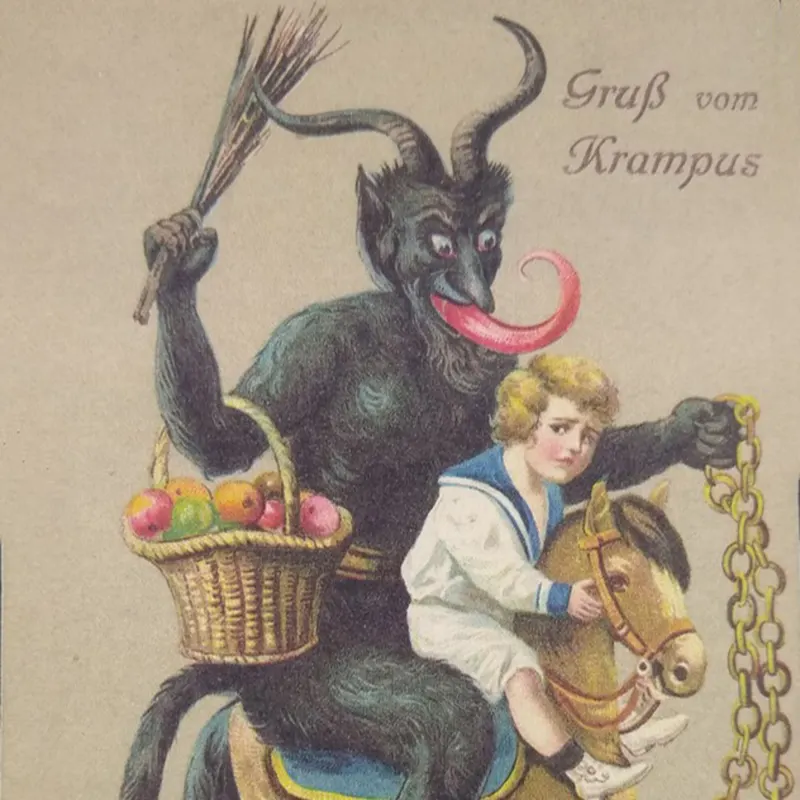
Yeah, and so the modern Krampus really became, really took off as a commercial phenomenon with the development of Krampus Christmas cards in the 1880s. Because once the Austrian-Hungarian Empire had finally developed a sophisticated train system and then a sophisticated mail system, people from remote villages loved sending these cute little Krampus cards to each other. This led Krampus to move from the villages to the cities and eventually outside the Alps altogether into places like Berlin and even Poland that didn't have a tradition of Krampus before this point. You can look online to find these pictures of 19th century Krampus cards. They're usually a little bit scary, but also kind of funny. A lot of times you'll see Saint Nicholas giving gifts to good children and then Krampus right next to him punishing the bad ones, usually carrying away the really bad kids in a wicker basket.
A lot of these also were kind of ribald, a little salacious, because a lot of times, instead of just punishing bad kids, Krampus would punish young couples who were doing too much PDA. Sometimes, Krampus actually himself was the Lothario, because there's a couple cards of him picking up giggling women or handing girls bouquets of flowers. And I think this kind of shows that as the 19th century progresses, Krampus becomes less and less scary and is seen as more of just kind of this cute, funny Christmas character. His face even gets a rascal, not a demon.
Yeah, so after World War I, there was this trend of making Krampus cards with particularly cutesy designs, which showed him as, you know, a rascal, a little demonic teddy bear of sorts. And I'm just going to guess that they were probably riding on the coattails of Kewpie dolls, which were a strange early 20th century toy of a naked baby that looks a lot like a Disney design from a few decades later.
Yeah, yeah, because like by the 20s, they were basically doing like chibi Krampus. It's really funny. It's kind of cute.
Yeah, so, but anyway, this was the start of the decline of Krampus before his ultimate ascendance to the heights he has reached today.
Banned in Austria
But possibly due to the beliefs that Krampus was pagan, or at least the backdoor to paganism, when the Catholic fascist regime of Engelbert Dollfuss seized Austria in the early 30s, any Krampus celebrations were banned. And as far as we could tell, the Nazis kept up this prohibition even after annexing Austria, despite their pretty different attitudes towards manifestations of traditional Germanic paganism. And then by the 50s, the government of Austria began spreading propaganda, which tried to convince the parents of Austrian children to get rid of Krampus. They were distributing pamphlets entitled things like Krampus is an evil man. The Austrian psychologists worried that a society dominated by post-war shortages and the fear of nuclear war didn't really need something to frighten children like Krampus. There's a 1953 Time magazine article about these efforts, which is quite funny.
Yeah, yeah. And that article actually is the first, the earliest reference I can find to Krampus in English, which is kind of funny.
Right. So, possibly as a backlash to this policy, Krampus became much more scary across the second half of the 20th century in Notglass. According to the journalist Al Ridenour, who wrote one of the most comprehensive books on Krampus, Germans and particularly Austrians decided to amp up the intimidating elements of Krampus in the 60s. This might have been seen as an anti-establishment choice, a reaction both against government policies about Krampus as well as increasing influence of the friendly American Santa Claus trying to create this anti-Santa.
The anti-Santa
Basically, yeah, yeah. And that's the idea that I think is really important today, that Krampus is the inverse of Santa. The movie Krampus from 2015 makes it explicit. They say that, you know, Santa Claus gives, Krampus takes. And I think what really happened here is that just as Krampus was getting scarier in the 60s, by the 70s, there was a lot more tourism of Americans and Brits to these small alpine towns in Switzerland, Bavaria, Austria. Sometimes to ski, other times just to, you know, drink cider and punch and look at the cute architecture. Around this time, English speakers started to really be exposed to Krampus. And immediately, local business owners realized they could capitalize off of Americans' fear and confusion by using Krampus to juice local economies. Costume designers really made Krampus a lot scarier at this point. There even were Krampus coffee shops opening up in Austria.
And I think that's because they really wanted to emphasize the dissonance between the warmth of the jolly giving Santa Claus and the cruel taking Krampus. Additionally, I think this leads into Anglo-stereotypes of the Alps in Central Europe as particularly dark and harsh and ancient, maybe even primitive. These are the kind of Orientalist tropes we talked about in a Transylvania episode. In a weird way, I think that maybe Krampus is the westernmost version of Orientalism you can think of.
The Americaner Krampus
And so by the 1980s, there were small companies of Americans who were making much more realistic horror masks, usually out of rubber and latex, and sometimes for use in direct-to-VHS horror movies, and other times just for Halloween costumes. These companies realized that they had a market in the Alps and they started making masks specifically for Christmas parades in Germany and Austria. Meanwhile, as the cosplay world gets more and more developed, these costumes more broadly get a lot more elaborate, which means that by the late 2000s, the Krampus masks are really demonic, strongly influenced by American horror movies and video games with absolutely enormous horns, fangs, and scars, sometimes even glowing eyes built into the masks, to the extent that some towns in the Alps started banning any Krampus costumes that were too scary, too modern, or you could say too American.
Right, I think they usually call this like the Americaner Krampus in Austria, this kind of design. Yeah, so in recent years, there's been some pushback against this perceived Hollywoodization, especially because Krampus is understood as an important local cultural tradition, which is, once again, being swayed by the perfidious Americaner. But at the same time, the supposedly Americanized version of Krampus had helped the tradition to stay alive when so many others had fallen to the wayside. Like, we can probably comprehensively say that Krampus isn't going away anytime soon.
I think that's right, and especially with, you know, in the 2010s, all the spread of Krampus in American pop culture, Krampus is becoming an American tradition too, which is really interesting.
As Al Ridenour puts it, I have not spoken to any participant involved in Krampus customs not eager to emphasize the traditionalism of their activities, and many jumped to offer respectful praise of the prestige and preservation of customs in places like the town of Bad Gastein. But the fact remains, somebody is buying the new stuff. Just like the rock music aficionado who speaks admiringly of scratchy old 78s by Delta Bluesmen, this praise may be more of a way to emphasize an understanding and deep-rooted appreciation for more contemporary reinterpretations. For instance, lip service to Robert Johnson paid by a fan of The Rolling Stones.
Yeah, and it's mostly this version of Krampus that's increasingly become the American tradition.
Krampus in America
This is most likely a commercial phenomenon as well. Americans started learning about Krampus in the 90s and the 2000s thanks to travel magazines, costume shops, BuzzFeed listicles about crazy foreign traditions, Christmas episodes of both the Venture Brothers and American Dad, and more than anything, the 2015 movie, Krampus, which we talked about.
And yeah, yeah, again, like you guys should watch it. It's really fun. It's my favorite entry into the Christmas horror micro genre.
As Ridenour puts it, in the 20th century, Krampus arrived in English-speaking lands, like a thing long awaited. The menacing old-world companion to St. Nicholas shocks us with his brutal threats of punishment for naughty children, but somehow he also seems inevitable. In a secular society where craving the other is more commonly satisfied through horror and fantasy than through the Midnight Mass, this monstrous character seems custom-made to provide a thrill of holiday awe. It doesn't hurt that he comes from the German-speaking world. Christmas in America and the UK has long shown a bias toward German traditions. Our Christmas tree, Santa Claus, Silent Night, Christmas cards, and even the libretto of the Nutcracker are all unashamedly Germanic. Even the friction between the savage Krampus and our notion of the holiday as cozy domestic ideal is slowly working in the beast's favor. For Americans who came of age in the rebellious punk rock era, the Krampus now cuts a handsome figure.
Somewhat myopically perceived as the anti-Santa Claus, he seems to express the requisite countercultural contempt for the Coca-Cola guzzling, bloated patriarch of all that is consumerist and parental. As Dead Kennedys fans succumb to their reproductive urges, hanging up that family Krampus ornament purchased at an alternative craft fair becomes an important token of a fading rebellion. Slowly, or perhaps more quickly than we expect, the advance guard of American parenting is breaking down for Krampus alongside the Christmas dinner, Grandma's Visit, and any other enduring family traditions. And this is from Al Ridenour's The Krampus and the Old, Dark Christmas, which is a pretty fun book.
Yeah, so again, we see capitalism building new popular traditions, which have a kernel of the old stuff built in, but which are totally commercialized. The original intention is, of course, to make money, but just like beloved Christmas movies or the famous Coca-Cola Santa ads, these commercial ventures become genuine folk beliefs in their own right. Just as the colonial Americans incorporated Dutch ideas about Sinterklaas into the older stories of Father Christmas, and then Rudolph went on from being a pop song to part of the Christmas pantheon, Krampus is slowly becoming part of the American mythos of Christmas. Even though this cultural transmission happened through capitalistic marketing, it's still a genuine cultural transmission. So I'm sure that there's a small number of kids in America today who genuinely believe in Krampus, just as children in Austria and Germany do.
The most pagan of all?
Right.
And that's why I think, you know, to kind of close this all off, now that we've talked about all these figures, you know, Krampus, Belsnickel, Hulda, if we're asking if these characters are pagan, I think in a weird way, you could say that Krampus might be the most pagan of all of them. Because unlike the others, even though he might have the most recent origin, in practice, stories about Krampus and a genuine belief in Krampus seem to be spreading in America in the same ways that pagan deities once spread across Europe, you know, like the cult of Isis entering ancient Rome. The only difference is the only people who believe in Krampus are all born after 2016. They're small children. But it is kind of interesting that this figure lives again in the minds of, you know, the youngest among us. And I think it's kind of interesting to see this happen because usually this is a time when folk beliefs are sliding away.
But as a result of capitalism, as a funny consequence you wouldn't expect, this one belief is becoming stronger.
And no, actually, I think it's very interesting. Yeah, so again, like these traditions in the Alps, I think, are deserving of a lot more study, particularly in English. I think that if you're trying to look at the ways, if you're using these traditions to learn more about pre-Christian traditions, you're mostly going to be out of luck because any connections to genuine paganism are so old and indirect. But I think that if you want to learn about the kind of more recent intellectual worlds of everyday people in places like Austria, Slovenia, Bulgaria, these monstrous parades are a wonderful insight into those kinds of intellectual worlds and emotional worlds as well.
Yeah, like you said, like there really is something primal about this. And I'm not so sure, Sam, if I'd go so far as to say that the similarities of these traditions in different world regions point to a single common origin in the Ice Age. I don't know if I'd go that far, but I think it definitely points to some kind of common psychological belief, you know, that like there's something fun and exciting about letting loose and becoming an animal at one given time of the year, kind of as a lords of misrule kind of thing. And I think that more than anything is what really connects all of these practices. It's fun, basically. And, you know, it's that in America now, for the last 20 years, a lot of Christian conservatives have really made a big emphasis to, you know, to put the Christ back in Christmas.
But I think that the secular elements of celebration are really just as old as the religious elements. Christmas has always been about having fun, and it's even all about getting scared. So, I think that even if something like the 2015 Krampus movie is the ultimate example of the commercialization of these old traditions, it's also a very traditional way to celebrate Christmas.
Wrapping up
All right, well, thank you guys for joining us.
Any closing thoughts on these characters, Sam?
Yeah, all right. Well, it's gonna be Christmas soon. If you're in the mood to celebrate, Merry Christmas. If you're not the Christmas celebrator, then Happy New Year in the Soviet style. And have a lot of fun sharing Krampus with your friends and loved ones and younger members of your family. If you're going to be doing some kind of Krampus-themed thing for this year, then please get in touch with us and let us know because we'd love to hear about it.
Yeah, we'd love to hear.
Yes.
And make sure also that keep your floors clean because you don't want Holda to slice you open and fill you with dust.
Yeah, all right.
Take care.
The show is also on Apple Podcasts, Overcast, Pocket Casts, Podcast Addict, YouTube, RSS and Patreon.