This week, we have a very special guest coming to us from the steppe via transfer in Central Europe. This episode is all about the constitutive elements of Hungarian Turanism, the ideology that traces Hungarian origins back into Asia and often comes with a political program for what to do with that knowledge. In this multi-part series, we set the stage for a later exploration of Turanism as a doctrine of the late 19th and early 20th centuries. But before we go there, we must dive into the murky origins of the Hungarian people as derived from linguistic and genetic evidence, and how Hungarians of the medieval and early modern period conceptualized this migration. We have medieval chronicles deriving a biblically-based genealogy of the Hungarian people, we have early modern legal thinkers of the aristocracy constructing a doctrine of racial supremacy over their class inferiors, this one has it all!
What relationship do the Hungarians have to the Turkic peoples? Are the Hungarians descended from the Huns of Attila? Was the progenitor of the Arpad dynasty sired by a bird? Find the answers to these questions and more on this episode of Gladio Free Europe.
Turan Explorer is on Twitter, Tiktok, and Youtube. He also has a podcast, available on Spotify and other platforms.
Closing song: Gabor Szabo - Galatea's Guitar
Transcript
A very special guest
All right, we are back with another episode of Gladio Free Europe. I am your host, I am joined as always by the incredible Russian Sam.
Hello, hello.
And today we have a very, very special guest, somebody we've been wanting to collaborate with for a long time, a fellow podcaster, also a star in the TikTok space. We are joined today by the Turan Explorer himself.
How are you doing?
How are you guys doing? Very excited to be here. Long time, long time fan. Big inspirations, y'all were.
Oh, no, likewise, it is absolutely mutual.
What is Turan?
So, alright, so just to start off, most of our listeners probably don't even know what a Turan is. So, I think we have to start with a really, really quick crash course before we can get into any of this. In the broadest of terms here, since the time of Xerxes the Great, people in Persia have referred to the lands to the north of them as Turan. This area is basically identical to what we'd consider Central Asia today. Even though it's a Persian word, this land was very much not Persia. And I think that's important to say outright, because without getting ahead of ourselves here, we gotta keep in mind that Turan has always been this imagined foreign space. And although Central Asian countries are pretty obscure to modern Westerners, the Turan region was this essential thoroughfare of the Silk Road. It's a perfect highway for missionaries, merchants, or migratory nomads traveling from, let's say, Europe to China or India to Russia.
It's this great highway of civilizations and has been so for really thousands of years. As early as the 18th century, European translators of Persian literature used the name Turan to refer to this region, who by this point were mostly Turkic speakers. And we should mention the name Turan even appears in a famous opera, Puccini's Turandot from the late 19th century. So it kind of shows that the concept of Turan was percolating in the European imagination for quite a long time.
Finnish explorers and the Uralic languages
Then, in the middle of the 19th century, a tiny group of scholars in Finland, of all places, noticed that the so-called Turanian languages, the Turkic languages, had some strange grammatical similarities to their own Finnish language, which has long been understood to not be related to either Swedish or Russian, the languages of the aristocrats who've ruled Finland. So in 1841, the linguist Matthias Castrén and the folklorist Elias Lönnrot became the first modern Turan explorers when they set foot out from Helsinki, exploring the upper bound of the Turan zone, places of the Russian Empire where the steppes of Central Asia meet the forests of Siberia. They discovered that a lot of local Siberian languages exhibited the same grammatical similarities that Finnish shared with Turkish. And this discovery sparked a flurry of interest in Finland's supposed Turanian past. This tiny frozen country, which had long been under the thumb of its neighbors, Sweden and Russia, was in fact part of an ancient and unwritten history connecting many disparate peoples across Eurasia.
Matthias Castrén admitted that all of his research was in the service of his own Finnish patriotism, saying, I'm determined to show the Finnish nation that we are not a solitary people from the bog, living in isolation from the world and from universal history, but are in fact related to at least one-sixth of mankind. Castrén and Lönnrot argued that within the Turanian umbrella, some northern languages were particularly close to Finnish. Sami, spoken by the indigenous peoples of northern Scandinavia, but also more obscure Siberian languages like Kamassian, Mordvin, Tundra Nenets. But one more language was determined to be part of this family, one which had significantly more speakers than all of the other Uralic languages combined.
The Hungarian language
Tell us, Turan Explorer, what language is that?
That would be Magyar. magyar nyelv. That would be the Hungarian language.
Absolutely, yes. So Hungarian, which includes about two-thirds of all Uralic speakers, is, of course, a Uralic language. It is not closely related to Finnish at all, which we really have to emphasize. But tell us about Hungarian. I know you speak it quite well, right? I know you're not a native speaker, but what is Hungarian like? Because, you know, most of our listeners, this is an Anglo podcast, very few of us, I think, are going to have any familiarity with the Hungarian language at all. I know it's infamously difficult because of its grammar, but if you could, you know, share about your linguistic journey, please.
Yeah, for sure. Yeah, so I got interested in the Hungarian language and a lot of these subjects because I am a Hungarian-American. A lot of my family is from or currently lives in Hungary, and I always grew up, you know, kind of interested in it and sort of around the language. And as we'll kind of see as we talk about this subject, the whole mythos and all of the lore around Turanism branches off into a lot of really wild directions. You have people who are really embracive of the Finno-Ugric thesis that is now basically considered to be like the language family that a Hungarian belongs to, pretty unequivocally. And then you've got people who think that it's actually Turkic. That has for a long time been the historic divide, especially during the Ugric-Turkic war of the Hungarian Academy of Sciences.
But this would be in like the late 19th, early 20th century.
Exactly, yes. But you've also got other branches thinking that Hungarian is Sumerian, Hungarian is Mayan, Hungarian is Linear A, Etruscan, Tamil, related to Japanese, and Korean, which was not too unfamiliar to a lot of earlier Turanists. Because Hungarian, you know, it is related to Finnish the same way that French would be related to like Gujarati, you know, the same linguistic family, but so divergent from it.
Language, race, and nationalism
Right. And I guess one thing that I think is hard for Americans to grasp is the way that these linguistic theories, which is really at the end of the day what they are, have incredibly important implications for nationalism and politics and identity.
Right. Because, you know, these Finnish explorers, you know, were interested in kind of linguistic Turanism, but you've also got the German sort of race theorist Max Müller, who really critically wrote about how there were three main ethnic groups. I think he's just talking about, or three main races in like Eurasia, that of the Aryans and the Semites and the Turanian people. So really tied to this sort of racial construct at the same time that like myths of like the Aryan race or the Semite race or whatever are emerging at that same time. And I think that what's, I think, almost, I don't want to say amusing, that's, you know, it's condescending, but what's so fascinating about Turanism is that it's based on this idea that because of the linguistic connections between Hungary and Siberia, Hungary must be understood as truly this Asian country, which I think is especially funny, really, because, you know, to an outsider, for all intents and purposes, Hungary is as like classically European as you can get in Europe, right?
Yeah, exactly. Except for certain like modernist and turn of the century era revivals, then there's really a brilliant and probably one of the best impacts of this sort of Turanist legacy is its influence on Hungarian architecture. You will see a lot of fascinating buildings that try to very consciously bring in Turkic elements, Sassanid elements, even lots of, you know, so-called Oriental styles in order to create kind of a new Hungarian style, you know, especially during the 19th century. One other kind of complexity about the Hungarian language is that it broke off from the rest of these kind of Finno-Ugric peoples very early on. And their sort of political structure and lifestyle, there's a lot of mystery about what happened in between then and then when there's historical record of them. But there was a high degree of both like linguistic and social Turkification. You have a lot of different loanwords from Turkic languages in Hungarian.
They were referred to as Turks by the Byzantines very early on before they had even settled in modern Hungary. They were a vassal state, actually, of the Khazar Khaganate for a very long period of time.
Yeah, we'll definitely get into that.
Yes. Yeah. And so you wind up with a lot of these different influences sort of linguistically. And then also just the general growth and transformation of a language that was so far removed from its other Finno-Ugric counterparts.
East or West?
Definitely. And, you know, this is, I think this kind of gets to this really interesting kind of imaginary conflict within Hungarian nationalism that we see with a lot of different countries. We talked about this way back when, how, you know, in interwar Poland, there was the split between people who wanted kind of an eastern-facing Poland and a Western-facing Poland, which had very interesting implications about ethnicity and religion beyond anything just that's just purely geographic. And I think that's, I think that Hungary might be the most extreme example of this kind of divide. It's this kind of because Turanism kind of poses this question of what is the true Hungary? Is the true Hungary, you know, the Hungary of the Gothic cathedrals and the street cafes and jazz guitar? Or is it, you know, the Hungary of the Blood Pact, the steppe, the ten tribes and all that?
And I think that I would argue that most Turanists historically rejected Hungary as it actually exists, right? That's kind of this fundamental aspect of many forms of radical nationalism. This idea that if you wanted to tap into the true Hungarian soul, that of the temporarily embarrassed steppe conqueror, you have to give up your Budapest townhouse for a yurt and trade in your German car for a well-lathered stallion.
Exactly. Yeah. You know, and a lot of it, you know, I know that we'll get to this in more detail, but the classic national tragedy of the dismemberment of the state after World War I really caused a lot of these psychic ripples.
Yes. And that's what I think is so interesting is what I think is really the important question for this episode, or, you know, for any discussion about Turanism, is not are these theories true? It's what happened in Hungary in recent history to make so many Hungarians want to believe these theories are true.
Exactly.
The Egyptians spoke Hungarian
Yeah, there are so many kinds of layers to it because I got really interested in this in part because like I have relatives who have told me crazy stuff. My grandfather, who is Hungarian, a really complicated guy. But the last thing that he said to me before he died was that he thought that the ancient Egyptians spoke Hungarian. Because the ancient Egyptian hieroglyph for death, this is what he said. I actually don't know if this is the case or not, but the logic is that the ancient Egyptian hieroglyph for death is two fishes standing next to each other. And the Hungarian word for death or to die, the verb, is like halal, or like meg halalni, to die into completion. Hungarian grammar is a little unusual like that. But the word for fish is hal. So hal-hal sounds like the verb die. And therefore, with that ironclad logic, the Egyptians, as well as so many of these other glorious ancient peoples of the East, were true Hungarian Turanids.
Well, Hungarians trolley hold up half to sky.
Turanism beyond Hungary
I think let's just dive in. Yeah, so this is such an interesting topic because, you know, generations of Hungarians up to the present deeply believed in this Turanian idea. We should mention that Turanism is not specifically Hungarian. There are Finnish versions. There are even, there's even Japanese Turanism. There is Turkish Turanism, but really Hungarians made it their own. It were the Hungarians who took Turanism so seriously that they took these archaeological investigations to Central Europe and Tibet. I believe actually you mentioned in your podcast, Hungarian Turanists were the first Westerners to go to Tibet at all, right?
Basically, yeah, one of the first Europeans to learn and publish a dictionary of the Hungarian language was this fascinating figure. He was, I'm sure, Gladio Free Europe listeners know, Székely from Transylvania. And he believed that the origins of the Székely, specifically maybe the broader Hungarians, was actually among the yellow Uyghurs. So his big goal was to go to Uyghurstan and study the Uyghurs. He never made it that far. He wound up kind of getting, he was arrested by the British and later contracted by them to work on an English to Tibetan dictionary. And this is kind of the first introduction that you see sort of the role of kind of a consistent role of like British intelligence and despising the history of Turanism.
Yeah, no, I think that we'll have to do a full episode on the great game because it intersects so much with all of this stuff.
Exactly.
That being the rivalry between Russia and Britain in Central Asia. But it's just such an interesting topic.
A nationalist paradox
And one last note before we really, really dive in, I think what's also really fascinating about Turanism is that it is, at the end of the day, a European nationalist ideology, which means that many, possibly most implications of Turanism have some very odious conclusions about race and nationality. Many Turanists were aligned with the political far right. Many were extremely anti-Semitic. In the present, Turanism today is broadly aligned with the modern Hungarian far right, which is pretty infamous in European politics. At the same time, what makes it basically unique among European nationalism is this idea that Hungarians are not actually European at all. This strange tension has led to a lot of very unusual sympathies, especially in the modern era. And true believers in Turanism often take their nationalism in ways you would never expect. And I think that's part of why Turanism is so worth exploring and why we are so excited to jump in here with the Turan Explorer himself.
Well, thank you. Yeah, that's a great summary of it. You know, though, there is kind of an interesting tragedy to it because many of the most early figures in Hungarian Turanism were usually assimilated or on the or attempting to assimilate Jewish Hungarians who were really influential in this. You know, one of the great figures as well, Vámbéry, father. Turanism, as we know, he says in his biography, his initial interest in this thing that he would later be so responsible for turning into at least the beginnings of it as a political ideology is that he saw the dejected, well, that he during 1848 experienced pogroms in his Jewish community at the hands of Slovakians, thinking, you know, assuming Jews were allied with the Hungarian 48ers. And when he saw, you know, he was traumatized by that and saw the dejected and downtrodden 48 defenders returning. And an old peasant apparently appears out of a field and says, ah, you know, but this is just a momentary tragedy.
One day the old Hungarians will return and they'll save us from all of this misery. And he said that he was interested in the origins of the Hungarian people ever since.
That's amazing. All right. Well, so that's just kind of frankly that we're going to discuss 5,000 years of history here because what's so unusual about this nationalist ideology is this idea that you see that, you know, what happened 5,000 years ago among the ancient Hungarian peoples is relevant to the Hungary of the present, you know, that like one, yeah, the idea that one day these ancient, you know, Bronze Age Hungarians will liberate us. That's just so fascinating to me. That's the kind of stuff I love to get into.
The Uralic family
So, let's start with the very, very beginning. Let's start with the origin of the Uralic languages. So, as you mentioned, many Turanists would dispute this, but the scholarly consensus, which I think is very personally convincing, is that Hungarian is not directly related to the Turkic languages or to Mongolian. It is part of the small but very interesting Uralic family. This is a small language family, mostly spoken, as you mentioned, Hungarian and Finnish, as well as many languages in Siberia, probably began to separate around 3000 BC, which makes this divergence at least as early as the divergence of the much larger Indo-European language family, that being the language family that includes English as well as German, Persian, Hindi, yada yada. So, what this means is that Hungarian and Finnish are certainly related languages, but they diverged very, very early, about as early as English and Hittite. So, whenever any Hungarian and Finnish speaker happened to cross paths throughout history, let's say in a rowdy beer hall during the Thirty Years' War, it is very unlikely any Finn or any Hungarian would have ever even suspected these languages were kin.
And I'm saying this because we have to keep in mind throughout this whole episode that any of these kinds of connections we're talking about here really did not survive through folklore or through any living traditions. These are connections that had to be rediscovered, or you might argue, invented in the modern era, particularly in the 19th century. That being said, the similarities between Hungarian and Finnish, which we now know to be due to common origin, as well as the similarities with Turkic languages that are not believed to be common origin, these similarities are very interesting. I think the most obvious one is the use of the feature agglutination. I have to confess, I do not speak Hungarian. I do not speak any foreign language properly. I don't have a great handle on how agglutination works. I know broadly it means when you add syllables to the ends of words to add additional meaning.
How would you describe agglutination?
Yeah, that is effectively what happens. You add usually suffixes at the end of words to give a different meaning grammatically, can show what the object of the sentence is. It can kind of serve the same purpose as prepositions, complicated by the fact that Hungarians do also have separate post-position words that sort of do this as well. And as such, Hungarian has an unfixed word order. Now, it is believed that while the, you know, there are so many discussions about the language family and trying to essentialize things like that, there is kind of like a broader linguistic sprachbund of all of many of these languages believed to have interacted and shared a lot of features in this regard. So, you know, some of those early Turanists were, you know, not exactly right because they were so obsessed with this idea of linguistic familiarity. But over time, you know, certain connections that they made and certain etymologies that they found have been sort of, you know, revised a little bit.
But I think that it really speaks to the kind of obsession with language as race and linguistic family as race that was so consistent throughout the modern age that they would never even entertain that it wasn't based on linguistic family.
Yeah, no, 100%.
The steppe superhighway
And I think also is kind of interesting, you know, like that something as dry as this single grammatical feature was believed to be this, you know, keystone to understanding the true nature of the Hungarian people. Yeah. And but it is kind of interesting this similarity here. And like you said, that basically that there are these interesting similarities between Hungarian and Turkish and Mongolian, even as far off as Manchu, Korean, and Japanese. And scholars now believe it's kind of a healthy mix of coincidence and contact. Because due to this whole steppe superhighway, peoples speaking different languages did come into very close contact in the past. And particularly, you know, Hungarian was very heavily influenced by Turkic languages, especially before the Hungarian peoples entered Hungary as we know it. There was also the really interesting element of the Eastern Iranic Scythian languages. These are the languages that would have initially been spoken in the Turan area as described by the Persians.
The Scythians and their succeeding groups like the Sarmatians and the Alans basically disappear around the fifth century. This is a very complicated topic we can't really get into, but it is broadly understood that in some sense, the Scythian cultures of the ancient era were kind of the forerunners to the later Turkic and Hungarian-speaking nomadic cultures of the early Middle Ages. What this kind of relationship is not well understood by anybody, but from the Turanist perspective, the relationship is very simple. Hungarians are the Huns, and the Huns are the Scythians. And that it's this kind of racial essentialism that is very fundamental to this Hungarian understanding that, you know, Hungarians are truly a people of the steppe. This is not specifically a Hungarian phenomenon, as we mentioned. You know, a lot of Turkish nationalists believe something similar. We talked about pan-Turkism way back in episode 13, more than two years ago, but it's really what we're looking at here is this specifically Hungarian flavor of this broader nationalist phenomenon that looks at the ways that modern settled countries have these ancestral connections to the nomadic steppe and what this says about modern politics.
Iranian and Turkic loanwords
Yeah, exactly. The, you know, like we were kind of discussing, the difference, one of the many differences between Hungarian and a lot of those Finno-Ugric languages are the introduction of a lot of Turkic and then some Iranian and as well some later on after settlement in the Pannonian Basin, a bunch of Slavic loanwords as well. We can kind of get a glimpse into what they may have adopted from Iranian cultures. It likely would have not been Scythians, but it would have been maybe Alans or something like that, someone, you know, centuries after the Scythians. And, you know, some of those words that are believed to be of Iranian origin, they're usually like military kind of words. So the word for sword, the word for shield, the word for 1,000, which may have come from like a counting of certain troop regiments and this type of thing.
So we can see kind of some of the introduction of that. And then from the Turkic standpoint as well, we know that pre-conquest Hungarians were these sort of Khazar vassals, and they also were written about as having a very Turkic style of fighting and a sort of Turkic social structure as well. One that was very similar to, I believe, to what's believed to be the social structure of the Khazar Khaganate with a gyula, which is now a common name in Hungarian, and a Kende, a military leader and a spiritual leader.
Yeah, right. And that's the thing is, so I'll say this: I'm putting my cards on the table. I am very much skeptical of Turanism in any sense. However, there's two things we really have to keep in mind. The first is that due to this whole steppe superhighway, there was an incredible amount of contact between Hungarian speakers and Turkic speakers in the pre-conquest period. By conquest, we mean the settlement of Hungarians in Hungary. Additionally, it is totally indisputable that the Hungarian language was introduced into Europe from Asia. It seems like not the Turan region of Central Asia, but instead from Siberia. But this migration, this, or this rather, this, you know, movement of this language very much happened. And what I think is particularly interesting is that this movement from Siberia into Europe happened twice with the Uralic family because it's believed that Finnish and Hungarian entered Europe completely separately.
Finnish moving kind of in the northern route through the frozen taigas of northern Russia, and then Hungarian through the kind of the steppe route. That's, you know, hence these close connections with the Turks.
Into Pannonia
But eventually, Hungarian would really come into being once these pre-conquest Magyars settled in the former Roman territory of Pannonia, what we call the Carpathian basin. So, really, the Hungarian language came to Hungary relatively recently on a historic scale. This happened around the 9th, early 10th century, concurrent with the expansion of the Vikings in the other side of Europe. Byzantine sources record nomads from the east known as Ungroi taking part in ongoing conflicts between the Byzantine Empire and the Bulgarians along the shores of the Black Sea in like eastern Romania, eastern Bulgaria, around I think 862-ish, around the 860s, I believe, maybe a little before that.
Somewhere around then, yeah. These a little bit earlier. It was in the 9th century.
These Ungroi, who probably called themselves Magyars, Magyars, they might have been settlers, mercenaries, or pastoralists just passing through Bulgarian Byzantine territory, but they certainly would have not been that foreign in the sense that, or they wouldn't have been that unusual. Because nomads passing into the Balkans, this phenomenon had been happening for many hundreds of years. Before the Magyars were the Bulgars, the Khazars, the Avars, going all the way back to the Huns and even the Scythians and the Sarmatians and the Alans before them. We see another early record of these Ungroi about 25 years later when they're recorded pillaging the German territory of the Franks, possibly in the pay of the Moravians. Moravians were a Czech-speaking kingdom who were nominally Christian, but suspected of harboring sympathies for pagans like the Magyars.
Raiders and the bishop of Salzburg
Russian Sam, can you read this kind of fun letter from the Frankish bishop of Salzburg to the Pope?
For many years, the Moravians have in fact perpetrated the very crime of which they have once accused us. They themselves have taken in a large number of Hungarians and have shaven their own heads according to their heathen customs, and they have sent them against our Christians, overcoming them, leading some of them away as captives, killing others, while still others imprisoned and perished of hunger and thirst.
Yeah, we get another great early record of Hungarians from the famous monk Cyril, the creator of Cyrillic, because he was menaced by some Hungarian raiders while traveling through Bulgaria, but managed to somehow defuse the situation. We also find little scattered references to Hungarian merchants, probably slave traders, in Byzantine border towns in Crimea and Ukraine, on these frontier cities on the Black Sea. And then at the turn of the 9th century, this is right before the conquest of the Pannonian Basin, Hungarians are mentioned to have been fighting against the Franks at Vienna, and then again, with the Franks against the Moravians, who had previously been their allies. Shortly after, the Hungarians begin to move into Pannonia, at which point I think Hungarian history as we understand it really begins. We're going to go through this process in a second, but we should mention that everything we've set up here, that is basically all we know from contemporary sources of the early Hungarians.
Everything after this comes from oral history recorded down many centuries later. So this is really all we know of what was happening from the time. It all comes from external sources, mostly Greek and German sources. But then shortly thereafter, there is this observable shift in language and identity in the Pannonian basin. All of a sudden, very quickly, you begin to see the emergence of this Hungarian kingdom. And what's especially interesting is that these Hungarians did not, even though they settled down in Pannonia, they certainly did not stop raiding elsewhere. There are Hungarian raids recorded as far west as Italy and France. There is a, you know, a great victory, I believe, the Battle of Treviso, I want to say, against the Franks in Italy that allowed the Hungarians to just run rampage across northern Italy for a very long time. And I think this kind of, I'm bringing this up because Hungary is not a large country today.
And I think it's honestly not a country that most Westerners think that much about. But there was this period in which Hungary was very much at the center of European politics, this one moment in the early Middle Ages. And for quite a long time, the Hungarian kingdom would be one of the largest in Europe.
Yeah. And, you know, it's interesting too, though, the pre-conquest historical record, you know, that was a good overview of references to the Ungroi.
Ibn Rusta and the Khazar vassals
But Magyar, the original, you know, the endonym of Hungarians, it first enters the historical record actually in the writings of Ibn Rusta, who was an Islamic Persian traveler. He never went to Hungary, but he went to the Khazar Khaganate and wrote about and wrote about these Magyars as a vassal state. I believe he is where we get the evidence of the sort of dual leadership nature of Hungarians as well with the gyula and kende. And I believe additionally, there's a record that the Byzantine Emperor Leo the Philosopher was able to incentivize them to attack the Bulgars. I believe that that was one of the only during that time period victories that the Byzantines were able to get against the Bulgars because they were distracted by these Magyars to their east. It's also generally thought that the kind of push and pull factor, because they were in this area that was just to the north of the Sea of Azov in Ukraine, you'll find this referenced a lot in Hungarian chronicles, often as Etelköz, or between two rivers, basically.
And one of the things that pushed them into the steppe that is the Pannonian Basin and how great it is that you can be a Eurasian nomad traveling westward. Once you pass these mountains, you're greeted by another steppe that's easier to defend. You know, it really speaks to why so many people settled there. But yeah.
Why Hungarian survived
No, and that's something you see a lot in history is, you know, steppe nomads find a place that's very far from their home where the geography is suitable to that lifestyle. Like, you know, the Pannonian Basin is an obvious one, but even in Turkey, in Anatolia, I think a big part of why the Turks were able to enact this lasting language shift comparable to Hungarians is because there were these steppes within Anatolia where entire tribes could move over and practice this steppe lifestyle. And eventually, just like with Hungarian, the Turkish language would spread to the local farmers.
Yeah. It's really kind of miraculous that no, I've always said this is the greatest source of Hungaro optimism is that the Hungarians settled there. And after this long process of settlement and then getting taken over by new nomads, the Hungarians are the ones who are, you know, there, at least in the plains still today. So definitely held that territory down longer than the Huns, you know, for all of the wanting to be like the Huns, you know, in some ways, they've honestly exceeded what the Huns were ever able to do.
That's, no, that's a great point because so many different nomadic groups in this early Middle Ages period and even earlier crossed into settled territories and imposed themselves as a new ruling class. But as far as I know, the only times there was a permanent language shift was the Hungarians and the Turks in Anatolia. Everybody else, like, you know, the Bulgarians, they initially spoke a Turkic language, then they just eventually adopted the language of the local farmers, of the Slavs.
Exactly.
The Khazars no longer exist. Everyone, you know, probably everybody, you know, there's a lot of questions about who are descended from the Khazars. I think most likely the descendants of the Khazars directly are Slavic-speaking Ukrainians today who have no real link, you know, to the culture of their ancient conquerors. Like, usually, what I'm saying is, usually, the conquerors assimilate. In Hungary, you saw the opposite, which is really interesting. And that's really that, and if anything, you know, why that happened, why the Hungarian ruling class imposed their traditions from the top rather than adopting the traditions of the bottom, that is why Turanism exists. I think that if the Hungarians would have adopted a Slavic language spoken by the peasants, there would be a completely different political orientation. It really all goes back to this kind of historical accident of Hungarian being this Asian language.
The Avars and the dual conquest
Yeah, and there's interesting analysis as to why that didn't happen. One being that the Avar Khaganate existed there and the late Avar Khaganate was collapsing.
Yes.
And nobody knows about the Avars. And I will go ahead and say that there are a lot, or, you know, we know a bit about the Avars, but there are a lot of serious questions within like the archaeological record or in the kind of etymological record of place names. So many of the place names in the middle of the Pannonian basin are very easily identifiable as Finno-Ugric. Whereas, you know, on the north, it's more Slavic. You can pretty much easily track what's, you know, what might have been Romanian or Latin in origin. So that has led to one theory that I will say this is like it's inspired by Turanism. The person who came up with it was one of the more exactly.
Yeah.
The theory of the dual conquest, which I've seen so many serious historians writing serious history books always mention it as answering some questions, but opening up so many more questions that it is almost impossible to really entertain. The idea that maybe it was the Avars who were Finno-Ugric speakers and the Hungarians who were a Turkic elite, and they did actually adopt the language of the people in the basin. I don't think that's true, but it is interesting thinking about how the seven tribes that we have named, the seven tribes of the conquering Magyars, five of them, I believe, have Turkic etymologies. Only two have Finno-Ugric ones. And all of Arpad's children had Turkic names. Even eventually, István, who is considered the first king of Hungary, converted the country to Christianity. And there's some really interesting back and forth about his battles with the pagans or possibly Eastern Christians because of that.
But he was born with the name Vajk, which is itself a Turkic name, and Christianized it to the Hungarian Stephen.
Right. And I think this goes to show, which is so important here, is regardless of if there is a true common origin with the Turkic peoples, Hungarians were very much part of the Turkic milieu. And I think that, you know, to an outsider, they probably would have just seemed like any other Turkic tribe who just happened to speak a different language.
Why "Hungary"?
Yeah, exactly. And so you destroy, I think a good example of that is that the name Hungary, which that's an exonym. It's a Greek name, not an endonym. But it probably is actually a Turkic name that initially was used to describe a different Turkic nomadic confederation that may or may not have included pre-conquest Hungarians. It probably comes from the name Onogur, which means 10 tribes. And historians aren't really sure if that 10 tribes would have included any Magyars or not. And there's actually, you know, Russian Sam, I think you know this. The reason why Ungroi became Hungary, it's kind of funny.
Because of the conflation with the Huns?
Yeah, yeah. Greek scholars assumed that, you know, the Huns had to be directly linked to these Ungroi, so they just added an H to the name to make it sound more like Hun.
Yeah, and we're going to get into all this stuff and the ways that the Hungarian scholars took it and ran with it in a little bit. So stay tuned.
Yeah. Because, right, it was originally kind of an insult cast against them when they were doing a lot of their raids. I believe the first reference of Hungarians as Huns is in the records of when they sacked a particular Belgian abbey. Was when they were first called the Huns by an external source.
Now, and again, it's just amazing how far west these guys got. Like, that's just remarkable that, you know, these raiders were able to go all across Europe in search of plunder.
Yeah, all the way to Spain, where even medieval writers believed that Hispania was from the Hungarian word for basically like military governor, ispán, in a very early medieval chronicle that I'm sure that we'll talk about.
Oh, yeah, I think we discussed.
Yeah.
The genetics
Yeah.
Okay. One thing we should mention here, because this is something we discuss every so often in this podcast, is kind of the genetic side of all this. Because basically, because of a lingering influence of Turanism, Hungarians are probably one of the most heavily genetically analyzed populations in the world. Because so many Hungarian researchers want to find out exactly how much, you know, Asian ancestry they have. And this also has some kind of interesting implications on the whole Ugric versus Turkic thing that I guess we might get into later. Because, you know, Siberia and Central Asia are two different places, with each of them having unique genetic signatures. So there's a lot of interest in seeing which of these would be more prominent in Hungarians. And the answer basically is that. So, the short answer is that Hungarians are genetically very, very similar to neighboring peoples, to Poles, to Austrians.
Hungarians, you know, from a genetic standpoint, at first glance, are just a Central European people. But when you get a little bit closer, you do see some traces of Asian ancestry not shared with neighboring groups. And what's interesting is that there are two different sources of Asian ancestry within Hungarians. And as you might expect, it's one source from Siberia, which is shared with other Uralic speakers, which does indicate an ancient migration from Siberia. And a second source is from Central Asia. And that this Central Asian source is genetically closest to a group of people known as the Bashkirs, who are around the Ural Mountains in Russia today, who speak a Turkic language. This was of great excitement to Hungarian journalists because early Hungarian travelers along the Silk Road thought that these Bashkirs had some similarities to Hungarians themselves. And I think that the nature of this link between Bashkirs and Hungarians is an open question, but it's very interesting.
And again, speaks to these close connections medieval Hungarians had with Turkic-speaking tribes.
And what's much bigger of this sort of Asian genetic imprint, which most Hungarians don't have, but you do find some isolated locations, especially in like communities sort of in the northern Carpathians, as well as Székely in Transylvania. Certain, especially, you know, certain kind of heat points of that, where that's a lot, that's a lot stronger. But when you look at older graves of even like Hungarian kings who we think is basically, you know, Western, like Matthias Corvinus, you do see strong, you know, Central Asian imprint on that.
Yeah. Because, well, yeah, because it basically took many centuries of intermixing for all Hungarians to kind of look like regular Europeans. There probably would have been a very long time in which the ruling class would have looked kind of North Central Asian.
Especially around the time of László the Cuman, who was literally half Cuman. And I know y'all talked about it.
Yeah, yeah, we talked about Laszlo way back when in our episode, this, not, I guess not that long ago, maybe nine months ago in our episode in Transylvania.
Yeah, that was a fun guy.
Yeah, he was really the kind of the original Turanist. He was the one who kind of wanted to, yeah, return to the steppe at a time when most other Hungarians were facing very much towards the back.
The oral tradition
But if we want to talk about this kind of Eastern origin of Hungarians, like we said, there is very little hard evidence. What mostly we know is from the oral record. We have some early oral recordings written by outsiders, especially the Byzantines, but our most detailed sources are written down many centuries later, which means it's hard to know how reliable these sources are, but they're a great window into the kind of high medieval Hungarian worldview. The Byzantine sources give us some interesting little snippets of presumably an oral tradition. We see that the Magyars, immediately prior to coming to Hungary, they lived in a place called Levedia, which was believed to be a city on the kind of Pontic steppe, which is actually probably where the Proto-Indo-European language first emerged thousands of years earlier. And that this place, Levedia, was founded by a guy named Levedi, which is kind of interesting.
They believe that from Levedia, they entered the Balkans, possibly in service of the Khazars. The Khazars were a Turkic-speaking group, a very powerful confederation. They are of most interest to modern historians because they had this very unique affinity towards Judaism. It seems that some Khazars formally converted to Judaism, but the nature of this conversion and what impact it had is a very, very hot topic of debate. One thing I will say that I find very cool is that it seems that a breakaway Khazar group known as the Khabars were part of the Magyar migration into Pannonia, into Hungary. And this might be connected to a handful of potentially Jewish steppe-style burials found in Serbia around this time, which would have been part of the Hungarian kingdom. So, what this is to say, it's very possible that there might have been some Jewish Khazars essentially in the initial Hungarian migration, which really just goes to show the multi-ethnic and multi-religious nature of the steppe.
Exactly. Yeah, I think that it's interesting. It was very religiously diverse. Regardless, there's also strong belief that there were Muslims as well among those early Hungarians, including very likely a lot of artists who either were from or had been trained in sort of post-Sassanid Persia. Both a lot of the artifacts of the early conquering Magyars and then of the Avars as well have a lot of kind of like Sassanid and Persian style art.
Yes. And we're going to talk about this very popular kind of historical motif, this mythological motif in Hungary, the idea of the great bird, which is believed to be connected to pre-Islamic Persian iconography. It's amazing because, you know, because this kind of shows that, you know, there's not nothing to Turanism because Iran and Hungary are very far-flung countries, but you do see these really interesting, meaningful cultural connections in the early era facilitated by that whole steppe superhighway.
Yeah, exactly. Yeah. And returning to the Khabars as well, you know, there's no way to know this. And by this point, this guy had converted to Christianity. But there was a Khabar king of Hungary. He was only briefly three years in power after the kind of scuffle for power after István. But his name was Sámuel Aba or Samuel Aba. And he was from a Khabar family. So, you know, it's really interesting to think about the history of Hungary and Hungarian multiculturalism in that context.
Oh, absolutely.
The Gesta Hungarorum
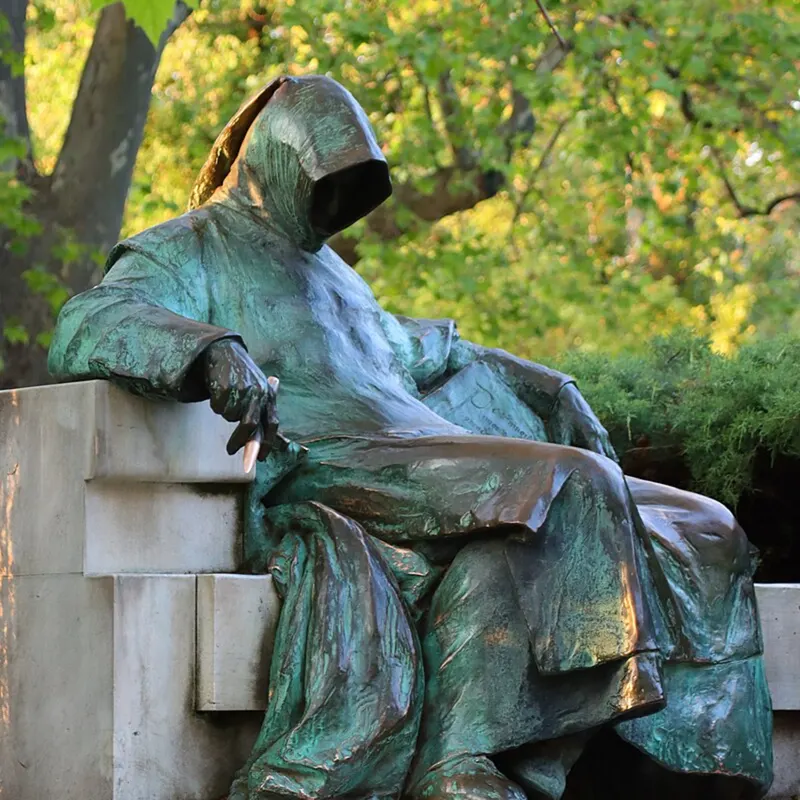
All right, well, Russian Sam, let's go into the written record here, really getting into, let's hear Hungarian prehistory from the Hungarians themselves. There are really two great sources here from the high medieval era, and you did a great job summarizing these. The first one of these, if you want to get into that, is the Gesta Hungarorum, an anonymous text written in the time of King Bela III by a court official known helpfully as simply Anonymous. He's also known as Master P, which I think is a much funnier name. And I believe if you go to Budapest today, there is a giant statue of him.
Yeah, he looks like a lich king.
Yeah, exactly. Yeah.
Yeah, so the Hungarians, just to make it clear, they show up in the Pannonian Basin in 894, 895, thereabouts. And these first written sources from the Hungarian historians, they show up around the year 1200. That's around where Anonymous was writing. And he was the first Hungarian writer known to specifically link his people to Attila the Hun, who had plundered his way through Europe centuries before that. In the opening passages of his chronicle, he writes, quote, The first king of Scythia was Magog, the son of Japheth, and this people were called after him Magyar, from whose royal line the most renowned and mighty king Attila descended. Now, Anonymous doesn't extend this thread much except to say that he founded Obuda, which was village, which would later get absorbed into Budapest, and that his descendants show up back in Pannonia later. But the other chronicle we're going to talk about tells this story with much more detail.
Also, this one jump in here: the whole idea that the Magyars that are descended from Magog, the similar names there, that is such a common medieval European thing. And not just a European thing, everybody loved claiming that a nation, a tribe, had to be descended by a person of that name. This shows up in the Bible. This shows up in Norse mythology. It was this really widespread belief. We mentioned in our legendary ancestor episode. For many years, the Scots even believed they were descended by the ancient Egyptian princess Scota. This is just a really common, you know, mythological motif.
Yeah. And an interesting thing as well about Anonymous's Gesta and then the other conveniently named Gesta that we'll talk about is that there was, historians generally agree that there was a Gesta before this that both authors were probably drawing from called the Ur-Gesta. That has exactly been pretty much lost to time, although there's a lot of speculation around other stuff. And you'll notice if you know your biblical history, this is very strange, and nobody's really come up with an answer for this. But Magog, who's written about in the Bible as this apocalyptic figure, he's from the line of Cush in the Bible, not from the line of Japheth. And it's very odd that a Christian magister, you know, someone who was a clerical person like Anonymous was, would make such a basic, such a weird mistake about the lineage of this very critical figure. But part of that is just the ambiguity about Magog is referred to in the Bible a number of different times, and it's kind of unclear which one is which.
Ah, yeah, it's interesting. And even in British writings, there was this idea that there was a giant called Gog Magog that was possibly ancestral to the Britons. It's kind of interesting how that one figure shows up a few times.
Yeah. I'm actually just bringing this back. Anonymus, he was actually not very well read at all. He wasn't super well educated. His Latin is pretty rudimentary from what I understand. So this kind of mistake slipping through makes sense in that context. This just, like, he was basically a scribe. He wasn't really someone who was trained in the classics, who would be super familiar with all these literatures. So to trace Magog to Japheth rather than Cush, that just seems like, you know, run-of-the-mill stuff for someone like that.
Latin and Christian Hungary
You know, before we keep going, I guess one thing I want to hone in on is the fact that this is written in Latin at all is very interesting. And it's just because it goes to show that despite this clear Eastern origin of the early Hungarian kingdom, by the high middle ages, Hungary was very much being increasingly incorporated into the kind of Catholic, Frankish, Roman sphere of Western Europe, not the sphere of the steppe or even the Eastern sphere of the Orthodox Byzantines. And that Latin actually became the official court language of Hungary. And there would be this very important influence of Latin in law for really up until the 20th century. Isn't that correct?
Yeah, for much longer than it was. And I also think that it's important to point out and jump back then 200 years. You know, István Christianized the Hungarian people, at least that's what's said. You know, he introduced like Western Catholicism. But there was.
And not Eastern Orthodox Catholicism, which is an important distinction.
Yes, but his father was closely aligned with Eastern Orthodox. He converted to Christianity, but people don't consider him a Christian because he still did lots of pagan stuff.
Koppány and the Black Hungarians
And there was a really vicious war that István had to fight almost as soon as he took power against several groups of people called the Black Hungarians. And the most infamous one of these was Koppány, who has become a kind of legendary figure in the Hungarian mythos and kind of Turanist-inspired mythos, because he was a relative of the royal family. Geza killed most of his relatives, but not, but Koppány somehow survived. We know that when Geza died, Koppány believed that he was entitled to Geza's wife, and also that he should have succeeded the throne because he was the senior most member of the family, which indicates that he still probably had some correspondence with or some belief in kind of the pagan structure, because it would have been kind of incestuous from a Christian context. So he was originally almost as soon as István takes power, waged a war against him and then a much more prolonged war against the other remnants of the Black Hungarians.
Now, they were most likely actually Eastern Christian.
Orthodox.
So, Gyula and Ajtony, yes, exactly, yes. Who had been baptized in Constantinople. And and so it's often framed that this war of the white Hungarians and the black Hungarians was a war between the Christian Hungarians and the remnants of the pagans. Also, a very long-standing folk myth that a pagan shaman cursed Hungary for a thousand years for converting to Christianity. There's been a great rock opera made out about this. This is where the curse of Turan comes, and kind of you know, Hungarians explaining why they tend to lose wars in modern memory, and a number of these different things. But this has definitely stuck in the mind of a lot of Hungarians in that context, right?
And it shows you this kind of divide of should Hungary be eastward-facing or westward-facing goes back to the early Middle Ages.
Exactly, exactly, yeah, from the very, very beginning.
Almos and the Turul
All right, so Anonymous writes that the Hungarians originally lived in Scythia, which means Central Asia. It's basically you know contiguous with the idea of Tehran, it's a similar concept. And that he says that, however, Scythia was highly populated, but that meant it was overpopulated, you know, so people constantly were spilling out of the steppe. And that in one case, the seven leading Hungarians known as the Hétmagyar, which is just seven Hungarians, decided that they had they needed to find their own promised land. So they should forsake the soil of their birth, quote, and take themselves and take for themselves such lands as they could inhabit, as will be said in what follows. And what follows is: on the way to Pannonia, the Hungarians stopped at a castle called Hung on the modern-day Ukrainian-Slovakian border, known as the Ungvar Pass, I believe, today. Anonymous explains that Almos was considered the leader of this area, and he named his people the Hungarians after this Ungvar area, or this castle of Hung.
And also, the really interesting thing about Almos here is that he has this very unusual birth story, which seems to point to many different ancient traditions: Christian, Persian, and of course, Turkic Turanian. What he says here is that Almos was named for a divine event because when his mother was pregnant, a divine vision appeared to her in a dream in the form of a falcon that seemed to come to her and impregnate her, and made known to her that from her womb a torrent would come forth, and from her loins, glorious kings would be generated, but that they would not multiply in their own land. Because a dream is called Alom in Hungarian language, and his birth was predicted in a dream, he was called Almos. And this bird in this story is the legendary Turul bird, which is very important to Turanism and modern-day Hungarian far-right nationalism.
It seems to indicate this kind of totemic Central Asian tradition, but we should mention that this kind of falcon imagery is really common in Persia in the pre-Islamic era. So it's really this kind of widespread cultural motif that you see in the Caucasus, you see all throughout the steppe. Really interesting.
Yeah. And, you know, I believe that the general consensus among linguists is that Turul originally was a type of crested goshawk and is itself a Turkic loanword.
Tughril, the Seljuk founder.
Exactly. And also a leader of a Nestorian Mongol Kerait peoples as well.
Two different guys named Togrul.
Exactly. Probably would be cognates with that as well. And I'll also point out, you don't notice because Anonymous doesn't say it, that Almos's mother has sex with the Turul. But subsequent retellings of the story do say that. And it's kind of entered sort of the folk mythology. And if you look at Turanian or Turanist art long enough and kind of fan art, there is some really kind of horny depictions I know of.
Doesn't it just have a cloaca? I feel like that's kind of mechanically hard to figure out.
All right, but that's your magic.
Yeah.
Yeah.
The blood oath
Okay. So, you know, I think the most famous part of the Anonymous's Chronicle, the Hungarorum, is the blood oath, which you've talked about at length in your own podcast. Do you want to, can you just briefly summarize this here? Because it's a cool concept.
Yes. So, you know, in theory, if this really happened, it would be pretty much one of the first records of like a country's founding constitution in Europe.
Yeah, that's true.
Which is the Mayflower Compact.
Yeah.
Exactly. Yes. Basically, you know, all of these sort of seven leading tribes come together and elect Almos, the son of Ügyek.
Yeah.
Excuse me, the son of the Turul bird.
Yes, yes, right.
To be the leader. And, you know, they swear, and the quote is right here, by the free will and common consent of the seven leading persons, they chose as their leader and master of the sons of their sons to the last generation, Almos, son of Ügyek. From today, we choose you as leader and master, and where your fortune takes us, there will we follow you. Then, on behalf of Prince Almos, the aforesaid men swore an oath, confirmed in pagan manner, with their own blood spilled in a single vessel. And although pagans, they nevertheless kept true to their oath. And they go through this kind of list of promises, one of which saying they'll never betray the king. If the king betrays the people, the nation will be cursed, this sort of thing, but kind of generally like an oath of loyalty between this sort of proto-nobility and the king itself.
What's interesting is that historians have kind of looked to see, okay, did this actually happen? It's mentioned in this Gesta, it's not mentioned in the other Gesta from shortly after this that we'll look at. And it's very possible because as this was being written about by Anonymous, there was a huge social transformation going on in Hungary. And very recently, or very shortly after this, would be the passage of the Hungarian version of the Magna Carta, basically, an actual sort of constitution of the country, wherein the nobles forced the king to sign.
Right. And I think that's an interesting point here. This is something that you see a lot in kind of late medieval, early modern politics, which might be something that's going on here. Is kind of a modern political situation is legitimized by this mythological past. This idea of like, you know, that this blood pact could have implications on the modern relationship of, you know, late medieval Hungarian nobility towards the king.
Right. And to spell it out a bit further, like, Hungary was an elective monarchy at this point, which meant that the nobility elected the king and they could withdraw their support if their rights were violated. So basically, this oath is saying that they swore that they and their descendants would remain loyal to Almos's line, provided that Almos and his descendants give them what they are due. And this is just important to highlight because this passage is actually going to have very important implications in the development of Turanism, as we're about to see shortly.
Yeah, yeah. Anything else we should mention from this chronicle, or should we go to the next guy, Simon? What do you think?
Emese and the deer
Let's, there is some really interesting sort of etymological stuff that we can that both looking at both of these chronicles and the way that they talk about this lineage are interesting to compare because there has been a lot of writing that one of the reasons why we know at least some amount of this comes from not just like secondhand sources but actually potentially a steppe central you know steppe nomad tradition is the sort of role of these kind of iconographic totemistic animals play like this Turul for example bird yeah because almosh's mother is Emese we'll see a sort of you know she has written i believe she is the daughter of duke yes unit de ulien and the hungarian word for a deer and we'll we'll talk about the stag in the next chronicle but that our not not a stag, a female deer, right yeah is is une and there is pretty pretty interesting linguistic research, mainstream hungarian linguistic research, that says that all of this may have been an interpretation of Emese, her name coming etymologically from a pretty antiquated word relating to like hallucinations and visions, being the daughter of this sort of deer, totemistic lineage.
So it's believed by a number of Hungarian linguists and historians that this may have been a translation of this kind of totemistic pagan culture that was very much, you know, still in fairly recent memory in Hungarian culture being translated into this becoming Christian and pagan, but thought about as still as noble and worthy of integrating into the Christian European system kind of culture. So yeah.
No, and I think also it might be relevant to mention that the Mongolians centuries later also recorded their own story of descent from a female deer.
Yeah, and just this is interesting from the perspective of this being a very Christian gloss of what's clearly a much more steppe-inspired story where, you know, this Turul bird appears to appear to Almos's mother in the dream rather than actually appearing her. And in this variant, she's already pregnant, whereas in the original, the father of Almos would have been.
And the whole thing, yeah, the whole thing of being visited by a bird, it's similar to the Holy Spirit and the birth of Christ, you know, and it could be a coincidence, but we also remember this is this is being written down by Christians. It's the same problem we have with Norse mythology, right? This oral tradition is recorded centuries later, centuries after the conversion to Christianity. And you noted, Russian Sam, that also that there's some of the descriptions of the Hungarians entering their own promised land has these interesting parallels with the biblical Hebrews entering Canaan. It's a similar kind of phenomenon.
Yeah, yeah, for whatever reason, Almos, he just totally disappears from the narrative when it comes to actually entering Pannonia. And it's not really clear in Anonymous, in some of the other chronicles. It says that he was killed. Some people say that this was some kind of a ritual murder. Some people say that this was a parallel to the Bible where Moses, he's allowed to look at Canaan, but he's not able to actually enter it himself.
Simon of Kéza
Yeah. And let's, on that note, let's move over to our next chronicler, Simon of Keza, from a few decades later, who happens to have a very Christian Jewish name, which you should mention. You know, remember, which should remind us, this is a Christian medieval society. Despite this steppe origin, it is very much enmeshed in the kind of Western Christian traditions of Central Europe.
Right, so let's talk about Simon of Keza. His chronicle was written around the year 1280. This would have been shortly before the Mongols invaded Hungary. We just know that based on what he actually covers. And this one is also called The Deeds of the Hungarians, the Gesta Hungarorum. And in many ways, he's...
He throws Huns in there too. Its full title is The Deeds of the Huns and Hungarians.
So he's even more explicit about the Hunnic connection than yeah.
So in many ways, he follows the same basic formula as Anonymous, but he gets really crazy with it in other ways. And, like, this one kind of threw me off guard because, on the one hand, he starts off very strong by debunking the notion that the Hungarians were descended from demons. Quote, one must dismiss it as against nature and quite contrary to the truth that maintains that spirits can beget when they are not supplied by the natural organs which would provide the procreative ability and the function capable of creating the true form of an embryo. From these considerations, it is obvious that, like other peoples of the world, the Hungarians owe their origins to man and woman. So, Simon begins with a genealogy, and this one is much more fleshed out and more foundational to Turanism for this reason.
Yeah.
Here, the Hungarians descend from the line of Japheth through Menrot, who built the Tower of Babel. Later narratives would identify Menrot with the biblical Nimrod, and Turan Explorer on your wonderful podcast. You actually did an entire episode about this. So we're going to link that one in the description. So we urge our listeners to check it out.
Hunor and Magor
But anyway, after the whole Tower of Babel thing, Menrot had sons named Hunor and Magor, who are the progenitors of the Huns.
And so I think we should mention here: this is interesting because the whole idea of Huns and Hungarians being linked probably was imposed upon the Hungarians by outsiders. We have no idea of knowing if the Hungarians had any kind of cultural memory of the much earlier Huns at all. But, you know, once people start calling you Huns enough, maybe you kind of start to believe it.
It remains one of these questions that is possible that there might have been a Hun continuity that the Hungarians had before conquest, but there's still a lot more research that would need to be done on that.
Yeah, I think that what, yeah, and to go back to Simon, in addition to being much more detailed in his genealogy than Anonymous, he was also a lot more well-read. He was much more of a classicist. He really embraced the kind of Latin elements of medieval Hungary to the extent that he actually plagiarized some Latin writers, including the early Byzantine writer Jordanes, whose Getica chronicles the early history of the Goths. And so, one of the things that he kind of, you know, stole basically from Jordanes is the idea that Hunor and Magor, the descendants, the ancestors of the Huns and the Magyars, went into the wilderness for five years. Then, in the sixth year, they realized that they needed some loving. They had to find some ladies. And just as it happened, they stumbled upon, quote, two daughters of Dula, prince of the Alans, who happened to be among the children, and they were seized.
Hunor took one of them in marriage, and Magor the other. And to these women, the Huns owe all of their origin. And as they stayed in the marshes, they gradually grew into a very powerful people, and the land was not large enough to contain or feed them. This idea of overpopulation also shows up in Anonymous. Then these people moved into Scythia proper, where they settled down until Scythia also becomes overpopulated.
The 108 pure clans
And here is an interesting passage: The pure Hungarian nation comprises 108 kindreds and no more. Any additional ones are immigrants or descendants of the captives. From 108 clans were begotten by Hunor and Magor in the marsh, without any admixture. This passage would become very important for early modern Hungarian racecraft. Taken at face value, it slides very neatly into a racialist discourse, but this wouldn't happen until centuries later. The commentary gives a better idea of what he might have meant, which is that, because quote, the expression pure Hungarian nation can be understood in the context of a common legal practice of Italian city-states at a time which made distinctions between original citizens and newly settled inhabitants. If you've ever read much about late medieval Italian history, you might know that this might remind you of the Ciompi revolt of rural farmboys settling into the cities and causing some mischief.
Continues: when talking about the mingling of these two groups, the originari and the newly settled inhabitants, the verb mischiare was used in Italian, which is probably the basis of Simon's term misitalia for admixture.
So I know that Russian Sam, you compared this to the way citizenship works in the Gulf states, right?
Yeah, yeah. So it's like not really a strictly racial delineation, but it very easily bleeds into that when you have more of the constitutive elements that would make racism a thing in the early modern period.
Yeah. And then so the story continues that the captains of the Hungarians would take 10,000 men from each of the 108 tribes and go off to greener pastures. So there would have been a million people migrating, which I think is a little hard to believe. And this is where things kind of really get fun because you start seeing a lot more borrowings from the Getica, as well as even some stories lifted from Germanic mythology, like the Nibelungenlied, which would have been probably introduced to Hungary by the Saxon townspeople who were settling in Hungary around this era.
The miraculous stag
And I also want to point out a really important thing to include in the Hunor and Magor story is that a miraculous stag leads them westward. I don't think that we mentioned that or really dove into that, but they follow this, and that is what leads them. It actually leads them closer to Hungary. It doesn't entirely lead them to it. But that is probably almost as, if not every bit, as important, like a Hungarian national and mythological symbol. That miraculous stag, sometimes called a white stag or a golden stag, as the Turul is in Hungarian nationalism and mythology. Another one of those things thought to be related to, you know, related to potentially a totemistic religion. Also, the, you know, Magor's children become the Magyars, Hunor's children become the Huns. And when he mentions, you know, people have still stayed behind in Persia where Nimrod is because he had so many other wives, potentially alluding that he might have gotten switched up with an early like Moravian prince or a prince who might have also been in Pannonia, who was a polygamist.
But, you know, this is debatable. People wonder where the Nimrod myth comes from because he was generally a hated figure in like Christian circles during this time, kind of like the apocalyptic Magog as well. But Kezai switches up the Tower of Babel and the Egyptian pyramids and mentions that Nimrod's pyramids can still be seen in Egypt today, which that's very funny because he's the first guy to say Hungarians are Egyptians, isn't he?
Tyson's your grandpa.
Attila, scourge of God
Yeah, that's great. Yeah, there's a lot more we could say about Simon. I think, in the interest of time, the last thing we should mention, which I find most interesting, is that he once again connects the Hungarians specifically to Attila. And I believe Simon is actually the first person to use the phrase the scourge of God to describe Attila the Hun. It wasn't a contemporary, you know, appellation. That was many centuries later. He also, he believes that the migration of the Huns was directly connected to the much later migration of the Hungarians.
So he also kind of invents the whole, you know, continuity thesis of Gyula László. You know, it's kind of interesting.
Yeah, exactly. Yeah. All right. I think that's basically all we can say about Simon, just in the interests of time. I think.
If you want to listen more, listen to the Turan Explorer podcast. Yes, of Russia.
You have one last thing to add?
Scythian law and the peasants
Yeah, but before we move on from Simon, I just want to draw everyone's attention to the way that there's another element of the story that would be very useful for the legal foundation of Turanism. So Scythia becomes overpopulated around the year 700. The chronology here is really fun and out of whack, basically. So Attila and six other captains, they lead their armies to settle in new frontiers, meaning Europe in this case. And here we get another passage that would just be totally foundational for Hungarian racial discourses. Quote, thus, in the days before the Hungarians had been baptized and became Christians, the criers of the camps would summon together the Hungarian host with the following proclamation: quote, It is the word of God and of the Hungarian people that on such and such a day, every man in arms shall present himself without fail and in such and such a place to listen to the council of the community and to hear their instructions.
That is, to go to war. If anyone dared to defy the command without being able to offer a reason, Scythian law decreed that he be cut in half or exposed to hopeless situations or degraded to communal enslavement. Thus, it was such offenses and excesses that separated one Hungarian from another. Otherwise, since one father and one mother were the ancestors of all the Hungarians, how could one be termed noble and the other not noble unless he be judged and proved by such blameworthy behavior? So, in other words, the reason why there's class stratification among the Hungarians, despite all of them originating from the same person, is because some of them are the descendants of people who just behave dishonorably by dodging the draft, essentially. And that's why you have the nobility who deserve to be up top and the peasantry who don't deserve that because they violated the oath and so they are to be punished in perpetuity.
Sarmatism
All right, and that's a great little segue there because I think that what's really bringing us to Turanism proper are the ways that these legendary genealogies and histories are used to justify existing structures of power, whether it's a class stratification or more often, the relationship between nobility to a king. This is something that will be very fundamental to a lot of Eastern European kind of proto-nationalist ideologies. The most important of these, which we have to kind of sort of, it's a kind of a parallel to Turanism, is the much earlier theory of Sarmatism or Sarmatianism, which was the Polish theory that Polish nobility were directly descended from the ancient Sarmatians. These were a Scythian-derived people who spoke an Eastern Iranian language before the time of Attila the Hun. This was a really widespread belief in the 15th, 16th, 17th centuries in the Polish-Lithuanian Commonwealth. And it sort of is like a proto-Turanism because you began to see Polish nobility adopting styles of dress borrowed from existing nomadic peoples in Central Asia, as well as from the Ottoman Turks, because they saw both these groups as kind of their Eastern kin, even while constantly waging wars against them. It's really interesting.
There was this kind of strange racial supremacist element, however, to Sarmatianism, Sarmatism, because this idea was that if the Polish nobility were descended from the Sarmatians, the Polish peasantry, many of whom spoke non-Polish languages like Ukrainian and Lithuanian, they were not descendants of the Sarmatians. Thus, they were not entitled to these same kinds of rights.
Right, so these people were sort of like natural slaves, whereas the nobility, they were the Scythian warriors who had won their place at the top of the food chain by conquering all of that. So they were literally built different. And as such, the nobility had a huge repertoire of rights that could not be violated. Whereas the peasants, that's a whole different story, but you cannot touch the rights of the nobility.
Right, and that's something that's especially true in Poland, but it's kind of true of Eastern Europe more broadly in this era. You tend to see a very large nobility with very strong rights versus both the peasants below them and the king above them, in contrast to Western Europe, where there's a much smaller nobility, but more of kind of an urban middle class. It's a very different sort of social structure.
István Werbőczy
Russian Sam, tell us about István Werbőczy.
Oh, yeah. So, the figure who really brought a Sarmatism-like conception to Hungary was named István Werbőczy. He lived from 1458 to 1541. He was the son of a relatively minor nobleman who rocketed his way through the ranks during his life. He received an excellent education all across Europe, including in the University of Kraków, where the legal theory of Sarmatism was being articulated at this time. So, Werbőczy, he went to serve in the Hungarian Diet, the parliament, in 1498. And at this time, the king of Hungary was the Polish Władysław II of the Jagiellon line. And of Władysław, he had actually suffered a stroke in 1504, so he was sort of incapacitated by this point. And as mentioned in the Transylvania episodes, the Hungarian kingship was really hotly contested in this period, and the elections were usually a very dirty business. So, many Hungarian notables were unhappy with the idea of a foreigner being the king of their country, which they saw as a violation of their rights.
And Werbőczy, he quickly became the most eloquent and well-reasoned proponents of these interests. He was one of the greatest Hungarian legal thinkers of all time. I don't think it would be a stretch to say that.
And what I think is kind of funny is that he would do this basically by using the Poles' weapons against them, because he would kind of borrow elements from Sarmatism and use them to promote Hungarian interests against their Polish overlords.
Right. So, in 1505, Werbőczy penned the decree of Rákos, which the Diet voted in favor of. It decried the disintegration of the country, which it held to be the fault of foreign kings who oppressed the Hungarians. And the foreign kings had failed on the battlefield, which led to the loss of Hungarian lands. This was the nobility's way of saying enough is enough.
Yeah, so this decree says that they're going to put an end to all these great tribulations that the Hungarian nobility is going through. They want to prevent the further degradation of their state. And it says that in the event that Vladislaus should die without a male heir, then no foreign king would be allowed to become, would be allowed to rule the country because this would make the Hungarians fall into perpetual servitude. But I think what I think is most important here, though, Sam, is the fact that in this decree, he also explained that the Hungarian nobility, drawing from the model of the Polish nobility, they should be declared as the gentis Scythiae. This he is directly comparing the nobility of Hungary to the ancient steppe peoples for political gain, to say that just like the Sarmatians in Poland, the Scythians in Hungary are a distinct nation who deserve specific rights given to them by their ancient steppe past.
Yeah, and this text, it never became law because it naturally wasn't ratified by the king, but it was very widely circulated and it marked a very important moment in the thinking of the nobility. It also shot Werbőczy to fame, where he would remain for the remainder of his life.
Right, and I think that why he's so interesting here is because he borrows from the words of Anonymous and Simon and others to really argue essentially a theory of racial supremacy for Hungarians over others, which again is drawing from the Polish model here. That other ethnicities were self-evidently meant to serve the nobility, just as these people's ancestors had been the servants of Attila the Hun. And so I think this is, it's really kind of showing this the beginnings of this supremacist form of Turanism. You know, we've been going on for a while here. You have any thoughts, Turan Explorer?
Yeah, no, I completely agree. Yeah, and it was especially cherished among the lower nobility, this idea of Scythian origin, nobles who didn't have land, nobles who might have been from elsewhere, who were given titles from the king for their service from the king. Kind of a unique sort of structure of the nobility tiers in Hungary. But it was especially beloved among them because that helped kind of let them into, continue to let them into the club of, you know, the real nobilities in the model.
György Dózsa
Yeah.
You know, there's a lot of people I think you could consider the first political Turanist. I think the most, the best example might actually be the Székely György Dózsa. What are your thoughts on this guy? Because I think he's a kind of really cool missing link from this medieval theories to modern Turanism.
Yeah. György Dózsa is a huge and super influential character. You know, a hero both among Hungarian right-wingers and left-wingers, like so many leaders of peasant rebels. You will find, other than statues of anonymous, statues of Dózsa are the most epic and metal things in Hungary because of the way that he died.
Please, let's tell us the story.
Yeah. So when he was killed, or when basically, you know he he amassed this large, you know, this large army of peasants and of about 40,000 marching all the way to Pest ultimately ultimately when he dies he is he is tied to a chair and they pour what is it molten is it lead or iron or something like that some molten metal on his head and and and melt him alive oh my god you will find a statues of him that depict this death and they are extremely brutal looking one is a huge like 12 foot tall statue in the hungarian oh my god it looks awesome yeah and that's not all like they also picked his skin open with red hot pliers and they made his followers bite chunks of flesh off of him while he was still alive gruesome stuff but he's also but Dózsa's interesting here because didn't he he he kind of used sort of proto-Turanist language to explain why hungary why hungarians deserve these rights right yeah and he was at least sort of sort of you know retrospectively understood understood as such yeah and Dózsa he had a very radical platform for his time like he was calling for the abolition of the nobility he wanted the redistribution of land and and the and the equalization of ranks within the church and there were a lot of of franciscans in particular in his ranks and getting and among his followers and giving him advice so there was a very strong millenarian millenarianism in the air he was arguing that the king and the nobility were pro-Ottoman traitors and that they were going to continue to crusade.
Like the nobility had called off this crusade because they saw the violence that was beginning to unfold and they wanted to crack down on it. But they said, oh no, but Dózsa said, oh no, this is a crusade. Just this is a crusade against the Hungarian powers that be. Many towns. Yeah, many towns, they declared their loyalty to the rebels and the peasants became very violent against the nobility. They were very quickly routed on the battlefield once the nobility got organized by John Zápolya and Stephen Bathory, whom we mentioned in the Transylvania episodes. And yeah, so on July 20th, the 1514 Dózsa, he was put to death in this really agonizing way.
The Tripartitum
Yeah, and so this rebellion, it became a justification for the Hungarian nobility to cement their status within the legal structure and also the legal inferiority of the peasantry. And this is where Werbőczy really made his mark. He got to work and he authored the so-called Tripartitum, which was a piece of constitutional theory which would continue to hold sway in Hungary until the 19th century. So Werbőczy, he based his thought on the passages from Simon that we quoted from above, and he used this as a historical justification for the total subjugation of the peasantry. The peasantry, by joining this rebellion, had broken their oath to the Hungarian nation, and thus their status was given a genetic basis. They were to be inferior going forward legally. So they and their descendants, they would be marred by this great dishonor of having taken part in this rebellion, and their rights would be curtailed.
And also, it was sort of like an affirmative action program for the nobility where the cleric was to be given an explicit leg up and in any church positions, as well as a ban on peasants becoming bishops, presumably because so many people around Dózsa were peasant origin priests who were preaching the immanentization of the eschaton, basically.
Habsburgs and Ottomans
So I feel like in very broad strokes here, following the Tripartitum, the defeat of the Dózsa Rebellion, you begin to see this gradual absorption of really the entire Hungarian state into the Habsburg monarchy of Austria. It's a slow process. For a long period, certain parts of Hungary are actually under the control of the Ottomans directly, the central region of Hungary, including Budapest. But slowly, you begin to see this kind of full assimilation into this Austrian sphere, and by extension, into this Western Catholic sphere. It really seems to be this final dominance over, you know, the West over the East in this imaginary conflict of the Hungarian identity. I get the impression that Hungarian nationalists don't really like the Habsburg period, right? They don't really like talking about it or thinking about it too much.
Yeah. And in many ways, even though the Ottomans, like a lot of Balkan countries, really were considered the principal villains of Hungarian history for a long time, the Habsburgs' reputation was so bad, deserved or not, that it wound up really rehabilitating Turkey. And you'll find even before 1848, which we'll talk about, there were other rebellions as well against the Habsburgs, like for example, you know, Rákóczi and Thököly and stuff, where they would flee, including as well, like Lajos Kossuth would flee to the Ottoman Empire and seek refuge there. So it sort of rehabilitated itself in this way. Additionally, there was really, really widespread embrace of Protestantism in Hungary during the Ottoman periods. And even to this day, you'll see Protestantism is most popular or most prominent in places that were closer to Ottoman Turkey because the Habsburgs were never able to fully re-Catholicize the country.
Yeah, no, because we talked about this way back in our episode on the 100 years on the 30 years' war with Matt Christman, but you know, the Habsburgs were famously, incredibly anti-Catholic. It took them a long time to stamp out Protestantism in the empire, but they eventually did, especially by the end of the Thirty Years' War. But then in the Ottoman territories of Hungary, the Muslim Turks didn't really care what kind of Christianity you practiced. There were many different kinds of Christians living within the borders of the Ottoman Empire, and they were repressed in many ways, but they were also given this kind of community autonomy to do whatever they wanted as long as they paid their taxes. They could never get too powerful, but they didn't really care what kind of Christians they were.
Paprika and lard
Yeah, and this Ottoman period also had really important impacts on Hungarian food. If you know, you know, paprika is beloved in Hungary, considered like the Hungarian spice and everything. And it came via Turkey. As well, one of the reasons why pork, I believe that this is the case. One of the reasons why pork is so prominent in Hungary. You know, you've got olive oil Europe and butter Europe, but Hungary is lard Europe. And it's because if farmers had more pigs than it couldn't be taken, it would be useless as tax.
Oh, yeah, yeah, because the Muslim Turks had no use for pork.
Yeah, of course. Yeah.
That's really interesting. Yeah, yeah.
Protestants and Unitarians
And one thing we should also mention is that these Protestants, not all, but many of them, were a particularly unusual form of Protestantism, which would be, I understand, very overrepresented in the true Turanist movement of the 19th and 20th century.
You've got, you know, you've got Reformed Church is very prominent in Hungary. Calvinism is prominent. Lutheran as well was considered like more pure of a Hungarian religion than Catholicism, but Lutheranism was also considered just a little too German. But you'll find a lot of the major 19th and 20th century Hungarian Turanists were either from Protestant backgrounds or would convert to Protestantism.
But specifically a lot of them, I was thinking, were Unitarians in particular, right?
Uh-huh, exactly. Unitarianism was really big, especially in Transylvania, and it split off for a long period of time. I think that it was actually just very recently, within the last few decades or so, that the Unitarian Church in Britain made contact with Unitarian Transylvanians and was like, wait, this is the same thing, separated across this continent over time. You had really wild versions.
That's cool.
You had wild versions of Unitarianism as well that tried to incorporate Judaism to like the Székely Sabbatarians.
Yes, you mentioned that. That is crazy.
Yeah, who were never accepted by the Transylvanian Jewish community because they were kind of this weird Protestant religious offshoot.
Gentiles.
Yeah. They're like, yeah, it's like it's Christian Seder revived. The tragedy about them is that the Holocaust impacted them, you know, nonetheless. And then they're basically gone as a community now, despite like never getting the acceptance. They were not ethnically Jewish. They were still victims of horrific Nazi racial anti-Semitism.
Right.
Yeah. They're, I believe, they are virtually non-existent now. There might be a couple people.
Wow. That's, yeah, that's the wow. I think just one last kind of thing about Unitarianism. What I think is interesting here, and this is pointing us to the end of this episode, is the fact that Turanism is often, from what I understand, political Turanism, as we're about to get into, is a result of negative polarization against the dominant Latin, Western, Catholic, Habsburg, German orientation of Hungary. It's what we talked about at the beginning: you know, Hungary as it exists versus Hungary kind of in the nationalist imagination. And that if you really want to reject Hungary of the street cafes and the river cruises, you're going to embrace the East.
1848
And this really comes to the fore in the 1848 revolution. So, really jumping ahead here, we're skipping to really the entire Habsburg period. But as most of our listeners probably know, the year 1848 was racked with revolutions all across Central and Western Europe. It was just this remarkable period. This is very fundamental to the birth of communism as we understand it, as well as the development of liberalism and nationalism throughout the 19th century. But the 1848 revolutions were probably most fiercely fought in Habsburg, Hungary, where this was really the only place where the 1848 revolutions became a true war. Is that right, Russian Sam? Is there anywhere else you can think of?
Yeah, I mean, like the Hungarians were placed under martial law for like 20 years because of this. So yeah, it was definitely the most intense manifestations of these revolutionary movements, as far as I can see. And it was this national trauma.
You know, we're going to get into national trauma in our second episode, but it seems like whenever Hungary really takes a beating, more and more people start turning to Turanism.
Exactly. Yeah. And, you know, in 1848, I mean, there's so much that we could say about the history of it and everything that led to it. You know, really interesting where it sits kind of politically because it was very much sort of, you know, it had these sort of liberal ideas, freedom of speech, freedom of religion, the end of serfdom, this kind of thing. You know, at first, its real downfall was because of Magyar chauvinism. The, you know, there was a lot of debate and very early on, minorities in, you know, including like Slavs and Slovakia or Serbia or Romanians, you know, a lot were very supportive of the revolution. But ultimately, kind of under the, you know, this kind of dichotomy between István Széchenyi and Lajos Kossuth debates about what this new Hungarian state should be, it took a, ultimately, the decision was made to kind of deny linguistic rights to those minorities, which really turned that against them.
Exactly.
Romanians. And that was a huge blow to it. What's interesting, though, is that, you know, this is a huge generalization, but István Széchenyi was like less of a Magyar chauvinist, but a little bit more anti-Semitic. And Lajos Kossuth was very pro-integration of Jews into Hungarian culture, but less linguistic rights for the minorities.
That's interesting.
And so.
And I think what's interesting is that in the later 19th century, Jewish minorities in the Habsburg Empire tended to be pretty pro-Habsburg. They distrusted the local nationalist movements in Hungary, Romania, whatsoever. But in 1848, that wasn't true. And that there were a lot of prominent Jewish supporters of all of these 1848 revolutions across the Habsburg Empire, not just in Hungary, but also the liberal revolutions in Austria and even all the way over in Romania. There were a lot of Jewish supporters.
Yeah. And part of this is because of the broader system of like Magyarization, but also, yeah, you know, an interesting kind of element promising the emancipation of Jews as well, kind of with the condition that they become Hungarian, you know, good normal Hungarian citizens, as well as freedom of religion. But you'll find that many of the 1848ers who came to the United States, there is this huge cohort of Jewish military leaders of 1848 who went to the U.S. and wound up fighting in the American Civil War.
Oh, yeah.
And though 48, or some of them fought for the South, some of them fought for the North, a lot of these Jewish Hungarians saw kind of an ideological through line between their struggle in Hungary and the Union. So you have, for example, Pulitzer, his family, came over and they were Hungarians who were fighting for 48, Jewish Hungarians who wound up becoming part of the Union as well. So complex, sort of an ethnic chauvinism analysis. I understand people who give it that, but it's interesting as well because there were huge pogroms against a lot of Hungarian Jews, especially in places where Hungarians were not the minorities, or not the majority rather, radicalizing someone like, for example, Ármin Vámbéry.
Yeah, no, 100%. And that's the thing, because it's all these interesting, kind of very interesting little contradictions here. Because basically, it's that the Hungarian Revolution, it was a revolution against Habsburg rule, but they wanted to reinforce the power of the Hungarian monarchy within the Habsburg Empire. It's confusing, but there was a kingdom of Hungary within the broader Austrian Empire. And so the same man was simultaneously the Emperor of Austria, which included Hungary, but also the king of Hungary in particular. And the whole thing with the chauvinism is that many Hungarian nationalists wanted that the kingdom of Hungary should have more power, which meant that the local minorities under the Kingdom of Hungary, like primarily Romanians and Croats and Slovaks, should, like you said, basically become Hungarian.
Yeah.
The course of the revolution
Yeah, I just kind of really quickly run through the course of these rebellions. There were simultaneous revolutionary outbreaks all throughout the Habsburg Empire, not just in Hungary, but also in Austria and Romania. The emperor at the time was the mildly mentally disabled Emperor Ferdinand, probably a victim of the infamous Habsburg inbreeding. And supposedly, when he was told that the people were rebelling in Vienna, he asked his generals, Are they allowed to do that?
That feels like a very Trump moment, honestly.
Oh, yeah, I know, it's great. Yeah, I know.
Yeah, he's the same guy who, I think when he was told that apricots were not in season, he said, I'm the emperor, I want apricots.
Yeah, that's a yeah. Anyways, he would, so for poor Ferdinand, was pressured to resign, and his young relation, Franz Joseph, the famous long-reigning emperor, would take the throne after him at just the age of 18. So, really, a trial by fire for this kid, Franz Joseph. Initially, he was pretty amenable to the demands of the Hungarian revolutionaries, but slowly he kind of shifted away from them. And the Hungarians had very specific political demands, some of these align with our modern liberal values, like we said, like you know, less anti-Semitism, for instance. But a lot of them were, like you said, very chauvinistic. One thing that they wanted was direct control over Transylvania. Transylvania was a one point the territory of Eastern Hungary with a mixed Hungarian, German, and Romanian population. At this point, Transylvania was not part of Hungary proper, rather, it was a direct province of the Austrian emperor, it was Habsburg crown territory.
However, Croatia was a province of Hungary. Croatians were generally very opposed to the 1848 revolution. When these revolutions broke out, most of the soldiers fighting against the revolutionaries were actually not Austrian Germans, they were instead local Croatians who no longer wanted to be subjects to the king of Hungary. Very confusing situation here, but that's correct, right? Am I getting this all right?
Yeah, that's effectively it. Yeah, the ban of Croatia was one of the big turns where the Hungarian War of Independence started to fail. It's also important to point out: if it wasn't for Croatia, and then eventually, if it wasn't for the Austrians calling on the Russians to help them, then 48 would have succeeded because it's important to point out the Hungarians at the end at their defeat of the war, they did not surrender to the Austrians. They surrendered to the Russians. They explicitly included that in their demands.
You know, I think that one thing that kind of really sums up all these mind-boggling complications and confusions of this whole war is that one of the rallying cries for the Croatians fighting on behalf of the Austrians against the Hungarians was: don't fight for your king, fight for your emperor, even though the king and the emperor were the same guy.
Exactly. It's, you know, it's yeah, exactly. It's it's quite funny. Yeah.
No, and then, like you said, eventually the Austrians made the somewhat shocking decision of bringing in Russians to invade their own empire to put down these rebellions. And although the Hungarians fought valiantly, the Russian forces combined with the Croatians and the Austrians, it was too much, and the rebellion was crushed. Like you said, Kossuth fled to the Ottoman Empire before touring Britain and America. There are now some towns across the Midwest named after him. And then many other rebel leaders were killed. Even more unpleasantly, a lot of ethnic Romanians basically did pogroms against Hungarians in the aftermath against this. Thousands of Hungarians were lynched in these ethnic reprisals after their failed revolution.
The aftermath
So, this really became this national trauma. And, like you said, Russian Sam, there would be like decades of martial law over Hungary. This was the fall of the 14th, the 1848 revolution was going to be this very dark moment for Hungary, which, as we mentioned, started causing more and more Hungarians to turn away from the West and toward the East.
Yeah, a big crackdown, the martyrs of Arad, where a bunch of leaders were hanged. Additionally, all Hungarian Jews were basically considered participants in 48. And I believe the Habsburgs levied new taxes to punish the entirety of the Jewish population. I think three separate times with a ton of backlash. If you could provide a Christian who would say they never supported 48, then you could be exempt from it. But otherwise, it was a blanket taxation and virtually no one did. It's a very interesting turning point.
I think, you know, this has been going on pretty long.
What 1848 meant
I think we should, this is probably a good place to wrap up. Anything you want to share about kind of the lasting impact of 1848 and the development of later 19th century Turanism? Because, you know, we're going to spend all of next week talking about that. But before we do, just what are your thoughts on 1848? Why do you think it was so fundamental to the kind of self-conception of Hungarians?
Because they almost had a chance, you know, because it came very, very close to establishing an independent Hungarian state. It also, you know, emerged out of this 19th century cauldron of both nationalism that we might associate as right-wing today, but also like liberal kind of emancipatory thoughts that we would think of as being kind of left-wing, leading to the spiciest Engels take of all time talking about the reactionary minorities basically in Hungary, how they screwed everything up and about like some ethnicities can serve in a reactionary purpose. That's been, you know, that they later did revise Engels, and I think Marx was very supportive of Kossuth at first, but revised his support for it. But it's quite funny.
Oh, no, I did. Yeah, I didn't actually. I believe he said something like the Germans and the Hungarians are revolutionary peoples, but all Slavs are backward, or something like that.
Something to that effect, yeah.
Which I think is, you know, of course, hilarious given which country would actually have a successful communist revolution.
I believe he used the term historic peoples much more, where like historic peoples are, you know, the ones who drive the motor of history, whereas the other ones, like the Slavs, they just, you know, are the forces of reaction, basically, and should be disregarded.
Exactly. And there was a period of really intense Habsburg despotism where, you know, things were incredibly censored. There were lots of these executions. Ultimately, winds up, you know, fast-forwarding as all of this Turanism is developing. You can see it if you read Vámbéry's writings throughout his life. He becomes more open to it as the dual monarchy starts to take shape. Because the Habsburgs kind of realize they have to lift up the Hungarians if they're going to continue their empire.
Yeah, that's who you get the Austrian Empire becoming formally the Austro-Hungarian Empire. Which, of course, as we'll find out in our next episode, the increasing predominance of Hungary within Austria-Hungary would come back to bite them in a terrible way. It's this kind of horrific self-own, this self-goal where, you know, Hungarians spent decades trying to agitate basically against the Austrian Empire. But then when the Austrian Empire finally falls, doesn't go too well for Hungarianism.
Somehow they give land to Austria.
Yeah. Yeah, right.
Well, that's for the curse of Turan is undefeated.
That's it. That's it. And that's the thing is that, you know, I think what's really fundamental for us understanding modern Turanism and modern Hungarian nationalism is this idea that there is something you that Hungarians are uniquely persecuted. And I think that you know, you can kind of see why this happens. Because, you know, if you if you lose a lot of wars, you start thinking like, hey, maybe, maybe the whole world really is conspiring against us. Maybe there's something different about us from everybody else. Maybe we're not actually these, you know, espresso-sipping, jazz guitar-playing Europeans. Maybe we are truly sons of Turanism.
Unfortunately, the curse ended in 2000, and everything's been totally cool in Hungary since.
Wrapping up
That's right. All right. Well, that's a great place to stop for today. Thank you so much, Turan Explorer. This has been really, really fun. I can't wait to dive back into this topic. We're going to talk all about Vámbéry very soon. Like I said, one of the most interesting people in the entire 19th century, maybe the coolest Hungarian of all time, just a great figure, even pops up in Dracula. And yeah, and then we'll talk about the strange directions taken by 20th century Turanism. All right. Any closing words, Sam?
No, not really.
Turan Explorer, do you have anything you'd like to plug before we sign off?
Yeah, you know, I'm mostly on TikTok, kind of randomly. Follow me, Turan underscore Explorer. Am I the first Gladio Free Europe guest that's been a TikToker first and foremost?
You are, which I think goes to show that, you know, the, you know, TikTok is, of course, an app in China. So, you know, the Eastern orientation of Turanism, it continues.
Exactly. Exactly. I also have a podcast, Turan Explorer for all the normal platforms.
Everyone, we'll make sure to listen to it. We'll make sure to link it. Thank you all of our listeners. You guys are going to love this. Please check it out.
Turan Explorer podcast. Thank you. And I'm on Twitter too. So very excited.
All right. Well, let the sons of the steppe go forth.
Viszlát.
The show is also on Apple Podcasts, Overcast, Pocket Casts, Podcast Addict, YouTube, RSS and Patreon.