122
The Wyrd World of Beowulf
In progressJust over one thousand years ago, an unknown scribe committed to vellum a fantastical tale of swordsmen and sea monsters, set not in contemporary Anglo-Saxon England, but instead in the distant swamps of Denmark, hundreds of years in the past and hundreds of miles away. In doing so, they would open a portal to one of the most mysterious and murky periods of European history. In this episode of Gladio Free Europe, Liam and Russian Sam return to the mighty mead-halls of the Migration Era for a discussion of Beowulf, the greatest work of Old English and one of the most fascinating documents of the early medieval world.
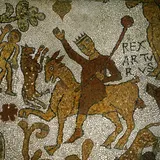
The poem is effectively without parallel. It is a full-length heroic narrative written in Old English, whose eponymous protagonist is attested nowhere else. Though other works in this genre had been created, its sole survival and rediscovery made it the national epic of the English people, often compared to Homer's Iliad in both theme and content. As it was popularized in the early 19th century, the poem became useful to British, German, and even Danish nationlists who sought to use their ancient and medieval heritage to justify present-day political ambitions. But Beowulf does not belong to any existing society. Instead, it is an early medieval document of an idealized antiquity, possibly analogous to the role of King Arthur's Camelot to later medieval Englishmen.
Beowulf provides a unique view into the Anglo-Saxon imaginary, illustrating how a deeply Christian population reckoned with their pagan past, and how the insular descendants of North Sea migrants understood their relationship to an ancestral home. But beyond its anthropological value, Beowulf is a mature reflection on ephemerality and loss. The setting, Heorot, is the most glorious of mead-halls, yet the audience knows from the start that it shall one day burn. Beowulf and King Hrothgar are the best of men, yet even their virtues cannot prevent the ruin caused by mankind's own doomed nature. The concept of wyrd , fate, features prominently in the poem.
Despite not having a direct influence on the culture of high medieval and early modern England, Beowulf has profoundly shaped contemporary English literature. Its heroic narrative, prefiguring chivalric romance and King Arthur stories by several centuries, would inspire the career of J.R.R. Tolkien and shape the contemporary understanding of early medieval Northern Europe. Comparative studies with Norse and German literary works help us understand more fully the cold, courageous, and sometimes cruel world of early Germanic-speaking peoples. Most importantly, it is one of the most engaging and entertaining pieces of early fiction. Everybody, whether a proud Sea-Geat or a descendant of Cain, ought to read Beowulf.
Transcript
Rediscovering Beowulf
Imagine we are in the frosty, gloomy marshlands of Cambridge, Massachusetts. The year is 1790, when the young American Republic introduced a new class of scholars into its Academy of Arts and Sciences. This was an honorary society whose vaunted leadership included John Adams, Samuel Adams, John Quincy Adams, James Bowdoin, John Hancock, and until his recent death several months prior, Benjamin Franklin. These men chose a variety of scientists and historians and physicians to bestow national honors, including a few who were not members of the American nation at all. These newcomers included the 30-something Danish Icelandic brewer and part-time philology professor, Grímur Jónsson Thorkelin. Like his Viking ancestors, Thorkelin had busily sailed all across the North Sea and North Atlantic, plundering the libraries of London and Edinburgh and Copenhagen and Boston for any information he could find on the lost world of the Germanic pagans. An early Danish nationalist at a time when his native Iceland was still a Danish province, Thorkelin saw his frozen corner of the world not as a chilly frontier, but instead as a womb of nations, the key to understanding the broader narrative of European history.
To him, the Danes had really built much of the modern world. Without them, there'd be no England. There'd be no British Empire. There'd be no America. If he could prove this through rigorous study of medieval texts, specifically the Norse sagas, then maybe these snooty southerners would finally give the Danes their due. Due to the strong similarities between his native Icelandic and medieval Old Norse, Thorkelin was able to become a foremost scholar of texts relating to the Vikings. This was several decades before the rest of Europe took any interest in this subject. He taught himself Old English, poorly known in England at the time, and became convinced that this language was, in fact, a dialect of Danish. The English and their American cousins were, like his own Icelandic people, nothing more than Danes in denial. In 1786, four years before he sailed to America to share this news, Thorkelin took up residency at the British Museum, where he studied various compendia of Old English texts, including a half-burned and neglected tome called the Nowell Codex.
Contained within were a variety of texts depicting either grotesque monsters or acts of monstrous violence. The longest of these was Beowulf. This book, compiled at some point in the 11th century, had been stored in the unfortunately aptly named House of Ashburnham, but thankfully survived a 1731 fire mostly intact. But although only the edges were frayed in the fire, the manuscript itself was not treated for the damaged in any significant way. This meant, as decades wore on, the edges of the text continued to disintegrate, compounding issues with its legibility and interpretation. This gets to a very interesting fact about Beowulf in the context of nationalist myth-making. The manuscript was known by a few Anglo-Saxonists, but did not seem to be of any real interest. The earliest reference we have is 1700, when the philologist George Hickes wrote to a colleague, I can find nothing yet of Beowulf, and he spells Beowulf with a pH.
The colleague in question, Humphrey Wanley, would include this in his 1705 catalog and print a few lines of his poem, but nobody really paid it any real attention until this young Icelander got his hands on it. Thorkelin translated the poem into international Latin, allowing it to be accessible to learned men and women across the Western world. But in another funny wrinkle to this nationalist perspective on Beowulf, he titled his translation De Danorum Rebus Gestis, or On the Deeds of the Danes, and called it a Danish poem in the Anglo-Saxon dialect, which, remember, he believed was in fact a dialect of Danish. This little detail gets to the heart of why Beowulf has been very useful for nationalist thinkers. It's incomplete as a national myth, and thus contains many different threads that can be pulled upon in different directions to serve contradictory nationalist purposes. A national epic exists in the imaginary to explain who we are, and the we in Beowulf is particularly fraught, even by most epic standards.
Throughout the centuries, returning to Thorkelin, his series of lectures given in British universities ignited a new interest in the Anglo-Saxon past, leading to his recognition by American scholars who saw themselves as the inheritors of the ancient legacy as much as the British. His full translation of Beowulf would not be published until 1815, due to his home in Denmark and all of his papers getting burned during the Napoleonic Wars. Later scholars would rate Thorkelin's translation quite poorly, but its publication at the end of the Napoleonic period buoyed British nationalism. The English, at least those who could read Latin, now had a hero that they could call their own up there with Achilles and Aeneas, if we ignore the fact that Beowulf is set entirely in Scandinavia and features no Englishmen. Shortly thereafter, scholars in Britain and Scandinavia built on Thorkelin's work, tidying up his Latin translation errors and connecting certain events and characters in Beowulf to a 6th century medieval chronicle and the 12th century Norse sagas.
Beginning in the 1830s, translations into modern English allowed Beowulf to be widely read by many generations of the British public. As the British Empire expanded, there was an eager demand for stories of ancient English heroism. Beowulf found its way into the public school system, taught in both modern and old English. Following Thorkelin's unfortunate example, many of the early translations were not particularly readable. I think here we also need to address the consequences of this nationalist scholarship, in which even the text of Beowulf is implicated.
Right, and this is to say, you know, because, you know, we're mentioning how nationalists can interpret a text like Beowulf in many different ways. And as we see in the 20th century, these interpretations have some pretty awful implications. So rather than putting this at the end of the episode like we might usually do, I think it's better to get this stuff out of the way first. That is to say, that long after Thorkelin's time, nationalism became a little bit less fun. The Napoleonic Wars slipped further and further out of the memories of 19th century politicians. This meant that many nationalists thought that a return essentially to violence could reinvigorate their national spirit and bring them into communion with their glorious barbarian past. Texts like Beowulf were thought to justify the very concept of warfare, as well as being used to glorify one supposed race over another.
Beowulf and the world wars
In 1914, a full century after, we have the outbreak of brutal war between Britain and Germany. The English at this point begin to lose interest in their common Germanic past. On the continent, the opposite was true. Scholarship used to, you know, glorify ancient Germanic peoples, the society in which Beowulf is set, would be used to justify a new level of ethnic supremacism never before seen in Europe. And, you know, even though Beowulf is set in Scandinavia, even though Beowulf is by an English poet, it would have a very happy reception in Nazi Germany in the 30s and 40s. The heroic Beowulf's battle against monsters was used as an allegory for Germany's genocidal war in Eastern Europe against supposedly inferior races analogous to Grendel and his mother and the dragon. Then in 1941, at the height of Operation Barbarossa, the German Wehrmacht named its invasion of the Baltic Islands Operation Beowulf.
The success of this operation made possible the ensuing massacre of tens of thousands of Jewish and Estonian civilians. Meanwhile, in England, interest in the Anglo-Saxons never exactly recovered from the world wars. They would have a very different approach to their supposedly Teutonic heritage afterwards. Worldwide, after this period, there was much more care given to avoid scholarship which could potentially reignite such nationalist passions. Looking on the ground here, I've heard one anecdote of British soldiers, either during the time of World War I or the time of World War II, stumbling on an ancient Anglo-Saxon burial site. When a group of archaeologists came to explain the significance of this site, these soldiers were furious at the very thought that their ancestors could have been related to Germans on the continent. They insisted they would have nothing in common with the Huns. As a result, the reception of Beowulf as a literary work declined in the 20s, 30s, 40s, and 50s due to its association with this supposed Teutonic supremacist agenda.
I don't think the poem can be blamed here. This is entirely a case of misuse of the text. But regardless, it led to a chilling effect in the second and third quarters of the 20th century before a recovery beginning around the 40s and 50s. As a result of this chilling effect, many British readers disparaged Beowulf as they had hoped for either a straightforward heroic page turner or an encyclopedia of ancient Germanic kings and kingdoms. J.R.R. Tolkien noted in a famous lecture that the poem places unimportant things at the center and the important on the outer edges. This is to say, Beowulf assumes the reader is already familiar with many aspects of the setting and characters, something it shares in common with many other ancient works. Early critics were frustrated with the constant, very lengthy digressions into seemingly unrelated episodes, such as a battle between the Danes and the rival Frisians.
Tolkien and the poem's structure
But modern scholarship, especially since Tolkien, has argued that the sometimes confusing structure of Beowulf was a choice and not an error. The poem is structured around the slayings of monsters and the funerals of great men. The author additionally painstakingly weaves together his own Christian theology with a pagan narrative. This way he's able to justify why his medieval Anglo-Saxon audience should care about their heathen ancestral past. Personally, I think Beowulf is really worth reading. I understand the criticisms of the narrative here, but I think part of the issue is that we're projecting our own preferences onto a very old story. I think that many aspects of the Beowulf narrative are familiar to us. He's a hero in a mold that we can immediately recognize. But I think the differences between our world and the world of Beowulf make it more interesting, not less. Sam, so just we should say here, I've previously read the Seamus Heaney translation, which I think is great.
For this episode, I wanted something different, so I reread Beowulf using the Leslie Hall translation. Sam, you read a different one, right?
Yeah, I read the one by Tolkien, which is actually interesting. It wasn't actually published until like 2014. Like his son just spent a very long time getting the notes together to actually compile it. Tolkien, like his actual profession was to be an English professor. He was doing a lot of philological stuff around Beowulf specifically. He wrote many different articles specifically on various questions of Beowulf, so I got to read all of that in all of its nerdy glory. It's also... A lot of people don't really like that translation because it's very archaicizing, and it's kind of difficult to understand what's going on. But honestly, I really liked it. I felt like it added to like a certain level of like, you know, like a certain level of remove that made makes you feel like, oh, this is something from a past age, and this is like something that should be treated with reverence.
I also read it in, like, I previously read it when I was in high school. I'm not sure which translation I read then, but I also, like, something I found really interesting is just like when I read it in high school, my focus was very much on the aspect of the monsters. It's like, oh, this is a monster story. Like, first you have one monster, then you have Grendel, then you have the monster's mom, and then you have the dragon. But this time, I was just like, very much drawn to sort of like the moral side of it and the way that the poem is just like it's basically all about how everything is diminishing, everything is going to shit, and you know, there's just constant moral degradation all around you. So I think, like, honestly, it should be treated as more as a meditation on all of those things rather than purely the monster story elements.
So we're going to talk about how Beowulf as a protagonist is a little bit boring because he doesn't seem to have any visible internal struggles the way that we'd like to see in a protagonist. Instead, he's just a man who does his duty. But I think that the fact that he does continue to do his duty, he refuses to break in spite of all of these horrible obstacles being thrown at him, I think does make him a somewhat compelling character. And then we see with the end of his life, we're going to get to this at the end of the episode, there are some interesting contemplations on mortality that we seem to have here. Or destiny, rather. Wyrd in Old English. Now, let's get into the poem itself. Anyone listening, if you haven't read Beowulf, you totally should. It's not super long. I think it's like 100 pages in most translations.
How to read Beowulf
You can read it in like a day or two. If you're unfamiliar, Beowulf is considered today to basically be the beginning of English literature. It's not exactly the first English text. There are some Anglo-Saxon texts that certainly predate it. And if we date it very late, as some historians do, it actually could be one of the last surviving Anglo-Saxon texts. But regardless, it's the first in the sense that it is a cohesive, long-form narrative work. There's really nothing else like that in the Anglo-Saxon world, not to the same extent. Also, we should note that we consider it the first work of English literature, even though its centuries of obscurity meant that it didn't have any direct influence on the likes of Chaucer or Shakespeare. But despite that, it's very fascinating. It's probably the most interesting example of any piece of Old English literature. And it is our widest window into the psychological and cosmological world that it comes from.
And I think that it's a very interesting look at Anglo-Saxon society because it's not actually about the Anglo-Saxons. Its hero and setting would have been foreign to its creator. So I mentioned that there's some question over the dating. Beowulf is set at minimum several hundred years before it was written. This means it is essentially a piece of historical fiction. Just like Homer's Iliad and Odyssey, it reconstructs an idealized ancestral past. And like you said about the part about how glory is diminishing, it shows how there were these many beautiful, morally impeccable aspects of the past that did not survive into the present, including most prominently the lost hall of Heorot. So, Beowulf is a sophisticated epic poem, regardless of what some critics say. It clearly reflects mature and complex attitudes toward honor and duty and morality, almost like the Iliad in miniature. While critics tend to rate Homer ahead of the Beowulf poet in both narrative and poetic skill, only Beowulf can be read in a single cozy afternoon.
It is a much faster narrative than the Iliad, and it manages to include three monster fights and a battle and an international swimming contest within its hundred pages. Like I said, the main reason why it's attracted so much attention is that it lacks any immediate parallel. It is by far the longest surviving Old English verse text. It is nearly twice as long as any other extended narrative work in that language, except for Old English translations of the Bible. All other texts of any significant length are saints' lives. Beowulf, as a story about monster slaying, is something very different. It is indeed a deeply Christian poem, but its setting in pagan Denmark shows that its English audience maintained a strong interest in their pre-conversion and pre-migration heritage. These readers, who for convenience we will call the Anglo-Saxons, despite some ongoing controversies over that name, were a complex and contradictory bunch.
The Anglo-Saxon literary world
Despite being the children of North Sea pirates and blue-faced headhunters, they wholeheartedly adopted Christianity, thanks to the influence of first the Irish and then the Pope in Rome. Despite incessant warfare between the various Anglo-Saxon kingdoms and against their Danish cousins, not to mention the native Welsh, these people established legal and political and monetary institutions more sophisticated than anything on continental Western Europe. Despite having a material culture that would appear quite primitive to us, the Anglo-Saxons really only built huts and longhouses. And despite lacking organized towns or even significant villages until the 9th century, the Anglo-Saxons developed a vernacular literary culture more vibrant than probably anywhere else in Europe at this time. Old English literature was written for everyday Anglo-Saxons, not only for cloistered clergy. This is again in contrast with both literature on the continent and with the large body of Anglo-Latin literature that was made by and for monks.
Because many Anglo-Saxon writers had a classical education, they could have chosen to write in Latin. This means that any text written in English is probably written in English as a choice meant for a wide audience. I think we should compare Old English texts in this diglossic situation with our recent discussions on Yiddish versus Hebrew among Ashkenazi Jewish readers in the High Middle Ages onwards. Additionally, the Anglo-Saxons believed that vernacular literature could be divinely inspired, just as Latin was. The 7th century saint Cædmon was said to have been an illiterate cowherd who was given poetic skill during a dream from heaven. The Anglo-Saxons also wrote texts on a variety of subjects for a variety of reasons. One of the most fascinating and most mundane Anglo-Saxon texts is the Gerefa. This is a late Old English book about how to be a reeve, that is, how to be a man appointed by a lord to squeeze agricultural surplus out of their neighbors.
This is all to say the Anglo-Saxon literary corpus is deep and vast. Beowulf is the only surviving long-form narrative poem, but surely there would have been others. And I'll say, given what happened with the fire in Ashburnham, we're quite lucky that Beowulf survives at all. Its unlikely survival means we only have one complete work of heroic fiction from this place in time, although we know of the existence of at least one other epic, Waldere, which survives through very small and very tantalizing fragments. Because we cannot put Beowulf in its full context, much about the poem was confusing to early readers and remains a source of controversy today. Even the title is a puzzle, almost like the hundreds of riddles Anglo-Saxon writers left for us to solve. Many scholars believe the Old English name Beowulf literally translates to beewolf. This is the name of a nasty species of wasp that would have been well known to medieval farmers, but it's more probably a reference to an even more fearsome animal, a honey-loving bear.
Beowa and the gods
I know, Sam, you brought up when we were planning this that many cultures have had taboos about stating the name of bears. So beewolf may have very well been a poetic allusion, a kenning for that most valiant beast. In an ancient Scandinavian context, bears would have been extremely fearsome, a predator to all known creatures except the mythical dragon. In England, however, bears were extinct. This means if Beowulf is meant to be an allusion to a bear, it is yet another element alluding to a glorious past that no longer exists. There's also a newer theory about Beowulf's name, which I find just as intriguing. That could be that his name is actually a reference to a largely forgotten Anglo-Saxon deity named Beow. This figure, whose name literally meant barley, is recorded as one of the ancestors of the famous Saxon king, Alfred the Great. Because this Beow was the son of a man named Shield and the grandson of a man named Skiff, he was probably a legendary figure meant to represent or govern an aspect of daily life in the 6th century or earlier.
In this case, the production of ale. Beowa also appears to be referenced in the text of Beowulf itself. There is, confusingly, another character named Beowulf at the beginning of the poem, an ancestor of the Danish king Hrothgar. Contemporary scholars have identified this first ancestral Beowulf with the Beowa of Alfred's genealogy. I also want to bring up another element of this migration-era Germanic world. This is that centuries before Beowulf was composed, some of the earliest surviving inscriptions in Germanic languages make reverent reference to a concept or deity called Alu. This appears to be a divine incarnation of ale. What Alu actually meant is an open question, but indicates some spiritual association with drunkenness and divinity. Beowulf itself uses the term alu in the phrase ealuscerwen, which occurs nowhere else in the Old English corpus. Literally translating to ale forsaken or ale deprived, this is probably a kenning to mean angry or frustrated, like a warrior who thinks he's a whole night of revelry ahead of him, but then realizes he just finished his last horn of ale.
Sam, you also pointed out it could very well mean hungover.
Yeah, but I mean, that's just pure speculation on my part. I actually don't know Anglo-Saxon.
No, I think it's very possible. Tolkien complained in one of his lectures that Anglo-Saxons were unfairly perceived as drunken boors, solid and practical when not under the influence of beer. I gotta say, however, if we're just looking at a language alone, the Anglo-Saxons are not feeding the allegations. Now, if we move a thousand years in the opposite direction, some folklorists have speculated that some dregs of this figure, Beowa, could have survived deep into the Christian era. A popular subject of early modern ballads was John Barleycorn, or in Scotland, Allan-a-Maut. As you might be able to guess from the name, these are human personifications of beer and drunkenness. I don't personally think you can draw a straight line between John Barleycorn and the ancient Beowa, any more than you can between John Barleycorn and today's John Pork. But all this goes to show that the writer of Beowulf was born into a world in which drinking and revelry were not just favored pastimes on cold nights.
The mead hall
Instead, the longhouse or mead hall was the center of social life and social order. The warmth of the hearth, around which rings would be given and ale passed around, could even be a metaphor for life itself. The great Anglo-Saxon writer Bede describes this in his account of how England became Christian. According to his Latin text, a courtier of a pagan king stood and said to his sovereign, This present life of man on earth, O king, seems to me like the swift flight of a sparrow through the house wherein you sit at supper in winter with your ealdormen and thanes, while the fire blazes in the midst and the hall is warmed, but the wintry storms of rain and snow are raging abroad. The sparrow, flying in at one door and immediately out at another, while he is within, is safe from the wintry tempest. But after a short space of fair weather, he immediately vanishes out of your sight, passing from winter into winter again.
So this life of man appears for a little while. But of what is to follow or of what went before, we know nothing at all. Despite the didactic Christian context here, this speech reveals a lot about the spiritual and cultural significance of the mead hall or longhouse in the Anglo-Saxon world. In addition to providing shelter from the frost and wind, the hall was a place for ruling, for revelry, and clearly even for religious debate. Pagan kings may have poured some kind of libation to the gods, including Beowa, the Lord of Ale, while gathered around the hearth. Their later Christian descendants appear to have preserved this in the tradition of drink hailing or wassailing, a ritual toast made at Christmas and New Year's, not only to people, but also to the trees. We also need to consider that the basic social unit in early medieval northern Europe was not the town or the village for the most part.
People did not live in nucleated villages centered around a common green, but instead smaller and more dispersed settlements. These were individual households scattered among the fields of wheat and barley. Essentially, all people lived lives as part of a single physical household. The meanest of those would have been tiny, shabby farmsteads, while high-status people lived in massive longhouses, split into multiple rooms, replete with slaves and guards and retainers. This is the physical place where a lord would reign, and in the Anglo-Saxon period, it does not seem like any lord ruled much farther than a day or two's ride from his own hearth. And it is the longhouse, the mead hall, where the story of Beowulf really begins. Good King Hrothgar reigns in the Great Hall of Heorot, a beautiful longhouse, probably named for the antlers of stags or harts, hung over its walls. This is a place of warmth and glory, mead pouring and ring-giving, but an outside threat wishes to destroy everything inside.
Looking at the archaeological context here, Heorot would have been the center of social organization and the seat of power for a primitive king. Here, the king's liegemen would assemble to hear his orders. Foreign adventurers would come here to pledge their own swords to a well-known ruler. This was the place where men and women went to get drunk on ale and mead and foreign wine, as well as to listen to the strumming of harps. But it was also much, much more. A great hall in this period was like a political machine for cementing loyalty. You entered the king's hall as his guest. You accepted his drink and his gifts. You listened to his bards recite poems recounting his bravery. You got a good look at the king's extensive treasures and you got a sense of who wielded power based on those who sat closest to the king.
Heorot is Hrothgar's palace, his government, his court, his throne room, and his barracks, all at one. Every night of feasting told the same story. Hrothgar is brave. He is generous. He has friends. He can feed you and he can protect you. But if you cross him, you will feel the full might of his power bear down upon you. The hall is an oasis of warmth and civilization in a world of cold and mud. This is what makes the monster Grendel, its would-be destroyer, so existentially terrifying. His attack wreaks havoc on a seemingly impenetrable fortress. It would be like if an enemy airdropped troops over Washington, D.C. and shot up the White House in Congress. It fundamentally delegitimizes the entire social order and the system of laws.
But I'm going to say right here, I think that we will be the first ever podcast to say that the closest narrative parallel to Beowulf is the film White House Down.
So true. Yeah. But. But a big question asked these days by contemporary archaeologists and historians is: how real was Heorot?
No one has a... No one has ever found a big sign with a blinking light that reads Heorot anywhere.
But even if we can't speak to the veracity of the specific hall in the poem, we know a fair amount about what these elite longhouses would have looked like. Later Scandinavian literature, the famous sagas, corroborates a lot about what we know of the social structures and rituals surrounding the great halls. These sources also give us a candidate for the real Heorot. In other sagas, Hrothgar is considered to be one of the Skjöldung kings who held court in Lejre near Roskilde on the Danish island of Zealand. In the 1980s, archaeologists discovered the remains of a great hall in Lejre. This structure was dated to the mid-9th century, but later digs showed that it had been built on top of a much older migration-era site. An even older structure about 500 meters away was built in the mid-6th century, around the period when scholars estimate Beowulf is set.
Archaeology of Heorot
It's about 50 meters long and 7 meters wide. This would have been enormous for the place and time. Anybody in the vicinity would have immediately understood this to have been the base of a great ruler. This likely would have been the largest building anybody had ever seen in their lives or in the lives of their ancestors. Other details bear this out. Pits surrounding the longhouse complex contain ample evidence of Lejre's prosperity. The site is littered with animal bones, proving it was a site of feasting, as well as jewelry, glass, and gold alike. Pottery too is abundant. It even sits next to a much older barrow, almost as if the person who built this hall meant to frame himself as the inheritor of an ancient line. But if we were to step outside Heorot, we would find ourselves in a dark, wet world of meres and marshes.
Danes and Geats
Southern Scandinavia was flattened by the repeated movement of glaciers over millions of years, which freckled the countryside with lakes large and small and carved deep inlets into the coastlines. These glaciers were some of the last to recede globally, and the geography of Scandinavia is still experiencing a rebound as land slowly rises after millennia of being crushed under the ice. So much meltwater had dripped into the Baltic Sea since the last glacial maximum that the Baltic has the lowest salinity levels of any marine body of water. It doesn't have the same salty smell as the Atlantic or the North Sea, and in fact, if not for centuries of sewage dumping, locals insist Baltic seawater would be safe to drink. Kind of like a chilly, smaller Mediterranean, the Baltic has served as more of a channel connecting the various pieces of Northern Europe than it has in separating them.
Since the Neolithic, southern Sweden has been much closer in its language and culture to the islands of Denmark and the inlets of Norway than it has been to the frozen tundra of northern Sweden. In recorded history, many political entities have crossed the various straits between the islands and the mainland of southern Scandinavia. Beowulf is set again in the 6th century, just as the earliest permanent political bodies appear to have taken shape in the region. This was when the tribes we refer to as Swedes and Danes occupied territories significantly smaller than their present-day national entities. While most of the action in Beowulf is on the islands of Denmark, again near the modern town of Roskilde, Beowulf himself was not technically Danish, he was a Geat, or in the terrible Old English pronunciation, a yacht. The Geats lived on the western coast of Sweden around the modern-day city of Gothenburg, occupying this geatish belt all across southern Sweden toward the eastern coast.
Geatland was comprised of rocky coastlines with nearly 10,000 tiny islands. The Geats thus had to develop a mastery of water, as implied by their common designation in the poem as Sæ-Geats, or Sea Geats. We should also note that the body of water connecting the land of the Geats to that of the Danes is called the Kattegat or Katsgate. So named because only a slinky little feline could easily pass between the narrow straits of these islands. The Kattegat is also where the Baltic opens up to the more salty and treacherous North Sea. Geats and Danes would have had more exposure to oceanic storms than neighboring tribes. This might be why another one of the Geats' nicknames is Weder-Geats or Weather Geats. Exposure to the North Sea and the Atlantic world gave these tribes direct access and contact with peoples of northwest Germany, the Netherlands, as well as Britain and Ireland.
People from the shores of the Kattegat, the Geats and the Danes, would sail to Britain in many great waves across the 5th to the 11th centuries, often with disastrous implications on the British themselves.
The manuscript and its date
Right, now let's move on to the Beowulf poem itself. The manuscript was probably composed around the early 11th century during the reign of Sweyn Forkbeard or his son Cnute, the last of these Danish adventurers who successfully seized power in England. The text is written in two distinctive handwriting styles, suggesting it was either the work of two different scribes or one writer at two different periods of his life. This second interpretation would match the narrative of the text, as the second hand returns to the story when Beowulf is no longer young and an eager adventurer, but is instead an elderly, beneficent king. The Beowulf scribe surely drew from the earlier traditions when he was composing the text, but scholars intensely debate whether or not the poem itself was an original 11th century composition or a copy of an older one. Scholars have convincingly argued that the poem was originally written in the 8th century, not long after the Venerable Bede, when the Anglo-Saxon migration was still living in memory.
Others have suggested it came to be in the late 9th century during the reign of Alfred the Great, a great patron of scholarship whose wars with the Vikings gave him a strong interest in Scandinavian affairs. More recent scholarship has suggested that the language of the text is not necessarily any older than the manuscript itself, and that the document could date possibly as late as the reign of Edward the Confessor, not long before the Norman conquest. The historian Helen Damico sees the story of Beowulf and Grendel as a deliberate political allegory for 11th century England. One of the motivations for an earlier date is that some English historians believe that the Danes could not have been portrayed positively during the Viking period, only before. We're not really sure if this is the case, and we really have to wonder if some of these scholars, many of whom were writing from the 1920s through to the 50s, were projecting the ways that the world wars had led to the rejection of all things German in the English-speaking world.
Things were a bit more complicated in early medieval England, especially as Christian Danes would remain rulers of England and a distinct minority population almost until the Norman era.
Right, and so I really have no idea when Beowulf was composed. I don't speak Old English, so I can't say with any certainty or really, you know, any authority whatsoever if it's an early Anglo-Saxon or a late Anglo-Saxon poem. But I think that both of the possibilities are interesting. Is this imagining a past that was recently pagan and barbaric, or is this a distant past being reconstructed for a literary purpose? A lot of earlier scholarship assumed an earlier date. They thought that the setting had to have been very familiar to the writer and the audience, but this is no longer taken for granted. If Beowulf was composed at the end of the Anglo-Saxon period, it would suggest a lingering interest in a heroic past. This means that stories of the pre-Christian world would have survived in England for many centuries after the conversion, just as we know these stories survived in Iceland, where the sagas would eventually be composed.
Since the early 20th century, scholars have also recognized that, regardless of when or why Beowulf was written, it shares common mythic themes with stories such as the Icelandic Grettis saga. This is a more down and dirty tale about a rough outlaw who battles trolls, she-trolls, and the living dead. According to the early 20th century philologist Friedrich Panzer, no points for guessing what country he was from, both of these stories can be traced to a hypothetical myth of the bear's son, a being of supernatural ability and ursine strength who was able to defeat monsters no other mortal could subdue. Moving past the specific contours of the plot, the story of Beowulf is a vivid portrayal of life in early 6th century Denmark and Sweden. We should reiterate it's a bit unusual that it's an Anglo-Saxon poem, not a Danish poem. Very little about Beowulf is indeed recognizably English.
There are no references to England or the British Isles, even though that in the time in which this poem is set, we would have begun to see significant migration to those places from the very lands of the Geats and the Danes. The lack of any Britishness, it almost feels like a deliberate omission.
Right, yeah. So the North Sea world of the 6th century was tumultuous and fractious. The Byzantine writer Jordanes is unfortunately our only reliable source of this place in time, and he is very, very unreliable.
And he says that the world is our only and our most unreliable source.
But he's always all we got.
Right. Yes.
Scandza and the migration era
Yeah.
So, Jordanes says that in the land of Scandza, what's today called Scandinavia, was a quote workshop of peoples and womb of nations. It was constantly ejecting new tribes of barbarians southward to terrorize the civilized world. We've discussed across several years of this podcast why the simple narrative of barbarian despoliation is not an accurate picture of life in this time, but even still, historians continue to describe the period of transition from classical antiquity to the Middle Ages as, quote, a migration period, as it saw a significant movement of individuals and languages and identities, largely from the north to the south and from the east to the west. Archaeologists prefer to describe this period as the post-Roman Iron Age, suggesting that the vacuum created by the contraction and collapse of Roman authority in Western Europe, the Mediterranean saw a relatively managed handover of power from one ruling class to another, as we related in our episode on the work of the groundbreaking historian Henri Pirenne.
But the island of Britain endured an absolutely brutal decline, worse than anywhere else in the empire. The situation was certainly not improved by the arrival of Germanic-speaking warriors who both sacked and settled across the island.
Right, and so the places these foreigners came from had experienced their own unpleasant shifts despite having never been part of the Roman world at all. Early states in late antique Denmark derived much of their income and authority from trade with the Romans, whom Germanic-speaking peoples called the Walhaz. This is where we get the ethnonyms Welsh and Walloon, and might be a clue about the identity of Queen Wealhtheow in Beowulf. Her name appears to literally mean Roman slave. Despite the great distance between Denmark and the Mediterranean, turbulent political and social turmoil from the 3rd to the 5th centuries would have been felt through a decline in the southern trade and perhaps fewer opportunities for northern men and women to find employment as soldiers or craftspeople in Roman frontier outposts. While Scandinavia itself had no distinct military presence, it is nearly certain that some Scandinavians found work in forts such as Matilo in the modern-day Netherlands or Vetera, today the German city of Xanten.
In the third and fourth centuries, these sites were abandoned, and after which point, graves in Denmark and Norway containing Roman arms and armor go from rare to non-existent. Then in the fifth century, the Western Roman Empire ceased to exist as a political entity, leading to a drop-off in elite Mediterranean imports like wine and textiles. The walla had run dry. But just as Rome's laws and social institutions and literary culture survived in its former provinces, Denmark and neighboring regions of Northern Europe remained possessed by a Roman ghost, because centuries of generational service in the Roman military apparatus had led to the introduction of more sophisticated martial traditions. Returning veterans appear to have formed a military elite as early as the third century in southern Scandinavia. Roman ideas of martial glory and duty to one sovereign merged with indigenous concepts of honor and manliness, giving us the moral code we see in Beowulf and the later Norse sagas.
This apparent Romanization of ideology and society is evident even in the material record. Settlements in Denmark become more well organized across the 3rd, 4th, and 5th century. Historian Dagfinn Skre argues that in the third and fourth centuries, Danish forts begin to take on the physical structure of Roman military buildings, even including courtyards imitating the Roman Forum. I think a more fun example of Roman influence is the Club of Hercules. This was a metal necklace popular in the Roman world with soldiers, introduced to the northern lands beyond the frontier. After the 4th century, imported Roman trinkets are replaced by locally produced amulets made of wood or antlers, mostly found in the graves of German and Danish women. It has been suggested that later pendants in the shape of Thor's hammer might have their origins in this Roman Hercules amulet. As elsewhere in Europe and the Middle East, the decline and fall of Rome saw a rise in low-level warfare in Scandinavia, probably associated with primitive states established by foreign auxiliaries of the Roman army.
The sixth-century winter
Additionally, an unprecedented winter in the 6th century led to new population pressures that wiped out most agricultural yields across northern Norway and likely caused a miniature refugee crisis within Scandinavia. These kinds of tensions led to hill forts being raised all across the North Sea across the 5th and 6th centuries. One of these sites, Feddersen Wierde, in Germany's Lower Saxony region, may very well have been a staging ground for the Saxon raiding and eventually settlement of the British Isles. The warlords who built these fortifications clearly amassed new wealth through conquest, as well as from the management of land. This might have made up for the shortfall in Roman trade. Certain individuals in this migration-era world took advantage of this upheaval to establish the largest and most permanent states in Scandinavian history up to this time. Golden medallions called bracteates were struck and awarded as gifts to loyal retainers, often marked with images of men and animals that clearly prefigured the visual language of Viking Age artifacts.
These discs were often stamped with that mysterious runic word alu for ale. Due to the establishment of larger and more prominent political bodies, as well as more rigid relationships between elites and their liegemen, the fifth and sixth centuries are considered to have been the birth of kingship in Northern Europe. The Danish king Hrothgar, if he really existed, would have thus been part of a new generation of rulers more capable than earlier chieftains. His great hall at Heorot, described in the poem as the largest and most beautiful of buildings, would have been built through a command of labor not possible in earlier times. We should mention that the Danes at this time would have been organized into a state much smaller than the later Viking Age kingdom of Denmark. They do not seem to control any land beyond the Danish islands. The poem suggests that Hrothgar's territory is bordered to the east by the Swedes, to the west by the Jutes, and to the north by Beowulf's people, the Geats.
Hrothgar and his court
The last of these two tribes probably shared a common etymological origin, a proto-Germanic word meaning those who pour, probably also cognate with the name Goth. Outside of Beowulf, we have a few other faint attestations of the Geatish people. There's offhand mentions in Ptolemy and Jordanes, and some intriguing place names in Britain indicate that some of Beowulf's kin may have indeed eventually made their way to the island where his eulogy would be written. Right. Now let's mention, let's get back into Beowulf himself, our hero. So, Sam, what are your thoughts on Beowulf as a dude?
I mean, he's just sort of like a generic hardass, I guess. He has a sort of very. I mean, like, like a one-I mean, sure, I'm feeling a little mean tonight. He has a sort of Chuck Norris vibe to him, where he just, like, sort of, like, he's a tough guy, and like, his whole thing is just being tough, and he doesn't really externally have many different things going on.
Yeah, we really don't get a lot from him in terms of personality or even backstory. He has no real relations, despite his, you know, besides his parents, he's unmarried, no close friends except his king, and then his kind of squire guy at the end. Many readers have taken this for inadequate storytelling. I think it's really just that Anglo-Saxon writers did not have the same narrative preferences that we have today. They did not want their hero to necessarily be complex and internally pained. They wanted a guy who did his duty.
Right, and again, like, I get the sense that the author of Beowulf was very much fixated on specifically the spiritual slash the emotional slash psychological dimension. Like, like, morality is really at the center of his mind. Like, the physical world is just kind of off for him, just in general. I mean, of course, you have Grendel who's terrorizing these people, but also, I mean, just right in the opening lines of the poem, when he's discussing, like, Heorot, it just, like, automatically, you know, he's talking about, oh, and that place would burn because people are evil.
And, like, well, yeah, yeah, no, no, that's right. And so, Beowulf is thus a basically perfect man in an imperfect world who seems to be sent almost by God to save this world. Homer begins the Odyssey by telling us that his Odysseus is a man of twists and turns. Beowulf is quite the opposite. He is introduced matter-of-factly as the stoutest and strongest, sturdy and noble, and that's the Leslie Hall translation. Beowulf is an uncomplicated hero who exemplifies without complaint the ideal loyalty and bravery of a liegeman, and then in his old age, the selflessness of a king who puts his people's needs ahead of his own. Beowulf might lack many defining characteristics besides his proficiency at basically everything. He is very much a sixth-century Superman in this case, whose only apparent kryptonite is dragon venom. Due to the poem's limited scope, we don't really get a full biography or even a perfectly clear portrait of our protagonist.
We just get a glimpse at two different chapters of his life. First, an episode of his early fame when he defeats two monsters, and then, 50 years later, the end of his glorious kingship when he defeats a third monster. Beowulf's rise to kingship, which happens off-screen, would have happened amid a chaotic and tragic series of treacherous events that included the burning of Hrothgar's Great Hall of Heorot, as well as the betrayal and murder of his sons by his own kinsman, Hrothulf. These legendary Danish events are corroborated in the Norse sagas, although in these texts the character Beowulf is conspicuously absent. I think that audiences would have been expected to know from the beginning that the great Heorot would one day burn, because its doom is only mentioned in passing. It's something that you should already know. Another passage from Queen Wealhtheow seems to foreshadow to the audience that her oath-breaking kinsman Hrothulf is going to build, is going to destroy everything she and her husband built.
She puts their two young sons under Hrothulf's care and says how lucky she is that they're going to be safe with their cousin. This is a clear instance of dramatic irony, winking to the audience just as the Greek tragedians would do. Hrothgar's kingdom would have thus been understood as the last Camelot of the Germanic world, a place in time where the best men ruled before honor was betrayed by treachery, and virtue overran with vice. We can imagine that kings in both Scandinavia and England during the Viking era might have compared their own rulers to figures like the beloved King Hrothgar or fearsome King Hygelac. The second of these kings was Beowulf's own liege lord, ruler of the Geats in the early 6th century. We know that's when he ruled because unlike any other figure in Beowulf, Hygelac is in fact attested in contemporary historical sources, which I think is honestly just kind of mind-blowing that we have proof of this guy.
Hygelac in Gregory of Tours
This is because Gregory of Tours, early French bishop who's come up again and again in this podcast, tells us that the kingdom of the Merovingian Franks was invaded by Scandinavian raiders around the year 516. These Vikings, avant la lettre, were led by a king named Chlochilaicus, who died in the fighting, upon which his men fled back to the coast and left their king to moulder on the banks of the Rhine. This is a perfect match for the description of the Geatish king Hygelac in Anglo-Saxon sources, including Beowulf, whose death in battle is what allows Beowulf to eventually take the throne of the Geatish kingdom for himself. Hygelac is mentioned about 50 times in the poem, but he doesn't actually appear until the final third of the text, a section termed Beowulf's Homecoming. After his adventures in Denmark, the hero sails back up to the lands of the Geats in southwestern Sweden, where he meets with his king Hygelac and, to the frustration of his readers, recounts everything that just happened in the poem again.
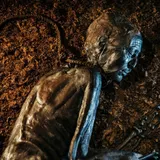
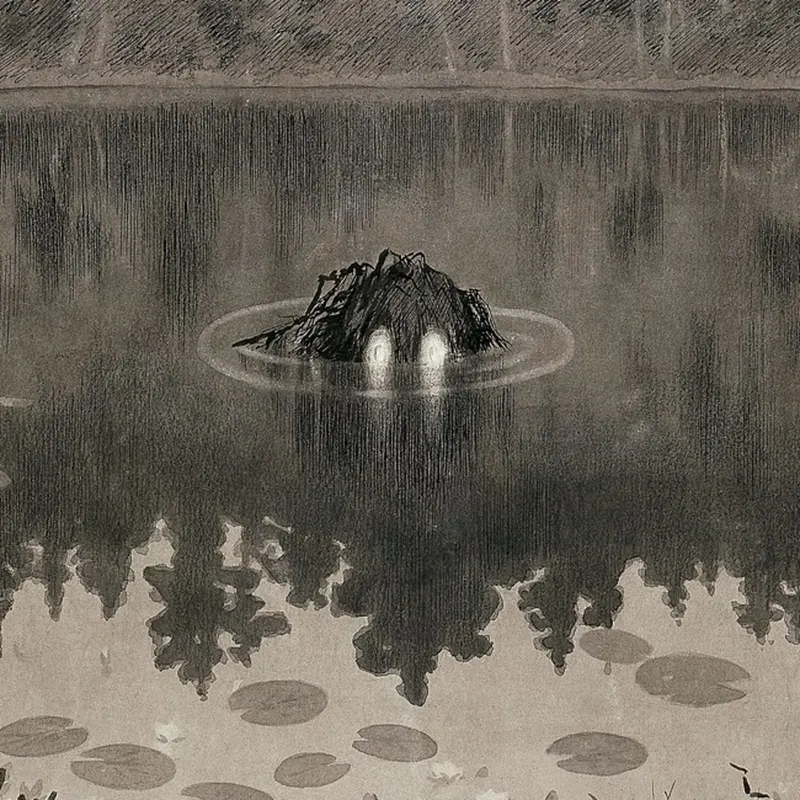
So, this Hygelac was clearly a well-known historical figure. He's corroborated not only by Gregory of Tours, but also another Anglo-Saxon text, the Latin bestiary Liber Monstrorum. This catalogue of creatures mentions Hygelac as a man so monstrously large that no horse could carry him after the age of 12. But despite his great size, Hygelac was killed by the Franks, and his long bones were left to bleach on an island in the Rhine, where they supposedly could still be seen centuries later. On the subject of monsters, more scholarly attention has probably been given to the non-human inhabitants of the world of Beowulf than to its heroes. Grendel is the personification of all that is outside the Danish longhouse. He is wet, cold, dark, and dangerous. He is so strongly associated with the marshland and with mortality that he almost feels like one of the famous bog bodies come back to life.
His only apparent motivation is his hatred for the goodness of Heorot and his anger at the singing of Christian songs in this otherwise pagan court.
Extremely strong Whoville vibes here, you know? All the noise, noise, noise, noise.
Grendel and his mother
Yeah, so basically in the story, none of the Danes are able to resist Grendel's nightly attacks, during which time he drags off humans to devour. But Beowulf is the selfless visitor who is so strong that he manages to rip Grendel's arm off with his own two hands until, quote, his sinews were shivered, his body did burst. Grendel would flee into the woods, mortally wounded, to die like a coward in his own wet lair, whose waters were now troubled by his own blood.
Right, but just as the Danes begin to celebrate again, Grendel's own mother appears. In my favorite passage of the poem, Grendel descends into her watery lair, guarded by hideous sea monsters. My girlfriend describes her very much as an Ursula type, and I think that's actually kind of true. One of the Danes blows a horn as Beowulf, a great swimmer, dives into the water. The monsters scatter, slithering out of their brackish caves, and there's great atmosphere as Beowulf goes in after her. Many a serpent, mere-dragons wondrous, trying the waters, nickers a-lying, on the cliffs of the Nesses, which at noonday full often go on the sea deeps their sorrowful journey. Wild beasts and worm kind, away then they hastened. Hot-mooded, hateful, they heard the great clamor, the war trumpet winding. One did the Geat-prince sunder from earth joys with arrow from bowstring. From his sea struggle tore him, that the trusty war missile pierced to his vitals, he proved in the currents, less doughty at swimming, whom death had off-carried.
That's to say, he shoots an arrow underwater and kills a sea monster, then descends even further into this watery underworld. Reminiscent of Orpheus, or to a contemporary Christian reader, Jesus harrowing hell. Despite continuous attacks by flood beasts, no few, with fierce biting tusks, Beowulf manages to find and destroy the sea bottom's monster, the mighty mere-woman, Grendel's mother herself. I mentioned that Christian parallel because despite the pagan setting here, the encounter with the monsters is explicitly framed in Christian terms. The author is using presumably pagan characters and pre-Christian legends to thus illustrate a Christian story. Again, I think this is a really cool look at the Anglo-Saxon worldview and the apparently seamless ways Christian and pre-Christian traditions came together. I cannot think of any other work from this era that does this. There are plenty of famous Christian allegories from across, you know, the entire historical, you know, the breadth of English literature.
You've got Piers Plowman, Pilgrim's Progress, the Chronicles of Narnia, but in none of those texts are the protagonists explicitly pagan. Here, a non-Christian hero is lauded in Germanic terms. His foes are not rival petty kings, but instead monstrous enemies of God. Grendel is in fact introduced to us as a descendant of Cain, the world's first murderer, according to the book of Genesis. This note about his ancestry is interesting because the monster is given very few additional details beyond that he is compelled to kill, that he is an ugly giant, and that he carries a dragonskin purse. Because Grendel is described as a Jotun, the giants of Norse mythology, I would bet that his character predates the composition of this poem and probably has his roots in common pre-Christian Germanic folklore. But by rooting the creature in a biblical genealogy, the author justifies his inclusion in the Christian world of the story.
Hope of the heathen
This also gives Grendel a narrative function beyond scaring the audience. He represents everything terrible in the pagan world. Senseless violence, and the destruction of all that is good and holy. Early in Beowulf, we learn that Grendel has chosen to target Heorot because of the presence of bards singing Christian songs to the pagan congregants. Although his victims are not Christians themselves, Grendel recognizes them as future believers. Another possible hint about a late composition date, maybe. And Grendel thus decides to punish them for their future adoption of Christianity. Another interesting choice is to add that Hrothgar's throne is somehow protected by God, despite Hrothgar himself not believing in God. The poet writes of Grendel, Horrible hermit, Heorot he frequented, gem-bedecked palace when night shades had fallen. Since God did oppose him, not the throne could he touch. The light flashing jewel, love of him knew not. Shortly thereafter, the suffering Danes pray to their Norse gods for deliverance from this monster's wrath.
But that just makes matters worse. As we've discussed on this podcast before, medieval Christians, by and large, believed that pre-Christian gods, in fact, were real. They were just demons. Accordingly, the poet tells us, At the shrines of their idols, often they promised, gifts and offerings, earnestly prayed they, the devil from hell would help them to lighten their people's oppression. Such practice used then, hope of the heathen. Hell they remembered in their innermost spirit, but God they knew not. The true God they do not know. Judge of their actions, all-wielding ruler. No praise could they give the guardian of heaven, the wielder of glory. Woe will be his who, through furious hatred, his spirit shall drive to the clutch of the fire. No comfort shall look for, wax no wiser. Well for the man who, living his life days, his Lord may face and find defense in his father's embrace.
That phrase, hope of the heathen, comes to us from the Old English, hæþenra hyht, which is a great phrase, very breathy, and it's the kind of alliteration you see in almost every verse of Beowulf. I also think that this concept, the hope of the heathen, gets right at the moral core of this poem.
Yes.
The people of Heorot needed a hero, one who exemplified godly qualities of a god they did not know. This also explains why Beowulf is kind of a boring protagonist. He lacks flaws, he lacks complications, because he serves this purpose: to be dutiful and to be godly, even in a godless world.
Yeah, we touched at the religious overtones of the Mead Hall versus the darkness outside. And light, as a metaphor, is not exclusive to Christianity, but it appears to have been a major part of Anglo-Saxon religious imagery. Eleanor Parker's recent book, Winters in the World, looks at how these people had a strong association of the sun with God and life and goodness, and winter with evil and death and sorrow. Grendel and his mother are wintery beasts associated with the night and the cold. Beowulf brings the light of God into the dark pits of their hellish lairs. Skipping ahead to the end of right, right?
Just imagine how cold it would have been to swim underwater in Scandinavia. Just keep that in mind.
Yeah, yeah, yeah.
And I mean, to add to that additionally, like, while we were preparing for this episode, Liam told me that there's a theory out there that basically ties the coldness of this world with the notoriously cold winter of 536, which is what I would consider to be the worst year in history. And that just was a volcanic winter that just disrupted agriculture across Northern Europe, probably killed large numbers of people through starvation and through just through freezing.
Beowulf and the dragon
Right, yeah, yeah. So, skipping ahead to the end of the poem, in the third act of Beowulf, we see our hero 50 years later in his last days. He is now a wise and elderly king, and although he is still physically capable, he learns that a dragon has come to the land of the Geats, funnily enough, because basically someone stole one of his goblets. So, basically, the dragon is sort of not justified, but I mean, it just like again, it's just humans are fucking this up, and that's why bad things are happening. And so, yeah, yeah, and yeah, so he learns that this dragon is in the land of the Geats, and and you know, it's inhabiting the tomb of a people ancient even to Beowulf. So, if Grendel and his mother were creatures of water, this was a demon of hellish fire.
We've talked about dragons on this podcast at length, and although stories of serpent creatures greatly predate Christian religion, ancient Greek and Roman Christians eagerly connected their own dragon myths with the serpentine devil. In England, it seems that the oral traditions of dragon slaying preserved in Beowulf would be supplanted during the Crusades by the Catholic legend of St. George, who was said to have slain a dragon. So, when Beowulf learns that a dragon is plaguing the Geats, he at first fears that he had angered God somehow in ruling his kingdom. It's sad that the poet didn't elaborate more on this point because it seems to be an early recognition that the use of state violence is totally contrary to the moral teachings of the New Testament. So, without a second thought, the old king risks his own life before the lives of his people. He commissions a shield of solid iron and marches towards the den of this devilish serpent.
He thinks of his past service to Hrothgar and the death of his own king, Hygelac. We get here one of the most beautiful moments in the text, an extended metaphor where Beowulf imagines the sorrow of a father seeing the death of his son, and knowing that not even the birth of another son could replace this loss.
Yeah, he imagines here: So to hoar-headed hero, tis heavily crushing to live to see his sons as he rideth young on the gallows. Then measures he chanteth a song of sorrow when his son is hanging for the raven's delight, and aged and hoary, he is unable to offer any assistance. Every morning his offspring's departure is constant recalled. He cares not to wait for the birth of an heir in his burrow enclosure, since that one through death pain the deeds hath experienced. His heart grieved beholds in the house of his son, the wine building wasted, the wind-lodging places, reeved of their roaring, the riders are sleeping, the knights in the grave. There's no sound of harpwood. Joy in the yards, as of yore, were familiar.
And this passage comes in the context of Beowulf recalling another king whose son has died, but I think it's meant here as kind of a broader metaphor. Beowulf, as a good king, sees the deaths of his subjects at the claws of this dragon as as tragic as if his own children were dying. I also think it's fascinating that, unlike nearly every other legendary hero who we mostly know from genealogies, Beowulf did not have a wife or children. He is single-mindedly serving the people around him and not his own dynastic line. And I think also there's some additional subtext here. If, as the poem says, it is so unnatural for an aged and hoary father to watch his son hang from the gallows, then the right thing to do is for a father to lay down his own life so that his son might live. Beowulf here is thus knowingly going to his doom.
But he isn't alone in this. Although most of his comrades desert him, one disciple remains by his side, his young kinsman Wiglaf, who's never before fought a battle. Together, Beowulf and Wiglaf defeat the dragon, but Beowulf dies in the process, allowing himself to be sacrificed so that his people might live. I think Beowulf's death here functions as a perfect summation of the moral synthesis of Christianity and paganism that makes the poem so fascinating. His death would have been understood by medieval Christians to be just like the final sacrifice of Jesus, the dragon being a gloss for the devil. But from a pagan perspective, Beowulf is a valiant hero who slays a dragon, just like the legendary Sigurd, to whom he's compared, and dies with a sword in his hand. He is burned upon a pyre and bound thus both for the pagan Valhalla and the Christian heaven.
The last lines of Beowulf, again getting to the poem's theme, have the Geats reflecting on the fact that they may never again have a king so noble. So lamented mourning the men of the Geats, fond loving vassals, the fall of their lord, said he was kindest of kings under heaven, gentlest of men, most winning of manner, friendliest to folk troops, and fondest of honor. So that's Beowulf. Any further thoughts before we move on to comparable?
Yeah, no, I mean, I just found it fascinating that, like, this dragon's horde is just, you know, so central, but it's ultimately completely useless. Like, Beowulf, ultimately, he wins it by slaying the dragon, but it doesn't do anyone any good. It's just buried with him. So it's basically like, yeah, it's like, basically, going back to like sort of the philosophical substrate of this poem, it's like, you know, you can use treasure to build loyalty when the king is alive, but when the social order breaks and the king is no longer dead, it's just, you know, it's going in there with him. And you can't take it to heaven. So there's like. Yeah. Yeah. Just like, like, the treasure, the treasure doesn't actually have a chance to have a sort of human connection to it. And so neither do the Geats because they sort of forsook Beowulf.
Like, he went out to battle alone with Wiglaf in the first place because, like, everyone else in his retinue was sort of a coward and ran away. So, it's sort of just like, yeah, I don't know. Yeah. Yeah, yeah, sorry if this is very rambly, but just like, yeah, I found that very pessimistic.
Other Old English poems
You know, one thing also I think we should add here, just a thing before we move on from the dragon part, I think it's very fascinating that the dragon stuff is so reminiscent of later high medieval chivalric romance, even though Beowulf did not seem to have any immediate legacy. It seems like it was basically lost pretty soon after it was written. And I think this, again, kind of proves that Beowulf is not without context. It's not without parallel. It is a, it was part of an ancient storytelling cycle, most of which is otherwise lost, but managed to survive through various unexpected branches in many different countries. So we're going to talk about here now some other parallels in the medieval world to Beowulf that I think kind of help contextualize what this poem might have meant in its own time. So, you know, we mentioned that Beowulf is about twice as long as the second longest poem in Old English.
This second longest poem is a very strange Christian saint's life called Andreas about Andrew the Apostle. It's strange because there are all these unexpected parallels with the themes and even the language of Beowulf, as this disciple of Christ is described in language more typical of a Germanic hero. The most obvious example here is the very first word of Andreas. Hwat! It's the same word of Beowulf. It means, you know, listen up. And there are other correspondences, too. The author uses the phrase meoduscerwen, mead deprived, a unique construction almost the same as that phrase in Beowulf, meaning the frustration of not having a cold one in your hand. And then the other candidate for the greatest companion to Beowulf is mostly hypothetical. This is Waldere, an Old English poem about the legendary king of the Goths, Waltharius, probably based on the very real Visigothic monarch Walia. The English text had been destroyed and two pages used to line the cover of a 16th century prayer book, but the fragments that survive indicate that these pages are taken from a long-form narrative text with significant dialogue and many historical allusions.
What survives of Waldere tells us that the late Anglo-Saxons were well aware of Wayland, the pagan smithing god of their ancestors, as well as Attila the Hun, presented here as Waldere's great foe. Attila is also referenced in another poem often compared to Beowulf, Widsith. This one has an all-time opening line. Widsith came to talk, opening his word hoard. Sadly, this word hoard itself is just a pretty tedious list of kings and where they rule. Widsith may have been once the hero of his own epic, now lost, as the purpose of this poem is to rattle off all of the various places Widsith has been, including Byzantium and the lands of Attila the Hun. The poem mentions tribes attested nowhere else in any other ancient Germanic text, and there are also offhand references to some figures described elsewhere in Beowulf, such as Breca, the man he met for a swimming contest.
There's also one last Old English poem I want to mention here. This one is only tangentially related, but definitely feels to be in conversation with Beowulf. That is The Wanderer. This is a short, deeply contemplative poem about a masterless warrior. Very Japanese in character, it brings to mind the loyalty of Beowulf to Hrothgar, and again, his reflections on mortality as he marches to meet the dragon. Near the end, the narrator of The Wanderer laments on the loss of his social world as a liegeman. Where have the horses gone? Where are the riders? Where is the giver of gold? Where are the seats of the feast? Where are the joys of the hall? It's hard to hear this and not think of Heorot, the Hall of Halls, a place destroyed not by Grendel the Murderer, nor even the dragon, but instead by human treachery and Hrothgar's own kin.
The continental Saxons and the ballads
Right, so moving outside of England, the Saxons on the continent remained pagan for a few centuries longer than their intuit cousins, before they were finally subjugated by the Frankish Emperor Charlemagne with infamous brutality. So the Saxons were converted at sword point, but clearly force alone was not enough to win their hearts. During the reign of Charlemagne's son or grandson, a Saxon poem known as Heliand was produced, literally meaning savior. Just like Andreas, this uses the format of a heroic German legend to illustrate the life of a Christian figure. In this case, it's Christ himself. I would argue that the very existence of Heliand all but confirms that Beowulf was part of an international tradition of Germanic language storytelling. But I think we can thus understand Beowulf as part of the same literary tradition as the 12th century Norse sagas, as well as a German Leiter and high medieval stories about pre-Christian heroes.
Right, right. So this is to say, you know, that like there are many stories from the High Middle Ages later than Beowulf which seem to be drawn from the same ancient pagan well. So in this case, Beowulf is not so isolated as some scholars might suggest.
Right, yeah. So while Beowulf's loss means that the poem did not have a direct continuity with greater medieval literature, it's clear that the elements of the tradition seeped into later chivalric romances. Though these medieval tales were largely inspired by French literary forms, we see the recurrence of some characters and story themes first found in earlier Germanic language writing. So that again, this is about how, you know, the dragon in Beowulf, which is written no later than the 11th century, feels very reminiscent of like 14th century stories about dragons, you know. I also want to bring up another aspect of later European culture, which has a tenuous but really interesting connection to the ancient Germanic past. This is early modern balladry. Some listeners who know me well may be aware that I'm a huge dork for traditional folk music, so I had to find some way to work this in here.
Unfortunately, no single ballad has been convincingly linked to Beowulf, with apologies here to John Barleycorn. But certain other songs in the ballad tradition are thought to be rooted in the same world of storytelling that gave us Beowulf. For instance, the English song Lady Isabel and the Elfin Knight reflects a story first recorded in the 13th century Netherlands about a woman who uses her wiles to defeat and kill a non-human foe. Another ballad, King Henry, involves a monstrous woman not too unlike Grendel's mother. This too is corroborated by an earlier medieval source, the Saga of Hrólf Kraki, also from the 13th century. This saga is actually an Icelandic account of Hrothulf, the treacherous kinsman of good King Hrothgar, who would betray his two young sons and be implicated in the burning of Heorot. So there are these deep, fascinating, but barely tenable connections that we see with medieval literature and later European culture, but there's not a lot there.
And this is again why I think it's very difficult to make any kind of broad pronouncements about modern-day European peoples based on these essentially ancient texts. So going back to our friend Grímur Jónsson Thorkelin here, the early Icelandic translator who invigorated a new interest in Beowulf and also thought that we are all actually speaking Danish right now, Thorkelin had a specific political interest in recovering ancient and medieval literature. This was very common in his place and time and would be common pretty much up until World War II. A century after Thorkelin's translation was published, Australian scholar Archibald Strong wrote that, Beowulf is the picture of a whole civilization, of the Germania which Tacitus describes. The main interest which this poem has for us is not a purely literary interest. Beowulf is an important historical document. Archibald Strong here was reflecting an earlier Victorian interest in the common Germanic heritage of the English, the Germans, and the Scandinavians.
Beowulf and nationalism
This period saw intense political interest in ancient Northern Europe. The literati of industrial era London and Berlin felt insecure in their manliness, being cooped up in desk jobs. The encroachment of the modern world had alienated the middle and upper classes from nature, from agriculture, and to an extent, from combat. It was thought that stories of an ancient, more simple, and more violent past could be morally instructive and revealing of hidden truths about some supposed Teutonic Volksgeist or Anglo-Saxon character. These anxieties of gender and modernity caused Western men to start wearing full beards for the first time in 200 years and led to a general romantic interest in the ancient and medieval past. This gave us the operas of Wagner, the stories of Ivanhoe, the image of the horned Viking warrior, as well as new translations of the Norse sagas and of Beowulf. Even famous socialist wallpaper designer William Morris took a shot at a verse translation of the great English epic, although his is unfortunately not one of the best.
While William Morris was an internationalist and a pacifist who thought that Beowulf preserved cultural expressions that were being eroded by English capitalism, many other Victorian readers sought to use or abuse Beowulf to very different ends. I'm going to pick on one obscure American writer here, that's the essayist Sarah McNary, who wrote a piece on Beowulf in 1894 that basically has everything wrong with this kind of worldview. She expresses a view of culture that is so infantile it would be funny if this line of thinking did not lead to nationalist wars that killed tens of millions. Writing in 1894, she says, The race ideal is the product of race possibility, molded into form by the shaping power which lies behind literature, and breathed into life by the divine spark of imagination. In the childhood of the nation, this race ideal has its birth, which establishes itself in time as the permanent national ideal.
She goes on to say that in Beowulf, the fictional hero's loyalty and heroism reflects the loyalty and heroism of the entire Teutonic race. And though this noble warrior, quote, passed so early out of English thought, the elements of his being passed into the English people, and Beowulf lives today in enduring qualities. He appears in history and literature in varied forms. He lives the free life of law-abiding lawlessness, with Robin Hood in Sherwood Forest. He reaches England's heart through the kindly and kingly heartiness of Henry V. He stirs the English blood to go overseas on adventure in the great days of Elizabeth. He fights again with Nelson and the Iron Duke. She then insists that the race was virtually a unit in spite of transfer of abode, conquest by continual fighting, and the introduction of a new religion. The Germanic races are stable in quality and do not easily change.
Again, this is a summation of everything wrong with the worst 19th century scholarship. There's this reliance on extremely simplistic understandings of history as a contest of races, which are seen as unchanging throughout time and space. Contemporary historians have called this the billiards ball model of history, one in which cultures roll across the map of Europe as hard, unchanging entities. This model involves picking and choosing specific aspects of what you consider your own history as examples of virtues across space and time, and cherry-picking things you don't like from other cultures. It is a dishonest approach to history that completely falls apart at any serious level of scrutiny in the past. In reality, the poem Beowulf is a product of a world in transition, one in which influences from the ancient Germanic past blended with the prevailing Christian worldview introduced by Irish and Italian missionaries. Looking beyond the dubious comparison of Beowulf to Robin Hood, or worse, toward Admiral Nelson, there is no sense in which Beowulf, a figure from the 6th century, resembles the modern everyday Englishman rather than he does a classical hero like Hercules, or even modern American folkloric characters like John Henry or Superman.
What Beowulf teaches
Readers can certainly draw moral lessons from this hero's courage, but the lessons of Beowulf are not the exclusive property of the English or the so-called Teutonic peoples. Furthermore, I think that while much of the appeal of this poem is totally universal, so much about Beowulf is specific to the world that created it and is unfamiliar to our own world.
Yes.
Unexpected narrative and poetic choices that perplexed Victorian readers who assumed the first of all English stories must also be the most of all English stories add more appeal, not less. This gap in familiarity makes Beowulf so interesting. Unexpected segues into other times and places fill out this damp and dark environment, pulling us right into the swampy shoes of the brave Sea-Geats. Tolkien directly borrowed these techniques of allusion and digression in his own novels, and in doing so, basically established the modern tradition of fantasy literature. I think Beowulf is absolutely worth reading. It is a remarkable look into a world that is not our own. Everybody should read Beowulf, and I regret any attempts by modern scholars, or modern educators rather, to move contemporary education away from the classics, Beowulf in particular.
Yes, we gotta return with the V.
Final thoughts
I've always got a very strong interest in the early medieval world, particularly because it was a world in such transition, in which identities were not solid, but constantly being reshaped and renegotiated. Beowulf, again, is an English poem about a non-English world. English interest in this Danish past would have been very confusing to basically any other generation of English people, and scholars are still not entirely sure why exactly Beowulf was written or when. I think that we're never exactly going to know many of these questions posed today in the podcast, but you don't always have to know every single detail about a work to find it compelling and engaging.
Yes.
Beowulf really is the beginning of English literature. It's the beginning of medieval fantasy, in a sense. I think that, I really think that there's something in it for everybody, even if you might get a little bit tedious of Beowulf doing a thing and then telling you what he just did, and then going to someone else and telling them what he just did again. Despite that, it's still very fun.
Very much so. Yeah. Yeah. Yeah. Thanks so much for suggesting this one, Liam. It's been great to get reacquainted with Beowulf.
All right. Well, yes, thank you, Sam. And as Beowulf would say, far off Kisunda.
The show is also on Apple Podcasts, Overcast, Pocket Casts, Podcast Addict, YouTube, RSS and Patreon.