45
The Northman
In progressEverybody’s been talking about The Northman, so we decided to talk about it even more. We break down the meticulous research Robert Eggers put into this movie. From Norse mythology to the details of Viking slavery, Scandinavian state formation, and material culture, we cover the bases to allow our audience to appreciate what a truly alien world this was.
Hosted by Liam, and Russian Sam.
Transcript
Welcome
And we're back with a new episode of Gladio Free Europe. I am Liam, joined here today by Russian Sam. And we have just come here from the land of the ice and snow, where the hot springs bubble, to talk about The Northman, the newest Hollywood movie taking us back to one of my favorite periods of history, the Viking Age of Medieval Scandinavia, directed by Robert Eggers. There's so much to talk about with this movie. I think this is going to be a really fun one. Before we start, Russian Sam, you just saw this yesterday. I saw this two weeks ago. Tell me, Russian Sam, what do you think about The Northman?
First impressions
Well, when I got out of the theater, I felt that it was kind of very predictable. Like, it was really nice to look at, but that I didn't really feel like it was great cinema. But I gotta say, it's grown on me. But like, this is one of those movies that, like, you need to marinate in for a little bit. Like, you gotta soak up that historical context before you start to appreciate what's actually being done in this movie.
For sure, for sure, yeah, yeah. And I get what you're saying, yeah, because it's a somewhat conventional story. It's a very loose retelling of Hamlet. I know right when it came out, there's a lot of jokes about how it's the same story as the Lion King, because, you know, that's also a retelling of Hamlet. But what's kind of cool is that it's specifically based on the Norse myth of Amleth, which is where the name Hamlet comes from, with additional elements from other Norse stories. I know that to prep this episode, Sam, you read Njal's saga. Do you think that was a strong influence here?
It wasn't really listed as an influence by Eggers, but nevertheless, many of the themes that are explored in Njal's saga are very persistent in Icelandic society, and so we're going to come back to that later.
Right. Yeah, this one was also, if you knew, it was co-written by an Icelandic writer named Sjón, who is a big saga head. And whenever he's not co-writing lyrics with Bjork, he's doing historical fiction much like this. So I wouldn't be surprised if the co-author was a big fan of Njal's saga. But in any case, there definitely is this really big influence from Scandinavian folklore and literature on this story.
Robert Eggers
Like we said, this is directed by Robert Eggers, one of my favorite filmmakers, best known for The Lighthouse and The Witch, which, as you pointed out, Sam, both start with the. So all of his movies so far are just the and a noun, which is interesting.
Yeah, well, I mean, it's a very great framing. I mean, Seinfeld did it for years.
It's true, yeah, yeah, yeah. And yeah, so Robert Eggers is best known for his meticulous recreations of mythology and history. All of his films thus far have been in the past. This is his first one not about American history, because previously he took us to colonial New England and then, I guess, 19th century New England with the lighthouse. But yeah, this really, this really is an impressive work of production design because so much care went into the faithful reconstruction of 9th century Norse society. And what's pretty cool is that unlike basically all previous high-profile Viking stories, this one actually has some attention to historical detail. There was a lot of consultation by pretty well-known archaeologists and historians, especially Neil Price, who's someone I'm a big fan of, who we're going to talk about in this episode. And that really gives this movie a pretty unique vibe that something like the History Channel Viking series doesn't really have.
Oh, yeah, for sure. Like the History Channel Viking series walks so this could fly, literally. Like, if it wasn't for that show, probably there wouldn't be enough interest to merit this production in the first place.
Oh, yeah, for sure, for sure. Yeah, I know. I don't want to be too cruel to Vikings, the show, but it's very different works here. Yeah, and again, I'm just a huge fan of Robert Eggers'. He's usually done more horror-tinged stuff previously, which isn't really part of his story. He was actually about to do, he had intended to do a remake of Nosferatu, which I was super hyped for, especially after we did our Shadow of the Vampire episode around Halloween. But tragically, it seems like now that that project has been shelved for the foreseeable future.
Yeah, for the second time, actually.
I know. I know it's probably because The Northman didn't make as much money as they were hoping. But I think actually maybe it's because he didn't want to break his "the" streak, you know?
Revenge
Oh, yeah, yeah, for sure. As Liam said, this is very much a loose retelling of Hamlet aside, along with some other elements of Norse history and mythology. But, you know, the story, a uncle kills a guy's father, a guy has to get revenge, and ultimately he succeeds in getting the uncle killed, but at great personal cost to himself. But perhaps more interesting here would be to talk about what makes The Northman unique, the themes specifically. And we're going to talk a bit more about the themes later on in the episode, but if I had to choose a word to describe the main theme of The Northman, it would be revenge. It's everywhere. Like, this is a society that's built on revenge. It's a society where maintaining one's honor is what you do. So if somebody offends you or your kin group, you have an obligation to get revenge against them.
That's the highest virtue.
Right, right. And I think that just to continue on that point, what that means, for revenge to be such an enshrined virtue, that means that vengeance must take precedence even over self-preservation. Which that might sound somewhat heroic, but that means that vengeance can lead you to really terrible ends, as we see in this movie.
Oh, yeah, for sure. But there is a silver lining to this cloud. If you're honorable and you get revenge and you die in the process, then you get to go to Valhalla, where all the best warriors go, and you're just hanging out with the guys, drinking beer until Ragnarok happens. So, not all bad.
You know, one thing that I liked about this that I bet has something to do with Neil Price is that they pronounced Valhalla as Valhall with no A at the end. Because in Neil Price's book, Children of Ash and Elm, he actually argues that the modern word Valhalla has actually been corrupted by German linguists who incorporated modern German phonology into this old Norse word. And I think that this theme of modern German romantics polluting the Viking narrative is kind of a through line for depictions of Norse history.
Oh, yeah, for sure.
Fate
But the other theme that's really at the heart of this story is fate. But it's not really fate in the same way that we understand it. The Norse had a different idea of fate, where rather than being something that you're just consigned to and that's just going to happen to you no matter what you do, a la Greek tragedy, fate is more of a path that you should take rather than like, you know, something that's imposed on you. There's room for latitude. So it's like if you do X, then Y will happen. Thinking about it, it's quite similar to the Hindu concept of Dharma, where each caste is, you know, supposed to have its particular place in the scale of society. And if you do well in your place, then you get to move up in the next life. Kind of a similar concept.
Slavery on screen
Another really prominent theme in this story, which is less prominent in other Viking narratives, is just the complete ubiquity of slavery. Just looking at this film, just running the numbers, I would bet that something like 70% of the people you see on screen are either slaves or civilians about to be captured as slaves. This is a fundamentally unequal society where most people, I would expect an outright majority, do not have rights in the way we understand today. They are human property whose labor is the basis of this society and whose capture and sale is probably the biggest economic activity at this place in time. And I think that's pretty interesting. And I think that's a, in addition to being, you know, historically faithful in a cool way, I think that's also a very wise narrative choice. Because this means that right from the start, you understand that these characters are not heroic in any way we can comprehend today.
These are people that we, with our modern, you know, enlightened secular worldview would rightfully understand as violent and basically evil. But if you're someone like the character Amleth, who's raised in this society, you wouldn't understand yourself that way at all. And I think that one of the most interesting thematic points in this movie are the ways that Amleth and other characters move between slavery and freedom. But because they are in this society, none of them ever leave this situation with the conclusion that slavery is wrong. They just see it as a personal misfortune upon themselves.
Yeah, it's just a way of life. It's just how things have always been done, quote unquote. And yeah, I'm just very appreciative of this movie for getting to this theme, because although it's generally common knowledge that some form of slavery existed in Viking society, if you look at a show like Vikings, for example, there are like literally just a handful of slaves. The majority of people that you see are like, you know, free men and their children and wives and family.
Right, I think that the way that Neil Price puts it is that most people in the Viking Age weren't Vikings. They weren't the ones going out, venturing, you know, into the Great Beyond to capture plunder. They were the plunder.
The raid scene
And I think that the scene that probably has gotten maybe most of the press in this movie, because it's brilliantly directed and it's super exciting, but it also gives you a lot to think about, is the slave raid early on, set in Russia.
Yeah, yeah, that was incredible choreography. There were hundreds of people.
Oh, yeah, it's great. It's great. Yeah, no, the part at the beginning where he catches the spear, you know, throws it back. Awesome. Yeah.
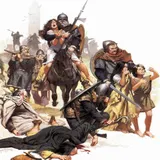
We're going to talk about the plot of the film later, just for people know, but just to talk about this one scene, it really hammers home the brutality of what was going on in this place and time when Norse people were active as raiders and traders and slavers in modern-day Russia and Ukraine. Way back when we did our episode on the Kievan Rus, which was sort of a society that emerged as a result of these encounters, but this movie really hammers home that these encounters were unpleasant and violent for most of the people involved. I think what I found really striking, I don't know if you thought this, Russian Sam, but it really seems like the raid scene is a deliberate homage to the famous Soviet war film Come and See, especially in the part when children are being burned alive by the Vikings, just as the Nazis do in that film.
And I was wondering if you thought that was deliberate, and if so, what do you think Robert Eggers is trying to say about, you know, the role of Vikings as these invaders and interlopers in medieval Russia?
Just the way that it's shown, I would have to say that it very much was deliberate. Reading some of Eggers' interviews, I came to the conclusion that he is very much a film bro and he's very appreciative of great cinema from across the world. No Marvel for him. But yeah, you can just tell that, like, okay, so for context, in this scene, like, this is after the raid has already taken place. The Vikings have, they've taken the fortification and now they're sorting through the people that they've captured. And so young children and the elderly, they're just herded into this barn, locked inside, and it's all set aflame. And like, these people, they just don't make anything of it. You can just tell that this is very routine mode of operations for them. Just like, take the plunder, take the people you can sell for a lot of money, and leave the rest to literally burn to death.
The discourse
Yeah, no, right. Yeah, like you said, he's. Eggers is very much aware of the kind of discussion he's tapping into when he does this, which is why I think it's especially unhelpful that there's been some very annoying discourse on some corners of Twitter about this movie. I don't want to get into the discourse too heavily because everyone's going to have forgotten it in three months or six months. But, you know, the gist of it is that there was some hand-wringing about the possibility for, you know, racist people to appreciate this movie or whatever. I think that Robert Eggers knows what he's doing with the depiction of violence in this movie. And it's true that maybe some, you know, particularly unobservant viewers might think that this depiction of violence is cool. But I think that by shooting this violence the way he does, especially if it's deliberately meant to invoke a depiction of World War II Nazi atrocities, I think that Eggers is making a deliberate statement about the cruelty of this world that I think most audiences are smart enough to pick up on.
Yeah, no, you would have to be a total psychopath to look at this movie and think, oh, yeah, Amleth is based.
Right, no, right, right. And that's why I think that it's not particularly helpful discourse, because I don't think that a depiction of violence in this way is harmful. Because I think the film does a really good job in showing us that this guy is from an alien society. He, if he existed in our modern world, would be an evil person. But because he's living in a very different society, he is able to be a heroic character in the context of that society.
But why don't you read what Robert Eggers had to say in an interview about the way that these kinds of violent masculine characters are perceived in different ways throughout history?
Eggers on Vikings
I was not ever interested in Vikings really as a kid, nor as an adult, and the macho stereotype and the right-wing appropriation of Viking culture really put me off. My wife, who, like myself, is into early modern and medieval literature, suggested that I would like sagas, but I just didn't.
You should always listen to your wife.
But then, when we went to Iceland, no surprise that the landscapes knocked me out completely. Aside from the raw power of the landscapes themselves, I thought the fact that people sailed here in the dark ages and didn't die is crazy.
Yeah. No, I totally get it. One little side here: I think it's really funny that sometime around 2010 or so, it became a lot cheaper for Americans to fly to Iceland. And ever since then, basically all fantasy has had some kind of Icelandic influence, whether it's filmed in Iceland, like Game of Thrones is, or if it's something like Skyrim, where there's this huge, you know, aesthetic influence of the fjords and the crags and the rocks.
Yeah, actually, speaking on the topic of the landscape, so Liam mentioned earlier that one of the co-writers of this film is an Icelandic writer named Sjón, who also last year co-wrote a movie called Lamb.
Right, yeah, also an A24 movie.
Yeah. Yeah, I saw it in the theater. I'm really glad I did. Stunning landscapes all around. This is one of those things that you really want to see on the big screen.
Oh man, I can't believe I missed out.
Yeah, hopefully one of the art houses in LA will show it again eventually. But yeah, really striking geography, and there's so much of that in this movie.
Vikings and nationalism
But to go back to a less pleasant topic, a topic less pleasant than geography, we should acknowledge that there is a very real, very ugly history of Viking imagery and the mythology of the Vikings and the mythos surrounding the Vikings being appropriated for nationalistic ends by various groups. Probably the first example are Romantic German nationalists who had a chip on their shoulder because there wasn't enough documentation of ancient German mythology and hoping to reconstruct this mythology, they basically just stole from the Norse. This is how you have people like Wagner, you know, the composer, notorious German nationalist chauvinist anti-Semite, who tried to invoke Germanic mythology in his operas, but really all he was doing was drawing from Norse mythology. And even though there are definitely very real and important connections between the ancient continental Germanic peoples like Arminius, who we talked about in our barbarians episode way back when, the Vikings lived centuries apart and many hundreds of miles away.
And probably most importantly, everything we know about Norse mythology comes from several centuries after the Viking period itself, usually around the 12th and 13th centuries. So this means that when Wagner is trying to depict these ancient Germanic myths, he's really only recounting these 13th century Icelandic myths that were oftentimes written down by Christians.
And of course, this mind virus made its way over to the Anglosphere. Soon enough, the Brits and the American imperialists were also viewing the Norse as their great ancestors, cousins, and they thought, you know, that these Viking raids and expansions were, you know, a legitimizing precedent for whatever they were up to at the turn of the 20th century in places like India or the Philippines, for instance.
Right, right, right. And I think, you know, part of this, this is that the 19th century British nationalists, as we talked about previously, were really interested in the Anglo-Saxon past, but the Anglo-Saxons never, except for the time they, you know, conquered Britain, they didn't go anywhere exciting. Whereas the Norse, a few hundred miles away, they were the ones who were sailing to Constantinople and the Middle East and Iberia and eventually even the Americas. So it's kind of easy to understand how if you're trying to justify your imperialist conquest on historical or even on a racial basis, it's easy to see why these kinds of 19th century imperialists would want to point to the Vikings. And probably the most horrible example of this is how the Nazis themselves, in the style of Wagner, would use Viking imagery to justify their current day occupation of Eastern Europe. That's why I think that it's pretty cool that Robert Eggers depicts the absolute horror that would have happened when the Vikings did go to Russia.
And of course, there are some strains of thought which continue in our country to this day. This is not exactly contemporary, but for example, around 2006 or 2007, when we had the movie 300, a lot of people really got a kick out of the idea of these light-skinned Greeks facing off against these literally monstrous-looking Persians who are dark-skinned and have all kinds of weird chains on their nipples and whatever.
The Northman is not remotely a racist movie, but I think 300 is. And that's why I think that some of the kind of anxieties around this movie potentially being enjoyed by racists. It's true, there probably are some racist guys who might find this entertaining, I guess. But something like 300, I think, it had a much more troubling effect on essentially boosting a racist comprehension of the past.
I just think that this is a very poor framing. It's a bad use of time and it leads to some really bad implications if your main concern in art is making sure that the people you don't like don't appreciate it rather than making a good piece of art.
Right, right. No, absolutely. And especially because any right-winger who appreciates this movie for a political reason rather than for its literary and artistic merit, I think is wrong because this is depicting a society that is fundamentally different from the society we're living in now. And this is so ludicrous because ancient and medieval societies are fundamentally alien to how we're living today. We cannot project our values onto the past, whether or not these are secular liberal values or whether these are weird right-wing values like racial supremacy and hierarchy. Because these themes just wouldn't have made sense to people in that society. And this is why I think that Children of Ash and Elm by Neil Price is such a great historical text, because it really underlies the ways that the Vikings and the people in their society were very, very different from people today. When Neil Price has written a lot about the appropriation of Viking imagery and Viking history by various kinds of nationalists, and what he points out is that he says here, what unites all these perspectives is that they privilege the observer looking in on the Viking world from the outside.
They ignore how the Vikings themselves saw their worlds. And so, in other words, what Price is saying is that these appropriations of the Viking past aren't based on any realities of Norse history that we can construct through archaeology and historical record, but instead are just a cartoon imagery of the Vikings that imagines them as this ideal ancestral subject. A culture who are better than us, stronger than us, and more virtuous than us, but also somehow tell us something about who we are or who we are meant to be. I'm just gonna say my own opinion here: I don't think that ancient and medieval societies tell us very much about the present at all. I don't think we can draw any inferences about modern-day cultures based on the behavior of ancient peoples. It's very difficult to draw a cultural through line from ancient and medieval societies to the present, especially in cases where these are non-Christian peoples who had their worldview completely transformed by the introduction of Christianity.
And I think it's really futile and essentially dishonest to attempt to connect any modern political program or legitimize any cultural attitudes by using the past.
Neo-paganism
Yeah, for sure. I'm not, I don't remember where I got this, but at some point I've read this very insightful piece that made the argument that basically, well, well, because you know, there's some proliferation of like neo-paganism. So some people are like, for example, reviving Norse paganism, some of this to nefarious ends. Other people just, you know, want to have a fun, quirky religion. But whoever the author of this piece was made the point that these people fundamentally cannot be pagans because they're still acting in reaction to the Christian society that they exist within.
Totally. No, totally. And this is another kind of troubling point: is that so much of what we know about paganism to begin with was recorded by Christians. You know, often they were Christians whose recent ancestors might have been believers of this pagan mythology, but this usually means there's some kind of pollution going on of what these people actually would have believed. Like I think Beowulf is a great example because it's set in a non-Christian society. Everybody in that story is pagan, but it was written in the Christian era. So all the time there are these attempts to link Christianity with this worldview. Like I think that the funniest example is that the villain, the initial villain of Beowulf is the monster Grendel. Even though this is probably some kind of troll in the Norse tradition, Grendel is depicted as a descendant of Cain from the Bible, even though nobody who would have been living at the time when Beowulf was set, I think it's like the third century, nobody would have had any idea in Scandinavia who Cain was.
An alien culture
And this is what's really interesting about Norse society in general. And I think that this movie does a good job depicting this. It's that, like we said, it is an alien culture because the Norse were a people who had been pretty isolated for a very long time. They had developed a religion and a worldview that appears to be different from their, I guess you could say, their distant cousins living in Germany. Because it really seems to have been pretty diverged from what we know about continental paganism. And again, because it's for many centuries, these people are living in Scandinavia, quite far from the rest of the European continent. But then suddenly, around maybe the 8th century, the 6th century, for reasons we aren't really sure, people from this isolated society began encountering other cultures on a much larger scale. This is when you start to see the great trade networks that stretched from Scandinavia into Constantinople and Baghdad.
And this is also when you begin seeing the Viking era as we understand it, when Norse people began conducting violent raids, capturing slaves and booty from the British Isles and the Baltic and modern-day Russia.
Neil Price and the berserkers
Yeah, so Neil Price, he was, again, great author, great book. He was actually one of the main consultants on this movie. And so, because of this, this is probably the most realistic Viking film you're going to see. Maybe not in terms of all the details, but in terms of the material culture, at the very least, this is indeed the case. So, for example, you see this very stunning depiction of the Berserkers, who are a well-known trope in the Icelandic and Norse literature writ large. They are basically these warriors who imagine themselves to be shapeshifting into bears and wolves to get themselves into a trance-like state so they can better, you know, kill. And there's this one scene where, right before the battle, they're dressed up in their wolf skins and they're dancing to the drum. And that scene, although the chant itself, which is said in Old Norse, interestingly enough, that seems to have been invented.
The dancing itself is inspired by these metal figurines of naked men with spears, which Price believed to have come from a combat ritual.
Yeah, yeah, it's pretty fun stuff.
The he-witch
One other aspect, which this is kind of more of a blink-if-you-miss it part, but there's this, I think this, the, the, the script calls him a he-witch that you see in one part, kind of this like shaman character. He's this weird guy living on the edges of society, which probably reflects Norse attitudes toward male practitioners of magic. Because one really strange aspect of Norse society, which Neil Price spends a lot of time discussing, is that being a known practitioner of magic in this society made you a deviant in a way that was considered identical to supposed sexual deviancy, like being gay. And actually, the exact same word was used to describe a male witch that was used to describe suspected gay people in medieval Scandinavia, which it's really interesting. And there's been a lot that's been written about Norse conceptions of gender and sexuality because they definitely were different from what was going on in Christian Europe at this time.
But this kind of idea that magic and homosexuality are deviant in the same way is really unusual, I feel like. And the movie doesn't really go into that that deeply, but I'm sure that Neil Price was behind the depiction of the witch character, the male witch in this movie.
I mean, I'd say it's a bit of a gradient. For example, in some of the Norse mythological stories, Odin is depicted as doing women's magic, and he, you know, he's one of the heads of the pantheon. So presumably, if he's doing it, then it's acceptable in some circumstances. But on the other hand, Iceland is actually notable for the fact that when they had their own witch trials, it was the only place in Europe that I know of where the majority of people brought for witchcraft charges were men.
Uh-huh. Yeah, yeah. And another thing that Neil Price brings up in his book is that there's at least one archaeological finding that appears to be a depiction of Odin wearing women's clothes, which probably has something to do with this idea of Odin both as a magical person, which therefore is feminine. And it's really tricky here because we would consider the Vikings very intolerant of womanly behavior as practiced by men. But at the same time, there was this understanding that men who were supposedly womanly were seen as somewhat valuable in the society, even if they weren't accepted. And there are a lot of cases of Norse chieftains and kings basically paying these deviants who were both considered to be magical and gay, essentially, paying them to, you know, hang around their society for good luck and to bestow blessings. Which again, like, that would have been completely unheard of in Christian societies at this time.
But this would have made sense in this particular Viking worldview.
Yeah, it's sort of an untouchable cast, really. Like, you need these people around, but at the same time, you don't want to be around them because they're just gross.
Yeah, yeah, I guess one good thing that you can say about the show Vikings, again, it's like it's not really drawn from history that much, that successfully. But one thing I did notice was that there's a character, I think his name's Floki, in the first couple seasons, and he is both magical and kind of implied to be bisexual, which does sort of, you know, that fits in with this Viking understanding of magic.
I too, I'm a magical bisexual.
Yeah, so you would have been a, yeah, you would have been a very powerful person if you were living in Scandinavia many centuries ago.
Many souls
You know, one other, speaking of kind of a funny gender thing, one thing that does not show up in this movie that I think that might have been too hard to explain was the fact that Vikings had a very strange conception of the soul because they perceived multiple souls inhabiting a single person's body, kind of like a reverse hive mind thing. I guess you could say that every single Viking person had a split personality because in addition to the conscious personality that every person has, they also believed that there was a special spirit embodying luck inside every person, and that whether or not somebody was lucky depended on the strength of this particular spirit in their body. But perhaps more interesting was a spirit known as a fylgja, I think that's how you pronounce it, which was a female soul inside every single man and woman.
And this woman's spirit would give protection and advice to every person that she inhabited.
So would she be like a little angel on your shoulder?
Exactly, an angel in your shoulder.
I think the best comparison is Cortana from Halo.
So basically every Viking had a little lady inside their helmet. Yeah, but again, like that'd be kind of hard to work into a film. So I don't blame Robert Eggers for skipping that part.
The Norse afterlives
One other thing that I kind of wish he would have gone into a little bit more is that, contrary to popular belief, Valhalla or Valhall, as they say in this movie, was not the only afterlife of the Vikings, and that it's really easy to understand it as a, you know, particularly macho version of heaven, but that isn't really what it is. Because when somebody died in Norse society, they could be sent to many different afterlives, and it's really hard to know how these different realms were perceived. Valhalla isn't necessarily even the most prestigious of all of these. The least prestigious was probably Hel, which is from where we get the modern word hell. But unlike the Christian perception, this wasn't a place of torment. It was just the least exciting realm of the dead. Other dead people, I think those who drowned, would go to Loki's realm under the ocean, and then even more people would go to Freya's realm, known as Fólkvangr, which means the field of warriors.
So again, it's a very complicated understanding of the afterlife that can't be understood in Christian terms. And it's a shame that all of the writings that we have about the Norse afterlife come from people who were themselves Christians, who would have had a very different understanding of these afterlives as their ancestors might have had. And I think that you mentioned gradients before, and that's a really important aspect of Norse society in general, is that a lot of binaries that we imagine in our modern society and the past, whether they're binaries of gender or law, whether or not someone is a slave or they're free, these binaries weren't how the Norse understood their own society. And instead, these binaries would have been seen as two poles of a gradient that people could find themselves on different parts of. And that it's really important to keep in mind that something like marriage to the Vikings wouldn't have necessarily been understood as an on or an off switch.
You're married or you're not. It might have been understood and most likely was understood as a very complicated set of layered relationships and you would find yourself and another person on any level of that sliding scale.
Yeah, very interesting.
Initiation
So let's touch on a few other mythological elements that made it into this film before we get into the nitty-gritty of the history. In one of the first scenes of the movie, where the king returns from a raiding voyage and he finds that his son is now old enough to start becoming a man, so he takes him to this subterranean cavern. So it was under a temple, and we see Willem Dafoe, who is only on screen for like what two, three minutes max, but very memorable two, three minutes.
Yeah, yeah, he plays this, you know, magician shaman, and he initiates Amleth into his into his fate, into his family line, his destiny.
And in that scene, they're drinking a drink, which makes them start tripping, basically. That was probably supposed to be Henbane, which has been found in the graves of some of the Norse people whose other grave goods suggest that they were involved in magic. So I just, before I saw this film, I never really thought of the Norse as having a shamanistic component, and yet here we are.
Yeah, I'm kind of wondering if that might be a little bit of an extrapolation. I think that especially because it kind of seems like the depiction of the He-Witch shaman character is drawn actually mostly from Sami traditions, especially the use of the drum. But it's totally possible that the Norse would have had some kind of shamanic tradition like this, especially because, you know, contact with the Sami would have been pretty ubiquitous for people living in Sweden and Norway.
Maeshowe
Yeah. And another really fun detail that I totally by accident stumbled upon. This is why I like the movie so much more now, by the way, because, like, after watching it and after reading all this stuff, I finally understand, oh, that's what that was. So so the chamber that they're in in that scene, that's actually based on on this Neolithic site called Maeshowe in the Orkney Islands, which was from the Neolithic period, it's from the 2800s before the common era, something like that. And this site is actually very interesting because it received a new lease on life in the Viking period.
Liam, would you like to read this passage?
Most of the inscriptions at Maeshowe are ordinary and commonplace, which gives them a special value. These aren't the epics of kings and heroes that you find in the sagas, but the authentic voices of ordinary folk who are usually as anonymous as flocks of birds. In Maeshowe, they had their brief say recorded forever on stone, because the old Neolithic burial chamber seems to have been a popular venue for Viking courtship. One inscription states, rather smugly, Thorn bedded, Helgi carved it. Another, with engaging simplicity, says, Ingrid is the sweetest woman there is. Another refers obliquely to the activities of a local femme fatale. Ingibjorg, the fair widow, many a woman has lowered herself to come in here. A great show off. Erlingr. And then when you bump your head creeping in along the passage, you realize what a neat pun that is.
Oh, because you have to, yeah, you have to bend over, I guess, to get in.
Yeah, exactly.
Yeah, so this site is really neat because it has the largest number of Viking graffiti in one place anywhere. There are something like 30 different inscriptions. And it just goes to show that many of these historical sites, you know, it's not like they just used it once, like thousands of years ago, and it just lay fallow until 19th century European archaeologists showed up and started excavating it. But no, no, clearly, some other people got other ideas for what this place could be useful for.
Yeah, I know. And that's again, there's a classic kind of joke in archaeology that archaeologists always want to assume something had a ritual purpose, but this shows that ritualistic sites could often be used for very non-ritual reasons.
The draugr
Yeah, and speaking of the subterranean, there's another scene in the movie later on when he's already in Iceland and he finds this he-witch who had summoned him. And he basically tells him that he has to go to this burial mound somewhere in Iceland and retrieve a sword. This was a very common motif in Norse literature, by the way. There were a lot of notorious weapons, very famous swords and halberds and shields and things of that nature, often with some kind of magical powers ascribed to them. So the person who wields these kinds of sword is first of all quite getting a lot of prestige from the act because it's a big deal. But secondly, they also likely have some powers as a result of this. And this particular sword in the movie, it's called Draugr, which, interestingly enough, a Draugr in Norse mythology was basically kind of a zombie, kind of a vampire.
Pretty close, yeah, yeah. Most famous as depicted in Skyrim.
Yeah, so the sword is called Draugr, but it's also guarded by a Draugr who is defeated in the movie in a very realistic manner. Do you remember what happens to the Draugr, Liam?
Sure, yeah, yeah. So yeah, Amleth, the protagonist, lowers himself into this kind of box-like tomb, which again, that comes from Neil Price. These weird kind of underground rooms were used to bury seated corpses. And yeah, he sees this ancient warlord, you know, with his sword sitting down. And the way that he grabs it is that he goes up to the Draugr, and then suddenly the Draugr comes to life, and Amleth has to defeat this zombie to take the sword. But then only after grabbing it, we see that the whole thing was in his head. Which is kind of a cute way to, you know, show the medieval understanding of spirituality. Like kind of a, it was real to them approach.
Yeah, but in the vision that Amleth has, which may or may not be real, this is also a topic of discussion because clearly the supernatural does exist in the story. But basically, what he does is something that's described in another saga where apparently the proper way to defeat a draugr is you have to decapitate it and shove its head up its ass.
Right, yeah, yeah.
Yeah, and that's that's depicted on screen. That was a very unexpected moment. I was not ready, but great entertainment.
Oh, yeah, yeah, absolutely.
The Valkyrie
And of course, also another supernatural element is that there is the Valkyrie character we see every so often in his visions. A lot of jokes at the time that it looks like she's wearing braces because her teeth are filed down. She has these weird carvings, these parallel lines carved on her teeth, which we know from archaeology that we found some Norse skulls that have that really creepy deformity.
Yeah, I'm gonna theorize that there was a really famous Danish king called Harald Bluetooth, and it's thought that he was called that because he had these indentations in his teeth which would have been carved out and he would have put blue paint in inside of those as an intimidation tactic against the enemy, essentially. So, this is likely what the Valkyrie what the Valkyrie is doing. She is not wearing braces. Her smile is perfect, slay queen.
Odin versus Frey
And I guess another part that we can talk about is that there seems to be this idea that Odin and Frey have kind of an antagonistic relationship. I don't know if that really bears out from the scholarship. I don't think that Neil Price has written about that or any other writers of Norse history that I know. But in the movie, Amleth sees himself as this kind of as the spear-bearer for Odin, whereas his villainous uncle represents Frey. What are your thoughts on that? Because I have one that'll take, but what do you have to say?
I'm not as familiar with Norse mythology as I'd like to be, so I'm afraid I can't give a super informed take. However, it does seem to me like this is kind of sort of a showdown between very different conceptions of the religion where Odin is, you know, this male figure who is, you know, not 100% masculine in the same way as a god like Thor would be, for instance, but nevertheless, he's a manly guy. He has his wits about him. He's strong when he needs to be. Whereas Frey is an earth god, which is, you know, associated with farming and fertility and things of that nature. And it seems to me like the people who would have been Vikings would have looked down upon people who farm for a living. So.
Right, right. And that's something I think is really important here. And that's kind of what I was getting at. It seems to indicate this sort of social and economic even conflict between the like, you know, wandering raiders and traders, the Vikings, versus the settled agriculturalists who would eventually, you know, become everybody in Europe. Eventually, like, you know, even though this is a movie where the warriors of Odin win, in a sense, in the long view of history, everybody would end up worshiping Frey, you know, like in a kind of spiritual sense, because we'd all be farmers eventually. There aren't any Vikings left around. Eventually, you know, settled agricultural production would become the state of the game everywhere. Eventually, today, essentially, all across the planet. Everybody is living in what is essentially an agricultural society. As far as I know, the only hunter-gatherers left in the planet are the Sentinelese Islanders and the Hadza in East Africa.
There are a couple of more. I think there's a group called the Kung somewhere in Central Africa that's also hunter-gatherer, but yeah, very, very few holdouts left.
Yeah, it's Frey won. But yeah, let's come back to the... We'll talk about the plot of the movie at the end. So we'll hold off all the spoilers for the very last minutes.
Thule
But for now, let's talk about Sam, because I know you did a ton of research onto this. Let's talk about what we know about Iceland from the historical record, because it's a lot less than you might think. Where does Iceland first enter history? Or where or when maybe is a better question?
Well, let me answer your question with the question, Liam. What comes to mind when I say Thule?
Thule, a couple things. It makes me think of a car brand, and it also makes me think of the Nazis.
Yeah, because there was a paranormal society known as the Thule Society, which was influenced by these kinds of new age thinking.
Right. I think that we talked about them in our amazing episode with Brendan a few months ago.
Yeah, so this Thule Society, they took this name from the name of an island called Thule, which, believe it or not, was believed to be an actual historic location. And some have theorized that Thule might have been the first name for Iceland. Iceland is quite isolated. It's out in the middle of the Atlantic Ocean, and it really wasn't settled at all until a couple of Irish monks started showing up there.
Yeah, yeah. The papar that we'll get into.
Yeah, in the 8th century. But it seems like some people had some idea that there might have been something there. So in the 4th century before the Common Era, you had this Greek geographer, trader called Pytheas of Massalia, who traveled through the North Atlantic and documented his journey. That book does not survive to our times, but it was very well known in antiquity and cited by many other authors, such as Polybius and Strabo. For the record, Strabo really was not a fan. He thought that Pytheas was making all of this up. Maybe out of jealousy, I've seen that speculated. A lot of people thought that this guy was a very successful traveler and they were just traveling from their armchair, basically. So according to what comes down to us, Pytheas claims that he had circumnavigated Britain and Ireland as well as other places. But that also, far in the north, there's a land called Thule.
As Strabo tells us, Thule was supposed to be about six days of sailing away from Britain near the frozen sea, so further up north. Pliny tells us that Pytheas wrote that, quote, the most remote of all that we find mentioned is Thule, in which, as we have previously stated, there is no night at the summer solstice, when the sun is passing through the sign of cancer, while on the other hand, at the winter solstice, there is no day.
Yeah, I gotta say that I don't think there's any way you would know that unless you either had visited the far north or encountered somebody who had. So I think that Pytheas might have been onto something.
Yeah, no, it seems pretty indisputable to me that he was indeed somewhere in the Arctic Circle.
Right, yeah, if not necessarily Iceland, then maybe in the Faroes or the Shetland Islands or, you know, possibly into somewhere in Norway, if that was an island.
Yeah, but the problem with this theory is that Pytheas says that Thule was settled and they had agriculture, which was not the case for Iceland until the Vikings showed up. So it seems more likely that perhaps this would have been the western coast of what is today Norway. But nevertheless, there's a book called The Book of Settlements, which is a genealogical history of Iceland. That's one of the most important early sources for the history of the island. And in the preface, the author began by citing the work of Bede, who came up before in our Anglo-Saxon episode, who himself had talked about Thule. So basically, this author was making that connection himself. Like, even if what Pytheas was describing is not Thule, Thule would have been Iceland to the author of the Book of Settlement.
You know, speaking of Pytheas, one other kind of cool connection between the Greco-Romans and Iceland is that some Roman coins from the third century have been found in Iceland. And I'm 99% certain that these would have been brought by the Vikings. They probably would have already been ancient when they got to Iceland. But hey, who knows? It's hypothetically possible that, you know, some Roman guy might have dropped some coins there. But yeah, at the very least, what this shows is that even though the Norse were pretty isolated from the rest of the goings-on of Europe, they really weren't part of the broader European society. They still had sporadic contact with the outside world. And then going into the Viking era, this sporadic contact became much more far-reaching and with much wider implications for everybody involved.
Irish monks in Iceland
Yeah, so the earliest evidence of actual human habitation on Iceland comes to us from the 7th and 8th centuries thereabouts. This would have been Irish monks who had a tradition of building monasteries on these uninhabited islands where basically hermit monks would go and just think about life. This would have been the equivalent of the desert fathers in Egypt, for example, who would have done the same thing by wandering into the desert. But since this was the north and they had no deserts, isolated islands were the next best thing. The most famous of these Irish monasteries would have been Skellig Michael, which is most famous for having been the site of Luke Skywalker's home in The Last Jedi. And speaking of Irish monks, the knowledge of this fact that they would indeed settle in these remote places laid the groundwork for the fringe belief that Irish monks settled in North America, which as far as I can tell is bunk, but hey, who knows?
Oh yeah, no, they love that. Like some early English settlers were convinced that there were Welshmen also living in America, Welsh Indians. And my hunch is that it's because if you've only ever heard Welsh as the only foreign language, when you meet somebody speaking Narragansett, you're going to think, oh, is that Welsh? I'm getting a lot of Welsh wa vibes off of this.
Yeah, but as for confirmed settlements, going back to the Book of Settlements, quote, before Iceland was settled from Norway, there were other people there called the Papar by Norwegians. They were Christians and were thought to have come from overseas from the West because people found Irish books, bells, crosiers, and a lot of other things. So it was clear that they must have been Irish.
And we should add that the word papar that they used for the Irish, that almost certainly comes from the Greek papas for priest, which also is, you know, the basis of the word papa for pope in Spanish and many languages. There was a 9th century Irish monk named Dicuil who claimed that other Irish monks had sailed to somewhere called Thule because he was familiar with Pytheas sometime in the 700s alongside other destinations. But I think what's really important here though is that recently, just in the last like five or six years, there have been a lot of archaeological breakthroughs that, yeah, seem to kind of confirm that somebody was living in Iceland before the Norse. Iceland magazine in 2017 wrote that there are some strange structures east of Reykjavik in Iceland that had previously been assumed to have been Viking Age, but some recent carbon dating suggests they probably actually predated the Norse presence.
So most likely, these kind of circular remains represent some kinds of huts used by Irish monks, most likely. And then in addition, the historian Thorvaldur Fridriksson argues that some of the place names in this part of Iceland seem to have Celtic roots, which is kind of interesting. It's possible when the Vikings got there, the local Irish monks told them the names of these, you know, springs and rivers that they'd already given names to.
Yeah, that's, wow, yeah, really fascinating. Yeah, so there are also a number of carvings that were discovered in the last couple of years. This is from an article in The Conversation. Quote: A remarkably similar carvings and simple cross sculptures mark special sites or places once sacred spanning a zone stretching from the Irish and Scottish coasts to Iceland. We can look at Skellig Michael, which rises from the sea 12 kilometers off the southwest Irish coast to Airdamoran, to the Outer Hebridian island in northeast in the Isle of Nas Shetkund, and to Hema Kleturkliffface in Iceland's Westminster Islands. Also in southern Iceland, a number of the 200 man-made caves found there are marked with similar rock-cut sculptures, and these dark remote places suggest a different answer to the puzzle that we thought we had solved a long time ago.
Irish slaves in Iceland
I think that all this should say, though, is that there are very strong connections between Iceland and Ireland, which are pretty cool, but most of these connections would not be facilitated by these pre-Viking monks. Instead, much more tragically, this connection would largely be mediated through the enormous presence of Irish slaves present in Iceland. And this is where we have to talk about the least pleasant aspect of The Northman and Viking society in general, which was the unbelievable ubiquity and the really shocking brutality of slavery. Because this was a slave society that, you know, honestly, in the crudest ways, you can compare Viking Scandinavia to something like colonial Cuba or 19th-century Alabama. American slavery was definitely uniquely dehumanizing and brutal in ways that Viking slavery was not. But in any case, this was a society in which most of the people living here were unfree laborers with no rights, compelled to work for their entire lives.
They would have had incredibly unpleasant and violent lives, dependent entirely on the mercy of the person who owned them. And given that these people tend to be left out of popular narratives of the Vikings, I think it's cool that Robert Eggers includes slaves and slavery as such prominent aspects of this story.
Viking slavery
Yeah, so slavery as an institution, it's almost universal, past a certain stage of development. We have evidence of it existing in Scandinavia from the Nordic Bronze Age onwards, which would have been something like 1500 BC to 600 BC or thereabouts, I believe.
Yeah, yeah. So a very long history of people kept in presumably intergenerational servitude.
Yeah. So on Iceland itself, modern genetic studies are consistently showing that there's an enormous, enormous genetic contribution of Irish people on the modern Icelandic population. So almost 20% of paternal DNA and over 60% of maternal DNA in Iceland is associated with Ireland.
Right, and from what we know about the historical record, this kind of genetic flow almost certainly happened through slavery and kidnapping. And due to the difference in paternal versus maternal ancestry, it was primarily the kidnapping of women. You know, like, yeah, that it's, we know through the historical record that it was incredibly common for enslaved women to be married to their masters or just simply sexually abused. This was incredibly widespread and normalized, although we should mention that in one way in which this form of slavery was less brutal and dehumanizing than American slavery is that it was not standard for the children of enslaved women to be enslaved themselves. Usually this would be determined by the father. And there are some cases in which slave women taken as wives or concubines would have freeborn children that would be recognized by their masters. But again, these women were enslaved.
They had no rights. Their well-being was entirely determined by the mercy, the relative kindness of their master, which is a terrible situation for anybody to be in.
Nonetheless, we do have some evidence in literature and history of individual enslaved women reaching some heights in society. I think the best example is that the Laxdaela saga involves an Irish woman named Melkorka who is taken as a slave but then marries a high-status Icelandic man. And then also interestingly, the queen in Beowulf, married to King Hrothgar, seems to have a name that means foreign slave. So, you know, who knows what's going on there? But that also kind of ties in nicely to this certain revelation later on in The Northman.
One other interesting little thing is that I know you're a big fan of Njal's saga, Sam, that one character in Njal's saga is mentioned as being Scottish in heritage. Presumably one of his parents was a slave, or perhaps both of them were slaves from Scotland. And I think it's interesting to note that he is one of the most brutal and uncivilized characters in the saga. So you kind of got to wonder if they're making some weird, you know, kind of proto-racial judgment about somebody who is descended from slaves.
Or he might just be an asshole.
Yeah, that's true. We shouldn't assume too much here. Yeah, yeah.
And like I mentioned before, there were also varying different legal statuses of marriage, and that often depended on if there was any kind of social distinction between the husband and the wife. So usually there could be an exclusive matrimonial relationship between a free man and an enslaved woman, but that would have been a very different legal relationship from a marriage between a free man and a free woman, which is really interesting to think about. That again, like marriage existed on a continuum then. And this is why some form of polygamy was very common, but having the multiple wives of the same legal status was less common. And again, like these kinds of social gradients, gradients of criminality, gradients of gender, gradients of freedom, were very important to this society, but it's very hard for us to understand them today. But in any case, anybody who was subject to slavery in the Viking Age would have been subject to brutality.
Even if they might have been, they certainly would have been better off than slaves in some other societies. And even within Viking society, some slaves were better off than other slaves. But in any case, nobody wants to be a slave. And I think there's a really good Neil Price quote here that summarizes the kind of brutality that it's easy to forget about when you're just studying a map. Behind every notation on our maps lay an urgent present of panic and terror, of clashing blades and sharp points, of sudden pain and open wounds, of bodies by the wayside and orphaned children, of women raped and all manner of people enslaved, of entire family lines ending in blood, of screams and then silence where there should be lively noise. Right, yeah. And again, I don't want to get too graphic with this, but abuse of slaves, especially sexual abuse, was incredibly normalized.
And as far as I can tell, the only restrictions on abuse were that it was illegal to sexually abuse an enslaved woman if she happened to be married to somebody else. Otherwise, fair game for abuse.
Yeah, but I mean, who's enforcing that, really?
That's true also. And that's a good point. That even though these restrictions might have existed, it's very unlikely that anybody would have been punished for them. And, you know, one strange report, particularly shocking report by Ibn Fadlan, which he found very scandalizing, this was a Muslim writer in Russia who gives us one of our best encounters of Norse society. He reported that slavery was so dehumanizing as practiced by the Rus, who would have been, you know, the, these would have been the Vikings in Russia who the film depicts as particularly brutal. And maybe that's true because his depiction here suggests that sexual abuse was so normalized that the wives of these slavers didn't even mind if their husbands were sexually abusing enslaved women because to them that was that that wouldn't count as infidelity. These women were so dehumanized that to abuse them was not seen as any breach in the contract of marriage.
That other infidelity absolutely would have been.
Yeah, so again, like we often see this kind of stuff get a bit whitewashed in comparison to chattel slavery because it really is a very different institution and chattel slavery is what's most familiar to us as Americans, but we shouldn't lose sight of the fact that this was extremely violent and extremely horrific for the people who were involved in this. They wouldn't have gotten any comfort from the fact that someday, hundreds of years in the future, other people would be treated worse than they are.
Yes, completely.
The word slave
And you actually, bringing up the word slave here, we should probably mention that it is most likely through the activities of the Viking slave trade that the word slave enters English. Because, you know, they would have used the word thrall to describe enslaved peoples. But the word slave that we use today comes from the ethnonym Slav. Because most likely, large amounts of the slaves captured by Vikings and then sold to peoples in Western Europe and the Byzantine Empire and the Arab world would have been Slavic speakers.
For instance, like the love interest in this movie played by Anya Taylor-Joy.
And also, one thing that you mentioned that I thought was kind of funny was that the subtitles specify that they're speaking old Ukrainian, but that there was no such language called Old Ukrainian.
Yeah, this is the end credits. Apparently, they list old Ukrainian, which I'm guessing they probably went into post after the war began and they just decided that they're going to change that. But in reality, this would have been Old East Slavic at that point. These kinds of differentiations wouldn't come about until much later.
Yeah, yeah, yeah. Actually, also that reminds me: the probably the absolute worst take I saw on this movie, genuinely the stupidest opinion I think anybody has had on The Northman, was that one guy argued that because the film shows violence against Slavic peoples, it's meant it's part of a propaganda push to make Americans support a war against Russia. Like, come on, man.
No, how could you believe that? That's incredible.
Slaves and the medieval economy
Okay, and so speaking of, you know, these guys, I mentioned before that the fact that many of the buyers of these slaves would have been people living in France, living in Italy, living even in the Islamic world. I think it's important to note that a lot of more optimistic scholarship about the Norse Age has emphasized the very multicultural nature of these trade networks, which is absolutely true. The Norse, even though they were isolated for many years, starting in the Viking Age, Norse individual, individual Norse merchants and mercenaries would have been everywhere. They would have been in Constantinople, they would have been in Baghdad, they would have even been in Iberia. I know ages back we talked about how one group of Vikings settled in Iberia as cheesemakers, which is really cute. But as cute as that might sound, we should keep in mind that the primary economic activity of these people would have been capturing and selling human beings.
This was the main function that the Norse played in the medieval economy. There was a huge demand for slaves, not only among the Norse, but among all the peoples of Europe and the Middle East, and the Vikings were able to provide this.
Yeah, grim stuff, grim stuff.
Yeah, I think that medieval slavery is such a crazy topic that we could maybe eventually do a whole episode on this because it existed a lot longer than you might expect. And it has some pretty interesting implications on, I would say, the formations of, you know, the modern European peasant class.
State formation
Yeah, and, you know, speaking of the formation of modern societies, one really important aspect of Viking history that this movie sort of goes into is the fact that across the Viking era, the primitive kingdoms in Scandinavia would become increasingly powerful and increasingly complex. This would have really interesting implications on the course of the Viking Age and eventually the end of the Viking phenomenon. And you've done some great research on this, Russian Sam. So yeah, if you could tell us about state formation in Scandinavia, that would be awesome.
Yeah, so Scandinavia is very much a latecomer to state formation, relatively speaking, compared to its neighbors.
Right, right. You know, comparison here, it's like how Japan was much slower than China to actually seem to have these organized governments. And what's kind of cool about The Northman is that you get to see a little bit of that sort of indirectly in the movie.
Yeah, yeah, for sure. So the thing is that, like, this is a very complicated question just because we don't have a lot of written sources from this period at all. But we do know that some of these peoples have, well, at least the names of these people have a very long history. So, in Tacitus, he speaks of the Suiones. This would have been in the first century. And then in the sixth century, there was a book called Getica by a man named Jordanes who spoke of the Danai, who are supposed to be of the same stock as the Suetidi. Names in and of themselves don't tell us that much, as I've said, but nevertheless, we don't have anything else to go by, so we're just going to have to.
Right, right. So, yeah, so I guess, in other words, it seems like there are these old ethnonyms for tribes or clans that eventually became associated with these early state governments sometime in the Iron Age or the early Middle Ages.
Dan and Nor
One thing I want to add here is that the Danai that he mentions, later generations of Danes had their own local tradition that the Danai were all descended from a guy named Dan, which I find hilarious.
Yeah, that sounds very biblical, almost.
Oh, absolutely. And you know what? I'm sure they probably lifted that totally from biblical genealogy narratives. And what's even funnier is that because the Danes believed they were descended from a guy named Dan, the Norwegians in this same time, like the 12th century, they believed they were descended from a guy called Nor.
Isn't Norway just like the northern place, basically?
Yeah, yeah, which makes it hilarious. Yeah, it's like, yeah, the name literally means the northern passage, but I guess they wanted to, you know, build this mythology for themselves that seemed a little bit more legitimate. And I guess, as we'll talk about in a second, the Swedes would end up doing this too. But we should probably add that all of these historical figures, like Dan or whoever, we got to take them with a grain of salt because these mostly come from the sagas, every so often from scant classical or early medieval sources. And what all these sources have in common is that they were written many centuries after these supposed figures would have lived. So any references to specific historical personalities would be very much, you know, we're really dealing with mythology here, not reliable historical chronology.
Yeah, but nevertheless, we do get a glimpse at some stuff.
What did king mean?
So for example, Gregory of Tours, whose work we relied on heavily in episode 36 about the Franks, he mentions that there was a king of the Danes who was attacking Frankish lands around the year 520.
Yeah, and this is important, the language he uses here.
Yeah, because like what exactly would king mean in this context precisely? We just don't know because the Romans and their descendants, ideologically at least, they just use these kinds of words like king, which is all fine and dandy in and of itself, but like, first of all, it's from a lens that would have been foreign to the people themselves. And second of all, like, a king could mean many different things to many different cultures. It could be hereditary, or it could be chosen by the tribe from among the best warriors, or it could be some other arrangement. We just have no way of knowing.
Contact with Rome
Yeah, yeah. Well, it's funny that you should mention the fact that a lot of what we know about these early proto-kingdoms or whatever comes from the Romans, because according to Guy Halsall and Neil Price, it's possible that contact with Rome is actually what led to these early states or proto-states arising in Scandinavia. Because tribes like the Dani, which would have had some kinds of connections directly or indirectly to Rome, may have been able to monopolize the trade networks and even employment networks, the systems of mercenary recruitment we've talked about in previous episodes with the Roman Empire. And some of the evidence of this is that suddenly during the period known as the Roman Iron Age, when the tribes of Scandinavia began to indirectly contact Rome through intermediary tribes in modern-day Germany and France, you suddenly start seeing a ton of Roman goods appearing in Scandinavian graves.
And this is part of a broader trend of what appears to be increased wealth accumulation within these tribal contexts. And so because you start seeing guys with a lot fancier graves, like for example, they would have these giant wine goblets that would hold like half a bottle of wine that they'd probably drink in a single gulp, this suggests you've got a more increasingly stratified society, which could maybe hint to these tribes coalescing into more powerful and more stratified, like, you know, political organizations, these early kingdoms. But none of this stuff ever really emerges wholesale.
So it would seem like the most likely scenario here would be that what later came to be Norway and Denmark and Sweden, they would have all had their origins in the Germanic institution known as the Thing. And on that note, in the 16th, 17th centuries in Sweden, you had a bit of an inferiority complex about this because relative to Denmark and Norway, Sweden would have arrived to a kingdom in a much later point in time. So basically, to make up for this, Swedish nationalist ideologues became obsessed with the Goths.
Right, right. And just for a serious little context here, it's because there are a lot of place names in Sweden that seem to suggest that a people with a name similar to the Goths might have lived there. Any connection with the Goths of the Roman era is pretty spurious. There's no direct correlation, but because the early modern Swedes wanted this classical legacy, they clung to the Goths. We should also mention around the same time, you also sort of see this in England, in Scotland. This is a lot less. This seems a lot goofier and even more spurious, but it's really the same context. As the Scots would somehow claim to be the kindred of the ancient Egyptians, whereas the English would claim to be descended from the Israelites.
The thing
Oh, but yeah, so we know that sometime around the Roman Iron Age, there's increasing stratification within these societies. This would imply that there's some kind of early state formation going on, and it would seem like the most likely antecedent to an actual state would be an institution known as the Thing, which Gladio Oldheads may remember from episode 4 of Barbarians, where this thing is actually depicted based on the writings of Tacitus himself. Now, Tacitus doesn't use the word thing in the text itself, but judging from what we know about how later Germanic peoples would conduct these affairs, it would seem like Tacitus wasn't just making stuff up. Like, he clearly knew something about these Germanic peoples whom he was describing. In fact, Liam, could you read this passage from Tacitus where he talks about how the thing would be conducted?
Tacitus on the thing
They assemble on fixed days, either just before the new moon or just after the full. This they reckon to be the most auspicious starting point for transacting business. When the assembled crowd is ready, they take their seats. The king or the chiefs are heard, in accordance with each one's age, nobility, or military distinction, and eloquence. If a proposal displeases them, they shout out their dissent. If they approve, they clash their spears. One may also bring in an accusation in the assembly, including a capital charge. Those convicted are fined with a certain number of horses or cattle, of which part is paid to the king and the state, and part to the victim and his relatives. In these assemblies, they also elect chiefs to administer justice in their districts and villages. Each chief is assisted by a hundred assessors chosen from the people as an advisory body, which also increases his own power.
Yeah, so that makes sense. Just great warriors and charismatic personalities who are able to attract large numbers of people to their side are able to dominate this institution naturally. So over time, you would have seen less democracy, so-called, among these peoples and more of a concentration of power based on the wealth that these people could dole out. So in this way, something that would have required the input of the entire tribe, per se, would become much more an organ to exercise the will of its most powerful members. So as I mentioned earlier, Tacitus does not use the word thing in that passage, but we have a very early attestation of it from the early 5th century found near Hadrian's Wall, which would have been a pillar that was carved by Frisian auxiliary units.
Yeah, it's pretty cool. Yeah, and I gotta say, I really love how Hadrian's Wall is like, it seems to be this real, like, I don't know kind of holding place for all these different weird cultures from around the Roman Empire. Like, there's evidence of North African guys at Hadrian's Wall. There's evidence of Alanian guys who are basically Scythians at Hadrian's Wall. It's pretty funny.
Yeah, I would have loved to see the kinds of creolization that would have been happening there.
Dude, can you imagine? Yeah, like, yeah, guys speaking, like Latin, some kind of Norse Latin creole, I'm sure, yeah. But yeah, but I think what this kind of shows is that there's a lot of controversy when discussing ancient Germanic cultures about when you see something held that appears to be held in common between a Roman-era tribal culture in continental Europe and a later Scandinavian group. Is this similarity a feature of common inheritance? Or is it some kind of recent adaptation that might have spread not from Scandinavia into Germany, as is most often assumed, but might have spread in the opposite direction? You know, shouting out Guy Halsall again, he's done some pretty interesting research showing that a lot of cultural institutions that are assumed to be these ancient primordial, you know, Germanic Scandinavian traditions are actually relatively recent innovations that might be shaped in some part through contact with Rome, which then spread back up north into Scandinavia.
It's totally possible that the thing could be one of those things. We'll just never know.
Yeah, but nevertheless, even if it was foreign importation, it was something that the Scandinavians took up with great enthusiasm. If we're basing off of linguistic evidence like place names, there would have been something like hundreds of Thing sites all across Scandinavia.
Things in Norway
Yeah, yeah. And yeah, so here's Neil Price right now. In Norway, where the phenomenon of the thing has been most closely investigated through archaeological survey, the locations of some 30 things are known from the first millennium. Some are inland, but most cluster around the coast in the areas of densest settlement in Norway. Within these, there appear to be three levels of thing assemblies: the Shire, the half-shire, and the Quarter-shire. This tripartite division can be found all across Scandinavia, even in different contexts. In each region of Scandinavia, the Iron Age archaeological features correlate remarkably closely to the administrative units of later medieval gatherings. So, what this means is that it seems like these things did really exist for a very long time. So, you start seeing these during the Roman and post-Roman Iron Age, you start seeing these things, these councils arise, and then for like a thousand years later, people are still using them, which is pretty cool.
Yeah, and they had a lot of uses aside from pure legislation. Legislating would have been the main function, but also like people would go to these places to trade and catch up with friends, arrange marriages, things of that nature. So, this was something that really encompassed many different aspects of their culture.
Danish kingdoms
But, nevertheless, things do not a state make, which gets us back to the question: like, at what point do we have actual kingdoms in Scandinavia? And the most concrete evidence I've been able to find is that from around the 9th century, especially in Denmark for a variety of reasons, there are definitely like things that we could call kingdoms.
Right, and it's probably no coincidence that Denmark is the only Scandinavian country that's not actually on the Scandinavian Peninsula. It's part of mainland Europe, which means that Denmark has always had much closer cultural and political connections to countries like Germany, France, and the Low Countries, which means they've tended to be on a slightly different development track than peninsular Scandinavia since the Iron Age.
Yeah, so there are many different state formation theories out there about how this process happens, but for our purposes, it seems like the Scandinavian state structures would have emerged in reaction to themselves being bordered by a state. Basically, the logic would have been you either form a state, you either create a centralizing tendency, or you become subsumed under your neighbor's state. And that might not be a great time for you.
Yeah, and again, that sort of comes up in the movie, where we start to see what happens when one larger kingdom gobbles up a smaller one, which would have happened so often in any period of state formation, whether you're talking about France or the Franks, or whether they're talking about Denmark and Norway.
Yeah, and speaking of the Franks, this mode of operation really goes back a very long time. So, as we saw in the Franks episode, Roman presence would have given many frontier peoples a knowledge of statecraft, which they would later be able to deploy to great effect when the empire faltered and there was suddenly a vacuum.
Totally. You know, and talking about the Roman Iron Age era, it's totally possible that some dudes serving on Hadrian's Wall might have been Scandinavian and they might have learned some ideas about political governance. They might have even read some text about the Roman Senate and slowly brought that back into Scandinavia.
Yeah, so you had the in this Roman period, you had the Franks, you had the Burgundians, you had the Visigoths, etc. You had a lot of these peoples. These are just the main ones. But the Scandinavians themselves, as Gleam mentioned previously, didn't really have direct contact with Rome.
Right. It was indirect. There's some scant evidence of individual Scandinavians serving in the Roman military, but there doesn't seem to have been any kind of like diplomatic negotiations between peoples like the Danai and the Romans, the way there was for, like, yeah, the Visigoths and the Burgundians. They were really on the fringes or beyond the fringes, really, of the Roman world.
Charlemagne and Denmark
But this really begins to change in the time of Charlemagne. The Saxons, who had been, for all intents and purposes, able to maintain their independence up until the 8th century when Charlemagne would have been ruling, suddenly found that the Empire's patience with them is yeah, yeah.
And if anyone isn't addicted to paradox games like we are and doesn't know the map of medieval Europe like the back of their hand, Saxony is right on the North Sea coast of Germany. So this is where continental Europe links up with Denmark. And this means that Charlemagne subjugating the Saxons and supposedly putting thousands of pagans to the sword and expanding his empire to the shores of the North Sea, this has very important implications for the Danes.
Yeah, suddenly what later becomes Denmark is bordered by a powerful empire, which, you know, gives them the impetus to actually start adopting these features. And speaking of Denmark, fun fact, the name Denmark itself, it comes from an amalgamation of the tribe Dan, the Danai, as well as the word mark, which is derived from the same Germanic root as the English march. So it's a borderland.
Like, like, think Ukraine, which literally itself means borderland.
Yeah, so you had the Hispanic march, which is sort of the border between Spain and France modern day. You had the Anglo-Saxon kingdom of Mercia coming from the same root. You had the Pannonian March. And so the Carolingians and Ottonians, as well as these other Germanic states, would have used this suffix often, which, of course, going back to Gregory of Tours, he talks about a king of the Danes, whereas in this period you have Denmark, which shows that this was something that would have arisen in response to the Carolingian and later the Ottonian presence on the borders.
The Ottonians
Eventually, of course, the Carolingian Empire would be split up. We talked about this in our Franks episode. It was when Louis the Pious died. And so, yeah, like you said, East Francia would become under the control of the Ottonian family, who are actually themselves from Saxon descent. So the Saxons kind of have a little comeback here. And East Francia would really go on the offensive and they would really have some pretty violent interactions with the pagan Slavic-speaking peoples of Eastern Europe and to a lesser extent, the pagan Hungarians. This long series of conflicts would eventually lead to all of the Central European peoples becoming Catholic and sort of becoming part of the Carolingian orbit, or I guess I'm sorry, the Ottonian orbit. But this is also when you start to see state formation in Denmark and in Norway. We don't have much direct evidence of the Autonians invading Denmark and certainly not Norway, but it's long been speculated that the Danes were aware of these violent encounters in North Central Europe and thought, hmm, maybe we're going to be next.
Maybe we should start consolidating ourselves.
Harald Fairhair
And a really important figure in this process is: well, first there's Harald Bluetooth, who also from Denmark, who also was responsible supposedly for the conversion of Denmark. But another important figure that you might remember from The Northman is Harald Fairhair.
Yeah, so we don't really know that much about Harald Fairhair himself. Our sources are overwhelmingly sagas, which are very contradictory. But one fun story talks about how he fell in love with this one woman and he asked her what he would have to do to win her hand in marriage. And she essentially tells him that I will marry you if you're able to form a kingdom. And so...
Only if, yeah. Yeah, to have a real kingdom. Yeah, hilarious. He did just that, if the saga is to be believed. And from that point onwards, Harald Fairhair, he would play an especially large role in the imaginary of Icelandic society, which we'll get back to later.
The end of the Viking Age
But this period that we're talking about, the late 9th, early 10th century, it would have also been when the Viking Age draws to a close. And one historian that I read in preparation for this episode argues that this is not a coincidence. The wealth from the Viking expeditions made it possible for chieftains to attach more men to their service than before, men who could be in turn used to gain further wealth. However, this wealth was likely used to increase the number of chieftains as well as that of their followers, and consequently didn't necessarily lead to larger political units. As long as it was easy to gain wealth from Viking expeditions, the principalities that emerged were likely to be unstable. New chieftains with fresh resources might easily expel the old ones. This happened repeatedly in Norway in the 10th and 11th centuries. Consequently, the Viking expeditions seem to have made available a greater surplus to be invested in lordship, created greater ambitions among the chieftains, and led to more intense struggles between them, but didn't necessarily lead directly to consolidated kingdoms.
This rather seems to have resulted from the end of the Viking expeditions, not the start. And that's from Sverre Bagge, a historian.
Yeah, so in other words, this period of state formation would have also coincided with a tremendous transition in social relations, whereas previously you would have had these charismatic chiefs assemble a retinue and go out raiding to Rus or to Anglia or wherever. Now these kings very much had a motive to keep these kinds of operations to a minimum because this would really threaten their power base ultimately. And this shift in social relations is also what results in the formation of the Commonwealth of Iceland.
Iceland's sources
So let's transition back to Iceland, the real core of this episode.
Yeah, because we should mention that so not only is Iceland the main location for the movie The Northman, it's actually the source of most of what we know about the real Northmen. Because even though Iceland is so remote from the rest of Scandinavia, by this pretty odd coincidence, so much of what we know about the ancient Norse or the early medieval Norse comes from Icelandic sources.
Yeah, and we'll get into why that is. But first, let's talk about the actual historical sources at our disposal. The first one would be the Book of Icelanders. I'm not going to attempt to pronounce that in Icelandic because it's intimidating, but it was written in the early 12th century by a man named Ari Thorgilsson, likely written sometime between 1122 and 1133. And it was written in Old Norse. Once again, we get into the phenomenon of important literature being written in the vernacular and coming off as less stuffy as the Latin stuff. But this book, it's very short. It's 10 tiny chapters, most of which are like a page or two. In the edition I found online that I used for this episode, the actual text only takes up 12 pages, followed by 20 pages of notes. So it's not like the Anglo-Saxon chronicles here, but there is a coherent narrative.
Right, which is this like real tome.
It's not strictly an ecclesiastical history, but the narrative is very clearly structured in such a way as to make Christianization the logical culmination of the development of the society. So it goes from the first settlement to the bringing of laws and establishment of the Althing, calendar reform, administrative reform, and finally Christianization. And it just kind of makes sense that this increasing sophistication of administration and all of these factors naturally ends with the establishment of Christianity. Of course, this is not something to be taken for granted, but that's just how a lot of histories were written back in the day. Like, think of Bede, for example, also not strictly history, but one of the most important sources that we have from the period.
And I think also we should really kind of like, you know, hammer home here that one really difficult thing with dealing with this period is that even though we have a pretty good number of sources about the Vikings, everything that their descendants wrote themselves would have been during the Christian period, which means that pretty much everything we know about the actual Norse religion either comes from Christian sources, it's all guesswork, and it's all guesswork being made by Christian sources centuries after the fact, or by piecing together very indirect second-hand sources, also from Christians, from the same time when these beliefs were practiced.
The Book of Settlements
But one thing that wasn't really just pieced together very in a very fragmentary nature is another one of the main sources for Icelandic history, and this one is quite different from a lot of the stuff you'll encounter in mainland European medieval historiography, and that would be the Book of Settlements, which is primarily a genealogical book. It's divided into 399 chapters. He begat, she begat, etc. Yeah, so these 399 chapters, they catalog the 435 original settlers who came to Iceland from 874 to 930. Most of these people were coming from modern-day Norway, for reasons we'll be getting into, but also, once again, getting into the stratified nature of Icelandic society, there are many more than 435 people discussed in this book. There are something like 3,000, but there are, you know, I mean, slaves don't really count. Wives aren't the primary focus most of the time, women in general.
But yeah, there's a very variable amount of detail found within the Book of Settlements. So for example, you have chapter 176 for a man named Soti. It reads, There was a man named Soti who took possession of Vesterhop and lived at Soterfell. That's it. Versus chapter 68, Grimm.
Liam, would you like to take this?
Grimm Ingildson settled in the north of Iceland with his wife Bergdis and son Thorir. One day in autumn, Grimm went fishing with his farmhands and Thorir, who sat at the front of the ship in a sealskin bag. Grimm caught a merman, and when he got it to the surface, Grimm asked, What can you tell us about our futures? Where in Iceland should we settle? The merman said, There's no point in making prophecies about you, but that boy in the sealskin bag, he'll settle and claim land where your mare Skollum lies down her load. Not another word could they get out of the merman. That winter, Grimm and his farmhands all drowned while fishing. In the spring, his son Thorir and wife Bergdis set out to look for a new home with Skollum at the lead, heading south. In the summer, Skalm the mare finally laid down and Thorir claimed a large plot of land, becoming a powerful chieftain himself.
And then it goes on to list all of Thorir's children, all of his grandchildren, and ends with, When Thorir was old and blind, he went outside in the evening and saw a huge, evil-looking man come rowing into the Kald River in a great iron boat, walk up to a farm called Hrip, and start digging at the sheep pen. During the night, there was an eruption there, and that's how the lava field at Borg came to be. The farm stood where the lava mountain is now.
Yeah, so really weird. Clearly, lots of mythological elements. This wouldn't have been entirely historical. But the interesting thing about this entry is that Grimm Ingildson actually comes up in another source base that we have. This is from a saga called the Vastaila Saga, which gets us to the main point.
The sagas
Sagas.
Yeah, yeah, so these are basically the most famous genre of Norse literature that we have. These are prose narratives, almost like early novels essentially, that recount these long, generally intergenerational stories about various families and communities. These would have been derived primarily from oral traditions, which would have been written down later, sometimes after centuries, and other times only a few decades after the events themselves that took place. So they're a very mixed bag. They really range the gamut from pure mythology, stories of the gods, to the stories of kings, and as well as family histories, as we said. In fact, most Icelandic sagas fall under the category of something called family sagas. But later on, there were even saga renditions of saints' lives and even chansons de geste from Western Europe, which really gets to the heart of to what extent there was an interconnected literary culture in medieval Europe to an extent that many people wouldn't consider.
I believe there's at least one saga that was even an adaptation of the Iliad, I want to say. And there was a really common one also was the Alexander saga, which was, you know, part of this medieval tradition reconstructing stories of Alexander the Great from second-hand Roman sources. So it's a kind of funny game of telephone.
So we have about 100 Norse sagas surviving today, and only about half of them are actually from Iceland. But considering that Iceland is such a small place compared to Sweden or Denmark, that's a pretty huge percentage. And the sagas themselves tend to be especially meticulous in recounting the deeds and histories of the Icelanders, and they're so detailed that we actually have a pretty good picture of who exactly were these 430 initial settlers, or at the very least, how did their descendants perceive their immediate ancestors? So most of the sagas are written down in the 12th or 13th centuries, but they're set at the end of the Viking Age. So from the 9th century with the settlement of Iceland up until the early 11th century when it was Christianized. And the really interesting thing about Icelandic history is that they even in the historiography have what they call the saga age right after the age of settlement, which would have been from 870 to 930.
Yeah, yeah, just because we just know so much about these early generations because there's so much is written about them by their grandchildren and great-grandchildren. So again, these are all Christian sources describing pagan people, so we can't really be sure how much of this information, especially concerning belief systems, is accurate at all. But I think that at the very least, it's a great document for how these people would have perceived their immediate forebearers. One other interesting aspect here is that probably possibly the reason why so many Icelandic sagas survive compared to other sagas. Partially, it could be climate reasons, because in Iceland it's much easier to preserve vellum than somewhere like Denmark that's very wet. But another factor is that there's a strong possibility that Icelanders might have just been a lot more literate than other parts of Scandinavia. So there were more people, even though there were many fewer people in Iceland, there were more people per capita who were able to tell the stories about their own families.
Yeah, and in general, for whatever reason, Ireland seemed to be better at preserving literature than mainland Europe. A recent study came out where the authors argued that approximately 9% of medieval European literature survived into the present, compared to 17 and 19% respectively for Iceland and Ireland. And that's just kind of nutty.
Yeah, yeah, yeah. Yeah, I think the island thing might be a coincidence, but who knows, you know?
Yeah.
Snorri Sturluson
But really, to get into the meat of this, is that there's one saga writer in particular who we really got to mention. And that is the famous Snorri Sturluson.
Great name, great guy. He is the best known of the saga writers, and he also compiled the Prose Edda, which is again one of our best documents of Icelandic mythology that we have.
Yeah, and in addition to the Prose Edda, he also wrote a number of other sagas, such as the Heimskringla, I think that's how you pronounce it, which is sort of like the saga of Norwegian kings, which is where we get a lot of the information about who these early Norwegian kings might have been, as well as the Ynglinga saga, which is another huge part of the saga literature. But Snorri Sturluson, he actually led a very crazy life himself. He would have lived from 1179 to 1241. So, so again, this would have been someone whose family would have been Christian for several generations at this point, but nevertheless, it's because of him that we have a knowledge of a lot of Norse beliefs. Granted, this would have been interpolated through generations of Christian understandings of the world, but nevertheless, it's without him, we wouldn't have had a lot of the stuff that we have.
And in addition to his literary talent, he was also a fixture in Icelandic society. He would have been the law speaker for a while, which is an institution we're going to talk about later. But really, the crazy part is that he was assassinated because this was the middle of the 13th century, is when Norway attempted to integrate Iceland under its kingdom. And so, Snorri Sturluson stood in the way of that. And he was killed in a very grisly manner in everyone's presence. So, yeah, that was the end of Snorri.
That's wild, yeah. Wow.
12th century target assassination. That's kind of crazy, yeah.
Centuries before Predator drones.
Njal's saga
Well, we should get into one saga in particular because this is one that is one of the most important sagas. It's the longest saga. It's also the saga that you have read most recently, Sam. And it's a saga that has some loose connections to The Northman. And that is, of course, Njal's saga.
Yeah, alternatively, it has been known as the saga of Burnt Njal for reasons that we'll get into. But Eggers didn't cite this one directly as inspiration in the interviews with him that I've read. But I felt that this one would be a very good supplement to the film just because it tells us so much about Icelandic society.
Right, and a lot of Icelandic experts who watched the movie noted this as well. It's the longest saga, it's really intricately written, and again, it tells us a lot, a lot, a lot about how Icelandic society would have worked.
So, because it's so long, it has a very large cast of characters and many different side narratives and stories. But the too long didn't read version would be that there's this 50-year blood feud going on because of a woman named Hallgerd who had her first two husbands killed.
Yeah, specifically, I think that she doesn't murder them herself, which is a kind of common trend in Icelandic literature, which says a lot about gender at the time, I feel like. Instead, she goads her foster father into killing her two husbands.
And then there's this third guy named Gunnar who just decides I can fix her.
Yeah, which I think is great. Like, there's this, like, there's a woman who's her two previous husbands have been killed. You're like, yeah, why not? Third time's the charm.
Yeah, so Gunnar marries Hallgerd against the advice of his close friend Njal. One of the lessons of the saga would be always listen to Njal. At one point, rather early on in the saga, Hallgerd and Njal's wife, Bergthora, they get into a fight over seating arrangements at a wedding, which really escalates into tit-for-tat killing within their respective households. So it started with like sending people to kill the slaves of the other household and then gradually escalating into actual family members, which would have been a huge no-no.
Right, and again, we talked about how there is really conditional humanity in this era. So yeah, killing a free person would have been a pretty grave offense. Even in a society that had a lot more tolerance for violence than our own society does.
Yeah, so it really gets out of hand. Gunnar is sentenced to three years of exile because he failed to take Njal's advice. But just as he's packing, he decides against screaming at the last moment because he's stricken by how beautiful his land is. He falls off his horse and ends up facing towards his house. He takes this as an omen to, you know, that he has to remain. And so he's declared an outlaw, which is a person who could be killed by anyone for absolutely any reason without any legal repercussions. And he dies in an ambush after his bowstring broke. And Halgerd, who is noted for having this really long, beautiful blonde hair, she refuses to give him a strand of her hair because of a really petty reason. But the situation, even after Gunnar's death, continues to escalate until finally it culminates in the burning of Njal's home with him and his wife inside, and they're just consigned to their fate.
By this point, they would have become Christians, which really shows a sort of syncretic idea of what it means to be a noble person with both Christian ideals as well as the old Norse ones. Can you want to elaborate on that?
Yeah, so for example, there's this idea of resignation that, like, oh, this is our fate. If we must burn to death, then we must burn. Njal decides that he's going to burn, and his wife decides, well, I've been with him my entire life, so I'm going to stay in here and burn with him. And they just passively allowed this fate of martyrdom to happen to them, even though they could have reasonably escaped. There would have been a really clear idea, just based on the tone of the writing, that this blood feud is not a good thing. It just results in a lot of innocent people dying for no good reason. But there is a certain tone of admiration for dying well and in the task of fulfilling one's duties to the family line to maintain the honor of the individual as well as the family, which just goes to show that the values don't really change overnight.
Pagan memories
Right, and we should try to add here, there's kind of a debate in historiography about to what extent can these early Christian sources attest to previous pre-Christian traditions? And the argument in favor that yes, they can is that even if the people writing these stories were Christians themselves, they were in a society that still had a strong cultural memory of the pre-Christian era. And like many of these values like you're talking about, or some elements of folklore from their grandparents or great-grandparents' generation, probably would have survived. Or at least would still be hanging on.
Njal's saga is interesting because once again, there is historical basis here. In the Book of Settlements, we have a passage that reads, quote, With Osgard's approval, her brother Thorulf took possession of land west of Fjot, between the two Deidgard rivers, making their home at Dorsfell. There he fostered Thorgeir Gollnir, son of Osgard, who farmed there afterwards. Thorgeir's son was Njal, who was burned to death in his house. And another feature of the saga literature is that many of them feature the same cast of characters. This would have been a literature of the ancestors in a way that doesn't quite exist anywhere else in Europe, especially not going this far back.
Right, yeah, I know that anyone who has like an amateur interest in genealogy often is very disappointed to find out that you really can't go into the Middle Ages at all unless you are, unless you know you're descended from nobility. But here in Iceland, we have these really detailed genealogical lineages of regular people. And I think it's important to note here, and they kind of touch on this in The Northman, that Iceland was a society without any kind of a formal monarchy or nobility. It was a society that was very stratified, especially on the basis of slavery versus freedom, but at the same time, was in some ways more legally egalitarian than the rest of Europe.
Well, yeah, so let's talk about what kind of sketch of Icelandic society, and including pre-Christian Icelandic society, do you think that Njal's saga gives us?
Well, of course, the pre-Christian aspect needs to be taken a bit with a grain of salt. And in general, the sagas shouldn't be accepted as face value as history.
Right, because there's some magic in them.
Yeah, but for the most part, the family sagas are very reality-oriented. So it's not quite like the literature about the Holy Grail, for example. Although there are magical objects, for example, many characters have the gift of foresight, such as Njal, for example.
And there's an enchanted halberd.
Yeah, so this halberd, it has a. It's enchanted and it casts a spell that basically protects its wielder against being killed by a weapon that's not the halberd. But for the most part, you know, this stuff is believable.
Honor
And yeah, so let's get into what Njal's saga tells us about early Icelandic society.
Yeah, so honor is the main word here, as it is in The Northman. It gives us a very clear idea that being dishonorable is one of the worst things that a person could be in Norse society. One must be ready to spill blood to preserve one's honor, not just your own honor, but the honor of your kin group.
Right, and so much can be a slight against one's honor, whether it's for something very major, like being attacked or being subject to infidelity, but or something a lot more minor. Like, for instance, Njal's sons are very insecure about the fact that they can't grow proper beards. And so they're even at one point, it's alleged that they rub cow manure on their face to make it look like they have a beard. And this is a real slight against these guys' honor. Such a slight, they have to retaliate.
Yeah, and that's how the actual core family members between Gunnar's and Njal's household get into.
Yeah, yeah, yeah. No, it's a cautionary tale. Never suggest to gut that someone has a cow dung on his face. It's not gonna end well for you.
So again, from this, we can see that killing in and of itself is not bad if it's done the right way. Right. Which definitely seems to be some kind of pre-Christian value system coming through. Although, of course, you know, Christian medieval Europe had no shortage of justified killing going on under the sanction of the law.
Yeah, so really, if you were slandered or in any way had your honor threatened, you could basically kill with impunity the person who was spreading this information, provided that the intention to kill is voiced in the presence of several witnesses. And as long as it's a so-called good clean fight, it's honorable.
Law in Iceland
But these honor killings aren't really the only way to get justice done in Icelandic society. You can, of course, also resort to the law, which is rather unexpectedly, I'd say, one of the main themes of Njal's saga.
Yeah, yeah, you know, maybe we should mention is that it's been a pop, it's been pretty commonly alleged that Njal's saga was written by Snorri Sturluson's father, if not Snorri Sturluson himself. Which makes me think that if he was a renowned law speaker, it would make sense that him, or at least his father, would have, you know, been especially familiar with how the law works in the society. So, you know, write what you know.
Well, does the law work is really the question here. And in the saga, it doesn't. But nevertheless, we have a very clear idea of the law, of what the law of the society would have looked like, because we have a manuscript called the Grey Goose Laws, which would have been written in the mid-13th century. But prior to that, it would have been an oral legal tradition. A figure called the Law Speaker was expected to have all of the laws memorized. And many other characters in Njal's saga also have recall of the law. So that goes to show that knowledge of the law was something that many people were expected to have to one extent or another. But as for the history of law in Iceland, according to the Book of Icelanders, there was a man named Úlfljótr who, once Iceland was settled, was sent over to Norway to learn the laws of Norway so that he could bring them back and govern Iceland.
And this man would go on to become the first law speaker. And again, the job of the law speaker was to have total recall of the law and the ability to cite it when it's needed. And most of these proceedings would have been done at the so-called Althing. And so the thing, obviously, it was practiced all throughout Scandinavia and even in some other Germanic-speaking places as well. But yeah, it was probably the most codified in Iceland.
And it's kind of funny is that some of our listeners might know, the Althing still exists today. That is the formal name of the Icelandic parliament, even to the present.
Yeah, in fact, it's considered that the Althing is the longest running parliament in the world. I'm not sure to what extent how true that is, but I mean, it goes back all the way to the year 930. So even if it's not the oldest per se, it's very, very old.
Right. Yeah, and just as we talked about in Norway, there were these layers of different things beneath the Althing. These judges known as Gothar would look after the lower things, whereas the Althings would be held every year, only once a year, at an area called the Thingvellir, which meant the Thing Fields. And what's interesting is that the law speaker, who was the person who would, you know, preside over the Althing, was actually the only salaried government official in the entire country of Iceland. Yeah, for hundreds of years.
Outlawry
So in addition to Njal's saga, I also read a book called Why is Your Axe Bloody? by William Miller.
Yeah, yeah, yeah. That's what Hallgerd asks her foster father after he kills both of her husbands.
Yeah, so Miller, who really is helpful for understanding how the society would have worked, tells us that people would sue each other at the thing in search of various punishments. And the most serious sentence that someone could be sentenced to is full outlawry, which basically turns a person into a homo sacer in the Roman context.
And yeah, and this is what happens to Gunnar in Njal's saga after he refuses to take an exile. He stays in the country and he now is...
Yeah, he is now a homo sacer, which means he and his property are immediately forfeit, and anybody who encounters Njal can kill him with impunity. And there's also lesser outlawry, which is what Gunnar was originally sentenced to, which is you still have to give up your property and you have to go abroad for a couple of years, depending on the sentence. So yeah, so people, so often what happened is that people who became lesser outlaws in Norway would be sent to Iceland. And then people who became lesser outlaws in Iceland, they would be sent to Greenland. This kind of sentence, generally, it wouldn't have been decided at the Althing, but at regional things. One of the earliest reforms that happened would have been to section Iceland off into four quarters, and each of these quarters was supposed to have three regional things where smaller disputes would happen and which would be convened much more regularly compared to the Althing, which only meant once a year.
And in these smaller disputes, they usually had much less dramatic outcomes than exile or outlawry, where instead people just have to be made to pay a fine or a fee or a damage, kind of like in the modern Western legal system.
Wergild
We see also that fines could also be used to pay for the murder of someone, a so-called wergild.
That's a term from Anglo-Saxon law, but it's, yeah, it's a similar tradition where you can basically get out of jail free for killing someone as long as you pay a certain fee to their family. And perhaps unsurprisingly, how high this fee would be would be weighted based on the victim's place within society. So killing of a slave would be much less expensive than the killing of you know the firstborn son of a major landowner.
Yeah, and this wouldn't have necessarily needed to be done at the thing. Oftentimes, this would be a private arrangement between two men.
Women in the sagas
So, for example, in Njal's saga it really tells us a lot about the ways that women would have existed within Icelandic society, maybe beyond that Norse society writ large. We really get a sense that although women would have been dependent on the income of their husbands to run their affairs, for example, they would have had a lot of leeway. So, the servants, of course, they're going to listen to the wife rather than the husband, if that's what's needed. And they have a lot of latitude in terms of getting people to kill other people or just goading their husbands on. Like, oh, if you don't respond to this slight, then you're not a real man.
Right, and you know, I think that the one thing that's important to note here: you mentioned servants, and that this seems to be a case where free Icelandic women almost certainly did have more social liberties than continental European women at this time. But of course, there's this little paradox, which is that many, potentially most women in this society, would have essentially had no rights at all because they themselves would have been enslaved.
Why Iceland was settled
Yeah, so for a variety of reasons, Iceland served as a capsule for a very particular type of Viking Age Norse culture, which survived for centuries after it had been extinguished on the mainland, which is really why Iceland was settled in the first place. Because basically, if the sagas are to be believed, it was the result of the state formation process in Norway. So, in the Book of Icelanders, we learn: quote, a great many people began to move out here from Norway until King Harald forbade it because he thought it would lead to depopulation of the land. They then came to the agreement that everybody who was not exempt and traveled here that he should pay the king five ounces of silver. And it is said that Harald was king for 70 years and lived to his 80s. These are the origins of the tax, which are now called land dues.
So because of this, Icelandic society was governed by a class of people called the Gothar, whom we mentioned previously.
Right, yeah, we mentioned these are the guys who are the leaders of the lesser things.
Yeah, and your interesting thing about the Gothar is that their name actually derives from a name for the gods. So this would suggest sort of a religious place as well as legal place within society. So because of this, Iceland was settled by these chiefs as well as their families. And they would basically just come to this place and claim whichever land they wanted, provided they had the manpower to actually cultivate it. They could preserve their claims based on first come, first serve. And like you had the chiefs themselves in their immediate household, but you would also have their followers who would become tenant farmers on their land, basically, as well as a class of yeomanry who would have had their own small estates in between these larger ones owned by the Gothar. And so it's really not hard to see why Icelandic society was so different because it was based on the idea that the ruling classes of Norway before the state centralization process would have been able to preserve their way of life as the state started to tax them.
Right, right, right. And that's why, you know, in the movie The Northman, it all starts when Amleth's uncle is evicted from Norway and has to move to Iceland to start a new life.
Yeah, and so they would create the Commonwealth of Iceland, which is generally considered to have started officially with the convening of the first Althing in 930, and it would continue until the... middle of the 13th century when the kings of Norway were finally able to impose their control over the island and integrate it into their kingdom so they could start getting taxed again. And unfortunately for these Gothar who had come to this land to escape the state, they ultimately came to have the same structure as everyone else.
The Viking funeral
So let's get back to The Northman itself. And I wanted to talk about one very particular scene. After the killing of Fjölnir's elder son, there's this funeral ceremony, which, as it turns out, was lifted almost entirely from an account given by Ibn Fadlan, who wrote a really famous book where he details his time among the Rus, among other peoples. And in this section, he talks about how a great chief among the Rus would have been sent into the afterlife.
Right, and so we should mention that this is the classic example of a Viking funeral. Pretty much everything we know about a Viking chief being burned in his ship comes from Ibn Fadlan. And so a little caveat here is that, so he was from Iraq. He was traveling a pretty far distance, and eventually he managed to encounter some Vikings. But two things here. Number one is that because he was a devout Muslim, he was coming at this funeral with a specific set of expectations and biases that might have informed his work. Some historians even argue that he embellished a lot of this to, you know, shock or titillate his, you know, the more civilized Muslim audiences back in Baghdad. But the other thing is that he didn't make it all the way to Scandinavia. He met these guys in central South Russia, where the Rus were active as slave traders.
And so this means two things. First off, because this was in Russia, we're not entirely sure that these guys were practicing the same kinds of burial traditions that would have been practiced by their immediate ancestors back in Scandinavia. And then also, because these guys were slave traders and appear to be a particularly violent aspect of Norse society, we're not really sure to what extent we can extrapolate broader Norse traditions off of these guys. But in any case, Ibn Fadlan gives us a riveting and really quite shocking account of what a Viking funeral really would have been like.
Sam, can you describe this?
Not all Vikings would have been created equal. Obviously, according to Ibn Fadlan, slaves weren't even buried. Their bodies were just left out in the open to be eaten by dogs and birds.
Yeah, and I kind of seems a little bit reminiscent. It's probably a coincidence, but that does seem pretty reminiscent of the traditional Central Asian burials of Turkic and Turkic peoples and even Tibetan peoples. And it's probably just a coincidence, but I do wonder if they might have picked that up from nearby Khazar or Cuman populations.
Yeah, it's possible. But when an actual chieftain dies, someone who is important, his slaves would be asked to want to die with him, to accompany him to the afterlife. And usually a woman would volunteer or volunteer in air quotes if Ibn Fadlan is to be believed. But yeah, so the chieftain's body would be loaded onto a boat with food, alcohol, weapons, as well as two horses, two cows, and two chickens slaughtered. But then finally, it would come... it would become the turn of the slave who volunteered to actually be sacrificed. So this movie actually sanitized what these slaves would have been going through at the time. Because if Ibn Fadlan is to be believed, this was not a pleasant death, even less so than it is in the movie. A female slave would volunteer to be sacrificed, and she would visit the homes of his comrades and sleep with them.
And those comrades would say, quote, tell your master I've done this out of love for you.
And again, just to interject here, this probably is something, I think it's probably something that actually happened, but there's been some speculation that this could also be an embellishment just to, you know, shock his readers back home. It's hard to know.
Yeah, maybe. But after this, the woman would step into a wooden door frame and hold onto the sides, at which point she would be lifted by the same men over the head of the master's ship, and she would be lifted up three times, first saying, I see the spirits of my father and my mother. Then the second time she would say, I see my dead kindred. And then the third time, I see my master seated in a beautiful garden. After which point, the woman would be given a chicken to kill, and its headless body would be left on the ship with the master.
Right, and I guess I want to mention here, this looks a lot like the archaeological find that we talked about right at the start of this episode, that ship burial in Saaremaa, where the man was buried with a chest piece in his mouth, which makes me think there is some kind of external corroboration here. So, even if Ibn Fadlan was embellishing, there is some, you know, there's something backing this up.
Yeah, so after this, the woman would be given copious amounts of alcohol to drink, during which she would chant as she became drunk. And she was taken out of the ship one last time to bid farewell to the other slaves and her family, at which point she would be taken to her husband's corpse.
Right. Or not husband per se, but her master, her owner.
A lot darker.
Yeah, yeah.
And then after this, there would be even more ritualized sex between this woman and her master's companion. After which point, she was actually killed, and she and her master's corpse would be taken back to the corpse. She was laid next to the body, and then an old woman, described as an angel of death by Ibn Fadlan, she stabs her to death while two of the men strangle her with a cord.
Right, and I think, you know, this makes me think that what we see of the Viking funeral in The Northman, that's actually the sanitized version, which is pretty crazy.
Yeah, but we have testimony from sagas which do give a similar account to the deaths. So in the Prose Edda.
Right, yeah, so which is further corroboration of the Ibn Fadlan narrative.
Yeah, so in the Poetic Edda, we see a funeral sacrifice described as such. Bond women five shall follow him, and eight of my thralls, well born are they. Children with me and mine they were as gifts of Budli, his daughter gave.
Yeah, oh, you know, this actually, this story has also a kind of funny connection to, you know, Russia and Central Asia. This is from one of the narratives that actually mentions Attila the Hun. And this guy, Budli, they're talking about the guy being buried, his daughter would end up marrying one of Attila's grandsons, which is kind of funny.
When are the Scandinavians going to embrace their Turkic ancestry? Yes, the Sun Language Theory is real.
The plot
You know, but you know, speaking of that funeral scene from the movie, I think now this is as good a time as any to actually get into the plot of The Northman. Because I know all of our listeners are waiting for us to talk about this. So, Russian Sam, tell us, what exactly is The Northman about? We've talked about the world it's set in, but what is the movie telling us the story of?
Yeah, so again, it's a very loose retelling of Hamlet, as we mentioned previously, but it differs from Shakespeare's version to a very large extent. And Shakespeare himself would have heavily modified the version that he read and so on and so forth. Like, for example, there's no ghost like there is in Shakespeare's version. Hamlet isn't poisoned, etc., etc. But we're not really here to pick apart the different aspects of.
Yeah, the broad strokes are all there. But let's go into the details. What happens in The Northman?
So we have Amleth, who is the son of a king named Aurvandill and Gudrun, who is played by Nicole Kidman.
Right. I think it's very funny that she's playing Alexander Skarsgård's mother in this, because in Big Little Lies, she's playing his wife.
Wow. Yeah, so Aurvandill, he returns from abroad and he finds that Amleth is finally old enough to begin the journey into manhood. And so the two, they partake in the ceremony, led by the jester-class shaman, Willem Dafoe, named Heimir.
Yeah, best character in the movie.
Yeah, who reveals that Aurvandill is going to die soon, that Amleth is going to need to avenge him. And right as they walk out of the temple after the ceremony, Aurvandill is murdered by his bastard brother, in both senses of the word. That is, he is both a bastard because he kills Aurvandill, but he's also a so-called half-breed in the words of Aurvandill, which seemingly really stings, honestly. So Fjölnir, at this point, he kills Aurvandill and kidnaps Gudrun. And Amleth manages to escape and sails away into the open ocean while screaming, I will avenge you, father. I will save you, mother. I will kill you, Fjölnir. And so he grows up to become a Viking berserker. And when we catch up to him again, several decades have passed, and he is now raiding Rus and taking slaves, which has very strong Come and See vibes, as Liam commented on earlier.
Yes, and there is no way that's a coincidence. The barn burning scene, and I might have, I think I touched on this at the top, but the scene where they burn the children in the barn, that is lifted directly from Come and See, which is some interesting commentary right there. Especially considering that it's, you know, it's also about, you know, foreign invaders in Russia, Ukraine, Belarus area.
And then one night when he's wandering about one of the villages that he had raided, he enters a temple and Bjork manifests to him, which has happened to all of us at some point in our lives, I feel like.
Yeah, yeah, so Björk, she's a local seeress, you know, who tells him this prophecy that eventually Amleth will finish his quest of revenge. She kind of reminds him of the pledge. Also, I just want to add, hilarious that you put the most, you have the most famous Icelandic person in the world in your movie, and she's one of the only characters who's not Icelandic.
So Amleth finally remembers his pledge, and so he disguises himself as a slave, and when he hears that one of the boats will be going to Iceland to Fjölnir's estates.
Right. Oh, and just a little note here: so he's from Norway, but what's happened in the 10-20 years since he's been abroad, you know, as a slave capturer, Amleth has learned that his uncle, actually, the entire kingdom has been conquered by Harald Fairhair, the first, you know, king of all Norway. And so now, his uncle Fjölnir is just a regular landowner in Iceland. So he has to go to Iceland to track down his traitorous uncle.
And on the ship to Iceland, he meets a woman named Olga, who is played by Anya Taylor-Joy. Right, she's a particularly plucky slave woman that we saw earlier. I think she tried to kill one of the Vikings because he was trying to kill her brother.
The two, they stick together. They both end up becoming Fjölnir's slaves, and Amleth, he falls in love with her. They have children, twins, as it would later turn out.
Yeah, but that's later on, yeah.
Yeah, but Amleth, he plays his role well. He pretends to be a loyal slave. He saves his little half-brother during the really fucked up game of baseball slash slash club rugby that they play.
Yeah, yeah.
Yeah, so he's able to gain the family's trust, at which point he begins to wreck Fjölnir's life. Yeah, so he starts out by just killing the friends of the son, hacking them into pieces, and then nailing those pieces to a wall.
Yeah. And I loved the part where when this happens, all the other people, they're convinced that the Christian slaves are to blame because they say, oh, you know, see? Because their god. He's nailed to a piece of wood.
Yeah, that was great. Which again really speaks to the mastery of this movie in terms of coming to terms with this really foreign world. Which really gives us a glimpse into how Christians might have been perceived not as like the turn-the-other cheek people, but as the people who worship a guy nailed to a piece of wood, and that's just really fucked up.
Yeah, it's kind of creepy, you know? Although I guess, you know, they aren't really one to speak, given that a big theme in this movie is how Odin, you know, would also be nailed to a tree. Something about the magic of the runes or whatever. So.
Yeah, so shortly after this, Amleth reveals himself to his mother, Gudrun, thinking that she'll be happy to see him.
Yeah. Yeah, hey, mom, it's me. Remember that quest of revenge?
Yeah, but instead, she tells him that she had conspired with Fjölnir to have Aurvandill killed and that she was originally a slave.
Yeah, this is a great scene. Basically, what happens here is that Amleth's whole world comes falling down because he realizes that so much of what he thought he believed that was so essential to his being is a lie. His mother was not this highborn noblewoman, she was a slave. And much more importantly, it seems like she was part of the conspiracy to kill his father. Because we learned that even though Aurvandill, the dead king, was this ideal Viking, you know, who he'd be that he was this fearsome warlord, he was this, you know, violent patriarch and all that. From her perspective, he was this adulterous monster, this, you know, abusive dominator. And so we learned that actually, when he was killed by Fjölnir, she was totally supporting it. And then when he sees his mother being dragged away by Fjölnir, she wasn't screaming, she was laughing because she was so excited that this man that she despised was gone and she could now marry his brother.
Yeah, and actually, caveat: I'm not sure if we're supposed to be taking her testimony at face value.
Right, she might just be trying to psych him out. In any case, it certainly works. And he has this real kind of interesting moment of doubt where he starts to wonder if this quest of revenge is ill-advised. And he responds pretty shockingly.
Yeah, so he goes to the chamber of Fjölnir's elder son and cuts out his heart as he's sleeping. And the next day, he comes back to taunt Fjölnir with the son's heart in hand, which he uses to exchange the heart and his own captivity for the life of Olga, who now has a target painted on her back because it's known that she and Amleth were involved.
Yes, and pretty soon afterwards, he even kills his mother and his half-brother.
Yeah, at which point, by the way, I found this interesting. Gudrun thanks Amleth for killing her as her final words, which goes to show that, like, regardless of the truth of what she told him earlier, it's not as if she had a great life. It seems like death might be a sweet release to her, too. She just couldn't deal with the idea that she might once again fall into somebody else's hands. Yeah, so Amleth, he's taken prisoner and he's tied up in a barn to be tortured, but he's saved by divine intervention by Odin. And they don't really touch on this, but there's kind of a funny like Frey versus Odin thing going on where he Amleth seems to speak very dismissively of Frey.
So Amleth, he's planning his escape with Olga, and yeah, he still has family in the Orkney Islands, so they're able to contact a Slavic sailor who agrees to take them there. But just as they're pulling away from Iceland, Amleth has a vision where he sees that Olga is pregnant with twins, and he realizes at this point that he has to go back and actually kill Fjölnir. Because if he doesn't do this, then his children will never be safe according to the mores of this Norse society.
Yeah. And also because, you know, I think he understands now that after he learns about his future children, I think he really starts to think, oh, that I have this duty of fate. I have this legacy. And that to really, you know, for my legacy to be what it must be, I must kill the man who killed my father. So against, you know, against the wishes of his wife partner Olga, he goes back to Iceland.
Yeah, so he goes back to Iceland. He kills Gudrun and her son by Fjölnir. And I mean, finally, the two they decide that they're going to have a duel to the death at the so-called gates of hell, which would have been the volcano Hekla. And the final scene, it's just incredible. Like, what happens is that Amleth is able to decapitate Fjölnir just as Fjölnir was able to stick his sword into Amleth's heart. So in this way, they die simultaneously. But as Amleth lay there dying, he sees a vision of Olga with his two infant children who are now born. This is a happy ending, I guess, in some way that his descendants are now going to be free of this bright blood feud.
Right, right. Yeah, because it's really showing it's this kind of like pagan idea of honor and virtue that like his own life is forfeit, but he dies with honor. He goes to Valhalla, and his children, you know, carry on his legacy or whatever. And one thing that's kind of interesting is that this is just really a very thin allusion, but the film indicates that his daughter will actually end up being this figure from Russian folklore known as the maiden queen. What do you know anything about that, Russian Sam?
Yeah, it's actually Norse folklore. The seeress Björk tells Amleth that one of his children will be the so-called Maiden King. And towards the end of the movie, Olga, she changed, she gives this rousing address to the gods and the winds. And I got the sense that she was actually going to the land of her ancestors, so Rus, with her children in hand. And at that point, I just thought, is this Maiden King going to grow up to become Olga of Kiev? Perhaps?
Yeah, well, actually, so what I thought, I guess I read something earlier that there actually is a Russian legend called the Maiden Tsar, which is what I was thinking of, that seems to somehow be based on Olga of Kiev. But unfortunately, I couldn't. I wasn't able to find out what that story actually is. So there's something in Russian folklore, but clearly it's not like any well-known story.
Yeah, in any case, yeah, potentially a cool link to our one of our best episodes, the Kievan Rus episode. And frankly, I quite like the idea that Eggers did this to set the groundwork up for a sort of spiritual sequel where he goes into the life of Olga of Kiev.
Yeah, oh man, can you imagine Robert Eggers doing an Olga of Kiev movie?
Oh man, that would be awesome. I would love that.
Yeah, you could get into like the Khazars.
Oh, that could be great.
Closing thoughts
Well, yeah, so yeah, that is The Northman. Great movie. I really liked it. It's a very fun movie. The action's great, obviously, but it's definitely much more simple in some ways than a lot of his other work. But it does give you a little bit to think about. And I think that in kind of our closing moments here, I'm wondering if we can sort of bring this back to kind of a philosophical question that the movie poses, which is basically that this movie is a chronicle of an incredibly brutal Viking society, while at the same time pretty clearly showing us that this is not a society anybody living today would really be able to survive in, let alone thrive in. It's an exceptionally violent and stratified world where everybody except really a small sliver of the population are dominated and abused in some really terrible ways.
I kind of want to know what you thought about that, Russian Sam, and whatever kind of commentary this movie might be providing on, you know, early medieval Norse society.
Yeah, I just really have to say that it's just absurd that the discourse around this movie, like it's very clearly a condemnation of this kind of society.
Right, right, right. Yeah, and I think that the kind of like the Twitter thing about like, you know, all depiction is endorsement. I think that's very stupid. But I do have to wonder if the medium of film itself, if it is an adequate medium for, you know, providing this kind of a critique. Because basically, it's my question is, is it possible for a film to show the Vikings as really a group of people who are horrible by our modern Western Christian, you know, secular, whatever values? You know, is it possible to do that and still be fun and entertaining? Personally, I think the movie does do that. All the discourse circulates around, oh, well, some people won't get it. But it is an interesting question.
An anti-Viking Viking movie?
And it brings me to the kind of famous, you know, Francois Truffaut quip that there's no such thing as an anti-war film. Because any kind of movie that depicts violence, even I guess he would tell you, even Come and See, even The Wind That Shakes the Barley that we talked about before, still ends up endorsing essentially the violence of war in its, you know, narrative entertaining depiction. So what I'm asking you, Russian Sam, is, is it possible for there to be an anti-Viking Viking movie?
Like, it's not that you can simply either understand something or you can condemn it. Rather, you need to do both if you want to make something that's truly great. I would say that Eggers, in fact, does this to some extent just because he's able to show us the society, warts and all, without really glorifying it. It doesn't really matter if some of the people don't get it, I don't think, because I mean, it's up to thinking people to decide what things mean rather than just going along with the crowd and deciding that just because so-and-so decides that this is good, that it's really bad. It does leave the room open for a glorification to some degree or another, but why must everything become this sort of basic morality play?
Yeah, and I completely agree with that. That as far as I can tell, any, and again, I really don't want to wade too much into the discourse here, but any of the kind of criticisms I've seen of the movie, they seem to boil down with the fact that something is bad because people with bad politics might find it entertaining. And I just kind of have to think, why should a work of entertainment be essentially created in anticipation of what its audience is going to be? I think that's a pretty bad attitude when constructing art. You can never predict who will or will not like something. And a lot of times, you know, films might attract a very unsavory audience that the filmmakers never would have expected or intended. Like anybody who's encountered, you know, an actual neo-Nazis on Twitter, fortunately, there's way too many of them.
You'll see that a lot of them have profile pictures taken from World War II movies. You know, those guys, they love Schindler's List. Obviously, Schindler's List was a movie that was clearly meant to condemn the atrocities of Nazism, but there's still a crowd out there that will watch Schindler's List and love it because they think that the Nazis are cool. And so I gotta think that it's kind of inevitable that if you're making a film that does depict any kind of harm, you probably are gonna run into some terrible people who do relish in that. And my question is: if you're depicting a kind of harm that existed historically, and if you're depicting this for genuine artistic creative reasons, I'm not really sure if you have to take into account the potential audience at all. Because I don't think you are doing any harm simply by making a work that depicts violence in a way that bad people might appreciate.
I don't think that needs to be a primary concern of an artist.
Yeah, just frankly, people don't need to be spoon-fed. It's patronizing this idea that that depiction equals endorsement. It's like this is something that you would expect for maybe cartoon meant for children, like very small children, perhaps. Or even then, that's not enough.
Because remember when the Avengers movies came out and, you know, Thanos snaps his fingers and destroys half the universe. That was as cartoonish of a depiction of evil as you can imagine. But then the day after that happened, all these, you know, edgy kids on Reddit were saying, like, oh, Thanos did nothing wrong, overpopulation. Which makes me think that, you know, there's nothing too simplistic or too cartoonish for edgy, for edgy or violent or misanthropic or racist people to find some way to latch onto, even ironically latch onto. And I think that something that genuine fascists know is that if they can try to claim something, others will be much less inclined to touch it. It's like when you spit on a donut so no one else can eat it. And so I think that if you really give so much credence to these kinds of people who latch onto something, whether it's the Avengers, whether it's The Northman, whether it's even Schindler's List, and you really have this kind of panic about the fact that they enjoy it, you're really giving them this cultural power that those terrible guys don't need to have.
And then I think that when you consider the kind of real damage that these groups of people can do, being freaked out because they joke about a certain work of fiction and saying that nobody else can enjoy that work of fiction, that just seems like a waste of time.
Yeah, well, you must fight like hell for every single frame, for every line. You shouldn't allow these people to claim that they are the rightful inheritors of this stuff.
Right, right. And I completely agree. And then, just, you know, turning this all back to how we started with this discussion of nationalism and the appropriation of these medieval and ancient cultures by modern-day right-wing political groups, I think what this movie does a great job of depicting is that this world that those guys see as ancestral to their own was completely alien. No modern-day right-winger would survive a moment in 9th century Denmark, because that was a world with a set of values and expectations totally contrary to the world we're living in today. And that all reactionaries, even if they call themselves traditionalists or whatever, they are modern subjects operating with a modern political framework, modern ideological constructions that simply were not present in this period. And I think that, you know, to Robert Eggers' credit, by showing us how genuinely alien Norse society was, through the assistance of people like Neil Price, who consulted, I think he does a great job of kind of recovering Norse society from the stereotypical depictions that we've had in our minds for so long.
These stereotypes that have been made worse by, in some ways, by, you know, Hollywood depictions across the years and also by the efforts of nationalists like Richard Wagner, who tried to project 19th century, 20th century political values onto these much earlier people.
Yeah, well, it's all ultimately a game of interpretation. The point is to make a compelling interpretation that can win out in the realm of discourse. And I gotta say, it's hard to have a more compelling interpretation of history than the interpretations given to us by Robert Eggers. Great director, great movie. Hopefully, it makes a little more money, so we'll see more films like this in the future. But it's really a great work. I'm really glad that he was able to produce this. It's a shame he's probably not doing his Nosferatu remake anymore, but I am very excited to see many other filmmakers are able to tell stories like this from history from all corners of the world. Because I love movies like this. I would love filmmakers from all backgrounds to be able to have these kinds of historical filmmaking opportunities. Because this is just, man, this is my favorite thing to watch.
Kill Disney
One last note. When I was in the theater to watch this, there were, for the entire day, there were something like six-ish screenings of The Northman versus literally every 15 minutes, they were playing a screening of Doctor Strange in the theater that I went to. And that was just a very black pilling moment for me because every single screening that's taken up by a movie like Doctor Strange or any other Marvel slop that comes through the pipes means that it's more difficult for these kinds of movies to compete. And so that's why we end this episode by asking President Brandon to please kill Disney.
Yes, no, yeah. God, like if there's any way to slow down entertainment consolidation, it would be just such a coup for American art, you know?
Yeah, and hey, yeah, yeah, yeah, Brandon, if you're listening, if you want American media to be as powerful globally as it used to be, there has to be more diversity in it. It has to be more than just superhero stuff.
Wrapping up
Yeah, and speaking of breaking up the monopolies, you can do your part to destroy the media and the ecosystem as it is by leaving us a rating and/or a review on Spotify, Apple.
Yes, please.
Yeah, yeah, yeah. If you've enjoyed this, like, what, probably two-hour-long talk now on Norse society, and if you want more of this, please give us a review on iTunes and Spotify, or if you're listening. Thank you all so much for joining us for this episode. We had a ton of fun putting this episode together. Huge thank you to Russian Sam, who did like 90% of the research here. And we hope you all enjoyed The Northman.
All right, and big thanks to Liam as well. He also contributed to this. He's just being modest. But yeah, Gladio Free Europe signing off.
The show is also on Apple Podcasts, Overcast, Pocket Casts, Podcast Addict, YouTube, RSS and Patreon.