67
The Bog Bodies
In progressWe get knee-deep in the peat this week to examine the bog body phenomenon. Due to their unusually anaerobic nature, bogs across the world have a remarkable ability to preserve any animal matter that falls into them. The cold and wet climate of Northern Europe has proven especially fruitful for the preservation of human corpses, many of which date back to the iron age and beyond. Generations of scholars have been enchanted by these enigmatic and unnerving corpses, whose flesh and faces are so well-preserved that they look like they could have died next week. Moreover, individual bog burials like the Egtved Girl and the Tollund Man offer unparalleled insights into the lives and typically violent deaths of individual people from the deep past.
The existence of these bodies gives a voice to a people who could not read or write, and whose culture is only known from potsherds and petroglyphs and the occasional footnote of a Roman text. At the same time, any true understanding of their lives will always remain beyond our grasp. On this episode of Gladio Free Europe, we show this paradox has tantalized artists, archaeologists, and propagandists for hundreds of years. Join us to see what happens when the dead live again.
Transcript
Finding the Tollund Man
Hello and welcome to Gladio Free Europe. I am Liam, joined as always by the incredible Russian Sam.
Hello, hello.
This episode is going to go across a lot of times and places, but I think the best place to start this discussion is in 1950, outside a small Danish village with an incredibly hard to pronounce name known as Bjældskovdal. 73 years ago, in Bjældskovdal, an 11-year-old boy named John Kausland was knee-deep in a bog. Like generations of people before him, John and his mother Greta were peat diggers. They made their living carving out chunks of high-carbon, high-energy, rotting plant matter that stays half alive, half dead for thousands of years in the northern European wetlands. As they were cutting through the bog one day, Greta realized something. There was a shape in this chunk. A shape she'd never seen in any of her years cutting peat. And this shape was the shape of a human body. She called out to her husband, but he told her, you're probably making this up.
It's no big deal. It's just a log or something. So Greta shrugged, and according to her son John, many years later, she said, you can say whatever you want, but there's something strange here. So she got down and started wiping away the mud with her bare hands until something stared back at her. It was the perfectly preserved face of a man. Greta sent her son to the police, and the police figured it had to be either a murder victim or some poor farmer who stumbled into the bog and drowned. They were about to search for the records of anybody who'd gone missing over the past couple years, but then the cops noticed that on this man's head was a strange leather cap. It was pretty old-fashioned. The cops thought it might be the kind of thing that a Danish peasant might have worn 200 years ago.
Maybe this was one of those bodies that is miraculously preserved in the bog. It's not a recent murder victim, it's a much older murder victim, someone from the 18th century. So they rang up Aarhus University to speak to the first available archaeology professor, and they got a hold of a very important person to this story. His name was, I am not shitting you, P.V. Glob. And P.V. Glob was in the middle of a lecture. He told his undergrads that class was over, they'd found a body, they all were going to come with him on a field trip out into the town of Bjældskovdal to find this new body. As soon as he got there, he looked at the corpse and he realized this man wasn't 200 years old. This man was 2,000.
I stood bent over the startling discovery, face to face with an Iron Age man who two millennia before had been deposited in the bog as a sacrifice to the powers that ruled men's destinies.
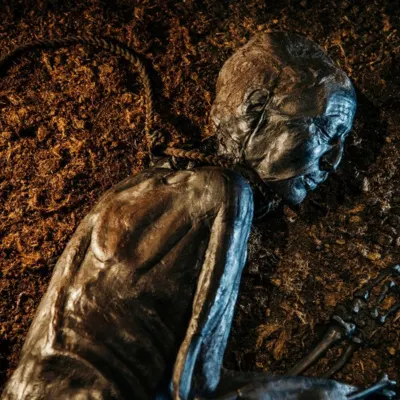
Right, and so ancient bodies have been discovered in Denmark before, but none of them were as well preserved as this guy. His facial features were really clearly seen, even though the flesh had become the same color as the bog itself. He'd shaved, but not recently, and the fact that you could tell that was amazing. The follicles were still preserved. The only fabric he had in his body was one hide cord around his waist and another around his neck. When Dr. Glob noticed the cord in the neck, he realized it was a noose. And he said that at that point, the wrinkled forehead and set mouth seemed to take on a look of affliction. Glob took control of the scene and decided that this body had to be properly studied in a laboratory setting, especially because sudden exposure to the elements could cause the flesh to immediately degrade.
He demanded that the body and much of the surrounding peat be carved out into a huge wet slab and transported to Copenhagen, about four hours away by train. He later wrote: The heavy plank box weighed almost a ton when filled. It had to be raised nearly ten feet vertically from the bottom of the bog and onto the horse-drawn cart, which was to take it to the nearest railway station in the village of Engesvang. The soft surface of the bog made it impossible to bring a crane up to the spot, and everything had to be done by hand. This was not accomplished without loss. One of the helpers overstrained himself and collapsed with a heart attack. The bog claimed a life for a life, or, as some prefer to think, the old gods took a modern man in place of the man from the past.
Right, that's a pretty creepy story, which I think also. Yeah, yeah, it's a testament to Dr. Glob's abilities as a writer, you know, and he, this one guy, is a huge part of why these bog bodies are so well known. And this particular bog body created a media sensation, first in Denmark, and then across the English-speaking world as well. British reporters quickly came to Copenhagen to see this miraculously preserved man, who's, like we said, his face looks like the face of someone you could see on the street. It's amazing this body is 2,000 years old. And they asked Dr. Glob, what do you call this man? He realized that the name of the town Bjældskovdal would be a little bit tricky for English speakers. So instead, he told them that the body had actually been found in the town next door, with a much more merciful name, Tollund.
It's pretty easy to say. And so, the Tollund man was born.
Or reborn, rather.
That's right, yeah, conjured out of the mud again, yeah, for a new life.
What are bog bodies?
And so, we are going to talk all about the new lives of these bog bodies in this episode today. The bog body phenomenon, which is mostly known for stretching across the northern belt of Europe, but has also been found in other parts of the world, allows human bodies to be preserved incredibly well over many thousands of years. This very unique chemical reaction gives us an unparalleled window into the physical lives of people in the past. A window so vivid that we start to wonder how much do we actually know about the past at all, bringing up some pretty interesting questions about historical memory and the extent of the abilities of this story. Before we get into all of that, though, we should mention that Gladio Free Europe now has a Patreon page. We are still going to be a free podcast for all of our episodes, but if anybody wants to just, you know, give us something just as a nice little tip, you know, think of it as a tip jar.
We would certainly appreciate it.
Yeah, if we raise enough money, maybe we can fund our own expedition to a bog to find a body or another.
Yes, and maybe one of these days, one of us could be a bog body ourselves. You never know.
I would love to be a bog body. Please make my dream come true by donating to our Patreon.
Yes. Yes.
Glob's The Bog People
And the Tollund Man, now we should mention, is one of hundreds of remarkably preserved bodies. Most of them are from northern Europe, like, you know, Denmark, Sweden, Northern Germany, but there are some elsewhere. We're going to be sourcing a lot of this episode from Dr. Glob's book, which is just simply called The Bog People from 1965. This would have a huge impact on popular conceptions of archaeology, and it's a really fun read. If you haven't checked it out, you totally should. It even had a surprising impact on literature, as we'll talk about at the end of this episode.
Yeah, but it should be noted that that book, although it's very beautifully written, it's very outdated and very speculative. Yeah, so it should be taken with a grain of salt, but it's definitely something that you could sit down and read for enjoyment.
Yeah, yeah, yeah. Because the big thing is that Dr. Glob was the first writer really to understand how unusual these bog bodies are, or at the very least, understand the implications of these bodies on our appreciation of history and the way that history can affect the public. Because, like we said, these bog bodies, these products of this very unusual ecological chemical reaction, give us this really unusual insight into the past. It's an insight that otherwise scholars can really only dream of. The archaeologist Melanie Giles described bog bodies as unparalleled insights into the lives and deaths of people from the past and the most powerful lens to view not just daily life and prehistory, but also conflicts, customs, beliefs, and relations with their environment.
What is a bog?
But before we get too deep in the peat, we should probably clear up what exactly is a bog?
Yeah, it's it's a word that comes up pretty often, honestly. You might have learned it in elementary school that there are different kinds of wetlands that, you know, do you have marshes, you have swamps, you have fens, and then you have bogs.
A little bit fed. Yeah. Yeah.
Yeah, so bogs are the most unusual of these in that they were created after centuries of dying organic matter falls into a swamp and accumulates into this solid mass of peat. Which again is like half alive, half dead, plant matter basically.
Yeah.
Some bogs are bodies of stagnant water surrounding islands of squishy wet peat while others are huge fields of moss and peat with ponds and lakes scattered all across. And the thing that really distinguishes the bog is that there's is that it's a very anaerobic environment. There's very little oxygen. And the lack of oxygen in this lakes means that vegetation doesn't really fully decay, but it stays in this half decomposed state, which makes bogs an amazing carbon sink. And the reason that peat and also the reason why peat is such a great fuel, it's because it's all very rich in carbon and energy. And once you burn that stuff, you'll get a lot out of it. But also on the flip side, it's one of the dirtiest fuels to burn, releasing huge quantities of carbon into the air. But I mean, I'm sure people had bigger things to worry about back then.
Right, and because of that dirtiness, a lot fewer bog bodies are being discovered now than they were 20 or 30 years ago. Because when less peat is being cut up, less bodies are going to be found. So, you know, if we ever want to find, like, the next Tollund man, we might have to convince people to start digging the peat again, you know?
You will dig the peat, you will eat the bog butter and be happy.
Yes, we should mention, yeah, not just bodies, but lots of animal products can be preserved, right?
Yeah. Yeah, like, they found bog butter that's like 2,000 years old in Ireland that's still edible. It tastes like bog, but it's technically edible if you're going hungry.
But anyway, the best kinds of bogs for preserving bodies are raised bogs, because they have a really unusual accumulation of peat that doesn't form around the lake, but being instead formed around a permanently water-clogged floodplain, which is fed by a high volume of cold and constant rain. And because of that, you have these layers of moss building up on top of one another, growing and dying, and creating a dome of rotten plant matter into which a heavy object, like a human body, for example, will slowly sink. And so, because Northern Europe is so wet and so rainy, there is a particularly large amount of surface area to be taken up by these bogs. But really, this kind of environment exists all over the world. Down in southern Argentina, there's the Tierra del Fuego, which is home to the large Carbajal bog, which formed from cold water running from the Andes.
In Africa, meanwhile, on the Congo basin, there's a 10,000-year-old warm bog that's larger than all of England and stores more carbon than the dense rainforest that surrounds it in its entirety, which is really mind-boggling to think about.
Yeah, most bog bodies have been found in Europe, although I have to wonder if a little bit of that might just be the fact that they're close to very well-funded universities. I wouldn't be surprised if in future decades that we start finding really remarkable bodies in bogs in Congo or Siberia as well. There is one little ecological factor that helps Europe, which is that their bogs are particularly cold. Because from what I understand, one warm summer can like totally ruin bog preservation and turn anything preserved into it into a skeleton. So that's probably part of it. But speaking of the bodies here, it's like, like we said, is that they preserve any kind of matter this way in this kind of half-dead, half-alive state where decomposition doesn't really happen and their matter just gets totally frozen in there. And like, and it's often plant matter, but animal matter can also be part of this process, like butter or like a person.
And so, in a weird way, this means that when somebody falls into a bog and their body becomes part of this process, you could say they're not really in the bog so much as they are the bog. They become part of it because their flesh becomes part of the peat.
You have been assimilated into the bog.
Exactly, yes, yeah.
Thousands of bodies
So, it's really hard to know how many bog bodies there are because about 2,000 human corpses have been pulled out of bogs all across Europe. But most of those are actually quite recent. They actually are farmers who wandered in one day with like, you know, after drinking too much aquavit or whatever. More tragically, a lot of them are actually World War I victims, like people from battles like the Somme, where they just, you know, stumbled into a wetland and were drug out many years later.
I think the most recent bog body was a downed body, that's like the youngest bog body ever been found, was a downed German pilot from like 1945 whose body was preserved very well in the Netherlands.
Yeah, yeah, yeah. But like we said, the best preserved ones are in Northern Europe, mostly along the North Sea, probably because it's just very cold there and the winters never get too hot. Also, a big part of it is because Dr. Glob was from Denmark and he spent his entire career basically promoting the study of the bog bodies. And he worked all over the region looking at a lot of very important bog bodies, not just the Tollund Man. But in this episode, we're not going to be talking about the World War II bog bodies or the World War I bog bodies. We want to talk about the ancient and medieval bog bodies. They give us, mostly because, you know, that's the kind of history that we actually talk about most often in this podcast, and also because it's just so remarkable to see something that well preserved from that era, an era where we have, generally speaking, no writing at all.
The Iron Age bog bodies
What's especially interesting is that, but the bog bodies don't seem to be randomly scattered by date. It seems like there was one period about a thousand years long, from like 400 BC to maybe 400-500 AD, when the bog bodies were especially common. It's the Iron Age in Scandinavia, where all across the region, people started being tossed into these bogs. So looking at that era, like the Iron Age era, about 120 bog bodies have been found. And of that 120, only 45 still survive today, because over the years, many of them were improperly preserved. And once you take a bog body out of the bog, those kind of frozen processes of decomposition suddenly start again and they start to decay. So the Tollund Man, the most famous bog body of all, only his head still survives. Because, you know, the people who dug him out, like, you know, young little Jan Kauslund, they didn't realize that as soon as they took out this corpse, they were exposing it to the elements once again.
Mm-hmm. Yeah, it's sort of a more macabre version of what happened to the terracotta army where they dug it up and they found this really beautiful army of these painted life-size statues of the soldiers. But then by the time that people with proper equipment actually got there, the oxygen had just totally destroyed any trace of that.
Yeah, yeah, it's tragic.
Older bodies and the Egtved Girl
Yeah, yeah. And so, yes, like we said, most of the bog bodies are from the Iron Age, but there's a few that are older. There's one called the Koelbjerg Man, which is like a 10,000-year-old hunter-gatherer, which is kind of cool.
Wow.
So he would have been buddies with, yeah, yeah, he was, you would have been around the same time, maybe a little bit older than the Cheddar Man from Britain, you know, this like basically a caveman, but even before the introduction of agriculture.
Was that one like that? Another ritual? Was it just the guy who was found in the bog for no reason?
I think that was just a guy who like stumbled and drowned. If I remember correctly, there isn't any signs of foul play with that one. Another one without any signs of foul play, which is maybe the second most famous bog buddy of all after the Tollund Man. Mostly not because of the conditions of her body, but the conditions of her clothing. And that is the Egtved Girl, a Bronze Age woman, maybe a thousand years before the Tollund Man, who died when she was only maybe 18. And she was buried in a wooden coffin alongside a newborn infant. So you can kind of, you know, put two and two together and assume that she probably was a very young mother who might have died in childbirth alongside her baby.
Yeah.
Which is, you know, very sad. But, you know, she kind of lives again because her clothing was totally preserved in that coffin and in that coffin, in that bog. And it's kind of unusual because her clothing is just like shockingly modern. Sam, have you seen what her clothing looks like?
Yeah, I saw a diagram. It's really funny. You could absolutely see Girls' Day. It's crazy on dress like this today.
Yeah, yeah, absolutely. Yeah, yeah, yeah. Because this woman, she was buried in a, basically a crop top, a really modern-cut wool woven shirt that, like, with, like, it had short sleeves, it would have exposed the midriff, which you don't really, you know, expect in ancient times. And it even had this, like, very stylish bronze belt with a big, a big bronze disc that would have covered her belly button. And probably the most famous part of her outfit is that she had this, basically, she had like a mini skirt on that was made out of loose cords, which is kind of weird. So her dress, so her shirt was woven, but her skirt was like knotted. It was all these little ropes that were tied at the top and then tied again at the bottom, which is pretty funny. So when these clothes were discovered, it was actually the height of the flapper era, which I think kind of helped a lot.
It was a very good time for that kind of design, which is kind of funny. And if you Google the Egtved Girl, you'll see that all the time, women who are into knitting and sewing try to recreate that outfit because it's like.
Why the Iron Age?
Yeah, but most of these bog bodies are from the Iron Age, like we said. Another one is called the Grauballe Man, that's pretty well known, also very well preserved. And no one's really sure why the Iron Age is like the bog body time. It might be ecological again. It might, because it seems like the early Iron Age was especially cold, so there might have been fewer warm summers that could have reduced preservation. But I think it's more likely that this was just a time period when a lot of people were tossing a lot of bodies into the bogs. It was a cultural phenomenon. And what I find especially interesting is that it was a cultural phenomenon that was very widespread. So widespread that it would have most likely crossed any lines of religion, of culture, of language. It was a regional phenomenon that people started doing despite whatever differences they might have had.
Everyone seemed to agree that, you know, even if we hate the tribe next door, even if we can't understand their language, we're all going to be tossing these bodies into the bogs. We should mention that there are bog bodies that have been discovered from Ireland to Poland. There have even been some much older bog bodies discovered in America, which we'll talk about at the end here. But most of them are found in Denmark, in northern Germany, and a little bit in southern Sweden. Only one bog body has ever been found in Norway, which I think is kind of interesting. And that might just be random, you know, it's because most of them are still under the bogs. It might be because there's maybe not as many bogs in Norway. It's also possible that it might be because Norway wasn't settled as recently as the rest of Scandinavia, and that for a long period of time, southern Norway was mostly depopulated.
It's a little bit harder to get to, which is kind of interesting. But yeah, most of these are in Denmark, and like especially kind of like mainland Denmark, Jutland, and also northern Germany, like the Mecklenburg area, like Lower Saxony.
Common features
So let's talk about the common features of the bog bodies found in Denmark and Northern Germany. Most of this comes from Glob, and so he's not super reliable, but these characteristics have been corroborated by other later scholars like Melanie Giles.
If you could describe these, Russian Sam.
Mm-hmm. Yeah. S so the bodies that were described by Glob, almost all of them were murdered, and often not just once, by multiple means, really. Tollund Man had been stabbed before he was bludgeoned. Tollund Man, for example, had first been stabbed, and then bludgeoned, and then finally strangled.
Yeah, kind of like a Rasputin case.
Mm-hmm. Yeah. Their last meals were generally very sparse, very gruel and things like that, and no alcohol.
A lot of porridge.
Yeah. Yeah. And the bodies in question belonged to both men and women, which tells us that this was in something that was exclusive to any particular type of person, it seems like. Yeah.
And well, at least at any particular gender, because there is one thing that sets the bodies apart from other humans at this time, which was that they never had big muscles, and they never had any kind of microskeletal fractures. So what this seems to indicate is that the people who were being sacrificed never did any very hard labor in their lives. They probably weren't farmers. They probably weren't slaves. They probably weren't even warrior chieftains. They would have been some kind of a leisure class. They might have been nobles, they might have been merchants, or they might have been some kinds of priests.
Yeah, and in some of the cases, branches or sort of wicker baskets were pressed down onto the victims' bodies to make sure that they sink, most likely, or as part of some ritual practice to make sure that they don't return from the dead. As we talked about on the vampires episode, for example.
Yes. Lots of, yeah, lots of really fun customs around making sure that the dead don't wake up. Yeah, and I think that we should mention this, and this is something that Melanie Giles talks about, is that it really seems like in many cases, this is a situation of overkill. You've got a person that they're trying to get rid of, and they really make sure they get rid of this person. They often kill them through multiple means, and then once they're dead, once their body's in the mud, they really make sure that body's not coming back. So it does seem to indicate that there was either a religious or at least very emotionally significant purpose for these kinds of killings. This isn't just a normal execution. If it was an execution at all, it would be for some very particularly heinous crime. Dr. Glob was convinced it was a religious sacrifice and that all of these bog bodies were sacrificed for some kind of religious purpose.
And he had a pretty worked-out theory. And these days, people are not so hasty to jump to conclusions, but we'll get to it in a second.
Buried, not burned
And there's one other common feature we should mention about the bog bodies, which kind of goes without saying. And that is the fact that these bog bodies were buried. You know, the entire body was interned in the ground. This seems totally natural now. You know, if someone dies, you bury the body. Whether or not they were executed, whether they were, you know, they died naturally, whether they were poor, whether they were rich, you bury the body. But in this particular time and place, burial was actually very uncommon. The overwhelming majority of human remains that have been discovered from Iron Age Scandinavia are actually cremations, you know, just fragments of bone that have been totally burned. And in fact, in Denmark, the bog bodies are the only known burials at all. Everybody else, every single person from that era that we know of, whose remains have survived, was burned.
Which is a pretty interesting contrast from the later centuries, from the Viking Age, you know, when chieftains were buried in these great mounds, right? It's really unusual that they were buried at all. And so there might have been some kind of spiritual significance for that. Dr. Glob looked at cultures around the world that are very into cremation today. For instance, Hindus or Zoroastrians or even the Tlingit and Haida people of the Pacific Northwest. Because in these cultures, there is this association with cremation and purity. That fire is in some way cleansing. And that, you know, by burning a body, you remove it of any physical impurities associated with the material world.
Zoroastrians don't cremate bodies for the record. I mean, they're starting to now because of the whole thing about the vultures. Generally, yeah, the bodies were supposed to be eaten by vultures.
Yes, the sky burials. You're right. That's correct. Yeah, that's correct.
I guess what he was getting at there is that they avoided interning bodies into the earth. That's why they opted, that's why the Hindus, that's why Hindus opt for cremation, and that's why Zoroastrians opt for a sky burial. Because there's this idea that if the physical body is somehow too material or too unclean, you don't want to put it into the earth, you know, where like our food comes from and all that. That leads us to his assumption. And he goes on to assume that if that was the case, then maybe condemning somebody to the bog might have had, you know, the opposite of effect. You're forcing their corpse to live in this realm of, you know, to in this realm of pollution and uncleanliness. That itself might be some kind of spiritual punishment. It also might be of note that much later literature from Scandinavia, most famously Beowulf, which maybe was composed in Scandinavia and it's definitely set in Scandinavia, suggests that bogs and fens were seen as very evil places.
And that just, you know, the bog next to your house could actually be the secret hiding place of a monster. And that if you ever got too close, you might get pulled under.
What the bodies tell us
So, let's shift gears a little bit. Unlike the other preserved bodies that we have from pre-literate Europe, like Ötzi, the Iceman, for example, from the Alps, bog bodies tend to be, they tend to have very well-preserved physical features, but unfortunately, very poorly preserved DNA. The same chemical reaction that prevents decay also degrades the DNA very heavily. So, future analyses of petrous bones in the skull, the stuff that we talked about with Natasha in Genetics 101, that stuff might help to crack the genomes of figures like the Tollund Man at some point. But so far, chemical analysis of hair composition has proven the most useful avenue for gaining information about how these figures lived.
Yeah, yeah, yeah, yeah. For instance, it gives you really detailed information about what kind of food you ate and even the air quality you were breathing in, which is interesting. If you're in a place with higher volcanic activity, that's gonna be recorded in your hair follicles.
Yeah, so for instance, two Iron Age women found in a Danish bog appear to have traveled abroad before their deaths, probably as far as Britain. And this indicates that the presence of some kind of mobility in Scandinavia many centuries before the Viking Age.
Yeah, yeah, it's impressive. Yeah, yeah. Wow, yeah. Yeah, incredibly impressive. And one very common cause of ancient mobility, unfortunately, was the transportation of slaves. But historians tend to think that the men and women killed in the bogs were high status for the reasons for the people. The muscles, the very intact bones, yeah, yeah.
Not the body of someone who was working in a field all day or working in an Amazon warehouse.
Yeah, or even someone who's like a warrior or something along those lines.
We should also mention that some bogs, but not all, contain some kinds of treasure, which Dr. Glob thought vindicated his idea that these were high-status people being killed. Like maybe they kill you and then they also dump all your toys in there too, right? Like if you have a cool Roman glass jug that was really big at this time, sorry, man. It's going in the bog.
Kings, priests, or witches?
And so there's a lot of different explanations for why these bog bodies didn't have, you know, developed physical bodies. Like we said, they might have been royal, they might have been priests and priestesses. One thing that's interesting is that if they were priests and priestesses, it's possible that the reasons they were killed might look something a little bit like an early modern witch trial. This is a very popular idea now that people like Melanie Giles have discussed. This is a very kind of like, you know, in the 60s, Glob was totally convinced with saying that these were kings who were being killed as part of some kind of ritual to help the crops grow or whatever. But now there's a little bit more skepticism. Maybe because these killings were so violent, they might have not been killings out of respect, but out of hatred. They might have been killings of people who were feared in the society.
People who may have had abilities that the people in their community believed in, but believed might have been harmful. So we've relied on Neil Price's work very heavily for the podcast previously.
And yes, in our Northman episode, we talked about Neil Price a lot.
Yeah, so in his work on the Viking Age, he analyzes attitudes towards magic and witchcraft in Scandinavia probably close to a thousand years later by this point. And that's really important to note. This is a difference of hundreds of years, and a lot can change in that time. Like, for instance, Danish switching from exclusively cremating their dead, not counting, that is, not counting the bog bodies, to interning chieftains in great Viking burial mounds. But if Viking Age life does provide any clues for the earlier Iron Age, it's that witchcraft was seen as seen by these Scandinavians with awe and fear and always distrust. This was a guy who was useful, but who was sort of like the freak living at the corner of the village who you don't want to mingle with because you never know what kind of curses might rub off on you. So magic was something that could be used to destroy one's enemies, but it was extremely dirty.
The most evocative example of this is that the Old Norse word for sorcery, ergi, could also be used as a homophobic slur.
Yeah, yeah. They thought magic was sus, you know, and it's possible that that is gay to conjure stuff.
Yeah. Exactly.
Yeah, yeah. It's a gay to cast a spell.
Yeah, exactly. Right, and for that reason, a king or any respectable man probably wouldn't be caught dabbling in magic. However, like we said, some according to the sagas, some kings did keep witches and wizards on retainer, you know, if they ever needed magic. So it's this kind of funny little gray area.
So, yeah, following that, if these Viking Age attitudes had anything to do with earlier Iron Age attitudes, then it's possible that the people tossed into these bogs were magicians.
And if we want to take another leap and connect this with the kind of, you know, gender and sexuality implications of magic that Neil Price goes into, one thing we should mention is that most of the men in the bogs have their beards cut. They're basically all clean-shaven. In addition, many women thrown into bogs have their hair cut very short. So it seems like one aspect of bog burial was this kind of equalization of gender, of certain, you know, physical sexual characteristics being removed possibly forcibly, which might be some kind of incredibly disrespectful gender-related punishment. This could potentially indicate, if you want to take one final leap here, this might indicate that the violation itself that caused these people to be killed that way might have somehow involved gender. Dr. Glob thought that perhaps some of the people killed might have been adulterers, they also might have been homosexuals, but there's a really big problem with his assumption there.
And that really, really big problem is that we actually don't know anything about what these people would have thought about sex and gender at all. We are entirely assuming. And when we assume this, it is basically inevitable that we project modern-day prejudices onto the past. And that's a pretty dangerous thing to do. You know, like when you see a bog body that's so well preserved, you really feel like you can almost know what that person could have could have thought, could have felt. But you actually don't. You know, at the end of the day, it's just simply matter, just matter arranged in this remarkably preserved human form.
Tacitus and the bog
Something that Dr. Glob used to support that argument comes from Tacitus. And so, Tacitus is a Roman writer that we've discussed in the past. Way back when we did an episode on Barbarians, he mentioned how his one book called his one book on the Germanic tribes, Germania, is this incredibly great resource. It's the best resource we have for like Iron Age Germanic life, but his descriptions of these various tribal peoples and their customs are so scanty. But despite that, various historians, as well as various kinds of nationalists, have been drawing from Tacitus and leaning on Tacitus for many hundreds of years. And I would say Dr. Glob is one of those historians who leans very heavily on Tacitus because he describes a few interesting passages that have some echoes of the bog bodies.
If you could read one of these, Sam.
Mm-hmm. Yeah, and of course, it should be mentioned that, again, although Tacitus was for most likely writing Germania as a way of admonishing Rome for having fallen to lower morals compared to these barbarians, nevertheless, it does seem like he had some idea of what the ancient Germanic peoples would have been doing.
Yeah. We talked a lot about noble savages. Tacitus basically invented the noble savage.
Yeah, exactly. So moving on, here's what Tacitus wrote: quote: Before the tribal council, it is likewise allowed to exhibit accusations and to prosecute capital offenses. Punishments are varied according to the nature of the crime. Traitors and deserters are hung upon trees. Cowards, dastards, and those guilty of unnatural practices are suffocated in mud under a hurdle. The difference of punishment had in view the principle that villainy should be exposed while it is punished, but turpitude concealed.
Yeah, you catch that part about guilty of unnatural practices, suffocated under a hurdle. So that's interesting, right? Like so the punished under a hurdle thing, suffocated under a hurdle, that looks a lot like the bog bodies being placed underneath sticks. That seems to be what he's describing there. But in classic Tacitus, he doesn't explain in any detail at all. When he says unnatural practices, that isn't like a euphemism by the translator. That is the phrase he uses in Latin. It is incredibly vague, and historians have spent many centuries trying to figure out what kinds of unnatural practices he might have been describing. And again, there's really no way to assume what practices might have been considered unnatural by ancient Germanic-speaking peoples, unless we project our own biases onto the past. You know, it might have been incest, it might have been bestiality, it might have been something that's not sexual at all.
We have no idea. We just know that certain types of crimes received this punishment.
Yeah, we just know that whatever it was, it would have been seen by Tacitus at least as unnatural. So again, this might be a jab at Rome itself rather than a reflection of what the Germanic peoples of this time actually believed.
Yeah, it's just so hard to know, you know, because basically we're dealing with two different ancient cultures that are beyond our grasp. We're assuming what the Romans found objectionable, and we're assuming what these Germanic peoples found objectionable. We're just so far removed from this era that we can only speculate, and this kind of speculation can sometimes be dangerous, especially because if you look at the course of the 20th century, speculation about these specific crimes has actually been used to justify repression in the present, as odd as that sounds.
The goddess Nerthus
We should mention one more thing about Tacitus. There's one more passage of Tacitus that was especially important to Dr. Glob. It is a passage that refers to a goddess who is unnamed in any other source. We only know about her from Germania. This goddess is named Nerthus. She probably had some connection to weather, some connection to the sea, and some connection to bogs. We don't know how widespread her cult was, because Tacitus is the only source. It's possible, though, that she has an echo in Norse mythology. There's a figure called Njord, who's a male god, but is believed to maybe somehow be connected. Either this god shifted gender from female to male over the centuries, or in the more southern areas of Germania, you know, where the West Germanic-speaking peoples lived, who would have had close connections with Rome, they had a female goddess, Nerthus, and then the more northern peoples, whose descendants would be the Vikings, who spoke a North Germanic language, they had Njord, who was male.
You know, it might have been a regional thing. In any case, though, it convinced this passage convinced Dr. Glob that he really could understand why the bog bodies were being buried. That kind of confidence is impressive, but is not really encouraged today. Historians tend to be a lot more guarded with discussing the ancient past, especially, you know, when there is such a risk of projecting your own biases.
But here is what Tacitus wrote about Nerthus, the goddess of the holy island.
In an island of the ocean is a holy grove, and in it a consecrated chariot covered in robes. A single priest is permitted to touch it. He interprets the presence of the goddess in her shrine and follows with deep reverence as she rides away, drawn by cows. Then come days of rejoicing and all places keep holiday, as many as she thinks worthy to receive and entertain her. They make no war, take no arms, every weapon is put away. Peace and quiet are then, and then alone, known and loved, until the same priest returns the goddess to her temple, when she has had her fill of the society of mortals. After this, the chariot and robes, and if you will believe it, the goddess herself, are washed in the sequestered lake. Slaves are the ministers and are straight away swallowed by the same lake. Hence, a mysterious terror and an ignorance full of piety as to what may be which men only behold to die.
Yeah, so just to translate here into modern English, but basically what he's saying, which is very interesting, is that in this holy island, in the ocean, there's a lake, and that when you go to this lake, slaves will see this goddess physically reveal herself. She descends onto earth. They bathe the goddess, but as soon as they have touched her holy magical body, as soon as they've performed this ritual, they have to die. And so any slave who does this is then sacrificed. To Dr. Glob, this kind of ritual festive sacrifice is the best explanation for why the Tollund Man in particular, had been sacrificed. That in a different time and place, several hundred years, I guess this would have been a few hundred years before Tacitus was writing, in a more northern part of the Germanic-speaking world, the Tollund Man was a young, high-born man who was chosen to be part of that ceremony that year.
He was chosen to see the goddess, and that as soon as he saw the goddess, he had to be killed.
At the beginning of the era of the Bog people, a female god was dominant, and her male servant had to be sacrificed at the completion of the journeying so that the cycle of nature might be supported and helped forward. The Tollund Man and many of the other Bogmen, after their brief time as god and husband of the goddess, the time of the spring feasts and the wanderings through the village, fulfilled the final demand of religion. They were sacrificed and placed in the sacred bogs, and consummated by their death, the rite, which ensured the peasant community luck and fertility in the coming year.
Right, so the whole thing was just, you know, the whole brutal process was just a way to ensure a good harvest.
And Glob in his book, on a very poetic note, quote, at the same time, through their sacrificial deaths, they were themselves consecrated for all time to Nerthus, goddess of fertility, to Mother Earth, who in return so often gave their faces her blessing and preserved them through the millennia.
Yeah, yeah, like I said, it's a really beautifully written book. Not necessarily something that should be taken literally, but.
Britain and Ireland
Yeah, yeah, and his book was a huge part of popularizing the bog body trend. And like we mentioned, bog bodies took root in the imaginations of many different people, not only in Scandinavia. A lot of bog bodies have been found in Britain and Ireland. And in those two countries, there has also been a lot of awareness, you know, of, or a lot of interest rather, in what these bogs can tell us about the past. There's also some very interesting regional differences that we see from the British Isles versus from Scandinavia. Part of this might be purely regional. You know, once you're farther away, the traditions just always kind of change, you know, there's always variation everywhere. It also could be a cultural thing. Most of the bog bodies we've talked about in the Iron Age Scandinavia were probably the bodies of people who would have spoken some kind of proto-Germanic language, a language which is, if you go back far enough, ancestral to English.
Britain and Ireland at this time, though, would have probably been entirely speaking Celtic languages, languages ancestral to modern Gaelic, Irish and Scottish Gaelic, and modern Welsh. So maybe there is some kind of Celtic versus Germanic divide here, but these days a lot of historians are very hazardous to assume that there was ever any kind of unifying Germanic culture or unifying Celtic culture at all. A lot of modern historians, like Guy Halsall, only use the phrases Celtic and Germanic as linguistic categories. So it's really hard to know why these cultural differences existed, but they did exist, and we'll get into them in a second.
Lady Moira's bog body
One thing we should mention is that the very earliest bog body ever found was actually found in Ireland by an interesting woman named Elizabeth Rawdon, who was the Countess of Moira. She was a noblewoman. She had lands entitled in her own right, and she was married to the Count of Moira, who was also a powerful nobleman. And because she had this life of leisure, she became basically a professional archaeologist. In her time, she would have been called an antiquarian, but she went all around Ireland looking for the oldest stuff she could find, you know. And many people had been doing this for many years. But what was interesting about her was that she scientifically recorded everything that she encountered. One of the most interesting things she encountered in 1781 was the perfectly preserved hair braid of a woman that was found sticking out of a peat bog.
She ordered her servants to start digging around. And as they dug, they found out that this braid of hair was attached to a head. It was the preserved body of a girl or what she called a very small woman wrapped in red and green cloth. This was very remarkably fine cloth, she observed. And it was so fine that she thought, and we should mention here that Lady Moira, actually no, let's do it again. And so fine that Lady Moira was convinced that it couldn't have been produced by any local Irish people. Instead, this had to have been imported by Greece or Phoenicia. And I think it's important to mention here that Lady Moira was English.
Oh my god. Like you literally pulled this thing out of the ground and your first thing is like, yeah, it's not from here. Yeah, yeah.
Yeah, tried something we're never going to know because although she was very good at recording what she found, she was not very good at keeping what she found because she ended up selling off the fabric and then the body was reburied in a Catholic graveyard. And at that point, if we ever find it again, it'll just be a skeleton because that's what happens when we take the bog out of the body and put it into regular soil. So we're never going to know who this lady was, you know, why she had her clothes, where it came from, who had arranged her hair in that lovely braid. But it goes to show that there has been a long history of interest, even before Dr.
Mary Wollstonecraft
Glob. Another person interested in the bog bodies we should mention, just a little funny, was the early feminist and writer Mary Wollstonecraft. She visited Norway and she saw a bog body on display there, which really freaked her out. She later wrote, When I was shown these human putrefactions, I shrunk back with disgust and horror. Ashes to ashes, thought I, dust to dust. If this be not dissolution, it is something worse than natural decay. It is reason against humanity, thus to lift up the awful veil which would hide its weakness. And, you know, obviously today, if you know the name Mary Wollstonecraft, it's probably because you know that she is the mother of Mary Shelley. And so I kind of gotta wonder if her horrified reaction to seeing this half-dead, you know, but still kind of alive body might have somehow found its way into the emotion that inspired Frankenstein.
Oh, absolutely.
I can see that.
The threefold death
So now let's talk about what makes these bog bodies specific. The most famous thing, if you want to describe this, Sam, is a feature that we see with the Tollund Man, but we don't always see in Scandinavia. However, we see it with almost every bog body in Britain, and many in Ireland, too. And this is the feature known as the three-fold death.
Yeah, so as we mentioned, the Tollund Man, he got stabbed, he got bludgeoned, he got strangled to death. Not a fun way to go at all. And this was more of the norm in the British Isles, it seems like.
Lindow Man
And the most remarkable example of this is the Lindow Man, which is a body discovered in the 80s by Northern English peat cutters.
Right. You know, interestingly, when they found the body, they actually thought that it was the corpse of a woman named Malika de Fernandez, who had gone missing in 1960, 23 years before. And as soon as they found this body, the woman's former husband confessed that, yes, I killed her. I threw her into the bog. And yeah, it very quickly locked him up after that. But then as soon as they actually tested the body, they realized this couldn't be Malika de Fernandez because this was a young man. And he could not have died in 1960. Instead, he had died maybe around the year 60, you know, first century. And as they tested the body, they realized with some confidence that this person probably had died right around the exact moment that the Romans arrived in Britain. So it would have been either the last generation to live in pre-Roman Britain or the first generation to live in Roman Britain.
Yeah, yeah, for all we know, this guy could have been like a sacrifice to make sure the gods keep the Romans away or something.
Yeah, that's absolutely possible. And he, again, appears to probably be a sacrifice. He most likely wasn't a slave, you know, he most likely wasn't a, he wasn't a regular person, you know, because he had a weak musculature. So he probably couldn't have been like a farmer who committed a crime. He most likely had some kind of high status. He was an aristocrat, you know. He was part of what today we call like the knowledge economy. We don't really know what British culture was like at this time, but there is one thing that we know. And that is that in Britain, when the Romans arrived, there were a group of people called druids. And so for that reason, a lot of people assumed that the Lindow Man was a very young druid, some like 20-something acolyte who, for whatever reason, was tossed into the bog. You know, why else would he have like...
Yeah, he bumped out of druid school.
Yeah, yeah, exactly. Yeah, yeah, right out of druid school. Yeah. Why else would he have like a nerdy build, right? If you're like, if you're a nerd in the year 60, of course you're going to be a druid. Yeah, and so he caused this press phenomenon in Britain very similar to the Tollund Man press phenomenon like 30 years earlier.
Anne Ross and the Celtic gods
And the version of Dr. P.V. Glob here was another person with a name that is not as funny, but it's a little bit evocative. Anne Ross, you know, kind of makes me think of Moss.
Well, Anne Ross, just like Dr. Glob, she charmed the public with her description of the Lindow Man, who she was confident was a druid prince. And what really intrigued her was that whole threefold death thing. And so she had a very interesting description in her book, The Lindo Man, where she attempts to connect his death with the entire world of Celtic cosmology. And Dr.
Ross wrote in 1989: Yeah, quote: The Celts did everything in threes. Three was their sacred number. It clinged tales, legends, and deities together throughout our society, and it is omnipresent in their art and literature. Many of their gods and goddesses have three aspects, and the vast and complex Celtic pantheon is dominated by three gods, each hungry for human sacrifice: Taranis, the thunder god, Esus, the Lord and Master, and Teutates, the overall god of the people. Taranis required prisoners of war to be burned alive in giant wicker cages.
Yeah, this is the Wicker Man, if you've heard of that, right? This is the Wicker Man.
Yeah.
While Esus was offered victims who were either hanged from sacred trees or stabbed to death, or both. Teutates, however, took his sacrifices into a watery embrace in sacred wells and pools that always figured very strongly among the Celtic holy sites. These wells and pools were also receptacles for elaborate and costly offerings of weapons and ornaments to the gods. Our powerful, our continuing custom of throwing coins into fountains is a distinct echo of this powerful pagan rite.
Also, I'm going to jump in here. I think that little line right there, like, that catches a lot about how confident Dr. Moss is. Dr. Ross is. You wouldn't hear that today. Like, oh, yeah, throwing a coin into a lake, that's painful.
Yeah, spoiler alert specialists really hate Dr. Ross in her book. But anyway.
But it's fun.
But, but anyway, going on. At first sight, Lindow Man, garroted and with a severed jugular, seemed to be an offering to Esus, but this final resting place in the pool of water appeared to make him an offering to Teutates, the god of the people. What then of Taranis, the Thunderer? If we are looking for a triple offering, we had to seek Taranis' share in the opening stages of the ritual, now that we have found the characteristic signs of Esus and Teutates. The fire offering to the Taranis clearly resides in the baking of the sacred bread and its ritual searing, which was the starting point of the whole ceremony. But important as this eating of the seared slice of pancake was, it seemed far more outweighed by the offering of life and blood to Esus and the lifeless body to Teutates. This made us wonder whether the mark of Taranis could be found elsewhere in the ritual.
The only place left to look was the part that we had so far, perhaps unwisely, discounted. This was the stunning of Lindow Man prior to Garroting. Truly, Lindow Man had died a triple death through the stunning and lethal blows of the axe, the crushing force of the garrotte that choked him and then broke his neck, and the cold embrace of the pool that symbolically drowned him in the final stage. The stab wound to his neck had already been revealed as a precise incision intended to drain the body of blood rather than a killing stroke. And we have also noted the significance of the figure three. There were three knots in the sinew cord used for the garroting, just as the first phase, there were three axe blows to his head. Since each mode of death offered him in turn to a different god, and he probably died at the feast of the mighty Celtic sun god Belenos, the importance of his death went far beyond the initial impressions of macabre overkill.
Why this special death was visited upon him or why he offered himself for it, as seemed possible, we did not yet know. But already we began to suspect that such an extraordinary death and offering to the gods would not be made on a routine basis, nor would any randomly chosen aristocrat. The special death required a very special person.
And again, so she was writing in the 80s, and these days, 30 years after, historians are a lot less confident than Dr. Ross was here. You know, we mentioned that even the idea of speaking of the Celts as a people at all, let alone a people who do everything in threes, would be questioned today. But it definitely gives you a lot to think about, you know? And I kind of respect her confidence. Like, Dr. Glob has his theory, she has her theory, and even if they require a lot of leaps and logic, they give you something to talk about, something to shoot on. And you mentioned, Sam, that it's possible that this guy could have been killed to ward off, you know, some kind of Roman defeat, you know? Which I think is interesting. Another theory that's been also proposed, a much more mundane theory, but still very intriguing, is that this could have just been a regular secular killing.
You know, he could have been killed for any reason, for some kind of crime. And it could have been a very such a serious crime that they chose a very serious method of execution. Like, for all we know, this guy was a Roman collaborator. And when he was exposed as a collaborator, people resisting Roman rule said, okay, you're going to the bog.
Mm-hmm.
Irish bog bodies
And so that's Britain. And there's, of course, one other very important island in the British Isles, which is the lovely Emerald Isle of Ireland, where there are a lot of bogs and a lot of bog bodies. One really interesting characteristic of Irish bog bodies is that, except for the now completely lost corpse discovered by Lady Moira, nearly all Irish bog bodies are male. They also lack the undeveloped musculature that we see in continental and British bog bodies, meaning that the people who were killed were men who led relatively more normal lives. At the very least, lives marked by physical labor and perhaps some kind of involvement in violence. For instance, they might have been prisoners of war, they might have been men who lost a battle, or they might have, again, been kings and warriors who committed some kind of crime or being killed as some kind of an offering.
I think that one of the most interesting aspects of Irish bog bodies as well is that a few of them, not a lot, just a couple, have had their nipples cut off.
Sam, do you know the whole thing with ancient Irish people and nipples?
It's a weird one. I know you were supposed to suck the king's titty as a way to swear fealty.
That's right, yeah. We know very little about this practice. I think our best source for it is the life of St. Patrick. So that's like an early medieval, late antique text. But yeah, it suggests that as a sign of submission, when one king lost a battle to another king, he was expected to suck the nipple of the winning king. Like, I guess it's some weird kind of thing where it's like, you know, you are now my parent. You're my, you're my mother now that you've beaten me. Very weird. It's very kind of odd today. But.
I can't imagine being the first guy to suggest this.
Yeah, you guys were like, yeah, how did that start, right? Who was the first Irish king? Who's like, all right, man, and now you gotta suck that he was. But in any case, some of these bodies have had their nipples cut off. So people have wondered that, you know, if nipples were associated with royalty, maybe when you overthrow a king, you can cut off his nipple to remove him from any kind of royalty. Who knows? It's just a very interesting difference, a very specifically Hibernian flavor to Irish bog bodies that we don't see in the continent.
Windover, Florida
And as we mentioned, there are even some bog bodies in America, particularly Windover, Florida, which is, I think, pretty close to Orlando. So just like, you know, a few minutes away from Disney World, there is a bog where they have found hundreds of very old Native American skeletons from, I want to say, like 8,000 BC. Really, really old.
Mm-hmm. Like 7,000 BC, 9,000 years ago.
Okay.
Yeah, so the site is called Windover, Florida, and it's really interesting. So before we get into the site itself, we should talk a little bit about the people who inhabited it. The people whose bodies were found at the site, they were hunter-gatherers and fishers who had lived in the area for thousands of years and deposited their bodies there as a matter of tradition for, again, thousands of years. There's like a 2,000-year period when new burials happen at the site. These are also kind of bog bodies, but not really, exactly, not in the same way. The site was discovered in like the 80s when they were building a highway in the area. And the area, it used to be a lake bed. So, if I understood it correctly, what these people would do is they would like have these platforms that were right on the water. And under these platforms, they would place the bodies of the deceased.
And these bodies are interesting because, unlike the ones that we have from Europe, which tend to be younger people who either had the misfortune of wandering into the bog and passing away or were actively sacrificed, these just seemed to be burials which encompassed all kinds of people from every stage of life, from toddlers all the way to people who were well into their 70s and 80s, which would have been incredibly old for that period.
And I would say that that makes the Windover bog bodies a little bit more common to the famous comparison made with the European bog bodies, which is Egyptian mummies. How they were not, the mummies were never sacrifices, as far as I know, or at least in most cases. The mummies were just people, generally high-status people, but not always, whose deaths were given this very important, you know, whose burials were given a whole bunch of a lot of ceremony and significance.
Yeah, so again, the people who were found in this sent in this Windover site, like, it's around 50-50 male, female, which again suggests that this was a cemetery. And the range and ages also suggest that this wasn't like a battle site or a massacre site or something like that. This was a deliberate practice that carried on for thousands of years. And so we've mentioned that these are bog bodies, but they're also not exactly bog bodies in the same way that the ones that we discussed so far are in that these are for the most part outwardly just skeletons. There's no flesh remaining on their bones. But their brain matter is very well preserved, first of all, and so are their stomach contents. So we know what their final meals would have been before they met their boggy.
That's pretty cool. Was it all, do you know, was it also like thin porridge like the European bog bodies or what were they?
No, it was just anything. Yeah, if they're, yeah, it's anything. They're not sacrifices. They're the burials. So it could be anything. Yeah. Yeah, no, it's the same thing. It's like 160-something bodies have been discovered so far, I believe.
And they have a, and so you said that the flesh is not very well preserved. The brain is. Aren't their clothing is also all preserved, right?
Oh, yes, yes. And they're also covered in the garments that they were buried in. So again, very deliberate burial practice. Yeah, and again, it's a site that's much, much older than the European analogs. Whereas these people in the Danish bogs and the Irish bogs, they would have died like 2,000 years ago. These guys, once again, are from 7,000 BCE, 9,000 years ago, roughly speaking. But the remarkable thing about the age of these bodies is, I mean, first of all, that this would have been relatively early in the peopling of the Americas. But yeah, but also that these bodies, they were wrapped in these really beautiful garments that were very sophisticated for their time, which, again, these people were very deliberately buried as part of a set ritual. They were always, they were usually put on one side and they were covered in these kinds of cloths, things of that nature.
Yeah, incredible things are happening in Florida now and always.
Yeah, at least they were. Yeah, 7,000, 9,000 years ago, yeah.
And so those are all, as far as I know, those are the only bog bodies discovered in America. Although I wouldn't be surprised if one of these days they pull some remarkably well-preserved body out of a bog somewhere in the north northern states where it gets colder, you know, in Alaska and Minnesota. We also mentioned that there's those huge bogs in South America, particularly Argentina, and in the Congo. No bog bodies have yet been discovered there, but I think that's partially because there isn't a big tradition of peat burning in either of those countries, and there hasn't been much archaeological penetration. So I think that both of those bogs could be containing some very interesting secrets about the ancient past. And I really hope that in the near future, you know, when I'm still around, scholars start poking around in those giant Congolese bogs and seeing what they can find.
Yeah, we're going to find out what goes on in the Congolese bogs.
I'd love to know, yeah.
Seamus Heaney
Well, I think the reason, yeah, so bogs, obviously, they're fun. We love a good bog. And in particular, we love a good bog body. Because, like we said, they give us this really interesting insight into the lives of everyday people from the past. Usually when we know anything about the ancient past, we either have these half-remembered legends, usually recorded in literature from much, much later, or we just have these writings by foreigners who never made any real efforts to distinguish between the different groups of people they were talking about, whose interest in describing these tribal peoples might have really been about the politics back home. When we see the bog bodies, we really do get to see a look at illiterate cultures free from any kind of bias. And because we can never have nice things, that means people always have to inject their own bias into this study.
And so I think in this last part of the podcast here, I wanted to talk about the ways that bog bodies affect the modern historical memory and how they have been connected to politics for both good and bad reasons. I think that to start off, we have to introduce someone who I would say has used bog bodies to a pretty noble political end. Or really more of an not necessarily not a strictly political end, but to a politically charged artistic end. That being the 1995 Nobel Prize laureate in literature, Seamus Heaney, a very remarkable Irish poet who just died several years ago, who I first came to as the translator of my Beowulf edition that I read in undergrad, who really made Beowulf very fun. As a poet, he made sure to bring back the meter and the kind of the, you know, the lyric of the original poem and really make you care.
We should mention again that Beowulf, it's a very boggy poem. Most of his other work, though, involves Ireland. He was very well known as a poet of Ireland, describing Irish history, both ancient and present, and often connecting modern-day Irish conflicts, particularly struggles toward independence and then unification, with much earlier violence in Ireland, with, you know, clashes against the Vikings, with very ancient archaeological discoveries. Sometime in the 60s, Seamus Heaney read Dr. Glob's book, The Bog People, and this really captured his attention. I want to end this episode with his poem that he wrote about the Tollund Man, the famous bog body discovered in 1950. Before we get there, though, Russian Sam, if you could read this interesting passage by Seamus Heaney that he made at a Danish museum not far from where the Tollund Man was held, where he explained why he found the bog bodies so compelling, and why multiple poems he would write over his pretty long career would be inspired or even dedicated to these humans found in the mud.
Once upon a time, these heads and limbs existed in order to express and embody the needs and impulses of an individual human life. They were the vehicles of different biographies, and they compelled singular attention. They proclaimed, I am I. Even when they were first dead, at the moment of their sacrifice or atrocity, their bodies and their limbs manifested biography and conserved vestiges of personal identity. They were corpses, but when a corpse becomes a bog body, the personal identity drops away. The bog body does not proclaim, I am I. Instead, it says something like, I am it, or I am you. Like the work of art, the bog body asks to be contemplated. It eludes the biographical and enters the realm of the aesthetic. I mean, I mean, that's just really imposing your own idea onto it. I mean, I don't think that when these bodies were being deposited, anyone would ever think that someday these guys would be on display in a museum to be gawked at by millions of passerbys to would then be inspired to write poetry about them.
I just don't think this would have been on anyone's mind.
But I think what it shows, though, is that it's this, it's this kind of bog bodies evoke a visceral reaction in people who see them, especially up close. And it's much like an Egyptian mummy, you know, where you get this, you can see the physical form of a very ancient person, which you could almost never otherwise see. That's why Ötzi the Iceman is so important, because it's so unusual. But I think he's broadly right here. And there's a literary critic, Anthony Purdy, who was not a huge fan of Heaney's use of ancient aesthetics. He thought it was distasteful that Seamus Heaney would try to use the past to what he believed was trying to justify politics of the present. But he recognized, though, that bog bodies do have what he called an extraordinary power to abolish temporal distance, to make the past present. They are not skeletal remains.
They have flesh on their bones, and that flesh bears the marks of their living and their dying. Bog bodies speak of a life anchored in an everyday that was then but is also now. To an extraordinary degree, bog bodies allow us to see time.
Hmm. Yeah, so I guess. Okay, yeah, I mean, I like the way that's put a bit better because it doesn't imply causality or like an attempt to make something contemplated. It's just something that's so captivating that we can't help but think about it and our own mortality because of it.
Yeah, no, it definitely. What Anthony Purdy would say is that sometimes what you're thinking about, though, is not necessarily something good. You know, sometimes it gives you a false impression of proximity to the past. And once you think that the past is you, it's really easy to use this kind of imagined ancientness to justify whatever you're doing today.
Bog bodies and politics
And that's why, as we mentioned earlier, there is such a long history of bog bodies being used in political, in various kinds of political discourse. Although we should mention that it wasn't always that way, because when bog bodies were very first being uncovered, like in the era of Countess Moira, there was some uneasiness with pulling out this perfectly preserved corpse of somebody who presumably was first an everyday person, and second, probably a non-Christian. Because in the Catholic worldview of the time, in early modern Europe, only one kind of body doesn't rot. You probably know what that is, Sam, right?
Mm-hmm. Yeah, the bodies of the saints.
Exactly. And it's hard to think of somebody less saintly than an ancient pagan peasant. So why had God chosen to preserve these bodies? That supposedly is why there was such an effort to hurriedly rebury any body that was found, you know, because it was this kind of uncomfortable challenge to prevailing notions at the time. That if physical decay was something to do with spiritual corruption, then only the most incorrupt body would not decay, you know? So that's kind of interesting. But then by the 19th century, that sort of had fallen away, especially in Protestant countries where the idea of incorruptibility never really took as much hold or had you know dropped away. And so, there's one interesting example from the early 19th century. I think it's 1835, if you can describe this one, Sam.
Queen Gunnhild
Yeah, and this comes to us from a really great Smithsonian article that we've used a fair bit in this episode. That's titled Europe's Famed Bog Bodies Are Starting to Reveal Their Secrets from May 2017. This article is what really got me interested in the topic, so please do check it out if you want to read more. But anyway, this article gets into the ways that the discoveries of the bog bodies in the 19th century were used by Scandinavian nationalists of various stripes to prove that the stories of the sagas were real and that they had discovered the actual bodies of the figures involved. So, for example, there was a legendary queen tyrant named Gunnhild who was supposedly tricked into walking into a bog sometime in the ancient past. And so, yeah, or maybe around like 900 or something like that, like early medieval. So, the people who would have been keeping abreast of such developments, like the discovery of the bog body, they were all very deeply steeped in the literature of Scandinavia, the sagas.
Yeah, the sagas, yeah, especially. Yeah, the Icelandic sagas, yeah. Yeah, I mean, so in 1835, when the body of a woman was found in a Danish bog, journalists immediately proclaimed that this was the body of Gunnhild. And this discovery supposedly proved that the early history of Denmark was entirely true, because I mean.
Right, because, like, yeah, so if Gunnhild was real, then everything else was real, too.
Yeah, and ultimately, like, funnily enough, despite the fact that this was supposed to be a very disreputable figure, the affair ended with the Danish crown giving the body a state funeral, which they sort of had to do because, I mean, that's their ancestor, I guess. So it's like...
Yeah. And yeah, it's pretty funny. And so that was actually one of Dr. Glob's early famous assignments was properly dating the body that was supposedly Queen Gunhild. And lo and behold, she was actually much older. She was from the Iron Age, like basically all these bog bodies are. She was not from the Viking era, a thousand years later.
Bog bodies and race science
And but then, but despite, and more broadly, in that period, you start seeing bog bodies being used to support various political agendas. And in the later 19th century, there is this sudden turn all across Europe, but particularly in Germany and Scandinavia and England toward race science. These pseudo-scientific analyses of human bodies to proclaim that various physical differences on average somehow had anything to do with ability or worthiness or virtue. An especially common tactic for the race scientists this time was measuring skull sizes. And so when these bog bodies started being dug up across England and Britain, some English racialists used cranium data collected from ancient skulls in Britain and Ireland and compared them with skulls from Denmark at this time. And we mentioned that there were like, you know, slight differences in the the cultures surrounding the bog bodies. These guys didn't care about that. What they cared about was the fact that the Danish skulls were supposedly slightly larger than the native British skulls.
This meant that the anglo-saxons who came from the region of denmark and germany and whom english race scientists often believed to be exclusively their ancestors they did not believe they were descended from native britons they were only descended they thought from germanic speaking peoples this proved that germanic speaking peoples were natively naturally superior and therefore the you know conquest of britain by anglo-saxons which scholars today now think was a much more complicated affair they believed that was justified and then moreover they would expand that to say due to these ancient slight differences in skull size english people today are similarly justified in maintaining control over places like scotland and ireland where there was supposedly still this kind of you know genetic racial inherent difference something that i find kind of funny that we should probably mention also is that just like the catholics from much earlier they treated these bog bodies terribly and many britain british scholars actually carefully cleaned the bog bodies of any flesh at all which you know ruins them for academic study but it meant right oh i'll tell you why because they wouldn't have to explain why the bog bodies whose physical appearance was so important to them also had very dark skin are you kidding me oh my god that might have had you know troubling implications for the what what was wrong with these people yep they yeah like like you think you've heard it all and then you hear like oh, they got rid of the skin from the bog bodies because it was too dark like dude, welcome to 19th century race science, right? Yeah.
You know, yeah, it's hilarious.
Yeah, yeah, even in even in in like later in the 20th century dr. Glob mentions that some Danish government officials were like, wait a minute, this can't be a Dan. His skin's black. He had to be a foreigner. They tried to say like, oh, maybe he was a wandering gypsy who fell into this bog. No, no, the answer, the real answer is that we have no idea what skin color the bog bodies had. From what we know about ancient Europe, the bog bodies probably would have had a variety of different skin tones depending on what era they lived in, because skin color has changed a lot over European history. However, we can't tell it all because when you're in a bog for 2,000 years, your skin basically becomes the exact color of the bog around you. You become part of the mud, essentially.
So yeah, so that's why.
The Nazis and the bog
But we should mention now that probably most unpleasant of all, of all these implications, as you might expect, the Nazis were very interested in bog bodies. Although, it was maybe not as much as you expect, not in the way you'd expect. It was a negative interest.
Yes, yes.
They didn't think the bog bodies were good. You know, they loved trying to find out examples of, you know, great Germanic Aryan prehistory, yada, yada, yada, all that bullshit. But Himmler in particular was very troubled by that passage in Tacitus that mentioned people committing unnatural practices being condemned to the bog. Because, you know, he mentioned that you're always going to project on your own assumptions of unnatural practices. For Himmler, it was completely clear that those unnatural practices were homosexuality, and that therefore the traditional, Germanic, Aryan, whatever thing to do was to murder gay people. And that means that this was used as a precedent for the ongoing murder of gay people in Nazi Germany. So that's probably easily the worst of any implication of, you know, bog body discovery, like justifying an active campaign of murder.
Seeing but never hearing
I think that in general, this kind of, you know, political misappropriation brings us to the basically the paradox that I kind of want to end this episode with, which is that we know so much about how these people lived. Even though they wrote nothing down, we get this glimpse into their lives. It's a glimpse that we can't get with other societies, with much more literate societies like Rome or Babylon or China. We actually get to see these people who lived in this world, but we can never hear them. We can only assume. We don't actually know who the bog bodies were, even though we know how much physical activity they've gotten, what kind of food they ate, what they were wearing, where they went.
Exactly, yeah.
And so I feel like in a weird way, that means that Northern Europe, the places where you find the bogs most often, it's like a haunted house, you know? And anybody looking at these bodies, it's like we are the naive young governess who's staying in this mansion, who can see these terrifying ghosts, these apparitions, but we can never figure out why they're appearing before us, you know? We don't know why they're still here, who they were, and why they can't pass on to the next world.
Yeah, and unfortunately, we're nowhere close to figuring it out.
No, no, yeah, no. Maybe if, like, somehow some new literature is discovered, we can get some more cultural context for the bog bodies. Maybe future scholars can synthesize the work of people like Glob and Giles and Ross to understand much more, understand better with more confidence, or at least with more evidence, why these people were tossed into the bogs.
Yeah, and they're starting to x-ray the libraries found in Pompeii.
Yeah, yeah, who knows? Yeah, maybe we'll find, yeah, yeah, we'll find like some other Tacitus text where he's like, yeah, just about the bog bodies, yeah, whoever, yeah, yeah. A treatise on the practice of the barbarians tossing bodies into the swamp.
Yeah, you never know.
Yeah.
Violence past and present
Although, yeah, one thing that we should mention also is that although, you know, it does seem kind of like it's kind of fun and exciting to see these bodies, because it's like, yeah, it's, it's like this, you know, 4K view into the past, there is a darker aspect, which is that the vast majority of these bog bodies died really terrible deaths. And in that sense, they are not just a view into the past, but a reminder about the violence that we see in the present, you know, that a lot of this violence has always been among us. Something that Seamus Heaney took a lot of heat for, which I think is unfair, is he was very interested in the ways that violence is basically eternal. That, you know, conflicts in the present are preceded by conflicts in the past. Perhaps there is something inherent to, if not human nature, human civilization, to committing violence, to harming the defenseless.
And the bog bodies do make us think of that. At the most basic level, bog bodies remind us that all societies are characterized by, or at least capable, of really terrible mistreatment. Mistreatment often of people who have no say in this, who are some of the most vulnerable people in our society, who are victims nonetheless, you know. And a lot of times, the kind of violence that we see, both in modern times, you know, looking at the ways that police abuse people like the homeless, you know, the ways that many communities are disproportionately affected by violence, both crime and repression by the state, that kind of violence in our society seems normal, you know, it seems unavoidable often. If you look at news coverage of crime in poor areas, it has this implication of inevitability. It has this implication of inevitability, you know? But I kind of wonder if, you know, if with hindsight, the violence of the present might seem as senseless as sacrificing a princess to make the crops grow.
In a different cultural context, our violence today will seem as brutal as the violence that took the life of the Tollund Man.
Mm-hmm. Or maybe they'll think that we're just a bunch of cucks. You never really know how history is going to turn out.
That's true, yes, because we have no idea what people are going to think.
Yeah, we have no idea what the future will bring. Hopefully it's gentler than what we've gotten so far.
Yeah, yeah. I certainly like to think so. Yeah, yeah. And yeah, just one last thing here. I'm going to close this off by playing this, the poem, The Tollund Man by Seamus Heaney. But one last thing to think about. As Melanie Giles, who is probably the most methodological and most up-to-date of all these bog researchers, puts it, the bog bodies make the past present in ways that touch and appall our shared humanity.
Yeah, absolutely. And if you've listened through to this episode, and you haven't gotten an inkling that maybe you should actually look these bodies up and see what they are, you absolutely should do that. Especially the Tollund Man. Absolutely incredible.
Yeah, you know, the Tollund Man is incredible. I would love to go to Denmark one of these days and see, yeah, it's at Aarhus University, I believe. Yeah, yeah, and then yeah, the Egtved Girl with her like cute little crop top. Come on, dude.
The Tollund Man, by Seamus Heaney
No, yeah, well, maybe if we get enough Patreon bucks, maybe we can go to Denmark and see the Tollund Man himself.
Yeah, I take a field trip, yeah, yeah, maybe so. All right, all right. Okay, well, thank you so much, Sam, for joining us today. I hope everyone enjoyed. Here now is Seamus Heaney, in his own words, describing his impression of the Tollund Man.
Someday I will go to Aarhus to see his peat-brown head, the mild pods of his eyelids, his white skin cap in the flat country nearby where they dug him out, his last gruel of winter seeds caked in his stomach, naked except for the cap, noose, and girdle, I will stand a long time. Bridegroom to the goddess, she tightened her torque on him and opened her fen. Those dark juices working him to a saint's kept body, trove of the turf cutter's honeycombed workings. Now his stained face reposes at Aarhus. I could risk blasphemy. Consecrate the cauldron bog, our holy ground, and pray him to make germinate the scattered, ambushed flesh of labourers, stocking corpses laid out in the farm yards, tell-tale skin and teeth flecking the sleepers of four young brothers trailed for miles along the lines. Something of his sad freedom as he rode the tumbrel should come to me, driving, saying the names Tollund, Grauballe, Nebelgård, watching the pointing hands of country people, not knowing their tongue.
Out there in Jutland, in the old man-killing parishes, I will feel lost, unhappy, and at home.
The show is also on Apple Podcasts, Overcast, Pocket Casts, Podcast Addict, YouTube, RSS and Patreon.