112
Ass Worship
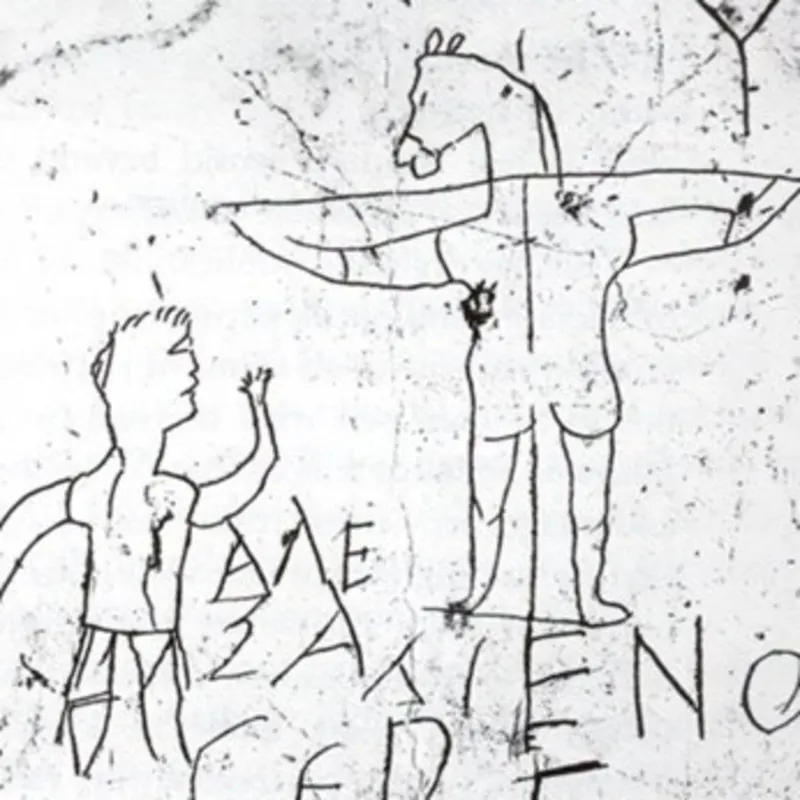
In progressYou read that right. 1800 years ago, a Roman youngster etched a taunting cartoon of a classmate raising his hand to salute a figure on a cross. This graffito, labeled "Alexamenos worshipping his god," is remarkable for two reasons: it is the oldest known artistic depiction of Jesus, and it happens to depict the Christian Messiah as a man with the head of a donkey.
This artistic choice might seem perplexing, but actually reflects an ancient pagan stereotype. In this Gladio Free Europe solo episode, Liam explores a three-thousand-year-old allegation: that Yahweh, the all-powerful God of Israel, was actually an ignoble ass.
Despite being outright false, the idea that Judaism and Christianity had something to do with the worship of donkeys was a strong conviction of many ancient writers, even capable scholars like Tacitus and Posidonius. In fact, this myth goes back incredibly far into ancient history, with roots in Egyptian mythology and the cultural memory of the Hyksos, a Bronze Age dynasty of Levantine origin who appear to have actually included onolatry into their practice.
The story of ass worship, as an allegation and a practice, is as nearly as old as the history of civilization, with unexpected connections to Greek mythology, gnosticism, and the beginnings of Mesopotamian Kingship. Listen to this episode of Gladio to see why maybe the dutiful donkey really does deserve some veneration after all!
Transcript
A donkey on the cross
Welcome back to Gladio Free Europe. I am your host Liam, not joined today by Russian Sam. Instead, we are back with another Liam solo episode. Last year, I regaled you guys with the tale of the surprisingly rich Irish presence in Latin American history. Now I'm back with another of my new fixations. This being the strange rabbit hole, or perhaps burrow, of donkey worship, known in the ancient world as Onolatry. In 1857, a group of construction workers in the city of Rome uncovered an ancient building built during the time of Caligula, probably used at one point as a place to train young scribes. This building held something unusual, a cartoon that would completely change our understanding of history. This was an ancient symbol of mockery, almost identical in content and function to the kind of memes or wojaks you'd see in the internet today. In this crude drawing, a male figure, usually identified as a student or a soldier, salutes another figure up on a cross.
Written underneath, in very poor Greek, is Alexamenos worshiping his god. This picture, created somewhere between 100 and 200 CE, is in fact the earliest known depiction of Jesus. And it's especially remarkable because Jesus is depicted not as a man, but a donkey. To understand why this Roman schoolboy thought it made sense and was funny to call Jesus a donkey, we are going to have to look at the preceding 2,700 years of Near Eastern history. This is going to be a long winding road from the Bronze Age way up till the end of the Roman period, following the trajectory of one of the most enduring religious themes of ancient Near East, that being the worship or charge of worship of the donkey or ass. This is an episode all about Onolatry. This is going to be a long winding road from the Bronze Age up until the end of the Roman period, following the trajectory of one of the most enduring themes of the ancient Near East, that being the charge of Onolatry or donkey worship.
This is going to be a whole episode about the ass.
What's funny about donkeys
All right, so to modern people and to the ancients, there's something funny about donkeys. Just think about Shrek II. When the ogre protagonist becomes beautiful, he's transformed into a square-jawed human, but his equine companion, voiced by Eddie Murphy, becomes a gallant horse. There's this idea, therefore, that, you know, a donkey is the monstrous, ignoble equivalent to a horse. Ass and jackass remain insults to this day, and this term goes back to the Roman period. Few people realize that asinine literally means donkey-like. And of course, the main association now with the word ass is the human buttocks. This is a link so strong that ass has become a bad word. And this goes back at least as far as Shakespeare. Remember the bumpkin transformed into a donkey in A Midsummer Night's Dream. His name is Bottom. Transformations to and from donkeys were well known in the classical world.
In the only surviving Latin novel, a hapless protagonist is magically changed into the eponymous golden ass. One of Aesop's fables, later revived by C.S. Lewis in the weird final Narnia book, is about a donkey who dresses himself up in a lion's skin in a failed bid to seem menacing. So clearly, as early as classical antiquity, you know, the era of Greece and Rome, the donkey was seen as one of the lowliest of beasts. It's got a cultural reputation along the same lines as a pig, probably a little worse than a dog and a little better off than a rat. To call Jesus, God of the Christians, an ass, was a grievous, grievous insult. But poor Alexamenos wasn't the only victim of this kind of abuse. Because you see, the allegation of donkey worship has deep roots in ancient history. Onolatry, the supposed worship of the ass, is an association that not only predates the existence of Christianity, it may very well predate the existence of Judaism.
Although they didn't know it, those soldiers or school kids who drew Christ as a donkey were participating in a millennia-old Mediterranean tradition, a tradition almost as old as civilization itself.
The donkey in the Bronze Age
Before we get into donkey worship and claims of donkey worship, we have to ask: why exactly is the donkey considered funny and undignified? Is it because of their hee-haw noise, their big ears, and you know, stumpy bodies, especially compared to the bigger, more streamlined horse? I think that's part of it. But we have to point out, donkeys weren't always seen this way. They are, after all, loyal work animals whose muscle power has been a cornerstone of human agriculture since the Neolithic. They're smaller and more efficient than oxen, which made them essential for plowing the dry shrubberland of East Africa, where they were probably first domesticated from the African wild ass. After moving up through Nubia and into Egypt, the donkey was cross-bred with the local Asiatic wild ass, a species that was genetically distant enough for their offspring, called kungas, to be sterile. In great contrast with later attitudes toward donkeys, ancient Mesopotamians held these animals in great esteem.
To the Sumerians, the first civilization of Mesopotamia, the kunga half-breed was a major symbol of royal power. This noble donkey pulled the carts of the world's first kings, as we can see on the famous royal standard of Ur. Shortly thereafter, the Akkadians or the Babylonians appear to have migrated from the Levant into Mesopotamia, seeking new pasture for their donkey herds. These people, who would adopt the older urban culture of the Sumerians, brought with them some of the earliest Semitic languages. It's very possible that if not for the donkey, these languages, like Hebrew, Arabic, Aramaic, and Amharic, would never have become dominant in the Middle East and East Africa. Additionally, donkeys could be raised locally, while throughout the Bronze Age, horses had to be imported from the Hittite lands of Anatolia or even further beyond on the Eurasian steppe. Donkeys also don't scare as easily as horses, and they pose less of a danger to any poor plowman standing in range of their hooves.
Much later, in the Roman and Byzantine period, carts and chariots fell out of use almost entirely in the Near East. This is probably because donkey and camel rearing had become such an economy of scale that it was cheaper to buy three donkeys and strap your goods to their back than it was to get one donkey to pull a cart. My guess is that donkey breeding was such a huge industry because it was recently discovered that mixing donkeys with horses produced a new animal, the mule. Just like the kunga, these guys were sterile and had to be constantly bred and rebred. They can't form a self-sustaining population. So this means people are constantly breeding huge numbers of donkeys and mules to sell, and the cost of buying one becomes much lower. Any peasant could own a donkey, and with the power and the determination of this humble animal, you could bring your goods all the way across the Near East, covering distances you could never hope to do on foot, or perhaps even on a horse.
This is all to say that the donkey was fundamental to the ancient Near Eastern way of life. It was through the dutiful labor of the donkey that the great caravans could bring goods from Egypt all the way to Iraq and Anatolia during the Bronze Age, always passing through the Sinai Peninsula and the pivotal land of Canaan. That's modern Palestine. During the Bronze Age, there's no evidence for any kind of taboo around this animal. To the contrary, ancient Semitic peoples recognized they had a special relationship with the donkey. But this would change in later centuries around the end of the Bronze Age, when ancient Egyptians began to develop new prejudices toward the ass that would remain in place arguably until modern times. And like so many prejudices, this one would have absolutely nothing to do with what donkeys did. So it's entirely possible that the ancient Egyptians only reviled the donkey because they associated these animals with their enemies.
Donkey burials in Canaan
Although there is no special reference for the donkey in Judaism, this wasn't the case for the pagan Canaanite religion that preceded Judaism. At the early Bronze Age site of Tell es-Safi, usually identified as Gath, hometown of the biblical giant Goliath, strange decapitated donkey burials were found inside 3,000-year-old houses. These donkeys had been imported into Canaan from Egypt, which at this point had no pyramids, no horses, and was just beginning to establish dynastic kingship. The people who buried these animals, probably merchants who ferried goods through Canaan and Sinai, carefully interred them underneath the mud floors of their modest homes. Although donkeys were eaten at Tell es-Safi, these ones were buried whole, with no butchering marks. Because they were all young and healthy, their deaths would have been a real economic loss for their owners. This indicates they were probably killed as a household offering to the early Canaanite gods.
Archaeologists noted that the graves were so shallow, the residents must have smelled these asses rotting for weeks. They weren't just sacrificing a useful animal. They were sacrificing the livability of their homes. This site at Tell es-Safi has parallels with a lot of later donkey burials. A full thousand years later in the Middle Bronze Age, we can find donkeys buried around Gaza, up in Syria, and as far east as the Mesopotamian city of Ur. At the Syrian city of Mari, texts were discovered filled with ritual references to donkeys. Apparently, to butcher an ass was a Bronze Age synonym for making a treaty. All of these sites were trading centers inhabited by ancient Semitic-speaking peoples who relied upon the faithful donkey to bring their goods between the various cities of the Bronze Age world. A donkey at the site of Tel Haror was buried with saddlebags and a bridle bit.
Egyptian art from this time shows massive packs of donkeys traveling from Canaan, crossing into the Sinai Peninsula, filled with valuable foreign goods. The Egyptians had close relations with their Asiatic neighbors, who, as we know from their art and sacrifices, relied heavily on the donkey and may have revered the donkey to some extent.
The Hyksos and Set
In the 18th century BCE, a group of warriors from Canaan, or perhaps Syria, established a new dynasty in northern Egypt around the Nile Delta. The Egyptians called these conquerors simply the foreigners, or Hyksos. And across the next 200 years, they would briefly become the dominant power across all of Egypt, establishing their own pharaonic dynasty. Who exactly these Hyksos were is not well known, but they were definitely from the Near East and spoke a Western Semitic language, related distantly to Hebrew or Arabic. One of the later Hyksos rulers was even named Yacub, clearly a cognate with the Hebrew name Jacob. As far as I can tell, he was not, sadly, a mad scientist. These guys introduced a foreign religion, a different polytheistic pantheon centered around the storm god Baal. This is a figure well known to anybody who studies early Judaism. And the worship of Baal by the Hyksos seems to have involved the regular sacrifice of donkeys.
Their capital of Avaris is filled with the bones of asses, up to six at a time in a single burial. While the much earlier people at Tell es-Safi had buried donkeys inside their households as an offering to the gods, the people at Avaris buried them as part of elaborate Egyptian-style entombments, perhaps riches to bring into the afterlife. This goes to show that while they were foreigners, the Hyksos adopted many aspects of their subjects' Egyptian civilization. Relatively quickly, their Near Eastern religion merged with that of the Egyptians. For somewhat unknown reasons, their worship of Baal became equated with the worship of Set. A lot of our listeners probably know that Set is one of the many Egyptian gods, but he might be the strangest among the primary pantheon. He was the enemy of the chief deity and his own brother Osiris, and was said to have killed Osiris and taken his throne as the leading god.
But Set didn't consider that Isis, their sister and Osiris' wife, could put her husband's body back together. This made him a lifelong enemy of both the resurrected Osiris and Osiris' son Horus. In other words, he was a complicated figure, not necessarily one of the most favored of the gods. Worship of Set goes incredibly far back in Egyptian history, at least as far as the construction of the pyramids, but after the ascension of the Hyksos, Set would be sidelined as a kind of outsider god, perhaps akin to Hades in the Greek pantheon. He was primarily associated with foreigners, the desert, and the memory of the Hyksos. A temple to Set was built in Avaris, the Hyksos capital, and would be maintained there long after the Hyksos were overthrown. Although the Hyksos only briefly ruled Egypt, their reign of a couple hundred years left a long mark on Egyptian historical memory and even religion.
A good comparison might be how Babylon features in the minds of Jews and Christians today. 400 years after the Hyksos, stories are written about how a clever native leader defeated a Hyksos king through a battle of riddles. About another thousand years after that, in the Hellenistic period, a Greek-speaking scribe named Manetho appears to have described the Hyksos in very unfavorable terms. Fortunately, we don't know how unfavorable, because Manetho's writings are entirely lost. We only know about his perspective because of a much more famous writer, the Jewish chronicler Josephus, who thought that everything Manetho said was nonsense. Manetho described the Hyksos as brutal plunderers who brought Egypt low by sacking ancient temples and enslaving the native population. Josephus defended these conquerors, however, for a funny reason. Even though he lived centuries and centuries later, in the Roman period, Josephus recognized that the Hyksos had come from his own land, Canaan, now called Judea.
And Josephus believed that the Hyksos were Jewish. In one sense, this is completely flat out wrong. We can't say that any religion resembling Judaism existed in the period when the Hyksos ruled Egypt. But because the Hyksos were from the southern Levant, the land of Canaan, the same place where Judaism developed, there was an obvious ancestral link there. Josephus was not alone in identifying this. Later Egyptians clearly associated the Jews with the Hyksos and with their god Set. Additionally, while I'm not sure that this is preserved in historical memory, I think it's interesting that Set was associated by the Hyksos with their god Baal, as Baal was, after all, one of the many names used initially for the god of Israel. Over time, that name was abandoned due to its pagan associations, but Egyptians probably didn't know this and may have continued to identify the god of the Iron Age Canaanites with the earlier god of the Bronze Age Canaanites.
The charge against the Jews
For all of these reasons, at some point in the Hellenistic era, Egyptian pagans began charging their Jewish neighbors with the accusation of donkey worship. I gotta make clear that Judaism has nothing to do with donkeys in either worship or practice. Ancient Bronze Age Canaanites might have ritually sacrificed the donkey, but these people greatly predated Judaism, the Hebrew language, the Jewish identity, all of this. And more importantly, donkey sacrifice, and certainly donkey worship is not a presence of monotheistic Judaism. The book of Exodus actually prohibits the sacrifice of donkeys, possibly because this was associated with earlier pagan Canaanites, like the Hyksos, the people who worshipped Baal. Donkeys and mules appear throughout the Hebrew Bible, but don't figure as prominently as, let's say, doves or lions as, you know, symbols.
Donkeys in the Hebrew Bible
But that doesn't mean these references aren't there. In Genesis, a young woman named Dinah is violently raped by the son of a pagan chief named Hamor. That's Hebrew for donkey. There's a supernatural donkey in the book of Numbers. When an angel meets this prophet on the road, he appears only to the donkey and not its rider. The angel gives this ass the power to speak, and only then can Balaam see the angel. Intriguingly, this story is also one of the few passages in the Old Testament that's shared with other Near Eastern traditions. An Iron Age inscription in Jordan, written in an otherwise unknown dialect of Aramaic, recounts how Balaam met not an angel, but the pagan gods Shagar and Ishtar. There does also seem to be a faint association with donkeys and royalty in Judaism, possibly inherited way back from Bronze Age Mesopotamia and, you know, the monopoly on a kunga breeding.
Because in the book of Samuel, the future king Saul has to recover his father's lost herd of donkeys. More interestingly, certain prophecies associated with the Messiah appear to indicate that this kingly savior of Israel would come on the back of an ass.
Elephantine and Alexandria
Meanwhile, outside the Jewish world, Egyptian pagans continued their association of Set with foreigners to the east, people from the land of Canaan who traveled to Egypt for centuries after the defeat of the Hyksos. It's likely that some of them may have worshipped at the Temple of Set in Avaris, but other Canaanites brought their own religions to Egypt, including Judaism. By the 8th century BCE, a community of Hebrew speakers from the kingdom of Judah had settled way up the Nile at the city of Elephantine, along the border with Nubia. By now, Judaism as we understand it really truly existed and was centered around a temple in the holy city of Jerusalem. But the Jews or Judeans of Elephantine were so far from that city that they built a local temple of their own. This discovery, made in the 1960s, was about as shocking to archaeologists as the Alexamenos graffiti, because ancient Judaism was completely centered around the temple, the temple, the one temple in Jerusalem.
The existence of a satellite so far away in Egypt transformed our understanding of Jewish history. But just as surprising was the clear evidence that this Jewish community did not only worship the Jewish god at Elephantine. Instead, these Jews and their Samaritan cousins worshipped the god of Israel alongside the gods of Egypt. We should note that Set is never mentioned among the gods that these people worshipped, but stereotypes need not be rooted in fact. After the conquest of Egypt and the Near East by Alexander the Great, Judea and Egypt were united under one empire, later again united in the Ptolemaic kingdom. Increasing numbers of Jewish immigrants migrated into Ptolemaic Egypt, particularly to the Greek colony of Alexandria. The Jewish community took their cues a lot more from the Greeks than the native Egyptians, and Alexandria became the center of the vibrant Hellenistic Jewish culture that used the philosophical contributions of Plato and Aristotle to interpret Hebrew scriptures.
This is the context that gave us the massive Greek translation of the Hebrew Bible, the Septuagint, and this would be the cultural backdrop that allowed first Judaism, then Christianity, to spread across the Greco-Roman world. But I'm getting ahead of myself. In the Hellenistic period, Jewish people would become a huge section of the Egyptian population, and they would have complicated relations with both Greeks and Egyptians. Many local pagans had a strong interest and respect for Judaism. Although ancient Greeks have a reputation for being the ultimate cultural chauvinists, many Greek scholars were curious about their neighbors and were really eager to incorporate foreign elements into their own pagan religion. Under the Hellenistic Greeks and then the Romans, the Jews would become one of the most studied peoples of the ancient world. They were a pretty big community dispersed across the Mediterranean, but they were set apart from their neighbors in their worship of a single all-powerful God, and also because of various cultural practices that separated them from the Gentiles, most notably circumcision and the aversion to pork.
The Greek anthropologist Posidonius, who we talked about in episode 106 on the Druids, wrote widely circulated texts on Jewish culture. Just like Manetho, his writings were all lost, so what he actually said is not known, but summaries and responses by later writers like Josephus indicate that he found the Jews fascinating and frustrating. He respected the seriousness of their monotheism, and based on later accounts by Strabo, he might have actually envisioned early Jewish history, as described in the Torah, as an ideally virtuous society, something similar to Plato's Republic. Like many later Christians, Posidonius approved of Judaism in theory, but was very critical of its practice. He believed the Jewish religion had been corrupted by its priestly leaders. He thought that the Jews were too insular. Prohibitions on intermarriage and their strict dietary laws meant that while Jewish communities were very well incorporated into some aspects of Jewish society, they remained a separate group and did not join their neighbors in communal feasts or pagan worship ceremonies.
The Hellenistic Jews spoke Greek as well as anyone else and often had a great respect for pagan poets and philosophers, yet they remained the perennial outsider, an increasing parallel to the later Jewish diaspora in the Christian and Islamic worlds. But, you know, going back to pagan times, we can't really speak about anti-Semitism in the modern sense. I think that requires religious and racial conceptions that developed later across the Middle Ages. But as we can see with people like Posidonius, there definitely was a lot of anti-Judaism. Many Greeks and Romans greatly respected their Jewish neighbors, at times even converting to Judaism, but others were suspicious and disdainful. I think it's important to note that most contact between the Greeks and the Jews happened in Egypt. Egypt was the site of possibly the world's biggest Jewish population in the Hellenistic and Roman period, outnumbering the Jewish population of Judea.
Greeks learned from the Egyptian pagans that the Jews worshipped the wicked god Set. Jewish writers like Josephus refuted this, but this ancient stereotype going way back to the Hyksos kept circulating across the Hellenistic world.
Set becomes a donkey
And around this time, the actual worship of Set began to change. Earlier in the Bronze Age, Set was identified with an unknown imaginary creature that seems like a cross between a giraffe and an anteater. But by the Hellenistic period, he was increasingly depicted as a man with the head of a donkey. This may or may not have something to do with the donkey sacrifices by the Hyksos, who had worshipped Set many years before. We must also mention that the Egyptian word for donkey, Io, might have had a passing resemblance to how Greek-speaking Jews pronounced Yahweh, because Hebrew writing does not have vowels, and because the pronunciation of Yahweh is something of a taboo in Judaism, it's very difficult to know how ancient Jewish people actually said the name of their god. Regardless, the Greeks picked up these ideas about Yahweh from the Egyptians, and also brought their own preconceptions about Set to Egypt.
Even before the writings of Posidonius and the conquests of Alexander the Great, a man named Hecataeus of Miletus thought that Set was the same figure as Typhon, a sea monster in Greek mythology, and an enemy of the gods. This means that if the Jews were believed to worship Set, despite all their protestations otherwise, they were worshipping a monster with the head of an ass. It became widely assumed that Judaism in practice, in those mysterious temple ceremonies not open to outsiders, must involve the ignoble donkey in some perverse way.
Mnaseas, Diodorus, and Apion
A writer named Mnaseas, who seems to have found the Jews too serious and haughty, wrote a smirking account about how a pagan subject of the Judean king played a prank on his monotheistic neighbors. This guy, Zabidus, nailed together some pieces of wood and affixed them with oil lamps, and he walked around at night with this strange glowing setup on his shoulders. To people far away, Zabidus' device made it look like the stars were moving in strange ways across the sky. This was so fascinating to the astrologers and the Jewish priests that they left the temple to watch. As they were distracted, Zabidus slipped off his weird machine and into the temple, where no Gentile was allowed to go. Inside, he found a golden statue of a donkey, which he stole back with him to his own city outside Judea. Another donkey story comes from the Greek writer Diodorus, who again was mentioned in our Druids episode.
This account, which is a lot more spiteful, claims that Moses was forced out of Egypt on the back of a donkey because he and his people hated the gods and hated humanity. This led to the donkey becoming supposedly the sacred animal of the Jewish god. Later on, during the wars between the Jews and the Greek kings of Syria, these are the wars that gave us Hanukkah, the Greeks supposedly found and destroyed a statue of Moses atop a donkey. This is very unlikely given that Judaism at this period had a strong aversion to human depictions. Regardless, this is what Diodorus wrote. A lot of people believed it. He continues that the Greek king, Antiochus, then sprinkled the blood of a pig across the Jewish temple and forced the Jewish priests to eat its meat in a direct violation of the dietary laws, the kashrut. I think this is a good place to mention that while the accusation of ass worship seems kind of funny, it was a deliberate and grievous insult, often paired with other horrific allegations and forms of abuse.
I don't think a straight line can be drawn from Mnaseas and Diodorus to medieval blood libel and 20th century genocide, but it's a comparable process of defamation being used to stir up hatred against Jewish people. And we should mention that this is something that ancient pagans did a lot. The Greeks and Romans would make up various canards about the non-Greek or non-Romans living among them to assert their own cultural superiority. Both Jews and Christians would be accused of human sacrifice and orgies by the pagans. Again, a major element here is that both Jewish and Christian worship was private, whereas pagan ceremonies were public and involved much of the whole community. Were these guys hiding something? What's going on? The Donkey Myth might not be as grave of an accusation as murder, but it was still incredibly offensive because donkeys were among the unclean animals of the Jewish dietary laws.
To this day, the consumption of donkey flesh is prohibited by both Jews and Muslims, just like the more famous prohibition on pork. Hellenistic Jews, as avid consumers of the classics, knew full well the associations of the donkey with stupidity and stubbornness. But many prominent Greek and later Roman writers took for granted that Judaism involved onolatry, including Tacitus. We know, however, that Jewish writers directly refuted this. Here is a great quote from Josephus, writing against Apion, one of the many pagans who perpetrated the donkey myth. We Judeans attribute no honor or virtue to asses, such as is ascribed to crocodiles and asps by the Egyptians. With us, as with other sensible peoples, asses are beasts that carry loads on their backs, and if they invade our threshing floors and eat our corn, or stop short on the road, they are soundly beaten as humble servants for labor and agriculture.
Either Apion was the stupidest writer of fiction, or, to say the least, he could draw no just conclusion from such facts as he had to start with. Josephus adds: There is the evidence which Apion should have considered, had he himself not been gifted with the mind of an ass and the impudence of a dog, which his people desired to worship. An outsider can make no sense of his lives. Josephus was writing in the Roman era in the late 1st century CE, during a period of increasingly turbulent relations between Jews and pagans, as well as increasing interest in Judaism among the Greeks and Romans. He is the greatest historical source for Judaism during this period and provides one of the earliest external references to an eccentric cult within Judaism that would eventually completely take over the Roman world.
Christians as donkey worshippers
And now we are getting back to our pal Alexamenos, because Christians, as worshippers of the Jewish God, were initially perceived by the Greeks and Romans as just another group of onolatrists. It should go without saying that Christians do not worship donkeys any more than Jews do, but there are a couple ways in which this misconception could be a little bit more understandable. Because despite not being considered sacred, donkeys do serve kind of a theological role in Christianity that isn't present in contemporary Judaism. Remember that Christianity is a religion about a single person, Jesus of Nazareth, man and God in one being. Early Christians spent centuries debating to what extent this being was a man rather than a god, but nobody would deny that he lived a human life, from his birth in a manger to his final weeks and death in Jerusalem. Remarkably, both end points of the Jesus story involve the silent presence of donkeys.
Although gospel accounts do not mention which animals were present in the stable where the Christian Messiah was born, artistic depictions almost universally include a donkey along with sheep brought by visiting shepherds and the camels of the Magi. One of the most popular artistic themes in the Middle Ages and early Renaissance was the flight into Egypt. Mary, Joseph, and the baby Jesus escape Israel and the predations of King Herod on the back of a donkey. Medieval Spaniards turned this into performance art with the Christian festival of Las Posadas, where a man and a woman of the village ride down the street on a live donkey taking the roles of Joseph and Mary. This is still widely celebrated across the Spanish-speaking world today. The association of donkeys with the early life of Jesus has survived for centuries. Way back in 1912, the earliest Christian movie, From the Manger to the Cross, opens with a shot, filmed on location in Ottoman Palestine, of a donkey.
A century after that, a very different kind of Jesus movie called The Star tells the Nativity story from the point of view of a talking donkey. But the primary association with Christ and the donkey comes from the end of our gospel accounts, the Passion narrative, in which Jesus suffers and dies in Jerusalem. In all of these Gospels, Jesus retrieves a young, unassuming animal to be his mount into the holy city. Three of the four Gospels make it explicit that this animal is a donkey. One element here is probably Christian humility. Rather than coming into King David's city on a royal chariot or in a palanquin, Jesus rides an animal not respected by his fellow Jews. Compare with the famous line in the Gospel of Matthew: So the last shall be first and the first last. But there's a deeper connection here. The presence of an ass also connects the Jesus story with older writings like the book of Zechariah, which many first-century Jews believed referred to the coming Messiah.
It's entirely possible that the first Christians invented this entire story of the triumphal entry to make the life of Jesus line up more with the expected signs of the Messiah. As Christianity spread across the Roman world, stories of Christ on the donkey might have spread as well. Did the school kids who cruelly mocked Alexamenos know about this? Maybe. It might also just be that they knew the Christians worshipped the Jewish God, which of course is a donkey. I'm sure poor Alexamenos tried to tell them that wasn't true, just as Josephus before him tried to say that wasn't true. But everybody knows Jews and Christians lie about their practices. Why else would they hold secret ceremonies that nobody can witness?
Gnostics and Yaldabaoth
There's one other element I think we should close on: the last final piece of this onolatry story. Because you see, although the vast majority of Christians rejected any association of the donkey with God, one strange group of Jesus believers did, in fact, accept the notion that Yahweh, the God of Israel, had something to do with donkeys. These were Gnostics, members of a religious and philosophical movement with a very close and complicated relationship to early Christianity. Gnosticism was an incredibly diverse tradition, with teachings often only known from condemnations by mainstream Christians. They leaned into the secrecy that made many pagans suspicious of Christianity and Judaism, believing that hidden knowledge, gnosis, was key to personal salvation. We're probably going to talk about Gnostics again in this podcast in much greater detail, but the major tenet of faith that you should know is that they believed our world is so imperfect, no perfect God could create it.
The Gnostics believe the problem of evil has an obvious solution. Whatever being made this horrible world, full of so much suffering and hate, was himself something horrible. And to a subset of Gnostics, this false creator was in fact the exact same as the God of Israel. Many Gnostics had a very anti-Jewish worldview. They saw Jesus and Christianity as an opponent of this false creator, and that Jesus had been sent by the true God that transcends creation to redeem the false world and bring us to something pure, something spiritual, not material, probably inspired to a great extent by the teachings of Plato. Although Gnosticism would be completely wiped out by mainstream Christianity, the negative attitude toward Judaism of the Gnostics would become pretty standard. But the reason we're mentioning all this is that Gnosticism was particularly popular in Roman Egypt. In fact, Egypt is where nearly all surviving Gnostic documents have been found.
Early Egyptian Gnostics had an interpretation of Christianity that accepted the idea that Yahweh was a donkey god, equated with Set and the Greek monster Typhon. Gnostics in Egypt created a new insulting name for Yahweh, Yaldabaoth, a word of uncertain origin, but probably related to either the Aramaic word for chaos or the Hebrew word for darkness. Certainly something unfavorable. I think the Yaldabaoth connection is strange and bizarre, but is really interesting because it shows that to these Egyptian Gnostics, who probably called themselves Christians, and who might have thought they were doing perfectly normal Christianity, their idea that the God of Israel was a donkey was so strong, it couldn't even be shaken by their conversion of Christianity. It was easier for them to accept that the entire world was a fabrication than it was to accept that Judaism does not involve donkey worship. I think in this sense, it's possible that the onolatry claim was the last element of Egyptian paganism to survive into late antiquity, because we know that these Gnostic groups in Egypt managed to survive in the desert up until the end of the Roman period and perhaps beyond.
Whether or not their ideas inspired later medieval heresies is a much more difficult topic we can get into later.
In praise of the donkey
You know, I think that maybe the longevity of the donkey myth would have given Alexamenos some comfort, because by being accused of onolatry, he was enduring something that his religious forebears had dealt with for centuries and centuries. While nobody charges Christians or Jews with onolatry today, this kind of conspiracism has unfortunately not gone anywhere. But I think our real takeaway should be that the donkey is not shameful. It isn't even that stupid. It's an animal fundamental to the development of civilization. A creature able to sustain life in complex urban trade networks in one of the most hostile natural environments on the planet. Donkeys remain essential to commerce and agriculture across much of the world. So I'm gonna say it. Maybe we should worship the donkey. All right, it's Gladio Free Europe. Signing off.
The show is also on Apple Podcasts, Overcast, Pocket Casts, Podcast Addict, YouTube, RSS and Patreon.