119
Herod the Great
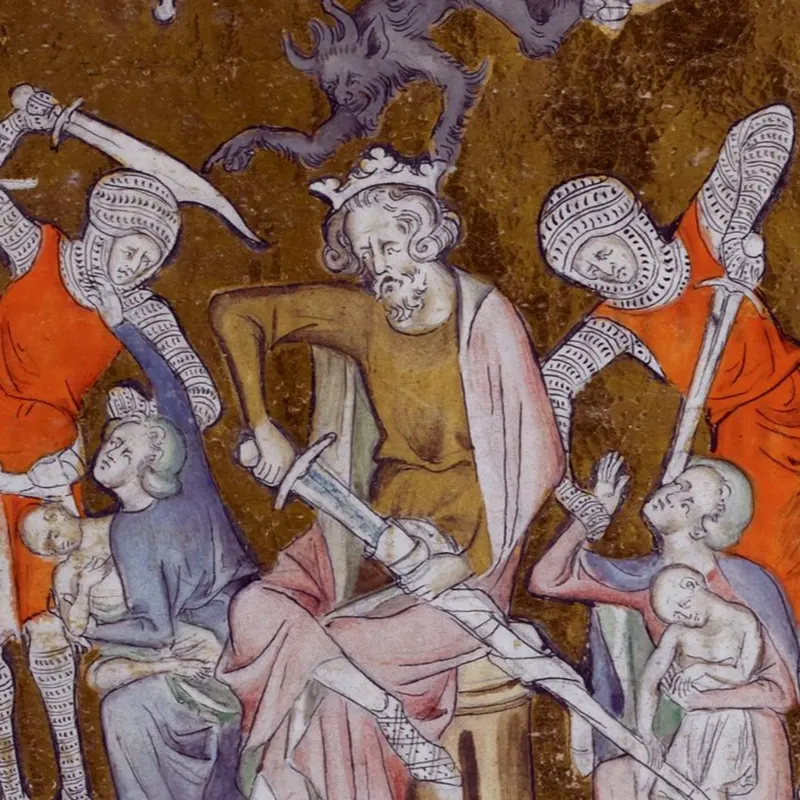
In progress"Herod the king, in his raging, charged he hath this day: his men of might, in his own sight, all young children to slay." So goes the Coventry Carol, a traditional English Christmas song commemorating the Massacre of the Innocents in Bethlehem. According to the Christian Gospel of Matthew, the jealous ruler of Judea so feared the arrival of the messiah that he ordered this slaughter of his own infant subjects. Herod's name rings through the ages with tyranny and evil. But who was Herod the Great?
This episode of Gladio Free Europe explorers the life and afterlife of Jewish history's most consequential monarch. Liam and Russian Sam situate King Herod in his historical context, as a pious Jewish monarch and a Hellenistic warrior-king. Born into an ambitious family descended from the conquered backwater of Edom, nobody expected Herod would ever assume control of the Hasmonean Kingdom of Judea. But as the Mediterranean world collapsed into a century of bloody turmoil, Herod used dynastic conflicts in both Jerusalem and in Rome to propel himself to the greatest heights of power. After he was suddenly named King of the Jews by the Roman Senate, Herod had to contend with ruling the most fractious kingdom in the Near East, and the most defiant corner of the vast Roman Empire.
Though his ancestors were converts to Judaism, brought into the Israelite fold at the point of a sword, Herod reigned as a pious Jew. Even scholars who doubted his commitment to the faith acclaimed his act of rebuilding the temple in Jerusalem, the center of all Jewish ritual. Though a Roman puppet who never attempted to liberate his subjects from foreign domination, Herod brought enormous prosperity and glory to his kingdom. The land that he once ruled is still marked by great works, built in Hellenistic fashion both to honor his God and to honor his own glory.
Despite his great successes, Herod was cruel, vindictive, and unceasingly murderous. Although his role in folklore derives from fiction and rumor rather than actual acts, his reputation for cruelty is well-deserved. Deeply paranoid and acutely aware of his own vulnerabilities, Herod dispatched every threat to his reign with unflinching violence. Even his own wives and children could not escape this violence. After his death, Herod would be immortalized not for his contributions to his kingdom and his faith, but instead for his wickedness. This episode will touch on the origins of Hanukkah and of Christmas to understand the career of one of the most fascinating and terrifying figures of the ancient world.
Transcript
Opening
Hello and welcome to Gladio Free Europe. I am Liam, joined here by Russian Sam.
Jacob, Esau, and Edom
Hello.
This episode is going to start a little bit differently than the rest. Let's open the book of Genesis and turn to chapter 25, verse 21. Isaac prayed to the Lord on behalf of his wife because she was childless. The Lord answered his prayer, and his wife Rebecca became pregnant. The babies jostled each other within her, and she said, Why is this happening to me? So she went to inquire of the Lord. The Lord said to her, Two nations are in your womb, and two peoples from within you will be separated. One people will be stronger than the other, and the older will serve the younger. When the time came for her to give birth, there were twin boys in her womb. The first to come out was red, and his body was red like a hairy garment. So they named him Esau. After him, his brother came out, with his hand grasping Esau's heel.
So he was named Jacob. According to Jewish scripture, these two sons of Isaac, grandsons of the great patriarch Abraham, would feud over their birthright. Esau, rough and hairy, would take to the field and become a great hunter. Jacob, a sensitive young man, instead spent his time with the people in the tents. Though their father Isaac favored Esau, his firstborn son, Jacob would buy his brother's birthright in exchange for a bowl of stew. Later, conspiring with his mother Rebekah, Jacob would trick his father Isaac into giving him a holy blessing meant for his brother. Realizing he had been deceived, Isaac thus proclaims to his firstborn Esau: Your dwelling will be away from the earth's richness, away from the dew of heaven above. You will live by the sword and you will serve your brother. But when you grow restless, you will throw his yoke from off your neck.
Esau would come to be known as Edom, Hebrew for red. Jacob would be known as Israel, meaning to struggle with God. These brothers would feud and reconcile just as their descendants would in turn. According to biblical genealogy, Jacob's descendants would be the Jewish people, comprising the 12 legendary tribes of Israel. Esau's descendants would be the Edomites, a related people speaking a related language. So these stories should be understood as mythology rather than history. They were told first orally, then in the Hebrew Bible, by the real historic Israelites, who were a Semitic-speaking people living in the land of Palestine among many other similar-speaking peoples. Like all neighboring cultures of the Levant, the people of Israel sought to understand their place in the temporal world of ancient Near Eastern society, as well as the immortal world of the gods. They saw their tribal relationship with the divine as unique, and their God mightier than any other.
Other peoples, too, must then be subordinate. But because the Edomites were so similar to the Israelites, speaking a mutually intelligible language, genealogical narratives were invented to explain the emergence of these two nations, and also to justify Israelite superiority over Edom. We only have the Israelite side of this story. There is no Edomite Bible. Only a tiny handful of inscriptions give us the vaguest glimpse of life in Edom. But my guess is that even before the book of Genesis was written, Isaac's son Esau was revered by the Edomites in their own history as their own sacred patriarch. Only later was he incorporated into Israelite mythology as a subordinate kinsman. It's entirely possible that in the Edomite holy tales, now lost forever, Esau may have signed a covenant with his own God, wrestled with his own angels. Maybe the Edomites understood themselves as the stronger nation, destined to rule over the Israelites.
Herod's reputation
500 years after Genesis was written, and centuries more after the story of Esau and Isaac first developed, an Edomite king would come to rule over the land of Israel. He would rule not as an adherent to the cults of his ancestors, but rather as a pious Jew. This king would be the most significant historically attested monarch in Jewish history. He would rebuild the great temple of Jerusalem, turn his country into a model of royal glory, and bring his people to a level of renown not seen in Jewish history. This king is Herod the Great, monarch of Judea in the first century BC, and one of the most hated villains in both Jewish and Christian tradition. His infamy is not entirely unearned. Herod was clearly a cruel man, perhaps even a tyrant, who most infamously slaughtered members of his own family when he feared they might turn against him.
Roman Emperor Augustus, his contemporary and greatest patron, famously quipped, It is safer to be Herod's pig than his son. However, we need to keep in mind that the brutality Herod employed to enforce his rule was not more extreme than that of his contemporaries. For instance, Augustus himself would be proclaimed first as emperor, then as God, yet he seized power through a brutal and selfish civil war. Augustus used targeted assassinations to maintain control of a degenerating republic, yet he is not understood as a wicked man today the way Herod is. Even the oppression of barbarian peoples in Germania, brutal enough to trigger one of the most successful uprisings against Rome, is always attributed to the pettiness of the emperor's officers, not to the will of Augustus himself. Additionally, Herod's wicked reputation does not really come from any of his historically attested crimes, such as the massacres of suspected bandits or the paranoid purges of his own family.
Instead, his infamy derives from religious and political conflicts with other members of the Judean elite. These conflicts would leave an impression not only on Jewish tradition, but also on the emerging religion of Christianity, a new movement based on the life of a man born just at the end of Herod's reign. This holiday season, Gladio Free Europe wants you to look at King Herod in his own context. This involves going through the labyrinth of court intrigue, a turn of the millennium Judea, but also looking more broadly at the culture and politics of the Hellenistic Mediterranean, and of course, going through the pages of scripture. To really understand Herod's career and legacy, we're going to have to get into both the Hanukkah story and the Christmas story. I do not think Herod was in any way a good man, but he might have been a great one. He was one of the most influential and successful monarchs of his time, a true major player in ancient politics in an era of legendary players.
And despite his certain cruelty, his alleged impiety, even his pathetic supplication to Rome, Herod left the land of Israel, a better and richer country than he found it. And his legacy would stand the ages in ways nobody, not even Herod himself, could ever anticipate. All right, so before we get into the story of Herod, we should mention that much like running an ancient Mediterranean kingdom, running this podcast does require contributions here and there. Sam, could you please direct our listeners to our Patreon page?
Mm-hmm. Yeah, so if you go to patreon.com slash gladiofreeeurope, you can become a patron and you can help us to build many magnificent things. We're currently in the process of designing an entire city. We have a couple of palaces in the works.
Yes, yes, that's right. And in addition, by becoming a patron, you are joining an illustrious ancient tradition, a tradition that connected Herod with some of the greatest figures in Roman history, as we're going to get into. All right, but let's really begin this story now. Sam, please tell us about the early history of the Edomites and the Israelites.
Israel and Edom
The Israelite tribes would coalesce into a kingdom along the coasts and hills of the southern Levant, while the Edomites would form their own kingdom in the deserts to the south, one seemingly related to in Egyptian records far earlier than any extra biblical reference to Israel. The Edomites were more likely to live as nomads than the Israelites, often settling to the west and Egypt, as well as among the nomadic Bedouins of the east and south. As the centuries progressed, both the Israelites and the Edomites increasingly focused their religious devotion to a single god. Circumstantial evidence suggests that the god of Israel, Yahweh, may have once been the god of Edom. At least one early Edomite, a figure named Doeg, is mentioned in the book of Samuel as a wicked advisor to the first Israelite king, Saul. There's no way to know if this Doeg was historical, but clearly individual Edomites were not out of place in Jewish royal courts, whether we're talking about the biblical era or the later Hellenistic era.
So, throughout their entire history, the Edomites had close cultural and economic relationships with the Israelites, as well as their more nomadic neighbors, such as the Moabites and the Ammonites of modern-day Jordan, as well as the Bedouin Arab tribes nearby. Later Greek writers could not really readily distinguish the Edomites from Arabs. It is possible that just as the Babylonian conquest of the Israelites saw the scale replacement of Hebrew and Aramaic, cultural contacts with Arabia may have led to the extinction of the Edomite language. Inscriptions in this language disappear around the 6th century before the Common Era. The Edomites would adopt Jewish Aramaic once they became Jewish, and we will get into that in this episode. But in the intervening centuries, it's entirely possible that they spoke a form of Arabic.
Right, and so because Edom was much smaller and much less urbanized than Israel, some scholars have speculated over the decades that an Edomite state, as described in the Bible, never existed at all. They were instead just a loose coalition of semi-nomads. However, recent excavations along the modern border of Jordan and Israel have found new evidence for organized Edomite life, suggesting state institutions. Specifically, there was a major copper mine and smelting site existing for generations, producing more sophisticated copper with every ensuing century. Archaeologists have noted that this would have been the highest quality copper available anywhere in the early Iron Age world. And as our listeners surely know, the quality of your copper was a major concern for ancient merchants. All right, so let's move westward now toward the Levantine coast and the land of Israel, which by the 6th century had been ravaged by subsequent invasions by the Assyrian and Babylonian empires.
Persians and Greeks in Judea
While these conquerors brought a lot to Palestine, including the Aramaic language, they took even more. The temple at Jerusalem, capital of the ancient kingdom of Judah, was destroyed. The priestly elite were kidnapped, taken in chains to the city of Babylon. After 80 brutal years, the Jewish aristocrats held captive found their release from an unexpected source. In one of the few events of the Old Testament, with clear extra-biblical corroboration, the Empire of Babylon was itself destroyed with the same brutality with which the Babylonians had ransacked the land of Israel. This new reigning power, the Achaemenid Persians, were relative newcomers in the ancient Near East. Descended from nomadic horsemen, the Persian language does not appear to have been present in Iran before the Iron Age. But the Persians learned fast. They adopted much of the administrative traditions and social technologies of the preceding Assyrian and Babylonian empires. They maintained the Semitic Aramaic language as the legal imperial standard, maintaining its use westward in Palestine and Egypt and expanding its use to the east, across the Iranian plateau and into Central Asia.
The Achaemenids also adopted the earlier imperial practice of mass ethnic politics. Whereas the Babylonians had destroyed the temple and stolen away the Jewish elite, the Persians facilitated their return and even allowed for the construction of a new second temple. It is looking increasingly possible that the Bible as we know it today only took shape in this post-exilic period under Persian patronage. And so during this relatively obscure 200-year Persian period, Jewish culture flourished under the leadership of imperial governors, some of whom, like Ezra, would be revered as prophets later. But in the 4th century before the Common Era, the land of Israel, as with much of the known world, would be irrevocably transformed by the sudden and unexpected invasions by another small, ambitious, and self-confident tribe, the Greeks. Under Alexander the Great, the entire Persian world, Palestine included, was incorporated into a short-lived Macedonian Empire. Upon its founder's untimely death, this empire would shatter into the rival Diadochi kingdoms, each sought their own legitimacy.
The former kingdom of Judah, now known by its Greek name Judea, would be contested by Greek rulers of Egypt and Greek rulers of Syria. The ways and customs of the Jewish world would be transformed under the Greek or Hellenistic influence. This was true both in Judea itself as well as in the sprawling diaspora, which really came into its own during this period. Jewish elites and Jewish peasants alike began adopting many of the customs of their conquerors. As we'll see, most of the Jewish people we'll be discussing in this episode are going to have Greek names. Some of these customs were thought to be contrary to the commandments of the Hebrew Bible. And so, about 150 years after Alexander's conquest of the land of Israel, there would be a new Hellenistic king in charge, the infamous Antiochus Epiphanes. His name, which is very typically humble in the ancient Greek manner, means God manifest.
The Maccabean revolt
What happened next marked a massive sea change in the land of Israel. What had previously been in relative backwater was suddenly coming into contact with the wider Mediterranean world. The Jews came to know the ways of the Greek overlords, both consensually and not. So began their entry into the Hellenistic fold. Jews began to adopt Greek as their language. They took to Greek fashions, they started going to gymnasiums, and some of them even began worshiping the gods of the Greeks. One particularly gnarly sign of Hellenization showing just how far this went: some Jews took to undergoing a procedure to reverse their circumcisions so that they might appear to look like Gentiles, even when they were naked. This willing acculturation was also paired with an increasing religious presence from without. At various times, the Seleucid kings would leave their Jewish subjects at peace, while other times they would apply pressure to the Jews.
Under the reign of Antiochus, things came to a head. Circumcision was outlawed on pain of death. An idol of Zeus was placed upon the altar in the temple. The possession of the Torah was criminalized, and Jews were required to eat pork. If you're a millennial, the Rugrats probably told you all about what happened next: the revolt of the Maccababies. These times were detailed closely in the books of the Maccabees, an odd pair of books which are not part of the Jewish canon, but which were later incorporated into the Christian Bible. As the story goes, one day, the oppression of the Greeks reached new heights. As part of their ritual humiliations of the Jews, the Greek overlords of the land of Israel demanded that Jews make sacrifices to an idol. Among those present when this demand was made was Mattathias, a priest. When he refused to take part in the ceremony, another Jew came forward, offering to do this.
This threw Mattathias into a rage, and he killed the man on the spot. He then took his sons into the Judean hills and began to wage a guerrilla war against the Seleucid kings to restore Jewish political authority over their land. From the hills, Mattathias issued a proclamation which would echo throughout the land: quote, Let everyone who is zealous of the law and supports the covenant come out to me. The Jews, angry with their long humiliation at the hands of the Greeks, did just that. Farmers, shepherds, displaced priests, these were men who, with more convictions than arms, an improvised army bound not by promises of pay or plunder, but their fidelity to the word of God, and their willingness to wage a holy war to defend the ways of old. Mattathias would not live long enough to see the rebellion to its end. On his deathbed, he charged his sons to continue the struggle.
He said, Remember the deeds of the ancestors, which they did in their generations, and you will receive great honor and an everlasting name. Upon Mattathias' death, leadership passed to his son Judah, nicknamed Maccabee, meaning hammer. So it was all up to Joey Hammer to continue the struggle. Judah was a ruthless commander with a great gift for strategy. He was a hardy man. The opening passages of chapter 3 of the Maccabees recount that he killed the Greek general in hand-to-hand battle and took his sword, with which he would fight the remainder of the war. He knew the Judean hills like the back of his hand, and he was guided by a fervor only possible in a man who firmly believed that God was on his side. His host was poor, outnumbered, untrained, and unsure of themselves. He had to reassure them in one early battle. Then they saw the armies coming against them.
They said to Judah, How can we, few as we are, fight such a strong host as this? Besides, we are weak since we have not eaten today. But Judah said, Many are easily hemmed in a few. In the sight of heaven, there is no difference between deliverance by the many or by the few. For victory in war does not depend upon the size of the army, but on the strength that comes from heaven. This one almost has the ring of a Maoist aphorism. And so, with these strong words, Judah's troops would crush the opposing army. This ragtag band of Jews was now emboldened, and they struck at Seleucid garrisons, razed pagan altars, and forcibly circumcised the Jewish children whose families had abandoned the practice. This was not just a war against foreign rule, this was a civil war within the heart of Judaism. Many Hellenized Jews fought in the Seleucid ranks against this mass of zealots, speaking to their acculturation into these foreign ways.
They looked aghast as the Maccabees smashed the accoutrements of their adopted culture. In 164 BCE, three years into the war, Judah and his followers took Jerusalem. They found the temple desecrated, and so they tore it down stone by stone and built a new one. Everything inside would be rebuilt and sanctified. When the effort was done and the temple reopened, Judah decreed that every year the reconsecration of the altar would be celebrated for eight days. This would be Hanukkah, which is celebrated to this day. And we are recording this on the first night of Hanukkah, dear listener. So it's especially direct to us at this very moment.
Yes.
The war would continue for decades more, but Judah would also not live to see the end of it. He was felled a few years later in another battle. The Seleucids were temporarily able to retake control and walked back Antiochus' anti-Jewish measures, but this would not be enough, and Judah's brothers continued the struggle still further. After many years of war, the Maccabean struggle was decisively ended by the intervention of the Roman Republic, which allowed the Judeans to secure their independent kingdom. They were by this point led by Simon Thassi, who would become the first priest and king from this new line. The descendants of the Maccabees would rule for over a century before being deposed by Herod, the anti-hero of our story. Ironically enough, the Hasmoneans themselves presided over the increasing Hellenization of the kingdom. There would be no putting the toothpaste back into the tube. The Hasmoneans would take Greek titles, and their combination of kingship with the high priesthood unsettled many Jews.
The Hasmoneans and the Idumaeans
About a generation after the revolt of the Maccabees, the Hasmonean king John Hyrcanus led one of the greatest geographical and demographic expansions of the Jewish world. He violently conquered the lands of Samaria, Moab, and Edom. All these areas were culturally very similar to Judea, but not exactly properly Jewish. While Edom may have very well been the birthplace of the cult of Yahweh, by this point, the Edomites worshipped the foreign god Qos. Hyrcanus then demanded the conversion to Judaism of all of the Edomites. Very little is known about what this mass conversion looked like, especially because mass conversions to Judaism are extremely rare throughout history. We would guess that the Edomite religion likely already resembled Judaism in most principal aspects. They probably had their own similar dietary laws that prohibited the consumption of pork. They would have been familiar with Yahweh and with the worship of one God.
Additionally, while Josephus reports that this required the Edomites to practice circumcision, archaeological evidence suggests that the Edomites were already snipped. Thus, by Herod's day, there were apparently no more cultural distinctions between the Edomites and the Israelites. Esau and Jacob had reconciled. But did they really? We will see.
Antipater and young Herod
All right, so looking ahead for a second, as king, Herod was said to have assembled an illustrious and fanciful genealogy for himself in hopes of connecting his family tree to the older kings of Israel. His real pedigree, though perhaps less illustrious in religious terms, is still extremely fascinating because the careers of his father and grandfather would foreshadow Herod's kingship in interesting ways. These early Herodians also give us a great look at how power and patronage worked in the Hellenistic Near East. The real founder of this dynasty was Herod's grandfather, Antipas the Idumaean. Idumaean being Greek for Edomite. Antipas was born just one generation after the conquest of Edom by the Hasmonean kings. He was, as far as we can tell, completely sincere in his Judaism. While other Edomites resisted this new regime and continued to worship the old god Qos, Antipas earned the favor of the Hasmonean kings and was thus appointed to be governor of his homeland of Edom.
In this way, Antipas is an interesting precursor to his grandson's later career as a Roman puppet. Some things really run in the family. Antipas was well-connected and well-traveled. He spent time both in Edom and the Hasmonean capital of Jerusalem, yet he also had dealings with the surrounding territories outside Judean lines. He was extremely wealthy, probably because of his involvement in caravan trade routes to Egypt and the Bedouin lands of the Nabataean kingdom. His son Antipater would rise to even greater heights in the Hasmonean court, largely due to the patronage of the powerful queen regnant Salome. Antipater used his family's riches to finance the queen's courtly expenses. Though he was not himself of noble extraction, he married an Arab princess named Cypros from Nabataea. She most likely converted to Judaism, as all of Antipater's children were raised Jewish from birth. These children included several sons and a daughter named Salome after the queen.
Antipater gave his second son the modest name Herod, in proper Greek, Herodes, son of the hero. We should mention now that roughly 90% of what we know about Herod comes from a single source, that being the great first century Jewish historian Josephus. He was born 40 years after Herod died, but he grew up in a world shaped by the king's policies. And I mean shaped in a physical sense, because anybody living in Judea in the first century of the Common Era would have seen the great constructions of the century before, the most famous of which was the reconstructed Temple of Jerusalem, which reached its greatest splendor entirely through the initiative of Herod. We'll discuss this in much greater detail near the end of this episode. Josephus had access to some primary sources about the late king, including his court historian, Nicholas of Damascus, who survives only in fragmentary quotations.
He might have also had access to a lost memoir attributed to Herod himself. But Josephus is additionally drawing from oral traditions and rumors. He has many narrative twists and payoffs that seem a little bit too good to happen just as neatly as he gives them to us. This is all to say, we need to take historical accounts of Herod's life with a grain of dead sea salt. But even if some of the events we're about to recount might be embellished, there's still a wonderful look at just what kind of shadow Herod cast in the century after his death. Personally, I don't think he would be entirely displeased with Josephus' account of things. According to Josephus, Herod was raised like a prince despite his lack of royal Judean heritage. He was an active hunter and warrior. Like many elite men in the Hellenistic world, he might have also been, to some degree, bisexual.
Josephus writes that Herod was very fond of androgynous eunuchs and also had a close friend in his youth for whom he later named one of his great palaces. Lots of speculation over the centuries about what this relationship might have been. But more significantly, Herod was very close to Queen Salome's son and successor, John Hyrcanus II. When Herod was still a small child, a rebellion against Hyrcanus sent Herod and his family to seek shelter in Nabataea. The king would never be restored to his throne. However, Hyrcanus would remain the high priest in the Jewish temple, which might have been a more coveted position to Second Temple Jews. Because Herod's family stuck with Hyrcanus during all this turmoil, the former king, now priest, would become their patron and their closest ally among the Jewish elite. Nobody could have anticipated that decades later, this patron-client relationship would be reversed.
Herod would be the king and patron of this priest.
Rome's civil wars come to Judea
The first century BC was a particularly bloody one all throughout the Mediterranean world. Civil conflicts within Roman Italy had ripple effects across the provinces of the Mediterranean and beyond. Taking advantage of his own wealth and fame, as well as various loopholes within the Roman Republic, the general Julius Caesar proclaimed himself dictator and consul for life. Despite his wide popularity among many plebeians, aristocrats had correctly feared for the survival of the Republic, and so they orchestrated his famous murder. Remarkably, due to a mix of clever maneuvering and excellent luck, both Caesar's life and death would be advantageous to Herod and his family. Many times in his youth, Herod found himself on the losing side of a conflict, yet somehow managed to come out on top. While Caesar was still alive, he had recognized Herod's father, Antipater, and not the priest and ethnarch Hyrcanus as the real power in the Hasmonean realm.
Antipater impressed his patrons with his influence over the surrounding lands, same way that Herod's grandfather, Antipas, had won over Queen Salome. During a war between Julius Caesar and the Egyptian king Ptolemy XIII, Antipater convinced a group of Egyptian Jews to rebel against their leader on behalf of Rome. As a reward, Caesar made Antipater one of the first Jewish Roman citizens and named him the procurator of Judea, effectively making him leader of the kingdom and effectively turning this kingdom into a vassal of Rome. Herod and his brother Phasael, both in their mid-20s, were named governors of Galilee and Jerusalem, respectively. While the Galilee is a very familiar name to any Christians listening, it was definitely the worst post to be stationed at. Galilee was a backwater, not technically part of Judea, but under Judean rule. Its population was primarily Jewish and extremely poor, although not without significant communities of Greek pagans.
Other Greeks lived in the nearby cities of the Decapolis, the Greek-speaking Roman colony completely immune from Hasmonean legal authority. As governor, Herod made a name for himself by clearing the Galilean hills of bandits. These bandits are sometimes suspected of having been religious rebels, seeking to overthrow the Romans and their local Jewish agents, such as Herod and Antipater. Once Herod had captured these bandits, he behaved exactly as any other ancient ruler would. He had them summarily executed. While Josephus reports that most of the Jews in the Galilee supported this violent crackdown, the mothers of the slain bandits got a protest movement against Herod and against Rome. Members of the Hasmonean elite, who opposed both Herod and Antipater, brought a formal legal case against Herod on behalf of the men who were killed. In the Hasmonean realm, legal cases were administered entirely by the Jewish temple priests, who were a class basically always opposed to Herod and his family.
Fearing that he would not be given a fair trial, Herod instead made for himself an unfair trial. He pleaded for help from the Roman governor of Syria, who luckily enough was a cousin of his patron, Julius Caesar. The governor lent a detachment of Roman troops to accompany Herod into the temple courtroom. So Herod met the priest behind an armed bodyguard, smugly wearing purple robes, typically only worn by a king. The message was clear. The priests were cowed, and the charges against Herod were dropped. Shortly thereafter, the Romans put other provinces of the Hasmonean kingdom under Herod's control.
Yeah, and so you just to kind of jump in here, I think this early story about the killing of these bandits does say a lot about the character and reputation of Herod, because at the end of the day, he was a thuggish dictator appointed by hated foreign conquerors. That being said, he was not necessarily any worse of a ruler than anybody else in this time or place. I think that the practice and enforcement of power in an ancient context necessitated violence, but because he was associated with foreign rule and was clearly not too sensitive about the legalistic norms of this society, Herod's violence was not received the same way as the violence of any other ancient despot. And of course, you know, this is, I think, is why his infamy has come down to us through the ages and not the infamy of any other leader at this time.
Yeah, so showing for the first time his brutally vindictive streak, Herod tried to take violent revenge against the priests who had brought him to trial. But his father Antipater wisely encouraged him to stay his hand and not risk offending his enemies further. Clearly, in the year 44, before the Common Era, things were looking bright for this rapidly rising family of Jewish Edomites. And then they received the news that Caesar was dead. He was stabbed to death by a host of his friends and rivals, who correctly feared that he was eroding the republican nature of the Roman state. The most famous of his killers was Brutus, whose name is said to have been the last word spoken by Caesar's lips. But another conspirator, Gaius Cassius Longinus, had a strong interest in the eastern Mediterranean. And so after Caesar's death, when the Roman world was completely shattered, Cassius established himself as a warlord, possibly hoping to amass the same kind of power as the consul he had killed.
Just as the rival general Mark Antony famously sought support from Egypt, then ruled by Cleopatra, Cassius turned to Palestine for his manpower and financing. Antipater and his sons enjoyed as much support from Cassius as they had from Caesar. It was even said that Cassius considered naming a member of his family the king of Judea, and that Antipater's ambitious second son, Herod, was a leading candidate. But then, in 42 BC, just two years after the assassination of Caesar, Antipater would be killed, poisoned at a lavish banquet in Jerusalem by a rival courtier. Outraged and horrified by his father's murder, Herod sought violent revenge, once again using the borrowed might of the Roman Empire. After tricking the conspirators into foolishly attending a banquet of his own, Herod had a detachment of Roman troops chop them to pieces. Unlike Antipater, these courtiers had not even had the time to try the dinner.
But then, just a year later, Herod's fortunes threatened to collapse even further. His patron, Cassius, left Palestine for Greece, only to be defeated and killed at the Battle of Philippi by Mark Antony and another ambitious warlord, Gaius Octavius, who would soon become the Emperor Augustus. But as we see again and again throughout Herod's career, he turned this setback into a remarkable opportunity. Even though Mark Antony was an enemy of his former patron Cassius, both men had spent time in Judea in earlier decades. Antony had been hosted by Antipater in Jerusalem and thus had no hard feelings towards his son.
Yeah, and one other funny thing was happening here as well, because just as Herod was endearing himself to the winning side of the civil war, he also found unexpected new allies in the losing side. Because members of the senatorial elite who had previously supported Brutus and Cassius now were begging for leniency from Octavian and Antony, just as Herod was. Because Herod was on these guys' side during the war, he was still on their side after the war. One defeated general was Messalla Corvinus, future Roman consul and highly educated patron of the art. He was said to be as skilled on the battlefield as he was on the floor of the Senate. It was Messalla who really gained the favor of Antony and Octavian and paved the way for his new friend Herod to do the same. And we're going to see a few years later, Messalla would be extremely important in advancing Herod's career even beyond that of his father, Antipater.
The Parthian invasion
During this time, several embassies of powerful Hasmonean loyalists made petitions to Antony and Octavian, pleading for the removal of Herod and his brother Phasael from power. The Hasmonean prince Antigonus, a grandson of Queen Salome, wrote a nasty letter insisting that as an Edomite, Herod was not a real Jew, but only a half-Jew. Not royalty, but only a private citizen. When the Romans did not respond to his petition to remove Herod, Antigonus and his supporters among the Hasmonean elite attempted to regain control by other, more violent means. Antigonus launched a violent rebellion against Herod around the year 40. Positioning himself as a true Israelite opposed to the Romans and their Edomite puppet, Antigonus rallied support from the same aristocrats who had killed his father, Antipater. Antigonus even went a step further, winning the support and military intervention from Rome's most hated enemies, the Persians. We can only imagine how Antigonus could have invoked the scripture here.
Because just as the Achaemenid Persians had delivered ancient Israel out of Babylon, now a new Persian dynasty could end the captivity of a new Babylon and free Israel once again. According to Josephus, Herod took to the field of battle himself, leading troops against Antigonus and his fearsome Persian allies outside Jerusalem. Despite winning at least one clash against these usurpers, Herod and his party were pushed out of the city. He managed to escape with some of his close friends and relatives, including his sister Salome and the 12-year-old Hasmonean princess Mariamne. However, his patron Hyrcanus, as well as his brother Phasael, were captured by Antigonus and the Persians. Herod managed to assemble a hasty caravan of aristocratic refugees out of Jerusalem, bound for Egypt. At this point, Egypt was, of course, itself also a client kingdom of Rome, ruled by the famous Cleopatra VII. She happened to be the lover and future wife of Herod's new patron, Antony.
During Herod's flight into Egypt, he and a small group of warriors repelled an armed attack from the Persians. Later on, he would build a palace on this site commemorating his victory. They escaped Judea altogether, first taking refuge in the Nabataean kingdom of Petra, where Herod hoped his mother's relatives would pay for the ransom of Hyrcanus and Phasael, and maybe also lend some military support. But to Herod's shock, the Nabataean king Malchus, probably his cousin, refused to come to his aid. Perhaps the Nabataeans feared they were backing what might have been the losing side in a dangerous war, or perhaps they worried they might incur the wrath of the Persians themselves. Herod then left Nabataea, clearly crestfallen, instead going to the remote and eventually famous palace of Masada, where his female relatives and entourage would be kept safe for the ensuing half-decade of warfare. Herod continued on to Egypt, where he was met with a warm reception by Cleopatra herself.
According to Josephus, the queen attempted to use her legendary wiles to seduce Herod. I have to personally wonder if this is an embellishment based on her later reputation. What's more certain about Herod's time in Egypt is that it was in Alexandria where he received the terrible word from Judea about the fate of high priest Hyrcanus and his brother Phasael. In a bizarre act, Antigonus, the usurper king, was said to have bitten off the ears of his uncle Hyrcanus. This was not only a brutal humiliation, but also a way to remove Hyrcanus from the temple establishment. As the Bible states, no man who had been disfigured could serve as a priest. Phasael, fearing an even worse fate awaited him, took his own life. According to a fragment that survives of Nicholas of Damascus, Herod's brother Phasael committed suicide by the most brutal of means. Because he was locked in a cell and chained both hands and feet, all he could do was bash his head in against the wall again and again until death.
King of the Jews in Rome
Seeing no other means to defeat Antigonus, Herod sailed to Rome. Despite being slowed down by a shipwreck, he landed in the great city in 40 before the Common Era, where he was greeted by that sympathetic general, Messalla Corvinus. Even though Herod was a representative of a distant client state, which had otherwise not been a priority in Roman politics, the Roman senators were unexpectedly eager to hear Herod's report. First, the revolt of Antigonus was understood as a Persian invasion of Roman territory, which required urgent attention. Second, because this was so soon after a destabilizing empire-wide civil war, the new Roman clique, led by Octavian and Antony, were eager to form up their support of any territory previously under firm Roman control. Thus, on the floor of the Senate, General Messalla made an impassioned plea in high Latin on behalf of his new Jewish friend, Herod. Herod himself likely spoke only a few words of Latin, certainly not enough to follow Messalla's flowery rhetoric, but he could clearly see that these foreign senators were being persuaded.
After less than a week of arriving in Rome, Herod, to his shock and confusion, was proclaimed not procurator like his father had been, not ethnarch like Hyrcanus, but king of the Jews. Herod surely had apprehensions about accepting this title. On one hand, his proclamation as rex Iudaeorum meant that Herod had risen to a height far greater than his father or grandfather. I'm sure that his more distant ancestors, the Edomite priests of Qos, could never have anticipated that one of their tribe would one day lead Israel, the nation of their conquerors. This kingship could be a poisoned chalice for Herod, because Judea was currently in the hands of the formidable Parthians. While Herod might be a king, he would have to win back his kingdom. He didn't know to what extent he could rely on Roman military support. What's more, Antigonus did have a fair amount of support among the Hasmonean aristocracy.
So even if Herod could dislodge his usurper, he would then have an extremely difficult time proclaiming his own legitimacy when so many other Hasmonean aristocrats had a more meaningful claim to be king than him. I think this more than anything, this drive for legitimacy, is going to make Herod one of the most impactful and interesting monarchs of the ancient world. But, Sam, tell us a little bit about how Herod would attempt to take his new kingdom.
Winning the kingdom
So, Herod and his surviving brothers returned to Judea at the head of an army. Proving his mettle as a warrior king, he had relieved the siege of the fortress of Masada, where he was reunited with his sister Salome and the princess Mariamne, who, despite her young age, was proclaimed to be his future wife. Even if he did not have Hasmonean blood himself, this match could ensure that his offspring would. He just had to wait a few more years for Mariamne to reach the age of majority. There was just one hiccup here: Herod was already married. His first wife was a common-born woman named Doris, with whom he had a son named Antipater. But while polygamy was not practiced among the Romans, it had a vaguely widespread tradition in the eastern Mediterranean, both among Jewish royalty and among Hellenistic elites. I'm sure Herod the Great told Doris that this was just what the king does.
Should he want to lead by David and Solomon's example? So after announcing the engagement to Mariamne, Herod and his brothers began the long and difficult campaign of retaking every Judean settlement held by the Parthians. Herod led his armies across hills and mountains through sand and snow. At least one of his brothers died on the battlefield. We also have one incredible story from this time. Herod's supply trains were attacked by Galilean bandits, clearly a perpetual problem in that region. He learned that these bandits were living in caves high up on the cliffside.
Right, and so Josephus writes here: Now, these caves were in the precipices of craggy mountains and could not be come at from any side, insomuch that the king was doubtful for a long time of what to do. Yet did he at length make use of a contrivance that was subject to the utmost hazard. For he let down the most hardy of his men in chests, lowered them with ropes to the mouths of the dens. Now, these men came out of the chests and slew the robbers and their families, and when they made resistance, they sent in fire upon them and burnt them. And as Herod was desirous of saving some of them, he had proclamation made that they should come and deliver themselves up to him. But not one of them came willingly, and of those that were compelled to come, many preferred death to captivity.
So, in contrast to the modern image of Herod as you know, wickedness personified, Josephus uses this anecdote to show that sometimes the king did take efforts to spare the innocent. Yet, these efforts were not always effective. And here, a certain old man, the father of seven children, whose children, together with their mother, desired him to give them leave to go out of the caves. This old man ordered every one of them to go out while he himself stood at the cave's mouth. But then he killed his own son who went out of the cave. Herod was near enough to see this grisly sight, and his bowels of compassion were moved at it. He stretched out his right hand at the old man and besought him to spare his own children. Yet did not he relent at all upon what he had said. But over and above, this man reproached Herod on the lowness of his descent, and he then slew his wife as well as his children.
When he had thrown their dead bodies down the precipice, he last threw himself out off the cliff after them. Herod was disturbed by this man's fanatical and brutal behavior toward his own family. Yet, as we're going to see, as king, Herod and this old bandit might be more alike than different.
Herod then marched to Jerusalem, King David's city, leading a mixed army of Jewish soldiers and Roman centurions. They camped out for a five-month siege, during which time Herod solidified his claim by marrying the Princess Mariamne in a public spectacle outside the walls of the city. The siege ended not with any surrender, but with the push to scale the walls and pursue the army of Antigonus into the Jewish temple. Gentile Roman troops, disregarding all respect for the Jewish religion, slaughtered their enemies inside the temple itself. After the usurper Antigonus was captured, Herod ordered the troops to stand down. Hearing the cries of fellow Jews, his own subjects, Herod realized just what kingship was built on: the Roman sword. All his legitimacy was at the hands of brutal conquerors, who would take just as easily as they gave. According to Josephus, Herod reflected that he was thus, quote, king of a desert, and that, quote, he judged the dominion of the habitable earth too small a compensation for the slaughter of so many citizens.
And thus, while the streets of Jerusalem still ran with the blood of the innocent, Herod took his throne as king, hardly an auspicious beginning. While the public slaughter had ceased and Roman troops were bribed to leave the city, Herod immediately began plotting the execution and assassination of his enemies. Antigonus, as the captive king, would typically be brought to Rome in chains, paraded around in a public triumph. Herod wouldn't have this. If the senators were so easily convinced to give him the crown, what would stop them from giving it to Antigonus? Instead, he had his rival quickly and secretly beheaded, an unceremonious end to the royal line of Judah Maccabee. In the first years of his reign, Herod brutally reshuffled the deck of the Judean aristocracy. He orchestrated the killing of most of the priests who had prosecuted him years earlier, when he was brought to trial for executing bandits in Galilee.
He brought old earless Hyrcanus back from exile and invited in some of his father's friends and relatives from Edom. He also made close contact with local Gentile elites, the Greeks who lived in the cities of Gadara and Sepphoris under his rule.
Carrot and stick
Right, and so Herod thus used both carrot and stick to win over the support of his elite subjects, especially those from Jewish stock, more noble than his. And despite that early rash of killings, you know, his own Layla montage, many Hasmonean loyalists remained. A lot of Jewish aristocrats were skeptical of this young upstart Edomite king, and these skeptics included his lovely wife, Mariamne. The queen, now 17 or 18 years old, was known to be exceptionally beautiful and a skilled conversationalist, compared often to the Egyptian queen Cleopatra. Mariamne and her brother Jonathan knew well that they each had a better claim to rule the kingdom than Herod did. And Herod, of course, knew this just as well as them. Either to appease his new wife or her influential relatives, Herod did not invite his first wife Doris to their palatial home. His mother-in-law, Alexandra, herself the daughter of a king, was suddenly in a place of great importance in this court.
Herod's sister Salome distrusted her brother's wife and mother-in-law entirely, perhaps feeling her own position threatened by these powerful noblewomen. The biggest threat of all was Herod's new teenage brother-in-law. Though Jonathan, also known as Aristobulus, was this point only around 16, he had the excellent royal pedigree that Herod lacked. Additionally, he had been trained practically since birth to serve one day as the high priest of the temple. We haven't even mentioned that as somebody of Edomite stock, not of the tribe of Levi, Herod was completely ineligible to serve in the temple. Jonathan's mother Alexandra tried to persuade Herod to make her son the high priest, but Herod knew this was risky, as many Hasmonean priests had eventually found their way onto the throne as king. Other members of the court and aristocracy had their own preferred candidates for priest, often well-known scholars connected to the various sectarian Jewish movements, such as the Sadducees or the Pharisees.
Instead, Herod appeased no faction by appointing an obscure elderly sage from the diaspora, probably Babylonia. However, this man's tenure would not last long. Jonathan, young and dashing, was powerful both among the Hasmonean aristocracy and the masses. Josephus even tells us that Cleopatra strongly supported this prince after her mother Alexandra sent them a painting of her handsome son. In a somewhat uncharacteristic move, Herod bowed to this pressure. He appointed Jonathan, his wife's teenage brother, as the new high priest. But just like that old man from Babylon, Jonathan would not spend much time within the Holy of Holies, especially once Herod learned that demonstrations were being held across Judea demanding that Jonathan not only be high priest, but king as well. One day, during a trip with his mother to the Hasmonean palace of Jericho, Jonathan went for a swim in an indoor pool. He never re-emerged. His death was declared to be an accidental drowning, and the young priest was publicly mourned by Herod.
Yet everybody suspected the king was behind this. Most suspicious of all were his sister Mariamne and mother Alexandra.
Yeah, it's a shame Columbo wasn't there at the time.
Mariamne
I know, really. Herod was passionately devoted to his second wife, but plagued with suspicion that she was conspiring against him or that she was having an affair. I gotta say, very big Henry VIII and Anne Boleyn vibes here. Herod was particularly worried about the designs of his patron Mark Antony, a famous seducer. These concerns might have been spread by Herod's sister Salome, who, as we mentioned, despised both Mariamne and her mother. In 34 BC, Antony summoned out Herod to Alexandria to interrogate him regarding the death of Jonathan. Herod told his own palace guard that if he was arrested or killed, his wife Mariamne was to be put to death as well to prevent her from falling into Antony's lecherous clutches. Although Herod would return to the palace unharmed, this order understandably put a damper on his relationship with his wife. It may be around this time that Herod allowed his first wife Doris to return to the palace with their first child, Antipater.
Herod's paranoia seemed to grow with his influence. With every new accomplishment, he feared more and more that those around him would take it all away. And despite ruling over a relatively small kingdom, Herod was extremely wealthy. He earned much of his money not only from estates held in Judea, but also from his properties beyond, in Cyprus, in Egypt, lands all across the Roman world. Supposedly, another one of Herod's Roman patrons, Marcus Agrippa, quipped that Herod deserved to rule a kingdom far greater than Little Judea, given the scope of his ambition and his ability. This clearly went right to his head, because about a decade after taking his throne, Herod launched an unauthorized invasion into Nabataea, the land of his mother. He might have been seeking revenge against the Arab king Malchus for not supporting him in his previous time of need. He might also have been seeking the repayment of debts.
The richest man in the Near East
Herod was probably the wealthiest man in the entire Near East. He thus loaned money to everyone. In addition to seeking the repayment of debts and to settling an old score, Herod knew that military conquest would be the best way to expand his glory and the glory of Judaism. He could possibly even bring into the religious fold a new tribe, the Nabataeans, just as his Edomite ancestors had become part of Israel. In the year 31, Herod led an invasion into modern-day Jordan that was initially quite successful, even despite the unexpected intervention by Cleopatra on the Nabataean side. Herod conquered much of this kingdom, and some local Arabs, perhaps knowing that Herod had royal Nabataean ancestry himself, were very willing to accept him as their new king. Local supporters of Herod even established pagan shrines for his worship across modern-day Jordan, revering him as a living demigod. And as we're going to see at the end of this episode, this Herodian cult, despite having no official sanction from Herod himself, would have a surprisingly long afterlife.
All was going well with this campaign until a devastating earthquake ripped through Judea. Well attested archaeologically, this earthquake appears to have led to the temporary abandonment of the caves at Qumran, where a Jewish monastic order left behind what we now call the Dead Sea Scrolls. This earthquake was also seen, of course, as a sign from God. Somebody was sinning, and thus somebody had to be punished. And there were many things in Herodian Judea that could have made God angry. This could be a signal about the adoption of Greek ways by the Jewish people, or it could have something to do with the occupation of the Judean throne by an Edomite puppet of Rome. Perhaps, some said, God simply didn't want Herod invading his neighbor. Thus, following the earthquake, Herod abandoned his military campaign and returned to Judea, upon which point he was called to see Octavian, who now was known as the Emperor Augustus.
Augustus was furious that Herod had invaded another Roman client state without permission. He threatened to strip away his crown. Herod, in a really interesting gamble, actually said that he would surely renounce his kingdom. Appearing to the emperor, dressed as a commoner, not wearing a crown, Herod said that only if he had the emperor's forgiveness would he accept the crown and rule as king again. During this crisis, Hasmonean legitimists once more began looking for a potential replacement as king. A new surprising candidate was the Prince Alexander, Herod's young son with Mariamne, who at this point was still too young to even read or write. These rumblings, just a couple years after the incident with the high priest Jonathan, led to new, eventually deadly tensions within the royal household. The growing enmity between Herod, Mariamne, her mother Alexandra, and even their own children would continue to simmer. But before this all comes to a head, I think we should pause for a second to get into the most famous aspect of Herod's reign: his massive and unprecedented building projects.
Hellenistic builders
In the 21st century, most academic attention is being paid to one aspect of Herod's career: his great sponsorship of massive construction projects. This would become the primary preoccupation of his later kingship and appears to have only really gotten underway after he was reprimanded by Augustus for invading Nabataea and had to let go of his grand territorial ambitions. Herod thus needed to seek honor and legitimacy through ways beyond military glory. His great wealth and great insecurity would drive him to leave a permanent mark on the physical landscape of Judea. These building efforts might be understood as the most glorious midlife crisis at the ancient world. But we also got to look at the broader social context here. So, for centuries, monarchs across the Hellenistic East had developed a mania for the establishment of great spectacular structures. Ancient rulers have sacrificed their wealth and the bodies of their subjects in the name of such projects really since the Neolithic.
Scholars have speculated to what extent canal building in ancient Mesopotamia contributed to the development of states and the first monarchies. But skipping ahead to the 4th century BC, Alexander the Great amassed a level of renown in the Greek timē that had never before been witnessed in any mortal career, let alone a career of just 32 short years. When Alexander died, the splintering of his short-lived empire into those various diadochi kingdoms led to a new crowd of rulers emerging, all obsessed with their own renown, their own timē. They took drastic, desperate measures to carve out their own names into the rock of ages. This often took the form of massive, fruitless wars between rulers of states like Seleucid Persia, Ptolemaic Egypt, and the small kingdom of Epirus. The last of these is only known today due to the military adventures of its great king Pyrrhus, a second cousin of Alexander, whose tactical brilliance but strategic sloppiness gives us the term Pyrrhic victory.
Despite the great human and economic cost of these Diadochi wars, none of the successors of Alexander managed to reunite his sprawling empire. Dreams of glorious standing armies led to an overabundance of soldiers in the Hellenistic world, which drained the coffers of these kings and stunted economic development all across the eastern Mediterranean. The weakening of these Greek kingdoms across the 3rd century BC played a notable role in the rise of non-Greek peoples in the 2nd century BC, such as the Empire of Carthage, the Roman Republic, and of course the Maccabees of Judea. But the end of these wars also caused Hellenistic kings to seek their timē by other means than combat. Most popular was the sponsorship of cultural pursuits. This could take the form of state sponsorship of individual poets and philosophers, or the erection of huge monuments whose legacy could outlast the memory of the men who built them.
Percy Shelley's famous poem Ozymandias mocks the folly of an ancient king who cannot comprehend his own ephemeral existence. But to the Greeks and many others in the Hellenistic world, a legacy that takes the form of two vast and trunkless legs of stone is a lot better than no legacy at all. Egypt, where the real Ozymandias once ruled, is of course famous for the great constructions completed millennia before the Hellenistic age. The pyramids of Giza and the Great Sphinx are the symbols of ancient Egypt, icons of royal authority and the endurance of human effort against the whipping winds of time. Ancient Egyptian monuments had the same symbolic resonance to Hellenistic monarchs, who, as some of our listeners may know, lived closer to our own time than they did to the construction of those pyramids. I think it is not a coincidence that Greek rulers of Egypt oversaw the most famous construction projects of the Hellenistic period.
Ptolemy II oversaw the construction of the famous Lighthouse of Alexandria and compiled its equally renowned library. Beginning in the third century, just as the Diadochi Wars ended, waves of construction projects spread all across the Hellenistic world, including Hellenistic lands not ruled by Greek people. This is the reason why Roman senators began investing their wealth in the opera publica, literally public works. The existence of amphitheatre across so much of the Mediterranean might have less to do with love for the theater than love for timē. Sometimes these construction projects were religious in nature. Sometimes they involved the restoration or expansion of much older sites like the Temple of the Olympian Zeus. This was a massive complex in Athens, first begun way back in the 6th century BC, closer to the time of Homer than to the Hellenistic age. Nearly four centuries after the first of its columns were erected, the Seleucid king Antiochus IV of Syria paid for this great pagan temple to be expanded.
Even though it was off in distant Greece, Antiochus understood that restoring this holy place, a place where God himself was thought to dwell, this could win him the respect of his co-religionists across the Hellenistic world. But Antiochus' attention would quickly turn toward matters much closer to home, the revolt of the Jewish Maccabees. The Maccabees had positioned themselves as the enemies of all things Greek. Supposedly, a major impetus for their revolt was the adoption of Greek customs, as we saw previously, and even the rejection of circumcision. But after the establishment of the Hasmonean kingdom, this anti-Hellenism seems to evaporate. Under the Hasmoneans, all aspects of Jewish high culture would become heavily Hellenized. Rulers like Salome and Hyrcanus followed the lead of the Hellenistic pagans and built palaces and fortresses across the Levantine countryside. The ancient town of Jericho, with notable biblical significance, was transformed into a winter royal residence.
Masada and Herod's palaces
The famous hilltop fortress of Masada was first built by the Hasmonean king Alexander Jannaeus. These Jewish kings not only sought to impress their pagan neighbors, but to establish their legitimacy among their Israelite subjects. We mentioned previously that legitimacy was a huge problem. The older legendary kingdom of Israel was understood to have been established by God. The biblical king of Israel was thought to be extremely holy. Various psalms even refer to him as a son of God. Yet the Hasmonean kings, despite their deep and perhaps even fanatical commitment to Judaism, were clearly put into power by men. Moreover, the Hasmoneans were Levites, descended from the priestly caste. They were not from the line of King David, which many Jews believed was essential for the legitimacy of their king. This crisis of legitimacy may very well be how the holiday of Hanukkah took shape. If the lamps remained miraculously lit for eight nights, then God clearly intervened to bring victory to the Maccabees and to put the Hasmoneans on the throne.
But stories of miracles are not always persuasive as physical demonstrations of royal authority, especially when these demonstrations bring huge amounts of wealth into the countryside.
Right, and so hopefully by now we've made clear that if the Hasmonean dynasty was on very shaky grounds of legitimacy, Herod was on no ground whatsoever. Herod the Great was a person stuck in quicksand, always perilously close to being destroyed both by elite enemies and the masses who did not believe he had any right to hold on to the kingship. Only thing stopping him from falling all the way into this quicksand was the patronage of the Roman Empire. But this vine was not enough to pull him out of this mire. Herod thought maybe a glorious victory on the battlefield could help, hence his invasion of Nabataea. When this didn't materialize, he began building his legitimacy more physically instead. Herod's 30-year rule saw significantly more construction projects than the past century of Hasmonean rule, and very possibly the past thousand years of Israelite history. Most of his constructions were entirely secular.
Herod built for both Jews and Gentiles, even those who weren't his subjects. Josephus tells us he provided gymnasia for Tripoli, Damascus, and Ptolemais, a wall for Byblos, halls, arcades, temples, and a public square for Beirut and Tyre, and then theaters for Sidon and Damascus. Elsewhere, he made dedications of parks and green space, the Avenue of Antioch, once an off-putting expanse of mud. Was it not Herod who paved all two and a quarter miles of it with flagstones of dressed marble and furnished it with an arcade across its entire length? Within his kingdom, the greatest secular accomplishment had to be the new port city of Caesarea, I believe actually the second biggest port city of the Eastern Roman Empire after Alexandria. In an ill-advised attempt to avoid conflict between his Jewish and Gentile subjects, Herod built elevated walkways to allow these two communities to exist in complete segregation without any direct contact.
And I gotta say, by using elevated highways in this manner, it's a very 20th century. I think Robert Moses would be proud.
Building for Gentiles
Speaking of Herod's Gentile subjects, he paid for the reconstruction of many dilapidated pagan sites to endear himself to the Roman elite, just like the Diadochi kings had done. Herod paid to expand the Olympic Games, described by Josephus as a gift not only to Greece, but to the entire world. Closer to home, Herod made contacts with the great Jewish diaspora. He encouraged his co-religionists to visit his kingdom on religious pilgrimage, something which would become a major pursuit across the next several centuries of Jewish history. This beneficence added to his own timē and also endeared Herod to his subjects. While he was certainly exceptionally cruel, I would argue that he intervened on behalf of regular people in ways more significantly than most monarchs of his era. In part, this was because the creation of these public works required the mass hiring of manual laborers, almost entirely taken from the poor Jewish masses.
In Greek, such a man was called a tecton. This is the word used in the New Testament to describe Joseph of Nazareth and his son Jesus. Nazareth itself appears to have been an extremely tiny town, too out of the way to attract the attention of the king, despite Herod's heavy involvement in the region of Galilee. However, Herod built a palace in the city of Sepphoris, only about four hours from Nazareth on foot. The construction of public works in Galilee, which was a very remote, underdeveloped region, thus brought huge amounts of economic development and specie currency into the kingdom and greatly increased the amount of coinage in circulation. This certainly raised the level of prosperity across the kingdom, but it might have also led to new inequalities. In recent years, scholars have speculated if the rich men described in the teachings of Jesus might have been a class of landowners and small-time moneylenders who were created by the new influx of coin into Galilee, a land that had previously probably been close to moneyless.
The Temple
But the most famous aspect of Herod's building regime was, of course, his reconstruction and expansion of the great temple in Jerusalem. As many of our listeners know, pious Jews understand this temple to have been the literal dwelling place of God. Its existence was essential to the priestly rituals of the Jewish holidays, most notably animal sacrifice. People who were not priests, and this includes Herod, could not enter the temple's inner sancta. Perhaps the most elaborate and expensive of all of his efforts, he spent years turning the temple of Jerusalem into a massive religious complex, the closest thing to a megachurch of the ancient world. It even had visiting rooms for Gentile observers, and it of course had many stations where worldly secular money could be changed for temple money, something that would be of great note to early Christians. Because only priests could work on the sancta of the temple, Herod had the crazy idea to recruit 10,000 tectons of Levite priestly heritage.
After several years of construction, not going into how many years it took to train these priests, Herod consecrated his temple with the slaughter of 300 cattle and a proclamation to his subjects. With God's assistance, I have advanced the nation of the Jews to a degree of happiness which they never had before. As to that undertaking, which I have a mind to set about at present, and which will be a work of the greatest piety and excellence that can possibly be undertaken by us, I will now declare it to you. Our fathers indeed, when they returned from Babylon, built this temple to the God Almighty. Yet does it want in cubits for its largeness and altitude? For so much did that first temple which Solomon built exceeded our own. Nor let anyone condemn our fathers for their negligence or want of piety herein, for it was not their fault that the temple was no higher.
For it was Cyrus and Darius, the Persians, who determined the measure for its rebuilding, and it hath been for this reason of the subjugation of those fathers of ours, that they had not the opportunity to follow the original model of this pious edifice, nor could raise it to its ancient altitude. But since I am now by God's will your governor, and I have had peace a long time, and have gained great riches and large revenues, and what is the principal thing of all, I am at great amity with and well regarded by the Romans, who, if I may say, are the rulers of the whole world, I will do my endeavor to correct the imperfection which hath arisen from the necessity of our affairs and the slavery we have formerly been under, and to make a thankful return after the most pious manner to God for what blessings I have received by Him by giving me this kingdom and that by rendering his temple as complete as I am able.
And this is a long-winded way to say that he was chosen by God to build this great temple, so please forget about the fact that he was a wicked tyrant who also was of Edomite heritage.
Has a very trumpy sound to it, honestly, now that I'm thinking about it. I built the best temple, folks. I did it. It's the best one. No one could do it better than me. There's many residences here.
But even Herod's greatest mitzvah in the eyes of his Jewish subjects was not without controversy, because hoisted above the walls of the Jewish temple was a golden eagle. This was both a transgression of Jewish ideas about depicting living things in art, as well as an obvious nod to Roman sovereignty over Judea. The Judeans were understandably uncomfortable with a pagan icon looming over the house of God. Herod's many overtures towards Greek and Roman culture caused some dismay. He encouraged wrestling, chariot races, even naked athletics, all the practices that the Maccabees had rebelled against a century prior. And Herod, who was many things but never a humanitarian, eagerly brought Roman gladiatorial games to his kingdom, often pitting condemned criminals against lions in great abundance, and as such other beasts as were either of uncommon strength or of such a sort as were rarely seen. And of course, that's again, Josephus.
Timē and impiety
These Hellenistic overtures, or as some would call them, impieties, became too much to bear for some of Herod's subjects. A group of young fanatics stormed the temple one night. Using the same tactics as Herod's commandos, who had cleared the Galilean hills of bandits, these men lowered themselves down into the temple on ropes and hacked the golden eagle to pieces. On their way out, however, they were captured by Herod's guardsmen. When asked on whose command they desecrated the eagle statue, these men replied, on the command of the law of our country. Herod then had these men and their rabbis killed by the most horrific means at his disposal, burning alive. Now, this is a good place to mention that Herod only really got underway with these projects in the darker second half of his reign, beginning in the late 30s BC. I think it's interesting that these great achievements, widely celebrated both by his Jewish subjects and Roman observers, coincided with his greatest acts of cruelty.
Herod not only sought to expand his glory and timē at every opportunity, he also used violence to remove even the unlikeliest threats to his power, sometimes even before these threats could really emerge. Looking ahead here, this habit of violent paranoia clearly contributes to Herod's legacy in Christianity today. So around the time that Augustus turned against Antony and Cleopatra, and Herod completely aligned himself with Augustus, the king and his second wife, Mariamne, grew further and further apart. He accused her of adultery, or at least a flirtation, with his kinsman Joseph, who was married to Princess Salome, Herod's sister. Mariamne was ruled to be innocent of all charges, but Joseph was put to death, apparently to Salome's delight. It seems that when Augustus awarded Herod some land that once belonged to Cleopatra, including the city of Gaza, Mariamne joked that it wasn't proper for a base-born man like her husband to have so much royal authority.
The death of Mariamne
She specifically insulted Herod's sister Salome, and even his mother Cypros, who by 29 BC had to be pretty old. One evening, Herod got into bed with his wife, but Mariamne refused to touch him. Here, she opened an old wound, reminding him that he was the one who killed her brother Jonathan years before. Herod was incensed by this accusation, especially because he knew it was true. According to Josephus, Salome then took devious advantage of the king's heightened emotional state and confusion. She cajoled a poor eunuch servant to tell Herod a completely invented story, that this eunuch had been ordered by the queen Mariamne to slip a love potion into the king's wine in hopes of restoring his former passions. Herod believed the eunuch's story, but just as Salome intended, he was sure this supposed love potion was really a deadly poison. His wife wanted him dead. Herod had Mariamne and her favorite courtiers arrested.
One of these courtiers was immediately put to death without trial. Mariamne was brought before what Josephus calls a hearing of all the people. She was found guilty this time on false charges, perhaps because the jurors were too intimidated by Herod to rule otherwise. It seems that Herod was strongly interested in acquitting his beloved wife, but Salome insisted the queen had to die. More appallingly, Mariamne's own mother, Alexandra, testified against her daughter in an attempt to save her own life. She alleged that Mariamne had been an ill woman and ungrateful to her husband, and that her punishment came justly upon her for such insolent behavior, for that she had not made proper returns to her husband, who had been their common benefactor. As Josephus tells it, this testimony by Alexandra was enough to send her daughter to the grave. Following an announcement of the guilty verdict, the queen went to death with an unshaken firmness of mind and without changing the color of her face, and thereby evidently discovered the nobility of her descent to the spectators, even in the last moments of her life.
Thus died Mariamne, a woman of excellent character, both for her chastity and greatness of soul, but she wanted moderation. She had too much contention in her nature. Yet, had she all that can be said in the beauty of her body and her majestic appearance in conversation. Herod's decision to murder his wife, who was innocent of these charges, sent him into an immediate frenzy of grief and regret. He bethought of him everything he could make use of to divert his mind from thinking of her. He contrived feasts and assemblies for that purpose, but nothing would suffice. He therefore laid aside the administration of public affairs and was so far conquered by his passion that he would order his servants to call for Mariamne as if she was still alive, as if he could still hear her. This impassioned regret was manifest as both mental and physical illness.
This was very possibly the beginning of the horrific gangrene, which would decades later take his life. Hoping to find any kind of relief from his pain, Herod retreated to hot springs and Roman baths, various kinds of new medical techniques, including coating his body in oil, hoping to relieve the pain. This involved months and months of complete seclusion. When the king emerged, he was a changed man, a crueler man. His first act was to capture and execute Alexandra, his former mother-in-law. Next, he killed one of his closest advisors, who was also the ex-husband of his sister Salome. Possibly unable to stand the sight of his sons with Mariamne, he had these two boys sent away to Rome, where they would be reared personally in the household of Augustus. During this time, Herod's sister Salome would become quite good friends with Livia, the wife of Augustus. Anybody familiar with Livia, or at least her fictionalized account in the novel I Claudius by Robert Graves, will see that she and Salome really had a lot in common.
According to the historian Martin Goodman, the death of Mariamne and the removal of her sons from court meant that Herod was less tethered by the Hasmonean legacy. Instead, he began to think of himself in more grandiose terms, not as a Maccabean king, but as a biblical king of Israel. Because he could not serve directly as priest, he took an active role in other aspects of Jewish ritual in his new temple. He also constructed a large fortress nearby, named Antonia, for his patron, the Roman general. Supposedly, a secret passageway was dug to connect it to the temple, possibly to allow Herod to meet the priests without being seen. Herod also held the ritual clothing of the high priest, the holy vestments, in the fortress of Antonia. This meant that the high priest could not perform ritual duties without coming first to Herod. This gave him de facto control over the Jewish high holy days.
At the time and in hindsight, Herod's commitment to Judaism was questioned by some of his subjects. When it was rumored that he had placed pagan images around Jerusalem, a small group plotted the assassination of Herod while he was in the theater. Although this plot was exposed, Herod was disturbed to learn that many common people of Jerusalem were unwilling to give up any information regarding these conspirators. In fact, the man who had exposed this plot was then publicly disemboweled on the street, presumably a warning by those rebels against any other Herodian collaborators. Herod used this fortune to place spies everywhere, hoping to know exactly what his enemies were saying and doing. In a tradition common to Near Eastern monarchs, Herod was said to have often disguised himself as a commoner to understand how his subjects really felt about him. Worried that dissidents may try to infiltrate his household through the personal guard, Herod brought over foreign barbarians, Gauls and Germans, to serve him instead.
Herod and his sons
As Herod grew older, he became increasingly alienated from his own family, including his three older sons. Antipater II, the 20-something child of his first wife Doris, was formally heir despite having spent most of his life banished, presumably on Mariamne's insistence. Even in death, however, Mariamne's sons had the upper hand. The Emperor Augustus strongly favored her teenage sons Alexander and Aristobulus. Remember, he'd raised them in his own household. As always, Herod's sister Salome strongly opposed any connection to the ousted Hasmonean house. She had cautioned against Mariamne's boys having any place in the royal succession. In 13 BC, when Herod was around 60, he sent his oldest son Antipater to Rome to meet with his half-brothers and to hash out the succession with the Emperor Augustus. This proved to be disastrous. The three brothers could come to no agreement, and Antipater convinced Herod that the other sons were plotting against him and tried to have him killed.
Herod likely remembered the young Hasmonean prince Jonathan, his wife's brother, who was so popular with the people that he was a real threat to his own legitimacy. Under pressure from Emperor Augustus, the charges against Herod's young sons were dropped, but Alexander and Aristobulus would never have the favor of their father again, and would in fact be in and out of prison on related accusations for the rest of their short lives.
Right, and so these brothers made a fatal mistake in the year 7 before the common era. That mistake was they complained to their father about his lack of affection. In what we would today call a boomer moment, Herod was outraged that the sons he had abused, neglected, and repeatedly charged with treason were so ungrateful. He then tortured his own bodyguard to learn more about his son's intentions. One of these guards confessed that the two princes were involved in a plot to kill him. Herod then claimed he had found a trove of gold coins which was meant to be payment for these bodyguards once the deed was done. Shortly thereafter, a common-born barber, whom Josephus believes was likely insane, confessed to have been hired to slit the king's throat with his razor. This first century Sweeney Todd and the bodyguard were then stoned to death. The princes were arrested, this time without any intervention from Augustus, who apparently seemed tired with the tedium of Judean affairs.
The two princes were strangled and never mentioned again. Antipater, the eldest son, now appeared certain to inherit his father's kingdom without the threat of his slain brothers. But Herod's paranoia didn't fade. The older he got, the more he worried that Antipater was also seeking to replace him. He heard a rumor that his firstborn son told his first wife, Doris, that he wished his dad would just die already so he could finally take over. Antipater seems to have thought that his status as firstborn was a lot more important than it really was, especially because Herod had at least three other younger sons who he thought he could trust more. These were children of his several other wives. Already an open polygamist, Herod began collecting queens like trading cards once he reached middle age. His third wife was a beautiful young commoner also named Mariamne, perhaps meant to be a replacement for the Mariamne he killed.
Because it was scandalous for the daughter of a private citizen to become queen, Herod elevated her unimportant father to the position of high priest, thus making the scandal ten times worse. Josephus writes that it was acceptable by Jewish norms for a powerful man to have many wives. However, no documented figure in Jewish history had been this much of a polygamist since the days of David and Solomon. Unfortunately for Herod, but perhaps to the relief of his many young wives, he was increasingly rendered impotent due to a horrific condition described in hindsight as Herod's evil, today identified as Fournier's gangrene. This condition involves corrosive blisters on the lower abdomen and genitalia. Though excruciatingly painful, it is not deadly. Herod suffered for years, possibly decades, with this disease that seemed to overlap with periods of emotional turmoil. His medical ailments began immediately after killing Mariamne, as we saw, and they would erupt again once his oldest son Antipater was arrested on a new charge of treason.
The last years
The ensuing trial involved a Roman general named Varus, who is most famous for perishing a decade later in the dark Teutoburg woods of Germany. While Herod deliberated over the fate of his son, his pain became so extreme that he thought he could no longer go on. He called for a slave to bring him a piece of fruit and a knife. As soon as he had this in his hands, he tried killing himself with the knife, interrupted only by the intervention of one of his relatives. Josephus says that during this time, Antipater mistakenly heard reports that this suicide attempt was successful. He rejoiced, thinking his father had finally died, and now he would be king. Herod, hearing this, was furious and would never let this come to pass. Driven mad by a mix of paranoia and extreme physical pain in his penis, Herod ordered the sudden execution of Antipater.
Herod had little reason to believe his firstborn son wanted to kill him, because just five days later, Herod himself died. This loss was mourned by some, but celebrated by many. Herod's diseased body was carried by his barbarian guardsmen into a massive tomb in a palace he named, fittingly, the Herodium. Salome became the executor of his will, which involved a mass arrest and execution of his critics. Many of them respected Jewish scholars. This was to be carried out in the Hippodrome he built in Jericho. He demanded that these men die with him, not out of spite, but because he knew they would be mourned much more than he. What better way to get the whole kingdom to weep at his funeral than by killing hundreds of others? Salome, showing unexpected restraint, decided not to carry out this last part of the will, especially because she now had to contend with ruling these Judean subjects herself.
Yeah, and beyond that, just the Jewish literature specifies that Herod's death day is like one of the only days that Jews aren't allowed to fast. As in, like, they hated this guy so much, it was literally forbidden to have any kind of religious remembrance on that day.
Herod's legacy in Judea
All right, so now let's get into that remembrance, the legacy of Herod, which I think is really possibly more interesting than Herod's actual career. Perhaps surprisingly, Herod's great kingdom died with him. As per his will, none of his surviving children would wear a crown. Instead, he split his territory up between Salome and three of his younger sons under the oversight of the Roman general of Syria. Conflicts between these four tetrarchs and the widely popular Pharisees saw most of the power of Herod's successors be taken away and given to the new position of Roman prefect. The best known of these would be Pontius Pilate. The Christian New Testament makes the interesting choice of describing one of Herod's weak sons as King Herod II, and Salome, meanwhile, we described as Queen Salome II. Neither of these successors was truly a royal monarch, but I doubt they took any pains to correct their subjects.
Although later on in the century, Herod's grandson, Herod Agrippa, would briefly call himself king and reunite his grandfather's monarchy, the Judean kingdom would never again reach such heights as it did under Herod the Great. It would slowly shift from being a Jewish client state under Roman authority to being any other Roman province, just with a Jewish population. Failed attempts by the Judean people to throw off the Roman boot saw the eventual complete destruction of Herod's temple and the beginning of a new and perilous period of Jewish history. These turbulent centuries can really best be understood in light of Herod's accomplishments and atrocities. Judea had gone from a backwater province to one of the wealthiest in the empire. The Jewish religion under Herod reached a new level of renown. However, the king's tense relationship with religious scholars, as well as his complete submission to Rome, exacerbated intra-Jewish conflicts in the years following his death.
Sects like the Pharisees and the Sadducees would have bitter disagreements about how to honor God now that their Jewish king was gone, but their pagan overlords remained. These Pharisees were a Jewish organization who rose up against a temple establishment that they associated with Herod's legacy. However, they would not be the only Jewish sect to emerge at this time. Josephus writes that the Zealots, violent rebels against Roman authority, were in fact founded by the grandson of one of those Galilean bandits killed decades prior at the start of Herod's career. And then, of course, there are the Christians. I would go so far as to argue that the emergence of Christianity, the reason why we have this, you know, BC, CE, AD distinction at all, was a reaction to the changes brought by Herod's reign. Changes such as the direct influence of the Roman Empire on Judean politics, the new tensions stoked between the Jewish sects, and maybe even a reaction against the economic changes brought by Herod's massive building program.
We know there was an unemployment crisis around the turn of the millennium, when huge numbers of poor tectons, perhaps including a Joseph of Nazareth, found themselves out of work now that their great patron Herod was dead. About Herod's dynasty, one which may seem familiar to any listeners familiar with medieval English, early modern Russian, or ancient Persian history. This is the story of the spurious Alexander. Because not long after the death of Herod, a young Jewish man of humble origins claimed to be his son. Not a secret child fathered with some commoner woman or a forgotten concubine, but instead one of those same sons whom Herod had executed several years before. Apparently, this young man had a very strong physical resemblance to Alexander, one of Herod's children with Mariamne. This unnamed young man, himself a freed slave, would belong to various Greek cities, especially Melos, meeting with local Jewish communities who hailed him as the rightful king and awarded him with hefty donations to press his claim.
This man even learned all of the secrets of Herod's court, just in case anybody tried to catch him in a lie. Eventually, he raised enough money to sail to the capital city of Rome. Josephus writes, Resemblance in his countenance procured him so much credit that those who had seen Alexander and had known him very well would take their oaths that he was the very same person. Accordingly, the whole body of the Jews that were in Rome ran out in crowds to see him, and an innumerable multitude there was, which stood in the narrow places through which he was carried. For those of Melos were so far distracted that they carried him in a sedan and maintained a royal attendance for him at their own proper charges. Unfortunately, this fraudster was not able to convince the one man who mattered most, because Caesar, who knew perfectly well the lineaments of Alexander's face, discerned the fallacy in his countenance even before he saw the man.
However, he suffered the agreeable fame that went of him to have some weight with him, and sent one man who knew well Alexander and ordered him to bring this young man to him. But when Caesar saw him, he immediately discerned a difference in his countenance. And when he discovered that his whole body was of a more robust texture and like that of a slave, he understood that this whole thing was a contrivance. Augustus laughed, clearly thinking this entire thing was hilarious. And then he had the young man imprisoned for life as a galley slave and had his strongest supporters put to the death. I think this episode could be taken as a sign that some Jews eagerly supported a man of Herod's line reigning in Judea. However, Josephus is convinced that this young man was only supported because of his Hasmonean heritage through his mother. Either way, Herod left a very complicated legacy and a very long shadow over the ensuing century of Judean history.
Herod in the Talmud
So let's get into Herod's afterlife a little bit deeper here, because while Herod's real tenure as a king is not super well known today, he has been rendered immortal by both Jewish and Christian tradition. Back in episode 99, we mentioned that the early Visigothic queen Brunhilde appears to have entered folklore as the mythological Norse Valkyrie of the same name. I would argue there's a similar process here with the historic Herod versus the Herod of the Bible and the Herod of the Talmud. Let's start with that second tradition. So, about 75 years after Herod, the temple, his temple, would of course be destroyed. This was a religious catastrophe and a national trauma. Judaism, formerly a religion led by priests and centered around ritual practices in the house of God, now became a religion led by teachers. the rabbis, centered around personal study and religious contemplation. As centuries passed, the ensuing movement of rabbinic Judaism saw the codification of many Jewish laws and traditions into the Talmud.
Assembled in Persia, this massive collection of texts would become about as important to Judaism as the Bible itself. But rather than being understood as holy scripture, the Talmud was instead a collection of dialogues and commentaries, including many contributions by later authors with many different perspectives. The Talmud and its rabbinical commentaries almost feel like a medieval internet forum.
Yeah, and surprisingly, these texts talk very little about Herod, with one notable exception. In the Baba Batra tractate of the Talmud, we get told the story of Herod in a very roundabout manner. As is typical of the Talmud, the discussion begins with the discussion of the ramifications of building a wall around your house and how that relates to protecting one from the evil eye. And then before you know it, the sages turn to the discussion of the temple walls. And then finally, you get an entire daf devoted to Herod's life story. The version of the story told here has only the faintest resemblance to the one told by Josephus, and we'll get into why that is soon. But this is a really juicy story, and we thought it would be worth it to go through it section by section just because there's so much happening here.
So, towards the end of Baba Batra 3b, the rabbis begin discussing the rules surrounding the construction of new synagogues, with the consensus being that you need to build the synagogue before demolishing the old one, lest the community be left without a temple. So, then the sages asked, How was Herod able to demolish the old temple to build the new one? The story goes that the sage Bava ben Buta advised Herod to raze the temple because cracks had appeared in its foundation. The state is allowed to demolish synagogues without having built new ones because, quote, the government does not go back on its decisions. If the government says it will uproot mountains, it will uproot mountains and not retract its word. We're off to a very regime-pilled start here, and at this point, we're treated to an extended narrative of Herod's life.
This is great. And so, before we get into this, into the Talmud narrative, I want to say Herod as a character feels somewhat familiar. He's the kind of evil king you know from a lot of fantasy literature and video games.
Oh, yes.
I have to wonder to what extent is this image, the you know, crazed tyrant, based on the folkloric descriptions of Herod from Jewish and Christian tradition? Was he the first tyrant of this kind? I don't know.
Yeah, well, I mean, the annals of history are full of mad kings, so he certainly didn't help them. Yeah, yeah, so the story in the Talmud goes that, quote, Herod was a slave in the house of the Hasmoneans. He set his eyes upon a certain young girl from the house of the Hasmoneans. One day, that man, that is Herod, heard a divine voice that said, Any slave who rebels now will succeed. He rose up and killed all his masters, but spare that girl. When the girl saw that he wanted to marry her, she went up to the roof and raised her voice and said, Whoever comes and says, I come from the house of the Hasmoneans, is a slave, since only that girl, i.e., I, remained from them, and that girl fell from the roof to the ground and died. So, yeah, so wow, just right off the bat, this girl would rather kill herself than be with Herod.
But that's just the beginning here. It is then related that Herod preserved the girl's body in honey for seven years to prevent it from decaying. There are those who say that he engaged with necrophilia with her corpse, and there are those who say that he did not engage in necrophilia with her corpse. According to those who say that he engaged in necrophilia with the corpse, the reason is that he preserved her was to gratify his carnal desires. And according to those who say that he did not engage in necrophilia, the reason that he preserved her body was so that people would say that he married a king's daughter. So, either way, this is just very, very nasty image there. It gives you a sense of just how negative.
And I have to say that that passage is also a great look at kind of the prose style of yeah, it's just always like some people say this, some people say that. You can believe whatever.
It's yeah. Yeah, so then Herod said to himself, who expounds the verse, one from among your brothers you shall set as king before you, from Deuteronomy, as meaning that he who is appointed as king must come from a Jewish family and cannot be an emancipated slave or convert. It is the sages who expound the verse in this manner, insisting that a king must have Jewish roots. He then rose up and killed all the sages, but spared Bava ben Buta in order to take counsel with him. Yeah, so Bava ben Buta had the privilege of being the only sage that Herod allowed to live. But even then, he blinded him by placing a crown of porcupine thorns on his head, which pricks his eyes out. One day, Herod went to visit the sage incognito to see if he would say something bad about him. Herod, now in disguise, tells Bava ben Buta that he should now curse Herod after what Herod had done to him.
But Bava ben Buta refused because one must never curse a king. And even if Herod isn't a true king, one mustn't curse a rich man even in his bedroom, nor should one curse a leader. But according to the law, a leader must be a Jew, and Herod does not act according to the laws, Herod goads Bava ben Buta. Bava ben Buta responds that he is afraid of Herod. But nobody will ever know, Herod told him. Nevertheless, Bava ben Buta responded, it is written, For a bird of the sky shall carry the sound, and that which has wings shall tell the manner. At this point, Herod felt remorse and revealed himself. Quote, Had I known that the sages were so cautious, I would not have killed them. Now what is that man's remedy? Bava ben Buta tells him that rebuilding the temple will give him the repentance which he seeks. I am afraid of the Roman government, Herod responds, saying that they would not give him permission to do it.
Bava ben Buta then suggests trickery. Quote, send a messenger to them asking for permission. By the time the messenger returns, the temple will have been built. Herod did as he was told, and by the time the Roman response reached him, it was all done. But Herod was admonished, nevertheless. In the story, even the Romans denied his Jewish bona fides. The letter that the messenger carried back from Rome read, quote, Even if you are armed and in command of a military force, your book, that is your genealogical record, is here. You are neither a king nor the son of a king, but rather Herod the slave who made himself freemen.
Yeah, and I just want to, before you go on, I just want to also kind of just stop here for a couple things and say this is a thing that both early Jewish and Christian authors love doing, is saying that these pagan Romans are actually on their side in one way. Like, you know, you'd think this pagan would know nothing about our religion, but actually, they're going to be the truth-teller here. That's a kind of common trope. Another interesting thing is that we're beginning to see how this story about Herod walking around as a commoner is becoming Near Eastern folklore. And this story is going to be applied to many other Near Eastern monarchs through the Middle Ages and beyond.
Yeah, yeah. I would argue that the point here isn't that like it's saying, oh, these Romans are on our side. It's rather, oh, this guy is so bad that even the Romans who are the most wicked, exactly. So the Baba Batra passage then continues to gush poetically about the beautiful marble walls. And all of this is to say that it's a miracle that such a wicked man could build such a fine temple. And this is basically the longest narrative we get about Herod in the Talmud. It offers a story of partial redemption, even though it shows him to be a complete tyrant and somebody who was just completely merciless in his pursuit against anyone he perceived to be against him. But there's another story in the Talmud. We briefly learned that God halted the rain during the construction of the temple so that it would be built in time.
Otherwise, the only passages one finds in the Talmud referring to Herod directly are really one-off lines, like in the times of Herod, such and such happened. And this is really fascinating because it goes to show that nobody was super fond of Herod. He was viewed as an embarrassment in some way. But even though he had such a negative reputation, they just couldn't not talk about this because the temple was really the center of Jewish life. And they needed to explain how exactly it was that such a wicked man could do such a righteous act. And this is really one of the most interesting things I learned while researching this episode. Apparently, the story that we just recounted does not come from any Jewish sources, but rather it seems to be cribbed from the story of Ardashir, who was the first Shah of the Sassanid dynasty. And because remember, so this Talmud was assembled in Persia under Sassanid rule.
Yes, exactly.
Ardashir and other parallels
Yeah. And so we have a number of sources that talk about Ardashir's life. These would also go on to influence Muslim historians and Ferdowsi and his Shahnameh. So these are very well-known stories. And I just read an analysis about it where it explains that the story of Herod is blow by blow basically a retelling of that Ardashir story where he was, yeah, he was sent off to work in the stables as like a way to humiliate him, even though he was of royal descent himself. And then one day he heard the astronomers saying that a slave will rise up and overthrow the old dynasty. So he does just this. And there are just a whole sea of parallels here. But there's a really interesting question to ask here. Why did the rabbis feel that they need to tell this story of the origins of the Sassanian dynasty to sort of mirror Herod's life?
And it really seems to me like they're trying to, in this sort of backhanded way, to deny him even like this Jewish story. It's as if to say, like, oh, this isn't really a Jewish man to a significant extent. This was, you know, an outsider. And so we're not going to give him like the credence that he deserves as a Jew. Instead, we're just going to retell this Persian story.
Oh, yes. Yeah. You know, that kind of reminds me one thing when I was reading about Herod. I saw one of the illuminated Jewish texts of Josephus in Hebrew from the Middle Ages uses a borrowed illustration previously used for the Pharaoh of the Old Testament. And it's again, it's like it's using a recycled image of a non-Jewish monarch, this time with the Persian emperor.
Yeah, yeah. And before we continue, just wanted to mention one funny thing that exists in the Herod narrative. So I've tried looking far and wide for Jewish sources that talk about Herod positively, aside from this passage. And as it turns out, there's exactly one. There's the infamous Toledot Yeshu, the story of Yeshu, which is sort of the Jewish anti-gospel, which sort of tells an inverted story of the life of Jesus. And in that one, Herod is depicted as a righteous king. And just to clarify, this is a medieval, basically a deliberate medieval blasphemy written among Jews, probably as entertainment when they were living under Christian rule. Yeah, so in that story, Herod is a righteous king who was trying to kill this blasphemer who broke into the temple and stole God's holy name. And that's how he was able to perform all these miracles. It's kind of a crazy story worth reading.
Just don't tell your anti-Semitic friends about this. In fact, please don't have anti-Semitic friends, but especially don't tell them about this.
Yes. Yes, yeah. There's one other kind of funny story from Jewish tradition about Herod or loosely involving Herod, which is the fact that there is a belief in the like early, in the post-temple era, that part of why the Romans had punished the Jews so terribly and destroyed the temple was actually because at some point in history, the Romans had been taken over by a clique of Edomites. This is why the Romans chose to make an Edomite Herod king of Israel, the ancient enemy of the Edomites. This was apparently genuinely believed that like, you know, medieval Jews that said, oh yeah, yeah, you know, those Romans from a couple centuries ago, they were all actually Edomites. That's why they did all that. And this remained part of Jewish folklore in at least a very vague sense for many centuries. An interesting consequence here is that in the dialect of the Italian Jews, the word Esau, the name of the Edomite patriarch, came to be used to describe all Christian Italians.
Because up until the 20th century, it was thought that Italians were Edomites and thus descended from Esau. But...
Yeah, there's another really funny story, really funny story in the Talmud that talks about basically how as punishment for the Romans' wickedness, God did the great replacement to them. So he sent a bunch of Edomites there and they just, you know, they replaced all the Roman stock. So as you can see, these kinds of bugbears, they just always existed.
The massacre of the innocents
All right. And so, you know, moving on from Jewish tradition here, we should now talk about Herod in Christianity because this entire, this is really where his modern reputation comes from. And fascinatingly, Herod in Christianity is really only a discussion of one source, which is the Gospel of Matthew. This was probably the second of the Gospels to be written, but the first in most New Testaments. It was likely composed in the late 1st century CE. This would have been just after anybody old enough to remember Herod had died. The unknown author of Matthew, who is a contemporary of Josephus, would have also been drawing upon memories of grandparents and synagogues elders, and also would have been familiar with third-hand rumors about Herod shared in Judea and beyond. Matthew's Gospel gives us 80% of the Christmas narrative and the Christian story of Herod. In Matthew, Jesus is born to the Virgin Mary in Bethlehem.
There is no indication here that his parents had ever lived anywhere else. There's certainly no mention of a manger. But a group of Eastern Magi, probably astrologers from Persia, follow a strange star into Judea, where they enter the court of Herod the Great. These Magi say they have come to worship the king of the Jews, who they believe has just been born. Herod and his aristocrats are understandably incensed. He is the king of the Jews, not some infant. But when he convenes a group of Jewish priests and scholars of the Torah to look into this matter, these scholars tell him that actually, the book of Micah says that a true ruler of the Jews will be born in Bethlehem. Herod tells these Magi from the East how to get to Bethlehem and says, go and search carefully for the child. As soon as you find him, report to me, so that I too may go and worship him.
And that's from the New International Version. And you can imagine Herod's devious smile as he's giving this false instruction to the Magi. They arrive to bestow their gifts, gold, frankincense, and myrrh, but wise men indeed, these Magi do not return to Herod to share what they've learned. Shortly thereafter, Joseph receives a dream in which an angel of the Lord warns him to escape with this holy family to Egypt, because Herod is coming to kill them. Herod then gives the order to kill every baby boy in and around the village of Bethlehem. The ensuing slaughter is not described directly, but instead, the author of Matthew includes a quote from the Hebrew book of Jeremiah. A voice is heard in Ramah, weeping in great mourning, Rachel weeping for her children, and refusing to be comforted because they are no more. This ends all appearance of Herod the Great in Christian scriptures.
Yet the Nativity story of Matthew would define Herod's entire reputation in the Christian world. This supposed slaughter of infants in Bethlehem, known as the Massacre of the Innocents, would become a prominent motif in Christian art. December 28th would eventually be proclaimed the Feast of the Holy Innocents in the Catholic Church, honoring these babies as the earliest Christian martyrs, even if they didn't know who Christ was. Biblical scholar Bart Ehrman recently pointed out that this incident is theologically troubling. Why does Christmas, the most joyous religious holiday, involve such a tragedy? Why would the angel of the Lord allow the holy family of Jesus to escape while allowing dozens of other infants to be slaughtered? The modern Christian sect, the Jehovah's Witnesses, offer a novel solution to this problem. They argue this entire episode with the Magi was not the work of God, but instead of Satan. Lucifer, the morning star, guided these wise men into Bethlehem, where they inadvertently brought horrific violence upon the mothers and infants of that town.
Now, I want to remind our listeners that in Herod's own lifetime, he was really one of the most famous people in the entire world. He was possibly the most powerful monarch of the ancient Mediterranean, after, of course, Augustus. He was an associate of extremely famous Roman players, including Antony and Cleopatra. And despite questions at home over his religious convictions, Herod was surely the best-known Jewish person of his era. He was the most significant figure in Judaism since Judas Maccabeus, very possibly the most effective monarch ever in Jewish history. Anybody living in Herod's lifetime or the next 200 years would have been sure that Herod the Great would be the most iconic inhabitant of Roman Judea. Yet for the vast majority of people of today, Herod's entire existence, his entire legacy, would be defined by the one crime he didn't do. This is because we can say with a good degree of certainty that the massacre of the innocents did not happen.
First off, this supposed slaughter of infants is not mentioned in Josephus or any other historical source. It is certainly true that such an act could have happened without the notice of any contemporary historians, especially because archaeological evidence indicates that Bethlehem was so small, this massacre might have only been a dozen or two dozen boys. But the reason for our skepticism is not about this absence of evidence, which after all cannot be evidence of absence. No, the bigger issue is that many aspects of the Nativity narrative of Matthew are clearly shaped retroactively by early Christian tradition. We're not trying to impugn or disprove Christianity here, we just want to put this in its scriptural context. Because early believers in Jesus as the Messiah worked tirelessly to find ways to glorify their teacher through ancient Jewish scripture and prophecy. Thus, nearly every element of the Nativity story, from the birth in Bethlehem to the flight into Egypt, and of course, the massacre of the innocents, these are all clear attempts to retroactively associate Jesus of Nazareth with earlier Jewish teaching and earlier Jewish figures.
Herod and early Christians
The specific story of the slaughter of the innocents is not just taken from the book of Jeremiah, you know, Rachel weeping for her children, but is also inspired by the story in Exodus of the Pharaoh killing all the Jewish babies of Egypt, but missing Moses. In this way, the author of Matthew can connect the life of Moses, associated with the great covenant of the Jews, with Jesus, a figure believed to have inaugurated a new covenant with the world's people. By the time the Gospel of Matthew had been written, the small but growing community of Christians maintained that Jesus Christ was the Messiah, the awaited savior of the Jewish people. References to the King of the Jews in Matthew, you know, this figure the Magi intended to worship, are really references to Jesus as the anointed king who would deliver the land of Israel from wickedness and oppression, the Messiah.
However, there were other Messianic communities in first century Palestine who had other ideas about who this Messiah was. One small group of believers insisted that their Messiah was Herod the Great. Information on these Herodians is extremely scarce, but early Christian writers like Pseudo-Tertullian and Epiphanius make reference to communities of Herodians across the Near East. It's possible these Herodians had something to do with the book of Isaiah, a hugely popular text among both Jews and Christians. Because Isaiah 45 describes the Emperor Cyrus of Persia, a Gentile, as God's anointed one, God's Messiah. Because Herod was of non-Jewish origin, and because he built a new temple, just as Cyrus had done, he could be understood as similarly messianic. Some Jews therefore thought this meant Herod was the awaited Messiah to come. I assume these people thought that he was going to raise from the dead. This was a popular expectation in the ancient Near East about charismatic leaders.
For instance, many people, pagans and Jews alike, believed or feared that Nero was going to rise from the grave and rule Rome again. I have to wonder if these Herodians described in early Christian sources have anything to do with the shrines to Herod built in Nabataean Arabia, where Herod was apparently worshipped as a god. Who knows? Again, this is the only reference to Herod in the New Testament. It's all for Matthew. There are references to other Herods in other Christian books, but these are all his sons and grandsons. Lots of confusion here over the centuries. Yeah, and this is just a very interesting point to me because there are just so many different Herods and all of them are wicked in different ways. So for example, yeah, so there's Herod and Herod Antipas who killed John the Baptist and then there's Herod Agrippa I who held Peter in prison and then there's Herod Agrippa II before whom Paul appeared in court.
So these guys are just consistently shown as persecuting the Christians. And I was just thinking that there is a through line here where I think like the writer, the writers of the various books of the New Testaments were just trying to say like, oh, this isn't one guy. This is an entire dynasty that's completely rotten to the core. And even after the original sin of the Christmas story, they just kept persecuting the Christians. So there was just really no respite from these people. No, that's a really good point. And because what we see is that in Christianity, Herod develops this reputation as pure wickedness, you know, right alongside the Pharaoh we mentioned previously, and right alongside Judas, the betrayer of Christ. Herod outside Christianity is not really that discussed in modern times, unless you're an archaeologist of Palestine. That being said, he does appear as a historical figure in the books of Robert Graves, as we mentioned, and even in an unpublished novel by Florida novelist Zora Neale Hurston, released just this year in unfinished form.
Herod at Christmas
Herod is not really seen in suburban front-lawn nativity scenes. However, many Christian pageants, themselves derived from much older medieval Christian plays, do often feature Herod as their chief antagonist. And Sam, you had a really interesting observation about Herod's role in Christmas today.
Yeah, yeah, just I noticed that Herod is basically the anti-Santa, not just because he's wicked and he kills children instead of bringing them gifts, but also just literally, like Saint Nicholas, who inspired Santa, was a similar figure who became mythologized over the centuries. But instead of like, you know, the positive sheen that good old Saint Nick acquired, our Herod just became a total villain.
Yeah, no, and even moreover, I guarantee you, every Christmas play in which there is a Herod who makes an appearance, I guarantee that Herod is a fat man with a robe and a beard, just like Santa. So speaking of depictions here, as early as the 5th century CE, Roman Christians began depicting the massacre of the innocents in Bethlehem and its tragic aftermath in their devotional art. The Basilica of Santa Maria Maggiore in Rome, built about a century after Constantine made Christianity the official religion, includes a mosaic of Herod, dressed as an emperor, rounding up the mothers and infants of Bethlehem for slaughter. Later medieval literature expanded on the life of Herod the Great, often confusing him with his later descendants, also named Herod. In English folklore specifically, there are at least two traditional songs that feature Herod as a prominent character. Saint Stephen and Herod is one of the 305 English ballads collected by Victorian scholar Francis James Child.
In this song, St. Stephen, another early Christian martyr, is mentioned to be a clerk in Herod's court, perhaps one of the Jewish scholars who tells him that a king will be born in Bethlehem. St. Stephen tells the king that this infant is even greater than he, and Herod says, if that's true, then the rooster he just roasted for his dinner is going to crow once more. Miraculously, the cooked rooster on the table lets out a cry. Stephen is stoned to death. Singers of this song did not seem to notice or care that the Bible actually has no association between the figure of Stephen and the person of Herod. Stephen actually would die 30 years after Herod. However, St. Stephen's Day is traditionally celebrated on December 26th, in between Christmas and the Feast of the Holy Innocents. So this was a fanciful story meant to explain the connection of these three holidays.
And Herod is also the subject of another medieval English song, one of my favorite Christmas carols. The Coventry Carol was first performed in Christmas pageants at least as early as the time of King Henry VIII, perhaps a kindred spirit of Herod. This song, however, was likely already quite old when it was first written down in the 16th century. In this piece, a woman of Bethlehem sings a final lullaby to her infant child, who has just been killed by King Herod's men. This is a reminder of what Bart Ehrman calls the dark side of Christmas, the suffering that accompanied the incarnation of Christ. The plight of these mothers of Bethlehem would become a prominent motif in Renaissance Christian art. These paintings, usually titled Massacre of the Innocents, tend to be the most graphic depictions of violence in all traditional European art. Peter Paul Rubens has two contrasting works painted in the early 17th century around this theme.
One is a classic example of this tradition: twisted overlapping bodies of Herod's soldiers and the mothers of Bethlehem. The bodies of infants litter the scene, forgotten and tread upon in pools of their blood. The other Rubens painting depicts these babies with the Virgin Mary in heaven, tumbling and laughing around the mother of Jesus in joyous immortality. The most famous of these is The Massacre of the Innocents by Pieter Bruegel the Elder, painted about 50 years before Rubens. Meant as a clear protest against Austrian rule of the Netherlands, Herod's men here wave the Habsburg flag as they oversee their massacre in a snowy Dutch landscape. Though not lifelike in its anatomy or rendering, there is an immediacy and an honesty to this version that I don't think is present in Rubens. Austrian Emperor Rudolf II, upon purchasing this painting, had it censored. The bodies of slaughtered children were painted over, turned into sacks of flour.
At least as early as the time of Bruegel, the biblical crime of Herod has been taken as a metaphor for all violence wrought upon those who did nothing to deserve it. I think we should remember here that Herod was an exceptionally cruel man, a murderer who killed his wife and his sons and many other people besides. But I think when discussing Herod, we have to remember that he ruled with the brutality inherent to ancient monarchies. This is why, even though his reputation is technically unearned, as the massacre of the innocents does not appear to have happened, I think he still deserves to be seen as this icon of wickedness. Although Herod's accomplishments were many, as I'm sure you know by now, and his legacy was as great as David, as Judas Maccabeus, as Ozymandias, Herod was still an evil man, as perhaps is every king. On that note, happy Hanukkah and Merry Christmas from Gladio Free Europe.
And in case you happen to be the last member of the Herodian cult, then here is to one of the most fascinating bastards in ancient history.
The moral of the story
Well, let me think here. So I guess the moral of the story here is: although the annals of history are replete with really nasty kings who did bad things, you really ought to treat your scholars nicely because if you do that, despite everything, you'll still be immortalized as a great king because someone will have been around to say nice things about you. So if a future malevolent dictator happens to be listening to this podcast right now, remember, show favor to your court historians. They will come in handy in the afterlife.
Yes, that's how you get your name out of the most haunting Christmas song ever recorded. All right, let's hear it. And this has been Gladio Free Europe signing off. Bye-bye.
The show is also on Apple Podcasts, Overcast, Pocket Casts, Podcast Addict, YouTube, RSS and Patreon.