106
The Druids
In progressUnique among the barbarians of ancient Europe, the Celtic tribes of Britain and Gaul were led by a sophisticated priesthood. The druids, who left us no writing of their own, fascinated and frightened their literate neighbors in Greece and Rome. Described as both brilliant philosophers and murderous bloodletters, these ancient sages were fundamental to the classical understanding of the pagan world, and widely discussed even after being suppressed and outlawed as a dangerous cult. But the druids could not be defeated so easily, as scattered references persist until the middle ages, and they continue to captivate the minds of historians and occultists to this day. Pick up your sickle and venture into the sacred grove, and join Gladio Free Europe as we glean the secrets of the druids.
Liam and Russian Sam go on a deep dive of virtually all available information on just who the druids were, from the classical texts of Julius Caesar and Pliny the Elder to medieval Irish poetry and startling discoveries in modern archaeological. Listen to this episode to learn all about Celtic human sacrifice, Indo-European horse worship, and St. Patrick's epic rap battle of history against his druid slave-masters. Because this is Gladio Free Europe, our episode could not be complete with a quick return to one of our favorite topics, the bog bodies.
Transcript
Where to begin with the Druids
Welcome back to Gladio Free Europe. I am Liam, joined as always by Russian Sam.
Hello, hello.
And we are here for a great, really thorough discussion on one of my favorite subjects, the Druids. There are a lot of places you can start this discussion. You can begin deep in the Iron Age, when the Celtic peoples of Europe first began to develop religious, philosophical, and maybe even scientific traditions vaguely comparable to what was going on in Greece or Rome. Or you can begin with the Greeks and Romans themselves, when they first began to document their behaviors of their strange, blue-faced barbarians to the west. You could even start a full 2,000 years later, when early modern scholars in England and France thought that the ancient Druids were key to understanding some fundamental national truth about themselves. But I think we should begin in between all those dates.
Rome in Britain
In 60 AD, when the Mediterranean world was the Roman world, commanded by the ignominious Emperor Nero. Nero's rule reached just about the edge of the known universe, and his misrule was felt and resisted in the furthest corners of the furthest province. As far off as the Isle of Mona, today called Anglesey, off the coast of Britain in the Irish Sea. Britain first came to the interests of Rome a century earlier, when Julius Caesar led a basically pointless incursion onto the island during his successful conquest of Gaul, that is, of course, modern-day France. After some false starts under the Emperor Augustus, a full invasion force was finally landed by Claudius. According to Roman sources, most of the island of Britain was quickly pacified thanks to the tactics of the Romans, as well as the bravery of their barbarian allies and the shock and awe inspired by the Roman war elephants brought over from North Africa.
But as Roman control over Britain began to tighten, discontent swelled among the Celtic-speaking British people. Initially, the various tribal kingdoms were understood to be tributaries of the empire, but quickly, Roman governors and military officers began to seize more power for themselves. They would not infrequently brutalize the native Britons as any occupying army will do. The historian Tacitus gives us an amazing view of the mindset of these British rebels in his biography of Agricola, his father-in-law and the future Roman governor of Britain. Tacitus writes: The Britons dwelt much among themselves on the miseries of subjection, compared their wrongs, and exaggerated them in discussion. All we get by patience, the Britons said, is that heavier demands are extracted from us, as for men who will readily submit. A single king once ruled us, now two are set over us: a legate to tyrannize our lives, and a procurator to tyrannize our property.
Their quarrels and their harmony are alike ruinous to their subjects. The centurions of the one, the slaves of the other, combine violence with insult. Nothing is now safe from their avarice and their lust. In war, it is the strong who plunder, but now it is for the most part cowards that for our homes are rifled, our children are torn from us, the conscription enforced, as though it was for our country alone that we could not die. For after all, what a mere handful of soldiers crossed over if we Britons look at our own numbers. Germany did thus actually shake off the Roman yoke, and yet its defense was but a river, not the ocean. With us, fatherland, wives, parents are the motives to war. With the Romans, only greed and profligacy. They will surely fly, as did the now deified Julius Caesar, if once we emulate the valor of our sires.
Yeah, this is really a crazy passage because you really almost never get this kind of insight into barbarian minds as you would with Tacitus. So, as he tells it, despite being almost entirely illiterate, the Celtic Britons knew all about the successful rebellion of Germania some 50 years earlier. We talked about this in episode 4 in the Battle of the Teutoburg Forest.
Boudica's revolt
And now, inspired by this act of rebellion, the British were preparing their own revolt. It would begin in one of the most Romanized parts of Britain, the realm of the Iceni, what is now called East Anglia. The Iceni were one of the most sophisticated British tribes. They had a huge output of coinage and their own road system to go with it. Despite the heavy presence of Roman troops and its own colony on territory, the Iceni were still nominally independent. In 60 AD, their king died and bequeathed his kingdom to be shared between his two daughters and the Emperor Nero. Nero wasn't really known for his beneficence, and he had other ideas. The kingdom of the Iceni was violently seized as a Roman province. In the process, the dead king's daughters were raped by soldiers. It was a shocking abuse of power, even by the standards of the ancient world.
And it was the spark of a full-blown rebellion led by the first famous Brit, the dowager queen of the Iceni, Boudica. For Tacitus, under the leadership of Boudica, for they'd admit no distinction of sex in the royal succession, they all rose in arms. They fell upon our troops, which were scattered on garrison duty, stormed the forts, and burst into the colony itself, the headquarters, as they thought, of tyranny. In their rage and their triumph, they spared no variety of our barbarian's cruelty. Had not Paulinus, on hearing of the outbreak in the province, rendered prompt succor, Britain would have been completely lost. So, the story of Boudica, it's both amazing and completely tragic. But what interests us is not Boudica herself as much as the man who destroyed her revolt. That was Gaius Suetonius Paulinus. This Roman general and the future consul cut his teeth in Morocco's Atlas Mountains, suppressing a revolt by the native Berbers against Caligula.
He was a natural choice for the governor of Britain, and he very quickly applied similar counterinsurgency tactics. When Boudica's revolt erupted in the east, he was occupied in the wild British West, quelling another revolt in modern-day Wales against an army of Britons that had crossed onto the holy island of Mona.
The Druids of Mona
Right, and here's where things get druidic. Paulinus prepared to attack the island of Mona, which had a powerful population and was a refuge for fugitives. He built flat-bottomed vessels to cope with the shallows and uncertain depths of the sea. Thus, the infantry crossed while the cavalry, followed by fording, or where the water was deep, swam by the side of their horses. On the shore stood the opposing army, with its dense array of armed warriors, while between the ranks dashed women, in black attire like the Furies, with their hair disheveled, waving firebrands. All around, the Druids, lifting up their hands to heaven and pouring forth dreadful imprecations, scared our soldiers by the unfamiliar sight, so that, as if their limbs were paralyzed, the troops stood motionless, exposed to wounds. Then, urged by their generals' appeals and mutual encouragements not to quail before a troop of frenzied women, they bore the standards onward, smote down all resistance, and wrapped the foe in the flames of his own brands.
A force was next set over the conquered, and their holy groves, devoted to inhuman superstitions, were all destroyed. They deemed it a duty to cover their altars with the blood of captives and to consult their deities through human entrails.
So, this paragraph and a half, it's widely considered to be one of the most cinematic passages of any ancient text. It basically tells, you know, the story of the Roman D-Day combined with some really nightmare stuff about human sacrifices. And it's also a really great illustration of what it felt like to be a Roman soldier attempting to conquer a completely alien and hostile land. It's the longest single passage describing the Druids from a contemporary author. It gives us the impression of the Druids as central to the British defiance against Roman subjugation. And for this reason, this scrap of writing turned the Druids into a lodestar for the British identity and eventually British nationalism.
Why the Druids matter
According to the historian Ronald Hutton, probably the foremost scholar of pre-Christian British religions, what's most notable about the Druids is not anything that they did or believed. As we're going to see, that's almost impossible to reconstruct from the available evidence. Instead, Druids are important because they have a name. The Greek and Roman writers wrote very little about who the Druids were, but they were very well aware of this distinct category of barbarian learned men. Julius Caesar, who wrote about druids a couple of generations before Tacitus, specifically mentions that they were an institution without parallel elsewhere in the barbarian world. So the Romans definitely knew the druids were a thing, a really distinct category referenced in the Roman literature, possibly even after they stopped existing. This preservation in Greek and Latin sources allowed memories of the druids to survive until the Middle Ages and up through modern times.
But as we're going to see, who these druids really were is a question without one single answer. So across this episode, we're really going to give you several.
The word "druid"
Right. I mean, we should start about the word druid itself, because even that word has this interesting etymological history and, you know, a really etymological historiography. I'm sorry, it's the most pretentious thing I've ever said. But it's that the word probably has a Celtic origin, but for many years, people actually believed the word was Greek. Pliny, in his natural history, believed that it came from the Greek word for oak. It's drys, compare with the word dryad. The theory went that the druids were under such strong influence from Greek colonists in southern Gaul that their whole religious system was based on that of the Greeks. Other writers would echo this across the ancient world. It's no longer believed to be true, but this shows us that the word druid and the whole conception of druids should not be understood as some like ancient tradition completely apart from Greco-Roman civilization, but instead this parallel world that was constantly in contact with the Greeks and the Romans.
Everything we're about to say about the druids is coming to us from the mouths of Greeks and Romans, or from later medieval writers heavily inspired by the Greeks and the Romans themselves. The Druids really do not speak to us in their own voice. And we really have to keep all of this in mind when interpreting anything we hear about them and when comparing or contrasting any of their beliefs or practices to their more urbane and supposedly more civilized neighbors to the south.
But Pliny, as it turns out, was correct, even if it was for the wrong reasons. Modern philologists believe that Druid has Indo-European roots, it being a combination of the words deru, which means tree, or maybe oak in particular, and also true. And this root, it comes into the Slavic languages as derevo, so you know, that's still how we say tree. And there's also the second half of this word, wid, or knowing. He who knows trees, or possibly the truth, is one other potential information because, again, true also comes from this root. Which, you know, this highlights the really bifurcated views of the Druids to the Greco-Roman writers and to the Celts. To the former, they were this exotic bunch of sinister tree huggers skilled with magic, where to the latter, these were the philosophers and arbiters of truth of their societies. As the Druids fell out of existence and these writings became the only trace of them, the more mystical interpretation of who these people were won out in the popular consciousness.
But before we continue with this episode, we'd just like to remind you that Gladio Free Europe is a Druid-friendly podcast, and as such, we have to keep up with our various votive offerings to the Celtic pantheon of gods. So.
Yes, yes, please. We have to support Lug. We have to support Goban.
Yes, exactly. So, you know, please give us your hard-earned money so we can throw it into a river and ask the gods for fortune in the podcasting business.
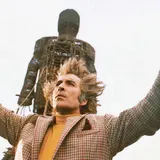
Right, right. Because if you don't, we're going to actually have to offer up ourselves into the Wicker Man.
All right, so now we're just going to dive into it. We're going to give you basically everything there is to know across the ancient and medieval record about the Druids. There are many references to Druids in ancient and medieval texts, but very few of them go into the kind of vivid detail that we would like. So, really, the kind of general theme here is that everybody, especially in the Greek and Roman world, knew that Druids existed, but they weren't necessarily super interested in who the Druids actually were. And I think this is a general pattern we see with the Hellenistic Greco-Roman perception of barbarian peoples. There was this heavy reliance on assumptions and stereotypes, oftentimes stereotypes that were carried through for centuries. And these stereotypes may or may not be useful for actually understanding these peoples and their practices.
Who were the Celts?
So let's go into the Celtic world. We should start by mentioning that, you know, the word Celtic today is obviously associated with Ireland, Scotland, and Wales, perhaps to a lesser degree, the French region of Brittany. And this is due to the tenacious survival of modern Celtic languages, mostly along the Atlantic coast. This so-called Celtic fringe is generally rocky and rural, as both the advantages of geography and disadvantages of economy helped preserve these languages despite centuries of domination by English and French. But this episode isn't going to be concerned entirely or exclusively with those regions. We're also going to focus on the more populous lowlands of Britain and Gaul before those places became known as England and France. Because unlike the Celtic fringe, these lowland regions were of much greater interest to the Roman Empire and became very rapidly Romanized. Due to some combination of education, immigration, and oppression, the Roman Empire appears to have completely eradicated the ancient Celtic languages of the European mainland.
Breton, spoken in Brittany, was actually introduced back to the mainland by Welsh-speaking refugees from across the English Channel. But long before the Romans came to Gaul, a vast gradient of Celtic languages was spoken across essentially all of Western and Central Europe. A merchant could travel from the tip of Scotland all the way down to France and Spain, then curve up through northern Italy, Switzerland, Germany, Austria, dealing entirely with fellow Celtic speakers along the way. And should this merchant ever visit Anatolia, that's Turkey today, he would even meet a small pocket of Celtic speakers in Galatia, named after the Gauls. The dominance of the Celtic languages as well as architectural styles in this pre-Greek and Roman period in Western Europe is so profound that archaeologists often consider the Western European Iron Age as the Celtic Age. But before we get deeper into Celtic cultures, especially the Celtic religious tradition of the Druids, there is the obligatory disclaimer that there is zero evidence that ancient Celtic-speaking peoples ever saw Celt as any kind of unifying identity at all.
They probably would have recognized the linguistic kinship from Britain to Ireland to the Celtiberians in Spain and all that, but this doesn't necessarily imply any sense of kinship. The Romans used the words Celt and Gaul largely interchangeably, but the peoples of Britain and Ireland were never called Celtic by ancient writers. In this episode, we're going to say the words Celtic and Celt a lot, always to refer to people who spoke Celtic, various Celtic languages. But we shouldn't assume that one Celtic speaker in one time and place is interchangeable with another. A swordsman in Spain in the 4th century BC inhabited a completely different universe than a 10th century monk shivering on some rock in the Irish Sea. Additionally, we know from both archaeology and archaeogenetics that the spread of the Celtic languages wasn't some huge replacement event. We can't assume that everything Celtic is derived from a single primordial source, because people have lots of different ancestors and often bring various cultural elements from very different sources.
So again, there is really no evidence that the Celts as a group ever really existed. They were really hardly even conceived as such by outsiders.
Yeah, in fact, instead of looking at themselves through this lens, they probably would have viewed themselves based on their tribal, regional, and especially familial identities and allegiances. If we are to jump forward a thousand years, we can see that the Romance speakers in medieval France did not believe that linguistic similarity bound them any closer to Sicilians than to the Germans. So, once we accept that the word Celt is only really useful as a linguistic designator, we really have to acknowledge that we can't assume any cultural practice described in Belgium or the Alps was also happening in Britain or Ireland. In the 18th and 19th centuries, historians were much more cavalier in describing the so-called Celtic race. But this understanding is completely modern, and it would be alien to the ancient Celts themselves. Our whole usage of the word Celtic is really tangled up with the really long history of oppression of supposedly Celtic modern peoples by the British, which then led to the first victims of British imperialism-the Welsh, the Scots, and especially the Irish-to embrace Celticness for themselves and to create a Celtic identity contrary to the British.
But as we're going to see, this identity had a lot less to do with the ancient Celtic peoples than the nationalists would have liked to believe.
Lug, Mercury, and Gobannus
Right, and so for all of those reasons, describing the Celts in broad strokes is really difficult. Contemporary scholars are hesitant to offer up any universal religious or cultural traditions that can be found everywhere across the entire Celtic-speaking world. But there are a couple concepts that do seem to be pretty widespread across both time and space. We know from a handful of inscriptions and place names that a god named Lug was central to the religious life of the Celtiberians in Spain and also worshipped by the Gauls all across France and Switzerland. The French city of Lyon, in fact, comes from the Latin Lugdunum, probably derived from the older Celtic name meaning hill of Lug. And then centuries later, medieval Irish writers recorded a mythical hero also named Lug, long believed to be a cognate of this ancient god. Who Lug was and what his worship entailed is a lot more difficult to answer, but he might be the same god described by Julius Caesar in his typically Romano-centric rundown of Gaulish religion.
Caesar writes, The god they revere most is Mercury. They have many images of him, and they regard him as the inventor of all arts, the god who directs men on their journeys and the most powerful helper in trading and getting money. Next to him, they revere Apollo, Mars, Jupiter, and Minerva, about whom they have much the same ideas as all the other nations. So if you listen to our previous episode about the artisans, you might find the Mercury part more than a little interesting. It seems that at least among the Atlantic coast, the Celtic-speaking peoples were probably somewhat Mercurian because they had extensive trade networks connecting modern-day Spain, France, and Britain. Meanwhile, further inland, the Celtic peoples ferried luxury goods like metal pots and swords across much of Europe, probably following organized roads that predate the Roman Empire. So this might be another general trait of ancient Celtic-speaking peoples.
A high value on trade, particularly in metal goods. The Gaulish god Gobannus, who like Lug, probably also has a descendant in the later Irish mythology, was associated both with blacksmithing and travel. An ancient Celtic inscription in the Swiss city of Bern records in Greek letters the following prayer to Gobannus, the world traveller, dedicated by the people of Brenodor in the Aare Valley. This emphasis on trade might be a clue of how the Celtic world first emerged.
Yeah, there's actually a really cool metal statue of Gobannus at the Getty Villa Museum in Los Angeles, and I gotta wonder if maybe, you know, the placement of that statue might be part of why that museum was you know miraculously protected during the fires that just happened.
Well, I mean, we certainly can't disprove that.
So, oh, yeah, but anyways, yeah, the spread of Celtic languages from Central Europe to the British Isles was not an unimpeded occurrence. Celtic languages out-competed their neighbors, some of which were closely related Indo-European dialects, while others, especially Basque and Iberian, were completely foreign. Just like the Celts' Bronze Age ancestors, the Bell Beakers, who we've discussed a few times on this show, the Celts established a new linguistic and material paradigm, what people call an archaeological horizon. Somehow, without widespread usage of writing or any organized governments, the ancient Celts managed to spread their language and material goods across much of Iron Age Europe, encompassing a cultural area even greater than the Roman Empire.
Hallstatt and La Tène
So, this is all very contentious, but the most popular theory is that at the start of the Iron Age, the spreading of the Celtic languages probably had something to do with the proliferation of the Hallstatt culture out of Austria, named for a tiny salt mine which was sitting underneath the most infamously picturesque town in the modern Alps. Hallstatt was clearly an international center even before the travel vloggers discovered it, as it was the major mineral depot as far back as the 12th century BC, around the same time that the Bronze Age world of the Near East was collapsing. Very slowly, across the next 600 years, a shared package of technologies and techniques spread westward, including the potter's wheel, the earliest known wagon tires, and of course, iron swords and armor. By 500 BC, the Hallstatt package could be found across the Alps in southern Germany, all of France, and even Britain and northern Spain.
In southern Britain, this archaeological shift was associated with the genetic pulse of new ancestry from France and probably led to the spread of Celtic languages into the Isles. And there was certainly at least some element of violent conflict to this expansion. Nora Chadwick, who spent 70 years researching the ancient Celts, wrote that they were uniquely skilled blacksmiths whose swords had no peer among the barbarian peoples of Europe. The Spanish city of Toledo has a famous blade industry to this day, apparently going all the way back to the Celtiberian artisans who came to the attention of both Rome and Carthage in the 3rd century BC. According to Chadwick, the Celts developed new, stronger axes, which allowed them to more easily clear dense forests, opening up new land for settlement and leading to a higher rate of natural population growth. Felled trees were then used to build hill forts, the famous oppida or castra, as described by the Romans.
These hill forts were halfway between castles and cities, with populations anywhere between 100 and 10,000, the vast majority of whom would not have been warriors, but civilians. And then, around 400 BC, after several centuries of contact with the Mediterranean world, the Hallstatt culture gave way to a new archaeological horizon, La Tène. For reasons nobody can really explain, the Celtic-speaking craftsmen leveled up their skills overnight, and the simpler styles of the early Iron Age developed into beautifully intricate art and jewelry. There is really a huge emphasis on naturalistic curves and patterns derived at least partly from Greek and Etruscan techniques. In Gaul, we also begin to see hill forts shift into walled towns, possibly built in imitation of the Greeks, with planned streets and larger buildings, indicating a specialization of labor and a widening of the class divides. This La Tène period may very well be when an organized priestly caste who became the Druids was first codified.
Bards and oral tradition
And this really brings us to the last real universal element of the Celtic cultures from the Roman era right up until the present. This is the reliance on oral tradition and the deep reverence for poets and storytellers. There is obviously nothing uniquely Celtic about storytellers being very important. You can see this in West Africa and the Caucasus and Scandinavia, in ancient Greece, of course, with the traditions of Homer and etc. The list can just keep going on. But many of the same Roman sources that describe the Druids also mention bards as a separate but similar class. The English word bard, in fact, comes from either Welsh or Scottish Gaelic, and the plural form bardoi is seen in the Latin sources. So the ancient and medieval evidence indicates that a special social position of poets and storytellers existed. Romans apparently hired or violently acquired Gaulish rhetoricians to teach their children, and even English writers who hated the Gaelic-speaking Irish marveled at their musical abilities.
Right, and this Celtic obsession with oral history and the oral tradition can be pretty frustrating today. Because while early Christian writers in Ireland and Wales recorded some accounts of their prehistory, in essentially every other part of Celtic Europe, the Celtic tradition, the oral mythological tradition, completely vanished. We have no surviving Celtiberian legends from Spain, no legends of the Noric peoples of Austria. Essentially, nothing can be reasonably called Celtic on continental Europe today, except for the region of Brittany, which again is only Celtic-speaking because of this back migration by the British. First, the Roman Empire and then the Roman Catholic Church were responsible for really erasing the linguistic and mythological heritage of the Celtic-speaking peoples, and this heritage obviously includes the institution of the Druids. It's possible that much of the Druidic tradition was already dead by the time some of the Roman sources we're about to get into were describing them.
Because the ancient Celts left us essentially no writing, just a few mysterious curses, we instead have to rely on whatever the Greeks and the Romans decided to jot down.
Greeks and Gauls at Massalia
Celtic encounters with the literate world of the Greeks and the Romans began long before Roman writers actually described the Celts. Some Gauls, led by a man named Brennus, invaded Italy and sacked Rome in 387 BC, and his followers would dominate northern Italy for the next few centuries. Another Brennus invaded Greece and the Balkans a century later. His followers eventually settled in a small patch of Asia Minor, that is, Turkey, leading to a region being called Galatia for hundreds of years. And although Greece proper is very far from Gaul, Greek merchants and colonists were in very close proximity to Celtic speakers from an incredibly early date. In 600 BC, when Rome and Athens were just large villages ruled by tyrants, some Greek settlers from Asia Minor established the port of Massalia on the Mediterranean coast of Gaul, today the famous French city of Marseille. According to one obscure Roman historian Justin, the Greeks first came to Rome during the reign of King Tarquin the Elder.
This would have been just before Rome became a republic. He probably wasn't too happy to host these newcomers because the Greeks were, quote, forced by the meanness and poverty of their soil to pay more attention to the sea than to the land. They eked out an existence by fishing, by trading, and by piracy. And so, like many later monarchs, Tarquin turned these pirates into privateers, sending them to raid Rome's enemies, the Gauls. But like so many other travelers in the French Riviera, as soon as they landed in southern Gaul, they immediately fell in love with the place and its people. The leader of these Greek pirates, a man named Protus, won the heart of the Celtic princess Gyptis at a banquet, and upon their marriage, her father bequeathed the land that would become Massalia as a wedding present. And just like we're going to see with so many other Roman accounts of Gaulish life, Justin was writing long, long after the events, which may or may not have transpired, happened.
In fact, perhaps as much as 800 years later, he was a historian of late antiquity describing the deep ancient past. But Justin's source was an earlier, now lost account by Gnaeus Pompeius Trogus. Trogus was an elite Roman who had lived a few centuries earlier to this story. He was also Gaulish, and he came from the region of Gallia Narbonensis, which was incorporated into the Roman Republic well before the rest of Gaul, and he may have spoken Gaulish as a first language. His family were the Gaulish elites who supported Rome shortly after the conquest, and thus he seems to have had a foot in both the Roman and the Celtic cultural world.
Romanizing the Gauls
Right, and so, you know, by the like late centuries BC, there was so much cultural influence from both Rome and the Greek colony of Massalia that the southern Gauls of Italy, France, and Spain were in constant contact with their Hellenistic neighbors. This leads to some really interesting cultural influences from the Mediterranean into the Celtic world, and also some cultural differences, because at this time, the peoples of Ireland and Britain would have had basically no contact with Hellenistic civilization at all. Celtic peoples in northern Italy, the Po Valley region, were known as Toga-wearing Gauls even before Roman armies crossed the Alps. As early as the 2nd century BC, Celtic towns in southern Gaul began using masonry and urban planning techniques directly borrowed from the Greeks, possibly with the help of hired Greek laborers from Massalia. Gaulish tribes were major trading partners of the Roman, especially of metal ore.
And even before Caesar's conquest, Gaulish slaves were a huge part of the Roman Republican labor force. Meanwhile, Celts in Spain and Austria produced some of the world's earliest steel, and the Austrian kingdom of Noricum was so Romanized in its culture and economy that they apparently willingly joined the empire rather than being conquered. Meanwhile, the French region of Provence, which is the whole region around the city of Massalia, Marseille, became part of Rome when it was still a republic. The name Provence comes from the fact that it was simply one of the first Roman provinces. That means a territory governed by an appointed governor, not governed by its own citizens. Even the names that we use for these ancient Celtic peoples are a result of Mediterranean contact. The Latin word Gallic comes from the Greek Galatian, which the Greeks believed meant milkskinned. The word galaxy, the Milky Way, has a related origin, but the milk connection might be an ancient folk etymology.
Instead, the name Galatian might have been a local name used by a band of Gauls who invaded Asia Minor and established a territory called Galatia. The Greeks began using this name, which referred to a specific tribe to describe all Celtic speakers, and the Romans, as always, followed the Greek lead. Meanwhile, the word Celt, Celtoi, in Greek, was used in earlier Greek sources. According to Caesar, this name was used by some of the Celts themselves, but again, there is really no reason to believe that there was a catch-all used by all or most Celtic speakers. Similarities in language or mythology might mean a great deal to modern scholars, but they were not necessarily remarked upon by the ancient peoples themselves. But confusingly, the English word Gaul has no apparent connection to the words Gallic or Galatian. It's from an Anglo-Saxon word for foreigner, which is related to the names Wales and Wallachia.
By the first century BC, the Greek and the Roman influence would affect all aspects of Celtic life, at least among the Celts in the Western Mediterranean. And this, of course, included their religious beliefs and the institution of the Druids.
The Greek sources
Right, and so now we are really getting into our discussion of the Druids, you know, deep into this podcast, but we're here. Okay, so again, nothing, absolutely nothing, comes to us from the mouths of the Druids themselves. So instead, we must rely almost entirely on the accounts of the people who destroyed the Druids, often writing long after the fact. As Barry Cunliffe, probably the most important living Celtic historian, puts it: The Roman fascination was tinged with fear, tempered with a degree of respect for Celtic prowess in battle. Later generations, further removed from the reality of the barbarian Celts of the first millennium BC, generated their own myths and stereotypes about the past, recreating Celtic ancestry for themselves in the image of the day, designed to explain their own attitudes and aspirations and to prove a legitimacy for later actions. A crude modern-day comparison might be the role that Native Americans play in the minds of non-Native Americans.
They are safely in the past, so we can emulate or idealize them, even though we, in fact, destroyed them as best as you know, the American Empire goes.
Exactly. So long before the Romans conquered Gaul, many Greek writers describe the Celtic people they encountered in the Western Mediterranean, especially around Massalia. Even Plato makes a passing reference to the hard-drinking Celtic warriors, and Aristotle describes how they would endure freezing weather in very little clothing as a test of endurance. Two big Greek sources describe the Gauls' religious rites. These were an Egyptian Greek named Sotion of Alexandria and a Syrian Greek named Posidonius. That's were, not are, because both Sotion and Posidonius' writings are only known from later Romans who paraphrase them. Sotion described the Druids and his succession of philosophers from around 200 BC. And this is one of the most maddening losses of the entire ancient world because it described not the Greeks and the Romans, of whom we know quite a bit about, but all the peoples of the ancient world, most of whom we know very little about.
Sotion described the Druidas of Gaul and Galatia, possibly putting them on the same level of sophistication as the Zoroastrian Magi of Persia and the holy men of India. Sotion may have been the first source to describe the Druids as Pythagorean. This does not mean that the Celts were really into triangles, but instead they believed in something similar to what was expressed in Pythagoras' philosophical work, which again is lost.
Pythagoras and reincarnation
Right, and so what we can say for certain is that Pythagoras believed in metempsychosis, which is the Greek term for reincarnation. Anybody who's read a lot of James Joyce knows that word. This belief was not widespread among the Greeks at all. But Pythagoras, one particular Greek, was so well known that everybody in the Greek world had some understanding of this reincarnation doctrine, even though they thought it was ludicrous. Because come on, everybody knows that when you die, you go to Hades, obviously. The place that this belief was widespread, however, was in fact in Gaul. Because if you asked a Greek or a Roman to describe the Gauls, they'd have a very quick list of stereotypes. They wear pants, they have mustaches, they spike up their hair with chemicals, and upon their death, they believe their souls will be born again to walk the earth anew. Those first three stereotypes are clearly derived from military encounters between the Greeks and Romans and the Celtic peoples.
Their warriors made a big deal about being intimidating to their urbane enemies, and a long stash was apparently a sign of in-group identification, just like a mustache is today for vinyl enthusiasts and history podcasters. But reincarnation also had a martial significance as well, because this belief, you know, metempsychosis, apparently gave the Gauls a near-unparalleled bravery in battle. They fought much fiercer than their civilized, wine-sipping Mediterranean enemies, because they knew that if they fell, they'd just be born again and could seek revenge 20 years later when they grew up. Greek writers apparently recognized the similarity of these beliefs to those of the Indian philosophers, the gymnosophists, who we would probably now identify as Hindu or Buddhist or somewhere in between. The Greeks speculated that Pythagoras might have learned his beliefs about metempsychosis from a foreign teacher, and this teacher may have been either Indian or Gaulish. But given what we know about the history of Celtic and Greek relations, I would say it's much more likely that some Pythagorean learning could have trickled up from the colony of Massalia into the Gaulish heartland.
It is very possible that if not for the establishment of this Greek colony, supposedly by Protos in the 7th century BC, the Druids may never have existed. But the other, possibly more likely answer is that reincarnation is a common, somewhat intuitive idea that has popped up in many different times in many different places. But I think that's not as fun.
Posidonius
Our other Greek source is Posidonius, and he wrote about a century later. While Sotion may have spent his entire life in Egypt, for all we know, Posidonius was one of the most widely traveled men of his era. He died before all of Gaul became a Roman territory, but when the Mediterranean coast and the Greek city of Massalia was already under Roman hegemony, the Roman province that became the French region of Provence.
Yes, exactly. And this means that the Celts that he met were already Roman subjects, and some of them even Roman citizens. And the practices he describes may have been the practices of a generation before. And there is also, of course, another very frustrating filter. Posidonius' works do not survive and is just referenced by the later writers. But what we can say with some certainty is that Posidonius observed a Celtic obsession with severed human heads, including the use of skulls as decorations. Recent archaeological evidence resoundingly affirms this. Posidonius recognized that the Celts paid a great respect for their holy men, the Druids, who were the priests and astronomers and diplomats all at once. He might have described some druidic association with nature, which is certainly a major part of the modern association with druids and can be seen in greater Roman works as well. But again, we have no way of knowing for sure.
We also begin to see in Posidonius the darker side of the Celtic-Mediterranean relationship. The Hellenistic Greeks and the Romans did not see the Gauls as their equals, and they were very eager to exploit them. Here's one particularly poignant passage from Posidonius, preserved by the Sicilian Greek writer Diodorus. Quote: They are extremely partial to wine and glut themselves with the unmixed wine brought in by merchants. Their desire makes them guzzle it, and when they get drunk, they either fall into a stupor or become manic. For this reason, many Italian merchants, with their usual love of money, regard the Celtic passion for wine as a source of treasure. They transport the wine by boat on the navigable rivers and by cart through the open country, and they get an incredibly good price for it. For one amphora of wine, they get a slave, a servant in return for a drink.
Right, you know, I gotta say, you know, this is obviously very reminiscent of, you know, later descriptions of colonized peoples from all over the world. That, you know, they're so dependent on the alcohol that we give them that they can't even rule themselves. And, you know, I'm sure it's true that the Gauls were hard drinkers. This was such a strong stereotype, it probably did reflect some reality. And, you know, we know archaeologically that there was plenty of ale and wine alike being consumed by the Gauls. In fact, I believe barrels were actually invented by later Roman Gauls for this purpose. But, you know, keep in mind, like, you know, as we talked about in our episode with our friend John, wine gods are very common across the ancient world. The Gauls were not the only hard drinkers around.
What if they were turd turbo-normies who got hard once-shotted by the wine?
Julius Caesar's Gallic War
You might be right. All right. So, those are the two pre-Roman Greek sources. Let's move on now. There's one really major early Latin source about the Druids, which in fact comes to us from the most famous Roman of them all, that being Julius Caesar. Caesar, who is as much of a genius with public relations as with battle tactics, wrote a detailed memoir of his conquest of Gaul while it was happening. De Bello Gallico is one of the most important sources in all of Roman history. It's also one of the only surviving texts by any great historic general. And obviously, it is entirely written to boost his own career. Caesar had a very clear agenda in trying to promote himself as a uniquely skilled conqueror who was doing something that was justified. A very violent conquest of a very large place. This is a lot for any country to have to deal with.
So his description of Gaul and specifically of the Druids needs to be understood in light of his complicated political motivations. This book needs to be read in the same way that you would read a politician's book before an election.
It's like basically an attempt to do the exact same thing, right? Where Caesar is like amping himself up.
No, no, right. Yeah, because it was absolutely part. Yes, it was part of his internal political rise, and it was justifying a very risky and potentially extra-legal action of the Roman military. So yeah, no, 100%.
Yeah, and it was written in this super accessible style, and it's still used to this day as like the first book you read in Latin because Caesar's text is so approachable, which suggests that it had a popular audience in mind, you know?
Yeah, absolutely. Yeah.
And so Caesar's account, written in plain Latin and in third person for added gravitas, presents the Gauls in vivid detail as both allies and enemies. On one hand, as barbarians who are too primitive and too drunk to rule themselves, yet at the same time, as future Roman citizens who had already had some taste of civilization. Caesar explains that the Gauls had been ruined by access to Roman luxuries, especially wine, stripping them of their famous pride and warrior spirit, and leaving them open to attacks by an even more wild barbaric people, the Germani across the Rhine. The only rational solution is for the Romans to take all of Gaul in the interest of the defense of the Republic and perhaps even the well-being of the Gauls themselves. Caesar, of course, used this book to argue that he alone was the only person capable of leading this invasion, and he formulated an argument that would be revived 1500 years later by the Spanish Empire and then 2,000 years later by the American Empire, that being that his conquest was in fact a humanitarian intervention.
Because you see, the Gauls, just like many other ancient peoples, the Greeks, the Romans, the Israelites, they believed in the power of sacrifice. However, the Gauls did not limit their sacrifice to that of sheep or oxen. And in fact, they may have preferred the most valuable flesh of all, that of men and women. The Romans saw human sacrifice as the ultimate mark of barbarism. Caesar describes the wanton bloodletting of the Gauls in lurid detail. Both friend and foe were offered up to the glory of the gods under the Druid's blade.
The wicker man
But in their most horrific sacrifice, no blade was swung at all. This is perhaps the most enduring legacy of Caesar's text beyond its first sentence about Gaul being three parts. This section is Caesar's description of the wicker man.
The nation of all the Gauls is extremely devoted to superstitious rites, and on that account, they who are troubled with unusually severe diseases and they who are engaged in battles and dangers either sacrifice men as victims or vow that they will sacrifice them and employ the druids as the performers of these sacrifices because they think that unless the life of the man be offered for the life of a man, the mind of the immortal gods cannot be rendered propitious. And they have sacrifices of that kind ordained for national purposes. Others have figures of vast size, the limbs of which form the willow branches that they fill with living men and which they set on fire. The men perish enveloped in the flames. They consider that the oblation of such as have been taken in theft or in robbery or other such offense is more acceptable to the immortal gods.
But when a supply of that class is wanting, they have recourse to the oblation of even the innocent.
Right, right. So, you know, so he's really emphasizing in a little detail the way that they would burn people alive in this horrific human sacrifice. But, you know, remember also that earlier passage of how the Gauls worship much the same gods along the same lines as many other peoples. So what Caesar is doing here is something, it's a really kind of funny argument. He's arguing that the practice of the Gauls is absolutely barbaric and needs to be suppressed. However, the beliefs of the Gauls are not too different from the beliefs of other peoples. Therefore, he needs to conquer the Gauls to put an end to this, you know, horrible sacrifice. But once he does that, it's not going to be too difficult to turn the Gauls into Romans.
Yeah, and I mean, adding another parallel here, the Romans themselves had a history of human sacrifice to one degree or another, which was familiar to the antiquarians of that period, I would think. And, you know, some vestiges of this practice persisted even into Caesar's day. So, for example, one particularly famous practice was if a Roman general was losing a battle, he would sometimes utter a prayer to Mars, the god of war, and like throw himself upon his sword as like a sacrifice to bring his army victory. And sometimes, you know, that would amp the army up enough to win, I guess.
Yeah, no, that's true. So we shouldn't see, yeah, yeah.
Yeah, so he's basically saying that, like, you know, we like, sure, these people are barbaric now, but we were that way until very recently as well. So there's no reason why they can't become a part of us.
Druids, equestrians, and the archdruid
Right.
No, yeah. And so in other texts, he kind of describes the Druids along similar lines to either a Greek philosopher or a Roman priest, a pontiff. And he also describes the aristocrats of the Gauls as equestrians. And he says that, you know, among the Celts, there are these two big classes, the equestrians and the Druids, that are both considered very important. And I think that his use of the word equestrian is very interesting because this was a social class in ancient Rome. It was the lower nobility, just below the patricians like Caesar. So I think what he's trying to say here is they already have their own aristocracy. They're, of course, not as, you know, important as us Roman aristocrats, but we can easily work them into our own aristocracy. They'll just be below you and I. So as per Caesar, who may be drawing on the works of Sotion and Posidonius, as well as his own experiences, the Druids were a learned order and maybe even a secret society who trained since childhood in law, astronomy, and prophecy.
Druids were the only Gaulish men who didn't fight, as they were too busy serving as clerics and pondering the stars and the immortal soul. They oversaw all religious rituals among the Gauls, not just human sacrifice, and they mediated disputes between private citizens and even rival tribes and kingdoms. The most tantalizing detail in Caesar is that the Gaulish Druids took cues from the Druids over in Britain. Gauls would even travel across the English Channel to study the Druidic arts, which were supposedly preserved in a purer form there. Every year, all the Druids gathered for a major festival in the middle of Gaul, where they arbitrated issues between the tribes and probably also oversaw some kind of sacrifice. And just like the Roman pontifex or the Catholic leader of the same name, all the Druids were under the authority of one single archdruid. We should mention that Caesar also insists that none of this kind of organized worship exists among the even more barbaric peoples of Germania over the Rhine.
One other little bit about Caesar here, actually given to us by the later writer Lucan, suggests that Caesar anchored some Gaulish priests, who we can probably assume were druids, in the Roman province around Massalia before he conquered the entire region proper.
Lucan's sacred grove
According to Lucan, Caesar ordered his troops to enter a sacred grove where interlacing boughs enclosed a space of darkness and cold shadows and banished the sunlight far above. Gods were worshipped here with savage rites. The altars were heaped with hideous offerings and every tree was sprinkled with human blood. When these gruesome tree trunks were dropped down, fire shot out from inside the woods and serpents slittered on the grounds. Just another looking colorful, you know, way of just to see how exactly the Romans perceived of druidic worship.
Diviciacus and divination
So, through the works of Caesar and Cicero, who is perhaps the second most famous Roman, exactly one specific druid is known to us by name, Diviciacus, who was the ambassador of the Aedui of the Western Alps. Now, little side note: ambassador is actually one of the only Gaulish words preserved in English today. Diviciacus was from an elite family, and despite Caesar's note that the Druids were exempt from military service, he led troops as an ally of the Romans in Gaul, even clashing against his own brother, the chief Dumnorix. Diviciacus wowed both Caesar and Cicero with his relentless stream of prophecies, often drawn from his analysis of the movement of birds in the sky. And later Roman sources about the Druids paint a much more colorful picture of druidic divination. Diodorus explains that they, quote, observe a custom which is especially astonishing and incredible, in case they are taking thought with respect to matters of great concern, for in such cases, they devote the death of a human being and plunge a dagger into him in the region above the diaphragm.
And when the stricken victim has fallen, they read the future from the manner of his fall and from the twitching of his limbs, as well as from the gushing of the blood.
Not pleasant at all.
According to the Romans, different peoples had different specializations for kinds of divination. So while the Etruscans were famed for their haruspicy or reading the livers of animals, this is what the Gauls were up to, supposedly. He also explains, you know, on kind of a nicer note, that, you know, they didn't always lead to bloodshed.
Bards between armies
Oftentimes, the Druids prevented bloodshed, because the druids had so much spiritual authority that they could convince two fighting armies to lay down their arms. Interestingly, Diodorus tells us this was something that they shared with a third social class among the Celts. These are the bards we've mentioned earlier. He writes that the Gauls are terrifying in aspect, and their voices are deep and altogether harsh. When they meet together, they converse with few words and in riddles, hinting darkly at things for the most part, and using one word when they really mean another. And they like to talk in superlatives, to the end that they may extol themselves and depreciate all other men. They are also boasters and threateners, and are fond of pompous language, and yet they have sharp wits and are not without cleverness at learning. Among them are found lyric poets whom they call bards. These men sing to the accompaniment of instruments, which are like lyres, and their songs may be either of praise or of obloquy.
In their wars as well, they obey before all others these men and their chanting poets, and such obedience is observed not only by their friends, but also by their enemies. Many times, for instance, when two armies approach each other in battle with swords drawn and spears forward, these men step forth between them and cause them to cease, as though having cast a spell over a certain kind of wild beast. In this way, even among the wildest barbarians, does passion give place before wisdom? And Ares stands in awe before the Muses.
Strabo's island of women
The Roman-era Greek writer Strabo, whom once again may be quoting from the earlier Posidonius, gives us some further detail about the Druids and Gallic religion more broadly. His best anecdote is that there was supposedly an island of sorceresses in the Loire River. He believed that these women were not Druids and not even Celtic, but instead colonists from the Samnite people who had lived near Rome. This was probably due to confusion with the Celtic tribe of a similar name. If this island really existed, the inhabitants prohibited any man from entering and would cross the river only to find husbands and become pregnant. Every year, these women did a strange ceremony where they dismantled and rebuilt their own temples. If one of the women dropped her tools, the other woman would immediately attack, brutally chopping her to pieces. Strabo believed, however, that this whole thing was stage-managed. It was a really carefully planned sacrifice, and one woman was selected to deliberately drop her tools so that they could kill her.
It's a great story and totally has the makings of an indie horror film from A24, but it could be completely fictitious. Strabo was writing when Gaul was a Roman province, and he says by this point, the island of women was no more. In 43 AD, around 20 years after Strabo died, the Romans invaded Britain, bringing us back to Tacitus and Boudica, as well as the Druids chanting on the shores of Mona.
Pliny and the mistletoe
The most important surviving ancient source on the Druids after Caesar and Tacitus has to be Pliny the Elder, writing around 70 AD. Pliny was really an ancient scientist who was deeply concerned with the functions of the natural universe. This meant to him the cosmic beliefs of the Druids were a lot less important than their interest in plants and wildlife. His description of the British religion really gives us the contemporary image of the Druids, from 19th-century Romantic literature to Druids as the Dungeons and Dragons class.
Right, and so Pliny writes: The Druids, as they call their wise men, hold nothing in greater reverence than mistletoe and the tree trunk upon which it grows, so that it be an oak. They choose forests of oak for the sake of the tree itself and perform no sacred rites without oak leaves, so that one might fancy they'd even been called this reason, from the Greek word drys into druids. But whatever grows upon these trees, they hold to have been sent from heaven and to be a sign that the deity himself has chosen this tree for his own. This thing, however, is rarely found, and when mistletoe is found, it is gathered with much ceremony. Addressing the mistletoe in their own language by the epithet of all healing, after duly preparing sacrifices and banquets under the tree, they bring to this spot two white bowls, the horns of which are then for the first time garlanded.
The priest, clothed in a white dress, ascends the tree and cuts the mistletoe with a golden knife. It is caught with a white cloak. Thereupon, they slay the victims with a prayer that the deity may prosper his own gift to them, to whom he has given it. They fancy that by drinking this mistletoe, fertility is given to any barren animal, and that the mistletoe is a remedy against all poison. The line about the white dress has stuck with us and every artistic depiction of the Druids since then, although we should note that it might not have been a uniform, but just a regalia of certain ceremonies. The association with oak is also a huge part of the modern druidic image, yet Pliny is the only author we know this from. There is one class detail in Pliny that survives in 20th and 21st century media: that at certain sacred rites, the young British women would dance naked, their bodies covered in the blue woad dye.
Scholars have noted that Pliny is much more interested in the nature worship of the Druids than any other writer. Other sources mention that the Druids worshipped in sacred groves, but that was kind of standard in the ancient world. The Greeks and the Romans had plenty of groves of their own, and we here in Gladio think that this is the result of Pliny's own fancy. He was a naturalist himself, but another theory proposes that after the conquest of Britain, the Druids had to retreat from the hill forts into the woods, losing their status as legitimate religious leaders and becoming a secret order of dissidents against Rome, who studied nature because they lived in nature. It's a romantic idea and not impossible, but just like everything else we talked about in this episode, totally a matter of conjecture.
Right, and we should mention that Pliny himself never stepped foot in Britain.
Banning the Druids
He spent a lot of time in Gaul, but probably never even met a druid in Gaul, because he records that under the emperor Tiberius, all druidism in that region was banned. Although Pliny doesn't go into too much detail about Celtic human sacrifice, he expects his audience to be very familiar with this lurid aspect of druidic practice and says that the world will thank Rome for ending the monstrous cult whereby the slaughter of a man was an act of great piety and to eat his flesh most beneficial.
Interestingly, Tiberius, who apparently banned the Druids, was also the emperor when Jesus would have been killed. So it's possible that there might have been this general mood of hostility toward secret foreign cults in the early imperial period. I think also that there was probably a popular interest among the Roman people in these cults at the same time. You know, and we're going to see in the next episode that a lot of people have attempted very clumsily to associate the druids with Christianity. I don't think there's any actual direct connection at all, but I do have to wonder if there might be these similar structural elements that led to Greek and Roman writers perceiving these two foreign religions in somewhat similar terms and having a similar interest, sometimes a lurid, morbid interest, in both of these religions. Even on the point of human sacrifice, historians have pointed out that stories of druidic sacrifice actually mirror early false stories circulated about Christians and Jews.
Pliny's offhand reference to Gaulish cannibalism is also a little bit sus, because if the Gauls really were cannibals, we'd expect at least one other source to mention this. So, due to this clear bias and the fact that there was apparently this mood both of fascination with foreign religions and suppression of foreign religions, some 20th-century scholars tried to make the case that every story of Celtic human sacrifice was a fabrication. It was entirely part of a propaganda war to first justify the invasion of Gaul, and then to justify the suppression of an institution which would have been a major rallying point for anti-Roman resistance. However, this, you know, kind of more positive spin on the druids is less defensible in light of the material record.
The archaeology of sacrifice
Right.
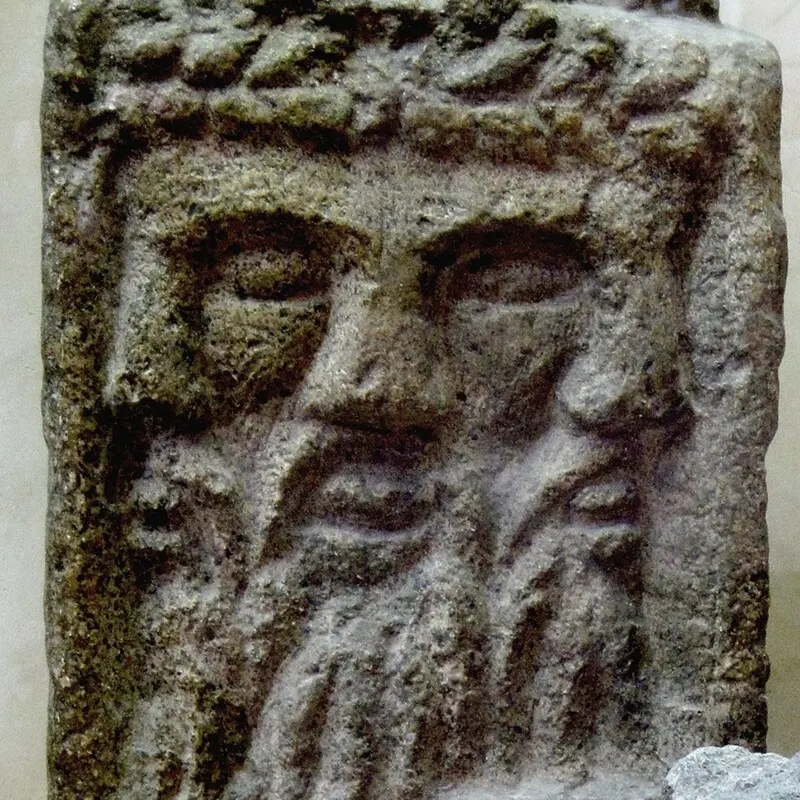
Three sites in France suggest that the religious life of the Gaul was about as morbid as the Romans indicate. At the Roquepertuse Acropolis, three pillars were topped with Greek-style statues of cross-legged men in armor near a mysterious sculpture of a three-faced god. Each of these pillars had a carved recess into which a human skull was placed. These skulls might not necessarily have been victims of human sacrifice, but it suggests this very interesting ritual association with the corpse and possibly with killing.
It's possible that these skulls were of renowned druids, not of the victims of murder, you know, because centuries later, Buddhist monks in Japan and Tibet would bequeath their bodies and body parts to be used as ritual objects. This was a great honor. Some of this, you know, reverence of skulls was a great honor, but the larger sites of Gournay-sur-Aronde and Ribemont-sur-Ancre seem less respectful in their treatment of the dead. Gournay and Ribémont are both in northeastern France and may be associated with the ancient Belgic people, whom may not have spoken a Celtic language at all. However, the Belgae were considered to be Gauls by Roman contemporaries, in contrast with the British, who were not. Both of these sites are mud-brick temples surrounded by a wooden wall, and you know, the fact that these were organized temples at all suggests that druidic worship was not necessarily as nature-focused as other sources suggest.
At Gournay, 2,000 suits of armor were arranged over a mass of broken bones. While most of these were sheep and cattle bones, closer inspection revealed some of them to be the remains of humans. Ribemont is even more gruesome. 80 headless corpses were arranged inside the temple, held up on sticks. Their heads may have very well been used as ritual items or decorations elsewhere. And at the center of this site was a crematorium made from cement that used as an ingredient human bone dust. One theory is that the honored dead of this druidic cult were burned in this morbid kiln, while the dishonored dead were left to rot in the hall. We should mention that these sites are really unusual and geographically specific. They might indicate a local tribal belief, or they could suggest that some Gauls, presumably the Druids, practiced rituals that were secret or at least not part of the general worship.
Greek and Roman sources emphasize that the Druids had to spend decades studying hidden knowledge. They might have been an ancient society whose beliefs and practices were generally unknown to the rest of the Gauls.
Lindow Man
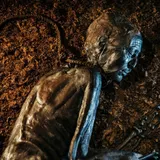
But similar sacrifices likely took place in Britain as well. Because in 1983 and 1984, two human corpses were discovered in the Lindow Moss. This was a peat bog in the northern English county of Cheshire. The first was the head of a woman, initially mistaken for an old soccer ball, with enough flesh attached that she was assumed to be a recent murder victim. As we discussed back in episode 67 about the bog bodies, this discovery led to a local man admitting to the murder of his wife in the 60s. Carbon dating, however, proved that this killer jumped a gun on his confession because the woman in question had died some 1700 years prior in the 3rd century when Britain was being ruled by the Romans. Just a few hundred feet from her, the body of a young man was discovered. In much better condition and slightly older, this person was killed right as the Romans were beginning their occupation of the island, leading to speculation that this could have been some kind of offering to bless the armies of Boudica against the Roman approach.
The Lindow Man was clearly killed very carefully, deliberately, and perhaps ritualistically. His head had been bashed in with the club, and then his neck was choked with the rope. To finish him off, his throat was then cut in a process reminiscent of the slaughter of cattle. Later studies made another startling revelation. Prior to his death, the Lindow Man may have been fed mistletoe. And a lot is written about the Lindow Man. Some of it kind of really extrapolates a little bit more than modern scholars would want to do. There's one book that explicitly describes him as a druid prince, which I don't think most historians think we have enough information to say. But, you know, it is one of the most interesting cases of, you know, a ritual killing that was clearly in a place in time where the Romans were recording a lot of similar sacrifices.
And again, because it was happening in a place where Roman armies were approaching, people have wondered if it might have been a specific sacrifice to ward off the you know inevitable Roman advance. But Britain has one more case of archaeological finds that might tell us something about the Druids, a style of bronze headband which was worn by high status men in Britain before and after the Roman conquest. This would be useless in warfare and was not made with any valuable metals, so its significance was probably spiritual, not practical. It's possible that these crowns were used to mark certain individuals as members of a specific class, and that class might have been the Druids.
Curse tablets
In the later Imperial era, there are scattered references to Druids here and there, despite their official prohibition in Gaul. It's possible that later Druids might have something to do with the mysterious Celtic curse tablets. These are metal sheets found both in Britain and France, with Latin letters, usually a mix of Latin and Gaulish or Britannic languages, a damning of a specific individual. One example from Britain might be a curse against somebody who aided the escape of a slave. It reads, May he who carried off Vibia from me become liquid as the water. May she who so obscenely devoured her become dumb. In fact, the longest inscription in the Gaulish language is a curse tablet from Larzac in southern France. This appears to be a curse against an entire group of women, often interpreted to be evidence of a spiritual contest between two groups of pagan witches, or maybe druidesses.
This brings to mind the Island of Woman of Strabo, as well as Tacitus's description of women dressed in black like the Furies during the invocation at Mona.
Saint Martin of Tours
And the last contemporary reference to anything involving Gaulish paganism comes from us from the hagiography of Saint Martin of Tours, written by Sulpicius Severus around the year 400, a few decades after the events described occurred. Now it came to pass sometime after the above that while Martin was going on a journey, he met the body of a certain heathen, which was being carried to the tomb with superstitious funeral rites. He believed that some profane rites of sacrifice were being performed, because it was the custom of the Gallic rustics in their wretched folly to carry about through the fields the images of demons veiled with a white covering. Lifting up, therefore, the sign of the cross opposite to them, he commanded the crowd not to move from the place in which they were. Upon this, the miserable creatures might have been seen at first to become stiff like rocks.
Next, they endeavored, with every possible effort, to move forward, but were not able to take a step further until they began to whirl themselves about in the most ridiculous fashion, until, no longer able to sustain their weight, they set down the dead body they were carrying. Thunderstruck and gazing in bewilderment at each other as not knowing what had happened to them, they remained sunk in silent thoughts. But when the saintly man discovered that these people were simply a band of peasants celebrating funeral rites and not any sacrifices to pagan gods, raising his hand again, he gave them the power of going away.
Yeah, and that's also not the only druid-ish reference we find in this hagiography of St. Martin of Tours. There's another story in here where he comes across a group of people who are worshiping a pine tree, I believe it is. And he, you know, as a good Christian, he goes and tells them to cut it down because it's a false god.
Yeah.
And these people, they agree, like, okay, sure, we'll cut it down if you stand on the spot where it's going to be felled. And so, like, he stood there and they felled this tree. They pushed it to fall on this place where he was standing. And it supposedly totally missed him. At which point, these people became convinced in the verity of the Christian God and embraced his religion.
And I think these stories, they're kind of interesting because, you know, they're from hagiographies, so they might not have happened at all, but they do indicate that it was believed that at least in his lifetime, some form of paganism still existed in Gaul. You know, Britain and especially Ireland had longer pagan traditions, but Gaul would have been Romanized and Christianized a lot earlier. So anything, you know, that's plausibly Druidic would have just disappeared a lot faster. As we discussed in our episodes on the collapse of Rome, the various barbarians who set up new kingdoms across Western Europe pretty immediately adopted Roman customs, and this included Christianity. Even the Angles and the Saxons, who were some of the least Romanized of any of these barbarian conquerors, only held on to their traditional beliefs for two centuries at the most. This is why, as we move out of the ancient textual record and into medieval sources, if we're going to want to find any further references to ancient Celtic druids, we'll have to abandon the ruins of the Roman Empire and look beyond its borders.
Ireland after Rome
And because this is Gladio Free Europe, all roads lead to the fall of Rome.
Yeah.
Now, the fall of the Western Roman Empire obviously had really profound consequences across Europe and beyond. But as Henri Pirenne brilliantly argued a century ago, the political collapse of Rome really was not civilizational collapse as such, because not only did the Christian religious life of the late Roman Empire survive the medieval transition, but so too did the Latinate rite of the high culture of Rome. Within roughly a generation of their conquest, the barbarian kings who had supplanted Rome became very Roman themselves. And remarkably, amid all this chaos and tumult, we even begin to see beacons of Roman Christian culture shine in places where the Romans themselves never set foot. The most important of these places for our purposes is Ireland. Ireland had never really been a part of the Roman Empire, although Tacitus suggests that his father-in-law Agricola, who was dealing with the Druids on the island of Mona, briefly weighed the pros and cons of taking this emerald isle.
It seems that violence between the Romans and the Irish mostly went in the other direction. Irish pirates preying upon the western Romano-British coast since Tacitus' own lifetime, leading to the construction of the coastal defenses across Wales. It may be in this era that the word Gaelic came into use. Surprisingly, not related to the words Gaelic or Gaulish, as we mentioned at the top of the episode, but instead coming from a Welsh word for wild man. This may very well be what the Celtic-speaking Roman subjects called their neighbors to the west.
Yeah, and so as Roman power receded across Britain, which happened a couple generations before the collapse of the Empire itself, these Irish seaborne raids increased. This was happening at the exact same time that Germanic-speaking plunderers, the Angles and Saxons, began attacking Britain's eastern shore. And in parallel to all of this, the Scoti tribe from Northern Ireland would migrate into the northern half of Britain, eventually leading to the formation of the medieval kingdom of Scotland. Even in southern Britain, what's today England, nobody was safe because the decline in Roman living standards was more devastating here than anywhere else in the former empire. A monk named Gildas left us with an impassioned ramble about the horrors of 5th century Britain, including an immortal line to sum up this place in time. The barbarians drive us to the sea. The sea drives us to the barbarians. Between these two means of death, we are either killed or drowned.
Saint Patrick
But there was one other prominent 5th century Britain who observed these predations directly, a man who himself was kidnapped, stolen away to Britain, and taken to his adopted homeland of Ireland. This man was, of course, Saint Patrick. Patrick's a really remarkable historical figure, not only because his life was so adventurous, but also because he was one of the few early saints to leave us something in writing. Unfortunately, the story about how he banished the snakes from the island is a high medieval fabrication, but we can say with some great certainty that Patrick was a Roman Christian. Although his autobiography, which is in fact a confession in the style of St. Augustine, includes that he went through a teenage atheist phase, as many of us do. And this was suddenly interrupted by the withdrawal of the Roman military from Britain and not long after, Patrick's capture by Irish pirates.
He was brought back to Ireland and forced to work as an enslaved shepherd, where he learned a Gaelic language. Possibly seeing this misfortune as a punishment for his disbelief in God. His years as a slave turned him from a doubter into a staunch doctrinaire Christian. Patrick writes, quote, Faith grew and my spirit was moved, so that in one day I would pray up to 100 times, and at night, perhaps the same. I even remained in the woods and on the mountain, and I would rise to pray before dawn and snow and ice and rain. Six years later, when Patrick was in his 20s, a voice in the dream told him that it was time for him to return home. He managed to convince an Irish boatman to take him to Britain. This boatman demanded as an act of submission that Patrick suckle on his nipple like a babe at the breast.
Yeah.
This is one of the vivid details of Irish paganism that Patrick gives us. Patrick refused, saying that it was contrary to the worship of Christ, and these hardy sailors were so impressed by his bravery that they took him back to his family for free, probably with the hope of getting some big reward. During his trek across the British countryside, a wild herd of pigs appeared before him. Patrick explained to the pagans that this was a miracle, and they were so convinced that these sailors then became the first recorded Irish Christians.
Which, I mean, I don't know about that. Like, what's going on there? What's so miraculous about these pigs?
Well, you know, man, pork's pretty good.
You know, yeah, I get it.
You know, well, okay. So, after months of travel, Patrick came home to his family, who he quotes that they welcomed me as a son, and they pleaded with me that after all the many tribulations I had undergone, I should never leave them again. But not long after, he had another dream, this time of his former captors and neighbors calling him back to Ireland. They called out as if it were worth one voice, We beg you, holy boy, to come and walk among us again. This touched my heart deeply, and I could not read any further. I woke up then. Thanks be to God, after many years, the Lord granted them what they were calling for. So, probably to the chagrin of his parents, Patrick soon left home once again to take the orders of a priest. He studied all across Gaul, possibly on the move to escape the constant threat of civil wars and barbarian invasions amid the death throes of the empire.
Then, when Patrick was in his 50s, he returned to Ireland, the place of his captivity. Apparently, still fluent in the Gaelic that he learned as a teenager, Patrick had great success in preaching the gospel to the pagan Irish, converting large numbers of noblewomen to the chagrin of their husbands and fathers, as well as slaves to the frustration of their masters. At one point, he was taken captive and nearly executed by an angry pagan king whose son Patrick had converted. But for undisclosed reasons, he was then freed. Patrick established monastic orders, especially nunneries, and appointed various men as priests across Ireland. Not long after his death, probably around the year 490, these monasteries and nunneries became the most important site in all of Ireland. Places of incredible learning and literacy, of the Greek and Latin classics, and even of the Hebrew scriptures, as well as the native Irish Bardic tradition, which was being recorded in writing for the first time.
Druids in Patrick's legend
Right, you might be wondering why we're giving you guys so much about Patrick and haven't said the word druid in a few minutes now. And that's because while St. Patrick never mentioned druids once in his own writing, every subsequent hagiography of his life does heavily emphasize the druids. These texts were written a pretty good time after he died. The nearest were 150 years after. This was once Patrick had been established as the Irish saint. So these later writers had good reasons to embellish their accounts. Some of them even give him mythical powers, kind of like we saw with Saint Martin of Tours. But regardless of how useful these hagiographies are for understanding Patrick's life himself, they are a really good use for understanding the Irish cultural memory of paganism and druidism. One little final etymological note is that the Irish had their own word for druids, clearly related to the Gaulish term recorded by the Greeks and the Romans.
This was druí, usually translated as Magi in Latin, that being, you know, like the biblical wise men. The word druidecht is still an archaic word for magic in the Irish language today. Even more interestingly, stories of Irish druids seem to have crossed into Anglo-Saxon England as well, because Old English poets borrowed the Gaelic word for magic as dry craft in Old English. Early literature on Saint Patrick, which was composed around 650 AD, that being about 150 years after his death, suggests that Patrick, when he was a slave, was owned not by an individual, but by quote, four houses of druids. If this is true, it raises some really interesting questions about Patrick. Was he able to juice these old connections to spread the Christian gospel among the pagans? Could these houses of druids have formed the basis for Catholic monasteries that he would go on to establish?
There is really no way to know that, unfortunately, but it suggests that the druids did exist as an organized institution of learning in the 5th century, just as they were described in Britain and in Gaul centuries before. Other early hagiographies describe how Saint Patrick amazed the Druids with supernatural signs and wonders. We see attested records of miraculous contests between different religions across the historical record. The only reason why Mongolia today is Buddhist and not Muslim is because some Tibetan lamas impressed the Khan by winning a god-off, where the holy men of various religions each had to walk across a bed of coals without flinching. But even though it's plausible that Patrick did beat these druids at some game, and he certainly would have wanted to if the druids had been his former masters, we need to keep in mind that this story is almost identical to the biblical narrative of Moses defeating the Egyptian priests, or a half-dozen other similar stories found in the Old Testament.
Other early biographies of Patrick say that he defied a pagan king by refusing to swear an oath before a druid, and that he composed a prayer for divine protection against, quote, the spells of women, druids, and blacksmiths. Those first spells are surely the most terrifying, but the blacksmith's reference is really interesting because remember, the continental Celts had their own special reverence for blacksmithing. While it's tenuous, it's not impossible that there is some comparable belief in pagan Ireland.
And I mean, this is a really wide-spanning belief, actually. Just a lot of people in various parts of the world, in Africa, all the way until the 20th century, viewed blacksmiths as being particularly magical and particularly dangerous if they have bad intentions. Like, dude, if you can turn a rock into a sword, you gotta be up to something weird.
Yeah, exactly.
Druids in medieval Ireland
So, later Irish literature from around the year 700 up to 1200, once the island was solidly, solidly Christian, we see many mentions of druids and descriptions of their druidecht. We have a lot more accounts of druids from this place in time than from ancient Britain or Gaul. Like, if you know, if you're counting up all the times the word druid is mentioned in literature, the vast majority are going to be from medieval Ireland. But we need to ask ourselves to what extent are all of these references retrospective? These were by Christian writers who believed that Ireland was actually not Christian enough. It's not impossible that some pockets of paganism survived, like those mysterious Gallic rites of sacrifice that shocked St. Martin. However, we shouldn't assume that this perceived lack of Christian piety meant that there was some belief in paganism. Oftentimes, when people say that this was druidism, this was paganism, they're really referring to specific beliefs or practices that they saw as immoral that might not have been actually expressions of pagan belief.
So, druids apparently did exist in some form in medieval Christian Ireland, as laws against druids were pretty uniform across the island. But we shouldn't assume that they were necessarily self-identified pagans or really doing anything that was remotely pagan at all. Ronald Hutton cautions us that the Druids did not represent the bulwark of paganism in the face of a Christian challenge, but were just one element of society that Christianity was trying to reform. In other words, the Druids were a nuisance to the Christian Irish. Being accused of druidecht was the medieval Irish version of a 17th century witch trial, but unlike in colonial New England, we aren't sure if anybody actually died for an accusation of being a druid. And these accused druids clearly had some real support among the common people. These medieval law codes that regulate druidism tell us that the Irish people continued to turn to druids for spiritual advice well into the medieval Christian era.
There were specific prohibitions against turning to druids as legal witnesses, which implies some degree of social legitimacy. And there were laws banning druids from plying their craft as fortune-tellers. They were particularly useful for divination, especially involving the burning of Rowan. The defeat of the druids was apparently foundational to the popular history around Irish law. One legal code says that a famous Christian lawyer had bested the druids just as Patrick had done. This might mean that before Christianization, druids were judges and lawyers, just like Caesar tells us of the Gauls. But we should keep in mind that some of these laws might have been on the books for centuries, and by the time they were recorded, they may have been totally out of date. So for instance, in the state of Alabama today, there is a law on the books banning the wearing of a false mustache in church.
For 100 years, nobody has been charged with this offense, and there is no real social crisis of people disrupting sermons by wearing Groucho Marx glasses. But it's still recognized by the state government. This might be a similar situation. The use of Rowan in the legal code suggests that tree worship seems to have been part of the Irish Druidic practice, just as Pliny described among the ancient British Druids. Rowan definitely appears in Irish mythology, but it's even more prominent in Norse mythology. So, by the time most of the Irish texts were written, much of Ireland was actively under Viking control, including basically every town. These Irish writers would have had a much greater proximity to their Norse pagan neighbors than to their Celtic pagan ancestors. So, it's possible that while Druidism survived to some extent into the Christian period, it was reinforced by new pagan contact. And there was clearly not any organized paganism after Christianization of Ireland had occurred.
The archaeologists found open-air cult centers, very possibly sites of human sacrifice, which were overseen by the Druids. But they were abandoned well before Irish Christians began writing about the past. By the time that we see contemporary literary references to druids, they do not seem to have been a priesthood with houses like St. Patrick had supposedly served. Instead, they were wandering magicians and fortune tellers who seemed to have existed somewhat apart from the rest of society. And so, this image of druids as these wandering sorcerers rather than sophisticated priests and philosophers, this is the image we see in fictional and mythological works written by Irish Christians, but set in the pagan past. Irish writers had a very rich vernacular literature based on mythological pre-Christian stories. And all of these stories were again written down by Christians, so there's certainly some element of kind of you know Christian pollution onto the narrative there, but they indicate that druids were seen as a major aspect of the pagan past.
In these stories, druids could use magic for good or for evil, apparently due to some innate ability rather than years of study. These druids often served kings, using prophecy to predict the outcome of a battle before it happened, and conjuring up a magical force field to prevent the warriors of a rival king from invading their territory. While druids are mostly described as men, there are multiple references to women being druids, more often than we see in Greek or Roman accounts. Corroborating what Diodorus wrote centuries earlier, one story suggests that a particularly renowned druid named Cathbad had enough influence to stop two armies from fighting. And this image of druids as otherworldly magicians seems very close to how Merlin appears in later French and English language Arthurian literature. I think it's not impossible that this type of Irish druid, this stereotype of the royal mystic advisor, might have trickled into Britain just as the medieval King Arthur mythos was coming together.
So because these Irish druids were depicted as wandering magicians and eternal outsiders, they don't play a major role in the scant descriptions we have of pre-Christian Irish paganism. They are rarely described as having any beliefs at all that could really be considered pagan, except for one reference to the druidic belief in a pagan day of judgment. This might mean that druids in Ireland had not been religious authorities in the pre-Christian era, in contrast to their role in Britain and Gaul. But I think it's more likely that by the Middle Ages, the word druid in Irish really just meant a magician rather than a priest. So druids weren't really mentioned in these handful of accounts.
Crom Cruach and Samhain
Most of what these accounts are, like really, which is, and these accounts are really all we know about pre-Christian Irish paganism. They are from a handful of 12th-century stories and poems describing rituals that took place about 600 years earlier. These texts describe how the pagan Irish had once worshipped a golden statue of a god named Crom Cruach during the festival of Samhain. A lot of our listeners probably know that this is the Gaelic name for Halloween. In devotion to this god, the High King of Ireland ordered all of his subjects to throw themselves on the ground before this statue. Many of these people hit the ground so hard they died on the spot, but this was not enough to satiate Crom Cruach's hunger. One text claims that every couple's firstborn child would have been sacrificed at Samhain. This ceremony might be totally fictitious, but Hutton points out that there was a stone pillar excavated in the same region of Ireland where this idol was supposedly to have stood.
The golden statue of Crom Cruach might have never existed, but the story could be a garbled folk memory about a real cult site, one which very well may have involved human sacrifice. And we know for certain that the ancient Irish certainly practiced the ritual killing of humans, as attested by the numerous archaeological finds, including the bog bodies. But we don't find any evidence of mass sacrifice, like we see described in this story or in Caesar. A partial corpse found in 2003, dated back to around 200 BC, is the clearest evidence we have of ritual sacrifice in Ireland. This guy, the Old Croghan Man, as he's called, died much earlier than the text we're describing. But there is one interesting continuity. His nipple had been cut off, which suggests that the nipple rituals that St. Patrick described might have had much older origins. Another interesting continuity is the brutal condition of the body.
It's just two arms and an upper torso, because before it had been preserved, the head and the lower body had been sliced off, and he had been stabbed through the chest. This brings to mind the threefold death of the Lindow Man from early Roman Britain.
The Normans and Gerald of Wales
Not long after these final references to Druids in Gaelic literature, the Normans arrived on Irish shores, inaugurating the 700-year period of English dominance and the near extinction of Gaelic culture. The Norman adventure began in a way not too dissimilar from the legendary origins of the Celtic colonization of Massalia. A Norman social climber known as Richard Strongbow, who had lost most of his territory in the Civil War, married an Irish princess named Aoife, whose father's land had been threatened in his own civil war in Ireland. Richard seized control of the Irish towns of Wexford and Waterford. When Aoife's father died, he bequeathed his kingdom to Richard. This angered the English king, who then invaded Ireland himself and declared the eastern part of the island, including Dublin, to be an English colony. Following this conquest, large numbers of Norman noblemen arrived in Ireland, many of them actually by way of Wales rather than England, establishing the basis of a colonial ruling class that would be in charge for the better part of a millennium.
Just like the Romans in Gaul 1200 years before, these conquerors composed lurid accounts of the cultural and religious practices of the people they were conquering. These medieval English sources described the Irish as wild, barbaric, and even as pagan. It didn't matter that the Irish had become Christian long before the Anglo-Saxons or the Normans did. This was the image. The most notable Norman writer of Ireland, Gerald of Wales, described with revulsion the customs and interests of the Irish, such as the habit of noblemen to keep hermaphrodites in their court as objects of ridicule as well as wonder, or a bizarre coronation tradition that may have something to do with the ancient Indo-Europeans of the Eurasian steppe. According to Gerald, a white mare would be led into a royal hall, followed by the new king, walking on all fours like a stallion. He would then slaughter this horse before all his retainers and boil its meat in a giant cauldron.
Once this soup is cooled, the king would step naked into this cauldron and eat the chunks of horse flesh with only his mouth, not using a knife or even his hands. In Britain, horse meat had once been associated with pagan Anglo-Saxons and was formally banned by Pope Gregory III for that reason. So Gerald almost certainly saw this Irish horse soup ceremony as a pagan holdover, even though all of the kings and the courtiers involved were proud Christians. On the subject of pagans, Gerald also shared a story heard second or third hand from some sailors that on the remote Aran Islands were wild men who wore animal skins instead of clothes, had never heard of bread or cheese, and were completely ignorant of the Christian faith. This is probably fiction inspired by continental medieval stories of wild men, but it's not impossible to imagine that some rural people who were, you know, could have lived lives so remote that they weren't Christian in a meaningful sense.
Yeah, I mean, in places like Sicily, we find, you know, the shepherds were still pagan into like the 19th century. So, you know, yeah, some sources assert that.
Yeah, yeah, it's definitely not. I will say it's unlikely that there were true genuine pagans anytime beyond like the year, I don't know, 900, but it's not totally impossible. We just don't have any like solid evidence to support that. Gerald was also scandalized by the sight of priests who took wives, by people who were so ugly they could only be born of incest, and by men who married their brothers' widows, and even by women who peed standing up. Notably absent from this entire account of Irish savagery, however, is a single mention of druids. Anti-Druid laws were still on the books when the Norman knights showed up, but by this point they seem to have been totally redundant. I gotta think if there still were druids around in the 11th century and 12th century, Gerald or somebody would have mentioned them. The most druidic sign we can see is an offhand mention to a strange ritual in which two Irish kings seal an alliance.
They meet before a church and pray, like good Christians should, but then take out a knife and each cut into their hands. The two kings will then drink of each other's blood. Definitely seems like the kind of thing that, you know, a druidic secret society would have done. Definitely a creepy little scene.
I don't know, but what are your thoughts, Sam?
I mean, I don't know. Maybe they were just goths.
Yeah.
Something like that.
It's possible, yeah.
What we can say
All right, well, this just about wraps up the entire canon of primary sources about the druids. There are many references across ancient and medieval texts, but very few of them go into the detail we'd like. It's clear that, you know, so much about the druids cannot properly be recovered, and it's so frustrating that there were these such contrary depictions in different sources. You know, some of them show the druids as brutal human sacrificers, others as sophisticated Pythagorean philosophers. I think that all we can say for sure is that the Celtic peoples of Europe, despite their apparent barbarism, had very sophisticated intellectual lives that were remarked upon by their more literate contemporaries. Tragically, due to the conquest of these peoples, none of their beliefs have survived in any meaningful sense. However, since only a couple hundred years after the last records of true druids are found, an interest in neo-druidism began to blossom across much of Western Europe.
This is going to be the subject of our next episode: the later cultural rediscovery of the druid and what this says about the early modern statecraft of various European countries. Because even though by the late Middle Ages, the Druids had completely died, a lot of people believed and even tried quite hard to resurrect these mysteries of the Druids. And we're going to cover that next week on Gladio Free Europe, an episode about the enduring legacy of the Druids, and especially of the Wicker Man.
Yeah, so stay tuned. We have a lot of fun stuff coming up. We have a lot of fun stuff coming up for the year in general. So old Gladio heads, be prepared. This truly is a year of magic.
The show is also on Apple Podcasts, Overcast, Pocket Casts, Podcast Addict, YouTube, RSS and Patreon.