66
Hail, Caesar!
In progressWe are now on ! We are not setting up a paywall, but if you would like to support Gladio Free Europe, we'll be thankful for your contribution.
The Golden Age of Hollywood was a rough time to be an actor. Overdoses, suicides, and secret abortions were routine, but always escaped the papers thanks to the hard work of the studio fixers. In the 1930s to the 1950s, Hollywood studio heads hired thugs and corporate spies to maintain control of their employees and keep scandals under wraps, and these fixers often used blackmail and brutality to enforce the studio's will.
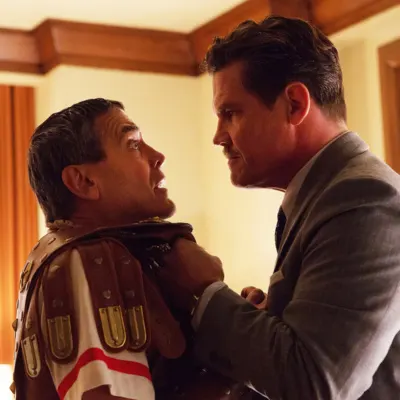
This week, Gladio Free Europe discuss Joel and Ethan Coen's recent classic Hail, Caesar! which follows a day in the life of one of these fixers, a fairground bouncer turned movie executive named Eddie Mannix, played by Josh Brolin. Although the movie depicts him as a deeply conflicted family man, the real Mannix was a world-class scumbag who abused and manipulated may actors, particularly young women, and may have even murdered those who got in his way. Liam and Russian Sam recount some sordid stories about real Hollywood fixers, especially Mannix, and go into the unlikely origins of America's film industry and its early leaders such as Louis B. Mayer. The studio system was both awful and awe-inspiring, an institution that relied on terrible exploitation and enabled shocking abuse, but also produced many of the greatest cultural achievements America has ever seen. Men like Eddie Mannix made all of that possible.
This episode includes some graphic descriptions of abuse.
Transcript
Welcome and Patreon news
Hello and welcome to Gladio Free Europe. I am Liam, joined as always by Russian Sam.
Hello, hello.
Today, we are going to be talking about one of my favorite movies from recent years. That movie is Hail Caesar, the 2016 Coen Brothers tribute to 1950s Hollywood.
Yeah, it's a great flick. It's one of the lesser known movies of the Coen Brothers, unfortunately. But we here at Gladio, we are something of trendsetters. So of course, after this episode airs, we expect everyone to be talking about Hail Caesar.
Yeah, yeah, I want to see some Eddie Mannix memes everywhere.
Oh man, that man has a very memeable face, honestly.
Right, and what I like about Hail Caesar, beyond the fact that it's very fun and very funny, is that it's a broad tribute to 1950s Hollywood. And I don't mean 1950s movies, but instead the world that produced them, specifically the world of the studio system. It goes into the gritty underbelly of film production in this era. And as you uncovered, Russian Sam, in the research for this episode, as crazy and as gritty as this movie can be at times, the real world of the studio system was so much darker and so much crazier.
Oh yeah, absolutely. They really did a lot to sanitize what happens in this movie because the real life events were just so much grislier.
But before we get into the episode, some brief housekeeping news. After many inquiries, we finally set up a Patreon.
Yes, we did it.
Yeah, we're not going to be putting anything behind a paywall, but if you guys feel like our show is worth your hard-earned money, then we would greatly appreciate any contribution you feel inclined to give us.
Anything you can give, yeah, yeah, yeah.
Yeah. And then, you know, if you guys give us money, we can start saying that we are professional podcasters, so come on.
Yeah, just imagine how arrogant we'll be after that.
Our show will get so much better.
I'm gonna start snorting cocaine on air.
Yeah, just like all the old stars.
Yeah, yeah.
I'm gonna have to call Eddie Mannix to clean up your overdose.
What Hail, Caesar! is about
Let's just take a step back and tell everyone what this movie is about. It's set in 1951 and it covers a sort of typical workday for a man named Eddie Mannix, who is a real-life general manager and so-called fixer of MGM Studios, one of the major studios of the time. And the movie follows him as he navigates his more typical duties, such as watching the day's reels, suggesting actors for roles, helping an actress pregnant out of wedlock to adopt her own baby, etc. You know, the usual, but also to deal with the mounting headache of a kidnapping of a major star by a group of disgruntled communist script writers. So naturally, hijinks ensue in typical Coen Brothers fashion, very fast-paced, extremely funny. There's a great laugh in every scene.
The studio system
So this movie is really a tribute to the studio system, but we should probably start out by explaining what the studio system actually was. Because from the very earliest days of Hollywood up until the 1960s, a handful of powerful companies completely controlled film production and distribution. Now, the idea of a powerful entertainment company might not seem that foreign today, but entertainment companies in the past had so much more direct control over what happened. These studios were vertically integrated empires headed by incredibly influential individual executives who typically came from pretty humble origins. And these studios, at the height of the studio system, controlled everything from start to finish of a movie's production. And most of what they did was completely accomplished on set on these massive studio lots. This era also saw a monopolization of American culture not really seen by other forms of entertainment. Films were way more accessible than vaudeville.
You could see them everywhere at any part of the country. This meant that until the rise of TV in the 50s, Hollywood was the American entertainment. In the 30s, 100 million people saw movies every week, and the entire American population was just 130 million. All of that would change in 1948 when the Supreme Court case, United States versus Paramount Studios, forced them to break up these monopolies and to cut back on a bunch of practices, like forcing theaters to run crap in addition to the coveted items, just so they would be able to monopolize what was being shown in the theaters.
Right, this is how the phrase B movie started, because they'd have an A movie, which was a higher quality picture people wanted to see, that would be paired with a B movie, with the exhibitors also had to show. In addition, the Supreme Court case banned movie studios from directly owning theaters. A lot of them did that. MGM, which is what we're going to be mostly talking about today, owned the Loew's theater chain until the 50s, when they had to divest that. And that divestment eventually, as well as a lot of other factors, like the rise of something called New Hollywood, when individual filmmakers who had more of an artistic bent began to have more clout within the industry, began to change the system. But this movie is set in the early 50s, when the power of the studios was basically peaking. The court ruling that just happened was just now beginning to come into place, but the studios still had an incredible level of control over their workers and an incredible level of influence in American culture, as figures like Eddie Mannix, this powerful Hollywood fixer, maintained this power and influence over the tens of thousands of people they employed.
Sideshows and vaudeville
Absolutely. So how did all of this start exactly? Basically, in the humblest way you can imagine, because the very first films in America, produced largely by Thomas Edison, were pretty much circus sideshows. The earliest films anyone in America was watching were incredibly short little novelties that you might see at a carnival or a circus. A lot of times they were used in between vaudeville sets, and so the main appeal was the vaudeville show, but in between they'd show like a two-second little clip of a guy sneezing. And oftentimes the hope was that this would just be a marketing tool to attract people to see the play, but eventually the movies themselves became the attraction. This means you start to see really two influences go into early Hollywood. And these two influences have varying degrees of disreputability, which means that there's going to be a stigma around movie making for a long time, longer than you'd expect.
And these influences were the theater and carnivals. Both of these industries were avoided by people of means and respectable origins. This meant that show business was generally dominated by people sort of on the margins of society, or at least of a bohemian sensibility. The bulk of early film producers were specifically from working-class Jewish backgrounds, usually immigrants from Austria-Hungary or the Russian Empire.
Filmmakers head west
Filmmaking was originally centered in the Northeast, particularly New York, with a little bit in North Florida and Chicago, but the growing popularity of Westerns caused early filmmakers to be scouting out west. D.W. Griffith, who's pretty notorious today for his work on Birth of a Nation, was the first filmmaker to come to Los Angeles in 1910 to direct a cowboy movie. In 1916, the Hungarian furrier Adolf Zukor teamed up with a respected young playwright named Cecil B. DeMille to shoot a Western called The Squaw Man. There were gunner rent lands in Arizona, but as soon as Zukor got off the train, he hated it. So he telegraphed DeMille that instead, they were going a little bit farther to LA, where Griffith was already active. This was a point in time when film acting was seen as a very base profession, even among actors who themselves were kind of on the margins.
Actors in these early films were very rarely credited, as it was thought that these appearances would harm their stage careers. But with time, audiences started to prefer certain film actors over others. And there were beginning to be unnamed movie stars in the 1900s. The system of unnamed movie stars just going by the studio monikers, like the Biograph Girl, for example.
Carl Laemmle and the first movie star
This would all change with the man named Carl Laemmle, who was the co-founder of Universal, which was then called Independent Moving Pictures, or IMP. He poached talent from competing studios by promising actors that they would be credited, and he engineered an entire stunt surrounding just one actress to get the ball rolling. In 1909, an actress named Florence Lawrence, who was then the so-called Biograph Girl.
That's a great name. Florence Lawrence? I love it.
Yeah, very musical. She went over to IMP, but they didn't go about this in this typical way. As a publicity stunt to build up hype around Lawrence, Laemmle had her taken out of New York and circulated rumors about her death. These covered everything from death by streetcar to kidnapping to terminal illness. The story became an international sensation and remained in the news for a year, actually. The following year, Laemmle revealed that Florence was very much alive and was the lead in the 1910 movie The Broken Oath. And ever the showman, Laemmle proceeded to circulate rumors that the fans at St. Louis were so thrilled to see Florence alive that they ripped the clothing off of her body during a public appearance.
That's hilarious.
Yeah. Yeah, and then so she ended up making more than 100 films in the next six years for Laemmle, which is insane. And so these were mostly short films, just like a few minutes, but still, 100 films, that might mean like 50 to 100 individual days of shooting. That's a lot of work. And these are full days we're talking about.
Contracts and control
And so here's what EJ Fleming has to say in his book, The Fixers, which looks a lot at the darker side of early Hollywood. His book, by the way, is one of the big sources we have for Eddie Mannix's life and the main source for this episode. He explained that the studios had to identify actors and the balance of power was altered. The studios' vulnerability to having their assets stolen was evident, so ironclad contracts became the rule. It was also evident that publicity was a two-edged sword. A recognizable name had to be protected, and the actor had to be protected from themselves. With exposure came notoriety. With notoriety, came problems. And with problems, came a need to conceal.
Yeah, so the studio's powers over their actors would become increasingly imposing.
Theda Bara
One early example cited by Fleming is the case of the actress Theodosia Goodman, who was billed under her stage name Theda Bara, which is an anagram for Arab Death.
I just gotta say, Theodosia Goodman is an amazing name on its own. I don't think she knew the stage name.
Well, again, back then it was disreputable to be an actor, so they all needed to have their own stage names. Yeah, but there was absolutely nothing Arab about Goodman in reality. She was born in Ohio to Jewish and Swiss parents, but she got a backstory claiming that she was the daughter of a French artist and an Egyptian woman, and that she grew up, quote, in the shadow of the pyramids and the Sphinx. Per her contract, Bara was forbidden to appear in daylight, and when she had to go out, she had to wear a full costume. Interviews were conducted by candlelight in the bedroom of her Hollywood home after set decorators transformed the ground floor into a desert tent hung with skulls and the smell of incense.
That's great.
Yeah, and these kinds of stipulations and contracts would only become more imposing with time.
Blind items and seedy pasts
As part of the marketing, as we saw, publicists would start to give so-called blind items to the press.
Yeah, and these, of course, still exist today.
Yeah, this could include anything from basic film publicity like the plot and the release date to gossip about the stars' personal lives. This was also very heavily managed by the studios. Before signing on, actors were asked to disclose any seedy elements from their past to keep the studio ready to anticipate any rumors that come up and respond to them. One particularly famous early example involved Joan Crawford, who had allegedly starred in a lesbian porno film before her Hollywood days. Eddie Mannix was tasked with tracking down and destroying copies of this film, and also, if some stories are to be believed, sometimes showing it to the guests in his home because he clearly kept a copy for himself.
Yeah, of course. Once we get into the real Eddie Mannix, you'll see that it's completely unsurprising. And Hollywood's location was actually very important for all of this publicity stuff. At this point, it was very remote, very far away from anything, so that helped the studios to keep on top of the publicity. LA was just a total remote backwater without easy access to more settled locations. Even in the 1930s, a cross-country train trip could take five days. It was also very easy to massage the writers who were present in LA in those early days because they would do very little independent research, and this would increasingly come in handy when the actors and studio workers became debauched, for lack of a better term, which didn't take them that long.
No, not at all, not at all. But I guess we'll see how they first got to LA.
Christian, anti-Semitic Hollywood
Obviously, the word Hollywood itself is, you know, synonymous with American movie making. But in the 1910s, Hollywood was a very strange neighborhood. It was probably the most unlikely neighborhood you might expect to be the center of the film world. Because Hollywood at this time, and Los Angeles more broadly, was dominated by evangelical church communities and even utopian Christian communes. These churches and these communes tended to be very right-wing and often explicitly anti-Semitic, which meant they were very opposed to anybody from a Jewish background, especially a filmmaker, living in their area. An example of one of these notoriously hateful churches was the Pillar of Fire, led by Alma Bridwell White, who was a forceful advocate for women's equality, but only if they happened to be white and Christian and Protestant. And so when the movies first came to Hollywood, the local landlords and property owners wanted nothing to do with their new neighbors.
In fact, there weren't any movie theaters in the neighborhood at all because an ordinance banned any from being built in the vicinity of Hollywood. However, once Hollywood was formally incorporated into the city of Los Angeles, a lot of those restrictions went away and filmmakers could more easily move in here.
One thing we should say here is that there was kind of two separate strains of anti-Semitism and a broader anti-actor sentiment. A lot of people who were not Jewish whatsoever were discriminated against, which is kind of crazy to think about now, just for being actors. For instance, Frances Marion, who was a very famous early screenwriter, was unable to buy property around Hollywood because much of it was owned by a guy named Alphonzo Bell, who's best known today as the namesake of Bel Air. He told her that, I'm sorry, Frances, but I simply cannot sell you any property here because I have a rule for myself. I won't sell any land to actors or Jews. At least one hotel had a sign reading, no dogs, no Jews, no actors. And even Cecil B. DeMille, who is one of the most respectable and inoffensive people in the business, had to lie and say he was a door-to-door salesman because that was a lot less offensive to the people of Hollywood than being an actor.
Yeah, but nevertheless, money talks.
Money talks
And by the early 1920s, there was so much money to go around that suddenly people were losing their inhibitions about these Jews and actors. So landlords and realtors no longer wanted to turn away these movie people. So by the end of the decade, many of these landlords had involvement with the movies themselves. And studios began buying up huge plots of agricultural land across Los Angeles. Again, just to reiterate, at this point, Los Angeles was basically just like small farms and ranches. That was it.
Yeah, a lot of ranches. In the early 20th century, there was even a lot of ostrich farming.
Really? Wow, that's very fun.
Yeah, yeah. And so these ranches basically became the studios because there were these massive lots of land across the Los Angeles area. Initially, most of the studios were in Hollywood proper, although today, interestingly, I don't think there are any studios in Hollywood. Instead, they're in adjacent neighborhoods like Burbank and Culver City. The movie Hail Caesar was filmed mostly on the old Warner Brothers lot in Burbank. Although it's a lot smaller than it was in the 1950s, the studio lot still dominates the area. So if you ever drive through Burbank, you can really see the impact of the old studio system because so many buildings in the area have the Warner Brothers logo on them. Even buildings that are no longer owned by Warner Brothers at all. Another kind of funny little, another little funny artifact of this is that right east of Burbank, when you get to the border with Glendale, it's kind of like a mini horse country because there are all these small horse riding academies that are descendants of the old ranches that used to supply the studios with all the horses they needed for Westerns.
Oh, is that where BoJack Horseman comes from?
That might be.
The studio as a company town
Yeah, so the studios from the 1920s to the 1960s controlled basically all aspects of production. Films were typically made entirely on the premises of these studios, and they would star contract players and made by directors and screenwriters on the studio salary. Costumes were designed and often even manufactured in-house. Horses and animals were kept on studio grounds, and child actors were educated at studio schools. MGM, which is the studio that inspired Hail Caesar, even had its own police department. At one point, it was led by Whitey Hendry, who also happened to be the police chief of Culver City next door.
I'm sure that there are no conflicts of interest there that could possibly crop up.
On Whitey, Strickling, a figure we'll sketch out momentarily, said, quote, we needed a top cop who knew all the other top cops in the area and all over the United States. So he offered Whitey a lot of money.
You know, in the movie, Whitey is also the name of the horse of the cowboy, Hobie Doyle. So might be a little nod there.
Yeah, perhaps. I could definitely see that.
Epic sets
And so, as early as the 1920s, the studios began to produce enormous epics with budgets reaching into the millions. Cecil B. DeMille's King of Kings was shot on a massive model of Roman-era Jerusalem built just for this purpose. And the owner of that lot is a man we'll also get into very shortly.
Also, and although the studios built these really incredible locations to shoot their movies, not that many of them still exist today because they weren't really permanent. They often were constantly being repurposed to be used as other sets. So that meant that the King of Kings set eventually was reused for a movie about another king, specifically King Kong.
It was used to be the island temple.
Yeah, yeah. And then a few years after that, it would end up being set on fire to simulate the destruction of Atlanta in Gone with the Wind. So sadly, no more scale model of Jerusalem in LA.
Tragic. Yeah, and you know, the studio buildings themselves were also pretty transient because chunks of these lots were constantly being sold to developers. Like Century City in LA is the former Fox lot, I want to say. And as a result of this, that's meant that when the Coen brothers were making this movie, they had to fake a lot of it because none of these studios were as grand as they used to be. So to replicate the MGM studio as it was in the 50s, they had to film it like seven different existing studios to give an impression of the scale of this enterprise. But okay, so now we know what the studio system was. Let's talk about what this movie says about the studio system, and then we can get into the real people involved who inspired this movie.
Eddie Mannix on screen
Yeah, so let's begin with our head guy, Eddie Mannix. In the movie, he comes across as a family man, as a very devout Catholic who goes to confession every day. He's constantly confessing his many sins, especially smoking cigarettes, even though his wife wants him to quit, but he just can't kick the habit. And again, this Eddie Mannix, he's a family man, which is nothing like the real life Eddie Mannix. In the movie, he is totally devoted to his wife, Connie, and their children. But in reality, he never had any children because he basically had them all aborted.
Right, because yeah, he was a terrible husband, too, as we're gonna get into. And his wife in the film is completely fictitious. Instead of replicating any of the real women he was married to, they just made up this fake, devoted housewife, I guess, to make him more relatable, more sympathetic, you know? It's kind of funny, because usually I feel like the Coen brothers don't stray away from any kind of darkness, but with this movie, they really sanitize the main character. I don't know if maybe they started working on the script and realized that the guy they wanted to be the protagonist was actually a really brutal guy or something, but they really shied away from the real history here, which I think is interesting.
What I'm thinking is they were very much trying to model this movie on a more 1950s theme, so maybe they were trying to make it more wholesome so that it wouldn't seem as odd in comparison to the movies of the 50s.
Well, yes, let's talk about the movie itself a little bit before we get into the history behind it. So it's got a really complicated plot, just kind of showing, I guess, is it a single day in the life of Eddie Mannix or just a couple days?
It's one entire day and a morning.
Yeah, yeah, and it shows how he has all these problems he has to deal with. You mentioned that one of them is that a pregnant actress has to adopt her own baby to avoid a scandal. So she can say, oh, no, I'm not a single mother. I just adopted this kid. A lot of stuff like that. Probably the most prominent plot involves a big actor being kidnapped by communists, you mentioned, who try to send some money to the Comintern. All these little stories happen, but they paint a broader picture of how the studio operates. It's a really fun movie. It gives you a pretty good impression of what a film studio used to do, used to be. But the tone of this film as this kind of a relatively bouncy comedy doesn't really reflect the grit underneath this broader studio system.
Yeah, I'm in a way you could say that the studio propaganda of the early days was so successful that even today, the Coen brothers, who definitely do know better, judging from their previous work, are still trying to go for this saccharine sort of interpretation.
Yeah, maybe so.
Communists in Hail, Caesar!
Yeah, and that kind of brings you to the monologue that George Clooney's character has near the end, where he's been exposed to communist propaganda by these left-wing screenwriters, and then he starts to, he really believes it. And so he starts telling Eddie Mannix that he's now doubting himself as they're filming this epic called Hail Caesar, this, you know, giant biblical Roman epic, where he's saying that, oh, you know, I'm realizing this studio is nothing more than an instrument of capitalism. The studios make the pictures to serve the system. That is its function. So I guess, Sam, you'd say that this movie itself is serving a certain function.
Yeah, absolutely. What really surprised me about this one is just how anti-communist this is. And I mean, I get it. Pretty much everyone involved in this movie is an awful person, but I felt like the communists.
Oh, I wouldn't say that.
I would. Oh, I mean, the characters.
Yeah.
Oh, yeah, yeah, yeah. The communists are just seen as bumbling and hypocritical. Like, right, like, so, like, they meet in a Malibu mansion, and the film takes pains to show that they have an overlooked maid looking after them, you know?
Mm-hmm. Yeah. They also completely fail to send any money to the Comintern, and all they were able to raise in the first place was just $100,000, which is kind of funny.
Yeah, no, but that's the funniest thing. Like, by the time this movie takes place in 1951, there hadn't been a Comintern in almost a decade. And it still gets true. And it still gets referenced. Like, again, there's this sort of very conspiratorial thing happening with the communists where they're purposely subversive, that, you know, they're actively treacherous, even. And it's just.
Yeah.
I mean, I guess it's all done in good fun. And maybe I just have a bit of a stick up my ass. But honestly, I mean.
I feel like communism is a very low-hanging fruit for Hollywood. So I feel like the depiction you see in something like this or in Stranger Things is basically par for the course, and should be expected. What I find most interesting and surprising is that Herbert Marcuse is a character in this movie, although he only has like a few lines.
Yeah, and they also made him significantly older than he was at that time. They probably saw a bunch of. Yeah, yeah, I think, yeah, yeah, I think they saw a picture of him in the 70s and assumed he would have looked like that in the 50s.
Barton Fink
But yeah, we should mention before we get into the history here, which is going to be the bulk of this episode, is that this is not the first Coen Brothers movie to deal with the classic studio system. Back in the 90s, they had Barton Fink with John Turturro and John Goodman. And you're a big fan of that one, Sam.
Uh-huh. Yeah, I just watched it for the first time a couple of days ago to compare it to this one. And I gotta say, that one is a much better movie taken as a whole. And I think maybe that's why the reception to this one was so lukewarm. Because it's a good movie in and of itself. But when Barton Fink is a reference point for Coen Brothers Hollywood Cinema, you can kind of see why this one might ring hollow in comparison. But also, interestingly, that one does not really indulge in the Hollywood bullshit at all. That one is much grittier.
Yeah, yeah. Which is funny, that's the kind of, yeah, yeah. And when you look at the real life of Eddie Mannix, you think that would inspire that kind of a picture.
MGM and Nick Schenck
So before we get into Eddie Mannix, we should probably say who he worked for, which is the company Metro Goldwyn Mayer, MGM. It was the most successful of all the major studios in the 30s, 40s, and 50s. And it was founded as a merger of three smaller studios owned by guys named Louis B. Mayer, Samuel Goldwyn, as well as a less well-known theater owner named Marcus Loew, a previous partner of that guy Adolf Zukor, who mentioned before. MGM directly owned Loew's movie theaters, which is illegal today, thanks to that '48 Supreme Court ruling. But when Marcus Loew died, control of that aspect of the business, which I believe was kind of the senior partner in the partnership of MGM, went to a guy named Nick Schenck, who is a very interesting and not super famous figure. A Russian Jewish immigrant entrepreneur who was involved in amusement parks, movies, and organized crime, and also a close personal friend of the real Eddie Mannix.
He was basically an underworld figure. Like he said, he had his thumb and a lot of pies. And this meant that he was able to bring a lot of tactics that we would today associate with organized crime into the movie business. And Mannix himself was his main agent in that. Louis B. Mayer was Nick Schenck's partner and also an avowed enemy. But he was also a very close friend of the real-life Eddie Mannix. Unlike Schenck, Mayer worked very hard to maintain the respectability of the film industry and MGM in particular. He was also initially successful thanks to the help of the young executive Irving Thalberg, the so-called boy wonder. Mayer handled the financial side of MGM while Thalberg handled most of the creative aspects. Money flowed upward to Nick Schenck, just like the kind of mob operations that he and Eddie Mannix were familiar with from their previous exploits.
And after Thalberg died while he was still young, in 1936, he had a heart condition and he ultimately died of pneumonia. Mayer was able to consolidate control of MGM.
Louis B. Mayer
He was really unfamiliar with the creative aspects of filmmaking, and he tended to be much more coarse than Thalberg. As Fleming put it, according to Mayer, only three emotions were important. He showed people what they were by tapping his forehead, his heart, and his genitals.
Yeah, and he is his classic trick during negotiations. I think it says a lot about his integrity here, which is that if Mayer wanted to make an emotional point, he fell back on two old ploys. First, he cried. If that didn't work, he fainted. When Mayer was young, he overdieted and during a disagreement with the director, fainted dead away from hunger. The director thought Mayer had died and, after reviving him, gave in to what he wanted. From that point forward, if any of his arguments didn't move an intractable opponent, Mayer would fall to the floor in a phony faint.
Man, what's stopping you from fainting?
And so during his decades as the head of MGM, Mayer brought the studio to an enormous financial success, especially because just so many people were watching the movies in the 30s. But he was also known for being personally ruthless and incredibly abusive, which meant that not long after 1951, when this film takes place, he would end up being ousted by the company. We also should mention that the most unpleasant aspect of his legacy was that, like many other film executives at this time, such as Darryl Zanuck and Harry Cohn, Louis B. Mayer abused a lot of women. Or the most objective way to say it is that he was involved in a lot of affairs with women who were very much his subordinates, actresses, secretaries that he hired, whose livelihoods were under his control.
Yeah, he was one of the inventors of the casting couch.
Yeah, the casting couch, exactly, yeah.
It seems like a lot of the biographers sort of take pains to show that these relationships were consensual, but I think that you got to question that, just given that he had so much power and he had just so much individual leverage over these people. And also, as I learned recently, he had connections to very violent people too. So I really am not sure to what extent actresses were able to say no to Louis Mayer.
Yeah, so once again, we're underlining all of these people were terrible, terrible people.
The fixers
Yeah.
Yes, and Eddie Mannix might have been the worst of the bunch. He worked to keep all these affairs under wraps along with many other types of scandals.
Yeah, so while I was watching Hail Caesar, I very strongly felt that clearly Eddie Mannix is an important person and he does a lot of work, but it's kind of difficult to pin down exactly what he does, just because he has so many different types of tasks. So Mannix was what was then known as a fixer, as I learned from the Fleming book, which we are using heavily for this episode. And his duties involved just about everything touching the lives of the talent.
Yeah.
But especially if it came to maintaining their image carefully crafted by the studios.
Yeah.
Officially, he was the general manager and also the head of MGM's private police force. But he had, he was sort of a jack of all trades in many respects. And in addition to Mannix, there was another MGM fixer whose name was Howard Strickling.
The death of Paul Bern
One of the most famous publicity scandals that he was involved in was covering up the death of Paul Bern.
Right, because Paul Bern was a German-born screenwriter best known for the movie Grand Hotel with Greta Garbo, which is pretty nice. You should see it if you haven't. Which actually was released less than a week after his death. Because Paul Bern had recently married the actress Jean Harlow, you might have heard of. She was a starlet, half his age, who just wrapped up the romantic drama Red Dust. It was her second marriage and his also, because Paul Bern had previously been with a much less famous actress named Dorothy Millette. And just two months into his second marriage, the one with Jean Harlow, Jean spent the night away from home to visit her mother. Paul had the house all to himself. He dismissed the servants, and according to the neighbors overhearing him, he invited over some kind of a lady friend. And he and this unknown woman had a fight.
The next morning, the butler came in, as he always did, but Paul wasn't around. He didn't come down for breakfast like usual. He wasn't swimming in the pool. He wasn't listening to the radio. He wasn't anywhere. He went into his bedroom and found Paul Bern naked on the floor with a bullet wound in his head. Instead of calling the police, the butler called Mr. Strickling at MGM because it was the fixer's job to solve problems like this.
Yeah, so the studio had a bit of a problem on its hands because Paul Bern was technically a bigamist. In other words, he was still technically married to this other woman. Even though they hadn't been formally married, they had lived together long enough that she was his common-law wife. And he continued to support her. She was mentally unwell throughout their marriage, but she clearly felt very scorned that he had married Jean Harlow. And in all likelihood, it was she who killed him. But they couldn't let that story leak just because, again, there's the whole bigamous tangle. So instead, they decided that they would totally destroy Paul Bern's reputation to try to maintain the image of the studio and Harlow. So instead, what they came up with was that Bern had killed himself because he had a small dick, basically. Like literally, they started spinning all of these rumors that he was very abusive, that he was constantly hitting Harlow, that he was constantly making all kinds of self-derogatory comments, all because his junk was kind of small.
And they bought it. People believed it. Yeah, to this day, if you ask people about Paul Bern, you'll probably hear that version. Yeah. And this had nothing in common with the real life Paul Bern. He very deeply loved Jean Harlow, and she was devastated when he died. She refused to play along openly with MGM. She wouldn't speak against them to refute the suicide claims, but she wouldn't really play ball. And so MGM organized this spectacle of a funeral, despite the fact that they were also seeding the stories about what an evil man Bern was. So Liam, what happened at his funeral?
A funeral circus
Bern's funeral at Grace Chapel at Inglewood Park Cemetery was a circus. Louis B. Mayer arrived flanked by Mannix and Strickling, the two fixers. The casket was covered with $25,000 worth of flowers from Thalberg and MGM. Thousands of fans stood along the street, and hundreds of reporters and photographers fought for spots near the chapel. After a short service, the funeral director asked that they take out one last look at their old friend. A mechanical pulley attached to the casket slowly raised it to an almost vertical position, and the lid automatically slid open. Bern appeared to be standing in front of the horrified crowd, staring at him. Harlow immediately burst into tears. So did Irving Thalberg. Clark Gable scrambled out of the chapel as Jack Gilbert vomited. After the bizarre finale to his service, Bern was cremated.
This just feels like a Simpsons bit, and they actually did this. I'm in disbelief.
It's so crazy how.
Who killed Paul Bern?
Yeah, yeah.
You know, we should say one thing we haven't actually said is what exactly Howard Strickling and Eddie Mannix did in the cover-up and how exactly Paul Bern died. We're never really going to know for sure because this was covered up. But according to screenwriter Ben Hecht and producer Samuel Marks, who were both working at MGM at this time, Paul Bern had not killed himself. He was murdered by Dorothy Millette, his ex-wife. Strickling forged a suicide note as soon as he found the body and convinced the police not to investigate further. Also, interestingly, very shortly after this, Dorothy Millette herself died in an apparent suicide. I have no idea what happened there, but it's very convenient that there would never be any other person to tell the tale.
Yeah, they found her body in the river. So I absolutely would not be surprised knowing what I know about these guys if they had to.
Yeah, yeah, yes, yes, yeah. Mannix and Strickling. It's fine. Like the Josh Brolin character in this movie is this affable father who also does some sleazy business.
The real Mannix versus the movie
The real Eddie Mannix was a gangster who almost certainly killed people, you know? And that's why, again, it's like it's kind of surprising that that wasn't touched on by the Coen brothers, but the movie itself was really fun, so I can't really fault them for changing the story. I'm just surprised that they made their main character named Eddie Mannix when he so clearly is not. He's so much more benevolent than the original actual Mannix.
Yeah, that's the strange thing. He's one of the few real-life people named in the movie, even though he...
I know. Like, yeah, the studio is an MGM. It's called Capital. I don't think the executive is named Louis B. Mayer. So the only person they stuck with is, yeah, is this incredibly inaccurate portrayal.
It's funny.
I don't know why they didn't just call him like, yeah, yeah, why not make him like Eddie O'Malley?
Yeah, why?
Yeah, it's funny. Yeah, it's just him and Schenck. Those are the only real life personnel.
Yeah, they briefly mentioned Nick Schenck, who's ever seen. Yeah, alright, but we should mention.
Strickling and Mannix
So getting back to the fixers, Strickling and Mannix would play complementary but slightly different roles within the studio because Strickling was the image guy, whilst Mannix was more of the enforcer, the on-the-ground guy. In terms of personality and disposition, the two were total opposites and hated spending time with each other outside of work. But on the job, they worked well together. The real-life Mannix is also depicted in the 2006 movie Hollywoodland, which I'm going to say I have not seen. I don't know if it's any good, but I have been told it's a more accurate depiction of the real Mannix.
Mannix's early life
The real Mannix, like so many early film figures, was from a humble working-class immigrant background. He was born in New Jersey in 1891 to Irish immigrant parents. He dropped out of school after just one year of middle school to support his family and, like we said, was kind of a jack of all trades for his whole life, working in all sorts of capacities from bricklaying to carpentry to eventually mafia bookkeeping. He'd maintained these mob protections for the rest of his life and then often be very useful throughout his career. His first mafia employers that we know of were the Schenck Brothers, who, before they were involved in movie theaters and theme parks, were drug dealers. According to E.J. Fleming, Mannix in his youth was a foul-mouthed, dese-dem-and-dose type guy with no social polish, a fondness for drinking, and a weakness for women. The unofficial bodyguard and muscle of the Schenck brothers, Eddie could take out five rowdies at a time.
He had to rid the park of the unruly, make sure the money was safe, deal with unscrupulous vendors, and protect the brothers from any anti-Semitic locals. Eventually, when the Schenck Brothers got involved with Louis B. Mayer, they sent Mannix from New York to California to be their eyes and ears. Basically, he was Schenck's spy on Louie B. Mayer, because Mayer was technically his employee, because the Loew Theater Company was the senior partner in MGM. He really liked Hollywood. He liked the freedom he had, he liked his new access to wealth and power, he liked the access to alcohol and women. And they eventually, eventually, Mannix would bond with Louis Mayer, sort of over these shared interests, and also because he was very impressed by the time that he watched Louis B. Mayer punch out Erich von Stroheim for making a coarse comment about women. But let's not think that Mannix was any kind of feminist, because he, like we said, was this notorious womanizer.
He was married to his wife Bernice, but was serially unfaithful. Even when he was back in New York, he was always cheating on his wife with employees and visitors. And I gotta wonder if, just like Louie Mayer, he used his position, even this tiny amount of power as a manager of a theme park, to coerce women into sex, as he would do eventually much later as he became this powerful film executive.
Yeah. In addition to his womanizing, Mannix was also famously really disdainful of most actors. He had a sign on his desk which read, The only star at MGM is Leo the Lion. And although he did have a lifelong friendship with some of the actors, such as Clark Gable.
Damage control
But going back to Mannix in his professional capacities, his main job as a fixer was to perform damage control on scandals which involved movie stars. We see quite a bit of this in Hail Caesar. He does all kinds of errands, like find a missing alcoholic on the bender, convince a pregnant single actress to get into a hasty marriage with another man, arrange a date between the cowboy and the Chiquita Banana lady, etc.
That's the cutest of all the plots in that movie.
Yeah.
The death of Thomas Ince
A really famous case that he was involved with that you dug up, Sam, was the murder of Robert Ince, who I hadn't really heard of before.
Yeah, he was the owner of that lot where they built a model of Jerusalem for the record. And a very big yeah, he was a huge hotshot in Hollywood back in those days. So again, we're very heavily drawing on Fleming for this section. In 1922, William Randolph Hearst came to LA with his mistress Marion Davies, buying her a mansion in Hollywood. Hearst was insanely jealous and worried that she was having an affair, and spoiler alert, she was. When he read in the New York Daily Times that Charlie Chaplin was paying, quote, ardent attention to Marion in Hollywood, he returned from San Francisco to Hollywood the following morning. They were indeed having a fling, and Hearst's jealousy erupted just weeks after this during the Labor Day cruise. The only thing known for sure about what happened aboard the Oneida, which was his ship, was that at the end of the weekend, the filmmaker Thomas Ince was dead.
Ince was the most successful movie producer in the business at this time, and he was invited on the Oneida because Hearst was negotiating to rent Ince's studio to make Marion's movies. Hearst, for reasons unknown, also invited Charlie Chaplin, her suspected lover. The Oneida left LA.
Yeah, yeah, who knows?
The Oneida left LA on Saturday, but Ince boarded on Sunday because he had to attend to premiere. What happened Sunday night is a mystery, but Chaplin telegraphed his longtime valet Toraichi Kono and ordered him to meet him at the boat the next morning in San Diego. Kono was waiting dockside as the Oneida cruised into San Diego next to an ambulance requested by the ship. Kono told his friends that Ince was removed on a stretcher with a bullet wound visible in his head, and the later stories mentioned wet clothes as if he'd been fished out of the ocean. Servants on board claimed that Hearst shot Ince after catching him having sex with Davies on a private deck. However, Marion herself reportedly told friends that Hearst actually intended to shoot at Charlie Chaplin and was shocked later to discover that the man he had killed was in fact Ince.
Circumstantial evidence indicates that a massive cover-up began even before the ship returned to San Diego, thanks to the help of Mannix and Strickling.
Spies and telegrams
So Strickling acted as a liaison between MGM and the gossip writers. He would convince them not to print negative stories or planting positive ones. In return, he would promise them his next exclusive. Each thought that she was his sole confidant, and most of these writers were women at this point. Once again, quoting Fleming, quote, By the late 1920s, Mannix sat on every important meeting at MGM, with Strickling usually in attendance as well. All communication was signed by Mannix, who preferred green ink in a gesture to his Irish roots. Mannix and Strickling organized a system to control not only the information flow, but the day-to-day activities of their stars. To keep track of the internal comings and goings, they used spies, literally. People everywhere in the studio reported back to them. Studio drivers, waiters at the studio dining room, even the lowliest janitors were routinely quizzed to see if they knew anything.
They were rewarded in their paychecks. Again, big mafia vibes. Mannix and Louis B. Mayer personally read every single telegram arriving or leaving from MGM and the Culver City Western Union offices. In an era before overnight delivery and email, telegrams were the name of the game. And by reading these private letters, they were able to know any kind of affair or financial problem or family issue happening between the stars. They knew everything about everybody. Fleming wrote that Mannix brought the telegrams home at night and read them in bed before retiring for the evening. He read them with his girlfriends, sharing the most private secrets of the biggest stars at MGM. These fixers often dealt with people much less powerful than William Randolph Hearst and exerted enormous influence over them. Once Strickling and Mannix took care of a problem, they owned that actor. Strickling felt that they Strickling felt that once they did something for an actor, they became important to that actor.
The studio could get them to do things, and they did what they were told. Get married if you're a homosexual. Stop sleeping with a married co-star. Go back to your wife. Get an abortion.
Drugs and Barbara La Marr
Anything.
Yeah, so as we can tell from the conditions of Hollywood, it was really grueling, which is probably why drug use became so prevalent in the Hollywood of these days. Jean Harlow's husband, Paul Bern, who we mentioned above, was previously involved with the actress Barbara La Marr, who was addicted to cocaine and morphine and probably much more. Because of this, she slept around two hours per night, and the tabloids were told that she was full of energy, quote, didn't want to waste a single minute of her wonderful life sleeping. Drug use and alcoholism were absolutely rampant. In 1922 to 1923 alone, over 30 movie stars died of drug overdoses. The Hays Code was beginning to be developed around this time to deal with situations like this. And so when it came to Barbara La Marr, fixers like Mannix enabled this addiction while paying her to make anti-drug statements to avoid suspicion.
Then in 1926, Barbara La Marr suddenly died at the age of just 29. The newspapers reported this as tuberculosis, which was often how drug overdoses were covered.
Drunk-driving cover-ups
Equally a headache for the studios, the actors would often go on joyriding benders, which ended with dead or injured pedestrians. In the summer of 1928, a drunken Joan Crawford was driving down Hollywood Boulevard, weaving in and out of traffic and onto the sidewalk. She ran a red light and hit a woman in the crosswalk, tried to bribe the motorcycle policeman at the scene, and then drove away. Arrested later at her Brentwood home, she called Strickling, who reportedly went to the young girl's hospital room with $10,000 in crisp $100 bills, which is like $300,000 today. Nothing ever came of the problem. As we already mentioned, the studios had their own police departments, and they pretty much owned the LA police as well. During the tenure of LA DA Asa Keyes, for example, which lasted from 1923 to 28, 40% of cases brought by the police were dropped. And again, because this, and again, because the studios were basically the economy of LA by this point, there was some oil on the side, but it was pretty much an all-studio town by that point.
Mannix's own crimes
Right, and there were a lot of cases because Mannix himself produced a lot of them. He committed a lot of crimes.
Yeah, as we mentioned at the top of the episode, Mannix was very heavily changed for Hail Caesar. In addition to covering up the crimes of the actors, he also had a talent for crimes of his own.
Yeah, he was a friend of a lot of gangsters, such as Mickey Cohen, who's pretty well known, also Jack Dragna, and another figure I hadn't heard of named Victor Orsatti. Just a little note here: he's a funny guy because he was a mafia member who got involved in Hollywood with the help of Bugsy Siegel and then became an agent himself. So he went from being, you know, a gangster hitman to being a talent agent, which I think is kind of funny.
Oh, that's great. That's perfect.
Yeah.
Bernice Mannix and Mary Nolan
And so we mentioned that Mannix was married to a woman named Bernice. That's Bernice Fitzmaurice. He married in 1916, way before he came to Hollywood. He began cheating on her basically as soon as they got married. He had a long string of affairs, including a lot of Hollywood actresses. And she was so disgusted with Mannix that she never wanted to have any children with him. But cheating was really the least of their problems because Mannix was actually incredibly abusive. So shockingly abusive that in one case, he allegedly broke Bernice's spine. Really, really insane stuff here. And despite living separate lives for most of their marriage, Mannix remained married to her because she was a devout Catholic. So divorce was out of the question.
Yeah, just to give you guys an idea of just how sick this man was. Around the year 1927, he started to have an affair with the actress Mary Nolan. And after a while, she began arriving on set with bruises and black eyes. Mannix had also forced her to have at least three abortions over the course of their relationship. He broke it off with Nolan in 1929, at which point she threatened to confront him at home in front of Bernice, his wife. He beat her unconscious, and she had to be hospitalized. And the damage he did to her body is just shocking. Nolan would eventually have to endure 15 separate abdominal surgeries as a result of this abuse. And instead of quieting her, after six months, she sued Mannix for half a million dollars, which is $5 million today. She filed a complaint against Edward J. Mannix, VP and general manager of Metro's Co-Studios, which is the original name of MGM.
The affair, the lawsuit, and the beating all became public. Variety Magazine detailed Nolan's charges against Mannix and that he beat her on numerous occasions, not just that last time. Publicly, Mannix denied everything, while Strickling's people described the lawsuit as a frivolous publicity stunt, at the same time leaking stories about Nolan's alleged sexual past. Strangely, they even mentioned the abortions that Mannix had paid for, as if that was a stain against only her, not against Mannix, who forced her to get them.
Yeah, so Mannix, being the kind of gangster that he was, he pulled a bunch of strings to have her fired, and afterwards, he came to her house and threatened to have her arrested on charges of drug possession unless she left the city. By this point, she was a drug addict as a result of her injuries, because again, she was in enormous pain because of the beating she got from Mannix. And the threat worked. She stayed away from LA for a decade before coming back and briefly running a bungalow in obscurity. She would ultimately die of a barbiturate overdose in 1948.
Yeah, and I think it's pretty safe to place her death at the feet of Eddie Mannix because it's just horrendous. He was an incredibly abusive person, particularly really towards women in particular. And he just left an entire string of bodies in his wake. Again, again, it's funny to contrast the tone here. Like, the movie presents him as this funny, hard-working guy who's always confessing his sins, who loves his kids. In real life, he was just this like classic thug who the studios did a very good job at covering up. And I think that his relationship with Strickling, the other fixer, is kind of interesting because it's like Mannix would do these terrible things on behalf of the studio, and then Strickling would make sure that nobody ever found out. Which really shows, like, you know, it's like it's a great system for just getting away with so much terrible stuff.
And I don't think that Eddie Mannix was that unique. I'm pretty sure that these kinds of fixers existed at other studios as well. Mannix is just the one that we know the most about.
The death of Bernice Mannix
So let's talk about two other people whose deaths probably can be blamed on Eddie Mannix. The first being his first wife, Bernice. By 1937, the couple was living separately and without much contact. But something shifted in Bernice, and she finally decided to publicly sue Mannix for a divorce. Quote, she accused him of cruelty and infidelity and kicking and beating her so violently that he broke her back. She also took a jab at a mistress, Toni Lanier, accusing Eddie of, quote, associating with other women. She asked for $4,000 a month, $50,000 today in alimony and property worth $1 million, $10 million today.
This is a pretty big deal for him, right? Like he's in the news again, another scandal. But then it all went away. Because on November 19th, 1937, Bernice died in a car crash. Her car had been run off the road, its side covered with scrapes, and two sets of tire marks were found in the sand around the scene. It was ruled as an accident, but it's pretty easy to connect the dots here.
Yeah, and this happened right before the paperwork came into the court's possession.
Honestly, and I wouldn't be surprised if Mannix was driving the car himself.
Yeah, it's not out of the question.
George Reeves
No, absolutely not. And another one, a much more famous person whose death has been blamed on Mannix, was, in fact, the most powerful man in the world. The man who was bulletproof. That being George Reeves, known at that time as Superman.
Yeah, when I started researching this stuff, I was kind of confused because I know that Christopher Reeves was the other famous Superman, and I was just like...
I know they love hiring Reeves as Superman.
I don't get it.
I think there's just something in the nature of Reeves that predisposes them to become Superman.
Well, this Reeves, the first one, George Reeves, was 6'2", 200 pounds, all muscle. He was like the ideal superhero actor at this time. He started playing, he started playing Superman in 1951 with Superman and the Mole Men and continued this role into the new medium of television. He was also involved with Toni Lanier, the aforementioned mistress of Eddie Mannix. And the two of them actually worked together on a Superman movie. By this point, actually, though, she was no longer only Mannix's mistress, she was his wife. Because after the convenient death of Bernice, he married Toni Lanier. She became Toni Mannix. However, both of them...
He actually married her right as this affair with Reeves was starting.
Oh, so a while after, okay. So a while after the death of his first wife, he marries his longtime mistress, Toni Mannix. After remarried, both of them were quite unfaithful. They made no effort to stop the affairs they'd already begun. And Mannix at this point was like 60 years old. So he wasn't as much of a womanizer anymore. He didn't have that stamina, but he still had one longtime relationship with his live-in Japanese maid. Interestingly, the two of them were very open about their affairs. So Toni Mannix was now involved with George Reeves, and Mannix was involved with his anonymous Japanese assistant. They both were fully aware of this and seemed to all get along. And in fact, the four of them would go on vacations together. Lanier, Mannix, Reeves, and the Japanese woman.
Yeah, and Mannix seemed to genuinely like Reeves, which was a pretty rare thing. He usually had a lot of disdain for actors, but something about this guy sat well with him. And his wife liked him, so he can't really do anything about it.
Reeves and Toni Mannix
But by 1958, Reeves had a new love interest and he was no longer interested in Toni. She did not take this well at all, and she began badmouthing him to the press, stalking him, and possibly even stole his dog. Now, that last part isn't confirmed, but Fleming reports that some of her friends sometimes heard a dog barking in the background during phone calls. So I'm going to believe this.
Yes, I believe that part.
Yeah, yeah, yeah, yeah. And as a result of this, the irate George Reeves began to file complaints against Toni Mannix. Eddie Mannix was really unhappy about this. His whole thing was, you know, staying out of the news. So he didn't want his wife and her lover coming into the news as well. Eventually, though, there was a media circus surrounding Toni Mannix, and she was clearly distraught about this. In April 1959, 20 years after the death of Bernice Mannix, Reeves suffered his own mysterious car accident. Somebody cut his brakes. He crashed and only barely survived. He suffered terrible headaches from the remainder of his life, which would in fact be quite short, because on June 16th of that same year, he'd be killed by a bullet wound.
The death of George Reeves
Just like the death of Paul Bern, what happened that night remains a mystery, but one thing is absolutely certain. The gun that killed George Reeves was registered under the name Eddie Mannix. And once again, quote from Fleming: the fatal bullet had passed through the dead man's head and lodged in the ceiling above. The detectives mentioned that it was, quote, certainly an odd upward trajectory for a bullet to take if this was a suicide. Lifting the body, they found the bullet shell casing ejected from the chamber when the fatal shot was fired lying underneath. They also thought that strange. When a pistol ejects a casing, it is projected out to the side and up. It would be extremely unlikely, but not impossible, for an ejected casing to travel in an arc that ended up beneath the seated body of the person firing the pistol. A cursory look at the gun showed it was so well oiled that there were none of the visible smudges or prints one would expect to find.
It was oddly cleaned. Reeves had guests in his home at this time, and despite being drunk, they all repeated the exact same story verbatim. And it's worth noting that none of the people in question were really close friends. They were just acquaintances who happened to be there. And they all told the police that he killed himself because he was upset that he was typecast as Superman. So if that sounds sketchy to you, then what comes next will just blow your socks off because the police work on the scene was extremely shoddy and the body was handled very, very poorly. Once again, quoting from Fleming. Only a cursory physical examination was done and two photographs, one each of the entrance and the exit wounds, were taken. The wounds were sewn shut with twine and the body washed. No test for gunpowder residue was done on the hands.
Once the body was washed, the test would have been useless anyway. Finally, the mortician embalmed the body. A full set of photographs should have been taken. A total examination of the body should have been done. The wound should not have been tampered with at all, and the body should not have been washed. Embalming was, in fact, against California law without family permission. But it meant that all physical evidence was lost forever. A second autopsy was arranged due to the furor caused by this first one, but the body had already been embalmed and heavily tampered with. Neither autopsy checked Reeves' hand for gunpowder residue, a telltale sign of suicide by gun. Nevertheless, the second autopsy also had many irregularities, but the police chief was able to block further inquiries.
Yeah, so again, all of this is very uncertain. Fleming himself does not think that either of the Mannixes was involved in the death. He writes, quote, simply put, if Eddie wanted Reeves dead, Reeves would have been dead.
But Reeves was dead. That's the thing. That feels like a case of circular reasoning.
But again, all we can really say with certainty is that he didn't kill himself and that the investigation was botched for whatever reason.
Right, and yes, yeah. And the death of George Reeves and the potential involvement of Eddie Mannix is a major plot point in the movie Hollywoodland.
The studio system and American capitalism
So in conclusion, the studio system was really a microcosm of the grandeur of American capitalism in the middle chunk of the 20th century. This kind of power wasn't limited to filmmaking because tons of other large companies like General Electric or United Fruit all operated with their own similar vertically integrated ecosystems with a shocking ability to abuse and exploit those who worked under them. There were Eddie Mannixes of every American corporation in this era, and there are still Eddie Mannixes today, even if they behave differently outwardly nowadays.
And I think that this, yeah, yeah, and I think that the life of Eddie Mannix really kind of shows how the sausage of American capitalism often has to get made. It's incredibly unpleasant. You have to give power and influence to these very bad people who are going to do it and use this power and terrible ways, whether it's Louis B. Mayer coercing actresses into sex, or whether it's Eddie Mannix beating his own mistresses half to death and then, you know, driving them to kill themselves.
Who's who in Hail, Caesar!
Yeah, so just to go back to the movie one more time, I thought it would be nice to just keep track of who's who in the movie because again, aside from Mannix and Schenck, everyone else in the movie had their names and personalities changed, and many of them were composite characters rather than being based on a single movie. But the movie Hail Caesar in the movie itself, it's most likely an amalgamation of the movies Ben-Hur and Quo Vadis. We talked about Quo Vadis, of course, last winter with Maggie. But I feel like Ben-Hur is probably the better comparison in terms of the aesthetic that were shown within the movie and also the fact that A Tale of the Christ was the actual subtitle of the Ben-Hur novel, which was written by a union general, interestingly enough. So again, we have George Clooney as Baird Whitlock, a sort of Charlton Heston slash Robert Taylor type, a very handsome, but kind of dumb and sleazy type of guy who isn't, but who isn't necessarily a bad person, just more of a hunk than a thinker.
Yeah, and then Alden Ehrenreich stars as kind of a mix of Gene Autry and Montgomery Clift as this like young and handsome cowboy actor who also sings.
I think it's, yeah. I think that Alden Ehrenreich totally kills it in this part. I know a lot of people don't love him as an actor, but I think that as this guy, Hobie Doyle, he's just absolutely perfect. We also have Scarlett Johansson playing an actress named Deanna Moran, who is much more clearly based on a single person, the actress Esther Williams, who was also famously pregnant while she was supposed to be filming water scenes.
Yeah, you thought actually that part of her story, though, was based on another actress who I hadn't heard of as much, known as Loretta Young.
Uh-huh. Yeah, this happened in the late 20s. Loretta Young, she gave birth to a child secretly and then she adopted her own kid. It's I'm in the movie, it's in the movie, Mannix says that this is totally legal, but Fleming says that this was not, in fact, legal, but that the studio had created a paper trail so thick that for legal purposes, this was not her child that she was adopting.
Yeah. And Tilda Swinton has a fun role as the Thacker sisters, who are based on both of them based on Hedda Hopper, who for some reason is split into twin sisters.
Hedda Hopper
Hedda Hopper was a very famous and very notorious gossip columnist, very right-wing, ruined a lot of careers, very racist and anti-Semitic. I gotta say, she's one of the most repellent figures in early Hollywood. Maybe not as bad as people who actually killed people or abused women, but she was pretty damn bad, I gotta say.
Oh, yeah, we'll get back to her in our future Hollywood episodes. This is gonna become a bit of a theme. But while preparing this episode, Liam commented that she probably would have been a Nazi just because of the kind of person she was.
Yeah, she fits the mold. She really does.
But she wouldn't have been the Nazi for one simple reason. They kept using her photos and their propaganda as examples of American decadence because she was known for wearing all these weird, fancy hats. And I don't think that somebody as arrogant and superficial as Hedda Hopper would support Mr. Adolf Hitler for defaming her.
Yeah, and if they didn't do that, she would have been like the perfect axis Sally. So that's a real, real, real elephants on that one.
Yeah.
Fiennes, Tatum, and Hill
Ralph Fiennes plays this very fancy British director, Laurence Laurent, who is maybe based on Vincente Minnelli as this kind of like, you know, very high-class director. Although I'm, I don't know, I feel like he's kind of more of like a generic, like, you know, highbrow kind of filmmaker who the cowboy actor Hobie Doyle doesn't get. And then meanwhile, Channing Tatum plays the mysterious musical actor Burt Gurney, who is maybe inspired by Gene Kelly, but a lot more macho.
Yeah, he has an absolutely amazing musical sequence in this movie, which is probably the greatest tribute to 50s Hollywood that I've seen put down to cinema.
Oh, yeah, it's great. It's yeah, it's lovely.
No dames.
Yeah, and then Jonah Hill has a small role as a generic professional person who helps Mannix do those two aspects of his fixed. And who equips with Scarlett Johansson, because my man polls in this movie.
Yeah, yeah, yeah, yeah.
Hollywood communists, coming soon
Yeah. You might notice that we haven't mentioned as much the left-wing radicals in this movie, the communists. And there's a reason for that. It's that this is one of the most famous aspects of the movie, the depiction of communism. We talked about, like, you know, it's a very kind of stereotypical negative depiction, but it touches at a very interesting part of Hollywood history. And while we were doing this episode, Sam and I initially wanted to get into all of the stuff with Hollywood radicalism in the 20s, 30s, 40s, 50s. But we realized there's so much there that it really deserves its own episode, possibly more than one. So in the coming weeks, we're going to get back to you guys with another episode entirely about the rise of socialism within the Hollywood landscape and how eventually this was violently suppressed by McCarthyism and how a lot of figures in the studio system harbored radical sentiments.
Figures such as Dalton Trumbo, Paul Robeson, and even briefly, a young Ronald Reagan.
Oh, yeah. But before we finish, can I just go off one last time?
The submarine
Absolutely.
I just really love the idea that they put this whole convoluted plot in motion. They got Newman to roofy Baird Whitlock and bring him over to this house. Also, they could extract $100,000 to hand over to the Soviets who arrive in a submarine. Now, I'm no engineer, but something tells me it would cost a lot more than $100,000 just to run that submarine alone. To go from Vladivostok all the way to Los Angeles.
Yeah, yeah, yeah, yeah. No, no, no, no, no. It's, you know, I think that kind of adds to the charm here that, like, you know, these guys are trying so hard, but all they can scrape together is, yeah, 100 grand. And then, yeah, yeah, yeah.
Hail, Caesar! and Once Upon a Time in Hollywood
Well, yeah, if you have not seen Hail Caesar, you gotta watch it. It's on Netflix. It's one of the lesser-known Coen offerings, but I gotta think that its reputation is going to grow with age. And I'd like to think that we're doing our part at Gladio Free Europe to spread the word about how fun this movie is.
Yes, I would hope so too. But before we finish, I just want to make one final comment. You can think of this movie as a spiritual sequel to Once Upon a Time in Hollywood, which also goes back to Hollywood 20 years later to cover many of the same themes. Something that hit me while I was preparing this episode is that the figure of Hobie Doyle, as he's depicted in this movie, he's basically the hero of the movie, the only one who's like unambiguously good.
Yeah.
Just 20 years later, he would basically be Leonardo DiCaprio's character in Once Upon a Time in Hollywood.
Yeah, Rick Dalton.
Yeah, yeah, he would.
Yeah, the same trajectory, starting out as this, like, you know, film Western star, but then moving into TV, and then by the later 60s, not having much of a career at all. And I think it also, more broadly, you could say that this is a movie about the studio system at its absolute height. They are right before the fall. Whereas Once Upon a Time in Hollywood is about the end of that system, when the great stars had started to fade, you know, once the gods had fallen from Olympus.
Yeah, absolutely. So we went back into the history, we dug through it, and we can conclusively tell you that all of these people were terrible.
Except for Hobie Doyle.
That's right.
We love you, Hobie.
Patreon and goodbye
All right, so we hope you guys all enjoyed this episode today. And if you're really enjoying our podcast, please give us a rating, give us a review, or now subscribe to our new Patreon. You know, get in now, be an early subscriber, you know, get on the ground floor. You can get bragging rights. All right, goodbye, everyone.
The show is also on Apple Podcasts, Overcast, Pocket Casts, Podcast Addict, YouTube, RSS and Patreon.