4
Barbarians
In progressBarbarians is a German
historical drama that tells the story of Arminus, a Germanic Barbarian, who as
a child is raised in Rome and becomes a Roman soldier. As an adult he is sent
back to his home in Germania to aid in ensuring Rome’s control over the
various Barbarian tribes.
We discuss the show, and what we know of the real history that serves as
inspiration for this Netflix dramatization.
Hosted by Liam,
Russian Sam, and
Transcript
Welcome
And we're back with another episode of Gladio Free Europe. I'm Liam.
I'm Abram.
And I'm Russian Sam.
Barbarians and the Teutoburg Forest
So far in this podcast, we've been looking a lot at the 20th century, a little bit the 19th century, but in this episode, we are going a lot farther back. Because today, we are going all the way back to the first century. And we are going to explore the ancient history of Northern Europe through the lens of a new Netflix show called Barbarians.
You're going to get red-pilled onto Germans.
Oh, yes.
We are going to solve the German problem.
This show is about this really famous battle that happened in the year 9 AD, which is the Battle of Teutoburg Forest. If anyone who's ever taken a broad Roman history class has probably heard about this, because it was one of the biggest defeats of all time, where three entire legions during the time of Augustus were completely wiped out by German barbarians. And they were led by a man named Arminius, who became this really significant figure in the later history of the Germanic peoples. And so this battle is considered one of the real turning points of European history. They say it's the battle that stopped Rome, according to many modern historians. But what we're going to look at in a couple different episodes is what was actually happening in Rome, what was happening in Germany? How can we tie it to this Netflix TV show, which is honestly, it's kind of good, kind of goofy.
And how has this event been totally misinterpreted and horribly abused by later peoples? But before we get into that, let's give a little thoughts about this TV show, shall we?
Latin and German on screen
Absolutely.
The show is a German TV show. So all the Germanic characters are speaking in German, and all the Roman characters are speaking in Latin. And I took a little Latin in high school.
Oh, really?
I forgot most of it. But if you're just watching the show and don't know Latin, you're probably going to assume they're speaking Italian because modern Latin is spoken in a basically Italian accent. So I don't know how useful that was for an English-speaking audience, but I'm sure for a classically trained audience, it might have been actually very nice to see.
Yeah, I watched a couple of YouTube videos of classicists who go into the Latin spoken in the show, and most of them seem to say that they do a pretty good job. It doesn't really sound like classical Latin. Like Abram said, they're speaking it with the modern Italian accent. So they say v's as va instead of w, which is what they're supposed to sound like.
Oh yeah. It was fun. It was probably one of the only pieces of media that I've seen where the Romans are actually speaking in Latin.
Oh god, yeah.
I feel like if you have to have the Romans speak English, at least get them like, you know, get some like Brooklyn Italian guys to speak English instead.
Oh yeah, I mean, obviously you can't do that because, you know, in media, accents are kind of inseparable from perception of intelligence. So, you know, obviously like southern accents or like very specific regional accents like Brooklyn accents are just seen as lower class. So you have to have like the British guy like do it.
Right.
Oh, and funny you should bring that up because one of the biggest complaints that German audiences have with that show is that the German that's being spoken is too modern. And I don't just mean that because it's like a dialect of German that didn't exist 2,000 years ago, but because apparently there's a lot of contractions and slang and that really pissed a lot of fans.
Yeah, a lot of fans got pissed off about that. And also I think that some people are mad because I guess one of the actors, I believe, is Austrian or Bavarian, and they just can't take it.
Yeah, that's Arminius.
Yeah, they just, oh, it's Arminius. They just can't take him seriously because of the accent, which is, I think, is hilarious.
I can't take Arminius seriously because he's a mangled, personally.
Too colloquial?
Does the show, the German they're speaking in the show, is it just the German that's spoken in every show, or is there something specific?
No, it's like normal spoken German, but at the same time, it's just like, it's too colloquial, man. Like, you're talking about people 2,000 years ago.
Yes, and I think that it is, like, it is especially colloquial, but then, yeah, like Sam said, when it's a show set in the deep past, people have this impression of how that they should have spoken back then. Although, of course, that's probably bullshit. And as we're going to get into in the next episode, and a little bit in this episode, modern perceptions of the past are totally tinged with recent nationalistic perceptions. The idea that our ancestors were these great people who had to be somehow better and purer and more virtuous than ourselves. And I think that's why modern German audiences don't like the idea of their ancient ancestors speaking like people today.
That's just a perception people have. Because the only stuff that still exists to this day from the past is stuff written by the intelligentsia. So obviously everything written from those periods of time.
Yeah, for most, like, most works of history were written by people, very elites.
Yeah. If you're somebody who studies German history, what you are studying is the history of the intelligentsia. So you will have this perception that everybody back then spoke like they did, which means everybody back then spoke with a very, you know, intelligent, you know, no contractions, no colloquial sort of stuff.
Yeah, yeah. You know, medieval history is a pretty funny field because almost every medieval writer was an adult virgin living in a monastery. And that probably colors your perception of the world.
Yeah. I mean, it's unfortunate, but yeah.
Casting Arminius
Yeah, and going back to the point about this history being misused throughout German history, this actually played a role in the casting because apparently the directors didn't want like a blonde-haired, blue-eyed Arminius, so they chose this guy with black hair and kind of dark for a German, I guess. That was an intentional choice.
Right. Yeah, which makes sense because we have no idea what Arminius would have looked like. And some Germans today might assume he would have looked especially Nordic or whatever, but that's basically a racist assumption because it's this misperception that we're going to get into, especially in the next episode, is that there's this misperception that ancient peoples were somehow pure or unmixed, which isn't true at all. It's kind of funny is that we read a lot of the primary sources from this period, and even a fair amount of Romans assumed that these barbarian peoples they were encountering had to have just sprung out of the soil. But obviously that wasn't the case. And we know through genetics, through prehistory, that ancient peoples were moving around and encountering other groups very different from themselves almost as much as we are today.
So, for example, in Germania by Tacitus, which is basically the book that really lies at the heart of German nationalism, he very much insisted that, like, oh, the Germans are very racially pure and they've just been here forever and they don't mix and blah blah blah. But at the same time, like, you get some inconsistencies. Like, for example, at one point he says that the Germans had a cult of Isis, not the Islamists.
Yeah, the Egyptian Isis.
But to a large extent, Germania was more of a polemic against the decline of Rome, as Tacitus saw it, by projecting these noble values onto these barbarians.
Ancient Northern Europe
Well, let's get into the early history right now. And so, we're just going to lay out a quick little intro to what we know for sure and what we think we know about the early German past. And then we're going to get into the episode. It's the show itself and giving our thoughts on the show, barbarians. It was kind of, as we say, it is kind of cool. I'm a big dork. You don't see ancient history that often in mainstream media. And even though this wasn't a perfect depiction, it was a lot more authentic than what you usually get. But so now, just to dive in for a quick crash course on ancient Northern Europe, I'm sure some of you people listening to this show might know that the German language is part of the huge Indo-European family, which is this massive language family all the way, as they say, from Ireland to India, which in the early Bronze Age spread across a huge chunk of the world.
It's a little bit of a dicey area, especially when it comes to Germanic peoples because of the associations with like the Nazis. But it is true that Germanic languages were broadly descended from this group. There was this one specific migration within the ancient Indo-European umbrella, this group of people called the Bell Beakers. And they're somewhat mysterious. They really loved jars, so they would always be buried with jars. But they appear in Denmark and Norway and Sweden around 3,500 years ago, 1500 BC, and that's considered to probably be basically the birth of Germanic cultures as we understand them. They were a lot late, they broke off a lot later than other groups, such as Greek or Celtic, you know, or Indian and Indo-Iranian. But what's interesting is that there definitely were people living in Scandinavia before the people who spoke the ancestors of German got there. So, from the very start, the people way before even this show takes place, the very first people that can be considered Germanic, they would have been encountering other peoples.
And I know one thing that I think Sam and I both think is pretty interesting is that there's actually a theory about what the previous group of people that the early Germanic speakers encountered might have been, or at the very least, there's a theory that they had an early sustained contact with another group.
The Phoenician theory
Oh, yeah, here we go. All right, guys, put on your tinfoil hats.
Or I would say tinfoil yarmulkes, perhaps.
Quick heads up, this theory is kind of fringe, it's not really accepted by most linguists. It was most prominently put forward by this linguist named Theo Vennemann, but let's get into it now. So, the theory is that the reason why Germanic languages are so strange in comparison to many other Indo-European languages is that, well, first off, let's get into the Phoenicians, our brothers in Lebanon.
Yeah, so the Phoenicians were a seafaring people, they just traded all over the world, not just in the Mediterranean, especially during the late Bronze Age and the early Iron Age.
Yeah, like we know for a fact that they got as far as Cornwall to buy tin over there. So they were making it very, very deep into the north.
So the idea is that at some point early Germanic speakers must have come into contact with the Phoenician trading colony because there are just so many weird things about Germanic languages in general.
Yeah, yeah.
We don't have to get too deep into the weeds with the differences in language, but a big thing that Sam discovered is that a third of Germanic words used in languages like English or Icelandic or German can't actually be traced back to earlier Indo-European roots.
Yeah, and you find a lot of coincidences which are quite close to Semitic vocabulary.
Yes. Because the Phoenicians, just like the ancient Israelites, just like the ancient Babylonians, spoke a Semitic language. And Semitic languages are totally different from Indo-European languages. They're not believed to have any related origin.
Yeah, and also I'd just like to add that Phoenician was actually very, very close to Biblical Hebrew. It was, for all intents and purposes, one language. It's just that Hebrew was written with one alphabet and Phoenician was written with another one.
Semitic words in Germanic?
Let's get into some of these coincidences right now with words with Semitic and Germanic vocabulary.
All right, let's go. So, for example, you have the word maiden in English, which is believed to have sounded something like Magden in Proto-Germanic.
Yeah.
But the interesting thing is that it's attested in Biblical Hebrew. This exact word, it was written as Machat, which, I mean, you know, I can kind of see it.
And you have just a little bit of context here. We know through genetics that Indo-European migrations were very male, kind of biased toward men, which meant that you can, if this theory is true, you can totally imagine these dudes speaking one language, meeting women, maidens, speaking a different language, and then taking on the word for woman that they would have used to describe themselves.
Yeah, and there are other interesting coincidences. For example, a very famous word, folk, in German, folk. The Proto-Germanic would be folk. And this is very, very similar to the Semitic root, palach, which appears in both modern Hebrew and modern Arabic. So, for example, the word alifloch, which is to separate, and then you have felach, which is to plow, to till, but also to divide, essentially. And that's also what it means in Hebrew. So, like, the idea is division. So, like, you have this division of people.
Yeah, and that's a great one because, you know, the word volks with a V has very nasty associations due to the unbelievably horrific legacy of anti-Semitism in the 19th and 20th century among Germans, which is why I think a lot of us find it really entertaining and interesting to think that there is a possibility that Semitic-speaking peoples might be totally inherent to Germanic history.
Yeah, and then you have the word over, like, you know, over something. But there's also the word Ofer, which is a shoreline, basically. And you have the same division in German, over as in, like, over something is Über, and then shore is Ufer. And this one is very interesting because, I mean, as you can tell, these words are very close and they have these sort of proximate meanings. And you find the exact same thing happening in the Arabic root, Abr or n-avar in Hebrew.
Right, right. And so I guess that means that if the word uber is of Semitic origin, then the Übermensch really is a mensch after all.
Yeah, so in Hebrew you have avar or levor, which is like the word for to cross and across, and also meaning shoreline. And in Arabic, you have the word abr, which is across, and then you also have the word abara, which is to go across. But the most interesting one, I contend, is the word Balder, who was an old Germanic god. Well, as it turns out, the ancient Semites had a god named Baal-Adir.
Oh, damn.
It's not like a totally sound conclusion, but it's interesting.
And well, and honestly, it's not as implausible as it sounds. Because in the Bronze Age, so not too long after those bell beaker guys I mentioned, the guys who loved jars, you had this era known as the Nordic Bronze Age, when even though we generally think of Scandinavia and northern Germany as being basically a backwater, which it was for most of its history, there was a time around 1000 BC, 500 BC, when it was actually a bit more developed than other parts of Europe, such as Britain. And it was because there was a really strong trade network that involved peoples like the Phoenicians to buy amber. And one thing that I find really interesting is that one more word with a suspected Semitic root or a proposed Semitic root is shilling, which is a word of unknown origin meaning coin. Can you guess, Sam, what the word shilling might come from?
Shekel.
Yep, that's right. So, yeah, which is, which I think makes, which makes quite a lot of sense that the you know, the Phoenicians were this great trading people. They could have given the word for currency that the Germanic peoples used.
Who were the Germani?
You know, speaking of words, it is, I think, important to note that so many of the words we use today and that historians use today were never actually used by the Germanic peoples themselves. Like, the word Germanic in German is the best example. Even though these words are used so heavily by historians and by laypeople, the people we're going to be talking about once we get into the show, Arminius, his wife Thusnelda, his rival Folkwin Wolfspeer, they never would have called themselves Germani. They probably would have been called Germani by outsiders, by the Romans, but that wasn't a word that they used for themselves. There was a word that they used for themselves a few centuries later, maybe at this time, which was a Theode or Theodiscus, which kind of survives today in the words Dutch and Deutsch. They actually come from Theode, but the word German only came about 50 years before the show is set.
You know, Julius Caesar, the famous, he was one of our first very early records of Germanic peoples. And he heard that there was a tribe living across the Rhine when he was in Gaul, modern-day France. And he learned that the tribe across the Rhine was called the Germani or Germans. And he started, he called the area they came from Germania, Germania, and every single person living across the Rhine to Julius Caesar was a German. He didn't care if they actually spoke a Germanic language. Some of them might have spoken Celtic languages. Some of them might have even spoken Iranic languages like Scythian, but he called all of them Germani. And I think this is important to note because it shows that our modern ideas of cultures and peoples don't necessarily always apply. Who the Romans thought was German was totally different from who these people might have considered their own kin.
And it's very different from what later 19th and 20th century German nationalists would have thought about what a German person was.
Yeah, you also see some of this today, like maybe people who aren't as educated might assume that Iranians were a type of Arab or something like that because they just have this conception.
Yeah, no, exactly. Yeah, yeah.
Or like, you know, every Latino is Mexican.
That is absolutely how this might have gone.
Germany is a recent invention
We have to say that Germany is a very recent invention.
That's true.
Do you remember what year Germany kind of came about?
1871.
There was since the Middle Ages this broad idea of like the Deutsch German people, but you really don't see the idea of the idea of a unified German nation until the Napoleonic era. And that is exactly when German nationalism really takes off. We're going to go into this pretty deep into the next episode, but this was when you started seeing educated people, some of them very right-wing, some of them a little bit more moderate, even including some of the people Karl Marx was hanging out with, looking toward the ancient Germanic past to see what it could tell them about the present. A lot of times, if the facts of history didn't really agree with the narrative, they would massage the facts to fit the narrative.
Well, that's all history really is. There's no objective history. Every history is sort of like a history of the conditions that the author is writing in.
Nationalism and the show
That is right. And I would argue, even this show, Barbarians, I would argue, reflects modern-day German perceptions and anxieties about their own nation and about their own past.
Yeah, I would say just a last word about modern Germany and modern German nationalism for this episode: is this show ends with the tribes all coming together to face a mutual foe. And the German state as it exists today and German nationalism as it exists today is essentially the same thing where all these groups that weren't necessarily related or got along with each other just kind of came about together to, you know, fight Napoleon or whoever the fuck. It's like, yeah, I mean, that is what nationalism is. It's just you need an ideology and a history to weave together these, you know, semi-related but semi-opposed forces to oppose something greater.
Yeah, it's like, I mean, it's fake, but if you say it enough, it becomes real.
A warlike people?
I think that one way that the story of Teutoburg Forest, this famous battle, really influenced perceptions of Germanic peoples and influenced later German nationalist perceptions of themselves is the fact that it was so violent and the fact that the Romans lost so hard. Because this really fits the narrative, depending on your perspective, either that Germanic peoples are complete brutes who could never be integrated into a proper society, or if it's the narrative that us Germanic peoples are really cool and virile and strong, and those pussy-ass Romans couldn't stand the chance against us. And there is this perception that last to the present that Germanic peoples are especially warlike. I think that's basically bullshit. I think it's taking the history of the 19th and 20th century and projecting it backwards. But because that is the perception of Germanic peoples, it's projected backwards to ancient history, and that leads to people thinking that violent encounters with Romans are somehow the most exemplary characteristics of the German soul or whatever.
I just had a funny thought. I wonder how many people are gonna watch this show, watch the ending, and think, oh, there's a unified German now. That's what the ending of the season means.
God.
Maybe so. Well, hey, yeah, this show definitely does suit, you know, modern German politics, so maybe so.
The characters
Well, hey, let's get into it. Okay, so let's.
Abram, why don't you take us off and talk about the first episode?
Before we get into the nitty-gritty of the episode, let's just go through a full rundown of the main cast of characters in the show.
Even better.
First, we have Arminius, who is the main character of the story and based off a known historical figure. He's a Germanic barbarian, the son of the Reich, you know, the leader of the tribe, the Cheruski.
Just a quick note: Reich is the reconstructed word that they think would have meant chief. Probably comes from the Latin and Celtic rix, rex.
Yeah, I'm surprised they didn't call him Fuhrer.
No, I know that's true. It is kind of interesting. They didn't think that word would be too objectionable.
You know, the Reich's name is Segimer. He's like an older guy, you know, kind of out of shape. He's never happy about the situation the tribes are in, like, you know, being subservient to Rome. But, you know, he always complies because that's just how this world works. Before the events of the season story take place, when Arminius was like around 10 years old, Segimer was forced to give up Arminius as a like a sign of loyalty to Rome. So Arminius, as a 10-year-old child, is sent off to Rome and adopted by a man named Varus, who is another named historical figure and a main character in this show. When the season starts, he's recently arrived to Germania as the Roman general tasked with overseeing the things going on in this region.
One very quick note. There is no reason to believe that the real-life Arminius would have been raised by Varus, the Roman general. We know that Arminius answered to Varus, but this is a great example of how the truth of history is massaged to fit, if not a political narrative, an emotional narrative.
Yeah, or just kind of reduce the number of characters you need to have on a casting list.
Yeah. That's also true, yeah, yeah.
As somebody who just got a degree in screenwriting, you would be amazed how many big screenwriting decisions often come down to things like, you know, it'd be easier if you don't have to hire one extra actor.
Yeah, exactly.
Before Arminius left for Rome, he had two close friends in the village who he's reunited with in the season. They are Folkwin Wolfspeer, who is, you know, a man without much going on, really. He's good with a spear. He can hunt and fight, you know, if need be, but he's mostly just chilling. The other childhood friend is a woman named Thusnelda, who again is based off a real historical figure. She doesn't have much going on either, other than like potentially being sold off into a marriage to benefit her father politically. Her father is a man named Segestes, who's like a real scumbag. He's the barbarian who loves Rome and is constantly trying to win Rome's affections. He's the one person in the village who speaks Latin, so when he isn't, you know, sucking up to the Romans, he's always playing translator for the Reich Segimer.
Those are basically the main characters.
Yeah.
And, you know, there's also a group of German mercenaries that are working for the Romans.
Auxiliaries
And those group mercenaries become very important.
So the Roman army, straight from the beginning, is always full of non-Roman peoples. At this time, you have these groups called the auxiliaries. or auxilia rather that were non-citizens and usually straight up foreigners from places like germania from gaul later on from britain syria all that that were recruited into the legions and typically if you served enough number of numbers of years you would become a citizen yourself as time went on this system became really the backbone of roman military service and then so by about 500 years 400 years after this show takes place that would have been probably the majority of roman troops one thing about the united states army and the roman army in general is a lot of non-american citizens will join the united states army as a quick pathway to citizenship yeah in a weird way the the american army is our version of the foreign legion you could say well the republic was modeled on rome so i mean makes sense yeah yeah it makes sense well yeah okay so let's get into the episode so as the show starts we don't meet armenius at first but instead we meet all the people from this tribe called the Cheruski this is a real tribe we don't know too much about them we don't really know to what extent they were similar or different from their neighbors but they were this prominent group of germans who later fought this battle does this tribe or these tribes in general have a you know a written history?
Unfortunately no no ger there we have like some individual the words of individual inscriptions, just like names and whatnot, and a couple of germanic words transcribed in roman histories, but other than that, we don't really know.
No written history
If anybody knows anything about the Vikings a few centuries later, in like the 700s and 800s, we have very scant writing from them, you know, just like carvings on birch bark and on rocks. For this early, we don't even have that.
The only written sources we have from Germanic peoples themselves might be an inscription on a helmet saying that like this belongs to Folkwin or something like that.
Yeah, so most of this series is essentially pieced together by, you know, what Romans were writing about these people at the time.
Yes, yes.
The plot begins
So let's get into the plot of the TV show and just go, you know, as it goes.
Which, and let me just add right now, very standard, very Hollywood. You can really tell that they're trying to go after the kind of Game of Thrones Vikings sort of style. And it's, it's, I would say, moderately successful.
Yeah, I mean, if you just are watching this, if you're just, it is very similar to Game of Thrones.
Yes. Very high production values.
So we start off with Thusnelda, who is the main female character of the show.
Iron Age girl boss.
And her father, Segestes, who is a nobleman of this tribe.
Nobles and chiefs
And can you explain what nobleman means in this case, Liam?
Yeah, sure. So we know from the primary sources that there were hereditary and appointed leaders of the ancient Germanic peoples. They didn't have, as we know them, like kings and lords, but it seems like there would have been kind of like a local big man. And that's probably who Segestes would have been. Just a guy with a lot of land, maybe a lot of cattle, who's old enough and wealthy enough to have earned some influence in the community.
Yeah, but he is not the leader of his tribe, he's not the Reich, which is something that's very important to him.
But yeah, yes, the fact that he, yes, he's jealous, he's jealous, he's covetous.
Yeah, he is his plan is, of course, to sell his daughter off for five cattle to the Reich of a different clan. And, you know, we have the scene where we're introduced to them, the Reich, who is a very shady and you know, unpleasant character.
Oh, yeah, this bastard. And it's kind of the classic thing you see in so many medieval ancient stories. It's a little bit played out, but it's probably a very real trauma. Just the fact that if you're a young woman, you're being forced to marry some guy you've never met before who might be a total asshole.
Yeah, and being sold off for, you know, five cattle.
Wealth or political connections in this case.
Yeah.
Although, I'll say five cattle. That's a lot of cattle. I don't think I can afford five cattle.
That's true. And yeah, but of course, she is not very happy with this, though it seems like she's going to go along with it anyway, because, you know, that is just how it is.
Thusnelda and Folkwin
However, she does have a lover, a secret lover from her parents, who is Folkwin Wolfspeer.
And let me just add: if we're saying Arminius looks kind of like Southern European or whatever, this guy Folkwin, he's just like, he's like the most German soccer hooligan looking guy you can imagine. He's just like, he's the kind of guy hanging outside the kebab shop, you know.
He's very handsome, not gonna lie.
We learn later that they are friends from childhood and, you know, they go way back, but yeah, they are lovers, secret lovers, and he seems like a very nice guy. He's very good with her little brother, who we also meet right here. He's, you know, just like a 10-year-old kid.
Well, so yes. Well, so generally speaking, like, you know, in this Cheruski village, like, life is pretty good. Like, you know, Thusnelda, who's our protagonist at first, has issues with her impending marriage. But for the most part, like, things seem to be going well. Segestes gets along with the chief Segimer pretty well. But then.
The Romans arrive
Then the Romans march in.
Yes, essentially, yeah, yeah.
The Roman nation arrives. A small assortment of Roman soldiers comes in and says, We're imposing taxes and we need five cattle and however much, you know, grain and such from every single tribe in the Roman Empire, basically. And of course, our Reich is very displeased with this. But, you know, what's he gonna do? Is he gonna fight Rome? Is he gonna fight the entire Roman army? Is this little village gonna revolt against all of Rome? I don't think so.
Yeah, he just starts yelling at the legionaries. Are you blind? Can't you see that we're barely feeding ourselves? And by the way, I think that this is interesting because it shows the way that the Romans dealt with conquering new territory and integrating new peoples into their empire. Liam probably knows more about this than me, but essentially this was sort of their modus operandi. First, they would go into an area and they would say, Alright, so just give us some tribute and you'll be a friend of Rome and we'll be your ally. So if you have any trouble with your neighbors, we'll come and help you. And then slowly they would increase their demand to the point where these people just can't keep up. At which point, Rome has a pretext to declare war and conquer them outright.
Yeah, it's a protection racket, which becomes very common in Italian history.
That's true, yeah.
No, yeah, it starts with it starts with pacification and then ends with assimilation.
Yeah. And of course, you know, the Reich and the Roman soldier aren't speaking to each other directly because they need to. The Roman soldier only speaks Latin and, you know, our local villagers only speak their mother tongue.
Varus's career
Speaking of the, you mentioned the leaders of the leaders of the Cheruski are Segimer, the Reich, and Segestes. The leader of the Romans at this time, who is a real character, is Quintilius Varus. And Varus, of course, is a real person. He is very infamous in Roman history because of what's going to happen by the end of the first season of this show. But his career is kind of interesting because it really shows to what extent the Roman world was incredibly cosmopolitan and to what extent it was a global system, really.
Yeah, many people have this idea that people in the past just like stayed in their own village. Like maybe 40, 50 miles was the maximum distance they could expect to go. But that's really not true. Plenty of people would have traveled long distances.
And could you remind me, Sam, where did Varus work before going to Germania?
Yeah, so Varus had a very long military career before he was actually sent to Germania. From 8 to 7 BC, he was governing the province of Africa, which is modern-day Tunisia and thereabouts. And then he was sent to Syria from 7 to 6 BC until 4 BC, where he had four legions. He was known for being very harsh and charging very high taxes. And finally, so you guys know about the king Herod, Herod the Great?
Varus in Judea
Oh, because this was the same. This was the Herod from the Bible. This was the one who allegedly killed all the boys.
Okay, yeah.
Yeah, exactly.
He was a big deal in Judean history at this time, Jewish history. He created a bunch of huge monuments and infrastructure projects, which really turned Jerusalem into a major city. He renovated the temple, etc.
Did he build this?
Yeah, the second temple.
That was that him?
He didn't build it, but he expanded it massively. And so after he died, there was unrest in Judea, which is covered a bit in the Bible, although we're not 100% sure that the way things are depicted in the New Testament are completely accurate. But it seems like that the person, the unrest, would have been quelled by Varus. So after the death of Herod, the Judean people were getting a bit antsy and rebellious, so they started rioting a bit. So our boy Varus just went into Jerusalem and crucified 2,000 rebels.
Oh, Jesus.
And I think that's great, that that connection right there. Because not only does it show that the Roman world, like I said, was pretty much global, the fact that someone like him could have been in Africa, then in Israel, then in Germany, but also the fact that it turns out that the Germans and the Jews are brothers not only in blood, but also in struggle. Struggle against the bastard Italians.
Yeah, and of course, Varus is here now. He just recently arrived in Germania and is doing the exact same thing that he was assigned to do in Tunisia and now in Germany.
No, but yeah, and also this reminds me a lot of modern empires, especially in the 19th and 20th century, how people like Churchill and Chinese Gordon would be sent all across different parts of the empire. And also the fact that when these empires do become these global systems, you get a lot of people and ideas and technologies moving between the different parts, even from different subjugated provinces to others.
The thing
So, a Reich, being as displeased as he is with this new tax that's being imposed on him, goes to a meeting of all the various Reichs.
Yes, this is the kind of meeting I think Tacitus called it the convention. We know it today because of Norse writings as the thing or the all thing. It's very vague, just like, hey, are you coming to the thing tonight?
Yeah.
Yeah, the thing. I'll be at the thing.
I'm not sure. Obviously, I don't know the real history, but my impression just watching the show was that this was like a thing that happens every full moon that the Reichs get together.
Yeah, that's what Tacitus writes.
Democratic roots?
And also a quick note about politics. It seems to me that they really wanted to emphasize the democratic nature of decision-making because it seemed to me that there was an interest in the filmmakers to show that the modern liberal democratic roots of the German Republic could go all the way back to the first century.
Yeah, so they're still depending on Tacitus's Germania, but rather than focusing on the racial stuff, they're just talking about the good stuff.
Yeah, which is funny, it's that different types of nationalists or just different political interests in general latch on to different aspects of the ancient past.
Yeah, and of course it makes sense that this stuff would be sort of democratic because, you know, when you have like small tribes, you know, of course, there does need to be like a consent to be led from the small tribes. So, of course, you know, at this meeting, they argue with each other over what they should do. And some people say we should revolt against Rome, and others disagree because obviously it's Rome and we're just, you know, small tribes would get owned. So they kind of reluctantly will go back to their villages and just decide to pay the tax.
Kiss the eagle
And, you know, a week later, Roman legions are back, you know, right on cue to collect. And of course, they're getting shortchanged because, as they say, they don't even have enough to go around. So they don't have enough to give away.
Yeah.
So we're happy about getting shortchanged and decide to just raid everybody's houses. And, you know, as a thank you for what you've given us, kiss the eagle. And the eagle, of course, is, you know, a piece of a gold eagle at the top of, I guess, the centurion's staff. Just, you know, just perched from his horse. He bends down the staff out to the Reich and says, kiss the eagle, as a symbolic act of your subservience to Rome.
God, those Italians, they love those symbolic kisses, don't they?
Our boy Andrew Cuomo was just following ancient Roman traditions.
That's true.
Yeah, this is not a kiss of death, though. So, our good friend and nobleman, Segestes, seeing that our Reich is reluctant to do this, he's very much willing to just say, Oh, no, no, no, no, I'll kiss the eagle, I'll be subservient to Rome. And yeah, his daughter is Thusnelda is very displeased with this and tries to stop him. Her little brother runs along, tries to stop them, and little brother gets stabbed right in the neck by the Roman centurion. Just off to a very terrible start. These Romans just coming in, just raiding people's houses, grabbing their shit, and then stabbing a 10-year-old boy in the neck, crippling him forever, and just fucking off. And yeah, these are the people that are now your rulers. Not a good situation to be in. Obviously, the situation changes eventually, as you probably understand that there's going to be a revolt at some point.
Not today, but, you know, at some episode in the future. This series is the story of how they eventually just have enough with this bullshit and eventually decide to revolt.
An anti-imperial story
Yeah, and then that's really the whole series is about this.
I think that they try to, very differently from many traditional nationalistic interpretations of this event. They really want to emphasize not the strength of the Germans, but the cruelty of the Romans. The fact that this was an anti-imperialist, almost perhaps even anti-fascist act of rebellion. It really emphasizes kind of the subrosa nature, the covert nature of anti-Roman operations, which I thought was kind of cool. All the sneaking around kind of stuff.
Yeah, I mean, this is a settler colonial project, and they are the, you know, oppressed natives.
But I will say, though, I think that we can agree that the position of this podcast is that the Roman Empire deserved it, everything they got.
Eh, I'm more on defense, honestly.
I'm not going to say that what came after the Roman Empire was good, but I think that we can agree that the Roman Empire, or the Romans, were a bunch of bastards.
Oh, definitely. I would say, yeah, up there with the Brits, honestly.
And the Americans, of course.
So, you know, this happens.
What we didn't like
It's very traumatic. And this is, I'll just get into it right now. I didn't really like this show because most of this show is just very dramatic scenes, like one after the other. And everything is, you know, there's just like lots of tragedy and, you know, action and just like just very dramatic pauses on people's faces and such. But, you know, it feels very drawn out. This is only a six-episode season, and it feels like there's only enough material for three episodes.
Yeah, and honestly, it's not as high-minded as it always wants to be. The drama between the characters isn't particularly new or interesting. It reminds me more of Vikings than Game of Thrones in the way the characters are developed.
Yeah, so much of it is just very schlocky romance. Like, I mean, personally, I liked watching this show. It's entertaining, but it's not a great show or a good show, even. And it just looks nice.
The heist
There is one really fun moment that we're going to talk about right now in the first episode.
Oh, yeah.
We have a heist movie.
Yeah, we do. We do. Yeah.
Obviously, just our main characters, Folkwin and Thusnelda, are very displeased with what just happened. Thusnelda's brother is now crippled for life because he got a fucking sword in the neck. And they want to deal a decisive blow to Rome. Just the two of them with, you know, a couple of their friends. So they hatch a plan to raid the Roman camp and steal that eagle.
Roman eagles and superstition
The Romans, they were a superstitious bunch, and so they would always treat their symbols with a lot of care. One symbol you might know today, because it has some pretty nasty modern associations, was the fasces, you know, the axe in the bundle of sticks. But the other one were the eagles, which were incredibly important to Romans. These were these bronze eagles, kind of like what you might see at the tip of an American flag today, that they would hold, that every legion would have one, and that whenever they were on official legion business, whether war or diplomacy, they'd be showing these golden eagles.
So, obviously, we don't have to get into the nitty-gritty of this heist sequence, but it is an effective sequence. And the sequence, they, you know, sneak into the camp, set fire to one of the tents, and steal the eagle and just walk out without even being noticed. And, yeah, of course, this causes a great celebration in the village and a great point of contention for the Roman legionnaires in the back of the camp.
Yeah, and it's like you said, it's a kind of fun heist scene. So they get Thusnelda, you know, one of our protagonists, to pretend to be a prostitute to distract the horny Romans. And they sneak in and they grab the eagle. And this is a really big deal. I don't think this eagle was stolen in real life, but the theft of eagles was a huge concern, not just for specific military leaders, but really for the entire empire. I don't really understand why this was the case, but this was a huge symbolic blow to the kind of like proto-nationalist conscious. And whenever an eagle got lost, the entire empire would know about it.
Yeah, I mean, these eagles were associated, you know, with the gods. And, you know, you get rid of the eagle, it's just like you've lost favor with the gods. And obviously, if you are in the army, if you are a soldier, if you are fighting for your death every day or, you know, every battle, then obviously losing the connection with the gods is not a good sign for you.
Yeah, yeah, yeah. And like we said, they were so superstitious. The Romans, they would do things like they would toss grain in front of a chicken before a battle. And if the chicken didn't eat the grain, they would wait and do the battle the next day.
Yeah, they had a lot of really great types of fortune telling.
Oh, yeah, yeah, cutting open the goat.
Oh, that's a classic. I think that all the astrology kids these days, if they were really serious, they'd get into that.
Of course, superstition wasn't just a Roman thing. That was all over Europe.
Oh, yeah, yeah, yeah. No, yeah. And honestly, even today, I bet you meet some old ladies in like even Germany and Sweden and Greece. You'll probably find some old ladies who believe in stuff like that.
Yeah, well, definitely reading tea leaves and such.
The Romans probably would have looked at the grit in their like disgusting Greek wine. Because if you've had Greek wine, it's basically pine tar. It's awful.
Yeah, they would read the splatter in the chamber pots.
Yeah.
Yes.
Arminius arrives
Well, yeah, so they steal the eagles. It's a huge deal. And then the episodes, the first episode's right about to end, and that's when our boy shows up, Arminius. Arminius is a Roman soldier, but we learn that he's also the son of Segimer, the Reich.
Yeah, and also the son of Varus.
Yeah, he was adopted by Varus, the general. And he spent 20 odd years, you know, having bunga-bunga parties in Rome, enjoying all of the Italian splendor. And then now he comes home to the austere Cheruski, and he's expected to be their conquerors.
Yeah, but again, this is a moment that was totally fabricated. We have no evidence that Varus and Arminius were in any way related.
As someone who's trying to be a writer, I can forgive them making that kind of a historical leap. This writing decision makes the series, I would say.
Yeah, absolutely. It strengthens the narrative. And I think that's much more acceptable than when traditional, not so much in this show, but when traditional narratives would completely distort the facts of ancient history to suit a political narrative, which I find much more objectionable.
Yeah, really, the truth is that if you were to make a show about actual events as they're portrayed in actual historical sources, you're not even going to get one episode.
Yeah, sadly, yeah, yeah.
Where the show drags
Well, speaking of episodes, so that was the pilot, and we can go into the rest of the show, but I gotta say, after the pilot, the story sort of takes a nosedive.
Yeah, most of the story takes place over the course of about a week. When this episode starts, then, you know, events take place over the next few days, which are in the next few episodes. But most of the entire season is just that first week. And then, of course, there's...
I gotta say that the problem with the middle episodes of this show is that there's one really interesting premise here. The fact that this character Arminius, this real historical figure, who was a Roman soldier, who was forced by his adopted father or his captors to subjugate his own biological family, has to come to the realization that this is wrong and then that he has to betray them. But I think that everything else in this series that's supplemental just isn't that interesting. At one point, there's this other tribe called the Bructeri who end up betraying the Cheruski, but nothing really comes of that. There's a whole scene where the Romans have to kill Folkwin, but instead they find a dead body, they think it's him, and they pass it off as Folkwin. But it's none of it, it's yeah, none of it was really that engaging to me.
And I think the problem is that they had this one great concept, this moment of realization, this really interesting emotional moment, but that's all they had. And it wasn't enough to make the show as interesting as it could have been.
The wolf's tooth
The people who steal the eagle are, you know, the childhood friends, Folkwin and Thusnelda. And, you know, in this excitement, one of them leaves behind their necklace. And their necklace is just a piece of leather tied around a wolf's tooth. And Arminius picks this up and says, I know which clan stole the eagle, essentially. And then, of course, we get a flashback scene to them as children where, you know, they kill a wolf and then they each take a tooth from the wolf's mouth and make a necklace out of it. And that symbolizes, you know, their childhood bond. But it's just like, are these the only three people in this entire area of Germany that have a wolf's tooth necklace? Like, this is just so written for convenience, like, to the point that it's unbelievable.
Oh, absolutely.
A small Germania
This is also a really tiny thing, but it just makes sense given like production constraints. But it also kind of bugged me, like, they make it seem like ancient Germania was a really small country, but there would have been pretty sizable populations here. Like, it's not that likely that you would just run into somebody as easy as these characters do. There would have been, like, these tribes would have been probably many thousands of people. Instead, the Cheruski seems to be just a single village.
Yeah, I mean, yeah, this is. It is something that I noticed because, you know, later on in the series, you know, while they're assembling an army, like, one of the Reichs offers, you know, 2,000 men. And it's just like, I've never seen more than like 15 people on screen at once. You kind of have to, like, suspend your disbelief.
Oh, yeah.
And actually, I looked this up, and apparently, there would have been, like, 3 million people in modern-day Germany at this time.
Oh, wow. Which is a pretty big population.
Arminius's arc
So one thing I like about this show is the Arminius arc. It's definitely, as you guys said, it's the most compelling part. But in particular, I like his transformation from being this equestrian, this big deal, you know?
Yeah, yeah. Oh, yeah, just a quick little note on that. One emotional moment that I did like in the midway through the series is the fact that he's offered, they call it in the show a knightship, but really, yeah, he's being offered an introduction into the equestrian class, which is like it's one step above being a plebeian, but one step below being a patrician. Kind of like a Roman PMC, you can think of it that way.
Armed PMC.
So the arc is very interesting because, you know, we see the scene, the flashback of Arminius being taken from his family as a young child and being taken to Rome. Like, he's totally Roman, like, he worships Roman gods, he dresses like a Roman, he speaks perfect Latin, of course.
Yeah.
And this is a big issue with people like Folkwin, you know, who don't, who don't accept, who don't like that. They see him as a complete traitor, which he is.
Yeah, and so Arminius sees himself as totally Roman. Like, he does Varus' bidding. He retrieves the eagle. Then he brings back, quote-unquote, Folkwin's head.
Yes, which is just the head of some other guy.
And he's just doing everything that he can. And when he finally gets his equestrianship, he asks that he be sent back to Rome because being in Germania around his childhood friends is putting too much pressure on him and making him feel very conflicted as this guy who has a very Roman self-conception. And then finally, it turns out that Varus does not want to do this. Instead, he wants to make Arminius the Reich instead of his father. And at that point, Arminius realizes that, like, no matter how much he strives, he'll never become a Roman. Even in his adopted father's eyes, he's still just the barbarian, and his place is in Germania, which is when he finally gets pushed over the edge and just says, fuck it, let's rebel.
Rome or the tribe
The reason why he is so pro-Rome in the very beginning of this series is because Rome is so much bigger and more powerful. You know, he's constantly trying to get these barbarians to just do Rome's bidding because it is better than the alternative. And, you know, the alternative is all of them getting killed. And, you know, plenty of barbarians are killed throughout the series. Folkwin's entire family is killed. Once they realize Folkwin is the person who stole the eagle, the Romans come in and murder his entire family, his two parents and two siblings.
Yeah, they crucify them.
This is my problem with the series because this would be like an excellent character moment, but none of his family have any dialogue scenes at all. They're introduced when they're being killed.
Yeah, no, no, no, no, I agree. And I think that that is just a problem: the writing of the show is always a little bit sub-par. I'm trying to say this in the least condescending way possible, but European TV is a lot newer than American TV. And I think in general, there are every so often in European shows, there are these kinds of amateur-ish moments.
Yeah, I mean, okay, so I'm just going to get into the Game of Thrones comparison because this show is so much inviting you to do that.
The Game of Thrones comparison
Because, you know, I've seen a lot, I've seen a bunch of things about Rome. So I've seen Rome on HBO, which takes place around like 50 to like 30 BC.
Yeah, so not too much earlier.
Yeah. But of course, that was on HBO. It's a very high-production show. It was a very good show. Definitely check that out if you haven't. Also, Spartacus on Starz, which is a lower budget show, probably around the same budget as this show. But, you know, that was also fairly good. I think it was like 2010 to 2013. So fairly recent. And, you know, there's also Gladiator, which I'm sure most people have seen. Going into this, I kind of assumed this show would probably feel something like those, right? But instead, it is basically Game of Thrones. The way the shots are composed in this show is very reminiscent of Game of Thrones, especially the lighting, like in scenes at night, just the way shots are lit. It just very much feels like Game of Thrones. And even has that. I'm not. I can't remember if Game of Thrones had this color grading, but this show has the color grading where yellows and reds and blues are very exaggerated.
So you have characters like Folkwin, who of course is a blonde man with blue eyes, and his eyes just glow in this show. Yeah. And of course, the score, I think, is the most obvious part because Game of Thrones, the score, lies heavily on the string instruments, especially like the bassy ones, like the double bass and the cello.
Oh, yeah, of course, like in the intro, yeah.
There are periods where you hear just you know, just like in a scene, like a dramatic scene, you'll have where it's just the cello playing this long, exaggerated note, and that like flourish of the score is in this show so very often, especially in like the pilot episode, the first episode. So, just watching it, you can't help but think, oh, this is this is just Game of Thrones.
Yeah, no, definitely, yeah, yeah.
It's those are actually the good parts, you know, visually and you know, sonically, looks and sounds like Game of Thrones and does it very well. And, you know, I will say, obviously, it's like an imitation, but you know, props to them for getting the imitation like almost dead on.
Vikings and dialogue
Yeah, no, I'm in the computers with Vikings, because although Vikings is a very fun show, it's not an incredibly well-written show. And I think that because they were kind of in a middle ground, they didn't want to get as like openly bro-ish as Vikings. It just left you kind of, it felt kind of confused. They weren't sure what kind of tone they were going for.
Yeah, the problem with the show is the writing. So with Game of Thrones, if you were to just condense the episodes to just like two or three sentences, just what happens to the overarching plot, you could probably do it, but you would lose out so much because most of the show is just dialogue scenes where you have like two characters paired together and they're just like interacting and you know, you know, good conversation, good dialogue, and that builds your understanding of the characters, their motivation, understanding of the world, you know, just what's going on in this entire series. And, you know, that stuff is vital to your enjoyment of the series. Problem with this show is it doesn't really have that. There's like a couple of scenes that are like really good character conversation moments. Like there was a scene where Arminius is talking with a centurion just around the campfire, and they just have like a pleasant conversation about you know what happened in the previous battle.
And that's like a that was like a very good Game of Thrones-y, you know, character study scene. But there's only like two of those in the entire show. Most of the dialogue scenes in the show are either characters talking about what happened in a previous scene or what they're going to be doing in the next scene. Like they are the dialogue scenes are just connective tissue between like the drama and action scenes, basically.
Yeah, and I think that that kind of connective tissue can be important because it can heighten the drama, but the problem is that the drama has to be interesting. And I think that the biggest problem in this show is that the only interesting bit of drama is the whole will Arminius betray Rome, and that everything else is not properly set up.
Segestes's warning
Yeah, and there's also Segestes, and you know, there's drama with him. It's like, is he gonna successfully derail this and become, you know, the Reich himself?
I will say, though, that there is one really good moment in the second last episode that I think we should probably get into with Segestes, which is one of the better scenes. This is the scene which apparently actually happened, according to Tacitus, where Segestes warns Varus that Arminius is going to betray him.
By the way, there's another very funny Segestes scene in like the first or the second episode where he's coming to speak to Varus and he's trying to speak to him in his broken Latin and Varus just tells him to speak in German because when a German speaks Latin, it's like hearing an old toothless whore recite poetry. So you can really feel the contempt that Varus has for these barbarian types.
So Segestes, after finding out that Arminius, who had married Thusnelda, who had set herself up as this sort of like prophetess seer type figure.
Yeah.
Oh, actually, you know, let me just add right now, that's the kind of drama I didn't like that I thought was boring, was the whole love triangle thing. It's the Folkwin, because she was in, she is, she wants to, she has to marry this Reich, then she's in love, but she's in love with Folkwin, then she has to marry Arminius. It just felt very hollow to me. It felt very played out.
Yeah, no, it's not great at all. After Arminius had put all the pieces into place and he convinced Varus that the tribes are rebelling and they need to send the legions in to put down the rebellion before it spreads and blah blah blah. So Segestes goes into the camp and he starts yelling at Varus that Arminius is going to betray him.
Arminius just like says exactly what Segestes said back and you know Varus just hearing it from like somebody else's mouth. They're just like, oh yeah, this is bullshit.
Yeah.
Folkwin's alive and he's...
And coincidentally, he's in this very camp.
No, that's stupid.
Sounds crazy, yeah.
It's crazy talk. What do you mean?
I mean, obviously, this scene only works because Varus and Arminius are like father and son, which kind of makes it like, oh, yeah. Obviously, no, this is my son. He wants to lie to me like that.
Which again is the kind of shames that I think solves problems in the story and is totally believable. Like, I like that, the fact that they had this personal connection.
I mean, this is pretty much what happened. Varus just comes to a conclusion that Segestes is mad because Arminius had married his daughter Thusnelda. And of course, Segestes was constantly asking Varus to make him the Reich.
Yeah, yeah.
Yeah, so he just assumes that this is a jealousy thing, that this is just a struggle, and he just tells Segestes to fuck off, basically.
This is why the show really needs like good dialogue scenes, or just like a good scene of Segestes and his wife talking about things, just so we can like really get to understand their character motivations. Because he's just like a piece of shit from the very get-go, and yeah, which is yeah, the show's detrimental and why I say like you could have edited this down to like be a three-hour long, you know, thing instead of six, but yeah, I have to wonder if this is Netflix, you know, they're meddling, they heard the pitch, they thought it would be better as a TV show, and that these screenwriters who were probably being European might not have had as much experience writing TV struggled to extend it to six hours rather than two or three. Oh, and let me just say, any European writers listening to this, I apologize for the insults.
Please hire me and I'll write better stuff with you guys.
The battle
Well, why don't we wrap up by talking about the end of this show, the final episode of Barbarians, which is okay. It's really the pivotal episode because this whole show leads up to the Battle of Teutoburg Forest, and the entire episode goes into that battle. Although it's told in kind of a funny way, if you guys want to explain how.
I'll just ask right now, did this work for you guys?
Yeah, I know what you mean. And I would say mostly no. I thought it was a mistake.
Yeah, like the fires, for example, I was just like, what the hell is that? There's no way that actually happened.
Yeah, yeah, that was corny.
Although, really, what I'm talking about here, which I think is what Abram means, is the fact that it was basically, yes, the whole, really, that the way they do this battle, which is an incredibly pivotal scene, they basically do it as a montage with you see little snippets of the battle, and the whole time, Arminius is narrating how he feels about it. And it's a really important moment, and there's some parts that they do well. And then at the end of the very end of the episode, the twist is that he's actually speaking to the severed head of Varus, his adopted father.
Arminius is giving this narration throughout the battle, and the battle goes on for like 10 minutes. I will say, except for the cheesy, the fire thing that Sam mentioned is kind of cheesy. The battle itself, it's kind of cool. It's pretty well done. So, this is the moment we've been building up for these six episodes.
How the trap worked
And so, the premise is that Arminius, he's a lifelong Roman soldier, so he like understands how these units operate. So, the plan is to guide Varus and these three legions. A legion was about 4,500, yeah, three legions, around 15,000 people. So, basically, the way Romans usually march is like they're organized in these big rectangular columns that are like six soldiers wide. And this is what they train for, you know. And it's a great tactic if you're in an open field and you're fighting against these lightly armored people who don't really have much strategy to speak of.
Oh, one thing I do want to add right here is that this is a good example of how even though the German, the Cheruski defeated the Romans in this battle, it wasn't because like the superior German spirit or some bullshit. Because usually, when Germanic peoples were going one-on-one against a Roman legion, they'd get fucked.
Yeah, the reason why they were able to succeed is because Arminius was able to convince Varus to take a shortcut through the forest so that they can sneak up on this rebelling tribe by surprise. And, like, yes, and because the forest pass is so narrow, the soldiers have to go, like you said, six by six in pretty small columns.
Two by two.
Oh, two by two, even worse. And the way Arminius puts it is: if we what is it? If we start with the tail of the snake, the head won't even know, or something like that.
Yeah, yeah, exactly.
So these lines would have been so long that it would have taken a very long time for news to reach the back that there's something going on. And also, like, it would have been very slow traveling because on the way there was a lot of mud and they had to like cover that up so that people behind them could walk slowly. So, like, if the line stops for some time, that's not necessarily unusual. So, what the Germans were able to do is that they were able to cut up the line, just slaughtering, like, 20, 30 people at a time while the Romans were in the middle of the forest and unable to get into formation before moving on to the next part. And this was possible because Varus had trusted Arminius so much that he didn't bother to send sentries ahead of the main force to make sure that everything is as it should be.
Yeah, Arminius led the way, basically. And yeah, he led the Romans to their death.
And of course, this maneuver is the only way they could have won because, as depicted in the show, the Roman army is like an actual army with like equipment and discipline and you know trained soldiers and such. And the barbarians, all they have is just like some guy who lives in the village who just like picks up a sword and goes wailing on some soldiers. Like, of course, they were gonna lose if this was just like a battle in an open field, but because they, you know, the terrain and they're luring Romans into a luring them into a situation that they obviously would not go into just by themselves.
For a more modern comparison, you can maybe compare it to the way the US Army operated in Vietnam and how the Viet Cong countered them.
Yeah, definitely, definitely. Yeah, I mean, that's that's the way you gotta do it. You have higher ground, you're just throwing the spear like down at them, and you know, what are they gonna do? I mean, they can like run up at you and they can just get like another spear in the face. So, you know, it's good tactics.
Yeah, yeah, as far as I understand it, Roman infantry were very much trained to fight in formation of like these very thick, you know, lines, sold and all of them would carry these big rectangular shields. When the enemy got too unmanageable, the cavalry would come and clear them up. So, yeah, they were just in totally unfamiliar terrain, totally out of formation, and that's why they were able to get slaughtered.
Fantasy gasoline and Uruk-hai
Yeah, you know, one question, I'm not sure what was going on here. They throw some liquid at the Romans that then light it, and then you know, that burns them. What is that liquid? Is that supposed to be like vodka or something?
I have no idea.
Oh, yeah, yeah, I think it was fantasy gasoline.
Yeah, because I know it wouldn't have been gasoline, so my guess would have been, oh, it has to be like some high-proof alcohol or something, but yeah.
Nah, I don't know. Yeah, these are artistic liberties. Another artistic liberty that's taken by this show is that one of you guys said, or they prepped in this episode, that they basically turn into Uruk-hai when it's time to fight. They don't wear armor, obviously, because they're not professional soldiers that have, you know, these like racks of armor that they can just pull up anytime. But, you know, they do cover themselves in charcoal, black charcoal, like whole body, and then like white paint. So they do look like Uruk-hai where they're like covered in black and have like some white on their faces and such.
And Arminius has sort of a two-face thing going on.
Yeah, and there's a very subtle, a very subtle implication for that for Arminius. You know, he's two faces, he's part of two worlds.
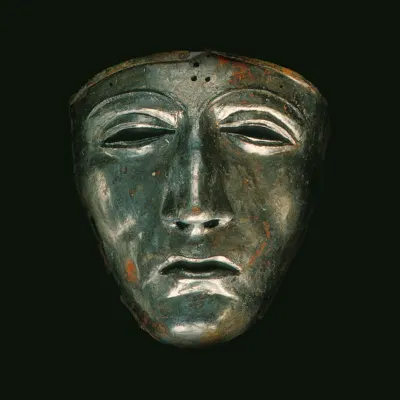
Yeah, well, and of course, he's wearing the full helmet.
Right, yeah, the mask.
A very similar mask actually was recovered at the battle site.
Yeah, yeah, which is cool.
Getting the gear wrong
Yeah.
One thing I didn't like about the armaments is that, like, this is in general the problem with the kind of archaeological side of the show. The Roman stuff, totally on point. The German stuff, basically, just the same old stereotypes. And it's unlikely that the Germans would have just been wearing skins. We know from archaeology that they would have had plenty of chainmail. Some of them might have even had some kind of weird.
Or at the very least, leather.
Actually, you know, fun fact, leather armor did never really existed, which is kind of funny.
That's faith. Yeah, that was never actually that common in history.
Well, not leather armor, but like, you know, like a leather clothing at the very least, right?
Alright, alright, maybe.
Yeah, the Germans are known. The Germans are known for being very kinky, so that makes sense.
Winter quarters
There was, at the end of the series, I think there was a line just like the spring campaign is over, the summer campaign is over. So what does that mean?
So from what I understand is that basically when winter came, when the autumn equinox happened, people in more northern areas would go further south to like basically wait out the cold because they're just not really used to it. This is still basically done among shepherds in Germany and in Switzerland today, which is kind of cool.
Yeah, and isn't that why the army was moving in general?
Yeah, like the army was already on the move into its winter quarters, and Arminius is like, oh, by the way, there's this rebellion while you're marching to the winter quarters. You should stop by and put down these barbarians. Take a detour, quell this rebellion, and then go back on your way. And yeah, obviously, this is this battle is why this entire historical person is known.
Rushed pacing
This is why this entire TV show is made. And honestly, I would have preferred if there were more artistic liberties taken prior to this event, just so you can get some more character moments to flesh out the series before this.
Yeah. No, the example you gave about how Folkwin's family are never developed until they're killed, that's a perfect example. It's this really unfortunate wasted opportunity that makes the entire show much weaker.
Yeah. And also, because like everything is so compressed, the introduction of Arminius back in Germania until the point where Arminius becomes the Reich of his village. I mean, I'm not sure how long that's supposed to have taken in the show, but it feels like that's just one week of time has passed. And, you know, obviously, yeah, you should have just put some stuff in between to like flesh it out because it just feels like so inauthentic that, oh, yeah, this guy's like, this guy who is just a Roman soldier is now like the head of your Reich, and everybody just accepts it like a week later.
Ah, absolutely, yeah, yeah, yeah.
Make that entire thing take over like a like an entire spring or summer.
Oh, yeah, yeah. And if this was George R. Martin writing, there would have been an entire book just about how the Romans react, how the Germans react to having a Roman guy in charge.
Yeah, maybe they were looking at the wrong seasons Game of Thrones for inspiration for this show.
The severed head
But yeah, this final battle is like most of the final episode, and it kind of doesn't really work for me because, you know, there is this narration, it's a very dramatic narration by Arminius, and this narration goes over the battle. And, you know, you get the impression that he's talking to somebody. And in the end, the reveal is like he's talking to the severed head of his father, Varus.
Who had killed himself when he realized the battle was lost.
No, he killed himself when he saw that Arminius was indeed fighting on the side of the Germans.
Which is a nice. I would say that that's a very Roman moment. Like, I can buy that.
Yeah, he fell on his sword, literally, which is, yeah.
Yeah, yeah, oh, yeah.
If you ever read Julius Caesar by Shakespeare, yeah, common practice.
Yeah, but I guess the reveal that he was talking to the severed head of his father at the end was like good. But up until that, just like, you know, like they're doing like slow-mo with the dramatic music, and it's like, oh, no, don't use slow-mo. Come on. It's like, I mean, obviously, it's very, it's very difficult to like choreograph like a 15-minute long action scene with like this many people. So that's why they kind of like have to make it a montage and then slow it down a little bit with the slow-mo, make it a little more dramatic. I understand the production details that go into something like this, but unfortunately, I just wasn't really into the final product.
Segestes waits
Although, I will say, Segestes' role in these final scenes, this is kind of funny. He's just him and a couple of other people decide that they're just going to lay back in the battle and wait to see who's going to win, basically. And of course, they assume that it's going to be the Romans who come out on top.
Yeah. Just constantly scheming. Yeah, I mean, I assume in season two he'll be scheming much more and more.
Oh, yes. Yeah, because without getting into any historical spoilers, the real life Arminius, we know from, I believe, from Tacitus, had a lot of very tricky encounters with the other Germanic elites.
Especially Segestes. This guy didn't go away. He was a constant presence.
Yeah.
He just wants to be Roman so bad. And yeah, maybe that's why he hates Arminius, because Arminius had the opportunity to be Roman, but he rejected it.
Should you watch it?
Anyway, the show is on Netflix. I'll say this. It has good reviews. So just because we are down on it doesn't mean like it's a bad show. You might actually enjoy it, but yeah.
It's the kind of thing that you watch when you want something, something low-effort but flashy. Like, it's fine. If you guys got like a brother or a cousin or an aunt or a sister who's really into like, you know, Peaky Blinders, kind of like bare knuckle, kind of Game of Thrones-y, Vikings-y, sword and punching kind of shows, but also wants to learn about the ancient past.
It's a good rec.
It's a good rec.
It's a good jumping-off point.
I get a feeling that this show exists because shows like Rome and Game of Thrones are on HBO Max and not Netflix.
The Elder Scrolls connection
Yeah, I think actually I would go even so far as to venture that this show is the newest domino in a chain that begins with the Elder Scrolls V Skyrim in 2011.
Oh, that would be so good.
Oh, an Elder Scrolls show?
Oh, yeah, yeah.
Fuck yes, dude. There's so much to go on.
Oh, I know, I know. Hopefully, before this podcast ends, we'll be able to do a whole we'll be able to do a show on the eventual Elder Scrolls adaptation.
Oh, look, and you know, I just googled. Rumor, Elder Scrolls TV show may be in development in Netflix. So, yeah, who knows?
I will say this: as Netflix originals go, it's certainly not one of the worst.
Definitely.
Closing thoughts
Anyway, closing thoughts on this period of history. I will say that as a medieval and ancient history nerd, it's really interesting to dive into the ancient past and see how similar and how different are these peoples from 2,000, 3,000, 4,000 years ago from the groups that we associate with them today. I think that what I find interesting is that the Cheruski, who we associate with the Germans, are not really any more related to the Germans than previous earlier Celtic-speaking peoples are. But because of historical narratives, we see them as more connected to the modern-day German people.
My view on this period of history is that it's sort of unexplored in media, and just like in, and that leads to it being unexplored in people's imagination. Because I get the sense that these kinds of peoples, the barbarians or the Gauls or, you know, whatever, they don't really exist in people's imagination.
Yeah, my impression is that the Vikings are very much in people's imagination because, you know, they're still a topic that is explored in like popular culture. So when you think of like, you know, Nordic history, you do think of the Vikings. Whereas something like, you know, if you think of German history or French history, you don't think about like the barbarians or the Gauls. You think about like the Napoleonic era or World War I and World War II or you know, stuff like that. It is something that I would like more media to delve into just to like, you know, give the average people like a bigger understanding of what happened before you know these major like pieces in these countries history.
It'd be interesting to talk about the way that the classics have really fallen off. Like a century ago, educated people knew these kinds of things by heart, like they were reading them in the original Latin and everything.
And these days, like yeah, and these days, educated people only know Fortnite.
Well, all right, well, this is it's interesting. I will say that the fact that it paints Rome as the villains is kind of cool. You don't see it that often, and I think it does there's some shows, so some films like Spartacus that kind of go into this, but it does show the inherent brutalities of empire that we don't really think about when dealing with such, especially when dealing with such in an ancient context.
Ovid on Arminius
You know, just to close this off, while we were prepping this, Sam found this really beautiful poem by Ovid, the famous Roman poet, which actually mentions Arminius, which was quite interesting. This is from his book, Lamentations. So, in this poem, he's just fantasizing about witnessing the triumph of Arminius and these leaders who organized this greatest shame to the Roman Empire in its history by far. And he's just imagining seeing this procession go down, and he writes: So, all the people will be able to watch the triumph and read the names of leaders in captured towns and see the captive kings with chains round their necks marching in front of the garlanded horses, and behold, some with downturned faces, as is fitting, others still terrible, indifferent to their fate. Some people will ask for histories, facts, and names, others will answer, though they know little.
He who shines on high in Sidonian purple was leader in the war. This next in command, that one who fixes his wretched gaze on the ground, did not cook, so when he was carrying weapons, this fierce one with hostile eyes still burning was the instigator and planned a revolt. And that traitor, who hides his face in the shaggy hair, trapped our men in a treacherous place. They say the one who follows him was his priest who sacrificed captives to their gods, gifts who often refused. And that kind of that shows it that there's this perception that Arminius was this traitor. But I almost wonder if there's not admiration, but the kind of the there is in those lyrics, it seems to me, this begrudging acceptance of the fact that Arminius was so victorious, you know, that he did trap these men and defeat Rome in ways that Rome had not been defeated in generations.
Respect for enemies
I would say that the Romans often had a begrudging respect for worthy adversaries. You often see this in Tacitus, especially, like the way he puts these extremely admirable elements into the mouths of these Celtic rebels in Britannia, for example. It's almost like an early Roman, an early noble savage narrative.
Well, this portrayal is much easier to swallow because they were being led by somebody who was a Roman.
Yeah, no, yeah, yeah. In many ways, he was part of the Roman system. And yeah, the thing is, that there would have been thousands of Arminiuses throughout the empire, thousands of young boys who were raised because of slavery, because of voluntary service, or because of some kind of hostage situation in the Roman system. And 999 times out of a thousand, they would not have done anything to break with the Roman system. But then all you need is one, and you get something like this: where Arminius was able to use everything about his own childhood to his advantage. He knew the land, he knew the people, and he knew the Romans' plans, which was the perfect storm to allow him and his tribe to, as historians today will say, stop Rome in its tracks.
Give me back my legions
And it was kind of like a Vietnam moment for them. They didn't expect this kind of defeat. They'd been defeated before, but never by barbarians. The Romans weren't, the Romans had more respect for their, I would say, their rivals than the Greeks did. So if the Carthaginians or the Persians beat you, those are big empires, you know, it happens. But these smelly, weird, pale-skinned Germans defeating three entire legions doesn't make sense.
Augustus would supposedly wake up at the middle of the night and scream, Varus, give me back my legions.
They had this recurring memory of Rome getting sacked by the Celts.
Oh, yeah, many centuries before, like 300 BC or something.
Yeah, by Brennus. And from that point onward, like, that was a huge anxiety for the Romans.
Definitely, definitely.
The lost eagles
No, and speaking of anxieties, another issue, beyond the fact that so many soldiers were lost, the three eagles were gone after this defeat. If you've ever seen the TV show I, Claudius, which I think is probably the best Roman media ever back from the 70s, they talk about how the Emperor Claudius, a few decades after Augustus, had a whole campaign going into the heart of Germania just to get those eagles back.
I believe that the campaign of Germanicus recovered two of them and the campaign under Claudius recovered the third one.
The end of expansion
Oh, you're right.
It did. What historians generally have thought, there's some question about this, but the general assumption is that this defeat is what led essentially to the end of major Roman expansion. There's a little bit more that they went into Crimea, they hadn't been there before, they went to Britain most famously after this, but you never saw any of the huge conquests except for Britain that marked basically the entirety of Roman history up till this point. And a lot of people think that Augustus, who was emperor at this time, he realized that this expansion was no longer tenable. And that if one group of barbarians, a single tribe, pretty much, or I guess there were some tribes in alliance with them, but if one population of barbarians could bring the empire to its knees, then maybe they shouldn't be in every barbarian country at once.
Right. It's important to remember that we're talking about first century logistics. So they didn't have telegraphs, they didn't have phones, they didn't have any of that stuff. So basically, like Rome's natural frontiers would have been basically like the shoreline of the Mediterranean where messages would be able to travel relatively quickly. But I mean, that's further inland would have been a major struggle for them to hold.
Wrapping up
Well, yeah, this has been Gladio Free Europe going back to the possibly the earliest European history we have recorded.
Although we should add that Europe is fake.
And I think that we should maybe start every episode with that from now on by reminding our fans that the concept of Europe is buggy.
The show is also on Apple Podcasts, Overcast, Pocket Casts, Podcast Addict, YouTube, RSS and Patreon.