33
Late Roman Empire
In progressLike all bad things, the Roman Empire came to an end. But why did it take hundreds of years for that to happen? This week, the gang guides us through an astonishingly chaotic period when Rome did NOT fall — the Crisis of the Third Century — and explores how late Roman figures like Constantine, Queen Zenobia, and Julian the Apostate created the medieval world.
Hosted by Liam, Russian Sam, and Halal Sam.
Transcript
Welcome
Welcome back to Gladio Free Europe. I am your host for today, Liam, and I am here with my incredible co-hosts, Russian Sam.
Hello.
And Sam B. How you guys doing?
Hello.
I'm feeling like pure shit. I've just been reading so much about the topic for this week's episode, and man, it is harrowing stuff. I love reading detailed, gruesome stories about Roman slavery.
This is a crazy one. A lot of bloodshed, a lot of turbulence.
So yeah, so this episode, we are back in Rome again. You know, last week, we were in the modern legacy of, you know, what exists of Rome today in the Catholic Church, but today we are going a lot farther back. This is another ancient Roman episode, you know, following our episodes on Quo Vadis and Barbarians. This time, we're going to the last few centuries of the Roman Empire, which is a topic that I find really interesting. It's a topic that I've read a lot about in the last couple years, but is also a topic that a lot of people don't know much about, even though it's, I think, one of the most interesting times and places in world history. And it's also a time you see a lot of people draw comparisons to, especially over the last few years. Sometimes right and sometimes very wrong. There's a, yeah, a lot of this episode is probably gonna be relevant today.
How societies change
So on Gladio Free Europe, we tend to be really interested in the ways that societies change and transform across time. You know, we've spoken on a really wide variety of topics from the spread of ancient languages to colonization of the Americas, the communist revolution in China, the start of a punk rock scene amid all the chaos of the late Soviet Union, and even the birth of suburbs. But all these topics have something in common. They deal with the end of one moment in history and the beginning of another. Societies are always changing, but some changes are a lot more important than others. If you look at the 50s in America, you got the simultaneous development of American suburbs and the highway system, as well as the birth of the civil rights movement, which led to the victory of legal and political equality for African Americans for the first time in centuries.
For somebody on the ground, the civil rights movement was a much more important part of the 50s than the birth of American car culture. But sometimes changes don't happen all at once. And sometimes the effect of a historical process can't really be known until decades or even centuries after it begins. Even though the US highway system isn't going to be that interesting to historians living 300 years from now, the spread of car culture out of the United States from across the world has really important implications on the transformation that's going to happen and has already happened on the global climate. So this means that people living centuries from now are probably still going to be living in a world that bears the marks of 20th and 21st century industrialization and climate change. To bring this back home, for those of us in the Western world today, we live in societies whose linguistic, cultural, and political landscapes are shaped by the legacy of the Roman Empire.
It's incredibly hard to talk about the emergence of modern cultures in Europe and the Middle East without talking about Rome. This episode itself started when I was trying to talk about early medieval France and the ancient Franks, but I realized it was impossible to talk about the early Franks without laying out the kind of world that existed when they first made their debut and how that world eventually disappeared.
Why Rome didn't fall
But this episode isn't going to be about the fall of Rome, which happened about 1500 years ago in the West. Instead, this episode is going to be about why Rome didn't fall during a crisis of genuinely astronomical proportions a couple centuries earlier. And the ways that Rome responded to this crisis gave us so much of the political and cultural landscape of modern European and Middle Eastern countries in ways that we are still grappling with today. A lot of the traditions that define Europe's political and cultural landscapes before capitalism have their roots in this era, before the fall of Rome, but during a massive stagnation.
Or transformation, really, yeah.
And so the main point here for this episode is that Roman civilization lasted in Western Europe for more than a thousand years, but experienced an incredible cultural and political transformation across the period we're talking about today, which is the third and fourth centuries, the 200s and the 300s. By the time of the fifth century, when the Western Roman Empire actually fell, a lot of the culture and political aspects that we associate with classical Roman society didn't exist anymore. And this means that in some ways, the transformations of the third century contributed more to the end of antiquity and the start of the medieval world than the fall of Rome itself did. This is to say that so much of the medieval world already existed when Rome fell. In this episode, I want us to talk about how that happened. To get to a point where we can talk about what actually happened and the actual effects of these things, we need to talk about what the traditional view of these events are.
Yeah, yeah, yes.
Edward Gibbon
We're going back so early, actually, that the first person we're going to talk about is, in fact, an ape.
You can't say that about all English people.
Edward Gibbon, 1776, this aristocratic, hoity-toity historian, very complicated legacy. Whatever you think about him, he did do a pretty impressive job with composing the 1776 text, The Decline and Fall of the Roman Empire.
Oh, yeah, it's absolutely massive. It's how many volumes is it?
Six volumes, yeah, published across 13 years. Six full-length books going with pretty fine-grained detail into how Rome fell. You know, a lot of earlier historians had touched on the reasons why Rome fell, but none of them really gave great reasons.
This is where we get the idea of kind of Christianity marking the end and decline of the empire, right?
Right, right, yeah.
So a lot of earlier historians in the Renaissance and the earlier 18th century, they recognized that the Roman Empire ended and then you had a Christian world, but they didn't really grapple with the fact that the Roman Empire actually ended quite a bit after the conversion to Christianity. Some of them thought that it was inevitable because the Roman Empire had been pagan, but Gibbon was the first person to really connect Christianity with why Rome fell. He was writing in the Enlightenment. He was very influenced by secular ideals at the time. So he was somebody who saw that the Roman Empire before Christianity was actually a very virtuous place, you know, inspired by all the values of Athenian democracy. But by the time they adopted Christianity, he believed, the decline of Rome was hastened by this new and he believed decadent religion. According to Gibbon, the Roman Empire experienced a long decline associated with the adoption of Christianity as they slowly drifted farther from their initial classical heights.
He also had an incredibly reductive and chauvinistic view of the various barbarian peoples who migrated into the Roman Empire around the time that it was falling.
Yeah, so if you ever see some dumbass on the internet say that Rome fell because of illegal immigration, we probably have Gibbon to thank for that.
Yeah, absolutely, because he had a fall of Rome story with a clear hero, you know, the virtuous Athenian values of the early Roman Republic, and a clear enemy, the barbarians. He believed that a superior society slowly decayed, and again, Christianity, he believed, is a big part of that, and decayed to such a state that these inferior barbarian peoples were able to infiltrate and destroy this empire.
Did he think that they were like racially inferior or inferior in terms of values?
I don't think he really talked about race much, especially because he was living in England, which was one of these barbarian places.
You don't want to open up that can of worms.
Yeah, yeah. But it's funny you should mention because there is kind of a tension here. By the 18th century, a lot of northern European countries had become a lot more developed than places in southern Europe, even though obviously that was not the case for a very long time. Up until really the late Middle Ages, really up until, or maybe the Renaissance really, Northern Europe lagged behind. This is something that probably touched the nerve for a lot of Northern European nationalists as the 18th and 19th century progressed. And you start to see nationalistic interpretations of history where Northern Europeans, especially Germans, try to cope with the fact that their cultural linguistic ancestors weren't doing the same kind of things that the Romans were doing.
German chauvinism
In Germany in the 19th century, you saw a bunch of historians who broadly agreed with Gibbon's thesis, except they believed that the fall of Rome was a good thing because they, as German chauvinists in the 19th century, believed that their ancestors were culturally, possibly even physically, you know, racially superior to the Romans, and therefore it was a good thing that a decadent Roman Empire fell. Because these historians viewed Germanic barbarians as a noble, you know, racially superior people, they thought that by some kind of right of conquest, they were able to defeat the decadent Roman Empire. And as wild as that view might be today, this was very common among 19th century Germans. You know, Carl Wilhelm Friedrich Schlegel actually has a pretty crazy quote about this that really shows the biases of this time. He argued that if the Roman Empire had survived, Europe would have no nations and no history, only annals like the Chinese.
Which definitely says a lot about German chauvinism.
Damn, yeah. That's a pretty bad one, huh?
I guess we should mention, though, that as awful as a lot of 19th century history could be, there were some pretty interesting characters who tried to chart a different course. And because this was the 19th century, they were using methodology that might be kind of outdated today, and they often drew a lot of very hasty conclusions that no modern historian would make. But these guys in the late 19th, early 20th century started to paint a very different picture of the fall of Rome and really for the first time break from Gibbon's old model of the noble Roman Empire brought low by these deplorable barbarians.
Henri Pirenne
Probably the most interesting one of these guys is Henri Pirenne, this Belgian from the early 20th century, born right across the border from Germany. So, Belgium in the middle of the 19th century was one of the most rapidly industrializing places in the world. If you want to see the transformation of the economy, this is exactly where you would be. So, he witnessed this incredible economic transformation across Northwestern Europe, and he saw these ancient social institutions broken. Farmers becoming proletarianized and becoming workers, capitalists supplanting the aristocracy as the new elite.
He probably grew up and saw, you know, a lot of farms around his neighborhood become apartments, for instance.
Exactly. This is a really earth-shattering thing to witness. And so, as a French-speaking Belgian born just next to the German border, he was also fluent in German and closely followed the new economic history in Germany, which, you know, Marx, Weber, etc. And he saw Germany and German scholars in particular as the torchbearers of this new capitalist modernity that they were building. But as you might expect from a Belgian guy born in the late 19th century, he also very quickly witnessed the dark side of German modernity.
Yeah.
So while he's teaching university in Ghent, Germany invades Belgium, and his son is killed in the war pretty soon after. And then two years after the invasion, he takes part in this nonviolent protest against German occupation and is then dragged to a German prison hundreds of miles away. And if you are dragged to a German prison in World War I, you are going to develop some feelings about the Germans. He, like many 20th century scholars, you know, he actually does a lot of his best writing while in jail. And what's especially interesting is that while he was in prison, he was in there with a lot of Russian POWs, and they actually taught him Russian. So he managed to become fluent in Russian across these four years. And supposedly, he even had Russian literature smuggled in during this time, which is kind of cool.
He learned Russian, he probably read some Latin, maybe some Plekhanov. He became really, really irritated at the rise of nationalism and the fact that these nationalists used the ancient and medieval past to justify their territorial claims and their claims of superiority.
Right, and if you've listened to this podcast before, you'll know that this is a pretty common topic for us: the way that, you know, ancient and medieval history are abused by various modern political forces for their own ends. In particular, Pirenne realized that a lot of the ways that these racial nationalists, especially the Germans, were abusing the Roman Empire actually had to do with the fact that earlier historians who were even writing before the rise of nationalism had placed an undue role on race or civilization in their writings. He was very critical of the idea that the Germanic-speaking peoples represented some inherently different race than the Romans, or even that their, you know, civilizational virtues had anything to do with the fall of Rome. And interestingly, despite whatever personal biases Pirenne might have had against German speakers, he crunched the numbers around the fall of Rome.
You know, stuff like the size of cities around that time, what we know about what trade networks were happening. And he realized that the movement of German-speaking peoples into Europe around that time didn't seem to actually be associated with any kind of major collapse, which was a huge development for history. He was the first person to argue that the fall of the Roman Empire might not have been as catastrophic as others might have thought, and that the people traditionally blamed for the fall of Rome, the barbarians, might not really have been the ones to cause it.
Although it should be noted that some of the later work pushes back against this claim, it's definitely not as simple as the Gibbon formulation of like we had the empire and everything was good and there was stability and everyone was happy, yada, yada, yada. But at the same time, it does seem pretty clear from the data that material goods became much more expensive during this period and there were far fewer of them because the efficiency of the centralization of the empire had withered away by this point. So it was worse in that regard, but in some other ways it might have been better, especially if you were a commoner. Really, because at that point, you suddenly had one fewer taxman looking to take money from you. So for a time at least, you would have maybe had a higher standard of living if you were a commoner.
If you were a noble, it seems like it went down a bit because, again, those were really the ones who would have been consuming most of these goods.
Yeah, and so Pirenne is a very complex figure today because he made a lot of broad claims about a lot of topics that aren't really taken seriously. But if you look at his data, it seems pretty solid. Historians largely agree from the standpoint of somebody living in the Roman Empire at the time, the fall of Rome probably would have felt more like a transformation of power than a collapse. You might be paying taxes to somebody else, and goods might come a little bit slower, but your daily life might not have been as interrupted as you might expect. You were still living in a Latin-speaking city. There still was a Roman Senate, even who didn't have that much power. There was a continuation of the ancient trade networks, especially in the Mediterranean, that he noted wouldn't really be interrupted until many centuries after the fall of Rome.
But Pirenne really just changed the game because before him, nobody had really thought to emphasize the continuity of Roman institutions into the Middle Ages. But it becomes increasingly clear that the Roman society that existed in the 5th century looked a lot like the medieval society that existed centuries later. This is to say that the fall of Rome itself, which definitely was a very important thing that happened, wasn't actually the most transformative event in the lives of many people, especially in Europe.
What changed Rome?
Which begs a very important question: what then happened to change the world of Julius Caesar into the world of Charlemagne? If the fall of Rome itself wasn't that important, when was it? You know, because Pirenne himself actually thought that it was the rise of Charlemagne and Muhammad around the same time, the 7th and 8th century, that really ended Roman society. Historians today don't really believe that. They actually think that a lot had changed by that point, and they kind of downplayed the economic and social significance of those events. But they do recognize that there were some very interesting political and social transformations that happened independent of the fall of Rome. Except that historians today don't really think that these major transformations happened after the fall of Rome. They think that it happened before. Historians who followed Pirenne in the Annales school in France, who really emphasized materialist interpretations of history, wondered why Roman society in the 5th century during the time of Romulus Augustulus was so different from Roman society in the first century during the first emperor Augustus.
The crisis of the third century
And to answer this question, there was one moment in particular that historians began to focus on: the crisis of the third century. In the historiography, the crisis of the third century is generally considered to have begun in 235 with the assassination of Severus Alexander, who had been the emperor at that point, and lasted until 284, until Diocletian came to the throne. And I did not know what we were getting ourselves into when we started researching this topic because it's just... A lot happens in this time.
It's huge.
Yeah, it's one of the most studied topics of Roman history these days because it's just so enormous. You had in this 50-year period, 26 different rebellions happen. You had a plague, you had an economic crisis. We're going to talk about all of it. But the bulk of today's episode is going to be a look at what exactly the crisis of the third century was and why and how so much changed during this time.
Yeah, so Severus Alexander, he was the last emperor of the Severan line, which had been ruling the empire since 193.
Yeah, with roots in North Africa, interestingly. The kind of the last gasp of the Carthaginians, you could say.
Yeah, so Severus Alexander is assassinated by his own troops. We'll get into why that happened later. And in the following decades, there were over 50 attempts by generals to usurp the throne. 26 of them were successful.
Probably the most famous and kind of the sexiest aspect of the crisis was that for the first time, you had the Roman Empire split into basically three stable polities in a kind of major civil war scenario that hadn't really existed in Rome before. Because rebelling against the Roman Empire in the middle, you had suddenly the emergence of this rebel Gallic Empire, which existed when one rebel general united Gaul and Britain. And you also had the Empire of Palmyra, when a very interesting character named Queen Zenobia declared herself queen over a huge chunk of the Middle East, which would previously have been part of Rome.
Problems mounting for centuries
So the crisis is generally dated to have started in 235, but of course, that's really just the straw that broke the camel's back. In reality, this was just a perfect cascade of all these absolutely horrific problems that had been mounting for centuries. And the assassination of Alexander Severus, it was just the point where it was just so broken that it couldn't not break up the way it did.
Yeah, yeah.
So we should mention that at the start of the third century, the 200s, Rome had basically met its territorial extent. Britain had been part of the empire for over a century. The frontier in the west was always shifting, but they had sort of cemented their frontier with the Germanic peoples. They weren't planning on going much farther. And then in the east, there was a constant tug of war between the Romans and the Persians, where cities in modern-day Syria and Iraq were being handed back and forth every few years as they each got conquered by the respective empire.
Yeah, which brings us to maybe the most important point. The empire was just way too big, considering the technologies that they had available to them at the time. So despite the fact that the Roman state was spending 60% of its budget on the military, this was still nowhere near enough to defend its frontiers. In the east, you had the Sassanid Empire, the Persians, which was constantly trying to capture the Levant and Anatolia. And then in the West, you had a bunch of barbarian tribes, as the Romans would have seen them, tried to break into the empire and plunder. Sometimes these were refugees who were themselves fleeing some other tribe invading them. But basically, this meant that Rome was under attack on basically all fronts.
Right, and yeah. And basically, every few decades you had another crisis of some barbarian group, usually that spoke some kind of Germanic language, coming across the Rhine and either asking to settle or raiding somewhere.
Yeah, and of course, they don't have enough soldiers to defend all of these frontiers at once. So, say there's a barbarian invasion in the West that you need to fight off, they would have to move troops away from the eastern provinces, aka on the border with the Sassanid Empire, to fight off these people. And the Sassanids, before long, they would realize, oh, look, we're not facing the bulk of the Roman army anymore. Why don't we take this chance to rebel? And this just pendulum just kept swinging.
No rules of succession
Yeah, and completely independent of any wars, there was another really big crisis that constantly destabilized the empire. The Roman Empire never really had clear rules of succession. It was ultimately based on traditions without any concrete mechanisms to enforce that an orderly transfer of power happens. I mean, in theory, the Senate was supposed to vote to proclaim the new emperor, but in practice, usurpers really found it very easy to install themselves into power and then to force the Senate to approve this decision post facto.
Yeah, and in the interest of stability, the the military usually preferred each emperor to give the power to his son, but in practice, it wasn't usually what happened. Usually, when an emperor died, if there wasn't a clear successor, whoever could amass the most power quickly enough would take the throne. And even when there was a designated heir, it was pretty common for some usurper to seize the throne for himself anyway.
So, going back to the external factors, namely the military threat, with the rise of the Sassanid Empire, for the first time in many centuries, the Romans were facing off against the serious, very well-organized foe. And Rome lost many wars against Persia, which caused Roman territories in modern-day Iraq to essentially be lost forever.
Yeah, yeah. And we should add it, this was a pretty big spiritual loss because, you know, so much of the ideology of the Roman state, especially before the conversion of Christianity, was about the idea that the gods had made Rome victorious. You know, I believe there was the altar of victory even in the Roman Senate. It was just the idea of winning wars was in many ways central to the entire Roman project.
An enormous army
Yeah, so across the early third century, the Persian frontier was just pushing closer and closer west. And as the valuable Greek-speaking city-states on the Mediterranean coast came under threat, the military had to expand to sizes that had never been seen before. There were something like 600,000 Roman troops at this point.
And I mean, that's enormous. There are plenty of modern-day states in Europe that don't have armies this large.
Yeah, just for a comparison, the current U.S. active duty army soldiers are less than 500,000. So the Roman Empire was actually larger than the modern-day U.S. army is, even though the United States has something like five or six times the population as the Roman Empire had at its height.
Absolutely insane. You had more troops than ever before, which brings us to our next point. The military was just way too powerful, and Roman polity had no counterbalance against these powerful generals and their legions. Traditionally, you had the Praetorian Guard, who were the personal elite troops of the Emperor, who also had a tendency to kill the Emperor from time to time. But these Praetorians, they just were no match against the legions, which were absolutely huge in comparison.
Yeah, and the army was so prominent politically that it's even been asked: to what extent did the army serve the Roman Empire, and to what extent did the Roman Empire exist basically just to feed the army? And there was also a very perverse incentive for the army to overthrow emperors at this point, because every time a new emperor took power, he would issue a donativum, which was sort of a lump sum payment to the military to ensure their loyalty. Basically, that translates to: if there's a new emperor every year, you're going to get a bonus every year. So it's in your interest to, you know, do as many coups as you can.
That's hilarious, yeah.
Debasing the currency
So, along with a lot of other economic factors, this resulted in the debasement of Roman currency. And debasement means like the amount of precious metals that are actually in the coin are reduced so that the state can actually issue more money. You don't have enough silver or gold or whatever. You can just lower it, lower the from like, I don't know, 80% to 70 or 10%. And as a result, you get a huge economic crisis. The currency gets devalued. So there's a crazy amount of inflation. It's getting so bad that the barter economy is starting to spring up. And just to give you guys an idea of the scale of the problem, so the main silver coin of the empire was the denarius, which was the most common currency in circulation, along with these good old bronze coins. In around 60 AD, a denarius contained about 4.5 grams of silver, which would have been 95% silver.
By 210, it was at 60%. And then finally, by 265, it was only 0.5%. It was just like a thin layer of coating on the coin.
Oh, it's hilarious, yeah. And this is an era where, from what I understand, like the material the coin is made out of is still supposedly what gives the coin its value.
Yeah, yeah.
And so, because of this, trade networks began to break down because there just wasn't enough currency in circulation to pay for goods, which is why the barter economy arose. And alongside it, you had the phenomenon of manorialism, which became a very prominent mode of economic production during this crisis. Basically, what you saw happen was that Roman citizens gave up some of their rights in exchange for the protection of large landowners. So they became tenant farmers or coloni. And with the passage of time, this became the basis of serfdom in Europe, an institution which would last for well over a thousand years. So this is one of many transformations we're going to see in the Roman Empire that happens well before the fall of the Roman Empire, but is going to have ramifications in Europe and the Middle East for many, many centuries after.
Climate change
And in addition, you get climate change. Something relevant today, obviously. There were falling temperatures during the third century, shorter and drier summers in Europe and less favorable flooding conditions along the Nile and Egypt and droughts in the Levant. This is really bad for agriculture. You get reduced efficiency, you get more famines, and that'll have a demographic hit.
Yeah, and of course, if the efficacy of agriculture goes down and your population goes down as well, that's sort of a self-feeding cycle.
And speaking of demographic decline, another problem that you had that was really, really wreaking havoc.
Also, also perhaps relevant to today, although thankfully, our own is nowhere near as deadly.
Plague
You had plague. So, first, you had the Antonine plague in the second half of the second century, which was believed to have been smallpox, and it killed about 10% of the population of the empire. It lasted until about 180. And this is generally taken to be the end of the Pax Romana. And then, in the middle of the third century, you had the Cyprian plague, which was by all accounts far nastier. And you had this diminishing workforce, as I had mentioned previously. You had the drought. And historian Kyle Harper proposes that this would have been a hemorrhagic virus akin to Ebola.
Yeah, which even today kills something like 50 to 70% of the people it infects. We don't really have empire-wide statistics for how many people died, but in the city of Alexandria alone, you saw a 60% drop in population from 500,000 to around 200,000.
Absolutely insane.
Yeah, no, you're right, right. And I just want to add that that is a drop in population that we don't see with the fall of Rome proper. This suggests that in a lot of ways for people on the ground, I think like a plague like this probably would have been a lot more traumatic than learning that centuries later you were no longer part of the Roman Empire.
The death of Severus Alexander
So I guess the big question is: so this is a crazy crisis. We've talked about all the sort of long-term effects that sparked it, but remind me, Russian Sam, what exactly was the event that really put the crisis into high gear?
Yeah, so again, in 235, you saw the death of Emperor Alexander Severus, who was killed by his own soldiers, supposedly because once again, you had war on multiple fronts with the Germanic tribes as well as with the Persians. And so Severus had basically bribed the Germanic tribes so that they would leave them alone so they could fight against the Sassanids. And his troops were not having that. They felt that this besmirched Rome's honor to basically surrender to these barbarians. And so they just killed him.
Also, that's a very modern-sounding kind of assassination.
Yeah, yeah, and I've heard someone say that actually the Capitoline Hill was once referred to as a grassy knoll.
Yeah, so after the death of Severus, again, you don't have a clear succession mechanism. And at this point, you had these cascading crises, which were really taking a toll on the Empire writ large, which was disrupting the structures of the Empire.
The barracks emperors
So at this point, you have the era of the so-called Barracks Emperors. These were generals who generally had a commoner origin. Often in the Balkans, many of them. And they were generally in charge of legions on the frontier. So these guys, they didn't last for very long. Most of them served for only one or two years. Sometimes it wasn't even a single year. And the way that this worked, just the fact that these were border generals, once they left Rome to take power, you suddenly had a gap in the border defenses. So suddenly you find you have a whole bunch of unwelcome Germanic guests.
Yeah, anybody who lives by the beach in Spain has dealt with this.
Civil war became the norm throughout this period. As I mentioned previously, you had 26 different generals who successfully took power. You had many more attempts. And most of these guys weren't very important. I just want to highlight some of the more interesting ones.
Yes.
A lot of these guys are a lot of very fun characters in this time period.
Philip the Arab
Yeah, so first of all, you had a guy named Philip the Arab who reigned from 244 to 249. And as his name suggests, he was unusual for having been an Arab. He was born in modern-day Syria in 204, and he had that grind set, so he worked his way up the military ranks. And when it came time for his soldiers to declare him emperor so they can get another bonus, he was ready and he took charge. So the fact that he was an Arab was unusual even among these emperors, but again, just to highlight, this was an era when you saw a lot of self-made, talented men who had risen up the ranks of the meritocracy. And many of these people were not ethnic Romans. Like I said, a lot of people were of Illyrian origin from the Balkans. So any Albanian nationalists listening to this should probably note that there's a very good chance that a whole bunch of Roman emperors at this time might have spoken a language similar to Albanian.
This just in: Roman Empire was Albanian. Everyone else in the Balkans, fuck off.
So Philip the Arab, in addition to being an Arab, was also unusual in that he has been rumored to have been the first Christian emperor.
Yeah, I actually had no idea about this. That's really cool. Everyone always thinks of Constantine.
It's not a for sure thing. It's been hotly debated for a very long time. But many early church histories, most notably Eusebius's Ecclesiastical History, report this to have been the case. Eusebius reports a story where Philip attempted to attend a church service on Easter, and he was not allowed to enter until he confessed his sins. He did this gladly, and then finally he was let in, but he had to sit with the penitents. I don't know personally what to make of this. It seems to be he was technically sympathetic to Christians at the very least. He had many Christians in his service. But even if he was personally Christian, at this point in time, the office of the emperor required him to publicly partake in pagan rituals because the head of the Roman Empire was also the pontifex Maximus, who was the head of the Roman religion.
Yeah, and just for a quick little sidebar here, we talked about early Roman Christianity in the Quo Vadis episode a couple weeks ago, but by now Christianity had grown to a much wider religion and was sort of starting to shape up into the Christianity we know today. You had people calling themselves bishops, even though they didn't really have any real authority, and you also had the circulation of a group of texts that eventually became the Bible. And so this time, it's called the Ante-Nicene period. You probably had about a few hundred Christians in every city. And there were lots of Christians in the military in particular. And there were even the beginnings of Christian communities trickling outside the Roman Empire, getting started in places like Armenia and Ethiopia.
Yeah, I believe that Christians were something like 3 to 5% of the population of the empire in this period.
Yeah, probably should add probably less of a percent of the population than Jews were at this time. At one point, Jews were as much as 10% of the population. Pretty cool.
Decius
So Philip's reign ended in 249. Like most of these guys, he did not die of natural causes. He was succeeded by a man called Decius, who reigned from 249 to 251. And let's just say Decius had a very different attitude toward Christians.
Yeah, so Decius is unusual for this group of guys because he had actual political experience. He had been a senator for a very long time. And in fact, it was this role that first brought him into contact with Philip the Arab, and through which Decius had made such a positive impression on Philip. So Philip felt that he could trust this guy enough to give him an army and send him to the Balkans to put down some revolts. But as is usual for this period, his troops proclaimed him to be the emperor in 249 and he marched on Rome, defeated Philip easily, and killed him and took the throne. If anyone knows anything about Decius, it's usually for his persecution of the Christians. This is often called the first empire-wide persecution of Christians.
Yeah, and we should add that even though that he's a lot less well-known than Nero in the popular culture, his persecution of Christians was almost certainly much more wide-reaching and destructive than what Nero had done. Nero's successors, many of them, were not very fond of Christians, and there were periods of persecution, which shouldn't be discounted. But up until this point, these had usually been very localized and very brief, only lasting a couple of years. But Decius really took this to another level.
And the interesting thing is that modern scholars seem to say that this wasn't a specifically anti-Christian action. It just ended up developing in a way that saw Christians hurt in large numbers. In 250, Decius, who is a very sort of return-to-tradition guy, issues an order demanding that all Roman citizens burn incense and offer sacrifices and libations to the gods. But there was an exception. Jews actually weren't required to do this because from the time of Julius Caesar, Judaism had been recognized as a permitted religion.
I have one little thing here. The historian Philip Daeliter has sort of talked about this: that there was this very brief moment where Jews were better off than Christians in the Roman Empire, you know, which is a very interesting contrast with like, you know, the ensuing rest of European history. And he believes it was a pretty simple reason. It was just that because Judaism was seen as ancient, even to the Romans, there was this understanding that their traditions were somehow more legitimate than this upstart cult. There does seem to have been some kinds of Jewish proselytism during this period because you start to see Jewish convert communities seem to appear in Roman cities. It doesn't seem that Judaism was growing as fast as Christianity or it was growing in ways that would freak out Roman officials, such as, for instance, among slaves, who appear to have been a big early social base for Christianity.
People who performed these sacrifices would be issued a libellus, which is this bureaucratic document which testifies that a person had done a sacrifice. And these sacrifices, they were based on the idea that the gods needed to be appeased. So the more people you have performing sacrifices, the more happy the gods would be, and maybe then the turmoil of the empire would come to a halt. And from a more civic point of view, this could be viewed as something of a loyalty oath, which was very important at a time when Rome's frontiers were being relentlessly assaulted. And seen in that light as something that's purely for the benefit of the state, some Christians did follow the order because, you know, render unto Caesar what is Caesar's, all that stuff.
Yeah.
And so you can imagine if you're a Roman pagan at this time, if like your son is being, you know, is fighting in some war off in Persia and your uncle in Gaul has just been killed by barbarians, you might be kind of mad at the Christians next door who don't want to partake in these rituals to defend the empire.
Yeah, so some Christians acquiesced, but others were refusing to do this in very outspoken ways because they believed it to be contrary to their religion, because they believed that this was idol worship, basically. And these people would be persecuted and some of them even executed, which made this period a very rich period for martyrs.
I guess tragically for Decius, though, it doesn't seem like these very haughty rituals actually protected him that much because in 251 he had a pretty undignified end. He was actually the first emperor in a very long time to personally take to the battlefield while he was emperor. And so he went off to the Balkans again to fight off the Goths. And he died in a battle in 251.
Yeah, unlike people like the Vikings, dying in battle, especially if it was a battle that you lost, wasn't seen as especially glorious for the Romans. And in fact, it was pretty catastrophic morally whenever an emperor would be killed. 100 years after this, another emperor would also die against the Goths, and it's seen as one of the biggest contributing events to the fall of Rome.
Valerian
Yeah, so again, there's no chain of succession, and again, there's a couple of guys in between. But in 253, Valerian comes to the throne, and he is notable for having been taken prisoner by the Sassanid Emperor Shapur I after the Battle of Edessa. Basically, what had happened was that he had gone off to the east to fight the Persians, and lo and behold, you have the Cyprian plague, and suddenly large numbers of his troops are being killed off. And the army is very weak, very diminished, and they stood no chance. One tradition holds that Shapur captured Valerian and used him as a footstool to mount his horse for a couple of years until he got bored with him and killed him.
The Persians across our history, they've got a lot of fun little tortures for Roman officials, it sounds like. But speaking of people getting tortured, he's most famous for his torture and actions against Christians.
Yes, yeah, that didn't get better for Christians very early during the crisis.
Yeah, high-ranking Christians were stripped of their ranks and property, and low-ranking Christians would be enslaved. It's bad stuff. And this time you had some very prominent martyrs. Among them was Pope Sixtus II and Cyprian, after whom the Cyprian plague is named.
Wow, what an honor.
He was a bishop of Carthage where the plague had been particularly devastating. And he would give sermons about the usual stuff, castigating the evil Roman state for having brought this plague upon the people. And again, in this context where you have a massive plague and you exist with the worldview, which says that the gods can unleash punishments upon you for not performing the customs which you're supposed to be performing. You're not giving sacrifices to them. And suddenly you have this new religion which not only doesn't worship your gods, which actively rejects them, you're going to be very unhappy with them. And just the fact that he was the bishop of Carthage, which was very hard hit, you sort of have this question of, did the Romans perhaps think that the Christians were responsible for the plague? Is that why Valerian suddenly amped up the persecutions to such a high degree?
Yeah, that's really interesting. It's kind of funny because that's so reminiscent of like medieval anti-Semitism. Maybe there's some kind of interesting little ideological continuity there. You know, like these, these are the heathens living near us. Maybe they're the reason that the gods are unhappy, therefore we should punish them.
So again, there were a bunch of guys that no one really cares about all that much.
Aurelian
But in 270, we finally get the big dog, Aurelian himself, one of the most renowned Roman emperors. He's not attributed with ending the crisis, and we'll talk about why, but he brought some really interesting stability to the empire.
He was an Illyrian, also, like many of these guys from, you know, modern-day Albania, the Balkans. And his mother was probably a freed woman who, you know, had been a slave, which is pretty interesting. So he's really somebody from humble origins.
Yeah, so he joined the military in 235 and he rose his way up the ranks because he was clearly a very, very competent guy who knew how to network with the right people and schmooze. And so in 268, this guy named Claudius II becomes emperor through the usual route, at which point Aurelian becomes the second in command of the military. He was the magister equitum, basically the head of the cavalry. This position was second in command of the Roman military right after the emperor, and he's sent to crush a Goth offensive into the Balkans.
God, why are the Goths so passionate about the Balkans?
Yeah, they love that rakia.
Yeah, so in 270, Claudius II dies of plague, and his brother attempts to take the throne, but the military backs Aurelian, who at this point he really shines up his boots and he's ready to rumble. So that same year, a bunch of Germanic tribes had successfully raided into northern Italy. And for some time, it seemed like the city of Rome itself was at risk of being sacked for the first time in many centuries. Just to give you guys an idea, the last time that Rome had been sacked was the fourth century before the Common Era. And they had walls around the city at the time, but they never bothered to update them up until that point. And the city sort of just sprawled beyond the borders of these old Servian walls. And to prepare for the possibility that Rome might be besieged, Aurelian orders the construction of walls around Rome, which bear his name to this day.
And this was the largest construction project taken upon by the Roman state in many decades and was done entirely by the citizens of Rome as the military was obviously very occupied.
And you know, what's kind of cool is that these walls actually remained the main, you know, physical line of defense for the city of Rome for centuries after that, across the Middle Ages and into the Renaissance and early modern period. And it actually wasn't until the 19th century that the city of Rome would legally grow beyond the boundaries of the Aurelian walls.
Aurelian proves his bona fides. He shows that he's made of some really tough stuff. He defeats these Germanic invaders and he turns his attention to reunifying the empire. And as we said earlier, in around 260-ish, the empire had broken up into three pieces. In the west, you had the Gallic Empire, Britain, Gaul, and Hispania for a period. And then in the east, you have the Palmyrene Empire, which had gobbled up large parts of Anatolia, the Levant, and had even briefly conquered Egypt.
Odaenathus and Palmyra
So let's rewind to Valerian now. Valerian is captured in 260, and suddenly there's no emperor, there's no military for him to lead. And it seems like the Persians might capture this territory any day now. And they very well might have had it not been for a man named Odaenathus, I think that's how you pronounced it, who was the ras of Palmyra. It literally means head. It's like he was the lord of Palmyra, the city. He was able to successfully mobilize an army and repel the Persians. And he sort of worked his way up the ranks. He founded the Palmyrene Kingdom, which pledged fealty to the Roman Empire, but in practice had a lot of free reign on the ground.
You ask, I just, this kind of reminds me of another Anatolian figure from many centuries after, how, you know, Ataturk first came to prominence, because when the Ottoman Empire failed, he formed his own military and repelled the invaders.
Yeah, so Odaenathus, he becomes the king of this Palmyrene kingdom, and he doesn't really challenge the Roman state. Although in practice, he very much built a state which Rome could not influence very strongly. So basically, all of these Roman-appointed provincial governors were subordinate to Odaenathus, who would be assassinated in 267. And this is really where the fun really starts.
Zenobia
At this point, he had a young wife, Zenobia. He had a young son. And Zenobia, she took power nominally as a regent for her son, but she was very ambitious and very strong-willed and very skilled in wielding political authority in her own right. So she slowly expanded the borders of the kingdom. Well, actually, now that I think about it, not so slowly. She captured the Levant, so you know, Syria, Palestine, Jordan. She captured all that area up until basically the Sinai Peninsula in the south and up until quite a long way into Anatolia in the north. But in 270, she had overplayed her hand. She assembles an army of 70,000 men and invades Roman Egypt.
Which, if you know anything about Egypt in the Roman period, this is a problem.
Yeah, you can't emphasize enough how important Egypt was to the social and economic health of the empire. And eventually, when Egypt would be lost to the Arabs many centuries later, the Byzantines had to completely transform their economy to make up for that devastating loss. And also, this is why the Nile getting less rain really, really had a huge impact.
Yeah, so from 271, Zenobia starts to adopt imperial titles for herself. So she's no longer a queen who was a vassal to the Roman Empire, but an empress in her own right. In another period, maybe she would have been more successful in this endeavor, but Aurelian was not that type of guy who would just take this and accept that the eastern half of his empire was slipping away from his fingers. So in 272, he launches assaults on both Egypt and Anatolia. He's personally leading the army in Anatolia, and he has a very well-disciplined force that's very loyal to him. So in no time, his military overpowers the Palmyrene forces, and they capture Zenobia and her son, who is consequently taken to Rome and put on trial for treason, basically. And as well as to be marched through the city as part of the triumph while wrapped in gold chains.
And seemingly she was executed a short while later.
Yeah, it's generally very bad when female leaders try to rebel against Rome.
Even if it makes a good story.
Postumus and the Gallic Empire
So then you get in the west, there's Postumus, who was this Batavian Germanic man who was favored by Valerian.
Yeah, yeah, just a little quick sidebar, a little add-on here. So yeah, he was from the tribe the Batavi, who were another Germanic tribe, one of the first to settle in the Roman Empire. And they were interesting because they were basically made to serve as guards, especially kind of like a Praetorian guard type of system for Roman officials. But pretty soon after the events of that show, Barbarians, we talked about many months ago, these guys, the Batavi, they rebelled, but they were completely crushed. And in the process of quelling this rebellion, it basically transformed them into the most loyal Germanic-speaking ethnic group toward the Roman Empire. So just as so many Illyrians became part of the Roman military apparatus, many Batavians, like Postumus, became military officers.
So Postumus was a Batavian, that is a Germanic man, and he was favored by Valerian, but we don't really know his exact title. We just know that when Valerian went east to fight the Sasanians, Postumus was one of the people that he left in charge of Gaul.
Bad idea.
Bad decision.
Not a good one.
No.
And after Valerian's capture, his troops revolted, and they proclaimed him as the emperor. And he headed this Gallic Empire.
Yeah, so the troops that were in Gaul, they decided that if the emperor out in Persia is captured, someone else back in Gaul has to be their emperor.
Yeah, and now he's the head of the Gallic Empire. And he expands his domain to include Hispania, Britain. And in the end, Emperor Gallienus tried to retake these lands in 265, but he failed. And Postumus ends up holding on to power until 269 when the army rebelled against him, finally.
Yeah, you can't please everyone, right? What is it?
Live by the sword of the military usurper?
Die by the sword of the military usurper.
Yeah, so eventually the whole Gallic Empire thing just kind of falls apart after they got rid of Postumus. And then Aurelian comes back in to try to sweep things up, pretty quickly gets rid of the remnants of the Gallic Empire and makes some kind of deal for clemency with the rebellious troops. And I think you pointed out, Russian Sam, that it's possible that he actually didn't want to kill too many of the rebel troops because he needed to recruit them. Because there were so many barbarians going in and out of Gaul that he needed the loyalty of the Gallic troops, even if they were rebelling against him.
He can't kill everyone, willy-nilly.
Yeah, yeah.
And we'll talk about this in a second, but the broad process of kind of increased military power, even as the military itself becomes looser and starts admitting more types of people, is a really important process long term in Rome.
Aurelian reunites the empire
So Aurelian did it. He successfully reunited the empire. There was now one emperor ruling all of these lands, and it seemed like a guy with a very good head on his shoulders, someone who could fix this entire mess of a situation. So in 274, he sets out on a campaign against the Sassanids to retake the lands that they had taken in the east, but he ends up getting killed by his own officers before he even crosses into Anatolia.
Yeah, what had happened was Aurelian instituted very strict anti-corruption measures because by this point they were clearly necessary. And he had a secretary who was up to some shady shit, and he was afraid that he would be brought to justice for some infraction or another. So what he did was he created this forged document, supposedly in Aurelian's hand, which was to be a list of prominent officers to be executed under these anti-corruption campaigns. And so he just goes to these guys and shows them, hey, look, the emperor is planning to kill you. You should do something about that. So the officers, they take the list to be real, and they assassinate Aurelian in 275.
Which, of course, was not the best decision because, you know, as soon as Aurelian died, there was the outbreak again of, you know, chaos and violence. Although, fortunately for the people of Rome, it doesn't seem like there was much really severe civil unrest after Aurelian's death. Aurelian did do a really good job on reuniting the empire, and even killing him wasn't enough to undo that work.
Pretty impressive, honestly.
So, again, you had a rapid succession of usurper emperors, most of whom had very short reigns.
Diocletian
Finally, in 284, Diocletian takes the throne, and he's the one who's considered to have decisively ended this crisis.
Yeah, and so just to pause here. So, so Diocletian is not a name that a lot of people know, especially, you know, Americans who haven't intensely studied Roman history. But I think that Diocletian is probably one of the most significant figures in, you could say, world history. You know, I don't love the whole great man view, but his personal choices had such far-reaching implications on the history of Rome and what that meant for the history of Europe and the Middle East as a whole, that I think he really is one of the most significant people to live ever.
I think that's totally fair.
Yeah, so let's get into him. He was born in Dalmatia to a freedman.
Just like Aurelian.
Yeah, again, very, very humble origins. And again, he worked his way up the ranks until he was able to insert himself as the head of the elite cavalry unit of Emperor Carus' household, which he did in 282. And shortly after this, Carus died under very mysterious circumstances while on campaign against the Sassanids. Some of the sources say that he was struck by lightning.
Yeah, sounds legit.
And he's succeeded by his sons, who would be the co-emperors briefly, but not for too long. Diocletian had a chance to take the throne for himself in 284. And Diocletian was, again, a very clever man who had lived through the chaos of the period, as well as having lived to see and be a part of the military during Aurelian's reign when he was able to consolidate power. But Diocletian, he realized that there's a great danger in concentrating the power of the entire empire in the hands of a single man. And just the fact that this crisis had been going on for almost 50 years at this point, he decided that he would put an end to it through the means of the devolution of power. So basically, he split the empire up. Initially, he chose one of his officers named Maximian to serve as the co-emperor with him.
So Diocletian would rule in the east, and Maximian would rule in the west. And in this way, they would continue to administer the empire as equals, basically.
Yeah, yeah.
He figured out the best way to cut up an empire is with a pair of Caesars.
There you go.
Co-emperors were not unknown in Roman history. Some emperors did take on a co-emperor, like a son, for example, or a general whom they adopted and expected to succeed them. Basically, you had the rank of Augustus, who was like the top emperor, and then you have the rank of Caesar, which is prince, kind of. What Diocletian ultimately decided to do in 293 is to promote Maximian to the rank of Augustus, as well as to give both him, that is Maximian and himself a Caesar.
The Tetrarchy
So this was the beginning of the period known as the Tetrarchy, which means rule of four.
Right, which is basically going to be the period we're going to see pretty much for the rest of Roman history. And this is at least in the West. And this is the process that eventually results in the Eastern and Western Roman Empire becoming two completely separate polities.
So there's a very good rationale for this. The devolution of power reduces the authority of the single emperor, who is, you know, nominally in Rome and who's supposed to be giving orders that spanned the entire range of his empire all the way from Brittany to the Levant, which, with the technologies of the time, would have been very difficult. So, rather than having that set up, you would break the empire up into four quadrants, and each of these quadrants would be ruled by one of these co-emperors. And this had the benefit of the fact that this meant that you had multiple emperors leading armies on multiple fronts. So, basically, one of them was never too far away from whatever upstart general who might be thinking, hey, maybe I'd make a good emperor myself.
Yeah, and it also means that if any of these upstart generals tries to actually replace someone, they have a much harder road to hoe because you can't just replace one guy and call yourself the empire emperor. You're now going against three or four different emperors. So, the handsome generals were put in their place. But this devolution had massive implications for the later history of Rome.
So, here we are. The Roman Empire has now been split into four sections. Eventually, they'll coalesce into two. But now we have the Tetrarchy, where basically two sets of two emperors run the show. Like we said, the higher-ranked was called an Augustus, the lower-ranked was known as a Caesar.
There's a very famous statue known as the Four Tetrarchs that we're going to mention again later. That's a really perfect example of late Roman art that shows these four emperors embracing each other like brothers. And it's a pretty clear symbol meant to show that even though there are now these four distinct rulers of the Roman Empire, they're still part of a single cultural political project of defending this Roman state from foreign and internal threats.
Another succession crisis
Unfortunately, this system did not remove all the instability associated with succession. Diocletian and his co-emperor Maximian both abdicated in 305 and left power in the hands of their underlings, but within a year, there was a succession crisis. Constantius, who's the father of Constantine, who succeeded Maximian as Augustus of the West, died in 306. And then Severus, the Western Caesar, was supposed to take power according to the rules, but the troops of Constantine elevated him to the rank of emperor instead. And then, seeing an opening, there was a doubt that was introduced. And Maxentius, who's the son of Maximian, had himself proclaimed emperor of Rome by the Praetorian Guard.
So now there's five emperors. This is insane.
I mean, I've heard all the stereotypes about Italians and government, but my god.
Severus was sent to put down Maxentius, who had also made Maximian co-emperor, but some of his troops defected because they were bribed. Galerius, another co-emperor, marched on Rome with an army, but again his troops defected. So now there's another civil war threatening to tear the empire apart.
Yeah, so there's a lot of intrigue at this point. At one point, Maximian decides he doesn't just want to be co-emperor anymore, he wants to actually run the show. So he tries to overthrow Maxentius, who sends him abroad into an exile fleeing for his life. And he's suddenly schmoozing up to another one, the co-emperors again, because his son kicked him out. And frankly, this is very complicated stuff that would take a long time to explain thoroughly.
Constantine at the Milvian Bridge
But what you have to know, really, is that this is where Constantine really makes a name for himself. So it's at this point that you have the famous Battle of the Milvian Bridge, which was where you get this story about Constantine having a vision where he's told that if he puts a Chi-Rho on the shields of his soldiers.
Which was the prominent Christian symbol at that time.
Yeah, which is like an X and a P written on top of each other. It represents the name of Jesus. And he's told that if he paints this symbol on the shields and banners of his soldiers, he will emerge victorious. And surprise, surprise, it works. And it's from this point onwards that Constantine first begins to flirt with the Christian faith. But he doesn't actually convert for quite a while.
Christianity's rise
And yes, this is as good a time as any to talk about the fact that, yeah, so Christianity, like we said, was really rapidly growing across this period. And I've kind of wondered, this is just my own speculation, if all of the chaos of the third century might have somehow brought more people into the Christian faith. You know, if there's so much chaos happening on earth, maybe you start to become interested in these guys who offer this eternal life in heaven.
Makes perfect sense to me, honestly. It's an appeal to the world around you is really messed up. And so what about the next life?
Yeah, yeah.
And it seems like there was kind of a general spiritual crisis, especially among elite Romans, but also sometimes among the poor, happening at this time. Because you seem to see a lot of conversion on the high and the low end of urban Roman society. Like we said, many slaves start becoming Christians at this time, but you also have smaller numbers of elites becoming Christians. Also among elites, especially among elite women, there seems to be a strong interest in Judaism, quite interestingly. You start seeing these groups called the God-fearers, who seem to be, if not Jewish converts, converts to something that was very influenced by Judaism and eventually a religion that eventually sort of probably got wrapped up in mainstream Judaism. You also, just a little sidebar here, you have the Manichaeans who become somewhat prominent at this time. They were very unpopular in Rome for whatever reason.
They were seen as the kind of a fifth column for Persia, I believe. But they were this Persian-influenced religion inspired by Zoroastrianism that was all about this idea of a constantly warring battle between good and evil. And I also kind of wonder if, you know, like you live in a world constantly torn by war, you're probably going to think of the spiritual cosmology as some kind of eternal war.
Early Christian art
So it was at this point that the Christian community became large enough that most major cities across the Mediterranean had tombs or catacombs for Christians. And the earliest Christian art that we have is these third century tomb decorations.
Yeah, and what's cool is that because of all these tomb decorations, you can start to see the evolution of Christian imagery across this period. Like very early Christian tombs, they tend to show Jesus as this blonde child, this icon known as the Good Shepherd. And what's especially interesting is that a lot of very early Christian artworks even seem to show some kinds of pagan holdovers. It might be just pagan imagery. It might not reflect pagan belief, but it shows that these people were still operating in a world that was very much non-Christian. But then across this century, going into the 4th and 5th century, you start to see the emergence of the face of Jesus we know today, you know, the guy with brown hair and a beard.
Well, we'll talk about beards in a minute, but a lot of people think that the appearance of Jesus with long hair and a beard during this time has something to do with the fact that that was seen as the clothing of a philosopher. A lot of early Christian art also shows Jesus with a stick, kind of like a rod, which was for some reason also associated with philosophy. It was like kind of like a teaching stick that like a Victorian school teacher might have. That was a symbol of education back then.
And the Roman state, we don't need no education.
Yeah, that was her attitude. Yeah, yeah.
And it's funny you mentioned education because that ended up actually being a really big battleground about Christians because among Christians, because many Christians were educated at this time, like we said, some of them came from the elite, and there was a big focus of Christians teaching classical Greek and Roman philosophy. And a lot of times, they would teach it with a specific Christian valence that helped spread their religion. So as you might understand, the fact that there were these Christians teaching these sacred texts was a pretty big moral crisis.
Persecution under Diocletian
And so, like we said, there was an increased persecution of Christians during the time of the Emperor Decius, and then again during the time of Diocletian. It seems that by Diocletian's time, a lot of the persecution was actually bottom-up. There were a lot of anti-Christian mobs, especially in North Africa. We mentioned that during the plague, there were some persecutions in North Africa. There were also sporadic killings of random Christians in Alexandria and also in Carthage across the third and fourth century, including going into the years after the crisis.
After the crisis ended, Diocletian enacted a pretty severe organized persecution. And although it affected a lot of people, it wasn't a mass murder. And it's kind of interesting because although it seems that Diocletian's persecution was the single biggest persecution of Christians, not very many of them actually died. Individual Christians were not really in danger for the most part because Roman officials really realized that a lot of these people wanted to be martyrs.
Yeah, and actually we're not blaming the victim here. There was a very genuine belief that being martyred was the best thing a Christian could do, especially when being a Christian was effectively illegal. So yes, a lot of people really did actively try to be martyred.
Yeah, no, it makes sense. I mean, in addition to the individual motivation, the fact is that the more martyrs you get, the more it's clear that these people are willing to die for their beliefs, the bigger the threat the religion is perceived to be, and the more converts you draw. So Roman officials weren't stupid. They didn't want to give these people what they wanted. A large percentage of Christians were implicated in the persecutions and that they were called before a court system. But I don't think more than a few hundred were actually killed. Because what's kind of funny was that knowing that any severe persecution would lead to, you know, backlash and martyrdom, individual Roman judges were given a lot of leeway over how severe their persecutions could be. And a lot of times their persecutions were actually not that harsh at all.
Apparently Diocletian himself requested that these persecutions happen without bloodshed, so without actually killing anyone, just trying to dissuade people from following the Christian faith. But his co-emperor Galerius actually demanded that those who refused to make sacrifices be burned alive.
So dodge the bullet there.
I think what this shows is that this was a time because of this devolution of power, a lot of different members of the Roman state could believe and could do different things. And then we actually know that during this time, there was a lot of variety within the Roman judiciary over how Christians should be treated. So, the main crime that people were brought to the courts for was refusing to do a sacrifice, because Christians believed that making a religious sacrifice was a pagan act, but they had to do it based on those oaths we talked about before. But the judges knew that they really didn't want to kill lots of people, you know, because you know, Galerius aside, most of them were a little bit squeamish about mass executions, especially because they knew that a lot of Christians basically wanted to be martyrs, and that any martyr they created would strengthen their religion.
As a way around this, a lot of Roman judges offered Christians some pretty clever little plea deals as a way to avoid having to kill them and therefore avoid creating martyrs for the community. So, a Roman judge might give a Christian the option of making an offering to the emperor instead of to the false gods. He might tell Christian to destroy a copy of the gospel but not actually check what he's burning. He might confiscate property instead of executing him. Effectively, this would just place a tax on you. And wealthy Christians could afford that without any problems, really.
The persecutions are pretty wide-reaching. They affect a lot of people, but despite this, Christianity keeps growing.
The Edict of Milan
And that leads to that famous moment in the bridge we talked about where Constantine suddenly proclaims his support for the Christian cause.
You know, and we don't exactly know when Constantine himself became a Christian because he actually wouldn't be baptized until his death. But he in 313 made the famous Edict of Milan, which was this letter that formally reprieved Christians from persecution. So after centuries of persecution under emperors like Decius and Diocletian, if you're a Christian now, you're suddenly free. And it wasn't just that he relieved them of this oppression, because in addition to that, Constantine started to curry favor with the Christian community. And if anything, it kind of seems like he made them his favorite sect in Rome. So because Constantine was personally sympathetic to the new faith and you started getting more Christian officials, a lot of officials became sympathetic, you start seeing the first churches built in the empire, which is pretty huge.
Christians essentially turned into the favorite social group.
Yeah, and so yeah, Christians now had this enormous transformation in fortune. And as you might imagine, now that Christians were the favored social group, they very quickly grew. And a lot of pagan holdouts started saying, all right, whatever, I'm going to join the winning team. I'm going to baptize my child, my children as Christians, you know. And across Constantine's tenure, you start seeing a very rapid turn towards Christianity, especially among the Roman elite. And across this time, you even see many members of the Roman Senate very quickly abandoning their pagan roots and becoming Christians. This led to this basically permanent inauguration of Christian power in Europe, which remains to the present. You know, nearly every monarch on the European continent since Constantine has been a Christian. There's some important exceptions to that, but that's the general trend. And really, it starts here.
Interestingly, he wasn't actually baptized until his death, you know, when he was on his deathbed. But only one Roman emperor after him would be a pagan. And this last pagan is actually a pretty interesting character who I think says a lot about the kind of conflicts that existed in the end of the Roman Empire.
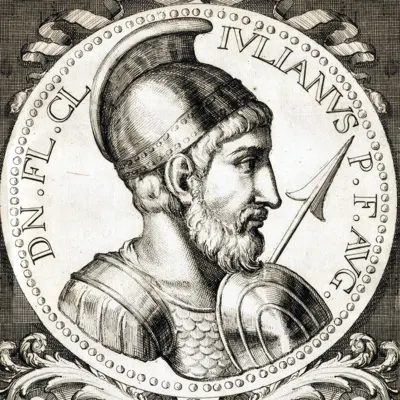
Julian the Apostate
Okay, so let's talk about Julian the Apostate. He's a pretty interesting guy. So, Julian the Apostate, who's the son of Constantine's half-brother Julius, was never supposed to be the emperor.
He's kind of the Bashar al-Assad of this story, I guess.
He's the bookish, the bookish nerdy guy.
Yeah, the bookish nerd who, through a combination of the people who were supposed to get the throne dying, ended up in power.
Yeah, you know, the Emperor Claudius was a very similar character.
Yes, yes.
But because he was never really intended to be emperor, he received a very good education in the Greek-speaking East and kind of became this philosopher, this wannabe philosopher.
No, actually, this philosopher. He was a philosopher. He wrote essays and polemics and other things of that nature, many of them anti-Christian, which we're going to talk about a bit more here.
Yeah, he was a really committed pagan in a time when very few people weren't committed to pre-Christian traditions at all. He had to repress that, in fact. He had to, he was essentially a crypto-pagan. He had to hide his true beliefs until he really got in power. And he would be the last pagan in power.
Now, he didn't unleash any kind of horrible, bloody persecution because, just as we talked about before, he and the Romans in general were smarter than that. They knew that this would just give the people who wanted to be martyrs exactly what they wanted. But he put a lot of incentives in place to say, hey, do you really believe this new religion you converted to? Come back to Apollo.
And maybe as a result of this, he was seen by later historians in the Enlightenment as this last defender of Greco-Roman, especially Greek virtue. The idea that somehow there was this thread of democracy that started with Athens, that went on to the Roman Republic, and that he was the one who tried to save that, but the Christians wouldn't let it happen.
Exactly.
In fact, sometimes the Christians even get blamed for his death on campaign in Persia, but that's almost certainly not true.
What did he actually do? What did he do to defend or promote paganism and philosophy? And how good of an emperor do you think he was?
So he banned Christians from teaching classical texts, which is a really interesting way to go about suppressing Christianity because it means that if you want your children to get a classical education, which they need if they want to be like a civil servant, for example, they can't be educated by a Christian. They have to be educated by a pagan because only the pagans can teach Homer and Aristotle and all that.
Yeah, yeah.
And even though everyone, it seems like even though most people were Christians at this time, they had a very strong attachment still to this kind of pagan culture. And I think this kind of goes against the Gibbon model that, you know, that the new Christians were against all that the Republic had stood for. Because it seems here that even though these people are Christians, they're still fine with sending their Christian children to pagan schools if it means their Christian children can be exposed to Homer and Plato.
Yeah, I know that was viewed as still as the cornerstone, as important as the cornerstone of a good education.
So in a way, you could say that Julian passed the first anti-CRT laws?
Essentially, yes.
He decreed that devout pagans were to be preferred to Christians for civil service and other government positions of that nature. This is a very interesting edict. It declared that Christianity, paganism, and Judaism were all equal. But not only that, all forms of Christianity are equal. So there's no longer any official Roman state-approved Christianity anymore. You can all fight it out yourselves, which is throw a little wrench into the united Christian community, which is not going to be so united.
Yeah, especially we should probably mention that even this early Christianity was already quite divided because there was the whole Arian movement, which is especially popular among barbaric, barbarian peoples. So by saying that all Christianity is the same, you know, that just opens the door to more conflict.
So very canny move on his part.
No, very, very smart. He was a very interesting guy.
Hell, he tried to rebuild the temple in Jerusalem.
That's wild.
Yeah, I mean, imagine if he succeeded. It's insane to think about.
Yeah, that would completely change the trajectory of Judaism.
Absolutely.
He styles himself as kind of a philosopher king. He had a beard, unlike Constantine, who was clean-shaven, as far as I can, at least as far as depictions go.
Yeah, you know, and the beard actually, it's funny you should mention the beard was remarked upon a lot by his contemporaries because they saw it as this kind of Greek intellectual affectation. It seems a little bit like the way that a beard would be seen in like the 1960s, even.
Exactly.
Exactly.
He wrote a bunch of essays and polemics defending traditional Roman religion and traditions and virtues against Christianity. One example would be like his now lost anti-Christian polemic against the Galileans.
People like calling Christians Galileans.
Because no prophet will arise from Galilee. It's kind of a dig there.
Oh, interesting.
Yeah.
No, it's a shame it doesn't survive because I'm kind of curious what the pagans had to say for themselves about Christianity. We only have basically the only parts of it that survive are the parts that Christians in responding essays picked apart.
Right, yeah.
People like Augustine, who was, yeah, we haven't mentioned him yet, but St. Augustine was someone around this period who was emerging.
It's interesting that he seems to have written these polemics because like the only other Roman emperor that I could think of who wrote anything of note was Marcus Aurelius, who wrote his little Meditations book, which is now sort of passed around as like a self-help type of thing.
Well, yeah, and also, you know, Claudius, he, who I think that in some ways looks a lot like Julian the Apostate he actually wrote a really big history of the Roman Empire which unfortunately is now lost that sucks I hate when we lose books sorry that sounded so dumb no it's it's true In the end, he didn't get to really pursue this agenda to the fullest. Like, we didn't have, we didn't have decades of Julian. He died in his early 30s on campaign.
Also, that's remarkable how young a lot of these emperors, he was as an emperor, and a lot of them.
Yeah, oh, yeah, we should mention that, yeah, Julian the Apostate, he was in his, I believe, late 20s, early 30s this whole time.
Yeah, he was in his late 20s, became emperor.
Yeah, no, you can compare him to like Muhammad bin Salman or something like that. This like, you know, young guy with a vision whose vision, sadly, in this case, was really not meant to be.
Yeah, he actually didn't cut people up into pieces.
That's true.
Yeah, that's true.
And that's actually a good segue there because he was much, you know, even though you said he was a pagan, he didn't persecute Christians at all. And I believe he was the only emperor in the entire history of Rome to have this kind of equal religious policy, to say anybody can be of any religion.
Yeah, it was pretty amazing.
Also, much like Muhammad bin Salman, he would have some serious problems with problems with the Persians. Which brings us to his death.
He died while on campaign in Persia, and it was... that was the end of him. And in the end, he was... It's actually kind of funny. I forget where his body was originally buried. I believe somewhere in what's now Turkey, probably. But he was eventually reburied in the Church of the Holy Apostles in Constantinople, along with the rest of Constantine's family. Even though I don't think he himself would have liked being buried in a church.
That's really sad, man. Even in death, they get you.
It's like how the Mormons, you know, baptize dead people. It's just leave someone alone. Leave a guy alone.
But he was, he genuinely believed that he could bring a lot of people up with, you know, carrot and stick and also intellectual arguments and stuff and philosophy, whatever, could de-Christianize the empire, or at the very least, de-Christianize the elite.
Yeah, and you know what? If he had more than a couple years to do it, maybe he would have pulled it off.
It would be hard. It would be really hard, but he might have.
Paganism would have probably survived a lot longer if he'd served, say, a decade.
I would say that.
What pagan meant
Yeah.
One thing it might make sense to mention here is that the word pagan originally meant rural because around this time in the Roman Empire, it was noted that the last remaining practitioners of the traditional Hellenic religion were the people living in the countryside. And so if he had managed to de-Christianize the elite, that would have been a completely different process because it seems like the elite were still, the elite and the urban slaves were still the main people who were Christian.
Religious traditions survive in the countryland in the countryside for a long time. I mean, like there's that famous story of the dog that was worshipped as a saint in France until like the 19th century in the countryside.
That's great.
Yeah, no, exactly. Yeah, yeah.
Well, you know, I guess now is the perfect time to mention that although traditional Greco-Roman paganism was sadly on its way out forever, non-Christians in general would have a much longer history in Europe. And that one of the aspects bridging the late Roman Empire towards the early medieval period is the presence of these new pagans, particularly the Germanic-speaking pagans with roots in Northern Europe who would become increasingly prominent after the crisis of the third century. But before we go on, I would just like to mention that pagans still had a couple of centuries of life in them. It wasn't until the reign of Justinian, I believe, that paganism was finally made illegal.
Side note, Justinian also is, as far as I know, the last Latin-speaking Roman emperor.
Which is also, speaking of language, I believe that Julian wrote most, if not maybe all, of his writings in Greek.
But yes, well, that just goes to show that this was a world that didn't transform as neatly as we might expect it to. It wasn't that as soon as Rome fell in the West, the East started speaking Greek. It took decades for the shift toward Greek to happen in the Eastern Empire, you know. And even though Christianity had been the state religion for 200 years before that, it wasn't also until Justinian, like you said, until paganism was outlawed.
Germanic peoples in Rome
But back to the other pagans, starting with the crisis of the third century, you do start to see Germanic-speaking barbarians become increasingly prominent in Roman life. And they were prominent in a few different ways. You know, we should mention that although there were very big migrations much later during the fall of Rome itself, which led to a lot of endless discussion about whether these barbarians were a cause or effect of the fall of Rome, there were earlier migrations of groups that would play a very important role in Europe, both before and after the fall of Rome. Probably the most prominent of these groups are the Franks. And again, this whole episode started as I was going to be talking about the Franks, but there was so much to get into just to start with the Franks that I couldn't end up getting to them at all.
But the one thing I'll say about those people is that a lot of Germanic-speaking auxiliaries were hired as cross-border militias along the Rhine. They would be hired to fight other groups beyond the border as a way of securing the frontier. So you'd have the Roman soldiers on one side of the border, and on the other side, you'd have allies just for an extra layer of security. Sometimes, as a reward to this loyalty, barbarian peoples would be hired as federati, which were groups of barbarians who were allowed to settle in exchange for military service. This led to a lot of very interesting long-term settlement of barbarian peoples within the Roman Empire. Most prominently, this is when you start to see the Franks settle in modern-day France, a process which eventually gives us the modern French state. You also, interestingly, start seeing groups of Gothic speakers sent to Egypt, and we even have copies of the Gothic Bible from like the year 600.
So it seems like there were still Gothic speakers for a long time in the East in these military communities. And it also went both ways, because we have a grave from Serbia in the third century of actually a soldier of East African descent who had been sent to fight and eventually died in the Balkans.
Yeah, Tupac's still alive in Serbia.
Well, in any case, this process made it clear that there was increased barbarian influence in a lot of channels of society. You know, like we said, that there were many individual barbarian peoples, such as the Franks now living west of the Rhine. And I should mention that the Rhine was traditionally the big border between Germania and the empire. Now, the border was at least culturally a little bit more porous. As a consequence of this influence of Germanic peoples in the military, you started to see this Germanic or broadly barbarian turn over Roman military culture. A lot of words of Germanic origin came into Latin in this period, particularly words involving the military. And this is probably how words like bivouac and border and dart all exist in Romance languages today. These are Germanic words of a very old provenance that probably entered Latin before it differentiated in the modern Romance languages.
In addition, you pointed this out, Russian Sam, all of the direction words in Romance languages come from the north-south-east-west system, which is Germanic. The Romans didn't use that before this point.
And it's just very interesting that, you know, Gibbon basically pinned the fall of the Roman Empire on the so-called barbarians, when in reality, it seems like, if anything, the barbarians extended the lifespan of the empire for at least a century.
Yeah, you really start to see the slow augmentation of Roman power, even on elite levels, with the, you know, the Germanic power structure within the Roman military. And you start seeing different elements of barbarian culture influencing broader Roman culture through the military. So trousers, which are seen as a Germanic and also a Scythian thing from the East, start coming into Roman clothing. And in addition, some clothing from Persia, also in the East, starts to influence Rome at this time.
Saxon raiders
But of course, relations weren't always good with barbarian peoples at this time. And another much more negative consequence of the crisis of the third century is that there is an increased problem of North Sea raiding by various barbarian peoples. Starting in the third century, there's basically an incessant onslaught of low-level raids happening in northern France and Britain, very similar to the Viking raids that would happen many centuries later. Except this time it's by the peoples who would eventually become the ancestors of the English, at least culturally and linguistically. Because you start seeing groups like the Saxons entering history for the first time due to their constant raids of southern Britain and northern Gaul. And in fact, actually, there was a system of forts in southeastern Britain, in modern-day Kent, that was meant to defend against these incursions. And it was actually known as the Saxon Shore because these people were so often raiding Britain.
The coloni and serfdom
So originally, there was a thing called a colonus, and it was a mutual relationship in which a landowner would allow a tenant to use their land in return for a portion of the farm crops. But under the rule of Emperor Diocletian, there was a reform in the taxation system, which many historians attribute as the cause of the shift in the tenant-landowner relationship. There were some edicts that tied coloni to the land for the first time, which really dramatically altered this relationship. Once you start tying people to the land, that really affects their basic freedom.
Yeah, and like we talked about with like, you know, carbon emissions starting with American car culture in the 50s, this is one of those changes that might have not seemed so important at the time, but had very massive ramifications for the demographic makeup of European and Middle Eastern society for many years thereafter. It led to a system where agriculture was dominated by either free peoples or slaves to a system where it was dominated by semi-free peasants. And like we said, these peasants would be the bulk of society in the Western world for a very long time. This is where you start to see the beginning of the emergence of what would become serfdom.
Now, serfdom is a lot of different things in a lot of different places. It's a really broad and tricky term.
So, Diocletian created this complex tax system based on persons and the census and basically make sure that he could monitor the population and wealth and how much tax is being collected and how much should be collected. So, his top goal was to eliminate corruption and tax collecting, and to do this, he would give governors more direct control. So, these peasants weren't exactly slaves, but their lives just kept getting gradually and gradually worse until Justinian, which is when they reached an all-time low in the 500s. Basically, we start seeing a codification in law of non-free people bound to the land who are comparable to slaves. And, like we said, this would be the basically foundation of the European Middle Eastern population for many, many centuries. They're not exactly slaves, but they aren't exactly free because they're bound to the land.
And I think this is one of many examples of aspects of what we would consider medieval culture that already existed in the late Roman era. And there were a lot of aspects of this. And this is why I think it's very clear that so many of the transformations we associate with the Middle Ages really need to be attributed to the end of Rome, the last several centuries of the Roman Empire.
Art and aesthetics
I think that actually one of the most interesting and clearest examples of this, of a clear consequence of the crisis of the third century that led to what we think of as the medieval European world, is art and aesthetics and fashion. Because we have a very specific image in our mind of what a Roman person would have looked like and a very specific image of what a medieval person would have looked like. But actually, in fact, by the end of the third century, so much of the aesthetics we associate with Rome, all of the aesthetics that the Romans shared or par with the Greeks, no longer existed.
I wonder to what extent this was a question of changing tastes and to what extent it was simply just skills loss.
And that is the million-dollar question. Historians don't really have a strong argument for this. I believe Barbara Rosenwein is one who believes that it really was mostly a consequence of changing tastes, that for whatever reason, the more Greek-looking naturalistic statues were no longer as desired in Rome. But for whatever reason, starting with the crisis of the third century, you seem to see a decline in the realism of Roman art, eventually leading to the disappearance of Greco-Roman sculpture altogether. So this really means that by the end of the Roman Empire, the statues that are such an iconic symbol of Rome weren't being produced anymore. There were still many sculptures being made, you know, like we talked about the monuments of the emperors, like the famous four Tetrarchs sculpture. But these weren't the kinds of statues that were associated with Rome. The ones that emerged tended to be either much smaller as these kind of, you know, realistic figurine portraits, or as these large colossal statues that were very impressive, but didn't have anywhere near the degree of realism that once existed.
You're not going to find anyone on Twitter with a statue of like Emperor Theophilus.
Yeah, yeah, no.
So you start to see the emergence of Christian art. Christian tombs were richly decorated with a lot of colorful religious designs that kind of harkened back to the pagan mosaic traditions, but also looked towards what we would see with the Byzantine icons of the Middle Ages, which, in my opinion, are absolutely beautiful. Some classical imagery would still survive, but would be transformed by Christianity. Poses associated with Roman emperors and imperial families were used to depict Jesus and the Holy Family. A famous pagan image called Thracian Horseman becomes a common symbol of St. George on horseback vanquishing a dragon. You start to see Christianity seeping into everything, finally. High status people were buried in intricately carved marble caskets, which had incredible detailed relief scenes of Christian imagery or the person in their life. And some of these coffins are really masterpieces of art, but they don't have the same degree of realism we would see in the classical tradition.
So this is by the art critic Ernst Kitzinger, who looks at this kind of change towards these very complicated but not necessarily realistic funeral depictions, especially coffins. He says, We see in funerary and political art the same stubby proportions, angular movements, an ordering of parts through symmetry and repetition, and a rendering of features and drapery folds through incisions rather than modeling. The hallmark of this style, wherever it appears, consists of an emphatic hardness, heaviness, and angularity. In short, a complete rejection of the classical tradition.
Colossal statues
Yeah, there's two very famous, very large sculptures that survive from the fourth and fifth century, which are these colossal statues of Constantine and another of an unknown Roman emperor called the Colossus of Barletta. But these statues don't really have the realism of the Greek and Roman works from a thousand years earlier. Constantine has these unrealistically big eyes. The Colossus of Barletta kind of look stiff, like an Egyptian statue.
Yeah, I think I would actually, yeah, yeah, I would say, I was going to compare them to like maybe an Egyptian or like Babylonian statue, where they're very beautiful and impressive, but they don't seem to have the realism, especially the kind of the lifelike poses you'd associate with a classical statue.
Yeah, the worst thing you can say about the Colossus of Barletta, which I think is a pretty interesting work, the worst you can say about it is that it looks like an action figure.
Yeah, we just don't get that stuff anymore. We get like some nice mosaics, like there's that really famous one of Justinian.
Yeah, yeah, and there's that famous Jesus mosaic from around this time, the Christ Pantocrator. But you don't get these statues anymore.
No, no.
And but we should mention, though, that the fact that sculptures were being produced at all shows that this art didn't disappear. It might have been, it really might have been an issue of taste, not of skill, because there clearly was a continued tradition of sculpture practice across the late Roman Empire. It's just that they weren't practicing the same types of sculptural traditions that the Greeks were.
I was just thinking of this in the context of like them losing technological know-how to create the same kinds of villas with indoor plumbing that the Romans had, or just over time they just lost the ability to make those things. And it wouldn't be for a thousand years almost until these methods would be rediscovered.
Yeah, it's hard to say. You know, I think that regardless if it's a case of loss of skill or changing tastes, what's really interesting is the fact that sculpture, which is really hard to do, did continue actually pretty much uninterrupted after the fall of Rome. Because what's pretty remarkable, in my opinion, is that after the statue of the Colossus of Barletta, which was probably a fourth century emperor, was built, we have evidence of continued sculptural practice even into the barbarian era, once Gothic-speaking kings come in as rulers of Italy, when the Roman Empire in the West is formally abolished.
Theodoric's statue
Because actually, quite famously, there was a statue of Theodoric, the Gothic king, made sometime in the early 6th century. And the statue actually survived all the way up to the 18th century. It's tragic that it didn't survive longer, that we don't still have this sculpture, but it appeared to show Theodoric on a horse, which I think that the fact that this statue is produced shows that as late as the early 500s, about 30-40 years after the fall of Rome, there still were these sculptural workshops teaching people how to make these kinds of monumental life-size sculptures. And I think there might be some continuity there with the kind of sculpture you see in the High Middle Ages. Because by the 11th and 12th century in Europe, you start seeing these somewhat lifelike statues adorning tombs across Europe. You also see statues as part of Gothic cathedrals in the 12th, 13th century.
I'm not sure if there's a perfectly straight line that can be drawn from the late Roman Empire to the High Middle Ages, but it really seems like the sculpture traditions didn't change much. And I think that a good example of kind of a missing link between ancient and medieval sculpture is this pretty remarkable statue of Charlemagne from the 8th century. It's very small, it's just about a foot tall, but it's a metal sculpture that's actually somewhat lifelike, that clearly is made by a professional sculptor with a ton of skill who almost certainly had some experience with older Roman bronze working. So, personally, I take the opinion that a lot of the art from the Roman Empire, that which had not been forgotten by the time of the late Roman Empire, survived up through the Middle Ages and gives us a lot of the medieval artistic traditions that we have today.
Pants and tunics
Yeah, so by the late Roman Empire, people were walking around wearing pants, tights, and tunics, which frankly sounds very scandalous to me.
Yeah, no, yeah.
If you were an early, you know, Roman senator from the Republican era, yeah, pants, that's barbarian clothes. What's a Roman senator, let alone an emperor, do wearing pants? That's awful.
Yeah, so again, these clothes were very different from the fashions that Romans had traditionally worn, the fashions of the Roman Republic, but it's very close to what would have been worn in medieval Europe. And ultimately, this boils down to the fact that many of the aesthetics that we associate with the Middle Ages are really the aesthetics of the late Roman Empire, which survived back into the Middle Ages.
Yeah, just like how the statue of Charlemagne looks like late Roman statues, I think we can pretty reasonably assume that Charlemagne's clothing would have drawn a lot from late Roman clothing. Because when these peoples, like the Franks, became dominant in Europe after the Roman Empire fell, they had completely styled themselves after the previous Roman elites. So if the Roman governor dressed and spoke a certain way, it's very likely that the Frankish or Gothic person now running that man's estate would dress in a similar fashion and probably also try to learn some Latin.
And I think, yeah, I really think that this kind of goes to show that in most places in Europe, the fall of Rome itself, which is a whole other topic that we can do another episode on, but the act of the Roman Empire falling and being replaced by these Germanic-speaking barbarian kingdoms seems like it really might have been more of a change in management than a fall of civilization. Because although there were lots of very big transformations in Roman society that the average person would have felt. Many of these changes happened later or even far earlier than the absolute fall of Rome in the late 5th century. And that so much of history as we know it, both in ancient times and today, involves these long-term transitions that are very hard to look at when they're still pretty close in the rearview mirror.
Not so ancient history
You know, from our vantage point today in the 21st century, it's really easy to see ancient history as something static and incredibly long-lasting. We have this image of a unified classical world that starts with Athenian democracy around 500 BC and ends with the fall of Rome in 500 AD. But this isn't correct. The Middle Ages was not a society created from whole cloth after a complete collapse. Instead, it's increasingly clear, thanks to the efforts of modern historians, that so much of what we associate with the Middle Ages, whether in aesthetics, in religion, in politics, or in culture and language, has its roots in the late Roman period. And it was really these dynamics within the end of the Roman Empire, not what happened afterward, that shapes Europe that we know. Not that many people who don't have like a college-level understanding of Roman history really know about the crisis of this third century at all, but I think it's pretty clear that this is an event that had a profound impact on the medieval and even the modern world, you know, because we're still dealing with the fall of Rome in a lot of ways, you know, and the world we live in today was shaped by both the existence and then the absence of the Roman Empire.
I think that understanding a lot of aspects of the modern world, especially in language and culture and religion, really have their roots in this area, which just goes to show that sometimes ancient history isn't actually that ancient at all.
Wrapping up
This has been Gladio Free Europe. I hope we all enjoyed this riveting talk on the late Roman Empire.
Who knows? Maybe centuries from now, when they're analyzing the fall of 20th, 21st century civilizations due to climate change, maybe this podcast will resurface. Maybe future historians will be like picking apart our understanding of our worlds through this. Who knows?
God, I hope not. I hope my voice doesn't survive for that long. That's terrifying.
The show is also on Apple Podcasts, Overcast, Pocket Casts, Podcast Addict, YouTube, RSS and Patreon.