8
Beware of the Car
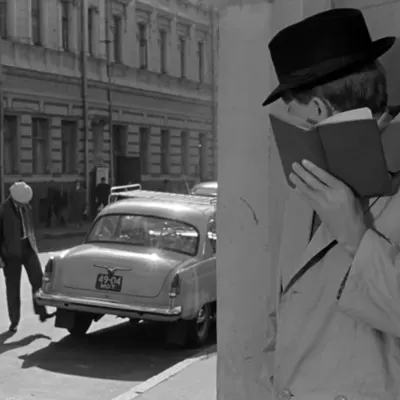
In progressBeware of the Car is a Soviet-era Russian film about an insurance agent who moonlights as a car thief who steals cars from various crooks.
You can watch the full movie on Youtube.
Hosted by Liam, Russian Sam, Halal Sam, and Abram.
Transcript
Before you listen
Alright, so today we're going to be talking about Beregis Avtomobilya, Beware of the Car, a 1966 film by Eldar Ryazanov. It's a wonderful film. I would really prefer it if you would take the time to watch this film before you actually get into this episode, because I don't really want to spoil it for you. And once you're done with that film, you can come back to this episode and listen to it to understand the details that you might not have caught and to get a more holistic understanding of what Soviet life in this period entailed.
Welcome
And we're back with another episode of Gladio Free Europe. I'm Russian Sam, and today the gang's all here. We got Liam. Hey, we got Halal Sam.
Hello.
And we have Abram.
What's up?
And today we're going to be talking about a 1966 Soviet movie, Beware of the Car. It's been a while since we've done a Soviet episode, but I'm back on my bullshit and we're going to have fun with it.
A Soviet Robin Hood
So, what how would you guys describe this movie?
Very fun.
A fun Soviet Robin Hood.
Yeah.
It's a very kind of swinging 60s type of romp. Definitely a good antidote to anybody who hasn't seen any Soviet movies and thinks that every Soviet movie is like a dour war epic. No, this is a fun movie and it's not it defies some stereotypes about the Soviet Union that a lot of Westerners would have.
Yeah.
You know, I know we've all seen Mimino, that movie, and I think this is kind of in a similar tradition of how it portrays like the fun aspects of you know civil society in the USSR.
Yeah, it's a very simple story, very reminiscent of like American movies of that period.
Definitely.
Maybe not the 60s, but like the 50s. Yeah, just you know, kind of very simple story, very just like misunderstandings and hijinks. And, you know, just like regular Joes doing silly things.
Car chases.
Fun shit.
Film noir in the USSR
Basically, a parody of the film noir genre more generally.
How much would Soviet audiences have known about that?
They had American films. Like you could just go to the theater and see an American film most of the time. Okay, exactly. Like it wasn't like in Stalinist times when you had a total control of information. And we're going to talk more about access to Western goods in this movie.
Oh, yeah, yeah, that plays a big role in here.
I mean, even during Stalin times, you probably had access to like pulp novels, detective novels, which film noir movies are basically adaptations of pulp novels.
Especially after the war when you could have things flow through the Eastern Bloc, through, you know, from East Germany and Poland.
Yeah.
And I've actually, I believe there was even like a homegrown Russian pulp industry, Soviet pulp industry, which I have to think was a big influence here.
Eldar Ryazanov
All right, so why don't we get into the premise of the movie?
Yeah, so this is a really fun movie. It goes by both names, Beware the Car and Watch Out for the Car, depending on the translation. And it's directed by Eldar Ryazanov, who I know you were saying Russian Sam, is one of the most beloved directors in Russia of the 20th century.
Eldar Ryazanov, he's one of the greatest Soviet directors of all time, in my opinion. He just died a few years ago. Yeah, he lived a very long and fruitful life, and he also dated my mom's aunt for a little while. Fun fact.
Oh, all right.
Oh, wild.
Yeah, but she didn't like him, so that didn't last very long. So let's talk a little bit about this guy and his work, because I feel like he's a very important part of understanding Soviet culture.
Yeah, so tell us, so this movie, it's really bouncy, it's really fun. There's a there's a jazz soundtrack, which is not like super cool jazz, but kind of like a playful fun jazz, which even in American film at this time wasn't super common. So this movie, the themes and how it feels, how do you think it compares to the broader canon of his work?
I would say that this movie embodies many of the themes that he would continue to work with from this time all the way until the 90s. Like for most of his movies, the premise is that you have this sort of curmudgeonly but good-spirited guy who's trying to do the best thing that he could do in any given situation and he's confronted with the general drudgeries of Soviet life.
Ryazanov's life
But yeah, let's get into Ryazanov himself. He was born in 1927 in Samara, but he grew up in Moscow. He graduated from the Gerasimov Institute of Cinematography, which, fun fact, was the oldest film school in the world.
Oh, that's awesome.
Wow.
Founded all the way back in 1919.
That's great.
Oh, yeah, I know that, yeah, like as soon as the revolution happened, Lenin was like, oh, yeah, movies, gotta get on that.
Yeah, we've gotta spread the good word of communism.
How better to spread the word than through movies?
Stalin loved movies.
Oh, yeah, yeah, he'd stay up all night watching American Westerns without subtitles. Honestly, just incredibly cool, dude.
I've heard that, like, the little English that he did know, he picked up from American Westerns, so he had sort of like a cowboy accent.
That's awesome because Lenin had an Irish accent.
And I know that, so when he started his career, Ryazanov started as a documentary filmmaker, right?
Carnival Night
Yeah, his first couple of movies were just documentaries. And in a way, I would say that there's a documentary streak in all of his movies because you really get a very clear look at the realities of Soviet life throughout his filmography. So his first big hit was in 1956, a movie called Karnavalnaya Noch, Carnival Night. And like basically, this is a musical comedy. You have a work collective, like a bunch of people who are trying to organize this fun New Year's Eve party. And suddenly they're faced with this stodgy old bureaucrat party type who wants to like turn it into a lecture about how much Soviet socialism has accomplished in the last year and blah blah blah.
New Year's in the Soviet Union
And also, and New Year's is a huge New Year's was a huge deal in the Soviet Union, right?
It basically replaced Christmas. Like as part of the anti-religious campaigns, they tried to get rid of religious holidays, but in practice, that meant that New Year's Eve became what Christmas was before that. So like you even have New Year's Eve trees.
Oh, it's just Festivus.
Like this is a universal Soviet thing. Like everyone would have a New Year's Eve tree in their apartment. And when Soviet Jews started leaving the country in like the 70s and 80s to go to the United States or Israel, the local Jews over there had a big problem with the fact that Soviet Jews have these Christmas trees, quote unquote. And it just created a lot of tension because it was seen as sort of the prime example of the ways that Soviet Jews have been like demeaned by the system and ground down. So like now they're basically Goyim. Now they have these Christmas trees.
How horrible a Christmas tree. This is truly the worst thing that could possibly happen to a Jew.
In Russia, or I guess, you know, people who did celebrate Christmas, were they celebrating it on the 25th of December or in January?
In January. Basically, like right now, they celebrate it on the 25th, but that's American influence. The Orthodox have their own dates for things.
I think it's January 6th for Eastern Orthodox.
But yeah, I mean, that's why I ask.
Yeah, like no one really celebrated Christmas on the 25th.
The Firemen's Ball
Yeah, we're getting a little off topic here, but I feel like what this reminds me a lot of is that movie that you might have heard of from 67, which is the Czech movie The Firemen's Ball, which, you know, film historians make a huge deal about, like, oh, it was this, it was the great Czechoslovak satire of communism that got him exiled. So it's really funny to see this movie 11 years before seems to have been basically doing the same thing.
Yeah, so going back to Carnival Night, I'm in the end, the Work Collective is victorious and they have their fun party, and the stodgy director is just like, like, waving his fist and going, but basically, like, this movie really put Ryazanov on the map. This movie became emblematic of the thaw under Khrushchev more generally, like, from 1956 when you had the quote-unquote reopening of society after the Stalinist repressions. And at this point, you can really see Ryazanov as sort of a bellwether of Soviet society and culture because he always created very realistic depictions of what life was like in any given era and you couldn't really tell where his mind was at any given time.
Zigzag of Success
Another example would be the 1968 film Zigzag Udachi, Zigzag of Success. The premise is that the worker in this photography studio takes 20 rubles out of the cash register at the end of the workday to buy a lottery ticket. And suddenly it turns out that he had won 10,000 rubles, which was a huge amount of money. Just to make clear, like the average Soviet monthly salary would have been like 120, 150 rubles per month. So 10,000 is genuinely a huge amount. And in this movie, you see the workers in this collective basically fighting about how these funds are supposed to be allocated. And you see a lot of drama. And again, you see a lot of the realities of Soviet society.
Right, which is cool.
Criticizing the government
And again, that's not what you expect about Soviet film. And I know that when we were planning this episode, we were talking about how a lot of Americans had this idea that in the Soviet Union, you couldn't criticize the government. And at least by the Khrushchev era, that was not remotely true.
It's just not true.
I mean, the idea that you can get Russians to sh not yell about politics, come on.
Well, I mean, it was sort of tricky because here's the thing: like, you sort of had red lines about what exactly could be talked about, but they weren't always very well demarcated.
I mean, that's the same in our society, though, today.
Like, basically, the newspapers would be full of stories about people being incompetent or someone screwing something up. But the difference was that you couldn't criticize the big guys. Like, no one cares if you call out somebody in your gorkom for screwing something up, like the city committee or whatever. But when you get to, like, the general secretary or whatever, that's when things get kind of iffy.
Yeah, it's like how China is today. You can kind of complain about basically everybody except like the very higher ups.
And people do. Yeah, the joke I've heard of in modern day China is that you can complain about the government all you want, you just can't do anything about it. Once you try to change things, that's when you get in trouble.
Yeah, I mean, it's the same thing with the Soviet Union, of course. I guess they were afraid that maybe complaints would actually result in something, but obviously they couldn't have.
Garage
Yeah, and then you have a bunch of other great films, but the final one for this triplet, I would say, would be the 1979 film Garage. Again, a very slice of life film from Ryazanov, as was his style.
Very about regular people doing regular people things.
Yes, exactly. And the premise in Garage is that a work collective learns that there are going to be four fewer parking spaces than they had anticipated. And so they hold a meeting to decide which people are to be excluded from those parking spaces. And one of the members of the collective, who is not among the excluded, but who feels that certain people were unfairly excluded and others were unfairly given spots, she locks the doors and refuses to let anybody leave until a just resolution is found. It's very typical of Ryazanov films that a simple Soviet person goes up against a difficult system, but in the end, justice triumphs.
Yeah, it's like 12 Angry Men, only lower stakes.
And that's really like the general tone of Ryazanov's films. It's something that you're always going to find. Except for some of his later editions, which I will not be getting into now due to time constraints, but rest assured, there will be episodes about more of his films.
The premise
So let's talk with this one. I know that it seems like there's going to be some kind of shared themes that we can see in Beware of the Car. What happened in this one? Refresh my memory.
Alright, so the basic premise is you have this guy named Yuri Detochkin. And basically, he's an insurance salesman by day and a car thief by night. And whenever he sells insurance to somebody who is a sketchy type, he marks down their license plate and notes where their car is and in various ways that get more and more interesting and wild and like theatrical.
What was his goal in stealing these cars?
He wants to punish the corrupt officials. Or not, sorry, corrupt officials, these corrupt people. We'll get to who they are later.
Well, he wants to expose them more specifically.
Yes.
In the first couple of times, he just wants to expose them, but then when he finds out that they weren't getting exposed for their shady bit tactics, he says, fuck it, I'm just stealing this and I'm just selling it. He sells it, and then he sells it, and then very importantly, he donates the money to orphanages. He does not keep a penny for himself, and that's super important.
Yeah, that's why, like we said, it's a Robin Hood story. And I know that his signature move is that he uses oil to pick locks, which I guess is really innovative.
Maxim and Hamlet
Yeah, and then you have his foil, Maxim Podberyozovikov, who is this sort of, very, on the face of it, very typical sort of film noir detective style guy, except he's also kind of incompetent and doesn't see what's right in front of his face.
Yeah, yeah, yeah, yeah, yeah.
A lot of humor jumps from the fact that he doesn't yet realize that Yuri is the thief. And they're in close contact.
Yeah, tell us, Halal Sam, why are they in such close contact?
They're both theater guys, and they're both in the play of Hamlet together.
Yeah.
No, the only thing I don't like about this movie is that it's about two theater kids.
It is indeed about two theater kids, two amateur theater kids who are doing this for fun.
Yeah, it kind of reminds me of if you've ever seen the Rex Banner episode of The Simpsons.
Oh, fuck yeah.
Yeah, the protagonist is the guy who's doing the illegal activities, and then you have these, like, secondary character who is the, yeah, the hard-boiled detective, the film noir detective, who's just like a clueless idiot who doesn't figure out what's happening. Obviously, in film noir genres, there are detective stories and they follow the detective, but this is in inverse where it follows the criminal and the detective is the secondary character.
And yeah, one thing that we're saying is that this movie definitely has very strong film noir vibes.
The jazz soundtrack
And what's kind of funny is that the scenes that follow the detective, Maxim, they seem like they're out of like a 1950s film noir. And I think that the actor for Maxim even kind of looks like Humphrey Bogart. But then the scenes following Yuri the thief are a lot more goofy and bouncy, which I think is a kind of a fun contrast.
They still sound like film noir scenes because they have that soundtrack. I mean, this is a jazzy soundtrack, but it's more of... has more horn instruments. I feel like mostly in film noir genres when like you know you have the cat burglar like sneaking through the house and stealing something. This is more of a like string heavy instrumentation.
Yeah. And that's like I was saying I'll expand a little bit right now. This is kind of hard to believe because jazz was so old by this point. But until like around this time, the mid-late 60s, it was actually pretty uncommon for movies, even very edgy movies, to have anything but the typical Bernard Herrmann, you know, Hollywood score. So the fact that this was that this was so jazz inflected would even for an American film be kind of unusual. Because I know that the very first American movie to have a jazz soundtrack was Anatomy of a Murder, which I think was 59. So not too long before this.
Yeah, most movies before then had like orchestra scores, you know, those.
Yeah, yeah. Another movie that is really similar to this one in a few ways, but not every way, is Godard's famous Breathless, you know. This is definitely not the same kind of like groundbreaking motion picture that that was, but they have a lot of similarities and that also had this kind of very playful jazz soundtrack.
Dima's Volga
As Tamer counted, we are following Yuri as he tries to steal the car of this one particular guy named Dima and he is the owner of well he's not the owner, he's the manager of an electronics shop basically. Detochkin came across him because he was selling insurance to him and he had noted that this guy had a fancy new car and he just doesn't seem like a guy who would have a lot of money on hand. So the fact that he has this car is very suspicious and is what drives Detochkin to decide that this guy's car should be requisitioned.
And it's a nice car. It's a Volga, which is very important in this movie. Sam, can you explain what the Volga is and who drove them?
Well, the Volga weren't really the top-of-the-line cars, but they were very nice.
Cars in the Soviet Union
I feel like something that might be lost to an American audience is just how rare cars were in the Soviet Union. In the movie, there's a voiceover that comes up a couple times, and one of the voiceovers says, Anyone without a car dreams of buying one. Anyone who's got a car dreams of selling it, but doesn't do it because once it's sold, you are left without a car. The idea of leaving five and a half thousand just like that in the street, ready with wheels, can poison even the happiest life.
And yeah, it does in the movie because the guy whose car gets stolen in the movie, he's constantly looking at it. So yeah, he's very paranoid about his car. And I'm sure that's like a very common thing at the time.
But buying, it wasn't like American car ownership at the time.
Yeah, no, not at all. It was very exclusive. And in fact, the universal car ownership was something that Soviets looked to very aspirationally.
Yeah, as the Soviet economy shifted towards consumer goods.
Right, because weren't cars like the image of the Khrushchevite reforms?
I would say it was more apartments, but yes, cars were a very big part of it.
Yeah, Khrushchev is when you start getting those blocky apartments that everyone associates with Soviet home design.
Getting one was a very long endeavor. First, you would have to collect the 5,000 to 8,000 rubles that you would need to buy the car, which by Soviet standards is a huge amount. Like, again, average salary would have been from around 120 rubles to 150 rubles per month.
And of course, we should say that one of the reasons why Yuri suspects this guy's crooked is because even a shop manager shouldn't be able to get that kind of money to buy a car that easily. It's clearly a sign that something financial, something skeevy is going on financially.
And then when you finally get the order in, you're not going to see that car for another five to ten years. You're just going to be waiting around until one day you get a letter in the mail saying, Oh, by the way, we have the car ready.
Yeah, it's like ordering a Tesla.
When my parents first got here, the thing that really threw them off was the number of cars just parked out in the street in the open, that the roads were just so congested because this was unusual.
This also is something you see in the movie with the chase scenes and the driving scenes. There's not many cars on the road.
Anti-theft devices
One last thing about cars from that era: there wasn't a lot of locking mechanisms in cars. So you could very easily just open the door and drive away. Like that stuff that we associate with anti-theft devices. Mostly came out in like the 80s, 90s.
Yeah, and Yuri doesn't have any problem with picking locks, as we see repeatedly in the movie. He's very good at it.
Yeah, because he's the cat burglar character from one of these detective movies. He's a cool guy, good and cool guy thing.
Our Hamlet
And while he's doing his day job of being an insurance salesman and going around the houses of these various folks to sell them life insurance or insurance for their goods, by night, he's sometimes stealing cars, and other times he's going to an amateur theater troupe to put on a production of Hamlet. Which, in fact, the actor who plays Yuri in this film, his name was Innokenty Smoktunovsky. Probably his most famous role in any Soviet movie was the 1960s film adaption of Hamlet, where he plays Hamlet. And in this amateur production, he's also playing Hamlet. Liam, how would you compare to...
Well, I think it's funny because he's the actor who's well known for playing Hamlet, and here he is playing an amateur actor playing Hamlet. And I guess the biggest difference is that the sword fighting is much more graceful in the original 1964 Hamlet film.
Yeah, they taught them how to fence some shit with that one, whereas in this one.
Yeah, because it's an amateur production. They're just kind of like flailing things around.
And in the scene where Yuri first shows up to the amateur theater troupe, you have another very common element in Ryazanov films where the director is just giving this very long winding speech about Soviet art.
Yeah, so he's talking about how they're going to be performing, quote-unquote, our Hamlet, the very Soviet Hamlet.
Yeah, I'm sure there was a lot of, not jealousy, but envy, I guess, at theater productions in the West, like in Europe and Americas, and just how their adaptations are always seen as the iconic ones. So, you know, this is our Hamlet. This is the Soviet Hamlet. We gotta put on a show, not just for the people in the audience, but for the people out there in the Western world, in the capitalist world, to see what we can do.
It's an amateur theater troupe, so.
Although the director does say that one day amateur theater is going to replace professional theater because, you know, passion is always going to be more of a draw than working for a paycheck.
Yeah, exactly. The director definitely has those ambitions, even if the actors absolutely do not.
Yeah.
So the director says, an actor who doesn't get paid for performances performs with a greater enthusiasm because besides the theater, the actor has to work somewhere. It's not good for somebody to hang around the theater all day. Just imagine how much better Yermolova, who was a very famous actress at the turn of the century, just imagine how much better Yermolova could play in the evening if in the morning she had worked on the grinding machine. And it's just basically like this depiction of these very out-of-touch bureaucratic guys who don't really have a firm understanding of Soviet-lived experience, trying to translate these sometimes fantastical ideas into real life.
I think he's just talking about why he doesn't like theater kids.
Lyuba and the trams
Okay, so let's talk about the characters in this movie.
Yeah, so another side character who doesn't show up very much, but who is an important character is Lyuba, who is sort of the long-term girlfriend of our boy Yuri.
Yeah, or wife, right?
No, no, girlfriend. They're not married yet. There's a scene where his mother is chastising him. Like, when are you going to marry Lyuba already?
Yeah, and she drives the bus.
It's the cable car.
Yeah, yeah. But yeah, I mean, those cable cars are still around in Moscow to this day, right?
Well, now there are rails more. But yeah, so they upgraded their infrastructure. No more cable cars. Now they have actual rail cars.
Every city needs a light rail.
Without question, this is why we're a pro-China podcast. They have good trains.
That's true. Anybody on the fence about the US versus China just needs to consider that one little part of their culture. They have better trains. Gotta respect it.
But of course, I guess modern-day Russia has much better trains than the United States as well.
Certainly better train stations.
Oh, yeah, yeah, yeah, they're stunning. They're palaces of the people.
Plus, they are very timely. They always come on time. There's one every like three, four minutes.
Oh, that's so good. I cannot imagine that, the MTA being that good.
The black market
Of course, we should note that not all was peachy and keen in the Soviet Union because one recurring problem, especially at this time, were bureaucrats and shopkeepers who were involved in some shady business on the side. We first get to see exactly how this guy's corrupt because we go to his store and he's trying to sell this woman a Soviet tape recorder, but she insists, No, no, no, I don't want a Soviet tape recorder, I want a Western tape recorder.
Specifically German or American?
Yeah, German or American. And he looks over his shoulder and he says, Okay, okay, I can get you an American or German tape recorder, but just keep it quiet. So we see that in addition to being a shopkeeper, he's also secretly this black market merchant, which is how he's making extra money.
Which was a very big part of Soviet life.
Yeah, it's interesting just how matter-of-fact it's told, like Liam says, is just this woman comes in and just says, No, no, no, I want the good shit. I want the German stuff. And very normalized, I guess. Like, he wasn't afraid of, you know, is this a cop? Is this a, am I gonna get trapped here? It just, no, people do this all the time. I do this all the time. This is just how it goes.
I think that considering how much Ryazanov draws from that whole well of social realism, I think that probably this was the kind of thing that would happen quite often.
Yeah, you just make sure no one's overhearing you and ask for the herbs.
Yeah, just make sure the tape recorder is off.
The kitchen debate
Yeah, so consumer goods were always a bit of a problem. It was something that the government from Khrushchev onwards continuously tried to improve. You had the very famous exchange at the so-called kitchen debate between Khrushchev and Nixon, who was then the vice president. And it was in the context of this American exhibition in Moscow, which was showing off American appliances, where he's basically talking about how, okay, so for now, maybe you guys are ahead of us, but in 10, 15 years, we're going to surpass you, and we're going to have higher-quality consumer goods. And when we finally surpass you, we'll be waving at you from the train. And of course, that doesn't happen. It happens for Japan in like a couple of decades, but it never happens for the Soviet Union. And the focus on consumer goods would ultimately be not good for the Soviet Union.
Not good for Americans either.
True. Once you decide that consumer goods are the metric of your success as a society, it underpins the whole foundation of the socialist project. If the idea is to be able to have as many consumer goods as you want, why not just go with the system that can guarantee you as many bananas and jeans as your heart desires rather than aspiring for the higher goal of socialism? At that point, you're just trying to create a bootleg version of American capitalism, really.
Yeah, you're going from the vision of a society of workers to a society of consumers, which is tragic.
Say what you will about Stalin, but he didn't do that.
Yeah, it's interesting that they had car alarms back then. Because, yeah, that wasn't a very common thing.
One thing I gotta say about Soviet Union cars in general is that they were ahead of the Japanese at this point. And they probably say ahead of the Japanese until the 70s.
The detective who sees nothing
So in the following scene, we're in the theater, they're practicing for their Hamlet performance, and there's an intermission. And you have this very funny sequence which shows that Podberyozovikov that he has no idea what's going on. You know, a detective is telling him about what's going on and his investigation. And of course, Yuri is just, you know, just kind of nodding along and just smiling.
And yeah, he describes his actions, his face, his mannerisms, all while looking at him. And Yuri's just like, it's very playful.
A Soviet idea of art
Like, basically, like the entire point of the Soviet Union from a cultural standpoint was that we are the next stage in the great progression of human culture, and we are working to embody the ideals of these writers of years long past who have been superseded by these very superficial bourgeois cultural producers who are only in it for the money. Were for the introduction of these great pieces of work to the proletarian peoples of the world. There was a fork in the road, and the West chose profit, and we chose art. So, not only do they know about this Western art, they know it, and they are very much determined to produce something superior.
Yeah, yeah. And that's why I think that this to take a step back, I think this movie kind of represents that because it is this very fun, very light-hearted, like crime comedy, but it also is a pretty insightful social critique at the base of it. And also, a very interesting look at Soviet society.
Oh, definitely. Yeah, yeah.
This was a good-looking movie. I mean, there's a lot of long shots.
Oh, yeah, yeah.
Long takes, and I mean, that was like a staple of all movies at the time, but you know, it was still well done. And even the dialogue scenes, the dialogue scenes, they don't have like constant cuts. They're just because they are coming out of that, you know, theater tradition. So, these actors don't have to cut every line.
The bear trap
If you don't mind if I move a little bit faster through the story, there are two scenes we can talk about that I think really show how, that I think show how Ryazanov drew from Western filmmakers, which is that the first scene that I think is really interesting is the bear trap, which is this really suspenseful moment. A party is happening inside. Dima is at the party, and Yuri has just broken into the car, but something happens.
While our hero is walking past a party and going to steal a car, the first thing he encounters inside, and when he tries to put his foot on the accelerator, is a trap, a bear trap.
Yeah, placed there by the owner of the car, yeah, as an anti-theft device.
In an attempt to catch the thief, yeah.
And he, we see him struggle with this thing, and not only that, we see him struggle with this as people are coming out of the party, and so he has to hide himself.
Yeah, he has to hide himself, he's still struggling with the bear trap on his foot that's like killing him. You know, he also has to be quiet, even though he's in a lot of pain. Well, all these people are gathered around, you know, hey, let's check out the car. You boarding the car, let's check out the car. Take us for a drive, drive me home. No, no, no, I'm too drunk, I'm too drunk to do this, I can't do this. Come on, come on, and you know, all this shit's happening. You're just like hunched over, just you know, you know, somebody just like looks in the window or just opens the door.
Well, this scene I think is really fun because it's just kind of like the Hitchcock type of suspense because you know, he's got his foot stuck in the bear trap, but he can't get out of the car. You know, a character trying to hide, somebody's coming up the stairs, and they have to hide so they don't get caught. You know, that's a staple of like Hitchcock movies, that kind of suspense.
Yeah, like no, absolutely. And then, and then when eventually the crowd disperses and they're about to get in the car, what Yuri does is he holds the door shut so Dima can't open it, and then Dima tries and gets frustrated because he thinks the door is stuck, and then he says, Oh, well, I'm too drunk anyway, I'll just try to wait around a little bit before I drive, which allows Yuri to get away. And then Yuri slinks home with his hurt foot and gets home to his girlfriend.
Yeah, he shows up at his girlfriend's apartment and he's just like crying to her. He's saying, There are animal traps everywhere. And she thinks that he's speaking metaphorically, but no, he literally got his foot stuck in a bear trap.
Hiding in plain sight
This leads us to a pretty funny scene. Pretty soon after this, we're back to our detective, you know, the hard-boiled investigator, Maxim. And he's meeting with Dima, who says that who, I guess, he has some reason to believe that there was an attempt on his car again. But he says, oh, but I think maybe that bear trap might have done the trick. And then in the middle of the conversation, he gets a phone call from Yuri that says, oh, I can't make it to theater practice tonight because I hurt my leg.
It's very awesome power, Z.
It really is, yeah. It's like, even the evidence is flying right in this guy's face. Maxim, this brilliant detective, doesn't realize that his friend is actually the thief.
At one point, he's talking to Yuri and he says, I'm in the last year in this neighborhood, there have been four car thefts, and Yuri quickly jumps in and says, Actually, there were three. And he goes, Ah, yes, I see you read the papers.
Yeah, no, I think a lot of the humor in this movie, it's very situational, and a lot of it is derived from the fact that this guy who thinks he's a brilliant detective is unable to see what's right in front of his face. Which is something that definitely translates well in a movie that if you don't speak any Russian, which none of us do.
Situational comedy
Yeah, definitely. I think that situational comedy is basically universal. And I think it's also the funniest comedy.
Yeah, that's why American sitcoms, which rely on situational comedy, like heavily, that's why they get sold all over the world. And like Friends or Seinfeld. This is why Friends is like one of the biggest shows in China.
I think that Seinfeld is situational, but it's that it's so specific that maybe it's like, like you said, when it gets bogged down in the wordplay, then those are the situations that aren't as easy to market.
And also a lot of irony and, yeah.
Seinfeld's a weird one. Famously hard to translate.
The chase
The other scene that I think is also really clearly inspired by, like American, the American film tradition is the chase scene, which is pretty well done.
Oh, the chase scene is so cool.
Yeah, oh, absolutely.
And what do they say when it starts?
The narrator says something like, oh, you can't be a detective story without a chase scene.
It's very silent movie-esque, like Buster Keaton, that kind of influence. Yeah, the same type of like genuinely impressive stunts with like cars swerve going underneath like high trucks and swerving between cars.
It also gives us a good view of the Soviet road system, or at least outside Moscow.
Yeah, also like aerial shots, which is very impressive. I'm not sure if those aerial shots were the actual roads or just like a miniature.
No, but still, I agree. Yeah, that must have been... Yeah, because back then, you know, before drones, and I would guess before helicopters were common in film, they probably would have had to build this enormous crane to get that.
What I thought was also cool was that, so this movie's 66, and this kind of a chase scene, even though it's not super, I don't know, super like ambitious or realistic, it's still before really any like American chase scene that we can think of. Like the big movies in the U.S. that supposedly invented the chase scene are Bullitt 68 and The French Connection 71. But this is years before all of those.
This one's more cartoony, though.
That's, yeah. Like you said, Buster Keaton. Very cartoony, very fun, and whimsical. You know, like truck drives by, they drive underneath the truck.
He's on like the side of the road, like hiding in the bank, yeah, yeah.
And then they're driving past the school zone, and then you can only go 20 kilometers per hour, so he slows down his car. And so does the policeman. Very cartoony. And then immediately they go back to it. It's great.
Soviet roads
But yeah, you say these roads weren't typical of the Soviet landscape. Okay, I was in Russia in 2017, and I was going from Pskov, which is quite a medium-sized city, to St. Petersburg, which is like the second biggest city in the country. Like the majority of the way there, the entire road is just one lane going north and one lane going south.
Where were you going to St. Petersburg from?
From Pskov. It's a very nice city if you're going to Russia and you want to stop somewhere that isn't a major city. It has a very nice art museum.
I mean, I think you're just bringing your American perspective to this because most countries don't have the extensive highway network that the United States does. They don't need it also.
That was the only thing we did right, and we still managed to screw it up with the way that like so many neighborhoods were destroyed.
I'm not sure about that because the reason most countries don't have those is because they rely on trains to like freight goods so much more. Because in the United States, there's like trains are basically one lane for the most entire way. So you're constantly getting like traffic jams with trains. So that's why in the United States we do everything with trucks on the highways.
Yeah, no, highways, cars are bad.
The school zone
This epic chasing is eventually concluded because we see our anti-hero Yuri is driving away from this cop and he's going really fast, but then he realizes he's in a school zone. And even though he's about to evade the cop, he deliberately slows down so he doesn't put the kids in danger and allows the cop to catch up with him.
Which really speaks to the kind of guy that Yuri is.
I don't think I mentioned this before, but his last name is interesting because this is sort of a Dickensian thing. So his last name is Detochkin, which is derived from the word for children. So clearly, like, this is someone who really cares for children.
Was he an orphan in the movie? I assumed like his father died, maybe the war or something.
Yeah, it's implied that his father died in the war and that his mother had to raise him alone.
Robin Hood's motives
Yeah, so what Yuri's been doing, as it turns out, is that once he sells the car to various shady people, he takes all of this money, which again, 5,000 rubles is a huge amount of money in the Soviet Union, and he donates it to orphanages.
He's a mensch.
Yeah, he's a total mensch. He's a Soviet Robin Hood.
Once he's finally found out, he mentions that originally he was just returning the car to the police with notices saying that the owner of this car is a crook, but of course, the car would be returned to the owner. So after doing that fruitlessly for the first two times, he decides that he's going to sell the car to other shady people and donate the proceeds to orphanages because he just loves those kids and he really wants to live up to the ideals of the Soviet system.
Party lines
These are not corrupt party people that he's stealing from. So one of the red lines of this film, I'm guessing, is that they didn't want the corruption to be portrayed as coming from the party. They wanted it to be rather these petty bourgeois managers who just want to live the good life.
In fact, there's this really great quote from Dima. In a previous scene, he's just driving up to the Dacha, very worried and talking about how the Dacha of someone that he knows is being confiscated, while the father-in-law is just happy and gloating about it. Fuck these people. They deserve to have that taken. They're crooked. And the father-in-law just asks him, So explain to me how the deputy director of a knitting factory has the money to build a two-story villa. And Dima just responds, that's his business. No, it's ours. We will fight without mercy against the people living on money that they haven't earned.
Yeah, the attitude's a generational thing because the fathers-in-law generation would have been born in the 20s and 30s, right? Like and lived through World War II and lived through all the, you know, terrible things and all the good things that happened in that period to the Soviet system. And obviously, this guy, he's living in the Khrushchev era and the consumerist era, and he has a completely different outlook on how people should conduct themselves in this country.
But to go back to the aspect of the kinds of people who are stealing, who are being corrupt in this scenario, we don't actually see a party member stealing. It's more that the party can't do anything about it, or like isn't strong enough, and they should. Not this is all coming from the party.
Yeah, like I'm guessing this was one of the red lines that the studio told Ryazanov not to cross because essentially in real life, like all of these managers of stores would have been party members.
This gets at why I felt this is very similar to a Western movie. They were just speaking English. I could see this being American. Even though we see like the day-to-day activities of Soviet citizens, the day-to-day activities feel very reminiscent of what people were doing in the Western world because there is no Soviet apparatus that's being referenced to constantly. You know, you have an insurance salesman, and you have like a police detective, and you have a guy who runs a shop, and those are your main characters. And it's nothing about the grand state of the country.
It's more the idea that we have these bad apples who are preventing our advancement to a more socialist society because they're embezzling goods. And while this is true to a certain extent, it doesn't really factor in the extent of the rot within the party itself.
Petty bourgeois villains
Yeah, I should say the shopkeeper isn't portrayed as like a villainous character. I mean, there's another person who gets their car stolen who is portrayed as bad, the barkeeper, bar owner, whatever. But, you know, the shopkeeper, it's the guy who's, for the most of the story, it's about him and his car. He's not like a villainous guy. He's just like a guy trying to make a buck. Like, he's just kind of like the portrayal of him in the movie is basically saying, like, look, these are just regular guys. Even if they're corrupt and they're crooked and they're selling contraband behind the scenes, they're just like they're people like you and me.
And in fact, we do see Ryazanov passing a moral judgment towards the end of the movie when Detochkin is on trial.
Private property on trial
Dima is, of course, a witness at the trial, and he's giving testimony. He's saying, This guy has endangered the most sacred thing we have. Our Constitution. It states that every man has a right to private property. It must be protected by law. Every man has the right to a car, a dacha, books, money, comrades. Money hasn't been abolished yet, from each according to his ability, to each remunerated in cash for their labor.
And I thought that was a really cool moment, because it really shows straight from the horse's mouth the way that Marxian theory was understood by essentially regular people in this society.
We haven't abolished money yet.
Yeah, exactly. So that was really interesting.
This is something we talked about in our Letov episode of communism coming, just give it another few years. So he's just like interpreting that as like, okay, I'm not a communism yet, so I can make money right now.
And I bet that under the Khrushchev period, there probably were some people who still believed that.
Oh, absolutely.
Well, yeah, I mean, the guy's father-in-law, of course, believed in it.
Yeah.
Most people, like, weren't completely cynical about this stuff, even if they thought that the currently the government, the people in charge of this system, were bad. The roots of it, they still probably approved of.
Yeah, well, it's really difficult to not approve of the goals unless you're kind of crooked, if we're being honest.
Yeah, exactly.
The priest and the barkeeper
So, going back to the car itself, he sells it to some kind of priest. I'm not sure how to describe it, but it was a Baltic accent for sure.
Yeah, and he's paying for the car and money he stole from the collection plates. That's why he paid in like single ruble notes.
I actually found this juxtaposition kind of interesting. I don't know if it's intentional per se, but on the one hand, you have this guy who's ostensibly a man of God, which in the Soviet Union was not a positive thing to be. There was still very much an anti-religious mindset, but just like this juxtaposition of a man of God who is stealing from his parishioners so he can have access to worldly goods versus this ordinary Soviet man who is sure he's committing a crime, but he's doing it for an almost saintly reason, you could say.
We haven't mentioned him yet. There's the bar owner who gets his car stolen, and he's the first person who gets his car stolen in the very beginning. What was his deal? What was the shady thing he was doing?
Alright, so what happens is once Podberyozovikov finally realizes that Detochkin is the guy who had been stealing cars, yeah, he goes out, they go out together afterwards to a bar, and as it turns out, the manager of the bar that they are currently sitting in is one of the victims. And once he notices that Podberyozovikov is in the bar, he assumes that he's there on investigative business to find out what happened to his car. So he suddenly gives him an upgrade to better beer. Because, like, this was another long-running reality in the Soviet Union where restaurant managers were also stereotyped as these very shifty types who would they would skimp on the good supplies, water down your drinks and stuff, just not serving the best quality food and drinks so that they can sell the rest on the black market and pocket the change.
Ryazanov's reputation
Yeah, it's just it's definitely a fun movie. I'm really glad I saw this one because it's not something I'd heard of. And even though you mentioned that Ryazanov is quite beloved within the former Soviet Union, he really has no strong reputation in the West at all compared to other Soviet directors.
Yeah, I had never heard of him before this.
Yeah, he's not a Tarkovsky type, he's just a good old-fashioned Soviet guy who loved his country and just wanted to see it do well.
Yeah, I mean, Tarkovsky, the reason he's so big is because his movies are very big on the visuals and, you know, very cutting-edge in that regard. Arguably, Tarkovsky is easier to translate. And because American filmmakers and American film enthusiasts, like, love seeing something, you know, visually breathtaking like that.
Yeah, you know, it's funny. When I was telling my parents that I was going to be doing an episode about this movie, they were just saying, you know, Americans aren't going to understand this. They won't find it interesting. Why are you talking about this? And I guess I just wanted to share with a broader audience this really great piece of art that shows very truthfully what Soviet life was about. And it disproves a lot of our Western notions of what Soviet life was.
I mean, if this was shown to American audiences in the 1960s, I think a lot of the paranoia about the Soviet Union would have eased up a little.
Well, I imagine that this movie did make it to American theaters. Granted, it wouldn't have been super wide releases, but like the Soviet Union was a cultural powerhouse in itself. Like, its movies were regularly shown at film festivals, and they regularly won awards.
Especially in Europe, right?
The trial
Let's talk about the trial scene at the very end.
Yeah, there's testimony from Dima, there's testimony from the bar manager, and then Podberyozovikov is the final one to speak aside from Yuri. And he's just talking about what a great guy this is, and that although he violated the law, he did so with the noblest of intentions. As he says, he is guilty, but he is not guilty.
I just remember noting that the judge seems like, you know, like a 40-year-old woman, kind of dressed in like casual clothing and not like an annie robe or anything.
It was formal by Soviet standards.
Also, the judge is a woman in 1966, which is notable.
That's true, yeah. Like, how many women judges were there in America in 1966?
Yeah, so finally, it's Yuri's turn to give his final statement, and he just says, I may not have acted correctly, but I did so with a pure heart. I just couldn't stand it anymore. They're stealing. They're stealing a lot. I only wanted to help you as in the Soviet government. That's why this all happened. Please let me go. I won't do it anymore. I give you my word.
I really liked how in the trial, we see that one of the people there is Yuri's boss from the insurance company, who usually hates him for taking off work so often. Come on, you have five grandmas in different republics.
Yeah, yeah, it's the joke earlier. But then when he sees that actually he's this Robin Hood figure, he shouts out, like, oh, you need the best employee ever.
What I found amusing was the store clerk's father-in-law, who we said earlier, was a guy from the older generation, the guy who believed in the Soviet system. He said, Lock my son-in-law up for the bullshit that he's been doing.
Even the victim's family is on Yuri's side.
Well, yeah, because he is embodying Soviet ideals. He is a good Soviet man. He's just pure of heart. And although he's not acting legally in the strictest sense of the word, he is doing what's right. And that's the important part.
The sentence
But ultimately, he does get a jail sentence. Although it's implied that his sentence wasn't that long, you keep hearing five years in jail thrown around in this movie, but that was the maximum sentence. In actuality, the sentence could have been anywhere from three months to five years. And it's kind of implied that Yuri just got a slap on the wrist.
Yeah, because when he comes back, it's clearly like, yeah, he has a shaved head and all that, but it looks like only a few months have passed because it's turned from fall to winter.
Yeah, I'll have to say, and I'm sure that all of you will agree, that Detochkin did nothing wrong.
Oh, of course not. Like, what he did was objectively good.
Yeah, and I think that that's kind of the message of the movie, is that although he's a criminal, he's doing so in a way that is both socially good and ultimately supportive of the whole Soviet project. Because even though he's not going after the corrupt party bosses who would have been the real, basically, you know, the bad guys in this environment, he is essentially fighting for a more egalitarian Soviet society, which is what, which I assume is what a lot of people would have wanted.
The audience verdict
So originally, the idea was to sort of make it a choose your own adventure ending where the audience would get to vote on what happens to Yuri, and with that, they would be shown one or the other ending. So, during the trial sequence, you were supposed to hear the narrator say, Dear listener, please deliver Detochkin's verdict. The court has taken a hands-off approach to Detochkin's destiny and has put this responsibility on your shoulders. Like the vast majority of the population, you are not familiar with the criminal code, and so it will be easier for you to pass judgment. If you are kind, then you will lighten the load of your Yuri Ivanovich. But if you're stringent, then throw the book at Detochkin and lock him up behind bars. In a word, dear listener, please decide his fate.
Detochkin's children
And if I remember correctly, there was some heavy pressure on them to edit this script.
Oh, yeah, in the original script, Detochkin was supposed to be a much more prolific thief. He was supposed to have stolen a lot more cars. He was supposed to have gotten into more adventures that maybe weren't as comical as the final product. But the studio liked the premise of the original film, but they wanted it to be rewritten because they felt that if Detochkin was too badass, then it would inspire a wave of copycats who would start stealing cars to help the Soviet system to grow and to root out the corrupt faces.
Which would have been a lot easier given the lack of anti-theft devices in most cars, I think. You know, what Khanobi had it.
But even with this more toned-down version that we actually got, it did inspire a wave of similar crimes.
That's so cool.
Yeah, so much so that the police department started referring to these kinds of cases as Detochkin's children, because the people who were doing this were generally like teenagers.
Yeah, so they're stupid enough to think that the way the detectives are portrayed in the movie is like how actual police detectives are.
It's an expensive item. They're gonna recover. People are going to put resources into recovery. Especially because the people whose property is being stolen are the ones who have connections in the first place.
Wrapping up
Alright, so do we have any final thoughts on the movie?
I think what he did is good and that more people should do it.
I think Soviet roads look very fun to drive down.
Yeah, I didn't realize they had the clover leaf thing in the Soviet Union, even at this time.
Yeah, definitely some True Detective Season 2 vibes in the highway shots.
Alright, well, thanks for a great show tonight, guys. And thank you guys for listening to this. Hopefully, you learned a little bit about Soviet life in the 60s.
Yeah, thank you, Russian Sam, for telling us about this movie. This was fun.
Yeah, that was good.
This is Gladio Free Europe. We're signing off, and catch you on next week's episode. Later.
The show is also on Apple Podcasts, Overcast, Pocket Casts, Podcast Addict, YouTube, RSS and Patreon.