29
Soviet New Year & Sympathy Seeker
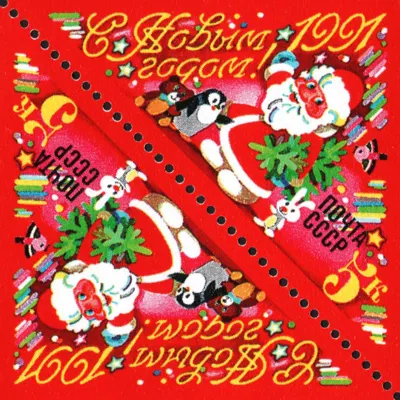
In progressThis week, we popped open a bottle of Soviet Champagne to talk about Russian New Year and the 1997 film Sympathy Seeker. Why is New Year’s Eve such a big deal in the former Soviet Union? Why are there so many paintings of Lenin around a Christmas tree? Is the Soviet version of Santa really an evil spirit from Slavic myth?
All this and more as we dive into the history of holidays in the former USSR and the long history of wars against Christmas.
Hosted by Liam, Russian Sam, and Halal Sam.
Transcript
Welcome
And we're back with another episode of Gladio Free Europe. I'm Russian Sam and I'm joined as always by my co-host Liam.
Hey!
And Sam B.
Hello.
So the holidays are upon us.
They are, yeah. I'm in Florida with the family for right now, doing the classic 80-degree Christmas. Very fun.
I just got back from the Dallas-Fort Worth area and it was warm as hell. Had a good time mostly, and I am glad to be back in New York, though, the traditional homeland of my people.
A war on Christmas
Well, me personally, I guess I'm just built different. I don't celebrate Christmas. I'm a Soviet person, and because of that, I'm bringing my Soviet traditions to the table to fight back against American global hegemony. And for this reason, I'm declaring my own personal war on Christmas by choosing to do an episode about a certain other holiday, namely New Year's, which is a much bigger deal in Russia and the former Soviet Union. And among those diasporas.
I gotta say, I didn't realize that until really recently. Probably most of our listeners are on Twitter. Every year, people post the same kind of cute, kitschy cartoons and comics of Christmas Lenin with, you know, giving gifts to children by the tree. Those gifts? Not Christmas gifts. New Year's gifts. And that tree, a New Year's tree.
Yeah, very different.
Very, very different. Don't confuse the two.
Yeah, so as we'll talk about in this episode today, most traditions that we associate with Christmas in the U.S., many or most of them do have an analog in Russia and the former Soviet Union, except over there, they are not Christmas traditions. They are New Year's traditions. But this wasn't necessarily always the case.
Sympathy Seeker
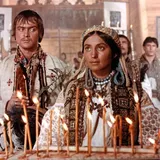
So today we're going to be talking about a fun little movie from 1997 called Sympathy Seeker. But in the original Russian, it's called Sirota kazanskaya, which is Kazan Orphan, like Kazan the city.
Yeah, you know, before we get into the name right there, I just want to say this movie is such a good example of the way that American Christmas culture is reflected in Russian New Year's culture. Because, you know, in America, we have so many kind of cutesy, convoluted comedy movies set around the holidays. This is the exact same thing in a Russian post-Soviet context. Except instead of being about people gathering for Christmas, it's about people gathering for New Year's.
Yeah, so basically, I would say that this movie is sort of like Mamma Mia, but make it Russian. The premise is that you have this school teacher named Nastya, who lives in a small Russian town. She was raised by a single mother, having never met her father, and it's the New Year's season. But right before that, she had put an advert in the newspaper to search for her father, whom she had never met. She only knows that her father's name was Pavel and that he had met her mother at a resort in the Caucasus or maybe Crimea in the summer of 1969.
The Black Sea Coast.
Yeah, so yeah, so then it's New Year's, she's with her fiancé, and then suddenly this guy comes up to the door and says, it's me. I'm Pavel. And then before too long, there's another guy who says, I'm also Pavel and I'm your father. And then there's another guy. Yeah. So you've got three men all claiming to be this woman's father that all say they were the Pavel who met her mother 30 years before on the Black Sea coast.
The cast
This is really an A-list cast in terms of the talent they got. This movie was really made on a shoestring budget, and you can see it in terms of the production value. But the acting is great.
I especially like the cosmonaut. He's very fun.
Yeah, yeah, we should probably mention. So, they're all three of the guys named Pavel. One of them is a traveling magician. One of them is a cosmonaut, and then one of them is this rough and tumble ship's cook who never left the navy.
Yeah, and all of these guys all passed away in the last couple of years, unfortunately, but they all have a massive filmography. Most famously, 17 Moments of Spring, which is sort of like this 60s spy epic television series. Yeah, and both of the two of the Pavels actually were major characters in that series.
And unfortunately, the 90s were not the greatest time for Russia. Largest peacetime life expectancy drop in, I think, modern history.
I mean, listen, it's just the price of doing business, it's the price of freedom.
The freedom to have your apartment stolen by a bunch of gangsters.
Yeah, look, I know that heroin usage was out of control, you know, the life expectancy dropped so quickly, but at least you guys got Pizza Hut.
True, true. So, actors in general were very down on their luck in this period. A lot of them simply drank themselves to death. But thankfully, these guys went on board for this sympathy seeker project. And as I said, it was made on shoestring budget, only $800,000.
The orphan of Kazan
But before we continue further, I'd like to talk about the name of the movie. The name in Russian specifically, which is The Orphan of Kazan. Yeah, so sirota kazanskaya, it basically has two meanings. It could either be a person who has no living relatives or a more great-headed-hearted one, a person who exaggerates their own hardships to win pity from others.
So, I just say I was kind of confused by this, because why is Kazan mentioned in this? And the origin's pretty funny.
Yeah, so according to the popular etymology, when Ivan the Terrible conquered Kazan in 1552, which at that point had been the capital of the rump state left behind by the Mongols, the Golden Horde, basically, he was bombarded with petitions from the Tatar nobility who were all rushing to tell him that they had converted to Orthodoxy and basically inform him that they're having a very hard time because their city got sacked. So they were trying to extract basically gifts and favors. And oftentimes they would refer to themselves as orphans in these petitions, sort of in the sense of like we're left without a state. And now as the head of state of our conqueror, you are our father. So please take care of us.
And a possible alternative here is that after the capture of Kazan, there would have been a proliferation of people fleeing the city. So you would have had beggars in other Russian towns claiming to be orphans from the city.
And ultimately, the expression entered the Russian language with a very like sarcastic tone, as you can tell. But also, it should be made clear that in the movie itself, like a Kazan orphan refers specifically to the first meaning, someone without family, period, not the sarcastic one. I think that the English translation is a mistranslation, frankly.
Uh-huh.
It's more, it's it's kind of condescending.
Not really condescending, just like this would have been a great example of Soviet English. Like, if you've ever read Soviet materials written in English, like they were often kind of awkward and stilted.
A little stilted, yeah, yeah.
Three lonely fathers
Well, I think about the title, though. It's kind of cute, though, because at the beginning of the movie, this little boy, this one of Nastya's students, he describes her as, you know, an orphan of Kazan. But then, in a way, as the movie progresses, we see that all of the three men who might be your father, they kind of also are. Because just like her, they are celebrating New Year's alone. And that's part of why they're going to find her, to find the person that they believe is their daughter.
Yeah, and a lot of them came a very long way to find her. The one who's the cook came from Japan, then to Vladivostok. The cosmonaut was from Kazakhstan.
Which would make sense because that's where all the spaceships are launched from.
Oh, of course.
A sincere holiday movie
Yeah, still to this day. I think Russia still leases that land.
Yeah, so when I went into this movie and I saw how it played out in the beginning, I thought that this was going to be sort of like a scam story because, I mean, basically, it's the 90s in Russia. Everyone's impoverished. And so my thought was that, oh, these guys, they're just scammers trying to get a meal out of this poor girl.
Which is what the fiancé accuses them of.
Which does seem like a natural reaction considering the times and the hardships that people were facing. But no, it's a very sincere movie.
Well, that's why I said it reminds me so much of so many American Christmas movies, you know. It's almost saccharine, it's very sweet, but it's funny enough that it's not too cloying, you know? And I think that it's a good movie. It's very cute. It's very short. It's like less than 90 minutes. The performances are great. But what I find most interesting about it is as somebody who really knew almost nothing about the Soviet New Year's tradition, it's a really fun look at this whole world, this really rich world of New Year's celebrations. And I found that, to me, that was the most interesting part of this movie.
I would just like to say that in many ways, this movie is very reminiscent of another much more popular movie, the 1975 film by Ryazanov, Irony of Fate, which is sort of like a cult classic. Like a tradition is to watch this movie on New Year's Eve. And that also has kind of a similar premise, although like not with the father, just like a stranger dropping into your life and inserting themselves into it. So this really is part of an existing tradition, you could say, of holiday cinema, except in Russia, it's not Christmas, it's New Year's.
Why New Year's?
So why is it New Year's? Not Christmas?
Well, it goes back to, like a lot of things in modern Russian history, it goes back to the revolution. So because obviously the Bolsheviks were atheists and tried to lessen the influence of the church on public life, a lot of Christmas traditions came under heavy scrutiny.
Right, even traditions that weren't necessarily explicitly theological.
Exactly. Let me just read this quote here. Christmas trees were criticized as a bourgeois tradition imported from Germany, Russia's enemy during the First World War. Ded Moroz, who's the Russian equivalent of Santa Claus, I think literally Grandfather Frost. Ded Moroz was exposed as a collaborator with the church and the rich peasants. Bolshevik policy aimed not only to dismantle the state church, but also to convince the people of their total folly in celebrating religious holidays. Newspapers exclaimed that Christmas was based on a pagan midwinter celebration and that the birth of Jesus had simply been confused with peasant sun worship. Now that the people were educated in the scientific laws of nature, it would be foolish to go on celebrating old falsehoods.
I mean, as you can see, there were a lot of buzzkills in the Soviet Communist Party by this point.
And it's also just kind of funny in general that they're attacking this as a pagan tradition when the church is really their main target.
Yeah, it's strange, yeah.
I feel like there's another universe where the non-theological, potentially non-Christian aspects of Christmas would be embraced by an atheistic program.
Yeah, well, if Tukhachevsky had taken power, then maybe we'd get a pagan revival.
Yeah, there was a lot of weird ideological stuff at this time. But I guess now I think about it, in a way, these traditions did come back, except they didn't come back as Christmas traditions. And I guess because what's crazy is that, like you said, like Christmas as an idea, because of its theological origins, was really reviled by the early Soviet state, which I didn't realize. And what's kind of interesting is that Christmas in 1929 was actually made to be a working day, where suddenly Soviet workers no longer had the day off. It kind of reminds me of some of the things you saw in the French Revolution with the whole cult of the Supreme Being and the replacement of all those saints day and holidays with this festive period at the end of the calendar.
Yeah, and I think in both these cases, I think the intentions are definitely good-hearted. It's just that on the ground, everyday people, and I would say maybe especially workers, don't want their holidays taken away.
Exactly.
It's a time of bonding with family, of being off from work. It's nice.
Everyone loves Christmas.
Everyone.
The anti-holiday campaigns
Yeah, and Christmas and other Christian holidays also weren't the only target of these kinds of campaigns. Like, I remember reading a couple of years back when I was still in grad school an article from 1929 where they talked about how they had made Yom Kippur into a working day so that Jews would also shed their superstitious beliefs.
I can't even imagine how hard it must have been to be like, you know, an observant Orthodox Jew in the Soviet period.
Although it is worth pointing out that the same thing would be true of working on Christmas. This is not a specific religion. It was a general anti-religious push.
It was the war on Christmas anti-holiday.
It was this anti-holiday push because holidays were seen as, you know, bourgeois and pre-revolutionary. But as you can guess, this was very unpopular.
Yeah, and it would not last, importantly.
No.
Postyshev's letter
And really what seems like the big turning point in the end of this kind of anti-holiday phase was in 1935, Pavel Postyshev, this prominent party activist, he'd had enough. And so he published an open letter in Pravda that was a passionate defense of the Christmas tree from a working class perspective. In pre-revolutionary times, the bourgeoisie and officials of the bourgeoisie always arranged for a New Year's tree for their children. Workers' children would look through the window with envy as the tree sparkled with colorful lights and the children of the rich enjoyed themselves around it. Why do our schools, orphanages, nurseries, children's clubs, and pioneer palaces deprive the children of the working class in the Soviet country of this wonderful pleasure? Some leftist deviationists have denigrated this children's pastime as a bourgeois undertaking. Yeah, which is kind of funny. It's that it's kind of like the rhetoric you see from right-wingers today, like, oh, the leftists are canceling Christmas.
Except in this case, the leftists really were canceling Christmas.
No, it was true. It was true.
Yeah, yeah, except these were the leftists within the Soviet communist movement. And so you get this guy, Pavel Postyshev, who is also, he's very left-wing. He's a Marxist within the Soviet Communist Party, but he, I guess, would have aligned himself towards the rightist faction of the party, which was against these kinds of broad social changes.
Yeah, yeah, he wouldn't have been aligned with the rightist faction per se, because by this point, like you had the war against the left deviationists, you had the struggle against the right-devi-deviationist. So now around Stalin, you just had the radical centrism of Marxism-Leninism, basically.
No, yeah, this is the left deviationist is a very specific meaning in this context. And I guess maybe that makes me realize this was this period now that you mentioned it, from what I understand, this was a time when, in general, a lot of pre-revolutionary traditions and cultural figures were starting to sort of be brought back into the public imagination. So maybe it's no coincidence that in this period, Postyshev would be interested in reviving the Christmas tree.
He continues, the incorrect condemnation of the holiday tree, an excellent form of merriment for children, needs to end. Komsomol members and pioneer workers should arrange for collective Christmas trees for children on New Year's Eve. In schools, orphanages, children's clubs, and cinemas, everywhere there should be a tree for the children. The city councils, the chairman of district executive committees, the village councils, and the public education authorities must arrange a Soviet Christmas tree this New Year's for the children of our great socialist motherland. The organization of a children's tree on New Year's Eve will be appreciated by all our children. I am sure that the Komsomol members will take an active part in this and eradicate the ridiculous opinion that a Christmas tree for children is a bourgeois prejudice. So let's organize a Merry New Year's Eve for the children. Let's have a good Soviet Christmas tree in all our cities and all our collective farms.
And I'm glad it worked.
The New Year's tree?
It's fucking cool.
Yeah.
No, come on.
Yeah, how can you be against a Christmas tree?
Yeah, who dislikes a Christmas tree?
It's nice.
We still have our Christmas tree up right here. Or our New Year's tree, I guess, now that it's after Christmas.
Yeah, yeah, yeah.
New Year's traditions
Yeah, so after the publication of Postyshev's article, the Soviet public started to shift their previous Christmas traditions towards the new year. As you know, the primary holiday of the winter season, so many Christmas traditions were just grafted onto this new Soviet holiday based around an entirely Soviet identity. So you're just tossing that there.
What are some of these traditions? Especially ones that might be, you know, only traditions in Russia and in the former USSR.
Food's a big one. You have a lot of traditional Christmas foods. You have tangerines. You have a lot of salat Olivier, which is sort of like a Russian potato salad with like mayonnaise and bologna and peas. It's much better than it sounds, I promise you. But also Soviet champagne, just sparkling wine, which we actually see in the movie. Yeah, in the movie, it comes up.
Is that the same as French champagne, the cheap champagne you get in the US, or is it something different?
It's not champagne unless it comes from the champagne region of France.
But yeah, yeah, it's a sparkling wine. I'd say it's sweeter than like proper champagne, but it's very nice. It mostly comes from, I guess, from the Black Sea region.
Georgia, you know, Sochi.
A little more to the east, I'd say, but I guess somewhere around that general area.
You know, funny you should mention that the tangerines, because you know, in Britain and Ireland, and sort of in the US, there used to be this tradition of oranges being eaten on Christmas. And if anyone's ever had a chocolate orange, they usually only sell them at Christmas because that's kind of what that comes from.
Yeah, and there are also a number of other traditions around New Year's. So a really big one, one that I had actually just finished doing yesterday, was you're supposed to like do a deep clean of your apartment before New Year's, just like to get rid of all the old dirt. So like the dirt of the previous year doesn't infect the coming year.
That's pretty cool.
Then you have more modern ones, like for example, on Moscow time when it's midnight, there's always going to be like a close-up shot of the clock tower in the Kremlin as it gongs.
Oh yeah, it's like yeah, watching the ball drop.
The president's address
I mean, nowadays there's an address from the president, so.
Oh, it's interesting.
It's usually very like saccharin stuff, very baseline, just like, oh, we, the Russian people, have worked hard this year, and so now it's our time to celebrate.
Typical nationalist, yeah, patriotic platitudes.
Has religious rhetoric re-entered his those speeches?
It's not very religious. I mean, Putin in general just isn't a very religious guy. I mean, this is something you have to understand. Putin isn't really a Russian nationalist. He's sort of a...
He's a Putin nationalist.
Yeah, no, he's a pan-Russianist. So like in Russian, you have this distinction between a Russian, a russkiy, and a rossiyanin.
Ethnic Russian versus citizen Russia. And again, I guess this is a big difference between modern day, like mainstream Russian nationalism and the kind of more extreme nationalism that, you know, sort of came to prominence with some figures in the 90s and then also was much more popular before the revolution in the Tsarist era.
Yeah, this was a very big deal in the 90s.
The kind of civic nationalism we're describing that Putin embraced was really necessary to stabilize the mess that was being created in the 90s.
Yeah, to keep this like very extreme, basically, you know, ethno-fascism from sort of spreading.
And also you had started getting rumblings of independence movements with obviously the Chechens, to a lesser degree the Tatars. And you really don't want that shit. And being, you know, not openly racist is a good way to get the local elites of those minorities on your side.
When the alternative is a bunch of actual fascists.
Navalny probably shouldn't be in jail, but Navalny also represents a much more nationalist take on Russian identity than Putin himself, which is often glossed over.
Oh, yes, even he's depicted in like the New York Times as this anti-corruption liberal.
He has a very nasty, anti-immigrant background. There's the famous clip of him describing people from the Caucasus as cockroaches.
Yeah, really nasty stuff. This does persist in a lot of factions in Russian politics today, from what I understand.
Yeah, but thankfully it's being kept to a somewhat manageable level. The state tries to clamp down on that stuff.
One day we'll have an episode on the modern Russian state and Russian identity. It's a really interesting topic. But let's get back to the new year.
When is the new year?
So yeah, so let me ask you. So when is the Soviet Union New Year? We've talked about what it is, but when does it take place?
It's December 31st, the evening of December 31st, slash the early morning hours of January 1st, same as here. But the funny thing is that, like, when the New Year starts, is itself a very arbitrary idea. So, throughout Russian history, it actually fluctuated quite a bit. So, traditionally, the Slavs had a lunar calendar of 12 months with the 13th month added for seven out of every 19 years. And the names of the months, which fun fact have been preserved in Polish and Ukrainian, even though in Russian itself, they just went with the Latin names, but in Polish and Ukrainian, they still have Listopad and all those. Instead of like Yanvar and Fevral and whatever the fuck. Yeah, so anyway, this was a very nature-centered holiday, of course, because for most of its history, Russia was a very agricultural society. And from what I've found, the New Year was traditionally celebrated around March 1st as sort of the beginning of the agricultural season.
But with the introduction of Christianity, the church really began to promulgate the Roman calendar as used by the Byzantines. But this was really a very official thing. The commoners continued to track their lives according to the old way for centuries. So years were marked in the Greek way, as in they were counting from the beginning of the world. If you remember our Kievan Rus episode, when we read passages from the Povest Vremennykh Let, all of the years given in the original manuscript there are these like Greek-style, I mean, the year 6800, yada, yada, yada. So the years were marked in the Greek way from the beginning of the world. But otherwise, as I said, this didn't really leave a mark in the lives of ordinary people. But they started to tinker with that stuff as early modernity began.
Moving the new year
So, in 1492, not only did Columbus sail the ocean blue, but over in Russia, the new year was moved to September 1st. Why, you ask? I have no idea. Yeah, but for some reason, they decided to move the New Year from March to September.
It's funny, it's if they're going off of the American school calendar or something.
But finally, 200 years later, it got moved yet again.
Peter the Great's calendar
So, we've already mentioned Ivan the Terrible. Now, let's mention another, one of the only other Russian czars that most Americans have ever heard of, Peter the Great. And so, as part of Peter the Great's westernizing reforms, in 1700, he basically decreed that we're going to start using the AD system instead of the whole creation of the world system. This also led to Latinized months, New Year's Eve on January 1st. And let me just read this quote here: It has become known to him, the great sovereign, that in many European Christian countries, as well as in the Slavic nations, people according to their years count from the eighth day after the nativity of Christ, that is, from January 1st, and not from the creation of the world. The years should henceforward be numbered in all offices and in all matters and fortresses, from this January the 1st of the Nativity of Christ, 1700.
And as part of that decree, homes across the country were to be decorated with pine, juniper, fir branches. And as a token of the good beginning of the new centenary year, after giving thanks to God and the singing in church, every person in the reigning city of Moscow shall make decorations of wood and branches of pine, spruce, and juniper, and lay this greenery at the gate to his home. And funnily enough, when Peter made the switch to this calendar, he was switching to the Julian calendar, which was the old way that had been used in Europe until the second half of the 16th century. But the trouble with the Julian calendar was that there was a bit of drift going on, so it got out of sync with the seasons. And so, with time, like, this is why often you'll see that, like, until the Russian Revolution, you'll see two dates, like, one in the old style, in the Julian style, and one in the Gregorian style, which is what we use today.
Which is how you get all the big events, or I think all the big events of the October Revolution actually happening in November, our time.
Side note: also led to an incredibly funny detail during the Napoleonic Wars where, because the Germans and Russians use different calendars, the Russian troops just did not come on time because they were using the Julian calendar.
That's hilarious.
Insanely funny. So, back to the calendar, right as Europe was switching to the Gregorian calendar, which was better at not drifting and messing with the holidays and the seasons, Russia chose to go with the Julian calendar, which just continued to drift.
Yeah, actually too bad.
It's buying an iPod classic after the iPhone comes out.
Yeah, yeah, yeah, absolutely.
New Year's trees
As was discussed previously, the general assumption is that Christmas trees were an import from Germany. I think that's a bit of an oversimplification because, as we just discussed, Peter the Great did declare that some greenery should be displayed in front of your home for New Year, which sort of might have some distant continuity with the modern New Year's tree. But it is true that Tsar Nicholas I's wife was from Prussia, and she did introduce Christmas trees proper to Russia in the early 19th century. This was the start of a lot of the modern sort of Western Christmas traditions coming to Russia. So, even though they might have had earlier Russian antecedents, this is when things like gift-giving really become common. Russian Sam, can you tell us a little bit about the linguistics of this?
Yeah, so this is a bit of a tangent. It might not be correct, but the Russian word for fir trees, which are generally used to make Christmas slash New Year's trees, is yolka, which is a diminutive form of yoi, which refers to the actual tree, whereas a yolka refers to like a decorated tree. And there's also a Greek word, elato, I think it's pronounced, which means fir. And so, I've had a lot of Christmas stuff on my mind lately because tis the season, and I was just thinking, could this possibly be connected to Yule?
Maybe, yeah, yeah, yeah, I think in our next episode, we'll talk about Yule a little bit. I think that the influence of traditional, you know, pagan traditions on modern-day Christmas is a little bit overstated, but it's definitely possible that this kind of ancient tree worship could have passed through into modern Christmas and then, you know, crossed over from Germany into Russia with Tsarina Alexandra. So, definitely, maybe. That's my answer.
Ded Moroz
You know, another kind of fun figure that really comes to prominence around this period that does actually seem to have a better case for having pagan roots is, I'm sure I'm going to say this wrong, Ded Moroz, the kind of Russian analog to Santa Claus.
Literally, Grandfather Frost.
So, in the West, often Santa Claus is conflated with the figure of Saint Nicholas, who was an actual saint who came from a rich family whose entire deal was basically giving gifts to the poor, and that's why he got canonized. He was recognized in the church, he was always very popular with sailors in particular.
But by the second half of the 19th century, as there's more and more European influence on Russian culture.
Particularly from Germany.
Yeah, so in the second half of the 19th century, Saint Nick sort of became associated with Santa in Russia as he had been in the West. But there was also sort of a competing figure by the name of Ded Moroz.
Who also appears in the movie we watched.
Yeah, yeah.
Well, the third Pavel shows up as Ded Moroz, you know, carrying this New Year's tree and wearing basically the traditional American-style Santa costume.
Yeah, it's still recognizable to us as Americans.
Oh, yeah, that's Santa. Yeah, yeah. So, you know, before we talk about the origins of Ded Moroz, are there any ways that he is distinct from Santa Claus as Americans will know him?
Nowadays, not so much, because there's been a lot more American influence.
Doesn't he have an assistant?
Yeah, yeah, he has an assistant. Her name is Snegurochka. She's sort of the snowmaiden. And she's his granddaughter, I believe it is. And she's like always depicted in this flowing blue gown. She's supposed to be very pretty. And they get around the world in a sleigh pulled by horses.
That's interesting. Also, I think this is the only companion of Santa that I can think of that's not a male.
Like the little blackfaced guy that the Dutch have, Zwarte Piet.
Oh, yeah.
Yeah, and it also isn't racist.
Exactly, exactly. Ded Moroz supposedly does have pagan origins, right?
Yeah, and yeah, seemingly he appears in Slavic mythology and he sort of hung on in the peasants' popular traditions, even as the church would continue to impose a more Christian worldview on the people. But everywhere, this was very much a mixed process. You had a lot of eclectic mixing of new beliefs and old beliefs, and this is sort of what happened here.
A frost spirit
So, originally, Ded Moroz was sort of like this frost entity, sort of one of many natural forces personified. He could be good, he could be evil, it just depends on how you address him. And if you show him proper respect, he'll be fine. So, no, they are nice.
Definitely not a kindly gift giver.
Yeah, but not evil.
Does he give you coal in a stocking?
Well, the reward for placating him is to not have your crops frozen over right after you plant them.
Okay, so you don't starve to death if you're nice to this old man.
As I said, with Christianization, it's almost always the case that vestiges of old traditions will hang on. And in the case of Ded Moroz, this was preserved in the tradition of klikanye moroza, which is sort of like the calling of the frost, which would happen either on Christmas Eve or Christmas Day itself. And what they would do is the oldest member of the household would bring a bunch of food, traditionally porridge, pancakes, and kissel, which is sort of like this fruit jelly sort of dessert. And they would leave it on a windowsill or a porch, and they would call upon Grandfather Frost to come and have a snack.
That's great.
It's like, yeah, leaving out cookies for Santa.
So here's an example of a call to Ded Moroz from Pskov that I came across. Ded Moroz, Ded Moroz, come eat pancakes and porridge. Don't wander in the summer. Don't eat our cucumbers. Don't kill the dew. Don't chase the children. Yeah, so basically, Ded Moroz should come around and accept an offering so that he doesn't bother the village folks later on in the year when his presence could actually genuinely threaten their lives.
Yeah, he's a bit threatening, unlike Santa.
No, he's the force of nature personified.
Yeah, Santa isn't gonna fuck you up. I guess he could damage your chimney a bit, but that's it.
Ded Moroz goes soft
Yeah, well, so slowly, you know, the kind of scarier aspects of Ded Moroz start to fade away from, you know, in the Russian Christmas celebrations. And a lot of this is because of increasing European influence. And so you start to see a lot of Christmas traditions, not just Ded Moroz, increasingly look like Christmas traditions in the West. You have, like you mentioned, the trees, you have gift-giving, and you have a much friendlier gift-giver figure.
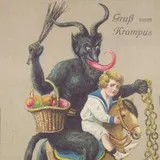
It feels important to clarify that the Santa analog Ded Moroz is in some ways more similar to German traditions, or at least he was until he got Santa-fied. Like in the German traditions, you have figures like Krampus and Belsnickel, which if you've watched The Office, you might remember Belsnickel from a particular episode. So he could either bring gifts to nice children, or if he decided that you've been behaving poorly this year, you might expect to get a very light flogging.
The Soviets and Ded Moroz
And we should mention that although Ded Moroz is a very popular New Year's figure in Russia today, there was initially some hesitation about this figure within the Soviet government. And that as they were building the new Soviet New Year's program, there was some concern about whether Ded Moroz was too religious or was just, you know, too old-fashioned for the new Soviet world. You dug up, Russian Sam, this pretty funny cartoon from 1928, if you want to describe it.
This is on the Wikipedia page for Christmas in Russia. It's from the Ukrainian edition of Pravda, which was the official state newspaper. And it sort of shows Ded Moroz dressed up as a priest, carrying with him some kind of ark that looks like a church, as he's being chased by a boy who is wielding a Christmas tree as a weapon, which, by the way, that boy is buff as shit.
He's gotta be.
He's very older than Christmas.
Yeah, no, it's it's the power of communism. You can lift up an entire tree and whack at these ancient creatures.
I mean, the so I mean, the former Soviet Union has produced a lot of people in wrestling and such.
Yeah, and so the caption on this image says, Get out of our lives.
Dude, if I see Santa, it's fucking on sight.
You know, I gotta say, this comic, I believe, was in Ukraine in 1928. I hate to say it, but I think maybe they should have remembered that if you want a good harvest in 1928, maybe you shouldn't forget to placate Ded Moroz.
Oh, Jesus.
Well, in any case, eventually, Ded Moroz would return to Soviet popular culture. And from what I understand, Russian Sam, Ded Moroz, like you said, he's bigger than ever, right?
He's a very popular figure today.
Ukraine's culture war
Yeah, he's very popular in some places, but in other places that are heading towards a more Euro-American orientation, they're having a bit of a culture war about this.
Yeah, let's talk about Ukraine. There's a lot of controversy in Ukraine over Ded Moroz and the idea that there is a need to create a separate Ukrainian cultural institutions and figures separate from Russia. I mean, the most obvious manifestation of this is the split in the Orthodox Church we've seen. How after many centuries, there is now, from what I understand, there's now a separate Ukrainian Orthodox Church that now exists.
Yeah, which is, like, was a huge deal and still is.
I don't think it's really fully resolved yet, fully, but it's it's happened. It's there now.
Not really, you can't really go back on that. But, anyways, so this is from a Russian-language Ukrainian news site. Kiev, at the site of the main Christmas tree of the country on Sofia Square, will no longer feature Ded Moroz. The organizer of the capital celebration, Igor Dubrodsky, announced to the residents and guests of Kiev that they will now be greeted by Saint Nicholas. We have been popularizing the idea for a long time now, and it's taken on a mass character. Ded Moroz is a fictitious character and a relic of the Soviet past. We need to do away with him, Dubrodsky said in a comment to the Vesti newspaper.
God, I love that quote. Ded Moroz is a fictitious character.
Santa, however, is real.
Yeah, no, no, no, and I think that I don't want to get too epic atheism about this, but I think that is kind of an interesting tension at the heart of any discussion about the secularization of Christmas, whether in the US or in Russia. It's difficult to be against, to speak against these kind of miraculous figures in traditional folklore and pop culture when the serious religious celebration of a holiday is all about miraculous figures. And I feel like it's kind of, you can't really pick one or the other, I feel like, you know?
You can't have it both ways.
Yeah, or really, I think it's that, yeah, it's that if you want to accept the divinity, or at least that you want to take seriously certain miraculous traditions, I think it might make the most sense to respect others as well, especially when they're all part of the same package.
Yeah.
And there's another article that we found from Euromaidan Press, which, okay, written by Paul Goble, who is. He served as director of research and publication at the Azerbaijan Diplomatic Academy and also worked for the State Department and the CIA and Radio Free Europe, Radio Liberty.
Yeah, so yeah, here is, yes, this is from, you know, from the lips of empire.
Here we go. This is, yeah, the, yeah, this is the American perspective, on the American state perspective on this issue.
It's the perspective of the psychos that America is backing in Ukraine.
Side note, it's, we really should do a whole episode on post-Maidan Ukraine at some point because.
Well, it's crazy things happening in a really short amount of time. This kind of desperate need to create, to form a more distinct national identity away from Russia.
Right. And, you know, I feel like, yeah, national identities are a topic that comes up a lot in this podcast, and it's happening right now in Ukraine. In the 2010s, this all happened. I imagine this is what it was like to watch what happened in the Baltics in the 90s, but this is on an even more compressed time scale. Yeah, or hey, even what it was like to watch German and French nationalisms being formed in the 19th century.
And there are a lot of very wild facets to this, some of them kind of funny, like the Ded Moroz stuff, and some of it more substantive.
Like, for example, shortly after Euromaidan, Ukraine decided that it would celebrate Victory Day on May 8th rather than May 9th. Victory Day meaning, you know, the victory over the Nazis. The moment when Germany formally surrendered, it would have been May 9th in Moscow itself, but in Central Europe, it still would have been the 8th. So you have a different day in Europe and in Russia. And in recent years, this has taken on a very political attitude, sort of, where it's like, we can't possibly celebrate this on the same day. Each of us has to have our own separate day to commemorate this, you know? And yeah, so Ukraine, which was part of the Soviet Union and which was one of the republics hardest hit by the Nazi occupation, now decides that it's going to go the way of Europe and celebrate it on May 8th as a fuck you to Russia.
It's incredibly weird to see one of the biggest victims of German aggression decide that they want to be part of the Merkel Reich and to just orient themselves towards German economic hegemony. But whatever.
So I'm just going to read a bit of this.
Postyshev and the Holodomor
Many Russians still view Pavel Postyshev as their favorite Bolshevik because of his role as the author of the letter to Pravda on December 28th, 1935, calling for the introduction of New Year's trees as a substitute for Christmas trees that the Bolsheviks had banned. To this day, some view it as a way that Christmas was covertly kept alive and even suggest that was his purpose. But for one nation in the former Soviet space, however, New Year's trees because of Postyshev's involvement in promoting them should be anathema. Ukrainians know that Postyshev played a key role in implementing the Holodomor, Stalin's terror famine that killed millions of their co-nationals. Consequently, as Ukrainians move away from the Soviet past, as when they tear down statues of Soviet leaders or introduce Santa Claus in place of Grandfather Frost, they should dispense with yet another symbol linked to those who did everything in their power to destroy Ukraine and Ukrainians.
Which, there's so many things wrong in this that it's just ridiculous. The idea of Ukraine as this monolithically anti-communist place is just ahistorical and even wrong today. Literally, millions of Ukrainians fought for the Red Army heroically.
Yeah, yeah, yes, yeah, way more Ukrainians fought for the Soviet Union against Nazism than against the Soviet Union.
That's inconvenient for many people on both sides of the issue.
But yeah, no, Ukraine is an incredibly diverse place in culture and language and traditions and in ideologies and perspectives. And yeah, trying to carve out any single Ukrainian identity, as far as I can tell from my limited American perspective, is a futile effort.
Yeah, exactly. And not to mention the whole famine thing is a really there were famines in Kazakhstan too. There were famines.
Yeah, yeah, it's it's not as simple as is described here. As evil Stalin took away the grain and he did it himself.
But this is the now we see that though the Grandfather Frost and the New Year's tree has all entered this kind of culture war in Ukraine that we've started see really unleashed after 2014. Yeah, yeah, where many and what's interesting is that I assume that Ded Moroz was not a specifically Russian figure before the Soviet period, right? I would assume that Ukrainians also celebrated him.
Yeah, no, he was a pan-Soviet figure. Like, like even in Central Asia, you'll find people with Ded Moroz presence in their lives. But I do get the impression that Ded Moroz would have been a more Russian sort of figure. I'm not sure who the Ukrainian equivalent would have been if there was one. But I actually find this article kind of humorous because I doubt that this guy is calling for like the abolition of New Year's trees as in keeping trees in your home, period. He just like wants to swap the label and be like, yes, it's a Christmas tree, not a New Year's tree.
Yeah, the narcissism of minor differences, etc., etc.
Soviet Jews and New Year's trees
But funnily enough, Ukrainian nationalists are not the only group that have beef with New Year's trees. Another, perhaps, more famous example would be the case of Soviet Jews in the United States and Israel.
Yes, this is, it is very shocking to a lot of Israeli Jews when all these Russians, Russian Jews, Ukrainian Jews started coming in and putting up their trees at the end of the year. And they saw no conflict between that and Jewish identity.
And I guess isn't there a broader problem of many Israeli Jews fearing that Soviet Jews are like, you know, not Jewish enough, either in religion or in ancestry or whatever?
I mean, some of them literally weren't Jewish.
Oh, yeah, yeah.
They just let anyone, yeah, they were letting anyone come over for a while.
Yeah, just the whole point is just to outnumber the Palestinians.
Well, I mean, it wasn't anyone. Like, you're still supposed to have a Jewish grandparent.
Yeah, it's the Nuremberg law standards. I mean that literally.
So a lot of Israeli Jews are very hostile to the idea because they think this is a Christian thing. But again, it's not a Christmas tree. It's the New Year's tree.
But like, if, but the fact is that if Muslim Central Asians or Russian Jews can celebrate this alongside Russian Christians or Ukrainian Christians, Catholic or Orthodox, that does mean that this is a cross-religious thing.
Yeah, and again, it was specifically imagined as a secular holiday that could be shared by the Soviet people across the board regardless of their ethnicity.
Which is really cool.
It lives on today. So in Israel, like every year you have this controversy about someone displaying a New Year's tree in a public space and just people losing their mind. But even in America, I mean, the 70s and 80s, you suddenly had a large number of Soviet Jews coming over as guests of the American Jewish community who were basically viewing themselves as the saviors of Soviet Jewry who were basically fleeing from Nazi Germany. And like a lot of our cultural habits and customs were very off-putting to them, especially this New Year's tree thing, because they saw it as another example of Soviet Jews being turned into Goyim, basically. Like, oh, you know, they eat pork, they have a New Year's tree. Like, how are these Jews exactly?
As if American Jews don't also eat pork and, you know.
Yeah, but I mean, again, like, this had a bit of a different resonance because a lot of these organizations that would have been helping Soviet Jewish immigrants here would have been more religiously oriented.
That's true. That is true.
And these are traditions that still to this day persist in the Russian-American community.
Like the one you grew up in.
Yep. I set up my New Year's tree yesterday and it was a lot of great fun. I love not celebrating Christmas. I love holding on to my Soviet identity and setting up my New Year's tree, which again, totally different.
Wrapping up
All right, well, yeah, this is a bad episode. And thank you so much, Russian Sam, for bringing this movie to our attention and sharing so much about these fun Soviet New Year's traditions.
Yeah, thanks a bunch.
Yeah, well, no problem. Just doing my bit in the battle against American hegemony.
Well, I wish all of our followers a lovely Soviet New Year's.
Yes, and of course, don't forget your pancakes for Ded Moroz.
And if you want to leave us a nice present for New Year's Eve, we ask you to go to iTunes or Podcast Addict or whatever podcasting platform you may use and leave us a rating and/or review telling other people that our show is worth listening to.
The show is also on Apple Podcasts, Overcast, Pocket Casts, Podcast Addict, YouTube, RSS and Patreon.