77
Pirosmani
In progressOn Easter 1918, Georgian painter Nikolo Pirosmani passed away in a hospital bed before he could be examined by a physician. This enigmatic naive artist whose works graced the walls of half the taverns of Tbilisi was only mildly famous in the avant-garde world when he drew his last breath. But after this corporal death, Pirosmani would live on, reaching a mythic stature. Songs and stories of the mad painter of the Caucasus have spread widely across the past century, to the point where it is difficult to separate the facts of his life from the stories which followed. So just who was this man, and how did he come to be recognized as THE national artist of Georgia?
This week on Gladio Free Europe, we will be looking at Pirosmani: the man, the legend, his exalted place in the Georgian heart, as well as Giorgi Shengelaia's 1969 film documenting all of this, Pirosmani. Upon its international release, American critics were entranced by its visuals but largely confused about its contents. We'll be setting the record straight on this film and the man who inspired it, doing our small part to bring recognition to an incredible artist who is an icon across the former Soviet world but still obscure in the West.
Transcript
Who was Niko Pirosmani?
And we are back with another episode of Gladio Free Europe. I am Russian Sam, joined as always by the excellent Liam.
Hey, how are you?
And today we're bringing you a topic that's a bit out of left field. This is probably someone you've never heard about before, even though he's a huge deal in Georgia. And this is the national artist Niko Pirosmani. Have you ever heard of this guy before, Liam?
No, I gotta say, this is totally new to me. And I'm kind of surprised about that because his paintings are really incredible. Pirosmani is what they call a primitive artist, kind of along the lines of Rousseau, Chagall, I guess technically a naive artist. But his art is really bold. And even though it's from the late 19th century, it feels in some ways incredibly modern while also clearly being rooted in a very ancient local Georgian tradition. And I think that's super cool. I can totally see why people in Georgia are so into this guy.
Yeah, absolutely.
A Million Scarlet Roses
I actually knew about Pirosmani for a very long time just because he's very well known through a very particular piece of Russian art. There's this one song called Million Scarlet Roses that was made famous by the Russian singer Alla Pugacheva, who's sort of like the Barbra Streisand of Russia. Also, side note, she's like 30 years older than her husband, but that's a totally different topic.
Good for her.
Yeah, and so, like, I grew up with this song. I knew about the story of this artist who spent all his money to buy his beloved a million roses, and she just scoffs him off, basically. But I hadn't really gotten into Pirosmani until my trip to Georgia, the National Museum. It has an entire hall dedicated to Pirosmani, and I was really excited to see that. That was actually one of the things that my dad told me as a must-see. He'd been to Georgia a couple of times before as well. But I have to be honest, when I was over there, I didn't really appreciate it as much just because the hall is very sterile. It has a very clinical setting. And like, the art just doesn't work there, frankly. It's just like, it looks kind of like a hospital almost, except the walls are just lined with all of these incredible paintings by Pirosmani.
Yeah, they're some of the least sterile art that's ever been produced, I'd say. It's really full of life, almost cartoonish in a way, but that seems very heartfelt. And I think that kind of touches on what I understand to be the kind of mythic image of Pirosmani. Maybe more so in Russia than in Georgia. This image of this kind of like beautiful, innocent soul who might have not been all the way there and was very childlike, but had this, you know, remarkable imagination that he put onto the canvas.
I get the sense that this is the image of him in Georgia as well. But just let's rewind a little bit.
Paintings for taverns
I say it feels very clinical because this is absolutely not the setting that it was painted for. This guy, he was basically doing all of these really incredible paintings for the various dukhans, that is, taverns of Tbilisi, and he was getting paid pennies for this stuff. So it was for a totally different environment. He never really sought fame, and in fact, people had to basically chase him down to find out who he was, as we're about to get into.
Shengelaia's Pirosmani
Yeah, I think that's because the movie Pirosmani largely focuses on the fictionalized search for Pirosmani by a pair of art collectors. This is the 1969 movie of the same name, Pirosmani. It's directed by Giorgi Shengelaia, one of the most famous Georgian film directors.
And you could call it a biopic. Many have called it a biopic, but that's not really entirely accurate. The truth is because we know so little about the artist himself, his life story, quote-unquote, is very liberally sprinkled with legends.
Right, right. At this point, he's much more of a folk hero than a real personality, despite his temporal proximity to us. He only lived like 100 years ago.
Yeah, in 1975, when this came out in the U.S., the New York Times has a very short but poignant review of the movie, where the critic Vincent Canby said that it's a fine, firm, gentle consideration of the life and work of the Georgian primitive painter. I use the word consideration instead of biography since the movie is not interested in factual details. Rather, it attempts to reconstruct the feelings experienced by the alternately determined and tortured artist.
So in other words, vibes.
Yeah, it's a very heavily vibes-based movie.
Yeah, yeah. And the vibes are cool, I gotta say. Before we were recording this episode, Russian Sam, I don't know, you made a joke that, like, when people talk about watching a three-hour, you know, Eastern European movie told from the point of view of a pigeon, this is the kind of movie they're talking about.
Yeah, exactly.
Because it's certainly not an exciting movie, and it's not always an engaging movie, but it's really beautiful. It has a great visual sense that if not reconstructing the style of Pirosmani's art, tries to reconstruct the specific emotions and images that led to his art. And I think that's very cool.
Yeah, although I do get the sense that he was trying, that Shengelaia, that is, was trying to evoke a Pirosmani's art, if not literally in composition, at least in the themes, because we get a lot of that.
Yeah, yeah.
Like Georgian folklife, animals, just people going about their business, things like that. This is the mode that he was working in. And the colors were also very prominent, which looks like his paintings. And there are even a couple specific allusions to individual Pirosmani paintings. Like, I don't know if you notice the woman in the red dress with the mug of beer. That's just a Pirosmani painting recreated.
The film's style
Yeah, exactly.
And this is really the story of the tortured artist par excellence. It's also an allegory for a distinct Georgian identity. And in many ways, it's a veiled criticism of life in the Soviet Union as experienced by artists, but also just a criticism of Georgia as well and the cruelty of man against man. And I'd say that Shengelaia had good reason to make many of these critiques. He was a good friend of a previous director whom we discussed on the show, Parajanov, who of course spent his life being plagued by Soviet authorities, unfortunately.
And yeah, no, I would say there's a lot of similarities in the vibes here, especially with his later work, like The Color of Pomegranates.
Yeah, and Parajanov, in fact, he has his own short film about Pirosmani called Arabesques on the Pirosmani Theme. That one is available on YouTube with English intertitles. It's done in the style of like a silent film, but honestly, I didn't really care for it that much. I think that's just because the version that's on YouTube looks like it was recorded on a potato. There was recently a restoration made by the Lincoln Center, I think it was. I saw a trailer that looks much nicer. So if you can reach that, then by all means, have a stab at it and tell us what you're doing.
You mentioned that Parajanov one looks kind of like a silent film. I think this one, the future film, does too. The composition is really funny. It's probably mostly inspired by paintings by Pirosmani, but the composition is all these tableaus, very delicately crafted positionings of the actors in the shot, you know, like literally bodies and spaces in a way that was very common in silent film, but isn't that common since the advent of sound. And I'm sure that was a deliberate allusion. A lot of directors have worked with that kind of style as a deliberate choice, but not that many of them are Soviet. So I think it's kind of interesting. Like this is the kind of style that you'd associate with like Bergman around this time. I think this movie came out the same year as Persona by Bergman, which also has a lot of kind of silent film style tableaus with these like kind of medium-wide shots.
So it's interesting that that same year, if they were doing the same kind of thing on the other side of the Iron Curtain.
Yeah, well, as we talked about, the Iron Curtain was really permeable when it came to art. Propagandistic fiction.
Naive art
But let's talk about Pirosmani himself. As mentioned previously, he is often considered a naive artist or primitive artist, although, as Liam explained to me before we began recording, the term primitive artist doesn't really work here just because a primitive artist usually signifies someone who does have formal training but who eschews that in pursuit of a more authentic yeah whereas he's the real deal but in practice the art styles are very similar it's like it's this kind of deliberate style that depict humans you know without the like a supposed taint of realism so there typically is not great pers great use of perspective there the colors often have are are completely emotional they don't really match the realistic colors of the sky and the trees so this is like we're talking like henri rousseau we're talking mark chagall there's probably some influence in there from matisse yeah dominguez alvarez is another artist i've often seen compared to him yeah yeah and Pirosmani is right within those guys and like someone like rousseau he didn't have formal training and i think that's why art collectors even in his lifetime were quite interested in collecting his art although he never got to the same level of fame as somebody like rousseau and i think that at least not during his lifetime yeah at least not during his lifetime and even today i gotta say i'm kind of surprised i hadn't heard of Pirosmani because his work is really cool.
And I wouldn't be surprised if Pirosmani develops more of a following in the west very soon but yeah, let's talk more about.
Do you have any thoughts, Sam, on his style before we get into the movie itself?
Yeah, I just mentioned some artists he's often compared to, but I would have to say that the comparisons only work so far because he's just so quintessentially Georgian. He is very heavily influenced by Georgian folk art rather than any kind of stylistic currents that would have been simmering in the West around this time. So. Yeah, yeah. And I'd say that's a big part of the appeal. That's why he's so beloved in Georgia as like done the national artist because he's just very national in the way he expresses himself and the themes that he depicts.
From what I understand, the kind of traditional art that he's drawing from is a kind of art that's often described in the West as Persian illustration or Persian miniatures, but were very widely created across the Caucasus in both Georgia and Armenia. And so Parajanov, I believe his parents or grandparents were professional Persian miniature artists, which certainly comes clear in some of his movies like The Color of Pomegranates. And I think you can see that here.
Persian roots
It's kind of cartoonish. It doesn't look very much like Western art being produced around the same time in like the 18th, 19th century. It looks a little bit more like maybe medieval European Western art with like all of the bright colors and kind of stylized faces, but usually, I would say kind of more sophisticated. Very interesting arrangements of different small figures in these faces. There's kind of an influence from Chinese art that you can see in a lot of Persian miniature painting. And this is the backdrop that kind of gives us Pirosmani.
Yeah, just again, I want to emphasize just how Persian Georgia is in many ways, because Georgia was often ruling over large swaths of what became Georgia, and there was just this constant back and forth. Georgia is a borderland in many, many senses of the term. It's sort of a connection between three different worlds, really. You have the Ottomans, you have the Persians, and then you have the Russians, as well as the various Caucasian peoples.
Anybody who's read much about the Eastern Front of World War II knows about Operation Bagration, which is named after a Georgian general who fought in the Napoleonic Wars for Russia. That was a Georgian family, but they go all the way back to the early Middle Ages when pre-Islamic Persia was ruling over Georgia and Armenia, which I think is pretty cool.
Yeah, yeah. The Bagrationis, they were the kings and queens of Georgia for over a thousand years, I believe.
Yeah, and they even ruled Armenia for a bit too.
Discovered by the avant-garde
But yes, let's get a out of the Middle Ages and let's get to 1918, which is around the time that most of this film was set. Kind of the turn of the century. It really, I guess it's mostly, it's before, it's all set before the Russian Revolution, rather, somewhere like 1915, maybe, when Pirosmani is a young man, then until his middle age, as this struggling artist in Georgia who has gotten some recognition, but hasn't gotten really any kind of serious financial compensation for his art.
Yeah, and as we're going to get into, he didn't really want financial compensation, but nevertheless, when he turned around 50, he was just suddenly discovered by the Russian avant-garde, namely the Rayonists and the Russian futurists, not really related to the Italian futurists for the record. Just wanted to clarify that. These Russian futurists were people like Malevich, Chagall, Larionov. And so, because of this, Pirosmani really began to acquire fame within his own lifetime as his works came to be displayed in Moscow in 1913 in the famous Mishen exhibition, that is, Target. And at this exhibit, Larionov said the following: We aspire towards the East and direct our attention toward national art. We protest against the servile subordination to the West, which has vulgarized our own forms and those of the East, has reduced everything to a uniform level and has delivered them back to us. And this is basically part of the same pan-European impulse that saw artists like Picasso turn to African-inspired Cubism around the same period.
And this is a major plot point in the film. The entire movie just features some of these Russian art collectors trying to track down the ever-elusive Pirosmani and buy up his works, which is exactly what happened, actually.
A Soviet, not Russian, film
But yeah, let's talk a bit more about the film, shall we?
Yeah, right. So this is a movie that it doesn't have, much like Pirosmani himself, it doesn't have maybe as much of an eminent reputation as it should have, because it's a really very remarkable work of Soviet cinema. Something that you really made sure to underline, Sam, is that this is not in any sense a Russian film. It is, it's a Georgian film, but more broadly, it's a Soviet film because it's part of the very rich tradition of non-Russian Soviet cinema. You know, we talked previously about Shadows of Forgotten Ancestors by Parajanov, who was a Georgian-Armenian director working in Ukraine. I think it's important to remember that, you know, Russia and the Soviet Union were not synonyms.
Right. And I just got really worked up about this because that New York Times article that we're going to be reading from throughout the episode. So it starts by calling it a Russian film by a Georgian director, which really riled me up because again, especially now, there's this increasing emphasis on trying to create a sign of equivalency between Russia and the Soviet Union, which was very much not the case.
No, no, certainly. I suppose, yeah, with all the, yeah, with the thought of the Russian invasion of Ukraine, there's been, I think, often well-intentioned, but terribly executed movements to basically really demonize any aspect of Russian and Soviet media, even Soviet media, which deliberately goes against the kind of Russian nationalist tendencies that lead to stuff like the invasion of Ukraine.
So the movie was in its time was pretty well regarded, but not well remembered. It won the Golden Hugo Award in Chicago and then the Sutherland Trophy in London. So it got some critical acclaim. And the New York Times article is quite praiseworthy. But critics didn't really get it. They appreciated the vibes. They knew that the director was doing something interesting here, but they didn't really know who Pirosmani was. They didn't understand the cultural context. And I think for that reason, it hasn't really become part of any film school syllabus the way something like The Color of Pomegranates has been. It's, if anything, it's kind of just remembered as a curiosity. And I think this movie deserves better.
Yeah, but thankfully, in the last couple of years, it was restored. It's now available on Blu-ray and also on YouTube. Actually, you can find a great rip with English subtitles on there. It's one of the first things that comes up when you search Pirosmani. So if this episode sparks your fancy, then please do watch the movie. And hopefully, unlike the critics who were talking about it in the 70s, you'll now understand what's going on thanks to our help.
The Shengelaia dynasty
So the Shengelaias are really film industry royalty in Georgia for several generations now. Giorgi's parents are Nikoloz Shengelaia and Nato Vachnadze, the former being a director and scriptwriter who's most famous for the 1928 silent film Eliso, which is available on YouTube with Russian intertitles. If any of our listeners know Russian and would like to get at that. And the latter was an actress who starred in many of his films. They had two sons. Both of them became directors. The elder is Eldar. He was born in 1933. Very fitting.
Yeah.
And the younger one is Giorgi, born in 1937 and only recently passed away in February 2020. And as Giorgi tells it, he was surrounded by Pirosmani's art from a very early age. In an obituary by Carmen Gray in The Calvert Journal, he said, quote, All my parents' friends had one or two paintings by Pirosmani, he recalled. As a child, I'd be sitting alone looking at these paintings. I entered into them very easily and stayed there. I couldn't get out. Later, studying at Moscow's famed film school, VGIK, under Soviet montage pioneer Dovzhenko, Shengelaia determined to, quote, find a way to give form to these childhood memories. And from this bloomed Pirosmani.
Yeah. And so interestingly, this was actually the second film he made about Pirosmani because he shot a documentary in 61 about the artist when he was still in film school. And then just eight years later, when he was a young professional director, he decided that Pirosmani's life was deserving of a narrative adaptation and a very unusual kind of narrative adaptation.
Yeah, and this had to do both with the fact that Shengelaia was very proud of being Georgian and also he saw a lot of himself and the artist. In the same obituary, he said, quote, I have other films which I love a lot, but the one which is most important to me is Pirosmani. When you touch Pirosmani, you touch me. He expressed old Georgia, not the Georgia of today. I have a very nice garden, and it makes me calm, but sometimes I cry in this garden too, because I see that people are different and they have lost something very important. And Shengelaia, he had a very long career. In addition to Pirosmani, his best-known films are Melodies of the Vera Quarter and the 1985 Journey of a Young Composer. In Independent Georgia, he would make a foray into politics, as did his brother Eldar, who was at one point the vice speaker of the Georgian parliament, which didn't really amount to much.
He was just, he was in this mode for a very long time. For this episode, I read an interview he gave in 1997, I believe, to Radio Liberty, where he's just explaining his motivations for this party. And just out of nowhere, he just goes on this tangent, like, oh, no, we don't have art. What kind of art could we have in these economic conditions?
I think I gotta say, this is also a classic kind of like Eastern Europe versus the West kind of thing. Like, think about the kind of people who become politicians in the West. Like, when people go from a media background to politics, they're like a newspaper magnate, they're a reality show host, they're a cowboy actor. And then in Georgia, you've got like this guy, this like avant-garde film director. And then in the Czech Republic, you've got Václav Havel. I think it's a very funny, very funny difference.
Yeah, Georgian politicians and the arts, they have a very long and not always great legacy. Like, like Zviad Gamsakhurdia, who was the first president of Georgia, who was a genocidal maniac, frankly, he was a poet in his own time. So.
Yeah, like the Italian fascists had a lot of those too. A lot of poets turned genocide.
Avtandil Varazi
But anyway, so speaking of artists with her multi-hyphenates, I was surprised to learn that the lead actor who plays the character of Pirosmani was himself a painter.
Yeah, this was a guy named Avtandil Varazi. He lived from 1926 to 77, and he's known much more as an artist than an actor. In fact, as far as I could tell, he was, this was the only role that he acted in. He was also the art director for this film, which is kind of unusual. And he's well regarded enough that one of his works is in the MoMA.
Yeah, he channeled Pirosmani extremely well, maybe a little too well, in fact. He was also an alcoholic, and he died when he was only 50. Yeah, he's remembered very fondly by those who knew him. I read some anecdotes of people who knew him and just he was always very good-humored, but in like towards the end of his life, he just got very sickly. At one point, there was an episode that this person recalls, I don't remember who it was, where he talks about how they see how skinny Varazi is, so they just start joking around with him, like, hey, we got you some baker's yeast, you can eat that, and that'll help you gain weight. And then when they see him a couple of weeks later, he's just really bloated from the cirrhosis, and he's just like, Well, I guess your yeast worked. And yeah, he passed away very shortly after that from cirrhosis, as I said.
Oh, that's terrible. And again, that is really eerily similar to Pirosmani's death. He, I think he died right before his career basically was about to take off. In the 30s, which he didn't live to see, he'd become this celebrated national artist in Georgia.
20s.
Yeah, but in 1918, not so much. And there's some question about how Pirosmani died, but it was probably alcohol-related to some extent. I think that I think Wikipedia says it was alcohol-related. Somewhere else, you found that it was tuberculosis. It happened during the flu pandemic, so it was just a very miserable time to be a very miserable few months.
What we know of his life
But that's too far away for now. Let's talk about what we know of his life, not his death. And from what I understand, we know not a lot. There's been a lot of speculation and a lot of myth-making around the figure of Pirosmani, but the real Pirosmani is somewhat out of reach.
Yeah, details of his life are just really difficult to come by. We don't even know his year of birth with certainty. And most of the details that follow, I just wanted to give a disclaimer, aren't might not be entirely accurate. So just take it with a grain of salt. I'm going to give some other versions when I feel it's appropriate, but we're just going to try to stick to a main narrative. So as best as we could tell, he was born in around 1862 to a peasant family in Kakheti, Georgia, in the far eastern village of Mirzaani. His full name was Pirosmanashvili, but he usually went by the shortened form for whatever reason. We know for certain that his father Aslan was an excellent gardener, and according to one version, when Pirosmani was still a toddler, his family moved to Shulaviri, another village, to work on the estate of the Kalantarovs, who were this Armenian nobility family.
So Aslan, he worked as the chief gardener in the vineyard for some time, but the father, he would pass away in 1870. There are some other variants. Some say that he was just totally orphaned by 1870, but it's once again really difficult to say. Now, just a side note, Pirosmani's home region of Kiziki, within Kakhetia, it didn't have serfdom unlike most of the rest of Georgia. And some, including Erast Kuznetsov, whose biography in Russian in the ZhZL series I relied on for this episode very heavily, have used that to explain his personality, as we're going to get into. But in a word, he was just very independent, just very he didn't want to be pitied. He refused to take help from people most of the time. But at this point, I'm just psychologizing. So let's just get to what we know for certain.
A Tbilisi childhood
The young Niko, he would move to Tbilisi around 1880, give or take a couple of years, which was at that point the capital of Russian Transcaucasia, and a melting pot of many different peoples, both Caucasian and from further afield. He would live with the Kalantarovs for some 15 years. According to the recollections of the Kalantarovs, he was treated like part of the family rather than as a servant. We know he received an education. He spoke both Russian and Georgian, and he maintained cordial relations with the family for most of his life. It was also in this household that he discovered his love of drawing and painting. And it's often repeated that Pirosmani had no formal art training, but this might not be entirely true. He began to see art as a viable profession around 1883 when he met the Armenian artist Gevorg Bashinjaghian, who later made a name for himself as a landscape painter, likely through the Kalantarov social network.
And the latter might have given him lessons and encouraged him to go to art school. But this was likely too expensive for the young hopeful. So instead, he became an apprentice to a certain miller, that is the last name, who owned the printing house. This arrangement only lasted for one year for unknown reasons. And so we catch a glimpse of the troubles that the man would face throughout his life. At a very early stage, he had a lot of failures both in his professional life and in love.
Love and failure
Yeah, yeah. He seemed like a constant guy with like different professional schemes that never went anywhere. He was always having to start a new hustle.
Yeah, so when he returned from the failed Miller venture, he moved in with the youngest of the Kalantarov sisters, the widow Elizaveta Khankalamova, who was actually 10 years his senior. He fell in love with her and wrote a letter asking her to become his wife. He said that he hoped that seeing as she was an educated woman, she would go past his inferior class position, but it wasn't to be. According to Khankalamova's daughter, Elizabeth saw Pirosmani as sort of a younger brother, and the family sort of left the whole situation off. But it really deeply affected the young Nico. So reeling from the embarrassment of rejection, he moved out and went to live with her brother, where he stayed for another few years before striking it out on his own.
Yeah, nothing extracted with that family. Yeah, this episode is kind of depicted in the opening scene of the film.
Yeah. But we see a sort of different version where Elizabeth is sitting on a sofa, weeping and lamenting that Pirosmani had ruined her friendship by writing her this letter. The Pirosmani of the movie is then depicted as having set out to Tbilisi, but in reality, he was already living in the city.
Sign painter, cook, conductor
So around 1888, he had another failed venture. He tried to set up his own sign painting studio, but he didn't have the prerequisite training or the social connections. Since he was a total unknown, the business shuttered shortly thereafter.
Yeah, and you dug up that after this, he became a cook at an Armenian manor, but apparently he was the worst cook they ever had.
Yeah. So finally, in 1890, he became a brake conductor on the Transcaucasian Railway. And this is one of the only periods of Pirosmani's life that we have concrete dates for because paperwork related to his unemployment remains in the archives. And from this paperwork, we find that he was often fined for various infractions, which nevertheless took a very large chunk of his meager 15 ruble a month salary.
He was getting fined like, oh, it's like, oh, you let a passenger on the train without paying. That's three rubles. You were late to work. That's 50 kopecks.
Yeah.
And the idea of, you know, cutting too much slack for poor customers, that's a theme in the film as well.
Yeah. And this time, he was also chronically sick with some ailment or another, and he would finally be fired in December 1893. He continued to paint on the side during this railroad employment for the record.
The dairy shop
He was always doing that on the side, even if it wasn't his main mode of making money. And thanks to the severance payment he received from the railroad, he was able to set up a small dairy stand in the outskirts of Tbilisi the following spring, 1894, and he found some measure of success. He advertised his stand with his own paintings of a white cow and a black bull, which we actually see in this film, which are hanging from the stand itself.
Yeah, and this is where the movie begins. He's like 32 years old. He's running this dairy stand with his buddy Dimitri. And it seems like things were initially going all right, but Pirosmani has such a poor business sense. He's such an aversion to doing the kind of nasty things needed to make a profit. He's simply too nice and too generous to the customers that it doesn't work.
Yeah, and again, there are divergent versions. There is a version that he was simply too generous. There's a version given by his former co-worker that he got scammed by his relatives and just had a poor workout that in general. His relatives said that Dimitri forced him out. But the movie goes with the version that he was just too nice. But there's probably an element of truth to all of these versions from what I can tell. The business did well for a couple of years. And while that was happening, he went back to his home village around 1898 and built a very nice house, which still stands today as a museum. It's actually the house we see in the village when he goes to the wedding ceremony. It's in the background over there. And at this point, he was presumed to be rich. So the next year, his sister and her husband took advantage of him.
They convinced him to return to the village, which was then undergoing a drought, to bring flour with him and to sell it there. They said to him that he would make a lot of money. But because of the difficult economic conditions, the flour was sold at very low prices. And the money ultimately was stolen by the sister, who then had the temerity to kick him out of the house. There was also some kind of fallout relating to a marriage. The sister seems to have told him that she found a bride for him, but for whatever reason, the wedding didn't happen. And the movie gives us the version that he just refused to marry her because she was too ugly. But in reality, it's very unclear. Like, again, even though we're dealing with the guy who just lived very near to us in time, he just is an unknown quantity in many respects.
The supra
Yeah, yeah. And, you know, and let's stop here for a second because I think that the wedding, the kind of aborted wedding scene, is one of the probably the most engaging scenes of the movie. It's really interesting. It's very Georgian, you know. So if you're looking, if you want to see a movie to be introduced to Georgian culture, this is perfect for that because it shows this traditional wedding ceremony with all of the kind of like twirling dances of the bride and her sisters that you might associate with like Chechnya. And then all of the men sit separately at a table where they're all arranged kind of last supper style, only on one side of the table. And they sing that famous Georgian polyphony that some of you might have heard before.
Yeah, so this is a Georgian tradition. These are called supras, which by the way is from a Persian word sofra, just to give a sense of how Persianate the Georgian world is. And these are the kinds of feasts that happen for many different occasions. It could be celebratory, it could be in mourning. But there's always a Tamada, that is a toastmaster, who is supposed to pronounce toasts, after which the guests need to drink everything in their cup. A good Tamada is supposed to handle his drink well, and I say him because traditionally it's supposed to be a man, and he needs to be an elegant speaker to keep the engagement going, to make sure that the toasts are never stale, to make sure that everyone's having a good time, to pace, to make sure that people aren't getting too blasted. And in these ceremonies, it's usually wine that must be drunk.
In fact, if you toast with beer in Georgia, that's considered an insult, as I learned.
Drink and despair
After this trip in 1899, Pirosmani's personality changed and he suddenly became very distrustful. After the death of his goddaughter, that is Dmitry's daughter Mary, he just became really inconsolable and he seems to have undergone some kind of mental break. It's said that this is also when he began to turn to alcohol, as one person quoted in the Kuznetsov book, in the Russian style, not the Georgian style. So like just very hard drinking that results in death. In the movie, when he returns from the village, he just kicks Dmitry out of the shop and he gives away all the wares to the poor. But in reality, Pirosmani's proprietorship days dragged down Skulli. He began to raid the cash in the shops to go on alcohol binges and Pirosmani's share of the capital shrank. So Dmitry was able to take over the business because of this. He was Skully bought out because Dmitry would give him a ruble every day until his share finally ran out around 1901.
Painting for food
And after this point, he spent his days around the Tbilisi train station looking for day labor. He was basically homeless now, and he would remain so for much of the rest of his life. He was very transient. He was just barely scraping by, making paintings and signs for the dukhans of Tbilisi and just sleeping where he worked most of the time. And I think there's this kind of weird kind of tragedy in how this is the period that must have been so brutal to endure, but also gave us so much of his great art because he was really painting as much as he could to support himself, selling paintings for very little money to all of the taverns around Tbilisi.
And that's when the film begins. We see these art collectors, I think, I'm not sure if they're Georgian or Russian, but they're traveling across the country looking at all the paintings from tavern to tavern, realizing that these paintings are very funny. They're really unique, and they're clearly by the same guy. And so they decided to track him down.
Yeah. And in fact, you said that it was a difficult time. Yes, it was. But he wasn't really that interested in improving his lot, frankly. He was often leaving behind a very large chunk of the money that he was paid for his paintings. He just, for whatever reason, he just didn't want to be paid in money. He didn't want charity as he saw it. He was just very committed to going it alone. Just very, very strange guy. Kind of in the tradition maybe of like the holy fool that we talked about a little bit.
Yeah. Just unfortunately not all there in some ways.
His paintings
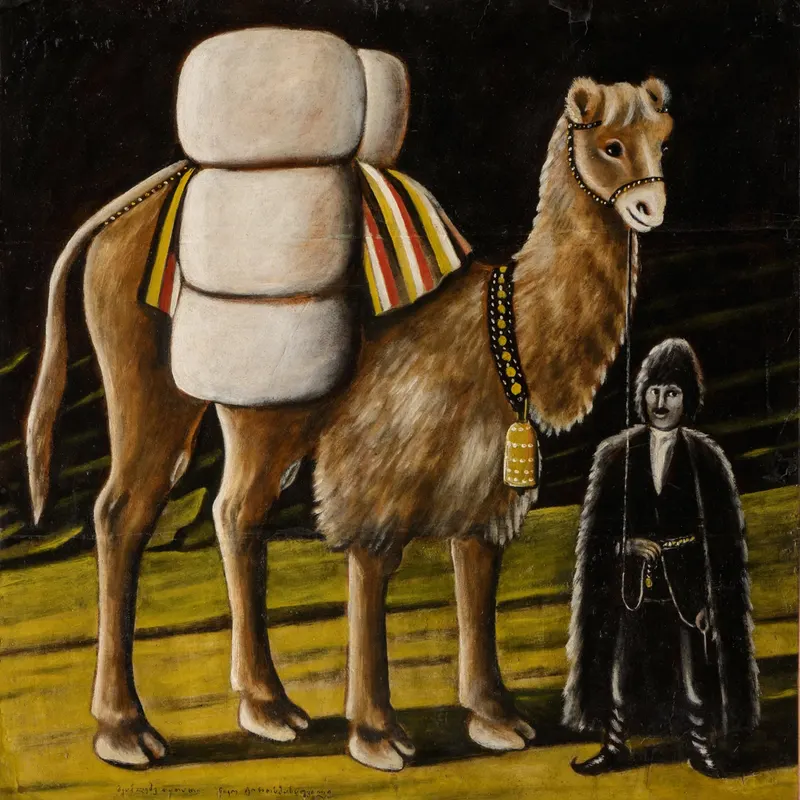
Well, you know, because this is the period where he made so many paintings. Let's start talking about them because we haven't really gone in detail about what his output was like. One thing you found, Russian Sam, was that there's like more than 200 of his paintings are available right now on WikiArt. So, if you want to see Pirosmani's output, it's really just incredible. Just a huge variety of subject matter. He has paintings about political events. The one shown in the film is a political allegory of an eagle killing a hare, which is supposed to represent Russia as the eagle and Georgia as the hare. He has stuff about the Russo-Japanese War. He has paintings of rebels against the Russian Empire, but then many of them are much more parochial or pastoral. Things like groups of farmers sitting at a table about to drink, a beautiful woman at a bar, even lots and lots of animals, too, which I know are some of your favorites.
Yeah, yeah, he has this one really beautiful painting of a sow and her piglets that is just really, really stunning to look at.
A giraffe painting shown in the movie, yeah.
And there are also some still lifes and urban scenes, but he clearly preferred nature and Georgian village life. He really loved the countryside dearly, and we see in the movie how he buys a bundle of grass from a passerby, bringing it to market so that he can lay on it. When he was able to, he would sometimes have a so-called grass room that was just covered in grass because he was really a country boy at heart, and he would paint surrounded by these mounds of grass because that's what really gave him inspiration and life. And his paintings have a really unusual character for a Western audience, but also for a Georgian audience for a specific reason is that they were usually painted on black oilcloth because that was much cheaper than canvas.
So, in other words, yeah, and it gives a very unusual look to his paintings. It looks kind of like 1960s black velvet paintings. You know, it's very, very kind of dark, and the colors really pop out on them.
Yeah, so again, like black is the default, and then he would just use oil paints on top of that. And the results are really stunning. He didn't really mix paints that much, so he was just like sometimes he was making his own paints, other times he was just taking the individual colors out of the tube and just working with those. But yeah, it's really something to behold. He didn't really charge much for his work because of his life's circumstances, and also he was just very deeply uninterested in money most of the time. So he was being taken advantage of in one sense, but he didn't really seem to mind it all that much given his relationship with money. One dukhan proprietor quoted in the Kuznetsov book said in the 20s, quote, if our Nico were still alive, he would decorate this busted wall and I would get off cheap just because this guy didn't want to spend a lot of money to fix the wall.
But once again, he was just very opposed to getting help. His longest term arrangement was with a dukhan proprietor named Bego Yaksiev. He lived with him from 1905 to 1910, although, again, he refused to take money. It was just room and board and food, basically.
The mystery of creation
Yeah. You know, something I found interesting with this movie was that even though it's about his career as an artist, you never really see those like kind of classic biopic scenes where he sees something, you know, shot at his reaction. You see that he's inspired, and then you see him like all night painting it. That kind of sequence never happens. And Canby, the New York Times critic, he noticed something similar where he said that it was one of the only films about an artist that, quote, respects the mystery of the creative process and style and sidesteps melodrama. The manner of the film is detached, almost shy from the art, like the artist himself.
Yeah, so just throughout the film, he's just very hell-bent on maintaining his independence. He told one dukhan proprietor that he cannot live in shackles when he offers to give him room and board. And yeah, just very sad situation, honestly, just because, like, he could have lived so much longer. He could have given us so much more amazing art, but because of his foibles or maybe some kind of mental illness, he was just very chronically allergic to reaching out to people.
Tamar and Rustaveli
But yeah, so there's another scene that follows after this, which is just, I mean, it shows him and a couple of his buds drinking in the bar. And one of them is like, oh, you know, I know where Tamar and Rustaveli are buried. And I just want to take a moment to explain who these figures are because, again, just not super familiar to an American audience. We're going to talk about these guys in more depth, I think, when we get around to our medieval Georgian literature episode. But Tamar, she was the queen who ruled in the late 12th century onwards. This was the very end of the Georgian Golden Age. A couple of decades after her death, the Mongols and the Khorezmians would show up and wreck everything, unfortunately. But she also had in her employ a man named Shota Rustaveli, who was the treasurer in her court, I believe, and the poet who wrote the greatest Georgian epic poem, The Knight in the Tiger Skin.
But yeah, these two are national heroes in Georgia today. Tamar is even a saint in the Georgian church. And they come up in the film because one of Pirosmani's friends is telling some tall tale of how, like, my grandpa said that there's a mountain somewhere and there's a tunnel in the mountain. And if you go through the tunnel, you'll get to a valley where the sun never sets. And in that valley, you can find the graves of Queen Tamar and Rustaveli. Yeah, and again, Georgia is a place that's very big into legends. One of these legends states that the two, that is, Rustaveli and Tamar were lovers and that they ran away together so that they could die together as they couldn't be open about their love.
Yeah. But I think in the context of the film, it's basically meant just to be this tall tale that like their graves are in this magical valley. But Pirosmani doesn't get that. And I think that kind of hammers home his idea as this like holy fool that he thinks his friend is being completely serious about this place where the sun never sets and he wants to go there.
And Tamar and Rustaveli, they're very common, well, somewhat common topics in Pirosmani's work. You can see a couple of his paintings of Tamar and Rustaveli in the background of the film. In fact, just again, the film is littered with the actual paintings that he painted. So, yeah, just keep your eye out for those.
Yeah, you'll certainly recognize them. You know them when you see them.
Decline
Yeah. After this point in the film, we begin to see Pirosmani's decline precipitously. He just becomes much more withdrawn. He's just dining by himself, even though strangers invite him to come sit and eat with him, with them. And he's just fully in the vagrant mode. And we just see him wander into a tavern to offer his services. And as he's painting, he becomes really irritated that the owner criticizes a minor element of the composition. So he just packs up and leaves, just takes everything and says, good luck to you.
Margarita and the million roses
Yeah.
Now, let's get to the legend that I mentioned at the top of the episode.
Right. This is another great part of the film.
Yeah, so this concerns a woman named Marguerite de Sèvres. This is a very mysterious episode in Pirosmani's life. We know from an advert that appeared in 1905 that a certain French actress who went under the name Marguerite de Sèvres made in the pyramids in Tbilisi.
Yeah, and he was just obsessed. One night Pirosmani goes to a bar and he sees her performance and is just totally smitten.
Details are very hazy, but as I mentioned at the top of the episode, this unrequited love resulted in an aspect of the Pirosmani legend that everyone from the former Soviet Union knows about.
Yes, and that is the million scarlet roses. Yeah.
As the story goes, Pirosmani tried to win Margaret's affection with a really dramatic gesture. He's said to have gathered all the money that he had and used it to buy cartloads of flowers to be delivered to her hotel room in Tbilisi. In another version, this happened in Sighnaghi, which is about an hour and a half away from Tbilisi, which I suspect has to do with the fact that the Georgian tourist industry is constantly looking to cultivate new sites for people to visit. Yeah, and in this version, Pirosmani, he covered the plaza outside of the hotel room with flowers. I actually went to that plaza. Unfortunately, it was really foggy the day that I went to Sighnaghi, so I couldn't see the beautiful sites. But nevertheless, it's a really nice place to visit, a bit off the trodden path, but not that difficult to get to from Tbilisi, really.
So at this point, Margaret is said to have been shaken, and she just gave Pirosmani a single kiss. But it was really the end of the one-sided romance. She then absconded with another wealthy suitor, and Pirosmani never saw her again. And so she became the subject of Pirosmani's most famous painting, the actress Margarita, painted in 1909. And you can really see the Persian influence on this one, especially in her face. She just has these really heavy, bushy eyebrows. Some of the Russian art critics take this to be sort of an insult to her to like make her out to be ugly. But no, really, this is just what the Georgian standard of beauty looks like. Big bushy eyebrows. That's what they love. And so I also mentioned this story because there's a further evolution of the legend that just keeps developing. Some runet pages have popped up in the last couple of years, which add an interesting addendum to the story.
They say that in 1968, when Pirosmani's work was being displayed in the Louvre, which is already a red flag, I have to say, this exhibition happened in 1969. There was an elderly woman who stood before the actress Margarita painting for a very long time crying. When someone finally approached her, she said that she was the very same Margarita. She asked to have her photo taken in front of the painting and offered to give her correspondence with Pirosmani to Soviet representatives at the exhibition. But of course, the Soviet representatives refused them because they didn't want problems with the KGB, yada yada yada. And then everyone clapped. I just don't believe this one bit. Honestly, it just sounds like a very post-Soviet thing to say. Just like, oh, yeah, you know.
Yeah, yeah. Yeah, it's a myth building off of the existing myth of the Million Roses that we don't even know if is actually true.
Yeah. Yeah, but just to compare that to the film version of it, it's surprisingly very muted in the film.
Yeah, yeah. It focuses more on the first moment he sees Margarita rather than his actions afterward.
Yeah. And he just looks really unwell at this point. Like, he just has a really pale face. Like, you can tell that not everything's alright with this guy. And the very next scene, we just don't see any involvement with Margarita. He just looks at her. He's just sitting in a bar and lamenting. And his client at this point just really got to me. So I just want to quote it in full. How much vodka am I to drink in this life? Shall I drink it slowly and scared for longer or drink it all in one cup and thus bring my end closer? I can't decide what's better. I got stuck in the throat of this wretched life. It will neither swallow me nor release me.
Yeah, so we really get a strong sense of just how tortured this guy is, how just nothing goes his way and he's just constantly battling his own internal demon. Because he's a kind of figure who is not able to function in the rough realities of the Soviet Russian Empire. He just does not fit in with that kind of lifestyle. And so, and that's what tortures him, you know, that he would love to be able to just be supported and paint all day, but instead he's compelled to labor in ways that he can basically cannot.
Discovered
Yeah. And returning to another arc in the film that we didn't really explore yet, while all these events are happening in the film, we just get these scenes interspersed of a pair of artists who are trying to track down this elusive artist whose works are displayed in every tavern they visit. Only one of the two is named. He is given the name of Lado Gudiashvili, who is a historic figure. He actually lived for a very long time. He lived until 1980. He was born in 1896. So a very long-lived guy. He actually was acquainted with Pirosmani, but he didn't really have anything to do with this episode as far as I could tell. In actuality, Pirosmani was discovered by the Russian art scene around March 1912 when Mikhail Le-Dantyu, who unfortunately died in the war in 1917, and the half-Georgian, half-Polish brothers, Ilia and Kirill Zdanevich, visited Tbilisi from St.
Petersburg and stumbled upon his works in a manner that's otherwise very similar to the one depicted in the film. Le-Dantyu is supposed to have said, this is a modern-day Giotto. And now just a side note to explain Soviet silliness. Why did they go unnamed? I really heavily suspect that has to do with the fact that Ilya was an émigré. He hung around in European art circles for many years. He went back to Georgia as a journalist during the days of the Menshevik Republic, but he left in 1920, never to return. The Zdanevich brothers, they amassed a massive collection of Pirosmani's works. They bought them up everywhere they could, and the collection remained in Georgia, which gives us a really funny addendum to the story of Margarita in the Louvre, which, while that one is fake, this one is definitely real. It's said that at this exhibition, Ilia Zdanevich, who lived until 1975, so he had a pretty long life, he had a chance to visit the Pirosmani exhibition with his wife, and he was just seething the entire time, yelling about how most of these paintings belong to him.
Sorry, buddy. That's what happens when you defect.
Yeah, exactly. And it was his paintings that would be sent to Moscow for the Target exhibition and all these other exhibits that popped up around this time.
And so the characters who are probably based on Zdanevich, they are the ones who track down Pirosmani in the film. And in the film, it seems like he's pretty nonchalant about the whole being discovered thing. He doesn't want to be famous. He just wants to make enough money to support himself.
Yeah, but nevertheless, he did acquire fame. A few of his paintings even became known in Paris, which he actually boasted about to the guy with whom he ran the failed sign painting business in 1916. He usually wasn't one to boast, but he just felt like saying, oh, by the way, they know me in France when that guy was trying to invite him to some exhibition. So he was just saying this to blow him off, as far as I can understand.
The Society of Artists
But we don't really know what happens to Pirosmani between his discovery in 1912 and 1916, which is when he finally got his big break. But his legend, it was steadily growing all through this time. In May 1916, he would finally be invited to a meeting with the Georgian Society of Artists after an article published by Grigol Robakidze, where he went as far as to call him a Georgian national painter and called for the museum of his works to be established was getting some attention. So he finally has his big break. He has a chance to rub shoulders with the real art world to make himself known. And for the narrative purposes of the film, Pirosmani is shown to be very optimistic, but he wasn't really that thrilled about it in real life. In the movie, he says, they know about me in other countries.
My name will not disappear without a trace. But he just didn't care all that deeply. He has this meeting with the Society of Artists, and in the movie, he gives his famous quote: What we need, brothers, is this. Right in the middle of the city, so that it be near everyone, we ought to build a big wooden house where we could gather. We ought to bring a big table and a big samovar and drink lots of tea and talk about painting and art. But I found it very interesting that the last words of the quote are left out. In reality, Pirosmani ended that statement by saying, But you don't want this, you speak of other things. So he just instinctively understood that these highfalutin art circles, they, as much interest as they might show in him, they just didn't have corresponding interests with him.
He was too innocent, you know. Even the art world was, you know, too venal for him.
The last photograph
Yeah, but after this meeting, a photo was taken, and this is the last photo that we have of his life. There's one photo of him taken around 1880 when he was still in his 20s, and then there's this 1916 one, I believe that's it. He's not yet haggard as he wouldn't become in the final years, and his appearance made a very strong impression. One witness to the meeting described him as having, quote, a perfectly oval face lit up by large black eyes. They radiated kindness and gentleness. His whole appearance, with his goatee and his smooth black hair, was reminiscent of an image from a Georgian fresco. Pirosmani was extraordinary and humble at the same time.
The paintings vanish
And so we get another narrative arc where he's just like he goes to the village to visit his sister with whom he had reconciled, and then he returns to the city to Tbilisi to find that all of his paintings are disappearing from the taverns, just got bought up. And that's exactly what happened in real life. As soon as the world found out about Pirosmani, suddenly all these tavern owners decided that they were going to sell the art of this guy who just really put his soul into his work, as we can tell. And the disappearance of the paintings in the film, it really marks a break. This is like the final episode where he like really drowns in his despair, for lack of a better word. And the final straw is another episode that happened in real life. There was a caricature published in a newspaper that showed him basically as this sort of talentless artist who's being egged on.
Like, oh, you know, if you work at it for another 20 years, you could be a great artist. And he really, really took this personally. He was just...
Poor Piero.
Yeah. Yeah.
At this point, he just cut off contact with these art people who kept trying to help him, but he just was even less interested in their help than he was.
Yeah, and he was obviously an incredibly self-destructive person.
Locked in the basement
Yeah, so the movie draws to a close. We get one really evocative scene that didn't happen in real life where his friends lock him up in the basement and force him to paint until they just lock him up until Easter for a couple of days. And this didn't happen as far as I could tell. I think that the point of the scene was much more to be an allegory for which Shengelaia felt Georgian artists were going through and well, Soviet artists were going through in the Soviet Union because of this idea that, like, as they saw it, these people who pretend to care for you and be your friends, they just don't allow you to leave the country and they force you to produce your work to be displayed for international audiences. In the Radio Liberty interview, I read, he actually says this explicitly. He says that directors like him and Parajanov, they were allowed to direct largely for a Western audience rather than for a Soviet one.
But is that true? I really have to push back here a bit because, I mean, although I do understand why there would have been a need for the Soviet Union to present great art on the international scene, there was also a lot of domestic demand for great art from the Soviet people because this was the period of the Thaw, and people just really wanted something that spoke to them in a way that the stodgy socialist realism of that time just wasn't able to express because it was just so stultified. So, like, again, I can understand where he's coming from, seeing the travails of people like Parajanov personally. But on the other hand, it's just not really true. Like, even if it does seem true from his perspective to some degree.
Yeah. Yeah.
And after this point, when he's finally released from the basement, he wanders into a cellar drunk on Easter and he just dies. The final scene is a horse carriage taking him, presumably taking away his body. And that's where the film ends.
Where is the war?
In reality, Pirosmani's decline was more extended.
I was actually really surprised that the war didn't show up in the film at all. It just makes it seem like...
Yeah, you're right, because so much of it is happening during... Yeah, yeah, his last year of his life totally coincide with the war.
Yeah, like we see the Easter celebration and it's just everyone hanging out, playing music, having a great time, and just no mention of the fact that at this point the war was going very badly. The Turks were making their way into the Caucasus and everyone was fleeing to Tbilisi. It's just totally unmentioned. I really do have to wonder what was the point of eschewing that.
I think that because this movie isn't really big on realism, they really want to capture the world in which Pirosmani inhabited, not the world that actually was Georgia and the Russian Empire at the end of World War I.
Yeah, I mean, yeah, that makes a lot of sense, actually.
Pirosmani's death
But let's talk about his actual passing, because it's a very, very sad story. Pirosmani, he returned to Tbilisi in February or March of 1918. He was out in the west of the country for a while, but he left, presumably, because the Turks were starting to make their way into the Caucasus, and Tbilisi seemed like a safer place. But by this point, the situation was dire even in Tbilisi. The economy was really bad, and people just fled the city, which didn't, which meant that Pirosmani was left to fend for himself. He didn't see that many familiar faces, so he just had to make do. He was desperate for anything at this point, and he finally found some work in exchange for food and vodka, which by this point he was a really heavy alcoholic. He actually needed alcohol. And that was really the best he could hope for.
He took to sleeping in a tiny cellar right on a stone floor, and he was often unable to even light a fire. That's how broke he was. One of his neighbors named Archil Maisuradze, who was a poor invalid himself, discovered the state that Pirosmani was going in, and he finally gave him some money and food to try to help. But at this point, it was too late, although Pirosmani was now too weak to refuse for the sake of his pride, as he had done prior.
Liam, would you mind reading this quote from Kuznetsov that describes the circumstances of his death?
His life was coming to an end. One evening, Pirosmani went down to his cellar. He was drunk. He lay down on the floor, fell into unconsciousness, and lay there for two days. Easter Eve came. A frightened, starving city was preparing for the holiday. There was no one to remember Pirosmani. It was only on the third day that the same Maisuradze, peeking into the basement, by chance, he had no idea the artist was there, heard a moan in the darkness. Who's there? It's me, Pirosmani answered. He no longer recognized his own neighbor. It's me. I don't feel well. I can't get up. The bells tolled frantically but joylessly. The colored eggshells rustled underfoot. Ribbon-decorated Easter lambs bleated by the trees. Maisuradze found a phaeton and his neighbor Ilya took the artist to hospital. There, his trail was cut short. The neighbor did not even know to which hospital he was being taken.
In its registration book, there was an unknown man in his 70s. He was taken to the emergency room and died before the arrival of the doctor. The autopsy reports on the following day agree with what we can surmise about Pirosmani. His heart, lungs, spleen, liver, and kidneys were all diseased, and the cause of his death was determined to be tuberculosis. He was buried on May 9th in the nearby cemetery, in a special place reserved for the destitute and the homeless from the hospital.
Yeah, so that's the end of the life of the great artist. A couple of weeks after that, the Mensheviks would proclaim their republic and they would be independent until 1921 when the Soviets went in there.
You know, I just want to note about the medical report. They said that he was a man in his 70s, whereas in reality, I think he was like 55. That shows, you know, in what bad shape he was in.
Yeah, yeah, just really unfortunate.
You know, it brings to my another famous tortured artist, you know, Charlie Parker, the jazz saxophonist. He, I think, was 35 when he died, and his medical report lists his age as 60.
Wow.
Yeah, that's what, you know, really serious hard drinking paired with you know a lifetime of destitution can really do to you.
A national artist
It's and and and Pirosmani's fame really grew by leaps and bounds. Already in the 20s, there were books coming out about him and as we saw his story gained all of these accretions that added legends to the point where we can't even really tell who the real Pirosmani was. He was just really amped up so heavily that by the time Georgia gained independence in 1991, he was chosen as the national artist because he represented something that was so quintessentially Georgian without the admixture of any other kind of culture that it was deemed appropriate. His face was on the one lari note for a while. That note isn't really in circulation. They use a coin now. But I'm sure you could still get your hands on it if anyone is so inclined.
Legacy
Yeah, it's nice to know that he does have this legacy in Georgia, even if it might only be because for more nationalistic than aesthetic reasons. But I do think that both Pirosmani the Man and Pirosmani the film deserve a better reputation in the West.
Yeah, absolutely. Or more of a lasting legacy. And hopefully we gave you enough of the cultural and historic context for you to really appreciate this movie for what it is and what it's trying to say.
Yeah, you know, because it's a great tribute to this very interesting artist. And I think beyond that, it's a really interesting document of a very cool moment in Soviet cinema. If you like Parajanov, then you're going to love this movie as well. I think it's really in conversation with the broader Soviet film industry of the 60s and 70s.
So his home region, his home village of Mirzaani, it actually has a holiday that's celebrated every October called Pirosmanoba. And now they're trying to make this more of a national thing, as I understand it. Kind of like a Bloomsday for James Joyce.
Yeah, yeah.
Hopefully it succeeds because...
Yeah, because again, this was a great man who was tormented in his life, and hopefully in his afterlife, he can get what he really deserved.
Yeah, yeah.
Well, you know what I say? It's like the best thing that an artist can do is die, usually, right? And so, yeah, maybe, yeah, maybe he'll be the next Picasso.
Picasso's sketch
You know, speaking of Picasso, I think one of the most interesting examples of the kind of limited Western reception of Pirosmani is that there is this really interesting sketch that you dug up of Pirosmani by Picasso. Could you describe this? What's your take?
Yeah, it's kind of uncanny, honestly. It just lines, basically. It looks kind of like he has a witch hat on, if you know what I'm talking about.
Yeah, yeah, yeah. It's very angular. He appears to be wearing a hat. And like you said, you can see the image of Pirosmani's face. He's holding up a palette. He's painting on an easel. But there are just these chaotic lines that are scratched coming from out of his neck, going in all directions. You can see what looks like a beard, maybe hints of cheekbones and eyes and a hat, but it's just these like lines are covering him. And I don't know if it's you know meant to represent his you know internal turmoil or what, but if it's just Picasso being Picasso, but but it's interesting.
Yeah, yeah. Although to me, it does look like he's smiling, but it's a very creepy smile, unfortunately.
Yeah, yeah, it definitely goes into the kind of the mad artist. And these lines are only found over his body, they're not in the rest of the painting. So I think it's trying to show that, like, there's just you know something burning within inside Pirosmani, and potentially that being the yeah, the turmoil and addiction to kill him.
Wrapping up
Yeah, so he's quite famous now. Every couple of years, there's an auction for one of his paintings that sells for like one, two million dollars. So, you can probably expect the art money laundering industry to really catch on to this Pirosmani guy at some point, and maybe at that point he'll get more of an international reputation.
Yeah, you know, Gladio Free Europe business tip is buy Pirosmani now because his paintings are only gonna be worth more in the future. Sandy, you guys have two million dollars to spare, you might want to invest in that, it might be worth 10 million in a decade.
Yeah, and if you guys have that kind of money to spare, be sure to also buy us one because hey, I'd love to own an original Pirosmani.
That's right, and if you are not able to give us that much money, we would certainly appreciate just you know a couple dollars on our Patreon. If you're liking the show, we'd really appreciate it if you guys could share your support in any way that you'd like. We hope that we've explained why Pirosmani the man and Pirosmani the film are both deserving of your attention. I had not heard of either the artist or the film until these last couple weeks, and I'm really glad that you brought this guy to my attention, Sam. It's a really interesting figure.
Well, I'm glad to have done my own small part in helping to spread the name.
All right, well, thanks so much, Sam. And hope the listeners enjoyed. We've got some great episodes coming up soon. We're going to be going back to Georgia not too long from now, as well as back to Japan. And as always, if anybody has any episode topics they'd like to suggest, please let us know. We recently got a suggestion for a very cool movie episode that we're hoping to do very soon, sort of dovetailing with our last Japan stuff in a funny kind of way. So we'll see you guys soon. Bye-bye.
And the music that's being played right now is going to be A Million Scarlet Roses by Alla Pugacheva.
The show is also on Apple Podcasts, Overcast, Pocket Casts, Podcast Addict, YouTube, RSS and Patreon.