The Pacific Ocean is not all that separates the 50th state from the American mainland. The Hawaiian islands remain a place apart, with a distinct culture and national identity borne out of the cyclone of colonial exploitation. Liam and Russian Sam are joined by Miguel (@whitejsakai) for Gladio Free Europe's first exploration of the history of Hawai'i, beginning with a look at the award-winning 2020 documentary CANE FIRE.
Taking its name from the first Hollywood production shot on the island of Kauai, filmmaker Anthony Banua-Simon uncovers chains of exploitation that link the plantation economy of Hawai'i's past to the real estate and hospitality industries of the present. Accounts of violent labor wars in pre-statehood Hawaii are interwoven with contemporary vinettes of the everyday struggles of Hawaiian workers, and exoticized images used to sell Hawai'i from the 19th century to the present. While Hawai'i represents a tropical idyll for travelers across the globe, soaring costs of living rampant housing speculation have forced thousands of residents, particularly Native Hawaiians, to flee to the mainland.
A general history of Hawaiian colonization starts at 28:24, from the ill-advised decisions of Captain James Cook in 1779 to the illegal imposition of Haole (white American) rule more than a century later. In between, Hawaiian monarchs and ali'i aristocrats established a unified nation that was the first non-European polity to be internationally recognized a legal peer by colonial contemporaries and the first country on earth to achieve universal literacy. 19th century Hawaiians had a vibrant press in their native language and made important diplomatic connections with neighboring Polynesian nations also groaning under the colonial threat. While many of these transformations were related to the growing influence of New England missionaries and other Haoles over the islands, Native Hawaiians like the missionary Henry ʻŌpūkahaʻia and the "merrie monarch" King Kalākaua were the primary actors in making contact with the world beyond the waves.
Like that of all nations, the identity of Hawai'i was carefully constructed by its aristocrats and industrialists during the development of a capitalist economy. Because while so many aspects of pre-colonial religion and culture were suppressed by missionaries and their aristocratic ali'i patrons, that which could be marketed to outsiders was preserved and promoted. Native Hawaiian leaders like Kalākaua and his sister Liliʻuokalani traveled the world to present an image of the Hawaiians as a dignified and civilized people. This was not enough to preserve Hawaiian sovereignty, but it established a romantic image of the islands that has enchanted outsiders for well over a century. Despite the violent overthrow of the islands' last queen, and the systematic disenfranchisement and ongoing of Native Hawaiians, Hawaiian culture, or at least a specific image of it, has found admirers as disparate as Elvis Presley and Chinese Premiere Jiang Zemin.
Please see below for a link to a clip of the 2025 Merrie Monarch Festival celebrating traditional Hawaiian ritual hula dance:
https://www.youtube.com/watch?v=b6qOY7kze7I
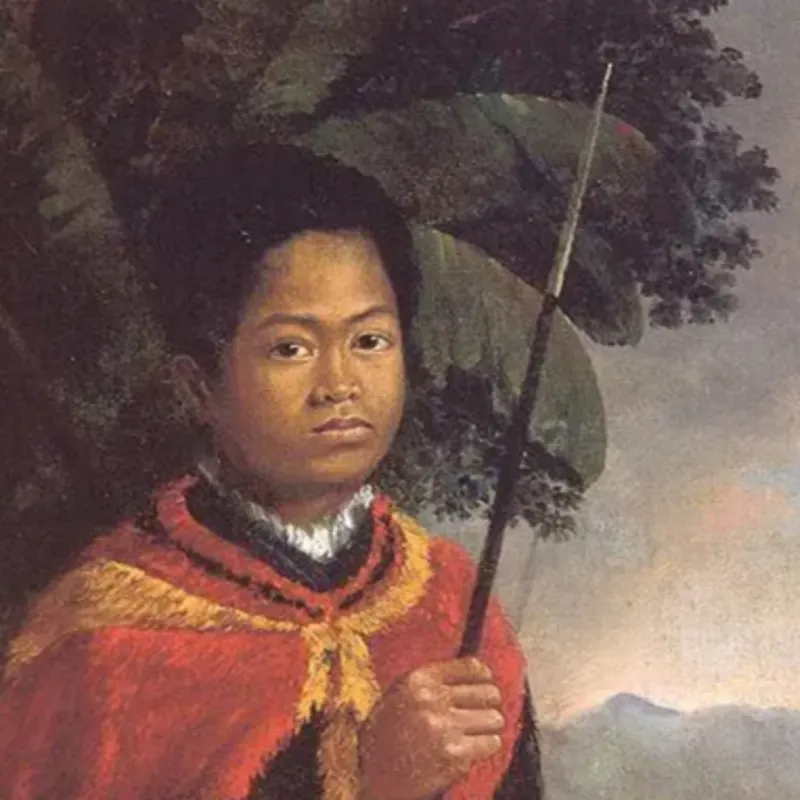
Episode Art is the Portrait of Kamehameha III by Robert Dampier (1825).
Transcript
Miguel joins from Hawaiʻi
Welcome back to Gladio Free Europe. I am Liam, joined as always, or almost always, by Russian Sam.
Hello, hello.
And we have a very special guest today for a really cool episode discussing one of the most interesting territories of the United States. A territory whose legitimacy as a member of the United States has probably been questioned more than perhaps any territory except Puerto Rico. That being the state, the islands, of Hawaii. This is our friend Miguel, who we've known through Twitter for quite a while. Miguel, you live on Hawaii. You found a really cool documentary discussing recent Hawaiian history and the lingering echoes of Hawaiian colonization. Could you please introduce yourself and your academic background and how you first got interested in this topic?
Oh, hello, hello. Yeah, my name is Miguel. Funnily enough, I don't really have a history background. I am actually more in the science and technical fields. But I found it from a love of Hawaiian culture that I slowly kind of grew into when I was, I'd say around my teens. It's weird. I was way more of a pessimist towards the whole concept of Hawaiian culture and Hawaiian ideas as a kid. I had, for whatever reason, a pessimistic thing, wishing that I was way more Californian than I was from Hawaii. I'm not certain how I discovered this. I think I was just trying to find documentaries to recommend to people on Hawaii and I managed to stumble upon this. I haven't really talked too much about it, but I have been a very silent mover of telling people from around the city. Hey, you should check it out.
I'm kind of curious what you think.
Cane Fire, the documentary
Yeah, and this in question is Cane Fire, a 2020 documentary by Anthony Banua-Simon that is going to be the focus of this episode, but also a pretty cool intro into Hawaiian history more broadly. Back to your background here, of the people that we know, you really are the foremost figure of Hawaiian history. And I think it's cool that even though you have not studied history formally, you've made a lot of interesting connections with historians of Hawaii. And even historians of Southeast Asia. Like one thing you've mentioned is that a lot of the historians we cited in previous episodes of this show about Southeast Asia are actually people you know quite well.
Yes, yes, I actually knew Barbara Watson Andaya personally. I was in one of her lectures. A fun little bit of color is that I would see her come to class in various outfits from South and Southeast Asia for the day. Oh, it was really amazing. A week when she wasn't in, I was subbing in as her TA while the TA took over the class.
Yeah.
Otherwise, some of the people we will be using for today's episode, I have met and spoken with many times.
Yeah, yeah. You know, and it's just you speaking a little bit more broadly about Hawaii, so you've lived on Hawaii your whole life, right?
Basically, I'm not actually born here. I'm from the Bay Area originally, but I moved over here at such a young age that, for all intents and purposes, this is my home. And what's interesting is that there is a marked shift between Oahu and Honolulu more generally and the outer islands. And you can really see this with the way the outer parts vote based on the Hawaii electoral districts. So we only have two districts because of population reasons.
Yeah. Cane Fire is interesting because it discusses issues of colonialism and displacement that affect all of the Hawaiian islands, but it's really focused specifically on the island of Kauai, where the filmmaker Anthony Banua-Simon, part of his family, comes from. And his family has a really interesting historical connection to the history of Kauai because Kauai was dominated across the 20th century by two very different industries: sugar cane cultivation and the American movie industry. Because both of those large industries exploited Kauai to a pretty significant degree. And although the sugar plantations all shuttered in the 90s and Hollywood's interest in Hawaii more generally has kind of tapered off since the 60s, I think this documentary does a really good job showing how cane cultivation and this cultural kind of exploitation are more connected than you might expect. And are both part of this legacy of American imperialism that connects to the annexation of Hawaii in the 1890s, which we'll end this episode with.
Yeah, like it's a very gladio sort of movie in a way where it's like you have this intersection of film as well as like real-world events and like seeing the, you know, how this rosy image of Hawaii on cinema where you have a happy Elvis just like dancing around and singing his songs is contrasted with like the very real miserable labor conditions of like the Hawaiians on the island at the time.
Right, no, right, and that's where tourism and real estate come in because a huge issue discussed in the documentary is how the literal sale of the islands to people from the mainland or from overseas is based on this romanticized image of life in Hawaii, but is actively contributing to the destruction of Native Hawaiian culture and the displacement of Native Hawaiians from lands that their ancestors have lived on for centuries.
Lois Weber's lost film
So as you probably expect, most of the movies shot on Kauai have this specific idyllic vision. This, you know, like the exotic romance you see in movies like South Pacific or Blue Hawaii, the Elvis movie that Sam mentioned. But what's interesting is that Cane Fire takes its name from another very different movie shot in Kauai. It is the first movie shot in Kauai, and it's one of the first Hollywood movies by a woman director. It's Lois Weber's Cane Fire, which, as far as I can tell, is completely lost, but is a very interesting part of the history of the island. I don't know if you want to share anything about the original film, Miguel.
Well, one thing that it sort of plays on is standard Hollywood Orientalist tropes of the time of the peasantry rising up against the colonial overseers. It's playing against, it's almost southern depictions of worrying about black slave revolts. Everyone sort of knows that.
Yeah, yeah, yeah, yeah. To be clear, the cane fire in question is like the laborers burning down the plantation because they're tired of being exploited.
Which is interesting because to cultivate sugar cane properly, you actually have to do that normally. So it's almost taking the master's tools against them by sabotaging productions similar to what happened during the Haitian rebellions.
Yeah, and I think that the Hollywood cane fire, the fictional film, not the documentary, the one from the 30s, it's interesting because I think it does have, from what I can tell, kind of a nuanced take on Hawaiian colonialism because it's about an interracial relationship with a white man and a native woman, and it shows their the it just depicts the prejudice against them as harmful and something that should be done away with. But then I think the rebellion and the climax is definitely meant to horrify white American audiences at the time, especially because it was to an extent ripped from the headlines. There were very real, very violent labor struggles specifically on Kauai across the 20s and 30s, basically right up until the time that this film was made.
Labor wars on Kauai
I can point to a specific event which is a big thing for ILWU members is the Hanapēpē massacre where the police killed a bunch of Filipino organizers in Kauai.
Yes, and then the ILWU, so that is the sugarcane workers union, right?
Yes, as the ILWU ended up being sort of a conglomerate union for many industries within the Hawaiian Islands up until recently.
Yeah. And I think what makes this documentary work is the link between the original Cane Fire film and this actual real-life labor struggle. And it's a link that is very personal to the filmmaker because there is this family legend that his own great-grandfather, who was one of these striking Filipino laborers, actually appeared as an extra because so many films were shot on the island that many Hawaiian people, usually of either native Hawaiian or Asian, especially Filipino descent, would often appear as like these happy laborers in the movies. You know, like another, even in modern times, one of the one of the Hawaiian, one of the organizers, the labor organizers that the filmmaker meets was in some forgettable Kevin Costner movie in the 2000s. Do you know what the name of that Kevin Costner film is?
I'm not familiar.
Dragonfly, 2002. Apparently, it was universally panned by critics.
Back to, I think, the documentary, the link between the idyllic Hollywood Hawaii and the realities of labor exploitation, which obviously has a colonial and racial element in Hawaii, is really interesting. And I love the way that this film managed to weave that together.
Coco Palms and Chad Deal
But there's a lot of other interesting elements too, especially when they talk about the role of modern-day tourism and modern-day real estate development. A big part of the documentary focuses on the Coco Palms Estate, which was a resort that was really popular in the 50s and 60s, which I think is the kind of heyday of mainland interest in Hawaii. They filmed Blue Hawaii there. I think that a lot of films were shot there. In the 90s, it was destroyed in a hurricane. And I think that this coincides with a rise in less culturally specific tourism and more generic kind of tropical beach tourism, as well as an increased migration by wealthy mainlanders to Hawaii, the Hawaiian Islands, especially Kauai, without much consideration for the local culture of the history, just because they want to live, you know, on a place by the beach. And that's when we meet the incredibly named character, real estate agent Chad Deal, who is involved in selling huge chunks of the island of Kauai to wealthy mainlanders.
Yeah, like I was kind of sleep deprived when I was watching this movie, and I saw this guy's name tag Chad Deal, and I thought I was quite hallucinating for a second.
For the people listening at home, it's hard to picture Chad Deal besides a sort of stocky white American guy wearing a sort of ill-fitting Hawaiian or Aloha shirt, sort of putting on the costume to do the business, almost in the same way like a mafia also would do to hold out one of their executions.
Yeah.
Also, there's an interesting element about how even though not many films are shot on Kauai anymore because it's so expensive to bring a film crew out there, there's still this Hollywood legacy. And there's this really one of the industries on Kauai is like film tourism, going to the sites of like James Bond movies that were shot there in the 70s or Elvis movies in the 50s and 60s. One really interesting movie that I'm trying to track down, it's Jungle Heat from 1957. Much like Cane Fire, it dramatizes the actual labor struggles on Hawaii involving especially Filipino laborers. Unlike Cane Fire, this one is not lost, so I think I might be able to track it down. I'm curious to see how it, to what extent it might be sympathetic to the labor struggle. But moving beyond that, they mentioned the film tours continues to be a big part of the tourism industry on Kauai to the extent that it even appears in the 2012 sci-fi channel movie Piranhaconda, in which a busload of tourists get eaten by a giant alligator creature. Yeah.
To give a bit of color, I've actually been to Kauai, and it's interesting. When I was walking down one of the streets, one of the little placards they had was the people from Tropic Thunder ate at our Burger Place. And you can get tours of the various valleys where they shot Jurassic Park.
Yeah. Yeah.
I really responded to the documentary. I think I liked it a little more than Sam did. And I think that you can tell, it's this really strong narrative vision, I feel like. It's a great articulation of the ways that various systems of exploitation on Hawaii are connected. Also, one kind of funny element here, not to dox or anything, but my girlfriend has a very similar backstory to this filmmaker. One of her parents has, one of her grandparents has roots on Kauai. And so when he describes his experiences as like the haole cousin coming to visit people, his relatives who never left the island, she's had some kind of similar family experiences there. All down to the uncle who's a truck driver.
So many truck drivers. I don't understand that with so many truck drivers.
I guess just because it's a place where there's not really much other means of transport, right? Like it's too small to have freight trains. So much is constantly being brought onto the island because nothing could be produced locally. And then even before that, it was just like for export, you know?
Yes.
The rise of the truck drivers might kind of indicate this. The Hawaiian Islands, but particularly Kauai, shifted from being colonies that exported something to colonies that imported everything. And they're both terrible systems of economic subjugation. But they're very different. And I feel like Kauai today is economically subjugated, but in ways that are somewhat unrecognizable to earlier generations. And there are times in the documentary where old school labor organizers who worked in the sugarcane era are interviewed and they talk about how the IWLW Thank you, the ILWU, doesn't really know what to do anymore because it's such a different kind of economy as they shift from cane cultivation to being a service economy.
Plantation railways and the Polynesian Cultural Center
Yeah, I wanted to add a small detail. So throughout the Hawaiian Islands, there were rail systems which were primarily meant to export sugar from the plantations to the small little port systems. A lot of them sort of disappear around the same time in the 40s to 60s period. And this rail system was originally how a lot of tourism was predicated. So up in Lāʻie, where today BYU–Hawaii is, tourists would show up in Honolulu Harbor, take the train from there around the islands to end up at the Polynesian Cultural Center today to go see the quote-unquote hukilau.
What is that?
It is a musical tug of war.
Oh, okay.
It's the Polynesian Cultural Center we can touch on if you want to, but it's an interesting place where a sort of Americanized perception of what a Polynesian and their very expansive of what a Polynesian is, their culture and understandings should be within a Mormon lens.
Oh, that's fun.
Well, and so the role of like white missionaries in the islands, that's going to be a very major theme in the later part of this episode. But it's really interesting that it's obviously still ongoing.
Yeah, you can really see the influence of the Mormon church and various missionary boards using Hawaii as a spring, not spring, launch point for proselytizing towards the other Pacific regions.
Yeah, and we're, yeah, and that's what we're about to see. There's like been, that has a very long history in itself. The Hawaiians themselves were missionizing other Polynesians, like not a generation after Hawaii itself became Christian.
Resorts and evictions
And I guess the one other major element in this documentary we should talk about is: you mentioned, you know, Chad Deal, the real estate developer. There are also some really big resorts being built on Kauai right now, leading to really fierce struggles with native Hawaiians who recognize that this is going to increase their displacement, especially because many of them are currently squatting on the land that's trying to be this resort. And I think that one of the most dramatic elements of the documentary is when the filmmaker met these Hawaiian people who are living on this land that's set for development and how the private security and police were brought to force them out. And some of the private security actually refused to do that. They were saying, this isn't what I signed up for. I'm not working this job to kick my neighbors off their property.
And this is the nature of Kauai. Kauai is a very, very small place. When you told me that you have some connections to Kauai, I was joking to you that, oh, I'm probably four people removed from that. I probably could ask around and figure out who your family is.
But I think also it's that this process of displacement on Kauai, I guess because it's such a small country or such a small island, I think it's especially painful because there's, you know, if you lose, if you get forced off your house, which you might not legally own it, but you see it as your ancestral land, you have nowhere else to go. I know that a lot of native Hawaiians have probably started living in Nevada. Like that, there's a huge Native Hawaiian community there. And I think it's largely because it's so expensive to live on the Hawaiian Islands, I think, particularly on Kauai, that many people are forced off of Hawaii altogether.
And what's interesting is that in many cases, they do actually have a claim that it kind of got wiped away during the overthrow of the Hawaiian Kingdom.
Right, because the Coco Palms estate was on this royal Hawaiian land.
Exactly. And we can touch upon it, but the Great Māhele of 1843 sort of granted about a third of all land to the commoners. So, in many cases, if you can prove it, and this is very contentious to this day, where the state and the local body of capital doesn't like the fact that you can sort of challenge for land back and will send the forces of the state to fight against it. So, I know someone whose family was working as a law firm trying to prove that these people had ancient 19th-century deeds and whatnot. So, they don't necessarily need to pay fees or dues to the state to use said land.
But, you know, but you know, despite these legal avenues, it's clear that these evictions have been happening for decades and decades. I think one of the most memorable parts of the film is this archival footage from a news story from the 80s on Waimanalo Beach, where this family was evicted from this land they were squatting on, and there's this incredibly impassioned child pleading with the police not to be removed from this land that they live on. And it really, really sticks with you.
Yeah, let's clip it here.
Streets, our house, new house, everybody, the streets. We're not gonna live on the streets. Shit! We know the house, yeah! At least give us a piece of land that put them on out! Yeah! We don't want no place to stay! Yeah!
Yeah, Waimanalo is interesting because it is one of the areas where it's still very Hawaiian. There's a large Hawaiian homelands presence over there.
And when you say Hawaiian homelands, do you mean basically these basically native Hawaiian squatters?
No, no, no, no, no, no. So, Hawaiian Homelands is a 1920s provision brought by Prince Kuhio, the delegate for Hawaii at the time, trying to guarantee some land and some housing for the native Hawaiian population. It is, in practice, much more complicated than that, but it does at least guarantee some Native Hawaiians access to land. Though, what Hawaiian homelands are is very legally contentious of who has authority in those regions.
Verdicts on the film
Well, yeah, so Sam, and do you have any more thoughts on the documentary before we move on to kind of Hawaiian history more broadly or anything you want to share, Miguel, about the film?
Yeah, for me, I guess I see the vision. I think he chose a very interesting and touching subject matter. I just think that he didn't quite do his homework to 100% there, and because that ended up being a bit scoffier than it should have been. But it's definitely worth watching.
Well, yeah, I think it's important to remember it's independent. I think it was all made by one guy, right?
He probably shot and edited the whole thing himself.
Yeah, he's from the mainland and with family roots, but he basically did the whole production by himself.
And I'll give him credit. His interview portions are some of the best I've seen. I don't know how I would be able to handle Mr. Chad Deal the way he had. Just completely stone cold.
Yeah.
There's a lot of very touching moments. Like, there's the one guy, I think he's a Filipino Hawaiian guy who loses his job during the filming of the documentary and he just like calls completely destroyed.
Yeah, and that's kind of the thing that a lot, despite Hawaii having the second largest union presence, the service industry is way more callous towards these people when you don't fit the needs. There's this one in native Hawaiian who almost kind of buys into the system. He plays all the music for Coco Palms. He's always been an entertainer there.
Oh, yes, yeah, the old guy, yes.
His connection to Hawaiian culture is always through the medium of cocoa palms. It's never been through traditional practices or the domestic film industry or music industry for that matter. It's always been how some guy from the mainland sort of pictured it. There's a lot of postcards which picture this idealized bit of Hawaii, which actually, funnily enough, gets slapped on for all of Polynesia. And that's another earlier, the roots of this generic tropical tourism that we see in like the 80s, 90s has its roots way back in the past, but definitely gets heightened in that period.
Selling Hawaiian culture
Right, and this is something I personally find really, really interesting. The way that although so many aspects of Hawaiian culture were suppressed and destroyed by colonizers, and I'm sure you also see this in other places in Polynesia, like Tahiti, for instance, certain aspects a couple generations later then became the basis for this massive commercial industry, which in some ways has kind of defined how people perceive Polynesia today. Or in this case of this musician, even how some native Polynesian people perceive their own culture. And I think that this process of deconstruction and reconstruction in this colonial capitalist context is really worth examining. And I think this film is a great intro into that.
Oh, totally.
For the audience, there's a renowned Hawaiian academic named Haunani-Kay Trask who calls this process of selling off your culture as means of surviving a cultural prostitution. Where the only context where you're even dealing with it is to sell it in the same way you would sell your labor. Yeah. Yeah.
And I know that this is something that you kind of were looking at, Sam. This idea of reconstruction has led to allegations from people opposed to any kind of native Hawaiian rights or autonomy. That because their culture has been like, you know, supposedly prostituted, that means that it is not worth preserving. I know there was like some awful tweet you saw that I think you wanted to summarize.
Yeah, it was just like this paragraph's long screed. That's another thing we can never forgive Elon for for making it possible to just like post that kind of shit on Twitter uninterrupted. But it was just this guy like talking shit relentlessly about like, oh, you know, like they didn't even have pineapples before Europeans introduced them and like their culture was just made up for like the tourism industry and et cetera, et cetera. And it was a really nasty post, but I found it fascinating just because like this was something that's like, you know, sort of combining like all of the worst types of cultural chauvinism in a way that's like super relevant to this episode and like all the charges leveled against Hawaiians.
Funnily enough, if, or unfunnily enough, there was a recent scandal in Honolulu where a woman at a Honolulu City Council remarked that Hawaiian is a dead language.
Oh.
So she kept on doubling down. Quote, I'm not sure what language it was. I'm assuming it was Hawaiian, and that is a dead language. So it would not work on a translator.
Hawaiian language today
We've talked a little bit about language revitalization of this podcast before, but I think that's also one thing I think really is interesting about Hawaii more broadly is how it's true that the Hawaiian language is not a language of everyday communication for most people on the islands, but there's still this ubiquitous presence of Hawaiian. I think maybe comparable to Irish Gaelic in Ireland.
Yeah, so many street signs are in Hawaiian. Many things that I talk to, many of the concepts I understand are within Hawaiian. Like, I know the names of plants and animals and fish more in Hawaiian than I do in English. And it always takes me a second to switch, for lack of a better term.
That's cool. Yeah, yeah. No, no, I think it's super interesting. Well, you know, I guess this is probably a good time. Let's just jump in right now to the broader history of Hawaii. And we'll keep bringing in references to the documentary Cane Fire because there's going to be a lot of interesting residences here. But Russian Sam and I, we just did some research for the past few weeks and we assembled this quick little crash course on basically the late 18th century to the late 19th century. You know the history of Hawaii a lot better than we do, Miguel. If there's anything that we're getting wrong, please let us know. Anything you want to add, please jump in. But I guess let's just get started. All right.
Captain Cook
So for more than 200 years, authoritative Western accounts of Hawaiian history have begun the same way. Captain James Cook, a white Englishman, lands on the island of Kauai on the western side of the archipelago. The local islanders are intrigued by his two vessels, the HMS Resolution and HMS Discovery. But when one man tries to board a British rowboat, he is shot and killed. Cook quickly flees the scene, spending some time on the big island of Hawaii itself on the eastern end of the archipelago. He realizes that this big island was the most influential of the island chain, and he ingratiates himself with Chief Kalaniʻōpuʻu, who has dominion over the entire big island.
Kalaniʻōpuʻu.
Thank you. I'm sorry, the pronunciations are going to trip me up here, I'm sure.
Oh, no worries. It's just good for the future. I'll be providing some minor corrections. It's okay. I'm very much used to people screwing up.
Of course. Thank you, Miguel. Yeah. So after this initial visit to the big island, Captain Cook departs the Hawaiian Islands to go to the North Pacific, charting the area around Vancouver. And I think this is interesting because it shows that these links between the South Pacific and the North Pacific go really far back into the 18th and 19th century.
Yeah, and there's going to be another Vancouver connection very soon.
Yeah.
After spending time at Fort Vancouver, Captain Cook curves back around to Hawaii, back to the Big Island, meeting Kalaniʻōpuʻu once again. This time, the chief invites Cook and his men to take part in the annual festival for Lono, who's one of the main Hawaiian gods. At this festival, gifts are exchanged, including some European manufactured goods that were not accessible in Hawaii, as well as some high-status Hawaiian items like feather capes, particularly given to Captain Cook from this chief. It's clear that the Hawaiians initially treat these white newcomers with great hospitality, possibly because the sails of Cook's ships were reminiscent of the white banners used to worship Lono. This is a contentious historical topic now, but it seems that to some extent the Hawaiian people associated Captain Cook with this god Lono. This is a little bit resonant with more mythical depictions of colonization in Peru and Mexico.
So there's some hesitation to describe how exactly Captain Cook was perceived by Hawaiians. But either way, he was certainly recognized as an honored guest, and he then wasted no time in spending all of his social capital, overstaying his welcome as quickly as he could.
Yeah, so I'm gonna say a little bit. So Lono is one of the two main gods. Lono is more the god of the peasantry. He's very much involved in agriculture, fertility, and ensuring that the Hawaiian people continue on. And this annual season called Makahiki is a time of harvest, it's a time of games, recreation, and most importantly, it gives a period where war is not conducted. Which kind of helps with he basically sort of gets lucky that he's in during this period. This isn't going to be the case for the future.
Right, you mentioned one of two major gods. Is the other major god Pele, or who's the second?
Despite what it seems, Ku, the goddess of statecraft, warfare, various concepts. He is the god of the Akua, the sources, the spirits, and the Ali'i itself. So the royalty, what we would consider today.
Yes. Yes, no, and the aliʻi, the aristocrats, they're going to be discussed at length in this episode.
Yeah, Hawaiian in culture and society is way more stratified, though there are avenues to elevate yourself and lose the status.
Right, and so returning to the narrative of Captain Cook's time in Hawaii, pretty soon after the festivities began, he allowed some of his men to chop down wood that was part of a fence for this burial ground for some aliʻi chiefs. And possibly realizing that this transgression was bothering the hosts, not long after this, Captain Cook ordered his men to leave the islands to sail back westward, presumably to Europe. But then just a week out after they sailed, a storm forced them back to the islands, specifically back to the lands of Chief Kalaniʻōpuʻu. But this time, when they returned, the British realized they were no longer being treated as honored guests, and the Hawaiians were not too happy to see them return. Shortly thereafter, a couple Hawaiian men stole a small boat from the HMS Resolution, and Cook responded by leading a detachment of armed men to not only capture the men who had stolen the boat, but to take members of the Ali'i hostage, including Kalaniʻōpuʻu himself.
When locals realized what was happening, they massed on the beach to stop their leader from being seized by these strangers. An old kahuna, or Hawaiian priest, led a mele chant to intimidate the British. This causes the sailors to panic, and at one point, Captain Cook himself shoots his gun to disperse the crowd. This instead has the opposite effect. Hawaiians rush toward the British with their clubs raised. Some of the sailors begin shooting. The outnumbered British retreat, but not before several men on both sides have been killed, including Captain Cook himself, who was stabbed with a British-made knife given as a gift to these Hawaiians weeks before. The other whites are horrified at Captain Cook's death, as well as the treatment of his body afterwards, because some native Hawaiians removed the legs from Captain Cook's corpse. This was seen as the lowest barbarism in the eyes of the English, but is in fact actually part of an elite ceremony that, from what I understand, is how many Ali'i were buried.
So they were actually treating his body with this kind of royal respect. And then the Hawaiians, aware of this cultural difference, allowed the rest of Captain Cook's body to be given to his men for a Christian burial. But regardless, this incident was a very unfavorable first impression of Hawaiian culture in the eyes of Europeans and would be used in European writings to justify the next century plus of missionary efforts and efforts of colonial conquest against Hawaii.
What is interesting is that for Captain Cook, it's not entirely certain that the European blade is what killed him. He was documented as saying, yes, so where he is is a very rough bay. I've actually been to the site where the memorial is. It's a very rough bay with very heavy waves. So he might have been caught in the waves, bashed against the rocks, and because many sailors at the time couldn't swim, oddly enough, he might have semi-drowned in both the water and a pool of blood.
Yes.
So is it possible he was not stabbed at all?
He was definitely stabbed, but I don't think that's what took him out. It's an interesting thing because that and the burial, which in my opinion would be trying to show that he is a great military officer, a great member of the army. They were trying to show his respect because, in Hawaiian culture, generally speaking, the essence of oneself, mana, imbues a lot of power towards your actions, towards your words. And by possessing parts or pieces, such as hair, teeth, bones.
Yeah, or in this case, yeah, legs.
It imparts a lot more legitimacy. So there are other ways you can gain mana, for instance, big temple projects, big infrastructure projects such as roads, making sure that the harvest seasons are very plentiful. But unfortunately, this kind of gets corrupted as Hawaiians are cannibals who are consuming the body of Captain Cook.
There is a very racist Russian song by Soviet singer Vysotsky of how the Aboriginals ate Captain Cook.
Yeah, Vysotsky.
Pochemu aborigeny syeli Kuka.
Yeah, well, the fact that this is a known story in Russia just shows how widely circulated this was. You know, I think that the cannibalism thing was totally a myth. You know, Europeans described his body as being butchered. Some of them took that literally. In practice, there's a huge taboo against cannibalism in Hawaiian culture. But we should also mention: so, this story, the Captain Cook story, this is the traditional beginning of Hawaiian history in basically all Western accounts. This is the first time that Hawaiians were contacted by any known literate peoples. So it kind of makes sense that a written record begins this way.
The Kumulipo and other beginnings
However, this is certainly not how Hawaiian history begins for Hawaiians. For many centuries, ancient Hawaiian history was recorded in the Kumulipo, which is a mele chant recounting the creation of the islands, including its people, the Commoners, as well as the Ali'i and the royal dynasty of King Kamehameha, who we'll discuss at length in a minute. This song, the Kumulipo, was first translated into English by the last Hawaiian monarch, Queen Liliʻuokalani, after being placed under house arrest by an armed American coup. According to this story, the Kumulipo, there was once a time when all the world was subdued by darkness, described as a primordial slime. Out of this slime, or Icor, was born the first man, the first woman, the plants, and all the animals of the sea and land. After all the life of the Hawaiian islands emerged, the gods were then born, some of them in the form of humans, others in the form of animals.
The humans and the gods began to reproduce, including with each other, bearing children not from their mothers' wombs, but from their brains. These descendants would be the ali'i, the chiefly class. Additionally, other Hawaiian myths recorded in the 19th century explain that Captain Cook did not actually initiate first contact between Hawaii and the outside world. Instead, according to these folkloric accounts, Hawaiians had been in touch with outsiders for centuries. In addition to very well-documented connections with the islands of Tahiti and the Marquesas, there are these less well-attested folkloric stories about ancient Hawaiian explorers sailing across the Pacific and beyond. Some Hawaiian writers claimed that ancient Hawaiians visited every country on earth in their outriggers, exploring Asia and Africa and the Americas even before Europeans did. In addition, some Hawaiians believed James Cook was not in fact the first white man to visit Hawaii. Instead, European sailors in the Middle Ages came to Hawaii, but unlike the haughty haole conquerors, assimilated into Hawaiian culture, and their descendants were among Hawaiian people to this day.
I think that even if the ancestors of Hawaiians did not actually visit every nation on Earth, they did something almost as impressive, which is that ancient Austronesian-speaking explorers, disembarking from the island of Taiwan during the Neolithic, expanded across basically the entire Pacific Ocean, which is an area greater in size than all of the continents put together. Archaeological and genetic research now shows that while they might have not been Hawaiian per se, ancestral Austronesian peoples certainly did voyage across, again, most of the Pacific world, making contact with Asia and Africa and even the Americas. It seems that the spread of the banana into mainland Africa and the spread of the sweet potato from South America to Southeast Asia was facilitated by these intercontinental voyages by ancient Austronesian people. We mentioned in our episodes on Japan that there's even some evidence of an Austronesian-speaking group living briefly in medieval Japan, not to mention the much more significant presence in Southeast Asia.
The peoples of Malaysia, Indonesia, the Philippines, and even the Cham people of southern Vietnam all speak languages related, at least distantly, to Hawaiian.
Yeah.
Polynesian identity
Hawaiian specifically is the Polynesian subgroup of the Austronesian languages. The Polynesian identity today is very interesting. Is there anything you can share, Miguel, about basically what it means to be Polynesian and how this Polynesian self-consciousness emerged?
Polynesian and consciousness sort of evolves during the 19th century. It really solidifies during the 20th, but you see the early roots of this during the trading periods where Hawaiians and other Polynesian groups were trading on behalf of other vessels of European merchant ships. A pan-Pacific pidgin was formed because the most interesting thing about the Polynesian languages is that it doesn't take much to create a pidgin between everyone because it takes certain vocal shifts.
Yeah.
So you can basically understand everyone else. Of course, there's caveats where like certain words don't exactly mean the same thing. But generally speaking, you can just trade and conduct businesses. Even today, I have many stories of having teachers and people I know when they're traveling, they need to speak to someone in Tahiti, so they switch to Hawaiian and then it kind of goes to there. Or for the people of Rapa Nui speaking in a mixed Hawaiian Rapa Nui, a dialect almost.
Yeah.
No, I think it might be helpful to mention that these are specifically eastern Polynesian islands. Hawaii, the Marquesas, Tahiti, Rapa Nui, that's Easter Island, and also New Zealand. They were some of the last places to be settled by Polynesian speakers. This was still quite ancient. I think Hawaii was probably settled in the equivalent to the Roman era for European history. And then New Zealand was the last place to be settled sometime in the 13th or 14th century. But it's recent enough that these linguistic differences are still quite slight. One thing I think is interesting is that the Hawaiian language has a lot of words that begin with a K that correspond to words that begin with a T in Tahitian or Maori. And so the word kapu, which is this complex system of religious restrictions governing behavior, it's the same word as taboo, which is from Tahitian.
Yeah, and it's really interesting because there is a T sound in Hawaiian. It's been sort of buried because of just standardization and later work, but you can hear it during certain Hawaiian chants where it's harder to make a K sound than a T sound.
Oh, interesting. So the T, the T is the T survives, yeah.
Yeah, another also, you know, T word is that the word in, so the phrase for native Hawaiians in the Hawaiian language, what Hawaiians call themselves today, is kanaka maoli. And so the word kanaka has cognates all across the Pacific, the first word there. But the second part of that word, Maoli, is a direct cognate for the Maori people of New Zealand.
Yes, and in Tahiti, the native Polynesian group is called Māʻohi. It's interesting. There's a group of Hawaiians who prefer kanaka ʻōiwi. But generally speaking, I've heard both fairly interchangeably.
Yeah, we discussed in this podcast the kind of the rediscovery of Celtic identity in the 19th century. That reminds me a little bit about what's happening here in colonial era Hawaii, where these cultural connections that might not have been seen as meaningful in earlier eras before there was this ethnic consciousness or rise of nationalism suddenly are considered a lot more politically meaningful as Hawaiians begin to make common cause with people in other colonized Polynesian islands.
And this is kind of interesting because to go back to Kauai, Kauai has its own identity because it operated under a separate kingdom period for about the first 20 or 30 or so years of Hawaiian, of modern Hawaiian history.
No, yeah, yeah. And many people on Kauai were not happy to be brought into Kamehameha's kingdom.
Yes, yes. I always found that interesting. Also, a minor aside about the Polynesian groups, there are Polynesians all the way into Micronesia and Melanesia, so the region of New Caledonia, I would personally call it Kanaky. There is a group of people from the island of Uvea who are Polynesian.
And I understand also that, so there's a lot of warm feelings between different Polynesian groups in a political context. But no, there were other times, especially in the 19th and 20th century, when there was some tension between Native Hawaiians and other Polynesian or Micronesian groups living in Hawaii, right?
Yes, yes. We can shift base to that, the formation of this sort of racial caste system that didn't really exist in the kingdom period, that solely forms as a result of a growing national identity. It's a more uncomfortable subject, but it has to be said.
Yeah, that might be getting a little bit far afield here, but I guess this is just to say that even though Hawaiians might have been perceived as isolated by Europeans, that was not how they understood themselves, and that doesn't reflect actual Hawaiian history.
Before Cook: the Spanish?
I think one other interesting kind of open question is if Captain Cook was in fact the first European to visit Hawaii. I think there's zero evidence of the legend about medieval Europeans visiting Hawaii. I think that's not, I don't think there's any evidence to believe that's true. But it does seem like in the earlier colonial era, there might have been at least some limited contact with the Spanish. Because for almost 200 years before Captain Cook got to Hawaii, the Spanish were the only Europeans sailing across the Pacific. And they sailed across the Pacific pretty regularly, bringing treasure from Mexico to the Philippines and back and forth. And that the journey across the Pacific was incredibly perilous. According to a 2020 study at George Mason University, a full 20% of Spanish galleons departing the Filipino port of Manila sank before they reached Mexico. So there's been some question that Hawaii could have been used as a discrete stopover during times of stormy weather or potential times to refuel just because Hawaii is right there.
Do you know anything about this subject about whether there might have been any kind of contact with Native Hawaiians in the Spanish before Captain Cook?
The only thing I know of is an excerpt from Samuel Kamakau's Ruling Chiefs of Hawaii, where he mentions the presence of Native Hawaiians with blonder or more fairer hair than what is commonly associated with Native Hawaiians. So that was thought to be possibly evidence of contact.
Yeah, yeah. Yeah, no, it's interesting. Well, I guess, but I think you were saying that Hawaii is very strategically useful for anybody seeking to make any kind of oceanic voyage across the Pacific. So, and for this reason, even though Europeans were repelled by stories of supposed Hawaiian savagery, by the widely circulated stories of the death of Captain Cook, almost immediately after Captain Cook's death, Western sailors and whalers began visiting Hawaii just to refuel or to stop for the night. And this contact was sporadic, but it had an immediate effect on Hawaiian society simply because Hawaiians knew that they were now part of this broader economic world. And I don't know exactly how Hawaiian society immediately responded to these changes, but it seems like there was some trade pretty early. There's an infamously grotesque story from neighboring Tahiti where the Tahitian islanders immediately became somewhat dependent on European goods to the extent that some Tahitian women were prostituting themselves just to get metal nails because metal was so valuable.
There's a similar story for Hawaii as well, even during the period of Captain Cook.
So I've heard that story about the boat being that they were taking the boat for the nails.
Yeah, no, because metal was incredibly hard to come by. Yeah, so we see these some small changes happening immediately after contact. From what I understand, I guess it's generally believed that these economic or even psychological changes might have contributed to Kamehameha's efforts to unite the Hawaiian Islands into a single kingdom, right? Like it's probably not a coincidence that unification happened shortly after contact.
Yeah, not to diminish the ingenuity of Kamehameha's military prowess. It definitely gave an edge in certain ways that it at some point he ends up with American and British officers who wash up from these ships.
Kamehameha and his foreign helpers
Yeah, so yeah, Sam, you want to tell us this story? You want to jump in and tell us about the rise of Kamehameha and the unlikely arrival of some British and American helpers?
Yeah, so after Captain Cook left, I guess there was a very strong impression about what goes on in Hawaii. So Europeans really wouldn't visit or settle in Hawaii for decades after that visit. But European contact immediately began to transform life on the island. So although the British had only been there for a couple of weeks, there was a very strong psychological and biological mark made on Hawaii. Most Hawaii were becoming very eager to trade with other Europeans to acquire foreign goods, such as nails, for example. But European diseases, including venereal diseases, began to circulate among the population as well. But even though Captain Cook's journey obviously met with tragedy, there was also like the spread of the story in the English-speaking world, which led British and American whaling ships to the island because it's like, hey, there's this place in the middle of the ocean where you could resupply and maybe get a few weeks away.
Yes, and so the whaling industry, which was really active in New England, was really taking off in the 1810s, not too long after contact, even before, like the 1790s, early 19th century. That was really, yeah. So we're seeing contact with Hawaii come just as whaling is this huge industry.
Yeah, and meanwhile, while all this is happening, there is like simultaneously the rise of a young chief named Kamehameha was beginning. No, this is not the move from Dragon Ball Z. This is an actual guy. This is where the move comes from. So Kamehameha established his own chiefdom on the big island and he was able to overthrow the son of Kalaniʻōpuʻu, who was the one who had the confrontation with Cook. Unlike previous rulers, Kamehameha's ambitions extended across the entire island chain, which previously had been split into many different competing kingdoms. So eight years after Kamehameha became the uncontested ruler of the big island, he would preside over his first international crisis when a pair of U.S. merchant ships called the Fair American and the Eleonora left the Chinese port of Macau with their hull full of tea. They were hoping to sail back to New York, but after crossing the Pacific, the captains, who were a father and a son named Metcalfe, landed at Vancouver and got caught in a brief international incident between Britain and Spain, who both claimed the Pacific Northwest.
Instead of going all the way to New York, which before the Panama Canal required a huge amount of supplies as you had to go all the way across the Patagonian Straits, the two captains decided instead to veer into the west, to Hawaii, to restock. The father ship, the Eleonora, landed a few weeks earlier on the island of Maui. After yet another incident over a rowboat, the captain flogged the local chief who retaliated the next night by killing an American sailor and stealing the boat in question. Captain Metcalfe responded with horrific force, blasting his cannons at a gathered armada of Hawaiian canoes, killing up to 100 civilians. When Metcalfe's son landed his own ship, the Fair American, some weeks after that, the Hawaiians killed him, captured the vessel, and took a Welsh sailor named Isaac Davis prisoner. He was very quickly joined by another white hostage, as Captain Metcalfe sent another sailor named John Young to the islands to investigate the disappearance and presumed death of his son.
Yeah, no, I think these two guys, John Young and Isaac Davis, are really interesting because it's the beginning of this process in which white English speakers, universally Protestants, are given these privileged positions in the Hawaiian court. And I think that these two guys were very helpful in the development of Hawaiian power, but I think, in a way, this is also the beginning of a process that ultimately leads to the establishment of this missionary planter clique and the ultimate end of native Hawaiian sovereignty.
Yeah, they were doing shogun type shit, basically. Yeah, so they were treated very well by Kamehameha. And as they learned the Hawaiian language and became useful as translators and ambassadors in dealings with elder American or British vessels, they became increasingly indispensable. John Young, in particular, also took a military role, and he helped Kamehameha to fulfill his dream of the unification of the Hawaiian islands through violence. He taught the men the use of cannons and firearms. As a result of Young's service in the king's court, both men were able to marry into elite aliʻi families. Those are the nobility, just to remind you. John Young's granddaughter would be Queen Emma, the wife of Kamehameha IV, who was the grandson of the first king. Isaac Davis was involved in the annexation of the island of Kauai, the focus of the documentary Cane Fire, for which he was fatally poisoned by the local islanders who were unhappy with the imposition of foreign rule.
This would be the first of many acts of resistance on Kauai.
Another guy who shows up a little bit later, I think we should mention, is Alexander Adams. He was a Scottish sailor of the Royal Navy who was brought on as a commander for the new Hawaiian Navy. He was involved in the procurement of acquiring European vessels for Kamehameha's monarchy, but he continued to fly the British naval jack while under Hawaiian service. I think this might indicate a little bit of dual loyalty as a British subject, the kind of dual loyalty by these white settlers, which would ultimately undermine Hawaii's independence. But at the same time, having this European flag would ultimately become the basis for the native Hawaiian flag, because even though it was a foreign symbol, it was a major sign of legitimacy for Kamehameha's new monarchy. And that's why it's still in the Hawaiian flag today, even though Hawaii was never in fact a British colony.
Okay, so just to add some color, John Young was also one of the people who ended up commanding the Fair American once it was taken over by Kamehameha's Hawaiian army. So interestingly, he is known in Hawaiian as Olohana, which comes from him constantly saying, all hands, all hands, all hands, all hands. Olohana, Olohana, Olohana.
Oh, that's great.
This is more spurious, but he probably had gay relations with Kamehameha.
Oh, really?
He was the aikāne. Yes. That is something that you don't really see for Europeans, is there is a very different sort of identity towards sexuality and gender within Polynesian culture more generally.
Yeah, and that's something that I thought was really interesting: is that they were kind of like the Greeks, that, you know, like bisexuality for men was very much the norm among native Hawaiians. And there was this tradition where there would be this like official, like, almost like royal mistress of the king, but he'd be a man, the aikāne. And I guess, so is that what people think John Young's position would have been?
Possibly. The thing is, is that it could have been a different relations, but still within that basis.
Yeah.
The upper nobility have certain things that don't tend to happen for the peasantry as much, especially when it comes to familiar relations.
Oh, interesting.
Most importantly, I would point out that as a child, as part of Kamehameha's upbringing into becoming a chief, he learns various practices towards procreation, towards acts that he must do to follow the internal structures of Hawaiian society more generally.
Yeah, another ancient Greek parallel. By the end of his life, Kamehameha had basically unified, I think, basically the entire islands, at least the major inhabited islands today. But interestingly, his reign was opposed by a lot of elements in Hawaiian society, both on his own big island and in the peripheral conquered territories. I think in particular, there was a lot of opposition to the monarchy from traditional religious institutions. And so, especially after his death, when the crown passed to his son, Kamehameha II, or Liholiho, is that correct?
Liholiho.
Liholiho, thank you. That's when you begin to see this immediate resistance to the new monarchy, often on religious grounds. Could you speak a little bit about the religious conflict that happened in the late 1810s, right after Kamehameha I died?
The end of the kapu system
Yeah, we can speak on the abolition of the Kapu system. So, one of the interesting things about Kamehameha's rise is that when he became of age, he was granted the symbol of governance, of statecraft, and most importantly, the man who, the god who devours all the lands, Kūkāʻilimoku, while his main opponent was given the land titles itself. During Kamehameha's passing, what happens is that he grants it to Liholiho's rival. The icon of Kūkāʻilimoku, while Liholiho is granted the lands, which basically puts into context the legitimacy of Liholiho's reign. As part of this, the mother of Liholiho, as well as Kamehameha's most favorite wife, Ka'ahumanu, hashed a plan almost coercing Liholiho during this period where the normal laws around eating customs are suspended due to mourning.
Yeah, which often have a strong gendered element. Like, there were very few foods women could legally eat.
Yes, the reason is that these foods had sort of phallic imagery, so certain coconuts, certain bananas, shark size.
Oh, yeah.
They have a sort of male energy.
No, I think it's important to note that, you know, I think in many depictions of indigenous or just any kind of traditional religions, you assume that everybody must be satisfied with this system because it's all they know. In practice, we know many native Hawaiians were happy to see the kapu system go, including Queen Kaahumanu, the stepmother of Liholiho, Kamehameha II, who probably becomes the most important figure in Hawaiian religious history. She'd have a huge impact. Well, anything you can say about the famous Battle of Kuamoʻo before we move on?
Kuamoʻo is sort of a battle between Liholiho's forces. He wasn't necessarily at the battle and the traditionalists who fought a last stand and for the beliefs of the Kapu system.
Yeah.
It ends up being a massacre that actually, right recently, it was turned into a Hawaiian language opera courtesy of Kamehameha.
And so it's interesting because it's a religious conflict, but this is before anybody on the Hawaiian Islands is a Christian yet. This is before you begin to see any kind of missionary efforts at all. There was already this religious rupture happening.
Yeah, I think it's a result of the upheavals that were happening due to the monumental act of King Kamehameha unifying the islands, which had only partially happened under previous Ali'i dynasties, most importantly during the semi-mythological period of Lonoikamakahiki, a man who, in Hawaiian legends, basically almost unifies the Hawaiian Islands through a series of games. That's sort of being akin to a trickster god. It almost taking everything through diplomacy.
And we saw with you, with Isaac, with Isaac Davis, that there was a fair amount of diplomacy in Kamehameha's conquest. It wasn't all battles. There was a lot of negotiating, too.
Yeah, the unification of Kauai, most importantly, doesn't happen due to naval invasions. Kamehameha's forces get routed multiple times due to bad weather. So the king there, King Kaumualiʻi, ends up ruling till his death. And then the Hawaiian kingdom gets to put it under direct administration.
Well, I think it's clear to say that in just a single generation, from like, you know, 1790, which I think was when Captain Cook gets there, to 1820, which is like the beginning of the rise of Liholiho, who's Kamehameha II, Hawaiian society is already completely transformed, basically in non-colonial ways. There is no imposition of European culture yet, but you're already seeing this society really greatly transform. One very unfortunate transformation is the fact that these European diseases have had terrible consequences on the native population, even before any kind of true colonialism begins. Over 100,000 native Hawaiians had probably already died of European diseases by the time of Kamehameha I's death, which is just crazy to think about.
Yeah, and I mean, yeah, so obviously there's this turmoil. And I mean, we haven't really talked about the Kapu system that much, but I mean, aside from like the restrictions around like, you know, what food women are allowed to eat, it was just a very burdensome system where it's like commoners literally weren't allowed to be any like in the shadow of like the nobility or to look at them in a particular way or to breach any of these million different customs that were very stultifying. And suddenly there's this guy who's fighting to unify the islands and he's also, you know, trying to bring an end to this system that is keeping you in this very humiliating sort of servitude. It's obviously like a major rupture.
And it's interesting because as the Kapu system, it's definitely the most egregious between the commoners and the highest of high aliʻi, where a lot of these regulations are meant for, though it has a very funny thing where, as a very young boy, whenever Kamehameha would meet his child, Liholiho, he would have to prostrate himself in front of Liholiho instead. There are a series of intermediaries. The aliʻi wouldn't necessarily be in charge or seeing in every day-to-day affairs. There were a class of managers, of local, what I guess you would consider in the European context more like counts, dukes, meant to oversee the crop systems, the fishing lands, and whatnot. And there is a genuine use of the Kapu system. It's not entirely bad. It sort of regulates how much fish you're extracting from the land, how much crop area you can actually take over for certain purposes, where you can bathe, where you can do certain sorts of business like washing clothes and whatnot, because you don't want that at the headwaters.
You want that closer to the sea so it doesn't poison.
Yeah.
Hawaiians abroad: whalers and sandalwood
I think also what's interesting is that in this context of turmoil, which involves so many Native Hawaiians dying, you first begin to see lots of Native Hawaiians leaving Hawaii to work abroad. You know, like we talked about how there's a huge Hawaiian population in Nevada around Las Vegas today. You first begin to see this Hawaiian diaspora as early as like 1810, when all these Native Hawaiian young men begin joining American and British whaling ships. These whalers would chase, you know, giant marine mammals all across the oceans. Like, you know, many whaling ships would depart from New England and then find themselves in like Madagascar a year later. They were used to these incredibly long voyages and they were also always looking for places to stop over and refuel. This is why Hawaii was so important to the whaling industry, especially because English speakers generally could not use colonial Spanish ports along Peru or Mexico or California.
Their ships were blocked there. So Hawaii was really important to any whaling voyage in the Pacific. A lot of Hawaiians realized that their own navigation skills would be useful to these white whalers, and that joining these crews could also be quite lucrative. So Hawaiians and Polynesians more broadly became a major part of the whaling labor force, not only in the Pacific Ocean, but in the Atlantic too. You know, this left its mark on fiction, which is the, you know, the character of Queequeg in Moby Dick. That attests to a real, very important tradition in whaling in New England. So as a result of this, there were major populations of Native Hawaiians in every whaling port. New England had a major whaling population, and then Fort Vancouver, the settlement that would become one of the biggest cities in Canada today, was 40% Native Hawaiian in the 1830s and 40s, which is crazy to think about that so many Native Hawaiians were living in Canada.
But in New England, newspapers, especially in Nantucket, remarked about the constant presence of men from the South Seas who they called kanakers. Obviously, their rendering of kanaka from the Hawaiian word for Hawaiian. And something I find interesting is that due to the racial segregation on Nantucket, most of these Hawaiians stayed on the black side of town, which was called New Guinea. Except this was not a reference to the Pacific Island of New Guinea. This was a reference to the African nation to which New Guinea is named. I think it's kind of a funny, you know, South Pacific coincidence there.
One thing I will also add is that there were also Hawaiian presence across East Asia due to the lucrative sandalwood trade, which was the first real capital industry that the Hawaiian kingdom both used and depleted. Because in China, the sandalwood was highly prized, it's for market, so you end up seeing Native Hawaiians in China on these ships trading in the woods for the lands which were under the custody of especially King Kamehameha and King Kamehameha II.
Yeah, and I think in both of these cases, these contacts with China and with the New England whalers, these would have huge consequences on later Hawaiian history. But we should keep in mind that these connections were initiated in large part by Native Hawaiians themselves. Native Hawaiians were very eagerly becoming part of the broader world.
ʻŌpūkahaʻia and the missionaries
And so I think the best example of this is that the spread of Christianity in Hawaii, although it certainly does involve white missionaries coming to Hawaii, only happened because of interest in Native Hawaiians who went abroad. Particularly, there was a young Hawaiian boy named ʻŌpūkahaʻia, who hopped on a whaling vessel in 1807 as a cabin boy and was then afterwards dropped off in New Haven, Connecticut. In 1807 or 1809, whenever he arrived, he was probably the first Polynesian person to come to New England, which made him a local celebrity. The president of Yale, Timothy Dwight IV, who was actually the grandson of the famous first Great Awakening preacher Jonathan Edwards, was a major promoter of missionary endeavors abroad. So he took on this boy, ʻŌpūkahaʻia, as his personal student. ʻŌpūkahaʻia was then given the English name Henry and became a zealous convert to New England Protestant Christianity.
When he was just in his early 20s, he created the first known writing system for the Hawaiian language. And he worked with his mentor, Timothy Dwight, to establish a racially integrated divinity school with a special focus on training Native American and Native Hawaiian missionaries to proselytize their own communities. But like so many of his countrymen, ʻŌpūkahaʻia was exposed to European diseases to which he had no resistance. Just as he was planning a trip to return to the islands, he contracted typhus and died in his mid-20s.
It is the work of ʻŌpūkahaʻia that the modern translation of the Hawaiian Bible basically comes. He basically leis the foundation for that because him working as part of the missionary school, one of the first things he does is help translate the Bible into Hawaiian.
Yeah, yeah. And so this translation would be completed by a white missionary from Vermont named Hiram Bingham, who I think is the first of these New England missionaries who would have a huge effect on Hawaiian history. Hiram Bingham came to Hawaii under the guise of preaching to the American whalers who were temporarily residing there. In practice, though, his real intent was to convert the entire native population. He became part of the court of Liholiho, that's Kamehameha II, and was very close with his stepmother, Queen Kaahumanu, we mentioned previously. She was kind of like the co-ruler of Hawaii during this time, and she was the one who was strongly dissatisfied with the pre-colonial taboos around gender and food, the kapu system. She was an early convert. She became a Christian in 1824, and she specifically adopted the Puritan Calvinism that Hiram Bingham preached. As Hiram Bingham worked to finish the translation of the Bible into Hawaiian, the queen began incorporating elements of Christianity into her own laws.
She eagerly invited other Protestants into her kingdom, primarily from New England, which inadvertently laid the foundations for the first community of Haole European settlers. She also sidelined the small community of French Catholics who were there, and one of her first decisions was actually to exile any Catholic missionaries from Hawaii.
Yeah, no haven given to Papists.
Kaʻahumanu actually had an official role within the kingdom, kuhina nui, which was akin to a prime minister system, which lasted even into the mid to late 19th century, where a woman was placed in this role as prime minister. Yes.
No, I think that there's this great irony then that once the missionaries would really cement their control, women would be sidelined in Hawaiian politics, when in fact it was a queen who was the reason why these missionaries would be given such a prestigious role in society at all. From what I understand, that the Haole missionaries were treated with a lot of reverence initially because of their spiritual authority. So they were almost kind of like de facto ali'i, right? And they often married into these elite indigenous Hawaiian families.
Yeah, that'd be correct. The most important legacy of the missionaries is the work that they did with the ali'i to create a formalized education system, mass literacy drives.
Yes.
Which we can touch upon if you.
Universal literacy
No, sure.
No, no, you're right. Because that's the thing is that Hawaiian society was changing so fast. The school system was established incredibly quickly. And initially, it was a school system in the Hawaiian language. Hawaiian language schools were established by these missionaries, some of them white missionaries, others native Hawaiians who had become Christians. And they put basically every single student, regardless of social class, into this school system. And a really amazing consequence of this, which is almost impossible to believe, but it seems to be true, the nation of Hawaii was probably the first nation on earth with universe with universal literacy because all Hawaiians were enrolled in this school system. And this is the 1850s we're talking about. Yeah. Way before you have universal education in Britain or America.
Yeah, and I mean, this has impacted, it's like this has made its impact felt all the way until today, where it's like Hawaiian was an actual literary language. It's like they had plenty of newspapers, they had all kinds of books, and consequently today, today you can like read Harry Potter in Hawaiian if you were so inclined.
Yeah, and a book that we sourced a lot of this episode from is Aloha Betrayed by Noenoe Silva. And she is a Hawaiian-speaking historian who goes really deep into the Hawaiian language literary account of what these transformations looked like from a Native Hawaiian point of view. Because there is this really vibrant literary record that you don't see for many other colonial societies around this time. You don't get that, you know, the perspective of the indigenous.
Yeah, this newspaper system is actually how a lot of the first books were published. So I earlier mentioned Ruling Chiefs of Hawaii. Ruling Chiefs of Hawaii was originally sections of one of the local Native Hawaiian newspapers and then collected into a book. And this is actually similar to how it later happened for Victorian England, where books were translated via newspaper sections. This is how a lot of the works of Shakespeare are in Native Hawaiian.
You know, and one thing also that we should mention about the missionaries, because I just find this really interesting, is how they were not from all over the U.S., as you might expect. Instead, they were almost universally from New England. And a lot of them were from Maine in particular. And I think it's so funny because, you know, Maine is the most geographically distant state from Hawaii. It's possibly the state that is culturally the most different from Hawaii, you know, certainly the most different in vibes and in weather, but actually has this really deep connection to Hawaii. Many of these people from New England, Maine in particular, were Calvinists. They were very suspicious of all other Christians, including other Protestants. They were especially intolerant of Catholics and Mormons, both of whom made early contact with Hawaii. And I think there's a lot of dark elements of the entire missionary system.
Because, you know, just like Native Americans and Africans in the 19th century, the Hawaiians as non-Christians were considered heathens bound for eternal hellfire, lest they be shown the path of Jesus Christ. New England was this major Protestant center going back to its foundation in the early 17th century. You know, the Puritans were some of the most fervent Protestants in the Christian world. So, therefore, these guys had this very passionate interest in converting any non-Christians they came across. But paired with colonial racial ideology at this time, many of the missionaries saw all elements of Native Hawaiian culture as savage and barbarous and pagan, and believed that the culture of these New England white settlers had to completely replace Hawaiian culture. In the school system, Hawaiian women in particular were taught to dress in Western clothing. And photos from the 1830s are really interesting because you can see Hawaiian women that really are dressed exactly like New Englanders, this very plain style of 19th-century dress.
You also begin to see lots of English first names, especially of biblical origin, circulating among the native Hawaiian population as they are, as these missionaries attempt to turn them into these New Englanders, basically.
Yeah, there's an interesting hang-up that the missionaries don't understand and why Native Hawaiians are taking a rest around the midday, where due to just the nature of Hawaii being in the subtropics, it gets a lot hotter down here than it does over in Maine. So it's that these Native Hawaiians aren't wearing the clothes that they are, and that they're taking a very nice, is probably necessary break from the workday when they could be productive doing the Bible, tending to the affairs indoors.
Yes.
And the whole Protestant work ethic thing is a huge part of this story because the missionaries saw Native Hawaiians as lazy. And I know that a really big issue of concern is that there was a tradition for Native Hawaiians to travel the islands a few times a year, basically just kind of visiting towns they had not been to before, making new personal and professional connections. But this kind of wandering was seen as extreme idleness by the missionaries. And from what I understand, the school and church system was used almost like the Chinese hukou system to immobilize Native Hawaiians and prevent them from freely traveling between the islands.
Yeah, using the threat of Native Hawaiians' desire for literacy and education against them. We can touch upon the fact that during this period, Lahaina and the missionary school, Lahainaluna, were of way greater importance to the Hawaiian kingdom than they are today. I think it should be mentioned given the recent events in Lahaina with the fires, which also relate back to the plantation era that we might be able to cover.
Missionaries become planters
Yeah, well, yeah, let's get into the plantations right now because this is also probably the darkest aspect of the missionary legacy, which was that because these missionaries were like de facto alii, they were considered almost like aristocrats, despite being these foreigners with no connection to Hawaii, they were able to immediately impose themselves economically over Native Hawaiians, establishing plantations, especially sugar plantations, just like we see in the documentary Cane Fire, that initially primarily relied upon Native Hawaiian labor. To some extent, violent force was used to maintain this system of order. Also, weird spiritual threats. There was one story mentioned in the book Aloha Betrayed, in which one missionary claimed he could send a letter to God telling on God if any of his workers didn't work hard enough.
And while we're still on the subject of Kauai, the first sugar plantations were introduced there at introducing a very standardized workday, the company scrip, and most importantly, trying to get Native Hawaiians to labor there. But most crucially, the whaling industry itself was a great check against this because for the amount of yearly labor it required to work on said plantations, you could make much more or greater sums in about three months on a whaling journey and then go back to the traditional mode of living of farming for taro, fishing, taking care of the sweet potatoes, breadfruit, and what have-not.
Yeah, and another interesting element, another interesting link with the documentary is that the sugar company mentioned in the film is Alexander and Baldwin. Both the Alexander and the Baldwin families were missionary families that came to Hawaii in the early 19th century and became part of this de facto aristocracy. So, as a result of the influence of these missionaries, the missionaries were able to pressure the Hawaiian kingdom, especially under Liholiho, Kamehameha II, into eradicating or at least discouraging many traditional elements of Native Hawaiian culture.
Hula, aikāne, and the missionary gaze
A famous example is hula dance, which was suppressed by Kamehameha I's widow, the queen Kaʻahumanu, who we mentioned, because she thought it was too sexual. Or at least, you know, the missionaries told her that hula dancing was too sexual. The mele songs were also discouraged because some of them supposedly had sexual lyrics, because sometimes the creation of the world was described with like sexual language of birth and reproduction. There was this huge panic among the missionaries over indigenous Hawaiian sexual practices, including, you know, as you mentioned, the fact that there was this tradition of royal homosexuality. There was a guy called an aikāne, who was the official male lover of the king. And many of these figures, these aikāne, were quite, were quite well known. There was one guy in 1833 who was the aikāne of Kamehameha III. And confusingly, Kamehameha III is the brother of Kamehameha II, right?
Yes, that is correct. Also, I'll mention that aikāne is more closer to two-spirit in the Native American concept, where it's more both possessing female and masculine traits and energies. So there's a gender implication. It's not simply about sexual choices. Yes, and this gets unfortunately corrupted into modern Hawaiian pidgin as māhū, which is what mahu generally includes aikāne within it, but not necessarily that. But today is unfortunately a slur for the local queer community of the Hawaiian Islands due to legacies of Christianity itself.
Yeah, no doubt, absolutely. Well, and I guess a good example of that in practice is how there was this, how Kamehameha III had a very prominent aikāne named Kaomi, who was of Tahitian descent. He was overthrown by the other aliʻi at the urging of the missionaries, almost kind of like a Rasputin figure. He was this distrusted advisor who was overthrown by other members of the king's circle. And he was exiled from the court and wandered aimlessly around the countryside before dying in obscurity in 1833. But I know there were like poems and songs written about Kaomi in the Hawaiian press at that time and in the decades after, because he became this symbol for the vanishing pre-Christian ways of life on the island. I think one another consequence of this demonization of Native Hawaiian sexual practices is on the flip side, you begin to see this immediate Orientalist eroticization of Native Hawaiian women, especially, in their supposed sexual practices.
And that, you know, because Native Hawaiians were seen as these promiscuous savages, many European men began to perceive Hawaiian women as especially alluring. And this directly leads to the modern hula girl stereotype that develops in the early 20th century. You see these colonial stereotypes around sex and gender suddenly switching from being reviled to being celebrated in this leering, condescending kind of way. Any other thoughts, Miguel, on kind of the role of the missionaries and their moral attitudes?
The legacy of the missionaries is obviously still felt today. The descendants still profit off of the competitive advantage that their ancestors once enjoyed. I think it also has a big formation in a funny sort of resultant factor that even today you can see a sort of syncretic traditionalism and Christianity even within Native Hawaiian culture today, where you can, or I have known people who both know traditional mele, know traditional chants, understand how rituals would be conducted of offering to the ahu or local shrines, but at the same time, you will probably see them at local church on Sundays.
That's really interesting. One thing I've heard from other people who've lived on Hawaii is that many indigenous Hawaiians, possibly because of a result of like Christianity, they kind of like see common cause with themselves and like American southerners. Like a lot of Native Hawaiians are really into driving lifted trucks and listening to country music. Is that true in your experience?
I mean, it's really funny because I think the two most played genres of music in Hawaii are reggae and country.
Yes.
There's a genre of music called Jawaiian.
Jawaiian, oh yeah, no, I listened to it a little bit in the lead up to this episode. I guess it was really big in the 90s, it seems like.
Yeah, you still see a lot of it today. There's a modern artist called Kolohe Kai, who I think is probably one of the most popular ones today. But yeah, the lifted Toyota with tinted windows and the biggest speaker system around has definitely put us closer and probably unfortunately tricked a couple Native Hawaiians into ending up at the University of Alabama. I always feel bad for them.
Yeah, so I guess it's probably good to mention that the biggest consequence, I think, in addition to the mass conversion and the mass literacy of Hawaiians, is the fact that the missionaries became this permanent, like ethnic ruling caste in Hawaii. They had major both economic and spiritual influence. And then by the across the 19th century, this would translate into political influence as well.
A recognized kingdom
So before we get into the history of the annexation of Hawaii, which would be pioneered by these missionaries and their immediate descendants, could you share a little bit about the middle of the 19th century when Hawaii was able to really establish itself as an internationally recognized nation?
Yeah, I can. And so one of the results of Hawaii being sort of a gray area is that Native Hawaiians sent emissaries to various countries to try to secure rights. And this is sort of downstream of relations that King Kamehameha enjoyed with George Vancouver of trying to, at least on paper, establish Hawaii as a pseudo-protectorate under the United Kingdom. Later on, due to turmoil events such as the 1939 Laplace affair, where a French naval vessel threatened to shoot at Honolulu if they didn't recognize the rights of French Catholics, and the later 1843 Paulet affair, where a British naval officer de facto ruled the islands for about four months until the native Hawaiian basically sent an emissary over to the United Kingdom to secure the rights and legitimacy of the kingdom, which end up downstream effects have resulted in the 1843 Anglo-French Proclamation written in both English, French, and Native Hawaiian, showing the sovereignty under the British and French that the Hawaiian kingdom is an independent power, as well as sending emissaries to meet with the United States.
Crucially, I'll add that the second king, King Liholiho, dies in the United Kingdom as part of him trying to secure direct legitimacy from the king at the time. I believe it's either King George III or King George IV. The first of several Hawaiian monarchs to die abroad. Yeah, and one of the things that happens as a result of this is Native Hawaiians, the Hawaiian kingdom generally, just sets up a constitutional monarchy based off the American, British, and French systems of governance and integrates this royal aristocracy into something akin to the House of Lords. Yeah.
Well, I think it is important, though, that Hawaii was recognized by European powers in ways that most non-Western or at least non-European states were not, like, you know, with the exception of like, you know, Russia and the Ottoman Empire. And I think that that makes the annexation that's going to happen at the end of the 19th century a bit more shocking, or at least less legally sanctioned than most other colonial actions in the 19th century. Like, I don't think that the Ashanti Kingdom, for instance, or the Dahomey Kingdom had the same kind of international recognition. I think it puts Hawaii along the same level as somewhere like Siam or Japan or Ethiopia. These rare monarchies that managed to win this legitimacy in the eyes of the Europeans. But as we're going to see in Hawaii, this legitimacy would only go so far. I'll point out that today in Honolulu, there is a Beretania Street from where the British consulate was established, and the Native Hawaiians had small consular offices in Italy, in the United States, in the United Kingdom, France, Austria-Hungary, and various German princely states.
Yeah, like from the moment I learned about all of this, I was basically thinking about this in comparison to Meiji Japan, where you sort of have very similar processes happening, where these kingdoms that had previously been isolated more or less from the outside world suddenly are forced to open up to European powers, but they are able to do so on their own terms and consequently to like carve out actually powerful states that are like, you know, heavily influenced by European ideas, but are nevertheless very much their own thing and sovereign in their own right. And basically, like, Japan is what happens when you are large enough to avoid, you know, getting overthrown internally. And then Hawaii is just what happens in the less fortunate circumstance.
Kalākaua, the Merrie Monarch
Yeah, no, I'm sure we could talk so much more about 19th-century Hawaii, especially in this period when it did have this international recognition. But I think it might make the most sense if we kind of skip ahead to the end of Hawaiian sovereignty, which I think begins with discussing the reign of King Kalākaua, who I feel like is probably the most important of all the Hawaiian monarchs. And I think he's someone who should really be much better known by the broader American public. And I'm surprised that I never learned anything about him in either high school or university studying U.S. history, because he's a really remarkable figure.
Yeah, well, I mean, unironically, leaked Hillary Clinton telegraphs reveal that Kalākaua was overthrown for attempting to establish the United States of Polynesia.
What's crazy is that there is some legitimacy to this. Yeah. The later bayonet constitution is imposed due to the work that he's trying to do to make an anti-colonial Polynesian confederation. So it as a result of the declining Native Hawaiian population, Kalākaua goes out on a journey throughout the world trying to secure immigrant laborers throughout the world. So he travels to Japan, he travels to Malaysia, he travels to quote-unquote adopt people of like races using the 19th century conceptions of what a native Hawaiian is to his advantage, as well as meet with various emissaries and European courts.
Well, yeah, no, he traveled. His voyage, he went all across the world. Really interesting. Like, so much of his reign was spent on ships.
Yeah, and speaking of Japan, once again, during the trip, he made a trip to Japan as well, during which he attempted to secure a marriage alliance between the Japanese royal family and his own, which is a very big what-if moment, I feel like.
Yeah, that trip to Japan is actually really interesting because King Kalākaua tries to give the rights of a European power to the Japanese. During the trip, he renounces the special rights that the Hawaiian kingdom has over the Japanese kingdom. And another thing that's really interesting is the day that Kalākaua lands in Yokohama Harbor, the Japanese army is playing Hawaiʻi Ponoʻī on brass as courtesy for him.
Yeah, well, no, I guess that's a big thing also with Kalākaua is that in addition to his like diplomacy efforts promoting the power of Hawaii, he really was active in shaping the image of Hawaii and selling that image, or at least promoting that image abroad. And so, you know, Sam mentioned that he saw some idiot racists talking about how Hawaii is fake, all Hawaiian culture is invented for tourism. I think that a really important element of how that isn't true is how elements of Hawaiian culture which had to be reconstructed and often were reconstructed with commercial intent happened because of efforts by native Hawaiians, including especially Kalākaua and his court. So like, you know, under Kalākaua's monarchy, there was the Royal Hawaiian Band, which would gain international renown and would be really active in promoting the image of Hawaii abroad. They were this brass band who performed all across the US and Europe.
He was really interested in music in particular. And I think what's interesting is that Kalākaua is this funny connection to both of the two most prominent elements of native Hawaiian music, which was that, first off, he was a trained choral singer and composed a lot of choral pieces. There's a very strong indigenous Hawaiian choral tradition today. He also played the ukulele, which was introduced to Hawaii during his reign by Portuguese laborers encouraged to emigrate to Hawaii.
Yeah, the Kalākaua family, they were the closest thing I could akin to Renaissance men, because Kalākaua, prior to his reign, and most interestingly, the Hawaiian Constitution elected him as the new king. This was a genuine election in the 1870s and 1880s for the elevation of him and a previous person we can't really touch upon, Charles Lunalilo.
How did that work? Like, who was voting in this election?
Everyone. If you had a voting right for your district, you had the right to vote for this. So, Kalākaua's second election, he ran against Queen Emma, who was the closest tie to the Kamehameha dynasty, which is the reason after he wins the election and there's a massive riot by the Emmaites, he publishes the Kumulipo as a show that, hey, I have legitimacy, I have a connection to the very beginning of Hawaiian culture. So, he's very syncretic. He's mixing both European traditions with Hawaiian cultural practices. So, during his various Jubilees, he's having hula, he's having chants. His crown has native Hawaiian symbols like the ulu, the taro, and various other things. And he constructs a large palace, Iolani Palace, which is unfortunately today right within the bounds of the current state capital.
Anything else you want to share about like the kind of cultural efforts? Because I get the impression, because I know that the whole thing with Kalākaua, he was called the Merrie Monarch because he was so famous for his like cultural endeavors. I know that he revitalized hula dancing, which had been suppressed under his, you know, previous rulers. I guess, because from what I understand, part of why he was so interested in cultural practices was because he was not a direct descendant of Kamehameha I, right? And so he kind of felt this need to legitimate himself.
Yes, and he came from a more, his family was part of a more traditionalist faction. And I'll point out, just because the state has abolished the kapu system, there are still people who still hold traditional Hawaiian beliefs, are still maintaining the traditional practices of priestly duties and whatnot. So one of the things he does is he tries to integrate them into a house of genealogy, an academic research paper or journal basically, working to publish and document the various parts of Hawaiian society, Hawaiian genealogy, and so on. So they so future questions about the legitimacy of aristocracy won't happen in the same way it happened for him.
Immigrants and the Bayonet Constitution
Yeah, and I know that eventually, you know, so it's also under so a lot of important things happened in Kalākaua's reign. So you mentioned that I guess one big thing we should mention is that this is when immigration to Hawaii really picks up from East Asia as well as from Portugal. And so there's a huge cultural presence of Filipinos, Chinese people, Japanese people, and Portuguese people in Hawaii to this day, largely as a result of deliberate migration policies by Kalākaua. I understand that, you know, that Chinese laborers initially came to work in the fields, but many of them, especially those of Hakka descent, quickly became this kind of interesting merchant class. And this was something that white settlers were unhappy with. And a lot of the white settlers were also even unhappy with these Portuguese Catholics and some Greek Orthodox guys, because they were seen as incompatible with the Protestant way of life.
Anything you can share about the relationship between these new immigrants and the older Hawaiian population, the Indigenous people, as well as the earlier, like New England white settlers?
For the most part, relations between the immigrant groups and Native Hawaii was fairly cordial. Even today, I know many Native Hawaiians with Portuguese surnames or Chinese surnames and what have you. But this also, the relations are really interesting in the sense that from the Big Island, the story of a Japanese plantation worker turned shopkeeper is the first documented lynching in Hawaiian history, where a man named Katsu Goto, who was too successful of a shopkeeper, was basically hung up on a telephone line or a telegraph line by white shopkeepers who were angry that he was basically doing too successfully.
That's crazy.
As far as I'm concerned, relations between the missionaries and the descendant of the missionaries was both cordial yet subtly hostile towards the native Hawaiian populations. I'll note that this will be important for later, that at Sanford B. Dole and the Dole family, you would see both them and the queen at the same church. It's also the work of the later parts of the dynasty that the Kalākaua aligns more with the United Kingdom, creating the Church of Hawaii, which is today the Episcopalian church, but was an Anglican-affiliated church of Hawaii. But the Hawaiian Kingdom also had freedom of religion, freedom of religion for everyone.
Yes. And this really freaked out these New England Anglicans because, you know, they wanted this complete spiritual control over the island. But you're having less of this. And then I think also that there were a few prominent non-Protestant guys in Kalākaua's court that were really, that really freaked out the haole planter missionary guys. Just a couple of quick examples. There was this great guy, this figure named Elias Rosenberg, who was a Jewish mystic from San Francisco, who, despite being the only Jewish person on the island, would hold these Hebrew language Jewish services, these Shabbat services on Saturday that many Hawaiians found very interesting. There was also a Mormon guy named Walter Gibson, who was one of the king's closest advisors, if not the closest. Both of these guys were, you know, because of their religious beliefs, were deeply hated by the New England planters and would ultimately be exiled from Hawaii in the lead up to the imposition of the 1880s Bayonet Constitution, which was when a group of native, when a group of white settlers calling themselves the Honolulu Rifles, basically staged a coup and forced King Kalākaua to sign a new constitution, severely limiting the rights of Asian immigrants most of all, but also Native Hawaiians to an extent, and enshrining themselves, these white planters, as this ruling dynasty.
Yeah, so this Committee of Safety basically imposed themselves as a shadow government legally within the Constitution. This constitution was one of multiple, where the most recent one was granting universal manhood suffrage, something that the British press noted as an oddity to their readers. And this is one of a series of constitutions that the missionaries and the business oligarch bourgeoisie more generally impose that rollbacks sovereignty from the king and everyone else.
Yeah, and I think that the business bourgeoisie and the missionaries, they're basically the same group because so many of the elite white settlers on Hawaii were themselves the sons or grandsons of these New England missionaries from the 1820s, including Sanford Dole and Lorrin Thurston, who are the two biggest names here in this coup.
Lorrin Thurston, I'll note, later on forms the Hawaii, the first Hawaiian tourism authority, which still has its roots to today, still exists as a way to market the islands.
Yeah, no, the through lines here are just so strong. It's really, I think it's just such an interesting subject. And this is why I really liked the documentary Cane Fire. It doesn't necessarily go into all this, but it helps these links become clear. So we're kind of getting near to the end of this narrative as we're approaching the ultimate destruction of Hawaiian sovereignty. Anything you want to share, Miguel, before we get into the ultimate annexation and anti-annexation efforts under Liliʻuokalani?
This period is also the formation of labor unions. It's the formation of formalized political parties, of like a formalized political body among men and women, most crucially. And I want to emphasize that despite the fact that they have been sidelined by the missionaries, women continue to play a very, very strong role within Hawaiian politics more generally.
Yeah, and that's again this irony that this Hawaiian queen was the one who first welcomed these white missionaries to the island, and now women of all religions are being sidelined in Hawaii.
Yes, yes, as means of communicating between the various immigrant groups from all over.
I guess one other kind of interesting thing we should mention in the Kalākaua era, I believe the influx of immigration, this is when Hawaiian pidgin first comes to be, right?
Yes, yes. So the grammar structure is most closely to Native Hawaiian itself.
Yeah, so that there's a lot of big Filipino influence. There's some Portuguese words here and there. And of course, I'm sure many, many Native Hawaiian words.
Yeah, it is, especially in the more outer reaches, outside of the city more broadly. Hawaiian pidgin is definitely has a very strong roots. I don't sound it, but I do know a bit.
Oh, cool. Yeah. No, it's funny. So my girlfriend's grandmother, who grew up on Kauai, she grew up basically bilingual in Hawaiian pidgin and English, which I think is really common for people of a lot of different ethnicities on Kauai.
Yeah, and I mean, going back to Cane Fire, something I was really struck with is just like there are just so many white people who talk like that on Hawaii, and it's just like not strange at all. This is just like, you know, how they talk over there.
Yeah, it does kind of form a sort of local versus other, which is an interesting sort of separation that unfortunately we won't have the time to get into.
Yeah.
Liliʻuokalani and the 1893 coup
So, Kalākaua would die during a trip to San Francisco. Like, you know, he would, many of the kings would end up dying abroad. The crown would then pass to his sister, Liliʻuokalani, famous for being the last Hawaiian monarch. She is going to be overthrown pretty quickly into her reign. Her reign is often defined by its end. Anything you can share, Miguel, about what she was actually like as queen before she was violently taken out of power?
Well, she paid a lot of attention to the people. So one of the things that she did a lot of work with was at the leper colony on Moloka'i. She worked a lot with the Catholic charities to ensure that her people were healthy from the disease, trying to treat as much as possible using the kingdom-run health care system as an attempt to try to secure the basis for future generations.
She was also and again, we're seeing those funny links with the non-Protestants and the monarchy.
Yeah, I think one thing you always have to keep in mind is that the Hawaiian kingdom was always searching for counter-cultural and counter-hegemonic forces as a way to secure themselves, more broadly speaking.
Yeah, because there was almost this like dual power system in 19th century Hawaii between the planters and the monarchy.
Yeah, the monarchy running day-to-day affairs, but on the ground for the laborers, the missionaries were generally in charge of these plantation systems.
Yeah, and so we mentioned in 1888 you have the bayonet constitution being imposed on Kalākaua, in which the white settlers, the missionaries, have increased influence. Then, in 1893, this missionary clique, the Honolulu Rifles, seizes power by force. It's this kind of inverted bourgeois revolution led by Lorrin Thurston. It uses Republican language, this like, you know, American iconography about anti-monarchial democracy. In practice, it removes any existing democratic elements of Hawaiian society, and it's basically allows this warlord clique to take over the country. It's like what you see in China in the 1920s and 30s. There's nothing democratic about this coup at all, and ultimately, this would be the most important step in the end of Hawaiian sovereignty.
The Republic of Hawaii
So, what was the Republic of Hawaii, this phony republic? What was it like in practice?
In practice, it was attempting to be a whites-only republic. It definitely was trying to solidify the regressions that they made by introducing English literacy tests. Most importantly, it was way easier for a European who had showed up, say, about a year prior to just rapidly become a citizen when Native Hawaiians had much stronger property requirements or capital requirements to become a voting citizen.
Yeah, and something I find really interesting is that it's a very similar process to what happened in the South with the beginning of Jim Crow after Reconstruction. This isn't something that historians have noted. Native Hawaiians at the time were reading the newspapers, seeing Jim Crow become entrenched in the South, and realize this is exactly what's happening here. And there were, like, in the book Aloha Betrayed, there are accounts by Native Hawaiians where they explicitly compare their own struggles under the new Hawaiian Republic to both African Americans and Native Americans on the mainland.
To add a bit of color, one of the things the Republic does is pass the Sanitation Act of 1895, which basically considers marshland and wetlands a public health hazard, rife with mosquitoes. Most importantly, Hawaiian agriculture requires these wetlands to cultivate taro. And because of this, a lot of these lands get cleared up. And coincidentally, Waikiki, which was once a large collection of marshlands and taro fields, now becomes a very drained location where the hotels are today.
Yeah, no, it's probably the most famous part of Hawaii, right? Just because it's been such a big tour spot for like 80 years.
Yeah, I could rapidly sketch what Diamond Head looks like, and people would understand that this is Hawaii. I don't think very few images besides that and maybe Volcano National Park could evoke it.
So, and of course, Native Hawaiians resisted this pretty much immediately, which is, I think that's important to consider because a lot of accounts of Hawaiian colonization and annexation at the time didn't describe this. Many whites in the mainland were convinced that Native Hawaiians were indifferent to annexation to the U.S., they had no interest in governing themselves. Perhaps they could not govern themselves. And the book Aloha Betrayed mentions how many historians who really should have known better well into the 20th century were describing this supposed indigenous Hawaiian passivity to colonial rule. But this isn't actually what happened. Immediately, there was violent resistance against this violent coup. There was this attempted counter-revolution led by a really interesting guy named Robert Wilcox. He was a Hapa. His father was a New England sailor. His mother was from the native Hawaiian Ali'i. She was descended from a Hawaiian king from the pre-unification era before Kamehameha.
And he was very proud of his royal ancestry. He was one of many young Hawaiian Ali'i men sent abroad to study military tactics and science and diplomacy in American or European universities. He was interestingly sent to Italy, which was also this kind of upstart new republic, this new kingdom, not too unlike Hawaii at this time. He married into an Italian aristocratic family, which I think is really interesting as a brown person at this time. And with his military training, in 1889 and then 1895, he led two different failed attempts to remove this settler clique from Hawaii.
Yeah, it is. Robert Wilcox, as part of Kalākaua's intentional scholarship program of Hawaiian youth abroad, is definitely one of the things that he tries to ensure that he has a proper Hawaiian army, a proper Hawaiian navy. One of the things that Kalākaua does is establish a small boat called the Kaimiloa, a small schooner, meant to try to secure the rights and legitimacy of other Pacific kingdoms.
Right, there's kind of this United States of Polynesia element, which I'm sure is connected to this new 19th century acknowledgement of this broader Polynesian identity, similar to like, you know, Celtic revivalism in 19th century Ireland and Scotland. So, in so during the during Liliʻuokalani's reign, leading up to the coup and then ultimately annexation, there is this re-entrenchment of colonial missionary power over Hawaiian society. There's a particular effort to destroy the Hawaiian language. So, in just 10 years, the number of Hawaiian schools in the island, and you know, these Hawaiian schools were once the pride and joy of the missionary system, now are being replaced by English-only schools. In 1886, there were 77 Hawaiian schools. In 1896, only one Hawaiian language school was still operating. Just this incredibly quick turnaround.
Aloha ʻOe
1893 is when Liliʻuokalani would be formally overthrown and placed under house arrest. Is it under her house arrest when she famously composed the song Aloha Oe?
No, Aloha Oe comes, I believe, earlier. I'm not too certain. It's from the 1870s.
Okay, oh, so that was so good. That was before she was queen. But from what I understand, at least this is the external perception. This famous mournful song that she wrote, Aloha Oe means, you know, goodbye to you. It's Aloha meaning goodbye. It kind of would become this symbol, this like lament for the loss of Hawaiian sovereignty.
And is it the state song of Hawaii today?
No, the state song is still the one that was composed with Kalākaua and the Royal Hawaiian Band and Hawaiʻi Ponoʻī. Though, importantly, Liliʻuokalani was responsible for the previous state anthem. I believe that is Hawaii Aloha.
But Aloha Oe would become, I think, probably the most famous Hawaiian song. And it would contribute after the period of annexation. We'll talk about this at the end of the day. We'll end with this. The beginning of Western interest in Hawaiian from a tourism perspective. But the song Aloha Oe would have a really major legacy with a lot of listeners outside of the United States. I think Sam found something interesting about this.
Oh, yeah, yeah. So when Jiang Zemin, who was the premier of the Chinese Communist Party, visited Hawaii in the 90s, during the reception, he just like busted out a Hawaiian guitar and started playing Aloha, saying that he used to play it when he was in college. So yeah, he still remembered it.
Can we put a clip of that in?
Yes, here's a little clip of a Jiang Zemin Chinese premier playing Aloha ʻOe composed by Liliʻuokalani.
Annexation
All right, so yeah, so Liliʻuokalani would of course be deposed, and immediately after her overthrowal, the planter clique began moving toward annexation to the United States. It's a very similar process to what happened in Texas, to a lesser extent in California, when those places became U.S. states. Although what's interesting is that initially, when this coup happened, some Americans, including very high-up Americans in the government, were embarrassed by this behavior, this thuggish behavior by American settlers and worried that it would be too politically controversial to annex Hawaii outright. Initially, President Grover Cleveland opposed any effort to annex Hawaii and indicated that he would be interested in hearing out Liliʻuokalani's plea to be reinstated as the monarch. So in the 1890s, Liliʻuokalani moved to Washington, D.C. and began this anti-annexation effort, trying to make connections with especially elite women in Washington, D.C., the wives and daughters of senators and congressmen, while her friends and relatives back on Hawaii began this massive anti-annexation petitioning drive.
One thing that's quite interesting is that this petition was not widely known at the time, at least in the subsequent years, and knowledge of this petition was rediscovered by modern historians.
Yeah, Noenoe discovered it in the U.S. archives because these were presented towards Congress, which killed the one official attempt to formally annex the territory. Yeah.
And yeah, and so this was during the Cleveland administration when this happened. However, then Cleveland was a Democrat. Democrats at this time were generally less favorable toward international expansion. He was succeeded by the Republican William McKinley, who was much more in favor of expanding abroad. And it would ultimately be under the McKinley presidency, in which Liliʻuokalani's hopes and the hopes of many native Hawaiians would be completely dashed. I think there was a last-ditch effort where she and her friends in Hawaii made these folding fans that had message anti-annexation messages that were presented to the president, but it's hard to know if they were ever actually seen by him. It seems like this had no effect at all. And I think the biggest issue was in the late 1890s, the Spanish-American War began, in which the U.S. suddenly had a much stronger strategic interest in Hawaii as the Navy needed coaling stations for their wars in the Pacific, the wars to conquer Spanish colonial territories like the Philippines and Guam.
Yeah, previously, the U.S. had a lease over the area now today considered Pearl Harbor as part of American expansionism. This was done as a way to waive tariffs, interestingly, off sugar exports to the United States, which was the primary destination.
So, tariffs, they're never going away, baby. Yeah.
So, in the late 1890s, Hawaii is formally annexed. Sanford Dole, the coup leader, becomes, I believe, the first governor of Hawaii. And of course, this would be a prominent fruit planter whose family's corporation is still.
It's his cousin. It's his cousin.
Yeah, it's, and I'll push back.
Okay, it was his cousin had the fruit company.
It's basically de facto annexed. It's never formally annexed. The Newlands Resolution is contended as a formal treaty. This is hence the illegal overthrow and the illegal annexation.
Right. No, and I think that illegal here is kind of important to note because all colonization is, you know, I think it's fair to say is immoral, but even under the legal structures imposed by the colonizers, what happened to Hawaii was not supposed to happen. It's kind of a unique case. Hawaii had this unique international recognition that was disregarded by the new colonial elite. And I think that, and this is a big deal for Native Hawaiians today who seek independence. There's still this native sovereignty movement, and a lot of times Native Hawaiians will point to the fact that there was never a formal legal treaty made by the Hawaiian government and the United States. It was all through these illegal means, through force of arms.
Ukuleles, hula girls, and tiki
I think also it's, you know, Jessica, we're kind of ending here. I want to talk a little bit about how the annexation of Hawaii contributes to the modern cultural exploitation of Hawaii that we see in the film Cane Fire. So we've talked about the destruction of many aspects of Hawaiian culture and the destruction of Hawaiian sovereignty, but there's also this reconstruction of this image of Hawaii that happens as a mix of both efforts by native Hawaiians themselves and by haoles seeking to sell aspects of Hawaiian culture. So we mentioned how Kalākaua was a huge promoter of Hawaiian music. He played the ukulele. The ukulele would become this internationally recognized symbol of Hawaiian culture. I know you've dug up that there was this stories about the ukulele craze in the 1910s and 1920s. There's this like awful racist comic that I think was in the New York Times that you found, Miguel.
Yes, yes, where it's like, come visit Little Hawaii. And it's every depiction of a white guy with an ukulele basically predicated on this image.
Yeah, and it includes like, I think the idea is it's like, I think that what I think we're trying to say is that ukulele are so popular in New York, there's going to be, next thing you know, there's going to be a little Honolulu neighborhood where people wear grass skirts and there's going to be a giant statue of Liliʻuokalani depicted as a nude fat woman.
Yeah, for the record, I support this.
We mentioned already how the Royal Hawaiian Band was really instrumental in promoting Hawaiian culture, but really after annexation is really when you begin to see surviving aspects of Hawaiian culture be commodified. We already talked about the sexualized image of the hula girl, which would become especially prominent after World War II, when Americans began paying a lot more attention to Hawaiian culture. I think I've thought about doing another episode in the future on the whole Tiki craze, which I think is largely predicated on this whole moment of exploitation in the late 19th, early 20th century, when mainland Americans first began paying a lot of attention to Hawaii. Do you have any thoughts on the oriental implications of the Tiki craze and luaus and the hula obsession in the 50s and 60s?
Yeah, I think really it ends up getting boiled into the cultural prostitution thing where the only place I could see hula in a context that isn't during the annual Merrie Monarch Festival is shelling a bunch of money for the hotels and watching someone say that. Oh, yeah, this fire dance is part of traditional Hawaiian culture. It's not. It's an invented tradition from the 20th century, actually. It meant to sell, give like a show, basically. I think the tiki culture, it's definitely being capitalized more broadly to keep tourists here. But I'd say today it's almost like a decaying culture with mostly nostalgia holding it up in the same way Elvis is.
The lei stand
Yeah, yeah. No, I think that maybe something to kind of end on here, at least this discussion, I think the lei is such a perfect symbol for the history of Hawaiian cultural exploitation. Because leis, you know, the flower garlands, obviously, they were a famous symbol of Hawaii. They were in pre-colonial times, or I'm sure to this day, actually, not just in pre-colonial times, they were very important in Hawaiian religion. They were worn by monarchs, they were worn at important ceremonies. But then, as early as the Kalākaua period, they began to be sold to visitors to Hawaii. Lei stands would dot the area of Honolulu. And in the 1890s, during the period of the anti-annexation movement, one anonymous Hawaiian writer said that if we allow these haoles to keep power, they're going to turn our entire country into a lei stand.
Yeah, it's the commodification of leis, which are only meant for hyper-specific traditional events of respect and whatnot, being subsumed into this. Yeah.
Most importantly, orchids and plumerias, which are commonly associated as the flowers of leis, both aren't native, both weren't used all too much. It kind of flattens the diversity and the meanings with the flowers being made into leis, of the leaves being used, being made into leis and whatnot. Yeah.
And so I know that in the like mid-20th century, after World War II, coinciding with the tiki craze, when air travel became a lot more affordable for Americans and Hawaii became a much more popular vacation spot, people began to be the Hawaiian state government would give out free leis to all visitors to Hawaii. And they don't do that anymore. But I think it's the lei as a gift to tourists is still this kind of iconic symbol. And I think, and I think, do any like Hawaiians look back fondly on this, or is this just seen as, again, this cultural prostitution?
I'd say this is more controversial. I don't think you can, unfortunately, flatten it towards it. Like, obviously, it provided a very different sort of job than what you see today. But lei making is still a massive industry and they're very commonly given out for graduations and big celebrations nowadays. So we're around finals time, so a lot of leis have been manufactured and sold to celebrate the fact that our students are transitioning to higher education or into the workforce.
But I guess I'm asking this because I read how the lei has kind of fallen in its prominence in Hawaiian society for a couple reasons. One reason is that tourists who come to Hawaii now are somewhat less interested in Hawaiian culture than previous tourists. Now, that's not to say previous tourists were, you know, were especially respectful, but that there's a general push towards kind of more generic tropicalia in Hawaii, the same that you'd see in a beach resort in Florida or Mexico or Ibiza. And in addition, the rise of the cost of living has made leis especially expensive. It's too expensive to produce most of these flowers in Hawaii now. So instead, the flowers have to be shipped from overseas. This means that leis tend to be really expensive to produce and often cost like $100. So it's way too expensive to.
It's not $100. It's like $20, but that's still quite a lot.
I saw, all right, I'm sorry. I'm sorry. Okay. I might get my numbers wrong. But in any case, because they're more expensive now, I've read that they've become less of a ubiquitous symbol, especially in the context of tourism. For that reason, some Hawaiian people are trying to preserve the last remaining lei stands on Honolulu because there are so few left because they've gotten so expensive. The lei stand, which was once the symbol of haole domination over the islands, has now become this unlikely symbol of authentic Hawaiian culture against capitalistic homogenization. And I find that really fascinating.
Oh, yeah, it totally is. And it's interesting because to go back to like general celebrations, leis is also could be found just giving out candy. It's very common to get a bunch of dollar bills turned into a lei. I myself have received one and a vote. It's interesting that older forms of capitalist accumulation and exploitation can almost be repurposed in some manner towards a fight against modernity or the encroachment of the world tropicalia place.
The cost of living today
Well, this has been such a good episode, Miguel, and thank you so much for sharing your really vast knowledge of Hawaiian history. There's so much we didn't even get into here, and I really plan to study a lot more about Hawaii myself, just because the islands are so fascinating, and there's just so much to get into. One last question to bring this back to the documentary Cane Fire, the main reason for the displacement of Hawaiians, especially Native Hawaiians, off of Kauai and other parts of Hawaii, is the rising cost of living, particularly as it pertains to housing, but also groceries. For this reason, there's been a big push on social media to discourage people from visiting or especially moving to Hawaii. I'm just curious, as somebody who lives there, what's your perspective on the cost of living? How bad is the displacement? Are people actively getting pushed out?
Yes, yes. It's been a big running news story that there are more Native Hawaiians on the continent than there are in the islands itself. We're definitely...
Are there more Native Hawaiians now living on the mainland?
Yes, yes. We recently crossed that threshold. This was a thing from the Council of Native Hawaiian Advancement and Relations.
That's crazy.
It's a wild thing, and I don't. I'm not saying that.
And that number includes anybody in Hawaii with any Native Hawaiian ancestry, right? So that's crazy.
So I remember when I was in Vegas not too long ago, I kept on seeing Native Hawaiian flags throughout the very, it's the what is it called? Like the sixth island?
The ninth island.
The ninth island, thank you.
Yeah, well, I think honestly, we should just let them coup Las Vegas and make it its own sovereign kingdom if they want to.
Yes, yes, there should be the there should be a Native Hawaiian bayonet constitution in Nevada.
Hey, they'd run it better, but yeah, things are really costly out here. Loaves of bread are at least $6. I know eggs right now are about $10. Milk, I think I pay $6. Sugar, shoot, $7. Fruit is really expensive if you don't know how to look properly. And that's the emphasis: if you don't know how to look properly. And housing is insane over here.
Yeah.
Yes, no, and that's bring us back to our friend Chad Deal, who was selling lands that had been vacated by Native Hawaiians who couldn't afford to live there anymore.
You can't live here on minimum wage. We just raised it, and it takes something like 120% of your income if you were at minimum wage to rent an apartment in Honolulu more broadly. It's wow. I remember I'm currently looking for places and it's insanity. I don't know, I don't know how it hasn't broken yet. I really don't.
What will be the next cane fire is uncertain, but yeah, well, if we have any benevolent landowner listeners to this podcast, please give Miguel a house.
I'd certainly need it.
All right, well, this has really been excellent. I think that that's a good place to wrap up. I think you're right. Like, you know, another cane fire might be brewing. We didn't even talk about the U.S. military presence, but there is a lot of increasing resentment in Hawaii about the inequalities in Hawaiian society. And these are inequalities that I think are expressed quite well in this documentary. And I think it's just so interesting to see how contemporary Hawaii, both as a real place and as a cultural image, came to be. And that I think you really cannot understand Hawaii without understanding the history of colonization and the missionary clique and all the transformations of the 19th century. Transformations initiated both by these missionary interlopers as well as by many ambitious Native Hawaiians themselves.
Thank you so much for having me on. It was a pleasure speaking with you. I hope to speak about other matters some other time.
Yeah, please come back. Absolutely. We'd love to have you back. In the meantime, anything you want to plug? Anything you want to share?
Honestly, if you get the chance, I highly encourage everyone to read Aloha Betrayed. And I think it would do your listeners a lot of good work if they can catch some clips of the Merry Monarch Festival. I think it just would be very interesting to see.
Yeah, and that's the, yes. And that's the annual Hula Festival named after King Kalākaua.
Yes.
Yeah. All right, well, we'll make sure to add that into the show notes. And thank you so much, Miguel. This has been great. It's Gladio Free Europe. Signing off.
The show is also on Apple Podcasts, Overcast, Pocket Casts, Podcast Addict, YouTube, RSS and Patreon.