Was your grandmother a Neanderthal? Did the English language originate in ancient Iran? What's a haplogroup anyway? These questions and more will be answered in our Q&A with returning guest Natasha, a molecular biologist with great insight into what recent breakthroughs in ancient DNA can and can't teach us about our past. This episode goes over the broad strokes of archaeogenetic research, using a few famous case studies to explore discoveries made through genetics as well as potential ethical pitfalls and dangerous misapplications. Plus, we make sure to dive into the hottest gossip and scandals currently tearing the field of ancient DNA research strand by strand.
Transcript
Welcome back, Natasha
Welcome back to another episode of Gladio Free Europe. I am Liam, joined here today by Russian Sam.
Hello, hello, hello.
As well as a very special guest, one of our favorite previous contributors to the podcast, somebody who is an amazing resource on some of the most arcane areas of knowledge around, ranging from the inner workings of the Nevada Democratic Party to the genetic history of the ancient past. That is our good friend Natasha, who some of you might know as JD Vybance. How are you, Natasha?
Hi, that's Senator-elect, JV Vybance, to you. But hi.
Yes, congratulations.
Of course, that's yes. Congratulations.
Yes, yes. Senator Yes, our Ohio, correct?
Yes, thank you so much. Yeah, I'm happy to be back and I'm happy to share my knowledge from my side interest in ancient DNA because I'm a microbiologist and in that case we just do DNA work all the time, but on microbes. But that gives me the background to be able to really enjoy reading about ancient DNA and my side hobby that isn't politics, which is history.
Yeah, well, that's great because in like in the corners where we usually tend to hang around with there's a very deep skepticism about a lot of this stuff, which comes from a place that I very much understand because of the idea that like the DNA of the past necessarily has to mean something to for the present day. But I just don't think that this is a topic that can really be ignored, especially not with the genetics revolution that's happening right now in the background. So we're happy to talk specifically with you about it.
Absolutely. It's one of those things that it doesn't stand by itself. And I don't think that the rest of archaeology and history should stand without it either, right? You know, this is just one piece as part of it in part of the bigger world of evidence for this sort of work.
Yeah.
Right, yeah, yeah. And I think that seems to be a pretty interesting kind of issue right now is that geneticists and archaeologists and historians often are looking at the same kinds of questions, but they're going about very different ways of finding the answers. And that leads to a lot of tension.
Yeah, different ways of knowing to use a very academia term.
Yeah, very annoying phrase.
Yeah, yeah, yeah, exactly.
The plan for the episode
So yeah, so again, so thank you so much, Natasha, for coming on. This is going to be a slightly different kind of episode. It's going to be like mostly a QA where we are going to ask Natasha a lot of questions that we and our audience have about genetics. And then we're going to close off with some interesting stories about archaeogenetics and its applications from around the world. Before we go into all of that though, I think we probably should do some really basic foundational stuff. We're going to talk about the history of archaeogenetics.
So being a very right-brained kind of person, I am super excited to finally learn what exactly a gene is. But before I and all of our audience gets to know that, I would like to ask you guys once again, please, if you're liking this podcast, give us a rating or a review. We're really excited to know what you guys think. And I guess without further ado, please tell us, Natasha, what is genetics?
What is DNA?
What is DNA? Getting the biggest questions out there first.
Okay, well, you know, DNA, it is the building block, right, of every living thing, including even viruses, some people would say. We won't get into that though. But it's a bit conflated, right? You know, you think DNA, you think genes, you think, oh, these mean, these genes have meaning. They encode things like how we look or how our organs function. But that's actually not necessarily the case at all, especially in eukaryotes, so you know, multicellular organisms. Most of us, at least. Like humans and other animals and plants. Most of your DNA is junk. It doesn't do anything. And we still, that's still very important, though, in the world of ancient DNA, because for the type of DNA research that we're going to be talking about, it's primarily not about encoding regions. So not about genes that we've linked to eye color or skin color, although there are some studies that do that.
SNPs
Primarily, they're just looking at what are called single nucleotide polymorphism mutations, or SNPs is what we call them in biology.
What are those exactly? But these are just like random mutations.
Yeah, just random single mutations, just one nucleotide, right? So you may remember that A matches with T and C matches with G in DNA. And so single nucleotide means one of those have shifted. And so if you imagine the first ever human had a certain genome, and then imagine one random base just mutates over time. You can track that mutation across time and space. And so we are really talking about.
Right, and this is a really common thing. If I'm not mistaken, something like one out of every million replications ends with some kind of mutation, which doesn't sound like a lot, but when you remember that, like, we're made up of trillions of cells in our body, it adds up over time.
Exactly, exactly. And so, you know, most of our genome is actually nonsense, so it doesn't actually matter when we have all of those mutations, right? We don't notice. We are totally, totally unaware, and we just keep on reproducing and spreading around the globe while we're collecting all of these little SNPs, as we say. So, not to say that aDNA and other DNA studies never look at genes that encode things like eye color or skin color or like disease susceptibility. Some of these papers do that. But when we talk about ancient DNA, identifying ethnicities and peoples and migrations, we're mostly just tracking these SNPs and over time collections of SNPs across the world and across time.
Ancient DNA
And you mentioned aDNA, which I feel like is a good place to bring up the different kinds of DNA that there are and what they do.
So, aDNA is just shorthand for ancient DNA. We just use that as a term, not only because it's like a field of study, right? Archaeogenetics uses ancient DNA, but ancient DNA is also very tricky. There's a reason why most of this work has only really been published in the last 10 years, and that's because it's very difficult to extract ancient DNA. DNA is not very stable, and when an organism ceases living, right, it starts to decay. Everything starts to decay, it's decayed by other things, it dries out, it's or exposed to water, it's exposed to the sun because the sun UV rays will degrade DNA. There's so many ways that DNA can be degraded after an organism stops living that for a long time it was believed that it would be impossible to ever extract any DNA out of things that had died. I mean, I don't even know exactly what I mean, but more than even like a hundred or so years.
So, ancient doesn't right.
And I guess, and that's why this moment is so big, right?
Yeah, and ancient doesn't even mean that long in that sense. We use the term ancient DNA when we study, you know, indigenous remains in the Americas from the last thousand years, right? So, ancient in this sense does not mean thousands of thousands of years ago, it just means old and decayed.
Blood types and the Hirszfelds
Well, you know, you mentioned how there's been these important breakthroughs in DNA, you know, research recently. I think it would probably be pretty good time now to kind of go over what those breakthroughs were. Something that I didn't know until doing research for this episode, Natasha, was that a lot of the foundations for DNA research sort of began even before DNA was discovered. Because about a hundred years ago, scientists first began wondering if different kinds of biometric or biological data could be used to solve the same kinds of questions about the deep past that modern-day geneticists like someone like David Reich, who we'll be talking about a lot today, are trying to answer now.
Yeah, and so one of the earliest, so one of the important figures in this early movement to try to track the kinds of stuff that we associate with DNA was done by a doctor named Ludwik Hirszfeld, who was a doctor from the Russian Empire who had volunteered to assist the tiny Serbian army during World War I.
Yeah, Serbia had an army in World War I and they fought. Fun fact. But yeah, it's easy to forget, yeah.
Yeah, so when the Gallipoli campaign began, there was a huge number of troops suddenly pouring into the Balkans to fight in this campaign, and he treated thousands of patients from all over the world. And right after the war, he and his wife Hanka realized that almost none of the troops from England had blood type B, while around half of the troops from India did have it. So, decades before the discovery of DNA, which would happen in the 50s, they published a paper arguing that blood type could be used to trace the ancestry and ancient history of different nations more accurately than just going off linguistic and folkloric evidence. The really key word here is nations, because this was the 1920s. This was really the apogee of nationalism. Well, it was the apogee of good feelings around nationalism. It was an era where nations were seen as these sort of indivisible communities that stretch back into time immemorial, as we talked about in the previous episode about legendary ancestries.
And this included a large amount of really unquestioned Eurocentrism, which would go on to dominate anthropology because this was where the research was being done at this point. So, to cut to the chase, Hirszfeld's research was groundbreaking for its time, but his conclusions were completely incorrect. Although blood type is inherited from the parents, its distribution is pretty random, and it's an ineffective means of measuring how different populations are related to each other.
It seemed very intuitive, right, that blood types would be unique to populations, right? And it could be understood why this would be such an appealing idea. But, you know, it's like blood types, like most genes, are a very basal gene, right? Like, we've had these genes since, you know, we left Africa, right? Since we became human, since before we became humans. So they're thinking a little too recent, you know, a little bit of recency bias, right? So, you know, there is a lot of variation on blood types around the world between different ethnic groups. That's just because the ABO blood type system is a very Mendelian, you know, genetics. It's a classic example. It's even an interesting example because someone can be AB at the same time, right? So, of course, things, there will be different ratios of blood types in populations, but it doesn't really mean anything as a whole.
But it is a very attractive idea, especially, you know, in those earlier days of science.
Yeah, and I think that's why I think that this kind of blood type data was important in sort of drawing out the kinds of questions that are being asked today. But it seems like blood type itself is just not really that effective at answering those questions. And when I say those questions, I basically mean questions like ancient human migrations, the origins of different populations, et cetera, et cetera. It was kind of like an important stepping stone between earlier and just as inaccurate race science kind of stuff, like skull-shaped measuring, from that to modern genetics. So it was like an important step, arguably in the right direction, but ultimately not really correct.
Right. So these sort of ideas we still apply when we look at diseases that are genetically linked towards certain ethnic groups, right? So like sickle cell in African populations or like Tay-Sachs in Ashkenazi Jewish populations, right? It's the same idea where this allele frequency is higher in those groups. And it really doesn't mean anything except that those groups are more like each other and that allele just stayed at a higher frequency, right? That's all it really means.
And actually, you know, a great example of that is that I believe that another population that's the second most likely group to have Tay-Sachs are French Canadians who don't have any significant connection to Jewish people, but you know, that you might be misled to think that because of that gene alone.
Yeah, it's just a question of like founder populations being small for both of these groups, and consequently, because of that, when you have a small starting population, the frequency of different kinds of conditions is going to be more common than in other populations just because there isn't as much gene flow between different people.
Yeah, yeah.
Cavalli-Sforza
So I know the next big name in this kind of like proto-genetic research who was around for the transition to DNA once DNA came about was this Italian guy named Luigi Luca Cavalli-Sforza. You're familiar with him, right, Natasha?
Yeah, yeah, no, I'm familiar with Luca. He's basically the first population geneticist, right? So that's a sub-type of genetic research or evolutionary biology, right? So when you're looking at genetics in the big picture of a population, so a lot of the work I do, for example, in microbiology is kind of population genetics because a microbiome is like a population, right? And when you're looking at humans, you know, especially humans and migration, that's a form of population genetics.
Right. And so he, just like Hirszfeld, was looking at blood type primarily, but I think that he was a little bit more rigorous about it. And he really thought that he could answer broad questions about, you know, these ancient migrations. And he was also around when archaeology first started asking the same questions too. We're going to talk about the very fraught relationship between archaeologists and geneticists. And I think that Luca was probably the first guy to, you know, be having those conversations with archaeologists. You could say he was the first geneticist to be stepping on their toes.
Yeah, and as another note, I believe Luca was, if not the first, but he really revolutionized phylogenetic trees. Right. Everyone's probably seen one if you've ever taken biology or like an evolutionary tree. The way that you demonstrate relations between different species or subspecies, that was he was responsible for that as well. So even though some people have wrong ideas, they can still contribute to science.
Yeah, no, exactly. Look at Aristotle, you know, yeah, he said, so Luca, you know, yeah, he's like the Aristotle of genetics, especially because just like Aristotle, he had many important students who would go on to more accurately answer these kinds of questions. Because from what I understand, tell me if I'm wrong, but from what I understand, basically, he trained a lot of the current crop of geneticists who are asking the same kinds of questions, but with a much more effective tool set. No longer looking at an individual trait like blood type, but instead looking at DNA, both chromosomal DNA, you know, like haplotype stuff, and also autosomal DNA.
Haplogroups and autosomal DNA
Just a quick note before we jump in. So to clarify the differences between haplogroups and autosomal DNA, right? So autosomal DNA means like all of your DNA from your chromosomes and specifically your non-sex chromosomes. But haplogroups or haplotypes, that's related to what I was explaining at the top of the episode about those SNPs. So when geneticists look at haplotyping, what they're doing is they're finding the most basal mutation, right? So the very first mutation. And then they find another mutation that occurred after that. And then maybe they find another mutation that occurred after that, and so on and so forth. And they can estimate the time that these mutations arose because we know the average rate of mutation in the human genome, right? And over time, the haplogroup will get more and more specific, usually as migrations occur further on and on, as we say, out of Africa, right?
So haplogroups usually start with a letter of the alphabet, so A and on down. Then after the letter, they'll usually add a number and then maybe another letter, and those signify another mutation on top of that original mutation, right? And so on and so forth. That's how you get stuff like R1, R1A, 1A, 1A, 11, and all that. Yes. So you can have haplogroups both for the Y chromosome, right? So the male line, and then also for the female line through mitochondrial DNA. So not on the X chromosome, but on the special DNA that's in your mitochondria. Because you only get your mitochondria from your mother. Right. Because a sperm cell does not contain any mitochondria, only an egg cell does. If you don't know that, now you do. And so all of your mitochondria are 100%, or, you know, as close to 100%, the same as your mother's.
So based on this, these haplogroups and tracking the mutations back in time, we can determine a Y chromosome Adam and a mitochondrial Eve. So basically the last common ancestor for the Y chromosome and the mitochondria of living humans. So those are the differences.
Mitochondrial Eve and Y-chromosome Adam
You know, in our last episode, we talked a little bit about the most recent common ancestor of humans. I think that the mitochondrial Eve is almost kind of the opposite because she is the earliest common ancestor of all humans. I believe that the earliest common ancestor of all humans is like 320,000 years ago or something like that, according to what Reich wrote. But again, I'm very much.
Then, so what's the then what's the difference then? Natasha, can you shed some light on this?
So, it's kind of a confusing, there's two confusing terms here. You can either say the most recent common ancestor or the last common ancestor, right? And it really means the same thing, okay? So, we know the Y chromosome Adam pretty confidently, it's around 200,000 years ago, but the mitochondrial Eve dating that person is a little more controversial. So, for a long time, it was believed mitochondrial Eve would have been after Y chromosome Adam, but now, like you've just suggested, Reich thought it was it's it's even before that. So, it it's it ranges before and after, it's not fully determined yet, not confidently. But no matter what, it won't be that much more above 200,000 years, just based off of you know the establishment of modern humans versus archaic humans. But yeah, yeah, that's I think I think that covers it. But one last note about autosomal DNA is you can still track ancestry via autosomal DNA, of course, right?
So, things like 23andMe and AncestryDNA, those look at your autosomal DNA and see the similarities to other ethnic groups that they have on file.
And so, just to just to clarify, so autosomal DNA, that's kind of comparing all of your entire genome, right? Instead of just looking at the one trait essentially inherited by your mother or your father, technically, yes. I mean, they're not doing a full genome sequencing on you when you send in your DNA to 23andMe and to AncestryDNA.
Because that would take forever.
It wouldn't, no, it wouldn't take forever, but it would be slightly more expensive than $100. It wouldn't take forever. It's actually, it's actually not, it's not that for a good quality sample. Sequencing now is relatively fast. It wouldn't be, it's not even that expensive, but it would be more expensive than $100. But they have a list of genes and regions of interest that they sequence selectively. If you'd like, we can get back. I know, I think you had some ancestry stuff later on. I can explain more of that later.
The ancient DNA revolution
Well, yeah, sure. I think actually right now we should probably jump into the kinds of breakthroughs that we're talking about and about how this sort of is like, as far as I can tell, kind of a golden age of genetic testing, particularly archaeogenetics. Because you're talking about, you mentioned, you know, like the forebears of humans, like archaic humans. Until pretty recently, it was unbearably expensive or even impossible to analyze their DNA at all, right?
Yeah. And it's not even necessarily that the technology to sequence didn't exist. It was the ability to extract that DNA as well. Because of, like I said, it's decayed and it's broken down into smaller fragments. Even if you can get it, it's going to be damaged. So there were a lot of things that needed to improve, including techniques, including locations, right? So all DNA can be very easily contaminated, but especially ancient DNA. So there were so many things that needed to be perfect to really be able to properly sequence ancient DNA with high confidence, right? Because there have been ancient DNA studies that have been published that have turned out to have contamination.
Really? Can you think of any examples off the cuff?
No, not necessarily like big papers, but let me rephrase that. There have been many times when people sequence DNA, including ancient DNA, and they discover that it's been contaminated and they've wasted all this work. They might have started analysis and it's totally ruined. It basically has to be thrown out if the contamination is too great. You can remove contamination to some extent, but if it's too great, you have to start over.
David Reich
Great. And so, one of the books that Sam and I read for this episode, I think I'm sure you've heard of it. I bet a lot of our listeners have read it because it made kind of a splash when it came out. And that is David Reich's book, Who We Are and How We Got Here, which is a pretty cool primer on what archaeogenetics can and can't do. I know that David Reich is a really big figure these days in genetics, but he's also sort of a controversial figure, right?
Absolutely. Yeah, he's there's not that many guys in ancient DNA, right? You have David Reich, you have Svante Pääbo, who he focuses more on Neanderthals.
Yeah, he just won the Nobel Prize.
Yeah, the Neanderthal guy out of Finland, yeah.
He did just win the Nobel Prize, he's also controversial. And then there's also a couple other labs, Krause, and then everyone else has basically come out of those other guys' labs, and particularly David Reich. So, he really is and he also, if I don't, if you can jump in here, you don't mind, David Reich also came out of Luca's lab, right? So, it's kind of like a direct link there. Yeah, yeah, you know, and to a certain extent for these smaller, more niche, at least at the outset, fields, right? You know, it's all incestuous in a way. And that's a common term in to say something is like a family or incestuous is a pretty common term in academia, right? You know, you say you have your academic parents, your grandparents, your aunts and uncles, people who come from the same lab as you. You say that you have a kind of relationship, and so you could very much say it's incestuous for ancient DNA.
Yeah, or about like the allegations that, you know, he's like withholding access to data or anything like that. It's just that the equipment to study this stuff is so specialized that it takes a lot of investment to actually get a lab off the ground. So once you actually have one, it's very easy to sort of monopolize the research, which is something that Reich and his team have been accused of doing.
Right, so there's really only, I think, three or four places that can do like large-scale ancient DNA extraction, processing, and sequencing. And the main place is Harvard with David Reich. Otherwise, you have Krause in Germany and Pääbo. With Reich, even his students who go on and create their own labs, usually they will send their samples to Reich's lab, like we've already said, because it's very expensive to set up a lab, especially this type of lab. You know, this is a super clean facility, and clean facilities are even more expensive to build and they're even more expensive to maintain, right? Because you're trying to reduce contamination, like we said. And also, you know, they have a lot of really skilled and trained technicians to do this work as well. So he kind of set this up on purpose, I think, to really be like the factory for ancient DNA extraction.
And so, of course, when you use someone's facilities, their equipment, their staff, and some sense, their expertise, that person is going to be an author on your work, right? And when someone is an author on your work, that means that they get to read the paper, you know, that they get to edit it, right? They have to approve what's being published. And so David Reich is a man with theories, and he doesn't like to change his theories, even if the data sometimes disagree.
Yeah, and that's how we're going to kind of later on in the episode, we're going to close off tonight with talking about some of those issues, but please continue.
Yeah, exactly. Yeah, so not to get too far into it, he exerts a lot of influence about his beliefs and for and you know, in favor of his pet theories on these other researchers who are using his equipment, his lab, to get the DNA extracted, right? So, you know, they extract the DNA there, they send the sequencing data back to the people who are actually designing and running the study. But then David Reich gets to give input, read, look at the analysis, and he can say, oh no, I don't agree with that. I think you're wrong. And he can put his foot down and stop something from being published because you're supposed to have every author sign off on your papers. And also, David Reich is very powerful. He can contact Nature if he wants. He can contact any of these journals and say, don't publish this, right?
And there's some allegations regarding that as well.
We're really getting into the dirt today.
Who owns the data?
Thank you for us spilling the beans, Natasha. This is pretty juicy stuff.
Hey, I said allegations.
Yeah, so let's say hypothetically you're a researcher at Reich's lab and you discover some data that contradicts Reich's position, so you can't get it published. Can you like take that data and then go to another team to like further explore the question? Or does that like become the property of Reich's lab so it just gets stuck in limbo forever?
Yeah, that is an interesting question. So generally, most people don't think about the ownership of data that is produced under a research study, but it's actually kind of a complicated situation, right? You know, you have the institutions that you're working under, you have the projects that you're being funded under, like the grants, then you have your collaborators, right? So, if your collaborator is producing this, like, do they own it? So, it's very complicated in that sense. And I don't know what kind of contracts Reich makes people sign when he sequences their ancient DNA samples for them. I wouldn't be surprised if it includes some sort of ownership rule like that, but it's not very, it's not a very polite thing to do. I don't know what the exact academic word would be for it, but you know, generally, the PI or like the head author of a paper, right?
Like, they should get the ultimate ownership, right? It's not unheard of for sub-authors to like walk away from something they worked on if they don't agree with it, right? So, there are plenty of times when people take their names off papers if they don't agree with it. But it seems like he is not a person who's inclined to take his name off. He'd rather blow something up, allegedly.
Yeah, yeah. And so, in this podcast, we talked a lot about movies and academic papers, a weird little mix. And I wouldn't have thought until I started this podcast that so many of the same fights about attribution and ownership happen in, you know, in Hollywood and academia.
Oh, God, it could possibly be worse in academia. People are constantly fighting over like what order their names are in.
It's a real Thunderdome.
It is, it's really tiring. It's like Hollywood with even worse social skills.
Yeah. Well, all right.
Archaeology versus genetics
So, I guess moving on here for a second. So, we're talking about these kinds of issues. These basically, you could argue, ethical issues that exist within archaeogenetics. And there's also a lot of ethical issues that come up sort of when archaeogeneticists deal with other scholars. Like, you know, we've sort of brushed on the idea that some historians and archaeologists are pretty uncomfortable with using genetics to answer big questions about the ancient past. There have been a lot of breakthroughs recently, breakthroughs that seem to offer a pretty good answer to David Reich's question of who we are and you know how we got here, but a lot of people are hesitant to accept that data. Can you explain why?
So there's been a pretty common saying in archaeology and anthropology for decades, especially among Indo-Europeanists, right? Languages aren't people, aren't cultures. There's also another form of this phrase, primarily just for archaeologists, where you know pottery shards aren't people or cultures, right? So I guess you could say that DNA is people, but it isn't culture and it isn't language. So you always have to remember that, right? So it's a different perspective, but it can't tell you everything. And so I said this earlier on, and I'm saying it again here. You can't use DNA by itself. And now that we have DNA, we shouldn't do just archaeology without it. We should try to combine them as much as possible because that will enrich the story and help us get a bigger picture of what we're looking at, you know, the window into the past.
Yeah, there's just this really big problem where people who are very science-brained and who just believe in the data ipso facto will just say, oh, it's totally objective. Like, this is the data. This is what it says. Therefore, this is what happened. And of course, although the data is objective, assuming there's no contamination or something like that, it's still very much an interpretive exercise because DNA in and of itself will not tell you much about who these people are. It needs to be combined with the whole set of things to really pin down who you're talking about.
Consumer DNA tests
Yeah, and I think that's actually a very time to bring this up. Natasha, you mentioned 23andMe. So these days you can spend just like 99 bucks to have a company run by Mormons tell you what countries your ancestors lived in. What exactly is going on there when you pay for one of these services? Would you mind explaining what is, what is not accurate about that analysis?
Okay, so to clear the air, I'm pretty sure it's just AncestryDNA, which is the one that's owned by Mormons. Just to get that straight. Well, so I already mentioned how it works. It's they're looking at your autosomal DNA, so they're looking at your actual genes. And these services are only as good as the databases that they have. So, for example, I am a Russian, like Russian Sam, but you know, I'm not a Jewish Russian, I'm various different types of Russian. And when I did ancestry.com, there's not much definition for the Russian slash Eastern European part of my ancestry. But if I see a friend who is Irish or English, you know, they can pinpoint it down to the county or the Shire because there's so much.
Oh, yeah, guilty as charged because I did one a few months ago, and yeah, it goes like straight to like the part of the county where my grandparents lived.
Yeah, absolutely. I have a friend who is from who's Irish and from County Galway, and it literally zooms in basically on his house. But on the other hand, he has a wife who is biracial, and so her father is a you know descendant of African-American slaves. And so her European parts have nice definition, but then Africa is just this huge blob, right? So that's the case. So these services are looking for comparison, or they're just doing comparisons based on their database. So they say, like, oh, this group of people who self-identify as German have these similarities, right? And by similarities, we're mostly meaning these SNPs like that we've been talking about, right? These random mutations. So the same for people who identify as from this country or from this ethnic group, right? So it's not just nationalities, there's also specific ethnic groups, like the different Jewish ethnicities, for example, will have come up differently on these DNA tests.
And also ethnic groups within a larger country will appear as long as they have that data. But it really isn't useful except for people who come from basically the new world, where there's a large melting pot over centuries, right? And people who want to see, hey, is my family story actually correct? Because there are plenty of people in America who are told they're Irish and they do a DNA test and they find out actually I'm mostly German and English. How does that work? Yeah, yeah, yeah.
The Biden story, yeah, yeah.
Well, what you're saying, it kind of sounds like that the same pitfalls that this field had 100 years ago in Ludwik Hirszfeld's day kind of still exist today. Like this kind of essentialism about nations and national communities and a very unfortunate Eurocentrism.
Right. When you think about it, same thing I said earlier: DNA is people, but it's not culture. If someone identifies as Irish American and a DNA test tells them they're not, that doesn't mean they have to stop identifying as Irish American because that's how they grew up, right? Like, obviously, this is different for people who appropriate identities, but if your family lore has been that you're Irish and you, you know, you make the special meal on St. Patrick's Day in America, right? Like your DNA saying you're actually only 7% Irish doesn't mean that has to change. That's just what the test says. Yeah. Yeah, yeah, yeah.
And yeah, yeah. And even before, like in the old world, even like there's many cases of migration happening where somebody would, you know, move from one country to another, and after a few generations, they might even have forgotten that their ancestors, even though they lived in England, might have originally came from medieval Flanders. But genetically, that thing, that kind of ancestry might show up. But it doesn't say anything about their identity.
Recency bias
Yeah, and that actually brings me to a really interesting point about this stuff: about the problem of data sets and the granularity with which you can pinpoint this stuff. Even if you assume that there's a good data set, that a lot of people who report coming from so-and-so region have submitted DNA, so they're able to get more fine-tooth with it. It still suffers from very much from a sort of recency bias. Like basically, it's based on the people who live in this place now rather than people who would have lived in this place in the past, which is something really important to consider for pretty much any place where you might come from if you happen to do one of these DNA tests.
Absolutely, right? People have been moving around. So, you know, your ancestors might have left England, but you know, they could have been French Huguenots, right? Like, that's actually something people have discovered through these DNA tests that they were English, but they weren't, you know, Anglo-Saxon English.
The return of migration
Yeah, and the idea that, you know, people have always been moving around, that's something that I feel like has really been vindicated by DNA because there were some very kind of hard line 1970s style Pots Not people archaeologists who basically up until 2015 were hesitant to accept any kind of mass migratory narratives that happened, you know, anytime in any previous centuries. Way back in our migrations episode, that was like episode four or something, super early. We talked in 13 yeah we talked about this. But now, in a large part, thanks to the research of people like David Reich, it's very clear that there have been some very significant population turnovers in ancient times. And we didn't know this until DNA.
To be clear, those people, those scientists, starting in the 1970s, they were actually essentially reactionaries to an earlier common theory about migration. Yes. That was actually a reaction to earlier archaeologists and anthropologists who believed that migrations were central to primarily the movement of languages, but also, you know, people and cultures, right? So, very famously, some of the predecessors of the modern Indo-Europeanists, like Dave Anthony, one of his mentors was Marija Gimbutas, and she very famously developed the Kurgan hypothesis, which has been partially vindicated, I would say, you know, not fully, but you know, just basically, without the right evidence to confirm hers and others' theories, people just thought it was getting too complicated, right? So, you know, we have the whole, you know, we have Occam's razor. When things are just becoming far too complicated, we tend to take a step back in science and be like, all right, we have no evidence for this, so let's go for the most simple explanation.
And so it was a reaction, but it ended up being vindicated. So, and not only that, Dave Anthony himself published the book, The Horse, the Wheel, and Language, right before ancient DNA exploded. And almost everything in his book ended up being vindicated by ancient DNA. Although his book wasn't really controversial by that point, but he did make some statements that really didn't have solid evidence that were immediately backed up by ancient DNA. So it's pretty exciting to see how strong the archaeology and the linguistics have been.
The Indo-European homeland
Well, and this is a perfect place, I think, to jump into our first big case study, which is the way that genetics has revolutionized and vindicated some of the various competing theories about the origin and spread of Indo-European languages. I think most of our audience probably knows this, but if anyone's not familiar, most of the languages of Europe and some of the languages of South Asia and West Asia are all part of this giant language family. And for hundreds of years, people have been trying to figure out how these languages spread. From where did they come from? Some ultra-nationalists in India believe that they came out of India. Some ultra-nationalists in Europe, including the Nazis, were convinced that they came out of Germany. And since World War II, there were more serious, less ideologically driven debates that focused on one potential homeland in Ukraine and Russia, north of the Black Sea, and another homeland in Anatolia, modern-day Turkey.
But this is a really politically fraught issue. We mentioned how, you know, the German homeland idea was initially put forward by some very bad guys, including eventually the Nazis. And because of that, there is an uncomfortable political tenor to a lot of this that I think Russian Sam can expand on.
Kossinna and the Nazis
Just to give one example, there was this one German philologist named Gustaf Kossinna, who was one of the earliest proponents of what was then called the Aryan migrations. Today we call them the Indo-Europeans rather than the Aryans.
Right. And we actually mentioned in the last episode how, you know, this actually all begins with the idea of a Japhetic race, which is based on biblical creationism, then was rebranded as Caucasians or eventually Aryans, which now has a very understandably odious reputation.
So, Kossinna, he was someone who actually died before the Nazis actually took power, if I'm not mistaken.
That's right, right before, just yeah, barely, you know, just out of the gate, weeks before they took over. It's pretty funny.
Yeah, he posited what he then called the Aryan race came out of like northern Europe and then conquered much of the rest of the world.
I think, I think, actually, I think Kossinna said it was Germany proper, I believe.
Oh, okay. Basically, Kossinna posited that these people were like these very hardy warriors who were able to subsume a lot of other societies under them. And of course, the Nazis, with their ideology of German racial supremacy, really took a liking to this theory because they saw it as basically a vindication for their own project. If this is what our ancestors did 5,000 years ago, this is what the German Reich has to do today to subsume the lesser peoples and to create a civilization space based on the extermination of those old peoples.
Right, and I should just jump in here. I should jump in here. I dug up something from the historian Stefan Arvidsson, who researched Kossinna. And it wasn't, this is not a case of these ideas being abused. Kossinna specifically believed that southern Denmark, northern Germany, was where all Indo-European peoples began. And he explicitly believed and stated that because of that, people living in that region now had basically an ownership claim over other parts of Europe and many other parts of the world. And Kossinna specifically called for the annexation of Poland, which he insisted was the rightful territory of Germanic peoples. So, not a great guy.
Yeah, now, so it's very clear why a person like this would be very appealing to the Nazis. And consequently, when the Nazis were defeated, there was a great stigma around these kinds of ideas, because this is what had been used to propel the Nazi ideology to a great extent. So, this is why a lot of these models, like Pots, Not People, became so prominent. It was a reaction against the theories of people like Kossinna, who turned out to be correct in their own ways, wrong in others. Right. But yeah, it's kind of a minefield to this day for these reasons.
Steppe or Anatolia?
Right. And so, this kind of led to a couple interesting questions that both were resolved basically around the same time due to these recent DNA breakthroughs. The first question is: Were Indo-European languages spread by a migration of people, what they call a demic movement? This would be, you know, people not pots, or was it just a matter of cultural exchange? The other question was: did these languages emerge north of the Black Sea in Russia and Ukraine, or south of the Black Sea in Anatolia? Generally speaking, linguists prefer the idea that it was the steppe, Russia-Ukraine, because a lot of words that all Indo-European languages have, even Indo-European languages spoken really far away, like in Iran, like in Ireland, like in India, have words based on plants and animals that are found in Ukraine. So, there's kind of an interesting link there. But on the other hand, there's also a lot of evidence for a different spread of technologies and potentially languages and people out of Anatolia.
So, before we move on too much, I just want to say, rather than saying Ukraine or Russia, it's just easier to say Pontic steppe because to not nationalize anything. So, we're saying Anatolia, right? We're not saying Turkey in the same sense, we're saying Pontic steppe and not Ukraine or Russia, which both have the Pontic steppe. So, Pontic just means of the Black Sea, right? So, north of the Black Sea, and that's the steppe region that ranges from eastern Ukraine into that sort of southern, western Russia area. And like Liam said, there are lots of words that are directly tied to that steppe. Those words would not have come from the Anatolian plateau, which is a totally different region. Different plants, different conditions, different climate. And so the two big scholars that we you mentioned Marija Gimbutas, who was a pretty firm believer in that there was both a migration and a migration out of the steppe.
And then a generation later, Dave Anthony, who you know we're a big fan of, he's a very interesting researcher. He believed the same thing and he argued it, I would say, with more sophisticated methods because some of Gimbutas's research was kind of a little bit out there. She made a lot of claims, a lot of very sweeping claims.
But recently, genetic evidence around like 2014, 2015 showed that there was a very big genetic turnover that happened due to a migration out of the steppe in two different directions into Western and Central Europe, out of the steppe, and then eventually also into parts of Asia, such as India and Iran, where Indo-European languages like Persian and Hindi are spoken today. As far as I can tell, that is pretty inarguable, right, Natasha? Is there anybody who contests that that kind of migration happened? Does anybody reject that genetic data?
No, there's just some people who really cling still to the Anatolian hypothesis. They refuse to let it go. Even though they know that, okay, the original start must have happened there. There are some people that insist that it moved wholesale to Anatolia after that before diffusing out. And I believe that's what you're about to continue talking about. So I'll let you get to it.
Yes, right. Yes, that's right. Yeah, no, for sure. Because like I said, about seven years ago, it looked like the book had been closed. That the steppe hypothesis is correct. Anatolia has nothing to do with the spread of these languages. Instead, the Hittites and other related groups who lived in Anatolia, who spoke Indo-European languages, they were descended in part, or at least culturally descended in part, linguistically descended, from people who migrated out of the steppe.
Reich's Southern Arc
But then the guy who had basically solved this problem opened the book back up and said, actually, no, that's not right. And that guy is David Reich. And so, from what I understand, his argument that the steppe was the origin of 99% of Indo-European languages was not controversial. But what was controversial, and where he broke heavily with David Anthony, who is not a geneticist, he is an archaeologist and a historian, they broke because David Anthony believed that the deepest origins of the people who spoke the first Indo-European languages probably lived in Northeast Asia, or North Asia at least, somewhere like Siberia. David Anthony connected them with a very ancient Ice Age era people known as the ancient North Eurasians. David Reich has done a lot of research on these ancient peoples. He most interestingly connected them both toward Europeans and also to Native Americans, showing this very interesting link there as this very ancient North Eurasian community migrated in two different directions into Europe and then across the Bering Strait.
But David Reich believed that the other 1% of Indo-European languages, that being the Anatolian languages like Hittite, were not driven by this kind of steppe migration at all. Instead, David Reich, just a few months ago, published a paper that laid out what's now known as the Southern Arc theory. And this sort of revived the Anatolian hypothesis by saying that rather than ultimately originating in North Asia, the earliest form of the Indo-European languages originated in Southwest Asia, in Iran or in the Caucasus. And this paper used genetic evidence to argue that because the Anatolian peoples did not have much steppe ancestry, it was unlikely that their languages had come from the steppe. Instead, these languages probably did originate from Anatolia, but instead of spreading to the rest of Europe from Anatolia, they went from Anatolia to the steppe and then from the steppe to the rest of Europe and parts of Asia. Is that right?
Am I getting all that right, Natasha?
Yeah, you are. And this is a perfect situation where it's almost too simplistic of an analysis. Not on your part, but on David Reich and also his protégé who also contributed heavily to this paper, really, actually led it, Iosif Lazaridis.
Languages without migrations
Where do you even start? You mentioned demic expansions. Linguists have been debating this for a long time, right? Do languages have to move with people, right? Can languages move on their own? So there's a pretty famous example from the Bronze Age of the Mitanni people. So, you know, we're going to go, we're going a couple thousand years ahead of the time that Reich is talking about in this hypothesis. We're staying in Anatolia, or, well, close to Anatolia. But so Mitanni was a city-state, you know, around, I don't know, 1500 BC. And the royalty of the Mitanni, the rulers, they all had names that came from Indo-Aryan, right? So.
Right, and to clarify, that means from South Asia. There were people from modern-day India living in Syria.
And so these, they were not Indo-Iranian because they were clearly Indo-Aryan names, you know, because there was a lot of Vedic influence. But it wasn't really a demic change, right? So these rulers of the Mitanni with their names, they were a small group of people who came to that city-state, became the rulers, and imposed their language and clearly the culture from their language, because there are some, you know, like I said, Vedic mythology in these names. But that was only in that upper class. There was not a significant demic inflow into that population, right? They were still very much like the other city-states in that area, but they had rulers that had Indo-Aryan names. So there's many other examples, right, of this. We know that in most cases.
And I believe this is known as elite replacement.
Yeah, elite replacement is very common. And even then, you rarely have full demic replacement, right? I think in the study of ancient DNA as well as previous archaeology, one of the few cases where we've seen total population replacement has been in Neolithic Britain, but that's another story. So sorry, Cheddar Man probably isn't your ancestor based off of that research.
Yeah, it seems to have been much more of a Neolithic phenomenon, like total replacement. That stopped being done when agriculture really took off because populations got much bigger, so it was more difficult.
Yeah, but even then, when we do look at rates of steppe ancestry across different Indo-European speaking populations, it changes. It's not always a huge influence.
Bell Beakers in Britain
Yeah, I think as a little case study of that, we've talked about the bell beakers before. They were this very interesting, very successful, in a sense, archaeological culture that spread Indo-European languages across Western Europe. And pretty shockingly, it was recently discovered that the introduction of this bell beaker culture into Britain and Ireland seems to have been basically cataclysmic. An incredibly rupturous and probably incredibly violent event that basically ended the previous societies that had built the megaliths of Britain, like Stonehenge or Newgrange in Ireland. But at the same time, you don't see this at all in other parts of Europe. So even though these similar languages were spread into both Denmark and into Britain, there doesn't seem to have been this kind of violent rupturous process on the continent in places like Denmark and Germany. You know, there's very many possibilities for that. You know, these are islands, but it really is interesting because we basically see it nowhere else except there. Yeah, yeah.
You know, as of yet, there's still lots of aDNA research to be done. But it seems like every year another paper comes out that makes the story even more complicated. Like there was a kind of cool paper recently that showed that one area where you did not see this kind of replacement at all was in the Hebrides, I believe, in the islands of Scotland. Because although the bell beaker culture was introduced there, it happened really differently than in the rest of Britain and in Ireland also. Because in the Hebrides, you had an apparently peaceful and very female-heavy migration, where it seemed like these earlier Neolithic cultures living in these islands had constant marriage alliances with people in mainland Scotland who had a lot more bell beaker ancestry. So it seems like rather than being, you know, replaced by these invaders, they sort of slowly and very peacefully and you know, hopefully, lovingly accommodated them.
Yeah, well, and you know, you also have to think about the Hebrides and the, you know, northern Scotland like that. The landscape's very different than in, you know, the lush breadbasket of southern England, which it is. Okay, it's a lush breadbasket. And so, you know, you tend to have a little bit more survival on that type of terrain. So that's interesting, you know. Even you can very rarely get full population replacement. You can come close, but maybe not, maybe not full replacement.
Doubts about the Southern Arc
Yeah. So before we move on from the Indo-Europeans, are there any kind of hesitations that you could talk about that people have about the use of genetics in Indo-European studies, especially this whole new southern arc theory that sort of revives the Anatolian idea?
Well, it's very controversial. So I have to say, there is so much evidence for the Pontic steppe, you know, out of the Yamnaya, going out, becoming the Corded Ware people, eventually becoming the Bell Beaker people, and while at the same time, there being an offshoot south to Anatolia to become the Hittite language. And then also remember, there's a turnaround of, you know, of the Corded Ware people back towards Russia and down through the steppe.
Right. Yeah, and that's how we get the Indo-Aryan and Indo-Iranian languages, right?
Absolutely, exactly. Like, there's so much evidence towards that. Nobody's throwing that away just based off of this one study. Look, you know, you know, it'll be interesting to see if there's more that comes out to support this, but it really seems like a stretch because it's heavily, heavily just DNA-based, and it doesn't combine the linguistics and the archaeology like it should. While the Pontic steppe theory, that actually incorporates all three things. It incorporates linguistics, it incorporates archaeology, it incorporates DNA. So, I don't think people are going to be jumping on board the Southern Arc without a lot more evidence.
Also, nice little nautical metaphor there. Very nice.
Genetics in India
On another note, and I don't want to get too deep into this so your podcast doesn't get too much hate mail, because I know Patrick, I know that Patrick Wyman has.
Oh, please.
This sort of ancient DNA studies on the Indo-Europeans has been very fraught for Indian nationalists. And it might just be good to leave it at that. You could probably fill in the blanks.
Yeah, well, I think actually one thing we tiny thing we didn't want to talk about, I think Russian Sam, you dug up one little quick thing about this topic that we found a little bit entertaining.
Yeah, Reich has an entire chapter devoted to just this question, actually, and the difficulties of navigating it because Indians are very skeptical about the Aryan invasion theory just because it happened to be propagated by the very same people who were, you know, invading them and arguing that they were acting in a long line of conquerors. European colonialists. Yeah, the English specifically, exactly. And so, consequently, Indians right now, they're very much not having it. You don't want to generalize too much, but yeah, there's a lot of resistance. I would say there's a lot of resistance in India, including among not just among like nationalists, but including a lot of regular people who have reasonable beliefs in a lot of ways, and including a lot of academics in India. Yeah, and so basically, like when Reich was trying to do genetic studies in India, he was facing a lot of hurdles in what he was or wasn't allowed to study and publish.
And ultimately, he was able to get consent because they came to a compromise where, like, basically, India's population is composed of ancestral northern Indians and ancestral southern Indians. Ancestral Southern Indians being people who have a more Dravidian ancestry, South India, they speak a totally different language. And the ancestral North Indians being the people who may or may not have been Aryan invaders. So, yeah, so changing the language makes this sound more suitable. Because, you know, the phrase Aryan invasion, that's a pretty, pretty creepy phrase, right? Like, I can see why that might, you know, raise some eyebrows.
And that's not a phrase that is used really in, it's not, yeah, it's not a very commonly used phrase, but that is how some people in India see it. Yes, the accepted term and the term that's been in use for decades and decades now has been the Aryan migrations because similar to like we said before, that was more of an elite replacement. It wasn't a significant or you know majority demic replacement. These were a smaller group of people, but with a culture and a language that just really caught on.
Yeah, and we should probably just clarify here also that when we're saying the word Aryan, we're not using it in the Kossinna sense, in the Nazi sense. We're using it in the sense of a group of people living in India today who identify themselves as Aryans, which is a word that was ended up being stolen by people who wanted to abuse this research for imperialistic reasons.
Epigenetics
Moving on from this particular subject, getting something that's kind of potentially maybe even juicier, which I think has generated a lot of discussion online that I think a lot of our listeners are curious about. What exactly, Natasha, can you tell us about epigenetics in the ways that potentially intangible elements of the human experience like trauma or a personality trait can be inherited?
Oh boy, this is very complicated and it's still something that's a very open book, right? So there's a lot we don't know about epigenetics still. Just to get that on the table now. So everyone is familiar with DNA. It's a double helix, right? And then your DNA becomes a chromosome. And everyone is kind of familiar with what those look like, right? Like kind of weird blobby things. So how does your really long double helix DNA, right? You know, billions of bases, how does it become that blobby chromosome? Well, DNA is packaged, okay? So DNA is just not exposed freely in your cells. Well, I mean, it is when it's being, you know, written, rewritten, or read, but as on an average, its default state is to be packaged, okay? And so that is also a protective packaging, right? Because DNA is not super stable. This DNA packaging can also promote gene expression and it can also reduce gene expression by making the sites where genes are the start sites for reading genes by making them easier or harder to access.
And so a big part of what epigenetics looks at is how these changes to packaging or for example, maybe potential like methylation of bases, how that happens based off of your environment, based off of stress, based off of your diet, based off of various things that aren't changing your DNA itself, but are changing basically the outside of your DNA. The packaging, the stuff it's wrapped in, the stuff stuck to it, and how is it changing what genes are actually being turned on and off, right? So, because it's not actually linked to genes, it's very difficult to actually study and trace, especially in humans, because our generation time is very long, right?
The Swedish famine study
Yeah, compared to like fruit flies.
So, there have been studies in mice and other small mammals. There's also been some studies that necessarily don't necessarily link to epigenetics on a molecular level, but famously a study about a generation of children who underwent famine in the early 1900s in Norway, I believe.
Sweden, I think it was.
Okay, Sweden, one of the Scandinavian countries. And so, it looked at this group of children, and they found that this group of children who were starved within the specific age window essentially preteens, so like 9 to 12, right before you know, your body, when you're a preteen, is like building up to prepare for puberty. Sorry, so when you're a preteen, your body is building up in preparation for puberty because it's a very intensive process. And so, they saw, when looking at this specific age group, larger downstream effects from suffering these famine conditions on their weight, on their susceptibility to these metabolic diseases, and then they also saw them in their children. They didn't see them in the other age groups, they didn't see grandchildren specifically and grandchildren too.
Yes, yeah.
So, they didn't see them in the other age groups, or at least not to the same effect, right? The teenagers and the younger children, they didn't see the same effect. But specifically, something happened to these preteen children who underwent the same famine conditions. Something happened that was able to be passed down to their children, but that was not in their genes that made them more susceptible. And their parents hadn't been susceptible, right? That it made them more susceptible than their peers to being obese, to metabolic diseases, right? What was being proposed is because their body was in that state of preparing for puberty, that their body basically turned on all the genes to keep everything possible, right? So they're like, oh, you're starving, but you're about to go through this really intensive period of your life, of your development. Okay, we need to turn on all of these genes to get the most out of everything you're eating.
And because they encountered those conditions during that period, it became part of their epigenetics, or at least that's what's proposed. And that was able to be passed down to their descendants, even though it wasn't a change in their genes at all. It was just a change in what genes are being turned on and off and how often.
Epigenetics versus intergenerational trauma
And I think that in a lot of popular discourse, there's a lot of confusion over this kind of research over this kind of, you know, inheritance of trauma with a generally very separate topic, a sociological topic, which is the idea of intergenerational trauma, which is much more, you know, social and psychological than anything to do with your genes.
Yeah, I so for that, you really, I really worry when I see people conflate them too much, because I'm not trying to say that intergenerational trauma isn't real because it is very much real, but it is a different thing. Like you said, it's a social, an emotional, and psychological thing.
Oh, absolutely.
And I mean that. I don't mean psychological in a bad way, but in a way that it affects, you know, your brain development when there's that sort of intergenerational trauma. But it's different than epigenetics. And of course, it's very plausible that intergenerational trauma can cause epigenetic changes, but we just don't really know yet. But it's definitely not a 100% overlap situation.
And I think this kind of, if I could be bold here, I think this kind of brings us to a broader issue that I think exists with the popular discussion of genetics, which is the idea that anything associated with hard science is somehow more legitimate form of evidence. That generational trauma only counts if it's somehow if it affects your genome, not just how you feel. Or, you know, a migration of languages that involves genetic turnover is somehow more important than one that does not.
Right, exactly. That's a very common situation. And, you know, it's common for so many things, not just, you know, genetics, or in this case, hard science or hard evidence is favored over, you know, sociology or something like that. But it doesn't make it any less valid because there's no evidence, right? Like, plenty of psychologists and sociologists and other scholars in those fields have presented plenty of data attesting to the existence of intergenerational trauma that there's no reason to believe that it isn't a real thing. It just may not 100% result in epigenetic changes all the time.
Inherited fear in mice
Yeah, but going beyond like the social questions of that sort, what's interesting about the field of epigenetics is that there's been a lot of research done on animals as well, which is much easier because again, much shorter generation times. You don't have to worry about the same kinds of ethical questions that you do with human subjects. But one particularly interesting and famous example of this was a 2013 study published in Nature, which looked into the way that fear was transmitted from parents to their offspring. So, what they did is they created this setup where basically lab mice would be shocked, but before the shock came in, they would sense the smell of acetophenone, which is like a very distinctive smell. So, because of this, you know, typical Pavlovian response dynamic in here, right? Because once this smell appears, you're going to, you know, expect to be shocked.
So, these mice exhibited a lot of anxiety, things of that nature. But the really interesting part of this is that when researchers tried to do these kinds of experiments, the children of those mice who themselves had not been exposed to these kinds of shocks, they also found an anxiety response to the smell of acetophenone. And of course, it's a very broad question of just how exactly this kind of data gets transmitted because it's not really genetic proper. I mean, it just leaves a lot of hard questions. And I'm sure that there's a lot of debate even about the validity of this study itself because it's just a very, it's a huge find, right? And it's not something that is necessarily very intuitive. And I can't really get into the details of all that because I don't understand it myself. But just be aware that there's also a lot of interesting stuff being done with mice to see the applicability of epigenetics or lack thereof.
Yeah, it gets with epigenetics, it very quickly gets into a lot of molecular biology terms and whatnot. But I mean, basically, when you think about it, epigenetics, just think very simply, it affects the turning on and off of genes. And it affects how often they're turned on, how often they're turned off. And so then that affects the gene expression, right? So you'll express more some genes more often, or you might express other genes less often based off of just the stuff that's on the outside of the DNA. So methylation on the bases or, you know, changes to the histones, the packaging of DNA, right? So it's not, and the thing is, like, we don't know that much yet, right? Like, it's still a very, very developing field.
Yeah, well, thank you so much, Natasha, for helping clear up epigenetics for us. And I hope, hopefully, you know, we might see less epic viral tweets in the future about people confusing, you know, genetic trauma with intergenerational trauma.
Kennewick Man
But we have a couple other interesting case studies that look at the ways that look at the kind of ethical questions raised by these new breakthroughs in genetic research. One of them, which I'm sure you're familiar with, is the story of the Kennewick man. Oh, absolutely. Very familiar with the Kennewick man. Yeah, Russian Sam, could you kind of lead us off here?
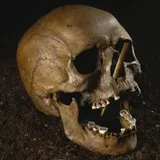
Yeah, so Kennewick Man, it was the big genetics controversy of the late 90s, early 2000s. What had happened was they found the body of an ancient man who was something like 10,000 years old near the town of Kennewick, Washington. And so the skeleton was initially assumed to be a murder victim. So it was brought to the police for investigation. But upon examining it.
Yeah, I just want to jump in. I think it was found by two guys in two guys riding the inner tubes, which I think is a little detail.
Yeah, so this body, it was taken to the morgue to a coroner to do an autopsy and figure it out. And when the coroner examined the body, he thought that the person had been of European ancestry. But he also noticed that this was not a recent body by any stretch of the imagination. Again, it was 9,000 years old. So the bones were sent to an archaeology lab in California, for further analysis.
Yeah, well, just to pause here. So, if this, this is if this is a 9,000-year-old skeleton, why did the coroner think it looked European? What does that mean exactly?
Race science, for lack of a better word, just skull shapes and vibes and things of that nature.
That's a really fun, well, fun in quotation marks part of the history of anthropology, where, like, you know, there were guys going around literally measuring skull shapes to try to draw conclusions about actually existing people. And so, this was like a very old school methodology being used on this find. Yeah.
So, the coroner looked at this skull, he decided that it was of European ancestry, and suddenly there was all this speculation about whether Europeans had actually been the first people to come to America. This was one of the earliest American skeletons ever found, and it happened to match up with what we would consider today to be European in some ways, but not in others.
Yeah, so kind of like a like a secular, it's almost there's like a revival of like secular Mormonism.
Oh, yeah, the idea that, yeah, like ancient Europeans had somehow come to the United States very early. Yeah, but not everyone had this reaction. Other scholars thought that this person might have been related to the Ainu of Japan, who are a very famous population and linguistic isolate, who were not related to the people who we think of when we say Japanese. But in any case, members of the Umatilla and Colville Reservation tribes near Kennewick decided that they had a strong spiritual affinity for these remains, and they thought that this guy would have been their ancestors. So, of course, they disputed any claims of a European or Japanese origin.
Yeah, and just to jump in here, you know, just like with people in India being upset at some of these implications here, I totally understand why if you're a Native American, you don't want to be told that you came here after white people. Like, think how potentially insulting that implication would be.
Yeah, absolutely. It's just very, like, especially given the history and what these people had gone through, I would say that this was an entirely natural reaction. To cut a long story short, there was a long legal dispute about the remains and who had the right to them. The Umatilla people wanted to end all research on the bones and to have them buried. While members of the Colville Reservation, on the other hand, were more enthusiastic about further genetic testing. So there was this enormous legal battle that led to the museum handing the bones over to the U.S. government on the condition that they never handle them.
Yeah, and but eventually, though, after this dispute, when you know genetic testing of very ancient remains became more viable, eventually the Kennewick man was tested. And can you speak, Natasha, about what these genetic tests discovered?
What Kennewick Man's DNA showed
Liam, you mentioned earlier that David Reich discovered a group, or he didn't discover, but he, via DNA analysis, he determined this group, you could say like a proto-ethnic group, called the ancient Northern Eurasians. Okay.
Yes, yeah, we mentioned them briefly. Yeah.
Yeah, so very briefly. So essentially, the ancient North Eurasian ancestral component would be the word, right? So this is the link that ties Europeans and Asians to Indigenous Americans. So from Alaska to the tip of South America, this is the group that links them all together. There are some other Asian ancestry components that also entered into the Americas, but this is the group that connects them all together, right? And particularly, there was a so in Siberia, there was discovered the remains of a boy who lived over 20,000 years ago called the Mal'ta boy. Not from Malta. Yeah, and so this is.
Yeah, I'm in Russian. I'm it's Mal'ta, like the L is palatalized.
Oh, you're right, there is a palatal. Yeah, I've always just read it in English, but you're right, there is a palatal in it. So this boy was the main source of this ANE component, this ancient North Eurasian component, right? So when they looked at Kennewick Man, they looked at his DNA, they saw ANE component, right? And they saw more ANE than modern Native Americans. But this man, Kennewick man, was still closer related to Native Americans than to Europeans because, of course, right, it makes sense. You know, he is the ancestor. He is part of those earlier groups, you know, just like 8,000 years ago, European groups contributed to European peoples, right? He is closer to those modern people than he is to a modern-day European, right? He would have been closer to Europeans, you know, his contemporary Europeans, but at this point, he's not a member of either of those tribes, right?
Obviously not, because it's obviously different. Yeah. But, how do I want to say this? We try to avoid nationalism when talking about these sort of groupings. And obviously, it's a little more delicate when talking about indigenous groups, right? But those are still national identities.
Well, they literally are national identities in the United States, right? And those are not permanent, right?
Nations aren't people either, right? Well, they kind of are, but they're not. Not in the archaeological sense.
Yeah, because tribes are nations, yeah. Any nation, and basically any nation, including indigenous nations, are ideas.
Yes, they're an idea. But he is ultimately a more common ancestor to those groups than he was to the Europeans, right? He was not a European, right? He came over, you know, likely over the Bering Land Bridge. We won't get into that. Well, he didn't come over, but his ancestors came over, right? Like just with the main flow of the, you know, the proto-Indigenous Americans from Siberia into Alaska, down through Canada, and so on, right? He belonged to that group. So he hadn't fully become a modern-day, you know, Indigenous American because it was 8,000 years ago, but he's still much closer related to them than he was to Europeans. He was not, he didn't come from Europe. He wasn't a Western hunter-gatherer, right? He had that same ancient North Eurasian link between modern-day Europeans and modern-day Indigenous Americans. That's all.
Yeah, like I believe specifically his Y-DNA haplogroup was Q-M3, which is basically only found among Native Americans today. It's not found in the Pacific Northwest very often, as far as I can tell, but it is very common in South America because this is part of an ancestral migration that eventually made it all the way down across the entire Americas.
Yeah, and they and they moved very fast. Yeah, no, those ancient proto-Indigenous Americans, they moved down through the Americas really fast and they hugged the coasts. So it makes sense that he would have been found close to the Pacific Ocean as his population group, you know, his, you know, his group of people moved south.
An equitable outcome
Yeah.
And so I wanted to include the Kennewick Man story because I think in a way this shows that genetic research, which is very fraught, often can be used to more accurately and sometimes more equitably solve these kinds of questions that exist when you have Western people, almost usually of European ancestry, you know, dealing with the ancestral remains or the potentially ancestral remains of non-European people. A lot of kind of, there's a lot of uncomfortable implications there sometimes. And this was a case where, if you're a proponent of genetic testing, it's like you could argue there's a way to see this where genetic testing basically led to an equitable outcome.
Yes, I think so. I think in the end, it made both of those tribes happy or happier, because I think the Umatilla were still a little less happy, but in the end, he was able to be laid to rest, you know, with cultural practices that were probably closer to his own than a modern European cultural plus.
Probably much closer than a modern European one. Yeah, and certainly much closer than just, you know, being in a museum for another 100 years.
Absolutely.
Yeah, and we won't get into it for this episode just because we've already gone very long, but this population group, the ancient North Eurasians, basically they left an imprint on the mythology of places like from the Americas all the way to Western Europe.
So potentially it left an imprint, yeah. Yeah. It's very speculative.
There's a lot of fun stuff to dive into that we'll have to go to in another episode. It's a really fun topic. We've talked about Dave Anthony a little bit. He really loves that.
Yes, yes.
Vanuatu
Okay, and so we're kind of reaching the end of this episode. This has been so great. And thank you so much, Natasha, for coming on again today. There's one last big case that we want to talk about with you, which is something that I know you find very interesting that Russian Sam and I researched for this episode, which involves the guy who's really the rock star of American archaeogenetics, and that's David Reich. And this is a study he did in the Pacific island of Vanuatu, which is a very small independent nation in the South Pacific. The people that live on Vanuatu are considered Melanesian. They are a population who speak Austronesian languages similar to the languages of Polynesia, but genetically they're kind of different. And one really big social difference is that people on Vanuatu and some other islands in that area often actually consider themselves to be black people.
They have darker skin, they identify with the cultural social label of blackness. And even though they speak languages related to the languages of Hawaii and New Zealand, they don't necessarily see Polynesian peoples like Hawaii as their relatives. When David Reich analyzed the earliest remains found on Vanuatu, he made discoveries, or at least made claims, that raised some eyebrows. Can you speak to that, Natasha?
Yeah, absolutely. As you said, the people of Vanuatu call themselves the Ni-Vanuatu. And like Liam said, they see themselves more similar to the Papuans or Aboriginal Australians, right? They have the darker skin. But they have another story as well. There are these archaeological sites on the island that have been discovered that were named as the Lapita culture, and that has become instrumental to their identity as well, right? So these ancestral groups from their island, their homeland. And essentially, David Reich and his team and other archaeologists, they came to the island, spoke to the people, and offered to do a large-scale test based off of a graveyard that had been found in the early 2000s that included some skulls, right? So you need skulls to do ancient DNA because you need the petrous bone that's in the ear. And so they offered to look at the ancient DNA of these skulls and also sample the DNA of the population.
Because, like we talked about with ancestry, DNA, and 23andMe, you need to have data from a population to actually be able to compare it to, right? So, not that many people have had their DNA sequenced from that island, so they had to take samples from everyone. So, this was a large-scale study that required gaining a lot of trust of the population, and they got it. You know, these people wanted, by and large, wanted to learn more about their history. Based off of everything I've read, it seemed like they were very interested. And honestly, the archaeologists who live and work there had built close relationships with the population, right? This wasn't exploitive in that sense, but it wasn't necessarily a perfect situation. So, David Reich takes these skulls and he doesn't listen to the archaeologists that they say that, oh, we don't, we're not sure if all of these skulls are original to this site.
We think some of them might have came later. They might have been sacrifices or just, you know, kind of maybe even potential, you know, similar to medieval heads on pikes. Yeah, they could be enemies. Yeah. Right? Like, you know, beheaded skulls that were moved to that location for whatever purpose, right? There was a lot of belief among local archaeologists that that had been the case. David Reich didn't care. It was also a very small sample size as well. It's his data, it's his paper, so he just decides the interpretation. Yeah. So, based off of the data he got, he said that the Lapita were not actually the Ni-Vanuatu' ancestors. They were solely descended from the Papuans, who had basically done population turnover, like complete population turnover in waves. Yeah. But it wasn't even fully from the data.
Yeah, if I could just jump in, the least charitable interpretation is that this basically means that the people who live there are not indigenous relative to the prior inhabitants. Even if, you know, even if they are the victims of colonization, it's probably very important to their own identities that they, you know, came out of this land. They were here before the Europeans. So many people probably like to believe they were the very first people to be there at all. But that doesn't seem to be the case.
Right. There were also some concerns that there actually was still Lapita DNA in the modern signal, but essentially David Reich was just ignoring it to suit his theory. Really? There was some controversy with that as well.
So if I could ask you, so you think that basically it is more of a case of population mixture rather than like a replacement, but David Reich sort of misrepresented that?
Well, we'll get to that.
Okay, please, yes. Sorry. Yes. Sorry to cut you off.
So essentially, yes.
Reich versus Krause
No, well, this ties nicely into how we're talking about there are just a couple labs that do this, and they're incestuous, right? They're still very closely related to each other. So after this was published, it was controversial, and there were other people who were also working on a similar project. And these people were from the Krause lab from Germany, and they decided to write another paper, you know, basically pushing back against David Reich's work. And basically, they said, oh no, he's wrong. David Reich ignored the fact that some of those skulls are likely much later and they were moved there and they're not from the same grouping. But they didn't just get to publish their paper, right? You know, their paper wasn't just saying that he did bad science. They were also saying his science was wrong. They were saying, like you said, that it was actually admixture, right?
So the Lapita were there, Lapita, who are basically the Polynesians, right? Who had that language. But the Papuans arrived and they admixed, right? So they are an admixed people. So that was what the Krause lab, that's what they published. But when they went to publish this follow-up, it seemed like David Reich was all ready to go with his own response, right? So he also wrote a follow-up of his own and he published it where he like gave some concessions, but not full concessions, and he still doubled down, right? And this is where we get back into the ethics, right? He's very powerful. He can just contact whatever journal he wants. Potential implication was he was being given heads up about this as it was going on, and he was given, you know, kind of special allowance and time to write this response that was published, I think, days after, like literally at the same time, right?
So he's just very, very resistant to anybody pushing back to his work, even when it's wrong, right? Like even when there's issues with methodology, issues with samples. And so there's a really great New York Times Magazine article on this that I really recommend to people. It's very interesting and it really gives you, I think, a really nuanced picture. And it doesn't just say ancient DNA bad, but it just really makes you think about these issues.
Yeah, it's called, Is Ancient DNA Research Revealing New Truths or Falling Into Old Traps? And I believe they talk about a couple of his other controversies in that as well. Like I said, I do recommend it. It's a bit of a longer read, but it's very engaging. Well, yeah, well, thank you so much, Natasha, for helping us understand all of this. You know, it's clearly such an interesting, a growing, and a fraught field, that being archaeogenetics. And that this is a field that potentially has the keys to unlock so many important questions, but I don't think we've quite yet figured out how exactly to turn all of those keys because we have so much data now, but now it's a question of analysis and interpretation.
Spotify playlists by ancestry
And, you know, speaking of the ways that this kind of data could be used or abused and interpreted in potentially dangerous ways, we dug up, Natasha, one last example that might be the most horrifying application of DNA results yet. That being Spotify playlists based on your 23andMe results.
I love it. I want to know. Let's get into it. Actually, I believe it's AncestryDNA, which is the Mormon one.
And it is, what is the sound of you? This was a question AncestryDNA, the world's largest for-profit genealogy company, recently asked its users. Its in-home DNA saliva test can give you an idea of where you've come from. But how can you translate that newfound knowledge into something more tangible? Music might be the answer. Ancestry has collaborated with Spotify to determine your musical DNA based on your AncestryDNA test results. It's so much more than stats and data and the records, says Vineet Mehra, Executive Vice President and Chief Marketing Officer at Ancestry. How can we help people experience their culture and not just read about it? Music seemed like an obvious way to do that. In Spotify, in Ancestry's custom playlist generator, you can input the different ethnicities and regions that make up your heritage based on your AncestryDNA test results. The generator will then select the range of tracks that reflect the cultures your ancestors came from.
For example, someone with Chinese heritage might get classical musician Wu Fei on their playlist, while a person with a Spanish background might get the rock band Los Cyrex. This will, quote, encourage ancestry's audience to explore the soundtrack of their heritage. Danielle Lui, global head of partner solutions at Spotify, told Quartz.
So tell us, Natasha, what do you think about this kind of application of consumer DNA research?
Look, it's silly. It's I think it makes sense when you think about how I described it before, where this is very useful for people who come from the new world and they want to get in touch with where their actual ancestors came from before they became Americanized. And if that's the case, I think it's a sweet thing to do. But, you know, your DNA does not predispose you towards liking that music, of course. It's just kind of saying, you know, these are the popular music from where we say your ancestry is. But yeah, it doesn't necessarily mean you have to like, I don't know, Belarusian trip hop. I don't know.
Genetic determinism
Yeah. And I think it's kind of, it's like this is something that kind of rubs me the wrong way. This is innocent. But I think it's a lot. I think recently there's been this unintentional kind of retrenchment of a very dangerous idea that who you are is who your ancestors were. And that, you know, an identity can be somehow broken down into something as simple as, you know, like the machine code of your body. And I just don't really think that's accurate. And I don't think that's a route that our society should go down again.
Yeah, I think that's absolutely true. And, you know, I've been warning people not to, you know, tie nationalities to DNA. Yes. And this just goes along with it.
Yeah, like this, in and of itself, as Liam said, it's not really particularly harmful, but it does predispose people to a very kind of genetic determinist way of understanding themselves. Like, just because your ancestors might have come from, let's say, China 150 years ago to build the Transcontinental Railroad, you might be just totally American. Like, Chinese culture might not be something that you identify with or have experience of at all. And yet, products like these, they're basically trying to sell people on the idea of some kind of innate racial essence. And this particular application, of course, it's not harmful, it's just silly. But I'm just concerned that this kind of thinking is making a comeback this time with a much friendlier face than the previous times, I'd say. But nevertheless, this combined with increasing calls for eugenics, basically, there's no other way to describe it. It's just filling me with worries about where we're headed as a society. Yeah.
So, as somebody who is actually in this world, who is involved in genetics and you know, molecular biology, who's not just some, you know, humanities nerd like me and Sam, what do you have to say about Natasha about all this?
Your DNA is not private
Do you have any, you know, final words of wisdom, words of warning to impart to our audience?
Yeah, so I'll say this: your DNA is not private, and I mean that in like a legal sense and a practical sense, right? I mean, you see it in cop TV shows or detective TV shows all the time, right? You know, your DNA is public, but also, you know, anybody can take it if they wanted to. It's very easy. And I think it's good to think about that in that sense because it's going to be increasingly difficult to avoid this reality where, you know, DNA is being used in a lot of things. Personally, I don't think people need to worry about the health insurance part because at the moment, there is a federal law called GINA that protects from that explicitly. It's called the Genetic Information Non-Discrimination Act. Your DNA cannot be used in health insurance. It can't be used for employment, right? You know, it's non-discrimination for everything, right?
So at the moment, that is in effect. So I would not worry about things like health coverage.
The new eugenics
However, what Russian Sam said about the rise of new eugenics, that is a concern. And there's a lot of that that comes up in evolutionary psychology, as it's called.
Absolutely. Oh, yes, I'm familiar. Yeah. Oh, yes.
EvoPsych. People might be familiar. There's a lot of famous Twitter people on that. I mean, there's also people, there's also a guy. We might call him. I don't even know how to say his name.
Are you thinking of Khazeeb Ron?
Thank you. That's how I was trying to figure out a way to say it. Yeah, that guy. That guy. And he mixes, he mixes a lot of the kind of stuff we've been talking about, like this kind of population genetics. Yeah, I think he's a poster boy for these inappropriate applications, if ever there was one. Yeah, he's the modern race scientist for sure.
To be clear, I'm not talking about Razib Khan. I'm talking about the other guy.
Yeah, yeah. And, you know, and there's lots of concerns about this kind of future in Evo-psych. A lot of these people are determining these polygenic risk scores. You may have recently heard about those effective altruists who are trying to repopulate the world. And they.
Oh, yeah, Calvinists without God.
Yes. Yes, exactly. And they took their embryos from the IVF center, which would not do this kind of full genetic testing, and they had them genetically tested separately. And they chose their embryos based off of these polygenic risk scores, which are basically bullshit. But it's modern race science, it's modern eugenics. Although, hysterically, the couple chose not to select against the polygenic risk score for autism because the woman is autistic, which I thought was just a hilarious part of that article. My disability is good. Mine is good. That one's fine.
Oh my god, of course. Yeah, yeah, yeah.
Yeah, eugenics for me, but not for thee. Oh, it's hilarious.
And I guess, you know, and that's the best example of why we need the humanities. Because if you try to reduce everything to the numbers and the data, you're always going to be clouded by your own biases. Because whenever you try to be like completely objective or whatever, you're going to run into shit like this. Absolutely. Like saying you have to get rid of all disabled people except for me.
Yeah, but I mean, humanities people have their own biases themselves. I think just like the main lesson here isn't that humanity's good, science bad. It's more just like science is a method that doesn't necessarily tell you anything about ethics. That's what you need the humanities stuff for. The science is a separate thing.
Right. Or yeah, yeah, yeah.
I would say the only way to stop a bad guy with the science is a good guy with the science. Or in this case, a good girl with a science.
Thanks and goodbye
And that's why, Natasha, we are so happy that you could come join us today. This was really, really fun and enlightening. And both Russian Sam and I really appreciate you lending us your time and your expertise.
Ah, well, thank you so much. I'm glad we were finally able to make this happen. We were supposed to do this shortly after my first appearance, but I've had a bit of a crazy time. But hopefully, I can be on again in a much sooner window than this.
Yeah, this is in the works for a while. Yeah. Well, you know, you know, a lot of hard work on the campaign trail.
Yeah, no, of course.
Yeah, you were getting elected to the Senate in Ohio. Yeah, very big news.
Tim Ryan, you know, he was really hitting me hard with those campaign ads. And then I was busy being an elections pundit in Nevada, you know, being the new John Ralston. So there's a lot.
Yes, well, you wear many hats.
But you should follow me on Twitter.
Yes. What is your @?
Bone30. Like, B-O-N-E-T-H-I-R-T-Y. Spelled out, right? So not the number 30, but the word 30. So Bone30.
Yeah, that'll be in the show description. Yeah, yeah, everyone, please follow Natasha. And thank you again, Natasha, for coming on. This is a great episode. This has been Gladio Free Europe signing off. Bye-bye.
Bye-bye.
The show is also on Apple Podcasts, Overcast, Pocket Casts, Podcast Addict, YouTube, RSS and Patreon.