82
God-Kings of Southeast Asia
In progressPut on your rubber boots, we're continuing our exploration of Southeast Asia as we excavate the deep jungle ruins of the Classical Age. From the Khmer Empire to Champa to Srivijaya and beyond, the early medieval period of Southeast Asian history is marked by the emergence of incredible states and empires whose histories, though tantalizingly obscure, hint at great narratives of conflict and cooperation.
This episode of Gladio Free Europe travels across the kingdoms and trade federations today comprising countries like Indonesia, Cambodia, and Vietnam. Of particular interest is the figure of the deva-raja, the god-king, who could command the ability to construct enormous monuments to Hindu gods and the principles of Buddhism beyond the scope of anything in Europe at this time. Join us to learn about the pirate-kings of Java, the Burmese King Arthur, Malay sea-cossacks, and how the far-reaching journeys of Austronesian merchants led to the introduction of Southeast Asia's most popular religion, Islam.
Transcript
Back to Southeast Asia
Hello and welcome back to Gladio Free Europe. I am Liam, diving back into the steamy jungles of Southeast Asia with my good friend Russian Sam.
Hello, hello, I am dripping with sweat.
That's right. This episode is going to cover the classical period of Southeast Asian history, the time when Southeast Asia was dominated on the mainland by the great Khmer Empire and at sea by the maritime empire of Srivijaya. This period stretches roughly from the 9th century to the 13th century. It's generated the most attention in scholarship as well as pop history, mostly because of the really impressive accomplishments of states like the Khmer Empire, as well as the increasing interconnectedness of trade networks connecting Southeast Asia to China, India, the Islamic world. The reason this framing exists, this classical period of greatness in the early Middle Ages, starting with the 9th century, followed by a less impressive post-classical period, really has its roots not in the 9th century, but instead in the 19th century. As European colonialists came to Southeast Asia as explorers, adventurers, and ultimately colonizers, and were amazed by what they saw and then made unfavorable comparisons to the state of Southeast Asian society that existed in the present.
This idea that the classical period, a period mostly before written records, when most of what we know it comes from the work of European archaeologists, not native historians, the idea that this period was greater than the periods that came after it. A lot of emphasis is put on the power of the kings at this time. You know, our episode title, The God-Kings of Southeast Asia, is because you start to see incredibly grand language of power at this time that isn't as prominent in later periods. But I think that if we want to talk about this classical period, which is incredibly interesting, we first got to figure out how we get there, particularly why so much of this framing looms around one single state, the Khmer Empire, which really dominates the scholarship of classical Southeast Asia, even to this day.
The French come to Indochina
And that starts in 1860, when the French government of Napoleon III had taken a sudden interest in the region, which they had termed Indochina, by a geographer who never actually left Europe. The Opium Wars had just brutally opened up Chinese markets to British trade, and the Brits' rivals in France didn't want to be left out of Asia. So the French signed a treaty in 1858 with the powerful kingdom of Siam, that's modern-day Thailand, and using the pretext of protecting Catholic missionaries, invaded Vietnam. After a brief but intense conflict, they gained a foothold on the coast that would become the start of the French colony of Indochina. As a reward for their complicity, the kings of Siam were given tributary status over the inland kingdoms in between French Indochina and Thailand, those being the modern-day states comprising Laos and Cambodia.
Henri Mouhot finds Angkor
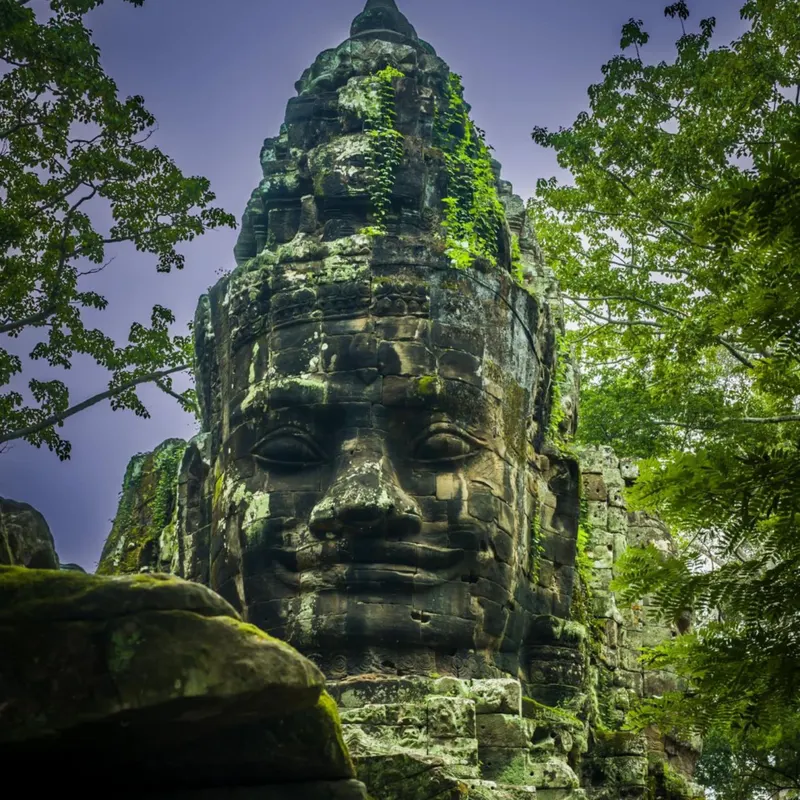
Within months, European explorers and adventurers began to wander in to these contested territories. One of these adventurers was Henri Mouhot, a young photographer who had read a British account of Southeast Asia and decided that it would be his destiny to reveal the secrets of the realm to Europeans. He traveled to Siam in 1860 and then followed the tributaries of the Mekong River into the kingdom of Cambodia. Local Cambodians and a few Catholic missionaries pointed him to the great temple site near the Siamese border, which is now known as Angkor Wat. This was a 700-year-old city of temples from which power once radiated across all of mainland Southeast Asia, surrounded by an enormous moat and carefully planned with mathematical precision for the rising sun to shine down on the bridge and central boulevard on the morning of the spring equinox. Mouhot's amazement at the size, beauty, and sophistication of this temple, which was now derelict and covered with vines, would set the tone for European impressions of Cambodia and all of Southeast Asia for more than a century.
One of these temples, a rival to that of Solomon, erected by some ancient Michelangelo, might take an honorable place beside our most beautiful buildings. It is grander than anything left to us by Greece or Rome, and presents a sad contrast to the state of barbarism in which this nation is now plunged. At Angkor, there are ruins of such grandeur that, at first view, one is filled with profound admiration and cannot but ask: what has become of this powerful race, so civilized, so enlightened, the authors of these gigantic works? So, to many Europeans, including Mouhot, the beauty of Angkor Wat and the state in which it was now in was proof that Southeast Asia, which they called Indochina, had once been host to great civilizations which had fallen from glory. The mud covering the steps, the bushes growing out of the stupas, were evidence that local peoples had apparently failed to maintain their own civilization.
Therefore, European intervention to reclaim this glory was justified. These innovations would happen with brutal consequences, although we should mention Mouhot himself wouldn't live to see it. After a quick visit to Long Song, one of the kingdoms that's today Laos, Mouhot caught malaria and died at a French mission. But his hardworking Cambodian employees traveled back to Bangkok and mailed his writings to publishers in Paris and London. Possibly as a direct consequence of Mouhot's writing, Napoleon III would break his arrangement with the Thai king and establish a French protectorate over Cambodia, briefly invading Siam itself to gain more territory around the site of Angkor, fortifying it from any potential foreign assault.
Angkor and Cambodian nationalism
They knew there was something special about this place, and it became essentially the jewel of French colonialism. After independence, the emergence of Angkor Wat as a lost glory would shape the new nationalist identity of Cambodia. Pol Pot would basically try to reconstruct society in imitation of this medieval glory, trying to excise any foreign influence from places like France, America, Vietnam, or China over the country. Ironically, though, the image of Cambodia that he was basing this off of was itself a colonial image, based on this idea that Cambodia at the present had fallen from grace.
What happened to Angkor?
And so there's a huge question that has dominated native and Western Southeast Asian scholarship for really centuries, which is what happened to Angkor? Why did this once great Cambodian civilization fall? And if it did fall at all. This is really considered a great turning point in Southeast Asian history, the passing from the classical period, which we're going to talk about in this episode, to the lesser post-classical period. There are some unfortunate implications here. You know, for instance, the idea that there was some decline in the virtue or capabilities of the people, or even that all of Southeast Asia, not just Cambodia, experienced a decline. Historians in the 19th century and historians today are still debating why this collapse happened or if it really did happen at all. But what's not arguable is that there was an enormous transformation in the distribution of power in Southeast Asia around the year 1300.
Additionally, this collapse of the Khmer Empire, although it did lead to a century in which there was very little writing at all, it seems that the literary culture of ancient Cambodia, which was mostly dominated by the Sanskrit language from India, transitioned to a new literary tradition, mostly in the Khmer language.
The Poem of Angkor Wat
And I think that the first example of this kind of rebirth among the ruins is a really good example of this shift. Because this is the first known literary work in Khmer, simply called the Poem of Angkor Wat, which is a long series of verses narrating the famous Ramayana as depicted on the reliefs carved onto the temple walls. This being the great Hindu epic, which was very much revered by peoples in Southeast Asia. Interestingly, this Khmer language poem suggests that nobody knew who built Angkor Wat. The name had been totally forgotten. It's kind of like that famous Anglo-Saxon poem, The Ruin, celebrating capabilities of Roman architecture without realizing that the Romans had built these houses.
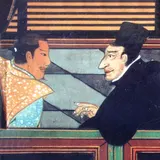
While the Europeans arrogantly believed that they were rediscovering an ancient ruin, Buddhists from around Asia had visited Angkor Wat continuously until the colonial period. Around the same time that the poem of Angkor Wat was carved onto the walls, a group of Japanese Buddhists visited the temple. They were trying to make pilgrimage to India, but made the classic Columbus-style mistake and landed in a different country instead. They probably realized that they weren't actually in India, but they were so taken with the site that they went back home and told all their friends about it. Inscriptions indicate that for around a century, Japanese pilgrims would continuously visit Cambodia to pay homage to the Buddha and the devas depicted there until the Sakoku regime that closed down the borders prohibited them from going further.
Empires without written history
Right, and you know, another thing I find really interesting about Angkor Wat is that it's kind of a testament to one of the last periods of history that is in a sense still prehistoric. Because the classical period of Southeast Asian history is mostly known not from written literature, not from records kept by native Southeast Asian people, but instead by archaeological discoveries. One annoying effect of this is that it gives European archaeologists, many of them who were there in the colonial era, a lot of power over the narrative here. Mistakes that these scholars might have made in the 1920s are still being corrected today, and we'll get into some of these mistakes. But I think that there is also a really cool mystery about that, that this is a period of great empires who can't exactly speak for themselves. So, so much about this period really is, you know, shrouded in mist in vines.
There's a lot of conjecture with Southeast Asian history in the classical era, but we know it was a period of enormous change and enormous power. There certainly were kings calling themselves gods who had a command over the population that I would say greatly exceeds that of European monarchs in the early Middle Ages and really is comparable with, you know, the old kingdom of Egypt. This ability to command the population to construct enormous public works in honor of gods or of glory that are still monumental elements of the landscape today. So, this episode of Gladio Free Europe is going to be a crash course on the classical period of Southeast Asian history, the time of the god-kings, both on the mainland and on the islands that today make up Malaysia and Indonesia. This was a really fun period. There's going to be a lot of blood feuds and invasions and great social turmoil. Sit back, enjoy.
There are some really, really fun stories here.
The Khmer Empire
We got to start with the big one, the Khmer Empire. The main thing that you got to know is that this was an empire really marked by first a high degree of territorial control, having influence of some kind over most of mainland Southeast Asia, the great majority of it, as well as being capable of really interesting great social works projects. Huge series of canals, enormous construction of temples and cities such as Angkor Wat, very developed social services, such as apparently a medieval equivalent of free healthcare for the population, as well as mass enslavement. It seems like, just like in ancient Rome, many people, possibly most people in the Khmer Empire, were slaves.
Oh, you won some, you lose some.
Yeah, no, right, right, yeah. Yeah, in some ways, a nice place to live, some ways, pretty brutal. It seems like the slaves also mostly came from ethnic minority backgrounds, probably sourced as some kind of tribute from peoples living in the countryside who did not speak the Khmer language of Cambodia. Popular narratives around Angkor and the Khmer Empire really focus on two kings in particular who we're going to mention here. Those are Jayavarman II and Suryavarman II, who lived about 200 years apart. The first of whom, Jayavarman, established the Khmer Empire, and the second saw it reach its greatest glory and build Angkor Wat.
Funan and Zhenla
So, last episode, we mentioned that the first clear references to Cambodia are of the kingdoms of Funan and Zhenla, successive dynasties really only known from Chinese sources, but who clearly had extensive contact with India, as well as going as far west as Rome. We mentioned there are a lot of Roman coins found at Funan and Zhenla sites, and even some local coins made in imitation of Roman styles. You know, it really shows how interconnected the world was becoming at this time. These kingdoms were both Hindu and Buddhist, with both of these Indian religions influencing society in different ways. It seems like the elite were highly literate and mostly acculturated in the Hindu tradition. They were particularly interested in the gods Vishnu and Shiva, often depicting this figure that's the two of them combined called Harihara. They also had some kind of echo of the Hindu caste system.
It wasn't really the basis of society the way it was in many Indian societies, but you start seeing some elites of Zhenla start calling themselves Brahmans and kshatriyas. This may also have been used to justify the enslavement of foreigners, but that's again all conjecture. Most of what we're, much of what we know about, or what we think we know about Funan and Zhenla and the Khmer Empire is conjecture. Interestingly, just like the previous dynasty, Zhenla, that began as a vassal of Funan, the Khmer Empire probably began as a vassal of the Champa Kingdom, today part of Vietnam, the southern half of Vietnam, but which was something quite different back then.
We mentioned two kingdoms in the previous episode. These were Funan and Zhenla. These were the polities on the territory of what is today Cambodia, which were referenced in the Chinese sources. Once again, pretty much everything we know about these places is a matter of heavy contention just because there are very few written sources and the archaeological record hasn't been filled out as meticulously. But as far as we understand, these polities had a similar sort of succession go on for quite a while. So Zhenla rose as a result of the weakening of the Funan. Later on, the same thing happened to the Zhenla. It all ended with King Jayavarman I of Zhenla, who ruled until 681. His successor, however, was not a very strong man, and consequently, the Zhenla state was supposed to have fallen apart. And as a result of this, there was chaos in the region for a while and no direct focus of authority.
That is, and this would be the state of affairs for over a century until finally another man who decided to take on the title of Jayavarman decided that he would put an end to this.
Jayavarman II, god-king
Jayavarman II is considered to be the founder of the Khmer Empire of the classical period, and he chose his king name, Jayavarman, specifically to call back to the reign of the last king of a united Zhenla before that kingdom fell to waste. So again, this is a very common trope we find all throughout history and especially in this region where a lot of people are really heavily grasping at different aspects of symbols of authority of previous dynasties and great empires to solidify their own claims.
Yeah, and at this time, Jayavarman II came out of a region of modern-day Cambodia that was today under the control of Champa, which you mentioned is the Austronesian-speaking kingdom of South Vietnam. He seems to have initially began expanding his realm underneath the authority of Champa, but then was able to bring under his control many independent, small polities of Khmer people and then proclaim himself an independent king, no longer under the influence of Champa. And we should say, not just a king, but a god-king, using the Sanskrit word Devaraja, you know, which is literally god-king. We know all of this because of really one single Sanskrit inscription at the site of Sdok Kak Thom, a temple in modern-day Thailand, then part of the Khmer Empire, that proclaims Jayavarman as a god-king, and that a local Brahmin, possibly an immigrant from India, or maybe just a local priest claiming an Indian ancestor, performed magical rites involving the Hindu gods Vishnu Brahma and especially Shiva, the god of destruction.
A penis-shaped statue called a lingam, kind of a holy Hindu phallic object, was dedicated to both Shiva and to Jayavarman, possibly indicating that his specific god-king form was Shiva, given that association. Future generations of Brahmin kings were actually implored to constantly perform sacred rites at this phallic object and preserve in hopes of preserving the line of descent from Jayavarman II to future kings.
Java or Champa?
You know, we mentioned that there's a lot of interesting questions and historical mistakes that have been made about Southeast Asian history. I think the most obvious of these is that the word used in, I believe, later Khmer sources, no, that the word used in Sanskrit to describe the Cham people here, the former overlords of the Khmer Empire, was Chvea, which previously was misidentified with the island of Java, hundreds of miles to the south in Indonesia. Early historians thought that when Jayavarman II established an independent dynasty, he was declaring independence not from the king of neighboring Champa, but instead from a Javanese king far to the south. This is no longer widely accepted, due to the fact that many other references to this place, Chvea, were seen to mean Champa, right next door. We should mention, though, that the idea that there would have been strong Javanese influence over Cambodia is not totally without merit, because close analysis of the art and architecture of the early Khmer Empire shows that there does seem to have been a strong influence from early Indonesia and Malaysia, which is interesting because Cambodia and Malaysia aren't that close together.
You've got to travel through hundreds of miles of Thailand to get there. But still, there was this really interesting overseas influence.
Mahayana Buddhism in Cambodia
And so, Khmer contact with Java as well as Tang China up to the north led to the expansion of Buddhism across the growing Khmer Empire. Although Buddhist traditions had been present in the region for centuries, the influence of monks from overseas led Buddhism in the Khmer Empire to become distinctly Mahayana. This is the school emphasizing the universal path to Buddhahood based on the expansive canon of books known as the Sutras, which were composed many centuries after the Buddha's death. And about a century after the time of Jayavarman II, his successor Indravarman built a temple known as Bakong, a ziggurat-type structure that looks a lot like the later temple at Angkor Wat, but especially like the Javanese temple of Borobudur, one of the most remarkable sites in Indonesia and possibly the most famous ruin in Southeast Asia after Angkor Wat.
Champa
Yeah, we're going to talk about Borobudur and Indonesia in a second, but before we leave the mainland for now, we should probably talk a little bit about what's happening to the east, especially the modern nation of Vietnam. Vietnam was incredibly disunified in this era because there were really two significant kingdoms in the classical era. There was Dai Viet in the north in the later classical era, and then of course there was Champa in the south. By the end of the classical era, Champa would have been reduced pretty significantly. Eventually, of course, there would become a single Vietnamese state centered around the north, in the Red River Valley, a Vietnamese-speaking state. But Austronesian-speaking Champa would remain pretty important in this period.
We mentioned that they speak an Austronesian language. This is from a family of languages that's spoken all the way from Madagascar in the west to Hawaii and Easter Island in the east. It's the language of the Polynesians, the Melanesians, the Micronesians, as well as most peoples in maritime Southeast Asia, as well as the indigenous peoples of Taiwan. But interestingly, there's also a pretty unique mainland community of Austronesian speakers, which is the Cham people of Champa. At the end of the first millennium, during the classical era, they were in charge of really one of the primary kingdoms of Southeast Asia. Champa was a really big player. And what's especially interesting about Champa is that while they were, although they were never as successful as the Khmer Empire, they didn't have these great public works that we know of, these huge temples. What they did have was very extensive contact with the outside world, particularly with maritime Southeast Asia.
Historically, historians of Champa assumed that because they speak a language related to that of the more populous Indonesia and Malaysia, they must have been founded from settlers from those places. But interestingly, recent research indicates that actually the flow of ideas and languages happened in the other direction. It seems that Champa actually was kind of a motherland for many peoples who would later settle in Indonesia, most significantly the peoples of the Indonesian province of Aceh, in the north of the island of Sumatra. It appears that around the same time the Khmer Empire was coming together, people from Champa settled in Aceh, establishing a new dynasty. There would be permanent ties between Champa and Aceh, as well as other parts of Maritime Southeast Asia, for many centuries, which means that in a lot of ways, new ideas entering mainland Southeast Asia from the islands would usually come through Champa.
One of these ideas, which would come in a little bit later, is the religion Islam, as Aceh in the north of Sumatra would become the most strongly Muslim part of Indonesia, both in the classical period and today. But Aceh in this period was not yet that influential.
Srivijaya
It was simply the westernmost port of Sumatra. Sumatra at this time was mostly dominated by a city in the south, known as Palembang, because this city in the south would be the seat of one of the most interesting empires in this period. An empire not drawing its power from tilling the soil and mass enslavement like the Khmer Empire, but instead for mastery of the seas. Last episode, we mentioned a Chinese monk named Yi Jing who visited the island of Java around the year 700, a century before the rise of the Khmer Empire, and was amazed by the influence and discipline of the Buddhist monks on the island. There is almost no remnant of this Buddhist heritage in Indonesia today, unfortunately, but for hundreds of years, the islands of Java and Sumatra were ruled by dynasty that were not just very Buddhist, but also decidedly more Buddhist than Cambodia or Myanmar.
Today, this dynamic is totally flipped. The most important state of maritime Southeast Asia at the close of the first millennium was Srivijaya, which was probably the first thalassocratic empire that was based out of Sumatra. The historic record of Srivijaya is a bit problematic, like we've mentioned for all the other kingdoms.
All that we know for certain comes from a large handful of inscriptions across the Middle Ages, which were translated during the First World War period by a French archaeologist named George Coedès, who is really one of the big honchos of classical European historiography of Southeast Asia. The earlier archaeologists, of whom Coedès was the most renowned specimen, believed that Srivijaya was the name of an individual person, meaning the great Vijaya, because Vijaya is a Sanskrit word that means victory.
Oh, yeah, and just to jump in here, you know, the kingdom of Champa I just mentioned, their capital was actually called Vijaya. That's how common of a word it was.
Yeah, so it could be either just victory or it could be a personal name. But Coedès, he believes that if you compare the name of the Chinese references to a place called Sanfoqi and the Arabic references to a place called Zabaj, this would suggest that Srivijaya is indeed a place name. Both of these terms described an island in between India and China, and the Arabic sources mention that the place was ruled by a single Maharaja. The more recent scholarship has revised a lot of what the first historians and archaeologists of Southeast Asia thought, and recent scholarship suggests that Srivijaya may have been something quite different from a kingdom in the medieval European sense, but was instead a very loose federation of hereditary monarchies, maybe closest to the Holy Roman Empire. There was no hard line between vassals and tributaries, and power was probably codified through marriage alliances and extortion rather than laws or permanent institutions.
The mandala system
Historians of Southeast Asia call this kind of system of a mandala, which we mentioned in the previous episode briefly, after the Buddhist artworks of concentric geographic shapes that usually depict Gautama Buddha in the middle with the other Buddhas surrounding him, and then other holy people on the road to enlightenment around them.
Right, and so historians of Southeast Asia today often use the word mandala instead of state or kingdom because they believe that most Southeast Asian polities on the mainland and the islands didn't have many of the traits associated with a state in the European sense, especially permanent borders and rulers with hard power over all of their vassals and constituents. Instead, this is a system based more on influence than direct control. Elites in outlying regions were part of multiple mandalas sometimes, often pledging allegiance to multiple kings simultaneously, paying taxes to different rulers at the same time. I gotta say, personally, I don't think that this is actually that unique to Southeast Asia. I think that if you look at recent scholarship with Europe as well, you'll see that power is also very flexible. But this concept of the mandala as opposed to the kingdom is pretty dominant in South Asian historiography.
So you kind of gotta introduce this if you're talking about Southeast Asia in this period.
Yeah, it's part of the same package of ideas that, which is part of the long-standing debate about just how Indian all of these states were that we briefly touched on in the previous episode, which was, once again, something sort of vaguely something that's a bit analogous to the Norman question in Russia. Like, it's not that there's a question of Indian influence, it's more that to what extent did this Indian influence exist? Was this a product of local kingdoms taking on Indian advisors and adapting Indian modes of thought and technologies to their own needs? Or was this more outsiders imposing their will onto the locals? Though the current scholarship suggests that the former is the more likely option, but in Coedès's time, it was more in the opposite camp.
Yeah, there's two historians of Malaysia in particular and Srivijaya that really dominate the field. These are the husband and wife couple, Leonard and Barbara Watson Andaya. They described Srivijaya as not an empire in the sense that Rome was an empire, you know, a place with a shared civic identity and a single official language, but instead more of just a confederation of trade cities and local kingdoms vowing allegiance to a single god-king, sending regular tribute and giving favorable trade deals to local merchants. It seems that the king himself did not have very much power over this empire, you know, despite considering himself divine. Instead, it seems that the merchants and sailors really held all the cards here, which is interesting. And archaeological and inscriptionary evidence shows that this kind of maritime empire that existed was really significant. Srivijaya had influence all over modern-day Indonesia and Malaysia, as well as the Philippines and parts of mainland Southeast Asia, like Champa.
Much of this was just simple trade influence, you know, like merchants were active overseas. But the Chinese records suggest that many of these cities saw themselves as part of this permanent network. Another comparison might be the Hanseatic League in Europe, if the Hanseatic League had a guy in charge who called himself a god. One of the vassal states that we know of is a place called Lankasuka in the Malay Peninsula. Chinese and Indian records suggest that this place existed both before and after the Srivijaya period, but from around 800 to 1200, it was a part of this network. It had its own king and seemed to have conducted independent trade relations with China and hosted Chinese Buddhist monks.
The Orang Laut
How this network came to exist under one Sumatran king is a mystery, but historians like Barbara Andaya, in analyzing later examples of empire building in Southeast Asia, believe that the one really important factor here was an incredible group of people called the Orang Laut. Right, it's kind of somewhere between an ethnic group and a way of life. The Orang Laut were and still are Southeast Asian sea nomads, people who speak dialects of the Malay language and historically have served as merchants, fishermen, pirates, or even pirate hunters in service of various kings. They're like if the pirates of the Caribbean somehow consolidated into a nomadic lifestyle that was passed intergenerationally for a thousand years. They could have been hired by rulers in Palembang as muscle to guarantee merchant rights initially across Sumatra, first creating a network around that island and then expanding beyond to Borneo, Sumatra, the Malay Peninsula.
So they were basically naval Cossacks.
Yeah, naval Cossacks. That's perfect.
Srivijaya and the Malay language
Yeah, yeah. You know, we also mentioned that they speak dialects of the Malay language. Another really interesting question about Srivijaya is: to what extent was the rise of this one political and economic empire connected to the linguistic rise of the Malay language? Because today, because today both Indonesia and Malaysia speak languages that are just standardized dialects of Malay. Other countries like Brunei, even South Africa, have very significant Malay-speaking populations, largely due to the predominance of Malay-speaking merchants before and during the colonial era. So, according to Leonard Andaya, there probably is a connection there. It seems like the rise of Srivijaya as a political entity led to the establishment of many Malay-speaking communities, probably initially from Sumatra, and then the rise of Malay as a unifying trade language across the islands of Southeast Asia. People have tried to connect the language and ethnic identity to a city called Melayu, which was a political center in Srivijaya that probably took over as the main city in Sumatra after the eventual fall of Srivijaya, when Palembang, the capital, lost its prominence.
Which makes me think that if that's the case, the Malay identity, the name Malay, probably post-dates the existence of Srivijaya, but it's based around or it emerged out of an economic situation very much created by these Srivijayan god-kings, their many, many wealthy merchants, and their armies of sea Cossacks, the Orang Laut.
To wrap the Srivijaya section off, whatever you might call Srivijaya, be it a kingdom, an empire, a confederation, or whatever else, it probably marks the ancient trade networks of Southeast Asia reaching their full maturity and creating economic bonds within the region and beyond that would survive well until the present.
One interesting effect of this is that this is probably connected to the standardization of Mahayana Buddhism, that's basically Chinese Buddhism, across the region, as well as an increased worship of Vishnu by Hindus and even some Buddhists. As an example of this kind of influence, you start seeing a lot of Buddhist statues suddenly emerge in the Philippines, a place that's been sort of peripheral until this point. You also start seeing Malay-speaking communities really become permanent fixtures of the islands more broadly. On the island of Borneo, the kingdom of Brunei is very Malay-speaking today. That's probably because of Srivijaya, even if the name Malay didn't exist yet.
Srivijaya's rivals
But despite all of this great power of Srivijaya, all was not necessarily peaches and roses for these god-kings, because they did have two rivals who were getting increasingly powerful across the 9th, 10th centuries. First, the Cholas, those Tamil-speaking South Indian Hindus you mentioned before, who were traditionally understood as the most outward-looking polity of Indian history, because they exerted a lot of direct influence over Srivijaya and beyond. But another rival was closer to home.
Mataram
This was the kingdom of Mataram on the island of Java, right across the straits, right next to Sumatra. Mataram was itself a much smaller maritime mercantile power and also a big pirate power that we can probably assume the Srivijayas saw as kind of a remora on their much larger body. It shaped itself in imitation of Srivijaya, probably adopting the name God-King for their ruler from Srivijaya. But just like the Srivijaya, the sources here are so fragmentary, we don't really have any solid evidence about when and how this kingdom appeared. What we really know is that it had a king who probably drew more of his power from agriculture than from trade, unlike the god-king of Srivijaya. But again, we don't really know who this king was or who he came from. Because although Mataram definitely had a palace, a great temple complex, a capital, probably around the modern-day city of Yogyakarta on Java, it seems that there isn't really a consensus on who exactly these kings were.
There's actually a very interesting division found in the classical period between Buddhism in maritime Southeast Asia and the mainland, just because on the mainland, more of the sources that people were reading were in Sanskrit or Pali, whereas in the islands, it was usually Tamil, just because the Cholas got there first.
Sanjayas and Sailendras
Yeah, and even on the islands, there was this interesting split. Tell us about the Sanjayas and the Sailendras.
So these sources say that Mataram was ruled by the Sanjaya dynasty, who were the native Javanese with close ties to the Chola kingdom of South India, the Tamil speakers, and strong devotees of the god Shiva. But Buddhist sources written in native Indonesian languages or in Sanskrit say that the kings of Mataram came from the Sailendra dynasty, who had close religious and familial ties to Srivijaya. The prevailing theory as of this moment is that Mataram had a strange system in which the two ruling families would coexist and possibly trade kings between each other. Because the Sanjayas were Hindu and the Sailendras were Buddhist, there appears to have been successive periods of patronage for each religion.
Yeah, it's possible that maybe due to reduce the split, Mataram helped mediate conflicts between Srivijaya and the Cholas. I don't know, while also carving out some influence for themselves. It seems like that most of their influence, like you mentioned, was over the Khmer Empire. There was a lot of, especially, artistic and archaeological influence in both directions. When relations were good, Javanese merchants would bring spices and Indian goods up to Cambodia and modern-day South Vietnam, probably bringing back Buddhist texts, especially Chinese Mahayana Buddhist texts, and some architectural techniques. When relations were bad, we have records of Javanese pirates sailing up the coast to plunder mainland cities at one point around the year 1000, apparently killing the Khmer king and bringing back his head to the capital. So, yeah, fun stuff.
Not a great way to go.
Borobudur
Like we said, the greatest testament to this kind of cooperation between the god-kings of Mataram and the god-kings of the Khmer Empire is architecture. It really seems like there is direct influence in temple construction from the mainland to the islands, oftentimes crossing Hindu and Buddhist boundaries. There was clearly this international and intergenerational tradition of great architectural works, which I think might be kind of a good comparison to cathedrals in Europe a couple hundred years later. These massive projects that would take entire lifetimes to complete, but would be huge legacies of the power of the people who built them. So powerful as statements that it would inspire colonial historians to invent the field of Southeast Asian studies a full thousand years later. Sam mentioned Borobudur, which is this massive squat pyramid in Indonesia. It almost looks like an Aztec temple, but much more ornamented because it has hundreds of little peaks and towers stacked on every level.
Most of these towers contain life-size Buddhist statues, like five feet tall. But unlike Angkor, this site was totally abandoned, partially because of the shift on Java from Buddhism to Islam, but also because constant volcanic activity covered most of the pyramid in a really deep layer of volcanic ash that was so thick it was actually mistaken for a natural hill for many centuries. And Muslims in the later period would associate this place with heathenry, which, I mean, given Islamic metaphysics, okay, fair enough, maybe. But anyway, in the 18th century, one Javanese Muslim prince accidentally uncovered a statue of a Buddha while walking on a hill that covered the temple. The very next day, he was struck ill and died. By being buried in the ash, Borobudur was hidden from view for centuries and largely faded from historical memory, but was remarkably preserved. Stone reliefs are in better condition here than in Angkor Wat.
Liam was sharing some of these images with me before we recorded this episode, and he said his favorite are these ships that are carved around the year 800 into the side of this complex.
Yeah, they're great. They're roughly contemporaneous with Viking ships in Europe at this time. But they look actually, I would say, closer to much later European ships because they've got very complicated rigging, multiple adjustable sails, and I think most modern, there's a bow sprit, which is kind of like a forward-pointing mast at the front of the ship. And what I love is that on almost all of these carvings, either a monkey or a child is shown hanging on to the bow sprit, which is kind of fun. But these carvings are an amazing look at what ship construction looked like, because ships never survived. Well, not in that climate. Also, they often show both men and women on these ships. So clearly, unlike in Europe at this time, it doesn't seem that maritime travel was incredibly male-dominated.
Yeah, so it's a really good reminder of the fact that this was just a very maritime society, even if the kings appear to have gotten most of their power and wealth from the land on Mataram.
The exiled boy king
But back to the kings of Mataram. Like we mentioned, that there were the two competing dynasties, Sailendra and Sanjaya, and that their centuries of uneasy coexistence were upended when one king named Samaratunga, who probably built that temple of Borobudur, died very young and left the throne to his child son Balaputra. He was a Buddhist and a kid. And what's worse is that his mother Tara came from Srivijaya, the rival kingdom of Sumatra. So for all of these reasons, the competing Hindu Sanjaya dynasty wanted Balaputra gone. So a Sanjaya pretender named Rakai Pikatan rallied the smaller lords to overthrow the child king Balaputra, kick him out of Java, and establish a new holy Sanjaya kingdom of Mataram. To solidify his power, he built a Hindu temple in an attempt to one-up the Buddhist site of Borobudur.
But I gotta say, it's nowhere near as impressive. I'm kind of on a team Sailendra here. It does seem like that poor kid got a really rough deal.
Well, so you might think. Because although he didn't know it, when Rakai Pikatan kicked this young boy king out of Java, he would in fact not inaugurate a great golden age for Mataram, but instead initiate one of the greatest blood feuds of Southeast Asian history. Because although the Sailendra dynasty would no longer rule Java, they weren't going anywhere. This part of the story of King Balaputra is somewhat mysterious, but records on Sumatra and even India show that after being deposed from the throne of Mataram, the young King Balaputra went to his mother's homeland of Srivijaya as a gesture refugee. But due to his family connections to the Srivijaya royal family, he was not only given very good treatment in his new home, but somehow, amazingly, managed to rise to the throne of Srivijaya itself, a much more powerful kingdom than Mataram. So he literally traded one throne for another, and a much more powerful one.
It seems that Balaputra was a pretty successful king of Srivijaya, you know, of his new adopted home. He sent emissaries to Tang China and more ambitiously, actually, had very close contacts with India, not just the Cholas, but also other peoples in North India. He even built a Buddhist monastery in the Indian state of Bihar, and inscriptions made for the dedication of that monastery are really the best source of what we know about Balaputra's life after his exile.
Islam arrives in Aceh
There was also another really big change that probably happened during the later years of his reign, which is that we mentioned the North Sumatran province of Aceh, which has very close ties to Champa. Around this time, around the year 900 or so, Aceh began to see a permanent presence of Muslim merchants from the west, from Persia, but especially Arabic-speaking merchants from Oman and Yemen, who settled in Aceh and quickly spread the Muslim religion. Starting around the 10th, 11th century, Aceh would become a Muslim part of Sumatra. From here, Islam would radiate across Southeast Asia, probably through the trade networks established in this era.
Mataram's pirates
But, you know, even though they failed to get rid of the Sailendra dynasty, Mataram under the Sanjaya dynasty would still manage to grow in influence modestly. They would finally successfully subjugate all of the other smaller lords on the island of Java, and they would also use some kind of marriage diplomacy to bring the island of Bali into their orbit. They appear to have attempted to build their own maritime merchant network similar to that of Srivijaya. And Srivijaya wasn't too keen on sharing the seas with these guys from Java. Also, remember, you know, the Srivijayas are the great merchants. The Javanese of Mataram are mostly known as pirates, so, you know, they don't have this great of a reputation. By the 10th century, diplomats from Srivijaya had appealed to the court of Song China, that's the Song dynasty, to assist them in defending their homeland from a whole bunch of raids by Javanese pirates.
One ambitious king of Mataram named Dharmawangsa launched a naval assault on the capital of Palembang, but was repelled probably with the help of Chinese forces.
This was a real hornet's nest moment for Mataram. They really clearly got too big for their britches because after Srivijaya pushed back this invasion on their home island, warriors from Srivijaya launched a punitive attack on Java. A 10-year-long invasion would ensue as the island of Java was blockaded, and slowly warriors from Srivijaya would make land campaigns to take over the kingdom of Mataram.
Mataram's red wedding
Eventually, the ultimate end of Mataram is narrated in a pretty cool stone found on Java.
Yeah, so these stones in Java record that Dharmawangsa was king for the entirety of the war, and that as fighting raged on, many of the petty kings he had subjugated pledged themselves to Srivijaya, rising up in revolt. Mataram was blockaded and invaded, and now the rebellions were emerging in their own land. So in the year 1016, while King Dharmawangsa was holding a feast to celebrate the wedding of his daughter, Srivijaya forces and their foreign allies burst into the palace and began slaughtering the royal family.
So a real wedge. So a real red wedding situation going on here.
The king dies with the sword in his hand, but the kingdom of Mataram died with him.
Right. It seems like his nephew, a Buddhist named Airlangga, survived this bloodshed and was able to found a new kingdom called Kahuripan under strong Srivijayan influence. But Java would not be a great maritime player for many centuries until the rise of the Majapahit Empire. But that's for another episode.
The Chola invasion
It seems that, so Srivijaya really seemed like it had finally conquered that, you know, annoying thorn in their side. They thought that they had now uncontested control over the Sea of Java, the South China Sea. They were the great merchant kings, the Cossacks of the sea. They controlled all of the straits. But within just 10 years of destroying Mataram, Srivijaya suddenly had a renewed threat from their much more dangerous rival, the Cholas of South India.
Yeah, we're absolutely going to have to do an episode about these guys in the future. But around the year 1025, their centuries-old rivalry came to a head. Just like Mataram before them, the kingdom of Srivijaya would buckle under the pressure of this naval blockade and eventual land invasion. Chola ships would land on the harbor of Palembang before the king of Srivijaya had the time to muster a defense. The royal family was held hostage and taken back to India, eventually released in exchange for an acknowledgement of Chola overlordship over Srivijaya. But when the king returned from his captivity, Srivijaya no longer existed. Outside of Palembang, he had no real authority. Leaders who derived their wealth mostly from agriculture and not trade had taken over. Thanks to the dominance of the Cholas and other foreign merchants, the Orang Laut were no longer useful allies and kingmakers. The king of Srivijaya had been reduced to a king of Palembang, and during this time, embassies from Srivijaya to China came to an end.
The Cholas handled their foreign affairs for them instead.
Islam spreads
And so, with merchants from both Sumatra and Java basically down for the count, there is a power vacuum that foreign sailors were able to fill. Initially, Chola merchants from South India, but increasingly Arabic-speaking merchants based in Aceh. Near the end of the 11th century, we start seeing Muslim graveyards in all of the cities that make up Srivijaya. There was clearly a growing presence of Muslims across modern-day Indonesia and Malaysia that appeared to be quite high status. They had access to very high-quality foreign goods and they brought a new religion which interested many local peoples. So starting with around the year 1100, the end of the classical period of Southeast Asian history, going into the post-classical period, we start to see a very slow transition in the islands away from Hinduism and especially Buddhism toward Sunni Islam. To this day, nearly all of Indonesia and Malaysia are Muslim.
Only one island is prominently Hindu today, and that is the island of Bali. Another place that would become Muslim quite early was Champa, because remember how they had very close ties with Aceh before the Muslim tradition? Once Aceh became Muslim, Champa followed pretty quickly, possibly due to, you know, family ties between the ruling houses. I don't know. We should also mention that in all of these places, the Islam that arrived in Southeast Asia was really syncretized with local religions. There were very interesting Hindu and Buddhist elements that remained in popular worship really until the 20th century and might still persist today in some communities. These kinds of syncretized beliefs looked very different in different places, but there was just a kind of tolerance of pre-Muslim deities and beliefs that you don't really see elsewhere.
Theravada and Myanmar
But at the same time as the introduction of Islam, there was another religious shift in Southeast Asia. On the mainland, Buddhism began to shift away from the Chinese Mahayana school toward Theravada. And this movement mostly begins in the one country of Southeast Asia we haven't talked about yet. That is Myanmar.
The Pyu and the Bamar
Just to remind you guys where we are, it's the beginning of the 11th century. It was just a few decades before the Normans would take over England and the Turks would enter Anatolia. And just like Europe and the Middle East at this time, Southeast Asia was experiencing enormous changes.
For centuries, Myanmar was dominated by the Pyu city-states of the Irrawaddy River Valley, which we mentioned last time, who were engaged in a constant small-scale war with each other and their neighbors, including a kingdom known as Nanzhao in what is today China's Yunnan province. In a pattern that we've seen again and again in Southeast Asia, the expansion of the Chinese Empire led to constant migrations out of China into Southeast Asia. Around the year 900, one of these groups was the Bamar, which is the group from which we get the word Burma in English today. They fled Nanzhao during a conflict with Tang China. These people who spoke a predecessor to the Burmese language would settle in the Pyu cities that they'd spent generations warring against.
Right, and so the Pyu cities would slowly become Burmese-speaking cities, one of which was known as Pagan.
Anawrahta
And there was one really important ruler who's, I think, probably the most interesting figure in this entire episode. That is a king of Pagan known as Anawrahta, who would really become considered the father of the Burmese nation and remains to this day a really influential figure in folklore and even religion.
So according to the Royal Burmese Chronicle, written several centuries after his death, Anawrahta's father was the previous king, but he was forced out of the court of the city of Pagan by his own stepson, Sokate, due to some court intrigue. His father would retire as a Mahayana Buddhist monk rather than attempt to retake the throne, but his son, Anawrahta, had more worldly ambitions while still being very interested in his father's Buddhist faith. When Anawrahta was a teenager, he was horrified to learn that his mother had actually, even before the death of his father, married that same stepbrother, Sokate, the one who exiled his father. And what really offended him about his mother's new marriage was that the king was now his stepfather and would refer to him not as stepbrother, but as son. And Anawrahta really resented this. He saw this as a terrible slight and challenged Sokate to single combat on a deadly horseback joust.
The two men, the rightful king and the usurper, met at the banks of the Irrawaddy River and charged towards each other, swords drawn. An audience of commoners watched each one take his swipe, and when the joust was done, Sokate fell dead into the river. Anawrahta would proclaim himself king of Pagan and soon expand his realm across all of the Pyu cities in the Irrawaddy Valley, but he wouldn't stop there. He'd keep moving into other provinces of people speaking other languages like Mon and Shan, basically creating essentially the modern Burmese state, establishing a realm pretty contiguous with modern-day Myanmar. He would enter Burmese folklore, like we said, kind of as a local version of King Arthur, but with a lot more religious significance.
The Pagan Empire
He had his own knights of the round table who would become incorporated into local Burmese Buddhism as gods. Under Anawrahta, the growing Pagan Empire would exert pressure over its neighbors, particularly the region of Dvaravati, which was either a kingdom or a set of principalities in Thailand. They didn't yet speak Thai, but rather a Mon language spoken in Myanmar today, and they were probably under the protection of the Khmer Empire to one extent or another. And finally, a war broke out between the ancient Khmer Empire and the ascendant Pagan over control of the Chao Phraya River Valley, in which both sides would lose. Khmer control would recede over central Southeast Asia, while Pagan would turn its attention west.
Sri Lanka and Theravada Buddhism
And so, a generation after the war with Srivijaya, the Chola Empire was now at war with Sri Lanka, the only remaining Buddhist kingdom in South Asia at the time. Emissaries appealed to other Buddhist kingdoms for help, including Pagan. Anawrahta answered by sending ships full of supplies to break the Chola siege, including Buddhist texts to strengthen their spiritual resolve. The king of Sri Lanka managed to survive this invasion by the Cholas, and in thanks he sent his own Buddhist resources toward Pagan. For centuries, Sri Lanka had been the sole home of Theravada Buddhism, a tradition which was older and more orthodox than Mahayana Buddhism. Theravada Buddhists are less optimistic about the potential for any given person to become enlightened, and so they emphasized personal morality and charity instead of spiritual accomplishments. In the final years of his reign, Anawrahta declared that Theravada Buddhism would be the single official religion, leading to a campaign to break up the power of the older Mahayana monasteries and found new ones under his control.
Interesting English Reformation echoes here, you know, using like the breakup of monasteries as a political tool.
Oh, yeah, absolutely. New monasteries, yeah, yeah.
So his new monasteries would spread rapidly across all of mainland Southeast Asia, first into the contested Dvaravati lands and then into the heartland of the Khmer Empire itself, leading to a religious shift, like we mentioned, from Mahayana Buddhism to Theravada Buddhism, even in the enemy Khmer Empire.
The coming of the Thais
You know, but one other really big change happens in Southeast Asia at this time. One of the most permanent changes of this entire episode. You know how I mentioned that both the Khmers and the Burmese would basically lose the war over Thailand? A third group would win. As you could probably guess, that third group was the Thais. Because starting in the earlier centuries of the first millennium, Thai-speaking peoples originating in Southeast China would slowly expand into neighboring Southeast Asian countries. It's the same pattern that we saw with the Burmese and with the Pyu people before them. A slow migration out of China, probably in response to Chinese statecraft. First, some Thai-speaking peoples arrived in the Khmer Empire in what is today Laos. Others went into Myanmar in the Shan state. But then around the year 1000, they appear to have settled in Thailand proper, the Chao Phraya River basin.
The flood and the gourds
Only one narrative has actually passed down about how this transition happened, although historians have their doubts about its accuracy. In this folkloric account, a great flood washed over the world, and only three men survived. The three men being ancestors of all of the world's royal houses. The three men were lonely and appealed to the gods for something to keep them company. So the gods sent down a buffalo. One day, after many years of friendship, this buffalo died, but out of its nostril grew a vine, and from this vine grew two gourds. One of the three kings, a guy named Khun Borom, cracked open the two gourds, and from them emerged two peoples. The first were the indigenous peoples of Southeast Asia, like the Mon and the Khmer, and out of the second gourd came the Thai. The king decided that these two peoples would be his people, but he liked the Thai best of all.
So he taught the Thai secrets of music and writing and religion and made the Mon be their servants. Interesting kind of, you know, ethnic politics here. Very, you know, this kind of medieval narrative.
Yeah.
Obviously, that tells us unfortunately nothing about how this transition actually happened. This year it transitioned toward a Thai-speaking Thailand, but it shows how medieval Thais and Laotians would kind of see themselves as rightful rulers of a place that had other ethnicities living there.
Thai settlers in the Khmer Empire
The more plausible belief people think is that in a process more parallel to the introduction of Germanic languages into the former Roman Empire, you start seeing Thai-speaking peoples enter the Khmer Empire, that being the Dvaravati region, possibly initially as military auxiliaries or settlers working not against the Khmer king, but on behalf of the Khmer king. They probably initially were ruled by Khmer-speaking nobility, but over time began to become locally autonomous and develop their own traditions of kingship and nobility. Along the Chao Phraya River, the Thai would mostly assimilate the local Mon peoples, eventually creating a mostly homogeneous Thai-speaking population along the river, not in the hinterlands. But they would incorporate a lot of cultural traits of the Mon, especially Theravada Buddhism. The rise of the Thais and the eventual emergence of the medieval kingdom of Ayutthaya is traditionally associated with the corresponding decline of the Khmer, another parallel with Rome and the barbarians.
But just like with Rome, it's a much more complicated story than these barbarians overthrew an empire. Instead, it really seems like there was a slow and very complicated decline in the Khmer Empire, in which the Thais were basically there to pick up the pieces. Eventually, by the end of the classical period, Thai-speaking nobility had become effectively autonomous. Several independent kingdoms had emerged in the former territory of Dvaravati along the Chao Phraya River, and a lot of these Thai-speaking kings were starting to call themselves Devarajas, which is a title that was probably invented by the Cambodians. So, you know, even when the Khmer Empire was fading, their institutional legacy was still very strong.
Why the Khmer declined
We can't speak with much certainty over why the Khmer Empire fell or to what extent it really did fall. I think this was mostly just, because most of the reason for this, you know, this narrative of decline is the fact that written references very quickly dry up, both external references to Cambodia and native Cambodian accounts. So it does seem like there was some kind of societal decline, but just from looking at the outside, it's very hard to say what did it. One common suspect, which I think we know too little to say for sure, but possibly might have led to disunity, which could have contributed to decline, was the transition from Hinduism to Buddhism in the Khmer Empire. The one king most associated with this transition is Jayavarman VII, about 400 years after Jayavarman II, who established the Khmer Empire. Interestingly, at a time in Southeast Asia when every Buddhist was becoming Theravada, he insisted on converting from Hinduism to the Mahayana Buddhist school, which again was already on its way out.
Kind of an interesting choice and possibly a tactical mistake. He would reconsecrate his grandfather Suryavarman, he would reconsecrate his grandfather Suryavarman's temple of Angkor Wat as now a Buddhist site and change his title from Devaraja to Dharmaraja, which sounds a little more Buddhist. He also, so he would antagonize Hindus by that reconsecration, but would also antagonize the Buddhist establishment by insisting on Mahayana scholarship, even though that Theravada Buddhists often consider Mahayana texts written centuries, years, centuries later than the Buddha, to be heretical. So, this decision, this political shift, probably was somewhat chaotic. Even though otherwise Jayavarman was a very strong king, it seems that this religious shift might have led to increased tensions between the kings and the nobility. He died, the king that succeeded him would reassert Theravada power, but that would just annoy the Mahayana Buddhists. And so, around this time, it seems that possibly as a consequence of fighting between kings, clergy, and nobility, regional authorities like the Thai clans and the Cham in the east would become independent once more.
Ayutthaya and the new map
So, by the early 13th century, the great Angkor Empire had shrunk mostly to the modern borders of Cambodia, borders it would keep for about 800 years. The former territory of Dvaravati in the west was now becoming several independent Thai realms that would eventually consolidate into a new great kingdom, that being Ayutthaya, which in many ways was the successor to the glory of the Khmer Empire, ruled by a Devaraja in the Khmer tradition. So, in a sense, by around 1230, the modern map of Southeast Asia was really starting to come together. We start to see increasingly stable, medium-sized kingdoms on the mainland. The islands were still really disunified politically, but increasing trade ties and the growing role of Islam would in many ways keep the city states of Indonesia and Malaysia as interconnected as they had been in the time of Srivijaya.
End of the classical age
Right, and so we're seeing kind of the end of this classical world here, but just like the classical world of Europe, these political and institutional traditions of Srivijaya and the Khmer Empire would have a really interesting lasting effect. And so, even though we have very little written records from the classical period, in the post-classical era, we start to see records develop that look favorably on this classical period, something that European scholars would notice and draw some nasty implications from. I think it's really interesting to see kind of this classical to post-classical tradition transition, especially because it looks a lot like Europe maybe a thousand years earlier in the, you know, the fall of Rome, when a new world kind of emerges, a new system of politics, religion, and trade emerges out of the one that came before it, but is incredibly indebted to this previous world.
We're starting to see a new world in Southeast Asia dominated not by the Khmers and not by Mahayana Buddhism, but by the Thais and by Sunni Islam. Really a remarkable transformation. But beneath the surface, so much of Southeast Asian society and so much of the language of power used by the rulers harkens back to these classical empires, the era of the god-kings. And I think it's just really interesting to see how Southeast Asia is a place that's so big and so diverse, but can be the site of very rapid changes across the entire region. And I think that this is so much, this is so clear in the classical era when temple styles in Java look so similar to temples being built all the way in Indonesia and Vietnam. It's just really remarkable.
Wrapping up
Well, yes, Sam, thank you for joining me for this one. This look at, you know, early medieval Southeast Asia. I've just been really, really into Southeast Asian history for the last few months. I think it's just a super interesting region. It's a region that I knew very little about until this year. And I'm really glad that I started reading about it. I think it's a place that deserves so much more attention from fans of history in the West, so much more respect, I would say. It's just a really, really remarkable part of the world with histories and traditions and incredible monuments just as impressive as those in Europe and the Middle East, I'd say. It's just a really remarkable area, and I'm excited to keep learning more.
Yeah.
You got any thoughts, Sam, before we close out?
Yeah, and I'm just glad that you're here to inform me about all this great stuff and give me suggestions for reading so I can learn about an area that I'd neglected for most of my life.
Yeah, I think a lot of people neglect Southeast Asia, but it's just, it's so cool. And, you know, and much like, you know, it's similar to the Middle East or Central Asia, it's just, it's such a crossroads. So many, you know, different civilizations come through there, and that's just super cool to me. But hey, you guys listening, if you're liking this podcast, give us suggestions about future episodes, particularly with Southeast Asia. We're both total outsiders to this area. We don't want to misrepresent anything. If you have any suggestions or ideas or corrections about Southeast Asian history, let us know. We want to be as interesting and as accurate as possible. Also, you know, if you happen to know about more recent Southeast Asian history, if you have family from there, if you have any stronger connection to the islands than we do, the islands and the mainland than we do, please, you know, let us know.
Let us know about any topics you might want to hear about, any suggestions of ideas. It's just really fun. You know, in researching these last couple episodes about ancient and medieval Southeast Asia, Sam and I both had a lot of ideas for future episodes about later Southeast Asia, because, you know, stuff like the civil wars in Myanmar, the development of Thai nationalism, the communist movement of Indonesia is just super interesting. Again, it's just like a super, super cool region. There's so much going on there. So much is happening in Southeast Asia at once. I had a lot of fun with this, and I hope you guys like listening to this.
Just one final closing thought, I guess, is that it's also a bit remarkable just how long these narratives and symbols have held up. I'd say much more than in any other part of the world. Like, just it's just crazy to think about the fact that the Khmer Rouge government changed the national flag to, you know, a picture of Angkor Wat on a red background. And it's just, like, can you imagine any kind of regime anywhere in the world doing that?
No, right, yeah. You see, like, you know, the use of medieval and ancient imagery in, like, you know, German and Italian fascism for sure. But I think it does seem to, I think that the historical, the medieval past seems to linger more in Southeast Asia than in Europe. I think partially because of this European idea that the classical era was this period of greatness and everything else that followed was lesser. I think that's nonsense personally, but I can see why that's a strong idea. And every culture has some notion of a glorious past. Part of why I want to dig into modern Southeast Asia is that I think I'm always interested in the role of ancient history in modern politics. And there's a lot of that in Thailand, Myanmar, Vietnam. So it'll be really fun to dig into.
And I guess with all that being said, join us soon for Gladio Free Europe. We're going to take a break from Southeast Asia for the next few weeks, but we're definitely coming back to this place because it is really fun. And I guess that's it. Gladio Free Europe signing off. Bye-bye.
The show is also on Apple Podcasts, Overcast, Pocket Casts, Podcast Addict, YouTube, RSS and Patreon.