81
The Start of Southeast Asia
In progressFor thousands of years, voyagers from all across the known world have docked their ships in the harbors of Southeast Asia. The diverse countries that make up this region have played an essential role in human history, witnessing the first waves of migration out of Africa, the development of the earliest oceanic trade networks, the synthesis of political and religious ideas from both China and India, and the birth of overseas colonial empires. But to most people in the west, the history of this region is entirely unknown.
This episode of Gladio Free Europe charts the course of early Southeast Asian history, starting with the miniature early humans of paleolithic Indonesia and ending with the formation of the great ancient civilizations of Cambodia, Myanmar, and Vietnam. Liam and Russian Sam dive through the deep past to uncover ancient migrations, lost kingdoms, the marriage of indigenous traditions with foreign ideas, and the beginnings of a trade system that would connect the farthest points of Eurasia and transform the entire world. Listen to this week's episode to find out why Southeast Asia may be the most interesting place on earth.
Transcript
Why Southeast Asia?
Welcome back to Gladio Free Europe. I am Liam, joined as always by the incredible Russian Sam.
Hello, hello.
Over the past couple of months, this podcast has mostly been talking about American history, Russia, the Caucasus, very much the West and Eurasia. We were thinking that for this week, though, we are going to dive into a topic that most Americans and Westerners more broadly know vanishingly little about. And that, of course, is Southeast Asia. I think Southeast Asia is an incredibly interesting place. And it's a place that I have to confess, I knew very little about until I started researching the history and contemporary politics of this region a few months ago. And I realized that the stories in Southeast Asian history are so incredible and have such interesting implications for world history and politics more broadly. This was something we had to talk about. Before we get started, Sam, just curious, what kind of exposure did you have to Southeast Asian history and society before these last couple weeks?
Ah, well, more than the median American, definitely, but that's not saying much. Like, I was vaguely aware of the fact that, for example, like Indonesia is the world's largest Muslim country, but you just don't really hear about Indonesia and Indonesian Muslims all that much, despite that.
You really don't? No, no, absolutely. And Indonesia is a perfect example because it's this enormous country, but possibly because there's not very much of a Indonesian diaspora in America, most Americans know basically nothing about Indonesia at all. And I think that, you know, more broadly speaking, looking at Southeast Asia, if Westerners have any impression of Southeast Asian history, they'll probably know two things: they'll know about the Vietnam War and the brutal excesses of 20th century anti-communism in that region, and they'll know about tourism and the fact that there are places like Bangkok and Bali where a lot of Westerners go and don't always behave very well.
Yeah, honestly, like before we started looking into this, I would say that the majority of my knowledge, which was very surface level in the first place, would have all been events that took place after the 60s, basically. And even then, just like I knew vaguely that there were all of these incredible empires and states that prospered in the region for centuries because I had a bit of a Europa Universalis addiction at one point. So I just always saw those states and I would, you know, like casually Wikipedia them and be like, oh, oh, Majapahit. Yeah, sounds cool. But beyond that, I just didn't really retain any of it.
Yeah, and we're saying all this because this episode that we're doing this week, our hope is it's going to be a broad introduction to Southeast Asia as a cultural, geographic, historical phenomenon. Because it's a place with incredible amounts of diversity in so many ways. For instance, in Malaysia alone, Kuala Lumpur is one of the most developed cities on the planet. For a long time, it actually had the tallest buildings in the world, the Petronas Towers, until they were exceeding the buildings in Dubai. But just a couple hours out of the city, you could find people living hunter-gatherer lifestyles like their ancestors would have been living thousands of years ago, which is just so hard to contemplate. This incredible gap in lifestyle, in economic development, it's crazy. And you don't see this outside of Southeast Asia because it's a place with these really vast gaps in culture and society from country to country within individual countries.
Yet at the same time, for thousands of years, the broad region of Southeast Asia has been subject to these shared dynamics, these shared changes that often happen incredibly fast. So we were thinking for this episode, we want to run down the earliest history of Southeast Asia, especially the prehistory of Southeast Asia, by looking into what these different changes were for two reasons. First off, Southeast Asia is an incredibly interesting place. It's really fun to learn about these histories, especially because I knew so little about it until this year when I started, you know, doing some research. And additionally, it's because the kind of dynamics you see in Southeast Asia really can be interesting mirrors for political and historical dynamics in other parts of the world. And I think that if you understand Southeast Asia, you can get a much more interesting and broader perspective to see more, to understand more well-known political dynamics like the start of agriculture, the development of feudalism in Europe or in the Middle East, to look at the ways that certain developments happened in parallel, whereas in other ways there were some really surprising differences.
But before we get into the incredible history of Southeast Asia, we should probably mention that we do have a Patreon.
Yep, yep. It's been a while since we've mentioned it. So, speaking of remedying gaps, yeah, I mean, we're going to be talking about Theravada Buddhism later on in this episode. And those guys, they're just totally not allowed to own property. They're supposed to just wander around with their little bowl and subsist off of whatever peasants give them. And that's what we're doing right now. We're just holding out our little bowl and asking you if you appreciate our podcast and you feel like you're getting something from it, please consider donating to the Patreon.
What is Southeast Asia?
That's right. And now let's get into explaining what the hell Southeast Asia is. If you've never looked at a map before in your life, obviously this is the large set of 11 countries roughly in between India in the southwest and China in the northeast. To the southeast, of course, you get Papua New Guinea and Australia and a whole other world region. To put these in perspective, Southeast Asia has roughly the same population of Europe, about 700 million. It's also about the same dimensions as Europe. You know, to get from Madrid to Moscow is about as far as to get from Myanmar to the end of Indonesia. There are some really interesting parallels between Europe and Southeast Asia in other ways. We certainly don't want to overstate these parallels, but I would say, broadly speaking, there is a historical trend of competing medium-sized political dynasties. Very much, I would say, comparable to, you know, France and Spain.
These medium-sized kingdoms with hereditary monarchies, with usually very strong political institutions, initially Hinduism and Buddhism, and then elsewhere in the islands of Southeast Asia, there was a shift to Islam. In this episode, we're going to talk about how the development of these hereditary monarchies happened and how eventually they evolved into the great empires like the Empire of Cambodia, the Khmer, that we'll talk about next episode.
Rivers and statecraft
So, you have the Irrawaddy in Myanmar, you have the Chao Phraya in Thailand, and then, of course, you have the Mekong in Cambodia. We've talked a lot about the importance of rivers in previous episodes and how they can facilitate trade and migration. One of the books that we read for this episode was written by Victor Lieberman. It's called Strange Parallels. It's a massive doorstopper of a book. He just really.
Oh, yeah, it's about a thousand pages. Yeah, and he's the foremost English-speaking scholar of the region. He's a very big proponent of the idea that rivers facilitate statecraft. He points to the fact that the only mainland Southeast Asian country without an arterial river is Vietnam. And Lieberman believes that this basically doomed Vietnam to never have a cohesive and stable monarchy until relatively modern times.
Mainland and islands
Right, and the reason we're saying the mainland is because Southeast Asia is basically divided roughly equally in population between those mainland countries, those being Myanmar, Cambodia, Thailand, Vietnam, Laos, with the islands of Indonesia and Malaysia, the Philippines. Indonesia, of course, being the largest country in Southeast Asia by significant margin with like over 200 million people. The islands of Southeast Asia have always been very much tied up politically and economically with the politics of mainland Southeast Asia. A lot of dynasties from one half have exerted influence over the other. In addition, you could argue that actually, in a sense, maritime Southeast Asia almost begins on the mainland. Because if mainland Southeast Asia is a peninsula, that peninsula buds off into the smaller Malay Peninsula of Malaysia, which culturally, politically, historically, is much more connected to the nearby islands of Sumatra, Borneo, and Java than to the mainland.
And then moving up to the northeast, of course, you have the Philippines, which today, due to the legacy of Spanish colonialism and then American rule, American colonialism, are somewhat different in politics and culture than the rest of Southeast Asia, but very much subject to the same regional dynamics. And prior to Spanish colonialism, I would say, looked much more like neighboring countries in their religion, in their politics, all that.
A crossroads of trade
One other really interesting thing about Southeast Asia more broadly is that its unique geographic position, this is why it was the entry point for European colonists, for Arabic-speaking merchants, Indian merchants. And this means that for a very long time, Southeast Asia has been really important to the development of global trade. And we're hoping with this episode, kind of to the prehistory, to explain basically how that became possible and how these great trade networks bringing black pepper from Indonesia all the way to medieval England first began to develop. What Russian Sam and I are going to do in this episode is to follow the major internal and external changes of the earliest period of Southeast Asian history. We want to understand how this remarkably diverse region came together, how it became so diverse in language and religion. Once we kind of get all these ingredients understood, then we're hoping to really be able to get into the dynamics between these ingredients.
You know, what starts to happen once Buddhism begins to interact with Islam, for instance. We also want to say though that we don't want to give the impression that Southeast Asia is simply a region of the world that things happen to. This is very much the traditional historical characterization of Southeast Asia, one that scholars inside and outside Southeast Asia have worked really hard to push away from. Traditionally, even before European colonialism, so much of what we knew about ancient and medieval Southeast Asia came from foreign sources, particularly Indian and Chinese sources, that it was really easy to make the mistake that all changes within Southeast Asia were caused by foreigners visiting those places. We now understand that is very much not the case. Just to give some examples here, Southeast Asia has been connected to broader regional networks of trade and politics for a very long time, and influences have always gone in both directions.
When we were researching episodes on medieval Japan earlier this year, I learned that there were a couple tribes in ancient Japan that probably originated in the Philippines and had sailed all the way up to Japan and briefly settled there, known as the Bear People and the Falcon people, which I think is pretty cool. Additionally, English has a whole bunch of words from the Malay language, words that you might use all the time without knowing them. Many of these words are directly related to Southeast and East Asian subjects, like for instance, bamboo or the word mandarin for a Chinese official. Even other words, like calling a small group of houses a compound, that comes from the Malay word kampong. And this is because Southeast Asian Malay-speaking merchants were so active all across the Indian and Pacific Ocean that when Europeans first got to this region, they relied extensively on the work that had previously been done by generations of Southeast Asian merchants in establishing these trade networks.
This is why Southeast Asia is just such an essential piece of understanding how the modern world came together. I personally don't think it would have been possible for Spanish and Portuguese colonialism to develop the way it did if they didn't have access to these great trade networks established centuries earlier by Southeast Asians themselves.
Yeah, spice must flow, and these guys were setting up the groundwork for that.
Exactly.
Centuries before the European ship.
Right, right.
Unwrapping the burrito
Yeah, since speaking of, you know, food, seasoning, spices, and all that, I think here's a little metaphor here. I think that to explain what we're doing with this episode, Southeast Asia is like a very stuffed burrito. It's delicious, but there are so many ingredients that if you just take a bite, you can't really tell what exactly you're eating. What we're going to do here is unwrap the burrito and take it apart piece by piece and figure out when each ingredient of this burrito first emerged.
The Hoabinhians
To do that, we have to go way back to the start to the Mesolithic, to the late Stone Age in Southeast Asia, when indigenous hunter-gatherers arrived from Africa and quickly began spreading their Mesolithic culture across the region. Geneticists call these hunter-gatherers the Hoabinhians, after the Hoa Binh province of Vietnam. These people might not have been the very first humans to live in Southeast Asia, but they are the first major population that is part of the Southeast Asian gene pool today. And I think they were a pretty remarkable group of people, especially given how limited their material culture was.
Yeah, so these guys were hunter-gatherers, and the Hoabinhians settled all over the environment of Southeast Asia and would adapt to each environment as they got there, both culturally and physically. The areas in which they lived spanned from the bottom of China all the way down to western Indonesia. And around the same time, these people were moving into Southeast Asia, into the mainland and the maritime sections, which were still connected by land.
Sundaland and the Wallace Line
You might have heard of Doggerland before, which is the lost landmass that had once connected Britain to continental Europe during the Ice Age. Well, Southeast Asia had a very similar dynamic. Over there, it's called Sundaland, which is named after the continental shelf that links the mainland with the islands of Malaysia and western Indonesia.
Yeah, and so interest, it's kind of cool, right? So, like, there's this line, invisible line, running through the islands of Indonesia. Whereas on one half, they were historically connected geographically to the mainland, but the eastern half, islands like Sulawesi and Papua and Flores, have always been separate. And this has some really interesting implications here. This line is called by biologists the Wallace Line, because on the western half, the northwestern half, you see animals like elephants and orangutans, animals that are a lot more kind of Afro-Eurasian, you know, very much mainland kinds of animals in their origins. Whereas on the southeastern half, you see marsupials, eucalyptus trees. It's almost like you're getting into Australia. And this also has some interesting cultural implications because one species never respected the Wallace Line, which of course is humans. Yet it still was an interesting geographic boundary because it seems like that although the Hoabinhians did not settle east of the Wallace Line, previous, even earlier waves of human migrations did cross that line.
These being the even earlier ancestors of the Papuans, the Melanesians, and the Aboriginal Australians. And the fact that these people were able to exit Sundaland and cross the Wallace Line shows that those people had seafaring technology very, very early, but the later Hoabinhians probably did not.
The so-called Negritos
Yeah, so we've been very careful about writing this description so far, just because the term that you'll come across in a lot of the older literature about prehistoric Southeast Asia will talk about the so-called Negritos. It's not a great word, it means little black, literally, and so it's kind of racist and it's very misleading. It comes from the fact that when the Spanish and Portuguese explorers and colonizers were first making their way through the region, they noticed that certain tribes living in the Philippines and in the other islands in the area were much shorter and darker than many of their neighbors. And so they thought that these people looked like the tiny bushmen of Central Africa. So they just applied the same name to them, Negritos. Or also Negrillos, sometimes.
But the thing is that even though, you know, African people and some of the populations of Southeast Asia might have some similarities in appearance, they are really distinct genetically. And even more surprisingly, some of the populations within Southeast Asia itself that are called Negritos have very little genetic commonality with each other because some of them are in fact descended from the Hoabinhians. Other supposedly so-called Negrito peoples are not. So it's really not an effective term. It has very racial implications and it basically is simply a physical descriptor. It doesn't reflect the origins or the culture of these people. All that being said, it does seem like most of these of the people who are particularly short and particularly darker skinned in Southeast Asia do seem to be predominantly descended from these Hoabinhian hunter-gatherers. Although, whether or not their current-day lifestyles can be taken as any indication of the much earlier Hoabinhian lifestyle, that's another question.
I would hazard it against that.
Insular dwarfism
Although we should mention, though, that some Russian Sam, you pointed out is that there is an interesting reason why different populations around the world who are not genetically similar might share similar traits, for instance, being particularly short.
Yeah, it's a phenomenon called convergent evolution. In other words, when creatures are subjected to similar evolutionary pressures, they're going to adapt in similar ways. And in this specific case, it's the phenomenon of insular dwarfism. Yeah, it's what it sounds like. On islands and peninsulas all over the world, we see that the genes for height slowly start going downwards to select for shorter height. This is probably in response to less food availability. So, for example, in the islands of the Mediterranean, like Malta, you once had the pygmy hippopotamus, which is about a fifth of the size of the modern hippopotamus. Meanwhile, on the other end of the world, on Wrangel Island between Siberia and Alaska, there was a population of these tiny mammoths all the way until 2500 BCE, who were still around when the pyramids were getting built, as you'll often hear.
Yeah, it's crazy. You know, I'm from Florida, and whenever we would drive from Miami down to the Keys, we would see these really tiny deer because Florida has its own subspecies of key deer who have in recent centuries adapted to the environment.
The hobbits of Flores
So it's really cool. There's also one very famous example of insular dwarfism in Southeast Asia, greatly preceding the arrival of the so-called Negrito peoples. These are the famous hobbits. When in 2003, archaeologists on the Indonesian island of Flores uncovered some very small skeletons of pre-human hominids. They were named the Homo floresiensis after the island, and they probably capped off around like three foot six. They initially were mistaken for humans with some kind of birth defect, but are now understood as a separate human species, just like Neanderthals, who exhibited insular dwarfism, which is pretty cool. A much more extreme case of insular dwarfism than what exists in any Homo sapiens population. I think that there's some question about whether they are a completely separate species or should be considered a subspecies of Homo erectus that were very specifically adapted to an island environment. But in 2019, similar remains were found in the Philippines, which is pretty cool.
So I think we're probably going to learn a bit more about Homo floresiensis pretty soon.
The first pottery
But anyways, returning to modern humans, like we said, the Hoabinhians were not the first humans to live in Southeast Asia. People related to the peoples of Australia and Papua New Guinea passed through first, but the Hoabinhians are the first population to be significantly ancestral to modern-day Southeast Asians, from Myanmar in the northwest all the way down to Borneo and Java. I think the coolest thing about the Hoabinhians is that even though they were a Stone Age culture that did not have agriculture, they developed pottery independently of people in Europe or the Middle East or the Americas, which is really interesting because in the Middle East, agriculture actually was developed before pottery. So this kind of shows how real life is not a game of civilization. There are no tech trees. Different technologies emerge in response to individual situations, usually, different population pressures, for instance. The Hoabinhians lived in a circumstance where pottery either was developed or quickly spread much faster.
One cool thing about their pottery is that by the late Mesolithic, right before the introduction of agriculture, the Hoabinhians had begun decorating their pots by pressing ropes into the wet clay, you know, marking them with cords. I think this is kind of cool because this is something you see in a lot of ancient cultures. The early Bronze Age peoples of Northern Europe, the first known Indo-European speakers in Northern Europe, the corded ware culture, were named after their habit of doing that to pots. And then, similarly, you might have heard of the ancient Jomon people of Japan. That name, Jomon, simply means corded pot. So, for whatever reason, ancient people, yeah, they loved pressing ropes into pots to make cool patterns. It's kind of funny.
The first farmers
Well, that's very endearing. I was going to mention they weren't able to develop agriculture for various reasons, but they were getting along fine without it. So, just like the hunter-gatherers of Europe and South Asia, they appear to have been introduced to farming by newcomers. According to the archaeological and archaeogenetic evidence, these newcomers came from southern/slash/central China, and they brought with them rice and millet farming, as well as primitive copper and bronze technology. This would have profound implications on the coming history and population of Southeast Asia, and these farmers would become the primary ancestors of modern-day mainland Southeast Asians, like the Vietnamese and the Khmer and so on.
Yeah, yeah, and just to kind of identify a little parallel here, this is exactly the same kind of thing you see in both India and in Europe, where the earliest hunter-gatherers are ancestral to modern-day peoples in those places, but most of their ancestry comes from later Neolithic migrants. You see a lot of migration from Iran into India around like 5000 BC, and you see a lot of migration from Anatolia and Syria in the Caucasus into Europe around 5000 BC. And in both of those places, as well as Southeast Asia, it is those Neolithic migrants who are the biggest ancestral group to the modern population. And this is because once you develop agriculture, you're going to have a lot less free time in your hands, but you're also going to have a lot more children. So, generally speaking, agricultural populations quickly out-compete the previously existing hunter-gatherers. That's why this is basically a global trend.
Yeah, although Southeast Asia speaks to the fact that there are circumstances where a hunter-gatherer lifestyle might be able to compete against an agriculturalist lifestyle in the long term, just because the reason why these peoples existed for so long is because this region is famously prone to a lot of natural disasters. You have a lot of flooding, you have a lot of tsunamis, a lot of volcanic activity, especially in the Indonesian and Malaysian peninsulas. So, basically, this meant that, like, every century or two, there would be some kind of massive disaster which would wreak havoc for the settled agriculturalists, but the hunter-gatherers would be more or less fine in the long run just because they were able to just get up and move. And in fact, you've got a lot of linguistic and genetic convergence in these populations because in these kinds of difficult times, a lot of the agriculturalist people would move in with the hunter-gatherers and just decide to adopt that lifestyle.
Right. And I think that that kind of convergence does potentially suggest to a different kind of transition to an agricultural economy in Southeast Asia than you saw in Europe, because there generally seems to be a greater survival of cultural traits potentially associated with the Hoabinhians and not these incoming farmers from China.
Where did Austroasiatic come from?
There's a really fierce debate about one particular potential shared cultural convergence, which is whether the modern-day Austroasiatic languages, which are languages like Vietnamese, Cambodian, Mon, and Munda, spoken in India, that last one, were introduced by these farmers from China or were in fact indigenous to the region and spoken by the earlier hunter-gatherers. It's a really fierce debate. There is not a hard answer yet, but there are kind of two positions. The most orthodox position, which has been most common across the 20th century, but has recently come under fire, is the assumption that the people from China brought such a profound technological, cultural, and genetic change to Southeast Asia that it was only natural that the modern-day languages of Southeast Asia must have been introduced by these foreigners. People point to the fact that Chinese has some shared characteristics with Austroasiatic languages like Vietnamese. Recently, though, on the linguistic front, it's become pretty clear that these shared similarities with Chinese do not attest to any shared origin with Chinese, but instead are a result of centuries, many centuries of deep contact between Vietnam and China.
And especially that the more west you go in Southeast Asia, other more Western Austroasiatic languages like Mon or like Munda have very little similarities with Chinese. So this indicates that there certainly is not a shared origin with Chinese, and there may not be an origin in the modern-day country of China at all, particularly because recent archaeogenetic studies show that speakers of Austroasiatic languages in India don't have any East Asian ancestry at all. What they do have is a lot of ancestry associated with the Hoabinhians. So, first off, big thanks to Cheyenne on Twitter. If any of you know him, he helped me out with this part of the episode, and that's evil villain1231 on Twitter. If I had to guess, I think that the modern-day Austroasiatic languages, languages like Vietnamese, Cambodian, they were indigenous hunter-gatherer languages that were adopted by these incoming farmers for whatever reason.
And then, after the introduction of agriculture, these languages then spread very far across all of Southeast Asia, probably pushing out other languages spoken by other hunter-gatherers in the region.
Right, but on the other hand, as we mentioned, it's very much not a sealed debate. There's still a lot of back and forth. One thing that I came across, which tells me that maybe this was indeed a case of the ancestors of the Austroasiatics bringing this technology package with them, is that in the Mon-Khmer languages, which are basically all of the languages spoken in mainland Southeast Asia, share the words for rice and bronze, and they also have very similar words for getting drunk, millet, winnowing, transplanting, dogs, and goats, which would suggest that the ancestors of those people would have had words for these things before they evolved into separate languages. So, that suggests to me a common origin before diffusion. But I don't really have a dog in this fight very heavily, honestly. I still don't quite understand what's going on. But that did seem very convincing to me personally for this being an outside import.
Bronze Age chiefdoms
Well, but just like in Europe, within centuries of the emergence of this Neolithic horizon, you start to see the hunter-gatherer tradition mostly give way to a patchwork of settled agricultural societies. And then, if we flash forward to 1000 BC, many of these societies had now become stratified, kind of proto-states with more established bronze working industries, pretty comparable to what was happening in China at that time. Both of these, I've noticed, a lot of really cool geometric patterns in the bronze, almost kind of Aztec-looking. It's really interesting. A lot of museums that have a lot of Chinese artifacts might have something from Shang, Bronze Age China. Totally check it out. It's super cool. And the bronze working of Southeast Asia at this time seems to draw very heavily from Chinese bronze.
Hunter-gatherers to the present
Yeah, and notice that we said the hunter-gatherer tradition mostly gave way to agriculture. This is because there is an enormous difference between social development of Southeast Asia versus what happened in Europe, the Middle East, or China. This was the astonishing survival of hunter-gatherer lifestyles until the present day, which we alluded to earlier. You can still find it among isolated groups like the Maniq people of Thailand and the Penan people of Indonesia. And so these geographically isolated peoples continued to reject settled agricultural lifestyles for thousands of years. These cultures tend to look different from the rest of the Southeast Asian population. This, of course, had to do with the fact that there were rarely centralized states in the region who could muster enough manpower to subjugate the hunter-gatherer neighbors. And of course, we mentioned previously, the region was very prone to natural disasters, which means that for millennia, people have fled upland into the hills and the forests in response to cyclones and tsunamis and the seasonal monsoon, which is a pretty big deal over there.
So it's not difficult to imagine that some of these refugees may have chosen to stay up high there where it's dry, and they just eked out their lifestyle up in up in the higher lands.
And so, earlier generations of historians, especially in the colonial era, basically thought that this process was as cut and dry as those modern-day hunter-gatherers are Negritos who are exactly the same as the ancient hunter-gatherers. But there's a million things wrong with that assumption. Genetically, it doesn't work. And historically, we cannot assume that there is direct continuity between ancient and modern-day hunter-gatherers for all the reasons Russian Sam went into. I think also the best example of this is the fact that Austroasiatic languages are certainly the oldest layer of languages spoken in Southeast Asia. However, many of these modern-day hunter-gatherer groups speak languages that were introduced more recently. So, that kind of proves these cultures have not been living in isolation. Otherwise, they could not have adopted these outside languages.
The Austronesian expansion
All right, but let's talk about these other language families in Southeast Asia. Because Austroasiatic languages are the oldest known group, but they're not obviously the only. And they're not even the most widely spoken language family. That would be the Austronesian languages, not to be confused with Austroasiatic. So, the Austronesian languages have about as many native speakers as English. The most widely spoken of these is Indonesian, but it also includes a lot of different languages in the Philippines, every Polynesian language, including Maori and Hawaiian, and the endangered Cham language of South Vietnam. Many languages in Papua New Guinea and even Malagasy spoken in Madagascar are part of the family. As you can tell, these languages are spoken far outside of Southeast Asia, which means that the spread of these languages is an incredibly interesting topic and also a bit outside of the scope of this episode. It's also pretty clear that around the same time the Neolithic package was entering mainland Southeast Asia, a similar Austronesian package was hitting the islands.
Brave seafarers, originally from mainland China, took their families and livestock on boats to Taiwan, from which point they went out and sailed to islands all over the Pacific, from the Philippines to Borneo and Java and all the way to Hawaii and Madagascar.
And one thing that's really crazy here is that you mentioned that they're from Taiwan, it's like the place of dispersal. If you look at the entire Austronesian language family, there are hundreds of Austronesian languages spoken today, but nearly all of them are from one single branch, descended from one single Taiwanese language. And all the other branches are just these very small endangered languages on Taiwan. It's kind of crazy to me. Like you have this very interesting language dispersal where the languages of Taiwan are much more far apart from each other than Hawaiian is from Malagasy.
Yeah, a very similar thing happens when you look at the distribution of Semitic languages because like you have Arabic that spans pretty much all the Middle East and North Africa. Then you get to Ethiopia, which is presumably where the Semitic languages started. And there's like two dozen Semitic languages that no one's heard of before.
No, totally, yeah, yeah. And you know, to put this kind of in a broader archaeological perspective, a lot of archaeologists like Charles Higham and Peter Bellwood have kind of put this migration in this broader process of kind of a proto-state formation happening in Neolithic China, where big states were starting to coalesce, states that may or may not be connected to the later development of China as we understand it, the Chinese language, Chinese society, Chinese empire, all that. And it seems that this process of state formation started pushing certain peoples out of the mainland and into places like Southeast Asia and Taiwan. And this is a phenomenon that you really are going to see pretty much continuously over the next several thousand years, with very profound implications on Southeast Asian history. What's interesting about the Austronesian languages is that they didn't come by land, they came by sea.
And like Russian Sam said, these guys were really hardy seafarers. Even though they lacked writing, you know, complex methods of navigation, metal tools, probably even sails, they were able to go all across the Pacific as early as like 2000 BC. And the interesting thing is that this was not just like a case of packing all your things in a boat and going off to a new island and not looking back. Because instead, these early Austronesian speakers developed these basically permanent links between different islands of Southeast Asia and the mainland. Places like Taiwan, the Philippines, Borneo, and Sumatra were in contact for a very long time, both with each other and with the mainland.
The Maritime Jade Road
So, like, for instance, jade mined in Taiwan would be fashioned into really complex medallions called lingling-o that are associated with the spread of Austronesian languages. And I think that these medallions are really cool. How would you describe them, Russian Sam?
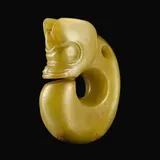
Well, if you guys remember our dragons episode, we talked about some early jade work that came from pre-state China, and it's kind of similar in concept, I guess. Like they're loops, and there are some pretty straightforward ones that look kind of like the pig dragons that we talked about in that episode. And then you have more complex ones, like the one that Liam got for this episode. It's, I'm not even sure how to describe that, but it's flanked by these two goats. I think those are goats on either end of it. And then it gets into a really wacky pattern that looks kind of like an hourglass in the middle. And like the edges of it are kind of like an anchor.
Yeah, it's really complicated, kind of really beautiful geometric jewelry that was being produced. And the interesting thing is that they might have been produced specifically for a foreign market because as early as we said, like 2000 to 1000 BC, in the second millennium BC, you start seeing these types of medallions, presumably made in Borneo in the Philippines, start appearing in mainland China. It's something that archaeologists call the Maritime Jade Road, which is the first known trade network in Southeast Asia. And this is a place where trade networks would have probably a more profound influence than anywhere else, maybe aside for Central Asia. So this is a really kind of cool part of this history. We're seeing these international kind of connections first begin to take place. And these connections would go in both directions from the islands to the mainland and the mainlands to the island.
Dong Son drums
Because around the same time that these Filipino jade artifacts start appearing in the mainland, you start seeing the development of a much, like we said, a more sophisticated bronze working culture in mainland Southeast Asia. And there's one very interesting type of bronze artifact that you start seeing mostly in the mainland, but then also the islands as well. These are bronze drums, probably with some kind of ceremonial purpose. They were hammered out bronze with very beautiful patterns pressed into them. Most of these appear associated with the Dong Son culture of ancient Vietnam. But I think these are beautiful. Again, tell us about these patterns and the drums, Sam.
Yeah. Well, it's very elaborate. It's sort of these concentric rings of different patterns with a many-pointed star in the center that expands outwards, and then you have different kinds of lines, you have different geometric shapes, and then finally you get to the lower levels.
Well, I think what's really interesting here are like the kind of the naturalistic carvings. There's like you see a lot of birds, a lot of people, like you'll see men with bows, people on boats, possibly even like creatures with many arms. There's a bunch of guys holding giant toothbrushes for whatever reason.
I think they're spears with like flags on them.
Yeah, yeah. Yeah, definitely. It gives you some kind of indication about what kind of lifestyle the early farming societies of Southeast Asia might have had. A kind of like early Bronze Age of the region. These bronze drums start popping up everywhere. And one thing I think is really cool is that once we get into the first millennium BC, when societies are getting even more complicated, you start seeing stone statues appear, especially in the island of Sumatra in maritime Southeast Asia, of warriors with these drums on their back. So presumably, this was this beloved luxury good that was cherished from the mainland, particularly from Vietnam, that was cherished in maritime Southeast Asia for many hundreds of years. So this kind of shows that this trade across the region had really interesting political, maybe even religious consequences. This kind of trade also led to increased changes in Southeast Asia because it meant that there was so much contact between different parts of the region that the sudden introduction of new technologies or perhaps a new religion would really quickly spread.
And you start seeing this time and time again.
The Iron Age
First, you see this with the introduction of bronze working, and then in the first millennium BC, around 500 BC, you start seeing the introduction of iron. And so, just like in Europe and the Middle East, you see a bronze horizon give way to an iron horizon. What I think is kind of interesting is that it seems that iron in Southeast Asia was actually coming from two different directions. These two directions being the two great civilizational influences on Southeast Asia: China and India.
The Bronze Age was much less materially well represented in the archaeological record, from what I understand, because copper and tin weren't that easy to come by in the region. But in contrast, iron ore was very readily available. So, once they actually got around figuring out how to smelt things at high enough temperatures to work with iron, they just started using this stuff for rather than like ceremonial drums and things of that nature, they started actually making tools and weapons out of it on a much larger scale.
Right, right. And one thing I think is really cool is that if you look specifically at the Dong Son culture of Vietnam, we suddenly see shifts in the political dynamics of the region where chiefdoms that had access to iron suddenly start having much more elaborate burials and having a lot more goods in general, which seems to indicate that regions with access to Indian and Chinese iron suddenly became politically prominent. I think that this potentially might be the origin of basically statecraft in Southeast Asia. These certain chiefdoms became the winners, other guys were the losers, and these became the earliest basically power centers, regional power centers that would evolve into the kingdoms of the proto-classical period and then the great empires of the classical period of Southeast Asia.
The Hồng Bàng dynasty
One thing that we should mention is that this transition period from Bronze Age to Iron Age in the Dong Son culture has traditionally been associated in Vietnamese archaeology with the start of the legendary Hồng Bàng dynasty. That name means giant bird, which I think is kind of cool. Whether or not these guys ever actually existed, it's really up for debate, but it does seem to be at the very least a discrete archaeological horizon.
Yeah, so they have an origin myth like most people do. And according to their origin legend, there was once a boy named Thánh Gióng who was born in a period of terrible strife between the kings of Vietnam and the Shang emperors of China. When he was just three years old, he learned that defeat by China was imminent, but miraculously, in just three months, he grew from a toddler into a grown man and was greeted by a horse of pure iron. And so together, the boy and the horse went into battle against the Chinese and pushed them out of the country. Afterwards, he and the horse flew away to join the gods in the sky. So, I mean, I don't know. Personally, I find that very convincing. I'm sure that totally happened. But despite the fact that I am personally convinced, there's no way to know if this dynasty ever actually existed.
But what we do know is that state formation and close contact with China is just undeniably there. So that.
Yeah, yeah. And also, I gotta say, I think that the fact that the horse is made of iron is a cool touch. I don't know how old this story actually is, but I do like the idea that it's like some weird game of telephone memory of the transition from bronze to iron.
The proto-classical period
All right, so far this episode has been a lot of talk about archaeological cultures, pottery, language families, but we're now getting into the really fun stuff, which is early historic Southeast Asia, what's called the proto-classical period. Because around the turn of the millennium, I think starting around like maybe the third century BC, I think, for the first time, we start getting clear historical references to Southeast Asian political and social dynamics from other countries. The fact that these references exist at all, I think, indicates that Southeast Asia was becoming increasingly connected to places like India and China.
The Pyu
Although, you know, actually, before we get into those foreign accounts of Southeast Asia, we do have to mention that right around the same time that these Chinese and Indian accounts emerge, we also see one more language family be introduced to mainland Southeast Asia. This is the Sino-Tibetan language family, related to, of course, you know, Chinese and Tibetan, because it also includes the languages of Myanmar, which I think is one of the most interesting countries in Southeast Asia of all of them.
Yeah, it's really diverse, but only around 70% of the population speaks Sino-Tibetan languages. It would appear that the speakers of these languages came into Southeast Asia from China, like many of the other previous migration waves. In this case, they came through the southwest, probably originating in the Himalayan foothills near Tibet and floating around the Irrawaddy River Valley towards the Bay of Bengal for a while. So, like all these ancient cultures, we don't know what these guys called themselves, but they've been retroactively described as the Pyu. And from around 200 BC, they formed walled cities, probably the first organized cities in the region, and conducted horseback raids against each other, as well as against the probably Austroasiatic-speaking peoples of the hinterland, and even raids up into China going up north.
So, and this is part of why we're mentioning them right now, because they're the last group to enter in the prehistoric period and also the first group to enter the historical record, which I think is pretty interesting. They traditionally have been understood by Burmese nationalists as the direct cultural linguistic ancestors of the ethnic Burmans or the Bamar, the dominant ethnic group of Myanmar. This probably is not the case. They certainly spoke a language that is related to Burmese in the Sino-Tibetan family, but not necessarily that closely related. It seems like actually the shift to the modern Burmese language happened in the Middle Ages. But these guys were, at the very least, the first organized urban society to live in Myanmar and probably the first literate society of Southeast Asia. Because by 200 CE, residents of these city-states had adopted the Brahmi writing system of India and began producing their own inscriptions, which would be the first kind of autonomous indigenous writing that we see in Southeast Asia.
Interestingly, their writing shows influence from both northern India and southern India at the same time, which suggests that by this period, there was contact happening over land through Bangladesh, as well as by sea from the Tamil and Sinhalese-speaking peoples of South India and Sri Lanka.
The Golden Chersonese
Now, let's get into the first actual historical references we have to these people by outside observers.
Yeah, not just inscriptions but literature. In the Greco-Roman literature, we find traces of knowledge about Southeast Asia under the name of the Aurea Chersonesus or the Golden Peninsula. The Romans were familiar with the general contours of the region since at least the time of Josephus, whose antiquities mentions that, quote, King Solomon gave this command that they should go along with his own stewards to the land that of old was called Ophir, but now the Aurea Chersonesus, which belongs to India, to fetch him gold. But the most in-depth description of the golden Chersonese comes to us from Claudius Ptolemy, who was a second-century author of the Geographia. It's a very broad term and might encompass the islands as well as some parts of the mainland. But don't get your hopes up for juicy details yet, though, because Ptolemy's geography is exactly that. It's literally just a list of the rivers and emporia found in the region and broad coordinates.
But nevertheless, from both Josephus and the archaeological record, we know that the region was renowned even halfway across the world, even if none of the surviving Greco-Roman literature goes into depth about it.
Greek Buddhas
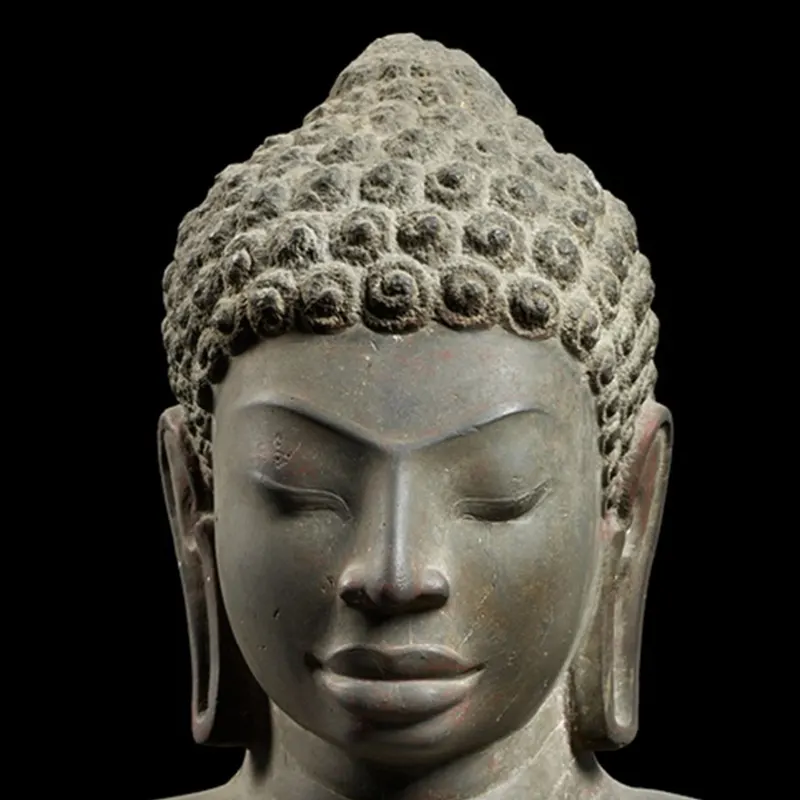
Yeah. And you know, one thing we should mention here is that the Greco-Roman world was a lot closer to Southeast Asia than you might think at this period, because as a consequence of the campaigns of Alexander the Great, there was a lasting political and cultural legacy of Greek-speaking peoples in northwest India for a very long time. So, contemporary societies, like I think the Kushans or around this time, had a really profound Greek influence. And the best example of this is the fact that statues of the Buddha, which would eventually become incredibly common in Southeast Asia, ultimately have an origin influenced very heavily by Greek sculpture, which I think is pretty crazy.
Yeah, and in fact, there are some early Hellenistic Buddhist statues that basically show the Buddha as Hercules, which is not exactly a figure you would associate with Siddhartha Gautama, but nevertheless, just goes to show how deep those contacts were.
Yeah, yeah, yeah. Again, the world has always been so interconnected, and I think Southeast Asia is the best way to understand that.
Yeah, so despite the really sparse showing in the Greco-Roman record, the name, the Golden Chersonese, points to something really, really interesting.
Suvarnabhumi
In the Sanskrit literature, you find another term for the region. It's called the Suvarna Bhumi, or the land of gold. Also, sometimes called the Suvarna Dvipa, or the island of gold. So, just coming across this fact, it seemed to me like the Greco-Roman term might be a calque from Sanskrit.
Yeah.
So, yeah, it's really interesting. Unfortunately, the Sanskrit record is quite vague too. Although the term does come up in the Ramayana and some early Buddhist writings, it may have been allegorical in some meanings, but by a certain point, it had cohered into a geographic category.
Yeah, I know that speaking of Buddhist writings, so one of the major schools of Buddhism, one of the three great schools of Buddhism today, is the Theravada Buddhism, which seems to probably originate in Sri Lanka. At the very least, it is very closely connected to Sri Lankan history. And our sources for the canon of Theravada Buddhism comes from the Sri Lankan Pali language. And the Pali Canon has some pretty cool references to Suvarnabhumi that might give us a little bit of a hint about early Indian, especially South Indian contact with Southeast Asia.
Yeah, and so because of these Pali sources, we have a lot of chronicles which tell of historic Buddhist missions to other places around the world. And then these commentaries and chronicles point to, you know, these missions and all these different monks. But anyway, the long and short of it is that there's a lot of emphasis on the missions sent to Suvarnabhumi. And this would become very important in early modern nationalist discourses just because of the way that the term...
Right, right. Yeah, because there's a lot of question about whether Suvarnabhumi is a reference to Southeast Asia as a geographic construction or some individual specific kingdom. And if it's the latter, if any modern-day nation state can lay claim to one of these ancient kingdoms that are mentioned in the Pali sources. I think that recently it seems that it might actually refer to a specific kingdom, or at the very least, at least one kingdom might have tried to lay claim to the ancient Suvarnabhumi legacy in ancient times. Because in 2017, the Cambodian historian Vong Sotheara was called to inspect an inscription which written in Sanskrit around the year 633. So this was again like eight, this was like many centuries after, this is yeah, after the first references to Suvarnabhumi, that says, the great king Ishanavarman is full of glory and his bravery. He is the king of kings who rules over Suvarna Bhumi until the sea, which is the border, while the kings in the neighboring states honor his order to their heads.
Some scholars question Vong's interpretation, for instance, like Dr. Arlo Griffiths from the French School of the Far East finds it hard to agree with this, although what he says is that, I have seen the context of the occurrence of the two words Suvarna and Bhumi, meaning gold and earth. The meaning of this verse is not particularly clear, but it seems certain that Suvarna Bhumi does not here form the name of any individual country. Rather, the words just mean golden earth. So again, like it's hard to know. I think that maybe it might have been a geographic region that had such prestige due to its inclusion in Buddhist texts that Southeast Asian rulers tried to lay claim to this ancient region. I don't know. We should mention, though, that Ishanavarman was a king of the Zhenla kingdom, which we'll talk about of Cambodia. It's not a smoking gun or anything, but it is the earliest attestation of the name in native sources, so it probably means something.
Yeah, but it's very much a hot potato, as we mentioned. I found an article in the Phnom Penh Post that was quite enlightening about this. So here's what the article says: quote, With evidence being sparse, vague, and often little more than an implication, it's no surprise that Cambodia is not the only country which has claimed to be the so-called land of gold. In Thailand, the government and national museum asserted that Suvarna Bhumi occupied the country's coast along the central plain, centered on the ancient city of U Thong in the western part of the Suphan Buri region. Bangkok's Suvarnabhumi airport is named to further cement the national identity. In Myanmar, scholars and politicians have asserted, based on excerpts from the chronicles of King Ashoka's Buddhist missionaries from the 4th century, that Suvarnabhumi was the Thaton kingdom located in the Tanintharyi region, which existed from 300 to 1057.
Right. And because this place, Suvarnabhumi, is so well known from Buddhist texts, many countries that are heavily Buddhist today have tried to lay claim to being that place. For instance, Sri Lanka, which is not even really in Southeast Asia at all. Again, it's like, I think that it's hard to know who exactly this word referred to, but I think that the fact that it's such a politically charged topic today, I think, indicates the way that this, you know, historical Indian legacy has on the whole Southeast Asian region.
China and India as influences
You know, while we were preparing this episode, I don't know Russian Sam, that you mentioned how you thought that in a lot of ways, it's like the joint influences of Indian religion and Chinese politics are a little bit like the ways that Europe was simultaneously influenced by Near Eastern religion and Roman politics, which I think is kind of interesting.
Yeah, and also when it comes to the historiography of the region, it's kind of similar because the parallel just really jumps out when you're comparing the histories of the neighbors of the Roman Empire and the Chinese and the way that they were written about. So the earliest attestations of peoples in this region, beyond the cursory geographic information that we got from the likes of Ptolemy, comes to us from Chinese chronicles and gazetteers. And this is very similar to what we'd see with Rome and its barbarian neighbors. These early Chinese sources contain a lot of information, but the description should not always be taken at face value because the Chinese, they very much had the same sort of civilizational superiority complex about them. And they often tended to put down a lot of these peoples because, you know, they're not Hua, they're a bunch of Yi who really needs them anyway.
And just a general outsider's bias. But nevertheless, there's a lot of really revealing information that we can glean from these early Chinese sources, which start from the third century.
Funan
Right, and the first specific polity that we know about through Chinese sources is the kingdom of Funan, which, due to its reference in historical sources, has gotten a ton of scholarly attention in recent years. It presumably was mostly centered around modern-day Cambodia, although it seems like their initial source of power might have actually been the Mekong River Delta, which is today part of Vietnam. So again, you start to see some unfortunate kind of nationalist fighting over this historical legacy. As an example, the fact of how Chinese records can be kind of unfortunately problematic, they were very dismissive of the people of Funan. They were approving of their wealth and the fact that taxes were often collected in pearls and silver, not in rice and millet. But they also decried the people of Funan as ugly, as curly-haired, as short. They mentioned how they would often be as likely to walk around naked as walk around in clothes, and they would even go around barefoot, which was seen as this great mark of barbarism to the Chinese.
We also don't really know what language the people of Funan would have spoken, because unlike the people of the Pyu cities of Myanmar, who had an indigenous writing system using the Indian Brahmi script, the people of Funan simply just used the Sanskrit language, kind of like how early China, kind of like how early Japanese and Korean monarchs would simply write their histories in the Chinese language, or how early medieval Europeans would write in Latin, not vernacular languages. So it's kind of because of that, we have no indigenous linguistic evidence of Funan beyond very scant place name kind of evidence. Probably the most interesting of these place names would be Funan itself.
Yeah. So there's been a lot of speculation about what exactly Funan might mean, and some of the scholars have come to the conclusion that it's basically a transcription of the old Khmer form of Phnam, which means mountain and which is still present in the capital city of Cambodia, Phnom Penh. So we don't really have written records of Khmer until the Funan basically disappears right in the early Zhenla period. But we do have a lot of sentences, but we do have some Sanskrit sources from the time which talk about it a little bit.
So they weren't illiterate. It's just that they were not yet writing in Khmer. But I think the fact that it seems to be resembling the word Phnom Penh does indicate that at least some of the elite in Funan spoke something related to Cambodian. Others might have spoken languages more related to Vietnamese. Others even might have spoken Austronesian languages because southern Vietnam, the Mekong Delta, was once predominantly Austronesian-speaking due to this Cham people who are now a dwindling minority in Vietnam today.
The Indianization debate
The thing that Funan probably gets the most attention for is this Indian influence, as shown by the fact that they did all their writing in Sanskrit. This is part of a process that has historically been termed Indianization, but has gotten a lot of kind of pushback in recent decades. At its worst, the Indianization model proposes that some kind of actual colonization by people from India was necessary to bring literacy and civilization to Southeast Asia. And at its worst, this had actually racial implications because colonial.
It's kind of similar to the Norman question in Russia.
Yeah, yeah, it is. Because this was in the middle 19th century. The Indo-European language family had just been demonstrated. Europeans were getting really excited about the fact that the introduction of the Sanskrit language into India might have happened by people with some connection to Europe. They extended this to say that, therefore, even distant Southeast Asian culture had to have been introduced by people with some European connection, which then it like allows them to glorify themselves. And in a roundabout way, it kind of even justifies the contemporary 19th century European subjugation of Southeast Asia, which a lot of these guys would have been enthusiastic supporters of. So it's a very difficult topic.
Kaundinya and the queen
We know that the Chinese certainly saw that there was a profound Indian influence in Southeast Asia. And they even had stories to explain this influence. We don't know if these are indigenous folk tales or if these are just Chinese guesses, but they're kind of fun. There's one story in particular that I think is kind of cute, very strange, written by scholars in faraway China about an Indian prince named Kaundinya who founded the kingdom of Funan in Cambodia and Vietnam.
So, Kaundinya, he was told in a dream that he should board a merchant ship and sail across the sea to the east. During this trip, he found an ancient temple which contained a magical bow. Maybe this is the result of a game of telephone, which ultimately references Rama, the Hindu archer of the Ramayana, who became popular across Southeast Asia. Kaundinya, he was then approached by a local queen from one of the eastern kingdoms who was naked because her kingdom had not yet invented clothes. So the prince shot an arrow all the way across the water, which landed at the prow of her ship. She was so impressed by this display that she asked him to marry her and provide her kingdom with clothes, which is, yeah, I don't know about that. Maybe a little condescending. So you can see why a lot of the more recent historiography has been reluctant to take Chinese sources at face value.
But nevertheless, there is a lot of useful information to be gleaned there.
Yeah, yeah. At the very least, it shows how the process of Indianization was perceived rather than how it happened.
Hindu kings and Buddhist missions
The current consensus is less romantic. It's that trade networks had been developing for many centuries across both land and sea. So places like Pyu in Myanmar and Funan in Cambodia both begin to get new cultural influences, presumably brought by Indian merchants, as well as more obscure societies of Indonesia and Malaysia at this time, who were also showing an Indian influence, but did not leave written records. So we don't know much about them or what they called themselves. It seems that rulers of emergent hereditary monarchies in this pre-classical era found Indian ideas appealing sources of legitimacy and power. They started taking on piecemeal introductions from both Hinduism and Buddhism at the same time. You mentioned Ashoka, who was the Buddhist king of India in around the second century BC. There would have been, this was a period when Buddhism was quite prominent in India, but the overwhelming Indian population was mostly Hindu still.
So there would be this kind of interesting dynamic where you might have had some diplomats bringing Buddhism and possibly Buddhist missionaries like those mentioned in the Pali sources, but most of the merchants, who were probably much more numerous, they would have been Hindu. And it seems that Hindu ideas were particularly attractive to the monarchs of these early Southeast Asian states, more so than Buddhist ideas.
Right. So we know that Hinduism was definitely spread through all these places, but it wasn't really adopted in the same way as it was in India and Southeast Asia. It was really the religion of power, but not the masses, as far as we can tell, except for a few exceptions like Bali, which remains majority Hindu to this day. It seems that the people who came across these Indic religions, like Hinduism and Buddhism, largely held on to their local beliefs or adopted a more syncretized form of Buddhism. The discourse around caste was present, but it was largely an elite phenomenon. It was the vernacular of power rather than a lived reality. So it might have been present in the courts where Brahmins were setting up shop after being invited there, but it wouldn't have trickled down in most of these places.
Vishnu, Shiva, and the Nagas
This is obviously kind of a consequence of what we know from the archaeological record, but it seems that the main aspects of Hinduism and Buddhism that spread to Southeast Asia in this very early period, the pre-classical period, were basically individual deities. Vishnu, the many-armed god of time and protection, was probably the most popular, but also there's Shiva, kind of as his counterpart, the god of destruction. And then also you see a lot of Nagas around this time. Nagas are really fun. They are snake people. They are really prominent in both Hinduism and Buddhism. They're part of Indian folklore, but they probably take off more in Southeast Asia than anywhere else. And even up to the present, all over Southeast Asia, Indonesia, Vietnam, Thailand, Myanmar, you're going to see statues of snake people. Interestingly, the more eastern you go, they actually start to be influenced by Chinese dragons too, which is kind of fun.
We have a whole episode of Dragons a while back that kind of talks about this. So, this is in a way, Nagas are almost like the Southeast Asian version of dragons. But this is an idea originally from India that basically becomes part of the native folklore of Southeast Asia. And the cool thing about a lot of these early folkloric influences is that they're so strong that even places in Southeast Asia that would later become Muslim and Christian would still hold on to some of these very early Indian-originating folktales.
Yeah, so the older historiography attempt to indicate a shift from Hinduism to Buddhism in the classical period after societies like Funan and Pyu were supplanted by larger kingdoms like the Khmer Empire. It's like there's definitely something to this, but it probably overstates the division that existed between different religious traditions very, very early on in Southeast Asian history. Because in the first half of the first millennium, different kinds of Indian ideas were entering Southeast Asian courts. And these were very different forms of Hinduism and Buddhism. And sometimes it's even difficult to find where one ends and one begins, frankly, at this point. There was very, very little, there was very, very little orthodoxy this far out from the frontier. And so, yeah, it's just very difficult for me to speak to as someone who, again, is very much not an expert in the topic. But it seems like it's like the origins of Southeast Asian civilization are clearly very multifocal.
And you can't totally get around that.
You know, I think one kind of cool clue about the way that influence happened in different directions is that it seems that Myanmar mostly had kind of a northern Indian influence, whereas Funan had a very much a southern, probably Tamil-speaking influence very early. And I think one example of this is that what we know of the Hinduism of Funan, it was very much centered around Vishnu, who was the predominant god worshipped among South Indian Hindus around this time. And also the Sanskrit they used is closest to the Sanskrit used by South Indian people.
Funan's global trade
Funan has to be considered the first international economy in Southeast Asia. I think it's not really the case. You know, we know from the much earlier maritime jade trade that Southeast Asia has been connected to other parts of the world since like the early Bronze Age. But Funan has the best documented early evidence of very far trade networks. These would not really be permanent trade networks that would develop in the classical era, the kinds that like we were saying would bring black pepper to England, but they were very interesting. And especially because they didn't just look eastward to China, but also to the west, quite far to the west. Because at the site of Óc Eo, which is today a part of Vietnam, located around the Mekong Delta, coins were found from Persia, India, and even as far away as the Roman Empire. The funniest of these Funan artifacts is a Commodus coin, which were locally produced counterfeit Roman currency, which got a lot of circulation nevertheless.
But more intriguingly, these coins appear roughly contemporaneously with Chinese records of Roman emissaries arriving in southeastern China, almost certainly through the sea route that passed through the coast of Funan. So we can see in Funan this development of a sort of pan-Asian and even a pan-Eurasian trade network that would become really serious in the centuries to come, in the upcoming classical era.
Zhenla
Yeah, yeah. And so we're getting kind of long here, so we're not going to be able to talk about classical Southeast Asia in this episode, but there's one more final dynasty we should talk about of the proto-classical period, the early historic period. That is the Zhenla kingdom that we also know from Chinese sources, which I think is especially interesting because this seems to be when Buddhism really gets a firm hold on Southeast Asia. And what's really interesting about early Buddhism in Southeast Asia is that, you know, we mentioned there are two big schools of Buddhism. Today, Southeast Asia is incredibly Theravada, which is the old kind of orthodox school. It literally means the school of the elders. But intriguingly, in this period, the early classical period, it seems that actually the Buddhism that is most dominant is not the Theravada from nearby Sri Lanka, but instead Mahayana, which originated in northern India and wrapped all the way around, taking the land route through Mongolia into China, from where eventually it would influence places like Zhenla, as well as Indonesia.
But during the first millennium, kingdoms like Funan would have received Buddhist influences both from India and China. And despite the overwhelming trend of Indianization, by the end of the post-classical period, it seemed that Mahayana Buddhism, which was brought over by way of China, would become the predominant influence, not Sri Lankan Theravada.
This is conjecture, but from what I understand of early religion in Southeast Asia, the Buddhist and Hindu traditions were so localized that orthodoxy came through stronger, longer-lasting ties between Southeast Asia and China. And the Southeast Asian kingdom best exemplifying this is Zhenla, whose king, whose king Ishanavarman, we mentioned higher up.
Yeah, so starting around the 6th century, references in Chinese texts to Funan get replaced by references to Zhenla. The origins are totally unknown. The only guess is that it might be a word for beeswax, simply because beeswax was the primary good that Zhenla exported to China. So they might, yeah, so it's just like, yeah, it's again, kind of shows the way that the Chinese records perceived their neighbors at this period. Chinese records greatly predating the transition from Funan to Zhenla say that it was founded by a vassal lord of Funan, whom even later Cambodian legends gave the name Mahendravarman, which is a Sanskrit phrase meaning protege of the great god Indra. Indra is an early Hindu deity associated with thunder, also the king of the gods. Anybody who's read a lot about Indo-European mythology knows that he is believed to be a cognate of Zeus, Jupiter, and Thor.
But his name is interesting because according to the Chinese account, Mahendravarman overthrew the older kingdom of Funan, established the new kingdom of Zhenla, but then mistreated the Buddhists who were already present in the kingdom, preferring Hindu-style worship of both Vishnu and Shiva at the same time. If we look at the archaeological record, it does seem that there was a greater trend toward Hinduism in this period. You know, at the very earliest period, you start to see Hinduism and Buddhism together. Then you see a turn toward more of an orthodox Hinduism, but then the reverse happens and we start seeing an assertion of Mahayana Buddhism. But one example of the kind of Hindu influences associated with Zhenla is that there were a lot of statues of a figure called Harihara, which is this combined form in Hinduism of both Vishnu and Shiva, often depicted as a man with one half of his body being pink or gold, and the other half of his body being blue.
If anybody listening has ever played The Elder Scrolls Morrowind, you've seen a modern adaptation of this kind of Indian deity. Well, back here, thousands of years ago, they were doing their own adaptation of Indian religions.
Yi Jing's journey
And so, around the year 690, during the early decades of the Tang Dynasty, we know by name one of the many Buddhists who would travel through this region. He was called Yi Jing, and he was a monk and missionary who traveled to India by way of Vietnam, Cambodia, and Indonesia. He noted that Buddhist communities were present all across the region, and some of them preached doctrine that he approved of, although others strayed from what he considered to be the right path. It seems that there was a lot of syncretism with local Southeast Asian beliefs, as well as a soft line between Hinduism and Buddhism.
There's a really interesting piece of artwork that survives from this period. It's found in the Sara Bodhisattva cave and dates to around the 6th century, so just around when Zhenla would have been coming up. In this carving, we see the Buddha preaching to Vishnu and to Shiva, and it's really revealing in some ways because it shows the Buddha as this sort of ethereal figure, whereas Vishnu and Shiva, although they are present and they're very kingly, it's just that they have a very temporal presence above them. So here they are, these gods, sitting around and listening to the preachings of the great Buddha, which I think shows to a great extent the dynamics between Hinduism and Buddhism in the region, as well as the ways in which these were not mutually exclusive systems of belief.
Yeah, but bringing this back to Yi Jing, the place that he was most impressed by in terms of the Buddhism preached was the island of Sumatra, which today has very little evidence of its Buddhist heritage. But in the late 7th century, a new network called the Srivijaya was forming in the islands, which would create a permanent trade of spices and goods stretching all the way to Western Europe.
Right, right. And again, you hear about the idea of Southeast Asia, of maritime Southeast Asia being the spice islands. This is a consequence of this transition from the pre-classical era to the classical era, where Southeast Asia becomes even more interconnected to other parts of the world, including very distant parts of the world.
Coming up next
Right. And it was around the same time that another Buddhist dynasty would emerge on the mainland. This would be the Khmer Empire. In the next episode, we're going to talk about the classical era of Southeast Asian history, which was dominated by these two empires, as well as more obscure kingdoms like Mataram and Dvaravati. But this episode, it was more about setting the general lay of the land.
Yeah.
Yes, setting the stage. Yeah, yeah, yeah. Explaining basically what are the primary ingredients in the Southeast Asian burrito. But there are a few more that are going to come on in the medieval period, in the classical era, which I think really make things interesting. It's going to be, yeah, so next week we're going to have a fun episode shaping up as we talk about the arrival of the Thai culture into Southeast Asia, of the arrival of the Indian Chola dynasty, which would have very profound influence over Southeast Asia, as well as, of course, the influence of Islam, which is now, I believe, the most widely practiced region or religion of the region. That would all happen as Southeast Asia, a place that many Americans see as, you know, obscure and out of the way, would begin to be incredibly interconnected into broader regional and even global systems.
And that's why we're doing this whole thing, because I think that if you really want to understand the modern world, how it came to take shape, you have to understand the role that Southeast Asia has played in global history. And to understand that role, you got to know what was going on in Southeast Asia, these internal dynamics.
Yeah, and Liam, I think you've done a really great job of setting this groundwork because, frankly, like this episode was mostly Liam. I am still very much lost. Hopefully, I'll have a better idea of what we're talking about by next week. But for now, just big and big ups to Liam.
Oh, well, thank you. Thank you. And it's a really fun topic. It's one I gotta say where I'm learning too, you know, which is kind of interesting. Like, this is an area where I knew very little until about a couple months ago. And so it's been really fun to kind of, you know, learn as I'm basically learn with the audience here. I think it's really, yeah, it's a really fun process because it's such an incredible region with really interesting contemporary politics that we'll probably eventually have to get to. And it's also a place where history is very political, just like in somewhere like the Middle East or the Balkans. And that's, again, why, like, if you really want to understand the modern political dynamics, for instance, the modern-day rivalry between Myanmar and Vietnam, I'm sorry, the modern-day rivalry between Myanmar and Thailand, you really got to understand the ancient and medieval past.
And there are a lot of really fun stories coming up as we get into medieval Southeast Asia, the classical period. And so we'll see you guys very soon. Bye-bye.
The show is also on Apple Podcasts, Overcast, Pocket Casts, Podcast Addict, YouTube, RSS and Patreon.