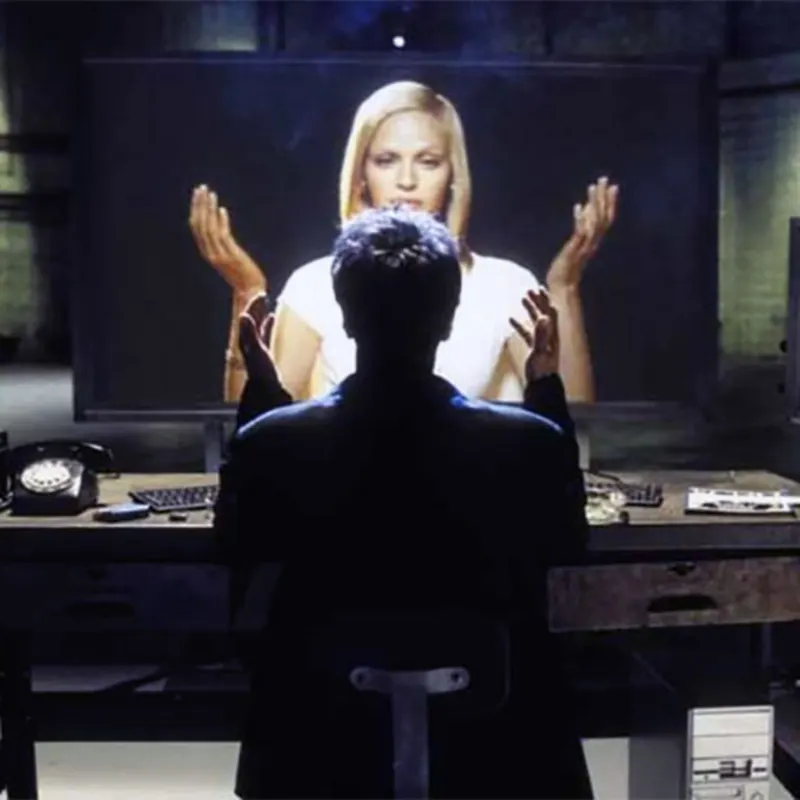
In 2002, S1m0ne posed the question of what would happen if we were to replace actors with computers. What 20 years ago seemed like a fantasy in the realm of science fiction has increasingly begun to rear its head in our world, and we as a society are still grappling with the consequences and implications of our increasingly virtual reality.
Computer-generated actors, models, influencers, and pop stars, we’ve got them all on this week's episode.
Hosted by Liam, Abram, and Pam.
Ananova, the first virtual newscaster
Kyoko Date/DK-96, the first virtual popstar
E-Cyas, the first male virtual popstar
Transcript
Welcome, Pam
People keep asking this, are you back? And yeah, I'm thinking we're back with another episode of Gladio Free Europe. I'm Abram, and today I'm joined by Liam.
How are we doing?
And special guest Pam.
Hi.
S1m0ne
And today, we're going back to the dawn of a new millennium by a long-forgotten 2002 movie, Simone. If you haven't seen this movie, don't bother. It's a nothing movie. It's also a movie you can't really spoil, so don't worry about that, because the movie is the premise, and that's it. The premise is, a Hollywood director, played by Al Pacino, faces a crisis when his lead actress quits the film. Luckily for him, a genius programmer hears of, you know, his predicament and gives him a piece of software to create virtual actors or vactors. And he uses that software to create Simone, the perfect actress. He completes the movie, a success, and, you know, like, it's a big deal for him. And then, you know, there's like an hour and a half of sitcom hijinks of him trying to hide the fact that Simone isn't a real person. And that's it.
That's the entire movie.
Yeah, yeah. And then along the way, he starts to develop some strange, not exactly romantic feelings for this imaginary person. Then he starts to resent her for being more successful than him. But by the end of it, it's kind of like Pygmalion for the information age.
A comedy without jokes
So, what do we think of this movie?
Yeah, it was pretty bad. The dialogue was awful. It like the watching the beginning was such a slog because they do that thing where like they have the characters like say context of like what they're doing when, like, no one in real life would do that. Like, for example, she's like, oh, well, after the divorce, XYZ.
It's classic Hollywood. There's no audience there there. There's no reason to remind your ex-husband you got divorced. He knows.
Yeah, yeah. Very bad expository dialogue. There's, yeah, and this is like no reason to care about any of the characters.
I always do have like a soft spot for movies that kind of like, you know, show how the sausage gets made.
Yeah, if it's like campy, it's good and self-aware, but this wasn't. It was just such bad writing.
Yeah, you say it wasn't because I'm pretty sure this movie is meant to be a comedy, but it's like a first draft of a comedy where like they wrote the structure and they wrote the characters and everything out, but like a couple of people were supposed to go back and like write like a jokey line here and there like setups and payoffs and stuff and like that never happened. They just like made the first draft into a movie.
I heard a new movie that came out is just like that. The Scary of Sixty-First. Sorry. I would not be surprised if it turns out that Dasha is also a fictitious amalgamation of various other celebrities.
She kind of does have a Dasha era when she's smoking and cursing.
I definitely didn't hate this movie. I think that it wasn't, I don't think it sucked, but I think it wasn't. I can see why it's forgettable, why it really didn't leave much of an impact. I think it's a pretty good idea on paper. And I'm sure that I wouldn't be surprised if the first draft was a lot stronger, but clearly along the way, it lost really any amount of charm that the original script might have had. And because they tried to make it a comedy without having any jokes, it was just totally, really unpleasant to watch. Because when you know it's supposed to be a comedy, but it's not funny, you just feel completely unsatisfied. And then I think that really they wanted us to care about the kind of more thematic implications about what does it mean, you know, to be a performer if you don't really exist.
But that's not the kind of thing the audience is will actually care about. Especially, like you said, Pam, we don't have much reason to care about these characters.
What else we could have watched
You know what we should have also watched? We should have watched that Disney movie Pixel Perfect.
Oh, that was on my Letterboxd watch list. I put a few movies on my watch list for this episode to see which one would be best. And I watched Looker, and that wasn't great, and it didn't really fit thematically. Then I watched this, and this one fit perfectly thematically, but it also wasn't great. And then I just didn't feel like watching Pixel Perfect.
Honestly, that movie had more depth to it.
A sitcom with no jokes
Anyway, we keep saying this is supposed to be a comedy, and I just want to explain why it feels like it's meant to be a comedy. Is this movie takes place over the course of two years, but it feels like a week, and that's very clearly intentional. Like, you very clearly are trying to make this feel like an extended sitcom by like, you know, intentionally not like having just establishing shots that, like, okay, this is six months later, you know, stuff like that. But so it looks and feels like a sitcom, but there's no jokes.
Right.
But I will say, this is the kind of movie that's perfect for cable because of the way it's structured. Because you only really need to watch the first 30 minutes. Then after that, you can like change the channel, watch something else for a little bit, get up, like make dinner, come back, and then just like catch the last like half hour, and you won't really like miss anything.
No, yeah, absolutely.
Andrew Niccol
This movie was written and directed by Andrew Niccol, who before this movie wrote The Truman Show and wrote and directed Gattaca.
That's right.
And the structure of this movie is like basically the same as those, in that none of these scripts are intricately plotted, you know, where like every scene like leads into the next scene and there's like a very strong narrative throughout the movie. It's just, you know, you have your premise up front, and then most scenes are fleshing out the premise. And some scenes are progressing the plot, but that's not really the point of the movie. The point of the movie is just to like enjoy this premise.
And I believe, Abram, that Andrew Niccol is also a fellow New Zealander.
I mean, I don't think he made any New Zealand movies. I think he moved to Hollywood, and that's when he got his movie career. Yeah, but I mean, I think like these kinds of movies, the ones that are just, you know, you can kind of leave them on in the background and just enjoy them. Like, those are great movies to have.
Oh, yeah, yeah.
It's much better than like having on like four episodes of The Office or Friends in the background, like, constantly.
We need mediocre movies
I totally agree. And the thing is, like, we do need mediocre movies because in the absence of them, we just have more and more remakes and more and more really low-quality original streaming thrillers. This is definitely the kind of movie that I don't think could be made today. It would either be a TV show where they'd stretch out the premise even worse with probably even less interesting characterization, or it would be a lower-budget Netflix original, which would probably be even a worse product than this.
It would have been more interesting if they just made it like a contemporary version of A Star is Born. At least, like, have that structure to it, and then like she has to die or something instead of the actual ending, which is really stupid.
Well, as we'll see, she does kind of have to die.
Yeah. The like conflict of the movie is pretty stupid.
You're right.
Well, let's get into that.
The plot
Okay, so let me just explain the main events of the movie. So, as I said, Al Pacino plays the director. He makes this movie. His lead actress, played by Winona Ryder, just like leaves in the middle of production. Then he gets this piece of software and then he finishes the movie with Simone.
I think that the most dated aspect of this movie is the central problem. It's the idea that, oh, this one actor is so important to the movie that the studio can't survive if they have to recast her. I don't think these days that's the case at all. I think that film studios are such bigger enterprises than they were 20 years ago that if like Scarlett Johansson walks off, it's no problem to find somebody else.
Yeah, I think the main thing is the movie in this movie is basically like this movie in that Simone, this movie, had a budget of $10 million. And the movie that Al Pacino is making in the movie is also like a low-budget movie.
Right.
And also, and again, these types of movies, a movie with these is, if you adjust for inflation, that's probably like closer to 20 million, but 20 million dollar movies don't really come out anymore. If they do, they're streaming, they're streaming originals.
Yeah.
Because my interpretation of the movie that Al Pacino is making is that, you know, it's like a simple character drama, like a romance, and you know, they only have like a budget of like 10 million, and they only have like allotted time of like a month to make to like shoot the movie. So they're working on a limited budget, a limited time, limited resources. And so if like the entire movie is held on, okay, we're gonna get this big actress, you know, like Scarlett Johansson. Like, what was that movie she was in recently?
Marriage Story.
Yeah, like if Scarlett Johansson just like left Marriage Story, like when it was like three quarters done, that movie would have just died, right? Because it's like a low-budget movie. It's being held on like these two actors. If one of them just like leaves in the middle of production, they probably aren't gonna figure out how to like, you know, reshoot the movie or just like get a new actress or yeah.
Replacing actors mid-production
Or, yeah, I mean, she should have, she should have done us the favor. I think it depends. I think that it, I think it depends on what kind of movie it is. I guess you're right for a small movie, but there are cases of actors being replaced pretty deep into production.
With that recent movie that came out, that zombie one on Netflix, they had Zack Snyder, yeah, D'Elia, yeah, and then Army of the Dead.
Yeah, yeah, where Chris D'Elia is digitally replaced by Tig Notaro. Yeah, I think the most famous example that I can think of of an actor being replaced is that, like, halfway into the production of Back to the Future, they recast Marty McFly, which is insane. They had already filmed half the movie with some other actor.
Yeah, I think that's definitely the most famous example. I mean, in like low-budget movies, like B-movies, that happens a lot because they're just like just terrible jobs to work at. So, a lot of times, actors will just quit. And then, a lot of those movies just like, I mean, the production just falls apart and that's it. But sometimes they actually manage to either recast or just like try finish the movie with like just behind-the-head shots or something, just like be creative. Yeah, but usually, in like a professional picture, that doesn't happen, especially because you know, there's like contracts and shit. You can't just like leave in the middle of a movie, yeah.
The software
And also, to take a step back here, this is because, like you mentioned earlier, we just kind of brushed by. He is approached by this feverish inventor who tells him that he has this invention that can solve all of his problems after the first actress walks out. And then Al Pacino realizes that af this man eventually dies out of the blue, and in his will, Al Pacino is bequeathed, which is, as we find out, Simone.
That guy dies. He, as Liam just said, in his will, he leaves this piece of software. Basically, it's a piece of software where all Al Pacino has to do is sit in front of a computer, like he waves his hand, the Simone character waves her hand, he speaks into the microphone, Simone's voice says those words back to him. So, obviously, if you've ever done any kind of like 3D modeling or animation work, you understand that it's a lot more involved than is being depicted in this movie.
Specifically, it's kind of like an aggregate of all these other celebrities. When you see him scrolling through, he can click, oh, let's get a little Audrey Hepburn here, a little Grace Kelly there to build the perfect actress. That's why it kind of reminds me of the Pygmalion story of the ancient Greek sculptor who creates this sculpture so beautiful, he thinks she's more perfect than any real woman and falls in love with her.
His relationship with the 3D avatar is kind of weird.
Yeah, like I said, it's almost romantic. It almost gets into Her territory.
Yeah, he's kind of in love with it, even though, again, he's the one who's speaking the words that she's saying. Like, we see him, he like says it into the microphone, they just says it back to him. Which I guess it kind of makes sense that just hearing those words in a woman's voice is enough, even if he knows that it's a computer. But I don't know.
But it never goes all the way.
It doesn't. This movie does not explore the premise deeply in any meaningful way.
It's like, it's like, you know, when you sit in your hand for a long time, and then, you know what I mean. He never falls in love with the avatar. He never, like, gets caught. He never, you never like, there's no real conflict.
The press and the mystery
Okay, so step back a little. The press are fucking in love with Simone. They want to know who Simone is, they want to know where she lives. They, all the paparazzi are showing up in Al Pacino's house because they think maybe Simone's at his house or something.
Yeah, because the big thing is that because this person doesn't really exist, there's this immediate mystery: who is this actress winning these awards? Where is she? How come nobody has ever seen her? There are a couple interviews, but it's because she doesn't really exist, they're just done remotely with Al Pacino speaking through a microphone and her voice coming out.
Yeah, she doesn't do the typical press junket tour. Like, the press never gets to interview her. Like, she doesn't go on like the tonight show or anything like that. She doesn't, and also because she isn't real, they make a second movie and she's never on set. And you know, he's he says that you know, she's just gonna do her scenes herself, and then we're gonna get a body double to do some other pickup scenes. It was just like the effect, obviously, immaculate because if you haven't seen this movie, it isn't a 3D render, it's like an actual actress who's playing Simone.
Who, as we might get to later, ends up marrying the director.
Constantly with the movie is that the effect is supposed to be immaculate, so everybody is completely convinced this is a real person.
I should just add it's Australian actress Rachel Roberts, who funnily enough hasn't really done much else.
She's not an actress, she's a model, so yeah.
The funny thing is, and her voice sounds just like Al Pacino for some reason. She kind of looks like Cate Blanchett, if Cate Blanchett was like a makeup model.
I was thinking she looks like like if Jessica Chastain was a supermodel instead of an actress.
Rachel Roberts
Let's talk about Simone herself. So, name just that she's played by a model named Rachel Roberts. Very pretty, a little bit toothy.
I see just like a Chastain. Also, maybe some hints of Toni Collette there.
She reminded me of Naomi Watts, but also a little bit like Angelina Jolie. But yeah, she does.
I noticed that too. She, it was good casting because she definitely looks like a mashup of a bunch of different actresses who were popular at the time.
She she looks the way that a fake song in a movie feels. Like, you know, like in a movie like, you know what I mean, right?
Like, yeah, yeah.
Or like a fake movie.
They just ran her through FaceApp like 20 times with a bunch of different actresses, and that's how they got her. That's why it's very good casting.
Roberts at the time was an ad model, usually like in skincare and like fashion magazine and like TV ads. She was quite young too. I think she was only like, she's only like 23 at the time.
She doesn't look like a leading Hollywood actress to me. Like she just fundamentally does not look like. Like when I think leading Hollywood actresses, I think, you know, like Cate Blanchett, which she kind of looks like, but I mean, usually the leading actresses are pretty, but like, not cover girl pretty.
Right.
Yeah, she definitely has like an uncanniness to her and also her mannerisms too, which was a nice touch.
One unfortunate thing about this movie for her is that because she is playing computer program and not a character, she doesn't really have a real performance. So everything we see is deliberately stilted. So this actress doesn't have a ton to work with.
I mean, she gets very little screen time as well. Like, she's not a real character in the movie. She's just like exists on the screen. We only see her where Al Pacino's like going to a secret computer and like using the simulation one software.
She talks like she's always filming like a Neutrogena commercial or something. Because she's a model, like you said, so that's like her only acting like experience is short stuff like commercials where.
Yeah, just like reading ad copy into and looking directly into the camera. Initially, she wasn't credited in the movie because the studio wanted to keep her identity a secret, like Al Pacino was like trying to hide Simone in the movie. But, you know, nobody gave a shit about this movie when it came out, so that didn't accomplish anything.
Models and funny faces
But yeah, how she looks, though, is interesting to me because she was a successful model in this era, in like the 2000s era, and that meant being conventionally attractive in a way that's pretty, but like not cute, just look like a you know, a mature adult woman and attractive. But over time, that changed, right? A few years later, like, I don't know, 2009, 2008, there's a much greater emphasis in having very unique-looking models rather than conventionally attractive models.
Well, I don't, I'm admitting here, I'm like a complete outsider to anything involving fashion or modeling, but what I have heard was that in the around this time, the big buzzword was approachability. It was kind of an extension, it was a little bit similar to the push towards representation and diversity because it basically opened the doors toward people who were not people who were not the type of people who were traditionally on magazine covers. But initially, it didn't mean like a woman with rosacea like you might see today in a magazine. It meant a woman who just is a little bit funny-looking.
Yeah, that funny-looking is the perfect way to put it because at this time, there was a lot of models that had a particular quirk about their face that made them look odd.
Yeah.
Because that oddity with the right clothes, hair, and makeup makes for a very striking photo.
Yeah, this is why Chrissy Teigen is the household name. There's a lot of other examples.
Miranda Kerr is kind of funny looking.
Winnie Harlow, I think, is probably the most famous one that comes out of this era because she's the black woman that has vitiligo around her face and around her arms.
Yeah, well, I think it's just people are so used to like we're so used to now after the 2000s Photoshop and everything and plastic surgery that we can attain the perfect face. Now it's like those little oddities, like you said, that's not actually something you could attain with plastic surgery easily. So that's why models like that are more sought after.
Yeah, there's a lot of models that just have like a slightly odd head shape, like maybe their chin is extremely pointy, or they have you know ears that stick out or just maybe eyes that are slightly further apart than you would normally expect. One particular detail that makes them stand out, especially like if she's walking down a runway or you're, you know, in a magazine ad, you're just flicking through, just like, oh, what's this? You know, like a striking visual. Most of them aren't household names, of course. That's why we can't name them because usually models retire like 20 years old. So they never establish themselves.
Sad.
Winnie Harlow is like a household name because she's like one of the few models that manages to break through and become a supermodel. You know, becomes like somebody who can actually have a long-term modeling career rather than just usually sad. It's not sad. Like, you know, it's like this thing you do in your like late teens, early 20s. You know, travel the world, like do fashion shows, and then you retire and you get a real job. Like, it's a great thing to do in your youth if you can. But yeah.
Unique characters on Tumblr
Around this time, you know, early 2010s on Tumblr, partially inspired by this trend of unique models, there's a trend to draw unique-looking characters.
Of course.
I'm sure basically everybody listening knows exactly what the fuck I'm talking about. So usually it's like just drawing a face with like details you never see.
Yeah. I think the most famous is the bright red nose.
No, actually.
The Hamilton edit.
Oh, so you mean Laura? Oh, okay. I oh, I see. A different type of. I see. Okay, yes, yes.
So what I mean is drawing characters with unique characteristics that you don't see. Usually the people drawing these are watching a lot of anime. So like first thing they did, like all of them did, was okay, I'm gonna draw a character with dark colored skin. That's gonna make my character stand out because literally everybody else is just like drawing white anime characters, right?
Right.
But you know, if you're scrolling through the Tumblr dashboard, eventually you just see, okay, everybody's doing this.
Yeah.
So I gotta do something else. So, you know, you gotta keep innovating. So a lot of things were like, okay, freckles. Nobody draws freckles. Okay, like a facial blemish, a big nose.
Yeah.
Girls never have big noses in these illustrations.
Or thick eyebrows.
Weird fish, fish-shaped mouths.
Yeah, or a gap tooth or piercings, like a septum piercing. Never see that. And then all of a sudden, everybody's doing that. So, you know.
Yeah, it's just like very literal interpretations of representation.
Yes.
Or making them androgynous or racially ambiguous.
Again, just and so you know, it's been on for a while and eventually it just becomes like normalized, so like nobody gives a shit anymore.
Lil Miquela
But around 2016, something magical happened. A synthesis of these two things was born. So, part Tumblr drawing, part real-world fashion model. I am, of course, talking about Lil Miquela, Brazilian-American blogger, influencer, model, Gen Z fashion icon.
Oh, yes.
Let's get into her deal right now. This is an article that's a little after she became like a thing. So, at first, she was just like an Instagram account, and then she became like a thing people talked about. And this is what they were saying: Meet Lil Miquela, the AI influencer. Miquela Sousa, better known as Lil Miquela, is the first computer-generated social media influencer. In less than two years of existence, she's amassed over a million Instagram followers and sparks a debate about what makes a persona real online. In an era of fake news, AI Russian troll farms, catfishing, and deceptive selfies. Miquela highlights how technology is estranging us from reality. No, she's not. She's not doing any of that shit. She's not highlighting shit. She is just a fucking. Okay, I'll have a link to her profile in the show notes if you want to check it out, but don't bother.
I'll just explain right now, which is what this Instagram account is: is there's a real model, and you know, they take photos of her, or she takes selfies of herself, you know, just like very typical Instagram influencer bullshit. If you live in a big city, you've probably seen the angel wings like spray-painted on the side of buildings, and then like, oh, yes, you know, a skinny girl will like stand in front of the angel wings and looks like she has, she looks like an angel, you know, that kind of crap. That's the crap she's doing. But somebody's taking those photos of that real-world model. We don't even know who it is. I think it might have been like a couple of people doing it. And then just Photoshops this very crappy 3D render of a face onto that person's face.
No, it looks like a 2007 Final Fantasy cutscene.
Yeah, exactly. She's a horribly out-of-date CGI. And I say this is a synthesis of Tumblr crap. Let me just explain what she looks like. So she has light brown skin, dark brown hair, straight hair. Kind of like a Princess Leia thing almost going on.
Yeah.
She has freckles on her brown skin. She's a gap tooth. She has like a widish nose, like an African person's nose.
Yeah.
And straight hair again. So she has like light color eyes. So this is like the Tumblr thing of making it representation and also as racially ambiguous as possible.
A fantasy of diversity
Yeah, yeah. No, no, yeah, yeah. She's basically kind of a pornified fantasy of diversity.
Yeah, because technically, somebody could look like this. Somebody could have dark skin and then full of freckles and also dark brown hair instead of black hair and it'd be straight.
Yeah.
You know, straight hair and also like a wide nose. You know, like technically, this is possible, but not bloody likely.
And also, it's the most cynical type of representation imaginable because not only is this character, I guess she's ostensibly Brazilian, but although she's not identifiably part of any particular marginalized group, but then moreover, the fact that she's not a real person means no actual marginalized person is benefiting from this. It's completely hollow.
She has big lips, I guess. One less detail, but yeah.
I mean, of course she has big lips. Everybody has big lips on Instagram now.
Barbie and scandals
I think the best, like, the funniest comments I saw on YouTube when I was watching her videos were that they're saying that she reminds them of like the Barbie YouTube videos that the official Barbie account makes. And it's true, like her mannerisms and the way she talks, it's very like, you could definitely show her interviews and everything to a kid, like a 12-year-old girl, and they'd be totally fine with it. And even her aesthetic, a little bit with how they designed her, is kind of safe. Like she's a Barbie doll. Which also adds to the uncanniness and like makes it like it's hard to know who is she really marketed towards. Like, is she for younger kids or for like adults? Because it's just like so safe with the branding of all of her.
Oh, I think the person who looks closest to Lil Miquela is that that racist girl from California who said that this black kid stole her phone.
Okay, so basically, I'm a 22-year-old girl. I'm I don't racism yeah, she does.
Okay, no, no, that that girl, that that girl is whoever she is, that's the closest thing to a real Lil Miquela.
Okay, yeah, okay, okay, I definitely definitely see it. I definitely see it.
That would be really funny if they faked a Lil Miquela scandal and like someone found quote-unquote old tweets of her and she had to make an apology.
There's there's multiple fake Lil Miquela scandals and they were all so cringe. I just wanna one thing is Miquela's made by a company and the company has like multiple other like models like this. There's one that's like a white woman and she's supposed to be like right wing. And one time there was like a thing where she was she hacked Miquela's account and then you know like I don't know I'm not even gonna like go into details because it's so dumb.
Simulacra
For a lot of people, the initial impulse is to dismiss Lil Miquela as unreal, but in many ways she's only marginally less real than the living, breathing influencers that she sometimes uses as Instagram props. With the right lighting and a high enough camera angle, anyone can make themselves look like an entirely different person online. In his career-defining work, Simulacra and Simulation, the late French philosopher Jean Baudrillard argues that human beings are no longer able to see the world as it really is because technology and the media have blurred our perception of the real and the imagined to such an extent that we can no longer separate the two.
Okay, that's true. Fair enough.
This state where reality and illusion fold into one is called hyper-reality. Hyper-reality is created by simulacra, which are images that serve as a representation or imitation of a person or thing.
Yeah.
I want to say something here, which is in a lot of early comments for Miquela Photos, people are saying, Oh, this is a real girl, this is a real girl. And your initial reaction to those comments is like, Oh, these people are idiots. What the fuck are they saying?
Yeah, I don't how could you think that?
I think what they're trying to get at is the fact that this is clearly a photo of a person where the face is edited. And they're kind of saying, like, no, this is a real person. These are her real photos. She's just like editing her face. Later, we realize that, like, yes, that is a real person that's in the photos, but it isn't like a singular person managing this account. It's a company.
Right. And have you heard the theory that there's this, that her face is based on some British model?
I have heard that. I mean, I don't know. It just, it just looks like a Tumblr illustration to me. So, okay.
The only reason I'm mentioning it is because the model in question, she's a British woman named Emily Bador, and she's white. And I'm only mentioning this because it just, I think this again reinforces how it's such a cynical and I would say offensive attempt at representation. Because if they really are basing this model on this white lady, what they're doing is they're just taking a white person who already looks like the kind of ideal of like, you know, Eurocentric beauty and then tuning her up slightly so she has certain, certain like so-called ethnic features that can still be desirable while also being still within the realm of, you know, Eurocentric acceptability.
Yeah, I mean, I guess that makes sense. Like, obviously, they have to start with like a base. Like, they probably base the 3D model on like an actual human being. And then, you know, then you apply color and texture to the model. So then, you know, that part's the easy part. Like, you can just make the skin color any color you want. Whereas, like, modeling, like, the exact face shape is very difficult to do if you don't have a reference. So, it makes sense they probably use just like a famous person, like a model where they can just get, like, source a lot of photos of this person's face from like multiple angles.
Uh-huh.
Personas and pop stars
That part in the article. Well, first of all, it's totally wrong because, I mean, people see Lil Miquela and know that she's not real. Like, there's no, like you said, like, when people are saying, oh, that's a real girl, they're just saying, like, they used a model. But people, you can pretty clearly tell it's just an edited photo. If anything, I feel like that it's a way more interesting comparison or analysis applied to say to someone like Lana Del Rey or Poppy. Because when Lana Del Rey first came out, people were like, oh, like, is this a persona? Is this really her? Like, right, yeah. Lizzie Grant, like, who is she trying to be? And this is people are understanding that she's doing a persona. It's not her trying to say that's her. And if anything, when pop stars do that, that's way more of an interesting take on the role of a pop star.
Like, because we all know to some extent, like, there's a record company telling them to do what they need to do. So when you take something like Lil Miquela, that's so literal, it's just like it only offers like a surface-level, I guess, like, look at what it means to be a pop star. That's just never actually that interesting. That's why, like, all the comments for Lil Miquela videos are just like, this is so stupid. She's obviously on like multiple platforms. I scroll through her TikTok. I guess she has like a lot of TikTok views. She's got obviously a lot of Instagram views, but you can ratio this bitch on Twitter so easily. Like I did once. I got like 10 likes on a reply to hers, and she got like eight likes on her tweet. So it's like, feel free to dunk on this bitch afterwards.
Yeah, and then that's just like the problem with concepts like Lil Miquela or the movie Simone is that like this isn't a shock to anyone that like, oh, like celebrities are fake. Like, you know, like, it's just like, yeah, yeah. You didn't, like, no one was like, oh, no, I didn't realize that. Like, it's, yeah, if anything, it's more interesting to analyze, say, someone like Demi Lovato and be like, how much of this is authentic or them trying to promote something?
Baudrillard and Debord
Well, that's why it's funny that they bring up Baudrillard, because you know, like, I haven't read too much Baudrillard, but I do think it's very funny that he thought one of his most famous insights is saying, oh, you think Disneyland is fake? What if I told you all of America is fake? It's like, I am 14 and I'm very smart.
I just gotta preface this before we get further into this article: is that last three paragraphs are about Guy Debord?
Oh, yes. Okay, who's I'm more into Debord?
Okay, okay.
I mean, I should say I am into Debord, and it's just that hearing this name referenced in an article about this crap is pretty funny.
Yeah, yeah.
It's like a college essay just trying to like sound so smart.
Well, I think that's definitely a very unfortunate trend in, I would say, late 2010s till now, mass media, oh, yeah, or at least like online journalism, is just trying to shoehorn in philosophy references in like the most banal culture pieces.
Yeah, everyone feeling they're way too qualified for what they're doing.
There was a great ClickHole article about this. ClickHole or the Onion, I forget, but it was just like, girl free from her captors, but are any of us free, really?
Yeah, exactly, yeah, yeah.
Yeah, well, yes, I think the French do have a lot to answer for bringing that to America.
And then, well, well, speaking of, in his seventh work of critical theory, The Society of the Spectacle, Marxist theorist Guy Debord argued that stars, spectacular representations of living human beings, project this general banality into images of permitted roles.
A superficial society
As specialists of apparent life, stars serve as superficial objects that people can identify with.
Yeah.
I mean, Pam said this about superficial. This was something I kind of wanted to say in the True Detective episode, but I just never got the chance, which is that one of the reasons I don't believe in things like secret societies going on in the background that we don't know about is that our culture is so superficial that I just don't believe anything can exist below the surface. We want there to be depth, we want there things to be existing in the depths of our society, but nothing can. We are just the most superficial society there is. And obviously that's like because of cavalry, neoliberalism, just like we none of us have the fucking time to do anything, but yeah.
Yeah, no, no, I agree. Well, yeah, to go back to that episode, if anybody listening now remembers that, True Detective often involves sex trafficking rings, which obviously in real life do exist, but in real life, they tend to be not so mystical, not so occult and satanic as depicted either in the fantasies of QAnon or in a TV show like True Detective, because there really was a sex abuse network involved in the city that was the basis for the last season of the second season of True Detective. But instead of being guys in robes doing satanic ceremonies, it was that a guy working at a school was taking sexual advantage of the teenage boys there. And the guy was just the son of the city manager. Like, I feel like real-life evil is very rarely as flamboyant as we want it to be. And when there is that flamboyance, it's really only just window dressing.
Like, so much of occultism in the 20th century was just a way for different elites to bond with each other. Like, there's a lot of overlap, I would say, between what Aleister Crowley was doing and what proto-fascist groups like the Thule Society were doing. They were just different stripes, different colors of upper-middle-class weirdos, usually very right-wing, finding different self-important reasons to get together and talk about how cool they are.
Yeah, and to bring this back to Lil Miquela and why, for whatever reason that I cannot fathom, is so successful, is just that nobody gives a shit anymore.
Yeah, and she has something like 3 million Instagram followers, which isn't enormous for Instagram, but it's still a pretty high number.
Yeah, it's just nobody gives a shit anymore. Like, that fear, that satanic panic fear, that fear of like things hiding in the shadows. Obviously, there is still QAnon and people believe in that, but for the most part, nobody believes in it because at this point, we're just so completely accustomed to the fact that we are a very surface-level, superficial society and nothing exists in the depth. We know there's nothing more, so we don't care.
Well, if anything, I think it's kind of the opposite with Lil Miquela. I think, I mean, especially with Zoomers, I think they're just they grew up with social media, but they don't know anything else. And like to see something like Lil Miquela, where it's trying to make this commentary about how dependent we are on social media and everything, and images, and you know, like what you, a persona you project online versus what you are in real life. I think like those are both the same thing to them. It's all blended together where, like it isn't a spectacle to them anymore. It just is life. Like, especially you see this on TikTok where like kids or teenagers are so obsessed about like following trends and like, you know, all these filters and everything and fashion. And like there's no concept of a pre-teen anymore because kids are just on YouTube all the time that they see, you know, makeup tutorials and fashion and everything.
They start to dress like they're 16 once they hit 12. I think it's just like all this has been blended together for younger people that it's like they're they're like, why are you commenting on this? Like, I don't care. I've already accepted this, that this is how life is for me. Like this is my normal. I don't know what anything else how it's supposed to be.
Yeah.
The Utah monolith
You guys remember, I think it was November 2020, there was a monolith discovered in the Utah desert.
Of course.
Oh, yeah, yeah. Of course, yeah.
And no one cared.
Yep.
Initially, people cared. For the first week, there was interest.
Especially when it turned out that it had been there for years.
Yeah, somebody went on Google Earth and noticed that it was there for years. People were wondering, okay, what is this? And then a few days later, another one was discovered like in the middle of a park somewhere. And then everybody stopped giving shit. You know, there was like a very viral tweet just saying, can we just cut to the revelation of whatever this is? Come on, we know this is a viral marketing stunt. Let's just get to it. Obviously, what it turned out was that that initial monolith was like, I guess, somebody's art piece just erected in the desert years ago. But then a week later, somebody saw this on the news and decided to wreck their own in the park somewhere, just like to fuck with people.
Yeah, some copycat.
There's one in LA and there's one in Romania.
But yeah, I think that just says that there's no capacity for believing in any kind of mystery anymore. People kind of sort of believe in UFOs, I guess. Obviously, there's UFO stories coming out in the past couple of years that people are interested in. But I think that's like a very small percentage of people. I think for the most part, people are just like have completely given up on giving a shit about anything mystical or mysterious in the world.
Yeah, yeah.
Cyber babes
Let's go back to a time that's a little less depressing. Let's go back to the dawn of a new millennium. All right, Pam, take us away.
Cyber Babe to Read the News, January 2000. She's being called the news anchor for the new millennium. Coming up, we're going to be talking about a computer-generated news anchor. Yikes, it is coming your way. But can people really be replaced by a virtual anchor? Ananova displays the personality her creators hope will captivate 21st century news consumers. A cyber babe modeled on a mixture of Posh Spice, Kylie Minogue, and TV presenter Carol Vorderman is set to become the world's first virtual newscaster. Computer-generated character called Ananova will be able to deliver the latest news over the internet when she is launched later this year.
This movie, Simone, came out in 2002. Simone was playing on things that already existed in real life, which I'm pretty sure nobody under 20 would realize. Or even people under 25. Like, do you remember when this was the thing going on on television?
No, I do not.
Pam, do you remember when we had a cyber newscaster?
Not really. I feel like it would have been something on like AOL, but not on TV.
For whatever reason, there were a lot of these. Ananova was created by PA New Media, which claims to have given her a full range of human characteristics based on the personality most people wanted to read the news. As a result, she has a profile of a single 28-year-old girl about town who loves Oasis and The Simpsons and is five feet eight inches tall.
She's just like me.
She's just an e-girl.
She's just every girl on Twitter.
That's true.
She's ahead of her time.
Okay, Ananova was possibly inspired by Kyoko Date, otherwise known as DK-96, a Japanese/slash Korean virtual singer who vies for the title of the first ever Cyber Babe.
Of course, Japanese be the first.
Oh, yeah, of course. I mean, who else?
But I gotta say, this is very funny to me: is that Cyber Babe was the nomenclature for the time. So, this article that we're reading is from the BBC News. You know, a respectable newspaper is referring to these women as cyberbabes.
That's hilarious.
Later, we're gonna read one from the New York Times, which says the same thing.
Yeah, I'm sure when people tried to Google Cyber Babe, they really love the results that came up.
Well, that's a very kind of 2000s cultural artifact, too. Like, I remember the big kind of proto-Gamergate in like 2009 was when E3 finally banned the booth babes that used to be outside like every game.
Oh, yeah, yeah, they were basically banned from all conferences because they're just like, honestly, the reason was they made a lot of the nerds uncomfortable. Like, obviously, a lot of the nerds like looking at them, but a lot of the nerds are just like uncomfortable around like beautiful women who are just like smile at them.
Wow, no, I thought it was a respectability thing.
Wow, okay, where was I?
DK-96 and T-Babe
Okay, so DK, she released a pop song in 1996. It looks like a cutscene from like Tekken 3. It has that look. This was like a big thing. At the dawn of the millennium, people were obsessed with this idea of replacing specifically women with 3D models.
Well, I think that's why I never like caught on. It was kind of always a novelty.
There's a couple of pop stars that tried this. Let's get into them. T-Babe is tipped to become the next pop music sensation. She's blonde, very sexy, and is reported to have a great voice. Her supermodel looks have already caught the eye of Vogue magazine, which has booked her for a forthcoming issue. So, yeah, a 3D model in April 2000 is going to be in a Vogue magazine. That's just like how into this everybody was.
God, that's awful.
DK's Cyber Sisters include T-Babe, a virtual artist created in the UK by Glasgow Records. T-Babe is credited with inspiring a new genre of music called CyboFunk. Bite me, 20 of the hottest women on the web. Gosh, that's kind of cool, isn't it? I've never even taken my clothes off. In 2002, Entertainment Weekly named T-Babe the it cyber pin-up of the year. Virtual pop stars are so perfect and so pristine that they make the actual pop stars up the ante. They have to, because Hollywood has to try even harder now to manufacture an even more perfect girl.
I'm googling her now and she looks awful.
Oh.
She looks like, what's that like really dumb flash game that people make fun of? That it's like you're having like dinner with a couple that's like breaking up.
Oh my god, yes. That's what she looks like. Oh my god.
Abram, you know what we mean, right?
Oh my god.
You like watch them have a divorce?
Oh my god.
It's called facade, yeah. It's such an awful game. That's what she looks like.
Uh-huh.
Cyber Babe, CyboFunk, like all these names are much cooler than what the fuck we have now.
That's true.
Early 2000s optimism
Definitely the kind of like early 2000s techno optimism. It was very fun.
Yeah, that optimism completely gone now.
Yeah.
Oh, absolutely. No, and I'm sure it was totally connected with the whole, like, the whole Euro optimism thing, with the end of the Cold War, you know, just the Clinton era in general, pre-9/11.
End of history.
Yeah.
End of history.
Only T-Babe now.
I mean, I gotta say, this podcast is completely pro-Fukuyama. He was completely right about everything.
Yeah.
It's true.
E-Cyas
It's true.
T-Babe's biggest rival is Germany's virtual star, I. E-Cyas.
Oh, it's a dude.
He's sciased as a man.
So Germany had one of these too. So there's one in Japan, there's one in the UK now, and now there's one in Germany. You have four of these going operating at the same time, which is interesting, you know, all in the same year.
Deepfakes
Yeah, it's kind of funny how, like, there's a weird optimism to all these articles because, if anything, now today, the biggest concern is like deep fakes, which, I mean, is a lot more insidious in its intent and usage. Just kind of using someone who already exists to make it seem like they're doing something they're not rather than creating a whole new persona and person.
Yeah.
Have you seen the Tom Cruise account on TikTok?
Oh, yeah, yeah, yeah. I've seen that. Yeah, I also saw the other day, I saw Blackpink edits. Someone did a deep fake of Jennie to make it look like she's doing a TikTok dance, and all the comments are like, why did you do this? But like, people are starting to do that now as fan edits.
Yeah, I mean, this is obviously different than deep fakes in that these are very clearly not real persons. Kind of supposed to like replace real people.
Yeah.
I mean, it's the same intention trying to control or manipulate someone to do what you want.
No, I would say it's more trying to replace a real pop musician or actor with like a digital copy. Like just kind of erase the need for a real human being from the equation.
Agency and consent
So then, you know.
Right, because a human could object to something you want them to do, but if it's a totally robot or something, someone totally not human, they can't object. You just program them to do what you want them to do. And then going back to Lil Miquela, like that's why like the whole authenticity thing is so weird because it's so clearly like, at least it's someone say, like, Selena Gomez, you're like, okay, maybe she had some say in what direction they wanted to take her career, for example. But for someone like Lil Miquela, it's like, well, Lil Miquela has no agency.
Yeah, so she can get sexually assaulted and it doesn't matter.
Yeah, but yeah, which is a totally weird thing to say she to apply the concept of consent to a robot or AI or whatever she is. I mean, it's a fictional character, so you can just say, oh, our fictional character also knows exactly what you're going through because she suffered, you know, assault in her life as well.
Yeah, the Lil Miquela assault video is one of the one of the lowest things I've seen. It's just such an insidious attempt to chase Clout in a way that really made me feel kind of queasy.
Lil Miquela's assault video
Lil Miquela also does, like, they make her do vlogs and upload onto YouTube and Twitter, which is also weird because they clearly like made a fake bedroom background for her and like make it seem like she's recording a vlog like she's a YouTuber. So in 2019, she had a vlog where she talks about her quote-unquote sexual assault, which a lot of people got upset over. So this one article by Paper Mag says, In the clip, Miquela begins by detailing a supposed scenario that's unfortunately all too familiar experience for many women who use rideshare apps. Anyway, I called a rideshare because we love a sustainable budget-friendly moment. The car pulled up outside my house, and I'm getting in when I'm immediately gagged by the smell of like jasmine air freshener mixed with old man farts. The only save was my queen Dua on the radio and the foamy Malibu coast.
But then I noticed the other rider wouldn't stop staring at me. Like, okay, sure, I looked cute in my club 404 tennis skirt, but this stare was less, I think you're cute and more. I'm confused by what you are, and I deserve to find out. Best believe that after a minute or so, this mother has the audacity to lean in so close that I can literally smell his breath as he whispers, Are you real? His hand literally lingers there rubbing my skin, she said of the creepy ass man she was supposedly sharing a lift with. Miquela then went on to say that it felt like he was threatening me before saying that he pinched her and proceeded to make a gross sexually charged comment about down there, which led to her getting out of the car in the middle of the 101 freeway.
So, like, not only is this, you know, a gross appropriation, you could say, of the trauma of assault, but it's all ultimately a marketing thing because it goes back to the fact, like, the whole is she real kind of, you know, gimmick.
Yeah, it's it's really odd to think like she's experiencing like a special form of misogyny because she's also not real. Like that prompted him to touch her. Like I just want to be in the boardroom meeting that like means tested this story and was like, oh, how can I make this so relatable? But like brand her more? It's just so odd. And of course, like people on Twitter got so upset and were like, why are they making like this fanfic of her?
Yeah.
The Mad Men pitch
That's what I want to know. Would Don, Peggy, or Pete pitch this? This? The Lil Miquela sexual assault plot.
Of course, of course, Pete.
Of course, Pete. Pete would pitch it, and then both Don and Peggy would just be like, What the fuck is this?
Yeah, but then it would mirror Peggy's life later in the episode.
Oh, yeah.
Where someone touches her leg. It's like, You're really an executive.
And then it would obviously end with Don actually having an affair with the CGI character.
And Sally saying how she's a big fan.
Yeah.
Oh, God.
Comes home after having sex with his computer, and then Sally is wearing the same haircut as Lil Miquela, and then he deletes her off the hard drive.
It's her, the movie her, but it's just Don Draper.
In Mad Men, I think it was when Don went to California and Harry takes him to like a Hollywood party. That's when he meets Simone, the actress who plays Simone. She's like, in Mad Men, it's just like two lines.
Yeah.
The maiden format, you're either a Simone or a Lil Miquela.
Webbie Tookay
Okay, so back to models. While we're on the topic of Simone and Lil Miquela, let's go back to models. So here's an article from the New York Times, the most trusted source of journalism for like 100 years or whatever the fuck, titled Perfect Model, Gorgeous, No Complaints, Made of Pixels. Webbie Tookay is the latest lithesome discovery of John Casablancas, the founder of Elite Model Management, which shaped the careers of Cindy Crawford and Naomi Campbell. Okay, so big deal. Yeah.
And if anybody's wondering, yes, that it's the same Casablancas.
Oh, God.
I think it's so funny. It's that you're at the strokes. One of the, really one of the best bands of the last 20 years, just made by the children of some of the worst people on the planet. They all met at a Swiss, they met at a Swiss boarding school. It's like a, it's like a, they're like a little team of super villains.
Oh, were they on the same boarding school as Kim Jong-un?
Very good chance. You probably actually can only get into that school if your father has killed at least 100 people. Or the very least of four.
Talk about being fashion forward. The Elite Modeling Agency is adding to its stable of stars for the millennium. Webbie is the agency's newest supermodel, and her runway is cyberspace. Plans for Webbie are ambitious. Like many of her counterparts, her future includes not only modeling, but also acting on television and in movies. I think that you need cyber everything nowadays. You need to be people who are available in two different places at the same time. A virtual model is absolutely the ideal person for that. She doesn't complain. She doesn't have a boyfriend. She doesn't be late. No skin problems. No weight problems. She's perfect. Webbie exists only in cyberspace. The creation of Swedish animator Steven Stahlberg, but that didn't hinder her from posing for a feature in Details in October 1999 and a new Nokia film advertising campaign in Latin America.
Steven Stahlberg
You know, actually, I recognize the name Steven Stahlberg, and I bet you probably do too, Abram.
Oh, yeah. He's this like a CGI artist guy who mostly some of his stuff is kind of interesting, but a lot of it's really horny. And he's been around forever. And he does like, some of it's kind of good, but it's all kind of porny. So it's funny that he was the one behind this.
If you Google his name, it's basically just like CGI pinup stuff, usually with kind of like a fantasy bent, and some of it very kind of weird and kinky.
Yeah.
Also, he lives in Malaysia now.
Ooh, that's a very bad sign.
Regardless, Webbie can eat nothing and keep her curves, boasted Mr. Casablancas, who left Elite and founded Illusion 2K, an agency dedicated to representing virtual models. She can be on time or in two places at once, and you know she'll never get a pimple or ask for a raise. Sometimes I wish all models were virtual.
Oh, good, good.
This is just like printed in the New York Times without like, I guess there's a lot back in this, but it's just like, yeah. I mean, people were just saying this in like 2001. Like, it's not that long ago. People were just saying design and like.
Yeah.
Oh, hilarious. Yeah. Oh, yeah.
Like, wouldn't it be great if we just replaced women with virtual machines? It was like, yeah, everyone's just like, you know what? That would be a good idea if we replaced a woman.
Simulacra again
These models arrive at a time when the distinction between reality and artifice has so eroded the mass culture that to some minds it hardly exists. Think of Madonna or Michael Jackson, said Marcia Kinder, professor of critical studies at the University of Southern California. What's so distinctive about these stars is the malleability of their image. They are constantly reinventing themselves in a way that makes them seem like virtual figures. We even talk about them as if they were virtual. And why not? In our postmodern culture, a simulacrum is not only acceptable, it is preferable.
There's that Baudrillard shit again.
What the heck is this? Every single time we're gonna pull out Baudrillard?
I will say that I've heard that in like the 80s and 90s, Baudrillard was like the biggest guy in American philosophy. And he was actually, I believe, living in LA at the time, which might be part of this.
I blame the Matrix.
Yeah, it's just very funny that both these articles about like 3D models is just like they're pulling the exact same like philosophy.
Yeah.
Andrew Niccol on fakes
Well, speaking of movies, people are fine with fake now, says writer-director Andrew Niccol, whose movie in progress, Simone, is due out next fall. Very soon, we'll be able to turn our television sets on and not know if the presenter is real or fake, Mr. Niccol said. And frankly, we won't care. When so many real actors and models have digital work done to them, we're talking about a very gray area of reality, Mr. Niccol said. Pilfering line from the movie, he added, It's gotten to the point that our ability to manufacture fraud now exceeds our ability to detect it.
Yeah, or it's just like, oh, okay. Even the director of this movie is just saying, yeah, wouldn't it be great if we could just replace like female actors with software?
Well, I think it's these articles. It's just they're hyping up something that the technology just wasn't there yet.
Right.
Like you said, like a lot of the graphics look like Tekken and stuff.
Yeah.
So it's kind of like how when people would talk about AI like five years ago or now thinking like, oh, we're going to have, you know, self-driving cars and stuff when really we don't have the AI technology yet. And this kind of going crazy with like the potential scenarios it could bring.
Yeah.
Nobody talks about Siri anymore.
Yeah.
No. Yeah.
Like I know some people are super into Alexa and stuff, but most people are like, it's just a novelty to them. They don're into it in the sense of just like, hey, Alexa, can you play this piece of music real quick?
Yeah, it's not like smart home, smart house.
The feminist critique
However, the cyberbabe's extreme malleability has raised the ire of feminists. Virtual females are the postmodern equivalent of a mail-order bride, scoffed Suzanna Walters, director of the feminist studies program at Georgetown University. They are compliant creatures created for one's pleasure. Another example of the female as object. And worse, Miss Walters suggested, an ideal that real women cannot hope to emulate.
I'm glad they actually put that in this article. Not at the audit girls, like put that shit in, but at least the New York Times thought that it's like, hmm, maybe somebody thinks it's kind of worrying that all these like famous and powerful men are just so eager to replace their female workers with computers.
Well, it kind of reminds me of like all the like, you know, a lot of the especially poorly adjusted like incel creep boys, a lot of them are really excited at the prospect of sex bots because they think that like, oh, a sex robot will replace women. So we don't have to deal with women.
Yeah, like RealDolls. Yeah.
Yeah, yeah, yeah, no. And those guys, they love talking about like artificial wombs too. Some of them really do think that the worlds would be better if it was just dudes.
Yeah.
I mean, they've completely given up on the idea of getting a girlfriend for real. So I'm just like, okay, well, maybe technology will fix this problem in the future.
It's funny when you are like ostensibly like a traditionalist, like you talk about how like, you know, like the old times are so much better than now, and then you want to completely abandon anything resembling a traditional lifestyle because you're so bad at achieving one.
Hatsune Miku
It's interesting how like this never really picked up in the US, but in Japan they do. They have like Miku and stuff, which, I mean, I think part of the reason she does well there is because they don't care about having her be authentic and relatable, like Lil Miquela. She's really like, it's just, she's a fun little pop star. Like, if you watch her live shows, it's just like people like holding glow sticks and stuff. And, like, it's just kind of like a little rave or something. It's not like they want a pop star who has like something to say. They get that it's kind of like campy and playful and like they don't they understand that something fake like that is never gonna actually offer like a human connection or like a like real human interaction and i guess also just like in japan people are so alienated that like they've already had a culture of i mean like people like the what's the term hikikomori yeah and like like like those pillows and stuff i don't know it's just like more ingrained in japanese culture to kind of accept that you're alienated and like use these items or products to kind of fill that void and not actually like look too deep into it but in america they're we're way more neurotic with like knowing that something's fake but still trying to make it authentic and human and like in japan they just kind of accept that it's not human yeah they accept that everything is a product and everything is a transaction yeah like they're way more nihilistic with it yeah we're desperately trying to cling to the last remnants of authenticity in our culture yeah but they've kind of accepted that that's gone well i mean i think what makes it easier for them there is they actually have a very rich culture a very rich history rich traditions and aesthetics, and just like so, even though, like, in your day-to-day life, everything is just a transaction, everything is just you know, a product, Japan still offers you more, like, spiritually, I guess i i think the the trick about American culture is, although it's true, we're pretty bad at most things, we do do low culture way better than anybody else.
Anyway, let's get back to Miku. I want to talk about her a little bit. So, let me explain what she is because most people kind of don't get what Hatsune Miku is. But she's a vocaloid, and Vocaloid is a piece of software that synthesizes vocal tracks. And Hatsune Miku is the name of a voice that you can buy in 2006. There's like a meme, you know, popular meme on like 4chan and even like 2chan in Japan. It's called Leekspin. I'm sure you've probably heard of this.
Oh, of course.
It's like just a perfect loop. And that was like a very big meme in like 2006.
Yeah.
And then in 2007, the Hatsune Miku voice was released for the Vocaloid software. And somebody in Japan redid that song using the Hatsune Miku voice and then uploaded to, I forget what the name of the website is, but it's Japan's equivalent of YouTube. And that became like the biggest video on the website for that day. And that's like what made Hatsune Miku like a star, a household name immediately.
Yeah.
No, it's the point now that like even in America, you'll see people with Hatsune Miku car decals. And it's been this way for like five or six years.
The Miku timeline
Let's go through this timeline a little bit. Japanese pop star Hatsune Miku takes the stage as 3D hologram. This is November 2010. A few months ago, a 3D projection of Miku pranced around several stadium stages as part of a concert tour where capacity crowds waved their glowsticks and sang along. It all reminds us a bit of Simone. Remember her? She's the sultry actress who captivated adoring audiences in the 2002 film of the same name. Somewhere, we bet Simone's just a little bit jealous.
Wow.
Pitting women against each other.
I gotta say, obviously I prepared the notes for this episode. I did not type in Hatsune Miku Simone and look for articles that mention them both. No, no, no, no. I was just like going through Hatsune Miku's Wikipedia article and clicked one of the sources and this source also mentions Simone, which is very amusing.
Yeah.
Yeah, it's funny they referenced a movie. This is 2010 and they referenced a movie that bombed in 2002.
I actually, you know, I forgot to mention this. We didn't come up, but the venue in the movie Simone where she has her big performance is actually where I graduated a month ago.
Oh, interesting.
Pretty funny. Yeah, yeah, the LA Memorial Coliseum.
Yeah, but in the movie, yeah, she's just a hologram, but she's a hologram to hide the fact that, you know, she's not a real person for the people. It's very interesting that, yeah, in the movie 2002, there's a hologram of pop star giving this big concert. And then, like, really less than a decade later, like, this is in 2010, 2008, 2009, they had a hologram of her performing live in Japan and like Malaysia and stuff. Interesting how, like, how quickly that became a reality.
Why Miku worked
Yeah.
One reason why Hatsune Miku is so successful and why those shitty artists that happened in the 2000s were failures, like, immediately, is that Hatsune Miku is a commercial piece of software. Like, you can just buy the software and make a Hatsune Miku track, right? In the 2000s, when this idea was first being formed, and multiple companies were doing this, there was the one in Japan, there was the one in Germany, there was the one in the UK. All of those failed because, in all those cases, it was a company that developed the software to like make the 3D model and also wanted to manage the content. So, they realized they could make the software, but they can't make good music, they can't make good content, so the company just like collapsed. Whereas, in Miku's case, it's just like we're just gonna make the software, and then talented musicians are gonna buy it, use it, and that's what's gonna make us successful.
And that's why Miku is so successful. That is just to say, the idea of a virtual like pop star was always a good idea, it's just the first people to give a crack at it just like failed so potentially because they couldn't deliver.
Toyota and Lady Gaga
She became like a huge deal in 2011. She was the face of the Toyota commercials in the United States.
Yeah, introducing the new 2011 Toyota Corolla. Refresh styling, 35 mpg highway rating, available Bluetooth technology and wire for MP3 players. It's the official car of Hatsune Miku. Follow her big dreams at Toyota.com/slash Corolla Miku.
We have to, we have to play the commercial pair with Scarlett Johansson. Hi, Miku. This is Scarlett. Being true to who you are makes all your dreams possible. Yes!
She opened for Lady Gaga in 2014 when Lady Gaga released ARTPOP and did her tour for that. Like, Hatsune Miku was her opening act. In less than a decade, she went from just this piece of software that, like, you could buy to create vocal tracks for your song to being like a household name and like touring with Lady Gaga.
Do you think we should mention the.
The Domino's commercial
We probably have to if we're talking about Hatsune Miku, we probably should mention the Domino's thing, right?
What was the Domino's thing?
Oh my god, Abram, you surprised me. I think it was probably in 2013 or something, the CEO of Domino's starred in a commercial advertising the Hatsune Miku app in Japan. It was an English language commercial advertising this tie-in program.
Hello, everyone. I'm Scott, president of Domino's Pizza. Have you heard of Hatsune Miku? Today, I'd like to announce a new collaborative project featuring Hatsune Miku. Domino's app featuring Hatsune Miku. Based on Miku's image, the Domino's app changes its appearance. A lot of music and illustrations produced by Domino's crew are here. From the menu to the order, it looks very cute, just like Miku. Once your pizza's delivered, have some fun with Miku.
Oh my god.
Oh.
Vactors today
So, what do you think about vactors? Virtual actors, as they say in Simone.
Well, yeah, they've been talking with them for so long now, and it still hasn't really taken off. But hey, it certainly might.
I mean, it absolutely has.
You think so?
I guess the closest we've had is like, you know, bringing back Princess Leia in that one Star Wars movie after the death of Carrie Fisher.
Well, Star Wars specifically did it three times. They brought back Peter Cushing for Rogue One.
Tarkin.
They brought back Princess Leia, and they brought back Young Luke Skywalker for The Mandalorian.
Okay.
And for The Mandalorian, I'm pretty sure they just used Mark Hamill's real voice. They just have him like speaking to a microphone. But with Peter Cushing, I'm not sure what they did. They might have used like a sound-alike.
I mean, we mentioned the Tom Cruise TikToks earlier. Was that a sound-alike, or was that just somebody using deepfake audio? Because that is a possibility now as well. They can just like, if they have enough audio of you performing throughout the years, they can easily synthesize it to make it sound sort of believable.
Yeah, I mean, obviously that.
There was Paul Walker, like Furious 7. That was a CGI guy.
Oh, they brought him back too?
I mean, that was just like he died, so they brought him back for the very ending, like a send-off.
I guess the highest profile, like Vactor kind of stuff, has been those Michael Jackson and Elvis hologram performances that people pay money for.
Tupac hologram at Coachella.
The Tupac one too, yeah. No, yeah, that's kind of especially that's like especially grim.
I mean, they did it twice for Arnold Schwarzenegger in Terminator Salvation and Terminator Genisys. They like made a digital young Arnold because obviously Arnold had aged so much by then.
Yeah. I feel like if you're still alive, it's not as grim. You know, if it's like, like, the Irishman doesn't really rub me this the wrong way the same way that bringing back Carrie Fisher does.
Starring Al Pacino.
That's right.
All comes back to Simone.
Yeah, I mean, in Terminator Genisys, the old Arnold Schwarzenegger, as well as the, like, CGI Young one were both in the same movie, so I guess it's okay. It's like the same with Tron Legacy. They had a completely fake young Jeff Bridges, but they had also regular Jeff Bridges in it.
And a lot of people at the time were a bit unnerved by the not so developed tech.
Yeah. I think that was the first, I think that's the first one where they really replaced an actor with a because there were instances beforehand, but they were like special effects, or they weren't like a full-on actor. Like, Tron Legacy is like full-on, we're replacing an actual human being, which is a completely digital thing, and like what is otherwise a you know, a live-action movie.
I think this is the funny thing about like The Irishman is that we know what those actors looked like when they were in their 30s. They don't look anything like how they do in that movie.
I mean, yeah, they, I mean, the movie looked good, but I guess there's still like an it still looks like they're airbrushed in every single frame, you know?
Yeah, definitely.
Final thoughts
Yeah, I don't know. Final thoughts about Simone or just replacing human beings with digital copies?
I think, Pam, jumping on again, your point about the tech being too early, I think this is a movie that came too early. Because in 2002, when Simone came out, there was a little bit of that whole, like, the T-babe stuff or whatever it's called, early virtual online performers, but it wasn't part of the consciousness at all. There wasn't really this possibility that we do have today of these virtual characters overtaking real stars. And I think that just makes the film not as believable as it would have been now. And because it's not really a successful comedy, it's just this sort of half-baked thought experiment that at the time didn't seem that compelling.
Yeah, it was sort of techno-optimism, if you can kind of say that, because it was like, yeah, yeah. It's like imagining what we could do with this technology. Obviously, it's what they're imagining is basically replacing like human work, like human labor with technology. So maybe it's like a little dystopian, but still sort of optimistic about it, tone-wise. It's still like, isn't this cool? Isn't this neat? Isn't this great? Like, everybody was really into this shit. So that's why it had that tone.
Robots and chatbots
It's like how in the mid-2000s, also, I was a child at the time, which might have, you know, warped my perceptions, but I feel like robots were a really big deal. I remember the, I guess it was the Honda robot, ASIMO, was like, oh, yeah, yeah, yeah, really well known.
Remember, SmarterChild?
No.
Oh, my God. He was my bestie.
Tell me more.
He was a little AI robot you could talk to on AOL.
Oh, there were a lot of AI chat bots.
Well, do you remember the subservient chicken in like 2004, 2003? One of the first like big viral marketing things was, I guess it was like a Burger King campaign where you could do like a chat bot kind of thing with like a low-res video of a chicken. And then when you type certain keywords, it would play footage that made you feel like you were having a conversation with like a real person in a chicken suit.
I remember how exciting I was for viral marketing campaigns.
Oh yeah. Oh god.
Cloverfield, obviously.
Oh yeah, and like I remember the Halo 3 one was so famous. Some guy almost died in a hurricane because he was trying to like do an outdoor segment of it in Florida when like Katrina or Wilma was like about to tear through his neighborhood.
Yeah, I don't know. I don't know what to make of this. I mean, I kind of hate it.
Bringing back dead actors
Like, do you guys remember the Audrey Hepburn chocolate commercial from like 2012, 2013?
I don't think so.
It's the same kind of thing.
Okay.
It was a. They did a completely 3D recreation of Audrey Hepburn and it looked perfect. Like it looked seamless. It was just like, why are you bringing this 50 years dead actress to like do this chocolate commercial?
This is gonna be the thing because we're so tied to remakes. Like we're just gonna keep bringing back dead actors. At first we would never like kill off an intellectual property. Now we're never gonna kill off like famous actors. Like famous actors are just gonna continue to live on as like 3D models in the future.
That's a really good point.
Still in the 80s
And you know, this kind of reminds me, I don't have to go into it too deep here, but I have my own little amended version of the Fukuyama thesis, which is specifically about culture. I think that we're basically still in the 80s, and that all of the cultural artifacts, cultural mores, and maybe even political discourse of like, let's say, let's say the long 80s, like late 70s, early 90s, everything since like 93, everything since the election of Bill Clinton has been like the Carter and Reagan years repeated again and again. It's the same type of discussions, it's the same type of music, often the same exact artists. And if they're dead, like, you know, like Tupac, then we bring him back.
Green screens
So in this movie, the way the movie ends is his ex-wife, the producer, finds out Simone is unreal, and then she helps him, like, fake it. Whatever. Final scene, he's like sitting on a couch in front of a green screen. Like his, yeah, his ex-wife is like controlling Simone. So it's like, finally, have two people so he can be in the same shot with Simone at the same time. But this isn't a movie, it's 2002. And what struck out to me is that he's sitting in front of a green screen and not a blue screen. Liam, you're working in movies. What is the difference between a blue screen and a green screen?
I actually didn't know there was a significant difference, so I think you were let. Why don't you tell me?
Okay, so because blue screens are better for movies that are edited on film, because blue is obviously completely different from like human skin tone, but it's also on one end of the visible light spectrum, so it's like isolated that way. Whereas green is also, you know, completely opposite of like human skin tone, but digital cameras pick up more green light than blue light. So around the turn of the millennium, Hollywood was editing movies on computers rather than on film. So they moved from blue screens to green screens to make that process easier.
Now I did know that blue screens were used earlier, but I didn't realize why there was that shift.
Yeah, but of course, movies around this time, like the Matrix movies, were using blue screens. The Star Wars prequels were using blue screens because that shift hadn't occurred yet, even though those movies were obviously edited digitally, you know.
How movies look
But it speaks to why this movie looks contemporary, because, you know, throughout all of Hollywood history, when you watch a movie, it kind of looks like the period that it came out, right? Because everybody in Hollywood is like a freelancer, so because you're constantly moving from job to job, there needs to be a kind of like standardization of how to make a movie. Everybody kind of needs to be on the same page of how to light a scene, how to shoot a scene, how to stage your actors, you know. Unless it's like a very artistic movie. If it's just like a movie like Simone, which is fairly standard comedy, so it can be shot fairly standardly. But yeah, so obviously throughout the decades, those standardizations kind of shift, which is why the look of movies sort of shifts slowly throughout time. And then around 2000, you know, is basically the final shift.
Like, Simone looks like it could have come out in 2018.
Yeah, yeah.
Because we haven't really changed the standardization process of how to make a movie since then. Like, we kind of just came to this one and said, you know what? This is perfect. This is what we're going to do now.
Yeah, there was some kind of aesthetic shift in like the late 90s. And then I would say ever since Heat came out in 95, every movie has basically looked like that.
Yeah, I mean, again, if a movie is very artistic and wants to do something different with visuals, obviously there's plenty of examples of those. But any kind of like, like a romantic comedy or, you know, like a very simple low-budget character drama or something like that, usually are all going to look basically the same because everybody just kind of agrees this is how we make movies now. And again, kind of like end of history stuff, where it's just like, yeah, things aren't changing anymore. You know, maybe, maybe, vactors will be the thing that makes it shift. Maybe the fact that we don't even need. I mean, obviously, we don't need sets anymore, right?
Shooting without sets
Like, so many fucking movies are just completely shot in front of a green screen.
Yeah, and COVID only amplified that. There was that, it was pretty awful, but there was that Netflix show, Space Force, which is going to go down in history books as this monumental TV show only because so much of it was done remotely. They just started filming it when the pandemic hit, and they were so determined to finish it, they finished it by having tons of, you know, scenes where it looks like there's three actors together, but they're really in separate rooms or green screen scenes where no one's actually in the same place at all.
The ending of Avengers Endgame was very much like this. I'm pretty sure you've seen it before.
Yeah, where it's just like they have that long panning shot with like basically every single actor that's ever appeared in Avengers movie.
Oh, yeah, yeah, and no one's actually there.
Hilarious, yeah.
And it's very clearly, no, they're just doing like a shot of every single one of these actors individually and then piecing it together.
Yeah, it was stitched together like a Thanksgiving photo with a dysfunctional family.
Wrapping up
Anyway, Pam, any final thoughts?
Yeah, I think we're all a little bit like Simone in our own ways.
So terrible.
Yeah, on that note, this is Gladio Free Europe. I'm Abram. I was joined by Liam and Pam, and we're signing off. Bye.
The show is also on Apple Podcasts, Overcast, Pocket Casts, Podcast Addict, YouTube, RSS and Patreon.