99
The Birth of the Middle Ages and Henri Pirenne
In progressLiam and Russian Sam continue their exploration of the fall of the Roman world, as described by revolutionary historian Henri Pirenne. Writing between the world wars, the great Belgian scholar used cutting-edge research methods to analyze changes in the economy and society of the 6th century, describing a Roman world in Western Europe that lumbered on without Rome. According to Pirenne, the greatest shock to this unstable system was the rise of the Islamic Caliphate in the early 7th century, which broke off contact between east and west, turned the Mediterranean into a "Muslim lake," and gave the Eastern Roman Empire a challenge far greater than the Goths or Persians of old. Across the next 200 years, the once-Roman world would adapt to this great new change. The ensuing turbulence in the west would lead to the rise of the Carolingian Franks and the new Empire of Charlemagne, which would bring Western Europe out of antiquity and truly into the Middle Ages.
This episode of Gladio Free Europe is a roller-coaster across the 7th and 8th centuries, featuring colorful personalities such as the gold-nosed Byzantine Emperor Justinian II and the legendary feuding queens Fredegund and Brunhilda. Come listen to see how arcane questions of the nature of Jesus led to bloodshed across the Mediterranean, and decide for yourself whether or not the fall of Rome happened with the collapse of the Roman empire in 476, or the birth of a new empire on Christmas Day, 800.
Transcript
Pirenne's thesis, continued
Welcome back to Gladio Free Europe. I am your host, Liam, joined by my Magister Militum, Russian Sam.
Hello, hello.
And we are continuing our discussion on the fall of Rome and the birth of the Middle Ages, primarily through the pen of the Belgian scholar Henri Pirenne, who is a controversial but incredibly compelling historian by redirecting the course of medieval and ancient scholarship by arguing that, in a significant sense, Rome never really fell at all. He argued that there was certainly a major political shift inaugurated by the emergence of barbarians in the fifth century who established new hereditary monarchies where the Roman Empire had been, but that this new political order did not mark the end of the Roman world, what he refers to as Romania. The barbarians, contrary to prevailing belief, had no interest in overturning the systems introduced by the Romans and instead maintained them, arguably prolonging the existence of Roman life for another couple centuries. But the other half of Pirenne's argument is that eventually this state of affairs would also fall apart.
Because 200 years after the collapse of the Western Roman Empire, new systems of governments and social and religious institutions, established first by the Arab Muslims and then by the Carolingian Franks, would begin work building a new social and political order distinctly different from that of the ancient Romans. And now we are going to dive really into the weeds with Pirenne's work, looking at kind of the arguments and counter-arguments about this model of Roman long-term continuity and then a sudden break, not in the fifth century, but in the seventh and the eighth.
Yeah, but before we continue this episode, we would just like to tell you guys that just like the Merovingian state was able to maintain its long existence thanks to plentiful tariffs from the Mediterranean trade, Gladio Free Europe too has its own toll booth set up on patreon.com. So if you guys feel like you're getting bang for your buck by listening to this show, why don't you pitch in a couple of dollars so we could buy more papyrus to keep the show notes in good order and to keep this enterprise running in tip-top shape.
Or watch out, there might be a palace coup against us.
That's right, yes.
Henri Pirenne in brief
So now let's just get back into it, into the work of Henri Pirenne. So quick crash course. He was a turn of the century going into the interwar Belgian historian who initially came to acclaim by writing this great work on Belgian history and then following World War I began work on his truly more famous text, Muhammad and Charlemagne, advancing this radical new argument about the nature of the fall of Rome and the birth of the medieval world. As we just mentioned, he argued that if there was any great rupture with the classical past, it did not happen in the fifth century when the general Odoacer overthrew the last Western Roman Emperor and proclaimed himself king of Italy. Instead of seeing this transition as vandals blowing to bits the Roman Empire, instead it was a shift towards a new form of government over a Roman world. Yet, hundreds of years later, when Arabs and Franks established a new political order, the world truly would begin to change in ways that the Romans of the second and third century would not have found recognizable.
Using the best historical and archaeological research methods available at the time, especially those pioneered by German historians like Leopold von Ranke, Henri Pirenne dug into the data of everyday life in the Roman Empire before and after the fall of the Roman government. Striking against the traditional model brought forward by historians like Edward Gibbon, the 18th century Englishman, which imagined the barbarians as rapacious invaders who overthrew a glorious Roman civilization, Pirenne argued that cliques of barbarians established themselves as simply a new elite. The barbarians left Romanness, or in Latin, Romanitas, largely intact. Rather than being the transition from a classical Mediterranean world to a new medieval world, the fall of the Roman Empire was really just a change in management. The barbarians were a new military class layered on top of an existing aristocracy. Not only did they maintain the older Roman nobility, but they idolized and emulated them.
Barbarians as a new elite
Right, we can see plenty of instances of this across the board. For instance, the Visigoths in southern France and Spain left Roman agricultural lands intact. The senators, who were the political class of the empire, continued to maintain their great estate. And while many slaves took advantage of the chaos of the 5th century to escape to freedom, the old Roman elite continued to draw their power from slavery. Everyday Roman citizens, the small farmers, seem to have lived their lives largely unaltered as well, at least in terms of structure. Because for the average poor farmer living in Italy or Gaul, the replacement of the Roman Emperor with the Gothic king would have been much less important than making sure that this year's seeds were planted. As Pirenne put it, quote, the Roman colonists remained tied to the soil to which their impost had attached them. Instead of paying a Roman, they paid a German master.
The slaves were divided among the conquerors. As for the peasants, they cannot have noticed any very great change. Even more significant than agriculture, mostly staying the same, the great Roman trade networks across the Mediterranean continued to function. We mentioned in the previous episode that Pirenne makes a very big deal about references to Middle Eastern, North African, and Jewish merchants coming to barbarian port cities, as well as the slaves from the fringes of Western Rome, such as Britain, being shipped across the Mediterranean. He believed that these long-standing communities of foreigners proved constant contact between East and West. In addition to peoples, foreign goods such as Syrian wine and Egyptian herbs were widely consumed in Merovingian France. Live camels were even used as beasts of burden to ship these goods across Western Europe. From further afield, long-distance trade was maintained to procure Arabian and Indian spices, as well as silk from as far as China.
Pirenne argues that these goods were not just available to the elite, but available to all free citizens. Although this is one of his more dicey claims, I have to say. And another good that continued to be imported from the East was papyrus, the famous Egyptian paper, which was the foundation of basically all Roman record keeping, including record keeping after the fall of the Roman government. Because paper was not just written on by monks and scribes and government officials, but by everyday merchants and even casual letter writers. And this is an important one, because papyrus is going to be an important aspect of Pirenne's argument moving forward.
The survival of Romanitas
Alright, but as interesting as economic data might be to some of our listeners, what I find juicier than the paper trade is the survival of Romanitas into the early Middle Ages. Because if we look at Hispania, Italia, or Gaul in the third century, and then shift to Spain, Italy, and France of the 7th century, we see Roman culture, language, and religion largely intact. The barbarians who succeeded the Roman Empire were foreigners and heretics, yet within a few generations, they had all adopted the religions of their subjects. And with the exception of England, the new rulers took on the Latin language as well. According to Pirenne, these aspects of the Roman world survived because the barbarians offered nothing to replace it. Like, you can see a parallel with what happens in China when a new dynasty rolls up from the steppe, like the Mongols or the Manchus.
Initially, they have their own culture and they often try to hold on to it, but the pull of China is just too great to keep the barbarians out of its orbit.
Right, it's a great metaphor because basically, things were just simply too comfortable for Rome, in Rome, for these newcomers to want to do really anything else. They did not want to overthrow Rome, they really just wanted to be part of Rome. And Pirenne argues that they were not entirely unsuccessful in maintaining Roman society. And we have to underline that this whole argument that the barbarians introduced nothing is a total refutation of specifically the German nationalist model of the fall of Rome. This is not a model that's taken seriously by any historians today, but certainly was in Pirenne's lifetime. And remember, he was very inspired by German scholarship, but due to German activities in World War I, he had a real crisis of his personal affinity towards German-ness. These nationalist historians interpreted the fall of Rome as the victory of a superior race over an inferior one.
And whether you believe the superiority was a question of morals or race probably depended on whether you were about to vote for Hindenburg or Hitler in the 1932 election. This whole model implied that the Middle Ages emerging from the fall of Rome was a case of noble barbarians overthrowing a decadent Roman society and replacing it with one that was somewhat democratic, based on the belief that tribal institutions, as described by Tacitus centuries earlier, brought down from Northern Europe, led to a kind of freer German, possibly Aryan society. So, although Pirenne is certainly happy to use the word decadent in describing the late Roman society, he does not really hold to the rest of this argument at all. He does not see the barbarians as superior in any sense to the Romans, certainly neither morally nor racially. And he notes that, in fact, the Franks and the Goths seem to have had some surprisingly little regard for their own customs at all, because they made little to no effort in imposing their customs upon the people that they had conquered, their masses of Roman subjects.
Instead, the barbarian elite saw the splendor of the Roman world as worthy of admiration, not disdain. Roman systems of law, trade, and Chalcedonian Christianity, what would become the Catholic Church, were so powerful that these systems overpowered anything the barbarians brought with them from their homes. For instance, the handful of barbarian legal codes which did come down from barbaricum, from you know, the territories of northern Europe, they did not have as much influence on the new barbarian kingdoms, as many historians would have assumed.
Salic Law and church law
And a big part of Pirenne's argument is downplaying the importance of barbarian law, particularly the famous Salic Law of Merovingian France.
Right, because he wrote, quote, that the Salic law was the law of Gaul after the reign of Clovis is a quite mistaken belief. Outside Belgium, there was hardly any Salians or Franks apart from the magnates about the king. We do not find a single allusion to this law and its procedures in Gregory of Tours. We must conclude that its sphere of application was confined to the extreme north. But whether or not all the subjects of the Franks were subjected to Frankish laws is a very contentious topic, and this is one of the areas where contemporary historians push back on the edges of the Pirenne thesis. The historian Katherine Fischer Drew believes that Pirenne is right that the Salic Law was not applied universally across the kingdom, but this isn't because Latin speakers were exempt, but rather because the Merovingian government was too fractured to have a unified legal system.
While the kings of Italy and Spain maintained two different systems of law for Goths and for Romans, the kings of the Franks had every expectation that non-Franks would follow their laws. They simply were not able to spread their legal authority outside of the core of their kingdom in northern France. And the fact remains that even if this ancient barbarian legal code was imposed on Latin-speaking Romans, it was written in Latin, which indicated that the Franks did not believe that their mother tongue was worthy or useful enough to record these laws. You wouldn't find a Germanic language law code until like the reign of Charlemagne, basically. But more importantly, the Salic Law coexisted with the incredibly Roman system of church law. Church law apparently filled the gaps of the Salic Law and was likely a major influence on local legal systems in places of the Frankish kingdom, where the king's law did not apply.
Historians have identified at least seven competing legal systems across Merovingian France. So, except for the Salic Law, each of these systems was a system of church canon law based on the laws of ancient Rome, which is really quite the confusing tangle. It seems like the Germans were really big on having all these contradictory laws in place from very early on.
Right, and I think also that's the kind of thing that would become characteristic of the medieval period. This really confusing and oftentimes incredibly inefficient power-sharing agreement where different systems of law and different courts coexist between the rule of the king, the rule of the church, and then often other localized systems of law in cities and under various ducal governments. Really a mess, one of those things that the Enlightenment was so happy to do away with.
The Roman church and the Arians
And I think that the importance of Roman law in the church points to one of the areas in which Pirenne is kind of most correct, which was in the fact that the entire survival of the Chalcedonian church, really the Roman church, is the greatest evidence, I think, for the continuity between the ancient world and the medieval world. Because the fact that Roman church structures survived basically unaltered across the fifth century just speaks to the fact that some semblance of Roman order survived. Bishops continued to be appointed to the same Roman diocese, often corresponding to Roman provinces that no longer existed. For this reason, a lot of historians will describe the Catholic Church even today as this ghost of the Roman Empire, maybe more of a skeleton. And I think that this survival of the Roman church will be interesting enough on its own during all of this turmoil.
But what I think really makes us want to reconsider the cataclysmic model of the fall of Rome is the fact that this church was actually not the church attended by the barbarian kings. Because although most of these Germanic-speaking newcomers were already Christian when they entered the empire, they tended to practice Arian Christianity, an interesting but heretical belief which saw God the Father and Jesus his Son as two distinct persons, not part of a trinity. This was the chosen religion of the Vandals, the Visigoths, and the Ostrogoths, and they built their own churches and appear to have appointed their own bishops, parallel to the Roman system. And I think parallel is an important word here because you'd expect a conquering elite to replace a church system they viewed as heretical with their own system. Instead, they allowed their Roman subjects to continue practicing their Roman form of Christianity without any real serious impediment.
These kings would intervene in the appointments of bishops, but it would be for political reasons, not because they disagreed over theology. And within a century or two, the Roman church systems would easily dominate whatever had been introduced by the Arian kings. And less than 300 years after the fall of Rome, this Arian religion that had once been the practice of really all of the barbarian masses had vanished.
Yeah, and this actually speaks to a really interesting phenomenon because when you hear medieval, your association is automatically the church and this deeply ingrained notion of Christianity in all domains of life. And this is true when you talk about the Carolingian period onwards, but in this period, this was not at all the case. These were largely secular governments that happened to have very friendly relations with the church rather than being a system of government that was based on the legitimacy of the church.
Yeah, and that's why I think that even if you disagree with Pirenne's central argument that the core of Roman civilization survived the fifth century, and many historians do disagree with that notion, even if you do, there's so much to be gained from the way that he identifies specific institutions we associate with the Middle Ages as they emerged. Because often these institutions emerged a lot later than you'd think. And, you know, also, as we talked about way back when in our episode on the crisis of the third century, other aspects of the Middle Ages emerge earlier. So it's really interesting to see how the ancient world really does not immediately end and give to give us the medieval world. Instead, there are certain small social and cultural and aesthetic changes that happen as early as the third century and really as late as the 10th or 11th or 12th centuries.
And it takes a very long time for our, you know, stereotypical image of this feudal world of knights and castles to replace the world of philosophers and togas and Mediterranean port cities.
The case for catastrophe
But while we can talk all day about these kinds of continuities, like the church, for example, there were also lots of discontinuities that came to the fore after Pirenne's death.
Right. It should be emphasized that people like Gibbon and Herder, who we mentioned in the previous episode, were writing primarily based on textual sources, while Pirenne represented a 20th century mode of writing, which was beginning to integrate data based on archaeological findings. But even in Pirenne's own time, it was still quite a primitive field and the data was very, very fragmentary. So, thanks to almost 90 years of research since then, we're able to get a much more complete picture than Pirenne would have been able to construct. What exactly do we find when we look at the data corresponding to the collapse of Rome? We use Bryan Ward-Perkins' The Fall of the Roman Empire as the default the fall of Rome was catastrophic text. I enjoyed it. It's very short, it's very engaging. He has sort of this sarcastic British wit about him, so he's constantly talking about like testosterone-fueled barbarians and that kind of thing.
Yeah, and I think in a sense, it's kind of this, it's a more academically rigorous version of the kind of, yeah, they said the catastrophic narratives that were popular before Pirenne. And I think in many ways, it's a refutation of Pirenne's entire argument, and it makes a very good case. I have some issues with some of these arguments as we're going to get into, but I think that it's a good kind of counterpoint to Pirenne. Because basically, Pirenne will point out that all of these systems survived, but as we're about to see with Ward-Perkins' evidence, even if a certain system associated with Roman glory survived past the Roman Empire, it often survived in such a limited form that it's really hard to describe as survival at all. And I think the best example of this is the decline in trade. Pirenne talks about how trade networks survived across the fifth century, but what he doesn't tell you is how much these trade networks were diminished.
And, you know, so according to Ward-Perkins, there really was a qualitative drop in the living standards of most, possibly all people in the post-Roman world. In some ways, life got better, but in other ways, life got a lot worse. And there's this weird tangle of seemingly contradictory factors at play. So for instance, immediately in the post-imperial West, the average height of people went up, but probably not coincidentally, they were a lot fewer people. And the people that survived, although they seem healthier by some metrics, they had many more parasites and were probably more disease-prone. And in terms of material consumption, this is where we see really the greatest, most cataclysmic drop.
Pottery and the Roman economy
So let's talk about the Roman economy. It's just mind-boggling when you actually learn how big this thing was. To give just one example, Ward-Perkins cites the example of Monte Testaccio, which is this giant trash heap near the city of Rome, which served as a depository for old amphoras. It was used predominantly in the second and third centuries, and the mound is estimated to contain the remnants of some 53 million amphoras. These amphoras were used primarily to transport oil, but these pottery containers were also used for other everyday liquid amenities like garum and wine. These amphoras, they tell a very interesting story about the complexity of the Roman supply chains on their own and the mass production of pottery in particular. Roman pottery was highly standardized and was built to precise spec in many different locations to the point where you can pinpoint the origin of just about any Roman-era pot to a specific decade, city, or even production facility.
It was also mass-produced cheaply enough that you'll often find African pottery in Britain, for example.
Yeah, and so these Roman facilities, and we're talking really the height of Roman power, not the end of the Roman Empire, but centuries before in the second and third centuries, prior to the crisis of the third century. These facilities were so productive and enforced such strict quality control standards that, in fact, near many of them, you'll find deposits of slightly defective pots with holes punched through them to prevent them from being used, you know, to remove the faulty pots out of circulation. And amazingly, even these rejects tended to be quite nice compared to post-Roman pottery. There was just so much Roman pottery around that at a certain point, archaeologists began treating it like garbage. Ward-Perkins remembers how, as a child growing up in the city of Rome, he would help dump the remains of old pottery shards into a river because there just wasn't enough storage space for archaeologists to keep all of it.
Really, this is such a great tragedy of record keeping right there and shows that even today, you know, logistics are not where we want them to be. But, you know, thankfully, these pottery shards might one day be rediscovered because pottery never rots. And this means that its presence is a really useful proxy for other indicators, such as volume of trade, economic productivity, and of course, even the number and presence of humans. Ward-Perkins writes that in both excavation and field survey, while Roman pottery is so abundant that it can be a positive nuisance, post-Roman wares of any kind are invariably very scarce.
Ice cores and roads
Yeah, right, and pots are really only the tip of the iceberg because Roman production was so extensive that you can literally see its impact in the icebergs. When you do ice core analysis in Greenland, you find that it took until the 17th century for these cores to show the same levels of metal pollution as they did in the Roman period. This would be produced as a result of the smelting of lead, copper, and silver, all of which were used to keep the Roman economy afloat. The Romans weren't just making pots, they needed weapons, armor, and tools to maintain the flow of these pots too, both through military means such as keeping bandits and pirates at bay, but also through the construction of infrastructure. And they needed precious metals to pay for everything above. To that end, Romans were already making use of hydraulic mining in the silver mines of Spain and Wales in the second and first centuries.
Ward-Perkins estimates that it wouldn't be until the 14th or 15th century that the territory of the Western Empire would be as technologically and economically complex as it was in Roman times. The famous Roman road network, which connected the empire, was no longer actively maintained after the early 6th century, which tells you a lot about the state of things after the so-called end of the Roman Empire, which in some ways really was an end.
A decline that began earlier
Yeah, so I'm gonna, there's kind of two things that I think I want us to consider here, basically in defense of Pirenne. So, well, the first off, it's that I think that it's correct that the ice core analysis, and perhaps even more so, the collapse of the road system does show that clearly life was basically getting worse. It was less interconnected from place to place, and the economy was much more simplified. And that generally leads to worse outcomes for most people. I think that's completely correct. Only couple things I'm going to say here are that I don't think that data is completely contradictory with what Pirenne argues, primarily because if you look at the peak of hydraulic mining, the peak of these ice of pollution in the ice cores, particularly lead pollution, you do see a drop-off across the fall of Rome that is not recovered for many, many centuries.
But the drop-off begins actually centuries before the fall of Rome. And if you're looking at where the drop-off is steepest, it in fact is the crisis of the third century, which corresponded with this cataclysmic Antonine plague, one of several plagues that would just devastate the population in the UK.
No, actually, the Antonine plague was before that. During the crisis of the third century, you had the Cyprian plague.
Oh, I see too many.
Yeah, there's so many plagues, you're getting them confused.
Way too many plagues. This is to say, is that the greatest change in Roman living standards, at least in terms of the development of the Roman economy, happened quite earlier than the actual fall of the Western Roman Empire. Many, it was about 200 years before. There was this great decline in economic productivity, especially in the West. But, however, the Western Roman Empire continued mostly unabated, despite this great decline in currency circulation and metal productivity and mining and trade. The greatest, I would say, drop-off you see immediately after the fall of Rome is that the road system is no longer maintained. Because once the Roman Empire had been broken apart into various successor kingdoms, these successor kingdoms were, you know, much too quarrelsome to maintain these great road systems that connected what were now these distinct nations. However, you do not seem to see a significant drop-off in light and quality of life after the immediate fall of Rome.
Most of the drop-off is much earlier. This is also when you begin to see the loss of many classical sculptural techniques, for instance. You don't see much Greek-style sculpture in the fifth century, in the last century of the Roman Empire. That seems to peter out during the second century, the third century, excuse me. So, basically, this is all to say that the decline of Rome across the third and fourth and fifth centuries may have been more important to everyday people than the actual collapse of Rome in the fifth century. And I think that Pirenne is generally correct that what Roman society meant in the fifth century largely survived into the sixth century. It's just that Rome of the fifth century was incredibly different from Rome of the 2nd century.
Food and population
Right. And just to look at these differences a bit more, there's also the question of food, which was regularly traded across very long distances on the scale that wouldn't be seen again for a very long time. Rome, the city itself, famously depended on regular shipments of grain from Egypt and Tunisia to support its population. The city of Rome alone had a population of at least a million inhabitants well into the third century. By the end of the sixth century, however, there would only be about 30,000, and that number would remain largely stable well into the 10th or the 11th century. And speaking of population, it seems that population decline was a fact across the board, starting from the Antonine plagues. It's difficult to say just how steep it was in most areas because, especially in the post-Roman world, the decline of durable goods in later centuries makes it difficult to say exactly how many people were living when and where.
But it is indisputable that the number of settlements continued to shrink across the former Western Empire. But this isn't a consequence of the fall of the empire as much as it was a contributing factor. The population of the empire shrank from the Antonine plagues to the crisis of the third century onwards as a result of a number of factors. There was, of course, the aforementioned plague, there was war, there was the breakdown of trade networks, and there were declining crop yields as a result of climate change. The lack of manpower caused by these problems created an opening for the barbarians to enter the empire, and through this, they were able to make their existence indispensable to its continued existence. Nevertheless, there weren't enough of them to fill in the gaps, and the decline continued. So, economic specialization declined through the centuries, economies of scale diminished, and the gradual decline became a norm for several centuries.
Yeah, but again, note how this decline began long before the fall of Rome and would continue quite a while after. It's hard to know what effect the actual disappearance of a centralized Western Roman government had on this decline. You know, because this decline seemed to be happening, you know, pretty significantly when Rome still existed.
Right. And many armed barbarian incursions, such as those experienced during the Gothic Wars, only made the situation worse. The Gothic armies rampaging through Italy in the early 5th centuries did extensive damage to the economy. To quote Ward-Perkins for just one example, the widespread damage caused by these incursions is shown by the extensive tax relief that the imperial government was forced to grant in 413, the year after the Goths had left the peninsula. This was a time when the emperor desperately needed more rather than less money, not only to fight the invaders, but also to resist the string of pretenders to the throne. Yet it was decreed in 413 that for a five-year period, all provinces of central and southern Italy were to be excused four-fifths of their tax burden in order to restore them to well-being. Furthermore, the damage that the Goths had inflicted appears to have been long-lasting.
In 418, six years after the Goths had left Italy for good, several provinces were struggling to pay even this substantially reduced rate of taxation and had to be granted an extended and increased remission.
Trade, roof tiles, and houses
And moving on to trade here, Pirenne is correct that trade continued in the post-Roman Mediterranean to one degree or another, really until the 8th century when it hit a nadir, but the scale was significantly reduced in a way you wouldn't understand from simply reading Mohammed and Charlemagne. We see that Carthage continued to be renowned for its pottery production until the Arab conquest of the 7th century, but just because Carthaginian pottery was found in many post-Roman areas except for Britain, which really was this cataclysmic collapse, doesn't mean that this pottery was accessible to everybody. What we see are that goods that were once widely accessible are now luxuries reserved for the wealthy, not the kind of thing you find in regular homes in the countryside. A really interesting example of this is how roof tiles were a mainstay of Roman pottery. Every home, even that of a small rural farmer, probably had these classic Mediterranean-style barrel tiles.
But following the collapse of the Western Roman Empire, the usage of roof tiles is dramatically restricted, replaced, I assume, with wooden tiles and thatching, and ceramic tiles would not become widespread again until the 15th century, about a thousand years later. And speaking of homes, in the post-Roman period, homes were increasingly not built out of brick and stone like in the Roman style, but instead out of wood and straw, similar to those pioneered by the barbarians of Germania. Previously, this was taken to mean that a large-scale population influx has occurred, but genetic evidence suggests this wasn't really the case. There was not much population turnover in the post-Roman period, but rather, people began to build these sorts of homes because they had lost the ability to create more sophisticated Roman ones. It would be a thousand years before indoor plumbing or heated floors would be once again built in Western Europe.
And a great symptom of this decline was the lack of new construction in stone and brick. And in many cases, when stone structures were built, the builders were merely recycling materials from older buildings. This is why, you know, huge sections of Hadrian's Wall in Britain are gone, but you can find bricks from Hadrian's Wall in nearby medieval cottages. And I think that if you want to look at a deeper dive into the ways that barbarian practices were incorporated by non-barbarians, which very much flies against Pirenne's notion that the barbarians brought nothing to the Roman Empire, you really should read Guy Halsall. He is a historian who, in many ways, argues for this kind of Roman continuity, just as Pirenne does, but is, you know, really in many ways just as iconoclastic about prevailing models of Roman collapse as Pirenne was in his time. His book, Barbarians in the Roman West, was my really major introduction to the whole topic of the fall of Rome and is a great use of a great look at what ancient identities looked like and what being a barbarian versus being a Roman actually meant in practice.
Coinage
But to get back to this, another way you see a really sharp decline that Pirenne describes at length is the change in the circulation of coinage. Pirenne mostly dates this to the 8th century following the successes of the new Islamic caliphates. But it seems that this decline might have happened much earlier, especially if we look at less valuable coinage, especially copper. Because in the late Roman Empire, copper coins were abundant, but after the collapse of the Western Roman Empire, you only really see them in the Byzantine sphere. And in places like Britain, which again had the most sharp collapse of all, you even begin to see coins being incorporated as personal jewelry, which seems to indicate that they no longer had any value as fiat currency. They were only worth as much as the metal that made them up.
Right. And some of the more prosperous regions of the former Western Empire continued to keep copper coins, like Visigothic Spain and the area around Marseille and large parts of Italy. But for the most part, they just stopped making copper coins, which tells you that there weren't as many consumer goods around for good old purchases.
Yeah. Where previously, like a Roman citizen of the second century would keep a pocket full of change to buy like lunch at the cafeteria or something. Now you didn't have money in small denominations, which would suggest that people, common people, were right.
And then, you know, and also Pirenne telling you that the places outside of Byzantium where copper coins remained in circulation were the places with the most contact with Byzantium, especially East Spain. This is in the era of Justinian, who, you know, made this great valiant attempt to reunite the Roman Empire, but in the process basically destroyed what remained of Roman Italy and would in fact bankrupt the empire in ways that possibly left them open to much more dire circumstances the following century. But we'll get to that. And of course, yes, and his own plague, because you know, these plagues, they just simply do not stop for the Roman Mediterranean. So we were talking previously about just now about copper coins. We should mention that gold and silver coins do continue to circulate, but they decrease in a way not really articulated by Pirenne. You continue to see coins being used in purchases by people in France, Spain, Italy, but not anywhere close to the same quantity as before the collapse of the Western Roman Empire.
What I will say is that, you know, the only way you can kind of defend Pirenne here is that you see a corresponding collapse in the usage of coinage in the Byzantine world, where Rome continued to exist. So this kind of indicates it's again more of a symptom of decline rather than collapse. You begin to see similar patterns that makes it you that suggest that this decrease in living standards was not directly related to the presence of a central Roman government. We should mention that a lot of the barbarian kings continued to mint their own coins. It wasn't just old Roman coins in circulation, but the minting of coins precipitously decreases after the fall of the Western Roman Empire, as the various barbarian successor states did not have the same institutions and systems for printing so much money so fast.
Yeah, but in a point of continuity, many of these coins were copied from Byzantine coins, basically. They were just putting their own portraits and names on Byzantine-style coins.
Mediterranean trade
Right. But really, as we're about to kind of get into the great shift you see after the fall of the Western Empire, which Pirenne argues was significantly after Ward-Perkins, which Ward-Perkins would disagree with, is trade across the Mediterranean Sea. Because really, the Mediterranean was the great domain of the Roman Empire. And nobody would come close to matching this command and this degree of exploitation of the seaways really until the 19th century, it seems like. You don't see the same quantity of goods shipped across the Mediterranean for a very, very long time. Now, part of this, as we're going to see, is because there is an increasing development in overland trade in the Middle Ages, but it takes quite a long time for these kinds of very developed overland trade networks to emerge in Europe. And that really, the collapse of the Mediterranean system, which Pirenne attributes to the rise of Islam, that genuinely was quite catastrophic for people living in the Mediterranean world.
So, Pirenne, he emphasizes the role of Jewish and Syrian merchants in bringing goods from the Roman East into the post-Roman West. And by the time of Gregory of Tours, camels were being used as beasts of burden in Gaul, as we mentioned previously. This means that there had to have been a lively trade in importing livestock all the way across the Mediterranean.
Yeah, you mentioned garum earlier, the famous Roman fermented fish sauce. Garum continues to be produced and imported across the Mediterranean in the post-Roman period, and as well as other kind of inexpensive foodstuffs like herbs from Egypt. So this indicates that certain inexpensive goods were still accessible, but as you pointed out, Sam, they might have been accessible to, they probably were accessible to a much smaller consumer market. And as we mentioned, you also see papyrus from Egypt being widely used. And one thing, just kind of a little diversion here. One thing that Pirenne does not describe, but I've seen in other histories, which I find interesting, is that the mark of a vibrant economy is not the existence of luxury trade networks, because luxury goods are so expensive that naturally it will always be profitable to ship them across large distances. Really, what's impressive are the shipment of common goods like the North African pottery found in Britain, for instance, across long distances, because this suggests economies of scale that make these journeys safe and profitable enough that something as cheap as a pot could travel a long distance before it's bought or sold.
Right. And as a consequence of this, the merchants probably had a cozier and easier life in the earlier centuries of the Middle Ages than they would in the later medieval era. There was much more profit to be made, and merchants appear to be less subservient to noblemen. Now, Pirenne, he notes that the Mediterranean trade networks were strengthened by the wars of Justinian, who retook Italy and Northern Africa for the empire and even briefly held some land in Spain. But these constant wars and the infamous Justinian plague had the effect of further depopulating many Western Roman population centers, especially in Italy, which ultimately left the economy less developed on the ground than it had been before Justinian.
Right. You know, Pirenne touches on this, but you know, Pirenne, I think, he's quite enamored by the Byzantine legacy because he sees this as central to his argument of Roman continuity. Like, look, see, the actual Roman Empire in the East still exists and is still very influential. So he doesn't really touch on the ways that Byzantine efforts disrupted what survived of Roman society in Italy and France.
Lombards and Byzantium
Yeah, and so after the death of Justinian, the barbarian Lombards, who, unlike the Goths, were not Romanized at all, invaded Italy and established a new kingdom. However, the concept of Romania still survived, even under the Lombards. And just like with Odoacer and the Goths, Pirenne notes that even these savage Lombards still acknowledged the Eastern Emperor as their overlord. There was a significant influence of Greek art and culture on Italy during the Lombard period, and the fact that the Lombards were considered tyrannical Christians by the Eastern Romans didn't do much to limit this cultural influence. Even distant England was falling under the sphere of influence of Byzantium, largely thanks to the efforts of Eastern Roman missionaries like Augustine of Canterbury.
Right. So in sum, it seems like by many metrics, the quality of life and production, and especially the quantity of trade, certainly did go down following the collapse of the Western Roman Empire. This goes against the rosier picture of continuity presented by Henri Pirenne. That being said, Henri Pirenne was correct that these were not problems directly rooted in the disappearance of the Roman Empire or even by the presence of barbarians. Instead, this was an ongoing decline relative to the peaks of Roman glory in the second century, often associated with the reign of Trajan, with further declines being punctuated by partial recoveries. It's this real unpleasant, kind of downward, spiky trend that seems to reach a nadir really in the Carolingian era, long after the fall of the Western Roman Empire. That's when you see the lowest standard of living. And then this is followed by an unsteady but significant uptick in economic productivity and quality of life up through the high middle ages.
But so, despite this gradual and clearly very unpleasant decline in the standard of living following the collapse of the Roman Empire, Pirenne argues that the dominance of the Eastern Roman Empire in the time of Justinian and beyond maintained the Roman character of the barbarian kingdoms. And this Roman character was becoming increasingly Greek, or in Pirenne's language, Oriental, but this was still recognizably Roman. These were cultural practices drawing from the same ancient Mediterranean well. However, just a single generation after Justinian, the Mediterranean world would change in ways that nobody in the 6th century could imagine.
Islam breaks the Mediterranean
Now, as we've alluded to throughout this episode and the previous one, the sudden rise of Islam in the 7th century completely upended the economic, religious, and even psychological world of the early Middle Ages. Pirenne contends that, quote, Islam shattered the Mediterranean unity which the Germanic invasions had left intact. This was the most essential event of European history which had occurred since the Punic Wars. It was the end of the classical tradition. It was the beginning of the Middle Ages. Which is very dramatic language, I have to say, but it's probably not incorrect. The Muslim governments established in what had been the Eastern Roman Empire had a religious identity completely different from that of the barbarians. Although the earliest generations of the Byzantine writers considered Muslims to be heretical Christians, just like the Arians, unlike the Arians, the new Muslims did not view themselves as Christian at all.
And much like the Germanic-speaking barbarians, the Arab Muslims drew heavy inspiration from the Romans, whom they replaced and staffed their government with Romans. But the Muslims had the confidence to replace Roman laws and governing institutions with new ones rooted in their new religion. In Pirenne's words, quote, the German became Romanized as soon as he entered Romania. The Roman, on the contrary, became Arabized as soon as he was conquered by Islam. And I think contemporary scholars in Middle Eastern history would take a lot of issue with such a rough, or shall we say, 1930s-style understanding of ethnicity and identity. But the fact remains that the theological break between Muslims and Christians in the 8th century led to a truly irreparable shift in identity for the peoples of the Middle East. We'd see the creation of new anxieties and conflicts of identity far greater than anything seen in the Mediterranean world since the rise of Christianity.
Muslims and Christians, particularly Greek Christians, would be at war on and off for about 800 years, and these wars would end not with any kind of common understanding, but with the entire Greek Christian world becoming subsumed under Islam. But even in this period, in the 7th century, two-thirds of the Byzantine Empire of Justinian had already been incorporated into the new Arab-Muslim Umayyad Caliphate within a single human lifetime, about 70 years. And not only Roman land was lost, because wars at sea would also be decisively won by the Muslims, as we mentioned last episode. This would relieve the Mediterranean of Roman hegemony for the first time in about a thousand years, but deprive Roman subjects of incredibly vital goods, systems of information, and contact in general with the East. According to Pirenne, the sudden inability to communicate across the Mediterranean seaway would be one of the most fundamental elements in the transition from the ancient world to the medieval.
East and West would drift further and further apart, and within the East, former territories now held by the Muslims would become increasingly less Roman with every generation. And the direct and indirect consequences of the emergence of a new world religion within what had previously been Christendom would define the history of the Mediterranean and its inland extremities going forward. The importation of Syrian wine, Arabian spices, North African camels, all of that ends overnight.
From papyrus to parchment
More significantly, Egyptian papyrus was no longer easily acquirable outside of Italy. Small-scale papyrus production continues, possibly in Sicily, which would not become Muslim for another century. But parchment, that is, dried sheepskin, would become the standard writing material for Europeans going forward. Parchment has certain benefits over papyrus. It's much more durable, especially in wet conditions, which makes it very useful for historians. That's partially why we have a much greater corpus of medieval texts than Roman texts. But papyrus is enormously expensive. A single medieval book would have required the skins of 30, 50, 60 sheep, depending on its page count. Each one of these sheep would have had to be raised for, you know, a year or more prior to slaughter. And so it might be unsurprising that merchants dealing in sheep products would quickly become the most important tradespeople in the medieval world. But Pirenne notes that the rise of this medieval trading economy, an economy mostly centered on overland trade from northern Italy to the Rhineland, would not come into shape until long after this early medieval period, following the collapse of Rome.
Pirenne takes pains to mention the economic development of his native Belgium during the early Merovingian period, but he notes that merchants become far less prominent than after the loss of Mediterranean trade. Merchant districts that once dotted every port city, often for these long-term intergenerational communities of foreign merchants, immediately disappear. Here, he recognizes that coinage begins to fall out of usage, and you begin to see a shift of coins from gold to the more plentiful silver. And what Mediterranean trade still remained was conducted by Jewish and Italian merchants. The former were generally much more tolerated by the Muslim sultans than the Christian kings of the time, and the latter had broken free from direct Byzantine control and were now free to position themselves as middlemen between Muslim and Christian monarchs. And so no Italian city-state benefited from this situation more than Venice, the ancient mercantile republic whose power would ebb and flow across the eastern Mediterranean until the time of Napoleon over a thousand years later.
But if we look further out west, we find the rise of a power equally as interesting as Venice, and far more important to world history.
The rise of the Carolingians
That would be Carolingian France, which, in a roundabout way, may have existed as a response to the rise of the challenges of Islam. Although the Carolingian Empire is now inseparable from the legacy of Charlemagne, the dynasty was actually propelled to power by another Charles, the bastard-born Charles the Hammer, known in Old French as Charles Martel. His ancestors were aristocratic families known as the Pippinids and the Arnulfings, and these guys had been running the show in the Merovingian kingdom for a couple generations, but only behind the scenes. As we discussed in our episode specifically on Frankish history, these families monopolized the position of mayors of the palace, which was initially a title similar to majordomo, but really became the power behind the Merovingian throne. French popular history remembers the entire Merovingian dynasty as do-nothing kings, and not entirely without reason. Pirenne constantly cites their decadence. But what exactly did the Merovingians do to earn this opprobrium?
Do-nothing kings
Yeah, this manner of assessment, in fact, long predates Pirenne. We find it a century before the Carolingians took power, even. According to Fredegar's Chronicle, one of the major sources of the Merovingian history that survives to our day, throughout his wedding night, Childeric, who was the father of Clovis, was commanded by his bride Basina to look out of his window. First, he saw a lion and a unicorn. On the second viewing, he saw bears and wolves. And the third time, he saw small animals, dogs, and the like. At dawn, Basina revealed to him the significance of what he had seen. Quote: A son will be born to us who has the mark and likeness of a lion. His sons will possess in their strength the mark of a leopard and a unicorn. And from them will come men who will display the strength and voracity of bears and wolves.
What you saw third are those who remove the foundations of the kingdom. They will rule in the manner of dogs and lesser animals, which they will resemble in their strength. These lesser beasts, twisting and hugging each other, are the people destroying each other without the fear of kings.
Right. And I feel like, you know, across the course of medieval history, it's very common to have this attitude that the founders of a dynasty are so great that their successors will always be weak and decadent. And I think that, you know, this narrative is kind of universal. Sometimes it seems to bear out. Sometimes it doesn't. I think it's a very common, easy complaint to make, you know, especially if you never had any direct dealings with the founders of the dynasty. You can imagine them as these legendary heroes versus the venal kings ruling in the present. But I think that with the case of the Merovingians, there really does appear to be this societal decline. Not really in the virtue of the kings, as people like Fredegar would have seen it, but in the nature and sophistication of Merovingian society, largely for reasons entirely outside of their control.
Pirenne notes that at the high point of their reign, the economy was generally in good health and trade was plentiful enough that the state derived enough revenue from tolls and tax farms. A cash economy existed, as did credit, and you did not see the predominance of the kind of barter trade that would become the norm in Carolingian times just yet. The treasury was well stacked and the Merovingians were wealthy in their own right. Consequently, they were able to keep a lid on the nobility. A state proper continued to exist in contrast to the pure feudalism of the Carolingian period, where everything was bound by personal relations. But over time, this treasury and the state and the entire Merovingian dynasty would be undermined, not necessarily due to this lack of virtue that we saw argued by Fredegar, but instead by the misfortune of ruling in an increasingly fragmented world.
According to Pirenne, if we really want to understand the fall of the Merovingians, we first need to understand what's going on out east.
Justinian's wars
Justinian today is easily the most famous Byzantine emperor. He's often considered the last best hope of unifying the Roman East with an increasingly un-Roman West. And in the first years of his reign, Justinian successfully put down barbarian threats on the eastern Roman frontier and waged a successful war against the Sassanids in the Caucasus. This concluded with the so-called eternal peace of 532, which would ironically only last a couple of years, as the Persians would once again attack in 540. But this would be enough time for Justinian to pull his armies out of the eastern frontier and focus on his expansive domestic agenda, as well as the new military campaigns in the West, which Justinian believed would finally rebuild and reunite the Roman Empire. Pirenne wrote that in the West, the emperor no longer governed but still reigned, and this system wasn't enough for Justinian. He first invaded the former Roman territories of North Africa, at this time still held by the barbarian Vandals, and then moved into Italy, finally campaigning along the eastern shores of Spain.
Lands long lost to the emperor were reunited into the fold, and it seemed for a moment that the glory of the Caesars might be restored, with the light of Roman civilization emanating now not out of Italy, but from Constantinople. But to do so required ceaseless brutal invasions of the barbarian kingdoms. Kingdoms that, we should remind you, saw themselves as still part of a Roman system, often as subjects of the emperor who was invading them. We discussed the infamous Gothic War in episode 49 on Sicily. Because of these invasions, the surviving Roman societies cultivated by the Ostrogoths was pummeled by the Byzantine general Belisarius. The famously colorful chronicler Procopius would write that during Justinian's reign, the entire earth was drenched with human blood, a constant stream that was being poured out by almost all the Romans and the barbarians. But death by human hand would just be the beginning.
The Justinianic plague
The Justinianic plague was first recorded in the early 540s. It was likely the first appearance of the infamous bubonic plague, and its impact was nearly as deadly as the Black Death 800 years later. Tens of millions of people died of this sixth-century pestilence, and the constant movement of ships and soldiers, thanks to Justinian's wars, ensured that the disease was spread across the Mediterranean world much more quickly. Just like the later plague, this disease became endemic for centuries. One researcher records at least 18 outbreaks across the early Middle Ages.
Yeah, and there's currently very lively debate about just how deadly this plague was, because relatively few mass graves have been found. But the demographic decline across the Mediterranean is unmistakable. Cities shrank, and what remained of them contracted further into little more than military outposts, especially when we're talking about Gaul. There are some exceptions, such as Marseille, which we'll talk about a bit later, but that's the general rule. In addition to that, villas also collapsed. In Gaul, only Metz was able to re-establish itself as a significant urban center in the middle of the 6th century on account of the Merovingian patronage. And we should mention that Pirenne himself almost completely sidesteps the question of plague. There is only two mentions of plague or sickness in the book, which very much underplays just how significant this was. But contemporary research shows that this factor really should not be understated.
Chris Wickham, in Framing the Early Middle Ages, argues that from northern Europe to the western half of the Mediterranean and Italy, judging by rural settlements, the population declined by some 50% from 550 to 700.
Shocking.
Yes, yeah, it's just not quite apocalyptic because it was very steady, but nevertheless, the population just totally flew off a cliff.
Right, right. It's a collapse in the population that's comparable to what we see in the later Black Death, just much more slowly. And again, it's also a collapse much more drastic than anything that we saw during the fall of Rome in the 5th century.
Right. In the eastern half of the empire as well, there was demographic distress, too, which made itself felt in other spheres of life. This reduction in population in the east would contribute to a very similar dynamic as we will see in the west. Depopulation tends to weaken the tax base and lead to decentralization of the population, which consequently weakens the center at the expense of the nobility and creates more opportunities for outsiders to seize the throne, which would become a very familiar theme in Byzantine history as well, even if Eastern Rome didn't collapse in quite the same way as the Merovingians would.
Right, because although Eastern Rome never quite dissolved, the effect after the time of Justinian is palpable. Because, in addition to the direct casualties of the plague, the later bouts of sickness would have disrupted production, and because of the war, there was less trade overall. So, the you know, very interconnected Roman system that was kept up by the early Byzantine empires, emperors, was really no longer sustainable. This meant there wasn't nearly as much surplus going around, there was a much smaller pie, the administration degraded, and there were hungry wolves within and without who were ready to impose their will as the opportunity presented itself. In the Merovingian lands, these wolves would amass under the banner of the Pippinids, ancestors to Charlemagne. But we're still a long way off from there.
Right, because in the meantime, as the Islamic conquests continued apace through the 7th century, the volume of trade in the Mediterranean would dwindle. Constantinople faced constant onslaughts, which strained its resources and led to the cessation of Roman subsidies to the Merovingian kings. Trade dried up, and there was less revenue to be had by way of levies. Trade dried up, and there was much less revenue to be had by way of levies and tolls, and gold as a circulating currency diminished significantly. The treasury of the Merovingians was no longer what it was before, and the king became poorer and weaker relative to the aristocracy and the church.
Brunhilde and Fredegund
So, chinks in the Merovingian armor began to appear in the late 6th century, before the rise of Islam, even, with the infamous rivalry between the circles around Brunhilde and Fredegund. A Dance of the Dragons-style showdown immortalized in the Nibelungenlied, which spans decades and sapped Merovingian strength, contributed further to what Pirenne terms the Merovingian decadence.
So, let's get into this interesting struggle here, which you compare it to what we're currently seeing on House of the Dragon. A lot of us who are, you know, have an HBO subscription. And that being the rivalry between the Visigothic princess Brunhilde and the Frankish Fredegund. So, Brunhilde was married to King Sigibert I of Austrasia, and she'd become a formidable and intelligent ruler in her own right, determined to consolidate power and rule the land as regent through a long list of pliant sons and grandsons. She's, in fact, not the last French queen to rule this way. And Brunhilde's rival, Fredegund, rose from the ranks of slavery to become the wife of King Chilperic of Neustria, another Frankish territory. And these two queens were exceptionally ruthless, willing to employ any means necessary to secure their positions and advance the fortunes of their progeny. The personal animosity between these two women quickly escalated into a series of brutal and prolonged conflicts, drawing in various factions within the Merovingian realm.
And this rivalry began as all good stories do, with a pair of brothers marrying a pair of sisters.
Right, because the Merovingians had traditionally married low-born women, which helped to keep the nobility in line. Just as an aside, if you're ever looking to start a noble dynasty, you should look into this practice because it really does seem to cut down on the amount of conflict you have between the crown and the nobility.
Which, which after listening to this episode, I'm sure you will want to avoid as much as possible.
So, anyway, Sigibert, however, broke this tradition of marrying low-born women and he married Brunhilde, who was the daughter of the Visigothic king.
Right, right. I mean, we should mention that the Visigoths of Spain had a very Roman society. So, this woman Brunhilde probably would have been raised in the lap of post-Roman luxury, unlike the generally, you know, more coarse lives of the Merovingians.
Right, and Sigibert's brother Chilperic became jealous at this. He wanted a princess's wife too, and so he wrote the king of the Visigoths asking him to send another of his daughters so that they may be married. Galswintha was made to pack all her things and sent north to cement the relationship between the Franks and the Visigoths. The latter were very afraid of the former encroaching on their territory. So, sometime in 566, the two were married, but Galswintha did not find a court to her liking. The Franks were very big on polyamory, and the Visigoths were not quite woke enough to appreciate it. Galswintha complained incessantly that her husband continued to sleep around. The woman of his affections was Fredegund, with whom he had a relationship even before this marriage. Fredegund already had a very mean streak. She came into the court as a slave of Chilperic's previous wife, Audovera, and successfully became the king's lover.
She ultimately had her mistress sent to a nunnery before Galswintha entered the picture. Per the marriage agreement with Galswintha, Chilperic was to end all extramarital affairs, but Fredegund continued to be in the picture. Galswintha made enough of a stink about this that Fredegund suggested to her lover that he should have his wife killed, and he complied. So in 568, Galswintha became no more. She was strangled to death, and Brunhilde's legendary fury began to simmer. To rub salt into the wound, three days after the murder, Chilperic wedded Fredegund. The conflict between these two women would shape so much of the history to come, and independent of the exogenous shocks that would come for the Merovingians, this conflict introduced new fissures in the Merovingian world, which laid the path for a Carolingian takeover.
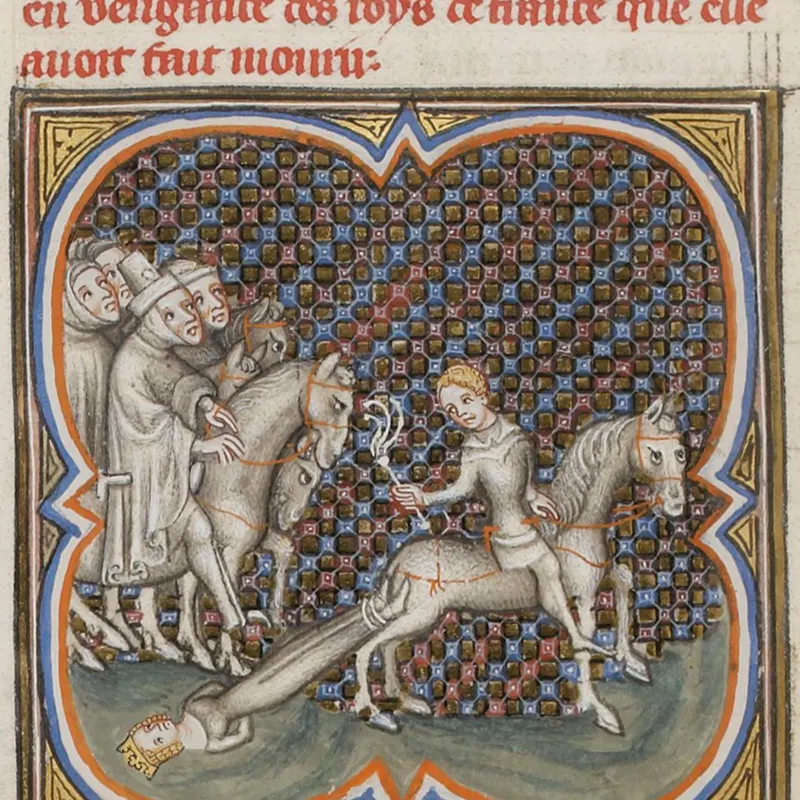
Right, because in the immediate aftermath of the murder of Brunhilde's sister, everyone tried to keep a lid on things. A third Merovingian brother, Guntram, the king of Burgundy, was brought in to try to cool tempers, and his mediation ended with Brunhilde inheriting her sister's significant dowry, making her immensely wealthy in the process. But the feud between Brunhilde and Fredegund was still well underway, and it would continue to escalate. The brothers had already fought wars against each other, and the feud between their wives added only more fuel to that fire. Brunhilde's husband Sigibert would be poisoned in 575, and then Fredegund had Childeric's ex-wife Audovera murdered in a monastery in 580. Childeric would be murdered in 584, and the feud would continue even past Fredegund's death by natural causes in 597, culminating in the capture of Brunhilde by Fredegund's son in 613. Brunhilde, who was now at least 70 years old, was tortured for many days, paraded around on camelback.
You know, we mentioned the camels that were around France back then, remember? And finally, she was drawn and quartered by horses. Just a horrible way to go. And, you know, we might have to come back to this story in a later episode, especially in the influence this would have on later Germanic mythology. Because, you know, you might know the name Brunhilde if you're familiar with German folklore or the Norse sagas. But suffice to say, it was indeed the time of bears and wolves foretold in Basina's prophecy a century earlier. For our purposes, a couple things are important to us and to Pirenne from this story. First, this violence resulted in an unprecedented level of strife within the Merovingian nobility. Everybody got their hands dirty to one degree or another, participating in this 50-year-long feud. It was a weakening of the center at the expense of the whims of the nobility.
Neustria versus Austrasia
But more importantly, there was a geographic component: Neustria, which is today northern France, versus Austrasia, which is more around the Low Countries in Western Germany. The former territory, Neustria, had been a part of the Roman world and depended heavily on commercial revenue. The latter had been mostly outside the control of Rome and wasn't nearly as dependent on trade. This meant that as the flow of trade was reduced to a trickle, Neustria declined significantly, but the much more agrarian Austrasia saw little change. Two different geographically distinct courts vied for supremacy over the Merovingian Frankish realm, and this rivalry would continue to grow across the 7th and 8th centuries until the Carolingians, rising from Austrasian networks of power, seized the throne for themselves.
Right, and as a quick aside on the historiography, this conflict is in the 19th century sometimes taken to mean a conflict between like Romance speakers and Germanic speakers, and basically a proxy for like France versus Germany, which would be a thing that continued to crop up. But it doesn't seem like this was necessarily a thing at the time. In fact, Pirenne, he denies that this was a national thing per se. It was just, you know, different bases of production.
The rise of the Pippinids
Right. Another consequence here is that the very families from which the later Carolingians would spring first rose to prominence during this Merovingian Civil War, because the line of Charlemagne is traced back to two men named Arnulf and Pippin the Elder, both of whom were prominent in the Austrasian court in the early 600s. These two participated in the rebellion that would see Brunhild deposed and murdered in 613. And in doing so, Pippin the Elder was able to rise up the ranks before finally becoming the mayor of the palace of the Kingdom of Austrasia in 623. Arnulf's son married Pippin's daughter, and this marriage produced another Pippin, Pippin of Herstal. Before we get to that Pippin, though, we should mention that the first Pippin had another son named Grimoald, who succeeded his father of mayor of the palace, serving from 643 until his death in the 650s. He became very close to Sigibert III, the first roi fainéant, and convinced him to adopt his own son as heir.
But shortly after this arrangement was made, Sigibert had a natural-born son, which put a wrench in Grimoald's schemes. With the death of Sigibert in 656, Grimoald had Sigibert's son, Dagobert, exiled and placed his own son, Childebert, on the throne. This was short-lived, as he would be executed by the king of Neustria the following year. Thus, the Pippinids' drive for power had deadly consequences from the time, but their immediate rise was averted.
Right, and so now we get to Pippin of Herstal, also known as Pepin the Middle, who lived from 635 to 714 thereabouts. And just so we're keeping track, this was Charlemagne's great-grandfather. He was the one who really made a name for the Pippinids. By this Pippin's time, the family had all but monopolized the position of mayor of the palace of Austrasia. By the end of Pippin's life, the position would be monopolized by them and their proxies in both Austrasia and Neustria, until the Carolingians decided to ditch the pretext altogether and seize the throne for themselves. But other factions of the nobility wouldn't sit idly by while this happened, and Pippin would come close to meeting his end several times.
Ebroin and the Battle of Tertry
Pirenne takes the conflict between Ebroin, who was the mayor of the palace of Neustria, and these early Pippinids to be emblematic of the battle between the crown and the nobility writ large. And this is actually an interesting question. Just we don't really have time to get into Ebroin super deeply, but the TLDR version is that he was this mayor of the palace of Neustria, who in the surviving sources is very much painted as a tyrant because he was, if sources are to be believed, trying to centralize power. Now, Pirenne takes this to be Ebroin trying to centralize power in the name of the crown so that the crown could actually rule. But when you look at what actually happened, that's actually not super clear. It might just be that Ebroin was trying to do a similar thing to the Pippinids, where he would be able to monopolize the position of king of the palace for his descendants.
But yeah, he wasn't liked at all. He levied taxes on people and he was just, you know, trying to keep the government up and running at a time when a lot of people didn't want that. And so because of that, he was assassinated in 630 and 680 or 683. And from then onwards, Neustria was basically a wet blanket. Austrasia would increasingly impose its will. And this would come to a head a couple of years later, and Pippin of Herstal would play a very direct role in it.
And just to keep a track on the Islamometer here, this is approximately the same time as Carthage would have fallen to the Arab conquests, which basically decisively ended trade in the Mediterranean for a while. According to Pirenne, the fate of the Merovingians was sealed in 687 at the Battle of Tertry. Since becoming mayor of the palace of Austrasia in 680, Pippin, this Pippin of Herstal, was driven from power and nearly killed before successfully rallying the nobility and making it clear that the king was to remain a king in name only. It would now be the inmates running the asylum as the crown was no longer able to marshal its resources to impose its will. At Tertry, a village in the region of Somme, Pippin's army had its showdown with the king's army led by Berchar, the Neustrian mayor. Details are scarce, but Pippin's forces won decisively, and Berchar was forced to vacate the office.
From this point on, the Neustrian mayor of the palace was always to be a Pippinid or his puppet. Pippin took the title Dux et Princeps Francorum, Duke and Prince of the Franks, and Austrasian interests were now ascendant throughout the Merovingian world. The Pippinids continued to rule from the shadows for another 60 years, but the true nature of power was clear. That was until 751, when another Pippin, Pippin the Short, sent a delegation to Rome to ask whether it was good or not that the kings of the Franks should wield no power, as was the case at the time. But to understand the Pope's answer, first we have to look at the two turbulent previous centuries of papal history.
Popes, exarchs, and Lombards
So let's go back to Justinian at the end of the 6th century, because while many aspects of Justinian's legacy, such as his legal code, would influence the developing medieval world, the great conquests that would be much of his life's work were almost immediately undone, as we saw just now in the conquest of Carthage by the Arabs. But long before the Arabs arrived, the Lombards swept into what was left of Italy after Justinian's wars and Justinian's plague. These guys, Germanic speakers hailing somewhere from the region of northern Germany and Scandinavia, established their own kingdom in the city of Pavia that had no interest in continuing Roman civilization, and this kingdom made no pretense of serving the Roman Empire the way the Ostrogoths had done. Although the Lombard kings had complete control over northern Italy, and some Lombard adventurers established their own domains in southern Italy, central Italy remained officially Byzantine territory.
But because they were now unable to reap the agricultural wealth of the Alpine foothills and Tuscany, this strip of Byzantine territory running from Rome to Ravenna was essentially an island in a barbarian sea. With the emperor far off in Constantinople, power in this Roman enclave had to be shared between a Byzantine official known as the Exarch and the city of Rome's bishop, a man who was increasingly known as the Pope.
Right, so the Pope in Rome and the Emperor in Constantinople would have a turbulent and exceptionally complicated relationship for centuries, which culminated in the mutual expulsion from the church by one another in the 11th century. But these Eastern and Western worlds of Christianity would drift apart at a glacial pace. But although this drift was very slow, it was not steady or peaceful. Instead, various spiritual and political crises would pit Eastern Christians against their brothers in the West. After years or decades of squabbling, the brothers would hug and make up, but they would never be as close as they had been before. The Lombard situation we just described left the Pope, like all residents of Italy's Byzantine island, completely dependent on the protection of the emperor. But the empire would never again be as strong as it had been during Justinian. By the end of the 6th century, the emperor began paying the distant Merovingian Franks to defend the cities of Rome and Ravenna, and even to invade Spain, which, after Justinian had done, also slipped back out of Roman control.
But just like the Western emperors we described in our previous episode centuries earlier, this reliance on barbarian allies would have consequences that the Byzantine rulers could not foresee.
And right, and it should be clear now that the rise of Islam changed everything in ways both direct and indirect, not only in the history of the Mediterranean, but in the history of really almost the entire old world. The Arabs were such a serious threat to the Byzantine Empire that many troops stationed in the Exarchate in Italy had to be withdrawn. The Lombards immediately took advantage of this power vacuum, expanding across all of northern Italy except the immediate environs of Ravenna and the city of Venice. It's actually in this moment of chaos that Venice really steps into history. We'll mention them again later on. The Byzantines could no longer even afford to pay the Merovingian Franks to protect their Italian holdings. This threw Ravenna and Rome into peril, stirring resentment among the locals and depriving the Merovingian kings of a major source of revenue needed for the upkeep of their Roman-style bureaucracy.
The ceaseless wars between Arabs and Byzantines across the 7th century meant that this would be nearly as chaotic as the 6th century and the 5th, leading to a long period of Muslim naval superiority across the Mediterranean world, which would have irreparable cultural and economic effects across the former Roman lands. While the Merovingians were safe from any direct threat of Muslim conquest, at least for now, the sudden drop in trade duty revenue was a shock to the system that would never be recovered. The entire monetary economy of the Frankish kingdom began to decline. Regions where the economic system of the Romans had been the strongest, such as southern and western France, again the territory of Neustria, these regions now found themselves poorer than their northern and eastern neighbors, like Austrasia. It's not a coincidence that the Carolingians, who would take the reins a century later, came from these backward regions that now found themselves comparatively richer than before.
Just like in Italy in the time of Justinian, cities across France shrank. As money left the cities, so did churches and churchmen. Towns across this region went without bishops until the rise of the Carolingians.
Right, and meanwhile in Italy, the sudden dominance of Arab navies across the Mediterranean meant that people in Rome began receiving less support and communication from the imperial overlords in Constantinople. The military official known as the exarch still ruled for the emperor, but this was typically much less popular than the pope. The pope, who in the 6th century had to be approved by the emperor, benefited in some ways from the situation. He could benefit from imperial legitimacy without having to worry about imperial oversight. Because the emperors were no longer able to offer much practical protection, they would instead bestow titles and honors that seemed meaningless, but which would have major implications for the development of Catholicism. Most importantly, the emperor declared that the bishop of Rome was, quote, the head of all the churches.
Pope Martin and the emperors
And the popes in Rome used this new clout to scrutinize the increasingly foreign religious practices of the East. Quibbling over the divine nature of Christ led Pope Martin I to declare the Emperor Constans II a heretic in 649, which was a very serious charge, especially in those days. And unsurprisingly, the emperor had this pope imprisoned for life. After his Gongli death in distant Crimea, Martin was hailed as a defender of the true faith, and he ultimately became venerated as a saint. In fact, he would be the last pope to be recognized as a martyr by the Catholic Church today.
He's also a martyr for the Orthodox Church, interestingly enough.
Oh, sorry, our bad.
Yeah, exactly.
Later popes would be wiser than Martin, however, because they generally stopped short of calling the emperor a heretic outright. They were, after all, still citizens of his empire, and he technically had to approve their appointment. But over time, this influence began to dwindle. In addition to these theological arguments, there was also a question of power and influence over the city of Rome itself. Technically, all Byzantine holdings in Italy were run by the exarch, who was based in Ravenna. Ravenna had at one point been the seat of the late Roman Empire. But the Pope ruled in the city of Rome, and he was the spiritual and really the political leader of the city. Popes were universally more popular than the exarch, and it probably matters that by the 8th century, nearly every pope was a local boy raised in the city, or at least somewhere in Italy.
The exarch was usually a foreign Greek, a court favorite from Constantinople. The typical unpopularity of the exarchs led to numerous mobs rising against them, often in the name of their beloved pope. In 692, when a second Justinian ordered his exarch to arrest the pope over yet another minor dispute, the city of Rome rose up to defend Pope Sergius from Justinian II and his hated exarch. What's more, military garrisons from the Italian countryside defected and rushed to the city in the pope's aid. Ultimately, instead of arresting the pope, an agent of the exarch was himself arrested by the pope. Sergius had to calm down the mob outside the city and let this man return home. Clearly, by the end of the 8th century, the influence of the Byzantine Empire on Italian politics was on the wane. But the empire had much greater concerns than Italy.
Justinian II's golden nose
The 7th century ended with Justinian II, the one who tried to arrest Pope Sergius, himself being arrested and overthrown. Infamously, Justinian had his nose sliced off to permanently mark him. Twenty years of chaos followed, in which time Justinian actually pulled off one of the greatest comebacks in medieval history, returning to Constantinople at the head of an army of steppe nomads and wearing a shiny new nose of gold. During his brief second reign, Justinian II tried unsuccessfully to restore direct influence over Italy by sacking his own city of Ravenna, and then cowed the Pope into visiting him in Constantinople. This was a meeting on such poor terms that it might be unsurprising this would be the last time any pope would visit Constantinople until the 1960s. But the people of Constantinople remembered that they actually didn't really like this guy Justinian, and in 711 he was overthrown by some rebellious troops.
Now that he no longer had a nose to cut off, they went for the head, which ended the strange and ignominious career of Justinian II, but also ushered in another era of instability, and Italy continued to drift further and further from imperial control. On the one hand, this new state of affairs pleased the Pope. It was now taken for granted that he and not the exarch would be the primary authority in the city of Rome. Pirenne explained that, quote, he was at once the civil and military head of a city, and that rather than shirking away from his connection to the empire, he embraced it because, quote, it greatly increased his authority since the emperor regarded him as the first personage in the church. In fact, with the emperor no longer able to easily send soldiers to maintain formal control over Italy, he relied on the pope more than ever, handing him new spiritual titles and duties which seemed meaningless at the time, but which would be very useful to popes in later centuries.
These duties allowed the popes to assert complete spiritual control over Western Christians. No other bishop dared to challenge him, especially outside Roman territory. This new base of support among the non-Roman Christians, among the descendants of those barbarian kings who came to power during the fall of Rome, would be the beginning of a new system of power that Pirenne identified as fundamental to medieval Western Europe. And this system would be solemnized by a shotgun wedding of the Pope and the Frankish king in 751.
Monophysitism and iconoclasm
By the 8th century, religious disputes would flare up around the concept of monophysitism, this very confusing and honestly somewhat trivial question about the nature of the divinity of Christ. At least one exarch would be killed by his own troops for having the wrong answer to this question. Generally, the popes tended to take a line pretty close to contemporary Catholicism as well as contemporary Orthodox Christianity, whereas emperors often took a more heterodox view, sometimes even denying that Christ had a human nature at all, that he was purely divine. But an even greater issue than monophysitism was emerging out east. Another heresy much potentially much more damaging to the fundamentals of Christianity. Pope Leo the Isaurian, who was born on the frontier of the Caliphate and was probably from an Arab Christian background, successfully defended the city of Constantinople from one of several Arab sieges by the use of Greek fire.
Pirenne considers this a Christian victory of far greater importance than the Battle of Tours under Charles Martel, which we'll get to shortly. So Leo the Isaurian ruled the empire at probably its lowest geographical extent, but he managed to reverse its century of decline with a series of major societal reforms. In this, he looks a bit like the first Justinian, or even an emperor like Constantine or Diocletian, even farther in the past, because he reshaped the system of taxation and military recruitment to meet the new challenges from their Eastern enemies and also make up for the loss of Syria and Egypt. He managed to restore Byzantine authority over regions overrun by Slavic and Bulgar barbarians, often giving these people lands out in the eastern frontier to shore up power against the caliphate. But his most controversial reform would be that of religion. Because in 726, the Emperor Leo inaugurated an age of iconoclasm when he ordered his servants to take down a famous image of Jesus Christ over the gate to the imperial palace.
Religious icons were so beloved in the empire that, as a result of this, the servants who took down the icon were lynched in the street by religious mobs. Undaunted by this violence, Leo moved to outlaw the worship and reproduction of icons across the entire empire, immediately leading to a violent uprising against Leo, which he had to put down using Greek fire, just like he'd used against the Arabs a decade before. We don't know what caused Emperor Leo to suddenly take this drastic religious turn, but some historians have speculated it could have had something to do with his Eastern origins. Leo would have grown up much more familiar with the doctrines of Islam than other Greeks of his era. He thought that perhaps God had rewarded these Muslims with such great conquests because they were doing something right. Obviously, it couldn't be anything really about their religious beliefs because he would have believed that, you know, Islam was fundamentally incorrect and Christianity was correct.
But maybe there was something in Muslim practice that God liked. Maybe it was the Muslim prohibition on physical depictions of God and his prophet. So we're not sure if Islamic theology was a direct influence on Leo's ideas or not, but he certainly saw the victories of the Muslims as a sign from God that Christians were doing something wrong. And this something wrong might have been the veneration of icons.
And just as a quick aside, it should be noted that at this point, Christian theologians didn't yet think that Islam was a separate religion. It was still treated as a heresy of Christianity.
Yeah.
So there was this idea that, like, okay, so maybe they're wrong on everything else, but on this one particular issue, they're right. And God is sending this scourge upon us so that we right our ways. So in this context, it sort of, you know, starts to make sense why someone would decide to suddenly just destroy centuries of religious art.
Right. But even if it made sense in the mind of this emperor, he would not see eye to eye with his subjects. For many Christians, who were probably the great majority of Christians in the empire, they thought that they were, you know, they were orthodox. They were doing everything correctly.
The papacy turns to the Franks
Pope Gregory II excommunicated the Emperor Leo, which caused imperial troops in Italy to once again murder their exarch. To even greater alarm to the emperor, Pope Gregory and his successors began making alliances with barbarian lords beyond the imperial borders. Initially, the Lombard adventurers in southern Italy, and then the much more powerful Franks. Pope Gregory II was succeeded by Pope Gregory III, who would in fact be the last pope formally approved by the Byzantine Emperor. Just like his predecessor, this Gregory upheld the excommunication of Emperor Leo, which caused the emperor to take away all privileges of the papacy and declare him just another bishop. This right here was one of the many breaks which led to the permanent split between the Latin and Greek Christianities. But even though the pope had lost his formal power within the empire, he became the spiritual head of the anti-iconoclastic movement and had great favor among Christians in the barbarian kingdoms as far away as England and Portugal.
This is why in 751 a delegation of clerics from the Merovingian kingdom of France showed up at the papal court. They were representing not the king, but a politician named Pippin the Short. This was the grandson of Pippin of Herstal, who we talked about earlier. And they were there to ask the Pope for his blessing to overthrow the Merovingian family and to make Pippin the king.
Charles Martel
Right, so Pippin the Short was a member of the Carolingian family, named after the great military leader Charles Martel, and his family was in fact the union of two great families of the preceding century, the Arnulfings and the Pippinids. Like we said earlier, these two families monopolized the internal functions of the Merovingian kingdom. And Pirenne says that, you know, by the time of Charles Martel, they were equivalent to the Japanese shoguns, this hereditary power behind the throne, a king behind the king. During a period of dynastic turmoil within the Carolingians, in which different branches of the family favored their own Merovingian puppet kings, Charles Martel emerged as a leader of the Eastern Frankish territory, Austrasia. He reunited the various Frankish territories and brought semi-independent lands like Aquitaine back into the fold. And just like his more famous grandson, Charles Martel led a campaign against the pagan Saxons, walling in the Frankish realm from this northeastern threat.
But his real fame would come from another threat, one to the south.
The Battle of Tours
Because at the same time that Charles Martel emerged as the leader of the Franks, the Umayyad Caliphate famously crossed over from North Africa to Iberia. They routed the Visigothic kingdom almost immediately, forcing the state that had once controlled the entire Iberian Peninsula all the way back to a strip of rocky northern territory along the Pyrenees and the Bay of Biscay. The Umayyads made the mistake of believing that if the Christians were all stuck along the coast, they would never really be a threat to Muslim ambitions in Spain, and instead set their eyes on the great riches of the European interior. Because less than a decade after invading Spain, which they called Al-Andalus, Muslim armies occupied almost the entire Mediterranean coast of Merovingian France, and even sent raiding parties to attack towns and monasteries throughout the interior of the country. Periodic sacks were reported across the 720s, and in 732, the Andalusian general Abd al-Rahman, a name that comes up repeatedly in Andalusian history, led an expedition all the way to the French city of Tours, quite far to the north.
And what happened next isn't quite clear. Just a lot of this stuff isn't, because we've lost so many sources, and this was a very minimally literate society to begin with. But as far as we know, Charles Martel was fortuitously returning from Saxony with a host of infantry who were fully mustered, battle-tested, and invigorated by a recent victory against the pagans. The Franks were probably outnumbered by the Andalusians, and they were mostly on foot rather than on horse, and yet they still managed to lose the battle to Charles' forces. This was a big enough victory to be welcomed throughout Christendom, especially among Christians living in the now Muslim Spain. But Arab sources did not see it as a major setback at all. They saw it as just a minor hiccup to the spread of Islam. The Mediterranean coast of France would remain in Muslim hands for another 27 years, and Muslim fortresses would exist on and off in France as late as the 10th century.
And so, entire books have been written on how important the Battle of Tours was for the subsequent history of Islam and Christianity. It's nearly as contentious of a topic as the fall of Rome. In practical terms, the battle was not decisive in halting the efforts of Muslims to pillage France and to not even conquer back the southern French coast from the Muslims. Medieval Arabic sources that downplay the battle may not only be trying to sidestep an embarrassing and unexpected defeat. But just like with Alaric's sack of Rome in the early 5th century, the moral and spiritual implications of this Frankish Catholic victory can't be ignored.
Tours and the far right
Externally, the Battle of Tours remains a politically charged topic, often embraced by the contemporary far-right, especially in France, as a model of both Muslim and Christian behavior. In this narrative, all contemporary Muslim Europeans are invaders, and Christians have a duty to oppose them, potentially with violent means. While this is a product of modern nationalism, the battle had polemical implications as soon as it was fought. 20 years afterward, a Spanish Christian account of the battle would be the very first citation of the word European to describe a group of people in contrast to non-Europeans. This is a really tricky topic, far beyond the scope of this episode, but I think there is a case to be made that conflicts between medieval Catholics and medieval Muslims are a proximate cause to the emergence of contemporary racial categories and following this, racial white supremacy. One of many reasons why this period is just so instrumental in understanding the medieval world that came after and then the world of modernity that came after that.
Yes, and just to highlight another irony of what's going on here, Charles Martel, he was, you know, very quickly sort of made into this great hero of Christendom, when in reality, this was a guy who didn't have a lot of respect for the church. He was constantly sacking churches in Gaul, which was something that people within the church hierarchy were very angry at him for continuously throughout his lifetime. But that somehow didn't make it into the myth of the, you know, the great warrior who stopped the Muslim invaders.
Right. I think returning to the immediate political implications, the early Middle Ages were a very dire time for Christianity, whether in the West or in the Byzantine East. And so the dominance and even the survival of Christianity had never been truly certain across this entire period. You had barbarian invasions, you had plagues, you had heresies, and now you had Islamic invasions that constantly threatened to upend the religious order at every turn. And so even if this specific battle was actually not of much strategic importance, its spiritual implications certainly were very important. Because now defending the cross, hammer in hand, was Charles Martel.
Pippin becomes king
And just like any savvy savior who comes in on a white horse, Charles made sure to use his political capital as best he could. Because after five more years of battling Muslims, Charles found himself holding even more power than before, because the latest do-nothing Merovingian king died without a successor. And Charles made no effort to find one. Instead, he titled himself Duke of the Franks during this period of interregnum. And Duke of the Franks, you know, sounds a little bit like King of the Franks. Charles Martel died in 741, but a decade later, his son Pippin decided that Duke was not good enough. And this brings us back again to 751. A Frankish delegation meets with the Pope, asking who should wear the crown, he who is called king or he who holds power. When the Pope decides to side with the mayors of the palace, Pepin the Short is able to end decades of kayfabe and finally proclaim himself king.
This ascension marks the emergence of the Carolingians as probably the most important royal dynasty in all of European history. But this will largely be due to the actions of his son, Charles the Great, known in French as Charlemagne. Pirenne writes, quote, With the Carolingians, Europe finally assumed a new orientation. Until their advent, Europe had continued to live the life of antiquity, but all the traditional conditions were overthrown by Islam. The Carolingians were to find themselves in a situation which was not of their own making, but having found it, they exploited it in such a way as to open up a new epoch.
Charlemagne
There is just so much that we could say about the legacy of Charlemagne. He is known in Latin as Carolus Magnus, Carl the Great. His name alone carried so much power that it became the word for king in Slavic languages. And in Scandinavia, the second part of his title became a given name, Magnus, which continues to remain popular from the Viking era all the way up until the present.
Yeah, I think that if you've listened to this many hours of this podcast his name.
Yeah, you're probably quite familiar with the figure. But in short, in case you're not, he united the various Frankish kingdoms across the 8th century, and he waged war in essentially every direction. His battles in Spain literally became the stuff of legend, and his campaigns to the north began the difficult, bloody process of introducing Christianity to the remaining Germanic pagans of the North Sea coast. But like all great rulers, Charlemagne was not just ambitious and capable, he was incredibly lucky. Because he carried out his great conquests of Western Europe, just as Pope Leo in Rome was embattled against supporters of the previous pope. The Franks had a long history of protecting popes from their neighboring Italian rivals, so it was only natural that Charlemagne, who had recently conquered much of Italy, should shelter the Pope. Quote, however great the respect which people might profess for the church and however great its influence, it did not constitute an integral part of the state.
The political power of the kings, like that of the emperors, was purely secular. No religious ceremony was celebrated on the accession of the kings, except in the case of the Visigothic kings from the end of the 7th century. There is no formula of devotion, Dei gratia, in their diplomas, Dei gratia being by the grace of God. None of their court functionaries were ecclesiastics. All their ministers and officials were laymen. This is Pirenne writing about the church in Merovingian times. And so, Pope Leo remained at Charlemagne's capital for several weeks, during which time Charlemagne convened a court that proclaimed Leo of all the charges which had been cobbled against him by his rivals in Rome.
Christmas Day, 800
And in the next month, on Christmas Day 800, Leo suddenly proclaimed Charlemagne the emperor of Rome. Medieval, early modern, and modern historians have often interpreted Charlemagne's coronation as the restoration of something Roman, the return of something truly imperial, the return of imperial rule to Europe after 300 years of anarchy. But Pirenne makes the radical point that Charlemagne's ascension was actually a divergence from the Roman tradition. This so-called imperial system was in fact the infancy of the medieval European kingdom, a system of law in which power was shared jointly between the kings, the nobility, and the church. By accepting the title of emperor from a pope, Charlemagne was subordinating himself to the pope, in contrast with the Byzantine emperors who traditionally saw the church leaders as officers under their authority. Without getting ahead of ourselves here, this kind of power-sharing agreement is going to be replicated on a lower level across Carolingian society and later medieval societies.
Later historians pay more attention to the relationship between the popes and the emperors in the East, but the new challenge of Islam caused the church in the East to change in ways that troubled the emperors in the West. Moreover, shortly before Charlemagne's coronation, the Empress Mother Irene of Athens became the sole ruler of the Eastern Roman Empire. This was the first and only time that a woman sat on the throne in Constantinople. Perhaps following the example of the male-dominated Frankish law, the possession of the imperial title by a woman would be a useful pretext to offer the title of emperor to somebody else. So, whatever the specific cause of this coronation, the ascension of Charlemagne to the emperorship would be sanctified by the special relationship between the Pope and Rome and the Frankish king. This relationship dates all the way back to the time of Clovis, as time and time again the Franks had intervened to defend Rome when the Byzantine emperor could not.
Now, by transferring the imperial crown from Constantinople to Charlemagne, any meaningful relationship between the Pope and Byzantium was severed. Western and Eastern Christianity would drift increasingly further apart, and the Byzantine temporal power over Italy was fading, not in the least because of a new wave of seaborne attacks by Arab Muslims, and a century later by the Vikings and Normans. Charlemagne's coronation was ultimately only a symbolic turn, but it still marks an enormously important point in the development of the ancient world as it transitioned into the medieval. Just like how the mayors of the palace took the title of king to reflect the realities of power in the ancient Merovingian kingdom, the recognition of Charlemagne as emperor only formalized the pre-existing relationship of Charlemagne to the Pope, as well as to his rivals in the other monarchies of Europe. Because Charlemagne was the uncontested ruler of Western Europe even before his coronation.
And as the protector of the Pope, it only made sense for the Frankish king to be crowned the new Roman Emperor as well. Because who is the Roman Emperor from the Pope's point of view, if not the Pope's protector?
The Carolingian economy
Yes, and in the later chapters of Pirenne's book, he explains how the new order under the Carolingians solidified the economic break with the older Roman economy, which was centered on the Mediterranean. In response to the massive decline in overseas trade, even trade over land began to trickle. Pirenne explains that professional merchants largely disappeared, being replaced instead by local peddlers who sold goods produced locally. There was still a demand for foreign luxury goods, but the only people wealthy enough to afford these goods were kings and aristocrats of the highest rank and their courtiers. During the Carolingian era, the court rather than the city appears to become the new center of economic activity. Due to the dominance of Muslim navies in the Mediterranean and the corresponding religious embargoes, long-distance trade became exclusively, or at least almost exclusively, the domain of Italian and Jewish merchants. The Carolingian era saw the rise of Venice, as well as smaller city-states like Portofino in the south of Italy, next to the now Muslim territories of Sicily.
These all made special deals with Muslim monarchs in exchange for safe passage. Jewish traders also had their own arrangements and routes, and were particularly relied upon for the sale of wine, including liturgical wine, into northern Europe, where grapes could not be grown. Jewish merchants such as the Radhanites traveled across Muslim, Christian, pagan, and even Buddhist lands in this era, venturing as far north as the Viking town of Hedeby and as far east as China.
Jewish merchants and moneylenders
Yeah, historians generally agree that the Carolingian era was a pretty good time to be Jewish, all things considered, especially in contrast with the anti-Semitic bloodshed of the 11th and 12th centuries and the mass expulsions of the 13th and 14th centuries. Jewish scholars and translators were essential intermediaries in dealing with Muslim states, and certain Jewish merchants and rabbis were greatly esteemed. For a brief period, some Jewish people were able to own large amounts of land in southern France, and the success of some Jewish merchants and landowners in the Carolingian period likely led to the rise of Jewish people as moneylenders, thanks to a religious loophole in both Christianity and Judaism that banned usury, except in the case of lending to those of a different faith. Although individual moneylenders benefited from this arrangement, the Jewish religion at large would be associated with trade and condemned by peasants and princes alike who thought that only wealth associated with agriculture was legitimate.
This system also left entire Jewish communities reliant on the protection of local lords and kings. When religious relations got worse, especially with the start of the First Crusade, all Jewish people found themselves in a much more precarious situation, a situation which, in a heartbeat, could lead to the slaughter the likes of which had not been seen in centuries.
Clergy and literacy
Another major shift in the Carolingian era was the rise of the clergy in all aspects of life, largely for the simple reason that nobody else could read. Unlike the Romanized kings of centuries prior, who loved quoting Ovid, or the later high medieval kings who couldn't stop sharing stories of King Arthur, Carolingian monarchs were generally illiterate. Schooling had collapsed, and even the wealthiest royalty saw formal education as an afterthought. Impressive scholarship continued in the courts and the monasteries, but really only by priests, monks, and the occasional nun. There were no universities in this era, only primitive cathedral schools. There were a tiny handful of lay writers, most famously Charlemagne's fawning biographer Einhard. But these people were likely seen as oddities, living and working in clerical circles. Einhard, for instance, seems to have been vaguely embarrassed to be a regular guy with a wife and a family, because in his later years, he adopted a vow of celibacy despite being married.
Thanks to their literacy, churchmen were used everywhere in the Carolingian period, not just as missionaries and spiritual guides, but also as diplomats, historians, everyday scribes, spies, and even mail carriers. Churches began to amass great landholdings in this period, with bishops and abbots serving as lords over local farming communities. The economy in general was increasingly manorial, following that Austrasian model we described earlier. Remember, that's where the Carolingians came from.
From gold to silver
And one final interesting break from Rome, which is very important to Pirenne's entire argument, is that the increasing dominance of agriculture under the Carolingians saw gold coins fall out of usage. Pippin the Short and his son Charlemagne transitioned to minting coins entirely out of silver, and these coins were typically minted at local workshops near towns where trade occurred. Trade in general was quite primitive, far less developed than it had been a century prior. While foreign merchants imported luxury goods like wine, agricultural products like flour and wool were handled by small-time peddlers who may have also been farmers themselves most of the year. These peddlers were most prominent along the Rhine River, in the half-pagan lands of the Frisian Netherlands, and especially in Henri Pirenne's native land of Belgium. The shift from gold coins to silver might not seem particularly dramatic, but it's a great mark of one world transitioning to another.
Gold was no longer useful because there was no gold to be minted within the Frankish Empire, and it had become impossible to import enough foreign gold to sustain the economy. Additionally, because the value of these coins was not in fiat, but instead from the worth of the metal itself, it didn't really make much sense to use such a precious metal anymore. Because the goods being bought and sold were so cheap and meager that using gold was not really practical.
Right, but to draw out the actual implications here, because it actually took me a while to understand what the problem here is, it's not just that, like, you're dealing with physical currency, you're dealing with actual, you know, coins or bars of gold or silver or whatever you were using. And so, like, it might not seem like a big deal. Why can't they do these kinds of transactions with silver instead? Until you realize that the volume of silver that you would have needed to actually do these kinds of major transactions was just so much larger that it would have been a major inconvenience to haul all of that around. Whereas, like, gold, because it's so many times more valuable than silver as a result of its relative scarcity compared to silver, it means that you're able to buy and sell much more for a smaller quantity of physical stuff.
So, like, you can actually put it in your pocket, for example.
You know, right. And so, Pirenne argued, you know, the rise of silver itself reflects a weaker economy. It suggests this massive deflation.
Right.
And so, and so slowly but surely, this agrarian silver-based economy of the Carolingian Empire grew into something more permanent and more sophisticated. The trade in animal products, especially wool, would unite the nascent trade towns of Western Europe from England into the Low Countries through to the Rhine and down to Italy. This new economy would be the economic powerhouse of another wave of Italian city-states, who would give us the genius of Dante and Boccaccio and the cunning of the Medici, and from here the development of mercantile capitalism in the Low Countries and England. Thus, the silver-based system of the Carolingians was the first crude seed of a European forest that would spread as an invasive species into all corners of the globe.
Muhammad and Charlemagne
Right, and so for all of these reasons, Pirenne believed that Charlemagne's contemporary admirers and later generations of historians and agilators were wrong. Charlemagne was not, in fact, the restorer of any kind of Roman world. Instead, when the King of Franks was proclaimed Emperor of the Romans, he was really shrugging off the last vestiges of a decaying Mediterranean Roman economy and bureaucracy. What Charlemagne would do was hammer together a clumsy but effective system based around local landed wealth and the influence of individual warrior princes and powerful bishops. This system of agrarian power, shared between temporal and spiritual leaders, would essentially be the medieval system. This was nothing like the system of Rome, and it left so much to be desired. But this new order would dominate Western Europe for centuries and be directly ancestral to the economic and political systems that all people live with today. And none of this would have happened if not for the emergence of Islam 150 years before Charlemagne, upending the late Roman Mediterranean and thus impelling three new worlds, the Arab, the Greek, and the Latin, to establish new systems and new cultural identities that have survived up to the present.
And this is why I think that per Pirenne, it was Muhammad and Charlemagne who truly oversaw the demolition of the Roman world and the birth of something new.
Well said.
Critiques of Pirenne
Yeah, and so, you know, so that's basically Pirenne. You know, it took us two episodes and over a month to do, but yeah, it's a really interesting argument here. It's an argument that I gotta say I am quite sympathetic to, but we do need to mention before I wrap this up that it is also an argument that has come under quite a lot of fire for many different directions in the century since. But I think that just as a rule, when people are arguing against Pirenne, they tend to be missing the forest for the trees, because there are many problems with Pirenne's research. You know, it's actually a somewhat short book, but every page is just full of very interesting arguments that might not necessarily be supported by the kinds of research and data that would be expected today. There are many things that I'm sure Pirenne was completely wrong about, but I think it's a question of, you know, the letter versus the spirit.
Just to wrap up, I'm just kind of curious: what do you think, Sam, might be some of the problems you've noticed with Pirenne? Because he argues so much that there's really, you know, there's no way everything is right. Even though I'm pretty fond of his argument, there's a few issues I have, but you want to start off?
Yeah, well, I'd say that the biggest one is that he portrays the Arab conquests as being like the moment that changed everything, period. When in this episode, I think we've made it exceedingly clear that this was the Arab conquest certainly didn't help and they accelerated the decline of what remained of the Roman world. But all these processes were already in place. Plague had already killed half of the population before the Arabs even finished conquering the area around the Mediterranean.
Right. In addition to that, I think we talked about in the first half of this episode that the earlier plagues, the, I guess was it, the Antonine plague way before Justinian, that also had such a huge impact that during the crisis of the third century, you saw this decline in the middle of the year. Thank you. A decline in trade output that would never be recovered. Like, you know, like there was a much sharper decline in living standards from the third century to the fifth century than there was from the fifth century to the seventh.
Yeah, yeah, exactly. And another thing I find kind of annoying that Pirenne does is he's constantly talking about how, you know, oh, trade continued. There was long distance trade. Papyrus and spices and all that stuff continued to be traded. And that's very much true. And in fact, some of the pushback against Pirenne has been against his argument that there was pretty much a total cessation of the spice trade, for example, which wasn't really true. It still continued to some extent. But also, like, it's not a question of absolutes. It's really a question of volume. And to me, just given the body of evidence, it's indisputable that the volume of trade across the board just totally declined. And just because these goods were available, even if they were available to fewer people, doesn't mean that there wasn't a precipitous decline that would have been felt across the social ladder.
Right. And I know that some historians kind of argue that he minimizes the impact of land-based trade, especially in the Carolingian period. But I think that he's generally kind of got the right idea. One argument I've seen is that we don't know for sure that papyrus stopped being used in the West because of the Islamic conquests. It could have been that papyrus was no longer imported because the rise of wool production meant that vellum, sheepskin, had now become cheaper than foreign papyrus. And I think that's possible, but if that is the case, you'd expect to still see some papyrus in usage in the West. Instead, as far as I know, papyrus is only used in Italy, especially in Sicily after the Norman conquest, where it was still being produced. And otherwise, it really does seem to disappear.
Yeah, and I also don't really buy the idea that people just found vellum much more practical to use, which like on one hand, it's great from a durability perspective. But on the other hand, like you need so many sheep hides to actually build, to make even a single sheet of paper. Whereas papyrus is just, you know, it's basically you grow a bunch of plants, you cut them down, and then you pulp it and you get sheets of papyrus paper.
Right, no, that's just a matter of fact. An entire herd of sheep had to be slaughtered to produce one single book, I think is really hard for us to comprehend.
I just remembered another criticism of Pirenne. Apparently, like he underplays the Northern Sea trade massively, which, to be fair to him, the research on this wasn't done until like after the Second World War. So he just didn't live long enough to see it. But he does also suggest at the same time that we don't really know much about this. Someone should check it out.
Yeah, no, and for reference, the North Sea trade was so vibrant in the Merovingian period that Scandinavian historians generally refer to the 6th and 7th centuries as the Merovingian period of Denmark and Norway, even though the Merovingian kings didn't rule anywhere near there. There was just this very strong influence of Mediterranean activity. We see, we mentioned back in our Viking episodes how French wine was widely consumed in Viking era Scandinavia and even pre-Viking Scandinavia. And at least some of this wine, interestingly, would have been imported all the way up into Scandinavia by Jewish merchants. And at least one Jewish merchant gives us one of our best descriptions of the Viking trade town of Hedeby.
Yeah, so I think that's it for like the major arguments against Pirenne.
Yeah, well, I guess it's again, it's that Pirenne's argument was so revolutionary at the time. We focused a lot, especially in our first episode about this, on what was so new, on the idea that the Middle Ages was not this, you know, period of supreme darkness inaugurated by the fall of Rome. Instead, that the kingdoms immediately following Rome, the earliest medieval kingdoms, really were hanging on to something recognizably and meaningfully Roman. And it was later problems largely outside their control, and predominantly the rise of Islam, which meant the Roman world was no longer tenable. And I think that this is largely correct. I think it's true that the fall of Rome happened much more slowly than any of us want to give it credit for. And I think this kind of implicates the many, many political exploitations of the fall of Rome. Because if this is a process that took 400 years to occur, not 40, it's much harder to identify any kind of contemporary political causes.
And, you know, since the time of Gibbon, and I'm sure before Gibbon, people have loved to compare the fall of Rome to politics in the present day. And I just don't really think that's something you can do. I think that it's a world that's simply too foreign. And I think that what I really find so interesting about Pirenne and this whole period in general is the ways in which this Roman world, which gives us quite a lot that we utilize today, but is so fundamentally foreign, began to shift into something that slowly, increasingly looks more like the world of today. And I think that this is really why understanding the Carolingian period is so important, because this, much more so than the Roman Empire, this period lays the direct foundations for the systems of power that we currently live under, just in ways that have, you know, morphed very strangely from their inception.
No escape from Rome
Yeah, yeah, absolutely. In some ways, there's no escape from Rome. We're still living yet. Oh, yeah, just a thought that I had. Like, I was reading a book in preparation for this, and someone made the note that partly that the reticence to stop, to not act like anything had changed, had to do with the fact that these people were, you know, they were very biblically minded, even if they were secular rulers. So the idea was like, oh, you know, the book of Daniel, it talks about how Rome will still be around when the apocalypse comes, which means, yeah, which means, of course, that Rome must still be around if, you know, if the Antichrist isn't here yet. So therefore, like, I mean, Rome is eternal in that sense. I guess we're just not getting away from it until this Antichrist finally shows up. Or maybe he doesn't, and we just live in Rome forever. Who knows?
We can't just fall out of a coconut tree. We exist in the context of all that came before us.
That's it. And you know what? Yeah.
And I think on that note, that's a great way to end it. This has been our exploration of the works of Henri Pirenne, a historian who I think is just so interesting in understanding not only the medieval world, but our conception of it. I think that, you know, traditional understandings of the medieval world, and especially its birth in the fall of Rome, are shaped incredibly strongly by the biases of Renaissance 18th and 19th century historians. I think that Henri Pirenne, for his faults, did an admirable job of looking through those biases to see how our own world came to be. And for that, I think he deserves a lot of credit, and it is very much worth reading his books.
I really had a good time with this.
All right, well, thank you, Sam. I know this has been a long time coming, and I hope our audience enjoys. Bye-bye.
The show is also on Apple Podcasts, Overcast, Pocket Casts, Podcast Addict, YouTube, RSS and Patreon.