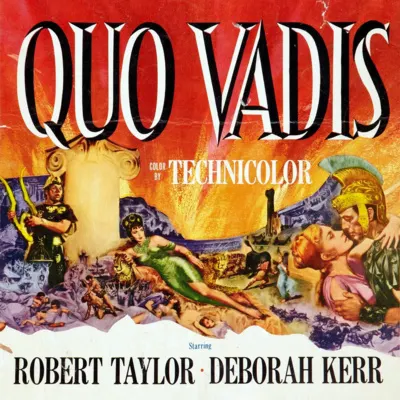
We’re putting the Christ back in Saturnalia this week with an episode on Christianity in the 1st century AD. Maggie guides us through the history of the early church with the help of the 1951 Hollywood epic Quo Vadis, and explains why these ancient religious communities are so significant to Christians today.
Hosted by Liam, Russian Sam, Halal Sam, and Maggie.
Transcript
Welcome, Maggie
And we're back with another episode of Gladio Free Europe. I'm Liam, and I am joined today by Russian Sam.
Hello.
Halal Sam.
Hello.
And a very special guest, Maggie.
Hi, my name's Maggie.
You are one of the oldest and best fans of our podcast. You're also a really fun, really interesting person who knows a lot about the topic we're going to get into today. So we thought you'd be perfect for this discussion of Quo Vadis, the 1951 movie going into the earliest history of Christianity in the Roman Empire.
Yeah, I really hope so. I was raised in Texas and I attended the First United Methodist Church of Arlington where I was trained in the Wesleyan arts, mostly actually by my father, who taught my confirmation class with a sort of unerring precision and attention to liturgy and detail and history. So I do, I have a very particular perspective. It's mainly American Protestantism, but I, boy howdy, do I know it well.
And that's perfect because this movie is a Christian movie in a lot of respects. It's about Christianity in the Roman Empire, but I think it's most interesting because of what it says about the way that modern Christians, in particular 20th century American Protestants, thought about the earliest Christian past.
Yeah, absolutely. There's a way in which Christians really do always feel connected to that earliest part of Christianity, and it shows through in all kinds of different ways at all kinds of different times and nowhere more particular than right here.
First impressions
This is a pretty fun movie. Just saying this out right, I liked it. I think that a lot of these classic Hollywood sword and sandal epics are a little bit dry, but this one has a little bit more, I guess, humanity to it. The characters feel a little bit more real than in some of them, and the story's pretty exciting. It's definitely long, but I'm a fan.
Yeah, it's almost three hours long. It's very hard to believe that there was a point when the American attention span could actually grasp that.
Yeah, and no superheroes.
Well, Jesus is a superhero, so. There were plenty of capes, though.
That's true. There were a lot of capes. Yeah.
God, the costumes were really cool. Very gay, very fun. The sets are magnificent. Like, you're not going to see any of this stuff in today's Hollywood, unfortunately.
Oh, yeah, no, no, it's, yeah, if it was, they're probably going to make a remake of this the next five, ten years, and it's going to be totally green screened. They'll get some TikTok star to play Lygia. Yeah, no. Yeah, there was a remake of Ben-Hur and like five years ago that totally tanked because they did that. Yeah, yeah, so yeah.
So, and so in particular, the sword and sandal epic we're looking at today is Quo Vadis 1951.
Sorry, Liam, that's actually Quo Wadis, if you want to have your Latin correct.
Oh man, I'll get a, I'm getting crucified over here.
Yeah, the was sounds kind of undignified on screen.
Weni, widi, wiki.
Yeah, it doesn't have the same ring to it.
The book and the film
And I guess it's good you point that out because part of what made this movie supposedly unique at the time was it was considered to be especially historically faithful. I don't think that's actually true, but that was a big effort on the part of the filmmakers to promote this movie. It was shot in Rome with mostly Roman extras. And in addition, the book that it was based on, the 1896 Quo Vadis or Quo Wadis by the Polish author Henryk Sienkiewicz.
Sienkiewicz.
Thank you, Sienkiewicz. I am all over the place today with my pronunciations. It was known for being especially historically faithful. It tells the story of a Roman centurion who falls in love with a Christian slave or hostage who eventually falls in with the early Roman Christian community. Then they get tied up in the high politics of Nero's court. The fire of Rome happens, but Christianity at the end prevails. It's not a super original story. There's a lot of other sword and sandal Christian epics kind of like this, but I think it's a little more human and a little more professionally or at least artistically produced than some other epics from the 30s, 40s, and 50s. What are the rest of you think?
Are we fans?
Are you fans? You liked Quo Vadis?
Quo Vadis?
I thought it was great.
Yeah, yeah, I'm a fan. Kind of schlocky at times, a lot of romance, but we have to keep in mind that this was the 50s at a time when housewives could expect to get maybe one example of physical intimacy per year, so they really had to pack it on there, you know? I think there, I believe there are four different romance plots in this movie. Some of them more interesting than others.
I thought it was really interesting. I thought some of the performances were just absolutely fantastic. And one thing in particular that I noticed was the length of the shots was just incredible at times. The amount of choreography that had to go into it, the amount of just unbroken eye contact was just absolutely incredible and not something that you'd see in a modern movie. It was a nice touch.
I think movies just used to be better than they are now.
Yeah, it definitely has more of kind of a bedroom drama sensibility than this kind of epic would be today.
Yeah, it balances the state and the personal, the public and the inner life really effectively.
Yeah. And that's why I think this is a lot more effective than other epics, because it really does give you a great look into the inner worlds of the main characters.
Petronius and Nero
Especially the character I find most interesting is not the protagonist Marcus, but his uncle, Petronius, the sympathetic pagan working in Nero's court, who sort of puts the whole plot into motion.
Oh, I just gotta say, I am in love with Nero in this movie. He is very campy. He's.
Yes.
Oh, he's so fun. He's just a total theater kid. I loved it.
Yeah, we'll get into him later.
Yeah, Peter Ustinov, as Nero, really kills it.
Yeah, he's having the time of his life wearing the most comfortable and sumptuous cloaks and capes I've ever seen in my life.
He couldn't stop looking through the green glass.
He's got to look through his green glass.
Oh, yes, the sapphire lens.
Yeah.
I remember, actually, I saw this movie for the first time as a kid, and that little scene was one of the things that stuck out most.
Judaism in the first century
So, yeah, so Russian Sam, you know the most about this of any of us. Can you tell us what is going on with Christianity and with Judaism at the dawn, or at least the middle of the first century common era? What does Christianity look like, and what does Judaism look like?
So, first of all, we have to talk about what Judaism looked like in Jesus' time and the transition that Judaism underwent. And not any kind of transition from Judaism to Christianity, but a transition from ancient Judaism to a Judaism more similar to what you'd see in a synagogue today.
Something recognizable to a modern Jew.
Yeah, as many of you no doubt know, in the year 70 CE, the second temple was razed to the ground by the Romans as a result of a revolt.
Right, that's after the Jewish War.
Yes, exactly. And up until that point, the temple was really the focal point of Judaism. It was where you would go to get cleansed of your sins, to do sacrifices. So, Temple Judaism, it's very much focused on this one particular site.
The physical location, right, right, right, yeah. Both of the Sams, you know a lot more about Jewish theology than I do. Do you think this is part of the destruction of the temple? Is that part of why Jerusalem as a place and as an idea comes up so often, from what I understand, in modern Jewish worship?
Well, Jerusalem was always a central part, really. Well, I mean, not always, but since the kingdom of Judea for sure, that's when the temple allegedly really became the focal point of worship, although there were still outliers, but after the Babylonian exile and the Jews were allowed to return to Canaan, Palestine, Israel, whatever you want to call it, with the reign of Cyrus the Great, that's when you have a Judaism that's closer to what we would recognize today, something that's actually monotheistic. As opposed to an earlier, more kind of traditionally Babylonian, resembling polytheism.
So, just for the timeline here, so you'd say that around 500 BC-ish, you start seeing the beginnings of a temple Judaism that's somewhat recognizable to modern Judaism, but then around 70 CE, you start seeing a different kind of Judaism take shape. Is that right?
I mean, 70 CE is sort of the turning point, but a lot of the...
These were trends that were already starting.
Yes, exactly. So the main thing being rabbis, for example, they seem to have been around for some time. It's hard to say for how long. They're constantly mentioned in the New Testament literature. But it wasn't really a formal designation. It was more of a, you know, just like teachers.
Uh-huh. Yeah, I noticed that in the movie, in Quo Vadis, Paul describes himself as a rabbi.
Yeah, actually, when I was growing up, if whenever there's a bit in the New Testament when I believe Mary Magdalene encounters Jesus after he's died and she sees him resurrected for the first time, she says rabbi, and we always had that translated as teacher for us in church.
Yeah, so again, rabbi only really starts to take on a more serious theological connotation after the destruction of the temple when suddenly you can no longer practice Judaism as it had been practiced before because there's no longer a temple. So it was really a choice between a reformation of the religion or death. And since we have Judaism today, you can tell that it was the path of reformation that really took hold.
Rabbinic Judaism and the Talmud
Yeah.
So rabbinic Judaism is much more of a text-based religion. And that's not just the Tanakh, the Bible, but you also really need to understand the Talmud if you want to get serious about it. Hasidic Jews have this saying that basically says that the Bible is for children and that you're supposed to really get a grip on the Talmud to really call yourself an educated Jew.
Oh, for God's sake.
So the Talmud, it consists of the Mishnah, the so-called oral Torah, which was not really compiled until the early third century. But there had been some efforts to compile this oral Torah before the temple was actually destroyed because at a certain point, if you don't have it down in writing, then it might get corrupted over time. So we better get on this.
And I guess we should mention that the Talmud is often called the Babylonian Talmud because it really cohered not in the Roman Empire, where many Jews had previously lived, but in Babylon, which was part of the Persian Empire.
Yeah, there's also a Jerusalem Talmud, which is sort of an earlier redaction. The Babylonian Talmud is later, and that's the one that became the authoritative edition. But yeah, the second component of the Talmud is the Gemara, which is basically a commentary on the Mishnah. And the Babylonian Talmud was completed around the sixth century.
In Persia. Not in modern-day Iran, but in Iraq, which was controlled by Persia.
Essenes, Pharisees, and Sadducees
Even keeping this in mind, Judaism really was not a monolith at all. The New Testament and the contemporary Greco-Roman sources speak of three main strains of Judaism. These were the Essenes, the Pharisees, and the Sadducees.
The Pharisees, of course, make a big appearance in the New Testament.
Yeah, so the Essenes, they were sort of these ascetic mystics. If you guys have heard about the Dead Sea Scrolls, this was the sect that wrote those texts down. I have an extract here from Pliny the Elder's Natural History where he talks about the Essenes. On the west side of the Dead Sea, but out of range of the noxious exhalations of the coast, is the solitary tribe of the Essenes, which is remarkable beyond all other tribes in the whole world as it has no women and has renounced all sexual desire, has no money, and has only palm trees for company. Day by day, the throng of refugees is recruited to an equal number by numerous successions of persons tired of life and driven thither by the waves of fortune to adopt their manners. Thus, through thousands of ages, incredible to relate, a race in which no one is born lives on forever.
So prolific for their advantage is other men's weariness of life. Yeah, so they were having fun in the desert, total sausage party, just reading texts all day and calling everyone else a heretic.
It's funny how close this seems to, you know, Christian monasticism. It's pretty funny. I didn't realize this might be kind of part of the origin of that.
So beyond the Essenes, what were the other Jewish sects at this time?
So the next guys were the Pharisees.
Those are the ones that we, yeah, that everyone knows.
Yeah, they basically became the foundation of Post-Temple Judaism. They were popular with the common people. Like, they had arisen from the Maccabean revolt because basically the official priestly class was too Hellenized for these people's likings.
Too assimilated into Greek and Roman culture.
Yeah, and so they just tried to do their own thing for a while. And as I said, they became the foundation of post-temple Judaism. Although that's also kind of oversimplifying it a bit, but it'll have to do for now.
I get the impression that in a lot of Christian sources, Maggie probably can come in here, the Pharisees get kind of a bad rep because they're seen as the establishment basically that Jesus was rebelling against.
Yeah, he was, they persecuted him. They always were asking him questions in the street, and he used them as examples of things you shouldn't do. There's a particular instance in which he warns you against praying on the street as the Pharisees do. Pray in your house instead, alone where no one can hear you, because those are the purest prayers rather than these public prayers that the Pharisees were doing.
So would you say that Jesus was a facts and logic guy?
I would say that Jesus did not care about your feelings one bit, indeed.
Yeah, and finally, you had the Sadducees who were really the establishment. They were basically the priestly class. They rejected the oral Torah.
This is in the Temple period before the Pharisees took over.
Yeah, exactly. Once the Temple was demolished, it was pretty obvious that these guys didn't have a future.
Uh-huh. Oh, because yeah, because there's no temple, so there's no need for any temple priests.
And of course, these are just like bird's eye view delineations. First century Judea would have been teeming with tons of prophets who were analogous to Jesus. And it's also likely that there were a bunch of folk Jewish practices which would have differed from like the official stuff because that's always how this works. And also, and Josephus, who was the other major source for this period, also talks about the so-called zealots, or the Sicarii.
Right, that's where, yeah, where Sicario comes from.
Oh, that's where that word comes from. I never realized that. That's so cool.
Yeah, but as far as I understand it, like these, this might not have been a separate sect per se, but rather just the people who were clamoring to overthrow Roman rule.
Like the revolutionaries, quote unquote.
Prophets and prefiguration
But yeah, but going back to prophets, just look at John the Baptist, who really prefigured Jesus in a lot of ways.
He was Jesus' cousin. And that's such an interesting part of the Bible, the fact that even though Jesus is, you know, the Son of God, he's the Messiah, he still has a figure who comes before him, who, you know, who baptizes him, which is a really kind of interesting touch that seems to speak to a broader theological spiritual world of first century Judea.
Yeah, and I mean, the Christians even now see a lot of the one big strain in Christian theology is the idea that the New Testament is really just a fulfillment of the Old Testament. So these thing called prefiguration, these concepts that we have now exist in other forms. Jesus is but another Adam who also has a form and say Isaiah or Moses or Abraham, any of these kinds of patriarchs all exist in the same kind of line.
Yeah, and of course a major strain of Christian apologetics was basically scouring through the Old Testament and looking for verses which hint at Jesus' coming.
Exactly. The book of Isaiah is pointed to a lot in that respect.
Why December 25th?
So on the subject of Jesus, quick question. Why is December 25th, just a few days from now, traditionally seen as his birthday?
I was always taught that it was a means of conversion in the early church, that they switched these Christian holidays. That I think the historic texts say that Jesus was probably born around March, but in order to convert people, they switched the Christian holidays over to the more pagan schedule because Christmas, December 25th, currently, I think it falls somewhere around the winter solstice.
As far as I understand it, an aspect of Christian theology is that prophets are born and die or are conceived and die on the same day.
Prophets were conceived on the same day that they died, so to be conceived on March 25th would also be born on December 25th, because that's nine months later.
But of course, there's also, as you touched on, Maggie, with the conversion line, there is sort of another theological stream here that made December 25th a convenient day for the birth of Jesus. Or at least a practical one, if not a necessarily theological one.
Right. And that's because it was also associated with another divine figure at this time.
Yeah, you can celebrate your holidays. We're just going to call them something different. They're at the same time.
It's often said that the church co-opted Saturnalia, which was a holiday that was celebrated on various times, but...
In worship of Saturn, the god of war.
No, no, no, no. Sol Invictus, actually. The god of the sun. And he was the guy whom Constantine believed to be the top god before he went to Jesus, which is why with Constantine, you get a lot of very solar imagery around Jesus because he was coming at this from a sun cult.
Oh, okay.
It's often said that the church basically co-opted Saturnalia because this was something that people were celebrating and they were trying to, you know, say, how do you do, fellow kids? But it seems far more likely that Christians were already celebrating a Saturnalia and conflating it with Jesus' birthday because it's the winter solstice. It's symbolically important in the first place. And also, it's just time to have fun and enjoy yourself. So, basically, what more modern scholarship seems to say is that first the Christians started celebrating this holiday because this was their culture and something that they were used to. And then later, the church sort of accepted it rather than it being imposed from the top because bishops didn't really have that much power until Christianity would have been institutionalized with the reign of Constantine and after.
Jesus's family
Right, so back to Jesus himself. You guys know the basic story: he was born in a manger in Bethlehem and as Joseph and Mary and Mary, Joseph being his Mary's husband, who was kind of Jesus' father, but kind of not for theological reasons.
They didn't fuck.
They did not fuck.
They did not fuck.
It's very important that you note this. This is Mary was a virgin. She never had sex. It's very and very important.
However, fun fact: if you ever hear of someone refer to the Immaculate Conception, it doesn't refer to the conception of Jesus. It actually refers to Mary's conception.
Yes, because to be a vessel for God, she had to be born without sin.
And also, Joseph has to be counted as Jesus' father, even though Jesus isn't his biological son, because the Old Testament prophecies about the Messiah say that he's going to be from Nazareth and he's going to be from the Davidic line, so a descendant of King David, which Joseph was. So in this way, Christians were able to point to this and be like, see, that's our guy.
Yeah, and you can see that actually because in the book of Luke, Luke starts out his gospel by listing the entire genealogy of the whole thing.
Right, all the way up from Adam.
Yeah, so-and-so was begat by so-and-so, who was begat by so-and-so, begat so-and-so, begat so-and-so. Now we're here.
Yeah, so Jesus was raised in this household with his parents and a bunch of siblings. So, yes, yes, Jesus sees born, he starts preaching. He has a brother who becomes this revolutionary in China 2,000 years later, and he also starts collecting these apostles. And two of these apostles are probably the most famous in popular culture and are very important to this movie, Quo Vadis.
Jesus's career
Yeah, but first, Maggie, could you please give us a rundown of Jesus' career?
Well, a lot of stuff happened in not a whole lot of time. One thing that is interesting is that when he was a young child, he actually stayed behind at the temple and was asking questions of the priests or the rabbis. He was some kind of little child prodigy, and his mom thought his dad had him, and his dad thought his mom had him. It's a real sitcom situation. But basically, he starts kind of running around the Sea of Galilee, finding these people, saying he's going to make them fishers of men instead of fishers of fish, which is how you get Saint Peter. But actually, one of the more important saints in this movie is St. Paul. And St. Paul is actually a guy who comes a lot later. I'm sure you're going to get into that. But he has a vision of and is struck blind and changes his name from Saul to Paul.
And he's going to be a whole new guy. But yeah, Jesus is running around, kind of doing some heterodox preaching, offending a lot of people by telling them that they need to rearrange their whole system and do all of this. And a lot of this comes out of the idea that he is the fulfillment of a Jewish prophecy that there will be a Messiah. And guess what? He's that guy. So not only is he doing heterodox preaching, he's purporting to be a new God that will entirely upend the system by which they currently live their lives.
I mean, is Jesus calling himself a God, though?
Well, he's the Son of God, is the whole thing. He's the word made flesh. And I think that actually comes from John.
Yeah, but I've always had the impression that Jesus wasn't calling himself a God, but rather he was someone who saw himself as working within a Jewish framework to...
It's the new covenant.
Yes, a new covenant that also includes the Gentiles, the people who aren't descended from the 12 tribes of Israel.
Exactly. He's coming for everyone, not just for the Jewish people.
He's coming for everyone, working, yes, within a Jewish framework. But again, it's not a supersession of Judaism per se.
No, it is a new covenant within it. And that's actually how the Christians regard it. The Old Testament is what we used to have to do. And now with Jesus, we don't have to do this anymore. We don't have to sacrifice goats. We can just pray.
Oh, so you get to get out of keeping kosher then. How convenient.
Yeah, and what's more American than a cheeseburger?
Well, I mean, the not keeping kosher, it really goes back to Peter and not Jesus himself, as far as I understand it. Peter was the one who was really insistent on telling the Gentiles that they no longer have to follow all of these rules because it was from a different period, tells the men that they don't have to be circumcised to join the faith, which seems like it would have been a draw factor, really.
We'll take the knife away.
Peter and Paul
Maggie, can you tell us a little bit about Peter and Paul and how they might be kind of different figures from each other, and also how you feel about the depiction of Peter and Paul in this movie?
Sure. Well, the thing about Peter and Paul is they represent two very different forms of the path to salvation. Peter comes to it the Jewish way, like Jesus himself could be argued to have done. But Paul comes to it in the new way. He receives a vision and renounces his old ways and takes on a new form. Peter is often depicted as the keeper of the keys. Actually, in the movie, the actor playing Peter is kind of an old man, very stately, and he says at one point that he is the rock on which Jesus will build his church. And so a lot of times, if you see him in Renaissance art in particular, and even in medieval art, you'll see him holding keys, and those are actually the keys to the church. So he's the keeper of the keys, but then you have Paul, who's the writer of the laws.
He's the one that does all the epistles in the New Testament. And as far as a sort of post-Jesus tradition in the Christian theology, that's really all we have. You mentioned earlier that there's a big Talmudic tradition in Judaism. The Christians don't really have that. We have the Bible, and everything that comes after that is more set dressing than anything. You could say that the Catholics have saints, but it's not exactly on the same level as maybe the Talmud would be revered to an Orthodox Jew.
And I guess anything extracanonical is seen very poorly oftentimes, right? Like, I don't think anyone, like, there's like the Gospel of Thomas, but I don't think that's really taken seriously.
I mean, the Catholics also have the Apocrypha, but, you know, you brought a Protestant on, you're going to get Protestant stuff. I'm sorry.
And yeah, and if you're talking about American religious practice, Protestantism is a big part of that.
Yeah.
Restorationism
Well, I guess, you know, on the subject of American religious practice, maybe before we get into the plot of Quo Vadis, let's talk about the context that this book and then the movie came in, which is, you know, 19th, 20th century Christianity. The book was written by a Catholic, but it had a lot of appeal among Protestants. And there's one topic that I think is really important to this episode, which I know you're pretty familiar with, is the concept of restorationism. The idea that Christians, especially Protestants in the 19th and 20th century, should establish a Christianity that is somehow more like the kind of Christianity that was practiced by Jesus and his disciples and the early church.
Yes. If you look at the Second Great Awakening in particular in the northeast of the U.S., you see a lot of new forms of religion, Mormonism being one of them. And from that time, you also get, you get Methodists, you get Baptists who establish these, there's a particular concept that we have called itinerant ministry, in which preachers don't actually stick around for too long at certain churches. They're directed to go places by the conference, which is a governing body, but it's not huge. It's usually kind of a smaller region. I think the conference that I grew up covered like North Texas or something. And they could send ministers anywhere they wanted to go. But it kind of resists a sort of entrenchment in a single monolithic ideology. A lot of it is done at the regional level. And so a lot of things don't get stuck in stone, as you might expect.
And this ideology, explain what you mean by that.
I'm kind of referring more to the concept of ideology broadly. Practice can differ significantly in different places. I'm sure even just a church down the road from where I grew up, you could end up getting all kinds of different stuff. I know that I grew up in a fairly liberal, fairly well-to-do environment, but there was a massive Baptist church down the street that I visited, I remember when I was in doing confirmation class, and it was wildly different. My dad, when he was doing confirmation class, actually took us around to different churches around town so we could learn about different religious practice. We went to a Catholic church, they took us to the synagogue. It was actually a really interesting experience.
Christians love to be persecuted
That's cool. And what do you think are some ways that, in your own experiences, Christians have tried to kind of connect their faith or hearken back towards earlier forms of Christianity?
Well, Christians love to be persecuted. If there's one thing that we love, it's we love pretending to be persecuted. You know, it's fun to act like everyone's mad at you. I think that that's a pleasure that everyone experiences. But I could see it really particularly in the movie with the gratuity with which the lions were murdering the new Christians.
Just shredding people into bits.
Absolutely. Just tearing them apart. But there is an extreme focus in our practice that you don't really see in Judaism, especially on the earliest, earliest days of the church. We don't really have holidays that commemorate anything after the scope of the Bible. We have Christmas, we have Lent, we have Easter, and we have everything that goes with that. We have Pentecost, but that's really about it. We don't really celebrate anyone else.
Well, Catholics also have Saint Days.
Yeah, that's true. But like I said, you invited a Protestant, you're getting Protestant stuff.
I feel like, especially in the U.S., Saints' Days outside of the Catholic community totally fell away. I mean, you'll get some observance of them, I'm sure, and people will take saints for themselves, but it's not like, I mean, we have Valentine's Day, I guess, but on St. Patrick's Day.
Jewish holidays span an incredibly long amount of time. I mean, think about how late Hanukkah is in the scheme of Jewish holidays and Jewish practice.
Oh, like, do you mean like what it refers to? The historical events it refers to?
Yes, exactly, the historical events.
Yeah, like none of Christian practice comes after the Bible for the most part.
Protestants and the saints
So, does Protestantism have any kind of relationship with the saints? I know the Catholics have intercession, which you guys don't do, but are they like acknowledged or celebrated in any way?
Not one bit. Not one time ever do I remember hearing anything about the saints except when we did the Apostles' Creed and there's the line about the community of holy saints. That's it. And actually, another fun fact about Methodism: a lot of times in the Apostles' Creed, we remove the line about Jesus going to hell after crucifixion. We just kind of let that one slide because we don't want to talk about it.
Oh, yeah, do you want to mention what that's about? Because it's actually a very interesting aspect of Christian theology that's not very well known.
Sure, I actually conveniently have my hymnal right next to me. Methodists don't really want to talk about hell because why bother? Because we're not going there, so shut up about it. I don't want to answer any questions about it.
Maggie, stop asking questions about hell.
You know, but well, that's the thing. There is an incredible assurance in Protestant practice that we're going to heaven because all you have to do is ask Jesus for forgiveness. Literally, I was taught that once you've asked Jesus into your heart, he lives there. Yeah, that's it. He lives there, he's there, he's not going away, and you can't make him go away. So, as long as you ask for forgiveness, your sins are absolved.
Jesus in your heart
Yeah, I think we should mention that just the concept of Jesus being in your heart is a pretty important part of this movie, which is there's a pretty kind of interesting conversation about that, where Marcus, the protagonist, the Roman soldier, he's really offended when his beloved, who's a Christian, Lygia, says that she has this man in her heart. And he says that, oh, you get him out of there. I want your heart to be only for me. But it's the exact same thing that saves him at the arena. He's able to break free because he has Jesus in his heart.
And you can actually see it as well. The prayer that Lygia does to God is so extremely conversational without any kind of ritual whatsoever. It felt like exactly as I was taught to pray. Because I was always taught that Jesus is your friend, so just kind of have a conversation with him like you'd have a conversation with a friend of yours if you've had a bad day today at work, which every time I tell any other person who was raised in any kind of religious tradition other than mine about that, their heads explode.
Yeah, I was not raised in a religious household at all. My parents are both Jewish, and my mom was actually, you know, did go to synagogue every week. And that kind of thing is just baffling to her because God is not your friend in Judaism. He's more of a frenemy, I'd say.
Yeah, that's a good way to put it. No, God is someone you should be afraid of and who you should be fasting for.
Eh, not necessarily. I mean, the Talmud is full of stories of people like defying God and questioning God without much consequence.
Well, yeah, if you look at the folk tradition that goes into these earliest texts, there is a more rebellious nature in some of these people, like Jacob. He's the one who wrestles with God. And there is a willingness also on the part of God to negotiate. If you look at Sodom and Gomorrah, he's negotiating. He's saying, if I find 10 men, will you save the city? And God says, sure. And then he says, if I find one man in the city, will you save it? And he says, sure. It's less of a monolith.
Jews love negotiating.
A Catholic story?
Well, here's a question. So so this movie and the book it's based on were both very, very popular among Protestants in particular. I assume it's probably because a lot of it is just that this focus on the early church. But what's interesting is that the author of the original novel in 1895 Sienkiewicz was himself a Catholic although interestingly actually his family was of a Tatar Muslim origin if you go far enough back, which is kind of a cool little fun fact.
Yeah, so I guess the Russians aren't the only Mongols.
Also not the only Slav involved in this production. Nero of course played by Peter Ustinov.
Yeah, Peter Ustinov, yeah, yeah.
Well so what I wanted to know, Maggie, is do you think there's anything about this movie that did feel Catholic specifically at all? Did anything about the theology of this movie seem out of place from what you were raised with?
Honestly, I didn't see much of anything. With the focus on Jesus being in your heart, with the extremely Protestant sounding prayer, it was just extremely, extremely Protestant. Although there was to some degree the extreme goriness, I would say, of the lions that felt a little visceral and Catholic to me, but you know.
Yeah, very, very Hieronymus Bosch, I felt like. It was...
I really applaud the actors who were willing to sacrifice themselves for the sake of this movie.
I have a very poor understanding of the kind of Catholic-Protestant theological divisions, but from what I understand, you mentioned that the Apocrypha is primarily a Catholic thing, right?
Yes, we don't recognize that at all.
Right. So I guess one way that this could be considered kind of a Catholic story is that even though it's so appealing to Protestants, it is based off of the Acts of Peter, which from what I understand is not really observed, is not a text observed for Protestants.
No, but we do know it happened. We just don't attribute as much theological significance to it.
The Acts of Peter
You guys want to talk about what exactly the Acts of Peter entail and why that sort of brings us to this story?
This is based on a famous story from chapter 35 of the Acts of Peter. There's an arrest warrant out for Peter, and he's told by his fellow Christians that he needs to flee Rome. And as he escapes the city, he sees a vision of Jesus carrying the cross towards Rome. And as he went forth out of the city, he saw the Lord entering into Rome. And when he saw him, he said, Lord, quo vadis, where are you going? And the Lord said unto him, I go into Rome to be crucified. And Peter said unto him, Lord, art thou being crucified again? He said unto him, Yes, Peter, I am being crucified again. And Peter came to himself. And having beheld the Lord ascending up into heaven, he returned to Rome, rejoicing and glorifying the Lord.
I actually found it interesting that the scene as shown in the movie differs from this in that we don't see Jesus. It's just that a young boy has a vision. That the boy, the brother of Lygia, who is with St. Peter, he's in a trance and he starts telling Peter to go back to Rome. And then immediately afterwards, he says, I didn't actually see that. Yeah, I was wondering if that almost was a Protestant thing. If it might seem objectionable for Protestants to have this visual, which seems to be a more Catholic apparition.
Well, to be honest, now that I'm seeing this quote on this thing, I did not know at all that this was a part of any holy text whatsoever. So that should tell you something about the Protestant belief in the Apocrypha, because I had no idea that this was a thing. I saw that in the movie and I was like, wow. Okay. A scene in a movie. I had no recognition. It's just that you see the light, and you hear him saying what he thinks the Lord wants him to do. And that's kind of it. There's no visual besides that light.
Jesus movies
Who are you going to cast for Jesus? Is the question.
Well, you know, funny you should ask because this was a kind of a golden age for Jesus movies, and a lot of them from the 30s, 40s, and 50s did cast a lot of kind of well-known actors as Jesus. You know, this one, you never really see Jesus' face, which I think is somewhat typical, but others, you know, like in the 70s, you got Jesus Christ Superstar, which are a lot more personal.
Incredibly good.
Okay.
Highly recommend the 74 version the 70s version of Jesus Christ Superstar. Full disclosure, Sam and I have been doing Jesus Christ Superstar at each other for about six months now. About six months. Yeah, I would say I love Jesus Christ Superstar.
The many adaptations
Yeah, well, you know, this book, Quo Vadis, was at its time a huge hit. So, you know, I guess like the way you guys feel about Jesus Christ Superstar, a lot of early 20th century Christians, especially Protestants, but also a lot of Catholics, were just obsessed with this book. And it was, it's been, Quo Vadis is one of the most adapted books of all time. I think there's been six different adaptations, and there were actually, or no, seven, I believe, and four of them happened before this one in 1951. I think one might have been a miniseries, but the rest are movies. And the first was in 1901, and the second was in 1912. And the 1912 adaptation is sometimes considered the first feature film. It was such a big visual spectacle that when Rodin, the sculptor, saw it, he was suddenly convinced that maybe film also could be a medium that could produce masterpieces.
People were a lot more bored back then.
That's true, yeah. Well, like you've been saying, Russian Sam, just the fact that people could sit through this movie, which is basically about three hours long, and in many ways, like I said, kind of a bedroom drama. Lots of intimate conversations. There is a lot of, you know, lions eating people, but that's not the whole movie.
This was before the ADHD epidemic of 2020.
That's correct, yeah.
The critics
One thing I do want to add because it's very funny to me, and you might get the kick out of this, Maggie. Although the book was a huge bestseller in the US, it wasn't that critically acclaimed because a lot of people found that it was a little too cheesy. You know, there's this one American review in particular by an author named William Cowper Brann, who really just was very derisive of it. And he described how the characters are just automatons, they only exist to facilitate the plot. And he said his line was that you can see the author pulling the levers and ropes behind the scenes. But he also had another comment to make about the author. If you want to read this, sure.
Sienkiewicz is a Polander with the constructive ability of a candle maker and the lawless imagination of a pack peddler.
I have not heard the term Polander in many other contexts.
Oh, isn't it wild?
Yeah, that even shows that, like, you know, anti-Polish racism was very alive in 1895, clearly.
I'm a Pole.
Okay.
Side note, the word Polander also occurs in the Haitian Constitution, I think, if you want to be.
Oh, yeah, right, because they said that the Polish count as black because of their virtuous and heroic role in the revolution.
Yes, indeed, they disobeyed the French orders and decided to side with the right side.
I feel it should be explained. The reason that I'm Polish and also a Protestant is because my grandfather decided when my dad was a baby that he cried too much in church so they wouldn't go anymore. And then my dad's grandparents, who were like old-timey farmers in Texas, decided to make a Methodist of him. And then my mother's whole family, or my mother's whole family, are East Texas farmers, and they're all Methodists. So.
Oh, it's hilarious.
Yeah, I'm a truly uniquely American construction.
The Sign of the Cross
Well, unsurprisingly, many American Christians were very excited to see this movie. You know, I wouldn't be surprised if, you know, people in those Methodist churches were familiar with Quo Vadis as a book and the various adaptations. What's kind of funny is that there was a more obscure play that was written, I believe, just two days before Quo Vadis. Crazy coincidence. That was called The Sign of the Cross, which also involves a Roman soldier named Marcus who becomes a Christian in the time of Nero. Really crazy similarities there. And I think it has to only be a coincidence because they came out so close together. But because, quote, the rights to Quo Vadis were very expensive in the 1930s, Paramount Pictures and Cecil B. DeMille got the rights to The Sign of the Cross instead, which is basically generally understood to be sort of an inferior version of a very similar story.
So The Sign of the Cross in 32 was a huge hit, and MGM, the big rival studio, sought to strike back. So after a long legal battle, they got the rights to the original, or at least the more famous, Quo Vadis. They tried to produce it in the 30s, but for various reasons, it was mired in development hell for 20 years, which is kind of crazy. And it didn't eventually come out until 1951.
A lavish production
But by 1951, when it was finally in production, it was one of the most elaborate Hollywood productions in history up to that point. The budget was $7.5 million, which would have been about a little over $80 million today, which is pretty massive. There are incredible crowd scenes. The Roman triumph part, about maybe a third of the way into the movie, has probably, what, 3,000, 5,000 people on screen.
Yeah, and you also have several scenes at the temple which involve just thousands of people watching the priestess commemorate the ceremony.
Yeah, it's really amazing. It was actually filmed, I believe, at Cinecittà, the famous film studio in Rome. So it was actually, in a way, sort of on location. And the actors, you could say, were real-life Romans because they were just everyday people, you know, like shopkeepers and bicycle delivery boys that they hired off the streets of Rome.
I'm guessing it's not an accurate depiction of what a Roman religious ceremony looked like, though.
Pagan excess, Christian modesty
It looked like fun, though.
Yeah, I would think not, but I don't know. And I think that on the topic of the religion, I think that the lavishness of the rituals really shows the way that paganism is associated with excess, whereas Christianity in this movie is associated with, you know, simple piety and modesty.
Yeah, you can see this pretty clearly with Lygia. She's wearing usually very plain garments. She looks very nice, but she's always wearing something plain. And when they take her to the women's quarters at the temple, they dress her up in sparkles and medallions and bangles and things like that. But also, there's an element to which you can see this in the way that she actually won't put out for Marcus, even though she wants to. There's a restraint to it, a sort of power that's not really being used to its full extent. And that's evident in a lot of ways.
And I think this kind of juxtaposition of, you know, pagan excess versus Christian moderation really seems to be a huge part of this movie. But what's especially interesting, and I think this is present in the source material, is that even though this is a Christian story that triumphs the early history of Christianity, paganism isn't necessarily seen as evil. It's just a different, somewhat inferior framework. But it's also, in a sense, I think, kind of sympathetic.
Yeah, no, they're not doing human sacrifices or anything truly horrific. And, you know, they are sacrificing people to lions, but not to the gods or anything.
Yeah, not, yeah.
It's a punishment, not like a true sacrifice.
And I think in general, it's a really kind of, it's a really interesting and I would say almost respectful depiction of this ancient non-Christian past.
Yeah, I would argue that a lot of the really evil stuff, the sacrifices and the excess, is not so much a reflection of paganism as much as it is a reflection of an autocratic state in Nero.
Yeah, a really depraved society, which the film goes out of its way from the beginning to point out the cruelty of Roman slavery and what it does to people. I mean, like, you can see what it does to Marcus. He's constantly going, well, see, yeah, you should have sex with me, see? In this really crude and disgusting way. Whereas Lygia is very, you know, proper and not even a slave. She's a hostage the whole time. It's a very interesting situation, yeah.
Marcus
One thing that I think is interesting is that Marcus, the protagonist, he's outside of Nero, he's one of the worst pagans in the movie because he's basically just like nothing but a complete horn dog. His only motivation, it seems like, is to get laid for the entire first half of the movie.
Well, he's been in battle a long time, of course.
It's lust and bloodlust. That's really all he cares about, it seems like.
It's an unrestrained masculinity that doesn't actually really find its footing in court either. When he speaks plainly, when he says Nero's killed his wife and mother, he's told to actually literally calm down with the proletarians speak and switch back to something more genteel. And he's told that by probably the most interesting character in the movie, who is his uncle, Pretorius.
Petronius.
Thank you. Petronius.
Petronius
If Marcus is the sinful pagan who must be redeemed by Christ, I get the impression that Petronius is a virtuous pagan who, even though he never becomes a Christian, he is a somewhat heroic character in his own way, in his own pagan way.
He's the sacrifice.
And he's not unsympathetic to Christianity. No, not at all. He is probably a real person, and his title in the movie is the arbiter of elegance. That actually was his real position at Nero's court, which is pretty funny.
Oh man, he's such a great character. Like, Nero is constantly asking him for feedback, and he just gives all these insults that are crafted in such a way that Nero doesn't pick up on them. Like, there's a point where he says that Nero's poetry is trash, and then he elaborates what, well, if Homer had written these verses, then of course that would be sufficient. But you are a genius of an even greater caliber, and so I expect better from you.
Yeah, to the point that it all builds into that great joke at the end where Nero's like, oh, but he always loved my poetry. Let's read his last letter. And then he just goes, ah, fuck.
The plot
Well, if you want to kind of go across the plot of the movie, which I think would, you know, would make sense. Really, this movie gets started when the character Marcus, this heroic soldier, gets back from his campaigns in Britain and Gaul and meets with his uncle, who is this big official in the court of Nero. It's hard to know to what extent Marcus knows that Nero is insane, but he definitely knows he's a brutal guy that seems to garner little respect among the Roman people.
I would respect him.
And then pretty soon after this, Marcus, he needs somewhere to stay because I guess he doesn't have a home in Rome. He's sent to live with this retired general named Aulus. And this retired general, it so happens, is living with this very pretty young woman who's somewhat mysterious, who we've mentioned before, Lygia. If Maggie, if you want to talk about this character.
Lygia
Oh, she's great. She is a hostage from Lygia, but she prefers not to be called by her own name. She prefers to be called by the name of her people. And from the very beginning, she represents a kind of pushback against the conquering force that Marcus represents. Marcus, she says, you know, what kind of, it's brave to die for your home, that kind of thing.
Yeah, and just to add to jump on here, if anyone listening, if anyone listening has heard our Barbarians episode from many months ago, the character Arminius is in a very similar position. He's a Germanic barbarian hostage from a noble family being raised in Rome. But yeah, Lygia, the family sees her as one of their daughters. They're very kind to her. And even though she's technically a hostage, it really doesn't feel like that until you find out. But it affects her life completely because her legal status is such that she can be given to this general.
Yeah, but in Lygia, there also appears a sort of reformation of familial bonds, just the same way in which a Christian might regard other Christians as their brothers and sisters in Christ. Lygia is not a hostage. She's not an outsider. She is our daughter. She refers to herself as her daughter. And it's not until the scene at the dinner where we finally learn that she's actually an adopted daughter.
Oh, right. That's true. Yeah, because at first, Marcus thinks she's just a slave. And there's a really kind of funny scene here where when he first sees her, he's very brutally, basically, harassing her sexually. But then when he finds out that she calls herself the general's daughter, he still keeps going, but suddenly in a much more subtle and kind of a little less crude way.
It's just switching registers in order to seduce hot redheads.
What were they doing with her hair? My God. It would have been fine if not for the little weird curls on the sides.
The hair in this movie is wild. All like the crazy Roman curls and, you know, stacked up.
You know, one little last thing about Lygia before we keep going is that some of you guys might know this. Originally cast for her was Elizabeth Taylor, but she dropped out.
Oh, there was also Audrey Hepburn was cast as well. Isn't that wild that both of those would have gone in such different directions?
But no, instead, Deborah Kerr, she does a very good job, I think.
Yeah, Audrey Hepburn was relatively unknown at the time. And Deborah Kerr was an established star, and so they cast her instead.
Another actress who actually didn't make it into this version of the film, but apparently was in scenes that were cut, was Sophia Loren. And that one of her first roles was actually as an attendant to Lygia in this movie.
Everyone looked great.
I think people were just more attractive then.
It was all the smoking, you know, all the tobacco, you know, kept people looking good.
Yeah, you know, the uppers and the downers kept people about.
The Roman salute
Speaking of Roman customs, they do a lot of heiling in the movie. Like, like a lot of it.
Oh, yeah, yeah.
The hailing?
Yeah, yeah. Well, it's heiling. It's heiling.
I mean, yeah, the Roman salute, as they call it, which I don't think the Romans actually did to that degree.
Well, I mean, that's an actual thing. That's where the Nazis got it from.
No, that's where they claim to have gotten it, but I don't think that's, I think it's actually a Renaissance thing. Like everything people think, like just about everything people associate with the Roman Empire, it's from the Renaissance.
Nero as Hitler?
Yeah.
Well, you know, it's funny you should mention this because at the time, a lot of film critics were basically saw this movie, even though it's so clearly a Christian movie, which is really just about, you know, Christian virtue and piety. A lot of film critics at the time thought it was also sort of an allegory on fascism. Because, you know, World War II wasn't that far back in the rearview mirror, which was seen as this, you know, event of immolation. You could argue even self-immolation on the part of the Germans and the Italian fascists, you know, destroying their own nations in this suicidal, genocidal rage. A lot of people thought that the character Nero, who really kind of leads the whole movie, was an allegory for Hitler or for Mussolini.
I could see that, but at the same time, this is very much the traditional view of Nero, that he was just this really cruel emperor who was mentally feeble and who like literally played the fiddle as Rome burned.
It was the lyre.
It's the story coming down from Tacitus about Nero's cruelty and vanity.
Peter Ustinov
What do you guys think about Peter Ustinov as a Nero?
Oh, he's fantastic. He does such a good job. Incredibly fun, very kind of ridiculous. He's having the best time.
He reminds me of Sam in some ways. Actually, I gotta say, as I was watching this, I was thinking, he looks a tiny bit like your boyfriend.
I know, he really does. It's something about like just the, you know.
Yeah, yeah, it's the curls, it's the beard, it's the pride.
The thick Slavic thing.
I am more well-groomed, I would hope.
Oh, yes, you absolutely are. Yes, yes.
You're much better looking than Peter Ustinov.
Thank you. Although I am not as well dressed. I would love, love, love to wear those purple outfits this man wears. They look really comfortable. If it were socially acceptable, I would drape myself in it.
If you want to read this, Maggie, there's a pretty funny little story about Peter Ustinov because, you know, just like Deborah Kerr, he almost didn't get this part. I think also part of why there was such so much turnover in the production was because the production went so long, different actors would join and then drop out, but eventually we got Peter Ustinov.
Peter Ustinov recalled how he was cast as Nero in 1949, saying, An exciting proposition came my way when I was 28 years old. MGM were going to remake Quo Wadis, and I was a candidate for the role of Nero. Arthur Hornblow Jr. was to be the producer, and I was tested by the director John Huston. I threw everything I knew into this test, and to my surprise, John Huston did little to restrain me, encouraging me in confidential whispers to be even madder. Apparently, the test was a success, but then the huge machine came to a halt and the project was postponed for a year. At the end of the year, the producer was Sam Zimbalist and the director Mervyn LeRoy. They also approved my test, but warned me in a wire that I might be found to be a little too young for the part. I cabled back that if they postponed again, I might be too old since Nero died at 31.
A second cable from them read: Historical research has proved you correct. Stop, the part is yours.
Yeah, yeah. And also, you mentioned that John Huston was almost the director, so it's kind of funny how this movie went through so many different variations before it eventually came out.
One last little thing that this is not very relevant, but just a little fun fact about Peter Ustinov. His family is part Russian, but also part Ethiopian, which is kind of cool, because that's the same very kind of unusual mix as Pushkin, the poet.
Russian Ethiopians really making waves in the world.
Orthodox unity.
The Christian meeting
So, yeah, so the movie continues. You see, the character of Marcus gets eventually, because of his obsession with this woman, Lygia, he starts falling in with the Christian community. He starts out as a spy. There's this really kind of funny character, this very stock villain named Chilo, the Greek soothsayer, who tells him about the Christian cult.
He said I was like Kylo Ren.
Kylo Ren.
Yeah, you're right. Kylo Ren.
And but this Chilo, who is much less attractive, I would say, than Kylo Ren, he leads them to this Christian cult ceremony with a very kind of small little service where we meet. We've already met Paul, but now we meet Peter giving his interpretation of the Sermon on the Mount. But then it all kind of falls apart when they find out that Marcus is there secretly, and a fight breaks out, and his slave gets killed by a Christian slave, but then he is actually brought to safety. Instead of being killed by the Christians, they forgive him for infiltrating their meeting.
Yeah, and it should be noted that he was there in the first place because Nero had basically given him the rights to Lygia, who as a hostage could be given away.
Right. And they say, yeah, because even though Lygia is not a slave, they mention that she is a ward of the state. And therefore, because Nero is the head of the state, he can determine what happens to her. And so Marcus tries to kidnap her. She runs away and she only turns up at this Christian ceremony, which is why Marcus was there in the first place.
No, yeah, no, yeah. Marcus is not the best guy at the start of this movie.
Not a great human. It's really funny to watch him running around while everyone is just so genteel with their transatlantic accents and he just sounds like John Wayne.
And yeah, no, absolutely. And we mentioned before there's kind of the banquet orgy scene that happens before Lygia runs away. And that's where those ruby sapphire lenses come in. And we see that Nero is so bored of the world that not even looking at his court through a gem lens will make him entertained.
He's fried his serotonin receptors.
Poppaea
Yeah. Another character you should mention here who probably has the best hair of the whole movie is Poppaea, the Empress.
And her leopards.
Oh, isn't that great? The live leopards in this movie.
Yeah, a lot of big cats.
One thing I want to mention about Poppaea here that's kind of funny, this doesn't come up into the movie at all. And I'm not sure how true this is, but according to Josephus, the Roman Jewish writer we mentioned earlier, he was convinced that Poppaea herself, just like the way that some characters in this movie are secret Christians, he believed Poppaea was secretly sympathetic to Judaism. If not a full Jewish convert, that she had some kind of reverence toward the Jewish God.
A crypto-Jew.
Yeah, yeah. I don't know how true that is. I think that it's possible that historians are a little bit skeptical because it seems that as Empress, nothing about her life was sympathetic to Jewish communities in Rome. But it's interesting that that was believed. It kind of reminds me of like a first, second century version of the whole Obama's a Muslim kind of thing.
Or Melania's on our side.
Yeah, yeah, secret Muslim Obama or secret liberal Melania. Yeah, either one.
The most important thing about Poppaea in this movie is that she, just as Marcus is obsessed with Lygia, she is obsessed with Marcus. And because she finds out that Lygia is a Christian, out of spite and scorn, she decides that she has to punish the Christian people.
Yeah, and so she starts whispering in Nero's ear that the Christians are subversive, that they want to overthrow the emperor, and that they'd make an ideal target to scapegoat for the burning of Rome.
The burning of Rome
Yeah, yeah. And around, we mentioned the burning of Rome. Throughout the whole movie, Nero is just so bored of Rome as it exists. He really even starts planning on what can he do, how can what can he do to recreate the city in his own image? How can he make Rome a more beautiful place, a more elegant place? And slowly, in no small part, because of the Empress Poppaea, he decides that only through fire can they cleanse this filthy city and build it anew.
It's not even like that. It's even more depraved. Basically, he wants to see the city burn so he can feel inspiration for his poetry.
So you're saying that some men just want to watch the world burn.
And so, yeah, so really the movie really takes off around maybe halfway through when the burning of Rome happens. By now, Marcus has started to warm a bit to Christianity. He has that conversation with Lygia where he says she must take Christ out of her heart, but she strikes back and says that instead she wants Christ to be in his heart too. The fire burns. He starts to sort of show his more heroic side as he leads civilians into the sewers. But yeah, the Poppaea's plan works and the Christians begin to be blamed for it.
Seems a little fruity for a man to let Jesus into his heart, you know?
But he did it for pussy, so.
One scene I think is kind of interesting is that as they're about to blame the Christians, Petronius, who I guess knows by now that his nephew Marcus is sympathetic to Christianity, he tries to warn Nero against doing that. And the way he says it is that, oh, they want to think you're a great emperor. Well, what great emperor would blame some other people for his success? Instead, they'll be so proud that you took the initiative to burn this city. But instead, because of Poppaea's obsession with Marcus and her hatred for the Christian Lygia, she convinces him that they have to blame the Christians.
Yeah, and when he's told that actually this is going to make you look like a villain, he says, no, don't worry, the Christians aren't going to matter.
Christians in first-century Rome
Just to pause the narrative for a second here, there's something that I find really interesting about this whole movie, which is just the fact that Christians were a known community apparently in the first century, just 30 odd years after the death of Jesus. And it seems like that's true, because Tacitus, who was writing 50 years after this, he claims that the Christians really were blamed for the fire of Rome. And it's so interesting to me that just 30 years after the death of Jesus, Christianity had already been established in the heart of the Roman Empire. And that's just really kind of surprising and interesting to me.
Well, it really goes back to these Jewish trade networks that were set up all over the Mediterranean. And of course, this was before the Jewish-Christian divide really became hard as we're used to. Like many Christians of this time believed themselves to be Jewish, and vice versa.
Paul introduces himself as a Jew, first as a Jew and then as a Roman citizen.
Yeah, a Christian is just a kind of Jew you can be.
And he calls himself a rabbi.
Right, right. Yeah, and that's in that context, even though it's unlikely to think that Empress Poppaea might have been a Jewish convert, it's not totally impossible that she would have a familiarity with Judaism, because this was a world, and it seems like in the in this kind of, in the Roman Empire, especially as it went on, there was a popular interest in spirituality and religion, and that a lot of upper-class people, especially upper-class women, were very active in these personal spiritual philosophical circles.
Especially with Christianity as a kind of, I mean, if you're thinking about the current strain of Christianity and my Protestant strain of Christianity, you're thinking about something extremely personal. You have a very personal relationship with God. You can see that in the scene where Lygia is praying. It is a conversation, a very intimate one, where she's doubting herself and she's saying, I don't know what came over me, my lord. It's something that you, as a woman, in these times where you aren't necessarily allowed to practice publicly, can experience.
Although this is interesting to contrast it with the pagan priestess who does practice publicly.
Tacitus on the Christians
Would you guys want to read what we have from Tacitus from the year 116? Because I believe this might be the first non-Christian reference to Christianity.
But all human efforts, all the lavish gifts of the emperor, and the propitiations of the gods did not banish the sinister belief that the conflagration was the result of an order. Consequently, to get rid of the report, Nero fastened the guilt and inflicted the most exquisite tortures on a class hated for their abominations, called Christians by the populace. Christus, from whom the name had its origin, suffered the extreme penalty during the reign of Tiberius at the hands of one of our procurators, Pontius Pilate, and a most mischievous superstition, thus checked for the moment, again broke out not only in Judea, the first source of the evil, but even in Rome, where all things hideous and shameful from every part of the world find their center and become popular. Accordingly, an arrest was first made of all who pleaded guilty. Then, upon their information, an immense multitude were convicted, not so much of the crime of firing the city as of hatred against mankind.
So more of an ideological crime than an actual one.
It's a thought crime.
It's yeah, and that right there is, I believe, the first reference from a non-Christian to Christianity, which is really funny. This, that, all that, so this suggests that by the beginning of the second century, a historian like Tacitus was familiar with Christians, but didn't really think of them as that important. They were a superstitious group that had some foothold in Rome at this time.
It's also interesting that that reference is happening in Rome and not like in Syria or Egypt or somewhere a little bit closer to Palestine.
I guess in any case, I just find it very interesting that it does seem like there really was a Christian community within the city of Rome this early. Because it's really kind of interesting that even though Christianity took so long to become the dominant religion in the Roman Empire, it just shows that from the very start, there were these sub-rosa Christian meetings happening in the city. The traditional narrative, of course, is that Saint Peter himself was the one who went to Rome. And I think that some historians are a little bit skeptical of that, but it's absolutely possible. And I always thought the idea was kind of funny of this very provincial Jewish fisherman going to this big bustling city. You know, it's kind of a bit of a Midnight Cowboy situation for him.
Well, they did crucify him upside down, supposedly, which sounds excruciating.
Do you want to talk about the persecutions now?
The persecutions
Because that's really, that's kind of the climax of the movie.
Yeah, good lord, do Christians love to harken back to a time in which they were persecuted. And this is a thing that Christians love to do now, especially the ones down where I came from. Good God, think about all the religious exemptions that people are trying to get for vaccines. I mean, it's stuff like that. Just the idea that the world is against us. There's a sort of outward pressure that a lot of times Christianity relies on because honestly, our Protestant faith doesn't exactly have object permanence. We don't really have rituals. We don't really have practices other than the holidays like that. We have a liturgical calendar in the Methodist church, but even that is just like what, you know, what subject to do your sermon on this week. You know, it's this week you should talk about grace, and next week you should talk about forgiveness.
So there's a kind of outward pressure that Christianity sort of almost seems to need to sustain itself sometimes.
Well, I mean, listen, in today's America, everyone loves to be persecuted. You guys were just a bit ahead of the curve.
I mean, I remember growing up and seeing kids in shirts with crosses on them that said, this shirt is illegal in 52 countries. It's like, don't forget, there are still people that hate you out there, kid.
Very strange.
I mean, although I can't really talk, Jews also love to talk about being persecuted.
Well, I guess, you know, if your grandparents died in genocide, I think you got a little more of a claim to that. Yeah.
That's true. That's entirely fair.
My grandmother just got snubbed at a church party.
Postwar parallels
Well, that's also kind of the kind of interesting, like, the parallel with fascism. How, like, I think kind of a common narrative after World War II was that, I don't know how much this comes into play with this movie, but the impression I get is that a lot of Germans and Italian people wanted to paint themselves as victims of the fascist regime. And even though I'm sure many, many Italians and ethnic Germans were persecuted by these regimes, this often might have been sort of used to cover up some complicity to some extent.
Oh, absolutely. There are quite a lot of Germans who love to talk about the persecution of Christians under Nazi Germany, especially.
Which, I mean, there was, you know, a lot of people did go to, who were sent to the camps for religious reasons. That is definitely a thing, but it wasn't exactly the primary aim.
Yeah, actually, you know what that reminds me of? Speaking back about the silent versions of this movie, I think in 1924, there was a German version starring Emil Jannings, the famous German actor who was the first person to win an Academy Award for Best Actor. He was one of the only German actors or filmmakers who didn't flee the country under Hitler. Instead, he chose to stay and had a career in the Nazi film industry. But then after the war, he made up this elaborate lie about how he was secretly funding the resistance the entire time.
Oh, no, actually, I was with the Resistance the whole time.
It was very common. You see that a lot in France as well, the Netherlands as well. Everyone loves to act like they would have helped Anne Frank and not turn her in.
Yeah, for one little last World War II parallel, I think it's kind of interesting that the way that Nero is eventually ousted is basically the Nazi Valkyrie plot, except it succeeds. It's an officer's coup that Petronius takes part in, where all of these Roman officers get together to install Galba, the more stable general, instead of Nero.
I mean, that's also what happened historically, but I could see why this movie would have so much appeal in a post-war setting when most American men had some experience in the war.
Yeah, and you know, the fact that it's filmed in Italy, I'm sure, probably ties back into World War II because there was such an interest in French and Italian culture after the wartime experience. All these Nebraska farmboys trying red wine for the first time. They really had this newfound appreciation for the Mediterranean.
The other part of this is that I think a lot of Christians at the time could see this narrative as a means by which to act out a sort of alternative power to the walls closing in on them. They're seeing a totalizing state force that is making, as you see in the beginning of the movie, Marcus says that it makes slaves out of everyone. It is something that consumes and burns everything in its path. However, these early Christians aren't actually opposed to the idea of Rome as a state. You can see this when Marcus declares a new Roman emperor.
You're right.
He declares Galba a stable kind of guy. What it's really opposed to is this kind of autocrat in Nero. It's opposed to this totalizing force. The state and the Christians have the same goal, to remake the whole thing. The Christians just kind of have a different means by which they do it.
That's a really interesting comparison.
Yeah, yeah.
And the kind of Nero's, you know, Nero's plans to cleanse the city of Rome by fire sort of exist as kind of a satanic parallel to the, you know, the Christian end times.
Sort of, but also the Christian end times involve fire just as much as that. The fiery, you know, Pentecost is all about the fire coming down and inhabiting the new disciples who are now apostles. Now it's a righteous fire, not a heathen fire.
Yeah, yeah. Yeah, it's a real duality of symbol.
You could even, if you wanted to be really pretentious, you could do a play on raze and raise, R-A-Z-E and R-A-I-S-E.
Nero and 666
Yeah, and speaking of demons, do you guys know what 666 refers to?
Well, it's the other mark of the beast and all that, but is it something that we don't expect?
So apparently, this, when you do Gematria for Nero's name and title, comes out to 666. So is that part of how that began?
Yes, yes, because Nero would have been like the big baddie of the Christians in the period when the gospel was being cemented and written because this persecution was fresh on everyone's minds. So naturally, this monster who would try to pin this massive crime on the Christians, he must have been in link with the devil to try to stamp out God's word.
Christians and state power
Well, to keep on this thread about Nero and the Roman state, if we go back to what you were saying, Maggie, about the idea of the state encroaching in, what about this movie do you think might resonate with American Christian fears of state power?
Well, as you see a little bit later after this movie is made, the evangelical Christians have to find a way to assert themselves in government. Until really about the Reagan years, they pretty much stayed out of it. They entered with abortion. But until then, I think that they tended to see themselves as a sort of alternative path, something that could coexist with the state, as you can see with Marcus, but also be something that resides within your own heart internally that can save you from the horrors that you are witnessing. It is a way out off of this ride.
I never thought about this, but I guess it's no coincidence that this period of early Christianity when the Christian faith is believed to be more pure and more virtuous is also a period where it must meet in secret, where there can be no open Christian worship.
Exactly.
Camp in the woods
When I was growing up, I went to the summer camp in the woods. I feel like the more stories I tell about my upbringing, the darker they get. But I went to a camp in the woods in East Texas, and every year we did a really scary passion play where they like shut off all the lights and they led us into the woods and they whipped the shit out of this guy.
Whoa.
No, well, they didn't actually whip him, but like he was like a counselor, whoever it was. And then the next day he would be like, no, yeah, look, they really got me. And he'd try to show you whip scars. And I'm like, yeah, they didn't really whip you. But it was genuinely very scary. They really wanted us to feel like we were in mortal danger. I was not, I could not have been more than nine years old at the time.
Wow, that's wild. And you didn't come from like an especially religious household.
This is just a church, it is a place of community meeting and you participate in these things. Yeah, I mean, that's the thing about the Christian experience, especially in rural places. I myself grew up in a pretty big Metroplex, so it was a little bit different. But the church is where you do all of your socializing. There's not much in the way of community activity because your community activity is the church. Maybe you go to the grocery store, but you don't really... Look, my grandparents have been going to high school football games since my mother was in high school. They've had the same season tickets for years. You treasure these kinds of small things, these rituals. And one of those big rituals is church. It's church or school. That's it. Yeah, the first question that you ask someone, you know, besides you, where do you come from?
What do you do? Is what church do you go to?
Well, the first question my great-grandfather asked people is, oh, you're from there? Why do you grow there? But, you know.
Wrapping up
Yeah, well, I think in any case, this is a really cool movie to talk about. And I really wanted to thank you again, Maggie, for leading this really, or being part of this really fun, riveting conversation. Because this is a lot, it's a better movie than many epics from this era, but it's also a lot more thought-provoking than many other films from the early 50s, the start of the color era.
Oh, absolutely. Like always, the art we make says as much about the time that it's made in as the other way around. And thank you so much for having me on. I've heard only Sam's part of these podcasts for months because we live in a studio apartment. So I listen to his section and it's his section only.
Because I wear headphones.
Yeah, but thank you so much. I've had such a wonderful time.
We will definitely have Maggie back again sometime.
Race in Rome
Any closing thoughts anybody wants to add?
The movie definitely gets race in Rome very wrong.
How do you mean?
Well, it basically seems to have an American-style racial hierarchy of white on top and black on bottom, which is simply not the case in Rome.
The African eunuchs, yeah, that's a little iffy.
You wouldn't put that in a remake.
I don't think they're eunuchs. I think they're a woman, but like, yeah, their job is to dress up Nero's harem.
I think they were eunuchs.
But yeah, that part, that is not an accurate depiction of Roman society. Not to say that Romans aren't racist. I mean, they were Italians after all, but Roman society did not have an American-style racial hierarchy, which is something that a lot of the trad people really don't understand.
No, a German would have been much more barbaric to them than a Moroccan.
And one of the first Christians was Ethiopian in the Apocrypha.
All right, well, again, thank you so much, Maggie, for joining us. And thank you to all our listeners for keeping up with this fun ride of a podcast we've been doing for a few months now. If you are liking Gladio Free Europe, please leave us a review. And if you have any suggestions or any ideas for future episodes, definitely drop me a line. I'm at LegoRacers2 on Twitter and I would love to hear your thoughts. Happy Saturnalia, everybody. We'll see you soon.
Happy Saturday.
The show is also on Apple Podcasts, Overcast, Pocket Casts, Podcast Addict, YouTube, RSS and Patreon.