98
The Fall of Rome and Henri Pirenne
In progressOn September 4, 476 the barbarian general Odoacer deposed the last Roman emperor in the West and proclaimed himself king of Italy. After 500 years of existence, the Western Roman Empire was gone. But if you were living there at the time, would you have even noticed anything had changed?
Liam and Russian Sam return to one of their favorite historical subjects, an area that has energized and terrified generations of scholars for 1500 years: the decline and fall of the Western Roman Empire. Considered to mark the end of classical antiquity and the start of the middle ages, this event was traditionally understood to be the fundamental cataclysm of the history of Europe, perhaps even the history of the world. But on the eve of the Second World War, aging Belgian historian Henri Pirenne proposed an alternative view: that the collapse of the Roman Empire and the rise of the barbarian kingdoms only amounted to a change in management. The real transformation of the Roman world into the medieval world would not happen until centuries later, when the empires of the Muslims and the Carolingian Franks built new political and economic systems that replaced what had been left by Rome.
This is the key argument of Mohammed and Charlemagne , Pirenne's most famous work published posthumously in 1937 and one of the most revolutionary texts in medieval history. Still hotly debated today, Pirenne's thesis upended a seemingly adamantine tradition of scholarship established by the Italian humanist Petrarch in the 14th century, and elaborated by later historians such a Edward Gibbon, which viewed the medieval period as a detestable Dark Age that had to be redeemed by the discovery of Roman glory. While not rejecting outright the notion of an early-medieval Dark Age, Pirenne put forward a strong argument for continuity across the 4th, 5th, and 6th centuries, interrupted not by the invasions of barbarian peoples but instead by the later rise of the Muslim caliphate. New religious divisions severed the arteries of trade and communication that united the Mediterranean world. And when a new Roman Empire emerged in the west the following century, Pirenne argues that this realm of Charlemagne did not restore Roman civilization as once was believed, but instead created a new imperial system just like their Arab contemporaries.
Listen to this week's Gladio Free Europe to decide for yourself if the end of the Western Roman Empire did or did not mark the end of the Roman world.
Transcript
From one world to another
Hello and welcome to Gladio Free Europe. I am back with my illustrious co-emperor, Russian Sam.
Hello.
We are returning to one of our favorite topics for this episode, that being the change from one world to another. The fall of the ancient classical Mediterranean civilizations and the rise of the Middle Ages, both in Europe and in the Near East. This is a topic we've touched upon a lot on this podcast, as far back as episode 33 on the crisis of the third century. If you haven't heard that episode, I'd recommend it. It gives a lot of great context here. But if you haven't, I think you'll still get a kick out of this topic. This is just one of my favorite subjects of history. It's something that I've been interested in since I was a teenager, but especially in the past few years. I think there's so much great scholarship on the topic of the fall of Rome and the birth of the Middle Ages.
But there's one historian in particular that we at Gladio Free Europe are particularly indebted to. And Russian Sam had the great idea to summarize what this historian argued and why his argument was so revolutionary.
Henri Pirenne
Yeah, so we're going to be talking about Henri Pirenne, the famous Belgian historian. We, in fact, touched upon his work previously, in episode 33, but this time he's going to be much more of a main character. And his book, Muhammad and Charlemagne, which is really one of the main villains of medievalist historiography for almost 90 years because it's been massively controversial all through its existence for various reasons. But it's a really great thing to dive into to get a handle on this topic just because it touches on all of the big questions of this period and what the fall of Rome actually meant in practice. So to that end, we're going to be exploring the fall of Rome through the lens of Pirenne and also analyzing to what extent he was actually right, which is always a big question.
Right, right. Because it really, if you're looking at medieval history, I think it's really fundamental. There is the medieval history before Pirenne, and there's medieval history after Pirenne. And even though a lot of historians today disagree with many or all of his assertions, the field of medieval history has been completely altered by this one guy's argument.
The traditional view of the Middle Ages
We're gonna get to what that argument is, but I think before we even describe Pirenne, we gotta talk about the traditional view of medieval history, the view of the medieval past that Pirenne completely upended. And that even those who disagree with Pirenne need to acknowledge his critique of this traditional viewpoint was absolutely necessary. Many people who do not study medieval history don't know that their attitudes about the Middle Ages are probably very out of date and oftentimes quite wrong. Because the conception of the Middle Ages as this uniquely regressive and oppressive period is no longer really taken for granted by most historians, in a large part due to the efforts of Pirenne. But this is still how many common people see the Middle Ages, and it's certainly how many early historians see the Middle Ages. And I think the entire concept of medievalness is based on the idea that it is this inferior middle period after the glory of Rome, but before the, you know, glory of the Renaissance and modernity.
This idea of this collapse and rebirth is incredibly Western-centric, and even with the framework of Western European history, it seems to be wrong. But what we can say for sure, and what is maybe the only completely inarguable statement about the fall of Rome and the early Middle Ages, is that the four centuries between 300 and 700 shuffled the deck of the Mediterranean world, changing civilization in unalterable ways. The cities, languages, and religions that dominated classical antiquity gave way to new communities and institutions. The Mediterranean Sea was still the heart of this civilization, but new political rivalries and religious revolutions meant that the western and eastern halves of this world were growing increasingly different. But even if this world was new, it was incredibly familiar because every aspect of this new society was inherited or influenced by the Romans of antiquity, and to a lesser but very important extent, the Greeks and Persians as well.
By the year 700, it was clear that the Roman Empire was gone, but the Roman world remained. Both Christian and Muslim intellectuals understood themselves in very different ways as bearers of this classical torch.
476 as the end of an era
But many centuries later, the historians who lived in the northwestern corner of the Mediterranean would tell you that this torch never existed in the first place. Because for traditional scholars of European history, the classical era was very cleanly and neatly ended on September 4th, 476, when the barbarian general Odoacer deposed the boy Emperor Romulus Augustus and assumed the title of the king of Italy. To these historians, Odoacer's relatively peaceful transfer of power was, in fact, the end of a thousand-year epoch of brilliance. It was a lost age beginning with Homer and Hesiod and ending with the strangulation of the empire by Gothic hands. What followed was another millennium of darkness and depravity, deserving the obligatory condemnation. And so these scholars took little note of the fact that Odoacer saw himself as a king in Roman service, or that the Roman Senate continued to convene not only under his reign, but also under every subsequent Ostrogothic king as well.
These historians try to sidestep the fact that, in every single sense, the Roman Empire continued to exist across large swaths of the Mediterranean, just no longer in northwestern Europe.
Right, right, because you know, this goes without saying for most people with any familiarity with medieval history, but the Eastern Roman Empire survived for a thousand years after the Western Roman Empire. But as we're going to see in this episode, even many aspects of the Western Empire survived long after that traditional 476 date. But following this traditional viewpoint, the classical world was completely lost with the fall of Rome in the West. Scholarship in the East, in the Byzantine, and the later Islamic worlds were not really deserving of much attention from Western European scholars. And even the medieval scholars of the West, the labor of generations of monks in Irish monasteries and Frankish courts and Italian libraries. Even this scholarship was understood as a failed imitation of the classic past, or this, you know, feudal dead end of no relevance to the peoples of the Renaissance and later.
There was this really overwhelming attitude that everything associated with the medieval past was really not worthy compared to the glory of the classical past. And the Renaissance drew not from its immediate medieval forebearers, but instead was completely derived from ancient times. According to this model of understanding, a handful of scholars in Renaissance Italy, which had once been the cradle of Latin civilization, rebuilt the world by hand. And the generation of scholarship in the medieval era or the scholarship from the Islamic world had no real influence on the Renaissance. It was just about the rediscovery of ancient Italian scrolls by 15th century Italians.
Petrarch and the Renaissance
And what's interesting is that this idea of the Renaissance as this, you know, moment of Italian brilliance that owed no debt to the medieval past, this was not built entirely in retrospect, but was identified while it was happening by these Italian scholars themselves. The most important here, this guy who is completely fundamental to understanding the traditional misinterpretation of the Middle Ages, is the 14th century writer Petrarch, who was around for the birth of this new Renaissance movement and who saw his own period as one of darkness and ignorance compared to the glory of Rome. Petrarch hoped that he and his contemporaries could inaugurate a new period of brilliance that would rival the Greeks and Romans, but that this could only be done through a complete rejection of his medieval era that he was living through. Metaphors would abound in visual art. Michelangelo turned marble into flesh in ways not seen in a thousand years.
The architect Brunelleschi built a brilliant Duomo of Florence based on the instructions laid out by the Roman engineer Vitruvius in the first century before the Common Era. But even in art, these famous Renaissance men were not just rediscovering the ancient past, but building on centuries of medieval tradition. Sculptural realism was very slowly being recovered in Western Europe. Beginning in the 12th century, Gothic cathedrals were filled with realistically proportioned statues, not that much less sophisticated than the more famous sculptures of antiquity and the Renaissance. The cathedrals themselves were wonders of medieval ingenuity, using techniques that had survived from ancient times with new methods of design and construction. While Brunelleschi was able to use these Roman techniques to give the Florentine Cathedral the largest dome ever built since ancient times, the rest of the cathedral was decidedly Gothic.
Vasari and the word Gothic
Right, and I think the word Gothic is such a good metaphor here for this kind of, you know, misunderstanding of the medieval past because Gothic architecture is brilliant. It's probably the highest point of medieval Western European civilization. I think that, you know, those guys deserve a lot of credit for doing that.
Yeah.
But the word Gothic was used specifically to denigrate medieval architecture by these Italians who used Gothic as a synonym for barbaric because they thought that compared to surviving Roman ruins like the Colosseum and the Pantheon in Rome, Gothic cathedrals were basically worthless. This largely comes down to us from the historian Giorgio Vasari, who was writing about 200 years after Petrarch and who worshipped both Michelangelo and Brunelleschi. He saw all art before Brunelleschi and Michelangelo as worthless and vulgar and barbaric. And he coined the word Gothic to describe medieval architecture as a reference to the ancient barbarian Goths who ruled Italy after the Romans. Again, this goes back to, you know, Odoacer making himself king of Italy and then the Ostrogoths after him. So if you're wondering, you know, why the word Goth is confusingly used to describe like a modern subculture and this medieval architecture style as well as an ancient people, it's actually all because of this guy, Vasari, which is kind of interesting.
But Vasari's is very interesting because he was all about the concept of the Renaissance and he, in fact, coined that term, Rinascimento, in Italy. The word Renaissance itself is a French translation of his concept. He saw his time, the 16th century, as this period of glory and that the medieval world of Petrarch had finally been banished and the glory of Rome had finally been restored. And so his self-conception of his own time was based upon this rejection of everything associated with the Middle Ages. And many scholars following Vasari totally ran with this concept.
Yeah, of course. It's just a very revealing concept because, again, the idea is a rebirth. In other words, all this stuff was already there. It was just waiting for these men who were very, very talented. Like, I'm not going to denigrate their accomplishments, but this idea that they were just looking to this ancient past. They were literally excavating these glaiers that lay undisturbed for a thousand years rather than coming to these conclusions using the tools and methods that were available to them in their own time. And yeah, it's just a totally undialectical way of approaching history, if I can say so myself.
The Renaissance reconsidered
No, no, of course. And looking at the idea of the Renaissance, you're right, it was this brilliant artistic and intellectual movement, but it was centered in a very small place and among a very limited subject sector of the population, even in Italy. It was an intellectual movement of upper-class men. A lot of work has been done trying to see if a Renaissance of women ever happened at all. And it was, you know, it was incredibly geographically limited. And that's why the idea of the Renaissance as a time period, as this new era of human history following the Middle Ages, and which was undeniably greater than the Middle Ages, that doesn't really make sense anymore. This is a concept that has been basically debunked by medieval historians and to a lesser extent, Renaissance historians, although they're still kind of dragging their feet. However, historically, there is this idea that the Renaissance is more deserving of study than the Middle Ages, and that, you know, the Middle Ages were this kind of period of stagnation, and that history didn't really start moving in full color until the, you know, 15th, 16th centuries.
Violence in the Middle Ages and after
And I think it's interesting that, you know, Vasari was certainly writing at a very pivotal time in world history. He was writing in the middle of the 16th century, just as the Spanish and Portuguese were quite brutally forging the first global empires. And back in Europe, new conflicts between Catholics and Protestants led to bloodshed that probably exceeded the violence of the Middle Ages. It certainly led to a lot more violence against common people, because a really interesting aspect of the Middle Ages that's kind of hard to understand today is the fact that violence and warfare was actually kind of a rich man's game.
Yeah, I found these really interesting statistics from legal records of violence in early Renaissance Venice. So this is from 1324 to 1406. The nobility, who were just 4% of the population, were responsible for 22% of the assaults, 20% of the rapes, and 35% of the speech crimes, which could be things like, you know, insulting someone's honor or maybe some light blasphemy. So it was, yeah, just not what you generally think when you hear violence, because our notion of violence is so rooted in this idea of violence from being deprived of basic necessities rather than violence as a way of life rooted in honor and all these nebulous, high-minded concepts that let these guys go around and stab whoever they wanted just for the right.
And that's the thing. So it's like, you know, in the Middle Ages, there was a lot of violence concentrated among the upper classes. But then in the Renaissance, you know, in the early modern period, you start seeing this violence basically be distributed among the much wider population of commoners. You have everyday people being murdered for their religious beliefs much more often in the early modern period than in the medieval period. And then, of course, once you get outside of Europe, the violence of the colonial era in the 16th and 17th centuries, I'm pretty sure exceeds anything you see in the old world except like the Mongol conquests, right?
Yeah, most likely, yeah, unless I'm missing something.
Right. And we should mention that, you know, the fact that these brutal colonial empires were being formed at the same time as this new valorization of Rome wasn't a coincidence because the Spanish and Portuguese empires really saw themselves as inheritors of the Roman imperial legacy. And they were very quick to point out that Brazil and the Spanish Empire were actually geographically bigger than Rome ever was. They really saw themselves as part of this, you know, rebirth of the Roman world that was happening in the early modern period. And there's so much, you know, to criticize, there's so much to problematize, if you want to use a kind of annoying word. But nobody was doing that in the 17th and 18th centuries. Everybody took for granted that the early modern period, despite the sudden uptick in violence, especially violence experienced by common people, had to be this great civilizational improvement.
And nobody was more enthusiastic about this improvement than the Protestants, who saw the medieval period as a Catholic period and the early modern period as this new period of religious freedom, even though it led to so much terrible religious violence.
The Enlightenment and Gibbon
If you want to speak in very broad terms here, moving into the 17th and 18th centuries, this Protestant outlook was expanded to a broader, more secular, enlightenment, rationalist perspective that saw medieval people as not just foolish Catholics, but as instead being led astray by any form of organized Christianity. Philosophers like David Hume and Voltaire and the historian Edward Gibbon, who's going to be very important here, were generally a lot more interested in ancient pre-Christian conceptions of divinity than the description of God taught by organized churches, whether Catholic or Protestant. These writers were very aware that prevailing religious institutions in their time, in the 18th century, had their start in the medieval world.
And of course, Voltaire was also no fan of the Holy Roman Empire, which he described as, you know, neither Holy Roman nor an empire, and which was, of course, this great legacy of the medieval period. So, you know, from this Enlightenment point of view, the medieval period was continuing to influence the modern world through these institutions like the church, and that was a problem. But let's return to Gibbon here, because he's really so important in understanding the traditional perspective on the Middle Ages and especially on the fall of Rome.
He's a really interesting man. We're probably going to have to dig into him some other time, but there's just so much there. Like at one point when he was in college, he converted to Catholicism on a lark, which led to him getting disowned by his family, basically, until like a year later he just calmed down and said, okay, maybe this Protestantism thing isn't so bad. But for our purposes, we're going to be focusing on the decline and fall of the Roman Empire, his magnum opus, six volumes of what's considered the orthodox view of what the end of Rome was like. This book, it's a really massive undertaking and a very impressive work in its own right, even if not all of its conclusions can be taken at face value. It renewed interest in ancient history and really codified the pessimistic view of the Middle Ages that came down to us from Petrarch.
Gibbon implicitly identified pagan Rome with the Protestant British Empire and understood that its fall and the beginning of the medieval world was the rise of Catholic superstition. This also made it a cautionary tale for his own empire. Without the proper moral hygiene, Britain would fall just like Rome did. The ensuing power vacuum would inevitably be filled by modern-day barbarian peoples, whom Gibbon saw as his intellectual, religious, and racial inferiors. Gibbon and his followers were really taking it for granted the idea that the Middle Ages were despotic and violent, while the Renaissance was democratic and civilized. This understanding still prevails among regular people and a dwindling handful of academics, even though the 16th and 17th centuries saw much more violence than the Middle Ages, with the massacres of the Native Americans and the start of the transatlantic slave trade, with the absolutely biblical scale of the bloodletting of the 30 Years' War in continental Europe, and the sectarian conflicts that sprang up all across in France and Germany and England, the Dutch Revolt.
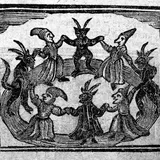
It was an immensely violent time of upheaval. Even in the securely Catholic kingdoms like Spain, there was a lot of religious paranoia going around, which led to persecutions that greatly exceeded those of the early medieval period. We talked about this a bit in episode 89 with the witch trials, which were largely an early modern and not a medieval invention and paired these new advances in law and reason with much older views on magic and Satan.
Right. So, in short, the Middle Ages were in certain respects less developed than ancient Rome and less developed than the early modern period, particularly if you look at like long-distance trade networks or the size of cities or also the spread of literacy. However, the Middle Ages were also marked by brilliant advances in art and scholarship in their own right, both within the Catholic West and outside in the Islamic world and Byzantium. So, in many ways, it was a lot better to be alive in the 13th century than the 16th century. Like we said, you know, violence was largely an elite phenomenon. So, if you were a peasant, you were actually less likely to be randomly killed than you would have been in the period of the Thirty Years' War. So, really, you don't have to be a historian to understand why the traditional perspective on the Middle Ages as the Dark Ages is nonsense.
In fact, you can hear it from Inspector Columbo. You see, the Middle Ages weren't as dark as everybody thought they were. Lieutenant, or the Renaissance is light.
Barbarians as heroes
Yeah, but already within Gibbon's own time, some historians had inverted his conclusions. Some leaned into Gibbon's contempt for the Middle Ages by embracing his perception of slavish Catholicism as, in fact, a virtue. It's good that everybody was Catholic then, that there was this monopoly on spiritual life. Others still embraced the idea of barbarian conquerors as masculine nation builders. This idea was especially popular in Germany, where figures like Odoacer and Arminius were understood as virtuous and heroic revolutionaries who fought a decaying Roman Empire in the name of Germanic freedom. Take this 1784 quote from Gibbon's contemporary, Johann von Herder, a Germanic, romantic, proto-nationalist. Quote: Expiring Rome lay for centuries on her deathbed in the most frightful convulsions, a deathbed extended over a whole world from which she sucked her delicious poison and which could then render her no assistance but that of accelerating her death. Barbarians came to perform this office.
Northern giants, for whom the enervated Romans appeared dwarves, they ravaged Rome and infused new life into expiring Italy. A tremendous yet wholesome proof that all irregularities in nature avenge and consume themselves. We have to thank the luxury of the East for having freed the world earlier from a carcass which victories in other regions indeed would have destroyed, but it is probable neither so speedily nor so terribly.
Very ominous language, especially when you know what the German nationalists were going to be doing essentially later. But yeah, just to people like Herder and those who followed in his tradition, the fall of Rome was the defeat of a weak people by a strong people whose strength was often supposed to not just come from their values or tactics, but instead from the superiority of blood.
And in fact, that's actually kind of a really interesting thing because right now, the main people who talk about the barbarians as being a positive are just like either woke people or Nazis.
Yeah, no, it's this, yeah, well, it's this very funny kind of dynamic. And, you know, we're big fans of the historian Guy Halsall, a contemporary British historian, and he's talked a lot about how everybody always projects their own politics onto the fall of Rome. And first, certain people choose to identify with the Romans, others identify with the barbarians. Halsall, who draws quite heavily from Pirenne, he would argue that the whole idea of the barbarians as fundamentally antagonistic to Rome is actually a very inaccurate view. But we're kind of getting ahead of ourselves here. I think, you know, if we're sticking to the 18th and 19th century, the first people to kind of take this barbarians are good perspective tend to be coming at it from this very creepy, racialized viewpoint. The idea that the, you know, noble Germans were somehow just of better stock than the Romans, and therefore it's just natural.
It's Darwinism that they were able to defeat a weaker people and start this new order. And I think that he's not explicitly racial about it, but I think one good example of this in the early 19th century is the writer Friedrich Schlegel, who said that Arminius in the first century, by revolting against Rome and keeping Germania out of complete Roman control, he in fact created Europe. And that if not for Arminius, Europe would have no history. And he says, we would only have annals like the Chinese. No history, just annals, which is a very weird, chauvinistic thing to say. I think it's kind of a great little look at this worldview.
And again, that was another projection of contemporary politics onto the past because this was the time of the Napoleonic invasion. So a lot of people took to identifying Rome with the burgeoning France under the aegis of Emperor Napoleon.
Victorian Teutonism
Yes, yeah. And then so moving on beyond the Napoleonic era into the Victorian period, many British nationalists got very excited about the supposed Teutonic origins of the Anglo-Saxons. There was this idea that the Anglo-Saxon invasion was part of this racially justified conquest of a lesser people by a superior people. This also was a nice excuse for the colonization of the Celtic-speaking Irish that was happening around the same time. The idea that the British were just made of better stock than the Irish was very popular. This actually, this idea that this idea of Germanic superiority became less popular in England, not because they started really feeling better about the Irish, but because Germans became a lot less popular during World War I. And suddenly, British nationalists were a lot more hesitant to describe their German connections.
We talked about this topic also back in our episode, Migration and Memory, really early. That was one of our early ones.
Yeah, and also episode 15 about The Last Kingdom, where we discussed Alfred and the ways that this Anglo-Saxon mythology came into the limelight in the 19th and early 20th centuries.
Yeah, but before World War I, the Brits were very excited about being these, you know, Teutonic barbarians.
And interestingly, a lot of Victorian English scholars were also very interested in the Vikings because they saw Vikings as like proto-British imperialists. As goofy as it sounds, these like, you know, tax assessors working for the East India Company in some office in Manchester, they saw themselves in the you know Viking explorers and conquerors.
They're like, oh, that's me, the Teutonic wanderer. That's just like me for real.
Exactly. And that's just what all nationalism is. It's this goofy projection of yourself onto an incredibly foreign past due to some imagined spiritual or ethnic kinship. It's nonsense. So basically, you know, what we're all saying here is that in the 19th century, there were basically two perspectives. The two perspectives were that the brutal barbarians overthrew Rome and that was bad, or the brutal heroic barbarians overthrew Rome and that was good because they were so strong and masculine. And so that really is kind of the state of play at the start of the 20th century. Those were the two conceptions of the past. Both of these conceptions were oftentimes explicitly racist because even people who said Rome is so good and the Middle Ages were so bad, they would often compare medieval Europeans with modern-day peoples in India or China and say that the supposed medieval nature of non-European peoples justified their conquest by modern, civilized, enlightened Europeans.
So really both of these two ideas had very nasty implications and I think more importantly for our purposes, both of these ideas were wrong. Because as we're about to find out, the idea of the fall of Rome as this permanent civilizational break and this terrible decline is no longer really taken for granted. And that's really all because of one man.
Pirenne's last manuscript
Right, because on January 14th, 1935, Henri Pirenne sat down to write a manuscript. This eminent historian of Belgium of his lifetime, Pirenne intended the new book to be a synthesis of his theory of the emergence of the Middle Ages. This was a topic which had interested him greatly for many years, but to which he wasn't able to devote his full attention on account of his lifelong commitment to the seven volume long history of Belgium. With the final volume of this absolutely massive work completed in 1932, Pirenne set out to write a book for which he would be most remembered, although he would not live to see its publication. And so in early May, he would complete this manuscript that he would set out to write, but within a month of completing it, Pirenne lost a son for the third time in his life, and his health took a nosedive.
Pirenne was beset by one ailment after another, which left him largely bedbound for the next several months until he finally passed away on October 24th, 1935. The book, it would have a long and illustrious life ahead of it. The manuscript in question became Muhammad and Charlemagne, and from its publication in 1937 and subsequent translation into English in 1939, it became one of the key texts of medieval European historiography.
Right. Because this so-called Pirenne thesis has kept medievalists busy for almost 90 years by posing a revolutionary question. What if the conventional understanding of the decline and fall of the Roman Empire, given to us by historians from Petrarch to Gibbon, was completely wrong? What if the years that followed 476, when Odoacer overthrew the last emperor, had in practice differed little from the time that preceded it? What if, rather than being the arsonists of Roman civilization, the Franks, Goths, and Vandals had in fact given it new life? What if the true fall of Rome was not in the 5th century, but in the 7th century, when the rise of Islam cleaved the Mediterranean in two? If this sounds familiar to you, we touched on these ideas back in episode 33 when we first mentioned Pirenne, but this time we're going much deeper into his scholarship. But first, a big caveat.
Because although Pirenne did a brilliant job considering what was known at the time, a lot has changed in the subsequent 90 years of scholarship. The fields of history and archaeology have uncovered a wealth of new information which Pirenne could not have possibly had access to, rendering some of what he wrote out of date. And depending on which aspects of his argument you choose to highlight, you can make the case for either Pirenne's ultimate vindication or his failure. But the Pirenne thesis is something every historian of Europe has to grapple with in some way. And it seems like the popularity of Pirenne's arguments cycles around. One generation of historians will say, yes, the Roman Empire transformed into a new medieval period. Other historians will say, no, there was, there were just a cataclysmic collapse. And the tricky thing is, there is a lot of evidence in both directions.
It's not a settled question. But what I would say is the only thing that is truly settled is that thanks to Pirenne, we now decisively know that whatever happened in the year 476, when the Roman government no longer ceased to exist, even though the Roman Empire in the West was no longer there, the Roman world survived. Pirenne was the first person to argue this, and he did so really elegantly with this great and very readable work that charts the transition from late Roman antiquity to the medieval world of knights and kings.
The Pirenne thesis
Right, so let's actually sketch out what Pirenne argued. Central to this Pirenne thesis is the contention that the barbarians did not spell the end of the Western Roman world because, quite to the contrary, these barbarian peoples who had entered Roman territory were not coming as civilizational enemies. They were instead people who were already acquainted with Roman goods and Roman ways and who wished to enjoy the benefits of Roman life, albeit in a privileged position. So, to that end, they conquered and plundered, but they left much of what they found intact, preferring not to kill the golden goose. These barbarians, peoples like the Visigoths, the Ostrogoths, the Franks, the Burgundians, they took up the mantle of kings and warriors who operated under imperial authority to protect the Roman lands from the onslaught of further barbarians such as the Lombards and the Huns. With time, they acculturated to Roman norms, which they found all around them.
Thus, per Pirenne, Odoacer's overthrow of the Western Empire in 476, which is traditionally taken to be the mark of the end of the empire, fundamentally changed nothing on the ground in terms of the superstructure. Odoacer and all the other barbarian kings would continue to claim fealty to the other Roman emperor whose seat was now in Constantinople rather than in Rome. While there were differences in how these successor states would operate compared to the old Western Roman Empire, Pirenne claims that there was no major rupture to be found across this fifth century transition.
Yeah. And again, that is such a huge contention that nobody was saying in the 1930s. The idea that, you know, the fall of Rome didn't actually matter. Even though the Roman Empire ceased to exist in the West, the Roman government still existed in the East, and all of the new kingdoms that were emerging in the West understood themselves as basically vassals of Rome. And for everyday people living in these barbarian kingdoms, life was still very Roman. It wasn't as if these barbarians were suddenly imposing barbarian customs and cultures on the population. Instead, these barbarian kings saw themselves as basically Roman, and they adopted the customs of their Roman subjects, not the other way around.
Britain, the exception
We should mention there is one huge caveat here, which is always the great caveat when you're talking about the fall of Rome. And Pirenne makes sure to acknowledge this. And that's the fact that if there's one place where the Roman world did completely end, it was Anglo-Saxon England, where for very complicated reasons we can't really get into here, there was a much greater cultural and social change. And the best evidence of that is the fact that, you know, people in Britain actually speak the language of the Anglo-Saxons, whereas in Italy and Spain and France, the languages spoken today are descendants of Latin, not descendants of the languages of the Goths and the Franks.
Yeah, in Britain, like the fall of Rome actually is apocalyptic to the point where material conditions return to basically Bronze Age norms rather than even what immediately preceded the conquest by Rome of the Isles. It's just like really terrifying to think about. And yeah, we're probably going to have to talk about this some other time because another huge topic.
And I think I'll also kind of on that point, I think that one of Pirenne's potential problems, which is a problem with basically every historian of the fall of Rome, is that the fall of Rome happened very differently in different places. And if you focus mostly on Mediterranean evidence, it's going to look a lot less cataclysmic than if you focus on the northern parts of the empire, where society fell a lot more brutally.
He does acknowledge this in Muhammad and Charlemagne, to be fair. He just doesn't focus on it nearly as much because he's very much of the mind that his focus is the parts of the empire that didn't fall into total.
Right, exactly. And right next to the thing is that, because he's describing a story of Roman continuity, so it makes sense he's going to focus on the places that were most continuous.
Pirenne between France and Germany
But so let's get into, yeah, let's get into, you know, Pirenne's life because it's very interesting. And, you know, he, so he was a Belgian historian. And as a Belgian, he kind of had one foot in the camp of French scholarship and one foot in the camp of German scholarship. He was exposed quite early to the kind of nationalist conception of the fall of Rome by German historians. The idea that, you know, that the fall of Rome was cataclysmic, but that was good because the Germans were just so neat. And he also is exposed to the French scholarly tradition, which included the idea that the fall of Rome was cataclysmic and terrible. That's the perspective of Voltaire, for instance. But also the French Catholic position that the fall of Rome was good because the Catholic Church is so great and the Catholic Church, you know, was so powerful after the fall of Rome.
He was completely fluent in both German and French, but he was generally a writer in French. He was a Walloon. And that he was interested in early medieval history from a young age. And so in 1895, 40 years before Muhammad and Charlemagne, he published his essay, L'Origine des constitutions urbaines au Moyen Âge. So, you know, the origin of the urban constitutions of the modern age.
Middle Age.
Where he describes, oh, of the Middle Age, thank you. Where that makes more sense. And in this text on medieval cities, Pirenne was already speaking of post-Roman Gaul, of the early Frankish kingdom, as a land of organized towns, not barbarian strongholds and villages. And so, you know, he was already focusing on continuity with Rome, which was not a popular topic among 19th-century historians. According to Pirenne, a time traveler from the heyday of Roman civilization, let's say like the time of Trajan in the second century, if this time traveler leapt forward to the Merovingian period when Gaul was becoming France, he would actually experience a world that continued to follow Roman civic traditions, where industry and economic life carried on as before, where customs duties from trade were still plentiful enough to give these kingdoms ample revenue, and where connections with Constantinople and the Middle East were still quite common.
Pirenne drew heavily on the 6th century historian Gregory of Tours. When he was writing this text. He also made a lot of references to the prominence of Jewish and Syrian merchants in Merovingian Gaul. And all of these elements would return 40 years later when he wrote Muhammad and Charlemagne. His medieval cities text also lays out the proof of a thriving economic system after the fall of Rome, in which Western Europe was still a vital part of the Mediterranean organism. As we can see by the presence of all these Syrian guys, there were constant close contacts with the Near East and North Africa. And so, again, this, but however, even though the Roman way of life was continuing, it did have a limited shelf life. And if we go on after the Merovingian period into the Carolingian period, the time of Charlemagne, the world looks a lot less Roman.
The Arab conquests and the Muslim lake
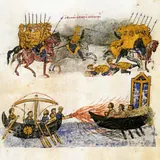
Right, so what changed precisely? Per Pirenne, the disruptions had been brought by the Arab conquests of the 7th century, which meant that the Mediterranean would end as a shared political, economic, and civilizational space. The Mediterranean Sea, which was once known as the Roman Lake, was rapidly becoming, in his words, Muslim Lake. We talked about the success of the Arab navies back in our episodes, Medieval Sicily. Then that's episode 50 and 51, I believe. So immediately after the Arab conquest of Byzantine Egypt and the Levant, regions that had been essentially Greek for a thousand years, the Admiral Muawiya had begun launching his seaborne raids on Greek islands like Cyprus and Rhodes. And so after a decade of piracy, Muawiya's experienced Muslim sailors won a devastating defeat against the Byzantine navy off the coast of Anatolia and then proceeded to launch the first of four unsuccessful seaborne invasions of Constantinople.
While the attack on the Byzantine capital was repulsed, Muawiya's success proved that control over the eastern Mediterranean had been wrested out of Roman hands. This was a thought that could not even be entertained in earlier generations. And so, across the next couple of decades, Muawiya would shift from admiral to caliph as he founded the Umayyad Caliphate and continued a new push to claim the remaining Byzantine possessions across North Africa, which would allow him and his successors to reach the Atlantic coasts of Morocco and then further into Spain.
Right. And so, as a result of this rapid Muslim advance, which occurred within a single human lifespan with room to spare, the Mediterranean trade that had been the lifeblood of Roman civilization even after the formal fall of Rome in 476 was now irreparably damaged in the 7th century. Consequently, the cash-based economy of the Roman world made way to one where payments were mostly in kind, and value was now based not on possession of money, but possession of agricultural land. Customs duties dried up, weakening the state, especially the Merovingian kingdom of Gaul, and charting the path for the takeover of the much more powerful Carolingians, who Pirenne takes pains to mention were a lot less Roman than the barbarians who preceded them. And that was also a pretty remarkable contention, because 19th-century historians generally saw the Carolingians, especially the famous Charlemagne, as restorers of the prosperity and the order of the lost Roman Empire.
Instead, Pirenne argues that the rise of the Carolingians brought a new political and economic order, which also coincided with arguably a worse economic way of life in Western Europe. And also during this period, the Catholic Church began to emerge as a powerful economic and political actor in its own right. And while education continued in monasteries and in the court of Charlemagne, secular learning basically disappeared. And this disruption in literacy hastened the evolution of Latin into modern-day Spanish, French, and Italian. You know, because if you can't read, your language tends to evolve more rapidly from generation to generation.
Yeah, and it was just more difficult to keep written text in general because so much of what had been written up until the Carolingian period was written on papyrus, which is native to Egypt. And one of Pirenne's central points is that this trade in papyrus, with the exception of Italy where it continued to be found in small quantities, it just dried up and meant that the medieval Europeans now had to write on vellum, sheepskin, which is much more difficult to process. And consequently, there was just much less written work around.
Right. So, in short, if you ask what is the Pirenne thesis, the Pirenne thesis is that the world of Roman law, culture, and economics did not vanish when the Western Roman Empire collapsed, because there was simply nothing yet to replace it. But then, if we move into the seventh and eighth centuries, 200, 300 years after the supposed fall of Rome, you begin to see the creation of new systems of rule and religion by the Carolingian Empire in France and by the Muslim empires of the Near East. And this leads to this division of the once Roman Mediterranean world that would never really come back together again. And this, Pirenne argues, is truly the end of the Roman era.
A Belgian life
All right, so Pirenne's work, and especially Muhammad and Charlemagne, were profoundly shaped by his own life, and it was really quite the life. Pirenne, being Belgian, had a lot to do with it. As the son of a small nation lodged at the confluence of Romance and Germanic Europe, he had his foot in both worlds. And these were worlds very much in flux. A generation before his birth, little Belgium had only just secured its independence. A little over a decade before his birth, the revolutions of 1848 rocked the continent, and shortly after his birth, Germany would be united. At which point, the world seemed largely stable until he was well into his mature years. A long continuity followed by a cataclysmic rupture of a world that was entirely unprepared for it. That's the gist of Muhammad and Charlemagne.
A crash course in Belgian history
Yeah, so let's give a very brief crash course on Belgian history. You know, I gotta say, there are some haters out there, especially in the language, in the Anglo world, who love to say that Belgium is a fake country because it's got two languages. I am a Belgian defender. I think that there's a lot of great history there, really interesting, especially going back into the early modern period.
Is European Lebanon with all the good and bad that implies?
Yeah, that's it. It's the European Lebanon. It's a small country with a really interesting history, really crazy politics. And much like Lebanon in ancient times, medieval Belgium was this great trading power. The Low Countries and Belgium in particular were really one of the true economic heartlands of Europe. Possibly the most developed economic area in parts of the Middle Ages and the early modern period. Really only rivaled by the Po Valley of northern Italy going into Florence. But anyways, Pirenne was well aware of the late medieval splendor of Belgium, particularly when it had been part of the state of Burgundy, this very interesting, almost kingdom in between France and what's now Germany. After the collapse of the Burgundian state, largely due to the betrayal and death of the famous Charles the Bold, it was inherited by the Spanish Habsburgs, which led to the, of course, the long period of the Spanish Netherlands over Belgium.
The fact that the Spanish were in charge of Belgium, but not the Netherlands, is a big contributor to the current day Catholic-Protestant divide between these two countries. And Belgium, just like the Netherlands, would be locked in conflict with the Spanish for quite a long time in the Eighty Years' War. So this means that if we're going into the 16th, 17th century, Belgium was this constant battlefield, oftentimes with the French getting involved. And this meant that if we flash forward a few hundred years, when the French Revolution happens and Napoleon completely changes the political and economic and geostrategic position of France, Belgium finds themselves, finds themselves right in the middle of the Napoleonic Wars. Belgium was briefly annexed into the French Empire and the French made Belgium a lot more French, which sparked some nationalist discontent among the Dutch-speaking Flemings. With the defeat of Napoleon, Belgium was taken from France and given to the Netherlands and briefly was part of the short-lived United Kingdom of the Netherlands.
But Belgium chafed under this arrangement due to the fact that they were predominantly Catholic, due to the fact that many of them spoke French, they were not entirely Dutch-speaking, and because there really was this genuine Belgian political identity, which again, a lot of people, especially in the Anglo world, don't really recognize. They assume that because it speaks multiple languages, it must be kind of a fake country. But really, Belgium is just as fake as any other country. And so in 1830, the Belgian Revolution broke out. French intervention kept the Dutch military at bay. And then from 1831, Belgium was de facto independent. And then in 1839, the Treaty of London proclaimed Belgium to be independent de jure.
Pirenne's youth
And then, like we said, just a few decades later, in the next generation, in 1862, Pirenne is born. He is the eldest son of a textile industrialist factory owner, which is really one of the most classically Belgian professions you could have. You know, going back about the past thousand years, all the most prominent people in Belgium probably were in the textile trade. So I think it's very funny to me. And as we mentioned, his family were Walloons, which are French speakers. And the Walloons, in no small part due to the influence of the Napoleonic era, not too long before, the Walloons were overrepresented in the Belgian ruling classes, while the Flemings were at this point more agrarian. These linguistic divisions still matter today, but they were especially prominent in the 19th century. However, Pirenne and others in his milieu really strongly identified as Belgians rather than either Flemings or Walloons.
They wanted to live in this unified, united country that happened to speak two languages. And these kinds of Belgian patriotic circles were very heavily invested in the Belgian past and sought to look through history to kind of overcome the seeming artificiality of the modern country. You know, because if they could find past evidence of, you know, united Belgian states crossing linguistic lines, or of course, anything involving the ancient Celtic Belgae tribe of whom Belgium gets its name, this could strengthen the Belgian identity in the present. And so to Pirenne, this country was not artificial. It was entirely natural because the French and Dutch-speaking parts of Belgium had been very economically and socially interconnected across the Middle Ages and the early modern period. And the fact that textile trade and the early bourgeoisie were so prominent in medieval Belgium really made Belgium this great place for these, you know, bourgeois liberal nationalists who were really into stuff like the rise of the middle class and the beginning of democracy in early modern Europe.
That was, you know, Belgium was really ground zero for a lot of that.
So as we mentioned, he came from quite a wealthy family. His father was a factory magnate. And initially, he was being groomed to take over this family textile trade. But from an early age, Pirenne instead showed proclivities which would have hampered his effectiveness as a bourgeois because he was drawn much more to history books than accounting books, and he excelled in the humanities rather than math and science. He had a particular aptitude for languages, which is going to come back later in his life. However, he was not a great student, but he was well liked. And when he was 15, the king of Belgium, who is probably in fact the only king of Belgium anybody listening to this podcast has heard of, that being the infamous Leopold II, actually met Pirenne because the popular young boy was chosen to welcome the king on the student's behalf during the opening of a newly built dam.
And this was apparently a moment that Pirenne remembered quite fondly.
Belgian history and German method
Right, yeah. So going back to the state of Belgium, when Pirenne was growing up, the Belgian people were really thirsty for a history of their own, but Belgian historiography was still a bit undercooked. It was quite weak. And Belgian historians of this period tended to be amateurs. The Belgian university system was very young and not yet very rigorous. Here's how Bryce Lyon characterizes the Belgian historiography of the mid-19th century. Quote: When German and then later French historians were shedding romantic history for that based upon systemic and critical examination of the sources, and when the Germans were experimenting with their famous seminars and the French with their cours pratiques at the École pratique des hautes études, the Belgian historians were involved in a long love affair with history based mostly on narrative sources. History charming and florid in style, glorifying the Belgian past. Invariably self-trained, these historians were often rich gentlemen who regarded history as a serious avocation.
This is from Lyon, Henri Pirenne: A Biographical and Intellectual Study. And so basically, this means that as this crossroads between France and Germany, the Belgians really benefited from these different kinds of academic strains and methodology. So the most famous of these would be the kind of particular rigorous German historians of the later 19th century. The most famous of these is Helmuth von Ranke, who is quite famous for his insistence upon objective factual reporting, something that's sort of been called into question by history as it really was.
Exactly. And this is a concept that's been called into question by later 20th century scholars with good reason, but it really was the basis for this kind of new understanding of history, free from the potential biases of primary sources, and looking more critically at kind of what we thought we knew about the past, which of course is very relevant for Pirenne here, as well also as Mommsen, another big influence on the Belgian academy. And so these guys were most famous for these seminars where they preached to many people who were not just students. This was a kind of interesting aspect of the 19th century public intellectual world. You could just easily attend a lecture on, you know, history or medicine or physiology. This was just the kind of thing that people did before TED Talks. And then in 1874, one prominent Belgian historian, Godefroid Kurth, introduced to the University of Liège these new seminars in medieval history inspired by the German model.
And then by the end of the 19th century, these German methods were not only being used to describe all medieval history, but specifically the history of Belgium, which would have been particularly interesting to Pirenne, who was enrolled in the late 80s at the University of Liège, where Kurth was teaching. So he was really quite a. So, despite not being a great student as a child, as a university student, Pirenne was really quite a prodigy. And when he was just 19 in 1882, he already published his first book, which is just crazy to think about. His professors loved him, and they sent him on these study trips to both France and Germany. He would rub shoulders with a lot of well-known German scientists of his time during his period in Berlin and Leipzig. And he really understood that the German historians were at the bleeding edge of historical methodology, this more critical approach for going through ancient sources and applying modern techniques of reason as well as modern scientific analysis to these earlier sources.
Additionally, the German government in the imperial era gave a lot of support to the burgeoning field of history, but not necessarily for the most altruistic reasons. You know, Germany was also a new state, not unlike Belgium, and in fact, quite newer than Belgium. And so there was a natural interest in using history to basically justify the existence of a unified Germany. This, of course, means that the German academy was very closely tied with the German nationalist movement. And of course, we know the many directions that would take. We've discussed this in the podcast before. So, this kind of means that Pirenne is entering this very strange German academic world. Like we said, he would meet many of these prominent German historians.
Karl Lamprecht
The most important of them for his intellectual development would be the historian Lamprecht. If you want to share anything about him, Sam.
Lamprecht, he's largely forgotten today, but he was a giant in his own time. He wrote a 12-volume history of Germany, and he was really the bad boy of German academia, quite literally. He's most infamous today for his participation in the so-called Methodenstreit, which was a historiographical battle in the 1890s, which was provoked by Lamprecht's work. Where the German historical science was heavily state-centric because of all the government patronage that was going into it, Lamprecht was pioneering the field of cultural and psychological history, which he called Geistesgeschichte. Lamprecht's approach to history, as innovative as it was, was very sloppy, and there were a ton of errors to be found in his work. So, consequently, popular audiences loved it, while professional historians hated it. In the end, Lamprecht's name was dragged through the mud so much that cultural history wouldn't be treated as a serious discipline in Germany for another 50 years.
But even though his work was panned in the German establishment, he had a very strong influence abroad, including on the Annales School in France, and most importantly for our purposes, Pirenne.
So, in 1885, after studying in Germany for a couple of years in Leipzig and Berlin and all of these places, he was able to secure a professorship. He went back to his alma mater, but this time as a professor rather than as a student. A year after that, in 1886, he transferred to the University of Ghent at the invitation of Fredericq, who was his professor in his own time, and he continued to work at the University of Ghent until 1930 when he retired. And like his alma mater, Ghent was primarily Dutch-speaking locale, and much of the instruction in the university was given in that language. But Pirenne lectured in French, which would become an issue during the German occupation of Belgium, and he steadily produced work on Belgian and medieval history. He would publish his first volume of the seven-volume long history of Belgium that he devoted his life to in German in 1899 with the funding of Karl Lamprecht, and it would be translated into French in 1900.
And nobody reads this today because Belgian identity has changed so much. There's not so much explicit Belgianism anymore. But these things were selling like hotcakes back in those days because a lot of the Belgian middle classes and bourgeoisie were very interested in specifically this sort of Belgianism, this idea of Belgium as a discrete nation with its own identity that's multilingual. And so, like Pirenne, he really made a name for himself throughout the country as well as in Germany and France because he was just so prolific. And Pirenne and Lamprecht, they would be very buddy-buddy for another decade to come.
1914
But in 1914, something happened that would really throw a stick in that wheel.
Yes. Because if we're looking at Pirenne's career, you know, the first 30 years of his career are, you know, interesting, but mostly uneventful. He would spend a lot of time traveling to Germany. He made these contacts with German historians and he published his great history of Belgium, which was eventually published in 1899. Across the early 20th century, he continues to have very warm relations with German academics. And then in 1914, the world that Pirenne knew collapsed because in August of that year, Pirenne was blindsided when the Germany he loved so much invaded his own land. And the phrase rape of Belgium is sometimes considered to be somewhat sensationalist, but the German invasion of Belgium in World War I really was quite brutal. There were multiple massacres of civilians in which hundreds of townspeople would be killed at a time in the name of pacification. And that, you know, if you're trying to draw a straight line from German behavior in World War I and World War II, Belgium is a good place to look at, I'd say.
He really had understood the Germans to be uniquely sophisticated and, you know, so advanced and enlightened in terms of academia and philosophy. So seeing this just shockingly brutish behavior really completely changed his entire perception of Germans. And even then, it took a while.
Yeah, because he didn't, he didn't want to immediately admit this.
Yeah.
But it was kind of obvious what was happening to many of the people around him. Pirenne's own son was studying in Germany in 1913 and he was sending letters home where he was complaining about the German intelligentsia as being this quote-unquote garnered brute. And yeah, so this really took him by surprise, but ultimately Pirenne decided that he was going to stay put. He was going to stay in Ghent, even when it became clear that the entire country was going to fall under German occupation. And Ghent was taken in October. His sons were very patriotic, so they enlisted in the army, and his son Pierre would go missing in action in November. It would be confirmed that he was killed in October of the following year. So Pirenne tried to remain steeped in academics as before, but the German occupation proved disruptive. In addition to the psychological blow of living in this environment, they were just constantly sticking their fingers into the Belgian university system because they were so interested in hijacking it.
Right, and we should mention because, you know, no small part of that is because, you know, just like epic Americans on Twitter today, many Germans in the early 20th century were fixated on the idea of Belgium as an artificial nation. You know, really just as an excuse to partition it. The idea was that Belgium was created only for the benefit of the great powers, who at the time were Britain and France. And Pirenne really took exception to this idea. Again, he would point to the history of a unified Belgium in the medieval era, particularly under the Duchy of Burgundy, which nearly became this significant kingdom between France and Germany. And also, this academic onslaught, as well as the literal violent onslaught, which killed, was it one or two of his sons?
No, one of his sons died in the war. But yeah, he would outlive three of his four sons.
Yeah. And this experience just really made him come to terms with kind of the realities of the German nation versus his idealized academic, you know, scientific Germany.
The Appeal to the Civilized World
In October 1914, 93 leading German academics signed a letter titled Appeal to the Civilized World, in which they basically justified the conduct of Germany, explaining that, you know, these atrocities weren't really happening. If they are, it's okay. They were denying these charges and were saying that actually, in fact, the Russians on our Eastern Front, they're drinking the blood of women and children. They're the real barbarians. We're just bringing this civilized Western enlightenment, you know, of the Abendland into Eastern Europe. And, you know, if the Belgians in the West are standing in our way, maybe they just have to be a tragic but necessary consequence. And what must have been truly a knife in the gut for Pirenne was that one of the 93 academics who signed this letter was Lamprecht.
Lamprecht's lecture on Belgium
And a few months later, Lamprecht would give an infamous lecture entitled About Belgium. Russian Sam, well, what does Ian Wood say about it?
The lecture was delivered as part of a great occasion, which began with an organ voluntary followed by two songs. The first was Hoffmann von Fallersleben's poem of 1840 to the Flemings, and the second by the Flemish poet Emanuel Hiel, the 1870 poem, Oprop an dit Deutschers, which Lamprecht mistranslated as Appeal to the Germans, whereas Hiel had used the word Deutscher in the form of Großenied Landisch, that is, Dutch and Flemings combined, but without the Germans. After briefly discussing the poems as evidence that the Flemings were German, Lamprecht talked about Brussels as a Flemish city and about the cultural and geographic distinction between the Flemish north of Belgium and the Walloon south. He noted the borders with the French cultural region, though what he describes follows neither the modern political frontier nor that of 1914. He presented Lille as a Flemish city, something that the Lillois would accept.
He then pointed out that Beethoven's family was Flemish. Where, he asked, was the distinction between Fleming and Walloon? Its origins lay in the Germanic settlement of Flanders. It was in Belgium that the Lex Salica, quote, the oldest of all our tribal laws, end quote, was compiled. Lamprecht then followed the early history of the Salians, their expansion against the Celts, and their role in Merovingian and Carolingian history. From there, he traced the rise of Flanders as the economic center of trade, paralleling Venice. He noted the region's architecture and painting, as well as its developing democracy. With the Burgundian court, of course, the region enters the Habsburg world. Turning to more modern times, Lamprecht looked at the aftermath of the Peace of Paris in 1815, which he read as an English neutralizing Belgium and Holland, which at the same time left the way open to French influence, especially in Brussels, Liège, and Ghent.
And then he turned to his hope for the future, which was the success of the current German policy. His lecture was followed by the singing of O Deutschland hoch in Ehren, old Germany High in Honor, and Haltet Aus endur.
And you know, so basically, and so just this, like, you know, long academic lecture explaining why Belgium has no right to exist and why the Flemings in particular are really just Germans in denial. And then in April of that year, Pirenne noted that Lamprecht had also written a preface to a book arguing that Germany should redraw the maps of Europe. And additionally, he had penned a newspaper article claiming that Belgium ought to be integrated into Germany. So, basically, it's a confession that Lamprecht, his idol really, genuinely desired to destroy the Belgian nation. And so, of all these betrayals by German academics, Lamprecht's surely hurt Pirenne the most. In his wartime diary, Pirenne noted bitterly of the German intellectuals that, accustomed to absolutism for centuries, it didn't strike them that they themselves were the state. They turned the state into an independent being, a sort of mystic entity, a power endowed with all the attributes of force and intelligence.
At the desired moment, all were ready to obey it, not as citizens, but like servants.
Resisting the occupation
During this time, the Belgian universities were shuttered, but the German administration was desperate to actually have it back up and running for the sake of maintaining this, you know, semblance of normality for Belgium under occupation. Belgian academics were staunchly against this. They didn't want to go back to work in a university dominated by their German occupiers. And Pirenne argued that as professors, their contracts were with the Belgian government, not with the occupying Germans. As such, it was illegal for them to teach at the behest of another government. In a vote, 30 voted against reopening the university and all and nine abstained. There were no votes in favor of the German plan. Thus rebuffed, the Germans moved to a forced reopening of the university in 1916, but this was part of an effort to split Belgium along linguistic lines. Accordingly, all instruction at the Ghent University was to be carried out in Dutch, of course, a Germanic language, not in French.
Even the professors who had previously collaborated with the Germans balked at this new linguistic proposal, and even professors who taught in Dutch and not in French refused to go along with this new policy in solidarity. Many of these professors met secretly to plan how they could resist peacefully the German occupation, but there were some informers among them, and they reported to the German occupiers that these secret resisters included Henri Pirenne.
Arrest and deportation
Right, so because of this, he was placed under arrest and he was set to be deported to Germany. At first, he was placed in a POW camp where he began to learn Russian with the help of a Russian officer, as we mentioned previously. It was a camp for officers, so it was as nice as the circumstances allowed. But nevertheless, this was a POW camp, and he was a civilian who was motivated entirely for political reasons to this harrowing existence. But he made the best of it. He was giving lectures to the other prisoners and he was widely beloved by them. But Pirenne's arrest and deportation made international news, and even the Pope wrote a letter to the Kaiser about it. So a German professor whom he had known earlier petitioned the government to have him transferred to a university town. Pirenne was transferred to the town of Jena, where he was surprised to find himself reunited with Fredericq, who had been arrested and deported at the same time.
The pair would have access to a library, but they were warned not to engage in any political activity or write letters home that could be construed as political. So, but Fredericq, he was openly chafing under this, and he was given repeated warnings. Finally, Fredericq riled up the locals and the police administration so much that they were deported separately to seven different villages in Thuringia where they would spend the remainder of the war.
Right. And but, you know, just like another great French-speaking historian who we're great fans of, that being a certain Braudel, Pirenne would not let imprisonment stop him from writing great works of history. Much like Braudel decades later, he managed to have kind of the privilege of going on field trips to the local library while he was imprisoned by the Germans, and he was able to get books delivered to aid in his writing efforts. And so, in addition to his now famous wartime diaries, during his imprisonment, Pirenne wrote the foundations of what would become his history of Europe. In August 1918, he received permission to be joined in prison by his wife and one of his surviving sons. The war would end in just a few months, and Pirenne returned home, but was now completely a changed man.
After the war
His previous love for the German nation and German academia had completely evaporated. Castigating German professors in a post-war article, Pirenne wrote that the most terrible thing is not that the fanatical publicists have spread this poison among the masses. The most terrible thing is that the philosophers, the historians, the economists, the philologists, the sociologists have not been immune and that they have infected these German universities that foreigners nevertheless continued to admire smugly as serene schools of learning and criticism. And as a result of this captivity, Pirenne's fame actually grew as he was invited to all manner of conferences and went on a coast-to-coast tour of American universities following the war, you know, as this heroic, brave academic.
Yeah, he was even received in the White House.
Yeah, which is, you know, very funny to imagine a medieval historian getting that treatment today. Meanwhile, in Germany, Pirenne's work was treated with scorn. Even in the Weimar period, where so much of the chauvinism and nationalism of the imperial era was overturned, Pirenne was still seen as this anti-German whipping boy. His work, which, you know, really defended the Belgian nationhood against claims of pan-Germanic unity, was really seen as a threat to German nationalism.
Yeah, and he was very epic about his anti-German activities after the war. Like, he was taking the names of German academics off honorary postings in Belgium. And he even wrote a book that was titled What We Must Unlearn from Germany, which was basically, you know, we got to decolonize Belgian academia, which is very funny to think about, especially as someone who had such a massive debt to German historiography.
Scrubbing race from his history
So yeah, Pirenne, he just continued to work in the same vein. He became quite anti-racist in the way that he made his arguments. And in fact, he even reissued his history of Belgium after the war to scrub references to race. Quote, even though this self-critical rewriting of early volumes had been almost ignored by historiographers, it very convincingly shows Pirenne's determination to extirpate any racist or ethnic arguments. If we compare, for instance, the pre-war to the post-war editions of the first volumes, we get a long list of symptomatic changes. Here are some examples from volume one. Number one, advanced post of Germanic colonists, quote, scattered among the people of a foreign race, becomes scattered among people of Latin language. Medieval civilization, as a quote, common creation of two great races, the Romanic and Germanic, becomes, quote, a common creation of two nationalities. The Flemish administration no longer crosses the boundary of race, so-called, but, quote, the boundary of language.
Belgium, as a, quote, country populated by two different races, becomes a country in between, and so on. Other passages have been completely cut out or rewritten in order to show, for instance, that, quote, nothing is more different from a war between races than Frankish colonization. So, in other words, like he was just actively anti-racist. He just got the Ibram X. Kendi Lifetime Achievement Award for all this stuff.
Right, and this is because he's writing here. This is in the, you know, he's editing his books here in the 1920s and 30s when racialism was still this very fundamental understanding of history that, you know, now has been rightfully banished from academia, but was this not yet controversial, these kinds of racial concepts. The idea that national ethnic groups are these permanent, unchanging blocks, and that you can, you know, predict something about German behavior across history, whether it's in 1930 or in the year 30, you know, during the time of Arminius. And he was very much against this notion.
Yeah, and in fact, it was only getting worse in Germany at this time, specifically, because this was the era when the Nazis were cementing their basis on power. And then ultimately, when they actually took power, they, of course, purged academia of people who died.
Pirenne in Nazi Germany
And so I gotta say, it's amazingly, Pirenne's work was published in Germany. So once he wrote Muhammad and Charlemagne, not long after, so he dies in 1935. The book is published in 1937. And of course, this was immediately prior to the outbreak of World War II, you know. And so there was a lot of interest in any kind of medieval history among the Nazis. They loved using the medieval past to justify all kinds of policies that they were carrying out in the present. So there was interest in Muhammad and Charlemagne, but unsurprisingly, when they got to his argument, and, you know, especially considering Pirenne's historical relationship to German-ness, there was a lot that the Nazis found incredibly objectionable.
Right, yeah. So, first of all, the title was changed completely to make it more German. Instead of Muhammad and Charlemagne, it became The Birth of the Occident, the Downfall of Antiquity in the Mediterranean, and the Rise of the Germanic Middle Ages. It's quite a mouthful.
No, and that's so funny because the whole idea of the concept of the Germanic Middle Ages, when an incredibly fundamental part of Pirenne's argument is that there was very little Germanic about the Germanic kingdoms that supplanted Rome. They were led by people who spoke Germanic languages, but even those languages disappeared after just a couple generations. As you know, the Visigoths of Iberia basically became the first Spaniards, and nobody in Spain speaks Gothic today.
Right, but that title isn't even the worst of it. They also added a bunch of footnotes that weren't shown as being added by the editor. So it seemed like Pirenne was adding them. And then through these footnotes, they were basically giving this book a more Nazi-friendly gloss of the history, where presumably it was like, oh, look, the Germans kicked down the door and the decadent Roman Empire fell to waste. And then we created European civilization. And now we're going to do it again. So watch out.
Empires fall, worlds remain
Right, right. And if there's one biographical fact we should mention, which is a little tricky because, you know, this book was posthumous. You know, there's nothing really else we can say about his life here. But if you just want to put this in context, I think that Pirenne's experiences in the end of World War I and the lead up to World War II, which of course would happen shortly after his death, I do think that might have informed his later perspective in his much more famous later career as he developed his very nuanced arguments about Muhammad and Charlemagne. Because by living through the end of World War I, I wonder if Pirenne might have seen the fall of these empires as comparable to what would have been experienced by the people living in the former Roman Empire in the fifth century. Because just like with the fall of the European empires, these governments, such as the Ottoman Empire, the Russian Empire, the Habsburg empires had fallen, but the political, cultural, and social structures associated with these empires continued to remain.
And what the legacies of these empires would be was in the 1920s and 30s a very open question, just as it was going to be in the immediate aftermath of the fall of Rome. And so, I think that with that context, that does put Pirenne's treatment of the early Middle Ages at this intermediate period following essentially this great war, you could say. It really, you know, makes you think a little bit about the kind of the resonance this might have had for modern readers. And I think the fact that, you know, we always are putting ourselves in the fall of Rome, and no matter what era we're living in, I think it just does go to show that it really is one of the real kaleidoscopic moments of world history. It's such a complicated topic, it has such wide-reaching implications that it's quite easy to read anything you want into it.
And so, with all that being said, we should remember that Pirenne was still a product of his time. He was very much a liberal nationalist in a sense that is kind of anachronistic now, but was not in that period. He was also quite Western-centric, I would say. He was not as particularly interested in the goings-on of the Byzantine Empire and the Islamic world, except when they basically disrupted activities in the West. But it is such an interesting text. Let's dive into it right now and let's see what exactly Pirenne was arguing in Muhammad and Charlemagne.
Reading Pirenne today
Right, and but before we dive into what Muhammad and Charlemagne actually says, I just want to say that this book is such an interesting gloss in the context of Pirenne's own life because you can really read so many different things into it. Right now, like Pirenne is kind of right-wing-coated because his emphasis is specifically on the ways that the rise of the Islamic civilization and the Arab conquests disrupted this trade and led to the collapse of the Merovingians. I've seen like an academic paper, for example, complaining about this being an Islamophobic argument because some right-wingers really do read it like that. But when you look at Pirenne's actual life and especially his post-war activity, he was just the most liberal person you can imagine and just really remarkably anti-racist for the standards of his times, which is quite the contrast, you know, just we have this tendency to pre-judge things based on what people are accepting them and at any given time and putting them up on their mantles.
But that's just not a good way to react to anything, especially when it comes to history, because history is such a complicated and messy topic, and there's just so many different facets you can get into. So, that being said, let's actually dig into what Pirenne had to say about, well, everything.
From Diocletian to Constantine
Right, right, because we know the thesis, which he'd already kind of hinted at in his earlier work, but he really dives into this thesis: the idea that Rome did not really fall in 476, instead, it slowly transformed in the seventh, eighth centuries. He really gets into that with his great work, Muhammad and Charlemagne. And this book picks up immediately after the crisis of the third century. So, if you guys did not take our advice, if you have not listened to episode 33, that's fine. We'll summarize it right here. The crisis of the third century was an intense period of constant turmoil for Rome. War, famine, pestilence, and death haunted the empire from Britain to Byzantium and beyond. Remarkably, Rome weathered these challenges, but by the end of the third century, the empire of Augustus and Trajan had become something completely different. Under the rule of the great stabilizer Diocletian, Roman society became harder, more militarized, arguably less fun.
Violent force was becoming a more popular tool than the old Roman law to settle internal matters. The Senate began to slowly lose its importance and was now much less likely to produce new emperors than the army. And the emperor himself was a very different figure. He no longer called himself princeps or first citizen. He now referred to himself as Dominus, Lord.
Yeah, that's pretty ominous, isn't it?
Yes, the ominous dominus. And we should mention that that word would become very important to Roman citizens for completely unrelated reasons. Reasons not connected to worldly law, but the law of heaven. Because just a year after Diocletian died, the son of his ally Constantius would quickly rise in the western provinces. Constantine was a young general popular with the military and with barbarian auxiliary troops. He was proclaimed emperor at the British city of Eboracum in what's today York. Unable to fully control the empire, it now seemed that the crisis of the third century was going to spill into the fourth century. Constantine was trying, not particularly successfully, to reunite Rome, but there were still many other people calling themselves emperors. Then in the year 312, he went into battle outnumbered against a powerful enemy and apparently felt the need for his own ally more powerful than any Roman general or barbarian king, because Constantine ordered his men to paint the letters Chi and Rho on their shields.
These are the first two letters of the Greek word Christ. So in this period, Constantine himself was not a Christian, but many of his friends and supporters were. He seems to have, if anything, been this desperate spiritual opportunist who hoped that appealing to this foreign god might grant him some victory. And amazingly, it did. He beat his enemies in 312 and was able to successfully reassert imperial authority over the entire empire. Constantine thanked the Christian god by not performing the expected offerings to Jupiter after his victory, and the next year, in the famous Edict of Milan, proclaimed that Christianity was fully legal throughout the empire. It seems that for the next 25 years of his life, Constantine secretly practiced Christianity and openly favored Christians over pagans, but was strangely not technically a Christian himself. This was probably again for some strange reasons of spiritual opportunism. It seems that Constantine believed that as the emperor, you'd have to get your hands so dirty that you would always be constantly sinning.
You know, you're always committing acts of violence and greed or whatever.
Yeah, but there was also a practical reason because the emperor was also the head of the Roman imperial cult. So you sort of needed this guy to be in charge of the religious life of the empire, which, if the guy in question is a Christian, that's kind of a dicey proposition.
Yeah, and so Constantine made a decision which was surprisingly common in the ancient world, which was he became a Christian immediately prior to his death when he was literally on his deathbed with only days remaining. He knew he was about to die, and that meant if I become a Christian now, I'm not going to have any opportunities to sin ever again. So I'll get baptized and then I'll die completely free of sin. Constantine dies a Christian and the empire is then split between his three sons, annoyingly named Constantine, Constantius, and Constans. This multi-emperor situation had actually begun under Diocletian, but would really become the name of the game until 476 when the Western Roman Empire finally collapsed. This system probably almost certainly contributed to the fall of Rome because it led to a lot of infighting between these co-emperors, but it also localized military control, which hypothetically made it easier for the army to quickly respond to persistent threats.
And boy, were these threats persistent because rebellions were constantly happening across the fourth century. You know, things were, even though the crisis of the third century was in the past, things were still quite unstable. People were constantly proclaiming themselves to be emperor. And there were also the constant threats of barbarians in the north and the Persian Empire in the east. Other internal problems continued to beleaguer the Roman Empire, because the population was basically permanently depleted after the crisis of the third century due to waves of plague as well as a changing climate which lowered crop yields. This meant that due to this declining population, Rome could no longer put enough men in the army to properly defend its frontiers. Enter the barbarians.
Enter the barbarians
Quite literally, into Roman territory, not as invaders, but as refugees from the fearsome Huns of Central Asia. This wave of barbarian newcomers, who most notably included many Goths, were promised Roman land and Roman luxuries in exchange for defending the empire from more grievous threats, like the Huns. Various barbarians from outside the empire had already served as Roman mercenaries for a very long time, but now their cousins from beyond the Roman frontier were looking to move in and reap the benefits of Rome.
Yeah, to quote Pirenne, there was no longer any question of closing the empire to the barbarians. The population was diminishing, the soldier had become a mercenary, the barbarian was needed as a soldier and as agricultural laborer. They asked nothing better than to enter the service of Rome. Thus, the empire on its frontiers became Germanized in respect to blood, but not otherwise. For all who entered the empire became Romanized. All these Germans who entered the empire did so to serve it and to enjoy its advantages. They felt for it all the respect of the barbarian for civilization.
Romans, barbarians, and intermarriage
This Roman polity was forced to accept a new reality, but previous hang-ups about the barbarians endured. So, around the year 370, for example, the Emperor Valens and Valentinian passed a law making marriage between a Roman and a barbarian a capital offense.
Quote: Yeah, I gotta say that I had no idea that that's crazy to me. I didn't realize that they banned intermarriage like that.
Quote: For none of the provincials of any rank or status, may there be a marriage with the barbarian wife, nor may any provincial woman marry any of the Gentiles, that is, non-Romans. But if any relation by marriage between provincials and Gentiles arise because of marriages of this sort, that which is detected to be suspect or distasteful shall be punished capitally. Similar laws around this time also prohibited trade with the barbarians from beyond the frontier. And as far as I can tell, this was not very strongly enforced. Such marriages had been happening for centuries, of course, but it gives an idea of the tone for the relations between Romans and the newcomers in their midst.
Yeah, and we should mention that, you know, once we got into the fifth century, there are so many references to people who are half Vandal, half Goth, even half Hun and half Roman, that I don't think there was really any real mechanism for enforcing this.
Yeah. Pirenne says that such ideas work contrary to the benefit of the empire because they quote perpetuated the barbarians' condition of a foreign body within the empire.
Right. And that's, you know, just a little diversion here.
Projecting politics onto Rome
People love projecting contemporary politics onto the Roman past. And one thing that Guy Halsall has written about is that many people who are advancing an anti-immigration agenda see the Goths, you know, in Rome as comparable to contemporary immigrants in the Western world, and that there's going to be the fall of the West because of immigration, just like the fall of Rome. And then on the flip side, there are possibly equally anachronistic argument that says that if there was less racism against the Goths, things would have been much more stable. But I think in practice, the ancient past is so alien to our own current social and economic system that you really can't draw any perfectly clear lessons for the present.
Yeah, I mean, I guess you could draw a perfectly clear lesson, which is don't allow a mass of people to move in with their own laws and their own kings and their own weapons and set up a kingdom in your midst. But that's not what modern immigration is, so we don't really have to worry about it.
Yeah, but no, but even then, even then, then Pirenne would argue that did not contribute to the collapse that people thought it did.
Yeah, no, of course, but it definitely led to a change in the forms of the empire just because there wasn't enough strength to keep it from deforming in the direction of these newcomers.
Yeah, but again, this just isn't applicable to the modern day period. So let's get back into the modern.
The Gothic refugees
Let's get to these newcomers. So the most important migration of barbarians into the Roman Empire happened was the migration of Gothic refugees, especially of the Thervingi tribe, who had been living in Romania, Bulgaria, Ukraine, but who were fleeing the Huns. It seems that a lot of Goths served the Huns pretty openly. And there are some interesting Central Asian influences on Gothic art, which is kind of cool. But these Huns, these, excuse me, these Goths had nothing, wanted nothing to do with the Huns. So they entered as family units into Rome, probably would have been overwhelmingly a civilian population, and they crossed the Danube in the 370s, hoping to be treated well, and not as Roman citizens, but as I believe the word is peregrini, as free people who are supposedly free from slavery. We're going to find out that in practice, this would not be the case.
Yeah, but they were actually invited by the Emperor Valens, the same one who passed that anti-intermarriage decree, because this area that they were supposed to be settling in around what's today Serbia, basically, and like the Balkans region in general, they were supposed to move over there and become agricultural laborers, basically. But there were going to be hitches in this plan, as we're about to see.
Right, yes. Because really, the main issue was that possibly as a consequence of, you know, these segregationist policies, basically, of the Goths, many local Roman elites wanted nothing to do with these Gothic newcomers. And the most infamous betrayal was that, despite prohibitions against this, elite Romans began poaching Gothic children to be slaves. And when Gothic leaders demanded their children be returned to them, instead, the Roman elites sent them dogs as repayment. The implication being that, you know, your sons and daughters are worth as much as us to a dog. This led to huge amounts of completely understandable outcry among the Goths. The Goths attempted to entreat.
You know, to give you guys an idea of the scale of this, like the governor of this place was personally implicated in all of these shenanigans. So it wasn't just like a bunch of unscrupulous citizens trying to scam them. It was like literally the government figures who were tasked with helping them to settle on these lands, treating them like animals, like livestock.
Oh, yeah, it's brutal. And so when they tried to settle this, you know, diplomatically, a handful of Gothic leaders were brought in for a banquet with these corrupt Roman officials. And then as soon as they enter the banquet hall, these guys are assassinated. It's just this shocking betrayal by Rome. It's certainly, you know, it's one of the, I would say, darkest moments of the entire Roman legacy. And that, you know, people who took a very pro-historians took a very pro-Roman perspective would see this as proof of the decadence of Rome. That, you know, Rome's virtues had fallen so far that no wonder the barbarians stepped in. But I find it hard to believe that this kind of behavior would not have happened in like the time of Trajan when Rome was supposedly so virtuous. I think this is a consequence of this terrible social hierarchy.
Yeah, the problem wasn't that they lacked virtue, it's that they lacked the manpower to keep these people in line when they do this kind of shit.
Yeah. Yeah, yeah.
Fritigern's revolt
And so as a result, after the assassination of those Gothic leaders, a new class of leaders emerge, much angrier at Rome, no longer as satisfied with this, you know, subjugation under the Roman citizenry. So a chieftain known as Fritigern led these Goths on a plundering campaign across the Balkans, going east to Thrace, you know, like northeast, what's today northeast Greece and northwestern Turkey. These guys, they invited other Goths to cross the Danube and join them in this campaign of plunder, and even brought in some mercenaries from the Hunnic Empire, who came from very many different ethnic groups. They include Goths, but also actual, you know, Huns from Central Asia, as well as the Alans, who are a very interesting people descended from the Scythians, who pop up a little bit in late antiquity. So they began plundering Greece. They don't seem able to actually take any Roman towns, but they just had a lot of fun stealing food from the countryside.
And this is a big problem because Thrace is very close to Constantinople, which is the capital of the Eastern Roman Empire. You don't want to have this kind of rebellion literally outside the walls of your capital. It's not a good look. So the Emperor Valens, who at this point was tied up in a war with the Persians, waited over a year to deal with these rebels, which led to huge amounts of outcry among the townspeople who were safe at this point from the rampaging Goths, but certainly felt very threatened, knew that at any moment the barbarians could come through the walls.
Adrianople
Eventually, after a year, Valens makes an unpopular peace with the Persians and rides back west to Thrace, sparking riots across Greece as local citizens blame him for not dealing with the Goths fast enough. Initially, Valens was going to wait to unlodge, to dislodge the Gothic rebels until reinforcements from the Western Empire arrived. But convinced that the Goths would be very easy to put down and worried that waiting too long could maybe hurt his image even more among the citizenry, Valens rode to the city of Adrianople to confront the rebels under Fritigern. The Gothic chief sent a message to the emperor asking for peace, insisting he only wanted his people to be respected as Roman allies and subjects. But Valens foolishly ignored this olive branch and charged at Gothic fortifications unsuccessfully, tiring out his cavalry in the August sun. Fritigern sent one more message offering peace, and Valens responded to this gesture with a volley of arrows.
So as response to this dishonorable act, literally shooting the messenger, the Goths led their own cavalry charge against the Romans, which led to an unexpected and chaotic rout of the Roman forces. Arrows are flying in all directions, Gothic horsemen are riding around strafing the Romans, and in this chaos, the Emperor Valens himself was struck with an arrow, and depending on which ancient historian you read, either died instantly or was carried to a nearby house that was then set on fire by the Goths. Either way, a Roman emperor died unceremoniously on the field of battle, killed not by any great rival, but instead a ragtag, probably starving army of barbarian refugees. Not the kind of thing that was supposed to ever happen in the Roman Empire.
Right, because by this point, the Roman army was very depleted. Like, that's why they had this problem in the first place. These people were supposed to be allies of the Roman Empire and to fight on their behalf, but instead, they just basically were put in this position where Roman tactics were generally quite good against these barbarian peoples who were much less organized. But because they had so much less manpower, they were much more reluctant to actually meet these armies in the field. So, like, even when there were victories, there were just so many more barbarians out there that they felt they had to preserve their strength rather than to just go out and fight them directly, which also meant their military effectiveness was going down with time.
Theodosius and the foederati
But yeah, to get back to the Goths, massacres of the Goths were being carried out across the Roman Empire in response to the killing of Valens. But his successor, Theodosius, who would in fact be the last sole emperor of Rome, made the interesting choice of not punishing these rebels, but protecting them. He offered them amnesty in exchange for giving them status as foederati, a sort of permanent military status. We talked about these guys in episode 36 about the Franks with Natasha. The Franks were another people who were given the foederati status. It basically means that these peoples were permanently incorporated into the Roman military. And many of them very loyally served Rome. But this also was kind of fundamentally destabilizing because these people were organized in these ethnic units, they tended to have this important ethnic identity as non-Romans. And what that meant, they fundamentally had divided loyalties.
And that would prove to be an issue again and again. And it didn't help that ethnic tensions were continuing to heat up. And these foederati would never be truly trusted and would often be discriminated against when it came to promotions.
Stilicho and Alaric
And so a great case study here of two figures of Germanic origin, both seen with distrust in very different ways, were the two Roman officers, Stilicho and Alaric. Stilicho, who was magister militum, which was the highest possible rank anybody could achieve in the Roman army, and Alaric, who would become the first king of the Visigoths. So, looking first at Stilicho, he was in every sense a Roman, but had one parent of Vandal origin. This meant that he had this ethnic taint in the eyes of other Romans, and he was seen as this permanent outsider. By contrast, Alaric was born outside Roman territory shortly before the Goths crossed the Danube. He would have entered Rome as a young boy, he would have seen other children like himself be illegally taken as slaves, and then he would have grown up as the adults around him took part in the Battle of Adrianople, killing the Emperor Valens.
He probably grew up with, you know, hearing stories about that great victory, how they defeated the Roman Emperor and they could do it again. But now, under Theodosius, his family would have been slowly more and more incorporated into the Roman military structure. And so while Stilicho was unfailingly loyal to Rome, Alaric always seemed out really only for himself. When he was a young man, he pillaged Thrace just as his parents had done 20 years earlier in the Battle of Adrianople. But then he joined the Roman military under Stilicho to fight a rebellious military unit of Franks, another foederati group. Alaric would lead a brutal and hard-fought victory against the Franks, losing 10,000 men in the process, probably many of his own friends and relatives. And as a result of this great sacrifice, he thought the Emperor Theodosius owed him some big reward. But by this point, Theodosius was on his deathbed.
And so Alaric was not really at the top of his priority list. Alaric was passed up for the promotion to the role of magister militum, the same rank that Stilicho held. And this seems to have caught really soured Alaric on the entire concept of Roman service at all. Theodosius died shortly after, and the Roman Empire was split east and west between his two underage sons. Alaric decided this moment of weakness was the best time to take his revenge. And just like those foederati Franks had done, Alaric's Goths, who probably included many people of disparate ethnic origins, rebelled against Stilicho's leadership of the Western Roman army. Alaric and his troops spent several years bouncing between different loyalties, often actually teaming up with Stilicho against the teenage emperor in the east, then teaming up with the emperor in the east against Stilicho and the Emperor of the West.
It's a very confusing situation. But at some point during this long rebellion, Alaric, who was probably about 30, proclaimed himself King of the Goths, referred to in hindsight as the Visigoths, to differentiate them from the much larger population of Ostrogoths in the East. So due to unrelated rebellions of Roman military units in Britain and in Gaul, as well as raids by barbarians across the Rhine, Stilicho was unable to contain Alaric, and his army continued to plunder across Roman Italy and the Balkans. Large numbers of slaves would also defect to Alaric's cause, as well as poor commoners who were increasingly unhappy with Roman rule. Stilicho formed another temporary alliance with Alaric, which infuriated many Roman aristocrats. In 408, rumors were swirling that Stilicho and Alaric were planning to overthrow the Roman Empire together, which led to Stilicho being arrested and unceremoniously executed by his own men. Alaric, now realizing that he'd never be paid for serving Stilicho, decided to take his payment in kind by attacking the city of Rome itself.
And in fact, like to give you guys an idea of what kinds of ethnic tensions there existed within Rome, after news of the execution of Stilicho spread throughout Italy, there were these pogroms against the families of Germanic soldiers within the Roman military all across the Italian peninsula. So these people who were fighting to defend Italy from these roving bands of invaders were having their own wives, parents, and children killed at the hands of their Roman neighbors, which just didn't do any favors for morale.
The sack of Rome
So in this shitstorm of circumstances, Alaric sacked the city of Rome in 410. This was the first time such a thing had happened since the invasion of the Gauls almost a thousand years earlier. This was an enormous moral blow against Rome, but not so much against the administration of the empire because the city was actually no longer the capital of the Western Empire by this point. The emperors were no longer residing there. Months after this attack, Alaric got sick and he died while planning an invasion of North Africa. Pirenne describes his burial as, quote, that of an epic hero.
Ataulf's Gothic empire
Right. And so, you know, although Alaric didn't really accomplish much, it was certainly, you know, this great indication of the weakness of Roman Roman Empire and the abilities for barbarians and Roman service to become major power brokers. So his brother-in-law Ataulf emerged as the second king of the Visigoths, and he has one really interesting statement that comes down to us in the Roman record, which really reveals so much about the self-conception of Romans, I'm sorry, of barbarians in Roman service. He says, To begin with, I ardently desired to efface the very name of Romans and transform the Roman Empire into a Gothic empire. Romania, as it is vulgarly called, would have become Gothia. I, Ataulf, would have replaced Caesar Augustus. But long experience taught me that the unruly barbarism of the Goths was incompatible with the laws. Now, without the laws, there is no state. I therefore decided rather to aspire to the glory of restoring the fame of Rome in all its integrity and of increasing it by means of Gothic strength.
I hope to go down to posterity as the restorer of Rome, since it is not possible that I should be its supplanter. And I think that is such an interesting statement. It totally refutes so much of the, you know, post-medieval understanding of the fall of Rome. The idea that these rampaging barbarians destroyed Rome and set up their own brutal kingdoms, and instead shows that the barbarians themselves, despite warring against the Roman Empire, very much saw themselves as perpetuating Roman civilization.
Kingdoms within the empire
Yeah, yeah. So across the next several years, Ataulf would be assassinated by a rival among the Goths, and his brother Wallia would emerge as the king. Wallia was a staunch Roman ally, and as a reward for his service, the Visigoths were granted the status of a client kingdom under Rome, which would have been comparable to the kingdom of Judea under Herod. Pirenne points out that although Wallia was recognized as a king in southern France, he was king only of the Goths. He was rex Gothorum, not of the Romans. He had no actual authority over the vast majority of the population under his territory. At least in theory. In practice, it was a very different situation.
Right, especially as we'll see as time goes on across the next few decades.
Right, and this was a very uneasy relationship. A decade after the Visigothic kingdom was established in 418, another barbarian peoples, the Vandals, they crossed across Iberia into Africa and they took over the great port of Carthage. So, out of nowhere, this barbarian power dominated the Western Mediterranean Sea. At this moment, Pirenne explains that the Western Roman Empire had, quote, lost the Mediterranean, which had hitherto been its great weapon of defense. The Visigoths, meanwhile, took advantage of the situation to spread out of their prescribed territory across more of southern Gaul as well as down to Spain, which would become the center of the Visigothic kingdom for almost 250 years.
Right. And just for some context here, so we're now about like 40 years, not for 30 years after Alaric. So, you know, the sack of Rome is now in the past, but things are increasingly unstable. And the client kingdoms of the Visigoths and the Vandals, who are supposedly in Roman service, are now acting very independently of Rome. This is really the moment where the Roman Empire, as a political unit, is truly threatened and is facing threats from which it will actually never recover. And again, to reiterate, Pirenne sees the real key moment of Roman weakness. It's not the takeover of land by barbarians, it's instead the takeover of the sea.
Yeah, and again, I just want to highlight what exactly the Visigoths were doing here. I'm looking at a map. They were like basically granted a strip of territory in like southwestern France around the river Garonne with like the cities of Bordeaux and Toulouse to give you guys a vague idea of where they were. And by the year 500, they spread up to the north, all the way up to the Loire, to the east, all the way up to Marseille, and then through most of the and then through most of the Iberian Peninsula. So even though formally they were, you know, maintaining that they were doing all this under the authority of the emperor in practice, they were way, way, way exceeding their allotted territory. So yeah, yeah.
476
Yeah, so Pirenne argues that after the loss of Spain and North Africa and southern Gaul, as well as the mysterious withdrawal of Roman troops from Britain, the imperial government in the West was living on borrowed time. So across the next 40 years, Rome was sacked once more in 455. And then in 476, the general Odoacer famously deposed the child emperor Romulus Augustus and proclaimed himself the king of Italy. The Roman Empire as a government no longer controlled any territory in Western Europe but the Roman way of life, that which Pirenne calls Romania, was not going anywhere.
He writes right, yeah, so he writes that, thus, at the beginning of the 6th century, there was not an inch of soil in the West still subject to the emperor. At first sight, the catastrophe seems enormous, so enormous that the fall of Romulus has been regarded as the beginning of a second act of the world drama. But if we examine it more closely, it seems less important, for the emperor still had a legal existence. He had abdicated nothing of his sovereignty. The old fiction of the Allies was maintained, and the new upstarts themselves acknowledged the emperor's primacy. No one ventured to assume the title of emperor. There would be no emperor in the West before Charlemagne. Constantinople in the East remained the capital of this complex. And to Constantinople, the Visigoth, Ostrogoth, and Vandal kings appealed as the arbiter of their disputes. The empire subsisted in law as a sort of mystical presence.
In fact, and this is much more important, it was Romania that survived.
And so, yeah, so Pirenne points out that not only did Odoacer recognize the Roman Emperor as his overlord, but the Emperor Zeno was happy to recognize Odoacer as what Pirenne describes as an imperial functionary. Coins in Italy were not minted with Odoacer's face, but instead with the face of Zeno, even though he ruled hundreds of miles away.
Romania survives
So, what you're seeing at the end of the fifth century, beginning of the sixth century, the Roman Empire as a government no longer exists.
In the West.
Yeah, in the West, thank you. But the Roman world continues to go on. The idea of Rome is central to not only the psychological world of these post-Roman people, but the legal world, the economic world. Even though there's no longer a Roman government, the world is still the world of Romania. And that there is just so fundamental to the Pirenne thesis.
Next: Muhammad and Charlemagne
And I think that is a great place to take a break right here. That even though the Roman Empire ceased to exist, the barbarians who set up kingdoms in the empire were not establishing a new world. They were taking over the administration of the Roman Empire. They were not replacing the world of the Roman Empire. There was no replacement of Roman customs with barbarian customs. Instead, these barbarian monarchs continued to rule the empire along with the Roman Senate and the Roman aristocracy, just as the Roman emperors before them had done.
On paper, at least.
Yes, yes, and that's what we're going to see. And then across the next several centuries, the realities of Roman continuity slowly become a legal fiction. And then by the seventh and eighth centuries, particularly the time of the Carolingians, this legal fiction is ultimately dispensed with. So yes, so we've seen the fall of Rome, and now next we're going to see the rise of a new world under Muhammad and Charlemagne. We're going to come back very shortly with a new episode of Gladio Free Europe, continuing where Pirenne left off, seeing not just how Rome fell, but what exactly did rise in those fundamental seventh and eighth centuries? What exactly was the world that Muhammad and Charlemagne built?
The show is also on Apple Podcasts, Overcast, Pocket Casts, Podcast Addict, YouTube, RSS and Patreon.