78
The Flavorful Life of Yevgeny Prigozhin
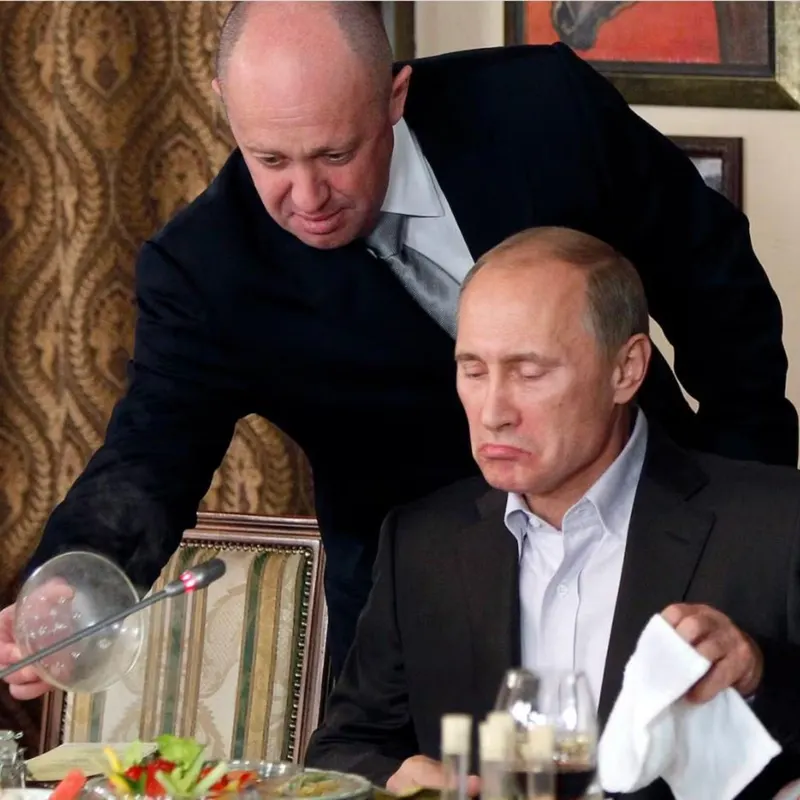
In progressBy now much of our audience may have heard of PMC Wagner, the mercenary group that marched on Moscow earlier this week in what appeared to be an abortive coup against the Russian government. Wagner infamous for its many alleged atrocities, and has been proven to be the most effective force in Russia's invasion of Ukraine. But this notorious private army is all the work of larger-than-life dog vendor Yevgeny Prigozhin.
Liam and Sam B recount the rise of Russia's most bizarre oligarch, nicknamed "Putin's Chef" for his insistence that his only business was catering. A failed athlete and former burglar, Prigozhin who fought his way to the top of St. Petersburg's brutal post-Soviet economy while striking up an advantageous friendship with a young Vladimir Putin. Long rumored to have ties to organized crime, he took up a side hustle as a warlord through his association with mercenary Dmitry Utkin, the apparent Neo-Nazi for whom PMC Wagner is named. After being outed as the leader of Wagner despite years of denial, Prigozhin has taken the stage as the fiercest critic of Russia's strategy in Ukraine. He gained attention for his colorful, vulgar front-camera video rants tearing into the military brass, particularly Minister of Defence Sergei Shoigu. And just days ago, the world watched this trash talk escalate into an armed attempt to remove Shoigu from power.
On this week's episode of Gladio Free Europe, we explain why Yevgeny Prigozhin is both a figure from another time and also a guy who is inextricably of the president. Listen and find out if this St. Petersburg sausage seller really is the End of History on horseback.
Transcript
Who is Yevgeny Prigozhin?
Welcome back to Gladio Free Europe. I am Liam, joined here by Sam B.
How you doing?
Hello, I return.
By now, a lot of you guys have probably heard of Yevgeny Prigozhin, the colorful Russian oligarch, caterer, and mercenary leader who was rocketed to the world stage just a couple days ago for his role in what appeared to be an attempted coup against Vladimir Putin. So obviously the coup fails. Prigozhin got some kind of deal, and as we're recording this, he's been exiled to Belarus while posting vague online hints that he's cooking something new.
Yeah, yeah.
We have no idea what's going to happen, and I think the rule for this episode should be we won't make any predictions because the Ukraine-Russia situation is very volatile, and I think that a lot of podcasts get a little bit too overconfident, and we're not going to be one of them.
Yeah, let's just not make that mistake. Let's just not even go there.
Instead, we're going to go over who Prigozhin is, where he came from, and how he got to this point.
Yeah.
The craziest thing about the Russia coup is that it was all caused by this one guy, this one really weird hot dog seller, turned mercenary kingmaker.
Yeah, he's a clown, he's this buffoonish grandstander who is nevertheless probably the most brutally effective commander in Russia's entire war effort against Ukraine.
Or at least it's the image he likes to portray.
That's true, absolutely. Because, and the image is very important here. Because unlike other oligarchs who prefer to stick to the shadows, Prigozhin is a gloryhound through and through. He wants to throw himself into the center of the world's eye, and he's finally there. And we have to wonder if, you know, his attempts to seek publicity are not disconnected from his apparent attempt to overthrow the Russian government. You know, maybe it all was just to get the cameras on him. Because he is a very unusual figure. In some ways, he feels like he's stepped out of another time, you know, an age of condottieri, like the Italian Renaissance.
Absolutely.
But on the other hand, he's the kind of figure who can only exist in 2023. And so I feel like if, you know, Hegel famously called Napoleon history on horseback, I think this episode will explain why Prigozhin is in fact the end of history on horseback.
A Leningrad childhood
So let's get into his life and background a bit. So Yevgeny Prigozhin was born in 1961 in St. Petersburg, Leningrad at the time. He was a solidly middle-class kid. His mother, Violetta, was a doctor. But his dad died when he was young, and for a while, his mom supported the family on a single income. This was not a huge income because Soviet doctors were nowhere near as well paid as their American counterparts.
Right.
But he still was solidly middle class. The biggest event in Prigozhin's early life was that his mother remarried a man named Samuel Zharkoy, a professional cross-country skier, which is a profession I did not know existed in the Soviet Union.
Well, it's because it was all about the Olympics. The Olympics were a really big part of Soviet statecraft and diplomacy, especially the Winter Olympics, you know.
Oh, absolutely. And so that's why, as a teenager, Prigozhin really wanted to follow in his stepdad's footsteps and also become, if not an Olympian himself, a trainer for the Olympic athletes like his stepdad was. And he actually got somewhat far in this because he was admitted to a special boarding school for Soviet athletes that was known for pumping out tons of Olympians.
Exactly.
So at school, he met a lot of kids who were a lot more high up in the Soviet elite than his family was. But what really stung was that a lot of these kids weren't just richer or well-connected, they were better athletes.
Which is a really hard thing to take or truth to take in if this is your dream.
Exactly. So unlike these kids who were already better off than him, who already had parents in the nomenklatura or whatever, he had nothing waiting for him after high school. No lucrative athletic career, no, you know, contracts, and nothing like that. And this was presumably pretty heartbreaking to him because he'd spent so long trying to become an athlete. But ironically, his failure to live out these Olympic dreams would ultimately bring him to much, much greater fame and glory.
Burglar and prisoner
But it all starts, I would say, with how as soon as he gets out of high school, he starts hanging out with a pretty bad crowd with very bad implications in the short term.
Yeah, and this is a bad crowd in St. Petersburg in the late Soviet Union, which is saying it's serious.
Right. Things are falling apart. Nobody has money. People are trying to make ends meet in other ways. And for Prigozhin, it was breaking into luxury apartments and robbing them. He was just 18 when he did this.
You know, just to psychoanalyze a bit, I gotta wonder if maybe this was his way at getting back at the rich kids at his school, the well-connected kids in the fancier apartments. He's arrested at 18, but given a second chance by the Soviet legal system, suspended sentence. He doesn't take that second chance because just two years later, he's arrested again. This time for a much more serious crime because he's now alleged to be the ringleader of a gang of thieves that includes minors.
Yeah, gang activity is a big no-no.
Yeah, and so for that reason, he was slammed with 12 years in prison, probably thinking his whole life was over.
Yeah. But he ended up benefiting from something that didn't benefit a lot of people, and I wouldn't say benefited the public at large in terms of quality of life. That being the fall of the Soviet Union.
From hot dogs to casinos
Because when that happened, a lot of people were released from the overcrowded Soviet prisons, including Prigozhin. And they started a new attempt to make money through other means. In a country where that was now accepted and legal.
Exactly.
Yes, yes.
And that suddenly transitioning from a planned economy to this free market, kind of almost libertarian capitalist state. And tell me, Sam, how did Prigozhin make his money initially?
Well, he started out with a hot dog stand.
That's right.
Yeah, as humble as you can start. With his mom and stepdad.
Yeah.
Who, by the way, was, like his father, Jewish.
Yes, and that's going to be important as we'll get into it.
You wouldn't expect that with his later activities. And his later associations, I would say.
Yeah. Yeah.
So, you know, the fall of the Soviet Union was really bad for a lot of people, but really good for small-time businessmen with a lot of gumption. And he's a good example of that. He would really quickly rise through the new Soviet economy, largely just through his involvement in the food industry. He grew from having a hot dog stand to being able to invest in grocery stores and restaurants with some of the connections he made at that elite boarding school. And this meant that by his mid-30s, he was owning some restaurants in his own right and had actually become one of the richest businessmen in St. Petersburg. This is in the 90s when he's like 33 or something. I think where he really made it big, though, after this point, was when he moved from grocery stores and restaurants into casinos. He was kind of like the Ace Rothstein of St.
Petersburg, setting up gambling enterprises all over the city, bringing in blackjack machines, and especially greasing the palms of the Supervisory Board of Gambling, a part of the Russian government, which was chaired by a young city official of St. Petersburg. Can you guess who this was, Sam?
Well, he might have heard of him. His name is Vladimir Putin.
That's right.
Friends with Putin
The two guys, Putin and Prigozhin, would see their own fortunes each greatly improve across the 90s. And it seems like they became friends along the way. Because by the time Putin was named as deputy chairman of the St. Petersburg government, Prigozhin was operating high-class restaurants across the city, including one called New Island, which was a boat one?
Yes, a boat turned into a restaurant that hosted guests as eminent as Jacques Chirac, president of France, and even George W. Bush when they made state visits to Russia.
Because remember, these days, Russia and the West have a very oppositional relationship, but in the 2000s and especially the 90s, this wasn't the case. George Bush was very friendly with Putin. And I think that Prigozhin, if you asked him, would probably say he's part of the reason why.
Yeah, absolutely. Honestly, Putin was probably one of the few European leaders who Bush didn't hold a grudge against for being not joining the Iraq war.
Yeah.
Yeah, he famously said he looked into Putin's soul.
Yeah. Which is.
Yeah.
Ah, there's a lot there. But in the 2000s, he expanded into industrial-scale catering, which would gain huge government contracts and delivered food to schools, state offices, and most importantly of all, the Russian military.
Right.
By 2012, he was living in his own mansion with a helipad. And isn't that crazy? It's almost too hard to believe, right? All this from a little hot dog stand?
Yeah, it is a little too crazy to believe.
Mobsters and neo-Nazis
Yeah, exactly. Yeah, it's like you gotta wonder if that's really the full story. Because while a lot of kind of classic mom-and-pop joints did turn very much everyday people into oligarchs in this era, this was a time in which rising through the economy was basically impossible without collaboration with very shady characters. And Russia in the 90s had no shortage of shady characters. Probably the two most notorious groups like that to emerge out of this place and time were groups which both had some circumstantial role in Prigozhin's success. Nothing is known for sure, but it might make his rapid success easier to understand. These two groups are mobsters and neo-Nazis.
Okay, so a lot has been written about the Russian mob. Their international reach means they're pretty widely known in pop culture to the extent that they've been the go-to action movie for Hollywood villains the past 10 or 20 years, second only to Middle Eastern terrorists.
Yeah.
These gangs existed in the Soviet prison system all across the Soviet era. But during the 80s, the increased openness of Soviet society allowed prison gangs to operate semi-publicly for the first time, opening legitimate businesses and fronts and even going abroad to establish criminal syndicates in countries like the United States or in European countries. So as a result of this, as early as 1985, major Russian gangsters were being assassinated in Brooklyn. And so by the 90s, Russian mobsters had become some of the most significant international criminals, making deals with a lot of different gangsters. You know, the casinos that we mentioned, Prigozhin, working at, they probably got their slot machines with the assistance of the Japanese Yakuza.
Absolutely. Yeah, Russian gangsters were also making deals with cartels in Colombia and Mexico to bring drugs between Europe and Latin America. Within Russia, entire sectors of the new economy were coming under domination of the mob. They even entered politics, but didn't have as much success.
The best example of this I know is that a 30-year-old gangster named Vladimir Nikolaev, whose nickname was Winnie the Pooh, became the unexpected mayor of Vladivostok, a really major city, after his favorite opponent apparently tripped on a live grenade and was killed.
I shouldn't laugh. I shouldn't laugh, but Kevin, come on.
Exactly, yeah. So by the early 2000s, a little bit after this, the interior minister Rashid Nurgaliyev claimed that 10% of the geography of Russia was either under the control of gangsters or Chechen rebels.
Who were also effectively gangsters by that time.
I'm sure. And the new government, now led by Vladimir Putin himself, would very effectively and brutally deal with both these threats due to a combination of violence and backroom shady dealmaking that ended up turning both.
This is a huge topic and probably too much for this podcast.
Right, right, yeah. It has to be mentioned.
Putin restores order
But I think what matters here is that I think a lot of people in the West don't understand why a figure as violent and boorish as Vladimir Putin has any support among the Russian public. And I think that the biggest reason he does is that the 90s in Russia were a really bad time. Life expectancy dropped precipitously. There was a huge amount of violence. The economy was in shambles. Then Vladimir Putin comes in, and for various reasons, he's able to bring back an order of stability, which gave him enough goodwill to basically stay in power for the ensuing 20 years. He essentially recentralizes the state.
Yeah, yeah, absolutely. Like, I mean, even under Yeltsin, famously, there were competing security agencies. The KGB or the FSB wasn't the only game in town. And Putin centralized all that.
Yes, centralized it, especially under his direct control. He basically reoriented the Russian state around him. Russia still has elections, but it really seems like for the past several, basically 15 years-ish, these elections have been, at best, semi-legitimate, you know? At worst, total farce.
I'd compare them to Turkish elections.
Yeah, yeah. Turkish elections now are kind of what Russian elections have been like for the last like 15 years. And again, it's because you could say that so that the 2000s were this kind of autocratic stability brought in by Vladimir Putin. The 90s were utter pandemonium.
Russia's neo-Nazis
And I think that one of the most shocking aspects of this pandemonium for everyday Russian people were the sudden appearance of those neo-Nazi thugs we mentioned.
Yeah, because obviously neo-Nazis are despised by the vast majority of people in America or England or Germany, but Russia is a little different. In Russia, the sight of a swastika stings a little deeper than it does here, because so many Russians and other Soviet citizens, I should note, were slaughtered by the Nazis in World War II. It's really shocking to see that. It's like, there's really no parallel here. There's no war where Americans have lost nearly as many people as the Soviets lost.
And just like the mob, the neo-Nazi movement began before the fall of the Soviet Union as an extreme reaction to whatever the Soviet Union represented, right? Like, if you hate the USSR and you're an edgy piece of shit, you're going to embrace the most anti-Soviet symbol you can think of, which is, in this context, Nazism. So, small Nazi skinhead gangs start popping up across Russian cities amid the fall of the USSR, probably inspired by Nazi punks in the United States and Europe. Our very first episode of this show was actually about the National Bolsheviks, a famous similar group of punks who also adopted Nazi imagery alongside Soviet imagery to shock people.
There is a significant distinction here because the National Bolsheviks, they were not good people in any sense.
No.
Good music, though, sometimes. But they were using these symbols as purely an aesthetic point. They expressly did not adhere to any of the genocidal tendencies of National Socialism. Other Nazi punks, explicit neo-Nazis, very much did.
There was a rash of hate crimes across Russia, murders of rival groups. It was not uncommon to see small groups of neo-Nazis gathering in the streets. These were not large movements. Like, this was not a huge percentage of the population in any sense. We're talking a few hundred, maybe a few thousand in every city. These were fringe groups, but they were very visible. One interesting thing also about them is that they even started their own religion. There is a neo-pagan Slavic movement created by Russian neo-Nazis inspired by far-right neo-pagans in Scandinavia. They reject.
Followed by someone who we will talk about later, honorable.
Yes, yes, yeah. Based on the idea that Christianity is too Jewish or whatever, and because these guys are so anti-Semitic, they reject even Christianity, which has been so essential to other kinds of right-wing Russian thought.
Absolutely. Yeah, these people basically believe that the only thing Hitler got wrong was that Russians are infuriated Germans.
Yes, exactly, exactly. They're on board with everything else, particularly the anti-Semitism. And we should mention here that just like with the mobsters and with the Chechen rebels, the relationship between neo-Nazis and the Russian government has been somewhat complicated because it's long been alleged that some of these Nazis were in fact on the government payroll. Not because Putin had any real ideological sympathy with Nazis, but because the no, but because the sight of these Nazis was such a good fear tactic in Russia that it could be used as an excuse to get more funding for the growing security state, which of course meant more power for Vladimir Putin.
Yeah, there's some strong analogs to American history for this one.
Oh yeah, yeah, yeah, no, exactly.
Like it's covert government support for fascists.
Oh yeah, absolutely.
Dmitry Utkin
And here's the thing. So bringing this all back home, I don't think Prigozhin is in the mob, and I certainly don't think he's a Nazi, but he seems to have spent a lot of time with both of those kinds of people. There is one particular association we have to talk about here, which is incredibly important to his career. It's an association that's generated a lot of speculation with a figure who is much more shadowy than the, you know, very public, grandstanding Prigozhin. That is his bodyguard and presumed former neo-Nazi thug, Dmitry Utkin.
Who is this guy?
Well, he's got SS tattoos and was active in the Russian military.
Yes, he does. Yeah, so active in the Russian military, where his call sign was Wagner, as in Hitler's favorite composer. So there's not really much dispute about his political orientation.
Yeah. About him being a Nazi.
Right, and this is especially kind of surprising or incongruous because, as we mentioned, Prigozhin is part Jewish.
Yeah, he is Jewish. His father is Jewish, and there are arguments about that, but I... I think he's definitely Jewish, and that was definitely part of his upbringing and his experiences.
Even his stepdad was Jewish.
Yeah, yeah, yeah.
I think his mother was not, but one kind of funny thing about his mother's family is that her last name is Khokhlova, which, if that sounds familiar, it means Ukrainian, and it's actually related to a word that's a pretty nasty Russian slur for Ukrainians. So it's kind of funny, right? So he's a guy who's, you know, he's of Jewish and Ukrainian descent, but he's palling around with Nazis and he's invading Ukraine, right? Like it's a, he really is a man who contains multitudes.
Yeah.
Yeah, and so for whatever reason, Prigozhin began his association with this guy, despite the fact that Utkin presumably adheres or at least once adhered to an ideology that would see Prigozhin's family wiped out. Initially, Utkin served as his bodyguard and security manager for his various businesses and factories. But on the side, Utkin had another hustle, one relating to his former military service.
From Slavonic Corps to Wagner
It's that Utkin was a mercenary. He had a company based in Hong Kong known as the Slavonic Corps, which is another kind of funny little nod to, right, another nod to his kind of Slavic nationalism and neo-paganism, that fought in 2013 in the Syrian Civil War. Russia would later officially join the civil war on behalf of the government of Bashar al-Assad. But this early, this was unusual. This was a small group of mercenaries that included Utkin. And this would have very big implications for the career of his partner, Prigozhin, who at this point, we have to mention, maintained that his only business was food service.
Yeah. So there was an investigation by Forbes Russia about this, and they found that although Putin had publicly toured Prigozhin's facilities in 2010, by 2013, a lot of their factories had been shuttered, even though government contracts kept coming in. So it's pretty clear that he was making money by other means.
Right. And shortly before this happened, Utkin, head of that group, Slavonic Corps, comes back from Syria to St. Petersburg. And not long after this, he forms a new mercenary corps with a ton of money, supposedly under his direct control, named after him. This is, of course, PMC Wagner, the group that we're going to spend a lot of this episode talking about, and the group which just this week was involved in the attempted coup or abortive coup against Putin.
Yeah, and before you ask, PMC does not stand for professional managerial class. It's a private military company.
Right. And so for many, many years, Prigozhin denied any connection to Wagner. He denied that Wagner even existed.
That's hilarious, yeah.
But obviously, that's a lie. He is not an honest fella. He has been in charge of Wagner the entire time. The relationship between Utkin and Prigozhin in the structure of Wagner is a bit mysterious. It seems like Utkin himself no longer has any real involvement. It's possible he never had any involvement. He was only the faceovich, or perhaps only the field commander, while Prigozhin led the operations.
Crimea and the Donbas
But as early as 2014, these operations were basically going global. In 2014, just a few weeks after the Sochi Olympics, which were a huge deal for Putin and Russia, the government in Kiev was overthrown, and Viktor Yanukovych, who was this Russian-linked president of Ukraine, was overthrown and went into exile in Russia. So immediately after, Russian tanks rolled into Crimea and claimed the peninsula as Russian territory after a referendum. On the mainland, rebels who rejected the new Ukrainian government declared independence on the heavily Russian-speaking Luhansk and Donetsk provinces, which today are the Luhansk and Donetsk people's so-called people's republics.
Right, right.
And so this led directly to eight years of civil war in Ukraine, which was broken only when Putin launched his special military operation last year. And that special military operation, of course, being the full-scale invasion, seeking to destroy the Ukrainian state.
And annex its lands.
Right. But before this, the Russian military was not directly involved in the Ukrainian civil war, only in Crimea.
At least officially, yeah.
At least, yeah, officially. Instead, many other Russian-speaking groups were. These included militias based out of Ukraine, because Ukraine has a very large population of Russian speakers, some of whom, a minority of whom, supported the independence of these republics. Also, because of widespread speculation that individuals and private citizens who were not officially connected to the Russian government, were entering Ukraine to foment rebellion and support the ongoing civil war. This included the Wagner group.
Wagner in Syria
After the initial outbreak of violence in Ukraine, Utkin went back to Syria as the field commander of the Wagner forces on the ground there. And one of their main operations was the Battle of Palmyra against ISIS. Wagner actually trained a group of local militias called, they called themselves the ISIS Hunters, a group whose insignia looks exactly like the skull patches of the Wagner troops, except with some Arabic writing underneath, which is really interesting. In late 2016, Utkin returns to Russia for an event celebrating the success of the Battle of Palmyra. He was photographed meeting President Putin, but this would be his last known public appearance. Wagner would explode in success and notoriety after this, indicating that Utkin may have been a little more than a frontman in coordinating the group's operations in Ukraine and also in Africa.
Yeah.
And the Middle East.
Right. Because the real, yeah, because the real guy behind the scenes, of course, is Prigozhin.
Wagner in Africa
Yeah, let's talk about his activities in Africa, because they're pretty interesting.
Just to speculate here, my hunch is that the way kind of Wagner functions, especially now, now that the war in Ukraine has begun, is that their main activity in terms of numbers of troops deployed is in Ukraine. But they use these contracts in Syria and Africa to train the recruits to have battle-hardening experience and also generate money for the main event, which is Ukraine. So there's been a lot of kind of relatively small-scale deployments across Africa in many different countries, usually just like CAR, Mali, Sudan.
Yes, CAR, Mali, Sudan, just a few dozen to a few hundred.
Central African Republic is one of the most notorious of these. All these are quite notorious. And Wagner, they have a very complicated reputation because their pitch to these African countries is that they will basically behave better than Western mercenaries do, because many Western mercenaries have done a lot of really terrible stuff in Africa.
And the colonial scars. And Western regular militaries.
Yes, regular militaries, the French military, for instance. And also, yeah, the colonial scars are really, really fresh. I think in 2022, actually, as an example of this, I'll try to dig it up. Wagner put out this insane cartoon commercial specifically trying to attract African investors, saying, Look, in this cartoon, the mean Western mercenaries are going to, you know, abuse your people, whereas the better-trained Russian mercenaries, we all want the same thing. We don't like the West either. So work with us, we're more sympathetic to you. And that's basically the pitch. And so Wagner mercenaries have been sent to all these countries. In 2018, 170 of them were sent to the CAR, that being the Central African Republic, to defend their lucrative diamond and gold mines. After this success, the force grew from 170 to about maybe 300, 500. And they were involved not only in guard duty, but now in actual military operations against rebels.
These military operations saw some pretty bad atrocities against suspected rebels and their collaborators. The same kind of thing you're seeing in Ukraine.
In other words, civilians.
Yeah, yeah. Suspected collaborators, that means civilians. And survivors also allege something you might be familiar with if you know Wagner. They allege that execution methods by these mercenaries included disemboweling and beheading. So, really, really bad stuff here. So, you can see why pretty early opponents of Wagner and the Russian government more broadly sought to investigate this.
In 2018, three Russian journalists traveled to the CAR to film a documentary exposing alleged war crimes by Wagner troops. They would return home in body bags. So, no killer was ever named, but it's determined to be the work of well-trained professional assassins.
Right. So, I think it's pretty clear what happened here.
Exactly.
That was 2018. In 2019, Wagner forces were implicated in violence against protesters in Sudan during the very complicated overthrow of the government of Omar al-Bashir, and then the installment of a military dictatorship, also with Wagner assistance. Probably the most notorious of all their actions, though, was in the Western Sahara region in Mali.
A former French colony.
Yeah, yeah.
Which is important.
Yes, because while Wagner was deployed in Mali to assist against these ISIS cells in West Africa, a firefight broke out between soldiers and jihadis that resulted in a brutal punitive massacre of nearby townspeople, residents of a city called Moura. They, just like the people in CAR, were accused of harboring rebels, and so at least 300 civilians were gunned down in a retaliatory attack, very similar to something like My Lai, you might have seen American troops doing in the Vietnam War. And you mentioned, Sam, that it's a former French colony, and that matters because locals reported that several dozen of these soldiers appeared to be Europeans who couldn't speak French. This has led to it being widely assumed that this massacre could have been perpetrated by Wagner.
Prigozhin outed
Eventually, Prigozhin would be outed as the leader of Wagner in 2022. And when this happened, he was confronted by the Russian media about these terrible atrocities his men were carrying out. This is his response: Neither I, neither I, nor the men I know, nor the Malian army have committed them. You are dying. You are dying out. Western civilization that considers Russians, Malians, Central Africans, Cubans, Nicaraguans, and so many other peoples and countries to be third world scum, he said. You are a pathetic, endangered bunch of perverts, and there are many of us, billions of us, and victory will be ours.
Right.
And I realize now this is the first action. Yeah, this is the first Prigozhin quote we have in this episode. He is just always saying stuff like this. I'd recommend if you want to hear...
Third world is boss.
Yeah.
He's not as third world as shit.
No, he really is. It's hilarious. Yeah, if you want to see the kinds of like, you know, bombast he's known for, go and Google and look at any, like try to limit your search for results from like, let's say, before June 2023. And you're not going to find stuff about the coup that's dominating the search results now. You're going to find all these crazy quotes like this. Because like I'm saying, he is a grandstander. He loves getting attention for himself through these kinds of bombastic statements. And just to...
They called Sergei Shoigu a fuckhead.
Yeah, yeah. The defense minister. Yeah, yeah.
The golden billion
The whole idea of like, you know, placing billions of people in the developing world, positioning them against like the West, that's a pretty common aspect of Russian nationalism, which is a bit interesting because, you know, although Russian nationalism does appear to have a lot of overlap with American conservatism, I think the fundamental difference is that it is by necessity anti-American. It sees Westerners, including the United States, as, you know, entitled, overfed, demanding too much, and taking, and while the rest of the world gets too little. And so the very common rhetoric these days is that the West makes up a so-called golden billion of the wealthiest top eighth of all people, whereas the other seven billion, which includes Russia, are more honest and hardworking and suffer under this plight. I think that this, you know, yeah, this is sometimes labeled as a conspiracy theory, but it's really more of the description of exploitation assigned certain numbers.
Yeah, no, no, exactly. Yeah, no, it's I completely agree. It's not the worst way to describe how rich countries interact with poor countries. It's just done in a very self-serving way that supports the aggression of Russian nationalism.
Nazi role-play
I also think it's kind of interesting because this is directly at odds with, in my opinion, with the white supremacy that you'd associate with Nazis. So even though Wagner is named after a guy who is a neo-Nazi and has other weird little elements of like weird little German quirks about it, I don't think that Prigozhin's ideology has really any connection to Nazism.
No, although I will say, though, I wouldn't be that surprised if a lot of members of Wagner, especially given how many of them are ex-cons, might be, you know, might happen to be like Nazi thugs.
Oh, no, we've seen it.
I've never seen the same stuff that created guys have to wear. You know, the Wolfsang.
Oh, yeah, no, it's all that. Yes, there is a. Yes, there's a lot of edgy Nazi role playing in going on in this war. Yeah, yeah, yeah.
I love two groups of people with iron crosses calling each other Nazis. It's great.
Yes, no, absolutely. And that's the thing is, because, yeah, you know, Putin has claimed that the purpose of the Russian invasion is to denazify Ukraine. That's obviously bullshit. And the best evidence of how bullshit that is is the fact that the Russian invasion relies on the support of this militia, nominally led by a new Nazi. You know, it's like you said, yeah, it's, yeah, it's.
Yeah, no, there are like most Ukrainians and most Russians would find these symbols appalling.
Yes, yes, obviously. Yet, regardless, you see people on both sides using these symbols to be shocking or show how tough they are.
It's because they genuinely just believe that Hitler was cool.
Yeah, or because they think Hitler was cool. Yeah. In any case, I do not think that Russia-Ukraine is a romantic war at all. And I do not sympathize with people who think that either side is completely morally virtuous. I think that it's really, but I do think it's really, really bad that Russia invaded. I think putting my cards on the table, that was a brutal, unnecessary, imperialistic thing to do. And they should not have done that.
And just stupid.
Prigozhin and Russiagate
Yes. But before we get to the Russian invasion of Ukraine, which leads to this abortive coup, let's talk about the thing that first brought Prigozhin to American attention. Because I didn't realize this until I was researching this. So obviously, some of our listeners, most of our listeners will remember Russia Gate and the subsequent investigations. There were these 13 Russians involved in troll farms promoting Trump in 2016.
Yeah. They would use posters from Ghana or Nigeria.
Yeah, yeah. And these were led by individuals, including allegedly Prigozhin. And so, you know, personally, I don't think that these specific Facebook pages had any real significant effect in turning the election towards Trump, because I think that they were mostly just copying American pages that were, you know, that were real. But they're pretty funny. They were left-wing and right-wing pages, all meant to defame Hillary, whatever, the Democrats, yada yada, promote Trump from different angles. And some of these pages did have some measure of success. A few of them got like 100,000 followers or more on Facebook. But I gotta say...
The woke Aztec.
Yeah, the names are ridiculous. Yeah, there's the woke Aztec was the name of one of these accounts. There was one called Blacktivist, another one called Woke Blacks, all obviously meant to get people of color to, you know, in some way support Russian interests.
Yeah, and then there was the right-wing ones, Back the Badge, Pray for Police.
Yeah.
A lot of back the fights.
Yeah, yeah. Really, a lot of involvement in gun rights stuff, you know, in like NRA stuff, in pro-police stuff. I think really you can maybe compare this to the, you know, previous Russian strategy of, the government strategy of supporting neo-Nazi thugs just as an excuse to cause chaos. Because I think that what was happening here is that figures like Prigozhin were, on behalf of the Russian government, creating these troll farms just to spread chaos and discord in the United States in hopes that this kind of chaos and discord would be advantageous to Russia, the rival of the United States.
Even if it wasn't particularly successful.
Right, right. Yeah, and so I said that I don't think these pages were really that important. I think that it's like, I have nothing against the Russia investigations, but I never was that convinced they would lead to the downfall of Trump, the way some people thought they would. But, you know, somebody who did think that these Facebook trolls were very important is Yevgeny Prigozhin himself, who claimed, who bragged rather, that he was the reason Trump got elected and then said that he's going to keep meddling in American elections and nobody can stop him.
Yeah, yeah, it's really funny.
Putin's chef
Yeah, as much as I want, is what he said.
Yeah, and so when he first kind of got exposed in this Russiagate stuff, he started being referred to in the Western press as Putin's chef because of his role in catering companies. Although this was not a nickname he liked.
No, he really did not like that. I have never been a chef. I used to be a restaurateur and quite successful. I can't cook for myself, though. But I can't cook myself.
They should have just come up with the name Putin's butcher instead.
Yeah.
Right. Another thing he got into all around this time was that if you remember the name Maria Butina, who's a Russian woman who was involved in promoting right-wing American politics, especially gun stuff, he paid for a lot of her legal defense. So he was very much interested in promoting Russian interests abroad in any way, whether it's by committing massacres in Central Africa or by doing these goofy stuff in America.
Wagner invades Ukraine
And so eventually, you know, in 2022, the Russian invasion happens. And right from the start, Wagner plays a pivotal role. I think it's important to mention that they had previously been active in Ukraine. Like we said that right when the annexation of Crimea happened, Wagner troops were believed to be present in the Donbas region. Interestingly, it seems like several commanders of the pro-Russia rebels in fact died mysteriously and may have been killed by Wagner. It appears that these rebels, though they were pro-Russia, were deemed unreliable. So Wagner figures, including Utkin before his disappearance, were involved in getting rid of them and replacing them with new leaders more amenable to Moscow. We know all this thanks to the reporting by the Russian newspaper Gazeta. And about a year after this was reported, Gazeta was brought under government ownership in Russia. Years pass, the Russian invasion begins. Wagner plays a very pivotal role.
It becomes increasingly hard for Prigozhin to pretend that he is not running this mercenary company. A major part of the Russian war effort that's gotten a lot of attention has been the recruitment of prisoners to fight in the war. People not unlike Prigozhin, you know, people who had a military prison sentence, but might have, but really want to get out, right? And a video came out in 2022 where Prigozhin was personally speaking to these recruits in the Wagner company from prisons. And that was basically when he realized he could no longer pretend to not be running this company. And he eventually admitted to having been the real leader of Wagner since 2014. Utkin was just a front man.
Exactly. Yeah.
And kind of an interesting kind of consequence of this is that although now, so he was announced as the leader of Wagner. And Wagner is very notorious in the West, particularly because of its, you know, Nazi associations. In Russia, though, it's seen as this patriotic organization. And this means that right until launching this abortive coup, Prigozhin had a very, and his family had a very interesting relationship with Russian high society.
A celebrity family
Because this association with Wagner made him a celebrity, which I gotta think might be what he wanted all along.
Absolutely.
It brought wealth, brought fame for him, and even brought fame for his family, according to this.
His mother.
Yeah. I found this report from the Financial Times. Can you read this quote here, Sam?
Oh, hell yes, of course. So one report on the state-owned Channel 1 television station marveled at the woman's transformation into an overnight art world sensation. She could not sit idle and found not just a hobby, but a new calling. What casual visitors to the gallery might not know is that the artist has a famous son, Yevgeny Prigozhin, the hot dog seller turned private militia boss who has emerged as a powerful warlord in Vladimir Putin's full-scale invasion of Ukraine, and who's also one of the most notorious accused war criminals on the planet.
Right. So while Prigozhin himself is in Ukraine, not too far from the front lines, involved in the war effort, his 83-year-old mother is becoming a professional artist, launching an art gallery, which I think is kind of sweet in a twisted way. And also, kind of funny enough, apparently a lot of her art had an anti-war message, and one of her paintings was of Palmyra, the city defended by Wagner troops in Syria that had suffered extreme damage due to ISIS.
Yeah, no, that was house-to-house fighting.
We should mention, though, that his mother is not the only one who's gotten her time in the spotlight.
Exactly. No. So.
Oh, no, no, yeah.
So, on February 20th last year, about four days before the invasion, a blonde-haired Russian teenager competed in an amateur showjumping event in the Mediterranean Resort of Oliva near Valencia in Spain. This girl was Veronica Prigozhina, the younger of Prigozhin's two daughters. She rode a grey gelding called Dithara and finished fourth, netting prize money of 50 euros.
Yeah, so you know, Prigozhin, he could never become an Olympic, you know, skier, but maybe his daughter can be an Olympic show jumper someday.
Yeah, and then records compiled by the International Federation for Equestrian Sports, Jesus Christ, the Equestrian Governing Body, show how from 2014, Veronica and Polina, his elder daughter, competed outside Russia in hundreds of events on a stable of horses with names including Happyfeet, Brunetti, and Zitana in competitions in Germany, France, Portugal, Italy, Belgium, and also in Spain.
Yeah.
His oldest son, though, is Pavel, who actually joined Wagner as a soldier in Syria. He won the Eunice Black Cross Award, which is, as you might guess, probably a reference to the German Iron Army.
Yes, yeah.
So that's what's going on with his family. Pretty ugly stuff.
The meat grinder of Bakhmut
Prigozhin himself, though, has not had as fun of the past few months as his family have had.
No, and neither has Wagner.
No, no. Because as he constantly complains, his men are being thrown in the meat grinder.
Yeah. Because, I mean, what do you think is going to happen when you sign up a bunch of ex-cons in Russia?
Right.
Going to be cannon fodder.
Right. There's actually some dispute about whether or not the ex-cons have yet served in Ukraine. Some people think they've only been fighting in Africa, but I gotta think that these are true. I think that I think these riders probably fighting in Ukraine.
Yeah, no, I don't see how they have as enough men without resorting to that. Because the war has been...
Especially in Bakhmut, which was such a huge and right, really ugly battle. And let's get into why the Russian war effort has been so ugly. Because, look, it is not going well for Russia. I don't think this was supposed to be over in weeks and right.
Yeah.
And so the Russian government has been very Baghdad Bob about that. You know, they downplayed their embarrassing defeat trying to take Kiev. And they also downplayed the fact that this tiny city of Bakhmut, which is not even that, you know, which you don't think would be that important to the war effort, ended up being a bloody conflict that lasted longer than the entire Battle of Stalingrad in World War II.
Yeah.
But while, you know, the Russian government, the Ministry of Defense, is being very elusive about these losses, Prigozhin is the opposite.
No, if anything, he's trying to get everyone who will ever listen to him to hear his tirades.
Yeah.
He's totally confused about this. The war is going terribly. Wagner is the only competent force. The Ministry of Defense is always to blame. Shoigu isn't sending in us bullets, et cetera, et cetera.
Front-camera rants
Yes, yes. We'll talk about Shoigu in a minute, his rival. But yeah, he.
He's a front camera video guy.
Yes, yes.
He's a boomer.
He's taking videos in his car. Instead of complaining about Target t-shirts being too woke, he is talking about how the Russian military isn't actually committed to the war effort. And yeah, so he said things like he claims that the Ukrainian government is committing an ongoing genocide of ethnic Russians in Ukraine, but the government is too busy with their own interests to get involved there. In October 2022, he said that the leaders of the Russian army, as opposed to Wagner, the private army, all these bastards ought to be sent out to the front barefoot with only a submachine gun. And then saying that the Russian parliament was totally useless for not giving Putin enough power to, you know, effectively prosecute this war. And, you know, the interesting thing here is that he is really one of the only... You could argue in a sense that he's one of the only figures who has publicly criticized Putin and the Russian government and until very recently basically got away with it, you know, because this is a state that does not tolerate that much significant criticism, but their most important commander is out here just constantly talking shit about his rivals.
And I think it's because of that, Prigozhin really thought that he was essential. He thought that because he was so important to the war effort, he could say or even do whatever he wanted. And that led to the crazy situation that we've been seeing this week. But before we get into that crazy situation, Sam, let's read off some of the quotes that he said over the past year about the state of the war in Ukraine.
We are now in a state where we could just screw Russia up. So we have to introduce martial law. We have to announce new waves of mobilization. We have to get everyone we can producing ammunition.
Yeah, so he's basically saying that the world should be like, you know, World War II, essentially, a full mobilization, which we haven't seen.
Yeah. He says that we have to stop wasting money, stop building new roads and new infrastructure, and work only for the war.
Yeah, yeah. And I think his funniest comment was when he explained kind of what he thought the course of Russian society should take.
Russia needs to live like North Korea for a certain number of years. Close all the borders, stop playing nice, bring all our kids back from abroad, and work our asses off. Then we'll see some results.
Right. He often directly addresses the people he's complaining about, including on rare occasions Putin, and especially Sergei Shoigu, the Minister of Defense, who leads the Russian army. And remember, so the army and Wagner group are separate, and Wagner has generally been a lot more effective than the army, especially in conflicts like the Battle of Bakhmut. He, however, often guards his fiercest criticism by addressing Russia's happy grandfather, who has been sometimes been speculated to be Putin, but I think is most likely Shoigu. Here's an example of one of his most colorful quotes about the happy grandfather.
And the happy grandfather thinks that he is good. If he turns out to be right, then may God grant everyone health. But what will the country do? Our children and grandchildren, and who are the future of Russia? And how can we win this war if by chance, and I'm just speculating here, it turns out that this grandfather is a complete fuckhead.
Yeah.
Yeah, and so this guy frequent stuff.
Yeah, especially, you know, given the track record of, you know, Russian dissidents basically, you know, getting pushed out of a window or whatever. But he totally feels free to make these statements. You kind of gotta admire the gumption.
Shoigu, the woodcarver
And so I think, you know, as we kind of wrap this up, let's, going up to the present here, let's explain what exactly led to the violent events of the last few days that really all have to do with that rivalry with Shoigu, the head of the Ministry of Defense. And he says, Shoigu, so he is in many ways the total opposite of Prigozhin. Prigozhin is the carnival barker, and then Shoigu is the quiet kid in the corner of the classroom, you know, slowly drawing pictures on his desk, or perhaps, you know, carving a piece of wood.
Exactly.
And also, Shoigu is, it should be noted, also an ethnic minority, but a very much one from much farther afield. He's Tuvan.
Yeah, yeah, you know, the throat-singing guys from the Russian Far East, you know, in Siberia.
Yeah.
So that's his background, which is kind of cool. And he's been attacked on the basis of ethnicity by many members of the Wagner group, including Prigozhin, who recently condemned him as a Tuvan degenerate.
Good God.
Not a lot is...
Yeah, no, it's awful.
Not a lot is known about Shoigu, except that he has been often named as a potential successor for Putin.
He is no spring chicken, so I wouldn't be that... I wouldn't be expected that much.
But one thing that's kind of funny about Shoigu that I just want to mention is that he has a lifelong hobby of collecting pieces of wood and carving wood. And there are all these photos of him. There's photos of him finding pieces of wood off the ground, showing Putin his favorite pieces of wood that he's collected over the years. And then I want to say in 2018, just like Prigozhin's mother, Shoigu got his own art gallery where he showed off his favorite logs he'd collected across the forests of Russia and brought in all these logs to display his pieces of art.
Man just really likes wood. I respect it.
Yeah, it's great.
Yeah.
But the two totally despise each other. Prigozhin blames all of Russia's failures in the war on Shoigu, and there have been a lot of failures. I think everyone expected the Ukrainian military to basically collapse with contact with the Russian army, and this didn't happen. The early weeks of the war went very badly for Ukraine, but after the defeat outside Kiev, there was a successful counter-attack where they pushed back the Russian forces, including Wagner, basically just to the eastern side of the country. And it's basically, honestly, been a stalemate ever since for the past year. There have been many people in Russia did not expect this to happen, and fingers, a lot of finger-pointing happened in different directions. Obviously, Prigozhin says that Shoigu is simply too incompetent. It's all his fault. But that isn't necessarily the opinion of the Kremlin, particularly of Putin.
The last straw
Because recently, the Russian government proposed a new policy which would totally change the organizational makeup of their war effort, presumably in an attempt to streamline things and help win their war. But instead, this would be a point of no return for Prigozhin and directly incite his rebellion. This was that it was declared that members of the Wagner group would actually have to sign contracts directly with the Minister of Defense, suggesting that they would no longer be a private mercenary company, but instead be integrated into the Russian army. This would presumably strip Prigozhin of all of his power and all of his great influence, make him no longer so essential to the war effort, and possibly most painfully of all, mean that all of his troops would now have to answer to the hated Shoigu. And this was the last straw. Shortly after this statement was made, Prigozhin claimed, without any real evidence as far as I can tell, that the Russian army had been shelling or conducting airstrikes against Wagner units across Ukraine.
The march on Moscow
And so he declared that, therefore, he was going to take his army to Moscow, cross the Rubicon like Julius Caesar, and replace Sergei Shoigu with a better minister of defense.
Yeah, it doesn't seem like he had that concrete of a plan on how to do this exactly.
Yeah, I agree.
And the results kind of bear it out.
Yeah, yeah, right. But that's what he said.
That's what we can glean in what he said.
Right. Yeah, so a couple days ago when this all happened, it was really hard to know to what extent this was real. At first, some people thought this was, you know, false reports. Even still, it's hard to know to what extent how many troops participated, but it seems like the city of Rostov, which is, you know, not, which is about not far from the Ukrainian border. You know, that was legit.
Yeah, yeah.
Several buildings were occupied by troops. Presumably, Minister of Defense employees and Russian army soldiers were taken hostage. And for a minute, it really seemed like a real violent revolt was taking place.
Yeah, I mean, it clearly was. And the column was marching up the road to Moscow.
Straight to Moscow. No, it's crazy. Again, it's like Julius Caesar stuff. It's the kind of thing that doesn't happen in a modern war. It's like warlords sacking the provinces and marching to the capital.
Yes, this is like medieval stuff. This is like the 30 years' war.
It's the 14th century Italian wars. It's, you know, John Hawkwood, mercenary captains like that.
Condottieri.
It's really weird stuff. We don't know to what extent any actual clashes happened between the Russian army and Wagner. It's been described as a bloodless coup, although I'm not entirely sure that was true. There were some reports of gunfire, as well as the claim that a Wagner helicopter shot down a Russian military helicopter. This is all still, you know, the dust is still settling here. But what we know for sure is that when the army was not that far from Moscow, Wagner suddenly announced that they were going to turn back, that they would not take the city as planned. There were reports that he was about to remove Putin from power and install a new president, possibly himself, you know.
It would have been cool to have two Jewish presidents fighting each other.
Oh, yeah, yeah, because Zelensky is Jewish as well. Yeah, that'd be funny, yeah. But it didn't happen. Although, obviously, it would have been terrible. Like, let's not.
There were some Westerners who were, you know, Michael McFaul and all those other people who were talking about this as an opportunity and this could be a new future for Russia, but it's this would be terrible. This would be even worse than that.
Oh, no, yes, yes. Right, yeah, no.
He's a Prigozhin is a very bad guy. You don't want him in charge of a country of 100 million people.
No. And, you know, a full-on civil war would have been very bloody. A lot of people died. And there even would be a chance of nuclear escalation, you know? One of the only good things that Prigozhin has ever said or done is that he condemned Putin's nuclear bluster earlier this year over Ukraine. But maybe Putin would use nukes against him, right? It's scary to think about. Who knows? It's, you know, look at how bad the warlord era was in China in the 1930s. We don't want to see this happen to Russia. You know, Russia could be a lot better than it is right now, but I don't think complete collapse into civil war in which various, you know, venal or even genocidal, you know, factions are waging war against each other. I don't think that's a situation you want.
Lukashenko's deal
But it doesn't seem like that's the situation that we're going to get because it appears that a deal was reached between Putin and Prigozhin.
Via one of my favorite characters of modern European politics, Belarusian president Alexander Lukashenko.
Right, right, right. Yeah, so tell us about Lukashenko, Sam.
Lukashenko is a weird dude. He's a former, he's a former Kolkhoznik, turned anti-corruption crusader guy in the 90s, turned dictator. He's ruled Belarus in a very weird, in a very odd direction. He brought back Soviet symbolism. For example, the flag was changed and the state security agents was renamed to the KGB. It's still called the KGB, which is wild. He brought back state ownership. Yeah, he brought back state ownership of a lot of companies, but with an explicit rejection of Soviet social progressivism and equality. It is a right-wing boomers version of Soviet history.
Yeah, no, I think it's fair. You know, and the fact that he's a boomer...
You might have heard of him for being the guy who famously said that it was better to be a dictator than to be gay.
Yeah, yeah. He also said something about how he decided actually that he's fine with lesbians. He only hates gay men.
Jesus fucking Christ.
You know, it's funny that you mentioned he's a boomer because I think it's very important that he was born in the 50s because he had previously claimed that his father died in World War II.
Yes. You gotta wonder how that works out.
Yeah, yeah, if you're born in like 1950, but you're yeah, yeah, right, yeah. But yeah, so Lukashenko, he's a weird guy. He has been playing a kind of odd, a peripheral but not unimportant role in world politics since the 90s.
Yeah, the Russian army, part of their invasion was through Belarusian territory, which Lukashenko okayed, although he did not send Belarusian troops proper into the war. He declined, and I'm sure he was pressured immensely to have his arm the their army join the war, but that did not happen. He it would be a re he recognized it would be a stupid move.
Yeah, and so he's a very close relationship with Putin, but he's kind of backed off at a few moments. I know, I feel like didn't it five or six years ago there was talk of some kind of Eurasian Union being set up by Putin to counter the influence of NATO in the EU. And it seemed like for a moment but he would be on board with that, you know, joining some kind of new post-Soviet confederation that stands for nothing except nationalism and profit. But that didn't happen. He never that net union did not materialize. And I think that Lukashenko's resistance is a big part of that.
Yeah, he very much he tried to balance the EU and Moscow in a really weird, interesting way. He would have he had like a trade war with Russia for a while.
Right.
There was a lot of really, really weird disputes between Russia and Belarus. But in the end, Russia was much more willing to put up with his shit than the Europeans were.
And right, and that's probably why, you know, he's returned the favor by negotiating this peace settlement that presumably avoided a civil war. Because now it has been announced that Wagner troops are going to return to the front to continue their fight against Ukraine. And Prigozhin himself, however, will be exiled to Belarus.
What it means
And that, as late as we're recording this on June 25th, is where the story ends. We don't know what is next for Prigozhin. And like we said, we're not going to speculate. We're not going to make predictions. But what we can say is that I don't think the emergence of this mutiny is a good sign for Russia or for no. I think it suggests a fundamental weakness about the Russian state. It makes me think that the entire war effort is held together by duct tape. I don't think the war is going well for Ukraine either, but I think this is two countries who are overly reliant on ultimately unreliable militias. And it seems like a bad move. And I've got to think that if Putin was as smart as he wants us to think he is, he would have seen this coming.
Absolutely. He wouldn't have allowed so much power to be rested in the hands of essentially a warlord. This really unique postmodern figure.
And I gotta say, he's a terrible guy, but he's one of the funniest, most entertaining figures of the last few years to emerge, you know?
Absolutely. I think that some people think that the Russian equivalent to Donald Trump is Vladimir Putin. That is absolutely not correct. The Russian version of Trump is this guy.
I couldn't agree more.
Yeah.
He represents everything that's terrible about the modern world, right? Like publicity as politics.
The modern Russian economy specifically.
Yeah, exactly. He's a classic oligarch who uses his money, you know, to get into the most brutal business you can imagine. Defending other venal dictatorships, attacking, you know, just trying to destroy an entire nation just, you know, to satiate the nationalist whims of Russian boomers in a pointless war where many people are dying. Yeah, it's, you know, he's a uniquely 21st century kind of dirtbag. And that's why I think he's a fun guy to talk about.
I really like the description, end of history on horseback.
Yeah, yeah, that's it right there. Yeah, yeah.
Closing thoughts
All right, well, any closing thoughts on Prigozhin, Sam?
I would say to probably relocate somewhere a little farther from home.
Yeah, yeah.
Maybe try Uruguay. I don't know.
I've heard that. Yeah, yeah, yeah.
No, God, no, if I was Prigozhin, I would just take all my money that I could, move to Miami, a lot of Russian speakers there, and try something new. Maybe start a new restaurant, you know? Yeah.
Maybe, you know, get, you know, score some new facial hair. Try to look different. Try to stay away from open windows. That kind of thing.
Yeah. Yeah.
All right. Well, this has been Gladio Free Europe. This has been a very special episode. I have to think recounting probably the most recent history we've ever discussed. But it's a fun topic, and I know that a lot of people wanted to know more about who Prigozhin is. So I hope that we've done a good job explaining why he is such a fun figure.
I think so too. And we'll probably be seeing more from this wonderful, wonderful chef.
Again, I won't be making any predictions. This is a no predictions episode, but I would not be surprised if he has a significant role to play in coming years. All right.
Or he will be pushed out of window.
We'll find out. All right. We'll see you guys all soon. Goodbye.
The show is also on Apple Podcasts, Overcast, Pocket Casts, Podcast Addict, YouTube, RSS and Patreon.