62
The Man Who Came to Dinner and the Algonquin Round Table
In progressBring out your cudgels, the midwestern barbarians are afoot! This week we delve into the massively underrated 1942 Christmas film The Man Who Came to Dinner starring Bette Davis and Monty Woolley, the story of the cranky proto-podcaster Sheridan Whiteside who seemingly breaks his hip on a speaking tour and is forced to recuperate in a podunk Ohio town. To contemporaries, Whiteside was obviously based on prolific critic and radio personality Alexander Woollcott, whose appraisal could make or break careers at the drop of a hat, even though his heft has largely been forgotten.
In this episode we explore the life of Woollcott as well as the famous social circle that surrounded him: the Algonquin Round Table, a collection of particularly gifted, galling, and gay young writers and comedians who met for lunch every day across the 20s and 30s. Members included Harpo Marx, Dorothy Parker, even Citizen Kane screenwriter Herman J. Mankiewicz. This extended circle of friends dominated the American culture industry in Hollywood's early days, and this movie is an amazing window into this period, filled with nods to many different members of Manhattan's "Algonquin Round Table", alternatively known as the "Vicious Circle." By the end of this episode, you'll see why The Man Who Came to Dinner deserves the highest seat in the holiday movie pantheon.
Transcript
Happy holidays
Welcome back to Gladio Free Europe. I am Liam and I'm joined as always by the incredible Russian Sam.
Hello, hello.
Well, Sam, you know, the holidays are winding down. Christmas is over. Hanukkah has passed.
Well, what do you mean Christmas is over? We're Norman Pills here on Gladio Free Europe. We're celebrating all 12 days of Christmas.
That's right, which is why we're doing our Christmas episode two days late. And of course, you know, the new year is about to be coming. I'm hearing reports that Baby New Year is, you know, just awakening from his slumber. Before we start this episode, I gotta ask, you got any fun gifts this year, Sam?
Well, we don't celebrate Christmas at the Sam household, unfortunately, because we're Jewish and we're Soviet. That stuff is all for the new year rather than Christmas.
You guys are just waiting for the real one, you know, for the real change of the season.
Well, I got Hanukkah presents when I was a kid, but that got phased out some years ago because I'm a little too old now. But for the record, if anyone wants to mail me some golden Hanukkah coins, I will not resist.
Okay, well, I'll be sure to send some your way. And, you know, dear listeners, if you happen to still be in the giving mood, there is one incredible gift that you could give to your lovely neighborhood podcast, Gladio Free Europe. And that is, if you're liking what we've been doing this year, please let us know in a review. You know, we'd love to hear feedback. And even if you're not liking what we're doing, drop me a line.
Yeah, Apple, Spotify, Spotify has a new Q&A feature in the app, by the way. So if you have any comments about this specific episode, you can just comment in there and we'll do our best to respond to it whenever we get it.
An underrated Christmas movie
Yes, give us Q's and A's. All right, and with that out of the way, the holiday season is certainly winding down, but it's not quite over yet. And that's why for this week, we decided to talk about an obscure, arguably cult classic Christmas movie from the early 1940s, which is number one, incredibly fun, but also is a great glimpse in how American culture basically used to function.
Yeah, it's the first movie about a podcaster.
That's right. You know, real old movie heads already know we are talking about 1942, The Man Who Came to Dinner, starring Monty Woolley as Sheridan Whiteside. This is one, I'm telling you, get on the ground floor with The Man Who Came to Dinner. Every year, there's another article about it. It's slowly gaining steam. I think by like 2025, this is going to be America's favorite Christmas movie because it's very fun. Even though it's like, you know, 80 years old, it feels very up to date. And you're just going to have a great time.
Yeah, there's a proto-e-girl.
There absolutely is. It's got everything. It's got penguins. It's got a giant octopus, convicted criminals. You're going to love this movie. So we're going to talk all about what this movie is, why it's fun, but just to start us off, Sam, who is The Man Who Came to Dinner?
Well, in this movie, The Man Who Came to Dinner is one Sheridan Whiteside, who is a nationally acclaimed radio personality and critic who is harangued into dining at the homes of the Stanleys, who are prominent capitalists in a small Ohio town.
Right.
But while he's entering their home, Whiteside slips on the frozen steps to the house and is seemingly confined to a wheelchair for several weeks. Meanwhile, his secretary, who's played by the wonderful Bette Davis, falls in love with the local journalist and makes plans to leave Whiteside's employ. So pandemonium ensues naturally.
Does it ever?
But that's enough for the summarization, I think. It's a movie to be watched, not summarized.
Yeah, yeah. So rather than taking you through all the twists and turns, we're just going to spend the episode exploring the figures involved in the making of the play, later the movie, and the real-life inspirations for the characters, as well as the lives of the actors, and also just a great little glimpse into how cultural production worked in the interwar years in America.
Sheridan Whiteside and Alexander Woollcott
Right, right. Because this movie is all about, like we said, Sheridan Whiteside, who is a thinly veiled allusion to radio host, cultural critic, and journalist Alexander Woollcott, a member and probably originator of the very famous Algonquin Circle. This was a group of friends in the, mostly in the 1920s, about 20, 10, 20 years before this movie came out, who were at the beating heart of American cultural production at this time. They all lived in, I believe, Lower Manhattan, around Times Square.
That's not Lower Manhattan, really. That's more...
Yeah, but close enough, good enough for the outsiders. No, I must confess, I have never lived in New York.
Tragic.
Tragic.
Not all of us can be as blessed as to reside in the greatest city in the world.
But tell us, Tim, though. So, yeah. So Alexander Woollcott, Sheridan Whiteside, who's played incredibly by the actor Monty Woolley, who exactly is this character, and who is he based on? Who is the real Sheridan Whiteside?
Well, Sheridan Whiteside is basically this very cantankerous, very cranky public intellectual who, despite his meanness, is beloved by his friends and acquainted with important people all over the world. And who just who was Alexander Woollcott, I hear you asking, also known as Alec to his friends. Here's a really apt description, I found from a book called Smart Alec by Howard Teichmann, which is a biography that we relied on heavily for this episode. Quote, Money was not Woollcott's goal. Recognition, fame, and glory were what he wanted, and that's what he got. He had small talent, but he used it brilliantly. He tried to fool the world, and he succeeded. He strove to fashion a character that would be remembered, and he did. Precisely for these reasons, I write that Woollcott was an American original. He created a style for himself which stemmed from his own shame and inferiorities.
The acrimonious remarks unleashed by his tongue came from being the object of crude and insulting jokes made by thoughtless cousins or fellow students. These people were so much like one another and yet so different that Alec had to find a way of becoming immune to the barbs.
Wow. Hurt people hurt people. Classic story.
Yeah, exactly.
Woollcott's childhood
So Woollcott, he was born in the town of Red Bank, New Jersey in 1887. His maternal grandfather was one of the founders of the Fourier compound known as the North American Phalanx in the 1840s, which fell apart a decade later after the commune disbanded because of a fire that destroyed much of the enterprise. But nevertheless, the massive 85-room home which the members resided in remained in the family's possession, and that was where Woollcott would be born and raised for a significant part of his childhood.
That's great.
Yeah, in the shadow of this cult.
That's awesome.
Yeah, so Woollcott's father, he was not a great guy. He had really loose morals and he would often leave the family for long stretches of time. He was known to be very cruel and sarcastic towards those who he didn't like.
Right, which is where clearly where Woollcott gets that.
Yeah, and his son was unfortunately one of the people on the list. It's very likely that Woollcott's own personality would be influenced by his father's shaming him.
Yeah, you dug up a pretty crazy quote that Woollcott said about his own father, which was, that son of a bitch left us dangling from the brink of insecurity over the pit of poverty. What on God's good earth was there for me to love about my father or even admire? So yeah, Jesus, not a great relationship there at all.
Yeah, like his father, he would be absent for many years at a time. He would keep trying to make himself to be a great businessman. He succeeded for a few years when Woollcott was like an elder teenager. But nevertheless, he went broke. And Woollcott would actually end up being called by the coroner's office in New York when he was already a journalist to identify his father's body, who had been found dead on the streets.
Oh, man.
Yeah, it's crazy. But despite this very toxic environment, he began to develop his intellectual predilections and a great love for theater, which he would exhibit for the rest of his life.
Hamilton College
He attended college at Hamilton College up in upstate New York.
Oh, yeah, I have a friends with her.
Yeah, his classmates looked upon him with great distrust because of his appearance. He was always very overweight because of a hormonal imbalance, and he would become actually obese towards the end of his life because he just was hefty guy.
Yeah. Famously so.
Yeah, and in addition to that, he also had really effeminate manners. He would often play female characters in plays and used to show up to parties dressed in female clothes.
As we'll talk about, yeah, lots of speculation about this guy's sexuality, and it seems like decades later, the jury's still out.
Yeah, like basically, a lot of books, including Smart Alec, say that he was a repressed homosexual, but it doesn't seem to me like that was really the case. I couldn't find any record of him having any kind of romantic relationships at all. Yeah, his hormones just really messed up his sex drive in general, and he just went through life without ever feeling that kind of pleasure, it looks like, unfortunately. And he was bullied so heavily at university that for his sophomore year, he even brought a gun back to campus so he could kill himself if he ever oh my god.
Yeah, it's crazy.
Oh man, yeah, but fortunately for us, he didn't end up going that route.
Yeah, and nevertheless, he was able to finish his university education. And lo and behold, when he got to a senior year, he suddenly wasn't sure what he wanted to do with his life.
Tell me about it. Yeah, very familiar experience to many of us, I'm guessing.
Joining the Times
But ultimately, he was drawn to journalism, and he was able to secure letters of recommendation from Samuel Hopkins Adams of McClure's magazine, which was a really famous journal at the time, most famous for the gonzo journalist Ida Tarbell, whose most famous stunt was getting herself institutionalized to talk about the awful conditions that patients were being held in at asylums.
Damn.
So Adams wrote one of these letters to the editor of the New York Times, but it came to nothing at the time. Woollcott went to work as a bank teller for some time, but he would also make regular weekend visits to the Times office to ask for a job. Eventually, it worked, and Woollcott quickly came to be regarded as the best journalist at the Times. But although he was on the beat, he was doing all kinds of stuff, he was doing crime journalism, just in general. One of his famous early reportings was about a lynching that happened in New Jersey, I believe it was. In New Jersey? Yeah, some black man killed a cop and he just got kidnapped from prison and burned alive. But anyway.
Oh my god.
Yeah, it's nuts.
Theater critic and soldier
But even though he was working with these kinds of stories, Woollcott was still a great lover of theater. And unfortunately for him, in 1914, there was a vacancy at the theater criticism page at the Times because the editor had gotten married. And so he... So he started to work the review beat. But that would be kind of short-lived because when the United States entered World War I, he volunteered to serve in the Army, even though he was already 30 years old at this point. He was assigned to a medical unit, but shortly thereafter, he was reassigned to work for the Army's newspapers, Stars and Stripes, which is still around today. Yeah, and at Stars and Stripes, he rubbed shoulders with people who would become some of America's most eminent newspapermen. Among them was Harold Ross, who was elected to be the editor of the paper by the men and who would found the New Yorker a few years after the war.
Him and Woollcott had a sort of love-hate relationship. Well, not really hate, but they could get very competitive.
Yeah, because I think the thing that's key about Woollcott is that he was a huge asshole, but he was also very funny. And I think this was, you know, like 1890, right? 1920, that era. I bet it was probably a lot easier to be like the funniest guy in the room back then. And Alexander Woollcott was the master of that.
Oh, absolutely. And it was at the war that the Alexander Woollcott of the Whiteside variety began to blossom.
Vicious reviews
When he came back from the war, his reviews, which were previously much more subdued and polite, came to have a very cantankerous tone, which would be familiar to the viewers of this movie. Liam, care to take us away?
Yeah. So one of his, for instance, says, this is just a theater review. The suffering of the audience was beyond words. The leading man should have been gently but firmly shot at sunrise. Mrs. Patrick Campbell, he wrote in another review, is an aged British battleship sinking rapidly and firing every available gun at her rescuers. When viewing the performance of an actor, Woollcott proclaimed, he snatched the play to his bosom, rushed to the Eltinge Theatre, and acted it all over the stage. Hurt and alarm greeted Alexander's astringent comments. A performer who received unfavorable notice actually threw a punch at Woollcott. At one point, he criticized the composer Sigmund Romberg for stealing earlier melodies for his musicals, saying, The audience whistled the tunes going into the theater, not coming out. His first sentence reviewing a new play proved even more devastating. When a play called Number 7 opened at Times Square, he insinuated that it should have been called Number Two instead.
Yeah, and for another play, he wrote, Dracula walks the boards at last. He mentioned in his review that the classic horror play, quote, ye who have fits, prepare to throw them now. And Edna Ferber, who is one of his close friends and part of the Algonquin circle, she called him the New Jersey Nero, and who mistook his pinafore for a toga. Like, he was this kind of like, you know, tyrannical guy who's also very funny. And I think the Nero comparison is especially apt because he looked a bit like Nero as presented in Quo Vadis. Well, he didn't have the neckbeard. He had a nice little Hitler mustache, as was the style at the time. According to another book that I dug up by Kevin Fitzpatrick, Woollcott's friends had a lot of very positive and very negative things to say about him because he was, again, he was very entertaining, but also completely merciless.
I'm sure he left people in tears constantly. He just loved being a jerk to people, and that comes out so clearly with his character Sheridan Whiteside in the play and the film. One friend said anonymously, If there is a hell for important people who are carelessly cruel to the helpless and unimportant, I hope Woollcott is there. Another friend wrote, I want no part of Woollcott, dead or alive.
Making careers
Yeah, but nevertheless, as cruel as he could be, he could have a very soft side as well, and he made many people's careers. Here's another quote from Smart Alec. We opened on the same night eight other plays opened. I had no name, of course, Katharine Cornell reflected. The next day we got our notices to close on Saturday night. The reason we didn't was Alec Woollcott. He went to a Wednesday matinee and sat backstage. We'd never met, but he came into my dressing room and said, This cannot close this play. I will see to it that it does not close. He went out and called Heywood Broun and said, Pull everything out for Sunday. Make your whole page A Bill of Divorcement. And Broun put out his Sunday page, and we went on for two years, all because of Woollcott. And Woollcott had a hand in bringing many people to stardom, including Paul Robeson and the famous Marx Brothers.
Yeah, yeah, he was just this central cultural figure at this time.
And just to avoid a confusion, A Bill of Divorcement is not an actual, you know, divorce notice. That was the name of the play that he was giving. He had some great quips, and the movie just perfectly captures the spirit of them. He wasn't involved in the writing of the play or the movie, but it seems like he mostly approved. Some quips by the real Woollcott are: to say of a bad play that some of it is pretty good, is a little too much like saying of an unpleasant egg that at least part of it was fresh. Or, if I were found dead with a dagger through my chest, the next morning 300 actors would be arrested on suspicion of murder.
Yeah, and speaking of his own passions in life or lack thereof, he told one friend, George Backer: Perhaps there is a speck of truth in this new Freudian foolishness. Perhaps food is a substitute for love. My capacity for the former makes me positively tingle at the possibilities of what might have occurred had I the aptitude for the latter. Had things been different, I might have been lean and lusty. Yeah, and it was around this time that his weight really ballooned. He was always kind of rotund, but when he came back from the war, he picked up a lot of weight. He got a triple chin. He weighed like 250 pounds towards the end of his life.
You know, I hate to say this, but I'm just getting huge court eunuch vibes from this guy.
Oh, absolutely.
Like, no, he would have been right at home, you know, in like the at the Sublime Porte or whatever.
Yeah, yeah, he definitely had the personality to be the Sultan's favorite jester. You know, this guy would be up scheming.
The Algonquin Round Table
Yeah, and speaking of scheming, the majority of the scheming that he would do in his life would come in the context of the so-called Algonquin Round Table.
Right.
On Christmas 99 years ago, the New York Times ran a front-page story about how the young artist Neysa McMein organized the toy drive on the Lower East Side. Creative and literary figures like songwriter Irving Berlin and Herbert Swope, editor of New York World, were to take part. And several years before this, Neysa McMein had been a total unknown, but now she was one of the most sought-after artists in the country. She was able to rise to prominence so quick because she was part of a social circle that dominated the front pages and gossip sections of the 1920s and had connections to many of the most important artists and intellectuals of the jazz age. As historian Kevin C. Fitzpatrick explains, for the past four and a half years, Neysa and her nearly inseparable group of friends had eaten lunch together, held marathon poker parties, collaborated in hit shows, and turned out best-selling novels.
In the early evenings, they visited her art studio. By June 1919, they had become darlings of the press. When they became regulars at the hotel restaurant at the edge of theater district, the proprietor gave the gang a dedicated table, large, circular, just for them, that gave them their collective nickname, the Algonquin Round Table. They called themselves the Vicious Circle, and the group made headlines every single day. Together, they came to represent all that was racy, refined, and romantic in the era of the smart set of Manhattan. The New York City they inhabited was a shadow of what it is today, but even while the roundtable was in full swing, a cultural sea change was remaking the metropolis. Nothing ever stays the same in New York City, and the Vicious Circle was in the thick of it, experiencing and observing the city's dizzying highs and crushing lows.
Right. Yeah, because these guys were like, they were one of many different prominent social and artistic circles during the jazz age, the American interwar period. You know, they're, I think they were a lot less cynical than the lost generation you hear about, you know, the Hemingways, the Gertrude Steins, but they were still very prominent, mostly in the world of comedy, which I think is a pretty funny complement and a real contrast with other groups of interwar artists. They were just much more positive, or at least much more goofy, than other people at the time. Like, we're going to talk about the people who were in this group. A lot of interwar artists at this time were crossing in circles with, you know, prominent communists or even fascists. We're talking about, you know, the dark soul of humanity. These guys were hanging out with the Marx brothers.
The first lunch
Yeah. Yeah. So the first session of what would become the Algonquin Round Table happened in 1919. It was explicitly organized as what we would call today a roast of Alexander Woollcott, who enjoyed it so much that it became a regular gathering place for a really tight-knit circle of friends from throughout the New York publishing world.
Yeah. And so the origin specifically is that after Woollcott got after Woollcott got back from Europe where he'd been a war correspondent, he basically wouldn't stop telling people his war stories. And eventually, they got kind of bored of them, especially because Alexander never actually picked up a gun. And so at one point he says, well, you know, back when I was the theater of war, and his friend Arthur jumped in with, listen, if you were ever in the theater of war, you sat in a row Z on the aisle.
Yeah, and yeah, great, great stuff. This is what the humor of the circle was really about. Like, you know, these really quick jabs, great wordplay. It's, I mean, it's why the circle doesn't really have a lot of recognition outside of Anglo-speaking circles, just because, like, it's so rooted in the English languages and the nuances of it.
Exactly.
Yeah, no, definitely. Yeah, yeah.
And we probably mentioned that. Like, people made fun of him for not really serving in the war at the time, but he was like, you know, on the front lines. And he wasn't exactly a spring chicken. Like, I think he was probably in his mid-30s at this point, right?
Yeah, he was like 31 by this point, I think.
Yeah, yeah. And in the UK, a very hefty guy, too. And he was like, he was actually at the front lines. He just wasn't fighting.
Yeah, he was always on the front, and he even became sort of a meme thanks to the caricatures of him, which were regularly published in the Army newspaper Stars and Stripes. He was a very caricaturable guy in general. Look at some photos of him. He's very rotund.
Oh, yeah, you'll see. Yeah, yeah. No, definitely kind of in the Alfred Hitchcock mold. Like a very recognizable silhouette.
Yeah, he tells a story at one point about how the cartoonist had been really into painting him marching across trenches holding a rose. And he really hated to be portrayed in that way. So he would basically get this guy drunk before the cartoon ran so that he wouldn't be drawn with the rose. If he didn't, if he didn't proceed with this ritual, then the next cartoon would have the rose once again, which Woollcott.
Yeah, so in 1919, 20 of his friends organized a surprise lunch at the Algonquin Hotel where they'd roast Woollcott for an entire hour. And because he always reminded people that his name had two O's, two L's, and two T's, they made a banner for the occasion that says, Welcome home, Wolcot, with one O, one L, and one T. Yeah, yeah, pretty funny. And so, yes, like I said, they just roasted him for an hour. Apparently, he, at first, he hated it, but then he started coming around, and everyone else was having a really good time. And so, by the end of their lunch, as they were all walking out, somebody said, You know what? Let's just do this every day. And so, for the next like 10 years, some of these friends out of a group of about 20 to 30 would get together at this hotel basically every single day.
So, if you came down for lunch, there would always be someone there.
Who was at the table
And a lot of these people were really famous. I don't know most of these names, I gotta say, but a few of them are absolutely household names. People like Harpo Marx, people like Herman Mankiewicz, Tallulah Bankhead, really interesting people were part of this circle.
Yeah, so again, these meetings were held at the Algonquin Hotel, which if you listen to our Thanksgiving episode, you'll know that it comes from the Algonquin peoples of the American Northeast. Yes. Yeah, we spoke quite a bit about these peoples and their cultures and political economy in the Thanksgiving episode, so check that one out if you haven't yet. But another link to the New England episode is that the proprietor of this hotel originally wanted to call it the Puritan because he wanted something that was quintessentially American. But his associates quickly made him realize that that sort of name would not be conducive to an establishment where you want people to be having a good time.
Right, right. Especially because this is 1919, right? Start of Prohibition.
Yeah.
And I'm pretty sure these guys were some big drinkers despite that.
Oh, no, absolutely. They were always carrying their little flasks and spiking their coffee, of course. And the Algonquin Hotel, it's still there. If you're ever in the neighborhood of Times Square, you can go see it for yourself. You can even have lunch where these exact people would gather for over a decade.
Yeah. Yeah, it's great. But yeah, so like, and the people who gather, like we said, there were a ton of them. A lot of them are really prominent. Here's just, we can just kind of like go over a few of them right here. There are probably about like 30, 35 people who were part of it in some sense, and maybe 10 to 20 who were there like multiple times a week, always at the Algonquin. And due to these connections, they were always collaborating. Oftentimes, many of them would work on the same work. There was this play in the 1920s called No Sirree! that basically all of them had some contribution in. And then across the 30s, across the 20s, 30s, and even into the 40s, which is when this movie came out, The Man Who Came to Dinner, they were constantly collaborating with each other.
Dorothy Parker and friends
Probably the most famous member of the Algonquin circle, certainly more famous than Alexander Woollcott, was the beloved satirist Dorothy Parker. She's best known for her quips, just like Woollcott, but she was also a screenwriter. And so she wrote the original script for A Star Is Born, which I believe got her an Oscar nomination. And she even dabbled in film noir. A movie she wrote called Smash-Up: The Story of a Woman was also written by her. Dorothy Parker, she's just a true household name. She's beloved. I think there's like two different movies about her.
Another very prominent member was Harold Ross, who of course created The New Yorker, and his wife, Jane Grant. Yeah, and in fact, Woollcott had spent some time living in the same home as Ross and Grant. And again, about the whole love-hate relationship. Woollcott, he was just really uncomfortable with being alone, so he was always trying to wake up Grant to like play a game, or he would just like barge into their bedroom to use the bath while he was chatting with them.
Yeah, not the best roommate, I gotta say, but best viewed from a distance.
Yeah, absolutely.
Another guy was Franklin Pierce Adams, who was this prominent columnist who wrote this two-million-word public diary in the 1910s before the war, which I think makes him the first blogger. And in addition to that, there was also the playwright and Marx brother collaborator George S. Kaufman, who would be the one who wrote The Man Who Came to Dinner. And then you have Harpo Marx himself, who, of course, needs no introduction.
Yeah, and the Marx brothers in general. Again, they came to prominence thanks to Woollcott noticing them in like a small Nickelodeon play, I think it was.
Yeah. And then you have the novelist Edna Ferber, who is best known for Show Boat. Like all of these people, she was very funny. She has a lot of great quips that persist in the cultural memory. The one that I liked most was being an old maid is like death by drowning, a really delightful sensation after you cease to struggle. Because she was a lifelong bachelorette like Woollcott was.
Yeah, yeah. And I think just like Woollcott, there's a lot of very indecisive discussion about her sexuality because there's really just no evidence in any direction. Another guy who's pretty prominent was Herman J. Mankiewicz, who is famously the screenwriter for Citizen Kane and The Wizard of Oz, and who apparently was kind of known as the least funny one in the bunch. And speaking of funny, there's also the British playwright Noel Coward, who is portrayed in this movie as well, as we'll get to.
Yeah, but Coward, he's known for works such as Design for Living and Blithe Spirit. And he was probably the lifelong boyfriend of Queen Elizabeth's Uncle George. Once again, lots of gay people in this.
Absolutely, yeah, definitely, definitely. You know, one person who I believe was rumored bisexual was the sultry stage star, Tallulah Bankhead. She's somebody whose name I've heard a lot, but I've never really seen many movies of because she was a huge celebrity who was one of the last celebrities more famous for stage than screen. Monty Woolley, the star of this movie, was kind of the same. So she was kind of like a last gasp of the pre-Hollywood celebrity era, I feel like. Another kind of funny thing about her was that, in addition to being in a lot of famous plays, as well as a couple famous movies like Hitchcock's Lifeboat, she claimed to smoke 120 cigarettes a day.
Yeah, and she like Coward would also be portrayed in this movie. And then, of course, you have Neysa McMein, the artist with whom we started this segment, who painted portraits of figures like Warren G. Harding and Herbert Hoover. But her most famous contribution might be creating the character of Betty Crocker, who's still interested in this.
And one last member who was always that he was the youngest in the circle and kind of a hanger on, but is intimately connected to both the story of the Algonquin Circle and the movie The Man Who Came to Dinner was Moss Hart. He looked a lot different from other members of the group because most of these people came from pretty privileged backgrounds. They weren't necessarily wealthy, but you know, of course, Woollcott didn't grow up in an 85-room mansion. But many of them did come from somewhat pampered backgrounds. This is why they were able to go out to lunch at a nice hotel almost every day. Moss Hart, on the other hand, was an immigrant kid from the Bronx. He, you know, grew up with a much poorer childhood, much less nice kind of connections, but he managed to insert himself into the circle regardless. And he ended up becoming George Kaufman's protege and collaborator.
A lot of movies that the Marx brothers were in were credited to Kaufman and Hart. Even though Hart was about 15 years younger, they would often work together. And one of their most famous collaborations is this one, The Man Who Came to Dinner.
The women of the circle
Yeah, yeah, great circle of people. And maybe I don't really know what I'm talking about, but I get the sense that the circle was kind of unique in that woman played a very prominent role, unlike a lot of the other social circles.
Very mixed in gender, yeah, yeah. Yeah, very, very almost equal in gender, I think. It was like a lot, a ton of women were involved.
Yeah, and many of the women who were involved had a very feminist orientation, and several of the members, including Jane Grant, who was Ross's wife, made a very big deal of keeping their maiden names because when she applied for a passport, they told her to they wanted to write her down as Mrs. Harold Ross, and she threw a fit about that. So that it became her thing, and now you no longer have to change your maiden name if you're a woman. So great for you.
Yeah, a lot of them had just had very non-traditional marriages, including several open marriages. And this meant that affairs among the Algonquin Round Table were very common, but also meant that they didn't really do much damage, you know? Like a lot of people were sleeping with someone else's wife or some else's husband, but it didn't cause any kind of long-term splits that they might have caused in other front circles. Yeah, and of course, as we mentioned previously, a lot of them were gay or bisexual. At least there were questions about their sexual orientations at the time. And then people like Woollcott and Ferber, who apparently just were never involved with anybody. They just kind of sat in the sidelines.
The Vicious Circle's reputation
So the Algonquin Round Table, it was very well known for the quick wit and brash commentary of its participants. They would trade jabs over games of poker while discussing the latest news, high society, and the lives of its members. Dorothy Parker said, quote, the first thing I do in the morning is brush my teeth and sharpen my tongue to prepare herself for the harrowing ordeal that was the vicious circle. Yeah.
And maybe unsurprisingly, it just says not everybody was a fan of Alexander Woollcott. Not everybody was a fan of the social circle around him. Some considered it to be too self-important and too self-referential. And I think there was also a lot of resentment about how central it was to cultural production at this time, especially in comedy. So the meanness associated with the group gave it the name the Vicious Circle. And more substantially, they were also often accused of log rolling, which basically means kind of like friend nepotism. Boosting your buddy in a respective outlet to maintain discursive go to maintain discursive dominance.
The people in the roundtable themselves dismiss these allegations, though, and Edna Ferber would go on to say this. The contention was that this gifted group engaged in logrolling, that they gave each other good notices, praiseful reviews, and the like. I can't imagine how any belief so erroneous was ever born. Far from boosting one another, they actually were merciless if they disapproved. I never have encountered a more hard-bitten crew. But if they liked what you had done, they would say so publicly and wholeheartedly. Their standards were high, their vocabulary fluent, fresh, astringent, and very, very tough. Theirs was a tonic influence, one on the other, and all on the world of American letters. The people they could not and would not stand were the bores, hypocrites, sentimentalists, and the socially pretentious. They were ruthless towards charlatans, towards the pompous, the mentally and artistically dishonest, casual and incisive.
They had a terrible integrity about their work and a boundless ambition.
Yeah.
Yeah.
It feels a little bit too simplistic to accuse them of, you know, just boosting each other without reservation, but I think it's true that this was an incredible circle was an incredible career move. You know, and if you're someone like Moss Hart, like a poor kid from the Bronx, being able to be friends with these people just instantly boosts your career. Or same thing with Neysa McMein, who becomes this beloved artist just because of who her friends are. So like, I think, I don't know. I think that Edna Ferber is kind of, you know, she's kind of full of people.
You know, like, again, even if they weren't explicitly boosting each other, they were still spending pretty much all of their free time around each other, and that would have had a massive influence on what they were exposed to and their own tastes. So, even if they weren't explicitly boosting each other's favorites, they nevertheless would have had a great effect on who exactly got exposure. Because, like, basically, like, these people wouldn't just gossip at the Algonquin Round Table and play poker. Many of the participants would actually write their pieces at the Algonquin in a reserved area. There was a special room reserved just for that that had a big sign on the door, which read, caution minds at work. So, yeah, it's just difficult to imagine that this wouldn't have had an influence.
Connections in the arts
Liam, you're in the industry right now, and I'm sure that you're very familiar with the way that this works, just because, like, the arts, this isn't something that really has objective criteria, like engineering would, for example. So, it's kind of difficult to evaluate someone based purely on merit and objective and objective qualifications. So, at the end of the day, a very large part of it is just knowing the right people so that you could get recognized by the people who are actually forwarding the money to have all of the stuff made.
Yeah, no, no, absolutely. And I think in some ways, the role of connections and nepotism is just as big as it ever was. I think in some ways, the industry now is probably more meritocratic. There are certainly more opportunities for people who are not from these kinds of very privileged New York backgrounds than there were back then. But at the same time, I kind of feel like this kind of personal, almost this kind of patronage network system, does seem to be more conducive to good art than today's more corporate system. I think it's a very unpleasant trade-off where it probably is easier for the average person to break into entertainment today, but I think that ultimately the ways talent is found today versus back then probably leads to a worse result for the audience. So I certainly can't say which type of cultural production is better.
Yeah, and yeah, like writing by committee or AI but to make sure that all of the to make sure that there's a sufficient number of GIF-able moments and like yeah, exactly, exactly.
It's it's it's a very unpleasant trade-off, I feel like it's like you know, there's just two choices and neither are great. It's like reading about you know the English Civil War or something.
Oh yeah, absolutely.
War and the Lost Generation
But another interesting question that often comes up when this group is discussed is a question of the war because so many of them had served in the war and although most of them were in non-combat roles like hospital staff or journalists for the Stars and Stripes newspaper, there were a few that were actually involved in frontline combat. And Liam, you've made this great point that this background makes these guys seem really similar to the interwar circles of artists and intellectuals in Weimar, Germany, and Paris at that time.
Right, but they just had a completely different outlook. I think it's really interesting. You know, it's like they both saw, on paper, they both saw the same kind of terrors in World War I, but they just had totally opposite reactions. It's like, I kind of, it feels like, you know, it's like, do you go deeper into the darkness, or you just try to escape it? Do you, you know, like, do you, do you come out of the war writing all quiet on the Western Front, or do you come out of the war writing Duck Soup?
Yeah, exactly. And I think that that's a big part of why this circle is the way it is. Although, there was, of course, the more dark and somber examples of this so-called Lost Generation that made it into the public consciousness, like Ernest Hemingway. These guys, they had a very different outlook that was much more about the good times.
And I feel like this is like part of it is that, first of all, Americans didn't really feel the brunt of the war in the same way that absolutely. It wasn't fought in their home country. It was fought 2,000 miles away. And the casualties were relatively low. Something like 100,000 Americans ended up dying in the war, which sounds which is a lot, but also like half of those were killed by the Spanish flu. So it's just, yeah, I mean, I don't know. And also, like, the fact that America ended up coming out of this war so relatively unscathed meant that the 20s was this really sort of carefree time when there was a lot of money going around. Everyone was speculating on the stock market. In fact, the Marx brothers, they were constantly getting into all these financial shenanigans with like 10 times leverage, which all of that dissipated when the stock market crash finally happened. But absolutely.
Optimism in the twenties
Yeah, and that's why the 20s are just such an interesting time. And we've talked a lot about the interwar period in general, but I think like, you know, the first half of the interwar period, the first of the two decades, it really was this time of profound optimism in many places, except for parts of Europe, but in very different ways. So, you know, in the United States, you had this, like, the boundless economic optimism of the Roaring 20s. But then, meanwhile, in Germany, of course, you had this much more sober outlook after they've been so badly chastened by the war. But then, in other places, like, for instance, Soviet Russia, you had a very different kind of optimism. But again, the Soviets would also have their own kind of downturns in the 30s, even before the start of the just absolutely terrifying war. Yeah, absolutely.
But before we wander off onto too dark a note, let's finally get to the content in question for this episode.
Woollcott's own voice
Yes, let's do it.
And I was thinking, Sam, to really set the tone for The Man Who Came to Dinner, which is really all but a biopic of Alexander Woollcott, why don't you show us a clip of the man himself? Let's bring in a little bit of Woollcott's own voice right here, and let's hear what he had to say.
Do you hear the music of that day? The songs we used to sing, the measures to which we danced, the bunny hug, and the turkey trots, and the grizzly bears. October 1913. We're looking through the window of a building in New York. It's the hive from which the New York Times emerges. Up on the third floor, a bespectacled young man of 26 is banging away on a typewriter. I hardly recognize him. His name is Alexander Woollcott. He doesn't know much. I look at him and think of all the time he's going to waste in the 20 years ahead and all the pounds he's going to put on. Things that will be commonplace to any child of 1933 are miles and years outside his knowledge. Think of the things he knows nothing about, this 1913 reporter. Why, he's never heard of Calvin Coolidge. He's never heard of Midget Golf.
He's never seen or heard a radio. He's seen a Ford, but he's never heard a Ford joke. To him, it's inconceivable that a civilized nation would ever send bombing planes across its frontier to rain destruction on helpless homes. While the poor, incredulous wretch will live to see submarines deliberately sinking passenger ships in mid-ocean. He'll live to see the incompetent rulers of the world out-Herod Herod by killing 10 million of the world's youth. But as you watch him there in 1913, he doesn't know it. He's never dreamed of the transatlantic telephone. He's never seen a concrete road or played a game of Mahjong or worked a crossword puzzle. He has a lot to learn, the poor schlemiel.
How the play came about
So The Man Who Came to Dinner, which is a 1942 movie based on a 1939 play by George S. Kaufman and Moss Hart, was itself based on a real encounter with their good friend, sometimes enemy, Alexander Woollcott. Sometime in the 1930s, Alexander Woollcott showed up completely uninvited at Moss Hart's home in rural Pennsylvania, and apparently he just completely took over the house. He terrorized relatives and servants, and he even demanded to sleep in the master bedroom.
Yeah, Woollcott had made it known that he would love to have a play written about him, and this encounter would go on to inspire the events of The Man Who Came to Dinner.
Right. And according to legend, on his way out of Hart's home, he even wrote in the guest book: This is to certify that I had one of the most unpleasant times I ever spent. And so, during all of this, Hart and Kaufman had been trying to think of their new play. And incidentally, they'd also really been wanting to cast Alexander Woollcott in something that they were writing. Shortly after Woollcott storms out of this house that he had arrived at uninvited, Hart and Kaufman are talking, and Hart's telling Kaufman just how crazy his weekend with Alexander Woollcott was. And then he said something like, you know, I guess the only good thing is that he didn't break his leg. Then he would have been stuck there for two weeks. And supposedly, Kaufman said, all right, that's it. Get me a typewriter. And they immediately got to work writing this play.
What would happen if Alexander Woollcott was stuck at your home with a broken leg for two weeks? Which is essentially the plot of the man who came to dinner.
Yeah, and although the timing didn't really work out for Woollcott playing himself, he did have a chance to take the role once while the play was on the West Coast tour.
Yeah, he played the role and the crowd really loved it. Apparently, before the curtain closed, he announced that he would be suing the writers for $150,000, which is one of the signature lines of the play.
And the play itself, it was really immensely popular. It ran on Broadway 739 times.
From play to film
So naturally, it became a great opportunity to make a film out of this play, which had been so beloved by audiences all across the nation. And that's when the Epstein brothers of Casablanca fame got their hands on it.
Yes. And so as far as I can tell, the play is almost identical to the movie, but the plot is actually even a little bit more complicated. A couple characters were taken out of the film version. But otherwise, it's very similar. So, you know, as great as the Epstein Brothers are, I don't think they did much work on this one at all.
Yeah, it seems like they're always having these disputes on just how much work they contributed. This was also a question with Casablanca when the writer of the play was arguing that they had just totally stolen the play, and they were arguing that, no, they refined it quite a bit to make it much more tolerable, etc.
Monty Woolley
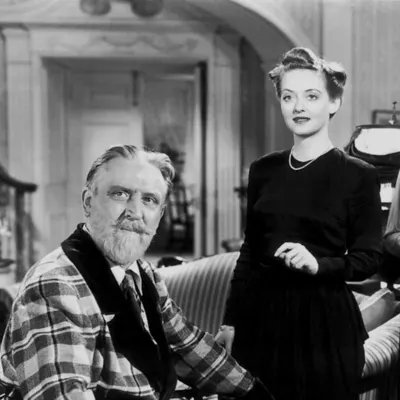
Absolutely, yeah. And what's really interesting about this, the play and the movie are that so many characters in it are specific references to members of the Algonquin Round Table. Most importantly, obviously, Alexander Woollcott is represented as the radio host Sheridan Whiteside. So he here is played by Monty Woolley, who just gives an amazing performance. Monty Woolley really is just, he's the heart of this movie. He completely steals the show. He was a guy just like Tallulah Bankhead who was more famous for being a stage actor than a screen actor at a time when you could still be nationally famous just for being in plays. And his nickname was The Beard for his signature look. He had a huge big beard in a time when that was very uncommon for men. And when he got his handprint at Grauman's Chinese Theatre in the 1940s, he made sure to bend down and give a print of his beard and chin as well.
Which I feel like, you know, must have been hell to clean out afterward. But yeah, yeah, great times. He wasn't a member of the Algonquin Circle himself, but he had the commonality with them in that he was also a World War I veteran and part of the Manhattan theater scene. But unlike Woollcott, he actually was gay and was documented to have many affairs throughout his life. In his later years, he lived with a man named Carrie Abbott, who was discreetly identified publicly as Woollcott's, quote, courier, secretary, traveling companion. And I feel like that just really gives it away. Like, I can't think of a more obvious way to say, hey, I'm boning this guy. Just like, keep it at secretary for God's sake.
Yeah. He was also friends and maybe sometimes lovers with the famous composer Cole Porter. There's a lot of apocryphal stories in books like Hollywood Babylon about how they would, you know, pick up sailors down at the wharf together.
One interesting part of their relationship, though, is that they eventually parted on very poor terms because Cole Porter was horrified and offended that Monty Woolley dated a black guy, which I feel like it's kind of crazy. Like, you're going to be gay and racist. Like, you know, well, get on Grindr sometimes. Some things haven't changed that much.
The other characters
Yeah, and speaking of famous gay people, once again, Noel Coward, who was, again, the lover of the uncle of Queen Elizabeth, George.
George, yeah. Yeah. Yeah, and so yeah, so he's in it basically. So he, a character based on him, plays this a famous playwright. And so the character's sexuality is never mentioned, but I think that anybody who knew that he was based on Noel Coward probably would have realized, you know, the allusions there.
Yeah, absolutely. And one of the other famous actors who was shouted out in this movie was Harpo Marx, who plays.
Right, the character of Banjo. So he's played by a guy named Jimmy Durante, who's really famous. I'm not really sure what his deal was, but a lot of the reviews say that although the character is supposed to be Harpo Marx, Jimmy Durante is basically just playing Jimmy Durante.
Yeah, he is the horniest man I've ever seen in a film.
Oh, oh, yeah. No, yeah, it's great. So yeah, he plays, yeah, no, he is a fiend in this movie. Yeah, just like there's a scene where he gets a call and he's backstage with a bunch of actresses and he just hangs up midway through because a blonde woman walks by and he just starts tailing her.
Yeah. Another character inspired by a member of the roundtable is, of course, Tallulah Bankhead, who I think you've called the first e-girl.
Oh, absolutely, especially the way she's portrayed in the movie. I just gotta ask, what's her @?
Yeah, her name is something like Lorraine, which I feel like is a much less sexy name than Tallulah, I gotta say. I don't know.
I feel like Lorraine is a very sexy name. It's like a MILF name, if you get it.
Yeah, well, whatever you say.
Yeah, to each their own, yeah.
What happens in the movie
Well, okay, so like we said, we're not going to recount the plot of the movie. Not in least because it's incredibly complicated, and just going over all the Byzantine details would be really boring and not very fun. But it's an amazing movie, and everybody listening needs to watch it. Like we said, there's so much great stuff here because the central conceit is that this character, Sheridan Whiteside, played by Monty Woolley, clearly based on Alexander Woollcott, gets trapped in the small town of Mesalia, Ohio, which he says is populated by Midwestern barbarians. And as soon as he gets off the train, he breaks his hip and he's stuck there for two weeks in the home of this very uptight, wealthy family. The mother, interestingly, is played by the same actress who was Glinda the Good Witch in The Wizard of Oz, which I think is pretty funny.
They have two kids who both kind of want to go their own way. And then another important character is, as we mentioned, Bette Davis playing Sheridan Whiteside's secretary, Maggie. She's also kind of not exactly an e-girl, but a very kind of modern Twitter type of woman, I feel like.
Yeah, like, absolutely. This woman who can hold her own against Whiteside, who can trade quips with him.
Absolutely. Who is really very much a working woman.
Absolutely.
And I wonder if she is inspired by Dorothy Parker in any sense. You know, they didn't have that kind of relationship, but she has that kind of.
I believe that Woollcott had a longtime secretary named Allison Smith.
Yeah. Yeah, maybe it's based on her. I'm not 100% sure. I haven't been able to follow that thread very closely. But again, you really gotta see this movie. It really has everything.
Penguins and an octopus
Yeah, like we said, there's penguins, there's convicted murderers, there's a giant Egyptian mummy case.
Like, no, come on. There's an axe murderer?
Yes, yeah, there is. Yeah, no. Yeah, yeah. There's surprisingly a large amount of murderers for what is essentially a Christmas movie. Yeah. And there's also this really weird moment where, like, they haul into the home of this Stanley guy, like, this tank with the fakest looking.
Oh, yes. Yes. Best moment of the show.
Yeah, best moment of the movie. Yes. Yeah, they bring in this octopus, which is the worst fake octopus you have ever seen.
It's essentially a mummy. Yeah, like, I don't understand the reasoning behind that. I mean, like, they were able to get actual penguins. Why couldn't they, like, get an actual...
Yeah. No, I gotta think, even in 1942, like, the terribleness of the puppet was part of the.
Oh, yeah, maybe that's it. Like, an ironic thing.
Yeah.
A forgotten classic
I think that's it. Because, in any case, the movie and the play were both incredibly popular. And that's why I think it's so crazy that this movie is not that well remembered today. Like we said, every year there's an article about it somewhere where somebody tries to revive it. And I think that eventually, I think this is going to start snowballing. And I think that more and more people are going to see the Man Who Came to Dinner. And that's why for this year's Christmas episode, we want to do our part to spread the gospel because it's really funny. It's really delightful. It's the kind of movie that, you know, a 19-year-old and a 90-year-old would both lose their shit at because it's just really funny, really charming, very well-plotted.
Yeah, 100%. I feel like part of the reason why it isn't more well-known is that some of it is very dated because you have all these like cultural references to like actors and celebrities from like the 1930s.
Yeah, no, that's true. There's a couple times I had to like, you know, Google Google the allusions they were making. Like, yeah, but beyond that, like, a lot of it's pretty universal. I think that, and especially because so much of the humor is situational and physical, you can almost compare it to Seinfeld that way, as opposed to something like an old episode of SNL, which your dad might think is really funny, but it's just gonna fly over your head.
Yeah, like the wit of the writers is really unparalleled. It's hard to absolutely.
Yeah, yeah. No, yeah, it's it really shows basically what the what the Algonquin Circle had to offer because you know Kaufman and Hart and Alexander Woollcott really talented people and you can see even though Woollcott was not directly involved in this one you can see his talent and his charm very clearly come through and the actor playing his character Monty Woolley the beard is just excellent as always yeah I'm just really taken by so many of the moments like there are so many quotable moments that it's hard to list them all one that I really loved was when when Whiteside is having dinner with a bunch of Chinese dignitaries and he asks them is it true that in China you drown middle-aged businessmen at birth yeah yeah he predicted the cultural revolution 20 years early. Oh yeah, it's a great movie really just a really a delight.
The 1942 review
Like, you know just, oh, yeah two thumbs up, four bags of popcorn.
You gotta see it and just to really drive the point home, we were thinking about ending this episode with a really fun review that we found from 1942, published in the New York Times. You dug this up, Sam.
And this says, Just in time to slip under the wire was the niftiest comedy of 1942. The man who came to dinner kept an appointment at the Strand yesterday and peeled off more concentrated merriment than did the New Year's bells. Anyone who happened to miss the original acid-throwing antic on stage should pop around and catch the cinematic reprise. The review goes on to describe the film as unquestionably the most vicious but hilarious cat-clawing exhibition ever put on the screen, a deliciously wicked character portrait and a helter-skelter satire. Perhaps motion picture audiences in their oft-alleged innocence will fail to perceive that the leading character is but a thinly veiled impersonation of a certain writer and critic of portly frame. Maybe they won't get it. But even if they don't, it makes no never mind, for the probing is so incisive that many of them will be shocked otherwise.
Messrs. Kaufman and Hart wrote the play very much in the image of a river of incidents and wisecracks plunging over a precipice, and the Warner Brothers have smartly filmed it with the same fluid, headlong tempo, keeping virtually all of the action fixed within the four walls of one room and making only such slight alterations as decent modesty compelled them. And of course, everybody loved Monty Woolley as Whiteside. Mr. Woolley makes the man who came to dinner a rare old goat. His zest for rascality is delightful. He spouts alliteration as though he were spitting out orange seeds, and his dynamic dudgeons in a wheelchair are even mightier than those of Lionel Barrymore. A more entertaining buttinsky could hardly be conceived, and a less entertaining one would be murdered on the spot. One palm should also be handed Bette Davis for accepting the secondary role of the secretary, and another should be handed her for playing it so moderately and well.
Jimmy Durante plays Jimmy Durante with so much gusto that it is just as well for our diaphragms that his part is comparatively brief. He is a killer while in there. Last, the picture as a whole is a bit too long and internally complex for 100% comprehension, considering the speed at which it clips. But even if you don't catch all of it, you're sure to get your money's worth. It makes laughing at famous people a most satisfying delight.
Yeah, that's a great way to put it. Again, even if I didn't understand all the references, it was still very fun to watch, because if you don't get one joke, there's another joke 15 seconds later that will surely make you laugh.
Woollcott's death
But on another thing that's not quite a laughing matter, as we mentioned previously, Woollcott, by the end of his life, he was most famous as a radio broadcaster for a show called The Town Crier, which we played a clip of a bit earlier. And this show, it would air from 1933 until Woollcott would himself expire the next year while filming a broadcast for this show. It was an impromptu panel to describe Hitler and war in general. And over the course of this panel, he had a heart attack, which, although it didn't kill him right there, he would die in the hospital shortly thereafter. Again, he was a very unhealthy man. He died quite young, relatively speaking. He was like 50-ish, I want to say. Yeah, and although he was very well known in his own time, we don't really associate anything with the name Woollcott these days at all.
I hadn't heard of him at all until we started doing research for this episode.
Likewise. And yeah, and I gotta say, I'd seen this movie before a couple times, and I never realized that this character was not totally fictitious. I didn't realize that it was, you know, that he was based on this real guy. And it's crazy. Like, this guy was immensely popular in his own lifetime, but he just evaporated from public consciousness, like, like at a drop of a hat, which goes to show just how impermanent our culture is.
And absolutely. Yeah, I can't even begin to imagine, like, what will people 80 years from now remember about the current moment, if anything at all?
Yeah, yeah.
Why Woollcott was forgotten
Well, I guess maybe it's because of, you know, the wars that he was a very pre-war kind of figure. He'd even got us started in his career before World War I. And so, given the fact that he dies during World War II, when this incredibly different cultural moment emerges in the late 40s and the 50s, somebody like him quite literally can't be part of it. And the kind of comedy he was producing was pretty rapidly falling out of favor. People like Alexander Woollcott, as well as the Epstein brothers and actor Monty Woolley, they weren't really part of the Zeitgeist anymore. And tragically, they mostly got forgotten.
Well, that's what we're here for. We are excavating the past. We're finding great jewels from decades past that your grandparents would have enjoyed, and we're bringing them right back to you. So if you have a grandparent who was alive during this period, maybe this holiday season, you can bring up Monty Woollcott and see their eyes light up as you mentioned something that they remember fondly from their youth.
Yes, and remember, that's Alexander Woollcott, because he and Monty Woolley are technically two different people.
Oh, oh, yeah, my bad. Yeah, just very similar names, you know. It's easy to confuse them.
Yeah, well, yeah.
Happy holidays and goodbye
Well, okay, great movie. Everyone should watch it. And on that note, happy holidays from Gladio Free Europe. We are really looking forward to the new year because we've got some really, really fun stuff lined up. Right off the bat, we have some really fun episodes already planned, some amazing guests. We can't wait to record these episodes next year, and I only hope that you guys can wait to hear them. But they'll be out very soon. Incredible things are happening on Gladio Free Europe. Yes. Any closing thoughts, Sam?
Go watch the movie.
The Town Crier
Alexander Woollcott, the Town Crier. The sound of his bell is a signal that he has taken up his stand once more at the great crossroads of the world. Ladies and gentlemen, there is time left for me only to read you a sentence from a great book. It's a novel written in China not 20, but 500 years ago. Under the title, All Men Are Brothers. It has just been translated into the beautiful English prose of Pearl Buck, the woman who wrote The Good Earth. 500 years ago, the author of All Men Are Brothers wrote the preface to his book. In that preface, he said, So one day is over. How do a hundred years differ from it? Can anyone see that which is past and gone? It is gone. Even as I finish this very sentence, the time which is passed before it is gone. Sorrow is this to the heart.
Thus, a Chinese philosopher in a book written before America was discovered.
The show is also on Apple Podcasts, Overcast, Pocket Casts, Podcast Addict, YouTube, RSS and Patreon.