56
A Global History of Dragons
In progressFrom Godzilla to Game of Thrones, dragons dominate today's pop culture landscape and play a monstrous role in the modern imagination. But how did this obsession with fire-breathing reptiles begin? For this week's episode, Liam and Russian Sam follow the cultural history of dragons across Europe and Asia. We explore why so many cultures imagined their own colossal serpents, diving into paleontology, mythology, and evolutionary psychology to figure out why these scaly creatures delighted the minds and haunted the dreams of our ancestors for thousands of years.
Hosted by Liam and Russian Sam.
Transcript
Welcome
And we're back with another episode of Gladio Free Europe. I'm Russian Sam, joined as always by my great co-host, Liam.
Oh, thank you. You are too kind.
Speaking of kindness, today we're going to be talking about the kindest creature in all the land, at least if you're out in China, the dragon. It's long been a source of fascination for people, and that doesn't seem to have waned over the centuries, judging by the regular depictions of dragons that are found in media. They're pretty prominent in all kinds of franchises. Just off the top of my head, there's The Hobbit, there's Harry Potter, Skyrim, Reign of Fire, and of course, most recently, there's Game of Thrones and its prequel series, House of the Dragon, which we are all watching with trepidation.
Yeah, yeah, yeah, you're watching, right?
Oh, yeah, yeah, of course. Of course. It's very exciting. I'm surprised that it's this good considering how it went off the rails in the last few seasons, but.
Yeah, I'm impressed, obviously, knock on wood.
Yeah, and speaking of House of the Dragon, while I was doing research for this episode, I came across a really fun fact. There's a very common Chinese surname, Pang, which is written basically the way Chinese characters work is that there's a bunch of these radicals or elements that make up each sign. And as it turns out, the signs for the surname are the signs for House and Dragon, or literally House of the Dragon.
Dragons around the world
Yeah, so if you haven't figured it out yet, this week in preparation for Halloween, we're bringing you an episode where we explore many different stories of dragon from all across the world. We really couldn't fit all of them in here, unfortunately. This is just a small fraction of the stuff that's out there, considering that this is pretty much a universal fixture of mythologies from everywhere. But nevertheless, we're going to be bringing you the coolest stories we could get our hands on. So join us as we traverse the world from Britain all the way to China and present some clues as to what all the hubbub might have been about.
But before we begin, I would just like to ask you: if you're listening to this on Spotify, iTunes, whatever, just take a moment to leave us a rating or review. It'll really help us out a lot. But in the meantime, yes, otherwise, a dragon will eat you.
That's a little mean. I don't endorse that. Gladio Free Europe is not a violent podcast.
Let's begin, shall we? As I mentioned, these guys are found pretty much everywhere across the world. And we don't really give this much thought, but I just found it very interesting that every culture in the world pretty much has something akin to a giant serpent. The details will differ quite a bit from place to place. Some of them can fly, some are aqueous, some are fundamentally good, others are evil, others are very morally ambiguous. But we have to ask: where do dragons come from?
What is a dragon?
Well, I guess that's kind of means what question you're trying to ask, because the word dragon comes from Greek. It's the ancient Greek drakon, which really means any kind of large reptile. They would call a snake, a crocodile, a Nile monitor, a drakon. And what's interesting is that this means that if any kind of giant reptile is a dragon, then Komodo dragons are real dragons after all.
Ah, neat.
But of course, what we're talking about here is the mythological dragon, because the Greeks would also use this word to not only describe these creatures that did exist, but also those that we at least now know did not exist. And I think this kind of gives you a hint to this ancient worldview where these dragons, just like griffins and gods and many other beings, were really seen as part of the natural landscape, even if no individual person would ever actually encounter one. One thing we should say here is that as we get into this kind of comparative mythology of dragons, there are some historians and anthropologists who are wary about the terminology. They would argue that there's really nothing in common between a benevolent Chinese dragon and the demonic, fire-breathing Christian European dragon. And they think that the use of the same word only leads to confusion.
But I think that's kind of throwing the baby out with the bathwater. Because just like Sam, I think it's pretty cool and really interesting that so many cultures have some kind of giant serpent myth. And that in so many of these cultures, this giant serpent has some kind of supernatural powers involving fire and water. It's pretty cool. And so we were hoping with this episode to explore the various reasons why this might be the case. Sort of charting a natural history of dragons across many different world mythologies.
Why we fear snakes
Well, my own explanation for this would be the fact that on a primal level, we are just basically afraid of serpents and snakes. This is not exactly hardwired into people, but it's something that, you know, a lot of people just really don't like snakes, even if they don't have any negative experience with them per se. And this isn't limited to you humans either. So just to give you guys one anecdote, I keep parakeets, you know, the little parrots that sit around and chirp all day. And when I was a kid, my dad brought me this toy wooden snake that, you know, would dangle around like a real one. And I didn't really think about it, so I just dangled it in front of the cage. And they were just viscerally terrified. And I, yeah, I should have thought about this better, but it makes a lot of sense because out in the wild, snakes are pretty much the biggest enemy that a bird could have.
Really? I mean, these guys were bred in captivity, right?
They just have never seen anything like it, and yet they just reacted with total terror the moment it yeah, still it's visceral fear, yeah, yeah, yeah. Yeah, and there's a pretty good reason for this stuff, really. There's just plenty of examples found all throughout nature of not just you know, snakes, but of potential prey mimicking snakes to escape being eaten. So, what actually spurred this episode is that I found this really cool video that was going around on Twitter that shows a snake mimic caterpillar, which lives in the Amazon, which is one of many species around the world that evolved to resemble snakes, caterpillars specifically. I mean, it just makes a lot of sense, you know, because this would have been sort of evolution pushed on by the fact that these creatures are trying to find a mechanism to avoid getting eaten by something substantially bigger than they are.
So, it seems like evolution naturally pushed them into this direction where many species all around the world just happened to, you know, have a way to make themselves appear like snakes.
Yeah, so this is found all over the animal kingdom, and monkeys and primates, who are our closest relatives, are no exception. They also exhibit this behavior to a large extent. In fact, there's even something called snake detection theory, which posits that primates evolved to have a very advanced visual system so that they would notice snakes specifically. Because, you know, if you happen to not notice a snake slithering around, it just could be your last moment on Earth. I came across this very interesting study published in 2013, which lent support to this hypothesis, Liam.
The present study shows preferential activity of neurons to images of snakes. Neurons responded faster and stronger to snake stimuli than to monkey faces, monkey hands, or geometric shapes. This neuroscientific evidence supports the snake detection theory, which posits that the threat of snakes strongly influenced the evolution of the primate brain. This finding may have great impact on our understanding of the evolution of primates. And this is from a paper called Pulvinar Neurons Reveal Neurobiological Evidence of Past Selection for Rapid Detection of Snakes from 2013.
It's a very interesting paper, you know. In the beginning, the authors bring up the fact that there's art from around 75,000 years ago, which may represent snakes, which would mean that snakes are one of the earliest objects of artistic representation for humans.
Wow.
Yeah, and this deep relationship to snakes persists even to this day. As I said, my little birds who had never even seen a snake were just viscerally terrified of this toy. And as it turns out, many people just don't like snakes either. So you're going to learn a new word today. It's ophidiophobia, which is the fear of snakes. A 2014 YouGov poll found that 32% of American adult respondents were very afraid of snakes, and an equal number are somewhat afraid of them. And next biggest fear is heights, with only 24% being very afraid. Keeping all of this in mind, it just seems to me logical that there would be this jump from fear to reverence in early humans, because if you're afraid of something, you're going to respect it. And at a certain point in our evolution, that would have meant that you would try to appease it to, you know, minimize your chances of incurring wrath.
So, when the idea of deities came around, whenever that might have been, this would have been a natural object of fear or devotion or a mix of the two.
Greek dragons
Right, and so let's look at some of these mythological creatures, these giant serpents, which instilled fear, this fear of, you know, incurring this wrath. Like we said, for the Greeks, the drakon initially meant kind of any large reptile, but in mythology, specifically meant an entire category of monsters, the most famous of which being the many-headed Hydra. So, there aren't really any accounts of these Greek dragons flying or breathing fire like the typical medieval European dragons would do, but these Greek stories seem to be the primary basis of later European dragon mythology. The part of this myth that would have the most staying power, in addition to the name dragon, was the fact that these dragons were generally bad. They had a nasty habit for targeting beautiful women, and they could usually only be killed by a virtuous hero. According to Daniel Ogden, when Greek and Roman writers developed deeper connections with neighboring cultures in the Middle East and other parts of Europe, they started to see dragons everywhere in many different cultures and used the word dragon to describe them.
And this might not be a total coincidence because a lot of Greek mythology can be traced all the way back to the Bronze Age Eurasian steppe to you know a shared proto-Indo-European legend of a folk hero who slew a serpent. So in Hittite mythology, for example, there's the story of the storm god Tarhunt, who slays a giant serpent called Illuyanka. Whereas in Hindu mythology, the Hindu god Indra is said to have killed a multi-headed snake, just like the Hydra killed, that was killed by Hercules. And in Norse stories, of course, you have Thor and Sigurd and Beowulf all killing these giant reptiles called worms, which Christian historians would later connect to the Greek myth of the dragon retrospectively.
Semitic sea serpents
But the Greeks would also encounter a totally separate tradition of serpent imagery in Egypt and the Middle East. The most widespread of these would have been the Semitic legends of serpent demons and water monsters, which survive to some extent even in modern Abrahamic religions.
Right.
One example of this would be the tannin, which is sort of a chaotic multi-headed water serpent whose appearance in the Bible would play a pretty big role in the development of Christian concepts of the dragon being evil. This word in modern Hebrew now just means crocodile, but back in the day, it was something much, much worse. There's another biblical water serpent called Lotan, who appears in Bronze Age Ugaritic texts centuries before the emergence of any recognizably Jewish religion. It's thought that this guy is probably the namesake for the Litani River up in Lebanon. And yeah, that just goes to show there's a lot of waterborne serpents going around. And that's not even keeping in mind the most famous serpent of the Bible, the serpent in the Garden of Eden, who, you know, tempted Eve to eat of the tree of knowledge.
Yeah, and that's important, that link there. We'll get to that. So you also, back to our Daniel Ogden, who wrote this kind of general history of Greek dragon mythology, he argued that it's plausible that Middle Eastern stories about Lotan and tannin circulated west, back across the Mediterranean, sometime in antiquity. Because Greek dragons often have some connections to these Semitic legends that aren't really shared with the dragon you see in Beowulf, for instance, like the association with water. The name Hydra obviously means of water, but there are other dragons in Greek mythology that are also potentially derivative of these earlier Semitic creatures.
Cetus and Andromeda
The most famous is probably the Greek monster Ketos or Cetus, which actually is a sea monster that gave us the modern scientific name for whales. So, if you don't know the story of Cetus, it's that an Ethiopian queen named Cassiopeia bragged that she and her daughter Andromeda were even more beautiful than the daughters of Poseidon, which is, you know, the classic ancient Greek mistake. You never compare yourself to the gods. But because of this, you know, to punish Cassiopeia for her hubris, Poseidon sends Cetus, this giant water snake just like Lotan, to devour as many Ethiopian people as it could out of revenge. Cassiopeia decides that to save her kingdom, she'll sacrifice her own daughter by lashing Andromeda to a rock for the monster to eat. But then in an incredible stroke of luck, the hero Perseus happens to be passing through Africa after killing Medusa.
He goes into Ethiopia and he just happens to see Cetus about to eat this beautiful princess Andromeda. So Perseus slays Cetus, marries Andromeda, and brings her back to Greece.
Wow, that's just very lazy writing.
Absolutely. Yeah, especially because they're stealing it totally from these earlier Semitic traditions. They just totally borrowed the water monster element of Lotan into this myth. And this shows potentially an example of the famous Greek syncretism, where they would encounter foreign religions and find ways to blend them with their own traditions.
Dragons and Christianity
But what I think is really cool about dragon syncretism in particular is that it's one of the clearest examples we have of pagan mythology persisting after Christianization. Way back in our 30th episode on Medieval Christmas, we talked about the ways that it can be really difficult to actually draw a through line from ancient and medieval pagan traditions to modern practices. But even if people don't really believe in dragons anymore, I think this is a really cool example of an ancient Greek belief that somehow managed to survive all the way across the Christian transition. And my guess why dragons were able to survive, even though belief in the gods and in Hades and all that did not, is that possibly due to the link with Jewish depictions, ancient and medieval Christians were able to link Greek dragons with the devil.
Yeah, and there was a lot more cultural synthesis happening with the advent of Christianization because after the fall of Rome, these Greek and Jewish dragon narratives, for lack of a better word, would slowly be combined with already pre-existing Germanic traditions about worms to create the medieval European dragon that we all know and love today. By the 13th century, it was generally understood that a dragon was not just any kind of large reptile, but specifically a large reptile with wings, legs, and of course, who can forget that famous ability to spit fire. A very important part of Christian dragon iconography was the connection with Satan, precisely because of the biblical narrative that I mentioned earlier. This early Christian literature, like the book of Revelation, which draws from the Greek word drakon and the Hebrew tannin to describe visions of Satan. And of course, there's a whole Garden of Eden kerfuffle.
But I mean, eh, who hasn't tempted a woman to eat a fruit before? Just doesn't seem like a big deal, right?
Saint George
And as an example of this kind of syncretism, let me tell you probably the most famous Christian dragon story, which is the story of Saint George, who slew the dragon. Let me know if you've heard this one before. A Greek hero, Saint George, goes to Africa and sees that local people are being attacked by a sea monster.
God, no way.
As an offering, the local king gives up his daughter to be the dragon's dinner. But just in time, perfect timing, Saint George comes. So this Greek hero kills the dragon, and in return, all the people happily become Christian. And then, yeah, St. George saves the day, and in some versions, he even marries this African princess and takes her back home.
And then everybody clapped.
Yes. So this story probably comes from the Middle East, but it became really widespread in Europe after the Crusades. And you can totally see how it's really clearly drawing from the Perseus legend, which I think is very funny.
Saint George, he was a Christian soldier who was martyred in the Holy Land, which meant that all these crusaders who were facing what they saw as martyrdom themselves thought that St. George was a pretty cool guy. And so they brought this story back to Western Europe, where it would influence a lot of other stories of Saints' lives all across England, Germany, France, even Ireland. We should mention that usually the aquatic element of these dragon-slaying narratives was dropped, especially in Saints' lives, but in some stories, they actually kept that.
Saint Columba and the Loch Ness monster
Here's an excerpt from the Life of Columba, which is an Irish account of the monk who brought Christianity to Scotland sometime in the 6th century. Chapter 28, How an Aquatic Monster Was Driven Off by Virtue of the Saints' Prayers. On another occasion, when the blessed man Columba was living for some days in the province of the Picts, he was obliged to cross the river Nessa, or Loch Ness. And when he reached the bank of the river, he saw some of the inhabitants burying an unfortunate man who had been seized as he was swimming and bitten most severely by a monster that gripped in the water. His wretched body was taken out with the hook by those who came to his assistance with a boat. The Blessed saint, on hearing this, directed one of his companions to swim across the lake despite this danger. His companion, trusting the word of this excellent man, obeyed without the least delay, taking off all his clothes except for his tunic and leaping into the water.
But the monster, so far from being satiated, was roused for more prey. It was lying at the bottom of the stream, and when it felt the water disturbed above by the man swimming, it suddenly rushed out and, giving an awful roar, darted after him with its mouth wide open as the man swam in the middle of the stream. While all others were stupefied with terror, the Blessed Saint Columba raised his holy hand and formed the sign of a cross in the air. He commanded the ferocious monster, Thou shalt go no further, nor touch this man, go back with all speed. Then, at the voice of the saint, the monster was terrified and fled more quickly than if it had been pulled back with ropes. Then, the Irish companions of the saint, seeing that the monster had gone back and that their comrade returned to them safe and sound, were struck with admiration and gave glory to God and the Blessed Man.
And even the barbarous Pictish heathens who were present were forced by the greatness of this miracle, which they themselves had seen to magnify the God of the Christians. And if you hadn't guessed, that is the very first known story of Loch Ness Monster.
Yeah, that's the world's longest-running franchise.
Yeah, I also like the subtle little, like, you know, good Irish guys, bad Scottish guys in there. Very funny.
Vortigern's dragons
Right, and as we remain in the British Isles, there's one more really interesting dragon story that I think is pretty fun, and it's one that some of our listeners might know. We sort of touched on this story in episode 15. This one is the story recorded by Nennius, a Welsh monk sometime in the 8th century. And it covers a tyrannical British king named Vortigern around the time of the fall of Rome. According to Nennius, Vortigern invited the pagan Saxons to Britain in hopes that he could use these guys, these barbarians, to wipe out his enemies and even oppress his own people. But it turns out that these, you know, rowdy Saxons instead just want to turn their seaxes on him. So the Saxons kick Vortigern out of eastern Britain, force him into the highlands of Western Britain, which is, you know, now Wales, and he realized that the only way he could ever resist the complete domination of these Saxons is if he could build a castle so strong, not even these terrifying barbarians could conquer it.
So Vortigern starts building the biggest castle the world has ever seen, this tower of Babel, essentially. But the castle is so big and so ambitious that it keeps collapsing in and itself, presumably due to its own size. Vortigern wants to know what's going on, so he consults some pagan magicians, these druids, who say that he could only build a castle strong enough if he sacrifices the life of a child, but not just any child. It has to be the child that was magically born without a father, just like Jesus Christ himself. So Vortigern's knights comb the Welsh countryside looking for any child who was born without a father. And eventually they find a kid who somehow fits this description named Ambrosius. The knights bring Ambrosius to Vortigern's castle, which has just collapsed again, and they're about to sacrifice him when suddenly Ambrosius yells that he knows exactly what's going on.
He says, Listen, my king, spare my life, and I'll show you exactly why your castle keeps collapsing. And for some reason, Vortigern agrees. And so Ambrosius tells him that your men have to dig through the rubble deep into the very foundations of the castle. They do this, and they're shocked at what they find underground. Two dragons are locked in mortal coil, one red and one white, representing the Welsh and the Anglo-Saxons. Ambrosius says that even though the white dragon might have the upper hand right now, the red dragon will never truly be defeated.
And then again, yeah, everybody clapped.
And so the story ends with Vortigern even resigning as king in some versions or being killed in others and bequeathing this castle to Ambrosius, who then uses it to stop the Saxons from completely taking over Wales. And if you hadn't realized, this red dragon today is on the flag of Wales. And centuries later, Norman historians who had conquered the entire island of Britain essentially would change Ambrosius' name to Merlin. And they would connect this story to the then very popular and growing mythos of King Arthur.
Chinese dragons
Yeah, and of course, aside from Wales, there's just a ton of dragon imagery found on both flags and political iconography all over the world. Not as much as I would like, I would say, but you know, it's a good start. The most famous of these would probably be Qing China, where the dragon, or as it's known in the language Long, is closely associated with imperial power.
Right. And so, like we mentioned earlier, Chinese dragons are very far removed from these European fire-breathing stories. I feel like, correct me if I'm wrong, Sam, but aren't they usually, if anything, associated more with water?
Oh, yeah, absolutely. They can fly generally, but yeah, they're more aqueous creatures rather than, you know, the fire-breathing dragons that we're familiar with.
Right, yeah. I think there are some really interesting similarities. And like we talked about, the whole this concept of a giant reptile, specifically, you know, this like this flying serpent, is so similar that I think they're, I think you might be onto something with the kind of you know evolutionary psychological example. But the fact is, these eastern and western dragons are very different. So I think an interesting question is: why exactly is the same word used to describe them? Why do people in the west at least see the Chinese long as an extension of the European idea of a dragon?
How the long became a dragon
So I looked into this tonight and I actually found out that the reason is really odd and kind of roundabout. I was, I managed to dig up exactly the very first time that a Chinese long was associated with a European dragon. And it actually happened in the medieval Arab world. In the 13th century, some anonymous Yemeni writer put together a phrase book meant to translate basically all of the languages spoken in the Middle East. Arabic, Turkish, Persian, Greek, and Mongolian. Because this was in the 13th century when the Mongols controlled a huge chunk of the Arab world. And this book had all these different passages of religious scripture in different languages, including a section on Mongol cosmology, which drew really heavily from the Chinese zodiac. And so this writer had to translate all of the different animals of the Chinese zodiac. There was the tiger, the rat, the pig, all that. Those were easy.
But he struggled when he came to the dragon because the long, or in Mongolian, the luu didn't really have a clear analog in all of these languages. You know, in I think in Turkish, he used a word for eel to describe the dragon. In Persian, he described another kind of dragon creature. But for Greek, this unknown author used the word drakon. And for Arabic, he used tinnin, that Semitic word. So again, yeah, this spur-of-the-moment decision by this unknown Arab translator seems to be why we associate Chinese dragons with European dragons today. I think it's kind of cool.
Yeah, so let's just jump right into Chinese dragons.
Yes, please, yes, yes. Tell us, Sam, all about the long.
Neolithic Chinese dragons
And although the earliest recorded stories that have passed down to us about dragons don't come from China, we actually get the earliest Chinese iconography by a very large margin from way out east.
Right, the archaeology vastly predates the literature.
Yeah, so these dragon depictions really predate the advent of writing in China by thousands of years. Most of the earliest surviving dragons were carvings made of jade, and they were meant as ornaments. And they tend to be centered around Chinese cultures, which were located near the region that is today Inner Mongolia. It's also an area that very closely intersects with the Gobi Desert, and you should keep that place in mind. So the earliest depiction that I've been able to find of dragons come to us from the Xinglongwa culture, which existed from 6200 BCE to 5400 BCE. So again, 8,000 years ago.
Yeah, yeah, and just to show the context here, that is so old. That is like, I want to say, what, 3,000 years before Stonehenge and probably 3,500 or 4,000 years before the pyramids?
Yeah. It's very old. Yeah, incredible things are happening in China. But anyway.
So the first dragon that I've been able to find was discovered in Chahai, and it's made entirely of stone. It's about 20 meters long and has a width of about 2 meters and it seems to have been part of some kind of ritual complex. For some reason, I wasn't able to find a good photo of it, and the ones that I did see don't look very dragon-like to me. But I mean, I'm sure the archaeologists know much better than me, just a guy who's clicking on the computer from thousands of miles away. Also, interesting is that the Xinglongwa people were also the first to begin working with jade. And although their jade ornaments were quite primitive at this point, this art would evolve shortly among the cultures that would arise in roughly the same geographic area.
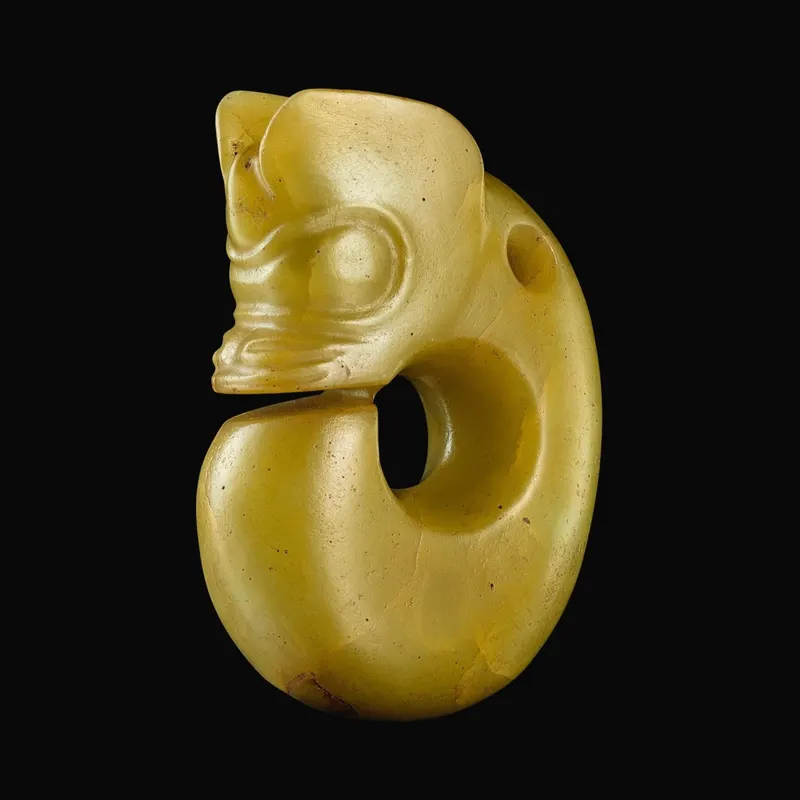
One of these later cultures would be the Hongshan, which would be around the fifth millennium, like 4700 BC, up to around 2900 BC. And these are the people who created, I think, the clearest early dragon depictions, which are still much earlier than any dragon depictions in Greece or even in the Middle East. Because the Hongshan, these guys, they love them some dragons. Most of these depictions are actually called pig dragons because they'd be assembled with stones leading up to a pig skull to create the shape of a dragon. It was kind of like a cute little like a shrimp shape, maybe a C-shape. And so, yeah, like this C-shaped loop would end in the pig, so it'd be called a pig dragon. And for the record, we're gonna put photos of all this up on the website, so stay tuned. Yeah, you guys gotta see this. Yeah, yeah, yeah.
But jumping ahead a bit, my own personal favorite dragon-themed burial from this period was found in the neighboring Yangshao culture. It's called Neolithic Burial 45. I know that name doesn't sound very exciting, but it's a really cool site. Basically, what you have here is the body of the buried person, and he was flanked to either side by these quite large mosaics made out of seashells. To his left is a tiger, and to his right is a dragon. And I just found this particularly fascinating because even to this day, there's a very strong association in Chinese culture between tigers and dragons, usually, as mortal enemies.
Yeah, yeah. Like, like you know, crouching tiger, hidden dragon, for example, just off the top of my head.
Of course, yeah, yeah.
I mean, just like the people before them, the Hongshan were very good jade workers, also. And I think that there's they made these kind of jade versions of the pig dragons, they're really cool, these very interesting, very stylized, kind of C-shaped loops that are kind of like a dragon with a big head. They kind of remind me of like the the like the Dratini Pokémon, you know, that looks like it, yeah, yeah, and yeah, that's a great analogy.
Yeah, it's very cute, yeah. So, the examples that I found were made around something like 3,500 years before the common era, yeah, which again, like that's that one over there, that's like as old as Stonehenge.
That's nutty, yeah.
And something I didn't quite expect to come across, but some people have suggested that these might in fact be stylized depictions of fetuses, which I don't know enough about what these kinds of people were doing, although I know that they were engaging in human sacrifice, so they were probably up to some pretty messed up stuff. But yeah, this just looks exactly like a fetus would look at a couple of weeks into development, yeah, or an embryo, even a very, yeah, a very, very, very early, yeah, very early stages.
Yeah, like its head is tucked up and its tail is right there up towards the head, yeah, yeah, yeah, that is interesting, yeah.
Yeah, and these Hongshan people they also like to depict another type of dragon, which is slightly different because they aren't nearly as tightly coiled. This looks more like a C proper, but some scholars call them J-shaped because C-shaped already refers to these other kinds of pig dragons. The most famous example doesn't look particularly pig-like either because it seems to have some kind of mane-like protrusion from its neck. So it might be that this is a phoenix rather than a dragon, per se, but this gets us into a future point that we're about to get into. Chinese dragons come in many different forms, there's a ton of these guys.
Right. Yeah. Yeah, we should mention that none of the ones you've mentioned so far even have wings, and that most Chinese dragons actually lack wings altogether, which is a pretty big contrast from medieval European dragons.
Dragons in early Chinese texts
Yeah, so we've gone through the Neolithic.
Let's get into the actual written records. Right, because there is a lot to get through. Dragons are always showing up in Chinese sources, going back to basically the earliest sources we have. So in the Bamboo Annals, it's claimed that Emperor Yao, one of the first emperors, was actually himself fathered by a dragon. There are also creation stories that posit that dragons are actually the progenitors of all mankind. But this actually might be a modern spin on older tales. Because really, it seems like that at the time, mostly emperors and nobility were the ones claiming descent from dragons, not the common people. Starting with the Yuan dynasty, which was founded by the Mongols, commoners were actually prohibited from making any kind of dragon-related ancestry claims or even having any paraphernalia that could be seen as, you know, associating yourself with dragons. The motif of being fathered by a dragon to some extent was pretty common all throughout Chinese history, and that the founder of the Han dynasty, Liu Bang, actually claimed that he was conceived when his mother dreamed of a dragon.
The dragon keepers
So let's look at a passage here from Zuo Zhuan, which is one of the earliest extant Chinese histories and commentaries. And I love this one a lot. I've come across a lot of old dragon sources, but this is my favorite, and you guys are about to see why. Wei Xianzi questioned Scribe Mo of Cai. I have heard that there is no wiser beast than the dragon, because it cannot be captured alive. Would it be accurate to call it wise? He replied, It is not that dragons are wise, but rather that human beings have been unwise. The ancients kept dragons. Xuan of Yoliu had a descendant whose name was Dongfu. Dongfu was extremely fond of dragons and was able to seek out for them the things they like to drink and eat. Dragons came to him in large numbers, so he tamed them and reared them, offering them to the Emperor Shun.
Thus, in the generation since Emperor Shun, there was dragon keeping. Later, Kong Jia of Xia was obedient to God on high, and the God on high bestowed upon him a team of four dragons, each a mating pair. Kong Jia was not able to feed them himself, so there was a certain Liu Lei who had studied dragon taming with the dragon feeding lineage who had served Kong Jia, so that Liu Lei was able to provide the dragons with the proper drink and food. When one of the female dragons died, Liu Lei pickled its flesh and fed it to the Xia ruler. After feasting upon it, the Xia ruler asked him to get more such food. Alarmed, Liu Lei went to Lu Shan. Wei Xianzi asked, Why then are there no dragons nowadays? Scribe Mo replied, Every kind of thing has its official, who is charged with perfecting the methods for it and keeping these in mind day and night.
If one day the official fails in his duties, then death comes to him. When the official remains in his duties, the kind of thing to which his office is devoted will make itself manifest. If he abandons his duties, then the thing will hide away, becoming obstructed and unproductive. Thus, there were the five officials. These officials were put in power as great nobles and were offered sacrifices as the most exalted spirits. The dragon is a water creature. Since the office of water has been abandoned, dragons are no longer taken alive.
What's really funny is that the part about the dragon being pickled and secretly being fed to an emperor. I read a book as a kid about that happening, this like American YA book. And I guess that whole time I didn't realize it was based on this very famous ancient story.
Yeah, well, I guess this story has inspired a lot of stuff. As you can tell, there's really a lot going on here, and I just thought this text was really useful because although the idea of the dragon would change in some ways in later periods quite a bit, especially during the Han Dynasty, and this was written before the Han Dynasty, so we're talking about almost 3,000 years of history after all. So people would have been bringing very different conceptions to all this stuff. But it's interesting precisely because it sketches out ideas which would persist to a large extent. First of all, of course, there's the idea that dragons are indeed real, and they make themselves known in positive ways if you fulfill your duties to heaven or God on high as it's rendered in this translation. I would just like you to pay attention to the captured alive bit.
Perhaps this is proof that people were finding dinosaur bones.
Would that be because, like, mentioning that they were found alive implies that they're usually found dead?
Yeah, exactly. And there's also the mention of so-called breeding pairs, which would suggest that these are biological creatures and not necessarily something that's godly.
Right.
Although there were, in fact, godly associations made with dragons. In fact, in some texts that were contemporaneous to the Zuo Zhuan, it just goes to show that there was a lot of latitude in the kinds of things people believed about dragons.
Right, and like you mentioned, Chinese dragons are generally aqueous. Another passage in this book also mentions that some dragons will fight in a pond.
Yeah, so this goes to show that there are many influences that went into the creation of the dragons. So, some of these would have been inspired by terrestrial creatures, including possibly dinosaurs, wink wink. Some would have been aquatic, and yet others were aerial. Hence, there are so many different kinds of dragons because there are so many different sources of inspiration for them.
Dragons across East Asia
And side note: because of Chinese influence in the region, pretty much all of East Asia came to be influenced by Chinese conceptions of dragons. So, one particularly cute myth that I like is the idea that Japan is the back of a sleeping dragon, and earthquakes happen when the dragon is, you know, moving around in its sleep. It's cool. There's also this idea that dragons are the wellspring of wisdom, or at the very least, they're the equals of humans at their wisest. But this also tells us that, first of all, dragons are delicious, and second of all, early Chinese rulers were basically Targaryens.
Yeah, yeah, yeah, yeah, keeping dragons, you know, for their own use, yeah. And that's true, also. Like, this story, like, in addition to the fact that they could die and they can breed, the fact they're basically kept captive by, you know, professional dragon tamers, that makes them seem way less celestial than I feel like some other Chinese dragon depictions.
Well, I read that as meaning that the dragons want to be there because clearly, the mandate of heaven is no longer there, so the dragons are no longer showing up.
Yeah, right, right, which again, also an interesting Targaryen parallel of how, you know, once the dragons died, that's when they lost power over Westeros. But to return to the real world, you know, there are so many different dragons across Chinese history. If you just look at the Wikipedia article Chinese Dragon, you'll find so many different types of dragons, so many important individual-named dragons that pop up in mythology. And so, because of this traditional diversity, they can all look really different.
The nine traits
There were nine traits that were considered universal, and the second-century scholar Wang Fu lists them. And so, I want you guys to note: some of these definitely resemble European dragons, other ones, not so much. The nine traits are: his antlers resemble those of a stag, his head, that of a camel, his eyes, those of a demon, his neck, that of a snake, his belly, that of a clam, his scales, those of a carp, his claws, those of an eagle, his soles, those of a tiger, his ears, those of a cow. Upon his head, he has a lump.
Yeah, it's yeah, quite quite interesting. And again, note that wings don't make the list. You don't need wings to be a dragon, although some dragons do have wings.
Dragon gods of water
And one other particularly notable difference between these dragons and dragons out in the west is that Chinese dragons are, for the most part, considered good, although there are some individual exceptions that came about with the influence of Buddhism on Chinese religious beliefs. And in fact, there are several dragons that are actively worshipped as deities even to this day.
Oh, really?
Yeah, yeah. So, because of their association with water, they're they're mostly water deities. So, there are the so-called four dragon kings of the seas, for example. And these dragon deities are responsible for the most part for things relating to the weather and bodies of water writ large. So, basically, if you're having a drought, just bring some offerings to a dragon and it'll go right away. And although Chinese dragons aren't necessarily winged, as I mentioned, some of the most famous ones actually are. The most famous of this is the Ying Long, the so-called responsive dragon. According to some Chinese sources, particularly the classic of mountains and seas, this was the one who helped the Yellow Emperor to defeat the tyrannical gods Chiyou and Kuafu, who were basically trying to destroy the sun, if I'm recalling correctly. So, the classic of the mountains and seas tells us that: quote, Ying Long killed Chiyou and Kuafu, the boaster, but he could not return to the mountain afterwards.
Therefore, many droughts fell upon the world. When there was a drought, people would make an image of the winged dragon in order to obtain rain. And although this is the ancient past, we still have remnants of dragon worship all the way to this day. Perhaps the most visible example of this would be the dragon dance, which you might see if you show up in Chinatown around Chinese New Year.
Yeah, of course, yeah, famously, yeah.
Yeah, today it's for the most part a secular pastime activity, but it seems to be connected to water dances of eras past, basically, because it makes sense. It's awesome. Because Chinese New Year generally happens right before the beginning of the spring. So, of course, you want good rains to ensure that the soil is rich and you'll have a good harvest. And of course, in some places, there will be offerings made to the dragon kings during difficult weather conditions, as alluded to previously.
The four dragons
And speaking of difficult weather conditions, I came across this very cute Chinese dragon myth, which I think would go well with this episode. So, let's just jump right into it. Long ago, China was barren and without lakes or rivers. There was only the eastern sea, which was home to four dragons: the black, yellow, pearl, and the long dragon. They spent their days frolicking in the water, living carefree lives. One day, the pearl dragon took the sky over the mainland and saw crying humans performing rituals in desperation, gesticulating towards the sky. The pearl dragon told the others about this: Look down on the earth. The people are suffering. Let's find out what this is all about. When they returned to have a closer look, they saw that the people were begging the Jade Emperor to send rain, as they were on the brink of starvation. When the dragons had a further look around, they saw the land was very dry, so dry that the earth was cracked, and all of the crops and the grass had turned yellow.
We have to help them. They'll surely die. Let's fly to the Jade Emperor and implore him on their behalf. When they reached this place, they found that the Jade Emperor was watching some fairies dance. The Emperor, noticing the dragon's presence, got angry. What are you doing here? I didn't summon you. Go back to your sea. Emperor, the people of Earth are on the brink of starvation. They've received no rain in a very long time. Please send that rain. The emperor, one eye still occupied by the fairies, told them that he'd send rain tomorrow. But that when the dragons flew to the land a few days later, they saw that it was still cracked and yellow. It still hadn't rained. The Jade Emperor has forgotten. He's too busy trifling with fairies to care for such things. We must take matters into our own hands. There's so much water in the sea.
If we each took some in our mouths and sprayed it over the land, we could save the people. And so, the dragons went back into the sea and filled their bellies up with water. They flew over the land and sprayed water all across the sky. This became rain clouds, and a great rain descended upon the earth. The plants were rejuvenated. The people were overcome with joy. But the god of the sea was angry that the dragons had taken his water without permission. So the god of the sea went to the jade emperor with a complaint: These dragons dare to make it rain without my permission? You need to arrest them. So the emperor's forces massed and captured the dragons, bringing all four of them back to the emperor. You have been so insolent, and you'll be punished. The emperor ordered the mountain god to create four mountains, and under each one, a dragon was to be imprisoned for all eternity.
But the dragons, in a final act of kindness, turned themselves into rivers that they could continue to help the people. Thus, each one bearing the name of the dragon who created it. And the people of China were forever grateful. Yeah, it's a very cute story. I quite enjoyed the fact that the Jade Emperor isn't really doing anything. He's just hanging out with his fairies while people are starving. And I actually found this interesting because generally in Chinese mythology, the Jade Emperor is the stand-up guy. And, but I mean, I guess nobody's perfect. We all slip up from time to time. So let's give him the benefit of the doubt.
Dragons and the natural world
You know, what I like about this story also is that it also shows that dragon mythology was used in conjunction with explanations of the natural worlds. In this case, it wasn't that the natural world was used to explain dragons. Dragons were used to explain the world, but you see a lot of both of these things happening throughout history. I think that especially as time progresses, people start to realize that dragons don't seem to actually exist. So starting with antiquity, a lot of people have been trying to look for physical evidence of these dragons being real now or once being real. We've gone over, you know, the origins of dragon mythology earlier with the part about the psychological snake aversion, but it's also possible that humans discovering ancient fossils might have been how these worldwide dragon myths first began.
Griffins and gold
Yeah, so I went ahead and found some examples from Greek sources. We all know about Herodotus. He's our favorite father of history, or maybe father of lies, depending on your perspective. But he had a lot of interesting tidbits in there. He wrote of a Central Asian people known as the Issedonians, who are possibly related to the Wusun described in Chinese sources, who lived around what is today Gansu province in China, which is right on the border of Mongolia. This area, again, overlaps with the Gobi Desert. Right? Remember I mentioned that earlier? As Herodotus tells us, these Issedonians told of another tribe that lived a bit further away from them who were known as the Arimaspians, a one-eyed race of Scythians, really. So, to quote from Herodotus, this is also plain that to the north of Europe, there is far more gold than elsewhere. In this matter, again, I cannot with certainty say how the gold is got.
Some people say that the one-eyed men called the Arimaspians steal it from the griffins. And he goes on to say that he's skeptical about the one-eyed part, but the gold is undeniably there, so who knows, really. I found it interesting that he situated this in Europe, although this is, you know, right all the way over in Mongolia, which would suggest a very unusual definition of Europe. But that aside, I just really like this as a cover story because it's like it's never a direct source from these Arimaspians.
It's always just like, oh, you know, these guys who have over there, they say, I heard, yeah, yeah. I know a guy who told me his cousin.
Yeah, yeah, yeah. Exactly.
We should note that, again, like many of the dragon creatures that we spoke of earlier, the Greeks viewed griffins as actual living animals. They would show up in all kinds of Greek sources. One other example that I came across that I found quite interesting was written by Aelian, who was a third century Greek writer, who and he included more talk of these griffins and gold in his Encyclopedia of Natural History. He wrote, quote, Now the regions where the griffins live and where the gold is mined is a dreary wilderness, and the seekers after the aforesaid substance arrive, a thousand or two strong, armed and bringing spades and sacks, and watching for a moonless night, they begin to dig. Now, if they contrive to elude the griffins, they reap a double advantage, for they not only escape with their lives, but they also take some of their freight.
And when those who have acquired a special skill in the smelting of gold have refined it, they possess immense wealth to requite them for the dangers described above. And they return home, I am told, after an interval of three or four years. One really has to ask, what's the deal here? Why is there so much consistent talk about griffins guarding gold? And as it turns out, there might be a great reason, in fact.
The Protoceratops
Yeah, so let's look at dinosaurs and specifically one particularly nice-looking fellow called the Protoceratops, whose bones are indeed found scattered throughout the Gobi Desert, all over the place. And they really do seem to match the description. If you look at the way griffins are generally depicted in both Greek and Persian iconography, they're in fact originally Iranic creatures rather than Greek ones. But the Greeks, as we saw, they had a knack for adopting creatures from other people's stories into their own mythology. As they tell it, this is a beaked quadruped that has protrusions above its face. It has a tail, it has claws. It doesn't really have wings, but the way that fossils can be compacted, it's very possible that crushed skeletons could appear to have wings. And again, the Gobi Desert is just scattered with these bones. When Western archaeologists first showed up there in like the 1920s, I believe, they just couldn't believe how many of them there were over there.
Some were collected, some were taken back to Europe. Other specimens remained in China, where many of them would be destroyed during the war with Japan, of course. But now a whole lot of excavation is going on because the Chinese happen to be very interested in archaeology and their own history, and they happen to have the resources to throw into that.
Yeah, again, incredible things happening in China.
Yeah.
Discovering real-life griffins all over the place.
Ancient fossil hunters
You know, this story reminds me a lot of a kind of example of modern folklore, which is the idea that a lot of people have that cyclopes, you know, the cyclops, is based on ancient Greeks finding the skulls of mammoths or other elephants. Because if you look at a mammoth skull, it sort of has one big hole in the middle for its trunk, which kind of looks like a giant eye, and the rest of it is like vaguely shaped like a human skull. The thing is, though, there's this is totally plausible, but there's really no evidence of this at all. This is just a modern assumption brought backwards. I think these examples are a little bit different, though, you know, because basically we do have concrete evidence of ancient Greek and Romans interacting with other fossils, you know, which I guess you could say means that maybe they could have found mammoth fossils.
It's just that you don't have evidence of that particular fossil being discovered.
Yeah, so in the course of researching for this episode, I came across a really interesting book by Professor Adrienne Mayor, who wrote The First Fossil Hunters. And she writes, quote, Romans recognized stony shells and fish bones found far inland as evidence for vast past seas, and they interpreted enormous bones in the earth as the remains of long extinct giants and monsters. The same ancient sources tell us that such bones were collected and displayed in public and sacred places. Fossilized bones millions of years old that weathered out of the ground in antiquity would have been extremely fragile, especially when further exposed to the elements and human handling. Which is to show why we don't have a lot of ancient fossil collections around, even though they were clearly finding this stuff. A very interesting example I found of fossil collecting of some kind going on would have to be the fact that the Emperor Augustus set up a Wunderkammer of sorts in his villa in Capri, where visitors were free to see the many curiosities that he had gathered in this place, including the bones of so-called ancient monsters and the weapons of ancient heroes.
Unfortunately, that collection doesn't exist today for the reasons that Professor Mayor described above, but we do have a lot of evidence for Greeks, Romans, and even Egyptians cherishing fossilized remains. Mayor goes on in her book that in 1998, I learned that a shoulder blade longer than my arm had been excavated from a 9th century BC site in the Agora of Athens. My first thought was that the early Athenians had discovered a fossil mastodon scapula in the bone beds around nearby Pikermi, but the Agora archaeologists believe that it, in fact, actually came from a contemporary whale whose mammalian scapula resembles that of a giant human. A square hole was cut into one end, which might have allowed the big bone to be suspended for display. Whether modern whale or ancient fossil, this intriguing find means that sometime in the 9th century BC, when interest in relics of larger-than-life mythological heroes like Pelops was first stirring, someone expended considerable toil to lug a colossal shoulder blade all the way back to Athens.
And I think that the earliest extant depiction of a recovered fossil like this is probably this really fun artifact that you dug up, Sam, or you found, you know, which is the monster of Troy vase from 6th century BC.
Yeah, this is the Ketos that we mentioned earlier in the episode. Right, yes, yes. It's a different Ketos or Cetus that's being killed by Hercules as he rescues the heroine Hesione from Troy. And this vase has a really weird, really creepy monster design. It's this weird black creature whose head is clearly a skull of some kind of animal. It could be a whale skull, it could be a deer skull, but I think that the most interesting and the most fun theory is that it's in fact an ancient reptile known as Varanus marathonensis, a species whose remains are found on the island of Samos, which I believe is where this vase comes from. It doesn't come from Samos itself, but it's from somewhere nearby. In the neighborhood. Yeah. Which is very, very fun. And again, we will make sure this is such a crazy design. We will make sure to absolutely include this one in the show notes.
There, we just gave you guys some examples of ancient paleontology happening in medieval Europe and the ancient Mediterranean world.
Dragon bones in China
But I hear you wondering right now, what's going on in China? Are incredible things still happening in China? And yes, they are indeed. So as we've shown you guys, China has a ridiculously long history of dragon mythology. But now, let's look specifically for evidence of Chinese interaction with fossils. As we saw in the passage from the Zuo Zhuan, there is a specific mention to the fact that dragons are never captured alive. So, presumably, sometimes they find dragons' remains, but they don't have alive specimens of dragons. So, let's get into this. Dragon bones are a very well-known term in the West, and in traditional Chinese medicine, it was believed that grinding up the so-called dragon bones and teeth would cure all kinds of ailments like insomnia, emotional outbursts, dizziness, palpitations. There's a whole list of them. You can find this stuff quite easily. What else can we find in the literary record?
I found myself wondering. And disclaimer: neither of us can read Chinese, and the overwhelming majority of ancient Chinese texts remain untranslated, so it's not been as well studied as the Greco-Roman record. But here's what I did find, aside from the mention in the Zuo Zhuan. One possible mention is found in the I Ching, which is an ancient Chinese divination manual which dates all the way back to the Western Zhou period. The text reads: The dragon is seen in the field. It is favorable to see the powerful person. This entire text is really infamously opaque, but one could conceivably read this as meaning that to find the so-called dragon bone while plowing your field is a good omen. And speaking of the I Ching, in fact, traditional beliefs and writings about it say that it was in fact revealed to the person who ended up writing it down by a dragon who had all these markings on his face, and these markings would become the 64 hexagrams which we now associate with.
Oh, wow, yeah, yeah, yeah. So, yeah, so so the red dragon of Nennius ends up on the Welsh flag, and the weird markings on this one dragon's face end up on the South Korean flag.
Yeah, exactly. Yeah, and aside from the I Ching, I found another possible reference here going back all the way to the 4th century to the writer Chang Qu, who wrote the first regional gazetteer of China. Gazetteers are basically like geographies, fun facts, things of that nature. It's not necessarily a history, although it can contain elements of history. But anyway, this text is called the Chronicles of Huayang. And here's what he had to say. Quote, In Wuchang County, there is a mountain called Somber Warrior Mountain that has six bends and six rises. Dragon bones are taken from it. It is said that the dragons flew up from these mountains, but that they found heaven's gates closed. They could not enter and thus fell dead in that place and later sank into the earth. That is why one can dig out dragon bones. This is quoted in Rieppel's book titled Assembling the Dinosaur.
And we should note that Rieppel is skeptical for good reasons. I would say that these would have been actual dinosaur fossils, and this could have easily been some other kind of fossilized remains. We just have no way of knowing what they were because we don't have the samples in question.
Right. And I think especially because the phrase dragon bones meant a whole bunch of stuff in traditional Chinese society and probably still does to many people in China. Because, you know, dragon bones could be anything. Some of them could be actual fossilized remains, but others could be the famous Shang-era oracle bones that were believed to have a connection to the dragons. Because the Shang Dynasty era oracles would take tortoise shells, which were very expensive, or perhaps cheaper ox scapulas, engrave them with a question, and then heat them until a crack appeared on the bone or the shell. These bones would then be retrieved, and based on the ways that they cracked, a message could be divined.
Oracle bones
And so, for a really long time, these kinds of cracked tortoise shells or ox bones were sold to dealers, often with the inscriptions sanded off of them so they could seem more draconic.
But as the story goes, their true nature would be discovered in 1899 after some of these oracle bones came to the hands of Wang Yirong, who was at that time the chancellor of the Imperial Academy. He was an avid collector of ancient Chinese bronzes, and so he had experience with reading very old Chinese script. And one day he came down with a bit of a cold and he was told by a physician that he should consume dragon bones. But before they were ground up, his friend Liu E, who was also someone who knew something about antiquities, noticed that these so-called dragon bones were in fact inscribed with a script that closely resembled that found on the bronzes. So Wang and Liu finally recognized that this is what these were. And per the story, they were the first people to see that this is ancient Chinese script.
For some reason, these bones are inscribed with a very archaic style of Chinese writing. So Wang began to collect and catalog these oracle bones. He tried to buy as many of them as he could, and he did get a bit of a collection going. But unfortunately, Wang was involved with the Boxer Rebellion. And when it failed, he chose to take his own life in 1900.
Oh man, that's awful.
Yeah, but fortunately for us, this collection would be passed on to other scholars who expanded his fledgling work. And thanks to the foundation that Wang laid, the study of oracle bones became an academic field in its own right. And we've just gained a lot of insights into very early Chinese life and the history of the Shang dynasty in particular from these artifacts, which previously had been ground up to be eaten as medicine for God knows how long.
Fossil mines
As for actual fossil dragon bones, they were unearthed by peasants in remote locations where there was a rich fossil sediment. But for the most part, these weren't dinosaurs. The peasants, they would unearth their wares and sell them on to merchants for a pretty good wage compared to regular farming. And it seems that the peasants who would unearth these fossils weren't exactly blind to what they were seeing. They realized that all is not what it seems. When Austrian paleontologist Otto Zdansky was able to find one of these dragon bone extraction sites in the early 1920s in a remote part of Shaanxi province, here's what he discovered: He found that the dragons' bones and teeth were being extracted from a lower Pliocene formation of red clay around the village of Jiajiago, 13 kilometers northeast of the town of Boda Xian. The fossils occurred in nests in the clay.
Describing the system of mining, Zdansky said that during the course of the decades, a whole network of winding galleries had been formed, many of them over 100 meters in length. The mining is done in winter, alternating with agriculture in the summer. In the spring, buyers for apothecaries from all over China arrived to buy fossil bones and teeth. The workers in the mines know well enough the nature of many of these fossils. They recognize that the Hipparion skulls are from a kind of horse, but they break out the teeth and sell them to buyers by the pound. Yeah, so this is from Oakley's book, Decorative and Symbolic Uses of Vertebrate Fossils. The Hipparion is a type of ancient horse that lived somewhere between 23 million years ago and 1 million years ago. And for the most part, these people were finding ancient mammal remains and they were recognizing them as such, but they nevertheless sold them on as dragon bones because, I mean, hey, it's a living.
It's funny.
Yeah, and fun fact, horses weren't the only kinds of animals that they would find out there. So fossilized antlers were also regularly found on the market because they were thought to belong to dragons.
Yeah. One of the nine traits.
Yeah, yeah, yeah.
Did they find any, what is it, fossilized lumps? I'm very intrigued by the lump on the dragon's head. What's that about?
It's just like a protrusion. It's like it's a little pointy thing. Like, it's not exactly a horn, but it's like...
Like, it's because they've been working out at the gym. They have big brains.
Oh, okay. It makes sense. Yeah, yeah, yeah.
You know, if I was one of those guys, I would have just found like a vaguely oblong-shaped rock and said, oh, yeah, here, it's a dragon lump.
Sleeping dragons
Take it. Well, so, yeah, so we're kind of getting to the end of this episode, but I think we should mention that sometimes actual dinosaur bones were found from time to time. And you found one Russian Sam, which I think might be some of the clearest potential linkage with dragons. Just because it looks, maybe it looks more like a European dragon. Maybe I'm, you know, showing my bias here, but it's a really cool-looking fossil. And if I was, you know, a medieval Chinese miner and I found one of these, I would have been freaked out.
Yeah, so today these guys are called Mei long, which literally means sleepy dragon. This was a duck-sized dinosaur that would have lived sometime in the Cretaceous period. And the name comes from the fact that these guys were often found curled up as if they're napping. And it's just, it seems very possible to me that at some point one of these little guys would have been uncovered in somewhere in China and interpreted as a baby dragon who died tragically before his prime.
Yeah, and we were absolutely putting this one in the show notes because it looks just like a baby dragon from Game of Thrones. It's kind of nutty.
Yeah, it's just adorable. I wish I had one. But yeah, there we have it. There are some examples of the fossil record being connected to dragons in a direct way. But it's really important that these fossils were evidence for existing myths for the most part. We don't really have a record of people thinking dragons must exist because they saw dinosaur bones. They clearly already believed that the dragons existed. And because of this worldview, when they encountered these fossils, they would have believed that they would have had to be dragons. And of course, fossils aren't ubiquitous, really. Not every place is like the Gobi Desert. Most places, you're not going to find them because of climatic conditions or this, that, or the other. So it's very likely that these stories would have traveled from pretty far away places where people who already believed in dragons would take rumors of so-called dragon bones as evidence for these creatures' existence, as we saw with the griffin.
Right, especially, you know, when global trade was less developed in the Middle Ages.
Bestiaries and salamanders
And so it's easier to imagine that, you know, such crazy things could be happening in faraway places if you weren't able to easily visit yourself. I think that an example of this is how in the Middle Ages, there were these things called bestiaries, which some of you guys might be familiar with, which were these really kind of strange books of animals that just had like a paragraph for every animal you could think of. But really, but really each paragraph would describe the real or imagined behavior of an animal. It would really be some kind of weird, smuggled Christian message. Like the famous one is how they talk about pelicans and how the pelican supposedly pierced its own heart to nurse its young with its blood. This is total bullshit, but it was seen as a Christly metaphor, so they put it in. Generally, though, even though a lot of these stories weren't true, they were believed in because people read about them, they had heard stories about them.
It's not super hard to imagine that, you know, a pelican could pierce its own heart. And accordingly, it's not too hard to imagine that maybe not here in England, but out in, you know, Cathay, maybe there could be dragons, or maybe you've never seen a salamander that can resist fire, but maybe some other salamanders are fireproof. But as the Middle Ages gave way to the early modern period, you started seeing these, you know, the famous Renaissance humanists start to interrogate some of these stories for the first time. They especially became interested in the very fanciful sounding stories. Did the fireproof salamander really exist? If, you know, if so, where was it? For this particular example, Marco Polo actually saw Turkic peoples on the steppe digging up asbestos to fireproof their yurts. And when he saw this, he said, oh, okay, maybe the salamander isn't real, but you know, somehow that substance in the ground, that's really the real salamander all along.
Yeah, and speaking of Marco Polo, I believe at some point he mentions that he saw a dragon flying past him somewhere on his journey.
Really? I know that.
Yeah, I think so.
I guess he was reasonable enough to see that maybe asbestos is the real anti-fireproof thing and not like salamander serum or whatever. But he also thought he saw a dragon. You win some, you lose some.
Yeah.
Yeah.
Valvasor
Well, you know, to keep this back on dragons, you know, to bring this whole episode home, there was one scholar I find pretty interesting who wanted to dig deeper, literally. And this guy was Johann Weikhard von Valvasor, one of the strangest naturalists of this era with one of the most Pokemon-sounding names.
I was just thinking that.
Yeah. He was a, so he was a sort of a 17th-century German from Slovenia at a time when there was a German aristocracy over a Slavic-speaking majority population. And Valvasor was a classic dreamer, a real romantic, who really wanted to believe in dragons. But this was, you know, the 17th century, which was long after most respectable scholars had acknowledged dragons probably don't really exist. Because he was such a romantic, Valvasor left his comfortable aristocratic life to be a mercenary in the Habsburg wars. And he fought these wars on both fronts, both in the east and the Balkans, where he was from, as well as in the west with the Spanish Habsburgs, you know, in the Mediterranean and even actually in North Africa. I think he spent like 15 years as a mercenary and he made a lot of money. He was pretty good at it. But the whole time, he really just wanted to collect stories, collect knowledge.
He interviewed people wherever he spoke, and every dime he made, he used it to build the largest collection of books in the Balkans. A library so big that many local bishops would go just to, you know, read things there. Valvasor was so thirsty for knowledge, especially for information about the most extreme or unusual peoples or animals he could read about, that he actually wasted his entire family fortune on books. Eventually it got so bad that he had to sell his ancestral castle. Wow. His last possession was his own personal printing press. I wish I was that devoted to anything. Well, that's what it ends basically kind of on a bittersweet note where he's impoverished, but he still has his own personal printing press, which would have probably pretty crazy at the time. And he used it to produce one pretty well-known book. This magnum opus was this document of the Balkans, sort of like one of those Chinese gazetteers you mentioned, because it explains to a Western audience what he found so remarkable about his Balkan neighborhood, particularly the Slovenian region of Carniola, and how this region was key to understanding the secrets of the world and maybe even proving the existence of dragons.
His book, which is titled very humbly, The Glory of the Duchy of Carniola, was the most thorough depiction of the Balkans ever to be, you know, composed at this time. It goes into history, folklore, anthropology, zoology, geography, and a really big part of the book described, I think for the first time, the really massive cave network underneath Slovenia. These caves are a big deal because there are a lot of organisms that live there and only live there and have only lived there for millions and millions of years.
The olm
Russian Sam, what do you think is going to happen if I put you and your family in a cave for a million years?
I'm going to die long before that term expires, so I'm probably going to be a skeleton by that time.
Okay, well, let's say, let's say, let's all right, but let's say you got food. Let's say you and like 10 of your closest friends are in a cave, you have food, you're going to survive. What's going to happen to you after a million years?
Well, presumably we'd adapt to the conditions because, well, I mean, if we have an unlimited food supply, then presumably someone's feeding us, so we don't really have an impetus to evolve now, do we?
Alright, okay, baby, you know what I'm saying, man. Play along. You know what I'm saying?
Well, I mean, like, in the worst case scenario, we'd probably evolve. We wouldn't find a way to adapt our organisms to no longer need sunlight. We're probably gonna go blind because why waste that energy on eyes when we can, you know, just grasp around and do echolocation or whatever.
Right, exactly. Exactly. Yeah, that's it. Blindness and paleness. And that is exactly the two most famous traits of the olm or the blind salamander, which is this really bizarre amphibian. It's this tiny amphibian with a really long, serpent-like body and also a very long serpent-like head and legs so small they're basically vestigial and eyes that have completely disappeared. Entire generations of olms will live and die without ever seeing the sun. But once every few decades, a rain so heavy will flood the Slovenian caves with water and pump out a handful of olms to the surface. Valvasor learned about this because he saw that local peasants would talk about what they called the human fish because it's this weird little guy, this weird creature with kind of like, you know, pale, human-like, fleshy skin. When Valvasor saw one of these, he thought it was something much grander.
He saw the tiny limbs, the snake-like body, the long head. He was convinced these olms were baby dragons.
I mean, good for him, I guess, for having such a sense of wonder at the world.
Right, well, that's it, yeah. And so, so he published in his book that he believed that if these tiny dragons were coming up, you know, coming up dead after a long rain, that there must be full-grown dragons in the caves beneath. Sadly, or maybe actually, maybe not sadly, he would die without ever fully exploring the caves. So, he probably died believing dragons were real. And I guess this kind of shows that, you know, if you really want to believe and you look hard enough, you might be able to find some proof. And I think that wraps up our episode.
Yeah, this is a very fun one. Thank you so much, Russian Sam, for putting this all together. You really came in clutch here. This is great.
Well, I really couldn't have done this without you. I just.
Oh, God, come on. You're too kind.
A vampire story
Oh, actually, you know what? That reminds me. Leading on to the rest, to a future episode, there's one last thing about Valvasor that I want to mention, which was that during his travels across the Balkans, he also happened to record a very spooky story. A story about a man who died and returned from the dead, which historians now think might be the very first individual story of a vampire. And that thanks to the circulation of Valvasor's work of Balkan mythology and folklore, stories of vampires would seep into Western Europe and terrify everyday people in Germany and France and even the American colonies for generations.
Next time
Yeah, so some of you guys who've been listening for a while may remember that we talked about the origins of vampires in last year's Halloween special, episode 22 about Nosferatu. And with Halloween just around the corner, we're about to do our second Halloween episode. Think of this as an appetizer, and where we're going to be looking at another classic German horror movie and the ancient legends that inspire it. So stay tuned. See you guys soon. I hope you enjoyed this one, and I can assure you you're going to enjoy the next one as well. All right. Have a great one. Bye-bye.
The show is also on Apple Podcasts, Overcast, Pocket Casts, Podcast Addict, YouTube, RSS and Patreon.